Search Results: "ag"

13 February 2024

Arturo Borrero Gonz lez: Back to the Wikimedia Foundation!

Wikimedia Foundation logo In October 2023, I departed from the Wikimedia Foundation, the non-profit organization behind well-known projects like Wikipedia and others, to join Spryker. However, in January 2024 Spryker conducted a round of layoffs reportedly due to budget and business reasons. I was among those affected, being let go just three months after joining the company. Fortunately, the Wikimedia Cloud Services team, where I previously worked, was still seeking to backfill my position, so I reached out to them. They graciously welcomed me back as a Senior Site Reliability Engineer, in the same team and position as before. Although this three-month career detour wasn t the outcome I initially envisioned, I found it to be a valuable experience. During this time, I gained knowledge in a new tech stack, based on AWS, and discovered new engineering methodologies. Additionally, I had the opportunity to meet some wonderful individuals. I believe I have emerged stronger from this experience. Returning to the Wikimedia Foundation is truly motivating. It feels privileged to be part of this mature organization, its community, and movement, with its inspiring mission and values. In addition, I m hoping that this also means I can once again dedicate a bit more attention to my FLOSS activities, such as my duties within the Debian project. My email address is back online: aborrero@wikimedia.org. You can find me again in the IRC libera.chat server, in the usual wikimedia channels, nick arturo.

Matthew Palmer: Not all TLDs are Created Equal

In light of the recent cancellation of the queer.af domain registration by the Taliban, the fragile and difficult nature of country-code top-level domains (ccTLDs) has once again been comprehensively demonstrated. Since many people may not be aware of the risks, I thought I d give a solid explainer of the whole situation, and explain why you should, in general, not have anything to do with domains which are registered under ccTLDs.

Top-level What-Now? A top-level domain (TLD) is the last part of a domain name (the collection of words, separated by periods, after the https:// in your web browser s location bar). It s the com in example.com, or the af in queer.af. There are two kinds of TLDs: country-code TLDs (ccTLDs) and generic TLDs (gTLDs). Despite all being TLDs, they re very different beasts under the hood.

What s the Difference? Generic TLDs are what most organisations and individuals register their domains under: old-school technobabble like com , net , or org , historical oddities like gov , and the new-fangled world of words like tech , social , and bank . These gTLDs are all regulated under a set of rules created and administered by ICANN (the Internet Corporation for Assigned Names and Numbers ), which try to ensure that things aren t a complete wild-west, limiting things like price hikes (well, sometimes, anyway), and providing means for disputes over names1. Country-code TLDs, in contrast, are all two letters long2, and are given out to countries to do with as they please. While ICANN kinda-sorta has something to do with ccTLDs (in the sense that it makes them exist on the Internet), it has no authority to control how a ccTLD is managed. If a country decides to raise prices by 100x, or cancel all registrations that were made on the 12th of the month, there s nothing anyone can do about it. If that sounds bad, that s because it is. Also, it s not a theoretical problem the Taliban deciding to asssert its bigotry over the little corner of the Internet namespace it has taken control of is far from the first time that ccTLDs have caused grief.

Shifting Sands The queer.af cancellation is interesting because, at the time the domain was reportedly registered, 2018, Afghanistan had what one might describe as, at least, a different political climate. Since then, of course, things have changed, and the new bosses have decided to get a bit more active. Those running queer.af seem to have seen the writing on the wall, and were planning on moving to another, less fraught, domain, but hadn t completed that move when the Taliban came knocking.

The Curious Case of Brexit When the United Kingdom decided to leave the European Union, it fell foul of the EU s rules for the registration of domains under the eu ccTLD3. To register (and maintain) a domain name ending in .eu, you have to be a resident of the EU. When the UK ceased to be part of the EU, residents of the UK were no longer EU residents. Cue much unhappiness, wailing, and gnashing of teeth when this was pointed out to Britons. Some decided to give up their domains, and move to other parts of the Internet, while others managed to hold onto them by various legal sleight-of-hand (like having an EU company maintain the registration on their behalf). In any event, all very unpleasant for everyone involved.

Geopolitics on the Internet?!? After Russia invaded Ukraine in February 2022, the Ukranian Vice Prime Minister asked ICANN to suspend ccTLDs associated with Russia. While ICANN said that it wasn t going to do that, because it wouldn t do anything useful, some domain registrars (the companies you pay to register domain names) ceased to deal in Russian ccTLDs, and some websites restricted links to domains with Russian ccTLDs. Whether or not you agree with the sort of activism implied by these actions, the fact remains that even the actions of a government that aren t directly related to the Internet can have grave consequences for your domain name if it s registered under a ccTLD. I don t think any gTLD operator will be invading a neighbouring country any time soon.

Money, Money, Money, Must Be Funny When you register a domain name, you pay a registration fee to a registrar, who does administrative gubbins and causes you to be able to control the domain name in the DNS. However, you don t own that domain name4 you re only renting it. When the registration period comes to an end, you have to renew the domain name, or you ll cease to be able to control it. Given that a domain name is typically your brand or identity online, the chances are you d prefer to keep it over time, because moving to a new domain name is a massive pain, having to tell all your customers or users that now you re somewhere else, plus having to accept the risk of someone registering the domain name you used to have and capturing your traffic it s all a gigantic hassle. For gTLDs, ICANN has various rules around price increases and bait-and-switch pricing that tries to keep a lid on the worst excesses of registries. While there are any number of reasonable criticisms of the rules, and the Internet community has to stay on their toes to keep ICANN from totally succumbing to regulatory capture, at least in the gTLD space there s some degree of control over price gouging. On the other hand, ccTLDs have no effective controls over their pricing. For example, in 2008 the Seychelles increased the price of .sc domain names from US$25 to US$75. No reason, no warning, just pay up .

Who Is Even Getting That Money? A closely related concern about ccTLDs is that some of the cool ones are assigned to countries that are not great. The poster child for this is almost certainly Libya, which has the ccTLD ly . While Libya was being run by a terrorist-supporting extremist, companies thought it was a great idea to have domain names that ended in .ly. These domain registrations weren t (and aren t) cheap, and it s hard to imagine that at least some of that money wasn t going to benefit the Gaddafi regime. Similarly, the British Indian Ocean Territory, which has the io ccTLD, was created in a colonialist piece of chicanery that expelled thousands of native Chagossians from Diego Garcia. Money from the registration of .io domains doesn t go to the (former) residents of the Chagos islands, instead it gets paid to the UK government. Again, I m not trying to suggest that all gTLD operators are wonderful people, but it s not particularly likely that the direct beneficiaries of the operation of a gTLD stole an island chain and evicted the residents.

Are ccTLDs Ever Useful? The answer to that question is an unqualified maybe . I certainly don t think it s a good idea to register a domain under a ccTLD for vanity purposes: because it makes a word, is the same as a file extension you like, or because it looks cool. Those ccTLDs that clearly represent and are associated with a particular country are more likely to be OK, because there is less impetus for the registry to try a naked cash grab. Unfortunately, ccTLD registries have a disconcerting habit of changing their minds on whether they serve their geographic locality, such as when auDA decided to declare an open season in the .au namespace some years ago. Essentially, while a ccTLD may have geographic connotations now, there s not a lot of guarantee that they won t fall victim to scope creep in the future. Finally, it might be somewhat safer to register under a ccTLD if you live in the location involved. At least then you might have a better idea of whether your domain is likely to get pulled out from underneath you. Unfortunately, as the .eu example shows, living somewhere today is no guarantee you ll still be living there tomorrow, even if you don t move house. In short, I d suggest sticking to gTLDs. They re at least lower risk than ccTLDs.

+1, Helpful If you ve found this post informative, why not buy me a refreshing beverage? My typing fingers (both of them) thank you in advance for your generosity.

Footnotes
  1. don t make the mistake of thinking that I approve of ICANN or how it operates; it s an omnishambles of poor governance and incomprehensible decision-making.
  2. corresponding roughly, though not precisely (because everything has to be complicated, because humans are complicated), to the entries in the ISO standard for Codes for the representation of names of countries and their subdivisions , ISO 3166.
  3. yes, the EU is not a country; it s part of the roughly, though not precisely caveat mentioned previously.
  4. despite what domain registrars try very hard to imply, without falling foul of deceptive advertising regulations.

12 February 2024

Andrew Cater: Lessons from (and for) colleagues - and, implicitly, how NOT to get on

I have had excellent colleagues both at my day job and, especially, in Debian over the last thirty-odd years. Several have attempted to give me good advice - others have been exemplars. People retire: sadly, people die. What impression do you want to leave behind when you leave here?Belatedly, I've come to realise that obduracy, sheer bloody mindedness, force of will and obstinacy will only get you so far. The following began very much as a tongue in cheek private memo to myself a good few years ago. I showed it to a colleague who suggested at the time that I should share it to a wider audience.

SOME ADVICE YOU MAY BENEFIT FROM

Personal conduct
  • Never argue with someone you believe to be arguing idiotically - a dispassionate bystander may have difficulty telling who's who.
  • You can't make yourself seem reasonable by behaving unreasonably
  • It does not matter how correct your point of view is if you get people's backs up
  • They may all be #####, @@@@@, %%%% and ******* - saying so out loud doesn't help improve matters and may make you seem intemperate.

Working with others
  • Be the change you want to be and behave the way you want others to behave in order to achieve the desired outcome.
  • You can demolish someone's argument constructively and add weight to good points rather than tearing down their ideas and hard work and being ultra-critical and negative - no-one likes to be told "You know - you've got a REALLY ugly baby there"
  • It's easier to work with someone than to work against them and have to apologise repeatedly.
  • Even when you're outstanding and superlative, even you had to learn it all once. Be generous to help others learn: you shouldn't have to teach too many times if you teach correctly once and take time in doing so.

Getting the message across
  • Stop: think: write: review: (peer review if necessary): publish.
  • Clarity is all: just because you understand it doesn't mean anyone else will.
  • It does not matter how correct your point of view is if you put it across badly.
  • If you're giving advice: make sure it is:
  • Considered
  • Constructive
  • Correct as far as you can (and)
  • Refers to other people who may be able to help
  • Say thank you promptly if someone helps you and be prepared to give full credit where credit's due.

Work is like that
  • You may not know all the answers or even have the whole picture - consult, take advice - LISTEN TO THE ADVICE
  • Sometimes the right answer is not the immediately correct answer
  • Corollary: Sometimes the right answer for the business is not your suggested/preferred outcome
  • Corollary: Just because you can do it like that in the real world doesn't mean that you can do it that way inside the business. [This realisation is INTENSELY frustrating but you have to learn to deal with it]
  • DON'T ALWAYS DO IT YOURSELF - Attempt to fix the system, sometimes allow the corporate monster to fail - then do it yourself and fix it. It is always easier and tempting to work round the system and Just Flaming Do It but it doesn't solve problems in the longer term and may create more problems and ill-feeling than it solves.

    [Worked out for Andy Cater for himself after many years of fighting the system as a misguided missile - though he will freely admit that he doesn't always follow them as often as he should :) ]


Emanuele Rocca: Enabling Kernel Settings in Debian

This time it s about enabling new kernel config options in the official Debian kernel packages. A few dependencies are needed to run the various scripts used by the Debian kernel folks, as well as to build the kernel itself:
apt install git gpg python3-debian python3-dacite
apt build-dep linux
With that in place, fetch the linux and kernel-team repos:
git clone --depth 1 https://salsa.debian.org/kernel-team/linux
git clone --depth 1 https://salsa.debian.org/kernel-team/kernel-team
So far you ve only got the Debian-specific bits. Fetch the actual kernel sources now. In the likely case that you re building a stable kernel, run the following from within the linux directory:
debian/bin/genorig.py https://git.kernel.org/pub/scm/linux/kernel/git/stable/linux-stable.git
Use the torvalds repo if you re building an RC version instead:
debian/bin/genorig.py https://git.kernel.org/pub/scm/linux/kernel/git/torvalds/linux.git
Now generate the upstream tarball as well as debian/control. The first command will take a bit, and the second command will fail: but that s success just as the output says.
debian/rules orig
debian/rules debian/control
Now generate patched sources with:
debian/rules source
Time to edit the Kconfig and enable/disable whatever setting you wanted to change. Take a look around the files under debian/config/ to see where your changes should go. If it s a setting shared among multiple architectures that may be debian/config/config. For x86-specific things, the file is debian/config/amd64/config. On aarch64 debian/config/arm64/config. If in doubt, you could try asking #debian-kernel on IRC.
It may look like you need to figure out where exactly in the file the setting should be placed. That is not the case. There s a helpful script fixing things up for you:
../kernel-team/utils/kconfigeditor2/process.py .
The above will fail if you forgot to run debian/rules source. The debian/build/source_rt/Kconfig file is needed by the script:
Traceback (most recent call last):
  File "/tmp/linux/../kernel-team/utils/kconfigeditor2/process.py", line 19, in __init__
    menu = fs_menu[featureset or 'none']
           ~~~~~~~^^^^^^^^^^^^^^^^^^^^^^
KeyError: 'rt'
During handling of the above exception, another exception occurred:
[...]
FileNotFoundError: [Errno 2] No such file or directory: './debian/build/source_rt/Kconfig'
If that happens, run:
debian/rules source
Now process.py should work fine and fix your config file.
Excellent, now the config is updated and we re ready to build the kernel. Off we go:
export MAKEFLAGS=-j$(nproc)
export DEB_BUILD_PROFILES='pkg.linux.nokerneldbg pkg.linux.nokerneldbginfo pkg.linux.notools nodoc'
dpkg-buildpackage -b -nc -uc

Gunnar Wolf: Heads up! A miniDebConf is approaching in Santa Fe, Argentina

I realize it s a bit late to start publicly organizing this, but better late than never I m happy some Debian people I have directly contacted have already expressed interest. So, lets make this public! For all interested people who are reasonably close to central Argentina, or can be persuaded to come here in a month s time You are all welcome! It seems I managed to convince my good friend Mart n Bayo (some Debian people will remember him, as he was present in DebConf19 in Curitiba, Brazil) to get some facilities for us to have a nice Debian get-together in Central Argentina.

Where? We will meet at APUL Asociaci n de Personal no-docente de la Universidad Nacional del Litoral, in downtown Santa Fe, Argentina.

When? Saturday, 2024.03.09. It is quite likely we can get some spaces for continuing over Sunday if there is demand.

What are we planning? We have little time for planning but we want to have a space for Debian-related outreach (so, please think about a topic or two you d like to share with general free software-interested, not too technical, audience). Please tell me by mail (gwolf@debian.org) about any ideas you might have. We also want to have a general hacklab-style area to hang out, work a bit in our projects, and spend a good time together.

Logistics I have briefly commented about this with our dear and always mighty DPL, and Debian will support Debian-related people interested in attending; please check personally with me for specifics on how to handle this case by case. My intention is to cover costs for travel, accomodation (one or two nights) and food for whoever is interested in coming over.

More information As I don t want to direct people to keep an eye on my blog post for updates, I ll copy this information (and keep it updated!) at the Debian Wiki / DebianEvents / ar / 2024 / MiniDebConf / Santa Fe please refer to that page!

Contact

Codes of Conduct DebConf and Debian Code of Conduct apply. See the DebConf Code of Conduct and the Debian Code of Conduct.

Registration Registration is free, but needed. See the separate Registration page.

Talks Please, send your proposal to gwolf@debian.org

Reproducible Builds (diffoscope): diffoscope 257 released

The diffoscope maintainers are pleased to announce the release of diffoscope version 257. This version includes the following changes:
[ James Addison ]
* Parse the header and hunksize of diffs strictly before parsing the context
  below. (Closes: reproducible-builds/diffoscope#363)
* Reformat code to comply with the latest version of Black (24.1.1).
[ Chris Lamb ]
* Expand the previous changelog entry to include the CVE number that was
  subsequently assigned.
* Bump the miniumum Black requirement to run the "Black clean" test and make
  test_zip.py Black clean.
You find out more by visiting the project homepage.

Freexian Collaborators: Monthly report about Debian Long Term Support, January 2024 (by Roberto C. S nchez)

Like each month, have a look at the work funded by Freexian s Debian LTS offering.

Debian LTS contributors In January, 16 contributors have been paid to work on Debian LTS, their reports are available:
  • Abhijith PA did 14.0h (out of 7.0h assigned and 7.0h from previous period).
  • Bastien Roucari s did 22.0h (out of 16.0h assigned and 6.0h from previous period).
  • Ben Hutchings did 14.5h (out of 8.0h assigned and 16.0h from previous period), thus carrying over 9.5h to the next month.
  • Chris Lamb did 18.0h (out of 18.0h assigned).
  • Daniel Leidert did 10.0h (out of 10.0h assigned).
  • Emilio Pozuelo Monfort did 10.0h (out of 14.75h assigned and 27.0h from previous period), thus carrying over 31.75h to the next month.
  • Guilhem Moulin did 9.75h (out of 25.0h assigned), thus carrying over 15.25h to the next month.
  • Holger Levsen did 3.5h (out of 12.0h assigned), thus carrying over 8.5h to the next month.
  • Markus Koschany did 40.0h (out of 40.0h assigned).
  • Roberto C. S nchez did 8.75h (out of 9.5h assigned and 2.5h from previous period), thus carrying over 3.25h to the next month.
  • Santiago Ruano Rinc n did 13.5h (out of 8.25h assigned and 7.75h from previous period), thus carrying over 2.5h to the next month.
  • Sean Whitton did 0.5h (out of 0.25h assigned and 5.75h from previous period), thus carrying over 5.5h to the next month.
  • Sylvain Beucler did 9.5h (out of 23.25h assigned and 18.5h from previous period), thus carrying over 32.25h to the next month.
  • Thorsten Alteholz did 14.0h (out of 14.0h assigned).
  • Tobias Frost did 12.0h (out of 10.25h assigned and 1.75h from previous period).
  • Utkarsh Gupta did 8.5h (out of 35.75h assigned), thus carrying over 24.75h to the next month.

Evolution of the situation In January, we have released 25 DLAs. A variety of particularly notable packages were updated during January. Among those updates were the Linux kernel (both versions 5.10 and 4.19), mariadb-10.3, openjdk-11, firefox-esr, and thunderbird. In addition to the many other LTS package updates which were released in January, LTS contributors continue their efforts to make impactful contributions both within the Debian community.

Thanks to our sponsors Sponsors that joined recently are in bold.

11 February 2024

Marco d'Itri: Extending access to the systemd RuntimeDirectory with a POSIX ACL

inn2 uses ephemeral UNIX domain sockets in /run/news/ to communicate with the ctlinnd program. Since the directory is only writeable by the "news" user, other unprivileged users are not able to use the command. I solved this by extending the inn2.service systemd unit with a drop-in file which uses setfacl to give access to my user "md" to the RuntimeDirectory created by systemd. This is the content of /etc/systemd/system/inn2.service.d/md-ctlinnd.conf:
[Service]
# innd will change the permissions of /run/news/ when started: without
# creating it now with mode 0775 then that will change the ACL mask.
RuntimeDirectoryMode=0775
# allow user md to run ctlinnd(8), which creates sockets in /run/news/
ExecStartPost=/usr/bin/setfacl --modify user:md:rwx $RUNTIME_DIRECTORY
The non-obvious issue here is that the innd daemon on startup will change the directory permissions in a way which sets a more restrictive (non group-writeable) ACL mask, and this would make the newly created user ACL ineffective. The solution is to create the directory group-writeable from start. (Beware: this creates a trivial privileges escalation from md to news.)

Freexian Collaborators: Debian Contributions: Upcoming Improvements to Salsa CI, /usr-move, and more! (by Utkarsh Gupta)

Contributing to Debian is part of Freexian s mission. This article covers the latest achievements of Freexian and their collaborators. All of this is made possible by organizations subscribing to our Long Term Support contracts and consulting services.

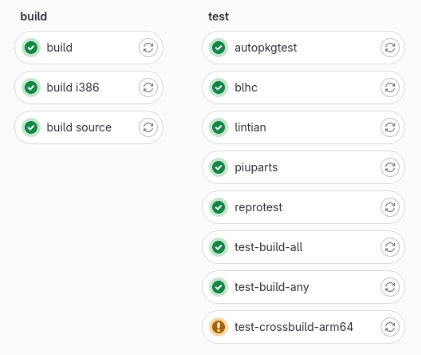
Upcoming Improvements to Salsa CI, by Santiago Ruano Rinc n Santiago started picking up the work made by Outreachy Intern, Enock Kashada (a big thanks to him!), to solve some long-standing issues in Salsa CI. Currently, the first job in a Salsa CI pipeline is the extract-source job, used to produce a debianize source tree of the project. This job was introduced to make it possible to build the projects on different architectures, on the subsequent build jobs. However, that extract-source approach is sub-optimal: not only it increases the execution time of the pipeline by some minutes, but also projects whose source tree is too large are not able to use the pipeline. The debianize source tree is passed as an artifact to the build jobs, and for those large projects, the size of their source tree exceeds the Salsa s limits. This is specific issue is documented as issue #195, and the proposed solution is to get rid of the extract-source job, relying on sbuild in the very build job (see issue #296). Switching to sbuild would also help to improve the build source job, solving issues such as #187 and #298. The current work-in-progress is very preliminary, but it has already been possible to run the build (amd64), build-i386 and build-source job using sbuild with the unshare mode. The image on the right shows a pipeline that builds grep. All the test jobs use the artifacts of the new build job. There is a lot of remaining work, mainly making the integration with ccache work. This change could break some things, it will also be important to test how the new pipeline works with complex projects. Also, thanks to Emmanuel Arias, we are proposing a Google Summer of Code 2024 project to improve Salsa CI. As part of the ongoing work in preparation for the GSoC 2024 project, Santiago has proposed a merge request to make more efficient how contributors can test their changes on the Salsa CI pipeline.

/usr-move, by Helmut Grohne In January, we sent most of the moving patches for the set of packages involved with debootstrap. Notably missing is glibc, which turns out harder than anticipated via dumat, because it has Conflicts between different architectures, which dumat does not analyze. Patches for diversion mitigations have been updated in a way to not exhibit any loss anymore. The main change here is that packages which are being diverted now support the diverting packages in transitioning their diversions. We also supported a few packages with non-trivial changes such as netplan.io. dumat has been enhanced to better support derivatives such as Ubuntu.

Miscellaneous contributions
  • Python 3.12 migration trundles on. Stefano Rivera helped port several new packages to support 3.12.
  • Stefano updated the Sphinx configuration of DebConf Video Team s documentation, which was broken by Sphinx 7.
  • Stefano published the videos from the Cambridge MiniDebConf to YouTube and PeerTube.
  • DebConf 24 planning has begun, and Stefano & Utkarsh have started work on this.
  • Utkarsh re-sponsored the upload of golang-github-prometheus-community-pgbouncer-exporter for Lena.
  • Colin Watson added Incus support to autopkgtest.
  • Colin discovered Perl::Critic and used it to tidy up some poor practices in several of his packages, including debconf.
  • Colin did some overdue debconf maintenance, mainly around tidying up error message handling in several places (1, 2, 3).
  • Colin figured out how to update the mirror size documentation in debmirror, last updated in 2010. It should now be much easier to keep it up to date regularly.
  • Colin issued a man-db buster update to clean up some irritations due to strict sandboxing.
  • Thorsten Alteholz adopted two more packages, magicfilter and ifhp, for the debian-printing team. Those packages are the last ones of the latest round of adoptions to preserve the old printing protocol within Debian. If you know of other packages that should be retained, please don t hesitate to contact Thorsten.
  • Enrico participated in /usr-merge discussions with Helmut.
  • Helmut sent patches for 16 cross build failures.
  • Helmut supported Matthias Klose (not affiliated with Freexian) with adding -for-host support to gcc-defaults.
  • Helmut uploaded dput-ng enabling dcut migrate and merging two MRs of Ben Hutchings.
  • Santiago took part in the discussions relating to the EU Cyber Resilience Act (CRA) and the Debian public statement that was published last year. He participated in a meeting with Members of the European Parliament (MEPs), Marcel Kolaja and Karen Melchior, and their teams to clarify some points about the impact of the CRA and Debian and downstream projects, and the improvements in the last version of the proposed regulation.

10 February 2024

Andrew Cater: Debian point releases - updated media for Bullseye (11.9) and Bookworm (12.5) - 2024-02-10

It's been a LONG day: two point releases in a day takes of the order of twelve or thirteen hours of fairly solid work on behalf of those doing the releases and testing.Thanks firstly to the main Debian release team for all the initial work.Thanks to Isy, RattusRattus, Sledge and egw in Cottenham, smcv and Helen closer to the centre of Cambridge, cacin and others who have dropped in and out of IRC and helped testing.

I've been at home but active on IRC - missing the team (and the food) and drinking far too much coffee/eating too many biscuits.

We've found relatively few bugs that we haven't previously noted: it's been a good day. Back again, at some point a couple of months from now to do this all over again.With luck, I can embed a picture of the Cottenham folk below: it's fun to know _exactly_ where people are because you've been there yourself.


9 February 2024

Thorsten Alteholz: My Debian Activities in January 2024

FTP master This month I accepted 333 and rejected 31 packages. The overall number of packages that got accepted was 342.

Hooray, I already accepted package number 30000.

The statistic, where I get my numbers from, started in February 2002. Up to now 81694 packages got accepted. Given that I accepted package 20000 in October 2020, would I be able to accept half of the packages that made it through NEW? Debian LTS This was my hundred-fifteenth month that I did some work for the Debian LTS initiative, started by Raphael Hertzog at Freexian. During my allocated time I uploaded: This month I was finally able to really run the test suite of bind9. I already wanted to give up with this package, but Santiago encouraged me to proceed. So, here you are fixed-Buster-version. Jessie and Stretch have to wait a bit until the dust has settled. Last but not least I also did a few days of frontdesk duties. Debian ELTS This month was the sixty-sixth ELTS month. During my allocated time I uploaded: This month I also worked on the Jessie and Stretch updates for bind9. The uploads should happen soon. I also started to work on an update for exim4. Last but not least I did a few days of frontdesk duties. Debian Printing This month I adopted: At the moment these packages are the last adoptions to preserve the old printing protocol within Debian. If you know of other packages that should be retained, please don t hesitate to ask me. But don t wait for too long, I have fun to process RM-bugs :-). This work is generously funded by Freexian! Debian Astro This month I uploaded a new upstream version of: Debian IoT This month I uploaded new upstream versions of: Other stuff This month I uploaded new upstream version of packages, did a source upload for the transition or uploaded it to fix one or the other issue:

Abhijith PA: A new(kind of) phone

I was using a refurbished Xiaomi Redmi 6 Pro (codename: sakura . I do remember buying this phone to run LineageOS as I found this model had support. But by the time I bought it (there was a quite a gap between my research and the actual purchase) lineageOS ended the suport for this device. The maintainer might ve ended this port, I don t blame them. Its a non rewarding work. Later I found there is a DotOS custom rom available. I did a week of test run. There seems lot of bugs and it all was minor and I can live with that. Since there is no other official port for redmi 6 pro at the time, I settled on this buggy DotOS nightly build. The phone was doing fine all these(3+) years, but recently the camera started showing greyish dots on some areas to a point that I can t even properly take a photo. The outer body of the phone wasn t original, as it was a refurbished, thus the colors started to peel off and wasn t aesthetically pleasing. Then there is the Location detection issue which took a while to figure out location and battery drains fast. I recently started mapping public transportation routes, and the GPS issue was a problem for me. With all these problems combined, I decided to buy a new phone. But choosing a phone wasn t easy. There are far too many options in the market. However, one thing I was quite sure of was that I wouldn t be buying a brand new phone, but a refurbished one. It is my protest against all these phone manufacturers who have convinced the general public that a mobile phone s lifespan is only 2 years. Of course, there are a few exceptions, but the majority of players in the Indian market are not. Now I think about it, I haven t bought any brand new computing device, be it phones or laptops since 2015. All are refurbished devices except for an Orange pi. My Samsung R439 laptop which I already blogged about is still going strong. Back to picking phone. So I began by comparing LineageOS website to an online refurbished store to pick a phone that has an official lineage support then to reddit search for any reported hardware failures Google Pixel phones are well-known in the custom ROM community for ease of installation, good hardware and Android security releases. My above claims are from privacyguides.org and XDA-developers. I was convinced to go with this choice. But I have some one at home who is at the age of throwing things. So I didn t want to risk buying an expensive Pixel phone only to have it end up with a broken screen and edges. Perhaps I will consider buying a Pixel next time. After doing some more research and cross comparison I landed up on Redmi note 9. Codename: merlinx. Based on my previous experience I knew it is going to be a pain to unlock the bootloader of Xiaomi phones and I was prepared for that but this time there was an extra hoop. The phone came with ROM MIUI version 13. A small search on XDA forums and reddit told unless we downgrade to 12 or so it is difficult to unlock bootloader for this device. And performing this wasn t exactly easy as we need tools like SP Flash etc. It took some time, but I ve completed the downgrade process. From there, the rest was cakewalk as everything was perfectly documented in LineageOS wiki. And ta-da, I have a phone running lineageOS. I been using it for some time and honestly I haven t come across any bug in my way of usage. One advice I will give to you if you are going to flash a custom ROM. There are plenty of videos about unlocking bootloader, installing ROMs in Youtube. Please REFRAIN from watching and experimenting it on your phone unless you figured a way to un brick your device first.

Reproducible Builds (diffoscope): diffoscope 256 released

The diffoscope maintainers are pleased to announce the release of diffoscope version 256. This version includes the following changes:
* CVE-2024-25711: Use a determistic name when extracting content from GPG
  artifacts instead of trusting the value of gpg's --use-embedded-filenames.
  This prevents a potential information disclosure vulnerability that could
  have been exploited by providing a specially-crafted GPG file with an
  embedded filename of, say, "../../.ssh/id_rsa".
  Many thanks to Daniel Kahn Gillmor <dkg@debian.org> for reporting this
  issue and providing feedback.
  (Closes: reproducible-builds/diffoscope#361)
* Temporarily fix support for Python 3.11.8 re. a potential regression
  with the handling of ZIP files. (See reproducible-builds/diffoscope#362)
You find out more by visiting the project homepage.

8 February 2024

Dirk Eddelbuettel: RcppArmadillo 0.12.8.0.0 on CRAN: New Upstream, Interface Polish

armadillo image Armadillo is a powerful and expressive C++ template library for linear algebra and scientific computing. It aims towards a good balance between speed and ease of use, has a syntax deliberately close to Matlab, and is useful for algorithm development directly in C++, or quick conversion of research code into production environments. RcppArmadillo integrates this library with the R environment and language and is widely used by (currently) 1119 other packages on CRAN, downloaded 32.5 million times (per the partial logs from the cloud mirrors of CRAN), and the CSDA paper (preprint / vignette) by Conrad and myself has been cited 575 times according to Google Scholar. This release brings a new (stable) upstream (minor) release Armadillo 12.8.0 prepared by Conrad two days ago. We, as usual, prepared a release candidate which we tested against the over 1100 CRAN packages using RcppArmadillo. This found no issues, which was confirmed by CRAN once we uploaded and so it arrived as a new release today in a fully automated fashion. We also made a small change that had been prepared by GitHub issue #400: a few internal header files that were cluttering the top-level of the include directory have been moved to internal directories. The standard header is of course unaffected, and the set of full / light / lighter / lightest headers (matching we did a while back in Rcpp) also continue to work as one expects. This change was also tested in a full reverse-dependency check in January but had not been released to CRAN yet. The set of changes since the last CRAN release follows.

Changes in RcppArmadillo version 0.12.8.0.0 (2024-02-06)
  • Upgraded to Armadillo release 12.8.0 (Cortisol Injector)
    • Faster detection of symmetric expressions by pinv() and rank()
    • Expanded shift() to handle sparse matrices
    • Expanded conv_to for more flexible conversions between sparse and dense matrices
    • Added cbrt()
    • More compact representation of integers when saving matrices in CSV format
  • Five non-user facing top-level include files have been removed (#432 closing #400 and building on #395 and #396)

Courtesy of my CRANberries, there is a diffstat report relative to previous release. More detailed information is on the RcppArmadillo page. Questions, comments etc should go to the rcpp-devel mailing list off the Rcpp R-Forge page. If you like this or other open-source work I do, you can sponsor me at GitHub.

This post by Dirk Eddelbuettel originated on his Thinking inside the box blog. Please report excessive re-aggregation in third-party for-profit settings.

Sven Hoexter: Use GitHub CLI to List all Repository Secrets

Write it down before I forget about it again:
for x in $(gh api graphql --paginate -f query='query($endCursor:String)   organization(login:"myorg")  
    repositories(first: 100, after: $endCursor, isArchived:false)  
        pageInfo  
            hasNextPage
            endCursor
         
        nodes  
            name


     ' --jq '.data.organization.repositories.nodes[].name'); do
    secrets=$(gh secret list --json name --jq '.[].name' -R "myorg/$ x "   tr '\n' ',')
    if ! [ -z "$ secrets " ]; then
        echo "$ x ,$ secrets "
    fi
done
Requests a list of all not archived repositories in a GitHub org and queries repository secrets. If we find some we output the repo name and the secrets in a comma separated list. Not real CSV, but good enough for further processing. I've to admit it's kinda beautiful what you can do with the gh cli by now. Sadly it seems the secrets are not yet available via GraphQL (or I missed it in the docs), so I just use the gh cli to do the REST calls.

Bits from Debian: DebConf24 Logo Contest Results

Earlier this month the DebConf team announced the DebConf24 Logo Contest asking aspiring artists, designers, and contributors to submit an image that would represent the host city of Busan, the host nation of South Korea, and promote the next Debian Developer Conference. The logo contest for DebConf24 received 10 submissions and garnered 354 responses with 3 proposals in particular getting very close to first place. The winning logo received 88 votes, the 2nd favored logo received 87 votes, and the 3rd most favored received 86 votes. Thank you to Woohee Yang and Junsang Moon for sharing their artistic visions. A very special Thank You to everyone who took the time to vote for our beautiful new logo! The DebConf24 Team is proud to share for preview only the winning logo for the 24th Debian Developer Conference: [DebConf24 Logo Contest Winner] 'sun-seagull-sea' by Woohee Yang This is a preview copy, other revisions will occur for sizing, print, and media... but we had to share it with you all now. :). Looking forward to seeing you all at #debconf24 in #Busan, South Korea 2024!

Reproducible Builds: Reproducible Builds at FOSDEM 2024

Core Reproducible Builds developer Holger Levsen presented at the main track at FOSDEM on Saturday 3rd February this year in Brussels, Belgium. Titled Reproducible Builds: The First Ten Years
In this talk Holger h01ger Levsen will give an overview about Reproducible Builds: How it started with a small BoF at DebConf13 (and before), then grew from being a Debian effort to something many projects work on together, until in 2021 it was mentioned in an Executive Order of the President of the United States. And of course, the talk will not end there, but rather outline where we are today and where we still need to be going, until Debian stable (and other distros!) will be 100% reproducible, verified by many. h01ger has been involved in reproducible builds since 2014 and so far has set up automated reproducibility testing for Debian, Fedora, Arch Linux, FreeBSD, NetBSD and coreboot.
More information can be found on FOSDEM s own page for the talk, including a video recording and slides.
Separate from Holger s talk, however, there were a number of other talks about reproducible builds at FOSDEM this year: and there was even an entire track on Software Bill of Materials.

7 February 2024

Reproducible Builds: Reproducible Builds in January 2024

Welcome to the January 2024 report from the Reproducible Builds project. In these reports we outline the most important things that we have been up to over the past month. If you are interested in contributing to the project, please visit our Contribute page on our website.

How we executed a critical supply chain attack on PyTorch John Stawinski and Adnan Khan published a lengthy blog post detailing how they executed a supply-chain attack against PyTorch, a popular machine learning platform used by titans like Google, Meta, Boeing, and Lockheed Martin :
Our exploit path resulted in the ability to upload malicious PyTorch releases to GitHub, upload releases to [Amazon Web Services], potentially add code to the main repository branch, backdoor PyTorch dependencies the list goes on. In short, it was bad. Quite bad.
The attack pivoted on PyTorch s use of self-hosted runners as well as submitting a pull request to address a trivial typo in the project s README file to gain access to repository secrets and API keys that could subsequently be used for malicious purposes.

New Arch Linux forensic filesystem tool On our mailing list this month, long-time Reproducible Builds developer kpcyrd announced a new tool designed to forensically analyse Arch Linux filesystem images. Called archlinux-userland-fs-cmp, the tool is supposed to be used from a rescue image (any Linux) with an Arch install mounted to, [for example], /mnt. Crucially, however, at no point is any file from the mounted filesystem eval d or otherwise executed. Parsers are written in a memory safe language. More information about the tool can be found on their announcement message, as well as on the tool s homepage. A GIF of the tool in action is also available.

Issues with our SOURCE_DATE_EPOCH code? Chris Lamb started a thread on our mailing list summarising some potential problems with the source code snippet the Reproducible Builds project has been using to parse the SOURCE_DATE_EPOCH environment variable:
I m not 100% sure who originally wrote this code, but it was probably sometime in the ~2015 era, and it must be in a huge number of codebases by now. Anyway, Alejandro Colomar was working on the shadow security tool and pinged me regarding some potential issues with the code. You can see this conversation here.
Chris ends his message with a request that those with intimate or low-level knowledge of time_t, C types, overflows and the various parsing libraries in the C standard library (etc.) contribute with further info.

Distribution updates In Debian this month, Roland Clobus posted another detailed update of the status of reproducible ISO images on our mailing list. In particular, Roland helpfully summarised that all major desktops build reproducibly with bullseye, bookworm, trixie and sid provided they are built for a second time within the same DAK run (i.e. [within] 6 hours) . Additionally 7 of the 8 bookworm images from the official download link build reproducibly at any later time. In addition to this, three reviews of Debian packages were added, 17 were updated and 15 were removed this month adding to our knowledge about identified issues. Elsewhere, Bernhard posted another monthly update for his work elsewhere in openSUSE.

Community updates There were made a number of improvements to our website, including Bernhard M. Wiedemann fixing a number of typos of the term nondeterministic . [ ] and Jan Zerebecki adding a substantial and highly welcome section to our page about SOURCE_DATE_EPOCH to document its interaction with distribution rebuilds. [ ].
diffoscope is our in-depth and content-aware diff utility that can locate and diagnose reproducibility issues. This month, Chris Lamb made a number of changes such as uploading versions 254 and 255 to Debian but focusing on triaging and/or merging code from other contributors. This included adding support for comparing eXtensible ARchive (.XAR/.PKG) files courtesy of Seth Michael Larson [ ][ ], as well considerable work from Vekhir in order to fix compatibility between various and subtle incompatible versions of the progressbar libraries in Python [ ][ ][ ][ ]. Thanks!

Reproducibility testing framework The Reproducible Builds project operates a comprehensive testing framework (available at tests.reproducible-builds.org) in order to check packages and other artifacts for reproducibility. In January, a number of changes were made by Holger Levsen:
  • Debian-related changes:
    • Reduce the number of arm64 architecture workers from 24 to 16. [ ]
    • Use diffoscope from the Debian release being tested again. [ ]
    • Improve the handling when killing unwanted processes [ ][ ][ ] and be more verbose about it, too [ ].
    • Don t mark a job as failed if process marked as to-be-killed is already gone. [ ]
    • Display the architecture of builds that have been running for more than 48 hours. [ ]
    • Reboot arm64 nodes when they hit an OOM (out of memory) state. [ ]
  • Package rescheduling changes:
    • Reduce IRC notifications to 1 when rescheduling due to package status changes. [ ]
    • Correctly set SUDO_USER when rescheduling packages. [ ]
    • Automatically reschedule packages regressing to FTBFS (build failure) or FTBR (build success, but unreproducible). [ ]
  • OpenWrt-related changes:
    • Install the python3-dev and python3-pyelftools packages as they are now needed for the sunxi target. [ ][ ]
    • Also install the libpam0g-dev which is needed by some OpenWrt hardware targets. [ ]
  • Misc:
    • As it s January, set the real_year variable to 2024 [ ] and bump various copyright years as well [ ].
    • Fix a large (!) number of spelling mistakes in various scripts. [ ][ ][ ]
    • Prevent Squid and Systemd processes from being killed by the kernel s OOM killer. [ ]
    • Install the iptables tool everywhere, else our custom rc.local script fails. [ ]
    • Cleanup the /srv/workspace/pbuilder directory on boot. [ ]
    • Automatically restart Squid if it fails. [ ]
    • Limit the execution of chroot-installation jobs to a maximum of 4 concurrent runs. [ ][ ]
Significant amounts of node maintenance was performed by Holger Levsen (eg. [ ][ ][ ][ ][ ][ ][ ] etc.) and Vagrant Cascadian (eg. [ ][ ][ ][ ][ ][ ][ ][ ]). Indeed, Vagrant Cascadian handled an extended power outage for the network running the Debian armhf architecture test infrastructure. This provided the incentive to replace the UPS batteries and consolidate infrastructure to reduce future UPS load. [ ] Elsewhere in our infrastructure, however, Holger Levsen also adjusted the email configuration for @reproducible-builds.org to deal with a new SMTP email attack. [ ]

Upstream patches The Reproducible Builds project tries to detects, dissects and fix as many (currently) unreproducible packages as possible. We endeavour to send all of our patches upstream where appropriate. This month, we wrote a large number of such patches, including: Separate to this, Vagrant Cascadian followed up with the relevant maintainers when reproducibility fixes were not included in newly-uploaded versions of the mm-common package in Debian this was quickly fixed, however. [ ]

If you are interested in contributing to the Reproducible Builds project, please visit our Contribute page on our website. However, you can get in touch with us via:

6 February 2024

Louis-Philippe V ronneau: Montreal's Debian & Stuff - February 2024

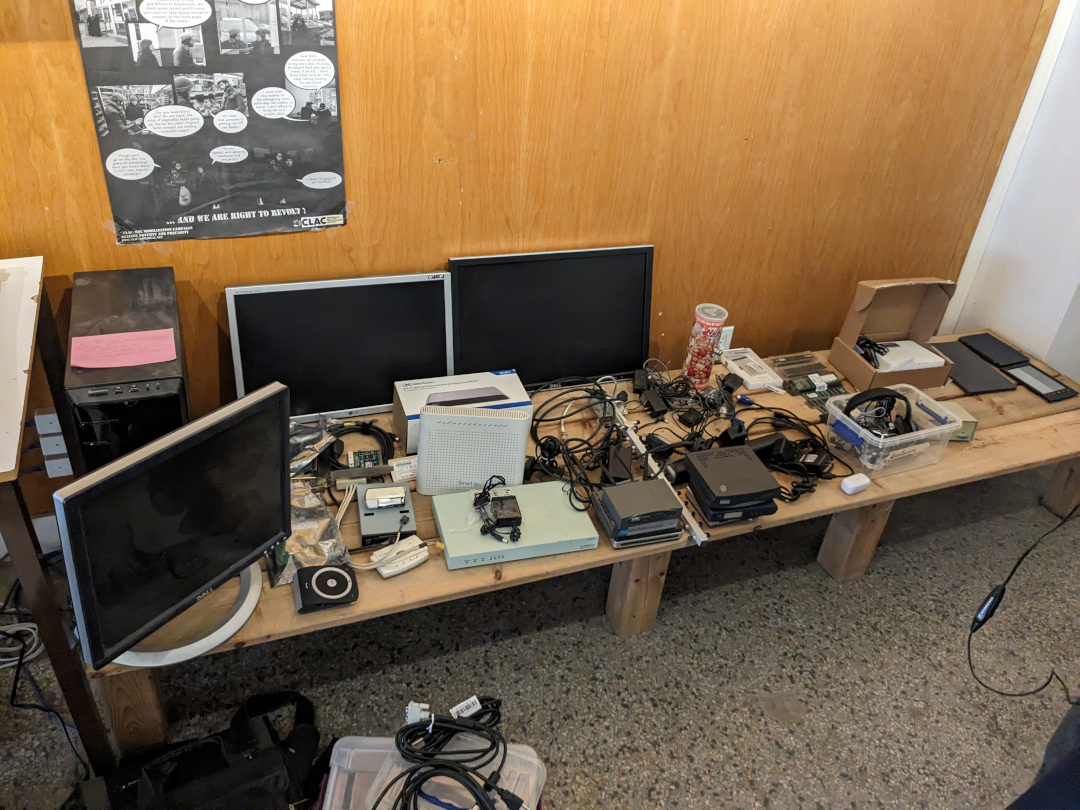
New Year, Same Great People! Our Debian User Group met for the first of our 2024 bi-monthly meetings on February 4th and it was loads of fun. Around twelve different people made it this time to Koumbit, where the meeting happened. As a reminder, our meetings are called "Debian & Stuff" because we want to be as open as possible and welcome people that want to work on "other stuff" than Debian. Here is what we did: pollo: LeLutin: mjeanson: lavamind: viashimo: tvaz & tassia: joeDoe: anarcat: Pictures I was pretty busy this time around and ended up not taking a lot of pictures. Here's a bad one of the ceiling at Koumbit I took, and a picture by anarcat of the content of his boxes of loot: A picture of the ceiling at Koumbit The content of anarcat's boxes of loot

Robert McQueen: Flathub: Pros and Cons of Direct Uploads

I attended FOSDEM last weekend and had the pleasure to participate in the Flathub / Flatpak BOF on Saturday. A lot of the session was used up by an extensive discussion about the merits (or not) of allowing direct uploads versus building everything centrally on Flathub s infrastructure, and related concerns such as automated security/dependency scanning. My original motivation behind the idea was essentially two things. The first was to offer a simpler way forward for applications that use language-specific build tools that resolve and retrieve their own dependencies from the internet. Flathub doesn t allow network access during builds, and so a lot of manual work and additional tooling is currently needed (see Python and Electron Flatpak guides). And the second was to offer a maybe more familiar flow to developers from other platforms who would just build something and then run another command to upload it to the store, without having to learn the syntax of a new build tool. There were many valid concerns raised in the room, and I think on reflection that this is still worth doing, but might not be as valuable a way forward for Flathub as I had initially hoped. Of course, for a proprietary application where Flathub never sees the source or where it s built, whether that binary is uploaded to us or downloaded by us doesn t change much. But for an FLOSS application, a direct upload driven by the developer causes a regression on a number of fronts. We re not getting too hung up on the malicious developer inserts evil code in the binary case because Flathub already works on the model of verifying the developer and the user makes a decision to trust that app we don t review the source after all. But we do lose other things such as our infrastructure building on multiple architectures, and visibility on whether the build environment or upload credentials have been compromised unbeknownst to the developer. There is now a manual review process for when apps change their metadata such as name, icon, license and permissions which would apply to any direct uploads as well. It was suggested that if only heavily sandboxed apps (eg no direct filesystem access without proper use of portals) were permitted to make direct uploads, the impact of such concerns might be somewhat mitigated by the sandboxing. However, it was also pointed out that my go-to example of Electron app developers can upload to Flathub with one command was also a bit of a fiction. At present, none of them would pass that stricter sandboxing requirement. Almost all Electron apps run old versions of Chromium with less complete portal support, needing sandbox escapes to function correctly, and Electron (and Chromium s) sandboxing still needs additional tooling/downstream patching to run inside a Flatpak. Buh-boh. I think for established projects who already ship their own binaries from their own centralised/trusted infrastructure, and for developers who have understandable sensitivities about binary integrity such such as encryption, password or financial tools, it s a definite improvement that we re able to set up direct uploads with such projects with less manual work. There are already quite a few applications including verified ones where the build recipe simply fetches a binary built elsewhere and unpacks it, and if this already done centrally by the developer, repeating the exercise on Flathub s server adds little value. However for the individual developer experience, I think we need to zoom out a bit and think about how to improve this from a tools and infrastructure perspective as we grow Flathub, and as we seek to raise funds for different sources for these improvements. I took notes for everything that was mentioned as a tooling limitation during the BOF, along with a few ideas about how we could improve things, and hope to share these soon as part of an RFP/RFI (Request For Proposals/Request for Information) process. We don t have funding yet but if we have some prospective collaborators to help refine the scope and estimate the cost/effort, we can use this to go and pursue funding opportunities.

Next.

Previous.