Mike Hommey: eSATA FTW
- usb: Timing buffered disk reads: 84 MB in 3.01 seconds = 27.89 MB/sec
- firewire: Timing buffered disk reads: 112 MB in 3.00 seconds = 37.33 MB/sec
- eSATA: Timing buffered disk reads: 216 MB in 3.01 seconds = 71.88 MB/sec
This last couple of days I've been dedicated making Gnus fresher.
I've decided to give a whirl on Gravatar support. I already tried the
gravatar.el lying on the Interweb, but well, it was crap: it used wget to
fetch pictures, therefore was totally synchronous. Reading each mail was
slower. The cache did not even have TTL, as far as I recall.
So, I've now wrote gravatar.el implementing the Gravatar API. Asynchronously
of course. With cache, TTL, etc. Perfect. :-)
Then I've composed gnus-gravatar.el, implementing a washing function adding
Gravatar for From field and/or Cc/To fields, like done for picons.
As I was expecting, the patch was badly received by the GNU guys, which
start talking about thinks like external resources, privacy, non-free
software, etc. Boring.
Fortunately, Lars allowed me to push the patch in git so everybody can give
it a try. I'm now waiting for feedbacks in order to know if I will have to
maintain this patch outside Gnus, or not.
Here's the mandatory screen-shot.
I finally found the time to port the scripts
generating these statistics to use the Ultimate Debian
Database (and especially its bugs webinterface). Parsing the HTML output of bts.turmzimmer.net was
quite insane and slow, but it worked... kind of. However it's now done:
The script now uses not that insane SQL queries and UDD, of which I have
been told has more accurate numbers as bts.turmzimmer.net, which uses to
the best of my knowledge the obsoleted ldap gateway.
Well, so much for the talk, here are the actual numbers, created with
the new script:
| In Total: | 799 |
|---|---|
| Affecting Squeeze: | 429 |
| Squeeze only: | 110 |
| Remaining to be fixed in Squeeze: | 319 |
| Pending in Squeeze: | 22 |
|---|---|
| Patched in Squeeze: | 57 |
| Duplicates in Squeeze: | 35 |
| Can be fixed in a security Update: | 12 |
| Contrib or non-free in Squeeze: | 18 |
| Otherwise fixed in Squeeze: | 40 |
Squeezereleased. However, with the view of the Release Managers, 260 need to be dealt with for the release to happen. You'll note, that the numbers got quite higher. Sorry, for that, but bts.turmzimmer.net seems to be kind of buggy :( You'll also note, that there is no longer a row for
claimedand
fixed in delayedbugs, as UDD doesn't support these numbers as of now. But I think you'll agree with me, that having more accurate numbers is better than having these rows.
Brian announced it on r-help and r-sig-finance
and I have since updated the
R/Finance website and
Call for Papers page.
And as David Smith already outblogged me about it,
without further ado our Call for Paper for next spring's R/Finance conference:
Call for Papers: R/Finance 2011: Applied Finance with R
April 29 and 30, 2011
Chicago, IL, USA
The third annual R/Finance conference for applied finance using R will be held this spring in Chicago, IL, USA on April 29 and 30, 2011. The two-day conference will cover topics including portfolio management, time series analysis, advanced risk tools, high-performance computing, market microstructure and econometrics. All will be discussed within the context of using R as a primary tool for financial risk management, portfolio construction, and trading. One-page abstracts or complete papers (in txt or pdf format) are invited to be submitted for consideration. Academic and practitioner proposals related to R are encouraged. We welcome submissions for full talks, abbreviated "lightning talks", and for a limited number of pre-conference (longer) seminar sessions. Presenters are strongly encouraged to provide working R code to accompany the presentation/paper. Data sets should also be made public for the purposes of reproducibility (though we realize this may be limited due to contracts with data vendors). Preference may be given to presenters who have released R packages. Please send submissions to: committee at RinFinance.com. The submission deadline is February 15th, 2011. Early submissions may receive early acceptance and scheduling. Submissions will be evaluated and submitters notified via email on a rolling basis. Determination of whether a presentation will be a long presentation or a lightning talk will be made once the full list of presenters is known. R/Finance 2009 and 2010 included attendees from around the world and featured keynote presentations from prominent academics and practitioners. 2009-2010 presenters names and presentations are online at the conference website. We anticipate another exciting line-up for 2011 including keynote presentations from John Bollinger, Mebane Faber, Stefano Iacus, and Louis Kates. Additional details will be announced via the conference website as they become available. For the program committee:
Gib Bassett, Peter Carl, Dirk Eddelbuettel, Brian Peterson,So see you in Chicago in April!
Dale Rosenthal, Jeffrey Ryan, Joshua Ulrich
The unofficial rc bug tracker
currently knows about the following bugs:
| In Total: | 371 |
|---|---|
| Affecting Squeeze: | 281 |
| Squeeze only: | 66 |
| Remaining to be fixed in Squeeze: | 215 |
| Pending in Squeeze: | 14 |
|---|---|
| Patched in Squeeze: | 40 |
| Duplicates in Squeeze: | 23 |
| Contrib or non-free in Squeeze: | 7 |
| Claimed in Squeeze: | 1 |
| Delayed in Squeeze: | 3 |
| Can fixed in a security Update: | 12 |
| Otherwise fixed in Squeeze: | 14 |
Squeezereleased. However, with the view of the Release Managers, 235 need to be dealt with for the release to happen. Please see my older post for an explanation of the different numbers.
Hello Planet Debian,
Since everyone seems to like sharing and hearing about travel plans, I took the initiative of creating a Debian group on Tripit*.
To join, you need a @debian.org email and click on: http://www.tripit.com/group/join/debian.
Cheers
*I realize Tripit is not free (as in freedom), but it s not like there are comparable free alternatives.
As I'm currently attending the EUgridPMA meeting in Zagreb I thought I'd share a bit of this project I've been working on for the past year: the TCS eScience project.
In the scientific world lots of calculations are performed on distributed computing platforms known as grid. Because users of other institutions will be using your hardware, authentication is needed and this problem has been solved with x.509 personal certificates. The problem however, is that these certificates of course have to be issued by some CA. Currently in Europe alone there are over 40 active CA's, even multiple per country, dedicated to this job. They are accredited through the EUgridPMA which meets regularly. For scientists, it's often cumbersome to obtain a certificate: find your local CA, present an ID (probably in person), and sometime later receive your certificate. The process can take days or even weeks. Scientists are not interested in CA's but just want to practice science.
Our solution is a central web portal where users can request a certificate and have it delivered in minutes. This leverages the fact that identities of scientists normally have already been vetted at their home institution: users log in to the portal via federated login. Their home institution passes a special attribute that declares "Yes, we have really seen photo ID of this person and the name is correct". This attribute must of course not be passed for guests or test users or role accounts. However, it may still be easy to mass-provision it. In the Netherlands for example, the employer is required by law to verify the identity of each employee, so all employees can be automatically assigned the attribute.
After logging in and uploading (or generating) a csr, the request is passed in the back end to the Comodo API. This also means that we do not need to perform the complex operations of running an online CA (with hardware crypto devices, crl's, etc.). The use of Comodo is part of the same deal as the TERENA Certificate Service for host SSL certificates. The Comodo API responds within two minutes with the certificate which the user can download.
Currently 10 European countries are involved with the project (nl no se fi dk at cz it fr be), and more have shown interest. The certificates we issue have been accredited by the EUgridPMA so can be used on the grid. A separate but similar service is being set up for 'regular' personal certificates for the academic community, e.g. for s/mime usage. More details are in the presentation and paper by portal software developers Henrik and Thomas at the most recent TNC.
I guess it's time again to push for another band. This time I present you Garbage. I love them, but one has to be careful in what mood one is when listening to them; it's possible that they move you in a direction you don't feel comfortable with at that time.
My comment form on my blog contains the following, right above the
<textarea> element where the text can be entered:
<!-- To any spammers out there: Any submission to this form is moderated: this means that only I will see your URLs, and I will not visit them nor link to them. Thus, you can stop wasting our collective time. -->That, combined with the fact that my blog comment system is a home-grown thing, has meant that I haven't seen a single spammy comment anymore in months. The same comment form has shown the same thing since ages in a <p> element right above the <form> element, but that apparently was missed by some spammers. Since adding the above comment, however, I've not received a single spam submission to that form in over a year. Who says spammers are stupid?
Some weeks ago, I've started to change documentation structure of Gammu to move from separate documents here and there into one comprehensive documentation which would cover it all. As a tool to do this I've chosen Sphinx, simply because I felt most convenient with the format and outputs it provides.
So far the SMSD documentation has been converted from various places and formats, but it also opened up a question - how to deal with translations? So far we used po4a to translate man pages, however using it for generated man pages is slightly complicated (there are some macros which po4a does not understand and it seems to break encoding on the way).
Translating whole new documentation is something what is unlikely to be finished, especially considering fact, that the only real existing translation so far is Czech which was done by me.
For now I decided to keep old translated man pages and postpone the decision, but considering current situation, I will most likely just drop the translations for man pages unless I find some good solution how to translate Sphinx documents (po4a should be able to do that, but it will probably need some tuning).
Filed under:
Coding
Gammu
Wammu
1 comments
As this year's admin, I wrote up the following summary which has now been
posted at the R site in the appropriate slot. My thanks to
this year's students, fellow mentors and everybody else who helped to make it
happen.
f:R^m -> R^n, through Automatic Differentiation (AD). Numerical evaluation of derivatives has widespread uses in many
fields. rdx will implement two modes for the computation of derivatives, the Forward and Reverse modes of AD, combining
which we can efficiently compute Jacobians and Hessians. Higher order derivatives will be evaluated through Univariate
Taylor Propagation.
Delivered:
Two packages
radx: forward automatic differentiation in R and
tada: templated automatic differentiation in C++ were created; see
this blog post for details.
Last modified: Wed Sep 22 19:39:43 CDT 2010
As I already wrote too many times, I've started to use Gnus 6 months ago,
and never looked back.
At that time, I joined the ding mailing list in order to ask some dumb
questions and, once, send a patch. There were very low activity on that
list.
Until Lars, the original Gnus author, came back.
Three weeks ago, he started to wrote a new wash function to render HTML
mails properly, with pictures. It's named gnus-html', and is (for now)
based on w3m (but not on emacs-w3m, which is not part of Emacs).
Last week, I've sent a set of patches to replace the usage of curl by the
standard url-retrieve' function to fetch images, plus various enhancement.
It seems that my work was good enough that Lars offered me write access to
the git repository. I can therefore mess up the Gnus entirely. Hurrah!
I've continued to work on gnus-html' and recently merged a set of patches
improving image retrieval (which is now done in parallel) and starting to
use url-cache' to cache image for a defined period of time. Of course, I
found a bunch of tiny bug and special case while reading RSS feeds and
various HTML mails, and fixed them all along.
Lars added a libxml binding for Emacs 24, providing the html-parse-string'
function. His future plan seems to be the abandon of w3m in favor of a
native parsing via libxml to render HTML, and therefore, HTML mails.
I should also mention the new nnimap' back-end; Gnus has been designed to
read NNTP newsgroups, and not mails. Consequently, it had a very poor
behaviour when used with a back-end such has IMAP.
Lars took a week to rewrite entirely our dear nnimap' back-end, and make it
act in a more expected way. There's still a bunch of bug and code to write,
but it is at least usable and seems faster than the old code.
Last thing I did was to rewrite the icon support in the group buffer. When I
started to use Gnus, I was curious and tried to configure this. I never
managed to make it work, and now know and understand why it was broken. So I
ended rewriting entirely, and now it works. I never though I would
understand, fix, and commit this code when reading the Gnus documentation
this winter, but hell yeah, I did.
Now I've still several little project to improve things in all sort of area.
We'll see what I'll do next. :-)
Thank you for your message. This is an automated reply.I have been thinking of writing one myself, being I am also on sabbatical but thought I might be a bit more honest and forthcoming. This is what I have so far come up with:
I am on sabbatical leave and unable to reply to my email. For all matters concerning the __________________________ Department of __________ Contact ____________ .
Thank you for your patience,
Professor
Thank you for your message. This is an automated reply. I am on sabbatical leave and while I am able to reply to my email, in fact, I have a heck of a lot more time compared to when I teach, it is customary to write a message like this and claim otherwise. However, being on leave does relieve you of (most) all department responsibilities. And given the grueling pace of academic jobs and the contemporary burden of email avalanches we all suffer from, I am taking the license (the sabbatical license) to say: 1) I may never get back to you 2) I may but it may take longer than usual 3) honestly I suffer from MEAD (Massive Email Anxiety Disorder) and hate it when people don t respond to me, so I will likely get back to you but don t you get MEAD if I fail to do so. Thanks for your patience,
Gabriella Coleman
On leave 2010-2011
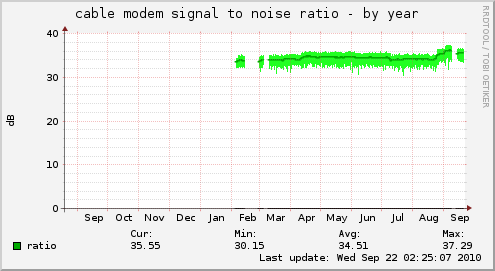
Usually I like to monitor as much as possible. but unfortunately my cable provider does not allow to access the cable modem via SNMP, so I had to find a different way to retrieve at least some basic information. After a bit of googling I figured out how to access the web interface of the Scientific Atlanta modems. The model here is a EPC2203 - seems to work for various models, though.
These modems do not only provide access to the traffic within the cable network on their internal networking port (ever tried tcpdump on that?), but they also have their own IP (192.168.100.1). To be able to access the modem you should add something like
post-up ip addr add 192.168.100.2/31 dev extern0 trueto the configuration of the interface which is connected to the cable modem. Make sure you're not using the same network internally - or find a proper way to handle it. If you access http://192.168.100.1/ then, you'll be able to retrieve some basic information form the modem. If you google a bit longer, you might even be able to do more stuff! But to monitor the power levels and signal-to-noise ratio, this is all we need. I'm using Munin usually, as the web interface is just much easier to setup than the collectd CGI (hint, hint!!). Drop the following two scripts into the Munin plugins folder. wget, sed and grep is all they need, so it should be easy to get them working. cablemodem signalnoise.sh
#!/bin/sh # Copyright (c) 2010 Bernd Zeimetz <bzed@debian.org> # # Permission to use, copy, modify, and/or distribute this software for any # purpose with or without fee is hereby granted, provided that the above # copyright notice and this permission notice appear in all copies. # # THE SOFTWARE IS PROVIDED "AS IS" AND THE AUTHOR DISCLAIMS ALL WARRANTIES # WITH REGARD TO THIS SOFTWARE INCLUDING ALL IMPLIED WARRANTIES OF # MERCHANTABILITY AND FITNESS. IN NO EVENT SHALL THE AUTHOR BE LIABLE FOR # ANY SPECIAL, DIRECT, INDIRECT, OR CONSEQUENTIAL DAMAGES OR ANY DAMAGES # WHATSOEVER RESULTING FROM LOSS OF USE, DATA OR PROFITS, WHETHER IN AN # ACTION OF CONTRACT, NEGLIGENCE OR OTHER TORTIOUS ACTION, ARISING OUT OF # OR IN CONNECTION WITH THE USE OR PERFORMANCE OF THIS SOFTWARE. PATH=/bin:/sbin:/usr/bin:/usr/sbin export PATH if [ "$1" = "config" ]; then echo graph_title cable modem signal to noise ratio echo 'graph_args --base 1000' echo 'graph_vlabel dB' echo 'graph_category network' echo 'graph_info This graph shows the signal to noise ratio of the Scientific-Atlanta cable modem.' echo "signalnoise.label ratio" echo "signalnoise.info Signal to noise ratio" echo 'signalnoise.draw LINE2' echo 'signalnoise.type GAUGE' exit 0 fi wget -q -O - http://192.168.100.1/system.asp \ grep 'Signal to Noise' \ sed 's,.* ,signalnoise.value ,;s, dB.*,,'cablemodem powerlevel.sh
#!/bin/sh # Copyright (c) 2010 Bernd Zeimetz <bzed@debian.org> # # Permission to use, copy, modify, and/or distribute this software for any # purpose with or without fee is hereby granted, provided that the above # copyright notice and this permission notice appear in all copies. # # THE SOFTWARE IS PROVIDED "AS IS" AND THE AUTHOR DISCLAIMS ALL WARRANTIES # WITH REGARD TO THIS SOFTWARE INCLUDING ALL IMPLIED WARRANTIES OF # MERCHANTABILITY AND FITNESS. IN NO EVENT SHALL THE AUTHOR BE LIABLE FOR # ANY SPECIAL, DIRECT, INDIRECT, OR CONSEQUENTIAL DAMAGES OR ANY DAMAGES # WHATSOEVER RESULTING FROM LOSS OF USE, DATA OR PROFITS, WHETHER IN AN # ACTION OF CONTRACT, NEGLIGENCE OR OTHER TORTIOUS ACTION, ARISING OUT OF # OR IN CONNECTION WITH THE USE OR PERFORMANCE OF THIS SOFTWARE PATH=/bin:/sbin:/usr/bin:/usr/sbin export PATH if [ "$1" = "config" ]; then echo graph_title cable modem power level echo 'graph_args --base 1000' echo 'graph_vlabel dBmV' echo 'graph_category network' echo 'graph_info This graph shows receive and transmit power levels of the Scientific-Atlanta cable modem.' echo "receive.label receive" echo "receive.info Receive power level" echo 'receive.draw LINE2' echo 'receive.type GAUGE' echo "transmit.label transmit" echo "transmit.info Transmit power level" echo "transmit.draw LINE2" echo "transmit.type GAUGE" exit 0 fi wget -q -O - http://192.168.100.1/system.asp grep dBmV \ sed -e 's,.* ,,;s, dBmV.*,,' \ -e '1s/^/receive.value /' \ -e '2s/^/transmit.value /'
Guess you can easily figure out when I had issues with my cable connection.
This morning, my laptop was stolen from my parked car while I was jogging. I do not want to make a big deal out of it.
Still, even though I am sure it was not targetted at my data (three other people at least were reporting similar facts in the same area), and the laptop's disk will probably just be reformatted, I am trying to limit the possible impact of my cryptographic identification being in somebody else's hands.
GPG makes it easy: I had on that machine just my old 1024D key, so it is just matter of generating a revocation certificate. I have done that, and uploaded it to the SKS keyservers - Anyway, here is my revocation certificate:

-----BEGIN PGP PUBLIC KEY BLOCK----- Version: GnuPG v1.4.10 (GNU/Linux) Comment: A revocation certificate should follow iHIEIBEIADIFAkyaOZwrHQJBIGNvbXB1dGVyIGNvbnRhaW5pbmcgdGhpcyBrZXkg d2FzIHN0b2xlbgAKCRDYDvNai7UnrzWAAKC34eF76JQjxrZqSjNwcC0dU/5VbACg gMIMmYg91Sl3y8KsZXdGj/rV7UE= =rdlT -----END PGP PUBLIC KEY BLOCK-----But What worries me more is access to the computers my ssh key works for. Yes, the ssh key uses a nontrivial passphrase, but still SSH keys cannot be revoked (and this makes sense, as SSH should not add the delay, or potential impossibility, to check with a remote infrastructure whenever you want to start a session). So, I generated a new key (and stored it at ~/.ssh/id_rsa.new / ~/.ssh/id_rsa.new.pub) and came up with this snippet:
$ OLDKEY=xyHywJuHD3nsfLh03G1TqUEBKSj6NlzMfB1T759haoAQ $ for host in $(cat .ssh/known_hosts cut -f 1 -d \ cut -f 1 -d , sort uniq); do echo == $host ssh-copy-id -i .ssh/id_rsa.new.pub $host && ssh $host "perl -n -i -e 'next if /$OLDKEY/;print' .ssh/authorized_keys" done
/[, ]/, but... I didn't think of that. Besides, the savings would be just for academic purposes ;-)
In the realm of Real Databases, PostgreSQL has made their
long-awaited 9.0 release. It comes with a bunch of interesting new
features, not the least of which is builtin replication, and another
bunch of interesting improvements to already-existing features.
My personal favourite:
LISTEN/NOTIFY now support a payload. Previously, I'd done things like
storing a changelog in a table and then calling NOTIFY, or hackery with
a NOTIFY string that included the primary key encoded somehow, resulting
in the need for many LISTEN strings. But this is just so much
easier, and much more, well, reasonable.
Also:
EXPLAIN enhancements. The output is now available in JSON, XML, or YAML format, and includes buffer utilization and other data not previously available.Cute.
Today, while writing a mail, I just remembered that I happened to be a
friend of Ren
Cougnenc. I remembered the numerous "petits midis" we made
together in his flat in Antony, reinventing the world while I was
supposed to be working and was instead drinking beers with him all
afternoon long.
It's already fourteen years since you decided that this world as not
meant for you, Ren . Crap.
Bizzzz, mon Ren .
Folks, if you can read or translate French, just read the nice
pieces collected by St phane. That sums up Ren fairly well.
Next.