Search Results: "zed"

28 January 2013

John Sullivan: FOSDEM

I'll be at FOSDEM again this year, arriving in Brussels on Thursday 31st and leaving on Tuesday 5th. I'll be speaking on Sunday in the legal issues devroom at 10:00. If you will be there and want to meet up, let me know. I may be trying to watch the Super Bowl from there, a plan that didn't quite work out last year but seems more likely this year. State of the GNUnion FSF licensing policy challenges in 2013 This talk will cover the main challenges facing the Free Software Foundation's Licensing and Compliance lab in 2013, and will invite discussion of the FSF's work and policies in this area. We'll explore:

27 January 2013

Jan Wagner: Fixing muninlite for up interfaces without link

Usually I'm monitoring stuff with Icinga (Nagios in the past). But for my small network, I primary needed monitoring of bandwidth. In our commercial environment we are using a closed source software for accounting traffic. There is also a license for testing purpose with a reduced number of sensors available. But I'm neither running windows in this network nor feeling happy with this. Cacti is a bit bloated for this small network and zabbix is (caused by what?) removed in wheezy, beside that I'm not getting the concept behind it. So I thought I could give munin a try and on the first view it doesn't look so bad. Monitoring my half dozens openwrt devices works like a charm by installing muninlite just the package. One central part of the network is a QNAP TS-459 Pro+, hosting a BackupPC and TimeMachine service, proving SMB/AFS data store and running SqueezeBox Server for another half dozen streaming devices. Unfortunately there is no optware package to provide a munin node. So I just copied the shell script of muninlite and the xinet config over from an openwrt device. At first it looked not bad, but than munin wasn't able to collect the data. After a while I realized, that munin was failing when collecting the network informations. A look into the muninlite script revealed that it was failing when trying to discover the interface speed of eth1 via ethtool. In my setup the QNAP is just connected with with one network interface, the second one is unconnected. Unfortunately all network interfaces on QNAP devices are up and therefore listed in /proc/net/dev where muninlite is discovering the network interfaces:
[~] # grep '^ *\(ppp\ eth\ wlan\ ath\ ra\ ipsec\ tap\ br-\)\([^:]\)\ 1,\ :' /proc/net/dev   cut -f1 -d:   sed 's/ //g
> s/\-/_/g'
eth1
eth0
Let's look into it:
[~] # ethtool eth0  grep Speed:
    Speed: 1000Mb/s
[~] # ethtool eth0  grep "Link detected:"
    Link detected: yes
[~] # ethtool eth1  grep Speed:
    Speed: Unknown! (65535)
[~] # ethtool eth1  grep "Link detected:"
    Link detected: no
Maybe you see .. the interface eth1 is up but has no link, so there is no speed negotiated and muninlite is failing. Thus I hacked the scripted and now it's working like a charme.
<notextile><figure class="code"><figcaption> (muninlite_fix-unused-up_interface.diff) download</figcaption>
1
2
3
4
5
6
7
8
9
10
11
12
13
14
15
16
17
18
19
20
21
22
23
24
25
26
27
28
29
30
31
32
33
34
35
36
37
38
39
40
41
42
43
44
45
46
47
48
49
50
51
--- /opt/sbin/munin-node.orig	2013-01-27 15:13:51.869007214 +0100
+++ /opt/sbin/munin-node	2013-01-27 16:11:20.536006950 +0100
@@ -133,7 +133,7 @@
   if [ -n "$(which ethtool)" ]; then
 	if [ -x "$(which ethtool)" ]; then
   		if ethtool $1   grep -q Speed; then
-    			MAX=$(($(ethtool $1   grep Speed   sed -e 's/[[:space:]]\ 1,\ / /g' -e 's/^ //' -e 's/M.*//'   cut -d\  -f2) * 1000000))
+    			MAX=$(($(ethtool $1   grep Speed   sed -e 's/[[:space:]]\ 1,\ / /g' -e 's/^ //' -e 's/M.*//'   sed -e 's/Unknown\!/0/'   cut -d\  -f2) * 1000000))
     			echo "up.max $MAX"
     			echo "down.max $MAX"
 		fi
@@ -535,19 +535,31 @@
     for INTER in $(grep '^ *\(ppp\ eth\ wlan\ ath\ ra\ ipsec\ tap\ br-\)\([^:]\)\ 1,\ :' /proc/net/dev   cut -f1 -d:   sed 's/ //g
 s/\-/_/g');
     do
-      INTERRES=$(echo $INTER   sed 's/\./VLAN/')
-      RES="$RES if_$INTERRES"
-      eval "fetch_if_$ INTERRES ()   fetch_if $INTER $@;  ;"
-      eval "config_if_$ INTERRES ()   config_if $INTER $@;  ;"
+      if [ -n "$(which ethtool)" ]; then
+        if [ -x "$(which ethtool)" ]; then
+          if [ -n "$(ethtool $INTER   grep 'Link detected: yes')" ]; then
+            INTERRES=$(echo $INTER   sed 's/\./VLAN/')
+            RES="$RES if_$INTERRES"
+            eval "fetch_if_$ INTERRES ()   fetch_if $INTER $@;  ;"
+            eval "config_if_$ INTERRES ()   config_if $INTER $@;  ;"
+          fi
+        fi
+      fi
     done
   elif [ "$PLUG" = "if_err_" ]; then
     for INTER in $(grep '^ *\(ppp\ eth\ wlan\ ath\ ra\ ipsec\ tap\ br-\)\([^:]\)\ 1,\ :' /proc/net/dev   cut -f1 -d:   sed 's/ //g
 s/\-/_/g');
     do
-      INTERRES=$(echo $INTER   sed 's/\./VLAN/')
-      RES="$RES if_err_$INTERRES"
-      eval "fetch_if_err_$ INTERRES ()   fetch_if_err $INTER $@;  ;"
-      eval "config_if_err_$ INTERRES ()   config_if_err $INTER $@;  ;"
+      if [ -n "$(which ethtool)" ]; then
+        if [ -x "$(which ethtool)" ]; then
+          if [ -n "$(ethtool $INTER   grep 'Link detected: yes')" ]; then
+            INTERRES=$(echo $INTER   sed 's/\./VLAN/')
+            RES="$RES if_err_$INTERRES"
+            eval "fetch_if_err_$ INTERRES ()   fetch_if_err $INTER $@;  ;"
+            eval "config_if_err_$ INTERRES ()   config_if_err $INTER $@;  ;"
+          fi
+        fi
+      fi
     done
   elif [ "$PLUG" = "netstat" ]; then
     if netstat -s >/dev/null 2>&1; then
</figure></notextile>

Russell Coker: LCA 2012

LCA 2013 [1] is starting so it seems like time to finish my write-up of LCA 2012. As usual it was a great conference, although I got sick immediately after getting there which reduced my ability to attend. Android A major unofficial theme of the conference was Android. Most delegates seemed to have Android phones, the Samsung Galaxy S and Galaxy Nexus seemed to be the most popular phones. Many delegates had two or more phones for development purposes. A large portion of the casual conversation at the conference concerned Android. There were a couple of really interesting talks about the Serval mesh networking project [2] which involves Android phones running in ad-hoc Wifi mode for long range communication without any official base station. Serval allows transferring messages, pictures, and voice calls. If you need to get longer range you can mount one phone in a convenient place and other phones will decide to use it as a relay there is no need to have a dedicated relay device (such as a mobile phone tower or Wifi access point). Serval is supposed to work with Wifi access points but due to Java not exposing some networking details to the higher levels of software the code that was available at the time of the conference didn t support networks other than a /24, which meant that the conference Wifi network didn t work with Serval. As an aside most people at the conference who installed Serval were using a development version that was newer than the version on the Android market. I can t remember what the extra features were though. Serval was designed for emergency situations, it can be installed on phones (and pushed to other phones via Wifi) in the field and allow communications when the infrastructure is broken. Also it s designed with some aim of circumventing censorship which among other things means that there are no facilities for tracking use. I think it would be really handy to be able to in some way track viewing of or interest in images that are transported via the mesh (maybe by something similar in concept to Google +1). Then in a crowd sourced environment people who take photos would be encouraged in their work by audience appreciation. One thing that interests me is the possibility of using Serval on a cruise ship. A cruise ship is an environment where mobile phone calls are unreasonably expensive, cabin phones aren t much use (who pays for a cruise and hangs out in their cabin?), and where there is usually a Wifi network installed. If a ship has a single bridged Wifi network that allows connecting to Wifi before authenticating for Internet access (which is probably the common case) then you could transport VOIP over that network without paying and without incurring any expense on the cruise company. One of the Serval developers assured me that this should be possible, of course a cruise ship with 3,000 passengers probably doesn t use a /24 for their Wifi so the current versions of Serval won t work At the geek my dinner event (a party where everyone brought $20 of food/drink which was cooked by volunteers) an artist showed me some art work that she created on her Samsung Galaxy Note (which was the biggest phone on sale at the time), it was very impressive. She recommended Picasso Mirror Draw, Sketch Free, Sketch Book Mobile Express, and Freenote as free graphical programs for Android. Samsung has a Noteworthy Project advertising campaign based on the artistic uses of the Galaxy Note which has some good videos of artists [3]. Chris Neugebauer and Paris Buttfield-Addison gave an informative and amusing talk about Android UI development (this link has the video) [4]. It s a pity that I missed seeing that one live but fortunately the video is of high quality. Accommodation picture of women cleaning As I ve become interested in Sociology I couldn t help but notice the pictures that accompanied the rules about cleaning the dormitory (which were displayed over the kitchen sink), it seems to imply that cleaning is only women s work. I wonder whether the people who created that poster deliberately chose pictures of women or whether they just chose the first available pictures from a collection of stock photos. Someone who was near my dorm room seemed to not realise how their alarm impacts other people. For the first two mornings I was woken repeatedly after 6AM by someone who was pressing the snooze button on their alarm. When sleeping in close proximity to other people the reasonable options involve some combination of having no loud alarm, immediately turning the alarm off and getting up (not pressing snooze to have it go off repeatedly), and setting the alarm for a time when almost everyone wants to get up (EG 1 hour before the first session). Networking Chris Neugebauer organised the Unprofessional Delegates Networking Session which was a great event. It was an event held at the same time as the Professional Delegates Networking Session with the difference being that you had to pay $5 for food and there was no free drink. A lot of great people attended the UPDNS so I m glad I don t pay for the PDNS. It seems that we won t have a UPDNS this year unfortunately. Conclusion LCA is always great fun and very educational. I recommend attending every year.

26 January 2013

Vipin Nair: Final Project (1/N): Introducing Simple Realtime Notification Service

I am building a realtime notification system as my final semester project. The end product is a simple API that can be used by third party to push real time notification to client applications running on multiple platforms that include browsers and devices. Ideally, if your device can connect to the internet, it should be able to receive notifications. The non functional system requirements are pretty ambitious with scalability, availability and latency guarantees being the most important. Maybe little too ambitious for someone like me but then I will learn a lot in this process and its more fun when its challenging. To address the scalability issues, we ll have to distribute the system. A single system will not scale beyond a point and we need to be able to distribute the load over nodes effectively to be able to serve clients while maintaining the quality of service guarantees. With distribution comes a whole lot of other problems like latency, coordination and handling failures. We have a theorem that officially states that you cannot have the pie and eat it too; its called the CAP theorem. It says that you cannot have have a system that is Consistent, Available and Partition tolerant at the same time (Partition tolerance here refers to the ability of a system to continue operating in the event of partial failures). You can have any two but not all three in varying degrees. In a way this is good because you do not go chasing the holy grail because you know it doesn t exist. CAP Twelve Years Later: How the Rules Have Changed is a good read for some sensible advice when applying CAP theorem to real world scenarios. Reading Notes on Distributed Systems for Young Bloods by Jeff Hodges is highly recommended for anyone starting to work on distributed systems. All the commons assumptions that you may have when you are building a distributed system is wrong, so wrong that it is sort of standardized now under the title Fallacies of Distributed Computing. A more detailed article is available here. I will be using concepts as given in the Amazon Dynamo paper to make the system highly available. This one is big and will a get a blog post of its own. The notification service that I am building at its core is a Publish/Subscribe system with soft real time guarantees. Right now I am clueless about how to deal with latency guarantees but I hope to figure it out soon. Websockets will be the application layer protocol that ll be used to push to browsers and for the trasport layer protocol I hear the MQTT protocol fits to a T. More on this later. I will updating my blog as the project progresses, documenting all the design decisions and the rationale behind them. The code will be available online. This is not something new and I am aware of tools that can do this. While I will try to improve on what already exists, the point is, as mentioned earlier, to learn something new and build what will be considered good software. I have never attended a distributed systems theory class, so I am reading up on that as well. Vector clocks are really cool, if you ask me. If you think this is too big, to be accomplished by a single student programmer in a semester s worth of effort, I wouldn t deny that but then when you pick the right tools for a job, things become a lot more easier and you can afford to be ambitious. Erlang for the win! Feel free to comment on what I am building as I may be potentially unaware of a lot of things I should be knowing. I could use all your suggestions/advice to make things better.

25 January 2013

Tanguy Ortolo: Do not reCAPTCHA!

A book

You probably know reCAPTCHA already: for the webmasters and the end user, it is an antispam system which asks you to read distorted words in order to prove that you are a human and not a spamming bot. This service has another end: instead of generating its distorted texts, it takes them from printed books to help digitalizing them.The problem In theory, this is an excellent idea, which should help preserving and distributing parts of the human culture. And, in the beginning, it was used in such a way, with reCAPTCHA participating in the Gutenberg project which digitalizes books from the public domain to offer them freely (as in free speech) to everyone. In 2009 however, reCAPTCHA was bought by Google. Now they do not participate in the Gutenberg project any more, instead they are digitalizing stuff from the New York Times and from Google Books. They do not provide much detail about that, but it does not seem that they distribute them in a free way afterwards . To put it boldly: they use people's brain power to digitalize books for their own exploitation monopoly, which is wrong. These books should be made available under a free license. Suggestion Do not help reCAPTCHA. If you are a webmaster, try to use another more ethical system. If you are an end user, and you are facing a reCAPTCHA test, avoid putting the exact answer but try inserting small mistakes (not big ones, which get detected and make you fail the test). And ask Google to free the books they digitalized using your brain. Notes

  1. I may be wrong but I learnt to be suspicious in the context of digital culture. Please Google, if you do publish your books digitalized with reCAPTCHA under a free license, tell me, or rather, tell it to everyone and display it proudly in the reCAPTCHA website.

Johannes Schauer: Bootstrappable Debian - New Milestone

This post is about the port bootstrap build ordering tool (naming suggestions welcome) which was started as a Debian Google Summer of Code project in 2012 and continued to be developed afterwards. Sources are available through gitorious. In the end of November 2012, I managed to put down an approximation algorithm to the feedback arc set problem which allowed to break the dependency graph into a directed acyclic graph with only few removed build dependencies. I wrote about this effort on our mailinglist but didnt mention it here because it was still too much of a proof-of-concept. Later, in January 2013, I mentioned the result of this algorithm in an email wookey and me wrote to debian-devel mailinglist. Many things happened since November 2012:

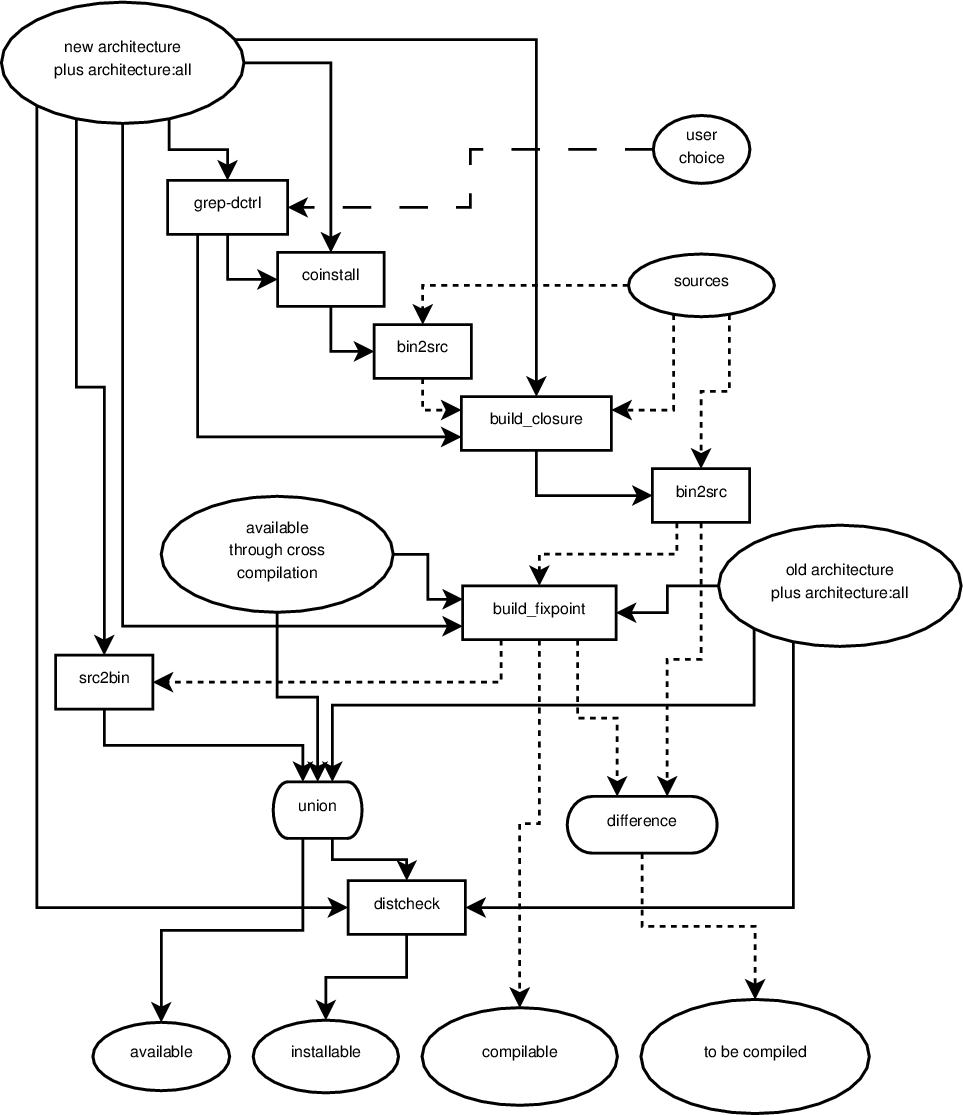
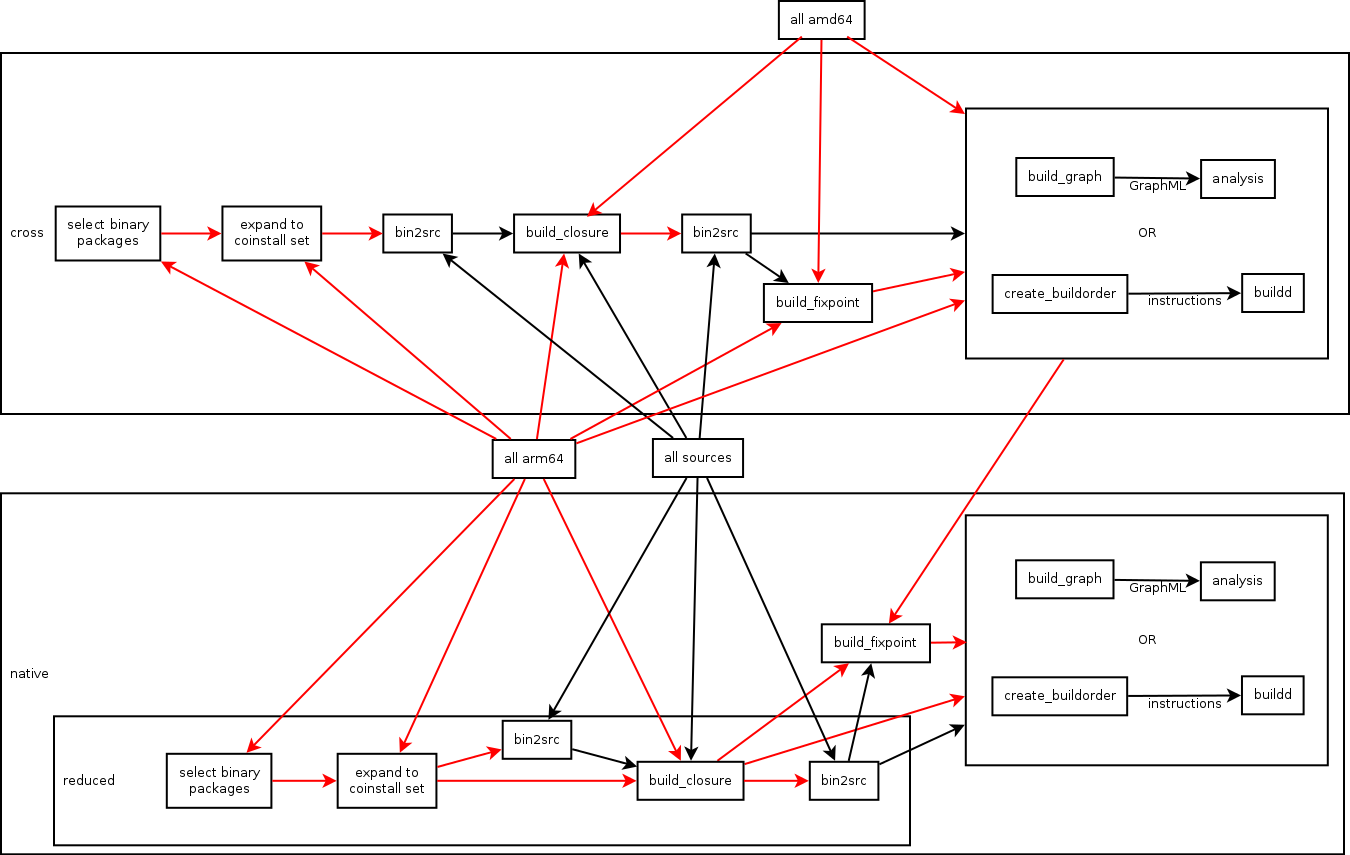
Processing pipeline instead of monolithic tools The tools I developed so far tried to accomplish everything by themselves, reusing functionality implemented in a central library. Therefor, if one wanted to try out even trivial new things, it mostly meant to hack some OCaml code. Pietro Abate suggested to instead develop smaller tools which could work independently of each other, would only execute one algorithm each and could easily be connected together in different ways to achieve different effects. This switch is now done and all functionality from the old tools is moved into a new toolset. The exchange format between the tools is either plain text files in deb822 control format (Packages/Sources files) or a dependency graph. The dependency graph is currently marshalled by OCaml but future versions should work with just passing a GraphML (an XML graph format) representation around. This new way of doing things seems close to the UNIX philosophy (each program does one thing well, data is stored as text, every program is a filter). For example the deb822 control output can easily be manipulated using grep-dctrl(1) and there exist many tools which can read, analyze and manipulate GraphML. It is a big improvement over the old, monolithic tools which did not allow to manipulate any intermediate result by external, existing tools. Currently, a shell script (native.sh) will execute all tools in a meaningful order, connecting them together correctly. The same tools will be used for a future cross.sh but they will be connected differently. I wrote about a first proposal of what the individual tools should do and how they should be connected in this email from which I also linked a confusing overview of the pipeline. This overview has recently been improved to be even more confusing and the current version of the lower half (the native part) now looks like this: native reduced Solid arrows represent a flow of binary packages, dottend arrows represent a flow of source packages, ovals represent a set of packages, boxes with rounded corners represent set operations, rectangular boxes represent filters. There is only one input to a filter, which is the arrow connected to the top of the box. Outgoing arrows from the bottom represent the filtered input. Ingoing arrows to either side are arguments to the filter and control how the filter behaves depending on the algorithm. I will explain this better once the pipeline proved to be less in flux. The pipeline is currently executed like this by native.sh.

Two new ways to break dependency cycles have been discovered So far, we knew of three ways to formally break dependency cycles:
  • remove build dependencies through build profiles
  • find out that the build dependency is only used to build arch:all packages and therefor put it into Build-Depends-Indep
  • cross compile some source packages
Two new methods can be added to the above:

Dependency graph definition changed Back in September when I was visiting irill, Pietro found a flaw in how the dependency graph used to be generated. He supplied a new definition of the dependency graph which does away with the problem he found. After fixing some small issues with his code, I changed all the existing algorithms to use the new graph definition. The old graph is as of today removed from the repository. Thanks to Pietro for supplying the new graph definition - I must still admit that my OCaml foo is not strong enough to have come up with his code.

Added complexity for profile built source packages As mentioned in the introduction, wookey and me addressed the debian-devel list with a proposal on necessary changes for an automated bootstrapping of Debian. During the discussiong, two important things came up which are to be considered by the dependency graph algorithms:
  • profile built source packages may not create all binary packages
  • profile built source packages may need additional build dependencies
Both things make it necessary to alter the dependency graph during the generation of a feedback arc set and feedback vertex set beyond the simple removal of edges. Luckily, the developed approximation algorithms can be extended to support such changes in the graph.

Different feedback arc set algorithms The initially developed feedback arc set algorithm is well suited to discover build dependency edges which should be dropped. It performs far worse when creating the final build order because it only considers edges by itself and not how many edges of a source package can be dropped by profile building it. The adjusted algorithm for generating a build order is more of a feedback vertex set algorithm because instead of greedily finding the edge with most cycles through it, it greedily finds the source package which would break most cycles if it was profile built.

Generating a build order with less profile built source packages After implementing all the features above I now feel more confident to publish the current status of the tools to a wider audience. The following test shows a run of the aforementioned ./native.sh shell script. Its final output is a list of source packages which have to be profile built and a build order. Using the resulting build order, starting from a minimal build system (essential:yes, build-essential and debhelper), all source packages will be compiled which are needed to compile all binary packages in the system. The result will therefor be a list of source and binary packages which fulfill the following property:
  • all binary packages can be built from the available source packages
  • all source packages can be built with the available binary packages
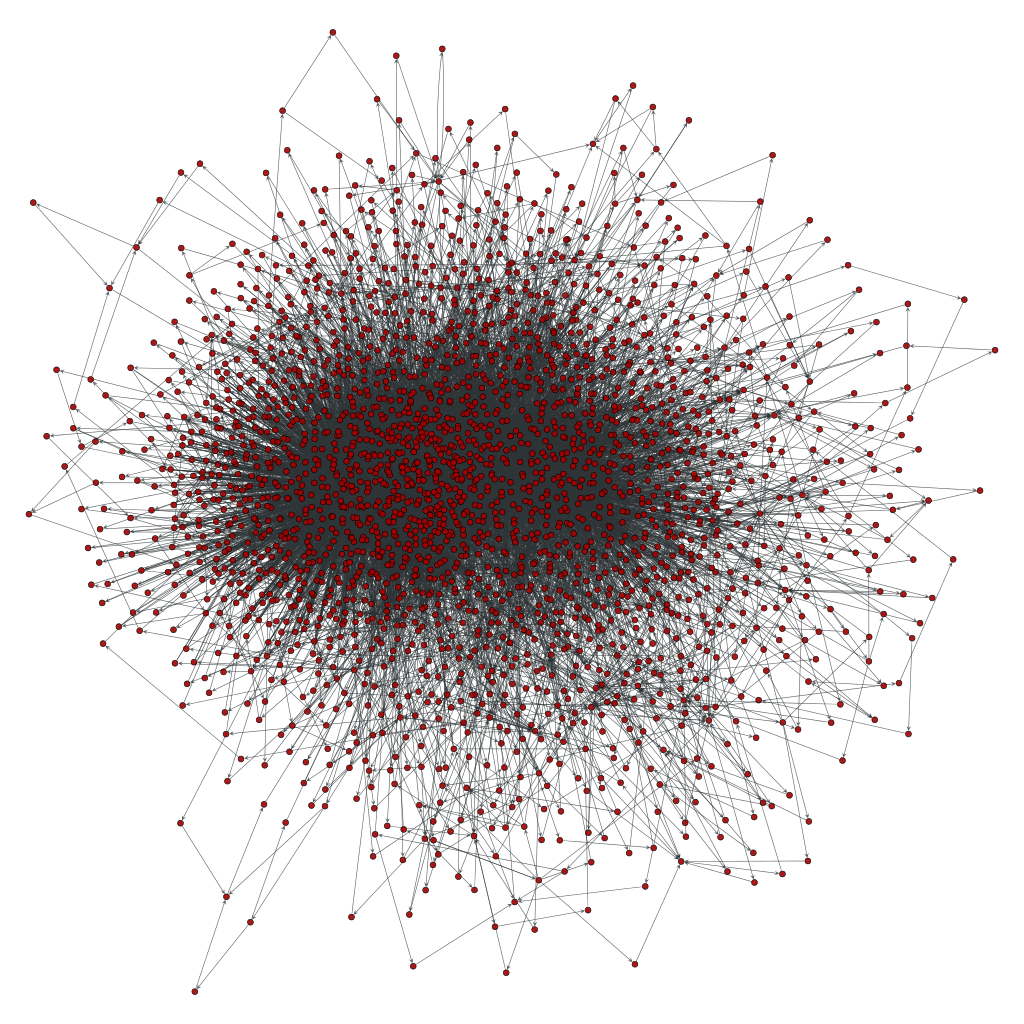
I called this a "reduceded distribution" in earlier posts. The interesting property of this specific selection is, that it contains the biggest problem set of Debian when bootstrapping it: a 900 to 1000 nodes big strongly connected component. Here is a visualization of the problem: hideous mess Source packages do not yet come with build profiles and the cross build situation can not yet be analyzed, so the following assumptions were made: The last point is about 14 build dependencies which were decided to be broken by the feedback arc set algorithm but for which other data sources did not indicate that they are actually breakable. Those 14 are dynamically generated by native.sh. If above assumptions should not be too far from the actual situation, then not more than 73 source packages have to be modified to bootstrap a reduced distribution. This reduced distribution even includes dependency-wise "big" packages like webkit, metacity, iceweasel, network-manager, tracker, gnome-panel, evolution-data-server, kde-runtime, libav and nautilus. By changing one line in native.sh one could easily develop a build order which generates gnome-desktop or really any given (meta-)package selection. All of native.sh takes only 80 seconds to execute on my system (Core i5, 2.5 GHz, singlethreaded). Here is the final build order which creates 2044 binary packages from 613 source packages.
  1. nspr, libio-pty-perl, libmcrypt, unzip, libdbi-perl, cdparanoia, libelf, c-ares, liblocale-gettext-perl, libibverbs, numactl, ilmbase, tbb, check, libogg, libatomic-ops, libnl($), orc($), libaio, tcl8.4, kmod, libgsm, lame, opencore-amr, tcl8.5, exuberant-ctags, mhash, libtext-iconv-perl, libutempter, pciutils, gperf, hspell, recode, tcp-wrappers, fdupes, chrpath, libbsd, zip, procps, wireless-tools, cpufrequtils, ed, libjpeg8, hesiod, pax, less, dietlibc, netkit-telnet, psmisc, docbook-to-man, libhtml-parser-perl, libonig, opensp($), libterm-size-perl, linux86, libxmltok, db-defaults, java-common, sharutils, libgpg-error, hardening-wrapper, cvsps, p11-kit, libyaml, diffstat, m4
  2. openexr, enca, help2man, speex, libvorbis, libid3tag, patch, openjade1.3, openjade, expat, fakeroot, libgcrypt11($), ustr, sysvinit, netcat, libirman, html2text, libmad, pth, clucene-core, libdaemon($), texinfo, popt, net-tools, tar, libsigsegv, gmp, patchutils($), dirac, cunit, bridge-utils, expect, libgc, nettle, elfutils, jade, bison
  3. sed, indent, findutils, fastjar, cpio, chicken, bzip2, aspell, realpath, dctrl-tools, rsync, ctdb, pkg-config($), libarchive, gpgme1.0, exempi, pump, re2c, klibc, gzip, gawk, flex-old, original-awk, mawk, libtasn1-3($), flex($), libtool
  4. libcap2, mksh, readline6, libcdio, libpipeline, libcroco, schroedinger, desktop-file-utils, eina, fribidi, libusb, binfmt-support, silgraphite2.0, atk1.0($), perl, gnutls26($), netcat-openbsd, ossp-uuid, gsl, libnfnetlink, sg3-utils, jbigkit, lua5.1, unixodbc, sqlite, wayland, radvd, open-iscsi, libpcap, linux-atm, gdbm, id3lib3.8.3, vo-aacenc, vo-amrwbenc, fam, faad2, hunspell, dpkg, tslib, libart-lgpl, libidl, dh-exec, giflib, openslp-dfsg, ppl($), xutils-dev, blcr, bc, time, libdatrie, libpthread-stubs, guile-1.8, libev, attr, libsigc++-2.0, pixman, libpng, libssh2, sqlite3, acpica-unix, acl, a52dec
  5. json-c, cloog-ppl, libverto, glibmm2.4, rtmpdump, libdbd-sqlite3-perl, nss, freetds, slang2, libpciaccess, iptables, e2fsprogs, libnetfilter-conntrack, bash, libthai, python2.6($), libice($), libpaper, libfontenc($), libxau, libxdmcp($), openldap($), cyrus-sasl2($), openssl, python2.7($)
  6. psutils, libevent, stunnel4, libnet-ssleay-perl, libffi, readline5, file, libvoikko, gamin, libieee1284, build-essential, libcap-ng($), lcms($), keyutils, libxml2, libxml++2.6, gcc-4.6($), binutils, dbus($), libsm($), libxslt, doxygen($)
  7. liblqr, rarian, xmlto, policykit-1($), libxml-parser-perl, tdb, devscripts, eet, libasyncns, libusbx, icu, linux, libmng, shadow, xmlstarlet, tidy, gavl, flac, dbus-glib($), libxcb, apr, krb5, alsa-lib
  8. usbutils, enchant, neon27, uw-imap, libsndfile, yasm, xcb-util, gconf($), shared-mime-info($), audiofile, ijs($), jbig2dec, libx11($)
  9. esound, freetype, libxkbfile, xvidcore, xcb-util-image, udev($), libxfixes, libxext($), libxt, libxrender
  10. tk8.4, startup-notification, libatasmart, fontconfig, libxp, libdmx, libvdpau, libdrm, libxres, directfb, libxv, libxxf86dga, libxxf86vm, pcsc-lite, libxss, libxcomposite, libxcursor, libxdamage, libxi($), libxinerama, libxrandr, libxmu($), libxpm, libxfont($)
  11. xfonts-utils, libxvmc, xauth, libxtst($), libxaw($)
  12. pmake, corosync, x11-xserver-utils, x11-xkb-utils, coreutils, xft, nas, cairo
  13. libedit, cairomm, tk8.5, openais, pango1.0($)
  14. ocaml, blt, ruby1.8, firebird2.5, heimdal, lvm2($)
  15. cvs($), python-stdlib-extensions, parted, llvm-2.9, ruby1.9.1, findlib, qt4-x11($)
  16. xen, mesa, audit($), avahi($)
  17. x11-utils, xorg-server, freeglut, libva
  18. jasper, tiff3, python3.2($)
  19. openjpeg, qt-assistant-compat, v4l-utils, qca2, jinja2, markupsafe, lcms2, sip4, imlib2, netpbm-free, cracklib2, cups($), postgresql-9.1
  20. py3cairo, pycairo, pam, libgnomecups, gobject-introspection($)
  21. gdk-pixbuf, libgnomeprint, gnome-menus, gsettings-desktop-schemas, pangomm, consolekit, vala-0.16($), colord($), atkmm1.6
  22. libgee, gtk+3.0($), gtk+2.0($)
  23. gtkmm2.4, poppler($), openssh, libglade2, libiodbc2, gcr($), libwmf, systemd($), gcj-4.7, java-atk-wrapper($)
  24. torque, ecj($), vala-0.14, gnome-keyring($), gcc-defaults, gnome-vfs($)
  25. libidn, libgnome-keyring($), openmpi
  26. mpi-defaults, dnsmasq, wget, lynx-cur, ghostscript, curl
  27. fftw3, gnupg, libquvi, xmlrpc-c, raptor, liboauth, groff, fftw, boost1.49, apt
  28. boost-defaults, libsamplerate, cmake, python-apt
  29. qjson, qtzeitgeist, libssh, qimageblitz, pkg-kde-tools, libical, dwarves-dfsg, automoc, attica, yajl, source-highlight, pygobject, pygobject-2, mysql-5.5($)
  30. libdbd-mysql-perl, polkit-qt-1, libdbusmenu-qt, raptor2, dbus-python, apr-util
  31. rasqal, serf, subversion($), apache2
  32. git, redland
  33. xz-utils, util-linux, rpm, man-db, make-dfsg, libvisual, cryptsetup, libgd2, gstreamer0.10
  34. mscgen, texlive-bin
  35. dvipng, luatex
  36. libconfig, transfig, augeas, blas, libcaca, autogen, libdbi, linuxdoc-tools, gdb, gpm
  37. ncurses, python-numpy($), rrdtool, w3m, iproute, gcc-4.7, libtheora($), gcc-4.4
  38. libraw1394, base-passwd, lm-sensors, netcf, eglibc, gst-plugins-base0.10
  39. libiec61883, qtwebkit, libvirt, libdc1394-22, net-snmp, jack-audio-connection-kit($), bluez
  40. redhat-cluster, gvfs($), pulseaudio($)
  41. phonon, libsdl1.2, openjdk-6($)
  42. phonon-backend-gstreamer($), gettext, libbluray, db, swi-prolog, qdbm, swig2.0($)
  43. highlight, libselinux, talloc, libhdate, libftdi, libplist, python-qt4, libprelude, libsemanage, php5
  44. samba, usbmuxd, libvpx, lirc, bsdmainutils, libiptcdata, libgtop2, libgsf, telepathy-glib, libwnck3, libnotify, libunique3, gnome-desktop3, gmime, glib2.0, json-glib, libgnomecanvas, libcanberra, orbit2, udisks, d-conf, libgusb
  45. libgnomeprintui, libimobiledevice, nautilus($), libbonobo, librsvg
  46. evas, wxwidgets2.8, upower, gnome-disk-utility, libgnome
  47. ecore, libbonoboui
  48. libgnomeui
  49. graphviz
  50. exiv2, libexif, lapack, soprano, libnl3, dbus-c++
  51. atlas, libffado, graphicsmagick, libgphoto2, network-manager
  52. pygtk, jackd2, sane-backends, djvulibre
  53. libav($), gpac($), ntrack, python-imaging, imagemagick, dia
  54. x264($), matplotlib, iceweasel
  55. strigi, opencv, libproxy($), ffms2
  56. kde4libs, frei0r, glib-networking
  57. kde-baseapps, kate, libsoup2.4
  58. geoclue, kde-runtime, totem-pl-parser, libgweather, librest, libgdata
  59. webkit
  60. zenity, gnome-online-accounts
  61. metacity, evolution-data-server
  62. gnome-panel
  63. tracker
The final recompilation of profile built source packages is omitted. Source packages marked with a ($) are selected to be profile built. All source packages listed in the same line can be built in parallel as they do not depend upon each other. This order looks convincing as it first compiles a multitude of source packages which have no or only few build dependencies lacking. Later steps allow fewer source packages to be compiled in parallel. The amount of needed build dependencies is highest in the source packages that are built last.

24 January 2013

Benjamin Mako Hill: Aaron Swartz

I moved to Boston in 2005 at the same time that Aaron Swartz did and we were introduced by a mutual friend. Aaron was one of my first friends in Boston and we became close. When Aaron moved to San Francisco, I moved into his apartment in Somerville where he kept a room for a year or so. Mika and I still live there. His old posters remain on our walls and his old books remain on our shelves. Aaron s brothers Ben and Noah both lived with us and remain close friends. I have spent hours (days?) reading and thinking about Aaron over the last two weeks. It has been disorienting but beautiful to read the descriptions of, and commentaries on, Aaron s life. Although I suspect I may never feel ready, there are several things I want to say about Aaron s death, about Aaron s work, and about what Aaron means to me. 1. Aaron s Death The reaction to Aaron s death has been overwhelming and inspirational. At some point in the near future I plan to join some of the important campaigns already being waged in his name. There are many attempts to understand why Aaron died and many attempts to prevent it from happening to others in the future. Unfortunately, I am familiar with the process of soul-searching and second-guessing that happens when a friend commits suicide. I m sure that every one of his friends has asked themselves, as I have, What could I have done differently? I don t know the answer, but I do know this: Aaron was facing the real risk of losing half his life to prison. But even if one believed that he was only facing the likely loss of ten percent or even one percent of his life I wish that we all, and I wish that I in particular, had reacted with the passion, time, anger, activity, and volume proportional to how we have reacted in the last two weeks when he lost the whole thing. 2. Aaron s Work Of course, Aaron and I worked on related projects and I followed his work. And despite all the incredible things that have been said about Aaron, I feel that Aaron s work was more focused, more ambitious, more transformative, more innovative, and more reckless (in a positive sense) than the outpour online suggests. Although discussion of Aaron has focused his successes, achievements, and victories, the work that inspired me most was not the projects that were most popular or successful. Much of Aaron s work was deeply, and as it turned out overly, ambitious. His best projects were self-conscious attempts to transform knowledge production, organization, and dissemination. Although he moved from project to project, his work was consistently focused on bringing semantic-web concepts and technologies to peer production, to the movement for free culture, and to progressive political activism and on the meta-politics necessary to remove barriers to this work. For example, Aaron created an online collaborative encyclopedia project called the TheInfoNetwork (TIN) several years before Wikipedia was started. I talked to Aaron at length about that project for a research project I am working on. Aaron s work was years ahead of its time; in 2000, TIN embraced more of the Wikimedia Foundation s current goals and principles than Wikipedia did when it was launched. While Wikipedia sought to create a free reference work online, Aaron s effort sought to find out what a reference work online could look like. It turned out to be too ambitious, perhaps, but it taught many, including myself, an enormous amount in that process. When I met Aaron, he was in the process starting a company, Infogami, that was trying to chase many of TIN s goals. Infogami was conceived of as a wiki aware of the structure of data. The model was both simple and profound. Years later, Wikimedia Deutschland s WikiData project is beginning to bring some of these ideas to the mainstream. Infogami merged with Reddit as equal halves of a company with a shared technological foundation based on some of Aaron s other work. But when Reddit took off, Infogami was rarely mentioned, even by Aaron. I think that is too bad. Reddit got traction because it made the most popular stuff more visible; Reddit is popular, fundamentally, because popular things are popular. But popular is not necessary positive. For that reason, Reddit never struck me as either surprising or transformative. But what started as Aaron s half the company, on the other hand, aimed to create a powerful form of democratized information production and dissemination. And although Infogami didn t take off, the ideas and code behind the project found life at the heart of Open Library and will continue to influence and inspire countless other projects. I believe that Infogami s lessons and legacy will undergird a generation of transformative peer production technologies in a way that the Reddit website important as it is will not. 3. What Aaron Means to Me A lot of what has been written about Aaron speaks to his intelligence, his curiosity, his generosity, his ethics and his drive. Although I recognize all these qualities in the Aaron I knew, I ve felt alienated by how abstract some of the discussion of Aaron has been my memories are of particularities.
I remember the time Aaron was hospitalized and I spent two hours on the phone going through my bookshelves arguing with him about the virtues of the books in my library as we tried to decide which books I would bring him. I remember Aaron confronting Peter Singer intellectual founder of the modern animal rights movement at the Boston Vegetarian Food Festival to ask if humans had a moral obligation to stop animals from killing each other. I lurked behind, embarrassed about the question but curious to hear the answer. (Singer sighed and said yes sort of and complemented Aaron on the enormous Marxist commentary he was carrying.) I remember 1-800-INTERNET.com. I remember talking with Aaron about whether being wealthy could be ethical. I argued it could not but Aaron argued uncharacteristically I thought that it could. Aaron told Mika she should slap him if he ever became wealthy. The very next day, it was announced that his company had been acquired and that Aaron was a millionaire. I remember the standing bets I had with Aaron and how he would email me every time news reports favored his claims (but never when they did not). And I remember that I won t hear from him again.
Aaron was a friend and inspiration. I miss him deeply and I am very sad.

Russ Allbery: Still having a blast

I did not realize how much I was missing this sort of heads-down programming time in my life until the last two days. I think the last time that I had this much fun with my job was when I was learning Java, and even that wasn't quite this much fun since it was a lot of experimentation rather than being directly productive in a language I know well. Here's a short list of modern Perl, Perl techniques, and interesting modules that I'd not had a reason to use before today: I still have tomorrow morning to continue focusing on this and will hopefully finish up the work to feed long time periods of logs into my analysis tool. And, even better, I have a log parsing framework that I really like and that I think will make any number of things easier in the long run. (Also, it has a remarkably thorough test suite. I love test-driven development. Although I haven't written comprehensive tests for the very final front-end piece, since generating sanitized log input to trigger all the cases is too much effort right at the moment.)

22 January 2013

Peter Makholm: Installing Linux on MyAudio Tablet Series9

Recently I recieved a MyAudio Tablet Series9 as a gift. From the factory it runs some version of Android, but I already got enough Android devices. Instead I wanted to play a bit with a basic Linux install. This tablet is based on the AllWinner A10 System on a Chip. Some of these instructions might work for other systems based on the same chip set: Step 1: Install the rescue system from http://forum.doozan.com/read.php?6,9396 on a SD-card. You can configure network settings in rescue/interfaces and rescue/wpa_supplicant.conf. Step 2: Boot the rescue system. The MyAudio table will boot from the SD-card if it contains a bootable system, so this is quite easy. The first time you boot the rescue system tries to locate a system.bin file from the tablet. this file contains the hardware configuration and is needed for initializing all the hardware. This means that the screen can t be initialized the first time you boot and will just appear off. Unless the system automatically boots again you need to locate the system.bin yourself from the tablet. It is usually located on /dev/nanda and have names like system.bin, script.bin, or evb.bin. To find the file you can use the log the rescue system places in log/deviceinfo.log on the SD-card during boot. You should now have console access to the tablet and using a USB keyboard you should be able to work in the console. Step 3: Setting up the network Having configured rescue/interfaces and rescue/wpa_supplicant.conf the network ought to work. I am experiencing some problems getting it to connect to my Access Point (using WPA2). Patience works, but you might need to monitor the status with wpa_cli(8) and then run udhcp -i wlan0 when it succeeds. Step 4: Install Debian using the installer at http://forum.doozan.com/read.php?6,8906 This just worked fine Step 5: Getting the touch screen to work. The system.bin file can be decoded with the fexc utility either available on the rescue system (compiled for arm) of from https://github.com/linux-sunxi/sunxi-tools. Finding the ctp_para section we can see that this tablet uses a ft5x touch screen. Adding ft5x_ts to /etc/modules on our installed system will make sure that the correct kernel module gets loaded on boot time. But for some reason the kernel driver and the X11 evdev driver will not talk together. So we need to compile our own kernel patched as described on https://www.miniand.com/forums/forums/development/topics/how-do-i-get-the-lcd-display-and-touch-screen-working-on-an-a10-tablet#post-1225. I have made kernel packages for Debian available at http://hacking.dk/files/linux-image-3.0.57-sun4i+_1.0+nomultitouch_armhf.deb or http://hacking.dk/files/linux-image-3.4.24-sun4i+_1.0+nomultitouch_armhf.deb. Install the kernel package you want and run this as root:
# KERNEL_VERSION=3.4.24-sun4i+
# /usr/bin/mkimage -A arm -O linux -T kernel  -C none -a 0x40008000 -e 0x40008000 -n Linux-$KERNEL_VERSION -d /boot/vmlinuz-$KERNEL_VERSION /boot/uImage
# /usr/bin/mkimage -A arm -O linux -T ramdisk -C gzip -a 0x00000000 -e 0x00000000 -n initramfs-$KERNEL_VERSION -d /boot/initrd.img-$KERNEL_VERSION /boot/uInitrd
After a reboot X11 will respond to the touch screen, but Step 6: Configure the touch screen the pointer does not point where I touch the screen. The transformation between the points are wrong. This is fixed by adding this to your xorg.conf:
Section "InputClass"
    Identifier     "touchscreen"
    MatchProduct   "ft5x_ts"
    Option    "TransformationMatrix" "0 1 0 1 0 0 0 0 1"
    Option    "Calibration" "0 768 0 1024"
EndSection
or more dynamically by running:
$ xinput set-prop ft5x_ts "Coordinate Transformation Matrix" 0 1 0 1 0 0 0 0 1
$ xinput set-prop ft5x_ts "Evdev Axis Calibration" 0 768 0 1024
For more information about the Transformation Matrix, see the X.Org Wiki Step 7: Install a on-screen keyboard. I have not found the perfect keyboard application yet. Currently I am using matchbox-keyboard

Julien Danjou: Extending Swift with middleware: example with ClamAV

In this article, I'm going to explain you how you can extend Swift, the OpenStack Object Storage project, so it performs extra action on files at upload or at download time. We're going to build an anti-virus filter inside Swift. The goal is to refuse uploaded data if they contain a virus. To help us with virus analyses, we'll use ClamAV. WSGI, paste and middleware
In a pipeline, a black cat can become a white cat with the help of some middleware.
To do our content analysis, the best place to hook in the Swift architecture is at the beginning of every request, on swift-proxy, before the file is actually stored on the cluster. Swift proxy uses, like many other OpenStack projects, paste to build his HTTP architecture. Paste uses WSGI and provides an architecture based on a pipeline. The pipeline is composed of a succession of middleware, ending with one application. Each middleware has the chance to look at the request or at the response, can modify it, and then pass it to the following middleware. The latest component of the pipeline is the real application, and in this case, the Swift proxy server. If you've already deployed Swift, you encountered a default pipeline in the swift-proxy.conf configuration file:
[pipeline:main]
pipeline = catch_errors healthcheck cache ratelimit tempauth proxy-logging proxy-server

This is a really basic pipeline with a few middleware. The first one catches error, the second one is in charge to return 200 OK response if you send a GET /healthcheck request on your proxy server. The third one is in charge of caching, the fourth one is used for rate limiting, the fifth for authentication, the sixth one for logging, and the final one is the actual proxy server, in charge of proxying the request to the account, container, or object servers (the others components of Swift). Of course, we could remove or add any of the middleware here at our convenience. Be aware that the order matters: for example, if you put healthcheck after tempauth, you won't be able to access the /healthcheck URL without being authenticated! ClamAV
If you don't know ClamAV, it's an antivirus engine designed for detecting trojans, viruses, malware and other malicious threats. Wwe're going to use it to scan every incoming file. To build the middleware, we'll use the Python binding pyclamd. The API is quite simple, see:
>>> import pyclamd
>>> pyclamd.init_unix_socket('/var/run/clamav/clamd.ctl')
>>> print pyclamd.scan_stream(pyclamd.EICAR)
'stream': 'Eicar-Test-Signature(44d88612fea8a8f36de82e1278abb02f:68)'
>>> print pyclamd.scan_stream("safe!")
None

Anatomy of a WSGI middleware Your WSGI middleware should consist of a callable object. Usually this is done with a class implementing the __call__ method. Here's a basic boilerplate:
class SwiftClamavMiddleware(object):
"""Middleware doing virus scan for Swift."""

def __init__(self, app, conf):
# app is the final application
self.app = app

def __call__(self, env, start_response):
return self.app(env, start_response)


def filter_factory(global_conf, **local_conf):
conf = global_conf.copy()
conf.update(local_conf)

def clamav_filter(app):
return SwiftClamavMiddleware(app, conf)
return clamav_filter

I'm not going to expand more on why this is built this way, but if you want to have more info on this kind of filter middleware, you can read their documentation on Paste. This middleware will just do nothing as it is. It's going to simply pass all requests it receives to the final application, and returns the result. Testing our basic middleware
Now is a really good time to add unit tests. I hope you didn't think we were going to write code without some tests, right? It's really easy to test a middleware, as we're going to use WebOb for that.
import unittest
from webob import Request


class FakeApp(object):
def __call__(self, env, start_response):
return Response(body="FAKE APP")(env, start_response)


class TestSwiftClamavMiddleware(unittest.TestCase):

def setUp(self):
self.app = SwiftClamavMiddleware(FakeApp(), )

def test_simple_request(self):
resp = Request.blank('/',
environ=
'REQUEST_METHOD': 'GET',
).get_response(self.app)
self.assertEqual(resp.body, "FAKE APP")

We create a FakeApp class, that represents a fake WSGI application. You could also use a real application, or write a fake application looking like the one you want to test. It'll require more time, but your tests will be closer to the reality. Here we write the simplest test we can for our middleware. We're just sending a GET / request to it, so it passes the request to the final application and returns the result. It is transparent, it does nothing. Now, with that solid base we'll able to add more features and test these features incrementally. Plugging ClamAV in With our base ready, we can start thinking about how to plug ClamAV in. What we want to check here, is the content of the file when it's uploaded. If we refer to the OpenStack object storage API , a file upload is done via a PUT request, so we're going to limit the check to that kind of requests. Obviously, more checks could be added, but we'll keep things simple here for the sake of comprehensibility. With WSGI, the content of the request is available in env['wsgi.input'] as an object implementing a file interface. We'll scan that stream with ClamAV to check for viruses.
import pyclamd
from webob import Response


class SwiftClamavMiddleware(object):
"""Middleware doing virus scan for Swift."""

def __init__(self, app, conf):
pyclamd.init_unix_socket('/var/run/clamav/clamd.ctl')
# app is the final application
self.app = app

def __call__(self, env, start_response):
if env['REQUEST_METHOD'] == "PUT":
# We have to read the whole content in memory because pyclamd
# forces us to, but this is a bad idea if the file is huge.
scan = pyclamd.scan_stream(env['wsgi.input'].read())
if scan:
return Response(status=403,
body="Virus %s detected" % scan['stream'],
content_type="text/plain")(env, start_response)
return self.app(env, start_response)


def filter_factory(global_conf, **local_conf):
conf = global_conf.copy()
conf.update(local_conf)

def clamav_filter(app):
return SwiftClamavMiddleware(app, conf)
return clamav_filter

That's it. We only check for PUT requests and if there's a virus in the file, we return a 403 Forbidden error with the name of the detected virus, bypassing entirely the rest of the middleware chain and the application handling. Then, we can simply test it.
import unittest
from cStringIO import StringIO
from webob import Request, Response


class FakeApp(object):
def __call__(self, env, start_response):
return Response(body="FAKE APP")(env, start_response)


class TestSwiftClamavMiddleware(unittest.TestCase):
def setUp(self):
self.app = SwiftClamavMiddleware(FakeApp(), )

def test_put_empty(self):
resp = Request.blank('/v1/account/container/object',
environ=
'REQUEST_METHOD': 'PUT',
).get_response(self.app)
self.assertEqual(resp.body, "FAKE APP")

def test_put_no_virus(self):
resp = Request.blank('/v1/account/container/object',
environ=
'REQUEST_METHOD': 'PUT',
'wsgi.input': StringIO('foobar')
).get_response(self.app)
self.assertEqual(resp.body, "FAKE APP")

def test_put_virus(self):
resp = Request.blank('/v1/account/container/object',
environ=
'REQUEST_METHOD': 'PUT',
'wsgi.input': StringIO(pyclamd.EICAR)
).get_response(self.app)
self.assertEqual(resp.status_code, 403)

The first test test_put_empty simulates an empty PUT request. The second one, test_put_no_virus simulates a regular PUT request but with a simple file containing no virus. Finally, the third and last test simulates the upload of a virus using the EICAR test file. This is a special test file that is recognized as a virus, even if it's not real one. Very handy for testing virus detection software! Configuring Swift proxy Our middleware is ready! We can configure Swift's proxy server to use it. We need to add the following lines to our swift-proxy.conf to teach it how to load the filter:
[filter:clamav]
paste.filter_factory = swiftclamav:clamav_filter

We'll assume that our Python modules is named swiftclamava here. Now that we've defined our filter and how to load it, we can use it in our pipeline:
[pipeline:main]
pipeline = catch_errors healthcheck cache ratelimit tempauth clamav proxy-logging proxy-server

Just before reaching the proxy-server, and after the user being authenticated, the content will be scanned for viruses. It's important here to put this after authentication for example, because otherwise we may scan content that will get rejected by the authtemp module, thus scanning for nothing! Beyond scanning And voil , we now have a simple middleware testing uploaded content and refusing infected files. We could enhance it with various other things, like configuration handling, but I'll let that as an exercise for the interested readers. We didn't exploited it here, but note that you can also manipulate request headers and modify them if needed. For example, we could have added a header X-Object-Meta-Scanned-By: ClamAV to indicates that the file has been scanned by ClamAV. You should now be able to build your own middleware doing whatever you want with uploaded data. Happy hacking!

John Goerzen: Today is Pretend St. Patrick s Day!

Today in the USA is Martin Luther King, Jr., day. But sometimes these holidays get confusing for a 6-year-old. I asked Jacob the other day if he knew what holiday was coming up. He thought about it for a second, then declared it would be St. Patrick s Day. He was excited because St. Patrick s Day is green. When he realized that it was really MLK Day, he was disappointed. That day isn t green. So I said, Jacob, how about we celebrate pretend St. Patrick s Day on Monday? His face lit up, he got a huge smile, and said, Oh yes! Great idea, dad! Oliver got all excited about it too. I was already planning on us doing some cooking, and thankfully had green food coloring already. So I sort of discarded my plans so each meal could have something green in it. When the boys woke up this morning, I wished each of them Happy Pretend St. Patrick s Day! We all wore green. Jacob put his shirt on backwards so the side with more green would be facing front. For breakfast, our green dish was green crepes with a succotash (based on baby lima beans and corn) filling. The boys were excited to discover that the crepes could be green on one side, and green and a little brown on the other. Jacob was unsure of the succotash idea, but after having a few bites, declared it excellent . After breakfast, we made bread. They loved watching the green food coloring disperse in the water. We checked on how green the dough looked periodically. We watched how it was rising and whether it was staying green. And we checked in on it backing, as the crust turned from green to brown. We discussed green bread over and over. Important questions were asked and answers were attempted. And then, of course, the moment of truth removing the loaf from the pan. The boys jabbered excitedly that there was some green peeking out. While we waited for it to cool, we went out to the creek. The creek is dry this year, so we got to walk in it. Jacob used his stick to make a line behind him. I asked him, Is that a line so we can find our way back? Oh! Uhm. Yes! And then he added arrows so we d know which way to go. Jacob stopped every 20 or so feet to collect pretend train tickets from Oliver and me. Oliver eventually grew tired of this, so Jacob started collecting Oliver s ticket from me. They climbed on some trees, managed to find some mud, drew outlines of train cars in the dirt, and then followed Jacob s line back down the creek bed. They pointed out any green things they saw. Then we went back to the house, took off our warm coats, and cut into the bread. Can you imagine the excitement? I hadn t realized green is a flavor, but it must have been somehow, because those boys absolutely loved this green bread. When we got out the jam, Jacob realized that it was red on the green bread, and that now his bread was Christmas-colored. All sorts of green bread discoveries were made, but the best among them was that if you hold a slice of green bread up to the bright sun, the sun makes it glow green and it looks like a stained-glass window. Sometimes a few drops of food coloring can add a ton of excitement to a day.

21 January 2013

Russ Allbery: Have some clouds

It's been a long time since I've posted any photographs here (about 15 months, it looks like), so have some clouds. Windswept clouds This also serves as a test for whether the scripts I use to post photographs have been properly converted to Git. (And a test to see if the occasional amateur photograph eating up screen real estate will provoke annoyed mutters from the direction of Planet Debian, although so far no complaints over my even-longer book reviews.) I'm still taking photographs occasionally, although not as much as I was at one point. Too many hobbies and not enough time. Part of why I've been slow in posting them is that I was bad about keeping notes about where I took them and bad about keeping up with sorting through them. So I have large collections of photographs from some days where I don't remember exactly where I was, and where I've not already singled out the ones that are worth sharing. One of the things my hobbies always seem to generate is yet another pile of stuff that's not organized quite to my liking. Maybe some evening I'll feel inspired to do a bit more sorting. This is a long weekend in the US for some of us, myself included, so I get another day in this weekend. Which is good, since I've only gotten to a fraction of what I wanted to get to, although at least I found several hours to play video games today. I have finally converted PGP::Sign to Git, so I have no more personal Subversion repositories, but I forgot how much code I'd written to handle its build-time configuration. All of that desperately needs to be reworked, so it's going to take a bit longer than I expected before I can push out another release.

18 January 2013

Ian Campbell: Using Valgrind to Debug Xen Toolstacks

What is Valgrind? Valgrind is a framework for building dynamic analysis tools. Several useful tools are included in the Valgrind distribution including tools to check dynamic memory usage (memcheck), a cache profiler (cachegrind), heap profiler (massif) and thread debugger (helgrind) among others. Valgrind also provides a framework which can be used to build other tools. The Valgrind tool which I find most useful and the one which I have most experience with is memcheck. This tool can detect all manner of memory management problems, including use after free, using uninitialized data, memory leaks, double free. Between them these can result in savings of many hours of staring a core dumps and gdb backtraces. How Does memcheck Work? At its core Valgrind is a dynamic binary translation engine, which is used to instrument the code at runtime. In the case of memcheck this is used to track properties of the memory in a process, including aspects such as whether each bit (yes, bit) of memory has been initialized since it was allocated. It also tracks this information as data is loaded into registers, so it can know if a given register is currently tainted with uninitialized data or not. As well as instrumentation through binary translation Valgrind also includes instrumented versions of the C dynamic memory allocation functions which are used to track whether a each bit of memory is currently considered free or allocated, as well as tainting registers when they contain a pointer to memory which has been freed. A large part of memcheck's functionality is built upon Valgrind's ability to determine when memory has been initialized. However although binary translation can be used to instrument when the application itself has initialized some memory it is not currently possible to instrument the behaviour of system calls, in other words Valgrind cannot automatically determine when memory has been initialised e.g. after a read(2) system call. For this reason Valgrind has baked in knowledge about the behaviour of system calls on various platforms. For example lets consider the read(2) system call. The prototype of read(2) is:
    ssize_t read(int fd, void *buf, size_t count);
This system call reads up to count bytes from the file descriptor fd into the memory pointed to by buf and returns the number of bytes read. Here is the code within Valgrind which handles this system call (found in coregrind/m_syswrap/syswrap-generic.c):
PRE(sys_read)
 
   *flags  = SfMayBlock;
   PRINT("sys_read ( %ld, %#lx, %llu )", ARG1, ARG2, (ULong)ARG3);
   PRE_REG_READ3(ssize_t, "read",
                 unsigned int, fd, char *, buf, vki_size_t, count);
   if (!ML_(fd_allowed)(ARG1, "read", tid, False))
      SET_STATUS_Failure( VKI_EBADF );
   else
      PRE_MEM_WRITE( "read(buf)", ARG2, ARG3 );
 
POST(sys_read)
 
   vg_assert(SUCCESS);
   POST_MEM_WRITE( ARG2, RES );
 
These two functions are called before and after the system call respectively. The main piece of functionality is the calls to PRE_MEM_WRITE and POST_MEM_WRITE. In this case PRE_MEM_WRITE is used to check that the memory starting at ARG2 (recall that this is the supplied buffer) and extending for ARG3 bytes (the system calls count argument) consists of allocated memory. After the system call in complete the post function calls POST_MEM_WRITE to indicate to Valgrind that RES bytes of the buffer have know been initialized. The above is a relatively simple case, but the above two hooks must be supplied for each system call on each platform which Valgrind wishes to support. One of the most problematic system calls is the ioctl(2) system call. The ioctl call takes a file descriptor, a request number and a pointer to a per-ioctl argument structure and implements per-device control requests. There are literally dozens of devices many with their own specific ioctls. For this reason a sizable portion of Valgrind code is dedicate to decoding the behaviour of the myriad of potential ioctls and providing pre- and post-call instrumentation for them. Interacting with the Hypervisor from Userspace Under Xen the toolstack is a normal userspace process running in the control domain (typically domain 0). As part of its operation the toolstack needs to communicate with the hypervisor and to do this it uses hypercalls. However a userspace process cannot simply make hypercalls on its own, instead it must request that the OS kernel make the hypercall for it. This prevents just any userspace process making a hypercall, since the kernel will first check the privilege of the process making the request. Under Linux a userspace process makes hypercalls by using the ioctl(2) system call on a special "Privileged Command" (privcmd) device. In this case the toolstack uses the IOCTL_PRIVCMD_HYPERCALL ioctl request which takes a hypercall number and the hypercall arguments as its argument. Other OSes which can be used as a control domain posses similar interfaces. Making memcheck Work With Xen Toolstacks? As might be expected the majority of the work to allow Valgrind to work on Xen toolstack processes was teaching it about the IOCTL_PRIVCMD_HYPERCALL ioctl. Fortunately it was not necessary to teach Valgrind about every hypercall but only about those which are used by toolstacks. This is a smallish subset of all hypercalls including the domctl interfaces and a handful of others. The initial batch of patches cover all of the system calls needed to start new domains, shut them down and migrate them using the XL toolstack. New hypercalls will be added as they are discovered to be missing. Getting and Using This Functionality The initial set of patches were accepted into Valgrind's Subversion repository trunk revision 13081 in October 2012 and are expected to be part of the 3.9.0 release. Until 3.9.0 is released it will be necessary to get this functionality from SVN. Fortunately this is relatively simple and follows the usual autofoo dance. Although the usual caveats regarding running unreleased software apply.
  $ svn co svn://svn.valgrind.org/valgrind/trunk valgrind
  $ cd valgrind
  $ ./autogen.sh
  $ ./configure
  $ make
  $ sudo make install
Once Valgrind is built and installed simply call it passing the command to be debugged as an option:
  # valgrind xl list
  ==16186== Memcheck, a memory error detector
  ==16186== Copyright (C) 2002-2012, and GNU GPL'd, by Julian Seward et al.
  ==16186== Using Valgrind-3.9.0.SVN and LibVEX; rerun with -h for copyright info
  ==16186== Command: xl list
  ==16186== 
  Name                                        ID   Mem VCPUs    State   Time(s)
  Domain-0                                     0   512     4     r-----     332.5
  ==16186== 
  ==16186== HEAP SUMMARY:
  ==16186==     in use at exit: 0 bytes in 0 blocks
  ==16186==   total heap usage: 16 allocs, 16 frees, 93,529 bytes allocated
  ==16186== 
  ==16186== All heap blocks were freed -- no leaks are possible
  ==16186== 
  ==16186== For counts of detected and suppressed errors, rerun with: -v
  ==16186== ERROR SUMMARY: 0 errors from 0 contexts (suppressed: 39 from 6)
Here we see that xl list has no leaks! However if I comment out the call to libxl_dominfo_list_free in tools/libxl/xl_cmdimpl.c:main_list() then instead Valgrind reports:
[...]
  ==16203== HEAP SUMMARY:
  ==16203==     in use at exit: 90,112 bytes in 1 blocks
  ==16203==   total heap usage: 16 allocs, 15 frees, 93,529 bytes allocated
  ==16203== 
  ==16203== LEAK SUMMARY:
  ==16203==    definitely lost: 0 bytes in 0 blocks
  ==16203==    indirectly lost: 0 bytes in 0 blocks
  ==16203==      possibly lost: 90,112 bytes in 1 blocks
  ==16203==    still reachable: 0 bytes in 0 blocks
  ==16203==         suppressed: 0 bytes in 0 blocks
  ==16203== Rerun with --leak-check=full to see details of leaked memory
  ==16203== 
  ==16203== For counts of detected and suppressed errors, rerun with: -v
  ==16203== ERROR SUMMARY: 0 errors from 0 contexts (suppressed: 39 from 6)
[...]
So it has caught the memory leak! Rerunning with the suggests --leak-check=full goes even further and tells me where the leaked memory was allocated:
[...]
  ==16204== 90,112 bytes in 1 blocks are possibly lost in loss record 1 of 1
  ==16204==    at 0x4024480: calloc (vg_replace_malloc.c:593)
  ==16204==    by 0x4050CE4: libxl_list_domain (libxl.c:548)
  ==16204==    by 0x805EEC7: main_list (xl_cmdimpl.c:3931)
  ==16204==    by 0x804D6DD: main (xl.c:285)
[...]
To ease debugging of domain creation I find it useful to use the -F option to xl create to stop xl from forking and daemonising. Most xl subcommands do not daemonize and so need no special treatment. For more information on running Valgrind see the Valgrind Documentation. Conclusion Valgrind is a powerful tool in the arsenal of the C programmer, and can be used to catch a large number of hard to debug and common issues before they happen can save many hours of tedious debugging. The ability to use tools such as this on Xen toolstack processes is of enormous benefit and has already found several bugs in the XL toolstack.

Ingo Juergensmann: Progress of m68k port

A few weeks ago on Christmas Wouter and I blogged about the successful reinstallation of m68k buildds after a very long period of years of inactivity. This even got us mentioned on Slashdot. It's been now roughly 3 weeks since then and we made some sort of progress:

Debian-ports.org shows now that we're from 20% keeping up to about 60% keeping up. The installed packages went from ~1900 to about 3800 and we even triggered 200 packages from BD-uninstallable to Needs-Build:

  wanna-build statistics - Fri Jan 18 06:52:36 CET 2013
  -----------------------------------------------------
Distribution unstable:
---------------------
Installed       :  3868 (buildd_m68k-ara5: 488, buildd_m68k-arrakis: 20,
                         buildd_m68k-elgar: 106, buildd_m68k-vivaldi: 80,
                         tg: 1412, unknown: 1761, wouter: 1)
Needs-Build     :  3500
Building        :    26 (buildd_m68k-ara5: 1, buildd_m68k-elgar: 1,
                         buildd_m68k-vivaldi: 1, tg: 23)
Built           :     0
Uploaded        :     1 (tg: 1)
Failed          :    34 (buildd_m68k-ara5: 17, tg: 17)
Dep-Wait        :     4 (tg: 4)
Reupload-Wait   :     0
Install-Wait    :     0
Failed-Removed  :     0
Dep-Wait-Removed:     0
BD-Uninstallable:  2320
Auto-Not-For-Us :   188
Not-For-Us      :     9
total           :  9975
 38.78% (3868) up-to-date,  38.79% (3869) including uploaded
 35.09% (3500) need building
  0.26% ( 26) currently building
  0.00% (  0) already built, but not uploaded
  0.38% ( 38) failed/dep-wait
  0.00% (  0) old failed/dep-wait
 23.26% (2320) not installable, because of missing build-dep
  1.88% (188) need porting or cause the buildd serious grief (Auto)
  0.09% (  9) need porting or cause the buildd serious grief
So, overall we're performing fine. The mention on Slashdot even brought up new donors of hardware. Someone offered SCSI/SCA disks up to 73 GB in size and another person even offered several Amigas, from which we'll using a Amiga 2000 with Blizzard 2060 accellerator card as a new buildd. This leads me to a medium-sized drawback: we actually have several Amigas with a Blizzard 2060 as buildds. Unfortunately there's no SCSI driver in current kernels for that kind of hardware. This results in the effect that we can't use as many machines as we could. Currently we are using 3 active buildds and some Aranym VMs running on Thorsten Glasers hosts. We could add 4 more buildds when there would be a working SCSI driver. So, if anyone likes to contribute to the m68k port and loves kernel hacking, this would be a great way to help us. :-)
Kategorie:

17 January 2013

Russ Allbery: A few last thoughts on Aaron Swartz

Daniel Kahn Gillmor has a very good blog post. You should read it. It includes a thoughtful rebuttal to some of my earlier thoughts about activism. I think I'm developing a richer understanding of where I see boundaries here, but after my last post, I also realized that by focusing on the specific details of what should have been a minor alleged crime, I'm derailing. Swartz did so much else. I made a note to come back to the more theoretical discussion in six months; now isn't the time. Now is the time to celebrate open content and all of the things Swartz achieved. (But thank you very much to the multiple people who have pointed out flaws in my reasoning and attempted approach.) Hopefully, it's also an opportunity to keep the pressure on for a saner and less abusive judicial system that doesn't threaten people with ridiculous and disproportional punishment in order to terrify them into unwarranted plea bargains. The petition I mentioned has reached nearly 40,000 signatures and passed the threshold (at the time it was posted) for forcing a White House response. Probably more importantly, it also seems to be creating the feedback cycle that I was hoping to see: the popularity of the petition is causing this story to stay in the news cycle and continue to be written about, which in turn drives more signatures to the petition. I'm not particularly hopeful that the Obama administration cares about the vast and deep problems with our criminal justice system, but I'm somewhat more hopeful that they, like most politicians, hate news cycles that they don't control. The longer this goes on, the stronger the incentive to find some way to make it go away, which could lead to real disciplinary action. A key committee in the US House of Representatives is starting a formal investigation. One of my local representatives has proposed modifying the US federal law on computer fraud and abuse to remove violations of terms of service from the definition of the crime. (I don't have much hope that this will pass when proposed by the minority party in a fairly hostile House, but the mere act of proposing it keeps the news focus on.) Glenn Greenwald has a (typically long-winded) round-up of news in the Guardian. Note that both Greenwald and Declan McCullagh link directly to the petition in articles in mainstream news outlets. One thing that slacktivism can do is perpetuate a news cycle until it gets more uncomfortable for people in power. It's still nowhere near as effective as the types of activism that Swartz was so good at, but in this specific case I think one gets a reasonable return on one's five-minute investment of effort. I'm going to stop talking about this now, since other people are a lot better at this sort of post than I am. But one last link: the medical community has a related open content problem, and theirs is also killing people. Possibly people you know. If all of this has inspired you, as it has me, to care even more about open content, be watching the push for open access to clinical trial data. More background is in Ben Goldacre's TED talk.

16 January 2013

Michal &#268;iha&#345;: Weblate has per project ACL

I've got yet another question whether Weblate has any sort for ACL to limit access to project. As usual, my answer was no, but I started to think how I would implement such feature. After a little bit of thinking and playing with code, I've realized, that this is not that hard as I thought and implemented it in few minutes. So there is another ofter requested feature which will come in Weblate 1.4 - ACL. It provides simple way to limit access to some projects to some users. The default behavior is still that anybody logged in can do anything, but this can be changed per project by enabling ACL for it. More details are available in our documentation.

Filed under: English Weblate 0 comments Flattr this!

13 January 2013

Bernhard R. Link: some signature basics

While almost everyone has already worked with cryptographic signatures, they are usually only used as black boxes, without taking a closer look. This article intends to shed some lights behind the scenes. Let's take a look at some signature. In ascii-armoured form or behind a clearsigned message one often does only see something like this:

-----BEGIN PGP SIGNATURE-----
Version: GnuPG v1.4.12 (GNU/Linux)
iQIcBAABAgAGBQJQ8qxQAAoJEH8RcgMj+wLc1QwP+gLQFEvNSwVonSwSCq/Dn2Zy
fHofviINC1z2d/voYea3YFENNqFE+Vw/KMEBw+l4kIdJ7rii1DqRegsWQ2ftpno4
BFhXo74vzkFkTVjo1s05Hmj+kGy+v9aofnX7CA9D/x4RRImzkYzqWKQPLrAEUxpa
xWIije/XlD/INuhmx71xdj954MHjDSCI+9yqfl64xK00+8NFUqEh5oYmOC24NjO1
qqyMXvUO1Thkt6pLKYUtDrnA2GurttK2maodWpNBUHfx9MIMGwOa66U7CbMHReY8
nkLa/1SMp0fHCjpzjvOs95LJv2nlS3xhgw+40LtxJBW6xI3JvMbrNYlVrMhC/p6U
AL+ZcJprcUlVi/LCVWuSYLvUdNQOhv/Z+ZYLDGNROmuciKnvqHb7n/Jai9D89HM7
NUXu4CLdpEEwpzclMG1qwHuywLpDLAgfAGp6+0OJS5hUYCAZiE0Gst0sEvg2OyL5
dq/ggUS6GDxI0qUJisBpR2Wct64r7fyvEoT2Asb8zQ+0gQvOvikBxPej2WhwWxqC
FBYLuz+ToVxdVBgCvIfMi/2JEE3x8MaGzqnBicxNPycTZqIXjiPAGkODkiQ6lMbK
bXnR+mPGInAAbelQKmfsNQQN5DZ5fLu+kQRd1HJ7zNyUmzutpjqJ7nynHr7OAeqa
ybdIb5QeGDP+CTyNbsPa
=kHtn
-----END PGP SIGNATURE-----
This is actually only a form of base64 encoded data stream. It can be translated to the actual byte stream using gpg's --enarmor and --dearmour commands (Can be quite useful if some tool only expects one BEGIN SIGNATURE/END SIGNATURE block but you want to include multiple signatures but cannot generate them with a single gpg invocation because the keys are stored too securely in different places). Reading byte streams manually is not much fun, so I wrote gpg2txt some years ago, which can give you some more information. Above signature looks like the following:
89 02 1C -- packet type 2 (signature) length 540
        04 00 -- version 4 sigclass 0
        01 -- pubkey 1 (RSA)
        02 -- digest 2 (SHA1)
        00 06 -- hashed data of 6 bytes
                05 02 -- subpacket type 2 (signature creation time) length 4
                        50 F2 AC 50 -- created 1358081104 (2013-01-13 12:45:04)
        00 0A -- unhashed data of 10 bytes
                09 10 -- subpacket type 16 (issuer key ID) length 8
                        7F 11 72 03 23 FB 02 DC -- issuer 7F11720323FB02DC
        D5 0C -- digeststart 213,12
        0F FA -- integer with 4090 bits
                02 D0 [....]
Now, what does this mean. First all gpg data (signatures, keyrings, ...) is stored as a series of blocks (which makes it trivial to concatenate public keys, keyrings or signatures). Each block has a type and a length. A single signature is a single block. If you create multiple signatures at once (by giving multiple -u to gpg) there are simple multiple blocks one after the other. Then there is a version and a signature class. Version 4 is the current format, some really old stuff (or things wanting to be compatible with very old stuff) sometimes still have version 3. The signature class means what kind of signature it is. There are roughly two signature classes: A verbatim signature (like this one), or a signature of a clearsigned signature. With a clearsigned signature not the file itself is hashed, but instead a normalized form that is supposed to be invariant under usual modifications by mailers. (This is done so people can still read the text of a mail but the recipient can still verify it even if there were some slight distortions on the way.) Then the type of the key used and the digest algorithm used for creating this signature. The digest algorithm (together with the signclass, see above) describes which hashing algorithm is used. (You never sign a message, you only sign a hashsum. (Otherwise your signature would be as big as your message and it would take ages to create a signature, as asymetric keys are necessarily very slow)). This example uses SHA1, which is no longer recommended: As SHA1 has shown some weaknesses, it may get broken in the not too distant future. And then it might be possible to take this signature and claim it is the signature of something else. (If your signatures are still using SHA1, you might want to edit your key preferences and/or set a digest algorithm to use in your ~/.gnupg/gpg.conf. Then there are some more information about this signature: the time it was generated on and the key it was generated with. Then, after the first 2 bytes of the message digest (I suppose it was added in cleartext to allow checking if the message is OK before starting with expensive cryptograhic stuff, but it might not checked anywhere at all), there is the actual signature. Format-wise the signature itself is the most boring stuff. It's simply one big number for RSA or two smaller numbers for DSA. Some little detail is still missing: What is this "hashed data" and "unhashed data" about? If the signed digest would only be a digest of the message text, then having a timestamp in the signature would not make much sense, as anyone could edit it without making the signature invalid. That's why the digest is not only signed message, but also parts of the information about the signature (those are the hashed parts) but not everything (not the unhashed parts).

10 January 2013

Michal &#268;iha&#345;: Improvements in Weblate master

As there is still some development ongoing in Weblate, it's time to share information about some of the features you can expect in upcoming release. Recently, Weblate gained ability to display changes which caused string to be fuzzy. This currently only works with Gettext PO files as no other format provides this information. If this is available Weblate shows differences between current and previous string, what allows translator to easily spot what has been changed. Example can be seen on Uzbek translation of phpMyAdmin (until somebody translates that). While working on this feature, I've realized, that Django does not include this information in PO files. Fortunately it was pretty easy to fix and I've created a pull request to implement this. Looking at this file made me fix another thing which annoyed me since I've used translations in Django for first time - it generates POT file for every language, making the updates really slow. Fortunately it was also easy to fix and pull request is here. So if you feel makemessages is too slow, this is patch for you. But back to Weblate as there are more changes. For example automatic locking now works more fine grained and uses AJAX to update lock period. This means translation will be unlocked much faster if you close browser with Weblate. Also searching for messages has been updated to include substring search as well as it is sometimes more useful than fulltext search.

Filed under: Django English Weblate 0 comments Flattr this!

8 January 2013

Bastian Venthur: Shiny new iPod Nano 6G fffffffuuuuuuuuuuuu

So I got an iPod Nano (6th generation) for Christmas this year, just in time since my trusty old iPod Mini started beg for retirement after almost 8 years of usage. Since my old iPod was working like a charm all those years I expected a smooth sailing when I plugged in my new iPod Nano. Gnome recognized it correctly and mounted the device. The iPod showed up in Rhythmbox as I was used to and I started to fill it with some music. Everything worked as expected: Rhythmbox copied the music to the iPod without complaining and after unmounting the iPod and starting it it was emtpy. Whait, what? Why is it empty? Didn t I just So I tried again, and again with the same result. Half an hour later I found out that libgpod (the iPod driver for Linux) supports all iPods except the iPod Nano 6G. Bummer. Apparently Apple changed the algorithm to calculate the checksums of the files on the device and since that algorithm is unknown you cannot successfully write on it with free software. That means technically this device is unusable for Linux users since iTunes doesn t run on Linux. However, there seems to be a way to use the iPod Nano with libgpod if you are trusting this guy and willing to use his binary (only!) file with libgpod (which I am not). And somehow the guys over at Spotify managed to get the iPod Nano running in their Linux client but they don t provide the code either. Being already more than two years old, I don t have much hope that the iPod Nano will work on Linux with libgpod in the foreseeable future. On the bright side I can say the device is not totally useless as it comes with FM radio

6 January 2013

Neil Williams: bootstrapping arm64

I'm still working on perl-cross-debian (just uploaded 0.0.2) and there's more to do on that with upstream but part of the reason to work on perl cross-building is to do what I can to help with the ARM64 port.

So, I went back to Wookey's talk at DebConf12 which leads to the current list of cross-build results for arm64 and started through the list.

coreutils is listed as failing but that was an archive error (MD5sum hash mismatch), so that just needs a retry. I don't have access to that buildd, yet, so nothing I can do there.

Next on the list (excluding those just waiting for build-deps) was klibc.

aarch64-linux-gnu-gcc -Wp,-MD,usr/klibc/.__static_init.o.d -nostdinc -iwithprefix
include -I/ PKGBUILDDIR /usr/include/arch/x86_64 -Iusr/include/arch/x86_64
-I/ PKGBUILDDIR /usr/include/bits64
-Iusr/include/bits64 -I/ PKGBUILDDIR /usr/klibc/../include
-Iusr/klibc/../include -I/ PKGBUILDDIR /usr/include -Iusr/include
-I/ PKGBUILDDIR /linux/include -Ilinux/include
-I/ PKGBUILDDIR /linux/arch/x86/include -Ilinux/arch/x86/include
-D__KLIBC__=2 -D__KLIBC_MINOR__=0 -D_BITSIZE=64 -fno-stack-protector -fwrapv -m64 -Os
-fno-asynchronous-unwind-tables -fomit-frame-pointer -falign-functions=1 -falign-jumps=1 -falign-loops=1
-W -Wall -Wno-sign-compare -Wno-unused-parameter -c -o usr/klibc/__static_init.o usr/klibc/__static_init.c
aarch64-linux-gnu-gcc: error: unrecognized command line option '-m64'
make[4]: *** [usr/klibc/__static_init.o] Error 1


Turns out that this is a build failure I understood, at least initially. A little digging and a trivial patch was begun:

--- a/usr/klibc/arch/arm/MCONFIG
+++ b/usr/klibc/arch/arm/MCONFIG
@@ -30,6 +30,13 @@
ifeq ($(CONFIG_AEABI),y)
KLIBCREQFLAGS += -mabi=aapcs-linux -mno-thumb-interwork
else
+# aarch64
+ifeq ($(CONFIG_AARCH64),y)
+KLIBCREQFLAGS +=
+KLIBCOPTFLAGS += -mgeneral-regs-only
+else
KLIBCREQFLAGS += -mabi=apcs-gnu -mno-thumb-interwork
endif
endif
+endif
+

Alongside a trivial change to debian/rules

ifeq ($(DEB_HOST_ARCH),arm64)
DEB_MAKE_ENVVARS := ARCH=arm CONFIG_AARCH64=y CPU_ARCH=armv8-a CPU_TUNE=generic
endif

OK, then things get a bit more awkward,

....
code/debian/cross/klibc/klibc-2.0.1/linux/arch/arm/include -Ilinux/arch/arm/include -D__KLIBC__=2
-D__KLIBC_MINOR__=0 -D_BITSIZE=32 -fno-stack-protector -fwrapv -fno-exceptions -Os
-march=armv8-a -mtune=generic -mgeneral-regs-only -W -Wall -Wno-sign-compare -Wno-unused-parameter
-c -o ../foo.o usr/klibc/arch/arm/crt0.S
usr/klibc/arch/arm/crt0.S: Assembler messages:
usr/klibc/arch/arm/crt0.S:19: Error: operand 1 should be an integer register -- mov r0,sp'
usr/klibc/arch/arm/crt0.S:20: Error: operand 1 should be an integer register -- mov r1,#0'

Hmm. Assembly, well, yes, I've done assembly before, I know what mov should normally do, sp is likely to be the stack pointer .... where's my AARCH64 assembly PDF again... PRD03-GENC-010197 ...

OK, so maybe the r0 and r1 should be x0 and x1, hmm, that at least doesn't raise assembly errors. So a tentative change:

--- a/usr/klibc/arch/arm/crt0.S
+++ b/usr/klibc/arch/arm/crt0.S
@@ -15,9 +15,13 @@
#ifdef __thumb__
.thumb_func
#endif
-
+#ifdef __aarch64__
+_start: mov x0, sp
+ mov x1, #0
+ bl __libc_init
+#else
_start: mov r0, sp
mov r1, #0
bl __libc_init
-
+#endif
.size _start,.-_start

Next stage, however, leaves me quite a bit more lost:

....
klibc-2.0.1/linux/arch/arm/include -Ilinux/arch/arm/include
-D__KLIBC__=2 -D__KLIBC_MINOR__=0 -D_BITSIZE=32 -fno-stack-protector -fwrapv -fno-exceptions -Os
-march=armv8-a -mtune=generic -mgeneral-regs-only -W -Wall -Wno-sign-compare -Wno-unused-parameter
-c -o usr/klibc/arch/arm/setjmp.o usr/klibc/arch/arm/setjmp.S
usr/klibc/arch/arm/setjmp.S: Assembler messages:
usr/klibc/arch/arm/setjmp.S:32: Error: unknown mnemonic stmia' -- stmia r0, r4,r5,r6,r7,r8,r9,r10,fp,sp,lr '
usr/klibc/arch/arm/setjmp.S:33: Error: operand 1 should be an integer register -- mov r0,#0'
usr/klibc/arch/arm/setjmp.S:34: Error: operand 1 should be an integer register -- mov pc,lr'
usr/klibc/arch/arm/setjmp.S:42: Error: unknown mnemonic ldmia' -- ldmia r0, r4,r5,r6,r7,r8,r9,r10,fp,sp,lr '
usr/klibc/arch/arm/setjmp.S:43: Error: unknown mnemonic movs' -- movs r0,r1'
usr/klibc/arch/arm/setjmp.S:44: Error: unknown mnemonic moveq' -- moveq r0,#1'
usr/klibc/arch/arm/setjmp.S:45: Error: operand 1 should be an integer register -- mov pc,lr'
make[5]: *** [usr/klibc/arch/arm/setjmp.o] Error 1


So now I'm out of my depth of AARCH64 assembly (apart from the recurrence of mov r0 vs mov x0 etc.). If the above is useful then maybe someone can work out what is wrong with setjmp.S or whether AARCH64 just means that klibc needs to gain a arch/arm64/ directory and not try to duplicate each entire assembly block within #ifdef clauses.

I don't really know where else to put an incomplete investigation like this, so it's here for anyone to find.

(Oh, and if you're reading those arm64 cross-build logs, then a few hundred occurrences of ldconfig: /usr/lib/aarch64-linux-gnu/*.so is for unknown machine 183. in every build log (success or fail) is apparently entirely normal until more packages get fixed. Really slows down scanning the build log. :-(

I may try busybox or libusb next. libusb looks like a classic "you might have told me to cross-compile but I'm going to use g++ anyway because I know best" cross-building problem, indicative of yet another BDBS. sigh.

Resources:
Getting started with 64-bit ARM development
ARMv8 images for developers
AArch64 for everyone, Marcin Juszkiewicz
Howto/HelloAarch64 - Linaro wiki
AArch64 gcc options

Next.

Previous.