Sunset, Witch Wells Arizona
To achieve my goal of publishing one high-quality piece of writing per week this year, I ve put together a draft writing plan and a few organisational notes.
Please let me know what you think - what s missing? what would you like to read more/less of from me?
I aim for each piece of writing to generate discussion, inspire further writing, and raise my visibility and profile with potential customers and peers. Some of the writing will be opinion, but I expect a majority of it will take a learning by teaching approach - aiming to explain and present useful information to the reader while helping me learn more!
FROM jgoerzen/debian-base-security:bullseye
RUN echo "deb http://deb.debian.org/debian bullseye-backports main" >> /etc/apt/sources.list && \
apt-get --allow-releaseinfo-change update && \
apt-get -y --no-install-recommends -t bullseye-backports install yggdrasil
...
COPY yggdrasil.conf /etc/yggdrasil/
RUN set -x; \
chown root:yggdrasil /etc/yggdrasil/yggdrasil.conf && \
chmod 0750 /etc/yggdrasil/yggdrasil.conf && \
systemctl enable yggdrasil
docker run to make Yggdrasil work are:
--cap-add=NET_ADMIN --sysctl net.ipv6.conf.all.disable_ipv6=0 --device=/dev/net/tun:/dev/net/tun
--privileged. In fact, due to the network namespaces in use in Docker, this command does not let the container modify the host s networking (unless you use --net=host, which I do not recommend).
The --sysctl parameter was the result of a lot of banging my head against the wall. Apparently Docker tries to disable IPv6 in the container by default. Annoying.
yggdrasil.conf with yggdrasil -genconf like usual. Some things to note for this one:
Listen to something like Listen: ["tls://[::]:12345"] where 12345 is the port number you ll be listening on.MulticastInterfaces entirely by just setting it to [] since it doesn t work anyway.AllowedPublicKeys is another useful step.Listen and act as a client to the others. See below.Peers to something like Peers: ["tls://routernode:12345"] where routernode is the Docker hostname of the router container, and 12345 is its port number as defined above. If you have more than one local router container, you can simply list them all here. Yggdrasil will then fail over nicely if any one of them go down.Listen should be empty.MulticastInterfaces should be empty.ping6 between your containers. If you have multiple hosts running Docker, you can simply set up the router nodes on each to connect to each other. Now you have direct, secure, container-to-container communication that is host-agnostic! You can also set up Yggdrasil on a bare metal server or VM using standard procedures and everything will just talk nicely!
AllowedPublicKeys on the nodes with listening ports, you can authenticate the Yggdrasil peers. Note that part of the benefit of the Yggdrasil mesh is normally that you don t have to propagate a configuration change to every participatory node that s a nice thing in general!
You can also run a firewall inside your container (I like firehol for this purpose) and aggressively firewall the IPs that are allowed to connect via the Yggdrasil interface. I like to set a stable interface name like ygg0 in yggdrasil.conf, and then it becomes pretty easy to firewall the services. The Docker parameters that allow Yggdrasil to run are also sufficient to run firehol.
--add-host command to add things to /etc/hostsdebdistdiff for one purpose (comparing two different archives like Trisquel and Ubuntu) and discovered that the tool could be used for another purpose (comparing the Trisquel archive at two different points in time). At this time I realized that I needed a log of all different apt archive metadata to be able to produce an audit log of the differences in time for the archive. I create manually curated git-repositories with the Release/InRelease and the Packages files for each architecture/component of the well-known distributions Trisquel, Ubuntu, Debian and PureOS. Eventually I wrote scripts to automate this, which are now published in the debdistget project.
At this point, one of the early question about per-IP substitution of Release files were lingering in my mind. However with the tooling I now had available, coming up with a way to resolve this was simple! Merely have apt compute a SHA256 checksum of the just downloaded InRelease file, and see if my git repository had the same file. At this point I started reading the Apt source code, and now I had more doubts about the security of my systems than I ever had before. Oh boy how the name Apt has never before felt more Apt?! Oh well, we must leave some exercises for the students. Eventually I realized I wanted to touch as little of apt code basis as possible, and noticed the SigVerify::CopyAndVerify function called ExecGPGV which called apt-key verify which called GnuPG s gpgv. By setting Apt::Key::gpgvcommand I could get apt-key verify to call another tool than gpgv. See where I m going? I thought wrapping this up would now be trivial but for some reason the hash checksum I computed locally never matched what was on my server. I gave up and started working on other things instead.
Today I came back to this idea, and started to debug exactly how the local files looked that I got from apt and how they differed from what I had in my git repositories, that came straight from the apt archives. Eventually I traced this back to SplitClearSignedFile which takes an InRelease file and splits it into two files, probably mimicking the (old?) way of distributing both Release and Release.gpg. So the clearsigned InRelease file is split into one cleartext file (similar to the Release file) and one OpenPGP signature file (similar to the Release.gpg file). But why didn t the cleartext variant of the InRelease file hash to the same value as the hash of the Release file? Sadly they differ by the final newline.
Having solved this technicality, wrapping the pieces up was easy, and I came up with a project apt-canary that provides a script apt-canary-gpgv that verify the local apt release files against something I call a apt canary witness file stored at a URL somewhere.
I m now running apt-canary on my Trisquel aramo laptop, a Trisquel nabia server, and Talos II ppc64el Debian machine. This means I have solved the per-IP substitution worries (or at least made them less likely to occur, having to send the same malicious release files to both GitLab and my system), and allow me to have an audit log of all release files that I actually use for installing and downloading packages.
What do you think? There are clearly a lot of work and improvements to be made. This is a proof-of-concept implementation of an idea, but instead of refining it until perfection and delaying feedback, I wanted to publish this to get others to think about the problems and various ways to resolve them.
Btw, I m going to be at FOSDEM 23 this weekend, helping to manage the Security Devroom. Catch me if you want to chat about this or other things. Happy Hacking!
apt upgrade until they have a recent kernel.apt changelog linux-image-unsigned-$(uname -r) to see if
Revoke & rotate to new signing key (LP: #2002812) is mentioned in there to see if it
signed with the new key.shimx64.efi.signed
or (on arm64) shimaa64.efi.signed alternative. The best link needs to point to the file ending in
latest:
$ update-alternatives --display shimx64.efi.signed
shimx64.efi.signed - auto mode
link best version is /usr/lib/shim/shimx64.efi.signed.latest
link currently points to /usr/lib/shim/shimx64.efi.signed.latest
link shimx64.efi.signed is /usr/lib/shim/shimx64.efi.signed
/usr/lib/shim/shimx64.efi.signed.latest - priority 100
/usr/lib/shim/shimx64.efi.signed.previous - priority 50
If it does not, but you have installed a new kernel compatible with the new shim, you can
switch immediately to the new shim after rebooting into the kernel by running dpkg-reconfigure shim-signed. You ll see in the output if the shim was updated, or you can check the output
of update-alternatives as you did above after the reconfiguration has finished.
For the out of memory issues in grub, you need grub2-signed 1.187.3~ (same binaries
as above).
~<release>.1 appended to the version
For some reason my son has started to be really into watching playthroughs of Mario and similar games on Youtube. I don t understand the appeal, but it s less distracting as background than Paw Patrol, so I m not complaining. He s not quite at the stage he s ready to play the games himself, but it s coming. So I figured it would be neat to sort out some retrogaming bits ready for when that happens.
I already have a Kodi box underneath the TV; it doesn t get as much use these days as a lot of our viewing is through commercial streaming services, but it s got all of our DVDs ripped so is still useful. Recent version of Kodi have support for games as well, so I decided it would be perfect if I could tie in to that. However. The normal ways of doing this seems to be to download someone s pre-rolled setup, and I d much rather be able to get the bits I need from Debian, as that s what the machine is running (it does a few minor things other than Kodi).
The best retrogaming environment out there seems to be RetroArch. It s available for Linux/OS X/Windows and RetroPie provides a nice easy standalone setup if you re not interested in the Kodi side. If you are then game.libretro provides a wrapper for libretro cores under Kodi. This seemed like the right track.
Unfortunately RetroArch and related packages were in need of some love in Debian. So I ended up engaging in some yak shaving to try and get to where I wanted to be. First up was RetroArch itself, which was over 4 years out of date, at 1.7.3. It turned out that wanted an updated assets package which contains the necessary icons etc for the interface.
RetroArch is only a frontend. To actually play games you need a suitable core. The first one I tried was genesisplusgx (I have fond memories of Sonic from the Master System era), which again was several years out of date. I pulled recent git (I wish folk would tag releases at least every now and then) and updated things. And successfully managed to play Sonic (badly, I am way out of practice).
genesisplusgx is in non-free, due to a prohibition on commercial distribution. So it s not actually part of Debian. I switched my attention to libretro-bsnes-mercury, which would then allow SNES emulation and is part of main. Again, not to hard to update, some packaging cleanups, and I was playing Super Mario. Again, badly.
That meant I knew I had working emulation with libretro cores. It was time to integrate with Kodi. That meant taking game.libretro, filing an ITP and doing a bunch of bits to get it ready to upload (including introducing a retroarch-dev binary package that contains the appropriate include files as part of retroarch). It sat in NEW for a while (including an initial reject because I d missed an attribution in the debian/copyright), and was accepted yesterday.
There s a final piece of the puzzle, and that s the Kodi config that ties together the libretro core with game.libretro and presents the emulator to Kodi as a fully fledged add-on. The kodi-game folk have a neat tool, kodi-game-scripting which automates the heavy lifting of producing this config. I ve done some local modifications that make it bit more useful for producing config that can be embedded in the Debian libretro-* packages directly, which I should upload somewhere but it s all a bit rough n ready at present. It was enough to allow me to produce some kodi-game-libretro-bsnes-* packages as part of libretro-bsnes-mercury.
With that complete, all the packages needed for playing SNES games under Kodi are now present in Debian. I need to upload libretro-bsnes-mercury to unstable (it went to experimental while waiting for kodi-game-libretro to be accepted), and kodi-game-libretro needs another source-only upload, but once that s done both should be in good shape to migrate to testing and be part of the upcoming bookworm release.
What else is there to do? I d like to get Kodi config included in the other libretro packages that are already part of Debian. That s going to need the Controller Topology Project to be packaged so that the controller details are available (I was lucky in that the SNES controller is already part of the Kodi package). I need to work out if I can turn kodi-game-scripting into some sort of dh helper to help automate things. But I ve done some local testing with genesisplusgx and it works fine as expected.
The other thing is that games are not yet first class citizens in Kodi; the normal browser interface you get for movies, music and TV shows is not available for games. Currently I ve been trying out the ROM Collection Browser though I find its automated scraping isn t as good as I d like. A friend has recommended the Advanced Emulator Launcher but I haven t taken a look at it. Either way I d like to ultimately get one of them packaged up as well, though not in time for bookworm.
Anyway. My hope is that these updated and new packages prove useful to someone else. You can tell I m biased towards 90s era consoles, but if you ve enough CPU grunt there are a bunch of more recent cores available too. Big thanks to the Debian FTP Master team for letting these through NEW so close to release. And all the upstream devs - RetroArch is a great framework from my perspective as a user, and the Kodi Game folk have done massive amounts of work that made my life much easier when preparing things for Debian.
Welcome to the 39th post in the relatively randomly recurring rants,
or R4 for short. Today s
post picks up where the previous post #38:
Faster Feedback Systems started. As we argued in #38,
the need for fast feedback loops is fairly universal and
widespread. Fairly shortly after we posted #38,
useR! 2022 happened and one presentation had the key line
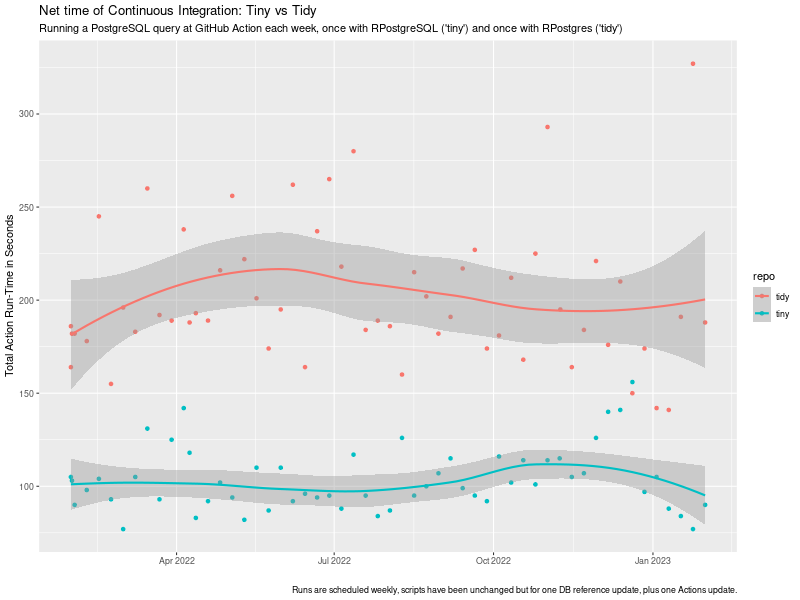
Waiting 1-24 minutes for a build to finish can be a massive time suck.which we would like to come back to today. Furthermore, the unimitable @b0rk had a fabulous tweet just weeks later stating the same point debugging strategy: shorten your feedback loop as a key in a successful debugging strategy. So in sum: shorter is better. Nobody likes to wait. And shorter i.e. faster is a key and recurrent theme in the R4 series. Today we have a fairly nice illustration of two aspects we have stressed before:
lim-tiny
and lim-tidy.
Our conjecture was (and is!) that less is more just as post
#34
titled Less Is More argued with respect to package
dependencies. Each of the repos just does one thing: a query to a
(freely accessible but remote) PostgreSQL database. The tiny version
just retrieves a data frame using only the dependencies needed for RPostgreSQL
namely DBI and
nothing else. The tidy version retrieves a tibble and has access to
everything else that comes when installing RPostgres: DBI, dplyr, and magrittr plus
of course their respective dependencies. We were able to let the code
run in (very default) GitHub Actions on a weekly schedule without
intervention apart from one change to the SQL query when the remote
server (providing public bioinformatics data) changed its schema
slighly, plus one update to the action yaml code version. No other
changes.
We measure the time a standard continuous integration run takes in
total using the default GitHub Action setup in the tidy case (which
relies on RSPM/PPM binaries, caching, , and does not rebuild
from source each time), and our own r-ci script (introduced
in #32
for CI with R. It switched to using r2u during the course of
this experiment but already had access to binaries via c2d4u
so it is always binaries-based (see e.g. #37
or #13
for more). The chart shows the evolution of these run-times over the
course of the year with one weekly run each.
tiny vs tidy ci timing impact
chart
This post by Dirk Eddelbuettel originated on his Thinking inside the box blog. Please report excessive re-aggregation in third-party for-profit settings.
I read somewhere a nice meme about Linux: Do you want an operating system or do you want an adventure? I love
it, because it is so true. What you are about to read is my adventure to set a usable screen resolution in a fresh
Debian testing installation.
The context is that I have two different Lenovo Thinkpad laptops with 16 screen and nvidia graphic cards. They are both
installed with the latest Debian testing. I use the closed-source nvidia drivers (they seem to work better than the nouveau
module). The desktop manager and environment that I use is lightdm + XFCE4. The monitor native resolution in both machines
is very high: 3840x2160 (or 4K UHD if you will).
The thing is that both laptops show an identical problem: when freshly installed with the Debian default config,
the native resolution is in use. For a 16 screen laptop, this high resolution means that the font is tiny.
Therefore, the raw native resolution renders the machine almost unusable.
This is a picture of what you get by running htop in the console (tty1, the terminal you would get by
hitting CTRL+ALT+F1) with the default install:
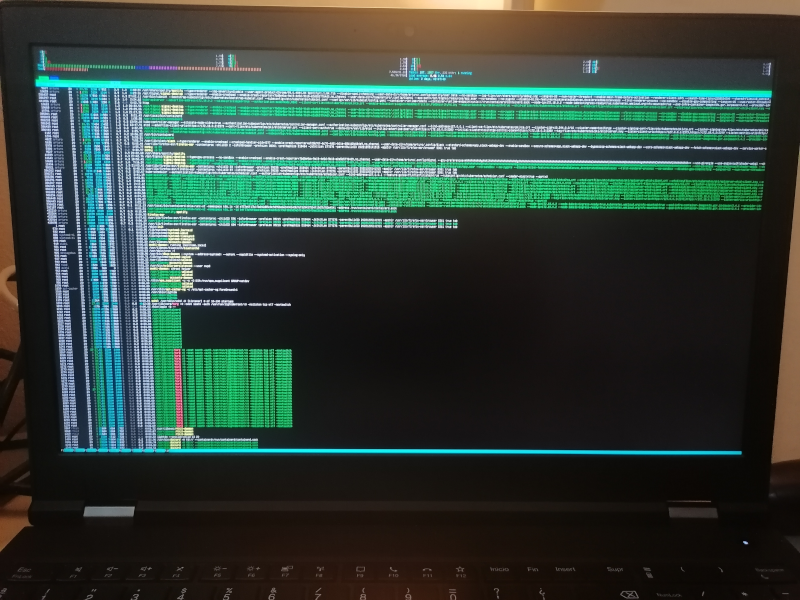
Everything in the system is affected by this:
#4 is the easiest. Navigate with the mouse pointer to the tiny Applications menu, then Settings, then Displays.
This is more or less the same in every other desktop operating system. There are no further actions required to persist this
setting. Thanks you XFCE4.
lightdm
Point #3, about lightdm, is more tricky to solve. It involves running xrandr when lightdm sets up the display.
Nobody will tell you this trick. You have to search for it on the internet. Thankfully is a common problem, and a
person who knows what to search for can find good results.
The file /etc/lightdm/lightdm.conf needs to contain something like this:
[LightDM]
[Seat:*]
# set up correct display resolution
display-setup-script=sh -c -- "xrandr -s 1920x1080"
xrandr --setprovideroutputsource NVIDIA-G0 modesetting && xrandr --auto
to instruct the NVIDIA graphic card to work will with the kernel graphic system.
In my case, one of my laptops require it, so I have:
[LightDM]
[Seat:*]
# don't ask me to type my username
greeter-hide-users=false
# set up correct display resolution, and prepare NVIDIA card for HDMI output
display-setup-script=sh -c "xrandr -s 1920x1080 && xrandr --setprovideroutputsource NVIDIA-G0 modesetting && xrandr --auto"
#1 about the grub menu is also not trivial to solve, but also widely known on the internet. Grub allows you to
set arbitrary graphical modes. In Debian systems, adding something like GRUB_GFXMODE=1024x768 to /etc/default/grub and then
running sudo update-grub should do the magic.
console
So we get to point #2 about the tty1 console. For months, I ve been investing my scarce personal time into trying to
solve this annoyance. There are a lot of conflicting information about this on the internet. Plenty of misleading solutions,
essays about framebuffer, kernel modeset, and other stuff I don t want to read just to get my tty1 in a readable status.
People point in different directions, like using GRUB_GFXPAYLOAD_LINUX=keep in /etc/default/grub. Which is a good solution,
but won t work: my best bet is that the kernel indeed keeps the resolution as told by grub, but the moment systemd loads the nvidia
driver, it enables 4K in the display and the console gets the high resolution.
Actually, for a few weeks, I blamed plymouth. Because the plymouth service is loaded early by
systemd, it could be responsible for setting some of the display settings. It actually contains some (undocummented)
DeviceScale configuration option that is seemingly aimed to integrate into high resolution scenarios. I played with it to no avail.
Some folks from IRC suggested reconfiguring the console-font package. Back-then unknown to me. Running
sudo dpkg-reconfigure console-font would indeed show a menu to select some preferences for the console, including font size.
But apparently, a freshly installed system already uses the biggest possible, so this was a dead end.
Other option I evaluted for a few days was touching the kernel framebuffer setting. I honestly don t understand this, and all the
solutions pointing to use fbset didn t work for me anyways. This is the default framebuffer configuration in one of the laptops:
user@debian:~$ fbset -i
mode "3840x2160"
geometry 3840 2160 3840 2160 32
timings 0 0 0 0 0 0 0
accel true
rgba 8/16,8/8,8/0,0/0
endmode
Frame buffer device information:
Name : i915drmfb
Address : 0
Size : 33177600
Type : PACKED PIXELS
Visual : TRUECOLOR
XPanStep : 1
YPanStep : 1
YWrapStep : 0
LineLength : 15360
Accelerator : No
modprobe nvidia my_desired_resolution=1920x1080 could
exist. Apparently not :-(
I was about to give up. I had walked every corner of the known internet. I even tried summoning the ancient gods, I used ChatGPT.
I asked the AI god for mercy, for a working solution to no avail.
Then I decided to change the kind of queries I was issuing the search engines (don t ask me, I no longer remember). Eventually I landed in
this askubuntu.com page. The question described the exact same problem I was experiencing. Finally, that was encouraging!
I was not alone in my adventure after all!
The solution section included a font size I hadn t seen before in my previous tests: 16x32. More excitement!
I did all the steps. I installed the xfonts-terminus package, and in the file /etc/default/console-setup I put:
ACTIVE_CONSOLES="/dev/tty[1-6]"
CHARMAP="ISO-8859-15"
CODESET="guess"
FONTFACE="Terminus"
FONTSIZE="16x32"
VIDEOMODE=
setupcon from a tty, and the miracle happened! I finally got a bigger font in the tty1 console!
Turned out a potential solution was about playing with console-setup, which I had tried wihtout success before.
I m not even sure if the additional package was required.
This is how my console looks now:
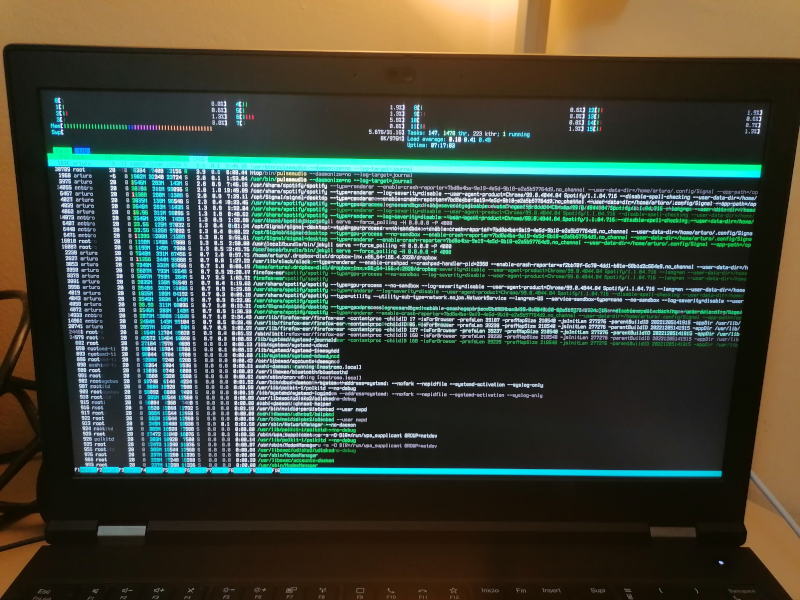
The truth is the solution is satisfying only to a degree. I m a person with good eyesight and can work with
these bit larger fonts. I m not sure if I can get larger fonts using this method, honestly.
After some search, I discovered that some folks already managed to describe the problem in detail and
filed a proper bug report in Debian, see #595696 opened more than 10 years ago.
2023 is the year of linux on the desktop
Nope.
I honestly don t see how this disconnected pile of settings can be all reconciled together.
Can we please have a systemd-whatever that homogeinizes all of this mess?
I m referring to grub + kernel drivers + console + lightdm + XFCE4.
Next adventure
When I lock the desktop (with CTRL+ALT+L) and close the laptop lid to suspend it, then reopen it, type the login info
into the lightdm greeter, then the desktop environment never loads, black screen.
I have already tried the first few search results without luck. Perhaps the nvidia card is to blame this time? Perhaps
poorly coupled power management by the different system software pieces?
Who knows what s going on here. This will probably be my next Debian desktop adventure.

Just days after a build-fix
release (for aarch64) and still only a few weeks after the 0.2.0
release of RcppTOML
and its switch to toml++, we have
another bugfix release 0.2.2 on CRAN also bringing release 3.3.0 of
toml++ (even if we
had large chunks of 3.3.0 already incorporated).
TOML is a file format that is most
suitable for configurations, as it is meant to be edited by
humans but read by computers. It emphasizes strong readability
for humans while at the same time supporting strong typing
as well as immediate and clear error reports. On small typos
you get parse errors, rather than silently corrupted garbage. Much
preferable to any and all of XML, JSON or YAML though sadly these may
be too ubiquitous now. TOML is
frequently being used with the projects such as the Hugo static blog compiler, or the Cargo system of Crates (aka packages )
for the Rust
language.
The package was building fine on Intel-based macOS provided the
versions were recent enough. CRAN, however, aims for the
broadest possibly reach of binaries and builds on a fairly ancient macOS
10.13 with clang version 10. This confused toml++ into (wrongly)
concluding it could not build when it in fact can. After a hint from Simon that Apple in their infinite
wisdom redefines clang version ids, this has been reflected in version
3.3.0 of toml++ by
Mark so we should now build
everywhere. Big thanks to everybody for the help.
The short summary of changes follows.
Courtesy of my CRANberries, there is a diffstat report for this release. More information is on the RcppTOML page page. Please use the GitHub issue tracker for issues and bugreports. If you like this or other open-source work I do, you can sponsor me at GitHub.Changes in version 0.2.2 (2023-01-29)
- New toml++ version 3.3.0 with fix to permit compilation on ancient macOS systems as used by CRAN for the Intel-based builds.
This post by Dirk Eddelbuettel originated on his Thinking inside the box blog. Please report excessive re-aggregation in third-party for-profit settings.
Greetings from Viluppuram, Tamil Nadu, South India!
As a preparation and warm-up for DebConf in September, the Debian
people in India have organized a miniDebConf. Well, I don t want to be
unfair to them They have been regularly organizing miniDebConfs for
over a decade, and while most of the attendees are students local to
this state in South India (the very tip of the country; Tamil Nadu
is the Eastern side, and Kerala, where Kochi is and DebConf will be
held, is the Western side), I have talked with attendees from very
different regions of this country.
This miniDebConf is somewhat similar to similarly-scoped events I have
attended in Latin America: It is mostly an outreach conference, but
it s also a great opportunity for DDs in India to meet in the famous
hallway track.
India is incredibly multicultural. Today at the hotel, I was somewhat
surprised to see people from Kerala trying to read a text written in
Tamil: Not only the languages are different, but the writing systems
also are. From what I read, Tamil script is a bit simpler to Kerala s
Mayalayam, although they come from similar roots.
Of course, my school of thought is that, whenever you visit a city,
culture or country that differs from the place you were born, a
fundamental component to explore and to remember is Food! And one
of the things I most looked forward for this trip was that
precisely. I arrived to the Chennai Airport
(MAA) 8:15 local time yesterday
morning, so I am far from an expert but I have been given (and most
happily received) three times biryani (pictured in the photo by this
paragraph).
It is delicious, although I cannot yet describe the borders of what
should or should not be considered proper biryani): The base dish is
rice, and you go mixing it with different sauces or foods. What
managed to surprise us foreigners is, strangely, well known for us
all: there is no spoon. No, the food is not pushed to your mouth
using metal or wooden utensils. Not even using a tortilla as back
home, or by breaking bits of the injera that serves also as a dish,
as in Ethiopia. Sure, there is naan, but it is completely optional,
and would be a bit too much for as big a big dish as what we have
got. Biryani is eaten With the tools natural to us primates: the
fingers. We have learnt some differnt techniques but so far, I am
still using the base technique (thumb-finger-middle).
I m closing the report with the photo of the closing of the conference
as it happens. And I will, of course, share our adventures as they
unfold in the next couple of days. Because Well, we finished with
the conference-y part of the trip, but we have a full week of
(pre-)DebConf work ahead of us!
kubeadm install.
After passing the two corresponding certifications, my opinion on cloud operators is that it is very much a step back in the direction of proprietary software. You can rebuild their cloud stack with opensource components, but it is also a lot of integration work, similar to using the Linux from scratch distribution instead of something like Debian. A good middle point are the OpenShift and OKD Kubernetes distributions, who integrate the most common cloud components, but allow an installation on your own hardware or cloud provider of your choice.
| AWS | Azure | OpenShift | *OpenShift upstream project& |
|---|---|---|---|
| Cloud Trail | Kubernetes API Server audit log | Kubernetes | |
| Cloud Watch | Azure Monitor, Azure Log Analytics | OpenShift Monitoring | Prometheus, Kubernetes Metrics |
| AWS Artifact | Compliance Operator | OpenSCAP | |
| AWS Trusted Advisor | Azure Advisor | Insights | |
| AWS Marketplace | Red Hat Market place | Operator Hub | |
| AWS Identity and Access Management (IAM) | Azure Active Directory, Azure AD DS | Red Hat SSO | Keycloack |
| AWS Elastisc Beanstalk | Azure App Services | OpenShift Source2Image (S2I) | Source2Image (S2I) |
| AWS S3 | Azure Blob Storage** |
ODF Rados Gateway | Rook RGW |
| AWS Elastic Block Storage | Azure Disk Storage | ODF Rados Block Device | Rook RBD |
| AWS Elastic File System | Azure Files | ODF Ceph FS | Rook CephFS |
| AWS ELB Classic | Azure Load Balancer | MetalLB Operator | MetalLB |
| AWS ELB Application Load Balancer | Azure Application Gateway | OpenShift Router | HAProxy |
| Amazon Simple Notification Service | OpenShift Streams for Apache Kafka | Apache Kafka | |
| Amazon Guard Duty | Microsoft Defender for Cloud | API Server audit log review, ACS Runtime detection | Stackrox |
| Amazon Inspector | Microsoft Defender for Cloud | Quay.io container scanner, ACS Vulnerability Assessment | Clair, Stackrox |
| AWS Lambda | Azure Serverless | Openshift Serverless* |
Knative |
| AWS Key Management System | Azure Key Vault | could be done with Hashicorp Vault | Vault |
| AWS WAF | NGINX Ingress Controller Operator with ModSecurity | NGINX ModSecurity | |
| Amazon Elasticache | Redis Enterprise Operator | Redis, memcached as alternative | |
| AWS Relational Database Service | Azure SQL | Crunchy Data Operator | PostgreSQL |
| Azure Arc | OpenShift ACM | Open Cluster Management | |
| AWS Scaling Group | Azure Scale Set | OpenShift Autoscaler | OKD Autoscaler |
* OpenShift Serverless requires the application to be packaged as a container, something AWS Lambda does not require.
** Azure Blob Storage covers the object storage use case of S3, but is itself not S3 compatible

BEGIN:VEVENT
DTSTART;TZID=Australia/Sydney:20230206T000000
DTEND;TZID=Australia/Sydney:20230206T000000
SUMMARY:School Term starts
END:VEVENT
The event starting and stopping date and time are the DTSTART and DTEND lines. Both of them have the date of 2023/02/06 or 6th February 2023 and a time of 00:00:00 or midnight. So the calendar is doing the right thing, we need to fix the feed!
The Fix
I wrote a quick and dirty PHP script to download the feed from the real site, change the DTSTART and DTEND lines to all-day events and leave the rest of it alone.
<?php
$site = $_GET['s'];
if ($site == 'site1')
$REMOTE_URL='https://site1.example.net/ical_feed';
elseif ($site == 'site2')
$REMOTE_URL='https://site2.example.net/ical_feed';
else
http_response_code(400);
die();
$fp = fopen($REMOTE_URL, "r");
if (!$fp)
die("fopen");
header('Content-Type: text/calendar');
while (( $line = fgets($fp, 1024)) !== false)
$line = preg_replace(
'/^(DTSTART DTEND);[^:]+:([0-9] 8 )T000[01]00/',
'$ 1 ;VALUE=DATE:$ 2 ',
$line);
echo $line;
?>
It s pretty quick and nasty but gets the job done. So what is it doing?
s and match it to either site1 or site2 to obtain the URL. If you only had one site to fix you could just set the REMOTE_URL variable.fopen() and nasty error handling.while loop to read the contents of the remote site line by line.preg_replace is a Perl regular expression replacement. The PCRE is:
BEGIN:VEVENT
DTSTART;VALUE=DATE:20230206
DTEND;VALUE=DATE:20230206
SUMMARY:School Term starts
END:VEVENT
The calendar then shows it properly as an all-day event. I would check the script works before doing the next step. You can use things like curl or wget to download it. If you use a normal browser, it will probably just download the translated file.
If you re not seeing the right thing then it s probably the PCRE failing. You can check it online with a regex checker such as https://regex101.com. The site has saved my PCRE and match so you got something to start with.
Calendar settings
The last thing to do is to change the URL in your calendar settings. Each calendar system has a different way of doing it. For Google Calendar they provide instructions and you want to follow the section titled Use a link to add a public Calendar .
The URL here is not the actual site s URL (which you would have put into the REMOTE_URL variable before) but the URL of your script plus the ?s=site1 part. So if you put your script aliased to /myical.php and the site ID was site1 and your website is www.example.com the URL would be https://www.example.com/myical.php?s=site1 .
You should then see the events appear as all-day events on your calendar.
This is the second of a two-part post covering my goals for 2023. See the first part to understand the vision, mission and strategy driving these goals. I want to thank my friend Nat, and Will Larson whose annual reviews I ve always enjoyed reading for inspiring me to write these posts. I ve found the process articulating my motivations and goals very useful to clarify my thoughts and create tangible next steps. I m grateful for that in and of itself, but I also hope that by publishing this you too might find it interesting, and the additional public accountability it creates will be a positive encouragement to me.
First up is Minidebconf Tamilnadu 2023 that would be held on 28-29 January 2023. You can find rest of the details here. I do hope we get to see/hear some good stuff from the Minidebconf. Best of luck to all those who are applying.

firebuild:
firebuild <build command>
ccache and other compiler-specific caches work, but firebuild can shortcut any deterministic command, not only a specific list of compilers. Since the inputs of each command is determined at run time firebuild does not need a maintained complete dependency graph in the source like Bazel. It can work with any build system that does not implement its own caching mechanism.
Determinism of commands is detected at run-time by preloading libfirebuild.so and interposing standard library calls and syscalls. If the command and all its descendants inputs are available when the command starts and all outputs can be calculated from the inputs then the command can be shortcut, otherwise it will be executed again. The interception comes with a 5-10% overhead, but rebuilds can be 5-20 times, or even faster depending on the changes between the builds.
Can I try it?
It is already available in Debian Unstable and Testing, Ubuntu s development release and the latest stable version is back-ported to supported Ubuntu releases via a PPA.
How can I analyze my builds with firebuild?
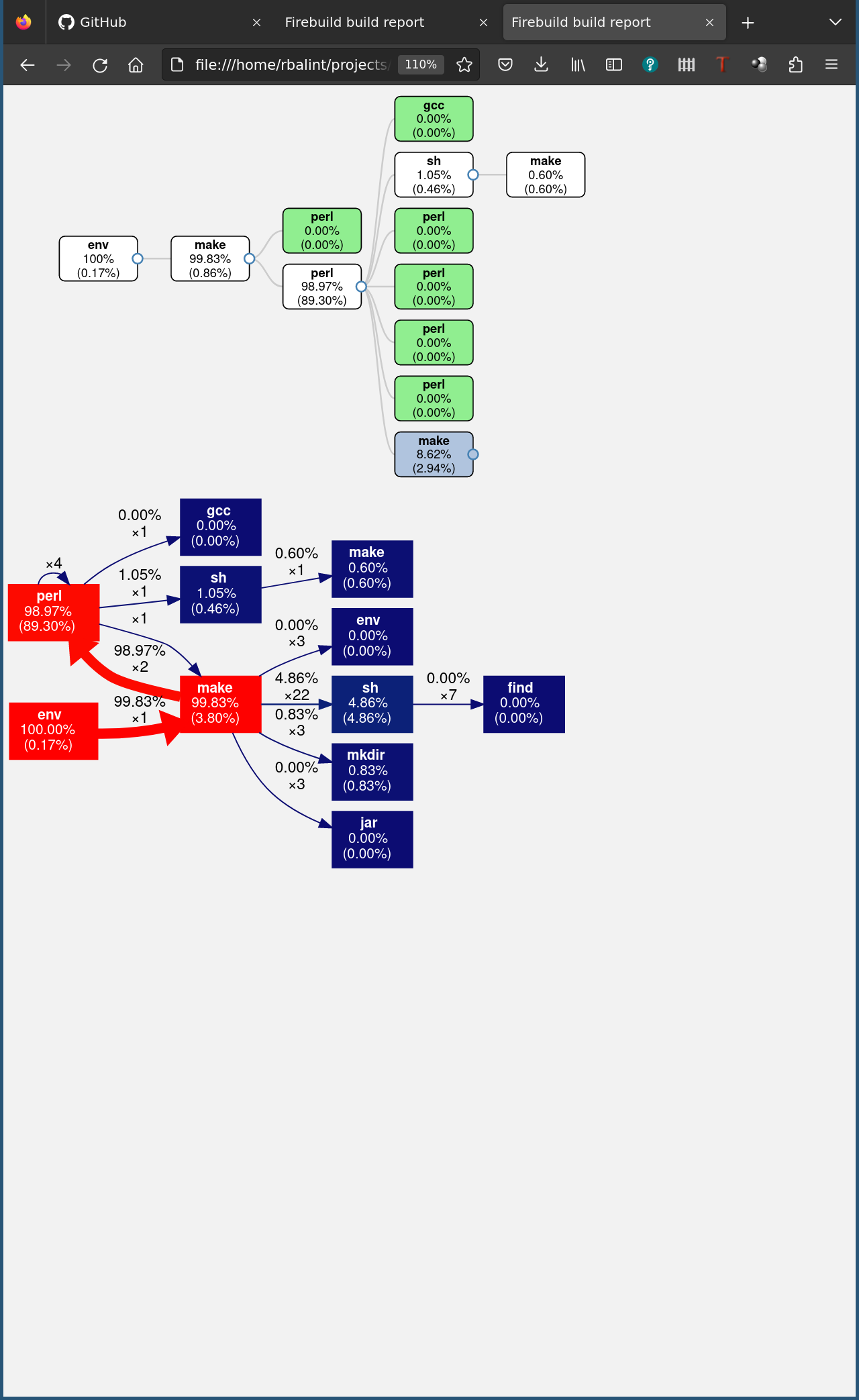
Firebuild can generate an HTML report showing each command s contribution to the build time. Below are the before and after reports of json4s, a Scala project. The command call graphs (lower ones) show that java (scalac) took 99% of the original build. Since the scalac invocations are shortcut (cutting the second build s time to less than 2% of the first one) they don t even show up in the accelerated second build s call graph. What s left to be executed again in the second run are env, perl, make and a few simple commands.
First run (102% of vanilla build)
Second run (1.4 % of vanilla build)
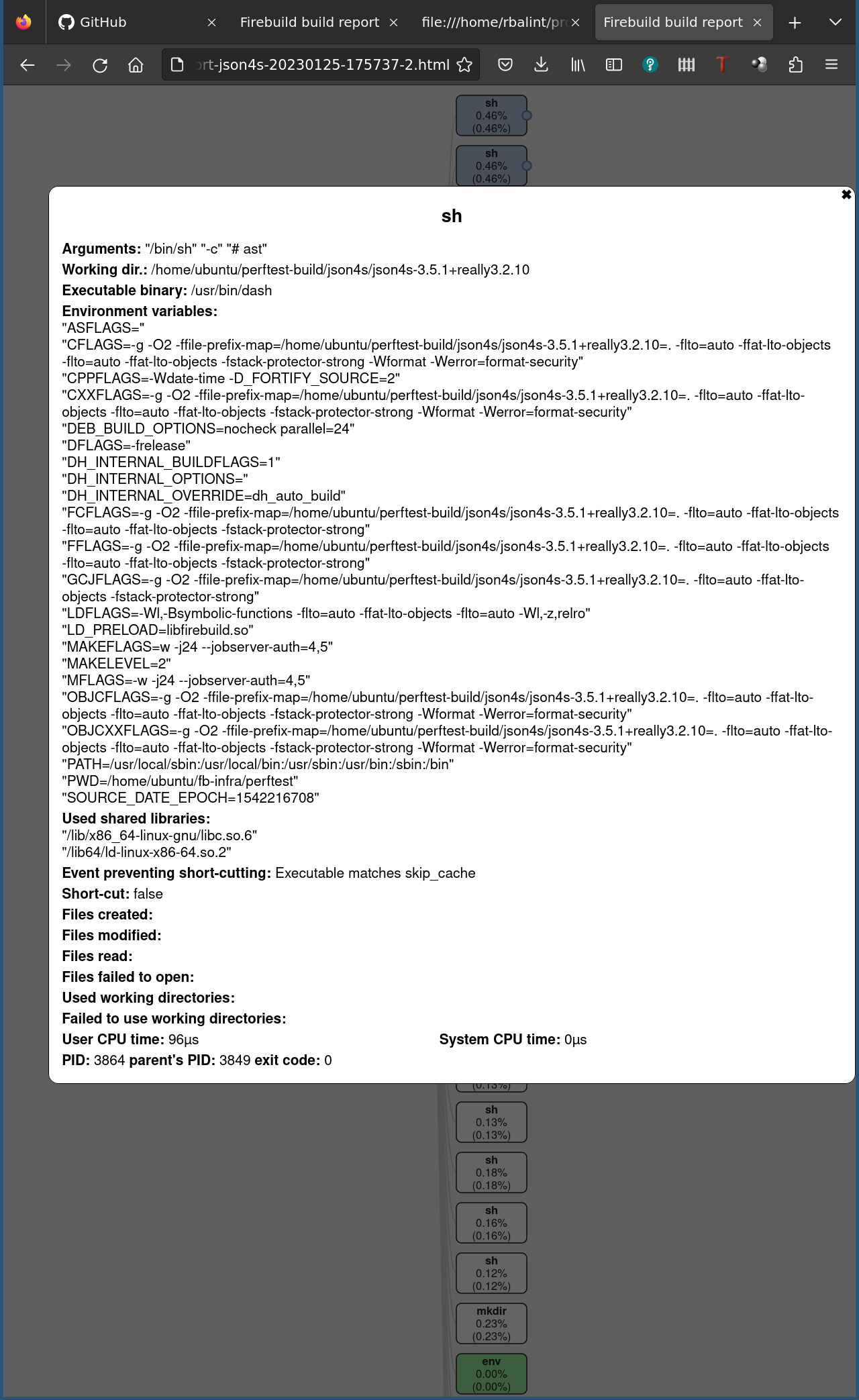
Command detailssh, grep, sed, etc., because caching those would take cache space and shortcutting them may not speed up the build that much. They can still be shortcut with their parent command. Firebuild s strength is that it can find shortcutting points in the process tree automatically, e.g. from sh -c 'bash -c "sh -c echo Hello World!"' bash would be shortcut, but none of the sh commands would be cached. In typical builds there are many such commands from the skip_cache list. Caching those commands with firebuild -o 'processes.skip_cache = []' can improve acceleration and make the reports smaller.
Firebuild also supports several debug flags and -d proc helps finding reasons for not shortcutting some commands:
...
FIREBUILD: Command "/usr/bin/make" can't be short-cut due to: Executable set to be not shortcut, ExecedProcess 1329.2, running, "make -f debian/rules build", fds=[ FileFD fd=0 FileOFD ...
FIREBUILD: Command "/usr/bin/sort" can't be short-cut due to: Process read from inherited fd , ExecedProcess 4161.1, running, "sort", fds=[ FileFD fd=0 FileOFD ...
FIREBUILD: Command "/usr/bin/find" can't be short-cut due to: fstatfs() family operating on fds is not supported, ExecedProcess 1360.1, running, "find -mindepth 1 ...
...
make, ninja and other incremental build tool binaries are not shortcut because they compare the timestamp of files, but they are fast at least and every build step they perform can still be shortcut. Ideally the slower build steps that could not be shortcut can be re-implemented in ways that can be shortcut by avoiding tools performing unsupported operations.
I hope those tools help speeding up your build with very little effort, but if not and you find something to fix or improve in firebuild itself, please report it or just leave a feedback!
Happy speeding, but not on public roads! 
This is the first of a two-part post, covering high-level thoughts around my motivations and vision. Make sure to check out the second part for my specific goals for 2023. A new year is upon us! My plan was to be 6 months into the journey of starting a business by this point. I made some very tentative progress towards that goal in 2022, registering a company and starting some consulting work, but on the whole I ve found it much harder than expected to gather the necessary energy to begin that journey in earnest.
Next.