Search Results: "mak"

28 December 2021

Russ Allbery: Review: Out of Office

Review: Out of Office, by Charlie Warzel & Anne Helen Petersen
Publisher: Alfred A. Knopf
Copyright: 2021
ISBN: 0-593-32010-7
Format: Kindle
Pages: 260
Out of Office opens with the provocative assertion that you were not working from home during the pandemic, even if you were among the 42% of Americans who were able to work remotely.
You were, quite literally, doing your job from home. But you weren't working from home. You were laboring in confinement and under duress. Others have described it as living at work. You were frantically tapping out an email while trying to make lunch and supervise distance learning. You were stuck alone in a cramped apartment for weeks, unable to see friends or family, exhausted, and managing a level of stress you didn't know was possible. Work became life, and life became work. You weren't thriving. You were surviving.
The stated goal of this book is to reclaim the concept of working from home, not only from the pandemic, but also from the boundary-destroying metastasis of work into non-work life. It does work towards that goal, but the description of what would be required for working from home to live up to its promise becomes a sweeping critique of the organization and conception of work, leaving it nearly as applicable to those who continue working from an office. Turns out that the main problem with working from home is the work part, not the "from home" part. This was a fascinating book to read in conjunction with A World Without Email. Warzel and Petersen do the the structural and political analysis that I sometimes wish Newport would do more of, but as a result offer less concrete advice. Both, however, have similar diagnoses of the core problems of the sort of modern office work that could be done from home: it's poorly organized, poorly managed, and desperately inefficient. Rather than attempting to fix those problems, which is difficult, structural, and requires thought and institutional cooperation, we're compensating by working more. This both doesn't work and isn't sustainable. Newport has a background in productivity books and a love of systems and protocols, so his focus in A World Without Email is on building better systems of communication and organization of work. Warzel and Petersen come from a background of reporting and cultural critique, so they put more focus on power imbalances and power-serving myths about the American dream. Where Newport sees an easy-to-deploy ad hoc work style that isn't fit for purpose, Warzel and Petersen are more willing to point out intentional exploitation of workers in the guise of flexibility. But they arrive at some similar conclusions. The way office work is organized is not leading to more productivity. Tools like Slack encourage the public performance of apparent productivity at the cost of the attention and focus required to do meaningful work. And the process is making us miserable. Out of Office is, in part, a discussion of what would be required to do better work with less stress, but it also shares a goal with Newport and some (but not most) corners of productivity writing: spend less time and energy on work. The goal of Out of Office is not to get more work done. It's to work more efficiently and sustainably and thus work less. To reclaim the promise of flexibility so that it benefits the employee and not the employer. To recognize, in the authors' words, that the office can be a bully, locking people in to commute schedules and unnatural work patterns, although it also provides valuable moments of spontaneous human connection. Out of Office tries to envision a style of work that includes the office sometimes, home sometimes, time during the day to attend to personal chores or simply to take a mental break from an unnatural eight hours (or more) of continuous focus, universal design, real worker-centric flexibility, and an end to the constant productivity ratchet where faster work simply means more work for the same pay. That's a lot of topics for a short book, and structurally this is a grab bag. Some sections will land and some won't. Loom's video messages sound like a nightmare to me, and I rolled my eyes heavily at the VR boosterism, reluctant as it may be. The section on DEI (diversity, equity, and inclusion) was a valiant effort that at least gestures towards the dismal track record of most such efforts, but still left me unconvinced that anyone knows how to improve diversity in an existing organization without far more brute-force approaches than anyone with power is usually willing to consider. But there's enough here, and the authors move through topics quickly enough, that a section that isn't working for you will soon be over. And some of the sections that do work are great. For example, the whole discussion of management.
Many of these companies view middle management as bloat, waste, what David Graeber would call a "bullshit job." But that's because bad management is a waste; you're paying someone more money to essentially annoy everyone around them. And the more people experience that sort of bad management, and think of it as "just the way it is," the less they're going to value management in general.
I admit to a lot of confirmation bias here, since I've been ranting about this for years, but management must be the most wide-spread professional job for which we ignore both training and capability and assume that anyone who can do any type of useful work can also manage people doing that work. It's simply not true, it creates workplaces full of horrible management, and that in turn creates a deep and unhelpful cynicism about all management. There is still a tendency on the left to frame this problem in terms of class struggle, on the reasonable grounds that for decades under "scientific management" of manufacturing that's what it was. Managers were there to overwork workers and extract more profits for the owners, and labor unions were there to fight back against managers. But while some of this does happen in the sort of office work this book is focused on, I think Warzel and Petersen correctly point to a different cause.
"The reason she was underpaid on the team was not because her boss was cackling in the corner. It was because nobody told the boss it was their responsibility to look at the fucking spreadsheet."
We don't train managers, we have no clear expectations for what managers should do, we don't meaningfully measure their performance, we accept a high-overhead and high-chaos workstyle based on ad hoc one-to-one communication that de-emphasizes management, and many managers have never seen good management and therefore have no idea what they're supposed to be doing. The management problem for many office workers is less malicious management than incompetent management, or simply no effective management at all apart from an occasional reorg and a complicated and mind-numbing annual review form. The last section of this book (apart from concluding letters to bosses and workers) is on community, and more specifically on extracting time and energy from work (via the roadmap in previous chapters) and instead investing it in the people around you. Much ink has been spilled about the collapse of American civic life, about how we went from a nation of joiners to a nation of isolated individual workers with weak and failing community institutions. Warzel and Petersen correctly lay some blame for this at the foot of work, and see the reorganization of work and an increase in work from home (and thus a decrease in commutes) as an opportunity to reverse that trend. David Brooks recently filled in for Ezra Klein on his podcast and talked with University of Chicago professor Leon Kass, which I listened to shortly after reading this book. In one segment, they talked about marriage and complained about the decline in marriage rates. They were looking for causes in people's moral upbringing, in their life priorities, in the lack of aspiration for permanence in kids these days, and in any other personal or moral failing that would allow them to be smugly judgmental. It was a truly remarkable thing to witness. Neither man at any point in the conversation mentioned either money or time. Back in the world most Americans live in, real wages have been stagnant for decades, student loan debt is skyrocketing as people desperately try to keep up with the ever-shifting requirements for a halfway-decent job, and work has expanded to fill all hours of the day, even for people who don't have to work multiple jobs to make ends meet. Employers have fully embraced a "flexible" workforce via layoffs, micro-optimizing work scheduling, eliminating benefits, relying on contract and gig labor, and embracing exceptional levels of employee turnover. The American worker has far less of money, time, and stability, three important foundations for marriage and family as well as participation in most other civic institutions. People like Brooks and Kass stubbornly cling to their feelings of moral superiority instead of seeing a resource crisis. Work has stolen the resources that people previously put into those other areas of their life. And it's not even using those resources effectively. That's, in a way, a restatement of the topic of this book. Our current way of organizing work is not sustainable, healthy, or wise. Working from home may be part of a strategy for changing it. The pandemic has already heavily disrupted work, and some of those changes, including increased working from home, seem likely to stick. That provides a narrow opportunity to renegotiate our arrangement with work and try to make those changes stick. I largely agree with the analysis, but I'm pessimistic. I think the authors are as well. We're very bad at social change, and there will be immense pressure for everything to go "back to normal." Those in the best bargaining position to renegotiate work for themselves are not in the habit of sharing that renegotiation with anyone else. But I'm somewhat heartened by how much public discussion there currently is about a more fundamental renegotiation of the rules of office work. I'm also reminded of a deceptively profound aphorism from economist Herbert Stein: "If something cannot go on forever, it will stop." This book is a bit uneven and is more of a collection of related thoughts than a cohesive argument, but if you are hungry for more worker-centric analyses of the dynamics of office work (inside or outside the office), I think it's worth reading. Rating: 7 out of 10

27 December 2021

Abiola Ajadi: Outreachy-Everyone Struggles!

Hello Everyone! Three weeks into my internship and it s been great so far with Awesome Mentors. I am currently learning a new Language which is Ruby and this is the perfect time to remind myself that everyone struggles! I struggled a bit getting farmiliar with the codebase and pushing my first merge request during the internship. I won t say i have a perfect understanding of how everything works, but i am learning.

What is Debci? Debci stands for Debian Continous Integration before i move on, what is continous integration? according to Atlassian Continuous integration (CI) is the practice of automating the integration of code changes from multiple contributors into a single software project. It s a primary DevOps best practice, allowing developers to frequently merge code changes into a central repository where builds and tests then run. Automated tools are used to assert the new code s correctness before integration. From the official documentation; The Debian continuous integration (debci) is an automated system that coordinates the execution of automated tests against packages in the Debian system. Debci exist to make sure packages work currently after an update, How it does this is by testing all of the packages that have tests written in them to make sure it works and nothing is broken. It has a UI for developers to see if the test passes or not.

Progress This week; I have learnt how to write automated test and Squashing multiple commits into one single commit.

26 December 2021

Vincent Bernat: Custom screen saver with XSecureLock

i3lock is a popular X11 screen lock utility. As far as customization goes, it only allows one to set a background from a PNG file. This limitation is part of the design of i3lock: its primary goal is to keep the screen locked, something difficult enough with X11. Each additional feature would increase the attack surface and move away from this goal.1 Many are frustrated with these limitations and extend i3lock through simple wrapper scripts or by forking it.2 The first solution is usually safe, but the second goes against the spirit of i3lock. XSecureLock is a less-known alternative to i3lock. One of the most attractive features of this locker is to delegate the screen saver feature to another process. This process can be anything as long it can attach to an existing window provided by XSecureLock, which won t pass any input to it. It will also put a black window below it to ensure the screen stays locked in case of a crash. XSecureLock is shipped with a few screen savers, notably one using mpv to display photos or videos, like the Apple TV aerial videos. I have written my own saver using Python and GTK.3 It shows a background image, a clock, and the current weather.4
Custom screen saver for XSecureLock, displaying a clock and the current weather
Custom screen saver for XSecureLock
I add two patches over XSecureLock: XSecureLock also delegates the authentication window to another process, but I was less comfortable providing a custom one as it is a bit more security-sensitive. While basic, the shipped authentication application is fine by me. I think people should avoid modifying i3lock code and use XSecureLock instead. I hope this post will help a bit.

Update (2022-01) XScreenSaver can also run arbitrary programs as a screen saver.


  1. See for example this comment or this one explaining the rationale.
  2. This Reddit post enumerates many of these alternatives.
  3. Using GTK makes it a bit difficult to use some low-level features, like embedding an application into an existing window. However, the high-level features are easier, notably drawing an image and a text with a shadow.
  4. Weather is retrieved by another script running on a timer and written to a file. The screen saver watches this file for updates.

Russ Allbery: rra-c-util 10.1

This is my collection of utility functions, Autoconf macros, test programs, and other support infrastructure for my other packages. Changes in this release: I go a few years between battles with perltidy, then dive in again, try to see if anything has gotten better, make a few tweaks, and leave vaguely frustrated. I've been so spoiled by Python's black that, despite knowing how much harder Perl is to parse, I keep hoping for the same thing. If anyone knows how to get perltidy to format long method calls the way black does, namely:
$spin = App::DocKnot::Spin->new(
      delete => 1, 'style-url' => '/~eagle/styles/'  
);
and not (as perltidy insists) either:
$spin
  = App::DocKnot::Spin->new(  delete => 1, 'style-url' => '/~eagle/styles/'  );
or:
$spin = App::DocKnot::Spin->new(
    delete => 1, 'style-url' => '/~eagle/styles/'  );
or some other weirdness, I'd love to hear it. Also this time around I discovered that changing the indent for continuation lines also changes the outdent for labels, because those are totally the same thing. A very perltidy sort of problem. Disabling vertical alignment (which makes code formatting very unstable and fiddly because perltidy is AMAZINGLY aggressive about what it tries to vertically align) means that perltidy instead aggressively breaks all of your vertical alignment. I just want => to line up, but not the arguments to any random function call or the equal signs for every random assignment. Is this too much to ask? (To be fair, black doesn't do this either, but for some reason it feels more important to line up fat commas in Perl than hash constructors in Python.) I should probably go file bugs against perltidy, and I admit I have not done that and thus there's no reason to expect anyone to know about my wishes. What I want seems different enough from how the program works that I'm not sure that would be appreciated, but I'm probably wrong. Anyway, you can get the latest version of rra-c-util from its distribution page.

25 December 2021

Russ Allbery: Review: Shattered Pillars

Review: Shattered Pillars, by Elizabeth Bear
Series: Eternal Sky #2
Publisher: Tor
Copyright: March 2013
ISBN: 0-7653-2755-4
Format: Hardcover
Pages: 333
Shattered Pillars is the second book in the Eternal Sky series, which begins with Range of Ghosts. You should read them in order, and ideally close together, since they (along with the next book) form a single continuous story. I made the horrible mistake of reading the first book of an Elizabeth Bear series and then letting four years go by before reading the second one. Bear's trademark style is to underexplain things to the point that it can be hard to follow the plot when you remember it, let alone after more than sufficient time to forget even the general shape of the plot. I therefore spent most of this book (and a bit of Internet searching) trying to dig up pieces of my memory and reconstruct the story. Learn from my error and read the trilogy as one novel if you're going to read it. Please, authors and publishers, put a short plot synopsis at the start of series books. No, your hints about what happened previously that you weave into the first two chapters are not as good as a one-page plot synopsis. No, I don't want to have to re-read the first book; do you have any idea how many books I own but haven't read? No, the Internet doesn't provide plot synopses for every book. Give me a couple of paragraphs and help me enjoy your fiction! Argh. Possible spoiler warnings for the first book are in order because I don't remember the first book well enough to remember what plot details might be a spoiler. As Shattered Pillars opens, Temur, Samarkar, and their companions have reached the western city of Asitaneh, seeking help from Temur's grandfather to rescue Edene from the Nameless. This will require breaching the Nameless fortress of Ala-Din. That, in turn, will entangle Temur and Samarkar in the politics of the western caliphate, where al-Sepehr of the Nameless is also meddling. Far to the east, from where Samarkar came, a deadly plague breaks out in the city of Tsarepheth, one that follows an eerily reliable progression and is even more sinister than it may first appear. Al-Sepehr's plans to sow chaos and war using ancient evil magic and bend the results to his favor continue apace. But one of the chess pieces he thought he controlled has partly escaped his grasp. Behind all of this lurks the powers of Erem and its scorching, blinding, multi-sunned sky. Al-Sepehr believes he understands those powers well enough to use them. He may be wrong. This is entirely the middle book of a trilogy, in that essentially nothing is resolved here. All the pieces in motion at the start of this book are still in motion at the end of this book. We learn a lot more about the characters, get some tantalizing and obscure glances at Erem, and end the book with a firmer idea of the potential sides and powers in play, but there is barely any plot resolution and no proper intermediate climax. This is a book to read as part of a series, not on its own. That said, I enjoyed this book considerably more than I would have expected given how little is resolved. Bear's writing is vivid and engrossing and made me feel like I was present in this world even when nothing apparently significant was happening. And, as usual, her world-building is excellent if you like puzzles, stray hints, and complicated, multi-faceted mythology. This is a world in which the sky literally changes depending on which magical or mythological system reigns supreme in a given area, which in the Erem sections give it a science fiction flavor. If someone told me Bear could merge Silk Road historical fantasy with some of the feel of planetary romance (but far more sophisticated writing), I would have been dubious, but it works. Perhaps the best thing about this book is that all of the characters feel like adults. They make complex, nuanced decisions in pursuit of their goals, thoughtfully adjust to events, rarely make obviously stupid decisions, and generally act like the intelligent and experienced people that they are. This is refreshing in epic fantasy, where the plot tends to steamroll the characters and where often there's a young chosen one at the center of the plot whose courage and raw power overcomes repeated emotional stupidity. Shattered Pillars is careful, precise, and understated where epic fantasy is often brash, reckless, and over-explained. That plus the subtle and deep world-building makes this world feel older and more complex than most series of this sort. There's also a magical horse, who is delightfully uninterested in revealing anything about where it came from or why it's magical, and who was probably my favorite character of the book. Hrahima, the giant tiger-woman, is a close second. I was intrigued to learn more about her complicated relationship with her entirely separate mythology, and hope there's more about that the third book. The villain is still hissable, but a bit less blatantly so on camera. It helps that the scenes from the villains' perspective primarily focus on his more interesting servants. One of the problems with this book, and I think one of the reasons why it feels so transitional and intermediate, is that there are a lot of viewpoint characters and a lot of scene-switching. We're kept up-to-date with four separate threads of events, generally with more than one viewpoint character in each of those threads, and at times (particularly with the wizards of Tsarepheth) I had trouble keeping all the supporting characters straight. Hopefully the third book will quickly merge plot lines and bring some of this complexity together. I wish I'd read this more closely to Range of Ghosts. Either that or a plot synopsis would have helped me enjoy it more. But this is solid epic fantasy by one of SFF's better writers, and now I'm invested in the series again. Some unfortunate logistics are currently between me and the third book, but it won't be four years before I finish the series. Followed by Steles of the Sky. Rating: 7 out of 10

23 December 2021

Russ Allbery: Review: The Empress of Salt and Fortune

Review: The Empress of Salt and Fortune, by Nghi Vo
Series: Singing Hills Cycle #1
Publisher: Tordotcom
Copyright: March 2020
ISBN: 1-250-75029-6
Format: Kindle
Pages: 119
Cleric Chih is a record-keeper and historian from the Singing Hills abbey. They have come to Lake Scarlet with their neixin, the hoopoe Almost Brilliant, because the magical imperial lock placed on the site by the Empress In-yo has just been lifted. They hope to be one of the first to catalog what may be found there, but are surprised to encounter an old woman named Rabbit. Along with a catalog of objects will come a catalog of stories. Empress In-yo came from the north, a political bride for Emperor Sung. She was exiled to Lake Scarlet, to a compound her attendants called Thriving Fortune as a bitter joke. This is the site that Cleric Chih is cataloging. The old woman named Rabbit was one of the empress's attendants. Cleric Chih slowly draws out her stories, often sparked by an object found in the compound and described in the chapter epigraphs. The Empress of Salt and Fortune is a short fantasy novella set in a slightly modified version of China. In-yo comes from a recognizably Mongolian north, but it's colder and has mammoths. Anh, the analogue of China, uses magic to ensure that winter never comes. The court politics, though, seem largely unchanged from our world. The empress from the north had one important duty: delivery of an heir. Once that was done, the empire had no more need for her. That was, as foreshadowed at the start of the novella, not the end of In-yo or Rabbit's story. This is a lovely, layered, and subtle story that was a bit too subtle for my mood when I was reading it. It is the type of story that understates the emotions of the characters and rewards close reading and paying attention. I was not paying enough attention and missed a few significant character developments, which in this concise and careful of a story is not advisable. If you read this, learn from my experience, take it slow, and don't expect major plot events to be signaled in neon. The center of this story is careful and ruthless use of power in a world that is attempting to deny you any, and the sacrifices that one makes to reach that power anyway. Both the empress and Rabbit play bad hands with great effectiveness, taking advantage of the ways in which they're underestimated. It's a sharp and difficult and quietly angry story with a good emotional payoff that doesn't deliver a typical ending. I like stories in which characters make difficult decisions with their eyes wide open, and then refuse to second-guess them or feel bad about the expected consequences. If you like stories about decisive women using and bypassing systems that were stacked against them, you will probably enjoy this novella. The Empress of Salt and Fortune won the 2021 Hugo for best novella, but there is not a lot of fantasy here. It's mostly in the background and setting of a political and character story, and I'm not sure any of it was essential to the plot. What it does have is memorable characters and concise and effective storytelling. We may be living through the golden age of the novella, at least in the science fiction and fantasy world. Chih is a quiet and careful questioner who knows the value of patience and creating space. They don't get much opportunity for characterization in this novella, but what hints we get of their order's approach are intriguing. It appears that this series of novellas will be following Chih rather than the other branches of the story. That will likely keep me reading. Followed by When the Tiger Came Down the Mountain. Rating: 7 out of 10

21 December 2021

Jonathan Dowland: Vim plugins by Tim Pope

I've been using Vim as my main text editor for 18 years, but for most of that time I've been using something very close to the default configuration: my vimrc contained not much more than preferences for indentation and how to visually indicate white space characters like tabs. Last but not least, I've used a single colour scheme for most of that time: Zenburn. In 20151 I started exploring a few Vim plugins2. To manage them, I started by choosing a plugin manager, Pathogen3. Recently I noticed that the plugin's author, Tim Pope, now recommends new users just use Vim's built in package management instead. I got curious about Tim Pope's other plugins: He has written a great deal of them. Given I've spent most of two decades with a barely-configured Vim, you can imagine that I don't want to radically alter the way it works, and so I did not expect to want to use a lot of plugins. The utility of a plugin would have to outweight the disadvantages of coming to rely on one. But when browsing Tim's plugins, time and time again, I found myself reacting to description with How did I manage without this?. And so, I've ended up installing all of the following, all by Tim Pope:

  1. I had to look this up, probably because I started at redhat
  2. I have opinions about Plugins, what supporting them means architecturally for your application, the interaction with Open Source, and stuff like that, perhaps for another post.
  3. To try out Vim plugins the first thing you need to figure out is how to manage them (install, activate, configure). Vim grew a Plugin manager in version 8 (2016). Prior to that, people wrote third-party ones. For this reason there is a frankly absurd number of Plugin managers, including: Vim's own; Vim Plug; Vundle; Dein; Volt and Pathogen.

20 December 2021

Craig Small: WordPress 5.8.2 Debian packages

After a bit of a delay, WordPress version 5.8.2 packages should be available now. This is a minor update from 5.8.1 which fixes two bugs but not the security bug. The security bug is due to WordPress shipping its own CA store, which is a list of certificates it trusts to sign for websites. Debian WordPress has used the system certificate store which uses /etc/ssl/certs/ca-certificates.crt for years so is not impacted by this change. That CA file is generated by update-ca-certificates and is part of the ca-certificates package. We have also had another go of tamping down the nagging WordPress does about updates, as you cannot use the automatic updates through WordPress but via the usual Debian system. I see we are not fully there as WordPress has a site health page that doesn t like things turned off. The two bugs fixed in 5.8.2 I ve not personally hit, but they might help someone out there. In any case, an update is always good. Next stop 5.9 The next planned release is in late January 2022. I m sure there will be a new default theme, but they are planning on making big changes around the blocks and styles to make it easier to customise the look.

19 December 2021

Bastian Venthur: Managing dotfiles with GNU Stow

Many developers manage their user-specific application configuration also known as dotfiles in a version control system such as git. This allows for keeping track of changes and synchronizing the dotfiles across different machines. Searching on github, you ll find thousands of dotfile repositories. As your dotfiles are sprinkled all over your home directory, managing them in a single repository is not trivial, i.e. how do you make sure that your .bashrc, .tmux.conf, etc. that life in your dotfile repository appear in the proper places in your home directory? The most common solution is to use symlinks so that the .tmux.conf in your home directory is just a symlink pointing to the appropriate file in your dotfile repository:

$ ls -l ~/.tmux.conf
lrwxrwxrwx 1 venthur venthur 34 18. Dez 22:53 /home/venthur/.tmux.conf -> git/dotfiles/tmux/.tmux.conf
This leads immediately to another problem: how do you manage the symlinks? For the longest time I just manually maintained the symlinks on the various machines, but this approach does not scale well with the number of dotfiles and machines you re using this repository on. Often, people write their own shell scripts that help them with the maintenance of the symlinks, but at least the solutions I ve seen so far did not convince me. Last year I stumbled upon GNU Stow, an unpretentious little tool that does not reveal at first sight how useful it would be for the job. The description on the website says:
GNU Stow is a symlink farm manager which takes distinct packages of software and/or data located in separate directories on the filesystem, and makes them appear to be installed in the same place.
Right. How does it work? In stow s terminology, a package is a set of files and directories that need to be installed in a particular directory structure. The target directory is the root of the tree in which the package appear to be installed. When you stow a package, stow creates symlinks in the target directory that point into the package. Let s say I have my dotfiles repository in ~/git/dotfiles/. Within this repository, I have a tmux package, containing the .tmux.conf dotfile:
$ pwd
/home/venthur/git/dotfiles
$ find tmux
tmux                # the package
tmux/.tmux.conf     # the dotfile
The target directory is my home directory, as this is where the symlinks need to be created. I can now stow the tmux package into the target directory like so:
$ stow --target=/home/venthur tmux
and stow will create the appropriate symlinks to the contents of the package into the target directory:
$ ls -l ~/.tmux.conf
lrwxrwxrwx 1 venthur venthur 34  2. Jun 2021  /home/venthur/.tmux.conf -> git/dotfiles/tmux/.tmux.conf
Note that the name of the package (i.e. the name of the directory) does not matter as stow points the symlinks into the package, so you can choose it freely. I usually use the name of the program that the configuration belongs to as the package name. Your package can also contain several files or even a complex directory structure. Let s look at the configuration for neovim, which lives below ~/.config/nvim/:
$ pwd
/home/venthur/git/dotfiles
$ find neovim
neovim
neovim/.config
neovim/.config/nvim
neovim/.config/nvim/init.vim
$ stow --target=/home/venthur neovim
$ ls -l ~/.config/nvim
lrwxrwxrwx 1 venthur venthur 41  2. Jun 2021  /home/venthur/.config/nvim -> ../git/dotfiles/neovim/.config/nvim
At this point we should mention that the target directory for my dotfiles will always be my home directory, so the contents of the packages are either the configuration files or the directory structure as they live in my home directory. Deleting a package from the parent directory You can also remove (unstow) a package from the target directory again, using the --delete parameter:
$ ls -l ~/.tmux.conf
lrwxrwxrwx 1 venthur venthur 34 18. Dez 22:53 /home/venthur/.tmux.conf -> git/dotfiles/tmux/.tmux.conf
$ stow --target=/home/venthur --delete tmux/
$ ls -l ~/.tmux.conf
ls: cannot access '/home/venthur/.tmux.conf': No such file or directory
Stowing several packages at once Since your dotfile repository will likely contain more than one package, it makes sense to combine the individual stow commands into one, so instead of stowing everything individually,
$ stow --target=/home/venthur tmux
$ stow --target=/home/venthur vim
$ stow --target=/home/venthur neovim
you can stow everything at once:
$ stow --target=/home/venthur */
Note that I use */ instead of * to match all directories (i.e. packages), since my dotfiles repository also contains a README.md and a makefile. Putting it all together My dotfiles repository contains a makefile that allows me to create/update or delete all symlinks at once:
all:
        stow --verbose --target=$$HOME --restow */
delete:
        stow --verbose --target=$$HOME --delete */
The --restow parameter tells stow to unstow the packages first before stowing them again, which is useful for pruning obsolete symlinks from the target directory. Et voil ! Whenever I make a change in my dotfiles repository that involves creating or deleting a dotfile (or a package), I simply call:
$ make
and everything is updated. To delete all dotfile-related symlinks from this machine, I simply run:
$ make delete

Russ Allbery: Review: Raybearer

Review: Raybearer, by Jordan Ifueko
Series: Raybearer #1
Publisher: Amulet Books
Copyright: 2020
ISBN: 1-68335-719-1
Format: Kindle
Pages: 308
Tarisai was raised alone in Bhekina House by an array of servants and tutors who were not allowed to touch her. Glimpses of the world were fleeting and sometimes ended by nailed-shut windows. Her life revolved around her rarely-seen mother, The Lady, who treats her with deep affection but rarely offers a word of praise, instead only pushing her to study harder. The servants whispered behind her back (but still in her hearing) that she was not human. At the age of seven, in a child's attempt to locate her absent mother by sneaking out of the house, she finds her father and is told a piece of the truth: she is the daughter of the Lady and a captive ehru, a djinn. At the age of eleven she's sent with two guardians to Oluwan City, the capital of Aritsar, to enter a competition she knows nothing about, for reasons no one has ever explained. Raybearer is a young adult fantasy novel, the first of a duology. Like a lot of young adult novels, it is a coming of age story that follows Tarisai from the end of her highly manipulated childhood through her introduction to a world she was carefully never taught about. Like a lot of young adult fantasy novels, Tarisai has some unusual abilities. What those are, and why she has them, is perhaps less obvious than it may appear at first. Unlike a lot of young adult fantasy novels, Raybearer is not set in a facsimile of Western Europe, the structure of gods and religion is not obviously derived from Christianity or Greek or Norse mythology, and neither Tarisai nor most of the characters of this story are white. Some of the characters are; Ifueko draws from a grab bag of cultures that does include European as well as African, Middle Eastern, and Asian. But the food, the physical descriptions, the landscape, and the hair and hair styles feel primarily African not in the sense of specific identifiable regions, but in the same way that most fantasy feels European even if the map isn't recognizable. That gives this story a freshness that I found delightful. The mythology of this world shares some similarities to standard fantasy tropes, including a bargain with the underworld that plays a similar role to fae bargains in some European fantasy, but it also goes in different directions and finds atypical balances, which gave the story room to catch me by surprise. The magical center of this book (and series), which Tarisai is carefully not told about until the story starts, is a system for anointing and protecting the emperor: selection of people who swear loyalty to him and each other and become his innermost circle, and thereby grant him magical protection. The emperor himself is the Raybearer, possessing an artifact that makes him invulnerable to one form of death for each member of his council he anoints. At eleven council members, he becomes invulnerable to anything but old age, or an attack from one of the council themselves. As the reader learns early in the book, that last part is important. Tarisai is an assassin; her mother's goal is for her to be selected as a member of the council for the prince, who will become the next emperor. But there is rather more to this system of magic than it may first appear, in a way that adds good depth to the mythology. And there is quite a bit more to Tarisai herself than anyone expects. Tarisai as a protagonist follows a more typical young adult pattern, but it's a formula that works for me. Her upbringing isolated from any other children has left her craving connection, but it also made her self-reliant, stubborn, and good at keeping her own counsel. One of the things that I loved about this book is that she's not thrown into a nest of vipers and cynical politics. Some of that is happening in the background, but the first step of her mother's plan is for her to earn the trust of the prince in a competition with other potential council members, all of whom are, well, kids. They fight (some), but they also make friends, helped along by the goal and requirement that they join a cooperative council or be sent home. That gives the plot a more collaborative and social feel than one would otherwise expect from the setup. Ifueko does a great job juggling a challenging cast size by focusing on a few kids with whom Tarisai strikes up a friendship but giving the others distinct-enough personalities that their presence is still felt in the story. There are two character dynamics that stand out: Tarisai's relationship with Prince Ekundayo, and her friendship with Sanjeet. The first carries much of the weight of the plot, of course; Tarisai is supposed to gain his trust and then kill him, and the reader will be unsurprised that this takes twists and turns no one expected. But Ifueko, refreshingly, does not reach for the stock plot development of a romance to complicate matters, even though many of the characters expect that. To the contrary, this is a rare story that at least hints at an acknowledgment that some people are not interested in romance at all, and there are other forms that mutual respect can take. Tarisai's relationship with Sanjeet is a different type of depth: two kids with very different histories finding a common understanding in the ways that they were both abused, and create space for each other. It's a great friendship that includes some deeply touching moments. It took me a bit to get into this book, but once Tarisai starts finding her feet and navigating her new relationships, I was engrossed. The story takes a sharp and nasty turn that was hard to read, but Ifueko chooses to turn it into a story of resiliency rather than survival, which makes it much easier to read than it could have been. She also pulls off the kind of plot that complicates and deepens the motives of the obvious villains in a way that gives the story much greater heft, but without disregarding the damage that they have done. I think the plot did fall apart a bit at the end of the book, with too much quick travel and world-building revelations at the cost of development of the relationships that were otherwise at the center of the book, but I'm hoping the sequel will pull those threads back together. And it's so refreshing to read a fantasy novel of this type with a different setting. It's not perfect: Ifueko falls back on Planet of the Hats regional characterization in a few places, and Songland is so obviously Korea that it felt jarring and out of place. Christianity also snuck its nose into the world-building tent near the end in ways that bugged me a bit, although it was subtle enough that I think most readers won't notice. But compared to most fantasy settings, it feels original and fresh. More of this! Ifueko starts this book with a wonderfully memorable dedication:
For the kid scanning fairy tales for a hero with a face like theirs. And for the girls whose stories we compressed into pities and wonders, triumphs and cautions, without asking, even once, for their names.
I think she was successful on both parts of that promise, and it makes for some great reading. Recommended. Followed by Redemptor. Rating: 8 out of 10

18 December 2021

Ben Hutchings: Debian LTS work, November 2021

In November I was assigned 0.75 hours of work by Freexian's Debian LTS initiative and carried over 15.25 hours from earlier months. I mistakenly worked 20 hours, which we'll try to resolve. I continued work on an update to the linux (4.9) package, but did not make an upload this month.

12 December 2021

Andrej Shadura: Coffee gear upgrade

Two weeks ago I decided to make myself a combined birthday and Christmas present and upgrade my coffee gear. I ve got my first espresso machine back in 2013, it was a cheap Saeco Philips Poemia, which made reasonably drinkable coffee, but not being able to make good coffee made me increasingly unhappy about it. However, since it worked, I wasn t motivated enough to change anything until it stopped working. One day the nut holding the shower screen broke, and I couldn t replace it. Having no coffee machine is arguably worse than having a mediocre one, so I started looking for a new one in the budget range. Having spent about two months reading reviews for all sorts of manual espresso machines, I realised the best thing I can probably do for the money I was willing to spend at the time was to buy a second-hand Gaggia Classic. Which is what I did: I paid 260 to a person who apparently decided they prefer to press a button to get their espresso rather than have to prepare it themselves. My first attempts at making espresso weren t very much successful, as my hand grinder couldn t produce the right grind for espresso (without using pressurised baskets), so I quickly upgraded it to the 50 De Longhi electric grinder, which was much better for espresso.
Gaggia Classic 2015 and De Longhi grinderGaggia Classic 2015 and De Longhi grinder

This setup has worked for me for nearly 4 years, but over the time the Gaggia started malfunctioning. See, this particular Gaggia Classic is the 2015 model, which resulted in the overhaul of the design after Gaggia was acquired by Philips. They replaced the boiler, changed the exterior design a bit, and importantly for me replaced the fully metal group head with the metal and plastic version typically found in cheap espresso machines like my old Poemia.
The Gaggia Classic 2015 group headThe Gaggia Classic 2015 group head
The trouble with this one is that the plastic bit (barely seen on the picture, but it s inserted into the notches on the sides of the group head) is that it gets damaged over the time, especially when the portafilter is inserted very tightly. The more damaged it gets, the tigher it is necessary to insert the portafilter to avoid leakage, the more damaged it gets and so on. At one point, the Gaggia was leaking water every time I was making coffee, affecting the quality of the brew and making a mess in the kitchen. I made a mistake and removed the plastic bit only to realise it cannot be purchased separately and nobody knows how to put it back once it s been removed; I ended up paying more than a hundred euro to replace the group head as a whole. Once I ve got the Gaggia back, I became too conscious of the potential damage I can make by overengaging the portafilter, I decided it s probably the time to get a new coffee machine.
Gaggia Classic 2015 vs 2019Gaggia Classic 2015 vs 2019
The makers of Gaggia listened to the critics and undid the 2015 changes to the Gaggia Classic design, reverting to the previous one and fixing it they basically merged the fixes many of the owners of the old Gaggia did themselves. The group head is now without any plastic, so I don t have to worry that much about damaging it accidentally. A friend pointed out that my grinder is probably not good enough and recommended a couple of models to me; I checked Kev s Coffee Blog and found a grinder, Sage Dose Control Pro, which was available on sale in my local shop for a reasonable price. I ve also got a portafilter holder to make tamping more comfortable I used to tamp against an edge of the sink:
The final setup:
Gaggia Classic 2019 and Sage BCG600 Dose Control ProGaggia Classic 2019 and Sage BCG600 Dose Control Pro
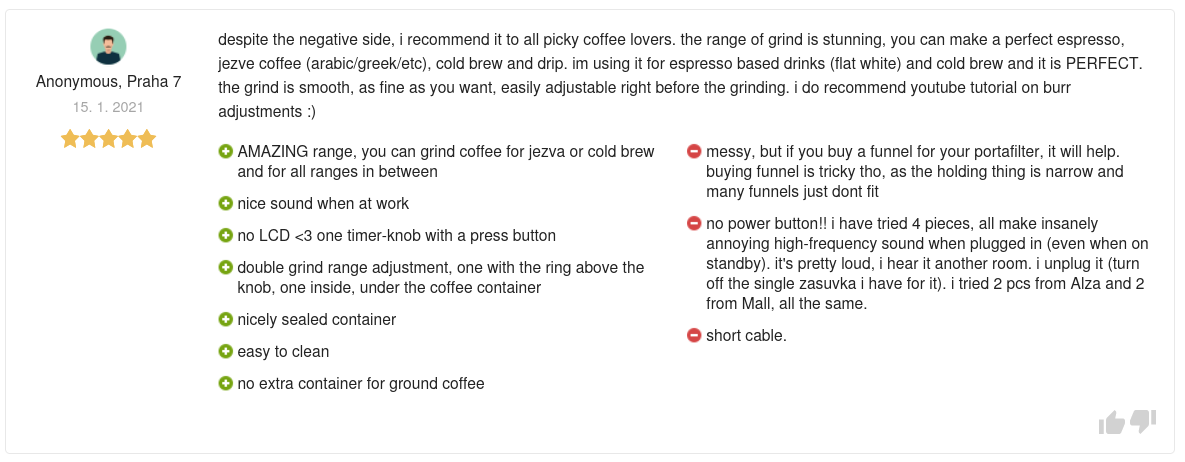
What I learnt from this is that the grinder does indeed make a huge difference. I am now able to consistently produce brews I would only occasionally get with the old De Longhi grinder. There is one downside to the new grinder. Grinder review at Alza.sk Happy with my new purchase, I went to read this review and thought to myself: lucky me, my grinder is absolutely quiet! And then I realised that the noise in my kitchen is not, in fact, produced by the fridge, but the grinder. Well, a cheap switched plug solved the issue completely (I wish sockets here each had a switch like they usually to in the UK!) Switched plug

Russell Coker: Some Ideas for Debian Security Improvements

Debian security is pretty good, but there s always scope for improvement. Here are some ideas that I think could be used to improve things.
  1. A security wizard , basically a set of scripts with support for plugins that will investigate your system and look for things that can be improved. It could give suggestions on LSMs that could be used, sysctl settings, lists of daemons running as root that possibly don t need root privs, etc. Plugins could be for different daemons, so there could be a plugin for Apache that looks for potential issues with Apache configuration. It wouldn t be possible to cover everything, but it would be possible to cover many common cases.
    It appears that we used to have a harden package to do some of these things which disappeared. It appears that the only remnant of that is the hardening-runtime package.
  2. Kali Linux [1] is a distribution designed for penetration testing, I recently tried out many of it s features and I was very impressed. While I don t think that the aim should be to copy all Kali features into Debian there are probably some that are worthy of inclusion. Most Kali features run well in a VM, but the Wifi penetration testing tools need access to the hardware, so they could be a good candidate for inclusion in Debian (license permitting).
  3. We have a Securing Debian Manual [2] that is really good. It s a little out of date and needs some contributions, it also needs to be better known.
  4. The Security Management page of the Debian wiki [3] has links to a number of pages about improving system security. It needs some updates, it doesn t have a link to a page about SE Linux so there s some work for me to do there.
  5. Can training help people? I would be happy to run some Debian SE Linux training sessions over Matrix or Jitsi. We can probably find people to offer training on other aspects of Linux security that are implemented in Debian if there is an audience. I don t think that I and other DDs (Debian Developers) can train everyone, but we could train people who then go on to run other training sessions and make the session notes etc available under the GPL.
    There would also be some benefits to training other DDs as probably no-one has a good overview of all the security features that are supported.
Any other ideas? Feel free to comment here or start a thread on a public mailing list. If you start a mailing list discussion please email me or comment here with the URL if it s a list that I m not on so I can track it via the archives. This post was inspired by a discussion on a private list of a related topic. I think it s better to have a public discussion instead.

11 December 2021

Neil Williams: Diversity and gender

As a follow on to a previous blog entry of mine, Free and Open, I feel it worthwhile to do my bit to dismantle the pseudo-science and over simplification in the idea that gender is binary at a biological level.
TL;DR: Science simply does not support binary sexes or binary genders. Truth is a bit more complicated.
There is certainty and there are binary answers in mathematics. Things get less definitive in physics, certainly as soon as quantum is broached. Processes become more of an equilibrium between states in chemistry, never wholly one or the other. Yes, there is the oddity of absolute zero but no experiment has yet achieved that fully. It is accurate to describe physics as a development of applied mathematics and to view chemistry as applied physics. Biology, at the biochemical level, is applied chemistry. The sciences build on each other, "on the shoulders of giants", but at each level, some certainty is lost, some amount of uncertainty is expanded and measurements become probabilities, proportions and percentages. Biology is dependent on biochemistry - chemistry is how a biological change results in a different organism. Physics is how that chemical change occurs - temperature, pressure and physical states are inherent to all chemical changes. Outside laboratory constraints, few chemical reactions, especially in organic chemistry, produce one and only one result from two or more known reagents. In biology, everyone is familiar with genetic mutations but a genetic mutation only happens because a biochemical reaction (hydrogen bonding of nucleobases) does not always produce the expected result. Every cell division, every viral infection, there is a finite probability that a change will occur. It might be a small number but it is never zero and can never be dismissed. This is obvious in the current Covid pandemic - genetic mutations result in new variants. Some variants are inviable, some variants produce no net change in the way that the viral particles infect adjacent cells. Sometimes, a mutation happens that changes everything. These mutations are not mistakes - these are simply changes with undetermined outcomes. Genetic changes are the foundation of biodiversity and variety is what allows lifeforms of all kinds to survive changes in environmental factors and/or changes in prevalent diseases. It is precisely the same in humans, particularly in one of the principle spheres of human life that involves replicating genetic material - the creation of gametes for sexual reproduction. Every single time any DNA is copied, there is a finite chance that a different base will be put in place compared to the original. Copying genetic material is therefore non-binary. Given precisely the same initial conditions, the result is not always predictable and the range of how the results vary from one to another increases with every iteration. Let me stress that - at the molecular level, no genetic operation in any biological lifeform has a truly binary result. Repeat that operation sufficiently often and an unexpected result WILL inevitably occur. It is a mathematical certainty that genetic changes will arise by attempting precisely the same genetic operation enough times. Genetic changes are fundamental to how lifeforms survive changing conditions. Life would likely have died out a long time ago on this planet if every genetic operation was perfect. Diversity is life. Similarity leads to extinction. Viral load is interesting at this point. Someone can be infected with a virus, including coronavirus, by encountering a small number of viral particles. Some viruses, it may be a few hundred, some viruses may need a few thousand particles to infect a vulnerable host. But here's the thing, for that host to be at risk of infecting another host, the virus needs the host to produce billions upon billions of copies of the virus by taking over the genetic machinery within a huge number of cells in the host. This, as is accepted with Covid, is before the virus has been copied enough times to produce symptoms in the host. Before those symptoms become serious, billions more copies will be made. The numbers become unimaginable - and that is within a single host, let alone the 265 million (and counting) hosts in the current Covid19 pandemic. It's also no wonder that viral infections cause tiredness, the infection is diverting huge resources to propagating itself - before even considering the activity of the immune system. It is idiocy of the highest order to expect all those copies to be identical. The rise of variants is inevitable - indeed essential - in all spheres of biology. A single viral particle is absolutely no threat of any kind - it must first get inside and then copy the genetic information in a host cell. This is where the complexity lies in the definition of life itself. A virus can be considered a lifeform but it is only able to reproduce using another, more complex, lifeform. In truth, a viral particle does not and cannot mutate. The infected host mutates the virus. The longer it takes that host to clear the infection, the more mutations that host will create and then potentially spread to others. Now apply this to the creation of gametes in humans. With seven billion humans, the amount of copying of genetic material is not as large as the pandemic but it is still easy for everyone to understand that children do not merely combine the DNA of both parents. Changes happen. Human sexual reproduction is not as simple as 1 + 1 = 2. Sometimes, the copying of the genetic material produces an unexpected result. Sexual reproduction itself is non-binary. Sexual reproduction is not easy or simple for lifeforms to adopt - the diversity which results from the non-binary operations are exactly why so many lifeforms invest so much energy in reproducing in this way. Whilst many genetic changes in humans will be benign or beneficial, I d like to take an example of a genetic disorder that results from the non-binary nature of sex. Humans can be born with the XY phenotype - i.e. at a genetic level, the individual has the same combination of chromosomes as another XY individual but there are changes within the genes in those chromosomes. We accept this, some children of blonde parents do not have blonde hair, etc. There are also genetic changes where an XY phenotype is not binary. Some people, who at a genetic level would be almost identical to another person who is genetically male, have a genetic mutation which makes it impossible for the cells of that individual to respond to androgens (testosterone). (See Androgen insensitivity syndrome). Genetically, that individual has an X and a Y chromosome, just like many other individuals. However, due to a change in how the genes on those chromosomes were copied, that individual is biologically incapable of constructing the secondary sexual characteristics of a male. At a genetic level, the individual has the XY phenotype of a male. At the physical level, the individual has all the sexual characteristics of a female and none of the sexual characteristics of a male. The gender of that individual is not binary. Treatment is centred on supporting the individual and minimising some risks from the inactive genes on the Y chromosome. Human sexual reproduction is non-binary. The results of any sexual reproduction in humans will not always produce the binary option of male or female. It is a lie to claim that human gender is binary. The science is in plain view and cannot be ignored. Identifying as non-binary is not a "cop out" - it can be a biological, genetic, scientific fact. Human sexuality and gender are malleable. Where genetic changes result in symptoms, these can be ameliorated by treatment with human sex hormones, like oestrogen and testosterone. There are valid medical uses for anabolic steroids and hormone replacement therapies to help individuals who, at a genetic level, have non-binary gender. These treatments can help align the physical outer signs with the personality and identity of the individual, whether with or without surgery. It is unacceptable to abandon such people to suffer life long discrimination and harassment by imposing a binary definition that has no basis in science. When a human being has an XY phenotype, that human being is not necessarily male. That individual will be on a spectrum from female (left unaffected by sex hormones in the womb, the foetus will be female, even with an X and a Y chromosome), to various degrees of male. So, at a genetic, biological level, it is a scientific fact that human beings do not have binary gender. There is no evidence that this is new to the modern era, there is no scientific basis for thinking that copying of genetic material was somehow perfectly reliable in earlier history, or that such mutations are specific to homo sapiens. Changes in genetic material provide the diversity to fight infections and adapt to changing environmental factors. Species have and will continue to go extinct if this diversity is absent. With that out of the way, it is no longer a stretch to encompass other aspects of human non-binary genders beyond the known genetic syndromes based on changes in the XY phenotype. Science has not uncovered all of the ways that genes affect personality, behaviour, or identity. How other, less studied, genetic changes affect the much more subtle human facets, especially anything to do with consciousness, identity, personality, sexuality and behaviour, is guesswork. All of these facets can and likely are being affected by genetic factors as well as environmental factors in an endless range of permutations. Personality traits are a beautiful and largely unknowable blend of genes and environment. Genetic information has a finite probability of changes at each and every iteration. Environmental factors are more akin to chaos theory. The idea that the results will fit into binary constructs is laughable. Human society puts huge emphasis on societal norms. Individuals who do not fit into those norms suffer discrimination. The norms themselves have evolved over time as a response to various influences on human civilisation but most are not based on science. It is up to all humans in that society to call out discrimination, to call for changes in the accepted norms and support those who are marginalised. It is a precarious balance, one that humans rarely get right, but it must be based on an acceptance that variation is the natural state. Artificial constraints, like binary genders, must be dismantled because human beings and human sexual reproduction are not binary. To those who think, "well it is for 99%", think again about Covid. 99% (or closer to 98%) of infected humans recover without notable after effects. That has still crippled the nations of the globe and humbled all those who tried to deny it. Five million human beings are dead because "most infected people recover". Just because something only affects a proportion of human beings does not invalidate the suffering of those humans and the discrimination that those humans will face. Societal norms are not necessarily correct. Religious and other influences typically obscure and ignore scientific fact and undermine human kindness. The scientific truth of life on this planet is that gender is not binary. The more complex the lifeform, the more factors will affect where on the spectrum any one individual will appear. Just because we do not yet fully understand how genes affect human personality and sexuality, does not invalidate the science that variation is the natural order. My previous blog about diversity is not just about male vs female, one nationality vs another, one ethnicity compared to another. Diversity is diverse. Diversity requires accepting that every facet of humanity is subject to variation. That leads to tension at times, it is inevitable. Tension against societal norms, tension against discrimination, tension around those individuals who would abuse the tolerance of others for their own gratification or from their own ignorance. None of us are perfect, none of us have any of this fully sorted and all of us will make mistakes. Personally, I try to respect those around me. I will use whatever pronouns and other conventions that the person requests, from their perspective and not mine. To do otherwise is to deny the natural order and to deny the science. Celebrate all diversity, it is the very stuff of life. The discussions around (typically female) bathroom facilities often miss the point. The concern is not about individuals who describe themselves as non-binary. The concern is about individuals who are fully certain of their own sexuality and who act as sexual predators for their own gratification. These people are acting out a lie for their own ends. The problem people are the predators, so stop blaming the victims who are just as at risk as anyone else who identifies as female. Maybe the best people to spot such predators are those who are non-binary, who have had to pretend to fit into societal norms. Just as travel can be a good antidote to racism, openness and discussion can be a tool to undermine the lies of sexual predators and reassure those who are justifiably fearful. There can never be a biological binary test of gender, there can never be any scientific justification for binary division of facilities. Humanity itself is not binary, even life itself has blurry borders around comas, suspended animation and locked-in syndrome. Legal definitions of human death vary around the world. The only common thread I have ever found is: Be kind to each other. If you find anything above objectionable, then I can only suggest that you reconsider the science and learn to be kind to your fellow humans. None of us are getting out of this alive. I Think You ll Find It s a Bit More Complicated Than That - Ben Goldacre ISBN 978-0-00-750514-2 https://www.amazon.co.uk/dp/B00HATQA8K/ https://en.wikipedia.org/wiki/Androgen_insensitivity_syndrome https://www.bbc.co.uk/news/world-51235105 https://en.wikipedia.org/wiki/Nucleobase My degree is in pharmaceutical sciences and I practised community and hospital pharmacy for 20 years before moving into programming. I have direct experience of supporting people who were prescribed hormones to transition their physical characteristics to match their personal identity. I had a Christian upbringing but my work showed me that those religious norms were incompatible with being kind to others, so I rejected religion and I now consider myself a secular humanist.

9 December 2021

Dirk Eddelbuettel: qlcal 0.0.1 on CRAN: New Package

A new package of mine arrived on CRAN yesterday in its inaugural 0.0.1 upload: qlcal. qlcal is based on the calendaring subset of QuantLib. It is provided (for the R package) as a set of included files, so the package is self-contained and does not depend on an external QuantLib library (which can be challenging to build). The only build requirements are Rcpp for the seamless R/C++ integration, and BH for Boost headers. qlcal covers over sixty country / market calendars and can compute holiday lists, its complement (i.e. business day lists) and much more. As a teaser see this two-liner for 2022 holiday for the Federal Reserve calendar in the United States, now including Juneteenth (on June 20 next year) as the most recently added holiday:
> library(qlcal)
> setCalendar("UnitedStates/FederalReserve")
> getHolidays(as.Date("2022-01-01"), as.Date("2022-12-31"))
 [1] "2022-01-17" "2022-02-21" "2022-05-30" "2022-06-20" "2022-07-04" "2022-09-05" "2022-10-10"
 [8] "2022-11-11" "2022-11-24" "2022-12-26"
> 
See the project page and package documentation for more details, and more examples. Going forward, and time permitting, it would be nice to slowly reduce the Boost dependency to make the underlying qlcal C++ library more self-sufficient. If you like this or other open-source work I do, you can now sponsor me at GitHub.

This post by Dirk Eddelbuettel originated on his Thinking inside the box blog. Please report excessive re-aggregation in third-party for-profit settings.

David Kalnischkies: APT for Advent of Code

Screenshot of my Advent of Code 2021 status page as of today Advent of Code 2021
Advent of Code, for those not in the know, is a yearly Advent calendar (since 2015) of coding puzzles many people participate in for a plenary of reasons ranging from speed coding to code golf with stops at learning a new language or practicing already known ones. I usually write boring C++, but any language and then some can be used. There are reports of people implementing it in hardware, solving them by hand on paper or using Microsoft Excel so, after solving a puzzle the easy way yesterday, this time I thought: CHALLENGE ACCEPTED! as I somehow remembered an old 2008 article about solving Sudoku with aptitude (Daniel Burrows via archive.org as the blog is long gone) and the good same old a package management system that can solve [puzzles] based on package dependency rules is not something that I think would be useful or worth having (Russell Coker). Day 8 has a rather lengthy problem description and can reasonably be approached in a bunch of different way. One unreasonable approach might be to massage the problem description into Debian packages and let apt help me solve the problem (specifically Part 2, which you unlock by solving Part 1. You can do that now, I will wait here.) Be warned: I am spoiling Part 2 in the following, so solve it yourself first if you are interested. I will try to be reasonable consistent in naming things in the following and so have chosen: The input we get are lines like acedgfb cdfbe gcdfa fbcad dab cefabd cdfgeb eafb cagedb ab cdfeb fcadb cdfeb cdbaf. The letters are wires mixed up and connected to the segments of the displays: A group of these letters is hence a digit (the first 10) which represent one of the digits 0 to 9 and (after the pipe) the four displays which match (after sorting) one of the digits which means this display shows this digit. We are interested in which digits are displayed to solve the puzzle. To help us we also know which segments form which digit, we just don't know the wiring in the back. So we should identify which wire maps to which segment! We are introducing the packages wire-X-connects-to-Y for this which each provide & conflict1 with the virtual packages segment-Y and wire-X-connects. The later ensures that for a given wire we can only pick one segment and the former ensures that not multiple wires map onto the same segment. As an example: wire a's possible association with segment b is described as:
Package: wire-a-connects-to-b
Provides: segment-b, wire-a-connects
Conflicts: segment-b, wire-a-connects
Note that we do not know if this is true! We generate packages for all possible (and then some) combinations and hope dependency resolution will solve the problem for us. So don't worry, the hard part will be done by apt, we just have to provide all (im)possibilities! What we need now is to translate the 10 digits (and 4 outputs) from something like acedgfb into digit-0-is-eight and not, say digit-0-is-one. A clever solution might realize that a one consists only of two segments so a digit wiring up seven segments can not be a 1 (and must be 8 instead), but again we aren't here to be clever: We want apt to figure that out for us! So what we do is simply making every digit-0-is-N (im)possible choice available as a package and apply constraints: A given digit-N can only display one number and each N is unique as digit so for both we deploy Provides & Conflicts again. We also need to reason about the segments in the digits: Each of the digit packages gets Depends on wire-X-connects-to-Y where X is each possible wire (e.g. acedgfb) and Y each segment forming the digit (e.g. cf for one). The different choices for X are or'ed together, so that either of them satisfies the Y. We know something else too through: The segments which are not used by the digit can not be wired to any of the Xs. We model this with Conflicts on wire-X-connects-to-Y. As an example: If digit-0s acedgfb would be displaying a one (remember, it can't) the following package would be installable:
Package: digit-0-is-one
Version: 1
Depends: wire-a-connects-to-c   wire-c-connects-to-c   wire-e-connects-to-c   wire-d-connects-to-c   wire-g-connects-to-c   wire-f-connects-to-c   wire-b-connects-to-c,
         wire-a-connects-to-f   wire-c-connects-to-f   wire-e-connects-to-f   wire-d-connects-to-f   wire-g-connects-to-f   wire-f-connects-to-f   wire-b-connects-to-f
Provides: digit-0, digit-is-one
Conflicts: digit-0, digit-is-one,
  wire-a-connects-to-a, wire-c-connects-to-a, wire-e-connects-to-a, wire-d-connects-to-a, wire-g-connects-to-a, wire-f-connects-to-a, wire-b-connects-to-a,
  wire-a-connects-to-b, wire-c-connects-to-b, wire-e-connects-to-b, wire-d-connects-to-b, wire-g-connects-to-b, wire-f-connects-to-b, wire-b-connects-to-b,
  wire-a-connects-to-d, wire-c-connects-to-d, wire-e-connects-to-d, wire-d-connects-to-d, wire-g-connects-to-d, wire-f-connects-to-d, wire-b-connects-to-d,
  wire-a-connects-to-e, wire-c-connects-to-e, wire-e-connects-to-e, wire-d-connects-to-e, wire-g-connects-to-e, wire-f-connects-to-e, wire-b-connects-to-e,
  wire-a-connects-to-g, wire-c-connects-to-g, wire-e-connects-to-g, wire-d-connects-to-g, wire-g-connects-to-g, wire-f-connects-to-g, wire-b-connects-to-g
Repeat such stanzas for all 10 possible digits for digit-0 and then repeat this for all the other nine digit-N. We produce pretty much the same stanzas for display-0(-is-one), just that we omit the second Provides & Conflicts from above (digit-is-one) as in the display digits can be repeated. The rest is the same (modulo using display instead of digit as name of course). Lastly we create a package dubbed solution which depends on all 10 digit-N and 4 display-N all of them virtual packages apt will have to choose an installable provider from and we are nearly done! The resulting Packages file2 we can give to apt while requesting to install the package solution and it will spit out not only the display values we are interested in but also which number each digit represents and which wire is connected to which segment. Nifty!
$ ./skip-aoc 'acedgfb cdfbe gcdfa fbcad dab cefabd cdfgeb eafb cagedb ab   cdfeb fcadb cdfeb cdbaf'
[ ]
The following additional packages will be installed:
  digit-0-is-eight digit-1-is-five digit-2-is-two digit-3-is-three
  digit-4-is-seven digit-5-is-nine digit-6-is-six digit-7-is-four
  digit-8-is-zero digit-9-is-one display-1-is-five display-2-is-three
  display-3-is-five display-4-is-three wire-a-connects-to-c
  wire-b-connects-to-f wire-c-connects-to-g wire-d-connects-to-a
  wire-e-connects-to-b wire-f-connects-to-d wire-g-connects-to-e
[ ]
0 upgraded, 22 newly installed, 0 to remove and 0 not upgraded.
We are only interested in the numbers on the display through, so grepping the apt output (-V is our friend here) a bit should let us end up with what we need as calculating3 is (unsurprisingly) not a strong suit of our package relationship language so we need a few shell commands to help us with the rest.
$ ./skip-aoc 'acedgfb cdfbe gcdfa fbcad dab cefabd cdfgeb eafb cagedb ab   cdfeb fcadb cdfeb cdbaf' -qq
5353
I have written the skip-aoc script as a testcase for apt, so to run it you need to place it in /path/to/source/of/apt/test/integration and built apt first, but that is only due to my laziness. We could write a standalone script interfacing with the system installed apt directly and in any apt version since ~2011. To hand in the solution for the puzzle we just need to run this on each line of the input (~200 lines) and add all numbers together. In other words: Behold this beautiful shell one-liner: parallel -I ' ' ./skip-aoc ' ' -qq < input.txt paste -s -d'+' - bc (You may want to run parallel with -P to properly grill your CPU as that process can take a while otherwise and it still does anyhow as I haven't optimized it at all the testing framework does a lot of pointless things wasting time here, but we aren't aiming for the leaderboard so ) That might or even likely will fail through as I have so far omitted a not unimportant detail: The default APT resolver is not able to solve this puzzle with the given problem description we need another solver! Thankfully that is as easy as installing apt-cudf (and with it aspcud) which the script is using via --solver aspcud to make apt hand over the puzzle to a "proper" solver (or better: A solver who is supposed to be good at "answering set" questions). The buildds are using this for experimental and/or backports builds and also for installability checks via dose3 btw, so you might have encountered it before. Be careful however: Just because aspcud can solve this puzzle doesn't mean it is a good default resolver for your day to day apt. One of the reasons the default resolver has such a hard time solving this here is that or-groups have usually an order in which the first is preferred over every later option and so fort. This is of no concern here as all these alternatives will collapse to a single solution anyhow, but if there are multiple viable solutions (which is often the case) picking the "wrong" alternative can have bad consequences. A classic example would be exim4 postfix nullmailer. They are all MTAs but behave very different. The non-default solvers also tend to lack certain features like keeping track of auto-installed packages or installing Recommends/Suggests. That said, Julian is working on another solver as I write this which might deal with more of these issues. And lastly: I am also relatively sure that with a bit of massaging the default resolver could be made to understand the problem, but I can't play all day with this maybe some other day. Disclaimer: Originally posted in the daily megathread on reddit, the version here is just slightly better understandable as I have hopefully renamed all the packages to have more conventional names and tried to explain what I am actually doing. No cows were harmed in this improved version, either.

  1. If you would upload those packages somewhere, it would be good style to add Replaces as well, but it is of minor concern for apt so I am leaving them out here for readability.
  2. We have generated 49 wires, 100 digits, 40 display and 1 solution package for a grant total of 190 packages. We are also making use of a few purely virtual ones, but that doesn't add up to many packages in total. So few packages are practically childs play for apt given it usually deals with thousand times more. The instability for those packages tends to be a lot better through as only 22 of 190 packages we generated can (and will) be installed. Britney will hate you if your uploads to Debian unstable are even remotely as bad as this.
  3. What we could do is introduce 10.000 packages which denote every possible display value from 0000 to 9999. We would then need to duplicate our 10.190 packages for each line (namespace them) and then add a bit more than a million packages with the correct dependencies for summing up the individual packages for apt to be able to display the final result all by itself. That would take a while through as at that point we are looking at working with ~22 million packages with a gazillion amount of dependencies probably overworking every solver we would throw at it a bit of shell glue seems the better option for now.
This article was written by David Kalnischkies on apt-get a life and republished here by pulling it from a syndication feed. You should check there for updates and more articles about apt and EDSP.

7 December 2021

Evgeni Golov: The Mocking will continue, until CI improves

One might think, this blog is exclusively about weird language behavior and yelling at computers Well, welcome to another episode of Jackass! Today's opponent is Ruby, or maybe minitest , or maybe Mocha. I'm not exactly sure, but it was a rather amusing exercise and I like to share my nightmares ;) It all started with the classical "you're using old and unmaintained software, please switch to something new". The first attempt was to switch from the ci_reporter_minitest plugin to the minitest-ci plugin. While the change worked great for Foreman itself, it broke the reporting in Katello - the tests would run but no junit.xml was generated and Jenkins rightfully complained that it got no test results. While investigating what the hell was wrong, we realized that Katello was already using a minitest reporting plugin: minitest-reporters. Loading two different reporting plugins seemed like a good source for problems, so I tried using the same plugin for Foreman too. Guess what? After a bit of massaging (mostly to disable the second minitest-reporters initialization in Katello) reporting of test results from Katello started to work like a charm. But now the Foreman tests started to fail. Not fail to report, fail to actually run. WTH The failure was quite interesting too:
test/unit/parameter_filter_test.rb:5:in  block in <class:ParameterFilterTest>':
  Mocha methods cannot be used outside the context of a test (Mocha::NotInitializedError)
Yes, this is a single test file failing, all others were fine. The failing code doesn't look problematic on first glance:
require 'test_helper'
class ParameterFilterTest < ActiveSupport::TestCase
  let(:klass) do
    mock('Example').tap do  k 
      k.stubs(:name).returns('Example')
    end
  end
  test 'something' do
    something
  end
end
The failing line (5) is mock('Example').tap and for some reason Mocha thinks it's not initialized here. This certainly has something to do with how the various reporting plugins inject themselves, but I really didn't want to debug how to run two reporting plugins in parallel (which, as you remember, didn't expose this behavior). So the only real path forward was to debug what's happening here. Calling the test on its own, with one of the working reporter was the first step:
$ bundle exec rake test TEST=test/unit/parameter_filter_test.rb TESTOPTS=-v
 
#<Mocha::Mock:0x0000557bf1f22e30>#test_0001_permits plugin-added attribute = 0.04 s = .
#<Mocha::Mock:0x0000557bf12cf750>#test_0002_permits plugin-added attributes from blocks = 0.49 s = .
 
Wait, what? #<Mocha::Mock: >? Shouldn't this read more like ParameterFilterTest:: as it happens for every single other test in our test suite? It definitely should! That's actually great, as it tells us that there is really something wrong with the test and the change of the reporting plugin just makes it worse. What comes next is sheer luck. Well, that, and years of experience in yelling at computers. We use let(:klass) to define an object called klass and this object is a Mocha::Mock that we'll use in our tests later. Now klass is a very common term in Ruby when talking about classes and needing to store them mostly because one can't use class which is a keyword. Is something else in the stack using klass and our let is overriding that, making this whole thing explode? It was! The moment we replaced klass with klass1 (silly, I know, but there also was a klass2 in that code, so it did fit), things started to work nicely. I really liked Tomer's comment in the PR: "no idea why, but I am not going to dig into mocha to figure that out." Turns out, I couldn't let (HAH!) the code rest and really wanted to understand what happened there. What I didn't want to do is to debug the whole Foreman test stack, because it is massive. So I started to write a minimal reproducer for the issue. All starts with a Gemfile, as we need a few dependencies:
gem 'rake'
gem 'mocha'
gem 'minitest', '~> 5.1', '< 5.11'
Then a Rakefile:
require 'rake/testtask'
Rake::TestTask.new(:test) do  t 
  t.libs << 'test'
  t.test_files = FileList["test/**/*_test.rb"]
end
task :default => :test
And a test! I took the liberty to replace ActiveSupport::TestCase with Minitest::Test, as the test won't be using any Rails features and I wanted to keep my environment minimal.
require 'minitest/autorun'
require 'minitest/spec'
require 'mocha/minitest'
class ParameterFilterTest < Minitest::Test
  extend Minitest::Spec::DSL
  let(:klass) do
    mock('Example').tap do  k 
      k.stubs(:name).returns('Example')
    end
  end
  def test_lol
    assert klass
  end
end
Well, damn, this passed! Is it Rails after all that breaks stuff? Let's add it to the Gemfile!
$ vim Gemfile
$ bundle install
$ bundle exec rake test TESTOPTS=-v
 
#<Mocha::Mock:0x0000564bbfe17e98>#test_lol = 0.00 s = .
Wait, I didn't change anything and it's already failing?! Fuck! I mean, cool! But the test isn't minimal yet. What can we reduce? let is just a fancy, lazy def, right? So instead of let(:klass) we should be able to write def class and achieve a similar outcome and drop that Minitest::Spec.
require 'minitest/autorun'
require 'mocha/minitest'
class ParameterFilterTest < Minitest::Test
  def klass
    mock
  end
  def test_lol
    assert klass
  end
end
$ bundle exec rake test TESTOPTS=-v
 
/home/evgeni/Devel/minitest-wtf/test/parameter_filter_test.rb:5:in  klass': Mocha methods cannot be used outside the context of a test (Mocha::NotInitializedError)
    from /home/evgeni/Devel/minitest-wtf/vendor/bundle/ruby/3.0.0/gems/railties-6.1.4.1/lib/rails/test_unit/reporter.rb:68:in  format_line'
    from /home/evgeni/Devel/minitest-wtf/vendor/bundle/ruby/3.0.0/gems/railties-6.1.4.1/lib/rails/test_unit/reporter.rb:15:in  record'
    from /home/evgeni/Devel/minitest-wtf/vendor/bundle/ruby/3.0.0/gems/minitest-5.10.3/lib/minitest.rb:682:in  block in record'
    from /home/evgeni/Devel/minitest-wtf/vendor/bundle/ruby/3.0.0/gems/minitest-5.10.3/lib/minitest.rb:681:in  each'
    from /home/evgeni/Devel/minitest-wtf/vendor/bundle/ruby/3.0.0/gems/minitest-5.10.3/lib/minitest.rb:681:in  record'
    from /home/evgeni/Devel/minitest-wtf/vendor/bundle/ruby/3.0.0/gems/minitest-5.10.3/lib/minitest.rb:324:in  run_one_method'
    from /home/evgeni/Devel/minitest-wtf/vendor/bundle/ruby/3.0.0/gems/minitest-5.10.3/lib/minitest.rb:311:in  block (2 levels) in run'
    from /home/evgeni/Devel/minitest-wtf/vendor/bundle/ruby/3.0.0/gems/minitest-5.10.3/lib/minitest.rb:310:in  each'
    from /home/evgeni/Devel/minitest-wtf/vendor/bundle/ruby/3.0.0/gems/minitest-5.10.3/lib/minitest.rb:310:in  block in run'
    from /home/evgeni/Devel/minitest-wtf/vendor/bundle/ruby/3.0.0/gems/minitest-5.10.3/lib/minitest.rb:350:in  on_signal'
    from /home/evgeni/Devel/minitest-wtf/vendor/bundle/ruby/3.0.0/gems/minitest-5.10.3/lib/minitest.rb:337:in  with_info_handler'
    from /home/evgeni/Devel/minitest-wtf/vendor/bundle/ruby/3.0.0/gems/minitest-5.10.3/lib/minitest.rb:309:in  run'
    from /home/evgeni/Devel/minitest-wtf/vendor/bundle/ruby/3.0.0/gems/minitest-5.10.3/lib/minitest.rb:159:in  block in __run'
    from /home/evgeni/Devel/minitest-wtf/vendor/bundle/ruby/3.0.0/gems/minitest-5.10.3/lib/minitest.rb:159:in  map'
    from /home/evgeni/Devel/minitest-wtf/vendor/bundle/ruby/3.0.0/gems/minitest-5.10.3/lib/minitest.rb:159:in  __run'
    from /home/evgeni/Devel/minitest-wtf/vendor/bundle/ruby/3.0.0/gems/minitest-5.10.3/lib/minitest.rb:136:in  run'
    from /home/evgeni/Devel/minitest-wtf/vendor/bundle/ruby/3.0.0/gems/minitest-5.10.3/lib/minitest.rb:63:in  block in autorun'
rake aborted!
Oh nice, this is even better! Instead of the mangled class name, we now get the very same error the Foreman tests aborted with, plus a nice stack trace! But wait, why is it pointing at railties? We're not loading that! Anyways, lets look at railties-6.1.4.1/lib/rails/test_unit/reporter.rb, line 68
def format_line(result)
  klass = result.respond_to?(:klass) ? result.klass : result.class
  "%s#%s = %.2f s = %s" % [klass, result.name, result.time, result.result_code]
end
Heh, this is touching result.klass, which we just messed up. Nice! But quickly back to railties What if we only add that to the Gemfile, not full blown Rails?
gem 'railties'
gem 'rake'
gem 'mocha'
gem 'minitest', '~> 5.1', '< 5.11'
Yepp, same failure. Also happens with require => false added to the line, so it seems railties somehow injects itself into rake even if nothing is using it?! "Cool"! By the way, why are we still pinning minitest to < 5.11? Oh right, this was the original reason to look into that whole topic. And, uh, it's pointing at klass there already! 4 years ago! So lets remove that boundary and funny enough, now tests are passing again, even if we use klass! Minitest 5.11 changed how Minitest::Test is structured, and seems not to rely on klass at that point anymore. And I guess Rails also changed a bit since the original pin was put in place four years ago. I didn't want to go another rabbit hole, finding out what changed in Rails, but I did try with 5.0 (well, 5.0.7.2) to be precise, and the output with newer (>= 5.11) Minitest was interesting:
$ bundle exec rake test TESTOPTS=-v
 
Minitest::Result#test_lol = 0.00 s = .
It's leaking Minitest::Result as klass now, instead of Mocha::Mock. So probably something along these lines was broken 4 years ago and triggered this pin. What do we learn from that?
  • klass is cursed and shouldn't be used in places where inheritance and tooling might decide to use it for some reason
  • inheritance is cursed - why the heck are implementation details of Minitest leaking inside my tests?!
  • tooling is cursed - why is railties injecting stuff when I didn't ask it to?!
  • dependency pinning is cursed - at least if you pin to avoid an issue and then forget about said issue for four years
  • I like cursed things!

Daniel Lange: Gradual improvements at the Linux Foundation

After last year's blunder with trying to hide the Adobe toolchain and using hilarious stock photos, the Linux Foundation did much better in their 2021 annual report1 published Dec. 6, 2021. Still they are using the Adobe toolchain (InDesign, Acrobat PDF) and my fellow DebianKernel2 Developer Geert was quick to point that out as the first comment to the LWN note on the publication: LWN comment from Geert I think it is important to call the Linux Foundation (LF) out again and again. Adobe is a Silver member of the LF and they can motivate them to publish their applications for Linux. And if that is not an option, there are Free alternatives like Scribus that could well use the exposure and funds of LF to help catch up to the market leading product, Adobe InDesign. Linux Foundation Annual report 2021, document properties Personally, as a photographer, I am very happy they used stock images from Unsplash to illustrate the 2021 edition over the cringeworthy Shutterstock footage from last year's report. And they gave proper credit: Thank you section for Unsplash from the Linux Foundation 2021 annual report Now for next year ... find an editor that knows how to spell photographers, please. And consider Scribus. And make Adobe publish their apps for Linux. Thank you.

  1. Update 07.12.2021 22:00 CET: I had to replace the link to the Linux Foundation 2021 annual report with an archive.org one as they updated the report to fix the typo as per the comment from Melissa Schmidt below. Stable URLs are not a thing, apparently. You can find their new report at https://www.linuxfoundation.org/wp-content/uploads/2021_LF_Annual_Report_120721c.pdf. Unless somebody points out more typos. There is a Last-Modified Header in HTTP 1.1. Wordpress, Varnish and Nginx, serving the LF website, all support that. Diff of 2021_LF_Annual_Report_120621a and2021_LF_Annual_Report_120721c
  2. 08.12.2021: Geert Uytterhoeven wrote in that he is "geert" on LWN, both are very nice Geert's but different Geert's :-)

6 December 2021

Jonathan Dowland: Sixth Annual UK System Research Challenges Workshop lightning talk

me looking awkward, thanks [Mark Little](https://twitter.com/nmcl/status/1466148768043126791/photo/1) me looking awkward, thanks Mark Little
Last week I attended the UK Systems Research 2021 conference in County Durham, my first conference in nearly two years (since FOSDEM 2020, right on the cusp of the Pandemic). The Systems conference community is very pleasant and welcoming and so when I heard it was going to take place "physically" again this year I was so keen to attend I decided to hedge my bets and submit two talk proposals. I wasn't expecting them both to be accepted As well as the regular talks (more on those in another post) there is a tradition for people to give short, impromptu lightning talks after dinner on the second night. I've given two of these before, and I'd been considering whether to offer to one this time or not, but with two talks to deliver (and finish writing) I wasn't sure. Usually people talk about something interesting that they have been doing besides their research or day-jobs, but the last two years have been somewhat difficult and I didn't really think I had a topic to talk about. Then I wondered if that was a topic in itself During the first day of the conference (and especially one I'd got past one of my talks) I started to outline a lightning talk idea and it seemed to come out well enough that I thought I'd give it a go. Unusually I therefore had something written down and I was surprised how well it was received, so I thought I'd share it. Here it is:
I was anticipating the lightning talks and being cajoled into talking about something. I've done it twice before. So I've been racking my brains to figure out if I've done anything interesting enough to talk about. in 2018 I talked about some hack I'd made to the classic computer game Doom from 1993. I've done several hacks to Doom that I could probably talk about except I've become a bit uncomfortable about increasingly being thought of as "that doom guy". I'd been reflecting on why it was that I continued to mess about with that game in the first place and I realised it was a form of expression: I was treating Doom like a canvas. I've spent most of my career thinking about what I do in the frame of either science or engineering. I suffer from the creative urge and I've often expressed (and sated) that through my work. And that's possible because there's a craft in what we do. In 2019 I talked about a project I'd embarked on to resurrect my childhood computer, a Commodore Amiga 500, in order to rescue my childhood drawings and digital paintings. (There's the artistic thing again). I'd achieved that and I have ambitions to do some more Amiga stuff but again that's a work in progress and there's nothing much to talk about. In recent years I've been thinking more and more about art and became interested in the works and writings of people like Grayson Perry, Laurie Anderson and Brian Eno. I first learned about Eno through his music but he's also a visual artist. and a music producer. As a producer in the 70s he co-invented a system to try and break out of writer's block called "oblique strategies": A deck of cards with oblique suggestions written on them. When you're stuck, you pull a card and it might help you to reframe what you are working on and think about it in a completely different way. I love this idea and I think we should use more things like that in software engineering at least. So back to casting about for something to talk about. What have I been doing in the last couple of years? Frankly, surviving - I've just about managed to keep doing my day job, and keep working on the PhD, at home with two young kids and home schooling and the rest of it. Which is an achievement but makes for a boring lightning talk. But I'd like to say that for anyone here who might have been worrying similarly: I think surviving is more than enough. I'll close on the subject of thinking like an artist and not an engineer. I brought some of the Oblique Strategies deck with me and I thought I'd draw a card to perhaps help you out of a creative dilemma if you're in one. And I kid you not, the first card I drew was this one:
Card reading 'You are an Engineer'

Matthias Klumpp: New things in AppStream 0.15

On the road to AppStream 1.0, a lot of items from the long todo list have been done so far only one major feature is remaining, external release descriptions, which is a tricky one to implement and specify. For AppStream 1.0 it needs to be present or be rejected though, as it would be a major change in how release data is handled in AppStream. Besides 1.0 preparation work, the recent 0.15 release and the releases before it come with their very own large set of changes, that are worth a look and may be interesting for your application to support. But first, for a change that affects the implementation and not the XML format: 1. Completely rewritten caching code Keeping all AppStream data in memory is expensive, especially if the data is huge (as on Debian and Ubuntu with their large repositories generated from desktop-entry files as well) and if processes using AppStream are long-running. The latter is more and more the case, not only does GNOME Software run in the background, KDE uses AppStream in KRunner and Phosh will use it too for reading form factor information. Therefore, AppStream via libappstream provides an on-disk cache that is memory-mapped, so data is only consuming RAM if we are actually doing anything with it. Previously, AppStream used an LMDB-based cache in the background, with indices for fulltext search and other common search operations. This was a very fast solution, but also came with limitations, LMDB s maximum key size of 511 bytes became a problem quite often, adjusting the maximum database size (since it has to be set at opening time) was annoyingly tricky, and building dedicated indices for each search operation was very inflexible. In addition to that, the caching code was changed multiple times in the past to allow system-wide metadata to be cached per-user, as some distributions didn t (want to) build a system-wide cache and therefore ran into performance issues when XML was parsed repeatedly for generation of a temporary cache. In addition to all that, the cache was designed around the concept of one cache for data from all sources , which meant that we had to rebuild it entirely if just a small aspect changed, like a MetaInfo file being added to /usr/share/metainfo, which was very inefficient. To shorten a long story, the old caching code was rewritten with the new concepts of caches not necessarily being system-wide and caches existing for more fine-grained groups of files in mind. The new caching code uses Richard Hughes excellent libxmlb internally for memory-mapped data storage. Unlike LMDB, libxmlb knows about the XML document model, so queries can be much more powerful and we do not need to build indices manually. The library is also already used by GNOME Software and fwupd for parsing of (refined) AppStream metadata, so it works quite well for that usecase. As a result, search queries via libappstream are now a bit slower (very much depends on the query, roughly 20% on average), but can be mmuch more powerful. The caching code is a lot more robust, which should speed up startup time of applications. And in addition to all of that, the AsPool class has gained a flag to allow it to monitor AppStream source data for changes and refresh the cache fully automatically and transparently in the background. All software written against the previous version of the libappstream library should continue to work with the new caching code, but to make use of some of the new features, software using it may need adjustments. A lot of methods have been deprecated too now. 2. Experimental compose support Compiling MetaInfo and other metadata into AppStream collection metadata, extracting icons, language information, refining data and caching media is an involved process. The appstream-generator tool does this very well for data from Linux distribution sources, but the tool is also pretty heavyweight with lots of knobs to adjust, an underlying database and a complex algorithm for icon extraction. Embedding it into other tools via anything else but its command-line API is also not easy (due to D s GC initialization, and because it was never written with that feature in mind). Sometimes a simpler tool is all you need, so the libappstream-compose library as well as appstreamcli compose are being developed at the moment. The library contains building blocks for developing a tool like appstream-generator while the cli tool allows to simply extract metadata from any directory tree, which can be used by e.g. Flatpak. For this to work well, a lot of appstream-generator s D code is translated into plain C, so the implementation stays identical but the language changes. Ultimately, the generator tool will use libappstream-compose for any general data refinement, and only implement things necessary to extract data from the archive of distributions. New applications (e.g. for new bundling systems and other purposes) can then use the same building blocks to implement new data generators similar to appstream-generator with ease, sharing much of the code that would be identical between implementations anyway. 2. Supporting user input controls Want to advertise that your application supports touch input? Keyboard input? Has support for graphics tablets? Gamepads? Sure, nothing is easier than that with the new control relation item and supports relation kind (since 0.12.11 / 0.15.0, details):
<supports>
  <control>pointing</control>
  <control>keyboard</control>
  <control>touch</control>
  <control>tablet</control>
</supports>
3. Defining minimum display size requirements Some applications are unusable below a certain window size, so you do not want to display them in a software center that is running on a device with a small screen, like a phone. In order to encode this information in a flexible way, AppStream now contains a display_length relation item to require or recommend a minimum (or maximum) display size that the described GUI application can work with. For example:
<requires>
  <display_length compare="ge">360</display_length>
</requires>
This will make the application require a display length greater or equal to 300 logical pixels. A logical pixel (also device independent pixel) is the amount of pixels that the application can draw in one direction. Since screens, especially phone screens but also screens on a desktop, can be rotated, the display_length value will be checked against the longest edge of a display by default (by explicitly specifying the shorter edge, this can be changed). This feature is available since 0.13.0, details. See also Tobias Bernard s blog entry on this topic. 4. Tags This is a feature that was originally requested for the LVFS/fwupd, but one of the great things about AppStream is that we can take very project-specific ideas and generalize them so something comes out of them that is useful for many. The new tags tag allows people to tag components with an arbitrary namespaced string. This can be useful for project-internal organization of applications, as well as to convey certain additional properties to a software center, e.g. an application could mark itself as featured in a specific software center only. Metadata generators may also add their own tags to components to improve organization. AppStream gives no recommendations as to how these tags are to be interpreted except for them being a strictly optional feature. So any meaning is something clients and metadata authors need to negotiate. It therefore is a more specialized usecase of the already existing custom tag, and I expect it to be primarily useful within larger organizations that produce a lot of software components that need sorting. For example:
<tags>
  <tag namespace="lvfs">vendor-2021q1</tag>
  <tag namespace="plasma">featured</tag>
</tags>
This feature is available since 0.15.0, details. 5. MetaInfo Creator changes The MetaInfo Creator (source) tool is a very simple web application that provides you with a form to fill out and will then generate MetaInfo XML to add to your project after you have answered all of its questions. It is an easy way for developers to add the required metadata without having to read the specification or any guides at all. Recently, I added support for the new control and display_length tags, resolved a few minor issues and also added a button to instantly copy the generated output to clipboard so people can paste it into their project. If you want to create a new MetaInfo file, this tool is the best way to do it! The creator tool will also not transfer any data out of your webbrowser, it is strictly a client-side application. And that is about it for the most notable changes in AppStream land! Of course there is a lot more, additional tags for the LVFS and content rating have been added, lots of bugs have been squashed, the documentation has been refined a lot and the library has gained a lot of new API to make building software centers easier. Still, there is a lot to do and quite a few open feature requests too. Onwards to 1.0!

Next.

Previous.