Search Results: "hug"

2 March 2007

Gunnar Wolf: Say no to petroleum-powered vehicles - Make Mexico a better place!

[ Yes, entry written for my Mexican fellows. My blog is in English. Don't rant about that, your pleads won't be listened ]
Damog just ranted (in Spanish) about too many people coming to Mexico City. I completely agree with him, but not with his conclusions. We are a ~25,000,000 people city, in a ~100,000,000 people country. The inequity we face every day is huge (Cd. Nezahualc yotl, among the poorest in the city, is the most densely populated region in the whole world, but you can easily spot over 2000 sq mt houses in Bosques de las Lomas or similar regions - And the whole Santa F region just scares me, it is an unknown planet I don't even want to think of). But what's really terrible is how living in this city changes our collective moods.
Sometimes it strikes me to understand how people in other countries can live in one town and work in another, over 40 minutes away. Well, for many years I worked at places over one hour away from home - and I didn't even cross the city. Mexico City is, or was last time I checked, 40x70km, and without enough adequate main ways. Of course, people get grumpy and aggressive while driving.
What's my answer?
Don't drive.
Seriously.
Yesterday, for example, I chaired three talks at Linuxworld Mexico. In friggin' Hip dromo de las Am ricas, a convention center located in one of the worst-connected pieces of land in Mexico. Usually, it would take me 40-90 minutes to get there by car, depending on the time of day and phase of Deimos against Fobos. Of course, it took me 70 minutes to go by metro+bus. I took two nice books (La regi n m s transparente, a beautiful book by Carlos Fuentes no Mexico City inhabitant should skip, and Laurence Rosen's Open Source Licensing). And I didn't get bored, and I didn't hate the people I was riding with. Even though I crossed the most crowded metro stations. Not only I saved a fair amount of money (MX$6.50 each way against probably something close to MX$120 between the gas and the parking fee of that unholy convention center), but I used my time much better. Some years ago, when I regularly travelled one hour back and forth to work, I learnt most of what I know today of Computer Science during the long time I spent sitting on small microb s seats. Not the most luxurious way of travelling, but still a very good way of moving around our messy city.
Of course, today I have learnt even more, and I want to advocate it: don't work far from your house, or at least, don't work far from a place reachable by Metro. Sometimes it sounds impossible, but really... How much do you value your time? Do you think that it's better to get MX$20,000 a month in a Santa F office than to get MX$15,000 in an office in Insurgentes? Do you think nobody will pay you decently if the offices are in Ermita Iztapalapa? Good work done brings a good salary. And seriously, the extra MX$5,000 in my first example is not worth the daily anger you will get by crossing the city to get to Nowhere Land and work for the corporate overlords.
I might be extremely lucky, but I work 3Km away from home. I come by bike every day. And yes, I was scared at first - Even in Ciudad Universitaria people drive aggressively. You have to take care where you drive. Taxi drivers are among the worst, as they are always in a hurry. And, yes, my elbow has an ugly scratch, as I prefered to stop and fall off my bike than to land over a car whose driver was in a hurry. I've just had my bike for ~6 weeks (after over 10 years of not riding one, and back then, just for a bit), but I'm confident enough to get off the safety of a protected University with no cafres driving their microb s as they damn well please. Last weekend I had a ~6km drive (Copilco-Miguel ngel de Quevedo-Loreto-Alta Vista-Copilco) using several high transit vialities (Universidad, Revoluci n, Insurgentes). I crossed three times the San ngel bus hub, which scared my ass as I approached - But it's perfectly doable, far easier than what I expected. It was fun. It is a decent excercise. And we need more people to take the streets with their bikes.
This morning I heard on the radio that Marcelo Ebrard (Mexico City mayor) is pushing a plan to boost bycicle usage in the city. Something similar to what has been done inside Ciudad Univeritaria, but -of course- in a larger scale: Useful ciclov as along the main roads, city-owned bike rental places (where you can rent your bike at one and drop it at another spot), all this well connected to the main Metro stations. In this interview (in this morning's 98.5 FM news program - sorry, I don't know who heads it... Mart n something IIRC) they said that today, ~0.7% of the trips outside home in Distrito Federal (where only 8 out of our 25 million people live) are carried out on bycicle, and they expect to raise it to 5% over the next six years. We will see about that, I can only wish this program best luck.
Damog complains that we drive like shit because dealing with too many people for too long pisses us off - Ok, Damog, here is the recipe: Don't get pissed off. Each of us will make a minor but tangible contribution. Don't drive so much. Quit your job so far away, get a decent (even worse paid) job closer to your house, closer to the university. You will be happier. Get a bike. Use it, you live close to UNAM as well. You will be happier. And we will be one step closer to total world domination. (yes, we the bikers, not we the Debianers ;-) )

27 February 2007

Edd Dumbill: OpenID and microformats support on XTech site

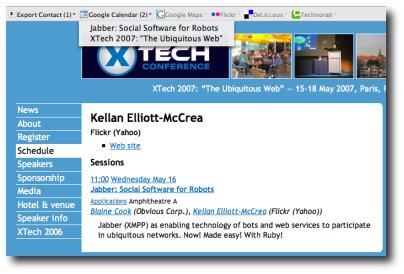
Thanks in no small part to the advocacy of Simon Willison, I've just OpenID-enabled the XTech web site. OpenID log in box on Expectnation Users can now create their accounts using an OpenID, or associate an OpenID with an existing account. A single-sign on solution like OpenID solves an important problem for us, as most people tend to interact with our conference web sites in only one or two time periods each year. While we've gone to the trouble of making retrieving a password easy, there's still the mental burden on the user of setting up the account and noting it down somewhere. As a measure of the impact of this on me personally: I habitually save registration confirmation emails in a certain mail folder. Since 1997 I have collected no fewer than 572 of these, and I'm sure some have been missed! One other cool thing about OpenID is that finally I can get the identity I wish to have. No longer do I have to be a compulsive early adopter of every service just to get the name edd. (Well, as long as said service integrates OpenID of course!) Personal branding is an important attractive aspect of OpenID.ImplementationImplementing OpenID using the Ruby ruby-openid gem was quite straightforward, as was the logical integration into our user models. I've not been the only one following this path recently, as illustrated by this post on Rails OpenID integration from Dan Webb.The harder problem of deploying OpenID lies in making the user interface work well: ultimately that will have a huge influence over its uptake. We've made a decent first go of it in Expectnation, but I'm sure we'll evolve and improve it over time. The main puzzling thing is how obvious to make the OpenID facility, given its relatively small take-up right now. We don't want to confuse normal users too much by using it. Microformats When I did my behind-the-scenes piece on the building of the XTech schedule last week, one feature I didn't discuss was the support for microformats we have in the schedule and on the session pages. If you use a tool such as Operator, you can easily save talk times to your calendar while reading the schedule.
XTech schedule microformats I'm personally a little late to the microformats party. Being a fan of pragmatic RDF, I didn't see much need for microformats right away. However, with tools like Operator I can honestly say that the use of microformats does enhance the XTech schedule.My impressions of microformats (in particular hCalendar and hCard) from using them are mixed. One the plus side, it was very easy to do. On the negative side, I found them restrictive in the sense that for the metadata to be present in the hCalendar object, it needs to be part of the HTML presentation.So, while microformats are meant to be about making human readable data useful for computers, they can have a tail-wagging effect on the human markup. Let me elaborate. In the conference schedule there is a grid overview. For readability here we want to keep the details down to a minimum in each box. There is definitely no need to repeat the date of each presentation when you can see there's a grid per day.But also we want to have microformats available in the page so users can use the grid to pick off talks to add to their calendar. The only details you currently get from the microformat are those you physically include inside the div marked as vevent. This means we can't embed the full details, such as the talk description. It also means I indulge in some dubious markup practices (an empty abbr element) in order to get the date and time into each hCalendar object.It seems to me that this could be ameliorated by more intelligent user agent behaviour. Each of my hCalendar events is given a URL. At the end of that URL is a full description of the event, using microformats. So, as long as I reference the URL in a summary page, the user agent can beetle off and pull down the full information, in much the same sort of way that FOAF uses the rdfs:seeAlso property.So, remove the expectation that microformats provide complete data, and I'm sold.Other schedule features: iCal, Upcoming.org
Of course, we have iCalendar support in the XTech schedule, so you can subscribe conventionally using iCal, Evolution or a similar program. Aaron Straup Cope took the iCalendar, and uploaded each event into Upcoming.org. If you look at the upcoming events tagged xtech07, you see the results of his work.This foreshadows some of the social elements we plan to add to Expectnation itself: indicating your intent to attend a talk, and adding comments to it. As a program chair I'm finding this quite fascinating to watch.

23 February 2007

James Morrison: Crazy friday

Wow, today is nuts, I've gotten 3.75 invites to parties for only tonight. That's 3 real invites, an invite to crash a games night and critical mass. So 3 events in the city and 2 in mtn view. Well, the christmas tree that's still up and a huge bottle of Jaeger have made my choice. Why did I move to the city again?

Evan Prodromou: 3 Vent se CCXV

I was up late last night upgrading Wikitravel from MediaWiki 1.8.3 to the new 1.9.3. It took a long while, since the 404-handler caching extension that I built for MediaWiki a couple of years ago (which keeps Wikitravel running on a single, albeit quite big, server) is pretty invasive, and a lot of things had changed with the way users and stuff worked, so I had a lot of hacking to do. But it's stable now, even if some watchlist stuff is a little funky. Doing major upgrades is a real bear for me, but I'm happy when it's over. tags:

Home people Maj had her final oral exam in her French class tonight, which left me and Amita June home alone to fend for ourselves. We had a lot of fun. First, I had to do the day's dishes (lunch and breakfast) that were sitting in the sink. I brought the footstool around to the sink from our laundry room, and she stood on it and helped me with the dishes. After I'd finished washing a dish, she'd carefully fill it up with water, dump it out, then put the dish in the dishrack next to her. Pretty good for 18 months old. That went so well that I moved the stool over to the kitchen table where I cut tofu and vegetables for dinner. I gave her pieces of pepper, cabbage, and carrot while I was working, and she nibbled on them a bit and then practiced chopping them... with the handle of her mother's toothbrush, which she'd stolen out of the bathroom earlier in the day. After dinner, we had a bath, then we read some books, and then she went to sleep on my shoulder while I walked around her room and sang, like she's been doing for the last 2 months. It was another good night. tags:

Soft launch We launched two new Wikitravel versions overnight, too: Catalan Wikitravel and Finnish Wikitravel. Catalan recently, uh, catalyzed from a blog post by Carme Pla . Readers and the Catalan-speaking community rallied to our Catalan Wikitravel Expedition and got the project rolling. I got the site set up last night and they've started translating key help, style manual and policy guidelines already. Mean, Finnish had been simmering on the back burner for a while, so we got it launched at the same time. My friend and colleague Jani Patokallio is a Finn and a longtime and well-respected Wikitraveller; I'm glad he's taking leadership of the project. Finns have such disproportionate contributions to Free Software and Free Culture; I'm glad to have that Freedom Powerhouse Country all working together on Wikitravel now. And, y'know, I'm going to totally rack up a ton of HugAFinn points off of this. Actually, now that I think of it, I have no idea if "Carme Pla" is a real name or even a plausible personal name in Catalan. It sounds like it to me, though. tags:

coComment A couple of months ago Don Marti recommended that I check out coComment, and I made a mental note and then forgot to follow up. But I started using the system a few days ago, and now I wonder how I ever lived without it. coComment is a Firefox plugin that keeps track of when you post a comment on a blog or some other comment-handling system. It then keeps track of the conversation that happens after you comment. I have a lot of standing keyword searches on Technorati and Google Blog Search, and if people are talking about a subject I'm interested in, I'll usually jump in and talk about it. But sometimes I'll go back months later and see that people asked me questions and continued the conversation without me. So coComment is exactly the kind of cross-the-Internet aggregation service I need. tags:

Sage Speaking of keeping up with blogs, I've realized in the last week that I've outgrown Live Bookmarks for following RSS feeds. Rather than going with a Web-based RSS reader like Google Reader or Bloglines, I opted instead for the in-browser reader, Sage. It's simple, it does what I need it to do, and it supports OPML so I can move my subscriptions somewhere else if something better comes along. Good piece of software. My best candidate for something better coming along? Probably if I get my Netvibes home page customized well enough to handle my 50-60 feeds. And maybe when Netvibes gets smart and becomes and OpenID identity provider (or at least figures out a way that you can log into your ID when you start a browser session). tags:

21 February 2007

Ingo Juergensmann: Wireless Bridge Linksys WET54G

Ok, for some time now, I've been using my old Samsung Vm8100KXDT Laptop to connect my wired network to my Linksys WRT54GS router, which resides on another floor.

Well, if you read my old Drupal blog, you may have noticed, that I complained several times about my Netgear WG311T PCI card, being not able to be run in my PowerPCs. That's the reason why my Laptop was acting as a wired/wireless bridge (or more exactly a router between both worlds).

Today I bought a Linksys WET54G wireless bridge to replace my Laptop for that purpose. My Laptop was just too noisy and too power consuming and - even worse - the harddisk began to die. It was giving loud klackklack noises from time to time, resulting in a loss of DMA and therefore needed a power cycle afterwards.

Anyway, the WET54G is a nice small box with one antenna and one ethernet port. It is advertised as being a operating system independent device - which is clearly not true. You'll need a Windows PC to configure the device and it's quite awful to configure.

Instead of accessing the WET54G bei http, the CD-Rom contains a small program that scans the ethernet for that device. Next problem will arise when you want to configure your WLAN/WiFi settings. It is pre-configured to use channel 6 and infrastructure mode. Unfortunately, you'll need to first configure infrastructure or ad-hoc mode before you proceed to configure your ESSID, channel and b/g/mixed mode settings. Even worse because you can't change the channel or the mode when you have chosen infrastructure mode.

So in order to change your channel, you'll need to configure it in ad-hoc mode first, then change your channel and mode first, safe your settings, let the device reboot and continue with configuring infrastructure mode again.
Really badly tested piece of software, Linksys!

But beside of this huge annoyance the WET54G works quite nice once setup properly. Alas, I can't recommend it to buy for the above reasons.

Update:
After configuring it the first time, there actually is a webinterface, where you can configure the device with your favorite free OS. However, it was not accessible the first time to me, although I configured a Laptop to use the described default network in the manual. The above mentioned problems of not being able to configure the channel in infrastructure mode still exists in the webinterface.

20 February 2007

Benjamin Mako Hill: Overprice Tags

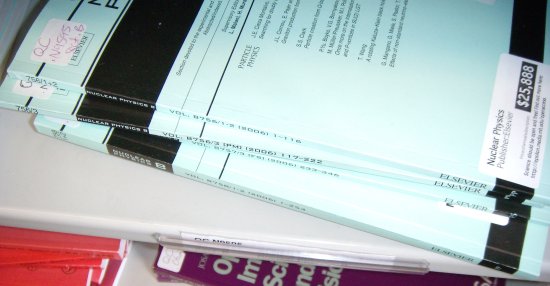
Last Thursday (February 15, 2007) was declared National Day of Action for Open Access. To help raise awareness of the movement for open access in scholarly publications at MIT, I got together with a number of other MIT students and placed price tags -- we called them overprice tags -- onto the 100 journals that MIT subscribes to at a cost of more than $5,000 USD per annum.
/copyrighteous/images/overpricetagged_journal.jpg
The project, inspired by a similar project called Seeing Red carried out by a Brown librarian a few years back, was a huge success. You can find information about the project, motivation and experience, see pictures, and find out how you might run a similar event at your institution on the Overprice Tags homepage.

18 February 2007

Evan Prodromou: 29 Pluvi se CCXV

Impressive amount of snow today -- all the digging I did yesterday when we got home is pretty much moot at this point. Huge swirling snowflake clusters are coming down from the sky and have been since we got up this morning. It's awfully pretty. Amita June and I went out to Loblaw's in the old CPR Angus Shops to replenish our larder, which was pretty empty after our trip to NYC. We had a pretty easy time of it, although I thought I'd be smart and go through the self-service line with my huge cart, which took about 2-3 times longer than just having a professional or two deal with it. By the time we left, Amita was exhausted and she fell asleep in the car on the way home. tags:

Jodi Martin at the Lobby Lounge My friend Jodi Martin is playing at the Lobby Lounge at 4538 av Papineau tonight (Sunday 18th Feb) from 7:30PM to 11PM. Jodi is a South Australian a beautiful voice; she's just an awfully decent person. I'm going to be there, after Amita goes to sleep tonight. Jodi's also got a smouldering new pub photo here. I can't tell if she's gonna kiss you or punch you. I guess that's part of the magic. tags:

wikipatterns.com One of the more interesting people I met at RecentChangesCamp 2007 was Stewart Mader, wiki evangelist for Atlassian and creator of ikiw.org (great domain name). We spent a lot of time talking about using wiki in education. Stewart has just launched wikipatterns.com, a site that uses pattern language to describe wiki usage, wiki adoption, and wiki roles. Patterns and wiki have a long and illustrious history together, of course; Ward Cunningham's original wiki, the Portland Pattern Repository, was created to help software developers share design patterns. Many patterns about wiki were first identified on Ward's wiki itself, and others have been elaborated on MeatballWiki and CommunityWiki, but as far as I know no site dedicated specifically to Wiki patterns has happened before. wikipatterns.com has some that I've never seen identified before, like the Content Alert and Scaffolds. I'm interested to see how wikipatterns.com goes. I think it could be an extremely valuable resource. Currently a lot of the language is aimed towards company wikis, which is probably where a lot of Atlassian people's interest lies, but I'm more interested in creating big Open Content repositories based on the contributions of the entire Internet. It will be interesting to see how wiki patterns scale to fit both kinds of wikis. tags:

17 February 2007

Alexander Schmehl: Is there a mail client which doesn't suck?

Until recently I was a quite happy user of the mail client mutt. I used to receive mails on my own mail server, check them for spam, and at home I used fetchmail to pull them all down, where they where sorted in different folders via procmail. Not very elegant, but working. Sometime I read the mails directly on my server, which wasn't as comfortable as possible, since the mails where all in one big pile. So I needed to change something to sort them on the server and sync them home. Not a big problem, you might think? Well... Sorting mails on my server wasn't a big problem (beside the fact that I needed to tweak my procmailrc a bit; I used real folders at home, but dovecot wants to have the folder hierarchy separated by dots in the names of the physical folders). First I tried to use mbsync, from the isync package. First problem was, that mbsync doesn't like subfolders (which I didn't found out via the documentation, but from a friend using it, too). So I needed to rename all my folders (nearly 100) again to something mbsync would understand. I worked quite well and did, what I wanted to do: Syncing mails from my home computer to my mail server and the other way around. It was nearly perfect, and I would be able to read mails even without net connection. Perfect for boring train rides! But after only one week something went wrong. mbsync started to segfault. Beside receiving new mails and doing the usual stuff (reading them, moving them to other folders) I changed nothing. But it kept on segfaulting; I didn't found out why (see #411120). Obviously I need a working mail setup, so I searched something new... like my old mutt! Why not use mutt to access the imap server directly? Okay, I wouldn't be able to read mails while traveling around in a train... but hopefully mbsync would be fixed in the meantime. But using mutt with imap sucks, too. While it is perfectly possible to read my mails, it seems impossible for mutt to check, which folder has new mails. No, that won't work. Thanks, I'll have a look at something else... Perhaps I should try something new? My girlfriend likes thunderbird icedove. Nice user interface... no problem accessing my imap server... and it has some kind of offline mode. But... NO! It seems it's impossible to make system wide folder settings! Like... displaying new mails on the top instead of the bottom... or using the thread view... or setting this damn "check this folder for new messages" flag, so the folder will be checked for new mails. Damn! I won't click through every single one of my nearly 100 mail folders to set the settings I want. Sigh... isn't there a mail setup which doesn't suck? It isn't that complicate: I want to use gpg, I want to have threading, I want my folders to be displayed properly (preferably in some kind of tree), I want to see which folders have new mails and it shouldn't be that huge (which kicks out kmail and gnus); bonus points if I can continue using my favourite editor and for some kind of offline mode. Update: icedoves threading sucks, too. It seems to be based on the subject of the mails, not mail headers. Leading to quite iritating views on a mailfolder containing a lot of auto generated messages with similar subject. PS: No, I haven't tried offlineimap, yet. Some people warned me to not use it. Well... perhaps I'll give it a try.

15 February 2007

Biella Coleman: Compress your work into a haiku.

Is your idea of an awesomely good time writing, over the course of 15 hours, a series of haikus? Are you an academic? Or do you write about things academic ? Well if you answered yes then do join this contest and I guess you should do it for the love of haiku writing and not the prize because, well 10 bucks from the Itunes store is not a huge pot of virtual gold, and anyway, I know a lot of readers of this blog are pretty anti Ipod/Itumes for DRM but many are also into haikus so… go for it. I am trying to get Seth Schoen to submit his now world famous haiku though it is a “little” long. Since I am mostly a right brain person (so that writing a haiku is excruciatingly painful), I will not submit my own haiku but at least I am wrapping up an article on a haiku (and yes it is Seth Schoen’s haiku).

Joey Hess: wikis out of disk

Today wiki.debian.org was briefly running on a full disk, and this MoinMoin based wiki failed pretty spectacularly: We're used to some unix programs not dealing with being out of disk space very well. But IMHO wikis should be in the same class as package management systems, revision control systems, or databases: running out of disk should be something they handle gracefully without data loss and with graceful degredation when possible. Course I wrote a wiki engine too, and it didn't fare much better. Possibly worse, although I tested it much harder than MoinMoin: Of course I've fixed all these problems, and it seems quite robust now on randomly failing disks. If a page edit fails, it will go as far as to bring you back to the edit form and let you try again. I'm interested in how well other wiki engines stack up.. Also, if anyone has some hints for good ways to write regression tests involving full disks, I haven't found an approach I like yet.

Jordi Mallach: Tunisia

Last month, Bel n and I managed to secure our trip to Tunisia on the very last moment. So, planning trips on the very last moment isn't nothing new around this place, but we made a big effort to take things to the limit. I can't remember why exactly, but on January 31 we were *so* close to fucking everything up before it started, when we packed our stuff just a pair of hours before having to leave to the train station. My luggage was prepared in a rush, so while I think I took everything I thought I'd need, I didn't really select my clothes too much. The idea was to have our suitcases mostly empty to bring back stuff from the markets: smoking cachimbas, lamps, leather stuff, etc. At that time I didn't know that would end up being a great strategy. Anyway, like 9 minutes before the train's departure we were stuck in Nuevo Centro without a taxi and at that point I really had lost hope about being on time. For some reason, there were no taxis in the area, when it's normally a place where there's tons of them. Suddenly one appeared, we rushed in and I asked the taxi driver to please fly to the station. Happily, we got an incredible green wave around the avenues, he drove us at like 80 Km/h and we even had to wait for a few minutes at the station. In Barcelona, we prepared our small New Year's Eve dinner with my cousin Laia and Marc, and while the plan was to go to sleep pretty early to be in good shape to go to the airport next morning, the bottles of wine and cava emptied quite fast, and around 4:30 we were quite drunk when we decided it was enough. When some annoying sound woke us up next morning, it was really late, so we again rushed out to the empty streets of Barcelona, sneaked into a regional train, without knowing it was the only way to get in time in El Prat airport, and after some initial confusion trying to find the travel's agency desk in the wrong terminal, we managed to check into our flight, being the very last to do so. With all the rush, I couldn't get some clothes from my suitcase transfered into my hand luggage, which I really wanted to do after my nice lost luggage experience during Debconf 5 in Helsinki. Anyway, chances are small that your luggage gets lost, right? But of course, Murphy is always vigilant, and this was a great opportunity to fuck me up. After a short but horrible (due to our really bad hangover) to Tunis/Carthage airport, we were in the long security/passport check. When Bel n picked up her bag and mine didn't appear, I tried to tell myself hey, it'll appear, no worries! . After 15 minutes, the stupid suitcase was nowhere to be found. Apparently, another two pieces of luggage had the same luck, which made us contact a group of four Uruguayans who were missing one of them. Nothing too terrible; it'll surely come on tomorrow's flight. After reclaiming our lost luggage, we went out to the parking where a bus was waiting for us, and on the way there, the six of us nearly fell into the first Tunisian scam, involving a dude selling jasmine flowers at 2 each. The bus took us down to Jasmine Hammamet, the most touristic place in Tunisia. Valencians might have an easy imagining the atrocity of the area by picturing what twice Marina d'Or plus Benidorm including Terra M tica would look like. Kilometres and kilometres of a disgusting Who can build the most horrible giant hotel right next to the beach contest. So it was pretty clear we had to spend as little time as possible in the area. We soon learned about how transport works in Tunisia. The cheapest is to use the public busses and the luagge collective taxis, we soon found out. Our first morning there, our guide Rejeb, working for Iberojet and Solplan touroperators, gave a talk where he advised us against travelling alone, specially around the South, while he offered organised trips around the country for every day of the week. Although we expected this danger! speech, we decided to book the two day trip to the South and Great South of the country, basically because it was the best way to see many places in a short time, even if it meant having limited time in each destination. We wandered around Jasmine Hammamet and discovered Carthage Land, sort of a Disneyland set in the age of Anibal and Carthage's empire, which was inside a newly built medina complex. This was a really bad place to practice the art of haggling, as the place was so desert, merchants really tried hard to get you buy something. Again, we were close to fucking up after our first negotiation, but we finally decided we weren't so interested. Lucky, we later found out the price was outrageous. Sadly, we spent way too much time in that tourist trap, and we found it was too late to go to the real Hammamet town to see a real medina and real stuff, so we had a long walk around the immense beach until sunset. On Wednesday, we did organise a bit with the Uruguayans and some others we had met: Mar a and Santi Kuchi Kuchy , Cristina and Pedro and an Argentinian family, and managed to hire a van driver to drive us all over the North. For quite a good price, we were taken to a few ruin sites in Carthago, now mostly a residential area, and it was really impressive. While the condition of many of the remainings is not optimal, it was exciting to see things which had been built by Phoenicians and Romans 2,000 years ago. I really enjoyed the remainings of the Antonine thermal baths of the city. It had been a huge building right next to the sea; one of the standing columns helps figuring out how big it had been. Right next to this site, the Presidential Palace dominated the whole gulf. Military places are treated zealously in Tunisia, and it is against the law to take pictures of any bit of it, not even a barbwire of the fence. The Palace had a great Tunisian flag waving over it, and many signs advised you against taking pictures in that direction. I couldn't resist.


The ruins of the Roman Antonine Baths After Carthage, we went to Sidi Bou Said, a small touristic town, which had the peculiarity and beauty of having all windows and doors painted in a beautiful light blue colour. Our last stop for the day was in Tunis, where we visited the most amazing medina of the whole week. Unlike the new medina in Jasmine Hammamet, this one was literally packed with people going up and down the maze of very narrow streets. Every few metres you'd come across a new, attractive smell coming from the few salons de th or spice, leather or perfume shops. Here we finally started developing our haggling skills, and managed to get a few items for reasonable amounts.


Streets of Sidi Bou Said Back at our hotel, everyone tried to get a quick dinner and go early to bed, as next morning we were taking a bus for our trip around the South. There was time to call yet another time to the Airport, to find out that one of the luggage pieces had been found. While there was no news about my suitcase, we shared a taxi to the airport to pick the found suitcase, and see if mine was actually there by any chance. Unluckily, it wasn't, so I wouldn't have any clothes for the desert visit. Some people in the group were kind enough to lend me some t-shirts and pants. For my underwear, I actually resorted to using some of Bel n's (no kidding, it was way too sexy :P), while mine dried up after some manual washing. The alarm clock went off at 5:15 or so, and soon after we were ready in the hall with our small bags. When the bus was ready to pick us up, the guide said we weren't allowed in, as we weren't on the list. WTF? We were nearly the first ones to book and pay for it! So he finally let us in, for a short while, until he realised there was no space for everyone, so he demanded that we got off. Of course, we didn't, and a long and very disgusting argument started between the guide, us and a few people who had seen us pay for our trip, and were trying to support us. To make a long story short, we ended up stepping down when I noticed the bus driver calling the police, and after Rejeb, our guide, told us the other bus would be waiting for us at the travel agency if we quickly took a taxi there. We of course knew that was a fantasy to get the bus moving, but dealing with the police at 6:30AM wasn't on my list of activities for the day, so we finally gave up to let the rest of the people get in time to their visits, as they were very tightly scheduled to make everything fit in two days. Nobody was waiting for us at the travel agency, but we were promised our money back, which did happen in the evening; our plans for Thursday and Friday were a bit broken though, and the rest of the morning was spent looking for alternatives. When we had managed to book a new trip in a different agency for Saturday, we took the bus to Nabeul, the capital of the province, well known for their medina specialised in pottery. In Nabeul, we lived a tourist trap which I found to be quite original. Not having walked 3 metres into the city walls, some young dude stops us and tells us that he knows us, as he works in the restaurant of our hotel . I totally didn't remember his face at all, but why not? So he quickly tells us Nabeul has good carpet workshops, and her sister is working in one which is regulated by the Government, and you can only visit two days a week. Coincidentally, Thursday is one of them! So he literally grabs us by the arm and takes us to one of the streets perpendicular to the main market street, and we enter a carpet shop. To the right, his sister probably being like 45 years older, is knitting a nice carpet on the loom. And a few seconds after, we're taken upstairs, where a Teletienda show starts before us. Without being asked if we want to buy a carpet, some other dude starts to unroll carpets and more carpets before us, talking in some very basic Spanish. While we're offered jasmine tea, which is really nice, Ali the brother quickly excuses himself and vanishes, leaving us with the salesman, which continues unrolling more and more before us, now helped by someone else. When 10 minutes later we convince them that we won't buy any carpet, he asks a donative for his young employee, who has unrolled and will now roll back a zillion carpets. Back in the hotel, we have dinner with a pair of Catalans from our flight, and when we tell us about the carpet place, they tell us they went over the same story like one hour before us! On Friday, we got some advice on other places to visit, and decided to go up to Cape Bon and visit Kerkuan, the only important remainings of a Punic city which, when conquered by the Romans, was destroyed to the grounds, but not rebuilt on top (they were busy with Carthage). Romans did an excellent job when destroying cities, and the result is a site which still lets you see perfectly how a small town (around 1,500) looked like 2,000 years ago.


Ruins of a Kerkuan neighbourhood, with their red bathrooms nearly intact To reach Kerkuan we had taken the bus up to Nabeul and then our first luagge to Kelibia, where we took a taxi (after no less than half an hour arguing in French with the taxi driver to settle on a rate for a ride to Kerkuan and then to the tip of the Cape in El Haouaria. Luagges are undoubtedly the best way to travel medium distances for very little money, while getting mixed with locals. During our ride up North, we chatted with a nursing student from Kelibia who was going back to her town for the weekend. She was really open, like most of the people we found in Tunisia, and we ended up exchanging our post addresses; we still need to send her a postcard from Val ncia soonish. This area wasn't so touristic, so the roads, while totally acceptable, weren't as good as the highway from Tunis to Sfax we were used to. We had seen some bits of the local driving skills , but the luagge driver performed some of the most extreme overtakings I've ever seen. These happened every three of four minutes, so after a while I was actually amused about what was going on. We would overtake two lorries on one go when there was absolutely no visibility; if things went too far, people would just slow down to let the overtaker get back into his lane on time, and those coming ahead would just use their headlamps to make them know it was just a bit too close. The taxi driver, annoyed at us, took us to Kerkuan but didn't wait for us; he immediately left, leaving us without any transportation in the middle of nowhere. After a visit at the site, we walked around 2.5 kilometres back to the main road, where we decided it was too late and risky to continue the journey up to El Haouaria, so we waited on the road gutter for a taxi. The first one which stopped was, to our surprise, the same bastard who left us one hour before, who stopped, laughing at us a little. Luckily some other taxi came by in the correct direction, and soon forgot about that man. After a taxi, luagge and bus ride, we were back in Hammamet, and the desert group had already got back from the two day trip. We were asked over and over what happened, what did we do, etc. People who hadn't talked to us before would come over and see; we were really surprised about the warm welcome we had. After dinner, we improvised a customes party, and many people managed to dress up in Tunisian/arabic fashions using bed sheets and so on. We had to wake up at 5AM next morning, but didn't go to bed until 2AM. Nothing could go wrong this time. We had our tickets, we had confirmed we would be going on Sunday the night before, so at 6:15, our new guide came in, and came straight towards me. He said something in German, and after I told him I spoke absolutely no German, he said huh, well you know the bus is full of Germans, and my indications will be in German? . Pretty incredible, but again a fuckup by the agency. My ticket said, clearly: Sahara safari. Bus + 4x4. (ALL). Turns out ALL meant Allemand, not everything included , although we had requested English pretty clearly. This was quite a minor problem though, after having no clothes for a whole week and having been left behind two days before. I think we were really lucky getting that German group, though. We were only 16 people on the minibus, making the stops a lot faster than the normal ones, where 55 persons need to get out and in of the bus. We had our own Routard guide for Tunisia, so we could read about the places we were about to visit before getting ther. Also, I surprisingly knew much of what our guide was talking about, just missing the details he talked about oil production in Tunisia compared to Spain's, among other topics . When the landscape was becoming drier and drier, Bel n and I spotted something dark far away ahead in the completely straight road. As it became bigger, I started thinking it might be the #1 place to visit for me in Tunisia: El Djem's impressive Roman amphitheatre. When we got off the bus, I was totally excited. Before me, the walls of an incredibly well preserved, huge Roman building; in fact, the best Roman ruins in the whole continent. El Djem's amphitheatre was the third biggest of the Roman empire with 35,000 seats, only surpased by Rome's and Capua's. It remained mostly intact until the 17th century, when some of its stones were used to build the city and some of the treasures taken to the Great Mosque of Kairouan, but when it took more damage was during two consequent wars, when the Turks didn't have many problems to blow part of the wall away using cannons to end up a siege of the city.


The Roman amphitheatre of El Djem The underground tunnels are intact, and it's difficult to not have flashes of Gladiator while walking under the arena's trapdoors. Sadly, there was little time to spend there, and we had to continue the journey after just 45 minutes. I would have spent half of the day there. From here, the landscape truly started to get drier and more desertic. The south of Tunisia is a giant olive field, until you reach the Great South, where it's dry enough that the only thing that grows in the land are rocks. Hours later we arrived in Matm ta, the very famous troglodyte village of small holes in the ground. Although I was curious about being there, watching how organised and massive tourism has destroyed these Berber's ways of life dissapointed me greatly. Our guide stopped the bus in one of the pits, which was decorated with white and light blue. In the first room, an old woman was grinding something in a small, stone mill. The dwellers of the few pits still used by their original inhabitants now make a living by letting people into their homes and getting dinar as a payment for taking photographs. What the woman was doing was just a bit of theatre, part of the show. After this first room, we got into the middle of the pit, which had a series of other passages to some rooms, some of which were simply open so we could get in and have a look. I felt a little bit like violating someone's privacy, and wondered how much the house had changed in the last years.


Inside a troglodyte underground house in Matm ta After our visit, we continued up the mountains of Matm ta, and after going by a giant "WELCOME TO MATMATA" sign drawn in white in the middle of a mountain, Hollywood style (!), we stopped for a brief photo-stop (sic). Indeed, the view was quite impressive, and is universally famous as one of the filming spots of Tatoonie scenes in Star Wars: A New Hope. Speaking of famous places, a few minutes later we stopped at the top of one of the hills, were we'd have lunch in the Hotel Sidi Driss, a place of pilgrimage for Star Wars fans, as it was the troglodyte pit which served as the Skywalker's home. The place is full of references to the film saga, and one of the open pits is full of set pieces stuck into the walls. We were served couscous, which wasn't bad, but was cooked and served in the most genuine fast-food fashion. Everyone there gets couscous to eat, apparently, and it's the same in many other touristic places in the area.


Matm ta's lunar landscape From here, our journey headed straight West, in the middle of the rocky desert, until after some time, you could start to see lines of palm tree branches planted here and there, a sign that rocks would soon disappear, being replaced by sand and dunes. As when we were approaching El Djem, at some point a huge, dark spot appeared on the horizon. Douz, probably named after some 12th French batallion which stayed there, is a small town in the very limit of the Sahara desert, built right next to a huge oasis, exclusively dedicated to palm tree plantations, making dates production a big source of income, along with, of course tourism. The travel agencies use Douz as the starting point for several-day trips into the desert, camel rides and stuff like this. Our guide offered us getting a camel and carriage ride in Tozeus for 20 dinar, but Bel n and I declined. He didn't seem to be too happy about it, and had no problem commenting this in German and Arab with the driver (Spanisch and Spanien were clear to me). We learned that the agency (or the guide) makes around 3 Dinar for everyone who contracts the camel rides, after speaking to one native young kid who worked in the camel place. While our German trip mates got dressed in berber fashion, we opted to walk into the desert and play around in the sand on our own. I discovered a few desert insects which were unlike anything I've seen anywhere, and their diminute trails were all over the dunes. Looking West, the view was astonishing, with only thousands of kilometres of yellow dunes ahead us.


The evening sun over the dunes After they came back, we were taken to our hotel, which was really impressive. After leaving our stuff in our room, we headed back to the desert, which was like 300 metres away, to see the sunset over the Great Dune . There's a street which literally serves as the frontier between the rocky ground and the sand desert. From there, you could see many lines of palm tree branches, which are planted by locals in a futile attempt to stop the inexorable advance of the desert. Women in Douz and other towns in the desert limit spend their days sweeping the entrances to their homes, as sand gets in really fast. A small village next to Douz even had to be abandoned and rebuilt in some other place, with the old one being finally devoured by the dunes. When it got dark, we still had some time to kill before dinner, and we discovered a hammam in our hotel. I got in, and saw there was a bored young man inside. He informed us about the prices, and after some short deliberation, we realised we'd spent half of the camel money in some Arab relaxation; while I got a really cool massage, Bel n enjoyed a Turkish bath. I spoke to the guy for a while, and he said not that many people used that hammam. He actually handed the list of services since 2002, which easily fitted in one piece of paper. People don't know what they are missing; he explained that most of the hotel's clients just showed no interest in the baths. I wonder how Fins or Norwegians would react, given their sauna culture. The dinner and breakfast in that hotel was absolutely awesome, and I actually ate too much to have an easy sleep. Next morning we had to be ready at 5:30. That's pushing my limits. The bus started crossing the Chott Jerid when it was still quite dark. The chotts are dry, salt lakes in the middle of the desert, which during some seasons do get some water, sometimes from the underground. The Chott Jerid is the biggest of the three chotts in the area, and the views are fantastic. It's like a giant, totally flat muddy sea which reflects light creating dangerous mirages of oasis-like dark patterns. Before the construction of the recent road that links Douz and Tozeur, crossing the chott was so risky that many people died in the attempt. We had the unique opportunity to see the sun rise over the salty horizon.


Sunrise at the Chott Jerid Again, on our way to Tozeur, we were offered a carriage ride for ten dinar, and again we declined. The guide then asked us if we had no money or what. So in Tozeur we basically wanted to walk around the oasis fields, and ended up talking most of the time with some old man who sold drums and desert roses. On a 4x4, we went up North to Chebika, a really cool town with a small oasis of thermal water, which I guess was around 40 C. The short walk to the wall where the oasis surfaced was packed with children who insistently begged for money or offered necklaces and other items. It was difficult to make them understand you didn't want anything. We then went up the mountain behind Chebika through a road which had its own piece of history. It seems that during WWII, Rommel suffered an Allied siege in Chebika, with a range of mountains behind their backs. The Allies gave him one month to surrender, and he took his time to answer. During that time, he ordered his engineers to design and build a road which would let them escape Chebika through the steep mountains, and they managed. When the ultimatum expired, the Allies apparently found out Chebika had been abandoned by the Germans, including tanks and most of their equipment. So, on the way up, a few kilometres away from the Algerian border, there was another typical visit to the biggest oasis waterfall in Tunisia, which was several metres high.


The oasis at Chebika Our Sahara trip would soon end, and after lunch we headed Northeast on our way to Hammamet. On our way back, we stopped in Kairouan, one of the key Islam pilgrimace spots, with the Great Mosque as the biggest attraction. Unluckily, as we arrived after lunch, we didn't had a chance to see it. Apparently it is really impressive. We haggled a bit for a pair of babouches and a small leather couch in the medina. We came back to our hotel around 7, and found most of the people around the hall. After the obligatory update on how it went, we went to bed as we were exhausted, and of course we had to get up really early to head to the airport. The airport was at that early time of the morning a total chaos, and while people stood in the checkin lines, I tried to find out what was going on with my still lost luggage. I went back to the lost luggage window, which would be closed for 5 more minutes. When they finally opened, they told me once again they had no clue about what was going on with my luggage. I finally understood they had no clue: my tracking number wasn't in their database. I asked them if I could have a look at the unreclaimed luggage storage room. They kindly opened a small door for me, and invited me to go inside and have a look. The view was gross: hundreds of lost bags all over the place. As I was in a bit of a hurry (I actually had to get back to Barcelona), I asked him where to find the bags of one week ago, and he nearly bursted into laugher. Okay, I had to look all over the place, scanning every piece of luggage in an attempt to spot mine. There were bags of absolutely every type in there. In one of the corridors, I sensed a disgusting smell, and figured out some poor guy may have food or something in one of their lost bags, which was rotting in that horrible room. So wrong: soon after I found myself nearly stepping on a puddle of shit, as if someone had literally dumped it right there. Oh my... luckily my search was nearly over and unsuccessful, and I got back to Barcelona with the hope of finding my bag in El Prat. After looking in their two storage rooms I realised I'd probably not see the luggage again, which is a real pain in the ass. A few hours of train later we were back in Val ncia, with a feeling of having spent 3 or 4 weeks in Tunisia, not just 8 days. Really a great place to visit, not only for their cultural treasures, both current and ancient, but for the openness of their people. I hope I'll be back at some point!

13 February 2007

Simon Huggins: Use a redirect, Luke.

Ingo, why don't you just redirect people to the new location redirecting feeds to their new location. That way on some aggregators like rawdog you'll just get the updated URLs all set with no manual adjustments at all. This post is also a hint that after deliberations I moved from planet to rawdog. It's neat and in Debian. Might have to try to write a plugin so I can read friend's livejournal posts with it too soon.

Eddy Petrișor: yet another disguised rant or how you won't run GDB remotely

I tried for the whole day to understand how I can debug remotely an application in a qemu machine.

Why would I want that?
The closest I could get was to start by hand qemu with the guest qemu serial port set on a tcp socket, start gdbserver on (guest) /dev/ttyS0 and try to start gdb remotely on that socket opened by qemu. This resulted, as expected in some errors...

Now, after reading all kinds of threads on the net, reading qemu's docs and gdb's docs, I gave up, I am installing X in the qemu machine.

BTW, I couldn't find a way to tell DDD to connect to a socket to debug :-/.


Of course, any help and advices would be mostly appreciated.

12 February 2007

Christine Spang: Armagetron Advanced and Debian

News flash: gamers and Tron fans everywhere can rejoice; Armagetron Advanced will soon be up-to-date once more in Debian! The last time a new upstream version (0.2.7.0) was uploaded was almost two years ago now, and while the Debian package has languished in neglect, upstream has chugged on, fixing bugs and adding new awesomeness to the game. Just recently, the old maintainer orphaned the package, and since I use it anyway I’ve adopted it and given it some much-needed love. The new version is 0.2.8.2.1, what an, er, long version number. The new packages have been renamed from armagetron[-foo] to armagetronad[-foo] to reflect upstream’s name change. They include upstream improvements such as the addition of maps and improved graphics code, as well as packaging improvements like a new initscript for the server and rewritten, up-to-date manpages. While the new packages have been uploaded to experimental, they’re stuck in NEW due to the binary name changes. So, grab the x86 or x86-kfreebsd packages from here and test, test, test! (Yes, I run a kfreebsd machine. I wanted something eclectic for a non-essential, moderately old dual-core x86 box. Also, I’ll probably compile amd64 packages soon, but the amd64-machine I can use to build them on is currently in a half-installed state, which I need to fix before that. You can always build from source.) I’ve cleared with the security team that it won’t get in the way of anything and will probably be uploading to unstable as soon as there’s been some more testing to look for major problems. And since the newest version contains fixes for the security bugs affecting the old version, I’m going to snoop around and judge the [in]sanity level of porting back the security fixes for etch, since the new version will at most be unofficially backported to etch. Go, er, take a break in between fixing RC bugs. And test, test, test!

9 February 2007

Evan Prodromou: 19 Pluvi se CCXV

I had a full day yesterday. I'm not sure how this happened, but for some reason both Montreal Wiki Wednesday and Yulblog First Wednesdays fall on (ta-da!) the same day of each month. So we get a whole lot of Internet social-software craziness all in one intense burst during the day. Wiki Wednesday last night was a good time. We had it up at La bande passante, the informal meeting space that Robin Millette, Marco and roommates have up near Metro Cr mazie. It's a really nice space for a meeting of <20 people in an informal setting. They have lots of space, equipment for presentations, WiFi, a big table and comfy chairs. Hugh McGuire, Anne Goldenberg and Antoine Beaupr , Marc LaPorte, Seb Paquet and Robin Millette were all there (with various bande-passistes passing in and out as needed). I talked about experiences with RecentChangesCamp 2007, especially the "what we should have done" session at the end of the event. It really informs what we're going to do with RoCoCo in May of this year. In particular, we've made a commitment to try to get invitations and sponsorship requests out in February -- about 3 months before the event proper. We hope this is close enough to the event itself that people won't put it off or forget about it, but far enough away that people have time to make plans. Hugh talked about his new project Visible Politics. It's kind of a Wikipedia-meets-They Work for You. It's a wiki project for sharing objective information about the voting records, positions, and affiliations of Canadian federal politicians. It's still in its infancy, but I think the project can lend a really great hand to making public information about civic activities possible. On top of that, Robin demoed a really cool project for measuring activity on parts of a wiki site, Hot Off the Wiki. His demo versions use the BarCamp wiki, but I think the plan is to expand the tool to work for other wiki engines and sites. It's a good idea. I also demoed the MediaWiki OpenID extension, which I think was pretty interesting. I didn't say it at the time, but I mostly did the demo for Marc, who I think could benefit from one of the US$5000 Open Source OpenID bounty. I believe that TikiWiki meets the popularity requirements and the OpenIDEnabled.com libraries should make it easy to implement. Anyways, good Wiki Wednesday all around. I'm looking forward to the next one in March. tags:

YULblog when I tell you to blog After WW, Hugh and I went down to the YULblog event at the Quincaillerie on rue Rachel. We actually stopped in and had a poutine at La Banquise really quickly, which definitely put me in a good mood. When we got to the bar around 8:30 -- in my mind, fashionably late -- the place was already jam-packed. There were easily over 50 bloggers there, and maybe closer to 75. My friend Nicolas Ritoux was already there, sitting down at a table eating papadum with a lot of nice folks. I got a chance to talk to Patrick Tanguay about his upcoming trip to San Francisco, and Niko and I chatted in French about how we never chat in French. I also managed to get a whole stack of Moo Cards from the likes of Hugh and Vanou. All in all a good time, although I left a little early to get some baby quality time in. I really love YULblog; it's a great event that makes me feel connected to the local community. tags:

Personal note Thanks for the blogroll link from the anonymous author of The Love Shack. My guess is that it's Alex Malinovich, but I'm not sure. Anyways, let me know who you are so I can add you to my roll. tags:

7 February 2007

David Nusinow: We've Moved!

For several months now, the XSF has been discussing, planning, and preparing to move from our old reliable svn repository to our new distributed git repositories on git.debian.org. As of a few minutes ago, that move is complete.

I'd like to thank the Alioth admins for setting up git.debian.org and letting us hammer it with the whole xorg codebase. Also deserving the lion's share of the credit for this move is Thierry Reding, who wrote the infrastructure and did a lot of debugging of the conversion script that came with git to let us make this move. It was a huge task, and I'm still amazed at how quickly he managed to pull it off.

I'm really excited that this is finally done. I've been wanting to have our codebase in some sort of distributed system ever since I started working on xorg a while back. Because I was deriving packages from Ubuntu, who was in turn deriving packages from us, it seemed like having the whole thing in a distributed system would have made my life a lot easier. It would also potentially make it easier on other derivatives who customize the X packages, like Knoppix. For a while I thought we were going to move to mercurial, but once X.org itself moved to git, it only made sense to follow suit. I'm excited at the benefits that this move will provide us, which will hopefully translate to faster updates and higher quality packages for Debian users. And this is only the beginning of what's going to come during the Lenny release cycle.

6 February 2007

Miriam Ruiz: About the NM process

There’s a huge problem with the educational system as we know it. It doesn’t teach people how to think, to be creative, or even to improve their knowledge. When a kid goes to school, the first thing they learn is that the answers they must give are not what they consider to be truth, but what they think the teachers want to hear. When you’re in high school, or at university, you have the inner feeling that you must behave, or else. I had personal problems with a teacher at university, and learnt that you’re helpless in that situation. The motto would be that if you want to finish university, you should take care about getting on with the teachers. The result are submissive citizens that won’t face authority even if they know they’re right, in order to avoid problems. One of the best things in Debian is that is revolutionary, belief-guided. People do what they feel they should do, according to their own beliefs, and mostly don’t care about having trouble with the “authority”. That’s something I really like a lot, and respect. Of course that is also the source of multiple fights and disagreements, but usually the result of those is a better solution that whatever could be achieved by an authority imposition from the power-handling people. I like the revolutionary face of Debian as much as I like the technical one, and wouldn’t like losing it. The NM process is Debian’s “university”. It’s the process in which new generations of developers will enter the project. Therefore, whatever is done with it will highly influence middle-term evolution of Debian. Of course, the NM process must assure that people becoming developers have enough technical skills, and also that they’re ideologically aligned with the Social Contract. Otherwise it wouldn’t make sense. What should be taken care about is that the NM process don’t filter side thinking, creativeness, confrontation with authority or the will to make a better world. I wouldn’t like an NM process that promoted the same submissive values that the educational system does.

MJ Ray: Bad Tech: Bad Solutions: Ban the Net

It's the Fourth Safer Internet Day which is fine in itself, but it also seems to be an excuse for politicians and journalists to say stupid things about the internet. Example 1: Interior Minister John Reid suggests making sex offenders register all email addresses and internet nicknames - seems fine at first reading, but then you realise that anyone can have an infinite number of email addresses and nicknames and wonder how the hell the police will cope with a denial-of-service attack that enumerates each address and nickname in turn. a@mydomain, b@mydomain, ... z@mydomain, aa@mydomain, ab@... you get the idea? Example 2: BBC Five Live asks 'Should websites that promote anorexia be shut down?' which was also subject of an ITV news programme called 'thinternet' yesterday evening - There are practical problems shutting down any web site (censorship is often seen as damage and the internet can route around it) and if it's not on the web, it will be passed from person to person. It's shameful that Eating Disorders Awareness Week is getting hijacked by this futility. Can someone get these people to realise that banning and controlling things on the internet is about as easy as controlling radio waves? The radio laws are mostly unenforced against small offenders because they are mostly unenforceable without a huge police force. The solutions will come from addressing the problems (sex offences, eating disorders) not the symptoms (email addresses, web sites).

4 February 2007

Ian Murdock: Why Solaris should adopt GPLv2

One word: Device drivers. (Ok, that’s two.) One of the biggest problems for any developer building an operating system for the x86 is device support—how do you get your cool new OS to run reliably across the seemingly endless collection of hardware that is “the x86″? No matter how cool it is, it won’t seem very cool if it can’t talk to the hardware. One time honored technique (at least in the academic world, and at least since I joined that world in the mid-1990s) is to use Linux’s huge collection of device drivers. Typically, that means creating a shim so your kernel can talk to the Linux device driver layer and, of course, making sure the licenses are compatible. Not sure I understand the rationale behind GPLv3, since there are rumblings that v2 and v3 won’t be compatible, and since it doesn’t look like Linux is going to adopt v3 anytime soon. But Solaris adopting GPLv2 makes a whole lot of sense from my point of view just for the device drivers and the resulting boost to overall usability.

2 February 2007

Meike Reichle: First day in Luxembourg

Next.

Previous.