Search Results: "ag"

23 December 2009

Torsten Landschoff: Hitting the dynamic linker wall

I was working on replacing some mockup code for testing an internal library with python. Basically, the C code is incredibly big and I would rather mock the 3rd party API we are using in python. I wrote a generator to create wrapping code that forwards the C API calls to my python module. Now that most of the work is finished, I get the following error message from my python mock:
1
2
3
4
5
6
Traceback (most recent call last):
File "simple_mockup.py", line 2, in <module>
import threading
File "/usr/lib/python2.5/threading.py", line 11, in <module>
from time import time as _time, sleep as _sleep
ImportError: /usr/lib/python2.5/lib-dynload/time.so: undefined symbol: PyExc_ValueError
What s going on here? This issue reminds me of a bug of my ancient Debian times which affected loading of GTK theme engines from python-gtk. The bug (#38138) is so old, it s not even in the BTS archive anymore The problem is illustrated by the following example program (consisting of three files):
demo.c
1
2
3
4
5
6
7
#include <Python.h>

void test_python()

Py_Initialize();
PyRun_SimpleString("import threading\n");
main.c
1
2
3
4
5
6
7
8
9
10
11
12
13
14
15
16
17
18
19
20
21
#include <stdio.h>
#include <dlfcn.h>

int main(void)

const char *error;

void *handle = dlopen("./demo.so", RTLD_LAZY EXTRA_RTLD_FLAGS);
void (*test_python)();
*(void**) &test_python = dlsym(handle, "test_python");
if ((error = dlerror()))
fprintf(stderr, "%s\n", error);
return 1;


printf("Calling test_python @ %p in shared object @ %p.\n", test_python, handle);
(*test_python)();
dlclose(handle);
printf("Feels fine, finishing.\n");
return 0;
run_it.sh
1
2
3
4
5
6
7
8
9
10
11
12
13
#! /bin/sh

gcc -shared python-config --includes -o demo.so demo.c python-config --ldflags

echo "Running example with default RTLD flags:"
gcc -DEXTRA_RTLD_FLAGS=0 -o main main.c -ldl
./main
echo

echo "Passing RTLD_GLOBAL in addition:"
gcc -DEXTRA_RTLD_FLAGS=RTLD_GLOBAL -o main main.c -ldl
./main
echo
On my system, this results in the following output:
torsten@pulsar:~/sh_bug$ ./run_it.sh
Running example with default RTLD flags:
Calling test_python @ 0xb77084bc in shared object @ 0x96bc018.
Traceback (most recent call last):
  File "<string>", line 1, in <module>
  File "/usr/lib/python2.5/threading.py", line 11, in <module>
    from time import time as _time, sleep as _sleep
ImportError: /usr/lib/python2.5/lib-dynload/time.so: undefined symbol: PyExc_ValueError
Feels fine, finishing.
Passing RTLD_GLOBAL in addition:
Calling test_python @ 0xb783f4bc in shared object @ 0x95e1018.
Feels fine, finishing.
Sucky. So embedding Python into an application is easy but if you want to use the interpreter and its modules from a plugin, you are out of luck. Somebody knows a way around this problem? The only solution I can think of is to link libpython.so into each of the python plugins. Update: Work around Small update: For my current problem, the work around is to run the application with the python library preloaded: LD_PRELOAD=/usr/lib/libpython2.5.so.1.0 app. Back to adding functionality

Ingo Juergensmann: Digikams 100% view

I'm using digikam to organize my pictures I took with my D90 DSLR. I always got the impression that the View -> "Zoom to 100%" menu shows not the full sized image (100%). When using another picture viewing program like okular and choosing View 100% there, I get a "bigger" image. Proof is here:

100% view - Okular vs. Digikam


You can see okulars view on the left in the foreground. Digikams 100% view is in the background at the right. Both apps are showing the same JPEG picture. I don't know that Digikam is doing wrong there, but it's definitely not a 100% view that it shows. Time for a bug report, I guess...

UPDATE:
Oh well... wondering why all those people got the Copyright-Notice.png instead of the real picture, I finally discovered that I need to change the rewrite settings for the IPv4 vhost section as well. IPv6 users hadn't this kind of problem. So, better use IPv6 instead of IPv4, folks! ;-)

And thanks to sgran for pointing out <vhost 1.2.3.4 2001::1:2:3:4> syntax! ;-)

UPDATE 2:
The bug report is filed and registered as #562197.

UPDATE 3:
Problem solved! See bugreport.

Gerfried Fuchs: Merry Season Greetings

This poem is only in German language, but I hope you can forgive me to run it in my English language feed nevertheless. I send you the best season greetings, have a nice time, use it well, relax and think about it. :)

Weihnachtsgedicht 2009

Vor ungef hr zweitausend Jahren
glaubt man, wurde ein Mann geboren
glaubt man, dass es Gottes Sohn gewesen ist
glaubt man, der uns alle erl sen sollte

Irgendwann sp ter
dachte man, das w re ein Grund, daran zu denken
dachte man, es w re ein Grund, in sich zu kehren
dachte man, es w re eine besinnliche Zeit

Heute jedoch
stresst man, um nur ja Geschenke f r alle zu finden
stresst man, weil jeder berall mit einem feiern will
stresst man, um sich besonders g tig zu zeigen

Ich w nsche mir, dass
wir helfen, uns zur ck zu erinnern
wir helfen, uns zur ck zu besinnen
wir helfen, wieder ruhiger zu werden

Ich w nsche euch ein erl stes, besinnliches,
g tiges und ruhiges Weihnachtsfest!

Robert Collins: bzr selftest uses testtools


the emperor has new clothes bzr has just changed the base class for its test suite from unittest.TestCase to testtools.TestCase . This change has cleaned up a bunch of test logic, deleted a significant amount of code (much of which was redundant with Python unittest) and added some useful and important features. bzr has only been able to make this change due to testtools expanding its mission from a simple aggregation of proven unittest extensions into one where new extensions that *make unittest more extensible*. My deepest thanks to Jonathan for permitting me to use testtools as the vehicle to put these extension-enabling-extensions (and for his patience in reviewing said changes!). The change was pretty easy: The bulk of the changes were in bzrlib.tests and bzrlib.tests.test_selftest. I chose to cleanup an ugly API at the same time which added a little scattershot across a number of tests. And there are more changes that can be done to take better advantage of testtools the amount of deleted and cleaned up code isn t complete. Even so, its a pretty clear win:
18 files changed, 228 insertions(+), 496 deletions(-)
What went? bzr had an implementation of TestCase.run. This function is the main workhorse of Python s unittest module, and yet sadly it has to be replaced to change the exceptions that can be raised(to signal new outcomes), or to improve on test cleanup. Testtools provides an API to permit registering new exception types and handlers for them. Like python 2.7 testtools also provides the TestCase.addCleanup API, and these two things combined mean that bzr no longer needs to reimplement the run method. For expected failures, bzr uses a helper method TestCase.expectFailure to perform an existing assertion and convert the test into an expected failure if that assertion does not trigger. This was another feature testtools already provides and thus got deleted. All the custom code for skipping and expected failures got deleted, and the other outcomes bzr uses turned into extensions (as per the run discussion above). In bzr test cases generate a log (because bzr generates a log) and previously the TestResult in bzrlib inspected each test that had been executed to extract the log. This was made simpler by using the details API that testtools provides (see testtools.TestCase.addDetail), which permits tests to add arbitrary data in a semi-structured fashion. This is supported by subunit and a long standing bug with bzr selftest --parallel was fixed as a result logs from tests run in other processes are now carried across the process barrier intact and are presented cleanly. Some other minor cleanups are in unittest compatibility code, where bzr would degrade gracefully with unittest runners, and testtools provides such logic comprehensively, so all that got deleted too. Whats new? I think the most significant new facility that testtools offers bzrlib is assertThat. This assertion is inspired by the very nice assertThat in JUnit (which has changed substantially since Python s unittest was written based on it). This assertion separates the two concerns of raise an exception and decide if an exception should be raised . The separation allows for better reuse of custom checking code, because it permits composition in a cleaner way than extra assertion methods permit. Testtools does not include many matchers as yet, but matchers are easy to write, and if one were to write a small adapter to the hamcrest library, there are a bunch of ready made matchers there (though they have a very Java feel such as is not meaning is which is why Testtools did not use that library). Secondly, the addDetail API referenced above, in combination with testtools.TestCase.addOnException will permit capturing the entire working area when a test fails, something that developers currently have to fiddle about with breakpoints to achieve. This hasn t been done, but is a straight forward patch I hope to do in the new year. Lastly, Testtools offers testtools.TestCase.getUniqueInteger and testtools.TestCase.getUniqueString, which are not as yet used in bzr tests, but we may start using them soon. Beyond that, the other features of testtools are already present in bzrlib, and we simply need to find and delete more duplicated code.

Benjamin Mako Hill: What's in a name?

Over the summer, there was a bit of a tussle at the highest level of Ubuntu governance over whether or not Canonical Ltd., the company that funds the majority of work done directly in Ubuntu, should name its file syncing and backup service Ubuntu One. Canonical's service involved a freely licensed client included in the Ubuntu distribution but, as a network service running on Canonical servers, it was not clearly a part of Ubuntu (the GNU/Linux distribution) or Ubuntu (the community) in the way the term was usually used within the community. Although the network service itself was not Franklin Street Statement free, this was not the most important issue for everyone who objected to the name. The major issue for many seemed to boil down to the fact that, free or not, Ubuntu One is a service run entirely by Canonical outside the reaches of the Ubuntu governance structures. Decisions were made and not everybody -- and maybe not anybody -- was absolutely happy with the outcome. My goal is not try to revive old arguments here. As far as I'm concerned, the issues are settled and the service is called Ubuntu One. That said, the questions raised during the episode are fundamental to Ubuntu and to other firm-sponsored FLOSS projects. Now that the dust has settled, they are worth reflecting on. From a legal perspective, there never was any ambiguity. Canonical "owns" the Ubuntu trademark. In this important sense, "Ubuntu" means whatever Canonical says it means. This is hardly new. As just one example, the Official Ubuntu Book (of which I am an author) was written by community members but became official because Canonical blessed it. But despite the fact that they don't need to, Canonical has often consulted with the community and its governance structures about trademark licensing policy. This was also not a case of Canonical not listening to the community. Canonical employees approached the Ubuntu Community Council (Ubuntu's highest governance board of which I am a member), listened carefully to concerns, and responded thoughtfully. The question was not even about a clash between what Canonical and the CC thought about the issue. An unambiguous majority of the board, including all the Canonical employees and several of the community members, supported the idea of Canonical using the trademark. The question was one about who gets to make the decisions about the Ubuntu name and about what role the community and Canonical would each play. Despite the fact that a majority of the Ubuntu community council was likely to support the proposed name, the CC was told by Canonical CEO Mark Shuttleworth that a vote was irrelevant. Canonical made it clear that decisions about the Ubuntu trademark were simply not in the CC's purview. The decision on how the name was to be used was something that Canonical was not willing to delegate to an "outside" (the firm) governance body. Few businesses would. And although I don't agree with the decision as a community representative, I might have even made the same call from Canonical's shoes. In traditional firms, it's usually pretty clear where the organization's boundary lies. In FLOSS projects -- and especially in FLOSS project like Ubuntu who are sponsored in very large part by a single for-profit company -- boundaries are fuzzier. The conversation about "Ubuntu One" can be seen as a fight over what "Ubuntu" refers to, and, more importantly, who gets to answer that question. In deciding whether to call a service "Ubuntu", a decision is made on what Ubuntu is. Names are powerful. Is Ubuntu just a Canonical project? Are Ubuntu's contributors really just Canonical contributors by proxy? I think the answer to both questions is "no" but the boundary issues involved are complicated and under constant negotiation. Every time Canonical uses the Ubuntu name itself or grants others the ability to do so, these boundary issues are negotiated, one way or another. This boundary setting work reveals an important tension that firms releasing FLOSS must all struggle with. To what extent and in what ways do communities get to decide what a FLOSS project is and to what extent do sponsoring firms get to do so? How should projects and firms do this most effectively? What should we even be optimizing for? I think that any resulting balance has a huge effect on whether a FLOSS project is, on one hand, released under a free license but run like any old corporate project or, on the other, a true "bazaar" style project where no single firm dominates -- or where they fall on that spectrum. Names and trademarks are one way that projects define their own identities and act as an important frontier in this balancing act. As every firm/project negotiates their own answers to questions of names and boundaries, there are important implications for the project's ability to attract volunteers, solicit contributions from other firms, and more. The confusion around conversations about Ubuntu One shows that we still have a lot to learn.

MJ Ray: Moved Home

My personal site s copy of this blog and some of my other sites moved servers last week. A few differences in Apache configuration between 1.3 on the old server and 2.2 on the new server tripped me up and it was Monday morning before some missing pages were back where they should be. By the time you read this, the dynamic pages should also be back. Sorry to anyone whose viewing was interrupted. The old server was the last one built by TTLLP still in service, I think. In the end, rising power prices and improved power efficiency have seen it replaced by younger, greener hardware, so I m not that sad to see it go.

Dirk Eddelbuettel: RInside release 0.2.0

RInside, a set of convenience classes to facilitate embedding of R inside of C++ applications, was updated to release 0.2.0 over the weekend. Sources as well as binary packages are at CRAN; sources are also at my RInside page The biggest news is that we now support builds on Windows -- if and only if you use the R toolchain -- more on that below. Since I had first released RInside people had emailed about support on Windows. However, Richard Holbrey deserves special mention as he actually sat down and tried to build it. Over a few email exchanges we made decent progress, but stalled. More recently, I sat down and had another go and lo and behold, it works. This required a few #ifdef statements here and there, as well as a function setenv() which Windows does not have -- Richard kindly helped here and borrowed most of the code from R itself. Now, to make this plain: you need gcc (as this is how R itself is built). This gcc compiler is the native compiler on Linux and OS X. But on Windows this requires installing the Rtools compiled by Duncan Murdoch as detailed in the The Windows Toolset appendix to the R Installation manual. Do not, I repeat, do not report an error if you fail to build this with another compiler as this is not supported. That said, if you have the proper tools, things are peachy. Install the package, change into the examples directory installed with it and say make (or on Windows: make -f Makefile.win). That's it -- now run the examples (which on Windows will most likely require setting the environment variable R_HOME). Now you can run simple examples like the one from the previous blog post or any of the other ones. Happy embedding!

22 December 2009

Lucas Nussbaum: Doctor Capello!

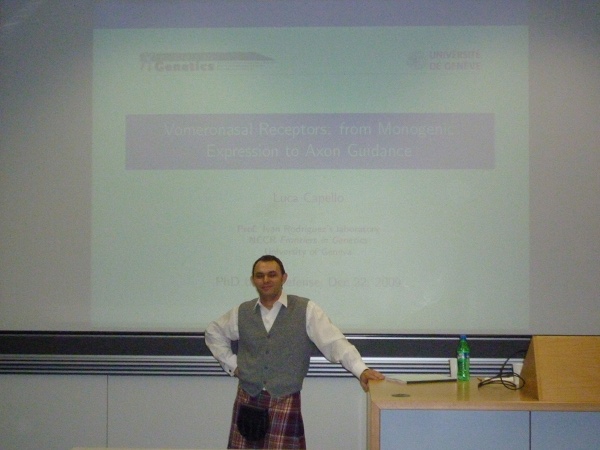
He might too shy to tell everybody, but the world must know. Luca Capello successfully defended his PhD thesis today at Universit de Gen ve, getting a Tr s Bien mention. I must admit that my last biology lesson was 13 years ago, so I m not sure I can really comment on his work on Vomeronasal Receptors: from Monogenic Expression to Axon Guidance. But I was very impressed by the quality of the experimental process, especially compared to what we do in computer science. Debian was well represented at the defense, since Axel Beckert, Didier Raboud and the Debian kilt were also there. Welcome to the list of Debian Developers holding PhD degrees, Luca!
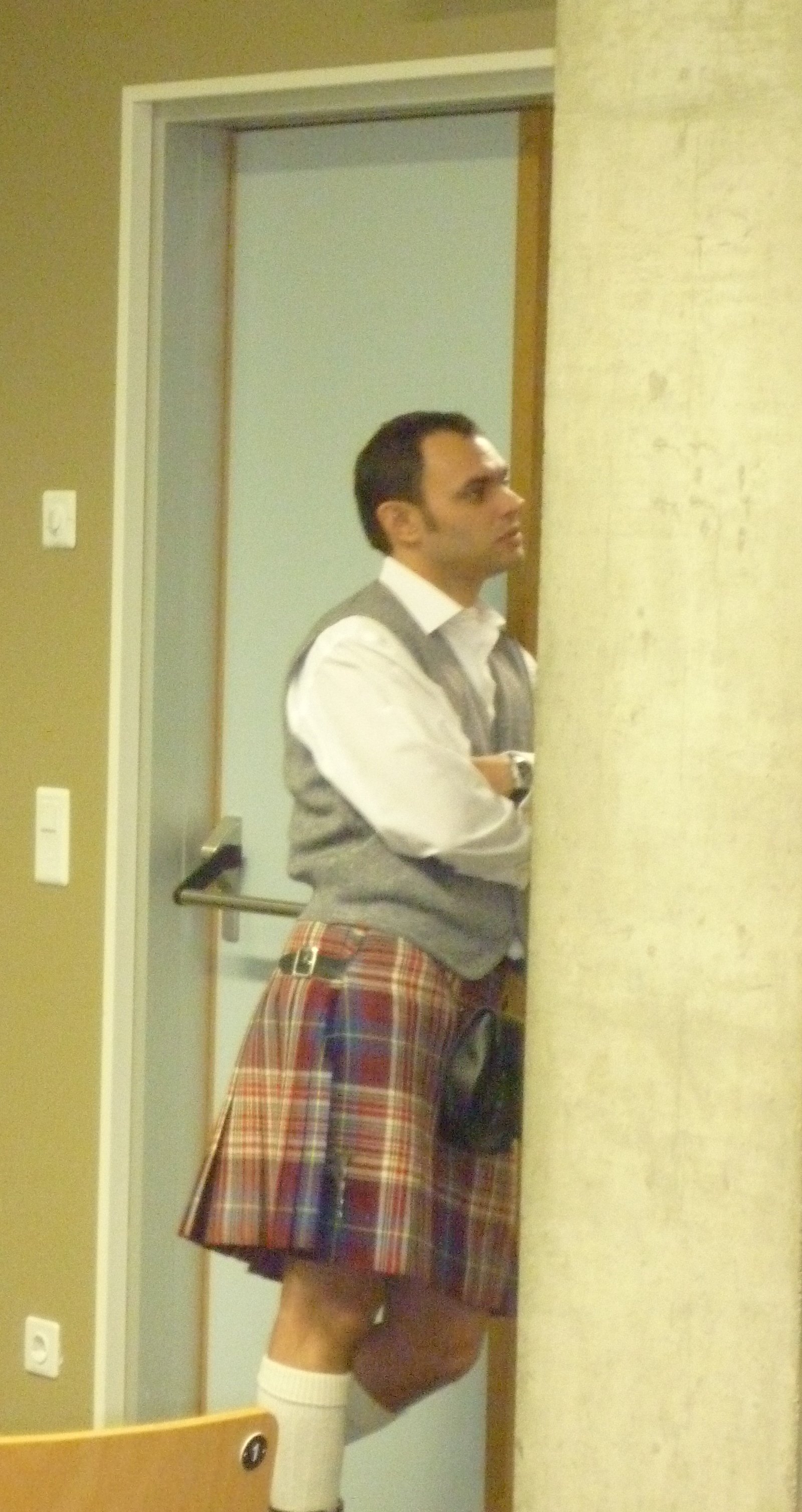
Luca waiting at the door (again).
luca1
Luca ready to start.

Lior Kaplan: When software patents works against you


AP reports about Court: Microsoft violated patent; can t sell Word
A federal appeals court on Tuesday upheld a $290 million judgment against Microsoft Corp. and issued an injunction that will prevent the sale of its popular Word software.The court injunction is set to go into effect Jan. 11. Microsoft has said such a bar would prohibit the sale of all currently available versions of Microsoft Word and Microsoft Office.
Is it time to have a second thought about Red Hat statement of position on software patents ? Posted in Proprietary software

Gustavo Noronha Silva: WebKitGTK+ HackFest!

The WebKit hackfest is now over, and I think it was a very productive week. Thank you very much to all who attended, to Igalia for organizing the hackfest, and hosting us so well, to Collabora for having sponsored the event, and allowed me to spend the week working on it, and to the GNOME foundation for having payed all of my costs!
Xan blogged about day 0, and also a summary of all that was done, so I ll focus on the stuff he forgot to mention ;D. The hackfest, for me, started on day -1 with me not allowing Xan to go sleep before he had reviewed a couple patches of mine to fix DOM context menu handling. It always bothered me that Epiphany failed to open right-click menus in some pages, or let pages handle the right click. Well, this is fixed now, and Zimbra users can now have their right click menus, and WoW players can remove talent points from their calculators =P. It turns out that many of the attendees don t like pages messing with their context menus, though, and they had some good points to back up their positions (like pages making it hard to save images, for instance), so I implemented a way to force openning the custom menu: Ctrl-rightclick. We wanted to use a GtkInfoBar to display questions regarding the form saving - our initial implementation always saved all credentials, but that didn t sound good enough. Xan and I thought it would be very complicated to make this work, because there were assumptions in the code regarding which widget contains which, but it turned out to be quite trivial - making EphyEmbed a descendant of GtkVBox instead of GtkScrolledWindow, fixing a small number of assumptions, and that was it. The passwords are saved in the GNOME Keyring. It s interesting to point out that GNOME Keyring seems to be unhappy with the number of passwords a browser stores - Xan s daemon was hanging, crashing, and spawning a large number of threads. My daemon decided to take up some 300MB of RAM at one point. It s somewhat funny to see how much a browser pushes the limits of our platform. We are hoping this will improve with the new keyring APIs, and the rewrite that is ongoing. It s nice to see my browser form passwords in seahorse, though, and be able to manage them like any other. One more thing worth of notice, although this post is already a bit too big: one of the main concerns people had during the Hackfest was on making build time smaller. Touching a single file in WebCore causes a debug build of 10 minutes on my laptop. Evan Martin and Benjamin Otte made a push at removing unnecessary includes from WebCore, and WebKitGTK+ files, which brough the build time down a bit. They end up inspiring Aroben, from Apple, to go even further into this, and remove many includes from files all over WebKit. Evan was also able to bring linking time down by making it possible to link libwebkit without having to build all the intermediate libraries, which brought build time down to 1 minute, when touching a single file in WebCore. Behdad and I also started looking into breaking WebCore up into lots of shared libraries for Debug builds, since we don t care too much about speed penalties in those. None of these experiments got committed yet, but I am hoping we will be having a better time hacking on WebKitGTK+ in the near future. It was awesome meeting everyone, by the way! See you around =).

Julian Andres Klode: Nokia N900


Yesterday, an N900 I bought from Amazon Warehouse Deals arrived. The device is great, but I discovered today that the AV output only outputs sound on the right speaker and nothing on the left one. So it seems that I have to send it back and will thus not have a N900 during Christmas. Appart from that problem, the device works almost perfectly. The internet browsing experience is faboulus, the camera is good, and the device is fast; the screen is great and the speakers are great as well. The keyboard is easy to type with and you can type fast after a short time. The video player does not seem to like my H.264 files (the OpenMAX decoder fails whereas on my PC ffmpeg is able to play it). That s all for now, I ll write again when I have a N900 with working AV output. Posted in General

Vincent Sanders: Time off

I have the time over Christmas off, partly because I needed some distance from work but mostly because the children need looking after while their schools are on break.

Usually switching off from the work mindset is hard for me and I end up "helping" anyway. Not this time...come last Friday at quitting time I was gone. I was apparently in desperate need of this break and spending time with the kids has been great.

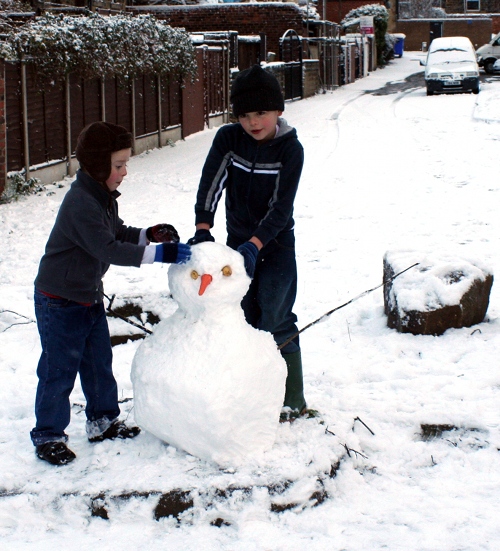
It has also been snowing! I used to love the snow when I was a kid and watching the boys build a snowman and have a snowball fight brought back good memories. It somehow has less amusement value when you are older and have to go to work in it and deal with all the problems with transport induces in the UK. Did I mention I was off work? ;-) I had a great time with them...and got a very cold neck.

I have also managed to solve the cat box problem. Turns out it was not the boxes, their placement or type. It seems they wanted three to choose from! They now have three boxes in which to sprawl and they use the original two in the original locations...just as long as they have the option of a third they are happy.

Now I have unwound sufficiently I am looking at tackling some Open source projects of my own which I have been neglecting. I am planning on finishing my whether station recording software and feeding my observations to the weather underground. Possibly doing some more work on Netsurf and maybe even fixing some RC bugs for Debian.

Julien Danjou: Python cairo and XCB support

cairo has a Python binding (pycairo) since a long time, and some months ago a Python binding for XCB (xpyb) has been released. Pycairo has no support for creating Xlib surfaces. You can get a Xlib surface from PyGTK and then use Pycairo to draw on it, but there's no way to create one directly. What I've done is make Pycairo aware of xpyb so it can creates directly an XCB surface from a XCB connection and a drawable. As said in my mail to the XCB list, I'm now waiting for a review before pushing this upstream. :-) For the first time, I guess, XCB has beat Xlib support! ;-)

Ian Wienand: An open letter to the bald-headed salesman in Harvey Norman, Norwest, Castle Hill

I usally find blog rants useless, but sometimes something is just so annoying one is sufficiently inspired. Today I went with my parents to buy them a Tivo at Harvey Norman, Norwest, Castle Hill, NSW, Australia. I am a big Tivo fan; the interface is good and it "just works". I don't mind paying for (or in this recommending paying for) good products. After selecting the Tivo model, I asked for a HDMI cable. The salesman made a series of questions about what sort of HD TV it was being plugged into; I quickly sensed this as a probe to see what sort of suckers we were, and requested just a "normal" cable. At this point, he insisted on a $130 (you guessed it) Monster cable, and had the audacity to say that we didn't need one of the really expensive cables because our TV wasn't good enough! I openly expressed my concern, but the annoying high-pressure sales pitch had just begun. The amount of, frankly, crap that he spewed about 4-bit this, 10-bit that, legislating of labels, DA signal levels, mythical customers who regretted buying the cheap cables and who knows what else was to the point of being comical if it weren't so insistent and said with such seeming authority. There is only one thing that matters - if the cable has passed the functional requirements for being certified to have the distinctive HDMI logo plastered on it. From the HDMI FAQ:
Q. What testing is required? Prior to mass producing or distributing any Licensed Product or component that claims compliance with the HDMI Specification (or allowing someone else to do such activities), each Adopter must test a representative sample for HDMI compliance. First, the Adopter must self test as specified in the then-current HDMI Compliance Test Specification. The HDMI Compliance Test Specification provides a suite of testing procedures, and establishes certain minimum requirements specifying how each HDMI Adopter should test Licensed Products for conformance to the HDMI Specification.
Now, I can understand that if you buy any old HDMI cable off Ebay for $1, it may be a knock-off that uses the HDMI logo illegally. But there is no way that the certified $50 Philips cable (still very over-priced, but at least not insane, and discounted to $35) performs any differently to some overpriced Monster model certified to exactly the same standard. The thing that annoyed me most was his analogy to buying a tyre. He stated that "if you walked up to a tyre salesman and I said don't want the Pirelli's, just put the cheap-o tires on my Ferrari" I'd be insane, and thus by extension of that logic I was insane for not buying a Monster cable for my great new Tivo. This analogy is completely flawed and really just dishonest. A Ferrari is much more powerful and goes much faster than a standard car. It is plausible it needs a better engineered tyre to perform adequately given the additional stresses it undergoes. A Tivo doesn't put out any more or any less bits than any other HDMI certified equipment, no matter what you do. If the cable is certified as getting all the bits to the other end under whatever environmental conditions specified by the HDMI people, then it's going to work for the 99% of people with normal requirements. Nobody wants to make a significant investment in a piece of audio-visual equipment and feel they are getting something that isn't optimal. Harvey Norman's use of this understandable consumer sentiment to sell ridiculously over-priced cables that do nothing is extremely disappointing. I'm sure the commissions on these things encourage this behaviour, so it is useless expecting the retailer or individual sales assistant to change their policy to reccommend reasonably priced cables. However, it is really Tivo and other manufactuers who get the raw end of this deal; a $130 cable is over 20% of the price the actual Tivo! That is surely affecting people's purchasing decisions. If Tivo and others included a certified HDMI cable with their device, as they do with component cables, and had "Certified HDMI 1.3 cable included" plastered on the box, it would be a harder sell to explain why the manufactuer would bother shipping a certified cable that is supposedly insufficient, and consumers would hopefully avoid the very distasteful high-pressure theatrics I was subjected to today.

Lior Kaplan: Oracle removes gnome packages from its database requirements


As a sysadmin I try to make sure my servers will have the minimal installation needed in order for them to work. In most cases this policy works fine, but some applications depend on too much unneeded software like GUI or sound packages. Two years ago I wrote about Why does Oracle s applications needs xscreensaver in order to run ? . It seems that finally things have changed. In it s latest version of the 10g r2 release notes (B15666-14), Oracle dropped the control-center and gnome-libs packages from the software requirements. This change is only relevant for RHEL5, as the list for RHEL4 (x86_64) haven t changed except from dropping xscreensaver and adding some other packages. Notice that for RHEL5, 3 packages were added in order to let the installer display it s graphical interface:
  • libXp-1.0.0 (i386)
  • libXt-1.0.2 (i386)
  • libXtst-1.0.1 (i386)
I m glad to see Oracle update it s software requirements as a lot of people in the databases world are afraid to make changes which are against the official documentation, regardless of how wrong it might be. Posted in Proprietary software, Red Hat Enterprise Linux, System Administration Tagged: Oracle, software requirements

21 December 2009

Lucas Nussbaum: Debian s KVM + Ubuntu karmic => bug?

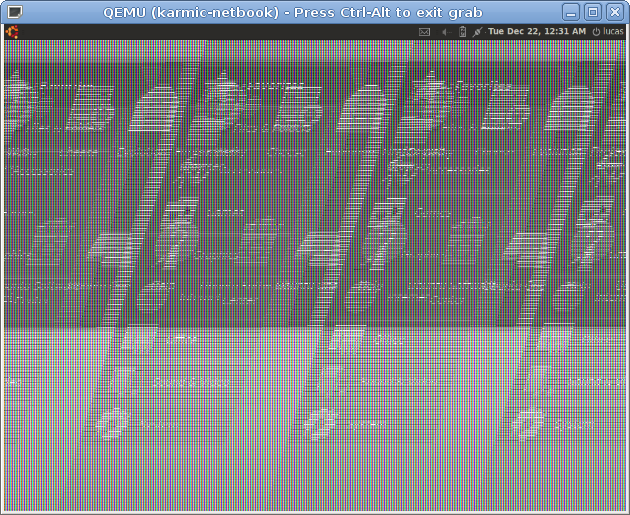
I ve been playing with virtualization, and KVM in particular. However, I m running into an interesting problem. Below is how Ubuntu Netbook Remix look inside my KVM (either using virt-viewer, virt-manager or directly KVM to display the VM). Note how the top panel is fine. I m using KVM 88 from experimental (but I had the same problem with KVM 85 from unstable), the cirrus video driver inside the VM, and an up-to-date karmic VM.
Has someone ran into that problem already? If yes, where is it tracked? I m been failing to find the correct search keywords so far. kvm-unr

Benjamin Mako Hill: Center for Future Names of Media Lab Centers

A few years ago, the MIT Media Lab, working with the Comparative Media Studies program at MIT, created the Center for Future Civic Media. It's a great project and one I've been involved in since the beginning. Not too long after, the lab announced the Center for Future Banking through a partnership with Bank of America. One couldn't help but notice the similarity between the names. The meme became further entrenched when, not too long after, the lab announced the Center for Future Storytelling in collaboration with Plymouth Rock Studios. But perhaps the very first in the pattern is the the Okawa Center for Future Children announced in 1998 as a way of bringing together and supporting the labs work with kids. And no, it has nothing to do with zygotes.

Daniel Kahn Gillmor: January 2010 Bug-Squashing Party NYC

We're going to have a Bug-Squashing Party at the end of January 2010 in New York City. If you live in or around the tri-state area (or want to visit), are interested in learning about the process, meeting other debian folk, or just squashing some bugs in good company, you should come out and join us!
Where:
Brooklyn, New York, USA
When:
January 29th, 30th, and maybe 31st of 2010
Why:
Because them bugs need squashing!
If you plan on coming, please either sign up on the wiki page, or at least mail one of the good folks listed there, or pop into #debian-nyc on irc.oftc.net's IRC network. Tags: bsp

David Paleino: RC bug squashing

Just had some time in the last two days, and here's the list of uploaded NMUs. So far, I had only one maintainer complaining (again, sorry!), but I must admit that on Sunday I just didn't follow the correct NMU procedure Sad Anyhow, here's what I have:
  1. #504824 [libnids] FTBFS with GCC 4.4: #elif used instead of #else
  2. #504864 [omnievents] FTBFS with GCC 4.4: missing #include
  3. #504871 [bookmarkbridge] FTBFS with GCC 4.4: missing #include
  4. #504902 [libofa] FTBFS with GCC 4.4: missing #include
  5. #504943 [libassa] FTBFS with GCC 4.4: missing #include
  6. #504963 [libfcgi] FTBFS with GCC 4.4: missing #include
  7. #504970 [italc] FTBFS with GCC 4.4: missing #include
  8. #504973 [libspiff] FTBFS with GCC 4.4: missing #include
  9. #505021 [passepartout] FTBFS with GCC 4.4: missing #include
  10. #505078 [codeine] FTBFS with GCC 4.4: missing #include
  11. #505333 [gloox] FTBFS with GCC 4.4: missing #include
  12. #505372 [bobot++] FTBFS with GCC 4.4: missing #include
  13. #505420 [esteidutil] FTBFS with GCC 4.4: missing #include
  14. #510759 [log4cxx] FTBFS with GCC 4.4: missing #include
  15. #526151 [openmovieeditor] FTBFS with GCC 4.4: missing #include
  16. #551107 [fusecompress] FTBFS with GCC 4.4: missing #include
  17. #551718 [eboard] eboard: FTBFS with latest eglibc and gcc 4.4
Some highlights Most of these bugs, if not all, already had a patch attached. Thanks to Martin Michlmayr for his work on this! Regarding fusecompress, after my upload to DELAYED/2, the maintainer promptly replied asking for sponsorship of a package he already had. So this does not really count Smile If you want to participate in this great game too, and improve our loved distribution, you can have a look at this list of possibly easy bugs to fix. Have fun!

Robert Millan: GRUB i18n


Better late than never. We promised internationalization and here comes GRUB with gettext support. Many thanks to Carles Pina for bringing GRUB a bit closer to end users. Here s GRUB menu in Catalan: GRUB menu And here s the Catalan version of GRUB command-line interface: GRUB command-line Help is much welcome from translators who want to add their own languages! Like many other GNU projects, translation support for GRUB is coordinated by the Translation Project. If you re excited by the idea that your strings will be the very first localized message that is displayed on every user s box, or simply want to bring our cause for computer freedom further, get in touch with your language team.

Next.

Previous.