Search Results: "tb"

14 August 2015

Wouter Verhelst: Multi-pass transcoding to WebM with normalisation

Transcoding video from one format to another seems to be a bit of a black art. There are many tools that allow doing this kind of stuff, but one issue that most seem to have is that they're not very well documented. I ran against this a few years ago, when I was first doing video work for FOSDEM and did not yet have proper tools to do the review and transcoding workflow. At the time, I just used mplayer to look at the .dv files, and wrote a text file with a simple structure to remember exactly what to do with it. That file was then fed to a perl script which wrote out a shell script that would use the avconv command to combine and extract the "interesting" data from the source DV files into a single DV file per talk, and which would then call a shell script which used gst-launch and sox to do a multi-pass transcode of those intermediate DV files into a WebM file. While all that worked properly, it was a rather ugly hack, never cleaned up, and therefore I never really documented it properly either. Recently, however, someone asked me to do so anyway, so here goes. Before you want to complain about how this ate the videos of your firstborn child, however, note the above. The perl script spent a somewhat large amount of code reading out the text file and parsing it into an array of hashes. I'm not going to reproduce that, since the actual format of the file isn't all that important anyway. However, here's the interesting bits:
foreach my $pfile(keys %parts)  
        my @files = @ $parts $pfile ;
        say "#" x (length($pfile) + 4);
        say "# " . $pfile . " #";
        say "#" x (length($pfile) + 4);
        foreach my $file(@files)  
                my $start = "";
                my $stop = "";
                if(defined($file-> start ))  
                        $start = "-ss " . $file-> start ;
                 
                if(defined($file-> stop ))  
                        $stop = "-t " . $file-> stop ;
                 
                if(defined($file-> start ) && defined($file-> stop ))  
                        my @itime = split /:/, $file-> start ;
                        my @otime = split /:/, $file-> stop ;
                        $otime[0]-=$itime[0];
                        $otime[1]-=$itime[1];
                        if($otime[1]<0)  
                                $otime[0]-=1;
                                $otime[1]+=60;
                         
                        $otime[2]-=$itime[2];
                        if($otime[2]<0)  
                                $otime[1]-=1;
                                $otime[2]+=60;
                         
                        $stop = "-t " . $otime[0] . ":" . $otime[1] .  ":" . $otime[2];
                 
                if(defined($file-> start )   defined($file-> stop ))  
                        say "ln " . $file-> name  . ".dv part-pre.dv";
                        say "avconv -i part-pre.dv $start $stop -y -acodec copy -vcodec copy part.dv";
                        say "rm -f part-pre.dv";
                  else  
                        say "ln " . $file-> name  . ".dv part.dv";
                 
                say "cat part.dv >> /tmp/" . $pfile . ".dv";
                say "rm -f part.dv";
         
        say "dv2webm /tmp/" . $pfile . ".dv";
        say "rm -f /tmp/" . $pfile . ".dv";
        say "scp /tmp/" . $pfile . ".webm video.fosdem.org:$uploadpath   true";
        say "mv /tmp/" . $pfile . ".webm .";
 
That script uses avconv to read one or more .dv files and transcode them into a single .dv file with all the start- or end-junk removed. It uses /tmp rather than the working directory, since the working directory was somewhere on the network, and if you're going to write several gigabytes of data to an intermediate file, it's usually a good idea to write them to a local filesystem rather than to a networked one. Pretty boring. It finally calls dv2webm on the resulting .dv file. That script looks like this:
#!/bin/bash
set -e
newfile=$(basename $1 .dv).webm
wavfile=$(basename $1 .dv).wav
wavfile=$(readlink -f $wavfile)
normalfile=$(basename $1 .dv)-normal.wav
normalfile=$(readlink -f $normalfile)
oldfile=$(readlink -f $1)
echo -e "\033]0;Pass 1: $newfile\007"
gst-launch-0.10 webmmux name=mux ! fakesink \
  uridecodebin uri=file://$oldfile name=demux \
  demux. ! ffmpegcolorspace ! deinterlace ! vp8enc multipass-cache-file=/tmp/vp8-multipass multipass-mode=1 threads=2 ! queue ! mux.video_0 \
  demux. ! progressreport ! audioconvert ! audiorate ! tee name=t ! queue ! vorbisenc ! queue ! mux.audio_0 \
  t. ! queue ! wavenc ! filesink location=$wavfile
echo -e "\033]0;Audio normalize: $newfile\007"
sox --norm $wavfile $normalfile
echo -e "\033]0;Pass 2: $newfile\007"
gst-launch-0.10 webmmux name=mux ! filesink location=$newfile \
  uridecodebin uri=file://$oldfile name=video \
  uridecodebin uri=file://$normalfile name=audio \
  video. ! ffmpegcolorspace ! deinterlace ! vp8enc multipass-cache-file=/tmp/vp8-multipass multipass-mode=2 threads=2 ! queue ! mux.video_0 \
  audio. ! progressreport ! audioconvert ! audiorate ! vorbisenc ! queue ! mux.audio_0
rm $wavfile $normalfile
... and is a bit more involved. Multi-pass encoding of video means that we ask the encoder to first encode the file but store some statistics into a temporary file (/tmp/vp8-multipass, in our script), which the second pass can then reuse to optimize the transcoding. Since DV uses different ways of encoding things than does VP8, we also need to do a color space conversion (ffmpegcolorspace) and deinterlacing (deinterlace), but beyond that the video line in the first gstreamer pipeline isn't very complicated. Since we're going over the file anyway and we need the audio data for sox, we add a tee plugin at an appropriate place in the audio line in the first gstreamer pipeline, so that we can later on pick up that same audio data an write it to a wav file containing linear PCM data. Beyond the tee, we go on and do a vorbis encoding, as is needed for the WebM format. This is not actually required for a first pass, but ah well. There's some more conversion plugins in the pipeline (specifically, audioconvert and audiorate), but those are not very important. We next run sox --norm on the .wav file, which does a fully automated audio normalisation on the input. Audio normalisation is the process of adjusting volume levels so that the audio is not too loud, but also not too quiet. Sox has pretty good support for this; the default settings of its --norm parameter make it adjust the volume levels so that the highest peak will just about reach the highest value that the output format can express. As such, you have no clipping anywhere in the file, but also have an audio level that is actually useful. Next, we run a second-pass encoding on the input file. This second pass uses the statistics gathered in the first pass to decide where to put its I- and P-frames so that they are placed at the most optimal position. In addition, rather than reading the audio from the original file, we now read the audio from the .wav file containing the normalized audio which we produced with sox, ensuring the audio can be understood. Finally, we remove the intermediate audio files we created; and the shell script which was generated by perl also contained an rm command for the intermediate .dv file. Some of this is pretty horrid, and I never managed to clean it up enough so it would be pretty (and now is not really the time). However, it Just Works(tm), and I am happy to report that it continues to work with gstreamer 1.0, provided you replace the ffmpegcolorspace by an equally simple videoconvert, which performs what ffmpegcolorspace used to perform in gstreamer 0.10.

Dirk Eddelbuettel: Rblpapi: Connecting R to Bloomberg

big deal Whit, John and I are thrilled to announce Rblapi, a new CRAN package which connects R to the Bloomberg backends. Rebuilt from scratch using only the Bloomberg C++ API and the Rcpp and BH packages, it offers efficient and direct access from R to a truly vast number of financial data series, pricing tools and more. The package has been tested on Windows, OS X and Linux. As is standard for CRAN packages, binaries for Windows and OS X are provided (or will be once the builders caught up). Needless to say, a working Bloomberg installation is required to use the package. Please see the Rblapi package page for more details, including a large part of the introductory vignette document. As a teaser, here are just three of the core functions:
## Bloomberg Data Point Query
bdp(c("ESA Index", "SPY US Equity"), c("PX_LAST", "VOLUME"))
## Bloomberg Data Set Query
bds("GOOG US Equity", "TOP_20_HOLDERS_PUBLIC_FILINGS")
## Bloomberg Data History Query
bdh("SPY US Equity", c("PX_LAST", "VOLUME"), start.date=Sys.Date()-31)
## Get OHLCV bars (by default hourly and just six of them)
getBars("ES1 Index")
## Get Tick Data (by default last hour)
getTicks("ES1 Index")
Source code for the package is at the Rblpapi GitHub repo where issue tickets can be filed as well. The sibbling blp GitHub repo contains the Bloomberg code required to build and link the package (which is automated during the build of the CRAN package). Last but not least the Rblpapi package page has more details about the package.

This post by Dirk Eddelbuettel originated on his Thinking inside the box blog. Please report excessive re-aggregation in third-party for-profit settings.

Alberto Garc a: I/O limits for disk groups in QEMU 2.4

QEMU 2.4.0 has just been released, and among many other things it comes with some of the stuff I have been working on lately. In this blog post I am going to talk about disk I/O limits and the new feature to group several disks together. Disk I/O limits Disk I/O limits allow us to control the amount of I/O that a guest can perform. This is useful for example if we have several VMs in the same host and we want to reduce the impact they have on each other if the disk usage is very high. The I/O limits can be set using the QMP command block_set_io_throttle, or with the command line using the throttling.* options for the -drive parameter (in brackets in the examples below). Both the throughput and the number of I/O operations can be limited. For a more fine-grained control, the limits of each one of them can be set on read operations, write operations, or the combination of both: Example:
-drive if=virtio,file=hd1.qcow2,throttling.bps-write=52428800,throttling.iops-total=6000
In addition to that, it is also possible to configure the maximum burst size, which defines a pool of I/O that the guest can perform without being limited: One additional parameter named iops_size allows us to deal with the case where big I/O operations can be used to bypass the limits we have set. In this case, if a particular I/O operation is bigger than iops_size then it is counted several times when it comes to calculating the I/O limits. So a 128KB request will be counted as 4 requests if iops_size is 32KB. Group throttling All of these parameters I ve just described operate on individual disk drives and have been available for a while. Since QEMU 2.4 however, it is also possible to have several drives share the same limits. This is configured using the new group parameter. The way it works is that each disk with I/O limits is member of a throttle group, and the limits apply to the combined I/O of all group members using a round-robin algorithm. The way to put several disks together is just to use the group parameter with all of them using the same group name. Once the group is set, there s no need to pass the parameter to block_set_io_throttle anymore unless we want to move the drive to a different group. Since the I/O limits apply to all group members, it is enough to use block_set_io_throttle in just one of them. Here s an example of how to set groups using the command line:
-drive if=virtio,file=hd1.qcow2,throttling.iops-total=6000,throttling.group=foo
-drive if=virtio,file=hd2.qcow2,throttling.iops-total=6000,throttling.group=foo
-drive if=virtio,file=hd3.qcow2,throttling.iops-total=3000,throttling.group=bar
-drive if=virtio,file=hd4.qcow2,throttling.iops-total=6000,throttling.group=foo
-drive if=virtio,file=hd5.qcow2,throttling.iops-total=3000,throttling.group=bar
-drive if=virtio,file=hd6.qcow2,throttling.iops-total=5000
In this example, hd1, hd2 and hd4 are all members of a group named foo with a combined IOPS limit of 6000, and hd3 and hd5 are members of bar. hd6 is left alone (technically it is part of a 1-member group). Next steps I am currently working on providing more I/O statistics for disk drives, including latencies and average queue depth on a user-defined interval. The code is almost ready. Next week I will be in Seattle for the KVM Forum where I will hopefully be able to finish the remaining bits.
I will also attend LinuxCon North America. Igalia is sponsoring the event and we have a booth there. Come if you want to talk to us or see our latest demos with WebKit for Wayland. See you in Seattle!

Norbert Preining: QMapShack GPS and Maps on Linux

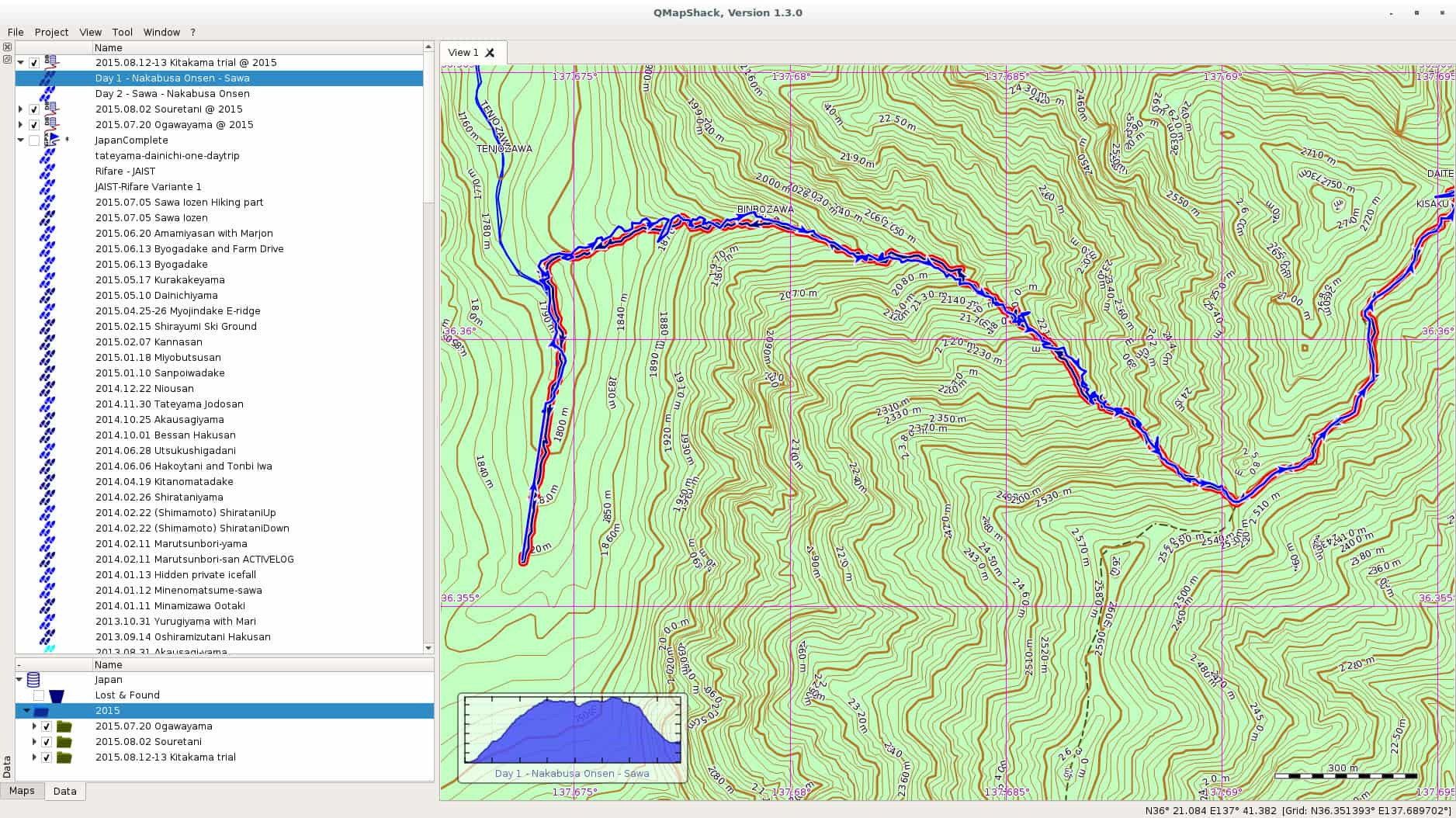
In one of the comments on my last post on Windows 10, a friendly reader from my home country pointed me at QMapShack as a replacement for QuoVadis. I have been using QuoVadis now for many many years, and it contains my mountaineering history all the way back. All the guiding work, all the track. QuoVadis is a great program, able to work with various commercial digital maps as well as GPS receivers. It only has one disadvantage, it doesn t work on Linux. QMapShack is very similar in the target audience, but very different in usage. The one big difference is of course the set of maps one can use with QMapShack. Fortunately, Garmin Maps are supported, and since all my maps regarding Japan are Garmin maps, I am now in the process to converting to QMapShack at least for my Japan GPS data. qmapshack Let us start with the program I was using since ages, and still are using, QuoVadis. QuoVadis is a great program, there is nothing to complain. It is extremely feature-rich, and above all it can work with many different maps. While working as mountain guide in Europe it was an essential tool for me. I could use the digital raster maps of Austria, Switzerland (SwissTOPO), Germany, France, Italy, as well as Garmin vector maps. For serious work as a professional it was indispensable for me. Unfortunately, it never worked on Linux. For some time I had a VirtualBox installation of Windows, but that was more a clutch than anything else. So for most of the GPS work I had to reboot my laptop to Windows, do my stuff there, and then switch back to Linux. QMapShack is far from as feature rich as QuoVadis, but as far as I see now, it does have enough features for me and my mountaineering in Japan. Dealing with GPS units is not a problem, this is the easy part. The difficult part are the digital maps. Fortunately, QMapShack supports Garmin vector maps, the only maps that are (as far as I know) available digitally for Japan. Getting used to QMapShack is a bit a challenge coming from QuoVadis, but the Wiki help pages allowed a quick start. Within short time I had maps set up. Next step was to download a data from my last weekend trip to Yarigadake, Kitakama-ridge (unfortunately we had to turn back due to rain). Connecting the unit and mounting it was already enough to show up in QMapShack, and allowed me to copy the tracks to my local database. Next I switched to Windows and exported some tracks from my Japan folder to a gpx file. After rebooting to Linux, I loaded the gpx file into QMapShack and without failure all the tracks and routes showed up, as it can be seen in the above screenshot (click on it to get a bigger version). Also the display of the Garmin map worked perfectly. Update: Please see the comment section for explanation of the necessary functions. QMapShack does provide similar functionality. Thanks to Oliver for pointing me at it! After some time of working there are a few functions from QuoVadis I am missing for now at QMapShack: Although these two functionalities are missing, all in all I am very happy for now with QMapShack. My next steps are: Finally, above all, I see a future where I do not need to reboot into Windows for doing my GPS work. For now I will import all the data into both applications, but if QMapShack holds its promises from the first day of usage, I am confident that this will not be necessary in future. Enjoy.

13 August 2015

Gunnar Wolf: It has landed.

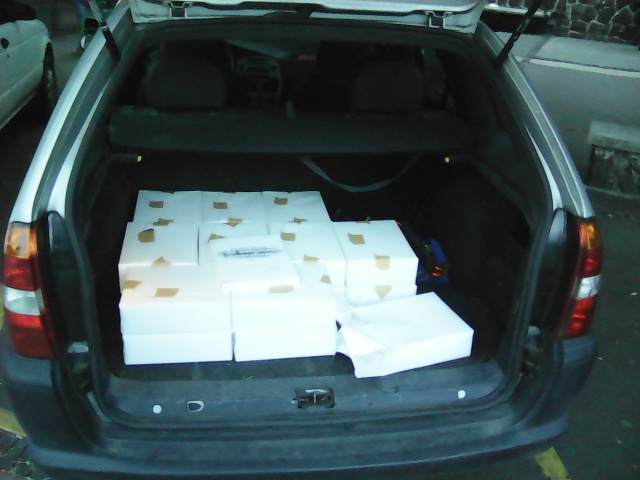
Basically everybody who knows me is aware that, basically for the last two years, I have been writing a book on Operating Systems for use in my class and, of course, in any similar class. Well, long story short, as of today: What's that in my car trunk? Lets have a closer look. Finally, Facultad de Ingenier a finished printing the book! So... Well, some minor data points: Anyway... Very happy here :D
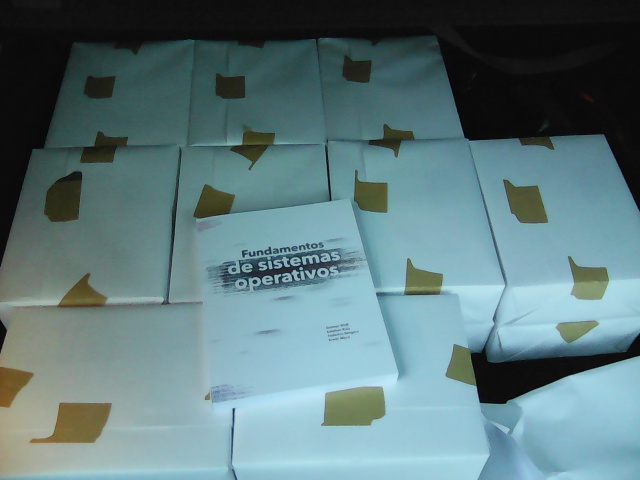

AttachmentSize
IMG_20150812_193756.t.jpg106.36 KB
IMG_20150812_193805.t.jpg82.22 KB

11 August 2015

Jonathan McDowell: Programming the FST-01 (gnuk) with a Bus Pirate + OpenOCD

Last year at DebConf14 Lucas authorized the purchase of a handful of gnuk devices, one of which I obtained. At the time it only supported 2048 bit RSA keys. I took a look at what might be involved in adding 4096 bit support during DebConf and managed to brick my device several times in doing so. Thankfully gniibe was on hand with his STLinkV2 to help me recover. However subsequently I was loathe to experiment further at home until I had a suitable programmer. As it is this year has been busy and the 1.1.x release train is supposed to have 4K RSA (as well as ECC) support. DebConf15 is coming up and I felt I should finally sort out playing with the device properly. I still didn t have a suitable programmer. Or did I? Could my trusty Bus Pirate help? The FST-01 has an STM32F103TB on it. There is an exposed SWD port. I found a few projects that claimed to do SWD with a Bus Pirate - Will Donnelly has a much cloned Python project, the MC HCK project have a programmer in Ruby and there s LibSWD though that s targeted to smarter programmers. None of them worked for me; I could get the Python bits as far as correctly doing the ID of the device, but not reading the option bytes or successfully flashing (though I did manage an erase). Enter the old favourite, OpenOCD. This already has SWD support and there s an outstanding commit request to add Bus Pirate support. NodoNogard has a post on using the ST-Link/V2 with OpenOCD and the FST-01 which provided some useful pointers. I grabbed the patch from Gerrit, applied it to OpenOCD git and built an openocd.cfg that contained:
source [find interface/buspirate.cfg]
buspirate_port /dev/ttyUSB0
buspirate_vreg 1
buspirate_mode normal
transport select swd
source [find target/stm32f1x.cfg]
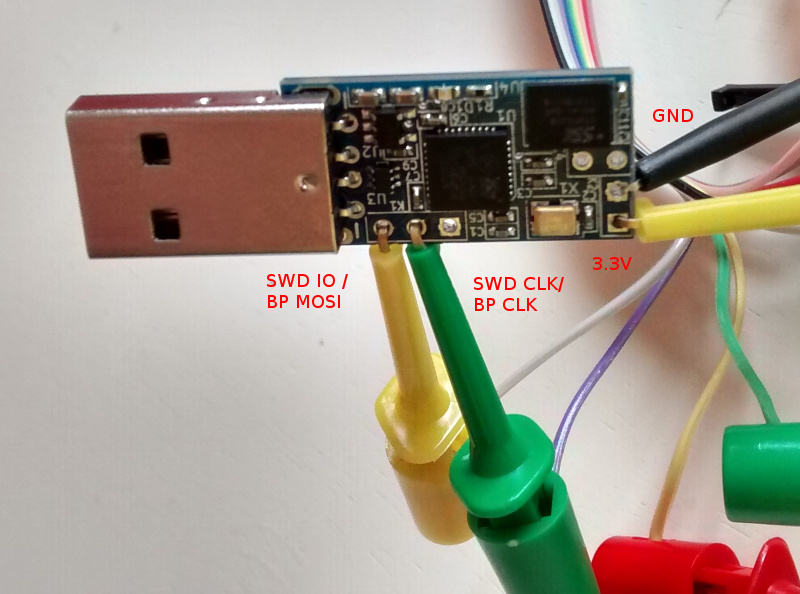
My BP has the Seeed Studio probe cable, so my hookups look like this: Bus Pirate + FST-01 SWD connection That s BP MOSI (grey) to SWD IO, BP CLK (purple) to SWD CLK, BP 3.3V (red) to FST-01 PWR and BP GND (brown) to FST-01 GND. Once that was done I fired up OpenOCD in one terminal and did the following in another:

$ telnet localhost 4444
Trying ::1...
Trying 127.0.0.1...
Connected to localhost.
Escape character is '^]'.
Open On-Chip Debugger
> reset halt
target state: halted
target halted due to debug-request, current mode: Thread
xPSR: 0x01000000 pc: 0xfffffffe msp: 0xfffffffc
Info : device id = 0x20036410
Info : SWD IDCODE 0x1ba01477
Error: Failed to read memory at 0x1ffff7e2
Warn : STM32 flash size failed, probe inaccurate - assuming 128k flash
Info : flash size = 128kbytes
> stm32f1x unlock 0
Device Security Bit Set
stm32x unlocked.
INFO: a reset or power cycle is required for the new settings to take effect.
> reset halt
target state: halted
target halted due to debug-request, current mode: Thread
xPSR: 0x01000000 pc: 0xfffffffe msp: 0xfffffffc
> flash write_image erase /home/noodles/checkouts/gnuk/src/build/gnuk.elf
auto erase enabled
wrote 109568 bytes from file /home/noodles/checkouts/gnuk/src/build/gnuk.elf in 95.055603s (1.126 KiB/s)
> stm32f1x lock 0
stm32x locked
> reset halt
target state: halted
target halted due to debug-request, current mode: Thread 
xPSR: 0x01000000 pc: 0x08000280 msp: 0x20005000
Then it was a matter of disconnecting the gnuk from the BP, plugging it into my USB port and seeing it come up successfully:
usb 1-2: new full-speed USB device number 11 using xhci_hcd
usb 1-2: New USB device found, idVendor=234b, idProduct=0000
usb 1-2: New USB device strings: Mfr=1, Product=2, SerialNumber=3
usb 1-2: Product: Gnuk Token
usb 1-2: Manufacturer: Free Software Initiative of Japan
usb 1-2: SerialNumber: FSIJ-1.1.7-87063020
usb 1-2: ep 0x82 - rounding interval to 1024 microframes, ep desc says 2040 microframes
More once I actually have a 4K key loaded on it.

10 August 2015

Lunar: Reproducible builds: week 15 in Stretch cycle

What happened in the reproducible builds effort this week: Toolchain fixes Guillem Jover uploaded dpkg/1.18.2 which makes dependency comparisons deep by comparing not only the first dependency alternative, to get them sorted in a reproducible way. Original patch by Chris Lamb. Dhole updated the patch adding support for SOURCE_DATE_EPOCH in gettext. A modified package is in the experimental reproducible repository. Valentin Lorentz submitted a patch adding support for SOURCE_DATE_EPOCH to ocamldoc. Valentin Lorentz also opened a bug about the inability to set an arbitrary RNG seed for ocamlopt which would be a way to fix an issue affecting many OCaml packages. Dhole submitted a patch adding support for SOURCE_DATE_EPOCH in qhelpgenerator. A modified package has been sent to the experimental repository as well. Several packages have been updated for the experimental toolchain: doxygen (akira), and dpkg (h01ger). Also, h01ger has built and uploaded all experimental packages having arch:any packages for armhf: dpkg, gettext, doxygen, fontforge, libxslt and texlive-bin. We are now providing our toolchain for armhf and amd64. Packages fixed As you might have noticed, Debian sid is currently largely uninstallable, due to the GCC 5 transition, which also can be see in our reproducibility test setup. Please help! The following packages became reproducible due to changes in their build dependencies: glosstex, indent, ktikz, liblouis, libmicrohttpd, linkchecker, multiboot, qterm, rrep, trueprint, twittering-mode. The following packages became reproducible after getting fixed: Patches submitted which have not made their way to the archive yet: Lunar reported an issue on an unstable ABI from a generated header in icedove reminding of an issue affecting libical-dev. The bug has since been fixed by Carsten Schoenert. akira identified an unreferenced embeded code copy (causing unreproducibility!) in gperf. reproducible.debian.net The scheduler has temporarily been changed to not schedule any already tested packages for sid and experimental, due to the the GCC 5 transitions, which are well visible in our graphs now. On the plus side this has caused our stretch testing to catch up (and improve stats). (h01ger) depwait packages (packages where the Build-Depends cannot be satisfied) are now listed in the last 24h and last 48h pages (Mattia Rizzolo) Two new amd64 build nodes (with 8 cores and 32 GB RAM each) have been added, kindly sponsored by Profitbricks. (h01ger) The 4 armhf (setup last week by Vagrant Cascadian) and 2 amd64 build nodes have been made available to Jenkins. Remote job scheduling has been implemented and 35 new jobs have been added for pbuilder and schroot creation and maintenance of the nodes. (h01ger) The manual scheduler gained a flag (-a/--architecture) to select which arch to schedule in. (Mattia Rizzolo) armhf will only be testing stretch for now, due to limited hardware ressources. (h01ger) The page listing maintainers of unreproducible packages gained internal anchors. As an example, one can now link to unreproducible orphaned packages. (Mattia Rizzolo) Packages with a bug tagged pending are marked using a new symbol: a brown P (Mattia Rizzolo) diffoscope development debbindiff is now called diffoscope! It also has a website at diffoscope.org. The name was changed to better reflect that it became a general purpose tool, capable of comparing many different archive formats, or directories. Version 29 is the renaming release. Amongst a couple of other cosmetic changes a favicon showing the new logo has been added to the generated HTML reports. Version 30 replaces the file matching algorithm for files listed in .changes to a smarter one that removes only the version number. It also fixes a bug where squashfs directories were being extracted even if their content was being compared at a later stage. It also fixes an issue with the test suite that was detected by debci. Documentation update More rationale have been added for supporting SOURCE_DATE_EPOCH The unfinished Reproducible Builds HOWTO is now visible on the web, feedback and patches most welcome. Package reviews 261 obsolete reviews have been removed, 73 added and 145 updated this week.

9 August 2015

Simon Kainz: DUCK challenge: week 5

Slighthly delayed, but here are the stats for week 5 of the DUCK challenge: So we had 10 packages fixed and uploaded by 10 different uploaders. A big "Thank You" to you!! Since the start of this challenge, a total of 59 packages, were fixed. Here is a quick overview:

Week 1 Week 2 Week 3 Week 4 Week 5 Week 6 Week 7
# Packages 10 15 10 14 10 - -
Total 10 25 35 49 59 - -
The list of the fixed and updated packages is availabe here. I will try to update this ~daily. If I missed one of your uploads, please drop me a line. Only 2 more weeks to DebConf15 so please get involved: The DUCK Challenge is running until end of DebConf15! Pevious articles are here: Week 1, Week 2, Week 3, Week 4.

7 August 2015

Norbert Preining: Japanese-English dictionary for Kobo

Since ever the Kobo firmwares also allowed downloading of a bunch of dictionaries, most of which I don t need. As I am fluent in most languages I read and write, the only real dictionary I would like to see is a Japanese-English (I don t dare asking for a Japanese-German). Unfortunately, Kobo never shipped one. OTOH, starting with firmware 3.16.10 they ships two different English-Japanese dictionaries, one excellent Japanese-Japanese dictionary, but not one Japanese-English. So I took the liberty to write a script that allows everyone to enrich the shipped Japanese-Japanese dictionary with English definitions. Kobo Logo Till now I have used Tshering s excellent Japanese dictionary which was enriched with English definitions. It was based on the older Japanese-Japanese dictionary shipped with firmwares before 3.16.10. I didn t want to loose the more complete dictionary from the new firmware, so here is a script that updates the dictionary for you Prerequisites The script is neither fool-proof nor does everything by itself. Furthermore, it requires a set of programs. In details: Supported dictionaries At the moment the program can use the following two dictionaries as sources: Edict2 and Japanese3. Edict2 The Edict dictionary is a free dictionary which is the base of most other dictionaries. Created by the JMdict/EDICT Project it provides a very complete Japanese-English dictionary. To use the dict with the current program, one need to download the edict2.gz file and unpack it with gunzip edict2.gz. If you put it into the same directory as the Perl script, nothing else needs to be done, otherwise one can use the command line option --edict PATH-TO-EDICT to specify the location of the edict2 file. Japanese3 The Japanese3 is a dictionary application for iOS which provides another very complete Japanese-English dictionary. My feeling is that it is 90% and more based on Edict, so adding it will not buy you much, but still a bit (see below for how much!). If you have purchased this dictionary/application, and you manage to get access to your iOS device (via jailbreaking or some other tools), then you need to get the file Japanese3.db from the application folder, and then generate a file via sqlite3 as follows:
$ sqlite3 Japanese3.db
.output japanese3-data
select Entry, Furigana, Summary from entries;
If you save the generated file japanese3-data into the same directory as the Perl script, nothing else needs to be done, otherwise one can use the command line option --japanese3 PATH-TO-J3-DATA to specify the location of the Japanese3 data file. Command line options The program supports the following command line options: Note that in case you pass in the option --unpacked, the files should be properly named (encodings are a problem!). Furthermore, note that the unpacked directory contains lots of .gif and .html files that are actually gzip-compressed files, but lacking the .gz extension. If you want to unpack the dictionary, by advised that the file names in the Zip directory are already encoded in UTF-8, but normal programs (unzip, 7z) assume that they are encoded in some other encoding. Thus, if your are using UTF-8 locale, it is necessary to set LC_CTYPE to C to make sure that the encoding is used, as in
LC_CTYPE=C 7z x ...
Typical run In the following example we use both dict2 and Japanese3 dictionaries, and prefer Edict2:
$ perl enhance-dictionary.pl --dicts edict2 --dicts japanese3
Using the following dictionaries as source for translations: edict2 japanese3
loading edict2 ... done
loading Japanese3 data ... done
unpacking original dictionary ... done
loading dict files ... done
searching for words and updating ... done
total words 805521, matches: 130563 (edict: 123388, japanese3: 7175)
creating output html ... done
creating update dictionary in dicthtml-jaxxdjs-201508072201.zip ... done
$
Installing the dictionary After having created the enhanced dictionary, one can install the generated file as KOBO/.kobo/dicts/dicthtml-jaxxdjs.zip (where KOBO is the mount point of the eReader). The dictionary should be picked up automatically. And the next lookup should give you something like the following:
kobo-glohd-enhanced-ja-dict There is only one caveat: Syncing with Kobo will re-download the original dictionary and overwrite the enhanced one. There is at least one solution here, which I am employing, see this post on MobileRead. Download and development place I am using the github repository kobo-ja-dict-enhance to develop the program. Please report bugs, and feature requests there. The file for the last released version can be downloaded from here: enhance-dictionary.pl Future plans I am planning to get rid of the 7z dependency and use Archive::Zip for all the unpacking and packing. This would also allow to do everything in memory and thus make it faster. There is a branch on github with ongoing work on this matter. I also think about including translations for Hiragana words by providing the translations of all possible Kanji readings. Conclusions Even if Kobo does not provide us with a decent Japanese-English dictionary, adding at least a huge amount of translations to the current dictionary is now easily possible. For serious students of Japanese who are reading or starting to read Japanese eBooks, this will be of great help. Enjoy, and don t forget to give feedback, suggestions, and improvements either here or better via the Github page.

Neil McGovern: Forty five hours

IMG_0330As some may know, since October 2013, I ve been studying to gain my Private Pilot Licence, and I finally achieved this goal. It s actually taken quite a bit more than 45 hours a total of around 60, but that does include a day trip to France (Le Touquet) and getting my night rating as well. This basically means I can fly single engine piston aeroplanes on my own, with passengers, as soon as my paperwork gets processed by the Civil Aviation Authority anyway. I ve been flying Cessna 172s from Cambridge Aero Club, where they have four of them, G-SHWK, G-UFCB, G-HERC and G-MEGS, as well as a Extra 200, G-GLOC. It s a great club, with fantastically maintained planes and great instructors, and Cambridge Airport has a full ATC service as well, so it s been useful to get that experience, especially as the UK s airspace is fairly contended with a lot of controlled and military airspace which needs permission to enter. As for what next, I need to work that out. When you get your licence, it s often described as a license to learn, so that s what I intend to do. Apart from popping over to France for lunch every now and again, I m probably going to have a go at aerobatics and farm strip flying, then probably look at my IMC rating. So, if it s a nice day, and you re around in Cambridge, let me know if you want a trip up in the skies!

6 August 2015

Eduard Sanou: Reproducible builds on Debian for GSoC 2015, 1st update

This is the second blog post I m writing about my experiences contributing to Debian for Google Summer of Code 2015 (check my first post)

Status update

First month It s been two months and a few days since the GSoC started. During the first month I worked on fixing specific packages, mainly concerning issues with timestamps, which is a very common source of unreproducibility. In many cases, during the build process files are compressed into gzip or zip archives, which store the creation time of files in the metadata. This can lead to unreproducible results when there is timezone variation between builds (easily fixed setting the timezone to UTC before the compression happens). In some cases the compressed files are generated during the build, and thus add build times in the metadata of compressed files (in this case the creation date of the files needs to be normalized somehow). As explained in my application, I finished exams on the end of June, that s why I chose to work on small fixes first, so that I could make the most out of my time between studying and finishing university projects and reports. I m happy with my first month, as I have worked as originally planned. Actually, my estimation of the number of bugs I could submit every week was surpassed in reality!

Second month Once the university was over, I started dedicating myself fully to the project. This allowed me to start working on toolchain fixes, following my original plan on working with timestamp related issues. In particular I have been working a lot in implementing a proposal for deterministic timestamps that appeared in the reproducible builds project. The idea is to define an environment variable called SOURCE_DATE_EPOCH that contains a known timestamp in Unix epoch format. With this variable exported, tools that would embed the localtime in their generated or processed files, can use this externally supplied date. This would happen only if SOURCE_DATE_EPOCH is exported, so the behaviour of the tool wouldn t change if the variable is not set. The first package I patched to implement this behaviour was gcc. The reason behind this is that there are about 420 unreproducible packages due to using the __DATE__, __TIME__ and __TIMESTAMP__ C macros. My patch changes the behavior of the macros __DATE__ and __TIME__ if SOURCE_DATE_EPOCH is exported. I submitted this patch to the gcc-patches list. Even though there was some interesting discussions in the list, the patch has not been accepted yet. Seeing how the reproducible builds idea is gaining momentum and becoming widespread, I m positive that at some point the gcc people will be more receptive for such patch. The second work with SOURCE_DATE_EPOCH was in debhelper; I patched this building tool to export the variable with the latest debian/changelog entry timestamp. With this patch, all the tools that run under dh will be able to use it to embed deterministic timestamps. Unfortunately some parts of the build process of some packages don t happen under debhelper, so the variable needs to be exported in a different way. Having submitted the debhelper patch allowed many packages to become reproducible after the tools that embedded timestamps were patched to honour SOURCE_DATE_EPOCH. As of today, the toolchain packages I have patched to do that are: gcc, libxslt, gettext, ghostscript and qt4-x11 (qhelpgenerator). I have also continued working on fixing individual packages affected by timestamps, random orderings (such as the ones from listing hash keys) and locale depending orderings; I have tagged packages in our infrastructure to note what kind of issue makes them unreproducible; I have updated some parts of the Reproducible Builds Wiki.

Impressions about reproducible builds The work I did during the first month felt a bit tedious sometimes: it didn t require much creativity or thinking as most of the fixes where quite mechanical, following a recipe. After I became free from university duties, I started looking into less trivial issues, which require more deep investigation and feel more rewarding once they are fixed. I also worked on toolchain fixes, which need more work and need more care. Fixing toolchain packages feels particularly rewarding because they can cause many packages to become reproducible at once. There is a very active community in the reproducible builds project! It s great to see so many people contributing to this project spending so many hours and putting so much effort. I ve felt very welcome from the beginning and I have gotten kind replies and helpful answers to all the questions and doubts I ve had, both from my mentor and from the other people in the project. I want to add that I m still amazed by the awesome infrastructure set up for the reproducible builds project. The team is using a Jenkins machine to continuously build packages to check for reproducibility, with irc notifications for changes, and also with a really useful web interface to list all the packages organized by issues that allows exploring them individually with all the available information. Also not only the infrastructure is used to build Debian amd64 packages, but also FreeBSD, NetBSD, OpenWRT, coreboot and lately Debian armhf with the help of a few new arm nodes.

Impressions about working on a free software project This was my first time working on a community driven free software project and I ve learned so many things. Something I learned during the first days, which is even more present in such wide project like the reproducible builds, is that contributing is not just writing patches for the features you want; you also need to convince the maintainer of the package to accept the patch! I was a bit surprised at the beginning because even if this is a Debian project, that aims to make changes to the whole distribution, decisions are not absolute for the whole Debian project. After taking decisions within the reproducible builds teams on how to approach things, we need to convince the rest of the Debian developers (mainly maintainers) to follow them, as they are allowed to disagree. So it is required to work together for solutions that makes everyone comfortable, usually with discussions on mailing lists or irc. There is another fact that I wasn t expecting before getting involved in this project. The kind of teamwork I have done previously involves having a leader who decides how stuff is done, who takes decisions when needed and oversees the whole project. There seems to be a different philosophy in Debian. Instead of having a leader, everyone tries their best, trying to convince the others that their solution is good, often by showing an implementation of the solution and providing proof that it works, rather than trying to get the solution accepted before coding it. Also, solutions and ideas are valued for their quality rather than by the position of the person submitting them, and there is no hierarchy within the group: all comments and advices are taken equally, valuing their usefulness regardless of who gives them. Usually there are no votes when deciding things. Members try their best on their approaches, trying to convince others as best as they can. And even if someone disagrees they may end up accepting the solution if they don t manage to convince the original proposer of doing things differently. The idea is to spend more time working and coding than arguing and deciding on the way to do things. So far I ve seen this approach to be very efficient :) I ve been told by my mentor that for difficult cases there exist a Debian committee that helps mediate on disagreements, but that is only used as a last option, probably when the discussion gets heated up.

Personal experience Overall I m very happy to finally having set my foot in the free software community, where I m able to contribute to the kind of software I have been using for years. The sense of community in Debian is really big, and everyone is invited to participate. I think that Google is doing an awesome job with the Google Summer of Code, not only because it gives a lot to free software but because it helps students to join the free software world as contributors (which is something that may be difficult to get into when you don t know how to begin, as it happened to myself for some time). I plan to continue contributing to the free software world, and I d encourage anyone to find projects to get involved and contribute as well! Happy hacking to everyone!

3 August 2015

Sven Hoexter: Failing with F5: CMP - Clustered Multiprocessing

The last Whiteboard Wednesday tackled a few of the gotchas of the F5 CMP implementation. I take that as an opportunity to finish a blog post I started to write six month ago on this topic. I've run into two scenarios where CMP got in my way: All of this happened on TMOS 11.4.1+HF run on BigIP 2K systems. Since F5 is sometimes moving very quickly you might not experience those issues on other hardware or with a different software release. applying low and strict connection limits Apparently connection limits are counted on a per tmm level and are not shared between the tmm processes running on different CPUs. So if you've two CPU cores with HT you'll see four tmm processes that will all enforce the connection limit. If you have a max connection limit set to two you might still see a maximum of eight connections. That is a very bad thing if you abuse the F5 to limit your outbound connections because your counter part is not able to enforce connection limits, but forces you via a contract to not open more then two connections. Disable CMP and it will all end on the same tmm process and suddenly your connection limits work as expected. If your connection limit is big enough you can cheat, say it's twelve connections, you can configure a limit of three. With four processes that makes a max of twelve connections as required. Though due to the hashing and distribution among the tmm processes it could happen that you reject connections on one process while others are idle. Another option would be to enter the dirty land of iRules and tables to maintain your own connection count table. There are examples given in the F5 devcentral community, but the best resolution you can get, without starting to scan the whole table on every request, is X requests per minute. active health checks Active monitoring checks were added to detect the operational state of our application servers. Now imagine you have some realtime processing with over a hundred requests per minute. So in case you've issues with one instance you'd like to remove it from the pool rather sooner then later, which requires frequent checking. So here is a simple active http check:
defaults-from http-appmon
destination *:*
interval 9
recv "^HTTP/1\\.1 200 OK"
send "GET /mon/state HTTP/1.1\\r\\nHost: MON\\r\\nConnection: Close\\r\\n\\r\\n"
time-until-up 0
timeout 2
up-interval 1
(Configuration options are described here) With an up-interval of 1 second and a timeout of 2 seconds someone naive like me expected that a fatal issue like a crashed application would be detected within three seconds and no more requests should hit the application after second 3. That turned out to be slightly longer, at least 4s for this case, often longer. Also for a regular maintenance we had to instruct our scripts to flip the application monitor to unavailable and wait for interval X tmm process count + timeout + 1s + max allowed request duration. That is not an instant off. If you use tcpdump (on the F5 where it's patched to show you the tmm that received the request) to look at the health check traffic you'll notice that the tmm threads pass around the handle to do a health check. So my guess is the threads do only sync the health check state of the application when they're due to run the health check. Makes sense performance wise but if you operate with longer timeouts and bigger intervals you will definetly loose a notable amount of requests. Even in our low end case we already loose a notable amount of requests in 4s. While you could resent them you never know exactly if a request was already processed or not. So you have to ensure that somewhere else in your stack. One option is to disable CMP but I guess that's not an option for most people that are required to scale out to handle the load and not only for the sake of redundancy. If you're running the balancer only for the sake of redundancy the choice is easy. You find a hint on this kind of issue if you lookup the documentation for the inband monitor: Note: Systems with multiple tmm processes use a per-process number to calculate failures, depending on the specified load balancing method. That case is a bit different due to the nature of the monitor but points in the same direction. The actual check is executed by bigd according to this document, so I'm pretty sure I'm still missing some pieces of the picture. Just be warned that you've to really test your outage scenarios and you should double check it if you run a transaction based service that is sensitive to lost requests.

2 August 2015

Benjamin Mako Hill: Understanding Hydroplane Races for the New Seattleite

It s Seafair weekend in Seattle. As always, the centerpiece is the H1 Unlimited hydroplane races on Lake Washington. EllstromManufacturingHydroplaneIn my social circle, I m nearly the only person I know who grew up in area. None of the newcomers I know had heard of hydroplane racing before moving to Seattle. Even after I explain it to them i.e., boats with 3,000+ horse power airplane engines that fly just above the water at more than 320kph (200mph) leaving 10m+ (30ft) wakes behind them! most people seem more puzzled than interested. I grew up near the shore of Lake Washington and could see (and hear!) the races from my house. I don t follow hydroplane racing throughout the year but I do enjoy watching the races at Seafair. Here s my attempt to explain and make the case for the races to new Seattleites. Before Microsoft, Amazon, Starbucks, etc., there were basically three major Seattle industries: (1) logging and lumber based industries like paper manufacturing; (2) maritime industries like fishing, shipbuilding, shipping, and the navy; (3) aerospace (i.e., Boeing). Vintage hydroplane racing represented the Seattle trifecta: Wooden boats with airplane engines! The wooden U-60 Miss Thriftway circa 1955 (Thriftway is a Washinton-based supermarket that nobody outside has heard of) below is a picture of old-Seattle awesomeness. Modern hydroplanes are now made of fiberglass but two out of three isn t bad. miss_thriftwayAlthough the boats are racing this year in events in Indiana, San Diego, and Detroit in addition to the two races in Washington, hydroplane racing retains deep ties to the region. Most of the drivers are from the Seattle area. Many or most of the teams and boats are based in Washington throughout the year. Many of the sponsors are unknown outside of the state. This parochialness itself cultivates a certain kind of appeal among locals. In addition to old-Seattle/new-Seattle cultural divide, there s a class divide that I think is also worth challenging. Although the demographics of hydro-racing fans is surprisingly broad, it can seem like Formula One or NASCAR on the water. It seems safe to suggest that many of the demographic groups moving to Seattle for jobs in the tech industry are not big into motorsports. Although I m no follower of motorsports in general, I ve written before cultivated disinterest in professional sports, and it remains something that I believe is worth taking on. It s not all great. In particular, the close relationship between Seafair and the military makes me very uneasy. That said, even with the military-heavy airshow, I enjoy the way that Seafair weekend provides a little pocket of old-Seattle that remains effectively unchanged from when I was a kid. I d encourage others to enjoy it as well!

1 August 2015

Russ Allbery: Review: The Pyramid Waltz

Review: The Pyramid Waltz, by Barbara Ann Wright
Series: Katya and Starbride #1
Publisher: Bold Strokes
Copyright: September 2012
ISBN: 1-60282-792-3
Format: Kindle
Pages: 264
Princess Katya Nar Umbriel is publicly a bored, womanizing, and difficult daughter to the rulers of Farraday. It's all an act, though, with the full knowledge of her parents. As the second child, she's the leader of the Order of Vestra: the equivalent of the Secret Service, devoted to protecting the royal family and, by extension, the kingdom, particularly against magical attacks. Starbride is new to court and entirely out of place. From a northern neighboring country, and far more comfortable in practical clothing than the frilled court dresses that her mother wants her to wear, she has been sent to court to make contacts. Her people are getting the bad side of various trade contracts and desperately need some political maneuvering space of their own. Starbride's best hope for this is to study law in the palace library when she can manage to avoid the other courtiers. But then she and Katya stumble across each other, outside of the roles they're playing, and might have an opportunity for a deeper connection. One that neither of them want to entangle in their personal worries. This is the last of a set of books I picked up while looking for lesbian romance with fantasy or science fiction elements. On the romance front, it's one of the better entries in that set. Both Katya and Starbride are likeable, in large part due to their mutual exasperation with the trappings of the court. (Making the protagonists more serious, thoughtful, and intelligent than the surrounding characters is an old trick, but it works.) Wright has a good ear for banter, particularly the kind when two people of good will are carefully feeling each other out. And despite Katya's need to keep a deep secret from Starbride for some of the book, The Pyramid Waltz mostly avoids irritating communication failures as a plot driver. The fantasy portion and the plot drivers, alas, are weaker. The world building is not exactly bad, but it's just not that interesting. There are a couple of moderately good ideas, in the form of pyramid magic and secret (and dangerous) magical powers that run in the royal family, but they're not well-developed. Pyramid magic turns out to look much like any other generic fantasy magic system, with training scenes that could have come from a Valdemar or Wheel of Time novel (and without as much dramatic tension). And the royal family's secret, while better-developed and integral to the plot, still felt rather generic and one-sided. Maybe that's something Wright develops better in future novels in this series, but that was another problem: the ending of The Pyramid Waltz was rather weak. Partly, I think, this is because the cast is too large and not well-developed. I cared about Katya and Starbird, and to a lesser extent their servants and one of the Order members. (Wright has a moderately interesting bit of worldbuilding about how servants work in Starbride's culture, which I wish we'd seen more of.) But there are a bunch of other Order of Vesta members, Katya's family, and various other bits of history and hinted world views, none of which seemed to get much depth. The ending climax involved a lot of revelations and twists that primarily concerned characters I didn't care about. It lost something in the process. This book is clearly set up for a sequel. There is an ending, but it's not entirely satisfying. Unfortunately, despite liking Katya and Starbird a lot, the rest of the story wasn't compelling enough to make me want to buy it, particularly since the series apparently goes through another three books before reaching a real ending. I enjoyed parts of this book, particularly Katya and Starbird feeling each other out and discovering similarities in their outlook. Katya teasing Starbird, and Starbird teasing herself, over her mother's choice of her clothing was probably the best part. It's not bad for what it's trying to do, but I think it's a bit too generic and not satisfying enough to really recommend. Followed by For Want of a Fiend. Rating: 6 out of 10

31 July 2015

Simon Kainz: DUCK challenge: week 4

The DUCK challenge is making a quite stable progress: in the last 4 weeks there were approximately 12.25 packages fixed and uploaded per week. In the current week the following packages were fixed and uploaded into unstable: So we had 14 packages fixed and uploaded by 10 different uploaders. A big "Thank You" to you!! Since the start of this challenge, a total of 49 packages, uploaded by 31 different persons were fixed. Here is a quick overview:
Week 1 Week 2 Week 3 Week 4 Week 5 Week 6 Week 7
# Packages 10 15 10 14 - - -
Total 10 25 35 49 - - -
The list of the fixed and updated packages is availabe here. I will try to update this ~daily. If I missed one of your uploads, please drop me a line. DebConf15 is approaching quite fast, so please get involved: The DUCK Challenge is running until end of DebConf15! Pevious articles are here: Week 1, Week 2, Week 3.

26 July 2015

Gregor Herrmann: RC bugs 2015/30

this week, besides other activities, I again managed to NMU a few packages as part of the GCC 5 transition. & again I could build on patches submitted by various HP engineers & other helpful souls.

Lunar: Reproducible builds: week 12 in Stretch cycle

What happened in the reproducible builds effort this week: Toolchain fixes Eric Dorlan uploaded automake-1.15/1:1.15-2 which makes the output of mdate-sh deterministic. Original patch by Reiner Herrmann. Kenneth J. Pronovici uploaded epydoc/3.0.1+dfsg-8 which now honors SOURCE_DATE_EPOCH. Original patch by Reiner Herrmann. Chris Lamb submitted a patch to dh-python to make the order of the generated maintainer scripts deterministic. Chris also offered a fix for a source of non-determinism in dpkg-shlibdeps when packages have alternative dependencies. Dhole provided a patch to add support for SOURCE_DATE_EPOCH to gettext. Packages fixed The following 78 packages became reproducible in our setup due to changes in their build dependencies: chemical-mime-data, clojure-contrib, cobertura-maven-plugin, cpm, davical, debian-security-support, dfc, diction, dvdwizard, galternatives, gentlyweb-utils, gifticlib, gmtkbabel, gnuplot-mode, gplanarity, gpodder, gtg-trace, gyoto, highlight.js, htp, ibus-table, impressive, jags, jansi-native, jnr-constants, jthread, jwm, khronos-api, latex-coffee-stains, latex-make, latex2rtf, latexdiff, libcrcutil, libdc0, libdc1394-22, libidn2-0, libint, libjava-jdbc-clojure, libkryo-java, libphone-ui-shr, libpicocontainer-java, libraw1394, librostlab-blast, librostlab, libshevek, libstxxl, libtools-logging-clojure, libtools-macro-clojure, litl, londonlaw, ltsp, macsyfinder, mapnik, maven-compiler-plugin, mc, microdc2, miniupnpd, monajat, navit, pdmenu, pirl, plm, scikit-learn, snp-sites, sra-sdk, sunpinyin, tilda, vdr-plugin-dvd, vdr-plugin-epgsearch, vdr-plugin-remote, vdr-plugin-spider, vdr-plugin-streamdev, vdr-plugin-sudoku, vdr-plugin-xineliboutput, veromix, voxbo, xaos, xbae. The following packages became reproducible after getting fixed: Some uploads fixed some reproducibility issues but not all of them: Patches submitted which have not made their way to the archive yet: reproducible.debian.net The statistics on the main page of reproducible.debian.net are now updated every five minutes. A random unreviewed package is suggested in the look at a package form on every build. (h01ger) A new package set based new on the Core Internet Infrastructure census has been added. (h01ger) Testing of FreeBSD has started, though no results yet. More details have been posted to the freebsd-hackers mailing list. The build is run on a new virtual machine running FreeBSD 10.1 with 3 cores and 6 GB of RAM, also sponsored by Profitbricks. strip-nondeterminism development Andrew Ayer released version 0.009 of strip-nondeterminism. The new version will strip locales from Javadoc, include the name of files causing errors, and ignore unhandled (but rare) zip64 archives. debbindiff development Lunar continued its major refactoring to enhance code reuse and pave the way to fuzzy-matching and parallel processing. Most file comparators have now been converted to the new class hierarchy. In order to support for archive formats, work has started on packaging Python bindings for libarchive. While getting support for more archive formats with a common interface is very nice, libarchive is a stream oriented library and might have bad performance with how debbindiff currently works. Time will tell if better solutions need to be found. Documentation update Lunar started a Reproducible builds HOWTO intended to explain the different aspects of making software build reproducibly to the different audiences that might have to get involved like software authors, producers of binary packages, and distributors. Package reviews 17 obsolete reviews have been removed, 212 added and 46 updated this week. 15 new bugs for packages failing to build from sources have been reported by Chris West (Faux), and Mattia Rizzolo. Presentations Lunar presented Debian efforts and some recipes on making software build reproducibly at Libre Software Meeting 2015. Slides and a video recording are available. Misc. h01ger, dkg, and Lunar attended a Core Infrastructure Initiative meeting. The progress and tools mode for the Debian efforts were shown. Several discussions also helped getting a better understanding of the needs of other free software projects regarding reproducible builds. The idea of a global append only log, similar to the logs used for Certificate Transparency, came up on multiple occasions. Using such append only logs for keeping records of sources and build results has gotten the name Binary Transparency Logs . They would at least help identifying a compromised software signing key. Whether the benefits in using such logs justify the costs need more research.

24 July 2015

Martin Michlmayr: Congratulations to Stefano Zacchiroli

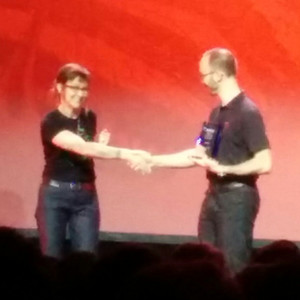
Stefano Zacchiroli receiving the O'Reilly Open Source Award I attended OSCON's closing sessions today and was delighted to see my friend Stefano Zacchiroli (Zack) receive an O'Reilly Open Source Award. Zack acted as Debian Project Leader for three years, is working on important activities at the Open Source Initiative and the Free Software Foundation, and is generally an amazing advocate for free software. Thanks for all your contributions, Zack, and congratulations!

Simon Kainz: DUCK challenge: week 3

One more update on the the DUCK challenge: In the current week, the following packages were fixed and uploaded into unstable: So we had 10 packages fixed and uploaded by 8 different uploaders. A big "Thank You" to you!! Since the start of this challenge, a total of 35 packages, uploaded by 25 different persons were fixed. Here is a quick overview:
Week 1 Week 2 Week 3 Week 4 Week 5 Week 6 Week 7
# Packages 10 15 10 - - - -
Total 10 25 35 - - - -
The list of the fixed and updated packages is availabe here. I will try to update this ~daily. If I missed one of your uploads, please drop me a line. There is still lots of time till the end of DebConf15 and the end of the DUCK Challenge, so please get involved. Pevious articles are here: Week 1, Week 2.

Next.

Previous.