Search Results: "rra"

19 January 2010

Martín Ferrari: FOSDEM 2010

For the first time in my life, I'll be going to FOSDEM, yay!! So I hope to see a lot of Debian friends there, drink a lot of Belgian beer and have a great time. Also, I'm finally going back home on March, after almost a year living in France, I expect a continuous stream of meetings, barbecues and random partying. I can't wait! Tags: Planet Debian, Planet Lugfi

18 January 2010

Christine Spang: Quodlibet: looking for mentee comaintainer

Quodlibet is a GTK+ audio library manager / player. In Debian, it makes up four binary packages: quodlibet, quodlibet-ext, exfalso, and quodlibet-plugins. It's big/popular enough to get a few bugs filed against it and for people to yell when things break, but not so big as to be overwhelming. Since the previous comaintainer has been inactive for some time, I've been thinking that it might be nice to have a comaintainer again. During my academic term at MIT or if I'm on vacation, I don't get to things as quickly as I should. The package has also gone through a period of inactive Debian maintainers and a period of inactive upstream maintainers, so it's accumulated a fair number of ignored bugs in the BTS. And in general, having others to fall back on is a good thing, as long as it doesn't lead to no one taking responsibility. So, here's a deal: I want a comaintainer. There's a catch, though: this person doesn't need to be already involved in Debian. In fact, I'd prefer it if she weren't. If you have a good grasp on the English language, enthusiasm for Debian, and a willingness to learn some technical skills, contact me, preferably via email, and let me know who you are. Quodlibet is written in python, but I'm explicitly not saying that you need to know python in order to help out. You'll gain the benefit of having someone willing to answer your questions and direct your efforts and an automatic sponsor for uploads you prepare. I can't say I have a ton of time to put into mentoring someone, but I'm willing to put in some, so hopefully such an arrangement will turn out well for all parties involved: you, me, upstream, and Debian. :)

17 January 2010

Tollef Fog Heen: Moving SMS-es and contacts from iphone to N900

I've been using an iphone since late 2007 as my primary phone and so I've gotten quite a few contacts and SMS conversations stored on it. Now that Collabora has given me a nice and shiny N900, I wanted to move my contacts and conversations over, but this proved to be a bit more work than expected. Please note that the following procedure worked for me, I have tried to take reasonable steps to prevent anything breaking, but if something breaks, you get to keep both pieces. I am not responsible and this comes with absolutely no warranty. Take backups. What you need The address book conversion script takes the SQLite database structure and converts that into a VCF file. It should be completely safe to run multiple times (it only does SELECT from the different tables in the contacts database, and you have made backups, haven't you?). If it dies with an "Unknown property", "Unknown label" or other error, you can poke it and see if you can work out what's wrong or drop me an email and I'll see if I can help you. Assuming it doesn't fall over, it will spit out a series of VCards, which you should store in a file, which you then to the N900 and open in the address book. Assuming you have less than 1000 contacts, they should now all be in your address book. If you have more, you need to split the file. A couple of known limitations: The procedure for exporting and importing SMS-es is a bit more involved. First, export the sms-es by running the perl script. It spits out a tab-separated file which you should copy to the N900 along with the smsimporter program from the smstools thread. Run ./smsimporter foo.csv and you should get all your SMS-es put into the conversation app. I ended up compiling my own smsimporter based on the 0.2.1 from the thread with the UUID patch too. Read the whole thread and it should be fairly clear.

16 January 2010

Miriam Ruiz: Packaging openFrameworks for Ubuntu and Debian

It seems that I m not blogging as often as I was some months ago. The main reason is microblogging, which is somehow quicker, even though briefer. It is also less informative, I guess, because 140 characters is a very limited length. Probably because of that, a friend of mine asked me to write a proper blog entry about this, and I think that he s probably right. openFrameworks is an open source toolkit, released under the MIT license, written in C++ and designed to assist the creative process by providing a simple and intuitive framework for experimentation. According to its authors, it was developed for folks using computers for creative, artistic expression, and who would like low level access to the data inside of media in order manipulate, analyze or explore. I attended a short course in openFrameworks some months ago, and decided that if I wanted to experiment with it, I should somehow structure the building process of the library a bit, remove the dependency on FMOD, which is not DFSG-free, even though that might require remove the whole audio subsystem, make it buildable without Code::Blocks, and hopefully build some more-or-less proper packages. I ve also added some pkg-config files, so that it becomes easier to build projects based in openFrameworks (as easy as g++ source.cpp -o test $(pkg-config openframeworks openframeworks-addons cflags libs) ). Even though the packages are still not as good as they should, they re absolutely usable right now. I ve uploaded them, as well as their dependencies, to my Ubuntu PPA (although I m using those packages in my Debian), in case that someone is interested. I ve also uploaded a couple of tiny examples (the second one downloaded from here) of openFrameworks.

15 January 2010

Eddy Petrișor: Busy, busy, busy and lazy me

It has been quite some time since my last post. I have been involved in quite a few things and the last part of 2009 which left no time for anything else. At the begining of 2010, just to set things on a good tone from the new year, I went on a snowboarding vacation to Austria to Kitzb hel.

Presidential campaign and pure irrationality in Romania

I got involved in Remus Cernea's presidential campaign, which was quite a success, considering the media blockade he was subject to. Unfortunately, Romanians seem to more and more indoctrinated, idiotic and gullible, probably thanks to newer generations that come through public schools after 12 years of religious indctrination and media promoting stupidity, non-values, ignorance and so on.

The more I live in this country, the more I realize how I don't feel like fitting in, because I refuse to be a mindless sheep, a moron, listening to anything the news at 5 say (those living in Romania know what I mean). I obstinately form my own ideas and question everything.

Significant event in my life

In September 2009 a life-turning event took place in my life - don't worry, is nothing bad, is pure good - and my eyes opened entirely. I have bacame a sponge trying to know more and more and this has helped me see the world with new eyes, from a new perspective, without lies or preconceptions.

Now I am thingking freely.


I am sorry for not going into details, but I have my reasons. Those who have the eyes and brains to understand what I am talking about, surely have understood by now what has happened to me ;-) .

Snowboarding vacation

At the begining of this year I went with my wife and some friends to Austria for a vacation. Kitzb hel's slopes and conditions were very good (bad points were only due to a couple of areas where snowboarders had to open at least one binding).

<iframe frameborder="0" height="350" marginheight="0" marginwidth="0" scrolling="no" src="http://www.openstreetmap.org/export/embed.html?bbox=12.2575,47.3556,12.5092,47.5304&amp;layer=mapnik" style="border: 1px solid black" width="425"></iframe>
View Larger Map

Weather was good and snow was icy only late in the afternoon. I was quite suprised to see stores close at 6pm, but overall, it was a well deserved vacation and I enjoyed it very much. My wife's skills on the board got better, although the third day some beginner skyer broke one of the bindings of my wife's snowboard and she had to use a rental instead. The rental was a quite new Burton board and Otilia got used to it and liked to the extent that we decided the next board we buy (for either of us) will be a Burton.

Did it worth it to drive 1500 km (roughly 1000 miles for the metric system challenged people :-P) for this vacation? Definitely! Did I enjoy the drive? Well, let's just say that the 950km from Kitzb hel to the Romanian border were made in approximately the same time it took us to make the last 550km to Bucharest, while 110km of those last were on the A1 "highway".

I'll probably put some photos from my vacation somewhere on the intenets, but don't hold your breath :-P .

Instead of conclusions

I know I promissed a lot of people to take care of some things like Wormux and some kernel bug debugging and I didn't kept my promise. I appologise, yet I don't expect anyone to accept my appologies. I am still unsure when I'll get back to that. I still care for Debian, yet the day has only 24 hours and I have to use at least 7 of those on sleep.

11 January 2010

Alastair McKinstry: Supporting free speech at home

Thanks to Joey Hess for the request to set up tor bridges. I wholeheartedly agree, and recommend the video he points to. I've installed a Tor bridge at home, and recommend others to do so. For the most part, I'm not politically active at the moment - I'm doing a PhD Part-time, and thats consuming all my "spare" time, other than work and family. Just given a blog site, however, one subject strikes me as very important - free speech. Hence the side links to Amnesty International, etc. In Ireland this campaign has a particular focus at the moment - the Repeal of the Blasphemy Law. This law came into effect in Ireland this January. While the government claims that this law will 'never be used', its bad in several ways. Firstly, it promotes the ideas of censorship as a method of hiding social issues, and secondly it may actually be used, as pointed out in : <object height="300" width="400"><param name="allowfullscreen" value="true"><param name="allowscriptaccess" value="always"><param name="movie" value="http://vimeo.com/moogaloop.swf?clip_id=5196379&amp;server=vimeo.com&amp;show_title=1&amp;show_byline=1&amp;show_portrait=0&amp;color=&amp;fullscreen=1"><embed allowfullscreen="true" allowscriptaccess="always" height="300" src="http://vimeo.com/moogaloop.swf?clip_id=5196379&amp;server=vimeo.com&amp;show_title=1&amp;show_byline=1&amp;show_portrait=0&amp;color=&amp;fullscreen=1" type="application/x-shockwave-flash" width="400"></embed></object>Blasphemy is a Victimless Crime from Limerick Blogger on Vimeo. Basically, with Europe-wide arrest warrants, if two European countries have criminal blasphemy laws, then someone may be extradited to face prosecution in another country. While the Irish government says they will never prosecute, they open the possibility of say, Irish citizens being extradited to Greece to safe prosecution for blasphemy. On a wider level, I recommend Index on Censorship. It keeps documenting the cost of censorship around the world, and has been instrumental in campaigning for Libel reform in the UK, which is ncreasingly important for open scientific discussion. Tags , ,

7 January 2010

Kumar Appaiah: Brief updates and some advice

So, while Richard is busy doing research and arranging or facilitating several Debian workshops, here I am, gulping down Idlis and Dosas by the dozen. It's been a fun visit, and I got to visit several places in my native state, but since my visit to Mumbai is rather short, I won't be able to say hello to several friends this time (Sorry Kartik). Maybe this would happen only when I am back in India on a permanent basis; let's see...Here are some general guidelines for travelers which I'd like to share:It's been a really fun trip, and I am sure I'll enjoy the rest of the trip, till I get back to my old routine and resume work.Finally, in keeping with the spirit of a blog I try to understand (albeit, in vain, I must accept), I duplicate the concept of a post from that blog, here is an up-to-date list of airports in which I have sat, but never left except by way of airplane:More updates later. Bye for now.

1 January 2010

C.J. Adams-Collier: SAN configuration (AoE)

With the help of a couple of friends, we ve put a 4.5T RAID-5 machine on our network and I m trying to figure out how to share the storage with the rest of the hosts. In the past, I have used NFS and CIFS/Samba to provide access to remote hosts. This has generally worked okay so long as the server stays online. I don t know if the results are going to be much different, but I am now trying a different approach. I plan to run an iSCSI server, and I ve already configured AoE (ATA over Ethernet). I ve exported a block device on the network segment and mounted it on a remote host. This was pretty easy to configure. There is a bit of documentation on the internet already, but I ll give another quick overview. I gave the storage server the unoriginal name san0 . This host is running debian lenny. I am testing the configuration from my debian sid development host, which has the similarly unoriginal name dev0 . So, think server when you see san0 and client when you see dev0 . I assume that you ve already got an LVM volume group set up. Mine is called vg0 . Correct the following examples to account for any differences. You can use disk partitions instead of LVM logical volumes.
Create a logical volume to be exported: cjac@san0:~$ sudo lvcreate /dev/vg0 -n e0.1 -L 5G Load the AoE kernel module: cjac@san0:~$ sudo modprobe aoe Install the package containing the vblade block device export server: cjac@san0:~$ sudo apt-get install vblade Export the block device. Note that the ethernet bridge on which I export the device is called loc : cjac@san0:~$ sudo vbladed 0 1 loc /dev/vg0/e0.1 Install the AoE discovery tools on the client: cjac@dev0:~$ sudo apt-get install aoetools Load the AoE kernel module: cjac@dev0:~$ sudo modprobe aoe Probe for exported AoE devices: cjac@dev0:~$ sudo aoe-discover Verify that our exported device was discovered: cjac@dev0:~$ test -e /dev/etherd/e0.1 && echo "yep"
yep

You can now treat /dev/etherd/e0.1 as you would any other block device. You can format it directly, or partition it and format a partition, use it as a device in your software RAID array, use it as swap space (ha), or something completely different. Now to figure out this iSCSI stuff
<script>//<script language="javascript" src="http://reddit.com/button.js?t=1"></script>

31 December 2009

John Goerzen: My Reading List for 2010

I can hear the question now: What kind of guy puts The Iliad and War and Peace on a list of things to read for fun? Well, me. I think that reading things by authors I ve never read before, people that take positions I haven t heard of before or don t agree with, or works that are challenging, will teach me something. And learning is fun. My entire list for 2010 is at Goodreads. I ve highlighted a few below. I don t expect to read all 34 books on the Goodreads list necessarily, but there is the chance. The Iliad by Homer, 750BC, trans. by Alexander Pope, 704 pages. A recent NPR story kindled my interest in this work. I m looking forward to it. The Oxford History of the Classical World by Boardman, Griffin, and Murray, 1986, 882 pages. It covers ancient Greece and Rome up through the fall of the Roman empire. The Fires of Heaven (Wheel of Time #5) by Robert Jordan, 1994, 912 pages. I ve read books 1 through 4 already, and would like to continue on the series. War and Peace by Lev Leo Nikolayevich Tolstoy, 1869, 1392 pages. Been on my list for way too long. Time to get to it. Haven t read anything by Tolstoy before. The Politics of Jesus by John Howard Yoder, 1972, 2nd ed., 270 pages. Aims to dispel the notion of Jesus as apolitical. An Intimate History of Humanity by Theodore Zeldin, 1996, 496 pages. Picked this up at Powell s in Portland on a whim, and it s about time I get to it. The Myth of a Christian Nation: How the Quest for Political Power Is Destroying the Church by Gregory A. Boyd, 2007, 224 pages. An argument that the American evangelical church allowed itself to be co-opted by the political right (and some on the left) and argues this is harmful to the church. Also challenges the notion that America ever was a Christian nation. Daily Life in Ancient Rome: The People and the City at the Height of the Empire, by Jerome Carcopino, 2003, 368 pages. I ve always been fascinated with how things were on the ground rather than at the perspective of generals and kings, and this promises to be interesting. Slavery, Sabbath, War, and Women: Case Issues in Biblical Interpretation (Conrad Grebel Lectures) by Willard M. Swartley, 1983, 368 pages. Looking at how people have argued from different Biblical perspectives about various issues over the years. To the Lighthouse by Virginia Woolf, 1927, 252 pages. I can t believe I ve never read Woolf before. Yet another one I m really looking forward to. Tales of the Jazz Age by F. Scott Fitzgerald, 1922, 319 pages. Per Goodreads: This book of five confessional essays from the 1930s follows Fitzgerald and his wife Zelda from the height of their celebrity as the darlings of the 1920s to years of rapid decline leading to the self-proclaimed Crack Up in 1936. Ulysses by James Joyce, 1922 (1961 unabridged version), 783 pages. The Future of Faith by Harvey Cox, 2009, 256 pages. Per Goodreads, Cox explains why Christian beliefs and dogma are giving way to new grassroots movements rooted in social justice and spiritual experience. Heard about this one in an interview with Diane Rehm. Being There by Jerzy Kosi ski, 1970, 128 pages. Jesus: Uncovering the Life, Teachings, and Relevance of a Religious Revolutionary by Marcus Borg, 2006, 352 pages. Whether or not you agree with Borg, this has got to be a thought-provoking title. The Three Musketeers by Alexandre Dumas, 1844, 640 pages. The Book of Tea by Kakuzo Okakura, 1906, 154 pages. Per Goodreads: In 1906 in turn-of-the century Boston, a small, esoteric book about tea was written with the intention of being read aloud in the famous salon of Isabella Gardner. It was authored by Okakura Kakuzo, a Japanese philosopher, art expert, and curator. Little known at the time, Kakuzo would emerge as one of the great thinkers of the early 20th century, a genius who was insightful, witty and greatly responsible for bridging Western and Eastern cultures. Nearly a century later, Kakuzo s The Book of Tea is still beloved the world over. Interwoven with a rich history of tea and its place in Japanese society is poignant commentary on Eastern culture and our ongoing fascination with it, as well as illuminating essays on art, spirituality, poetry, and more. More of my list is at Goodreads.

30 December 2009

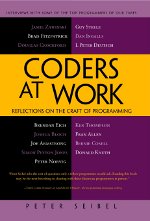
Christine Spang: Coders at Work

On the train to my parents' house for Christmas I finished up a wild run through the book Coders at Work. The book isn't even mine, but I'd been borrowing it very often, sometimes to the chagrin of its owner, because I could barely put it down. Coders at Work book cover The book is a collection of interviews with 15 great programmers of our time, starting with Jamie Zawinsky and ending with Donald Knuth. It's written in an interview style each interview starts with a brief introduction to the person being interviewed, summarizing what the person is known for and what he or she has accomplished and a few of the highlights of the interview, and then a transcript of the interview follows, with the author/editor, Peter Siebel, will saying something or asking a question, and the interviewee responding. I was skeptical about this format at first because I feel like it can be an easy way out of good editing and make the reader have to do the work of the editor, but on finishing I think that Siebel uses the format to his advantage in this case. For one, the speech format allows the reader to really form a picture of how the person being interviewed speaks and would act in a conversation. Jamie is somewhat bitter and pretty informal. Brad Fitzpatrick is flippant and energetic, his speech littered with profanity and colloquialisms. Others seem more stately and verbose Joe Armstrong's responses can go on for a page or more. In this way, not only do readers learn something about what these greats have learned about programming, but we also feel a bit more like we've met or know them, and can connect to them more as people. I always have this problem where I want to read computer books, but often computer books seem inextricably tied to the computer, so there's this dynamic of reading a bit and then wanting to get on a machine and try something out, write some code, play around especially with books focused on a specific language. Coders at Work retains some of this computer-book dynamic in that I constantly encountered things that I want to investigate or play around with more: Erlang, OCaml, various papers and essays, Knuth's literate programs, and books such as Higher Order Perl and others. Siebel makes a point to ask each person what her short-list of books and papers programmers should read are, so this book is a great source of pointers to other reading material. Unlike a more specific book, however, keeping a list in a notebook was enough to settle the mind to read away-from-a-computer for chapters at a time. It's obvious that despite the interview format, Siebel has done some serious editing. None of the prose is boring to read, and I can't imagine that the text is a straight transcript of how the interviews went. He also has arranged the interviews in an order such that different interviews play off each other. In Branden Eich's interview, for example, he disparages the book Design Patterns:

I never bought the Gamma book. Some people at Netscape did, some of Jamie Zawinski's and my nemeses from another acquisition, they waved it around like the Bible and they were kind of insufferable because they weren't the best programmers.
In the next chapter, Joshua Bloch names it as a book he thinks programmers should read:
Another one, which I have slightly mixed feelings about but I still think everyone should read, is Design Patterns. It gives us a common vocabulary. There are a lot of good ideas in there.
Similar plays, such as Ken Thompson and Fran Allen disagreeing on the badness of C, happen in later chapters, tieing together the different chapters and illustrating how even really good programmers disagree on the Right Thing all the time. Clearly the craft of programming is no settled thing. Besides the general structure of the book being well thought-out, the material is generally thought-provoking and interesting. One thing that stood out to me was Joshua Bloch describing what he called the "empathy gene", which is what a programmer has to have if he's going to be able to design good APIs and programming languages he has to be able to put himself in the shoes of the person who will be using the language or API. This is one thing that differentiates how different programmers can be good at different things. Another thing that stood out to me is that many of those interviewed stated that they don't use much in the way of modern tools and IDEs Joshua Bloch and Simon Peyton-Jones both touch on this, just to name a couple examples, even though some say that they think using these tools would make them more productive, especially when it comes to refactoring. This is a testament to the power of inertia sometimes there is just no chance to be unproductive now in order to be more productive later. Or perhaps just a sign that a programmable text-editor can stand on the same level as a heavier tool in terms of productivity in the right hands. I could go on with examples, but the conclusion here is that I thoroughly enjoyed Coders at Work, and I think it is a book that is well-worth the time spent reading the entire thing.

29 December 2009

John Goerzen: Review: The Happiest Days of Our Lives (by Wil Wheaton)

I started to write this review last night, and went looking for Wil Wheaton s blog, where many of the stories came from, so I can link to it from my review. It was getting late, I was tired, and so I was a bit disoriented for a few seconds when I saw my own words flash up on the screen. At the time, his most recent story had excerpted my review of paper books. Wow, I thought. This never happens when I m about to review Dickens. And actually, it s never happened before, ever. I ll admit to owning a big grin when I saw that one of my favorite authors liked one of my blog posts. And Wil Wheaton is one of my favorite authors for sure. I enjoy reading others too, of course, but Wil s writing is something I can really identify with like no other. My parents were never in a London debtor s prison like Dickens were; I was never a promising medical student like A. C. Doyle. But I was, and am, a geek, and Wil Wheaton captures that more perfectly than anyone. After I read Just a Geek a few years ago, I gave it to my wife to read, claiming it would help her understand me better. I think it did. In The Happiest Days of Our Lives, Wil recounts memories of his childhood, and of more recent days. He talks of flashbacks to his elementary school days, when he and his classmates tried to have the coolest Star Wars action figures (for me: calculator watches). Or how his aunt introduced him to D&D, which reminded me of how my uncle got me interested in computers. Teaching himself D&D was an escape for the geeky kid that wasn t good at sports, as teaching myself Pascal and C was for me. Between us, the names and activities are different, but the story is the same. I particularly appreciated Wil s reflections on his teenage years. Like him, at that age, I often found myself as the youngest person in a room full of adults. Yet I was still a teenager, and like any teenager, did some things that I look back on with some embarrassment now. Wil was completely honest with himself he admitted crashing a golf cart on the Paramount studio lot, for instance, but also reminds me that he was a teenager then. He recognizes that he didn t always make the best choices and wasn t always successful with what he did, but isn t ashamed of himself either. That s helpful for me to remember; I shouldn t be unreasonably harsh on my 16-year-old self, and need to remember that I had to be a teenager too. I also identify with him as a dad. He wrote of counting the days until he could teach his boys about D&D, about passing on being a geek to his sons. I ve had a similar excitement about being able to help Jacob build his first computer. Already Jacob, who is 3, loves using the manual typewriter I cleaned up for him, and spent an hour using the adding machine I dug out on Sunday while I was watching the boys. (I regret that I didn t have time to take it apart and show him how it worked right then when he asked). And perhaps his 2nd-favorite present of Christmas was the $3.50 large-button calculator with solar cell power I got him as an impulse buy at the pharmacy the other day. He is particularly enamored with the square root button because a single press replaces all the numbers on the screen with completely different numbers! I can t find the exact passage now, but Wil wrote at one point about his transition from a career in acting to a career in writing. He said that he likes the feeling he gets when his writing can touch people. He s been able to redefine himself not as a guy that used to be an actor on Star Trek but a person that is a good author, now. I agree, and think his best work has been done with a keyboard instead of a camera. And that leaves me wondering where my career will take me. Yes, I m an author, but of technical books. Authors of technical books rarely touch people s hearts. There s a reason we read Shakespeare and Dickens in literature classes, but no high school English teacher has ever assigned Newton s Opticks, despite its incredible importance to the world. Newton revolutionized science, mathematics, and philosophy, but Opticks doesn t speak to the modern heart like Romeo and Jiuliet still does. Generations of people have learned more about the world from Shakespeare than from Newton. I don t have Wil s gift for writing such touching stories. I ve only been able to even approach that sort of thing once or twice, and it certainly won t make a career for me. Like Wil, I m rarely the youngest person in the room anymore. His days of being a famous teenage actor on a scifi series are long gone, as are mine of single-handedly defeating entire teams at jr. high programming contests. (OK, that s a stretch, but at the time it sure felt exciting.) But unlike him, I m not completely content with my niche yet. I blog about being a geek in rural Kansas, where there still aren t many. I m a dad, with an incredible family. And I write about programming, volunteer for Debian and a few other causes, and have a surprisingly satisfying job working for a company that builds lawn mowers. And yet, I have this unshakable feeling of unsettledness. That I need to stop and think more about what I really want to do with my life, perhaps cultivate some talents I don t yet have, or perhaps find a way to make my current path more meaningful. So I will take Wil s book as a challenge, to all those that were once sure of what their lives would look like, and are less sure with each passing year: take a chance, and make it yours. And on that score, perhaps I ve done more than I had realized at first. Terah and I took a big chance moving to Kansas, and another one when we bought my grandparents run-down house to fix up and live in. Perhaps it s not a bad idea to pause every few years and ask the question: Do I still like the direction I m heading? Can I change it? Wil Wheaton gives me lots to think about, in the form of easy-to-read reflections on his own life. I heartily recommend both Just a Geek and The Happiest Days of Our Lives. (And that has nothing to do with the fact that the Ubuntu machine he used to write the book probably had installed on it a few pieces of code that I wrote, I promise you.)

25 December 2009

Erich Schubert: Media Players

Somehow, I'm still lacking the optimal media player application. Many popular ones are totally overloaded (e.g. amarok). Others like totem seems to be just a minimalistic frontend for a particular backend.My current choice: However, there is one thing I'm really not satisfied with: when putting together a CD compilation for friends (say, as Christmas present), they are quite useless. A key issue here is the total playlist length. Guess what, I want to make sure it fits on a single CD. So I really need to know the total playlist length. Why do so many media players (e.g. totem, alsa-player-gtk, xfmedia4, vlc, mplayer, ...) not show you the total playlist length? They did read all the files to get artist and title. Many even have the individual song lengths, just not the total sum.In the past I've been using old XMMS1 to check for the total length, or a CD burning application like K3B by repeatedly importing my current folder.Right now, I'm using Quod Libet (since I like the tag-editing component exfalso a lot) to arrange the playlist. It also gives me the total length, albeit I belive I've had incorrect song lengths in it before (broken VBR files?), and it's not perfect, too: being database-driven it has really long startup times for occasional users (because of updating the database) and is much more heavyweight. I also believe I've lost some playlists because I had moved my files around once ... so I'm a bit sceptical.Anyway, there are still hundreds of media players I havn't looked at. Don't bother me to send me an email about one I havn't mentioned!But if you are developing a media player, please consider the use case of putting together a music CD for your friends. In particular, for users that do not use your player all day.

24 December 2009

Andrew Pollock: [life] Homeowners!

There was a minor hiccup yesterday. Our mortgage broker called me up towards the end of the day in a flap because something had gone wrong on the seller's side of things, and their bank hadn't accepted the transaction or something. I still don't know the full story. Something about them missing a mortgage payment possibly. Anyway, she was able to arrange for funding and closing today, instead of funding yesterday and closing today, so the outcome was still the same. Now the real fun starts. The first thing I did tonight was program the garage door opener into the Prius' HomeLink thingy built into the rear vision mirror. It's always nice to be able to use a feature, even if it's taken 4 years.

Muammar El Khatib: Installing Adobe Air in Debian AMD 64 (TweetDeck can be used)

I love twitting using TweetDeck. So that, I started to investigate how to install Adobe Air in Debian AMD64 and, it was a real pain in the ass. I have found a way of installing it in Debian AMD64.

First of all, you need to install the following packages:

$ sudo apt-get install ia32-libs lib32nss-mdns lib32asound2 lib32gcc1 lib32ncurses5 lib32stdc++6 lib32z1 libc6 libc6-i386 lib32nss-mdns libcanberra-gtk-module


After installing them, we have to create some symlinks from the location of some of those libraries in /emul/ia32-linux/usr/lib/ to /usr/lib32/. For accomplishing it, do the next:

$ cd /usr/lib32/
$sudo ln -s /emul/ia32-linux/usr/lib/libnss3.so .
$sudo ln -s /emul/ia32-linux/usr/lib/libssl3.so .
$sudo ln -s /emul/ia32-linux/usr/lib/libsmime3.so .
$sudo ln -s /emul/ia32-linux/usr/lib/libnspr4.so .
$sudo ln -s /emul/ia32-linux/usr/lib/libnssutil3.so.1d .
$sudo ln -s /emul/ia32-linux/usr/lib/libplc4.so.0d .
$sudo ln -s /emul/ia32-linux/usr/lib/libplds4.so .


In the case that you have problems with libplds4.so.0d, create the symlink like this:


$sudo ln -s /emul/ia32-linux/usr/lib/libplds4.so.0d libplds4.so.0d


Now, it is time to download Adobe AIR (in this case version 1.5).

$wget http://airdownload.adobe.com/air/lin/download/latest/AdobeAIRInstaller.bin


Once it is downloaded, we have to make the .bin file an executable:

$ sudo chmod +x AdobeAIRInstaller.bin


Then, we can proceed to install it:

$ sudo ./AdobeAIRInstaller.bin


If you get an error like this:

Error loading the runtime (libnss3.so: wrong ELF class: ELFCLASS64)


It means that you haven't done the symlink from /emul/ia32-linux/usr/lib/libnss3.so to /usr/lib32/ correctly or that you haven't installed the library which is missed ('apt-file search' is your friend).

If everything goes fine, then the last steps are:

sudo cp /usr/lib/libadobecertstore.so /usr/lib32


Note: make a symlink if you prefer.

And for TweetDeck I had to do this:

Download libgnome-keyring0 for 32 bits (in this example I used the one from SID, if you are using testing, download the one from that release that you are using), extract it with dpkg and copy the libraries to /usr/lib32:

$ wget http://ftp.us.debian.org/debian/pool/main/g/gnome-keyring/libgnome-keyring0_2.28.2-1_i386.deb
$ sudo dpkg-deb -x libgnome-keyring0_2.28.2-1_i386.deb libgnome-keyring0_2.28.2-1
$ sudo cp libgnome-keyring0_2.28.2-1/usr/lib/* /usr/lib32/


Then install TweetDeck (http://tweetdeck.com/download/) and Enjoy :-)

Note: If you find any problem, please do not hesitate to write a comment so that I can help you or we can improve this post.

22 December 2009

Ian Wienand: An open letter to the bald-headed salesman in Harvey Norman, Norwest, Castle Hill

I usally find blog rants useless, but sometimes something is just so annoying one is sufficiently inspired. Today I went with my parents to buy them a Tivo at Harvey Norman, Norwest, Castle Hill, NSW, Australia. I am a big Tivo fan; the interface is good and it "just works". I don't mind paying for (or in this recommending paying for) good products. After selecting the Tivo model, I asked for a HDMI cable. The salesman made a series of questions about what sort of HD TV it was being plugged into; I quickly sensed this as a probe to see what sort of suckers we were, and requested just a "normal" cable. At this point, he insisted on a $130 (you guessed it) Monster cable, and had the audacity to say that we didn't need one of the really expensive cables because our TV wasn't good enough! I openly expressed my concern, but the annoying high-pressure sales pitch had just begun. The amount of, frankly, crap that he spewed about 4-bit this, 10-bit that, legislating of labels, DA signal levels, mythical customers who regretted buying the cheap cables and who knows what else was to the point of being comical if it weren't so insistent and said with such seeming authority. There is only one thing that matters - if the cable has passed the functional requirements for being certified to have the distinctive HDMI logo plastered on it. From the HDMI FAQ:
Q. What testing is required? Prior to mass producing or distributing any Licensed Product or component that claims compliance with the HDMI Specification (or allowing someone else to do such activities), each Adopter must test a representative sample for HDMI compliance. First, the Adopter must self test as specified in the then-current HDMI Compliance Test Specification. The HDMI Compliance Test Specification provides a suite of testing procedures, and establishes certain minimum requirements specifying how each HDMI Adopter should test Licensed Products for conformance to the HDMI Specification.
Now, I can understand that if you buy any old HDMI cable off Ebay for $1, it may be a knock-off that uses the HDMI logo illegally. But there is no way that the certified $50 Philips cable (still very over-priced, but at least not insane, and discounted to $35) performs any differently to some overpriced Monster model certified to exactly the same standard. The thing that annoyed me most was his analogy to buying a tyre. He stated that "if you walked up to a tyre salesman and I said don't want the Pirelli's, just put the cheap-o tires on my Ferrari" I'd be insane, and thus by extension of that logic I was insane for not buying a Monster cable for my great new Tivo. This analogy is completely flawed and really just dishonest. A Ferrari is much more powerful and goes much faster than a standard car. It is plausible it needs a better engineered tyre to perform adequately given the additional stresses it undergoes. A Tivo doesn't put out any more or any less bits than any other HDMI certified equipment, no matter what you do. If the cable is certified as getting all the bits to the other end under whatever environmental conditions specified by the HDMI people, then it's going to work for the 99% of people with normal requirements. Nobody wants to make a significant investment in a piece of audio-visual equipment and feel they are getting something that isn't optimal. Harvey Norman's use of this understandable consumer sentiment to sell ridiculously over-priced cables that do nothing is extremely disappointing. I'm sure the commissions on these things encourage this behaviour, so it is useless expecting the retailer or individual sales assistant to change their policy to reccommend reasonably priced cables. However, it is really Tivo and other manufactuers who get the raw end of this deal; a $130 cable is over 20% of the price the actual Tivo! That is surely affecting people's purchasing decisions. If Tivo and others included a certified HDMI cable with their device, as they do with component cables, and had "Certified HDMI 1.3 cable included" plastered on the box, it would be a harder sell to explain why the manufactuer would bother shipping a certified cable that is supposedly insufficient, and consumers would hopefully avoid the very distasteful high-pressure theatrics I was subjected to today.

20 December 2009

Wouter Verhelst: Good, not evil

There is a bit of a fluff online currently about the following clause in the "jsmin" code (whatever that is):
The software shall be used for good, not evil
This seems to have started when Google rejected a project based on that code due to its license being not free or open source according to their standards, and therefore not welcome anymore. The arguments then quickly degenerated into things like 'when did google stop being against evil'. But those are all besides the point. One of the most important properties of free and open source software is that anyone can use it for any purpose; there are no restrictions to using them. The DFSG (and hence, the OSD which was derived from the DFSG) encode this as follows:
No Discrimination Against Fields of Endeavor
The license must not restrict anyone from making use of the program in a specific field of endeavor. For example, it may not restrict the program from being used in a business, or from being used for genetic research.
You may think "how is 'evil' a field of endeavor", but that is the wrong question. To "use software for evil" can mean any of a number of things, including "nuclear research", "weapons development", "abortion", or, heck "the cash register in a butchery shop", depending on the ethical and moral framework through which the person writing the license sees the world. The ability to give someone a CD or DVD with a bunch of software on there, being able to tell them that they can just use this in any which way they see fit, is a very strong and important feature of the free and open source community. Every time someone comes up with a clause like the above, however, this ability is diluted somewhat; and if it is readily accepted within the greater free and open source movement, then eventually everyone interested in using a piece of software must first check whether they're not trying to use software that forbids someone's pet evil, and we lose one of the greatest strenghts that does exist for free software, but not for proprietary software. The sad thing is, the jsmin author seems to agree. From a video/transcript on which he talks about his absurd license clause is the following quote:
Also about once a year, I get a letter from a lawyer, every year a different lawyer, at a company I don't want to embarrass the company by saying their name, so I'll just say their initials IBM
[laughter]
saying that they want to use something I wrote. Because I put this on everything I write, now. They want to use something that I wrote in something that they wrote, and they were pretty sure they weren't going to use it for evil, but they couldn't say for sure about their customers. So could I give them a special license for that? Of course. So I wrote back this happened literally two weeks ago "I give permission for IBM, its customers, partners, and minions, to use JSLint for evil."
Or, in other words, all you have to do if you want to use this software for evil is set up a second company, tell Douglas that this second company wants to sell software that uses his software to people who might use it for "evil", even though the first company won't, and you're in business. Because Douglas doesn't really oppose evildoers. So the question is, why is that clause in there in the first place? There are only two possibilities; either Douglas didn't really think about those issues, in which case I hope he will one day see the light and remove the clause; or he did, and decided to go ahead and put that clause there anyway. And that would be evil.

12 December 2009

Russ Allbery: Peter Watts attacked by US border guards

Signal boost. While returning from a trip to the US (in other words, going to Canada) on December 8th, Canadian SF author Peter Watts was attacked, beaten, pepper-sprayed, and imprisoned without access to legal counsel by the US Border Patrol. See also his post on the subject. The government's case has obviously not yet been presented. However, given the past behavior of the US Department of Homeland Security, I find Watts's description of the event entirely credible. This is an outrage. This is the kind of thing that happens in third-world dictatorships. See also Making Light and Boing Boing. John Scalzi's post has information on how to donate money to Watts to get through this legal fight. I will be giving him money. I also plan on calling my US Representative and Senators when I'm no longer at work, as this sort of treatment of a Canadian citizen warrants a Congressional investigation and heads rolling, not only at the agent level but at the Homeland Security management level. Even apart from basic questions of human rights, Homeland Security is going to systematically destroy the tourist industry in the United States if this sort of behavior is not stomped on immediately and severely. There are border patrol guards who are probably still on duty today who are common criminals and belong in prison for assault. ETA: The government's side of the story. This is pretty much what I expected, and with the data available so far, I feel confirmed in my initial reaction. This level of force is completely disproportional and flatly unacceptable short of Watts pulling a weapon on the agents, which they are not claiming that he did and which therefore he clearly didn't do. I'm highly skeptical of this supposed "choking" of a police officer after they pepper-sprayed him. This reads like the standard cover-your-ass charges filed by the police after they beat someone up. Once they've provoked the struggle by grabbing you and have done something as painful and disorienting as pepper-spraying you, chances are you're going to physically react in ways that they can conveniently misinterpret and use as the basis for charges. People elsewhere have pointed out that contacting Congressional representatives is probably better done Monday morning since nothing will happen during the weekend.

10 December 2009

Biella Coleman: Postdoc Hall of Shame (please spread the shame)

Postdoc Hall of Shame So a few years ago I got stuck with no health insurance as I had a fellowship that had for its history accepted professors (with health insurance) not fresh off the boat PhDs as was the case with me. Since I was at a Large State school it was nearly impossible for me to get insurance and finally I ended up paying 400 a month and getting a whole lot of headache. In many ways my ordeal was a fluke following a change of policy and this fellowship now provides insurance to its postdocs. Increasingly, however, it seems like a number of postdoctoral fellowships shirk from their duties and don t provide a drop of health insurance. Given the academic job market, many academics don t have any choice but to accept these positions and if they don t come with insurance, well then these folks are shelling out thousands upon thousands of dollars for basic, really lousy, coverage. Given that universities for the most part have decent, even in some cases kick ass insurance, with a large pool of people, shutting postdocs out of their pool is.. gross and just plain wrong. One of my fellow friends, currently on the market and currently screwed by her last postdoc wrote up a short document (aka Academic Labor Hall of Shame) and I thought I would post it here as it gets to the heart of the issues and starts shaming some of these shameful universities. If you know of other postdoctoral positions that don t offer insurance, please please leave a comment. We will include it in the hall of shame. Academic Labor Hall of Shame Universities like to promote themselves as bastions of enlightenment, but their treatment of temporary and hidden employees is often anything but enlightened. Or progressive. Or fair. 1. Postdoctoral fellows and researchers: There is a growing trend towards classing postdocs as not employees . I learned this recently when I was laid off from postdoctoral position at the University of Pennsylvania. I planned to extend my health insurance through COBRA, which is currently federally subsidized for workers who lost their jobs during the financial crisis. I was shocked when Penn initially claimed that I was not eligible for the subsidy (made available through the American Recovery and Reinvestment Act of 2009, the so-called stimulus act ). Their reason was that postdocs were not classed by Penn as employees. I appealed this with the Office of General Counsel and after a few weeks was told that I was indeed eligible, as Penn had found an inconsistency in [their] policy for certain categories of post docs between tax treatment and the availability of COBRA/ARRA . This means that while I am in fact eligible for this subsidy, postdocs paid through many other classes of grants are still not. If you want to see an example of this process of sorting some postdocs into not employee status, here is another one:
Postdocs on training grants or on individual fellowships (roughly 25% of VUMC postdocs) receive a stipend and are specifically excluded from the employee classification. They do not pay FICA and do not receive employee benefits. Their health insurance is provided and purchased separately. [by whom?] Even if Vanderbilt does in this case make provisions for these postdocs to receive health insurance, there is abundant evidence that some postdocs are outright excluded, as in this example at Stanford:
Stanford makes no provision for fellows to purchase health insurance, and the Institute will not provide medical insurance or other benefits. External fellows must bring their own medical coverage with them or purchase an individual plan during their stay in California. This is also quite apparent when you look into the outfits that profit from selling health insurance to postdocs (because their universities don t provide them any):
http://www.garnett-powers.com/npa/ Also, take a look at the policy they and you ll note that it stinks: it excludes such luxuries as preventive care, birth control, and chemotherapy. I m not making this up:
http://www.garnett-powers.com/npa/summary.pdf

5 December 2009

Ren&#233; Mayorga: Acer support, so far looks nice

Yesterday I went to the local support service center for Acer at El Salvador, I realize that I bought my Acer One on Dic 21 2008, so the warranty is still valid :) , my first concern was my HDD, since at the time the netbook fails I did have a copy of my GPG Key on a non encrypted file system, also all my data was on the HDD and I did not want to leave my computer with my data on the hands of a $RANDOM tech support. It took me like 15 minutes to convince the representative to remove my HDD before I leave the netbook, but they agree, and they even agree on let me see when they remove the HDD before give it to me, for me this looks like a nice tech support, I actually thought that they will refuse to follow this extrange request, and I even thought that they will be refuse to admit the computer, since the original OS was no longer installed. The netbook should be up and running this Thursday yay! :)

Next.

Previous.