Search Results: "nic"

20 December 2020

Russ Allbery: Review: Can't Even

Review: Can't Even, by Anne Helen Petersen
Publisher: Houghton Mifflin
Copyright: 2020
ISBN: 0-358-31659-6
Format: Kindle
Pages: 230
Like many other people, I first became aware of Anne Helen Petersen's journalism when her Buzzfeed article "How Millennials Became the Burnout Generation" went viral. Can't Even is the much-awaited (at least by me) book-length expansion of that thesis: The United States is, as a society, burning out, and that burnout is falling on millennials the hardest. We're not recognizing the symptoms because we think burnout looks like something dramatic and flashy. But for most people burnout looks less like a nervous breakdown and more like constant background anxiety and lack of energy.
Laura, who lives in Chicago and works as a special ed teacher, never wants to see her friends, or date, or cook she's so tired, she just wants to melt into the couch. "But then I can't focus on what I'm watching, and end up unfocused again, and not completely relaxing," she explained. "Here I am telling you I don't even relax right! I feel bad about feeling bad! But by the time I have leisure time, I just want to be alone!"
Petersen explores this idea across childhood, education, work, family, and parenting, but the core of her thesis is the precise opposite of the pervasive myth that millennials are entitled and lazy (a persistent generational critique that Petersen points out was also leveled at their Baby Boomer parents in the 1960s and 1970s). Millennials aren't slackers; they're workaholics from childhood, for whom everything has become a hustle and a second (or third or fourth) job. The struggle with "adulting" is a symptom of the burnout on the other side of exhaustion, the mental failures that happen when you've forced yourself to keep going on empty so many times that it's left lingering damage. Petersen is a synthesizing writer who draws together the threads of other books rather than going deep on a novel concept, so if you've been reading about work, psychology, stress, and productivity, many of the ideas here will be familiar. But she's been reading the same authors that I've been reading (Tressie McMillan Cottom, Emily Guendelsberger, Brigid Schulte, and even Cal Newport), and this was the book that helped me pull those analyses together into a coherent picture. That picture starts with the shift of risk in the 1970s and 1980s from previously stable corporations with long-lasting jobs and retirement pensions onto individual employees. The corresponding rise in precarity and therefore fear led to a concerted effort to re-establish a feeling of control. Baby Boomers doubled down on personal responsibility and personal capability, replacing unstructured childhood for their kids with planned activities and academic achievement. That generation, in turn, internalized the need for constant improvement, constant grading, and constant achievement, accepting an implied bargain that if they worked very hard, got good grades, got into good schools, and got a good degree, it would pay off in a good life and financial security. They were betrayed. The payoff never happened; many millennials graduated into the Great Recession and the worst economy since World War II. In response, millennials doubled down on the only path to success they were taught. They took on more debt, got more education, moved back in with their parents to cut expenses, and tried even harder.
Even after watching our parents get shut out, fall from, or simply struggle anxiously to maintain the American Dream, we didn't reject it. We tried to work harder, and better, more efficiently, with more credentials, to achieve it.
Once one has this framework in mind, it's startling how pervasive the "just try harder" message is and how deeply we've internalized it. It is at the center of the time management literature: Getting Things Done focuses almost entirely on individual efficiency. Later time management work has become more aware of the importance of pruning the to-do list and doing fewer things, but addresses that through techniques for individual prioritization. Cal Newport is more aware than most that constant busyness and multitasking interacts poorly with the human brain, and has taken a few tentative steps towards treating the problem as systemic rather than individual, but his focus is still primarily on individual choices. Even when tackling a problem that is clearly societal, such as the monetization of fear and outrage on social media, the solutions are all individual: recognize that those platforms are bad for you, make an individual determination that your attention is being exploited, and quit social media through your personal force of will. And this isn't just productivity systems. Most of public discussion of environmentalism in the United States is about personal energy consumption, your individual carbon footprint, household recycling, and whether you personally should eat meat. Discussions of monopoly and monopsony become debates over whether you personally should buy from Amazon. Concerns about personal privacy turn into advocacy for using an ad blocker or shaming people for using Google products. Articles about the growth of right-wing extremism become exhortations to take responsibility for the right-wing extremist in your life and argue them out of their beliefs over the dinner table. Every major systemic issue facing society becomes yet another personal obligation, another place we are failing as individuals, something else that requires trying harder, learning more, caring more, doing more. This advice is well-meaning (mostly; sometimes it is an intentional and cynical diversion), and can even be effective with specific problems. But it's also a trap. If you're feeling miserable, you just haven't found the right combination of time-block scheduling, kanban, and bullet journaling yet. If you're upset at corporate greed and the destruction of the environment, the change starts with you and your household. The solution is in your personal hands; you just have try a little harder, work a little harder, make better decisions, and spend money more ethically (generally by buying more expensive products). And therefore, when we're already burned out, every topic becomes another failure, increasing our already excessive guilt and anxiety. Believing that we're in control, even when we're not, does have psychological value. That's part of what makes it such a beguiling trap. While drafting this review, I listened to Ezra Klein's interview with Robert Sapolsky on poverty and stress, and one of the points he made is that, when mildly or moderately bad things happen, believing you have control is empowering. It lets you recast the setback as a larger disaster that you were able to prevent and avoid a sense of futility. But when something major goes wrong, believing you have control is actively harmful to your mental health. The tragedy is now also a personal failure, leading to guilt and internal recrimination on top of the effects of the tragedy itself. This is why often the most comforting thing we can say to someone else after a personal disaster is "there's nothing you could have done." Believing we can improve our lives if we just try a little harder does work, until it doesn't. And because it does work for smaller things, it's hard to abandon; in the short term, believing we're at the mercy of forces outside our control feels even worse. So we double down on self-improvement, giving ourselves even more things to attempt to do and thus burning out even more. Petersen is having none of this, and her anger is both satisfying and clarifying.
In writing that article, and this book, I haven't cured anyone's burnout, including my own. But one thing did become incredibly clear. This isn't a personal problem. It's a societal one and it will not be cured by productivity apps, or a bullet journal, or face mask skin treatments, or overnight fucking oats. We gravitate toward those personal cures because they seem tenable, and promise that our lives can be recentered, and regrounded, with just a bit more discipline, a new app, a better email organization strategy, or a new approach to meal planning. But these are all merely Band-Aids on an open wound. They might temporarily stop the bleeding, but when they fall off, and we fail at our new-found discipline, we just feel worse.
Structurally, Can't Even is half summaries of other books and essays put into this overall structure and half short profiles and quotes from millennials that illustrate her point. This is Petersen's typical journalistic style if you're familiar with her other work. It gains a lot from the voices of individuals, but it can also feel like argument from anecdote. If there's a epistemic flaw in this book, it's that Petersen defends her arguments more with examples than with scientific study. I've read enough of the other books she cites, many of which do go into the underlying studies and statistics, to know that her argument is well-grounded, but I think Can't Even works better as a roadmap and synthesis than as a primary source of convincing data. The other flaw that I'll mention is that although Petersen tries very hard to incorporate poorer and non-white millennials, I don't think the effort was successful, and I'm not sure it was possible within the structure of this book. She frequently makes a statement that's accurate and insightful for millennials from white, middle-class families, acknowledges that it doesn't entirely apply to, for example, racial minorities, and then moves on without truly reconciling those two perspectives. I think this is a deep structural problem: One's experience of American life is very different depending on race and class, and the phenomenon that Petersen is speaking to is to an extent specific to those social classes who had a more comfortable and relaxing life and are losing it. One way to see the story of the modern economy is that white people are becoming as precarious as everyone else already was, and are reacting by making the lives of non-white people yet more miserable. Petersen is accurately pointing to significant changes in relationships with employers, productivity, family, and the ideology of individualism, but experiencing that as a change is more applicable to white people than non-white people. That means there are, in a way, two books here: one about the slow collapse of the white middle class into constant burnout, and a different book about the much longer-standing burnout of being non-white in the United States and our systemic failure to address the causes of it. Petersen tries to gesture at the second book, but she's not the person to write it and those two books cannot comfortably live between the same covers. The gestures therefore feel awkward and forced, and while the discomfort itself serves some purpose, it lacks the insight that Petersen brings to the rest of the book. Those critiques aside, I found Can't Even immensely clarifying. It's the first book that explained to me in a way I understood what's so demoralizing and harmful about Instagram and its allure of cosplaying as a successful person. It helped me understand how productivity and individual political choices fit into a system that emphasizes individual action as an excuse to not address collective problems. And it also gave me a strange form of hope, because if something can't go on forever, it will, at some point, stop.
Millennials have been denigrated and mischaracterized, blamed for struggling in situations that set us up to fail. But if we have the endurance and aptitude and wherewithal to work ourselves this deeply into the ground, we also have the strength to fight. We have little savings and less stability. Our anger is barely contained. We're a pile of ashes smoldering, a bad memory of our best selves. Underestimate us at your peril: We have so little left to lose.
Nothing will change without individual people making different decisions and taking different actions than they are today. But we have gone much too far down the path of individual, atomized actions that may produce feelings of personal virtue but that are a path to ineffectiveness and burnout when faced with systemic problems. We need to make different choices, yes, but choices towards solidarity and movement politics rather than personal optimization. There is a backlash coming. If we let it ground itself in personal grievance, it could turn ugly and take a racist and nationalist direction. But that's not, by in large, what millennials have done, and that makes me optimistic. If we embrace the energy of that backlash and help shape it to be more inclusive, just, and fair, we can rediscover the effectiveness of collective solutions for collective problems. Rating: 8 out of 10

19 December 2020

Russell Coker: Testing VDPAU in Debian

VDPAU is the Video Decode and Presentation API for Unix [1]. I noticed an error with mplayer Failed to open VDPAU backend libvdpau_i965.so: cannot open shared object file: No such file or directory , Googling that turned up Debian Bug #869815 [2] which suggested installing the packages vdpau-va-driver and libvdpau-va-gl1 and setting the environment variable VDPAU_DRIVER=va_gl to enable VPDAU. The command vdpauinfo from the vdpauinfo shows the VPDAU capabilities, which showed that VPDAU was working with va_gl. When mplayer was getting the error about a missing i915 driver it took 35.822s of user time and 1.929s of system time to play Self Control by Laura Branigan [3] (a good music video to watch several times while testing IMHO) on my Thinkpad Carbon X1 Gen1 with Intel video and a i7-3667U CPU. When I set VDPAU_DRIVER=va_gl mplayer took 50.875s of user time and 4.207s of system time but didn t have the error. It s possible that other applications on my Thinkpad might benefit from VPDAU with the va_gl driver, but it seems unlikely that any will benefit to such a degree that it makes up for mplayer taking more time. It s also possible that the Self Control video I tested with was a worst case scenario, but even so taking almost 50% more CPU time made it unlikely that other videos would get a benefit. For this sort of video (640 480 resolution) it s not a problem, 38 seconds of CPU time to play a 5 minute video isn t a real problem (although it would be nice to use less battery). For a 1600*900 resolution video (the resolution of the laptop screen) it took 131 seconds of user time to play a 433 second video. That s still not going to be a problem when playing on mains power but will suck a bit when on battery. Most Thinkpads have Intel video and some have NVidia as well (which has issues from having 2 video cards and from having poor Linux driver support). So it seems that the only option for battery efficient video playing on the go right now is to use a tablet. On the upside, screen resolution is not increasing at a comparable rate to Moore s law so eventually CPUs will get powerful enough to do all this without using much electricity.

18 December 2020

Raphaël Hertzog: Freexian s report about Debian Long Term Support, November 2020

A Debian LTS logo Like each month, here comes a report about the work of paid contributors to Debian LTS. Individual reports In November, 239.25 work hours have been dispatched among 13 paid contributors. Their reports are available: Evolution of the situation In November we held the last LTS team meeting for 2020 on IRC, with the next one coming up at the end of January.
We announced a new formalized initiative for Funding Debian projects with money from Freexian s LTS service.
Finally, we would like to remark once again that we are constantly looking for new contributors. Please contact Holger if you are interested! We re also glad to welcome two new sponsors, Moxa, a device manufacturer, and a French research lab (Institut des Sciences Cognitives Marc Jeannerod). The security tracker currently lists 37 packages with a known CVE and the dla-needed.txt file has 40 packages needing an update. Thanks to our sponsors Sponsors that joined recently are in bold.

One comment Liked this article? Click here. My blog is Flattr-enabled.

Junichi Uekawa: What did I learn about WebRTC in 2020.

What did I learn about WebRTC in 2020. Because of remote life I needed new tools for every day life, around video and recording. I figured that HTML5 had most of ffmpeg and OBS features that I needed, and thought I could make equivalent tools with just web technology. Learning curve was relatively steep because many of examples on the web that I could find was stale and nonfunctional. Most sample code are still not ES2015. What year is this? This is 2020. Busy rewriting var to const, functions to await.

17 December 2020

Elana Hashman: Easy risotto

I have a secret: risotto doesn't have to involve standing over a pot, stirring for 30 minutes. There is a better way. I've made risotto using the "stir 5ever" method and frankly this one is half the work and just as good. I took inspiration from Kenji Lopez-Alt, who describes how you can make risotto with only a few minutes of stirring at the end! Yes, this is a secret too good to keep to myself. The linked recipe is too rich for a weeknight dinner, at least for my tastes, so I've included my typical modifications below, which omits the heavy cream. I usually make mushroom risotto, because all the ingredients are long-lived pantry ingredients, which means I can make this on a whim without having to grocery shop! Mushroom risotto Serves 3 as a main course. Active time: 25m. Total time: 45m. Ingredients: Recipe:
  1. Leave mushrooms to rehydrate in 1 cup of hot water for at least 10 minutes.
  2. Set a wide saucepan (about 3.5qts) or skillet on medium heat.
  3. Mix stock and wine for a total of 4 cups. You can used homemade stock (the best), boxed, or reconstitute from bouillon (my usual). If you use bouillon, I find you get the best flavour if you use a mix, so I tend to use half "no-chicken" and half "organic chicken" of the Better than Bouillon brand. Let this cool if you used boiling water; you don't want it to be too hot.
  4. Mix the rice and stock in a large bowl, agitating it to release the starch. Reserve stock and set the rice in a strainer to drain.
  5. Small dice an onion. Add olive oil and butter to the pan, and then add the onion. Cook the onion until it's translucent, but don't brown it.
  6. Increase the heat to high and add the rice to the pan to toast until it becomes a little bit brown, stirring occasionally, about 3-4 minutes. Set a timer so it doesn't burn
  7. Meanwhile, drain the mushrooms, making sure you reserve the broth. Chop mushrooms and mince the garlic. Once the rice is toasted, add mushrooms and garlic and stir.
  8. Stir the reserved stock. Add all of the mushroom liquid and all but 1 cup of the starchy stock to the pan. Bring to a boil.
  9. Once it has reached a boil, cover, reduce to the lowest heat, and allow the rice to simmer undisturbed for 10 minutes. In the meantime, you can grate the cheese.
  10. After 10 minutes, stir the rice once, shake the pan to ensure it is level, and return to the heat for 10 more minutes. Sit back, relax, and bask in the very little stirring you are doing.
  11. At this point, the rice should be nearly cooked. Give it a stir, and add the remaining cup of broth. Stir until fully incorporated, turn the heat up to high, and cook until the risotto reaches your preferred consistency. I like mine rather thick.
  12. Once the rice is fully cooked, turn off the heat and stir in the grated cheese a bit at a time, reserving some for garnish. Taste, and season with salt and pepper.
  13. Garnish with the grated cheese, and perhaps some herbs. Serve and enjoy!
Variations No mushrooms: Okay, okay, you hate mushrooms! Sorry! You can leave them out. Don't bother with the mushrooms, and add broth to make up for the lost liquid. Mushroom lover: Alternatively, if you love mushrooms and you have fresh ones available, use &frac13 to a pound (150-225g) chopped fresh mushrooms instead of dried. Add them at the same time you add the onions to ensure all the liquid cooks off. Milanese, with stuff: One of my favourite variations on this dish is a version with shrimp, asparagus, and saffron. Leave the mushrooms out, increase the wine to or even 1 cup (seafood likes a little extra acidity), ensure you have a total of 5 cups of broth, and add a few strands of saffron. Chop asparagus and shrimp, season with salt and pepper, saut them with some butter or olive oil in a separate pan so they don't overcook, and fold them in at the very end, after you've added the cheese. I MUST SUFFER: This was too easy? Want to stir more??? Fine, have it your $*!#ing way. I'm sure you can be creative and come up with something on your own...

16 December 2020

John Goerzen: Non-Creepy Technology Purchasing & Gifting Guides

This time of year, a lot of people are thinking of buying gadgets and phones as gifts. But there are a lot of tech companies that have unethical practices, from terrible working conditions in their factories to spying on their users. Here are some buying guides to help you find gadgets that are fun and not creepy. The Free Software Foundation s Ethical Tech Giving Guide is a fantastic resource from what s probably the pickiest organization out there when it comes to tech. Not only do they highlight good devices, they also explain why and why you should, for instance, avoid the iPhone (their history of silencing political activists and spying on users). The FSF also has a Guide to DRM-Free Living talks about books, video, audio, and software that respects your freedom by letting you make your own backups, move it to other devices, and continue to use your purchases even if you have no Internet or the company you bought them from goes bankrupt. This is a fantastic and HUGE resource; there are hundreds of organizations out there that provide content in a way that respects your rights and many of them do it for free, legally, as well. PrivacyTools has a fantastic series of guides on everything from email providers to operating systems, as well as links to a number of other guides. The DeGoogle wiki on Reddit (as well as the sidebar) has a lot of fantastic alternatives to things like Chromebooks, Chrome, Gmail, etc. Related resources Here are some resources for education (what the issues are) and information about what companies and products to avoid. In addition to the FSF s other fantastic resources above, they also have a list of proprietary malware. It lists things, practices, and companies to avoid, and talks about the reasons why. Their addictions page is particularly good and relevant to my recent post on the problems of the attention economy. The Surveillance Self-Defense site from the Electronic Frontier Foundation is a fantastic introduction into how corporate surveillance works and how to defend against it. Use with a grain of salt: Mozilla, the people behind Firefox, have a site called Privacy Not Included that rates products by how creepy they are. They focus more narrowly on privacy than the more expansive set of freedoms the FSF considers (privacy is one of a number of things the FSF looks at), and in some cases I would say Mozilla is too generous (eg, with the Amazon Kindle, a number of their data points are just incorrect.)

Jonathan McDowell: DeskPi Pro + 8GB Pi 4

DeskPi Pro Raspberry Pi case Despite having worked on a number of ARM platforms I ve never actually had an ARM based development box at home. I have a Raspberry Pi B Classic (the original 256MB rev 0002 variant) a coworker gave me some years ago, but it s not what you d choose for a build machine and generally gets used as a self contained TFTP/console server for hooking up to devices under test. Mostly I ve been able to do kernel development with the cross compilers already built as part of Debian, and either use pre-built images or Debian directly when I need userland pieces. At a previous job I had a Marvell MACCHIATObin available to me, which works out as a nice platform - quad core A72 @ 2GHz with 16GB RAM, proper SATA and a PCIe slot. However they re still a bit pricey for a casual home machine. I really like the look of the HoneyComb LX2 - 16 A72 cores, up to 64GB RAM - but it s even more expensive. So when I saw the existence of the 8GB Raspberry Pi 4 I was interested. Firstly, the Pi 4 is a proper 64 bit device (my existing Pi B is ARMv6 which means it needs to run Raspbian instead of native Debian armhf), capable of running an upstream kernel and unmodified Debian userspace. Secondly the Pi 4 has a USB 3 controller sitting on a PCIe bus rather than just the limited SoC USB 2 controller. It s not SATA, but it s still a fairly decent method of attaching some storage that s faster/more reliable than an SD card. Finally 8GB RAM is starting to get to a decent amount - for a headless build box 4GB is probably generally enough, but I wanted some headroom. The Pi comes as a bare board, so I needed a case. Ideally I wanted something self contained that could take the Pi, provide a USB/SATA adaptor and take the drive too. I came across the pre-order for the DeskPi Pro, decided it was the sort of thing I was after, and ordered one towards the end of September. It finally arrived at the start of December, at which point I got round to ordering a Pi 4 from CPC. Total cost ~ 120 for the case + Pi.

The Bad First, let s get the bad parts out of the way. Broken USB port (right) I managed to break a USB port on the Desk Pi. It has a pair of forward facing ports, I plugged my wireless keyboard dongle into it and when trying to remove it the solid spacer bit in the socket broke off. I ve never had this happen to me before and I ve been using USB devices for 20 years, so I m putting the blame on a shoddy socket. The first drive I tried was an old Crucial M500 mSATA device. I have an adaptor that makes it look like a normal 2.5 drive so I used that. Unfortunately it resulted in a boot loop; the Pi would boot its initial firmware, try to talk to the drive and then reboot before even loading Linux. The DeskPi Pro comes with an m2 adaptor and I had a spare m2 drive, so I tried that and it all worked fine. This might just be power issues, but it was an unfortunate experience especially after the USB port had broken off. (Given I ended up using an M.2 drive another case option would have been the Argon ONE M.2, which is a bit more compact.)
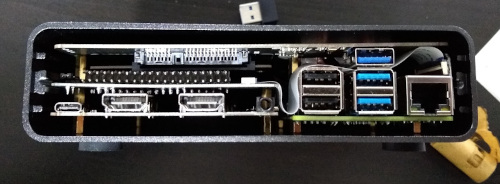
The Annoying DeskPi Pro without rear bezel The case is a little snug; I was worried I was going to damage things as I slid it in. Additionally the construction process is a little involved. There s a good set of instructions, but there are a lot of pieces and screws involved. This includes a couple of FFC cables to join things up. I think this is because they ve attempted to make a compact case rather than allowing a little extra room, and it does have the advantage that once assembled it feels robust without anything loose in it. DeskPi Pro with rear bezel and USB3 dongle I hate the need for an external USB3 dongle to bridge from the Pi to the USB/SATA adaptor. All the cases I ve seen with an internal drive bay have to do this, because the USB3 isn t brought out internally by the Pi, but it just looks ugly to me. It s hidden at the back, but meh. Fan control is via a USB/serial device, which is fine, but it attaches to the USB C power port which defaults to being a USB peripheral. Raspbian based kernels support device tree overlays which allows easy reconfiguration to host mode, but for a Debian based system I ended up rolling my own dtb file. I changed


#include "bcm283x-rpi-usb-peripheral.dtsi"
to
#include "bcm283x-rpi-usb-host.dtsi"
in arch/arm/boot/dts/bcm2711-rpi-4-b.dts and then I did:
cpp -nostdinc -I include -I arch -undef -x assembler-with-cpp \
    arch/arm/boot/dts/bcm2711-rpi-4-b.dts > rpi4.preprocessed
dtc -I dts -O dtb rpi4.preprocessed -o bcm2711-rpi-4-b.dtb
and the resulting bcm2711-rpi-4-b.dtb file replaced the one in /boot/firmware. This isn t a necessary step if you don t want to use the cooling fan in the case, or the front USB ports, and it s not really anyone s fault, but it was an annoying extra step to have to figure out. The DeskPi came with a microSD card that was supposed to have RaspiOS already on it. It didn t, it was blank. In my case that was fine, because I wanted to use Debian, but it was a minor niggle.

The Good I used Gunnar s pre-built Pi Debian image and it Just Worked; I dd d it to the microSD as instructed and the Pi 4 came up with working wifi, video and USB enabling me to get it configured for my network. I did an apt upgrade and got updated to the Buster 10.7 release, as well as the latest 5.9 backport kernel, and everything came back without effort after a reboot. It s lovely to be able to run Debian on this device without having to futz around with self-compiled kernels. The DeskPi makes a lot of effort to route things externally. The SD slot is brought out to the front, making it easy to fiddle with the card contents without having to open the case to replace it. All the important ports are brought out to the back either through orientation of the Pi, or extenders in the case. That means the built in Pi USB ports, the HDMI sockets (conveniently converted to full size internally), an audio jack and a USB-C power port. The aforementioned USB3 dongle for the bridge to the drive is the only external thing that s annoying. Thermally things seem good too. I haven t done a full torture test yet, but with the fan off the system is sitting at about 40 C while fairly idle. Some loops in bash that push load up to above 2 get the temperature up to 46 C or so, and turning the fan on brings it down to 40 C again. It s audible, but quieter than my laptop and not annoying. I liked the way the case came with everything I needed other than the Pi 4 and a suitable disk drive. There was an included PSU (a proper USB-C PD device, UK plug), the heatsink/fan is there, the USB/SATA converter is there and even an SD card is provided (though that s just because I had a pre-order). Speaking of the SD, I only needed it for initial setup. Recent Pi 4 bootloaders are capable of booting directly from USB mass storage devices. So I upgraded using the RPi EEPROM Recovery image (which just needs extracted to the SD FAT partition, no need for anything complicated - boot with it and the screen goes all green and you know it s ok), then created a FAT partition at the start of the drive for the kernel / bootloader config and a regular EXT4 partition for root. Copies everything over, updated paths, took out the SD and it all just works happily.

Summary My main complaint is the broken USB port, which feels like the result of a cheap connector. For a front facing port expected to see more use than the rear ports I think there s a reasonable expectation of robustness. However I m an early adopter and maybe future runs will be better. Other than that I m pretty happy. The case is exactly the sort of thing I wanted; I was looking for something that would turn the Pi into a box that can sit on my desk on the network and that I don t have to worry about knocking wires out of or lots of cables hooking bits up. Everything being included made it very convenient to get up and running. I still haven t poked the Pi that hard, but first impressions are looking good for it being a trouble free ARM64 dev box in the corner, until I can justify a HoneyComb.

John Goerzen: How To Join the Fediverse and Cast Off the Attention Economy

In a recent post, I wrote about how the attention economy in use at big social networks hurts you. In this post, I m going to suggest what to do about it. Mastodon and the Fediverse When you use email, you can send a message from an account at Google to one at Yahoo, Microsoft, or any of millions of businesses and organizations running their own mail server. Unlike, say, Facebook, email isn t a single service, but rather a whole bunch of independent systems that can communicate (or federate) with each other. The Fediverse is similar, and the most advanced Fediverse client is Mastodon. Mastodon: It s easy to get started! Head over to joinmastodon.org and click Get Started . Pick a community don t worry, this isn t a hugely consequential decision, as you can always move or change later. You can browse activity from across the Fediverse, or just on your local community, so if you find a community with similar interests, it can be a neat way to find others to follow. If you re looking for more details, mastodon.help has a nice guide. Defeating the Attention Economy So, why does Mastodon make a difference? First of all, you get to pick your host (and even software). With Twitter, you pretty much are using Twitter (yes, I know of things like Hootsuite, but for the vast majority of people, it s twitter.com only). With Mastodon, you have choice. Pick the host that runs the software and has the kind of moderation you like. Secondly, Mastodon is not for profit. There is no money to be made in keeping you on the site. Almost all Mastodon instances are ad-free. And Mastodon s completely open protocols make it easy to go elsewhere if you like. It s Not Just Mastodon! There are plenty of other programs in the Fediverse. And, this is really key, they all interact with each other. You can share photos in Pixelfed (sort of like a federated Instagram) and see them and comment in Mastodon! Some things to point out: And there are many others. This blog, for instance, runs WordPress and uses an ActivityPub connector; comments from the Fediverse integrate here. Find me in the Fediverse You can look me up: just type in @jgoerzen@floss.social in the search box of any Mastodon instance and click Follow. You can also follow this blog at @jgoerzen@changelog.complete.org.

13 December 2020

Russ Allbery: Review: Because Internet

Review: Because Internet, by Gretchen McCulloch
Publisher: Riverhead Books
Copyright: 2019
ISBN: 0-7352-1095-0
Format: Kindle
Pages: 276
If you're familiar with linguistics as a field of scientific study (as opposed to the tool-based fields of grammar or writing advice), you'll be familiar with the dichotomy between written and spoken language. We may spend more time thinking about written language since it is central to most types of education and carries much of the intellectual and social weight of society. Linguists, however, see spoken language as more fundamental, since speech is wired into our brains and universal in human societies. Written language is a recent and somewhat artificial invention. One also learns from linguistics that spoken language does not follow many of the rules of written language that we painstakingly memorized in school. In casual speech, people split infinitives, speak in partial and run-on sentences, ignore nit-picking pronoun case rules, and rarely notice or care about the difference between less and fewer. Spoken language does have rules, but they're more subtle and nuanced than the grammar rules we learn in school. (I think the real fun of linguistics is separating the rules that native speakers follow effortlessly from the artificial rules used as education markers.) This is, in part, because nearly all spoken language is informal, whereas nearly all written language is formal. Enter the Internet, and enter this book. For the first time in human history we have both an explosion of informal writing and easy availability of that writing to linguists for study. Informal writing is not entirely new, of course. We've had personal letters for nearly as long as we've had writing, not to mention private notes, diaries, and other writing intended for tiny audiences. But consider who wrote private letters and, on top of that historical filter, whose private letters were preserved for linguistic research. Until relatively recently, only the upper classes were literate and had access to the infrastructure to write and send letters. Someone's letters or private notes were unlikely to be preserved unless they were someone famous and important, and thus often well-educated and more likely to take a more formal tone in writing. If you compare this to the Internet-driven blizzard of work and personal email, SMS conversations, chatrooms, and social media posts, the difference is obvious in both volume and level of informality. We're all on the Internet, we all read and write with a frequency that would be staggering to the average person from even fifty years ago, and while one may take a bit of additional care with a tricky email to one's manager, the SMS message to one's friend is as informal of a use of language as a conversation over coffee. Gretchen McCulloch is a professional linguist and Because Internet is about exactly this phenomenon: the new conventions of informal writing, how it has changed and evolved, and the new subtleties and shortcuts we've invented to make written communication easier. That goes beyond words and grammar to encompass punctuation, emoji and emoticons, memes and reaction gifs, and even the subtleties of timing, whitespace, and the construction of virtual places via our choices in how and where we write. This topic is my catnip, so it's not surprising I love this book. I've been heavily involved with online communities that communicate in writing since 1993 (making me, in McCulloch's classification, an Old Internet Person; each wave of introduction to the Internet has its own conventions that can be in conflict with later waves). I've now spent more than half my life carrying out most of my social activity and most of my closest friendships primarily in writing, so I found a lot of satisfaction in a linguistic study that takes that seriously rather than treating it as a curiosity. But, even better, I was amazed at how much I didn't know, in part because I am from a specific wave. I have a deep intuition for the Usenet conventions, but not as good of an understanding of the ones from AIM and LiveJournal one wave later (the Full Internet People). And I had a lot to learn about the conventions of the Instagram and Snapchat cluster (the Post Internet People, who have never known life without the Internet). One of the things that struck me while reading this book is how most of the language innovations that McCulloch describes are addressing the old complaint that written communication is inferior to face-to-face conversation because it lacks emotional nuance. My knee-jerk reply is that, no, written communication is full of emotional nuance and the complainer is just bad at reading it, but that's somewhat unfair. A better statement of the problem is that there is not a standardized language for emotional nuance in written communication, in part because it's so new in human history. Most humans are extremely good at reading facial expressions and body language for emotional cues, and those physical expressions are largely subconscious, reliable, and similar among different people (particularly within a culture; one can get in trouble with body language variations across cultures). This is not true of writing. With friends I've talked to over chat for twenty-five years, I can read volumes about their emotional state in a couple of short lines of text. But with strangers, despite decades of Internet communications, I will still misread cues and misinterpret simple intentions. The other standard response to this complaint is that it is possible to put extensive emotional nuance into formal writing. Just get better at writing! This is true, but unhelpful. There's a reason why we give book contracts to people who are very good at investing formal writing with emotional nuance. It's difficult, time-consuming, and requires a great deal of practice. That may be appropriate for formal, paid writing, but it won't do for informal writing, which by definition needs to be as effortless as possible. It's therefore unsurprising that once millions of people were using the Internet regularly for informal writing, they started adding new mechanisms, shortcuts, and conventions for emotional nuance. The standardization is growing, but conventions still vary widely between waves of Internet users. One of the most fascinating parts of this book for me was McCulloch's explanation of why periods (and, to a lesser extent, capital letters) in short chat messages are perceived by younger users as harsh or passive-aggressive. I still have the formal writing mindset of treating proper capitalization and punctuation as a point of pride, but McCulloch makes an excellent argument for letting go of my biases and understanding how and why language is changing. The realization I had while reading this is that many of the changes that look like sloppiness or laziness to someone trained in formal writing have the effect of giving language greater dynamic range. If one always uses periods uniformly, the period becomes meaningless except as a sentence boundary (which is redundant with newlines in most short informal chat messages). If one normally doesn't use it, and then suddenly starts using it, the period can carry semantic weight. It can convey a snippy tone of voice, a note of annoyance, or other subtle shades of meaning. I still use periods in most of my Slack messages because habits are hard to break, but I'm remembering to leave them off some of the time and paying more attention to what emotional weight they're carrying when present. Because Internet is therefore the rare book that meets the bar of changing my day-to-day behavior. "lol" is another excellent example that McCulloch spends some time on. It started life as LOL, an abbreviation for "laughing out loud," and that's still how it's stuck in my head. But, as McCulloch explains, it no longer means that to newer waves of Internet users. It now carries a far more complicated and nuanced meaning that has very little to do with physical laughter and that doesn't easily translate to a single word or sentence. I went from being mildly irritated by and mildly superior towards the ubiquitous "lol" to realizing that it's a fascinating new word that carries primarily emotional nuance and that I don't understand well enough to read or use properly (yet). One more example of the type of analysis McCulloch brings to this book: emoji. The tendency when talking about emoji is to treat them as rebuses (pictures that stand in for a word, or at least a specific concept). They are sometimes used that way, but McCulloch argues that they more often function in the same role that gestures play in informal speech, including the gestures that have no simple name and no independent meaning outside of the context of the words being said at the same time. This seems obvious in retrospect, but before reading Because Internet I had never thought about what a gesture is, what function it plays in speech, and how that could be translated into informal written communication. If you're as interested in this area as I am, this is great stuff. I'd seen several mentions of this book go past on Twitter and kept holding off because I had lots of things to read and was worried it would only cover the superficial things I already knew as a long-time Internet user who has listened to a few lectures on linguistics. That was not the case at all. I learned so much from this book and had a delightful time reading it. If you're also interested in these topics, recommended. Rating: 9 out of 10

Junichi Uekawa: I created a video of how to use the web app to record video.

I created a video of how to use the web app to record video. Only supports Chrome browser due to the codec. video here. The app itself is here. My wish is that if everyone has this kind of tooling then it's easy to record your hacks and we can share our hacks to each other. This is the new normal.

Junichi Uekawa: What's your config for sharing emacs ?

What's your config for sharing emacs ? In a remote-primary world coding with peers I share my emacs a lot; I think most of the video streams are optimized for 720p which is 1280x720; and tuning emacs config; probably fonts with 10 pixels width each is about right. A frame with 160x50 or 128x40 is probably reasonable.

12 December 2020

Junichi Uekawa: Added multiple windows and a camera angle.

Added multiple windows and a camera angle. Maybe when I am talking and slides haven't started I want to show my face. I probably have a terminal and presentation to show off. So added a way to toggle between the sources. here.

10 December 2020

Jonathan Carter: CentOS Stream, or Debian?

It s the end of CentOS as we know it Earlier this week, the CentOS project announced the shift to CentOS stream. In a nutshell, this means that they will discontinue being a close clone of RHEL along with security updates, and instead it will serve as a development branch of RHEL. As you can probably imagine (or gleam from the comments in that post I referenced), a lot of people are unhappy about this. One particular quote got my attention this morning while catching up on this week s edition of Linux Weekly News, under the distributions quotes section:

I have been doing this for 17 years and CentOS is basically my life s work. This was (for me personally) a heart wrenching decision. However, i see no other decision as a possibility. If there was, it would have been made.Johnny Hughes
I feel really sorry for this person and can empathize, I ve been in similar situations in my life before where I ve poured all my love and energy into something and then due to some corporate or organisational decisions (and usually poor ones), the project got discontinued and all that work that went into it vanishes into the ether. Also, 17 years is really long to be contributing to any one project so I can imagine that this must have been especially gutting.

Throw me a freakin bone here I m also somewhat skeptical of how successful CentOS Stream will really be in any form of a community project. It seems that Red Hat is expecting that volunteers should contribute to their product development for free, and then when these contributors actually want to use that resulting product, they re expected to pay a corporate subscription fee to do so. This seems like a very lop-sided relationship to me, and I m not sure it will be sustainable in the long term. In Red Hat s announcement of CentOS Stream, they kind of throw the community a bone by saying In the first half of 2021, we plan to introduce low- or no-cost programs for a variety of use cases - it seems likely that this will just be for experimental purposes similar to the Windows Insider program and won t be of much use for production users at all. Red Hat does point out that their Universal Base Image (UBI) is free to use and that users could just use that on any system in a container, but this doesn t add much comfort to the individuals and organisations who have contributed huge amounts of time and effort to CentOS over the years who rely on a stable, general-purpose Linux system that can be installed on bare metal.

Way forward for CentOS users Where to from here? I suppose CentOS users could start coughing up for RHEL subscriptions. For many CentOS use cases that won t make much sense. They could move to another distribution, or fork/restart CentOS. The latter is already happening. One of the original founders of the CentOS project, Gregory Kurtzer, is now working on Rocky Linux, which aims to be a new free system built from the RHEL sources. Some people from Red Hat and Canonical are often a bit surprised or skeptical when I point out to them that binary licenses are also important. This whole saga is yet another data point, but it proves that yet again. If Red Hat had from the beginning released RHEL with free sources and unobfuscated patches, then none of this would ve been necessary in the first place. And while I wish Rocky Linux all the success it aims to achieve, I do not think that working for free on a system that ultimately supports Red Hat s selfish eco-system is really productive or helpful. The fact is, Debian is already a free enterprise-scale system already used by huge organisations like Google and many others, which has stable releases, LTS support and ELTS offerings from external organisations if someone really needs it. And while RHEL clones have come and gone through the years, Debian s mission and contract to its users is something that stays consistent and I believe Debian and its ideals will be around for as long as people need Unixy operating systems to run anywhere (i.e. a very long time). While we sometimes fall short of some of our technical goals in Debian, and while we don t always agree on everything, we do tend to make great long-term progress, and usually in the right direction. We ve proved that our method of building a system together is sustainable, that we can do so reliably and timely and that we can collectively support it. From there on it can only get even better when we join forces and work together, because when either individuals or organisations contribute to Debian, they can use the end result for both private or commercial purposes without having to pay any fee or be encumbered by legal gotchas. Don t get caught by greedy corporate motivations that will result in you losing years of your life s work for absolutely no good reason. Make your time and effort count and either contribute to Debian or give your employees time to do so on company time. Many already do and reap the rewards of this, and don t look back. While Debian is a very container and virtualization friendly system, we ve managed to remain a good general-purpose operating system that manages to span use cases so vast that I d have to use a blog post longer than this one just to cover them. And while learning a whole new set of package build chain, package manager and new organisational culture and so on can be uhm, really rocky at the start, I d say that it s a good investment with Debian and unlikely to be time that you ll ever felt was wasted. As Debian project leader, I m personally available to help answer any questions that someone might have if they are interested in coming over to Debian. Feel free to mail leader_AT_debian.org (replace _AT_ with @) or find me on the oftc IRC network with the nick highvoltage. I believe that together, we can make Debian the de facto free enterprise system, and that it would be to the benefit of all its corporate users, instead of tilting all the benefit to just one or two corporations who certainly don t have your best interests in mind.

5 December 2020

Junichi Uekawa: Learning WebAudio.

Learning WebAudio. I wanted to make a multi-track recorder before but I couldn't. This morning I am starting with single track audio recording and play back. here is audio record code.

4 December 2020

Russell Coker: ZFS 2.0.0 Released

Version 2.0 of ZFS has been released, it s now known as OpenZFS and has a unified release for Linux and BSD which is nice. One new feature is persistent L2ARC (which means that when you use SSD or NVMe to cache hard drives that cache will remain after a reboot) is an obvious feature that was needed for a long time. The Zstd compression invented by Facebook is the best way of compressing things nowadays, it s generally faster while giving better compression than all other compression algorithms and it s nice to have that in the filesystem. The PAM module for encrypted home directories is interesting, I haven t had a need for directory level encryption as block device encryption has worked well for my needs. But there are good use cases for directory encryption. I just did a quick test of OpenZFS on a VM, the one thing it doesn t do is let me remove a block device accidentally added to a zpool. If you have a zpool with a RAID-Z array and mistakenly add a new disk as a separate device instead of replacing a part of the RAID-Z then you can t remove it. There are patches to allow such removal but they didn t appear to get in to the OpenZFS 2.0.0 release. For my use ZFS on Linux 0.8.5 has been working fairly well and apart from the inability to remove a mistakenly added device I haven t had any problems with it. So I have no immediate plans to upgrade existing servers. But if I was about to install a new ZFS server I d definitely use the latest version. People keep asking about license issues. I m pretty sure that Oracle lawyers have known about sites like zfsonlinux.org for years, the fact that they have decided not to do anything about it seems like clear evidence that it s OK for me to keep using that code.

3 December 2020

Daniel Lange: No dog food today - the Linux Foundation annual report

The Linux Foundation has published its annual report today. LWN calls it glossy and yeah, boy, it is shiny. So shiny that people that work in the publishing industry immediately see this has been produced with the Adobe toolchain which - unfortunately - is one of the big suites of software not yet available for Linux. Checking the PDF file metadata reveals the keywords "open source, open standards, open hardware, open data". That is what the Linux Foundation is about. Good stuff. Linux Foundation annual report 2020 cover The PDF producer meta data for the annual report PDF has been set to "Linux kernel 0.12.1 for Workgroups" and the PDF creator meta data element to "Sharp Zaurus XR-5000 (Maemo5) Edition". Somebody thought to better hide the real data and had some tongue-in-cheek ideas. Kudos. But nicer would have been to use Open Source software to produce the report, not? Running strings 2020-Linux-Foundation-Annual-Report_113020.pdf grep Adobe wc -l gives us 1229 lines and confirms the suspicion of the toolchain. A stale /Title (Annual Report 2020) /Producer (macOS Version 10.15.7 \(Build 19H15\) Quartz PDFContext) has been forgotten in the document to tell us about the platform. So, ladies and gentlemen, the Linux Foundation 2020 annual report has been produced on a Mac. Running Adobe Creative Cloud on MacOS Catalina 10.15.7. Which is proprietary software. Its kernel (and some userland pieces) are based on BSD. Not Linux.

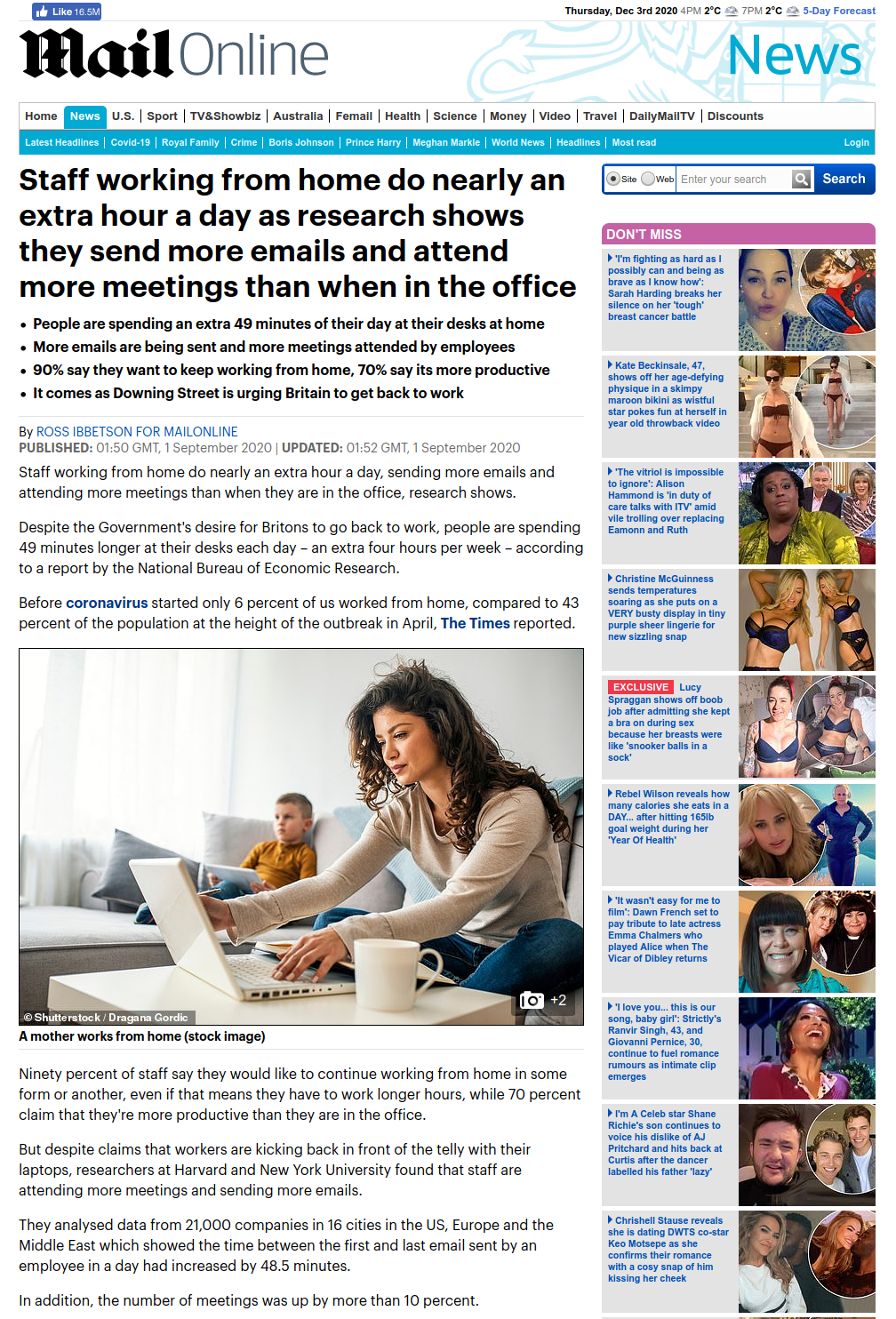
The image on the front page also struck me as a bit odd ... using a ballpoint pen on the laptop screen? Unbranded laptop. Unbranded cup in the foreground. Kid in the background not paying attention to his tablet. All of that cries stock image so loud it hurts. Google currently finds ~560 uses of the picture and any editorial use nicely tells us that it is Dragana Gordic / Shutterstock. The image is "Smiling mom working at home with her child on the sofa while writing an email. Young woman working from home, while in quarantine isolation during the Covid-19 health crisis". See the Daily Mail for a wonderful example of the working mum in context. I hope, if her laptop had been powered on, it would have run Linux. I mean, what else would still run on an old white MacBook with an Intel "Core 2 Duo" processor from 2008? Daily Mail screenshot of the same stock image used Continue reading "No dog food today - the Linux Foundation annual report"

1 December 2020

Junichi Uekawa: Been implementing something for pair programming.

Been implementing something for pair programming. Sharing the display is probably the most core part and the rest are minor improvements.

Shirish Agarwal: The Constitution of Knowledge

Truth, Untruths and Education in India. I read this somewhat disturbing and yet pretty raw truth from foreign affairs. It took me quite a few days to not only digest but also say yes and see the same situation playing out in India. I have been seeing the discourse on Twitter and while a part of it is the equivalent of road rage, a huge part is a disconnect to not acknowledge and be civil. We may come to different conclusions from the same data but being civil seems to be difficult for a lot of people. One part is of course ego, where nobody wants to lose, but more than that are the plain comprehension issues. Most of the literature, good literature is unfortunately based in English.

And while we can have differing opinions of what constitutes good literature, for me it s books like Battle of Belonging,The:On Nationalism, Patriotism, and What it Means Shashi Tharoor. From what little I have understood, the book makes the case of civic nationalism which is far more inclusive than the narrow confines of patriotism. Now this begs the question when you have such books and many books which do tell you about different aspects of social, political and knowledge, why are so many people prone to disinformation in India similar to U.S. and probably other countries as well. One of the biggest reasons per-se is lack of education and quality education. When the number of graduates is less than five percent how do you expect that population to be able to take decisions in their economic self-interest? So sadly the understanding is ingrained from WhatsApp and there is no need to check from alternate sources. And just like Mr. Trump followers, they believe those versions to be the unvarnished truth. I do understand that no truth is immutable except for life and death. All others are imperfect unless it is validated by some sort of scientific validation behind it. At the same time, these truths may themselves be invalidated if a stronger scientific evidence establishes itself. This is the reason why hypothesis and facts themselves are challenged again and again. Sharing couple of examples below.

Nationalization of Banking, RERA and RCEP Most of the people want freedom of the banks i.e. private banking don t really know that private banking existed at a time in free India before they were nationalized and these banks failed at surprisingly regular intervals. Now it isn t as if this fact is hidden but it is not as popular as maybe some other facts or ideas. Now the Government in the center obviously doesn t want to share these facts as they want corporates in banking. And if that fact is known by many people it will be a huge setback to their plans. RBI failures have been to many to count. Even recent legislations like RERA and others which were supposed to bring relief to millions of potential homeowners has become a pawn in the hands of builders and this has been known. One of the interesting points of RCEP which is not so much in public domain is that RCEP would have a mere 4.5% duty on most products which will go down to 1.5% over a 20 year period. Now with India staying out of it, we have done two things. We have said that we will not be competitive even after 20 years of this which is the more damning part. And we will not take part in the growth that other countries will have due to this. Contempt Proceedings against Comic Artist because she has an opinion on SC The fall in SC and constitutional values grows day by day. The AG today consented to have contempt proceedings against a comic artist saying she insulted the SC. Gone are the days when an artist made fun of the PM, and she gave him a Padam Shri (one of the highest civilian honors) for his contributions. Then, even dissent or being cynical was looked as being a contribution to the national effort rather than today. This is the reason why India has been continuously falling in the Global Freedom of Expression Index. I have seen censoring many a time here. I, myself has been locked out of Wikipedia many times. Can you imagine, being locked out of Wikipedia which is perhaps one of the more neutral sites on the web. And then there was this wikibio thing, such a sad thing to happen. Guessing this is the future of the Indian interweb.
Stick figure by Sanitary Panels on SC

Paul Wise: FLOSS Activities November 2020

Focus This month I didn't have any particular focus. I just worked on issues in my info bubble.

Changes

Issues

Review

Administration
  • Debian wiki: disable attachments due to security issue, approve accounts

Communication
  • Respond to queries from Debian users and contributors on the mailing lists and IRC

Sponsors The visdom, apt-listchanges work and lintian-brush bug report were sponsored by my employer. All other work was done on a volunteer basis.

28 November 2020

Russ Allbery: Review: Nine Goblins

Review: Nine Goblins, by T. Kingfisher
Publisher: Red Wombat Tea Company
Copyright: 2013
ASIN: B00G9GSEXO
Format: Kindle
Pages: 140
The goblins are at war, a messy multi-sided war also involving humans, elves, and orcs. The war was not exactly their idea, although the humans would claim otherwise. Goblins kept moving farther and farther into the wilderness to avoid human settlements, and then they ran out of wilderness, and it wasn't clear what else to do. For the Nineteenth Infantry, the war is a confusing business, full of boredom and screaming and being miserable and following inexplicable orders. And then they run into a wizard. Wizards in this world are not right in the head, and by not right I mean completely psychotic. That's the only way that you get magical powers. Wizards are therefore incredibly dangerous and scarily unpredictable, so when the Whinin' Nineteenth run into a human wizard who shoots blue out of his mouth, making him stop shooting blue out of his mouth becomes a high priority. Goblins have only one effective way of stopping things: charge at them and hit them with something until they stop. Wizards have things like emergency escape portals. And that's how the entire troop of nine goblins ended up far, far behind enemy lines. Sings-to-Trees's problems, in contrast, are rather more domestic. At the start of the book, they involve, well:
Sings-to-Trees had hair the color of sunlight and ashes, delicately pointed ears, and eyes the translucent green of new leaves. His shirt was off, he had the sort of tanned muscle acquired from years of healthy outdoor living, and you could have sharpened a sword on his cheekbones. He was saved from being a young maiden's fantasy unless she was a very peculiar young maiden by the fact that he was buried up to the shoulder in the unpleasant end of a heavily pregnant unicorn.
Sings-to-Trees is the sort of elf who lives by himself, has a healthy appreciation for what nursing wild animals involves, and does it anyway because he truly loves animals. Despite that, he was not entirely prepared to deal with a skeleton deer with a broken limb, or at least with the implications of injured skeleton deer who are attracted by magical disturbances showing up in his yard. As one might expect, Sings-to-Trees and the goblins run into each other while having to sort out some problems that are even more dangerous than the war the goblins were unexpectedly removed from. But the point of this novella is not a deep or complex plot. It pushes together a bunch of delightfully weird and occasionally grumpy characters, throws a challenge at them, and gives them space to act like fundamentally decent people working within their constraints and preconceptions. It is, in other words, an excellent vehicle for Ursula Vernon (writing as T. Kingfisher) to describe exasperated good-heartedness and stubbornly determined decency.
Sings-to-Trees gazed off in the middle distance with a vague, pleasant expression, the way that most people do when present at other people's minor domestic disputes, and after a moment, the stag had stopped rattling, and the doe had turned back and rested her chin trustingly on Sings-to-Trees' shoulder. This would have been a touching gesture, if her chin hadn't been made of painfully pointy blades of bone. It was like being snuggled by an affectionate plow.
It's not a book you read for the twists and revelations (the resolution is a bit of an anti-climax). It's strength is in the side moments of characterization, in the author's light-hearted style, and in descriptions like the above. Sings-to-Trees is among my favorite characters in all of Vernon's books, surpassed only by gnoles and a few characters in Digger. The Kingfisher books I've read recently have involved humans and magic and romance and more standard fantasy plots. This book is from seven years ago and reminds me more of Digger. There is less expected plot machinery, more random asides, more narrator presence, inhuman characters, no romance, and a lot more focus on characters deciding moment to moment how to tackle the problem directly in front of them. I wouldn't call it a children's book (all of the characters are adults), but it has a bit of that simplicity and descriptive focus. If you like Kingfisher in descriptive mode, or enjoy Vernon's descriptions of D&D campaigns on Twitter, you are probably going to like this. If you don't, you may not. I thought it was slight but perfect for my mood at the time. Rating: 7 out of 10

Next.

Previous.