From November 28 till December 2, 2007, I attended a Debian QA and release teams work session in
Extremadura, which is an autonomous community of western Spain, that managed to install Debian on 90000 computers in every school (technically a Debian based distribution called
gnuLinEx) and
Junta de Extremadura also
sponsored this meeting.
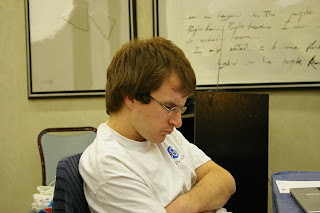
I took photos of all participants, see my
first,
second and
third posts. When I arrived at the Madrid airport where we first met, I set myself a goal to remember all names and faces, so I used my blog to help me and I think I succeeded in the end. :)

See also our
wiki page that we used prior and during the meeting.
So what did we do besides throwing candies?

Lucas Nussbaum will send a summary email soon about the meeting, so I'll just speak for
myself:
I worked with Gon ri on
svnbuildstat, that is a service for building packages and show statistics about lintian/linda/piuparts checks. It for example contains all packages of the
Debian Python Modules Team (that I am a member of) and many others. We discussed and started to work on how to create robust buildbots, that can be installed as a regular Debian package with zero (if possible) configuration, so that many people can just install them without pain, thus providing a huge scalability to the project.
We wrote a preliminary
patch to pbuilder for killing the build if it exceeds given memory/disk usage. I had to learn the internals of pbuilder and I lost quite some time squashing some stupid bug I caused while writing the patch.
I spent most of my time with svnbuildstat, mostly learning and discussing things. This will be important for the future, but to also have some real results, I also fixed some packages I comaintain:
Together with
Kumar Appaiah we fixed the
python-numpy package and I had it uploaded, then I learned how to work with quilt instead of dpatch to handle patches in Debian packages, thanks to Holger's
webpage, that contains a nice tutorial. Then I switched from dpatch to quilt in
python-scipy and backported a patch from upstream svn to fix a segfault
bug and had the package uploaded.
Then I finished the
Cython package and had it uploaded. Cython is a marvelous package to speed up Python programs and interface C/C++ programs. I greatly recommend to try. If you don't like it, you can try some of at least
10 other ways to wrap C code in Python. I also used quilt in there to backport a patch from the upstream Mercurial repository to implement parsing @classmethods. Quilt is really a pleasure to work with.
Impressions from the meetingI've been using Debian since 2001 as my only operating system on all of my computers, so I am not a complete beginner. But it never occured to me I could get involved in Debian more than a user and an occasional bug reporter. What a mistake.
I started packaging new things and fixing packages that I need for my work and that didn't work. This got me involved quite a bit in Debian. But in M rida it was the first time I could dring a beer (well, especially
wine) with Debian Developers and I found out they are really cool people. They are all very skilled. Also something, that I love about Debian, is that the people involved in it share two common features, that are very important for them - respect to democracy and personal freedom. When I think about it, those are probably the first two items on my presonal list of values.
Of course, everytime there is a group of 1000+ people, there are good and bad people, more and less skilled, but important is the overall atmosphere - and that is as I described. I think Debian is truly unique. There is Gentoo, that has maybe 40 (?) active developers. There is Ubuntu, that has maybe 100 (?) developers, but it's basically a comercial distribution and there is not so many interesting work for non employees of Canonical. There is opensuse and fedora, where I am not sure about the numbers. The atmosphere in Debian can change in the future, one never knows, but as of the end of 2007, I think it's very cool to get involved.
Maybe it's not for everyone, but it's the right place for me.
 There have been several long-term wishlist bugs on Mutt to include the
(in?)famous "sidebar" patch. It adds a panel on the left side of the screen to
list mailboxes with message counts.
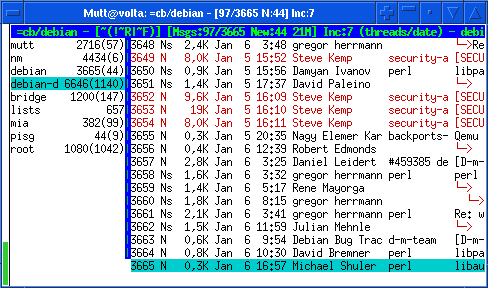 We do ship several patches with Debian's Mutt package that are not considered
for inclusion by the upstream authors, but this one is different. It touches
the core of the UI renderer and adds extensive counting of messages. There's
been quite a hype about the patch, it was even included in the (now
discontinued [1]) mutt-ng fork. Unfortunately, the patch was technically questionable, it
was written for the Mutt tarballs and didn't easily apply to CVS, and most
versions floating around contained lots of cruft like backup files and
temporary editor files. Furthermore, it is far from bug-free and even segfaults
occasionally.
Some months ago we decided we would build a second binary package to put the
patch in so we don't destabilize the standard package. Thanks Dann Frazier, we
got a clean patch, Adeodato had the right idea on how to build two binaries
from the same, differently-patched source (make install would run havoc, the
trick was to build the patched version before the regular one), and I
resolved some more involved conflicts with the maildir-mtime patch.
So, finally, there it is:
 In a sudden rush of stupidity, the Argentinian government decided that
we should change our timezone to include DST.
For those that don't know, Argentina lies almost completely in the GMT-4
zone. 20 years ago we used to have DST, switching between GMT-4 and GMT-3.
But since 1990 we've been using GMT-3 as the permanent timezone for our
country. Thus, noon happens at 13:00 (or even later in more western parts
of the country).
Now, since we are in energetic crisis, our government decided
that we should go back to DST, but instead of GMT-4 and GMT-3, we are going
to be GMT-3 and GMT-2. This means that during the summer noon will happen
at 14:00 or later.
Not only this, but they decided to do this on December 21st, passed the
law on December 26th, and published it on December 28th. And the day of the
switch is December 30th!.
Thanks to the quick work of Clint Adams, a patch was provided, applied
and uploaded to unstable today, and it's already available. After the
package was uploaded, I patched Etch's version so that we could upgrade all
our servers.
So, in case you need to take Argentina's stupidity into account, you can
currently download tzdata_2007j-3 from unstable, or download
tzdata_2007j-1etch2 from:
 A few days ago, I asked about
 Some small portable MP3 players also allow reproducing images and videos (does anyone know why they call them MP4 players?), but they need the latter to be in some funny format called SMV (for devices with SigmaTel chipset. Other devices use different formats, such as
 Hope you had a good Christmas Day if you celebrate it. The cycling starts again already:
 As I wrote earlier, I
 Yesterday was a nice sunny break in the mostly constant cloud cover. I went
out to the Clinch Mtn and climbed up to the fire tower, it was very clear
and I think I was able to see South Holston lake from there.
 My
 Everyone knows that Webmin is nasty - it does things in wrong way on a pure and nice Debian (and Ubuntu) systems and for some reason is not included in Debian (post-sarge) or Ubuntu. That does not inspire confidence in a root-running web based software to say the least.
 Seth Oster, executive VP and chief communications officer of the MPAA, told Ars that the notice came over the Thanksgiving holiday when their offices were closed. "As soon as we came back and discovered that there had been someone who had raised some concerns, we removed the software," Oster said. "Anytime anyone raises any reasonable concern we look at it because we take copyright very seriously at the MPAA." He also denied Garret's assertions that the ISP was involved in the takedown, saying that the MPAA chose to take the toolkit offline.


