Here s my (tenth) monthly update about the activities I ve done in the F/L/OSS world.
Debian
This was my 17th month of contributing to Debian.
I became a DM in late March last year and a DD last Christmas! \o/
Well, this month I didn t do a lot of Debian stuff, like I usually do, however, I did a lot of things related to Debian (indirectly via GSoC)!
Anyway, here are the following things I did this month:
Also, I log daily updates at gsocwithutkarsh2102.tk.
Whilst the daily updates are available at the above site^, I ll breakdown the important parts of the later half of the second month here:
Marc Andre, very kindly, helped in fixing the specs that were failing earlier this month. Well, the problem was with the specs, but I am still confused how so. Anyway..
Finished documentation of the second cop and marked the PR as ready to be reviewed.
David reviewed and suggested some really good changes and I fixed/tweaked that PR as per his suggestion to finally finish the last bits of the second cop, RelativeRequireToLib.
Merged the PR upon two approvals and released it as v0.2.0!
We had our next weekly meeting where we discussed the next steps and the things that are supposed to be done for the next set of cops.
Introduced rubocop-packaging to the outer world and requested other upstream projects to use it! It is being used by 13 other projects already!
Started to work on packaging-style-guide but I didn t push anything to the public repository yet.
Worked on refactoring the cops_documentation Rake task which was broken by the new auto-corrector API. Opened PR #7 for it. It ll be merged after the next RuboCop release as it uses CopsDocumentationGenerator class from the master branch.
Whilst working on autoprefixer-rails, I found something unusual. The second cop shouldn t really report offenses if the require_relative calls are from lib to lib itself. This is a false-positive. Opened issue #8 for the same.
Continuation of GSoC for other Ruby related stuff!
Whilst working on rubocop-packaging, I contributed to more Ruby projects, refactoring their library a little bit and mostly fixing RuboCop issues and fixing issues that the Packaging extension reports as offensive .
Following are the PRs that I raised:
Debian (E)LTS
Debian Long Term Support (LTS) is a project to extend the lifetime of all Debian stable releases to (at least) 5 years. Debian LTS is not handled by the Debian security team, but by a separate group of volunteers and companies interested in making it a success.
And Debian Extended LTS (ELTS) is its sister project, extending support to the Jessie release (+2 years after LTS support).
This was my tenth month as a Debian LTS and my first as a Debian ELTS paid contributor.
I was assigned 25.25 hours for LTS and 13.25 hours for ELTS and worked on
the following things:
Other(s)
Sometimes it gets hard to categorize work/things into a particular category.
That s why I am writing all of those things inside this category.
This includes two sub-categories and they are as follows.
Personal:
This month I did the following things:
Released v0.2.0 of rubocop-packaging on RubyGems!
It s open-sourced and the repository is here.
Bug reports and pull requests are welcomed!
Released v0.1.0 of get_root on RubyGems!
It s open-sourced and the repository is here.
Wrote max-word-frequency, my Rails C1M2 programming assignment.
And made it pretty neater & cleaner!
Refactored my lts-dla and elts-ela scripts entirely and wrote them in Ruby so that there are no issues and no false-positives!
Check lts-dla here and elts-ela here.
And finally, built my first Rails (mini) web-application!
The repository is here. This was also a programming assignment (C1M3).
And furthermore, hosted it at Heroku.
Open Source:
Again, this contains all the things that I couldn t categorize earlier.
Opened several issues and PRs:
Issue #8273 against rubocop, reporting a false-positive auto-correct for Style/WhileUntilModifier.
Issue #615 against http reporting a weird behavior of a flaky test.
PR #3791 for rubygems/bundler to remove redundant bundler/setup require call from spec_helper generated by bundle gem.
Issue #3831 against rubygems, reporting a traceback of undefined method, rubyforge_project=.
Issue #238 against nheko asking for enhancement in showing the font name in the very font itself.
PR #2307 for puma to constrain rake-compiler to v0.9.4.
And finally, I joined the Cucumber organization! \o/
Thank you for sticking along for so long :)
Until next time. :wq for today.
rejected
autotalent (not the package),
bart (logo),
mumble-server (client UI),
hpcc (not a screenshot)
approved deletion of
theli (replacing incorrect screenshot)
rejected deletion of
gnome-bluetooth/aptitude/torbrowser-launcher (unintelligible),
phpbb3/hashcat/onboard/kcharselect (spam),
various packages (not the place to report abuse),
vim (not the place to send kudos)
Administration
Debian wiki:
unblock IP addresses,
approve accounts,
reset email addresses
So even after years and years of experience, core tools still find ways to
surprise me. Today I tried to do some timestamp comparisons with mawk
(vnl-filter, to be more precise), and ran into a detail of the language that
made it not work. Not a bug, I guess, since both mawk and gawk are affected.
I'll claim "language design flaw", however.
Let's say I'm processing data with unix timestamps in it (seconds since the
epoch). gawk and recent versions of mawk have strftime() for that:
$ date
Wed Jul 29 15:31:13 PDT 2020
$ date +"%s"
1596061880
$ date +"%s"   mawk ' print strftime("%H",$1) '
15
And let's say I want to do something conditional on them. I want only data after
9:00 each day:
$ date +"%s" mawk 'strftime("%H",$1) >= 9 print "Yep. After 9:00" '
That's right. No output. But it is 15:31 now, and I confirmed above that
strftime() reports the right time, so it should know that it's after 9:00, but
it doesn't. What gives?
As we know, awk (and perl after it) treat numbers and strings containing numbers
similarly: 5+5 and ="5"+5= both work the same, which is really convenient.
This can only work if it can be inferred from context whether we want a number
or a string; it knows that addition takes two numbers, so it knows to convert
="5"= into a number in the example above.
But what if an operator is ambiguous? Then it picks a meaning based on some
internal logic that I don't want to be familiar with. And apparently awk
implements string comparisons with the same < and > operators, as numerical
comparisons, creating the ambiguity I hit today. strftime returns strings, and
you get silent, incorrect behavior that then demands debugging. How to fix? By
telling awk to treat the output of strftime() as a number:
$ date +"%s"   mawk '0+strftime("%H",$1) >= 9  print "Yep. After 9:00" '
Yep. After 9:00
With the benefit of hindsight, they really should not have reused any operators
for both number and string operations. Then these ambiguities wouldn't occur,
and people wouldn't be grumbling into their blogs decades after these decisions
were made.
Many people labour under the assumption that pop culture is trivial and useless while only 'high' art can grant us genuine and eternal knowledge about the world. Given that we have a finite time on this planet, we are all permitted to enjoy pop culture up to a certain point, but we should always minimise our interaction with it, and consume more moral and intellectual instruction wherever possible.
Or so the theory goes. What these people do not realise is that pop and mass culture can often provide more information about the world, humanity in general and what is even more important ourselves.
This is not quite the debate around whether high art is artistically better, simply that pop culture can be equally informative. Jeremy Bentham argued in the 1820s that "prejudice apart, the game of push-pin is of equal value with the arts and sciences of music and poetry", that it didn't matter where our pleasures come from. (John Stuart Mill, Bentham's intellectual rival, disagreed.) This fundamental question of philosophical utilitarianism will not be resolved here.
However, what might begin to be resolved is our instinctive push-back against pop culture. We all share an automatic impulse to disregard things we do not like and to pretend they do not exist, but this wishful thinking does not mean that these cultural products do not continue to exist when we aren't thinking about them and, more to our point, continue to influence others and even ourselves.
Take, for example, the recent trend for 'millennial pink'. With its empty consumerism, faux nostalgia, reductive generational stereotyping, objectively ugly sthetics and tedious misogyny (photographed with Rose Gold iPhones), the very combination appears to have been deliberately designed to annoy me, curiously providing circumstantial evidence in favour of intelligent design. But if I were to immediately dismiss millennial pink andanyoftheothercountlessculturaltrendsIdislikesimplybecauseIfindthemdisagreeable, I would be willingly keeping myself blind to their underlying ideology, their significance and their effect on society at large.
If I had any ethicalorpoliticalreservations I might choose not to engage with them economically or to avoid advertising them to others, but that is a different question altogether.
Even if we can't notice this pattern within ourselves we can first observe it in others. We can all recall moments where someone has brushed off a casual reference to pop culture, be it Tiger King, TikTok, team sports or Taylor Swift; if you can't, simply look for the abrupt change of tone and the slightly-too-quick dismissal. I am not suggesting you attempt to dissuade others or even to point out this mental tic, but merely seeing it in action can be highly illustrative in its own way.
In summary, we can simultaneously say that pop culture is not worthy of our time relative to other pursuits while consuming however much of it we want, but deliberately dismissing pop culture doesn't mean that a lot of other people are not interacting with it and is therefore undeserving of any inquiry. And if that doesn't convince you, just like the once-unavoidable millennial pink, simply sticking our collective heads in the sand will not mean that wider societal-level ugliness is going to disappear anytime soon.
Anyway, that's a very long way of justifying why I plan to re-watch TNG.
Hmm, this is the latest I ve posted my monthly updates yet (nearly by a month!). June was both crazy on the incoming side, and at the same time I just wasn t that productive (at least since then I caught up a lot). In theory, lockdown means that I spend less time in traffic, in shops or with friends and have more time to do stuff, in practice I go to bed later and later and waste more time watching tv shows and playing mobile games. A cycle that I have at least broken free from since June.
Debian Package Uploads
2020-06-04: Upload package btfs (2.21-1) to Debian unstable.
2020-06-04: Upload package gnome-shell-extension-disconnect-wifi (24-1) to Debian unstable.
2020-06-18: Sponsor package gamemode (1.5.1-5) for Debian unstable (Games team request).
2020-06-21: Upload package calamares (3.2.26-1) to Debian unstable.
2020-06-21: Upload package s-tui (1.0.1-1) to Debian unstable.
2020-06-29: Sponsor package libinih (48-1~bpo10+1) for Debian buster-backports.
2020-06-30: Upload packge calamares (3.2.26-1~bpo10+1) to Debian buster-backports.
2020-06-30: Upload package toot (0.27.0-1) to Debian unstable.
2020-06-30: Upload package calamares (3.2.26.1-1) to Debian unstable.
Sometimes I enjoy reading the source code to projects I like, use, or am about to install for the first time. This was something I used to do on a very regular basis, looking for security issues to report. Nowadays I don't have so much free time, but I still like to inspect the source code to new applications I install, and every now and again I'll find the time to look at the source to random projects.
Reading code is good. Reading code is educational.
One application I've looked at multiple times is redis, which is a great example of clean and well-written code. That said when reading the redis codebase I couldn't help noticing that there were a reasonably large number of typos/spelling mistakes in the comments, so I submitted a pull-request:
Sadly that particular pull-request didn't receive too much attention, although a previous one updating the configuration file was accepted. I was recently reminded of these pull-requests when I was when I was doing some other work. So I figured I'd have a quick scan of a couple of other utilities.
In the past I'd just note spelling mistakes when I came across them, usually I'd be opening each file in a project one by one and reading them from top to bottom. (Sometimes I'd just open files in emacs and run "M-x ispell-comments-and-strings", but more often I'd just notice them with my eyes). It did strike me that if I were to do this in a more serious fashion it would be good to automate it.
So this time round I hacked up a simple "dump comments" utility, which would scan named files and output the contents of any comments (be they single-line, or multi-line). Once I'd done that I could spell-check easily:
 $ go run dump-comments.go *.c > comments
 $ aspell -c comments
Anyway the upshot of that was a pull-request against git:
We'll see if that makes its way live sometime. In case I get interested in doing this again I've updated my sysbox-utility collection to have a comments sub-command. That's a little more robust and reliable than my previous hack:
Review: The City in the Middle of the Night, by Charlie Jane Anders
Publisher:
Tor
Copyright:
February 2019
Printing:
February 2020
ISBN:
1-4668-7113-X
Format:
Kindle
Pages:
366
January is a tidally-locked planet divided between permanent night and
permanent day, an unfortunate destination for a colony starship. Now,
humans cling to a precarious existence along the terminator, huddling in
two wildly different cities and a handful of smaller settlements,
connected by a road through the treacherous cold.
The novel opens with Sophie, a shy university student from the dark side
of the city of Xiosphant. She has an overwhelming crush on Bianca, her
high-class, self-confident roommate and one of the few people in her life
to have ever treated her with compassion and attention. That crush, and
her almost non-existent self-esteem, lead her to take the blame for
Bianca's petty theft, resulting in what should have been a death sentence.
Sophie survives only because she makes first contact with a native
intelligent species of January, one that the humans have been hunting for
food and sport.
Sadly, I think this is enough Anders for me. I've now bounced off two of
her novels, both for structural reasons that I think go deeper than
execution and indicate a fundamental mismatch between what Anders wants to
do as an author and what I'm looking for as a reader.
I'll talk more about what this book is doing in a moment, but I have to
start with Bianca and Sophie. It's difficult for me to express how much I
loathed this relationship and how little I wanted to read about it. It
took me about five pages to peg Bianca as a malignant narcissist and
Sophie's all-consuming crush as dangerous codependency. It took the
entire book for Sophie to figure out how awful Bianca is to her, during
which Bianca goes through the entire abusive partner playbook of
gaslighting, trivializing, contingent affection, jealous rage, and
controlling behavior. And meanwhile Sophie goes back to her again, and
again, and again, and again. If I hadn't been reading this book on a
Kindle, I think it would have physically hit a wall after their
conversation in the junkyard.
This is truly a matter of personal taste and preference. This is not an
unrealistic relationship; this dynamic happens in life all too often. I'm
sure there is someone for whom reading about Sophie's spectacularly poor
choices is affirming or cathartic. I've not personally experienced this
sort of relationship, which doubtless matters.
But having empathy for someone who is making awful and self-destructive
life decisions and trusting someone they should not be trusting and who is
awful to them in every way is difficult work. Sophie is the victim of
Bianca's abuse, but she does so many stupid and ill-conceived things in
support of this twisted relationship that I found it very difficult to not
get angry at her. Meanwhile, Anders writes Sophie as so clearly fragile
and uncertain and devoid of a support network that getting angry at her is
like kicking a puppy. The result for me was spending nearly an entire
book in a deeply unpleasant state of emotional dissonance. I may be
willing to go through that for a close friend, but in a work of fiction
it's draining and awful and entirely not fun.
The other viewpoint character had the opposite problem for me. Mouth
starts the book as a traveling smuggler, the sole survivor of a group of
religious travelers called the Citizens. She's practical, tough, and
guarded. Beneath that, I think the intent was to show her as struggling
to come to terms with the loss of her family and faith community. Her
first goal in the book is to recover a recording of Citizen sacred
scripture to preserve it and to reconnect with her past.
This sounds interesting on the surface, but none of it gelled. Mouth
never felt to me like someone from a faith community. She doesn't act on
Citizen beliefs to any meaningful extent, she rarely talks about them, and
when she does, her attitude is nostalgia without spirituality. When Mouth
isn't pursuing goals that turn out to be meaningless, she aimlessly
meanders through the story. Sophie at least has agency and makes some
important and meaningful decisions. Mouth is just there, even when Anders
does shattering things to her understanding of her past.
Between Sophie and Bianca putting my shoulders up around my ears within
the first few pages of the first chapter and failing to muster any
enthusiasm for Mouth, I said the eight deadly words ("I don't care what
happens to these people") about a hundred pages in and the book never
recovered.
There are parts of the world-building I did enjoy. The alien species that
Sophie bonds with is not stunningly original, but it's a good (and
detailed) take on one of the alternate cognitive and social models that
science fiction has dreamed up. I was comparing the strangeness and
dislocation unfavorably to China Mi ville's Embassytown while I was reading it, but in retrospect Anders's
treatment is more decolonialized. Xiosphant's turn to Circadianism as
their manifestation of order is a nicely understated touch, a believable
political overreaction to the lack of a day/night cycle. That touch is
significantly enhanced by Sophie's time working in a salon whose business
model is to help Xiosphant residents temporarily forget about time. And
what glimmers we got of politics on the colony ship and their echoing
influence on social and political structures were intriguing.
Even with the world-building, though, I want the author to be interested
in and willing to expand the same bits of world-building that I'm engaged
with. Anders didn't seem to be. The reader gets two contrasting cities
along a road, one authoritarian and one libertine, which makes concrete a
metaphor for single-axis political classification. But then Anders does
almost nothing with that setup; it's just the backdrop of petty warlord
politics, and none of the political activism of Bianca's student group
seems to have relevance or theoretical depth. It's a similar shallowness
as the religion of Mouth's Citizens: We get a few fragments of culture and
religion, but without narrative exploration and without engagement from
any of the characters. The way the crew of the Mothership was assembled
seems to have led to a factional and racial caste system based on city of
origin and technical expertise, but I couldn't tell you more than that
because few of the characters seem to care. And so on.
In short, the world-building that I wanted to add up to a coherent
universe that was meaningful to the characters and to the plot seemed to
be little more than window-dressing. Anders tosses in neat ideas, but
they don't add up to anything. They're just background scenery for Bianca
and Sophie's drama.
The one thing that The City in the Middle of the Night does well is
Sophie's nervous but excited embrace of the unknown. It was delightful to
see the places where a typical protagonist would have to overcome a horror
reaction or talk themselves through tradeoffs and where Sophie's reaction
was instead "yes, of course, let's try." It provided an emotional
strength to an extended first-contact exploration scene that made it
liberating and heart-warming without losing the alienness. During that
part of the book (in which, not coincidentally, Bianca does not appear), I
was able to let my guard down and like Sophie for the first time, and I
suspect that was intentional on Anders's part.
But, overall, I think the conflict between Anders's story-telling approach
and my preferences as a reader are mostly irreconcilable. She likes to
write about people who make bad decisions and compound their own problems.
In
one of the chapters of her non-fiction book about writing that's being
serialized on Tor.com she says "when we watch someone do something
unforgivable, we're primed to root for them as they search desperately for
an impossible forgiveness." This is absolutely not true for me; when I
watch a character do something unforgivable, I want to see repudiation
from the protagonists and ideally some clear consequences. When that
doesn't happen, I want to stop reading about them and find something more
enjoyable to do with my time. I certainly don't want to watch a viewpoint
character insist that the person who is doing unforgivable things is the
center of her life.
If your preferences on character and story arc are closer to Anders's than
mine, you may like this book. Certainly lots of people did; it was
nominated for multiple awards and won the Locus Award for Best Science
Fiction Novel. But despite the things it did well, I had a truly
miserable time reading it and am not anxious to repeat the experience.
Rating: 4 out of 10
I released version 2.4 of ledger2beancount, a ledger to beancount converter.
There are two notable changes in this release:
I fixed two regressions introduced in the last release. Sorry about the breakage!
I improved support for hledger. I believe all syntax differences in hledger are supported now.
Here are the changes in 2.4:
Fix regressions introduced in version 2.3
Handle price directives with comments
Don't assume implicit conversion when price is on second posting
Improve support for hledger
Fix parsing of hledger tags
Support commas as decimal markers
Support digit group marks through commodity and D directives
Support end aliases directive
Support regex aliases
Recognise total balance assertions
Recognise sub-account balance assertions
Add support for define directive
Convert all uppercase metadata tags to all lowercase
Improve handling of ledger lots without cost
Allow transactions without postings
Fix parsing issue in commodity declarations
Support commodities that contain quotation marks
Add --version option to show version
Document problem of mixing apply and include
Thanks to Kirill Goncharov for pointing out one regressions, to Taylor R Campbell for for a patch, to Stefano Zacchiroli for some input, and finally to Simon Michael for input on hledger!
You can get ledger2beancount from GitHub
As the United States tries, in fits and starts, to have a meaningful
discussion about long-standing police racism, brutality, overreach,
corruption, and murder, I've realized that my theoretical understanding of
the history of and alternative frameworks for law enforcement is woefully
lacking. Starting with a book by a conservative white guy is not the most
ideal of approaches, but it's what I already had on hand, and it won't be
the last book I read and review on this topic. (Most of my research so
far has been in podcast form. I don't review those here, but I can
recommend Ezra Klein's interviews with
Ta-Nehisi Coates,
Paul Butler, and, most strongly,
sujatha baliga.)
Rise of the Warrior Cop is from 2013 and has had several moments of
fame, no doubt helped by Balko's connections to the conservative and
libertarian right. One of the frustrating facts of US politics is that
critiques of the justice system from the right (and from white men) get
more media attention than critiques from the left. That said, it's a
generally well-respected book on the factual history of the topic, and
police brutality and civil rights are among the points on which I have
stopped-clock agreements with US libertarians.
This book is very, very libertarian.
In my callow youth, I was an ardent libertarian, so I've read a lot of US
libertarian literature. It's a genre with its own conventions that become
obvious when you read enough of it, and Rise of the Warrior Cop
goes through them like a checklist. Use the Roman Republic (never the
Roman Empire) as the starting point for any political discussion, check.
Analyze the topic in the context of pre-revolutionary America, check.
Spend considerable effort on discerning the opinions of the US founders on
the topic since their opinions are always relevant to the modern world,
check. Locate some point in the past (preferably before 1960) where the
political issue was as good as it has ever been, check. Frame all changes
since then as an erosion of rights through government overreach, check.
Present your solution as a return to a previous era of respect for civil
rights, check. Once you start recognizing the genre conventions, their
prevalence in libertarian writing is almost comical.
The framing chapters therefore leave a bit to be desired, but the meat of
the book is a useful resource. Starting with the 1970s and its use as a
campaigning tool by Nixon, Balko traces a useful history of the war on
drugs. And starting with the 1980s, the number of cites to primary
sources and the evidence of Balko's own research increases considerably.
If you want to know how US police turned into military cosplayers with
body armor, heavy weapons, and armored vehicles, this book provides a lot
of context and history.
One of the reasons why I view libertarians as allies of convenience on
this specific issue is that drug legalization and disgust with the war on
drugs have been libertarian issues for decades. Ideologically honest
libertarians (and Balko appears to be one) are inherently skeptical of the
police, so when the police overreach in an area of libertarian interest,
they notice. Balko makes a solid argument, backed up with statistics,
specific programs, legislation, and court cases, that the drug war and its
accompanying lies about heavily-armed drug dealers and their supposed
threat to police officers was the fuel for the growth of SWAT teams,
no-knock search warrants, erosion of legal protections for criminal
defendants, and de facto license for the police to ignore the scope and
sometimes even the existence of warrants.
This book is useful support for the argument that fears for the safety of
officers underlying the militarization of police forces are imaginary.
One telling point that Balko makes repeatedly and backs with statistical
and anecdotal evidence is that the police generally do not use raid
tactics on dangerous criminals. On the contrary, aggressive raids are
more likely to be used on the least dangerous criminals because they're
faster, they're fun for the police (they provide an adrenaline high and
let them play with toys), and they're essentially risk-free. If the
police believe someone is truly dangerous, they're more likely to use
careful surveillance and to conduct a quiet arrest at an unexpected
moment. The middle-of-the-night armed break-ins with battering rams, tear
gas, and flash-bangs are, tellingly, used against the less dangerous
suspects.
This is part of Balko's overall argument that police equipment and tactics
have become untethered from any realistic threat and have become cultural.
He traces an acceleration of that trend to 9/11 and the resulting
obsession with terrorism, which further opened the spigot of military
hardware and "special forces" training. This became a point of
competition between police departments, with small town forces that had
never seen a terrorist and had almost no chance of a terrorist incident
demanding their own armored vehicles. I've encountered this bizarre
terrorism justification personally; one of the reasons my local police
department gave in a public hearing for not having a policy against
shooting at moving vehicles was "but what if terrorism?" I don't believe
there has ever been a local terrorist attack.
SWAT in such places didn't involve the special training or dedicated
personnel of large city forces; instead, it was a part-time duty for
normal police officers, and frequently they were encouraged to practice
SWAT tactics by using them at random for some otherwise normal arrest or
search. Balko argues that those raids were more exciting than normal
police work, leading to a flood of volunteers for that duty and a tendency
to use them as much as possible. That in turn normalizes disconnecting
police tactics from the underlying crime or situational risk.
So far, so good. But despite the information I was able to extract from
it, I have mixed feelings about Rise of the Warrior Cop as a whole.
At the least, it has substantial limitations.
First, I don't trust the historical survey of policing in this book.
Libertarian writing makes for bad history. The constraints of the genre
require overusing only a few points of reference, treating every opinion
of the US founders as holy writ, and tying forward progress to a return to
a previous era, all of which interfere with good analysis. Balko also
didn't do the research for the historical survey, as is clear from the
footnotes. The citations are all to other people's histories, not to
primary sources. He's summarizing other people's histories, and you'll
almost certainly get better history by finding well-respected historians
who cover the same ground. (That said, if you're not familiar with Peel's
policing principles, this is a good introduction.)
Second, and this too is unfortunately predictable in a libertarian
treatment, race rarely appears in this book. If Balko published the same
book today, I'm sure he would say more about race, but even in 2013 its
absence is strange. I was struck while reading by how many examples of
excessive police force were raids on west coast pot farms; yes, I'm sure
that was traumatic, but it's not the demographic I would name as the most
vulnerable to or affected by police brutality. West coast pot growers
are, however, mostly white.
I have no idea why Balko made that choice. Perhaps he thought his target
audience would be more persuaded by his argument if he focused on white
victims. Perhaps he thought it was an easier and less complicated story
to tell. Perhaps, like a lot of libertarians, he doesn't believe racism
has a significant impact on society because it would be a market failure.
Perhaps those were the people who more readily came to mind. But to talk
about police militarization, denial of civil rights, and police brutality
in the United States without putting race at the center of both the
history and the societal effects leaves a gaping hole in the analysis.
Given that lack of engagement, I also am dubious of Balko's policy
prescriptions. His reform suggestions aren't unreasonable, but they stay
firmly in the centrist and incrementalist camp and would benefit white
people more than black people. Transparency, accountability, and cultural
changes are all fine and good, but the cultural change Balko is focused on
is less aggressive arrest tactics, more use of mediation, and better
physical fitness. I would not object to those things (well, maybe the
last, which seemed odd), but we need to have a discussion about police
white supremacist organizations, the prevalence of spousal abuse, and the
police tendency to see themselves not as public servants but as embattled
warriors who are misunderstood by the naive sheep they are defending.
And, of course, you won't find in Rise of the Warrior Cop any
thoughtful wrestling with whether there are alternative approaches to
community safety, whether punitive rather than restorative justice is
effective, or whether crime is a symptom of deeper societal problems we
could address but refuse to. The most radical suggestion Balko has is to
legalize drugs, which is both the predictable libertarian position and, as
we have seen from recent events in the United States, far from the only
problem of overcriminalization.
I understand why this book is so frequently mentioned on-line, and its
author's political views may make it more palatable to some people than a
more race-centered or radical perspective. But I don't think this is the
best or most useful book on police violence that one could read today. I
hope to find a better one in upcoming reviews.
Rating: 6 out of 10
Please report issues to the GitHub tracker.
There are a number of outstanding issues I'll fix soon, but please report any other issues you encounter.
Note that I'm not very familiar with hledger. I intend to sync up with hledger author Simon Michael soon, but please file an issue if you notice any problems with the hledger conversion.
Version 1.1 contains a number of fixes compared to the latest code in bean-report:
1.1 (2020-07-24)
Marks and mark rings in GNU Emacs
I recently attempted to answer the question of whether
experienced Emacs users should consider partially or fully disabling Transient
Mark mode, which is (and should be) the default in modern GNU Emacs.
That blog post was meant to be as information-dense as I could make it, but
now I d like to describe the experience I have been having after switching to
my custom pseudo-Transient Mark mode, which is labelled mitigation #2 in my
older post.
In summary: I feel like I ve uncovered a whole editing paradigm lying just
beneath the surface of the editor I ve already been using for years. That is
cool and enjoyable in itself, but I think it s also helped me understand other
design decisions about the basics of the Emacs UI better than before in
particular, the ideas behind how Emacs chooses where to display buffers, which
were very frustrating to me in the past. I am now regularly using relatively
obscure commands like C-x 4 C-o. I see it! It all makes sense
now!
I would encourage everyone who has never used Emacs without Transient Mark
mode to try turning it off for a while, either fully or partially, just to see
what you can learn. It s fascinating how it can come to seem more convenient
and natural to pop the mark just to go back to the end of the current line
after fixing up something earlier in the line, even though doing so requires
pressing two modified keys instead of just C-e.
Eshell
I was amused to learn some years ago that someone was trying to make Emacs
work as an X11 window manager. I was amazed
and impressed to learn, more recently, that the project is still going and a
fair number of people are using it. Kudos! I suspect that the basic
motivation for such projects is that Emacs is a virtual Lisp machine, and it
has a certain way of managing visible windows, and people would like to be
able to bring both of those to their X11 window management.
However, I am beginning to suspect that the intrinsic properties of Emacs
buffers are tightly connected to the ways in which Emacs manages visible
windows, and the intrinsic properties of Emacs buffers are at least as
fundamental as its status as a virtual Lisp machine. Thus I am not convinced
by the idea of trying to use Emacs ways of handling visible windows to handle
windows which do not contain Emacs buffers. (but it s certainly nice to learn
it s working out for others)
The more general point is this. Emacs buffers are as fundamental to Emacs as
anything else is, so it seems unlikely to be particularly fruitful to move
something typically done outside of Emacs into Emacs, unless that activity
fits naturally into an Emacs buffer or buffers. Being suited to run on a
virtual Lisp machine is not enough.
What could be more suited to an Emacs buffer, however, than a typical Unix
command shell session? By this I mean things like running commands which
produce text output, and piping this output between commands and into and out
of files. Typically the commands one enters are sort of like tiny programs in
themselves, even if there are no pipes involved, because you have to spend
time determining just what options to pass to achieve what you want. It
is great to have all your input and output available as ordinary buffer text,
navigable just like all your other Emacs buffers.
Full screen text user interfaces, like top(1), are not the sort of thing I
have in mind here. These are suited to terminal emulators, and an Emacs
buffer makes a poor terminal emulator what you end up with is a sort of
terminal emulator emulator. Emacs buffers and terminal emulators are just
different things.
These sorts of thoughts lead one to Eshell, the Emacs Shell. Quoting from its
documentation:
The shell s role is to make [system] functionality accessible to the
user in an unformed state. Very roughly, it associates kernel
functionality with textual commands, allowing the user to interact
with the operating system via linguistic constructs. Process
invocation is perhaps the most significant form this takes, using
the kernel s fork' andexec functions.
Emacs is a user application, but it does make the
functionality of the kernel accessible through an interpreted
language namely, Lisp. For that reason, there is little
preventing Emacs from serving the same role as a modern shell. It
too can manipulate the kernel in an unpredetermined way to cause
system changes. All it s missing is the shell-ish linguistic
model.
Eshell has been working very well for me for the past month or so, for, at
least, Debian packaging work, which is very command shell-oriented (think
tools like dch(1)).
The other respects in which Eshell is tightly integrated with the rest of
Emacs are icing on the cake. In particular, Eshell can transparently operate
on remote hosts, using TRAMP. So when I need to execute commands on Debian s
ftp-master server to process package removal requests, I just cd
/ssh:fasolo: in Eshell. Emacs takes care of disconnecting and connecting to
the server when needed there is no need to maintain a fragile SSH
connection and a shell process (or anything else) running on the remote end.
Or I can cd /ssh:athena\ sudo:root@athena: to run commands as root on the
webserver hosting this blog, and, again, the text of the session survives on
my laptop, and may be continued at my leisure, no matter whether athena
reboots, or I shut my laptop and open it up again the next morning. And of
course you can easily edit files on the remote host.
A little under two months ago I invested in an expensive ergonomic keyboard, a
Kinesis Advantage 2, and set about figuring out how to use it most effectively
with Emacs. The default layout for the keyboard is great for strong typists
who control their computer mostly with their mouse, but less good for Emacs
users, who are strong typists that control their computer mostly with their
keyboard.
It took me several tries to figure out where to put the ctrl, alt, backspace,
delete, return and spacebar keys, and aside from one forum post I ran into, I
haven t found anyone online who came up with anything much like what I ve come
up with, so I thought I should probably write up a blog post.
The mappings
The pairs of arrow keys under the first two fingers of each hand become ctrl
and alt/meta keys. This way there is a ctrl and alt/meta key for each hand,
to reduce the need for one-handed chording.
I bought the keyboard expecting to have all modifier keys on my thumbs.
However, (i) only the two large thumb keys can be pressed without lifting
your hand away from the home row, or stretching in a way that s not healthy;
and (ii) only the outermost large thumb key can be comfortably held down as
a modifier.
It takes a little work to get used to using the third and fifth fingers of
one hand to hold down both alt/meta and shift, for typing core Emacs
commands like M-^ and M-@, but it does become natural to do so.
The arrow keys are moved to the four ctrl/alt/super keys which run along the
top of the thumb key areas.
The outermost large thumb key of each hand becomes a spacebar. This means
it is easy to type C-u C-SPC with the right hand while the left hand holds
down control, and sequences like C-x C-SPC and C-a C-SPC C-e with the
left hand with the right hand holding down control.
It took me a while to realise that it is not wasteful to have two spacebars.
The inner large thumb keys become backspace and return.
The international key becomes delete.
Rarely needed for Emacs users, as we have C-d, so initially I just had no
delete key, but soon came to regret this when trying to edit text in web
forms.
Caps Lock becomes Super, but remains caps lock on the keypad layer.
See my rebindings for ordinary keyboards for some
discussion of having just a single Super key.
Sequences of two modified keys on different halves of the keyboard
It is desirable to input sequences like C-x C-o without switching which hand
is holding the control key. This requires one-handed chording, but this is
trecherous when the modifier keys not under the thumbs, because you might need
to press the modified key with the same finger that s holding the modifier!
Fortunately, most or all sequences of two keys modified by ctrl or alt/meta,
where each of the two modifier keys is typed by a different hand, begin with
C-c, C-x or M-g, and the left hand can handle each of these on its own. This
leaves the right hand completely free to hit the second modified key while the
left hand continues to hold down the modifier.
My rebindings for ordinary keyboards
I have some rebindings to make Emacs usage more
ergonomic on an ordinary keyboard. So far, my Kinesis Advantage setup is
close enough to that setup that I m not having difficulty switching back and
forth from my laptop keyboard.
The main difference is for sequences of two modified keys on different halves
of the keyboard which of the two modified keys is easiest to type as a
one-handed chord is different on the Kinesis Advantage than on my laptop
keyboard. At this point, I m executing these sequences without any special
thought, and they re rare enough that I don t think I need to try to determine
what would be the most ergonomic way to handle them.
Like each month, here comes a report about the work of paid contributors to Debian LTS.
Individual reports
In June, 202.00 work hours have been dispatched among 12 paid contributors. Their reports are available:
Abhijith PA did 8h (out of 14h assigned), thus carrying over 6h to July.
Evolution of the situation
June was the last month of Jessie LTS which ended on 2020-06-20. If you still need to run
Jessie somewhere, please read the
post
about keeping Debian 8 Jessie alive for longer than 5 years.
So, as (Jessie) LTS is dead, long live the new LTS, Stretch LTS! Stretch has received its
last point release, so regular
LTS operations can now continue.
Accompanying this, for the first time, we have prepared a small
survey about our users
and contributors, who they are and why they are using LTS. Filling out the survey should take
less than 10 minutes. We would really appreciate if you could participate in the
survey online!
On July 27th 2020 we will close the survey, so please don t hesitate and participate now! After that, there will be a followup with the results.
The security tracker for Stretch LTS currently lists 29 packages with a known CVE and the dla-needed.txt file has 44 packages needing an update in Stretch LTS.
Thanks to our sponsors
New sponsors are in bold. We welcome CoreFiling this month!
Answer: it sends the password typed into sudo to the other endpoint of netcat.
I can reproduce this with both nc.traditional and nc.openbsd.
One might be tempted to just put sudo in front of everything, but it'll mean
that only nc will run as root:
# This is probably not what you want
sudo nc localhost 12345   tar xf -
The fix that I will never remember, thanks to twb on IRC, is to close nc's
stdin:
<&- nc localhost 12345 sudo tar xf -
Or flip the table and just use sudo -s:
$ sudo -s
# nc localhost 12345   tar xf -
Updates
Harald Koenig suggested two alternative spellings that might be easier to remember:
nc localhost 12345 < /dev/null   sudo tar xf -
< /dev/null nc localhost 12345   sudo tar xf -
And thinking along those lines, there could also be the disappointed face variant:
: nc localhost 12345 sudo tar xf -
Matthias Urlichs suggested the approach of
precaching sudo's credentials, making the rest of the command lines more
straightforward (and TIL: sudo id):
There's one more problem with a plain tar nc tar without redirection or
extra parameteres: it doesn't know when to stop. So the best way to use it, I
believe, is:
tar c nc -Nnc -d tar x
The -N option terminates the sending end of the connection, and the -d
option tells the receiving netcat to never read any input. These two
parameters, I hope, should also fix your sudo/password problem.
Hope it helps!
Sorry for not being on blog for sometime, the last few months have been brutal. While I am externally ok, because of the lockdown I sensed major hearing loss. First, I thought it may be a hallucination or something but as it persisted for days, I got myself checked and found out that I got 80% hearing loss in my right ear. How and why I don t know. Is this NIHL or some other kind of hearing loss is yet to be ascertained. I do live what is and used to be one of the busiest roads in the city, now for last few months not so much. On top of it, you have various other noises.
Tinnitus
I also experienced Tinnitus which again I perceived to be a hallucination but found it s not. I have no clue if my eiplepsy has anything to do with hearing loss or both are different. I did discover that while today we know that something like Tinnitus exists, just 10-15 years back, people might mistake it for madness. In a way it is madness because you are constantly hearing sound, music etc. 24 7 , that is enough to drive anybody mad.
During this brief period, did learn what an Otoscope is . I did get audiometry tests done but need to get at least a second or if possible also a third opinion but those will have to wait as the audio clinics are about 8-10 kms. away. In the open-close-open-close environment just makes it impossible to figure out the time, date and get it done. After that is done then probably get a hearing device, probably a Siemens Signia hearing aid. The hearing aids are damn expensive, almost 50k per piece and they probably have a lifetime of about 5-6 years, so it s a bit of a expensive proposition. I also need a second or/and third opinion on the audiometry profile so I know things are correct. All of these things are gonna take time.
Pandemic Situation in India and Testing
Coincidentally, was talking to couple of people about this. It is sad to see that we have the third highest number of covid cases at 1/10th the tests we are doing vis-a-vis U.S.A. According to statistical site ourworldindata , we seem to be testing 0.22 per thousand people compared to 2.28 people per thousand done by United States. Sadly it doesn t give the breakup of the tests, from what I read the PCR tests are better than the antibody tests, a primer shares the difference between the two tests. IIRC, the antibody tests are far cheaper than the swab tests but swab tests are far more accurate as it looks for the virus s genetic material (RNA) . Anyways coming to the numbers, U.S. has a population of roughly 35 crores taking a little bit liberty from numbers given at popclock . India meanwhile has 135 crore or almost four times the population of U.S. and the amount of testing done is 1/10th as shared above. Just goes to share where the GOI priorities lie . We are running out of beds, ventilators and whatever else there is. Whatever resources are there are being used for covid patients and they are being charged a bomb. I have couple of hospitals near my place and the cost of a bed in an isolation ward is upward of INR 100k and if you need a ventilator then add another 50k . And in moment of rarity, the differences between charges of private and public are zero. Meaning there is immense profiteering happening it seems in the medical world. Heck, even the Govt. is on the act where they are charging 18% GST on sanitizers. If this is not looting then I dunno what is.
Example of Medical Bills people have to pay.
China, Nepal & Diplomacy
While everybody today knows how China has intruded and captured quite a part of Ladakh, this wasn t the case when they started in April. That time Ajai Shukla had shared this with the top defence personnel but nothing came of it. Then on May 30th he broke/shared the news with the rest of the world and was immediately branded anti-national, person on Chinese payroll and what not. This is when he and Pravin Sawnhey of Force Magazine had both been warning of the same from last year itself. Pravin, has a youtube channel and had been warning India against Chinese intentions from 2015 and even before that. He had warned repeatedly that our obsession with the Pakistan border meant that we were taking eyes of the border with China which spans almost 2300 odd kms. going all the way to Arunachal Pradesh. A good map which shows the conflict can be found at dw.com which I am sharing/reproducing below India-China Border Areas Copyright DW.com 2020
Note:- I am sharing a neutral party s rendering of the border disputes or somebody who doesn t have much at stake as the two countries have so that things could be looked at little objectively.
The Prime Minister on the other hand, made the comment which made galvanising a made-up word into verb . It means to go without coming in. In fact, several news sites shared the statement told by the Prime Minister and the majority of people were shocked. In fact, there had been reports that he gave the current CDS, General Rawat, a person of his own choosing, a peace of his mind. But what lead to this confrontation in the first place ? I think many pieces are part of that puzzle, one of the pieces are surely the cutting of defense budget for the last 6 years, Even this year, if you look at the budget slashes done in the earlier part of the year when he shared how HAL had to raise loans from the market to pay salaries of its own people. Later he shared how the Govt. was planning to slash the defence budget. Interestingly, he had also shared some of the reasons which reaffirm that it is the only the Govt. which can solve some of the issues/conundrum
First, it must recognize that our firms competing for global orders are up against rivals that are being supported by their home governments with tax and export incentives and infrastructure that almost invariably surpasses India s. Our government must provide its aerospace firms with a level playing field, if not a competitive advantage. The greatest deterrent to growth our companies face is the high cost of capital and lack of access to funds. In several cases, Indian MSMEs have had to turn down offers to build components and assemblies for global OEM supply chains simply because the cost of capital to create the shop floor and train the personnel was too high. This resulted in a loss of business and a missed opportunity for creating jobs and skills. To overcome this, the government could create a sector specific A&D Fund to provide low cost capital quickly to enable our MSMEs to grab fleeting business opportunities. Ajai Shukla, blogpost 13th March 2020 .
And then reporting on 11th May 2020 itself, CDS Gen. Rawat himself commented on saving the budget, they were in poor taste but still he shared what he thought about it. So, at the end of it one part of the story. The other part of the story probably lies in India s relations with its neighbors and lack of numbers in diplomats and diplomacy. So let me cover both the things one by one .
Diplomats, lack of numbers and hence the hands we are dealth with
When Mr. Modi started his first term, he used the term Maximum Governance, Minimum Government but sadly cut those places where it indeed needs more people, one of which is diplomacy. A slightly dated 2012 article/opinion shared writes that India needs to engage with the rest of the world and do with higher number. Cut to 2020 and the numbers more or less remain the same . What Mr. Modi tried to do is instead of using diplomats, he tried to use his charm and hugopolicy for lack of a better term. 6 years later, here we are. After 200 trips abroad, not a single trade agreement to show what he done. I could go on but both time and energy are not on my side hence now switching to Nepal
Nepal, once friend, now enemy ?
Nepal had been a friend of India for 70 odd years, what changed in the last few years that it changed from friend to enemy ? There had been two incidents in recent memory that changed the status quo. The first is the 2015 Nepal blockade . Now one could argue it either way but the truth is that Nepal understood that it is heavily dependent on India hence as any sovereign country would do in its interest it also started courting China for imports so there is some balance.
The second one though is one of our own making. On December 16, 2014 RBI allowed Nepali citizens to have cash upto INR 25,000/- . Then in 2016 when demonetization was announced, they said that people could exchange only upto INR 4,500/- which was far below the limit shared above. And btw, before people start blaming just RBI for the decision, FEMA decisions are taken jointly by the finance ministry (FE) as well as ministry of external affairs (MEA) . So without them knowing the decision could not have been taken when announcing it. The result of lowering of demonetization is what made Nepal move more into Chinese hands and this has been shared by number of people in numerous articles in different websites. The wire interview with the vice-chairman of Niti Ayog is pretty interesting. The argument that Nepal show give an estimate of how much old money is there falls flat when in demonetization itself, it was thought of that around 30-40% was black money and would not be returned but by RBI s own admissions all 99.3% of the money was returned. Perhaps they should have consulted Prof. Arun Kumar of JNU who has extensivelywritten and studied the topic before doing that fool-hardy step. It is the reason that since then, an economy which was searing at 9% has been contracting ever since, I could give a dozen articles stating that, but for the moment, just one will suffice. The slowing economy and the sharp divisions between people based on either outlook, religion or whatever also encouraged China to attack us. This year is not good for India. The only thing I hope Indians and people all over do is just maintain physical distances, masks and somehow survive till middle of next year without getting infected when probably most of the vaccine candidates have been trialed, results are in and we have a ready vaccine. I do hope that at least for once, ICMR shares data even after the vaccine is approved, whichever vaccine. Till later.
By now everyone must have seen the versions of comedy shows with the laugh track edited out. The removal of the laughter doesn't just reveal the artificial nature of television and how it conscripts the viewer into laughing along; by subverting key conversational conventions, it reveals some of the myriad and subtle ways humans communicate with one another:
Although the show's conversation is ostensibly between two people, the viewer serves as a silent third actor through which they and therefore we are meant to laugh along with. Then, when this third character is forcibly muted, viewers not only have to endure the stilted gaps, they also sense an uncanny loss of familiarity by losing their 'own' part in the script.
A similar phenomenon can be seen in other art forms. In Garfield Minus Garfield, the forced negative spaces that these pauses introduce are discomfiting, almost to the level of performance art:
But when the technique is applied to other TV shows such as The Big Bang Theory, it is unsettling in entirely different ways, exposing the dysfunctional relationships and the adorkable mysogny at the heart of the show:
Once you start to look for it, the ur-elements of the audience, response and timing in the way we communicate are everywhere, from the gaps we leave so that others instinctively know when you have finished speaking, to the myriad of ways you can edit a film. These components are always present, it is only when one of them is taken away that they become more apparent. Today, the small delays added by videoconferencing adds an uncanny awkwardness to many of our everyday interactions too. It is said that "comedy is tragedy plus timing", so it is unsurprising that Zoom's undermining of timing leads, by this simple calculus of human interactions, to feelings of... tragedy.
Leaving aside the usual comments about Pavlovian conditioning and the shows that are the exceptions, complaints against canned laughter are the domain of the pub bore. I will therefore only add two brief remarks. First, rather than being cynically added to artificially inflate the lack of 'real' comedy, laugh tracks were initially added to replicate the live audience of existing shows. In other words, without a laugh track, these new shows might have ironically appeared almost as eerie as the fan edits cited above are today.
Secondly, although laugh tracks are described as "false", this is not entirely correct. After all, someone did actually laugh, even if it was for an entirey different joke. In his Simulacra and Simulation, cultural theorist Jean Baudrillard might have poetically identified canned laughter as a "reflection of a profound reality", rather than an outright falsehood. One day, when this laughter becomes entirely algorithmically generated, Baudrillard would describe it as "an order of sorcery", placing it metaphysically on the same level as the entirely pumpkin-free Pumpkin Spiced Latte.
For a variety of reasons I recently decided to try interacting with various social media platforms in new ways. One way of loosening my addiction to this pornography of the amygdala was to hide the number of replies, 'likes' and related numbers:
The effect of installing this extension was immediate. I caught my eyes darting to where the numbers had been and realised I had been subconsciously looking for the input and perhaps even the outright validation of the masses. To be sure, these numbers can be relevant and sometimes useful, but they do implicitly involve delegating part of your responsibility of thinking for yourself to the vox populi, or the Greek chorus of the 21st century.
Like many of you reading this, I am sure I told myself that the number of 'likes' has no bearing on whether I should agree with something, but hiding the numbers reveals much of this might have been a convenient fiction; as an entire century of discoveries in behavioural economics has demonstrated, all the pleasingly-satisfying arguments for rational free-market economics stand no chance against our inherent buggy mammalian brains.
Tying a few things together, when attempting to doomscroll through social media without these numbers, I realised that social media without the scorecard of engagement is almost exactly like watching these shows without the laugh track.
Without the number of 'retweets', the lazy prompts to remind you exactly when, how and for how much to respond are removed, and replaced with the same stilted silences of those edited scenes from Friends. At times, the existential loneliness of Garfield Minus Garfield creeps in too, and there is more than enough of the dysfunctional, validation-seeking and parasocial 'conversations' of The Big Bang Theory. Most of all, the whole exercise permits a certain level of detached, critical analysis, allowing one to observe that the platforms often feel like a pre-written script with your 'friends' cast as actors, all perpetuated on the heady fumes of rows INSERT-ed into a database on the other side of the world.
I'm not quite sure how this will affect my usage of the platforms, and any time spent away from these sites may mean fewer online connections at a time when we all need them the most. But as the Karal Marling, professor at the University of Minnesota wrote about artificial audiences: "Let me be the laugh track."
The last of the tests for the basic .iso images are finishing. Live image testing is starting. Lots from RattusRattus, Isy, Sledge and schweer besides myself. New this time round is an experiment in videoconference linking which has made this whole experience much more human in lockdown - and means I'm missing Cambridge.
Two questions that have come up as we've been going through. There are images made for Intel-based mac that were first made for Jessie or so: there are also images for S390X. These can't be tested because none of the testers have the hardware. Nobody has yet recorded issues with them but it could be that nobody has ever used them recently or has reported problems
If nobody is bothered with these: they are prime candidates for removal prior to Bullseye.
Background
So apparently there's this pandemic thing, which means I'm teaching
"Alternate Delivery" courses now. These are just like online courses,
except possibly more synchronous, definitely less polished, and the
tuition money doesn't go to the College of Extended Learning. I figure
I'll need to manage share videos, and our learning management system,
in the immortal words of Marie Kondo, does not bring me joy. This has
caused me to revisit the problem of sharing large files in an
ikiwiki based site (like the one you are reading).
My goto solution for large file management is
git-annex. The last time I looked
at this (a decade ago or so?), I was blocked by git-annex using
symlinks and ikiwiki ignoring them for security related reasons.
Since then two things changed which made things relatively easy.
I started using the rsync_command ikiwiki option to deploy my
site.
git-annex went through several design iterations for allowing
non-symlink access to large files.
TL;DR
In my ikiwiki config
# attempt to hardlink source files? (optimisation for large files)
hardlink =>1,
In my ikiwiki git repo
$ git annex init
$ git annex add foo.jpg
$ git commit -m&aposadd big photo&apos
$ git annex adjust --unlock                 # look ikiwiki, no symlinks
$ ikiwiki --setup ~/.config/ikiwiki/client  # rebuild my local copy, for review
$ ikiwiki --setup /home/bremner/.config/ikiwiki/rsync.setup --refresh  # deploy
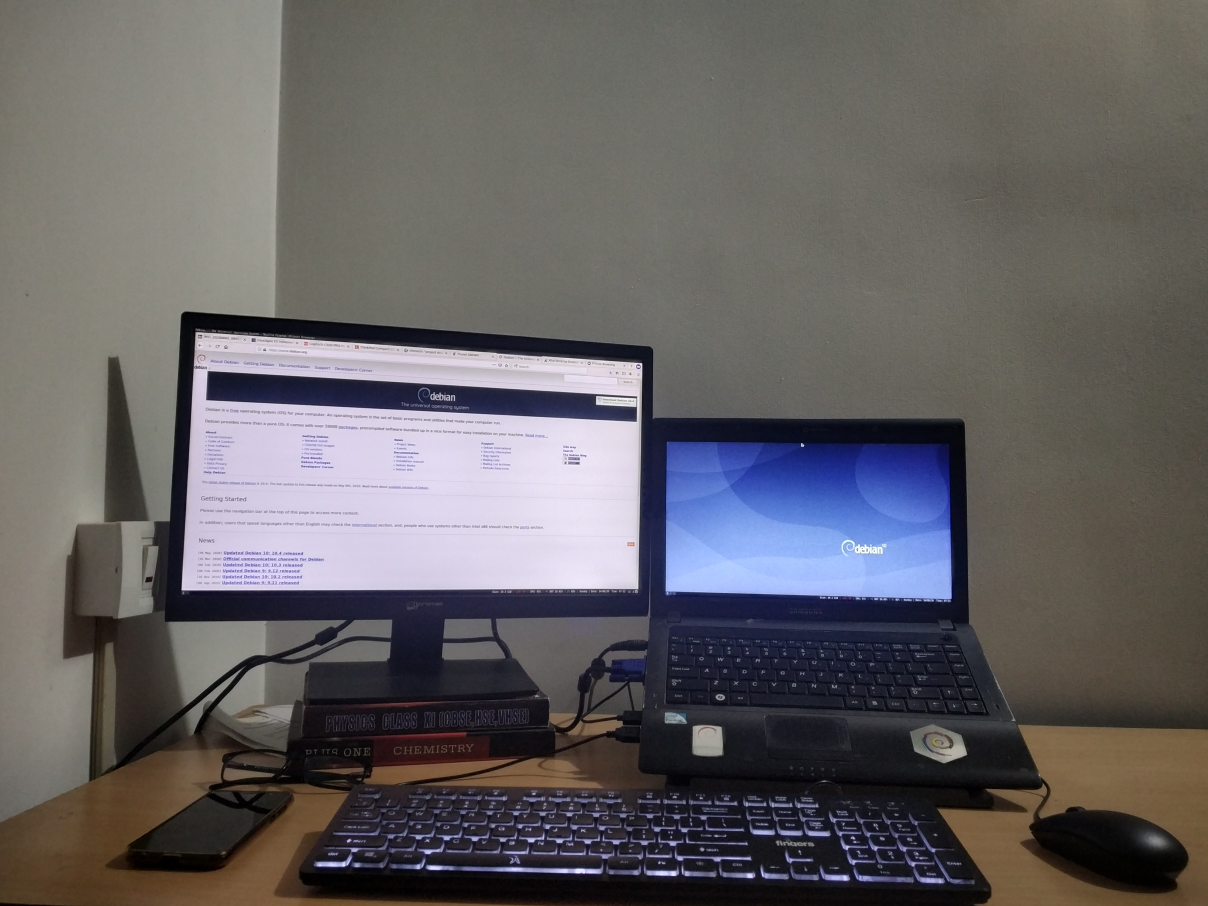
Hello,
Recently I ve seen lot of people sharing about their home office
setup. I thought why don t I do something similar. Not to beat FOMO,
but in future when I revisit this blog, it will be lovely to
understand that I had some cool stuffs.
There are people who went deep down in the ocean to lay cables for me
to have a remote job and I am thankful to them.
Being remote my home is my office. On my work table I have a Samsung R439 laptop. I ve blogged about it
earlier. New addition is that it
have another 4GB RAM, a total of 6GB and 120GB SSD. I run Debian
testing on it. Laptop is placed on a stand. Dell MS116 as external mouse always
connected to it. I also use an external keyboard from fingers. The keys are very stiff so
I don t recommend this to anyone. The only reason I took this keyboard that it is in my budget and have a backlit,
which I needed most.
I have a Micromax MM215FH76 21 inch monitor as my secondary display which stacked up on
couple of old books to adjust the height with laptop stand. Everything is ok with this
monitor except that it don t have a HDMI point and stand is very
weak. I use i3wm and this small script help me to manage my monitor
arrangement.
# samsung r439
xrandr --output LVDS1 --primary --mode 1366x768 --pos 1920x312 --rotate normal --output DP1 --off --output HDMI1 --off --output VGA1 --mode 1920x1080 --pos 0x0 --rotate normal --output VIRTUAL1 --off
# thinkpad t430s
#xrandr --output LVDS1 --primary --mode 1600x900 --pos 1920x180 --rotate normal --output DP1 --off --output DP2 --off --output DP3 --off --output HDMI1 --off --output HDMI2 --off --output HDMI3 --off --output VGA1 --mode 1920x1080 --pos 0x0 --rotate normal --output VIRTUAL1 --off
i3-msg workspace 2, move workspace to left
i3-msg workspace 4, move workspace to left
i3-msg workspace 6, move workspace to left
I also have another Viewsonic monitor 19 inch, it started to
show some lines and unpleasant colors. Thus moved back to shelf.
I have an orange pi zero plus 2 running Armbian which serve as my emby
media server. I don t own any webcam or quality headset at the moment.
I have a boat, and Mi, headphones. My laptop inbuilt webcam is
horrible, so for my video conferencing need I use jitsi app on my mobile device.

 In May, I got selected as a Google Summer of Code student for Debian again! \o/


 Many people labour under the assumption that pop culture is trivial and useless while only 'high' art can grant us genuine and eternal knowledge about the world. Given that we have a finite time on this planet, we are all permitted to enjoy pop culture up to a certain point, but we should always minimise our interaction with it, and consume more moral and intellectual instruction wherever possible.
Or so the theory goes. What these people do not realise is that pop and
 Hmm, this is the latest I ve posted my monthly updates yet (nearly by a month!). June was both crazy on the incoming side, and at the same time I just wasn t that productive (at least since then I caught up a lot). In theory, lockdown means that I spend less time in traffic, in shops or with friends and have more time to do stuff, in practice I go to bed later and later and waste more time watching tv shows and playing mobile games. A cycle that I have at least broken free from since June.
 Sometimes I enjoy reading the source code to projects I like, use, or am about to install for the first time. This was something I used to do on a very regular basis, looking for
 I released version 2.4 of
 Marks and mark rings in GNU Emacs
I

 Like
 Sorry for not being on blog for sometime, the last few months have been brutal. While I am externally ok, because of the lockdown I sensed major hearing loss. First, I thought it may be a hallucination or something but as it persisted for days, I got myself checked and found out that I got 80% hearing loss in my right ear. How and why I don t know. Is this
 Example of Medical Bills people have to pay.
 India-China Border Areas Copyright DW.com 2020



 Hello,
Recently I ve seen lot of people sharing about their home office
setup. I thought why don t I do something similar. Not to beat