Search Results: "ed"

25 October 2010

Axel Beckert: ratpoison and focus follows mouse

I use ratpoison as window manager on my ASUS EeePC netbook nemo for more than two years now. But although I m very happy with ratpoison in the EeePC, there are two feature wishes which have been refused by upstream: One is more flexibel window name matching for the unmanage command. The other one is focus follows mouse between ratpoison frames. Well, I always guessed that it was possible, but it took until now to find outhow to implement focus follows mouse for ratpoison. There s an ancient but still useful tool called Not a Window Manager (nawm) which is a small awk-like interpreter offering mostly window handling functions. The following .nawmrc implements focus follows mouse in nawm:
window newwin;  # stores window to raise
window lastwin; # stores previous window to prevent race conditions
leave  
    lastwin = currentwindow;
 
enter  
    newwin = pointerwindow();
    if (name(newwin) != "" && newwin != lastwin)  
        raise newwin;
        sync;
     
 
The leave hook is necessary to prevent flapping between two windows if switched between them via ratpoison s commands. I also had to add the following hook to my .ratpoisonrc to work around some cases where ratpoison s own window switching didn t work anymore. Only happened with more than one frame with one frame banishing the mouse cursor was annoying, so I filtered that case:
addhook switchwin exec if [  ratpoison -c fdump fgrep -o frame wc -l  -gt 1 ]; then ratpoison -c banish; fi
Unfortunately nawm has been removed from Debian Sid about a year ago due to being buggy and orphaned. There was not upstream development for seven years or so either. So for the moment you can get nawm either from Debian Lenny or from snapshot.debian.org. But I had to fix a segfault in nawm when calling name() on a window without name to be able to use it at all, so you will probably have to rebuild it anyway with the following patch:
diff -u nawm-0.0.20030130/builtins.c nawm-0.0.20030130-patched/builtins.c
--- nawm-0.0.20030130/builtins.c        2010-10-25 06:00:02.000000000 +0200
+++ nawm-0.0.20030130-patched/builtins.c        2010-10-25 04:15:25.000000000 +0200
@@ -546,8 +546,12 @@
     *name = gcstrdup("");
   else
      
-      *name = gcstrdup((char *)nm);
-      XFree(nm);
+      if ((char *)nm)  
+        *name = gcstrdup((char *)nm);
+        XFree(nm);
+        else  
+        *name = gcstrdup("");
+       
      
  
And yes, I m thinking about adopting and reintroducing the nawm package into Debian Sid. But I d prefer if anyone could give me a hint how to do this with more current and still maintained tools (or a patch against ratpoison :-). I looked into suckless-tools, but I haven t found anything in there which provides hooks on X events. And the Perl module Tk seems to be able to set X event hooks, but only within the application being written itself.

Bastian Venthur: Google Summer of Code 2010 Mentor Summit Report

As requested by our beloved leader, here s my report on this year s Google Summer of Code 2010 Mentor Summit. The summit took place in Google s HQ in Mountain View, California and was what they call an unconference . In the beginning of the unconference the attendees had 10 minutes to write down proposals for a session and put them on a huge white board. After that, every attendee voted for the sessions in which he was interested by putting a small sticker on the proposal. This way we could evaluate the interest on a specific topic and schedule the sessions to the differently sized rooms according to their interest. Neat trick! The the rest of the summit was basically like a conference: we had 11 tracks filled with 5-6 sessions per day, which ran from 10:00 to 17:30. Google provided shuttle buses from our wonderful hotel to the googleplex in the morning and back to the hotel in the evening. The hotel was very nice, it was equipped a swimming pool and a hot tub (both outside), which was extensively used in the morning and of course during the night. Speaking of the night, Google sponsored Thai food in the first night and ye olde Pizza and Beer in the second. Some of the attendees brought their keyboard, guitar, bass and electric clarinet, and where playing some sweet ass Jazz and Pop (on special request ). The sessions itself where not quite what I expected. I expected some proper talks about specific topics, but it was more like and open discussion round where everyone was invited to participate. For some topics it worked pretty well, for others not. It was still totally worth coming, since you meet a lot of like minded people and there is plenty stuff to talk about. Of course I was very exited to see the googleplex. And the rumors are true: the googleplex seems to be a very nice place to work. They provide free breakfast, lunch and dinner for their employees. They have micro kitchens everywhere where you can grab free snacks and beverages. There are lot s of toys lying around, they have bicycles everywhere on the campus which you can just grab to move from one building to another. There is a dinosaur on the yard, a spaceship over the stairwell and lots of other things (testing on the toilet, anyone?), and we have probably only seen a small fraction, since we were not allowed to leave the restricted areas for the unconference. Despite the horrible yet lag (leaving Germany on Friday morning and leaving San Francisco on Sunday night), I m glad I was able to attend to the summit and can only recommend aspiring mentors and students to participate to the next summer of code!

Jonathan Wiltshire: Facebook groups: a gift to framers

I didn t quite believe what I was seeing until I searched and found several other people noticing the same behaviour. For background, Facebook recently introduced the concept of groups not in the sense we ve been used to, but more like lists. Groups are supposed to be to lists what databases are to bits of paper. You can add friends to groups to organise them, send them group emails, run a collective mailing list, and so on. Except that in practice, this is another really good way of exploiting lazy users. See, there are some things to know about groups: The second point may be wrong it s very unclear exactly what permission is afforded to a group member and when or where information about the group membership is published. Since my day job is in private education, this immediately makes me think of two terrifying scenarios:
  1. A student inadvertently gets added to a large group and nobody notices because there is so much other traffic. Whatever my other privacy settings, anything I or anyone else posted to the group is now visible to him this is the same as the previous group arrangement. The difference is that he can now go on and add anyone else Mark Zuckerberg himself even without any kind of checks by the group administrator. A membership system like this quickly spirals out of control.
  2. Somebody with a grudge maybe I took too long fixing their PC adds me to a group with, shall we say, inappropriate or unsavoury content while I m away on holiday and tips off the child protection officer. Better yet, he first sends an email to all staff expressing horror and asking them to verify this in case it s his computer lying. Now there are multiple witnesses to the fact that I was a member of this group, and I return from the sea side to find a P45 on the door mat.
Unlike free software, I can t fix this. Fortunately, I have: enabled every email notification under the sun; few and trustworthy friends; according to my profile, no interests or contact details whatsoever; and no care for groups. I m happy with my lists, thanks all the same.
Comments flattr this!

Steve Kemp: Delivering to a Maildir folder, but marking as read

Email. We get a lot of it. We filter out the SPAM. Then if we're well-organized we file it away into folders as it arrives. (To be fair some people use priority settings such that all mail stays in their INBOX until they're "done" with it. I've never had the patience for that kind of behaviour.) One problem which I often encounter is wanting to have email be delivered, archived, and stored, but I don't want to read it. Yet when I see a folder in my mail client which has unread mail in it I cannot unsee. In my case I deliver mail to folders as it arrives via either Exim's filter language, or procmail. Procmail blows goats on the whole, but it is common and available everywhere - I just don't trust my own DSL enough to rely upon it (which is a dangerous sign). So, how do you deliver a new mail to a Maildir folder, and mark it read at the same time? Well you can be na ve and do what I did which is to invoke formail to add "Status: ro" to the header. Unfortunately that's insufficient to mark a mail as read when viewed in mutt. When an email is stored in a Maildir folder its status is encoded in part of its filename - which is why you'll have files like:
new/1288039894.28406_3.steve.org.uk
cur/1283711971.11157_3.skx.xen-hosting.net:2,S
The latter file has been Seen. So to mark a message as not-new you need to do two things: I've seen some horrific shell + procmail code to do the job, but the simpler version is:
:0
*^(To: From:).*root@
*^X-added-header:.*debian-administration.org
  ~/bin/read-to-maildir .machines.debian-administration.org/
Similarly you can use Exim's filter language to do the same job:
# Exim filter
if $h_to: contains "hostmaster@" then
    pipe "/home/skx/bin/read-to-maildir /home/steve/Maildir/.hostmaster/"
finish
Cute. Obvious too? Maybe not to me. ObSubject: Why did you murder someone, Raymond? - In Bruges

Bernd Zeimetz: merkaartor development version in experimental

For people who do not follow the Merkaartor mailing list: Regulary updated development snapshots are available in experimental again. Please report bugs, either in the Debian BTS or in the upstream bugtracker. Latest addition to Merkaartor is a plugin to support the French Cadastre peoject. Merkaartor development version 0.17

Raphaël Hertzog: Secret figures of a Debian/Ubuntu blogger: what you liked most on raphaelhertzog.com

Chart goes up on screenI launched raphaelhertzog.com this summer (taking over the English content of my former multi-lingual blog), when I decided that I would be more serious about blogging on Debian/Ubuntu related topics. On September, I decided to write 2 articles per week and up to now I managed to keep the schedule. Two of my articles were published by Linux Weekly News, those are much more researched than the average blog article (they are tagged with [LWN] in the list below). The most popular articles Most people read my blog through the RSS feed which happens to be syndicated on Planet Debian and Planet Ubuntu. According to the feedburner s statistics, the top-5 articles are:
  1. 5 reasons why I still contribute to Debian after 12 years (32700 views)
  2. [LWN] Understanding Membership Structures in Debian and Ubuntu (31700 views)
  3. Social Micropayment Can Foster Free Software, Discover Flattr (30100 views)
  4. Everything you need to know about conffiles: configuration files managed by dpkg (29900 views)
  5. How to make 110.28 EUR in one month with free software and Flattr (29400 views)
But I also have occasional readers visiting my blog because my articles are announced on Identi.ca, Twitter and Facebook (and they circulate on social networks, thanks to those who are sharing them!). The top-5 articles according to the statistics of my website are:
  1. 5 reasons why I still contribute to Debian after 12 years (6000 views)
  2. [LWN] Can Debian offer a Constantly Usable Testing distribution? (5000 views)
  3. Understanding Debian s release process (1500 views)
  4. Flattr FOSS (1400 views, not an article but I regularly blog about this project)
  5. Can Debian achieve world domination without being on Facebook? (1100 views)
The most flattered Since I am using Flattr on my blog, it can be interesting to see the articles which generated lots of flattr micro-donations. The top-3 articles are my articles about Flattr (1, 2, 3). Excluding articles related to Flattr, the top-5 is:
  1. 5 reasons why I still contribute to Debian after 12 years (12 flattr)
  2. The secret plan behind the 3.0 (quilt) Debian source package format (10 flattr)
  3. How to use multiple upstream tarballs in Debian source packages? (5 flattr)
  4. [LWN] Understanding Membership Structures in Debian and Ubuntu (4 flattr)
  5. Do You Want a Free Debian Book? Read on. (4 flattr)
Most articles get 2 to 3 flattr clicks. The most commented I usually get 4-5 comments on most articles but some generate much more feedback:
  1. [LWN] Can Debian offer a Constantly Usable Testing distribution? (40 comments)
  2. 5 reasons why I still contribute to Debian after 12 years (22 comments)
  3. Can Debian achieve world domination without being on Facebook? (15 comments)
  4. How to generate different dependencies on Debian and Ubuntu with a common source package (14 comments)
  5. [LWN] Understanding Membership Structures in Debian and Ubuntu (12 comments)
Factoids Here are my conclusions based on the above figures: If you also appreciate the above-linked articles, you should click here to subscribe to my email newsletter.

Flattr this Share/Bookmark 4 comments Support my work

Michal Čihař: Flattr for phpMyAdmin

The phpMyAdmin thing on Flattr has been around already for some time. I just created it together with other my stuff and somehow did not find time to discuss it with other project members and push it to our website. Despite this fact it got some attention and even recommendations. Today, being pushed by Linus Olsson from Flattr (who just forwarded questions about authenticity of phpMyAdmin on Flattr), I finally find time to get an agreement from other project members and placed the button on phpMyAdmin's website. Let's see how popular it will become now :-).

Filed under: Phpmyadmin 0 comments Flattr this

Wouter Verhelst: Bubble maker

I don't believe in bottled water. The reason for that should be obvious to anyone who thinks about it for more than just a second, but in case you can't figure it out:bottled water sucks. Since I moved out on my own, now over two years ago, I haven't bought the slightest amount of water other than through the tap. This wasn't a conscious decision, originally; it's just that I'm not a fan of non-sparkling water, and that buying 1.5L bottles of sparkling water would quickly reduce to non-sparkling ones by the rate I drink it, and I just didn't think it worth buying for that reason. As I came to realize that tap water is a fine beverage, and that for all practical purposes it is free or mostly so, compared to bottled water I stopped even considering the idea to buy bottled water. But I do still like sparkling water every once in a while; and this weekend, I remembered that about a decade ago, an acquaintance who worked for Philips had shown me a prototype apparatus to generate sparkling water out of plain water in approximately 1L quantities. It was a prototype then, so I could imagine it being a product today. Googling around for a while found no Philips product of that type; but then I did find another company that specializes in such devices. Their devices are fairly cheap (or, at the very least, affordable). And the best part: it doesn't even require electricity (contrary to that prototype device I saw so many years ago). One is on its way now. Wonder what it'll be like.

Evgeni Golov: RC bugs 2010/42

gregoa writes he squashed only 5 bugs in two weeks, and I think he still deserves a huge kudos too, as he squashes them for a long time now :)
And while at it, kudos to everyone who does not post their stats to planet, actually find those bugs, etc etc. Thanks that we have such a community!Now to the usual list of (pseudo) squashed bugs:

Gunnar Wolf: Biking without a set destination: Bas lica de Guadalupe

Sunday. A good day to take some time to myself, and get some much needed excercise. And the pseudo-meditation that comes with it: That's one of the factors I love the most about cycling. It's possibly my favorite way of just idling, of allowing for the time to pass without me noticing, just watching the movie of life, watching the world go around me with very little effort. I just love cycling. I have posted here several mentions of the Ciclot n: Every month, the last Sunday, our city government closes a ~32Km circuit to make it for cycling (and skating, and walking, and jogging, and other human-powered locomotion) use. Whenever I am in the city and have the possibility, I do the Ciclot n. Two months ago, I even did it twice in a row, for a total of almost 70Km. But this Sunday was not the last Sunday of the month! So, why am I writing this? Well, because when I left home today at ~10AM, I thought it was. Only when I reached Circuito Interior and had a this is full of cars moment, I remembered October has 31 days. And next Sunday I'll very probably be in Oaxaca city (for the Hackmitin 04h4ck4 2010). And I didn't want to miss the fun of a nice Sunday ride! I don't care if streets are closed just for bikes I am used to riding in traffic. Of course, this meant I would not take the central lanes in Circuito Interior on the way back, taking the ~10 bridges (which are quite tiring, to be honest!). It also meant I was free to make my own route. So, I thought, a nice small ~20-30Km ride will do. I'll just get to Eje 2 Sur or so, and back by another route (i.e. Plutarco E. Calles or so). But as I got closer to Reforma, I realized that every Sunday (independent of a Ciclot n), Reforma is closed for the "Paseos Dominicales" - Shorter than a Ciclot n, but still a nice way to share the streets with other cyclists. So I headed for Reforma. Part of Reforma (from the ngel roundabout westward) was closed due to a precisely cyclist race. But from there eastwards we had the street for us. Good, lets head downtown. The surprise came when I saw that it was not only towards downtown, but passing Av. Ju rez, Reforma continued to be closed just for cyclist use northwards. Great! Lets see how far does it go. The first surprise there: A couple of days ago, it was the "Noche de los Alebrijes". The alebrijes are a beautiful and very elaborated Mexican typical handicraft, depicting psychodelic dragons or dragonic representations of animals. Of course, alebrijes are usually ~30cm long... But here we had huge ones! And verrrry elaborated! How much so? You tell me. And as I started off... A nice thing about cycling is that you get to meditate. My body continued cycling, taking care not to run over the kids that are not so proficient, stoping at each red light... At some point, my mind entered back the body, and I realized we were passing by Tlatelolco (ok, to be honest, the picture was taken when crossing southwards, on my way back), about to cross Circuito Interior on the North, in that symbolically very strange place where Paseo de la Reforma (a long, beautiful avenue named after the war that marked the complete separation between church and Mexican state, in 1860) becomes two streets... Calzada de los Misterios and Calzada de Guadalupe. And, yes, it is among the greatest peregrination routes in the world. On December 12, the Holiday of the Guadalupe Virgin, up to 7 million people go visit her temple. And also around here, when my mind was busy inside my body, I noticed a pair from the Un paseo a ciegas (roughly translated, a blind ride) program was riding just by me. I knew about this program, but had never seen them before So I took the opportunity to get to know this program. Basically: Two people ride a tandem bike. The one in front, as always, drives and steers. The one in the back is a blind person, who gets the amazing sensation of freedom and enjoyment that only a bike gives you. Un paseo a ciegas is held every Sunday at 9AM except for the last Sunday every month. And I definitively want to be part of it! They told me the program has been adopted as well in Puebla, and if I recall correctly, it will soon be started in Quer taro and Guadalajara. Anyway, by then I realized the ride was probably going to reach the Bas lica, a very impressive church I had just visited for the first time ever a couple of weeks ago. And yes we went all the way up Guadalupe until the place where the street gets impossible to bike on, then left along a small street, and back to the South by Misterios. Then, all the way along Reforma again, saying goodbye to Cuitlahuac, Jos de San Mart n, Sim n Bol var, El Caballito, Cristobal Col n, Cuauhtemoc, La Palmera, El ngel... And back home. Of course, not without the sight of some bizarre signs we enjoy so much to find, point at and laugh. Have I ever told you, my nameless reader, that I love this city? I love getting surprised with so many great things. I love the distances I can safely ride on my bike without ever being far from a bike repair shop (which are only needed when they are far away). I love being surrounded by people breathing their freedom to take the streets. I love the safety of our wide, long streets (and no, I'm not joking here Mexico City is among the safest places for cyclists I have been to). I love its weather, that allows me to go out and enjoy the street at any time of year. And I love biking in it, one of the best ways to get to know so many bits of the city I would have never ventured into otherwise.

Jaldhar Vyas: So You Think You Can Dance...ON MY GRAVE? (4DRL Challenge Day 1)

Kanzepharaz of the one thousand and eight spires. Kanzepharaz capital of the Empire of K'thorv and since the succesful end to the war that led to the annihilation of the Pleiadic Oligarchy in K'threl, the richest and most splendid city in the Middle World. Kanzepheraz whose real estate prices have soared e'en beyond the calculation of the rainbow abacus of Thobis Himself. Anathomelis, a princeling of the Imperial Clan needs a location for his new and expanded orgy dome. Yet the only available and affordable on a seventh rank civil allowance place left in the city of one thousand and eight spires is the tomb of Pharaz the First and Subsequent, lich-emperor of the Jerelite dynasty and his eldritch retainers. Before the construction-serfs can move in, the tomb must be cleared of its unshriven and non-rent-paying denizens. As His Principalities' chief swordbearer it has fallen to you to make the tomb of Pharaz safe for gentrification. Treasures and honors await you if you succeed. Aeons of torment in the Planes of Unlife await you if you fail. WILL YOU RISE TO THE CHALLENGE? rec.games.roguelike.development is having another challenge, this time to complete a roguelike game in four days. My previous attempt to write one in seven days was a failure but as I can build upon my previous work, I think I can make it this time. This time I did not waste lots of time thinking of a name. S.Y.T.Y.C.D...OMG? and The Real Housewives of Mordor were the only ones under serious consideration. With that crucial task out of the way, I spent the morning ripping code out of A.L.F. wherever possible. In the afternoon, I looked into dungeon generation. My previous experiments with this sort of thing were pretty convoluted but now I think I have a simpler algorithm which still provides a random yet plausible-looking map. It basically goes like this:
  1. Divide the map into a grid of sectors.As the S.Y.T.Y.C.D...OMG? map is 60 80, my sectors are 20 16 giving 3 5 grid.
  2. Mark each space on the map as impassable.
  3. In each sector, pick a random square as its "center" not too near the edge of the sector.
  4. Join each pair of centers first W -> E and then N -> S. with passable spaces. These will be the corridors and doing it this way ensures all sectors will be connected. Last time, my mistake was making rooms first and then corridors which is much more complicated to get right.
  5. For each sector, there is a 2/3 chance it contains a room. If there is, randomly a number of spaces to each side of the center square. These will be the dimensions of the room. Make all the spaces in the resulting rectangle passable.
  6. Randomly take a quarter chunk out of some rooms making them "L" shaped for a bit of variety. (at some point I can add round, polygonal or other shapes.)
  7. Create "walls" by making all the outer boundary spaces of the room impassable again. This also ensures rooms do not touch or overlap.
  8. If a wall meets a corridor, turn it into a "door." Doors don't do anything yet but eventually will be locked, trapped etc.
  9. Finally, place monsters, treasure, and items in the room.

24 October 2010

Gregor Herrmann: RC bugs 2010/41 - 2010/42

it seems I was a bit busy & lazy in the last two weeks. luckily diocles & evgeni were more active than me kudos!

here are my small contributions:

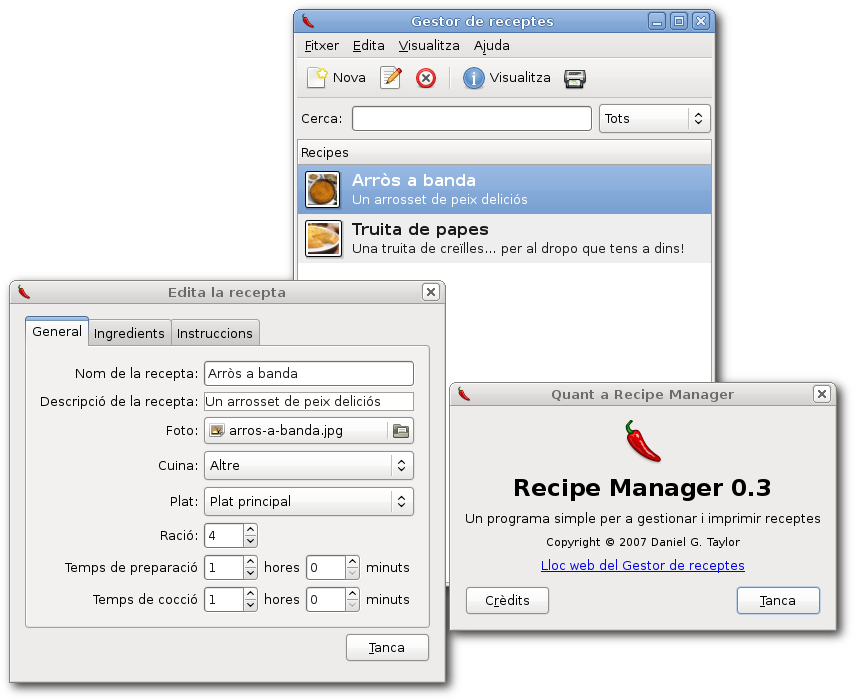
Jordi Mallach: Recipe Manager meets arr s a banda

Two weeks ago, nekohayo posted a blog entry on Recipe Manager, a (you guessed it) cooking recipe manager for GNOME. Looking good, I fetched the bzr tree from Launchpad and played a bit with it, and soon discovered it had no internationalisation support. I've tried to add i18n properly, but I've not had enough time to do it. Before tackling that, the authors need to give it some bootstrapping love so the app can actually install, look for its files in /usr/share, etc. My fugly, unpostable current patch does allow for a preview of how Recipe Manager will teach the world about the best rice dish ever, arr s a banda. Yum!


Recipe Manager, showing off the zenith of Valencian culture

Petter Reinholdtsen: Software updates 2010-10-24

Some updates. My gnash pledge to raise money for the project is going well. The lower limit of 10 signers was reached in 24 hours, and so far 13 people have signed it. More signers and more funding is most welcome, and I am really curious how far we can get before the time limit of December 24 is reached. :) On the #gnash IRC channel on irc.freenode.net, I was just tipped about what appear to be a great code coverage tool capable of generating code coverage stats without any changes to the source code. It is called kcov, and can be used using kcov <directory> <binary>. It is missing in Debian, but the git source built just fine in Squeeze after I installed libelf-dev, libdwarf-dev, pkg-config and libglib2.0-dev. Failed to build in Lenny, but suspect that is solvable. I hope kcov make it into Debian soon. Finally found time to wrap up the release notes for a new alpha release of Debian Edu, and just published the second alpha test release of the Squeeze based Debian Edu / Skolelinux release. Give it a try if you need a complete linux solution for your school, including central infrastructure server, workstations, thin client servers and diskless workstations. A nice touch added yesterday is RDP support on the thin client servers, for windows clients to get a Linux desktop on request.

Benjamin Mako Hill: Sharing an Email Address

I used to think that couples who share a single email address were just too cute. Then I saw this article which imported this whole "keeping each other honest" logic into the practice. Mika and I have never even had accounts on each other's servers.

Tim Retout: RC bugs for w/c 2010-10-17

My humble RC bug squashing efforts for this week. I've saved them all up, because I don't want to spam Planet Debian too much... or alternatively, because I've been feeling ill Thursday/Friday and didn't do anything at all. Note that quite a few of these were "cheating" by just closing bugs that someone else had written a patch/comment for, and the mgltools-* ones are in non-free software, so they won't have the same impact on the RC bug stats. Also, I've mentioned the gnucash and sawfish ones before, but they'll definitely be counted in the stats now..

23 October 2010

Joey Hess: tranquility

I brought my cat Leo to the house in the hollow a week ago. He settled in quickly; this was his 7th move. He seems both more kittenish, and more predatory out here. This was a trial run, I'll bring him back to town soon for a few weeks. Since early August, I've for one reason and another been away every other week, and I got tired of worrying about the cat home alone. With a cat, and with electricity seemingly sorted, it's getting homelike here. As the days shorten, I'm being power wasteful with computers and radio and lights, and the batteries still never drop below 13.5 volts. Bodes well for winter. All that remains to be done is refrigeration that does not involve hauling ice, and more water. Winter will help with both. Still remains to be seen if I will continue bouncing back and forth, or if there will be an inflection point. I've regained a tranquility that had been eluding me for ages. It's been a lot of work, but it seems worth it. (git-annex announcement soon!)

22 October 2010

Erich Schubert: Gnome panel applet alignment

Dear Gnome people. Is there a reliable way to right-attach panel applets? May laptop screen and my external monitor have different resolutions, and I havn't found a reliable way (except making two panels) of getting some of my applets to stick to the right. I usually keep my launchers on the left, while vairous system status icons on the right part. But when switching to a higher resolution, at most one will move to the right end of the panel at the new resolition, while the others just stay in place (i.e. left-attached at a given pixel position). There are so many smart layout managers, GTK pretty much always uses flexible layout managers, why is the Gnome panel relying pixel offsets? It has been suggested to me a couple of times that I could achieve this via gconf. However, since the gconf changes are not reflected at runtime but frequently overwritten I did not get this to work reliably even just for two applets. Thank you. If you have any comments, please email me via erich () debian org. On a side note, this is also the first true post to my new blog. :-)

Adrian von Bidder: SuperMicro BMC / IPMI: Can I Get In?

So I got a SuperMicro A+ Server 1012G-MTF today (seems to be a very nice unit for a decent price) and am preparing it for taking over fortytwo.ch and related services. Now this thing has got IPMI / BMC with remote management and KVM (both serial console and full graphical console with virtual CD-ROM etc.); works very nice. Basically the only thing I miss is the ability to disable services I don't need and/or restrict access to certain IP addresses. (No, I don't have the BMC on a public IP, but still...) So the question is: has anybody worked out how to hack / what kind of file system the IPMI Firmware for the H8SGL-F mainboard is? Or how one could drop from the BMC commandline to a /bin/sh prompt on the urnning system? A blog entry at Serverfault suggests it's been done but doesn't say how. (Running strings on the firmware binary shows the string Photoshop ICC profile near the end. I'm not sure if I want to know the story ... ;-)

Julian Andres Klode: FAIL: Arch Linux switch python executable to Python 3

Today, I got an email from an user of one of my Python scripts asking why the script t does not work on Arch Linux anymore. As it turns out, the Arch Linux team decided to switch /usr/bin/python to Python 3.0 and use python2 for Python 2.X versions. By doing this, they decided to make their distribution incompatible to almost any Python script in the world. Arch Linux s decision to diverge from the rest of the world that uses python for Python 2.X and python3 for Python 3.X is stupid. And doing this without updating reverse dependencies beforehand and thus breaking packages in their own distribution is insane. In the end this means that if you use Arch Linux, you should consider switching to a distribution that does things the right way: Debian. You can also switch to Ubuntu, that s normally just a bit less right (= faster). But using a distribution that does those crazy things in such an irresponsible way is really insane. Really, how can they be so stupid in the Arch world?
Filed under: Python

Next.

Previous.