Search Results: "ed"

31 October 2010

Jan Wagner: linux-image-2.6.32-bpo.5-xen-686 and xen/xen-common from squeeze broken?

I m experiencing since some time (out of the blue) spontaneous reboots of some of my dom0s on lenny/i386 (others don t have this effect). As result of this, I started rolling out linux-image-2.6.32-bpo.5-xen-686 from bpo and backported xen and xen-common from testing:

# dpkg -l grep xen grep bpo
ii libxenstore3.0 4.0.1-1~bpo50+1 Xenstore communications library for Xen
ii linux-image-2.6.32-bpo.5-xen-686 2.6.32-26~bpo50+1 Linux 2.6.32 for modern PCs, Xen dom0 suppor
ii xen-hypervisor-4.0-i386 4.0.1-1~bpo50+1 The Xen Hypervisor on i386
ii xen-linux-system-2.6.32-bpo.5-xen-686 2.6.32-26~bpo50+1 Xen system with Linux 2.6.32 on modern PCs (
ii xen-tools 4.1-1~bpo50+1 Tools to manage Debian XEN virtual servers
ii xen-utils-4.0 4.0.1-1~bpo50+1 XEN administrative tools
ii xen-utils-common 4.0.0-1~bpo50+1 XEN administrative tools common files
ii xenstore-utils 4.0.1-1~bpo50+1 Xenstore utilities for Xen This fixed the problem of spontaneous reboots for all of the systems I have migrated . until now! Last week I tried this solution on my private system and it failed in some way.
boot problems
A full dump of the syslog is also available. It looks like /etc/rcS.d/S03udev is hanging in some way .. the syslog for this looks like:

Oct 29 20:51:07 mordor kernel: [ 17.728120] Code: 04 00 00 00 00 83 3c 24 10 74 32 77 0c 83 3c 24 08 0f 85 9f 00 00 00 eb 12 83 3c 24 20 74 30 83 3c 24 40 0f 85 8d 00 00 00 eb 35 <0f> b6 01 8b 54 24 20 89 02 c7 42 04 00 00 00 00 eb 79 0f b7 01
Oct 29 20:51:07 mordor kernel: [ 17.731554] EIP: [<c1184d4c>] acpi_ex_system_memory_space_handler+0 189/0 221 SS:ESP 0069:ec135d74
Oct 29 20:51:07 mordor kernel: [ 17.731791] CR2: 00000000eda86000
Oct 29 20:51:07 mordor kernel: [ 17.731881] [ end trace 7b8af581772a1c55 ]
Oct 29 20:51:07 mordor kernel: [ 18.116622] input: PC Speaker as /devices/platform/pcspkr/input/input6
Oct 29 20:51:07 mordor kernel: [ 18.427607] Error: Driver pcspkr is already registered, aborting
Oct 29 20:51:07 mordor kernel: [ 232.381814] Adding 10000452k swap on /dev/sda2. Priority:-1 extents:1 across:10000452k The dom0 is there hanging in some way I don t have an exact way to get the system proceed from there usually I need to wait some seconds and pressing ^C after a while will get the box up.
Anyways I remember there are some problems with udev >= 150 and older kernels, which is also documented in the squeeze release notes. Maybe there is also a problem with older udev and newer kernels? But why is this combination working on other systems? Booting linux-image-2.6.32-bpo.5-686 works without any issue anyways, so it seems xen related. Any idea is appreciated!
UPDATE: I ve also reported this via #602109.

Erich Schubert: The next 'terror lie' - campaign time again

There is something fishy with the latest "printer bomb" reports. One one hand, they claim the parcels were adressed to "jewish synagogues in Chicago". On the other hand, they claim they were meant to explode in the air. So: why would you address them to a synagogue then? Sending a parcel from Jemen to a synagogue probably is a sure thing to have it thoroughly checked? I don't trust any of their reports. Don't get me wrong; for example I do not believe the WTC was blown up using explosives like most of the conspiration theorists out there do. But they are not telling the truth with these parcels, either. Also given that they claimed there were way over 20 parcels sent, and the security was that weak, how come all of them were found? When they decide to make up a story for us (either for having a reason to kill more people in Jemen or just for election reasons) they should at least bother to make up a consistent story ...

Ond&#345;ej &#268;ert&iacute;k: git has won

I switched to git from mercurial about two years ago. See here why I switched and here my experience after 4 months. Back then I was unsure, whether git will win, but I thought it has a bigger momentum. Well, I think that now it's quite clear that git has already won. Pretty much everybody that I collaborate with is using git now.

I use github everyday, and now thanks to github pull requests, I think it's the best collaboration platform out there (compared to Google Code, Sourceforge, Bitbucket or Launchpad).

I think it's partly because the github guys have a clear vision of what has to be done in order to make collaboration more easier and they do it, but more importantly that git branches is the way to go, as well as other git features, that are "right" from the beginning (branches, interactive rebase, and so on), while other VCS like bzr and mercurial simply either don't have them, or are getting them, but it's hard to get used to it (for example mercurial uses the "mercurial queues", and I think that is the totally wrong approach to things).

Anyway, this is just my own personal opinion. I'll be happy to discuss it in the comments, if you disagree.

Christian Perrier: Debian Installer beta1 released

Otavio Salvador announced the release of the beta1 version of Debian Installer, the installation system for Debian. This release is made in preparation of the overall release of Debian Squeeze. It should be followed soon by another release ("Release Candidate", probably) with a full localization update (that involves building/uploading all packages to get localization changes in). That release is dedicated to Frans Pop, who worked for two years as Debian Installer release manager and continued to bring very significant contributions to D-I later on.

David Bremner: Extracting text from pdf with pdfedit

It turns out that pdfedit is pretty good at extracting text from pdf files. Here is a script I wrote to do that in batch mode.
#!/bin/sh
# Print the text from a pdf document on stdout
# Copyright: (c) 2006-2010 PDFedit team  <http://sourceforge.net/projects/pdfedit>
# Copyright: (c) 2010, David Bremner <david@tethera.net>
# Licensed under version 2 or later of the GNU GPL
set -e
if [ $# -lt 1 ]; then
    echo usage: $0 file [pageSep]
    exit 1
fi
#!/bin/sh
# Print the text from a pdf document on stdout
# Copyright:   2006-2010 PDFedit team  <http://sourceforge.net/projects/pdfedit>
# Copyright:   2010, David Bremner <david@tethera.net>
# Licensed under version 2 or later of the GNU GPL
set -e
if [ $# -lt 1 ]; then
    echo usage: $0 file [pageSep]
    exit 1
fi
/usr/bin/pdfedit -console -eval '
function onConsoleStart()  
    var inName = takeParameter();
    var pageSep = takeParameter();
    var doc = loadPdf(inName,false);

    pages=doc.getPageCount();
    for (i=1;i<=pages;i++)  
        pg=doc.getPage(i);
        text=pg.getText();
        print(text);
        print("\n");
        print(pageSep);
     
 
' $1 $2
Yeah, I wish #!/usr/bin/pdfedit worked too. Thanks to Aaron M Ucko for pointing out that -eval could replace the use of a temporary file. Oh, and pdfedit will be even better when the authors release a new version that fixes truncating wide text

Joey Hess: a git-annex example

Today I forgetfully left my USB drive at home when I took off for a night at the yurt. This has happened before and generally involves staring at an scp for rather too long, probably getting low on battery power in the process, and is followed by not quite having files in the places I expect and forgetting to delete them from my small laptop SSD later. With git-annex those annoyances can go away. So I wanted a couple of gigabytes of files that were left at home behind a slightly slow link. Rather than scp them to my laptop for several hours, I just did a quick ssh into a server, and browsed through my stuff there, running git annex get $foo & on files and directories I wanted. Then went to eat dinner and play board games while the content was scped across the slow link from home. Now I can quickly download it all to my laptop from that fast server (named "finch"), like this:
git pull
git annex move . --from finch
That removes the data from the server too, freeing its space back up for next time. And the files are in their regular places on my laptop, automatically. And I can simply git annex drop . when I need that space back without worrying about losing any data. (Hmm, this feels a little bit like it did to switch from doing everything by hand with dpkg to using apt-get..)

30 October 2010

Rapha&#235;l Hertzog: Latest features of dpkg-dev: debian packaging tools

I m attending the mini-Debconf Paris and I just gave a talk about the latest improvement of dpkg-dev the package providing the basic tools used to build Debian packages. Latest is a bit stretched since it embraces the last 2-3 years of development. My talk covered the following topics: The slides are relatively verbose so that you can understand them even if you did not attend the talk. Click here to get the slides. Related links This section points to various articles that cover more extensively some of the features mentioned in my talk. Concerning dpkg-source: Concerning dpkg-maintscript-helper: Concerning dpkg-vendor:

Flattr this Share/Bookmark One comment Support my work

Erich Schubert: One month without Facebook

I disabled my Facebook account about a month ago. See the blog post when I started my Facebook hiatus for the reasons. Now, almost one month into my hiatus, I must say that it has been surprisingly easy. While I do think I probably missed some interesting things my friends are doing (or maybe even did not get invited to some parties; a lot of things are Facebook-only nowadays, unfortunately) I do have the impression that I have much more spare time and that I'm more productive. To my most important friends (in particular my girlfriend of course) I've been keeping my contact out of Facebook anyway, so I didn't lose anything there. So essentially I'm continuing my Facebook hiatus for an indefinite amount of time. I just wonder how to inform my Facebook friends that are expecting my back anytime soon ... and I do hope they'll at some point realize that some of their friends are not on Facebook by choice, but still deserve to be invited to parties and such.

Russell Coker: Parkour in Melbourne

When I was walking past Southbank when I saw some Parkour being practiced. I watched for a while and spoke to the instructor after the informal lesson was finished. He s a professional instructor with the Melbourne branch of the Australian Parkour Association [1] and he sometimes gives free advice to newbies that he meets on the street (in this case a group of 6 teenage boys). From the web site it seems that the standard lesson fee is $15 for an indoor lesson or $10 for an outdoor lesson with a $5 discount for members of the Australian Parkour Association [2], which is really cheap for a 2 hour lesson! APA membership costs $10 to join plus a $50 annual membership fee. It s worth reading the ParkourPedia information about the spirit/philosophy that is Parkour [3]. It s interesting to note that there can be no official Parkour shows because if you do it for anyone else then it s not Parkour so much for all the Parkour videos on Youtube. Also another issue with the Youtube videos is that Parkour isn t about doing the most dangerous things you can possibly survive in an urban environment, it can be practiced in country areas and isn t supposed to be unreasonably dangerous. The outdoor Parkour lessons start near the Arts center in the middle of Melbourne and presumably some of them go past Southbank as it has some interesting things to jump over. So it s worth watching out for people jumping over various obstacles instead of walking around them. They may not be doing a Parkour show, but it s in public and anyone can watch.

Tim Retout: LibreOffice

I've been ill this week. The only hacking I've been doing is of the cough variety. :) I think I'm recovering, though. This evening, I finally checked out LibreOffice, to get an idea what's going on - kicked off a build, joined the mailing lists. Some of the easy hacks look quite feasible, but there's always a bit of work to get started. The community looks very welcoming, though, so no problems there. The various Perl bits in the installer/build system seem an obvious place to get started. I've also got an eye on the mdbtools code - I theoretically maintain the Debian package, and have come close to forking it. But I aspire to be writing "real" patches, of course. I've been thinking about where I should put my development time over the next year or so, and LibreOffice is likely to be one of those places.

29 October 2010

Colin Watson: libpipeline 1.0.0 released

In my previous post, I described the pipeline library from man-db and asked whether people were interested in a standalone release of it. Several people expressed interest, and so I've now released libpipeline version 1.0.0. It's in the Debian NEW queue, and my PPA contains packages of it for Ubuntu lucid and maverick. I gave a lightning talk on this at UDS in Orlando, and my slides are available. I hope there'll be a video at some point which I can link to. Thanks to Scott James Remnant for code review (some time back), Ian Jackson for an extensive design review, and Kees Cook and Matthias Klose for helpful conversations.

Evgeni Golov: What to flattr? 2010/10

Another month ending and you still have some clicks left on flattr.com? How about these then?Again, all non-italics text is stolen directly from flattr, and please forgive me if I recommend some thing that hasn t been officialy announced yet :)
Rapha&#235;l Hertzog: Nice OpenOffice.org template for Debian presentations

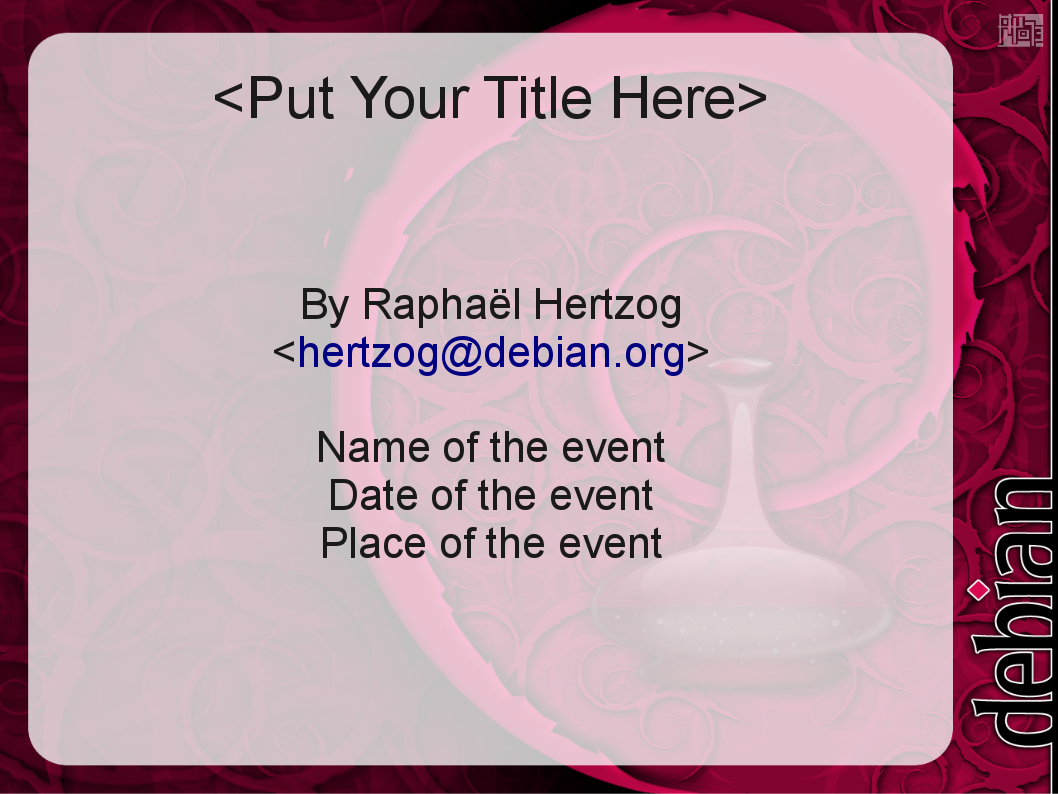
OpenOffice.org Impress Template for Debian Presentations While preparing for the upcoming mini-debconf Paris, I noticed that we don t have any good presentation template for OpenOffice.org Impress. I spent a few hours browsing Debian presentations put online by many speakers and was unable to find one that would suit me. This situation was clearly unacceptable and I decided to spend a few hours to fix this. I selected a very nice wallpaper created by Alexis Younes, used The Gimp to add a translucent white box so that the text can still be read, and combined all this in a OpenOffice.org Impress template. Click here to download the template. You can also get the Gimp XCF file for the background image. By the way, the same wallpaper has been used by Sam Hocevar to create nice-looking Debian business cards. PS: I contacted Alexis Younes by mail and he agreed to put the wallpapers under GPL-2+. It has been clarified on his webpage.
Follow me on Identi.ca, Twitter and Facebook.

Flattr this Share/Bookmark 6 comments Support my work

Alexander Reichle-Schmehl: Release Critical Bug report for Week 43

The bug webinterface of the Universal Debian Database currently knows about the following release critical bugs:
In Total:695
Affecting Squeeze:284
Squeeze only:71
Remaining to be fixed in Squeeze:213
Of these 213 bugs, the following tags are set:
Pending in Squeeze:7
Patched in Squeeze:40
Duplicates in Squeeze:24
Can be fixed in a security Update:14
Contrib or non-free in Squeeze:7
Otherwise fixed in Squeeze:32
Ignoring all the above (multiple tags possible), 126 bugs need to be fixed by Debian Contributors to get Debian 6.0 Squeeze released. However, with the view of the Release Managers, 169 need to be dealt with for the release to happen. Please see Interpreting the release critical bug statistics for an explanation of the different numbers.

28 October 2010

Sam Hartman: Moonshot at Kerberos

At The MIT Kerberos Consortium s 2010 conference, Josh Howlett and Sam Hartman delivered a talk on Moonshot. Slides should be up in a day or so. We reported on status and gave a brief overview. The new material was apropos for the venue. At the bar BOF back in March at IETF 77, we received several comments on Moonshot s limitations. It doesn t work well for services that require rapid authentications for multiple requests. There s not a good story for use when a Moonshot service needs to contact another service. There isn t a good standardized mechanism for mapping in domain-specific policy. We presented a proposal that Luke and Sam developed to optionally provide a Kerberos ticket as part of moonshot authentication. This scales from a service that simply generates its own service tickets all the way through resource domains that have many services and complex policy and provide the client a TGT. Clients can implement the feature in order to achieve better performance. Server can implement the feature in order to get delegation support within a resource domain and to get policy mapping. Luke has prototyped a version of this service involving a service ticket. We plan on briefly mentioning a desire to have extensible fast reauthentication support at the ABFAB meeting in IETF 79. However in the interest of getting the working group off to a good start we re going to focus on the well understand parts of the system and formally propose this extension after IETF 79.

Obey Arthur Liu: Debian & the Google Code-in 2010, requesting tasks

Debian so far had a nice experience with the Google Summer of Code and this year, Google is going to run the Google Code-in. We have applied and would now need some help from you all.
In the words of the official announcement: Google Code-in, Google s contest to introduce pre-university students to the many kinds of contributions that make open source software
development possible, is starting on November 22, 2010. Google is inviting students worldwide to produce a variety of open source code,
documentation, training materials and user experience research for the organizations participating this year. These tasks include: I have applied on behalf of Debian and we now need a series of short tasks (1-2 weeks work) to propose in all these areas.
The selected mentoring organizations will be announced on November 5th 2010.
As you can see, this is an interesting project as the individual tasks are closer in size to an RC bug and encompass a wider range of areas than the Summer of Code. I set up a welcome page and a tasks page.
Please fill in your tasks ideas ASAP. You can also volunteer to help as admin and/or mentor.
We will be using the usual communication channels used for the Summer of Code:

Marco Silva: An utility for sshpass

I just discovered sshpass and saw some comments of people complaining that there's no good use case that justifies it. Well, I have a use case. That's in fact what made me search about the theme and found it. I created a user on a machine and I can't remember which password I used, but I know it's probably one of a small list I can think of. The list is composed of variations of the same string, in a way that I could generate with a program. It would take me time to try all the passwords by hand, so using sshpass make things much easier:
$ generate-password > pass-list
$ for i in  cat pass-list ; do sshpass -p $i ssh host; done

Torsten Werner: More Results from the Debian Community Poll

I have announced the Debian Community Poll and published first results in former blog posts. I'll publish my analysis of the remaining questions about changes to Debian now.
Should Debian remove its non-free component?

Should Debian spend more money?
  • 28.9% choose answer #5: I don't know or don't care.
  • 22.8% choose answer #3: Debian should pay people having important positions in Debian and doing important work.
  • 21.2% choose answer #1: Debian should spend more money on organizing developer conferences and team meetings.
  • 11.4% choose answer #4: Debian should not spend more money.
  • 8.0% choose other (see below) or didn't answer
  • 7.7% choose answer #2: Debian should spend more money on free merchandizing, free DVDs, having a sexy web site, and being present on IT events.
There were quite a number of other answers. One participant missed the information about how the money is currently spend. Several participants didn't want to choose one of the provided answers. They either wanted to choose multiple answers or various combinations of them. Most other answers fall into one of the following categories:
  • various marketing suggestions with different focus than answer #2
  • Debian hosted hardware, infrastructure, services
  • funding upstream development
  • QA and work on release-blocking issues
  • partners and commercial support
  • developing important features
  • security support for oldstable
  • education of prospective developers and contributors
  • documentation for users
  • improving usability and accessibility
  • certifications like LPIC
  • getting supported by hardware and non-free software vendors
  • beer
  • promoting debian in developing countries
  • help contributors running a business on Debian
  • Bounty system
  • updating stable to avoid becoming stale
  • developing multimedia codecs
  • getting compliant with FSF guidelines for a free system distribution
  • developing free replacements to non-free software
  • maintaining a database of debian-friendly hardware
  • lobbying and politics
  • visibility to wider society, even non-IT
  • hardware for driver developers
  • a more sexy DVD/CD set with graphics (like Fedora, Ubuntu)
  • membership to boards of W3C, TEI Consortium, OASIS, etc.

Do you prefer time based releases instead of the "it's ready when it's ready" releases?
  • 73.1% answered no
  • 19.8% answered yes
  • 5.1% anwered: I don't know or don't care
  • 2.0% didn't answer

Which release interval do you prefer?
  • 38.7% choose answer #2: about 12 months
  • 36.9% choose answer #3: 18 - 24 months
  • 10.0% choose answer #5: I don't know or don't care.
  • 5.9% choose answer #1: about 6 months
  • 5.5% choose answer #4: more than 2 years
  • 3.0% didn't answer

Dirk Eddelbuettel: Google Tech Talk on Integrating R and C++: video and slides

Last Friday, Romain and I were guests of the R intergrouplet (what an adorable name!) at Google's headquarter in Mountain View. This arose out of discussions following useR! 2010 where we met Google's Murray Stokely. There appears to be ever increasing use of R at Google, and so it was a great opportunity to give a Google Tech Talk about R and C++ integration --- centered around our Rcpp, RInside and RProtoBuf packages which facilitate interoperability between R and C++. A video recording of our ninety-minute talk is already available via the YouTube channel for Google Tech Talks. The (large) pdf with slides (which Romain had already posted on slideshare) is also available from my presentations page. The remainder of the weekend was nice too (with the notably exception of the extremly sucky weather). We got to to spend some time at the Google Summer of Code Mentor Summit which is always a fun event and a great way to meet other open source folks in person. And we also took one afternoon off to spend some with John Chambers discussing further work involving Rcpp and the new ReferenceClasses that appeared in the just-released R version 2.12.0. This should be a nice avenue to further integrate R and C++ in the near future.

John Goerzen: Rudy Schmidt & Time Capsules

This evening, I arrived at church for mens chorus practice. I was surprised to see this sign on the door:
Rudy Schmidt died rather unexpectedly, but peacefully on Wednesday morning at his home .
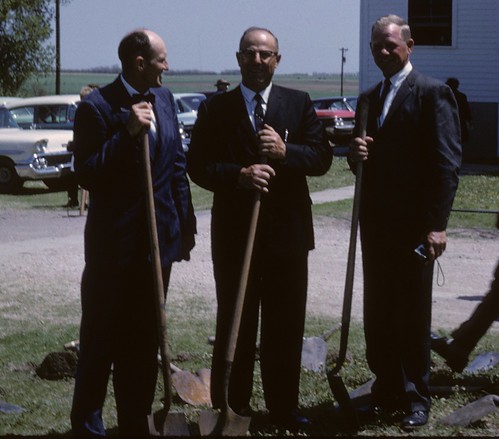
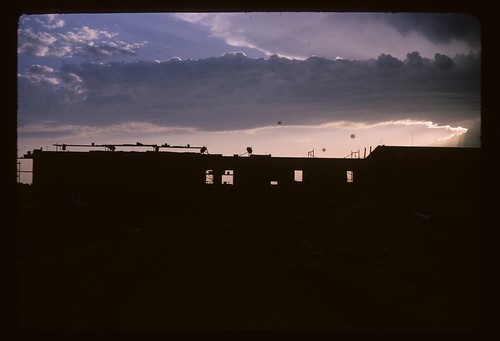
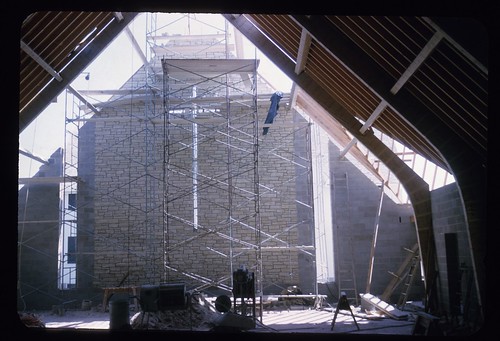
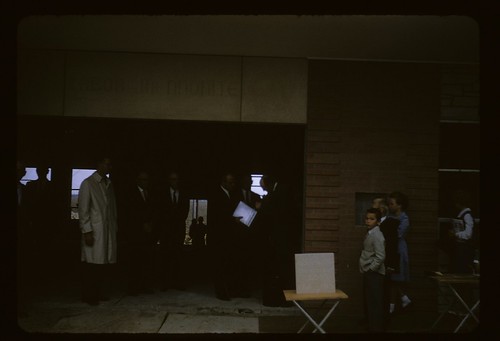
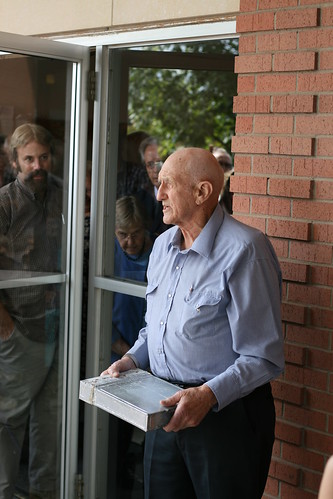
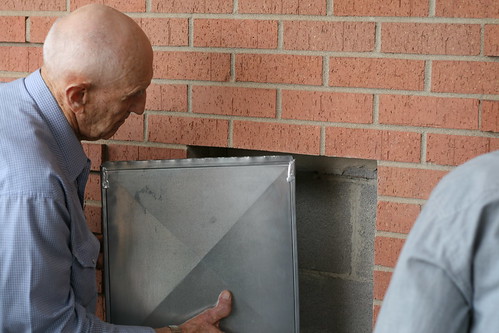
One of the benefits of living in a small community is that I get to know people of all ages around here. Not just people my own age, or coworkers. A few years ago, I worked on a history project for our church s centennial. Back in the 1960s, Rudy was one of the people in charge of building our current church. So he was a person I was interested in visiting with. Here he is, on the left, during the 1964 groundbreaking ceremony for the new building (the old one is visible in the background). 022 stamped may 1964cropped.jpg I and a few others went to his home one time a few years ago and we had a wonderful evening. Rudy shared all sorts of stories with us which I am happy to say I recorded. But moreover, Rudy was an avid photographer. There were some rare and brilliant color slides of the church being built in his collection. He let me borrow and scan some of them. Here are my two favorites: 015 stamped july 1964.jpg 016 stamped oct 1964.jpg Back in 1965, there was a ceremony at the setting of the cornerstone of Tabor Church. The people at the time assembled some papers and memorabilia and put them in a time capsule. Rudy Schmidt sealed the capsule and it was placed in the spot for it behind the cornerstone. Here is a photo of that ceremony. 013 stamped nov 1964.jpg 44 years later, on the occasion of Tabor s centennial, it was time to open the time capsule. The other building committee people, such as Jake Koehn, had passed away, so Rudy was the one to open it. He gave a few words in front of the large crowd, and mentioned that when he sealed it away, he smelled some smoke when he soldered it shut. Jake Koehn told him, Don t worry, nobody will ever see it again anyway and they had a little laugh about it. Now he was going to open it up and see if anything survived. img_6173.jpg It all did just a few minor burn marks. We enjoyed looking at all the items. Then the church placed some new items into the capsule. It was closed up again, to be opened in maybe 50 years. With luck, I ll still be around to see it opened again. Even if I m not, maybe Jacob and Oliver will be able to. And so it seems very fitting that the last hands to touch that box for the next 50 years were Rudy Schmidt s, when he placed it back in its spot on Oct. 12, 2008. img_6243.jpg

Next.

Previous.