Search Results: "ag"

17 January 2010

Mirco Bauer: Smuxi 0.7 Release + Smuxi 0.8 Plans + FOSDEM 2010

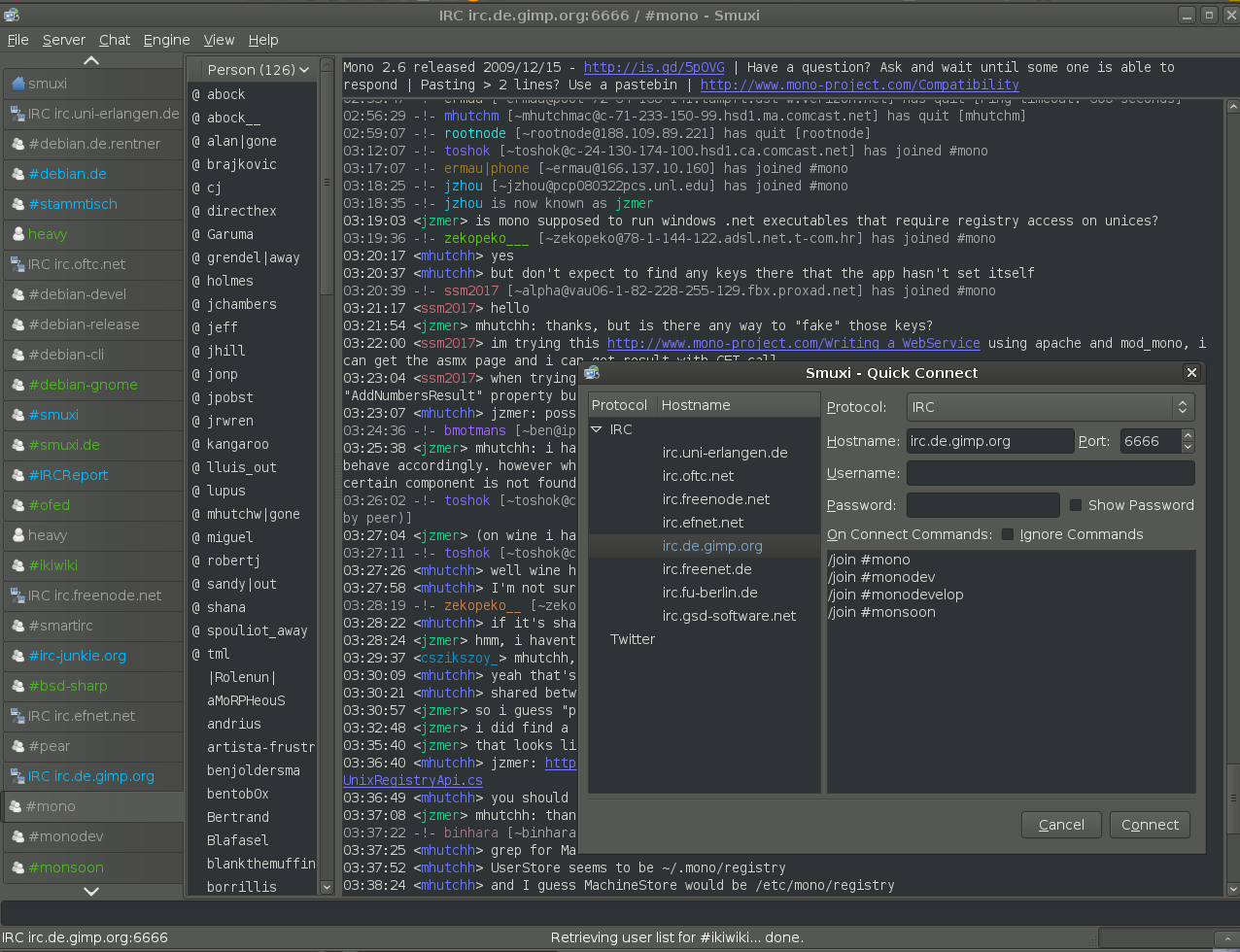
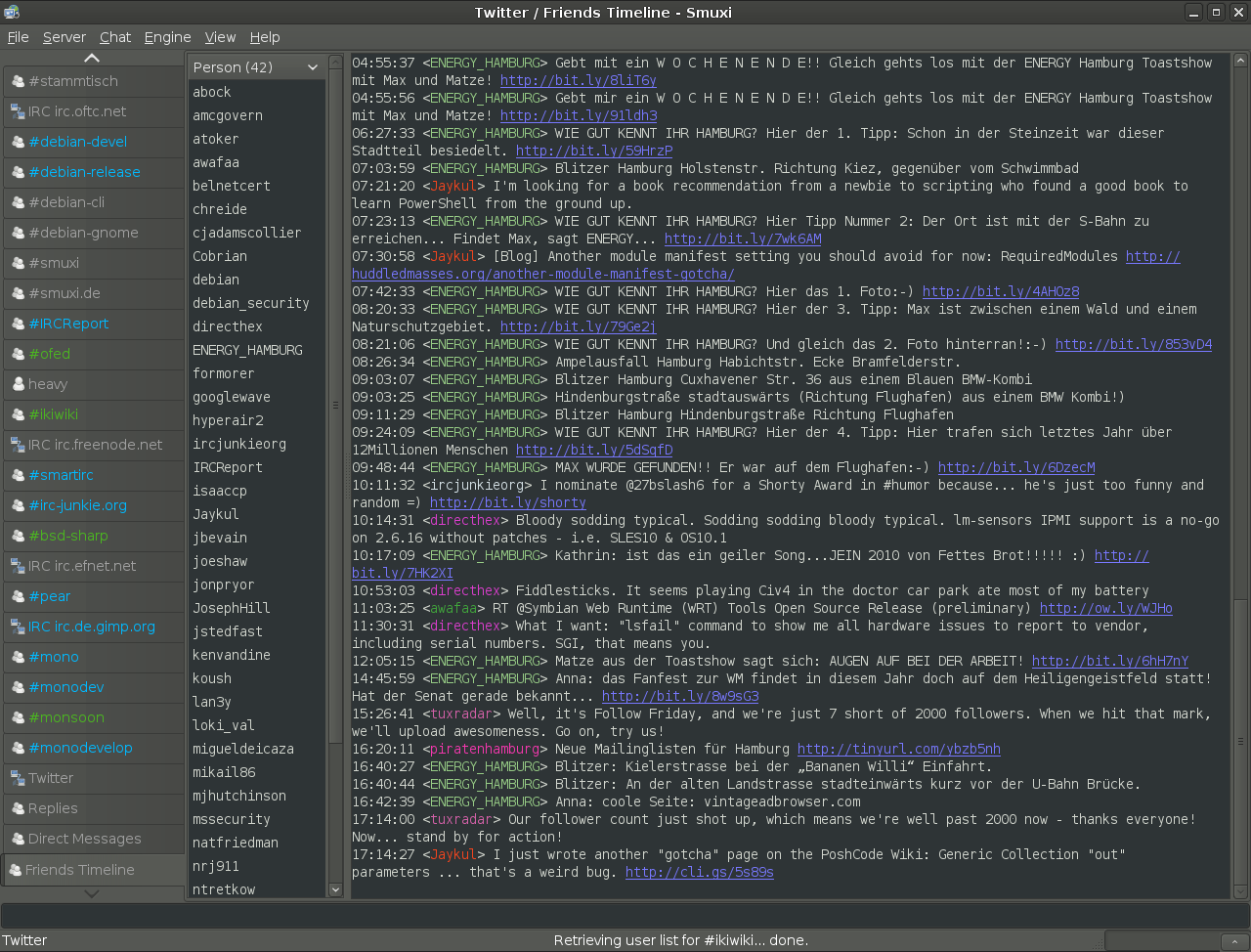
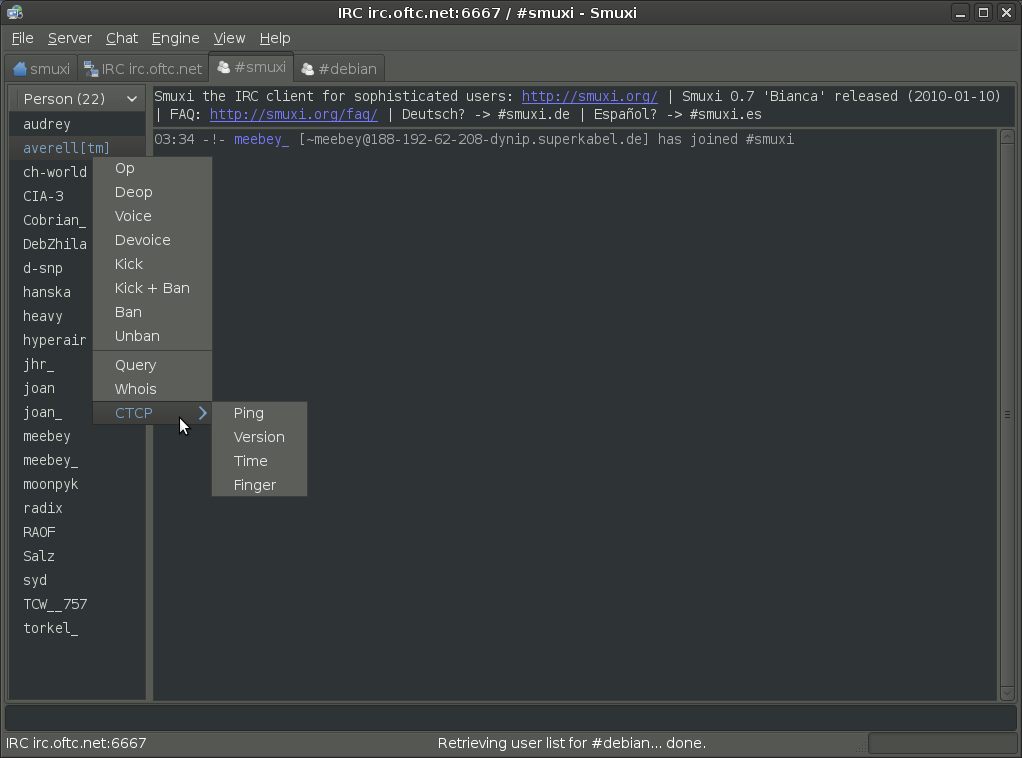
Merry Christmas! Happy New Year! Yeah, it's that time of year again, I am writing a blog post bigsmile.png. As some of you have probably already noticed I managed to get Smuxi 0.7 released a few days ago. Almost all of my Xmas vacation I was hacking on Smuxi. This is the best Smuxi release ever (guaranteed!). The most notable features I implemented in the 0.7 release are: Twitter support, handling for high latency networks (UTMS, WLAN, busy DSL) and an improved IRC experience through tweaks such as splitting oversized messages and new context menus. This release also contains very nice contributions from David Paleino [2] and Cl ment Bourgeois. Both joined the hackfest during my Xmas vacation and made the hacking sessions on Smuxi even more fun. Thanks for that guys! Here you can find a full list of changes. As everbody likes screenshots and as screenshots say a thousand words, here they are: Quick Connect
Twitter
User Menu
Which direction will Smuxi head in after the 0.7 release? For the 0.8 release, I plan to focus on making the IRC support feature complete. That means we will get DCC, SSL, IPv6 and logging support. Nothing of that sounds very special but I am already investigating how Smuxi can be integrated with the promising new Zeitgeist project. I interviewed one of the developers for potential communication between Smuxi and Zeitgeist. Last but not least, I want to announce that I will be attending FOSDEM 2010 in Brussels. I also will give a talk about Smuxi there, scheduled on 2010-02-07 at 16:30. If you want to have a chat, a beer, do some GPG keysigning, or ask me any questions, I am available bigsmile.png PS: If you want more updates than once per year, just follow me on Twitter

Gustavo Franco: Dell Mini 10, now what?

Dear lazyweb, I bought a Dell Mini 10 and am curious on how and if you use it for some sort of Debian development.

I would like to use it in an almost stateless setup (think installed, but usb stick would do) to browse things and have a few git/svn repositories to build small packages.

It seems there are some issues with the Xorg driver for this -- sbo. Thoughts?

16 January 2010

Biella Coleman: Being Bad-Ass w/o the Arrogance

bad-ass For the first time in a long while I took a vacation in New Zealand where I am for LCA. I decided to also take a break (mostly) from the Internet but I decided to it was worth to come back to write a brief response to Clay Shirky s rant about women, which I find pretty unsettling. So the basic upshot of his entry is that for women to get ahead in this world, they need to not only behave more like men but in specific, like all the effing blow-hard jerky self-promoting men like, well Clay Shirky (I guess, right? and he in fact might be proud, I a woman, made this accusation). What I appreciate about the post is the fact that he does not pigeon hole women as caring, maternal, and meek. I have always resented the idea that women can t be assertive and confident. However, confidence and self-esteem, which I agree are vital for getting noted, does not inherently entail jerky behavior.I think Shirky s perspective might be skewed because of his home field, which is filled with just the type of guys he is describing. I call them pundit-entrepreneurs (though to be sure some are pretty darn nice). If you take the field of anthropology, for example, it has traditionally and for a long time been known for grand slam female scholars from Ruth Benedict and Margaret Mead in the past to the ones of the present like Nancy Scheper Hughes and Jean Comaroff. During grad school, I was surrounded by strong, smart, witty, confident ladies and always felt I had role models to follow and emulate. They were not, however, low-life jerks clawing their way to the top of the academic mountain leaving a trail of destruction behind their path. Then when I started to go to the tech and media academic conferences, I was soon swimming in a sea of mostly white men and the vibe was different. I was ignored and talked over a handful of times, which had never happened to me before. There was a lot more self-promotion than I had seen in other fields, in part, it seemed because the media pays more attention to this field so folks are trying to get the media light focused on them. While I don t disagree that many fields from medicine to law promote and reward blow-hards and massive unrestrained arrogance, I would rather not create a false binary between meek/low self-esteem/female and total-jerky/arrogance/confidence. Why not instead promote and highlight behavior that rewards confidence sans the arrogance? Here are some thoughtful related posts.

C.J. Adams-Collier: AoE root for KVM guests

So. I m trying to get familiar with libvirt and friends. To this end, I ve set up a Lucid virtual machine booting from PXE into an initrd environment which does a pivot_root to an AoE block device. The #virt channel on irc.oftc.net told me that in order to have libvirt provide PXE capability, I would have to install a recent version of libvirt. I built version 0.7.5-3 from sid on my karmic laptop and it seems to be working okay. I decided to set up the pxe root directoy in /var/lib/tftproot just because that s what the example code had in it. I had to manually configure a virtual network. Here is the XML config file:
$ sudo virsh net-dumpxml netboot
<network>
  <name>netboot</name>
  <uuid>81ff0d90-c91e-6742-64da-4a736edb9a9b</uuid>
  <forward mode='nat'/>
  <bridge name='virbr1' stp='off' delay='1' />
  <domain name='example.com'/>
  <ip address='192.168.123.1' netmask='255.255.255.0'>
    <tftp root='/var/lib/tftproot' />
    <dhcp>
      <range start='192.168.123.2' end='192.168.123.254' />
      <bootp file='pxelinux.0' />
    </dhcp>
  </ip>
</network>
This, of course, depends on the pxelinux.0 file. Luckily, this is packaged up in syslinux and can be installed with a simple
$ sudo apt-get install syslinux
$ sudo mkdir /var/lib/tftproot
$ sudo cp /usr/lib/syslinux/pxelinux.0 /var/lib/tftproot
I had to create a pxelinux config file for the virtual machine (indexed by mac address). Note that I put a console=ttyS0,115200 argument on the kernel command line so that I can attach to the serial port from the host system for copy/paste debugging. Also of importance is the root=/dev/etherd/e0.1p1 argument, specifying which block device we ll be doing the pivot_root to eventually.
$ mkdir /var/lib/tftproot/pxelinux.cfg/
$ cat /var/lib/tftproot/pxelinux.cfg/01-52-54-00-44-34-67
DEFAULT linux
LABEL linux
SAY Now booting the kernel from PXELINUX...
KERNEL vmlinuz-lucid0
APPEND ro root=/dev/etherd/e0.1p1 console=ttyS0,115200 initrd=initrd.img-lucid0
I decided to use the karmic kernel for lucid initially. I ll eventually switch over to the lucid kernel ;)
$ sudo cp /boot/vmlinuz-2.6.31-17-generic /var/lib/tftproot/vmlinuz-lucid0
I copied /etc/initramfs-tools to ~/tmp/lucid so that I didn t mess up the system initrd scripts:
$ mkdir -p ~/tmp/lucid && cp -r /etc/initramfs-tools ~/tmp/lucid/
Since mkinitramfs doesn t currently have a system for AoE root, I had to do a bit of fiddling. I copied the NFS root boot script and made a couple of modifications.
$ diff -u /usr/share/initramfs-tools/scripts/nfs ~/tmp/lucid/initramfs-tools/scripts/aoe
--- /usr/share/initramfs-tools/scripts/nfs	2008-06-23 23:10:21.000000000 -0700
+++ /home/cjac/tmp/lucid/initramfs-tools/scripts/aoe	2010-01-15 14:56:28.098298027 -0800
@@ -5,59 +5,25 @@
 retry_nr=0
 # parse nfs bootargs and mount nfs
-do_nfsmount()
+do_aoemount()
  
-
 	configure_networking
-	# get nfs root from dhcp
-	if [ "x$ NFSROOT " = "xauto" ]; then
-		# check if server ip is part of dhcp root-path
-		if [ "$ ROOTPATH#*: " = "$ ROOTPATH " ]; then
-			NFSROOT=$ ROOTSERVER :$ ROOTPATH 
-		else
-			NFSROOT=$ ROOTPATH 
-		fi
-
-	# nfsroot=[<server-ip>:]<root-dir>[,<nfs-options>]
-	elif [ -n "$ NFSROOT " ]; then
-		# nfs options are an optional arg
-		if [ "$ NFSROOT#*, " != "$ NFSROOT " ]; then
-			NFSOPTS="-o $ NFSROOT#*, "
-		fi
-		NFSROOT=$ NFSROOT%%,* 
-		if [ "$ NFSROOT#*: " = "$NFSROOT" ]; then
-			NFSROOT=$ ROOTSERVER :$ NFSROOT 
-		fi
-	fi
+        ip link set up dev eth0
-	if [ -z "$ NFSOPTS " ]; then
-		NFSOPTS="-o retrans=10"
-	fi
+        ls /dev/etherd/
-	[ "$quiet" != "y" ] && log_begin_msg "Running /scripts/nfs-premount"
-	run_scripts /scripts/nfs-premount
-	[ "$quiet" != "y" ] && log_end_msg
+        echo > /dev/etherd/discover
-	if [ $ readonly  = y ]; then
-		roflag="-o ro"
-	else
-		roflag="-o rw"
-	fi
+        ls /dev/etherd/
-	nfsmount -o nolock $ roflag  $ NFSOPTS  $ NFSROOT  $ rootmnt 
+        mount $ ROOT  $ rootmnt 
  
-# NFS root mounting
+# AoE root mounting
 mountroot()
  
-	[ "$quiet" != "y" ] && log_begin_msg "Running /scripts/nfs-top"
-	run_scripts /scripts/nfs-top
-	[ "$quiet" != "y" ] && log_end_msg
-
-	modprobe nfs
-	# For DHCP
-	modprobe af_packet
+	modprobe aoe
 	# Default delay is around 180s
 	# FIXME: add usplash_write info
@@ -67,17 +33,13 @@
 		delay=$ ROOTDELAY 
 	fi
-	# loop until nfsmount succeds
+	# loop until aoemount succeds
 	while [ $ retry_nr  -lt $ delay  ] && [ ! -e $ rootmnt $ init  ]; do
 		[ $ retry_nr  -gt 0 ] && \
-		[ "$quiet" != "y" ] && log_begin_msg "Retrying nfs mount"
-		do_nfsmount
+		[ "$quiet" != "y" ] && log_begin_msg "Retrying AoE mount"
+		do_aoemount
 		retry_nr=$(( $ retry_nr  + 1 ))
 		[ ! -e $ rootmnt $ init  ] && /bin/sleep 1
 		[ $ retry_nr  -gt 0 ] && [ "$quiet" != "y" ] && log_end_msg
 	done
-
-	[ "$quiet" != "y" ] && log_begin_msg "Running /scripts/nfs-bottom"
-	run_scripts /scripts/nfs-bottom
-	[ "$quiet" != "y" ] && log_end_msg
  
(below is the full file in case udiff is less convenient)
$ cat ~/tmp/lucid/initramfs-tools/scripts/aoe
# NFS filesystem mounting			-*- shell-script -*-
# FIXME This needs error checking
retry_nr=0
# parse nfs bootargs and mount nfs
do_aoemount()
 
	configure_networking
        ip link set up dev eth0
        ls /dev/etherd/
        echo > /dev/etherd/discover
        ls /dev/etherd/
        mount $ ROOT  $ rootmnt 
 
# AoE root mounting
mountroot()
 
	modprobe aoe
	# Default delay is around 180s
	# FIXME: add usplash_write info
	if [ -z "$ ROOTDELAY " ]; then
		delay=180
	else
		delay=$ ROOTDELAY 
	fi
	# loop until aoemount succeds
	while [ $ retry_nr  -lt $ delay  ] && [ ! -e $ rootmnt $ init  ]; do
		[ $ retry_nr  -gt 0 ] && \
		[ "$quiet" != "y" ] && log_begin_msg "Retrying AoE mount"
		do_aoemount
		retry_nr=$(( $ retry_nr  + 1 ))
		[ ! -e $ rootmnt $ init  ] && /bin/sleep 1
		[ $ retry_nr  -gt 0 ] && [ "$quiet" != "y" ] && log_end_msg
	done
 
There was also a small modification to the initramfs.conf file:
$ diff -u /etc/initramfs-tools/initramfs.conf ~/tmp/lucid/initramfs-tools/initramfs.conf
--- /etc/initramfs-tools/initramfs.conf	2008-07-08 18:37:42.000000000 -0700
+++ /home/cjac/tmp/lucid/initramfs-tools/initramfs.conf	2010-01-15 14:33:38.088295207 -0800
@@ -47,14 +47,16 @@
 #
 #
-# BOOT: [ local   nfs ]
+# BOOT: [ local   nfs   aoe]
 #
 # local - Boot off of local media (harddrive, USB stick).
 #
 # nfs - Boot using an NFS drive as the root of the drive.
 #
+# aoe - Boot using an AoE drive as the root of the drive.
+#
-BOOT=local
+BOOT=aoe
 #
 # DEVICE: ...
I also needed to add aoe to the list of modules included in the initramfs:
$ echo aoe >> ~/tmp/lucid/initramfs-tools/modules
In order to generate the initrd.img file from this new config, I ran the following:
$ sudo mkinitramfs -d ~/tmp/lucid/initramfs-tools/ -o /var/lib/tftproot/initrd.img-lucid0
I created a lucid VM by installing from the desktop install disk. You can grab the ISO here: http://cdimage.ubuntu.com/daily-live/current/ I ll leave the creation of the virtual machine and installation as an exercise for the reader. I put the filesystem on an lvm volume group called vg0 in a logical volume called lucid0 (ie, /dev/vg0/lucid0). At this point, I created a new virtual machine called lucid0. Here is the xml for the domain:
$ sudo virsh dumpxml lucid0
<domain type='kvm' id='1'>
  <name>lucid0</name>
  <uuid>96fbad21-4f25-5700-ddd8-1a565c7170ee</uuid>
  <memory>524288</memory>
  <currentMemory>524288</currentMemory>
  <vcpu>1</vcpu>
  <os>
    <type arch='x86_64' machine='pc-0.11'>hvm</type>
    <boot dev='network'/>
  </os>
  <features>
    <pae/>
  </features>
  <clock offset='localtime'/>
  <on_poweroff>destroy</on_poweroff>
  <on_reboot>restart</on_reboot>
  <on_crash>restart</on_crash>
  <devices>
    <emulator>/usr/bin/kvm</emulator>
    <interface type='network'>
      <mac address='52:54:00:44:34:67'/>
      <source network='netboot'/>
      <target dev='vnet0'/>
    </interface>
    <serial type='pty'>
   <source path='/dev/pts/4'/>
      <target port='0'/>
    </serial>
  <console type='pty' tty='/dev/pts/4'>
   <source path='/dev/pts/4'/>
      <target port='0'/>
    </console>
    <input type='tablet' bus='usb'/>
    <input type='mouse' bus='ps2'/>
    <graphics type='vnc' port='5901' autoport='yes' listen='127.0.0.1' keymap='en-us'/>
    <sound model='es1370'/>
    <video>
      <model type='cirrus' vram='9216' heads='1'/>
    </video>
  </devices>
</domain>
Now we re ready to start the AoE target and launch the virtual machine. If you don t have vblade installed, do so now:
$ sudo apt-get install vblade
Start the target up with the following command:
$ sudo vbladed 0 1 virbr1 /dev/vg0/lucid0
Now, if all goes well, you should be able to watch the virtual machine boot up and do its thing like so:
$ sudo virsh start lucid0 && sudo screen -S lucid0 sudo virsh ttyconsole lucid0 115200
If you get errors about /dev/etherd/e0.1p1 not existing (these might look like this):
Begin: Retrying AoE mount ...
err         discover    interfaces  revalidate  flush
mount: mounting /dev/etherd/e0.1p1 on /root failed: No such file or directory
Done.
then you might want to try restarting vbladed like this:
$ sudo kill -9 ps auwx grep vblade grep -v grep awk ' print $2 ' && sudo vbladed 0 1 virbr1 /dev/vg0/lucid0
So. Now you should have a lucid gdm in your virt-manager console. Any questions? #virt on irc.oftc.net
<script>//<script language="javascript" src="http://reddit.com/button.js?t=1"></script>

Holger Levsen: #563195 RFH: usplash -- Userspace bootsplash utility

Two weeks ago I filed #563195, which reads:

the current maintainer welcomed me into the usplash maintainance team, because they are busy with other stuff. Unfortunatly, I'm too busy to give usplash the attention it needs as well.

So I still plan to spend some work on usplash, but I definitly also need help, thus I'm filing this bug.

My basic idea is to upload to experimental based on the upstream version ASAP and frequently, and then upload to unstable once it works ;-)

If you are interested and able to jump in, please reply to this bug.

That's all still the case. The area where help is most welcome atm is to actually make the latest upstream version work without upstart again, as far as I could see on a quick look, upstream has removed support for other initsystems... once we have a working package again, attacking the bugs in the BTS is next.

Wouter Verhelst: ACCEPTED

My mutt said this last night:
 894   + Jan 15 Archive Adminis (0,4K) ipcfg_0.1_amd64.changes ACCEPTED
This obviously means that if you wish to use it, you no longer need to go through git; you can just add experimental to sources.list and run 'apt-get install ipcfg'. A few notes, though: And in case you wonder why the hell I went from 0.1 to 0.3:
ipcfg (0.2) experimental; urgency=low
  * Rebuild without .git directory. D'oh.
 -- Wouter Verhelst <wouter>  Tue, 12 Jan 2010 17:43:09 +0100
srsly

Ingo Juergensmann: Drupal 7 alpha 1 released

As Dries Buytaert, the creator and head of development of Drupal, announced on Twitter, the new major (pre-)version of Drupal, namely Drupal 7 alpha 1 has been released! This was on the 9th birthday of Drupal.

This is great news and the release notes are mentioning some aspects why this is so:

Revamped User Interface
An incredible amount of work has gone into improving the user experience and administration interface. The new administration theme "Seven", the overlay module, the dashboard and the configurable shortcut bar, all lead to a much more user-friendly interface. In-place editing is enabled for blocks and nodes by default, so modifying the content of a site becomes much simpler.

Custom Fields
Drupal 7 bundles in the ability to add custom fields, similar in functionality to the Content Construction Kit (CCK) module. However, fields are no longer limited only to content types; they can be added to users, taxonomy terms, and other entities. Fields also have support for translations.

Image Handling
Drupal 7 brings native image handling to core. Image fields may be added to content, and have image styles applied to them, such as scaling, cropping, and other effects.
Update Manager
Building on Drupal 6's Update module, which keeps site administrators informed when new module and theme releases are available, the new Update Manger module can also install and upgrade modules and themes.

Front-end "under-the-hood" improvements
A new render API allows for highly granular theming, core template files have been revamped to provide more semantic markup, Drupal 7 now has built-in RDFa support, includes jQuery UI and a new AJAX framework, and a new core theme "Stark" which exposes Drupal's markup directly for those who want to dive in and start theming.

In addition, Drupal 7 has several major accessibility enhancements, making it the most accessible release of Drupal to date!

Back-end "under-the-hood" improvements
A revamped database layer resolving nearly all limitations in the Drupal 6 database layer, automated testing framework, new PHP stream-based file API that supports private and public files simultaneously, revamped node access system, new hooks for more flexible system interaction, an Entity API, a job queue API, and many, many, many more improvements.

Drupal 7 is also the most scalable release to date, with features such as built-in proxy server support, advanced caching techniques, and Content Delivery Network support for static files.


Alone the inclusion of CCK and Views are great news, whereas all PostgreSQL users will benefit from the new database layer under the hood. I've tested a pre-alpha development version some weeks ago and that Drupal 7 experience was already great. So, it would be nice to see Drupal 7 in Debian soon as well, but I guess a alpha 1 version might be too early to be packaged.

Stefano Zacchiroli: RCBW strike - BSP in Moenchengladbach

RC squashing news In the last two weeks I didn't progress as usual with RC bug squashing, even if I've some squashes to share: The reason for my under-activity are that for a week I'd relatively scarce network connectivity, which is a badly needed good for RCBW. Then, this week, I got swamped by various tasks at the university (including co-authoring a paper with Lucas, more on this (hopefully) in the future). My residual RCBW time has been devoted to write a page about RCBW where I've tried to summarize my initial motivations and the main points of the initiative, which I consider established by the first 18 weeks of activity. Starting from next week I'll be back with daily squashes. In the week-end ... drum roll ... I'll be attending the BSP in M nchengladbach, hosted by Credativ; I'll personally be kindly hosted by bzed which I thank already for that and for the BSP organization. See you there (!?)

Steve Kemp: I don't like this ending...

I've talked before about the minimal way in which I've been using a lot of the available automation tools. I tend to use them to carry out only a few operations: In the pub I've had more than a few chats about how to parse a mini-language and carry these operations out, and what facilities other people use. It'd be almost trivial to come up with a mini-language, but the conclusion has always been that such mini-languages aren't expressive enough to give you the arbitrary flexibility some people would desire. (Nested conditionals and the ability to do things on a per-host, per-day, per-arch basis for example.) It struck me last night that you could instead cheat. Why not run scripting langues directly on your client nodes? Assume you could write your automation in Ruby or Perl and all you need to do is define a few additional primitives. For example:
#
#  /policies/default.policy - the file that all clients nodes poll.
#
#
#  Fetch the per-node policy if it exists.
#
FetchPolicy $hostname.policy ;
#
#  Ensure SSH is OK
#
FetchPolicy ssh-server.policy ;
#
#  Or explicitly specify the URL:
#
# FetchPolicy http://example.com/policies/ssh-server.policy ;
#
#  Finally a quick fetch of a remote file.
#
if ( FetchFile(
                Source => "/etc/motd",
                Dest => "/etc/motd",
                Owner => "root",
                Group => "root",
                Mode => "0644" ) )
 
    RunCommand( "id" );
 
This default policy attempts to include some other policies which are essentially perl files which have some additional "admin-esque" primitives. Such as "InstallPackage", "PurgePackage", and "FetchFile". FetchFile is the only one I've fully implemented, but given a server it will fetch http://server/prefix/files/$FILENAME - into a local file, and will setup the owner/gid/mode. If the fetch succeeded and contents differ from the current contents of the named file (or the current file doesn't exist) it will be moved into place and the function will return true. On the server side I just have a layout that makes sense:
.
 -- files
     -- etc
         -- motd
         -- motd.silver.my.flat
         -- motd.gold
 -- policies
     -- default.policy
     -- ssh-server.policy
     -- steve.policy
Here FetchFile has been implemented to first request /files/etc/motd.gold.my.flat, then /files/etc/motd.gold, and finally the global file /files/etc/motd. In short you don't want to be forced to write perl which would run things like this:
# install ssh
if ( -e "/etc/apt/sources.list" )
 
  # we're probably debian
  system( "apt-get update" );
  system( "apt-get install openssh-server" );
 
You just want to be able to say "Install Package foo", and rely upon the helper library / primitives being implemented correctly enough to be able to have that work. I'll probably stop there, but it has given me a fair amount to think about. Not least of which : What are the minimum required primitives to usefully automate client nodes? ObFilm: Moulin Rouge!

Miriam Ruiz: Packaging openFrameworks for Ubuntu and Debian

It seems that I m not blogging as often as I was some months ago. The main reason is microblogging, which is somehow quicker, even though briefer. It is also less informative, I guess, because 140 characters is a very limited length. Probably because of that, a friend of mine asked me to write a proper blog entry about this, and I think that he s probably right. openFrameworks is an open source toolkit, released under the MIT license, written in C++ and designed to assist the creative process by providing a simple and intuitive framework for experimentation. According to its authors, it was developed for folks using computers for creative, artistic expression, and who would like low level access to the data inside of media in order manipulate, analyze or explore. I attended a short course in openFrameworks some months ago, and decided that if I wanted to experiment with it, I should somehow structure the building process of the library a bit, remove the dependency on FMOD, which is not DFSG-free, even though that might require remove the whole audio subsystem, make it buildable without Code::Blocks, and hopefully build some more-or-less proper packages. I ve also added some pkg-config files, so that it becomes easier to build projects based in openFrameworks (as easy as g++ source.cpp -o test $(pkg-config openframeworks openframeworks-addons cflags libs) ). Even though the packages are still not as good as they should, they re absolutely usable right now. I ve uploaded them, as well as their dependencies, to my Ubuntu PPA (although I m using those packages in my Debian), in case that someone is interested. I ve also uploaded a couple of tiny examples (the second one downloaded from here) of openFrameworks.

15 January 2010

John Goerzen: Netbook or thin & light notebook?

I am a big fan of thin and light notebooks. I ve been using the 9 EeePC 901 for awhile now, almost since it first came out. I initially loved it. The keyboard, while an obstacle, wasn t as much as I feared. The thing got insanely long battery life (5-6 hours or more typical), and was so small that my laptop bag is a DVD player bag . Now for the downsides. I am getting into a time where I m spending more time on the laptop, and I m starting to be far more acutely aware of them. #1 is performance. Let s face it: the 901 is just a slow machine all-around. The video performance isn t great, and I can watch the Thunderbird interface being drawn as it loads. But the real killer is the SSD storage. It is exceptionally slow, and gets in the way of multitasking in a serious way. (Syncing mail? Kiss performance in Firefox goodbye.) Problem #2 is the 1024 600 screen. This is becoming a serious inconvenience, as when you combine the need to do a lot of scrolling with slow scrolling performance, the result is unpleasant. Coding is pretty difficult at that size. #3 is the keyboard size. It is OK for light-duty work, but it is getting in the way for more serious work. So I m looking for a replacement. I m thinking something in the 10 to 12 range, thin and light, would be ideal. My main criteria are size, weight, performance, and compatibility with Debian. Durability is an added plus as it will be riding in my bicycle bag on a regular basis. This puts me in something of a grey area: there are netbooks in that range, and then there are machines like the Macbook Air (which may actually be a bit bigger than I d like). I have recently been hearing good things about the EeePC 1005PE (Atom N450) and the 1201N (N270 with Nvidia Ion). The 1201N seems to beat the 1005PE in terms of performance (especially video-related), but with far less battery life. I think I could live with the slower CPU, but the 1005PE still has only 1024 600 resolution, which would be a big problem for me. Lenovo has an IdeaPad U150 with an 11.6 1366 768 screen, and in the 12 size, they ve got various options, both Atom and Core 2 Duo. The X200 and X200s look interesting, but lack a touchpad. (The X200s appears to be their long-lasting-battery version.) The HP EliteBook 2530p also looks interesting; it has a touchpad, but is heavier and appears to have inferior battery life to the X200s. What ideas do people have?

Tiago Bortoletto Vaz: don t be ingenuous


It s only about business.

Roland Mas: FusionForge developers/users meeting coming up

News is slow this month on the FusionForge development front. We're all busy gathering all the things that we want to go into the next release, but there's no big news from the code. However, there is something of interest. You may have heard about the Coclico project, which is an initiative aiming at collaboration and convergence between several forge engines, most notably FusionForge, Codendi and Novaforge. That project was started last October, and it holds regular meetings with its members. The next meeting is scheduled for the 2nd of February in Paris, and we thought we could host an open meeting on the 3rd for non-Coclico members, a bit like the forge meeting we had last year (which is when FusionForge was officially born), but with an emphasis on what Coclico did so far. Since most of the FusionForge hackers are in Western Europe, and several are in Paris (especially if we add those who go to Paris for the Coclico meeting), we thought it would also be a good opportunity to gather for a technical and social meeting. It seems the Coclico open session didn't generate much interest this time (at least, it hasn't so far), so I proposed to hijack the room for this FusionForge meeting, and I didn't hear any objections. I have several themes I'd like to discuss with people, and possibly start implementing during that day: and so on. These are in no way specific to FusionForge, and in fact I think it would be great if hackers/users of other forges were present, because we could benefit a great deal from their experience and plans. But if we find ourselves amongst FF people only, I think these would be good to discuss, possibly write some code for, and go home with a clearer picture of where our efforts should focus in the near future. I'd therefore like to invite interested people to mark the 3rd of February on their agendas. The meeting will take place in Issy-les-Moulineaux (near Paris, within reach of the tube). If you're interested, please get in touch with us (#FusionForge on the FreeNode IRC network, or the fusionforge-general mailing-list), so we can have a rough estimate of how many people to expect. The meeting room is provided by France T l com, and they're probably going to need numbers if not names. Further details will be announced when known.

Eddy Petri&#537;or: Busy, busy, busy and lazy me

It has been quite some time since my last post. I have been involved in quite a few things and the last part of 2009 which left no time for anything else. At the begining of 2010, just to set things on a good tone from the new year, I went on a snowboarding vacation to Austria to Kitzb hel.

Presidential campaign and pure irrationality in Romania

I got involved in Remus Cernea's presidential campaign, which was quite a success, considering the media blockade he was subject to. Unfortunately, Romanians seem to more and more indoctrinated, idiotic and gullible, probably thanks to newer generations that come through public schools after 12 years of religious indctrination and media promoting stupidity, non-values, ignorance and so on.

The more I live in this country, the more I realize how I don't feel like fitting in, because I refuse to be a mindless sheep, a moron, listening to anything the news at 5 say (those living in Romania know what I mean). I obstinately form my own ideas and question everything.

Significant event in my life

In September 2009 a life-turning event took place in my life - don't worry, is nothing bad, is pure good - and my eyes opened entirely. I have bacame a sponge trying to know more and more and this has helped me see the world with new eyes, from a new perspective, without lies or preconceptions.

Now I am thingking freely.


I am sorry for not going into details, but I have my reasons. Those who have the eyes and brains to understand what I am talking about, surely have understood by now what has happened to me ;-) .

Snowboarding vacation

At the begining of this year I went with my wife and some friends to Austria for a vacation. Kitzb hel's slopes and conditions were very good (bad points were only due to a couple of areas where snowboarders had to open at least one binding).

<iframe frameborder="0" height="350" marginheight="0" marginwidth="0" scrolling="no" src="http://www.openstreetmap.org/export/embed.html?bbox=12.2575,47.3556,12.5092,47.5304&amp;layer=mapnik" style="border: 1px solid black" width="425"></iframe>
View Larger Map

Weather was good and snow was icy only late in the afternoon. I was quite suprised to see stores close at 6pm, but overall, it was a well deserved vacation and I enjoyed it very much. My wife's skills on the board got better, although the third day some beginner skyer broke one of the bindings of my wife's snowboard and she had to use a rental instead. The rental was a quite new Burton board and Otilia got used to it and liked to the extent that we decided the next board we buy (for either of us) will be a Burton.

Did it worth it to drive 1500 km (roughly 1000 miles for the metric system challenged people :-P) for this vacation? Definitely! Did I enjoy the drive? Well, let's just say that the 950km from Kitzb hel to the Romanian border were made in approximately the same time it took us to make the last 550km to Bucharest, while 110km of those last were on the A1 "highway".

I'll probably put some photos from my vacation somewhere on the intenets, but don't hold your breath :-P .

Instead of conclusions

I know I promissed a lot of people to take care of some things like Wormux and some kernel bug debugging and I didn't kept my promise. I appologise, yet I don't expect anyone to accept my appologies. I am still unsure when I'll get back to that. I still care for Debian, yet the day has only 24 hours and I have to use at least 7 of those on sleep.

Jon Dowland: Dawn

The weather in January in the UK is normally very drab, and this January has been no exception. Despite this I've found myself uncharactistically upbeat. I'm enjoying work, I've got a lot to do, and I feel like I'm making real progress in "real life" too. (It's a shame Debian has taken a back seat for the time being...) This morning was marginally less drab.

Russell Coker: Cheap Net Access in Australia

The cheapest ADSL or Cable net access in Australia seems to be about $30 per month. I ve been using 3G net access by the Three phone company for 18 months now and it s been working well [1]. I recently bought a new 3G modem because the old one broke, so it has cost me $250 in modems plus $15 per month for the connection which compares well to $100 (or more) for an ADSL or Cable installation plus $30 per month. My Three net access gives me 1G of data per month. I have just noticed that they have pre-paid net access that gives 12G of data that must be used within one year which costs $149 per year [2] that is $12.41 per month or 83% the price of the plan access plus it means that any bandwidth quota that isn t used in one month can be used the next month (so you can save up for upgrading to a newer distribution of Linux). Dodo has pre-paid mobile net access on the Optus network for $139 which gives 15G of data that must be used within one year [3]. So that s equivalent to $11.58 per month or $9.20 per gig. A member of my local LUG mentioned that Exetel has a 3G plan which is good value if you don t use much data transfer but which has per-megabyte charges for excess data transfer. I couldn t recommend it for my parents as I never know when they will do something that may transfer a lot of data, I could just imagine them saying loading web pages was really slow for a week and then I got a big bill . Ross Barkman s GPRS/UMTS page gives some critical information on using a 3G phone with a tether [4]. Using that information I discovered that I need to use AT+CGDCONT=1,"IP","3netaccess" in my chatscript to get ppp going with my old LG U890 mobile phone (with 3netaccess being the important word). I plan to give my old mobile phone to my parents and let them use prepaid 3G net access to reduce their net access bill by more than 1/3 while also giving them more data transfer quota for times when they need to transfer a lot (EG when my sister visits them). At this stage I m not sure whether I will get them to use Three or Dodo. One advantage of Three is that I ve used them a lot and know exactly how to get it all working, the other is that my old mobile phone is locked to Three they agreed to unlock it on demand after the contract is ended (which happened over a year ago) but it will be a hassle to get it done. Saving the hassle of getting an old phone unlocked may be worth the $10 per year cost. Also I have used my 3G modem at my parents house on a few occasions and know that the reception is quite good, while the reception for Dodo (Optus) 3G is unknown One extra benefit with doing this is that my parents will have some freedom to move their PC. If they decide that the computer room is too hot in summer and want to move their PC to below their air-conditioner they will be able to do so without needing a long Ethernet cable to connect their PC to the cable modem. For my personal 3G net access (which I require for fixing servers on occasion) I am stuck with Three. When I bought a new 3G modem I decided to save about $20 by getting a device that s locked to Three. 12G per year is more than enough for sshing to servers and checking email and if I had paid extra for the unlocked modem it would it would probably have died before the savings on net access made up for the higher purchase price. Update:
Crazy John has a good deal, $129 for 7.5G which expires in a year [5]. I won t use that for my parents though, the probability of them going over 7.5G is too high to make it worth the risk for a $10 saving.

Stefano Zacchiroli: Preserving privacy with Google Docs

Eclectic paper: SEcure GOogle DOCumentS Two days from an important Google announcement, privacy awareness is steadily increasing in the media. The old mantra that "despotic governments might use your data in unexpected way" sounds more real than last week, and recent movies ring different bells in our heads. That event has prodded me to (finally!) blog about yet another eclectic paper of mine, co-authored with my old friend Gabriele D'Angelo, and which I'm going to present at the forthcoming ACM SAC conference. The paper is titled Content Cloaking: Preserving Privacy with Google Docs and other Web Applications and poses (again) a rather simple question: why should you trust Google to faithfully store your Google Docs data? What if roles in the recent Google-vs-China issue were inverted? The proposed solution (Content Cloaking) then simply implements transparent encryption and decryption in the payload which is sent back and forth between your browser and the Docs backend. Trying to access your Docs data without a decryption layer and the needed key will then just show garbage, for both humans and Google harvesters. Of course you lose something, like full text search which is performed server-side by Google, but at least you're back in charge again: it is you who decides to which extent trading-off your privacy with offered services. A proof-of-concept implementation is provided (and of course is free software!) as an extension for the Firefox browser, but is now out of date wrt Firefox mainline and was not really production ready anyhow (let's say it was master-thesis-implementation-quality ...). Still we, the authors, stand behind the idea even if we don't have the energy to maintain a production-quality implementation. So, Dear LazyWeb, If you are interested in the topic and you've development cycles to spare, please drop me a mail and I'll be happy to point you to all needed details to resurrect the implementation (or create one from scratch, which should be pretty easy and quick if you're familiar with extension development).

Adrian von Bidder: Microsoft

Maybe we could define the [ACPI] APIs so that they work well with NT and not the others even if they are open.
Or maybe we could patent something related to this.
Bill Gates, 1999, the others is Linux (Bill says so explicitly in this email, too.) Obviously, we find similar anti-Windows rethoric en masse on Linux mailing list, and obviously it's been a few years since but I find myself asking if anything really changed in the top level of MS management, except perhaps that a few people realized that trying to make the Linux / FOSS crowd look like a ridiculous bunch of amateurs wouldn't work.

Christian Perrier: Samba 3.4.4 in unstable

It tooks me one week, this time after Karolin released upstream samba 3.4.4, to get Debian packages in unstable. That release will unfortunately be the first to use a "~dfsg" suffix to upstream version. In short, upstream used to distribute RFC files in their tarball. They first removed them when we pointed them at this (because we had an RC bug by our zealous "non-free documentation" hunters). However, they were reinstated after a discussion in upstream lists where it was pointed that these RFC files were needed for Samba 4 sources (that are distributed along with Samba 3 though not used to build Samba 3 packages). So, well, even though I don't feel really concerned by cutting hair in 4 about documentation files freeness, I fixed this by repackaging the upstream tarball without these files. I did choose to use "~dfsg" as suffix so that someone wanting to upgrade from our packages to some unofficial packages using the standard versioning (such as SerNet packages) can do it.

Next.

Previous.