Search Results: "sf"

1 April 2015

Benjamin Mako Hill: More Community Data Science Workshops

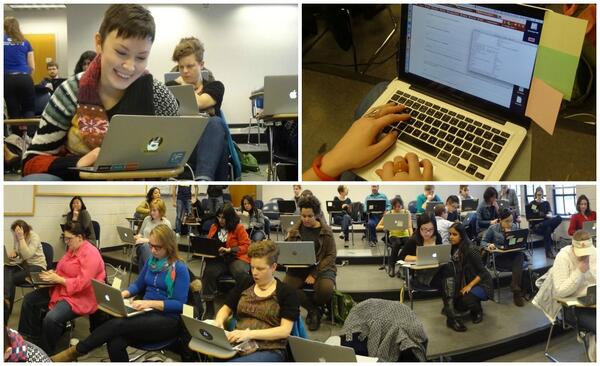
Pictures from the CDSW sessions in Spring 2014Pictures from the CDSW sessions in Spring 2014
After two successful rounds in 2014, I m helping put on another round of the Community Data Science Workshops. Last year, our 40+ volunteer mentorss taught more than 150 absolute beginners the basics of programming in Python, data collection from web APIs, and tools for data analysis and visualization and we re still in the process of improving our curriculum and scaling up. Once again, the workshops will be totally free of charge and open to anybody. Once again, they will be possible through the generous participation of a small army of volunteer mentors. We ll be meeting for four sessions over three weekends: If you re interested in attending, or interested in volunteering as mentor, you can go to the information and registration page for the current round of workshops and sign up before April 3rd.

Lars Wirzenius: Obnam 4.1 released

It is with great pleasure and satisfaction that I release version 4.1 of Obnam, my backup program. This version includes a radically innovative approaches to data compression and de-duplication, as well as some other changes and bug fixes. Major user-visible changes: Minor user-visible changes: Bug fixes:

31 March 2015

Zlatan Todori : Interviews with FLOSS developers: Francesca Ciceri

Debian and FLOSS community don't only occupy coding developers. They occupy people who write news, who talk about FLOSS, who help on booths and conferences, who create artistic forms of the community and so many others that contribute in countless ways. A lady, that is doing many of that is Francesca Ciceri, known in Debian as MadameZou. She is non-packaging Debian Developer, a fearless warrior for diversity and a zombie fan. Although it sounds intimidating, she is deep caring and great human being. So, what has MadaZou to tell us? Picture of MadameZou Who are you? My name is Francesca and I'm totally flattered by your intro. The fearless warrior part may be a bit exaggerated, though. What have you done and what are you currently working on in FLOSS world? I've been a Debian contributor since late 2009. My journey in Debian has touched several non-coding areas: from translation to publicity, from videoteam to www. I've been one of the www.debian.org webmasters for a while, a press officer for the Project as well as an editor for DPN. I've dabbled a bit in font packaging, and nowadays I'm mostly working as a Front Desk member. Setup of your main machine? Wow, that's an intimate question! Lenovo Thinkpad, Debian testing. Describe your current most memorable situation as FLOSS member? Oh, there are a few. One awesome, tiring and very satisfying moment was during the release of Squeeze: I was member of the publicity and the www teams at the time, and we had to pull a 10 hours of team work to put everything in place. It was terrible and exciting at the same time. I shudder to think at the amount of work required from ftpmaster and release team during the release. Another awesome moment was my first Debconf: I was so overwhelmed by the sense of belonging in finally meeting all these people I've been worked remotely for so long, and embarassed by my poor English skills, and overall happy for just being there... If you are a Debian contributor I really encourage you to participate to Debian events, be they small and local or as big as DebConf: it really is like finally meeting family. Some memorable moments from Debian conferences? During DC11, the late nights with the "corridor cabal" in the hotel, chatting about everything. A group expedition to watch shooting stars in the middle of nowhere, during DC13. And a very memorable videoteam session: it was my first time directing and everything that could go wrong, went wrong (including the speaker deciding to take a walk outside the room, to demonstrate something, out of the cameras range). It was a disaster, but also fun: at the end of it, all the video crew was literally in stitches. But there are many awesome moments, almost too many to recall. Each conference is precious on that regard: for me the socializing part is extremely important, it's what cements relationships and help remote work go smoothly, and gives you motivation to volunteer in tasks that sometimes are not exactly fun. You are known as Front Desk member for DebConf's - what work does it occupy and why do you enjoy doing it? I'm not really a member of the team: just one of Nattie's minions! You had been also part of DebConf Video team - care to share insights into video team work and benefits it provides to Debian Project? The video team work is extremely important: it makes possible for people not attending to follow the conference, providing both live streaming and recording of all talks. I may be biased, but I think that DebConf video coverage and the high quality of the final recordings are unrivaled among FLOSS conferences - especially since it's all volunteer work and most of us aren't professional in the field. During the conference we take shifts in filming the various talks - for each talk we need approximately 4 volunteers: two camera operators, a sound mixer and the director. After the recording, comes the boring part: reviewing, cutting and sometimes editing the videos. It's a long process and during the conference, you can sometimes spot the videoteam members doing it at night in the hacklab, exhausted after a full day of filming. And then, the videos are finally ready to be uploaded, for your viewing pleasure. During the last years this process has become faster thanks to the commitment of many volunteers, so that now you have to wait only few days, sometimes a week, after the end of the conference to be able to watch the videos. I personally love to contribute to the videoteam: you get to play with all that awesome gear and you actually make a difference for all the people who cannot attend in person. You are also non-packaging Debian Developer - how does that feel like? Feels awesome! The mere fact that the Debian Project decided - in 2009 via a GR - to recognize the many volunteers who contribute without doing packaging work is a great show of inclusiveness, in my opinion. In a big project like Debian just packaging software is not enough: the final result relies heavily on translators, sysadmins, webmasters, publicity people, event organizers and volunteers, graphic artists, etc. It's only fair that these contributions are deemed as valuable as the packaging, and to give an official status to those people. I was one of the firsts non-uploading DD, four years ago, and for a long time it was just really an handful of us. In the last year I've seen many others applying for the role and that makes me really happy: it means that finally the contributors have realized that they deserve to be an official part of Debian and to have "citizenship rights" in the project. You were the leading energy on Debian's diversity statement - what gave you the energy to drive into it? It seemed the logical conclusion of the extremely important work that Debian Women had done in the past. When I first joined Debian, in 2009, as a contributor, I was really surprised to find a friendly community and to not be discriminated on account of my gender or my lack of coding skills. I may have been just lucky, landing in particularly friendly teams, but my impression is that the project has been slowly but unequivocally changed by the work of Debian Women, who raised first the need for inclusiveness and the awareness about the gender problem in Debian. I don't remember exactly how I stumbled upon the fact that Debian didn't have a Diversity Statement, but at first I was very surprised by it. I asked zack (Stefano Zacchiroli), who was DPL at the time, and he encouraged me to start a public discussion about it, sending out a draft - and helped me all the way along the process. It took some back and forth in the debian-project mailing list, but the only thing needed was actually just someone to start the process and try to poke the discussion when it stalled - the main blocker was actually about the wording of the statement. I learned a great deal from that experience, and I think it changed completely my approach in things like online discussions and general communication within the project. At the end of the day, what I took from that is a deep respect for who participated and the realization that constructive criticism does require certainly a lot of work for all parts involved, but can happen. As for the statement in itself: these things are as good as you keep them alive with best practices, but I think that are better stated explicitly rather than being left unsaid. You are involved also with another Front Desk, the Debian's one which is involved with Debian's New Members process - what are tasks of that FD and how rewarding is the work on it? The Debian Front Desk is the team that runs the New Members process: we receive the applications, we assign the applicant a manager, and we verify the final report. In the last years the workflow has been simplified a lot by the re-design of the nm.debian.org website, but it's important to keep things running smoothly so that applicants don't have too lenghty processes or to wait too much before being assigned a manager. I've been doing it for a less more than a month, but it's really satisfying to usher people toward DDship! So this is how I feel everytime I send a report over to DAM for an applicant to be accepted as new Debian Developer: Crazy pic How do you see future of Debian development? Difficult to say. What I can say is that I'm pretty sure that, whatever the technical direction we'll take, Debian will remain focused on excellence and freedom. What are your future plans in Debian, what would you like to work on? Definetely bug wrangling: it's one of the thing I do best and I've not had a chance to do that extensively for Debian yet. Why should developers and users join Debian community? What makes Debian a great and happy place? We are awesome, that's why. We are strongly committed to our Social Contract and to users freedom, we are steadily improving our communication style and trying to be as inclusive as possible. Most of the people I know in Debian are perfectionists and outright brilliant in what they do. Joining Debian means working hard on something you believe, identifying with a whole project, meeting lots of wonderful people and learning new things. It ca be at times frustrating and exhausting, but it's totally worth it. You have been involved in Mozilla as part of OPW - care to share insights into Mozilla, what have you done and compare it to Debian? That has been a very good experience: it meant have the chance to peek into another community, learn about their tools and workflow and contribute in different ways. I was an intern for the Firefox QA team and their work span from setting up specific test and automated checks on the three version of Firefox (Stable, Aurora, Nightly) to general bug triaging. My main job was bug wrangling and I loved the fact that I was a sort of intermediary between developers and users, someone who spoke both languages and could help them work together. As for the comparison, Mozilla is surely more diverse than Debian: both in contributors and users. I'm not only talking demographic, here, but also what tools and systems are used, what kind of skills people have, etc. That meant reach some compromises with myself over little things: like having to install a proprietary tool used for the team meetings (and getting crazy in order to make it work with Debian) or communicating more on IRC than on mailing lists. But those are pretty much the challenges you have to face whenever you go out of your comfort zone . You are also volunteer of the Organization for Transformative Works - what is it, what work do you do and care to share some interesting stuff? OTW is a non profit organization to preserve fan history and cultures, created by fans. Its work range from legal advocacy and lobbying for fair use and copyright related issues, developing and maintaining AO3 -- a huge fanwork archive based on open-source software --, to the production of a peer-reviewed academic journal about fanworks. I'm an avid fanfiction reader and writer, and joining the OTW volunteers seemed a good way to give back to the community - in true Debian fashion . As a volunteer, I work for the Translation Committee: we are more than a hundred people - divided in several language teams - translating the OTW website, the interface of AO3 archive, newsletter, announcements and news posts. We have a orga-wide diversity statement, training for recruits, an ever growing set of procedures to smooth our workflow, monthly meetings and movie nights. It's an awesome group to work with. I'm deeply invested in this kind of work: both for the awesomeness of OTW people and for the big role that fandom and fanworks have in my life. What I find amazing is that the same concept we - as in the FLOSS ecosystem - apply to software can be applied to cultural production: taking a piece of art you love and expand, remix, explore it. Just for the fun of it. Protect and encourage the right to play in this cultural sandbox is IMO essential for our society. Most of the participants in the fandom come from marginalised group or minorities whose point of view is usually not part of the mainstream narratives. This makes the act of writing, remixing and re-interpreting a story not only a creative exercise but a revolutionary one. As Elizabeth Minkel says: "My preferred explanation is the idea that the vast majority of what we watch is from the male perspective authored, directed, and filmed by men, and mostly straight white men at that. Fan fiction gives women and other marginalised groups the chance to subvert that perspective, to fracture a story and recast it in her own way." In other words, "fandom is about putting debate and conversation back into an artistic process". On a personal side - you do a lot of DIY, handmade works. What have you done, what joy does it bring to you and share with us a picture of it? I like to think that the hacker in me morphs in a maker whenever I can actually manipulate stuff. The urge to explore ways of doing things, of create and change is probably the same. I've been blessed with curiousity and craftiness and I love to learn new DIY techniques: I cannot describe it, really, but if I don't make something for a while I actually feel antsy. I need to create stuff. Nowadays, I'm mostly designing and sewing clothes - preferably reproductions of dresses from the 40s and the 50s - and I'm trying to make a living of that. It's a nice challenge: there's a lot of research involved, as I always try to be historically accurate in design, sewing tecniques and material, and many hours of careful attention to details. I'm right in the process of make photoshoots for most of my period stuff, so I'll share with you something different: a t-shirt refashion done with the DebConf11 t-shirt! (here's the tutorial) T-shirt pic

30 March 2015

John Goerzen: ssh suddenly stops communicating with some hosts

Here s a puzzle I m having trouble figuring out. This afternoon, ssh from my workstation or laptop stopped working to any of my servers (at OVH). The servers are all running wheezy, the local machines jessie. This happens on both my DSL and when tethered to my mobile phone. They had not applied any updates since the last time ssh worked. When looking at it with ssh -v, they were all hanging after:
debug1: SSH2_MSG_KEXINIT sent
debug1: SSH2_MSG_KEXINIT received
debug1: kex: server->client aes128-ctr umac-64@openssh.com none
debug1: kex: client->server aes128-ctr umac-64@openssh.com none
debug1: sending SSH2_MSG_KEX_ECDH_INIT
debug1: expecting SSH2_MSG_KEX_ECDH_REPLY
Now, I noticed that a server on my LAN running wheezy could successfully connect. It was a little different:
debug1: kex: server->client aes128-ctr hmac-md5 none
debug1: kex: client->server aes128-ctr hmac-md5 none
debug1: sending SSH2_MSG_KEX_ECDH_INIT
debug1: expecting SSH2_MSG_KEX_ECDH_REPLY
And indeed, if I run ssh -o MACs=hmac-md5, it works fine. Now, I tried rebooting machines at multiple ends of this. No change. I tried connecting from multiple networks. No change. And then, as I was writing this blog post, all of a sudden it works normally again. Supremely weird! Any ideas what I can blame here?

Matthias Klumpp: Limba Project: Another progress report

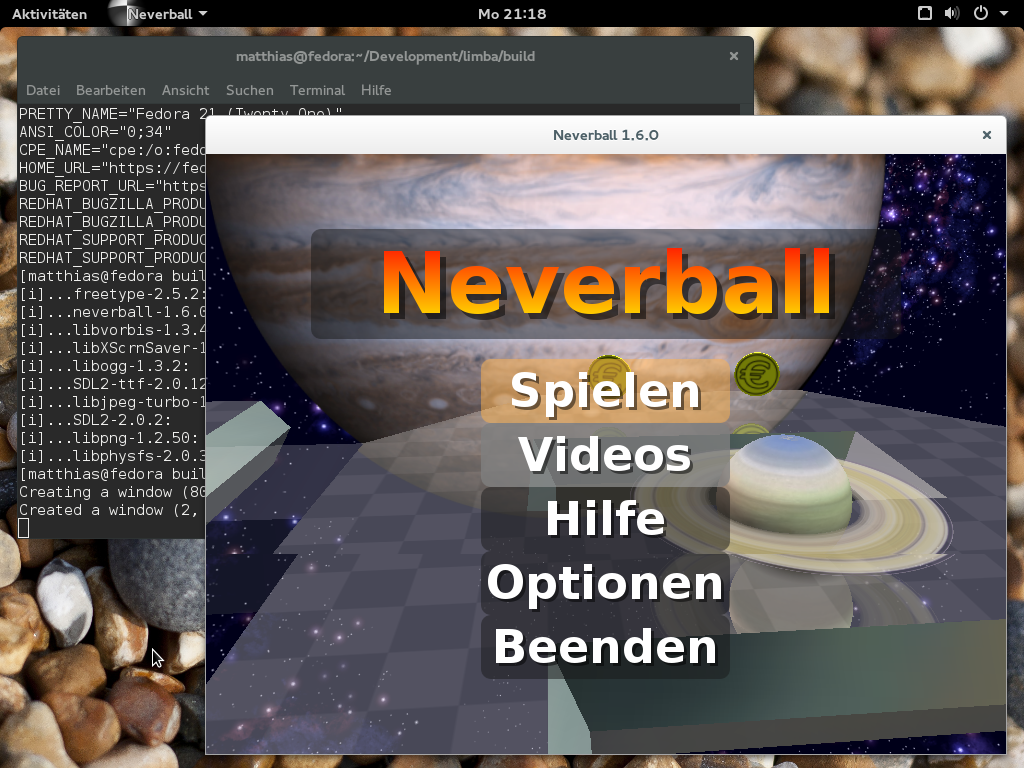
And once again, it s time for another Limba blogpost :-)limba-small Limba is a solution to install 3rd-party software on Linux, without interfering with the distribution s native package manager. It can be useful to try out different software versions, use newer software on a stable OS release or simply to obtain software which does not yet exist for your distribution. Limba works distribution-independent, so software authors only need to publish their software once for all Linux distributions. I recently released version 0.4, with which all most important features you would expect from a software manager are complete. This includes installing & removing packages, GPG-signing of packages, package repositories, package updates etc. Using Limba is still a bit rough, but most things work pretty well already. So, it s time for another progress report. Since a FAQ-like list is easier to digest. compared to a long blogpost, I go with this again. So, let s address one important general question first: How does Limba relate to the GNOME Sandboxing approach? (If you don t know about GNOMEs sandboxes, take a look at the GNOME Wiki Alexander Larsson also blogged about it recently) First of all: There is no rivalry here and no NIH syndrome involved. Limba and GNOMEs Sandboxes (XdgApp) are different concepts, which both have their place. The main difference between both projects is the handling of runtimes. A runtime is the shared libraries and other shared ressources applications use. This includes libraries like GTK+/Qt5/SDL/libpulse etc. XdgApp applications have one big runtime they can use, built with OSTree. This runtime is static and will not change, it will only receive critical security updates. A runtime in XdgApp is provided by a vendor like GNOME as a compilation of multiple single libraries. Limba, on the other hand, generates runtimes on the target system on-the-fly out of several subcomponents with dependency-relations between them. Each component can be updated independently, as long as the dependencies are satisfied. The individual components are intended to be provided by the respective upstream projects. Both projects have their individual up and downsides: While the static runtime of XdgApp projects makes testing simple, it is also harder to extend and more difficult to update. If something you need is not provided by the mega-runtime, you will have to provide it by yourself (e.g. we will have some applications ship smaller shared libraries with their binaries, as they are not part of the big runtime). Limba does not have this issue, but instead, with its dynamic runtimes, relies on upstreams behaving nice and not breaking ABIs in security updates, so existing applications continue to be working even with newer software components. Obviously, I like the Limba approach more, since it is incredibly flexible, and even allows to mimic the behaviour of GNOMEs XdgApp by using absolute dependencies on components. Do you have an example of a Limba-distributed application? Yes! I recently created a set of package for Neverball Alexander Larsson also created a XdgApp bundle for it, and due to the low amount of stuff Neverball depends on, it was a perfect test subject. One of the main things I want to achieve with Limba is to integrate it well with continuous integration systems, so you can automatically get a Limba package built for your application and have it tested with the current set of dependencies. Also, building packages should be very easy, and as failsafe as possible. You can find the current Neverball test in the Limba-Neverball repository on Github. All you need (after installing Limba and the build dependencies of all components) is to run the make_all.sh script. Later, I also want to provide helper tools to automatically build the software in a chroot environment, and to allow building against the exact version depended on in the Limba package. Creating a Limba package is trivial, it boils down to creating a simple control file describing the dependencies of the package, and to write an AppStream metadata file. If you feel adventurous, you can also add automatic build instructions as a YAML file (which uses a subset of the Travis build config schema) This is the Neverball Limba package, built on Tanglu 3, run on Fedora 21: Limba-installed Neverball Which kernel do I need to run Limba? The Limba build tools run on any Linux version, but to run applications installed with Limba, you need at least Linux 3.18 (for Limba 0.4.2). I plan to bump the minimum version requirement to Linux 4.0+ very soon, since this release contains some improvements in OverlayFS and a few other kernel features I am thinking about making use of. Linux 3.18 is included in most Linux distributions released in 2015 (and of course any rolling release distribution and Fedora have it). Building all these little Limba packages and keeping them up-to-date is annoying Yes indeed. I expect that we will see some bigger Limba packages bundling a few dependencies, but in general this is a pretty annoying property of Limba currently, since there are so few packages available you can reuse. But I plan to address this. Behind the scenes, I am working on a webservice, which will allow developers to upload Limba packages. This central ressource can then be used by other developers to obtain dependencies. We can also perform some QA on the received packages, map the available software with CVE databases to see if a component is vulnerable and publish that information, etc. All of this is currently planned, and I can t say a lot more yet. Stay tuned! (As always: If you want to help, please contact me) Are the Limba interfaces stable? Can I use it already? The Limba package format should be stable by now since Limba is still Alpha software, I will however, make breaking changes in case there is a huge flaw which makes it reasonable to break the IPK package format. I don t think that this will happen though, as the Limba packages are designed to be easily backward- and forward compatible. For the Limba repository format, I might make some more changes though (less invasive, but you might need to rebuilt the repository). tl;dr: Yes! Plase use Limba and report bugs, but keep in mind that Limba is still in an early stage of development, and we need bug reports! Will there be integration into GNOME-Software and Muon? From the GNOME-Software side, there were positive signals about that, but some technical obstancles need to be resolved first. I did not yet get in contact with the Muon crew they are just implementing AppStream, which is a prerequisite for having any support for Limba[1]. Since PackageKit dropped the support for plugins, every software manager needs to implement support for Limba.
So, thanks for reading this (again too long) blogpost :) There are some more exciting things coming soon, especially regarding AppStream on Debian/Ubuntu! [1]: And I should actually help with the AppStream support, but currently I can not allocate enough time to take that additional project as well this might change in a few weeks. Also, Muon does pretty well already!

27 March 2015

Michal Čihař: Porting python-gammu to Python 3

Over the time I started to get more and more requests to have python-gammu working with Python 3. Of course this request makes sense, but I somehow failed to find time for that. Also for quite some time python-gammu has been distributed together with Gammu sources. This was another struggle to overcome when supporting Python 3 as in many cases users will want to build the module for both Python 2 and 3 (at least most distributions will want to do so) and with current CMake based build system this did not seem to be easy to achieve. So I've decided it's time to split python module out of the library. The reasons for having that together are no longer valid (libGammu has quite stable API these days) and having standard module which can be installed by pip is a nice thing. Once the code has been put into separate git module, I've slowly progressed on porting to Python 3. Most of the problems were on the C side of the code, where Python really does not make it easy to support both Python 2 and 3. So the code ended up with many #ifdefs, but I see no other way. While doing these changes, many points in the API were fixed to accept unicode stings in Python 2 as well. Anyway, today we have first successful build of python-gammu working on both Python 2 and 3. I'm afraid there is still some bug leading to occasional segfaults on Travis, but not reproducible locally. But hopefully this will be fixed in upcoming weeks and we can release separate python-gammu module again.

Filed under: English Gammu python-gammu Wammu 0 comments

25 March 2015

Yves-Alexis Perez: LXCs upgrade to Jessie

So I started migrating some of my LXCs to Jessie, to test the migration in advance. The upgrade itself was easy (the LXC is mostly empty and only runs radicale), but after the upgrade I couldn't login anymore (using lxc-console since I don't have lxc-attach, the host is on Wheezy). So this is mostly a note to self. auth.log was showing:
Mar 25 22:10:13 lxc-sync login[1033]: pam_loginuid(login:session): Cannot open /proc/self/loginuid: Read-only file system
Mar 25 22:10:13 lxc-sync login[1033]: pam_loginuid(login:session): set_loginuid failed
Mar 25 22:10:13 lxc-sync login[1033]: pam_unix(login:session): session opened for user root by LOGIN(uid=0)
Mar 25 22:10:13 lxc-sync login[1033]: Cannot make/remove an entry for the specified session
The last message isn't too useful, but the first one gave the answer. Since LXC isn't really ready for security stuff, I have some hardening on top of that, and one measure is to not have rw access to /proc. I don't really need pam_loginuid there, so I just disabled that. I just need to remember to do that after each LXC upgrade. Other than that, I have to boot using SystemV init, since apparently systemd doesn't cope too well with the various restrictions I enforce on my LXCs:
lxc-start -n sync
Failed to mount sysfs at /sys: Operation not permitted
(which is expected, since I drop CAP_SYS_ADMIN from my LXCs). I didn't yet investigate how to stop systemd doing that, so for now I'm falling back to SystemV init until I find the correct customization:
lxc-start -n sync /lib/sysvinit/init   
INIT: version 2.88 booting
[info] Using makefile-style concurrent boot in runlevel S.
hostname: you must be root to change the host name
mount: permission denied
[FAIL] udev requires a mounted sysfs, not started ... failed!
 failed!
mount: permission denied
[info] Setting the system clock.
hwclock: Cannot access the Hardware Clock via any known method.
hwclock: Use the --debug option to see the details of our search for an access method.
[warn] Unable to set System Clock to: Wed Mar 25 21:21:43 UTC 2015 ... (warning).
[ ok ] Activating swap...done.
mount: permission denied
[ ok ] Activating lvm and md swap...done.
[....] Checking file systems...fsck from util-linux 2.25.2
done.
[ ok ] Cleaning up temporary files... /tmp.
[ ok ] Mounting local filesystems...done.
[ ok ] Activating swapfile swap...done.
mount: permission denied
[ ok ] Cleaning up temporary files....
[ ok ] Setting kernel variables ...done.
[....] Configuring network interfaces...RTNETLINK answers: Operation not permitted
Failed to bring up lo.
done.
[ ok ] Cleaning up temporary files....
[FAIL] startpar: service(s) returned failure: hostname.sh udev ... failed!
INIT: Entering runlevel: 2
[info] Using makefile-style concurrent boot in runlevel 2.
dmesg: read kernel buffer failed: Operation not permitted
[ ok ] Starting Radicale CalDAV server : radicale.
Yes, there are a lot of errors, but they seem to be handled just fine.

24 March 2015

Vincent Fourmond: Release 0.12 of ctioga2

Out is the new version of ctioga2, which brings:
As usual, the new release is available as a gem:
~ gem update ctioga2
The website has also been decently improved, with now a search box for finding images in the gallery

Russ Allbery: Review: Fukushima

Review: Fukushima, by David Lochbaum, et al.
Author: David Lochbaum
Author: Edwin Lyman
Author: Susan Q. Stranahan
Author: Union of Concerned Scientists
Publisher: The New Press
Copyright: 2014
ISBN: 1-59558-927-9
Format: Kindle
Pages: 320
This is a very interesting book, and I can recommend it, but there are two things you should be aware of up-front. The packaging does not necessarily make clear what expectations you should have of it going in. First, the subtitle (The Story of a Nuclear Disaster) should have appended to it And Its Implications for US Nuclear Power Policy. This book is very concerned with the impact of the Fukushima disaster on US policy and nuclear regulation, to the point where I think more than half of the book is about US agencies, nuclear regulatory history, and US reaction. There's nothing wrong with that, of course: the US should take a hard look at its own nuclear energy policy given the events at Fukushima, and it's a worthy topic for a book. But if you go into this book expecting a broader perspective, you will be disappointed. For example, I think the fact that France has a lot of nuclear power was mentioned maybe twice in the whole book, and French reaction was never discussed at all. There is a very detailed examination of exactly what happened at Fukushima (more on that in a moment), but most of the policy implications are examined purely from a US perspective. Even Japanese nuclear policy gets somewhat short shrift. Second, note that the fourth listed co-author is the Union of Concerned Scientists. For those not familiar with US environmental groups, the UCS has a reputation as an anti-nuclear advocacy organization. I don't think that's entirely fair; I think the UCS's position on nuclear power is better summarized as holding that it is theoretically possible to run a nuclear power plant safely, but the actual US nuclear power industry is not very close to that standard, and it would require much tighter regulation and more investment in safety systems to reach that standard. But be aware that the authors of this book have a clear position on the adequacy of current nuclear power safety standards, namely that they aren't. And they don't try to conceal that position in this book. Personally, I prefer authors to be open about their perspective in books like this, but your mileage may vary. There, disclaimers out of the way. I bought this book for a specific reason: I had followed some of the news coverage at the time of the earthquake and tsunami, and then (like many people, I suspect) lost track of the final outcome as the story fell out of the news and I started ignoring people who didn't understand how large the Pacific Ocean is. Now that we've had the benefit of several years of analysis and thoughtful reconstruction of events, I wanted to know what had actually happened. I'm happy to say that this book delivers quite well on that front. Roughly the first half of the book is a detailed blow-by-blow description of exactly what happened at Fukushima, at least as well as we've been able to reconstruct, told as an engrossing and dramatic narrative. There may be a little too much interleaving of reactions within the US government, which I suspect will particularly annoy non-US readers, but the level of factual detail is excellent, clear, and well-explained. What I wasn't expecting, but was pleasantly surprised by, is that it's also a great story. There's tension, conflict, heroism, hard choices, and moral quandries, and the authors do a great job conveying factual information while still giving the reader the sense of being in the middle of the unfolding drama. They resist the urge to disclose all the results of later analysis in the middle of the story, which may provide a slightly less clear view of the disaster, but which makes the telling far more compelling. I usually read non-fiction more slowly than fiction, but Fukushima dragged me in. I found myself grabbing moments to read just another few pages. Unfortunately, this is only about half the book. The other half is a mix of other things that won't have as broad of appeal: an analysis of the challenges of US nuclear regulation, a history of the US nuclear power industry, and a presentation of the authors' opinions about the best path forward for regulation of nuclear power in the US. Since I'm a US citizen and resident with an interest in both nuclear power and regulation of nuclear power in my country, I found this interesting, if not as engrossing as the rest of the book. But it felt a bit oddly tacked on, and I think it's a stretch to say that it's part of the story of Fukushima. The authors try to draw that link by presenting the Japanese nuclear power industry as heavily influenced by their US counterparts, and their regulatory problems as similar to the problems in the US, but there is nowhere near enough detail about Japanese regulatory practices here to support that conclusion. I think the largest weakness, and the most obvious gap, in this book is the lack of detailed analysis of the history and players in the Japanese nuclear regulatory environment. This is an odd miss. If one is concerned about regulatory inadequacy, Japanese government policy is far more obviously part of the story of Fukushima than US policy. I can only speculate that the authors had inside sources for the US policy discussions but not for the Japanese policy discussions (and, sadly, fall back on painting with a rather broad brush and making unsupported generalizations about Japanese regulatory approaches in a few spots). The result feels like two partly-unrelated books stacked and partly shuffled together. So, there are parts of Fukushima that are rather disappointing, particularly for non-US readers. But I still recommend it as a great detailed history of the actual incident and a summary of what we now think happened. That summary is unfortunately sketchy and still very unclear, but I don't think that's the fault of the authors. The inside of a nuclear power plant during a meltdown is a very difficult environment to measure or analyze, and there's a lot of data that we will probably never have. Some details may never be known. But what we do know, and how that knowledge unfolded, is told very well. This is the only book-length treatment on Fukushima I've read, so I can't compare it against other books on the same topic. But it satisfied my curiousity nicely. If you have a similar curiosity, I recommend this book to your attention, although be aware of its approach and its US-centric analysis going in so that you're not surprised by a mismatch of expectations. Rating: 8 out of 10

23 March 2015

Martin-Éric Racine: This and That

I haven't blogged anything in months and figured that now might be a good time to get around that. Here it goes:
Free Software
While I occasionally upgrade the packaging of the software I maintain at Debian to keep up with best practices, my activity downsizing goes on. Simply put: I never had any ambition to become a Debian Developer. My involvement has always remained pragmatic and mostly from the perspective of packaging software that I found useful. Even then, my motivation for doing that keeps on dwindling into nothingness, because key pieces of software keep on breaking, whenever someone upstream decides to reinvent the wheel.
For instance, GNOME no longer works at all on Geode chipsets and it barely works on Nouveau chipsets. This happened as soon as GNOME 3.14 was uploaded into unstable, right before the freeze started. Then again, I wouldn't jump to a conclusion that GNOME itself might be at fault, since Plymouth also stopped working on the same two video platforms at the same time. For all we know, this could be caused by some changes in the X.Org server code. Bugs were filed, additional information was provided, but no fix has taken place.
Given how Geode and Nouveau represent 80% of my hardware investment (my Intel laptop being the sole exception), it essentially means that the upcoming Debian "stable" is useless for me. Now try and remain motivated, even just as a mere Free Software end-user. At this point, I'm done.
Politics
Finland is holding national elections this April. I still have no idea who I'll vote for this time. The guy I voted for last time has become a career politician with an inflated ego and zero connection to the average Finn's aspirations and worries. Meanwhile, two friends are standing as candidates: one who is a razor-sharp fact finder and who is a proven pragmatic decision-maker, but whose values are slightly off with mine, and one whose actions come straight from the heart but whose concept of today's Finnish reality leaves a lot to be desired.
National Defence
There's been a lot of recent articles about how former hardware and locations of the Finnish defence forces and border guards have been sold, often for peanuts, to Russian interests. In some cases, we're only talking about buildings formerly used for on-site staff accommodations. In other cases, former patrol boats and navy harbours changed hands. Now, to top it all, it appears that our north-western neighbour, Norway, has sold a former submarine base to German investors who, in turn, leased it to you guessed it Russian interests.
Looking at Russian actions in Ukraine, I cannot help but feel great concern that strategic locations are falling into potentially dangerous hands. Just seeing the picture of a former navy harbour with a handful of patrol boats on standby, right on the Finnish coastline, half-way between Helsinki and Turku, was a sobering experience. While the whole idea of shooting at people even invading armies gives me the creeps, at this point, I cannot help but start pondering whether defending this country might in fact be an occupation worth training for.
Employment
It has now been 6 years since I held my last dayjob. Since then, the only thing I've found is an unpaid training in the national bureaucracy. I've also freelanced as an actor and model, but that barely brought me pocket change, if even that. Seeing my face on posters advertising a movie I participated in last year was indeed nice, getting some media attention in connection to that too, but it hasn't lead to additional gigs. As far as I can tell, this was just my Warholian 15 minutes of fame.
However, there's a larger issue at stake. Newspapers recently published an employment statistics map for Nordic countries and the truth couldn't be more bleak: while Norway and Sweden's employment figures are nearly spotless for almost every province, those of Finland are save for a couple of mildly successful provinces outright catastrophic. Given this and despite feeling relatively happy living in Finland and having developed a will to defend this country from an eventual Russian assault, I've come to the conclusion that I would be better off going West, with a strong preference for Norway.
Now, the main question is, doing what? 6 years later, I have strong doubts that I would be remotely considered for any high-tech job. Besides, come to think of it, I wouldn't want any new office job. Off the top of my head, my idea of a cool job that would allow me to stay physically fit would be working as a tourist guide in Lapland. However, if Norway is anything like Finland, someone probably needs a dozen of permits of all sorts (first aid certification, C or even D class driving license, college degree in tourism, etc.) that I cannot afford. What then?

22 March 2015

Lars Wirzenius: Obnam 1.9 released (backup software)

I have just released version 1.9 of Obnam, my backup program. See the website at http://obnam.org for details. The new version is available from git (see http://git.liw.fi) and as Debian packages from http://code.liw.fi/debian. Due to the freeze of Debian for the jessie release, I've not uploaded this version to Debian yet (not experimental and not backports). This is the first Obnam release since May 13, 2014, 313 days ago. That's a long time. I make no excuses: Obnam is a hobby project, which I work on when I have the time and energy. The past year has been very /interesting/ year for me, in all sorts of stressful ways: I've changed jobs, moved to another country, and dealt with the loss of a close relative. Because of this, I've not been able to spend as much time on Obnam as I'd like. The NEWS file extract below gives the highlights of what has happened to Obnam during this time. There's been a lot of things, actually. My plans for Obnam next are mainly centered around performance. This will require developing a new repository format, to allow things that are not possible with the current format. For example, the current format stores each data chunk in its own file in the repository, and that is quite wasteful when live data files (and therefore their chunks) are quite small. As preparation for this work, the silly-looking "simple" format has been added, mostly to make sure the internal code infrastructure is ready to support multiple repository formats in the same Obnam version. Those interested in discussing ways to make Obnam fast should join the obnam-dev mailing list. Version 1.9, released 2015-03-22 New features: Minor changes: Bug fixes:

20 March 2015

Zlatan Todori : Interviews with FLOSS developers: Laura Arjona

One of fresh additions to Debian, that is showing Debian's commitment to diversity in all fields is Laura Arjona Reina. A helpful hand on channels and a great flux of FLOSS energy she brings with herself. Although applied for non-packaging Debian Developer status, Laura does recognize that there are still some technical aspects what must grasp on. Her dedication to FLOSS and trying to solve some of its issues is astonishing, as this woman is doing a lot of self-hosting and system administration. Yes, you read it right - she does all of that and still applied for non-packaging Debian Developer. She is perfect example how FLOSS enhances humans in many ways. Hello Laura. Picture of Laura Who are you? I am Laura Arjona, I work as IT assistant at Technic University of Madrid, I am married and I have a son, and I use and promote free (libre) software both at job and at home and with friends. I have a nice time contributing in Debian and other FLOSS projects but I always want to do more than what I manage to actually do (I hope I can improve that, as time goes by... and maybe when I get retired I am the SuperLArjona that you wrote about!). What parts of FLOSS community are you engaged? I use Debian, and CyanogenMod + F-Droid in my phone. I coordinate the translation of the Debian website into Spanish, help with FSFE website translation too, and translate some other free software (GNU MediaGoblin, F-Droid, Android apps that I use, web services that we use at work...). I use and promote some free social networks: pump.io, GNU Social, and XMPP. My work/friends environment is mostly Windows/Android so I try to find/promote libre software replacements or interesting applications for them. I give free FLOSS stickers to everybody showing interest for libre software, and a nice Debian sticker if they finally install it in their computers. Setup of your main machine? My machine is a humble Compaq Mini 110C laptop (32bits, Atom N270@1.60GHz, 1GB RAM) and I have Debian Jessie (future-stable ATM) with xfce on it. I'm not tied to particular tools, for example I use Mousepad for editing here in my xfce, Kate in my desktop at work, nano in the server. The only "tuning" that I always do is to set a dark background for terminals and text editors, but I don't even switch to a desktop dark theme... (BTW I love Jessie's theme, "Lines"!). I know there are awesome pieces of software out there (hey emacs-org-mode!), but I just don't have fun having to learn them by myself (no LUG near, I'm afraid...). Some memorable moments from Debian conferences? I've only been at Barcelona MiniDebConf Women 2014 and it was great. It was memorable that I promoted the keysigning for that MiniDebConf, and came home with lots of signatures and papers to verify and sign... and then I was not remembering my GPG main key passphrase! so I hid under my desk for two months, and then, decided to start again (created a new key and tried to meet some Debian people in Madrid...). So I guess I should go to some (Mini)DebConf again. You are currently involved in process of becoming non-packaging Debian Developer - what made you take that step? I began translating in 2011, and since then, I enjoyed contributing in Debian (women, l10n-es, website, publicity). I'm quite regular with the translation work, and applying for DD is a plan to 'force' myself to find chunks of time to contribute more in the other areas too. I also believe that applying I may help other people to also apply or get more involved or become more visible. So here I am. Although you applied for non-packaging Debian Developer you recognize that there is still a technical learning curve in Debian even for that - what are the technical aspects a non-Developer should grasp? Well, I suppose it depends on the area you are contributing. In Publicity you find repositories in git (bits.debian.org), and subversion (Debian Project News). The website uses CVS (www.debian.org)... So you need the basics of 3 different version control systems to commit your changes (or send them to the mailing list and wait somebody to commit them). We use a mail robot to coordinate the translation work, so you need to write the subject with a certain format, and some people complains when somebody send mail in HTML (plain text is preferred). There are some other tools such as IRC and GPG that I began using just for contributing to Debian. Once that you learn them a bit and you learn how Debian works, you understand they are the great tools and you get in love (hey meetbot and KGB! hey i18n.debian.org!), but I wonder how people with no technical background, or even Computer Engineering students nowadays, accostumed to instant messaging in the mobile, fancy web interfaces and so on, look at these tools and just don't even try. How do you see future of Debian development? I don't know, Debian is huge... Some areas in which I hope we, as a community, find the way to work more: packaging (or help configuring) web applications or network services, provide LTS support, and keep on improving outreach/diversity. What are your future plans in Debian, what would you like to work on? In the Spanish team area, my plan is to go on translating the website, jump more often into translating package descriptions too, and help first-time-contributors to keep themselves involved. In the website and publicity teams, I hope I manage to put some weekly time to help with pending tasks/bugs, and serve as liaison with the other areas in which I'm involved (women, l10n, contributors...). If I become DD, I would like to create/adopt some data sources for contributors.debian.org, or convince people to do it I'm not sure if I will be able to attend DebConf some year; meanwhile, at least, I'll continue trying to help with the blog and promotion (as -publicity-team member). Why should developers and users join Debian community? What makes Debian a great and happy place? For using it: the desktop experience has improved very much in the last years, there's a clear separation between free and non-free software so the Debian users always know where are we, and there is wide documentation (in English, at least. Probably in other languages too). For getting involved: I like very much that you can lurk what almost everybody does: just join some mailing lists or IRC channels, the Debian people work in the open. So you know a bit where are you jumping in. Later you learn that everything is easier than what was looking from the outside, because you make friends and with friends everything is better.
Contributions made to Debian have many chances to reach a very wide community: Debian users, upstream projects, and the hundreds of derivatives. It's a quite horizontal, decentralized organization (that has its downsides too, but I can live with them). Is there something you would change in FLOSS ecosystem? We need much more internationalization and localization efforts. People don't need English for using libre software nowadays in their desktop, it's one of our big strenghts, but they definitely need English for using libre software for Android, or solving problems with the libre software they use in your computers/devices, or to contribute to any community. I think we need more local groups for user support/outreach, more libre-software-based translation tools and online services (replacements for Google Translator, for Transifex...),and more internationalization and localization efforts (manuals, websites... not only the software itself). If we work hard in this area, we'll gain much more users and much more contributors. Why does privacy matter to you? I have a son, at our family we interchange photos, and sometimes I have private conversations using the smartphone, mail or other internet services. I want to have the chance that the day that I (or my family) need privacy, we can have it easily. And I want that the people that really need privacy today, have proper tools at their hand. So I try to use PGP, selfhost my multimedia website, use decentralized, free software based networks and XMPP mobile apps... to help those projects to thrive. I try do my part of the network effect! You are being upset with rise of Github - why is that and what would change would you like to see? I totally agree with Mako's essay "Free software needs free tools". Yes, many nonfree web services are easier and have better features right now, but the key is that only dogfooding can change that, the same like changed it with the GNU/Linux desktop and Open/LibreOffice for example...
I would like to see more people trying to selfhost, use and promote libre software based forges, so in addition to avoid vendor lock in and win consistency in our discourse, we polish the available tools and eventually win the battle also in the technical side. You are hosting yours own instances of Mediagoblin - as it is not officially packaged in Debian yet, how do you manage it and how would you encourage others to do it? I followed the MediaGoblin documentation for its last stable release, and hanged on the IRC channel when in doubts/problems. It was not so hard, because it's well documented for Debian systems, and most of the dependencies are already packaged (in stable and testing). MediaGoblin is in its way to stretch too (thanks simonft and the rest of people working on this!). I'm documenting my adventures with selfhosting in [my blog (http://larjona.wordpress.com), but I need to write more often, and put more time in my small server (now I try to selfhost my git projects with cgit, and I want to setup an XMPP server and Etherpad Lite too). You are trying to resolve with self-hosting personal issues with services such as WhatsUp and other non-free parts of our everyday lives- what issues are you hitting on during your way and how do you resolve them? "#iloveemail", but people don't love it anymore, it seems... I've researched a bit about instant messaging to try to propose alternatives to WhatsApp to my family and friends. It seems Conversations with a community XMPP server where to create multi user chat rooms can be a replacement, so my plan is to try during this year. Meanwhile, I've setup the MediaGoblin site so I upload the photos there instead of sending them with the phone, and for the 1-to-1 chat I try to move people to Kontalk (instant messaging, GPG, photos, voice notes...). For the videocalls, I promote Jitsi or just point people to meet.jit.si/FancyNameofChatRoom. I have account and owndrive.com and will try to host Owncloud too. We'll see what happens. You are interested in radio shows - what drives you into that field and will we see soon any podcasts from Laura? I like to talk and I'm not a shy person, so the few times that in any of my social groups there was a chance to "talk in the radio", I volunteered and enjoyed. This has been, in my life, 6 or 7 times (in Spanish, talking about social activism or politics. No records, though!). Some months ago the people of "El Binario" invited me to talk at "findenegro" about pump.io and free networks (in Spanish), I accepted and had a very nice time (audios in my mediagoblin). I wish I have more free time to listen to podcasts and maybe to join some other people to participate in a program in a regular basis. OTOH, my son asks for a tale almost each day... I follow one of Gianni Rodari "The grammar of fantasy"'s approach: take some day-to-day facts and add something unexpected and crazy, and tailor a short story. Maybe I could record them and publish in my MediaGoblin... Of course their literary quality is not even near to Gianni Rodari's but people that listened to them when I was storytelling (in the metro, my mother at home, some friends...) say they are fun and interesting. Who knows! Work of Laura's son

Zlatan Todori : My journey into Debian

Notice: There were several requests for me to more elaborate on my path to Debian and impact on life so here it is. It's going to be a bit long so anyone who isn't interested in my personal Debian journey should skip it. :) In 2007. I enrolled into Faculty of Mechanical Engineering (at first at Department of Industrial Management and later transfered to Department of Mechatronics - this was possible because first 3 semesters are same for both departments). By the end of same year I was finishing my tasks (consisting primarily of calculations, some small graphical designs and write-ups) when famous virus, called by users "RECYCLER", sent my Windows XP machine into oblivion. Not only it took control over machine and just spawned so many processes that system would crash itself, it actually deleted all from hard-disk before it killed the system entirely. I raged - my month old work, full of precise calculations and a lot of design details, was just gone. I started cursing which was always continued with weeping: "Why isn't there an OS that can whithstand all of viruses, even if it looks like old DOS!". At that time, my roommate was my cousin who had used Kubuntu in past and currently was having SUSE dual-booted on his laptop. He called me over, started talking about this thing called Linux and how it's different but de facto has no viruses. Well, show me this Linux and my thought was, it's probably so ancient and not used that it probably looks like from pre Windows 3.1 era, but when SUSE booted up it had so much more beautiful UI look (it was KDE, and compared to XP it looked like the most professional OS ever). So I was thrilled, installed openSUSE, found some rough edges (I knew immediately that my work with professional CAD systems will not be possible on Linux machines) but overall I was bought. After that he even talked to me about distros. Wait, WTF distros?! So, he showed me distrowatch.com. I was amazed. There is not only a better OS then Windows - there where dozens, hundreds of them. After some poking around I installed Debian KDE - and it felt great, working better then openSUSE but now I was as most newbies, on fire to try more distros. So I was going around with Fedora, Mandriva, CentOS, Ubuntu, Mint, PCLinuxOS and in beginning of 2008 I stumbled upon Debian docs which where talking about GNU and GNU Manifesto. To be clear, I was always as a high-school kid very much attached to idea of freedom but started loosing faith by faculty time (Internet was still not taking too much of time here, youth still spent most of the day outside). So the GNU Manifesto was really a big thing for me and Debian is a social bastion of freedom. Debian (now with GNOME2) was being installed on my machine. As all that hackerdom in Debian was around I started trying to dig up some code. I never ever read a book on coding (until this day I still didn't start and finish one) so after a few days I decided to code tetris in C++ with thought that I will finish it in two days at most (the feeling that you are powerful and very bright person) - I ended it after one month in much pain. So instead I learned about keeping Debian system going on, and exploring some new packages. I got thrilled over radiotray, slimvolley (even held a tournament in my dorm room), started helping on #debian, was very active in conversation with others about Debian and even installed it on few laptops (I became de facto technical support for users of those laptops :D ). Then came 2010 which with negative flow that came in second half of 2009, started to crush me badly. I was promised to go to Norway, getting my studies on robotics and professor lied (that same professor is still on faculty even after he was caught in big corruption scandal over buying robots - he bought 15 years old robots from UK, although he got money from Norway to buy new ones). My relationship came to hard end and had big emotional impact on me. I fell a year on faculty. My father stopped financing me and stopped talking to me. My depression came back. Alcohol took over me. I was drunk every day just not to feel anything. Then came the end of 2010, I somehow got to the information that DebConf will be in Banja Luka. WHAT?! DebConf in city where I live. I got into #debconf and in December 2010/January 2011 I became part of the famous "local local organizers". I was still getting hammered by alcohol but at least I was getting out of depression. IIRC I met Holger and Moray in May, had a great day (a drop of rakia that was too much for all of us) and by their way of behaving there was something strange. Beatiful but strange. Both were sending unique energy of liberty although I am not sure they were aware of it. Later, during DebConf I felt that energy from almost all Debian people, which I can't explain. I don't feel it today - not because it's not there, it's because I think I integrated so much into Debian community that it's now a natural feeling which people here, that are close to me are saying that they feel it when I talk about Debian. DebConf time in Banja Luka was awesome - firstly I met Phil Hands and Andrew McMillan which were a crazy team, local local team was working hard (I even threw up during the work in Banski Dvor because of all heat and probably not much of sleep due to excitement), met also crazy Mexican Gunnar (aren't all Mexicans crazy?), played Mao (never again, thank you), was hanging around smart but crazy people (love all) from which I must notice Nattie (a bastion of positive energy), Christian Perrier (which had coordinated our Serbian translation effort), Steve Langasek (which asked me to find physiotherapist for his co-worker Mathias Klose, IIRC), Zach (not at all important guy at that time), Luca Capello (who gifted me a swirl on my birthday) and so many others that this would be a post for itself just naming them. During DebConf it was also a bit of hard time - my grandfather died on 6th July and I couldn't attend the funeral so I was still having that sadness in my heart, and Darjan Prtic, a local team member that came from Vienna, committed suicide on my birthday (23 July). But DebConf as conference was great, but more importantly the Debian community felt like a family and Meike Reichle told me that it was. The night it finished, me and Vedran Novakovic cried. A lot. Even days after, I was getting up in the morning having the feeling I need something to do for DebConf. After a long time I felt alive. By the end of year, I adopted package from Clint Adams and Moray became my sponsor. In last quarter of 2011 and beginning of 2012, I (as part of LUG) held talks about Linux, had Linux installation in Computer Center for the first time ever, and installed Debian on more machines. Now fast forwarding with some details - I was also on DebConf13 in Switzerland, met some great new friends such as Tincho and Santiago (and many many more), Santiago was also my roommate in Portland on the previous DebConf. In Switzerland I had really great and awesome time. Year 2014 - I was also at DebConf14, maintain a bit more packages and have applied for DD, met some new friends among which I must put out Apollon Oikonomopoulos and Costas Drogos which friendship is already deep for such a short time and I already know that they are life-long friends. Also thanks to Steve Langasek, because without his help I wouldn't be in Portland with my family and he also gave me Arduino. :) 2015. - I am currently at my village residence, have a 5 years of working experince as developer due to Debian and still a lot to go, learn and do but my love towards Debian community is by magnitude bigger then when I thought I love it at most. I am also going through my personal evolution and people from Debian showed me to fight for what you care, so I plan to do so. I can't write all and name all the people that I met, and believe me when I say that I remember most and all of you impacted my life for which I am eternally grateful. Debian, and it's community effect literally saved my life, spring new energy into me and changed me for better. Debian social impact is far bigger then technical, and when you know that Debian is a bastion of technical excellence - you can maybe picture the greatness of Debian. Some of greatest minds are in Debian but most important isn't the sheer amount of knowledge but the enormous empathy. I just hope I can in future show to more people what Debian is and to find all lost souls as me to give them the hope, to show them that we can make world a better place and that everyone is capable to live and do what they love. P.S. I am still hoping and waiting to see Bdale writing a book about Debian's history to this day - in which I think many of us would admire the work done by project members, laugh about many situations and have fun reading a book about project that was having nothing to do but fail and yet it stands stronger then ever with roots deep into our minds.

16 March 2015

Enrico Zini: screen-dependent-geometry

Screen-dependent window geometry I have an external monitor for my laptop in my work desk at home, and when I work I keep a few windows like IRC on my laptop screen, and everything else on the external monitor. Then maybe I transfer on the sofa to watch a movie or in the kitchen to cook, and I unplug from the external monitor to bring the laptop with me. Then maybe I go back to the external monitor to resume working. The result of this (with openbox) is that when I disconnect the external monitor all the windows on my external monitor get moved to the right edge of the laptop monitor, and when I reconnect the external monitor I need to rearrange them all again. I would like to implement something that does the following:
  1. it keeps a dictionary mapping screen geometry to window geometries
  2. every time a window geometry and virtual desktop number changes, it gets recorded in the hash for the current screen geometry
  3. every time the screen geometry changes, for each window, if there was a saved window geometry + wirtual desktop number for it for the new screen geometry, it gets restored.
Questions:
  1. Is anything like this already implemented? Where?
  2. If not, what would be a convenient way to implement it myself, ideally in a wmctrl-like way that does not depend on a specific WM?
Note: I am not interested in switching to a different WM unless it is openbox with this feature implemented in it.

Russ Allbery: Another haul post

Wow, it's been quite a long time since I've posted something here. Everything is going well -- I'm just very, very engrossed with the new job, since I'm still in exponential ramp-up mode. It's lasting for longer than I expected, although my expectations didn't have much basis since this is the first time I've started a new job in 17 years. I'm feeling more and more capable every day, but the combination of a very heavily social learning process, a lot of new technical areas to learn, and not having taken a vacation since last June means that my weekends are spent just passively watching things and zoning. Not sure yet how long that will last, and I don't want to make any predictions, although I do have my first significant vacation coming up next month. Anyway, book reading and buying has continued, although I'm again far behind on writing reviews. With luck, I'll be writing one of those (for posting later) right after writing this post. Michelle Alexander The New Jim Crow (non-fiction)
Elizabeth Bear Karen Memory (sff)
Becky Chambers The Long Way to a Small, Angry Planet (sff)
Fred Clark The Anti-Christ Handbook (non-fiction)
Charles de Lint The Very Best of Charles de Lint (sff)
S.L. Huang A Neurological Study on the Effects... (sff)
S.L. Huang Half Life (sff)
Kameron Hurley The Mirror Empire (sff)
Sophie Lack Dissonance (sff)
Sophie Lack Imbalance (sff)
Susan R. Matthews An Exchange of Hostages (sff)
Kaoru Mori A Bride's Story #1 (graphic novel)
Donald Shoup The High Cost of Free Parking (non-fiction)
Jo Walton The Just City (sff) Pretty nice variety of different stuff from a huge variety of recommendation sources. I've already read the Chambers (and can recommend it). A review will be forthcoming.

14 March 2015

Bits from Debian: apt install dpl-candidate: Gergely Nagy

0. Who are you and what's your history with Debian Project? I'm a little mouse behind a keyboard, going by the nickname "algernon". I used to be a lot of things: a flaming youth, an application manager, package maintainer, upstream, ftp-assistant, a student, a mentor, a hacker. In the end, however, I am but a simple, albeit sometimes crazy person. I did a number of things within Debian - mostly small and marginal things, mind you. With a little break, I've been here for over a decade, and am planning to stay for at least another. 1. What's your most proud moment as Debian Developer? At last year's LinuxTag, I was wandering around a stand where they sold Raspberry Pis (with cases and other accessories). I had a nice chat with one of the staffers there, inquired about the price (including the case, of course), and a few other things. He asked a few things back: what I'll be using it for, and so on. After it turned out that I'm a Debian Developer, and syslog-ng hacker, he went to the back, and emerged a few minutes later with a boxed up Pi, and gave it to me as a gift, for working on Debian. This was an incredibly touching moment, in many, many ways. 2. In your opinion what is the strongest part of Debian Project? That's hard to say, to be honest. There are a good number of things Debian is incredibly strong at, and it would be hard to arbitrarily pick one. Quality, responsibility, safety, predictability are all areas we are very good at. But those are the qualities of the OS. As a project, we are remarkably well organised, given the volunteer & distributed nature of the project. 3. And what is the weakest part of Debian Project? While we can resolve and work with technical issues in a reasonable manner, the project as a whole is rather lacking in all other areas. To grow beyond being the creators of the Universal OS, we, as a project, need to pursue goals beyond the OS. Being part of GSoC and Outreachy are great steps forward. But we still have a lot of internal issues that need to be resolved. Areas such as innovation, team work, where we're in dire need of improvement. 4. How do you intend to resolve the weakest part? As explained in my platform, my primary goal is to remove roadblocks. The DPL can do very little alone, his time and powers are better spent on enabling those who have the required skills and desires, to pursue those. 5. DPL term lasts for one year - what would you challenge during that term and what have you learned from previous DPL's? The most valuable thing I learned from past DPLs is that the expectations are sky-high, yet, a significant portion of what the DPL does is very different than what I imagined in past years. I'd like to challenge the status quo of the DPL being a nearly full-time job. 6. What motivates you to work in Debian and run for DPL? I'm in it for the fame and glory, of course! And because my Tamagotchi told me to. But on a more serious tone, my main motivation to work on Debian is because contributing makes me happy. It satisfies my hunger for doing useful work. Debian is - in my opinion - the perfect platform to give back to the wider Free Software community. Similarly, my motivation to run for DPL is to allow Debian to be a stronger member of that greater

12 March 2015

Enrico Zini: crypttab-reuse-passwords

Reuse passwords in /etc/crypttab Today's scenario was a laptop with an SSD and a spinning disk, and the goal was to deploy a Debian system on it so that as many things as possible are encrypted. My preferred option for it is to setup one big LUKS partition in each disk, and put a LVM2 Physical Volume inside each partition. At boot, the two LUKS partition are opened, their contents are assembled into a Volume Group, and I can have everything I want inside. This has advantages: However, by default this causes cryptsetup to ask for the password once for each LUKS partition, even if the passwords are the same. Searching for ways to mitigate this gave me unsatisfactory results, like: The solution that I found was something that did not show up in any of my search results, so I'm documenting it here:
    # <target name> <source device>   <key file>   <options>
    ssd             /dev/sda2         main         luks,initramfs,discard,keyscript=decrypt_keyctl
    spin            /dev/sdb1         main         luks,initramfs,keyscript=decrypt_keyctl
This caches each password for 60 seconds, so that it can be reused to unlock other devices that use it. The documentation can be found at the beginning of /lib/cryptsetup/scripts/decrypt_keyctl, beware of the leopard . main is an arbitrary tag used to specify which devices use the same password. This is also useful to work easily with multiple LUKS-on-LV setups:
    # <target name> <source device>          <key file>  <options>
    home            /dev/mapper/myvg-chome   main        luks,discard,keyscript=decrypt_keyctl
    backup          /dev/mapper/myvg-cbackup main        luks,discard,keyscript=decrypt_keyctl
    swap            /dev/mapper/myvg-cswap   main        swap,discard,keyscript=decrypt_keyctl

5 March 2015

Ian Wienand: On VMware and GPL

I do not believe any of the current reporting around the announced case has accurately described the issue; which I see as a much more subtle question of GPL use across API layers. Of course I don't know what the real issue is, because the case is sealed and I have no inside knowledge. I do have some knowledge of the vmkernel, however, and what I read does not match with what I know. An overview of ESXi is shown below overview of vmkernel and vmkapi There is no question that ESXi uses a lot of Linux kernel code and drivers. The question as I see it is more around the interface. The vmkernel provides a well-described API known as vmkapi. You can write drivers directly to this API; indeed some do. You can download a SDK. A lot of Linux code has been extracted into vmkLinux; this is a shim between Linux drivers and the vmkapi interface. The intent here is to provide an environment where almost unmodified Linux drivers can interface to the proprietary vmkernel. This means vendors don't have to write two drivers, they can re-use their Linux ones. Of course, large parts of various Linux sub-systems' API are embedded in here. But the intent is that this code is modified to communicate to the vmkernel via the exposed vmkapi layer. It is conceivable that you could write a vmkWindows or vmkOpenBSD and essentially provide a shim-wrapper for drivers from other operating systems too. vmkLinux and all the drivers are GPL, and released as such. I do not think there could be any argument there. But they interface to vmkapi which, as stated, is an available API but part of the proprietary kernel. So, as I see it, this is a much more subtle question than "did VMware copy-paste a bunch of Linux code into their kernel". It goes to where the GPL crosses API boundaries and what is considered a derived work. If nothing else, this enforcement increasing clarity around that point would be good for everyone I think.

EvolvisForge blog: I have to give you that one

After seeing what the Wildfly (formerly JBoss AS) and Liferay combo does to /tmp, and somewhat attempting to fix it, I saw JVM_TMP in the Debian tomcat7 init script and thought, oh no, not another one. Is that even safe, what they do here, or is that a possibility to instantly pwn? The net is full of literature for how to obtain temporary files and directories, but there is nothing about how to reliably obtain paths under /tmp or, more generally, directories not just writable for one single user (think the g+w thing that got FusionForge CVE-2013-1423). The scenario here is: I am root, and I want to start something as another user, and pass it a stable path, such as /tmp/liferay. So I can just mkdir /tmp/liferay die; chown thatuser /tmp/liferay and, in the stop process, rm -rf /tmp/liferay, right? (Of course not. Also, bad example, as the liferay thing can also be started as thatuser, and our devs regularily need to do that, the init script is there just for the admin convenience and reboot-safety. But I still am interested if there is a secure way to achieve this.) The tomcat7 scenario is trivial : on That Other Init System , it would just get its private /tmp declared in the .service file, and good is, no more hassle. That s one I have to give you. (No idea if this is actually shipped in jessie. Our production systems run wheezy anyway, so there is not even the slightest bit of temptation. Plus, it would not solve the liferay issue, see above. Still, a point for going into the right direction.) The idea here is the same. It creates a directory on start and tears it down on stop. If there was nothing to do on start, the init script could just use mktemp -d. Heck, maybe it still should, but it would need to note down, and communicate to the stop instance, the actual name used. What a drag This is something I see popping up from time to time. I want to use stable paths for SSH session multiplexing control sockets in my ssh_config(5) file, but have them on tmpfs (Linux) or mfs (BSD) so they get properly removed on reboot. No Unix traditionally has per-user temporary directories that are clean and created after reboot. (Adjusting the paths is trivial once you have them.) Android has it worse, what with not having a world-writable tmp directory, which the shell needs e.g. for here documents; there are two components here, to have a directory the current user can write to, and to know its location. Some fail at the first, some at the second, some at both, and the classic /tmp is not the cure, as we have seen. (But if you ever see mksh erroring out due to lack of write permissions somewhere (including /sqlite_stmt_journals which used to be it) as non-root on Android, or even as root, set TMPDIR to something writable; it s tracked, so the change gets active immediately.)

4 March 2015

Zlatan Todori : Interviews with FLOSS developers: Paul Wise

After starting with Joey Hess, we continue with Paul Wise. What makes his star to shine are many things such as being a DSA (Debian System Administrator), a helpful hand on mailings list, encouraging people to join Debian teams but most of all - he has encyclopedia knowledge on Debian as a whole which he gladly shares with anyone who asks (very fast response on IRC channels). It is almost impossible for any single person to count all Debian teams, work and places - to know most of those things, you can image the vast knowledge which Paul has. The legend says that his brain has better and faster search engine algorithm on Debian related queries than all other engines combined. So lets see what he has to share with world. me: Who are you? pabs: Paul Wise (pabs) and I have to say that I'm no-where near as knowledgeable as your intro suggests. me: How did you start programming? pabs: Messing around with fractals and graphics things in MS BASIC. me: How would you now advise others to start programming? pabs: Pick an issue in a tool you use, investigate how the tool works and how you can change it, fix that and contribute the change back to the project that created that tool. In the process you will learn skills, interact with the community and contribute to the project. me: Setup of your development machine? pabs: Lenovo Thinkpad with external monitor, Debian testing and some tweaks me What is your preferable language (for hacking)? Why? How do you compare it to other languages? pabs: I currently prefer Python for its readability. It still has some rough edges though the documentation covers them fairly well. I generally pick up new languages when working on projects written in them. Haskell is next on the horizon due to Nikki and the Robots. me: Describe your current most memorable situation as software developer/hacker? pabs: I had a great time creating fractals in BASIC, learning about the Mandelbrot set, L-systems and more. My days and nights of hacking on frhed (a GPLed hex editor for Windows) to help me cheat at Civilisation were pretty memorable. frhed led to my work on reverse engineering the CHM file format (a documentation format for Windows programs). A stand-out moment during my time with Debian was hacking on the derivates census patch generation code during the Debian UK BBQ weekend, surrounded by geeks playing Portal, cooking things, hacking on Debian and generally having a good time (thanks Steve!). me: Some memorable moments from Debian conferences? pabs: There are so many; meeting Debian folks, playing Mao once and then never again, late night games of werewolf, both delectably delicious and hideously disgusting cheeses, fried insects, day trips to beautiful landscapes, inspiring keynotes, exciting BoFs, secret IRC channels for planning surprise birthday parties, blue hair, wet air, blocks of fried cheese, a vast quantity of icecream, pants, geeks in the surf, volcanoes, hiking, a wonderful view, a uni-cycling stormtrooper & more. me: How do you see future of Debian development? pabs: I hope we will continue to exist and uphold our principles for the foreseeable future. I don't have any crystal balls though. me: You recently became member of Debian DSA - what is that like, what roles do you have and what tasks are in front of DSA? pabs: We wrote a bit of text about that for DPN recently. me: You have large knowledge on Debian and you share it with anyone who wants to know more. What motivates you to do so? pabs: I want the operating system I personally rely on to exist into the future, helping folks work on and join Debian can help with that. me: Why should developers and users join Debian community? What makes Debian a great and happy place? pabs: Every Debian contributor has different reasons for joining the community. Personally the Social Contract, the DFSG and the spirit and culture behind them are the main reason to be involved. I also like our many efforts towards technical excellence and correctness. Of course I've made a number of good friends over the years, especially as a result of attending DebConf every year since 2007. me: You are member of Debian publicity team which writes Debian news - do you need more people to join that team and how can they start? pabs: Since there is an infinite amount of work to do, pretty much every part of Debian always needs help, that includes the publicity team. We published a post about ways to help here. me: If someone wants to contribute to Debian in terms of packaging, can they do it anonymously (for example over Tor network, does Debian have .onion address)? pabs: Due to Debian's penchant for transparency it is harder but there are definitely package maintainers who have built up a reputation for good work under a pseudonym over the years and become Debian contributors as a result. I'm not aware of completely anonymous package maintainers but there are definitely people who file bugs using one-off pseudonyms, which is almost the same thing as anonymously. There are definitely Debian contributors and members who use Tor while contributing to Debian. In fact, as Debian is very highly dependent on OpenPGP and the best practices for OpenPGP include refreshing your keyring slowly over Tor, so probably quite a number of Debian contributors use Tor. As far as I know Debian itself does not run any Tor relays or onion services. me: What are places that non-packaging developers and people could join and help spread Debian even more? pabs: There are many ways to help Debian, including non-technical ones. Unfortunately our web page about helping Debian isn't quite up-to-date with all of them but a few more are to volunteer at DebConf, helo with artwork requests, speak about Debian at events or even come up with ideas for projects. Whatever skills you have, Debian can probably make use of them. If you aren't sure where to start, jump on the debian-mentors mailing list or IRC channel and we can probably guide you to the right place within Debian. Don't worry about not being skilled enough, everyone starts somewhere. me: How do you see Debian will manage webapps? pabs: Personally I prefer locally installed software, standard data formats and standard data transfer protocols to the wild webapps world but I understand they are becoming very popular to produce and use due to the ubiquity of the web browser platform. Antonio Terceiro is mentoring a project for this year's newcomer mentorship programs (outreachy/gsoc) that aims to improve support for installing web apps on Debian installations. I hope it succeeds as it could help make Debian more popular on servers and home servers in particular. me: How would you advise Debian (and other FLOSS users) to setup their machine in terms of security and anonymity? pabs: All technology has upsides and downsides. I would advise anyone to analyse their situation and protect themselves accordingly. For example if you have a bad memory, full disk encryption, which is based on pass-phrases might lead to data loss and physical security might be a better choice for protecting your data. The right choices around technology are very much a personal thing. me: Is it better to setup xmonad (because it is Haskell based WM) with small dependency chain or GNOME (because it is getting sandboxed apps) in term of security and privacy implications? pabs: Again, the right choices around technology are very much a personal thing. Due to the design of X11, both of these are approximately equivalent from a window-manager security properties point of view, that is to say, pretty bad. Wayland is one of the possible X11 successors and offers much better security properties. GNOME folks are working on switching to Wayland. Ultimately though it comes down to how each person uses their window manager and which software they run under it. me: Should Debian join Tor project as distro that installs Tor relays by default - should it offer that as option in installer in Debian 9? pabs: Running a Tor relay requires a reasonably fast and reliable Internet connection and should be a conscious decision on behalf of the sysadmin for a computer so Debian probably shouldn't install them by default. If tasksel gets support for installing tasks from Debian Pure Blends, then we could add a Tor relay task to the Debian Sanctuary Pure Blend. me: Have you ever considered joining initiatives such as FreedomBox? pabs: I was quite moved by Eben Moglen's talk at DebConf10 in New York and the resulting BoF. It seemed like a very ambitious project but I didn't really have the knowledge, skills or time to contribute yet. me: Are you a gamer? Valve Steam games are offered for free to Debian Developers - do you use steam and play Valve games? Your thoughts on Steam and non-free Linux gaming? pabs: I play computer games occasionally, all from Debian main or ones that I'm packaging. 0ad is my current go-to for a bit of gaming. I don't have any experience with Steam or non-free games on Linux. me: Is there something you would change in FLOSS ecosystem? pabs: Various folks have highlighted new and ongoing challenges for the FLOSS ecosystem in various places in recent years. Something that I would like to highlight that does not get talked about enough is the choices we make around our digital artefacts. This is the discussion around "preferred form for modification" or "source". The "source" for a particular digital artefact is a deliberate choice on behalf of the authors. Often generated files are distributed alongside the "source" without any instructions for reproducing the generated files from the "source". It sometimes happens that FLOSS contributors forget to distriute what they have chosen as "source", instead just distributing the generated files. This is a fairly well known issue but still happens. What isn't thought about quite as much is that the choice of "source" has consequences for future development possibilities of that "source". Some forms of "source" are more expressive than others, can be modified in a wider variety of ways and are better choices in general. Sometimes the consequences of choosing less expressive forms are mild and other times they are quite important. I hope more people will start to think about these choices. Some examples where, in my opinion, various people could have made better choices are listed in the mail I sent to the games team list last year. Another thing I would like to highlight is the work that organisations like Software Freedom Conservancy and Software in the Public Interest do to protect, defend, promote and support FLOSS projects. It is very important work that needs our interest and support. me: Can FLOSS world create great alternatives to Viber, Dropbox, WhatsUp, Facebook, Skype and other non-free services? pabs: I think that the FLOSS world has already created alternatives to all of those. The success of non-free services doesn't take these alternatives away but it does mean some of them are less useful because some of them are the kind of tools that become more useful with a larger amount of people using them. I don't know what it would take for the FLOSS alternatives to achieve similar success as network effects are hard to overcome. Hopefully mako is right and the network effects are overrated. me: Your thoughts and compare Cloud, IaaS, PaaS, SaaSS? To what should the FLOSS world pay more attention and energy? pabs: Initially I dismissed these as buzzwords and a threat to Free Software. These days I view them as potential opportunities for Free Software. Cloud-related technologies such as OpenStack and virtual machines can make private compute farm hardware more flexible and useful to their owners. IaaS providers can be used to run Debian more simply and cheaply and therefore bring Debian to more people than possible with hardware. PaaS providers can be used to run Free Software services. SaaSS can be based entirely on Free Software and respect users. Of course, just like running Free Software on hardware (proprietary or libre), cloud technology, IaaS, PaaS and SaaSS all come with downsides. The FLOSS world should aim to inform users of our software of these downsides. For example, the Debian installer could note that it is running on Intel CPUs with a proprietary BIOS and various proprietary software running, that it is running on a mobile phone with a locked bootloader, that it is running in a Xen VM on machines owned by Amazon. Free Software services could note they are running on Google App Engine etc. Free Software web browsers, chat clients etc could note when they are connecting to proprietary network services. All these notes could inform users about the downsides present in the particular situation encountered. There is also much work to be done making it easier to run Free Software on top of or use Free Software to connect to all manner of platforms from lowRISC to UEFI to VMware to Google App Engine to GitHub to Facebook. The more places Free Software can reach, the more people will be exposed to the philosophy behind it and the more potential there is for folks to join the community. While co-option of the FLOSS world is a dangerous certainty, co-option of proprietary platforms might be able to expand the reach of the philosophy behind Free Software. me: Your thoughts on Purism (the open hardware laptop initiative that got recently funded on CrowdSupply)? pabs: I don't know enough about that to comment but personally I am more interested in a laptop based on a libre CPU architecture. The RISC-V ISA and the lowRISC project seems to be one of the more promising possibilities at this point in time. me: Did you watch Citizenfour - comments on it? pabs: I've seen the trailer and look forward to watching it at some point, I read there might be a screening at DebConf15.

Next.

Previous.