After one year in France, there's still something I cannot completely
understand; I don't know if it is something common in Europe, or a artifact of
the French law, or if it is just that French people like to do things so
formally all the time...
I was taking a look at the website of the local LUG, and was
amazed that they have association loi de 1901 status, an
administration council with 11 members, statute, and written bylaws. Also, to
be a part of the association, you need to send a paper form and at least
10.
According to the Wikipedia
page , an association loi de 1901 is just a
non-profit organisation, and it has that status even if it is not registered.
But it seems that is not mandatory to have any of the hierarchical structure,
written rules and the such!
So it seems that any group of more than 10 that gets together to do
something go through all this trouble when it is not needed, there should be
some explanation for all this...
Tags: Planet Debian, Planet Lugfi, Francia
My project.
I m publishing my report earlier this week, because there was a lot to talk about. This week I started to make changes in the code going in the direction of what I want to do. I haven t started a final implementation, but I m studying about how what I want to do will affect the rest of the Garbage Collection (GC). I noticed the code in rts/sm/Sweep.c was simple and similar to what I m planning to do, so I started changing how it works.
Sweep in the Glasgow Haskell Compiler (GHC) is done by a bitmap, which contains a bit for each word in a memory block, and is set to 1 when there s an object starting in the mapped area and 0 otherwise. When there s a block with no objects starting at it, that is, all bits of the bitmap are set to 0, the block is freed.
if (resid == 0)
freed++;
gen->n_old_blocks--;
if (prev == NULL)
gen->old_blocks = next;
else
prev->link = next;
freeGroup(bd);
The bits are analyzed in a group of BITS_IN(W_), where BITS_IN(W_) is the number of bits in a word.
for (i = 0; i < BLOCK_SIZE_W / BITS_IN(W_); i++)
if (bd->u.bitmap[i] != 0) resid++;
If more than of the groups are completely set to 0, the block is considered fragmented.
if (resid < (BLOCK_SIZE_W * 3) / (BITS_IN(W_) * 4))
fragd++;
bd->flags = BF_FRAGMENTED;
Immix, the GC algorithm I plan to implement in GHC, divides the blocks of memory in lines. My initial plan was to identify free lines. I decided to consider a the size of a line fixed in BITS_IN(W_) words, because it will map to a word in the bitmap, and the code was already analyzing in groups of BITS_IN(W_) words. This was very easy with the current code.
if (bd->u.bitmap[i] != 0) resid++;
else printf("DEBUG: line_found(%p)\n", bd->start + BITS_IN(W_) * i);
This worked, and showed some free lines. I m sure there are other ways of logging in GHC, but printf was the simplest way I could thought of. I measured the occurrence of free lines using the bernouilli program from the NoFib benchmark suite, calling it with 500 +RTS -w, to make it uses sweep. In 782 calls to GarbageCollect(), sweep() was called 171 times, for 41704 blocks to be swept and found 230461 free lines. This gives us about 5.5 free lines per block, from the 8 lines in each block (on 64 bits systems).
The problem is that the bitmap is marked only in the start of the objects allocated, so even in a line that all bits are marked with 0 we can t assume that it s completely free, because there may be an object that starts in the previous line that is using the space of the line. Checking only for the previous line doesn t work either, because a big object can span several lines. What we can do here is a variation of conservative marking, as proposed in the Immix paper, checking only the previous line and working only with objects smaller than a line.
To make sure I was working only with objects smaller than a line, I had to mark the blocks that contains medium objects and avoid them when seeking free lines. The block flags are defined in includes/rts/storage/Block.h, so I included another flag in this file, BF_MEDIUM.
/* Block contains objects evacuated during this GC */ #define BF_EVACUATED 1 /* Block is a large object */ #define BF_LARGE 2 /* Block is pinned */ #define BF_PINNED 4 /* Block is to be marked, not copied */ #define BF_MARKED 8 /* Block is free, and on the free list (TODO: is this used?) */ #define BF_FREE 16 /* Block is executable */ #define BF_EXEC 32 /* Block contains only a small amount of live data */ #define BF_FRAGMENTED 64 /* we know about this block (for finding leaks) */ #define BF_KNOWN 128 /* Block contains objects larger than a line */ #define BF_MEDIUM 256The GHC GC is generational, there is, objects are allocated in a generation and, after a time, the ones that are still being used are moved the next generation. This idea assumes the death probability of younger objects is higher, so few objects are moved to the next generation. Sweep and Immix work only in the last generation so, to mark blocks with medium objects we have to check the size of the objects that are moved to the next generation. This is done in the copy_tag function of rts/sm/Evac.c. I inserted a code that checks for the object size and marks the block when it s bigger than BITS_IN(W_).
STATIC_INLINE GNUC_ATTR_HOT void
copy_tag(StgClosure **p, const StgInfoTable *info,
StgClosure *src, nat size, generation *gen, StgWord tag)
StgPtr to, from;
nat i;
to = alloc_for_copy(size,gen);
if(size > 8)
Bdescr(to)->flags = BF_MEDIUM;
So I updated the code in rts/sm/Sweep.c to only inspect for free lines in blocks without BF_MEDIUM mark.
if (bd->u.bitmap[i] != 0) resid++;
else if(!(bd->flags & BF_MEDIUM))
printf("DEBUG: line_found(%p)\n", bd->start + BITS_IN(W_) * i);
This also worked. Now, in the 32012 blocks there were 189015 free lines, found in the same number of GCs, making about 5.9 free lines per block. We considered only blocks with small objects, but we didn t ignore the first line of each group of free lines. This can be achieved by checking if the previous line was also free.
if (bd->u.bitmap[i] != 0) resid++;
else if(!(bd->flags & BF_MEDIUM) && i > 0 && bd->u.bitmap[i] == 0)
printf("DEBUG: line_found(%p)\n", bd->start + BITS_IN(W_) * i);
Now, from the 32239 blocks, 165547 free lines were found, giving 5.1 free lines per block. But there are more things to improve. If the whole block is free, we want to free it, instead of marking it s lines as free. So it s better to mark the lines after we know that the blocks are not completely free. So I left the code that checks the bitmap as it was, and included a line check only for blocks that are not completely free. At this point, I also associated the fragmentation test with blocks with medium objects, because in blocks of small objects we plan to allocate in free lines, so fragmentation is not a (big) issue.
if (resid < (BLOCK_SIZE_W * 3) / (BITS_IN(W_) * 4) &&
(bd->flags & BF_MEDIUM))
fragd++;
printf("DEBUG: BF_FRAGMENTED\n");
bd->flags = BF_FRAGMENTED;
else if(!(bd->flags & BF_MEDIUM))
for(i = 1; i < BLOCK_SIZE_W / BITS_IN(W_); i++)
if(bd->u.bitmap[i] == 0 && bd->u.bitmap[i - 1] == 0)
printf("DEBUG: line_found(%p)\n", bd->start + BITS_IN(W_) * i);
The total ammount of blocks increased dramatically: the blocks that become fragmented and were not called again in sweep made a huge difference. From the 345143 blocks, 1633268 free lines were found, or about 4.7 free lines per block. 9434 blocks were free, so, from the remaining blocks, we have about 4.9 free lines per block.
Something we ll need then is a way to access these lines latter. The simplest way I thought to achieve it is constructing a list of lines, in each the first word of each free line is a pointer to the next free line, and the first word of the last free line is 0. It s useful to keep reporting the lines to stdout, so that we can then follow the list and check if we went to the same lines.
if(bd->u.bitmap[i] == 0 && bd->u.bitmap[i - 1] == 0)
StgPtr start = bd->start + BITS_IN(W_) * i;
printf("DEBUG: line_found(%p)\n", start);
if(line_first == NULL)
line_first = start;
if(line_last != NULL)
*line_last = (StgWord) start;
line_last = start;
*line_last = 0;
for(line_last = line_first; line_last; line_last = (StgPtr) *line_last)
fprintf(stderr, "DEBUG: line_found(%p)\n", line_last);
I printed the inclusion of the lines on the list to stdout, and the walking on the list in stderr, so that it d be easy to diff. There was no difference between the lists.
There re another improvements that can be made, like using a list of groups of free lines, but I think it ll be better to think about this after studying how the allocation in the free lines will be done. That s where I m going to now.
Robert Collins did a very nice writeup not so long ago of
creating a Debian package with bzr-builddeb,
but he starts from the assumption that upstream also uses bzr. As we all
know, there are many projects that have their upstream sources in a VCS, but
don't use bzr. Can we still get reasonable results from bzr-builddeb,
including the ability to merge new upstream releases direct from the VCS, if,
say, upstream is using git?
Yes, we can!
Of course, if you're happy with using git as the VCS for your Debian packaging
already, there's probably no compelling reason for you to switch to bzr. But
if you prefer to use bzr and have been frustrated at having to choose between
being able to use the VCS client of your choice for your packages and being
able to use your VCS client to access upstream revision history, read on.
Thanks to the fine work of Jelmer Vernooij and friends, bzr-git has been
usable for a while if you just want to track the default git branch. But
what if you care about tracking multiple upstream branches?
Enter bzr git-import, which we'll use to set up a bzr repo from scratch for
our cifs-utils package, with a full import of all the branches of upstream's
git tree.
First we do some work to set up a shared bzr repository. As long as we're
going to the effort of mirroring all the git branches, we probably want to
publish them for other people to use, so we make sure our bzr repository is
reasonably configured for
sharing data between branches:
$ bzr init-repo --no-trees cifs-utils.server
Shared repository (format: 2a)
Location:
shared repository: cifs-utils.server
$ cd cifs-utils.server
Then we use bzr git-import, provided by the bzr-git plugin, to do a full
import of the upstream branches into a cleverly named subdirectory:
$ bzr git-import git://git.samba.org/cifs-utils.git upstream
[/ ] Counting objects: 181, done.
Now we create our own local 'trunk' for the package, by branching from the
upstream tag matching the release version we're going to package.
$ bzr branch -r tag:cifs-utils-4.0rc1 upstream/HEAD trunk
Branched 42 revision(s).
Do a little more prep work for future branches...
$ mkdir branches
And that's it. Now we have a bzr repo locally that we can push out to our
hosting server of choice (N.B.: we could do this all directly on the server,
but alioth doesn't currently have bzr-git installed):
$ rsync -az . alioth.debian.org:/bzr/pkg-samba/cifs-utils/
$
Now that we have a bzr repository, it's time to get ourselves a working
directory and do some packaging. We're probably going to work with multiple
branches locally as well, so we create another shared repository for local
use, and get a copy of the trunk branch we created before.
$ bzr init-repo cifs-utils
Shared repository with trees (format: 2a)
Location:
shared repository: cifs-utils
$ cd cifs-utils
$ bzr co bzr+ssh://bzr.debian.org/bzr/pkg-samba/cifs-utils/trunk
Now we grab the upstream tarball, and whip up some quick packaging with
(what else?) debhelper 7:
$ wget ftp://ftp.samba.org/pub/samba/cifs-utils/cifs-utils-4.0rc1.tar.bz2
$ ln -s cifs-utils-4.0rc1.tar.bz2 cifs-utils_4.0~rc1.orig.tar.bz2
$ cd trunk
$ mkdir -p debian/source
$ echo '3.0 (quilt)' > debian/source/format
$ echo 7 > debian/compat
$ cp /usr/share/doc/debhelper/examples/rules.tiny debian/rules
$ dch --package cifs-utils --versio 4.0~rc1-1 --create 'Initial package'
Create debian/control by hand, generate an initial source package, and import
it into bzr with bzr-builddeb.
$ debuild -uc -us -S -i
$ rm -r debian
$ bzr import-dsc ../*.dsc
$
Since we want to continue tracking upstream development, we need to
periodically sync our bzr import of the git tree.
$ bzr git-import git://git.samba.org/cifs-utils.git bzr+ssh://bzr.debian.org/bzr/pkg-samba/cifs-utils/upstream
$
And when we find a new upstream version in that import that we want to
package, bzr-builddeb makes this a snap, too.
$ cd cifs-utils
$ wget ftp://ftp.samba.org/pub/samba/cifs-utils/cifs-utils-$version.tar.bz2
$ cd trunk
$ bzr merge-upstream --v3 --version $version_with_epoch \
../cifs-utils-$version.tar.bz2 -r tag:cifs-utils-$version \
bzr+ssh://bzr.debian.org/bzr/pkg-samba/cifs-utils/upstream/HEAD
No distribution specified, and no changelog, assuming 'debian'
Committing to: /tmp/tmpbzOVMs/upstream/
Committed revision 2.
All changes applied successfully.
The new upstream version has been imported.
You should now review the changes and then commit.
$ bzr diff
<review changes>
$ bzr commit -m "merge upstream $version"
Committing to: bzr+ssh://bzr.debian.org/bzr/pkg-samba/cifs-utils/trunk
modified debian/changelog
Committed revision 50.
$
And that's it! It's exciting to see signs of real interoperability between
DVCSes at last. Thanks to everyone who's helped make it possible!
# semanage login -l
Login Name SELinux User MLS/MCS Range
%test user_u s0
__default__ unconfined_u s0-s0:c0.c1023
root unconfined_u s0-s0:c0.c1023
system_u system_u s0-s0:c0.c1023
test staff_u s0-s0:c1
# semanage user -l
Labeling MLS/ MLS/
SELinux User Prefix MCS Level MCS Range SELinux Roles
root sysadm s0 s0-s0:c0.c1023 staff_r sysadm_r system_r
staff_u staff s0 s0-s0:c0.c1023 staff_r sysadm_r
sysadm_u sysadm s0 s0-s0:c0.c1023 sysadm_r
system_u user s0 s0-s0:c0.c1023 system_r
unconfined_u unconfined s0 s0-s0:c0.c1023 system_r unconfined_r
user_u user s0 s0 user_r
I hope to get the policy written to support multiple user roles in time for the release of Squeeze. If I don t make it then I will put such a policy on my own web site and try to get it included in an update. The policy currently basically works for a Targeted configuration where the users are not confined (apart from MCS).
How MMCS Basically Works
The vast majority of SE Linux users run with the MCS policy rather than the MLS policy. For Debian I have written a modified version of MCS that I call MMCS. MMCS is mandatory (you can t relabel files to escape it) and it prevents write-down.
If a process has the range s0-s0:c1,c3 then it has full access to files labelled as s0, s0:c1, s0:c3, and s0:c1,c3 and any files it creates will be labeled as s0.
If a process has the range s0:c1-s0:c1,c3 then it has read-only access to files labelled as s0 and s0:c3 and read-write access to files labelled as s0:c1 and s0:c1,c3. This means that any secret data it accesses that was labelled with category c1 can t be leaked down to a file that is not labelled with that category.
Now MCS currently has no network access controls, so there s nothing stopping a user from using scp or other network utilities to transfer files. But that s the way with most usable systems. I don t think that this is necessarily a problem, the almost total lack of network access controls in a traditional Unix model doesn t seem to concern most people.
Now to REALLY Answer that Question
SE Linux is a Mandatory Access Control (MAC) system, this makes it inherently different to a Discretionary Access Control (DAC) system such as traditional Unix access controls.
Unix permissions are based on each file having a UID, a GID, and a set of permissions and each process having a UID, a GID, and a set of supplementary GIDs. If a user runs a setuid or setgid program then the process will have extra privileges. It also has a lot of stuff that most people aren t aware of such as real vs effective UIDs, the tag bit, setgid directories, and lots more including some quite arbitrary things like making ports <1024 special.
SE Linux is based on every object (process, file, socket, etc) having a single security label which includes an identity, a role, a type, and a sensitivity label (MCS categories or an MLS range). There is no support for an object to have more than one label. The SE Linux equivalent to setuid/setgid files is a label for a file which triggers a domain transition when it s executed. This differs from setuid files in that the domain transition is complete (the old privileges can t be restored) and the transition is generally not to a strict super-set of the access (usually a different sub-set of possible access and sometimes to lesser access).
These differences are quite fundamental. So really SE Linux can t implement traditional Unix access control. What SE Linux is designed to do is to provide a second layer of defense and to also provide access controls that have different aims than that of Unix permissions such as being mandatory and implementing features such as MLS.
Two years ago, while working on awesome, I joined the Freedesktop initiative to work on XCB. I had to learn the arcane of the X11 protocol and all the mysterious and old world that goes with it. Now that I've swum all this months in this mud, I just feel like I need to share my thoughts about what become a mess over the decades. When I was unborn
the Toto band were releasing their song "Africa" and some smart guys were working on a windowing system: the X Window System (this is its full name) which therefore has a (too) long history. The latest version of its protocol, the 11th one, has been designed in the 80's. You can learn more about the history in the Wikipedia article about X. In 2010, we still listen disco music and we still use various protocols designed in the 80's and even before X. Music have evolved, protocols have evolved, and so did X11. The problem is that X11 did not evolve that well. The guys at MIT-and-some other-places-with-very-smart-people-in-it created X version 1 in 1984, and updated it until X version 11 (the one we're still using) in 1987. Eleven version in 3 years, that was following the "release early, release often" model. But I don't know why, it just stopped to happen for the last 23 years1. I don't know what changes have been made in the first 11 major versions of the X protocol, but I'm rather sure we should have deserve a couple of major version updates this last 2 decades. In my humble opinion, X11 was not designed to live 23 years. But hey, I'm not blaming anyone here: I was 4 years old and playing Lego when they released this latest version of the X protocol, so there is little chance I'd have done something better.
1. That's not totally true: they added (and then deprecated) many extensions. We won't fix. We'll work-around.
That is probably one of the guideline of the X protocol for the last years. And don't misread me: I'm not bashing anyone thereafter. Since the X11 protocol was aging, the X guys started to add extensions. They added tons of them over the years. This, in application of one of the early principles of X:
All of them with no exception were added because, bad luck, the X11 protocol did not anticipated the things that happened in the last 23 years, like video, OpenGL, multiple monitors, or the pleasure to draw oval windows. Some of this extensions are still in use, while some of them have been dropped. While this is not a bad thing to extends the protocol, it seems like a bad thing to try to fix the protocol with for example the XFixes extension, even with all the good intentions Keith Packard might have in his greatness. Actually it's even worst than you thinkIt is as important to decide what a system is not as to decide what it is. Do not serve all the world's needs; rather, make the system extensible so that additional needs can be met in an upwardly compatible fashion.
The X11 protocol (without extensions) defines about 120 types of requests: create a window, move a window, etc. Nowadays, there's at least 25 % of them which are useless: usage of server-side font, or the drawing of squares and polygon, are unused by any modern application or toolkit. All of this is superseded by requests from extensions, like the XRender one. The handling of multiple monitors displays has totally been screwed up. X11 has been designed to work in Zaphod mode (independent monitors). But Xinerama, and nowadays XRandR have replaced it up: recent X servers (released after ~2007) does not support Zaphod mode anymore, even if it's a core piece of the X11 protocol. Worst: on many requests, there's limitation or design flaws, like described in this document: Why X Is Not Our Ideal Window System by DEC researchers. We'll add more broken standard on top of that
Following its early principle, X does not define policies but only mechanisms, which seems like a good thing, Consequently, people started writing specifications to determine a number of stuff and dogmas: ICCCM. That was 22 years ago in 1988. It's useless to add that many things in this specification are now obsolete, useless, or that it misses many modern stuff. I was not the only one to think that. The people from what will be the major desktop environments, KDE and GNOME, saw that too in the 90's while I was learning to count. So they wrote EWMH, another standard that comes on top of ICCCM and extends it with nifty features like maximization, full screen mode, etc. The problem is that this standard has also been written by narrow-minded people who at that time, were working on GNOME or KDE (and maybe others). This desktop environments were having and still have some strong concepts of how should work a desktop: "it should have work-spaces", "a window is only on one workspace", "we only see a workspace at a time", "you do not have multiple screens", etc. Dude, we don't care: we have toolkits!
This vision of how the desktop should work have now been written in marble in all applications and libraries implementing EWMH, like GTK+ or Qt. Nowadays, everybody forgot about all of this standards. Toolkits have implemented this, circumvented the X11 protocol limitation and flaws, and nobody wants to look back. Like all standards, obviously some people implemented them badly. This had some side effects, like OpenOffice acting like a pager. We don't look back? Worst, we forgot where we came from!
With all these layers of bad designed standards, the desktop continued to evolve for more than a decade. They continued to add more standard, the more recent ones being based on D-Bus like the Desktop Notification Specification or the latest Status Notifier Specification developed by KDE. The Status Notifier is a new implementation of the good old system tray based on XEmbed, using D-Bus instead of the X11 mechanisms, and adding the possibility to show the system tray with something else than icons. This specification draft saw an important issue and design flaw raised by Wolfgang Draxinger in this thread on the XDG mailing-list. What Wolfgang points out, is that X is network-oriented, and D-Bus is not. Therefore, making the Status Notifier specification to use D-Bus to pass system tray messages around is a bad idea, since running a X application from host A on host B will draw the system tray on the wrong host! Apparently, reading the thread, this does not fear some of the KDE people:
What Oswald describes as a corner case is an actual common use case for many of us. Of course, YMMV. From my point of view, this is a step back in the wrong direction. But we can conclude that the network part of X is now worthless, to at least KDE. I used to believe in XCBof course this is a bizarre corner case not worth much thought. at least that's what you'll think until you actually run into it yourself (be it because you are testing something or because you are setting up some weird kiosk environment).
When I joined Freedesktop, it was to work on XCB, the X C Binding. XCB is a nice, clean, 21st century technology based API to play with the X11 protocol. Its code is auto generated based on XML file describing the protocol. In comparison, Xlib is 80's obfuscated code with almost no comments and hard-coded things. Only a few people can understand some of its corner like its i18n or XKB implementations. And all its code is synchronous. For people not knowing it yet, X is a network protocol where you send request (like a GET in HTTP) and then get a response. Xlib forces the application to wait for the reply to its request, so the application is blocked until the X server sends the reply to the request. XCB on the other hand does not block and allows the application to send a batch of requests, do some other stuff in the mean time, and then gets the replies. It's like your Web browser would send one request at a time to a Web server, and would wait until you downloaded all the images one by one to display the page. In cases where X and all its clients are on the same host, the latency is small and not really visible, therefore the gain for XCB to be asynchronous is small. On slow network however, the gain can be huge, as proved in the rewrite of xlsclients with XCB by Peter Harris. One of the long standing goal of the XCB folks is to kick-out Xlib, to increase speed and hides latency in X11 applications. That requires to port many libraries, because almost none of them (Cairo being an exception) supports XCB. From where I stand, I don't really see if the work is worth it now. The desktop world is trusted by GNOME and KDE, meaning GTK+ and Qt. It seems none of this toolkits are interested to work on XCB, neither on the X protocol. They probably put hard effort in bypassing X limitation and flaws, and they now sit on top of crap of workarounds and broken-by-design-standard implementation. It seems to me they don't want to go back in the layers and improves things. They're too high to go back down and they don't see what the gain would be. Enlightenment with its EFL was the first toolkit to have an XCB back-end with the work of Vincent Torri. Unfortunately, the back-end is not maintained and nobody cares about it. Last time I tried it, it did not compile at all. X12 ?
There's a page called X12 on the Freedesktop wiki, listing all the things that should be fixed some days. Unfortunately, the list continues to grow up an no one talks about working on X12. On the other hand, there's a handset of people trying to work when they will have time on XKB2, the second version of the "let's-try-to-fix-up-the keyboard-part-of-the-protocol-we-wrote-23-years-ago-a-second-time" extension. To me, it does not seem X12 will happen in the next decade neither. Alternative ?
Do we got alternative to X ? There's Wayland, but it's far from being usable. There's DirectFB, but that's not very portable. None seems candidate to replace X some days to me. Anyhow, none of the main toolkits around support this alternative. GTK+ once supported DirectFB, but as far as I know, it is not supported nor works nowadays, as stated by Josselin Mouette. This is why recent versions of the Debian installer have migrated to X for the graphic part, thanks to Cyril Brulebois work. Conclusion
XCB has been around for more than half-a-decade, and very few people showed interested in it. As far as I can see, nobody is interested to use the X protocol and everybody tries to encapsulate it in some higher-level API as soon as possible to stop seeing it. This leads to poorly written application and toolkits, with a lot of ugly hack. All of that also means that starting to write applications and graphical toolkits based on XCB would be a very interesting project, but that would lead to spend too much time learning to circumvent the X protocol flaws, things that have been done in years by predecessors like Qt and GTK+. Major toolkits implementations have almost nothing to win in going back in the dark water of X. I guess most of their folks prefer to work on shiny 3D effects based on your GPS location, rather than redefining better basis for everyone. The manpower available in the X world is very small. Debian lacking of X maintainers is just the summit of that. There is very smart and very competent and skilled guys in the X world, as you can see by simply reading blog posts on Planet Freedesktop for example (me excluded). Unfortunately, there's not enough of them to cover all the things involved in X: input devices, graphics devices, new protocol extension specification and so on. The X server is really late, and it seems most of the developers prefers to work on the server itself than on the protocol behalf. Which is understandable. I'm curious to see where all of that will lead in the upcoming years. I've been walking in the X world hallways for about 3 years now, and I feel desktop alternatives to KDE and GNOME will all die sooner or later. The time were you could choose between a dozen "modern" window managers has passed away. After all, maybe that is simply Darwinism applied to computer software.
as a short reminder that there are still a few RC bugs waiting to be fixed
here's a short list of the ones I've worked on in the last time:
In response to a planet.d.o

series (mentioned in #grml on IRC) of postings:
In a sensible shell, Esc+# not only pushes it back but also
re-enables the command. Try it out: l s Esc
# Cursor-Up Esc #
tg@blau:~ $ #ls
tg@blau:~ $ ls
The command sticks in the history, and is not immediately shown in
the next interactive input line, which I consider a plus in most use
cases. Anyway, try mksh (just a-g
i it), there are a lot of goodies. I found out about Ctrl-O only a
year or so ago myself
I wonder why schizo didn t write about how to do it in posh tho
[107108.433300] chrome[12262]: segfault at bbadbeef ip 0000000000fbea18 sp 00007fffcf348100 error 6 in chrome[400000+27ad000]
When I first tried running the Google Chrome web browser [1] on SE Linux it recursively displayed the error message in the above picture, it first displayed the error and then displayed another error while trying to display a web page to describe the error. The kernel message log included messages such as the above message, it seems that some pointers are initialised to the value 0xbbadbeef to make debugging easier and more amusing.
V8 error: V8 is no longer usable (v8::V8::AddMessageListener())
When I ran Chrome from the command-line it gave the above error message (which was presumably somewhere in the 8MB ~/.xsession-errors file generated from a few hours of running a KDE4 session).
type=AVC msg=audit(1274070733.648:145): avc: denied execmem for pid=12833 comm= chrome scontext=unconfined_u:unconfined_r:unconfined_t:s0-s0:c0.c1023 tcontext=unconfined_u:unconfined_r:unconfined_t:s0-s0:c0.c1023 tclass=process
So someone thought it might be a good idea to switch the default from
the time-honoured Debian style ("booting foo... ok") to the RedHat style
("<left-align>booting foo... <right-align>[ok]"). I don't
think the switch adds any value (it's not like it looked bad or anything
in the past); in fact, I think it's a bad idea. And I even have a
technical reason.
On my 26" 1920x1200 screen (when the i950 driver detects it properly
and actually sets the framebuffer to that resolution), the output looks
like this:
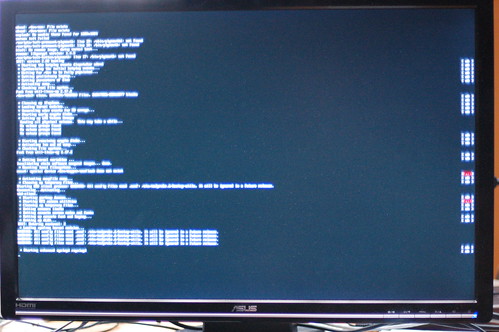
Now imagine you get to see that screen for about two to five seconds.
Please tell me which two initscripts failed. And no, you cannot use a
ruler. Bonus points for if you manage to do so while the text is also
moving upwards, which tends to happen when systems boot.
Also note that because kernel mode-settings has become the default, a
lot more people are going to be using framebuffers.
Am I the only one who thinks this is a bad idea?
If anybody is interested or can attend: Tomorrow and the day after (Wednesday and Thursday 12-13/05/2010) FLACSO (a leading Social Sciences faculty spanning countries all over Latin America) and IFE (Mexico's federal electoral authority) are presenting a seminar on e-voting: Electronic vote experiences in Mexico and around the world.

Sadly, I will be unable to attend, as I will be on the road once again (Ecuador!). However, I hope those among my readers who are interested in the topic can attend or at least follow the audio and video transmission from the IFE website.
The seminar will be held at IFE's auditorium Viaducto Tlalpan No. 100, Col. Arenal Tepepan, Delegaci n Tlalpan, c.p. 14610, M xico, DF.
[update] If you don't know what is my stand on this topic (and can read Spanish), please read this short article. In short: I am against e-voting, and hope we are still in time (and can push at the right places) to avoid it becoming the rule in our country.
Here's why:
Facebook recently launched the "Like" function, which basically can be
embedded into arbitrary web sites. Naively, it does two things:
But in general, we should try to make this kind of data aggregation illegal without explicit consent and force Facebook to make this an opt-in feature. Political work needed here ...P.S.: Make sure to check if your AdBlock actually blocks and not just hides. As far as I can tell, WebKit Adblock, including Chromes, only hide ads. Firefoxs AdblockPlus seems to be more powerful.P.P.S.: yes I've read the claim that FacebookIFRAME[src^="http://www.facebook.com/plugins/like.php"]
my current list of worked on RC bugs; not many for two weeks but I was on
vacation for almost a week ...
Last Friday and Saturday the second R / Finance
conference took place in Chicago on the
UIC campus.
As a co-organizer, it was a great pleasure to see so many users of R in Finance---from both industry and academia---come to
Chicago to discuss and share recent work. There is a lot going on, and it is always good to exchange ideas with others sharing the same
infrastructure. Participants appeared to enjoy the conference. My thanks to everybody who helped to put it together, from the
local committee to the helping hands at UIC and of course the sponsors.
I just put my slides from the
Extending and Embedding R with C++
tutorial preceding the conference, as well as the RQuantLib: Interfacing QuantLin from R
presentation (with Khanh Nguyen), up onto my
presentations page. I do have a usb-drive with all conference
presentations and will provide them via the R / Finance site in a few days.
The only truly sour note is the fact that several presenters from Europe had their travels schedules turned
upside down by the disruption to international air travel caused by the Icelandic volcano eruption and the resulting ash clouds.
While we are glad to have had them for a little longer in Chicago, we understand that they are getting eager to return home. I
hope this extended stay in the Windy City does not take away from the overall usefulness of the trip.
Account created for myaddress<at>glandium.org with hg_mozilla and mg_mozsrc bits enabled.Yes, this means I now have commit access on hg.mozilla.org. Thanks to those who vouched for me, namely Justin Wood, Christian Biesinger and Benjamin Smedberg. And thanks to the Mozilla governance for having changed the commit access requirements just in time for me to take advantage of the new ones: under the old rules, it was required that the vouching superreviewer had never reviewed a patch from the person applying for commit access. Of the 31 superreviewers, 14 (almost half of them) already had reviewed one or more patches from me (which is not really unexpected, considering the number of patches I sent in the past). One could wonder why I never applied for access earlier, though.
mutt -s "Bits from the (newbie) DPL"
debian-devel-announce@lists.debian.org, ... it's time to
realize that I've been elected DPL.
I still have a bunch of mixed feelings (happiness,
fear, responsibility, etc.) to disentangle, but above all I'm
really proud of our processes (well I don't mind the result
either!). I'm grateful to the other candidates and
to all the people that took part in campaigning discussions. As
I've observed
already, campaigning has been exciting for me. It wouldn't have
been so without the courage of all candidates and the inquiries of
all contributors. No wonder we have had both the highest percentage
of voters of recent years (yes, WAT runs of course helped that),
and an absolute number of voters close to that of past "heated"
elections.
In days in which most of the big players in the distro market
are companies (and hence take money-driven decision), I can't be
more proud to be a member of a huge volunteer project
whose processes are driven by a truly do-ocratic and
democratic constitution.
See you in a bit.
PS 1 in case you wondered, yes, I've fired
mutt, but I'm far from having written something in the
body of the mail! In the next few hours I'll first distill a
personal TODO-list / detailed-plan out of my platform and of the
inputs that I've already received. Then I'll finalize my
first ever DPL bits to d-d-a.
PS 2 In the meantime ... I'll surely be looking
for a new "maintainer" for RCBW, any taker?
PS 3 shameless plug! The
mythical Debian
Kilt is being weaved again, and you still have your
chance of getting one in time for DebConf10. If you're interested,
check out this
post by Phil Hands and sign up
on the wiki, I'm definitely getting one!
The DPL vote is over. I did not win, apparently. Let me start off by
thanking the other candidates for running, and congratulating Stefano
for winning.
My own results aren't too bad; I beat 'none of the above' by a
comfortable margin of almost 10 to 1, and ended up defeating
Charles Plessy by a slightly smaller margin. My margin to NOTA was far
better than during the previous DPL election that I participated in,
though I did end up defeating more than half of the other candidates
back then, which I didn't this time around. All in all, not enough to
win, but enough to conclude that I might have a chance some other time.
Margarita and Stefano were just better candidates this time around.
My own vote was:
[ 2 ] Stefano Zacchiroli [ 1 ] Wouter Verhelst [ 4 ] Charles Plessy [ 2 ] Margarita Manterola [ 3 ] NOTAIf you run, you have to be serious about running, and support yourself. So I did. After that, I wasn't sure that Stefano would do a better job than Margarita (or vice versa), so I put them at the same spot. Finally, I became convinced during campaigning that Charles has a lot to learn still about what lives in the Debian community, and I am of the opinion that feeling the community is a vital requirement for a DPL; so that ruled him out. So why did I not win? Obviously because there were better candidates in the election, but the real question is: why is that the case? What did I do, or what did other candidates do, that meant they fared better than I? One possibility was given on IRC:
< svuorela> ol: and "I'm running because no other runs" is also not a good way to get votes ...Which is fair enough; but I did run with the intention of winning, and I did try to make that clear. I'm hoping that worked out okay, which would imply that there could be other reasons. I'd like to know about those. So if you voted, and did not place me on the top spot, I'd very much appreciate learning about your motivations for doing so especially so if you were one of the 39 people who would rather have redone the vote than see me win. Comments on this blog post are welcome, or by private e-mail if you'd rather not see them made public.
It takes a lot to prepare for a big trip if you want to really enjoy it. This time, we re going to Japan, and we bought some stuff to stay connected there.
First, there s the new camera: that s a Sony 230. We haven t made a photo trip to see all its capabilities yet, but it looks like an excellent toy so far. You ll see probably more photos on this blog in the future.
And there s the new laptop: a Packard-Bell Dot-M/A.
Theoretically it s called a netbook, but in practice it has everything a real laptop has. The reason I chose this model is that it features Radeon (X1270) graphics and a 64-bit processor, all in a 11,6" laptop which is one of the cheapest of all. Lots of power in one kilogram for a low price, although the drawback is more cells in the battery.
Getting the Dot-M/A to work under Debian
I first tried to install lenny on it, and while it worked nicely there are several problems with hardware support.
It s no surprise that information visualization and related fields have been active research topics in the past decade. The widespread availability of large, valuable data sets has created a need for improved tools and techniques for making sense of it. This is highly technical work, requiring expertise in design, mathematics, software and other fields, and there is a vibrant community of professionals and amateurs who experiment and critique the latest methods. In the geeky blogs that I follow, I see more and more amateur interest in visualization.
Visualization is starting to take on political significance as well, as evidenced by the appointment of information design pioneer Edward Tufte to a US government advisory panel to help explain economic policy to the American public.
A technology is confirmed to be truly and vitally relevant, though, when it enters the mainstream consciousness in the form of humor. In the case of visualization, geeks have been trading funny charts and graphs for many years, but this phenomenon seems to have finally crossed the chasm into popular Internet culture with the advent of the Venn diagram meme. Now, anyone with an elementary education and a drawing program can create their own chuckle-inducing infographics and enjoy their 15 minutes of Twitter fame. Likewise for the X as seen by Y two-dimensional grids, revealing how various (stereotyped) groups perceive each other.
This is the future, becoming more evenly distributed by the minute.
Next.


