Search Results: "rra"

3 March 2010

Stefano Zacchiroli: RC bugs of the week - issue 23

RCBW - #23 Wacky week, last week. Not only I've (almost) completed my moving to the new house, but we have also had guests in the lab for some full-immersion-paper-writing. That had left very little time for RC squashing, but I've catched up a bit in the week-end. Without any further ado, here are this week's squashes: Random points: In totally unrelated news: I've bought my ticket for DebConf10 (YAY!), according to my usual debconf customs: 4 days of debcamp + all the conf. See you there (in a while). ... and congrats to Adnan for the winning DebConf11 bid!

2 March 2010

MJ Ray: The Co-operative Development Review: a call for evidence

Cooperatives-UK Chief Executive Ed Mayo has asked Robin Murray to undertake a brief review of the potential for expansion of co-operation in the UK, and the infrastructure necessary to support it. The review is intentionally wide ranging. It covers areas for innovation in methods of co-operation and its promotion, and ways in which the movement connects, reflects and supports itself in the era of the web. The aim is to prepare a report with recommendations and a plan for discussion during Co-operative Fortnight in June. Anyone with ideas about the challenges and opportunities you feel the movement is facing, and what can be done about them please email evidence to robinmurray AT blueyonder.co.uk by Friday March 5th for a first summary of the issues on Tuesday March 9th.

25 February 2010

Uwe Hermann: How to setup an encrypted USB-disk software-RAID-1 on Debian GNU/Linux using mdadm and cryptsetup

This is what I set up for backups recently using a cheap USB-enclosure which can house 2 SATA disks and shows them as 2 USB mass-storage devices to my system (using only one USB cable). Without any further introduction, here goes the HOWTO: First, create one big partition on each of the two disks (/dev/sdc and /dev/sdd in my case) of the exact same size. The cfdisk details are omitted here.
  $ cfdisk /dev/sdc
  $ cfdisk /dev/sdd
Then, create a new RAID array using the mdadm utility:
  $ mdadm --create /dev/md0 --level=1 --raid-devices=2 /dev/sdc1 /dev/sdd1
The array is named md0, consists of the two devices (--raid-devices=2) /dev/sdc1 and /dev/sdd1, and it's a RAID-1 array, i.e. data is simply mirrored on both disks so if one of them fails you don't lose data (--level=1). After this has been done the array will be synchronized so that both disks contain the same data (this process will take a long time). You can watch the current status via:
  $ cat /proc/mdstat
  Personalities : [raid1]
  md0 : active raid1 sdd1[1] sdc1[0]
        1465135869 blocks super 1.1 [2/2] [UU]
        [>....................]  resync =  0.0% (70016/1465135869) finish=2440.6min speed=10002K/sec
  unused devices: 
Some more info is also available from mdadm:
  $ mdadm --detail --scan
  ARRAY /dev/md0 metadata=1.01 name=foobar:0 UUID=1234578:1234578:1234578:1234578
  $ mdadm --detail /dev/md0
  /dev/md0:
          Version : 1.01
    Creation Time : Sat Feb  6 23:58:51 2010
       Raid Level : raid1
       Array Size : 1465135869 (1397.26 GiB 1500.30 GB)
    Used Dev Size : 1465135869 (1397.26 GiB 1500.30 GB)
     Raid Devices : 2
    Total Devices : 2
      Persistence : Superblock is persistent
      Update Time : Sun Feb  7 00:03:21 2010
            State : active, resyncing
   Active Devices : 2
  Working Devices : 2
   Failed Devices : 0
    Spare Devices : 0
   Rebuild Status : 0% complete
             Name : foobar:0  (local to host foobar)
             UUID : 1234578:1234578:1234578:1234578
           Events : 1
      Number   Major   Minor   RaidDevice State
         0       8       33        0      active sync   /dev/sdc1
         1       8       49        1      active sync   /dev/sdd1
Next, you'll want to create a big partition on the RAID device (cfdisk details omitted)...
  $ cfdisk /dev/md0
...and then encrypt all the (future) data on the device using dm-crypt+LUKS and cryptsetup:
  $ cryptsetup --verbose --verify-passphrase luksFormat /dev/md0p1
  Enter your desired pasphrase here (twice)
  $ cryptsetup luksOpen /dev/md0p1 myraid
After opening the encrypted container with cryptsetup luksOpen you can create a filesystem on it (ext3 in my case):
  $ mkfs.ext3 -j -m 0 /dev/mapper/myraid
That's about it. In future you can access the RAID data by using the steps below. Starting the RAID and mouting the drive:
  $ mdadm --assemble /dev/md0 /dev/sdc1 /dev/sdd1
  $ cryptsetup luksOpen /dev/md0p1 myraid
  $ mount -t ext3 /dev/mapper/myraid /mnt
Shutting down the RAID:
  $ umount /mnt
  $ cryptsetup luksClose myraid
  $ mdadm --stop /dev/md0
That's all. Performance is shitty due to all the data being shoved out over one USB cable (and USB itself being too slow for these amounts of data), but I don't care too much about that as this setup is meant for backups, not performance-critical stuff.

18 February 2010

Kees Cook: data mining for NX bit

9% of Ubuntu systems that were used to report bugs that included their /proc/cpuinfo file need to fix their BIOS settings to gain the NX bit. Check for yourself. (Run it with --verbose for useful details.) Out of 7511 Ubuntu bugs Brian Murray collected for me that included /proc/cpuinfo files, there were 7270 unique contents (which surprised me I was expecting this to be much lower). It s this last group of systems I m hoping to get fixed through education.

16 February 2010

Russell Coker: Would you Short-Change a Pedophile?

For some time the film industry has been running an anti-piracy campaign with slogans such as you wouldn t steal a car [1] in an attempt to draw a false analogy between downloading a movie and stealing a significant and valuable object the modern equivalent to being a horse thief . One of the many ways that such poor analogies break down is the fact that downloading a movie is not a crime, it s copyright infringement. The best analogy that I can think of for non-commercial copyright infringement is the practice of short-changing. I expect that almost everyone has at some time received less change than they deserved when buying something at a shop, the cashier aims to collect $1 or $2 from each customer and can easily double the amount of money that they take home at the end of the day. When a customer complains they just pretend to have made a mistake and although short-changing is a crime (unlike copyright infringement) it almost never results in police action. The practice is tolerated to such a degree that some people know the shops where they are likely to be short-changed, they count their change more carefully and demand the full amount but don t bother complaining to the manager! The film industry also tries to portray itself as representing struggling artists who deserve the money, it s described as a moral issue good people pay for movies while bad people download movies and steal cars. But then there s the case of Roman Polanski who is a well known movie director and child rapist [2]. I expect that most store employees would gladly palm some of the change if Roman Polanski was a customer that is of course if they weren t too busy arranging a lynch mob. So instead of you wouldn t steal a car a more reasonable statement would be you would short-change a pedophile if you weren t organising a lynch mob . Please note that murdering a criminal as part of a lynch mob is a crime (unlike making an unauthorised copy of a DVD), so I encourage people not to perform lynchings. Many important people in the movie industry have different ideas, the Wall Street Journal has an article about the petition to free Roman Polanski which demonstrates the difference between Hollywood attitudes and those of the rest of the world [3]. For them, violent crime is no big deal if the criminal is famous and the victim isn t but anything which affects their own wealth is regarded as a serious issue. Indiewire has a copy of the petition to free Roman and a list of the names of 100 people who signed it [4] (I heard that the latest count was nearer 150 but couldn t find a reference). I believe that the matter of morals is not whether someone who rapes children deserves jail time (that issue is really clear) but whether it is morally acceptable to give money to such a criminal or their supporters. I suggest that the list of signatories to the pro-rape petition be black-listed, any movie that involves any of them should not be paid for either don t see the movie or download it without paying at your own whim. If anyone knows of a web site that is being regularly updated with a list of all past and current projects involving people who signed the petition for Roman then please let me know it would be good to have a list of movies that I will never pay for. Anyone who feels morally obliged to pay something for a movie and who has a great desire to watch a movie made by Roman Polanski or his supporters could download it and then make a donation to a charity equivalent to the purchase price rumor has it that women s refuges are always short of funds. As an aside I find Wikipedia a good reference for movies that I don t plan to see, I read the plot summary on the wiki page and then have no curiosity about what happens in the movie if that isn t adequate I ask friends for spoilers or do a Google search on the movie name and spoilers .

Martín Ferrari: Facebook chat

I spent a few minutes trying out the new support for using the Facebook chat with Jabber/XMPP, which is a great idea, since I hate to chat using the web interface. Sadly, it doesn't support grouping your contacts (you set a group, but it doesn't keep registered, probably they didn't implement that feature), and that make my empathy client look quite untidy... I'll keep my account setup for a while, but I guess it will not be long until I remove it and continue not chatting with Facebook. Maybe some day they can properly implement the protocol... Update: As Tobias Wich and Clifford Hansen had kindly pointed out to me, you can actually group your contacts, but only from the web interface. I've tried it and it works, but it's not really comfortable. Tags: Planet Debian

Christian Perrier: Bug #570000

(you were awaiting this one, weren't you?) Ron Murray reported the Debian bug #570000 on Monday February 15th, against the gnome-keyring-daemon package. Bug #560000 was reported as of December 8th 2009. We're behind our "10,000 bugs in 2 months" pace by one week, so that's a small drop in the bug reporting rate, this time. I hope that people remember the Bug #600000 contest. Bets are closed now (the wiki page is still opened for modifications but I'll revert them if they are late bets). Being 30,000 bugs away from #600000, it's time to image when that bug could happen. The current "2 months+1 week/10,000 bugs" says it would happen around September 10th. With the "2 months/10,000 bugs" that would be August 15th, just after DebConf 10. The closest bet as of now seem to be either Miod Vallat or Kanru Chen. I probably lost already (I did bet June 30th) unless I imagine a very massive bug filing. Too bad Matt Arnold, Thomas Preudhomme, Nicolau Werneck and Odd Henriksen, you already lost!

15 February 2010

William Pitcock: How to Fight Lazy For Sports

OLAHRAGA(getactivechallenge)-DALAM Everyone knows that exercise can heal the body. But why only a few people who routinely perform the activity? Ask yourself. The answer is, maybe you less motivated to do so. A survey ever conducted to find out why people rarely do sports. The survey involving 15,000 women from 25 countries showed that although nearly half of them know that exercise is very important for health, but less than 25 percent of it done. Why? More than two-thirds of respondents said that they would exercise more often if the gym was fun. So far, they consider it as a routine or demand to stay healthy so feel burdened. Although the facts say so, but it is unfortunate if people take sport as a less desirable activity. If you are not motivated to do the morning run, bike or fitness, try these few tips that may improve your mood for a workout without having to feel it as a demand or load. 1. Participate In A Club
Come in a club full of adventure and can arrange your sporting activity each week. Find information from friends or open the website that provides these facilities. 2. Involve Friends
If you are interested in joining a club, you can do sports with your friends or beloved. Sport activities together can evoke passion and spirit to not realize that you are really doing is exercise, not just recreation. 3. Try New Types
Trying something new will make you feel to have new experiences and unexpected. Make your muscles work with the new type of sport and do not usually very good for your body. 4. Make A Game
You would be very interested in an adventure or a game. Making sport like games is a good idea. Make activities as the game ran find treasure limited time, and you will feel more happy and challenged. 5. Back to Boyhood
Do you remember when as a child running around all day without feeling tired and bored? It feels good right? That s what you should do now. Create a day where you can be reunited with friends and do sports or play activities you usually do in childhood. Rollerblading in the park to play or jump rope can be very enjoyable. 6. Give Credits For Yourself
If you ve managed to do sports, try giving a gift to yourself. Watching the film series, enjoying a plate of spaghetti or relax at the spa can be temoat rewards you deserve for successfully achieving exercise goals. Most people who do not enjoy the sport has a very dense activity and also because they are not used to doing. But if once you find that it is a routine exercise that is enjoyable, you will begin to enjoy it. Without realizing it, you also have to do two things at once is fun, physical exercise and psychological. Good luck.

William Pitcock: Vierra guys Stump in 2010

vierra_285 Vierra band to be different in 2010. The personnel men, Kevin cs, want to look more muscular. Of course there are reasons why the personnel Ballerina boys want to look more muscular. Raka Cyril, the guitarist, spoke up to express that excuse. . To create a more muscular body would need a business. So, Kevin (keyboards), Raka (guitar) and Tryan (drums), do not forget the additional bass player, Deryansha Azhary, melakoni fitness. Fitness together can maintain cohesion, said Raka again. The desire for fitness with the new fact emerged two weeks ago. At that time only as an expense only. But after thinking together, three boys Vierra agreed to be different in 2010. Apart from personnel appearance that her boyfriend would be more muscular, there is no change from the Ballerina in 2010. Band with hits Are You Really it was not planning to release a new album. We do not want to hurry. s Album coming out yesterday, not to waste too, added Widi, the vocalist.

11 February 2010

Joachim Breitner: Diploma Thesis Finished

Earlier today, I went to a local copy shop and had my diploma thesis printed. This afternoon, I will hand it in. The title is Loop subgroups of Fr and the images of their stabilizer subgroups in GLr( ) and discusses a group-theoretical result. I assume that very few readers care about the content of the thesis, but maybe some are interested in a few assorted LaTeX hints. I m also publishing the full TeX source code, maybe someone can make use of it. Less chatty varioref I m using the varioref package, in conjunction with the cleveref package. This provides a command \vref fig:S3S4l which will expand to, for example, to Figure 1 on page 11 . But if the referenced figure is actually on the current page, the next page, the previous page or the facing page (in two-side layouts), it will say so: Figure 1 on this page. This is very nice, but I assume that the reader of my thesis is able to find Figure 1 when it is visible, i.e. on the current or facing page. One can remove the referencing texts with the commands \def\reftextfaceafter , \def\reftextfacebefore and \def\reftextcurrent . But because varioref puts a space between Figure 1 and this text, we will get a superfluous space even before punctuation. The remedy is the command \unskip, which removes this space again. So I use in my preamble:
\def\reftextfaceafter  \unskip %
\def\reftextfacebefore \unskip %
\def\reftextcurrent    \unskip %
Palatino and extra leading I chose the Palatino font for my thesis, using the mathpazo package. Various sources (such as the KOMA-Script manual) suggest to use 5% extra leading:
\linespread 1.05 
Counting figures independently from chapters I don t have too many figures and tables in my thesis, and I want them to be numbered simple 1, 2, ... By default, LaTeX would say 1.1, 1.2, 2.1, ... This can be fixed using the remreset package and these commands:
\makeatletter
\@removefromreset figure chapter 
\renewcommand \thefigure \arabic figure 
\@removefromreset table chapter 
\renewcommand \thetable \arabic table 
\makeatother
No widows and club lines LaTeX already avoids these, but I wanted to get rid of them completely. This can be done with:
% Disable single lines at the start of a paragraph (Schusterjungen)
\clubpenalty = 10000
% Disable single lines at the end of a paragraph (Hurenkinder)
\widowpenalty = 10000 \displaywidowpenalty = 1000
Struck table lines I had to typeset tables with some lines struck, and I could not find a ready command for that. I used the following definition, based on the code for \hline. Note that it probably does not adjust well to other font sizes and needs to be adjusted manually:
\makeatletter
\def\stline %
  \noalign \vskip-.7em\vskip-\arrayrulewidth\hrule \@height \arrayrulewidth\vskip.7em 
\makeatother
Title page in one-sided layout According to the KOMA manual, the title page as set by LaTeX is not meant to be the cover of a publication, and therefore has to be set with the margins of a right page i.e. a larger right margin and a smaller left margin. But when printing cheaply, one often just put a transparent sheet on top of the print, so the title page is the cover. You can convince KOMA that you are right by using
\KOMAoptions twoside=false 
\begin titlepage 
...
\end titlepage 
\KOMAoptions twoside=true 
Not flushing the page for chapter heads LaTeX would put the list of algorithms on a new right page. I found this a waste of paper for my few algorithms, and preferred to put the list right after the table of contents. You can override the LaTeX behavior using:
\tableofcontents
 
\let\cleardoublepage\relax  % book
\let\clearpage\relax  % report
\let\chapter\section
\listofalgorithms
 
This code also reduces the size of the heading to that of a section. The same trick also works with \chapter. Math in headings vs. PDF bookmarks LaTeX with the hyperref package creates nice PDF bookmarks from your chapter and section titles. Unfortunately, PDF bookmark names can only be plain strings, while the titles in the document might contain some math symbols. You can make both happy with \texorpdfstring:
\section Stabilizer subgroups in \texorpdfstring $\GL_r(\Z/2\Z)$ GL\_r(Z/2Z) 
Setting lines for the signature The diploma thesis contains a small note which I have to sign, saying that I created it on my own etc. Below that, I put two labeled lines for date and signature, using the tabbing environment:
\begin tabbing 
\rule 4cm .4pt \hspace 1cm  \= \rule 7cm .4pt  \\
Ort, Datum \> Unterschrift
\end tabbing 

Asheesh Laroia: Google and University email

Should universities switch away from hosting their own email and join the Google bandwagon? Adi Kamdar wrote to the Students for Free Culture discussion mailing list linking us to a Yale Daily News article discussing an "almost-definite" switch for Yale to Google Apps for Education. Adi asked for thoughts, so here are mine.

Privacy One interesting thing about the Gmail option is that, when deployed for all students, students have no choice but to let Google read their official email. Some students might take part in activism that they want to shield from Google, a corporation with its own interests, or the attackers that attempt to break into Google's systems (see the recent attacks from crafty pro-Chinese-government hacktivists). Before a switch to Gmail, each student could choose if Google was the kind of company they wanted to share their email with. After a switch to Google Apps, the choice is made for them. But this highlights a different issue: Before a switch to Google, students have no choice but to let university administrators read their official email. That's not necessarily optimal, either. Others have pointed out in this thread that this option comes with legal advantages with regard to privacy law. At least that's some consolation. It's still true that students can encrypt their email and make it difficult for any eavesdropper to figure out the bodies of their emails. But that's no use for hiding the identities of the people with whom they communicate -- no email crypto I know hides email addresses.

Software freedom and open standards This is juxtaposed against another difficult situation: Matt Senate wrote about the sucky Squirrelmail system that Berkeley uses (used?) for webmail. The fact that SquirrelMail is Free Software is small consolation for Matt. From his perspective, because it's a hosted web application, he has no more freedom than he would have with Gmail. At least Berkeley's IMAP server followed standards! That's more than we can say for the Gmail IMAP server, which is famous for basically supporting just enough IMAP for Microsoft Outlook to work. But standards compliance is small consolation. If the university email server "properly" supports IMAP, but isn't fast or doesn't provide the new extensions that make threading or search speedy, it's not much relief to know that you can use any client you want to slowly read your email.

Internet history Truth be told, University-hosted Internet services are based on what you might call the original Internet perspective. The Internet began as a network of networks. A University was a network island unto itself, running its own email, news, and Ethernet services. When inter-network connection was available, you can email people at other institutions. When it wasn't, well -- the Internet is a useful tool, but it's down right now. "Don't worry," the admins might tell you, "you can still read your email with PINE." It used to be that inter-network connectivity was icing on top of the "real" network a person used. Today, inter-network connectivity is the whole point of a network connection. How embarrassing for each individual network! To test if our connections are working, we skip right over the local content and point our web browsers at a search engine. Users today aren't satisfied to read their email from imap.institution.edu and read USENET news-- they thirst for real-time access resources available beyond the university. Students weren't interested in the J-Stream service I helped set up at Johns Hopkins; instead they mostly posted and watched videos at YouTube. They don't really care if the the student-oriented wiki is based on campus or instead halfway across the globe (say, in Japan). The original Internet was based on autonomous networks and opt-in routing. But eventually, all the networks opted in. Users drive everything, and when they don't get what they want, they vote with their feet. Companies like Facebook and Google stand ready and armed to provide shockingly-efficient services to millions of users who choose them. You could say that with today's network, the autonomy shifted from the network to the users. The nice thing about University-run services is that students can organize and ask for changes, as Fred pointed out. And for people like me, there's something nice about knowing the person who runs your email system. But if your busy university staff doesn't have time to investigate an email server with fast full-text indexing, you might wish for change. Having the university tear down its internal services is a progression toward seeing its network as simply transit. Imagine the loss of pride. It used to be that the university personally ran a system for helping users get what they wanted. As it becomes simply transit, the staff are just greasing the cogs of a larger, invisible machine that's easy for users take for granted. Some netizens like me hold email as sacred, a beautiful institution based on standards and a decision to interoperate. When your university switches to Gmail, I'll be sadder, but maybe what you'll get is professors who can spend more time with students and less time configuring desktop software.

Trade offs Every university has a choice: Pay hundreds of thousands to millions of dollars a year for dedicated staff to run an in-house email system, or let Google do it. Think for a moment of what good could come from those dollars when put to use in other ways for students. Your school could start a switch to all-organic food. It could start paying more of its employees a living wage. Imagine the travel funding for student activities that can come from hundreds of thousands a year well-spent. It could run a massive used textbook clearinghouse to help students avoid pouring their dollars into the textbook industry. And now cry with me. What I've asked you do is to consider sacrificing institutional autonomy for cold, hard cash. That's to say nothing of the ecological benefits or the productivity increases possible from having Google's paid experts run this part of the computing system.

Conclusion Is an official Google email system much different than the reality most students I know live, which is configuring their student email address to forward to gmail.com? For those of us who would be sadder with one more push toward centralizing email with Google -- for those who see it as the behemoth whose size threatens the decentralization that used to be the core of the Internet -- I ask you to think positive. "See the profit from your loss." I have no conclusions for you, just niggling questions.

5 February 2010

Brandon Holtsclaw: My Friend Audio Business Converter Product

Audio information can be stored in a wide variety of formats, which vary in sound quality, file size, compatibility, etc. There are lots of extensions that cannot be read by some players. For this reason, many audiophiles are often confronted with compatibility issues. There are lots of audio conversion tools available on the web, but there are much more formats out there than they support. Most converters support only a few extensions and therefore they fail to satisfy users requirements.

Finding a high quality mp3 converter
has long been a challenge. Happily, software developers have designed Factory Audio Converter. It converts audio files to MP3, WAV, WMA, OGG, APE, MP4, FLAC, MPC, AAC. The array of input formats is even broader: MP3, RA, RMM, RAM, RPM, RM, RMVB, WAV, OGG, CDA, APE, APL, MPC, MP+, WMA, FLAC, AAC, M4A, MP4, TTA, OFR, SPX, WV, XM, IT, S3M, MOD, MTM, UMX, AMR, MP3/OGG compressed MODs, MIDI, VQF, AU / SND, PAF, IFF, SVX, WAV, SF, VOC, W64, MAT4, MAT5, PVF, XI, HTK, CAF. If you are looking for a flexible audio conversion utility, this one is the best!

Good audio converters feature batch mode. If you have a lot of wma files and would like to save them as mp3, you need a fast-working and powerful wma to mp3 converter. Factory Audio Converter can convert hundreds of files within seconds. If you have gigs of music on your PC, you can set the utility to convert all of them and turn in. You will get up in the morning to see all your files saved in your preferred format!

By aid of Factory Audio Converter, you can convert wma to mp3 right from the desktop. Once installed on a PC, the program integrates into Windows seamlessly, and Convert to option appears in the right-button menu. All you need to do is right-click on a wma file and select Convert to. You can also run Factory Audio Converter from within other programs via command line.

Advanced users do not only want toconvert wma to mp3
. They want to do it easily! User-friendliness all but heads the top-importance list of characteristics. Factory Audio Converter has a robust and intuitive user interface. It does not take any background to understand how to use it. The program wizard will guide you through the whole procedure. It will help you select your settings. You may either skip it and leave the default settings or specify your own settings. Sound quality will depend on your choice of bitrate, samplerate and channel.

The more new features a program has, the more likely it is to enjoy demand. Factory Audio Converter incorporates a built-in audio player and CD ripper. You can listen to your tracks prior to conversion and compare output and input files. The CD ripper will rip your CD files and help you save them on any type of hard drive. Factory Audio Converter permits you to change wav to mp3
and save a lot of drive space. Now you can use any portable player and listen to your favorite musicians any time, wherever you are!

You can buy Factory Audio converter at a price comparable to that of any other converter. However, few converters are comparable to Factory Audio Converter in terms of user friendliness and productiveness. <script class="owbutton" src="http://onlywire.com/button" title="My Friend Audio Business Converter Product" type="text/javascript" url="http://www.imbrandon.com/2010/02/05/my-friend-audio-business-product/"></script>

4 February 2010

Michal &#268;iha&#345;: Travel agenda before FOSDEM

In last few days I spent some time with travel agenda. Tomorrow morning I am leaving for FOSDEM, so I'm arranging last minutes things like online checking. Whoever wants to meet me just drop me an email or just check things I want to visit and find me there. Meanwhile got open registration for Debconf 10, so when I was in travelling mood, I also filled in that one. Right now it looks like it will be quite tough for me to pay this trip, but there is still some time to sort it out :-).

31 January 2010

Jordi Mallach: Cabanyal

Today, I was glad to attend the biggest demonstration ever in favour of the Cabanyal neighbourhood of Val ncia, a traditional district populated by the sea people of the city. After decades of oblivion, the Valencian right-wing government is trying to execute an old plan to open Valencia to the sea , which means demolishing around 450 traditional houses, many of them under protection for their cultural and architectural value, to extend a big avenue until the beach. Patrimonial loss aside, neighbours would be forced to other areas in the city (sadly, this has been happening for a decade already), making Cabanyal-Canyamelar the new posh neighbourhood for the richer class, destroying its identity and replacing it with a new set of skyscrapers.

The local government of PP, led by the infamous Rita Barber , knows that getting the anti-riot police in the neighbourhood and forcing very old men and women out of the houses where they were born isn't what many people like to see in the evening news. They also know time is their ally; this plan is many decades old, and there's no need to hurry now, so it's better to apply silent mafia tactics on the problem. It's very easy. First, stop investing a single euro in the area and monitor the slow but effective results of the degradation. Have a bit of patience, and after quite a few years, start promoting the illegal occupation of the increasing number of empty houses by marginal collectives which will bring the associated introduction of drug dealing in the area. This will surely make even more people leave or accelerate their decease. Keep repeating this process, until the Cabanyal is really fucked up. Now, start promoting the rehabilitation plan , which unavoidably includes splitting the neighbourhood in two pieces, and destroying a substantial part of it. Hopefully, many of the neighbours not directly affected by the demolitions will back the plan, they can't be blamed for being really fed up after all. Do all you can to confront those in favour to those against. In the meanwhile, start harrassing owners, make them end up selling their property at ridiculous prices and as soon as this happens, demolish it very quickly. Don't even bother with cleaning up the rubble: an increasing number of sites like this all over the place may be what makes a few more families give up and leave. In the end, you either have an empty neighbourhood, or you've managed to demolish all the annoying houses that block your shiny avenue. However, if a Supreme Court argues that the remaining houses still have some cultural value, you might want to consider changing your local law to unprotect those architectural elements. Today, many thousands of Valencians marched around Cabanyal to say enough! . From the street, I saw several old women out on the balconies of their beautiful houses, their eyes wet with tears, while they observed in silence all that many people who were fighting for them. There's still a long way to go in the courts until this is all over, but at least these people have a little more hope today than those in el Carme or La Punta, who ended up losing similar battles, years ago.

30 January 2010

Wouter Verhelst: On MySQL and Oracle

I think Monty has well and truly lost it. The European Commision, after careful consideration, has cleared Oracle's purchase of Sun:

The Commission's investigation showed that another open source database, PostgreSQL, is considered by many database users to be a credible alternative to MySQL and could be expected to replace to some extent the competitive force currently exerted by MySQL on the database market.
I'd go one step further, and would say that MySQL is not a credible alternative to PostgreSQL. But whatever. Hopefully, if MySQL fails, then PostgreSQL will (finally) get the attention that it deserves. I'll have a real database every time over this piece of... anyway.[1] This is a fair argument, and to be sure it is certainly not a problem for anyone to migrate from MySQL to a MySQL fork, or (with some work) from MySQL to PostgreSQL. But Monty seems to disagree, and now tries to get Russia and China to block the merger. What's next, Andorra? [1] comments on this blog item in defense of MySQL will be vigorously moderated away. MySQL is a POS that falls over if data is corrupt, that corrupts its own data (most distributions call 'mysql_recover' in their initscript for a reason), and whose C API does not properly support cursors unless you want to block concurrent access until the cursor is closed (paragraph 3). Every time a customer asks me about MySQL, I vigorously recommend against it, because it's a bad idea.

28 January 2010

John Goerzen: Greek Mythology and the Old Testament

I have lately been reading Homer s epic poems: first The Iliad, and now I am nearly done with The Odyssey. I figure there isn t anyone alive today that believes that Zeus literally caused thunder in answer to a prayer, or that Athene really transformed Ulysses between having a youthful and an aged physical appearance at a whim. Despite our understanding that these poems don t reflect a literal truth, we still find meaning and truth in them. It is for this reason that they are read by high school and college students all over the world. This same reason drives our reading of more modern plays and novels everything from King Lear to Catcher in the Rye. We learn something of the author s world, something about our world, and if we are truly lucky, a deeper understanding of the universal truths of human life. And it is with that preface that I suggest that the Old Testament or parts of it, at least ought to be read in the same manner. Modern Christianity speaks of a loving, caring God, one who is deeply concerned for the wellbeing of all. Under this understanding, forgiveness is more desired than retribution, and helping the week is better than enslaving them. How then can one square that with a literal reading of the Old Testament? This was a key question I asked over a span of perhaps 15 years. I was perplexed that the God of Love ought to turn someone into a pillar of salt for turning her head the right way, that almost all life on earth might be extinguished by a flood, that slavery is condoned and regulated, and all sorts of people being stoned to death, animals killed for no reason. In short, the God of the Torah, at least, didn t seem to me to be even the same person as the God the Church talks about. I raised this question with many people, and there was even a seminar on it at a convention I went to in 2001. The answers I got usually were of one of two types: 1) God is beyond our comprehension, and this is one of the mysteries we will never understand because that s just the way it is; or 2) the arrival of Jesus changed things, and it s impossible for a modern person to fully appreciate the laws as they existed prior to that. These are really two sides of the same stick: they re both saying, Yep, that s odd. But we have to believe that the Bible is inerrant and literally true, so we just have to accept the mystery and move on. Except I m not so good at accepting mysteries and moving on. It strikes me as odd that nobody even mentioned the third option: that some of the stuff in the Old Testament is, to be blunt, made up. This even though I have come to learn later that some of those people probably believed this to be the most correct explanation. Now, that doesn t mean it has no value or that is doesn t show us truth. Romeo & Juliet was made up, but we learn from it. A typical example of this is the creation myth. There are some that are very defensive about it, perhaps thinking that it weakens their religion to admit it might not be literally true. To me, I find that insisting upon its literal truth weakens the religion; can we not see how a piece of literature speaks to us today and leave it at that? Need we say that Shakespeare s Julius Caesar is an inferior play because it is a work of historical fiction? The position I suggest here is not some crazy nutjob position. Wikipedia has a concise overview of some of the scholarship surrounding these ideas. I now count myself as somewhat inspired by Homer to read the Old Testament in the same way that I read Homer: as a story that can speak to us today, one that inspired a nation in captivity and after, and launched perhaps the most amazing religious movement in history. I only wish that more people would admit the possibility of a non-literal reading of the Bible. This return to an earlier era of Christianity is, in my mind, the only way that Christianity can maintain its relevance in this age. Update: A note I received suggests I ought to make a bit of a clarification. I am not bothered by the fact that people have differing opinions about the historicity of Genesis. I m all for putting all the opinions out there for sure. I think that really the concern over whether Genesis is literally true or not is mostly irrelevant. I have no problem with Christians that find Genesis to be literally true. What I m lamenting is the attitude that you re not Christian if you re not sure that Genesis is literally true or saying anything else about Genesis undermines Christianity. I believe neither of those statements, and would really rather that we collectively got past the creationism vs. evolution debate already. Update 2: It appears that my use of a bit of technical language has caused some confusion. A creation myth can be defined as a supernatural story or explanation that describes the beginnings of humanity, earth, life, and the universe (cosmogony), often as a deliberate act by one or more deities. It is a category of explanations. Simply calling the Genesis story a creation myth is an act of categorization only, and doesn t imply anything about its accuracy or value.

27 January 2010

Russell Coker: Costs and Benefits of Search Engines

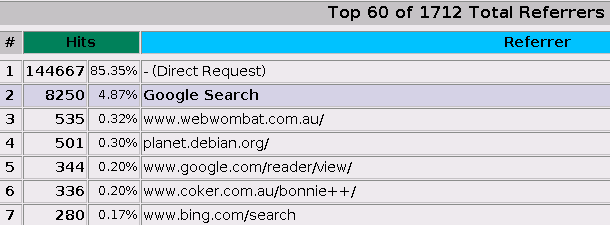
Chris Smart writes about the latest money making schemes for OS distributors, Canonical is getting paid by Yahoo to make them stop using Google as the default Firefox search engine [1]. I think this is OK, the user can easily change it back if desired and it allows them to pay the salaries of more employees who contribute code back to upstream projects. MSN uses 455M, Google uses 189M, and Yahoo uses 109MGoogle referrs 8250 hits, but Bing only refers 280 Above are sections of my Webalizer output related to my blog which show the data transfer use of search.msn.com (Bing presumably) which is 50% greater than that of Google and Yahoo combined. Why does MSN need to do 455MB of transfer so far this month to scan my blog when Google gets the job done with 189M and Yahoo only takes 109M? Also judging by the referrals Bing is only 3% as much use to me as Google. MSN uses 525M, Yahoo uses 132M, and Google only uses 35M Above is a sample of the Webalizer output from www.coker.com.au, MSN is using 525MB of data to scan the site which contains about 1.2G of static files that change very rarely. A Russian malware site seems to be downloading it three times a month, and Google only takes 35MB of data transfer to scan the site (which is probably still excessive). If Bing was a quality search engine that returned appropriate results then this could be forgiven. But however it is a very poor search engine that returns bad results. For example if you query Google or Yahoo for bonnie++ you will get an entire page of search results concerning my Bonnie++ benchmark, and those results are ordered in a sensible way. If you ask Bing then the first four results concern Bonnie (three women and a plant) and most of the first page don t concern my benchmark. Some time ago I had blocked MSN from scanning a server that I ran. The server in question had all the web servers for my domain plus quite a few other small domains. The total MSN data transfer was 3G per month which was almost half the data allowance for the server in question (data plans in Australia suck that s why my web servers are hosted in Germany now), so it was a question of whether to allow normal operation of the business or MSN searches. With Microsoft not running a popular search engine (then or now) it was an easy decision. I think that anyone who accepts money from Microsoft/Bing is doing their users a mis-service. Bing is simply an inferior search engine, it gets bad results and imposes excessive costs on service providers. Yahoo however seems to be a reasonable service, not as good as Google for the web hosters but not too bad. I wonder what would happen if Yahoo offered some sponsorship money to the Debian project in exchange for being the default search engine. I m sure it would be dramatic.

22 January 2010

Russell Coker: How to Lose Customers

Bruce Everiss who is famous for being threatened with legal action by Evony has been writing about the supposed losses from game piracy, in his latest missive he copies the text from a number of blog comments without citing the original authors [1]. He copied my text without citing me as the author (which is at best shoddy journalism and by a fundamentalist attitude such as his could be considered as piracy). He also copied my text in with a bunch of other comments which he attributes to The thieves . It s unfortunate that Bruce doesn t seem capable of understanding irony, he wrote There is no doubt whatsoever that downloading and playing a game that should have been paid for is theft and then copied part of the text of my comment where I provided a dictionary definition of theft that directly contradicts his claim. If he was at all interested in quality writing he would cite his references and then when a dictionary is cited which disagrees with his opinion he would at least try to find a dictionary with a more agreeable definition. It shouldn t be THAT difficult to find a dictionary that has multiple definitions of theft of which one is agreeable to the MAFIAA [2]. Now if Bruce had properly read my comment he would have seen I ve started watching content from sites such as blip.tv (in the little time I have for such things) and I only play games that are part of the Debian distribution of Linux (free software) which makes it very clear to any reasonable interpretation that I am not a game pirate and probably not even a movie pirate. I did mention in a comment on Bruce s blog that the DVD experience of being forced to sit through a whinge about piracy was a factor that made buying a DVD a worse experience than downloading it, a concept that I expanded into a blog post on the relative technical merits of DVDs and pirate MP4 files [3]. That post received a number of interesting comments including one from Josselin Mouette which had some useful technical detail about subtitles and audio track storage. I had believed that there were some real technical advantages of DVDs but Josselin corrected me on this matter. Also one thing that is noteworthy is that Bruce seems to use a copyright picture in almost every post but he doesn t attribute any of them. It does seem unusual for someone to use commercial artwork without any copyright or trademark notices attached. This usually isn t a big deal for a blogger, a liberal interpretation of copyright and trademark law is usually expected in terms of blogging corporations will tend to be hesitant to invoke the Streisand effect by suing a blogger (EG Bruce blog came to fame when he was sued by Evony). But when a blogger is writing about the importance of not pirating anything it would seem sensible to go to the effort of citing trademark and copyright references and also mentioning the licence agreements under which the IP was used. I believe that any loss of customers and revenue by the MAFIAA and the gaming industry is due to the actions of the companies involved. They should just try to make their customers happy, otherwise they lose the customers. The same goes for bloggers. I read blogs written by people who disagree with me, and sometimes by people who offend me on occasion. But Bruce is making baseless claims while deliberately ignoring evidence. He is calling for strong anti-piracy measures while doing what could be considered as pirating my work. He uses words in ways that conflict with dictionary definitions, and he calls for an end to our current legal system by demanding punishment based on three accusations rather than any legal process. I even pointed out to Bruce that if there was a three strikes law regarding accusations of copyright infringement then his blog would be offline after three accusations by Evony. Sorry Bruce, if I was looking for irrational rants about copyright then I would look at what the members of the Science Fiction Writers of America (SFWA) are doing [4]. The SFWA people demonstrate as much knowledge of computers and the Internet as Bruce does, but they are at least really good writers. If it was just me unsubscribing from Bruce s RSS feed then it wouldn t matter (I m one of tens of thousands of readers). But I expect that a large portion of the new readers Bruce acquired after being attacked by Evony will disappear when they see Bruce as the attacker and everyone who uses the Internet as a potential victim of the Three Strikes law.

Theppitak Karoonboonyanan: Thailand Mini-DebCamp 2010

Hello, Planet Debian. I'm pleased to have announced about the first Debian event in Thailand: Thailand MiniDebCamp 2010. This is a follow-up to Taiwan MiniDebConf 2009 in last September in Taipei. At the end of that event, we discussed about having a mini-DebCamp in Thailand during the New Year holidays. However, with many factors, it has been moved to this March. And the date has been settled on 13-19 March. The place will be Khon Kaen University (KKU) in Khon Kaen, a north-eastern province of Thailand (close to Lao, if you look for it in a map). In this event, we plan to arrange a Bug Squad Party for the Squeeze release, and some meetings between DDs and local people, to encourage more Debian activities in Thailand and nearby countries. Thailand has started its GNU/Linux development and usage since no later than 1997. Currently, we have projects like Thai Linux Working Group for upstream Thai resource developments; OpenTLE.Org and thaiopensource.org for local distros (Ubuntu-based); and some communities like ubuntuclub, debianclub, and more others for other distros. The user base is slowly growing, while developer base is yet growing more slowly. We have had domestic events occasionally. But certainly, an international one like this would effectively encourage more prospecters, as well as create closer cooperations with the global projects. We also hope this event to be a meeting point for developers from nearby regions. And internationalization, among other issues, can be discussed and worked out. So, please be invited to join and discuss. Please make sure to add your name to the Wiki page so we can prepare things for you, including accommodation. And feel free to propose your agenda in BarCamp style. It will be summarized some time before the event date. We also have a mailing list for updates and discussions.

21 January 2010

Benjamin Mako Hill: Annual Free Software Foundation Membership Drive Appeal

I wrote this for the FSF's annual membership drive where it was originally published. I am reposting it here.
At its core, I think of free software as about the ability of computer users to take control of their technology. Insofar as our software defines our experience of the world and each other, software freedom is an important part of what allows us to determine the way we live, work, and communicate. Free software is not really about software in this fundamental sense; it's about bringing freedom to users through software. In free software's incredible success over the last two decades, many people have lost sight of this simple fact. We have created an incredible array of applications, libraries, and tools. We have created vibrant development and support communities. We have created new development methodologies, powerful copyleft licenses, and massive collaborative projects. But these are all how we give users freedom. They are not freedom itself. They are not what we were trying to achieve. They are our instruments, not our goal. This distinction becomes central in a world where technology is in flux. Indeed, we live in such a world. We can see signs of this in how, as most users' primary computers become mobile phones and new types of network services make up most of many users' interactions with computers, the free software movement's old applications, communities, development methodologies, and licenses can become ill-suited to, or ineffective at, protecting user freedoms. And indeed, in the next few years, bringing freedom to computer users will need to involve new software and new forms of advocacy. It will need to involve new licenses and new techniques for their enforcement. It will need to involve new forms of collaboration and organization. If the free software movement is to succeed, it must stay focused on computer users' freedom -- on the question of why we do what we do -- and then work creatively on how to best respect and protect the freedom we are working toward. If we are overly focused on how we've done things in the past, we may lose sight of the most fundamental goal of supporting users' control over their technology in general. There are many organizations that support the how of today's free software in various ways -- they are law firms and companies and nonprofit organizations supporting various free software projects. The Free Software Foundation is, by far, the most important organization focused on why --- on the underlying principle of software freedom. As such, it plays an essential role in keeping our broader community focused on the key issues, threats, and challenges that will affect the success of every free software project, and every computer user, in the present and in the future. In this period of rapid change in computer technology, its role is more vital than ever. The consequence of any failure is more dire. Here are some of the ways that I will be encouraging the FSF to serve the free software movement in the coming year: Mobile Phones In a short essay I wrote earlier this year, I pointed out that there are now billions of mobile phones and that, although these phones are increasingly powerful computers, they represent one of the most locked-down, proprietary, and unfree technologies in wide use. The implications of this fact for users' control over their technology are dire. Although some widely used phones make extensive use of free software, most free phones are locked down and Tivoized and their users remain fettered, divided, and helpless. We must raise awareness of free software issues among users of phones, communicate to users that phones are powerful general purpose computers, and explain that control over these devices has critical implications for individual autonomy in the future. Toward this end, the FSF staff will launch an advocacy campaign around mobile phones and software freedom in the coming year. Network Services As network services -- like those built by Facebook, Google, and others -- have continued to grow both in scope and penetration over the last year, the importance of a meaningful free software responses grows as well. The launch of products like Google's network-centric ChromeOS offers one glimpse of what a future computing platform may look like. The implications for user freedom, and for the effectiveness of traditional free software approaches, are frightening. The fact that many network services are built using free software does not make the effect of these services on users' autonomy and freedom any less catastrophic. In the next year, the FSF is planning to release the first of what I hope will be several statements on software freedom and network services. Building off the work of the FSF-supported group Autonomous, the Foundation will help provide guidelines for those implementing network services, for users deciding whether to use services, and for developers trying to build services that go further to respect their users' freedom. Reaching beyond our traditional communities Successfully fighting for user freedom is going to mean successfully reaching out to users outside the FSF's historical base . The FSF continues to do so with its Defective By Design anti-DRM campaign and its End Software Patents work. In the last year, the FSF has also reached out to younger users through its "GNU Generation" campaign run by and for high school students. Additionally, the FSF convened a summit this year on women in free software. The FSF plans to build on these successes in the coming year and to expand similar outreach projects. Of course, fighting for and promoting software freedom is more work than today's FSF has the resources to accomplish. Each of my three points above represents an ambitious undertaking, and yet just a portion of the items on the plate of the FSF's small but dedicated staff. Even just continuing its existing projects will require that the FSF adds hundreds of new members by the end of this period. Your membership and donations help make goals like this possible. A strong free software movement focused on the principled issues of software freedom -- and a strong FSF in particular -- will determine what freedoms the next generation of computer users will enjoy. At stake is no less than that next generation's autonomy. I know that this is not the first fundraising appeal you've read this season and I know that the weakened economy makes giving difficult for many. I understand that the cost of a membership or donation may be less easy to afford this year. But we also cannot afford a weakened FSF at this important point of technological transition. If you are not an FSF associate member, now is the time to become one. If you've read my appeal the last two years and decided to wait, now is the time to take the plunge. Membership is $120 per year ($60 for students) and payable monthly. If you are already a member, please join me in giving generously through a tax-deductible donation, or encourage a friend to sign up. The FSF is a small, humble organization of passionate individuals working tirelessly for our software freedom. I've seen firsthand that even small gifts make a difference.

Join now with a $10 monthly donation

Next.

Previous.