Search Results: "edd"

29 May 2012

Jon Dowland: Debian Day

After a relatively long period of flux, I've managed to settle into a routine where I've got all the time I can dedicate to open source stuff bunched together: every Tuesday night. I've started calling it "Debian Day", although Debian won't get all that time exclusively. One evening a week doesn't sound like much, but that's unfortunately a realistic amount given my other commitments. Still, having a firm idea of how much resource I have makes planning what I can and can't do much easier. It also means I need to be quite selective about what I spend my time on. This also impacts the type of interactions I can use. I can respond to email, bugs, etc., but I cannot effectively interact with folks on IRC, for example: the period between windows is too large for it to work effectively. Therefore, I can't work reliably with any team or area of Debian that relies on IRC to get things done. Tonight, then. I have recently been ripping some CDs, a task for which I use grip, despite it long since having been dropped by Debian. It still works very well, whereas Sound Juicer, which still pops up whenever I insert an audio CD, does not. I've been interested in helping out with Debian GNOME packaging for a while, and it seems the issue has been fixed upstream, but after asking around in #debian-gnome, the root cause is that the newer musicbrainz API packages have not been uploaded to Debian. (the existing package uses the old API). Two separate people appear to have been working on a new Music Brainz package, but neither filed an ITP bug. I've spent the largest chunk of my Debian time just trying to figure out what has been going on, sadly, but at least there's the likelyhood this will be fixed for wheezy. There's also the tail end of a musicbrainz-2.1 transition finishing up. Another thing I considered this evening was the future of debgtd in Debian stable. On reflection, and after sitting on the fence for several months, I've decided I don't have the time to fix it up enough to have it ready for wheezy, so with regret I've filed a removal bug. With any luck, at some point in the wheezy cycle I'll manage to put more time towards this, because I think it addresses a genuine need and could be useful to people. Finally, whenever I sit down and look at Debian stuff to finish up, I have a strong temptation to fix some issues belonging to the games team. In particular, Gustavo Panizzo has put a lot of work into vavoom packages, but sadly his requests for sponsorship are falling on deaf ears. There's also Johey Shmit's work on packaging zdoom which needs some attention to finish removing some embedded libraries. I have to keep reminding myself I left the team for a reason, to focus on something else, and finding that something else should be the priority. So all in all not the most uplifting evening: I'm starting to think I simply couldn't work effectively with the Debian GNOME team without being able to dedicate more time to use IRC effectively; I spent more time that could be necessary figuring out a bunch of other folks have potentially wasted each other's time by working on packages and not filing ITPs; and I've removed one of my own packages from the distribution altogether. It's not all doom and gloom, though: last week I packaged Simon Howard's lhasa, a library and tool for decompressing LHA files, as used by various old DOS games. (See? I just can't escape that stuff ) I also managed to 'resolve' two bup bugs, one RC. I also finished transitioning from my old PGP key to my new one.

Niels Thykier: Lintian 2.5.7 and 2.5.8

The new version of Lintian (2.5.8) can pretty much be summed up as:
Its like 2.5.7, only with less false positives and no FTBFS.
Especially people annoyed by the hardening flags will hopefully find that 2.5.8 greatly reduces the number of false positives. I believe this is best demonstrated with an example:
$ lintian --print-version && lintian -q -C binaries amarok_2.5.0-1_i386.deb   wc -l 
2.5.7
94
[...]
$ lintian --print-version && lintian -q -C binaries amarok_2.5.0-1_i386.deb   wc -l
2.5.8
4
However, nothing comes for free. We dropped hardening-no-stackprotector from the default profile (and demoted it to an I tag). For hardening-no-fortify-functions we made a false positive -> false negative trade-off by ignoring binaries if their only unprotected function is memcpy. For more information, please refer to #673112. hardening-no-stackprotector is still available and can be used via the debian/extra-hardening profile (or via the tags argument). For the 2.5.7 behaviour of hardening-no-fortify-functions, you have to use hardening-check directly. But 2.5.7 had other changes besides the myriad of false-positives: A consequence of this is that we no longer warn if you use things like dpkg assert-working-epoch or your postinst creates a usr/doc transition symlink . With all the Lintian modules under the Lintian namespace, we can install them in the standard perl @INC path. Admittedly, I am not certain we are ready to commit to the current API in these modules, which is one of the reasons why they are still installed in /usr/share/lintian. But in a couple of releases things may look differently. :) Lintain 2.5.7 ships over 50 data files of various kinds (usually white- or blacklists of some kind). Before 2.5.7, all data files with a few exceptions would be loaded eagerly (i.e. as soon as the check was run for the first time). A few data files had been special cased with manual laziness . In 2.5.7, Lintian::Data was updated to lazily load the data. So depending on the packages being checked, Lintian may now load fewer data files. While this is not something exclusive to 2.5.7, we have separated quite a few checks from their data tables by now. My personal favorites are the table of known interpreters and (from 2.5.8) the table of known versioned interpreters. I am certainly biased here. But this is probably the most awesome feature in Lintian 2.5.7. It is now possible for vendors to extend or simply shadow the core Lintian data files. Allow me to demonstrate how this can be used:
$ lintian --tags build-depends-on-obsolete-package a2ps_4.14-1.1.dsc 
E: a2ps source: build-depends-on-obsolete-package build-depends: dpatch
$ cat ~/.lintian/profiles/local/main.profile 
Profile: local/main
Extends: debian/main
$ cat  ~/.lintian/vendors/local/main/data/fields/obsolete-packages 
@include-parent
@delete dpatch
bison
$ lintian --profile local/main --tags build-depends-on-obsolete-package a2ps_4.14-1.1.dsc
E: a2ps source: build-depends-on-obsolete-package build-depends: bison
$
It is a toy example, but I believe it is a good demonstration of the feature. The full documentation of Vendor specific data files can be found in the Lintian User manual (in lintian/2.5.7 or newer). It will also be on lintian.debian.org when we find time to update lintian there. :)

Steve Kemp: A heady mixture of photography and programming

The past few weeks have consisted of a heady mixture of taking interesting pictures of cute people, and writing code. I spent a while getting to grips with seccomp filters, using the facilities present in recent GNU/Linux Kernels to filter system calls binaries are allowed to make. My initial test was to patch GNU Less to only allow it to open, read, and close files. The side-effect of this was that the built in shell-escape was closed, thus allowing me to test it. After that I toyed around with interfacing with spidermonkey seamonkey. In this regard I was less succesful, but I did manage to write code in C that would invoke javascript functions loaded dynamically. Similarly I could call from my (loaded) javascript code into functions defined in C. I don't have a use for a Javascript to/from C bridge, but I'm sure that time will come. Photography has been a constant distraction, I took some fun shots of the Edinburgh Marathon, and then distracted myself with a volunteer to take an abstract fishnet photograph. We went on to do some more fun shots begin careful to stay on the safe side of the NSFW limit. I think this is borderline NSFW, but we were both clear exactly what we wanted and we got it perfectly there. Next week will be quieter, but providing we don't have another mini-heatwave in Edinburgh I'll be cheerful regardless. ObQuote: One, two, Freddy's coming for you. - A Nightmare on Elm Street (original)

23 May 2012

Craig Small: procps-ng 3.3.3 released

top

Top in colour mode

This weekend procps-ng version 3.3.3 was tagged and released for distribution. There have been many patches and fixes involved in this release as we move from an unchanging static sort of code into something that is easier to maintain and build on various architectures. The good thing is I m down to 1 or 2 patches in the debian archive which is a big change from the 30 or 40-odd I used to carry. For the sole metric of getting that number down, the project fork has been a success. There were some post-release bugs I found and these were more to do with the various options turned on or off rather than what you d see if you did the basic ./configure && make. One of them was how the version numbers are defined in git, but would only appear if certain files were older than others (such as aclocal.m4 versus config.h.in) Others were when certain features were turned on. The make check doesn t see all of this because it uses the default configure flags. One annoying thing of the autotools is conditionally installing man pages. This is where you don t or cannot compile a binary so you don t install the corresponding man page. The automake documentation is of course obscure about this but I cannot see a way of distributing only a man page, so we have this fiddle where a file goes into distmanMANS or EXTRA_DIST depending. Interestingly, there has been some bike-shedding around Fedora-land (see the link below) regarding the name procps-ng versus procps. Debian is lucky that we do have different upstream and package names (though not ideal) so apt-get install procps still gives you procps. There also has been discussion about merging procps-ng into util-linux whichin the short-term won t be happening.

21 May 2012

Dirk Eddelbuettel: RcppArmadillo 0.3.2.0

A new stable release 3.2.0 of Armadillo is now available. As usual, we have wrapped this into a new RcppArmadillo package, now at 0.3.0.2; and this version is now available via CRAN. The short NEWS entry follows below. For those interested in following RcppArmadillo eevn more closely, we generally track Conrad's Armadillo release candidates as well in SVN on R-Forge but do no longer submit these to CRAN (as the CRAN maintainers have enough incoming packages).
0.3.2.0  2012-05-21
    o   Upgraded to Armadillo release 3.2.0 "Creamfields"
          * faster eigen decomposition via "divide and conquer" algorithm
          * faster transpose of vectors and compound expressions
          * faster handling of diagonal views
          * faster handling of tiny fixed size vectors (  4 elements)
          * added unique(), for finding unique elements of a matrix
Courtesy of CRANberries, there is also a diffstat report for 0.3.2.0 relative to 0.3.0.3 As always, more detailed information is on the RcppArmadillo page. Questions, comments etc should go to the rcpp-devel mailing list off the R-Forge page.

19 May 2012

Matthew Garrett: Fixing Asus UX21e unexpected power off

Edit: Sigh, some further testing shows that it seems better, but not fixed. If you unplug the power while the CPU is over 80 degrees C, the machine will power off. I can't find any way of avoiding this - it seems to be handled at the embedded controller or SMM level, since as far as I can tell Linux isn't surviving long enough to even be aware that the event occurred.

Original entry:

The Asus UX21e (and maybe the UX31e?) has the irritating misfeature that it reloads the CPU thermal tables when you unplug the power. One consequence of this is that it'll automatically throttle itself much more aggressively on battery (reducing performance) but the more serious one is that the new critical power off temperature may then be lower than the temperature the CPU is currently operating at, resulting in the machine turning itself off. As far as I can tell from debugging, this is completely OS-independent - it still happens even if I stub out all the ACPI code for power supply events and there are reports of the same thing occurring on Windows. The good news is that it seems to be fixed in newer firmware versions. The even better news is that you can flash it without Windows. Just download the BIOS image from the Asus website, copy it onto a FAT formatted USB stick, insert that, go into the firmware (hit F2 on the splash screen) and start the flash program from there.

comment count unavailable comments

16 May 2012

Dirk Eddelbuettel: RProtoBuf 0.2.4

A new release 0.2.4 of RProtoBuf is now on CRAN. RProtoBuf provides GNU R bindings for the Google Protobuf data encoding library used and released by Google. This release once again contains a number of patches kindly contributed by Murray Stokely, as well as an added header file needed to build with the g++ 4.7 version which has become the build standard on CRAN. The NEWS file entry follows below:
0.2.4   2012-05-15
    o   Applied several patches kindly supplied by Murray Stokely to
         - properly work with repeated strings 
         - correct C++ function naming in a few instances
         - add an example of ascii export/import of messages
    o   Suppport g++-4.7 and stricter #include file checking by adding unistd
    o   Made small improvements to the startup code
CRANberries also provides a diff to the previous release 0.2.3. More information is at the RProtoBuf page which has a draft package vignette, a 'quick' overview vignette and a unit test summary vignette. Questions, comments etc should go to the rprotobuf mailing list off the RProtoBuf page at R-Forge. Updated to show NEWS rather than ChangeLog

15 May 2012

Dirk Eddelbuettel: RcppSMC 0.1.1

CRAN now tests packages against g++-4.7 (as this version has become the default on Debian's testing variant. This compiler switch once again triggered a set of build failures, mostly from include files now deemed missing. For RcppSMC, it came down to a five-character patch of explicitly stating one max() call as std::max() No other changes were made at this point. The NEWS entry is below:
0.1.1   2012-05-14
    o   Version 0.1.1 
    o   Minor g++-4.7 build fix of using std::max() explicitly
Courtesy of CRANberries, there is also a diffstat report for 0.1.1 relative to 0.1.0 As always, more detailed information is on the RcppSMC page,

14 May 2012

Vipin Nair: A quick and beautiful hack!

You can get inspired from the most unlikely of places, and this time it was a twitter background image. I came across the twitter profile of @Nitish today, a fellow GSoC student from India. One thing that held my attention, apart from the fact that he tweets crazy, was the background picture in his profile. Yes I had not seen something like that before and I absolutely loved the concept. The image was large grid and each tile carried the profile picture of one of his twitter followers. It was beautiful. The background image was generated by twilk, a very popular application that I had never heard of. I wanted to try it, but I figured my follower count might be a little too low for the application to work. Twilk works only with twitter and I wanted it for Facebook. Instead of looking for something similar, I decided to write it myself. I had worked with the Python Imaging Library some time back and knew it would not be very difficult task. The first thing I needed was the profile pic thumbnails of my friends. Facebook API supports a call which returns a small 50x50 pixel profile pic of a user, if we send a valid user ID. I wrote a quick script that returned the user ID s of my friends on Facebook as JSON data. I grepped the user ID s from the JSON and wrote a small wget script to download the profile pics of all my friends to a directory. Once the download was in progress, I started my work with the imaging library. I knew the image count beforehand and after some quick math, I fixed the dimensions of the output image that I wanted. Once the dimensions were fixed, the work was fairly easy. I knew before hand how many images will be there in each row and how many rows will be there in total. All I had to do was to randomly pick one of the images from the directory, and arrange it on the output image canvas. Few lines of code later I get the result that I wanted and it is on my twitter profile. Yay! :) I have uploaded the python code in here. If you are running it, make sure you change the values according to your requirements. The image below is a cropped out from the output image to fit this div. Click on it to see the actual output. When I showed this to @Jaseeemabid, he asked me to put this up on Google App Engine and start a service so that even non geeks could use this. I liked the idea but I am slightly busy(lazy) now. I ll do it when I am free or when I see that there is some demand for this! :) Update As few Redditors pointed out, this may not be the best way to do it. This was just a quick hack to get something done. The JSON could be processed in Python itself and files can be downloaded as well. I modified an old PHP script to get the JSON data and since the structure was relatively simple, I grepped the relevant information and fed it to wget as I prefer wget over any other tool for mass downloads. Update 2 Redditor Bio Lazarus improved upon this and made an end to end version that does all of the above in one single python script and the code is available here. And if you like this post, you should follow me on twitter :)

9 May 2012

Leandro Gómez: Are you going to DebConf12?

There s only a few days left before the sponsored registration for DebConf12 closes. If you haven t registered yet, please do it before May 15th and consider submitting a talk. We re looking forward to see you in Managua in July!

Norman García: Debian tour in Nicaragua

In April, the Nicaraguan Debian community started the Debian Tour, a series of talks in different universities around Nicaragua in order to promote Debian GNU/Linux and invite people to join our community.

The Debian Tour kicked off in the city of Masaya and we plan to visit other cities, like Le n and Chontales. In April we had two events, and we re planning four more events in May and an additional four in June for a total of 10 events, but hopefully we can do more :) At this time we have scheduled two visits to UNAN (Universidad Nacional Aut noma de Nicaragua), one in May and one in June, and one visit to UNI (Universidad Nacional de Ingenier a) and one more to UENIC (Universidad Evangelica de Nicaragua) in Masaya. Besides talks, we had one workshop with the help of the guys from UNI about Debian packaging by gwolf who was visiting Nicaragua last weekend. There are a few other workshops planned about sysadmin and security in Debian. I want to participate in Debian Tour but I still don t know how, maybe give a talk about LXDE or collaborating with Debian.

6 May 2012

Eddy Petrișor: Homeopathy, there's nothing in it, but is expensive

To add insult to injury, homeopathy is not only inefficacious, it's expensive, too.
A whole pack of an absurd dilution of a non-existent thing is the most expensive product on that advertising. Are we living an an age of insanity or what? If you want to know what really is homeopathy and why is dangerous, you can read here.

5 May 2012

Dirk Eddelbuettel: RcppArmadillo 0.3.0.3

Two days ago, Conrad Sanderson released another bug-fix version 3.0.3 for the 3.0.0 branch of his excellent Armadillo C++ template library for linear algebra. The new RcppArmadillo release 0.3.0.3 which contains it appeared on CRAN yesterday. Beside Conrad's bugfixes we also added an example script for fastLm and faster linear model fits. The short NEWS entry follows below.
0.3.0.3 2012-05-03
    o   Upgraded to Armadillo release 3.0.3
          * fixes for inplace transpose of complex number matrices
          * fixes for complex number version of svd_econ()
          * fixes for potential aliasing issues with submatrix views
    o   New example script fastLm 
Courtesy of CRANberries, there is also a diffstat report for 0.3.0.3 relative to 0.3.0.2 As always, more detailed information is on the RcppArmadillo page. Questions, comments etc should go to the rcpp-devel mailing list off the R-Forge page.

2 May 2012

Matthew Garrett: Anatomy of a Fedora 17 ISO image

My spare time has been limited lately, so progress on producing Mac-bootable Fedora install images has been a bit slow. Thankfully it looks like everything's gong to land in time for Fedora 17[1] so hurrah for that - all that's missing right now are the last couple of patches that make sure the boot picker displays useful labels on the drives.

So how is this accomplished? Here's a hex dump of the first few K of the image.
00000000  45 52 08 00 00 00 90 90  00 00 00 00 00 00 00 00   ER.............. 
00000010  00 00 00 00 00 00 00 00  00 00 00 00 00 00 00 00   ................ 
00000020  33 ed fa 8e d5 bc 00 7c  fb fc 66 31 db 66 31 c9   3...... ..f1.f1. 
00000030  66 53 66 51 06 57 8e dd  8e c5 52 be 00 7c bf 00   fSfQ.W....R.. .. 
00000040  06 b9 00 01 f3 a5 ea 4b  06 00 00 52 b4 41 bb aa   .......K...R.A.. 
00000050  55 31 c9 30 f6 f9 cd 13  72 16 81 fb 55 aa 75 10   U1.0....r...U.u. 
00000060  83 e1 01 74 0b 66 c7 06  f1 06 b4 42 eb 15 eb 00   ...t.f.....B.... 
00000070  5a 51 b4 08 cd 13 83 e1  3f 5b 51 0f b6 c6 40 50   ZQ......?[Q...@P 
00000080  f7 e1 53 52 50 bb 00 7c  b9 04 00 66 a1 b0 07 e8   ..SRP.. ...f.... 
00000090  44 00 0f 82 80 00 66 40  80 c7 02 e2 f2 66 81 3e   D.....f@.....f.> 
000000a0  40 7c fb c0 78 70 75 09  fa bc ec 7b ea 44 7c 00   @ ..xpu.... .D . 
000000b0  00 e8 83 00 69 73 6f 6c  69 6e 75 78 2e 62 69 6e   ....isolinux.bin 
000000c0  20 6d 69 73 73 69 6e 67  20 6f 72 20 63 6f 72 72    missing or corr 
000000d0  75 70 74 2e 0d 0a 66 60  66 31 d2 66 03 06 f8 7b   upt...f f1.f... 
000000e0  66 13 16 fc 7b 66 52 66  50 06 53 6a 01 6a 10 89   f... fRfP.Sj.j.. 
000000f0  e6 66 f7 36 e8 7b c0 e4  06 88 e1 88 c5 92 f6 36   .f.6. .........6 
00000100  ee 7b 88 c6 08 e1 41 b8  01 02 8a 16 f2 7b cd 13   . ....A...... .. 
00000110  8d 64 10 66 61 c3 e8 1e  00 4f 70 65 72 61 74 69   .d.fa....Operati 
00000120  6e 67 20 73 79 73 74 65  6d 20 6c 6f 61 64 20 65   ng system load e 
00000130  72 72 6f 72 2e 0d 0a 5e  ac b4 0e 8a 3e 62 04 b3   rror...^....>b.. 
00000140  07 cd 10 3c 0a 75 f1 cd  18 f4 eb fd 00 00 00 00   ...<.u.......... 
00000150  00 00 00 00 00 00 00 00  00 00 00 00 00 00 00 00   ................ 
This is the boot sector. One of the fun things about ISO9660 is that it doesn't have a boot sector in the usual x86 sense - firmwares are expected to read enough of the filesystem that they can find the bootloader in it and run it directly. x86 isn't really smart enough to manage that, so it uses something called El Torito[2]. In any case, this is usually empty space on an x86 CD. But with an increasing number of systems shipping without optical drives, real CD installs are decreasing in popularity. We use a piece of software called isohybrid that allows the building of ISO9660 images that can be written directly onto a USB stick. Asking a machine to boot off them will execute the boot sector located here, which then loads a real bootloader that's capable of reading ISO and booting the OS. It'll just be ignored when it's on a real CD.

There's one difference here, though. The isohybrid bootsector has been modified so that the first 32 bytes are just noops, and this has been inserted:
00000000  45 52 08 00 00 00 90 90  00 00 00 00 00 00 00 00   ER.............. 
45 52 ("ER") indicates the presence of an Apple partition map. This will become important later. 0800 indicates that it's using 2048-byte sectors. The 9090 is a lie to convince the firmware that it's not a zero-sized disk without representing dangerous code. We need an Apple partition map because some older Macs won't boot off CD unless the CD has one. But it's sitting right at the start of the boot sector, and this code is going to be executed. Thankfully, the entire Apple header decodes to
00000000  45                inc bp
00000001  52                push dx
00000002  0800              or [bx+si],al
00000004  0000              add [bx+si],al
00000006  90                nop
00000007  90                nop
00000008  0000              add [bx+si],al
0000000A  0000              add [bx+si],al
0000000C  0000              add [bx+si],al
0000000E  0000              add [bx+si],al
00000010  0000              add [bx+si],al
00000012  0000              add [bx+si],al
00000014  0000              add [bx+si],al
00000016  0000              add [bx+si],al
00000018  0000              add [bx+si],al
0000001A  0000              add [bx+si],al
0000001C  0000              add [bx+si],al
0000001E  0000              add [bx+si],al
which is completely harmless - we can execute all these instructions without any interesting changes in state. They'll all be undone by the rest of the boot sector.
000001b0  14 05 00 00 00 00 00 00  4c 1e ed 76 00 00 80 00   ........L..v.... 
000001c0  01 00 00 3f a0 89 00 00  00 00 00 50 14 00 00 fe   ...?.......P.... 
000001d0  ff ff ef fe ff ff a4 00  00 00 70 04 00 00 00 fe   ..........p..... 
000001e0  ff ff 00 fe ff ff 44 05  00 00 c0 08 00 00 00 00   ......D......... 
000001f0  00 00 00 00 00 00 00 00  00 00 00 00 00 00 55 aa   ..............U. 
This is the MBR partition table. The aim here was to produce media that would boot via BIOS just as well as it does via EFI, and it turns out that there are some systems that refuse to BIOS-boot off GPT media. So we need an MBR partition map. The first entry covers the entire disk and is of type 0. This is important, because some EFI implementations are strict about MBR parsing - if there's an MBR with overlapping partitions, the entire MBR will be ignored. Inconvenient. Fortunately, we've got the source code to this code, and it turns out that partitions of type 0 are ignored when performing this check. So, there's a partition of type 0.

Why does it cover the entire disk? Once we've booted the OS, we need to be able to read the ISO image contained on the USB stick. That means the kernel needs to be able to mount it, which means we need a partition entry that covers the entire disk. Linux is perfectly happy mounting a filesystem from a partition of type 0.

So, the next partition. This is an EFI boot partition that points at the embedded VFAT El-Torito image. Some firmware will decide that we've got an MBR and so will only boot off a partition that exists in it. So, here's an MBR partition to keep them happy.

The final partition covers the embedded HFS+ image. It's there purely for convenience - it means we can access it under Linux in order to update its contents for testing purposes.
00000200  45 46 49 20 50 41 52 54  00 00 01 00 5c 00 00 00   EFI PART....\... 
00000210  09 27 93 7e 00 00 00 00  01 00 00 00 00 00 00 00   .'.~............ 
00000220  fe 4f 14 00 00 00 00 00  30 00 00 00 00 00 00 00   .O......0....... 
00000230  de 4f 14 00 00 00 00 00  2a 26 0f 37 23 c9 7f 4f   .O......*&.7#..O 
00000240  90 df 5e fe 0a 60 1c b0  10 00 00 00 00 00 00 00   ..^.. .......... 
00000250  80 00 00 00 80 00 00 00  ec 70 63 c1 00 00 00 00   .........pc..... 
00000260  00 00 00 00 00 00 00 00  00 00 00 00 00 00 00 00   ................ 
And here we have the GPT header. Nothing complicated here, other than it indicates that the first partition descriptor is at LBA 0x10, ie byte 0x2000 - that's further into the disk than normal. That leaves us enough space to fit the Apple partition entries.

Why have a GPT at all? The EFI spec says that machines should boot fine from an MBR partition. Sadly, not all seem to. It also lets us represent the HFS+ partition in a way that makes the Mac firmware happy.
00000800  50 4d 00 00 00 00 00 03  00 00 00 01 00 00 00 10   PM.............. 
00000810  41 70 70 6c 65 00 00 00  00 00 00 00 00 00 00 00   Apple........... 
00000820  00 00 00 00 00 00 00 00  00 00 00 00 00 00 00 00   ................ 
00000830  41 70 70 6c 65 5f 70 61  72 74 69 74 69 6f 6e 5f   Apple_partition_ 
00000840  6d 61 70 00 00 00 00 00  00 00 00 00 00 00 00 00   map............. 
00000850  00 00 00 00 00 00 00 0a  00 00 00 03 00 00 00 00   ................ 
00000860  00 00 00 00 00 00 00 00  00 00 00 00 00 00 00 00   ................ 
2K into the disk, here's an Apple partition map. It's 2K into the disk because we set the sector size to 2K in the partition map header. Why did we do that? Because the default is 512 bytes, and if we'd put the partition map at 512 bytes it would have been on top of the GPT header. Why 2K rather than 1K? A couple of reasons. First, the Apple partition map is only used when we boot off an actual CD, and the CD sector size is genuinely 2K. Secondly, because CDs have a sector size of 2K, 2K is a value that's actually been tested in the real world. It's nice to avoid tempting fate.
00001000  50 4d 00 00 00 00 00 03  00 00 00 29 00 00 04 70   PM.........)...p 
00001010  45 46 49 00 00 00 00 00  00 00 00 00 00 00 00 00   EFI............. 
00001020  00 00 00 00 00 00 00 00  00 00 00 00 00 00 00 00   ................ 
00001030  41 70 70 6c 65 5f 48 46  53 00 00 00 00 00 00 00   Apple_HFS....... 
00001040  00 00 00 00 00 00 00 00  00 00 00 00 00 00 00 00   ................ 
00001050  00 00 00 00 00 00 04 70  00 00 00 33 00 00 00 00   .......p...3.... 
00001060  00 00 00 00 00 00 00 00  00 00 00 00 00 00 00 00   ................ 
*
00001800  50 4d 00 00 00 00 00 03  00 00 01 51 00 00 08 c0   PM.........Q.... 
00001810  45 46 49 00 00 00 00 00  00 00 00 00 00 00 00 00   EFI............. 
00001820  00 00 00 00 00 00 00 00  00 00 00 00 00 00 00 00   ................ 
00001830  41 70 70 6c 65 5f 48 46  53 00 00 00 00 00 00 00   Apple_HFS....... 
00001840  00 00 00 00 00 00 00 00  00 00 00 00 00 00 00 00   ................ 
00001850  00 00 00 00 00 00 08 c0  00 00 00 33 00 00 00 00   ...........3.... 
00001860  00 00 00 00 00 00 00 00  00 00 00 00 00 00 00 00   ................ 
The Apple partition map entries. One partition covers the entire disk, the other the embedded HFS+ filesystem. Why do this? Because not all Macs understand EFI El Torito, so won't EFI boot a CD unless there's an Apple partition map. Why have an HFS+ partition at all? Because the same Macs won't boot off FAT.
00002000  a2 a0 d0 eb e5 b9 33 44  87 c0 68 b6 b7 26 99 c7   ......3D..h..&.. 
00002010  d0 84 a5 d4 aa 89 e0 40  81 f9 fc e4 04 e9 c2 99   .......@........ 
00002020  00 00 00 00 00 00 00 00  10 4b 14 00 00 00 00 00   .........K...... 
00002030  00 00 00 00 00 00 00 00  49 53 4f 48 79 62 72 69   ........ISOHybri 
00002040  64 20 49 53 4f 00 49 53  4f 48 79 62 72 69 64 00   d ISO.ISOHybrid. 
00002050  41 70 70 6c 00 00 00 00  00 00 00 00 00 00 00 00   Appl............ 
00002060  00 00 00 00 00 00 00 00  00 00 00 00 00 00 00 00   ................ 
*
00002080  a2 a0 d0 eb e5 b9 33 44  87 c0 68 b6 b7 26 99 c7   ......3D..h..&.. 
00002090  68 d5 e0 27 72 83 c6 4c  a7 ae 92 dd ed 6c 89 71   h..'r..L.....l.q 
000020a0  a4 00 00 00 00 00 00 00  13 05 00 00 00 00 00 00   ................ 
000020b0  00 00 00 00 00 00 00 00  49 53 4f 48 79 62 72 69   ........ISOHybri 
000020c0  64 00 41 70 70 6c 65 00  41 70 70 6c 00 00 00 00   d.Apple.Appl.... 
000020d0  00 00 00 00 00 00 00 00  00 00 00 00 00 00 00 00   ................ 
*
00002100  00 53 46 48 00 00 aa 11  aa 11 00 30 65 43 ec ac   .SFH.......0eC.. 
00002110  68 d5 e0 27 72 83 c6 4c  a7 ae 92 dd ed 6c 89 71   h..'r..L.....l.q 
00002120  44 05 00 00 00 00 00 00  03 0e 00 00 00 00 00 00   D............... 
00002130  00 00 00 00 00 00 00 00  49 53 4f 48 79 62 72 69   ........ISOHybri 
00002140  64 00 41 70 70 6c 65 00  41 70 70 6c 00 00 00 00   d.Apple.Appl.... 
00002150  00 00 00 00 00 00 00 00  00 00 00 00 00 00 00 00   ................ 
Three GPT entries - one covers the entire CD, one covers the embedded FAT filesystem, one covers the embedded EFI filesystem. That ensures that they're all accessible to the firmware.
00008000  01 43 44 30 30 31 01 00  4c 49 4e 55 58 20 20 20   .CD001..LINUX    
00008010  20 20 20 20 20 20 20 20  20 20 20 20 20 20 20 20                    
00008020  20 20 20 20 20 20 20 20  46 65 64 6f 72 61 2d 4c           Fedora-L 
00008030  69 76 65 43 44 20 20 20  20 20 20 20 20 20 20 20   iveCD            
00008040  20 20 20 20 20 20 20 20  00 00 00 00 00 00 00 00           ........ 
00008050  c4 12 05 00 00 05 12 c4  00 00 00 00 00 00 00 00   ................ 
00008060  00 00 00 00 00 00 00 00  00 00 00 00 00 00 00 00   ................ 
00008070  00 00 00 00 00 00 00 00  01 00 00 01 01 00 00 01   ................ 
00008080  00 08 08 00 40 00 00 00  00 00 00 40 15 00 00 00   ....@......@.... 
00008090  00 00 00 00 00 00 00 17  00 00 00 00 22 00 1d 00   ............"... 
000080a0  00 00 00 00 00 1d 00 08  00 00 00 00 08 00 70 05   ..............p. 
000080b0  01 09 30 36 f0 02 00 00  01 00 00 01 01 00 20 20   ..06..........   
000080c0  20 20 20 20 20 20 20 20  20 20 20 20 20 20 20 20                    
The ISO9660 superblock. This is completely standard. From here on there's nothing terribly surprising - the CD filesystem itself is entirely normal. The only slight oddity is that we have three embedded El Torito images. The first of these is a BIOS-bootable disk image. That'll be executed whenever the CD is put in a non-EFI machine. The second is a VFAT EFI boot image. That's used for the majority of EFI systems. The third is an HFS+ EFI boot image. There's no strict requirement for the HFS+ one to be an El Torito image - CD booting on Macs is already handled by the Apple partition map. Storing it as an El Torito is purely for convenience, since it guarantees correct alignment and avoids us having to parse the entire ISO9660 image to find its location when generating the partition maps.

In summary: Three partition maps, three bootable images, support for BIOS, UEFI and Mac platforms, works whether it's burned to a CD or written directly to a USB stick. I'm pretty pleased with that.

[1] Other than an awkward bug where something goes horribly wrong during Radeon graphics init, so Radeon-based Macs aren't working too well at the moment. We're working on it.

[2] The world decided that writing a real ISO9660 driver for BIOS was hard, so came up with El Torito. El Torito is a spec for embedding disk images inside ISO9660. There's a pointer to the disk image in the Cd header, so the BIOS simply reads a few blocks off CD, finds that pointer and then sets up a bunch of disk i/o interrupts to point at the embedded filesystem rather than a real disk. From that point on, the El Torito image simply behaves like a floppy or hard drive. This was a reasonable compromise given how resource limited older BIOS implementations were.

For reasons that aren't entirely clear, UEFI doesn't mandate that implementations support ISO9660. So even though our firmware is now sufficiently capable that the only thing standing between it and emacs is someone being sufficiently bored, we still use El Torito. Fortunately the spec allows multiple El Torito images to be embedded, so we can include one that's bootable by BIOS systems and another that's bootable by UEFI systems.

comment count unavailable comments

Dirk Eddelbuettel: Boston Marathon 2012

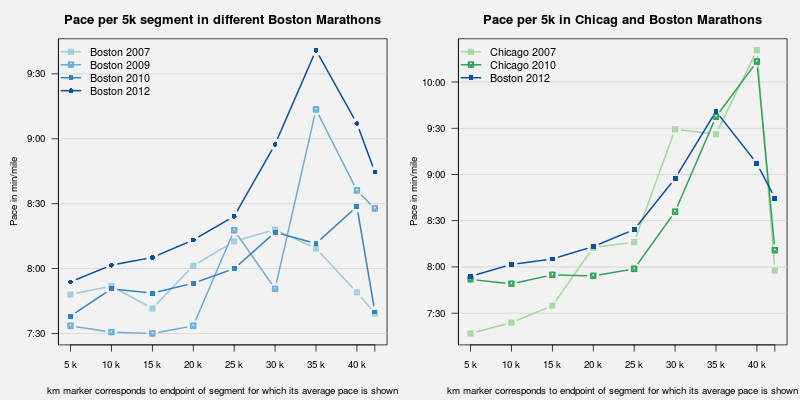
Two weeks ago I ran the 116th running of the Boston Marathon. Weather is often part of the story in Boston as e.g. my first one in 2007 happened after a storm-drenched and very wet weekend. This time, it was the opposite. Temperatures in the 60s in the morning before the start at 10:00am, which tempaeratures climbing well into the 80s for most of the race. The organizers had sent increasingly alarming email to us participants, warning about the weather conditions. And it was unpleasantly hot. Race support was great though: lots of locals had sprinklers pointed to the street; water stops were plenty and amply stocked and, being a nice summery day, lots of spectators made for lots of cheer. But heat makes for dreadful running conditions. I was pretty well trained, but I ended up running 3:43:55, or a tad slower than in Chicago 2007 (also record heat, with the race stopped around the four-hour mark) and Chicago 2009 (hot, though not that hot---but I was somewhat undertrained). Which makes this a personal worst. Oh well, stuff happens. And it was a pretty rough day---reports claimed that 2100 runners, or about 10%, were seeking some form of medical attention during or after the race which is a much higher proportion than under normal conditions. The chart below is an updated version of a chart which had appeared on my running page before. I regrouped my prior Bostons (2007, 2009 and 2010) on the left, and the Chicago runs 2007 and 2009 on the right---and each with the current Boston marathon. (Boston 2012 marathon in comparison to other Boston and Chicago marathons) So compared to the prior Boston races, I did indeed relatively poorly. Starting slower, and slowing down even more leading to about 1:45 for the first half and 1:58 for the second. Compared to the two poor Chicago races (put of the six times I have ran that race), things are not quite as bad as at least I didn't peak at over 10 min/mile. Weather will always remain a challenge. The previous marathon (which was last fall's Fox Valley 2011) was unseasonally cold and wet---making for a time fast enough to get me back to Boston. I am registered again for this one, so we will see what September brings this year.

30 April 2012

Lior Kaplan: Taking a vacation from open source

In the last 6 months I ve devoted a lot of time to the open source projects I m part of. I decided to take a vacation from most of the open source stuff I do. This is mainly to balance things better and make sure I don t feel burnt out. I m not disappearing completely, but rather shifting into a lower gear and focus on the things I enjoy most regarding open source.
Filed under: Debian GNU/Linux, LibreOffice

24 April 2012

Robert Collins: Less SPOFs: pyjunitxml, testscenarios

I ve made the Testtools committers team own both the project and the trunk branch for both pyjunitxml and testscenarios. This removes me as a SPOF if anything needs doing in those projects any Testtools committer can now do it. (Including code review and landing). If you are a testtools committer and need PyPI release rights, ping me and I ll add you. (I wish PyPI had group management).

23 April 2012

Benjamin Drung: Unreliable SSDs

Today my system froze and failed to reboot. I plugged in an Ubuntu live USB stick and booted from it. Then I discovered the problem that my Intel SSD 320 broke. The output of hdparm is attached to the end of the blog post. You can see that the device size is reduced to 8 MB from 120 GB and the serial number is called BAD_CTX 00000159. The firmware of the SSD was up-to-date and the last firmware update should have fixed the 8 MB bug. The Intel SSD 320 is my second SSD. My first SSD was a Super Talent Ultradrive GX 64GB, which died after around fifteen month of heavy use. It left a big bunch of my data corruption behind. SSDs seems to be very unreliable. Both SSDs died, but I cant remember that one of my HDDs died. $ sudo hdparm -I /dev/sda /dev/sda: ATA device, with non-removable media
Model Number: INTEL SSDSA2CW120G3
Serial Number: BAD_CTX 00000159
Firmware Revision: 4PC10362
Transport: Serial, ATA8-AST, SATA 1.0a, SATA II Extensions, SATA Rev 2.5, SATA Rev 2.6
Standards:
Used: unknown (minor revision code 0x0029)
Supported: 8 7 6 5
Likely used: 8
Configuration:
Logical max current
cylinders 16383 16
heads 16 16
sectors/track 63 63
--
CHS current addressable sectors: 16128
LBA user addressable sectors: 16384
LBA48 user addressable sectors: 16384
Logical Sector size: 512 bytes
Physical Sector size: 512 bytes
device size with M = 1024*1024: 8 MBytes
device size with M = 1000*1000: 8 MBytes
cache/buffer size = unknown
Nominal Media Rotation Rate: Solid State Device
Capabilities:
LBA, IORDY(can be disabled)
Standby timer values: spec'd by Standard, no device specific minimum
R/W multiple sector transfer: Max = 16 Current = 16
DMA: mdma0 mdma1 mdma2 udma0 udma1 udma2 udma3 udma4 udma5 *udma6
Cycle time: min=120ns recommended=120ns
PIO: pio0 pio1 pio2 pio3 pio4
Cycle time: no flow control=120ns IORDY flow control=120ns
Commands/features:
Enabled Supported:
Security Mode feature set
* Power Management feature set
* Write cache
* Look-ahead
* Host Protected Area feature set
* WRITE_BUFFER command
* READ_BUFFER command
* NOP cmd
* DOWNLOAD_MICROCODE
SET_MAX security extension
* 48-bit Address feature set
* Device Configuration Overlay feature set
* Mandatory FLUSH_CACHE
* FLUSH_CACHE_EXT
* General Purpose Logging feature set
* WRITE_ DMA MULTIPLE _FUA_EXT
* 64-bit World wide name
* IDLE_IMMEDIATE with UNLOAD
* WRITE_UNCORRECTABLE_EXT command
* READ,WRITE _DMA_EXT_GPL commands
* Segmented DOWNLOAD_MICROCODE
* Gen1 signaling speed (1.5Gb/s)
* Gen2 signaling speed (3.0Gb/s)
* Phy event counters
* Software settings preservation
* SMART Command Transport (SCT) feature set
* SCT LBA Segment Access (AC2)
* SCT Error Recovery Control (AC3)
* SCT Features Control (AC4)
* SCT Data Tables (AC5)
* Data Set Management TRIM supported (limit 8 blocks)
* Deterministic read ZEROs after TRIM
Security:
Master password revision code = 65534
supported
not enabled
not locked
frozen
not expired: security count
supported: enhanced erase
2min for SECURITY ERASE UNIT. 2min for ENHANCED SECURITY ERASE UNIT.
Logical Unit WWN Device Identifier: 500151795951d4b9
NAA : 5
IEEE OUI : 001517
Unique ID : 95951d4b9
Checksum: correct

22 April 2012

Eddy Petri&#537;or: xorg-macros in Debian

If you are looking for xorg-macros in Debian, you should install xutils-dev.

Julian Andres Klode: Reference Counting and Tail Calls

One thing I thought about today is reference counting in combination with tail calls. Imagine a function like this:
function f(x)   return g(x+1);  
Now consider that x is a reference counted object and that x + 1 creates a new object. The call to g(x + 1) shall be in tail call position. In most reference counted languages, the reference to an argument is owned by the caller. That is, f() owns the reference to x + 1. In that case, the call to g() would no longer be in a tail call position, as we still have to decrease the reference count after g() exits. An alternative would be that the callee owns the reference. This however, will most likely create far more reference count changes than a caller-owns language (increase reference count in caller, decrease reference count in callee). For example, the following function requires an increment before the call to g().
function f1(x)   return g(x);  
Does anyone have any ideas on how to solve the problem of tail calls while avoiding the callee-owns scenario? Something that does not require a (non-reference-counting) garbage collector would be preferably.
Filed under: General

Next.

Previous.