Search Results: "bab"

18 May 2015

Raphaël Hertzog: Freexian s report about Debian Long Term Support, April 2015

A Debian LTS logoLike each month, here comes a report about the work of paid contributors to Debian LTS. Individual reports In April, 81.75 work hours have been dispatched among 5 paid contributors (20.75 hours where unused hours of Ben and Holger that were re-dispatched to other contributors). Their reports are available: Evolution of the situation May has seen a small increase in terms of sponsored hours (66.25 hours per month) and June is going to do even better with at least a new gold sponsor. We will have no problems sustaining the increased workload it implies since three Debian developers joined the team of contributors paid by Freexian (Antoine Beaupr , Santiago Ruano Rinc n, Scott Kitterman). The Jessie release probably shed some light on the Debian LTS project since we announced that Jessie will benefit from 5 years of support. Let s hope that the trend will continue in the following months and that we reach our first milestone of funding the equivalent of a half-time position. In terms of security updates waiting to be handled, the situation is a bit contrasted: the dla-needed.txt file lists 28 packages awaiting an update (12 less than last month), the list of open vulnerabilities in Squeeze shows about 60 affected packages in total (4 more than last month). The extra hours helped to make a good stride in the packages awaiting an update but there are many new vulnerabilities waiting to be triaged. Thanks to our sponsors The new sponsors of the month are in bold.

No comment Liked this article? Click here. My blog is Flattr-enabled.

16 May 2015

Craig Small: Debian, WordPress and Multi-site

For quite some time, the Debian version of WordPress has had a configuration tweak that made it possible to run multiple websites on the same server. This came from a while ago when multi-site wasn t available. While a useful feature, it does make the initial setup of WordPress for simple sites more complicated. I m looking at changing the Debian package slightly so that for a single-site use it Just Works. I have also looked into the way WordPress handles the content, especially themes and plugins, to see if there is a way of updating them through the website itself. This probably won t suit everyone but I think its a better default. The idea will be to setup Debian packages something like this by default and then if you want more fancier stuff its all still there, just not setup. It s not setup at the moment but the default is a little confusing which I hope to change. Multisite The first step was to get my pair of websites into one. So first it was backing up time and then the removal of my config-websitename.php files in /etc/wordpress. I created a single /etc/wordpress/config-default.php file that used a new database. This initial setup worked ok and I had the primary site going reasonably quickly. The second site was a little trickier. The problem is that multisite does things like foo.example.com and bar.example.com while I wanted example.com and somethingelse.com There is a plugin wordpress-mu-domain-mapping that almost sorta-kinda works. While it let me make the second site with a different name, it didn t like aliases, especially if the alias was the first site. Some evil SQL fixed that nicely. UPDATE wp_domain_mapping SET blog_id=1 WHERE id=2 So now I had: Files and Permissions We really three separate sets of files in wordpress. These files come from three different sources and are updated using three different ways with a different release cycle. The first is the wordpress code which is shipped in the Debian package. All of this code lives in /usr/share/wordpress and is only changed if you update the Debian package, or you fiddle around with it. It needs to be readable to the webserver but not writable. The config files in /etc/wordpress are in this lot too. Secondly, we have the user generated data. This is things like your pictures that you add to the blog. As they are uploaded through the webserver, it needs to be writable to it. These files are located in /var/lib/wordpress/wp-content/uploads Third, is the plugins and themes. These can either be unzipped and placed into a directory or directly loaded in from the webserver. I used to do the first way but are trying the second. These files are located in /var/lib/wordpress/wp-content Ever tried to update your plugins and get the FTP prompt? This is because the wp-content directory is not writable. I adjusted the permissions and now when a plugin wants to update, I click yes and it magically happens! You will have to reference the /var/lib/wordpress/wp-content subdirectory in two places: What broke Images did, in a strange way. My media library is empty, but my images are still there. Something in the export and reimport did not work. For me its a minor inconvenience and due to moving from one system to another, but it still is there.

13 May 2015

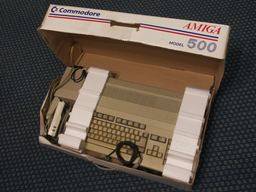
Jonathan Dowland: Amiga floppy recovery project

I've still got it! I've still got it!
Recovered floppy disks Recovered floppy disks
My first computer was an Amiga A500, and my brother and I spent a fair chunk of our childhoods creating things with it. These things are locked away on 3.5" floppy disks, but they were also lost a long time ago. A few weeks ago my dad found them in a box in his loft, so a disk-reading project is now on the horizon! Step one is to catalogue what we've got, which I've done here. Step two is to check which, if any, of these are not already in circulation amongst archivists. Thanks to Matthew Garrett for pointing me at the Software Preservation Society, which is a good first place to check. When we get to the reading step, there are quite a few approaches I could take. Which one to use depends to some extent on which disks we need to read, and whether they employ any custom sector layout or other copy protection schemes. I think the easiest method using equipment I already have is probably Amiga Explorer and a null-modem cable, as this approach will work on an A500 with Workbench 1.3. There are a variety of hardware tools and projects for reading Amiga floppies on a PC, but the most interesting one to me is DiscFerret, which is open hardware and software.

12 May 2015

Simon Josefsson: Certificates for XMPP/Jabber

I am revamping my XMPP server and I ve written down notes on how to set up certificates to enable TLS. I will run Debian Jessie with JabberD 2.x, using the recent jabberd2 jessie-backport. The choice of server software is not significant for the rest of this post. Running XMPP over TLS is a good idea. So I need a X.509 PKI for this purpose. I don t want to use a third-party Certificate Authority, since that gives them the ability to man-in-the-middle my XMPP connection. Therefor I want to create my own CA. I prefer tightly scoped (per-purpose or per-application) CAs, so I will set up a CA purely to issue certificates for my XMPP server. The current XMPP specification, RFC 6120, includes a long section 13.7 that discuss requirements on Certificates. One complication is the requirement to include an AIA for OCSP/CRLs fortunately, it is not a strict MUST requirement but a weaker SHOULD . I note that checking revocation using OCSP and CRL is a MUST requirement for certificate validation some specification language impedence mismatch at work there. The specification demand that the CA certificate MUST have a keyUsage extension with the digitalSignature bit set. This feels odd to me, and I m wondering if keyCertSign was intended instead. Nothing in the XMPP document, nor in any PKIX document as far as I am aware of, will verify that the digitalSignature bit is asserted in a CA certificate. Below I will assert both bits, since a CA needs the keyCertSign bit and the digitalSignature bit seems unnecessary but mostly harmless. My XMPP/Jabber server will be chat.sjd.se and my JID will be simon@josefsson.org . This means the server certificate need to include references to both these domains. The relevant DNS records for the josefsson.org zone is as follows, see section 3.2.1 of RFC 6120 for more background.
_xmpp-client._tcp.josefsson.org.	IN	SRV 5 0 5222 chat.sjd.se.
_xmpp-server._tcp.josefsson.org.	IN	SRV 5 0 5269 chat.sjd.se.
The DNS records or the sjd.se zone is as follows:
chat.sjd.se.	IN	A	...
chat.sjd.se.	IN	AAAA	...
The following commands will generate the private key and certificate for the CA. In a production environment, you would keep the CA private key in a protected offline environment. I m asserting a expiration date ~30 years in the future. While I dislike arbitrary limits, I believe this will be many times longer than the anticipated lifelength of this setup.
openssl genrsa -out josefsson-org-xmpp-ca-key.pem 3744
cat > josefsson-org-xmpp-ca-crt.conf << EOF
[ req ]
x509_extensions = v3_ca
distinguished_name = req_distinguished_name
prompt = no
[ req_distinguished_name ]
CN=XMPP CA for josefsson.org
[ v3_ca ]
subjectKeyIdentifier=hash
basicConstraints = CA:true
keyUsage=critical, digitalSignature, keyCertSign
EOF
openssl req -x509 -set_serial 1 -new -days 11147 -sha256 -config josefsson-org-xmpp-ca-crt.conf -key josefsson-org-xmpp-ca-key.pem -out josefsson-org-xmpp-ca-crt.pem
Let s generate the private key and server certificate for the XMPP server. The wiki page on XMPP certificates is outdated wrt PKIX extensions. I will embed a SRV-ID field, as discussed in RFC 6120 section 13.7.1.2.1 and RFC 4985. I chose to skip the XmppAddr identifier type, even though the specification is somewhat unclear about it: section 13.7.1.2.1 says that it is no longer encouraged in certificates issued by certification authorities while section 13.7.1.4 says Use of the id-on-xmppAddr format is RECOMMENDED in the generation of certificates . The latter quote should probably have been qualified to say client certificates rather than certificates , since the latter can refer to both client and server certificates. Note the use of a default expiration time of one month: I believe in frequent renewal of entity certificates, rather than use of revocation mechanisms.
openssl genrsa -out josefsson-org-xmpp-server-key.pem 3744
cat > josefsson-org-xmpp-server-csr.conf << EOF
[ req ]
distinguished_name = req_distinguished_name
prompt = no
[ req_distinguished_name ]
CN=XMPP server for josefsson.org
EOF
openssl req -sha256 -new -config josefsson-org-xmpp-server-csr.conf -key josefsson-org-xmpp-server-key.pem -nodes -out josefsson-org-xmpp-server-csr.pem
cat > josefsson-org-xmpp-server-crt.conf << EOF
subjectAltName=@san
[san]
DNS=chat.sjd.se
otherName.0=1.3.6.1.5.5.7.8.7;UTF8:_xmpp-server.josefsson.org
otherName.1=1.3.6.1.5.5.7.8.7;UTF8:_xmpp-client.josefsson.org
EOF
openssl x509 -sha256 -CA josefsson-org-xmpp-ca-crt.pem -CAkey josefsson-org-xmpp-ca-key.pem -set_serial 2 -req -in josefsson-org-xmpp-server-csr.pem -out josefsson-org-xmpp-server-crt.pem -extfile josefsson-org-xmpp-server-crt.conf
With this setup, my XMPP server can be tested by the XMPP IM Observatory. You can see the c2s test results and the s2s test results. Of course, there are warnings regarding the trust anchor issue. It complains about a self-signed certificate in the chain. This is permitted but not recommended however when the trust anchor is not widely known, I find it useful to include it. This allows people to have a mechanism of fetching the trust anchor certificate should they want to. Some weaker cipher suites trigger warnings, which is more of a jabberd2 configuration issue and/or a concern with jabberd2 defaults. My jabberd2 configuration is simple in c2s.xml I add a <id> entity with the require-starttls , cachain , and pemfile fields. In s2s.xml, I have the <pemfile>, <resolve-ipv6>, and <require-tls> entities. Some final words are in order. While this setup will result in use of TLS for XMPP connections (c2s and s2s), other servers are unlikely to find my CA trust anchor, let alone be able to trust it for verifying my server certificate. I m happy to read about Peter Saint-Andre s recent SSL/TLS work, and in particular I will follow the POSH effort.

11 May 2015

Julien Danjou: My interview about software tests and Python

I've recently been contacted by Johannes Hubertz, who is writing a new book about Python in German called "Softwaretests mit Python" which will be published by Open Source Press, Munich this summer. His book will feature some interviews, and he was kind enough to let me write a bit about software testing. This is the interview that I gave for his book. Johannes translated to German and it will be included in Johannes' book, and I decided to publish it on my blog today. Following is the original version. How did you come to Python?
I don't recall exactly, but around ten years ago, I saw more and more people using it and decided to take a look. Back then, I was more used to Perl. I didn't really like Perl and was not getting a good grip on its object system. As soon as I found an idea to work on if I remember correctly that was rebuildd I started to code in Python, learning the language at the same time. I liked how Python worked, and how fast I was to able to develop and learn it, so I decided to keep using it for my next projects. I ended up diving into Python core for some reasons, even doing things like briefly hacking on projects like Cython at some point, and finally ended up working on OpenStack. OpenStack is a cloud computing platform entirely written in Python. So I've been writing Python every day since working on it. That's what pushed me to write The Hacker's Guide to Python in 2013 and then self-publish it a year later in 2014, a book where I talk about doing smart and efficient Python. It had a great success, has even been translated in Chinese and Korean, so I'm currently working on a second edition of the book. It has been an amazing adventure! Zen of Python: Which line is the most important for you and why?
I like the "There should be one and preferably only one obvious way to do it". The opposite is probably something that scared me in languages like Perl. But having one obvious way to do it is and something I tend to like in functional languages like Lisp, which are in my humble opinion, even better at that. For a python newbie, what are the most difficult subjects in Python?
I haven't been a newbie since a while, so it's hard for me to say. I don't think the language is hard to learn. There are some subtlety in the language itself when you deeply dive into the internals, but for beginners most of the concept are pretty straight-forward. If I had to pick, in the language basics, the most difficult thing would be around the generator objects (yield). Nowadays I think the most difficult subject for new comers is what version of Python to use, which libraries to rely on, and how to package and distribute projects. Though things get better, fortunately. When did you start using Test Driven Development and why?
I learned unit testing and TDD at school where teachers forced me to learn Java, and I hated it. The frameworks looked complicated, and I had the impression I was losing my time. Which I actually was, since I was writing disposable programs that's the only thing you do at school. Years later, when I started to write real and bigger programs (e.g. rebuildd), I quickly ended up fixing bugs I already fixed. That recalled me about unit tests and that it may be a good idea to start using them to stop fixing the same things over and over again. For a few years, I wrote less Python and more C code and Lua (for the awesome window manager), and I didn't use any testing. I probably lost hundreds of hours testing manually and fixing regressions that was a good lesson. Though I had good excuses at that time it is/was way harder to do testing in C/Lua than in Python. Since that period, I have never stopped writing "tests". When I started to hack on OpenStack, the project was adopting a "no test? no merge!" policy due to the high number of regressions it had during the first releases. I honestly don't think I could work on any project that does not have at least a minimal test coverage. It's impossible to hack efficiently on a code base that you're not able to test in just a simple command. It's also a real problem for new comers in the open source world. When there are no test, you can hack something and send a patch, and get a "you broke this" in response. Nowadays, this kind of response sounds unacceptable to me: if there is no test, then I didn't break anything! In the end, it's just too much frustration to work on non tested projects as I demonstrated in my study of whisper source code. What do you think to be the most often seen pitfalls of TDD and how to avoid them best?
The biggest problems are when and at what rate writing tests. On one hand, some people starts to write too precise tests way too soon. Doing that slows you down, especially when you are prototyping some idea or concept you just had. That does not mean that you should not do test at all, but you should probably start with a light coverage, until you are pretty sure that you're not going to rip every thing and start over. On the other hand, some people postpone writing tests for ever, and end up with no test all or a too thin layer of test. Which makes the project with a pretty low coverage. Basically, your test coverage should reflect the state of your project. If it's just starting, you should build a thin layer of test so you can hack it on it easily and remodel it if needed. The more your project grow, the more you should make it sold and lay more tests. Having too detailed tests is painful to make the project evolve at the start. Having not enough in a big project makes it painful to maintain it. Do you think, TDD fits and scales well for the big projects like OpenStack?
Not only I think it fits and scales well, but I also think it's just impossible to not use TDD in such big projects. When unit and functional tests coverage was weak in OpenStack at its beginning it was just impossible to fix a bug or write a new feature without breaking a lot of things without even noticing. We would release version N, and a ton of old bugs present in N-2 but fixed in N-1 were reopened. For big projects, with a lot of different use cases, configuration options, etc, you need belt and braces. You cannot throw code in a repository thinking it's going to work ever, and you can't afford to test everything manually at each commit. That's just insane.

Craig Small: procps using GitLab CI

procps-ciThe procps project for a few years has been hosted at Gitorious. With the announcement that Gitorious has been acquired by GitLab and that all repositories need to move there, procps moved along to GitLab. At first I thought it would just be a like for like thing, but then I noticed that GitLab has this GitLab CI feature and had to try it out. CI here stands for Continuous Integration and is a way of automatically testing your program builds using a bunch of test scripts. procps already has a set of tests, with some a level of coverage that has room for improvement, so it was a good candidate to use for CI. The way GitLab works is they have a central control point that is linked to the git repo and you create runners, which are the systems that actually compile the programs and run the tests. The runners then feed back their results and GitLab CI shows it all in pretty red or green. The first problem was building this runner. Most of the documentation assumes you are building testing for Ruby. procps is built using C with the test scripts in TCL, so there was going to be some need to make some adjustments. I chose to use docker containers so that there was at least some isolation between the runners and the base system. I soon found the docker container I used (ruby:2.6 as suggested by GitLab) didn t have autopoint which mean autogen.sh failed so I had no configure script so no joy there. Now my second problem was I had never used docker before and beyond that it was some sort of container thing so like virtual machines lite, I didn t know much about it. The docker docs are very good and soon I had built my own custom docker image that had all the programs I need to compile and test procps. It s basically a cut-down Debian image with a few things like gettext-bin and dejagnu added in. Docker is not a full system With that all behind me and a few oh I need that too (don t forget you need git) moments we had a working CI runner. This was a Good Thing. You then find that your assumptions for your test cases may not always be correct. This is especially noticeable when testing something like procps which needs to work of the proc filesystem. A good example is, what uses session ID 1? Generally its init or systemd, but in Docker this is what everything runs as. A test case which assumes things about SID=1 will fail, as it did. This probably won t be a problem for testing a lot of normal programs that don t need to dig a deep into the host system as procps does, but it is something to remember. The docker environment looks a lot like a real system from the inside, but there are differences, so the lesson here is to write better tests (or fix the ones that failed, like I did). The runner and polling Now, there needs to be communication between the CI website and the runner, so the runner knows there is something for it to do. The gitlab runner has this setup rather well, except the runner is rather aggressive about its polling, hitting the website every 3 seconds. For someone on some crummy Australian Internet with low speeds and download quotas, this can get expensive in network resources. As there is on average an update once a week or so these seems rather excessive. My fix is pretty manual, actually its totally manual. I stop the daemon, then if I notice there are pending jobs I start the daemon, let it do its thing, then shut it down again. This is certainly not an optimal solution but works for now. I will look into doing something more clever later, possibly with webhooks.

Zlatan Todori : Reboot to roots

I am working in software development field for more then 5 years. During that period I came across of other developers which vast majority can be described as terrible people. That is what sets probably difference between hacker mind and average software engineer. People tend to think if they have position of software developer they are god-like and should be treated like that. Hackers know who they are and tend to be Socrates-wise "I know that I know nothing". As student of mechanical engineering (majoring in mechatronics) I didn't have much of programming so naturally I had some personal difficulties to grasp software field but once I got in I stopped almost totally doing my student duties as it didn't cross path with my love towards hacking. And now after that many years in software field, in which I mostly worked as freelancer for other people and companies (where it wasn't unusual that I got hired personally by a guy who couldn't or didn't know how to finish his work, I hand the code which he would present as his own work, but I don't mind as I needed the money to get on) and my work ended as proprietary - I am just fed up with all this nonsense. Someone would think what is problem there - well for me it is, as being part of Debian and wider Free software ecosystem I know proprietary software is not fostering better society in all together so it made me a bit unhappy about it. The thing that actually is really annoying me are asshole so-called software engineers and the most - bad behavior towards users. Users should be treated as supporters of your software and if proprietary company treats their users as shit then it's obvious that they don't care for the users but rather for the money and only money. Proprietary isn't here the only bad thing, open source community has it share of terrible responses - which comes naturally if you take the sheer amount of people in open source. I for instance was called on Debian IRC a peasant and even I sheep in my early days - but Debian as all communities has its bad seeds and sometimes even non-Debianities trolls hop on our channels. I didn't let myself put down because I personally got the chance to meet many of them and they change the flow of my life at that point. I am unhappy at the current state of things worldwide and personally but I have now made a decision that I am shifting towards being technical customer support engineer or for me better named as Happiness Hero. Why, one would ask because as software engineer you would make more? Well, firstly I don't care that much about money (or to be even more precise, as capitalism has made a sick money-grabbing society, you can never pay me enough as I am more worth then entire capitalistic system so in the end I don't care that much how I am paid) and secondly happiness hero can earn more then software engineer which latest #talkpay hashtag on Twitter showed. I have made IMHO many good pieces of code that will never be contributed as mine, but I achieved no happiness and rather achieved few months ago a rather bad burnout. My shift towards happiness hero should look like this - I am pretty well prepared technically for that position, I have experience with helping users and in general with people and I tend to be pretty good at that (but that we would need to ask them) and with part that I enjoy helping people to debug their technical problem so they can spend more time on others things (read family, creativity, hobbies) is something I believe will put me well into position to achieve happiness so I can create for myself time to finish damn faculty (where TBH professors showed that they can be one of the worst enemies of their students - and I am highly doubting in this generic way of schooling for centuries) and if I get some decent paycheck with this capitalistic system I will have a chance to sponsor a poor family that has child talented in artistic field - or to say SHARE something material for cultural and emotional gain. Take that capitalism! And the best part, I will start to believe more in myself so I have already few offers for that kind of position but am waiting for few more and I am screening companies to find one that fits me best - shares values with mine and has a great interaction with their users. One of the companies that makes me want to screen more companies is Buffer. When you read this and this you will see their way of life and perks are really something every company should do - then you will understand why I want to give my self a chance which I believe I finally deserved. And, no, I didn't apply for Buffer as I don't use their service nor did have time to read the two books needed for applying (which I think is really a great thing to foster people into getting more knowledge). I can only wish them best luck in future. I am currently doing one small software development thing (freelance) for next two weeks and after that I am hoping to get enough good offer to start with happiness job and retreat from software development for some good amount of time. That doesn't mean I will cease my Free software activities - on contrary I think I will have more time and even more will to work on Free software development in my spare time. So if anyone or any company that works with open source community has a position for happiness hero, get in touch with me and we will have a good talk. End point - I want to grow and become who am I, and not who I should be according to others.

9 May 2015

Hideki Yamane: Now we don't have do-release-upgrade/fedup

We've noted some instructions to release note, but probably next step is providing upgrade tool like do-release-upgrade (ubuntu) and fedup (fedora). I hope such cool tool would be provided before Stretch release.

Or if someone would start it already, tell me about it.

John Goerzen: First impressions and review of OwnCloud

In my recent post (I give up on Google), a lot of people suggested using OwnCloud as a replacement for several Google services. I ve been playing around with it for a few days, and it is something of a mix of awesome and disappointing, in my opinion. Files OwnCloud started as a file-sync tool, somewhat akin to Google Drive and Dropbox. It has clients for every platform, and it is also a client for every platform: you can have subfolders of your OwnCloud installation stored on WebDav, *FTP*, Google Drive, Dropbox, you name it. It is a pretty nice integrator of other storage services, and provides the only way to use some of them on Linux (*cough* Google Drive *cough*) One particularly interesting feature is the live editing in the browser of ODT, DOCX, and TXT files. This is somewhat similar to Google Docs and the only such thing I ve seen in Open Source software. It writes changes directly back to the documents and, in my limited testing, seems to work well. A very nice feature! I ve tested the syncing only on Linux so far, but it looks solid. There are two surprising issues, however: there is no deduplication and no delta-uploads. Add 10 bytes to the end of a 1GB file, and you re-upload the 1GB file. Thankfully the OwnCloud GUI client is smart enough to use inotify to notice an mv, but my guess is and I haven t tested this, but apparently OwnCloud doesn t use hashes at all that the CLI client would require a reupload after any mv, because it doesn t run continuously. In some situations, Syncany may be a useful work-around for this, as it does chunk-based dedup and client-side encryption. However, you would lose a lot of the sharing features inside OwnCloud by doing this, and the integration with the OwnCloud apps for photos, videos, and music. The Android/mobile apps support all the usual auto-upload options. Calendar A lot of people report using OwnCloud as a calendar server, and it does indeed use CalDAV. With a program like DAVDroid or Mozilla Lightning, this makes, in theory, a full-functioning calendar syncing tool. There is, of course, also a web interface to the calendar. It, sadly, is limited. Or shall we say, VERY limited. Even something like sending an invite is missing and in fact, the GUI for sharing an event is baffling. You can share it with someone, they get no say in whether or not it shows up, and it shows up on their calendar on the web only (not on synced copies) and they have no way to remove it! Sharing calendars is similar; you can hide the display of any one of your calendars on the web interface, but not of any calendars shared with you. Baffling. Address Book I haven t tested this yet, but there s not much to test, I suspect. It can be shared with others, which I could see as a nice feature. Bookmarks An interesting bookmarks manager, though mysteriously not with Firefox sync support. There is Chrome sync support, and a separate Mozilla Sync support, but it doesn t provide cross-browser syncing, apparently. Music It is designed to present an interface to music that is stored in Files. It provides an Ampache-compatible API, so there are a lot of clients that can stream music. It has very few options, not even for transcoding, so I don t see how it would be useful for my FLAC collection. Pictures Sort of a gallery view of photos synced up with Files. Very basic. Has a sharing button to share a link to an entire folder, but no option to embed photos in blog posts at a lower resolution or shortcut to sharing individual photos. Notes, Tasks, etc. I haven t had the chance to look at this much. Some of them sync to various clients. The Notes are saved as HTML files that get synced down. Clients overall There is a very helpful page that lists all the sync clients for OwnCloud not just for files, but also for calendars, contacts, etc. The list is extensive! Other options The two other Open Source options mentioned on my blog post were Kolab and Sogo, and there is also Zimbra which also has a community edition. The Debian Groupware page lists a number of other groupware options as well. Citadel caught my eye (wow, it s still around!). Sogo has ActiveSync support, which might make phone integration a lot easier. It is not dead-simple to set up like OwnCloud is, though, so I haven t tried it out, but I will probably be looking at it and Citadel next.

7 May 2015

Steve Kemp: On de-duplicating uploaded file-content.

This evening I've been mostly playing with removing duplicate content. I've had this idea for the past few days about object-storage, and obviously in that context if you can handle duplicate content cleanly that's a big win. The naive implementation of object-storage involves splitting uploaded files into chunks, storing them separately, and writing database-entries such that you can reassemble the appropriate chunks when the object is retrieved. If you store chunks on-disk, by the hash of their contents, then things are nice and simple. The end result is that you might upload the file /etc/passwd, split that into four-byte chunks, and then hash each chunk using SHA256. This leaves you with some database-entries, and a bunch of files on-disk:
/tmp/hashed/ef267892ee080862c96a8d2d05de62f48e20f0875f27379e7d58c73ea4455bf1
/tmp/hashed/a378977155fb42bb006496321cbe31f74cbda803c3f6ca590f30e76d1afad921
..
/tmp/hashed/3805b0245bc8375be7125ae228eef711552ac082ffb9bf8756e2964a2393a9de
In my toy-code I wrote out the data in 4-byte chunks, which is grossly ineffeciant. But the value of using such small pieces is that there is liable to be a lot of collisions, and that means we save-space. It is a trade-off. So the main thing I was experimenting with was the size of the chunks. If you make them too small you lose I/O due to the overhead of writing out so many small files, but you gain because collisions are common. The rough testing I did involved using chunks of 16, 32, 128, 255, 512, 1024, 2048, and 4096 bytes. As sizes went up the overhead shrank, but also so did the collisions. Unless you could handle the case of users uploading a lot of files like /bin/ls which are going to collide 100% of the time with prior uploads using larger chunks just didn't win as much as I thought they would. I wrote a toy server using Sinatra & Ruby, which handles the splitting/hashing/and stored block-IDs in SQLite. It's not so novel given that it took only an hour or so to write. The downside of my approach is also immediately apparent. All the data must live on a single machine - so that reassmbly works in the simple fashion. That's possible, even with lots of content if you use GlusterFS, or similar, but it's probably not a great approach in general. If you have large capacity storage avilable locally then this might would well enough for storing backups, etc, but .. yeah.

5 May 2015

Miriam Ruiz: SuperTuxKart 0.9: The other side of the story

I approached the SuperTuxKart community fearing some backslash due to last week s discussion about their release 0.9, to find instead a nice, friendly and welcoming community. I have already had some very nice talks with them since then, and they have patiently explained to me the sequence of events that led to the situation that I mentioned and that, for the sake of fairness, I consider that I have to share here too. You can read the log of the first conversation I had with them (the log has been edited and cleared up for clarity and readability). I seriously recommend reading it, it s a honest friendly conversation, and it s first hand. For those who don t already know the game:

All this story seems to start with the complain of a 6 yo girl, close relative of one of the developers and STK user, who explained that she always felt that Mario Kart was better because there was a princess in it. I m not particularly happy with princesses as role models for girls, but one thing I have always said is that we have to listen to kids and take their opinions into accounts, and I know that if I had such a request from one of the kids closer to me, I probably would have fulfilled it too. In any case, Free Software projects based on volunteer work are essentially a do-ocracy and it is assumed that whoever does the work, gets to decide about it.

So that is how Princess Sara was added to the game. While developing it, I was assured that they took extra care that her proportions were somehow realistic, and not as distorted as we re used to see in Barbie or many Disney films. Sara is inspired on an OpenGameArt s wizard and is not supposed to be a weak damsel in distress, but in fact a powerful character in the world s universe.

Sara is not the only female character playable. There are a few others: Suzanne (a monkey, Blender s mascot), Xue (XFCE s mouse) and Amanda (a panda, the mascot of windows maker). Sara happens to be the only human character playable, male or female. While it has been argued that by adding that character, a player might have the impression that the rest of the characters would be male by default, I have been told that the intention is exactly the opposite,and that the fact that the only human playable character in the game is female should make it more attractive to girls. To some, at least. Here are some images of Sara:

So the fact is that they have invested a lot of time in developing Sara s model. I m not an artist myself, so I don t know first hand how much time and effort it takes to make such a model, but in any case it seems that quite a lot. When they designed the beach track Gran Paradiso, they wanted to add people to the beach. That track is, in fact, inspired on a real existing place: Princess Juliana Airport. Time was over and they wanted to publish a version with what they already had, so they used Sara s model in a bikini on the beach, with the intention of adding more people, male and female, later. The overall view of the beach would be:

This is how that track shows when the players are driving in it:

Now, about the poster of version 0.9, it is supposed to be inspired in the previous poster of version 0.8.1, only this time inspired in Carnival (which is, in fact, a celebration in which sexualization of both genders is a core part). I know that there are accusations of cultural apropriation, but I couldn t know, as my white privilege probably shields me from seeing that. Up to now, no one has said anything about that, only Gunnar explaining his point of view as a non-native mexican: While the poster does not strike as the most cautious possible, I do not see it as culturally offensive. It does not attempt to set a scene portraiting what were the cultures really like; the portrait it paints is similar to so many fantasy recreations . In my opinion, even when the model is done in good taste, with no superbig breasts and no unrealistic waist, it s still depicting a girl without much clothes as the main element of the scene, with an attire, a posture and an attitude that clearly resembles carnival and, thus, inevitably conveys a message of sexualization. Even though I can t deny that it s a cute poster, it s one I wouldn t be happy to see for example in a school, if someone wanted to promote the game there. The author of the poster, anyway, tells me that he had a totally different intention when doing it, and he wanted to depict a powerful princess, in the center of SuperTuxKart s universe, celebrating the new engine.

About the panties showing every now and then, I ve been told that it s something so hard to see that in fact you would really have to open the model itself to view them. I m not saying that I like them though, I think it would have been better if Sara would have had short pants under the skirt, if she was going to drive the snowmobile with a dress, but I m not sure if that s something important enough to condemn the game. The original girl mentioned at the beginning of this post seems to have found the animation funny, started laughing, and said that Sara is very silly, and that was all. It s probably something more silly than naughty, I guess. Even though, as I said, it s something I don t like too much. I don t have to agree with STK developers in everything. I guess.

There s one thing I would like to highlight about my conversations with the developers of SuperTuxKart, though. I like them. They seem to be as concerned about the wellbeing of kids as I am, they have their own ethic norms of what s acceptable and what s not, and they want to do something to be proud of. Sometimes, many of these conflicts arise from a lack of trust. When I first saw the screenshots with the girl in bikini and the panties showing, I was honestly concerned about the direction the project was taking. After having talked with the developers, I am more calmed about it, because they seem to have their heart in the right place, they care, they are motivated and they work hard. I don t know if a princess would be my first choice for a main female character, but at least their intention seems to be to give some girls a sensible role model in the game with who they can identify.

4 May 2015

Mike Gabriel: Rebasing NXv3 against latest X.Org -- already ~2,700,000 lines of code removed

We have set sails for a great endeavour. We are cleaning up the nx-X11 / nxagent code tree [1] and rebase it against latest / recent X.Org. Until now, we have been able to drop ~2,700,000 lines of code [2] from the source tree that originally got released by NoMachine. The plan is... For more details, see the Readme.md[3] file on our Github project. What we have achieved so far... read more

Mike Hommey: Gnome shell Hello world

Gnome Shell, besides providing the main user interface for GNOME 3, is a Javascript shell with bindings to many native interfaces that allow e.g. Window manipulation, graphics rendering and animations, compositing, etc. It also allows developers to write extensions changing Gnome Shell s behavior. Less known is that it is possible to replace the entire Javascript code base that Gnome Shell uses. It can be useful to hack on Gnome Shell itself (no need to fiddle with system files, or, since 3.12, no need to rebuild libgnome-shell.so), but it can also be used to implement a completely new User Interface in Javascript. I m starting to experiment with the latter, because I want to try building a window manager that fits my needs, while keeping away the boring details of EWMH, xinerama, and other X11 things. And because it s fun. But baby steps, first: let s bootstrap a Hello world with Gnome shell. I tested this with Gnome Shell 3.14. Trying various older versions, I got different results for reasons I don t know. 3.4 doesn t display anything unless, paradoxically, global.stage.show() is removed, and 3.8 doesn t display anything no matter what. I guess the next step is to go through some Clutter tutorials and transpose them to Javascript. Update: On the other hand, a lot of the window managing is still done by mutter under the hood, which doesn t leave a lot of space for something really different.

3 May 2015

Hideki Yamane: release, and user complains

Now I've just finished to translate Debian Jessie release note for Japanese... *Phew*

Also we Japanese people has celebrated its release at Tokyo and Kyoto (thanks to someone who added it to Wiki), I'll put some photos later.


Anyway, we succeeded to push it out, now users get Jessie as stable release. Then, I found many users complain about it. Why? because it includes incompatible changes with previous wheezy. However it is obviously noted to release notes (check! lazy people ;), and even they could try it before its release!

Most of users don't want to use pre-release version, what they want is released one. Probably Debian should consider to push "something release version" out, not only each 2 years stable release. Since our distribution's quality relies on manual Exploratory testing in unstable by developers and users now, but it is not enough to check bugs. Somehow we get more human resource for testing.

28 April 2015

Craig Small: Backporting and git-buildpackage

For working with Debian packages, one method of maintaining them is to put them in git and use git-buildpackage to build them right out of the git repository. There are a few pitfalls with it, notably around if you forget to import the upstream you get this strange treeish related error which still throws me at first when I see it. Part of maintaining packages is to be able to fix security bugs in older versions of them that are found in stable and even sometimes old stable (jessie and wheezy respectively at the time of writing). At first I used to do this outside git because to me there wasn t a clear way of doing it within it. This is not too satisfactory because it means you lose the benefits of using git in the first place, and for distributions you are more likely to need collaboration with, such as working with the security team or help with backporting. So because I don t think the details are easily found and also I ll probably lose them again and need a central spot to find what I did last time. Building the environment The first step for a new distribution is to create the building environment. You really only need to do this once when there is a new distribution with then possibly some updates from time to time. The command will create the environment in /var/cache/pbuilder/base-DIST.cow/
DIST=wheezy git-pbuilder create
You will find all the files in /var/cache/pbuilder/base-wheezy.cow/ which is then ready to do be used. For more information about this useful tool, look at the git-builder entry on the Debian wiki. Creating the branch The master branch is generally where sid will located. For the other distributions, I use branches. For the initial setup you will need to create the branch and start it off from the right point. For example, the last non-security update for wordpress in jessie was version 4.1+dfsg-1. We then want the jessie branch to start from this point.
git branch jessie debian/4.1+dfsg-1
git checkout jessie
This will then create and put you on the jessie branch. You only need the first line once. You can switch between sid (master branch) and jessie (jessie branch). At this point you have a working place to make all the updates you need to do. Nothing is terribly different from the usual workflow. Building the package Make sure you have checked in all your changes and now it is time to build your package!
git-buildpackage --git-pbuilder --git-dist=jessie --git-debian-branch=jessie
You may need two additional flags:

27 April 2015

Matthew Garrett: Reducing power consumption on Haswell and Broadwell systems

Edit to add: These patches on their own won't enable this functionality, they just give us a better set of options. Once they're merged we can look at changing the defaults so people get the benefit of this out of the box.

Haswell and Broadwell (Intel's previous and current generations of x86) both introduced a range of new power saving states that promised significant improvements in battery life. Unfortunately, the typical experience on Linux was an increase in power consumption. The reasons why are kind of complicated and distinctly unfortunate, and I'm at something of a loss as to why none of the companies who get paid to care about this kind of thing seemed to actually be caring until I got a Broadwell and looked unhappy, but here we are so let's make things better.

Recent Intel mobile parts have the Platform Controller Hub (Intel's term for the Southbridge, the chipset component responsible for most system i/o like SATA and USB) integrated onto the same package as the CPU. This makes it easier to implement aggressive power saving - the CPU package already has a bunch of hardware for turning various clock and power domains on and off, and these can be shared between the CPU, the GPU and the PCH. But that also introduces additional constraints, since if any component within a power management domain is active then the entire domain has to be enabled. We've pretty much been ignoring that.

The tldr is that Haswell and Broadwell are only able to get into deeper package power saving states if several different components are in their own power saving states. If the CPU is active, you'll stay in a higher-power state. If the GPU is active, you'll stay in a higher-power state. And if the PCH is active, you'll stay in a higher-power state. The last one is the killer here. Having a SATA link in a full-power state is sufficient to keep the PCH active, and that constrains the deepest package power savings state you can enter.

SATA power management on Linux is in a kind of odd state. We support it, but we don't enable it by default. In fact, right now we even remove any existing SATA power management configuration that the firmware has initialised. Distributions don't enable it by default because there are horror stories about some combinations of disk and controller and power management configuration resulting in corruption and data loss and apparently nobody had time to investigate the problem.

I did some digging and it turns out that our approach isn't entirely inconsistent with the industry. The default behaviour on Windows is pretty much the same as ours. But vendors don't tend to ship with the Windows AHCI driver, they replace it with the Intel Rapid Storage Technology driver - and it turns out that that has a default-on policy. But to make things even more awkwad, the policy implemented by Intel doesn't match any of the policies that Linux provides.

In an attempt to address this, I've written some patches. The aim here is to provide two new policies. The first simply inherits whichever configuration the firmware has provided, on the assumption that the system vendor probably didn't configure their system to corrupt data out of the box[1]. The second implements the policy that Intel use in IRST. With luck we'll be able to use the firmware settings by default and switch to the IRST settings on Intel mobile devices.

This change alone drops my idle power consumption from around 8.5W to about 5W. One reason we'd pretty much ignored this in the past was that SATA power management simply wasn't that big a win. Even at its most aggressive, we'd struggle to see 0.5W of saving. But on these new parts, the SATA link state is the difference between going to PC2 and going to PC7, and the difference between those states is a large part of the CPU package being powered up.

But this isn't the full story. There's still work to be done on other components, especially the GPU. Keeping the link between the GPU and an internal display panel active is both a power suck and requires additional chipset components to be powered up. Embedded Displayport 1.3 introduced a new feature called Panel Self-Refresh that permits the GPU and the screen to negotiate dropping the link, leaving it up to the screen to maintain its contents. There's patches to enable this on Intel systems, but it's still not turned on by default. Doing so increases the amount of time spent in PC7 and brings corresponding improvements to battery life.

This trend is likely to continue. As systems become more integrated we're going to have to pay more attention to the interdependencies in order to obtain the best possible power consumption, and that means that distribution vendors are going to have to spend some time figuring out what these dependencies are and what the appropriate default policy is for their users. Intel's done the work to add kernel support for most of these features, but they're not the ones shipping it to end-users. Let's figure out how to make this right out of the box.

[1] This is not necessarily a good assumption, but hey, let's see

comment count unavailable comments

Gunnar Wolf: Worthy weekend

(No, I'm not talking about a future Ubuntu release... After all, what kind of weird animal would a weekend be?) This weekend we took the kids outside for the first time (not counting, of course, visits to the pediatrician). We were quite anxious... Of course, they were born somewhat under weight and at 7 months of gestation. But this Saturday we feelt adventurous, and took the kids out for a day among people! It might not sound like a big deal, but... Well, we took a not such beautiful or scenic route: We took them to the supermarket, and had a small lunch out. For the first time in the already two months they have been with us. Dinner with friends at home, having a very good time, and as expected a... Very hard night for us. All that excitement had the babies very nervous. Today again, for the first time we took the children out to visit some friends of ours. Again, it was great, they behaved very nicely, and were lovely all around. Lets see what this night holds in place for us. Anyway, with them growing slowly but steadily... We are very happy, thankful parents. For the first time since Regina is with me in Mexico, this time we decided we would not have a birthday party (yes, I'm 30 minutes away from being 39 year old). I cannot imagine a fuller, better celebration than what we are having. This two babies are the real event in our lives. Oh... And by the way, this weekend also saw the release of a great new Debian release: Debian 8, codenamed Jessie. Thanks, folks, for such a great birthday present ;-) For reasons that should by now be obvious, I wasn't able to go to either of the release parties I knew of in Mexico City (even one of them was ~500m from home!)

26 April 2015

Erich Schubert: Your big data toolchain is a big security risk!

This post is a follow-up to my earlier post on the "sad state of sysadmin in the age of containers". While I was drafting this post, that story got picked up by HackerNews, Reddit and Twitter, sending a lot of comments and emails my way. Surprisingly many of the comments are supportive of my impression - I would have expected to see much more insults along the lines "you just don't like my-favorite-tool, so you rant against using it". But a lot of people seem to share my concerns. Thanks, you surprised me!
Here is the new rant post, in the slightly different context of big data:

Everybody is doing "big data" these days. Or at least, pretending to do so to upper management. A lot of the time, there is no big data. People do more data anylsis than before, and therefore stick the "big data" label on them to promote themselves and get green light from management, isn't it?
"Big data" is not a technical term. It is a business term, referring to any attempt to get more value out of your business by analyzing data you did not use before. From this point of view, most of such projects are indeed "big data" as in "data-driven revenue generation" projects. It may be unsatisfactory to those interested in the challenges of volume and the other "V's", but this is the reality how the term is used.
But even in those cases where the volume and complexity of the data would warrant the use of all the new toys tools, people overlook a major problem: security of their systems and of their data.

The currently offered "big data technology stack" is all but secure. Sure, companies try to earn money with security add-ons such as Kerberos authentication to sell multi-tenancy, and with offering their version of Hadoop (their "Hadoop distribution").
The security problem is deep inside the "stack". It comes from the way this world ticks: the world of people that constantly follow the latest tool-of-the-day. In many of the projects, you no longer have mostly Linux developers that co-function as system administrators, but you see a lot of Apple iFanboys now. They live in a world where technology is outdated after half a year, so you will not need to support product longer than that. They love reinstalling their development environment frequently - because each time, they get to change something. They also live in a world where you would simply get a new model if your machine breaks down at some point. (Note that this will not work well for your big data project, restarting it from scratch every half year...)
And while Mac users have recently been surprisingly unaffected by various attacks (and unconcerned about e.g. GoToFail, or the fail to fix the rootpipe exploit) the operating system is not considered to be very secure. Combining this with users who do not care is an explosive mixture...
This type of developer, who is good at getting a prototype website for a startup kicking in a short amount of time, rolling out new features every day to beta test on the live users is what currently makes the Dotcom 2.0 bubble grow. It's also this type of user that mainstream products aim at - he has already forgotten what was half a year ago, but is looking for the next tech product to announced soon, and willing to buy it as soon as it is available...
This attitude causes a problem at the very heart of the stack: in the way packages are built, upgrades (and safety updates) are handled etc. - nobody is interested in consistency or reproducability anymore.
Someone commented on my blog that all these tools "seem to be written by 20 year old" kids. He probably is right. It wouldn't be so bad if we had some experienced sysadmins with a cluebat around. People that have experience on how to build systems that can be maintained for 10 years, and securely deployed automatically, instead of relying on puppet hacks, wget and unzipping of unsigned binary code.
I know that a lot of people don't want to hear this, but:
Your Hadoop system contains unsigned binary code in a number of places, that people downloaded, uploaded and redownloaded a countless number of times. There is no guarantee that .jar ever was what people think it is.
Hadoop has a huge set of dependencies, and little of this has been seriously audited for security - and in particular not in a way that would allow you to check that your binaries are built from this audited code anyway.
There might be functionality hidden in the code that just sits there and waits for a system with a hostname somewhat like "yourcompany.com" to start looking for its command and control server to steal some key data from your company. The way your systems are built they probably do not have much of a firewall guarding against such. Much of the software may be constantly calling home, and your DevOps would not notice (nor would they care, anyway).
The mentality of "big data stacks" these days is that of Windows Shareware in the 90s. People downloading random binaries from the Internet, not adequately checked for security (ever heard of anybody running an AntiVirus on his Hadoop cluster?) and installing them everywhere.
And worse: not even keeping track of what they installed over time, or how. Because the tools change every year. But what if that developer leaves? You may never be able to get his stuff running properly again!
Fire-and-forget.
I predict that within the next 5 years, we will have a number of security incidents in various major companies. This is industrial espionage heaven. A lot of companies will cover it up, but some leaks will reach mass media, and there will be a major backlash against this hipster way of stringing together random components.
There is a big "Hadoop bubble" growing, that will eventually burst.
In order to get into a trustworthy state, the big data toolchain needs to:
  • Consolidate. There are too many tools for every job. There are even too many tools to manage your too many tools, and frontends for your frontends.
  • Lose weight. Every project depends on way too many other projects, each of which only contributes a tiny fragment for a very specific use case. Get rid of most dependencies!
  • Modularize. If you can't get rid of a dependency, but it is still only of interest to a small group of users, make it an optional extension module that the user only has to install if he needs this particular functionality.
  • Buildable. Make sure that everybody can build everything from scratch, without having to rely on Maven or Ivy or SBT downloading something automagically in the background. Test your builds offline, with a clean build directory, and document them! Everything must be rebuildable by any sysadmin in a reproducible way, so he can ensure a bug fix is really applied.
  • Distribute. Do not rely on binary downloads from your CDN as sole distribution channel. Instead, encourage and support alternate means of distribution, such as the proper integration in existing and trusted Linux distributions.
  • Maintain compatibility. successful big data projects will not be fire-and-forget. Eventually, they will need to go into production and then it will be necessary to run them over years. It will be necessary to migrate them to newer, larger clusters. And you must not lose all the data while doing so.
  • Sign. Code needs to be signed, end-of-story.
  • Authenticate. All downloads need to come with a way of checking the downloaded files agree with what you uploaded.
  • Integrate. The key feature that makes Linux systems so very good at servers is the all-round integrated software management. When you tell the system to update - and you have different update channels available, such as a more conservative "stable/LTS" channel, a channel that gets you the latest version after basic QA, and a channel that gives you the latest versions shortly after their upload to help with QA. It covers almost all software on your system, so it does not matter whether the security fix is in your kernel, web server, library, auxillary service, extension module, scripting language etc. - it will pull this fix and update you in no time.
Now you may argue that Hortonworks, Cloudera, Bigtop etc. already provide packages. Well ... they provide crap. They have something they call a "package", but it fails by any quality standards. Technically, a Wartburg is a car; but not one that would pass todays safety regulations...
For example, they only support Ubuntu 12.04 - a three year old Ubuntu is the latest version they support... Furthermore, these packages are roughly the same. Cloudera eventually handed over their efforts to "the community" (in other words, they gave up on doing it themselves, and hoped that someone else would clean up their mess); and Hortonworks HDP (any maybe Pivotal HD, too) is derived from these efforts, too. Much of what they do is offering some extra documentation and training for the packages they built using Bigtop with minimal effort.
The "spark" .deb packages of Bigtop, for example, are empty. They forgot to include the .jars in the package. Do I really need to give more examples of bad packaging decisions? All bigtop packages now depend on their own version of groovy - for a single script. Instead of rewriting this script in an already required language - or in a way that it would run on the distribution-provided groovy version - they decided to make yet another package, bigtop-groovy.
When I read about Hortonworks and IBM announcing their "Open Data Platform", I could not care less. As far as I can tell, they are only sticking their label on the existing tools anyway. Thus, I'm also not surprised that Cloudera and MapR do not join this rebranding effort - given the low divergence of Hadoop, who would need such a label anyway?
So why does this matter? Essentially, if anything does not work, you are currently toast. Say there is a bug in Hadoop that makes it fail to process your data. Your business is belly-up because of that, no data is processed anymore, your are vegetable. Who is going to fix it? All these "distributions" are built from the same, messy, branch. There is probably only a dozen of people around the world who have figured this out well enough to be able to fully build this toolchain. Apparently, none of the "Hadoop" companies are able to support a newer Ubuntu than 2012.04 - are you sure they have really understood what they are selling? I have doubts. All the freelancers out there, they know how to download and use Hadoop. But can they get that business-critical bug fix into the toolchain to get you up and running again? This is much worse than with Linux distributions. They have build daemons - servers that continuously check they can compile all the software that is there. You need to type two well-documented lines to rebuild a typical Linux package from scratch on your workstation - any experienced developer can follow the manual, and get a fix into the package. There are even people who try to recompile complete distributions with a different compiler to discover compatibility issues early that may arise in the future.
In other words, the "Hadoop distribution" they are selling you is not code they compiled themselves. It is mostly .jar files they downloaded from unsigned, unencrypted, unverified sources on the internet. They have no idea how to rebuild these parts, who compiled that, and how it was built. At most, they know for the very last layer. You can figure out how to recompile the Hadoop .jar. But when doing so, your computer will download a lot of binaries. It will not warn you of that, and they are included in the Hadoop distributions, too.
As is, I can not recommend to trust your business data into Hadoop.
It is probably okay to copy the data into HDFS and play with it - in particular if you keep your cluster and development machines isolated with strong firewalls - but be prepared to toss everything and restart from scratch. It's not ready yet for prime time, and as they keep on adding more and more unneeded cruft, it does not look like it will be ready anytime soon.

One more examples of the immaturity of the toolchain:
The scala package from scala-lang.org cannot be cleanly installed as an upgrade to the old scala package that already exists in Ubuntu and Debian (and the distributions seem to have given up on compiling a newer Scala due to a stupid Catch-22 build process, making it very hacky to bootstrap scala and sbt compilation).
And the "upstream" package also cannot be easily fixed, because it is not built with standard packaging tools, but with an automagic sbt helper that lacks important functionality (in particular, access to the Replaces: field, or even cleaner: a way of splitting the package properly into components) instead - obviously written by someone with 0 experience in packaging for Ubuntu or Debian; and instead of using the proven tools, he decided to hack some wrapper that tries to automatically do things the wrong way...

I'm convinced that most "big data" projects will turn out to be a miserable failure. Either due to overmanagement or undermanagement, and due to lack of experience with the data, tools, and project management... Except that - of course - nobody will be willing to admit these failures. Since all these projects are political projects, they by definition must be successful, even if they never go into production, and never earn a single dollar.

Russell Coker: Anti-Systemd People

For the Technical People This post isn t really about technology, I ll cover the technology briefly skip to the next section if you aren t interested in Linux programming or system administration. I ve been using the Systemd init system for a long time, I first tested it in 2010 [1]. I use Systemd on most of my systems that run Debian/Wheezy (which means most of the Linux systems I run which aren t embedded systems). Currently the only systems where I m not running Systemd are some systems on which I don t have console access, while Systemd works reasonably well it wasn t a standard init system for Debian/Wheezy so I don t run it everywhere. That said I haven t had any problems with Systemd in Wheezy, so I might have been too paranoid. I recently wrote a blog post about systemd, just some basic information on how to use it and why it s not a big deal [2]. I ve been playing with Systemd for almost 5 years and using it in production for almost 2 years and it s performed well. The most serious bug I ve found in systemd is Bug #774153 which causes a Wheezy->Jessie upgrade to hang until you run systemctl daemon-reexec [3]. I know that some people have had problems with systemd, but any piece of significant software will cause problems for some people, there are bugs in all software that is complex enough to be useful. However the fact that it has worked so well for me on so many systems suggests that it s not going to cause huge problems, it should be covered in the routine testing that is needed for a significant deployment of any new version of a distribution. I ve been using Debian for a long time. The transitions from libc4 to libc5 and then libc6 were complex but didn t break much. The use of devfs in Debian caused some issues and then the removal of devfs caused other issues. The introduction of udev probably caused problems for some people too. Doing major updates to Debian systems isn t something that is new or which will necessarily cause significant problems, I don t think that the change to systemd by default compares to changing from a.out binaries to ELF binaries (which required replacing all shared objects and executables). The Social Issue of the Default Init Recently the Debian technical committee determined that Systemd was the best choice for the default init system in Debian/Jessie (the next release of Debian which will come out soon). Decisions about which programs should be in the default install are made periodically and it s usually not a big deal. Even when the choice is between options that directly involve the user (such as the KDE and GNOME desktop environments) it s not really a big deal because you can just install a non-default option. One of the strengths of Debian has always been the fact that any Debian Developer (DD) can just add any new package to the archive if they maintain it to a suitable technical standard and if copyright and all other relevant laws are respected. Any DD who doesn t like any of the current init systems can just package a new one and upload it. Obviously the default option will get more testing, so the non-default options will need more testing by the maintainer. This is particularly difficult for programs that have significant interaction with other parts of the system, I ve had difficulties with this over the course of 14 years of SE Linux development but I ve also found that it s not an impossible problem to solve. It s generally accepted that making demands of other people s volunteer work is a bad thing, which to some extent is a reasonable position. There is a problem when this is taken to extremes, Debian has over 1000 developers who have to work together so sometimes it s a question of who gets to do the extra work to make the parts of the distribution fit together. The issue of who gets to do the work is often based on what parts are the defaults or most commonly used options. For my work on SE Linux I often have to do a lot of extra work because it s not part of the default install and I have to make my requests for changes to other packages be as small and simple as possible. So part of the decision to make Systemd be the default init is essentially a decision to impose slightly more development effort on the people who maintain SysVInit if they are to provide the same level of support of course given the lack of overall development on SysVInit the level of support provided may decrease. It also means slightly less development effort for the people who maintain Systemd as developers of daemon packages MUST make them work with it. Another part of this issue is the fact that DDs who maintain daemon packages need to maintain init.d scripts (for SysVInit) and systemd scripts, presumably most DDs will have a preference for one init system and do less testing for the other one. Therefore the choice of systemd as the default means that slightly less developer effort will go into init.d scripts. On average this will slightly increase the amount of sysadmin effort that will be required to run systems with SysVInit as the scripts will on average be less well tested. This isn t going to be a problem in the short term as the current scripts are working reasonably well, but over the course of years bugs may creep in and a proposed solution to this is to have SysVInit scripts generated from systemd config files. We did have a long debate within Debian about the issue of default init systems and many Debian Developers disagree about this. But there is a big difference between volunteers debating about their work and external people who don t contribute but believe that they are entitled to tell us what to do. Especially when the non-contributors abuse the people who do the work. The Crowd Reaction In a world filled with reasonable people who aren t assholes there wouldn t be any more reaction to this than there has been to decisions such as which desktop environment should be the default (which has caused some debate but nothing serious). The issue of which desktop environment (or which version of a desktop environment) to support has a significant affect on users that can t be avoided, I could understand people being a little upset about that. But the init system isn t something that most users will notice apart from the boot time. For some reason the men in the Linux community who hate women the most seem to have taken a dislike to systemd. I understand that being conservative might mean not wanting changes to software as well as not wanting changes to inequality in society but even so this surprised me. My last blog post about systemd has probably set a personal record for the amount of misogynistic and homophobic abuse I received in the comments. More gender and sexuality related abuse than I usually receive when posting about the issues of gender and sexuality in the context of the FOSS community! For the record this doesn t bother me, when I get such abuse I m just going to write more about the topic in question. While the issue of which init system to use by default in Debian was being discussed we had a lot of hostility from unimportant people who for some reason thought that they might get their way by being abusive and threatening people. As expected that didn t give the result they desired, but it did result in a small trend towards people who are less concerned about the reactions of users taking on development work related to init systems. The next thing that they did was to announce a fork of Debian. Forking software means maintaining a separate version due to a serious disagreement about how it should be maintained. Doing that requires a significant amount of work in compiling all the source code and testing the results. The sensible option would be to just maintain a separate repository of modified packages as has been done many times before. One of the most well known repositories was the Debian Multimedia repository, it was controversial due to flouting legal issues (the developer produced code that was legal where they lived) and due to confusion among users. But it demonstrated that you can make a repository containing many modified packages. In my work on SE Linux I ve always had a repository of packages containing changes that haven t been accepted into Debian, which included changes to SysVInit in about 2001. The latest news on the fork-Debian front seems to be the call for donations [4]. Apparently most of the money that was spent went to accounting fees and buying a laptop for a developer. The amount of money involved is fairly small, Forbes has an article about how awful people can use controversy to get crowd-funding windfalls [5]. MikeeUSA is an evil person who hates systemd [6]. This isn t any sort of evidence that systemd is great (I m sure that evil people make reasonable choices about software on occasion). But it is a significant factor in support for non-systemd variants of Debian (and other Linux distributions). Decent people don t want to be associated with people like MikeeUSA, the fact that the anti-systemd people seem happy to associate with him isn t going to help their cause. Conclusion Forking Debian is not the correct technical solution to any problem you might have with a few packages. Filing bug reports and possibly forking those packages in an external repository is the right thing to do. Sending homophobic and sexist abuse is going to make you as popular as the GamerGate and GodHatesAmerica.com people. It s not going to convince anyone to change their mind about technical decisions. Abusing volunteers who might consider donating some of their time to projects that you like is generally a bad idea. If you abuse them enough you might get them to volunteer less of their time, but the most likely result is that they just don t volunteer on anything associated with you. Abusing people who write technical blog posts isn t going to convince them that they made an error. Abuse is evidence of the absence of technical errors.

21 April 2015

Jonathan Wiltshire: Tube in a Day

For some reason, I ve decided that gallivanting around the London Underground for the day one Saturday is a fine way to raise money for a local children s hospice. You d make my day by supporting us we aren t deducting expenses from pledges, so there s no penalty to the charity for our travel. We re going to run a modified version of the Guinness-recognised Tube Challenge starting about 05:15 (modified to allow for unavoidable maintenance works; we don t have the luxury of being able to pick a day when that s not going to be a problem) and likely finishing about midnight. I m also interested to hear ideas for some kind of micro-blogging platform that we can update on the move, preferably presenting in stream format and with an Android-friendly site/app that can cope with uploading a photo smoothly. Not Twitter or Facebook; it ll probably be a short-lived account. I don t want to part with personal information and I want to be able to throw it away afterwards. Suggestions?
Tube in a Day is a post from: jwiltshire.org.uk Flattr

Next.

Previous.