Search Results: "ana"

5 July 2020

Russell Coker: Debian S390X Emulation

I decided to setup some virtual machines for different architectures. One that I decided to try was S390X the latest 64bit version of the IBM mainframe. Here s how to do it, I tested on a host running Debian/Unstable but Buster should work in the same way. First you need to create a filesystem in an an image file with commands like the following:
truncate -s 4g /vmstore/s390x
mkfs.ext4 /vmstore/s390x
mount -o loop /vmstore/s390x /mnt/tmp
Then visit the Debian Netinst page [1] to download the S390X net install ISO. Then loopback mount it somewhere convenient like /mnt/tmp2. The package qemu-system-misc has the program for emulating a S390X system (among many others), the qemu-user-static package has the program for emulating S390X for a single program (IE a statically linked program or a chroot environment), you need this to run debootstrap. The following commands should be most of what you need.
# Install the basic packages you need
apt install qemu-system-misc qemu-user-static debootstrap
# List the support for different binary formats
update-binfmts --display
# qemu s390x needs exec stack to solve "Could not allocate dynamic translator buffer"
# so you probably need this on SE Linux systems
setsebool allow_execstack 1
# commands to do the main install
debootstrap --foreign --arch=s390x --no-check-gpg buster /mnt/tmp file:///mnt/tmp2
chroot /mnt/tmp /debootstrap/debootstrap --second-stage
# set the apt sources
cat << END > /mnt/tmp/etc/apt/sources.list
deb http://YOURLOCALMIRROR/pub/debian/ buster main
deb http://security.debian.org/ buster/updates main
END
# for minimal install do not want recommended packages
echo "APT::Install-Recommends False;" > /mnt/tmp/etc/apt/apt.conf
# update to latest packages
chroot /mnt/tmp apt update
chroot /mnt/tmp apt dist-upgrade
# install kernel, ssh, and build-essential
chroot /mnt/tmp apt install bash-completion locales linux-image-s390x man-db openssh-server build-essential
chroot /mnt/tmp dpkg-reconfigure locales
echo s390x > /mnt/tmp/etc/hostname
chroot /mnt/tmp passwd
# copy kernel and initrd
mkdir -p /boot/s390x
cp /mnt/tmp/boot/vmlinuz* /mnt/tmp/boot/initrd* /boot/s390x
# setup /etc/fstab
cat << END > /mnt/tmp/etc/fstab
/dev/vda / ext4 noatime 0 0
#/dev/vdb none swap defaults 0 0
END
# clean up
umount /mnt/tmp
umount /mnt/tmp2
# setcap binary for starting bridged networking
setcap cap_net_admin+ep /usr/lib/qemu/qemu-bridge-helper
# afterwards set the access on /etc/qemu/bridge.conf so it can only
# be read by the user/group permitted to start qemu/kvm
echo "allow all" > /etc/qemu/bridge.conf
Some of the above can be considered more as pseudo-code in shell script rather than an exact way of doing things. While you can copy and past all the above into a command line and have a reasonable chance of having it work I think it would be better to look at each command and decide whether it s right for you and whether you need to alter it slightly for your system. To run qemu as non-root you need to have a helper program with extra capabilities to setup bridged networking. I ve included that in the explanation because I think it s important to have all security options enabled. The -object rng-random,filename=/dev/urandom,id=rng0 -device virtio-rng-ccw,rng=rng0 part is to give entropy to the VM from the host, otherwise it will take ages to start sshd. Note that this is slightly but significantly different from the command used for other architectures (the ccw is the difference). I m not sure if noresume on the kernel command line is required, but it doesn t do any harm. The net.ifnames=0 stops systemd from renaming Ethernet devices. For the virtual networking the ccw again is a difference from other architectures. Here is a basic command to run a QEMU virtual S390X system. If all goes well it should give you a login: prompt on a curses based text display, you can then login as root and should be able to run dhclient eth0 and other similar commands to setup networking and allow ssh logins.
qemu-system-s390x -drive format=raw,file=/vmstore/s390x,if=virtio -object rng-random,filename=/dev/urandom,id=rng0 -device virtio-rng-ccw,rng=rng0 -nographic -m 1500 -smp 2 -kernel /boot/s390x/vmlinuz-4.19.0-9-s390x -initrd /boot/s390x/initrd.img-4.19.0-9-s390x -curses -append "net.ifnames=0 noresume root=/dev/vda ro" -device virtio-net-ccw,netdev=net0,mac=02:02:00:00:01:02 -netdev tap,id=net0,helper=/usr/lib/qemu/qemu-bridge-helper
Here is a slightly more complete QEMU command. It has 2 block devices, for root and swap. It has SE Linux enabled for the VM (SE Linux works nicely on S390X). I added the lockdown=confidentiality kernel security option even though it s not supported in 4.19 kernels, it doesn t do any harm and when I upgrade systems to newer kernels I won t have to remember to add it.
qemu-system-s390x -drive format=raw,file=/vmstore/s390x,if=virtio -drive format=raw,file=/vmswap/s390x,if=virtio -object rng-random,filename=/dev/urandom,id=rng0 -device virtio-rng-ccw,rng=rng0 -nographic -m 1500 -smp 2 -kernel /boot/s390x/vmlinuz-4.19.0-9-s390x -initrd /boot/s390x/initrd.img-4.19.0-9-s390x -curses -append "net.ifnames=0 noresume security=selinux root=/dev/vda ro lockdown=confidentiality" -device virtio-net-ccw,netdev=net0,mac=02:02:00:00:01:02 -netdev tap,id=net0,helper=/usr/lib/qemu/qemu-bridge-helper
Try It Out I ve got a S390X system online for a while, ssh root@s390x.coker.com.au with password SELINUX to try it out. PPC64 I ve tried running a PPC64 virtual machine, I did the same things to set it up and then tried launching it with the following result:
qemu-system-ppc64 -drive format=raw,file=/vmstore/ppc64,if=virtio -nographic -m 1024 -kernel /boot/ppc64/vmlinux-4.19.0-9-powerpc64le -initrd /boot/ppc64/initrd.img-4.19.0-9-powerpc64le -curses -append "root=/dev/vda ro"
Above is the minimal qemu command that I m using. Below is the result, it stops after the 4. from 4.19.0-9 . Note that I had originally tried with a more complete and usable set of options, but I trimmed it to the minimal needed to demonstrate the problem.
  Copyright (c) 2004, 2017 IBM Corporation All rights reserved.
  This program and the accompanying materials are made available
  under the terms of the BSD License available at
  http://www.opensource.org/licenses/bsd-license.php
Booting from memory...
Linux ppc64le
#1 SMP Debian 4.
The kernel is from the package linux-image-4.19.0-9-powerpc64le which is a dependency of the package linux-image-ppc64el in Debian/Buster. The program qemu-system-ppc64 is from version 5.0-5 of the qemu-system-ppc package. Any suggestions on what I should try next would be appreciated.

4 July 2020

Russ Allbery: Review: The Light Brigade

Review: The Light Brigade, by Kameron Hurley
Publisher: Saga
Copyright: 2019
ISBN: 1-4814-4798-X
Format: Kindle
Pages: 355
In the wake of the Blink, which left a giant crater where S o Paulo was, Dietz signed up for the military. To be a hero. To satisfy an oath of vengeance. To kill aliens. Corporations have consumed the governments that used to run Earth and have divided the world between them. Dietz's family, before the Blink, were ghouls in Tene-Silva territory, non-citizens who scavenged a precarious life on the margins. Citizenship is a reward for loyalty and a mechanism of control. The only people who don't fit into the corporate framework are the Martians, former colonists who went dark for ten years and re-emerged as a splinter group offering to use their superior technology to repair environmental damage to the northern hemisphere caused by corporate wars. When the Blink happens, apparently done with technology far beyond what the corporations have, corporate war with the Martians is the unsurprising result. Long-time SF readers will immediately recognize The Light Brigade as a response to Starship Troopers with far more cynical world-building. For the first few chapters, the parallelism is very strong, down to the destruction of a large South American city (S o Paulo instead of Buenos Aires), a naive military volunteer, and horrific basic training. But, rather than dropships, the soldiers in Dietz's world are sent into battle via, essentially, Star Trek transporters. These still very experimental transporters send Dietz to a different mission than the one in the briefing. Advance warning that I'm going to talk about what's happening with Dietz's drops below. It's a spoiler, but you would find out not far into the book and I don't think it ruins anything important. (On the contrary, it may give you an incentive to stick through the slow and unappealing first few chapters.) I had so many suspension of disbelief problems with this book. So many. This starts with the technology. The core piece of world-building is Star Trek transporters, so fine, we're not talking about hard physics. Every SF story gets one or two free bits of impossible technology, and Hurley does a good job showing the transporters through a jaundiced military eye. But, late in the book, this technology devolves into one of my least-favorite bits of SF hand-waving that, for me, destroyed that gritty edge. Technology problems go beyond the transporters. One of the bits of horror in basic training is, essentially, torture simulators, whose goal is apparently to teach soldiers to dissociate (not that the book calls it that). One problem is that I never understood why a military would want to teach dissociation to so many people, but a deeper problem is that the mechanics of this simulation made no sense. Dietz's training in this simulator is a significant ongoing plot point, and it kept feeling like it was cribbed from The Matrix rather than something translatable into how computers work. Technology was the more minor suspension of disbelief problem, though. The larger problem was the political and social world-building. Hurley constructs a grim, totalitarian future, which is a fine world-building choice although I think it robs some nuance from the story she is telling about how militaries lie to soldiers. But the totalitarian model she uses is one of near-total information control. People believe what the corporations tell them to believe, or at least are indifferent to it. Huge world events (with major plot significance) are distorted or outright lies, and those lies are apparently believed by everyone. The skepticism that exists is limited to grumbling about leadership competence and cynicism about motives, not disagreement with the provided history. This is critical to the story; it's a driver behind Dietz's character growth and is required to set up the story's conclusion. This is a model of totalitarianism that's familiar from Orwell's Nineteen Eighty-Four. The problem: The Internet broke this model. You now need North Korean levels of isolation to pull off total message control, which is incompatible with the social structure or technology level that Hurley shows. You may be objecting that the modern world is full of people who believe outrageous propaganda against all evidence. But the world-building problem is not that some people believe the corporate propaganda. It's that everyone does. Modern totalitarians have stopped trying to achieve uniformity (because it stopped working) and instead make the disagreement part of the appeal. You no longer get half a country to believe a lie by ensuring they never hear the truth. Instead, you equate belief in the lie with loyalty to a social or political group, and belief in the truth with affiliation with some enemy. This goes hand in hand with "flooding the zone" with disinformation and fakes and wild stories until people's belief in the accessibility of objective truth is worn down and all facts become ideological statements. This does work, all too well, but it relies on more information, not less. (See Zeynep Tufekci's excellent Twitter and Tear Gas if you're unfamiliar with this analysis.) In that world, Dietz would have heard the official history, the true history, and all sorts of wild alternative histories, making correct belief a matter of political loyalty. There is no sign of that. Hurley does gesture towards some technology to try to explain this surprising corporate effectiveness. All the soldiers have implants, and military censors can supposedly listen in at any time. But, in the story, this censorship is primarily aimed at grumbling and local disloyalty. There is no sign that it's being used to keep knowledge of significant facts from spreading, nor is there any sign of the same control among the general population. It's stated in the story that the censors can't even keep up with soldiers; one would have to get unlucky to be caught. And yet the corporation maintains preternatural information control. The place this bugged me the most is around knowledge of the current date. For reasons that will be obvious in a moment, Dietz has reasons to badly want to know what month and year it is and is unable to find this information anywhere. This appears to be intentional; Tene-Silva has a good (albeit not that urgent) reason to keep soldiers from knowing the date. But I don't think Hurley realizes just how hard that is. Take a look around the computer you're using to read this and think about how many places the date shows up. Apart from the ubiquitous clock and calendar app, there are dates on every file, dates on every news story, dates on search results, dates in instant messages, dates on email messages and voice mail... they're everywhere. And it's not just the computer. The soldiers can easily smuggle prohibited outside goods into the base; knowledge of the date would be much easier. And even if Dietz doesn't want to ask anyone, there are opportunities to go off base during missions. Somehow every newspaper and every news bulletin has its dates suppressed? It's not credible, and it threw me straight out of the story. These world-building problems are unfortunate, since at the heart of The Light Brigade is a (spoiler alert) well-constructed time travel story that I would have otherwise enjoyed. Dietz is being tossed around in time with each jump. And, unlike some of these stories, Hurley does not take the escape hatch of alternate worlds or possible futures. There is a single coherent timeline that Dietz and the reader experience in one order and the rest of the world experiences in a different order. The construction of this timeline is incredibly well-done. Time can only disconnect at jump and return points, and Hurley maintains tight control over the number of unresolved connections. At every point in the story, I could list all of the unresolved discontinuities and enjoy their complexity and implications without feeling overwhelmed by them. Dietz gains some foreknowledge, but in a way that's wildly erratic and hard to piece together fast enough for a single soldier to do anything about the plot. The world spins out of control with foreshadowing of grimmer and grimmer events, and then Hurley pulls it back together in a thoroughly satisfying interweaving of long-anticipated scenes and major surprises. I'm not usually a fan of time travel stories, but this is one of the best I've read. It also has a satisfying emotional conclusion (albeit marred for me by some unbelievable mystical technobabble), which is impressive given how awful and nasty Hurley makes this world. Dietz is a great first-person narrator, believably naive and cynical by turns, and piecing together the story structure alongside the protagonist built my emotional attachment to Dietz's character arc. Hurley writes the emotional dynamics of soldiers thoughtfully and well: shit-talking, fights, sudden moments of connection, shared cynicism over degenerating conditions, and the underlying growth of squad loyalty that takes over other motivations and becomes the reason to keep on fighting. Hurley also pulled off a neat homage to (and improvement on) Starship Troopers that caught me entirely by surprise and that I've hopefully not spoiled. This is a solid science fiction novel if you can handle the world-building. I couldn't, but I understand why it was nominated for the Hugo and Clarke awards. Recommended if you're less picky about technological and social believability than I am, although content warning for a lot of bloody violence and death (including against children) and a horrifically depressing world. Rating: 6 out of 10

3 July 2020

Dirk Eddelbuettel: #28: Welcome RSPM and test-drive with Bionic and Focal

Welcome to the 28th post in the relatively random R recommendations series, or R4 for short. Our last post was a double entry in this R4 series and the newer T4 video series and covered a topic touched upon in this R4 series multiple times: easy binary install, especially on Ubuntu. That post already previewed the newest kid on the block: RStudio s RSPM, now formally announced. In the post we were only able to show Ubuntu 18.04 aka bionic. With the formal release of RSPM support has been added for Ubuntu 20.04 aka focal and we are happy to announce that of course we added a corresponding Rocker r-rspm container. So you can now take full advantage of RSPM either via docker pull rocker/r-rspm:18.04 or via docker pull rocker/r-rspm:20.04 covering the two most recent LTS releases. RSPM is a nice accomplishment. Covering multiple Linux distributions is an excellent achievement. Allowing users to reason in terms of the CRAN packages (i.e. installing xml2, not r-cran-xml2) eases use. Doing it from via the standard R command install.packages() (or wrapper around it like our install.r from littler package) is very good too and an excellent technical achievement. There is, as best as I can tell, only one shortcoming, along with one small bit of false advertising. The shortcoming is technical. By bringing the package installation into the user application domain, it is separated from the system and lacks integration with system libraries. What do I mean here? If you were to add R to a plain Ubuntu container, say 18.04 or 20.04, then added the few lines to support RSPM and install xml2 it would install. And fail. Why? Because the system library libxml2 does not get installed with the RSPM package whereas the .deb from the distribution or PPAs does. So to help with some popular packages I added libxml2, libunits and a few more for geospatial work to the rocker/r-rspm containers. Being already present ensures packages xml2 and units can run immediately. Please file issue tickets at the Rocker repo if you come across other missing libraries we could preload. (A related minor nag is incomplete coverage. At least one of my CRAN packages does not (yet?) come as a RSPM binary. Then again, CRAN has 16k packages, and the RSPM coverage is much wider than the PPA one. But completeness would be neat. The final nag is lack of Debian support which seems, well, odd.) So what about the small bit of false advertising? Well it is claimed that RSPM makes installation so much faster on Linux . True, faster than the slowest possible installation from source. Also easier. But we had numerous posts on this blog showing other speed gains: Using ccache. And, of course, using binaries. And as the initial video mentioned above showed, installing from the PPAs is also faster than via RSPM. That is easy to replicate. Just set up the rocker/r-ubuntu:20.04 (or 18.04) container alongside the rocker/r-rspm:20.04 (or also 18.04) container. And then time install.r rstan (or install.r tinyverse) in the RSPM one against apt -y update; apt install -y r-cran-rstan (or ... r-cran-tinyverse). In every case I tried, the installation using binaries from the PPA was still faster by a few seconds. Not that it matters greatly: both are very, very quick compared to source installation (as e.g. shown here in 2017 (!!)) but the standard Ubuntu .deb installation is simply faster than using RSPM. (Likely due to better CDN usage so this may change over time. Neither method appears to do downloads in parallel so there is scope for both for doing better.) So in sum: Welcome to RSPM, and nice new tool and feel free to drive it using rocker/r-rspm:18.04 or rocker/r-rspm:20.04. If you like this or other open-source work I do, you can now sponsor me at GitHub. For the first year, GitHub will match your contributions.

This post by Dirk Eddelbuettel originated on his Thinking inside the box blog. Please report excessive re-aggregation in third-party for-profit settings.

1 July 2020

Utkarsh Gupta: FOSS Activites in June 2020

Here s my (ninth) monthly update about the activities I ve done in the F/L/OSS world.

Debian
This was my 16th month of contributing to Debian. I became a DM in late March last year and a DD last Christmas! \o/ This month was a little intense. I did a lot of different kinds of things in Debian this month. Whilst most of my time went on doing security stuff, I also sponsored a bunch of packages. Here are the following things I did this month:

Uploads and bug fixes:

Other $things:
  • Hosted Ruby team meeting. Logs here.
  • Mentoring for newcomers.
  • FTP Trainee reviewing.
  • Moderation of -project mailing list.
  • Sponsored ruby-ast for Abraham, libexif for Hugh, djangorestframework-gis and karlseguin-ccache for Nilesh, and twig-extensions, twig-i18n-extension, and mariadb-mysql-kbs for William.

GSoC Phase 1, Part 2! Last month, I got selected as a Google Summer of Code student for Debian again! \o/
I am working on the Upstream-Downstream Cooperation in Ruby project. The first half of the first month is blogged here, titled, GSoC Phase 1.
Also, I log daily updates at gsocwithutkarsh2102.tk. Whilst the daily updates are available at the above site^, I ll breakdown the important parts of the later half of the first month here:
  • Documented the first cop, GemspecGit via PR #2.
  • Made an initial release, v0.1.0!
  • Spread the word/usage about this tool/library via adding them in the official RuboCop docs.
  • We had our third weekly meeting where we discussed the next steps and the things that are supposed to be done for the next set of cops.
  • Wrote more tests so as to cover different aspects of the GemspecGit cop.
  • Opened PR #4 for the next Cop, RequireRelativeToLib.
  • Introduced rubocop-packaging to the outer world and requested other upstream projects to use it! It is being used by 6 other projects already
  • Had our fourth weekly meeting where we pair-programmed (and I sucked :P) and figured out a way to make the second cop work.
  • Found a bug, reported at issue #5 and raised PR #6 to fix it.
  • And finally, people loved the library/tool (and it s outcome):


    (for those who don t know, @bbatsov is the author of RuboCop, @lienvdsteen is an amazing fullstack engineer at GitLab, and @pboling is the author of some awesome Ruby tools and libraries!)

Debian LTS
Debian Long Term Support (LTS) is a project to extend the lifetime of all Debian stable releases to (at least) 5 years. Debian LTS is not handled by the Debian security team, but by a separate group of volunteers and companies interested in making it a success. This was my ninth month as a Debian LTS paid contributor. I was assigned 30.00 hours and worked on the following things:

CVE Fixes and Announcements:

Other LTS Work:
  • Triaged sympa, apache2, qemu, and coturn.
  • Add fix for CVE-2020-0198/libexif.
  • Requested CVE for bug#60251 against apache2 and prodded further.
  • Raised issue #947 against sympa reporting an incomplete patch for CVE-2020-10936. More discussions internally.
  • Created the LTS Survey on the self-hosted LimeSurvey instance.
  • Attended the third LTS meeting. Logs here.
  • General discussion on LTS private and public mailing list.

Other(s)
Sometimes it gets hard to categorize work/things into a particular category.
That s why I am writing all of those things inside this category.
This includes two sub-categories and they are as follows.

Personal: This month I did the following things:
  • Wrote and published v0.1.0 of rubocop-packaging on RubyGems!
    It s open-sourced and the repository is here.
    Bug reports and pull requests are welcomed!
  • Integrated a tiny (yet a powerful) hack to align images in markdown for my blog.
    Commit here.
  • Released v0.4.0 of batalert on RubyGems!

Open Source: Again, this contains all the things that I couldn t categorize earlier.
Opened several issues and PRs:
Thank you for sticking along for so long :) Until next time.
:wq for today.

Paul Wise: FLOSS Activities June 2020

Focus This month I didn't have any particular focus. I just worked on issues in my info bubble.

Changes

Issues

Review

Administration
  • Debian BTS: usertags QA
  • Debian IRC channels: fixed a channel mode lock
  • Debian wiki: unblock IP addresses, approve accounts, ping folks with bouncing email

Communication
  • Respond to queries from Debian users and developers on the mailing lists and IRC

Sponsors The ifenslave and apt-listchanges work was sponsored by my employer. All other work was done on a volunteer basis.

30 June 2020

Chris Lamb: Free software activities in June 2020

Here is my monthly update covering what I have been doing in the free software world during June 2020 (previous month): For Lintian, the static analysis tool for Debian packages:

Reproducible Builds One of the original promises of open source software is that distributed peer review and transparency of process results in enhanced end-user security. However, whilst anyone may inspect the source code of free and open source software for malicious flaws, almost all software today is distributed as pre-compiled binaries. This allows nefarious third-parties to compromise systems by injecting malicious code into ostensibly secure software during the various compilation and distribution processes. The motivation behind the Reproducible Builds effort is to ensure no flaws have been introduced during this compilation process by promising identical results are always generated from a given source, thus allowing multiple third-parties to come to a consensus on whether a build was compromised. The project is proud to be a member project of the Software Freedom Conservancy. Conservancy acts as a corporate umbrella allowing projects to operate as non-profit initiatives without managing their own corporate structure. If you like the work of the Conservancy or the Reproducible Builds project, please consider becoming an official supporter. This month, I:

Elsewhere in our tooling, I made the following changes to diffoscope including preparing and uploading versions 147, 148 and 149 to Debian: trydiffoscope is the web-based version of diffoscope. This month, I specified a location for the celerybeat scheduler to ensure that the clean/tidy tasks are actually called which had caused an accidental resource exhaustion. (#12)

Debian I filed three bugs against: Debian LTS This month I have worked 18 hours on Debian Long Term Support (LTS) and 5 hours on its sister Extended LTS project. You can find out more about the project via the following video:
Uploads

Russ Allbery: Review: The Fifth Risk

Review: The Fifth Risk, by Michael Lewis
Publisher: W.W. Norton
Copyright: 2018
Printing: 2019
ISBN: 0-393-35745-7
Format: Kindle
Pages: 254
The Fifth Risk starts with the presidential transition. Max Stier, the first person profiled by Lewis in this book, is the founder of the Partnership for Public Service. That foundation helped push through laws to provide more resources and structure for the transition of the United States executive branch from one president to the next. The goal was to fight wasted effort, unnecessary churn, and pointless disruption in the face of each administration's skepticism about everyone who worked for the previous administration.
"It's Groundhog Day," said Max. "The new people come in and think that the previous administration and the civil service are lazy or stupid. Then they actually get to know the place they are managing. And when they leave, they say, 'This was a really hard job, and those are the best people I've ever worked with.' This happens over and over and over."
By 2016, Stier saw vast improvements, despite his frustration with other actions of the Obama administration. He believed their transition briefings were one of the best courses ever produced on how the federal government works. Then that transition process ran into Donald Trump. Or, to be more accurate, that transition did not run into Donald Trump, because neither he nor anyone who worked for him were there. We'll never know how good the transition information was because no one ever listened to or read it. Meetings were never scheduled. No one showed up. This book is not truly about the presidential transition, though, despite its presence as a continuing theme. The Fifth Risk is, at its heart, an examination of government work, the people who do it, why it matters, and why you should care about it. It's a study of the surprising and misunderstood responsibilities of the departments of the United States federal government. And it's a series of profiles of the people who choose this work as a career, not in the upper offices of political appointees, but deep in the civil service, attempting to keep that system running. I will warn now that I am far too happy that this book exists to be entirely objective about it. The United States desperately needs basic education about the government at all levels, but particularly the federal civil service. The public impression of government employees is skewed heavily towards the small number of public-facing positions and towards paperwork frustrations, over which the agency usually has no control because they have been sabotaged by Congress (mostly by Republicans, although the Democrats get involved occasionally). Mental images of who works for the government are weirdly selective. The Coast Guard could say "I'm from the government and I'm here to help" every day, to the immense gratitude of the people they rescue, but Reagan was still able to use that as a cheap applause line in his attack on government programs. Other countries have more functional and realistic social attitudes towards their government workers. The United States is trapped in a politically-fueled cycle of contempt and ignorance. It has to stop. And one way to help stop it is someone with Michael Lewis's story-telling skills writing a different narrative. The Fifth Risk is divided into a prologue about presidential transitions, three main parts, and an afterword (added in current editions) about a remarkable government worker whom you likely otherwise would never hear about. Each of the main parts talks about a different federal department: the Department of Energy, the Department of Agriculture, and the Department of Commerce. In keeping with the theme of the book, the people Lewis profiles do not do what you might expect from the names of those departments. Lewis's title comes from his discussion with John MacWilliams, a former Goldman Sachs banker who quit the industry in search of more personally meaningful work and became the chief risk officer for the Department of Energy. Lewis asks him for the top five risks he sees, and if you know that the DOE is responsible for safeguarding nuclear weapons, you will be able to guess several of them: nuclear weapons accidents, North Korea, and Iran. If you work in computer security, you may share his worry about the safety of the electrical grid. But his fifth risk was project management. Can the government follow through on long-term hazardous waste safety and cleanup projects, despite constant political turnover? Can it attract new scientists to the work of nuclear non-proliferation before everyone with the needed skills retires? Can it continue to lay the groundwork with basic science for innovation that we'll need in twenty or fifty years? This is what the Department of Energy is trying to do. Lewis's profiles of other departments are similarly illuminating. The Department of Agriculture is responsible for food stamps, the most effective anti-poverty program in the United States with the possible exception of Social Security. The section on the Department of Commerce is about weather forecasting, specifically about NOAA (the National Oceanic and Atmospheric Administration). If you didn't know that all of the raw data and many of the forecasts you get from weather apps and web sites are the work of government employees, and that AccuWeather has lobbied Congress persistently for years to prohibit the NOAA from making their weather forecasts public so that AccuWeather can charge you more for data your taxes already paid for, you should read this book. The story of American contempt for government work is partly about ignorance, but it's also partly about corporations who claim all of the credit while selling taxpayer-funded resources back to you at absurd markups. The afterword I'll leave for you to read for yourself, but it's the story of Art Allen, a government employee you likely have never heard of but whose work for the Coast Guard has saved more lives than we are able to measure. I found it deeply moving. If you, like I, are a regular reader of long-form journalism and watch for new Michael Lewis essays in particular, you've probably already read long sections of this book. By the time I sat down with it, I think I'd read about a third in other forms on-line. But the profiles that I had already read were so good that I was happy to read them again, and the additional stories and elaboration around previously published material was more than worth the cost and time investment in the full book.
It was never obvious to me that anyone would want to read what had interested me about the United States government. Doug Stumpf, my magazine editor for the past decade, persuaded me that, at this strange moment in American history, others might share my enthusiasm.
I'll join Michael Lewis in thanking Doug Stumpf. The Fifth Risk is not a proposal for how to fix government, or politics, or polarization. It's not even truly a book about the Trump presidency or about the transition. Lewis's goal is more basic: The United States government is full of hard-working people who are doing good and important work. They have effectively no public relations department. Achievements that would result in internal and external press releases in corporations, not to mention bonuses and promotions, go unnoticed and uncelebrated. If you are a United States citizen, this is your government and it does important work that you should care about. It deserves the respect of understanding and thoughtful engagement, both from the citizenry and from the politicians we elect. Rating: 10 out of 10

27 June 2020

Russell Coker: Links June 2020

Bruce Schneier wrote an informative post about Zoom security problems [1]. He recommends Jitsi which has a Debian package of their software and it s free software. Axel Beckert wrote an interesting post about keyboards with small numbers of keys, as few as 28 [2]. It s not something I d ever want to use, but interesting to read from a computer science and design perspective. The Guardian has a disturbing article explaining why we might never get a good Covid19 vaccine [3]. If that happens it will change our society for years if not decades to come. Matt Palmer wrote an informative blog post about private key redaction [4]. I learned a lot from that. Probably the simplest summary is that you should never publish sensitive data unless you are certain that all that you are publishing is suitable, if you don t understand it then you don t know if it s suitable to be published! This article by Umair Haque on eand.co has some interesting points about how Freedom is interpreted in the US [5]. This article by Umair Haque on eand.co has some good points about how messed up the US is economically [6]. I think that his analysis is seriously let down by omitting the savings that could be made by amending the US healthcare system without serious changes (EG by controlling drug prices) and by reducing the scale of the US military (there will never be another war like WW2 because any large scale war will be nuclear). If the US government could significantly cut spending in a couple of major areas they could then put the money towards fixing some of the structural problems and bootstrapping a first-world economic system. The American Conservatrive has an insightful article Seven Reasons Police Brutality is Systemic Not Anecdotal [7]. Scientific American has an informative article about how genetic engineering could be used to make a Covid-19 vaccine [8]. Rike wrote an insightful post about How Language Changes Our Concepts [9]. They cover the differences between the French, German, and English languages based on gender and on how the language limits thoughts. Then conclude with the need to remove terms like master/slave and blacklist/whitelist from our software, with a focus on Debian but it s applicable to all software. Gunnar Wolf also wrote an insightful post On Masters and Slaves, Whitelists and Blacklists [10], they started with why some people might not understand the importance of the issue and then explained some ways of addressing it. The list of suggested terms includes Primary-secondary, Leader-follower, and some other terms which have slightly different meanings and allow more precision in describing the computer science concepts used. We can be more precise when describing computer science while also not using terms that marginalise some groups of people, it s a win-win! Both Rike and Gunnar were responding to a LWN article about the plans to move away from Master/Slave and Blacklist/Whitelist in the Linux kernel [11]. One of the noteworthy points in the LWN article is that there are about 70,000 instances of words that need to be changed in the Linux kernel so this isn t going to happen immediately. But it will happen eventually which is a good thing.

26 June 2020

Jonathan Dowland: Our Study

This is a fairly self-indulgent post, sorry! Encouraged by Evgeni, Michael and others, given I'm spending a lot more time at my desk in my home office, here's a picture of it:
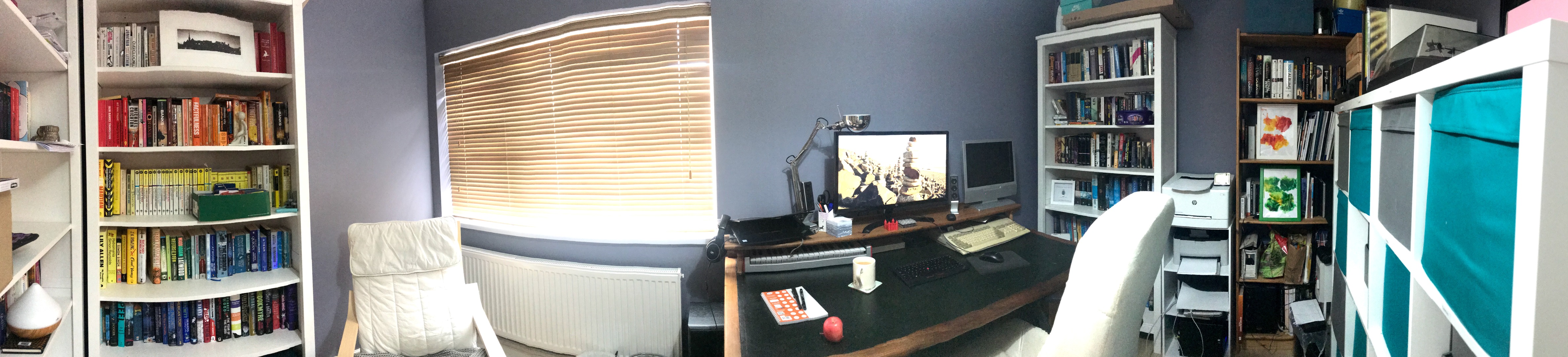
Fisheye shot of my home office Fisheye shot of my home office
Near enough everything in the study is a work in progress. The KALLAX behind my desk is a recent addition (under duress) because we have nowhere else to put it. Sadly I can't see it going away any time soon. On the up-side, since Christmas I've had my record player and collection in and on top of it, so I can listen to records whilst working. The arm chair is a recent move from another room. It's a nice place to take some work calls, serving as a change of scene, and I hope to add a reading light sometime. The desk chair is some Ikea model I can't recall, which is sufficient, and just fits into the desk cavity. (I'm fairly sure my Aeron, inaccessible elsewhere, would not fit.) I've had this old mahogany, leather-topped desk since I was a teenager and it's a blessing and a curse. Mostly a blessing: It's a lovely big desk. The main drawback is it's very much not height adjustable. At the back is a custom made, full-width monitor stand/shelf, a recent gift produced to specification by my Dad, a retired carpenter. On the top: my work Thinkpad T470s laptop, geared more towards portable than powerful (my normal preference), although for the forseeable future it's going to remain in the exact same place; an Ikea desk lamp (I can't recall the model); a 27" 4K LG monitor, the cheapest such I could find when I bought it; an old LCD Analog TV, fantastic for vintage consoles and the like. Underneath: An Alesis Micron 2 octave analog-modelling synthesizer; various hubs and similar things; My Amiga 500. Like Evgeni, my normal keyboard is a ThinkPad Compact USB Keyboard with TrackPoint. I've been using different generations of these styles of keyboards for a long time now, initially because I loved the trackpoint pointer. I'm very curious about trying out mechanical keyboards, as I have very fond memories of my first IBM Model M buckled-spring keyboard, but I haven't dipped my toes into that money-trap just yet. The Thinkpad keyboard is rubber-dome, but it's a good one. Wedged between the right-hand bookcases are a stack of IT-related things: new printer; deprecated printer; old/spare/play laptops, docks and chargers; managed network switch; NAS.

25 June 2020

Russell Coker: How Will the Pandemic Change Things?

The Bulwark has an interesting article on why they can t Reopen America [1]. I wonder how many changes will be long term. According to the Wikipedia List of Epidemics [2] Covid-19 so far hasn t had a high death toll when compared to other pandemics of the last 100 years. People s reactions to this vary from doing nothing to significant isolation, the question is what changes in attitudes will be significant enough to change society. Transport One thing that has been happening recently is a transition in transport. It s obvious that we need to reduce CO2 and while electric cars will address the transport part of the problem in the long term changing to electric public transport is the cheaper and faster way to do it in the short term. Before Covid-19 the peak hour public transport in my city was ridiculously overcrowded, having people unable to board trams due to overcrowding was really common. If the economy returns to it s previous state then I predict less people on public transport, more traffic jams, and many more cars idling and polluting the atmosphere. Can we have mass public transport that doesn t give a significant disease risk? Maybe if we had significantly more trains and trams and better ventilation with more airflow designed to suck contaminated air out. But that would require significant engineering work to design new trams, trains, and buses as well as expense in refitting or replacing old ones. Uber and similar companies have been taking over from taxi companies, one major feature of those companies is that the vehicles are not dedicated as taxis. Dedicated taxis could easily be designed to reduce the spread of disease, the famed Black Cab AKA Hackney Carriage [3] design in the UK has a separate compartment for passengers with little air flow to/from the driver compartment. It would be easy to design such taxis to have entirely separate airflow and if setup to only take EFTPOS and credit card payment could avoid all contact between the driver and passengers. I would prefer to have a Hackney Carriage design of vehicle instead of a regular taxi or Uber. Autonomous cars have been shown to basically work. There are some concerns about safety issues as there are currently corner cases that car computers don t handle as well as people, but of course there are also things computers do better than people. Having an autonomous taxi would be a benefit for anyone who wants to avoid other people. Maybe approval could be rushed through for autonomous cars that are limited to 40Km/h (the maximum collision speed at which a pedestrian is unlikely to die), in central city areas and inner suburbs you aren t likely to drive much faster than that anyway. Car share services have been becoming popular, for many people they are significantly cheaper than owning a car due to the costs of regular maintenance, insurance, and depreciation. As the full costs of car ownership aren t obvious people may focus on the disease risk and keep buying cars. Passenger jets are ridiculously cheap. But this relies on the airline companies being able to consistently fill the planes. If they were to add measures to reduce cross contamination between passengers which slightly reduces the capacity of planes then they need to increase ticket prices accordingly which then reduces demand. If passengers are just scared of flying in close proximity and they can t fill planes then they will have to increase prices which again reduces demand and could lead to a death spiral. If in the long term there aren t enough passengers to sustain the current number of planes in service then airline companies will have significant financial problems, planes are expensive assets that are expected to last for a long time, if they can t use them all and can t sell them then airline companies will go bankrupt. It s not reasonable to expect that the same number of people will be travelling internationally for years (if ever). Due to relying on economies of scale to provide low prices I don t think it s possible to keep prices the same no matter what they do. A new economic balance of flights costing 2-3 times more than we are used to while having significantly less passengers seems likely. Governments need to spend significant amounts of money to improve trains to take over from flights that are cancelled or too expensive. Entertainment The article on The Bulwark mentions Las Vegas as a city that will be hurt a lot by reductions in travel and crowds, the same thing will happen to tourist regions all around the world. Australia has a significant tourist industry that will be hurt a lot. But the mention of Las Vegas makes me wonder what will happen to the gambling in general. Will people avoid casinos and play poker with friends and relatives at home? It seems that small stakes poker games among friends will be much less socially damaging than casinos, will this be good for society? The article also mentions cinemas which have been on the way out since the video rental stores all closed down. There s lots of prime real estate used for cinemas and little potential for them to make enough money to cover the rent. Should we just assume that most uses of cinemas will be replaced by Netflix and other streaming services? What about teenage dates, will kissing in the back rows of cinemas be replaced by Netflix and chill ? What will happen to all the prime real estate used by cinemas? Professional sporting matches have been played for a TV-only audience during the pandemic. There s no reason that they couldn t make a return to live stadium audiences when there is a vaccine for the disease or the disease has been extinguished by social distancing. But I wonder if some fans will start to appreciate the merits of small groups watching large TVs and not want to go back to stadiums, can this change the typical behaviour of groups? Restaurants and cafes are going to do really badly. I previously wrote about my experience running an Internet Cafe and why reopening businesses soon is a bad idea [4]. The question is how long this will go for and whether social norms about personal space will change things. If in the long term people expect 25% more space in a cafe or restaurant that s enough to make a significant impact on profitability for many small businesses. When I was young the standard thing was for people to have dinner at friends homes. Meeting friends for dinner at a restaurant was uncommon. Recently it seemed to be the most common practice for people to meet friends at a restaurant. There are real benefits to meeting at a restaurant in terms of effort and location. Maybe meeting friends at their home for a delivered dinner will become a common compromise, avoiding the effort of cooking while avoiding the extra expense and disease risk of eating out. Food delivery services will do well in the long term, it s one of the few industry segments which might do better after the pandemic than before. Work Many companies are discovering the benefits of teleworking, getting it going effectively has required investing in faster Internet connections and hardware for employees. When we have a vaccine the equipment needed for teleworking will still be there and we will have a discussion about whether it should be used on a more routine basis. When employees spend more than 2 hours per day travelling to and from work (which is very common for people who work in major cities) that will obviously limit the amount of time per day that they can spend working. For the more enthusiastic permanent employees there seems to be a benefit to the employer to allow working from home. It s obvious that some portion of the companies that were forced to try teleworking will find it effective enough to continue in some degree. One company that I work for has quit their coworking space in part because they were concerned that the coworking company might go bankrupt due to the pandemic. They seem to have become a 100% work from home company for the office part of the work (only on site installation and stock management is done at corporate locations). Companies running coworking spaces and other shared offices will suffer first as their clients have short term leases. But all companies renting out office space in major cities will suffer due to teleworking. I wonder how this will affect the companies providing services to the office workers, the cafes and restaurants etc. Will there end up being so much unused space in central city areas that it s not worth converting the city cinemas into useful space? There s been a lot of news about Zoom and similar technologies. Lots of other companies are trying to get into that business. One thing that isn t getting much notice is remote access technologies for desktop support. If the IT people can t visit your desk because you are working from home then they need to be able to remotely access it to fix things. When people make working from home a large part of their work time the issue of who owns peripherals and how they are tracked will get interesting. In a previous blog post I suggested that keyboards and mice not be treated as assets [5]. But what about monitors, 4G/Wifi access points, etc? Some people have suggested that there will be business sectors benefiting from the pandemic, such as telecoms and e-commerce. If you have a bunch of people forced to stay home who aren t broke (IE a large portion of the middle class in Australia) they will probably order delivery of stuff for entertainment. But in the long term e-commerce seems unlikely to change much, people will spend less due to economic uncertainty so while they may shift some purchasing to e-commerce apart from home delivery of groceries e-commerce probably won t go up overall. Generally telecoms won t gain anything from teleworking, the Internet access you need for good Netflix viewing is generally greater than that needed for good video-conferencing. Money I previously wrote about a Basic Income for Australia [6]. One of the most cited reasons for a Basic Income is to deal with robots replacing people. Now we are at the start of what could be a long term economic contraction caused by the pandemic which could reduce the scale of the economy by a similar degree while also improving the economic case for a robotic workforce. We should implement a Universal Basic Income now. I previously wrote about the make-work jobs and how we could optimise society to achieve the worthwhile things with less work [7]. My ideas about optimising public transport and using more car share services may not work so well after the pandemic, but the rest should work well. Business There are a number of big companies that are not aiming for profitability in the short term. WeWork and Uber are well documented examples. Some of those companies will hopefully go bankrupt and make room for more responsible companies. The co-working thing was always a precarious business. The companies renting out office space usually did so on a monthly basis as flexibility was one of their selling points, but they presumably rented buildings on an annual basis. As the profit margins weren t particularly high having to pay rent on mostly empty buildings for a few months will hurt them badly. The long term trend in co-working spaces might be some sort of collaborative arrangement between the people who run them and the landlords similar to the way some of the hotel chains have profit sharing agreements with land owners to avoid both the capital outlay for buying land and the risk involved in renting. Also city hotels are very well equipped to run office space, they have the staff and the procedures for running such a business, most hotels also make significant profits from conventions and conferences. The way the economy has been working in first world countries has been about being as competitive as possible. Just in time delivery to avoid using storage space and machines to package things in exactly the way that customers need and no more machines than needed for regular capacity. This means that there s no spare capacity when things go wrong. A few years ago a company making bolts for the car industry went bankrupt because the car companies forced the prices down, then car manufacture stopped due to lack of bolts this could have been a wake up call but was ignored. Now we have had problems with toilet paper shortages due to it being packaged in wholesale quantities for offices and schools not retail quantities for home use. Food was destroyed because it was created for restaurant packaging and couldn t be packaged for home use in a reasonable amount of time. Farmer s markets alleviate some of the problems with packaging food etc. But they aren t a good option when there s a pandemic as disease risk makes them less appealing to customers and therefore less profitable for vendors. Religion Many religious groups have supported social distancing. Could this be the start of more decentralised religion? Maybe have people read the holy book of their religion and pray at home instead of being programmed at church? We can always hope.

24 June 2020

Rapha&#235;l Hertzog: Freexian s report about Debian Long Term Support, May 2020

A Debian LTS logo Like each month, here comes a report about the work of paid contributors to Debian LTS. Individual reports In May, 198 work hours have been dispatched among 14 paid contributors. Their reports are available: Evolution of the situation In May 2020 we had our second (virtual) contributors meeting on IRC, Logs and minutes are available online. Then we also moved our ToDo from the Debian wiki to the issue tracker on salsa.debian.org.
Sadly three contributors went inactive in May: Adrian Bunk, Anton Gladky and Dylan A ssi. And while there are currently still enough active contributors to shoulder the existing work, we like to use this opportunity that we are always looking for new contributors. Please mail Holger if you are interested.
Finally, we like to remind you for a last time, that the end of Jessie LTS is coming in less than a month!
In case you missed it (or missed to act), please read this post about keeping Debian 8 Jessie alive for longer than 5 years. If you expect to have Debian 8 servers/devices running after June 30th 2020, and would like to have security updates for them, please get in touch with Freexian. The security tracker currently lists 6 packages with a known CVE and the dla-needed.txt file has 30 packages needing an update. Thanks to our sponsors New sponsors are in bold. With the upcoming start of Jessie ELTS, we are welcoming a few new sponsors and others should join soon.

No comment Liked this article? Click here. My blog is Flattr-enabled.

22 June 2020

Evgeni Golov: mass-migrating modules inside an Ansible Collection

Im the Foreman project, we've been maintaining a collection of Ansible modules to manage Foreman installations since 2017. That is, 2 years before Ansible had the concept of collections at all. For that you had to set library (and later module_utils and doc_fragment_plugins) in ansible.cfg and effectively inject our modules, their helpers and documentation fragments into the main Ansible namespace. Not the cleanest solution, but it worked quiet well for us. When Ansible started introducing Collections, we quickly joined, as the idea of namespaced, easily distributable and usable content units was great and exactly matched what we had in mind. However, collections are only usable in Ansible 2.8, or actually 2.9 as 2.8 can consume them, but tooling around building and installing them is lacking. Because of that we've been keeping our modules usable outside of a collection. Until recently, when we decided it's time to move on, drop that compatibility (which costed a few headaches over the time) and release a shiny 1.0.0. One of the changes we wanted for 1.0.0 is renaming a few modules. Historically we had the module names prefixed with foreman_ and katello_, depending whether they were designed to work with Foreman (and plugins) or Katello (which is technically a Foreman plugin, but has a way more complicated deployment and currently can't be easily added to an existing Foreman setup). This made sense as long as we were injecting into the main Ansible namespace, but with collections the names be became theforemam.foreman.foreman_ <something> and while we all love Foreman, that was a bit too much. So we wanted to drop that prefix. And while at it, also change some other names (like ptable, which became partition_table) to be more readable. But how? There is no tooling that would rename all files accordingly, adjust examples and tests. Well, bash to the rescue! I'm usually not a big fan of bash scripts, but renaming files, searching and replacing strings? That perfectly fits! First of all we need a way map the old name to the new name. In most cases it's just "drop the prefix", for the others you can have some if/elif/fi:
prefixless_name=$(echo $ old_name   sed -E 's/^(foreman katello)_//')
if [[ $ old_name  == 'foreman_environment' ]]; then
  new_name='puppet_environment'
elif [[ $ old_name  == 'katello_sync' ]]; then
  new_name='repository_sync'
elif [[ $ old_name  == 'katello_upload' ]]; then
  new_name='content_upload'
elif [[ $ old_name  == 'foreman_ptable' ]]; then
  new_name='partition_table'
elif [[ $ old_name  == 'foreman_search_facts' ]]; then
  new_name='resource_info'
elif [[ $ old_name  == 'katello_manifest' ]]; then
  new_name='subscription_manifest'
elif [[ $ old_name  == 'foreman_model' ]]; then
  new_name='hardware_model'
else
  new_name=$ prefixless_name 
fi
That defined, we need to actually have a $ old_name . Well, that's a for loop over the modules, right?
for module in $ BASE /foreman_*py $ BASE /katello_*py; do
  old_name=$(basename $ module  .py)
   
done
While we're looping over files, let's rename them and all the files that are associated with the module:
# rename the module
git mv $ BASE /$ old_name .py $ BASE /$ new_name .py
# rename the tests and test fixtures
git mv $ TESTS /$ old_name .yml $ TESTS /$ new_name .yml
git mv tests/fixtures/apidoc/$ old_name .json tests/fixtures/apidoc/$ new_name .json
for testfile in $ TESTS /fixtures/$ old_name -*.yml; do
  git mv $ testfile  $(echo $ testfile   sed "s/$ old_name /$ new_name /")
done
Now comes the really tricky part: search and replace. Let's see where we need to replace first:
  1. in the module file
    1. module key of the DOCUMENTATION stanza (e.g. module: foreman_example)
    2. all examples (e.g. foreman_example: )
  2. in all test playbooks (e.g. foreman_example: )
  3. in pytest's conftest.py and other files related to test execution
  4. in documentation
sed -E -i "/^(\s+$ old_name  module):/ s/$ old_name /$ new_name /g" $ BASE /*.py
sed -E -i "/^(\s+$ old_name  module):/ s/$ old_name /$ new_name /g" tests/test_playbooks/tasks/*.yml tests/test_playbooks/*.yml
sed -E -i "/'$ old_name '/ s/$ old_name /$ new_name /" tests/conftest.py tests/test_crud.py
sed -E -i "/ $ old_name  / s/$ old_name /$ new_name /g' README.md docs/*.md
You've probably noticed I used $ BASE and $ TESTS and never defined them Lazy me. But here is the full script, defining the variables and looping over all the modules.
#!/bin/bash
BASE=plugins/modules
TESTS=tests/test_playbooks
RUNTIME=meta/runtime.yml
echo "plugin_routing:" > $ RUNTIME 
echo "  modules:" >> $ RUNTIME 
for module in $ BASE /foreman_*py $ BASE /katello_*py; do
  old_name=$(basename $ module  .py)
  prefixless_name=$(echo $ old_name   sed -E 's/^(foreman katello)_//')
  if [[ $ old_name  == 'foreman_environment' ]]; then
    new_name='puppet_environment'
  elif [[ $ old_name  == 'katello_sync' ]]; then
    new_name='repository_sync'
  elif [[ $ old_name  == 'katello_upload' ]]; then
    new_name='content_upload'
  elif [[ $ old_name  == 'foreman_ptable' ]]; then
    new_name='partition_table'
  elif [[ $ old_name  == 'foreman_search_facts' ]]; then
    new_name='resource_info'
  elif [[ $ old_name  == 'katello_manifest' ]]; then
    new_name='subscription_manifest'
  elif [[ $ old_name  == 'foreman_model' ]]; then
    new_name='hardware_model'
  else
    new_name=$ prefixless_name 
  fi
  echo "renaming $ old_name  to $ new_name "
  git mv $ BASE /$ old_name .py $ BASE /$ new_name .py
  git mv $ TESTS /$ old_name .yml $ TESTS /$ new_name .yml
  git mv tests/fixtures/apidoc/$ old_name .json tests/fixtures/apidoc/$ new_name .json
  for testfile in $ TESTS /fixtures/$ old_name -*.yml; do
    git mv $ testfile  $(echo $ testfile   sed "s/$ old_name /$ new_name /")
  done
  sed -E -i "/^(\s+$ old_name  module):/ s/$ old_name /$ new_name /g" $ BASE /*.py
  sed -E -i "/^(\s+$ old_name  module):/ s/$ old_name /$ new_name /g" tests/test_playbooks/tasks/*.yml tests/test_playbooks/*.yml
  sed -E -i "/'$ old_name '/ s/$ old_name /$ new_name /" tests/conftest.py tests/test_crud.py
  sed -E -i "/ $ old_name  / s/$ old_name /$ new_name /g' README.md docs/*.md
  echo "    $ old_name :" >> $ RUNTIME 
  echo "      redirect: $ new_name " >> $ RUNTIME 
  git commit -m "rename $ old_name  to $ new_name " $ BASE  tests/ README.md docs/ $ RUNTIME 
done
As a bonus, the script will also generate a meta/runtime.yml which can be used by Ansible 2.10+ to automatically use the new module names if the playbook contains the old ones. Oh, and yes, this is probably not the nicest script you'll read this year. Maybe not even today. But it got the job nicely done and I don't intend to need it again anyways.

21 June 2020

Enrico Zini: Forced italianisation of S dtirol

Italianization (Italian: Italianizzazione; Croatian: talijanizacija; Slovene: poitaljan evanje; German: Italianisierung; Greek: ) is the spread of Italian culture and language, either by integration or assimilation.[1][2]
In 1919, at the time of its annexation, the middle part of the County of Tyrol which is today called South Tyrol (in Italian Alto Adige) was inhabited by almost 90% German speakers.[1] Under the 1939 South Tyrol Option Agreement, Adolf Hitler and Benito Mussolini determined the status of the German and Ladin (Rhaeto-Romanic) ethnic groups living in the region. They could emigrate to Germany, or stay in Italy and accept their complete Italianization. As a consequence of this, the society of South Tyrol was deeply riven. Those who wanted to stay, the so-called Dableiber, were condemned as traitors while those who left (Optanten) were defamed as Nazis. Because of the outbreak of World War II, this agreement was never fully implemented. Illegal Katakombenschulen ("Catacomb schools") were set up to teach children the German language.
The Prontuario dei nomi locali dell'Alto Adige (Italian for Reference Work of Place Names of Alto Adige) is a list of Italianized toponyms for mostly German place names in South Tyrol (Alto Adige in Italian) which was published in 1916 by the Royal Italian Geographic Society (Reale Societ Geografica Italiana). The list was called the Prontuario in short and later formed an important part of the Italianization campaign initiated by the fascist regime, as it became the basis for the official place and district names in the Italian-annexed southern part of the County of Tyrol.
Ettore Tolomei (16 August 1865, in Rovereto 25 May 1952, in Rome) was an Italian nationalist and fascist. He was designated a Member of the Italian Senate in 1923, and ennobled as Conte della Vetta in 1937.
The South Tyrol Option Agreement (German: Option in S dtirol; Italian: Opzioni in Alto Adige) was an agreement in effect between 1939 and 1943, when the native German speaking people in South Tyrol and three communes in the province of Belluno were given the option of either emigrating to neighboring Nazi Germany (of which Austria was a part after the 1938 Anschluss) or remaining in Fascist Italy and being forcibly integrated into the mainstream Italian culture, losing their language and cultural heritage. Over 80% opted to move to Germany.

Molly de Blanc: Fire

The world is on fire. I know many of you are either my parents friends or here for the free software thoughts, but rather than listen to me, I want you to listed to Black voices in these fields. If you re not Black, it s your job to educate yourself on issues that affect Black people all over the world and the way systems are designed to benefit White Supremacy. It is our job to acknowledge that racism is a problem whether it appears as White Supremacy, Colonialism, or something as seemingly banal as pay gaps. We must make space for Black voices. We must make space for Black Women. We must make space for Black trans lives. We must do this in technology. We must build equity. We must listen. I know I have a platform. It s one I value highly because I ve worked so hard for the past twelve years to build it against sexist attitudes in my field (and the world). However, it is time for me to use that platform for the voices of others. Please pay attention to Black voices in tech and FOSS. Do not just expect them to explain diversity and inclusion, but go to them for their expertise. Pay them respectful salaries. Mentor Black youth and Black people who want to be involved. Volunteer or donate to groups like Black Girls Code, The Last Mile, and Resilient Coders. If you re looking for mentorship, especially around things like writing, speaking, community organizing, or getting your career going in open source, don t hesitate to reach out to me. Mentorship can be a lasting relationship, or a brief exchange around a specific issue of event. If I can t help you, I ll try to connect you to someone who can. We cannot build the techno-utopia unless everyone is involved.

18 June 2020

Gunnar Wolf: On masters and slaves, whitelists and blacklists...

LWN published today yet another great piece of writing, Loaded terms in free software. I am sorry, the content will not be immediately available to anybody following at home, as LWN is based on a subscription model But a week from now, the article will be open for anybody to read. Or you can ask me (you most likely can find my contact addresses, as they are basically everywhere) for a subscriber link, I will happily provide it. In consonance with the current mood that started with the killing of George Floyd and sparked worldwide revolts against police brutality, racism (mostly related to police and law enforcement forces, but social as well) and the like, the debate that already started some months ago in technical communities has re-sparked: We have many terms that come with long histories attached to them, and we are usually oblivious to their obvious meaning. We? Yes, we, the main users and creators of technology. I never felt using master and slave to refer to different points of a protocol, bus, clock or whatever (do refer to the Wikipedia article for a fuller explanation) had any negative connotations but then again, those terms have never tainted my personal family. That is, I understand I speak from a position of privilege. A similar although less heated issue goes around the blacklist and whitelist terms, or other uses that use white to refer to good, law-abiding citizens, and black to refer to somewhat antisocial uses (i.e. the white hat and black hat hackers). For several years, this debate has been sparking and dying off. Some important changes have been made Particularly, in 2017 the Internet Software Consortium started recommending Primary and Secondary, Python dropped master/slave pairs after a quite thorough and deep review throughout 2018, GitHub changed the default branch from master to main earlier this week. The Internet Engineering Task Force has a draft (that lapsed and thus sadly didn t become an RFC, but still, is archived), Terminology, Power and Oppressive Language that lists suggested alternatives:
There are also many other relationships that can be used as metaphors, Eglash s research calls into question the accuracy of the master-slave metaphor. Fortunately, there are ample alternatives for the master-slave relationship. Several options are suggested here and should be chosen based on the pairing that is most clear in context:
  • Primary-secondary
  • Leader-follower
  • Active-standby
  • Primary-replica
  • Writer-reader
  • Coordinator-worker
  • Parent-helper
I ll add that I think we Spanish-speakers are not fully aware of the issue s importance, because the most common translation I have seen for master/slave is maestro/esclavo: Maestro is the word for teacher (although we do keep our slaves in place). But think whether it sounds any worse if you refer to device pairs, or members of a database high-availability cluster, or whatever as Amo and Esclavo. It does sound much worse I cannot add much of value to this debate. I am just happy issues like this are being recognized and dealt with. If the topic interests you, do refer to the LWN article! Some excrepts: I consider the following to be the core of Jonathan Corbet s writeup:
Recent events, though, have made it clear even to those of us who were happy to not question this view that the story of slavery and the wider racist systems around it is not yet finished. There are many people who are still living in the middle of it, and it is not a nice place to be. We are not so enlightened as we like to think we are. If there is no other lesson from the events of the last few weeks, we should certainly take to heart the point that we need to be listening to the people who have been saying, for many years, that they are still suffering. If there are people who are telling us that terms like slave or blacklist are a hurtful reminder of the inequities that persist in our society, we need to accept that as the truth and act upon it. Etymological discussions on what, say, master really means may be interesting, but they miss the point and are irrelevant to this discussion.
Part of a comment by user yokem_55:
Often, it seems to me that the replacement words are much more descriptive and precise than the old language. Allowlist is far more obviously a list of explicitly authorized entities than whitelist . Mainline has a more obvious meaning of a core stream of development than master . The benefit of moving past this language is more than just changing cultural norms, it s better, more precise communication across the board.
Another spot-on comment, by user alan:
From my perspective as a Black American male, I think that it s nice to see people willing to see and address racism in various spheres. I am concerned that some of these steps will be more performative than substantial. Terminology changes in software so as to be more welcoming is a nice thing. Ensuring that oppressed minorities have access to the tools and resources to help reduce inequity and ensuring equal protection under the laws is better. We ll get there one day I m sure. The current ask is much simpler, its just to stop randomly killing and terrorizing us. Please and thank you.
So Maybe the protests of this year caught special notoriety because the society is reacting after (or during, for many of us) the lockdown. In any case, I hope for their success in changing the planet s culture of oppression.

Comments Tomas Janousek 2020-06-19 10:04:32 +0200 In the blog post On masters and slaves, whitelists and blacklists you claim that GitHub changed the default branch from master to main earlier this week but I don t think that change is in effect yet. When you create a repo, the default branch is still named master . Gunnar Wolf 2020-06-19 11:52:30 -0500 Umh, seems you are right. Well, what can I say? I m reporting only what I have been able to find / read Now, given that said master branch does not carry any Git-specific meaning and is just a commonly used configuration I hope people start picking it up. No, I have not renamed master branches in any of my repos but intend to do so soonish. Tomas Janousek 2020-06-19 20:01:52 +0200 Yeah, don t worry. I just find it sad that so much inaccurate news is spreading from a single CEO tweet, and I wanted to help stop that. I m sure some change will happen eventually, but until it does, we shouldn t speak about it in the past tense. :-)

17 June 2020

Ulrike Uhlig: On Language

Language is a tool of power In school, we read the philologist diary of Victor Klemperer about the changes in the German language during the Third Reich, LTI - Lingua Tertii Imperii, a book which makes it clear that the use of language is political, creates realities, and has reverse repercussions on concepts of an entire society. Language was one of the tools that supported Nazism in insiduously pervading all parts of society. Language shapes our concepts of society Around the same time, a friend of mine proposed to read Egalia's daughters by Gerd Brantenberg, a book in which gendered words were reversed: so that human becomes huwim, for example. This book made me take notice of gendered concepts that often go unnoticed. Language shapes the way we think and feel I spent a large part of my adult life in France, which confronted me with the realization that a language provides its speakers with certain concepts. If a concept does not exist in a language, people cannot easily feel or imagine this concept either. Back then (roughly 20 years ago), even though I was aware of gender inequality, I hated using gender neutral language because in German and French it felt unnatural, and, or so I thought, we were all alike. One day, at a party, we played a game that consisted in guessing people's professions by asking them Yes/No questions. Turns out that we were unable to guess that the woman we were talking with was a doctor, because we could simply not imagine this profession for a young woman. In French, docteur is male and almost nobody would use the word doctoresse, ou femme docteur. Unimaginable are also the concepts of words in German that have no equivalent in French or vice versa: Or, to make all this a bit less serious, Italian has the word gattara (female) or gattaro (male), which one could translate to English roughly as cat person, most often designating old women who feed stray cats. But really, the way language shapes our concepts and ideas goes much further, as well explained by Lera Boroditsky in a talk in which she explains how language influences concepts of space, time, and blame, among other things. Building new models This quote by Buckminster Fuller is pinned on the wall over my desk:

You never change things by fighting the existing reality. To change something, build a new model that makes the existing model obsolete.
A change in language is such a new model: it can make oppression and inequalities visible. Words do not only describe our world, they are a vehicle of ideas, and utopias. Analyzing and criticizing our use of language means paving the way for ideas and concepts of inclusion, equality, and unity. You might be guessing at where am I getting at with this Right: I am in favor of acknowledging past mistakes, and replacing oppressive metaphors in computing. As noted in the IETF draft about Terminology, Power and Oppressive Language, by Niels Ten Oever and Mallory Knodel, the metaphors "master/slave" and "blacklist/whitelist" associate "white with good and black with evil [which] is known as the 'bad is black effect'", all the while being technically inaccurate. I acknowledge that this will take time. There is a lot of work to do.

Russ Allbery: Review: Network Effect

Review: Network Effect, by Martha Wells
Series: Murderbot Diaries #5
Publisher: Tor
Copyright: May 2020
ISBN: 1-250-22984-7
Format: Kindle
Pages: 351
Network Effect is the first Murderbot novel, although the fifth story of the series. The previous stories, beginning with All Systems Red, were novellas. Under no circumstances should you start reading the series here. Network Effect builds significantly on the story arc that ended with Exit Strategy and resolves some important loose ends from Artificial Condition. It's meant to be read in series order. I believe this is the first time in my life that I've started reading a book on the night of its release. I was looking forward to this novel that much, and it does not disappoint. I'll try not to spoil the previous books too much in this review, but at this point it's a challenge. Just go read them. They're great. The big question I had about the first Murderbot novel was how would it change the plot dynamic of the series. All of the novellas followed roughly the same plot structure: Murderbot would encounter some humans who need help, somewhat grudgingly help them while pursuing its own agenda, snark heavily about human behavior in the process, once again prove its competence, and do a little bit of processing of its feelings and a lot of avoiding them. This formula works great at short length. Would Wells change it at novel length, or if not, would it get tedious or strained? The answer is that Wells added in quite a bit more emotional processing and relationship management to flesh out the core of the book and created a plot with more layers and complexity than the novella plots, and the whole construction works wonderfully. This is exactly the book I was hoping for when I heard there would be a Murderbot novel. If you like the series, you'll like this, and should feel free to read it now without reading the rest of the review.
Overse added, "Just remember you're not alone here." I never know what to say to that. I am actually alone in my head, and that's where 90 plus percent of my problems are.
Many of the loose ends in the novellas were tied up in the final one, Exit Strategy. The biggest one that wasn't, at least in my opinion, was ART, the research transport who helped Murderbot considerably in Artificial Condition and clearly was more than it appeared to be. That is exactly the loose end that Wells resolves here, to great effect. I liked the dynamic between ART and Murderbot before, but it's so much better with an audience to riff off of (and yet better still when there are two audiences, one who already knew Murderbot and one who already knew ART). I like ART almost as much as Murderbot, and that's saying a lot. The emotional loose end of the whole series has been how Murderbot will decide to interact with other humans. I think that's not quite resolved by the end of the novel, but we and Murderbot have both learned considerably more. The novellas, except for the first, are mostly solo missions even when Murderbot is protecting clients. This is something more complicated; the interpersonal dynamics hearken back to the first novella and then go much deeper, particularly in the story-justified flashbacks. Wells uses Murderbot's irritated avoidance to keep some emotional dynamics underplayed and indirect, letting the reader discover them at opportune moments, and this worked beautifully for me. And Murderbot's dynamic with Amena is just wonderful, mostly because of how smart, matter-of-fact, trusting, and perceptive Amena is. That's one place where the novel length helps: Wells has more room to expand the characterization of characters other than Murderbot, something that's usually limited in the novellas to a character or two. And these characters are great. Murderbot is clearly the center of the story, but the other characters aren't just furniture for it to react to. They have their own story arcs, they're thoughtful, they learn, and it's a delight to watch them slot Murderbot into various roles, change their minds, adjust, and occasionally surprise it in quite touching ways, all through Murderbot's eyes.
Thiago had said he felt like he should apologize and talk to me more about it. Ratthi had said, "I think you should let it go for a while, at least until we get ourselves out of this situation. SecUnit is a very private person, it doesn't like to discuss its feelings." This is why Ratthi is my friend.
I have some minor quibbles. The targetSomething naming convention Murderbot comes up with and then is stuck with because it develops too much momentum is entertaining but confusing. A few of the action sequences were just a little on the long side; I find the emotional processing much more interesting. There's also a subplot with a character with memory holes and confusion that I thought dragged on too long, mostly because I found the character intensely irritating for some reason. But these are just quibbles. Network Effect is on par with the best of the novellas that precede it, and that's a high bar indeed. In this series, Wells has merged the long-running science fiction thread of artificial intelligences and the humanity of robots with the sarcastic and introspective first-person narration of urban fantasy, gotten the internal sensation of emotional avoidance note-perfect without making it irritating (that's some deep magic right there), and added in some top-tier negotiation of friendship and relationships without losing the action and excitement of a great action movie. It's a truly impressive feat and the novel is the best installment so far. I will be stunned if Network Effect doesn't make most of the award lists next year. Followed by Fugitive Telemetry, due out in April of 2021. You can believe that I have already preordered it. Rating: 9 out of 10

16 June 2020

Ritesh Raj Sarraf: Kodi PS3 BD Remote

Setting up a Sony PS3 Blu-Ray Disc Remote Controller with Kodi TLDR; Since most of the articles on the internet were either obsolete or broken, I ve chosen to write these notes down in the form of a blog post so that it helps me now and in future, and hopefully others too.

Raspberry Pi All this time, I have been using the Raspberry Pi for my HTPC needs. The first RPi I acquired was in 2014 and I have been very very happy with the amount of support in the community and quality of the HTPC offering it has. I also appreciate the RPi s form factor and the power consumption limits. And then, to add more sugar to it, it uses a derivative of Debian, Raspbian, which was very familiar and feel good to me.

Raspberry Pi Issues So primarily, I use my RPi with Kodi. There are a bunch of other (daemon) services but the primary use case is HTPC only. RPi + Kodi has a very very annoying issue wherein it loses its audio pitch during video playback. The loss is so bad that the audio is barely audible. The workaround is to seek the video playback either way and then it comes back to its actual audio level, just to fade again in a while. My suspicion was that it may be a problem with Kodi. Or at least, Kodi would have a workaround in software. But unfortunately, I wasted a lot of time in dealing with my suspicion with no fruitful result. This started becoming a PITA over time. And it seems the issue is with the hardware itself because after I moved my setup to a regular laptop, the audio loss is gone.

Laptop with Kodi Since I had my old Lenovo Yoga 2 13 lying on all the time, it made sense to make some more use of it, using as the HTPC. This machine comes with a Micro-HDMI Out port, so it felt ideal for my High Definition video rendering needs. It comes stock with just Intel HD Video with good driver support in Linux, so it was quite quick and easy getting Kodi charged up and running on it. And as I mentioned above, the sound issues are not seen on this setup. Some added benefits are that I get to run stock Debian on this machine. And I must say a big THANK YOU to the Debian Multimedia Maintainers, who ve done a pretty good job maintaining Kodi under Debian.

HDMI CEC Only after I decommissioned my RPi, I came to notice how convenient the HDMI CEC functionality is. Turns out no standard laptops ship CEC functionality onto them. Even the case of my laptop, which has a Micro HDMI Out port, but still no CEC capabilities. As far as I know, the RPi came with the Pulse-Eight CEC module, so obvious first thought was to opt for a compatible external module of the same; but it comes with a nice price tag, me not willing to spend.

WiFi Remotes Kodi has very well implemented network interface for almost all its features. One could take the Yatse or Music Pump Kodi Remote Android applications that work very very well with Kodi. But wifi can be flaky some times. Especially, my experience with the Realtek network devices hasn t been very good. The driver support in Linux is okay but there are many firmware bugs to deal with. In my case, the machine will lose wifi signal/network every once in a while. And it turns out, for this machine, with this network device type, I m not the only one running into such problems. And to add to that, this is an UltraBook, which means it doesn t have an Ethernet port. So I ve had not much choice other than to live and suffer deal with it. The WiFi chip also provides the Bluetooth module, which so far I had not used much. From my /etc/modprobe.d/blacklist-memstick.conf, all relevant BT modules were added to the blacklist, all this time.
rrs@lenovo:~$ cat /etc/modprobe.d/blacklist-memstick.conf 
blacklist memstick
blacklist rtsx_usb_ms
# And bluetooth too
#blacklist btusb
#blacklist btrtl
#blacklist btbcm
#blacklist btintel
#blacklist bluetooth
21:21            
Also to keep in mind is that the driver for my card gives a very misleading kernel message, which is one of the many reasons for this blog post, so that I don t forget it a couple of months later. The missing firmware error message is okay to ignore, as per this upstream comment.
Jun 14 17:17:08 lenovo kernel: usbcore: registered new interface driver btusb
Jun 14 17:17:08 lenovo systemd[1]: Mounted /boot/efi.
Jun 14 17:17:08 lenovo kernel: Bluetooth: hci0: RTL: examining hci_ver=06 hci_rev=000b lmp_ver=06 lmp_subver=8723
Jun 14 17:17:08 lenovo kernel: Bluetooth: hci0: RTL: rom_version status=0 version=1
Jun 14 17:17:08 lenovo kernel: Bluetooth: hci0: RTL: loading rtl_bt/rtl8723b_fw.bin
Jun 14 17:17:08 lenovo kernel: bluetooth hci0: firmware: direct-loading firmware rtl_bt/rtl8723b_fw.bin
Jun 14 17:17:08 lenovo kernel: Bluetooth: hci0: RTL: loading rtl_bt/rtl8723b_config.bin
Jun 14 17:17:08 lenovo kernel: bluetooth hci0: firmware: failed to load rtl_bt/rtl8723b_config.bin (-2)
Jun 14 17:17:08 lenovo kernel: firmware_class: See https://wiki.debian.org/Firmware for information about missing firmware
Jun 14 17:17:08 lenovo kernel: bluetooth hci0: Direct firmware load for rtl_bt/rtl8723b_config.bin failed with error -2
Jun 14 17:17:08 lenovo kernel: Bluetooth: hci0: RTL: cfg_sz -2, total sz 22496
This device s network + bt are on the same chip.
01:00.0 Network controller: Realtek Semiconductor Co., Ltd. RTL8723BE PCIe Wireless Network Adapter
And then, when the btusb module is initialed (along with the misleading driver message), you ll get the following in your USB device listing
Bus 002 Device 005: ID 0bda:b728 Realtek Semiconductor Corp. Bluetooth Radio

Sony PlayStation 3 BD Remote Almost 10 years ago, I bought the PS3 and many of its accessories. The remote has just been rotting in the shelf. It had rusted so bad that it is better described with these pics.
Rusted inside
Rusted inside
Rusted inside and cover
Rusted spring
Rusted spring
The rust was so much that the battery holding spring gave up. A little bit scrubbing and cleaning has gotten it working. I hope it lasts for some time before I find time to open it up and give it a full clean-up.

Pairing the BD Remote to laptop Honestly, with the condition of the hardware and software on both ends, I did not have much hopes of getting this to work. And in all the years on my computer usage, I hardly recollect much days when I ve made use of BT. Probably, because the full BT stack wasn t that well integrated in Linux, earlier. And I mostly used to disable them in hardware and software to save on battery. All yielded results from the internet talked about tools/scripts that were either not working, pointing to broken links etc. These days, bluez comes with a nice utility, bluetoothctl. It was a nice experience using it. First, start your bluetooth service and ensure that the device talks well with the kernel
rrs@lenovo:~$ systemctl status bluetooth                                                                                                          
  bluetooth.service - Bluetooth service                                                                                                           
     Loaded: loaded (/lib/systemd/system/bluetooth.service; enabled; vendor preset: enabled)                                                      
     Active: active (running) since Mon 2020-06-15 12:54:58 IST; 3s ago                                                                           
       Docs: man:bluetoothd(8)                                                                                                                    
   Main PID: 310197 (bluetoothd)                                                                                                                  
     Status: "Running"                                                                                                                            
      Tasks: 1 (limit: 9424)                                                                                                                      
     Memory: 1.3M                                                                                                                                 
     CGroup: /system.slice/bluetooth.service                                                                                                      
              310197 /usr/lib/bluetooth/bluetoothd                                                                                               
                                                                                                                                                  
Jun 15 12:54:58 lenovo systemd[1]: Starting Bluetooth service...                                                                                  
Jun 15 12:54:58 lenovo bluetoothd[310197]: Bluetooth daemon 5.50                                                                                  
Jun 15 12:54:58 lenovo systemd[1]: Started Bluetooth service.                                                                                     
Jun 15 12:54:58 lenovo bluetoothd[310197]: Starting SDP server                                                                                    
Jun 15 12:54:58 lenovo bluetoothd[310197]: Bluetooth management interface 1.15 initialized                                                        
Jun 15 12:54:58 lenovo bluetoothd[310197]: Sap driver initialization failed.                                                                      
Jun 15 12:54:58 lenovo bluetoothd[310197]: sap-server: Operation not permitted (1)                                                                
12:55                                                                                                                                       
Next, then is to discover and connect to your device
rrs@lenovo:~$ bluetoothctl 
Agent registered
[bluetooth]# devices
Device E6:3A:32:A4:31:8F MI Band 2
Device D4:B8:FF:43:AB:47 MI RC
Device 00:1E:3D:10:29:0F BD Remote Control
[CHG] Device 00:1E:3D:10:29:0F Connected: yes
[BD Remote Control]# info 00:1E:3D:10:29:0F
Device 00:1E:3D:10:29:0F (public)
        Name: BD Remote Control
        Alias: BD Remote Control
        Class: 0x0000250c
        Paired: no
        Trusted: yes
        Blocked: no
        Connected: yes
        LegacyPairing: no
        UUID: Human Interface Device... (00001124-0000-1000-8000-00805f9b34fb)
        UUID: PnP Information           (00001200-0000-1000-8000-00805f9b34fb)
        Modalias: usb:v054Cp0306d0100
[bluetooth]# 
In case of the Sony BD Remote, there s no need to pair. In fact, trying to pair fails. It prompts for the PIN code, but neither 0000 or 1234 are accepted. So, the working steps so far are to Trust the device and then Connect the device. For the sake of future use, I also populated /etc/bluetooth/input.conf based on suggestions on the internet. Note: The advertised keymappings in this config file do not work. Note: I m only using it for the power saving measures in instructing the BT connection to sleep after 3 minutes.
rrs@priyasi:/tmp$ cat input.conf 
# Configuration file for the input service
# This section contains options which are not specific to any
# particular interface
[General]
# Set idle timeout (in minutes) before the connection will
# be disconnect (defaults to 0 for no timeout)
IdleTimeout=3
# Enable HID protocol handling in userspace input profile
# Defaults to false (HIDP handled in HIDP kernel module)
#UserspaceHID=true
# Limit HID connections to bonded devices
# The HID Profile does not specify that devices must be bonded, however some
# platforms may want to make sure that input connections only come from bonded
# device connections. Several older mice have been known for not supporting
# pairing/encryption.
# Defaults to false to maximize device compatibility.
#ClassicBondedOnly=true
# LE upgrade security
# Enables upgrades of security automatically if required.
# Defaults to true to maximize device compatibility.
#LEAutoSecurity=true
#
#[00:1E:3D:10:29:0F]
[2c:33:7a:8e:d6:30]
[PS3 Remote Map]
# When the 'OverlayBuiltin' option is TRUE (the default), the keymap uses
# the built-in keymap as a starting point.  When FALSE, an empty keymap is
# the starting point.
#OverlayBuiltin = TRUE
#buttoncode = keypress    # Button label = action with default key mappings
#OverlayBuiltin = FALSE
0x16 = KEY_ESC            # EJECT = exit
0x64 = KEY_MINUS          # AUDIO = cycle audio tracks
0x65 = KEY_W              # ANGLE = cycle zoom mode
0x63 = KEY_T              # SUBTITLE = toggle subtitles
0x0f = KEY_DELETE         # CLEAR = delete key
0x28 = KEY_F8             # /TIME = toggle through sleep
0x00 = KEY_1              # NUM-1
0x01 = KEY_2              # NUM-2
0x02 = KEY_3              # NUM-3
0x03 = KEY_4              # NUM-4
0x04 = KEY_5              # NUM-5
0x05 = KEY_6              # NUM-6
0x06 = KEY_7              # NUM-7
0x07 = KEY_8              # NUM-8
0x08 = KEY_9              # NUM-9
0x09 = KEY_0              # NUM-0
0x81 = KEY_F2             # RED = red
0x82 = KEY_F3             # GREEN = green
0x80 = KEY_F4             # BLUE = blue
0x83 = KEY_F5             # YELLOW = yellow
0x70 = KEY_I              # DISPLAY = show information
0x1a = KEY_S              # TOP MENU = show guide
0x40 = KEY_M              # POP UP/MENU = menu
0x0e = KEY_ESC            # RETURN = back/escape/cancel
0x5c = KEY_R              # TRIANGLE/OPTIONS = cycle through recording options
0x5d = KEY_ESC            # CIRCLE/BACK = back/escape/cancel
0x5f = KEY_A              # SQUARE/VIEW = Adjust Playback timestretch
0x5e = KEY_ENTER          # CROSS = select
0x54 = KEY_UP             # UP = Up/Skip forward 10 minutes
0x56 = KEY_DOWN           # DOWN = Down/Skip back 10 minutes
0x57 = KEY_LEFT           # LEFT = Left/Skip back 5 seconds
0x55 = KEY_RIGHT          # RIGHT = Right/Skip forward 30 seconds
0x0b = KEY_ENTER          # ENTER = select
0x5a = KEY_F10            # L1 = volume down
0x58 = KEY_J              # L2 = decrease the play speed
0x51 = KEY_HOME           # L3 = commercial skip previous
0x5b = KEY_F11            # R1 = volume up
0x59 = KEY_U              # R2 = increase the play speed
0x52 = KEY_END            # R3 = commercial skip next
0x43 = KEY_F9             # PS button = mute
0x50 = KEY_M              # SELECT = menu (as per PS convention)
0x53 = KEY_ENTER          # START = select / Enter (matches terminology in mythwelcome)
0x30 = KEY_PAGEUP         # PREV = jump back (default 10 minutes)
0x76 = KEY_J              # INSTANT BACK (newer RCs only) = decrease the play speed
0x75 = KEY_U              # INSTANT FORWARD (newer RCs only) = increase the play speed
0x31 = KEY_PAGEDOWN       # NEXT = jump forward (default 10 minutes)
0x33 = KEY_COMMA          # SCAN BACK =  decrease scan forward speed / play
0x32 = KEY_P              # PLAY = play/pause
0x34 = KEY_DOT            # SCAN FORWARD decrease scan backard speed / increase playback speed; 3x, 5, 10, 20, 30, 60, 120, 180
0x60 = KEY_LEFT           # FRAMEBACK = Left/Skip back 5 seconds/rewind one frame
0x39 = KEY_P              # PAUSE = play/pause
0x38 = KEY_P              # STOP = play/pause
0x61 = KEY_RIGHT          # FRAMEFORWARD = Right/Skip forward 30 seconds/advance one frame
0xff = KEY_MAX
21:48                 
I have not spent much time finding out why not all the key presses work. Especially, given that most places on the internet mention these mappings. For me, some of the key scan codes aren t even reported. For keys like L1, L2, L3, R1, R2, R3, Next_Item, Prev_Item, they generate no codes in the kernel. If anyone has suggestions, ideas or fixes, I d appreciate if you can drop a comment or email me privately. But given my limited use to get a simple remote ready, to be usable with Kodi, I was apt with only some of the keys working.

Mapping the keys in Kodi With the limited number of keys detected, mapping those keys to what Kodi could use was the next step. Kodi has a very nice and easy to use module, Keymap Editor. It is very simple to use and map detected keys to functionalities you want. With it, I was able to get a functioning remote to use with my Kodi HTPC setup.

Update: Wed Jun 17 11:38:20 2020 One annoying problem that breaks the overall experience is the following bug on the driver side, that results in connections not being established instantly. Once the device goes into sleep mode, in random attempts, waking up and re-establishing a BT connection can be multi-poll affair. This can last from a couple of seconds to well over minute. Random suggestions on the internet mention disabling the autosuspend functionality for the device in the driver with btusb.enable_autosuspend=n, but that did not help in this case. Given that this device is enumberated over the USB Bus, it probably needs this feature applied to the whole USB tree of the device s chain. Something to investigate over the weekend.
Jun 16 20:41:23 lenovo kernel: Bluetooth: hci0: ACL packet for unknown connection handle 7
Jun 16 20:41:43 lenovo kernel: Bluetooth: hci0: ACL packet for unknown connection handle 8
Jun 16 20:41:59 lenovo kernel: Bluetooth: hci0: ACL packet for unknown connection handle 9
Jun 16 20:42:18 lenovo kernel: input: BD Remote Control as /devices/pci0000:00/0000:00:14.0/usb1/1-7/1-7:1.0/bluetooth/hci0/hci0:10/0005:054C:030>
Jun 16 20:42:18 lenovo kernel: sony 0005:054C:0306.0006: input,hidraw1: BLUETOOTH HID v1.00 Gamepad [BD Remote Control] on 2c:33:7a:8e:d6:30
Jun 16 20:51:59 lenovo kernel: input: BD Remote Control as /devices/pci0000:00/0000:00:14.0/usb1/1-7/1-7:1.0/bluetooth/hci0/hci0:11/0005:054C:030>
Jun 16 20:51:59 lenovo kernel: sony 0005:054C:0306.0007: input,hidraw1: BLUETOOTH HID v1.00 Gamepad [BD Remote Control] on 2c:33:7a:8e:d6:30
Jun 16 21:05:55 lenovo rtkit-daemon[1723]: Supervising 3 threads of 1 processes of 1 users.
Jun 16 21:05:55 lenovo rtkit-daemon[1723]: Successfully made thread 32747 of process 1646 owned by '1000' RT at priority 5.
Jun 16 21:05:55 lenovo rtkit-daemon[1723]: Supervising 4 threads of 1 processes of 1 users.
Jun 16 21:05:56 lenovo kernel: Bluetooth: hci0: ACL packet for unknown connection handle 12
Jun 16 21:06:12 lenovo kernel: Bluetooth: hci0: ACL packet for unknown connection handle 1
Jun 16 21:06:34 lenovo kernel: Bluetooth: hci0: ACL packet for unknown connection handle 2
Jun 16 21:06:59 lenovo kernel: input: BD Remote Control as /devices/pci0000:00/0000:00:14.0/usb1/1-7/1-7:1.0/bluetooth/hci0/hci0:3/0005:054C:0306>
Jun 16 21:06:59 lenovo kernel: sony 0005:054C:0306.0008: input,hidraw1: BLUETOOTH HID v1.00 Gamepad [BD Remote Control] on 2c:33:7a:8e:d6:30

Others There s a package, kodi-eventclients-ps3, which can be used to talk to the BD Remote. Unfortunately, it isn t up-to-date. When trying to make use of it, I ran into a couple of problems. First, the easy one is:
rrs@lenovo:~/ps3pair$ kodi-ps3remote localhost 9777
usr/share/pixmaps/kodi//bluetooth.png
Traceback (most recent call last):
  File "/usr/bin/kodi-ps3remote", line 220, in <module>
  File "/usr/bin/kodi-ps3remote", line 208, in main
    xbmc.connect(host, port)
    packet = PacketHELO(self.name, self.icon_type, self.icon_file)
  File "/usr/lib/python3/dist-packages/kodi/xbmcclient.py", line 285, in __init__
    with open(icon_file, 'rb') as f:
11:16         => 1  
This one was simple as it was just a broken path. The second issue with the tool is a leftover from python2 to python3 conversion.
rrs@lenovo:/etc/bluetooth$ kodi-ps3remote localhost
/usr/share/pixmaps/kodi//bluetooth.png
Searching for BD Remote Control
(Hold Start + Enter on remote to make it discoverable)
Redmi (E8:5A:8B:73:57:44) in range
Living Room TV (E4:DB:6D:24:23:E9) in range
Could not find BD Remote Control. Trying again...
Searching for BD Remote Control
(Hold Start + Enter on remote to make it discoverable)
Living Room TV (E4:DB:6D:24:23:E9) in range
Redmi (E8:5A:8B:73:57:44) in range
Could not find BD Remote Control. Trying again...
Searching for BD Remote Control
(Hold Start + Enter on remote to make it discoverable)
BD Remote Control (00:1E:3D:10:29:0F) in range
Found BD Remote Control with address 00:1E:3D:10:29:0F
Attempting to pair with remote
Remote Paired.
Traceback (most recent call last):
  File "/usr/bin/kodi-ps3remote", line 221, in <module>
    main()
  File "/usr/bin/kodi-ps3remote", line 212, in main
    if process_keys(remote, xbmc):
  File "/usr/bin/kodi-ps3remote", line 164, in process_keys
    keycode = data.encode("hex")[10:12]
AttributeError: 'bytes' object has no attribute 'encode'
11:24         => 1  
Fixing that too did not give me the desired result on using the BD Remote in the way I want. So eventually, I gave up and used Kodi s Keymap Editor instead.

Next Next in line, when I can manage to get some free time, is to improve the Kodi Video Scraper to have a fallback mode. Currently, for files where it cannot determine the content, it reject the file resulting in those files not showing up in your collection at all. A better approach would have been to have a fallback mode, that when the scraper cannot determine the content, it should fallback to using the filename scraper

15 June 2020

Utkarsh Gupta: GSoC Phase 1

Hello, Earlier last month, I got selected as a Google Summer of Code student for Debian again! \o/
And as Chandler would say,
Could I be any more happier?
Well, this time, my project is basically to write a linter (an extension to RuboCop). This tool is mostly to help the Debian Ruby team. And that is the best part, I love working in/for/with the Ruby team!
(I ve been an active part of the team for 18 months now :)) More details about the project can be found here, on the wiki.
And also, I have got the best mentors I could ve possibly asked for: Antonio Terceiro and David Rodr guez So, the program began on 1st June and I ve been working since then. I log my daily updates at gsocwithutkarsh2102.tk. Whilst the daily updates are available at the above site^, I ll breakdown the important parts here: It has been a lot of fun so far! Though I am little worried on how to implement the next part of the project as I am not sure how to check only a particalar directory for some relative require calls.
But I think, that s okay, somehow, something will work out. And I can always ask around others and check other cops to see how it s done! \( )/
Until next time.
:wq for today.

Arturo Borrero Gonz lez: A better Toolforge: a technical deep dive

Logos This post was originally published in the Wikimedia Tech blog, and is authored by Arturo Borrero Gonzalez and Brooke Storm. In the previous post, we shared the context on the recent Kubernetes upgrade that we introduced in the Toolforge service. Today we would like to dive a bit more in the technical details. Custom admission controllers One of the key components of the Toolforge Kubernetes are our custom admission controllers. We use them to validate and enforce that the usage of the service is what we intended for. Basically, we have 2 of them: The source code is written in Golang, which is pretty convenient for natively working in a Kubernetes environment. Both code repositories include extensive documentation: how to develop, test, use, and deploy them. We decided to go with custom admission controllers because we couldn t find any native (or built-in) Kubernetes mechanism to accomplish the same sort of checks on user activity. With the Ingress controller, we want to ensure that Ingress objects only handle traffic to our internal domains, which by the time of this writing, are toolforge.org (our new domain) and tools.wmflabs.org (legacy). We safe-list the kube-system namespace and the tool-fourohfour namespace because both need special consideration. More on the Ingress setup later. The registry controller is pretty simple as well. It ensures that only our internal docker registry is used for user-scheduled containers running in Kubernetes. Again, we exclude from the checks containers running in the kube-system namespace (those used by Kubernetes itself). Other than that, the validation itself is pretty easy. For some extra containers we run (like those related to Prometheus metrics) what we do is simply upload those docker images to our internal registry. The controls provided by this admission controller helps us validate that only FLOSS software is run in our environment, which is one of the core rules of Toolforge. RBAC and Pod Security Policy setup I would like to comment next on our RBAC and Pod Security Policy setup. Using the Pod Security Policies (or PSP) we establish a set of constraints on what containers can and can t do in our cluster. We have many PSP configured in our setup: Each user can interact with their own namespace (this is how we achieve multi-tenancy in the cluster). Kubernetes knows about each user by means of TLS certs, and for that we have RBAC. Each user has a rolebinding to a shared cluster-role that defines how Toolforge tools can use the Kubernetes API. The following diagram shows the design of our RBAC and PSP in our cluster: RBAC and PSP for Toolforge diagram RBAC and PSP for Toolforge, original image in wikitech I mentioned that we know about each user by means of TLS certificates. This is true, and in fact, there is a key component in our setup called maintain-kubeusers. This custom piece of Python software is run as a pod inside the cluster and is responsible for reading our external user database (LDAP) and generating the required credentials, namespaces, and other configuration bits for them. With the TLS cert, we basically create a kubeconfig file that is then written into the homes NFS share, so each Toolforge user has it in their shell home directory. Networking and Ingress setup With the basic security controls in place, we can move on to explaining our networking and Ingress setup. Yes, the Ingress word might be a bit overloaded already, but we refer here to Ingress as the path that end-users follow from their web browser in their local machine to a webservice running in the Toolforge cluster. Some additional context here. Toolforge is not only Kubernetes, but we also have a Son of GridEngine deployment, a job scheduler that covers some features not available in Kubernetes. The grid can also run webservices, although we are encouraging users to migrate them to Kubernetes. For compatibility reasons, we needed to adapt our Ingress setup to accommodate the old web grid. Deciding the layout of the network and Ingress was definitely something that took us some time to figure out because there is not a single way to do it right. The following diagram can be used to explain the different steps involved in serving a web service running in the new Toolforge Kubernetes. Toolforge k8s network topology diagram Toolforge k8s network topology, original image in Wikitech The end-user HTTP/HTTPs request first hits our front proxy in (1). Running here is NGINX with a custom piece of LUA code that is able to decide whether to contact the web grid or the new Kubernetes cluster. TLS termination happens here as well, for both domains (toolforge.org and tools.wmflabs.org). Note this proxy is reachable from the internet, as it uses a public IPv4 address, a floating IP from CloudVPS, the infrastructure service we provide based on Openstack. Remember that our Kubernetes is directly built in virtual machines a bare-metal type deployment. If the request is directed to a webservice running in Kubernetes, the request now reaches haproxy in (2), which knows the cluster nodes that are available for Ingress. The original 80/TCP packet is now translated to 30000/TCP; this is the TCP port we use internally for the Ingress traffic. This haproxy instance provides load-balancing also for the Kubernetes API as well, using 6443/TCP. It s worth mentioning that unlike the Ingress, the API is only reachable from within the cluster and not from the internet. We have a NGINX-Ingress NodePort service listening in 30000/TCP in every Kubernetes worker node in (3); this helps the request to eventually reach the actual NGINX-Ingress pod in (4), which is listening in 8080/TCP. You can see in the diagram how in the API server (5) we hook the Ingress admission controller (6) to validate Kubernetes Ingress configuration objects before allowing them in for processing by NGINX-Ingress (7). The NGINX-Ingress process knows which tools webservices are online and how to contact them by means of an intermediate Service object in (8). This last Service object means the request finally reaches the actual tool pod in (9). At this point, it is worth noting that our Kubernetes cluster uses internally kube-proxy and Calico, both using Netfilter components to handle traffic. tools-webservice Most user-facing operations are simplified by means of another custom piece of Python code: tools-webservice. This package provides users with the webservice command line utility in our shell bastion hosts. Typical usage is to just run webservice start stop status. This utility creates all the required Kubernetes objects on-demand like Deployment, ReplicaSet, Ingress and Service to ease deploying web apps in Toolforge. Of course, advanced users can interact directly with Kubernetes API and create their custom configuration objects. This utility is just a wrapper, a shortcut. tool-fourohfour and tool-k8s-status The last couple of custom components we would like to mention are the tool-fourohfour and tool-k8s-status web services. These two utilities run inside the cluster as if they were any other user-created tool. The fourohfour tool allows for a controlled handling of HTTP 404 errors, and it works as the default NGINX-Ingress backend. The k8s-status tool shows plenty of information about the cluster itself and each tool running in the cluster, including links to the Server Admin Log, an auto-generated grafana dashboard for metrics, and more. For metrics, we use an external Prometheus server that contacts the Kubernetes cluster to scrape metrics. We created a custom metrics namespace in which we deploy all the different components we use to observe the behavior of the system: All the Prometheus data we collect is used in several different Grafana dashboards, some of them directed for user information like the ones linked by the k8s-status tool and some others for internal use by us the engineers. These are for internal use but are still public, like the Ingress specific dashboard, or the cluster state dashboard. Working publicly, in a transparent way, is key for the success of CloudVPS in general and Toolforge in particular. Like we commented in the previous post, all the engineering work that was done here was shared by community members. By the community, for the community We think this post sheds some light on how the Toolforge Kubernetes service works, and we hope it could inspire others when trying to build similar services or, even better, help us improve Toolforge itself. Since this was first put into production some months ago we detected already some margin for improvement in a couple of the components. As in many other engineering products, we will follow an iterative approach for evolving the service. Mind that Toolforge is maintained by the Wikimedia Foundation, but you can think of it as a service by the community for the community. We will keep an eye on it and have a list of feature requests and things to improve in the future. We are looking forward to it! This post was originally published in the Wikimedia Tech blog, and is authored by Arturo Borrero Gonzalez and Brooke Storm.
Next.

Previous.