Search Results: "tats"

5 March 2016

Antonio Terceiro: Debian Ruby Sprint 2016 - day 5: More Reproducible Builds, Retrospective, and A Little Bit of Tourism

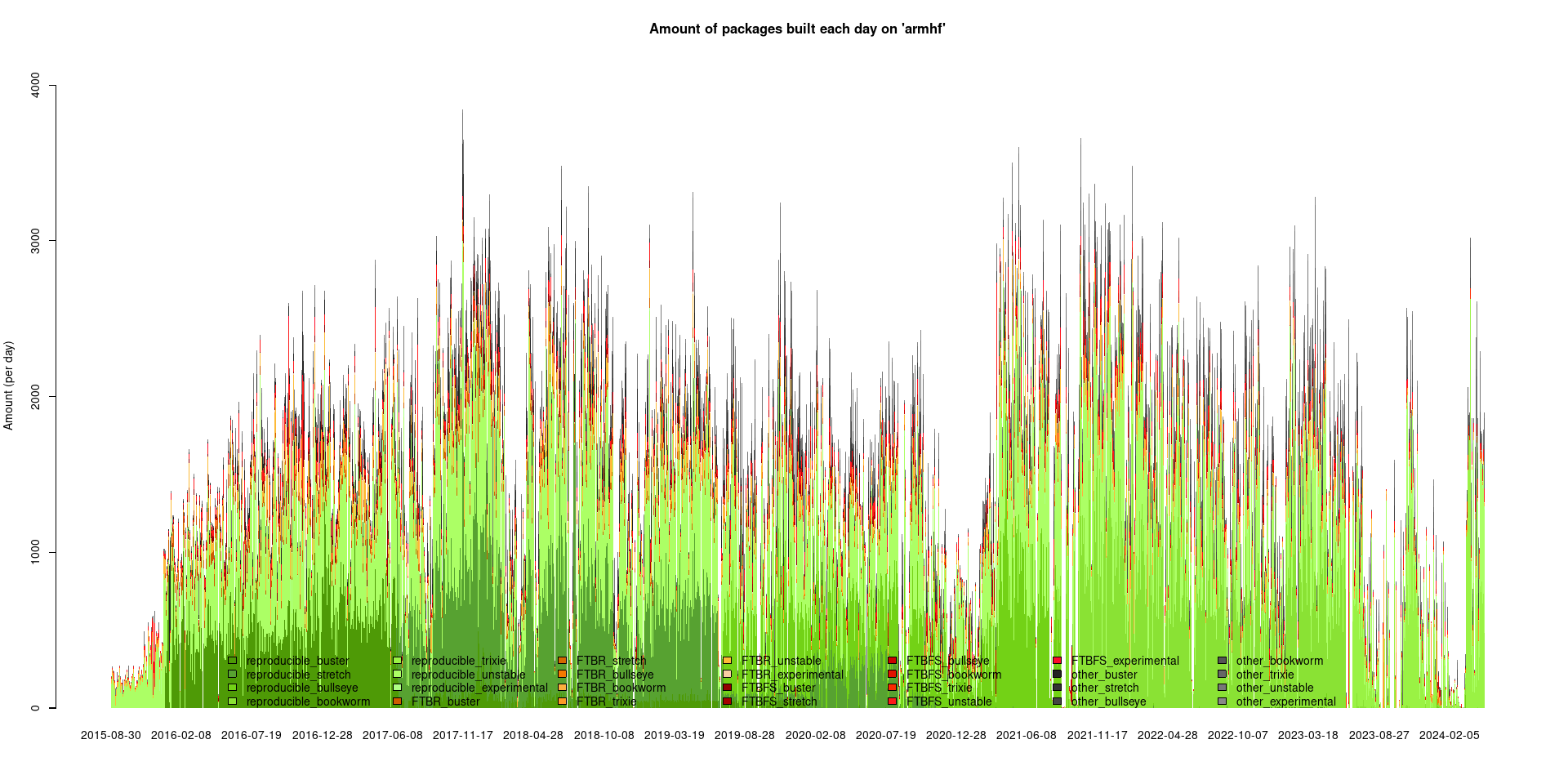
Earlier today I was made aware by Holger of the results of our reproducibility efforts during the sprint. I would like to thank Lunar for pinging us about the issue, and Holger for pointing me to updated results. The figure below depicts a stacked area chart where the X axis is time and the green area is reproducible packages. Red is packages that fail to build, and Orange are unreproducible packages I was able to book accommodation for the sprint attendees very close to both my place and the sprint venue, what was very useful but also had this downside of them not being able to see much of city. As the final day of the sprint was getting closer, we decided to have a different lunch to allow them to see one of the most famous local landmarks, the botanical gardens. So we headed down to the botanical gardens, grabbed a few items for lunch at the park coffee shop, and set out to visit this very beautiful place. I have to say that there is the place were I usually take every visitor I have. We were joined by Gioavani who had just arrived for the the MiniDebconf on the following weekend. The final lists of accomplishments of the day was again very impressive By the end of the afternoon I asked everyone to fill out a simple retrospective list, what we can use later to make future sprints better and better. Below are the results we got. What was good: What could be better: The night ended at Bar do Alem o ( The German s Bar ). Both their beer and their food are very good, but I don t have enough elements to vouch for their authenticity. :) We were joined by Giovani (who we also met earlier in the botanic gardens), and by Paulo and Daniel who are organizing the MiniDebconf. And that is the end of this year s Debian Ruby team sprint. I hope we do it all over again next year.

1 March 2016

Enrico Zini: Static site generators

I decided to rethink the state of my personal site, and try out some of the new static site generators that are available now. To do that, I jotted down a series of things that I want in a static site generator, then wrote a tool to convert my ikiwiki site to other formats, and set out to evaluate things. As a benchmark I did a full rebuild of my site, which currently contains 1164 static files and 458 markdown pages. My requirements Free layout for my site My / is mostly a high-level index to the site contents. Blog posts are at /blog. My talk archive is organised like a separate blog at /talks. I want the freedom to create other sections of the site, each with its own rss feed, located wherever I want in the site hierarchy. Assets next to posts I occasionally blog just a photo with a little comment, and I would like the .md page with the comment to live next to the image in the file system. I did not even know that I had this as a requirement until I found static site generators that mandated a completely different directory structure for markdown contents and for static assets. Multiple RSS/Atom feeds I want at least one RSS/Atom feed per tag, because I use tags for marking which articles go to http://planet.debian.org. I also want RSS/Atom feeds for specific parts of the site, like the blog and talks. Arbitrary contents in /index.html I want total control over the contents of the main home page of the site. Quick preview while editing contents I do not like to wait several seconds for the site to be rebuilt at every review iteration of the pages I write. This makes me feel like the task of editing is harder than it should, and makes me lose motivation to post. Reasonable time for a full site rebuild I want to be able to run a full rebuild of the site in a reasonable time. I could define "reasonable" in this case as how long I can stare at the screen without getting bored, starting to do something else, and forgetting what it was that I was doing with the site. It is ok if a rebuild takes something like 10 or 30 seconds. It is not ok if it takes minutes. Code and dependency ecosystems that I can work with I can deal with Python and Go. I cannot deal with Ruby or JavaScript. I forgot all about Perl. Also, if it isn't in Debian it does not exist. Decent themes out of the box One of my hopes in switching to a more mainstream generator is to pick and choose themes and easily give my site a more modern look. Hugo Hugo is written in Go and is in Debian testing. Full rebuild time for my site is acceptable, and it can even parallelize:
  $ time hugo
  real      0m5.285s
  user      0m9.556s
  sys       0m1.052s
Free layout for my site was hard to get. I could replace /index.html by editing the template page for it, but then I did not find out how to create another similar index in an arbitrary place. Also, archetypes are applied only on the first path component of new posts, but I would like them instead to be matched on the last path component first, and failing that traveling up to the path until the top. This should be easy to fix by reorganizing the content a bit around here For example, a path for a new blog post of mine could be blog/2016/debian/ and I would like it to match the debian archetype first, and failing that the blog archetype. Assets next to posts almost work. Hugo automatically generates one feed per taxonomy element, and one feed per section. This would be currently sufficient for me, although I don't like the idea that sections map 1 to 1 to toplevel directories in the site structure. Hugo has a server that watches the file system and rerenders pages as they are modified, so the quick preview while editing works fine. About themes, it took me several tries to find a theme that would render navigation elements for both sections and tags, and most themes would render by pages with white components all around, and expect me to somehow dig in and tweak them. That frustrated me, because for quite a while I could not tell if I had misconfigured Hugo's taxonomies or if the theme was just somehow incomplete. Nikola Nikola is written in Python and is in Debian testing. Full rebuild time for my site is almost two orders of magnitude more than Hugo, and I am miffed to find the phrases "Nikola is fast." or "Fast building process" in its front page and package description:
  $ time nikola build
  real      3m31.667s
  user      3m4.016s
  sys       0m24.684s
Free layout could be achieved fiddling with the site configuration to tell it where to read sources. Assets next to post work after tweaking the configuration, but they require to write inconsistent links in the markdown source: https://github.com/getnikola/nikola/issues/2266 I have a hard time accepting that that, because I want to author content with consistent semantic interlinking, because I want to be able 10 years from now to parse it and convert it to something else if a new technology comes out. Nikola generates one RSS/Atom feed per tag just fine. I have not tried generating feeds for different sections of the site. Incremental generation inside its built in server works fine. Pelican Pelican is written in Python and is in Debian testing. Full rebuild time for my site is acceptable:
  $ time pelican -d
  real      0m18.207s
  user      0m16.680s
  sys       0m1.448s
By default, pelican seems to put generate a single flat directory of html files regardless of the directory hierarchy of the sources. To have free layout, pelican needs some convincing in the configuration:
  PATH_METADATA = r"(?P<relpath>.+)\.md"
  ARTICLE_SAVE_AS = " relpath /index.html"
but even if I do that, the urls that it generates still point to just slug /index.html and I have not trivially found a configuration option to fix that accordingly. I got quite uncomfortable at the idea of needing to configure content generation and linking to match, instead of having one automatically being in sync with the other. Having assets next to posts seems to be possible (also setting STATIC_PATHS = ["."]), but I do not recall making progress on this front. I did not manage to generate a feed for each tag out of the box, and probably there is some knob in the configuration for it. I gave up with Pelican as trying it out felt like a constant process of hacking the configuration from defaults that do not make any sense for me, withouth even knowing if a configuration exists that would do what I need Ikiwiki Ikiwiki is written in Perl and is in Debian. Although I am not anymore proficient with Perl, I was already using it, so it was worth considering. Full rebuild time feels a bit on the slow side but is still acceptable:
  $ time ikiwiki --setup site.setup
  real      0m37.356s
  user      0m34.488s
  sys       0m1.536s
In terms of free site structure, all feeds for all or part of the site, ikiwiki just excels. I even considered writing a python web server that monitors the file system and calls ikiwiki --refresh when anything changes, and calling it a day. However, when I tried to re-theme my website around a simple bootstrap boilerplate, I found that to be hard, as a some of the HTML structure is hardcoded in Perl (and it's also my fault) and there is only so much that can be done by tweaking the (rather unreadable) templates. siterefactor During all these experiments I had built siterefactor to generate contents for all those static site engines, and it was going through all the contents quite fast:
  $ time ./siterefactor src dst -t hugo
  real  0m1.222s
  user  0m0.904s
  sys   0m0.308s
So I wondered how slow it would become if, instead of making it write markdown, I made it write HTML via python markdown and Jinja2:
  $ time ./siterefactor ~/zz/ikiwiki/pub/ ~/zz/ikiwiki/web -t web
  real  0m6.739s
  user  0m5.952s
  sys   0m0.416s
I then started wondering how slower it would become if I implemented postprocessing of all local URLs generated by Markdown to make sure they are kept consistent even if the path of a generated page is different than the path of its source. Not much slower, really. I then added taxonomies. And arbitrary Jinja2 templates in the input, able to generate page lists and RSS/Atom feeds. And theming. And realised that reading all the sources and cross-linking them took 0.2 seconds, and the rest was generation time. And that after cross-linking, each page can be generated independently from all the others. staticsite So my site is now generated with staticsite:
  $ time ssite build
  real  0m6.833s
  user  0m5.804s
  sys   0m0.500s
It's comparable with Hugo, and on a single process.

8 February 2016

Orestis Ioannou: Debian - your patches and machine readable copyright files are available on Debsources

TL;DR All Debian license and patches are belong to us. Discover them here and here. In case you hadn't already stumbled upon sources.debian.net in the past, Debsources is a simple web application that allows to publish an unpacked Debian source mirror on the Web. On the live instance you can browse the contents of Debian source packages with syntax highlighting, search files matching a SHA-256 hash or a ctag, query its API, highlight lines, view accurate statistics and graphs. It was initially developed at IRILL by Stefano Zacchiroli and Matthieu Caneill. During GSOC 2015 I helped introduce two new features. License Tracker Since Debsources has all the debian/copyright files and that many of them adopted the DEP-5 suggestion (machine readable copyright files) it was interesting to exploit them for end users. You may find interesting the following features: Have a look at the documentation to discover more! Patch tracker The old patch tracker unfortunately died a while ago. Since Debsources stores all the patches it was, probably, natural for it to be able to exploit them and present them over the web. You can navigate through packages by prefix or by searching them here. Among the use cases: Read more about the API! Coming ... I hope you find these new features useful. Don't hesitate to report any bugs or suggestions you come accross.

5 February 2016

Enrico Zini: debtags-cleanup

debtags.debian.org cleaned up Since the Debtags consolidation announcement there are some more news: No more anonymous submissions Official recognition as Debian Contributors Mailing lists closed We can just use debian-devel instead of debtags-devel. Autotagging of trivial packages Miscellaneous other changes

21 January 2016

Russell Coker: Finding Storage Performance Problems

Here are some basic things to do when debugging storage performance problems on Linux. It s deliberately not an advanced guide, I might write about more advanced things in a later post. Disk Errors When a hard drive is failing it often has to read sectors several times to get the right data, this can dramatically reduce performance. As most hard drives aren t monitored properly (email or SMS alerts on errors) it s quite common for the first notification about an impending failure to be user complaints about performance. View your kernel message log with the dmesg command and look in /var/log/kern.log (or wherever your system is configured to store kernel logs) for messages about disk read errors, bus resetting, and anything else unusual related to the drives. If you use an advanced filesystem like BTRFS or ZFS there are system commands to get filesystem information about errors. For BTRFS you can run btrfs device stats MOUNTPOINT and for ZFS you can run zpool status . Most performance problems aren t caused by failing drives, but it s a good idea to eliminate that possibility before you continue your investigation. One other thing to look out for is a RAID array where one disk is noticeably slower than the others. For example if you have a RAID-5 or RAID-6 array every drive should have almost the same number of reads and writes, if one disk in the array is at 99% performance capacity and the other disks are at 5% then it s an indication of a failing disk. This can happen even if SMART etc don t report errors. Monitoring IO The iostat program in the Debian sysstat package tells you how much IO is going to each disk. If you have physical hard drives sda, sdb, and sdc you could run the command iostat -x 10 sda sdb sdc to tell you how much IO is going to each disk over 10 second periods. You can choose various durations but I find that 10 seconds is long enough to give results that are useful. By default iostat will give stats on all block devices including LVM volumes, but that usually gives too much data to analyse easily. The most useful things that iostat tells you are the %util (the percentage utilisation anything over 90% is a serious problem), the reads per second r/s , and the writes per second w/s . The parameters to iostat for block devices can be hard drives, partitions, LVM volumes, encrypted devices, or any other type of block device. After you have discovered which block devices are nearing their maximum load you can discover which of the partitions, RAID arrays, or swap devices on that disk are causing the load in question. The iotop program in Debian (package iotop) gives a display that s similar to that of top but for disk io. It generally isn t essential (you can run ps ax grep D to get most of that information), but it is handy. It will tell you which programs are causing IO on a busy filesystem. This can be good when you have a busy system and don t know why. It isn t very useful if you have a system that is used for one task, EG a database server that is known to be busy doing database stuff. It s generally a good idea to have sysstat and iotop installed on all systems. If a system is experiencing severe performance problems you might not want to wait for new packages to be installed. In Debian the sysstat package includes the sar utility which can give historical information on system load. One benefit of using sar for diagnosing performance problems is that it shows you the time of day that has the most load which is the easiest time to diagnose performance problems. Swap Use Swap use sometimes confuses people. In many cases swap use decreases overall disk use, this is the design of the Linux paging algorithms. So if you have a server that accesses a lot of data it might swap out some unused programs to make more space for cache. When you have multiple virtual machines on one system sharing the same disks it can be difficult to determine the best allocation for RAM. If one VM has some applications allocating a lot of RAM but not using it much then it might be best to give it less RAM and force those applications into swap so that another VM can cache all the data it accesses a lot. The important thing is not the amount of swap that is allocated but the amount of IO that goes to the swap partition. Any significant amount of disk IO going to a swap device is a serious problem that can be solved by adding more RAM. Reads vs Writes The ratio of reads to writes depends on the applications and the amount of RAM. Some applications can have most of their reads satisfied from cache. For example an ideal configuration of a mail server will have writes significantly outnumber reads (I ve seen ratios of 5:1 for writes to reads on real mail servers). Ideally a mail server will cache all new mail for at least an hour and as the most prolific users check their mail more frequently than that most mail will be downloaded before it leaves the cache. If you have a mail server with reads outnumbering writes then it needs more RAM. RAM is cheap nowadays so if you don t want to compete with Gmail it should be cheap to buy enough RAM to cache all recent mail. The ratio of reads to writes is important because it s one way of quickly determining if you have enough RAM and adding RAM is often the cheapest way of improving performance. Unbalanced IO One common performance problem on systems with multiple disks is having more load going to some disks than to others. This might not be a problem (EG having cron jobs run on disks that are under heavy load while the web server accesses data from lightly loaded disks). But you need to consider whether it s desirable to have some disks under more load than others. The simplest solution to this problem is to just have a single RAID array for all data storage. This is also the solution that gives you the maximum available disk space if you use RAID-5 or RAID-6. A more complex option is to use some SSDs for things that require performance and disks for things that don t. This can be done with the ZIL and L2ARC features of ZFS or by just creating a filesystem on SSD for the data that is most frequently accessed. What Did I Miss? I m sure that I missed something, please let me know of any other basic things to do or suggestions for a post on more advanced things.

14 January 2016

Lunar: Reproducible builds: week 37 in Stretch cycle

What happened in the reproducible builds effort between January 3rd and January 9th 2016:

Toolchain fixes David Bremner uploaded dh-elpa/0.0.18 which adds a --fix-autoload-date option (on by default) to take autoload dates from changelog. Lunar updated and sent the patch adding the generation of .buildinfo to dpkg.

Packages fixed The following packages have become reproducible due to changes in their build dependencies: aggressive-indent-mode, circe, company-mode, db4o, dh-elpa, editorconfig-emacs, expand-region-el, f-el, geiser, hyena, js2-mode, markdown-mode, mono-fuse, mysql-connector-net, openbve, regina-normal, sml-mode, vala-mode-el. The following packages became reproducible after getting fixed: Some uploads fixed some reproducibility issues, but not all of them: Patches submitted which have not made their way to the archive yet:
  • #809780 on flask-restful by Chris Lamb: implement support for SOURCE_DATE_EPOCH in the build system.
  • #810259 on avfs by Chris Lamb: implement support for SOURCE_DATE_EPOCH in the build system.
  • #810509 on apt by Mattia Rizzolo: ensure a stable file order is given to the linker.

reproducible.debian.net Add 2 more armhf build nodes provided by Vagrant Cascadian. This added 7 more armhf builder jobs. We now run around 900 tests of armhf packages each day. (h01ger) The footer of each page now indicates by which Jenkins jobs build it. (h01ger)

diffoscope development diffoscope 45 has been released on January 4th. It features huge memory improvements when comparing large files, several fixes of squashfs related issues that prevented comparing two Tails images, and improve the file list of tar and cpio archive to be more precise and consistent over time. It also fixes a typo that prevented the Mach-O to work (Rainer M ller), improves comparisons of ELF files when specified on the command line, and solves a few more encoding issues.

Package reviews 134 reviews have been removed, 30 added and 37 updated in the previous week. 20 new fail to build from source issues were reported by Chris Lamb and Chris West. prebuilder will now skip installing diffoscope to save time if the build results are identical. (Reiner Herrmann)

2 January 2016

Steve Kemp: Restoring my system .. worked

A while back I wrote about some issues with converting a two-disk RAID system to a one-disk system, but just to recap: In the end we bought a small form-factor PC, with only a single drive and I moved one of the two drives from the old machine into it. Then converted it to run happily with only a single drive, and not email every day to say "device missing". So there things stood, we had a desktop with a single drive, and I ensured that I took full daily backup via attic. Over Chrismas the two-year old drive failed. To the extent I couldn't even get it to be recognized by the BIOS, and thus couldn't pull data off it. Time to test my backups in anger! I bought a new drive, installed a minimal installation of the Jessie release of Debian onto the system, and then ran:

 cd /
 .. restore latest backup ..
Two days later I'd pulled 1.3Tb over the network, and once I fixed up grub, /etc/fstab, and a couple of niggles it all just worked. Rebooted to make sure the temporary.home hostname, etc, was all gone and life was good. Restored backup! No errors! No data-loss! Perfect! The backup-script I use every day was very very good at making sure nothing was missed:
attic create --stats --checkpoint-interval=7200 attic@$ remote :/attic/storage::$ host -$(date +%Y-%m-%d-%H)
  --exclude=/proc      \
  --exclude=/sys       \
  --exclude=/run       \
  --exclude=/dev       \
  --exclude=/tmp       \
  --exclude=/var/tmp   \
  --exclude=/var/log   \
  /
In other news I published my module for controlling the new smart lights I've bought

31 December 2015

Chris Lamb: Free software activities in December 2015

Here is my monthly update covering a large part of what I have been doing in the free software world (previously):
Debian My work in the Reproducible Builds project was also covered in more depth in Lunar's weekly reports (#31, #32, #33, #34).
LTS

This month I have been paid to work 12 hours on Debian Long Term Support (LTS). In that time I did the following:
  • Issued DLA 363-1 for libphp-phpmailer fixing a header injection vulnerability.
  • Issued DLA 365-1 for foomatic-filters correcting a shell injection vulnerability.
  • Issued DLA 369-1 for pygments fixing an issue shell injection vulnerability.
  • Issued DLA 374-1 for cacti to fix an SQL injection vulnerability.
  • Did some futher investigation of CVE-2011-5325 in busybox.

Uploads
  • python-django (1.9) New upstream release.
  • redis (3.0.6) New upstream stable release. I additionally backported this package to Debian stable.
  • redis (3.2~rc1) Uploaded upstream's "testing/next" branch to experimental for testing.
  • gunicorn (19.4.1) New upstream release.


Patches contributed

I also filed FTBFS bugs against acpid, android-platform-frameworks-base, antlr3, artemis, beignet, bisonc++, bobcat, bustle, cargo, checkbox-ng, code2html, cplay, datanommer.commands, dcmtkpp, debci, diffutils, diod, django-restricted-resource, docker-libkv, doomsday, dvdauthor, dwww, elasticsearch, elki, flask-script, freeipa, fso-frameworkd, funny-manpages, ggcov, ghc-mod, gmpc-plugins, gparted, gs-collections, guacamole-server, guncat, haskell-concrete-typerep, haskell-geniplate, haskell-nats, haskell-x509-util, hawtbuf, heimdal, htsjdk, inspircd, jboss-xnio, jenkins-winstone, jpeginfo, jruby-openssl, kaffeine, kdbg, ktp-accounts-kcm, kuser, libcommons-cli-java, libcommons-openpgp-java, libconfig-model-lcdproc-perl, libdata-faker-perl, libexplain, libgettext-commons-java, libgtk2-ex-printdialog-perl, libmoops-perl, libnet-frame-perl, libsendmail-milter-perl, libupnp, libuv, libvpx, liwc, m4, maven2, meep-mpich2, nagios-plugin-check-multi, natlog, netpipe, ocserv, ogre-1.8, orthanc-dicomweb, perspectives-extension, php-mail, php-pinba, phpseclib, pkg-haskell-tools, plastimatch, plexus-compiler, plexus-compiler-1.0, python-acme, python-crontab, python-cs, python-csscompressor, python-debian, python-distutils-extra, python-django-compressor, python-django-openstack-auth, python-django-tagging, python-pygit2, python-pyramid, python-pywcs, python-releases, python-shade, python-statsd, python-tasklib, python-tasklib, python-webm, python-websockets, regina-normal, rinetd, roboptim-core, rpm2html, rpm2html, ruby-factory-girl, ruby-fogbugz, ruby-i18n-inflector, ruby-loofah, ruby-protected-attributes, ruby-rack-contrib, ruby-rufus-scheduler, ruby-sanitize, ruby-sidetiq, ruby-sinatra, scsh-0.6, shogun, sleekxmpp, slugimage, spatial4j, sqwebmail-de, trac-announcer, ttt, txaws, umbrello, wine-gecko-2.21, xboxdrv, xfonts-wqy, xserver-xorg-video-openchrome, yorick & yoshimi.

30 December 2015

Bits from Debian: Debian lamenta el dec s de l'Ian Murdock

Ian Murdock Amb el cor compungit, Debian lamenta la p rdua d'Ian Murdock, ferm partidari del programari lliure i de codi obert, pare, fill i l'"ian" a Debian. L'Ian va comen ar el projecte Debian l'agost de 1993, i va publicar les primeres versions m s tard el mateix any. Debian es convertiria en el sistema operatiu universal pel m n, que funciona en tot tipus de dispositius, des de sistemes encastats fins a l'estaci especial. L'Ian es va centrar en crear una distribuci i una cultura de comunitat que fessin el correcte, ticament o t cnica. Publicar quan estigui a punt i la ferma posici sobre la llibertat de programari s n les regles d'or en el m n del programari lliure i de codi obert. La seva devoci per fer el correcte va guiar la seva feina, tant a Debian com els seg ents anys, sempre treball per assolir el millor futur possible. El somni de l'Ian est viu, la comunitat de Debian continua incre blement activa, amb milers de desenvolupadors que treballen innumerables hores per proporcionar un sistema operatiu segur i fiable. Els pensaments de la comunitat de Debian s n amb la fam lia de l'Ian en aquests moments tant durs. La seva fam lia ens ha demanat privacitat en aquests moments dif cils i volem respectar-ho. Des de Debian i des de la comunitat de Linux en general podem enviar mostres de condol a in-memoriam-ian@debian.org; seran guardades i arxivades.

2 December 2015

Andrea Veri: Three years and counting

It s been a while since my last what s been happening behind the scenes e-mail so I m here to report on what has been happening within the GNOME Infrastructure, its future plans and my personal sensations about a challenge that started around three (3) years ago when Sriram Ramkrishna and Jeff Schroeder proposed my name as a possible candidate for coordinating the team that runs the systems behind the GNOME Project. All this followed by the official hiring achieved by Karen Sandler back in February 2013. The GNOME Infrastructure has finally reached stability both in terms of reliability and uptime, we didn t have any service disruption this and the past year and services have been running smoothly as they were expected to in a project like the one we are managing. As many of you know service disruptions and a total lack of maintenance were very common before I joined back in 2013, I m so glad the situation has dramatically changed and developers, users, passionates are now able to reach our websites, code repositories, build machines without experiencing slowness, downtimes or

unreachability. Additionally all these groups of people now have a reference point they can contact in case they need help when coping with the infrastructure they daily use. The ticketing system allows users to get in touch with the members of the Sysadmin Team and receive support right away within a very short period of time (Also thanks to Pagerduty, service the Foundation is kindly sponsoring) Before moving ahead to the future plans I d like to provide you a summary of what has been done during these roughly three years so you can get an idea of why I define the changes that happened to the infrastructure a complete revamp:
  1. Recycled several ancient machines migrating services off of them while consolidating them by placing all their configuration on our central configuration management platform ran by Puppet. This includes a grand total of 7 machines that were replaced by new hardware and extended warranties the Foundation kindly sponsored.
  2. We strenghten our websites security by introducing SSL certificates everywhere and recently replacing them with SHA2 certificates.
  3. We introduced several services such as Owncloud, the Commits Bot, the Pastebin, the Etherpad, Jabber, the GNOME Github mirror.
  4. We restructured the way we backup our machines also thanks to the Fedora Project sponsoring the disk space on their backup facility. The way we were used to handle backups drastically changed from early years where a magnetic tape facility was in charge of all the burden of archiving our data to today where a NetApp is used together with rdiff-backup.
  5. We upgraded Bugzilla to the latest release, a huge thanks goes to Krzesimir Nowak who kindly helped us building the migration tools.
  6. We introduced the GNOME Apprentice program open-sourcing our internal Puppet repository and cleansing it (shallow clones FTW!) from any sensitive information which now lives on a different repository with restricted access.
  7. We retired Mango and our OpenLDAP instance in favor of FreeIPA which allows users to modify their account information on their own without waiting for the Accounts Team to process the change.
  8. We documented how our internal tools are customized to play together making it easy for future Sysadmin Team members to learn how the infrastructure works and supersede existing members in case they aren t able to keep up their position anymore.
  9. We started providing hosting to the GIMP and GTK projects which now completely rely on the GNOME Infrastructure. (DNS, email, websites and other services infrastructure hosting)
  10. We started providing hosting not only to the GIMP and GTK projects but to localized communities as well such as GNOME Hispano and GNOME Greece
  11. We configured proper monitoring for all the hosted services thanks to Nagios and Check-MK
  12. We migrated the IRC network to a newer ircd with proper IRC services (Nickserv, Chanserv) in place.
  13. We made sure each machine had a configured management (mgmt) and KVM interface for direct remote access to the bare metal machine itself, its hardware status and all the operations related to it. (hard reset, reboot, shutdown etc.)
  14. We upgraded MoinMoin to the latest release and made a substantial cleanup of old accounts, pages marked as spam and trashed pages.
  15. We deployed DNSSEC for several domains we manage including gnome.org, guadec.es, gnomehispano.es, guadec.org, gtk.org and gimp.org
  16. We introduced an account de-activation policy which comes into play when a contributor not committing to any of the hosted repositories at git.gnome.org since two years is caught by the script. The account in question is marked as inactive and the gnomecvs (from the old cvs days) and ftpadmin groups are removed.
  17. We planned mass reboots of all the machines roughly every month for properly applying security and kernel updates.
  18. We introduced Mirrorbrain (MB), the mirroring service serving GNOME and related modules tarballs and software all over the world. Before introducing MB GNOME had several mirrors located in all the main continents and at the same time a very low amount of users making good use of them. Many organizations and companies behind these mirrors decided to not host GNOME sources anymore as the statistics of usage were very poor and preferred providing the same service to projects that really had a demand for these resources. MB solved all this allowing a proper redirect to the closest mirror (through mod_geoip) and making sure the sources checksum matched across all the mirrors and against the original tarball uploaded by a GNOME maintainer and hosted at master.gnome.org.
I can keep the list going for dozens of other accomplished tasks but I m sure many of you are now more interested in what the future plans actually are in terms of where the GNOME Infrastructure should be in the next couple of years. One of the main topics we ve been discussing will be migrating our Git infrastructure away from cgit (which is mainly serving as a code browsing tool) to a more complete platform that is surely going to include a code review tool of some sort. (Gerrit, Gitlab, Phabricator) Another topic would be migrating our mailing lists to Mailman 3 / Hyperkitty. This also means we definitely need a staging infrastructure in place for testing these kind of transitions ideally bound to a separate Puppet / Ansible repository or branch. Having a different repository for testing purposes will also mean helping apprentices to test their changes directly on a live system and not on their personal computer which might be running a different OS / set of tools than the ones we run on the GNOME Infrastructure. What I also aim would be seeing GNOME Accounts being the only authentication resource in use within the whole GNOME Infrastructure. That means one should be able to login to a specific service with the same username / password in use on the other hosted services. That s been on my todo list for a while already and it s probably time to push it forward together with Patrick Uiterwijk, responsible of Ipsilon s development at Red Hat and GNOME Sysadmin. While these are the top priority items we are soon receiving new hardware (plus extended warranty renewals for two out of the three machines that had their warranty renewed a while back) and migrating some of the VMs off from the current set of machines to the new boxes is definitely another task I d be willing to look at in the next couple of months (one machine (ns-master.gnome.org) is being decommissioned giving me a chance to migrate away from BIND into NSD). The GNOME Infrastructure is evolving and it s crucial to have someone maintaining it. On this side I m bringing to your attention the fact the assigned Sysadmin funds are running out as reported on the Board minutes from the 27th of October. On this side Jeff Fortin started looking for possible sponsors and came up with the idea of making a brochure with a set of accomplished tasks that couldn t have been possible without the Sysadmin fundraising campaign launched by Stormy Peters back in June 2010 being a success. The Board is well aware of the importance of having someone looking at the infrastructure that runs the GNOME Project and is making sure the brochure will be properly reviewed and published. And now some stats taken from the Puppet Git Repository:
$ cd /git/GNOME/puppet && git shortlog -ns
3520 Andrea Veri
506 Olav Vitters
338 Owen W. Taylor
239 Patrick Uiterwijk
112 Jeff Schroeder
71 Christer Edwards
4 Daniel Mustieles
4 Matanya Moses
3 Tobias Mueller
2 John Carr
2 Ray Wang
1 Daniel Mustieles Garc a
1 Peter Baumgarten
and from the Request Tracker database (52388 being my assigned ID):
mysql> select count(*) from Tickets where LastUpdatedBy = '52388';
+----------+
  count(*)  
+----------+
  3613  
+----------+
1 row in set (0.01 sec)
mysql> select count(*) from Tickets where LastUpdatedBy = '52388' and Status = 'Resolved';
+----------+
  count(*)  
+----------+
  1596  
+----------+
1 row in set (0.03 sec)
It s been a long run which made me proud, for the things I learnt, for the tasks I ve been able to accomplish, for the great support the GNOME community gave me all the time and most of all for the same fact of being part of the team responsible of the systems hosting the GNOME Project. Thank you GNOME community for your continued and never ending backing, we daily work to improve how the services we host are delivered to you and the support we receive back is fundamental for our passion and enthusiasm to remain high!

30 November 2015

Lunar: Reproducible builds: week 31 in Stretch cycle

What happened in the reproducible builds effort this week: Toolchain fixes Reiner Herrmann submitted a patch against debhelper to make dh_installinit source files in a stable order. Chris Lamb found how to make cython output deterministic by ordering the keys used to traverse a dict. Reiner Herrmann proposed a patch for pyside-tools to remove the timestamps embedded by rcc in the generated Python code. Mattia Rizzolo rebased our custom version of debhelper on version 9.20151126. As no objections have been made so far, Mattia Rizzolo has filled #805872 asking -Wdate-time to be turned on by default in dpkg-buildflag. Guillem has since sent a final warning before proceeding as such in the next dpkg upload. Russ Allbery added support for SOURCE_DATE_EPOCH in podlators 4.00 which Niko Tyni intend to backport to Perl 5.22. Packages fixed The following packages have become reproducible due to changes in their build dependencies: fontforge, golang-github-tinylib-msgp, libpango-perl, libparanamer-java, libxaw, sqljet, stringtemplate4, uzbl, zope-mysqlda. The following packages became reproducible after getting fixed: Some uploads fixed some reproducibility issues, but not all of them: Patches submitted which have not made their way to the archive yet: Lunar reported two issues making xz-utils unreproducible (#806328, #806331). reproducible.debian.net A seventh armhf build node has been added (resulting of two more armhf build jobs). Thanks to Vagrant Cascadian for putting this Raspberry Pi 2B to help. (h01ger) jenkins.debian.net has been made more robust against network and proxy failures. (h01ger) A new 100 GB partition has been set up on reproducible.debian.net to prevent disk space issues. Thanks to ProfitBricks for its continuous support to our continuous test system. (h01ger) New graphs showing usertagged bugs have been added on the dashboard to measure the progress without FTBFS issues. Please note that comparing the two graphs might be misleading as more than 1300 FTBFS bugs have been inventoried. (h01ger) Package reviews 78 reviews have been removed, 116 added and 49 updated this week. 25 new FTBFS have been filed by Chris West, Chris Lamb and Santiago Vila. New issues identified this week: timestamps_in_documentation_generated_with_libwibble, copyright_year_in_documentation_generated_by_sphinx, timestamps_in_documentation_generated_by_glib_genpod, random_order_of_tmpfiles_in_postinst, random_order_in_cython_output, timestamps_in_python_code_generated_by_pyside. Reiner Herrmann and Lunar improved the prebuilder script: the script can now be called through a symlink, run parallel builds, calls diffoscope by its new name and ensure to install its recommends, and save the text output aside the HTML one. Reiner also added a script to lookup the last update of notes for a given package. Misc. Santiago Villa has been recently working on making sure that Arch:all packages were properly buildable by running dpkg-buildpackage -A. This uncovered a question that is probably not currently addressed by the policy: on which architectures should architecture-independent be buildable?

17 November 2015

Petter Reinholdtsen: PGP key transition statement for key EE4E02F9

I've needed a new OpenPGP key for a while, but have not had time to set it up properly. I wanted to generate it offline and have it available on a OpenPGP smart card for daily use, and learning how to do it and finding time to sit down with an offline machine almost took forever. But finally I've been able to complete the process, and have now moved from my old GPG key to a new GPG key. See the full transition statement, signed with both my old and new key for the details. This is my new key:
pub   3936R/111D6B29EE4E02F9 2015-11-03 [expires: 2019-11-14]
      Key fingerprint = 3AC7 B2E3 ACA5 DF87 78F1  D827 111D 6B29 EE4E 02F9
uid                  Petter Reinholdtsen <pere@hungry.com>
uid                  Petter Reinholdtsen <pere@debian.org>
sub   4096R/87BAFB0E 2015-11-03 [expires: 2019-11-02]
sub   4096R/F91E6DE9 2015-11-03 [expires: 2019-11-02]
sub   4096R/A0439BAB 2015-11-03 [expires: 2019-11-02]
The key can be downloaded from the OpenPGP key servers, signed by my old key. If you signed my old key (DB4CCC4B2A30D729), I'd very much appreciate a signature on my new key, details and instructions in the transition statement. I m happy to reciprocate if you have a similarly signed transition statement to present.

21 October 2015

Antoine Beaupr : Proprietary VDSL2 Linux routers adventures

I recently bought a wireless / phone adapter / VDSL modem from my Internet Service Provider (ISP) during my last outage. It generally works fine as a VDSL modem, but unfortunately, I can't seem to get used to configuring the device through their clickety web user interface... Furthermore, I am worried that I can't backup the config in a meaningful way, that is: if the device fails, I will probably not find the same model again and because they run a custom Linux distributions, the chances of the backup being possible to restore on another machine are basically zero. No way i will waste my time configuring this black box. So I started looking at running a distribution like OpenWRT on it.
(Unfortunately, I don't even dare hoping to run a decent operating system like Debian on those devices, if only because of the exotic chipsets that require all sorts of nasty hacks to run...)
The machine is a SmartRG SR630n (specs). I am linking to third party site, because the SmartRG site doesn't seem to know about their own product (!). I paid extra for this device to get one that would do both Wifi and VoIP, so i could replace two machines: my current Soekris net5501 router and a Cisco ATA 186 phone adapter that seems to mysteriously defy the challenges of time. (I don't remember when I got that thing, but it's at least from 2006.) Unfortunately, it seems that SmartRG are running a custom, proprietary Linux distribution. According to my ISP, init is a complete rewrite that reads an XML config file (and indeed it's the format of the backup files) and does the configuration through a shared memory scheme (!?). According to DSL reports, the device seems to be running a Broadcom 63168 SOC (system on a chip) that is unsupported in Linux. There are some efforts to write drivers for those from scratch, but they have been basically stalled for years now. Here are more details on the sucker: Now the next step would logically be to "simply" build a new image with OpenWRT and install it in place. Then I would need to figure out a way to load the binary blobs into the OpenWRT kernel and run all the ADSL utilities as well. It's basically impossible: the odds of the binary modules being compatible with another arbitrary release of the Linux kernel are near zero. Furthermore, the userland tool are most likely custom as well. And worse of all: it seems that Bell Canada deployed a custom "Lucent Stinger" DSLAM which requires a custom binary firmware in the modem. This could be why the SmartRG is so bizarre in the first place. As long as the other end is non-standard, we are all screwed. And those Stinger DSLAM will stick around for a long time, thanks to bell.
See this other good explanation of Stinger.
Which means this machine is now yet another closed box sitting on the internet without firmware upgrades, totally handicapped. I will probably end up selling it back for another machine that has OpenWRT support for their VDSL modems. But there are very few such machines, and with a lot of those, VDSL support is often marked as "spotty" or "in progress". Some machines are supported but are basically impossible to find. There's the Draytek modems are also interesting because, apparently, some models run OpenWRT out of the box too, which is a huge benefit. This is because they use the more open Lantiq SOC. Which are probably not going to support Stinger lines. Still, there are some very interesting projects out there... The Omnia is one I am definitely interested in right now. I really like their approach... But then they don't have a VDSL chipset in there (I asked for one, actually). And the connectors are only mini-PCIe, which makes it impossible to connect a VDSL PCI card into it. I could find a single VDSL2 PCI card online, and it could be supported, but only the annex B is available, not the annex A, and it seems the network is using "annex A" according to the ADSL stats i had in 2015-05-28-anarcat-back-again. With such a card, I could use my existing Soekris net5501 router, slam a DSL card into it, and just use the SmartRG as a dumb wifi router/phone adapter. Then it will remain to see how supported are those VDSL cards in FreeBSD (they provide Linux source code, so that's cool). And of course, all this assumes the card works with the "Stinger" mode, which is probably not the case anyways. Besides, I have VDSL2 here, not the lowly ADSL2+. By the way, Soekris keeps on pushing new interesting products out: their net6501, with 2 extra Gig-E cards could be a really interesting high-end switch, all working with free software tools. A friend has a SmartRG 505n modem, which looks quite similar, except without the ATA connectors. And those modems are the ones that Teksavvy recommends ("You may use a Cellpipe 7130 or Sagemcom F@ST 2864 in lieu of our SmartRG SR505N for our DSL 15/10, DSL 25 or DSL 50 services."). Furthermore, Teksavvy provides a firmware update for the 505n - again, no idea if it works with the 630n. Of course, the 505n doesn't run OpenWRT either. So, long story short, again I got screwed by my ISP: I thought i would get a pretty hackable device, "running Linux" that my ISP said over the phone. I got weeks of downtime, no refund, and while i got a better line (more reliable, higher bandwidth), my costs doubled. And I have yet another computing device to worry about: instead of simplifying and reducing waste, I actually just added crap on top of my already cluttered desk. Next time, maybe I'll tell you about how my ISP overbilled me, broke IPv6 and drops large packets to the floor. I haven't had a response from them in months now... hopefully they will either answer and fix all of this (doubtful) or I'll switch to some other provider, probably Teksavvy. Many thanks to the numerous people in the DSL reports Teksavvy forum that have amazing expertise. They are even building a map of Bell COs... Thanks also to Taggart for helping me figure out how the firmware images work and encouraging me to figure out how my machine works overall.
Note: all the information shared here is presented in the spirit of the fair use conditions of copyright law.

15 October 2015

Laura Arjona: Long summer story, Welcome team, and I am a Debian Developer now

Note: 2015/10/16: I need to add some links but I won t delay this more, posting now, will edit later. Summer ended long time ago, but believe me, I m still catching up with all the things that I began in June/July, all the things I left in August when I went holidays, and more things that appeared in August and September. This is a long overdue post, I hope you bear with me for waiting so long, and writing (now) so long too! June In June, I was 100% sure that I would not attend DebConf15 (well, I was 98% sure until then), and when the new Outreach Sponsorship grants were announced, I decided to write some mails to several Debian contributors, so they consider applying for the grant and attend DebConf (and maybe trigger some i18n/l10n meeting ). They kindly declined, and I understood their reasons, but also wondered what would have happened if the proposal would have come from somebody more official instead of a random contributor that they don t know. I also hoped that lots of other Debianites also write to newbies or not-yet-DD-contributors or non-packaging contributors to invite them to DebConf, and I hoped that they had better luck than me in convincing them :) July In July I usually work hard preparing the computer labs for next academic year at my workplace in the University, but I also have more free time in the long afternoons and evenings, since I don t sleep much, and there is not much to do outside with the summer hot. So I used that month to go on contributing to DebConf publicity and think a bit more about Debian and the other free software communities. I didn t put much time in advancing my selfhosting (no SSL yet in *.larjona.net! booooo!) but I decided to deep my toe in Sandstorm.io, and try to selfhost an instance ( http://lacaja.larjona.net ) and try Etherpad inside Sandstorm (since I failed in deploying Etherpad by myself in my jessie+nginx+postgres box). Sandstorm worked, and Etherpad was packaged in Sandstorm so it worked too; and I have my free-software-base pads now for writing and share. So I joined #sandstorm IRC channel since then, and there I learnt that Asheesh Laroia (who works in Sandstorm.io and is also a Debian Developer and was going to give a talk about Sandstorm.io in DebConf15) was offering mentorship for people wanting to learn Sandstorm packaging, and his proposal was to begin packaging Framadate. I also failed in selfhosting Dudle (prepared for Apache + FastCGI, couldn t make it work in my Nginx), so Asheesh s proposal looked suitable for me. We talked and decided to invest the rest of July and first days of August in learning to package Framadate. I learned a lot, but couldn t finish the task. I encountered many issues (setting my dev environment, and later trying to package), and we solved some of them but my time ran out. I posted my work in the list, and I hope that my feedback on the documentation and the issues I encountered helped Asheesh and the Sandstorm community. Framadate is packaged in Sandstorm.io now, Drew Fisher packaged it, not sure if my stuff was useful or not (it s been useful for me, for learning, at least). I ll talk more about Sandstorm.io in a future blog post updating on my selfhosting adventures. What I liked most was the kind of proposal of mentoring that Asheesh made. It was very detailed in every aspect: the task, the things you need to accomplish it, details about his availability for mentorship I try to be welcoming in the teams in which I participate, but the fact is that I fail in actually mentor, maybe because of not making specific proposals to people (until now, I was like Hi, newcomer! Go read this, this and this, and try for yourself any task you feel you like it, and come back if you have issues , la Debian ). This, plus the thoughts about my mails in June for diversity outreach in DebConf, made me feel the need of having a team where people willing to welcome newcomers share tricks and procedures, write together more specific proposals, and follow up the newcomers experiences in a regular way. I talked with Enrico Zini and we wrote down some notes for a Welcome Team in Debian; he said he would spread the word during DebCamp/DebConf and we would see what people thinks about it. August August came, and the day before going on holidays I was really tired: too much luggage to prepare, too many hours in front of the computer, and the usual stress of traveling; and I took the bad decision of signing some GPG keys of several Debianites that I met in July. I say bad decision because the lack of sleep showed its black magic and I accidentally deleted my secring.gpg file. I knew I had a backup but I didn t have too much time to invest and I didn t want to mess it with the backup too, and my laptop was going to stay at home, powered off, during the whole month, so I just went on holidays and left the GPG issue for later. The day after, meanwhile I was waiting in the airport for my boarding time, I received a mail accepting me as Debian Developer. Wow!! Really, I was not expecting that the process was already finished, I had interchanged several mails with my Application Manager (who happens to be the current DPL!) and I thought that his summer could be quite packed of Debian/DebConf work and my process could wait a bit. So it was a very happy news and very motivating after one month (July) full of free software work. On the other side, I was a bit scared: what type of Debian Developer are you, larjona, not capable to sign some GPG keys without breaking your setup?! but I answered myself well, I m the type of Debian Developer that has backups :) and then, with that mixed feelings of excitement and impostor syndrome, I took my plane and went on holidays, not expecting to touch any computer until the end of the month. August is probably the month in the year when I have more free time (holidays), but less time to dedicate to free software. I devote most of the month to visit family and stay with them, with no internet connection available or no free time to look at the mailbox or social networks or IRC But DebCamp and DebConf15 were happening during my holidays. And this DebConf15 was the first one in which I participated in the organization, and the first one in which I felt more than being a consumer of Debian videos . I could not follow the streamings, my only internet-capable device was my Android 2.x phone, but when I had wifi I fetched the mail, and during the nights, while everybody else was sleeping and I was laying on the terrace, below the sky full of stars, I could read batches of hundred of mails from debconf-discuss mailing list. And I could get some feeling from DebConf life, because I learned about the ad-hoc BoFs and discussions, the morning bike rides and swimming proposals, and the dancing classes, the i18m/l10n meeting, and many other things. I could answer some mail from time to time, and I also knew that a fellow Debianite from Madrid was going to bring me some stickers, maybe a t-shirt, and shake hands in my name to some persons. September and October September was about finishing reading all the mails and try to answer the pending ones, and preparing my computer to use my new Debian identity (and stop using larjona-guest). I still have some things to do, pending technical work, and some mails that I should have answered and I ve forgotten, for sure (if you sent me a mail that needs answer or would be fine that I answer (even if it was months ago!), please resend or ping me). I recovered my secring.gpg but and just now I added larjona@debian.org to the ID in my GPG key, but didn t signed the pending keys again (sorry dkg and holger! will catch up there soon). My subkeys expired and I m trying to find out how to proceed (they are in my FSFE SmartCard) :/ About the Debian teams, I ve resumed my work in publicity team (this year I ll try to be more involved, in Debian Project News in particular), partially in the website team, and recently I ve finished catching up with the Spanish translation of the website. I ve also joined the DebConf team again (for DebConf16, no matter I probably won t attend) and documented the Publicity task for DebConf, and I try to engage the mailing list and the IRC meetings. I finally could have time to watch some DebConf15 videos and Andreas Tille s talk ( Creating a more inviting environment for newcomers New experiences from MoM, SoB, Teammetrics ) helped me to step ahead in welcoming people with more useful stuff than Hi, newcomer! Go read this (general URLs), try for yourself whatever you like . I have made specific proposals for two people. In mid September I accepted an interview about Debian for a podcast with quite a lot audience (in Spanish), in which I explained the idea of the Welcome Team and offered myself as first-contact. Since then, two more people have contacted me and I have offered specific tasks I think are suitable for them. I also try to be more available in the IRC and offer some time spans for new contributors to DebConf to explain the git setup, the wiki, and all this stuff that looks more complicated than what it is. And I think that s all. My Debianite friend kindly brought me some stickers and a DebConf t-shirt, plus the organization t-shirt that the team gave me as present for my contributions in DebConf15. Neil McGovern kindly sent me a certificate of my new Debian Developer status (thanks!!), and it s posted in my wall at work. Here you are a photo! larjona_dd.JPG (Note: my wall is full of stickers and pieces of papers with things I need, things I like and things I use to explain my work (sometimes sarcastically/ironically ). Maybe some day I ll make a blog post about that!) I feel very proud and happy. Still, a lot of things to learn and work to do, but my intentions are: to keep on progressing (sometimes fast, sometimes slowly), never give up, and enjoy the multiple flowers I find in my way :) Thanks everybody! October and future Some other ideas/plans for the future (the ones I didn t say yet): Comments? If you want to comment you can use this pump.io thread.
Filed under: My experiences and opinion, News Tagged: Communities, Contributing to libre software, Debian, Developer motivations, encryption, English, Free Software, gpg, libre software

4 October 2015

Lunar: Reproducible builds: week 23 in Stretch cycle

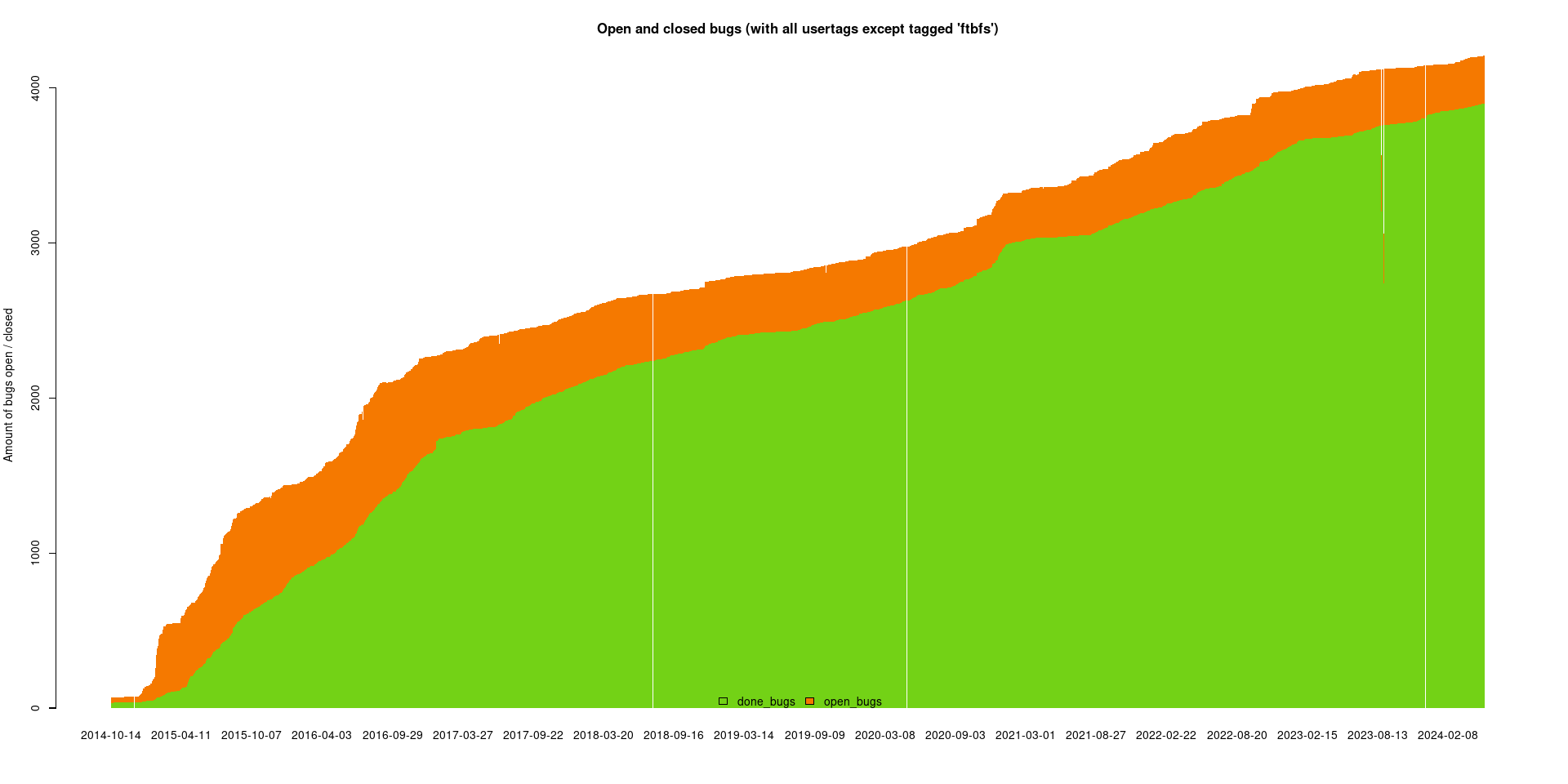
What happened in the reproducible builds effort this week: Toolchain fixes Andreas Metzler uploaded autogen/1:5.18.6-1 in experimental with several patches for reproducibility issues written by Valentin Lorentz. Groovy upstream has merged a change proposed by Emmanuel Bourg to remove timestamps generated by groovydoc. Ben Hutchings submitted a patch to add support for SOURCE_DATE_EPOCH in linux-kbuild as an alternate way to specify the build timestamp. Reiner Herrman has sent a patch adding support for SOURCE_DATE_EPOCH in docbook-utils. Packages fixed The following packages became reproducible due to changes in their build dependencies: commons-csv. fest-reflect, sunxi-tools, xfce4-terminal, The following packages became reproducible after getting fixed: Some uploads fixed some reproducibility issues but not all of them: Patches submitted which have not made their way to the archive yet: Tomasz Rybak uploaded pycuda/2015.1.3-1 which should fix reproducibility issues. The package has not been tested as it is in contrib. akira found an embedded code copy of texi2html in fftw. reproducible.debian.net Email notifications are now only sent once a day per package, instead of on each status change. (h01ger) disorderfs has been temporarily disabled to see if it had any impact on the disk space issues. (h01ger) When running out of disk space, build nodes will now automatically detect the problem. This means test results will not be recorded as FTBFS and the problem will be reported to Jenkins maintainers. (h01ger) The navigation menu of package pages has been improved. (h01ger) The two amd64 builders now use two different kernel versions: 3.16 from stable and 4.1 from backports on the other. (h01ger) We now graph the number of packages which needs to be fixed. (h01ger) Munin now creates graphs on how many builds were performed by build nodes (example). (h01ger) A migration plan has been agreed with DSA on how to turn Jenkins into an official Debian service. A backport of jenkins-job-builder for Jessie is currently missing. (h01ger) Package reviews 119 reviews have been removed, 103 added and 45 updated this week. 16 fail to build from source issues were reported by Chris Lamb and Mattia Rizzolo. New issue this week: timestamps_in_manpages_generated_by_docbook_utils. Misc. Allan McRae has submitted a patch to make ArchLinux pacman record a .BUILDINFO file.

24 September 2015

Petter Reinholdtsen: The life and death of a laptop battery

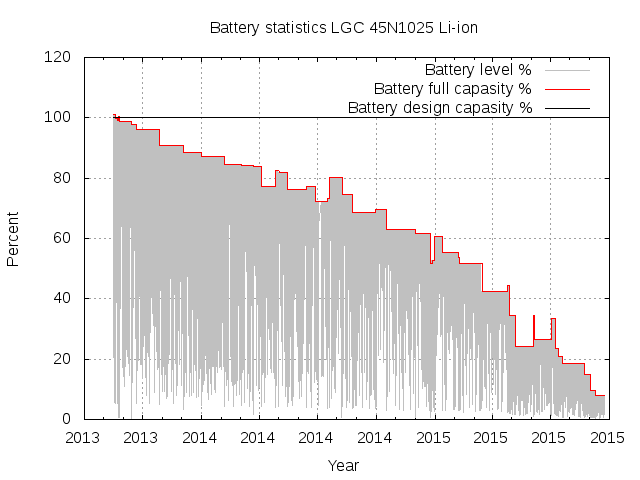
When I get a new laptop, the battery life time at the start is OK. But this do not last. The last few laptops gave me a feeling that within a year, the life time is just a fraction of what it used to be, and it slowly become painful to use the laptop without power connected all the time. Because of this, when I got a new Thinkpad X230 laptop about two years ago, I decided to monitor its battery state to have more hard facts when the battery started to fail. First I tried to find a sensible Debian package to record the battery status, assuming that this must be a problem already handled by someone else. I found battery-stats, which collects statistics from the battery, but it was completely broken. I sent a few suggestions to the maintainer, but decided to write my own collector as a shell script while I waited for feedback from him. Via a blog post about the battery development on a MacBook Air I also discovered batlog, not available in Debian. I started my collector 2013-07-15, and it has been collecting battery stats ever since. Now my /var/log/hjemmenett-battery-status.log file contain around 115,000 measurements, from the time the battery was working great until now, when it is unable to charge above 7% of original capacity. My collector shell script is quite simple and look like this:
#!/bin/sh
# Inspired by
# http://www.ifweassume.com/2013/08/the-de-evolution-of-my-laptop-battery.html
# See also
# http://blog.sleeplessbeastie.eu/2013/01/02/debian-how-to-monitor-battery-capacity/
logfile=/var/log/hjemmenett-battery-status.log
files="manufacturer model_name technology serial_number \
    energy_full energy_full_design energy_now cycle_count status"
if [ ! -e "$logfile" ] ; then
    (
	printf "timestamp,"
	for f in $files; do
	    printf "%s," $f
	done
	echo
    ) > "$logfile"
fi
log_battery()  
    # Print complete message in one echo call, to avoid race condition
    # when several log processes run in parallel.
    msg=$(printf "%s," $(date +%s); \
	for f in $files; do \
	    printf "%s," $(cat $f); \
	done)
    echo "$msg"
 
cd /sys/class/power_supply
for bat in BAT*; do
    (cd $bat && log_battery >> "$logfile")
done
The script is called when the power management system detect a change in the power status (power plug in or out), and when going into and out of hibernation and suspend. In addition, it collect a value every 10 minutes. This make it possible for me know when the battery is discharging, charging and how the maximum charge change over time. The code for the Debian package is now available on github. The collected log file look like this:
timestamp,manufacturer,model_name,technology,serial_number,energy_full,energy_full_design,energy_now,cycle_count,status,
1376591133,LGC,45N1025,Li-ion,974,62800000,62160000,39050000,0,Discharging,
[...]
1443090528,LGC,45N1025,Li-ion,974,4900000,62160000,4900000,0,Full,
1443090601,LGC,45N1025,Li-ion,974,4900000,62160000,4900000,0,Full,
I wrote a small script to create a graph of the charge development over time. This graph depicted above show the slow death of my laptop battery. But why is this happening? Why are my laptop batteries always dying in a year or two, while the batteries of space probes and satellites keep working year after year. If we are to believe Battery University, the cause is me charging the battery whenever I have a chance, and the fix is to not charge the Lithium-ion batteries to 100% all the time, but to stay below 90% of full charge most of the time. I've been told that the Tesla electric cars limit the charge of their batteries to 80%, with the option to charge to 100% when preparing for a longer trip (not that I would want a car like Tesla where rights to privacy is abandoned, but that is another story), which I guess is the option we should have for laptops on Linux too. Is there a good and generic way with Linux to tell the battery to stop charging at 80%, unless requested to charge to 100% once in preparation for a longer trip? I found one recipe on askubuntu for Ubuntu to limit charging on Thinkpad to 80%, but could not get it to work (kernel module refused to load). I wonder why the battery capacity was reported to be more than 100% at the start. I also wonder why the "full capacity" increases some times, and if it is possible to repeat the process to get the battery back to design capacity. And I wonder if the discharge and charge speed change over time, or if this stay the same. I did not yet try to write a tool to calculate the derivative values of the battery level, but suspect some interesting insights might be learned from those. Update 2015-09-24: I got a tip to install the packages acpi-call-dkms and tlp (unfortunately missing in Debian stable) packages instead of the tp-smapi-dkms package I had tried to use initially, and use 'tlp setcharge 40 80' to change when charging start and stop. I've done so now, but expect my existing battery is toast and need to be replaced. The proposal is unfortunately Thinkpad specific.

21 September 2015

Niels Thykier: With 3 months of automatic decrufting in unstable

After 3 months of installing an automatic decrufter in DAK, it: On a related note, the FTP masters have removed 28861 items between 2001 and now. The average being 2061 items a year (not accounting for the current year still being open). Though, intriguingly, in 2013 and 2014 the FTP masters removed 3394 and 3342 items. With the (albeit limited) stats from the auto-decrufter, we can estimate that about 2700 of those were cruft items. One could certainly also check the removal messages and check for the common tags used in cruft removals. I leave that as an exercise to the curious readers, who are not satisfied with my estimate. :)
Filed under: Debian, Release-Team

1 September 2015

Lunar: Reproducible builds: week 18 in Stretch cycle

What happened in the reproducible builds effort this week: Toolchain fixes Aur lien Jarno uploaded glibc/2.21-0experimental1 which will fix the issue were locales-all did not behave exactly like locales despite having it in the Provides field. Lunar rebased the pu/reproducible_builds branch for dpkg on top of the released 1.18.2. This made visible an issue with udebs and automatically generated debug packages. The summary from the meeting at DebConf15 between ftpmasters, dpkg mainatainers and reproducible builds folks has been posted to the revelant mailing lists. Packages fixed The following 70 packages became reproducible due to changes in their build dependencies: activemq-activeio, async-http-client, classworlds, clirr, compress-lzf, dbus-c++, felix-bundlerepository, felix-framework, felix-gogo-command, felix-gogo-runtime, felix-gogo-shell, felix-main, felix-shell-tui, felix-shell, findbugs-bcel, gco, gdebi, gecode, geronimo-ejb-3.2-spec, git-repair, gmetric4j, gs-collections, hawtbuf, hawtdispatch, jack-tools, jackson-dataformat-cbor, jackson-dataformat-yaml, jackson-module-jaxb-annotations, jmxetric, json-simple, kryo-serializers, lhapdf, libccrtp, libclaw, libcommoncpp2, libftdi1, libjboss-marshalling-java, libmimic, libphysfs, libxstream-java, limereg, maven-debian-helper, maven-filtering, maven-invoker, mochiweb, mongo-java-driver, mqtt-client, netty-3.9, openhft-chronicle-queue, openhft-compiler, openhft-lang, pavucontrol, plexus-ant-factory, plexus-archiver, plexus-bsh-factory, plexus-cdc, plexus-classworlds2, plexus-component-metadata, plexus-container-default, plexus-io, pytone, scolasync, sisu-ioc, snappy-java, spatial4j-0.4, tika, treeline, wss4j, xtalk, zshdb. The following packages became reproducible after getting fixed: Some uploads fixed some reproducibility issues but not all of them: Patches submitted which have not made their way to the archive yet: Chris Lamb also noticed that binaries shipped with libsilo-bin did not work. Documentation update Chris Lamb and Ximin Luo assembled a proper specification for SOURCE_DATE_EPOCH in the hope to convince more upstreams to adopt it. Thanks to Holger it is published under a non-Debian domain name. Lunar documented easiest way to solve issues with file ordering and timestamps in tarballs that came with tar/1.28-1. Some examples on how to use SOURCE_DATE_EPOCH have been improved to support systems without GNU date. reproducible.debian.net armhf is finally being tested, which also means the remote building of Debian packages finally works! This paves the way to perform the tests on even more architectures and doing variations on CPU and date. Some packages even produce the same binary Arch:all packages on different architectures (1, 2). (h01ger) Tests for FreeBSD are finally running. (h01ger) As it seems the gcc5 transition has cooled off, we schedule sid more often than testing again on amd64. (h01ger) disorderfs has been built and installed on all build nodes (amd64 and armhf). One issue related to permissions for root and unpriviliged users needs to be solved before disorderfs can be used on reproducible.debian.net. (h01ger) strip-nondeterminism Version 0.011-1 has been released on August 29th. The new version updates dh_strip_nondeterminism to match recent changes in debhelper. (Andrew Ayer) disorderfs disorderfs, the new FUSE filesystem to ease testing of filesystem-related variations, is now almost ready to be used. Version 0.2.0 adds support for extended attributes. Since then Andrew Ayer also added support to reverse directory entries instead of shuffling them, and arbitrary padding to the number of blocks used by files. Package reviews 142 reviews have been removed, 48 added and 259 updated this week. Santiago Vila renamed the not_using_dh_builddeb issue into varying_mtimes_in_data_tar_gz_or_control_tar_gz to align better with other tag names. New issue identified this week: random_order_in_python_doit_completion. 37 FTBFS issues have been reported by Chris West (Faux) and Chris Lamb. Misc. h01ger gave a talk at FrOSCon on August 23rd. Recordings are already online. These reports are being reviewed and enhanced every week by many people hanging out on #debian-reproducible. Huge thanks!

21 August 2015

Simon Kainz: DUCK challenge: Final week

Well, here are the stats for the final week of the DUCK challenge as well as DebConf15: So we had 21 packages fixed and uploaded by 14 different uploaders. People were really working hard on this during DebConf. A big "Thank You" to you!! Since the start of this challenge, a total of 89 packages, were fixed. Here is a quick overview:
Week 1 Week 2 Week 3 Week 4 Week 5 Week 6 Week 7
# Packages 10 15 10 14 10 9 21
Total 10 25 35 49 59 68 89
Thank you all for participating - either on purpose or "accidentially": Some people were really surprised as i sneaked up on them at DebConf15, confronting them with a green lighter! I just tried to put even more fun into Debian, i hope this worked out Pevious articles are here: Week 1, Week 2, Week 3, Week 4, Week 5,Week 6.

18 August 2015

Russell Coker: BTRFS Training

Some years ago Barwon South Water gave LUV 3 old 1RU Sun servers for any use related to free software. We gave one of those servers to the Canberra makerlab and another is used as the server for the LUV mailing lists and web site and the 3rd server was put aside for training. The servers have hot-swap 15,000rpm SAS disks IE disks that have a replacement cost greater than the budget we have for hardware. As we were given a spare 70G disk (and a 140G disk can replace a 70G disk) the LUV server has 2*70G disks and the 140G disks (which can t be replaced) are in the server for training. On Saturday I ran a BTRFS and ZFS training session for the LUV Beginners SIG. This was inspired by the amount of discussion of those filesystems on the mailing list and the amount of interest when we have lectures on those topics. The training went well, the meeting was better attended than most Beginners SIG meetings and the people who attended it seemed to enjoy it. One thing that I will do better in future is clearly documenting commands that are expected to fail and documenting how to login to the system. The users all logged in to accounts on a Xen server and then ssh d to root at their DomU. I think that it would have saved a bit of time if I had aliased commands like btrfs to echo you must login to your virtual server first or made the shell prompt at the Dom0 include instructions to login to the DomU. Each user or group had a virtual machine. The server has 32G of RAM and I ran 14 virtual servers that each had 2G of RAM. In retrospect I should have configured fewer servers and asked people to work in groups, that would allow more RAM for each virtual server and also more RAM for the Dom0. The Dom0 was running a BTRFS RAID-1 filesystem and each virtual machine had a snapshot of the block devices from my master image for the training. Performance was quite good initially as the OS image was shared and fit into cache. But when many users were corrupting and scrubbing filesystems performance became very poor. The disks performed well (sustaining over 100 writes per second) but that s not much when shared between 14 active users. The ZFS part of the tutorial was based on RAID-Z (I didn t use RAID-5/6 in BTRFS because it s not ready to use and didn t use RAID-1 in ZFS because most people want RAID-Z). Each user had 5*4G virtual disks (2 for the OS and 3 for BTRFS and ZFS testing). By the end of the training session there was about 76G of storage used in the filesystem (including the space used by the OS for the Dom0), so each user had something like 5G of unique data. We are now considering what other training we can run on that server. I m thinking of running training on DNS and email. Suggestions for other topics would be appreciated. For training that s not disk intensive we could run many more than 14 virtual machines, 60 or more should be possible. Below are the notes from the BTRFS part of the training, anyone could do this on their own if they substitute 2 empty partitions for /dev/xvdd and /dev/xvde. On a Debian/Jessie system all that you need to do to get ready for this is to install the btrfs-tools package. Note that this does have some risk if you make a typo. An advantage of doing this sort of thing in a virtual machine is that there s no possibility of breaking things that matter.
  1. Making the filesystem
    1. Make the filesystem, this makes a filesystem that spans 2 devices (note you must use the-f option if there was already a filesystem on those devices):
      mkfs.btrfs /dev/xvdd /dev/xvde
    2. Use file(1) to see basic data from the superblocks:
      file -s /dev/xvdd /dev/xvde
    3. Mount the filesystem (can mount either block device, the kernel knows they belong together):
      mount /dev/xvdd /mnt/tmp
    4. See a BTRFS df of the filesystem, shows what type of RAID is used:
      btrfs filesystem df /mnt/tmp
    5. See more information about FS device use:
      btrfs filesystem show /mnt/tmp
    6. Balance the filesystem to change it to RAID-1 and verify the change, note that some parts of the filesystem were single and RAID-0 before this change):
      btrfs balance start -dconvert=raid1 -mconvert=raid1 -sconvert=raid1 force /mnt/tmp
      btrfs filesystem df /mnt/tmp
    7. See if there are any errors, shouldn t be any (yet):
      btrfs device stats /mnt/tmp
    8. Copy some files to the filesystem:
      cp -r /usr /mnt/tmp
    9. Check the filesystem for basic consistency (only checks checksums):
      btrfs scrub start -B -d /mnt/tmp
  2. Online corruption
    1. Corrupt the filesystem:
      dd if=/dev/zero of=/dev/xvdd bs=1024k count=2000 seek=50
    2. Scrub again, should give a warning about errors:
      btrfs scrub start -B /mnt/tmp
    3. Check error count:
      btrfs device stats /mnt/tmp
    4. Corrupt it again:
      dd if=/dev/zero of=/dev/xvdd bs=1024k count=2000 seek=50
    5. Unmount it:
      umount /mnt/tmp
    6. In another terminal follow the kernel log:
      tail -f /var/log/kern.log
    7. Mount it again and observe it correcting errors on mount:
      mount /dev/xvdd /mnt/tmp
    8. Run a diff, observe kernel error messages and observe that diff reports no file differences:
      diff -ru /usr /mnt/tmp/usr/
    9. Run another scrub, this will probably correct some errors which weren t discovered by diff:
      btrfs scrub start -B -d /mnt/tmp
  3. Offline corruption
    1. Umount the filesystem, corrupt the start, then try mounting it again which will fail because the superblocks were wiped:
      umount /mnt/tmp
      dd if=/dev/zero of=/dev/xvdd bs=1024k count=200
      mount /dev/xvdd /mnt/tmp
      mount /dev/xvde /mnt/tmp
    2. Note that the filesystem was not mountable due to a lack of a superblock. It might be possible to recover from this but that s more advanced so we will restore the RAID.
      Mount the filesystem in a degraded RAID mode, this allows full operation.
      mount /dev/xvde /mnt/tmp -o degraded
    3. Add /dev/xvdd back to the RAID:
      btrfs device add /dev/xvdd /mnt/tmp
    4. Show the filesystem devices, observe that xvdd is listed twice, the missing device and the one that was just added:
      btrfs filesystem show /mnt/tmp
    5. Remove the missing device and observe the change:
      btrfs device delete missing /mnt/tmp
      btrfs filesystem show /mnt/tmp
    6. Balance the filesystem, not sure this is necessary but it s good practice to do it when in doubt:
      btrfs balance start /mnt/tmp
    7. Umount and mount it, note that the degraded option is not needed:
      umount /mnt/tmp
      mount /dev/xvdd /mnt/tmp
  4. Experiment
    1. Experiment with the btrfs subvolume create and btrfs subvolume delete commands (which act like mkdir and rmdir).
    2. Experiment with btrfs subvolume snapshot SOURCE DEST and btrfs subvolume snapshot -r SOURCE DEST for creating regular and read-only snapshots of other subvolumes (including the root).

Next.

Previous.