Search Results: "sven"

27 July 2007

MJ Ray: Debian Maintainers

I've voted in favour of the Debian Maintainers GR because, despite flaws like micro-managing the initial situation [Sven Mueller], I believe it is a useful step towards reforming the New Maintainer process. Those of you with long memories may recall that I think NM should be a modern portfolio-based qualification [-project, April 2006, but probably not the first time I explained it] instead of the current, inconsistent AM-dependent one which sees good people applying too early and sometimes being turned away, sometimes being accepted too quickly, but most often sitting in DAMnation. Despite some claims to be interested in fixing NM [Raphael Hertzog], it seems the current NM team requires throwing more people at the buggy system [Raphael Hertzog] before even considering fixing the damn bugs. Of course, I suspect any suggestion would be met with a claim that NM then wasn't performing too badly, now that it had more people. I think that's damage, so I hope the DM GR can be a first stepping stone in a new path to becoming a DD which routes around the damage.

26 July 2007

Sven Mueller: Re: voting on sponsorship

Joey, I see a huge difference between voting on the current DM proposal and your virtual (sorry, I can’t remember a better word for it) voting on sponsoring uploads. Debian Developers were always allowed to upload any package they saw as fitting into Debian (though there were no guarantees for these packages to actually being included). Also, NMUs are OK if the maintainer agreed. So all they (seemingly) did was putting a different maintainer address into the control file. However, at least in theory, the sponsors were still responsible for their upload if it turned out fishy. The DM proposal (don’t get me wrong there, I generally support the idea, I just don’t like the way it is implemented in the proposal) is shifting this responsibility from the sponsor onto the shoulders of the DM, which is a good thing. However I think it doubles some of the work the NM queue already needs done, so my proposal would be not to have it as a completely seperate path for a contributor, but instead see it integrated into the NM process. Wether it would mean adding a new maintainer to the DM keyring after he had an advocate (which is pretty near to the current proposal) or after an AM was assigned and checked some basic things (which I would prefer) doesn’t make a lot of difference to me.

Sven Mueller: The DM GR

Following up to Myon’s post, I also wanted to blog my honest opinion about the GR. Given my current understanding of the GR, I hope to see it fail (and will send my vote shortly after this blog entry I think). The reason is not that I think it shouldn’t be made easier to contribute to Debian (on the contrary). But the GR micro-manages too much and on the other hand doesn’t make the current NM process any easier for DM’s than for any non-DM applicant to the NM process. Also, like some others said before, I seriously doubt that a big part of the current DD-applicants (i.e. those in the NM queue at some level) would prefer DM status over DD status. And the same is true (IMHO) for other people wanting to contribute to Debian. This is a simple thing: If I contribute to something regularly in my spare time (like most contributors in the FL/OSS world do), I also would like to have some influence over its directions. And a DM is missing this influence even more than a DD is. So what should be done instead in my opinion?
I think that a DM like status is fine as part of a (possibly re-designed) NM process. Given the current NM process, I would like people been given a DM like status after they finished the T&S (tasksIIRC and skills) part if their AM found their skills and knowledge of the policy rules sufficient to give them that status. If that is all they wanted, they can drop from the NM process at that point and stay DMs. If they want to become DDs later on, they can resume the NM process at that very step (or continue right ahead). This would do several things: So I really think “more discussion” is the only valid option for me in this GR. If you want to change my mind: Please leave some feedback in my blog. Or give a precise (but brief) description why the current proposal is better than integration with the current NM process in one way or the other. Abbreviations: Update:
The GR even seems to contradict itself a bit. If the upload rules are applied in an AND fashion, one of these rules is superfluous (the first one), at least if I’m not mistaken: The first rules also means that no DM could ever do an upload for packages team-maintained in the fashion cyrus-imapd-2.2 is maintained (Maintainer address is the teams mailinglist address, all uploading team members are in the Uploaders field). This is IMHO a serious flaw in the proposal. If the first rule was dumped, all would be well for team maintainers.

3 July 2007

Dirk Eddelbuettel: More on 'nicer charts'

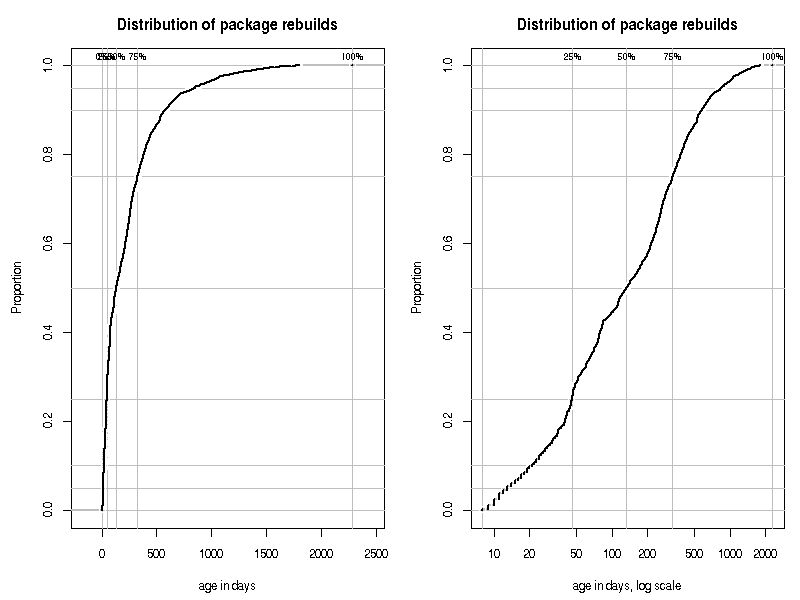
Via the Planet Debian aggregator and his blog, Sven followed up on my post regarding Lucas' plot of the package age distribution. As some of my points didn't seem to make it across, I will reiterate them more plainly: Sven also addresses the fact that what we really want is to see the quantiles of the data set. Quite right, and taking logs makes that easier. Consider the two charts below which plot the 'package age in days' as an empirical cumulative distribution function using built-in R functions ecdf and plot.stepfun (rather than redoing it ad-hoc as I had done), and also add explicitly quantiles. The two charts use the exact same instructions; however the second chart transforms the x-axis to a logarithmic scale. Debian Package Age-since-recompile Distributions charted two ways While it is close to impossible to find the 25 or 50 percentile on the first chart, it becomes a lot easier on the second chart because the x-axis is 'stretched' using the log transform. About one quarters of the distribution appears to be rebuild within 1.5 months old, and about half is younger than four months (as a quick call to summary(pkgAge) confirms). Reading these proprtions off the original chart, or the non-log chart, is much more difficult.

2 July 2007

Sven Mueller: Improving graphs

In Improving simple charts, Dirk Eddelbuettel wrote a nice little summary how to produce “nicer” charts using R. However, in my opinion, the charts he provided as alternate options to the original, purely linear graph are less readable for the average person. If anything, using a logarithmic scale on the original Y axis (number of packages not built after a specific date) would be of use, but the other graphs only hide the original point of the post Dirk replied to (How old are our (Debian’s) packages?). The point was that 94% of all packages had been rebuilt since the release of Sarge or, if you want to put it the other way around, 1264 (6%) were built before Sarge was released. This relationship is hidden from immediate recognition by the reader of the graphs. I admit though, that Dirk’s second graph (Number of packages against age in days with the age being on y logarithmic scale) is also insightful. The other two graphs he presents might make sense in a scientific publication if some point in the “more detailed” areas of the graph needs proving, but for this specific problem, they really don’t make sense to me. Actually, I would question their use even in scientific publications, since they distort the original data a lot. Scientists are pretty much used to logarithmic scales these days, but I couldn’t work out how the scales work on those two graphs. And another note on the second graph (logarithmic age): The way the X axis is labeled (10, 20, 50, 100,..) is also pretty non-intuitive to me. I’m much more used to something like 5, 10, 20, 40, 80, 160 and so on, which gives the same distance between each label and seems a lot more usable to me.. (edit: Fix spelling of Dirk’s surname)

3 June 2007

Michael Prokop: Linuxdays in Vienna 2007: done

Linuxdays in vienna were fun (as usual). Lessons learnt: I was responsible for the booth of grml (Linux live-cd for sysadmins and texttool users) as well as for the ones of Debian and Debienna (Debian in vienna) - especially in the first two days, until Markus and Kira joined. Regarding the grml booth: It was once more amazing to see how many people already know and use grml. I had the pleasure to meet people from a professional data rescue organization who use grml in their daily business. Not to forget to mention all the people who let me know how often grml managed to save their lif^Wdata. Oh, and some nice ideas were brought to my attention and are now part of the todo list for grml. Very geeky was the 13 year old boy who visited our booth and when asking him whether he knows how to work on the console (he was staring at our grml-CDs with shining eyes) he replied: "YES, of couuuuurse!" 8-) I couldn’t resist in giving him a grml-CD. Oh, and we were running out of grml-CDs earlier than expected. Thanks to my girlfriend - who can even explain the difference between grml meilenschwein and grml64 to you now :-) - I had the chance to attend some few talks - besides my own one about grml of course. I once more didn’t manage it to take just a single picture :-( but I just received a pointer to the linuxdays photogallery of jostusz, thanks Sven.

31 May 2007

Christoph Berg: Sadness

Sven Luther, you suck. I desperately hope Debian will recover from these months. PS: Please go see a psychologist. Really.

29 May 2007

Alexander Schmehl: Donating blood

Sven Mueller wrote a nice blog about how important it is to donate blood. To cite him: Please donate blood if you can. If you are uncomfortable with the choice you made on your first donation, check out other options for donations. I agree wholeheartedly! I heard from a Lady, who can't donate blood herself, since she doesn't feel comfortable with it -- I can understand it, I hate needles and don't like to see my own blood neither. But she wants to help nonetheless, so she volunteered to help during blood drives: She sits by the people donating blood, talks to them, helps them walk around when they still feel dizzy, give out food and drinks, etc.

Ingo Juergensmann: Please stop it

I think everyone knows about the issues between Sven Luther and the d-i team. This is going on for about a year now and although I'm usually a supporter of Svenl here, I have to admit that I can't hear/read it anymore.
So, please stop it now. Everyone!

Svenl, you did a great job for the PPC port in Debian, but there's so much in life beside Debian! Enjoy it! You're wasting your time and life if you insist in being right. Maybe you're right, but I don't that this does matter. Take a time off from the project and have a nice time with our stuff! Been there, done that and found it worthwhile! :-)

All others: I think it would be better to not respond to every mail by Svenl, especially when you're opposing him. This will make it even worse for him and for everybody else, too, because the impression of being insulted will grow with every mail that tells him to shut up.

Every party involved in this dilemma does have valid points. For example I would like to see some sort of Code of Conduct or a Social Commitee or anything else that will prevent such incidents over and over again.
I think it's highly unprofessional how Sven was pushed out of the d-i team. Sure, everyone can disagree with anyone else, but I expect DDs to be professional enough to work together despite their personal dislikenings. OTOH, Svenl didn't earn glory insisting every now and then of being mistreated and being right.

So, can we now stop that neverending story, please?

Sven Mueller: blood donations

Hi. Recently, on planet.debian.org, there were quite a few posts relating to blood donations. I must say that I really only live thanks to people donating blood. As many might know, I had a freaking motorcycle accident about 9 years ago. Well, apart from loosing my right leg in the weeks following the accident (irreparable damages to tissues led to amputation), I also lost a lot of blood after the accident. In the six hours following the accident, I got no less than 65 blood infusions (approximately 24-30 litres or 6-8 US gallons). As you can imagine, this is about 3-4 times as much blood as my body normally carries around. At least I can say that I didn’t receive blood without giving some before, though certainly I wasn’t able to give that much blood (I donated about 10 times, approx. 0.45 litres each time). However, due to the medication I now need, I can’t donate blood anymore. Anyhow, I strongly suggest to anyone who is capable of donating blood to do so. And regarding Thijs comment about the frequency of donation and payment: This is highly depending on the area you live in and the organisation who manages the donations. For example, while I donated blood in Dortmund, Germany, I had two options to donate blood: German Red Cross, who would accept a donation every 6 weeks, with free sandwiches, drinks and chocolate but without payment and the city-owned hospital’s blood bank, which allowed a donation every 3 month, with free drinks and a 50DEM (approx. 25EUR/30USD) payment. This sounds as if the city-owned blood bank could attract homeless and junkies who were in for the money, but from my experience, the blood bank did far stricter pre-donation tests (I can’t tell what they did after donation for either organisation) than the red cross. And knowing how much money can be earned with the blood donated, I certainly think that payment is fair, though not strictly necessary. And the blood bank people did a much better job when applying the needle than the red cross people did, which might be because they were used to taking blood from people with bad veins (mostly patients donating blood for themselves for use in a later, planned surgery). But to be fair: I know from other people who had very good experiences with the red cross staff in this respect. Once again: Please donate blood if you can. If you are uncomfortable with the choice you made on your first donation, check out other options for donations. For example, if you almost collapsed when donating blood, try out the plasma donation if it is offered. They usually take the plasma, but give back an equal volume of a substitution, so your circulation isn’t disturbed as much as by taking approx. 0.5 litres from it within an hour. If you feel that the person who applied the needle did a bad job, ask for someone else next time or try a different organisation altogether. cu,
Sven

25 May 2007

David Welton: ShopList updates

I did some work on my mobile phone shopping list ShopList today. Thanks to a bug report from Sven Mueller, I think I managed to correct an encoding issue. If you use ShopList and enter non-ascii text into the shoplist web application, let me know if things are working for you. I also did some work on the back end to enable statistics, but only for users who are logged in to their accounts. Not surprisingly, the most common things people buy at the store are: Which probably hasn't changed in hundreds of years. Sort of reassuring, I guess?

18 April 2007

Jordi Mallach: Debian's GNOME 2.18: are we there yet?

The short answer is no, but as our status page easily reflects, there has been lots of work going on during the last two weeks, once etch's release unblocked the way to upload new versions to unstable. This post intends to resume the trend of updating on the status of GNOME in Debian, after we ended up deciding we'd ship etch with 2.14 for a number of reasons, most notably some complications with the GTK 2.10 transition at that time. You'll be able to find other related news items in Debian GNOME team's website. What has the Debian GNOME team up to during the last 6 months? Our first priority was to focus on unstable's GNOME 2.14 packages again, in an attempt to fix any outstanding remaining bugs from our packaging, and get them in the best shape possible to deliver a polished GNOME desktop for etch. I think the result is really good, and Debian's default GNOME desktop is both very usable and attractive. In parallel, the preparations for a complete set of GNOME 2.16 packages continued in our Subversion repository and kept appearing, little by little, in experimental. The most visible consequence of our 2.16 efforts translated into nobse's backport of 2.16 for etch, which can be found in the corresponding repository. And then, with etch deep frozen and nearly ready to be released, GNOME 2.18 was released, and of course the GNOME team didn't wait too much to start working on it. Our current status is looking good: the Developer Platform is already available in unstable, although buildd's are fighting the builds on various architectures. When the dust settles (GTK 2.10's landing has generated quite a big cloud; we have a list of packages that still haven't completed the GTK+ 2.10 transition), we'll be able to prepare and upload the more complex Desktop components like the panel, nautilus, evolution or control-center. Unstable users should probably be seeing daily progress on this front, so keep an eye on your package managers! Although Debian 4.0 released with an old version of GNOME, vast amounts of time and work have been invested to release it with the necessary backported fixes and enhancements. The newer GNOME versions have been available in Debian official ftp archives in very reasonable timeframes; this has only been possible thanks to the restless efforts of the (fortunately) growing Debian GNOME team members: giskard, feedback, HE, lool, np237, slomo, shaka, sjoerd, xaiki and not forgetting our incredible bug triager, svena. Thanks! On the behind the scenes department, it's a pleasure to report that Lo c Minier and Jordi Mallach very recently joined the GNOME Foundation's board of advisors in representation of the Debian Project, replacing Matthew Garrett, who has been representing us for the last few years until he left the project. Thanks, Matthew!

17 April 2007

Gunnar Wolf: Init-related ideas BoF submitted for Debcamp

Ok, so it just seems like a hot topic - I just submitted a BoF for Debcamp to talk about the init-related ideas we've been discussing. As Debconf's Pentabarf conference management system does not like disclosing talk details before the talks are accepted, I'll reproduce here my short blurb:
This BoF comes out from several ideas posted in Planet Debian by Erich Schubert, Sven M ller, Joachim Breitner, Mike Homey and myself (so far). It's not to be "chaired" by any of us particularly, but I expect an interesting brainstorming session.
There are several different init systems present in Debian - However, we are only supporting currently one of them, good ol' sysv-rc - We have close to a thousand packages providing init scripts suitable for it, and close to none for all of the other systems.
In current systems, full of hot-pluggable devices, changing network configurations and so on, however, I think this situation is quite prone to change - sysv-rc and its runlevels are better suited for stable server-like systems, and is hard to adapt for future needs.
We will talk about the potential difficulties Debian will face in order to better support more init schemes, and discuss some ideas to solve them.
This should be a brainstorming session, not much material will be prepared (maybe some sketches by each of us, but nothing formal). If you plan on attending, take a look at the messages linked to in the 'links' section.
Note that, following Nomeata's suggestion, I'm presenting this for Debcamp - If you are not attending Debcamp and are interested, we will try to set this up via some sort of videoconferencing (or at least the usual video feed + IRC feedback), and I do hope we can have something showable (at least a broken concept) after Debconf.
In not-so-closely-related topics, I just learnt there is a shadow of doubt regarding my presence in Edinburgh - I will do my best to dispell the threat. I just don't want to miss a Debconf!

Sven Mueller: init script generators

Gunnar is following up on the init script blog posts by Erich and me. First a note to Gunnar: The idea of the init scrip snippets isn’t exactly my own idea, but rather taken from a comment to one of Erich’s posts (IIRC), I don’t know the original author anymore. Anyway, I really think that some init script generator should work. It should even be possible to fetch variables from /etc/default/<daemon-name> if needed. I’m just doing a braindump of what I have in mind for the start and stop of a daemon. I would expect a configuration file (currently I think one for each operation might be best, but INI-lookalike files might also be OK). So for the start operation, I would expect these options:
  1. simple daemon, uses a default config with a hardcoded path and needs no options or only static options passed:
    [SIMPLE]
    /path/to/daemon
    option 1
    option 2
    option 3
    
    Where I chose to name one option per line so whitespace and controll characters can be part of the options without the need to quote anything.
  2. a bit more complicated, needs a few variables from /etc/default/daemon:
    [TEMPLATED]
    /path/to/daemon
    option 1
    %PARAMETER_FROM_ETC_DEFAULT%
    --parameter=%ANOTHER_ONE_FROM_ETC_DEFAULT%
    
    Where the script generator would have to make sure that the parameters from /etc/default are filled in at runtime. I would expect POSIX-Shell-Scripts in /etc/default for this.
  3. Really complex: A custom script snippet is needed which has to do some specificc tasks, like cleaning possible stable locks which had been left behind.
    [SCRIPT]
    rm /var/lock/daemon.lck
    /path/to/daemon --background --and --other --options
    
    Where the script generator would simply take this script and use it where it would otherwise generate its own code.
As for stopping, I generally see only three options for the sysv-like background processes: Either a script is needed (see above for how that would look like) or a process needs to be killed according to a PID-file or the process name (with the later being rather bad). So this would result in:
  1. [SCRIPT] like for starting the daemon
  2. killing by PID-file:
    [PIDFILE]
    /path/to/pid-file
    
  3. killing by process name/executable:
    [PROCESS]
    binary
    
    or
    [PROCESS]
    /path/to/binary
    
    where the generator would either only look at the name of the process (first version, no full pathname) or for a process with the given executable (from /proc/ /exec, I would expect).
Alright, this would leave the cases of running (instead of backgrounding) the server and stopping such a running server (the later should be fairly simple unless the stopping of the server requires additional actions other than simply killing it) as well as the reload/restart/status stuff. But these should also be relatively simple actually. What would be interesting for me:
Does any init system require information that is not part of the following list? I would plan with supplying information how to: Finally, even with all that information available inside a Debian package, this would still leave one question unanswered: Who triggers init script generation? If a daemon package does so in postinst: How do I switch to a different init system? If the init system does it in postinst: What happens to additional daemons installed later on? If they get regenerated during system start: How much penalty does that cause? Currently I think the route to go is to provide a command to daemon packages’ postinst that (re)generates only the needed scripts for that package and have a command used in an init system’s postinst which regenerates all of them. That should do. Regenerating during boot would most likely take too much time and has other problems, too, like the availability of a writeable filesystem to store the generated scripts.
Alright, if someone would like to see this post (or rather parts of it) on the Wiki page about an Init HackFest, please transfer it there yourself. I’m currently not able to log in, for whatever reason.

Gunnar Wolf: Init followup

First of all, sorry for the delay. Leaving just as the discussion gets started is bad, yes... But I'm only now reading Erich's and Sven's follow-ups. Both (as well as some comments in my blog) ask why not integrating the startup links in each of the packages - Well, basically because I don't think that most maintainers will take care to do this, and we will end up having a situation very close to what we have today: If I'm not interested in supporting your favorite init system in my packages, I just won't bother to make the scripts.
Note: I'm going into braindump mode. Verbose blabber and some stupidity might follow ;-)
Think on the webapp scene - Most webapps ship with an Apache-like snippet so that http://yourserver/thisapp just works(tm). I love that, and it's one of the little details that make Debian shine - Things usually work with the least administrator burden possible. But it happens that there are other web servers around there - They just become somehow second class citizens (I happen to sponsor/comaintain Cherokee, for instance), as nobody cares to include the equivalent snippets for them. Apache is the standard, and is good enough.
The same goes for sysv-rc: It just rules the world. Who will work all the needed patches to support all the different init systems? As the maintainer for a simple package which requires to be started up, I probably won't care to even understand all the intimacies of every init system, at least until they all have a decent user base. But by having one package per (server,init-scheme) pair, any maintainer can come up with the needed initialization.
Of course, this degrades quickly. First of all, as a user: if mydaemon is not correctly starting up, I will probably file bugs at mydaemon, not at mydaemon-initscheme. If mydaemon changes its parameters, we will witness transition of mydaemon-*.
Further, remember this is Debian, and volunteer-work has its downsides. If the mydaemon maintainer is a primadonna (or just does not give a flying crap about the runit init scheme), he will just trash reports regarding a nonimportant init scheme. Bad. And, as Erich points out, we have ~1000 packages including /etc/init.d/something - It will mean 3000 or so packages for a decent (not complete!) coverage of the different schemes. And, of course, a very uncoordinated way of working. But back to my line of thought: If I'm promoting an init scheme, I cannot just push it down each maintainer's throat. I must include at least the most important init scripts somewhere. Maybe we could just group daemons by task, and then have -say- a webservers-runit package providing the init scripts for each webserver for runit? This could cut down from 3000 to some 100 packages, most probably team-maintained... But it still faces many scalability problems, and the bug-filled-somewhere-else problem seems unavoidable.
I think something interesting could come off Sven's idea of providing several independent scripts instead of today's complete init scripts - This would make it easier to adapt startup/shutdown and similar events to different world views, and if not specifically needed, most init scripts could even be autogenerated calling the right bits here and there. That would rock - except in the corner cases (I predict no less than 10% of the packages will become corner cases ;-) ) where it will crumble apart. But maybe if a package declares it should be autostarted and provides the separate bits, the sysv-rc, upstart or runit helper can come up with an autobuilt initscript (or equivalent) - And if it does not work, it can always be overriden by a maintainer- (or user-) supplied, explicitly built script. Humh...
The topic surely calls for a Debcamp session, as Joachim says in comments in two of our posts and Erich acknowledges. Erich, as the main instigator of this blog series, I hope you can at least join via Ekiga or such, as it can be quite interesting - But, yes, none of the people involved so far participates in any of the inits' maintenance... Anyway, please keep the ideas flowing. I want to sketch something up, as I feel this can be useful - and not only for initscripts, but for many of the areas where Debian provides several ways to do the same thing. And, once again, that's one of the best points of Debian for me.
13 April 2007

Sven Mueller: Init HackFest / New init systems in Debian

In his “Init followup” post, Erich posted a reference to his Debian-Wiki post about a proposed Debian HackFest after Etch was released (which would be about 5 days ago<smile />). Anyway, since that page at the wiki is protected, which means I can’t edit it, I’m posting my thoughts here. I agree with Erich and some other commentors at Gunnar Wolf’s blog post that it doesn’t make sense to add X init-script-only-packages for any daemon to support X init systems. Instead, each package containing one or more daemons should contain the meta information needed to create all init scripts. Basically, this would probably include script snippets which do the following operations: Additionally, some control information would be needed including, but probably not limited to: The script snippets listed above should allow basically any operation on a daemon, including the force-reload and try-restart commands not yet implemented by all current sysv-initscripts.

16 March 2007

Sven Mueller: 40% nerdy?

Hmm, following up to a post by MJ Ray, I found out that I’m 40% nerdy:

You Are 40% Nerdy

You’re a little nerdy, but no one would ever call you a nerd. You sometimes get into nerdy things, but only after they’ve become a part of mainstream culture.
How Nerdy Are You?

13 March 2007

Sven Mueller: Wishlist for lenny or why debian packaging is considered hard

Eddy, while I agree that ebuilds look a lot cleaner, shorter or easier than typical debian/rules + debian/control, you should consider a few things: So all in all, I’m quite certain that the amount of learning needed to create a correct ebuild is lower than that needed to create a Debian source package, but I don’t think that packaging for Debian is hard either. And finally, Erich is quite right that a central repository for all Debian packaging scripts would be a nice thing. However it would be quite hard to determine the right VCS to use for that. Most de-central VCSes I glanced over need manual intervention on the “server” side to include patches from local developer branches. And of course there is the problem of several packages having a non-clean upstream tarball they need to repack for each release as well as several packages having a tarball which includes more than one single upstream tarball. You would need to find a way to handle those as well.

MJ Ray: Debian: DPL Debate (3)

I hopped onto IRC and put most of the debate questions to Gustavo Franco (stratus). You can read it next to the others - SynrG and pusling tried to help recreate the cage fight, but I think we're just too tame. There's also this linux.com article where Steve McIntyre and Anthony Towns don't answer questions and it seems the reporters didn't notice Sven Luther's withdrawal.

12 March 2007

Wouter Verhelst: The DPL race

The previous DPL races which I actively followed consisted of hectic discussions on the debian-vote mailinglist, multiple parallel long threads full of questions and answers. Given that there were 9 candidates this year (of which only 8 are left now, after Sven Luther left the race, I expected to have to write an insane amount of time-sucking emails to that list, and had somewhat prepared for that eventuality. Strangely enough, though, that hasn't happened. Since the campaigning period will come to an end this sunday, that'll mean that either most developers are waiting 'till the last minute, or that there simply aren't that many questions this year. I'm really hoping for the latter... then again, I would prefer that people actually do ask questions -- the DPL is an important position in Debian, and people really should be informing themselves before voting.

Next.

Previous.