Search Results: "stone"

23 March 2017

Mike Hommey: Why is the git-cinnabar master branch slower to clone?

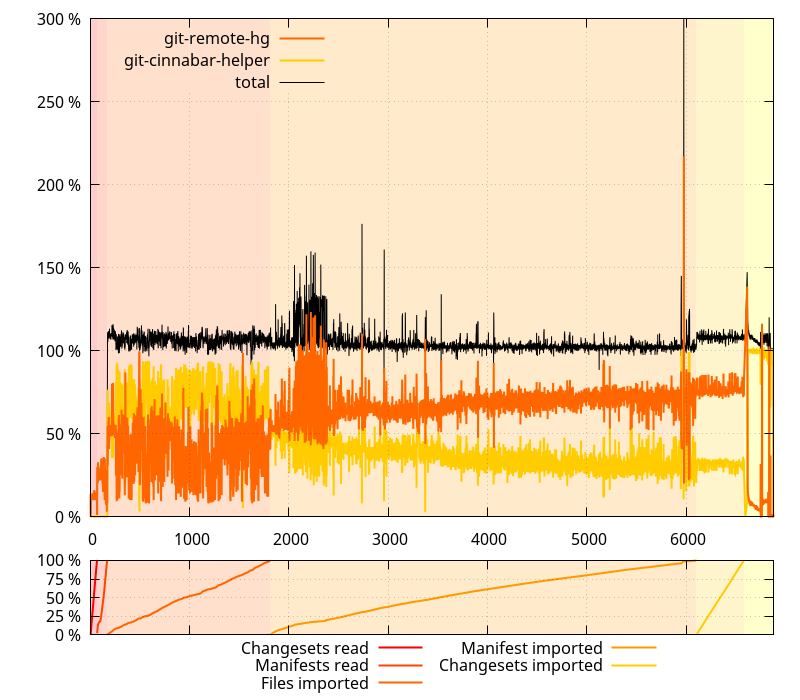
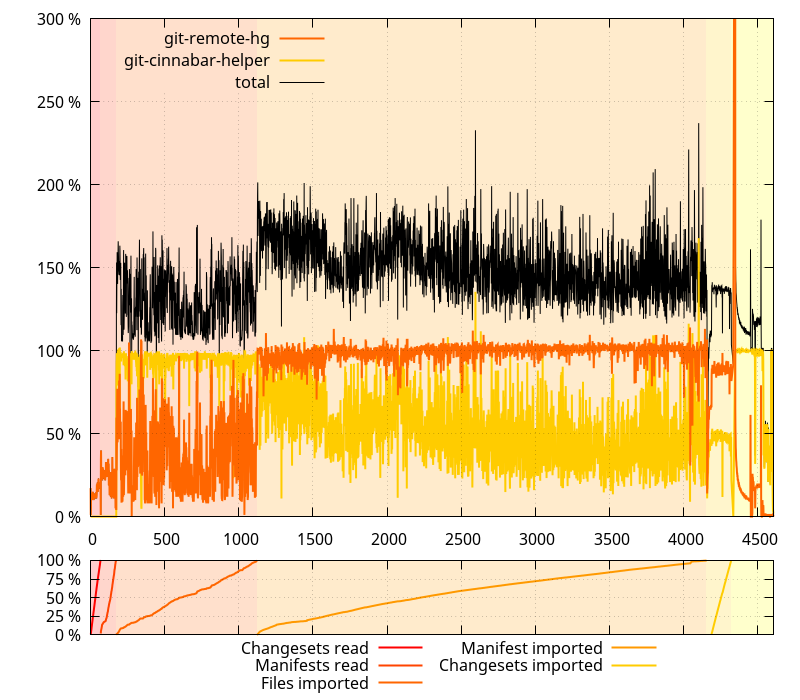
Apart from the memory considerations, one thing that the data presented in the When the memory allocator works against you post that I haven t touched in the followup posts is that there is a large difference in the time it takes to clone mozilla-central with git-cinnabar 0.4.0 vs. the master branch. One thing that was mentioned in the first followup is that reducing the amount of realloc and substring copies made the cloning more than 15 minutes faster on master. But the same code exists in 0.4.0, so this isn t part of the difference. So what s going on? Looking at the CPU usage during the clone is enlightening. On 0.4.0: On master: (Note: the data gathering is flawed in some ways, which explains why the git-remote-hg process goes above 100%, which is not possible for this python process. The data is however good enough for the high level analysis that follows, so I didn t bother to get something more acurate) On 0.4.0, the git-cinnabar-helper process was saturating one CPU core during the File import phase, and the git-remote-hg process was saturating one CPU core during the Manifest import phase. Overall, the sum of both processes usually used more than one and a half core. On master, however, the total of both processes barely uses more than one CPU core. What happened? This and that happened. Essentially, before those changes, git-remote-hg would send instructions to git-fast-import (technically, git-cinnabar-helper, but in this case it s only used as a wrapper for git-fast-import), and use marks to track the git objects that git-fast-import created. After those changes, git-remote-hg asks git-fast-import the git object SHA1 of objects it just asked to be created. In other words, those changes replaced something asynchronous with something synchronous: while it used to be possible for git-remote-hg to work on the next file/manifest/changeset while git-fast-import was working on the previous one, it now waits. The changes helped simplify the python code, but made the overall clone process much slower. If I m not mistaken, the only real use for that information is for the mapping of mercurial to git SHA1s, which is actually rarely used during the clone, except at the end, when storing it. So what I m planning to do is to move that mapping to the git-cinnabar-helper process, which, incidentally, will kill not 2, but 3 birds with 1 stone: So expect git-cinnabar 0.5 to get moar faster, and to use moar less memory.
19 March 2017

Petter Reinholdtsen: Free software archive system Nikita now able to store documents

The Nikita Noark 5 core project is implementing the Norwegian standard for keeping an electronic archive of government documents. The Noark 5 standard document the requirement for data systems used by the archives in the Norwegian government, and the Noark 5 web interface specification document a REST web service for storing, searching and retrieving documents and metadata in such archive. I've been involved in the project since a few weeks before Christmas, when the Norwegian Unix User Group announced it supported the project. I believe this is an important project, and hope it can make it possible for the government archives in the future to use free software to keep the archives we citizens depend on. But as I do not hold such archive myself, personally my first use case is to store and analyse public mail journal metadata published from the government. I find it useful to have a clear use case in mind when developing, to make sure the system scratches one of my itches. If you would like to help make sure there is a free software alternatives for the archives, please join our IRC channel (#nikita on irc.freenode.net) and the project mailing list. When I got involved, the web service could store metadata about documents. But a few weeks ago, a new milestone was reached when it became possible to store full text documents too. Yesterday, I completed an implementation of a command line tool archive-pdf to upload a PDF file to the archive using this API. The tool is very simple at the moment, and find existing fonds, series and files while asking the user to select which one to use if more than one exist. Once a file is identified, the PDF is associated with the file and uploaded, using the title extracted from the PDF itself. The process is fairly similar to visiting the archive, opening a cabinet, locating a file and storing a piece of paper in the archive. Here is a test run directly after populating the database with test data using our API tester:
~/src//noark5-tester$ ./archive-pdf mangelmelding/mangler.pdf
using arkiv: Title of the test fonds created 2017-03-18T23:49:32.103446
using arkivdel: Title of the test series created 2017-03-18T23:49:32.103446
 0 - Title of the test case file created 2017-03-18T23:49:32.103446
 1 - Title of the test file created 2017-03-18T23:49:32.103446
Select which mappe you want (or search term): 0
Uploading mangelmelding/mangler.pdf
  PDF title: Mangler i spesifikasjonsdokumentet for NOARK 5 Tjenestegrensesnitt
  File 2017/1: Title of the test case file created 2017-03-18T23:49:32.103446
~/src//noark5-tester$
You can see here how the fonds (arkiv) and serie (arkivdel) only had one option, while the user need to choose which file (mappe) to use among the two created by the API tester. The archive-pdf tool can be found in the git repository for the API tester. In the project, I have been mostly working on the API tester so far, while getting to know the code base. The API tester currently use the HATEOAS links to traverse the entire exposed service API and verify that the exposed operations and objects match the specification, as well as trying to create objects holding metadata and uploading a simple XML file to store. The tester has proved very useful for finding flaws in our implementation, as well as flaws in the reference site and the specification. The test document I uploaded is a summary of all the specification defects we have collected so far while implementing the web service. There are several unclear and conflicting parts of the specification, and we have started writing down the questions we get from implementing it. We use a format inspired by how The Austin Group collect defect reports for the POSIX standard with their instructions for the MANTIS defect tracker system, in lack of an official way to structure defect reports for Noark 5 (our first submitted defect report was a request for a procedure for submitting defect reports :). The Nikita project is implemented using Java and Spring, and is fairly easy to get up and running using Docker containers for those that want to test the current code base. The API tester is implemented in Python.

12 March 2017

Iustin Pop: A recipe for success

It is said that with age comes wisdom. I would be happy for that to be true, because today I must have been very very young then. For example, if you want to make a long bike ride in order to hit some milestone, like your first metric century, it is not indicated to follow ANY of the following points: For bonus points, if you somehow manage to reach the third peak in the above ride, and have mostly only flat/down to the destination, do the following: be so glad you're done with climbing, that you don't pay attention to the map and start a wrong descent, on a busy narrow road, so that you can't stop immediately as you realise you've lost the track; it will cost you only an extra ~80 meters of height towards the end of the ride. Which are pretty cheap, since all the food is gone and the water almost as well, so the backpack is light. Right. However, if you do follow all the above, you're rewarded with a most wonderful thing for the second half of the ride: your will receive a +5 boost on your concentration skill. You will be able to focus on, and think about a single thing for hours at a time, examining it (well, its contents) in minute detail. Plus, when you get home and open that thing I mean, of course, the FRIDGE with all the wonderful FOOD it contains everything will taste MAGICAL! You can now recoup the roughly 1500 calories deficit on the ride, and finally no longer feel SO HUNGRY. That's all. Strava said "EXTREME" suffer score, albeit less than 20% points in the red, which means I was just slugging through the ride (total time confirms it), like a very very very old man. But definitely not a wise one.

3 March 2017

Michal Čihař: Weblate 2.12

Weblate 2.12 has been released today, few days behind schedule. It brings improved screenshots management, better search and replace features or improved import. Many of the new features were already announced in previous post, where you can find more details about them. Full list of changes: If you are upgrading from older version, please follow our upgrading instructions. You can find more information about Weblate on https://weblate.org, the code is hosted on Github. If you are curious how it looks, you can try it out on demo server. You can login there with demo account using demo password or register your own user. Weblate is also being used on https://hosted.weblate.org/ as official translating service for phpMyAdmin, OsmAnd, Aptoide, FreedomBox, Weblate itself and many other projects. Should you be looking for hosting of translations for your project, I'm happy to host them for you or help with setting it up on your infrastructure. Further development of Weblate would not be possible without people providing donations, thanks to everybody who have helped so far! The roadmap for next release is just being prepared, you can influence this by expressing support for individual issues either by comments or by providing bounty for them.

Filed under: Debian English phpMyAdmin SUSE Weblate 0 comments

25 February 2017

Martin Pitt: systemd 233 about to be released, please help testing

systemd 233 is scheduled to be released next week, and there is only a handful of small issues left. As usual there are tons of improvements and fixes, but the most intrusive one probably is another attempt to move from legacy cgroup v1 to a hybrid setup where the new unified (cgroup v2) hierarchy is mounted at /sys/fs/cgroup/unified/ and the legacy one stays at /sys/fs/cgroup/ as usual. This should provide an easier path for software like Docker or LXC to migrate to the unified hiearchy, but even that hybrid mode broke some bits. While systemd 233 will not make it into Debian stretch or Ubuntu zesty, as both are in feature freeze, it will soon be available in Debian experimental, and in the next Ubuntu release after 17.04 gets released. Thus now is another good time to give this some thorough testing! To help with this, please give the PPA with builds from upstream master a spin. In addition to the usual packages for Ubuntu 16.10 I also uploaded a build for Ubuntu zesty, and a build for Debian stretch (aka testing) which also works on Debian sid. You can use that URL as an apt source:
deb [trusted=yes] https://people.debian.org/~mpitt/tmp/systemd-master-20170225/ /
These packages pass our autopkgtests and I tested them manually too. LXC and LXD work fine, docker.io/runc needs a fix which I uploaded to Ubuntu zesty. (It s not yet available in Debian, sorry.) Please file reports about regressions on GitHub, but please also le me know about successes on my Google+ page so that we can get some idea about how many people tested this. Thank you, and happy booting!

17 February 2017

Michal Čihař: What's coming in Weblate 2.12

Weblate should be released by end of February, so it's now pretty much clear what will be there. So let's look at some of the upcoming features. There were many improvements in search related features. They got performance improvements (this is especially noticeable on site wide search). Additionally you can search for strings within translation project. On related topic, search and replace is now available for component or project wide operations, what can help you in case of massive renaming in your translations. We have worked on improving machine translations as well, this time we've added support for Yandex. In case you know some machine translation service which we do not yet support, please submit that to our issue tracker. Biggest improvement so far comes for visual context feature - it allows you to upload screenshots which are later shown to translators to give them better idea where and in which context the translation is used. So far you had to manually upload screenshot for every source string, what was far from being easy to use. With Weblate 2.12 (and this is already available on Hosted Weblate right now) the screenshots management got way better. There is now separate interface to manage screenshots (see screenshots for Weblate as an example), you can assign every screenshot to multiple source strings, however you can also let Weblate automatically recognize texts on the screenshots using OCR and suggest strings to assign. This can save you quite a lot of effort, especially with screenshots with lot of strings. This feature is still in early phase, so the suggestions are not always 100% matching, but we're working to improve it further. There will be some more features as well, you can look at our 2.12 milestone at GitHub to follow the process.

Filed under: Debian English SUSE Weblate 0 comments

6 February 2017

Wouter Verhelst: FOSDEM 2017 is finished...

... but that doesn't mean the work is over. One big job that needs to happen after the conference is to review and release the video recordings that were made. With several hundreds of videos to be checked and only a handful of people with the ability to do so, review was a massive job that for the past three editions took several months; e.g., in 2016 the last video work was done in July, when the preparation of the 2017 edition had already started. Obviously this is suboptimal, and therefore another solution was required. After working on it for quite a while (in my spare time), I came up with SReview, a video review and transcoding system written in Perl. An obvious question that could be asked is why I wrote yet another system, though, and did not use something that already existed. The short answer to that is "because what's there did not exactly do what I wanted to". The somewhat longer answer also involves the fact that I felt like writing something from scratch. The full story, however, is this: there isn't very much out there, and what does exist is flawed in some ways. I am aware of three other review systems that are or were used by other conferences:
  1. A bunch of shell scripts that were written by the DebConf video team and hooked into the penta database. Nobody but DebConf ever used it. It allowed review via an NFS share and a webinterface, and required people to watch .dv files directly from the filesystem in a media player. For this and other reasons, it could only ever be used from the conference itself. If nothing else, that final limitation made it impossible for FOSDEM to use it, but even if that wasn't the case it was still too basic to ever be useful for a conference the size of FOSDEM.
  2. A review system used by the CCC "voc" team. I've never actually seen it in use, but I've heard people describe it. It involves a complicated setup of Samba servers, short MPEG transport stream segments, a FUSE filesystem, and kdenlive, which took someone several days to set up as an experiment back at DebConf15. Critically, important parts of it are also not licensed as free software, which to me rules it out for a tool in support of FOSDEM. Even if that wasn't the case, however, I'm still not sure it would be ideal; this system requires intimate knowledge of how it works from its user, which makes it harder for us to crowdsource the review to the speaker, as I had planned to.
  3. Veyepar. This one gets many things right, and we used it for video review at DebConf from DebConf14 onwards, as well as FOSDEM 2014 (but not 2015 or 2016). Unfortunately, it also gets many things wrong. Most of these can be traced back to the fact that Carl, as he freely admits, is not a programmer; he's more of a sysadmin type who also manages to cobble together a few scripts now and then. Some of the things it gets wrong are minor issues that would theoretically be fixable with a minimal amount of effort; others would be more involved. It is also severely underdocumented, and so as a result it is rather tedious for someone not very familiar with the system to be able to use it. On a more personal note, veyepar is also written in the wrong language, so while I might have spent some time improving it, I ended up starting from scratch.
Something all these systems have in common is that they try to avoid postprocessing as much as possible. This only makes sense; if you have to deal with loads and loads of video recordings, having to do too much postprocessing only ensures that it won't get done... Despite the issues that I have with it, I still think that veyepar is a great system, and am not ashamed to say that SReview borrows many ideas and concepts from it. However, it does things differently in some areas, too:
  1. A major focus has been on making the review form be as easy to use as possible. While there is still room for improvement (and help would certainly be welcome in that area from someone with more experience in UI design than me), I think the SReview review form is much easier to use than the veyepar one (which has so many options that it's pretty hard to understand sometimes).
  2. SReview assumes that as soon as there are recordings in a given room sufficient to fill all the time that a particular event in that room was scheduled for, the whole event is available. It will then generate a first rough cut, and send a notification to the speaker in question, as well as the people who organized the devroom. The reviewer will then almost certainly be required to request a second (and possibly third or fourth) cut, but I think the advantage of that is that it makes the review workflow be more intuitive and easier to understand.
  3. Where veyepar requires one or more instances of per-state scripts to be running (which will then each be polling the database and just start a transcode or cut or whatever script as needed), SReview uses a single "dispatch" script, which needs to be run once for the whole system (if using an external scheduler) or once per core that may be used (if not using an external scheduler), and which does all the database polling required. The use of an external scheduler seemed more appropriate, given that things like gridengine exist; gridengine is a job scheduler which allows one to submit a job to be ran on any node in a cluster, along with the resources that this particular job requires, and which will then either find an appropriate node to run the job on, or will put the job in a "pending" state until the required resources can be found. This allows me to more easily add extra encoding capacity when required, and allows me to also do things like allocate less resources to a particular part of the whole system, even while jobs are already running, without necessarily needing to abort jobs that might be using those resources.
The system seems to be working fine, although there's certainly still room for improvement. I'm thinking of using it for DebConf17 too, and will therefore probably work on improving it during DebCamp. Additionally, the experience of using it for FOSDEM 2017 has given me ideas of where to improve it further, so it can be used more easily by different parties, too. Some of these have been filed as issues against a "1.0" milestone on github, but others are only newly formed in my gray matter and will need some thinking through before they can be properly implemented. Certainly, it looks like this will be something that'll give me quite some fun developing further. In the mean time, if you're interested in the state of a particular video of FOSDEM 2017, have a look at the video overview page, which lists all talks along with their review/transcode status. Also, if you were a speaker or devroom organizer at FOSDEM 2017, please check your mailbox and review your talk! With your help, we should hopefully be able to release all our videos by the end of the week. Update (2017-02-06 17:18): clarified my position on the qualities of some of the other systems after feedback from people who were a bit disappointed by my description of them... and which was fair enough. Apologies. Update (2017-02-08 16:26): Fixes to the c3voc stuff after feedback from them.

5 February 2017

Iustin Pop: Short rant/review of La La Land

Warning: Spoilers below. Rant below. Much angry, MANY ALL-CAPS. You've been warned! So, today we went to see "La La Land", because I've heard good things about it, and because I do enjoy good musicals. And because of this, I wrote this post, instead of what I originally had in mind (related to kernel configuration). Was it a good movie? Definitely yes. Was it a good musical? So and so. Did I like the ending? HELL NO, over and over NO. The movie itself was much better than I expected. I don't read plot details in advance nor real reviews, so I expected more of a musical, and less of a good plot. But the movie had a very good plot. Two young people, striving to fulfil their artistic dreams, fall in love, and they fight through-sometimes helping, sometimes hindering each other until, finally, each gets their own breakthrough, etc. The choice of actress was spot on halfway through the movie, I was thinking that I can't imagine the same plot played by a different actress. Of course many other actresses could have played the part, but Emma Stone played so well, I have trouble seeing the same character with the same always half-happy, half-sad attitude. The choice of actor was I think OK at first I was in doubt, but he played also well. Or maybe it was just that I couldn't identify with him at first. Not that I identify well with artists in general The dance scenes were OK, and the singing good, but as I said, the musical part was secondary to the actual struggles of the characters. The movie itself was, technically, very well done; a lot of filming was in bars/clubs/locations with difficult lighting, and the shooting was very good. They also had a scene on a pier, looking towards the ocean and the setting sun, and the characters walking towards the beach so heavily back-lighted, and I kept thinking "If I get only one shot this perfectly exposed and colour correct(ed), I'm happy". So high notes here. Back to the plot. The story of how she and him fought their own struggles was very nicely told. Tick-tack, up and down (hope and rejection), leaning on the other to get morale back, is a captivating story. The cliff-hanger at the pre-end with her career, the going back home, the last minute save, all very well told. So at this stage, I would have given the movie a 9/10. And I was happy. Then we have the usual "one character has to go away to a far away country for a long time", except in this case it was just 4 months. And they have the usual discussion "what do we do with our relation, where do we take it", and she says "I will always love you", to which he replies "And I will too" (or equivalent). In my mind, this means they'll have to survive during the break, they'll have to also survive through his touring months/years, but in the end love will be stronger. Because this is what the movie told us until now, that she made it because of him, and he made it because of her. Neither of them would have been this strong without the other (he wouldn't have picked up the invitation from his old pal, she wouldn't have gone to the final audition request nor write the play which got her the audition/recognition). Estimated movie ending: awesome. And then something happens. The timeline jumps 5 years in the future (as expected), and she is famous, married (WITH SOMEONE ELSE) and happy mother of a 3-year old. Through fate, she and her husband enter the club of Sebastian (as he also fulfilled his dream), she and Sebastian see each other, he plays their song, during which we're served a re-run of the movie but in stupid "everything goes well" style (all bad events eliminated), in which it is she and Sebastian who enter the club (which belongs now to somebody else), and then we're back in real time, song ends, she and her husband leave, but before that she and Sebastian exchange one last smile, THE END. And I'm sitting there, not believing my eyes. WHAT THE? So I get home, not write this post for four hours to calm down, but I can't. Because this doesn't make sense. AT ALL. What does the internet say? Quoting from this CNN article, written exactly today. The director says:
"That ending was there from the get-go," [director Damien Chazelle] told CNN in a recent interview. "I think I just have a thing about love stories where the lovers don't wind up together at the end; I find it very romantic."
Huh, excuse me?
"I think there's a reason why most of the greatest love stories in history don't end with happily ever after," Chazelle said. "To me, if you're telling a story about love, love has to be bigger than the characters." Chazelle sees Mia and Sebastian's love as a "third character" and something that "lives on." "[The ending gives] you that sense that even if the relationship itself might be over in practical terms, the love is not over," he said. "The love lasts, and I think that's just a beautiful kind of thing."
OH FOR THE LOVE OF. This is a wishy-washy explanation that tries to approach the thing from the artistic side. No, this is bullshit, because of multiple things. Let me try to roll back and explain what I think was the intention.
  1. An earlier fight between Mia and Sebastian points to the fact that they're both very dedicated to their careers, and this means it's hard for them to stay together if they both chase their dream. He has to be on tour, and she has to rehearse for her play, so they won't see each other for at least two weeks (in this instance). Later, she calls him and leaves a message that she hasn't seen him in a while (complex scene which ends in another fight, which is very well done). So we see the conflict that seems to say "You can't have a relation of equals; one party has to give up their dream". While this might be partially true in the real world, I don't go to movies to see the real world.
  2. After the year-long window into their life, I can't think that either Sebastian or Mia can be really successful without the other; because they are so alike, so passionate about their dreams, that a normal person wouldn't be able to understand and push the other when they need. However, the ending show both Mia and Sebastian quite successful, so one has to wonder: did they make it alone? Sebastian seems so (we don't see a partner for him), Mia unclear, likely not. How did Sebastian get through? What did Mia find in her husband?
  3. This is very one-sided, since I'm a man, so bear with me: Sebastian helped Mia through her tough time. Once she got the breakthrough (and they split), she found somebody else, and I have to wonder in what circumstances they met. In the sense that maybe her husband only knew "successful Mia" and not "struggling/aspiring Mia". Her husband seems completely oblivious to all the eye contact between Mia and Sebastian in the club, seems to know Sebastian/about Sebastian not. How deep is their relation?
  4. This is still one sided, sorry. When they break up (before Mia leaves for Paris), Sebastian asks "so where do we go from here?". Mia says "Nowhere". He asks once more, she rejects him again. So after one year of mad love and cries and happy moments, he gives up over two sentences? He's been following his dream (proper Jazz) in spite of all downturns in life until then, but he gives up on his real love over this? It doesn't make sense; trying to identify my self with the character, I can't reconcile this scene at all, unless he didn't really love her.
So no, I don't see them ending apart as romantic. I see it as the director is saying "You can't have both love and your [career] dreams. Choose either.", and he gives the "love" fake ending in the mini-re-roll of the movie, and the "career" wrong ending in the actual ending. And worse, he does it by negating significant parts of the character development done until now. Moreover, this conclusion is wrong. Wrong because this is a movie, and if movies don't manage to make you dream that you can achieve all, if movies tell you "choose either", then all is lost. Their love is not a separate character; them struggling to find each other in the successful phase of their life, learning to adapt to the new "he" and "she", would be the third thing. As it was shown, their love is simply a young love, that can't really survive the changes in life; they each said "I'll love you forever", but with this ending it sounds more "I'll cherish the memory of young you forever". Or differently said, it sounded like a cheap excuse to use when ending their relationship, in order to not negate the relationship itself. My version of the movie is another half hour long. It explains how Sebastian get over the "only jazz is pure old jazz" and manages to build a successful business around his old-style-but-modern jazz, instead of the pop-style jazz of the touring band (while thinking about her). It explains how Mia becomes a successful actress and gets over her first/second movies (while thinking about him), because one movie doesn't make one really successful (that reminds me: 3 year old child after 5 year forward-jump? when/how did her career go?). Hell, make it even more bitter show how their correspondence starts strong but becomes more and more sporadic over time, dying after the first 2 years. Show how both of them try other relations, and not find the same spark that they had before. And then, after they have matured, they meet again. And, just like the first time, they fall for each other, once again. She for his music, him for her passion for acting/for acting itself. She finds that him naming his club after her suggestion is oh-so-grown-up-and-sweet, he is happy that she finally grew into what he saw in her from the beginning. And he sings their song once more. But no. I'm not an artist, so I can only get the "die hope die die die love because I can" version. I still recommend the movie, but not the "after 5 years" scenes. Also, I didn't get time to bike today nor yesterday, so all you really get here is an ANGRY RANT. Because while I drink the coffee black and the tea without sugar, I like my happy endings, DAMN IT.

2 February 2017

Paul Wise: FLOSS Activities January 2017

Changes

Issues

Review

Administration
  • Debian: reboot 1 non-responsive VM, redirect 2 users to support channels, redirect 1 contributor to xkb upstream, redirect 1 potential contributor, redirect 1 bug reporter to mirror team, ping 7 folks about restarting processes with upgraded libs, manually restart the sectracker process due to upgraded libs, restart the package tracker process due to upgraded libs, investigate failures connecting to the XMPP service, investigate /dev/shm issue on abel.d.o, clean up after rename of the fedmsg group.
  • Debian mentors: lintian/security updates & reboot
  • Debian packages: deploy 2 contributions to the live server
  • Debian wiki: unblacklist 1 IP address, whitelist 10 email addresses, disable 18 accounts with bouncing email, update email for 2 accounts with bouncing email, reported 1 Debian member as MIA, redirect 1 user to support channels, add 4 domains to the whitelist.
  • Reproducible builds: rescheduled Debian pyxplot:amd64/unstable for themill.
  • Openmoko: security updates & reboots.

Debian derivatives
  • Send the annual activity ping mail.
  • Happy new year messages on IRC, forward to the list.
  • Note that SerbianLinux does not provide source packages.
  • Expand URL shortener on SerbianLinux page.
  • Invite PelicanHPC, Netrunner, DietPi, Hamara Linux (on IRC), BitKey to the census.
  • Add research publications link to the census template
  • Fix Symbiosis sources.list
  • Enquired about SalentOS downtime
  • Fixed and removed some 404 BlankOn links (blog, English homepage)
  • Fixed changes to AstraLinux sources.list
  • Welcome Netrunner to the census

Sponsors I renewed my support of Software Freedom Conservancy. The openchange 1:2.2-6+deb8u1 upload was sponsored by my employer. All other work was done on a volunteer basis.

1 February 2017

Antoine Beaupr : My free software activities, January 2017

manpages.debian.org launched The debmans package I had so lovingly worked on last month is now officially abandoned. It turns out that another developer, Michael Stapelberg wrote his own implementation from scratch, called debiman. Both software share a similar design: they are both static site generators that parse an existing archive and call another tool to convert manpages into HTML. We even both settled on the same converter (mdoc). But while I wrote debmans in Python, debiman is written in Go. debiman also seems much faster, being written with concurrency in mind from the start. Finally, debiman is more feature complete: it properly deals with conflicting packages, localization and all sorts redirections. Heck, it even has a pretty logo, how can I compete? While debmans was written first and was in the process of being deployed, I had to give it up. It was a frustrating experience because I felt I wasted a lot of time working on software that ended up being discarded, especially because I put so much work on it, creating extensive documentation, an almost complete test suite and even filing a detailed core infrastructure best practices report In the end, I think that was the right choice: debiman seemed clearly superior and the best tool should win. Plus, it meant less work for me: Michael and Javier (the previous manpages.debian.org maintainer) did all the work of putting the site online. I also learned a lot about the CII best practices program, flask, click and, ultimately, the Go programming language itself, which I'll refer to as Golang for brievity. debiman definitely brought Golang into the spotlight for me. I had looked at Go before, but it seemed to be yet another language. But seeing Michael beat me to rebuilding the service really made me look at it again more seriously. While I really appreciate Python and I will probably still use it as my language of choice for GUI work and smaller scripts, but for daemons, network programs and servers, I will seriously consider Golang in the future. The site is now online at https://manpages.debian.org/. I even got credited in the about page which makes up for the disappointment.

Wallabako downloads Wallabag articles on my Kobo e-reader This obviously brings me to the latest project I worked on, Wallabako, my first Golang program ever. Wallabako is basically a client for the Wallabag application, which is a free software "read it later" service, an alternative to the likes of Pocket, Pinboard or Evernote. Back in April, I had looked downloading my "unread articles" into my new ebook reader, going through convoluted ways like implementing OPDS support into Wallabag, which turned out to be too difficult. Instead, I used this as an opportunity to learn Golang. After reading the quite readable golang specification over the weekend, I found the language to be quite elegant and simple, yet very powerful. Golang feels like C, but built with concurrency and memory (and to a certain extent, type) safety in mind, along with a novel approach to OO programming. The fact that everything can be compiled in one neat little static binary was also a key feature in selecting golang for this project, as I do not have much control over the platform my E-Reader is running: it is a Linux machine running under the ARM architecture, but beyond that, there isn't much available. I couldn't afford to ship a Python interpreter in there and while there are solutions there like pyinstaller, I felt that it may be so easy to deploy on ARM. The borg team had trouble building a ARM binary, restoring to tricks like building on a Raspberry PI or inside an emulator. In comparison, the native go compiler supports cross-compilation out of the box through a simple environment variable. So far Wallabako works amazingly well: when I "bag" a new article in Wallabag, either from my phone or my web browser, it will show up on my ebook reader then next time I open the wifi. I still need to "tap" the screen to fake the insertion of the USB cable, but we're working on automating that. I also need to make the installation of the software much easier and improve the documentation, because so far it's unlikely that someone unfamiliar with Kobo hardware hacking will be able to install it.

Other work According to Github, I filed a bunch of bugs all over the place (25 issues in 16 repositories), sent patches everywhere (13 pull requests in 6 repositories), and tried to fix everythin (created 38 commits in 7 repositories). Note that excludes most of my work, which happens on Gitlab. January was still a very busy month, especially considering I had an accident which kept me mostly offline for about a week. Here are some details on specific projects.

Stressant and a new computer I revived the stressant project and got a new computer. This is be covered in a separate article.

Linkchecker forked After much discussions, it was decided to fork the linkchecker project, which now lives in its own organization. I still have to write community guidelines and figure out the best way to maintain a stable branch, but I am hopeful that the community will pick up the project as multiple people volunteer to co-maintain the project. There has already been pull requests and issues reported, so that's a good sign.

Feed2tweet refresh I re-rolled my pull requests to the feed2tweet project: last time they were closed before I had time to rebase them. The author was okay with me re-submitting them, but he hasn't commented, reviewed or merged the patches yet so I am worried they will be dropped again. At that point, I would more likely rewrite this from scratch than try to collaborate with someone that is clearly not interested in doing so...

Debian uploads

Debian Long Term Support (LTS) This is my 10th month working on Debian LTS, started by Raphael Hertzog at Freexian. I took two months off last summer, which means it's actually been a year of work on the LTS project. This month I worked on a few issues, but they were big issues, so they took a lot of time. I have done a lot of work trying to backport the heading sanitization patches for CVE-2016-8743. The full report explain all the gritty details, but I ran out of time and couldn't upload the final version either. The issue mostly affects Apache servers in proxy configurations so it's not so severe as to warrant an immediate upload anyways. A lot of my time was spent battling the tiff package. The report mentions fixes for 15 CVEs and I uploaded the result in the DLA-795-1 advisory. I also worked on a small update to graphics magic for CVE-2016-9830 that is still pending because the issue is minor and we're waiting for more to pile up. See the full report for details. Finally, there was a small discussion surrounding tools to use when building and testing update to LTS packages. The resulting conversation was interesting, but it showed that we have a big documentation problem in the Debian project. There are a lot of tools, and the documentation is old and distributed everywhere. Every time I want to contribute something to the documentation, I never know where to start or go. This is why I wrote a separate debian development guide instead of contributing to existing documentation...

31 January 2017

Michal Čihař: Weblate 2.11

Exactly on the schedule, Weblate 2.11 is out today. This release brings extended stats available to users and various other improvements and bug fixes. Full list of changes: If you are upgrading from older version, please follow our upgrading instructions. You can find more information about Weblate on https://weblate.org, the code is hosted on Github. If you are curious how it looks, you can try it out on demo server. You can login there with demo account using demo password or register your own user. Weblate is also being used on https://hosted.weblate.org/ as official translating service for phpMyAdmin, OsmAnd, Aptoide, FreedomBox, Weblate itself and many other projects. Should you be looking for hosting of translations for your project, I'm happy to host them for you or help with setting it up on your infrastructure. Further development of Weblate would not be possible without people providing donations, thanks to everybody who have helped so far! The roadmap for next release is just being prepared, you can influence this by expressing support for individual issues either by comments or by providing bounty for them.

Filed under: Debian English phpMyAdmin SUSE Weblate 0 comments

8 January 2017

Dirk Eddelbuettel: Rcpp now used by 900 CRAN packages

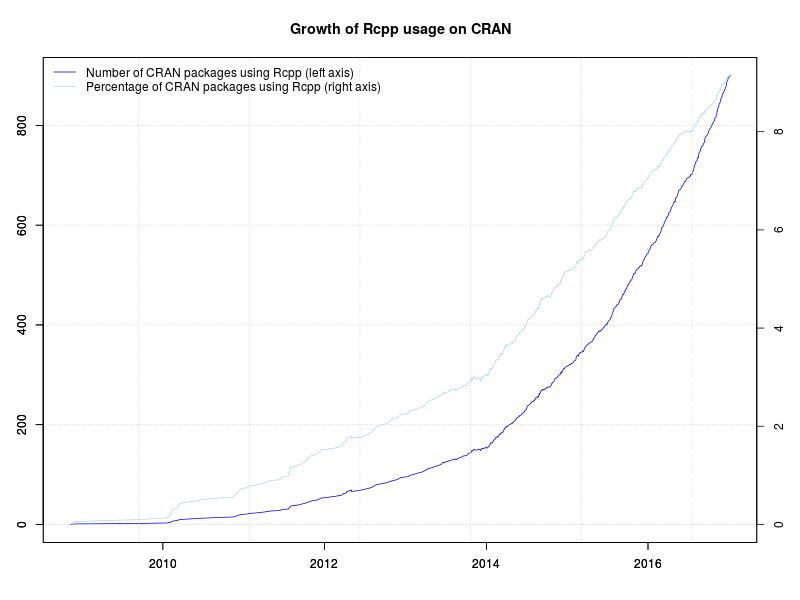
800 Rcpp packages Today, Rcpp passed another milestone as 900 packages on CRAN now depend on it (as measured by Depends, Imports and LinkingTo declarations). The graph is on the left depicts the growth of Rcpp usage over time. The easiest way to compute this is to use the reverse_dependencies_with_maintainers() function from a helper scripts file on CRAN. This still gets one or two false positives of packages declaring a dependency but not actually containing C++ code and the like. There is also a helper function revdep() in the devtools package but it includes Suggests: which does not firmly imply usage, and hence inflates the count. I have always opted for a tighter count with corrections. Rcpp cleared 300 packages in November 2014. It passed 400 packages in June 2015 (when I only tweeted about it), 500 packages in late October 2015, 600 packages last March, 700 packages last July and 800 packages last October. The chart extends to the very beginning via manually compiled data from CRANberries and checked with crandb. The next part uses manually saved entries. The core (and by far largest) part of the data set was generated semi-automatically via a short script appending updates to a small file-based backend. A list of packages using Rcpp is kept on this page. Also displayed in the graph is the relative proportion of CRAN packages using Rcpp. The four per-cent hurdle was cleared just before useR! 2014 where I showed a similar graph (as two distinct graphs) in my invited talk. We passed five percent in December of 2014, six percent July of last year, seven percent just before Christmas eight percent this summer, and nine percent mid-December. 900 user packages is a really large number. This puts more than some responsibility on us in the Rcpp team as we continue to keep Rcpp as performant and reliable as it has been. At the rate things are going, the big 1000 may be hit some time in April. And with that a very big Thank You! to all users and contributors of Rcpp for help, suggestions, bug reports, documentation or, of course, code.

This post by Dirk Eddelbuettel originated on his Thinking inside the box blog. Please report excessive re-aggregation in third-party for-profit settings.

2 January 2017

Ross Gammon: Happy New Year My Free Software activities in December 2016

So that was 2016! Here s a summary of what I got up to on my computer(s) in December, a check of how I went against my plan, and the TODO list for the next month or so. With a short holiday to Oslo, Christmas holidays, Christmas parties (at work and with Alexander at school, football etc.), travelling to Brussels with work, birthdays (Alexander & Antje), I missed a lot of deadlines, and failed to reach most of my Free Software goals (including my goals for new & updated packages in Debian Stretch the soft freeze is in a couple of days). To top it all off, I lost my grandmother at the ripe old age of 93. Rest in peace Nana. I wish I could have made it to the funeral, but it is sometimes tough living on the other side of the world to your family. Debian Ubuntu Other Plan status & update for next month Debian Before the 5th January 2017 Debian Stretch soft freeze I hope to: For the Debian Stretch release: Ubuntu Other

1 January 2017

Russ Allbery: 2016 Book Reading in Review

So, I did not accomplish my reading goal for 2016 (reading and reviewing more books in 2016 than I did in 2015). Many things contributed to that, but the root cause was that I didn't make enough time for reading. Much of the time that could have gone to reading went to playing Hearthstone (a good thing) and obsessing over the 2016 US election (mostly a waste of time and particularly energy, although I'm not sure I could have stopped). That said, I did get quite a lot of reading done at the end of the year, and I'm hoping to keep up that momentum for next year. In 2016, I did a lot of re-reading and comfort reading. I'm probably going to continue with some of the re-reading in 2017, since I'm enjoying it, but my reading goal for the year is to get back to reading award nominees and previous award winners. There's so much great new stuff being published that I want to discover. I'm not going to set an explicit goal around number of books, but I am going to make an effort to carve out more time in my schedule for reading books (and less for reading on-line news). This was another year with two 10 out of 10 books. One of them was a re-read: Lord of Emperors, the second book of Guy Gavriel Kay's Sarantine Mosaic. (I also re-read the first book this year, Sailing to Sarantium, and gave it a 9.) I like nearly all of Kay's historical fantasies, but this duology is one of my personal favorites. The second 10 out of 10 book was a complete surprise: A Man Called Ove by Fredrik Backman (translated by Henning Koch). My mother found this book and suggested it to me, and I loved every moment of it. I will definitely be reading more of Backman's work. There were two more fiction standouts this year: Digger by Ursula Vernon, and The Philosopher Kings by Jo Walton. The first is a graphic novel about a wombat who is trying to make her way home from an unexpected detour into a mess of magic and gods. The second is the middle book in a trilogy about an attempt to construct Plato's Just City and all of the philosophical and social problems that ensue (with some bonus science fiction and fantasy elements). Both of them are excellent. Walton is consistently one of my favorite authors, and Ursula Vernon was my great discovery of a new author to read this year. (Not that I've followed through on that much, the year in reading being what it was, but I will be doing so.) My favorite non-fiction book of the year continues my interest in time management in general and Mark Forster's approaches in particular. Secrets of Productive People was the last book I reviewed this year (just a coincidence, not any intentional attempt to set things up for next year) and the best version of his overall approach to date. If you've not read any of Forster based on my previous recommendations, this is a good place to start. Also worth mentions were Jeffrey Toobin's The Run of His Life, on the O.J. Simpson case, and Andrew Groen's The Empires of EVE, on the history of player empires in the EVE Online MMORPG. I Kickstarted the latter and didn't regret it. The full analysis includes some additional personal reading statistics, probably only of interest to me.

15 December 2016

Michal Čihař: Weblate 2.10

Quite on the schedule, Weblate 2.10 is out today. This release brings Git exporter module, improves support for machine translation services and adds various CSV exports and API interfaces. Full list of changes: If you are upgrading from older version, please follow our upgrading instructions. You can find more information about Weblate on https://weblate.org, the code is hosted on Github. If you are curious how it looks, you can try it out on demo server. You can login there with demo account using demo password or register your own user. Weblate is also being used on https://hosted.weblate.org/ as official translating service for phpMyAdmin, OsmAnd, Aptoide, FreedomBox, Weblate itself and many other projects. Should you be looking for hosting of translations for your project, I'm happy to host them for you or help with setting it up on your infrastructure. Further development of Weblate would not be possible without people providing donations, thanks to everybody who have helped so far! The roadmap for next release is just being prepared, you can influence this by expressing support for individual issues either by comments or by providing bounty for them.

Filed under: Debian English phpMyAdmin SUSE Weblate 0 comments

30 November 2016

Chris Lamb: Free software activities in November 2016

Here is my monthly update covering what I have been doing in the free software world (previous month):
Reproducible builds

Whilst anyone can inspect the source code of free software for malicious flaws, most software is distributed pre-compiled to end users. The motivation behind the Reproducible Builds effort is to permit verification that no flaws have been introduced either maliciously or accidentally during this compilation process by promising identical results are always generated from a given source, thus allowing multiple third-parties to come to a consensus on whether a build was compromised.

This month:

My work in the Reproducible Builds project was also covered in our weekly reports. (#80, #81, #82 #83.

Toolchain issues I submitted the following patches to fix reproducibility-related toolchain issues with Debian:

strip-nondeterminism

strip-nondeterminism is our tool to remove specific non-deterministic results from a completed build.


jenkins.debian.net

jenkins.debian.net runs our comprehensive testing framework.

  • buildinfo.debian.net has moved to SSL. (ac3b9e7)
  • Submit signing keys to keyservers after generation. (bdee6ff)
  • Various cosmetic changes, including
    • Prefer if X not in Y over if not X in Y. (bc23884)
    • No need for a dictionary; let's just use a set. (bf3fb6c)
    • Avoid DRY violation by using a for loop. (4125ec5)

I also submitted 9 patches to fix specific reproducibility issues in apktool, cairo-5c, lava-dispatcher, lava-server, node-rimraf, perlbrew, qsynth, tunnelx & zp.

Debian

Debian LTS This month I have been paid to work 11 hours on Debian Long Term Support (LTS). In that time I did the following:
  • "Frontdesk" duties, triaging CVEs, etc.
  • Issued DLA 697-1 for bsdiff fixing an arbitrary write vulnerability.
  • Issued DLA 705-1 for python-imaging correcting a number of memory overflow issues.
  • Issued DLA 713-1 for sniffit where a buffer overflow allowed a specially-crafted configuration file to provide a root shell.
  • Issued DLA 723-1 for libsoap-lite-perl preventing a Billion Laughs XML expansion attack.
  • Issued DLA 724-1 for mcabber fixing a roster push attack.

Uploads
  • redis:
    • 3.2.5-2 Tighten permissions of /var/ lib,log /redis. (#842987)
    • 3.2.5-3 & 3.2.5-4 Improve autopkgtest tests and install upstream's MANIFESTO and README.md documentation.
  • gunicorn (19.6.0-9) Adding autopkgtest tests.
  • libfiu:
    • 0.94-1 Add autopkgtest tests.
    • 0.95-1, 0.95-2 & 0.95-3 New upstream release and improve autopkgtest coverage.
  • python-django (1.10.3-1) New upstream release.
  • aptfs (0.8-3, 0.8-4 & 0.8-5) Adding and subsequently improving the autopkgtext tests.


I performed the following QA uploads:


Finally, I also made the following non-maintainer uploads:
  • libident (0.22-3.1) Move from obsolete Source-Version substvar to binary:Version. (#833195)
  • libpcl1 (1.6-1.1) Move from obsolete Source-Version substvar to binary:Version. (#833196)
  • pygopherd (2.0.18.4+nmu1) Move from obsolete Source-Version substvar to $ source:Version . (#833202)


RC bugs


I also filed 59 FTBFS bugs against arc-gui-clients, asyncpg, blhc, civicrm, d-feet, dpdk, fbpanel, freeciv, freeplane, gant, golang-github-googleapis-gax-go, golang-github-googleapis-proto-client-go, haskell-cabal-install, haskell-fail, haskell-monadcatchio-transformers, hg-git, htsjdk, hyperscan, jasperreports, json-simple, keystone, koji, libapache-mod-musicindex, libcoap, libdr-tarantool-perl, libmath-bigint-gmp-perl, libpng1.6, link-grammar, lua-sql, mediatomb, mitmproxy, ncrack, net-tools, node-dateformat, node-fuzzaldrin-plus, node-nopt, open-infrastructure-system-images, open-infrastructure-system-images, photofloat, ppp, ptlib, python-mpop, python-mysqldb, python-passlib, python-protobix, python-ttystatus, redland, ros-message-generation, ruby-ethon, ruby-nokogiri, salt-formula-ceilometer, spykeviewer, sssd, suil, torus-trooper, trash-cli, twisted-web2, uftp & wide-dhcpv6.

FTP Team

As a Debian FTP assistant I ACCEPTed 70 packages: bbqsql, coz-profiler, cross-toolchain-base, cross-toolchain-base-ports, dgit-test-dummy, django-anymail, django-hstore, django-html-sanitizer, django-impersonate, django-wkhtmltopdf, gcc-6-cross, gcc-defaults, gnome-shell-extension-dashtodock, golang-defaults, golang-github-btcsuite-fastsha256, golang-github-dnephin-cobra, golang-github-docker-go-events, golang-github-gogits-cron, golang-github-opencontainers-image-spec, haskell-debian, kpmcore, libdancer-logger-syslog-perl, libmoox-buildargs-perl, libmoox-role-cloneset-perl, libreoffice, linux-firmware-raspi3, linux-latest, node-babel-runtime, node-big.js, node-buffer-shims, node-charm, node-cliui, node-core-js, node-cpr, node-difflet, node-doctrine, node-duplexer2, node-emojis-list, node-eslint-plugin-flowtype, node-everything.js, node-execa, node-grunt-contrib-coffee, node-grunt-contrib-concat, node-jquery-textcomplete, node-js-tokens, node-json5, node-jsonfile, node-marked-man, node-os-locale, node-sparkles, node-tap-parser, node-time-stamp, node-wrap-ansi, ooniprobe, policycoreutils, pybind11, pygresql, pysynphot, python-axolotl, python-drizzle, python-geoip2, python-mockupdb, python-pyforge, python-sentinels, python-waiting, pythonmagick, r-cran-isocodes, ruby-unicode-display-width, suricata & voctomix-outcasts. I additionally filed 4 RC bugs against packages that had incomplete debian/copyright files against node-cliui, node-core-js, node-cpr & node-grunt-contrib-concat.

24 November 2016

Ritesh Raj Sarraf: SAN Updates for Debian Stretch

Now that we prepare for the next Debian Stable release (Stretch), it is time to provide some updates on what the current state of some of the (storage related) packages in Debian is. This is not an update on the complete list of packages related to storage, but it does cover some of them. REMOVALS
  • iscsitarget - The iscsitarget stood as a great SCSI target for the Linux kernel. It seems to have had a good user base not just in Linux but also with VMWare users. But this storage target was always out-of-tree. With LIO having gotten merged as the default in-kernel SCSI Target, development on iscsitarget seems to have stalled. In Debian, for Stretch, there will be no iscsitarget. The package is already removed from Debian Testing and Debian Unstable, and nobody has volunteered to take over it.
  • system-storage-manager - This tool intended to be a simple unified storage tool, through which one could work with various storage technologies like LVM, BTRFS, cryptsetup, SCSI etc. But the upstream development hasn't really been much lately. For Debian Stable, it shouldn't be part of it, given it has some bugs.
  • libstoragemgmt - libstoragemgmt is a universal storage client-side library to talk to remote Storage Arrays. The project is active upstream. For Debian, the package is out-of-date and, now, also needs a maintainer. Unless someone picks up this package, it will not be part of Debian Stretch.
UPDATES
  • open-iscsi - This is the default iSCSI Initiator for Linux distributions. After a long slow development, upstream recently did a new release. This new release accomplished an important milestone; Hardware Offloading for QLogic cards. A special thanks to Frank Fegert, who helped with many aspects of the new iscsiuio package. And thanks to Christian Seiler, who is now co-maintaining the package, it is in great shape. We have fixed some long outstanding bugs and open-iscsi now has much much better integration with the whole system. For Jessie too, we have the up-to-date open-iscsi pacakges (including the new iscsiuio package, with iSCSI Offload) available through jessie-packports
  • open-isns - iSNS is the Naming Service for Storage. This is a new package in Debian Stretch. For users on Debian Jessie, Christian's efforts have made the open-isns package available in jessie-backports too.
  • multipath-tools - After years of slow development, multipath-tools too saw some active development this year, thanks to Xose and Christophe. The Debian version is up-to-date with the latest upstream release. For Debian Stretch, multipath-tools should have good integration with systemd.
  • sg3-utils - sg3 provides simple tools to query, using SCSI commands. The package is up-to-date and in good shape for Debian Stretch.
  • LIO Target - This is going to be the big entry for Debian Stretch. LIO is the in-kernel SCSI Target for Linux. For various reasons, we did not have LIO in Jessie. For Stretch, thanks to Christian Seiler and Christophe Vu-Brugier, we now have the well maintained -fb fork into Debian, which will replace the initial packages from the pre-fork upstream. The -fb fork is maintained by Andy Grover, and now, seems to have users from many other distributions and the kernel community. And given that LIO -fb branch is also part of the RHEL product family, we hope to see a well maintained project and an active upstream. The older packages: targetcli, python-rtslib and python-configshell shall be removed from the archive soon.
Debian users and derivatives, using these storage tools, may want to test/report now. Because once Stretch is released, getting new fixes in may not be easy enough. So please, if you have reliance on these tools, please test and report bugs, now.

Categories:

Keywords:

Like:

17 November 2016

Reproducible builds folks: Reproducible Builds: week 81 in Stretch cycle

What happened in the Reproducible Builds effort between Sunday November 6 and Saturday November 12 2016: Media coverage Matthew Garrett blogged about Tor, TPMs and service integrity attestation and how reproducible builds are the base for systems integrity. The Linux Foundation announced renewed funding for us as part of the Core Infrastructure Initiative. Thank you! Outreachy updates Maria Glukhova has been accepted into the Outreachy winter internship and will work with us the Debian reproducible builds team. To quote her words
siamezzze: I've been accepted to #outreachy winter internship - going to
work with Debian reproducible builds team. So excited about that! <3
Debian
Toolchain development and fixes dpkg: debrebuild: Bugs filed Chris Lamb: Daniel Shahaf: Niko Tyni: Reiner Herrman: Reviews of unreproducible packages 136 package reviews have been added, 5 have been updated and 7 have been removed in this week, adding to our knowledge about identified issues. 3 issue types have been updated: Weekly QA work During of reproducibility testing, some FTBFS bugs have been detected and reported by: diffoscope development A new version of diffoscope 62~bpo8+1 was uploaded to jessie-backports by Mattia Rizzolo. Meanwhile in git, Ximin Luo greatly improved speed by fixing a O(n2) lookup which was causing diffs of large packages such as GCC and glibc to take many more hours than was necessary. When this commit is released, we should hopefully see full diffs for such packages again. Currently we have 197 source packages which - when built - diffoscope fails to analyse. buildinfo.debian.net development tests.reproducible-builds.org Debian: reproducible-builds.org website F-Droid was finally added to our list of partner projects. (This was an oversight and they had already been working with us for some time.) Misc. This week's edition was written by Ximin Luo and Holger Levsen and reviewed by a bunch of Reproducible Builds folks on IRC.

13 November 2016

Andrew Cater: MiniDebconf Cambridge, ARM, 13/11/16 - Day 4 post 3

Just about to watch Daniel Silverstone demonstrating his new FPGA board.

Mystorm - open hardware - growing out of Icestorm. Programmable hardware - toolchains - and showing the hardware.

The Debian video team have advised that they are about to start the transcoding process - videos will be available soonish :)

http://video.debconf.org/minidebconf-low.webm


4 November 2016

Michal &#268;iha&#345;: Weblate 2.9

Slightly behind schedule (it should have been released in October), Weblate 2.9 is out today. This release brings Subversion support or improved zen mode. Full list of changes: If you are upgrading from older version, please follow our upgrading instructions. You can find more information about Weblate on https://weblate.org, the code is hosted on Github. If you are curious how it looks, you can try it out on demo server. You can login there with demo account using demo password or register your own user. Weblate is also being used on https://hosted.weblate.org/ as official translating service for phpMyAdmin, OsmAnd, Aptoide, FreedomBox, Weblate itself and many other projects. Should you be looking for hosting of translations for your project, I'm happy to host them for you or help with setting it up on your infrastructure. Further development of Weblate would not be possible without people providing donations, thanks to everybody who have helped so far! The roadmap for next release is just being prepared, you can influence this by expressing support for individual issues either by comments or by providing bounty for them.

Filed under: Debian English phpMyAdmin SUSE Weblate 4 comments

Next.

Previous.