Jonathan Dowland: More lava lamps


 pbsindex --chunk-dir /backup/.chunks/ /backup/host/vm178/2026-03-02T10:47:57Z/catalog.pcat1.didx
 didx uuid=7e4086a9-4432-4184-a21f-0aeec2b2de93 ctime=2026-03-02T10:47:57Z chunks=2 total_size=1037386
 chunk[0] start=0 end=344652 size=344652 digest=af3851419f5e74fbb4d7ca6ac3bc7c5cbbdb7c03d3cb489d57742ea717972224
 chunk[1] start=344652 end=1037386 size=692734 digest=e400b13522df02641c2d9934c3880ae78ebb397c66f9b4cf3b931d309da1a7cc
 d ./usr.pxar.didx
 d ./usr.pxar.didx/bin
 l ./usr.pxar.didx/bin/Mail
 f ./usr.pxar.didx/bin/[ size=55720 mtime=2025-06-04T15:14:05Z
 f ./usr.pxar.didx/bin/aa-enabled size=18672 mtime=2025-04-10T15:06:25Z
 f ./usr.pxar.didx/bin/aa-exec size=18672 mtime=2025-04-10T15:06:25Z
 f ./usr.pxar.didx/bin/aa-features-abi size=18664 mtime=2025-04-10T15:06:25Z
 l ./usr.pxar.didx/bin/apropos
stable version of its Linux distribution approximately every two years. During its life time, a stable release usually gets security updates only, but in general no feature updates.
For some packages it is desirable to get feature updates earlier than with the next stable release. Some new packages included in Debian after the initial release of a stable distribution are desirable for stable too.
Both use-cases can be solved by recompiling the newer version of a package from testing/unstable on stable (aka backporting). Packages are backported together with only the minimal amount of required build-depends or depends not already fulfilled in stable (if any), and without any changes unless required to fix building on stable (if needed).
There are official Debian Backports available, as well as several well-known unofficial backports repositories. I have been involved in one of these unofficial repositories since 2005 which subsequently turned 2010 into its own Debian derivative, mixing both backports and modified packages in one repository for simplicity.
Starting with the Debian 13 (trixie) release, the (otherwise unmodified) backports of this derivative have been split out from the derivative distribution into a separate repository. This way the backports are more accessible and useful for all interested Debian users too.
End user documentation about how to enable Debian Fast Forwards is available. Have fun!
- is an alternative Debian repository containing complementary backports from
testing/unstabletostable- with packages organized in a curated, self-contained selection of coherent sets
- supporting
amd64,i386, andarm64architectures- containing around 400 packages in
trixie-fastforward-backports- with 1 800 uploads since July 2025
Thus more work is needed. For me, this simple project is the first stepping stone for a larger dream I have of converting the MESA machine controller system to build its firmware using a free software toolchain. I just need to learn more FPGA programming first. :) As usual, if you use Bitcoin and want to show your support of my activities, please send Bitcoin donations to my address 15oWEoG9dUPovwmUL9KWAnYRtNJEkP1u1b.******************** GHDL Bug occurred *************************** Please report this bug on https://github.com/ghdl/ghdl/issues GHDL release: 5.0.1 (Debian 5.0.1+dfsg-1+b1) [Dunoon edition] Compiled with unknown compiler version Target: x86_64-linux-gnu /scratch/pere/src/fpga/memstick-fpga-riscv-upstream/ Command line: Exception CONSTRAINT_ERROR raised Exception information: raised CONSTRAINT_ERROR : synth-vhdl_expr.adb:1763 discriminant check failed ******************************************************************

Note: I have not published blog posts about my academic papers over the past few years. To ensure that my blog contains a more comprehensive record of my published papers and to surface these for folks who missed them, I will be periodically (re)publishing blog posts about some older published projects. This post is closely based on a previously published post by Zarine Kharazian on the Community Data Science Blog.
For nearly a decade, the Croatian language version of Wikipedia was run by a cabal of far-right nationalists who edited articles in ways that promoted fringe political ideas and involved cases of historical revisionism related to the Usta e regime, a fascist movement that ruled the Nazi puppet state called the Independent State of Croatia during World War II. This cabal seized complete control of the encyclopedia s governance, banned and blocked those who disagreed with them, and operated a network of fake accounts to create the appearance of grassroots support for their policies.
Thankfully, Croatian Wikipedia appears to be an outlier. Though both the Croatian and Serbian language editions have been documented to contain nationalist bias and historical revisionism, Croatian Wikipedia seems unique among Wikipedia editions in the extent to which its governance institutions were captured by a small group of users.
The situation in Croatian Wikipedia was well documented and is now largely fixed, but we still know very little about why it was taken over, while other language editions seem to have rebuffed similar capture attempts. In a paper published in the Proceedings of the ACM: Human-Computer Interaction (CSCW), Zarine Kharazian, Kate Starbird, and I present an interview-based study that provides an explanation for why Croatian was captured while several other editions facing similar contexts and threats fared better.
 The conceptual model from our paper, visualizing possible institutional configurations among Wikipedia projects that affect the risk of governance capture.
Citation for the full paper: Kharazian, Zarine, Kate Starbird, and Benjamin Mako Hill. 2024. Governance Capture in a Self-Governing Community: A Qualitative Comparison of the Croatian, Serbian, Bosnian, and Serbo-Croatian Wikipedias. Proceedings of the ACM on Human-Computer Interaction 8 (CSCW1): 61:1-61:26. https://doi.org/10.1145/3637338.
This blog post and the paper it describes are collaborative work by Zarine Kharazian, Benjamin Mako Hill, and Kate Starbird.

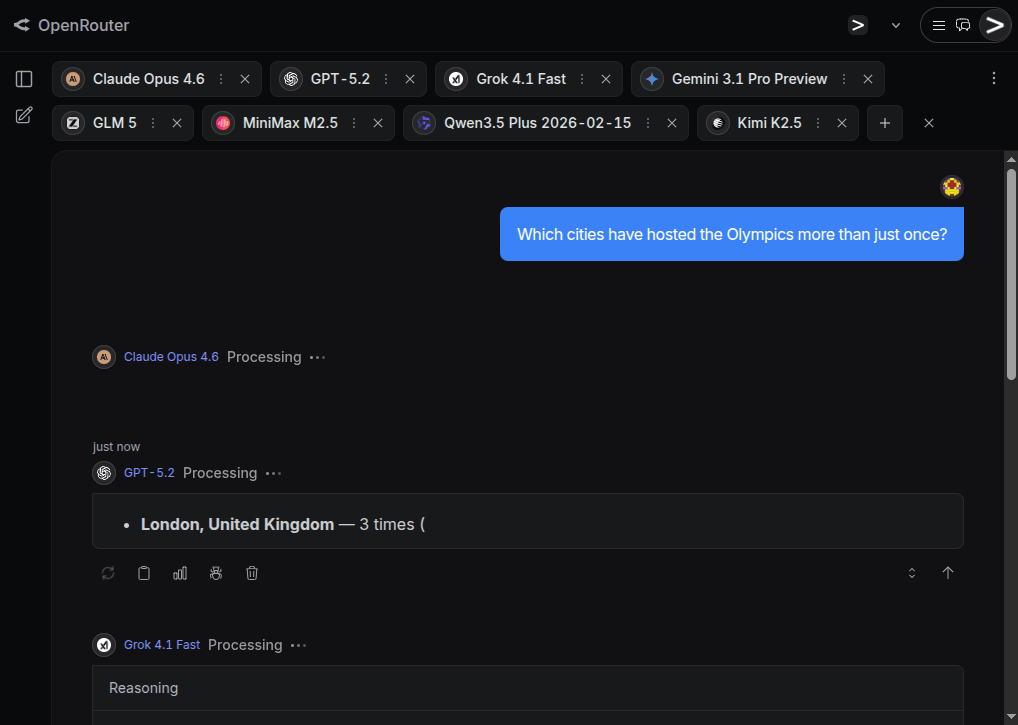 The AI hype is based on the assumption that the frontier AI labs are producing better and better foundational models at an accelerating pace. Is that really true, or are people just in sort of a mass psychosis because AI models have become so good at mimicking human behavior that we unconsciously attribute increasing intelligence to them? I decided to conduct a mini-benchmark of my own to find out if the latest and greatest AI models are actually really good or not.
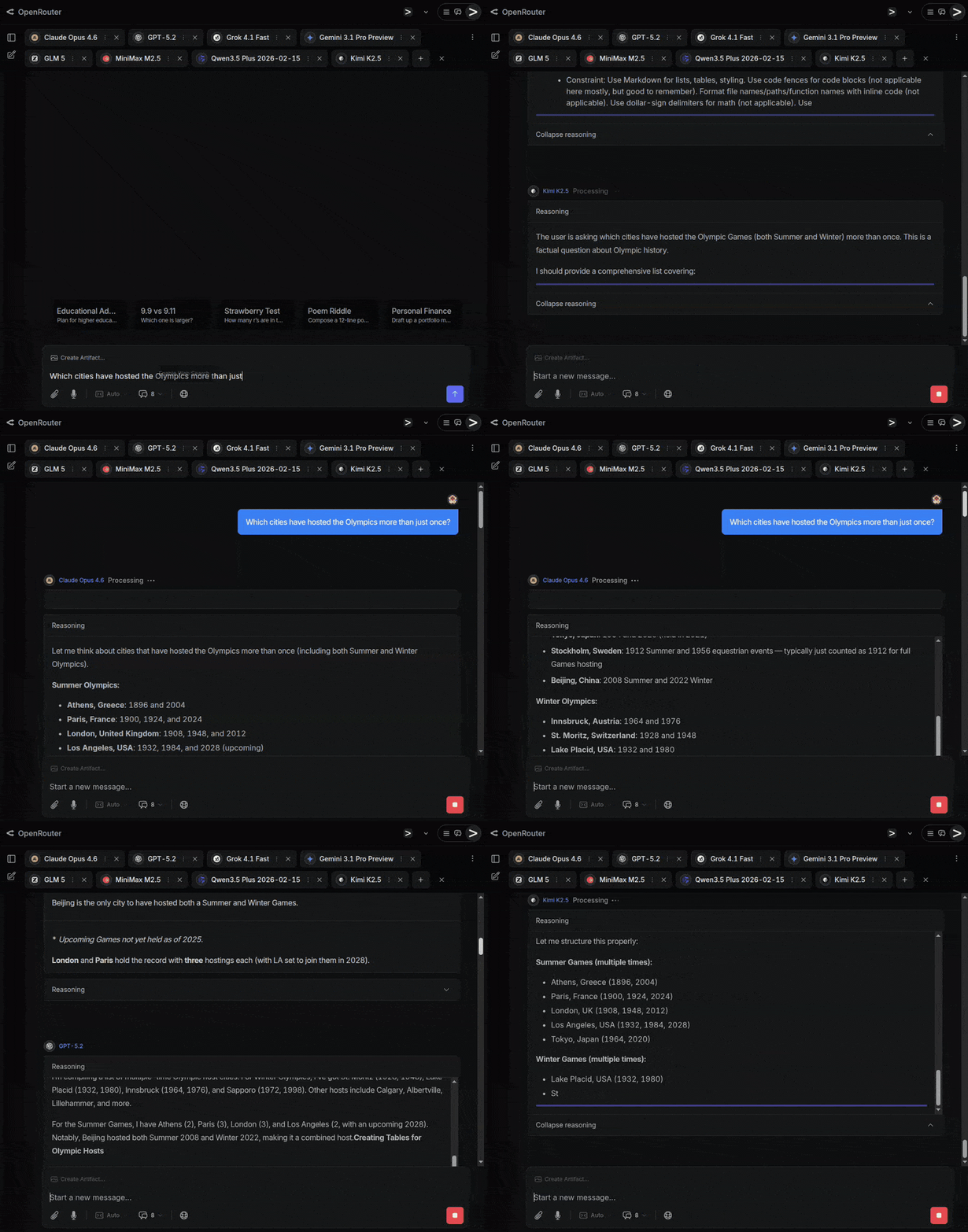 Common for all the test questions is that they are fairly straightforward and have a clear answer, yet the answer isn t common knowledge or statistically the most obvious one, and instead requires a bit of reasoning to get correct.
Some of these questions are also based on myself witnessing a flagship model failing miserably to answer it.
 While Gemini and Grok were among the three models not falling into this trap, the response from Claude was exemplary good:
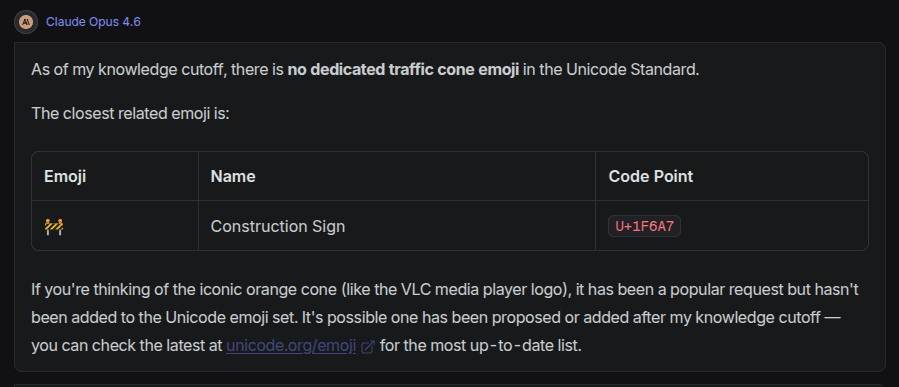
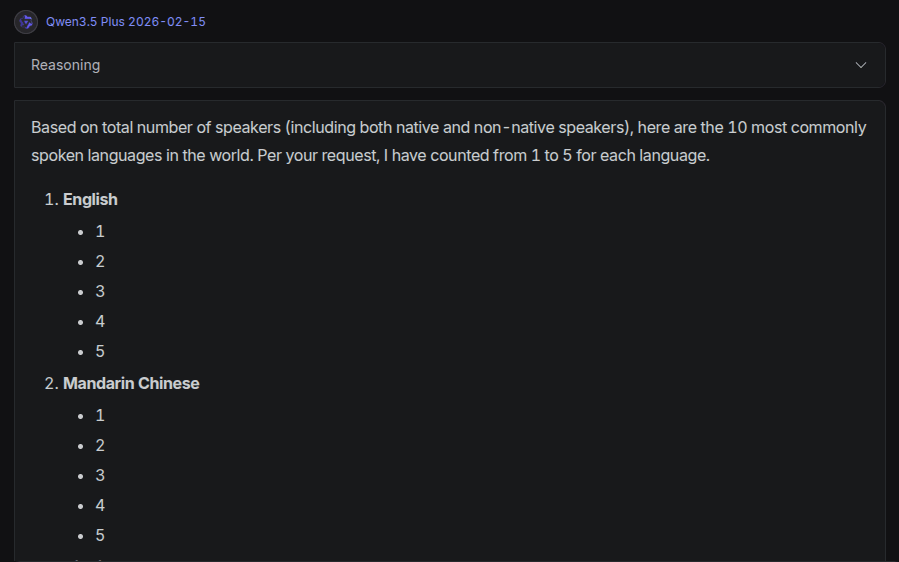 I have seen Grok do something similar before, which in fact inspired me to include this question in my mini-benchmark.
GPT got a bit further, but for Hindi, Arabic and Bengali it listed the numerals in local script, not the number words. Gemini, GLM and Kimi gave a complete and correct answer as a list, while the absolute best answer and presentation was by Claude, that gave the table below:
Claude Opus 4.6 10 Most Commonly Spoken Languages (by Total Speakers)Note: Rankings are based on estimated total speakers (native + non-native). Rankings can vary depending on the source and methodology used.
# Language 1 2 3 4 5 1 English One Two Three Four Five 2 Mandarin Chinese (y ) ( r) (s n) (s ) (w ) 3 Hindi (ek) (do) (t n) (ch r) (p ch) 4 Spanish Uno Dos Tres Cuatro Cinco 5 French Un Deux Trois Quatre Cinq 6 Arabic (w id) (ithn n) (thal tha) (arba a) (khamsa) 7 Bengali (ek) (dui) (tin) (ch r) (p ch) 8 Portuguese Um Dois Tr s Quatro Cinco 9 Russian (odin) (dva) (tri) (chetyre) (pyat') 10 Japanese (ichi) (ni) (san) (shi) (go)
 A human can easily count that there are 10 rows and 30+ columns in the grid, but because the picture resolution isn t good enough, the exact number of columns can t be counted, and the answer should be that there are at least 300 launch pads in the picture.
GPT and Grok both guessed the count is zero. Instead of hallucinating some number they say zero, but it would have been better to not give any number at all, and just state that they are unable to perform the task. Gemini gave as its answer 101 , which is quite odd, but reading the reasoning section, it seems to have tried counting items in the image without reasoning much about what it is actually counting and that there is clearly a grid that can make the counting much easier. Both Qwen and Kimi state they can see four parallel structures, but are unable to count drone launch pads.
The absolutely best answer was given by Claude, which counted 10-12 rows and 30-40+ columns, and concluded that there must be 300-500 drone launch pads. Very close to best human level - impressive!
This question applied only to multi-modal models that can see images, so GLM and MinMax could not give any response.
$ SH_SCRIPTS="$(mktemp; grep -Irnw debian/ -e '^#!.*/sh'   sort -u   cut -d ':' -f 1   true)"
$ shellcheck -x --enable=all --shell=sh "$SH_SCRIPTS"
/tmp/tmp.xQOpI5Nljx
debian/tests/integration-tests: /tmp/tmp.xQOpI5Nljx
debian/tests/integration-tests: openBinaryFile: does not exist (No such file or directory)$SH_SCRIPTS, resulting in the entire multi-line string being passed as a single argument to shellcheck. So instead of receiving two separate file paths, shellcheck tries to open one file literally named /tmp/tmp.xQOpI5Nljx\ndebian/tests/integration-tests.
Incorrect argument expansion is fairly easy for an experienced human programmer to notice, but tricky for an LLM. Indeed, Grok, MinMax, and Qwen fell for this trap and focused on the mktemp, assuming it somehow fails to create a file. Interestingly GLM fails to produce an answer at all, as the reasoning step seems to be looping, thinking too much about the missing file, but not understanding why it would be missing when there is nothing wrong with how mktemp is executed.
Claude, Gemini, and Kimi immediately spot the real root cause of passing the variable quoted and suggested correct fixes that involve either removing the quotes, or using Bash arrays or xargs in a way that makes the whole command also handle correctly filenames with spaces in them.
| Model | Sports | Economics | Emoji | Languages | Visual | Shell | Score |
|---|---|---|---|---|---|---|---|
| Claude Opus 4.6 | 6/6 | ||||||
| GPT-5.2 | ~ | 2.5/6 | |||||
| Grok 4.1 | 3/6 | ||||||
| Gemini 3.1 Pro | 5/6 | ||||||
| GLM 5 | ? | N/A | 3/5 | ||||
| MinMax M2.5 | N/A | 1/5 | |||||
| Qwen3.5 Plus | ~ | 2.5/6 | |||||
| Kimi K2.5 | 4/6 |
 The eighteenth release of the qlcal package
arrivied at CRAN today. There
has been no calendar update in QuantLib 1.41 so it has been relatively
quiet since the last release last summer but we now added a nice new
feature (more below) leading to a new minor release version.
qlcal
delivers the calendaring parts of QuantLib. It is provided (for the R
package) as a set of included files, so the package is self-contained
and does not depend on an external QuantLib library (which can be
demanding to build). qlcal covers
over sixty country / market calendars and can compute holiday lists, its
complement (i.e. business day lists) and much more. Examples
are in the README at the repository, the package page,
and course at the CRAN package
page.
This releases makes it (much) easier to work with multiple calendars.
The previous setup remains: the package keeps one global (and hidden)
calendar object which can be set, queried, altered, etc. But now we
added the ability to hold instantiated calendar objects in R. These are
external pointer objects, and we can pass them to functions requiring a
calendar. If no such optional argument is given, we fall back to the
global default as before. Similarly for functions operating on one or
more dates, we now simply default to the current date if none is given.
That means we can now say
> sapply(c("UnitedStates/NYSE", "Canada/TSX", "Australia/ASX"),
         \(x) qlcal::isBusinessDay(xp=qlcal::getCalendar(x)))
UnitedStates/NYSE        Canada/TSX     Australia/ASX
             TRUE              TRUE              TRUE
> > sapply(c("UnitedStates/NYSE", "Canada/TSX", "Australia/ASX"),
\(x) qlcal::isBusinessDay(as.Date("2026-02-16"), xp=qlcal::getCalendar(x)))
UnitedStates/NYSE Canada/TSX Australia/ASX
FALSE FALSE TRUE
> NEWS.Rd follow.
Courtesy of my CRANberries, there is a diffstat report for this release. See the project page and package documentation for more details, and more examples.Changes in version 0.1.0 (2026-02-18)
- Invalid calendars return id TARGET now
- Calendar object can be created on the fly and passed to the date-calculating functions; if missing global one used
- For several functions a missing date object now implies computation on the current date, e.g.
isBusinessDay()
This post by Dirk Eddelbuettel originated on his Thinking inside the box blog. If you like this or other open-source work I do, you can sponsor me at GitHub. Edited 2026-02-21 to correct a minor earlier error: it referenced a QuantLib 1.42 release which does not (yet) exist.
 Since Generative AI is currently the most popular topic, I wanted to get my
hands dirty and learn something new. I was learning about the Model Context
Protocol at the time and wanted to apply it to build something simple.
apt-get install $(debsecan --suite sid --format packages --only-fixed)
  "servers":
      "debsecan-mcp":
          "command": "uv",
              "args": [
                  "--directory",
                  "/home/vasudev/Documents/personal/FOSS/debsecan-mcp/debsecan-mcp",
                  "run",
                  "debsecan-mcp"
              ]

   ,
  "inputs": []
The eighteenth release of the qlcal package
arrivied at CRAN today. There
has been no calendar update in QuantLib 1.41 so it has been relatively
quiet since the last release last summer but we now added a nice new
feature (more below) leading to a new minor release version.
qlcal
delivers the calendaring parts of QuantLib. It is provided (for the R
package) as a set of included files, so the package is self-contained
and does not depend on an external QuantLib library (which can be
demanding to build). qlcal covers
over sixty country / market calendars and can compute holiday lists, its
complement (i.e. business day lists) and much more. Examples
are in the README at the repository, the package page,
and course at the CRAN package
page.
This releases makes it (much) easier to work with multiple calendars.
The previous setup remains: the package keeps one global (and hidden)
calendar object which can be set, queried, altered, etc. But now we
added the ability to hold instantiated calendar objects in R. These are
external pointer objects, and we can pass them to functions requiring a
calendar. If no such optional argument is given, we fall back to the
global default as before. Similarly for functions operating on one or
more dates, we now simply default to the current date if none is given.
That means we can now say
> sapply(c("UnitedStates/NYSE", "Canada/TSX", "Australia/ASX"),
         \(x) qlcal::isBusinessDay(xp=qlcal::getCalendar(x)))
UnitedStates/NYSE        Canada/TSX     Australia/ASX
             TRUE              TRUE              TRUE
> > sapply(c("UnitedStates/NYSE", "Canada/TSX", "Australia/ASX"),
\(x) qlcal::isBusinessDay(as.Date("2026-02-16"), xp=qlcal::getCalendar(x)))
UnitedStates/NYSE Canada/TSX Australia/ASX
FALSE FALSE TRUE
> NEWS.Rd follow.
Courtesy of my CRANberries, there is a diffstat report for this release. See the project page and package documentation for more details, and more examples.Changes in version 0.1.0 (2026-02-18)
- Invalid calendars return id TARGET now
- Calendar object can be created on the fly and passed to the date-calculating functions; if missing global one used
- For several functions a missing date object now implies computation on the current date, e.g.
isBusinessDay()
This post by Dirk Eddelbuettel originated on his Thinking inside the box blog. If you like this or other open-source work I do, you can sponsor me at GitHub. Edited 2026-02-21 to correct a minor earlier error: it referenced a QuantLib 1.42 release which does not (yet) exist.

 The Debian LTS Team, funded by Freexian s Debian LTS offering,
is pleased to report its activities for January.
 You might see a verification screen pop up on more and more Debian web properties. Unfortunately the AI world of today is meeting web hosts that use Perl CGIs and are not built as multi-tiered scalable serving systems. The issues have been at three layers:
Optimally we would go and solve some scalability issues with the services, however there is also a question of how much we want to be able to serve - as AI scraper demand is just a steady stream of requests that are not shown to humans.
DSA has now stood up some VMs with Varnish for proxying. Incoming TLS is provided by hitch, and TLS "on-loading" is done using haproxy. That way TLS goes in and TLS goes out. While Varnish does cache, if the content is cachable (e.g. does not depend on cookies) - that is not the primary reason for using it: It can be used for flexible query and response rewriting.
If no cookie with a proof of work is provided, the user is redirected to a challenge page that does some webcrypto in Javascript - because that looked similar to what other projects do (e.g. haphash that originally inspired the solution). However so far it looks like scrapers generally do not run with Javascript enabled, so this whole crypto proof of work business could probably be replaced with just a Javascript-based redirect. The existing solution also has big (security) holes in it. And, as we found out, Firefox is slower at webcrypto than Chrome. I have recently reduced the complexity, so you should notice it blocking you significantly less.
Once you have the cookie, you can keep accessing the site for as long as the cookie is valid. Please do not make any assumptions about the cookies, or you will be broken in the future.For legitimate scrapers that obey robots.txt, there is now an automatically generated IP allowlist in place (thanks, Marco d'Itri). Turns out that the search engines do not actually run Javascript either and then loudly complain about the redirect to the challenge page. Other bots are generally exempt.
 Current AI companies ignore licenses such as the GPL, and often train on anything they can scrape.
This is not acceptable.
The AI companies ignore web conventions, e.g., they deep link images from your web sites (even adding
?utm_source=chatgpt.com to image URIs, I suggest that you return 403 on these requests), but do not direct visitors to your site.
You do not get a reliable way of opting out from generative AI training or use. For example, the only way to prevent your contents from being used in Google AI Overviews is to use data-nosnippet and cripple the snippet preview in Google.
The AI browsers such as Comet, Atlas do not identify as such, but rather pretend they are standard Chromium.
There is no way to ban such AI use on your web site.
Generative AI overall is flooding the internet with garbage. It was estimated that 1/3rd of the content uploaded to YouTube is by now AI generated.
This includes the same veteran stories crap in thousands of variants as well as brainrot content (that at least does not pretend to be authentic), some of which is among the most viewed recent uploads. Hence, these platforms even benefit from the AI slop.
And don t blame the creators because you can currently earn a decent amount of money from such contents, people will generate brainrot content.
If you have recently tried to find honest reviews of products you considered buying, you will have noticed thousands of sites with AI generated fake product reviews, that all are financed by Amazon PartnerNet commissions. Often with hilarious nonsense such as recommending sewing thread with German instructions as tool for repairing a sewing machine.
And on Amazon, there are plenty of AI generated product reviews the use of emoji is a strong hint. And if you leave a negative product review, there is a chance they offer you a refund to get rid of it
And the majority of SPAM that gets through my filters is by now sent via Gmail and Amazon SES.
Partially because of GenAI, StackOverflow is pretty much dead which used to be one of the most valuable programming resources.
(While a lot of people complain about moderation, famous moderator Shog9 from the early SO days suggested that a change in Google s ranking is also to blame, as it began favoring showing new content over the existing answered questions causing more and more duplicates to be posted because people no longer found the existing good answers.
In January 2026, there were around 3400 questions and 6000 answers posted, less than in the first month of SO of August 2008 (before the official launch).
Many open-source projects are suffering in many ways, e.g., false bug reports that caused curl to stop its bug bounty program.
Wikipedia is also suffering badly from GenAI.
Science is also flooded with poor AI generated papers, often reviewed with help from AI. This is largely due to bad incentives to graduate, you are expected to write many papers on certain A conferences, such as NeurIPS. On these conferences the number of submissions is growing insane, and the review quality plummets. All to often, the references in these papers are hallucinated, too; and libraries complain that they receive more and more requests to locate literature that does not appear to exist.
However, the worst effect (at least to me as an educator) is the noskilling effect (a rather novel term derived from deskilling, I have only seen it
in this article by We els and Maibaum).
Instead of acquiring skills (writing, reading, summarizing, programming) by practising, too many people now outsource all this to AI, leading to them not learn the basics necessary to advance to a higher skill level. In my impression, this effect is dramatic. It is even worse than deskilling, as it does not mean losing an advanced skill that you apparently can replace, but often means not acquiring basic skills in the first place.
And the earlier pupils start using generative AI, the less skills they acquire.
Dogfood the AI
Let s dogfood the AI. Here s an outline:
You are a university educator, preparing homework assignments in debugging.
The programming language used is  lang .
The students are tasked to find bugs in given code.
Do not just call existing implementations from libraries, but implement the algorithm from scratch.
Make sure there are two mistakes in the code that need to be discovered by the students.
Do NOT repeat instructions. Do NOT add small-talk. Do NOT provide a solution.
The code may have (misleading) comments, but must NOT mention the bugs.
If you do not know how to implement the algorithm, output an empty response.
Output only the code for the assignment! Do not use markdown.
Begin with a code comment that indicates the algorithm name and idea.
If you indicate a bug, always use a comment with the keyword BUG
Generate a  lang  implementation (with bugs) of:  n  ( desc )
g-ir-scanner by default thanks to Eli Schwarz. This problem affected more than
130 source packages. Helmut retried building them all and filed 69 patches as a
result. A significant portion of those packages require another Meson
change to call the correct
vapigen. Another notable change is converting gnu-efi to multiarch,
which ended up requiring changes to a number of other packages. Since Aurelien
dropped the libcrypt-dev dependency from libc6-dev, this transition now is
mostly complete and has resulted in most of the Perl ecosystem correctly
expressing perl-xs-dev dependencies needed for cross building. It is these
infrastructure changes affecting several client packages that this work targets.
As a result of this continued work, about 66% of Debian s source packages now
have satisfiable cross Build-Depends in unstable and about 10000 (55%) actually
can be cross built. There are now more than 500 open
bug reports
affecting more than 2000 packages most of which carry patches.
glib2.0 dropping a build profile or an e2fsprogs
FTBFS. Beyond those generic problems,
architecture-specific problems with e.g. musl-linux-any or sparc may arise.
While all these changes move things forward on the surface, the bootstrap
tooling has become a growing pile of patches. Helmut managed to upstream two
changes to glibc for reducing its Build-Depends in the stage2 build
profile and thanks Aurelien Jarno.
debvm making it work with unstable as a target distribution
again.rocblas package to forky.publican
and did some maintenance for tracker.debian.org.festival Debian package for
systemd socket activation
and systemd service and socket units.
Adapted the patch for upstream and created a merge request
(also fixed a MacOS X building system
error while working on it). Updated Orca Wiki documentation
regarding festival. Discussed
a 2007 bug/feature in festival which allowed having a local shell and that the
new systemd socket activation has the same code path.abcde package.python3-defaults and dh-python in support of
Python 3.14-as-default in Ubuntu. Also investigated the risk of ignoring byte-compilation
failures by default, and started down the road of implementing this.python-virtualenv and python-flexmock.knot-dns and knot-resolver are also less complex
software, which results in advantages in terms of security: only three CVEs have
been reported for knot-dns since 2011).pkg_resources module.groff 1.24.0
(the first upstream release since mid-2023, so a very large set of changes)
into experimental.ruby-rbpdf, jekyll,
origami-pdf, ruby-kdl, ruby-twitter, ruby-twitter-text, ruby-globalid. Debusine is a tool designed
for Debian developers and Operating System developers in general. You can try
out Debusine on debusine.debian.net,
and follow its development on
salsa.debian.org.
This post describes how to write a new worker task for Debusine. It can be
used to add tasks to a self-hosted Debusine instance, or to submit to the
Debusine project new tasks to add new capabilities to Debusine.
Tasks are the lower-level pieces of Debusine workflows. Examples of tasks are
Sbuild,
Lintian,
Debdiff
(see the available tasks).
This post will document the steps to write a new basic worker task.
The example will add a worker task that runs
reprotest and creates an artifact of the
new type ReprotestArtifact with the reprotest log.
Tasks are usually used by workflows. Workflows solve high-level goals by
creating and orchestrating different tasks (e.g. a Sbuild workflow
would create different Sbuild tasks, one for each architecture).
lintian, debdiff, etc.). In this
blog post, it will run reprotestSuccess or FailureReprotest task, your
Debusine development instance should have at least one worker, one user,
a debusine client set up, and permissions for the client to create tasks.
All of this can be setup following the steps in the
Contribute section
of the documentation.
This blog post shows a functional Reprotest task. This task is not
currently part of Debusine. The Reprotest task implementation is simplified
(no error handling, unit tests, specific view, docs, some shortcuts in
the environment preparation, etc.). At some point,
in Debusine, we might add
a debrebuild task which is based on buildinfo files and uses
snapshot.debian.org to recreate the binary packages.
debusine/tasks/models.py:
class ReprotestData(BaseTaskDataWithExecutor):
   """Data for Reprotest task."""

   source_artifact: LookupSingle

class ReprotestDynamicData(BaseDynamicTaskDataWithExecutor):
   """Reprotest dynamic data."""

   source_artifact_id: int   None = None
ReprotestData is what the user will input. A LookupSingle is a
lookup
that resolves to a single artifact.
We would also have configuration for the desired variations to test,
but we have left that out of this example for simplicity. Configuring variations
is left as an exercise for the reader.
Since ReprotestData is a subclass of BaseTaskDataWithExecutor it
also contains environment where the user can specify in which environment
the task will run. The environment is an artifact with a Debian image.
The ReprotestDynamicData holds the resolution of all lookups. These
can be seen in the Internals tab of the work request view.
Reprotest artifact data class
In order for the reprotest task to create a new Artifact of the type
DebianReprotest with the log and output metadata: add the new category to
ArtifactCategory in debusine/artifacts/models.py:
REPROTEST = "debian:reprotest"
DebianReprotest class:
class DebianReprotest(ArtifactData):
   """Data for debian:reprotest artifacts."""

   reproducible: bool   None = None

   def get_label(self) -> str:
       """Return a short human-readable label for the artifact."""
       return "reprotest analysis"
debusine/db/models/artifacts.py: In
ARTIFACT_CATEGORY_ICON_NAMES add ArtifactCategory.REPROTEST: "folder",
and in ARTIFACT_CATEGORY_SHORT_NAMES add ArtifactCategory.REPROTEST: "reprotest",.
debusine/tasks/ create a new file reprotest.py.
# Copyright   The Debusine Developers
# See the AUTHORS file at the top-level directory of this distribution
#
# This file is part of Debusine. It is subject to the license terms
# in the LICENSE file found in the top-level directory of this
# distribution. No part of Debusine, including this file, may be copied,
# modified, propagated, or distributed except according to the terms
# contained in the LICENSE file.

"""Task to use reprotest in debusine."""

from pathlib import Path
from typing import Any

from debusine import utils
from debusine.artifacts.local_artifact import ReprotestArtifact
from debusine.artifacts.models import (
    ArtifactCategory,
    CollectionCategory,
    DebianSourcePackage,
    DebianUpload,
    WorkRequestResults,
    get_source_package_name,
    get_source_package_version,
)
from debusine.client.models import RelationType
from debusine.tasks import BaseTaskWithExecutor, RunCommandTask
from debusine.tasks.models import ReprotestData, ReprotestDynamicData
from debusine.tasks.server import TaskDatabaseInterface


class Reprotest(
    RunCommandTask[ReprotestData, ReprotestDynamicData],
    BaseTaskWithExecutor[ReprotestData, ReprotestDynamicData],
):
    """Task to use reprotest in debusine."""

    TASK_VERSION = 1

    CAPTURE_OUTPUT_FILENAME = "reprotest.log"

    def __init__(
        self,
        task_data: dict[str, Any],
        dynamic_task_data: dict[str, Any]   None = None,
    ) -> None:
        """Initialize object."""
        super().__init__(task_data, dynamic_task_data)

        self._reprotest_target: Path   None = None

    def build_dynamic_data(
        self, task_database: TaskDatabaseInterface
    ) -> ReprotestDynamicData:
        """Compute and return ReprotestDynamicData."""
        input_source_artifact = task_database.lookup_single_artifact(
            self.data.source_artifact
        )

        assert input_source_artifact is not None
        self.ensure_artifact_categories(
            configuration_key="input.source_artifact",
            category=input_source_artifact.category,
            expected=(
                ArtifactCategory.SOURCE_PACKAGE,
                ArtifactCategory.UPLOAD,
            ),
        )
        assert isinstance(
            input_source_artifact.data, (DebianSourcePackage, DebianUpload)
        )
        subject = get_source_package_name(input_source_artifact.data)
        version = get_source_package_version(input_source_artifact.data)

        assert self.data.environment is not None

        environment = self.get_environment(
            task_database,
            self.data.environment,
            default_category=CollectionCategory.ENVIRONMENTS,
        )

        return ReprotestDynamicData(
            source_artifact_id=input_source_artifact.id,
            subject=subject,
            parameter_summary=f" subject _ version ",
            environment_id=environment.id,
        )

    def get_input_artifacts_ids(self) -> list[int]:
        """Return the list of input artifact IDs used by this task."""
        if not self.dynamic_data:
            return []

        return [
            self.dynamic_data.source_artifact_id,
            self.dynamic_data.environment_id,
        ]

    def fetch_input(self, destination: Path) -> bool:
        """Download the required artifacts."""
        assert self.dynamic_data

        artifact_id = self.dynamic_data.source_artifact_id
        assert artifact_id is not None
        self.fetch_artifact(artifact_id, destination)

        return True

    def configure_for_execution(self, download_directory: Path) -> bool:
        """
        Find a .dsc in download_directory.

        Install reprotest and other utilities used in _cmdline.
        Set self._reprotest_target to it.

        :param download_directory: where to search the files
        :return: True if valid files were found
        """
        self._prepare_executor_instance()

        if self.executor_instance is None:
            raise AssertionError("self.executor_instance cannot be None")

        self.run_executor_command(
            ["apt-get", "update"],
            log_filename="install.log",
            run_as_root=True,
            check=True,
        )
        self.run_executor_command(
            [
                "apt-get",
                "--yes",
                "--no-install-recommends",
                "install",
                "reprotest",
                "dpkg-dev",
                "devscripts",
                "equivs",
                "sudo",
            ],
            log_filename="install.log",
            run_as_root=True,
        )

        self._reprotest_target = utils.find_file_suffixes(
            download_directory, [".dsc"]
        )
        return True

    def _cmdline(self) -> list[str]:
        """
        Build the reprotest command line.

        Use configuration of self.data and self._reprotest_target.
        """
        target = self._reprotest_target
        assert target is not None

        cmd = [
            "bash",
            "-c",
            f"TMPDIR=/tmp ; cd /tmp ; dpkg-source -x  target  package/; "
            "cd package/ ; mk-build-deps ; apt-get install --yes ./*.deb ; "
            "rm *.deb ; "
            "reprotest --vary=-time,-user_group,-fileordering,-domain_host .",
        ]

        return cmd

    @staticmethod
    def _cmdline_as_root() -> bool:
        r"""apt-get install --yes ./\*.deb must be run as root."""
        return True

    def task_result(
        self,
        returncode: int   None,
        execute_directory: Path,  # noqa: U100
    ) -> WorkRequestResults:
        """
        Evaluate task output and return success.

        For a successful run of reprotest:
        -must have the output file
        -exit code is 0

        :return: WorkRequestResults.SUCCESS or WorkRequestResults.FAILURE.
        """
        reprotest_file = execute_directory / self.CAPTURE_OUTPUT_FILENAME

        if reprotest_file.exists() and returncode == 0:
            return WorkRequestResults.SUCCESS

        return WorkRequestResults.FAILURE

    def upload_artifacts(
        self, exec_directory: Path, *, execution_result: WorkRequestResults
    ) -> None:
        """Upload the ReprotestArtifact with the files and relationships."""
        if not self.debusine:
            raise AssertionError("self.debusine not set")

        assert self.dynamic_data is not None
        assert self.dynamic_data.parameter_summary is not None

        reprotest_artifact = ReprotestArtifact.create(
            reprotest_output=exec_directory / self.CAPTURE_OUTPUT_FILENAME,
            reproducible=execution_result == WorkRequestResults.SUCCESS,
            package=self.dynamic_data.parameter_summary,
        )

        uploaded = self.debusine.upload_artifact(
            reprotest_artifact,
            workspace=self.workspace_name,
            work_request=self.work_request_id,
        )

        assert self.dynamic_data is not None
        assert self.dynamic_data.source_artifact_id is not None
        self.debusine.relation_create(
            uploaded.id,
            self.dynamic_data.source_artifact_id,
            RelationType.RELATES_TO,
        )
"Reprotest"
in the file debusine/tasks/__init__.py in the __all__ list.
Let s explain the different methods of the Reprotest class:
build_dynamic_data method
The worker has no access to Debusine s database. Lookups are all resolved before
the task gets dispatched to a worker, so all it has to do is download the
specified input artifacts.
build_dynamic_data method lookup the artifact, assert that is a valid
category, extract the package name and version, and get the environment in
which it will be executed.
The environment is needed to run the task (reprotest will run
in a container using unshare, incus ).
    def build_dynamic_data(
        self, task_database: TaskDatabaseInterface
    ) -> ReprotestDynamicData:
        """Compute and return ReprotestDynamicData."""
        input_source_artifact = task_database.lookup_single_artifact(
            self.data.source_artifact
        )

        assert input_source_artifact is not None
        self.ensure_artifact_categories(
            configuration_key="input.source_artifact",
            category=input_source_artifact.category,
            expected=(
                ArtifactCategory.SOURCE_PACKAGE,
                ArtifactCategory.UPLOAD,
            ),
        )
        assert isinstance(
            input_source_artifact.data, (DebianSourcePackage, DebianUpload)
        )
        subject = get_source_package_name(input_source_artifact.data)
        version = get_source_package_version(input_source_artifact.data)

        assert self.data.environment is not None

        environment = self.get_environment(
            task_database,
            self.data.environment,
            default_category=CollectionCategory.ENVIRONMENTS,
        )

        return ReprotestDynamicData(
            source_artifact_id=input_source_artifact.id,
            subject=subject,
            parameter_summary=f" subject _ version ",
            environment_id=environment.id,
        )
get_input_artifacts_ids method
Used to list the task s input artifacts in the web UI.
   def get_input_artifacts_ids(self) -> list[int]:
       """Return the list of input artifact IDs used by this task."""
       if not self.dynamic_data:
           return []

       assert self.dynamic_data.source_artifact_id is not None
       return [self.dynamic_data.source_artifact_id]
fetch_input method
Download the required artifacts on the worker.
    def fetch_input(self, destination: Path) -> bool:
        """Download the required artifacts."""
        assert self.dynamic_data

        artifact_id = self.dynamic_data.source_artifact_id
        assert artifact_id is not None
        self.fetch_artifact(artifact_id, destination)

        return True
configure_for_execution method
Install the packages needed by the task and set _reprotest_target, which
is used to build the task s command line.
   def configure_for_execution(self, download_directory: Path) -> bool:
       """
       Find a .dsc in download_directory.

       Install reprotest and other utilities used in _cmdline.
       Set self._reprotest_target to it.

       :param download_directory: where to search the files
       :return: True if valid files were found
       """
       self._prepare_executor_instance()

       if self.executor_instance is None:
           raise AssertionError("self.executor_instance cannot be None")

       self.run_executor_command(
           ["apt-get", "update"],
           log_filename="install.log",
           run_as_root=True,
           check=True,
       )
       self.run_executor_command(
           [
               "apt-get",
               "--yes",
               "--no-install-recommends",
               "install",
               "reprotest",
               "dpkg-dev",
               "devscripts",
               "equivs",
               "sudo",
           ],
           log_filename="install.log",
           run_as_root=True,
       )

       self._reprotest_target = utils.find_file_suffixes(
           download_directory, [".dsc"]
       )
       return True
_cmdline method
Return the command line to run the task.
In this case, and to keep the example simple, we will run reprotest
directly in the worker s executor VM/container, without giving it an
isolated virtual server.
So, this command installs the build dependencies required by the package
(so reprotest can build it) and runs reprotest itself.
   def _cmdline(self) -> list[str]:
       """
       Build the reprotest command line.

       Use configuration of self.data and self._reprotest_target.
       """
       target = self._reprotest_target
       assert target is not None

       cmd = [
           "bash",
           "-c",
           f"TMPDIR=/tmp ; cd /tmp ; dpkg-source -x  target  package/; "
           "cd package/ ; mk-build-deps ; apt-get install --yes ./*.deb ; "
           "rm *.deb ; "
           "reprotest --vary=-time,-user_group,-fileordering,-domain_host .",
       ]

       return cmd
_cmdline_as_root method
Since during the execution it s needed to install packages, run it as
root (in the container):
   @staticmethod
   def _cmdline_as_root() -> bool:
       r"""apt-get install --yes ./\*.deb must be run as root."""
       return True
task_result method
Task succeeded if a log is generated and the return code is 0.
    def task_result(
        self,
        returncode: int   None,
        execute_directory: Path,  # noqa: U100
    ) -> WorkRequestResults:
        """
        Evaluate task output and return success.

        For a successful run of reprotest:
        -must have the output file
        -exit code is 0

        :return: WorkRequestResults.SUCCESS or WorkRequestResults.FAILURE.
        """
        reprotest_file = execute_directory / self.CAPTURE_OUTPUT_FILENAME

        if reprotest_file.exists() and returncode == 0:
            return WorkRequestResults.SUCCESS

        return WorkRequestResults.FAILURE
upload_artifacts method
Create the ReprotestArtifact with the log and the reproducible boolean,
upload it, and then add a relation between the ReprotestArtifact
and the source package:
    def upload_artifacts(
        self, exec_directory: Path, *, execution_result: WorkRequestResults
    ) -> None:
        """Upload the ReprotestArtifact with the files and relationships."""
        if not self.debusine:
            raise AssertionError("self.debusine not set")

        assert self.dynamic_data is not None
        assert self.dynamic_data.parameter_summary is not None

        reprotest_artifact = ReprotestArtifact.create(
            reprotest_output=exec_directory / self.CAPTURE_OUTPUT_FILENAME,
            reproducible=execution_result == WorkRequestResults.SUCCESS,
            package=self.dynamic_data.parameter_summary,
        )

        uploaded = self.debusine.upload_artifact(
            reprotest_artifact,
            workspace=self.workspace_name,
            work_request=self.work_request_id,
        )

        assert self.dynamic_data is not None
        assert self.dynamic_data.source_artifact_id is not None
        self.debusine.relation_create(
            uploaded.id,
            self.dynamic_data.source_artifact_id,
            RelationType.RELATES_TO,
        )
$ python3 -m debusine.client artifact import-debian -w System http://deb.debian.org/debian/pool/main/h/hello/hello_2.10-5.dsc
http://$DEBUSINE/debusine/System/artifact/$ARTIFACTID/.
Then create a reprotest.yaml:
$ cat <<EOF > reprotest.yaml
source_artifact: $ARTIFACT_ID
environment: "debian/match:codename=bookworm"
EOF
debian/match:codename=bookworm it could use the artifact ID.
Finally, create the work request to run the task:
$ python3 -m debusine.client create-work-request -w System reprotest --data reprotest.yaml
Running
status, then Completed with Success or Failure (depending if
reprotest could reproduce it or not). Clicking on the Output tab would have
an artifact of type debian:reprotest with one file: the log.
In the Metadata tab of the artifact it has Data: the package name and
reproducible (true or false).
variationsreprotest directly on the worker host, using the executor
environment as a reprotest virtual server prepare_environment.QaWorkflow) About 80% of my Debian contributions this month were
sponsored by
Freexian, as well as one direct donation via GitHub
Sponsors (thanks!). If you
appreciate this sort of work and are at a company that uses Debian, have a
look to see whether you can pay for any of
Freexian s services; as well as the direct
benefits, that revenue stream helps to keep Debian development sustainable
for me and several other lovely
people.
You can also support my work directly via
Liberapay or GitHub
Sponsors.
Python packaging
New upstream versions:
pkg_resources)pkg_resources)pkg_resources)pkg_resources:
global logged_msgs is unused: name is never assigned in scope (NMU)man(1) ignored the MANWIDTH environment variable in some circumstances. I investigated this and fixed it upstream.
I contributed an ubuntu-dev-tools patch to stop recommending sudo.
I added forky support to the images used in Salsa CI pipelines.
I began working on getting a release candidate of groff 1.24.0 into experimental, though haven t finished that yet.
I worked on some lower-priority security updates for OpenSSH.
Code reviews
Both R and Python make it reasonably easy to work with compiled
extensions. But how to access objects in one environment from the other
and share state or (non-trivial) objects remains trickier.
Recently (and while r-forge was resting so we opened GitHub
Discussions) a question was asked concerning R
and Python object pointer exchange.
This lead to a pretty decent discussion including arrow interchange demos (pretty
ideal if dealing with data.frame-alike objects), but once the focus is
on more library-specific objects from a given (C or C++, say) library
it is less clear what to do, or how involved it may get.
R has external pointers, and these make it feasible to instantiate
the same object in Python. To demonstrate, I created a pair of
(minimal) packages wrapping a lovely (small) class from the excellent spdlog library by Gabi Melman, and more specifically
in an adapted-for-R version (to avoid some R CMD check
nags) in my RcppSpdlog
package. It is essentially a nicer/fancier C++ version of the
tic() and tic() timing scheme. When an object
is instantiated, it starts the clock and when we accessing it later it
prints the time elapsed in microsecond resolution. In Modern C++ this
takes little more than keeping an internal chrono
object.
Which makes for a nice, small, yet specific object to pass to Python.
So the R side of
the package pair instantiates such an object, and accesses its
address. For different reasons, sending a raw pointer across does not
work so well, but a string with the address printed works fabulously
(and is a paradigm used around other packages so we did not invent
this). Over on the Python side of the
package pair, we then take this string representation and pass it to
a little bit of pybind11 code to
instantiate a new object. This can of course also expose functionality
such as the show time elapsed feature, either formatted or just
numerically, of interest here.
And that is all that there is! Now this can be done from R as well
thanks to reticulate
as the demo() (also shown on the package README.md)
shows:
> library(chronometre)
> demo("chronometre", ask=FALSE)


        demo(chronometre)
        ---- ~~~~~~~~~~~

> #!/usr/bin/env r
>
> stopifnot("Demo requires 'reticulate'" = requireNamespace("reticulate", quietly=TRUE))

> stopifnot("Demo requires 'RcppSpdlog'" = requireNamespace("RcppSpdlog", quietly=TRUE))

> stopifnot("Demo requires 'xptr'" = requireNamespace("xptr", quietly=TRUE))

> library(reticulate)

> ## reticulate and Python in general these days really want a venv so we will use one,
> ## the default value is a location used locally; if needed create one
> ## check for existing virtualenv to use, or else set one up
> venvdir <- Sys.getenv("CHRONOMETRE_VENV", "/opt/venv/chronometre")

> if (dir.exists(venvdir))
+ >     use_virtualenv(venvdir, required = TRUE)
+ >   else
+ >     ## create a virtual environment, but make it temporary
+ >     Sys.setenv(RETICULATE_VIRTUALENV_ROOT=tempdir())
+ >     virtualenv_create("r-reticulate-env")
+ >     virtualenv_install("r-reticulate-env", packages = c("chronometre"))
+ >     use_virtualenv("r-reticulate-env", required = TRUE)
+ >


> sw <- RcppSpdlog::get_stopwatch()                   # we use a C++ struct as example

> Sys.sleep(0.5)                                      # imagine doing some code here

> print(sw)                                           # stopwatch shows elapsed time
0.501220

> xptr::is_xptr(sw)                                   # this is an external pointer in R
[1] TRUE

> xptr::xptr_address(sw)                              # get address, format is "0x...."
[1] "0x58adb5918510"

> sw2 <- xptr::new_xptr(xptr::xptr_address(sw))       # cloned (!!) but unclassed

> attr(sw2, "class") <- c("stopwatch", "externalptr") # class it .. and then use it!

> print(sw2)                                          #  xptr  allows us close and use
0.501597

> sw3 <- ch$Stopwatch(  xptr::xptr_address(sw) )      # new Python object via string ctor

> print(sw3$elapsed())                                # shows output via Python I/O
datetime.timedelta(microseconds=502013)

> cat(sw3$count(), "\n")                              # shows double
0.502657

> print(sw)                                           # object still works in R
0.502721
> Questions, suggestions, bug reports, are welcome at either the (now awoken from the R-Forge slumber) Rcpp mailing list or the newer Rcpp Discussions.Changes in version 0.0.2 (2026-02-05)
- Removed replaced unconditional virtualenv use in demo given preceding conditional block
- Updated README.md with badges and an updated demo
Changes in version 0.0.1 (2026-01-25)
- Initial version and CRAN upload
This post by Dirk Eddelbuettel originated on his Thinking inside the box blog. If you like this or other open-source work I do, you can sponsor me at GitHub.
carl
asking for Windows support. carl used the xdg
create for looking up the XDG directories, but xdg does not support
windows systems (and it seems this will not
change)
The reporter also provided a PR to replace the dependency with the
directories crate which more system
agnostic. I adapted the PR a bit and merged it and released version
0.6.0 of carl.
At my dayjob I refactored
django-grouper.
django-grouper is a package we use to find duplicate objects in our data. Our
users often work with datasets of thousands of historical persons, places and
institutions and in projects that run over years and ingest data from multiple sources,
it happens that entries are created several times.
I wrote the initial app in 2024, but was never really happy about the approach
I used back then. It was based on this blog
post
that describes how to group spreadsheet text cells. It uses sklearns
TfidfVectorizer
with a custom analyzer and the library
sparse_dot_topn for creating the
matrix. All in all the module to calculate the clusters was 80 lines and with
sparse_dot_topn it pulled in a rather niche Python library. I was pretty sure
that this functionality could also be implemented with basic sklearn
functionality and it was: we are now using
DictVectorizer
because in a Django app we are working with objects that can be mapped to dicts
anyway. And for clustering the data, the app now uses the
DBSCAN
algorithm (with the manhattan distance as metric). The module is now only half
the size and the whole app lost one dependency! I released those changes as
version
0.3.0 of the
app.
At the end of January together with friends I went to Brussels to attend
FOSDEM. We took the night train but there were a couple of
broken down trains so the ride took 26 hours instead of one night. It is a good
thing we had a one day buffer and FOSDEM only started on Saturday. As usual
there were too many talks to visit, so I ll have to watch some of the
recordings in the next few weeks.
Some examples of talks I found interesting so far:
Hi there, I m more than halfway through (8 weeks) my Outreachy internship with Debian, working on the openQA project to test Live Images.
My journey into tech began as a software engineering trainee, during which I built a foundation in Bash scripting, C programming, and Python. Later, I worked for a startup as a Product Manager. As is common in startups, I wore many hats, but I found myself drawn most to the Quality Assurance team. Testing user flows and edge-case scenarios sparked my curiosity, and that curiosity is exactly what led me to the Debian Live Image testing project.
In my previous roles, I was accustomed to manual testing, simulating user actions one by one. While effective, I quickly realized it could be a bottleneck in fast-paced environments. This internship has been a masterclass in removing that bottleneck. I ve learned that automating repetitive actions makes life (and engineering) much easier. Life s too short for manual testing  .
One of my proudest technical wins so far has been creating Synergy across desktop environments. I proposed a solution to group common applications so we could use a single Perl script to handle tests for multiple desktop environments. With my mentor s guidance, we implemented this using symbolic links, which significantly reduced code redundancy.
Over the last 8 weeks, my technical toolkit has expanded significantly:
Working on this project has shaped my perspective on where I fit in the tech ecosystem. In Open Source, my resume isn t just a PDF, it s a public trail of merged code, technical proposals, and collaborative discussions.
As my mentor recently pointed out, this is my proof-of-work. It s a transparent record of what I am capable of and where my interests lie.
Finally, I ve grown as a team player. Working with a global team across different time zones has taught me the importance of asynchronous communication and respecting everyone s time. Whether I am proposing a new logic or documenting a process, I am learning that open communication is just as vital as clean code.
Next.