Search Results: "sf"

31 October 2025

Russell Coker: Links October 2025

Informative video about the way corporations charge different rates based on location and even type of device used on the web site [1]. This should be illegal everywhere! Bruce Schneier with Heather Adkins and Gadi Evron wrote an insightful post about AI Hacking and the Future of Cybersecurity, the future seems grim [2]. Slaughterbots is an interesting Dust SciFi movie exploring the future of autonoms weapons [3]. Arstechnica has an intersting article on a genetically engineered plant with a more efficient system for photosynthesis [4]. If this goes to plan it could revolutionise agriculture! David Brin wrote an insightful blog post about the Seldon Paradox [5]. Also he wrote the final book in the Foundation series so he is the current living export on Hari Seldon. Charles Stross wrote an insightful blog post about the pivot away from fossil fuels and the future of computers without Moore s Law [6]. Audrey Woods wrote an insightful article about the end of Moore s Law, we can get more transistors from multichip modules bit it s only small linear improvements not exponential [7]. Bruce Schneier and Barath Raghavan wrote an interesting article about AI s OODA loop problem, it s a good way of thinking about some of these issues [8]. I think that LLM security is a losing game. Getting them to mostly not tell people how to commit crimes is the limit of controls. Manga telling the story of Revelations in all it s drug inspired madness [9]. When I read the entire Bible I skipped Revelations because it s too obviously the product of mental illness. CNN has an interesting article about bitcoin ARMs which are almost exclusively used for crime [10].

30 October 2025

Utkarsh Gupta: FOSS Activites in October 2025

Here s my monthly but brief update about the activities I ve done in the F/L/OSS world.

Debian
Whilst I didn t get a chance to do much, here s still a few things that I worked on:
  • Uploaded ruby-rack, 3.1.18-1, to fix a bunch of CVEs.
  • Asssited a few folks in getting their patches submitted via Salsa.
  • Mentoring for newcomers.
  • Moderation of -project mailing list.

Ubuntu
I joined Canonical to work on Ubuntu full-time back in February 2021. Whilst I can t give a full, detailed list of things I did, here s a quick TL;DR of what I did:

Debian (E)LTS
This month I have worked 16 hours on Debian Long Term Support (LTS) and 05 hours on its sister Extended LTS project and did the following things:
  • ruby-rack: There were multiple vulnerabilities reported leading to DoS (memory exhaustion) and proxy bypass.
    • [unstable/forky]: Uploaded a fix to unstable via 3.1.18-1 to fix 5 CVEs.
    • [trixie/bookworm]: Uploaded a fix for all 5 CVEs in trixie via 3.1.18-1~deb13u1 and 7 CVEs in bookworm via 2.2.20-0+deb12u1.
    • [LTS]: Uploaded a fix for all 7 CVEs in bullseye via 2.1.4-3+deb11u4. And released DLA 4357-1.
    • [ELTS]: Backported fixes for CVE-2025-46727 & CVE-2025-32441 to buster and stretch but the other backports are being a bit tricky due to really old versions. But I ll spend some more time there before coming to a conclusion.
  • wordpress: There were multiple vulnerabilities reported leading to Sent Data & Cross-site Scripting.
    • [bookworm]: Prepared a fix for all 4 CVEs in bookwrom via 6.1.9+dfsg1-0+deb12u1. Awaiting review from the Security team.
    • [LTS]: Uploaded a fix for all 4 CVEs in bullseye via 5.7.14+dfsg1-0+deb11u1. And released DLA 4358-1.
  • [LTS] Attended the monthly LTS meeting on Jitsi. Summary here.
  • [E/LTS] Monitored discussions on mailing lists, IRC, and all the documentation updates.

Until next time.
:wq for today.

28 October 2025

Russ Allbery: Review: Those Who Wait

Review: Those Who Wait, by Haley Cass
Publisher: Haley Cass
Copyright: 2020
ISBN: 979-8-9884929-1-7
Format: Kindle
Pages: 556
Those Who Wait is a stand-alone self-published sapphic romance novel. Given the lack of connection between political figures named in this book and our reality, it's also technically an alternate history, but it will be entirely unsatisfying to anyone who reads it in that genre. Sutton Spencer is an English grad student in New York City. As the story opens, she has recently realized that she's bisexual rather than straight. She certainly has not done anything about that revelation; the very thought makes her blush. Her friend and roommate Regan, not known for either her patience or her impulse control, decides to force the issue by stealing Sutton's phone, creating a profile on a lesbian dating app, and messaging the first woman Sutton admits being attracted to. Charlotte Thompson is a highly ambitious politician, current deputy mayor of New York City for health and human services, and granddaughter of the first female president of the United States. She fully intends to become president of the United States herself. The next step on that path is an open special election for a seat in the House of Representatives. With her family political connections and the firm support of the mayor of New York City (who is also dating her brother), she thinks she has an excellent shot of winning. Charlotte is also a lesbian, something she's known since she was a teenager and which still poses serious problems for a political career. She is therefore out to her family and a few close friends, but otherwise in the closet. Compared to her political ambitions, Charlotte considers her love life almost irrelevant, and therefore has a strict policy of limiting herself to anonymous one-night stands arranged on dating apps. Even that is about to become impossible given her upcoming campaign, but she indulges in one last glance at SapphicSpark before she deletes her account. Sutton is as far as possible from the sort of person who does one-night stands, which is a shame as far as Charlotte is concerned. It would have been a fun last night out. Despite that, both of them find the other unexpectedly enjoyable to chat with. (There are a lot of text message bubbles in this book.) This is when Sutton has her brilliant idea: Charlotte is charming, experienced, and also kind and understanding of Sutton's anxiety, at least in app messages. Maybe Charlotte can be her mentor? Tell her how to approach women, give her some guidance, point her in the right directions. Given the genre, you can guess how this (eventually) turns out. I'm going to say a lot of good things about this book, so let me get the complaints over with first. As you might guess from that introduction, Charlotte's political career and the danger of being outed are central to this story. This is a bit unfortunate because you should not, under any circumstances, attempt to think deeply about the politics in this book. In 550 pages, Charlotte does not mention or expound a single meaningful political position. You come away from this book as ignorant about what Charlotte wants to accomplish as a politician as you entered. Apparently she wants to be president because her grandmother was president and she thinks she'd be good at it. The closest the story comes to a position is something unbelievably vague about homeless services and Charlotte's internal assertion that she wants to help people and make real change. There are even transcripts of media interviews, later in the book, and they somehow manage to be more vacuous than US political talk shows, which is saying something. I also can't remember a single mention of fundraising anywhere in this book, which in US politics is absurd (although I will be generous and say this is due to Cass's alternate history). I assume this was a deliberate choice and Cass didn't want politics to distract from the romance, but as someone with a lot of opinions about concrete political issues, the resulting vague soft-liberal squishiness was actively off-putting. In an actual politician, this would be an entire clothesline of red flags. Thankfully, it's ignorable for the same reason; this is so obviously not the focus of the book that one can mostly perform the same sort of mental trick that one does when ignoring the backdrop in a cheap theater. My second complaint is that I don't know what Sutton does outside of the romance. Yes, she's an English grad student, and she does some grading and some vaguely-described work and is later referred to a prestigious internship, but this is as devoid of detail as Charlotte's political positions. It's not quite as jarring because Cass does eventually show Sutton helping concretely with her mother's work (about which I have some other issues that I won't get into), but it deprives Sutton of an opportunity to be visibly expert in something. The romance setup casts Charlotte as the experienced one to Sutton's naivete, and I think it would have been a better balance to give Sutton something concrete and tangible that she was clearly better at than Charlotte. Those complaints aside, I quite enjoyed this. It was a recommendation from the same BookTuber who recommended Delilah Green Doesn't Care, so her recommendations are quickly accumulating more weight. The chemistry between Sutton and Charlotte is quite believable; the dialogue sparkles, the descriptions of the subtle cues they pick up from each other are excellent, and it's just fun to read about how they navigate a whole lot of small (and sometimes large) misunderstandings and mismatches in personality and world view. Normally, misunderstandings are my least favorite part of a romance novel, but Sutton and Charlotte come from such different perspectives that their misunderstandings feel more justified than is typical. The characters are also fairly mature about working through them: Main characters who track the other character down and insist on talking when something happens they don't understand! Can you imagine! Only with the third-act breakup is the reader dragged through multiple chapters of both characters being miserable, and while I also usually hate third-act breakups, this one is so obviously coming and so clearly advertised from the initial setup that I couldn't really be mad. I did wish the payoff make-up scene at the end of the book had a bit more oomph, though; I thought Sutton's side of it didn't have quite the emotional catharsis that it could have had. I particularly enjoyed the reasons why the two characters fall in love, and how different they are. Charlotte is delighted by Sutton because she's awkward and shy but also straightforward and frequently surprisingly blunt, which fits perfectly with how much Charlotte is otherwise living in a world of polished politicians in constant control of their personas. Sutton's perspective is more physical, but the part I liked was the way that she treats Charlotte like a puzzle. Rather than trying to change how Charlotte expresses herself, she instead discovers that she's remarkably good at reading Charlotte if she trusts her instincts. There was something about Sutton's growing perceptiveness that I found quietly delightful. It's the sort of non-sexual intimacy that often gets lost among the big emotions in romance novels. The supporting cast was also great. Both characters have deep support networks of friends and family who are unambiguously on their side. Regan is pure chaos, and I would not be friends with her, but Cass shows her deep loyalty in a way that makes her dynamic with Sutton make sense. Both characters have thoughtful and loving families who support them but don't make decisions for them, which is a nice change of pace from the usually more mixed family situations of romance novel protagonists. There's a lot of emotional turbulence in the main relationship, and I think that only worked for me because of how rock-solid and kind the supporting cast is. This is, as you might guess from the title, a very slow burn, although the slow burn is for the emotional relationship rather than the physical one (for reasons that would be spoilers). As usual, I have no calibration for spiciness level, but I'd say that this was roughly on par with the later books in the Bright Falls series. If you know something about politics (or political history) and try to take that part of this book seriously, it will drive you to drink, but if you can put that aside and can deal with misunderstandings and emotional turmoil, this was both fun and satisfying. I liked both of the characters, I liked the timing of the alternating viewpoints, and I believed in the relationship and chemistry, as improbable and chaotic as some of the setup was. It's not the greatest thing I ever read, and I wish the ending was a smidgen stronger, but it was an enjoyable way to spend a few reading days. Recommended. Rating: 7 out of 10

26 October 2025

Russ Allbery: Review: Ancestral Night

Review: Ancestral Night, by Elizabeth Bear
Series: White Space #1
Publisher: Saga Press
Copyright: 2019
ISBN: 1-5344-0300-0
Format: Kindle
Pages: 501
Ancestral Night is a far-future space opera novel and the first of a series. It shares a universe with Bear's earier Jacob's Ladder trilogy, and there is a passing reference to the events of Grail that would be a spoiler if you put the pieces together, but it's easy to miss. You do not need to read the earlier series to read this book (although it's a good series and you might enjoy it). Halmey Dz is a member of the vast interstellar federation called the Synarche, which has put an end to war and other large-scale anti-social behavior through a process called rightminding. Every person has a neural implant that can serve as supplemental memory, off-load some thought processes, and, crucially, regulate neurotransmitters and hormones to help people stay on an even keel. It works, mostly. One could argue Halmey is an exception. Raised in a clade that took rightminding to an extreme of suppression of individual personality into a sort of hive mind, she became involved with a terrorist during her legally mandated time outside of her all-consuming family before she could make an adult decision to stay with them (essentially a rumspringa). The result was a tragedy that Halmey doesn't like to think about, one that's left deep emotional scars. But Halmey herself would argue she's not an exception: She's put her history behind her, found partners that she trusts, and is a well-adjusted member of the Synarche.
Eventually, I realized that I was wasting my time, and if I wanted to hide from humanity in a bottle, I was better off making it a titanium one with a warp drive and a couple of carefully selected companions.
Halmey does salvage: finding ships lost in white space and retrieving them. One of her partners is Connla, a pilot originally from a somewhat atavistic world called Spartacus. The other is their salvage tug.
The boat didn't have a name. He wasn't deemed significant enough to need a name by the authorities and registries that govern such things. He had a registration number 657-2929-04, Human/Terra and he had a class, salvage tug, but he didn't have a name. Officially. We called him Singer. If Singer had an opinion on the issue, he'd never registered it but he never complained. Singer was the shipmind as well as the ship or at least, he inhabited the ship's virtual spaces the same way we inhabited the physical ones but my partner Connla and I didn't own him. You can't own a sentience in civilized space.
As Ancestral Night opens, the three of them are investigating a tip of a white space anomoly well off the beaten path. They thought it might be a lost ship that failed a transition. What they find instead is a dead Ativahika and a mysterious ship equipped with artificial gravity. The Ativahikas are a presumed sentient race of living ships that are on the most alien outskirts of the Synarche confederation. They don't communicate, at least so far as Halmey is aware. She also wasn't aware they died, but this one is thoroughly dead, next to an apparently abandoned ship of unknown origin with a piece of technology beyond the capabilities of the Synarche. The three salvagers get very little time to absorb this scene before they are attacked by pirates. I have always liked Bear's science fiction better than her fantasy, and this is no exception. This was great stuff. Halmey is a talkative, opinionated infodumper, which is a great first-person protagonist to have in a fictional universe this rich with delightful corners. There are some Big Dumb Object vibes (one of my favorite parts of salvage stories), solid character work, a mysterious past that has some satisfying heft once it's revealed, and a whole lot more moral philosophy than I was expecting from the setup. All of it is woven together with experienced skill, unsurprising given Bear's long and prolific career. And it's full of delightful world-building bits: Halmey's afthands (a surgical adaptation for zero gravity work) and grumpiness at the sheer amount of gravity she has to deal with over the course of this book, the Culture-style ship names, and a faster-than-light travel system that of course won't pass physics muster but provides a satisfying quantity of hooky bits for plot to attach to. The backbone of this book is an ancient artifact mystery crossed with a murder investigation. Who killed the Ativahika? Where did the gravity generator come from? Those are good questions with interesting answers. But the heart of the book is a philosophical conflict: What are the boundaries between identity and society? How much power should society have to reshape who we are? If you deny parts of yourself to fit in with society, is this necessarily a form of oppression? I wrote a couple of paragraphs of elaboration, and then deleted them; on further thought, I don't want to give any more details about what Bear is doing in this book. I will only say that I was not expecting this level of thoughtfulness about a notoriously complex and tricky philosophical topic in a full-throated adventure science fiction novel. I think some people may find the ending strange and disappointing. I loved it, and weeks after finishing this book I'm still thinking about it. Ancestral Night has some pacing problems. There is a long stretch in the middle of the book that felt repetitive and strained, where Bear holds the reader at a high level of alert and dread for long enough that I found it enervating. There are also a few political cheap shots where Bear picks the weakest form of an opposing argument instead of the strongest. (Some of the cheap shots are rather satisfying, though.) The dramatic arc of the book is... odd, in a way that I think was entirely intentional given how well it works with the thematic message, but which is also unsettling. You may not get the catharsis that you're expecting. But all of this serves a purpose, and I thought that purpose was interesting. Ancestral Night is one of those books that I liked more a week after I finished it than I did when I finished it.
Epiphanies are wonderful. I m really grateful that our brains do so much processing outside the line of sight of our consciousnesses. Can you imagine how downright boring thinking would be if you had to go through all that stuff line by line?
Also, for once, I think Bear hit on exactly the right level of description rather than leaving me trying to piece together clues and hope I understood the plot. It helps that Halmey loves to explain things, so there are a lot of miniature infodumps, but I found them interesting and a satisfying throwback to an earlier style of science fiction that focused more on world-building than on interpersonal drama. There is drama, but most of it is internal, and I thought the balance was about right. This is solid, well-crafted work and a good addition to the genre. I am looking forward to the rest of the series. Followed by Machine, which shifts to a different protagonist. Rating: 8 out of 10

25 October 2025

Sam Hartman: My First Successful AI Coding Experience

Yesterday, I had my first successful AI coding experience. I ve used AI coding tools before and come away disappointed. The results were underwhelming: low-quality code, inconsistent abstraction levels, and subtle bugs that take longer to fix than it would take to write the whole thing from scratch. Those problems haven t vanished. The code quality this time was still disappointing. As I asked the AI to refined its work, it would randomly drop important constraints or refactor things in unhelpful ways. And yet, this experience was different and genuinely valuable for two reasons. The first benefit was the obvious one: the AI helped me get over the blank-page problem. It produced a workable skeleton for the project imperfect, but enough to start building on. The second benefit was more surprising. I was working on a problem in odds-ratio preference optimization specifically, finding a way to combine similar examples in datasets for AI training. I wanted an ideal algorithm, one that extracted every ounce of value from the data. The AI misunderstood my description. Its first attempt was laughably simple it just concatenated two text strings. Thanks, but I can call strcat or the Python equivalent without help. However, the second attempt was different. It was still not what I had asked for but as I thought about it, I realized it was good enough. The AI had created a simpler algorithm that would probably solve my problem in practice. In trying too hard to make the algorithm perfect, I d overlooked that the simpler approach might be the right one. The AI, by misunderstanding, helped me see that. This experience reminded me of something that happened years ago when I was mentoring a new developer. They came to me asking how to solve a difficult problem. Rather than telling them it was impossible, I explained what would be required: a complex authorization framework, intricate system interactions, and a series of political and organizational hurdles that would make deployment nearly impossible. A few months later, they returned and said they d found a solution. I was astonished until I looked more closely. What they d built wasn t the full, organization-wide system I had envisioned. Instead, they d reframed the problem. By narrowing the scope reducing the need for global trust and deep integration they d built a local solution that worked well enough within their project. They succeeded precisely because they didn t see all the constraints I did. Their inexperience freed them from assumptions that had trapped me. That s exactly what happened with the AI. It didn t know which boundaries not to cross. In its simplicity, it found a path forward that I had overlooked. My conclusion isn t that AI coding is suddenly great. It s that working with someone or something that thinks differently can open new paths forward. Whether it s an AI, a peer, or a less experienced engineer, that collaboration can bring fresh perspectives that challenge your assumptions and reveal simpler, more practical ways to solve problems.

comment count unavailable comments

23 October 2025

Russ Allbery: Review: Politics on the Edge

Review: Politics on the Edge, by Rory Stewart
Publisher: Penguin Books
Copyright: 2023, 2025
Printing: 2025
ISBN: 979-8-217-06167-9
Format: Kindle
Pages: 429
Rory Stewart is a former British diplomat, non-profit executive, member of Parliament, and cabinet minister. Politics on the Edge is a memoir of his time in the UK Parliament from 2019 to 2019 as a Tory (Conservative) representing the Penrith and The Border constituency in northern England. It ends with his failed run against Boris Johnson for leader of the Conservative Party and Prime Minister. This book provoked many thoughts, only some of which are about the book. You may want to get a beverage; this review will be long. Since this is a memoir told in chronological order, a timeline may be useful. After Stewart's time as a regional governor in occupied Iraq (see The Prince of the Marshes), he moved to Kabul to found and run an NGO to preserve traditional Afghani arts and buildings (the Turquoise Mountain Foundation, about which I know nothing except what Stewart wrote in this book). By his telling, he found that work deeply rewarding but thought the same politicians who turned Iraq into a mess were going to do the same to Afghanistan. He started looking for ways to influence the politics more directly, which led him first to Harvard and then to stand for Parliament. The bulk of this book covers Stewart's time as MP for Penrith and The Border. The choice of constituency struck me as symbolic of Stewart's entire career: He was not a resident and had no real connection to the district, which he chose for political reasons and because it was the nearest viable constituency to his actual home in Scotland. But once he decided to run, he moved to the district and seems sincerely earnest in his desire to understand it and become part of its community. After five years as a backbencher, he joined David Cameron's government in a minor role as Minister of State in the Department for Environment, Food, and Rural Affairs. He then bounced through several minor cabinet positions (more on this later) before being elevated to Secretary of State for International Development under Theresa May. When May's government collapsed during the fight over the Brexit agreement, he launched a quixotic challenge to Boris Johnson for leader of the Conservative Party. I have enjoyed Rory Stewart's writing ever since The Places in Between. This book is no exception. Whatever one's other feelings about Stewart's politics (about which I'll have a great deal more to say), he's a talented memoir writer with an understated and contemplative style and a deft ability to shift from concrete description to philosophical debate without bogging down a story. Politics on the Edge is compelling reading at the prose level. I spent several afternoons happily engrossed in this book and had great difficulty putting it down. I find Stewart intriguing since, despite being a political conservative, he's neither a neoliberal nor any part of the new right. He is instead an apparently-sincere throwback to a conservatism based on epistemic humility, a veneration of rural life and long-standing traditions, and a deep commitment to the concept of public service. Some of his principles are baffling to me, and I think some of his political views are obvious nonsense, but there were several things that struck me throughout this book that I found admirable and depressingly rare in politics. First, Stewart seems to learn from his mistakes. This goes beyond admitting when he was wrong and appears to include a willingness to rethink entire philosophical positions based on new experience.
I had entered Iraq supporting the war on the grounds that we could at least produce a better society than Saddam Hussein's. It was one of the greatest mistakes in my life. We attempted to impose programmes made up by Washington think tanks, and reheated in air-conditioned palaces in Baghdad a new taxation system modelled on Hong Kong; a system of ministers borrowed from Singapore; and free ports, modelled on Dubai. But we did it ultimately at the point of a gun, and our resources, our abstract jargon and optimistic platitudes could not conceal how much Iraqis resented us, how much we were failing, and how humiliating and degrading our work had become. Our mission was a grotesque satire of every liberal aspiration for peace, growth and democracy.
This quote comes from the beginning of this book and is a sentiment Stewart already expressed in The Prince of the Marshes, but he appears to have taken this so seriously that it becomes a theme of his political career. He not only realized how wrong he was on Iraq, he abandoned the entire neoliberal nation-building project without abandoning his belief in the moral obligation of international aid. And he, I think correctly, identified a key source of the error: an ignorant, condescending superiority that dismissed the importance of deep expertise.
Neither they, nor indeed any of the 12,000 peacekeepers and policemen who had been posted to South Sudan from sixty nations, had spent a single night in a rural house, or could complete a sentence in Dinka, Nuer, Azande or Bande. And the international development strategy written jointly between the donor nations resembled a fading mission statement found in a new space colony, whose occupants had all been killed in an alien attack.
Second, Stewart sincerely likes ordinary people. This shone through The Places in Between and recurs here in his descriptions of his constituents. He has a profound appreciation for individual people who have spent their life learning some trade or skill, expresses thoughtful and observant appreciation for aspects of local culture, and appears to deeply appreciate time spent around people from wildly different social classes and cultures than his own. Every successful politician can at least fake gregariousness, and perhaps that's all Stewart is doing, but there is something specific and attentive about his descriptions of other people, including long before he decided to enter politics, that makes me think it goes deeper than political savvy. Third, Stewart has a visceral hatred of incompetence. I think this is the strongest through-line of his politics in this book: Jobs in government are serious, important work; they should be done competently and well; and if one is not capable of doing that, one should not be in government. Stewart himself strikes me as an insecure overachiever: fiercely ambitious, self-critical, a bit of a micromanager (I suspect he would be difficult to work for), but holding himself to high standards and appalled when others do not do the same. This book is scathing towards multiple politicians, particularly Boris Johnson whom Stewart clearly despises, but no one comes off worse than Liz Truss.
David Cameron, I was beginning to realise, had put in charge of environment, food and rural affairs a Secretary of State who openly rejected the idea of rural affairs and who had little interest in landscape, farmers or the environment. I was beginning to wonder whether he could have given her any role she was less suited to apart perhaps from making her Foreign Secretary. Still, I could also sense why Cameron was mesmerised by her. Her genius lay in exaggerated simplicity. Governing might be about critical thinking; but the new style of politics, of which she was a leading exponent, was not. If critical thinking required humility, this politics demanded absolute confidence: in place of reality, it offered untethered hope; instead of accuracy, vagueness. While critical thinking required scepticism, open-mindedness and an instinct for complexity, the new politics demanded loyalty, partisanship and slogans: not truth and reason but power and manipulation. If Liz Truss worried about the consequences of any of this for the way that government would work, she didn't reveal it.
And finally, Stewart has a deeply-held belief in state capacity and capability. He and I may disagree on the appropriate size and role of the government in society, but no one would be more disgusted by an intentional project to cripple government in order to shrink it than Stewart. One of his most-repeated criticisms of the UK political system in this book is the way the cabinet is formed. All ministers and secretaries come from members of Parliament and therefore branches of government are led by people with no relevant expertise. This is made worse by constant cabinet reshuffles that invalidate whatever small amounts of knowledge a minister was able to gain in nine months or a year in post. The center portion of this book records Stewart's time being shuffled from rural affairs to international development to Africa to prisons, with each move representing a complete reset of the political office and no transfer of knowledge whatsoever.
A month earlier, they had been anticipating every nuance of Minister Rogerson's diary, supporting him on shifts twenty-four hours a day, seven days a week. But it was already clear that there would be no pretence of a handover no explanation of my predecessor's strategy, and uncompleted initiatives. The arrival of a new minister was Groundhog Day. Dan Rogerson was not a ghost haunting my office, he was an absence, whose former existence was suggested only by the black plastic comb.
After each reshuffle, Stewart writes of trying to absorb briefings, do research, and learn enough about his new responsibilities to have the hope of making good decisions, while growing increasingly frustrated with the system and the lack of interest by most of his colleagues in doing the same. He wants government programs to be successful and believes success requires expertise and careful management by the politicians, not only by the civil servants, a position that to me both feels obviously correct and entirely at odds with politics as currently practiced. I found this a fascinating book to read during the accelerating collapse of neoliberalism in the US and, to judge by current polling results, the UK. I have a theory that the political press are so devoted to a simplistic left-right political axis based on seating arrangements during the French Revolution that they are missing a significant minority whose primary political motivation is contempt for arrogant incompetence. They could be convinced to vote for Sanders or Trump, for Polanski or Farage, but will never vote for Biden, Starmer, Romney, or Sunak. Such voters are incomprehensible to those who closely follow and debate policies because their hostile reaction to the center is not about policies. It's about lack of trust and a nebulous desire for justice. They've been promised technocratic competence and the invisible hand of market forces for most of their lives, and all of it looks like lies. Everyday living is more precarious, more frustrating, more abusive and dehumanizing, and more anxious, despite (or because of) this wholehearted embrace of economic "freedom." They're sick of every complaint about the increasing difficulty of life being met with accusations about their ability and work ethic, and of being forced to endure another round of austerity by people who then catch a helicopter ride to a party on some billionaire's yacht. Some of this is inherent in the deep structural weaknesses in neoliberal ideology, but this is worse than an ideological failure. The degree to which neoliberalism started as a project of sincere political thinkers is arguable, but that is clearly not true today. The elite class in politics and business is now thoroughly captured by people whose primary skill is the marginal manipulation of complex systems for their own power and benefit. They are less libertarian ideologues than narcissistic mediocrities. We are governed by management consultants. They are firmly convinced their organizational expertise is universal, and consider the specific business of the company, or government department, irrelevant. Given that context, I found Stewart's instinctive revulsion towards David Cameron quite revealing. Stewart, later in the book, tries to give Cameron some credit by citing several policy accomplishments and comparing him favorably to Boris Johnson (which, true, is a bar Cameron probably flops over). But I think Stewart's baffled astonishment at Cameron's vapidity says a great deal about how we have ended up where we are. This last quote is long, but I think it provides a good feel for Stewart's argument in this book.
But Cameron, who was rumoured to be sceptical about nation-building projects, only nodded, and then looking confidently up and down the table said, "Well, at least we all agree on one extremely straightforward and simple point, which is that our troops are doing very difficult and important work and we should all support them." It was an odd statement to make to civilians running humanitarian operations on the ground. I felt I should speak. "No, with respect, we do not agree with that. Insofar as we have focused on the troops, we have just been explaining that what the troops are doing is often futile, and in many cases making things worse." Two small red dots appeared on his cheeks. Then his face formed back into a smile. He thanked us, told us he was out of time, shook all our hands, and left the room. Later, I saw him repeat the same line in interviews: "the purpose of this visit is straightforward... it is to show support for what our troops are doing in Afghanistan". The line had been written, in London, I assumed, and tested on focus groups. But he wanted to convince himself it was also a position of principle. "David has decided," one of his aides explained, when I met him later, "that one cannot criticise a war when there are troops on the ground." "Why?" "Well... we have had that debate. But he feels it is a principle of British government." "But Churchill criticised the conduct of the Boer War; Pitt the war with America. Why can't he criticise wars?" "British soldiers are losing their lives in this war, and we can't suggest they have died in vain." "But more will die, if no one speaks up..." "It is a principle thing. And he has made his decision. For him and the party." "Does this apply to Iraq too?" "Yes. Again he understands what you are saying, but he voted to support the Iraq War, and troops are on the ground." "But surely he can say he's changed his mind?" The aide didn't answer, but instead concentrated on his food. "It is so difficult," he resumed, "to get any coverage of our trip." He paused again. "If David writes a column about Afghanistan, we will struggle to get it published." "But what would he say in an article anyway?" I asked. "We can talk about that later. But how do you get your articles on Afghanistan published?" I remembered how the US politicians and officials had shown their mastery of strategy and detail. I remembered the earnestness of Gordon Brown when I had briefed him on Iraq. Cameron seemed somehow less serious. I wrote as much in a column in the New York Times, saying that I was afraid the party of Churchill was becoming the party of Bertie Wooster.
I don't know Stewart's reputation in Britain, or in the constituency that he represented. I know he's been accused of being a self-aggrandizing publicity hound, and to some extent this is probably true. It's hard to find an ambitious politician who does not have that instinct. But whatever Stewart's flaws, he can, at least, defend his politics with more substance than a corporate motto. One gets the impression that he would respond favorably to demonstrated competence linked to a careful argument, even if he disagreed. Perhaps this is an illusion created by his writing, but even if so, it's a step in the right direction. When people become angry enough at a failing status quo, any option that promises radical change and punishment for the current incompetents will sound appealing. The default collapse is towards demagogues who are skilled at expressing anger and disgust and are willing to promise simple cures because they are indifferent to honesty. Much of the political establishment in the US, and possibly (to the small degree that I can analyze it from an occasional news article) in the UK, can identify the peril of the demagogue, but they have no solution other than a return to "politics as usual," represented by the amoral mediocrity of a McKinsey consultant. The rare politicians who seem to believe in something, who will argue for personal expertise and humility, who are disgusted by incompetence and have no patience for facile platitudes, are a breath of fresh air. There are a lot of policies on which Stewart and I would disagree, and perhaps some of his apparent humility is an affectation from the rhetorical world of the 1800s that he clearly wishes he were inhabiting, but he gives the strong impression of someone who would shoulder a responsibility and attempt to execute it with competence and attention to detail. He views government as a job, where coworkers should cooperate to achieve defined goals, rather than a reality TV show. The arc of this book, like the arc of current politics, is the victory of the reality TV show over the workplace, and the story of Stewart's run against Boris Johnson is hard reading because of it, but there's a portrayal here of a different attitude towards politics that I found deeply rewarding. If you liked Stewart's previous work, or if you want an inside look at parliamentary politics, highly recommended. I will be thinking about this book for a long time. Rating: 9 out of 10

21 October 2025

Russ Allbery: Review: Space Trucker Jess

Review: Space Trucker Jess, by Matthew Kressel
Publisher: Fairwood Press
Copyright: July 2025
ISBN: 1-958880-27-2
Format: Kindle
Pages: 472
Space Trucker Jess is a stand-alone far-future space fantasy novel. Jess is a sixteen-year-old mechanic working grey-market jobs on Chadeisson Station with a couple of younger kids. She's there because her charming and utterly unreliable father got caught running a crypto scam and is sitting in detention. This was only the latest in a long series of scams, con jobs, and misadventures she's been dragged through since her mother disappeared without a word. Jess is cynical, world-weary, and infuriated by her own sputtering loyalty to her good-for-nothing dad. What Jess wants most in the universe is to own a CCM 6454 Spark Megahauler, the absolute best cargo ship in the universe according to Jess. She should know; she's worked on nearly every type of ship in existence. With her own ship, she could make a living hauling cargo, repairing her own ship, and going anywhere she wants, free of her father and his endless schemes. (A romantic relationship with her friend Leurie would be a nice bonus.) Then her father is taken off the station on a ship leaving the galactic plane, no one will tell her why, and all the records of the ship appear to have been erased. Jess thinks her father is an asshole, but that doesn't mean she can sit idly by when he disappears. That's how she ends up getting in serious trouble with station security due to some risky in-person sleuthing, followed by an expensive flight off the station with a dodgy guy and a kid in a stolen spaceship. The setup for this book was so great. Kressel felt the need to make up a futuristic slang for Jess and her friends to speak, which rarely works as well as the author expects and does not work here, but apart from that I was hooked. Jess is sarcastic, blustery, and a bit of a con artist herself, but with the idealistic sincerity of someone who knows that her life is been kind of broken and understands the value of friends. She's profoundly cynical in the heartbreakingly defensive way of a sixteen-year-old with a rough life. I have a soft spot in my heart for working-class science fiction (there isn't nearly enough of it), and there are few things I enjoy more than reading about the kind of protagonist who has Opinions about starship models and a dislike of shoddy work. I think this is the only book I've bought solely on the basis of one of the Big Idea blog posts John Scalzi hosts. I really wish this book had stuck with the setup instead of morphing into a weird drug-enabled mystical space fantasy, to which Jess's family is bizarrely central. SPOILERS below because I can't figure out how to rant about what annoyed me without them. Search for the next occurrence of spoilers to skip past them. There are three places where this book lost me. The first was when Jess, after agreeing to help another kid find his father, ends up on a world obsessed with a religious cult involving using hallucinatory drugs to commune with alien gods. Jess immediately flags this as unbelievable bullshit and I was enjoying her well-founded cynicism until Kressel pulls the rug out from under both Jess and the reader by establishing that this new-age claptrap is essentially true. Kressel does try to put a bit of a science fiction gloss on it, but sadly I think that effort was unsuccessful. Sometimes absurdly powerful advanced aliens with near-telepathic powers are part of the fun of a good space opera, but I want the author to make an effort to connect the aliens to plausibility or, failing that, at least avoid sounding indistinguishable from psychic self-help grifters or religious fantasy about spiritual warfare. Stargate SG-1 and Babylon 5 failed on the first part but at least held the second line. Kressel gets depressingly close to Seth territory, although at least Jess is allowed to retain some cynicism about motives. The second, related problem is that Jess ends up being a sort of Chosen One, which I found intensely annoying. This may be a fault of reader expectations more than authorial skill, but one of the things I like to see in working-class science fiction is for the protagonist to not be absurdly central to the future of the galaxy, or to at least force themselves into that position through their own ethics and hard work. This book turns into a sort of quest story with epic fantasy stakes, which I thought was much less interesting than the story the start of the book promised and which made Jess a less interesting character. Finally, this is one of those books where Jess's family troubles and the plot she stumbles across turn into the same plot. Space Trucker Jess is far from alone in having that plot structure, and that's the problem. I'm not universally opposed to this story shape, but Jess felt like the wrong character for it. She starts the story with a lot of self-awareness about how messed up her family dynamics were, and I was rooting for her to find some space to construct her own identity separate from her family. To have her family turn out to be central not only to this story but to the entire galaxy felt like it undermined that human core of the story, although I admit it's a good analogy to the type of drama escalation that dysfunctional families throw at anyone attempting to separate from them. Spoilers end here. I rather enjoyed the first third of this book, despite being a bit annoyed at the constructed slang, and then started rolling my eyes and muttering things about the story going off the rails. Jess is a compelling enough character (and I'm stubborn enough) that I did finish the book, so I can say that I liked the very end. Kressel does finally arrive at the sort of story that I wanted to read all along. Unfortunately, I didn't enjoy the path he took to get there. I think much of my problem was that I wanted Jess to be a more defiant character earlier in the novel, and I wanted her family problems to influence her character growth but not be central to her story. Both of these may be matters of opinion and an artifact of coming into the book with the wrong assumptions. If you are interested in a flawed and backsliding effort to untangle one's identity from a dysfunctional family and don't mind some barely-SF space mysticism and chosen one vibes, it's possible this book will click with you. It's not one that I can recommend, though. I still want the book that I hoped I was getting from that Big Idea piece. Rating: 4 out of 10

19 October 2025

Otto Kek l inen: Could the XZ backdoor have been detected with better Git and Debian packaging practices?

Featured image of post Could the XZ backdoor have been detected with better Git and Debian packaging practices?The discovery of a backdoor in XZ Utils in the spring of 2024 shocked the open source community, raising critical questions about software supply chain security. This post explores whether better Debian packaging practices could have detected this threat, offering a guide to auditing packages and suggesting future improvements. The XZ backdoor in versions 5.6.0/5.6.1 made its way briefly into many major Linux distributions such as Debian and Fedora, but luckily didn t reach that many actual users, as the backdoored releases were quickly removed thanks to the heroic diligence of Andres Freund. We are all extremely lucky that he detected a half a second performance regression in SSH, cared enough to trace it down, discovered malicious code in the XZ library loaded by SSH, and reported promtly to various security teams for quick coordinated actions. This episode makes software engineers pondering the following questions: As a Debian Developer, I decided to audit the xz package in Debian, share my methodology and findings in this post, and also suggest some improvements on how the software supply-chain security could be tightened in Debian specifically. Note that the scope here is only to inspect how Debian imports software from its upstreams, and how they are distributed to Debian s users. This excludes the whole story of how to assess if an upstream project is following software development security best practices. This post doesn t discuss how to operate an individual computer running Debian to ensure it remains untampered as there are plenty of guides on that already.

Downloading Debian and upstream source packages Let s start by working backwards from what the Debian package repositories offer for download. As auditing binaries is extremely complicated, we skip that, and assume the Debian build hosts are trustworthy and reliably building binaries from the source packages, and the focus should be on auditing the source code packages. As with everything in Debian, there are multiple tools and ways to do the same thing, but in this post only one (and hopefully the best) way to do something is presented for brevity. The first step is to download the latest version and some past versions of the package from the Debian archive, which is easiest done with debsnap. The following command will download all Debian source packages of xz-utils from Debian release 5.2.4-1 onwards:
$ debsnap --verbose --first 5.2.4-1 xz-utils
Getting json https://snapshot.debian.org/mr/package/xz-utils/
...
Getting dsc file xz-utils_5.2.4-1.dsc: https://snapshot.debian.org/file/a98271e4291bed8df795ce04d9dc8e4ce959462d
Getting file xz-utils_5.2.4.orig.tar.xz.asc: https://snapshot.debian.org/file/59ccbfb2405abe510999afef4b374cad30c09275
Getting file xz-utils_5.2.4-1.debian.tar.xz: https://snapshot.debian.org/file/667c14fd9409ca54c397b07d2d70140d6297393f
source-xz-utils/xz-utils_5.2.4-1.dsc:
Good signature found
validating xz-utils_5.2.4.orig.tar.xz
validating xz-utils_5.2.4.orig.tar.xz.asc
validating xz-utils_5.2.4-1.debian.tar.xz
All files validated successfully.
Once debsnap completes there will be a subfolder source-<package name> with the following types of files:
  • *.orig.tar.xz: source code from upstream
  • *.orig.tar.xz.asc: detached signature (if upstream signs their releases)
  • *.debian.tar.xz: Debian packaging source, i.e. the debian/ subdirectory contents
  • *.dsc: Debian source control file, including signature by Debian Developer/Maintainer
Example:
$ ls -1 source-xz-utils/
...
xz-utils_5.6.4.orig.tar.xz
xz-utils_5.6.4.orig.tar.xz.asc
xz-utils_5.6.4-1.debian.tar.xz
xz-utils_5.6.4-1.dsc
xz-utils_5.8.0.orig.tar.xz
xz-utils_5.8.0.orig.tar.xz.asc
xz-utils_5.8.0-1.debian.tar.xz
xz-utils_5.8.0-1.dsc
xz-utils_5.8.1.orig.tar.xz
xz-utils_5.8.1.orig.tar.xz.asc
xz-utils_5.8.1-1.1.debian.tar.xz
xz-utils_5.8.1-1.1.dsc
xz-utils_5.8.1-1.debian.tar.xz
xz-utils_5.8.1-1.dsc
xz-utils_5.8.1-2.debian.tar.xz
xz-utils_5.8.1-2.dsc

Verifying authenticity of upstream and Debian sources using OpenPGP signatures As seen in the output of debsnap, it already automatically verifies that the downloaded files match the OpenPGP signatures. To have full clarity on what files were authenticated with what keys, we should verify the Debian packagers signature with:
$ gpg --verify --auto-key-retrieve --keyserver hkps://keyring.debian.org xz-utils_5.8.1-2.dsc
gpg: Signature made Fri Oct 3 22:04:44 2025 UTC
gpg: using RSA key 57892E705233051337F6FDD105641F175712FA5B
gpg: requesting key 05641F175712FA5B from hkps://keyring.debian.org
gpg: key 7B96E8162A8CF5D1: public key "Sebastian Andrzej Siewior" imported
gpg: Total number processed: 1
gpg: imported: 1
gpg: Good signature from "Sebastian Andrzej Siewior" [unknown]
gpg: aka "Sebastian Andrzej Siewior <bigeasy@linutronix.de>" [unknown]
gpg: aka "Sebastian Andrzej Siewior <sebastian@breakpoint.cc>" [unknown]
gpg: WARNING: This key is not certified with a trusted signature!
gpg: There is no indication that the signature belongs to the owner.
Primary key fingerprint: 6425 4695 FFF0 AA44 66CC 19E6 7B96 E816 2A8C F5D1
Subkey fingerprint: 5789 2E70 5233 0513 37F6 FDD1 0564 1F17 5712 FA5B
The upstream tarball signature (if available) can be verified with:
$ gpg --verify --auto-key-retrieve xz-utils_5.8.1.orig.tar.xz.asc
gpg: assuming signed data in 'xz-utils_5.8.1.orig.tar.xz'
gpg: Signature made Thu Apr 3 11:38:23 2025 UTC
gpg: using RSA key 3690C240CE51B4670D30AD1C38EE757D69184620
gpg: key 38EE757D69184620: public key "Lasse Collin <lasse.collin@tukaani.org>" imported
gpg: Total number processed: 1
gpg: imported: 1
gpg: Good signature from "Lasse Collin <lasse.collin@tukaani.org>" [unknown]
gpg: WARNING: This key is not certified with a trusted signature!
gpg: There is no indication that the signature belongs to the owner.
Primary key fingerprint: 3690 C240 CE51 B467 0D30 AD1C 38EE 757D 6918 4620
Note that this only proves that there is a key that created a valid signature for this content. The authenticity of the keys themselves need to be validated separately before trusting they in fact are the keys of these people. That can be done by checking e.g. the upstream website for what key fingerprints they published, or the Debian keyring for Debian Developers and Maintainers, or by relying on the OpenPGP web-of-trust .

Verifying authenticity of upstream sources by comparing checksums In case the upstream in question does not publish release signatures, the second best way to verify the authenticity of the sources used in Debian is to download the sources directly from upstream and compare that the sha256 checksums match. This should be done using the debian/watch file inside the Debian packaging, which defines where the upstream source is downloaded from. Continuing on the example situation above, we can unpack the latest Debian sources, enter and then run uscan to download:
$ tar xvf xz-utils_5.8.1-2.debian.tar.xz
...
debian/rules
debian/source/format
debian/source.lintian-overrides
debian/symbols
debian/tests/control
debian/tests/testsuite
debian/upstream/signing-key.asc
debian/watch
...
$ uscan --download-current-version --destdir /tmp
Newest version of xz-utils on remote site is 5.8.1, specified download version is 5.8.1
gpgv: Signature made Thu Apr 3 11:38:23 2025 UTC
gpgv: using RSA key 3690C240CE51B4670D30AD1C38EE757D69184620
gpgv: Good signature from "Lasse Collin <lasse.collin@tukaani.org>"
Successfully symlinked /tmp/xz-5.8.1.tar.xz to /tmp/xz-utils_5.8.1.orig.tar.xz.
The original files downloaded from upstream are now in /tmp along with the files renamed to follow Debian conventions. Using everything downloaded so far the sha256 checksums can be compared across the files and also to what the .dsc file advertised:
$ ls -1 /tmp/
xz-5.8.1.tar.xz
xz-5.8.1.tar.xz.sig
xz-utils_5.8.1.orig.tar.xz
xz-utils_5.8.1.orig.tar.xz.asc
$ sha256sum xz-utils_5.8.1.orig.tar.xz /tmp/xz-5.8.1.tar.xz
0b54f79df85912504de0b14aec7971e3f964491af1812d83447005807513cd9e xz-utils_5.8.1.orig.tar.xz
0b54f79df85912504de0b14aec7971e3f964491af1812d83447005807513cd9e /tmp/xz-5.8.1.tar.xz
$ grep -A 3 Sha256 xz-utils_5.8.1-2.dsc
Checksums-Sha256:
0b54f79df85912504de0b14aec7971e3f964491af1812d83447005807513cd9e 1461872 xz-utils_5.8.1.orig.tar.xz
4138f4ceca1aa7fd2085fb15a23f6d495d27bca6d3c49c429a8520ea622c27ae 833 xz-utils_5.8.1.orig.tar.xz.asc
3ed458da17e4023ec45b2c398480ed4fe6a7bfc1d108675ec837b5ca9a4b5ccb 24648 xz-utils_5.8.1-2.debian.tar.xz
In the example above the checksum 0b54f79df85... is the same across the files, so it is a match.

Repackaged upstream sources can t be verified as easily Note that uscan may in rare cases repackage some upstream sources, for example to exclude files that don t adhere to Debian s copyright and licensing requirements. Those files and paths would be listed under the Files-Excluded section in the debian/copyright file. There are also other situations where the file that represents the upstream sources in Debian isn t bit-by-bit the same as what upstream published. If checksums don t match, an experienced Debian Developer should review all package settings (e.g. debian/source/options) to see if there was a valid and intentional reason for divergence.

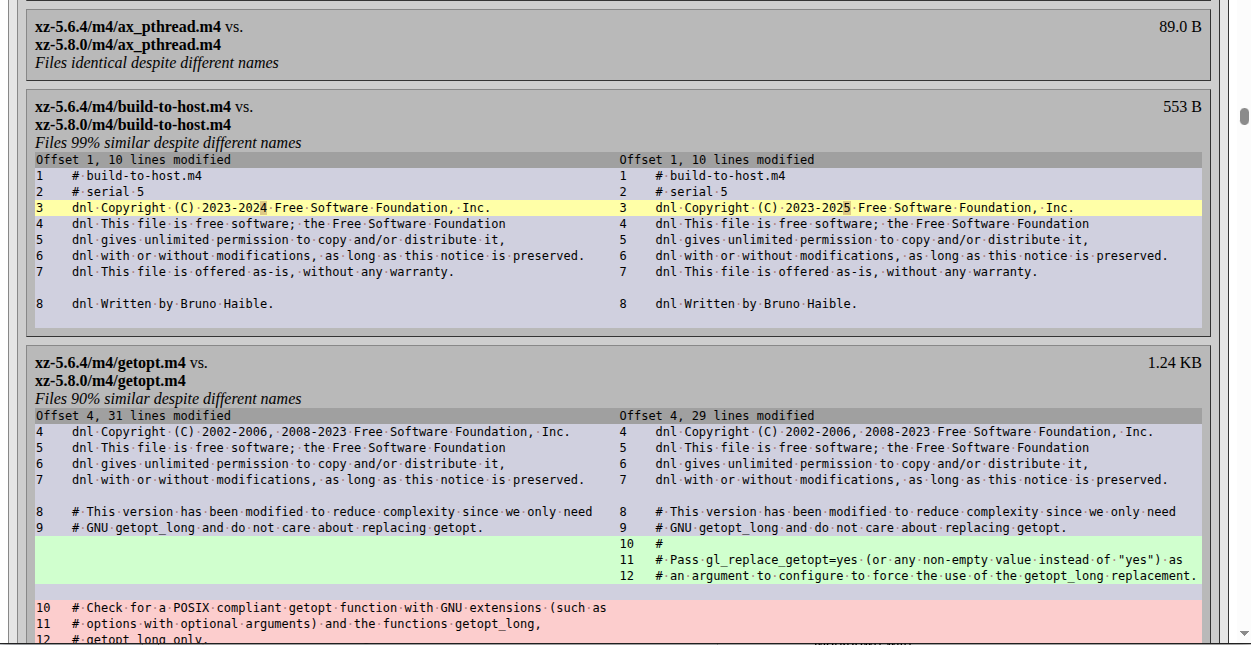
Reviewing changes between two source packages using diffoscope Diffoscope is an incredibly capable and handy tool to compare arbitrary files. For example, to view a report in HTML format of the differences between two XZ releases, run:
diffoscope --html-dir xz-utils-5.6.4_vs_5.8.0 xz-utils_5.6.4.orig.tar.xz xz-utils_5.8.0.orig.tar.xz
browse xz-utils-5.6.4_vs_5.8.0/index.html
Inspecting diffoscope output of differences between two XZ Utils releases If the changes are extensive, and you want to use a LLM to help spot potential security issues, generate the report of both the upstream and Debian packaging differences in Markdown with:
diffoscope --markdown diffoscope-debian.md xz-utils_5.6.4-1.debian.tar.xz xz-utils_5.8.1-2.debian.tar.xz
diffoscope --markdown diffoscope.md xz-utils_5.6.4.orig.tar.xz xz-utils_5.8.0.orig.tar.xz
The Markdown files created above can then be passed to your favorite LLM, along with a prompt such as:
Based on the attached diffoscope output for a new Debian package version compared with the previous one, list all suspicious changes that might have introduced a backdoor, followed by other potential security issues. If there are none, list a short summary of changes as the conclusion.

Reviewing Debian source packages in version control As of today only 93% of all Debian source packages are tracked in git on Debian s GitLab instance at salsa.debian.org. Some key packages such as Coreutils and Bash are not using version control at all, as their maintainers apparently don t see value in using git for Debian packaging, and the Debian Policy does not require it. Thus, the only reliable and consistent way to audit changes in Debian packages is to compare the full versions from the archive as shown above. However, for packages that are hosted on Salsa, one can view the git history to gain additional insight into what exactly changed, when and why. For packages that are using version control, their location can be found in the Git-Vcs header in the debian/control file. For xz-utils the location is salsa.debian.org/debian/xz-utils. Note that the Debian policy does not state anything about how Salsa should be used, or what git repository layout or development practices to follow. In practice most packages follow the DEP-14 proposal, and use git-buildpackage as the tool for managing changes and pushing and pulling them between upstream and salsa.debian.org. To get the XZ Utils source, run:
$ gbp clone https://salsa.debian.org/debian/xz-utils.git
gbp:info: Cloning from 'https://salsa.debian.org/debian/xz-utils.git'
At the time of writing this post the git history shows:
$ git log --graph --oneline
* bb787585 (HEAD -> debian/unstable, origin/debian/unstable, origin/HEAD) Prepare 5.8.1-2
* 4b769547 d: Remove the symlinks from -dev package.
* a39f3428 Correct the nocheck build profile
* 1b806b8d Import Debian changes 5.8.1-1.1
* b1cad34b Prepare 5.8.1-1
* a8646015 Import 5.8.1
* 2808ec2d Update upstream source from tag 'upstream/5.8.1'
 \
  * fa1e8796 (origin/upstream/v5.8, upstream/v5.8) New upstream version 5.8.1
  * a522a226 Bump version and soname for 5.8.1
  * 1c462c2a Add NEWS for 5.8.1
  * 513cabcf Tests: Call lzma_code() in smaller chunks in fuzz_common.h
  * 48440e24 Tests: Add a fuzzing target for the multithreaded .xz decoder
  * 0c80045a liblzma: mt dec: Fix lack of parallelization in single-shot decoding
  * 81880488 liblzma: mt dec: Don't modify thr->in_size in the worker thread
  * d5a2ffe4 liblzma: mt dec: Don't free the input buffer too early (CVE-2025-31115)
  * c0c83596 liblzma: mt dec: Simplify by removing the THR_STOP state
  * 831b55b9 liblzma: mt dec: Fix a comment
  * b9d168ee liblzma: Add assertions to lzma_bufcpy()
  * c8e0a489 DOS: Update Makefile to fix the build
  * 307c02ed sysdefs.h: Avoid <stdalign.h> even with C11 compilers
  * 7ce38b31 Update THANKS
  * 688e51bd Translations: Update the Croatian translation
*   a6b54dde Prepare 5.8.0-1.
*   77d9470f Add 5.8 symbols.
*   9268eb66 Import 5.8.0
*   6f85ef4f Update upstream source from tag 'upstream/5.8.0'
 \ \
  *   afba662b New upstream version 5.8.0
   /
  * 173fb5c6 doc/SHA256SUMS: Add 5.8.0
  * db9258e8 Bump version and soname for 5.8.0
  * bfb752a3 Add NEWS for 5.8.0
  * 6ccbb904 Translations: Run "make -C po update-po"
  * 891a5f05 Translations: Run po4a/update-po
  * 4f52e738 Translations: Partially fix overtranslation in Serbian man pages
  * ff5d9447 liblzma: Count the extra bytes in LZMA/LZMA2 decoder memory usage
  * 943b012d liblzma: Use SSE2 intrinsics instead of memcpy() in dict_repeat()
This shows both the changes on the debian/unstable branch as well as the intermediate upstream import branch, and the actual real upstream development branch. See my Debian source packages in git explainer for details of what these branches are used for. To only view changes on the Debian branch, run git log --graph --oneline --first-parent or git log --graph --oneline -- debian. The Debian branch should only have changes inside the debian/ subdirectory, which is easy to check with:
$ git diff --stat upstream/v5.8
debian/README.source   16 +++
debian/autogen.sh   32 +++++
debian/changelog   949 ++++++++++++++++++++++++++
...
debian/upstream/signing-key.asc   52 +++++++++
debian/watch   4 +
debian/xz-utils.README.Debian   47 ++++++++
debian/xz-utils.docs   6 +
debian/xz-utils.install   28 +++++
debian/xz-utils.postinst   19 +++
debian/xz-utils.prerm   10 ++
debian/xzdec.docs   6 +
debian/xzdec.install   4 +
33 files changed, 2014 insertions(+)
All the files outside the debian/ directory originate from upstream, and for example running git blame on them should show only upstream commits:
$ git blame CMakeLists.txt
22af94128 (Lasse Collin 2024-02-12 17:09:10 +0200 1) # SPDX-License-Identifier: 0BSD
22af94128 (Lasse Collin 2024-02-12 17:09:10 +0200 2)
7e3493d40 (Lasse Collin 2020-02-24 23:38:16 +0200 3) ###############
7e3493d40 (Lasse Collin 2020-02-24 23:38:16 +0200 4) #
426bdc709 (Lasse Collin 2024-02-17 21:45:07 +0200 5) # CMake support for building XZ Utils
If the upstream in question signs commits or tags, they can be verified with e.g.:
$ git verify-tag v5.6.2
gpg: Signature made Wed 29 May 2024 09:39:42 AM PDT
gpg: using RSA key 3690C240CE51B4670D30AD1C38EE757D69184620
gpg: issuer "lasse.collin@tukaani.org"
gpg: Good signature from "Lasse Collin <lasse.collin@tukaani.org>" [expired]
gpg: Note: This key has expired!
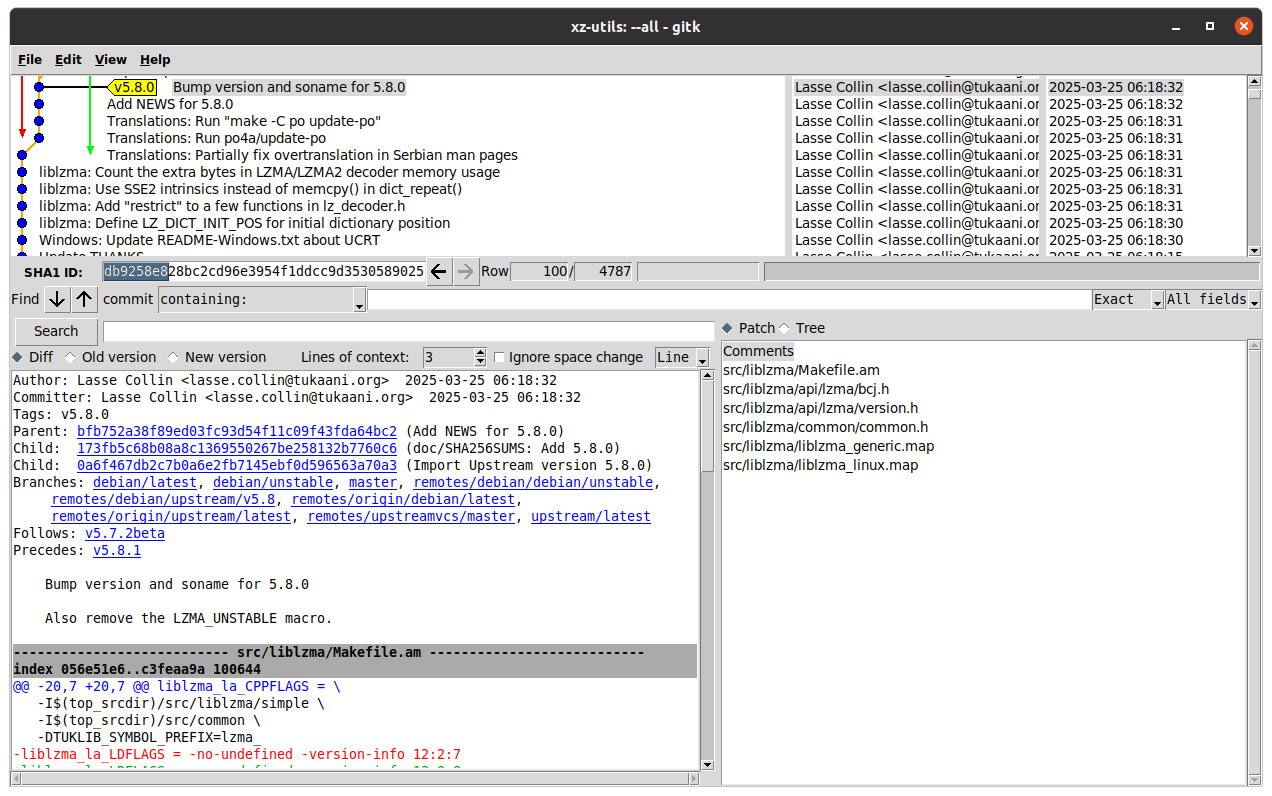
The main benefit of reviewing changes in git is the ability to see detailed information about each individual change, instead of just staring at a massive list of changes without any explanations. In this example, to view all the upstream commits since the previous import to Debian, one would view the commit range from afba662b New upstream version 5.8.0 to fa1e8796 New upstream version 5.8.1 with git log --reverse -p afba662b...fa1e8796. However, a far superior way to review changes would be to browse this range using a visual git history viewer, such as gitk. Either way, looking at one code change at a time and reading the git commit message makes the review much easier. Browsing git history in gitk --all

Comparing Debian source packages to git contents As stated in the beginning of the previous section, and worth repeating, there is no guarantee that the contents in the Debian packaging git repository matches what was actually uploaded to Debian. While the tag2upload project in Debian is getting more and more popular, Debian is still far from having any system to enforce that the git repository would be in sync with the Debian archive contents. To detect such differences we can run diff across the Debian source packages downloaded with debsnap earlier (path source-xz-utils/xz-utils_5.8.1-2.debian) and the git repository cloned in the previous section (path xz-utils):
diff
$ diff -u source-xz-utils/xz-utils_5.8.1-2.debian/ xz-utils/debian/
diff -u source-xz-utils/xz-utils_5.8.1-2.debian/changelog xz-utils/debian/changelog
--- debsnap/source-xz-utils/xz-utils_5.8.1-2.debian/changelog 2025-10-03 09:32:16.000000000 -0700
+++ xz-utils/debian/changelog 2025-10-12 12:18:04.623054758 -0700
@@ -5,7 +5,7 @@
 * Remove the symlinks from -dev, pointing to the lib package.
 (Closes: #1109354)

- -- Sebastian Andrzej Siewior <sebastian@breakpoint.cc> Fri, 03 Oct 2025 18:32:16 +0200
+ -- Sebastian Andrzej Siewior <sebastian@breakpoint.cc> Fri, 03 Oct 2025 18:36:59 +0200
In the case above diff revealed that the timestamp in the changelog in the version uploaded to Debian is different from what was committed to git. This is not malicious, just a mistake by the maintainer who probably didn t run gbp tag immediately after upload, but instead some dch command and ended up with having a different timestamps in the git compared to what was actually uploaded to Debian.

Creating syntetic Debian packaging git repositories If no Debian packaging git repository exists, or if it is lagging behind what was uploaded to Debian s archive, one can use git-buildpackage s import-dscs feature to create synthetic git commits based on the files downloaded by debsnap, ensuring the git contents fully matches what was uploaded to the archive. To import a single version there is gbp import-dsc (no s at the end), of which an example invocation would be:
$ gbp import-dsc --verbose ../source-xz-utils/xz-utils_5.8.1-2.dsc
Version '5.8.1-2' imported under '/home/otto/debian/xz-utils-2025-09-29'
Example commit history from a repository with commits added with gbp import-dsc:
$ git log --graph --oneline
* 86aed07b (HEAD -> debian/unstable, tag: debian/5.8.1-2, origin/debian/unstable) Import Debian changes 5.8.1-2
* f111d93b (tag: debian/5.8.1-1.1) Import Debian changes 5.8.1-1.1
* 1106e19b (tag: debian/5.8.1-1) Import Debian changes 5.8.1-1
 \
  * 08edbe38 (tag: upstream/5.8.1, origin/upstream/v5.8, upstream/v5.8) Import Upstream version 5.8.1
   \
    * a522a226 (tag: v5.8.1) Bump version and soname for 5.8.1
    * 1c462c2a Add NEWS for 5.8.1
    * 513cabcf Tests: Call lzma_code() in smaller chunks in fuzz_common.h
An online example repository with only a few missing uploads added using gbp import-dsc can be viewed at salsa.debian.org/otto/xz-utils-2025-09-29/-/network/debian%2Funstable An example repository that was fully crafted using gbp import-dscs can be viewed at salsa.debian.org/otto/xz-utils-gbp-import-dscs-debsnap-generated/-/network/debian%2Flatest. There exists also dgit, which in a similar way creates a synthetic git history to allow viewing the Debian archive contents via git tools. However, its focus is on producing new package versions, so fetching a package with dgit that has not had the history recorded in dgit earlier will only show the latest versions:
$ dgit clone xz-utils
canonical suite name for unstable is sid
starting new git history
last upload to archive: NO git hash
downloading http://ftp.debian.org/debian//pool/main/x/xz-utils/xz-utils_5.8.1.orig.tar.xz...
downloading http://ftp.debian.org/debian//pool/main/x/xz-utils/xz-utils_5.8.1.orig.tar.xz.asc...
downloading http://ftp.debian.org/debian//pool/main/x/xz-utils/xz-utils_5.8.1-2.debian.tar.xz...
dpkg-source: info: extracting xz-utils in unpacked
dpkg-source: info: unpacking xz-utils_5.8.1.orig.tar.xz
dpkg-source: info: unpacking xz-utils_5.8.1-2.debian.tar.xz
synthesised git commit from .dsc 5.8.1-2
HEAD is now at f9bcaf7 xz-utils (5.8.1-2) unstable; urgency=medium
dgit ok: ready for work in xz-utils
$ dgit/sid   git log --graph --oneline
* f9bcaf7 xz-utils (5.8.1-2) unstable; urgency=medium 9 days ago (HEAD -> dgit/sid, dgit/dgit/sid)
 \
  * 11d3a62 Import xz-utils_5.8.1-2.debian.tar.xz 9 days ago
* 15dcd95 Import xz-utils_5.8.1.orig.tar.xz 6 months ago
Unlike git-buildpackage managed git repositories, the dgit managed repositories cannot incorporate the upstream git history and are thus less useful for auditing the full software supply-chain in git.

Comparing upstream source packages to git contents Equally important to the note in the beginning of the previous section, one must also keep in mind that the upstream release source packages, often called release tarballs, are not guaranteed to have the exact same contents as the upstream git repository. Projects might strip out test data or extra development files from their release tarballs to avoid shipping unnecessary files to users, or projects might add documentation files or versioning information into the tarball that isn t stored in git. While a small minority, there are also upstreams that don t use git at all, so the plain files in a release tarball is still the lowest common denominator for all open source software projects, and exporting and importing source code needs to interface with it. In the case of XZ, the release tarball has additional version info and also a sizeable amount of pregenerated compiler configuration files. Detecting and comparing differences between git contents and tarballs can of course be done manually by running diff across an unpacked tarball and a checked out git repository. If using git-buildpackage, the difference between the git contents and tarball contents can be made visible directly in the import commit. In this XZ example, consider this git history:
* b1cad34b Prepare 5.8.1-1
* a8646015 Import 5.8.1
* 2808ec2d Update upstream source from tag 'upstream/5.8.1'
 \
  * fa1e8796 (debian/upstream/v5.8, upstream/v5.8) New upstream version 5.8.1
  * a522a226 (tag: v5.8.1) Bump version and soname for 5.8.1
  * 1c462c2a Add NEWS for 5.8.1
The commit a522a226 was the upstream release commit, which upstream also tagged v5.8.1. The merge commit 2808ec2d applied the new upstream import branch contents on the Debian branch. Between these is the special commit fa1e8796 New upstream version 5.8.1 tagged upstream/v5.8. This commit and tag exists only in the Debian packaging repository, and they show what is the contents imported into Debian. This is generated automatically by git-buildpackage when running git import-orig --uscan for Debian packages with the correct settings in debian/gbp.conf. By viewing this commit one can see exactly how the upstream release tarball differs from the upstream git contents (if at all). In the case of XZ, the difference is substantial, and shown below in full as it is very interesting:
$ git show --stat fa1e8796
commit fa1e8796dabd91a0f667b9e90f9841825225413a
(debian/upstream/v5.8, upstream/v5.8)
Author: Sebastian Andrzej Siewior <sebastian@breakpoint.cc>
Date: Thu Apr 3 22:58:39 2025 +0200
New upstream version 5.8.1
.codespellrc   30 -
.gitattributes   8 -
.github/workflows/ci.yml   163 -
.github/workflows/freebsd.yml   32 -
.github/workflows/netbsd.yml   32 -
.github/workflows/openbsd.yml   35 -
.github/workflows/solaris.yml   32 -
.github/workflows/windows-ci.yml   124 -
.gitignore   113 -
ABOUT-NLS   1 +
ChangeLog   17392 +++++++++++++++++++++
Makefile.in   1097 +++++++
aclocal.m4   1353 ++++++++
build-aux/ci_build.bash   286 --
build-aux/compile   351 ++
build-aux/config.guess   1815 ++++++++++
build-aux/config.rpath   751 +++++
build-aux/config.sub   2354 +++++++++++++
build-aux/depcomp   792 +++++
build-aux/install-sh   541 +++
build-aux/ltmain.sh   11524 ++++++++++++++++++++++
build-aux/missing   236 ++
build-aux/test-driver   160 +
config.h.in   634 ++++
configure   26434 ++++++++++++++++++++++
debug/Makefile.in   756 +++++
doc/SHA256SUMS   236 --
doc/man/txt/lzmainfo.txt   36 +
doc/man/txt/xz.txt   1708 ++++++++++
doc/man/txt/xzdec.txt   76 +
doc/man/txt/xzdiff.txt   39 +
doc/man/txt/xzgrep.txt   70 +
doc/man/txt/xzless.txt   36 +
doc/man/txt/xzmore.txt   31 +
lib/Makefile.in   623 ++++
m4/.gitignore   40 -
m4/build-to-host.m4   274 ++
m4/gettext.m4   392 +++
m4/host-cpu-c-abi.m4   529 +++
m4/iconv.m4   324 ++
m4/intlmacosx.m4   71 +
m4/lib-ld.m4   170 +
m4/lib-link.m4   815 +++++
m4/lib-prefix.m4   334 ++
m4/libtool.m4   8488 +++++++++++++++++++++
m4/ltoptions.m4   467 +++
m4/ltsugar.m4   124 +
m4/ltversion.m4   24 +
m4/lt~obsolete.m4   99 +
m4/nls.m4   33 +
m4/po.m4   456 +++
m4/progtest.m4   92 +
po/.gitignore   31 -
po/Makefile.in.in   517 +++
po/Rules-quot   66 +
po/boldquot.sed   21 +
po/ca.gmo   Bin 0 -> 15587 bytes
po/cs.gmo   Bin 0 -> 7983 bytes
po/da.gmo   Bin 0 -> 9040 bytes
po/de.gmo   Bin 0 -> 29882 bytes
po/en@boldquot.header   35 +
po/en@quot.header   32 +
po/eo.gmo   Bin 0 -> 15060 bytes
po/es.gmo   Bin 0 -> 29228 bytes
po/fi.gmo   Bin 0 -> 28225 bytes
po/fr.gmo   Bin 0 -> 10232 bytes
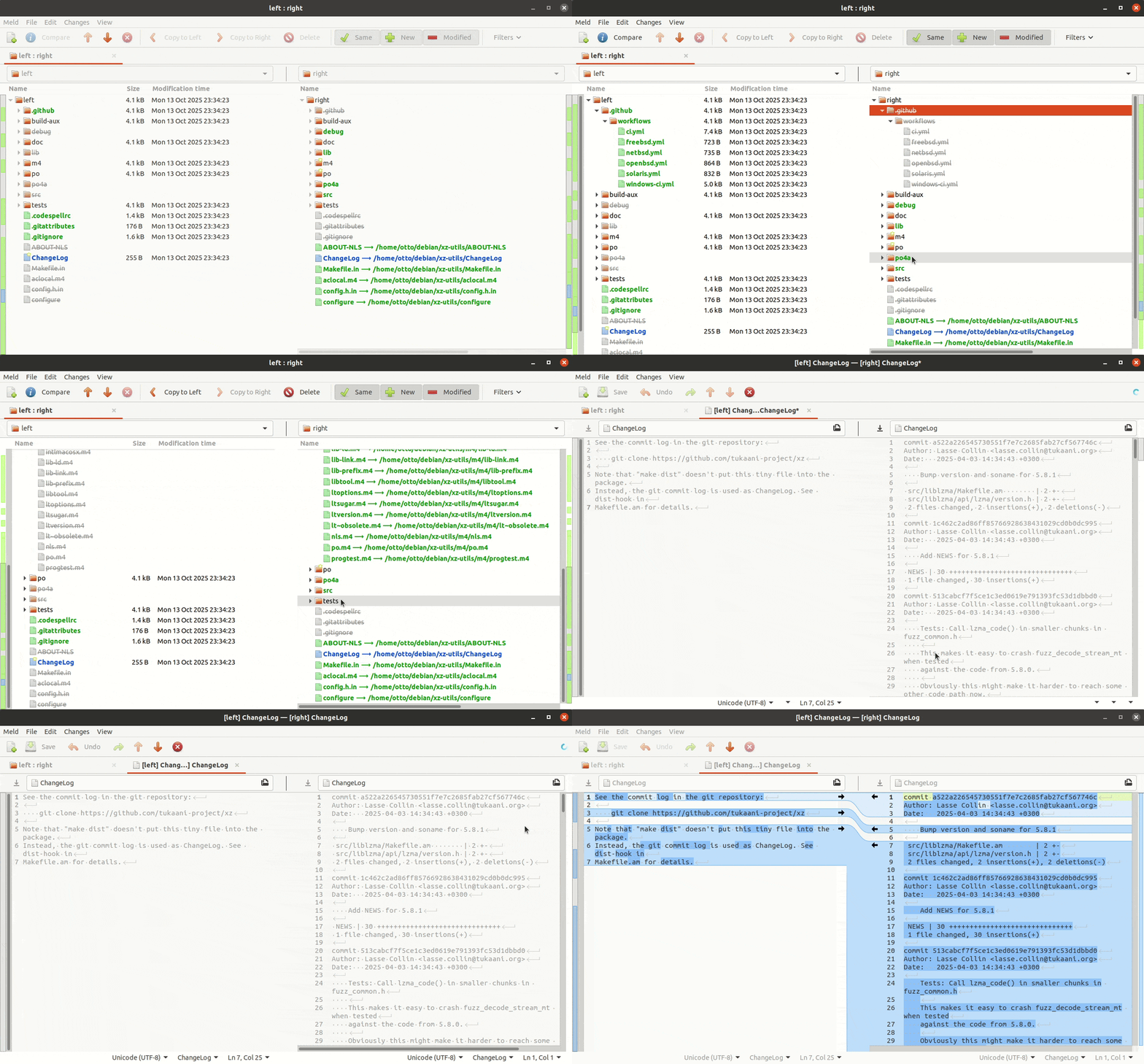
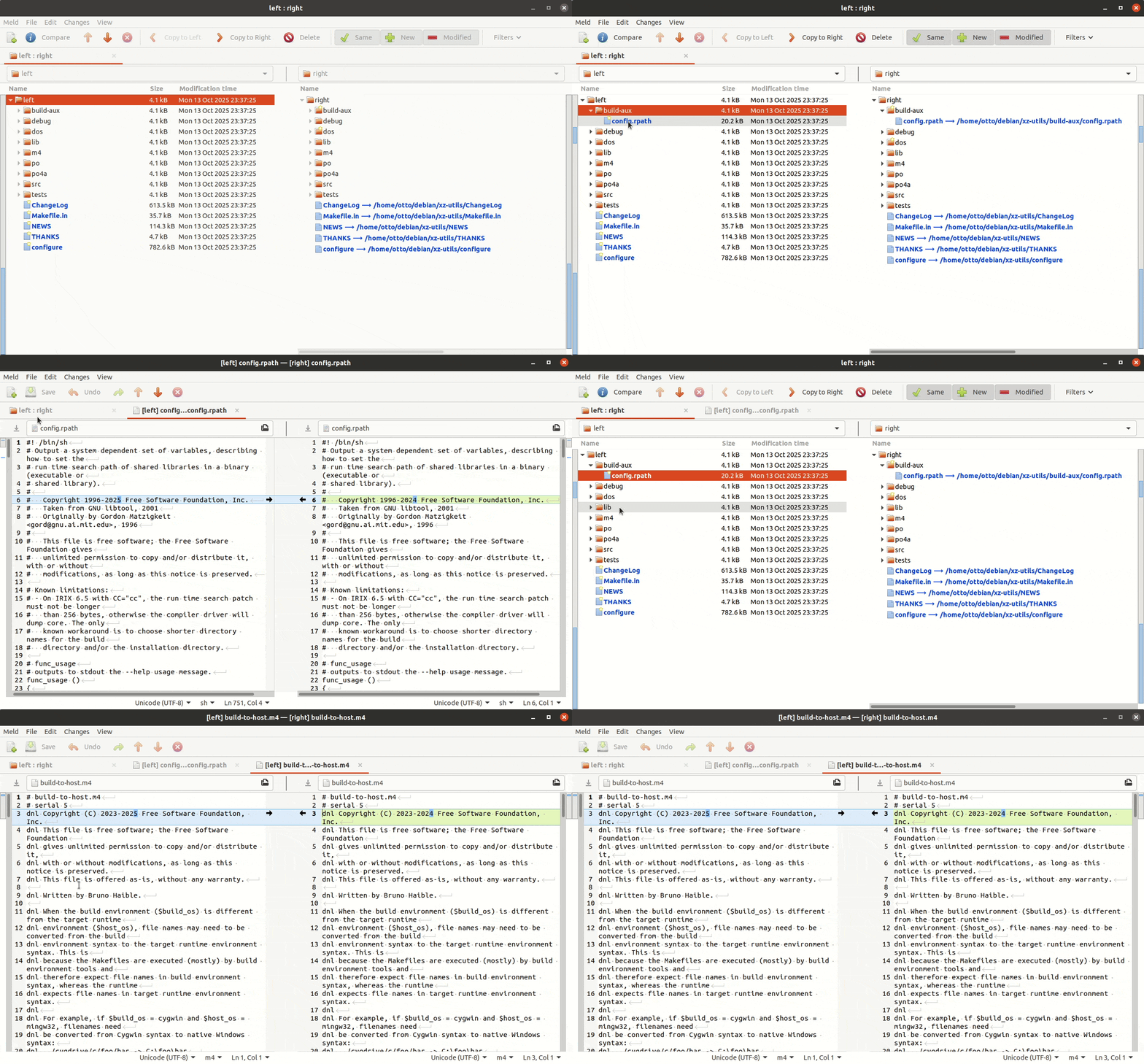
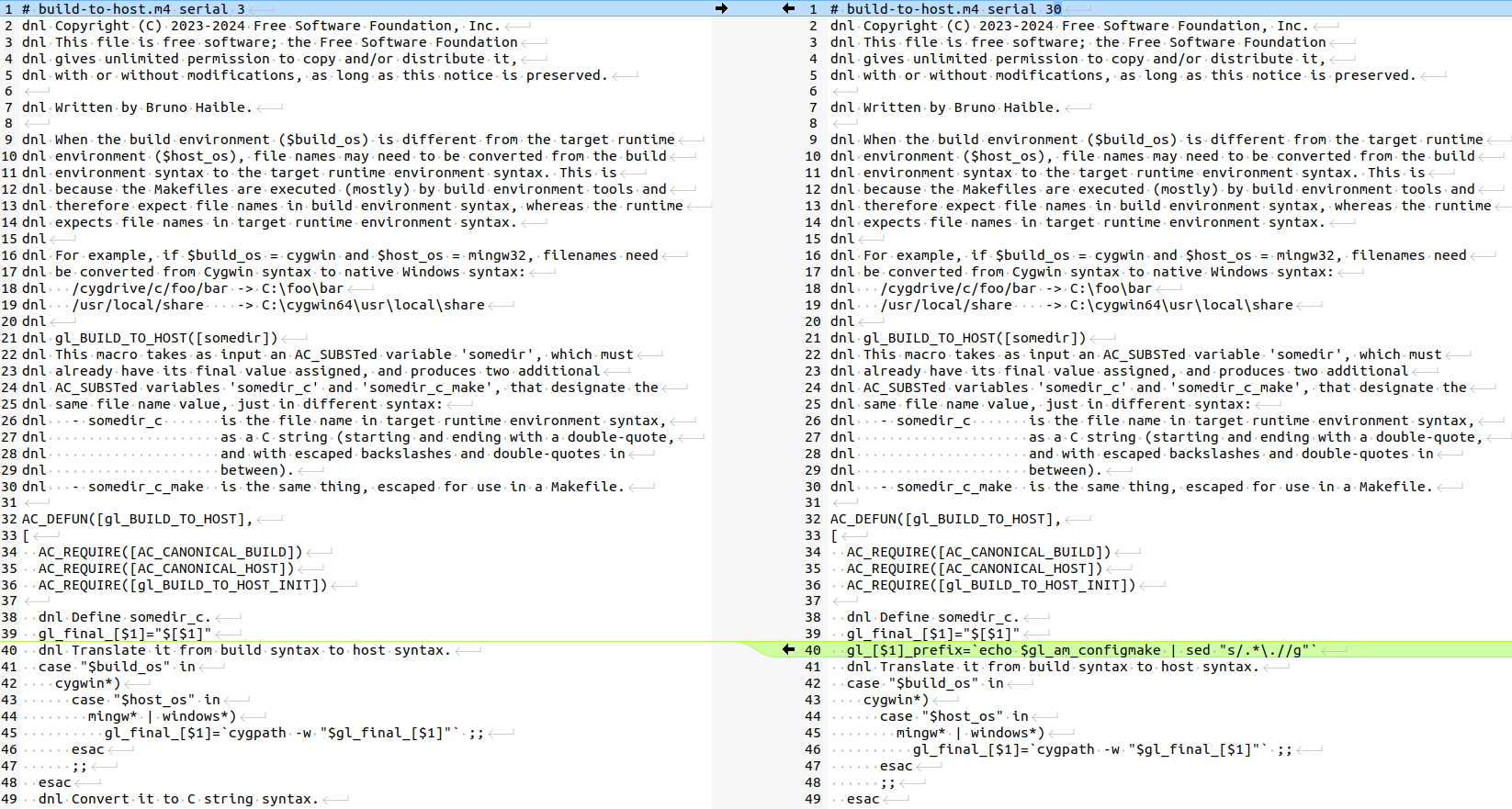
To be able to easily inspect exactly what changed in the release tarball compared to git release tag contents, the best tool for the job is Meld, invoked via git difftool --dir-diff fa1e8796^..fa1e8796. Meld invoked by git difftool --dir-diff afba662b..fa1e8796 to show differences between git release tag and release tarball contents To compare changes across the new and old upstream tarball, one would need to compare commits afba662b New upstream version 5.8.0 and fa1e8796 New upstream version 5.8.1 by running git difftool --dir-diff afba662b..fa1e8796. Meld invoked by git difftool --dir-diff afba662b..fa1e8796 to show differences between to upstream release tarball contents With all the above tips you can now go and try to audit your own favorite package in Debian and see if it is identical with upstream, and if not, how it differs.

Should the XZ backdoor have been detected using these tools? The famous XZ Utils backdoor (CVE-2024-3094) consisted of two parts: the actual backdoor inside two binary blobs masqueraded as a test files (tests/files/bad-3-corrupt_lzma2.xz, tests/files/good-large_compressed.lzma), and a small modification in the build scripts (m4/build-to-host.m4) to extract the backdoor and plant it into the built binary. The build script was not tracked in version control, but generated with GNU Autotools at release time and only shipped as additional files in the release tarball. The entire reason for me to write this post was to ponder if a diligent engineer using git-buildpackage best practices could have reasonably spotted this while importing the new upstream release into Debian. The short answer is no . The malicious actor here clearly anticipated all the typical ways anyone might inspect both git commits, and release tarball contents, and masqueraded the changes very well and over a long timespan. First of all, XZ has for legitimate reasons for several carefully crafted .xz files as test data to help catch regressions in the decompression code path. The test files are shipped in the release so users can run the test suite and validate that the binary is built correctly and xz works properly. Debian famously runs massive amounts of testing in its CI and autopkgtest system across tens of thousands of packages to uphold high quality despite frequent upgrades of the build toolchain and while supporting more CPU architectures than any other distro. Test data is useful and should stay. When git-buildpackage is used correctly, the upstream commits are visible in the Debian packaging for easy review, but the commit cf44e4b that introduced the test files does not deviate enough from regular sloppy coding practices to really stand out. It is unfortunately very common for git commit to lack a message body explaining why the change was done, and to not be properly atomic with test code and test data together in the same commit, and for commits to be pushed directly to mainline without using code reviews (the commit was not part of any PR in this case). Only another upstream developer could have spotted that this change is not on par to what the project expects, and that the test code was never added, only test data, and thus that this commit was not just a sloppy one but potentially malicious. Secondly, the fact that a new Autotools file appeared (m4/build-to-host.m4) in the XZ Utils 5.6.0 is not suspicious. This is perfectly normal for Autotools. In fact, starting from XZ Utils version 5.8.1 it is now shipping a m4/build-to-host.m4 file that it actually uses now. Spotting that there is anything fishy is practically impossible by simply reading the code, as Autotools files are full custom m4 syntax interwoven with shell script, and there are plenty of backticks ( ) that spawn subshells and evals that execute variable contents further, which is just normal for Autotools. Russ Cox s XZ post explains how exactly the Autotools code fetched the actual backdoor from the test files and injected it into the build. Inspecting the m4/build-to-host.m4 changes in Meld launched via git difftool There is only one tiny thing that maybe a very experienced Autotools user could potentially have noticed: the serial 30 in the version header is way too high. In theory one could also have noticed this Autotools file deviates from what other packages in Debian ship with the same filename, such as e.g. the serial 3, serial 5a or 5b versions. That would however require and an insane amount extra checking work, and is not something we should plan to start doing. A much simpler solution would be to simply strongly recommend all open source projects to stop using Autotools to eventually get rid of it entirely.

Not detectable with reasonable effort While planting backdoors is evil, it is hard not to feel some respect to the level of skill and dedication of the people behind this. I ve been involved in a bunch of security breach investigations during my IT career, and never have I seen anything this well executed. If it hadn t slowed down SSH by ~500 milliseconds and been discovered due to that, it would most likely have stayed undetected for months or years. Hiding backdoors in closed source software is relatively trivial, but hiding backdoors in plain sight in a popular open source project requires some unusual amount of expertise and creativity as shown above.

Is the software supply-chain in Debian easy to audit? While maintaining a Debian package source using git-buildpackage can make the package history a lot easier to inspect, most packages have incomplete configurations in their debian/gbp.conf, and thus their package development histories are not always correctly constructed or uniform and easy to compare. The Debian Policy does not mandate git usage at all, and there are many important packages that are not using git at all. Additionally the Debian Policy also allows for non-maintainers to upload new versions to Debian without committing anything in git even for packages where the original maintainer wanted to use git. Uploads that bypass git unfortunately happen surpisingly often. Because of the situation, I am afraid that we could have multiple similar backdoors lurking that simply haven t been detected yet. More audits, that hopefully also get published openly, would be welcome! More people auditing the contents of the Debian archives would probably also help surface what tools and policies Debian might be missing to make the work easier, and thus help improve the security of Debian s users, and improve trust in Debian.

Is Debian currently missing some software that could help detect similar things? To my knowledge there is currently no system in place as part of Debian s QA or security infrastructure to verify that the upstream source packages in Debian are actually from upstream. I ve come across a lot of packages where the debian/watch or other configs are incorrect and even cases where maintainers have manually created upstream tarballs as it was easier than configuring automation to work. It is obvious that for those packages the source tarball now in Debian is not at all the same as upstream. I am not aware of any malicious cases though (if I was, I would report them of course). I am also aware of packages in the Debian repository that are misconfigured to be of type 1.0 (native) packages, mixing the upstream files and debian/ contents and having patches applied, while they actually should be configured as 3.0 (quilt), and not hide what is the true upstream sources. Debian should extend the QA tools to scan for such things. If I find a sponsor, I might build it myself as my next major contribution to Debian. In addition to better tooling for finding mismatches in the source code, Debian could also have better tooling for tracking in built binaries what their source files were, but solutions like Fraunhofer-AISEC s supply-graph or Sony s ESSTRA are not practical yet. Julien Malka s post about NixOS discusses the role of reproducible builds, which may help in some cases across all distros.

Or, is Debian missing some policies or practices to mitigate this? Perhaps more importantly than more security scanning, the Debian Developer community should switch the general mindset from anyone is free to do anything to valuing having more shared workflows. The ability to audit anything is severely hampered by the fact that there are so many ways to do the same thing, and distinguishing what is a normal deviation from a malicious deviation is too hard, as the normal can basically be almost anything. Also, as there is no documented and recommended default workflow, both those who are old and new to Debian packaging might never learn any one optimal workflow, and end up doing many steps in the packaging process in a way that kind of works, but is actually wrong or unnecessary, causing process deviations that look malicious, but turn out to just be a result of not fully understanding what would have been the right way to do something. In the long run, once individual developers workflows are more aligned, doing code reviews will become a lot easier and smoother as the excess noise of workflow differences diminishes and reviews will feel much more productive to all participants. Debian fostering a culture of code reviews would allow us to slowly move from the current practice of mainly solo packaging work towards true collaboration forming around those code reviews. I have been promoting increased use of Merge Requests in Debian already for some time, for example by proposing DEP-18: Encourage Continuous Integration and Merge Request based Collaboration for Debian packages. If you are involved in Debian development, please give a thumbs up in dep-team/deps!21 if you want me to continue promoting it.

Can we trust open source software? Yes and I would argue that we can only trust open source software. There is no way to audit closed source software, and anyone using e.g. Windows or MacOS just have to trust the vendor s word when they say they have no intentional or accidental backdoors in their software. Or, when the news gets out that the systems of a closed source vendor was compromised, like Crowdstrike some weeks ago, we can t audit anything, and time after time we simply need to take their word when they say they have properly cleaned up their code base. In theory, a vendor could give some kind of contractual or financial guarantee to its customer that there are no preventable security issues, but in practice that never happens. I am not aware of a single case of e.g. Microsoft or Oracle would have paid damages to their customers after a security flaw was found in their software. In theory you could also pay a vendor more to have them focus more effort in security, but since there is no way to verify what they did, or to get compensation when they didn t, any increased fees are likely just pocketed as increased profit. Open source is clearly better overall. You can, if you are an individual with the time and skills, audit every step in the supply-chain, or you could as an organization make investments in open source security improvements and actually verify what changes were made and how security improved. If your organisation is using Debian (or derivatives, such as Ubuntu) and you are interested in sponsoring my work to improve Debian, please reach out.

18 October 2025

Julian Andres Klode: Sound Removals

Problem statement Currently if you have an automatically installed package A (= 1) where
  • A (= 1) Depends B (= 1)
  • A (= 2) Depends B (= 2)
and you upgrade B from 1 to 2; then you can:
  1. Remove A (= 1)
  2. Upgrade A to version 2
If A was installed by a chain initiated by Recommends (say X Rec Y, Y Depends A), the solver sometimes preferred removing A (and anything depending on it until it got). I have a fix pending to introduce eager Recommends which fixes the practical case, but this is still not sound. In fact we can show that the solver produces the wrong result for small minimal test cases, as well as the right result for some others without the fix (hooray?). Ensuring sound removals is more complex, and first of all it begs the question: When is a removal sound? This, of course, is on us to define. An easy case can be found in the Debian policy, 7.6.2 Replacing whole packages, forcing their removal : If B (= 2) declares a Conflicts: A (= 1) and Replaces: A (= 1), then the removal is valid. However this is incomplete as well, consider it declares Conflicts: A (< 1) and Replaces: A (< 1); the solution to remove A rather than upgrade it would still be wrong. This indicates that we should only allow removing A if the conflicts could not be solved by upgrading it. The other case to explore is package removals. If B is removed, A should be removed as well; however it there is another package X that Provides: B (= 1) and it is marked for install, A should not be removed. That said, the solver is not allowed to install X to satisfy the depends B (= 1) - only to satisfy other dependencies [we do not want to get into endless loops where we switch between alternatives to keep reverse dependencies installed].

Proposed solution To solve this, I propose the following definition: Definition (sound removal): A removal of package P is sound if either:
  1. A version v is installed that package-conflicts with B.
  2. A package Q is removed and the installable versions of P package-depends on Q.
where the other definitions are: Definition (installable version): A version v is installable if either it is installed, or it is newer than an installed version of the same package (you may wish to change this to accomodate downgrades, or require strict pinning, but here be dragons). Definition (package-depends): A version v package-depends on a package B if either:
  1. there exists a dependency in v that can be solved by any version of B, or
  2. there exists a package C where v package-depends C and any (c in C) package-depends B (transitivity)
Definition (package-conflicts): A version v package-conflicts with an installed package B if either:
  1. it declares a conflicts against an installable version of B; or
  2. there exists a package C where v package-conflicts C, and b package-depends C for installable versions b.

Translating this into a (modified) SAT solver One approach may be to implement the logic in the conflict analysis that drives backtracking, i.e. we assume a package A and when we reach not A, we analyse if the implication graph for not A constitutes a sound removal, and then replace the assumption A with the assumption A or "learned reason. However, while this seems a plausible mechanism for a DPLL solver, for a modern CDCL solver, it s not immediately evident how to analyse whether not A is sound if the reason for it is a learned clause, rather than a problem clause. Instead we propose a static encoding of the rules into a slightly modified SAT solver: Given c1, , cn that transitive-conflicts A and D1, , Dn that A package-depends on, introduce the rule: A unless c1 or c2 or ... cn ... or not D1 or not D2 ... or not Dn Rules of the form A... unless B... - where A... and B... are CNF - are intuitively the same as A... or B..., however the semantic here is different: We are not allowed to select B... to satisfy this clause. This requires a SAT solver that tracks a reason for each literal being assigned, such as solver3, rather than a SAT solver like MiniSAT that only tracks reasons across propagation (solver3 may track A depends B or C as the reason for B without evaluating C, whereas MiniSAT would only track it as the reason given not C).

Is it actually sound? The proposed definition of a sound removal may still proof unsound as I either missed something in the conclusion of the proposed definition that violates my goal I set out to achieve, or I missed some of the goals. I challenge you to find cases that cause removals that look wrong :D

17 October 2025

David Bremner: Hibernate on the pocket reform 13/n

Context

Some progress upstream Recently Sebastian Reichel at Collabora [1] has made a few related commits, apparently inspired in part by my kvetching on this blog.

Disconnecting and reconnecting PCI busses At some point I noticed error message about the nvme device on resume. I then learned how to disconnect and reconnect PCI buses in Linux. I ended up with something like the following. At least the PCI management seems to work. I can manually disconnect all the PCI busses and rescan to connect them again on a running system. It presumably helps that I am not using the nvme device in this system.
set -x
echo platform >  /sys/power/pm_test
echo reboot > /sys/power/disk
rmmod mt76x2u
sleep 2
echo 1   tee /sys/bus/pci/devices/0003:30:00.0/remove
sleep 2
echo 1   tee /sys/bus/pci/devices/0004:41:00.0/remove
sleep 2
echo 1   tee /sys/bus/pci/devices/0004:40:00.0/remove
sleep 2
echo LSPCI:
lspci -t
sleep 2
echo disk >  /sys/power/state
sleep 2
echo 1   tee /sys/bus/pci/rescan
sleep 2
modprobe mt76x2u

Minimal changes to upstream With the ongoing work at collabora I decided to try a minimal patch stack to get the pocket reform to boot. I added the following 3 commits (available from [3]).
09868a4f2eb (HEAD -> reform-patches) copy pocket-reform dts from reform-debian-packages
152e2ae8a193 pocket/panel: sleep fix v3
18f65da9681c add-multi-display-panel-driver
It does indeed boot and seems stable.
$ uname -a
Linux anthia 6.18.0-rc1+ #19 SMP Thu Oct 16 11:32:04 ADT 2025 aarch64 GNU/Linux
Running the hibernation script above I get no output from the lspci, but seemingly issues with PCI coming back from hibernate:
[  424.645109] PM: hibernation: Allocated 361823 pages for snapshot
[  424.647216] PM: hibernation: Allocated 1447292 kbytes in 3.23 seconds (448.07 MB/s)
[  424.649321] Freezing remaining freezable tasks
[  424.654767] Freezing remaining freezable tasks completed (elapsed 0.003 seconds)
[  424.661070] rk_gmac-dwmac fe1b0000.ethernet end0: Link is Down
[  424.740716] rockchip-dw-pcie a40c00000.pcie: Failed to receive PME_TO_Ack
[  424.742041] PM: hibernation: hibernation debug: Waiting for 5 second(s).
[  430.074757] pci 0004:40:00.0: [1d87:3588] type 01 class 0x060400 PCIe Root Port
F F & Zn [  watchdog: CPU4: Watchdog detected hard LOCKUP on cpu 5
[  456.039004] Modules linked in: xt_CHECKSUM xt_tcpudp nft_chain_nat xt_MASQUERADE nf_nat nf_conntrack nf_defrag_ipv6 nf_defrag_ipv4 nft_compat x_tables bridge stp llc nf_tables aes_neon_bs aes_neon_blk ccm dwmac_rk binfmt_misc mt76x2_common mt76x02_usb mt76_usb mt76x02_lib mt76 mac80211 rk805_pwrkey snd_soc_tlv320aic31xx snd_soc_simple_card reform2_lpc(OE) libarc4 rockchip_saradc industrialio_triggered_buffer kfifo_buf industrialio cfg80211 rockchip_thermal rockchip_rng hantro_vpu cdc_acm v4l2_vp9 v4l2_jpeg rockchip_rga rfkill snd_soc_rockchip_i2s_tdm videobuf2_dma_sg v4l2_h264 panthor snd_soc_audio_graph_card drm_gpuvm snd_soc_simple_card_utils drm_exec evdev joydev dm_mod nvme_fabrics efi_pstore configfs nfnetlink autofs4 ext4 crc16 mbcache jbd2 btrfs blake2b_generic xor xor_neon raid6_pq mali_dp snd_soc_meson_axg_toddr snd_soc_meson_axg_fifo snd_soc_meson_codec_glue panfrost drm_shmem_helper gpu_sched ao_cec_g12a meson_vdec(C) videobuf2_dma_contig videobuf2_memops v4l2_mem2mem videobuf2_v4l2 videodev
[  456.039060]  videobuf2_common mc dw_hdmi_i2s_audio meson_drm meson_canvas meson_dw_mipi_dsi meson_dw_hdmi mxsfb mux_mmio panel_edp imx_dcss ti_sn65dsi86 nwl_dsi mux_core pwm_imx27 hid_generic usbhid hid xhci_plat_hcd onboard_usb_dev xhci_hcd nvme nvme_core snd_soc_hdmi_codec snd_soc_core nvme_keyring nvme_auth hkdf snd_pcm_dmaengine snd_pcm snd_timer snd soundcore fan53555 rtc_pcf8523 micrel phy_package stmmac_platform stmmac pcs_xpcs rk808_regulator phylink sdhci_of_dwcmshc mdio_devres dw_mmc_rockchip of_mdio sdhci_pltfm phy_rockchip_usbdp fixed_phy dw_mmc_pltfm fwnode_mdio typec phy_rockchip_naneng_combphy phy_rockchip_samsung_hdptx pwm_rockchip sdhci dwc3 libphy dw_wdt dw_mmc ehci_platform rockchip_dfi mdio_bus cqhci ulpi ohci_platform ehci_hcd udc_core ohci_hcd rockchipdrm phy_rockchip_inno_usb2 usbcore dw_hdmi_qp analogix_dp dw_mipi_dsi cpufreq_dt dw_mipi_dsi2 i2c_rk3x usb_common drm_dp_aux_bus [last unloaded: mt76x2u]
[  456.039111] Sending NMI from CPU 4 to CPUs 5:
[  471.942262] page_pool_release_retry() stalled pool shutdown: id 9, 2 inflight 60 sec
[  532.989611] page_pool_release_retry() stalled pool shutdown: id 9, 2 inflight 121 sec
This does look like some progress, probably thanks to Sebastien. Comparing with the logs in hibernate-pocket-12, the resume process is not bailing out complaining about PHY.

Attempt to reapply PCI reset patches Following the procedure in hibernate-pocket-12, I attempted to re-apply the pci reset patches [2]. In particular I followed the hints output by b4. Unfortunately there are too many conflicts now for me to sensibly resolve.
  1. https://gitlab.collabora.com/hardware-enablement/rockchip-3588/linux.git#rockchip-devel
  2. https://lore.kernel.org/all/20250715-pci-port-reset-v6-0-6f9cce94e7bb@oss.qualcomm.com/#r
  3. https://salsa.debian.org/bremner/collabora-rockchip-3588#reform-patches

14 October 2025

Dirk Eddelbuettel: qlcal 0.0.17 on CRAN: Regular Update

The seventeenth release of the qlcal package arrivied at CRAN today, once again following a QuantLib release as 1.40 came out this morning. qlcal delivers the calendaring parts of QuantLib. It is provided (for the R package) as a set of included files, so the package is self-contained and does not depend on an external QuantLib library (which can be demanding to build). qlcal covers over sixty country / market calendars and can compute holiday lists, its complement (i.e. business day lists) and much more. Examples are in the README at the repository, the package page, and course at the CRAN package page. This releases mainly synchronizes qlcal with the QuantLib release 1.40. Only one country calendar got updated; the diffstat looks larger as the URL part of the copyright got updated throughout. We also updated the URL for the GPL-2 badge: when CRAN checks this, they always hit a timeout as the FSF server possibly keeps track of incoming requests; we now link to version from the R Licenses page to avoid this.

Changes in version 0.0.17 (2025-07-14)
  • Synchronized with QuantLib 1.40 released today
  • Calendar updates for Singapore
  • URL update in README.md

Courtesy of my CRANberries, there is a diffstat report for this release. See the project page and package documentation for more details, and more examples.

This post by Dirk Eddelbuettel originated on his Thinking inside the box blog. If you like this or other open-source work I do, you can sponsor me at GitHub.

13 October 2025

Russell Coker: WordPress Spam Users

Just over a year ago I configured my blog to only allow signed in users to comment to reduce spam [1]. This has stopped all spam comments, it was even more successful than expected but spammers keep registering accounts. I ve now got almost 5000 spam accounts, an average of more than 10 per day. I don t know why they keep creating them without trying to enter comments. At first I thought that they were trying to assemble a lot of accounts for a deluge of comment spam but that hasn t happened. There are some WordPress plugins for bulk deletion of users but I couldn t find one with support for delete all users who haven t submitted a comment . So I do it a page at a time, but of course I don t want to do it 100 at a time so I used the below SQL to change it to 400 at a time. I initially tried larger numbers like 2000 but got Chrome timeouts when trying to click the check-box to select all users. From experimenting it seems that the time taken to check that is worse than linear. Doing it for 2000 users is obviously much more than 5* the duration of doing it for 400. 800 users was one attempt which resulted in it being possible to select them all but then it gave an error about the URL being too long when it came to actually delete them. After a binary search I found that 450 was too many but 400 worked. So now it s 12 operations to delete all the spam accounts. Each bulk delete operation is 5 GUI operations so it s 60 operations to delete 15 months of spam users. This is annoying, but less than the other problems of spam.
UPDATE  wp_usermeta  SET  meta_value  = 400 WHERE  user_id  = 2 AND  meta_key  = 'users_per_page';
Deleting the spam users reduced the size of the backup (zstd -9 of a mysql dump) for my blog by 6.5%. Then changing from zstd -9 to -19 reduced it by another 13%. After realising this difference I configured all my mysql backups to be compressed with zstd -19, this will make a difference on the system with over 30G of zstd compressed mysql backups.

10 October 2025

Sergio Cipriano: Avoiding 5XX errors by adjusting Load Balancer Idle Timeout

Avoiding 5XX errors by adjusting Load Balancer Idle Timeout Recently I faced a problem in production where a client was running a RabbitMQ server behind the Load Balancers we provisioned and the TCP connections were closed every minute. My team is responsible for the LBaaS (Load Balancer as a Service) product and this Load Balancer was an Envoy proxy provisioned by our control plane. The error was similar to this:
[2025-10-03 12:37:17,525 - pika.adapters.utils.connection_workflow - ERROR] AMQPConnector - reporting failure: AMQPConnectorSocketConnectError: timeout("TCP connection attempt timed out: ''/(<AddressFamily.AF_INET: 2>, <SocketKind.SOCK_STREAM: 1>, 6, '', ('<IP>', 5672))")
[2025-10-03 12:37:17,526 - pika.adapters.utils.connection_workflow - ERROR] AMQP connection workflow failed: AMQPConnectionWorkflowFailed: 1 exceptions in all; last exception - AMQPConnectorSocketConnectError: timeout("TCP connection attempt timed out: ''/(<AddressFamily.AF_INET: 2>, <SocketKind.SOCK_STREAM: 1>, 6, '', ('<IP>', 5672))"); first exception - None.
[2025-10-03 12:37:17,526 - pika.adapters.utils.connection_workflow - ERROR] AMQPConnectionWorkflow - reporting failure: AMQPConnectionWorkflowFailed: 1 exceptions in all; last exception - AMQPConnectorSocketConnectError: timeout("TCP connection attempt timed out: ''/(<AddressFamily.AF_INET: 2>, <SocketKind.SOCK_STREAM: 1>, 6, '', ('<IP>', 5672))"); first exception - None
At first glance, the issue is simple: the Load Balancer's idle timeout is shorter than the RabbitMQ heartbeat interval. The idle timeout is the time at which a downstream or upstream connection will be terminated if there are no active streams. Heartbeats generate periodic network traffic to prevent idle TCP connections from closing prematurely. Adjusting these timeout settings to align properly solved the issue. However, what I want to explore in this post are other similar scenarios where it's not so obvious that the idle timeout is the problem. Introducing an extra network layer, such as an Envoy proxy, can introduce unpredictable behavior across your services, like intermittent 5XX errors. To make this issue more concrete, let's look at a minimal, reproducible setup that demonstrates how adding an Envoy proxy can lead to sporadic errors.

Reproducible setup I'll be using the following tools: This setup is based on what Kai Burjack presented in his article. Setting up Envoy with Docker is straightforward:
$ docker run \
    --name envoy --rm \
    --network host \
    -v $(pwd)/envoy.yaml:/etc/envoy/envoy.yaml \
    envoyproxy/envoy:v1.33-latest
I'll be running experiments with two different envoy.yaml configurations: one that uses Envoy's TCP proxy, and another that uses Envoy's HTTP connection manager. Here's the simplest Envoy TCP proxy setup: a listener on port 8000 forwarding traffic to a backend running on port 8080.
static_resources:
  listeners:
  - name: go_server_listener
    address:
      socket_address:
        address: 0.0.0.0
        port_value: 8000
    filter_chains:
    - filters:
      - name: envoy.filters.network.tcp_proxy
        typed_config:
          "@type": type.googleapis.com/envoy.extensions.filters.network.tcp_proxy.v3.TcpProxy
          stat_prefix: go_server_tcp
          cluster: go_server_cluster
  clusters:
  - name: go_server_cluster
    connect_timeout: 1s
    type: static
    load_assignment:
      cluster_name: go_server_cluster
      endpoints:
      - lb_endpoints:
        - endpoint:
            address:
              socket_address:
                address: 127.0.0.1
                port_value: 8080
The default idle timeout if not otherwise specified is 1 hour, which is the case here. The backend setup is simple as well:
package main

import (
    "fmt"
    "net/http"
    "time"
)

func helloHandler(w http.ResponseWriter, r *http.Request)  
  w.Write([]byte("Hello from Go!"))
 

func main()  
    http.HandleFunc("/", helloHandler)

    server := http.Server 
        Addr:        ":8080",
        IdleTimeout: 3 * time.Second,
     

    fmt.Println("Starting server on :8080")
    panic(server.ListenAndServe())
 
The IdleTimeout is set to 3 seconds to make it easier to test. Now, oha is the perfect tool to generate the HTTP requests for this test. The Load test is not meant to stress this setup, the idea is to wait long enough so that some requests are closed. The burst-delay feature will help with that:
$ oha -z 30s -w --burst-delay 3s --burst-rate 100 http://localhost:8000
I'm running the Load test for 30 seconds, sending 100 requests at three-second intervals. I also use the -w option to wait for ongoing requests when the duration is reached. The result looks like this: oha test report tcp fail We had 886 responses with status code 200 and 64 connections closed. The backend terminated 64 connections while the load balancer still had active requests directed to it. Let's change the Load Balancer idle_timeout to two seconds.
filter_chains:
- filters:
  - name: envoy.filters.network.tcp_proxy
    typed_config:
      "@type": type.googleapis.com/envoy.extensions.filters.network.tcp_proxy.v3.TcpProxy
      stat_prefix: go_server_tcp
      cluster: go_server_cluster
      idle_timeout: 2s # <--- NEW LINE
Run the same test again. oha test report tcp success Great! Now all the requests worked. This is a common issue, not specific to Envoy Proxy or the setup shown earlier. Major cloud providers have all documented it. AWS troubleshoot guide for Application Load Balancers says this: The target closed the connection with a TCP RST or a TCP FIN while the load balancer had an outstanding request to the target. Check whether the keep-alive duration of the target is shorter than the idle timeout value of the load balancer. Google troubleshoot guide for Application Load Balancers mention this as well: Verify that the keepalive configuration parameter for the HTTP server software running on the backend instance is not less than the keepalive timeout of the load balancer, whose value is fixed at 10 minutes (600 seconds) and is not configurable. The load balancer generates an HTTP 5XX response code when the connection to the backend has unexpectedly closed while sending the HTTP request or before the complete HTTP response has been received. This can happen because the keepalive configuration parameter for the web server software running on the backend instance is less than the fixed keepalive timeout of the load balancer. Ensure that the keepalive timeout configuration for HTTP server software on each backend is set to slightly greater than 10 minutes (the recommended value is 620 seconds). RabbitMQ docs also warn about this: Certain networking tools (HAproxy, AWS ELB) and equipment (hardware load balancers) may terminate "idle" TCP connections when there is no activity on them for a certain period of time. Most of the time it is not desirable. Most of them are talking about Application Load Balancers and the test I did was using a Network Load Balancer. For the sake of completeness, I will do the same test but using Envoy's HTTP connection manager. The updated envoy.yaml:
static_resources:
  listeners:
  - name: listener
    address:
      socket_address:
        address: 0.0.0.0
        port_value: 8000
    filter_chains:
    - filters:
      - name: envoy.filters.network.http_connection_manager
        typed_config:
          "@type": type.googleapis.com/envoy.extensions.filters.network.http_connection_manager.v3.HttpConnectionManager
          stat_prefix: go_server_http
          access_log:
          - name: envoy.access_loggers.stdout
            typed_config:
              "@type": type.googleapis.com/envoy.extensions.access_loggers.stream.v3.StdoutAccessLog
          http_filters:
          - name: envoy.filters.http.router
            typed_config:
              "@type": type.googleapis.com/envoy.extensions.filters.http.router.v3.Router
          route_config:
            name: http_route
            virtual_hosts:
            - name: local_service
              domains: ["*"]
              routes:
              - match:
                  prefix: "/"
                route:
                  cluster: go_server_cluster
  clusters:
  - name: go_server_cluster
    type: STATIC
    load_assignment:
      cluster_name: go_server_cluster
      endpoints:
      - lb_endpoints:
        - endpoint:
            address:
              socket_address:
                address: 0.0.0.0
                port_value: 8080
The yaml above is an example of a service proxying HTTP from 0.0.0.0:8000 to 0.0.0.0:8080. The only difference from a minimal configuration is that I enabled access logs. Let's run the same tests with oha. oha test report http fail Even thought the success rate is 100%, the status code distribution show some responses with status code 503. This is the case where is not that obvious that the problem is related to idle timeout. However, it's clear when we look the Envoy access logs:
[2025-10-10T13:32:26.617Z] "GET / HTTP/1.1" 503 UC 0 95 0 - "-" "oha/1.10.0" "9b1cb963-449b-41d7-b614-f851ced92c3b" "localhost:8000" "0.0.0.0:8080"
UC is the short name for UpstreamConnectionTermination. This means the upstream, which is the golang server, terminated the connection. To fix this once again, the Load Balancer idle timeout needs to change:
  clusters:
  - name: go_server_cluster
    type: STATIC
    typed_extension_protocol_options: # <--- NEW BLOCK
      envoy.extensions.upstreams.http.v3.HttpProtocolOptions:
        "@type": type.googleapis.com/envoy.extensions.upstreams.http.v3.HttpProtocolOptions
        common_http_protocol_options:
          idle_timeout: 2s # <--- NEW VALUE
        explicit_http_config:
          http_protocol_options:  
Finally, the sporadic 503 errors are over: oha test report http success

To Sum Up Here's an example of the values my team recommends to our clients: recap drawing Key Takeaways:
  1. The Load Balancer idle timeout should be less than the backend (upstream) idle/keepalive timeout.
  2. When we are working with long lived connections, the client (downstream) should use a keepalive smaller than the LB idle timeout.

Dirk Eddelbuettel: RcppArmadillo 15 CRAN Transition: Offering Office Hours

armadillo image Armadillo is a powerful and expressive C++ template library for linear algebra and scientific computing. It aims towards a good balance between speed and ease of use, has a syntax deliberately close to Matlab, and is useful for algorithm development directly in C++, or quick conversion of research code into production environments. RcppArmadillo integrates this library with the R environment and language and is widely used by (currently) 1273 other packages on CRAN, downloaded 41.8 million times (per the partial logs from the cloud mirrors of CRAN), and the CSDA paper (preprint / vignette) by Conrad and myself has been cited 651 times according to Google Scholar. Armadillo 15 brought changes. We mentioned these in the 15.0.2-1 and 15.0.2-1 release blog posts: (The second point is a consequence of the first. Prior to C++14, deprecation notes were issue via a macro, and the macro was set up by Conrad in the common way of allowing an override, which we took advantage of in RcppArmadillo effectively shielding downstream package. In C++14 this is now an attribute, and those cannot be suppressed.) We tested this then-upcoming change extensively: Thirteen reverse dependency runs expoloring different settings and leading to the current package setup where an automatic fallback to the last Armadillo 14 release offers fallback for hardwired C++11 use and Armadillo 15 others. Given the 1200+ reverse deoendencies, this took considerable time. All this was also quite extensively discussed with CRAN (especially Kurt Hornik) and documented / controlled via a series of issue tickets starting with overall issue #475 covering the subissues: The sixty pull requests (or emailed patches) followed a suggestion by CRAN to rank-order packages affected by their reverse dependencies sorted in descending package count. Now, while this change from Armadillo 14 to 15 was happening, CRAN also tightened the C++11 requirement for packages and imposed a deadline for changes. In discussion, CRAN also convinced me that a deadline for the deprecation warning, now unmasked, was viable (and is in fairness commensurate with similar, earlier changes triggered by changes in the behaviour of either gcc/g++ or clang/clang++). So we now have two larger deadline campaigns affecting the package (and as always there are some others). These deadlines are coming close: October 17 for the C++11 transition, and October 23 for the deprecation warning. Now, as became clear preparing the sixty pull requests and patches, these changes are often relatively straightforward. For the former, remove the C++11 enforcement and the package will likely build without changes. For the latter, make the often simple (e.g. swith from arma::is_finite to std::isfinite) change. I did not encounter anything much more complicated yet. The number of affected packages approximated by looking at all packages with a reverse dependency on RcppArmadillo and having a deadline can be computed as
suppressMessages(library(data.table))
D <- setDT(tools::CRAN_package_db())
P <- data.table(Package=tools::package_dependencies("RcppArmadillo", reverse=TRUE, db=D)[[1]])
W <- merge(P, D, all.x=TRUE)[is.na(Deadline)==FALSE,c(1:2,38,68)]
W

W[, nrevdep := length(tools::package_dependencies(Package, reverse=TRUE, recursive=TRUE, db=D)[[1]]), by=Package]
W[order(-nrevdep)]
and has been declining steadily from over 350 to now under 200. For that a big and heartfelt Thank You! to all the maintainers who already addressed their package and uploaded updated packages to CRAN. That rocks, and is truly appreciated. Yet the number is still large. And while issues #489 and #491 show a number of pending packages that have merged but not uploaded (yet?) there are also all the other packages I have not been able to look at in detail. While preparing sixty PRs / patches was viable over a period of a good week, I cannot create these for all packages. So with that said, here is a different suggestion for help: All of next week, I will be holding open door open source office hours online two times each day (11:00h to 13:00h Central, 16:00h to 18:00h Central) which can be booked via this booking link for Monday to Friday next week in either fifteen or thirty minutes slots you can book. This should offer Google Meet video conferencing (with jitsi as an alternate, you should be able to control that) which should allow for screen sharing. (I cannot hookup Zoom as my default account has organization settings with a different calendar integration.) If you are reading this and have a package that still needs helps, I hope to see you in the Open Source Office Hours to aid in the RcppArmadillo package updates for your package. Please book a slot!

This post by Dirk Eddelbuettel originated on his Thinking inside the box blog. If you like this or other open-source work I do, you can sponsor me at GitHub.

8 October 2025

Colin Watson: Free software activity in September 2025

About 90% of my Debian contributions this month were sponsored by Freexian. You can also support my work directly via Liberapay or GitHub Sponsors. Some months I feel like I m pedalling furiously just to keep everything in a roughly working state. This was one of those months. Python team I upgraded these packages to new upstream versions: I had to spend a fair bit of time this month chasing down build/test regressions in various packages due to some other upgrades, particularly to pydantic, python-pytest-asyncio, and rust-pyo3: After some upstream discussion I requested removal of pydantic-compat, since it was more trouble than it was worth to keep it working with the latest pydantic version. I filed dh-python: pybuild-plugin-pyproject doesn t know about headers and added it to Python/PybuildPluginPyproject, and converted some packages to pybuild-plugin-pyproject: I updated dh-python to suppress generated dependencies that would be satisfied by python3 >= 3.11. pkg_resources is deprecated. In most cases replacing it is a relatively simple matter of porting to importlib.resources, but packages that used its old namespace package support need more complicated work to port them to implicit namespace packages. We had quite a few bugs about this on zope.* packages, but fortunately upstream did the hard part of this recently. I went round and cleaned up most of the remaining loose ends, with some help from Alexandre Detiste. Some of these aren t completely done yet as they re awaiting new upstream releases: This work also caused a couple of build regressions, which I fixed: I fixed jupyter-client so that its autopkgtests would work in Debusine. I fixed waitress to build with the nocheck profile. I fixed several other build/test failures: I fixed some other bugs: Code reviews Other bits and pieces I fixed several CMake 4 build failures: I got CI for debbugs passing (!22, !23). I fixed a build failure with GCC 15 in trn4. I filed a release-notes bug about the tzdata reorganization in the trixie cycle. I filed and fixed a git-dpm regression with bash 5.3. I upgraded libfilter-perl to a new upstream version. I optimized some code in ubuntu-dev-tools that made O(1) HTTP requests when it could instead make O(n).

30 September 2025

Utkarsh Gupta: FOSS Activites in September 2025

Here s my monthly but brief update about the activities I ve done in the F/L/OSS world.

Debian
Whilst I didn t get a chance to do much, here s still a few things that I worked on:

Ubuntu
I joined Canonical to work on Ubuntu full-time back in February 2021. Whilst I can t give a full, detailed list of things I did, here s a quick TL;DR of what I did:
  • Successfully and timely released 25.10 (Questing Quokka) Beta! \o/
  • Continued to hold weekly release syncs, et al.
  • Granted FFe and triaged a bunch of other bugs from both, Release team and Archive Admin POV. :)
  • 360s were fab - I was a peak performer again. Yay!
  • Preparing for the 25.10 Release sprints in London and then the Summit.
  • Roadmap planning for the Release team.

Debian (E)LTS
This month I have worked 16.50 hours on Debian Long Term Support (LTS) and 05.50 hours on its sister Extended LTS project and did the following things:
  • [E/LTS] Frontdesk duty from 22nd September to 28th September.
    • Triaged lemonldap-ng, ghostscript, dovecot, node-ip, webkit2gtk, wpewebkit, libscram-java, keras, openbabel, gegl, tiff, zookeeper, squid, ogre-1.12, mapserver, ruby-rack.
    • Auto-EOL d a few packages.
    • Also circled back on previously opened ticket for supported packages for ELTS.
    • Partially reviewed and added comment on Emilio s MP.
    • Re-visited an old thread (in order to fully close it) about issues being fixed in buster & bookworm but not in bullseye. And brought it up in the LTS meeting, too.
  • [LTS] Partook in some internal discussions about introducing support for handling severity of CVEs, et al.
    • Santiago had asked for an input from people doing FD so spent some time reflecting on his proposal and getting back with thoughts and suggestions.
  • [LTS] Helped Lee with testing gitk and git-gui aspects of his git update.
  • [LTS] Attended the monthly LTS meeting on IRC. Summary here.
    • It was also followed by a 40-minute discussion of technical questions/reviews/discussions - which in my opinion was pretty helpful. :)
  • [LTS] Prepared the LTS update for wordpress, bumping the package from 5.7.11 to 5.7.13.
    • Prepared an update for stable, Craig approved. Was waiting on the Security team s +1 to upload.
    • Now we ve waited enough that we have new CVEs. Oh well.
  • [ELTS] Finally setup debusine for ELTS uploads.
    • Since I use Ubuntu, this required installing debusine* from bookworm-backport but that required Python 3.11.
    • So I had to upgrade from Jammy (22.04) to Noble (24.04) - which was anyway pending.. :)
    • And then followed the docs to configure it. \o/
  • [E/LTS] Started working on new ruby-rack CVE.

Until next time.
:wq for today.

Russ Allbery: Review: Deep Black

Review: Deep Black, by Miles Cameron
Series: Arcana Imperii #2
Publisher: Gollancz
Copyright: 2024
ISBN: 1-3996-1506-8
Format: Kindle
Pages: 509
Deep Black is a far-future science fiction novel and the direct sequel to Artifact Space. You do not want to start here. I regretted not reading the novels closer together and had to refresh my memory of what happened in the first book. The shorter fiction in Beyond the Fringe takes place between the two series novels and leads into some of the events in this book, although reading it is optional. Artifact Space left Marca Nbaro at the farthest point of the voyage of the Greatship Athens, an unexpected heroine and now well-integrated into the crew. On a merchant ship, however, there's always more work to be done after a heroic performance. Deep Black opens with that work: repairs from the events of the first book, the never-ending litany of tasks required to keep the ship running smoothly, and of course the trade with aliens that drew them so far out into the Deep Black. We knew early in the first book that this wouldn't be the simple, if long, trading voyage that most of the crew of the Athens was expecting, but now they have to worry about an unsettling second group of aliens on top of a potential major war between human factions. They don't yet have the cargo they came for, they have to reconstruct their trading post, and they're a very long way from home. Marca also knows, at this point in the story, that this voyage had additional goals from the start. She will slowly gain a more complete picture of those goals during this novel. Artifact Space was built around one of the most satisfying plots in military science fiction (at least to me): a protagonist who benefits immensely from the leveling effect and institutional inclusiveness of the military slowly discovering that, when working at its best, the military can be a true meritocracy. (The merchant marine of the Athens is not military, precisely, since it's modeled on the trading ships of Venice, but it's close enough for the purposes of this plot.) That's not a plot that lasts into a sequel, though, so Cameron had to find a new spine for the second half of the story. He chose first contact (of a sort) and space battle. The space battle parts are fine. I read a ton of children's World War II military fiction when I was a boy, and I always preferred the naval battles to the land battles. This part of Deep Black reminded me of those naval battles, particularly a book whose title escapes me about the Arctic convoys to the Soviet Union. I'm more interested in character than military adventure these days, but every once in a while I enjoy reading about a good space battle. This was not an exemplary specimen of the genre, but it delivered on all the required elements. The first contact part was more original, in part because Cameron chose an interesting medium ground between total incomprehensibility and universal translators. He stuck with the frustrations of communication for considerably longer than most SF authors are willing to write, and it worked for me. This is the first book I've read in a while where superficial alien fluency with the mere words of a human language masks continuing profound mutual incomprehension. The communication difficulties are neither malicious nor a setup for catastrophic misunderstanding, but an intrinsic part of learning about a truly alien species. I liked this, even though it makes for slower and more frustrating progress. It felt more believable than a lot of first contact, and it forced the characters to take risks and act on hunches and then live with the consequences. One of the other things that Cameron does well is maintain the steady rhythm of life on a working ship as a background anchor to the story. I've read a lot of science fiction that shows the day-to-day routine only until something more interesting and plot-focused starts happening and then seems to forget about it entirely. Not here. Marca goes through intense and adrenaline-filled moments requiring risk and fast reactions, and then has to handle promotion write-ups, routine watches, and studying for advancement. Cameron knows that real battles involve long periods of stressful waiting and incorporates them into the book without making them too boring, which requires a lot of writing skill. I prefer the emotional magic of finding a place where one belongs, so I was not as taken with Deep Black as I was with Artifact Space, but that's the inevitable result of plot progression and not really a problem with this book. Marca is absurdly central to the story in ways that have a whiff of "chosen one" dynamics, but if one can suspend one's disbelief about that, the rest of the book is solid. This is, fundamentally, a book about large space battles, so save it when you're in the mood for that sort of story, but it was a satisfying continuation of the series. I will definitely keep reading. Recommended if you enjoyed Artifact Space. If you didn't, Deep Black isn't going to change your mind. Followed by Whalesong, which is not yet released (and is currently in some sort of limbo for pre-orders in the US, which I hope will clear up). Rating: 7 out of 10

29 September 2025

Russ Allbery: Review: The Incandescent

Review: The Incandescent, by Emily Tesh
Publisher: Tor
Copyright: 2025
ISBN: 1-250-83502-X
Format: Kindle
Pages: 417
The Incandescent is a stand-alone magical boarding school fantasy.
Your students forgot you. It was natural for them to forget you. You were a brief cameo in their lives, a walk-on character from the prologue. For every sentimental my teacher changed my life story you heard, there were dozens of my teacher made me moderately bored a few times a week and then I got through the year and moved on with my life and never thought about them again. They forgot you. But you did not forget them.
Doctor Saffy Walden is Director of Magic at Chetwood, an elite boarding school for prospective British magicians. She has a collection of impressive degrees in academic magic, a specialization in demonic invocation, and a history of vague but lucrative government job offers that go with that specialty. She turned them down to be a teacher, and although she's now in a mostly administrative position, she's a good teacher, with the usual crop of promising, lazy, irritating, and nervous students. As the story opens, Walden's primary problem is Nikki Conway. Or, rather, Walden's primary problem is protecting Nikki Conway from the Marshals, and the infuriating Laura Kenning in particular. When Nikki was seven, she summoned a demon who killed her entire family and left her a ward of the school. To Laura Kenning, that makes her a risk who should ideally be kept far away from invocation. To Walden, that makes Nikki a prodigious natural talent who is developing into a brilliant student and who needs careful, professional training before she's tempted into trying to learn on her own. Most novels with this setup would become Nikki's story. This one does not. The Incandescent is Walden's story. There have been a lot of young-adult magical boarding school novels since Harry Potter became a mass phenomenon, but most of them focus on the students and the inevitable coming-of-age story. This is a story about the teachers: the paperwork, the faculty meetings, the funding challenges, the students who repeat in endless variations, and the frustrations and joys of attempting to grab the interest of a young mind. It's also about the temptation of higher-paying, higher-status, and less ethical work, which however firmly dismissed still nibbles around the edges. Even if you didn't know Emily Tesh is herself a teacher, you would guess that before you get far into this novel. There is a vividness and a depth of characterization that comes from being deeply immersed in the nuance and tedium of the life that your characters are living. Walden's exasperated fondness for her students was the emotional backbone of this book for me. She likes teenagers without idealizing the process of being a teenager, which I think is harder to pull off in a novel than it sounds.
It was hard to quantify the difference between a merely very intelligent student and a brilliant one. It didn't show up in a list of exam results. Sometimes, in fact, brilliance could be a disadvantage when all you needed to do was neatly jump the hoop of an examiner's grading rubric without ever asking why. It was the teachers who knew, the teachers who could feel the difference. A few times in your career, you would have the privilege of teaching someone truly remarkable; someone who was hard work to teach because they made you work harder, who asked you questions that had never occurred to you before, who stretched you to the very edge of your own abilities. If you were lucky as Walden, this time, had been lucky your remarkable student's chief interest was in your discipline: and then you could have the extraordinary, humbling experience of teaching a child whom you knew would one day totally surpass you.
I also loved the world-building, and I say this as someone who is generally not a fan of demons. The demons themselves are a bit of a disappointment and mostly hew to one of the stock demon conventions, but the rest of the magic system is deep enough to have practitioners who approach it from different angles and meaty enough to have some satisfying layered complexity. This is magic, not magical science, so don't expect a fully fleshed-out set of laws, but the magical system felt substantial and satisfying to me. Tesh's first novel, Some Desperate Glory, was by far my favorite science fiction novel of 2023. This is a much different book, which says good things about Tesh's range and the potential of her work yet to come: adult rather than YA, fantasy rather than science fiction, restrained and subtle in places where Some Desperate Glory was forceful and pointed. One thing the books do have in common, though, is some structure, particularly the false climax near the midpoint of the book. I like the feeling of uncertainty and possibility that gives both books, but in the case of The Incandescent, I was not quite in the mood for the second half of the story. My problem with this book is more of a reader preference than an objective critique: I was in the mood for a story about a confident, capable protagonist who was being underestimated, and Tesh was writing a novel with a more complicated and fraught emotional arc. (I'm being intentionally vague to avoid spoilers.) There's nothing wrong with the story that Tesh wanted to tell, and I admire the skill with which she did it, but I got a tight feeling in my stomach when I realized where she was going. There is a satisfying ending, and I'm still very happy I read this book, but be warned that this might not be the novel to read if you're in the mood for a purer competence porn experience. Recommended, and I am once again eagerly awaiting the next thing Emily Tesh writes (and reminding myself to go back and read her novellas). Content warnings: Grievous physical harm, mind control, and some body horror. Rating: 8 out of 10

28 September 2025

Russ Allbery: Review: Echoes of the Imperium

Review: Echoes of the Imperium, by Nicholas & Olivia Atwater
Series: Tales of the Iron Rose #1
Publisher: Starwatch Press
Copyright: 2024
ISBN: 1-998257-04-5
Format: Kindle
Pages: 547
Echoes of the Imperium is a steampunk fantasy adventure novel, the first of a projected series. There is another novella in the series, A Matter of Execution, that takes place chronologically before this novel, but which I am told that you should read afterwards. (I have not yet read it.) If Olivia Atwater's name sounds familiar, it's probably for the romantic fantasy Half a Soul. Nicholas Atwater is her husband. William Blair, a goblin, was a child sailor on the airship HMS Caliban during the final battle that ended the Imperium, and an eyewitness to the destruction of the capital. Like every imperial solider, that loss made him an Oathbreaker; the fae Oath that he swore to defend the Imperium did not care that nothing a twelve-year-old boy could have done would have changed the result of the battle. He failed to kill himself with most of the rest of the crew, and thus was taken captive by the Coalition. Twenty years later, William Blair is the goblin captain of the airship Iron Rose. It's an independent transport ship that takes various somewhat-dodgy contracts and has to avoid or fight through pirates. The crew comes from both sides of the war and has built their own working truce. Blair himself is a somewhat manic but earnest captain who doesn't entirely believe he deserves that role, one who tends more towards wildly risky plans and improvisation than considered and sober decisions. The rest of the crew are the sort of wild mix of larger-than-life personality quirks that populate swashbuckling adventure books but leave me dubious that stuffing that many high-maintenance people into one ship would go as well as it does. I did appreciate the gunnery knitting circle, though. Echoes of the Imperium is told in the first person from Blair's perspective in two timelines. One follows Blair in the immediate aftermath of the war, tracing his path to becoming an airship captain and meeting some of the people who will later be part of his crew. The other is the current timeline, in which Blair gets deeper and deeper into danger by accepting a risky contract with unexpected complications. Neither of these timelines are in any great hurry to arrive at some destination, and that's the largest problem with this book. Echoes of the Imperium is long, sprawling, and unwilling to get anywhere near any sort of a point until the reader is deeply familiar with the horrific aftermath of the war, the mountains guilt and trauma many of the characters carry around, and Blair's impostor syndrome and feelings of inadequacy. For the first half of this book, I was so bored. I almost bailed out; only a few flashes of interesting character interactions and hints of world-building helped me drag myself through all of the tedious setup. What saves this book is that the world-building is a delight. Once the characters finally started engaging with it in earnest, I could not put it down. Present-time Blair is no longer an Oathbreaker because he was forgiven by a fairy; this will become important later. The sites of great battles are haunted by ghostly echoes of the last moments of the lives of those who died (hence the title); this will become very important later. Blair has a policy of asking no questions about people's pasts if they're willing to commit to working with the rest of the crew; this, also, will become important later. All of these tidbits the authors drop into the story and then ignore for hundreds of pages do have a payoff if you're willing to wait for it. As the reader (too) slowly discovers, the Atwaters' world is set in a war of containment by light fae against dark fae. Instead of being inscrutable and separate, the fae use humans and human empires as tools in that war. The fallen Imperium was a bastion of fae defense, and the war that led to the fall of that Imperium was triggered by the price its citizens paid for that defense, one that the fae could not possibly care less about. The creatures may be out of epic fantasy and the technology from the imagined future of Victorian steampunk, but the politics are that of the Cold War and containment strategies. This book has a lot to say about colonialism and empire, but it says those things subtly and from a fantasy slant, in a world with magical Oaths and direct contact with powers that are both far beyond the capabilities of the main characters and woefully deficient in in humanity and empathy. It has a bit of the feel of Greek mythology if the gods believed in an icy realpolitik rather than embodying the excesses of human emotion. The second half of this book was fantastic. The found-family vibe among a crew of high-maintenance misfits that completely failed to cohere for me in the first half of the book, while Blair was wallowing in his feelings and none of the events seemed to matter, came together brilliantly as soon as the crew had a real problem and some meaty world-building and plot to sink their teeth into. There is a delightfully competent teenager, some satisfying competence porn that Blair finally stops undermining, and a sharp political conflict that felt emotionally satisfying, if perhaps not that intellectually profound. In short, it turns into the fun, adventurous romp of larger-than-life characters that the setting promises. Even the somewhat predictable mid-book reveal worked for me, in part because the emotions of the characters around that reveal sold its impact. If you're going to write a book with a bad half and a good half, it's always better to put the good half second. I came away with very positive feelings about Echoes of the Imperium and a tentative willingness to watch for the sequel. (It reaches a fairly satisfying conclusion, but there are a lot of unresolved plot hooks.) I'm a bit hesitant to recommend it, though, because the first half was not very fun. I want to say that about 75% of the first half of the book could have been cut and the book would have been stronger for it. I'm not completely sure I'm right, since the Atwaters were laying the groundwork for a lot of payoff, but I wish that groundwork hadn't been as much of a slog. Tentatively recommended, particularly if you're in the mood for steampunk fae mythology, but know that this book requires some investment. Technically, A Matter of Execution comes first, but I plan to read it as a sequel. Rating: 8 out of 10

24 September 2025

Matthew Garrett: Investigating a forged PDF

I had to rent a house for a couple of months recently, which is long enough in California that it pushes you into proper tenant protection law. As landlords tend to do, they failed to return my security deposit within the 21 days required by law, having already failed to provide the required notification that I was entitled to an inspection before moving out. Cue some tedious argumentation with the letting agency, and eventually me threatening to take them to small claims court.

This post is not about that.

Now, under Californian law, the onus is on the landlord to hold and return the security deposit - the agency has no role in this. The only reason I was talking to them is that my lease didn't mention the name or address of the landlord (another legal violation, but the outcome is just that you get to serve the landlord via the agency). So it was a bit surprising when I received an email from the owner of the agency informing me that they did not hold the deposit and so were not liable - I already knew this.

The odd bit about this, though, is that they sent me another copy of the contract, asserting that it made it clear that the landlord held the deposit. I read it, and instead found a clause reading SECURITY: The security deposit will secure the performance of Tenant s obligations. IER may, but will not be obligated to, apply all portions of said deposit on account of Tenant s obligations. Any balance remaining upon termination will be returned to Tenant. Tenant will not have the right to apply the security deposit in payment of the last month s rent. Security deposit held at IER Trust Account., where IER is International Executive Rentals, the agency in question. Why send me a contract that says you hold the money while you're telling me you don't? And then I read further down and found this:
Text reading ENTIRE AGREEMENT: The foregoing constitutes the entire agreement between the parties and may bemodified only in writing signed by all parties. This agreement and any modifications, including anyphotocopy or facsimile, may be signed in one or more counterparts, each of which will be deemed anoriginal and all of which taken together will constitute one and the same instrument. The followingexhibits, if checked, have been made a part of this Agreement before the parties  execution: Exhibit 1:Lead-Based Paint Disclosure (Required by Law for Rental Property Built Prior to 1978) Addendum 1 The security deposit will be held by (name removed) and applied, refunded, or forfeited in accordance with the terms of this lease agreement.
Ok, fair enough, there's an addendum that says the landlord has it (I've removed the landlord's name, it's present in the original).

Except. I had no recollection of that addendum. I went back to the copy of the contract I had and discovered:
The same text as the previous picture, but addendum 1 is empty
Huh! But obviously I could just have edited that to remove it (there's no obvious reason for me to, but whatever), and then it'd be my word against theirs. However, I'd been sent the document via RightSignature, an online document signing platform, and they'd added a certification page that looked like this:
A Signature Certificate, containing a bunch of data about the document including a checksum or the original
Interestingly, the certificate page was identical in both documents, including the checksums, despite the content being different. So, how do I show which one is legitimate? You'd think given this certificate page this would be trivial, but RightSignature provides no documented mechanism whatsoever for anyone to verify any of the fields in the certificate, which is annoying but let's see what we can do anyway.

First up, let's look at the PDF metadata. pdftk has a dump_data command that dumps the metadata in the document, including the creation date and the modification date. My file had both set to identical timestamps in June, both listed in UTC, corresponding to the time I'd signed the document. The file containing the addendum? The same creation time, but a modification time of this Monday, shortly before it was sent to me. This time, the modification timestamp was in Pacific Daylight Time, the timezone currently observed in California. In addition, the data included two ID fields, ID0 and ID1. In my document both were identical, in the one with the addendum ID0 matched mine but ID1 was different.

These ID tags are intended to be some form of representation (such as a hash) of the document. ID0 is set when the document is created and should not be modified afterwards - ID1 initially identical to ID0, but changes when the document is modified. This is intended to allow tooling to identify whether two documents are modified versions of the same document. The identical ID0 indicated that the document with the addendum was originally identical to mine, and the different ID1 that it had been modified.

Well, ok, that seems like a pretty strong demonstration. I had the "I have a very particular set of skills" conversation with the agency and pointed these facts out, that they were an extremely strong indication that my copy was authentic and their one wasn't, and they responded that the document was "re-sealed" every time it was downloaded from RightSignature and that would explain the modifications. This doesn't seem plausible, but it's an argument. Let's go further.

My next move was pdfalyzer, which allows you to pull a PDF apart into its component pieces. This revealed that the documents were identical, other than page 3, the one with the addendum. This page included tags entitled "touchUp_TextEdit", evidence that the page had been modified using Acrobat. But in itself, that doesn't prove anything - obviously it had been edited at some point to insert the landlord's name, it doesn't prove whether it happened before or after the signing.

But in the process of editing, Acrobat appeared to have renamed all the font references on that page into a different format. Every other page had a consistent naming scheme for the fonts, and they matched the scheme in the page 3 I had. Again, that doesn't tell us whether the renaming happened before or after the signing. Or does it?

You see, when I completed my signing, RightSignature inserted my name into the document, and did so using a font that wasn't otherwise present in the document (Courier, in this case). That font was named identically throughout the document, except on page 3, where it was named in the same manner as every other font that Acrobat had renamed. Given the font wasn't present in the document until after I'd signed it, this is proof that the page was edited after signing.

But eh this is all very convoluted. Surely there's an easier way? Thankfully yes, although I hate it. RightSignature had sent me a link to view my signed copy of the document. When I went there it presented it to me as the original PDF with my signature overlaid on top. Hitting F12 gave me the network tab, and I could see a reference to a base.pdf. Downloading that gave me the original PDF, pre-signature. Running sha256sum on it gave me an identical hash to the "Original checksum" field. Needless to say, it did not contain the addendum.

Why do this? The only explanation I can come up with (and I am obviously guessing here, I may be incorrect!) is that International Executive Rentals realised that they'd sent me a contract which could mean that they were liable for the return of my deposit, even though they'd already given it to my landlord, and after realising this added the addendum, sent it to me, and assumed that I just wouldn't notice (or that, if I did, I wouldn't be able to prove anything). In the process they went from an extremely unlikely possibility of having civil liability for a few thousand dollars (even if they were holding the deposit it's still the landlord's legal duty to return it, as far as I can tell) to doing something that looks extremely like forgery.

There's a hilarious followup. After this happened, the agency offered to do a screenshare with me showing them logging into RightSignature and showing the signed file with the addendum, and then proceeded to do so. One minor problem - the "Send for signature" button was still there, just below a field saying "Uploaded: 09/22/25". I asked them to search for my name, and it popped up two hits - one marked draft, one marked completed. The one marked completed? Didn't contain the addendum.

comment count unavailable comments

Next.

Previous.