Search Results: "rul"

19 February 2025

Scarlett Gately Moore: KDE Snaps are broken, sorry lights out for now

All core22 KDE snaps are broken. There is not an easy fix. We have used kde-neon repos since inception and haven t had issues until now. libEGL fatal: DRI driver not from this Mesa build ( 23.2.1-1ubuntu3.1~22.04.3 vs 23.2.1-1ubuntu3.1~22.04.2 )
Apparently Jammy had a mesa update? Option 1: Rebuild our entire stack without neon repos ( fails due to dependencies not in Jammy, would require tracking down all of these and build from source ) Option 2: Finish the transition to core24 ( This is an enormous task and will take some time still ) Either option will take more time and effort than I have. I need to be job hunting as I have run out of resources to pay my bills. My internet/phone will be cut off in days. I am beyond stressed out and getting snippy with folks, for that I apologize. If someone wants to sponsor the above work then please donate to https://gofund.me/fe30793b otherwise I am stepping away to rethink life and my defunct career. I am truly sorry everyone. New core24 Snaps:
Arianna Epub viewer
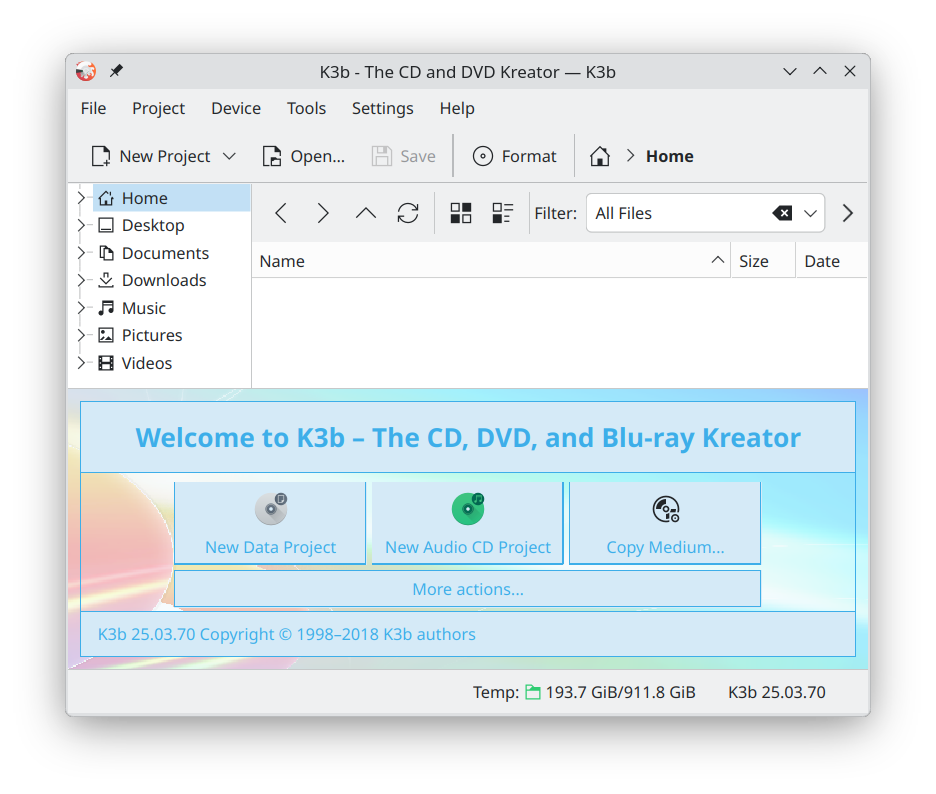
k3b Disc burner Snapcraft: Fixes for the qt5 kde-neon extension https://github.com/canonical/snapcraft/pull/5261

11 February 2025

Ian Jackson: derive-deftly 1.0.0 - Rust derive macros, the easy way

derive-deftly 1.0 is released. derive-deftly is a template-based derive-macro facility for Rust. It has been a great success. Your codebase may benefit from it too! Rust programmers will appreciate its power, flexibility, and consistency, compared to macro_rules; and its convenience and simplicity, compared to proc macros. Programmers coming to Rust from scripting languages will appreciate derive-deftly s convenient automatic code generation, which works as a kind of compile-time introspection. Rust s two main macro systems I m often a fan of metaprogramming, including macros. They can help remove duplication and flab, which are often the enemy of correctness. Rust has two macro systems. derive-deftly offers much of the power of the more advanced (proc_macros), while beating the simpler one (macro_rules) at its own game for ease of use. (Side note: Rust has at least three other ways to do metaprogramming: generics; build.rs; and, multiple module inclusion via #[path=]. These are beyond the scope of this blog post.) macro_rules! macro_rules! aka pattern macros , declarative macros , or sometimes macros by example are the simpler kind of Rust macro. They involve writing a sort-of-BNF pattern-matcher, and a template which is then expanded with substitutions from the actual input. If your macro wants to accept comma-separated lists, or other simple kinds of input, this is OK. But often we want to emulate a #[derive(...)] macro: e.g., to define code based on a struct, handling each field. Doing that with macro_rules is very awkward: macro_rules! s pattern language doesn t have a cooked way to match a data structure, so you have to hand-write a matcher for Rust syntax, in each macro. Writing such a matcher is very hard in the general case, because macro_rules lacks features for matching important parts of Rust syntax (notably, generics). (If you really need to, there s a horrible technique as a workaround.) And, the invocation syntax for the macro is awkward: you must enclose the whole of the struct in my_macro! . This makes it hard to apply more than one macro to the same struct, and produces rightward drift. Enclosing the struct this way means the macro must reproduce its input - so it can have bugs where it mangles the input, perhaps subtly. This also means the reader cannot be sure precisely whether the macro modifies the struct itself. In Rust, the types and data structures are often the key places to go to understand a program, so this is a significant downside. macro_rules also has various other weird deficiencies too specific to list here. Overall, compared to (say) the C preprocessor, it s great, but programmers used to the power of Lisp macros, or (say) metaprogramming in Tcl, will quickly become frustrated. proc macros Rust s second macro system is much more advanced. It is a fully general system for processing and rewriting code. The macro s implementation is Rust code, which takes the macro s input as arguments, in the form of Rust tokens, and returns Rust tokens to be inserted into the actual program. This approach is more similar to Common Lisp s macros than to most other programming languages macros systems. It is extremely powerful, and is used to implement many very widely used and powerful facilities. In particular, proc macros can be applied to data structures with #[derive(...)]. The macro receives the data structure, in the form of Rust tokens, and returns the code for the new implementations, functions etc. This is used very heavily in the standard library for basic features like #[derive(Debug)] and Clone, and for important libraries like serde and strum. But, it is a complete pain in the backside to write and maintain a proc_macro. The Rust types and functions you deal with in your macro are very low level. You must manually handle every possible case, with runtime conditions and pattern-matching. Error handling and recovery is so nontrivial there are macro-writing libraries and even more macros to help. Unlike a Lisp codewalker, a Rust proc macro must deal with Rust s highly complex syntax. You will probably end up dealing with syn, which is a complete Rust parsing library, separate from the compiler; syn is capable and comprehensive, but a proc macro must still contain a lot of often-intricate code. There are build/execution environment problems. The proc_macro code can t live with your application; you have to put the proc macros in a separate cargo package, complicating your build arrangements. The proc macro package environment is weird: you can t test it separately, without jumping through hoops. Debugging can be awkward. Proper tests can only realistically be done with the help of complex additional tools, and will involve a pinned version of Nightly Rust. derive-deftly to the rescue derive-deftly lets you use a write a #[derive(...)] macro, driven by a data structure, without wading into any of that stuff. Your macro definition is a template in a simple syntax, with predefined $-substitutions for the various parts of the input data structure. Example Here s a real-world example from a personal project:
define_derive_deftly!  
    export UpdateWorkerReport:
    impl $ttype  
        pub fn update_worker_report(&self, wr: &mut WorkerReport)  
            $(
                $ when fmeta(worker_report) 
                wr.$fname = Some(self.$fname.clone()).into();
            )


#[derive(Debug, Deftly, Clone)]
...
#[derive_deftly(UiMap, UpdateWorkerReport)]
pub struct JobRow  
    ...
    #[deftly(worker_report)]
    pub status: JobStatus,
    pub processing: NoneIsEmpty<ProcessingInfo>,
    #[deftly(worker_report)]
    pub info: String,
    pub duplicate_of: Option<JobId>,
 
This is a nice example, also, of how using a macro can avoid bugs. Implementing this update by hand without a macro would involve a lot of cut-and-paste. When doing that cut-and-paste it can be very easy to accidentally write bugs where you forget to update some parts of each of the copies:
    pub fn update_worker_report(&self, wr: &mut WorkerReport)  
        wr.status = Some(self.status.clone()).into();
        wr.info = Some(self.status.clone()).into();
     
Spot the mistake? We copy status to info. Bugs like this are extremely common, and not always found by the type system. derive-deftly can make it much easier to make them impossible. Special-purpose derive macros are now worthwhile! Because of the difficult and cumbersome nature of proc macros, very few projects have site-specific, special-purpose #[derive(...)] macros. The Arti codebase has no bespoke proc macros, across its 240kloc and 86 crates. (We did fork one upstream proc macro package to add a feature we needed.) I have only one bespoke, case-specific, proc macro amongst all of my personal Rust projects; it predates derive-deftly. Since we have started using derive-deftly in Arti, it has become an important tool in our toolbox. We have 37 bespoke derive macros, done with derive-deftly. Of these, 9 are exported for use by downstream crates. (For comparison there are 176 macro_rules macros.) In my most recent personal Rust project, I have 22 bespoke derive macros, done with with derive-deftly, and 19 macro_rules macros. derive-deftly macros are easy and straightforward enough that they can be used as readily as macro_rules macros. Indeed, they are often clearer than a macro_rules macro. Stability without stagnation derive-deftly is already highly capable, and can solve many advanced problems. It is mature software, well tested, with excellent documentation, comprising both comprehensive reference material and the walkthrough-structured user guide. But declaring it 1.0 doesn t mean that it won t improve further. Our ticket tracker has a laundry list of possible features. We ll sometimes be cautious about committing to these, so we ve added a beta feature flag, for opting in to less-stable features, so that we can prototype things without painting ourselves into a corner. And, we intend to further develop the Guide.

comment count unavailable comments

9 February 2025

Antoine Beaupr : A slow blogging year

Well, 2024 will be remembered, won't it? I guess 2025 already wants to make its mark too, but let's not worry about that right now, and instead let's talk about me. A little over a year ago, I was gloating over how I had such a great blogging year in 2022, and was considering 2023 to be average, then went on to gather more stats and traffic analysis... Then I said, and I quote:
I hope to write more next year. I've been thinking about a few posts I could write for work, about how things work behind the scenes at Tor, that could be informative for many people. We run a rather old setup, but things hold up pretty well for what we throw at it, and it's worth sharing that with the world...
What a load of bollocks.

A bad year for this blog 2024 was the second worst year ever in my blogging history, tied with 2009 at a measly 6 posts for the year:
anarcat@angela:anarc.at$ curl -sSL https://anarc.at/blog/   grep 'href="\./'   grep -o 20[0-9][0-9]   sort   uniq -c   sort -nr   grep -v 2025   tail -3
      6 2024
      6 2009
      3 2014
I did write about my work though, detailing the migration from Gitolite to GitLab we completed that year. But after August, total radio silence until now.

Loads of drafts It's not that I have nothing to say: I have no less than five drafts in my working tree here, not counting three actual drafts recorded in the Git repository here:
anarcat@angela:anarc.at$ git s blog
## main...origin/main
?? blog/bell-bot.md
?? blog/fish.md
?? blog/kensington.md
?? blog/nixos.md
?? blog/tmux.md
anarcat@angela:anarc.at$ git grep -l '\!tag draft'
blog/mobile-massive-gallery.md
blog/on-dying.mdwn
blog/secrets-recovery.md
I just don't have time to wrap those things up. I think part of me is disgusted by seeing my work stolen by large corporations to build proprietary large language models while my idols have been pushed to suicide for trying to share science with the world. Another part of me wants to make those things just right. The "tagged drafts" above are nothing more than a huge pile of chaotic links, far from being useful for anyone else than me, and even then. The on-dying article, in particular, is becoming my nemesis. I've been wanting to write that article for over 6 years now, I think. It's just too hard.

Writing elsewhere There's also the fact that I write for work already. A lot. Here are the top-10 contributors to our team's wiki:
anarcat@angela:help.torproject.org$ git shortlog --numbered --summary --group="format:%al"   head -10
  4272  anarcat
   423  jerome
   117  zen
   116  lelutin
   104  peter
    58  kez
    45  irl
    43  hiro
    18  gaba
    17  groente
... but that's a bit unfair, since I've been there half a decade. Here's the last year:
anarcat@angela:help.torproject.org$ git shortlog --since=2024-01-01 --numbered --summary --group="format:%al"   head -10
   827  anarcat
   117  zen
   116  lelutin
    91  jerome
    17  groente
    10  gaba
     8  micah
     7  kez
     5  jnewsome
     4  stephen.swift
So I still write the most commits! But to truly get a sense of the amount I wrote in there, we should count actual changes. Here it is by number of lines (from commandlinefu.com):
anarcat@angela:help.torproject.org$ git ls-files   xargs -n1 git blame --line-porcelain   sed -n 's/^author //p'   sort -f   uniq -ic   sort -nr   head -10
  99046 Antoine Beaupr 
   6900 Zen Fu
   4784 J r me Charaoui
   1446 Gabriel Filion
   1146 Jerome Charaoui
    837 groente
    705 kez
    569 Gaba
    381 Matt Traudt
    237 Stephen Swift
That, of course, is the entire history of the git repo, again. We should take only the last year into account, and probably ignore the tails directory, as sneaky Zen Fu imported the entire docs from another wiki there...
anarcat@angela:help.torproject.org$ find [d-s]* -type f -mtime -365   xargs -n1 git blame --line-porcelain 2>/dev/null   sed -n 's/^author //p'   sort -f   uniq -ic   sort -nr   head -10
  75037 Antoine Beaupr 
   2932 J r me Charaoui
   1442 Gabriel Filion
   1400 Zen Fu
    929 Jerome Charaoui
    837 groente
    702 kez
    569 Gaba
    381 Matt Traudt
    237 Stephen Swift
Pretty good! 75k lines. But those are the files that were modified in the last year. If we go a little more nuts, we find that:
anarcat@angela:help.torproject.org$ $ git-count-words-range.py    sort -k6 -nr   head -10
parsing commits for words changes from command: git log '--since=1 year ago' '--format=%H %al'
anarcat 126116 - 36932 = 89184
zen 31774 - 5749 = 26025
groente 9732 - 607 = 9125
lelutin 10768 - 2578 = 8190
jerome 6236 - 2586 = 3650
gaba 3164 - 491 = 2673
stephen.swift 2443 - 673 = 1770
kez 1034 - 74 = 960
micah 772 - 250 = 522
weasel 410 - 0 = 410
I wrote 126,116 words in that wiki, only in the last year. I also deleted 37k words, so the final total is more like 89k words, but still: that's about forty (40!) articles of the average size (~2k) I wrote in 2022. (And yes, I did go nuts and write a new log parser, essentially from scratch, to figure out those word diffs. I did get the courage only after asking GPT-4o for an example first, I must admit.) Let's celebrate that again: I wrote 90 thousand words in that wiki in 2024. According to Wikipedia, a "novella" is 17,500 to 40,000 words, which would mean I wrote about a novella and a novel, in the past year. But interestingly, if I look at the repository analytics. I certainly didn't write that much more in the past year. So that alone cannot explain the lull in my production here.

Arguments Another part of me is just tired of the bickering and arguing on the internet. I have at least two articles in there that I suspect is going to get me a lot of push-back (NixOS and Fish). I know how to deal with this: you need to write well, consider the controversy, spell it out, and defuse things before they happen. But that's hard work and, frankly, I don't really care that much about what people think anymore. I'm not writing here to convince people. I have stop evangelizing a long time ago. Now, I'm more into documenting, and teaching. And, while teaching, there's a two-way interaction: when you give out a speech or workshop, people can ask questions, or respond, and you all learn something. When you document, you quickly get told "where is this? I couldn't find it" or "I don't understand this" or "I tried that and it didn't work" or "wait, really? shouldn't we do X instead", and you learn. Here, it's static. It's my little soapbox where I scream in the void. The only thing people can do is scream back.

Collaboration So. Let's see if we can work together here. If you don't like something I say, disagree, or find something wrong or to be improved, instead of screaming on social media or ignoring me, try contributing back. This site here is backed by a git repository and I promise to read everything you send there, whether it is an issue or a merge request. I will, of course, still read comments sent by email or IRC or social media, but please, be kind. You can also, of course, follow the latest changes on the TPA wiki. If you want to catch up with the last year, some of the "novellas" I wrote include: (Well, no, you can't actually follow changes on a GitLab wiki. But we have a wiki-replica git repository where you can see the latest commits, and subscribe to the RSS feed.) See you there!

2 February 2025

Anuradha Weeraman: DeepSeek-R1, at the cusp of an open revolution

DeepSeek-R1, at the cusp of an open revolutionDeepSeek R1, the new entrant to the Large Language Model wars has created quite a splash over the last few weeks. Its entrance into a space dominated by the Big Corps, while pursuing asymmetric and novel strategies has been a refreshing eye-opener.GPT AI improvement was starting to show signs of slowing down, and has been observed to be reaching a point of diminishing returns as it runs out of data and compute required to train, fine-tune increasingly large models. This has turned the focus towards building "reasoning" models that are post-trained through reinforcement learning, techniques such as inference-time and test-time scaling and search algorithms to make the models appear to think and reason better. OpenAI&aposs o1-series models were the first to achieve this successfully with its inference-time scaling and Chain-of-Thought reasoning.

Intelligence as an emergent property of Reinforcement Learning (RL)Reinforcement Learning (RL) has been successfully used in the past by Google&aposs DeepMind team to build highly intelligent and specialized systems where intelligence is observed as an emergent property through rewards-based training approach that yielded achievements like AlphaGo (see my post on it here - AlphaGo: a journey to machine intuition).DeepMind went on to build a series of Alpha* projects that achieved many notable feats using RL:
  • AlphaGo, defeated the world champion Lee Seedol in the game of Go
  • AlphaZero, a generalized system that learned to play games such as Chess, Shogi and Go without human input
  • AlphaStar, achieved high performance in the complex real-time strategy game StarCraft II.
  • AlphaFold, a tool for predicting protein structures which significantly advanced computational biology.
  • AlphaCode, a model designed to generate computer programs, performing competitively in coding challenges.
  • AlphaDev, a system developed to discover novel algorithms, notably optimizing sorting algorithms beyond human-derived methods.
All of these systems achieved mastery in its own area through self-training/self-play and by optimizing and maximizing the cumulative reward over time by interacting with its environment where intelligence was observed as an emergent property of the system.
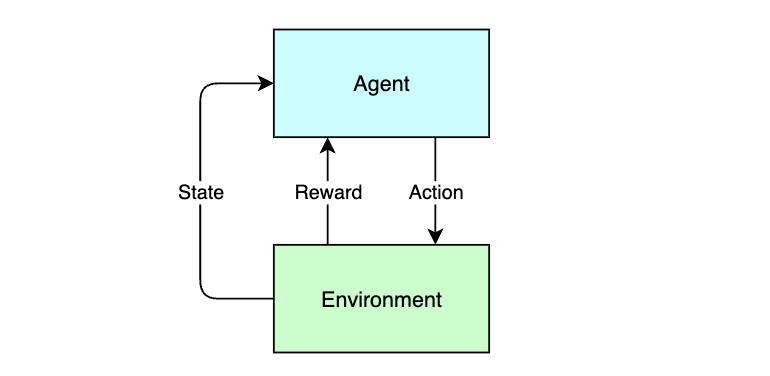
DeepSeek-R1, at the cusp of an open revolutionThe RL feedback loop
RL mimics the process through which a baby would learn to walk, through trial, error and first principles.

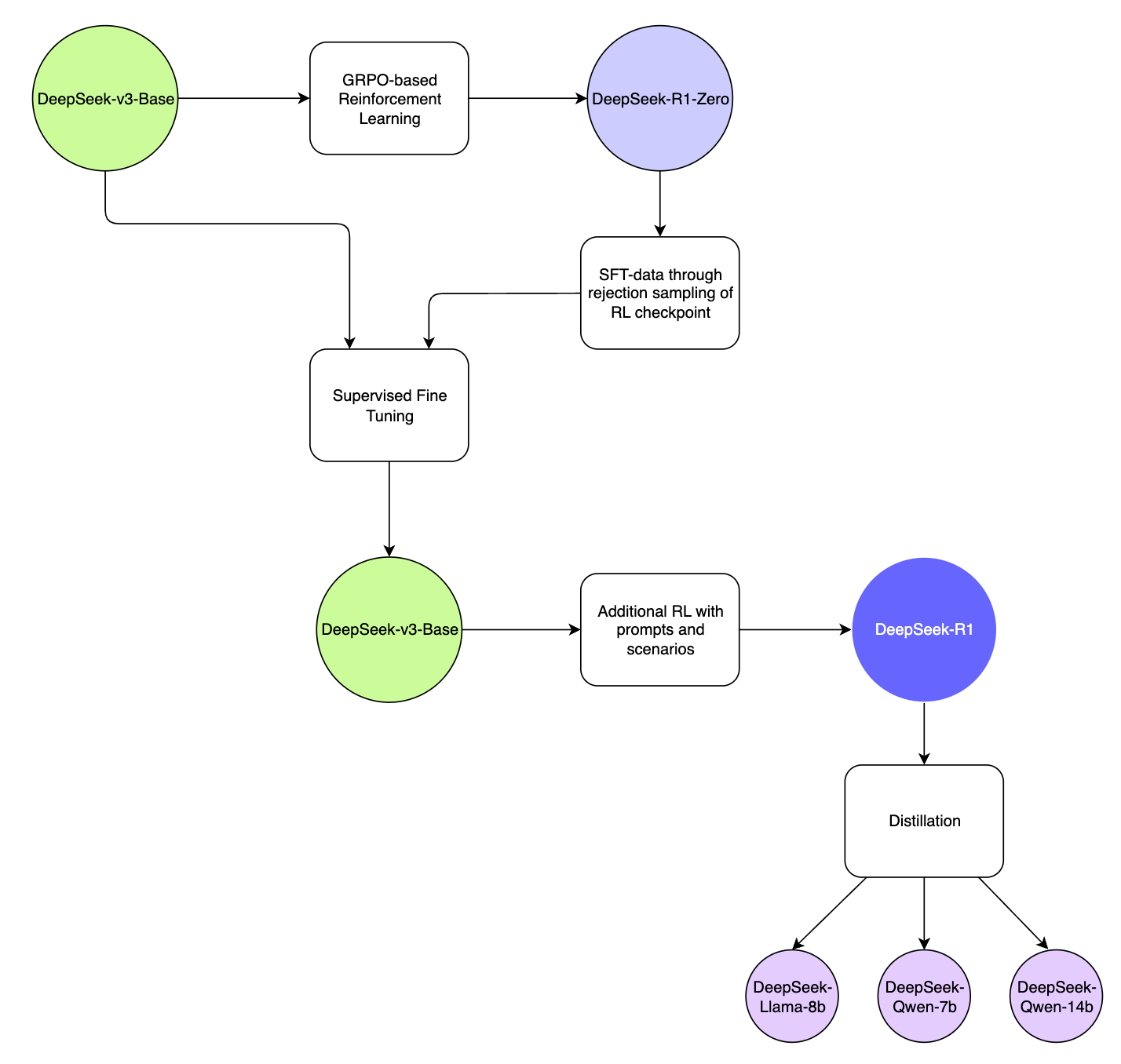
R1 model training pipelineAt a technical level, DeepSeek-R1 leverages a combination of Reinforcement Learning (RL) and Supervised Fine-Tuning (SFT) for its training pipeline:
DeepSeek-R1, at the cusp of an open revolutionDeepSeek-R1 Model Training Pipeline
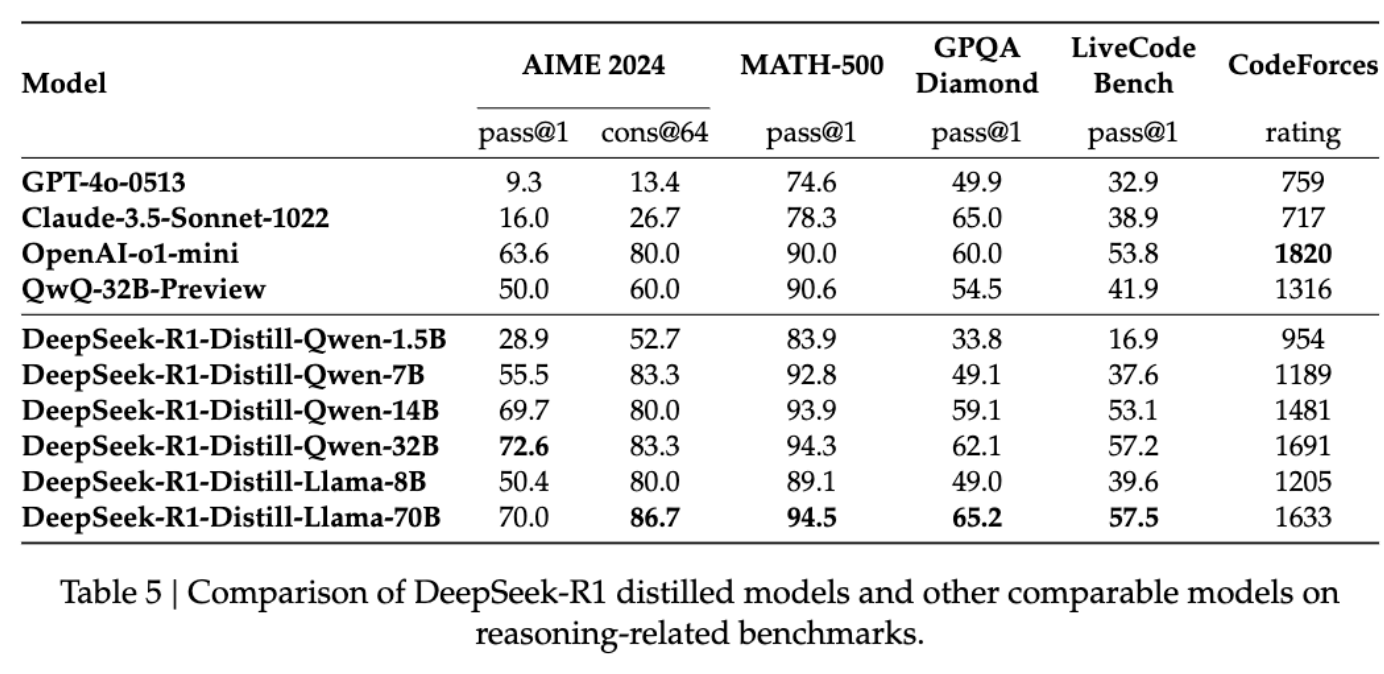
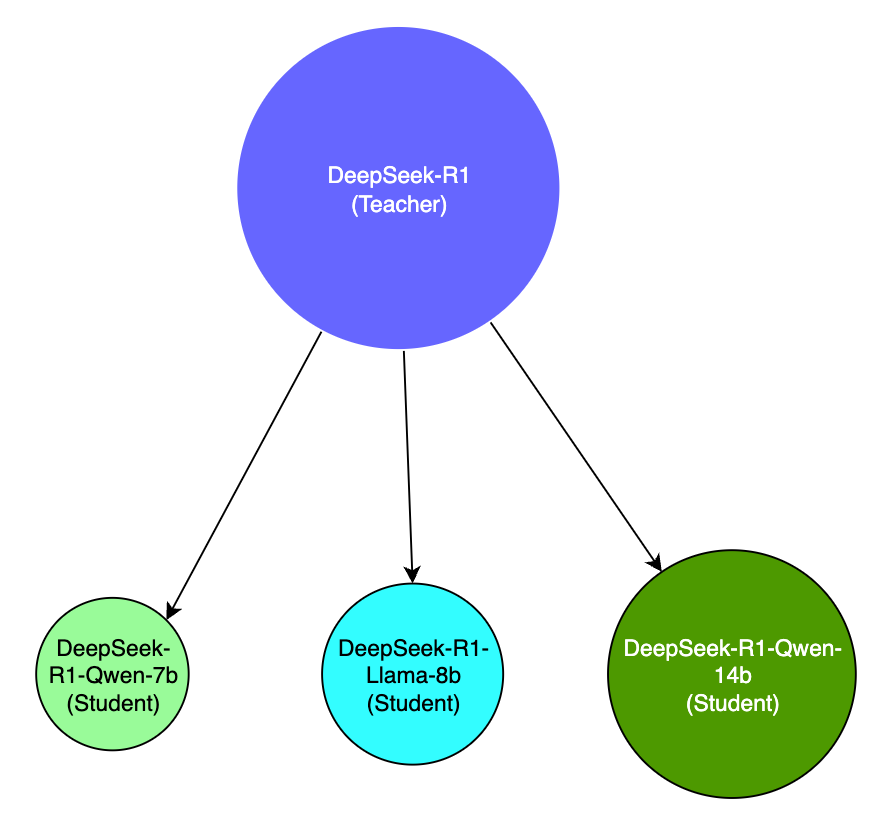
Using RL and DeepSeek-v3, an interim reasoning model was built, called DeepSeek-R1-Zero, purely based on RL without relying on SFT, which demonstrated superior reasoning capabilities that matched the performance of OpenAI&aposs o1 in certain benchmarks such as AIME 2024.The model was however affected by poor readability and language-mixing and is only an interim-reasoning model built on RL principles and self-evolution.DeepSeek-R1-Zero was then used to generate SFT data, which was combined with supervised data from DeepSeek-v3 to re-train the DeepSeek-v3-Base model.The new DeepSeek-v3-Base model then underwent additional RL with prompts and scenarios to come up with the DeepSeek-R1 model.The R1-model was then used to distill a number of smaller open source models such as Llama-8b, Qwen-7b, 14b which outperformed bigger models by a large margin, effectively making the smaller models more accessible and usable.

Key contributions of DeepSeek-R1
  1. RL without the need for SFT for emergent reasoning capabilities
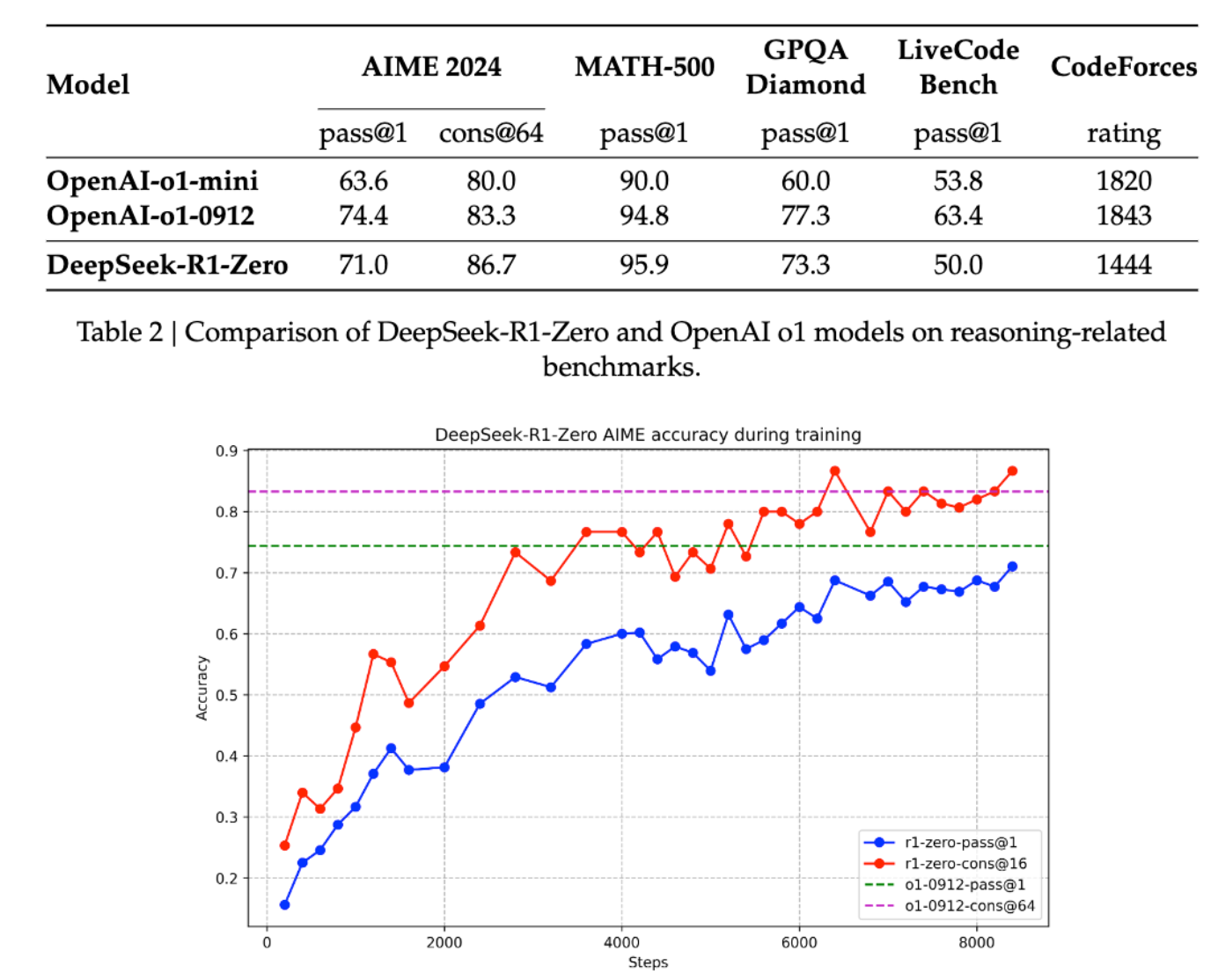
R1 was the first open research project to validate the efficacy of RL directly on the base model without relying on SFT as a first step, which resulted in the model developing advanced reasoning capabilities purely through self-reflection and self-verification.Although, it did degrade in its language capabilities during the process, its Chain-of-Thought (CoT) capabilities for solving complex problems was later used for further RL on the DeepSeek-v3-Base model which became R1. This is a significant contribution back to the research community.The below analysis of DeepSeek-R1-Zero and OpenAI o1-0912 shows that it is viable to attain robust reasoning capabilities purely through RL alone, which can be further augmented with other techniques to deliver even better reasoning performance.
DeepSeek-R1, at the cusp of an open revolutionSource: https://github.com/deepseek-ai/DeepSeek-R1
Its quite interesting, that the application of RL gives rise to seemingly human capabilities of "reflection", and arriving at "aha" moments, causing it to pause, ponder and focus on a specific aspect of the problem, resulting in emergent capabilities to problem-solve as humans do.
  1. Model distillation
DeepSeek-R1 also demonstrated that larger models can be distilled into smaller models which makes advanced capabilities accessible to resource-constrained environments, such as your laptop. While its not possible to run a 671b model on a stock laptop, you can still run a distilled 14b model that is distilled from the larger model which still performs better than most publicly available models out there. This enables intelligence to be brought closer to the edge, to allow faster inference at the point of experience (such as on a smartphone, or on a Raspberry Pi), which paves way for more use cases and possibilities for innovation.
DeepSeek-R1, at the cusp of an open revolutionSource: https://github.com/deepseek-ai/DeepSeek-R1
Distilled models are very different to R1, which is a massive model with a completely different model architecture than the distilled variants, and so are not directly comparable in terms of capability, but are instead built to be more smaller and efficient for more constrained environments. This technique of being able to distill a larger model&aposs capabilities down to a smaller model for portability, accessibility, speed, and cost will bring about a lot of possibilities for applying artificial intelligence in places where it would have otherwise not been possible. This is another key contribution of this technology from DeepSeek, which I believe has even further potential for democratization and accessibility of AI.
DeepSeek-R1, at the cusp of an open revolution

Why is this moment so significant?DeepSeek-R1 was a pivotal contribution in many ways.
  1. The contributions to the state-of-the-art and the open research helps move the field forward where everybody benefits, not just a few highly funded AI labs building the next billion dollar model.
  2. Open-sourcing and making the model freely available follows an asymmetric strategy to the prevailing closed nature of much of the model-sphere of the larger players. DeepSeek should be commended for making their contributions free and open.
  3. It reminds us that its not just a one-horse race, and it incentivizes competition, which has already resulted in OpenAI o3-mini a cost-effective reasoning model which now shows the Chain-of-Thought reasoning. Competition is a good thing.
  4. We stand at the cusp of an explosion of small-models that are hyper-specialized, and optimized for a specific use case that can be trained and deployed cheaply for solving problems at the edge. It raises a lot of exciting possibilities and is why DeepSeek-R1 is one of the most pivotal moments of tech history.
Truly exciting times. What will you build?

29 January 2025

Russ Allbery: Review: The Sky Road

Review: The Sky Road, by Ken MacLeod
Series: Fall Revolution #4
Publisher: Tor
Copyright: 1999
Printing: August 2001
ISBN: 0-8125-7759-0
Format: Mass market
Pages: 406
The Sky Road is the fourth book in the Fall Revolution series, but it represents an alternate future that diverges after (or during?) the events of The Sky Fraction. You probably want to read that book first, but I'm not sure reading The Stone Canal or The Cassini Division adds anything to this book other than frustration. Much more on that in a moment. Clovis colha Gree is a aspiring doctoral student in history with a summer job as a welder. He works on the platform for the project, which the reader either slowly discovers from the book or quickly discovers from the cover is a rocket to get to orbit. As the story opens, he meets (or, as he describes it) is targeted by a woman named Merrial, a tinker who works on the guidance system. The early chapters provide only a few hints about Clovis's world: a statue of the Deliverer on a horse that forms the backdrop of their meeting, the casual carrying of weapons, hints that tinkers are socially unacceptable, and some division between the white logic and the black logic in programming. Also, because this is a Ken MacLeod novel, everyone is obsessed with smoking and tobacco the way that the protagonists of erotica are obsessed with sex. Clovis's story is one thread of this novel. The other, told in the alternating chapters, is the story of Myra Godwin-Davidova, chair of the governing Council of People's Commissars of the International Scientific and Technical Workers' Republic, a micronation embedded in post-Soviet Kazakhstan. Series readers will remember Myra's former lover, David Reid, as the villain of The Stone Canal and the head of the corporation Mutual Protection, which is using slave labor (sort of) to support a resurgent space movement and its attempt to take control of a balkanized Earth. The ISTWR is in decline and a minor power by all standards except one: They still have nuclear weapons. So, first, we need to talk about the series divergence. I know from reading about this book on-line that The Sky Road is an alternate future that does not follow the events of The Stone Canal and The Cassini Division. I do not know this from the text of the book, which is completely silent about even being part of a series. More annoyingly, while the divergence in the Earth's future compared to The Cassini Division is obvious, I don't know what the Jonbar hinge is. Everything I can find on-line about this book is maddeningly coy. Wikipedia claims the divergence happens at the end of The Sky Fraction. Other reviews and the Wikipedia talk page claim it happens in the middle of The Stone Canal. I do have a guess, but it's an unsatisfying one and I'm not sure how to test its correctness. I suppose I shouldn't care and instead take each of the books on their own terms, but this is the type of thing that my brain obsesses over, and I find it intensely irritating that MacLeod didn't explain it in the books themselves. It's the sort of authorial trick that makes me feel dumb, and books that gratuitously make me feel dumb are less enjoyable to read. The second annoyance I have with this book is also only partly its fault. This series, and this book in particular, is frequently mentioned as good political science fiction that explores different ways of structuring human society. This was true of some of the earlier books in a surprisingly superficial way. Here, I would call it hogwash. This book, or at least the Myra portion of it, is full of people doing politics in a tactical sense, but like the previous books of this series, that politics is mostly embedded in personal grudges and prior romantic relationships. Everyone involved is essentially an authoritarian whose ability to act as they wish is only contested by other authoritarians and is largely unconstrained by such things as persuasion, discussions, elections, or even theory. Myra and most of the people she meets are profoundly cynical and almost contemptuous of any true discussion of political systems. This is the trappings and mechanisms of politics without the intellectual debate or attempt at consensus, turning it into a zero-sum game won by whoever can threaten the others more effectively. Given the glowing reviews I've seen in relatively political SF circles, presumably I am missing something that other people see in MacLeod's approach. Perhaps this level of pettiness and cynicism is an accurate depiction of what it's like inside left-wing political movements. (What an appalling condemnation of left-wing political movements, if so.) But many of the on-line reviews lead me to instead conclude that people's understanding of "political fiction" is stunted and superficial. For example, there is almost nothing Marxist about this book it contains essentially no economic or class analysis whatsoever but MacLeod uses a lot of Marxist terminology and sets half the book in an explicitly communist state, and this seems to be enough for large portions of the on-line commentariat to conclude that it's full of dangerous, radical ideas. I find this sadly hilarious given that MacLeod's societies tend, if anything, towards a low-grade libertarianism that would be at home in a Robert Heinlein novel. Apparently political labels are all that's needed to make political fiction; substance is optional. So much for the politics. What's left in Clovis's sections is a classic science fiction adventure in which the protagonist has a radically different perspective from the reader and the fun lies in figuring out the world-building through the skewed perspective of the characters. This was somewhat enjoyable, but would have been more fun if Clovis had any discernible personality. Sadly he instead seems to be an empty receptacle for the prejudices and perspective of his society, which involve a lot of quasi-religious taboos and an essentially magical view of the world. Merrial is a more interesting character, although as always in this series the romance made absolutely no sense to me and seemed to be conjured by authorial fiat and weirdly instant sexual attraction. Myra's portion of the story was the part I cared more about and was more invested in, aided by the fact that she's attempting to do something more interesting than launch a crewed space vehicle for no obvious reason. She at least faces some true moral challenges with no obviously correct response. It's all a bit depressing, though, and I found Myra's unwillingness to ground her decisions in a more comprehensive moral framework disappointing. If you're going to make a protagonist the ruler of a communist state, even an ironic one, I'd like to hear some real political philosophy, some theory of sociology and economics that she used to justify her decisions. The bits that rise above personal animosity and vibes were, I think, said better in The Cassini Division. This series was disappointing, and I can't say I'm glad to have read it. There is some small pleasure in finishing a set of award-winning genre books so that I can have a meaningful conversation about them, but the awards failed to find me better books to read than I would have found on my own. These aren't bad books, but the amount of enjoyment I got out of them didn't feel worth the frustration. Not recommended, I'm afraid. Rating: 6 out of 10

27 January 2025

Sergio Talens-Oliag: Running a Debian Sid on Ubuntu

Although I am a Debian Developer (not very active, BTW) I am using Ubuntu LTS (right now version 24.04.1) on my main machine; it is my work laptop and I was told to keep using Ubuntu on it when it was assigned to me, although I don t believe it is really necessary or justified (I don t need support, I don t provide support to others and I usually test my shell scripts on multiple systems if needed anyway). Initially I kept using Debian Sid on my personal laptop, but I gave it to my oldest son as the one he was using (an old Dell XPS 13) was stolen from him a year ago. I am still using Debian stable on my servers (one at home that also runs LXC containers and another one on an OVH VPS), but I don t have a Debian Sid machine anymore and while I could reinstall my work machine, I ve decided I m going to try to use a system container to run Debian Sid on it. As I want to use a container instead of a VM I ve narrowed my options to lxc or systemd-nspawn (I have docker and podman installed, but I don t believe they are good options for running system containers). As I will want to take snapshots of the container filesystem I ve decided to try incus instead of systemd-nspawn (I already have experience with it and while it works well it has less features than incus).

Installing incusAs this is a personal system where I want to try things, instead of using the packages included with Ubuntu I ve decided to install the ones from the zabbly incus stable repository. To do it I ve executed the following as root:
# Get the zabbly repository GPG key
curl -fsSL https://pkgs.zabbly.com/key.asc -o /etc/apt/keyrings/zabbly.asc
# Create the zabbly-incus-stable.sources file
sh -c 'cat <<EOF > /etc/apt/sources.list.d/zabbly-incus-stable.sources
Enabled: yes
Types: deb
URIs: https://pkgs.zabbly.com/incus/stable
Suites: $(. /etc/os-release && echo $ VERSION_CODENAME )
Components: main
Architectures: $(dpkg --print-architecture)
Signed-By: /etc/apt/keyrings/zabbly.asc
EOF'
Initially I only plan to use the command line tools, so I ve installed the incus and the incus-extra packages, but once things work I ll probably install the incus-ui-canonical package too, at least for testing it:
apt update
apt install incus incus-extra

Adding my personal user to the incus-admin groupTo be able to run incus commands as my personal user I ve added it to the incus-admin group:
sudo adduser "$(id -un)" incus-admin
And I ve logged out and in again of my desktop session to make the changes effective.

Initializing the incus environmentTo configure the incus environment I ve executed the incus admin init command and accepted the defaults for all the questions, as they are good enough for my current use case.

Creating a Debian containerTo create a Debian container I ve used the default debian/trixie image:
incus launch images:debian/trixie debian
This command downloads the image and creates a container named debian using the default profile. The exec command can be used to run a root login shell inside the container:
incus exec debian -- su -l
Instead of exec we can use the shell alias:
incus shell debian
which does the same as the previous command. Inside that shell we can try to update the machine to sid changing the /etc/apt/sources.list file and using apt:
root@debian:~# echo "deb http://deb.debian.org/debian sid main contrib non-free" \
  >/etc/apt/sources.list
root@debian:~# apt update
root@debian:~# apt dist-upgrade
As my machine has docker installed the apt update command fails because the network does not work, to fix it I ve executed the commands of the following section and re-run the apt update and apt dist-upgrade commands.

Making the incusbr0 bridge work with DockerTo avoid problems with docker networking we have to add rules for the incusbr0 bridge to the DOCKER-USER chain as follows:
sudo iptables -I DOCKER-USER -i incusbr0 -j ACCEPT
sudo iptables -I DOCKER-USER -o incusbr0 -m conntrack \
  --ctstate RELATED,ESTABLISHED -j ACCEPT
That makes things work now, but to make things persistent across reboots we need to add them each time the machine boots. As suggested by the incus documentation I ve installed the iptables-persistent package (my command also purges the ufw package, as I was not using it) and saved the current rules when installing:
sudo apt install iptables-persistent --purge

Integrating the DNS resolution of the container with the hostTo make DNS resolution for the ictus containers work from the host I ve followed the incus documentation. To set up things manually I ve run the following:
br="incusbr0";
br_ipv4="$(incus network get "$br" ipv4.address)";
br_domain="$(incus network get "$br" dns.domain)";
dns_address="$ br_ipv4%/* ";
dns_domain="$ br_domain:=incus ";
resolvectl dns "$br" "$ dns_address ";
resolvectl domain "$br" "~$ dns_domain ";
resolvectl dnssec "$br" off;
resolvectl dnsovertls "$br" off;
And to make the changes persistent across reboots I ve created the following service file:
sh -c "cat <<EOF   sudo tee /etc/systemd/system/incus-dns-$ br .service
[Unit]
Description=Incus per-link DNS configuration for $ br 
BindsTo=sys-subsystem-net-devices-$ br .device
After=sys-subsystem-net-devices-$ br .device
[Service]
Type=oneshot
ExecStart=/usr/bin/resolvectl dns $ br  $ dns_address 
ExecStart=/usr/bin/resolvectl domain $ br  ~$ dns_domain 
ExecStart=/usr/bin/resolvectl dnssec $ br  off
ExecStart=/usr/bin/resolvectl dnsovertls $ br  off
ExecStopPost=/usr/bin/resolvectl revert $ br 
RemainAfterExit=yes
[Install]
WantedBy=sys-subsystem-net-devices-$ br .device
EOF"
And enabled it:
sudo systemctl daemon-reload
sudo systemctl enable --now incus-dns-$ br .service
If all goes well the DNS resolution works from the host:
$ host debian.incus
debian.incus has address 10.149.225.121
debian.incus has IPv6 address fd42:1178:afd8:cc2c:216:3eff:fe2b:5cea

Using my host user and home dir inside the containerTo use my host user and home directory inside the container I need to add the user and group to the container. First I ve added my user group with the same GID used on the host:
incus exec debian -- addgroup --gid "$(id --group)" --allow-bad-names \
  "$(id --group --name)"
Once I have the group I ve added the user with the same UID and GID as on the host, without defining a password for it:
incus exec debian -- adduser --uid "$(id --user)" --gid "$(id --group)" \
  --comment "$(getent passwd "$(id --user -name)"   cut -d ':' -f 5)" \
  --no-create-home --disabled-password --allow-bad-names \
  "$(id --user --name)"
Once the user is created we can mount the home directory on the container (we add the shift option to make the container use the same UID and GID as we do on the host):
incus config device add debian home disk source=$HOME path=$HOME shift=true
We have the shell alias to log with the root account, now we can add another one to log into the container using the newly created user:
incus alias add ush "exec @ARGS@ -- su -l $(id --user --name)"
To log into the container as our user now we just need to run:
incus ush debian
To be able to use sudo inside the container we could add our user to the sudo group:
incus exec debian -- adduser "$(id --user --name)" "sudo"
But that requires a password and we don t have one, so instead we are going to add a file to the /etc/sudoers.d directory to allow our user to run sudo without a password:
incus exec debian -- \
  sh -c "echo '$(id --user --name) ALL = NOPASSWD: ALL' /etc/sudoers.d/user"

Accessing the container using sshTo use the container as a real machine and log into it as I do on remote machines I ve installed the openssh-server and authorized my laptop public key to log into my laptop (as we are mounting the home directory from the host that allows us to log in without password from the local machine). Also, to be able to run X11 applications from the container I ve adusted the $HOME/.ssh/config file to always forward X11 (option ForwardX11 yes for Host debian.incus) and installed the xauth package. After that I can log into the container running the command ssh debian.incus and start using it after installing other interesting tools like neovim, rsync, tmux, etc.

Taking snapshots of the containerAs this is a system container we can take snapshots of it using the incus snapshot command; that can be specially useful to take snapshots before doing a dist-upgrade so we can rollback if something goes wrong. To work with container snapshots we run use the incus snapshot command, i.e. to create a snapshot we use de create subcommand:
incus snapshot create debian
The snapshot sub commands include options to list the available snapshots, restore a snapshot, delete a snapshot, etc.

ConclusionSince last week I have a terminal running a tmux session on the Debian Sid container with multiple zsh windows open (I ve changed the prompt to be able to notice easily where I am) and it is working as expected. My plan now is to add some packages and use the container for personal projects so I can work on a Debian Sid system without having to reinstall my work machine. I ll probably write more about it in the future, but for now, I m happy with the results.

26 January 2025

Otto Kek l inen: 10 habits to help becoming a Debian Maintainer

Featured image of post 10 habits to help becoming a Debian MaintainerBecoming a Debian maintainer is a journey that combines technical expertise, community collaboration, and continuous learning. In this post, I ll share 10 key habits that will both help you navigate the complexities of Debian packaging without getting lost, and also enable you to contribute more effectively to one of the world s largest open source projects.

1. Read and re-read the Debian Policy, the Developer s Reference and the git-buildpackage manual Anyone learning Debian packaging and aspiring to become a Debian maintainer is likely to wade through a lot of documentation, only to realize that much of it is outdated or sometimes outright incorrect. Therefore, it is important to learn right from the start which sources are the most reliable and truly worth reading and re-reading. I recommend these documents, in order of importance:
  • The Debian Policy Manual: Describes the structure of the operating system, the package archive, and requirements for packages to be included in the Debian archive.
  • The Developer s Reference: A collection of best practices and process descriptions Debian packagers are expected to follow while interacting with one another.
  • The git-buildpackage man pages: While the Policy focuses on the end result and is intentionally void of practical instructions on creating or maintaining Debian packages, the Developer s Reference goes into greater detail. However, it too lacks step-by-step instructions. For the exact commands, consult the man pages of git-buildpackage and its subcommands (e.g., gbp clone, gbp import-orig, gbp pq, gbp dch, gbp push). See also my post on Debian source package git branch and tags for an easy to understand diagrams.

2. Make reading man pages a habit In addition to the above, try to make a habit of checking out the man page of every new tool you use to ensure you are using it as intended. The best place to read accurate and up-to-date documentation is manpages.debian.org. The manual pages are maintained alongside the tools by their developers, ensuring greater accuracy than any third-party documentation. If you are using a tool in the way the tool author documented, you can be confident you are doing the right thing, even if it wasn t explicitly mentioned in some third-party guide about Debian packaging best practices.

3. Read and write emails While members of the Debian community have many channels of communication, the mailing lists are by far the most prominent. Asking questions on the appropriate list is a good way to get current advice from other people doing Debian packaging. Staying subscribed to lists of interest is also a good way to read about new developments as they happen. Note that every post is public and archived permanently, so the discussions on the mailing lists also form a body of documentation that can later be searched and referred to. Regularly writing short and well-structured emails on the mailing lists is great practice for improving technical communication skills a useful ability in general. For Debian specifically, being active on mailing lists helps build a reputation that can later attract collaborators and supporters for more complex initiatives.

4. Create and use an OpenPGP key Related to reputation and identity, OpenPGP keys play a central role in the Debian community. OpenPGP is used to various degrees to sign git commits and tags, sign and encrypt email, and most importantly to sign Debian packages so their origin can be verified. The process of becoming a Debian Maintainer and eventually a Debian Developer culminates in getting your OpenPGP key included in the Debian keyring, which is used to control who can upload packages into the Debian archive. The earlier you create a key and start using it to gain reputation for that specific key that is used to sign your work, the better. Note that due to a recent schism in the OpenPGP standards working group, it is safest to create an OpenPGP key using GnuPG version 2.2.x (not 2.4.x), or using Sequoia-PGP.

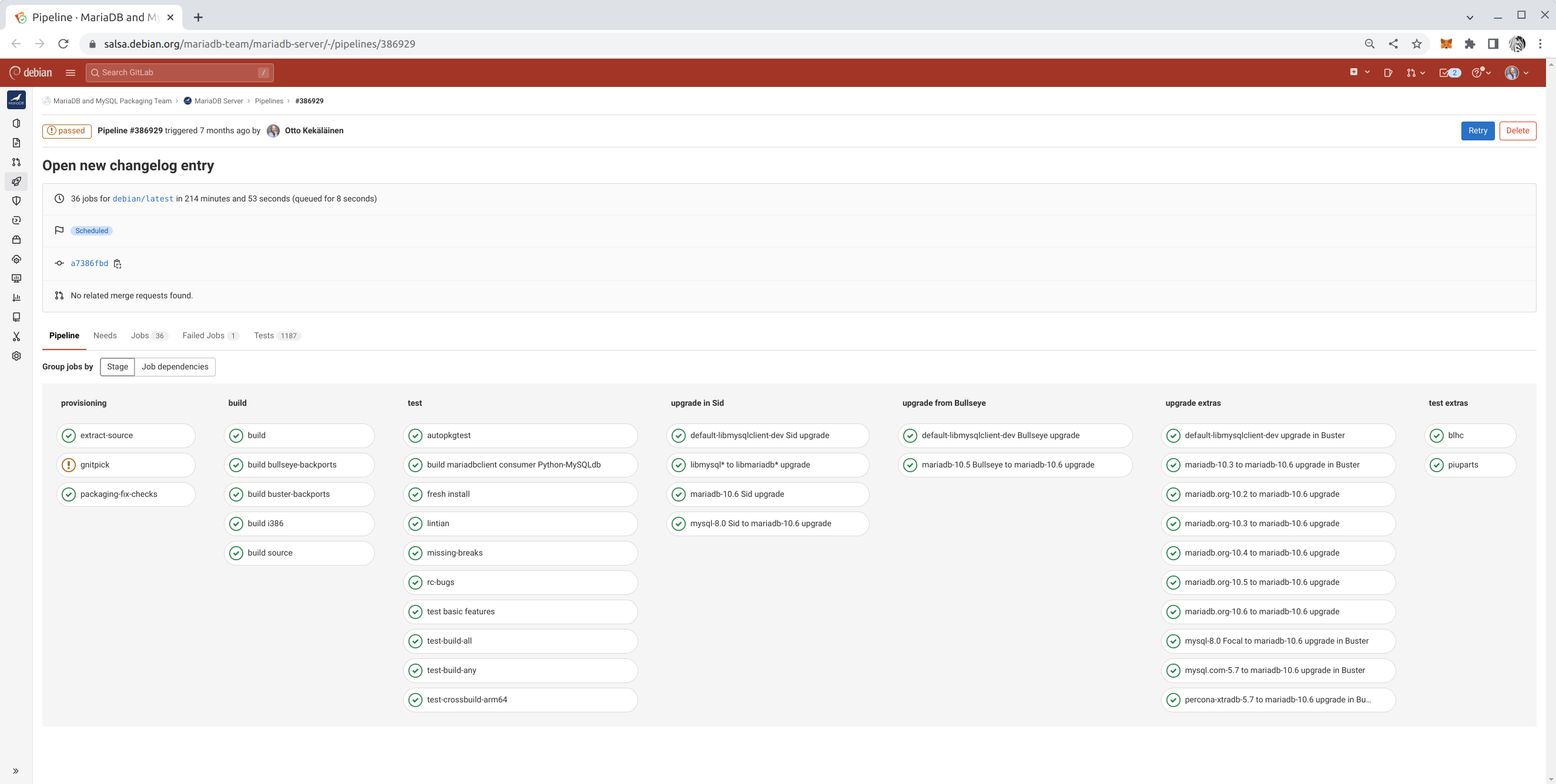
5. Integrate Salsa CI in all work One reason Debian remains popular, even 30 years after its inception, is due to its culture of maintaining high standards. For a newcomer, learning all the quality assurance tools such as Lintian, Piuparts, Adequate, various build variations, and reproducible builds may be overwhelming. However, these tasks are easier to manage thanks to Salsa CI, the continuous integration pipeline in Debian that runs tests on every commit at salsa.debian.org. The earlier you activate Salsa CI in the package repository you are working on, the faster you will achieve high quality in your package with fewer missteps. You can also further customize a package specific salsa-ci.yml to have more testing coverage. Example Salsa CI pipeline with customizations

6. Fork on Salsa and use draft Merge Requests to solicit feedback All modern Debian packages are hosted on salsa.debian.org. If you want to make a change to any package, it is easy to fork, make an initial attempt at the change, and publish it as a draft Merge Request (MR) on Salsa to solicit feedback. People might have surprising reasons to object to the change you propose, or they might need time to get used to the idea before agreeing to it. Also, some people might object to a vague idea out of suspicion but agree once they see the exact implementation. There may also be a surprising number of people supporting your idea, and if there is an MR, they have a place to show their support at. Don t expect every Merge Request to be accepted. However, proposing an idea as running code in an MR is far more effective than raising the idea on a mailing list or in a bug report. Get into the habit of publishing plenty of merge requests to solicit feedback and drive discussions toward consensus.

7. Use git rebase frequently Linear git history is much easier to read. The ease of reading git log and git blame output is vital in Debian, where packages often have updates from multiple people spanning many years even decades. Debian packagers likely spend more time than the average software developer reading git history. Make sure you master git commands such as gitk --all, git citool --amend, git commit -a --fixup <commit id>, git rebase -i --autosquash <target branch>, git cherry-pick <commit id 1> <id 2> <id 3>, and git pull --rebase. If rebasing is not done on your initiative, rest assured others will ask you to do it. Thus, if the commands above are familiar, rebasing will be quick and easy for you.

8. Reviews: give some, get some In open source, the larger a project becomes, the more it attracts contributions, and the bottleneck for its growth isn t how much code developers can create but how much code submissions can be properly reviewed. At the time of writing, the main Salsa group Debian has over 800 open merge requests pending reviews and approvals. Feel free to read and comment on any merge request you find. You don t have to be a subject matter expert to provide valuable feedback. Even if you don t have specific feedback, your comment as another human acknowledging that you read the MR and found no issues is viewed positively by the author. Besides, if you spend enough time reviewing MRs in a specific domain, you will eventually become an expert in it. Code reviews are not just about providing feedback to the submitter; they are also great learning opportunities for the reviewer. As a rule of thumb, you should review at least twice as many merge requests as you submit yourself.

9. Improve Debian by improving upstream It is common that while packaging software for Debian, bugs are uncovered and patched in Debian. Do not forget to submit the fixes upstream, and add a Forwarded field to the file in debian/patches! As the person building and packaging something in Debian, you automatically become an authority on that software, and the upstream is likely glad to receive your improvements. While submitting patches upstream is a bit of work initially, getting improvements merged upstream eventually saves time for everyone and makes packaging in Debian easier, as there will be fewer patches to maintain with each new upstream release.

10. Don t hold any habits too firmly Last but not least: Once people learn a specific way of working, they tend to stick to it for decades. Learning how to create and maintain Debian packages requires significant effort, and people tend to stop learning once they feel they ve reached a sufficient level. This tendency to get stuck in a local optimum is understandable and natural, but try to resist it. It is likely that better techniques will evolve over time, so stay humble and re-evaluate your beliefs and practices every few years. Mastering these habits takes time, but each small step brings you closer to making a meaningful impact on Debian. By staying curious, collaborative, and adaptable, you can ensure your contributions stand the test of time just like Debian itself. Good luck on your journey toward becoming a Debian Maintainer!

21 January 2025

Ravi Dwivedi: The Arduous Luxembourg Visa Process

In 2024, I was sponsored by The Document Foundation (TDF) to attend the LibreOffice annual conference in Luxembourg from the 10th to the 12th of October. Being an Indian passport holder, I needed a visa to visit Luxembourg. However, due to my Kenya trip coming up in September, I ran into a dilemma: whether to apply before or after the Kenya trip. To obtain a visa, I needed to submit my application with VFS Global (and not with the Luxembourg embassy directly). Therefore, I checked the VFS website for information on processing time, which says:
As a rule, the processing time of an admissible Schengen visa application should not exceed 15 calendar days (from the date the application is received at the Embassy).
It also mentions:
If the application is received less than 15 calendar days before the intended travel date, the Embassy can deem your application inadmissible. If so, your visa application will not be processed by the Embassy and the application will be sent back to VFS along with the passport.
If I applied for the Luxembourg visa before my trip, I would run the risk of not getting my passport back in time, and therefore missing my Kenya flight. On the other hand, if I waited until after returning from Kenya, I would run afoul of the aforementioned 15 working days needed by the embassy to process my application. I had previously applied for a Schengen visa for Austria, which was completed in 7 working days. My friends who had been to France told me they got their visa decision within a week. So, I compared Luxembourg s application numbers with those of other Schengen countries. In 2023, Luxembourg received 3,090 applications from India, while Austria received 39,558, Italy received 52,332 and France received 176,237. Since Luxembourg receives a far fewer number of applications, I expected the process to be quick. Therefore, I submitted my visa application with VFS Global in Delhi on the 5th of August, giving the embassy a month with 18 working days before my Kenya trip. However, I didn t mention my Kenya trip in the Luxembourg visa application. For reference, here is a list of documents I submitted: I submitted flight reservations instead of flight tickets . It is because, in case of visa rejection, I would have lost a significant amount of money if I booked confirmed flight tickets. The embassy also recommends the same. After the submission of documents, my fingerprints were taken. The expenses for the visa application were as follows:
Service Description Amount (INR)
Visa Fee 8,114
VFS Global Fee 1,763
Courier 800
Total 10,677
Going by the emails sent by VFS, my application reached the Luxembourg embassy the next day. Fast-forward to the 27th of August 14th day of my visa application. I had already booked my flight ticket to Nairobi for the 4th of September, but my passport was still with the Luxembourg embassy, and I hadn t heard back. In addition, I also obtained Kenya s eTA and got vaccinated for Yellow Fever, a requirement to travel to Kenya. In order to check on my application status, I gave the embassy a phone call, but missed their calling window, which was easy to miss since it was only 1 hour - 12:00 to 1:00 PM. So, I dropped them an email explaining my situation. At this point, I was already wondering whether to cancel the Kenya trip or the Luxembourg one, if I had to choose. After not getting a response to my email, I called them again the next day. The embassy told me they would look into it and asked me to send my flight tickets over email. One week to go before my flight now. I followed up with the embassy on the 30th by a phone call, and the person who picked up the call told me that my request had already been forwarded to the concerned department and is under process. They asked me to follow up on Monday, 2nd September. During the visa process, I was in touch with three other Indian attendees.1 In the meantime, I got to know that all of them had applied for a Luxembourg visa by the end of the month of August. Back to our story, over the next two days, the embassy closed for the weekend. I began weighing my options. On one hand, I could cancel the Kenya trip and hope that Luxembourg goes through. Even then, Luxembourg wasn t guaranteed as the visa could get rejected, so I might have ended up missing both the trips. On the other hand, I could cancel the Luxembourg visa application and at least be sure of going to Kenya. However, I thought it would make Luxembourg very unlikely because it didn t leave 15 working days for the embassy to process my visa after returning from Kenya. I also badly wanted to attend the LibreOffice conference because I couldn t make it two years ago. Therefore, I chose not to cancel my Luxembourg visa application. I checked with my travel agent and learned that I could cancel my Nairobi flight before September 4th for a cancelation fee of approximately 7,000 INR. On the 2nd of September, I was a bit frustrated because I hadn t heard anything from the embassy regarding my request. Therefore, I called the embassy again. They assured me that they would arrange a call for me from the concerned department that day, which I did receive later that evening. During the call, they offered to return my passport via VFS the next day and asked me to resubmit it after returning from Kenya. I immediately accepted the offer and was overjoyed, as it would enable me to take my flight to Nairobi without canceling my Luxembourg visa application. However, I didn t have the offer in writing, so it wasn t clear to me how I would collect my passport from VFS. The next day, I would receive it when I would be on my way to VFS in the form of an email from the embassy which read:
Dear Mr. Dwivedi, We acknowledge the receipt of your email. As you requested, we are returning your passport exceptionally through VFS, you can collect it directly from VFS Delhi Center between 14:00-17:00 hrs, 03 Sep 2024. Kindly bring the printout of this email along with your VFS deposit receipt and Original ID proof. Once you are back from your trip, you can redeposit the passport with VFS Luxembourg for our processing. With best regards,
Consular Section GRAND DUCHY OF LUXEMBOURG
Embassy in New Delhi
I took a printout of the email and submitted it to VFS to get my passport. This seemed like a miracle - just when I lost all hope of making it to my Kenya flight and was mentally preparing myself to miss it, I got my passport back exceptionally and now I had to mentally prepare again for Kenya. I had never heard of an embassy returning passport before completing the visa process before. The next day, I took my flight to Nairobi as planned. In case you are interested, I have written two blog posts on my Kenya trip - one on the OpenStreetMap conference in Nairobi and the other on my travel experience in Kenya. After returning from Kenya, I resubmitted my passport on the 17th of September. Fast-forward to the 25th of September; I didn t hear anything from the embassy about my application process. So, I checked with TDF to see whether the embassy reached out to them. They told me they confirmed my participation and my hotel booking to the visa authorities on the 19th of September (6 days ago). I was wondering what was taking so long after the verification. On the 1st of October, I received a phone call from the Luxembourg embassy, which turned out to be a surprise interview. They asked me about my work, my income, how I came to know about the conference, whether I had been to Europe before, etc. The call lasted around 10 minutes. At this point, my travel date - 8th of October - was just two working days away as the 2nd of October was off due to Gandhi Jayanti and 5th and 6th October were weekends, leaving only the 3rd and the 4th. I am not sure why the embassy saved this for the last moment, even though I submitted my application 2 months ago. I also got to know that one of the other Indian attendees missed the call due to being in their college lab, where he was not allowed to take phone calls. Therefore, I recommend that the embassy agree on a time slot for the interview call beforehand. Visa decisions for all the above-mentioned Indian attendees were sent by the embassy on the 4th of October, and I received mine on the 5th. For my travel date of 8th October, this was literally the last moment the embassy could send my visa. The parcel contained my passport and a letter. The visa was attached to a page in the passport. I was happy that my visa had been approved. However, the timing made my task challenging. The enclosed letter stated:
Subject: Your Visa Application for Luxembourg
Dear Applicant, We would like to inform you that a Schengen visa has been granted for the 8-day duration from 08/10/2024 to 30/10/2024 for conference purposes in Luxembourg. You are requested to report back to the Embassy of Luxembourg in New Delhi through an email (email address redacted) after your return with the following documents:
  • Immigration Stamps (Entry and Exit of Schengen Area)
  • Restaurant Bills
  • Shopping/Hotel/Accommodation bills
Failure to report to the Embassy after your return will be taken into consideration for any further visa applications.
I understand the embassy wanting to ensure my entry and exit from the Schengen area during the visa validity period, but found the demand for sending shopping bills excessive. Further, not everyone was as lucky as I was as it took a couple of days for one of the Indian attendees to receive their visa, delaying their plan. Another attendee had to send their father to the VFS center to collect their visa in time, rather than wait for the courier to arrive at their home. Foreign travel is complicated, especially for the citizens of countries whose passports and currencies are weak. Embassies issuing visas a day before the travel date doesn t help. For starters, a last-minute visa does not give enough time for obtaining a forex card as banks ask for the visa. Further, getting foreign currency (Euros in our case) in cash with a good exchange rate becomes difficult. As an example, for the Kenya trip, I had to get US Dollars at the airport due to the plan being finalized at the last moment, worsening the exchange rate. Back to the current case, the flight prices went up significantly compared to September, almost doubling. The choice of airlines also got narrowed, as most of the flights got booked by the time I received my visa. With all that said, I think it was still better than an arbitrary rejection. Credits: Contrapunctus, Badri, Fletcher, Benson, and Anirudh for helping with the draft of this post.

  1. Thanks to Sophie, our point of contact for the conference, for putting me in touch with them.

19 January 2025

Petter Reinholdtsen: 121 packages in Debian mapped to hardware for automatic recommendation

For some years now, I have been working on a automatic hardware based package recommendation system for Debian and other Linux distributions. The isenkram system I started on back in 2013 now consist of two subsystems, one locating firmware files using the information provided by apt-file, and one matching hardware to packages using information provided by AppStream. The former is very similar to the mechanism implemented in debian-installer to pick the right firmware packages to install. This post is about the latter system. Thanks to steady progress and good help from both other Debian and upstream developers, I am happy to report that the Isenkram system now are able to recommend 121 packages using information provided via AppStream. The mapping is done using modalias information provided by the kernel, the same information used by udev when creating device files, and the kernel when deciding which kernel modules to load. To get all the modalias identifiers relevant for your machine, you can run the following command on the command line:
find /sys/devices -name modalias -print0   xargs -0 sort -u
The modalias identifiers can look something like this:
acpi:PNP0000
cpu:type:x86,ven0000fam0006mod003F:feature:,0000,0001,0002,0003,0004,0005,0006,0007,0008,0009,000B,000C,000D,000E,000F,0010,0011,0013,0015,0016,0017,0018,0019,001A,001B,001C,001D,001F,002B,0034,003A,003B,003D,0068,006B,006C,006D,006F,0070,0072,0074,0075,0076,0078,0079,007C,0080,0081,0082,0083,0084,0085,0086,0087,0088,0089,008B,008C,008D,008E,008F,0091,0092,0093,0094,0095,0096,0097,0098,0099,009A,009B,009C,009D,009E,00C0,00C5,00E1,00E3,00EB,00ED,00F0,00F1,00F3,00F5,00F6,00F9,00FA,00FB,00FD,00FF,0100,0101,0102,0103,0111,0120,0121,0123,0125,0127,0128,0129,012A,012C,012D,0140,0160,0161,0165,016C,017B,01C0,01C1,01C2,01C4,01C5,01C6,01F9,024A,025A,025B,025C,025F,0282
dmi:bvnDellInc.:bvr2.18.1:bd08/14/2023:br2.18:svnDellInc.:pnPowerEdgeR730:pvr:rvnDellInc.:rn0H21J3:rvrA09:cvnDellInc.:ct23:cvr:skuSKU=NotProvided
pci:v00008086d00008D3Bsv00001028sd00000600bc07sc80i00
platform:serial8250
scsi:t-0x05
usb:v413CpA001d0000dc09dsc00dp00ic09isc00ip00in00
The entries above are a selection of the complete set available on a Dell PowerEdge R730 machine I have access to, to give an idea about the various styles of hardware identifiers presented in the modalias format. When looking up relevant packages in a Debian Testing installation on the same R730, I get this list of packages proposed:
% sudo isenkram-lookup
firmware-bnx2x
firmware-nvidia-graphics
firmware-qlogic
megactl
wsl
%
The list consist of firmware packages requested by kernel modules, as well packages with program to get the status from the RAID controller and to maintain the LAN console. When the edac-utils package providing tools to check the ECC RAM status will enter testing in a few days, it will also show up as a proposal from isenkram. In addition, once the mfiutil package we uploaded in October get past the NEW processing, it will also propose a tool to configure the RAID controller. Another example is the trusty old Lenovo Thinkpad X230, which have hardware handled by several packages in the archive. This is running on Debian Stable:
% isenkram-lookup 
beignet-opencl-icd
bluez
cheese
ethtool
firmware-iwlwifi
firmware-misc-nonfree
fprintd
fprintd-demo
gkrellm-thinkbat
hdapsd
libpam-fprintd
pidgin-blinklight
thinkfan
tlp
tp-smapi-dkms
tpb
%
Here there proposal consist of software to handle the camera, bluetooth, network card, wifi card, GPU, fan, fingerprint reader and acceleration sensor on the machine. Here is the complete set of packages currently providing hardware mapping via AppStream in Debian Unstable: air-quality-sensor, alsa-firmware-loaders, antpm, array-info, avarice, avrdude, bmusb-v4l2proxy, brltty, calibre, colorhug-client, concordance-common, consolekit, dahdi-firmware-nonfree, dahdi-linux, edac-utils, eegdev-plugins-free, ekeyd, elogind, firmware-amd-graphics, firmware-ath9k-htc, firmware-atheros, firmware-b43-installer, firmware-b43legacy-installer, firmware-bnx2, firmware-bnx2x, firmware-brcm80211, firmware-carl9170, firmware-cavium, firmware-intel-graphics, firmware-intel-misc, firmware-ipw2x00, firmware-ivtv, firmware-iwlwifi, firmware-libertas, firmware-linux-free, firmware-mediatek, firmware-misc-nonfree, firmware-myricom, firmware-netronome, firmware-netxen, firmware-nvidia-graphics, firmware-qcom-soc, firmware-qlogic, firmware-realtek, firmware-ti-connectivity, fpga-icestorm, g810-led, galileo, garmin-forerunner-tools, gkrellm-thinkbat, goldencheetah, gpsman, gpstrans, gqrx-sdr, i8kutils, imsprog, ledger-wallets-udev, libairspy0, libam7xxx0.1, libbladerf2, libgphoto2-6t64, libhamlib-utils, libm2k0.9.0, libmirisdr4, libnxt, libopenxr1-monado, libosmosdr0, librem5-flash-image, librtlsdr0, libticables2-8, libx52pro0, libykpers-1-1, libyubikey-udev, limesuite, linuxcnc-uspace, lomoco, madwimax, media-player-info, megactl, mixxx, mkgmap, msi-keyboard, mu-editor, mustang-plug, nbc, nitrokey-app, nqc, ola, openfpgaloader, openocd, openrazer-driver-dkms, pcmciautils, pcscd, pidgin-blinklight, ponyprog, printer-driver-splix, python-yubico-tools, python3-btchip, qlcplus, rosegarden, scdaemon, sispmctl, solaar, spectools, sunxi-tools, t2n, thinkfan, tlp, tp-smapi-dkms, trezor, tucnak, ubertooth, usbrelay, uuu, viking, w1retap, wsl, xawtv, xinput-calibrator, xserver-xorg-input-wacom and xtrx-dkms. In addition to these, there are several with patches pending in the Debian bug tracking system, and even more where no-one wrote patches yet. Good candiates for the latter are packages with udev rules but no AppStream hardware information. The isenkram system consist of two packages, isenkram-cli with the command line tools, and isenkram with a GUI background process. The latter will listen for dbus events from udev emitted when new hardware become available (like when inserting a USB dongle or discovering a new bluetooth device), look up the modalias entry for this piece of hardware in AppStream (and a hard coded list of mappings from isenkram - currently working hard to move this list to AppStream), and pop up a dialog proposing to install any not already installed packages supporting this hardware. It work very well today when inserting the LEGO Mindstorms RCX, NXT and EV3 controllers. :) If you want to make sure more hardware related packages get recommended, please help out fixing the remaining packages in Debian to provide AppStream metadata with hardware mappings. As usual, if you use Bitcoin and want to show your support of my activities, please send Bitcoin donations to my address 15oWEoG9dUPovwmUL9KWAnYRtNJEkP1u1b.

14 January 2025

Dirk Eddelbuettel: RProtoBuf 0.4.23 on CRAN: Mulitple Updates

A new maintenance release 0.4.23 of RProtoBuf arrived on CRAN earlier today, about one year after the previous update. RProtoBuf provides R with bindings for the Google Protocol Buffers ( ProtoBuf ) data encoding and serialization library used and released by Google, and deployed very widely in numerous projects as a language and operating-system agnostic protocol. This release brings a number of contributed PRs which are truly appreciate. As the package dates back fifteen+ years, some code corners can be crufty which was addressed in several PRs, as were two updates for ongoing changes / new releases of ProtoBuf itself. I also made the usual changes one does to continuous integrations, README badges and URL as well as correcting one issue the checkbashism script complained about. The following section from the NEWS.Rd file has full details.

Changes in RProtoBuf version 0.4.23 (2022-12-13)
  • More robust tests using toTextFormat() (Xufei Tan in #99 addressing #98)
  • Various standard packaging updates to CI and badges (Dirk)
  • Improvements to string construction in error messages (Michael Chirico in #102 and #103)
  • Accommodate ProtoBuf 26.x and later (Matteo Gianella in #104)
  • Accommodate ProtoBuf 6.30.9 and later (Lev Kandel in #106)
  • Correct bashism issues in configure.ac (Dirk)

Thanks to my CRANberries, there is a diff to the previous release. The RProtoBuf page has copies of the (older) package vignette, the quick overview vignette, and the pre-print of our JSS paper. Questions, comments etc should go to the GitHub issue tracker off the GitHub repo.

This post by Dirk Eddelbuettel originated on his Thinking inside the box blog. If you like this or other open-source work I do, you can sponsor me at GitHub.

Louis-Philippe V ronneau: Montreal Subway Foot Traffic Data, 2024 edition

Another year of data from Soci t de Transport de Montr al, Montreal's transit agency! A few highlights this year:
  1. The closure of the Saint-Michel station had a drastic impact on D'Iberville, the station closest to it.
  2. The opening of the Royalmount shopping center nearly doubled the traffic of the De La Savane station.
  3. The Montreal subway continues to grow, but has not yet recovered from the pandemic. Berri-UQAM station (the largest one) is still below 1 million entries per quarter compared to its pre-pandemic record.
By clicking on a subway station, you'll be redirected to a graph of the station's foot traffic. Licences

9 January 2025

Freexian Collaborators: Debian Contributions: Tracker.debian.org updates, Salsa CI improvements, Coinstallable build-essential, Python 3.13 transition, Ruby 3.3 transition and more! (by Anupa Ann Joseph, Stefano Rivera)

Debian Contributions: 2024-12 Contributing to Debian is part of Freexian s mission. This article covers the latest achievements of Freexian and their collaborators. All of this is made possible by organizations subscribing to our Long Term Support contracts and consulting services.

Tracker.debian.org updates, by Rapha l Hertzog Profiting from end-of-year vacations, Rapha l prepared for tracker.debian.org to be upgraded to Debian 12 bookworm by getting rid of the remnants of python3-django-jsonfield in the code (it was superseded by a Django-native field). Thanks to Philipp Kern from the Debian System Administrators team, the upgrade happened on December 23rd. Rapha l also improved distro-tracker to better deal with invalid Maintainer fields which recently caused multiples issues in the regular data updates (#1089985, MR 105). While working on this, he filed #1089648 asking dpkg tools to error out early when maintainers make such mistakes. Finally he provided feedback to multiple issues and merge requests (MR 106, issues #21, #76, #77), there seems to be a surge of interest in distro-tracker lately. It would be nice if those new contributors could stick around and help out with the significant backlog of issues (in the Debian BTS, in Salsa).

Salsa CI improvements, by Santiago Ruano Rinc n Given that the Debian buildd network now relies on sbuild using the unshare backend, and that Salsa CI s reproducibility testing needs to be reworked (#399), Santiago resumed the work for moving the build job to use sbuild. There was some related work a few months ago that was focused on sbuild with the schroot and the sudo backends, but those attempts were stalled for different reasons, including discussions around the convenience of the move (#296). However, using sbuild and unshare avoids all of the drawbacks that have been identified so far. Santiago is preparing two merge requests: !568 to introduce a new build image, and !569 that moves all the extract-source related tasks to the build job. As mentioned in the previous reports, this change will make it possible for more projects to use the pipeline to build the packages (See #195). Additional advantages of this change include a more optimal way to test if a package builds twice in a row: instead of actually building it twice, the Salsa CI pipeline will configure sbuild to check if the clean target of debian/rules correctly restores the source tree, saving some CPU cycles by avoiding one build. Also, the images related to Ubuntu won t be needed anymore, since the build job will create chroots for different distributions and vendors from a single common build image. This will save space in the container registry. More changes are to come, especially those related to handling projects that customize the pipeline and make use of the extract-source job.

Coinstallable build-essential, by Helmut Grohne Building on the gcc-for-host work of last December, a notable patch turning build-essential Multi-Arch: same became feasible. Whilst the change is small, its implications and foundations are not. We still install crossbuild-essential-$ARCH for cross building and due to a britney2 limitation, we cannot have it depend on the host s C library. As a result, there are workarounds in place for sbuild and pbuilder. In turning build-essential Multi-Arch: same, we may actually express these dependencies directly as we install build-essential:$ARCH instead. The crossbuild-essential-$ARCH packages will continue to be available as transitional dummy packages.

Python 3.13 transition, by Colin Watson and Stefano Rivera Building on last month s work, Colin, Stefano, and other members of the Debian Python team fixed 3.13 compatibility bugs in many more packages, allowing 3.13 to now be a supported but non-default version in testing. The next stage will be to switch to it as the default version, which will start soon. Stefano did some test-rebuilds of packages that only build for the default Python 3 version, to find issues that will block the transition. The default version transition typically shakes out some more issues in applications that (unlike libraries) only test with the default Python version. Colin also fixed Sphinx 8.0 compatibility issues in many packages, which otherwise threatened to get in the way of this transition.

Ruby 3.3 transition, by Lucas Kanashiro The Debian Ruby team decided to ship Ruby 3.3 in the next Debian release, and Lucas took the lead of the interpreter transition with the assistance of the rest of the team. In order to understand the impact of the new interpreter in the ruby ecosystem, ruby-defaults was uploaded to experimental adding ruby3.3 as an alternative interpreter, and a mass rebuild of reverse dependencies was done here. Initially, a couple of hundred packages were failing to build, after many rounds of rebuilds, adjustments, and many uploads we are down to 30 package build failures, of those, 21 packages were asked to be removed from testing and for the other 9, bugs were filled. All the information to track this transition can be found here. Now, we are waiting for PHP 8.4 to finish to avoid any collision. Once it is done the Ruby 3.3 transition will start in unstable.

Miscellaneous contributions
  • Enrico Zini redesigned the way nm.debian.org stores historical audit logs and personal data backups.
  • Carles Pina submitted a new package (python-firebase-messaging) and prepared updates for python3-ring-doorbell.
  • Carles Pina developed further po-debconf-manager: better state transition, fixed bugs, automated assigning translators and reviewers on edit, updating po header files automatically, fixed bugs, etc.
  • Carles Pina reviewed, submitted and followed up the debconf templates translation (more than 20 packages) and translated some packages (about 5).
  • Santiago continued to work on DebConf 25 organization related tasks, including handling the logo survey and results. Stefano spent time on DebConf 25 too.
  • Santiago continued the exploratory work about linux livepatching with Emmanuel Arias. Santiago and Emmanuel found a challenge since kpatch won t fully support linux in trixie and newer, so they are exploring alternatives such as klp-build.
  • Helmut maintained the /usr-move transition filing bugs in e.g. bubblewrap, e2fsprogs, libvpd-2.2-3, and pam-tmpdir and corresponding on related issues such as kexec-tools and live-build. The removal of the usrmerge package unfortunately broke debootstrap and was quickly reverted. Continued fallout is expected and will continue until trixie is released.
  • Helmut sent patches for 10 cross build failures and worked with Sandro Knau on stuck Qt/KDE patches related to cross building.
  • Helmut continued to maintain rebootstrap removing the need to build gnu-efi in the process.
  • Helmut collaborated with Emanuele Rocca and Jochen Sprickerhof on an interesting adventure in diagnosing why gcc would FTBFS in recent sbuild.
  • Helmut proposed supporting build concurrency limits in coreutils s nproc. As it turns out nproc is not a good place for this functionality.
  • Colin worked with Sandro Tosi and Andrej Shadura to finish resolving the multipart vs. python-multipart name conflict, as mentioned last month.
  • Colin upgraded 48 Python packages to new upstream versions, fixing four CVEs and a number of compatibility bugs with recent Python versions.
  • Colin issued an openssh bookworm update with a number of fixes that had accumulated over the last year, especially fixing GSS-API key exchange which had been quite broken in bookworm.
  • Stefano fixed a minor bug in debian-reimbursements that was disallowing combination PDFs containing JAL tickets, encoded in UTF-16.
  • Stefano uploaded a stable update to PyPy3 in bookworm, catching up with security issues resolved in cPython.
  • Stefano fixed a regression in the eventlet from his Python 3.13 porting patch.
  • Stefano continued discussing a forwarded patch (renaming the sysconfigdata module) with cPython upstream, ending in a decision to drop the patch from Debian. This will need some continued work.
  • Anupa participated in the Debian Publicity team meeting in December, which discussed the team activities done in 2024 and projects for 2025.

8 January 2025

John Goerzen: Censorship Is Complicated: What Internet History Says about Meta/Facebook

In light of this week s announcement by Meta (Facebook, Instagram, Threads, etc), I have been pondering this question: Why am I, a person that has long been a staunch advocate of free speech and encryption, leery of sites that talk about being free speech-oriented? And, more to the point, why an I a person that has been censored by Facebook for mentioning the Open Source social network Mastodon not cheering a lighter touch ? The answers are complicated, and take me back to the early days of social networking. Yes, I mean the 1980s and 1990s. Before digital communications, there were barriers to reaching a lot of people. Especially money. This led to a sort of self-censorship: it may be legal to write certain things, but would a newspaper publish a letter to the editor containing expletives? Probably not. As digital communications started to happen, suddenly people could have their own communities. Not just free from the same kinds of monetary pressures, but free from outside oversight (parents, teachers, peers, community, etc.) When you have a community that the majority of people lack the equipment to access and wouldn t understand how to access even if they had the equipment you have a place where self-expression can be unleashed. And, as J. C. Herz covers in what is now an unintentional history (her book Surfing on the Internet was published in 1995), self-expression WAS unleashed. She enjoyed the wit and expression of everything from odd corners of Usenet to the text-based open world of MOOs and MUDs. She even talks about groups dedicated to insults (flaming) in positive terms. But as I ve seen time and again, if there are absolutely no rules, then whenever a group gets big enough more than a few dozen people, say there are troublemakers that ruin it for everyone. Maybe it s trolling, maybe it s vicious attacks, you name it it will arrive and it will be poisonous. I remember the debates within the Debian community about this. Debian is one of the pillars of the Internet today, a nonprofit project with free speech in its DNA. And yet there were inevitably the poisonous people. Debian took too long to learn that allowing those people to run rampant was causing more harm than good, because having a well-worn Delete key and a tolerance for insults became a requirement for being a Debian developer, and that drove away people that had no desire to deal with such things. (I should note that Debian strikes a much better balance today.) But in reality, there were never absolutely no rules. If you joined a BBS, you used it at the whim of the owner (the sysop or system operator). The sysop may be a 16-yr-old running it from their bedroom, or a retired programmer, but in any case they were letting you use their resources for free and they could kick you off for any or no reason at all. So if you caused trouble, or perhaps insulted their cat, you re banned. But, in all but the smallest towns, there were other options you could try. On the other hand, sysops enjoyed having people call their BBSs and didn t want to drive everyone off, so there was a natural balance at play. As networks like Fidonet developed, a sort of uneasy approach kicked in: don t be excessively annoying, and don t be easily annoyed. Like it or not, it seemed to generally work. A BBS that repeatedly failed to deal with troublemakers could risk removal from Fidonet. On the more institutional Usenet, you generally got access through your university (or, in a few cases, employer). Most universities didn t really even know they were running a Usenet server, and you were generally left alone. Until you did something that annoyed somebody enough that they tracked down the phone number for your dean, in which case real-world consequences would kick in. A site may face the Usenet Death Penalty delinking from the network if they repeatedly failed to prevent malicious content from flowing through their site. Some BBSs let people from minority communities such as LGBTQ+ thrive in a place of peace from tormentors. A lot of them let people be themselves in a way they couldn t be in real life . And yes, some harbored trolls and flamers. The point I am trying to make here is that each BBS, or Usenet site, set their own policies about what their own users could do. These had to be harmonized to a certain extent with the global community, but in a certain sense, with BBSs especially, you could just use a different one if you didn t like what the vibe was at a certain place. That this free speech ethos survived was never inevitable. There were many attempts to regulate the Internet, and it was thanks to the advocacy of groups like the EFF that we have things like strong encryption and a degree of freedom online. With the rise of the very large platforms and here I mean CompuServe and AOL at first, and then Facebook, Twitter, and the like later the low-friction option of just choosing a different place started to decline. You could participate on a Fidonet forum from any of thousands of BBSs, but you could only participate in an AOL forum from AOL. The same goes for Facebook, Twitter, and so forth. Not only that, but as social media became conceived of as very large sites, it became impossible for a person with enough skill, funds, and time to just start a site themselves. Instead of neading a few thousand dollars of equipment, you d need tens or hundreds of millions of dollars of equipment and employees. All that means you can t really run Facebook as a nonprofit. It is a business. It should be absolutely clear to everyone that Facebook s mission is not the one they say it is [to] give people the power to build community and bring the world closer together. If that was their goal, they wouldn t be creating AI users and AI spam and all the rest. Zuck isn t showing courage; he s sucking up to Trump and those that will pay the price are those that always do: women and minorities. Really, the point of any large social network isn t to build community. It s to make the owners their next billion. They do that by convincing people to look at ads on their site. Zuck is as much a windsock as anyone else; he will adjust policies in whichever direction he thinks the wind is blowing so as to let him keep putting ads in front of eyeballs, and stomp all over principles even free speech doing it. Don t expect anything different from any large commercial social network either. Bluesky is going to follow the same trajectory as all the others. The problem with a one-size-fits-all content policy is that the world isn t that kind of place. For instance, I am a pacifist. There is a place for a group where pacifists can hang out with each other, free from the noise of the debate about pacifism. And there is a place for the debate. Forcing everyone that signs up for the conversation to sign up for the debate is harmful. Preventing the debate is often also harmful. One company can t square this circle. Beyond that, the fact that we care so much about one company is a problem on two levels. First, it indicates how succeptible people are to misinformation and such. I don t have much to offer on that point. Secondly, it indicates that we are too centralized. We have a solution there: Mastodon. Mastodon is a modern, open source, decentralized social network. You can join any instance, easily migrate your account from one server to another, and so forth. You pick an instance that suits you. There are thousands of others you can choose from. Some aggressively defederate with instances known to harbor poisonous people; some don t. And, to harken back to the BBS era, if you have some time, some skill, and a few bucks, you can run your own Mastodon instance. Personally, I still visit Facebook on occasion because some people I care about are mainly there. But it is such a terrible experience that I rarely do. Meta is becoming irrelevant to me. They are on a path to becoming irrelevant to many more as well. Maybe this is the moment to go shrug, this sucks and try something better. (And when you do, feel free to say hi to me at @jgoerzen@floss.social on Mastodon.)

4 January 2025

Kentaro Hayashi: Tips when building debian-installer

Recently, I'm trying to fix d-i Han-Unification issue for Japanese. This issue was not fixed for a long time since Debian 9 (stretch). #1037256 - debian-installer: GUI font for Japanese was incorrectly rendered - Debian Bug report logs
To know about how Han-Unification is harmful for Japanese in some cases, See "Your Code Displays Japanese Wrong". heistak.github.io
When building d-i (GUI Installer), you need to build build_netboot-gtk target. But note that you need recent master because it has nitpick issue with GNU Make 4.4.x. bugs.debian.org After that, need to prepare required packages. See README in details.
apt-get update
apt-get install -y myrepos git libgtk2.0-dev fakeroot
apt-get build-dep -y debian-installer
It seems that Bug#1037256 will be fixed with supporting compressed font. I don't know how to do it furthermore , but I'm sure that Mr. Cyril Brulebois will handle this issue better. :-) (I thought that creating fake fontconfig cache when building image, then decompress compressed font dynamically might work as just an idea, but it didn't work.) If you would like to tackle fixing d-i issues as a newbie, it might be better to execute "make reallyclean" before rebuilding image not to fall-in pitfalls.

1 January 2025

Louis-Philippe V ronneau: 2024 A Musical Retrospective

Another musical retrospective. If you enjoy this, I also did a 2022 and a 2023 one. Albums In 2024, I added 88 new albums to my collection that's a lot! This year again, I bought the vast majority of my music on Bandcamp. To be honest, I'm quite distraught by what's become of that website. Although it stays a wonderful place to buy underground music, Songtradr, the new owner of the platform, has been shown to be viciously anti-union. Money continues to ruin the world, I guess. Concerts I continued to go to a lot of concerts in 2024 (25!). Over the past 3 years, I have been going to more and more concerts, and I think I've reached my "peak". A mean of a concert every two weeks is quite a lot :) If you also like music and concerts, but find yourself not going to as many as you would like, the real secret is not to be afraid to go to concerts alone. Going with friends is always fun, but if I restricted myself to only going to concerts in a group, I'd barely see a few each year. Another good advice is to bring a book or something else1 to pass the time between sets. It can often take 30-45 minutes between sets for the artists to get their instruments ready, which can get quite boring if you just stand there and wait. Anyway, here are the concerts I went to in 2024: Shout out to the Gancio project and to the folks running the Montreal instance. It continues to be a smash hit and most of the interesting concerts end up being advertised there. See you all in 2025!

  1. I bought a Miyoo Mini Plus, a handheld Linux console running OnionOS, for that express reason. So far it's been great and I've been very happy to revisit some childhood classics.

31 December 2024

Russ Allbery: Review: Metal from Heaven

Review: Metal from Heaven, by August Clarke
Publisher: Erewhon
Copyright: November 2024
ISBN: 1-64566-099-0
Format: Kindle
Pages: 443
Metal from Heaven is industrial-era secondary-world fantasy with a literary bent. It is a complete story in one book, and I would be very surprised by a sequel. Clarke previously wrote the Scapegracers young-adult trilogy, which got excellent reviews and a few award nominations, as H.A. Clarke. This is his first adult novel.
Know I adore you. Look out over the glow. The cities sundered, their machines inverted, mountains split and prairies blazing, that long foreseen Hereafter crowning fast. This calamity is a promise made to you. A prayer to you, and to your shadow which has become my second self, tucked behind my eye and growing in tandem with me, pressing outwards through the pupil, the smarter, truer, almost bursting reason for our wrath. Do not doubt me. Just look. Watch us rise as the sun comes up over the beauty. The future stains the bleakness so pink. When my violence subsides, we will have nothing, and be champions.
Marney Honeycutt is twelve years old, a factory worker, and lustertouched. She works in the Yann I. Chauncey Ichorite Foundry in Ignavia City, alongside her family and her best friend, shaping the magical metal ichorite into the valuable industrial products of a new age of commerce and industry. She is the oldest of the lustertouched, the children born to factory workers and poisoned by the metal. It has made her allergic, prone to fits at any contact with ichorite, but also able to exert a strange control over the metal if she's willing to pay the price of spasms and hallucinations for hours afterwards. As Metal from Heaven opens, the workers have declared a strike. Her older sister is the spokesperson, demanding shorter hours, safer working conditions, and an investigation into the health of the lustertouched children. Chauncey's response is to send enforcer snipers to kill the workers, including the entirety of her family.
The girl sang, "Unalone toward dawn we go, toward the glory of the new morning." An enforcer shot her in the belly, and when she did not fall, her head.
Marney survives, fleeing into the city, swearing an impossible personal revenge against Yann Chauncey. An act of charity gets her a ticket on a train into the countryside. The woman who bought her ticket is a bandit who is on the train to rob it. Marney's ability to control ichorite allows her to help the bandits in return, winning her a place with the Highwayman's Choir who have been preying on the shipments of the rich and powerful and then disappearing into the hills. The Choir's secret is that the agoraphobic and paranoid Baron of the Fingerbluffs is dead and has been for years. He was killed by his staff, Hereafterist idealists, who have turned his remote territory into an anarchist commune and haven for pirates and bandits. This becomes Marney's home and the Choir becomes her family, but she never forgets her oath of revenge or the childhood friend she left behind in the piles of bodies and to whom this story is narrated. First, Clarke's writing is absolutely gorgeous.
We scaled the viny mountain jags at Montrose Barony's legal edge, the place where land was and wasn't Ignavia, Royston, and Drustland alike. There was a border but it was diffuse and hallucinatory, even more so than most. On legal papers and state maps there were harsh lines that squashed topography and sanded down the mountains into even hills in planter's rows, but here among the jutting rocks and craggy heather, the ground was lineless.
The rhythm of it, the grasp of contrast and metaphor, the word choice! That climactic word "lineless," with its echo of limitless. So good. Second, this is the rarest of books: a political fantasy that takes class and religion seriously and uses them for more than plot drivers. This is not at all our world, and the technology level is somewhat ambiguous, but the parallels to the Gilded Age and Progressive Era are unmistakable. The Hereafterists that Marney joins are political anarchists, not in the sense of alternative governance structures and political theory sanitized for middle-class liberals, but in the sense of Emma Goldman and Peter Kropotkin. The society they have built in the Fingerbluffs is temporary, threatened, and contingent, but it is sincere and wildly popular among the people who already lived there. Even beyond politics, class is a tangible force in this book. Marney is a factory worker and the child of factory workers. She barely knows how to read and doesn't magically learn over the course of the book. She has friends who are clever in the sense rewarded by politics and nobility, who navigate bureaucracies and political nuance, but that is not Marney's world. When, towards the end of the book, she has to deal with a gathering of high-class women, the contrast is stark, and she navigates that gathering only by being entirely unexpected. Perhaps the best illustration of the subtlety of this is the terminology in the book for lesbian. Marney is a crawly, which is a slur thrown at people like her (and one of the rare fictional slurs that work exactly as the author intended) but is also simply what she calls herself. Whether or not it functions as a slur depends on context, and the context is never hard to understand. The high-class lesbians she meets later are Lunarists, and react to crawly as a vile and insulting word. They use language to separate themselves from both the insult and from the social class that uses it. Language is an indication of culture and manners and therefore of morality, unlike deeds, which admit endless justifications.
Conversation was fleeting. Perdita managed with whomever stood near her, chipper about every prettiness she saw, the flitting butterflies, the dappled light between the leaves, the lushness and the fragrance of untamed land, and her walking companions took turns sharing in her delight. It was infectious, how happy she was. She was going to slaughter millions. She was going to skip like this all the while.
The handling of religion is perhaps even better. Marney was raised a Tullian, which sits alongside two other fleshed-out fictional religions and sketches of several more. Tullians tend to be conservative and patriarchal, and Marney has a realistically complicated relationship with faith: sticking with some Tullian worship practices and gestures because they're part of who she is, feeling a kinship to other Tullians, discarding beliefs that don't fit her, and revising others. Every major religion has a Hereafterist spin or reinterpretation that upends or reverses the parts of the religion that were used to prop up the existing social order and brings it more in line with Hereafterist ideals. We see the Tullian Hereafterist variation in detail, and as someone who has studied a lot of methods of reinterpreting Christianity, I was impressed by how well Clarke invents both a belief system and its revisionist rewrite. This is exactly how religions work in human history, but one almost never sees this subtlety in fantasy novels. Marney's allergy to ichorite causes her internal dialogue to dissolve into hallucinatory synesthesia when she's manipulating or exposed to it. Since that's most of the book, substantial portions read like drug trips with growing body horror. I normally hate this type of narration, so it's a sign of just how good Clarke's writing is that I tolerated it and even enjoyed parts. It helps that the descriptions are irreverent and often surprising, full of unexpected metaphors and sudden turns. It's very hard not to quote paragraph after paragraph of this book. Clarke is also doing a lot with gender that I don't feel qualified to comment in detail on, but it would not surprise me to see this book in the Otherwise Award recommendation list. I can think of three significant male characters, all of whom are well-done, but every other major character is female by at least some gender definition. Within that group, though, is huge gender diversity of the complicated and personal type that doesn't force people into defined boxes. Marney's sexuality is similarly unclassified and sometimes surprising. My one complaint is that I thought the sex scenes (which, to warn, are often graphic) fell into the literary fiction trap of being described so closely and physically that it didn't feel like anyone involved was actually enjoying themselves. (This is almost certainly a matter of personal taste.) I had absolutely no idea how Clarke was going to end this book, and the last couple of chapters caught me by surprise. I'm still not sure what I think about the climax. It's not the ending that I wanted, but one of the merits of this book is that it never did what I thought I wanted and yet made me enjoy the journey anyway. It is, at least, a genre ending, not a literary ending: The reader gets a full explanation of what is going on, and the setting is not static the way that it so often is in literary fiction. The characters can change the world, for good or for ill. The story felt frustrating and incomplete when I first finished it, but I haven't stopped thinking about this book and I think I like the shape of it a bit more now. It was certainly unexpected, at least by me. Clarke names Dhalgren as one of their influences in the acknowledgments, and yes, Metal from Heaven is that kind of book. This is the first 2024 novel I've read that felt like the kind of book that should be on award shortlists. I'm not sure it was entirely successful, and there are parts of it that I didn't like or that weren't for me, but it's trying to do something different and challenging and uncomfortable, and I think it mostly worked. And the writing is so good.
She looked like a mythic princess from the old woodcuts, who ruled nature by force of goodness and faith and had no legal power.
Metal from Heaven is not going to be everyone's taste. If you do not like literary fantasy, there is a real chance that you will hate this. I am very glad that I read it, and also am going to take a significant break from difficult books before I tackle another one. But then I'm probably going to try the Scapegracers series, because Clarke is an author I want to follow. Content notes: Explicit sex, including sadomasochistic sex. Political violence, mostly by authorities. Murdered children, some body horror, and a lot of serious injuries and death. Rating: 8 out of 10

29 December 2024

Russ Allbery: Review: The Last Hour Between Worlds

Review: The Last Hour Between Worlds, by Melissa Caruso
Series: The Echo Archives #1
Publisher: Orbit
Copyright: November 2024
ISBN: 0-316-30364-X
Format: Kindle
Pages: 388
The Last Hour Between Worlds is urban, somewhat political high fantasy with strong fae vibes. It is the first book of a series, but it stands alone quite well. Kembral Thorne is a Hound, a member of the guild that serves as guards, investigators, and protectors. Kembral's specialty is Echo retrieval: rescues of people and animals who have fallen through a weak spot in reality into one of the strange, dangerous, and malleable layers called Echoes. Kem once rescued a dog from six layers down, an almost unheard-of feat. Kem is also a new single mother, which means her past two months have been spent in a sleep-deprived haze revolving exclusively around her much-beloved infant. Dona Marjorie Swift's year-turning party is the first time she's been out without Emmi since she gave birth, and she's only there because her sister took the child and practically shoved her out the door. Now, she's desperately trying to remember how to be social and normal, which is not made easier by the unexpected presence of Rika at the party. Rika Nonesuch is not a Hound. She's a Cat, a member of the guild of thieves and occasional assassins. They are the nemesis of the Hounds, but in a stylized and formalized way in which certain courtesies are expected. (The politics of this don't really make sense; you just have to go with it.) Kem has complicated feelings about Rika's grace, banter, and intoxicating perfume, feelings that she thought might be reciprocated until Rika drugged her during an apparent date and left her buried under a pile of garbage. She was not expecting Rika to be at this party and is definitely not ready to have a conversation with her. This emotional turmoil is rudely interrupted by the death of nearly everyone at the party via an Echo poison, the appearance of a dark figure driving a black sword into someone, and the descent of the entire party into an Echo. This was one of those books that kept getting better the farther into the book I read. I was a bit leery at first because the publisher's blurb made it sound more like horror than I prefer, but this is more the disturbing strangeness of fae creatures than the sort of gruesomeness, disgust, or body horror that I find off-putting. Most importantly, the point of this book is not to torture the characters or scare the reader. It's instead structured a bit like a murder mystery, but one whose resolution requires working out obscure fantasy rules and hidden political agendas. One of the currencies in the world of Echos is blood, but another is emotion, revelation, and the stories that bring both, and Caruso focuses the story more on that aspect than on horrifying imagery.
Rika frowned. "Resolve it? How?" "I have no idea." I couldn't keep my frustration from leaking through. "Might be that we have to delve deep into our own hearts to confront the unhealed wounds we've carried with us in secret. Might be that we have to say their names backward, or just close our eyes and they'll go away. Echoes never make any damned sense." Rika made a face. "We'd better not have to confront our unhealed wounds, or I'm leaving you to die."
All of The Last Hour Between Worlds is told in the first person from Kem's perspective, but Rika is the best character in this book. Kem is a rather straightforward, dogged, stubborn protector; Rika is complicated, selfish, conflicted, and considerably more dynamic. The first obvious twist in her background I spotted so long before Kem found out that it was a bit frustrating, but there were multiple satisfying twists after that. As advertised in the blurb, there's a sapphic romance angle here, but it's the sort that comes from a complicated friendship and a lot of mutual respect rather than love at first sight. Some of their relationship conflict is driven by misunderstanding, but the misunderstanding happens before the novel begins, which means the reader doesn't have to sit through the bit where one yells at the characters for being stupid. It helps that the characters have something concrete to do, and that driving plot problem is multi-layered and satisfying. Each time the party falls through a layer of reality, it's mostly reset to the start of the book, but the word "mostly" is hiding a lot of subtlety. Given the clock at the start of each chapter and the blurb (if one read it), the reader can make a good guess that the plot problem will not be fully resolved until the characters fall quite deep into the Echoes, but the story never felt repetitive the way that some time loop stories can. As the characters gain more understanding, the problems change, the players change, and they have to make several excursions into the surrounding world. This is the sort of fantasy that feels a bit like science fiction. You're thrown into a world with a different culture and different rules that are foreign to the reader and natural to the characters. Part of the fun of reading is figuring out the rules, history, and backstory while watching the characters try to solve the puzzles they're faced with. The writing is good but not great. Characterization was good enough for a story primarily focused on action and puzzle-solving, but it was a bit lacking in subtlety. I think Caruso's strengths showed most in the world design, particularly the magic system and the rules followed by the Echo creatures. The excursions outside of the somewhat-protected house struck a balance between eeriness and comprehensibility that reminded me of T. Kingfisher or Sandman. The human politics were unfortunately less successful and rested on some tired centrist cliches. Thankfully, this was not the main point of the story. I should also warn that there is a lot of talk about babies. Kem's entire identity at the start of the novel, to the point of incessant monologue, is "new mother." This is not a perspective we get very often in fantasy, and Kem eventually finds a steadier balance between her bond with her daughter and the other parts of her life. I think some readers will feel very seen. But Caruso leans hard into maternal bonding. So hard. If you don't want to read about someone who is deliriously obsessed with their new child, you may want to skip this one. Right after I finished this book, I thought it was amazing. Now that I've had a few days to think about it, the lack of subtlety and the facile human politics brought it down a notch. I'm a science fiction reader at heart, so I loved the slow revelation of mechanics; the reader starts the story by knowing that Kem can "blink step" but not knowing what that means, and by the end of the story one not only knows but has opinions about its limitations, political implications, and interactions with other forms of magic. The Echo worlds are treated similarly, and this type of world-building is my jam. But the cost is that the human characters, particularly the supporting cast, don't get the same focus and therefore are a bit straightforward and obvious. The subplot with Dona Vandelle was particularly annoying. Ah well. Kem and Rika's relationship did work, and it's the center of the book. If you like fantasy mechanics but are a bit leery of fae stories because they feel too symbolic or arbitrary, give this a try. It's the most satisfyingly constructed fae story that I've read in a long time. It's not great literary fiction, but it's also not trying to be; it's a puzzle adventure, and a well-executed one. Recommended, and I will definitely be reading the sequel. Content notes: Lots of violent death and other physical damage, creepy dream worlds with implied but not explicit horror, and rather a lot of blood. Followed by The Last Soul Among Wolves, not yet published at the time I wrote this review. Rating: 8 out of 10

26 December 2024

Kentaro Hayashi: How to check what matches linux-any?

Usually Architecture: any is recommended in debian/control except upstream explicitly doesn't/won't support that architecture. In practical use case, linux-any is useful to exclude hurd architecture. (Previously it is also useful to exclude kfreebsd) Here is the simple script to check whether specific architecutre matches linux-any or not.
2024/12/28: UPDATE I've got feedback that the following command should be used. (Thanks Cyril Brulebois and Guillem Jover)
dpkg-architecture -L -W linux-any
or
dpkg-architecture --match-wildcard linux-any --list-known
NOTE: the following example is wrong, but for a record what I did wrongly, keep it as is:
#!usr/bin/bash
TARGETS="
amd64
arm64
armel
armhf
i386
mips64el
ppc64el
riscv64
s390x
alpha
hppa
hurd-amd64
hurd-i386
loong64
m68k
powerpc
ppc64
sh4
sparc64
x32
"
for d in $TARGETS; do
    dpkg-architecture -i linux-any -a $d
    if [ $? -eq 0 ]; then
    echo -e "[\e[32m\e[40mOK\e[0m] $d is linux-any (dpkg-architecture -i linux-any -a $d)"
    else
    echo -e "[\e[31m\e[40mNG\e[0m] $d is NOT linux-any (dpkg-architecture -i linux-any -a $d)"
    fi
done
screenshot of shell script

24 December 2024

Divine Attah-Ohiemi: Seamless Transitions: Mastering Apache Redirects for a Smooth Hugo Migration

This week, I dove into setting up redirects with Apache to make the transition to Hugo's multilingual system smoother. The challenge? Ensuring that all those old links still worked while I migrated to the new URL format. For instance, I needed to redirect: /es/distrib to /distrib/index.es.html
/es/social_contract to /social_contract.es.html
/es/intro/about to /intro/about.es.html
/da to /index.da.html

To tackle this, I turned to Apache's mod_rewrite. Here s the magic I came up with in my .htaccess file: RewriteCond % REQUEST_URI ^/([a-z] 2 (?:-[a-z] 2 )?)/(.*)$
RewriteCond % DOCUMENT_ROOT /$2/index.%1.html -f
RewriteCond % DOCUMENT_ROOT /$1/$2 !-d
RewriteRule ^/([a-z] 2 (?:-[a-z] 2 )?)/(.*)$ /$2/index.%1.html [last,redirect]

RewriteCond % REQUEST_URI ^/([a-z] 2 (?:-[a-z] 2 )?)/(.*)$
RewriteCond % DOCUMENT_ROOT /$2.%1.html -f
RewriteCond % DOCUMENT_ROOT /$1/$2 !-d
RewriteRule ^/([a-z] 2 (?:-[a-z] 2 )?)/(.*)$ /$2.%1.html [last,redirect]

What s happening here? The rules check if the URL starts with a language code (like /es or /da). Then, they verify whether the corresponding HTML file exists. If it does, and the path isn t a directory, voil ! The user gets redirected to the new format. It s a bit of a dance with conditions and rules, but it s satisfying to see everything working seamlessly. Now, as I continue migrating content, users clicking on old links won t end up in a digital dead end. It s all about keeping the flow smooth and maintaining that user experience. So, if you re also juggling multilingual pages and thinking about making the switch to Hugo, don t underestimate the power of mod_rewrite. It s your best friend in the world of redirects! Happy coding!

23 December 2024

Russ Allbery: Review: The House That Walked Between Worlds

Review: The House That Walked Between Worlds, by Jenny Schwartz
Series: Uncertain Sanctuary #1
Publisher: Jenny Schwartz
Copyright: June 2020
Printing: September 2024
ASIN: B0DBX6GP8Z
Format: Kindle
Pages: 215
The House That Walked Between Worlds is the first book of a self-published trilogy of... hm. Space fantasy? Pure fantasy with a bit of science fiction thrown in for flavor? Something like that. I read it as part of the Uncertain Sanctuary omnibus, which is reflected in the sidebar metadata. Kira Aist is a doctor. She's also a witch and a direct descendant of Baba Yaga. Her Russian grandmother warned her to never use magic and never reveal who she was because people would hunt her and her family if she did. She broke the rule to try to save a child, her grandmother was right, and now multiple people are dead, including her parents. As the story opens, she's deep in the wilds of New Zealand in a valley with buried moa bones, summoning her House so that she can flee Earth. Kira's first surprise is that her House is not the small hut that she was expecting from childhood visits to Baba Yaga. It's larger. A lot larger: an obsidian castle with nine towers and legs that resemble dragons rather than the moas whose magic she drew on. Her magic apparently had a much different idea of what she needs than she did. Her second surprise is that her magical education is highly incomplete, and she is not the witch that she thought she was. Her ability to create a House means that she's a sorcerer, the top tier of magical power in a hierarchy about which she knows essentially nothing. Thankfully the House has a library, but Kira has a lot to learn about the universe and her place in it. I picked this up because the premise sounded a little like the Innkeeper novels, and since another novel in that series does not appear to be immediately forthcoming, I went looking elsewhere for my cozy sentient building fix. The House That Walked Between Worlds is nowhere near as well-written (or, frankly, coherent) as the Innkeeper books, but it did deliver some of the same vibes. You should know going in that there isn't much in the way of a plot. Schwartz invented an elaborate setting involving archetype worlds inhabited by classes of mythological creatures that in some mystical sense surround a central system called Qaysar. These archetype worlds spawn derived worlds, each of which seems to be its own dimension, although the details are a bit murky to me. The world Kira thinks of as Earth is just one of the universes branched off of an archetypal Earth, and is the only one of those branchings where the main population is human. The other Earth-derived worlds are populated by the Dinosaurians and the Neanderthals. Similarly, there is a Fae world that branches into Elves and Goblins, an Epic world that branches into Shifters, Trolls, and Kobolds, and so forth. Travel between these worlds is normally by slow World Walker Caravans, but Houses break the rules of interdimensional travel in ways that no one entirely understands. If your eyes are already starting to glaze over, be warned there's a lot of this. The House That Walked Between Worlds is infodumping mixed with vibes, and I think you have to enjoy the setting, or at least the sheer enthusiasm of Schwartz's presentation of it, to get along with this book. The rest of the story is essentially Kira picking up strays: first a dangerous-looking elf cyborg, then a juvenile giant cat (because of course there's a pet fantasy space cat; it's that sort of book), and then a charming martial artist who I'm fairly sure is up to no good. Kira is entirely out of her depth and acting on instinct, which luckily plays into stereotypes of sorcerers as mysterious and unpredictable. It also helps that her magic is roughly "anything she wants to happen, happens." This is, in other words, not a tightly-crafted story with coherent rules and a sense of risk and danger. It's a book that succeeds or fails almost entirely on how much you like the main characters and enjoy the world-building. Thankfully, I thought the characters were fun, if not (so far) all that deep. Kira deals with her trauma without being excessively angsty and leans into her new situation with a chaotic decisiveness that I found charming. The cyborg elf is taciturn and a bit inscrutable at first, but he grew on me, and thankfully this book does not go immediately to romance. Late in the book, Kira picks up a publicity expert, which was not at all the type of character that I was expecting and which I found delightful. Most importantly, the House was exactly what I was looking for: impish, protective, mysterious, inhuman, and absurdly overpowered. I adore cozy sentient building stories, so I'm an easy audience for this sort of thing, but I'm already eager to read more about the House. This is not great writing by any stretch, and you will be unsurprised that it's self-published. If you're expecting the polish and plot coherence of the Innkeeper stories, you'll be disappointed. But if you just want to spend some time with a giant sentient space-traveling mansion inhabited by unlikely misfits, and you don't mind large amounts of space fantasy infodumping, consider giving this a shot. I had fun with it and plan on reading the rest of the omnibus. Followed by House in Hiding. Rating: 6 out of 10

Next.

Previous.