Search Results: "rra"

12 July 2024

Reproducible Builds: Reproducible Builds in June 2024

Welcome to the June 2024 report from the Reproducible Builds project! In our reports, we outline what we ve been up to over the past month and highlight news items in software supply-chain security more broadly. As always, if you are interested in contributing to the project, please visit our Contribute page on our website. Table of contents:
  1. Next Reproducible Builds Summit dates announced
  2. GNU Guix patch review session for reproducibility
  3. New reproducibility-related academic papers
  4. Misc development news
  5. Website updates
  6. Reproducibility testing framework


Next Reproducible Builds Summit dates announced We are very pleased to announce the upcoming Reproducible Builds Summit, set to take place from September 17th 19th 2024 in Hamburg, Germany. We are thrilled to host the seventh edition of this exciting event, following the success of previous summits in various iconic locations around the world, including Venice, Marrakesh, Paris, Berlin and Athens. Our summits are a unique gathering that brings together attendees from diverse projects, united by a shared vision of advancing the Reproducible Builds effort. During this enriching event, participants will have the opportunity to engage in discussions, establish connections and exchange ideas to drive progress in this vital field. Our aim is to create an inclusive space that fosters collaboration, innovation and problem-solving. If you re interesting in joining us this year, please make sure to read the event page which has more details about the event and location. We are very much looking forward to seeing many readers of these reports there.

GNU Guix patch review session for reproducibility Vagrant Cascadian will be holding a Reproducible Builds session as part of the monthly Guix patch review series on July 11th at 17:00 UTC. These online events are intended to encourage everyone everyone becoming a patch reviewer and the goal of reviewing patches is to help Guix project accept contributions while maintaining our quality standards and learning how to do patch reviews together in a friendly hacking session.

Development news In Debian this month, 4 reviews of Debian packages were added, 11 were updated and 14 were removed this month adding to our knowledge about identified issues. Only one issue types was updated, though, explaining that we don t vary the build path anymore.
On our mailing list this month, Bernhard M. Wiedemann wrote that whilst he had previously collected issues that introduce non-determinism he has now moved on to discuss about mitigations , in the sense of how can we avoid whole categories of problem without patching an infinite number of individual packages . In addition, Janneke Nieuwenhuizen announced the release of two versions of GNU Mes. [ ][ ]
In openSUSE news, Bernhard M. Wiedemann published another report for that distribution.
In NixOS, with the 24.05 release out, it was again validated that our minimal ISO is reproducible by building it on a virtual machine with no access to the binary cache.
What s more, we continued to write patches in order to fix specific reproducibility issues, including Bernhard M. Wiedemann writing three patches (for qutebrowser, samba and systemd), Chris Lamb filing Debian bug #1074214 against the fastfetch package and Arnout Engelen proposing fixes to refind and for the Scala compiler [ .
Lastly, diffoscope is our in-depth and content-aware diff utility that can locate and diagnose reproducibility issues. This month, Chris Lamb uploaded two versions (270 and 271) to Debian, and made the following changes as well:
  • Drop Build-Depends on liblz4-tool in order to fix Debian bug #1072575. [ ]
  • Update tests to support zipdetails version 4.004 that is shipped with Perl 5.40. [ ]

Website updates There were a number of improvements made to our website this month, including Akihiro Suda very helpfully making the <h4> elements more distinguishable from the <h3> level [ ][ ] as well as adding a guide for Dockerfile reproducibility [ ]. In addition Fay Stegerman added two tools, apksigcopier and reproducible-apk-tools, to our Tools page.

Reproducibility testing framework The Reproducible Builds project operates a comprehensive testing framework running primarily at tests.reproducible-builds.org in order to check packages and other artifacts for reproducibility. In June, a number of changes were made by Holger Levsen, including:
  • Marking the virt(32 64)c-armhf nodes as down. [ ]
  • Granting a developer access to the osuosl4 node in order to debug a regression on the ppc64el architecture. [ ]
  • Granting a developer access to the osuosl4 node. [ ][ ]
In addition, Mattia Rizzolo re-aligned the /etc/default/jenkins file with changes performed upstream [ ] and changed how configuration files are handled on the rb-mail1 host. [ ], whilst Vagrant Cascadian documented the failure of the virt32c and virt64c nodes after initial investigation [ ].

If you are interested in contributing to the Reproducible Builds project, please visit our Contribute page on our website. However, you can get in touch with us via:

8 July 2024

Russ Allbery: rra-c-util 11.0.0

rra-c-util is my collection of utility and test functions that I keep synchronized between my packages. The big change in this release is that I've switched to semantic versions, which I plan to do for all of my packages, and I've started using scriv to manage a Markdown change log. We've been using scriv for a while at work, so I have finally gotten on board the change log fragment train rather than assuming linear commits. This release also raises the minimum Perl version for all of the Perl support code to 5.12 so that I can use semantic versions for all modules, and updates the perltidy configuration with lots of improvements from Julien LIE. There are also the normal variaty of bug fixes and more minor improvements. You can get the latest version from the rra-c-util distribution page.

5 July 2024

Sahil Dhiman: Atleast Not Written by an AI

I keep on going back and correcting bootload of grammatical and other errors in my posts here. I somewhat feel embarrassed how such mistakes slip through when I was proofreading. Back then it was all good and suddenly this mistake cropped up in my text, which everyone might have already noticed by now. A thought just stuck around that. Those mistakes signify that the text is written by a real human, and humans makes mistakes. :) PS - Even LanguageTool (non-premium) couldn t identify those errors.

2 July 2024

Dima Kogan: vnlog.slurp() with non-numerical data

For a while now I'd see an annoying problem when trying to analyze data. I would be trying to import into numpy an innocuous-looking data file like this:
#  image   x y z temperature
image1.png 1 2 5 34
image2.png 3 4 1 35
As usual, I would be using vnlog.slurp() (a thin wrapper around numpy.loadtxt()) to read this in, but that doesn't work: the image filenames aren't parseable as numerical values. Up until now I would work around this by using the suprocess module to fork off a vnl-filter -p !image and then slurp that, but it's a pain and slow and has other issues. I just solved this conclusively using the numpy structured dtypes. I can now do this:
dtype = np.dtype([ ('image',       'U16'),
                   ('x y z',       int, (3,)),
                   ('temperature', float), ])
arr = vnlog.slurp("data.vnl", dtype=dtype)
This will read the image filename, the xyz points and the temperature into different sub-arrays, with different types each. Accessing the result looks like this:
print(arr['image'])
---> array(['image1.png', 'image2.png'], dtype='<U16')
print(arr['x y z'])
---> array([[1, 2, 5],
            [3, 4, 1]])
print(arr['temperature'])
---> array([34., 35.])
Notes: We still do not support records with any null values (-). This could probably be handled with the converters kwarg of numpy.loadtxt(), but that sounds slow. I'll look at that later. This is available today in vnlog 1.38.

1 June 2024

Russ Allbery: Review: I Shall Wear Midnight

Review: I Shall Wear Midnight, by Terry Pratchett
Series: Discworld #38
Publisher: Harper
Copyright: 2010
Printing: 2011
ISBN: 0-06-143306-3
Format: Trade paperback
Pages: 355
I Shall Wear Midnight is the 38th Discworld novel and the 4th Tiffany Aching novel. This is not a good place to start reading. Tiffany has finished her training and has returned to her home on the Chalk, taking up her duties as the local witch. There are a lot of those, because there's a lot that needs doing. In some cases, such as taking away the pain of the old Duke, they involve things that require magic and that only Tiffany can do. In many other cases, other people could pick up some of the work, but they lack Tiffany's sense of duty and willingness to pay attention. The people of the Chalk have always been a bit suspicious of witches, in part because the job was done for so long by Tiffany's grandmother and no one thought she was a witch. (She was a witch.) Of late, however, that suspicion seems to be getting worse. It comes to a head when Tiffany is accused of theft and worse by the old Duke's maid, a woman with very fixed ideas about the evils of witches. Tiffany has to sort out what's going on and clear herself, all while navigating her now-awkward relationship with the Duke's son Roland, his unimpressive fiancee, and his spectacularly annoying aunt. Ah, this is the stuff. This is exactly the Tiffany Aching novel that I have been hoping Pratchett would write. It's pure, snarky competence porn from start to finish.
"I'm a witch. It's what we do. When it's nobody else's business, it's my business."
One of the things that I adore about this series is how well Pratchett shows the different ways in which one can be a witch. Granny Weatherwax out-thinks everyone and nudges (or shoves) people in the right direction, but her natural tendency is to be icy and a bit frightening. Nanny Ogg is that person you can't help but talk to, who may seem happy-go-lucky and hedonistic but who can effortlessly change the mood of a room. And Tiffany is stubborn duty and blunt practicality, which fits the daughter of shepherds. In previous books, we've watched Tiffany as a student, learning the practicalities of being a witch. This is the book where she realizes how much she knows and how much easier the world is to navigate when she's in her own territory. There is a wonderful scene, late in this book, where Pratchett shows Nanny Ogg at her best, doing the kinds of things that only Nanny Ogg can do. Both Tiffany and the reader are in awe.
I should have learned this, she thought. I wanted to learn fire, and pain, but I should have learned people.
And it's true that Nanny Ogg can do things that Tiffany can't. But what makes this book so great is that it shows how Tiffany's personality and her training come together with her knowledge of the Chalk. She may not know people, in general, but she knows her neighbors and how they think. She doesn't manage them the way that Nanny Ogg would; she's better at solving different kinds of problems, in different ways. But they're the right ways, and the right problems, for her home. This is another Discworld novel with a forgettable villain that's more of a malevolent force of nature than a character in its own right. It's also another Discworld novel where Pratchett externalizes a human tendency into a malevolent force that can possess people. I have mixed feelings about this narrative approach. That externalization of evil into (in essence) demons has been repeatedly used to squirm out of responsibility and excuse atrocities, and it neatly avoids having to wrestle with the hard questions of prejudice and injustice and why apparently good people do awful things. I think some of those weaknesses persist even in Pratchett's hands, but I think what he was attempting with that approach in this book is to show how almost no one is immune to nastier ideas that spread through society. Rather than using the externalization of evil as an excuse, he's using it as a warning. With enough exposure to those ideas, they start sounding tempting and partly credible even to people who would never have embraced them earlier. Pratchett also does a good job capturing the way prejudice can start from thoughtless actions that have more to do with the specific circumstances of someone's life than any coherent strategy. Still, the one major complaint I have about this book is that the externalization of evil is an inaccurate portrayal of the world, and this catches up with Pratchett at the ending. Postulating an external malevolent force reduces evil to something that can be puzzled out and decisively defeated, thus resolving the problem. Sadly, this is not how humans actually work. I'll forgive that structural flaw, though, because the rest of this book is so good. It's rare that a plot twist in a Discworld novel surprises me twisty plots are not Pratchett's strength but this one did. I will not spoil the surprise, but one of the characters is not quite who they seem to be, and Tiffany's reactions once she figures that out are one of my favorite parts of this book. Pratchett is making a point about assumptions, observation, and the importance of being willing to change one's mind about someone when you know more, and I thought it was very well done. But, most of all, I enjoyed reading about Tiffany being calm, competent, determined, and capable. There's also a bit of an unexpected romance plot that's one of my favorite types: the person who notices that you're doing a lot of work and quietly steps in and starts helping while paying attention to what's needed and not taking over. And it's full of the sort of pithy moral wisdom that makes Discworld such a delight to read.
"There have been times, lately, when I dearly wished that I could change the past. Well, I can't, but I can change the present, so that when it becomes the past it will turn out to be a past worth having."
This was just what I wanted. Highly recommended. Followed by Snuff in publication order. The next (and last, sadly) Tiffany Aching book is The Shepherd's Crown. Rating: 9 out of 10

28 May 2024

Russell Coker: Creating a Micro Users Group

Fosdem had a great lecture Building an Open Source Community One Friend at a Time [1]. I recommend that everyone who is involved in the FOSS community watches this lecture to get some ideas. For some time I ve been periodically inviting a few friends to visit for lunch, chat about Linux, maybe do some coding, and watch some anime between coding. It seems that I have accidentally created a micro users group. LUGs were really big in the mid to late 90s and still quite vibrant in the early 2000 s. But they seem to have decreased in popularity even before Covid19 and since Covid19 a lot of people have stopped attending large meetings to avoid health risks. I think that a large part of the decline of users groups has been due to the success of YouTube. Being able to choose from thousands of hours of lectures about computers on YouTube is a disincentive to spending the time and effort needed to attend a meeting with content that s probably not your first choice of topic. Attending a formal meeting where someone you don t know has arranged a lecture might not have a topic that s really interesting to you. Having lunch with a couple of friends and watching a YouTube video that one of your friends assures you is really good is something more people will find interesting. In recent times homeschooling [2] has become more widely known. The same factors that allow learning about computers at home also make homeschooling easier. The difference between the traditional LUG model of having everyone meet at a fixed time for a lecture and a micro LUG of a small group of people having an informal meeting is similar to the difference between traditional schools and homeschooling. I encourage everyone to create their own micro LUG. All you have to do is choose a suitable time and place and invite some people who are interested. Have a BBQ in a park if the weather is good, meet at a cafe or restaurant, or invite people to visit you for lunch on a weekend.

27 May 2024

Sahil Dhiman: A Late, Late Debconf23 Post

After much procrastination, I have gotten around to complete my DebConf23 (DC23), Kochi blog post. I lost the original etherpad which was started before DebConf23, for jotting down things. Now, I have started afresh with whatever I can remember, months after the actual conference ended. So things might be as accurate as my memory. DebConf23, the 24th annual Debian Conference, happened in Infopark, Kochi, India from 10th September to 17th September 2023. It was preceded by DebCamp from 3rd September to 9th September 2023. First formal bid to host DebConf in India was made during DebConf18 in Hsinchu, Taiwan by Raju Dev, which didn t came our way. In next DebConf, DebConf19 in Curitiba, Brazil, another bid was made by him with help and support from Sruthi, Utkarsh and the whole team.This time, India got the opportunity to host DebConf22, which eventually became DebConf23 for the reasons you all know. I initially met the local team on the sidelines of DebConf20, which was also my first DebConf. Having recently switched to Debian, DC20 introduced me to how things work in Debian. Video team s call for volunteers email pulled me in. Things stuck, and I kept hanging out and helping the local Indian DC team with various stuff. We did manage to organize multiple events leading to DebConf23 including MiniDebConf India 2021 Online, MiniDebConf Palakkad 2022, MiniDebConf Tamil Nadu 2023 and DebUtsav Kochi 2023, which gave us quite a bit of experience and workout. Many local organizers from these conferences later joined various DebConf teams during the conference to help out. For DebConf23, originally I was part of publicity team because that was my usual thing. After a team redistribution exercise, Sruthi and Praveen moved me to sponsorship team, as anyhow we didn t had to do much publicity and sponsorship was one of those things I could get involved remotely. Sponsorship team had to take care of raising funds by reaching out to sponsors, managing invoices and fulfillment. Praveen joined as well in sponsorship team. We also had international sponsorship team, Anisa, Daniel and various Debian Trusted Organizations (TO)s which took care of reaching out to international organizations, and we took care of reaching out to Indian organizations for sponsorship. It was really proud moment when my present employer, Unmukti (makers of hopbox) came aboard as Bronze sponsor. Though fundraising seem to be hit hard from tech industry slowdown and layoffs. Many of our yesteryear sponsors couldn t sponsor. We had biweekly local team meetings, which were turned to weekly as we neared the event. This was done in addition to biweekly global team meeting. Pathu
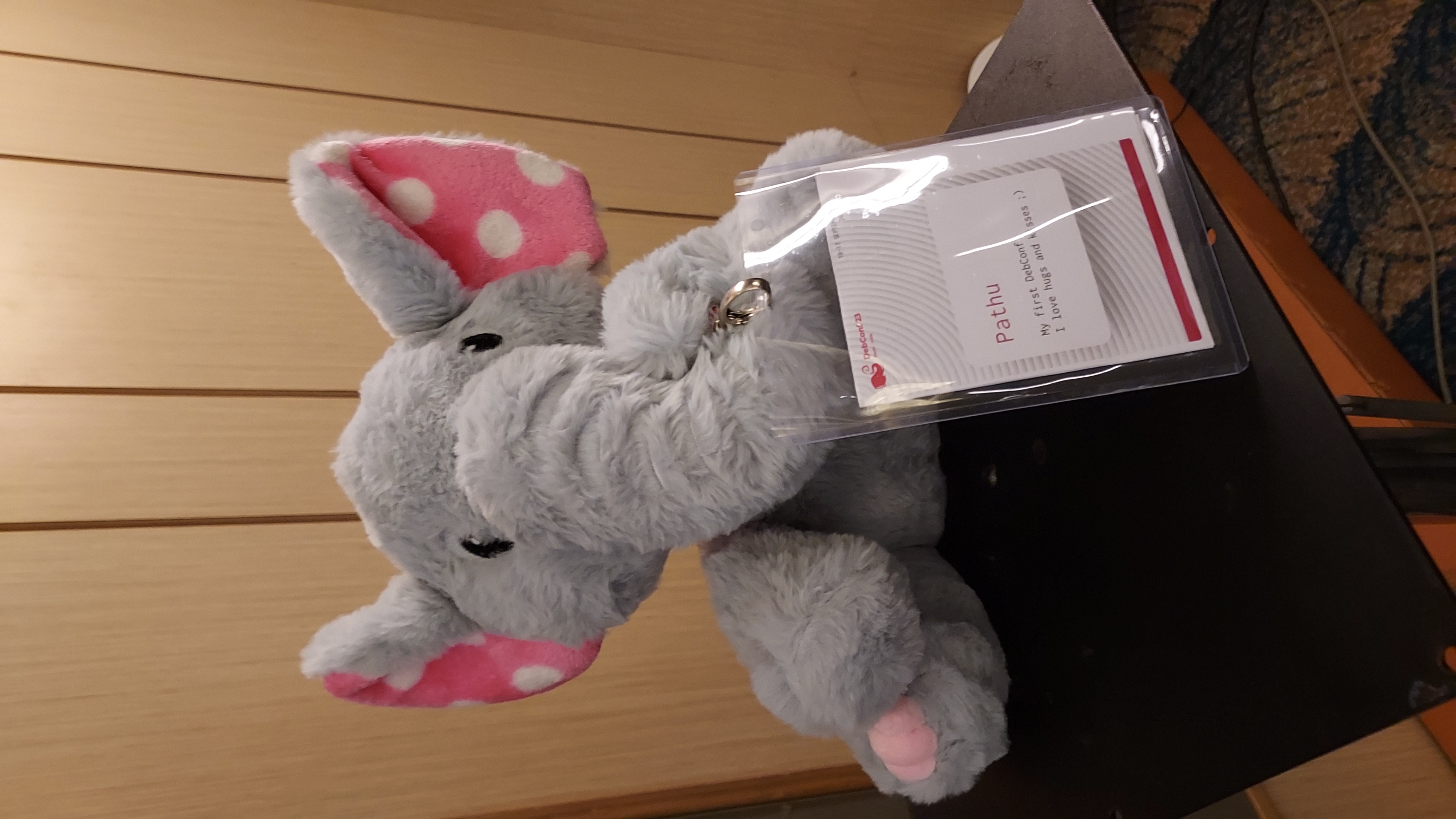
Pathu, DebConf23 mascot
To describe the conference venue, it happened in InfoPark, Kochi with the main conference hall being Athulya Hall and food, accommodation and two smaller halls in Four Point Hotel, right outside Infopark. We got Athulya Hall as part of venue sponsorship from Infopark. The distance between both of them was around 300 meters. Halls were named Anamudi, Kuthiran and Ponmudi based on hills and mountain areas in host state of Kerala. Other than Annamudi hall which was the main hall, I couldn t remember the names of the hall, I still can t. Four Points was big and expensive, and we had, as expected, cost overruns. Due to how DebConf function, an Indian university wasn t suitable to host a conference of this scale. Infinity Pool at Night
Four Point's Infinity Pool at Night
I landed in Kochi on the first day of DebCamp on 3rd September. As usual, met Abraham first, and the better part of the next hour was spent on meet and greet. It was my first IRL DebConf so met many old friends and new folks. I got a room to myself. Abraham lived nearby and hadn t taken the accommodation, so I asked him to join. He finally joined from second day onwards. All through the conference, room 928 became in-famous for various reasons, and I had various roommates for company. In DebCamp days, we would get up to have breakfast and go back to sleep and get active only past lunch for hacking and helping in the hack lab for the day, followed by fun late night discussions and parties. Nilesh, Chirag and Apple at DC23
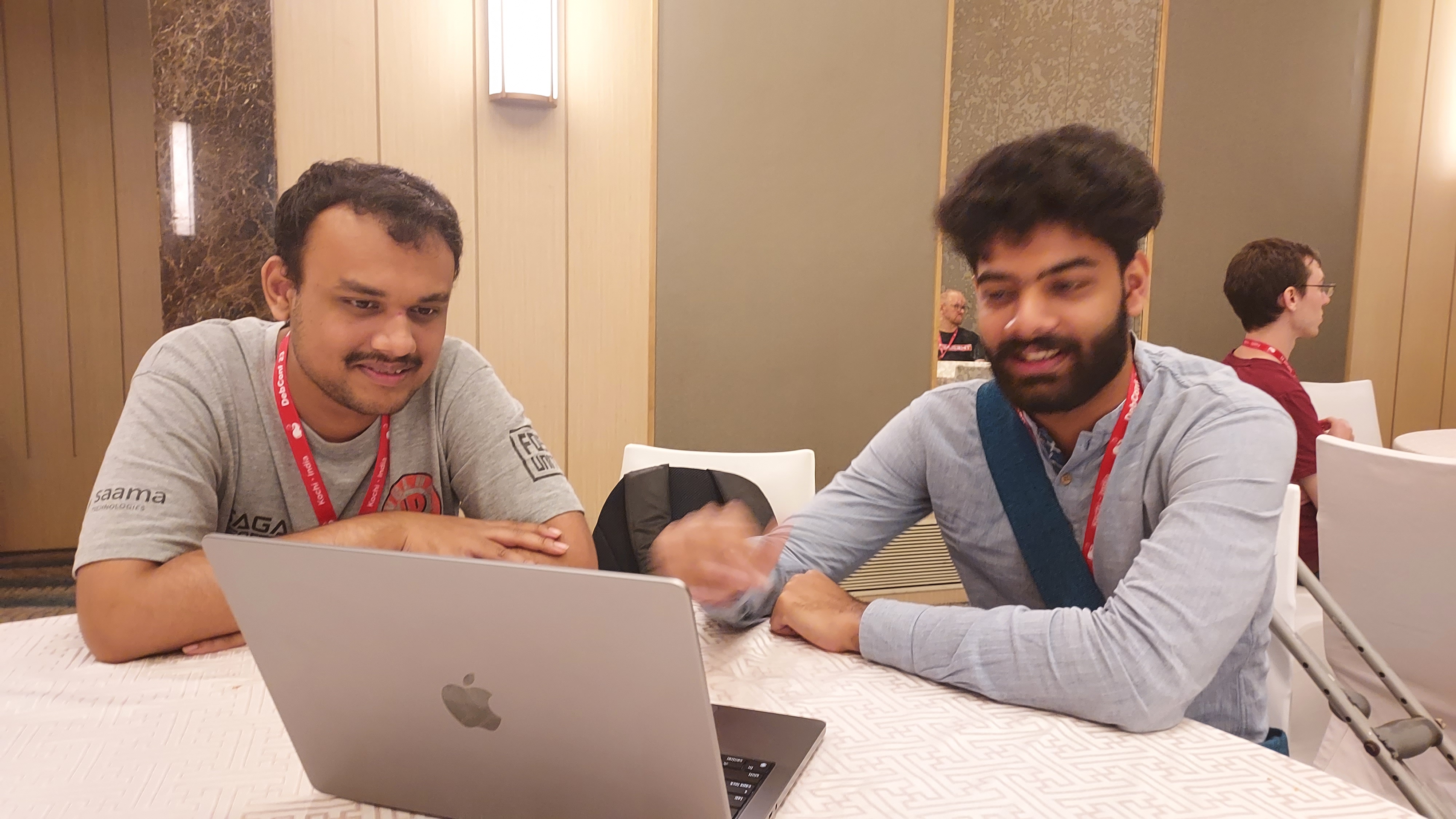
Nilesh, Chirag and Apple at DC23
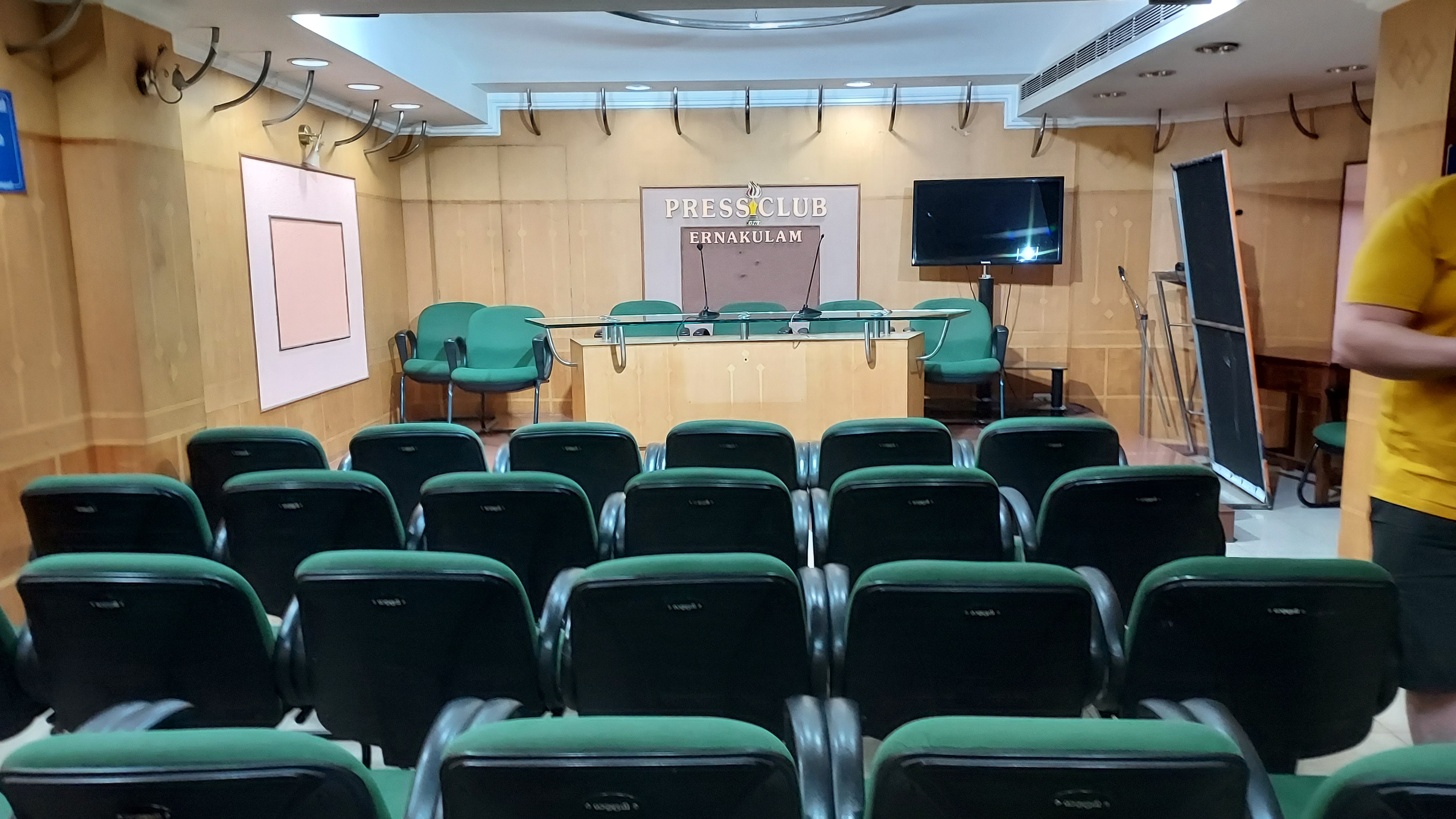
The team even managed to get a press conference arranged as well, and we got an opportunity to go to Press Club, Ernakulam. Sruthi and Jonathan gave the speech and answered questions from journalists. The event was covered by media as well due to this. Ernakulam Press Club
Ernakulam Press Club
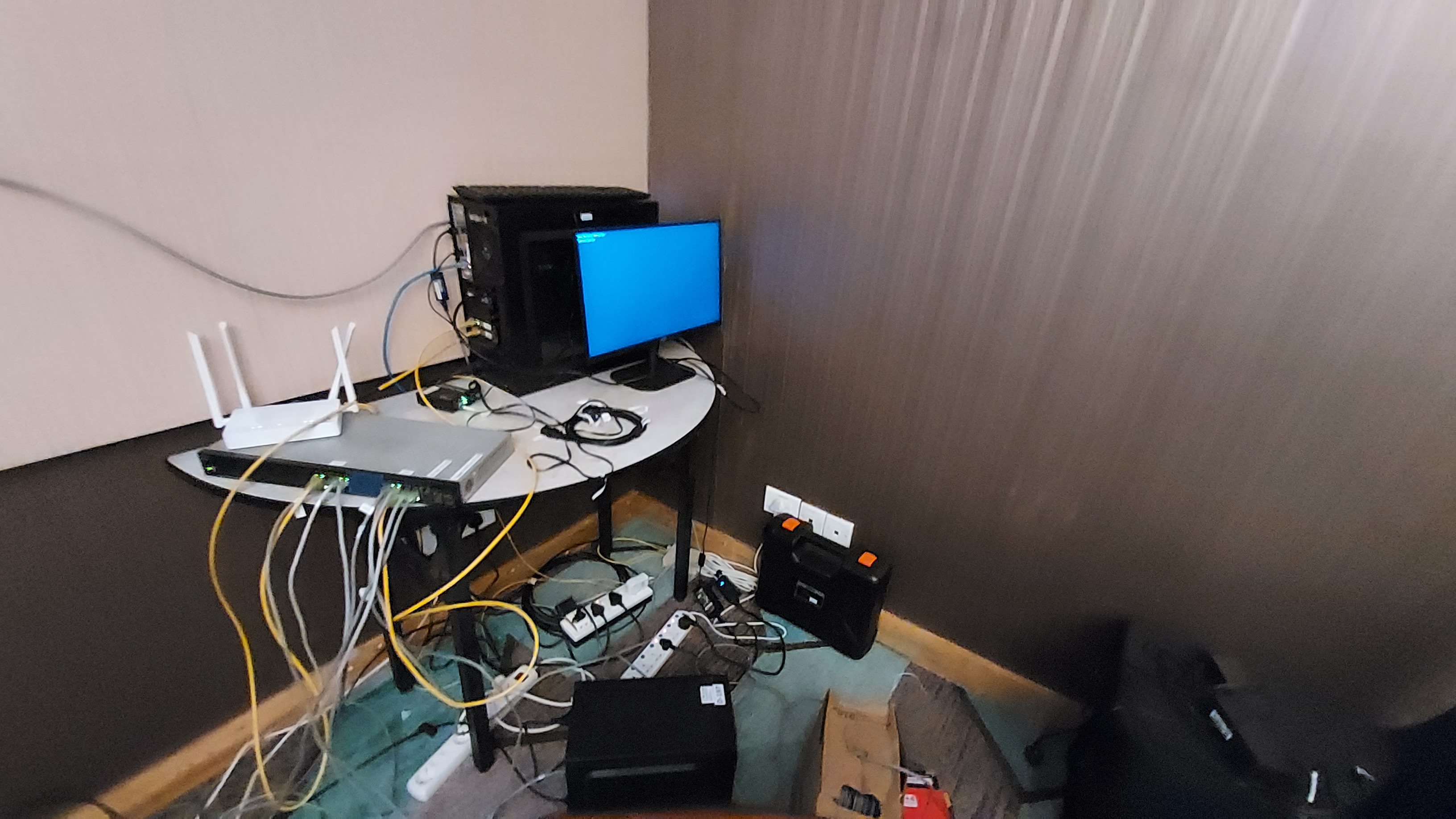
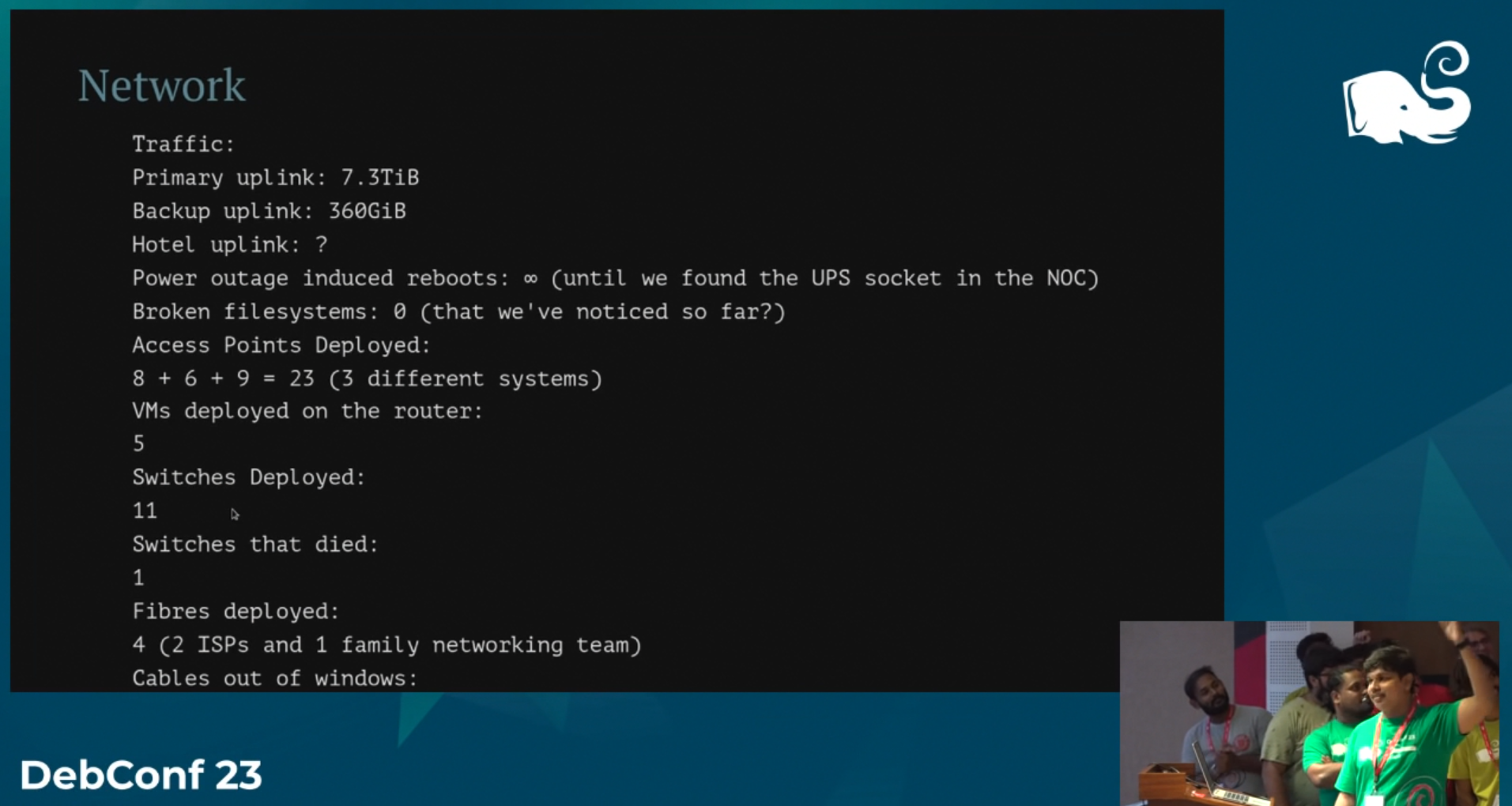
During the conference, every night the team use to have 9 PM meetings for retrospection and planning for next day, which was always dotted with new problems. Every day, we used to hijack Silent Hacklab for the meeting and gently ask the only people there at the time to give us space. DebConf, it itself is a well oiled machine. Network was brought up from scratch. Video team built the recording, audio mixing, live-streaming, editing and transcoding infrastructure on site. A gaming rig served as router and gateway. We got internet uplinks, a 1 Gbps sponsored leased line from Kerala Vision and a paid backup 100 Mbps connection from a different provider. IPv6 was added through HE s Tunnelbroker. Overall the network worked fine as additionally we had hotel Wi-Fi, so the conference network wasn t stretched much. I must highlight, DebConf is my only conference where almost everything and every piece of software in developed in-house, for the conference and modified according to need on the fly. Even event recording cameras, audio check, direction, recording and editing is all done on in-house software by volunteer-attendees (in some cases remote ones as well), all trained on the sideline of the conference. The core recording and mixing equipment is owned by Debian and travels to each venue. The rest is sourced locally. Gaming Rig which served as DC23 gateway router
Gaming Rig which served as DC23 gateway router
It was fun seeing how almost all the things were coordinated over text on Internet Relay Chat (IRC). If a talk/event was missing a talkmeister or a director or a camera person, a quick text on #debconf channel would be enough for someone to volunteer. Video team had a dedicated support channel for each conference venue for any issues and were quick to respond and fix stuff. Network information. Screengrab from closing ceremony
Network information. Screengrab from closing ceremony
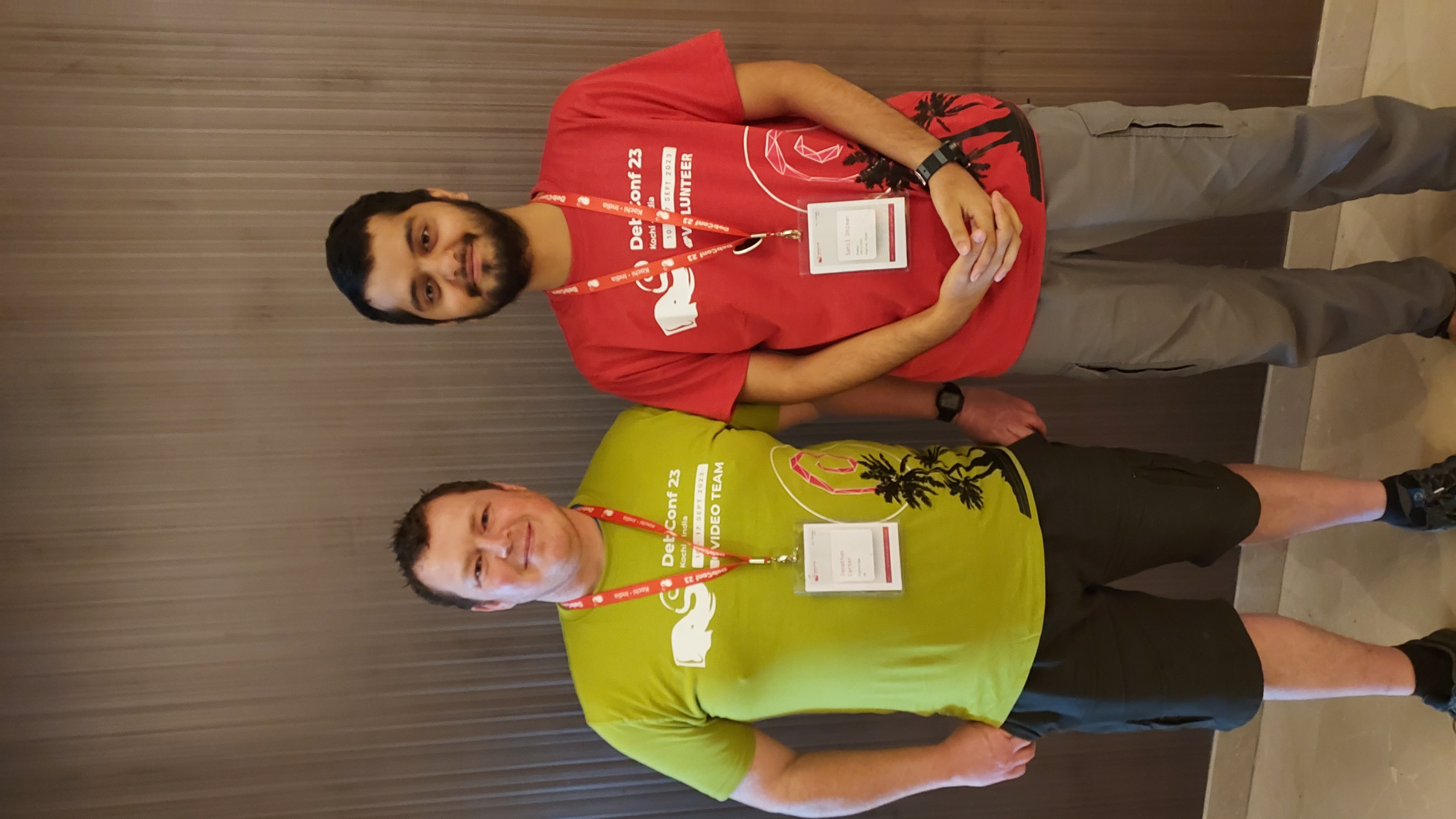
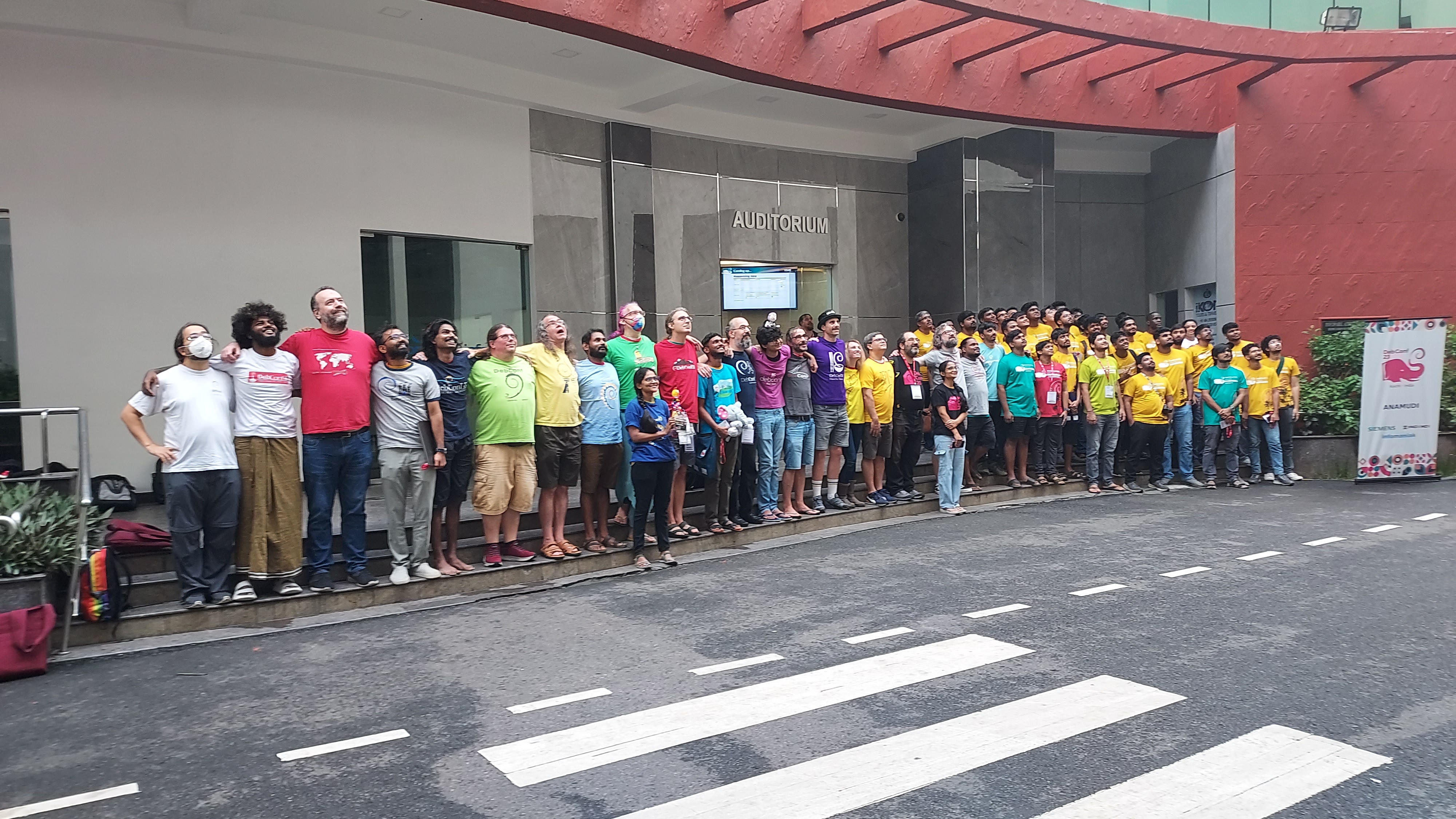
It rained for the initial days, which gave us a cool weather. Swag team had decided to hand out umbrellas in swag kit which turned out to be quite useful. The swag kit was praised for quality and selection - many thanks to Anupa, Sruthi and others. It was fun wearing different color T-shirts, all designed by Abraham. Red for volunteers, light green for Video team, green for core-team i.e. staff and yellow for conference attendees. With highvoltage
With highvoltage
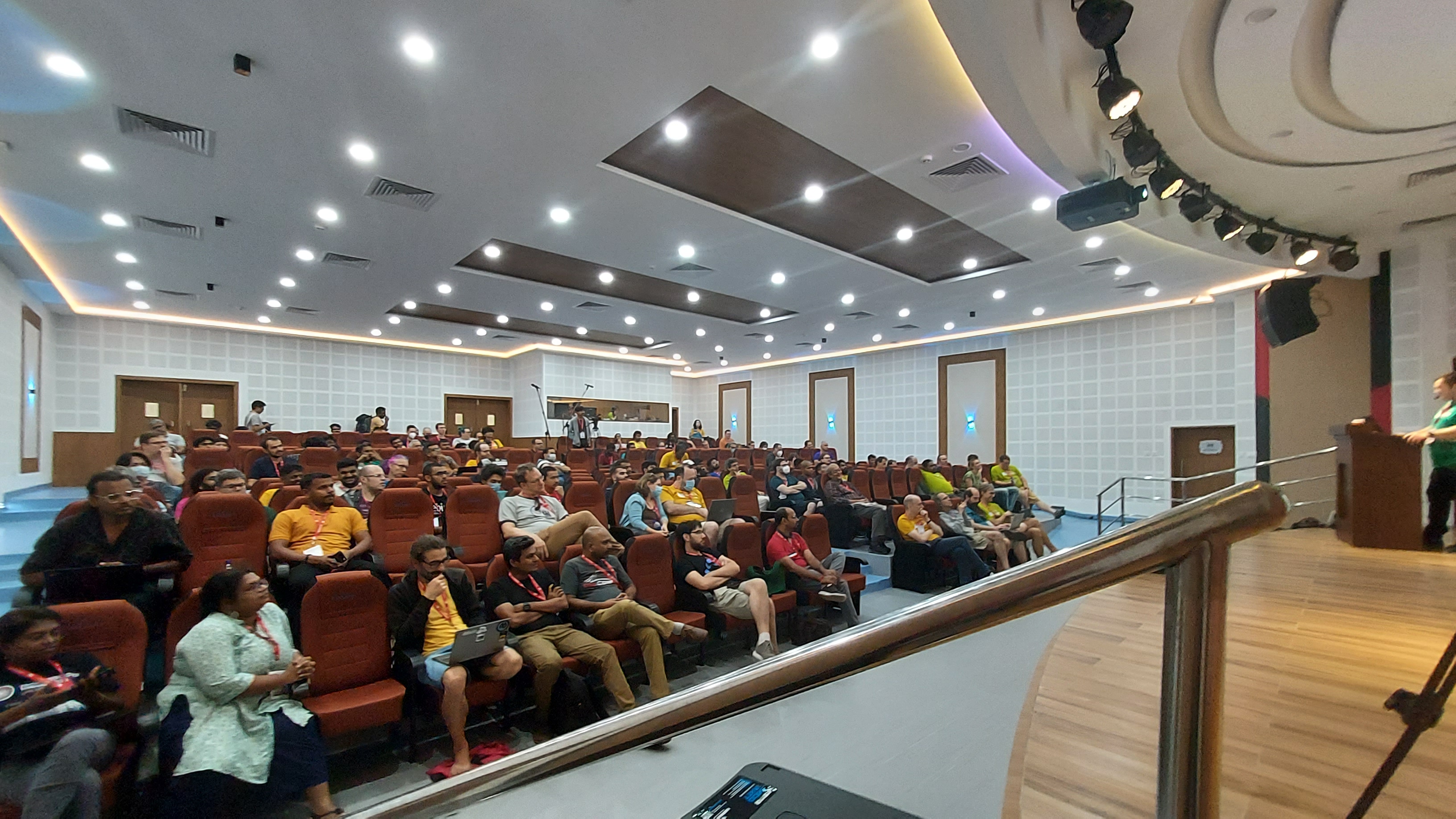
We were already acclimatized by the time DebConf really started as we had been talking, hacking and hanging out since last 7 days. Rush really started with the start of DebConf. More people joined on the first and second day of the conference. As has been the tradition, an opening talk was prepared by the Sruthi and local team (which I highly recommend watching to get more insights of the process). DebConf day 1 also saw job fair, where Canonical and FOSSEE, IIT Bombay had stalls for community interactions, which judging by the crowd itself turned out to be quite a hit. For me, association with DebConf (and Debian) started due to volunteering with video team, so anyhow I was going to continue doing that this conference as well. I usually volunteer for talks/events which anyhow I m interested in. Handling the camera, talkmeister-ing and direction are fun activities, though I didn t do sound this time around. Sound seemed difficult, and I didn t want to spoil someone s stream and recording. Talk attendance varied a lot, like in Bits from DPL talk, the hall was full but for some there were barely enough people to handle the volunteering tasks, but that s what usually happens. DebConf is more of a place to come together and collaborate, so talk attendance is an afterthought sometimes. Audience in highvoltage's Bits from DPL talk
Audience in highvoltage's Bits from DPL talk
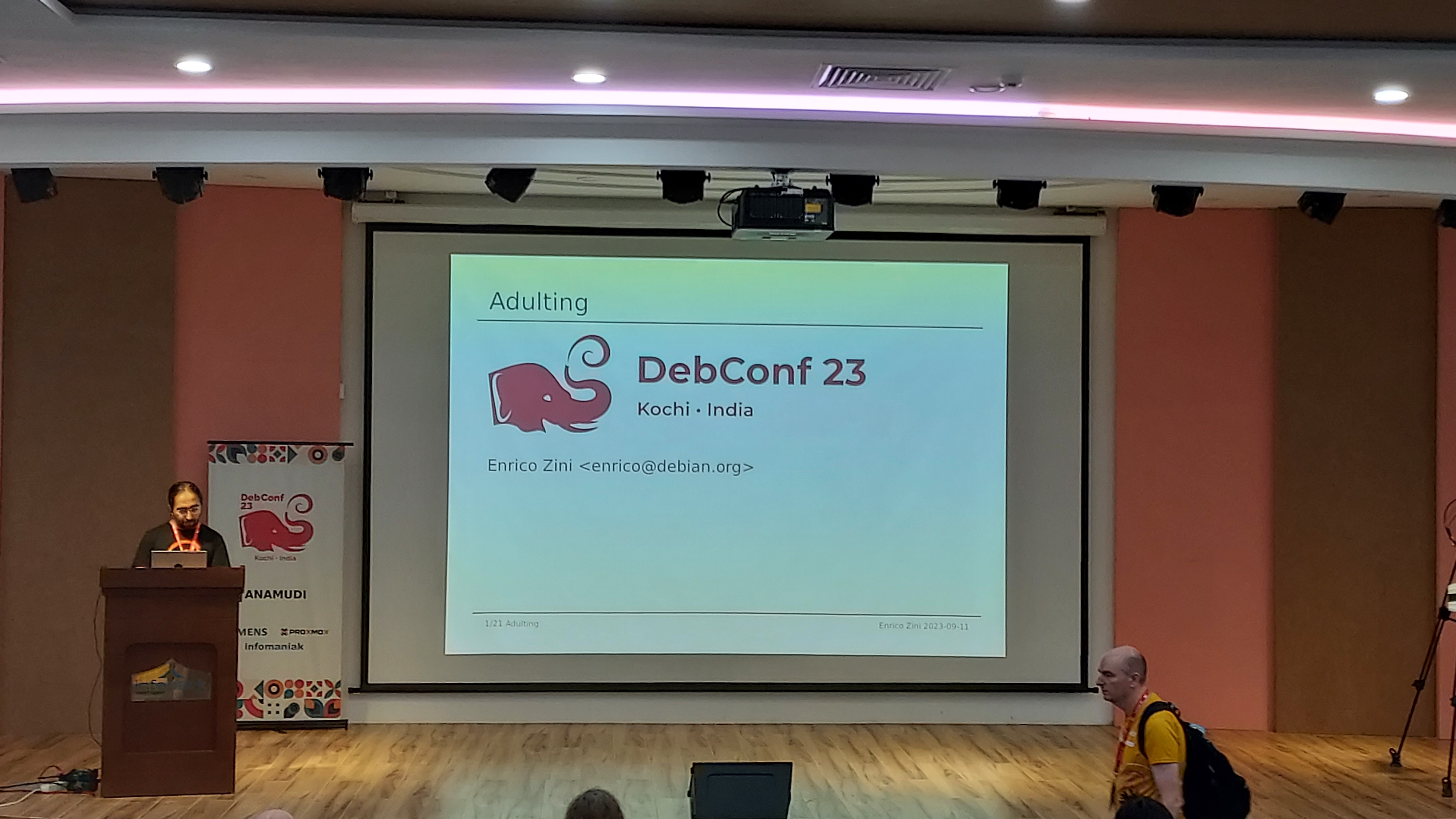
I didn t submit any talk proposals this time around, as just being in the orga team was too much work already, and I knew, the talk preparation would get delayed to the last moment and I would have to rush through it. Enrico's talk
Enrico's talk
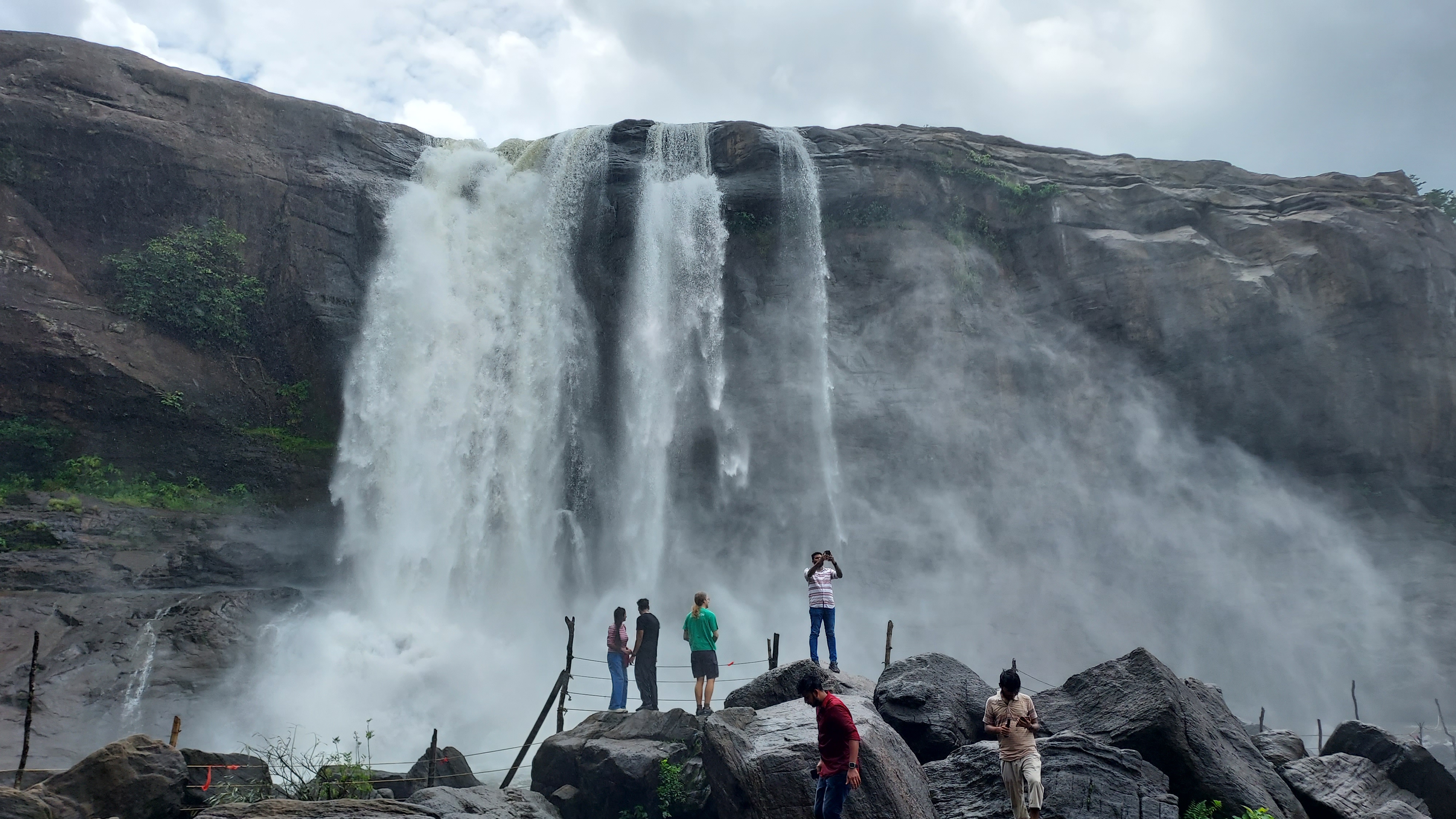
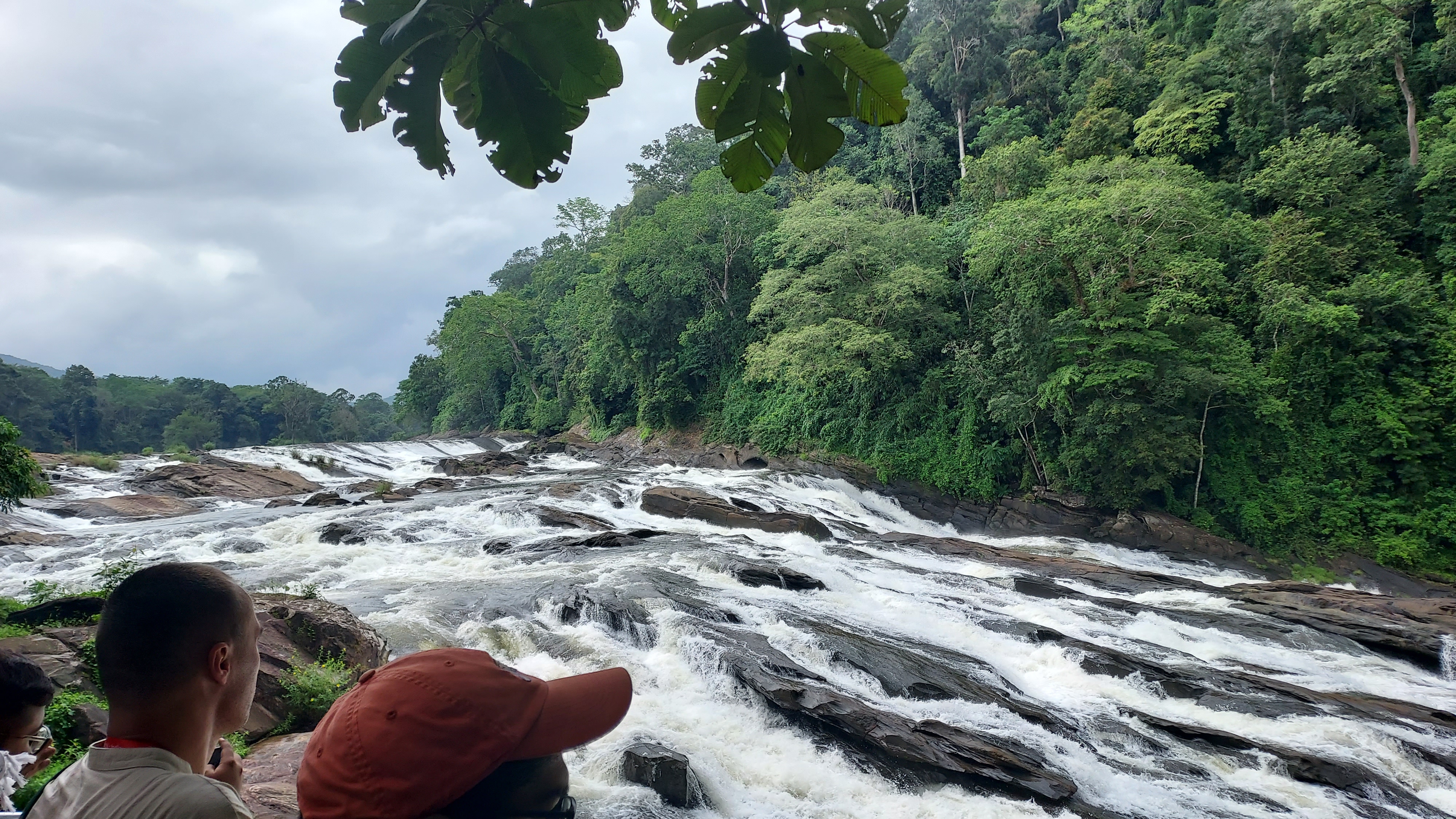
From Day 2 onward, more sponsor stalls were introduced in the hallway area. Hopbox by Unmukti , MostlyHarmless and Deeproot (joint stall) and FOSEE. MostlyHarmless stall had nice mechanical keyboards and other fun gadgets. Whenever I got the time, I would go and start typing racing to enjoy the nice, clicky keyboards. As the DebConf tradition dictates, we had a Cheese and Wine party. Everyone brought in cheese and other delicacies from their region. Then there was yummy Sadya. Sadya is a traditional vegetarian Malayalis lunch served over banana leaves. There were loads of different dishes served, the names of most I couldn t pronounce or recollect properly, but everything was super delicious. Day 4 was day trip and I chose to go to Athirappilly Waterfalls and Jungle safari. Pictures would describe the beauty better than words. The journey was bit long though. Athirappilly Falls
Athirappilly Falls

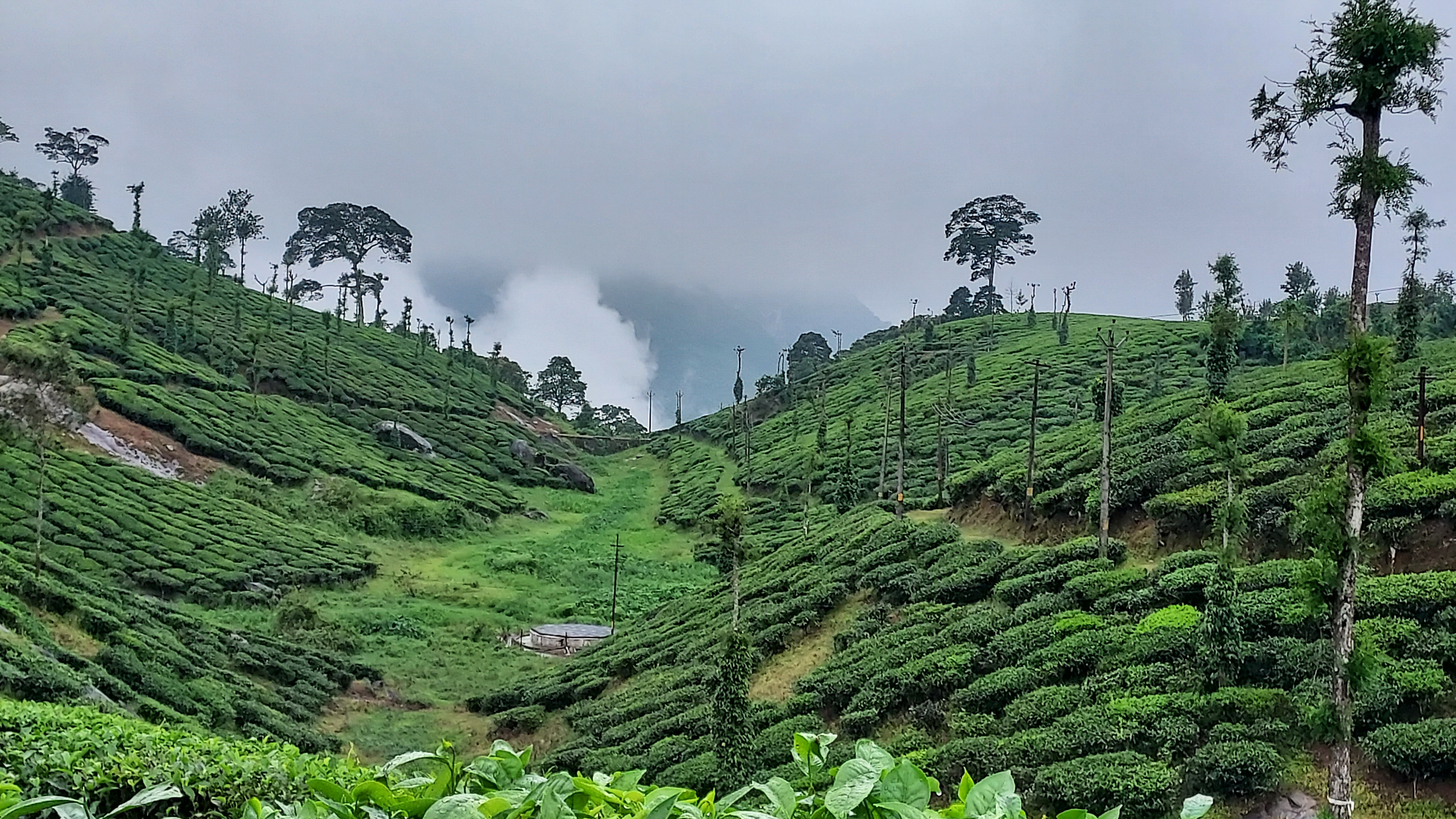
Pathu Pathu Tea Gardens
Tea Gardens
Late that day, we heard the news of Abraham gone missing. We lost Abraham. He had worked really hard all through the years for Debian and making this conference possible. Talks were cancelled for the next day and Jonathan addressed everyone. We went to Abraham s home the next day to meet his family. Team had arranged buses to Abraham s place. It was an unfortunate moment that I only got an opportunity to visit his place after he was gone. Days went by slowly after that. The last day was marked by a small conference dinner. Some of the people had already left. All through the day and next, we kept saying goodbye to friends, with whom we spent almost a fortnight together. Athirappilly Falls
Group photo with all DebConf T-shirts chronologically
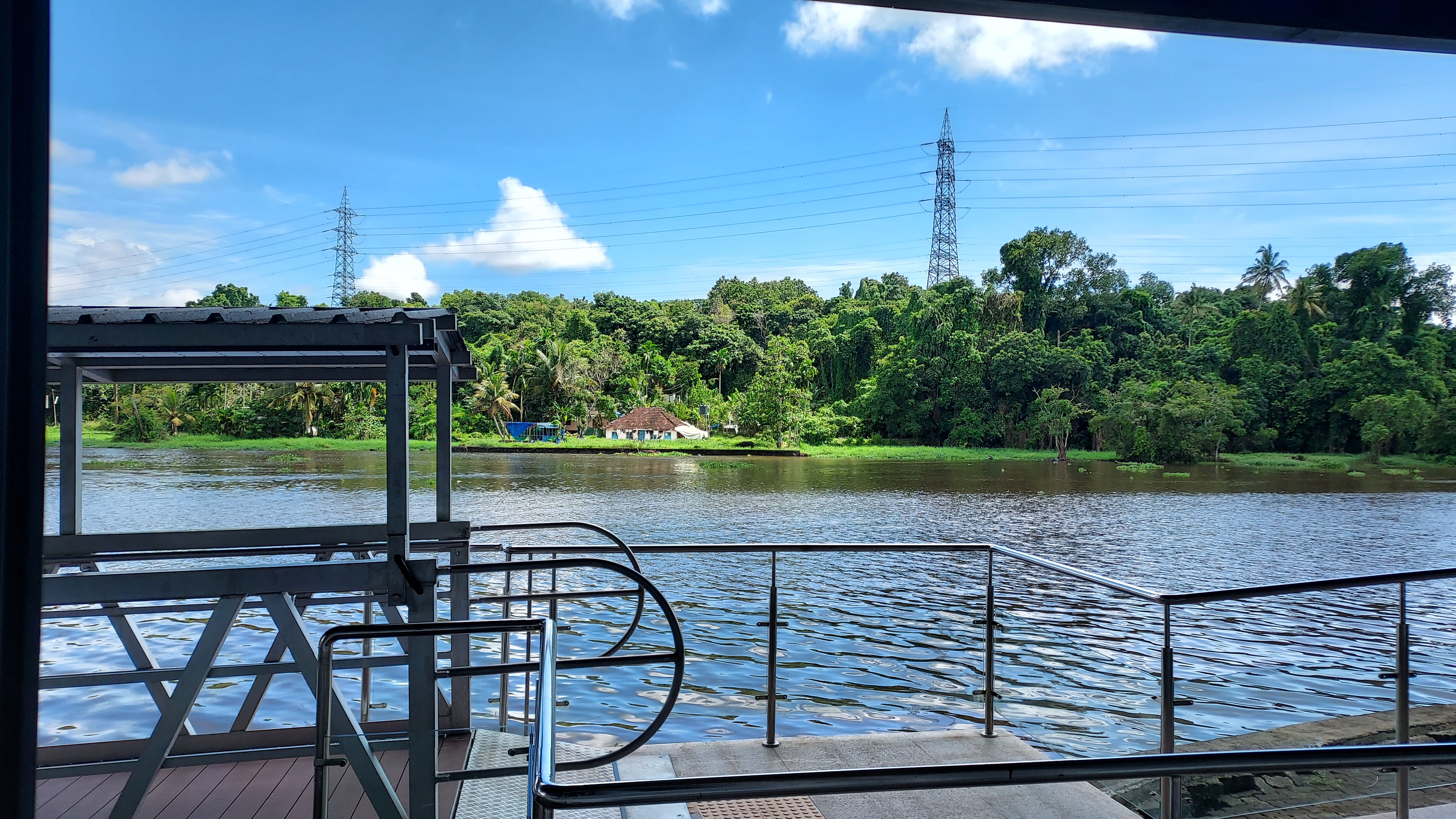
This was 2nd trip to Kochi. Vistara Airway s UK886 has become the default flight now. I have almost learned how to travel in and around Kochi by Metro, Water Metro, Airport Shuttle and auto. Things are quite accessible in Kochi but metro is a bit expensive compared to Delhi. I left Kochi on 19th. My flight was due to leave around 8 PM, so I had the whole day to myself. A direct option would have taken less than 1 hour, but as I had time and chose to take the long way to the airport. First took an auto rickshaw to Kakkanad Water Metro station. Then sailed in the water metro to Vyttila Water Metro station. Vyttila serves as intermobility hub which connects water metro, metro, bus at once place. I switched to Metro here at Vyttila Metro station till Aluva Metro station. Here, I had lunch and then boarded the Airport feeder bus to reach Kochi Airport. All in all, I did auto rickshaw > water metro > metro > feeder bus to reach Airport. I was fun and scenic. I must say, public transport and intermodal integration is quite good and once can transition seamlessly from one mode to next. Kochi Water Metro
Kochi Water Metro

Scenes from Kochi Water Metro Scenes from Kochi Water Metro
Scenes from Kochi Water Metro
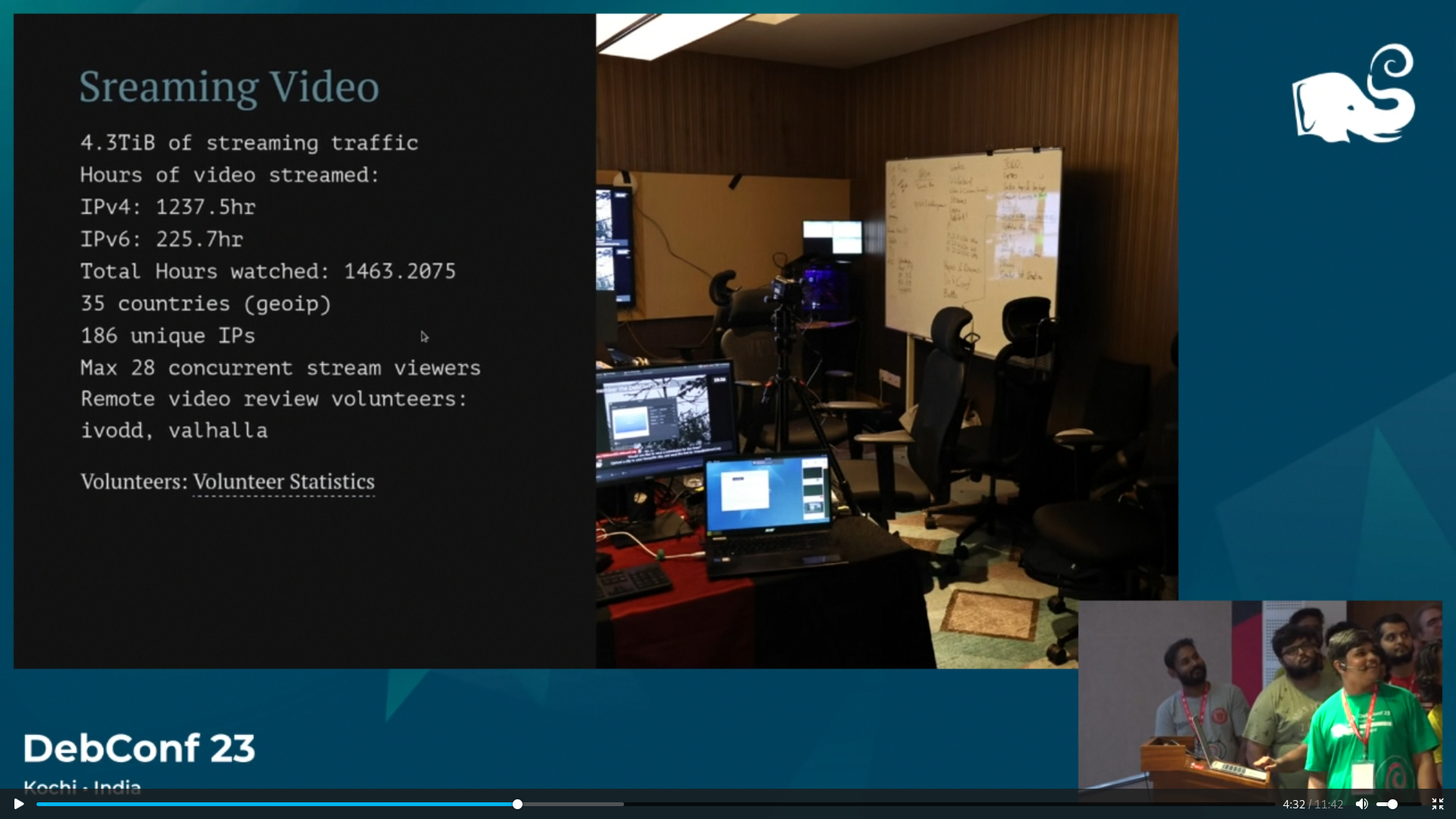
DebConf23 served its purpose of getting existing Debian people together, as well as getting new people interested and contributing to Debian. People who came are still contributing to Debian, and that s amazing. Streaming video stats
Streaming video stats. Screengrab from closing ceremony
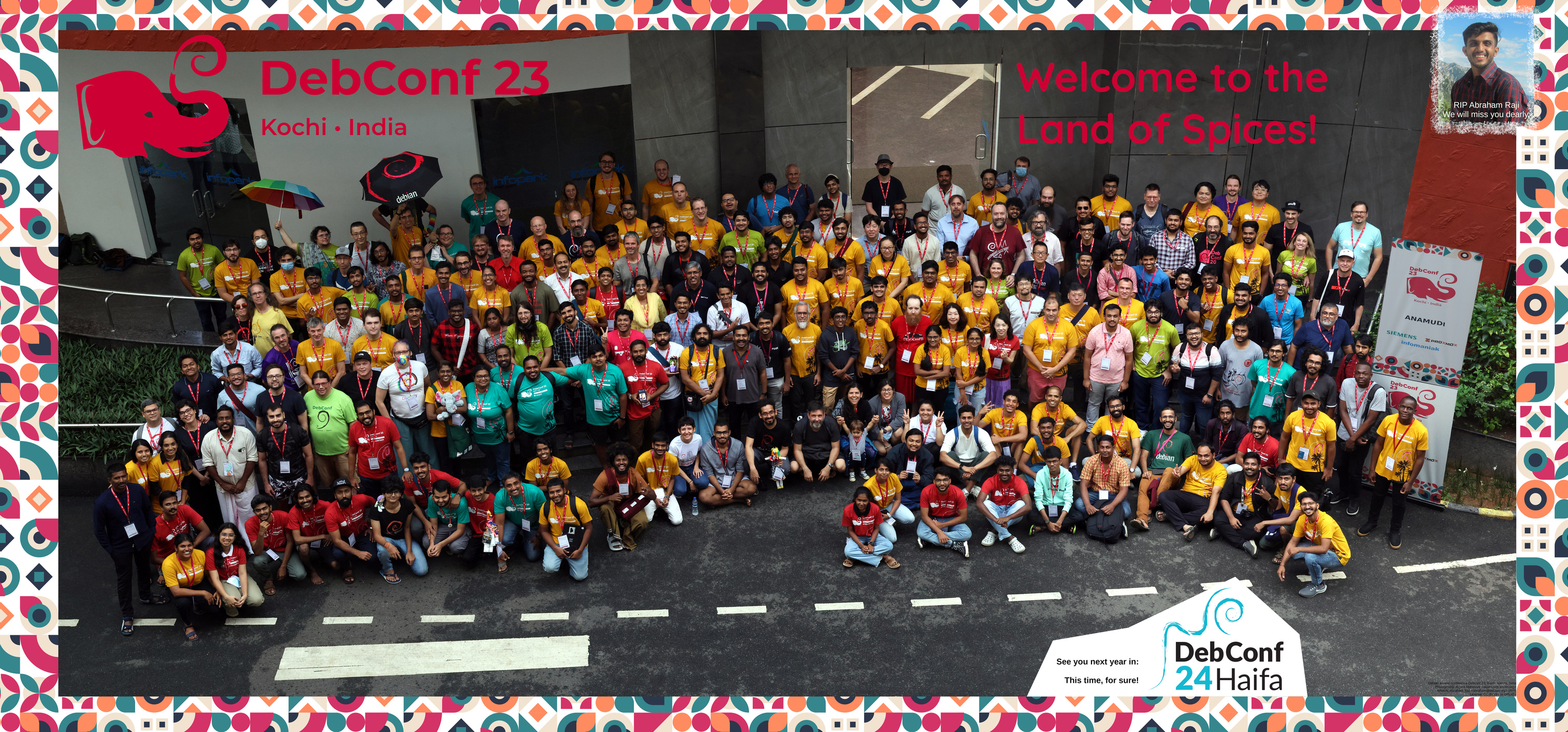
The conference wasn t without its fair share of troubles. There were multiple money transfer woes, and being in India didn t help. Many thanks to multiple organizations who were proactive in helping out. On top of this, there was conference visa uncertainty and other issues which troubled visa team a lot. Kudos to everyone who made this possible. Surely, I m going to miss the name, so thank you for it, you know how much you have done to make this event possible. Now, DebConf24 is scheduled for Busan, South Korea, and work is already in full swing. As usual, I m helping with the fundraising part and plan to attend too. Let s see if I can make it or not. DebConf23 Group Photo
DebConf23 Group Photo. Click to enlarge.
Credits - Aigars Mahinovs
In the end, we kept on saying, no DebConf at this scale would come back to India for the next 10 or 20 years. It s too much trouble to be frank. It was probably the peak that we might not reach again. I would be happy to be proven wrong though :)

25 May 2024

Gunnar Wolf: How computers make books from graphics rendering, search algorithms, and functional programming to indexing and typesetting

This post is a review for Computing Reviews for How computers make books from graphics rendering, search algorithms, and functional programming to indexing and typesetting , a book published in Manning
If we look at the age-old process of creating books, how many different areas can a computer help us with? And how can each of them be used to teach computer science (CS) fundamentals to a nontechnical audience? This is the premise of John Whitington s enticing book and the result is quite amazing. The book immediately drew my attention when looking at the titles available for review. After all, my initiation into computing as a kid was learning the LaTeX typesetting system while my father worked on his first book on scientific language and typography [1]. Whitington picks 11 different technical aspects of book production, from how dots of ink are transferred to a white page and how they are made into controllable, recognizable shapes, all the way to forming beautiful typefaces and the nuances of properly addressing white-space to present aesthetically pleasing paragraphs, building it all into specific formats aimed at different ends. But if we dig beyond just the chapter titles, we will find a very interesting book on CS that, without ever using technical language or notation, presents aspects as varied as anti-aliasing, vector and raster images, character sets such as ASCII and Unicode, an introduction to programming, input methods for different writing systems, efficient encoding (compression) methods, both for text and images, lossless and lossy, and recursion and dithering methods. To my absolute surprise, while the author thankfully spared the reader the syntax usually associated with LISP-related languages, the programming examples clearly stem from the LISP school, presenting solutions based on tail recursion. Of course, it is no match for Donald Knuth s classic book on this same topic [2], but could very well be a primer for readers to approach it. The book is light and easy to read, and keeps a very informal, nontechnical tone throughout. My only complaint relates to reading it in PDF format; the topic of this book, and the care with which the images were provided by the author, warrant high resolution. The included images are not only decorative but an integral part of the book. Maybe this is specific to my review copy, but all of the raster images were in very low resolution. This book is quite different from what readers may usually expect, as it introduces several significant topics in the field. CS professors will enjoy it, of course, but also readers with a humanities background, students new to the field, or even those who are just interested in learning a bit more.

References
  1. S nchez y G ndara, A.; Magari os Lamas, F.; Wolf, K. B., Manual de lenguaje y tipograf a cient fica en castellano. Trillas, Mexico City, Mexico, 1986, https://www.fis.unam.mx/~bwolf/manual.html
  2. Knuth, D. E. Digital typographyCSLI Lecture Notes: CSLI Lecture Notes. CSLI Publications, Stanford, CA, 1999, https://www-cs-faculty.stanford.edu/~knuth/dt.html

24 May 2024

Julian Andres Klode: Observations in Debian dependency solving

In my previous blog, I explored The New APT 3.0 solver. Since then I have been at work in the test suite making tests pass and fixing some bugs. You see for all intents and purposes, the new solver is a very stupid naive DPLL SAT solver (it just so happens we don t actually have any pure literals in there). We can control it in a bunch of ways:
  1. We can mark packages as install or reject
  2. We can order actions/clauses. When backtracking the action that came later will be the first we try to backtrack on
  3. We can order the choices of a dependency - we try them left to right.
This is about all that we really want to do, we can t go if we reach a conflict, say oh but this conflict was introduced by that upgrade, and it seems more important, so let s not backtrack on the upgrade request but on this dependency instead. . This forces us to think about lowering the dependency problem into this form, such that not only do we get formally correct solutions, but also semantically correct ones. This is nice because we can apply a systematic way to approach the issue rather than introducing ad-hoc rules in the old solver which had a which of these packages should I flip the opposite way to break the conflict kind of thinking. Now our test suite has a whole bunch of these semantics encoded in it, and I m going to share some problems and ideas for how to solve them. I can t wait to fix these and the error reporting and then turn it on in Ubuntu and later Debian (the defaults change is a post-trixie change, let s be honest).

apt upgrade is hard The apt upgrade commands implements a safe version of dist-upgrade that essentially calculates the dist-upgrade, and then undoes anything that would cause a package to be removed, but it (unlike its apt-get counterpart) allows the solver to install new packages. Now, consider the following package is installed:
X Depends: A (= 1)   B
An upgrade from A=1 to A=2 is available. What should happen? The classic solver would choose to remove X in a dist-upgrade, and then upgrade A, so it s answer is quite clear: Keep back the upgrade of A. The new solver however sees two possible solutions:
  1. Install B to satisfy X Depends A (= 1) B.
  2. Keep back the upgrade of A
Which one does it pick? This depends on the order in which it sees the upgrade action for A and the dependency, as it will backjump chronologically. So
  1. If it gets to the dependency first, it marks A=1 for install to satisfy A (= 1). Then it gets to the upgrade request, which is just A Depends A (= 2) A (= 1) and sees it is satisfied already and is content.
  2. If it gets to the upgrade request first, it marks A=2 for install to satisfy A (= 2). Then later it gets to X Depends: A (= 1) B, sees that A (= 1) is not satisfiable, and picks B.
We have two ways to approach this issue:
  1. We always order upgrade requests last, so they will be kept back in case of conflicting dependencies
  2. We require that, for apt upgrade a currently satisfied dependency must be satisfied by currently installed packages, hence eliminating B as a choice.

Recommends are hard too See if you have a X Recommends: A (= 1) and a new version of A, A (= 2), the solver currently will silently break the Recommends in some cases. But let s explore what the behavior of a X Recommends: A (= 1) in combination with an available upgrade of A (= 2) should be. We could say the rule should be:
  • An upgrade should keep back A instead of breaking the Recommends
  • A dist-upgrade should either keep back A or remove X (if it is obsolete)
This essentially leaves us the same choices as for the previous problem, but with an interesting twist. We can change the ordering (and we already did), but we could also introduce a new rule, promotions :
A Recommends in an installed package, or an upgrade to that installed package, where the Recommends existed in the installed version, that is currently satisfied, must continue to be satisfied, that is, it effectively is promoted to a Depends.
This neatly solves the problem for us. We will never break Recommends that are satisfied. Likewise, we already have a Recommends demotion rule:
A Recommends in an installed package, or an upgrade to that installed package, where the Recommends existed in the installed version, that is currently unsatisfied, will not be further evaluated (it is treated like a Suggests is in the default configuration).
Whether we should be allowed to break Suggests with our decisions or not (the old autoremover did not, for instance) is a different decision. Should we promote currently satisified Suggests to Depends as well? Should we follow currently satisified Suggests so the solver sees them and doesn t autoremove them, but treat them as optional?

tightening of versioned dependencies Another case of versioned dependencies with alternatives that has complex behavior is something like
X Depends: A (>= 2)   B
X Recommends: A (>= 2)   B
In both cases, installing X should upgrade an A < 2 in favour of installing B. But a naive SAT solver might not. If your request to keep A installed is encoded as A (= 1) A (= 2), then it first picks A (= 1). When it sees the Depends/Recommends it will switch to B. We can solve this again as in the previous example by ordering the keep A installed requests after any dependencies. Notably, we will enqueue the common dependencies of all A versions first before selecting a version of A, so something may select a version for us.

version narrowing instead of version choosing A different approach to dealing with the issue of version selection is to not select a version until the very last moment. So instead of selecting a version to satisfy A (>= 2) we instead translate
Depends: A (>= 2)
into two rules:
  1. The package selection rule:
     Depends: A
    
    This ensures that any version of A is installed (i.e. it adds a version choice clause, A (= 1) A (= 2) in an example with two versions for A.
  2. The version narrowing rule:
     Conflicts: A (<< 2)
    
    This outright would reject a choice of A (= 1).
So now we have 3 kinds of clauses:
  1. package selection
  2. version narrowing
  3. version selection
If we process them in that order, we should surely be able to find the solution that best matches the semantics of our Debian dependency model, i.e. selecting earlier choices in a dependency before later choices in the face of version restrictions. This still leaves one issue: What if our maintainer did not use Depends: A (>= 2) B but e.g. Depends: A (= 3) B A (= 2). He d expect us to fall back to B if A (= 3) is not installable, and not to B. But we d like to enqueue A and reject all choices other than 3 and 2. I think it s fair to say: Don t do that, then here.

Implementing strict pinning correctly APT knows a single candidate version per package, this makes the solver relatively deterministic: It will only ever pick the candidate, or an installed version. This also happens to significantly reduce the search space which is good - less backtracking. An uptodate system will only ever have one version per package that can be installed, so we never actually have to choose versions. But of course, APT allows you to specify a non-candidate version of a package to install, for example:
apt install foo/oracular-proposed
The way this works is that the core component of the previous solver, which is the pkgDepCache maintains what essentially amounts to an overlay of the policy that you could see with apt-cache policy. The solver currently however validates allowed version choices against the policy directly, and hence finds these versions are not allowed and craps out. This is an interesting problem because the solver should not be dependent on the pkgDepCache as the pkgDepCache initialization (Building dependency tree...) accounts for about half of the runtime of APT (until the Y/n prompt) and I d really like to get rid of it. But currently the frontend does go via the pkgDepCache. It marks the packages in there, building up what you could call a transaction, and then we translate it to the new solver, and once it is done, it translates the result back into the pkgDepCache. The current implementation of allowed version is implemented by reducing the search space, i.e. every dependency, we outright ignore any non-allowed versions. So if you have a version 3 of A that is ignored a Depends: A would be translated into A (= 2) A (= 1). However this has two disadvantages. (1) It means if we show you why A could not be installed, you don t even see A (= 3) in the list of choices and (2) you would need to keep the pkgDepCache around for the temporary overrides. So instead of actually enforcing the allowed version rule by filtering, a more reasonable model is that we apply the allowed version rule by just marking every other version as not allowed when discovering the package in the from depcache translation layer. This doesn t really increase the search space either but it solves both our problem of making overrides work and giving you a reasonable error message that lists all versions of A.

pulling up common dependencies to minimize backtracking cost One of the common issues we have is that when we have a dependency group
 A   B   C   D 
we try them in order, and if one fails, we undo everything it did, and move on to the next one. However, this isn t perhaps the best choice of operation. I explained before that one thing we do is queue the common dependencies of a package (i.e. dependencies shared in all versions) when marking a package for install, but we don t do this here: We have already lowered the representation of the dependency group into a list of versions, so we d need to extract the package back out of it. This can of course be done, but there may be a more interesting solution to the problem, in that we simply enqueue all the common dependencies. That is, we add n backtracking levels for n possible solutions:
  1. We enqueue the common dependencies of all possible solutions deps(A)&deps(B)&deps(C)&deps(D)
  2. We decide (adding a decision level) not to install D right now and enqueue deps(A)&deps(B)&deps(C)
  3. We decide (adding a decision level) not to install C right now and enqueue deps(A)&deps(B)
  4. We decide (adding a decision level) not to install B right now and enqueue A
Now if we need to backtrack from our choice of A we hopefully still have a lot of common dependencies queued that we do not need to redo. While we have more backtracking levels, each backtracking level would be significantly cheaper, especially if you have cheap backtracking (which admittedly we do not have, yet anyway). The caveat though is: It may be pretty expensive to find the common dependencies. We need to iterate over all dependency groups of A and see if they are in B, C, and D, so we have a complexity of roughly #A * (#B+#C+#D) Each dependency group we need to check i.e. is X Y in B meanwhile has linear cost: We need to compare the memory content of two pointer arrays containing the list of possible versions that solve the dependency group. This means that X Y and Y X are different dependencies of course, but that is to be expected they are. But any dependency of the same order will have the same memory layout. So really the cost is roughly N^4. This isn t nice. You can apply various heuristics here on how to improve that, or you can even apply binary logic:
  1. Enqueue common dependencies of A B C D
  2. Move into the left half, enqueue of A B
  3. Again divide and conquer and select A.
This has a significant advantage in long lists of choices, and also in the common case, where the first solution should be the right one. Or again, if you enqueue the package and a version restriction instead, you already get the common dependencies enqueued for the chosen package at least.

20 May 2024

Russell Coker: Respect and Children

I attended the school Yarra Valley Grammer (then Yarra Valley Anglican School which I will refer to as YV ) and completed year 12 in 1990. The school is currently in the news for a spreadsheet some boys made rating girls where unrapeable was one of the ratings. The school s PR team are now making claims like Respect for each other is in the DNA of this school . I d like to know when this DNA change allegedly occurred because respect definitely wasn t in the school DNA in 1990! Before I go any further I have to note that if the school threatens legal action against me for this post it will be clear evidence that they don t believe in respect. The actions of that school have wronged me, several of my friends, many people who aren t friends but who I wish they hadn t had to suffer and I hadn t had to witness it, and presumably countless others that I didn t witness. If they have any decency they would not consider legal action but I have learned that as an institution they have no decency so I have to note that they should read the Wikipedia page about the Streisand Effect [1] and keep it in mind before deciding on a course of action. I think it is possible to create a school where most kids enjoy being there and enjoy learning, where hardly any students find it a negative experience and almost no-one finds it traumatic. But it is not possible to do that with the way schools tend to be run. When I was at high school there was a general culture that minor sex crimes committed by boys against boys weren t a problem, this probably applied to all high schools. Things like ripping a boy s pants off (known as dakking ) were considered a big joke. If you accept that ripping the pants off an unwilling boy is a good thing (as was the case when I was at school) then that leads to thinking that describing girls as unrapeable is acceptable. The Wikipedia page for Pantsing [2] has a reference for this issue being raised as a serious problem by the British Secretary of State for Education and Skills Alan Johnson in 2007. So this has continued to be a widespread problem around the world. Has YV become better than other schools in dealing with it or is Dakking and Wedgies as well accepted now as it was when I attended? There is talk about schools preparing kids for the workforce, but grabbing someone s underpants without consent will result in instant dismissal from almost all employment. There should be more tolerance for making mistakes at school than at work, but they shouldn t tolerate what would be serious crimes in other contexts. For work environments there have been significant changes to what is accepted, so it doesn t seem unreasonable to expect that schools can have a similar change in culture. One would hope that spending 6 years wondering who s going to grab your underpants next would teach boys the importance of consent and some sympathy for victims of other forms of sexual assault. But that doesn t seem to happen, apparently it s often the opposite. When I was young Autism wasn t diagnosed for anyone who was capable of having a normal life. Teachers noticed that I wasn t like other kids, some were nice, but some encouraged other boys to attack me as a form of corporal punishment by proxy not a punishment for doing anything wrong (detentions were adequate for that) but for being different. The lesson kids will take from that sort of thing is that if you are in a position of power you can mistreat other people and get away with it. There was a girl in my year level at YV who would probably be diagnosed as Autistic by today s standards, the way I witnessed her being treated was considerably worse than what was described in the recent news reports but it is quite likely that worse things have been done recently which haven t made the news yet. If this issue is declared to be over after 4 boys were expelled then I ll count that as evidence of a cover-up. These things don t happen in a vacuum, there s a culture that permits and encourages it. The word respect has different meanings, it can mean treat a superior as the master or treat someone as a human being . The phrase if you treat me with respect I ll treat you with respect usually means if you treat me as the boss then I ll treat you as a human being . The distinction is very important when discussing respect in schools. If teachers are considered the ultimate bosses whose behaviour can never be questioned then many boys won t need much help from Andrew Tate in developing the belief that they should be the boss of girls in the same way. Do any schools have a process for having students review teachers? Does YV have an ombudsman to take reports of misbehaving teachers in the way that corporations typically have an ombudsman to take reports about bad managers? Any time you have people whose behaviour is beyond scrutiny or oversight you will inevitably have bad people apply for jobs, then bad things will happen and it will create a culture of bad behaviour. If teachers can treat kids badly then kids will treat other kids badly, and this generally ends with girls being treated badly by boys. My experience at YV was that kids barely had the status of people. It seemed that the school operated more as a caretaker of the property of parents than as an organisation that cares for people. The current YV website has a Whistleblower policy [3] that has only one occurrence of the word student and that is about issues that endanger the health or safety of students. Students are the people most vulnerable to reprisal for complaining and not being listed as an eligible whistleblower shows their status. The web site also has a flowchart for complaints and grievances [4] which doesn t describe any policy for a complaint to be initiated by a student. One would hope that parents would advocate for their children but that often isn t the case. When discussing the possibility of boys being bullied at school with parents I ve had them say things like my son wouldn t be so weak that he would be bullied , no boy will tell his parents about being bullied if that s their attitude! I imagine that there are similar but different issues of parents victim-blaming when their daughter is bullied (presumably substituting immoral for weak) but don t have direct knowledge of the topic. The experience of many kids is being disrespected by their parents, the school system, and often siblings too. A school can t solve all the world s problems but can ideally be a refuge for kids who have problems at home. When I was at school the culture in the country and the school was homophobic. One teacher when discussing issues such as how students could tell him if they had psychological problems and no-one else to talk to said some things like the Village People make really good music which was the only time any teacher said anything like It s OK to be gay (the Village People were the gayest pop group at the time). A lot of the bullying at school had a sexual component to it. In addition to the wedgies and dakking (which while not happening often was something you had to constantly be aware of) I routinely avoided PE classes where a shower was necessary because of a thug who hung around by the showers and looked hungrily at my penis, I don t know if he had a particular liking to mine or if he stared at everyone that way. Flashing and perving was quite common in change rooms. Presumably as such boy-boy sexual misbehaviour was so accepted that led to boys mistreating girls. I currently work for a company that is active in telling it s employees about the possibility of free psychological assistance. Any employee can phone a psychologist to discuss problems (whether or not they are work related) free of charge and without their manager or colleagues knowing. The company is billed and is only given a breakdown of the number of people who used the service and roughly what the issue was (work stress, family, friends, grief, etc). When something noteworthy happens employees are given reminders about this such as if you need help after seeing a homeless man try to steal a laptop from the office then feel free to call the assistance program . Do schools offer something similar? With the school fees paid to a school like YV they should be able to afford plenty of psychologist time. Every day I was at YV I saw something considerably worse than laptop theft, most days something was done to me. The problems with schools are part of larger problems with society. About half of the adults in Australia still support the Liberal party in spite of their support of Christian Porter, Cardinal Pell, and Bruce Lehrmann. It s not logical to expect such parents to discourage their sons from mistreating girls or to encourage their daughters to complain when they are mistreated. The Anglican church has recently changed it s policy to suggesting that victims of sexual abuse can contact the police instead of or in addition to the church, previously they had encouraged victims to only contact the church which facilitated cover-ups. One would hope that schools associated with the Anglican church have also changed their practices towards such things. I approve of the respect is in our DNA concept, it s like Google s former slogan of Don t be evil which is something that they can be bound to. Here s a list of questions that could be asked of schools (not just YV but all schools) by journalists when reporting on such things:
  1. Do you have a policy of not trying to silence past students who have been treated badly?
  2. Do you take all sexual assaults seriously including wedgies and dakking?
  3. Do you take all violence at school seriously? Even if there s no blood? Even if the victim says they don t want to make an issue of it?
  4. What are your procedures to deal with misbehaviour from teachers? Do the students all know how to file complaints? Do they know that they can file a complaint if they aren t the victim?
  5. Does the school have policies against homophobia and transphobia and are they enforced?
  6. Does the school offer free psychological assistance to students and staff who need it? NB This only applies to private schools like YV that have huge amounts of money, public schools can t afford that.
  7. Are serious incidents investigated by people who are independent of the school and who don t have a vested interest in keeping things quiet?
  8. Do you encourage students to seek external help from organisations like the ones on the resources list of the Grace Tame Foundation [5]? Having your own list of recommended external organisations would be good too.
Counter Arguments I ve had practice debating such things, here s some responses to common counter arguments. Conclusion I don t think that YV is necessarily worse than other schools, although I m sure that representatives of other private schools are now working to assure parents of students and prospective students that they are. I don t think that all the people who were employed as teachers there when I attended were bad people, some of them were nice people who were competent teachers. But a few good people can t turn around a bad system. I will note that when I attended all the sports teachers were decent people, it was the only department I could say such things about. But sports involves situations that can lead to a bad result, issues started at other times and places can lead to violence or harassment in PE classes regardless of how good the teachers are. Teachers who know that there are problems need to be able to raise issues with the administration. When a teacher quits teaching to join the clergy and another teacher describes it as a loss for the clergy but a gain for YV it raises the question of why the bad teacher in question couldn t have been encouraged to leave earlier. A significant portion of the population will do whatever is permitted. If you say no teacher would ever bully a student so we don t need to look out for that then some teacher will do exactly that. I hope that this will lead to changes both in YV and in other schools. But if they declare this issue as resolved after expelling 4 students then something similar or worse will happen again. At least now students know that when this sort of thing happens they can send evidence to journalists to get some action.

14 May 2024

Matthew Palmer: "Is This Project Still Maintained?"

If you wander around a lot of open source repositories on the likes of GitHub, you ll invariably stumble over repos that have an issue (or more than one!) with a title like the above. Sometimes sitting open and unloved, often with a comment or two from the maintainer and a bunch of I ll help out! followups that never seemed to pan out. Very rarely, you ll find one that has been closed, with a happy ending. These issues always fascinate me, because they say a lot about what it means to maintain an open source project, the nature of succession (particularly in a post-Jia Tan world), and the expectations of users and the impedence mismatch between maintainers, contributors, and users. I ve also recently been thinking about pre-empting this sort of issue, and opening my own issue that answers the question before it s even asked.

Why These Issues Are Created As both a producer and consumer of open source software, I completely understand the reasons someone might want to know whether a project is abandoned. It s comforting to be able to believe that there s someone on the other end of the line , and that if you have a problem, you can ask for help with a non-zero chance of someone answering you. There s also a better chance that, if the maintainer is still interested in the software, that compatibility issues and at least show-stopper bugs might get fixed for you. But often there s more at play. There is a delusion that maintained open source software comes with entitlements an expectation that your questions, bug reports, and feature requests will be attended to in some fashion. This comes about, I think, in part because there are a lot of open source projects that are energetically supported, where generous volunteers do answer questions, fix reported bugs, and implement things that they don t personally need, but which random Internet strangers ask for. If you ve had that kind of user experience, it s not surprising that you might start to expect it from all open source projects. Of course, these wonders of cooperative collaboration are the exception, rather than the rule. In many (most?) cases, there is little practical difference between most projects that are maintained and those that are formally declared unmaintained . The contributors (or, most often, contributor singular) are unlikely to have the time or inclination to respond to your questions in a timely and effective manner. If you find a problem with the software, you re going to be paddling your own canoe, even if the maintainer swears that they re still maintaining it.

A Thought Appears With this in mind, I ve been considering how to get ahead of the problem and answer the question for the software projects I ve put out in the world. Nothing I ve built has anything like what you d call a community ; most have never seen an external PR, or even an issue. The last commit date on them might be years ago. By most measures, almost all of my repos look unmaintained . Yet, they don t feel unmaintained to me. I m still using the code, sometimes as often as every day, and if something broke for me, I d fix it. Anyone who needs the functionality I ve developed can use the code, and be pretty confident that it ll do what it says in the README. I m considering creating an issue in all my repos, titled Is This Project Still Maintained? , pinning it to the issues list, and pasting in something I m starting to think of as The Open Source Maintainer s Manifesto . It goes something like this:

Is This Project Still Maintained? Yes. Maybe. Actually, perhaps no. Well, really, it depends on what you mean by maintained . I wrote the software in this repo for my own benefit to solve the problems I had, when I had them. While I could have kept the software to myself, I instead released it publicly, under the terms of an open licence, with the hope that it might be useful to others, but with no guarantees of any kind. Thanks to the generosity of others, it costs me literally nothing for you to use, modify, and redistribute this project, so have at it!

OK, Whatever. What About Maintenance? In one sense, this software is maintained , and always will be. I fix the bugs that annoy me, I upgrade dependencies when not doing so causes me problems, and I add features that I need. To the degree that any on-going development is happening, it s because I want that development to happen. However, if maintained to you means responses to questions, bug fixes, upgrades, or new features, you may be somewhat disappointed. That s not maintenance , that s support , and if you expect support, you ll probably want to have a support contract , where we come to an agreement where you pay me money, and I help you with the things you need help with.

That Doesn t Sound Fair! If it makes you feel better, there are several things you are entitled to:
  1. The ability to use, study, modify, and redistribute the contents of this repository, under the terms stated in the applicable licence(s).
  2. That any interactions you may have with myself, other contributors, and anyone else in this project s spaces will be in line with the published Code of Conduct, and any transgressions of the Code of Conduct will be dealt with appropriately.
  3. actually, that s it.
Things that you are not entitled to include an answer to your question, a fix for your bug, an implementation of your feature request, or a merge (or even review) of your pull request. Sometimes I may respond, either immediately or at some time long afterwards. You may luck out, and I ll think hmm, yeah, that s an interesting thing and I ll work on it, but if I do that in any particular instance, it does not create an entitlement that I will continue to do so, or that I will ever do so again in the future.

But I ve Found a Huge and Terrible Bug! You have my full and complete sympathy. It s reasonable to assume that I haven t come across the same bug, or at least that it doesn t bother me, otherwise I d have fixed it for myself. Feel free to report it, if only to warn other people that there is a huge bug they might need to avoid (possibly by not using the software at all). Well-written bug reports are great contributions, and I appreciate the effort you ve put in, but the work that you ve done on your bug report still doesn t create any entitlement on me to fix it. If you really want that bug fixed, the source is available, and the licence gives you the right to modify it as you see fit. I encourage you to dig in and fix the bug. If you don t have the necessary skills to do so yourself, you can get someone else to fix it everyone has the same entitlements to use, study, modify, and redistribute as you do. You may also decide to pay me for a support contract, and get the bug fixed that way. That gets the bug fixed for everyone, and gives you the bonus warm fuzzies of contributing to the digital commons, which is always nice.

But My PR is a Gift! If you take the time and effort to make a PR, you re doing good work and I commend you for it. However, that doesn t mean I ll necessarily merge it into this repository, or even work with you to get it into a state suitable for merging. A PR is what is often called a gift of work . I ll have to make sure that, at the very least, it doesn t make anything actively worse. That includes introducing bugs, or causing maintenance headaches in the future (which includes my getting irrationally angry at indenting, because I m like that). Properly reviewing a PR takes me at least as much time as it would take me to write it from scratch, in almost all cases. So, if your PR languishes, it might not be that it s bad, or that the project is (dum dum dummmm!) unmaintained , but just that I don t accept this particular gift of work at this particular time. Don t forget that the terms of licence include permission to redistribute modified versions of the code I ve released. If you think your PR is all that and a bag of potato chips, fork away! I won t be offended if you decide to release a permanent fork of this software, as long as you comply with the terms of the licence(s) involved. (Note that I do not undertake support contracts solely to review and merge PRs; that reeks a little too much of pay to play for my liking)

Gee, You Sound Like an Asshole I prefer to think of myself as forthright and plain-speaking , but that brings to mind that third thing you re entitled to: your opinion. I ve written this out because I feel like clarifying the reality we re living in, in the hope that it prevents misunderstandings. If what I ve written makes you not want to use the software I ve written, that s fine you ve probably avoided future disappointment.

Opinions Sought What do you think? Too harsh? Too wishy-washy? Comment away!

12 May 2024

Elana Hashman: I am very sick

I have not been able to walk since February 18, 2023. When people ask me how I'm doing, this is the first thing that comes to mind. "Well, you know, the usual, but also I still can't walk," I think to myself. If I dream at night, I often see myself walking or running. In conversation, if I talk about going somewhere, I'll imagine walking there. Even though it's been over a year, I remember walking to the bus, riding to see my friends, going out for brunch, cooking community dinners. But these days, I can't manage going anywhere except by car, and I can't do the driving, and I can't dis/assemble and load my chair. When I'm resting in bed and follow a guided meditation, I might be asked to imagine walking up a staircase, step by step. Sometimes, I do. Other times, I imagine taking a little elevator in my chair, or wheeling up ramps. I feel like there is little I can say that can express the extent of what this illness has taken from me, but it's worth trying. To an able-bodied person, seeing me in a power wheelchair is usually "enough." One of my acquaintances cried when they last saw me in person. But frankly, I love my wheelchair. I am not "wheelchair-bound" I am bed-bound, and the wheelchair gets me out of bed. My chair hasn't taken anything from me. *** In October of 2022, I was diagnosed with myalgic encephalomyelitis. Scientists and doctors don't really know what myalgic encephalomyelitis (ME) is. Diseases like it have been described for over 200 years.1 It primarily affects women between the ages of 10-39, and the primary symptom is "post-exertional malaise" or PEM: debilitating, disproportionate fatigue following activity, often delayed by 24-72 hours and not relieved by sleep. That fatigue has earned the illness the misleading name of "Chronic Fatigue Syndrome" or CFS, as though we're all just very tired all the time. But tired people respond to exercise positively. People with ME/CFS do not.2 Given the dearth of research and complete lack of on-label treatments, you may think this illness is at least rare, but it is actually quite common: in the United States, an estimated 836k-2.5m people3 have ME/CFS. It is frequently misdiagnosed, and it is estimated that as many as 90% of cases are missed,4 due to mild or moderate symptoms that mimic other diseases. Furthermore, over half of Long COVID cases likely meet the diagnostic criteria for ME,5 so these numbers have increased greatly in recent years. That is, ME is at least as common as rheumatoid arthritis,6 another delightful illness I have. But while any doctor knows what rheumatoid arthritis is, not enough7 have heard of "myalgic encephalomylitis." Despite a high frequency and disease burden, post-viral associated conditions (PASCs) such as ME have been neglected for medical funding for decades.8 Indeed, many people, including medical care workers, find it hard to believe that after the acute phase of illness, severe symptoms can persist. PASCs such as ME and Long COVID defy the typical narrative around common illnesses. I was always told that if I got sick, I should expect to rest for a bit, maybe take some medications, and a week or two later, I'd get better, right? But I never got better. These are complex, multi-system diseases that do not neatly fit into the Western medical system's specializations. I have seen nearly every specialty because ME/CFS affects nearly every system of the body: cardiology, nephrology, pulmonology, neurology, opthalmology, and, many, many more. You'd think they'd hand out frequent flyer cards, or a medical passport with fun stamps, but nope. Just hundreds of pages of medical records. And when I don't fit neatly into one particular specialist's box, then I'm sent back to my primary care doctor to regroup while we try to troubleshoot my latest concerning symptoms. "Sorry, can't help you. Not my department." With little available medical expertise, a lot of my disease management has been self-directed in partnership with primary care. I've read hundreds of articles, papers, publications, CME material normally reserved for doctors. It's truly out of necessity, and I'm certain I would be much worse off if I lacked the skills and connections to do this; there are so few ME/CFS experts in the US that there isn't one in my state or any adjacent state.9 So I've done a lot of my own work, much of it while barely being able to read. (A text-to-speech service is a real lifesaver.) To facilitate managing my illness, I've built a mental model of how my particular flavour of ME/CFS works based on the available research I've been able to read and how I respond to treatments. Here is my best attempt to explain it: The best way I have learned to manage this is to prevent myself from doing activities where I will exceed that aerobic threshold by wearing a heartrate monitor,12 but the amount of activity that permits in my current state of health is laughably restrictive. Most days I'm unable to spend more than one to two hours out of bed. Over time, this has meant worsening from a persistent feeling of tiredness all the time and difficulty commuting into an office or sitting at a desk, to being unable to sit at a desk for an entire workday even while working from home and avoiding physically intense chores or exercise without really understanding why, to being unable to leave my apartment for days at a time, and finally, being unable to stand for more than a minute or two or walk. But it's not merely that I can't walk. Many folks in wheelchairs are able to live excellent lives with adaptive technology. The problem is that I am so fatigued, any activity can destroy my remaining quality of life. In my worst moments, I've been unable to read, move my arms or legs, or speak aloud. Every single one of my limbs burned, as though I had caught fire. Food sat in my stomach for hours, undigested, while my stomach seemingly lacked the energy to do its job. I currently rely on family and friends for full-time caretaking, plus a paid home health aide, as I am unable to prep meals, shower, or leave the house independently. This assistance has helped me slowly improve from my poorest levels of function. While I am doing better than I was at my worst, I've had to give up essentially all of my hobbies with physical components. These include singing, cooking, baking, taking care of my houseplants, cross-stitching, painting, and so on. Doing any of these result in post-exertional malaise so I've had to stop; this reduction of activity to prevent worsening the illness is referred to as "pacing." I've also had to cut back essentially all of my volunteering and work in open source; I am only cleared by my doctor to work 15h/wk (from bed) as of writing. *** CW: severe illness, death, and suicide (skip this section) The difficulty of living with a chronic illness is that there's no light at the end of the tunnel. Some diseases have a clear treatment path: you take the medications, you complete the procedures, you hit all the milestones, and then you're done, perhaps with some long-term maintenance work. But with ME, there isn't really an end in sight. The median duration of illness reported in one 1997 study was over 6 years, with some patients reporting 20 years of symptoms.13 While a small number of patients spontaneously recover, and many improve, the vast majority of patients are unable to regain their baseline function.14 My greatest fear since losing the ability to walk is getting worse still. Because, while I already require assistance with nearly every activity of daily living, there is still room for decline. The prognosis for extremely ill patients is dismal, and many require feeding tubes and daily nursing care. This may lead to life-threatening malnutrition;15 a number of these extremely severe patients have died, either due to medical neglect or suicide.16 Extremely severe patients cannot tolerate light, sound, touch, or cognitive exertion,17 and often spend most of their time lying flat in a darkened room with ear muffs or an eye mask.18 This is all to say, my prognosis is not great. But while I recognize that the odds aren't exactly in my favour, I am also damn stubborn. (A friend once cheerfully described me as "stubbornly optimistic!") I only get one shot at life, and I do not want to spend the entirety of it barely able to perceive what's going on around me. So while my prognosis is uncertain, there's lots of evidence that I can improve somewhat,19 and there's also lots of evidence that I can live 20+ years with this disease. It's a bitter pill to swallow, but it also means I might have the gift of time something that not all my friends with severe complex illnesses have had. I feel like I owe it to myself to do the best I can to improve; to try to help others in a similar situation; and to enjoy the time that I have. I already feel like my life has been moving in slow motion for the past 4 years there's no need to add more suffering. Finding joy, as much as I can, every day, is essential to keep up my strength for this marathon. Even if it takes 20 years to find a cure, I am convinced that the standard of care is going to improve. All the research and advocacy that's been happening over the past decade is plenty to feel hopeful about.20 Hope is a discipline,21 and I try to remind myself of this on the hardest days. *** I'm not entirely sure why I decided to write this. Certainly, today is International ME/CFS Awareness Day, and I'm hoping this post will raise awareness in spaces that aren't often thinking about chronic illnesses. But I think there is also a part of me that wants to share, reach out in some way to the people I've lost contact with while I've been treading water, managing the day to day of my illness. I experience this profound sense of loss, especially when I think back to the life I had before. Everyone hits limitations in what they can do and accomplish, but there is so little I can do with the time and energy that I have. And yet, I understand even this precious little could still be less. So I pace myself. Perhaps I can inspire you to take action on behalf of those of us too fatigued to do the advocacy we need and deserve. Should you donate to a charity or advocacy organization supporting ME/CFS research? In the US, there are many excellent organizations, such as ME Action, the Open Medicine Foundation, SolveME, the Bateman Horne Center, and the Workwell Foundation. I am also happy to match any donations through the end of May 2024 if you send me your receipts. But charitable giving only goes so far, and I think this problem deserves the backing of more powerful organizations. Proportionate government funding and support is desperately needed. It's critical for us to push governments22 to provide the funding required for research that will make an impact on patients' lives now. Many organizers are running campaigns around the world, advocating for this investment. There is a natural partnership between ME advocacy and Long COVID advocacy, for example, and we have an opportunity to make a great difference to many people by pushing for research and resources inclusive of all PASCs. Some examples I'm aware of include: But outside of collective organizing, there are a lot of sick individuals out there that need help, too. Please, don't forget about us. We need you to visit us, care for us, be our confidantes, show up as friends. There are a lot of people who are very sick out here and need your care. I'm one of them.

9 May 2024

Vincent Sanders: Bee to the blossom, moth to the flame; Each to his passion; what's in a name?

I like the sentiment of Helen Hunt Jackson in that quote and it generally applies double for computer system names. However I like to think when I named the first NetSurf VM host server phoenix fourteen years ago I captured the nature of its continuous cycle of replacement.
Image of the fourth phoenix server
We have been very fortunate to receive a donated server to replace the previous every few years and the very generous folks at Collabora continue to provide hosting for it.Recently I replaced the server for the third time. We once again were given a replacement by Huw Jones in the form of a SuperServer 6017R-TDAF system with dual Intel Xeon Ivy Bridge E5-2680v2 processors. There were even rack rails!

The project bought some NVMe drives and an adaptor cards and I attempted to arrange to swap out the server in January.

The old phoenixiii server being replaced
Here we come to the slight disadvantage of an informal arrangement where access to the system depends upon a busy third party. Unfortunately it took until May to arrange access (I must thank Vivek again for coming in on a Saturday to do this)

In the intervening time, once I realised access was going to become increasingly difficult, I decided to obtain as good a system as I could manage to reduce requirements for future access.

I turned to eBay and acquired a slightly more modern SuperServer with dual Intel Xeon Haswell E5-2680v3 processors which required purchase of 64G of new memory (Haswell is a DDR4 platform).

I had wanted to use Broadwell processors but this exceeded my budget and would only be a 10% performance uplift (The chassis, motherboard and memory cost 180 and another 50 for processors was just too much, maybe next time)

graph of cpu mark improvements in the phoenix servers over time
While making the decision on the processor selection I made a quick chart of previous processing capabilities (based on a passmark comparison) of phoenix servers and was startled to discover I needed a logarithmic vertical axis. Multi core performance of processors has improved at a startling rate in the last decade.

When the original replacement was donated I checked where the performance was limited and noticed it was mainly in disc access which is what prompted the upgrade to NVMe (2 gigabytes a second peek read throughput) which moved the bottleneck to the processors where, even with the upgrades, it remains.

I do not really know if there is a conclusion here beyond noting NetSurf is very fortunate as a project to have some generous benefactors both for donating hardware and hosting for which I know all the developers are grateful.

Now I just need to go and migrate a huge bunch of virtual machines and associated sysadmin to make use of these generous donations.

Thorsten Alteholz: My Debian Activities in April 2024

FTP master This month I accepted 386 and rejected 39 packages. The overall number of packages that got accepted was 386.

I also added lots of +moreinfo tags to some RM bugs. Is it that hard to check the reverse dependencies on your own? Debian LTS This was my hundred-eighteenth month that I did some work for the Debian LTS initiative, started by Raphael Hertzog at Freexian. During my allocated time I uploaded:

7 May 2024

Melissa Wen: Get Ready to 2024 Linux Display Next Hackfest in A Coru a!

We re excited to announce the details of our upcoming 2024 Linux Display Next Hackfest in the beautiful city of A Coru a, Spain! This year s hackfest will be hosted by Igalia and will take place from May 14th to 16th. It will be a gathering of minds from a diverse range of companies and open source projects, all coming together to share, learn, and collaborate outside the traditional conference format.

Who s Joining the Fun? We re excited to welcome participants from various backgrounds, including:
  • GPU hardware vendors;
  • Linux distributions;
  • Linux desktop environments and compositors;
  • Color experts, researchers and enthusiasts;
This diverse mix of backgrounds are represented by developers from several companies working on the Linux display stack: AMD, Arm, BlueSystems, Bootlin, Collabora, Google, GravityXR, Igalia, Intel, LittleCMS, Qualcomm, Raspberry Pi, RedHat, SUSE, and System76. It ll ensure a dynamic exchange of perspectives and foster collaboration across the Linux Display community. Please take a look at the list of participants for more info.

What s on the Agenda? The beauty of the hackfest is that the agenda is driven by participants! As this is a hybrid event, we decided to improve the experience for remote participants by creating a dedicated space for them to propose topics and some introductory talks in advance. From those inputs, we defined a schedule that reflects the collective interests of the group, but is still open for amendments and new proposals. Find the schedule details in the official event webpage. Expect discussions on:

KMS Color/HDR
  • Proposal with new DRM object type:
    • Brief presentation of GPU-vendor features;
    • Status update of plane color management pipeline per vendor on Linux;
  • HDR/Color Use-cases:
    • HDR gainmap images and how should we think about HDR;
    • Google/ChromeOS GFX view about HDR/per-plane color management, VKMS and lessons learned;
  • Post-blending Color Pipeline.
  • Color/HDR testing/CI
    • VKMS status update;
    • Chamelium boards, video capture.
  • Wayland protocols
    • color-management protocol status update;
    • color-representation and video playback.
Display control
  • HDR signalling status update;
  • backlight status update;
  • EDID and DDC/CI.
Strategy for video and gaming use-cases
  • Multi-plane support in compositors
    • Underlay, overlay, or mixed strategy for video and gaming use-cases;
    • KMS Plane UAPI to simplify the plane arrangement problem;
    • Shared plane arrangement algorithm desired.
  • HDR video and hardware overlay
Frame timing and VRR
  • Frame timing:
    • Limitations of uAPI;
    • Current user space solutions;
    • Brainstorm better uAPI;
  • Cursor/overlay plane updates with VRR;
  • KMS commit and buffer-readiness deadlines;
Power Saving vs Color/Latency
  • ABM (adaptive backlight management);
  • PSR1 latencies;
  • Power optimization vs color accuracy/latency requirements.
Content-Adaptive Scaling & Sharpening
  • Content-Adaptive Scalers on display hardware;
  • New drm_colorop for content adaptive scaling;
  • Proprietary algorithms.
Display Mux
  • Laptop muxes for switching of the embedded panel between the integrated GPU and the discrete GPU;
  • Seamless/atomic hand-off between drivers on Linux desktops.
Real time scheduling & async KMS API
  • Potential benefits: lower latency input feedback, better VRR handling, buffer synchronization, etc.
  • Issues around async uAPI usage and async-call handling.

In-person, but also geographically-distributed event This year Linux Display Next hackfest is a hybrid event, hosted onsite at the Igalia offices and available for remote attendance. In-person participants will find an environment for networking and brainstorming in our inspiring and collaborative office space. Additionally, A Coru a itself is a gem waiting to be explored, with stunning beaches, good food, and historical sites.

Semi-structured structure: how the 2024 Linux Display Next Hackfest will work
  • Agenda: Participants proposed the topics and talks for discussing in sessions.
  • Interactive Sessions: Discussions, workshops, introductory talks and brainstorming sessions lasting around 1h30. There is always a starting point for discussions and new ideas will emerge in real time.
  • Immersive experience: We will have coffee-breaks between sessions and lunch time at the office for all in-person participants. Lunches and coffee-breaks are sponsored by Igalia. This will keep us sharing knowledge and in continuous interaction.
  • Spaces for all group sizes: In-person participants will find different room sizes that match various group sizes at Igalia HQ. Besides that, there will be some devices for showcasing and real-time demonstrations.

Social Activities: building connections beyond the sessions To make the most of your time in A Coru a, we ll be organizing some social activities:
  • First-day Dinner: In-person participants will enjoy a Galician dinner on Tuesday, after a first day of intensive discussions in the hackfest.
  • Getting to know a little of A Coru a: Finding out a little about A Coru a and current local habits.
Participants of a guided tour in one of the sectors of the Museum of Estrella Galicia (MEGA). Source: mundoestrellagalicia.es
  • On Thursday afternoon, we will close the 2024 Linux Display Next hackfest with a guided tour of the Museum of Galicia s favorite beer brand, Estrella Galicia. The guided tour covers the eight sectors of the museum and ends with beer pouring and tasting. After this experience, a transfer bus will take us to the Maria Pita square.
  • At Maria Pita square we will see the charm of some historical landmarks of A Coru a, explore the casual and vibrant style of the city center and taste local foods while chatting with friends.

Sponsorship Igalia sponsors lunches and coffee-breaks on hackfest days, Tuesday s dinner, and the social event on Thursday afternoon for in-person participants. We can t wait to welcome hackfest attendees to A Coru a! Stay tuned for further details and outcomes of this unconventional and unique experience.

30 April 2024

Russell Coker: Links April 2024

Ron Garret wrote an insightful refutation to 2nd amendment arguments [1]. Interesting article from the UK about British Gas losing a civil suit about bill collecting techniques that are harassment [2]. This should be a criminal offence investigated by the police and prosecuted by the CPS. David Brin wrote a new version of his essay about dealing with blackmail in the US political system [3]. Cory Doctorow gave an insightful lecture about Enshittification for the Transmediale festival in Berlin [4]. This link has video and a transcript, I read the transcript. The Cut has an insightful article by a journalist who gave $50k in cash to a scammer and compares the scam to techniques used to extort false confessions [5]. Truth Dig has an informative article about how Nick Bostrom is racist and how his advocacy of eugenics influences Effective Altruism and a lot of Silicon Valley [6]. Bruce Scneier and Nathan Sanders wrote an insightful article about the problems with a frontier slogan for AI development [7]. Brian Krebs wrote an informative article about the links between Chinese APT companies and the Chinese government [8].

18 April 2024

Jonathan McDowell: Sorting out backup internet #2: 5G modem

Having setup recursive DNS it was time to actually sort out a backup internet connection. I live in a Virgin Media area, but I still haven t forgiven them for my terrible Virgin experiences when moving here. Plus it involves a bigger contractual commitment. There are no altnets locally (though I m watching youfibre who have already rolled out in a few Belfast exchanges), so I decided to go for a 5G modem. That gives some flexibility, and is a bit easier to get up and running. I started by purchasing a ZTE MC7010. This had the advantage of being reasonably cheap off eBay, not having any wifi functionality I would just have to disable (it s going to plug it into the same router the FTTP connection terminates on), being outdoor mountable should I decide to go that way, and, finally, being powered via PoE. For now this device sits on the window sill in my study, which is at the top of the house. I printed a table stand for it which mostly does the job (though not as well with a normal, rather than flat, network cable). The router lives downstairs, so I ve extended a dedicated VLAN through the study switch, down to the core switch and out to the router. The PoE study switch can only do GigE, not 2.5Gb/s, but at present that s far from the limiting factor on the speed of the connection. The device is 3 branded, and, as it happens, I ve ended up with a 3 SIM in it. Up until recently my personal phone was with them, but they ve kicked me off Go Roam, so I ve moved. Going with 3 for the backup connection provides some slight extra measure of resiliency; we now have devices on all 4 major UK networks in the house. The SIM is a preloaded data only SIM good for a year; I don t expect to use all of the data allowance, but I didn t want to have to worry about unexpected excess charges. Performance turns out to be disappointing; I end up locking the device to 4G as the 5G signal is marginal - leaving it enabled results in constantly switching between 4G + 5G and a significant extra latency. The smokeping graph below shows a brief period where I removed the 4G lock and allowed 5G: Smokeping 4G vs 5G graph (There s a handy zte.js script to allow doing this from the device web interface.) I get about 10Mb/s sustained downloads out of it. EE/Vodafone did not lead to significantly better results, so for now I m accepting it is what it is. I tried relocating the device to another part of the house (a little tricky while still providing switch-based PoE, but I have an injector), without much improvement. Equally pinning the 4G to certain bands provided a short term improvement (I got up to 40-50Mb/s sustained), but not reliably so. speedtest.net results This is disappointing, but if it turns out to be a problem I can look at mounting it externally. I also assume as 5G is gradually rolled out further things will naturally improve, but that might be wishful thinking on my part. Rather than wait until my main link had a problem I decided to try a day working over the 5G connection. I spend a lot of my time either in browser based apps or accessing remote systems via SSH, so I m reasonably sensitive to a jittery or otherwise flaky connection. I picked a day that I did not have any meetings planned, but as it happened I ended up with an adhoc video call arranged. I m pleased to say that it all worked just fine; definitely noticeable as slower than the FTTP connection (to be expected), but all workable and even the video call was fine (at least from my end). Looking at the traffic graph shows the expected ~ 10Mb/s peak (actually a little higher, and looking at the FTTP stats for previous days not out of keeping with what we see there), and you can just about see the ~ 3Mb/s symmetric use by the video call at 2pm: 4G traffic during the work day The test run also helped iron out the fact that the content filter was still enabled on the SIM, but that was easily resolved. Up next, vaguely automatic failover.
11 April 2024

Jonathan McDowell: Sorting out backup internet #1: recursive DNS

I work from home these days, and my nearest office is over 100 miles away, 3 hours door to door if I travel by train (and, to be honest, probably not a lot faster given rush hour traffic if I drive). So I m reliant on a functional internet connection in order to be able to work. I m lucky to have access to Openreach FTTP, provided by Aquiss, but I worry about what happens if there s a cable cut somewhere or some other long lasting problem. Worst case I could tether to my work phone, or try to find some local coworking space to use while things get sorted, but I felt like arranging a backup option was a wise move. Step 1 turned out to be sorting out recursive DNS. It s been many moons since I had to deal with running DNS in a production setting, and I ve mostly done my best to avoid doing it at home too. dnsmasq has done a decent job at providing for my needs over the years, covering DHCP, DNS (+ tftp for my test device network). However I just let it forward to my ISP s nameservers, which means if that link goes down it ll no longer be able to resolve anything outside the house. One option would have been to either point to a different recursive DNS server (Cloudfare s 1.1.1.1 or Google s Public DNS being the common choices), but I ve no desire to share my lookup information with them. As another approach I could have done some sort of failover of resolv.conf when the primary network went down, but then I would have to get into moving files around based on networking status and that felt a bit clunky. So I decided to finally setup a proper local recursive DNS server, which is something I ve kinda meant to do for a while but never had sufficient reason to look into. Last time I did this I did it with BIND 9 but there are more options these days, and I decided to go with unbound, which is primarily focused on recursive DNS. One extra wrinkle, pointed out by Lars, is that having dynamic name information from DHCP hosts is exceptionally convenient. I ve kept dnsmasq as the local DHCP server, so I wanted to be able to forward local queries there. I m doing all of this on my RB5009, running Debian. Installing unbound was a simple matter of apt install unbound. I needed 2 pieces of configuration over the default, one to enable recursive serving for the house networks, and one to enable forwarding of queries for the local domain to dnsmasq. I originally had specified the wildcard address for listening, but this caused problems with the fact my router has many interfaces and would sometimes respond from a different address than the request had come in on.
/etc/unbound/unbound.conf.d/network-resolver.conf
server:
  interface: 192.0.2.1
  interface: 2001::db8:f00d::1
  access-control: 192.0.2.0/24 allow
  access-control: 2001::db8:f00d::/56 allow

/etc/unbound/unbound.conf.d/local-to-dnsmasq.conf
server:
  domain-insecure: "example.org"
  do-not-query-localhost: no
forward-zone:
  name: "example.org"
  forward-addr: 127.0.0.1@5353

I then had to configure dnsmasq to not listen on port 53 (so unbound could), respond to requests on the loopback interface (I have dnsmasq restricted to only explicitly listed interfaces), and to hand out unbound as the appropriate nameserver in DHCP requests - once dnsmasq is not listening on port 53 it no longer does this by default.
/etc/dnsmasq.d/behind-unbound
interface=lo
port=5353
dhcp-option=option6:dns-server,[2001::db8:f00d::1]
dhcp-option=option:dns-server,192.0.2.1

With these minor changes in place I now have local recursive DNS being handled by unbound, without losing dynamic local DNS for DHCP hosts. As an added bonus I now get 10/10 on Test IPv6 - previously I was getting dinged on the ability for my DNS server to resolve purely IPv6 reachable addresses. Next step, actually sorting out a backup link.

1 April 2024

Simon Josefsson: Towards reproducible minimal source code tarballs? On *-src.tar.gz

While the work to analyze the xz backdoor is in progress, several ideas have been suggested to improve the software supply chain ecosystem. Some of those ideas are good, some of the ideas are at best irrelevant and harmless, and some suggestions are plain bad. I d like to attempt to formalize two ideas, which have been discussed before, but the context in which they can be appreciated have not been as clear as it is today.
  1. Reproducible tarballs. The idea is that published source tarballs should be possible to reproduce independently somehow, and that this should be continuously tested and verified preferrably as part of the upstream project continuous integration system (e.g., GitHub action or GitLab pipeline). While nominally this looks easy to achieve, there are some complex matters in this, for example: what timestamps to use for files in the tarball? I ve brought up this aspect before.
  2. Minimal source tarballs without generated vendor files. Most GNU Autoconf/Automake-based tarballs pre-generated files which are important for bootstrapping on exotic systems that does not have the required dependencies. For the bootstrapping story to succeed, this approach is important to support. However it has become clear that this practice raise significant costs and risks. Most modern GNU/Linux distributions have all the required dependencies and actually prefers to re-build everything from source code. These pre-generated extra files introduce uncertainty to that process.
My strawman proposal to improve things is to define new tarball format *-src.tar.gz with at least the following properties:
  1. The tarball should allow users to build the project, which is the entire purpose of all this. This means that at least all source code for the project has to be included.
  2. The tarballs should be signed, for example with PGP or minisign.
  3. The tarball should be possible to reproduce bit-by-bit by a third party using upstream s version controlled sources and a pointer to which revision was used (e.g., git tag or git commit).
  4. The tarball should not require an Internet connection to download things.
    • Corollary: every external dependency either has to be explicitly documented as such (e.g., gcc and GnuTLS), or included in the tarball.
    • Observation: This means including all *.po gettext translations which are normally downloaded when building from version controlled sources.
  5. The tarball should contain everything required to build the project from source using as much externally released versioned tooling as possible. This is the minimal property lacking today.
    • Corollary: This means including a vendored copy of OpenSSL or libz is not acceptable: link to them as external projects.
    • Open question: How about non-released external tooling such as gnulib or autoconf archive macros? This is a bit more delicate: most distributions either just package one current version of gnulib or autoconf archive, not previous versions. While this could change, and distributions could package the gnulib git repository (up to some current version) and the autoconf archive git repository and packages were set up to extract the version they need (gnulib s ./bootstrap already supports this via the gnulib-refdir parameter), this is not normally in place.
    • Suggested Corollary: The tarball should contain content from git submodule s such as gnulib and the necessary Autoconf archive M4 macros required by the project.
  6. Similar to how the GNU project specify the ./configure interface we need a documented interface for how to bootstrap the project. I suggest to use the already well established idiom of running ./bootstrap to set up the package to later be able to be built via ./configure. Of course, some projects are not using the autotool ./configure interface and will not follow this aspect either, but like most build systems that compete with autotools have instructions on how to build the project, they should document similar interfaces for bootstrapping the source tarball to allow building.
If tarballs that achieve the above goals were available from popular upstream projects, distributions could more easily use them instead of current tarballs that include pre-generated content. The advantage would be that the build process is not tainted by unnecessary files. We need to develop tools for maintainers to create these tarballs, similar to make dist that generate today s foo-1.2.3.tar.gz files. I think one common argument against this approach will be: Why bother with all that, and just use git-archive outputs? Or avoid the entire tarball approach and move directly towards version controlled check outs and referring to upstream releases as git URL and commit tag or id. One problem with this is that SHA-1 is broken, so placing trust in a SHA-1 identifier is simply not secure. Another counter-argument is that this optimize for packagers benefits at the cost of upstream maintainers: most upstream maintainers do not want to store gettext *.po translations in their source code repository. A compromise between the needs of maintainers and packagers is useful, so this *-src.tar.gz tarball approach is the indirection we need to solve that. Update: In my experiment with source-only tarballs for Libntlm I actually did use git-archive output. What do you think?

21 March 2024

Ian Jackson: How to use Rust on Debian (and Ubuntu, etc.)

tl;dr: Don t just apt install rustc cargo. Either do that and make sure to use only Rust libraries from your distro (with the tiresome config runes below); or, just use rustup. Don t do the obvious thing; it s never what you want Debian ships a Rust compiler, and a large number of Rust libraries. But if you just do things the obvious default way, with apt install rustc cargo, you will end up using Debian s compiler but upstream libraries, directly and uncurated from crates.io. This is not what you want. There are about two reasonable things to do, depending on your preferences. Q. Download and run whatever code from the internet? The key question is this: Are you comfortable downloading code, directly from hundreds of upstream Rust package maintainers, and running it ? That s what cargo does. It s one of the main things it s for. Debian s cargo behaves, in this respect, just like upstream s. Let me say that again: Debian s cargo promiscuously downloads code from crates.io just like upstream cargo. So if you use Debian s cargo in the most obvious way, you are still downloading and running all those random libraries. The only thing you re avoiding downloading is the Rust compiler itself, which is precisely the part that is most carefully maintained, and of least concern. Debian s cargo can even download from crates.io when you re building official Debian source packages written in Rust: if you run dpkg-buildpackage, the downloading is suppressed; but a plain cargo build will try to obtain and use dependencies from the upstream ecosystem. ( Happily , if you do this, it s quite likely to bail out early due to version mismatches, before actually downloading anything.) Option 1: WTF, no I don t want curl bash OK, but then you must limit yourself to libraries available within Debian. Each Debian release provides a curated set. It may or may not be sufficient for your needs. Many capable programs can be written using the packages in Debian. But any upstream Rust project that you encounter is likely to be a pain to get working, unless their maintainers specifically intend to support this. (This is fairly rare, and the Rust tooling doesn t make it easy.) To go with this plan, apt install rustc cargo and put this in your configuration, in $HOME/.cargo/config.toml:
[source.debian-packages]
directory = "/usr/share/cargo/registry"
[source.crates-io]
replace-with = "debian-packages"
This causes cargo to look in /usr/share for dependencies, rather than downloading them from crates.io. You must then install the librust-FOO-dev packages for each of your dependencies, with apt. This will allow you to write your own program in Rust, and build it using cargo build. Option 2: Biting the curl bash bullet If you want to build software that isn t specifically targeted at Debian s Rust you will probably need to use packages from crates.io, not from Debian. If you re doing to do that, there is little point not using rustup to get the latest compiler. rustup s install rune is alarming, but cargo will be doing exactly the same kind of thing, only worse (because it trusts many more people) and more hidden. So in this case: do run the curl bash install rune. Hopefully the Rust project you are trying to build have shipped a Cargo.lock; that contains hashes of all the dependencies that they last used and tested. If you run cargo build --locked, cargo will only use those versions, which are hopefully OK. And you can run cargo audit to see if there are any reported vulnerabilities or problems. But you ll have to bootstrap this with cargo install --locked cargo-audit; cargo-audit is from the RUSTSEC folks who do care about these kind of things, so hopefully running their code (and their dependencies) is fine. Note the --locked which is needed because cargo s default behaviour is wrong. Privilege separation This approach is rather alarming. For my personal use, I wrote a privsep tool which allows me to run all this upstream Rust code as a separate user. That tool is nailing-cargo. It s not particularly well productised, or tested, but it does work for at least one person besides me. You may wish to try it out, or consider alternative arrangements. Bug reports and patches welcome. OMG what a mess Indeed. There are large number of technical and social factors at play. cargo itself is deeply troubling, both in principle, and in detail. I often find myself severely disappointed with its maintainers decisions. In mitigation, much of the wider Rust upstream community does takes this kind of thing very seriously, and often makes good choices. RUSTSEC is one of the results. Debian s technical arrangements for Rust packaging are quite dysfunctional, too: IMO the scheme is based on fundamentally wrong design principles. But, the Debian Rust packaging team is dynamic, constantly working the update treadmills; and the team is generally welcoming and helpful. Sadly last time I explored the possibility, the Debian Rust Team didn t have the appetite for more fundamental changes to the workflow (including, for example, changes to dependency version handling). Significant improvements to upstream cargo s approach seem unlikely, too; we can only hope that eventually someone might manage to supplant it.
edited 2024-03-21 21:49 to add a cut tag


comment count unavailable comments

Next.

Previous.