Search Results: "rkd"

6 February 2017

Martin Pitt: Migrated blog from WordPress to Hugo

My WordPress blog got hacked two days ago and now twice today. This morning I purged MySQL and restored a good backup from three days ago, changed all DB and WordPress passwords (both the old and new ones were long and autogenerated ones), but not even an hour after the redeploy the hack was back. (It can still be seen on Planet Debian and Planet Ubuntu. Neither the Apache logs nor the Journal had anything obvious, nor were there any new files in global or user www directories, so I m a bit stumped how this happened. Certainly not due to bruteforcing a password, that would both have shown in the logs and also have triggered ban2fail, so this looks like an actual vulnerability. I upgraded to WordPress 4.7.1 a few days ago, and apparently 4.7.2 fixes a few vulnerabilities, although all of them don t sound like they would match my situation. jessie-backports is still at 4.7.1, so I missed that update. But either way, all WordPress blogs hosted on my server are down for the time being. I took this as motivation to finally migrate to something more robust. WordPress has tons of features that I never need, and also a lot of overhead (dynamic generation, MySQL, its own user/passwords, etc.). I had a look around, and it seems Hugo and Blogofile are nice contenders no privileges, no database, outputting static files, input is Markdown (so much nicer to type than HTML!), and maintaining your blog in git and previewing the changes on my local laptop are straightforward. I happened to try Hugo first, and like it enough to give it an extended try you have plenty of themes to choose from and they are straightforward to customize, so I don t need to spend a lot of time learning and crafting CSS. I ran the WordPress to Hugo Exporter, and it produced remarkable results fairly usable HTML Markdown and metadata conversion, it keeps all the original URLs, and it s painless to use. Nicely done! So here it is, on to a much more secure server now! \o/

31 January 2017

Chris Lamb: Free software activities in January 2017

Here is my monthly update covering what I have been doing in the free software world (previous month):
Reproducible builds

Whilst anyone can inspect the source code of free software for malicious flaws, most software is distributed pre-compiled to end users. The motivation behind the Reproducible Builds effort is to permit verification that no flaws have been introduced either maliciously or accidentally during this compilation process by promising identical results are always generated from a given source, thus allowing multiple third-parties to come to a consensus on whether a build was compromised. (I have previously been awarded a grant from the Core Infrastructure Initiative to fund my work in this area.) This month I:
I also made the following changes to our tooling:
diffoscope

diffoscope is our in-depth and content-aware diff utility that can locate and diagnose reproducibility issues.

  • Comparators:
    • Display magic file type when we know the file format but can't find file-specific details. (Closes: #850850).
    • Ensure our "APK metadata" file appears first, fixing non-deterministic tests. (998b288)
    • Fix APK extration with absolute filenames. (Closes: #850485).
    • Don't error if directory containing ELF debug symbols already exists. (Closes: #850807).
    • Support comparing .ico files (Closes: #850730).
    • If we don't have a tool (eg. apktool), don't blow up when attempting to unpack it.
  • Output formats:
    • Add Markdown output format. (Closes: #848141).
    • Add RestructuredText output format.
    • Use an optimised indentation routine throughout all presenters.
    • Move text presenter to use the Visitor pattern.
    • Correctly escape value of href="" elements (re. #849411).
  • Tests:
    • Prevent FTBFS by loading fixtures as UTF-8 in case surrounding terminal is not Unicode-aware. (Closes: #852926).
    • Skip tests if binutils can't handle the object file format. (Closes: #851588).
    • Actually compare the output of text/ReST/Markdown formats to fixtures.
    • Add tests for: Comparing two empty directories, HTML output, image.ICOImageFile, --html-dir, --text-color & no arguments (beyond the filenames) emits the text output.
  • Profiling:
    • Count the number of calls, not just the total time.
    • Skip as much profiling overhead when not enabled for a ~2% speedup.
  • Misc:
    • Alias an expensive Config() lookup for a 10% optimisation.
    • Avoid expensive regex creation until we actually need it, speeding up diff parsing by 2X.
    • Use Pythonic logging functions based on __name__, etc.
    • Drop milliseconds from logging output.

buildinfo.debian.net

buildinfo.debian.net is my experiment into how to process, store and distribute .buildinfo files after the Debian archive software has processed them.

  • Store files directly onto S3.
  • Drop big unique_together index to save disk space.
  • Show SHA256 checksums where space permits.


Debian LTS

This month I have been paid to work 12.75 hours on Debian Long Term Support (LTS). In that time I did the following:
  • "Frontdesk" duties, triaging CVEs, etc.
  • Issued DLA 773-1 for python-crypto fixing a vulnerability where calling AES.new with an invalid parameter could crash the Python interpreter.
  • Issued DLA 777-1 for libvncserver addressing two heap-based buffer overflow attacks based on invalid FramebufferUpdate data.
  • Issued DLA 778-1 for pcsc-lite correcting a use-after-free vulnerability.
  • Issued DLA 795-1 for hesiod which fixed a weak SUID check as well as removed the hard-coding of a fallback domain if the configuration file could not be found.
  • Issued DLA 810-1 for libarchive fixing a heap buffer overflow.

Uploads
  • python-django:
    • 1:1.10.5-1 New upstream stable release.
    • 1:1.11~alpha1-1 New upstream experimental release.
  • gunicorn (19.6.0-10) Moved debian/README.Debian to debian/NEWS so that the recent important changes will be displayed to users when upgrading to stretch.
  • redis:
    • 3:3.2.6-2 & 4:4.0-rc2-2 Tidy patches and rename RunTimeDirectory to RuntimeDirectory in .service files. (Closes: #850534)
    • 3:3.2.6-3 Remove a duplicate redis-server binary by symlinking /usr/bin/redis-check-rdb. This was found by the dedup service.
    • 3:3.2.6-4 Expand the documentation in redis-server.service and redis-sentinel.service regarding the default hardening options and how, in most installations, they can be increased.
    • 3:3.2.6-5, 3:3.2.6-6, 4:4.0-rc2-3 & 4:4.0-rc2-4 Add taskset calls to try and avoid build failures due to parallelism in upstream test suite.

I also made the following non-maintainer uploads:
  • cpio:
    • 2.12+dfsg-1 New upstream release (to experimental), refreshing all patches, etc.
    • 2.12+dfsg-2 Add missing autoconf to Build-Depends.
  • xjump (2.7.5-6.2) Make the build reproducible by passing -n to gzip calls in debian/rules. (Closes: #777354)
  • magicfilter (1.2-64.1) Make the build reproducible by passing -n to gzip calls in debian/rules. (Closes: #777478)


29 January 2017

Reproducible builds folks: Reproducible Builds: week 91 in Stretch cycle

What happened in the Reproducible Builds effort between Sunday January 15 and Saturday January 21 2017: Media Coverage Upcoming Events Toolchain development and fixes Ximin Luo continued work on data formats, code, and test cases for SOURCE_PREFIX_MAP. He also continued to talk with the rustc team on the topic. Chris Lamb submitted a patch to implement SOURCE_DATE_EPOCH for wordwarvi, a game which gave extra points to people who built it from source within one hour. This fixes Debian #786593. Launchpad bug 1657704 was filed for them to start accepting buildinfo files. Bugs filed Reviews of unreproducible packages 10 package reviews have been added, 149 have been updated and 153 have been removed in this week, adding to our knowledge about identified issues. 2 issue types have been updated: Weekly QA work During our reproducibility testing, the following FTBFS bugs have been detected and reported by: diffoscope development diffoscope 69 was uploaded to unstable by Chris Lamb. It included contributions from: Further development continued in Git, and will be released as version 70 next week: reproducible-builds.org website development tests.reproducible-builds.org Misc. This week's edition was written by Ximin Luo, Vagrant Cascadian, Holger Levsen & Chris Lamb and reviewed by a bunch of Reproducible Builds folks on IRC & the mailing lists.

21 January 2017

Dirk Eddelbuettel: Updated Example Repo for RMarkdown and Metropolis/Mtheme

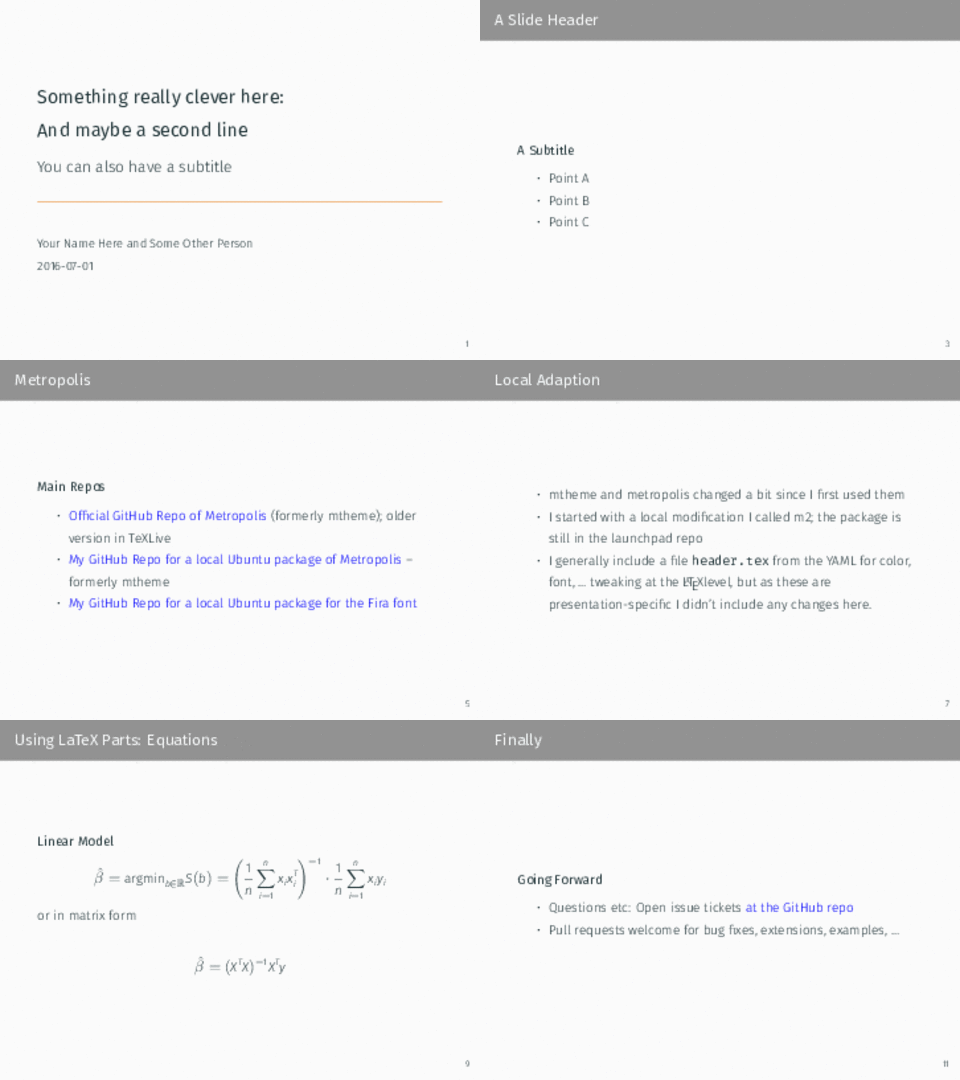
During useR! 2016, Nick Tierney had asked on Twitter about rmarkdown and metropolis and whether folks had used RMarkdown-driven LaTeX Beamer presentations. My firm hell yeah answer, based on having used mtheme outright or in local mods for quite some time (see my talks page), lead to this blog post of mine describing this GitHub repo I had quickly set up during breaks at useR! 2016. The corresponding blog post and the repo have some more details on how I do this, in particular about local packages (also with sources on GitHub) for the non-standard fonts I use. This week I got around to updating the repo / example a little by making the default colours (in my example) a little less awful, and a page on blocks and, most importantly, turning the example into the animated gif below:
And thanks to the beautiful tint package -- see its repo and CRAN package --- I now know how to create a template package. So if there is interest (and spare time), we could build a template package for RStudio too. With that, may I ask a personal favour of anybody still reading the post? Please do not hit my twitter handle with questions for support. All my code is an GitHub, and issue tickets there are much preferred. Larger projects like Rcpp also have their own mailing lists, and it is much better to use those. And if you like neither, maybe ask on StackOverflow. But please don't spam my Twitter handle. Thank you.

18 January 2017

Norbert Preining: Debian/TeX Live January 2017

As the freeze of the next release is closing in, I have updated a bunch of packages around TeX: All of the TeX Live packages (binaries and arch independent ones) and tex-common. I might see whether I get some updates of ConTeXt out, too.
texlive2016-debian The changes in the binaries are mostly cosmetic: one removal of a non-free (unclear-free) file, and several upstream patches got cherrypicked (dvips, tltexjp contact email, upmendex, dvipdfmx). I played around with including LuaTeX v1.0, but that breaks horribly with the current packages in TeX Live, so I refrained from it. The infrastructure package tex-common got a bugfix for updates from previous releases, and for the other packages there is the usual bunch of updates and new packages. Enjoy! New packages arimo, arphic-ttf, babel-japanese, conv-xkv, css-colors, dtxdescribe, fgruler, footmisx, halloweenmath, keyfloat, luahyphenrules, math-into-latex-4, mendex-doc, missaali, mpostinl, padauk, platexcheat, pstring, pst-shell, ptex-fontmaps, scsnowman, stanli, tinos, undergradmath, yaletter. Updated packages acmart, animate, apxproof, arabluatex, arsclassica, babel-french, babel-russian, baskervillef, beamer, beebe, biber, biber.x86_64-linux, biblatex, biblatex-apa, biblatex-chem, biblatex-dw, biblatex-gb7714-2015, biblatex-ieee, biblatex-philosophy, biblatex-sbl, bidi, calxxxx-yyyy, chemgreek, churchslavonic, cochineal, comicneue, cquthesis, csquotes, ctanify, ctex, cweb, dataref, denisbdoc, diagbox, dozenal, dtk, dvipdfmx, dvipng, elocalloc, epstopdf, erewhon, etoolbox, exam-n, fbb, fei, fithesis, forest, glossaries, glossaries-extra, glossaries-french, gost, gzt, historische-zeitschrift, inconsolata, japanese-otf, japanese-otf-uptex, jsclasses, latex-bin, latex-make, latexmk, lt3graph, luatexja, markdown, mathspec, mcf2graph, media9, mendex-doc, metafont, mhchem, mweights, nameauth, noto, nwejm, old-arrows, omegaware, onlyamsmath, optidef, pdfpages, pdftools, perception, phonrule, platex-tools, polynom, preview, prooftrees, pst-geo, pstricks, pst-solides3d, ptex, ptex2pdf, ptex-fonts, qcircuit, quran, raleway, reledmac, resphilosophica, sanskrit, scalerel, scanpages, showexpl, siunitx, skdoc, skmath, skrapport, smartdiagram, sourcesanspro, sparklines, tabstackengine, tetex, tex, tex4ht, texlive-scripts, tikzsymbols, tocdata, uantwerpendocs, updmap-map, uplatex, uptex, uptex-fonts, withargs, wtref, xcharter, xcntperchap, xecjk, xellipsis, xepersian, xint, xlop, yathesis.

15 December 2016

Steve Kemp: A simple Perl alternative to storing data in Redis

I continue to be a big user of Perl, and for many of my sites I avoid the use of MySQL which means that I largely store data in flat files, SQLite databases, or in memory via Redis. One of my servers was recently struggling with RAM, and the suprising cause was "too much data" in Redis. (Surprising because I'd not been paying attention and seen how popular it was, and also because ASCII text compresses pretty well). Read/Write speed isn't a real concern, so I figured I'd move the data into an SQLite database, but that would require rewriting the application. The client library for Perl is pretty awesome, and simple usage looks like this:
# Connect to localhost.
my $r = Redis->new()
# simple storage
$r->set( "key", "value" );
# Work with sets
$r->sadd( "fruits", "orange" );
$r->sadd( "fruits", "apple" );
$r->sadd( "fruits", "blueberry" );
$r->sadd( "fruits", "banannanananananarama" );
# Show the set-count
print "There are " . $r->scard( "fruits" ) . " known fruits";
# Pick a random one
print "Here is a random one " . $r->srandmember( "fruits" ) . "\n";
I figured, if I ignored the Lua support and the other more complex operations, creating a compatible API implementation wouldn't be too hard. So rather than porting my application to using SQLite directly I could juse use a different client-library. In short I change this:
use Redis;
my $r = Redis->new();
To this:
use Redis::SQLite;
my $r = Redis::SQLite->new();
And everything continues to work. I've implemented all the set-related functions except one, and a random smattering of the other simple operations. The appropriate test-cases in the Redis client library (i.e. removing all references to things I didn't implement) pass, and my own new tests also make me confident. It's obviously not a hard job, but it was a quick solution to a real problem and might be useful to others. My image hosting site, and my markdown sharing site now both use this wrapper and seem to be performing well - but with more free RAM. No doubt I'll add more of the simple primitives as time goes on, but so far I've done enough to be useful.

30 November 2016

Chris Lamb: Free software activities in November 2016

Here is my monthly update covering what I have been doing in the free software world (previous month):
Reproducible builds

Whilst anyone can inspect the source code of free software for malicious flaws, most software is distributed pre-compiled to end users. The motivation behind the Reproducible Builds effort is to permit verification that no flaws have been introduced either maliciously or accidentally during this compilation process by promising identical results are always generated from a given source, thus allowing multiple third-parties to come to a consensus on whether a build was compromised.

This month:

My work in the Reproducible Builds project was also covered in our weekly reports. (#80, #81, #82 #83.

Toolchain issues I submitted the following patches to fix reproducibility-related toolchain issues with Debian:

strip-nondeterminism

strip-nondeterminism is our tool to remove specific non-deterministic results from a completed build.


jenkins.debian.net

jenkins.debian.net runs our comprehensive testing framework.

  • buildinfo.debian.net has moved to SSL. (ac3b9e7)
  • Submit signing keys to keyservers after generation. (bdee6ff)
  • Various cosmetic changes, including
    • Prefer if X not in Y over if not X in Y. (bc23884)
    • No need for a dictionary; let's just use a set. (bf3fb6c)
    • Avoid DRY violation by using a for loop. (4125ec5)

I also submitted 9 patches to fix specific reproducibility issues in apktool, cairo-5c, lava-dispatcher, lava-server, node-rimraf, perlbrew, qsynth, tunnelx & zp.

Debian

Debian LTS This month I have been paid to work 11 hours on Debian Long Term Support (LTS). In that time I did the following:
  • "Frontdesk" duties, triaging CVEs, etc.
  • Issued DLA 697-1 for bsdiff fixing an arbitrary write vulnerability.
  • Issued DLA 705-1 for python-imaging correcting a number of memory overflow issues.
  • Issued DLA 713-1 for sniffit where a buffer overflow allowed a specially-crafted configuration file to provide a root shell.
  • Issued DLA 723-1 for libsoap-lite-perl preventing a Billion Laughs XML expansion attack.
  • Issued DLA 724-1 for mcabber fixing a roster push attack.

Uploads
  • redis:
    • 3.2.5-2 Tighten permissions of /var/ lib,log /redis. (#842987)
    • 3.2.5-3 & 3.2.5-4 Improve autopkgtest tests and install upstream's MANIFESTO and README.md documentation.
  • gunicorn (19.6.0-9) Adding autopkgtest tests.
  • libfiu:
    • 0.94-1 Add autopkgtest tests.
    • 0.95-1, 0.95-2 & 0.95-3 New upstream release and improve autopkgtest coverage.
  • python-django (1.10.3-1) New upstream release.
  • aptfs (0.8-3, 0.8-4 & 0.8-5) Adding and subsequently improving the autopkgtext tests.


I performed the following QA uploads:


Finally, I also made the following non-maintainer uploads:
  • libident (0.22-3.1) Move from obsolete Source-Version substvar to binary:Version. (#833195)
  • libpcl1 (1.6-1.1) Move from obsolete Source-Version substvar to binary:Version. (#833196)
  • pygopherd (2.0.18.4+nmu1) Move from obsolete Source-Version substvar to $ source:Version . (#833202)


RC bugs


I also filed 59 FTBFS bugs against arc-gui-clients, asyncpg, blhc, civicrm, d-feet, dpdk, fbpanel, freeciv, freeplane, gant, golang-github-googleapis-gax-go, golang-github-googleapis-proto-client-go, haskell-cabal-install, haskell-fail, haskell-monadcatchio-transformers, hg-git, htsjdk, hyperscan, jasperreports, json-simple, keystone, koji, libapache-mod-musicindex, libcoap, libdr-tarantool-perl, libmath-bigint-gmp-perl, libpng1.6, link-grammar, lua-sql, mediatomb, mitmproxy, ncrack, net-tools, node-dateformat, node-fuzzaldrin-plus, node-nopt, open-infrastructure-system-images, open-infrastructure-system-images, photofloat, ppp, ptlib, python-mpop, python-mysqldb, python-passlib, python-protobix, python-ttystatus, redland, ros-message-generation, ruby-ethon, ruby-nokogiri, salt-formula-ceilometer, spykeviewer, sssd, suil, torus-trooper, trash-cli, twisted-web2, uftp & wide-dhcpv6.

FTP Team

As a Debian FTP assistant I ACCEPTed 70 packages: bbqsql, coz-profiler, cross-toolchain-base, cross-toolchain-base-ports, dgit-test-dummy, django-anymail, django-hstore, django-html-sanitizer, django-impersonate, django-wkhtmltopdf, gcc-6-cross, gcc-defaults, gnome-shell-extension-dashtodock, golang-defaults, golang-github-btcsuite-fastsha256, golang-github-dnephin-cobra, golang-github-docker-go-events, golang-github-gogits-cron, golang-github-opencontainers-image-spec, haskell-debian, kpmcore, libdancer-logger-syslog-perl, libmoox-buildargs-perl, libmoox-role-cloneset-perl, libreoffice, linux-firmware-raspi3, linux-latest, node-babel-runtime, node-big.js, node-buffer-shims, node-charm, node-cliui, node-core-js, node-cpr, node-difflet, node-doctrine, node-duplexer2, node-emojis-list, node-eslint-plugin-flowtype, node-everything.js, node-execa, node-grunt-contrib-coffee, node-grunt-contrib-concat, node-jquery-textcomplete, node-js-tokens, node-json5, node-jsonfile, node-marked-man, node-os-locale, node-sparkles, node-tap-parser, node-time-stamp, node-wrap-ansi, ooniprobe, policycoreutils, pybind11, pygresql, pysynphot, python-axolotl, python-drizzle, python-geoip2, python-mockupdb, python-pyforge, python-sentinels, python-waiting, pythonmagick, r-cran-isocodes, ruby-unicode-display-width, suricata & voctomix-outcasts. I additionally filed 4 RC bugs against packages that had incomplete debian/copyright files against node-cliui, node-core-js, node-cpr & node-grunt-contrib-concat.

21 November 2016

Reproducible builds folks: Reproducible Builds: week 82 in Stretch cycle

What happened in the Reproducible Builds effort between Sunday November 13 and Saturday November 19 2016: Media coverage Elsewhere in Debian Documentation update Packages reviewed and fixed, and bugs filed Reviews of unreproducible packages 43 package reviews have been added, 4 have been updated and 12 have been removed in this week, adding to our knowledge about identified issues. 2 issue types have been updated: 4 issue types have been added: Weekly QA work During our reproducibility testing, some FTBFS bugs have been detected and reported by: strip-nondeterminism development disorderfs development debrebuild development debrebuild is new tool proposed by HW42 and josch (see #774415: "From srebuild sbuild-wrapper to debrebuild"). debrepatch development debrepatch is a set of scripts that we're currently developing to make it easier to track unapplied patches. We have a lot of those and we're not always sure if they still work. The plan is to set up jobs to automatically apply old reproducibility patches to newer versions of packages and notify the right people if they don't apply and/or no longer make the package reproducible. debpatch is a component of debrepatch that applies debdiffs to Debian source packages. In other words, it is to debdiff(1) what patch(1) is to diff(1). It is a general tool that is not specific to Reproducible Builds. This week, Ximin Luo worked on making it more "production-ready" and will soon submit it for inclusion in devscripts. reprotest development Ximin Luo significantly improved reprotest, adding presets and auto-detection of which preset to use. One can now run e.g. reprotest auto . or reprotest auto $pkg_$ver.dsc instead of the long command lines that were needed before. He also made it easier to set up build dependencies inside the virtual server and made it possible to specify pre-build dependencies that reprotest itself needs to set up the variations. Previously one had to manually edit the virtual server to do that, which was not very usable to humans without an in-depth knowledge of the building process. These changes will be tested some more and then released in the near future as reprotest 0.4. tests.reproducible-builds.org Misc. This week's edition was written by Chris Lamb, Holger Levsen, Ximin Luo and reviewed by a bunch of Reproducible Builds folks on IRC.

27 October 2016

Russ Allbery: DocKnot 1.00

I'm a bit of a perfectionist about package documentation, and I'm also a huge fan of consistency. As I've slowly accumulated more open source software packages (alas, fewer new ones these days since I have less day-job time to work on them), I've developed a standard format for package documentation files, particularly the README in the package and the web pages I publish. I've iterated on these, tweaking them and messing with them, trying to incorporate all my accumulated wisdom about what information people need. Unfortunately, this gets very tedious, since I have dozens of packages at this point and rarely want to go through the effort of changing every one of them every time I come up with a better way of phrasing something or change some aspect of my standard package build configuration. I also have the same information duplicated in multiple locations (the README and the web page for the package). And there's a lot of boilerplate that's common for all of my packages that I don't want to keep copying (or changing when I do things like change all eyrie.org URLs to HTTPS). About three years ago, I started seriously brainstorming ways of automating this process. I made a start on it during one self-directed day at my old job at Stanford, but only got it far enough to generate a few basic files. Since then, I keep thinking about it, keep wishing I had it, and keep not putting the work into finishing it. During this vacation, after a week and a half of relaxing and reading, I finally felt like doing a larger development project and finally started working on this for long enough to build up some momentum. Two days later, and this is finally ready for an initial release. DocKnot uses metadata (which I'm putting in docs/metadata) that's mostly JSON plus some documentation fragments and generates README, the web page for the package (in thread, the macro language I use for all my web pages), and (the other thing I've wanted to do and didn't want to tackle without this tool) README.md, a Markdown version of README that will look nice on GitHub. The templates that come with the package are all rather specific to me, particularly the thread template which would be unusable by anyone else. I have no idea if anyone else will want to use this package (and right now the metadata format is entirely undocumented). But since it's a shame to not release things as free software, and since I suspect I may need to upload it to Debian since, technically, this tool is required to "build" the README file distributed with my packages, here it is. I've also uploaded it to CPAN (it's my first experiment with the App::* namespace for things that aren't really meant to be used as a standalone Perl module). You can get the latest version from the DocKnot distribution page (which is indeed generated with DocKnot). Also now generated with DocKnot are the rra-c-util and C TAP Harness distribution pages. Let me know if you see anything weird; there are doubtless still a few bugs.

20 October 2016

H ctor Or n Mart nez: Build a Debian package against Debian 8.0 using Download On Demand (DoD) service

In the previous post Open Build Service software architecture has been overviewed. In the current blog post, a tutorial on setting up a package build with OBS from Debian packages is presented. Steps: Generate a test environment by creating Stretch/SID VM Really, use whatever suits you best, but please create an untrusted test environment for this one. In the current tutorial it assumes $hostname is stretch , which should be stretch or sid suite. Be aware that copy & paste configuration files from current post might lead you into broken characters (i.e. ). Debian Stretch weekly netinst CD Enable experimental repository
# echo "deb http://httpredir.debian.org/debian experimental main" >> /etc/apt/sources.list.d/experimental.list
# apt-get update
Install and setup OBS server, api, worker and osc CLI packages
# apt-get install obs-server obs-api obs-worker osc
In the install process mysql database is needed, therefore if mysql server is not setup, a password needs to be provided.
When OBS API database obs-api is created, we need to pick a password for it, provide opensuse . The obs-api package will configure apache2 https webserver (creating a dummy certificate for stretch ) to serve OBS webui.
Add stretch and obs aliases to localhost entry in your /etc/hosts file.
Enable worker by setting ENABLED=1 in /etc/default/obsworker
Try to connect to the web UI https://stretch/
Login into OBS webui, default login credentials: Admin/opensuse).
From command line tool, try to list projects in OBS
 $ osc -A https://stretch ls
Accept dummy certificate and provide credentials (defaults: Admin/opensuse)
If the install proceeds as expected follow to the next step. Ensure all OBS services are running
# backend services
obsrun     813  0.0  0.9 104960 20448 ?        Ss   08:33   0:03 /usr/bin/perl -w /usr/lib/obs/server/bs_dodup
obsrun     815  0.0  1.5 157512 31940 ?        Ss   08:33   0:07 /usr/bin/perl -w /usr/lib/obs/server/bs_repserver
obsrun    1295  0.0  1.6 157644 32960 ?        S    08:34   0:07  \_ /usr/bin/perl -w /usr/lib/obs/server/bs_repserver
obsrun     816  0.0  1.8 167972 38600 ?        Ss   08:33   0:08 /usr/bin/perl -w /usr/lib/obs/server/bs_srcserver
obsrun    1296  0.0  1.8 168100 38864 ?        S    08:34   0:09  \_ /usr/bin/perl -w /usr/lib/obs/server/bs_srcserver
memcache   817  0.0  0.6 346964 12872 ?        Ssl  08:33   0:11 /usr/bin/memcached -m 64 -p 11211 -u memcache -l 127.0.0.1
obsrun     818  0.1  0.5  78548 11884 ?        Ss   08:33   0:41 /usr/bin/perl -w /usr/lib/obs/server/bs_dispatch
obsserv+   819  0.0  0.3  77516  7196 ?        Ss   08:33   0:05 /usr/bin/perl -w /usr/lib/obs/server/bs_service
mysql      851  0.0  0.0   4284  1324 ?        Ss   08:33   0:00 /bin/sh /usr/bin/mysqld_safe
mysql     1239  0.2  6.3 1010744 130104 ?      Sl   08:33   1:31  \_ /usr/sbin/mysqld --basedir=/usr --datadir=/var/lib/mysql --plugin-dir=/usr/lib/mysql/plugin --log-error=/var/log/mysql/error.log --pid-file=/var/run/mysqld/mysqld.pid --socket=/var/run/mysqld/mysqld.sock --port=3306
# web services
root      1452  0.0  0.1 110020  3968 ?        Ss   08:34   0:01 /usr/sbin/apache2 -k start
root      1454  0.0  0.1 435992  3496 ?        Ssl  08:34   0:00  \_ Passenger watchdog
root      1460  0.3  0.2 651044  5188 ?        Sl   08:34   1:46      \_ Passenger core
nobody    1465  0.0  0.1 444572  3312 ?        Sl   08:34   0:00      \_ Passenger ust-router
www-data  1476  0.0  0.1 855892  2608 ?        Sl   08:34   0:09  \_ /usr/sbin/apache2 -k start
www-data  1477  0.0  0.1 856068  2880 ?        Sl   08:34   0:09  \_ /usr/sbin/apache2 -k start
www-data  1761  0.0  4.9 426868 102040 ?       Sl   08:34   0:29 delayed_job.0
www-data  1767  0.0  4.8 425624 99888 ?        Sl   08:34   0:30 delayed_job.1
www-data  1775  0.0  4.9 426516 101708 ?       Sl   08:34   0:28 delayed_job.2
nobody    1788  0.0  5.7 496092 117480 ?       Sl   08:34   0:03 Passenger RubyApp: /usr/share/obs/api
nobody    1796  0.0  4.9 488888 102176 ?       Sl   08:34   0:00 Passenger RubyApp: /usr/share/obs/api
www-data  1814  0.0  4.5 282576 92376 ?        Sl   08:34   0:22 delayed_job.1000
www-data  1829  0.0  4.4 282684 92228 ?        Sl   08:34   0:22 delayed_job.1010
www-data  1841  0.0  4.5 282932 92536 ?        Sl   08:34   0:22 delayed_job.1020
www-data  1855  0.0  4.9 427988 101492 ?       Sl   08:34   0:29 delayed_job.1030
www-data  1865  0.2  5.0 492500 102964 ?       Sl   08:34   1:09 clockworkd.clock
www-data  1899  0.0  0.0  87100  1400 ?        S    08:34   0:00 /usr/bin/searchd --pidfile --config /usr/share/obs/api/config/production.sphinx.conf
www-data  1900  0.1  0.4 161620  8276 ?        Sl   08:34   0:51  \_ /usr/bin/searchd --pidfile --config /usr/share/obs/api/config/production.sphinx.conf
# OBS worker
root      1604  0.0  0.0  28116  1492 ?        Ss   08:34   0:00 SCREEN -m -d -c /srv/obs/run/worker/boot/screenrc
root      1605  0.0  0.9  75424 18764 pts/0    Ss+  08:34   0:06  \_ /usr/bin/perl -w ./bs_worker --hardstatus --root /srv/obs/worker/root_1 --statedir /srv/obs/run/worker/1 --id stretch:1 --reposerver http://obs:5252 --jobs 1
Create an OBS project for Download on Demand (DoD) Create a meta project file:
$ osc -A https://stretch:443 meta prj Debian:8 -e
<project name= Debian:8 >
<title>Debian 8 DoD</title>
<description>Debian 8 DoD</description>
<person userid= Admin role= maintainer />
<repository name= main >
<download arch= x86_64 url= http://deb.debian.org/debian/jessie/main repotype= deb />
<arch>x86_64</arch>
</repository>
</project>
Visit webUI to check project configuration Create a meta project configuration file:
$ osc -A https://stretch:443 meta prjconf Debian:8 -e
Add the following file, as found at build.opensuse.org
Repotype: debian
# create initial user
Preinstall: base-passwd
Preinstall: user-setup
# required for preinstall images
Preinstall: perl
# preinstall essentials + dependencies
Preinstall: base-files base-passwd bash bsdutils coreutils dash debconf
Preinstall: debianutils diffutils dpkg e2fslibs e2fsprogs findutils gawk
Preinstall: gcc-4.9-base grep gzip hostname initscripts insserv libacl1
Preinstall: libattr1 libblkid1 libbz2-1.0 libc-bin libc6 libcomerr2 libdb5.3
Preinstall: libgcc1 liblzma5 libmount1 libncurses5 libpam-modules
Preinstall: libpcre3 libsmartcols1
Preinstall: libpam-modules-bin libpam-runtime libpam0g libreadline6
Preinstall: libselinux1 libsemanage-common libsemanage1 libsepol1 libsigsegv2
Preinstall: libslang2 libss2 libtinfo5 libustr-1.0-1 libuuid1 login lsb-base
Preinstall: mount multiarch-support ncurses-base ncurses-bin passwd perl-base
Preinstall: readline-common sed sensible-utils sysv-rc sysvinit sysvinit-utils
Preinstall: tar tzdata util-linux zlib1g
Runscripts: base-passwd user-setup base-files gawk
VMinstall: libdevmapper1.02.1
Order: user-setup:base-files
# Essential packages (this should also pull the dependencies)
Support: base-files base-passwd bash bsdutils coreutils dash debianutils
Support: diffutils dpkg e2fsprogs findutils grep gzip hostname libc-bin 
Support: login mount ncurses-base ncurses-bin perl-base sed sysvinit 
Support: sysvinit-utils tar util-linux
# Build-essentials
Required: build-essential
Prefer: build-essential:make
# build script needs fakeroot
Support: fakeroot
# lintian support would be nice, but breaks too much atm
#Support: lintian
# helper tools in the chroot
Support: less kmod net-tools procps psmisc strace vim
# everything below same as for Debian:6.0 (apart from the version macros ofc)
# circular dependendencies in openjdk stack
Order: openjdk-6-jre-lib:openjdk-6-jre-headless
Order: openjdk-6-jre-headless:ca-certificates-java
Keep: binutils cpp cracklib file findutils gawk gcc gcc-ada gcc-c++
Keep: gzip libada libstdc++ libunwind
Keep: libunwind-devel libzio make mktemp pam-devel pam-modules
Keep: patch perl rcs timezone
Prefer: cvs libesd0 libfam0 libfam-dev expect
Prefer: gawk locales default-jdk
Prefer: xorg-x11-libs libpng fam mozilla mozilla-nss xorg-x11-Mesa
Prefer: unixODBC libsoup glitz java-1_4_2-sun gnome-panel
Prefer: desktop-data-SuSE gnome2-SuSE mono-nunit gecko-sharp2
Prefer: apache2-prefork openmotif-libs ghostscript-mini gtk-sharp
Prefer: glib-sharp libzypp-zmd-backend mDNSResponder
Prefer: -libgcc-mainline -libstdc++-mainline -gcc-mainline-c++
Prefer: -libgcj-mainline -viewperf -compat -compat-openssl097g
Prefer: -zmd -OpenOffice_org -pam-laus -libgcc-tree-ssa -busybox-links
Prefer: -crossover-office -libgnutls11-dev
# alternative pkg-config implementation
Prefer: -pkgconf
Prefer: -openrc
Prefer: -file-rc
Conflict: ghostscript-library:ghostscript-mini
Ignore: sysvinit:initscripts
Ignore: aaa_base:aaa_skel,suse-release,logrotate,ash,mingetty,distribution-release
Ignore: gettext-devel:libgcj,libstdc++-devel
Ignore: pwdutils:openslp
Ignore: pam-modules:resmgr
Ignore: rpm:suse-build-key,build-key
Ignore: bind-utils:bind-libs
Ignore: alsa:dialog,pciutils
Ignore: portmap:syslogd
Ignore: fontconfig:freetype2
Ignore: fontconfig-devel:freetype2-devel
Ignore: xorg-x11-libs:freetype2
Ignore: xorg-x11:x11-tools,resmgr,xkeyboard-config,xorg-x11-Mesa,libusb,freetype2,libjpeg,libpng
Ignore: apache2:logrotate
Ignore: arts:alsa,audiofile,resmgr,libogg,libvorbis
Ignore: kdelibs3:alsa,arts,pcre,OpenEXR,aspell,cups-libs,mDNSResponder,krb5,libjasper
Ignore: kdelibs3-devel:libvorbis-devel
Ignore: kdebase3:kdebase3-ksysguardd,OpenEXR,dbus-1,dbus-1-qt,hal,powersave,openslp,libusb
Ignore: kdebase3-SuSE:release-notes
Ignore: jack:alsa,libsndfile
Ignore: libxml2-devel:readline-devel
Ignore: gnome-vfs2:gnome-mime-data,desktop-file-utils,cdparanoia,dbus-1,dbus-1-glib,krb5,hal,libsmbclient,fam,file_alteration
Ignore: libgda:file_alteration
Ignore: gnutls:lzo,libopencdk
Ignore: gnutls-devel:lzo-devel,libopencdk-devel
Ignore: pango:cairo,glitz,libpixman,libpng
Ignore: pango-devel:cairo-devel
Ignore: cairo-devel:libpixman-devel
Ignore: libgnomeprint:libgnomecups
Ignore: libgnomeprintui:libgnomecups
Ignore: orbit2:libidl
Ignore: orbit2-devel:libidl,libidl-devel,indent
Ignore: qt3:libmng
Ignore: qt-sql:qt_database_plugin
Ignore: gtk2:libpng,libtiff
Ignore: libgnomecanvas-devel:glib-devel
Ignore: libgnomeui:gnome-icon-theme,shared-mime-info
Ignore: scrollkeeper:docbook_4,sgml-skel
Ignore: gnome-desktop:libgnomesu,startup-notification
Ignore: python-devel:python-tk
Ignore: gnome-pilot:gnome-panel
Ignore: gnome-panel:control-center2
Ignore: gnome-menus:kdebase3
Ignore: gnome-main-menu:rug
Ignore: libbonoboui:gnome-desktop
Ignore: postfix:pcre
Ignore: docbook_4:iso_ent,sgml-skel,xmlcharent
Ignore: control-center2:nautilus,evolution-data-server,gnome-menus,gstreamer-plugins,gstreamer,metacity,mozilla-nspr,mozilla,libxklavier,gnome-desktop,startup-notification
Ignore: docbook-xsl-stylesheets:xmlcharent
Ignore: liby2util-devel:libstdc++-devel,openssl-devel
Ignore: yast2:yast2-ncurses,yast2-theme-SuSELinux,perl-Config-Crontab,yast2-xml,SuSEfirewall2
Ignore: yast2-core:netcat,hwinfo,wireless-tools,sysfsutils
Ignore: yast2-core-devel:libxcrypt-devel,hwinfo-devel,blocxx-devel,sysfsutils,libstdc++-devel
Ignore: yast2-packagemanager-devel:rpm-devel,curl-devel,openssl-devel
Ignore: yast2-devtools:perl-XML-Writer,libxslt,pkgconfig
Ignore: yast2-installation:yast2-update,yast2-mouse,yast2-country,yast2-bootloader,yast2-packager,yast2-network,yast2-online-update,yast2-users,release-notes,autoyast2-installation
Ignore: yast2-bootloader:bootloader-theme
Ignore: yast2-packager:yast2-x11
Ignore: yast2-x11:sax2-libsax-perl
Ignore: openslp-devel:openssl-devel
Ignore: java-1_4_2-sun:xorg-x11-libs
Ignore: java-1_4_2-sun-devel:xorg-x11-libs
Ignore: kernel-um:xorg-x11-libs
Ignore: tetex:xorg-x11-libs,expat,fontconfig,freetype2,libjpeg,libpng,ghostscript-x11,xaw3d,gd,dialog,ed
Ignore: yast2-country:yast2-trans-stats
Ignore: susehelp:susehelp_lang,suse_help_viewer
Ignore: mailx:smtp_daemon
Ignore: cron:smtp_daemon
Ignore: hotplug:syslog
Ignore: pcmcia:syslog
Ignore: avalon-logkit:servlet
Ignore: jython:servlet
Ignore: ispell:ispell_dictionary,ispell_english_dictionary
Ignore: aspell:aspel_dictionary,aspell_dictionary
Ignore: smartlink-softmodem:kernel,kernel-nongpl
Ignore: OpenOffice_org-de:myspell-german-dictionary
Ignore: mediawiki:php-session,php-gettext,php-zlib,php-mysql,mod_php_any
Ignore: squirrelmail:mod_php_any,php-session,php-gettext,php-iconv,php-mbstring,php-openssl
Ignore: simias:mono(log4net)
Ignore: zmd:mono(log4net)
Ignore: horde:mod_php_any,php-gettext,php-mcrypt,php-imap,php-pear-log,php-pear,php-session,php
Ignore: xerces-j2:xml-commons-apis,xml-commons-resolver
Ignore: xdg-menu:desktop-data
Ignore: nessus-libraries:nessus-core
Ignore: evolution:yelp
Ignore: mono-tools:mono(gconf-sharp),mono(glade-sharp),mono(gnome-sharp),mono(gtkhtml-sharp),mono(atk-sharp),mono(gdk-sharp),mono(glib-sharp),mono(gtk-sharp),mono(pango-sharp)
Ignore: gecko-sharp2:mono(glib-sharp),mono(gtk-sharp)
Ignore: vcdimager:libcdio.so.6,libcdio.so.6(CDIO_6),libiso9660.so.4,libiso9660.so.4(ISO9660_4)
Ignore: libcdio:libcddb.so.2
Ignore: gnome-libs:libgnomeui
Ignore: nautilus:gnome-themes
Ignore: gnome-panel:gnome-themes
Ignore: gnome-panel:tomboy
Substitute: utempter
%ifnarch s390 s390x ppc ia64
Substitute: java2-devel-packages java-1_4_2-sun-devel
%else
 %ifnarch s390x
Substitute: java2-devel-packages java-1_4_2-ibm-devel
 %else
Substitute: java2-devel-packages java-1_4_2-ibm-devel xorg-x11-libs-32bit
 %endif
%endif
Substitute: yast2-devel-packages docbook-xsl-stylesheets doxygen libxslt perl-XML-Writer popt-devel sgml-skel update-desktop-files yast2 yast2-devtools yast2-packagemanager-devel yast2-perl-bindings yast2-testsuite
#
# SUSE compat mappings
#
Substitute: gcc-c++ gcc
Substitute: libsigc++2-devel libsigc++-2.0-dev
Substitute: glibc-devel-32bit
Substitute: pkgconfig pkg-config
%ifarch %ix86
Substitute: kernel-binary-packages kernel-default kernel-smp kernel-bigsmp kernel-debug kernel-um kernel-xen kernel-kdump
%endif
%ifarch ia64
Substitute: kernel-binary-packages kernel-default kernel-debug
%endif
%ifarch x86_64
Substitute: kernel-binary-packages kernel-default kernel-smp kernel-xen kernel-kdump
%endif
%ifarch ppc
Substitute: kernel-binary-packages kernel-default kernel-kdump kernel-ppc64 kernel-iseries64
%endif
%ifarch ppc64
Substitute: kernel-binary-packages kernel-ppc64 kernel-iseries64
%endif
%ifarch s390
Substitute: kernel-binary-packages kernel-s390
%endif
%ifarch s390x
Substitute: kernel-binary-packages kernel-default
%endif
%define debian_version 800
Macros:
%debian_version 800
Visit webUI to check project configuration Create an OBS project linked to DoD
$ osc -A https://stretch:443 meta prj test -e
<project name= test >
<title>test</title>
<description>test</description>
<person userid= Admin role= maintainer />
<repository name= Debian_8.0 >
<path project= Debian:8 repository= main />
<arch>x86_64</arch>
</repository>
</project>
Visit webUI to check project configuration Adding a package to the project
$ osc -A https://stretch:443 co test ; cd test
$ mkdir hello ; cd hello ; apt-get source -d hello ; cd - ; 
$ osc add hello 
$ osc ci -m "New import" hello
The package should go to dispatched state then get in blocked state while it downloads build dependencies from DoD link, eventually it should start building. Please check the journal logs to check if something went wrong or gets stuck. Visit webUI to check hello package build state OBS logging to the journal Check in the journal logs everything went fine:
$ sudo journalctl -u obsdispatcher.service -u obsdodup.service -u obsscheduler@x86_64.service -u obsworker.service -u obspublisher.service
Troubleshooting Currently we are facing few issues with web UI: And there are more issues that have not been reported, please do reportbug obs-api .

8 October 2016

Norbert Preining: Debian/TeX update October 2016: all of TeX Live and Biber 2.6

Finally a new update of many TeX related packages: all the texlive-* including the binary packages, and biber have been updated to the latest release. This upload was delayed by my travels around the world, as well as the necessity to package a new Perl module (libdatetime-calendar-julian-perl) as required by new Biber. Also, my new job leaves me only the weekends for packaging. Anyway, the packages are now uploaded and should appear soon on your friendly local server. texlive2016-debian There are several highlights: The binaries have been patched with several upstream fixes (tex4ht and XeTeX compatibility, as well as various Japanese TeX engine fixes), updated biber and biblatex, and as usual loads of new and updated packages. Last but not least I want to thank one particular author: His package was removed from TeX Live due to the addition of a rather unusual clause in the license. Instead of simply uploading new packages to Debian with the rather important removed, I contacted the author and asked for clarification. And to my great pleasure he immediately answered with an update of the package with fixed license. All of us user of these many packages should be grateful to the authors of the packages who invest loads of their free time into supporting our community. Thanks! Enough now, here as usual the list of new and updated packages with links to their respective CTAN pages. Enjoy. New packages addfont, apalike-german, autoaligne, baekmuk, beamerswitch, beamertheme-cuerna, beuron, biblatex-claves, biolett-bst, cooking-units, cstypo, emf, eulerpx, filecontentsdef, frederika2016, grant, latexgit, listofitems, overlays, phonenumbers, pst-arrow, quicktype, revquantum, richtext, semantic-markup, spalign, texproposal, tikz-page, unfonts-core, unfonts-extra, uspace. Updated packages achemso, acmart, acro, adobemapping, alegreya, allrunes, animate, arabluatex, archaeologie, asymptote, attachfile, babel-greek, bangorcsthesis, beebe, biblatex, biblatex-anonymous, biblatex-apa, biblatex-bookinother, biblatex-chem, biblatex-fiwi, biblatex-gost, biblatex-ieee, biblatex-manuscripts-philology, biblatex-morenames, biblatex-nature, biblatex-opcit-booktitle, biblatex-phys, biblatex-realauthor, biblatex-science, biblatex-true-citepages-omit, bibleref, bidi, chemformula, circuitikz, cochineal, colorspace, comment, covington, cquthesis, ctex, drawmatrix, ejpecp, erewhon, etoc, exsheets, fancyhdr, fei, fithesis, footnotehyper, fvextra, geschichtsfrkl, gnuplottex, gost, gregoriotex, hausarbeit-jura, ijsra, ipaex, jfontmaps, jsclasses, jslectureplanner, latexdiff, leadsheets, libertinust1math, luatexja, markdown, mcf2graph, minutes, multirow, mynsfc, nameauth, newpx, newtxsf, notespages, optidef, pas-cours, platex, prftree, pst-bezier, pst-circ, pst-eucl, pst-optic, pstricks, pstricks-add, refenums, reledmac, rsc, shdoc, siunitx, stackengine, tabstackengine, tagpair, tetex, texlive-es, texlive-scripts, ticket, translation-biblatex-de, tudscr, turabian-formatting, updmap-map, uplatex, xebaposter, xecjk, xepersian, xpinyin. Enjoy.

30 September 2016

Chris Lamb: Free software activities in September 2016

Here is my monthly update covering what I have been doing in the free software world (previous month):
Reproducible builds

Whilst anyone can inspect the source code of free software for malicious flaws, most Linux distributions provide binary (or "compiled") packages to end users. The motivation behind the Reproducible Builds effort is to allow verification that no flaws have been introduced either maliciously and accidentally during this compilation process by promising identical binary packages are always generated from a given source. My work in the Reproducible Builds project was also covered in our weekly reports #71, #72, #71 & #74. I made the following improvements to our tools:

diffoscope

diffoscope is our "diff on steroids" that will not only recursively unpack archives but will transform binary formats into human-readable forms in order to compare them.

  • Added a global Progress object to track the status of the comparison process allowing for graphical and machine-readable status indicators. I also blogged about this feature in more detail.
  • Moved the global Config object to a more Pythonic "singleton" pattern and ensured that constraints are checked on every change.

disorderfs

disorderfs is our FUSE filesystem that deliberately introduces nondeterminism into the results of system calls such as readdir(3).

  • Display the "disordered" behaviour we intend to show on startup. (#837689)
  • Support relative paths in command-line parameters (previously only absolute paths were permitted).

strip-nondeterminism

strip-nondeterminism is our tool to remove specific information from a completed build.

  • Fix an issue where temporary files were being left on the filesystem and add a test to avoid similar issues in future. (#836670)
  • Print an error if the file to normalise does not exist. (#800159)
  • Testsuite improvements:
    • Set the timezone in tests to avoid a FTBFS and add a File::StripNondeterminism::init method to the API to to set tzset everywhere. (#837382)
    • "Smoke test" the strip-nondeterminism(1) and dh_strip_nondeterminism(1) scripts to prevent syntax regressions.
    • Add a testcase for .jar file ordering and normalisation.
    • Check the stripping process before comparing file attributes to make it less confusing on failure.
    • Move to a lookup table for descriptions of stat(1) indices and use that for nicer failure messages.
    • Don't uselessly test whether the inode number has changed.
  • Run perlcritic across the codebase and adopt some of its prescriptions including explicitly using oct(..) for integers with leading zeroes, avoiding mixing high and low-precedence booleans, ensuring subroutines end with a return statement, etc.

I also submitted 4 patches to fix specific reproducibility issues in golang-google-grpc, nostalgy, python-xlib & torque.


Debian https://lamby-www.s3.amazonaws.com/yadt/blog.Image/image/original/28.jpeg

Patches contributed

Debian LTS

This month I have been paid to work 12.75 hours on Debian Long Term Support (LTS). In that time I did the following:
  • "Frontdesk" duties, triaging CVEs, etc.
  • Issued DLA 608-1 for mailman fixing a CSRF vulnerability.
  • Issued DLA 611-1 for jsch correcting a path traversal vulnerability.
  • Issued DLA 620-1 for libphp-adodb patching a SQL injection vulnerability.
  • Issued DLA 631-1 for unadf correcting a buffer underflow issue.
  • Issued DLA 634-1 for dropbear fixing a buffer overflow when parsing ASN.1 keys.
  • Issued DLA 635-1 for dwarfutils working around an out-of-bounds read issue.
  • Issued DLA 638-1 for the SELinux policycoreutils, patching a sandbox escape issue.
  • Enhanced Brian May's find-work --unassigned switch to take an optional "except this user" argument.
  • Marked matrixssl and inspircd as being unsupported in the current LTS version.

Uploads
  • python-django 1:1.10.1-1 New upstream release and ensure that django-admin startproject foo creates files with the correct shebang under Python 3.
  • gunicorn:
    • 19.6.0-5 Don't call chown(2) if it would be a no-op to avoid failure under snap.
    • 19.6.0-6 Remove now-obsolete conffiles and logrotate scripts; they should have been removed in 19.6.0-3.
  • redis:
    • 3.2.3-2 Call ulimit -n 65536 by default from SysVinit scripts to normalise the behaviour with systemd. I also bumped the Debian package epoch as the "2:" prefix made it look like we are shipping version 2.x. I additionaly backported this upload to Debian Jessie.
    • 3.2.4-1 New upstream release, add missing -ldl for dladdr(3) & add missing dependency on lsb-base.
  • python-redis (2.10.5-2) Bump python-hiredis to Suggests to sync with Ubuntu and move to a machine-readable debian/copyright. I also backported this upload to Debian Jessie.
  • adminer (4.2.5-3) Move mysql-server dependencies to default-mysql-server. I also backported this upload to Debian Jessie.
  • gpsmanshp (1.2.3-5) on behalf of the QA team:
    • Move to "minimal" debhelper style, making the build reproducible. (#777446 & #792991)
    • Reorder linker command options to build with --as-needed (#729726) and add hardening flags.
    • Move to machine-readable copyright file, add missing #DEBHELPER# tokens to postinst and prerm scripts, tidy descriptions & other debian/control fields and other smaller changes.

I sponsored the upload of 5 packages from other developers:

I also NMU'd:


FTP Team

As a Debian FTP assistant I ACCEPTed 147 packages: alljoyn-services-1604, android-platform-external-doclava, android-platform-system-tools-aidl, aufs, bcolz, binwalk, bmusb, bruteforce-salted-openssl, cappuccino, captagent, chrome-gnome-shell, ciphersaber, cmark, colorfultabs, cppformat, dnsrecon, dogtag-pki, dxtool, e2guardian, flask-compress, fonts-mononoki, fwknop-gui, gajim-httpupload, glbinding, glewmx, gnome-2048, golang-github-googleapis-proto-client-go, google-android-installers, gsl, haskell-hmatrix-gsl, haskell-relational-query, haskell-relational-schemas, haskell-secret-sharing, hindsight, i8c, ip4r, java-string-similarity, khal, khronos-opencl-headers, liblivemedia, libshell-config-generate-perl, libshell-guess-perl, libstaroffice, libxml2, libzonemaster-perl, linux, linux-grsec-base, linux-signed, lua-sandbox, lua-torch-trepl, mbrola-br2, mbrola-br4, mbrola-de1, mbrola-de2, mbrola-de3, mbrola-ir1, mbrola-lt1, mbrola-lt2, mbrola-mx1, mimeo, mimerender, mongo-tools, mozilla-gnome-keyring, munin, node-grunt-cli, node-js-yaml, nova, open-build-service, openzwave, orafce, osmalchemy, pgespresso, pgextwlist, pgfincore, pgmemcache, pgpool2, pgsql-asn1oid, postbooks-schema, postgis, postgresql-debversion, postgresql-multicorn, postgresql-mysql-fdw, postgresql-unit, powerline-taskwarrior, prefix, pycares, pydl, pynliner, pytango, pytest-cookies, python-adal, python-applicationinsights, python-async-timeout, python-azure, python-azure-storage, python-blosc, python-can, python-canmatrix, python-chartkick, python-confluent-kafka, python-jellyfish, python-k8sclient, python-msrestazure, python-nss, python-pytest-benchmark, python-tenacity, python-tmdbsimple, python-typing, python-unidiff, python-xstatic-angular-schema-form, python-xstatic-tv4, quilt, r-bioc-phyloseq, r-cran-filehash, r-cran-png, r-cran-testit, r-cran-tikzdevice, rainbow-mode, repmgr, restart-emacs, restbed, ruby-azure-sdk, ruby-babel-source, ruby-babel-transpiler, ruby-diaspora-prosody-config, ruby-haikunator, ruby-license-finder, ruby-ms-rest, ruby-ms-rest-azure, ruby-rails-assets-autosize, ruby-rails-assets-blueimp-gallery, ruby-rails-assets-bootstrap, ruby-rails-assets-bootstrap-markdown, ruby-rails-assets-emojione, ruby-sprockets-es6, ruby-timeliness, rustc, skytools3, slony1-2, snmp-mibs-downloader, syslog-ng, test-kitchen, uctodata, usbguard, vagrant-azure, vagrant-mutate & vim.

12 September 2016

Steve Kemp: If your code accepts URIs as input..

There are many online sites that accept reading input from remote locations. For example a site might try to extract all the text from a webpage, or show you the HTTP-headers a given server sends back in response to a request. If you run such a site you must make sure you validate the schema you're given - also remembering to do that if you're sent any HTTP-redirects.
Really the issue here is a confusion between URL & URI.
The only time I ever communicated with Aaron Swartz was unfortunately after his death, because I didn't make the connection. I randomly stumbled upon the html2text software he put together, which had an online demo containing a form for entering a location. I tried the obvious input:
file:///etc/passwd
The software was vulnerable, read the file, and showed it to me. The site gives errors on all inputs now, so it cannot be used to demonstrate the problem, but on Friday I saw another site on Hacker News with the very same input-issue, and it reminded me that there's a very real class of security problems here. The site in question was http://fuckyeahmarkdown.com/ and allows you to enter a URL to convert to markdown - I found this via the hacker news submission. The following link shows the contents of /etc/hosts, and demonstrates the problem: http://fuckyeahmarkdown.example.com/go/?u=file:///etc/hosts&read=1&preview=1&showframe=0&submit=go The output looked like this:
..
127.0.0.1 localhost
255.255.255.255 broadcasthost
::1 localhost
fe80::1%lo0 localhost
127.0.0.1 stage
127.0.0.1 files
127.0.0.1 brettt..
..
In the actual output of '/etc/passwd' all newlines had been stripped. (Which I now recognize as being an artifact of the markdown processing.) UPDATE: The problem is fixed now.

24 August 2016

Zlatan Todori : Take that boredom

While I was bored on Defcon, I took the smallest VPS in DO offering (512MB RAM, 20GB disk), configured nginx on it, bought domain zlatan.tech and cp'ed my blog data to blog.zlatan.tech. I thought it will just be out of boredom and tear it apart in a day or two but it is still there. Not only that, the droplet came with Debian 8.5 but I just added unstable and experimental to it and upgraded. Just to experiment and see what time will I need to break it. To make it even more adventurous (and also force me to not take it too much serious, at least at this point) I did something on what Lars would scream - I did not enable backups! While having fun with it I added letsencrypt certificate to it (wow, that was quite easy). Then I installed and configured Tor. Ende up adding an .onion domain for it! It is: pvgbzphm622hv4bo.onion My main blog is still going to be zgrimshell.github.io (for now at least) where I push my Nikola (static site generator written in python) generated content as git commits. To my other two domains (on my server) I just rsync the content now. Simple and efficient. I must admit I like my blog layout. It is simple, easy to read, efficient and fast, I don't bother with comments and writing a blog in markdown (inside terminal as all good behaving hacker citizen) while compiling it with Nikola is breeze (and yes, I did choose Nikola because of Nikola Tesla and python). Also I must admit that nginx is pretty nice webserver, no need to explain the beauty of git but I can't recommend enough of rsync. If anyone is interested in doing the same I am happy to talk about it but these tools are really simple (as I enjoy simple things and by simple I mean small tools, no complicated configs and easy execution).

19 August 2016

Norbert Preining: Debian/TeX Live 2016.20160819-1

A new and unplanned release in quick succession. I have uploaded testing packages to experimental which incorporate tex4ht into the TeX Live packages, but somehow the tex4ht transitional updated slipped into sid, and made many packages uninstallable. Well, so after a bit more testing let s ship the beast to sid, meaning that tex4ht will finally updated from the last 2009 version to what is the current status in TeX Live. texlive2016-debian From the list of new packages I want to pick out the group of phf* packages that seem from a quick reading over the package documentations as very interesting. But most important is the incorporation of tex4ht into the TeX Live packages, so please report bugs and shortcomings to the BTS. Thanks. New packages aurl, bxjalipsum, cormorantgaramond, notespages, phffullpagefigure, phfnote, phfparen, phfqit, phfquotetext, phfsvnwatermark, phfthm, table-fct, tocdata. Updated packages acmart, acro, biblatex-abnt, biblatex-publist, bxdpx-beamer, bxjscls, bxnewfont, bxpdfver, dccpaper, etex-pkg, europasscv, exsheets, glossaries-extra, graphics-def, graphics-pln, guitarchordschemes, ijsra, kpathsea, latexpand, latex-veryshortguide, ledmac, libertinust1math, markdown, mcf2graph, menukeys, mfirstuc, mhchem, mweights, newpx, newtx, optidef, paralist, parnotes, pdflatexpicscale, pgfplots, philosophersimprint, pstricks-add, showexpl, tasks, tetex, tex4ht, texlive-docindex, udesoftec, xcolor-solarized.

14 August 2016

David Moreno: Feedbag released under MIT license

I was contacted by Pivotal Labs regarding licensing of Feedbag. I guess releasing open source software as GPL only makes sense if you continue to live under a rock. I ve bumped the version to 0.9 and released it under MIT license. Feedbag 1.0, which I plan to work on during the following days will bring in a brand new shiny backend powered by Nokogiri, instead of Hpricot (I mean, give me a break, I m trying to catch up with the Ruby community, after all I m primarily a Perl guy :D) and hopefully I will be able to recreate most of the feed auto-discovery test suite that Mark Pilgrim retired (410 Gone) when he committed infosuicide. Have a good weekend!

7 August 2016

Dirk Eddelbuettel: littler 0.3.1

max-heap image The second release of littler as a CRAN package is now available, following in the now more than ten-year history as a package started by Jeff in the summer of 2006, and joined by me a few weeks later. littler is the first command-line interface for R and predates Rscript. It is still faster, and in my very biased eyes better as it allows for piping as well shebang scripting via #!, uses command-line arguments more consistently and still starts faster. It prefers to live on Linux and Unix, has its difficulties on the OS X due yet-another-braindeadedness there (who ever thought case-insensitive filesystems where a good idea?) and simply does not exist on Windows (yet -- the build system could be extended -- see RInside for an existence proof, and volunteers welcome!). This release brings us fixes and enhancements from three other contributors, a couple new example scripts, more robust builds, extended documentation and more -- see below for details. The NEWS file entry is below.
Changes in littler version 0.3.1 (2016-08-06)
  • Changes in examples
    • install2.r now passes on extra options past -- to R CMD INSTALL (PR #37 by Steven Pav)
    • Added rcc.r to run rcmdcheck::rcmdcheck()
    • Added (still simple) render.r to render (R)markdown
    • Several examples now support the -x or --usage flag to show extended help.
  • Changes in build system
    • The AM_LDFLAGS variable is now set and used too (PR #38 by Mattias Ellert)
    • Three more directories, used when an explicit installation directory is set, are excluded (also #38 by Mattias)
    • Travis CI is now driven via run.sh from our fork, and deploys all packages as .deb binaries using our PPA where needed
  • Changes in package
    • SystemRequirements now mentions the need for libR, i.e. an R built with a shared library so that we can embed R.
    • The docopt and rcmdcheck packages are now suggested, and added to the Travis installation.
    • A new helper function r() is now provided and exported so that the package can be imported (closes #40).
    • URL and BugReports links were added to DESCRIPTION.
  • Changes in documentation
    • The help output for installGithub.r was corrected (PR #39 by Brandon Bertelsen)
Full details for the littler release are provided as usual at the ChangeLog page. The code is available via the GitHub repo, from tarballs off my littler page and the local directory here -- and now of course all from its CRAN page and via install.packages("littler"). Binary packages are available directly in Debian as well as soon via Ubuntu binaries at CRAN thanks to the tireless Michael Rutter. will probably have new Comments and suggestions are welcome at the GitHub repo.

This post by Dirk Eddelbuettel originated on his Thinking inside the box blog. Please report excessive re-aggregation in third-party for-profit settings.

5 August 2016

Arturo Borrero Gonz lez: Spawning a new blog with jekyllrb


I have been delighted with git for several years now. It's a very powerful tool and I use it every day.
I try to use git in all possible tasks: bind servers, configurations, firewalls, and other personal stuff.

However, there has been always a thing in my git-TODO: a blog managed with git.

After a bit of searching, I found an interesting technology: jekyllrb hosted at github pages. Jekyll looked easy to manage and easy to learn for a newbie like me.
There are some very good looking blogs out there using this combination, for example: https://rsms.me/

But I was lazy to migrate this 'ral-arturo' blog from blogger to jekyll, so I decided to create a new blog from scratch.

This time, the new blog in written in Spanish and is about adventures, nature, travels and outdoor sports.
Perhaps you noticed this article about the Mulhacen mountain (BTW, we did it! :-))
The new blog is called alfabravo.org,

I like the workflow with git & jekyll & github:


Who knows, perhaps this 'ral-arturo' blog ends being migrated to the new system as well.

9 July 2016

Enrico Zini: Monthly link collections with staticsite

A year ago, I wrote:
Instead of keeping substantial tabs open until I have read all of them, or losing them in the jungle of browser bookmarks, I have written a script that collects them into a file per month, and turns them into markdown files for my blog.
That script turned out to be quirky and overengineered, so much so that I stopped using it myself. I've now rethought my approach, and downscaled it: instead of saving a copy of each page locally, I can blog a reference to https://archive.org or https://archive.is. I do not need to autogenerate a description from the site itself. The result has been a nicely minimal set of changes to staticsite that resulted in a new version where adding a link to a monthly collection is as easy as typing ssite new -a links. As long as I'll remember to rebuild the site 3 weeks from now, a new post should automagically appear in my blog.

30 June 2016

Dirk Eddelbuettel: RMarkdown and Metropolis/Mtheme

Nick Tierney asked on Twitter about rmarkdown and metropolis about whether folks had used RMarkdown-driven LaTeX Beamer presentations. And the answer is a firm hell yeah. I have been using mtheme (and/or a local variant I called 'm2') as well as the newer (renamed) release mtheme for the last year or two for all my RMarkdown-based presentations as you can see from my presentations page. And earlier this year back I cleaned this up and wrote myself local Ubuntu packages which are here on Launchpad. I also have two GitHub repos for the underlying .deb package code: - the pkg-latex-metropolis package for the LaTeX part (which is also in TeXlive in an older version) - the pkg-fonts-fira for the underlying (free) font (and this sadly cannot build on launchpad as it needs a download step). To round things up, I now also created a public 'sample' repo on GitHub. It is complete for all but the custom per-presenteation header.tex that modifies colours, add local definitions etc as needed for each presentation. With that, Happy Canada Day (tomorrow, though) -- never felt better to be part of something Glorious and Free, and also free of Brexit, Drumpf and other nonsense.

Next.

Previous.