Search Results: "rak"

16 January 2013

Russ Allbery: afs-admin-tools 2.0

For years, I've distributed the individual AFS administrative tools that we use at Stanford as separate software releases on my web site, but this has clearly been less and less efficient. We've needed to package them for use at Stanford and didn't want to create separate packages for each individual script, we've wanted to get them out of their current CVS repository, and they didn't support any unified configuration system or simple method for local site customization. I started trying to solve those problems over a year ago by converting all the scattered CVS files into a coherent Git repository and turning the collection of scripts into an actual distribution that I can version and release more like regular software packages. But other things kept coming up, and it's one of the yearly goals I had for last year that I didn't finish. Today, I finally took the time to finish this off. The scripts frak, fsr, lsmounts, mvto, partinfo, volcreate, volcreate-logs, and volnuke, which were previously distributed separately, are now collectively distributed as afs-admin-tools and all support a standard configuration file and location. I also rolled up some previously unreleased fixes and removed some remaining Stanford-specific behavior. I have not, with this release, incorporated any of the various changes that people have sent me to the individual scripts. That's next. They're also all still standalone scripts without any common code moved into a Perl module, but I may change that in the future. Note that some of these scripts refer to scripts that will be part of the afs-mountpoints package. Putting that together is my next task, but it's a bit trickier since we moved the mount point database into an actual database, so I need to put some work into the Perl modules that wrap that database. Hopefully I can get that released before too long as well. You can get the latest release from the (new! shiny!) afs-admin-tools distribution page.

4 January 2013

Ian Wienand: Tagging handbrake output for iTunes

If you rip your DVD's with a unix-y name like longish-show-name-season-01-01.m4v then the iPad and iPhone video player only shows the prefix of the file-name to it's string limit, so you only ever see longish-show-na and can never tell what episode is what in the overview list. You can edit the files in iTunes to add meta-data information, but that's annoying and non-unix-y. It is of course easy, but I went down several dead-ends with tools that didn't recognise file-extensions, corrupted files and plain didn't work. The package I had most success with is mp4v2-utils and the mp4tags utility. The help is fairly self-explanatory, but something like
mp4tags -show "Show Name" -season <season> -episode <episode> -type "tvshow"  file.m4v
will mean that when you import your file into iTunes it displays correctly as a TV show (and not a movie), is grouped correctly into series and has a name you can see. Unfortunately, it doesn't seem my Nexus 7 tablet picks up these tags. And both players interfaces remain terrible at indicating which episodes have been watched and which have not. But this has allowed me to re-visit my old box-set of Yes Minister which, despite a few odd references to Quango's still seems as relevant as ever!

1 January 2013

Vincent Sanders: Gource

I have used the Gource tool for a few years now to produce visualisations of project history. The results are pretty but not especially informative and mainly serve to show how well maintained a projects revision control history is.

The results do however provide something pretty to put on projectors and screens at shows when there is nothing better to be displayed.

Recently I noticed the Gource tool got updated and I decided to compile it and give it a try. After the usual building of the dependencies (including all of libboost!) the new version (0.38) gives much better results than the previous edition I had been using (0.27).

I tested it on the NetSurf git repository generating an overview for the whole ten years the project has been running which produced a six minute video which I shall be using on the NetSurf stand at our next show.

Overall if you need a historical visualisation of your projects revision history Gource is a pretty good tool. I have also used the alternative "code swarm" tool in the past but that seems to have bitrotted to death so I cannot recommend it.

25 December 2012

Ingo Juergensmann: Resurrecting m68k - We're on track again!

Mid of November I already wrote about "Resurrecting m68k" - and went on holidays right after that writing. So, nothing really happened until December. But then things happened rather quickly one after one. First, I got Elgar up and running. Then I upgraded Arrakis and Vivaldi again. And then it was a lucky coincedence that my parents made a short trip to Nuremberg. Back then there were another buildd located in that city: Akire, which was operated by Matthias "smurf" Urlichs. So I mailed him and asked, if Akire still do exists and he answered surprising quickly that it is - but he wanted to take it to the garbage soon. I asked Smurf if my parents could pick it up and we managed to exchange contact addresses/phone numbers. To all of our surprise the Hotel, where my parents were staying, was just 180m away from Smurfs home! So it was really easy for my parents to pick up the machine, until they continued their trip to visit me in Rostock. That way I had just another machine to upgrade! Whoohoo! I used most of the time in December to upgrade the machines, migrating to larger disks, setting up everything as someone on debian-68k list popped up to offer a hosting facility in Berlin. That was really perfect timing! I took Elgar from NMMN in Hamburg, where it was hosted until August, and had now a second machine, Akire, where I didn't know where to host. So the offer made it easy to decide: Elgar & Akire will go to Berlin whereas Kullervo & Crest will move back to NMMN, when those two boxes got upgraded. That way we have some kind of redundancy. Perfect! Except that we would still need a running Buildd on those machines. During the last few years, I think 4-5 years, the sbuild/buildd suite did change in a great way. Nothing worked any longer as it did. So I concentrated on getting sbuild ready to pick a source and build it. But I got faced with some segfaults of various stuff. After all, it happened to be a somewhat broken kernel that caused all the problems. After upgrading the kernel, schroot suddenly did work and I could continue in setting up sbuild. After some days things got clearer and finally it worked: 6tunnel was the first newly build package by sbuild on m68k on 20. December 2012! During the next days I tried to get a larger disk (18G) for Spice, another machine, working, so I could use the big disk (36G) for Akire, instead of the old 2 & 4G disks and tried to deploy the sbuild config to Arrakis and Vivaldi. That was about two days ago. The missing part was an updated buildd config. This was addressed by Wouter today (well, actually yesterday in the meantime) and now we have a working buildd again since years! Hooray! :-)) Now we are back on track with the m68k port and will add more buildds, as well native as emulated ones, to come down from that "Needs-Build : 5261" number. So, very big thanks to all that made this possible:
  • Wouter for configuring the buildd setup on Arrakis
  • Aurelien for adding the m68k buildd back to debian-ports.org.
  • John Paul Adrian Glaubitz for offering the hosting
  • Matthias "smurf" Urlichs for keeping care of Akire all of these years
  • NMMN in Hamburg for willing to continue the hosting for Kullervo & Crest
  • adb@#debian-68k for donating 4x 32MB PS/2 RAM
and finally, last but not least, a very, very BIG THANKS to Thorsten Glaser who acted all these years as a human buildd and for solving the TLS problem on m68k and keeping the port alive in some kind of one-man-show!
Kategorie:

24 December 2012

Wouter Verhelst: m68k: back from the dead

It's been a few years coming, but the day has finally arrived. Contrary to some rumours which I've had to debunk over the years, the m68k port did not go into limbo because it was kicked out of the archive; instead, it did because recent versions of glibc require support for thread-local storage, a feature that wasn't available on m68k, and nobody with the required time, willingness, and skill set could be found to implement it. This changed a few years back, when some people wrote the required support, because they were paid to do so in order to make recent Linux run on ColdFire processors again. Since ColdFire and m68k processors are sufficiently similar, that meant the technical problem was solved. However, by that time we'd fallen so far behind that essentially, we needed to rebootstrap the port all over again. Doing that is nontrivial, and most of the m68k porters team just didn't have the time or willingness anymore to work on this; and for a while, it seemed like the m68k port was well and truly dead. But then, two things happened. The first thing that happened was called "ARAnyM", short for "Atari Running on Any Machine". An atari emulator, it started supporting running Linux at some point, allowing us to work on the port while on the road, using a laptop something not possible beforehand. While there were some bugs in the emulation of early versions of aranym, these were all fairly quickly fixed, and before long we could run Debian/m68k in the emulator. However, that was still the etch-m68k port on debian-ports.org, some time after Debian etch wasn't even supported anymore; this still required work. The second "thing" that happened was called "Thorsten Glaser". A fresh DD and maintainer of the "mksh" shell, he wanted to make sure his shell would work on all Debian architectures, including the ones on debian-ports.org. When he found out that the m68k port was in a pretty bad shape, he did not, like many before him, shrug and move on; instead, he took it upon himself to start compiling things, just so he could compile his shell. How's that for dedication. Anyway, fast-forward two years, and we're now, finally, at a point where I spent most of today getting buildd up and running on arrakis, one of our oldest buildd hosts. There were some issues while trying that, but it looks like everything is in working order now; and the first package to start building on the first functioning buildd host since a long time (the build of which is still ongoing at the time of this writing) is "babl". Of course, with only one buildd, we'll have no hope whatsoever of ever catching up. But that can be remedied easily by using more than one buildd host... Update: It built! Party!

22 December 2012

John Goerzen: Faces

A couple of weeks ago, I walked in to a nice, sit-down restaurant, with a smile on my face. It s the kind of restaurant with folded cloth napkins on the tables. Table for three, please as Jacob and Oliver were with me. This much isn t unusual. I have periodically taken them out to eat for quite some time, and they enjoy it. But there were a few unusual things about this particular day. I suppose the main one is that they had just been doing this. Yes, painting your own face can be a lot of fun. And also serious business. The boys and I were in Santa Fe, NM on a train trip. It had been a year since their last train trip, and that s longer than they are typically used to. I d taken Jacob on a train trip with just the two of us before, but this was the first trip with just the two boys and me. And one of the places we visited was the excellent Santa Fe Children s Museum. It may be the best children s museum I ve ever seen. Not the largest, or the flashiest, but that s part of the reason I say best . They had chimes (and many other percussive instruments to produce different pitches, including mounted hubcaps and varying length wooden planks). They had a great magnets table with washers and nuts, so children can build their own bridges, stairs, etc. using magnetism. A giant bubble table, tunnels to crawl in outside, etc. A great place. And, apparently, the thing they were really known for I did not know this in advance is the paint your own face station. Jacob and Oliver really got into it. Oliver informed me he was a lion and I heard ROAR! ROAR! periodically all afternoon. Jacob asked me to help paint a J, and the spirals, on his cheeks. After some careful thought, he informed me that he was spiral man . Next to the paint your own face area was a clean your own face area. Most kids were being helped to clean their own face by their parents on their way out. Jacob and Oliver protested that plan, so I figured, if they want to enjoy painted faces all day, why not? And this, of course, led into lunch with self-painted faces. Nobody at the restaurant commented, but the owner had a huge grin when he saw them. (It was a Mediterranean place, and I m sure the owner would have commented had there not been a language barrier.) Incidentally, the boys became quite the fans of souvlaki. Later, as we walked around Santa Fe Plaza and another museum, they drew smiles all over the place. Several kind people asked them, Did you enjoy the children s museum? Yes, everyone in Santa Fe seemed to know precisely where kids with painted faces had been that day. Santa Fe is an amazing and beautiful city. It was warm and friendly, and the architecture and layout was fun to see and pedestrian-friendly. We walked past the Cathedral Basilica of St. Francis of Assisi several times, and went in once. For some reason I could never fully explain, I could often smell their incense even a block or two away. It added to the crisp wintry feel of the plaza. The point of the trip wasn t Santa Fe, though. It was Jacob and Oliver on Amtrak, which is the thing they were really most excited about of course. They were excited as usual, and despite the fact that the train comes through this area only at around 3AM, were plenty excited to be on the train. And, in fact, didn t fall asleep again until about 5 due to the excitement (though they did an excellent job of being quiet). Of course, 6AM was morning so they were wide awake by then. Jacob had been planning what he d eat on the train for days already, and had announced he would be having French toast for breakfast and pizza at lunch. He was a bit disappointed to see that French toast wasn t on the menu this time, but pancakes saved the day. While waiting for the dining car to open at 6:30, we went to the lounge car for awhile. I had brought along various things for them to do on the train, of course, and among them was a notebook and some markers. Jacob loved drawing suns and stars, and sometimes writing short notes. He gave notes to several friendly people that happened to be visiting with us on the train. Oliver enjoyed it too, but he was more intrigued by the cheap set of multi-colored post-it notes. There were two happy, and somewhat tired, boys getting off that train in the middle of the night when we returned.

24 November 2012

Russ Allbery: Review: Dune

Review: Dune, by Frank Herbert
Series: Dune #1
Publisher: Ace
Copyright: 1965
Printing: September 1990
ISBN: 0-441-17271-7
Format: Mass market
Pages: 537
The Atreides family, distant cousins to the imperial family, have ruled the planet of Caladan for twenty generations. Caladan is a wet farming world, comfortable and pleasant, but not horribly important. But House Atreides is feuding with House Harkonnen, and, at the start of Dune, that feud maneuvers Duke Leto into giving up his holdings and moving his family to take possession of Arrakis. Arrakis is a desert planet, previously controlled by Baron Harkonnen. It is unrelentingly hostile, home to smugglers and dangerous local desert dwellers called Fremen. But it's also one of the most important planets in the galaxy, since it's the sole origin of the chemical called melange, or spice. Spice permits a limited form of prescience, which allows the navigators of the Spacing Guild to successfully steer ships across the interstellar void. Arrakis's production of spice is what makes interstellar travel, and therefore all of interstellar civilization, possible. Dune is the story of Paul Atreides, son and heir to Duke Leto Atreides. His mother, Lady Jessica, is one of the Bene Gesserit, a secretive order of women devoted to mental and physical discipline and to the long-term genetic improvement of mankind. He is not supposed to exist; Lady Jessica was supposed to only bear a daughter of Leto. But he may be something special, the long-sought (but also dangerous) Kwisatz Haderach who can unite male and female Bene Gesserit powers. The Bene Gesserit take great interest in him from the start of Dune. More surprisingly, so do the Fremen of Arrakis; from the moment he arrives there, he seems to be fulfilling prophecies of theirs that are partly, but not entirely, ones planted by the Bene Gesserit long ago. The feud with the Harkonnens, the unstable place of Arrakis in galactic politics, the dreams of the Fremen and the Imperial ecologist on Arrakis of terraforming, Bene Gesserit plans, Paul's abilities, and the legends of the Fremen all combine in a complex mix of politics, battle, and clashes of culture. Dune is an acknowledged SF masterpiece, one of the best-known classics of the genre. It's usually found in short lists of the best SF novels ever written. It spawned five sequels by Frank Herbert (about which more in a moment), as well as numerous additional sequels and prequels by Kevin J. Anderson and Brian Herbert. It's been adopted for the screen twice, not to mention board games, video games, and numerous other projects. This is my second reading, the first in about twenty years, but the story was still immediately familiar from having seen films and having discussed and read about the universe. This is not science fiction in any strict sense. Dune is science fiction in the same way that Star Wars is: a futuristic gloss on top of power structures inspired by feudalism, heavily mixed with mysticism, mental powers, magic, and implausible but convenient science that creates the story effects the author wants. Both Bene Gesserit powers in general and Paul's abilities in particular are effectively magic. There is some hand-waving explanation of their ability to verbally control other people as taking advantage of specific pitches and intonations that people are vulnerable to, but it's effectively spell-casting (and is a direct inspiration for Jedi mind tricks). All of the mysticism (and there's quite a lot of it in Dune, including race memory, precognition, and even molecular transformation) resembles the Force from Star Wars more than anything scientific. Dune is epic fantasy told on a science fiction stage, complete with a young protagonist coming into his powers and dangerous and sometimes hostile mentors. What Dune gets right, and what has put it so high in the pantheon of great science fiction, is the world building. Herbert sets the story tens of thousands of years into the future of humanity and then effectively projects the feeling of deep history over everything in the novel. This is the kind of book that has appendices with more background information; more to the point, it's the kind of book where you may actually read them out of curiosity. Mankind has a vast interstellar empire (Herbert's universe, like Asimov's Foundation universe, admits no aliens) governed by a system akin to the early British monarchy. An emperor rules in balance with the Great Houses, who meet in a sort of parliament. But against both is a third force: the Spacing Guild, who maintains a monopoly over all interstellar travel. (And the Bene Gesserit form an underground, secretive fourth power base.) Herbert plays with vast swaths of time and great forces of history as well as very good epic fantasy and better than nearly all SF I've read. The detailed world-building is equally good. Nearly all of Dune takes place on the desert planet of Arrakis, which has a lovingly-described ecology and local culture built entirely around scarcity of water. (The details of that ecology are much of the plot and mystery of the book, so I won't spoil them further.) While I doubt the precise details hold up to close scientific scrutiny, this is an obvious precursor to the great ecological stories of later SF, such as Kim Stanley Robinson's Mars trilogy. The details all feel right and hang together in satisfying ways, while also generating the great Sand Worms of Arrakis, a key ingredient in several of the best set pieces in the history of SF. This is the sort of book where the fascinating details and discoveries about the world do as much to keep one turning the pages as the plot, although the plot is also satisfyingly twisty and tense. Unfortunately, Dune doesn't get everything right. The amount of mysticism involved is a bit much, and at times the drug-trip mystical experiences of viewpoint characters turn into excessively purple prose and nearly incomprehensible descriptions. Those mystical experiences also involve race and genetic memory, a concept that's just scientific enough to be unbelievable. A few of the other scentific cheats are also rather blantant; for example, Herbert constructs an elaborate, artificial technology of shielding that seems designed primarily as an excuse to add sword combat to a futuristic story, and I have always struggled to suspend disbelief about the way lasers and shields interact in Dune. The Spacer Guild's monopoly on interstellar travel can be explained; their monopoly on local orbital space, or even the high stratosphere, both vital to allow certain things on Arrakis to remain secret, are much more dubious. Herbert mostly doesn't try to explain these things, and as with Star Wars the less explained the cheats are, the better they work as part of the story. But the technological background doesn't hold up against much examination. Worse, for me, is the general quality of the writing. Herbert does some things very well, such as world-building, and avoids awkward infodumps. Characterization and pacing are both fairly solid; he does a good job with Paul and Jessica in particular, and I've always liked the Fremen. But he wants to put the reader in everyone's head, frequently by giving character thoughts as italicized dialogue, and to enable that he uses a perspective that I always find distracting. Most fiction is written in tight third person. This means that the viewpoint character for any given section of the book is referred to in the third person, like all the other characters, but the reader has special access to their thoughts and emotions. We get to know what they're really thinking and feeling, not just the impressions they give to others, while the non-viewpoint characters are shown only from external appearances and the thoughts of the viewpoint character. Some books hold to the same viewpoint character throughout, but more commonly books move between viewpoint characters at scene breaks to provide more angles on the book's events. First person, in which the story is told by a specific character as if they were telling a story or writing it down, is the most common alternative. Third person objective, in which we don't get any special insight into the internal thoughts of any of the characters, is less common but still unsurprising. Dune does not use any of those perspectives. Instead, Dune uses wandering third-person omniscient, in which we get the inner thoughts and emotions of a character in a scene and then a few lines later the inner thoughts and emotions of a different character. This is the sort of thing that may or may not bug you depending on how much you've read, how deep the expectations of perspective are ingrained, and how much you notice perspective. It drives me nuts. I subconsciously align with the viewpoint character of a section, and pay attention to the ways that authors indicate which character will be the viewpoint character at the start of a scene. Herbert's constant flitting from character to character makes me dizzy. We get the verbatim thoughts of everyone almost indiscriminately, making me feel like I'm randomly hopscotching through the scene. For me, this does two things: it hurts my ability to get engrossed in the story, since I'm constantly thrown out of my normal reading mode when the viewpoint unexpectedly shifts, and it makes the writing feel repetitive. One keeps hearing about the same thing from multiple perspectives, and at times the story bogs down in everyone's internal dialogues rather than showing character reactions and letting the reader draw their own conclusions. I think it tries for a cinematic perspective, but ends up making the story feel muddled. The other flaw, which I didn't notice originally but which leaped out at me during this re-read, is that Herbert's world-building uses quite a few stereotypes. The most notorious, and most widely discussed, is of course the Fremen. Herbert draws heavily on Arab and Islamic culture even beyond the obvious similarities of people living in a harsh, arid climate. He borrows some rather loaded terms and cultural markers, such as jihad, to construct a culture of potential religious fanatics. This is not all bad; the Fremen are clearly portrayed as the good guys, which is a refreshing change from more typical current portrayals of Islam. But it becomes clear that they have aligned their entire culture around influences from outside, and the whole plot of Dune can be fairly characterized as an instance of "what these people need is a white man." Paul (and Kynes before him) joins their culture as well, but Paul becomes a better native than the natives, while simultaneously bringing his outside perspective. It's the sort of plot that is more widely noticed today than it would have been in 1965. Another major example of this, and one that I found more blatant, is that Herbert turns the Harkonnen into hissable, one-sided villains and uses some nasty stereotypes to do it. The insane torturer is consistently and repeatedly described as effeminate, fat is used as a marker of moral inferiority and evil, and the primary villain is homosexual and prefers drugged young male slaves. Here too, this sort of characterization short-cut was more common in 1965, but it's not appealing and makes the (already rather camp) scenes set among the Harkonnen even less enjoyable. Less clear-cut is the way women are handled throughout Dune. I do have to give Herbert some credit, particularly for the era in which he was writing. There are powerful female characters in Dune, including both Jessica and Alia, who have their own independent power and successfully pursue their own agendas throughout. The effectively all-female Bene Gesserit is a major political power in the story and is treated by the other players with respect as well as fear. But it's hard not to also notice the general position of women as subservient to men, not only in the general culture of the Great Houses but also in the more positively-portrayed Fremen culture. Indeed, the subservience of women is even worse in Fremen culture, where they're treated like property and where being killed by a woman is a sign of shame. Again, Herbert deserves some credit for doing better than a lot of 1960s fiction, but the sexism fairy has still been at work here. None of these flaws change the fact that Dune is a masterpiece. Herbert brings together history, world building, ecology, politics, and a compelling coming-of-age story about a messiah figure into a fast-paced, sweeping epic with a thoroughly satisfying conclusion. I think they do make it a flawed masterpiece, but it's still one of those SF novels that everyone should read at least once. Sadly, it's also a masterpiece that I think has suffered from its own success in the form of sequels, prequels, and a ton of supporting material. This is one of the problems that truly excellent world building can lead to. Human history is fractal: any specific detail can be examined in more depth and will usually lead (provided that information is available at all) to even more fascinating detail. The best world building conveys that impression of depth. That's what Herbert achieves here with hints, notes, and asides: the sense that galactic history is a vast ediface with the same fractal complexity as real human history. It makes for a compelling background, but it also inspires people to dig into that background and flesh out all of the details the way that we do with human history. But this doesn't actually work; invented history created by one person simply cannot be fractal in the same way. Human history is endlessly complex because it was generated by the complex interactions of many people. Invented history is an illusion that hints at complexity by building the same surface, but one mind, or even a small number of minds, cannot generate the same depth. The result is that if one digs too deep, one removes that convincing surface and ends up with a mundane, simplistic, and unsatisfyingly fake set of events. I think that's what's happened with all of the supporting material that's been written around Dune since its original publication. Dune is of a piece, a single story that's deeply enjoyable on its own terms and leaves the reader with a satisfying impression of complexity. The systemic excavation of that complexity lessens it and reveals too much of the illusion. Yes, I want to know more about the Butlerian Jihad, but that's the point: the wanting is the sign of succesful crafting of imagined history. Reading the definitive account is more likely to leave me unsatisfied than to lead to the recursive curiosity that human history can create. The sequels to Dune written by Herbert himself are, for me, another matter. Some reviewers level the same criticism at them: that Herbert dives too far into background best left unexplored. But they have the advantage of moving forward, telling more of the story set off by Paul, and the end of Dune is a clear setup for a sequel. One of Paul's goals throughout most of the book has been left unaccomplished. I don't think Herbert dove too deep into his creation; rather, my problem with his sequels (all of which I've read, although it's been some years now) is that he took the story in a direction that I actively disliked and found painful to read. Regardless, the general consensus is that the sequels aren't as good as the original, and while Dune doesn't fully resolve its story, it's complete enough that it's possible to stop here. Stopping is the general recommendation, although I still may re-read and review the sequels at some point. Followed by Dune Messiah. Rating: 8 out of 10

22 November 2012

Andrew Pollock: [life] Portland bound

So, after just having run 10K, I'm going to sit on a train for 20 hours and completely seize up. I've got me some stretching to do! I'm getting away to Portland for a few days. I'm taking the Coastal Starlight train up and back, and staying with Nigel and his family. I'm looking forward to having some time to myself on the train, I'm looking forward to the trip, because some mutual friends did it, and I've wanted to do it ever since. I'm also looking forward to catching up with Nigel, because I've barely spoken to him since he left Google, and he's a friend and fellow countryman who I really enjoyed working with. I'd also like to check out this barber shop, because I'm weird and like the idea of someone attacking my face with a cutthroat razor. And of course, you can't go to Portland without visiting Powell's City of Books. I'm probably spending as much time on the train as I am in Portland (I head back on Sunday), but I want to be back for Zoe's first dentist appointment on Tuesday.

14 November 2012

Jaldhar Vyas: Sal Mubarak 2069

Wishing everyone reading this a happy Gujarati New Year (Vikram Samvat 2069, called Krodhin,) Diwali was a bit of a squib this year thanks to the aftermath of Hurricane Sandy but we survived relatively unscathed so I pray that in the upcoming year Lakshmi Ma will give a portion of my good fortune to those who are still suffering.

12 November 2012

Ingo Juergensmann: Resurrecting m68k

In August I picked up Elgar, a m68k machine, from NMMN in Hamburg, where it was ought to run as a buildd (NMMN donated space and network). Unfortunately it was in some kind of bad state: operating system was out of date, expansion cards were getting loose and NMMN wasn't happy about the CRT monitor in its datacenter as well. Elgar is an Amiga 4000 Desktop built into a custom tower case. It took some weeks and months until I found a little time to care about Elgar, but now it's up and running again:
[ 0.000000] Initializing cgroup subsys cpuset
[ 0.000000] Initializing cgroup subsys cpu
[ 0.000000] Linux version 3.2.0-3-amiga (Debian 3.2.23-1) (debian-kernel@lists.debian.org) (gcc version 4.6.3 (Debian 4.6.3-8+m68k.1) ) #1 Wed Jul 25 13:02:31 UTC 2012
[ 0.000000] Enabling workaround for errata I14
[ 0.000000] console [debug0] enabled
[ 0.000000] Amiga hardware found: [A4000] VIDEO BLITTER AUDIO FLOPPY A4000_IDE KEYBOARD MOUSE SERIAL PARALLEL A3000_CLK CHIP_RAM PAULA LISA ALICE_PAL ZORRO3
That's the stock Debian m68k kernel and it already runs on Arrakis and Vivaldi, two other buildds, as well without any problem. The only problem at the moment is the missing SCSI driver for the CyberStorm Mk1 accelerator card. There were some changes in the kernel that need to be dealt with by someone knowing. The other problem was to upgrade from etch-m68k to unstable. I already blogged about this last year. It's not as easy anymore and you'll need to deal with lots of dependency problems and such nowadays. But anyway:
elgar:~# cat /etc/debian_version
wheezy/sid
elgar:~# dpkg -l libc6
Desired=Unknown/Install/Remove/Purge/Hold
Status=Not/Inst/Conf-files/Unpacked/halF-conf/Half-inst/trig-aWait/Trig-pend
/ Err?=(none)/Reinst-required (Status,Err: uppercase=bad)
/ Name Version Architecture Description
+++-====================-===============-===============-==============================================
ii libc6:m68k 2.13-35 m68k Embedded GNU C Library: Shared libraries
It's amazing that the m68k port is in such good condition after more than 4 years. That's because of the real great work of Torsten Glaser who is doing much of the porter work for the tool chain. But m68k has currently 4833 packages in state Needs-Build:
wanna-build statistics - Mon Nov 12 06:51:13 CET 2012
----------------------------------------------------- Distribution unstable:
---------------------
Installed : 1321
Needs-Build : 4833
Building : 0
Uploaded : 0
Failed : 0
Dep-Wait : 0
Reupload-Wait : 0
Install-Wait : 0
Failed-Removed : 0
Dep-Wait-Removed: 0
Not-For-Us : 0
total : 9906 13.34% (1321) up-to-date, 13.34% (1321) including uploaded
48.79% (4833) need building
0.00% ( 0) currently building
0.00% ( 0) failed/dep-wait
0.00% ( 0) old failed/dep-wait
0.00% ( 0) need porting or cause the buildd serious grief
So, there's a lot of work to do, but it's apparent that m68k won't keep up with 10.000 packages in unstable. When I started running an autobuilder back in year 2000 there were 2400 packages for m68k, on Aug. 15th 2005 we had a total of 5949 packages in the archive. For m68k this means that we will have to start adding lots of packages to Not-For-Us. I think m68k will/should end up with approx. 4000 packages at most. In the end m68k is a fairly good shape now. It only needs to get some packages built... Let's see when the buildds are operational again... ;-)
Kategorie:

5 November 2012

Vincent Sanders: Another NetSurf Developer Workshop

The NetSurf Developers - Bringing you alternative internet meme delivery since 2002
The weekend saw some of the NetSurf developers gather once again to do battle against the Red Queen...no, wait. I mean plan and write code.

The successful event was once again kindly hosted by Collabora at their Cambridge office, the facilities remain as good as at the previous event and provided a comfortable environment in which to work.

Four developers managed to attend from around the UK John-Mark Bell, Vincent Sanders, Daniel Silverstone and Rob Kendrick. The turnout was a little lower than previous events, however Michael Drake managed to assist with some bug fixes remotely.

From Friday to Sunday afternoon we each managed to put in 24 hours of work consisting of almost 90 commits changing over 100 files and removing 10,000 lines of code.

Whiteboard with the 3.0 release tasks
The main theme of the event was consolidation ready for the 3.0 release. While not a glamorous target this is a major release for the project which we want to achieve soon, this requires the completion of numerous ongoing tasks (like finally removing the dependency of libxml) and fixing as many reported bugs as possible.

The Major things we achieved were:

Once the final usage of libXML is removed (from the hotlist code) NetSurf will become substantially smaller on several platforms as we will not have two separate parser implementations linked.

One big feature of the 3.0 release which was not originally on the roadmap is that of JavaScript. We initially intend to provide two builds of with and without the JavaScript interpreter compiled into NetSurf. This allows those on very small systems to continue to run NetSurf and those users who want a richer web experience to enjoy it.

Although JavaScript is a major new feature which is frequently requested the initial implementation will be incomplete. To complete the feature several thousand JavaScript to DOM interface binding functions must still be written. In addition it should be noted that we have yet to add dynamic layout or extensions such as Canvas or WebGL

We had a Raspberry Pi which was used to run RISC OS so we could examine the operation on this system.

The 2.9 edition as shipped works OK but is lacking the substantial progress made in the last six months.

The CI system build was run on the system and works well so we are reassured the 3.0 edition will provide an even better browsing experience.

The event was a great success overall and we are now very close to our 3.0 release which we hope to produce before Christmas.

18 October 2012

Jonas Smedegaard: SOME DESCRIPTIVE TITLE

# Copyright (C) YEAR Free Software Foundation, Inc. # This file is distributed under the same license as the PACKAGE package. # FIRST AUTHOR <email>, YEAR. # #, fuzzy msgid "" msgstr "" "Project-Id-Version: PACKAGE VERSION\n" "POT-Creation-Date: 2012-10-12 11:14+0300\n" "PO-Revision-Date: YEAR-MO-DA HO:MI+ZONE\n" "Last-Translator: FULL NAME <email>\n" "Language-Team: LANGUAGE <ll>\n" "Language: \n" "MIME-Version: 1.0\n" "Content-Type: text/plain; charset=UTF-8\n" "Content-Transfer-Encoding: 8bit\n" #. type: Title # #, no-wrap msgid "Status hos doktoren" msgstr "" #. type: Plain text #, no-wrap msgid "\n" msgstr "" #. type: Plain text #, no-wrap msgid "\n" msgstr "" #. type: Plain text #, no-wrap msgid "" "**Jonas Smedegaard** [dr.jones at pobox.com " "](mailto:friends%40jones.dk?Subject=Status%20hos%20doktoren&In-Reply-To=1.5.4.32.19971011010004.0067de34%40kaospilot.dk) " "\n" msgstr "" #. type: Plain text msgid "_Sat Oct 11 15:22:00 CEST 1997_" msgstr "" #. type: Bullet: ' * ' #: msgid "Previous message: [Spamming? ](000001.html)" msgstr "" #. type: Bullet: ' * ' #: msgid "" "**Messages sorted by:** ? date (date.html#2) ? thread (thread.html#2) " "? subject (subject.html#2) ? author (author.html#2)" msgstr "" #. type: Plain text #, no-wrap msgid " Hej Patrik (og alle Jer andre )!\n" msgstr "" #. type: Plain text #, no-wrap msgid "" " >_Vad sker med dig det var ett stycke tid diden?\n" " _>_Vad skedde der med ditt arbejde pa cafeet og pa skolen?\n" " _\n" " Lang historie!\n" " (den kommer nu )\n" msgstr "" #. type: Plain text #, no-wrap msgid "" " Jeg tror snart jeg har laert (the hard way) hvor dyr jeg egentligt er i " "drift.\n" " Jeg har nu i 3 maneder "ligget med r ven *under* vandskorpen" " " konomisk: minus 15.000,- pa kontoen. Det vender forhabentligvis indenfor " "den naeste maned - ellers pa jeg tage et regulaert lan, hvis jeg fortsat " "skal have firma som fuldtidsbeskaeftigelse.\n" " Det betyder, at jeg for tiden arbejder fra ca. 9 morgen til 0:30 nat syv " "dage om ugen (med enkelte eftermiddage eller aftener fri). Der er faktisk " "opgaver at lave, som ogsa gi'r penge i kassen - men det har der ikke vaeret " "for nogle maneder siden, og nar der var, har jeg taget mig for billigt " "betalt (men du kender mig jo!). Jeg er begyndt mere at involvere min " "storebror, nar jeg udarbejder tilbud, til at hjaelpe mig med en mere reel " "prissaetning.\n" msgstr "" #. type: Plain text #, no-wrap msgid " Her er lidt(?) om, hvad jeg beskaeftiger mig med for tiden:\n" msgstr "" #. type: Plain text #, no-wrap msgid "" " *** Homebase ***\n" " Jeg far forbindelse fra mit kontor og ned til Mejlgade om en lille uge - " "rent teoretisk ihvertfald - derefter skal jeg ha' elektronikken til at " "fungere \n" " Jeg administrerer deres servere og netvaerk, og er "Boss" for Morten " "P. fra Frontl berne, som er blevet hyret til at vedligeholde alle " "arbejdspladserne pa skolen.\n" " Jeg har *intet* at g re med content pa webserveren. Efter i foraret at " "have haft DogSystem (et par nystartede edb-folk) til at udarbejde noget " "smart (som vist aldrig blev rigtigt til noget) har Uffe nu faet samlet nogle " "studerende (vist primaert fra hold 3), som skal hitte pa noget \n" msgstr "" #. type: Plain text #, no-wrap msgid "" " Her er et uddrag af en mail til Rasmus fra hold 3:\n" " >>_Du ma gerne f lge lidt med i arbejdet og sende mig en kommentar " "eller\n" " _>>_gode rad, hvis du f ler for det.\n" " _>_\n" " _>_Jeg har et ambivalent forhold til Jeres arbejde:\n" " _>_ - Jeg f ler for det, Ja. Meget!\n" " _>_ - I sidder og laver mit arbejde \n" " _>_ - Meningen med mit arbejde er ar g re mig selv arbejdsl s - sa det " "er\n" " _>_*godt*, at I laver det \n" " _>_ - I laver det maske bedre, maske darligere end jeg ville ha' gjort " "det -\n" " _>_men helt sikkert anderledes!\n" " _>_ - Min force (og min kaephest!) er grundstrukturer mere end visuel " "(og\n" " _>_anden) indpakning. Det er svaert at kommentere og komme med gode rad, " "nar de\n" " _>_er omkring grundstruktur. Det kraever naesten, at man sidder ved " "roret \n" " _>_ - Hvis ikke jeg kommer med mine kommentarer nu, skal jeg enten holde " "mund\n" " _>_med det (og det er svaert) eller de vil udvikles til bagklogskab og\n" " _>_bedrevidenhed \n" " _>_ - Jeg har egentligt for travlt til at beskaeftige mig med det: Jeg " "har hele\n" " _>_tiden haft "travlt". At jeg har "for travlt" er et udtryk for, at " "jeg er\n" " _>_blevet klar over, at for at leve et liv som selvstaendigt " "erhvervsdrivende\n" " _>_er det ikke nok at arbejde hardt - man skal ogsa ta' penge for " "det Jeg\n" " _>_har derfor ikke for travlt, hvis der er penge i lortet (men det er " "sjaeldent\n" " _>_tilfaeldet i Mejlgade - til gengaeld er der sa meget andet " "dernede!).\n" " _\n" " *** Brugerflade-design ***\n" " Jeg har faet et job ved Frontl berne: VPAE (Virtual Project Assistance " "Environment).\n" " De er med i et faelles-nordisk projekt om at lave en "virtuel " "projektvugge" - altsa et forum pa Internet med en raekke vaerkt jer til " "projektudvikling og administration af gamle projekter.\n" " Konkret arbejder jeg i diss uger pa design af brugergraenseflade " "(dialogbokse osv.) og n dvendige datastrukturer til et system til " "udarbejdelse af en projektbeskrivelse.\n" msgstr "" #. type: Plain text #, no-wrap msgid "" " Jeg arbejder taet sammen med Morten P., og det er utroligt spaendende at " "arbejde med en konkret, mindre opgave med stor paedagogisk og funktionel " "vaerdi.\n" msgstr "" #. type: Plain text #, no-wrap msgid "" " *** Praktikant ***\n" " En af mine venner fra gymnasietiden, Henrik, studerer informatik (det " "hedder vist noget lidt andet ) her i rhus, og meget tyder pa, at han " "snart kommer i praktik her hos mig i en maned.\n" " Han skal arbejde meget selvstaendigt. Jeg har brug for hans viden " "indenfor PR, han kan bruge mig som "pr veklud", og jeg kan stille medier " "(webserver o.l.) til hans radighed.\n" msgstr "" #. type: Plain text #, no-wrap msgid "" " Jeg har en ide om at vaere meget aben overfor brug af praktikanter - " "ikke bare som nem arbejdskraft (det er kraevende at saette i arbejde, og at " "give opgaver fra sig!), men mere fordi det giver mig en traening i " "formidling af min viden, og erfaringer mht. "s saetning" af mine metoder " "og ideer som tekniker - men det kraever maske lidt uddybning :\n" msgstr "" #. type: Plain text #, no-wrap msgid "" " Mit virke er grundliggende at bygge bro mellem teknikere og brugere " "indenfor IT. Det har 2 aspekter - at naerme teknikeren til brugeren, og at " "naermere brugeren til teknikken. Jeg arbejder med undervisning (arketyper, " "paedagogik og kommunikation), brugerfladedesign og almen radgivning for at " "hjaelpe brugeren pa vej. For at hjaelpe teknikeren tager jeg udgangspunkt i " "mig selv og mit arbejde med brugeren, og udvikler herigennem en raekke " "metoder og tankesaet, som jeg vil formidle - gennem praktikanter eller " "evt. decideret undervisning - til andre teknikere, som ikke i det daglige " "arbejder "i begge lejre", og derfor ikke ser de samme problematikker som " "mig.\n" " konomisk skulle "Projekt dr. Jones" gerne baeres igennem " "vha. konkrete projekter - virksomheder og enkeltpersoner, som har behov for " "min viden og mit arbejde, og som er villige til at betale merprisen for " "forskning fremfor traditionelle l sninger (NB! jeg bruger bevidst ikke ord " "som "udvikling" og "innovation" - for mit arbejde f rer til tider " "tilbage til udgangspunktet - det er ikke *altid* n dvendigt at opfinde den " "dybe tallerken igen!)\n" msgstr "" #. type: Plain text #, no-wrap msgid "" " Henrik vil ikke give mig de store erfaringer mht. formidling af min " "viden - jeg har for stor en pukkel af opgaver liggende til at kunne gabe " "over ham ogsa. Denne gang er det primaert hans felt - PR - jeg kan drage " "nytte af.\n" msgstr "" #. type: Plain text #, no-wrap msgid "" " *** Undevisning ***\n" " Jeg har nu i en maned undeervist i edb som valgfag pa IDA " "(Idraetsdagh jskolen). Indtil nu har det vaeret 2 timer om ugen, elever i " "alderen 30-60 ar - men om fa uger bliver der yderligere 4 timer om ugen med " "elever pa 20-30 ar.\n" msgstr "" #. type: Plain text #, no-wrap msgid "" " Afl nningen er symbolsk (nej, god l n regnet som underviser, jeg far " "samme l n som en uddannet laerer - men ikke sammenholdt med, hvor " ""dyrebar" min tid er som selvstaendig ), men sjaeldent har jeg oplevet " "sa tydeligt et ryk i min paedagogiske forstaelse og opmaerksomhed.\n" " Jeg bliver sandsynligvis ikke haengende ved IDA i mere end et 1/2-1 ar - " "det er simpelthen for tids- og ressourcekraevende - men h ster gode " "erfaringer salaenge (og bader mig i deres positive feedback :-)\n" msgstr "" #. type: Plain text #, no-wrap msgid "" " *** Brugerflade-programmering ***\n" " Samtidig (egentligt burde jeg forlaengst vaere faerdig, men opgaven greb " "om sig) arbejder jeg pa mit eget projekt: BOS (BrugerOpdateringsSystem).\n" " Det er et CGI-script (lille program pa en web-server), som muligg r " "redigering af indholdet pa websider uafhaengigt af sidens grafiske " "opsaetning, og - vaesentligst - UDEN AT SKRIVE EEN ENESTE KODE!\n" msgstr "" #. type: Plain text #, no-wrap msgid "" " 1. udgave af BOS betalte jeg en programm r 15.000,- for at udvikle. Jeg " "havde brug for det til en opgave for AC (Akademikernes Centralorganisation), " "som skulle bruge det til bl.a. pressemeddelelser og publicering af et " "manedsblad pa deres 200+ siders websider (som jeg ogsa har lavet!).\n" " Da AC i sensommeren kom med rettelser og udvidelser til deres website " "blev der brug for forbedringer af BOS, og jeg erfarede, at min programm r " "havde lavet meget u-fleksibel kode, som var umulig at bygge videre pa.\n" " 2. udgave af BOS er nu naesten faerdig. Jeg valgte at skrive det om fra " "grunden selv (med hjaelp fra en god ven, som studerer datalogi), og har " "efterhanden skrevet ca. 750 linjers kode i programmeringssproget Perl \n" msgstr "" #. type: Plain text #, no-wrap msgid "" " Jeg havde ikke troet, at jeg nogensinde skulle kunne programmere. Det " "kraever disciplin og god forstaelse for grundliggende datastrukturer, som " "jeg hidtil troede n dvendiggjorde et mangearigt universitetsstudie " "(datalogi).\n" " Jeg vil ikke sla mig ned som programm r, men kan nu bruge det som ekstra " "fjer i min vifte af erfaringsomrader, i min rejse mod "At vaere det ledende " "radgivningsorgan i Danmark indenfor anvendt edb"!\n" msgstr "" #. type: Plain text #, no-wrap msgid "" " *** Internet-Cafe ***\n" " Jeg har jo kontor i 2 lokaler hos NETLAB, en spillecafe (computerspil i " "netvaerk). Det tog ikke mange jeblikke at slutte deres og mit netvaerk " "sammen, sa alle spillecomputerne ogsa kunne komme pa Internet - desvaerre " "fungerede det ikke med store computerspil (lang teknisk forklaring ), kun " "med alm. ting som e-mail og at "surfe" pa nettet.\n" " Jeg far snart (indenfor fa uger) "aegte" adgang til Internet, via fast " "forbindelse d gnet rundt. Sa kan der spilles computerspil via Internet, og " "spillecafeen er reelt blevet en Internet-Cafe \n" " Den kommende Internetforbindelse er dog ikke saerligt kraftig (64kbit - " "2-4 x modemhastighed) til deling mellem 20 kraftige maskiner, og har lagt en " "f ler ind hos Telia: Om ikke de har lyst til at sponsorere stedet. Give os " "en kraftig forbindelse til Internet, og til gengaeld fa reklamevaerdien af " "en stabil og hurtig forbindelse Folk der bliver rigtigt bidt af det vil " "jo f r eller siden k be en maskine selv, og sa far de jo brug for en " "Internet-udbyder \n" " Min rolle bliver at administrere "hullet" (eller "hullerne" til " "Internet, og evt. ogsa at strukturere og administrere mail-adresser til " "bes gende pa cafeen.\n" " konomisk forestiller jeg mig en fast procentdel af indtaegterne i " "cafeen - eller evt. simpelthen en billigere husleje?!?. Det gaelder om at " "finde en prispolitik, som spiller sammen med den grundliggende holdning ved " "bade dr. Jones og NETLAB om et indbydende, seri st (uden at blive kedeligt!) " "milj fremfor "flest muligt forbi kasseapperatet".\n" msgstr "" #. type: Plain text #, no-wrap msgid " -\n" msgstr "" #. type: Plain text #, no-wrap msgid "" " Det blev et laengere brev - og jeg tror faktisk, jeg vil genbruge det " "til ogsa at fortaelle familie og andre venner, hvorfor de har h rst sa lidt " "til mig pa det sidste \n" msgstr "" #. type: Plain text #, no-wrap msgid "" " Hej allesammen!\n" " Haber I nyder tilvaerelsen. Det g r jeg - men traenger ogsa snart til et " "lille pusterum - juleferie i Sydfrankrig, regner jeg med!\n" msgstr "" #. type: Plain text #, no-wrap msgid "" " Ha' det bra!\n" " Jonas\n" " :_-)\n" " _\n" msgstr "" #. type: Plain text msgid "" "[More information about the Friends mailing list](http://mail.jones.dk/cgi- " "bin/mailman/listinfo/friends)" msgstr "" #. type: Plain text msgid "This text is part of my friends scriblings." msgstr ""

26 September 2012

NOKUBI Takatsugu: Debian Packaging dojo

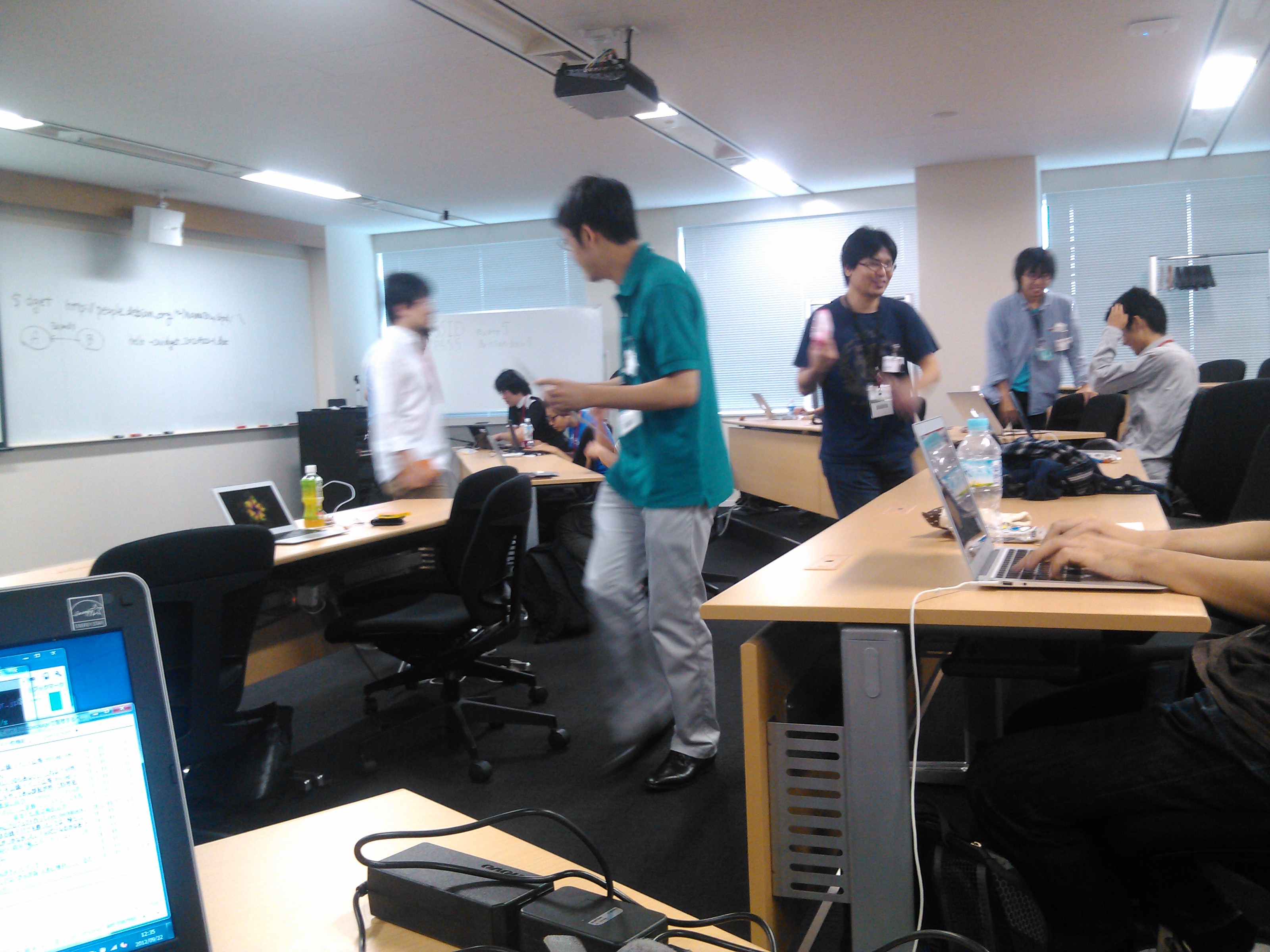
I attended Debian Packaging Dojo at 22 Aug. Dojo ( ) means a training hall for karate, judo, and/or kendo in Japanese. The event is a training for Debian packaging. Attendants were about 15 people. I could learn modern packaging methods. The place is Rakuten Tower in Shinagawa, thank you Rakuten company and Taku YASUI <tach at debian.org>.

18 August 2012

Paul Tagliamonte: Happy (belated) Birthday, Debian

Oh Debian. I don t know where to even start. I s pose all the cool kids are doing nostalgic posts about their time with Debian, so it s only natural I do the same. I can t remember when I first started with Debian, but I know it was woody. Before that, I was hanging out with Mandrake, Slackware and a few others. Not too long after, I switched to sarge, when it came out. Shortly after sarge, I d discovered unstable, and switched to running that and Fluxbox on my HP OmniBook until around 2007. In 2007, I got a new laptop, and went with Ubuntu, because of my laptop s nonfree problems, which now lives as frameputer, in which time I became an Ubuntu contributor, and all around cool guy. After a stint in Ubuntu-land, I d re-discovered my love for Debian on my machines in 2009 or so, when I started moving back to Debian for most of my computers. I still use Ubuntu, and I su spect there ll always be a place for it, but Debian s always been there for me. It wasn t my first, and I don t think it ll be the last, but it s always here, and I can always count on it to get work done, when I need work done. So, happy birthday, Debian, you rock.

19 July 2012

Matthew Palmer: Melt your cores with Rake's multitask

Reading documentation does pay off. Browsing through the Rakefile format documentation for Rake, just now, I found mention of the multitask method which declares that all of that task s prerequisites can be executed in parallel. A comparison run:
$ rake clean; time rake build
real    0m7.116s
user    0m6.788s
sys     0m0.260s
$rake clean; time rake multibuild
real    0m3.820s
user    0m8.809s
sys     0m0.288s
This is a trivially small build I m doing, I must admit, but halving the build time (in this case at least) pays huge dividends in my perceived productivity. It really blows the dust out of my CPU cores, too, which tend to be woefully underutilised (being this is a quad-core laptop and all). So I say unto you all: go forth and multitask!

15 July 2012

Steve Langasek: For those who care about my foot

Sitting in the airport during a layover on my way back from DebConf is one of the few times of year that time and motivation come together and routinely lead me to blog. Each year's DebConf has been special in its own way. This year at DebConf 12, in addition to the usual routine of catching up with all my far-away Debian friends, and of making new Debian friends in a country I've never been before, I got a special treat: my first opportunity to experience the practice of medicine in a foreign country. Last Saturday after arriving in Managua, I discovered that the very pretty paving stones making up the hotel walkway were also very slippery when wet, and the thin rubber strips that had been helpfully put in place to make them less slippery did not measurably succeed in doing so. So as it was raining that afternoon (as it does nearly every afternoon this time of year in Nicaragua), I slipped, and made the critical error of not falling. Instead, I stopped my slide - as it happens, by using the big toe of my left foot as if it were a roller skate brake. I don't recommend this, particularly if, as in my case, you already had it on your todo list to consult a podiatrist after DebConf regarding an ongoing feeling of weakness in precisely that part of precisely that foot. So while everything seemed fine the next day, Monday I woke up early with excruciating pain in my foot which, having forgotten about the incident two days prior, seemed to come from nowhere. After favoring the foot for another day and trying to keep the pain at bay using just OTC drugs, by Tuesday my foot was quite swollen and a source of concern. So I visited the clinic on the university campus, where the doctor diagnosed me with a dropped arch plus cellulitis due to bacteria entering through some invisible cut. Conclusion: university campus clinics are equally useless the world over. But at least in addition to pointlessly prescribing antibiotics, the doctor also prescribed some anti-inflammatory drugs to help bring the swelling down. Nevertheless, my questionable mobility kept both me and Patty from attending the day trip on Wednesday, which was a real shame as I had been keen to climb a volcano that day with my fellow Debian Developers (which in the end didn't happen for anyone, but that's a story for someone else's blog). Instead I took it easy for the day at the hotel, together with a few others who had opted not to attend the day trip, catching up on email and other work and hoping matters would improve. But by the end of the day the swelling was as bad as ever, if not worse, and I had no idea what was going on. Was it broken? Was something dislocated? And so I decided that the following day I would go to the hospital. The nearest hospital, as given in the DebConf local information page, is the Hospital Militar. It's a strange sort of thing as an American who remembers the 1980s to be seeking medical care from a facility operated by the Nicaraguan military; but accompanied by Fitoria, my native escort from the local team I had nothing to worry about; and besides, as a frequent international traveler I long ago learned the secret truth that people are people everywhere, no matter what flag they were born under. The highlight of the hospital visit was definitely when a member of the hospital staff, in full military uniform, shooed me towards a chair instead of standing to talk to her because "every patient has the right to sit, no matter what country they're in". After six x-rays and a doctor's consult, the conclusion was that it's probably not a broken bone and that it will probably clear up in just a couple of days with an even-better anti-inflammatory prescription and taking care of it by not walking on it. And indeed, my foot was already feeling better by Friday and aside from a little tenderness is now just about 100%. There are plenty of other entries on Planet Debian talking about the conference itself, and I don't think I have much to add to what's already been said there. But as for Nicaragua, I can conclude that it must be one of the best countries in the world to break your foot in - between the help of the hotel staff, the top-notch medical professionals, and above all the support of the DebConf local team (with a very big thank you again to Fitoria!), this is one brand of socialized medicine I can appreciate.

7 June 2012

Rog rio Brito: I am not going to DebConf 12

Due to some real life impediments (including a beautiful one with just over 2 months of life called Daniel), I will not be able to go to this year's DebConf, even though it seems that this DebConf will exceed many expectations with the support that the governement of Nicaragua just offered. Things that I would like to have worked on Unfortunately, this means that I will not be working with some fellows that may be there, like people from the pkg-multimedia team. In particular, as I am working on some packages that are not that well suited to distributions (especially regarding HandBrake), it would be highly productive to have a hacking session or two with other people interested in having this popular and easy-to-use video ripper/transcoder on Debian. I would also like to be able to talk in person with other people (including Joey Hess) about controversial packaging of some programs, like GNU Parallel, which I maintain in Debian. There are many things else that I would love to work on, besides helping a bit with some of the still pending transitions of the the Debian Fonts Task Force umbrella, meeting friends and other social stuff. Oh, well. I guess that working at home will be the solution for some time.

30 April 2012

John Goerzen: Review: Amateur Radio Handhelds (HTs), APRS, and Battery Tuning Tips

There are a lot of opinions about handhelds for amateur radio users (these handhelds are often known as HTs). I ve used three of them, two with APRS capability, and thought it s about time I write about them. First, I ll talk about the units in particular, then I ll get to some broader Yaesu vs. Kenwood generalizations and conclusions. Yaesu VX-7R a rugged first HT without APRS Cost: $350 as of 4/30/2012 This was the first HT I got as a ham, at the suggestion of Mike AE0MW. It truly does make a great first handheld for a ham. Radio-wise, one unique feature is a receive that s wideband enough to cover both broadcast FM and broadcast AM, the various ham bands, and plenty of others besides. The battery life quoted in the manual is 6 hours on 2m and 5.5 hours on 440 (using standard 6s TX / 6s RX / 48s squelched metric), and in my experience it seems it must be even better in some cases. The real piece of news about this unit, though, is just how rugged it is. It says submersible across the front and I absolutely believe it. I have personal experience with its ruggedness. I once was at an event and put the radio on my car roof while helping one of my children into the car. I then started driving home and forgot it there. When we got home, I realized what had happened, and also realized what that mysterious CLUNK along the busy county road was. So I drove 45 minutes back to where I heard the clunk, and found the VX-7R still lying in the roadway, where it had been for 1.5 hours on the 55 MPH road. The thing was really beat up. It had obviously been hit by numerous vehicles. The antenna was ripped off, taking the SMA mount with it. But wouldn t you know it, the darn thing still powered up. I took it to a local amateur radio shop, and about $80 later it was repaired. Incredible. The only real problem was the antenna connector. I took this radio with me on my bicycle many days, mounted on my handlebars. It got bounced around, but still worked great. Some days I listened to FM radio from it while riding my bike, monitoring a local repeater while I rode. Other days, I spent most of my ride (about an hour each way) chatting with people on the repeaters I have a mobile antenna mounted on the bike, fed to the VX-7R, and a headset. It all worked fine never a problem at all. The ruggedness has its downside. All of the connectors on the radio, except for DC in, are screw-down even the speaker/mic connector. This obviously helps keep water out, but means that it can take a lot longer than normal to do a simple thing like plug in a speaker/mic. It doesn t need any tools, but can get a little annoying. The radio physically is small (unless you install the belt clip, which has an odd peg-based mechanism that protrudes unnecessarily far and is surprisingly non-rugged). It can easily fit into a pocket. The other downsides of the VX-7R mostly surround its interface. I m not one of the Yaesu haters that seem to be so common. I find the interface usable if you read the manual; it seems a lot of people that complain about it don t. But it is quirky. The SET mode is one long menu in sort of a ring. You scroll with the knob, and when you get to the end, it repeats to the beginning. There are one or two shortcut keys to a specific setting, but overall either you use the thing so much you know exactly where you re going, or you re twisting the knob for awhile until the option you want rolls around. (I know of nobody that uses it so much they know exactly where they re going.) They do have options grouped into categories, but it doesn t help much because there s no quick way to skip between categories. The dual transceivers work less elegantly than on the TH-D72A or VX-8GR. Instead of being two equal transceivers A and B, they are main and sub . The sub transceiver is not broadband receive like the main receiver is. But there are also other limitations that have no apparent logic. For instance, you can program memory groups into the device putting, say, all the local repeaters into a certain group, or all the public safety frequencies (to use as a scanner). You can go to the special set menu, select group, then activate SCAN, and it will scan only the memories in that group. But you can t select the special group mode on the sub transceiver for no apparent reason. One other complaint is that the AC charger introduces so much noise to a transmission that you cannot really use the VX-7R to transmit while the charger is connected. Yaesu sells a programming cable that plugs into the speaker/mic port on one end, and a DB-9 serial port on the other, and includes programming software. For an incredibly high price. For far less, I found a similar cable on eBay that has a USB port on the other end (with a built-in USB/serial converter), and used VX-7R Commander though now that Chirp is available for Linux, I ll probably switch to it. I would probably continue to recommend this transceiver for a new ham. The ruggedness, plus the broadband RX, are features that should make it appealing. It is an excellent emergency preparedness/response radio due to those properties; having TX and RX on ham bands, plus RX on broadcast and public safety could be quite the asset. However, for someone that has any interest in APRS, one of the other two radios I mention is probably a better choice. At only $10 more, the VX-8GR sacrifices ruggedness and broadband receive for APRS functionality and could make a compelling alternative to the VX-7R at the same price point. The very low-power transmit at 50MHz and 220MHz on the VX-7R strikes me as a gimmick feature at best that has very little actual use. Shipped battery: FNB-80LI, 7.4V, 1400 mAh, lithium-ion Kenwood TH-D72A / D72E The Cadillac HT, with APRS and GPS Cost: $464 as of April 30, 2012 It s hard to use any word but incredible to describe this HT, though it does have its own rough edges. Starting with the basics, it has dual transceivers with full duplex (meaning you can be transmitting on one band while receiving on another). Its stored memory system and memory bank scanning system are both a lot easier and faster to use than Yaesu s, and work the same on both transceivers A and B, though perhaps offer slightly less flexibility than Yaesu s (on the VX-7R, a single memory can be a member of more than one group). The quoted operating time is 6 hours, which is probably accurate with APRS and GPS off, matching (or nearly matching) the VX-7R. The TH-D72A has the usual mic and speaker ports. Unlike Yaesu, Kenwood has used the same jack for years, so it is not necessary to purchase new accessories with each upgrade. The unit also has both serial (Kenwood connector) and standard mini USB ports, and even ships with a USB cable. The USB port is designed to interface to a PC, and the radio presents itself as a serial-over-USB device. Kenwood also includes MCP-4A, the programming software for the unit, free. This is one example of several things that Kenwood includes for free but are costly add-ons with Yaesu. Kenwood s configuration menu system is hierarchical. You can scroll through the four top-level menus (RADIO, GPS, APRS, and SKY), then navigate through sub menus. The result is that it s both faster and easier to find what you want than on the Yaesu menus. Plus, as you navigate, the radio shows you the shortcut key to get to a particular option (each level of menu is numbered starting) so, for instance, Menu-1-1-0 takes me directly to the configuration for RX battery saver interval far faster than I could get there on the VX-7R or VX-8GR. Only the APRS menu gets a bit crowded with this setup. The D72A supports Kenwood s Sky Command II an intriguing way of making it essentially a remote for a Kenwood HF rig such as the TS-2000. It works by engaging a crossband repeater for the audio, and setting up a AX.25 packet link for the control. It works, but as the response time to frequency adjustments is measured in seconds, is klunky for tuning around a HF band. A nifty, though perhaps not supremely useful, feature with some hackable potential that I haven t explored yet. The TH-D72A is one of only two shipping general-purpose amateur radios that have a built-in GPS the other is the Yaesu VX-8GR, which I ll review below. The GPS works well, and can get a fix indoors if desired. It has a system of saving waypoints, which you can then navigate back to later (using distance/bearing indicators). It also has a track log. While the track log can t be viewed on the unit, it can be downloaded with the included MCP-4A software and saved in a variety of formats including Google s KML for later importing into Google Maps or Google Earth. I enjoy this feature on trips to see where I went later on. There is also a GPS-only mode, which disables all of the other radio circuitry on the radio for very low power consumption. The GPS navigation screens all support heading-up or north-up indicators. But where this radio really shines is APRS. The D72 has all the basics you d expect sending and receiving beacons, sending and receiving messages and bulletins, etc. It has built-in support for being a digipeater in many different ways, including new-N UI-Trace. Coupled with an MFJ VHF amplifier, this could make a nice temporary (or even permanent) digi. The message interface permits sending, receiving, and shortcuts for replying to messages. Beacon transmission can be completely manual, at set intervals, or using SmartBeaconing. Outbound beacons also support proportional pathing (meaning adjusting via-path to not have wide coverage with every transmission). Also, if not using SmartBeaconing, a decay algorithm can be used to send beacons less frequently when the station s location isn t changing. An alternative tells the system to transmit a beacon every time PTT is released, subject to rate limiting by interval. So lots of choices there. For incoming beacons, there are various filters by callsign pattern, packet type, etc. that control whether they will be processed at all, and what kind of alert (visual or audible) to present. Beacons are also placed in a received beacon list, sorted with the most recent at the top (duplicates from the same station are always removed, so only the most recent is presented.) A long press of the LIST button shows time received and type of device next to the callsign. Selecting a specific beacon shows status text, comment, device type, bearing/distance (with graphical north-up or heading-up display), telemetry (weather information and the like), and a little bit of info about the via-path. Pretty nice to see weather reports from local weather stations on there. You can sort the list by received time, station call, or distance from your position but it doesn t stay sorted by anything other than received time, and takes several seconds to re-sort. Seems like a bit of an oversight there. The D72A supports QSY information in beacons. This can automatically insert the frequency of the other band on the transceiver into your transmitted beacons for you, or give you a quick way to tune to the frequency mentioned on others beacons. Either way, a nice touch. The D72 also supports query packets, such as packets asking your station to transmit its position right now. The TH-D72A can directly interface with several types of weather stations via serial link to read weather sensor information and transmit it into APRS packets directly, with no need for a PC to be in the picture at all. But if you do hook up a PC to it, there are quite a few more possibilities. You can hook it up to PC APRS software (or a hardware device such as the AVMAP) to see locations of other APRS stations on a map. It can emit APRS packets, plus even GPS sentences, down the USB port to the PC. Moreover, in PACKET mode, it acts as a full TNC, with a fairly robust TNC command set. In short, it can do more than APRS; it can also do regular AX.25 such as DX clusters, BBS, nodes, etc. As far as I know, this is the only HT that can interface with a PC in this manner, and only Kenwood s mobile D710 has the same kind of feature set at that. Kenwood includes a lot of documentation with the TH-D72A. The 51-page printed manual is a summary or introductory guide. The included CD-ROM supplies another 75 pages of detailed reference material, and the 92-page in-depth APRS manual has a level of detail that true geeks like me appreciate. I ve referred to Kenwood s documentation more than once while figuring out things about the VX-8GR (which woefully under-documents things like SmartBeaconing). That said, it appears that at least some of the documentation has been copied from the earlier TH-D7A. Page 4 of the printed book is a good example. It talks about the memory effect of the battery, and warns against unplugging and replugging the charger because the charge cycle will be reset and the battery will be over-charged (I find it hard to believe that a Li-Ion charge controller would be that stupid, and furthermore direct observation suggests that it isn t.) Parts of the in-depth APRS guide appear to have been written for the D710, but that s a really minor nit. Unlike Yaesu, Kenwood issues periodic firmware updates to the D72A, which you can apply over USB. They have fixed bugs and added features to the unit over time. Now onto the things that aren t so good about the D72A. I ll start with the battery system, since we were already discussing it. Despite shipping with a much larger battery than the VX-8GR (1800 mAh vs. 1100 mAh), it only manages roughly equal battery life with APRS and GPS engaged. (It will probably do better as a simple voice unit, however.) This has been confirmed by numerous reports on the Internet. I will discuss this topic more below. There is very little else to fault the D72A on, feature-wise. I have a minor nit in that it is impossible to cause the keylock feature to also lock PTT. It would be nice to be able to see raw APRS packets on beacons and messages. Other than that, I can t think of a feature it really lacks. Compared to the VX-7R and VX-8GR, the TH-D72A is significantly larger physically, in every dimension. It is not uncomfortably large, and still fits in my hand fine. But its size is enough different that it feels like the design is dated and could have been more compact if Kenwood would have bothered. It s a nit, sure, but a nontrivial one. With the single exception of the sturdy metal belt clip, the D72 doesn t feel nearly as rugged as the VX-7R, and not even as rugged as the VX-8GR. The keys have a squishy feel to them, the PTT button works fine but has a cheap plastic design (as opposed to the rubberized versions on Yaesu s HTs). The manual doesn t mention it, but one Kenwood brochure mentions and IP54 weatherproofing. That means it is protected against limited ingress of dust and against water sprayed from all directions limited ingress permitted. Contrast that to the VX-7R, which is rated for 30 minutes of submersion at 3ft and has a magnesium case. It seems to be specced similarly to the VX-8GR, though the VX-8GR certainly feels a lot more solid. I have no proof, as I m not about to sacrifice my HTs for science, but I doubt that the TH-D72A would have survived over an hour on a busy road as well as the VX-7R did, and probably not even as well as the VX-8GR would. The case is plastic a stout plastic, but still plastic. Like the VX-8GR, and unlike the VX-7R, the D72A does not have broadband receive. It can receive some bands adjacent to the ham bands it supports, which includes a lot of bands of interest to people with scanners, but still can t receive broadcast FM signals like the VX-7R. Shipped battery: PB-45L, 1800 mAh, lithium-ion Yaesu VX-8GR: Cheaper APRS & GPS Cost: $360 as of 4/30/2012 One could probably call this Yaesu s closest competitor to the D72A. At about $100 cheaper, it doesn t have a featureset that matches Kenwood s, but it does have a few innovations that the D72A lacks. Starting with the basics, it lacks the VX-7R s broadband receive, with the receive roughly matching the TH-D72A s. The 8GR is a dual-transceiver HT, and it works this effectively (moreso than the VX-7R). Yaesu has a bad habit of changing connectors on radios with regularity, and charging an arm and a leg for accessories to boot. Even within the VX-8 line, the 8GR uses different accessories than the 8DR, and of course has different plugs than the 7R (though it appears that the DC power plug is the same, and with some luck you might be able to use a VX-7R speaker/mic on the 8GR, though not the reverse). The menu system on the 8GR is still similar to the 7R, though Yaesu has done several things to improve it. For one, scrolling through the menu now shows several lines of context on the screen at once, making it faster to scan. Also, there are more ways to jump into the menu at a certain location than before and even a small bit of clumsily-implemented hierarchy (there are several settings on the SmartBeaconing page, for instance). The menu key now toggles between various displays: the default frequency/status display, a GPS display, an APRS staion list, and an APRS message list. Just about everything operationally takes more keypresses than the D72A. On the D72A, it s one or two keys (a physical button or F+button) to do almost everything: toggle GPS state, change TNC/APRS state (turn on or off), etc. All of that is in the scrolling menus on the 8GR. The quickest way there, which is documented in the manual, is to press MENU until a certain screen comes up, then press and hold MENU to bring up the settings (defaulting to a certain APRS-related category), then scroll and change settings. It s a pain to turn APRS on and off, because you have to do this process for both the GPS and the APRS modem. Inexplicably, there is a hotkey to change the APRS beacon method (manual, auto, or SmartBeaconing) but not to turn APRS itself on or off. (The D72A has a hotkey to toggle the beaconing, though not to change its method; though in truth, if you do it frequently, the menu shortcuts will get you there rapidly.) Physically, the VX-8GR is closer to the size of the 7R than the size of the D72A, and notably is significantly smaller than the D72A (at least with the standard battery). As noted in the D72A review, the VX-8GR feels more rugged than the D72A, though whether that is actually true or not is hard to pin down. It is definitely less rugged than the VX-7R. The keys require more pressure than the D72A, and in this they are similar to the 7R, but feel satisfyingly solid. Unlike the other radios here, the 8GR does not have a dedicated volume knob, having only one dial on the top. To adjust volume, you hold the volume button on the left while twisting the knob. In practice, this is probably not usually very annoying, but if the radio is on your belt or otherwise not in your hand, this would be a frustration. (I think it would be particularly annoying if using it with a speaker/mic). Setting 99 will let you change the key so you don t have to hold it in, which could probably go a long way to making the situation more tolerable. One unique feature of the VX-8GR, as far as I know completely unique to it, is a vibrating alert. This would most frequently be used with APRS to provide a nearly-silent alert of incoming messages and the like. The screen of the 8G, while similar in size to both the D72A and the 7R, appears to be higher-resolution (or if not, they make better use of it). More information is packed onto the screen at once, and although the D72A does have a small font, it uses it so rarely that lots of scrolling is needed. The 8GR uses a smaller font than the D72A to show content of messages and the like, which makes a much faster experience since there is a lot less scrolling. Neither radio has a setting to change this behavior, so if your eyesight isn t good, you may prefer the D72A anyhow. The VX-8GR supports a heading-up or a north-up view of the received GPS data, but strangely it does not support this when navigating to a received beacon (north-up is the only option). Unlike the TH-D72A, you can engage keylock on the 8GR while someone s beacon is on the display. Also unlike the TH-D72A, you can lock out the PTT key on the 8GR. However, the keylock feature is just a quick press of the power button, which makes me a bit nervous. And worse, if you tell it to lock the PTT key, then it also won t transmit any automatic APRS beacons! There are a lot of things the D72A supports in the APRS area that the 8GR doesn t. Here s a summary of features missing in the 8GR compared to the D72A: voice alert (can t even do it manually since tone/CTCSS are locked out in APRS mode), quick replying to messages, TNC mode (meaning you can t use it with PC-based APRS programs), full AX.25 packet mode, full PC linking, weather station inputs, built-in digipeater mode, heading-up display, GPS track logs, QSY in beacons, quick tuning to others QSY info, responding to position queries, proportional pathing, automatic decay, beaconing on PTT release, sorting of beacon list, hotkey access to many features, and I m sure the list goes on. On the flipside, the only thing feature-wise that you get on the 8GR s APRS implementation that the D72A lacks is ability to inspect raw APRS packets. The VX-8GR has the lowest-capacity battery of the three radios covered in this post, and this is an oft-cited problem for users of the unit. Yeasu does seem to do a much better job of power management than Kenwood, though, so in full APRS and GPS mode, the battery life is roughly the same, amazingly enough. It is unlikely that the talk time on the 8GR would match either the 7R or the D72A, however. Kenwood and Yaesu both have a battery saver feature which cuts power to the RX circuit except for brief checks for signals. Yaesu completely disables this while the APRS modem is on (and STILL matches Kenwood s battery life, despite the smaller battery!) Kenwood doesn t, though recommends changing the signal-check interval from 0.2s to 0.03s in order to avoid truncating APRS packets. Yaesu offers an 1800 mAh extended-life battery which should significantly exceed Kenwood s battery life. Aftermarket vendors have 2000 mAh batteries as well. Either way, expect APRS to be a drain on batteries. More on that below. Although Yaesu includes 168 pages of documentation with the 8GR, don t expect it to match the quality and detail of Kenwood s 218 pages. There are a lot of gimmicky/useless features on the 8GR (WIRES, for one) that get extensive treatment, and there is a fair bit of repetition. I particularly single out the SmartBeaconing documentation on the 8GR as being, at best, woefully incomplete and probably also inaccurate to boot. Read the D72A manuals to figure out how that feature works on your 8GR. I bought the VX-8GR intending it to be something akin to a more versatile TinyTrak. On that score, it mostly succeeds. It may be my go-to rig for use at bicycle rides, marathons, emergencies, etc., while the D72A will probably be the one that goes with me on trips. Shipped battery: FNB-101LI, 7.4V, 1100 mAh, lithium-ion Not covered: VX-8DR poor value for the dollar Cost: $434 ($550 with GPS and GPS connector) Yaesu s top-of-the-line HT is sometimes considered to be the VX-8DR. It maintains the broadband capability of the 7R, is probably almost as rugged as the 7R, and has APRS built in, like the 8GR. It even has an option to add a Bluetooth board. What is doesn t have built-in is a GPS. You can add one on for $77 for the FGPS-2 plus $39 for the CT-136 connector which connects the GPS to the unit. But then you have a unit a lot less rugged than even the D72A (that s a small connector for the GPS), a lot less small, with the same APRS featureset as the 8GR (meaning a lot less than the D72A), which costs about $100 more than the D72A. Frankly I think this makes for a poor APRS package, and would probably only be reasonable for someone that wants other 8DR features and has a desire for some very occasionaly APRS work. Battery Life and APRS One of my first surprises with APRS HTs was the poor battery life I saw. Doing my research seemed to suggest that, contrary to popular opinion, the transmitted beacons were not the culiprit, but the receive circuits were to blame. Because it is not acceptable to cut off the first 200ms of an AX.25 packet like it is with a repeater, the RX circuit is either engaged much more frequently (Kenwood) or continuously (Yaesu), putting a lot more drain on the battery. (This has also been confirmed by multiple others that have done testing) The GPS receiver also adds drain, and on the D72A, so does the TNC, which is always active when APRS is. If you don t care about received beacons, you can dramatically raise the battery life on the D72A by setting the power saver to 1 second or greater as high as 14 hours by one report. On either unit, raising the squelch should have some effect (though not as much; but in any case, weak packets won t decode anyhow, so there s no sense in letting them in.) On the 8GR, getting the extended life 1800 mAh (or aftermarket version) could produce battery life in nearly that same region, without compromising on the RX side of things. Conclusions If you want a HT capable of APRS, seriously think of the TH-D72A before anything else. It is $100 more expensive than the 8GR, but has more than $100 worth of extra features (and included things, like PC link cable and software, that are extra on the 8GR), so it has a better value. If you re particularly budget-conscious or want the most ruggedness you can find, the 7R and 8GR are solid contenders if you can sacrifice the extra APRS features. Update May 1: Clarified what the lack of TNC mode on the VX-8GR means, and also how the VX-8GR PTT keylock also locks out APRS transmissions.

25 April 2012

Alessandro Ghedini: Rakudo Perl 6 2012.01 uploaded to unstable

I ve uploaded yesterday the rakudo package version 0.1~2012.01-1 to unstable. It ships the Rakudo upstream release from January, running on top of the Parrot stable release 4.0.0 (which was uploaded earlier). Rakudo is a compiler that implements the Perl 6 specification and runs on top of the Parrot virtual machine (if you are interested on Perl 6 you may have a look at some nice articles, and at the talk of Damian Conway, about Perl 6). This is the first upload since a few months, and the first release being uploaded to Debian based on the nom (New Object Model) development branch of Rakudo, which opened the door for substantial performance improvements. This release brings other nice things too, such as the support for meta-programming, better package and exception handling and more. The latest upstream release 2012.04 (which brings, among other things, improvements in startup times thanks to bounded serialization) has been released a few days ago and uses the new Parrot stable release 4.3.0 (which has been released about a week ago), so we hope to test and upload both in time for the Wheezy freeze (and hopefully we ll be a bit more timely for future updates too).

21 April 2012

Vasudev Kamath: Update: Issue in Kannada Dictionary Bot

Just a short update for those who are wondering what is Kannada Dictionary bot, it is a small Jabber chat bot written in Python which pulls out meaning for given English or Kannada word from Kannada Wiktionary. More about the usage of this bot can be found in my previous post Recently I've been getting many queries from users that they are not able to access the bot from their GTalk account. Of course no one contacted me directly they were pinging my friend Omshivaprakash and in turn he was pinging and telling that some one contacted him and told bot is not online. But I have monit service monitoring bot 24x7 additionally I could see it online all the time, even when shiv is telling me its offline!. Finally figured out the reason when I went to Jabber So here is the reason
As you ve probably noticed, the jabber.org service has been experiencing connectivity problems with gmail.com and other Google Talk domains (e.g., you might not be able to see if your contacts there are online). The folks at Google are working on a solution and we will post again once they have fixed the problem.
Now folks please have patience till a solution comes up and once its in place you should be able to use the bot without any issue.

Next.

Previous.