Search Results: "otto"

7 February 2022

John Goerzen: KDE: A Nice Tiling Envieonment and a Surprisingly Awesome DE

I recently wrote that managing an external display on Linux shouldn t be this hard. I went down a path of trying out some different options before finally landing at an unexpected place: KDE. I say unexpected because I find tiling window managers are just about a necessity. Background: xmonad Until a few months ago, I d been using xmonad for well over a decade. Configurable, minimal, and very nice; it suited me well. However, xmonad is getting somewhat long in the tooth. xmobar, which is commonly used with it, barely supports many modern desktop environments. I prefer DEs for the useful integrations they bring: everything from handling mount of USB sticks to display auto-switching and sound switching. xmonad itself can t run with modern Gnome (whether or not it runs well under KDE 5 seems to be a complicated question, according to wikis, but in any case, there is no log applet for KDE 5). So I was left with XFCE and such, but the isues I identified in the shouldn t be this hard article were bad enough that I just could not keep going that way. An attempt: Gnome and PaperWM So I tried Gnome under Wayland, reasoning that Wayland might stand a chance of doing things well where X couldn t. There are several tiling window extensions available for the Gnome 3 shell. Most seemed to be rather low-quality, but an exception was PaperWM and I eventually decided on it. I never quite decided if I liked its horizontal tape of windows or not; it certainly is unique in any case. I was willing to tolerate my usual list of Gnome problems for the sake of things working. For instance: Under Wayland, I found a disturbing lack of logs. There was nothing like /var/log/Xorg.0.log, nothing like ~/.xsession-errors, just nothing. Searching for answers on this revealed a lot of Wayland people saying it s a Gnome issue and the trail going cold at that point. And there was a weird problem that I just could not solve. After the laptop was suspended and we-awakened, I would be at a lock screen. I could type in my password, but when hitting Enter, the thing would then tend to freeze. Why, I don t know. It seemed related to Gnome shell; when I switched Gnome from Wayland to X11, it would freeze but eventually return to the unlock screen, at which point I d type in my password and it would freeze again. I spent a long time tracking down logs to see what was happening, but I couldn t figure it out. All those hard resets were getting annoying. Enter KDE So I tried KDE. I had seen mentions of kwin-tiling, a KDE extension for tiling windows. I thought I d try this setup. I was really impressed by KDE s quality. Not only did it handle absolutely every display-related interaction correctly by default, with no hangs ever, all relevant settings were clearly presented in one place. The KDE settings screens were a breath of fresh air lots of settings available, all at one place, and tons of features I hadn t seen elsewhere. Here are some of the things I was pleasantly surprised by with KDE: Tiling So how about the tiling system, kwin-tiling? The out of the box experience is pretty nice. There are fewer built-in layouts than with xmonad, but the ones that are there are doing a decent job for me, and in some cases are more configurable (those that have a large window pane are configurable on its location, not forcing it to be on the left as with many systems.) What s more, thanks to the flexibility in the KDE shortcut settings, I can configure it to be nearly keystroke-identical to xmonad! Issues Encountered I encountered a few minor issues: In short, I m very impressed.

5 February 2022

Louis-Philippe V ronneau: Migrating from ledger to hledger

I first started using ledger the original plain-text accounting software in 2017. Since then, I had been pretty happy with my accounting routine, but grew a little annoyed by the repetitive manual work I had to do to assign recurring transactions to the right account. To make things easier, I had a collection of bash scripts to parse and convert the CSV files from my bank's website1 into ledger entries. They were of course ugly, unreadable piles of sed-grep-regex and did not let met achieve the automation complexity I longed for. Dissatisfied with ledger's features, I decided to migrate to hledger. Contrary to ledger, hledger comes with a CSV parser one can use to import and classify recurring transactions automagically. Having a proper DSL for this makes all the difference: I can easily add new rules and understand the old ones. In the end, I get a very consistent result, something my old bash scripts weren't great at. Here is what my debit.csv.rules file looks like. It is used to tell hledger how CSV data from my debit card should be parsed:
# skip the headings line:
skip 1
# assign fields
fields , , , date, , description, , amount2-in, amount2-out
# assign account where the money comes from
# 99 to get it at the bottom of the transaction
account99 assets:checking
include matchers.rules
As you can see, the rules matching transactions to specific accounts are imported from another file, matchers.rules. I'm doing this since I want to be able to use the same set of rules for debit and credit and use the cards interchangeably. Here's a snippet of my matchers.rules file:
# house
if Loyer/bail
  account2  expenses:rent
# leisure
if PAYPAL .*STEAM GAMES
  account2  expenses:leisure:videogame
if PAYPAL .*BANDCAMP
  account2  expenses:leisure:music
Using this ruleset, a transaction looking like this:
"SOME ACCOUNT DESC","111111","EOP","2022/01/03",00002,"Loyer/bail","",521.00,"","","","",""
Would be transformed into:
2022-01-03 Loyer/bail
    expenses:rent                               521.00
    assets:checking
Sadly, hledger's CSV rules won't let you do arithmetics. This can be useful when you know a certain transaction needs to be split between accounts. This is where auto postings come in. They are a way to specify arbitrary rules when an account is encountered. Going back to my previous rent example, I split it 50/50 with my SO using this rule:
= expenses:rent
    assets:receivable:rent    *0.5
    assets:checking
After it is applied, the final transaction looks like this:
2022-01-03 Loyer/bail  ; modified:
    expenses:rent                               521.00
    assets:receivable:rent                      260.50  ; generated-posting: = expenses:rent
    assets:checking
Neat eh? Here is the little bash script I've written to automate all these steps:
 #!/bin/bash
#
# Convert CSV to ledger using hledger
declare -a assets=("credit" "debit")
# Read the array values with space
for i in "$ assets[@] "
do
  if test -f "$i.csv"
  then
    # convert to ledger
    LEDGER=$(hledger -f "$i.csv" --rules-file rules/"$i.csv".rules print)
    # add auto_postings
    LEDGER=$(printf "include rules/auto_postings.ledger\n\n$LEDGER\n"   hledger print -f- --auto)
    # remove superfluous assets:checking lines
    LEDGER=$(printf "$LEDGER"   sed '/assets:checking \+; generated.\+/d')
    printf "$LEDGER" > "$i.ledger"
  else
    printf "File $i.csv does not exist\n"
  fi
done
Migrating to hledger, I've cut down the time I spend on accounting from 1 hour per month to about 10 minutes, all while making my workflow much cleaner. Many thanks to the kind folks on #hledger @irc.libera.chat for the help!

  1. One for my checking+savings account and another one for my credit card.

16 January 2022

Chris Lamb: Favourite films of 2021

In my four most recent posts, I went over the memoirs and biographies, the non-fiction, the fiction and the 'classic' novels that I enjoyed reading the most in 2021. But in the very last of my 2021 roundup posts, I'll be going over some of my favourite movies. (Saying that, these are perhaps less of my 'favourite films' than the ones worth remarking on after all, nobody needs to hear that The Godfather is a good movie.) It's probably helpful to remark you that I took a self-directed course in film history in 2021, based around the first volume of Roger Ebert's The Great Movies. This collection of 100-odd movie essays aims to make a tour of the landmarks of the first century of cinema, and I watched all but a handul before the year was out. I am slowly making my way through volume two in 2022. This tome was tremendously useful, and not simply due to the background context that Ebert added to each film: it also brought me into contact with films I would have hardly come through some other means. Would I have ever discovered the sly comedy of Trouble in Paradise (1932) or the touching proto-realism of L'Atalante (1934) any other way? It also helped me to 'get around' to watching films I may have put off watching forever the influential Battleship Potemkin (1925), for instance, and the ur-epic Lawrence of Arabia (1962) spring to mind here. Choosing a 'worst' film is perhaps more difficult than choosing the best. There are first those that left me completely dry (Ready or Not, Written on the Wind, etc.), and those that were simply poorly executed. And there are those that failed to meet their own high opinions of themselves, such as the 'made for Reddit' Tenet (2020) or the inscrutable Vanilla Sky (2001) the latter being an almost perfect example of late-20th century cultural exhaustion. But I must save my most severe judgement for those films where I took a visceral dislike how their subjects were portrayed. The sexually problematic Sixteen Candles (1984) and the pseudo-Catholic vigilantism of The Boondock Saints (1999) both spring to mind here, the latter of which combines so many things I dislike into such a short running time I'd need an entire essay to adequately express how much I disliked it.

Dogtooth (2009) A father, a mother, a brother and two sisters live in a large and affluent house behind a very high wall and an always-locked gate. Only the father ever leaves the property, driving to the factory that he happens to own. Dogtooth goes far beyond any allusion to Josef Fritzl's cellar, though, as the children's education is a grotesque parody of home-schooling. Here, the parents deliberately teach their children the wrong meaning of words (e.g. a yellow flower is called a 'zombie'), all of which renders the outside world utterly meaningless and unreadable, and completely mystifying its very existence. It is this creepy strangeness within a 'regular' family unit in Dogtooth that is both socially and epistemically horrific, and I'll say nothing here of its sexual elements as well. Despite its cold, inscrutable and deadpan surreality, Dogtooth invites all manner of potential interpretations. Is this film about the artificiality of the nuclear family that the West insists is the benchmark of normality? Or is it, as I prefer to believe, something more visceral altogether: an allegory for the various forms of ontological violence wrought by fascism, as well a sobering nod towards some of fascism's inherent appeals? (Perhaps it is both. In 1972, French poststructuralists Gilles and F lix Guattari wrote Anti-Oedipus, which plays with the idea of the family unit as a metaphor for the authoritarian state.) The Greek-language Dogtooth, elegantly shot, thankfully provides no easy answers.

Holy Motors (2012) There is an infamous scene in Un Chien Andalou, the 1929 film collaboration between Luis Bu uel and famed artist Salvador Dal . A young woman is cornered in her own apartment by a threatening man, and she reaches for a tennis racquet in self-defence. But the man suddenly picks up two nearby ropes and drags into the frame two large grand pianos... each leaden with a dead donkey, a stone tablet, a pumpkin and a bewildered priest. This bizarre sketch serves as a better introduction to Leos Carax's Holy Motors than any elementary outline of its plot, which ostensibly follows 24 hours in the life of a man who must play a number of extremely diverse roles around Paris... all for no apparent reason. (And is he even a man?) Surrealism as an art movement gets a pretty bad wrap these days, and perhaps justifiably so. But Holy Motors and Un Chien Andalou serve as a good reminder that surrealism can be, well, 'good, actually'. And if not quite high art, Holy Motors at least demonstrates that surrealism can still unnerving and hilariously funny. Indeed, recalling the whimsy of the plot to a close friend, the tears of laughter came unbidden to my eyes once again. ("And then the limousines...!") Still, it is unclear how Holy Motors truly refreshes surrealism for the twenty-first century. Surrealism was, in part, a reaction to the mechanical and unfeeling brutality of World War I and ultimately sought to release the creative potential of the unconscious mind. Holy Motors cannot be responding to another continental conflagration, and so it appears to me to be some kind of commentary on the roles we exhibit in an era of 'post-postmodernity': a sketch on our age of performative authenticity, perhaps, or an idle doodle on the function and psychosocial function of work. Or perhaps not. After all, this film was produced in a time that offers the near-universal availability of mind-altering substances, and this certainly changes the context in which this film was both created. And, how can I put it, was intended to be watched.

Manchester by the Sea (2016) An absolutely devastating portrayal of a character who is unable to forgive himself and is hesitant to engage with anyone ever again. It features a near-ideal balance between portraying unrecoverable anguish and tender warmth, and is paradoxically grandiose in its subtle intimacy. The mechanics of life led me to watch this lying on a bed in a chain hotel by Heathrow Airport, and if this colourless circumstance blunted the film's emotional impact on me, I am probably thankful for it. Indeed, I find myself reduced in this review to fatuously recalling my favourite interactions instead of providing any real commentary. You could write a whole essay about one particular incident: its surfaces, subtexts and angles... all despite nothing of any substance ever being communicated. Truly stunning.

McCabe & Mrs. Miller (1971) Roger Ebert called this movie one of the saddest films I have ever seen, filled with a yearning for love and home that will not ever come. But whilst it is difficult to disagree with his sentiment, Ebert's choice of sad is somehow not quite the right word. Indeed, I've long regretted that our dictionaries don't have more nuanced blends of tragedy and sadness; perhaps the Ancient Greeks can loan us some. Nevertheless, the plot of this film is of a gambler and a prostitute who become business partners in a new and remote mining town called Presbyterian Church. However, as their town and enterprise booms, it comes to the attention of a large mining corporation who want to bully or buy their way into the action. What makes this film stand out is not the plot itself, however, but its mood and tone the town and its inhabitants seem to be thrown together out of raw lumber, covered alternatively in mud or frozen ice, and their days (and their personalities) are both short and dark in equal measure. As a brief aside, if you haven't seen a Roger Altman film before, this has all the trappings of being a good introduction. As Ebert went on to observe: This is not the kind of movie where the characters are introduced. They are all already here. Furthermore, we can see some of Altman's trademark conversations that overlap, a superb handling of ensemble casts, and a quietly subversive view of the tyranny of 'genre'... and the latter in a time when the appetite for revisionist portrays of the West was not very strong. All of these 'Altmanian' trademarks can be ordered in much stronger measures in his later films: in particular, his comedy-drama Nashville (1975) has 24 main characters, and my jejune interpretation of Gosford Park (2001) is that it is purposefully designed to poke fun those who take a reductionist view of 'genre', or at least on the audience's expectations. (In this case, an Edwardian-era English murder mystery in the style of Agatha Christie, but where no real murder or detection really takes place.) On the other hand, McCabe & Mrs. Miller is actually a poor introduction to Altman. The story is told in a suitable deliberate and slow tempo, and the two stars of the film are shown thoroughly defrocked of any 'star status', in both the visual and moral dimensions. All of these traits are, however, this film's strength, adding up to a credible, fascinating and riveting portrayal of the old West.

Detour (1945) Detour was filmed in less than a week, and it's difficult to decide out of the actors and the screenplay which is its weakest point.... Yet it still somehow seemed to drag me in. The plot revolves around luckless Al who is hitchhiking to California. Al gets a lift from a man called Haskell who quickly falls down dead from a heart attack. Al quickly buries the body and takes Haskell's money, car and identification, believing that the police will believe Al murdered him. An unstable element is soon introduced in the guise of Vera, who, through a set of coincidences that stretches credulity, knows that this 'new' Haskell (ie. Al pretending to be him) is not who he seems. Vera then attaches herself to Al in order to blackmail him, and the world starts to spin out of his control. It must be understood that none of this is executed very well. Rather, what makes Detour so interesting to watch is that its 'errors' lend a distinctively creepy and unnatural hue to the film. Indeed, in the early twentieth century, Sigmund Freud used the word unheimlich to describe the experience of something that is not simply mysterious, but something creepy in a strangely familiar way. This is almost the perfect description of watching Detour its eerie nature means that we are not only frequently second-guessed about where the film is going, but are often uncertain whether we are watching the usual objective perspective offered by cinema. In particular, are all the ham-fisted segues, stilted dialogue and inscrutable character motivations actually a product of Al inventing a story for the viewer? Did he murder Haskell after all, despite the film 'showing' us that Haskell died of natural causes? In other words, are we watching what Al wants us to believe? Regardless of the answers to these questions, the film succeeds precisely because of its accidental or inadvertent choices, so it is an implicit reminder that seeking the director's original intention in any piece of art is a complete mirage. Detour is certainly not a good film, but it just might be a great one. (It is a short film too, and, out of copyright, it is available online for free.)

Safe (1995) Safe is a subtly disturbing film about an upper-middle-class housewife who begins to complain about vague symptoms of illness. Initially claiming that she doesn't feel right, Carol starts to have unexplained headaches, a dry cough and nosebleeds, and eventually begins to have trouble breathing. Carol's family doctor treats her concerns with little care, and suggests to her husband that she sees a psychiatrist. Yet Carol's episodes soon escalate. For example, as a 'homemaker' and with nothing else to occupy her, Carol's orders a new couch for a party. But when the store delivers the wrong one (although it is not altogether clear that they did), Carol has a near breakdown. Unsure where to turn, an 'allergist' tells Carol she has "Environmental Illness," and so Carol eventually checks herself into a new-age commune filled with alternative therapies. On the surface, Safe is thus a film about the increasing about of pesticides and chemicals in our lives, something that was clearly felt far more viscerally in the 1990s. But it is also a film about how lack of genuine healthcare for women must be seen as a critical factor in the rise of crank medicine. (Indeed, it made for something of an uncomfortable watch during the coronavirus lockdown.) More interestingly, however, Safe gently-yet-critically examines the psychosocial causes that may be aggravating Carol's illnesses, including her vacant marriage, her hollow friends and the 'empty calorie' stimulus of suburbia. None of this should be especially new to anyone: the gendered Victorian term 'hysterical' is often all but spoken throughout this film, and perhaps from the very invention of modern medicine, women's symptoms have often regularly minimised or outright dismissed. (Hilary Mantel's 2003 memoir, Giving Up the Ghost is especially harrowing on this.) As I opened this review, the film is subtle in its messaging. Just to take one example from many, the sound of the cars is always just a fraction too loud: there's a scene where a group is eating dinner with a road in the background, and the total effect can be seen as representing the toxic fumes of modernity invading our social lives and health. I won't spoiler the conclusion of this quietly devasting film, but don't expect a happy ending.

The Driver (1978) Critics grossly misunderstood The Driver when it was first released. They interpreted the cold and unemotional affect of the characters with the lack of developmental depth, instead of representing their dissociation from the society around them. This reading was encouraged by the fact that the principal actors aren't given real names and are instead known simply by their archetypes instead: 'The Driver', 'The Detective', 'The Player' and so on. This sort of quasi-Jungian erudition is common in many crime films today (Reservoir Dogs, Kill Bill, Layer Cake, Fight Club), so the critics' misconceptions were entirely reasonable in 1978. The plot of The Driver involves the eponymous Driver, a noted getaway driver for robberies in Los Angeles. His exceptional talent has far prevented him from being captured thus far, so the Detective attempts to catch the Driver by pardoning another gang if they help convict the Driver via a set-up robbery. To give himself an edge, however, The Driver seeks help from the femme fatale 'Player' in order to mislead the Detective. If this all sounds eerily familiar, you would not be far wrong. The film was essentially remade by Nicolas Winding Refn as Drive (2011) and in Edgar Wright's 2017 Baby Driver. Yet The Driver offers something that these neon-noir variants do not. In particular, the car chases around Los Angeles are some of the most captivating I've seen: they aren't thrilling in the sense of tyre squeals, explosions and flying boxes, but rather the vehicles come across like wild animals hunting one another. This feels especially so when the police are hunting The Driver, which feels less like a low-stakes game of cat and mouse than a pack of feral animals working together a gang who will tear apart their prey if they find him. In contrast to the undercar neon glow of the Fast & Furious franchise, the urban realism backdrop of the The Driver's LA metropolis contributes to a sincere feeling of artistic fidelity as well. To be sure, most of this is present in the truly-excellent Drive, where the chase scenes do really communicate a credible sense of stakes. But the substitution of The Driver's grit with Drive's soft neon tilts it slightly towards that common affliction of crime movies: style over substance. Nevertheless, I can highly recommend watching The Driver and Drive together, as it can tell you a lot about the disconnected socioeconomic practices of the 1980s compared to the 2010s. More than that, however, the pseudo-1980s synthwave soundtrack of Drive captures something crucial to analysing the world of today. In particular, these 'sounds from the past filtered through the present' bring to mind the increasing role of nostalgia for lost futures in the culture of today, where temporality and pop culture references are almost-exclusively citational and commemorational.

The Souvenir (2019) The ostensible outline of this quietly understated film follows a shy but ambitious film student who falls into an emotionally fraught relationship with a charismatic but untrustworthy older man. But that doesn't quite cover the plot at all, for not only is The Souvenir a film about a young artist who is inspired, derailed and ultimately strengthened by a toxic relationship, it is also partly a coming-of-age drama, a subtle portrait of class and, finally, a film about the making of a film. Still, one of the geniuses of this truly heartbreaking movie is that none of these many elements crowds out the other. It never, ever feels rushed. Indeed, there are many scenes where the camera simply 'sits there' and quietly observes what is going on. Other films might smother themselves through references to 18th-century oil paintings, but The Souvenir somehow evades this too. And there's a certain ring of credibility to the story as well, no doubt in part due to the fact it is based on director Joanna Hogg's own experiences at film school. A beautifully observed and multi-layered film; I'll be happy if the sequel is one-half as good.

The Wrestler (2008) Randy 'The Ram' Robinson is long past his prime, but he is still rarin' to go in the local pro-wrestling circuit. Yet after a brutal beating that seriously threatens his health, Randy hangs up his tights and pursues a serious relationship... and even tries to reconnect with his estranged daughter. But Randy can't resist the lure of the ring, and readies himself for a comeback. The stage is thus set for Darren Aronofsky's The Wrestler, which is essentially about what drives Randy back to the ring. To be sure, Randy derives much of his money from wrestling as well as his 'fitness', self-image, self-esteem and self-worth. Oh, it's no use insisting that wrestling is fake, for the sport is, needless to say, Randy's identity; it's not for nothing that this film is called The Wrestler. In a number of ways, The Sound of Metal (2019) is both a reaction to (and a quiet remake of) The Wrestler, if only because both movies utilise 'cool' professions to explore such questions of identity. But perhaps simply when The Wrestler was produced makes it the superior film. Indeed, the role of time feels very important for the Wrestler. In the first instance, time is clearly taking its toll on Randy's body, but I felt it more strongly in the sense this was very much a pre-2008 film, released on the cliff-edge of the global financial crisis, and the concomitant precarity of the 2010s. Indeed, it is curious to consider that you couldn't make The Wrestler today, although not because the relationship to work has changed in any fundamentalway. (Indeed, isn't it somewhat depressing the realise that, since the start of the pandemic and the 'work from home' trend to one side, we now require even more people to wreck their bodies and mental health to cover their bills?) No, what I mean to say here is that, post-2016, you cannot portray wrestling on-screen without, how can I put it, unwelcome connotations. All of which then reminds me of Minari's notorious red hat... But I digress. The Wrestler is a grittily stark darkly humorous look into the life of a desperate man and a sorrowful world, all through one tragic profession.

Thief (1981) Frank is an expert professional safecracker and specialises in high-profile diamond heists. He plans to use his ill-gotten gains to retire from crime and build a life for himself with a wife and kids, so he signs on with a top gangster for one last big score. This, of course, could be the plot to any number of heist movies, but Thief does something different. Similar to The Wrestler and The Driver (see above) and a number of other films that I watched this year, Thief seems to be saying about our relationship to work and family in modernity and postmodernity. Indeed, the 'heist film', we are told, is an understudied genre, but part of the pleasure of watching these films is said to arise from how they portray our desired relationship to work. In particular, Frank's desire to pull off that last big job feels less about the money it would bring him, but a displacement from (or proxy for) fulfilling some deep-down desire to have a family or indeed any relationship at all. Because in theory, of course, Frank could enter into a fulfilling long-term relationship right away, without stealing millions of dollars in diamonds... but that's kinda the entire point: Frank needing just one more theft is an excuse to not pursue a relationship and put it off indefinitely in favour of 'work'. (And being Federal crimes, it also means Frank cannot put down meaningful roots in a community.) All this is communicated extremely subtly in the justly-lauded lowkey diner scene, by far the best scene in the movie. The visual aesthetic of Thief is as if you set The Warriors (1979) in a similarly-filthy Chicago, with the Xenophon-inspired plot of The Warriors replaced with an almost deliberate lack of plot development... and the allure of The Warriors' fantastical criminal gangs (with their alluringly well-defined social identities) substituted by a bunch of amoral individuals with no solidarity beyond the immediate moment. A tale of our time, perhaps. I should warn you that the ending of Thief is famously weak, but this is a gritty, intelligent and strangely credible heist movie before you get there.

Uncut Gems (2019) The most exhausting film I've seen in years; the cinematic equivalent of four cups of double espresso, I didn't even bother even trying to sleep after downing Uncut Gems late one night. Directed by the two Safdie Brothers, it often felt like I was watching two films that had been made at the same time. (Or do I mean two films at 2X speed?) No, whatever clumsy metaphor you choose to adopt, the unavoidable effect of this film's finely-tuned chaos is an uncompromising and anxiety-inducing piece of cinema. The plot follows Howard as a man lost to his countless vices mostly gambling with a significant side hustle in adultery, but you get the distinct impression he would be happy with anything that will give him another high. A true junkie's junkie, you might say. You know right from the beginning it's going to end in some kind of disaster, the only question remaining is precisely how and what. Portrayed by an (almost unrecognisable) Adam Sandler, there's an uncanny sense of distance in the emotional chasm between 'Sandler-as-junkie' and 'Sandler-as-regular-star-of-goofy-comedies'. Yet instead of being distracting and reducing the film's affect, this possibly-deliberate intertextuality somehow adds to the masterfully-controlled mayhem. My heart races just at the memory. Oof.

Woman in the Dunes (1964) I ended up watching three films that feature sand this year: Denis Villeneuve's Dune (2021), Lawrence of Arabia (1962) and Woman in the Dunes. But it is this last 1964 film by Hiroshi Teshigahara that will stick in my mind in the years to come. Sure, there is none of the Medician intrigue of Dune or the Super Panavision-70 of Lawrence of Arabia (or its quasi-orientalist score, itself likely stolen from Anton Bruckner's 6th Symphony), but Woman in the Dunes doesn't have to assert its confidence so boldly, and it reveals the enormity of its plot slowly and deliberately instead. Woman in the Dunes never rushes to get to the film's central dilemma, and it uncovers its terror in little hints and insights, all whilst establishing the daily rhythm of life. Woman in the Dunes has something of the uncanny horror as Dogtooth (see above), as well as its broad range of potential interpretations. Both films permit a wide array of readings, without resorting to being deliberately obscurantist or being just plain random it is perhaps this reason why I enjoyed them so much. It is true that asking 'So what does the sand mean?' sounds tediously sophomoric shorn of any context, but it somehow applies to this thoughtfully self-contained piece of cinema.

A Quiet Place (2018) Although A Quiet Place was not actually one of the best films I saw this year, I'm including it here as it is certainly one of the better 'mainstream' Hollywood franchises I came across. Not only is the film very ably constructed and engages on a visceral level, I should point out that it is rare that I can empathise with the peril of conventional horror movies (and perhaps prefer to focus on its cultural and political aesthetics), but I did here. The conceit of this particular post-apocalyptic world is that a family is forced to live in almost complete silence while hiding from creatures that hunt by sound alone. Still, A Quiet Place engages on an intellectual level too, and this probably works in tandem with the pure 'horrorific' elements and make it stick into your mind. In particular, and to my mind at least, A Quiet Place a deeply American conservative film below the surface: it exalts the family structure and a certain kind of sacrifice for your family. (The music often had a passacaglia-like strain too, forming a tombeau for America.) Moreover, you survive in this dystopia by staying quiet that is to say, by staying stoic suggesting that in the wake of any conflict that might beset the world, the best thing to do is to keep quiet. Even communicating with your loved ones can be deadly to both of you, so not emote, acquiesce quietly to your fate, and don't, whatever you do, speak up. (Or join a union.) I could go on, but The Quiet Place is more than this. It's taut and brief, and despite cinema being an increasingly visual medium, it encourages its audience to develop a new relationship with sound.

13 January 2022

Daniel Lange: Leveling the playing field for non-native speakers

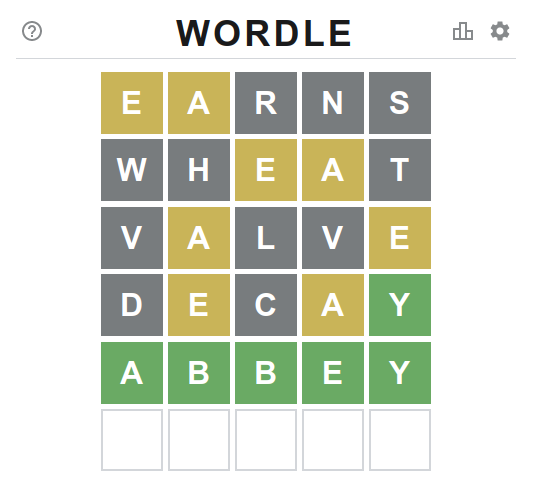
Wordle game screenshort of bash, grep and pipes

Updates 24.01.2022: What I love about the community is the playful creativity that inspires a game like Wordle and that in turn inspires others to create fun tools around it: Robert Reichel has reverse engineered the Wordle application, so in case you want to play tomorrow's word today .. you can. Or have that one guess "Genius" solution experience. JP Fosterson created a Wordle helper that is very much the Python version of my grep-foo above. In case you play regularly and can use a hand. And Tom Lockwood wrote a Wordle solver also in Python. He blogged about it and ... is pondering to rewrite things in Rust:

I ve decided to explore Rust for this, and so far what was taking 1GB of RAM in Python is taking, literally 1MB in Rust!
Welcome to 2022. 01.02.2022: OMG. Wordle has been bought by the New York Times for "for a price in the low seven figures" (Source). Joey Rees-Hill put it well in The Death of Wordle:
Today s Web is dominated by platforms. The average Web user will spend most of their time on large platforms such as Instagram, Facebook, Twitter, TikTok, Google Drive/Docs, YouTube, Netflix, Spotify, Gmail, and Google Calendar, along with sites operated by large publishers such as The New York Times or The Washington Post. [..]
The Web wasn t always this way. I m not old enough to remember this, but things weren t always so centralized. Web users might run their own small website, and certainly would visit a good variety of smaller sites. With the increasing availability of internet access, the Web has become incredibly commercialized, with a handful of companies concentrating Web activity on their own properties.
Wordle was a small site that gained popularity despite not being part of a corporate platform. It was wonderful to see an independent site gain attention for being simple and fun. Wordle was refreshingly free of attention-manipulating dark patterns and pushy monetization. That s why it s a shame to see it absorbed, to inevitably become just another feature of one large media company s portfolio.
Still kudos to Josh Wardle, a Million Pounds for Wordle. Well done! It was fun while it lasted. Let's see what the next Wordle will be. This one has just been absorbed into the borg collective.

4 January 2022

Russell Coker: Curiosity Stream

I have recently signed up for the Curiosity Stream [1] documentary site, this is designed to be like Netflix but for non-fiction content only. The service costs $US15 per annum or $52US per annum for 4K (I think the 4K service was about $US120 per annum when I signed up). The extra price for 4K seems excessive, while it is in line with the bandwidth requirements a large portion of the costs of the service would be about user support and running the service reliably for which 4K makes little difference. My aim in subscribing was to just get a service like Netflix with new documentary content as I have watched every documentary I want to watch on Netflix (I think I ve watched over 1000 hours of Netflix documentaries). So naturally I compare the service to Netflix and I found that it doesn t compare well. Curiosity Stream (CS) has no button to skip the intro and has a problem with using the right arrow to skip forward (seems to only work once and then I have to use the mouse), this costs me about 30 seconds for each episode which adds up when watching documentaries at 1.5* speed. The method of controlling the viewing is a little clunky, sometimes the popup menu at the bottom of the screen to control playback doesn t disappear by itself until you mouse over it and space bar doesn t select pause instead it selects the last action. CS allows selecting individual episodes for your watch list instead of entire series, this could be useful for some people but I just find it annoying, it might be good for classroom use. The method of searching for new shows to watch isn t as good as the Netflix method or the way things are displayed on Android TV (which seems to have an API for multiple video providers to show a list of shows with one row per provider). Some of these things might seem OK if you haven t used other services, but if you are used to Netflix and Amazon Prime then it will seem clunky. The amount of content on Curiosity Stream doesn t seem that large, I don t know how to get a full measure of it, but when I search for things I seem to get less results than on Netflix. That could be something to do with what I m searching for. In terms of value for money $US15 per annum for the content that CS provides is a good deal. Netflix overall offers better value for home users having fiction as well as non-fiction in large quantities. But for documentary content $US15 per annum is pretty cheap. I recommend signing up for CS, but for most people signing up for Netflix first will be a good option.
  1. [1] https://curiositystream.com/

3 January 2022

Ian Jackson: Debian s approach to Rust - Dependency handling

tl;dr: Faithfully following upstream semver, in Debian package dependencies, is a bad idea. Introduction I have been involved in Debian for a very long time. And I ve been working with Rust for a few years now. Late last year I had cause to try to work on Rust things within Debian. When I did, I found it very difficult. The Debian Rust Team were very helpful. However, the workflow and tooling require very large amounts of manual clerical work - work which it is almost impossible to do correctly since the information required does not exist. I had wanted to package a fairly straightforward program I had written in Rust, partly as a learning exercise. But, unfortunately, after I got stuck in, it looked to me like the effort would be wildly greater than I was prepared for, so I gave up. Since then I ve been thinking about what I learned about how Rust is packaged in Debian. I think I can see how to fix some of the problems. Although I don t want to go charging in and try to tell everyone how to do things, I felt I ought at least to write up my ideas. Hence this blog post, which may become the first of a series. This post is going to be about semver handling. I see problems with other aspects of dependency handling and source code management and traceability as well, and of course if my ideas find favour in principle, there are a lot of details that need to be worked out, including some kind of transition plan. How Debian packages Rust, and build vs runtime dependencies Today I will be discussing almost entirely build-dependencies; Rust doesn t (yet?) support dynamic linking, so built Rust binaries don t have Rusty dependencies. However, things are a bit confusing because even the Debian binary packages for Rust libraries contain pure source code. So for a Rust library package, building the Debian binary package from the Debian source package does not involve running the Rust compiler; it s just file-copying and format conversion. The library s Rust dependencies do not need to be installed on the build machine for this. So I m mostly going to be talking about Depends fields, which are Debian s way of talking about runtime dependencies, even though they are used only at build-time. The way this works is that some ultimate leaf package (which is supposed to produce actual executable code) Build-Depends on the libraries it needs, and those Depends on their under-libraries, so that everything needed is installed. What do dependencies mean and what are they for anyway? In systems where packages declare dependencies on other packages, it generally becomes necessary to support versioned dependencies. In all but the most simple systems, this involves an ordering (or similar) on version numbers and a way for a package A to specify that it depends on certain versions of B. Both Debian and Rust have this. Rust upstream crates have version numbers and can specify their dependencies according to semver. Debian s dependency system can represent that. So it was natural for the designers of the scheme for packaging Rust code in Debian to simply translate the Rust version dependencies to Debian ones. However, while the two dependency schemes seem equivalent in the abstract, their concrete real-world semantics are totally different. These different package management systems have different practices and different meanings for dependencies. (Interestingly, the Python world also has debates about the meaning and proper use of dependency versions.) The epistemological problem Consider some package A which is known to depend on B. In general, it is not trivial to know which versions of B will be satisfactory. I.e., whether a new B, with potentially-breaking changes, will actually break A. Sometimes tooling can be used which calculates this (eg, the Debian shlibdeps system for runtime dependencies) but this is unusual - especially for build-time dependencies. Which versions of B are OK can normally only be discovered by a human consideration of changelogs etc., or by having a computer try particular combinations. Few ecosystems with dependencies, in the Free Software community at least, make an attempt to precisely calculate the versions of B that are actually required to build some A. So it turns out that there are three cases for a particular combination of A and B: it is believed to work; it is known not to work; and: it is not known whether it will work. And, I am not aware of any dependency system that has an explicit machine-readable representation for the unknown state, so that they can say something like A is known to depend on B; versions of B before v1 are known to break; version v2 is known to work . (Sometimes statements like that can be found in human-readable docs.) That leaves two possibilities for the semantics of a dependency A depends B, version(s) V..W: Precise: A will definitely work if B matches V..W, and Optimistic: We have no reason to think B breaks with any of V..W. At first sight the latter does not seem useful, since how would the package manager find a working combination? Taking Debian as an example, which uses optimistic version dependencies, the answer is as follows: The primary information about what package versions to use is not only the dependencies, but mostly in which Debian release is being targeted. (Other systems using optimistic version dependencies could use the date of the build, i.e. use only packages that are current .)
Precise Optimistic
People involved in version management Package developers,
downstream developers/users.
Package developers,
downstream developer/users,
distribution QA and release managers.
Package developers declare versions V and dependency ranges V..W so that It definitely works. A wide range of B can satisfy the declared requirement.
The principal version data used by the package manager Only dependency versions. Contextual, eg, Releases - set(s) of packages available.
Version dependencies are for Selecting working combinations (out of all that ever existed). Sequencing (ordering) of updates; QA.
Expected use pattern by a downstream Downstream can combine any
declared-good combination.
Use a particular release of the whole system. Mixing-and-matching requires additional QA and remedial work.
Downstreams are protected from breakage by Pessimistically updating versions and dependencies whenever anything might go wrong. Whole-release QA.
A substantial deployment will typically contain Multiple versions of many packages. A single version of each package, except where there are actual incompatibilities which are too hard to fix.
Package updates are driven by Top-down:
Depending package updates the declared metadata.
Bottom-up:
Depended-on package is updated in the repository for the work-in-progress release.
So, while Rust and Debian have systems that look superficially similar, they contain fundamentally different kinds of information. Simply representing the Rust versions directly into Debian doesn t work. What is currently done by the Debian Rust Team is to manually patch the dependency specifications, to relax them. This is very labour-intensive, and there is little automation supporting either decisionmaking or actually applying the resulting changes. What to do Desired end goal To update a Rust package in Debian, that many things depend on, one need simply update that package. Debian s sophisticated build and CI infrastructure will try building all the reverse-dependencies against the new version. Packages that actually fail against the new dependency are flagged as suffering from release-critical problems. Debian Rust developers then update those other packages too. If the problems turn out to be too difficult, it is possible to roll back. If a problem with a depending packages is not resolved in a timely fashion, priority is given to updating core packages, and the depending package falls by the wayside (since it is empirically unmaintainable, given available effort). There is no routine manual patching of dependency metadata (or of anything else). Radical proposal Debian should not precisely follow upstream Rust semver dependency information. Instead, Debian should optimistically try the combinations of packages that we want to have. The resulting breakages will be discovered by automated QA; they will have to be fixed by manual intervention of some kind, but usually, simply updating the depending package will be sufficient. This no longer ensures (unlike the upstream Rust scheme) that the result is expected to build and work if the dependencies are satisfied. But as discussed, we don t really need that property in Debian. More important is the new property we gain: that we are able to mix and match versions that we find work in practice, without a great deal of manual effort. Or to put it another way, in Debian we should do as a Rust upstream maintainer does when they do the regular update dependencies for new semvers task: we should update everything, see what breaks, and fix those. (In theory a Rust upstream package maintainer is supposed to do some additional checks or something. But the practices are not standardised and any checks one does almost never reveal anything untoward, so in practice I think many Rust upstreams just update and see what happens. The Rust upstream community has other mechanisms - often, reactive ones - to deal with any problems. Debian should subscribe to those same information sources, eg RustSec.) Nobbling cargo Somehow, when cargo is run to build Rust things against these Debian packages, cargo s dependency system will have to be overridden so that the version of the package that is actually selected by Debian s package manager is used by cargo without complaint. We probably don t want to change the Rust version numbers of Debian Rust library packages, so this should be done by either presenting cargo with an automatically-massaged Cargo.toml where the dependency version restrictions are relaxed, or by using a modified version of cargo which has special option(s) to relax certain dependencies. Handling breakage Rust packages in Debian should already be provided with autopkgtests so that ci.debian.net will detect build breakages. Build breakages will stop the updated dependency from migrating to the work-in-progress release, Debian testing. To resolve this, and allow forward progress, we will usually upload a new version of the dependency containing an appropriate Breaks, and either file an RC bug against the depending package, or update it. This can be done after the upload of the base package. Thus, resolution of breakage due to incompatibilities will be done collaboratively within the Debian archive, rather than ad-hoc locally. And it can be done without blocking. My proposal prioritises the ability to make progress in the core, over stability and in particular over retaining leaf packages. This is not Debian s usual approach but given the Rust ecosystem s practical attitudes to API design, versioning, etc., I think the instability will be manageable. In practice fixing leaf packages is not usually really that hard, but it s still work and the question is what happens if the work doesn t get done. After all we are always a shortage of effort - and we probably still will be, even if we get rid of the makework clerical work of patching dependency versions everywhere (so that usually no work is needed on depending packages). Exceptions to the one-version rule There will have to be some packages that we need to keep multiple versions of. We won t want to update every depending package manually when this happens. Instead, we ll probably want to set a version number split: rdepends which want version <X will get the old one. Details - a sketch I m going to sketch out some of the details of a scheme I think would work. But I haven t thought this through fully. This is still mostly at the handwaving stage. If my ideas find favour, we ll have to do some detailed review and consider a whole bunch of edge cases I m glossing over. The dependency specification consists of two halves: the depending .deb s Depends (or, for a leaf package, Build-Depends) and the base .deb Version and perhaps Breaks and Provides. Even though libraries vastly outnumber leaf packages, we still want to avoid updating leaf Debian source packages simply to bump dependencies. Dependency encoding proposal Compared to the existing scheme, I suggest we implement the dependency relaxation by changing the depended-on package, rather than the depending one. So we retain roughly the existing semver translation for Depends fields. But we drop all local patching of dependency versions. Into every library source package we insert a new Debian-specific metadata file declaring the earliest version that we uploaded. When we translate a library source package to a .deb, the binary package build adds Provides for every previous version. The effect is that when one updates a base package, the usual behaviour is to simply try to use it to satisfy everything that depends on that base package. The Debian CI will report the build or test failures of all the depending packages which the API changes broke. We will have a choice, then: Breakage handling - update broken depending packages individually If there are only a few packages that are broken, for each broken dependency, we add an appropriate Breaks to the base binary package. (The version field in the Breaks should be chosen narrowly, so that it is possible to resolve it without changing the major version of the dependency, eg by making a minor source change.) When can then do one of the following: Breakage handling - declare new incompatible API in Debian If the API changes are widespread and many dependencies are affected, we should represent this by changing the in-Debian-source-package metadata to arrange for fewer Provides lines to be generated - withdrawing the Provides lines for earlier APIs. Hopefully examination of the upstream changelog will show what the main compat break is, and therefore tell us which Provides we still want to retain. This is like declaring Breaks for all the rdepends. We should do it if many rdepends are affected. Then, for each rdependency, we must choose one of the responses in the bullet points above. In practice this will often be a mass bug filing campaign, or large update campaign. Breakage handling - multiple versions Sometimes there will be a big API rewrite in some package, and we can t easily update all of the rdependencies because the upstream ecosystem is fragmented and the work involved in reconciling it all is too substantial. When this happens we will bite the bullet and include multiple versions of the base package in Debian. The old version will become a new source package with a version number in its name. This is analogous to how key C/C++ libraries are handled. Downsides of this scheme The first obvious downside is that assembling some arbitrary set of Debian Rust library packages, that satisfy the dependencies declared by Debian, is no longer necessarily going to work. The combinations that Debian has tested - Debian releases - will work, though. And at least, any breakage will affect only people building Rust code using Debian-supplied libraries. Another less obvious problem is that because there is no such thing as Build-Breaks (in a Debian binary package), the per-package update scheme may result in no way to declare that a particular library update breaks the build of a particular leaf package. In other words, old source packages might no longer build when exposed to newer versions of their build-dependencies, taken from a newer Debian release. This is a thing that already happens in Debian, with source packages in other languages, though. Semver violation I am proposing that Debian should routinely compile Rust packages against dependencies in violation of the declared semver, and ship the results to Debian s millions of users. This sounds quite alarming! But I think it will not in fact lead to shipping bad binaries, for the following reasons: The Rust community strongly values safety (in a broad sense) in its APIs. An API which is merely capable of insecure (or other seriously bad) use is generally considered to be wrong. For example, such situations are regarded as vulnerabilities by the RustSec project, even if there is no suggestion that any actually-broken caller source code exists, let alone that actually-broken compiled code is likely. The Rust community also values alerting programmers to problems. Nontrivial semantic changes to APIs are typically accompanied not merely by a semver bump, but also by changes to names or types, precisely to ensure that broken combinations of code do not compile. Or to look at it another way, in Debian we would simply be doing what many Rust upstream developers routinely do: bump the versions of their dependencies, and throw it at the wall and hope it sticks. We can mitigate the risks the same way a Rust upstream maintainer would: when updating a package we should of course review the upstream changelog for any gotchas. We should look at RustSec and other upstream ecosystem tracking and authorship information. Difficulties for another day As I said, I see some other issues with Rust in Debian. Thanks all for your attention!

comment count unavailable comments

1 January 2022

Chris Lamb: Favourite books of 2021: Classics

In my three most recent posts, I went over the memoirs and biographies, the non-fiction and fiction I enjoyed in 2021. But in the last of my 2021 book-related posts, however, I'll be going over my favourite classics. Of course, the difference between regular fiction and a 'classic' is an ambiguous, arbitrary and often-meaningless distinction: after all, what does it matter if Hemingway's The Old Man and the Sea (from 1951) is a classic or not? The term also smuggles in some of the ethnocentric gatekeeping encapsulated in the term 'Western canon' too. Nevertheless, the label of 'classic' has some utility for me in that it splits up the vast amount of non-fiction I read in two... Books that just missed the cut here include: Oscar Wilde's The Picture of Dorian Gray (moody and hilarious, but I cannot bring myself to include it due to the egregious antisemitism); Tolstoy's The Kreutzer Sonata (so angry! so funny!); and finally Notes from Underground by Fyodor Dostoevsky. Of significant note, though, would be the ghostly The Turn of the Screw by Henry James.

Heart of Darkness (1899) Joseph Conrad Heart of Darkness tells the story of Charles Marlow, a sailor who accepts an assignment from a Belgian trading company as a ferry-boat captain in the African interior, and the novella is widely regarded as a critique of European colonial rule in Africa. Loosely remade by Francis Ford Coppola as Apocalypse Now (1979), I started this book with the distinct possibility that this superb film adaptation would, for a rare treat, be 'better than the book'. However, Conrad demolished this idea of mine within two chapters, yet also elevated the film to a new level as well. This was chiefly due to how observant Conrad was of the universals that make up human nature. Some of his insight pertains to the barbarism of the colonialists, of course, but Conrad applies his shrewd acuity to the at the smaller level as well. Some of these quotes are justly famous: Ah! but it was something to have at least a choice of nightmares, for example, as well as the reference to a fastidiously turned-out colonial administrator who, with unimaginable horrors occurring mere yards from his tent, we learn he was devoted to his books, which were in applepie order . (It seems to me to be deliberately unclear whether his devotion arises from gross inhumanity, utter denial or some combination of the two.) Oh, and there's a favourite moment of mine when a character remarks that It was very fine for a time, but after a bit I did get tired of resting. Tired of resting! Yes, it's difficult to now say something original about a many-layered classic such as this, especially one that has analysed from so many angles already; from a literary perspective at first, of course, but much later from a critical postcolonial perspective, such as in Chinua Achebe's noted 1975 lecture, An Image of Africa. Indeed, the history of criticism in the twentieth century of Heart of Darkness must surely parallel the social and political developments in the Western world. (On a highly related note, the much-cited non-fiction book King Leopold's Ghost is on my reading list for 2022.) I will therefore limit myself to saying that the boat physically falling apart as it journeys deeper into the Congo may be intended to represent that our idea of 'Western civilisation' ceases to function, both morally as well as physically, in this remote environment. And, whilst I'm probably not the first to notice the potential ambiguity, when Marlow lies to Kurtz's 'Intended [wife]' in the closing section in order to save her from being exposed to the truth about Kurtz (surely a metaphor about the ignorance of the West whilst also possibly incorporating some comment on gender?), the Intended replies: I knew it. For me, though, it is not beyond doubt that what the Intended 'knows' is that she knew that Marlow would lie to her: in other words, that the alleged ignorance of everyday folk in the colonial homeland is studied and deliberate. Compact and fairly easy-to-read, it is clear that Heart of Darkness rewards even the most rudimentary analysis.

Rebecca (1938) Daphne du Maurier Daphne du Maurier creates in Rebecca a credible and suffocating atmosphere in the shape of Manderley, a grand English mansion owned by aristocratic widower Maxim de Winter. Our unnamed narrator (a young woman seemingly na ve in the ways of the world) meets Max in Monte Carlo, and she soon becomes the second Mrs. de Winter. The tale takes a turn to the 'gothic', though, when it becomes apparent that the unemotional Max, as well as potentially Manderley itself, appears to be haunted by the memory of his late first wife, the titular Rebecca. Still, Rebecca is less of a story about supernatural ghosts than one about the things that can haunt our minds. For Max, this might be something around guilt; for our narrator, the class-centered fear that she will never fit in. Besides, Rebecca doesn't need an actual ghost when you have Manderley's overbearing housekeeper, Mrs Danvers, surely one of the creepiest characters in all of fiction. Either way, the conflict of a kind between the fears of the protagonists means that they never really connect with each other. The most obvious criticism of Rebecca is that the main character is unreasonably weak and cannot quite think or function on her own. (Isn't it curious that the trait of the male 'everyman' is a kind of physical clumsiness yet the female equivalent is shorthanded by being slightly slow?) But the na vete of Rebecca's narrator makes her easier to relate to in a way, and it also makes the reader far more capable of empathising with her embarrassment. This is demonstrated best whilst she, in one of the best evocations of this particular anxiety I have yet come across, is gingerly creeping around Manderlay and trying to avoid running into the butler. A surprise of sorts comes in the latter stages of the book, and this particular twist brings us into contact with a female character who is anything but 'credulous'. This revelation might even change your idea of who the main character of this book really is too. (Speaking of amateur literary criticism, I have many fan theories about Rebecca, including that Maxim de Winter's estate manager, Frank Crawley, is actually having an affair with Max, and also that Maxim may have a lot more involvement in Mrs Danvers final act that he lets on.) An easily accessible novel (with a great-but-not-perfect 1940 adaptation by Alfred Hitchcock, Rebecca is a real indulgence.

A Clockwork Orange (1962) Anthony Burgess One of Stanley Kubrick's most prominent tricks was to use different visual languages in order to prevent the audience from immediately grasping the underlying story. In his 1975 Barry Lyndon, for instance, the intentionally sluggish pacing and elusive characters require significant digestion to fathom and appreciate, and the luminous and quasi-Renaissance splendour of the cinematography does its part to constantly distract the viewer from the film's greater meaning. This is very much the case in Kubrick's A Clockwork Orange as well whilst it ostensibly appears to be about a Saturnalia of violence, the 'greater meaning' of A Clockwork Orange pertains to the Christian conception of free will; admittedly, a much drier idea to bother making a film around. This is all made much clearer when reading Anthony Burgess' 1962 original novel. Alex became a 'true Christian' through the experimental rehabilitation process, and even offers to literally turn the other cheek at one point. But as Alex had no choice to do so (and can no longer choose to commit violence), he is incapable of making a free moral choice. Thus, is he really a Man? Yet whilst the book's central concern is our conception of free will in modern societies, it also appears to be a repudiation of two conservative principles. Firstly, A Clockwork Orange demolishes the idea that 'high art' leads to morally virtuous citizens. After all, if you can do a bit of the old ultra-violence whilst listening to the glorious 9th by old Ludvig van, then so much for the oft-repeated claims that culture makes you better as a person. (This, at least, I already knew from personal experience.) The other repudiation in A Clockwork Orange is in regard to the pervasive idea that the countryside is a refuge from crime and sin. By contrast, we see the gang commit their most horrific violence in rural areas, and, later, Alex is taken to the countryside by his former droogs for a savage beating. Although this doesn't seem to quite fit the novel, this was actually an important point for Burgess to include: otherwise his book could easily be read as a commentary on the corrupting influence of urban spaces, rather than of modernity itself. The language of this book cannot escape comment here. Alex narrates most of the book in a language called Nadsat, a fractured slang constructed by Burgess based on Russian and Cockney rhyming slang. (The language is strange for only a few pages, I promise. And note that 'Alex' is a very common Russian name.) Using Nadsat has the effect of making the book feel distinctly alien, but it also prevents it from prematurely aging too. Indeed, it comes as bit of a shock to realise that A Clockwork Orange was published 1962, the same year as The Beatles' released their first single, Love Me Do. I could probably say a whole lot more about this thoroughly engrossing book and its movie adaptation (eg. the meta-textual line in Kubrick's version: It's funny how the colours of the real world only seem really real when you watch them on a screen... appears verbatim in the textual original), but I'll leave it there. The book of A Clockwork Orange is not only worth the investment in the language, but is, again, somehow better than the film.

The Great Gatsby (1925) F. Scott Fitzgerald I'm actually being a little deceitful by including this book here: I cannot really say that The Great Gatsby was a 'favourite' read of the year, but its literary merit is so undeniable (and my respect for Fitzgerald's achievement is deep enough) that the experience was one of those pleasures you feel at seeing anything done well. Here you have a book so rich in symbolic meaning that you could easily confuse the experience with drinking Coke syrup undiluted. And a text that has made the difficulty and complexity of reading character a prominent theme of the novel, as well as a technical concern of the book itself. Yet at all times you have in your mind that The Great Gatsby is first and foremost a book about a man writing a book, and, therefore, about the construction of stories and myths. What is the myth being constructed in Gatsby? The usual answer today is that the book is really about the moral virtues of America. Or, rather, the lack thereof. Indeed, as James Boice wrote in 2016:
Could Wilson have killed Gatsby any other way? Could he have ran him over, or poisoned him, or attacked him with a knife? Not at all this an American story, the quintessential one, so Gatsby could have only died the quintessential American death.
The quintessential American death is, of course, being killed with a gun. Whatever your own analysis, The Great Gatsby is not only magnificently written, but it is captivating to the point where references intrude many months later. For instance, when reading something about Disney's 'princess culture', I was reminded of when Daisy says of her daughter: I hope she'll be a fool that's the best thing of a girl can be in this world, a beautiful little fool . Or the billboard with the eyes of 'Doctor T. J. Eckleburg'. Or the fact that the books in Gatsby's library have never been read (so what is 'Owl Eyes' doing there during the party?!). And the only plain room in Gatsby's great house is his bedroom... Okay, fine, I must have been deluding myself: I love this novel.

31 December 2021

Chris Lamb: Favourite books of 2021: Fiction

In my two most recent posts, I listed the memoirs and biographies and followed this up with the non-fiction I enjoyed the most in 2021. I'll leave my roundup of 'classic' fiction until tomorrow, but today I'll be going over my favourite fiction. Books that just miss the cut here include Kingsley Amis' comic Lucky Jim, Cormac McCarthy's The Road (although see below for McCarthy's Blood Meridian) and the Complete Adventures of Tintin by Herg , the latter forming an inadvertently incisive portrait of the first half of the 20th century. Like ever, there were a handful of books that didn't live up to prior expectations. Despite all of the hype, Emily St. John Mandel's post-pandemic dystopia Station Eleven didn't match her superb The Glass Hotel (one of my favourite books of 2020). The same could be said of John le Carr 's The Spy Who Came in from the Cold, which felt significantly shallower compared to Tinker, Tailor, Soldier, Spy again, a favourite of last year. The strangest book (and most difficult to classify at all) was undoubtedly Patrick S skind's Perfume: The Story of a Murderer, and the non-fiction book I disliked the most was almost-certainly Beartown by Fredrik Bachman. Two other mild disappointments were actually film adaptions. Specifically, the original source for Vertigo by Pierre Boileau and Thomas Narcejac didn't match Alfred Hitchock's 1958 masterpiece, as did James Sallis' Drive which was made into a superb 2011 neon-noir directed by Nicolas Winding Refn. These two films thus defy the usual trend and are 'better than the book', but that's a post for another day.

A Wizard of Earthsea (1971) Ursula K. Le Guin How did it come to be that Harry Potter is the publishing sensation of the century, yet Ursula K. Le Guin's Earthsea is only a popular cult novel? Indeed, the comparisons and unintentional intertextuality with Harry Potter are entirely unavoidable when reading this book, and, in almost every respect, Ursula K. Le Guin's universe comes out the victor. In particular, the wizarding world that Le Guin portrays feels a lot more generous and humble than the class-ridden world of Hogwarts School of Witchcraft and Wizardry. Just to take one example from many, in Earthsea, magic turns out to be nurtured in a bottom-up manner within small village communities, in almost complete contrast to J. K. Rowling's concept of benevolent government departments and NGOs-like institutions, which now seems a far too New Labour for me. Indeed, imagine an entire world imbued with the kindly benevolence of Dumbledore, and you've got some of the moral palette of Earthsea. The gently moralising tone that runs through A Wizard of Earthsea may put some people off:
Vetch had been three years at the School and soon would be made Sorcerer; he thought no more of performing the lesser arts of magic than a bird thinks of flying. Yet a greater, unlearned skill he possessed, which was the art of kindness.
Still, these parables aimed directly at the reader are fairly rare, and, for me, remain on the right side of being mawkish or hectoring. I'm thus looking forward to reading the next two books in the series soon.

Blood Meridian (1985) Cormac McCarthy Blood Meridian follows a band of American bounty hunters who are roaming the Mexican-American borderlands in the late 1840s. Far from being remotely swashbuckling, though, the group are collecting scalps for money and killing anyone who crosses their path. It is the most unsparing treatment of American genocide and moral depravity I have ever come across, an anti-Western that flouts every convention of the genre. Blood Meridian thus has a family resemblance to that other great anti-Western, Once Upon a Time in the West: after making a number of gun-toting films that venerate the American West (ie. his Dollars Trilogy), Sergio Leone turned his cynical eye to the western. Yet my previous paragraph actually euphemises just how violent Blood Meridian is. Indeed, I would need to be a much better writer (indeed, perhaps McCarthy himself) to adequately 0utline the tone of this book. In a certain sense, it's less than you read this book in a conventional sense, but rather that you are forced to witness successive chapters of grotesque violence... all occurring for no obvious reason. It is often said that books 'subvert' a genre and, indeed, I implied as such above. But the term subvert implies a kind of Puck-like mischievousness, or brings to mind court jesters licensed to poke fun at the courtiers. By contrast, however, Blood Meridian isn't funny in the slightest. There isn't animal cruelty per se, but rather wanton negligence of another kind entirely. In fact, recalling a particular passage involving an injured horse makes me feel physically ill. McCarthy's prose is at once both baroque in its language and thrifty in its presentation. As Philip Connors wrote back in 2007, McCarthy has spent forty years writing as if he were trying to expand the Old Testament, and learning that McCarthy grew up around the Church therefore came as no real surprise. As an example of his textual frugality, I often looked for greater precision in the text, finding myself asking whether who a particular 'he' is, or to which side of a fight some two men belonged to. Yet we must always remember that there is no precision to found in a gunfight, so this infidelity is turned into a virtue. It's not that these are fair fights anyway, or even 'murder': Blood Meridian is just slaughter; pure butchery. Murder is a gross understatement for what this book is, and at many points we are grateful that McCarthy spares us precision. At others, however, we can be thankful for his exactitude. There is no ambiguity regarding the morality of the puppy-drowning Judge, for example: a Colonel Kurtz who has been given free license over the entire American south. There is, thank God, no danger of Hollywood mythologising him into a badass hero. Indeed, we must all be thankful that it is impossible to film this ultra-violent book... Indeed, the broader idea of 'adapting' anything to this world is, beyond sick. An absolutely brutal read; I cannot recommend it highly enough.

Bodies of Light (2014) Sarah Moss Bodies of Light is a 2014 book by Glasgow-born Sarah Moss on the stirrings of women's suffrage within an arty clique in nineteenth-century England. Set in the intellectually smoggy cities of Manchester and London, this poignant book follows the studiously intelligent Alethia 'Ally' Moberly who is struggling to gain the acceptance of herself, her mother and the General Medical Council. You can read my full review from July.

House of Leaves (2000) Mark Z. Danielewski House of Leaves is a remarkably difficult book to explain. Although the plot refers to a fictional documentary about a family whose house is somehow larger on the inside than the outside, this quotidian horror premise doesn't explain the complex meta-commentary that Danielewski adds on top. For instance, the book contains a large number of pseudo-academic footnotes (many of which contain footnotes themselves), with references to scholarly papers, books, films and other articles. Most of these references are obviously fictional, but it's the kind of book where the joke is that some of them are not. The format, structure and typography of the book is highly unconventional too, with extremely unusual page layouts and styles. It's the sort of book and idea that should be a tired gimmick but somehow isn't. This is particularly so when you realise it seems specifically designed to create a fandom around it and to manufacturer its own 'cult' status, something that should be extremely tedious. But not only does this not happen, House of Leaves seems to have survived through two exhausting decades of found footage: The Blair Witch Project and Paranormal Activity are, to an admittedly lesser degree, doing much of the same thing as House of Leaves. House of Leaves might have its origins in Nabokov's Pale Fire or even Derrida's Glas, but it seems to have more in common with the claustrophobic horror of Cube (1997). And like all of these works, House of Leaves book has an extremely strange effect on the reader or viewer, something quite unlike reading a conventional book. It wasn't so much what I got out of the book itself, but how it added a glow to everything else I read, watched or saw at the time. An experience.

Milkman (2018) Anna Burns This quietly dazzling novel from Irish author Anna Burns is full of intellectual whimsy and oddball incident. Incongruously set in 1970s Belfast during The Irish Troubles, Milkman's 18-year-old narrator (known only as middle sister ), is the kind of dreamer who walks down the street with a Victorian-era novel in her hand. It's usually an error for a book that specifically mention other books, if only because inviting comparisons to great novels is grossly ill-advised. But it is a credit to Burns' writing that the references here actually add to the text and don't feel like they are a kind of literary paint by numbers. Our humble narrator has a boyfriend of sorts, but the figure who looms the largest in her life is a creepy milkman an older, married man who's deeply integrated in the paramilitary tribalism. And when gossip about the narrator and the milkman surfaces, the milkman beings to invade her life to a suffocating degree. Yet this milkman is not even a milkman at all. Indeed, it's precisely this kind of oblique irony that runs through this daring but darkly compelling book.

The First Fifteen Lives of Harry August (2014) Claire North Harry August is born, lives a relatively unremarkable life and finally dies a relatively unremarkable death. Not worth writing a novel about, I suppose. But then Harry finds himself born again in the very same circumstances, and as he grows from infancy into childhood again, he starts to remember his previous lives. This loop naturally drives Harry insane at first, but after finding that suicide doesn't stop the quasi-reincarnation, he becomes somewhat acclimatised to his fate. He prospers much better at school the next time around and is ultimately able to make better decisions about his life, especially when he just happens to know how to stay out of trouble during the Second World War. Yet what caught my attention in this 'soft' sci-fi book was not necessarily the book's core idea but rather the way its connotations were so intelligently thought through. Just like in a musical theme and varations, the success of any concept-driven book is far more a product of how the implications of the key idea are played out than how clever the central idea was to begin with. Otherwise, you just have another neat Borges short story: satisfying, to be sure, but in a narrower way. From her relatively simple premise, for example, North has divined that if there was a community of people who could remember their past lives, this would actually allow messages and knowledge to be passed backwards and forwards in time. Ah, of course! Indeed, this very mechanism drives the plot: news comes back from the future that the progress of history is being interfered with, and, because of this, the end of the world is slowly coming. Through the lives that follow, Harry sets out to find out who is passing on technology before its time, and work out how to stop them. With its gently-moralising romp through the salient historical touchpoints of the twentieth century, I sometimes got a whiff of Forrest Gump. But it must be stressed that this book is far less certain of its 'right-on' liberal credentials than Robert Zemeckis' badly-aged film. And whilst we're on the topic of other media, if you liked the underlying conceit behind Stuart Turton's The Seven Deaths of Evelyn Hardcastle yet didn't enjoy the 'variations' of that particular tale, then I'd definitely give The First Fifteen Lives a try. At the very least, 15 is bigger than 7. More seriously, though, The First Fifteen Lives appears to reflect anxieties about technology, particularly around modern technological accelerationism. At no point does it seriously suggest that if we could somehow possess the technology from a decade in the future then our lives would be improved in any meaningful way. Indeed, precisely the opposite is invariably implied. To me, at least, homo sapiens often seems to be merely marking time until we can blow each other up and destroying the climate whilst sleepwalking into some crisis that might precipitate a thermonuclear genocide sometimes seems to be built into our DNA. In an era of cli-fi fiction and our non-fiction newspaper headlines, to label North's insight as 'prescience' might perhaps be overstating it, but perhaps that is the point: this destructive and negative streak is universal to all periods of our violent, insecure species.

The Goldfinch (2013) Donna Tartt After Breaking Bad, the second biggest runaway success of 2014 was probably Donna Tartt's doorstop of a novel, The Goldfinch. Yet upon its release and popular reception, it got a significant number of bad reviews in the literary press with, of course, an equal number of predictable think pieces claiming this was sour grapes on the part of the cognoscenti. Ah, to be in 2014 again, when our arguments were so much more trivial. For the uninitiated, The Goldfinch is a sprawling bildungsroman that centres on Theo Decker, a 13-year-old whose world is turned upside down when a terrorist bomb goes off whilst visiting the Metropolitan Museum of Art, killing his mother among other bystanders. Perhaps more importantly, he makes off with a painting in order to fulfil a promise to a dying old man: Carel Fabritius' 1654 masterpiece The Goldfinch. For the next 14 years (and almost 800 pages), the painting becomes the only connection to his lost mother as he's flung, almost entirely rudderless, around the Western world, encountering an array of eccentric characters. Whatever the critics claimed, Tartt's near-perfect evocation of scenes, from the everyday to the unimaginable, is difficult to summarise. I wouldn't label it 'cinematic' due to her evocation of the interiority of the characters. Take, for example: Even the suggestion that my father had close friends conveyed a misunderstanding of his personality that I didn't know how to respond it's precisely this kind of relatable inner subjectivity that cannot be easily conveyed by film, likely is one of the main reasons why the 2019 film adaptation was such a damp squib. Tartt's writing is definitely not 'impressionistic' either: there are many near-perfect evocations of scenes, even ones we hope we cannot recognise from real life. In particular, some of the drug-taking scenes feel so credibly authentic that I sometimes worried about the author herself. Almost eight months on from first reading this novel, what I remember most was what a joy this was to read. I do worry that it won't stand up to a more critical re-reading (the character named Xandra even sounds like the pharmaceuticals she is taking), but I think I'll always treasure the first days I spent with this often-beautiful novel.

Beyond Black (2005) Hilary Mantel Published about five years before the hyperfamous Wolf Hall (2004), Hilary Mantel's Beyond Black is a deeply disturbing book about spiritualism and the nature of Hell, somewhat incongruously set in modern-day England. Alison Harte is a middle-aged physic medium who works in the various towns of the London orbital motorway. She is accompanied by her stuffy assistant, Colette, and her spirit guide, Morris, who is invisible to everyone but Alison. However, this is no gentle and musk-smelling world of the clairvoyant and mystic, for Alison is plagued by spirits from her past who infiltrate her physical world, becoming stronger and nastier every day. Alison's smiling and rotund persona thus conceals a truly desperate woman: she knows beyond doubt the terrors of the next life, yet must studiously conceal them from her credulous clients. Beyond Black would be worth reading for its dark atmosphere alone, but it offers much more than a chilling and creepy tale. Indeed, it is extraordinarily observant as well as unsettlingly funny about a particular tranche of British middle-class life. Still, the book's unnerving nature that sticks in the mind, and reading it noticeably changed my mood for days afterwards, and not necessarily for the best.

The Wall (2019) John Lanchester The Wall tells the story of a young man called Kavanagh, one of the thousands of Defenders standing guard around a solid fortress that envelopes the British Isles. A national service of sorts, it is Kavanagh's job to stop the so-called Others getting in. Lanchester is frank about what his wall provides to those who stand guard: the Defenders of the Wall are conscripted for two years on the Wall, with no exceptions, giving everyone in society a life plan and a story. But whilst The Wall is ostensibly about a physical wall, it works even better as a story about the walls in our mind. In fact, the book blends together of some of the most important issues of our time: climate change, increasing isolation, Brexit and other widening societal divisions. If you liked P. D. James' The Children of Men you'll undoubtedly recognise much of the same intellectual atmosphere, although the sterility of John Lanchester's dystopia is definitely figurative and textual rather than literal. Despite the final chapters perhaps not living up to the world-building of the opening, The Wall features a taut and engrossing narrative, and it undoubtedly warrants even the most cursory glance at its symbolism. I've yet to read something by Lanchester I haven't enjoyed (even his short essay on cheating in sports, for example) and will be definitely reading more from him in 2022.

The Only Story (2018) Julian Barnes The Only Story is the story of Paul, a 19-year-old boy who falls in love with 42-year-old Susan, a married woman with two daughters who are about Paul's age. The book begins with how Paul meets Susan in happy (albeit complicated) circumstances, but as the story unfolds, the novel becomes significantly more tragic and moving. Whilst the story begins from the first-person perspective, midway through the book it shifts into the second person, and, later, into the third as well. Both of these narrative changes suggested to me an attempt on the part of Paul the narrator (if not Barnes himself), to distance himself emotionally from the events taking place. This effect is a lot more subtle than it sounds, however: far more prominent and devastating is the underlying and deeply moving story about the relationship ends up. Throughout this touching book, Barnes uses his mastery of language and observation to avoid the saccharine and the maudlin, and ends up with a heart-wrenching and emotive narrative. Without a doubt, this is the saddest book I read this year.

30 December 2021

Chris Lamb: Favourite books of 2021: Non-fiction

As a follow-up to yesterday's post listing my favourite memoirs and biographies I read in 2021, today I'll be outlining my favourite works of non-fiction. Books that just missed the cut include: The Unusual Suspect by Ben Machell for its thrilleresque narrative of a modern-day Robin Hood (and if you get to the end, a completely unexpected twist); Paul Fussell's Class: A Guide to the American Status System as an amusing chaser of sorts to Kate Fox's Watching the English; John Carey's Little History of Poetry for its exhilarating summation of almost four millennia of verse; David Graeber's Debt: The First 5000 Years for numerous historical insights, not least its rejoinder to our dangerously misleading view of ancient barter systems; and, although I didn't treasure everything about it, I won't hesitate to gift Pen Vogler's Scoff to a number of friends over the next year. The weakest book of non-fiction I read this year was undoubtedly Roger Scruton's How to Be a Conservative: I much preferred The Decadent Society for Ross Douthat for my yearly ration of the 'intellectual right'. I also very much enjoyed reading a number of classic texts from academic sociology, but they are difficult to recommend or even summarise. These included One-Dimensional Man by Herbert Marcuse, Postmodernism: Or, the Cultural Logic of Late Capitalism by Frederic Jameson and The Protestant Ethic and the Spirit of Capitalism by Max Weber. 'These are heavy books', remarks John Proctor in Arthur Miller's The Crucible... All round-up posts for 2021: Memoir/biography, Non-fiction (this post) & Fiction (coming soon).

Hidden Valley Road (2020) Robert Kolker A compelling and disturbing account of the Galvin family six of whom were diagnosed with schizophrenia which details a journey through the study and misunderstanding of the condition. The story of the Galvin family offers a parallel history of the science of schizophrenia itself, from the era of institutionalisation, lobotomies and the 'schizo mother', to the contemporary search for genetic markers for the disease... all amidst fundamental disagreements about the nature of schizophrenia and, indeed, of all illnesses of the mind. Samples of the Galvins' DNA informed decades of research which, curiously, continues to this day, potentially offering paths to treatment, prediction and even eradication of the disease, although on this last point I fancy that I detect a kind of neo-Victorian hubris that we alone will be the ones to find a cure. Either way, a gentle yet ultimately tragic view of a curiously 'American' family, where the inherent lack of narrative satisfaction brings a frustration and sadness of its own.

Islands of Abandonment: Life in the Post-Human Landscape (2021) Cat Flyn In this disarmingly lyrical book, Cat Flyn addresses the twin questions of what happens after humans are gone and how far can our damage to nature be undone. From the forbidden areas of post-war France to the mining regions of Scotland, Islands of Abandonment explores the extraordinary places where humans no longer live in an attempt to give us a glimpse into what happens when mankind's impact on nature is, for one reason or another, forced to stop. Needless to say, if anxieties in this area are not curdling away in your subconscious mind, you are probably in some kind of denial. Through a journey into desolate, eerie and ravaged areas in the world, this artfully-written study offers profound insights into human nature, eschewing the usual dry sawdust of Wikipedia trivia. Indeed, I summed it up to a close friend remarking that, through some kind of hilarious administrative error, the book's publisher accidentally dispatched a poet instead of a scientist to write this book. With glimmers of hope within the (mostly) tragic travelogue, Islands of Abandonment is not only a compelling read, but also a fascinating insight into the relationship between Nature and Man.

The Anatomy of Fascism (2004) Robert O. Paxton Everyone is absolutely sure they know what fascism is... or at least they feel confident choosing from a buffet of features to suit the political mood. To be sure, this is not a new phenomenon: even as 'early' as 1946, George Orwell complained in Politics and the English Language that the word Fascism has now no meaning except in so far as it signifies something not desirable . Still, it has proved uncommonly hard to define the core nature of fascism and what differentiates it from related political movements. This is still of great significance in the twenty-first century, for the definition ultimately determines where the powerful label of 'fascist' can be applied today. Part of the enjoyment of reading this book was having my own cosy definition thoroughly dismantled and replaced with a robust system of abstractions and common themes. This is achieved through a study of the intellectual origins of fascism and how it played out in the streets of Berlin, Rome and Paris. Moreover, unlike Strongmen (see above), fascisms that failed to gain meaningful power are analysed too, including Oswald Mosley's British Union of Fascists. Curiously enough, Paxton's own definition of fascism is left to the final chapter, and by the time you reach it, you get an anti-climatic feeling of it being redundant. Indeed, whatever it actually is, fascism is really not quite like any other 'isms' at all, so to try and classify it like one might be a mistake. In his introduction, Paxton warns that many of those infamous images associated with fascism (eg. Hitler in Triumph of the Will, Mussolini speaking from a balcony, etc.) have the ability to induce facile errors about the fascist leader and the apparent compliance of the crowd. (Contemporary accounts often record how sceptical the common man was of the leader's political message, even if they were transfixed by their oratorical bombast.) As it happens, I thus believe I had something of an advantage of reading this via an audiobook, and completely avoided re-absorbing these iconic images. To me, this was an implicit reminder that, however you choose to reduce it to a definition, fascism is undoubtedly the most visual of all political forms, presenting itself to us in vivid and iconic primary images: ranks of disciplined marching youths, coloured-shirted militants beating up members of demonised minorities; the post-war pictures from the concentration camps... Still, regardless of you choose to read it, The Anatomy of Fascism is a powerful book that can teach a great deal about fascism in particular and history in general.

What Good are the Arts? (2005) John Carey What Good are the Arts? takes a delightfully sceptical look at the nature of art, and cuts through the sanctimony and cant that inevitably surrounds them. It begins by revealing the flaws in lofty aesthetic theories and, along the way, debunks the claims that art makes us better people. They may certainly bring joy into your life, but by no means do the fine arts make you automatically virtuous. Carey also rejects the entire enterprise of separating things into things that are art and things that are not, making a thoroughly convincing case that there is no transcendental category containing so-called 'true' works of art. But what is perhaps equally important to what Carey is claiming is the way he does all this. As in, this is an extremely enjoyable book to read, with not only a fine sense of pace and language, but a devilish sense of humour as well. To be clear, What Good are the Arts? it is no crotchety monograph: Leo Tolstoy's *What Is Art? (1897) is hilarious to read in similar ways, but you can't avoid feeling its cantankerous tone holds Tolstoy's argument back. By contrast, Carey makes his argument in a playful sort of manner, in a way that made me slightly sad to read other polemics throughout the year. It's definitely not that modern genre of boomer jeremiad about the young, political correctness or, heaven forbid, 'cancel culture'... which, incidentally, made Carey's 2014 memoir, The Unexpected Professor something of a disappointing follow-up. Just for fun, Carey later undermines his own argument by arguing at length for the value of one art in particular. Literature, Carey asserts, is the only art capable of reasoning and the only art with the ability to criticise. Perhaps so, and Carey spends a chapter or so contending that fiction has the exclusive power to inspire the mind and move the heart towards practical ends... or at least far better than any work of conceptual art. Whilst reading this book I found myself taking down innumerable quotations and laughing at the jokes far more than I disagreed. And the sustained and intellectual style of polemic makes this a pretty strong candidate for my favourite overall book of the year.

29 December 2021

Chris Lamb: Favourite books of 2021: Memoir/biography

Just as I did for 2020, I won't publically disclose exactly how many books I read in 2021, but they evidently provoked enough thoughts that felt it worth splitting my yearly writeup into separate posts. I will reveal, however, that I got through more books than the previous year, and, like before, I enjoyed the books I read this year even more in comparison as well. How much of this is due to refining my own preferences over time, and how much can be ascribed to feeling less pressure to read particular books? It s impossible to say, and the question is complicated further by the fact I found many of the classics I read well worth of their entry into the dreaded canon. But enough of the throat-clearing. In today's post I'll be looking at my favourite books filed under memoir and biography, in no particular order. Books that just missed the cut here include: Bernard Crick's celebrated 1980 biography of George Orwell, if nothing else because it was a pleasure to read; Hilary Mantel's exhilaratingly bitter early memoir, Giving up the Ghost (2003); and Patricia Lockwood's hilarious Priestdaddy (2017). I also had a soft spot for Tim Kreider's We Learn Nothing (2012) as well, despite not knowing anything about the author in advance, likely a sign of good writing. The strangest book in this category I read was definitely Michelle Zauner's Crying in H Mart. Based on a highly-recommended 2018 essay in the New Yorker, its rich broth of genuine yearning for a departed mother made my eyebrows raise numerous times when I encountered inadvertent extra details about Zauner's relationships.

Beethoven: A Life in Nine Pieces (2020) Laura Tunbridge Whilst it might immediately present itself as a clickbait conceit, organising an overarching narrative around just nine compositions by Beethoven turns out to be an elegant way of saying something fresh about this grizzled old bear. Some of Beethoven's most famous compositions are naturally included in the nine (eg. the Eroica and the Hammerklavier piano sonata), but the book raises itself above conventional Beethoven fare when it highlights, for instance, his Septet, Op. 20, an early work that is virtually nobody's favourite Beethoven piece today. The insight here is that it was widely popular in its time, played again and again around Vienna for the rest of his life. No doubt many contemporary authors can relate to this inability to escape being artistically haunted by an earlier runaway success. The easiest way to say something interesting about Beethoven in the twenty-first century is to talk about the myth of Beethoven instead. Or, as Tunbridge implies, perhaps that should really be 'Beethoven' in leaden quotation marks, given so much about what we think we know about the man is a quasi-fictional construction. Take Anton Schindler, Beethoven's first biographer and occasional amanuensis, who destroyed and fabricated details about Beethoven's life, casting himself in a favourable light and exaggerating his influence with the composer. Only a few decades later, the idea of a 'heroic' German was to be politically useful as well; the Anglosphere often need reminding that Germany did not exist as a nation-state prior to 1871, so it should be unsurprising to us that the late nineteenth-century saw a determined attempt to create a uniquely 'German' culture ex nihilo. (And the less we say about Immortal Beloved the better, even though I treasure that film.) Nevertheless, Tunbridge cuts through Beethoven's substantial legacy using surgical precision that not only avoids feeling like it is settling a score, but it also does so in a way that is unlikely to completely alienate anyone emotionally dedicated to some already-established idea of the man to bring forth the tediously predictable sentiment that Beethoven has 'gone woke'. With Alex Ross on the cult of Wagner, it seems that books about the 'myth of X' are somewhat in vogue right now. And this pattern within classical music might fit into some broader trend of deconstruction in popular non-fiction too, especially when we consider the numerous contemporary books on the long hangover of the Civil Rights era (Robin DiAngelo's White Fragility, etc.), the multifarious ghosts of Empire (Akala's Natives, Sathnam Sanghera's Empireland, etc.) or even the 'transmogrification' of George Orwell into myth. But regardless of its place in some wider canon, A Life in Nine Pieces is beautifully printed in hardback form (worth acquiring for that very reason alone), and it is one of the rare good books about classical music that can be recommended to both the connoisseur and the layperson alike.

Sea State (2021) Tabitha Lasley In her mid-30s and jerking herself out of a terrible relationship, Tabitha Lasley left London and put all her savings into a six-month lease on a flat within a questionable neighbourhood in Aberdeen, Scotland. She left to make good on a lukewarm idea for a book about oil rigs and the kinds of men who work on them: I wanted to see what men were like with no women around, she claims. The result is Sea State, a forthright examination of the life of North Sea oil riggers, and an unsparing portrayal of loneliness, masculinity, female desire and the decline of industry in Britain. (It might almost be said that Sea State is an update of a sort to George Orwell's visit to the mines in the North of England.) As bracing as the North Sea air, Sea State spoke to me on multiple levels but I found it additionally interesting to compare and contrast with Julian Barnes' The Man with Red Coat (see below). Women writers are rarely thought to be using fiction for higher purposes: it is assumed that, unlike men, whatever women commit to paper is confessional without any hint of artfulness. Indeed, it seems to me that the reaction against the decades-old genre of autofiction only really took hold when it became the domain of millennial women. (By contrast, as a 75-year-old male writer with a firmly established reputation in the literary establishment, Julian Barnes is allowed wide latitude in what he does with his sources and his writing can be imbued with supremely confident airs as a result.) Furthermore, women are rarely allowed metaphor or exaggeration for dramatic effect, and they certainly aren t permitted to emphasise darker parts in order to explore them... hence some of the transgressive gratification of reading Sea State. Sea State is admittedly not a work of autofiction, but the sense that you are reading about an author writing a book is pleasantly unavoidable throughout. It frequently returns to the topic of oil workers who live multiple lives, and Lasley admits to living two lives herself: she may be in love but she's also on assignment, and a lot of the pleasure in this candid and remarkably accessible book lies in the way these states become slowly inseparable.

Twilight of Democracy (2020) Anne Applebaum For the uninitiated, Anne Applebaum is a staff writer for The Atlantic magazine who won a Pulitzer-prize for her 2004 book on the Soviet Gulag system. Her latest book, however, Twilight of Democracy is part memoir and part political analysis and discusses the democratic decline and the rise of right-wing populism. This, according to Applebaum, displays distinctly authoritarian tendencies, and who am I to disagree? Applebaum does this through three main case studies (Poland, the United Kingdom and the United States), but the book also touches on Hungary as well. The strongest feature of this engaging book is that Appelbaum's analysis focuses on the intellectual classes and how they provide significant justification for a descent into authoritarianism. This is always an important point to be remembered, especially as much of the folk understanding of the rise of authoritarian regimes tends to place exaggerated responsibility on the ordinary and everyday citizen: the blame placed on the working-class in the Weimar Republic or the scorn heaped upon 'white trash' of the contemporary Rust Belt, for example. Applebaum is uniquely poised to discuss these intellectuals because, well, she actually knows a lot of them personally. Or at least, she used to know them. Indeed, the narrative of the book revolves around two parties she hosted, both in the same house in northwest Poland. The first party, on 31 December 1999, was attended by friends from around the Western world, but most of the guests were Poles from the broad anti-communist alliance. They all agreed about democracy, the rule of law and the route to prosperity whilst toasting in the new millennium. (I found it amusing to realise that War and Peace also starts with a party.) But nearly two decades later, many of the attendees have ended up as supporters of the problematic 'Law and Justice' party which currently governs the country. Applebaum would now cross the road to avoid them, and they would do the same to her, let alone behave themselves at a cordial reception. The result of this autobiographical detail is that by personalising the argument, Applebaum avoids the trap of making too much of high-minded abstract argument for 'democracy', and additionally makes her book compellingly spicy too. Yet the strongest part of this book is also its weakest. By individualising the argument, it often feels that Applebaum is settling a number of personal scores. She might be very well justified in doing this, but at times it feels like the reader has walked in halfway through some personal argument and is being asked to judge who is in the right. Furthermore, Applebaum's account of contemporary British politics sometimes deviates into the cartoonish: nothing was egregiously incorrect in any of her summations, but her explanation of the Brexit referendum result didn't read as completely sound. Nevertheless, this lively and entertaining book that can be read with profit, even if you disagree with significant portions of it, and its highly-personal approach makes it a refreshing change from similar contemporary political analysis (eg. David Runciman's How Democracy Ends) which reaches for that more 'objective' line.

The Man in the Red Coat (2019) Julian Barnes As rich as the eponymous red coat that adorns his cover, Julian Barnes quasi-biography of French gynaecologist Samuel-Jean Pozzi (1846 1918) is at once illuminating, perplexing and downright hilarious. Yet even that short description is rather misleading, for this book evades classification all manner number of ways. For instance, it is unclear that, with the biographer's narrative voice so obviously manifest, it is even a biography in the useful sense of the word. After all, doesn't the implied pact between author and reader require the biographer to at least pretend that they are hiding from the reader? Perhaps this is just what happens when an author of very fine fiction turns his hand to non-fiction history, and, if so, it represents a deeper incursion into enemy territory after his 1984 metafictional Flaubert's Parrot. Indeed, upon encountering an intriguing mystery in Pozzi's life crying out for a solution, Barnes baldly turns to the reader, winks and states: These matters could, of course, be solved in a novel. Well, quite. Perhaps Barnes' broader point is that, given that's impossible for the author to completely melt into air, why not simply put down your cards and have a bit of fun whilst you're at it? If there's any biography that makes the case for a rambling and lightly polemical treatment, then it is this one. Speaking of having fun, however, two qualities you do not expect in a typical biography is simply how witty they can be, as well as it having something of the whiff of the thriller about it. A bullet might be mentioned in an early chapter, but given the name and history of Monsieur Pozzi is not widely known, one is unlikely to learn how he lived his final years until the closing chapters. (Or what happened to that turtle.) Humour is primarily incorporated into the book in two main ways: first, by explicitly citing the various wits of the day ( What is a vice? Merely a taste you don t share. etc.), but perhaps more powerful is the gentle ironies, bon mots and observations in Barnes' entirely unflappable prose style, along with the satire implicit in him writing this moreish pseudo-biography to begin with. The opening page, with its steadfast refusal to even choose where to begin, is somewhat characteristic of Barnes' method, so if you don't enjoy the first few pages then you are unlikely to like the rest. (Indeed, the whole enterprise may be something of an acquired taste. Like Campari.) For me, though, I was left wryly grinning and often couldn't wait to turn the page. Indeed, at times it reminded me of a being at a dinner party with an extremely charming guest at the very peak of his form as a wit and raconteur, delighting the party with his rambling yet well-informed discursive on his topic de jour. A significant book, and a book of significance.

22 November 2021

Jonathan Wiltshire: Mischief managed

I m finally paying up a certain amount of household technical debt, including investigating some exciting mystery cabling and insulating the space it inhabits. This has meant pulling down large chunks of ceiling (eventually, most or all of it for the insulation) on a cable hunt. Turns out the best tool for this part of the job is a decent length of 4 by 2, some borrowed muscle, and a certain amount of bravery. Once a couple of holes have been cut the old-fashioned way to be sure there s nothing crucial above the ceiling (like the other side of the felt roof), the 4 2 really comes into its own: To use the 4 2, aim for a gap between two joists and imagine you re holding a caber. Launch it. The ceiling will come off far worse than the lump of wood you re holding. We found the mystery cable, but didn t really solve the mystery it creates and in the process uncovered another bizarre installation. The local lighting circuit is mostly a spur system in that white junction box by the RSJ. The overhead supplies dive under the RSJ through the junction box to the light switch including a full 3-core feed, not the usual loop-in system used in the rest of the house (I am not sure how prevalent loop-in systems are in other countries, they re sometimes called three-plate systems but they re very common in the UK). It does at least explain why I could never reverse-engineer the setup from the ceiling roses alone, which had only half the cores in the fitting than expected throughout the room (it wasn t even that the first fitting was looped in and being a supply for the others). On the other hand, normalising everything to a loop-in system and removing that awful rats nest of TPE should be straightforward. Neutral isn t required in that switch so that s one less problem. I couldn t resist labelling the switch in its relocated position:
Unfortunately, as valuable as that exercise was, I still have to get to the bottom of the original mystery cable which is at varying points 6mm2, 2.5mm2 and 1.5mm2 with apparently no current limiter or switch separation. Time for a bit more 4 by 2

23 October 2021

Antoine Beaupr : The Neo-Colonial Internet

I grew up with the Internet and its ethics and politics have always been important in my life. But I have also been involved at other levels, against police brutality, for Food, Not Bombs, worker autonomy, software freedom, etc. For a long time, that all seemed coherent. But the more I look at the modern Internet -- and the mega-corporations that control it -- and the less confidence I have in my original political analysis of the liberating potential of technology. I have come to believe that most of our technological development is harmful to the large majority of the population of the planet, and of course the rest of the biosphere. And now I feel this is not a new problem. This is because the Internet is a neo-colonial device, and has been from the start. Let me explain.

What is Neo-Colonialism? The term "neo-colonialism" was coined by Kwame Nkrumah, first president of Ghana. In Neo-Colonialism, the Last Stage of Imperialism (1965), he wrote:
In place of colonialism, as the main instrument of imperialism, we have today neo-colonialism ... [which] like colonialism, is an attempt to export the social conflicts of the capitalist countries. ... The result of neo-colonialism is that foreign capital is used for the exploitation rather than for the development of the less developed parts of the world. Investment, under neo-colonialism, increases, rather than decreases, the gap between the rich and the poor countries of the world.
So basically, if colonialism is Europeans bringing genocide, war, and its religion to the Africa, Asia, and the Americas, neo-colonialism is the Americans (note the "n") bringing capitalism to the world. Before we see how this applies to the Internet, we must therefore make a detour into US history. This matters, because anyone would be hard-pressed to decouple neo-colonialism from the empire under which it evolves, and here we can only name the United States of America.

US Declaration of Independence Let's start with the United States declaration of independence (1776). Many Americans may roll their eyes at this, possibly because that declaration is not actually part of the US constitution and therefore may have questionable legal standing. Still, it was obviously a driving philosophical force in the founding of the nation. As its author, Thomas Jefferson, stated:
it was intended to be an expression of the American mind, and to give to that expression the proper tone and spirit called for by the occasion
In that aging document, we find the following pearl:
We hold these truths to be self-evident, that all men are created equal, that they are endowed by their Creator with certain unalienable Rights, that among these are Life, Liberty and the pursuit of Happiness.
As a founding document, the Declaration still has an impact in the sense that the above quote has been called an:
"immortal declaration", and "perhaps [the] single phrase" of the American Revolutionary period with the greatest "continuing importance." (Wikipedia)
Let's read that "immortal declaration" again: "all men are created equal". "Men", in that context, is limited to a certain number of people, namely "property-owning or tax-paying white males, or about 6% of the population". Back when this was written, women didn't have the right to vote, and slavery was legal. Jefferson himself owned hundreds of slaves. The declaration was aimed at the King and was a list of grievances. A concern of the colonists was that the King:
has excited domestic insurrections amongst us, and has endeavoured to bring on the inhabitants of our frontiers, the merciless Indian Savages whose known rule of warfare, is an undistinguished destruction of all ages, sexes and conditions.
This is a clear mark of the frontier myth which paved the way for the US to exterminate and colonize the territory some now call the United States of America. The declaration of independence is obviously a colonial document, having being written by colonists. None of this is particularly surprising, historically, but I figured it serves as a good reminder of where the Internet is coming from, since it was born in the US.

A Declaration of the Independence of Cyberspace Two hundred and twenty years later, in 1996, John Perry Barlow wrote a declaration of independence of cyberspace. At this point, (almost) everyone has a right to vote (including women), slavery was abolished (although some argue it still exists in the form of the prison system); the US has made tremendous progress. Surely this text will have aged better than the previous declaration it is obviously derived from. Let's see how it reads today and how it maps to how the Internet is actually built now.

Borders of Independence One of the key ideas that Barlow brings up is that "cyberspace does not lie within your borders". In that sense, cyberspace is the final frontier: having failed to colonize the moon, Americans turn inwards, deeper into technology, but still in the frontier ideology. And indeed, Barlow is one of the co-founder of the Electronic Frontier Foundation (the beloved EFF), founded six years prior. But there are other problems with this idea. As Wikipedia quotes:
The declaration has been criticized for internal inconsistencies.[9] The declaration's assertion that 'cyberspace' is a place removed from the physical world has also been challenged by people who point to the fact that the Internet is always linked to its underlying geography.[10]
And indeed, the Internet is definitely a physical object. First controlled and severely restricted by "telcos" like AT&T, it was somewhat "liberated" from that monopoly in 1982 when an anti-trust lawsuit broke up the monopoly, a key historical event that, one could argue, made the Internet possible. (From there on, "backbone" providers could start competing and emerge, and eventually coalesce into new monopolies: Google has a monopoly on search and advertisement, Facebook on communications for a few generations, Amazon on storage and computing, Microsoft on hardware, etc. Even AT&T is now pretty much as consolidated as it was before.) The point is: all those companies have gigantic data centers and intercontinental cables. And those are definitely prioritizing the western world, the heart of the empire. Take for example Google's latest 3,900 mile undersea cable: it does not connect Argentina to South Africa or New Zealand, it connects the US to UK and Spain. Hardly a revolutionary prospect.

Private Internet But back to the Declaration:
Do not think that you can build it, as though it were a public construction project. You cannot. It is an act of nature and it grows itself through our collective actions.
In Barlow's mind, the "public" is bad, and private is good, natural. Or, in other words, a "public construction project" is unnatural. And indeed, the modern "nature" of development is private: most of the Internet is now privately owned and operated. I must admit that, as an anarchist, I loved that sentence when I read it. I was rooting for "us", the underdogs, the revolutionaries. And, in a way, I still do: I am on the board of Koumbit and work for a non-profit that has pivoted towards censorship and surveillance evasion. Yet I cannot help but think that, as a whole, we have failed to establish that independence and put too much trust in private companies. It is obvious in retrospect, but it was not, 30 years ago. Now, the infrastructure of the Internet has zero accountability to traditional political entities supposedly representing the people, or even its users. The situation is actually worse than when the US was founded (e.g. "6% of the population can vote"), because the owners of the tech giants are only a handful of people who can override any decision. There's only one Amazon CEO, he's called Jeff Bezos, and he has total control. (Update: Bezos actually ceded the CEO role to Andy Jassy, AWS and Amazon music founder, while remaining executive chairman. I would argue that, as the founder and the richest man on earth, he still has strong control over Amazon.)

Social Contract Here's another claim of the Declaration:
We are forming our own Social Contract.
I remember the early days, back when "netiquette" was a word, it did feel we had some sort of a contract. Not written in standards of course -- or barely (see RFC1855) -- but as a tacit agreement. How wrong we were. One just needs to look at Facebook to see how problematic that idea is on a global network. Facebook is the quintessential "hacker" ideology put in practice. Mark Zuckerberg explicitly refused to be "arbiter of truth" which implicitly means he will let lies take over its platforms. He also sees Facebook as place where everyone is equal, something that echoes the Declaration:
We are creating a world that all may enter without privilege or prejudice accorded by race, economic power, military force, or station of birth.
(We note, in passing, the omission of gender in that list, also mirroring the infamous "All men are created equal" claim of the US declaration.) As the Wall Street Journal's (WSJ) Facebook files later shown, both of those "contracts" have serious limitations inside Facebook. There are VIPs who systematically bypass moderation systems including fascists and rapists. Drug cartels and human traffickers thrive on the platform. Even when Zuckerberg himself tried to tame the platform -- to get people vaccinated or to make it healthier -- he failed: "vaxxer" conspiracies multiplied and Facebook got angrier. This is because the "social contract" behind Facebook and those large companies is a lie: their concern is profit and that means advertising, "engagement" with the platform, which causes increased anxiety and depression in teens, for example. Facebook's response to this is that they are working really hard on moderation. But the truth is that even that system is severely skewed. The WSJ showed that Facebook has translators for only 50 languages. It's a surprisingly hard to count human languages but estimates range the number of distinct languages between 2500 and 7000. So while 50 languages seems big at first, it's actually a tiny fraction of the human population using Facebook. Taking the first 50 of the Wikipedia list of languages by native speakers we omit languages like Dutch (52), Greek (74), and Hungarian (78), and that's just a few random nations picks from Europe. As an example, Facebook has trouble moderating even a major language like Arabic. It censored content from legitimate Arab news sources when they mentioned the word al-Aqsa because Facebook associates it with the al-Aqsa Martyrs' Brigades when they were talking about the Al-Aqsa Mosque... This bias against Arabs also shows how Facebook reproduces the American colonizer politics. The WSJ also pointed out that Facebook spends only 13% of its moderation efforts outside of the US, even if that represents 90% of its users. Facebook spends three more times moderating on "brand safety", which shows its priority is not the safety of its users, but of the advertisers.

Military Internet Sergey Brin and Larry Page are the Lewis and Clark of our generation. Just like the latter were sent by Jefferson (the same) to declare sovereignty over the entire US west coast, Google declared sovereignty over all human knowledge, with its mission statement "to organize the world's information and make it universally accessible and useful". (It should be noted that Page somewhat questioned that mission but only because it was not ambitious enough, Google having "outgrown" it.) The Lewis and Clark expedition, just like Google, had a scientific pretext, because that is what you do to colonize a world, presumably. Yet both men were military and had to receive scientific training before they left. The Corps of Discovery was made up of a few dozen enlisted men and a dozen civilians, including York an African American slave owned by Clark and sold after the expedition, with his final fate lost in history. And just like Lewis and Clark, Google has a strong military component. For example, Google Earth was not originally built at Google but is the acquisition of a company called Keyhole which had ties with the CIA. Those ties were brought inside Google during the acquisition. Google's increasing investment inside the military-industrial complex eventually led Google to workers organizing a revolt although it is currently unclear to me how much Google is involved in the military apparatus. Other companies, obviously, do not have such reserve, with Microsoft, Amazon, and plenty of others happily bidding on military contracts all the time.

Spreading the Internet I am obviously not the first to identify colonial structures in the Internet. In an article titled The Internet as an Extension of Colonialism, Heather McDonald correctly identifies fundamental problems with the "development" of new "markets" of Internet "consumers", primarily arguing that it creates a digital divide which creates a "lack of agency and individual freedom":
Many African people have gained access to these technologies but not the freedom to develop content such as web pages or social media platforms in their own way. Digital natives have much more power and therefore use this to create their own space with their own norms, shaping their online world according to their own outlook.
But the digital divide is certainly not the worst problem we have to deal with on the Internet today. Going back to the Declaration, we originally believed we were creating an entirely new world:
This governance will arise according to the conditions of our world, not yours. Our world is different.
How I dearly wished that was true. Unfortunately, the Internet is not that different from the offline world. Or, to be more accurate, the values we have embedded in the Internet, particularly of free speech absolutism, sexism, corporatism, and exploitation, are now exploding outside of the Internet, into the "real" world. The Internet was built with free software which, fundamentally, was based on quasi-volunteer labour of an elite force of white men with obviously too much time on their hands (and also: no children). The mythical writing of GCC and Emacs by Richard Stallman is a good example of this, but the entirety of the Internet now seems to be running on random bits and pieces built by hit-and-run programmers working on their copious free time. Whenever any of those fails, it can compromise or bring down entire systems. (Heck, I wrote this article on my day off...) This model of what is fundamentally "cheap labour" is spreading out from the Internet. Delivery workers are being exploited to the bone by apps like Uber -- although it should be noted that workers organise and fight back. Amazon workers are similarly exploited beyond belief, forbidden to take breaks until they pee in bottles, with ambulances nearby to carry out the bodies. During peak of the pandemic, workers were being dangerously exposed to the virus in warehouses. All this while Amazon is basically taking over the entire economy. The Declaration culminates with this prophecy:
We will spread ourselves across the Planet so that no one can arrest our thoughts.
This prediction, which first felt revolutionary, is now chilling.

Colonial Internet The Internet is, if not neo-colonial, plain colonial. The US colonies had cotton fields and slaves, we have disposable cell phones and Foxconn workers. Canada has its cultural genocide, Facebook has his own genocides in Ethiopia, Myanmar, and mob violence in India. Apple is at least implicitly accepting the Uyghur genocide. And just like the slaves of the colony, those atrocities are what makes the empire run. The Declaration actually ends like this, a quote which I have in my fortune cookies file:
We will create a civilization of the Mind in Cyberspace. May it be more humane and fair than the world your governments have made before.
That is still inspiring to me. But if we want to make "cyberspace" more humane, we need to decolonize it. Work on cyberpeace instead of cyberwar. Establish clear code of conduct, discuss ethics, and question your own privileges, biases, and culture. For me the first step in decolonizing my own mind is writing this article. Breaking up tech monopolies might be an important step, but it won't be enough: we have to do a culture shift as well, and that's the hard part.

Appendix: an apology to Barlow I kind of feel bad going through Barlow's declaration like this, point by point. It is somewhat unfair, especially since Barlow passed away a few years ago and cannot mount a response (even humbly assuming that he might read this). But then again, he himself recognized he was a bit too "optimistic" in 2009, saying: "we all get older and smarter":
I'm an optimist. In order to be libertarian, you have to be an optimist. You have to have a benign view of human nature, to believe that human beings left to their own devices are basically good. But I'm not so sure about human institutions, and I think the real point of argument here is whether or not large corporations are human institutions or some other entity we need to be thinking about curtailing. Most libertarians are worried about government but not worried about business. I think we need to be worrying about business in exactly the same way we are worrying about government.
And, in a sense, it was a little naive to expect Barlow to not be a colonist. Barlow is, among many things, a cattle rancher who grew up on a colonial ranch in Wyoming. The ranch was founded in 1907 by his great uncle, 17 years after the state joined the Union, and only a generation or two after the Powder River War (1866-1868) and Black Hills War (1876-1877) during which the US took over lands occupied by Lakota, Cheyenne, Arapaho, and other native American nations, in some of the last major First Nations Wars.

Appendix: further reading There is another article that almost has the same title as this one: Facebook and the New Colonialism. (Interestingly, the <title> tag on the article is actually "Facebook the Colonial Empire" which I also find appropriate.) The article is worth reading in full, but I loved this quote so much that I couldn't resist reproducing it here:
Representations of colonialism have long been present in digital landscapes. ( Even Super Mario Brothers, the video game designer Steven Fox told me last year. You run through the landscape, stomp on everything, and raise your flag at the end. ) But web-based colonialism is not an abstraction. The online forces that shape a new kind of imperialism go beyond Facebook.
It goes on:
Consider, for example, digitization projects that focus primarily on English-language literature. If the web is meant to be humanity s new Library of Alexandria, a living repository for all of humanity s knowledge, this is a problem. So is the fact that the vast majority of Wikipedia pages are about a relatively tiny square of the planet. For instance, 14 percent of the world s population lives in Africa, but less than 3 percent of the world s geotagged Wikipedia articles originate there, according to a 2014 Oxford Internet Institute report.
And they introduce another definition of Neo-colonialism, while warning about abusing the word like I am sort of doing here:
I m loath to toss around words like colonialism but it s hard to ignore the family resemblances and recognizable DNA, to wit, said Deepika Bahri, an English professor at Emory University who focuses on postcolonial studies. In an email, Bahri summed up those similarities in list form:
  1. ride in like the savior
  2. bandy about words like equality, democracy, basic rights
  3. mask the long-term profit motive (see 2 above)
  4. justify the logic of partial dissemination as better than nothing
  5. partner with local elites and vested interests
  6. accuse the critics of ingratitude
In the end, she told me, if it isn t a duck, it shouldn t quack like a duck.
Another good read is the classic Code and other laws of cyberspace (1999, free PDF) which is also critical of Barlow's Declaration. In "Code is law", Lawrence Lessig argues that:
computer code (or "West Coast Code", referring to Silicon Valley) regulates conduct in much the same way that legal code (or "East Coast Code", referring to Washington, D.C.) does (Wikipedia)
And now it feels like the west coast has won over the east coast, or maybe it recolonized it. In any case, Internet now christens emperors.

8 October 2021

Chris Lamb: Reproducible Builds: Increasing the Integrity of Software Supply Chains (2021)

I didn't blog about it at the time, but a paper I co-authored with Stefano Zacchiroli was accepted by IEEE Software in April of this year. Titled Reproducible Builds: Increasing the Integrity of Software Supply Chains, the abstract of the paper is as follows:
Although it is possible to increase confidence in Free and Open Source Software (FOSS) by reviewing its source code, trusting code is not the same as trusting its executable counterparts. These are typically built and distributed by third-party vendors with severe security consequences if their supply chains are compromised. In this paper, we present reproducible builds, an approach that can determine whether generated binaries correspond with their original source code. We first define the problem and then provide insight into the challenges of making real-world software build in a "reproducible" manner that is, when every build generates bit-for-bit identical results. Through the experience of the Reproducible Builds project making the Debian Linux distribution reproducible, we also describe the affinity between reproducibility and quality assurance (QA).
The full text of the paper can be found in PDF format and should appear, with an alternative layout, within a forthcoming issue of the physical IEEE Software magazine.

2 October 2021

Fran ois Marier: Setting up a JMP SIP account on Asterisk

JMP offers VoIP calling via XMPP, but it's also possibly to use the VoIP using SIP. The underlying VoIP calling functionality in JMP is provided by Bandwidth, but their old Asterisk instructions didn't quite work for me. Here's how I set it up in my Asterisk server.

Get your SIP credentials After signing up for JMP and setting it up in your favourite XMPP client, send the following message to the cheogram.com gateway contact:
reset sip account
In response, you will receive a message containing:
  • a numerical username
  • a password (e.g. three lowercase words separated by spaces)

Add SIP account to your Asterisk config First of all, I added the following near the top of my /etc/asterisk/sip.conf:
[general]
register => username:three secret words@jmp.cbcbc7.auth.bandwidth.com:5008
The other non-default options I have set in [general] are:
context=public
allowoverlap=no
udpbindaddr=0.0.0.0
tcpenable=yes
tcpbindaddr=0.0.0.0
tlsenable=yes
transport=udp
srvlookup=no
vmexten=voicemail
relaxdtmf=yes
useragent=Asterisk PBX
tlscertfile=/etc/asterisk/asterisk.cert
tlsprivatekey=/etc/asterisk/asterisk.key
tlscapath=/etc/ssl/certs/
externhost=machinename.dyndns.org
localnet=192.168.0.0/255.255.0.0
Note that you can have more than one register line in your config if you use more than one SIP provider, but you must register with the server whether you want to receive incoming calls or not. Then I added a new blurb to the bottom of the same file:
[jmp]
type=peer
host=mp.cbcbc7.auth.bandwidth.com
port=5008
secret=three secret words
defaultuser=username
context=from-jmp
disallow=all
allow=ulaw
allow=g729
insecure=port,invite
canreinvite=no
dtmfmode=rfc2833
and for reference, here's the blurb for my Snom 300 SIP phone:
[1001]
; Snom 300
type=friend
qualify=yes
secret=password
encryption=no
context=full
host=dynamic
nat=no
directmedia=no
mailbox=1000@internal
vmexten=707
dtmfmode=rfc2833
call-limit=2
disallow=all
allow=g722
allow=ulaw
I checked that the registration was successful by running asterisk -r and then typing:
sip set debug on
before reloading the configuration using:
reload

Create Asterisk extensions to send and receive calls Once I got registration to work, I hooked this up with my other extensions so that I could send and receive calls using my JMP number. In /etc/asterisk/extensions.conf, I added the following:
[from-jmp]
include => home
exten => s,1,Goto(1000,1)
where home is the context which includes my local SIP devices and 1000 is the extension I want to ring. Then I added the following to enable calls to any destination within the North American Numbering Plan:
[pstn-jmp]
exten => _1NXXNXXXXXX,1,Set(CALLERID(all)=Francois Marier <5551231434>)
exten => _1NXXNXXXXXX,n,Dial(SIP/jmp/$ EXTEN )
exten => _1NXXNXXXXXX,n,Hangup()
exten => _NXXNXXXXXX,1,Set(CALLERID(all)=Francois Marier <5551231234>)
exten => _NXXNXXXXXX,n,Dial(SIP/jmp/1$ EXTEN )
exten => _NXXNXXXXXX,n,Hangup()
Here 5551231234 is my JMP phone number, not my bwsip numerical username. For reference, here's the rest of my dialplan in /etc/asterisk/extensions.conf:
[general]
static=yes
writeprotect=no
clearglobalvars=no
[public]
exten => _X.,1,Hangup(3)
[sipdefault]
exten => _X.,1,Hangup(3)
[default]
exten => _X.,1,Hangup(3)
[internal]
include => home
[full]
include => internal
include => pstn-jmp
exten => 707,1,VoiceMailMain(1000@internal)
[home]
; Internal extensions
exten => 1000,1,Dial(SIP/1001,20)
exten => 1000,n,Goto(in1000-$ DIALSTATUS ,1)
exten => 1000,n,Hangup
exten => in1000-BUSY,1,Hangup(17)
exten => in1000-CONGESTION,1,Hangup(3)
exten => in1000-CHANUNAVAIL,1,VoiceMail(1000@internal,su)
exten => in1000-CHANUNAVAIL,n,Hangup(3)
exten => in1000-NOANSWER,1,VoiceMail(1000@internal,su)
exten => in1000-NOANSWER,n,Hangup(16)
exten => _in1000-.,1,Hangup(16)

Firewall Finally, I opened a few ports in my firewall by putting the following in /etc/network/iptables.up.rules:
# SIP and RTP on UDP (jmp.cbcbc7.auth.bandwidth.com)
-A INPUT -s 67.231.2.13/32 -p udp --dport 5008 -j ACCEPT
-A INPUT -s 216.82.238.135/32 -p udp --dport 5008 -j ACCEPT
-A INPUT -s 67.231.2.13/32 -p udp --sport 5004:5005 --dport 10001:20000 -j ACCEPT
-A INPUT -s 216.82.238.135/32 -p udp --sport 5004:5005 --dport 10001:20000 -j ACCEPT

Outbound calls not working While the above setup works for me for inbound calls, it doesn't currently work for outbound calls. The hostname currently resolves to one of two IP addresses:
$ dig +short jmp.cbcbc7.auth.bandwidth.com
67.231.2.13
216.82.238.135
If I pin it to the first one by putting the following in my /etc/hosts file:
67.231.2.13 jmp.cbcbc7.auth.bandwidth.com
then I get a 486 error back from the server when I dial 1-555-456-4567:
<--- SIP read from UDP:67.231.2.13:5008 --->
SIP/2.0 486 Busy Here
Via: SIP/2.0/UDP 127.0.0.1:5060;branch=z9hG4bK03210a30
From: "Francois Marier" <sip:5551231234@127.0.0.1>
To: <sip:15554564567@jmp.cbcbc7.auth.bandwidth.com:5008>
Call-ID: 575f21f36f57951638c1a8062f3a5201@127.0.0.1:5060
CSeq: 103 INVITE
Content-Length: 0
On the other hand, if I pin it to 216.82.238.135, then I get a 600 error:
<--- SIP read from UDP:216.82.238.135:5008 --->
SIP/2.0 600 Busy Everywhere
Via: SIP/2.0/UDP 127.0.0.1:5060;branch=z9hG4bK7b7f7ed9
From: "Francois Marier" <sip:5551231234@127.0.0.1>
To: <sip:15554564567@jmp.cbcbc7.auth.bandwidth.com:5008>
Call-ID: 5bebb8d05902c1732c6b9f4776844c66@127.0.0.1:5060
CSeq: 103 INVITE
Content-Length: 0
If you have any idea what might be wrong here, or if you got outbound calls to work on Bandwidth.com, please leave a comment!

16 September 2021

Chris Lamb: On Colson Whitehead's Harlem Shuffle

Colson Whitehead's latest novel, Harlem Shuffle, was always going to be widely reviewed, if only because his last two books won Pulitzer prizes. Still, after enjoying both The Underground Railroad and The Nickel Boys, I was certainly going to read his next book, regardless of what the critics were saying indeed, it was actually quite agreeable to float above the manufactured energy of the book's launch. Saying that, I was encouraged to listen to an interview with the author by Ezra Klein. Now I had heard Whitehead speak once before when he accepted the Orwell Prize in 2020, and once again he came across as a pretty down-to-earth guy. Or if I were to emulate the detached and cynical tone Whitehead embodied in The Nickel Boys, after winning so many literary prizes in the past few years, he has clearly rehearsed how to respond to the cliched questions authors must be asked in every interview. With the obligatory throat-clearing of 'so, how did you get into writing?', for instance, Whitehead replies with his part of the catechism that 'It seemed like being a writer could be a cool job. You could work from home and not talk to people.' The response is the right combination of cute and self-effacing... and with its slight tone-deafness towards enforced isolation, it was no doubt honed before Covid-19. Harlem Shuffle tells three separate stories about Ray Carney, a furniture salesman and 'fence' for stolen goods in New York in the 1960s. Carney doesn't consider himself a genuine criminal though, and there's a certain logic to his relativistic morality. After all, everyone in New York City is on the take in some way, and if some 'lightly used items' in Carney's shop happened to have had 'previous owners', well, that's not quite his problem. 'Nothing solid in the city but the bedrock,' as one character dryly observes. Yet as Ezra pounces on in his NYT interview mentioned abov, the focus on the Harlem underworld means there are very few women in the book, and Whitehead's circular response ah well, it's a book about the criminals at that time! was a little unsatisfying. Not only did it feel uncharacteristically slippery of someone justly lauded for his unflinching power of observation (after all, it was the author who decided what to write about in the first place), it foreclosed on the opportunity to delve into why the heist and caper genres (from The Killing, The Feather Thief, Ocean's 11, etc.) have historically been a 'male' mode of storytelling. Perhaps knowing this to be the case, the conversation quickly steered towards Ray Carney's wife, Elizabeth, the only woman in the book who could be said possesses some plausible interiority. The following off-hand remark from Whitehead caught my attention:
My wife is convinced that [Elizabeth] knows everything about Carney's criminal life, and is sort of giving him a pass. And I'm not sure if that's true. I have to have to figure out exactly what she knows and when she knows it and how she feels about it.
I was quite taken by this, although not simply due to its effect on the story it self. As in, it immediately conjured up a charming picture of Whitehead's domestic arrangements: not only does Whitehead's wife feel free to disagree with what one of Whitehead's 'own' characters knows or believes, but that Colson has no problem whatsoever sharing that disagreement with the public at large. (It feels somehow natural that Whitehead's wife believes her counterpart knows more than she lets on, whilst Whitehead himself imbues the protagonist's wife with a kind of neo-Victorian innocence.) I'm minded to agree with Whitehead's partner myself, if only due to the passages where Elizabeth is studiously ignoring Carney's otherwise unexplained freak-outs. But all of these meta-thoughts simply underline just how emancipatory the Death of the Author can be. This product of academic literary criticism (the term was coined by Roland Barthes' 1967 essay of the same name) holds that the original author's intentions, ideas or biographical background carry no especial weight in determining how others should interpret their work. It is usually understood as meaning that a writer's own views are no more valid or 'correct' than the views held by someone else. (As an aside, I've found that most readers who encounter this concept for the first time have been reading books in this way since they were young. But the opposite is invariably true with cinephiles, who often have a bizarre obsession with researching or deciphering the 'true' interpretation of a film.) And with all that in mind, can you think of a more wry example of how freeing (and fun) nature of the Death of the Author than an author's own partner dissenting with their (Pulitzer Prize-winning) husband on the position of a lynchpin character?
The 1964 Harlem riot began after James Powell, a 15-year-old African American, was shot and killed by Thomas Gilligan, an NYPD police officer in front of 10s of witnesses. Gilligan was subsequently cleared by a grand jury.
As it turns out, the reviews for Harlem Shuffle have been almost universally positive, and after reading it in the two days after its release, I would certainly agree it is an above-average book. But it didn't quite take hold of me in the way that The Underground Railroad or The Nickel Boys did, especially the later chapters of The Nickel Boys that were set in contemporary New York and could thus make some (admittedly fairly explicit) connections from the 1960s to the present day that kind of connection is not there in Harlem Shuffle, or at least I did not pick up on it during my reading. I can see why one might take exception to that, though. For instance, it is certainly true that the week-long Harlem Riot forms a significant part of the plot, and some events in particular are entirely contingent on the ramifications of this momentous event. But it's difficult to argue the riot's impact are truly integral to the story, so not only is this uprising against police brutality almost regarded as a background event, any contemporary allusion to the murder of George Floyd is subsequently watered down. It's nowhere near the historical rubbernecking of Forrest Gump (1994), of course, but that's not a battle you should ever be fighting. Indeed, whilst a certain smoothness of affect is to be priced into the Whitehead reading experience, my initial overall reaction to Harlem Shuffle was fairly flat, despite all the action and intrigue on the page. The book perhaps belies its origins as a work conceived during quarantine after all, the book is essentially comprised of three loosely connected novellas, almost as if the unreality and mental turbulence of lockdown prevented the author from performing the psychological 'deep work' of producing a novel-length text with his usual depth of craft. A few other elements chimed with this being a 'lockdown novel' as well, particularly the book's preoccupation with the sheer physicality of the city compared to the usual complex interplay between its architecture and its inhabitants. This felt like it had been directly absorbed into the book from the author walking around his deserted city, and thus being able to take in details for the first time:
The doorways were entrances into different cities no, different entrances into one vast, secret city. Ever close, adjacent to all you know, just underneath. If you know where to look.
And I can't fail to mention that you can almost touch Whitehead's sublimated hunger to eat out again as well:
Stickups were chops they cook fast and hot, you re in and out. A stakeout was ribs fire down low, slow, taking your time. [ ] Sometimes when Carney jumped into the Hudson when he was a kid, some of that stuff got into his mouth. The Big Apple Diner served it up and called it coffee.
More seriously, however, the relatively thin personalities of minor characters then reminded me of the simulacrum of Zoom-based relationships, and the essentially unsatisfactory endings to the novellas felt reminiscent of lockdown pseudo-events that simply fizzle out without a bang. One of the stories ties up loose ends with: 'These things were usually enough to terminate a mob war, and they appeared to end the hostilities in this case as well.' They did? Well, okay, I guess.
The corner of 125th Street and Morningside Avenue in 2019, the purported location of Carney's fictional furniture store. Signage plays a prominent role in Harlem Shuffle, possibly due to the author's quarantine walks.
Still, it would be unfair to characterise myself as 'disappointed' with the novel, and none of this piece should be taken as really deep criticism. The book certainly was entertaining enough, and pretty funny in places as well:
Carney didn t have an etiquette book in front of him, but he was sure it was bad manners to sit on a man s safe. [ ] The manager of the laundromat was a scrawny man in a saggy undershirt painted with sweat stains. Launderer, heal thyself.
Yet I can't shake the feeling that every book you write is a book that you don't, and so we might need to hold out a little longer for Whitehead's 'George Floyd novel'. (Although it is for others to say how much of this sentiment is the expectations of a White Reader for The Black Author to ventriloquise the pain of 'their' community.) Some room for personal critique is surely permitted. I dearly missed the junk food energy of the dry and acerbic observations that run through Whitehead's previous work. At one point he had a good line on the model tokenisation that lurks behind 'The First Negro to...' labels, but the callbacks to this idea ceased without any payoff. Similar things happened with the not-so-subtle critiques of the American Dream:
Entrepreneur? Pepper said the last part like manure. That s just a hustler who pays taxes. [ ] One thing I ve learned in my job is that life is cheap, and when things start getting expensive, it gets cheaper still.
Ultimately, though, I think I just wanted more. I wanted a deeper exploration of how the real power in New York is not wielded by individual street hoodlums or even the cops but in the form of real estate, essentially serving as a synecdoche for Capital as a whole. (A recent take of this can be felt in Jed Rothstein's 2021 documentary, WeWork: Or the Making and Breaking of a $47 Billion Unicorn and it is perhaps pertinent to remember that the US President at the time this novel was written was affecting to be a real estate tycoon.). Indeed, just like the concluding scenes of J. J. Connolly's Layer Cake, although you can certainly pull off a cool heist against the Man, power ultimately resides in those who control the means of production... and a homespun furniture salesman on the corner of 125 & Morningside just ain't that. There are some nods to kind of analysis in the conclusion of the final story ('Their heist unwound as if it had never happened, and Van Wyck kept throwing up buildings.'), but, again, I would have simply liked more. And when I attempted then file this book away into the broader media landscape, given the current cultural visibility of 1960s pop culture (e.g. One Night in Miami (2020), Judas and the Black Messiah (2021), Summer of Soul (2021), etc.), Harlem Shuffle also seemed like a missed opportunity to critically analyse our (highly-qualified) longing for the civil rights era. I can certainly understand why we might look fondly on the cultural products from a period when politics was less alienated, when society was less atomised, and when it was still possible to imagine meaningful change, but in this dimension at least, Harlem Shuffle seems to merely contribute to this nostalgic escapism.

6 September 2021

Vincent Bernat: Switching to the i3 window manager

I have been using the awesome window manager for 10 years. It is a tiling window manager, configurable and extendable with the Lua language. Using a general-purpose programming language to configure every aspect is a double-edged sword. Due to laziness and the apparent difficulty of adapting my configuration about 3000 lines to newer releases, I was stuck with the 3.4 version, whose last release is from 2013. It was time for a rewrite. Instead, I have switched to the i3 window manager, lured by the possibility to migrate to Wayland and Sway later with minimal pain. Using an embedded interpreter for configuration is not as important to me as it was in the past: it brings both complexity and brittleness.
i3 dual screen setup
Dual screen desktop running i3, Emacs, some terminals, including a Quake console, Firefox, Polybar as the status bar, and Dunst as the notification daemon.
The window manager is only one part of a desktop environment. There are several options for the other components. I am also introducing them in this post.

i3: the window manager i3 aims to be a minimal tiling window manager. Its documentation can be read from top to bottom in less than an hour. i3 organize windows in a tree. Each non-leaf node contains one or several windows and has an orientation and a layout. This information arbitrates the window positions. i3 features three layouts: split, stacking, and tabbed. They are demonstrated in the below screenshot:
Example of layouts
Demonstration of the layouts available in i3. The main container is split horizontally. The first child is split vertically. The second one is tabbed. The last one is stacking.
Tree representation of the previous screenshot
Tree representation of the previous screenshot.
Most of the other tiling window managers, including the awesome window manager, use predefined layouts. They usually feature a large area for the main window and another area divided among the remaining windows. These layouts can be tuned a bit, but you mostly stick to a couple of them. When a new window is added, the behavior is quite predictable. Moreover, you can cycle through the various windows without thinking too much as they are ordered. i3 is more flexible with its ability to build any layout on the fly, it can feel quite overwhelming as you need to visualize the tree in your head. At first, it is not unusual to find yourself with a complex tree with many useless nested containers. Moreover, you have to navigate windows using directions. It takes some time to get used to. I set up a split layout for Emacs and a few terminals, but most of the other workspaces are using a tabbed layout. I don t use the stacking layout. You can find many scripts trying to emulate other tiling window managers but I did try to get my setup pristine of these tentatives and get a chance to familiarize myself. i3 can also save and restore layouts, which is quite a powerful feature. My configuration is quite similar to the default one and has less than 200 lines.

i3 companion: the missing bits i3 philosophy is to keep a minimal core and let the user implements missing features using the IPC protocol:
Do not add further complexity when it can be avoided. We are generally happy with the feature set of i3 and instead focus on fixing bugs and maintaining it for stability. New features will therefore only be considered if the benefit outweighs the additional complexity, and we encourage users to implement features using the IPC whenever possible. Introduction to the i3 window manager
While this is not as powerful as an embedded language, it is enough for many cases. Moreover, as high-level features may be opinionated, delegating them to small, loosely coupled pieces of code keeps them more maintainable. Libraries exist for this purpose in several languages. Users have published many scripts to extend i3: automatic layout and window promotion to mimic the behavior of other tiling window managers, window swallowing to put a new app on top of the terminal launching it, and cycling between windows with Alt+Tab. Instead of maintaining a script for each feature, I have centralized everything into a single Python process, i3-companion using asyncio and the i3ipc-python library. Each feature is self-contained into a function. It implements the following components:
make a workspace exclusive to an application
When a workspace contains Emacs or Firefox, I would like other applications to move to another workspace, except for the terminal which is allowed to intrude into any workspace. The workspace_exclusive() function monitors new windows and moves them if needed to an empty workspace or to one with the same application already running.
implement a Quake console
The quake_console() function implements a drop-down console available from any workspace. It can be toggled with Mod+ . This is implemented as a scratchpad window.
back and forth workspace switching on the same output
With the workspace back_and_forth command, we can ask i3 to switch to the previous workspace. However, this feature is not restricted to the current output. I prefer to have one keybinding to switch to the workspace on the next output and one keybinding to switch to the previous workspace on the same output. This behavior is implemented in the previous_workspace() function by keeping a per-output history of the focused workspaces.
create a new empty workspace or move a window to an empty workspace
To create a new empty workspace or move a window to an empty workspace, you have to locate a free slot and use workspace number 4 or move container to workspace number 4. The new_workspace() function finds a free number and use it as the target workspace.
restart some services on output change
When adding or removing an output, some actions need to be executed: refresh the wallpaper, restart some components unable to adapt their configuration on their own, etc. i3 triggers an event for this purpose. The output_update() function also takes an extra step to coalesce multiple consecutive events and to check if there is a real change with the low-level library xcffib.
I will detail the other features as this post goes on. On the technical side, each function is decorated with the events it should react to:
@on(CommandEvent("previous-workspace"), I3Event.WORKSPACE_FOCUS)
async def previous_workspace(i3, event):
    """Go to previous workspace on the same output."""
The CommandEvent() event class is my way to send a command to the companion, using either i3-msg -t send_tick or binding a key to a nop command. The latter is used to avoid spawning a shell and a i3-msg process just to send a message. The companion listens to binding events and checks if this is a nop command.
bindsym $mod+Tab nop "previous-workspace"
There are other decorators to avoid code duplication: @debounce() to coalesce multiple consecutive calls, @static() to define a static variable, and @retry() to retry a function on failure. The whole script is a bit more than 1000 lines. I think this is worth a read as I am quite happy with the result.

dunst: the notification daemon Unlike the awesome window manager, i3 does not come with a built-in notification system. Dunst is a lightweight notification daemon. I am running a modified version with HiDPI support for X11 and recursive icon lookup. The i3 companion has a helper function, notify(), to send notifications using DBus. container_info() and workspace_info() uses it to display information about the container or the tree for a workspace.
Notification showing i3 tree for a workspace
Notification showing i3 s tree for a workspace

polybar: the status bar i3 bundles i3bar, a versatile status bar, but I have opted for Polybar. A wrapper script runs one instance for each monitor. The first module is the built-in support for i3 workspaces. To not have to remember which application is running in a workspace, the i3 companion renames workspaces to include an icon for each application. This is done in the workspace_rename() function. The icons are from the Font Awesome project. I maintain a mapping between applications and icons. This is a bit cumbersome but it looks great.
i3 workspaces in Polybar
For CPU, memory, brightness, battery, disk, and audio volume, I am relying on the built-in modules. Polybar s wrapper script generates the list of filesystems to monitor and they get only displayed when available space is low. The battery widget turns red and blinks slowly when running out of power. Check my Polybar configuration for more details.
Various modules for Polybar
Polybar displaying various information: CPU usage, memory usage, screen brightness, battery status, Bluetooth status (with a connected headset), network status (connected to a wireless network and to a VPN), notification status, and speaker volume.
For Bluetooh, network, and notification statuses, I am using Polybar s ipc module: the next version of Polybar can receive an arbitrary text on an IPC socket. The module is defined with a single hook to be executed at the start to restore the latest status.
[module/network]
type = custom/ipc
hook-0 = cat $XDG_RUNTIME_DIR/i3/network.txt 2> /dev/null
initial = 1
It can be updated with polybar-msg action "#network.send.XXXX". In the i3 companion, the @polybar() decorator takes the string returned by a function and pushes the update through the IPC socket. The i3 companion reacts to DBus signals to update the Bluetooth and network icons. The @on() decorator accepts a DBusSignal() object:
@on(
    StartEvent,
    DBusSignal(
        path="/org/bluez",
        interface="org.freedesktop.DBus.Properties",
        member="PropertiesChanged",
        signature="sa sv as",
        onlyif=lambda args: (
            args[0] == "org.bluez.Device1"
            and "Connected" in args[1]
            or args[0] == "org.bluez.Adapter1"
            and "Powered" in args[1]
        ),
    ),
)
@retry(2)
@debounce(0.2)
@polybar("bluetooth")
async def bluetooth_status(i3, event, *args):
    """Update bluetooth status for Polybar."""
The middle of the bar is occupied by the date and a weather forecast. The latest also uses the IPC mechanism, but the source is a Python script triggered by a timer.
Date and weather in Polybar
Current date and weather forecast for the day in Polybar. The data is retrieved with the OpenWeather API.
I don t use the system tray integrated with Polybar. The embedded icons usually look horrible and they all behave differently. A few years back, Gnome has removed the system tray. Most of the problems are fixed by the DBus-based Status Notifier Item protocol also known as Application Indicators or Ayatana Indicators for GNOME. However, Polybar does not support this protocol. In the i3 companion, The implementation of Bluetooth and network icons, including displaying notifications on change, takes about 200 lines. I got to learn a bit about how DBus works and I get exactly the info I want.

picom: the compositor I like having slightly transparent backgrounds for terminals and to reduce the opacity of unfocused windows. This requires a compositor.1 picom is a lightweight compositor. It works well for me, but it may need some tweaking depending on your graphic card.2 Unlike the awesome window manager, i3 does not handle transparency, so the compositor needs to decide by itself the opacity of each window. Check my configuration for details.

systemd: the service manager I use systemd to start i3 and the various services around it. My xsession script only sets some environment variables and lets systemd handles everything else. Have a look at this article from Micha G ral for the rationale. Notably, each component can be easily restarted and their logs are not mangled inside the ~/.xsession-errors file.3 I am using a two-stage setup: i3.service depends on xsession.target to start services before i3:
[Unit]
Description=X session
BindsTo=graphical-session.target
Wants=autorandr.service
Wants=dunst.socket
Wants=inputplug.service
Wants=picom.service
Wants=pulseaudio.socket
Wants=policykit-agent.service
Wants=redshift.service
Wants=spotify-clean.timer
Wants=ssh-agent.service
Wants=xiccd.service
Wants=xsettingsd.service
Wants=xss-lock.service
Then, i3 executes the second stage by invoking the i3-session.target:
[Unit]
Description=i3 session
BindsTo=graphical-session.target
Wants=wallpaper.service
Wants=wallpaper.timer
Wants=polybar-weather.service
Wants=polybar-weather.timer
Wants=polybar.service
Wants=i3-companion.service
Wants=misc-x.service
Have a look on my configuration files for more details.

rofi: the application launcher Rofi is an application launcher. Its appearance can be customized through a CSS-like language and it comes with several themes. Have a look at my configuration for mine.
Rofi as an application launcher
It can also act as a generic menu application. I have a script to control a media player and another one to select the wifi network. It is quite a flexible application.
Rofi as a wifi network selector
Rofi to select a wireless network

xss-lock and i3lock: the screen locker i3lock is a simple screen locker. xss-lock invokes it reliably on inactivity or before a system suspend. For inactivity, it uses the XScreenSaver events. The delay is configured using the xset s command. The locker can be invoked immediately with xset s activate. X11 applications know how to prevent the screen saver from running. I have also developed a small dimmer application that is executed 20 seconds before the locker to give me a chance to move the mouse if I am not away.4 Have a look at my configuration script.
Demonstration of xss-lock, xss-dimmer and i3lock with a 4 speedup.

The remaining components
  • autorandr is a tool to detect the connected display, match them against a set of profiles, and configure them with xrandr.
  • inputplug executes a script for each new mouse and keyboard plugged. This is quite useful to load the appropriate the keyboard map. See my configuration.
  • xsettingsd provides settings to X11 applications, not unlike xrdb but it notifies applications for changes. The main use is to configure the Gtk and DPI settings. See my article on HiDPI support on Linux with X11.
  • Redshift adjusts the color temperature of the screen according to the time of day.
  • maim is a utility to take screenshots. I use Prt Scn to trigger a screenshot of a window or a specific area and Mod+Prt Scn to capture the whole desktop to a file. Check the helper script for details.
  • I have a collection of wallpapers I rotate every hour. A script selects them using advanced machine learning algorithms and stitches them together on multi-screen setups. The selected wallpaper is reused by i3lock.

  1. Apart from the eye candy, a compositor also helps to get tear-free video playbacks.
  2. My configuration works with both Haswell (2014) and Whiskey Lake (2018) Intel GPUs. It also works with AMD GPU based on the Polaris chipset (2017).
  3. You cannot manage two different displays this way e.g. :0 and :1. In the first implementation, I did try to parametrize each service with the associated display, but this is useless: there is only one DBus user session and many services rely on it. For example, you cannot run two notification daemons.
  4. I have only discovered later that XSecureLock ships such a dimmer with a similar implementation. But mine has a cool countdown!

28 August 2021

Andrew Cater: "If you do it twice, it's tradition" - says nattie

Thanks to all who've made Debconf 21 such a good place to be.

A song for Debconf21 ["What shall we do with the drunken sailor"]


What shall we do with the online Debconf?What shall we do with the online Debconf?What shall we do with the online Debconf?

Earl-y in the morning

Close it up as we agreed it

Save each script in case we need it

Work out how we best live-feed itNext year s Debconf s dawning

Next year s Kosovo and Pristina

This virtual Debconf needs no cleaner

Hope when COVID s gone we re keener

To meet up every morning


Thanks to the Debconf orga team

Thanks to those who Loopy meme

Things are not always as they seeem

In virtual Debconf s morning

Bullseye s out its share is rising

Debconf s fun and quite surprising

Linux 30 :)

Yours and my thing - Debian s 28

Thanks to all who video d sessions

Debconf T-shirts - prized possessions

Debcamp bug-fixed some regressions

Now onto next year!


A closing song for Debconf 21 [Frere Jacques/Brueder Martin]

DebConf21

Virtual DebConf s

Now all through

Closed for you

Kosovo is next year

See you in Pristina!!

DebConf 22

Twenty twenty-two

17 August 2021

Russ Allbery: Review: Black Sun

Review: Black Sun, by Rebecca Roanhorse
Series: Between Earth and Sky #1
Publisher: Saga Press
Copyright: October 2020
ISBN: 1-5344-3769-X
Format: Kindle
Pages: 454
Serapio has been crafted and trained to be the vessel for a god. He grew up in Obregi land, far from his ancestral home, but he will return to Tova at the appropriate time and carry the hopes of the Carrion Crow clan with him. Xiala is a ship captain, a woman, and a Teek. That means she's a target. Teek have magic, which makes them uncanny and dangerous. They're also said to carry that magic in their bones, which makes them valuable in ways that are not pleasant for the Teek. Running afoul of the moral codes of Cuecola is therefore even more dangerous to her than it would be to others, which is why she accepts a bargain to run errands for a local lord for twelve years, paid at the end of that time with ownership of a ship and crew. The first task: ferry a strange man to the city of Tova. Meanwhile, in Tova, the priestess Naranpa has clawed her way to the top of the Sky Made hierarchy from an inauspicious beginning in the poor district of Coyote's Maw. She's ruthlessly separated herself from her despised beginnings and focused her attention on calming Tova in advance of the convergence, a rare astronomical alignment at the same time as the winter solstice. But Carrion Crow holds a deep-seated grudge at their slaughter by the priesthood during the Night of Knives, and Naranpa's position atop the religious order that partly rules Tova's fractious politics is more precarious than she thinks. I am delighted that more fantasy is drawing on mythologies and histories other than the genre default of western European. It's long overdue for numerous reasons and a trend to be rewarded. But do authors writing fantasy in English who reach for Mesoamerican cultures have to gleefully embrace the excuse to add more torture? I'm developing an aversion to this setting (which I do not want to do!) because every book seems to feature human sacrifice, dismemberment, or some other horror show. Roanhorse at least does not fill the book with that (there's lingering child abuse but nothing as sickening as the first chapter), but that makes the authorial choice to make the torture one's first impression of this book even odder. Our introduction to Serapio is a scene that I would have preferred to have never read, and I don't think it even adds much to the plot. Huge warnings for people who don't want to read about a mother torturing her son, or about eyes in that context. Once past that introduction, Black Sun settles into a two-thread fantasy, one following Xiala and Serapio's sea voyage and the other following Naranpa and the political machinations in Tova. Both the magic systems and the political systems are different enough to be refreshing, and there are a few bits of world-building I enjoyed (a city built on top of rocks separated by deep canyons and connected with bridges, giant intelligent riding crows, everything about the Teek). My problem was that I didn't care what happened to any of the characters. Naranpa spends most of the book dithering and whining despite a backstory that should have promised more dynamic and decisive responses. The other character from Tova introduced somewhat later in the book is clearly "character whose story will appear in the next volume"; here, he's just station-keeping and representing the status quo. And while it's realistic given the plot that Serapio is an abused sociopath, that didn't mean I enjoyed reading his viewpoint or his childhood abuse. Xiala is the best character in the book by far and I was warming to the careful work she has to do to win over an unknown crew, but apparently Roanhorse was not interested in that. Instead, the focus of Xiala's characterization turns to a bad-boy romance that did absolutely nothing for me. This will be a matter of personal taste; I know this is a plot feature for many readers. But it had me rolling my eyes and turning the pages to get to something more interesting (which, sadly, was not forthcoming). It also plays heavily on magical disabled person cliches, like the blind man being the best fighter anyone has met. I did not enjoy this book very much, but there were some neat bits of world-building and I could see why other people might disagree. What pushed me into actively recommending against it (at least for now) is the publishing structure. This is the first book of a trilogy, so one can expect the major plot to not be resolved by the end of the book. But part of the contract with the reader when publishing a book series is that each volume should reach some sense of closure and catharsis. There will be cliffhangers and unanswered questions, but there should also be enough plot lines that are satisfactorily resolved to warrant publishing a book as a separate novel. There is none of that here. This is the first half (or third) of a novel. It introduces a bunch of plot lines, pulls them together, describes an intermediate crisis, and then simply stops. Not a single plot line is resolved. This is made worse by the fact this series (presumably, as I have only seen the first book) has a U-shaped plot: everything gets worse and worse until some point of crisis, and then presumably the protagonists will get their shit together and things will start to improve. I have soured on U-shaped plots since the first half of the story often feels like a tedious grind (eat your vegetables and then you can have dessert), but it's made much worse by cutting the book off at the bottom of the U. You get a volume, like Black Sun, that's all setup and horror and collapse, with no payoff or optimism. After two tries, I have concluded that Roanhorse is not for me. This is clearly a me problem rather than a Roanhorse problem, given how many other people love both Black Sun and her Sixth World series, but this is the second book of hers where I mildly enjoyed the world building but didn't care about any of the characters. Ah well, tastes will differ. Even if you get along with Roanhorse, though, I recommend against starting this book until the second half of it is published (currently scheduled for 2022). As it stands, it's a wholly unsatisfying reading experience. Followed by the not-yet-published Fevered Star. Rating: 4 out of 10

10 August 2021

Shirish Agarwal: BBI, IP report, State Borders and Civil Aviation I

If I have seen further, it is by standing on the shoulders of Giants Issac Newton, 1675. Although it should be credited to 12th century Bernard of Chartres. You will know why I have shared this, probably at the beginning of Civil Aviation history itself.

Comments on the BBI court case which happened in Kenya, then and the subsequent appeal. I am not going to share much about the coverage of the BBI appeal as Gautam Bhatia has shared quite eloquently his observations, both on the initial case and the subsequent appeal which lasted 5 days in Kenya and was shown all around the world thanks to YouTube. One of the interesting points which stuck with me was that in Kenya, sign language is one of the official languages. And in fact, I was able to read quite a bit about the various sign languages which are there in Kenya. It just boggles the mind that there are countries that also give importance to such even though they are not as rich or as developed as we call developed economies. I probably might give more space and give more depth as it does carry some important judicial jurisprudence which is and which will be felt around the world. How does India react or doesn t is probably another matter altogether  But yes, it needs it own space, maybe after some more time. Report on Standing Committee on IP Regulation in India and the false promises. Again, I do not want to take much time in sharing details about what the report contains, as the report can be found here. I have uploaded it on WordPress, in case of an issue. An observation on the same subject can be found here. At least, to me and probably those who have been following the IP space as either using/working on free software or even IP would be aware that the issues shared have been known since 1994. And it does benefit the industry rather than the country. This way, the rent-seekers, and monopolists win. There is ample literature that shared how rich countries had weak regulation for decades and even centuries till it was advantageous for them to have strong IP. One can look at the history of Europe and the United States for it. We can also look at the history of our neighbor China, which for the last 5 decades has used some provision of IP and disregarded many others. But these words are of no use, as the policies done and shared are by the rich for the rich.

Fighting between two State Borders Ironically or because of it, two BJP ruled states Assam and Mizoram fought between themselves. In which 6 policemen died. While the history of the two states is complicated it becomes a bit more complicated when one goes back into Assam and ULFA history and comes to know that ULFA could not have become that powerful until and unless, the Marwaris, people of my clan had not given generous donations to them. They thought it was a good investment, which later would turn out to be untrue. Those who think ULFA has declined, or whatever, still don t have answers to this or this. Interestingly, both the Chief Ministers approached the Home Minister (Mr. Amit Shah) of BJP. Mr. Shah was supposed to be the Chanakya but in many instances, including this one, he decided to stay away. His statement was on the lines of you guys figure it out yourself. There is a poem that was shared by the late poet Rahat Indori. I am sharing the same below as an image and will attempt to put a rough translation.
kisi ke baap ka hindustan todi hain Rahat Indori
Poets, whether in India or elsewhere, are known to speak truth to power and are a bit of a rebel. This poem by Rahat Indori is provocatively titled Kisi ke baap ka Hindustan todi hai , It challenges the majoritarian idea that Hindustan/India only belongs to the majoritarian religion. He also challenges as well as asserts at the same time that every Indian citizen, regardless of whatever his or her religion might be, is an Indian and can assert India as his home. While the whole poem is compelling in itself, for me what hits home is in the second stanza

:Lagegi Aag to aayege ghat kayi zad me, Yaha pe sirf hamara makan todi hai The meaning is simple yet subtle, he uses Aag or Fire as a symbol of hate sharing that if hate spreads, it won t be his home alone that will be torched. If one wants to literally understand what he meant, I present to you the cult Russian movie No Escapes or Ogon as it is known in Russian. If one were to decipher why the Russian film doesn t talk about climate change, one has to view it from the prism of what their leader Vladimir Putin has said and done over the years. As can be seen even in there, the situation is far more complex than one imagines. Although, it is interesting to note that he decried Climate change as man-made till as late as last year and was on the side of Trump throughout his presidency. This was in 2017 as well as perhaps this. Interestingly, there was a change in tenor and note just a couple of weeks back, but that could be only politicking or much more. Statements that are not backed by legislation and application are usually just a whitewash. We would have to wait to see what concrete steps are taken by Putin, Kremlin, and their Duma before saying either way.

Civil Aviation and the broad structure Civil Aviation is a large topic and I would not be able to do justice to it all in one article/blog post. So, for e.g. I will not be getting into Aircraft (Boeing, Airbus, Comac etc., etc.) or the new electric aircraft as that will just make the blog post long. I will not be also talking about cargo or Visa or many such topics, as all of them actually would and do need their own space. So this would be much more limited to Airports and to some extent airlines, as one cannot survive without the other. The primary reason for doing this is there is and has been a lot of myth-making in India about Civil Aviation in general, whether it has to do with Civil Aviation history or whatever passes as of policy in India.

A little early history Man has always looked at the stars and envisaged himself or herself as a bird, flying with gay abandon. In fact, there have been many paintings, sculptors who imagined how we would fly. The Steam Engine itself was invented in 82 BCE. But the attempt to fly was done by a certain Monk called Brother Elmer of Malmesbury who attempted the same in 1010., shortly after the birth of the rudimentary steam engine The most famous of all would be Leonardo da Vinci for his amazing sketches of flying machines in 1493. There were a couple of books by Cyrano de Bergerac, apparently wrote two books, both sadly published after his death. Interestingly, you can find both the book and the gentleman in the Project Gutenberg archives. How much of M/s Cyrano s exploits were his own and how much embellished by M/S Curtis, maybe a friend, a lover who knows, but it does give the air of the swashbuckling adventurer of the time which many men aspired to in that time. So, why not an author???

L Autre Monde: ou les tats et Empires de la Lune (Comical History of the States and Empires of the Moon) and Les tats et Empires du Soleil (The States and Empires of the Sun). These two French books apparently had a lot of references to flying machines. Both of them were authored by Cyrano de Bergerac. Both of these were sadly published after his death, one apparently in 1656 and the other one a couple of years later. By the 17th century, while it had become easy to know and measure the latitude, measuring longitude was a problem. In fact, it can be argued and probably successfully that India wouldn t have been under British rule or UK wouldn t have been a naval superpower if it hadn t solved the longitudinal problem. Over the years, the British Royal Navy suffered many blows, one of the most famous or infamous among them might be the Scilly naval disaster of 1707 which led to the death of 2000 odd British Royal naval personnel and led to Queen Anne, who was ruling over England at that time via Parliament and called it the Longitude Act which basically was an open competition for anybody to fix the problem and carried the prize money of 20,000. While nobody could claim the whole prize, many did get smaller amounts depending upon the achievements. The best and the nearest who came was John Harrison who made the first sea-watch and with modifications, over the years it became miniaturized to a pocket-sized Marine chronometer although, I doubt the ones used today look anything in those days. But if that had not been invented, we surely would have been freed long ago. The assumption being that the East India Company would have dashed onto rocks so many times, that the whole exercise would have been futile. The downside of it is that maritime trade routes that are being used today and the commerce would not have been. Neither would have aircraft or space for that matter, or at the very least delayed by how many years or decades, nobody knows. If one wants to read about the Longitudinal problem, one can get the famous book Longitude .

In many mythologies, including Indian and Arabian tales, in which we had the flying carpet which would let its passengers go from one place to the next. Then there is also mention of Pushpak Vimana in ancient texts, but those secrets remain secrets. Think how much foreign exchange India could make by both using it and exporting the same worldwide. And I m being serious. There are many who believe in it, but sadly, the ones who know the secret don t seem to want India s progress. Just think of the carbon credits that India could have, which itself would make India a superpower. And I m being serious.

Western Ideas and Implementation. Even in the late and early 18th century, there were many machines that were designed to have controlled flight, but it was only the Wright Flyer that was able to demonstrate a controlled flight in 1903. The ones who came pretty close to what the Wrights achieved were the people by the name of Cayley and Langley. They actually studied what the pioneers had done. They looked at what Otto Lilienthal had done, as he had done a lot of hang-gliding and put a lot of literature in the public domain then.

Furthermore, they also consulted Octave Chanute. The whole system and history of the same are a bit complicated, but it does give a window to what happened then. So, it won t be wrong to say that whatever the Wright Brothers accomplished would probably not have been possible or would have taken years or maybe even decades if that literature and experiments, drawings, etc. in the commons were not available. So, while they did experimentation, they also looked at what other people were doing and had done which was in public domain/commons.

They also did a lot of testing, which gave them new insights. Even the propulsion system they used in the 1903 flight was a design by Nicolaus Otto. In fact, the Aircraft would not have been born if the Chinese had not invented kites in the early sixth century A.D. One also has to credit Issac Newton because of the three laws of motion, again without which none of the above could have happened. What is credited to the Wilbur brothers is not just they made the Kitty Hawk, they also made it commercial as they sold it and variations of the design to the American Air Force and also made a pilot school where pilots were trained for warfighting. 119 odd pilots came out of that school. The Wrights thought that air supremacy would end the war early, but this turned out to be a false hope.

Competition and Those Magnificent Men and their flying machines One of the first competitions to unlock creativity was the English Channel crossing offer made by Daily Mail. This was successfully done by the Frenchman Louis Bl riot. You can read his account here. There were quite a few competitions before World War 1 broke out. There is a beautiful, humorous movie that does dedicate itself to imagining how things would have gone in that time. In fact, there have been two movies, this one and an earlier movie called Sky Riders made many a youth dream. The other movie sadly is not yet in the public domain, and when it will be nobody knows, but if you see it or even read it, it gives you goosebumps.

World War 1 and Improvements to Aircraft World War 1 is remembered as the Great War or the War to end all wars in an attempt at irony. It did a lot of destruction of both people and property, and in fact, laid the foundation of World War 2. At the same time, if World War 1 hadn t happened then Airpower, Plane technology would have taken decades. Even medicine and medical techniques became revolutionary due to World War 1. In order to be brief, I am not sharing much about World War 1 otherwise that itself would become its own blog post. And while it had its heroes and villains who, when, why could be tackled perhaps another time.

The Guggenheim Family and the birth of Civil Aviation If one has to credit one family for the birth of the Civil Aviation, it has to be the Guggenheim family. Again, I would not like to dwell much as much of their contribution has already been noted here. There are quite a few things still that need to be said and pointed out. First and foremost is the fact that they made lessons about flying from grade school to college and afterward till college and beyond which were in the syllabus, whereas in the Indian schooling system, there is nothing like that to date. Here, in India, even in Engineering courses, you don t have much info. Unless until you go for professional Aviation or Aeronautical courses and most of these courses cost a bomb so either the very rich or the very determined (with loans) only go for that, at least that s what my friends have shared. And there is no guarantee you will get a job after that, especially in today s climate. Even their fund, grants, and prizes which were given to people for various people so that improvements could be made to the United States Civil Aviation. This, as shared in the report/blog post shared, was in response to what the younger child/brother saw as Europe having a large advantage both in Military and Civil Aviation. They also made several grants in several Universities which would not only do notable work during their lifetime but carry on the legacy researching on different aspects of Aircraft. One point that should be noted is that Europe was far ahead even then of the U.S. which prompted the younger son. There had already been talks of civil/civilian flights on European routes, although much different from what either of us can imagine today. Even with everything that the U.S. had going for her and still has, Europe is the one which has better airports, better facilities, better everything than the U.S. has even today. If you look at the lists of the Airports for better value of money or facilities, you would find many Airports from Europe, some from Asia, and only a few from the U.S. even though they are some of the most frequent users of the service. But that debate and arguments I would have to leave for perhaps the next blog post as there is still a lot to be covered between the 1930s, 1950s, and today. The Guggenheims archives does a fantastic job of sharing part of the story till the 1950s, but there is also quite a bit which it doesn t. I will probably start from that in the next blog post and then carry on ahead. Lastly, before I wind up, I have to share why I felt the need to write, capture and share this part of Aviation history. The plain and simple reason being, many of the people I meet either on the web, on Twitter or even in real life, many of them are just unaware of how this whole thing came about. The unawareness in my fellow brothers and sisters is just shocking, overwhelming. At least, by sharing these articles, I at least would be able to guide them or at least let them know how it all came to be and where things are going and not just be so clueless. Till later.

2 August 2021

Colin Watson: Launchpad now runs on Python 3!

After a very long porting journey, Launchpad is finally running on Python 3 across all of our systems. I wanted to take a bit of time to reflect on why my emotional responses to this port differ so much from those of some others who ve done large ports, such as the Mercurial maintainers. It s hard to deny that we ve had to burn a lot of time on this, which I m sure has had an opportunity cost, and from one point of view it s essentially running to stand still: there is no single compelling feature that we get solely by porting to Python 3, although it s clearly a prerequisite for tidying up old compatibility code and being able to use modern language facilities in the future. And yet, on the whole, I found this a rewarding project and enjoyed doing it. Some of this may be because by inclination I m a maintenance programmer and actually enjoy this sort of thing. My default view tends to be that software version upgrades may be a pain but it s much better to get that pain over with as soon as you can rather than trying to hold back the tide; you can certainly get involved and try to shape where things end up, but rightly or wrongly I can t think of many cases when a righteously indignant user base managed to arrange for the old version to be maintained in perpetuity so that they never had to deal with the new thing (OK, maybe Perl 5 counts here). I think a more compelling difference between Launchpad and Mercurial, though, may be that very few other people really had a vested interest in what Python version Launchpad happened to be running, because it s all server-side code (aside from some client libraries such as launchpadlib, which were ported years ago). As such, we weren t trying to do this with the internet having Strong Opinions at us. We were doing this because it was obviously the only long-term-maintainable path forward, and in more recent times because some of our library dependencies were starting to drop support for Python 2 and so it was obviously going to become a practical problem for us sooner or later; but if we d just stayed on Python 2 forever then fundamentally hardly anyone else would really have cared directly, only maybe about some indirect consequences of that. I don t follow Mercurial development so I may be entirely off-base, but if other people were yelling at me about how late my project was to finish its port, that in itself would make me feel more negatively about the project even if I thought it was a good idea. Having most of the pressure come from ourselves rather than from outside meant that wasn t an issue for us. I m somewhat inclined to think of the process as an extreme version of paying down technical debt. Moving from Python 2.7 to 3.5, as we just did, means skipping over multiple language versions in one go, and if similar changes had been made more gradually it would probably have felt a lot more like the typical dependency update treadmill. I appreciate why not everyone might want to think of it this way: maybe this is just my own rationalization. Reflections on porting to Python 3 I m not going to defend the Python 3 migration process; it was pretty rough in a lot of ways. Nor am I going to spend much effort relitigating it here, as it s already been done to death elsewhere, and as I understand it the core Python developers have got the message loud and clear by now. At a bare minimum, a lot of valuable time was lost early in Python 3 s lifetime hanging on to flag-day-type porting strategies that were impractical for large projects, when it should have been providing for bilingual strategies (code that runs in both Python 2 and 3 for a transitional period) which is where most libraries and most large migrations ended up in practice. For instance, the early advice to library maintainers to maintain two parallel versions or perhaps translate dynamically with 2to3 was entirely impractical in most non-trivial cases and wasn t what most people ended up doing, and yet the idea that 2to3 is all you need still floats around Stack Overflow and the like as a result. (These days, I would probably point people towards something more like Eevee s porting FAQ as somewhere to start.) There are various fairly straightforward things that people often suggest could have been done to smooth the path, and I largely agree: not removing the u'' string prefix only to put it back in 3.3, fewer gratuitous compatibility breaks in the name of tidiness, and so on. But if I had a time machine, the number one thing I would ask to have been done differently would be introducing type annotations in Python 2 before Python 3 branched off. It s true that it s technically possible to do type annotations in Python 2, but the fact that it s a different syntax that would have to be fixed later is offputting, and in practice it wasn t widely used in Python 2 code. To make a significant difference to the ease of porting, annotations would need to have been introduced early enough that lots of Python 2 library code used them so that porting code didn t have to be quite so much of an exercise of manually figuring out the exact nature of string types from context. Launchpad is a complex piece of software that interacts with multiple domains: for example, it deals with a database, HTTP, web page rendering, Debian-format archive publishing, and multiple revision control systems, and there s often overlap between domains. Each of these tends to imply different kinds of string handling. Web page rendering is normally done mainly in Unicode, converting to bytes as late as possible; revision control systems normally want to spend most of their time working with bytes, although the exact details vary; HTTP is of course bytes on the wire, but Python s WSGI interface has some string type subtleties. In practice I found myself thinking about at least four string-like types (that is, things that in a language with a stricter type system I might well want to define as distinct types and restrict conversion between them): bytes, text, ordinary native strings (str in either language, encoded to UTF-8 in Python 2), and native strings with WSGI s encoding rules. Some of these are emergent properties of writing in the intersection of Python 2 and 3, which is effectively a specialized language of its own without coherent official documentation whose users must intuit its behaviour by comparing multiple sources of information, or by referring to unofficial porting guides: not a very satisfactory situation. Fortunately much of the complexity collapses once it becomes possible to write solely in Python 3. Some of the difficulties we ran into are not ones that are typically thought of as Python 2-to-3 porting issues, because they were changed later in Python 3 s development process. For instance, the email module was substantially improved in around the 3.2/3.3 timeframe to handle Python 3 s bytes/text model more correctly, and since Launchpad sends quite a few different kinds of email messages and has some quite picky tests for exactly what it emits, this entailed a lot of work in our email sending code and in our test suite to account for that. (It took me a while to work out whether we should be treating raw email messages as bytes or as text; bytes turned out to work best.) 3.4 made some tweaks to the implementation of quoted-printable encoding that broke a number of our tests in ways that took some effort to fix, because the tests needed to work on both 2.7 and 3.5. The list goes on. I got quite proficient at digging through Python s git history to figure out when and why some particular bit of behaviour had changed. One of the thorniest problems was parsing HTTP form data. We mainly rely on zope.publisher for this, which in turn relied on cgi.FieldStorage; but cgi.FieldStorage is badly broken in some situations on Python 3. Even if that bug were fixed in a more recent version of Python, we can t easily use anything newer than 3.5 for the first stage of our port due to the version of the base OS we re currently running, so it wouldn t help much. In the end I fixed some minor issues in the multipart module (and was kindly given co-maintenance of it) and converted zope.publisher to use it. Although this took a while to sort out, it seems to have gone very well. A couple of other interesting late-arriving issues were around pickle. For most things we normally prefer safer formats such as JSON, but there are a few cases where we use pickle, particularly for our session databases. One of my colleagues pointed out that I needed to remember to tell pickle to stick to protocol 2, so that we d be able to switch back and forward between Python 2 and 3 for a while; quite right, and we later ran into a similar problem with marshal too. A more surprising problem was that datetime.datetime objects pickled on Python 2 require special care when unpickling on Python 3; rather than the approach that ended up being implemented and documented for Python 3.6, though, I preferred a custom unpickler, both so that things would work on Python 3.5 and so that I wouldn t have to risk affecting the decoding of other pickled strings in the session database. General lessons Writing this over a year after Python 2 s end-of-life date, and certainly nowhere near the leading edge of Python 3 porting work, it s perhaps more useful to look at this in terms of the lessons it has for other large technical debt projects. I mentioned in my previous article that I used the approach of an enormous and frequently-rebased git branch as a working area for the port, committing often and sometimes combining and extracting commits for review once they seemed to be ready. A port of this scale would have been entirely intractable without a tool of similar power to git rebase, so I m very glad that we finished migrating to git in 2019. I relied on this right up to the end of the port, and it also allowed for quick assessments of how much more there was to land. git worktree was also helpful, in that I could easily maintain working trees built for each of Python 2 and 3 for comparison. As is usual for most multi-developer projects, all changes to Launchpad need to go through code review, although we sometimes make exceptions for very simple and obvious changes that can be self-reviewed. Since I knew from the outset that this was going to generate a lot of changes for review, I therefore structured my work from the outset to try to make it as easy as possible for my colleagues to review it. This generally involved keeping most changes to a somewhat manageable size of 800 lines or less (although this wasn t always possible), and arranging commits mainly according to the kind of change they made rather than their location. For example, when I needed to fix issues with / in Python 3 being true division rather than floor division, I did so in one commit across the various places where it mattered and took care not to mix it with other unrelated changes. This is good practice for nearly any kind of development, but it was especially important here since it allowed reviewers to consider a clear explanation of what I was doing in the commit message and then skim-read the rest of it much more quickly. It was vital to keep the codebase in a working state at all times, and deploy to production reasonably often: this way if something went wrong the amount of code we had to debug to figure out what had happened was always tractable. (Although I can t seem to find it now to link to it, I saw an account a while back of a company that had taken a flag-day approach instead with a large codebase. It seemed to work for them, but I m certain we couldn t have made it work for Launchpad.) I can t speak too highly of Launchpad s test suite, much of which originated before my time. Without a great deal of extensive coverage of all sorts of interesting edge cases at both the unit and functional level, and a corresponding culture of maintaining that test suite well when making new changes, it would have been impossible to be anything like as confident of the port as we were. As part of the porting work, we split out a couple of substantial chunks of the Launchpad codebase that could easily be decoupled from the core: its Mailman integration and its code import worker. Both of these had substantial dependencies with complex requirements for porting to Python 3, and arranging to be able to do these separately on their own schedule was absolutely worth it. Like disentangling balls of wool, any opportunity you can take to make things less tightly-coupled is probably going to make it easier to disentangle the rest. (I can see a tractable way forward to porting the code import worker, so we may well get that done soon. Our Mailman integration will need to be rewritten, though, since it currently depends on the Python-2-only Mailman 2, and Mailman 3 has a different architecture.) Python lessons Our database layer was already in pretty good shape for a port, since at least the modern bits of its table modelling interface were already strict about using Unicode for text columns. If you have any kind of pervasive low-level framework like this, then making it be pedantic at you in advance of a Python 3 port will probably incur much less swearing in the long run, as you won t be trying to deal with quite so many bytes/text issues at the same time as everything else. Early in our port, we established a standard set of __future__ imports and started incrementally converting files over to them, mainly because we weren t yet sure what else to do and it seemed likely to be helpful. absolute_import was definitely reasonable (and not often a problem in our code), and print_function was annoying but necessary. In hindsight I m not sure about unicode_literals, though. For files that only deal with bytes and text it was reasonable enough, but as I mentioned above there were also a number of cases where we needed literals of the language s native str type, i.e. bytes in Python 2 and text in Python 3: this was particularly noticeable in WSGI contexts, but also cropped up in some other surprising places. We generally either omitted unicode_literals or used six.ensure_str in such cases, but it was definitely a bit awkward and maybe I should have listened more to people telling me it might be a bad idea. A lot of Launchpad s early tests used doctest, mainly in the style where you have text files that interleave narrative commentary with examples. The development team later reached consensus that this was best avoided in most cases, but by then there were far too many doctests to conveniently rewrite in some other form. Porting doctests to Python 3 is really annoying. You run into all the little changes in how objects are represented as text (particularly u'...' versus '...', but plenty of other cases as well); you have next to no tools to do anything useful like skipping individual bits of a doctest that don t apply; using __future__ imports requires the rather obscure approach of adding the relevant names to the doctest s globals in the relevant DocFileSuite or DocTestSuite; dealing with many exception tracebacks requires something like zope.testing.renormalizing; and whatever code refactoring tools you re using probably don t work properly. Basically, don t have done that. It did all turn out to be tractable for us in the end, and I managed to avoid using much in the way of fragile doctest extensions aside from the aforementioned zope.testing.renormalizing, but it was not an enjoyable experience. Regressions I know of nine regressions that reached Launchpad s production systems as a result of this porting work; of course there were various other regressions caught by CI or in manual testing. (Considering the size of this project, I count it as a resounding success that there were only nine production issues, and that for the most part we were able to fix them quickly.) Equality testing of removed database objects One of the things we had to do while porting to Python 3 was to implement the __eq__, __ne__, and __hash__ special methods for all our database objects. This was quite conceptually fiddly, because doing this requires knowing each object s primary key, and that may not yet be available if we ve created an object in Python but not yet flushed the actual INSERT statement to the database (most of our primary keys are auto-incrementing sequences). We thus had to take care to flush pending SQL statements in such cases in order to ensure that we know the primary keys. However, it s possible to have a problem at the other end of the object lifecycle: that is, a Python object might still be reachable in memory even though the underlying row has been DELETEd from the database. In most cases we don t keep removed objects around for obvious reasons, but it can happen in caching code, and buildd-manager crashed as a result (in fact while it was still running on Python 2). We had to take extra care to avoid this problem. Debian imports crashed on non-UTF-8 filenames Python 2 has some unfortunate behaviour around passing bytes or Unicode strings (depending on the platform) to shutil.rmtree, and the combination of some porting work and a particular source package in Debian that contained a non-UTF-8 file name caused us to run into this. The fix was to ensure that the argument passed to shutil.rmtree is a str regardless of Python version. We d actually run into something similar before: it s a subtle porting gotcha, since it s quite easy to end up passing Unicode strings to shutil.rmtree if you re in the process of porting your code to Python 3, and you might easily not notice if the file names in your tests are all encoded using UTF-8. lazr.restful ETags We eventually got far enough along that we could switch one of our four appserver machines (we have quite a number of other machines too, but the appservers handle web and API requests) to Python 3 and see what happened. By this point our extensive test suite had shaken out the vast majority of the things that could go wrong, but there was always going to be room for some interesting edge cases. One of the Ubuntu kernel team reported that they were seeing an increase in 412 Precondition Failed errors in some of their scripts that use our webservice API. These can happen when you re trying to modify an existing resource: the underlying protocol involves sending an If-Match header with the ETag that the client thinks the resource has, and if this doesn t match the ETag that the server calculates for the resource then the client has to refresh its copy of the resource and try again. We initially thought that this might be legitimate since it can happen in normal operation if you collide with another client making changes to the same resource, but it soon became clear that something stranger was going on: we were getting inconsistent ETags for the same object even when it was unchanged. Since we d recently switched a quarter of our appservers to Python 3, that was a natural suspect. Our lazr.restful package provides the framework for our webservice API, and roughly speaking it generates ETags by serializing objects into some kind of canonical form and hashing the result. Unfortunately the serialization was dependent on the Python version in a few ways, and in particular it serialized lists of strings such as lists of bug tags differently: Python 2 used [u'foo', u'bar', u'baz'] where Python 3 used ['foo', 'bar', 'baz']. In lazr.restful 1.0.3 we switched to using JSON for this, removing the Python version dependency and ensuring consistent behaviour between appservers. Memory leaks This problem took the longest to solve. We noticed fairly quickly from our graphs that the appserver machine we d switched to Python 3 had a serious memory leak. Our appservers had always been a bit leaky, but now it wasn t so much a small hole that we can bail occasionally as the boat is sinking rapidly : A serious memory leak (Yes, this got in the way of working out what was going on with ETags for a while.) I spent ages messing around with various attempts to fix this. Since only a quarter of our appservers were affected, and we could get by on 75% capacity for a while, it wasn t urgent but it was definitely annoying. After spending some quality time with objgraph, for some time I thought traceback reference cycles might be at fault, and I sent a number of fixes to various upstream projects for those (e.g. zope.pagetemplate). Those didn t help the leaks much though, and after a while it became clear to me that this couldn t be the sole problem: Python has a cyclic garbage collector that will eventually collect reference cycles as long as there are no strong references to any objects in them, although it might not happen very quickly. Something else must be going on. Debugging reference leaks in any non-trivial and long-running Python program is extremely arduous, especially with ORMs that naturally tend to end up with lots of cycles and caches. After a while I formed a hypothesis that zope.server might be keeping a strong reference to something, although I never managed to nail it down more firmly than that. This was an attractive theory as we were already in the process of migrating to Gunicorn for other reasons anyway, and Gunicorn also has a convenient max_requests setting that s good at mitigating memory leaks. Getting this all in place took some time, but once we did we found that everything was much more stable: A rather flat memory graph This isn t completely satisfying as we never quite got to the bottom of the leak itself, and it s entirely possible that we ve only papered over it using max_requests: I expect we ll gradually back off on how frequently we restart workers over time to try to track this down. However, pragmatically, it s no longer an operational concern. Mirror prober HTTPS proxy handling After we switched our script servers to Python 3, we had several reports of mirror probing failures. (Launchpad keeps lists of Ubuntu archive and image mirrors, and probes them every so often to check that they re reasonably complete and up to date.) This only affected HTTPS mirrors when probed via a proxy server, support for which is a relatively recent feature in Launchpad and involved some code that we never managed to unit-test properly: of course this is exactly the code that went wrong. Sadly I wasn t able to sort out that gap, but at least the fix was simple. Non-MIME-encoded email headers As I mentioned above, there were substantial changes in the email package between Python 2 and 3, and indeed between minor versions of Python 3. Our test coverage here is pretty good, but it s an area where it s very easy to have gaps. We noticed that a script that processes incoming email was crashing on messages with headers that were non-ASCII but not MIME-encoded (and indeed then crashing again when it tried to send a notification of the crash!). The only examples of these I looked at were spam, but we still didn t want to crash on them. The fix involved being somewhat more careful about both the handling of headers returned by Python s email parser and the building of outgoing email notifications. This seems to be working well so far, although I wouldn t be surprised to find the odd other incorrect detail in this sort of area. Failure to handle non-ISO-8859-1 URL-encoded form input Remember how I said that parsing HTTP form data was thorny? After we finished upgrading all our appservers to Python 3, people started reporting that they couldn t post Unicode comments to bugs, which turned out to be only if the attempt was made using JavaScript, and was because I hadn t quite managed to get URL-encoded form data working properly with zope.publisher and multipart. The current standard describes the URL-encoded format for form data as in many ways an aberrant monstrosity , so this was no great surprise. Part of the problem was some very strange choices in zope.publisher dating back to 2004 or earlier, which I attempted to clean up and simplify. The rest was that Python 2 s urlparse.parse_qs unconditionally decodes percent-encoded sequences as ISO-8859-1 if they re passed in as part of a Unicode string, so multipart needs to work around this on Python 2. I m still not completely confident that this is correct in all situations, but at least now that we re on Python 3 everywhere the matrix of cases we need to care about is smaller. Inconsistent marshalling of Loggerhead s disk cache We use Loggerhead for providing web browsing of Bazaar branches. When we upgraded one of its two servers to Python 3, we immediately noticed that the one still on Python 2 was failing to read back its revision information cache, which it stores in a database on disk. (We noticed this because it caused a deployment to fail: when we tried to roll out new code to the instance still on Python 2, Nagios checks had already caused an incompatible cache to be written for one branch from the Python 3 instance.) This turned out to be a similar problem to the pickle issue mentioned above, except this one was with marshal, which I didn t think to look for because it s a relatively obscure module mostly used for internal purposes by Python itself; I m not sure that Loggerhead should really be using it in the first place. The fix was relatively straightforward, complicated mainly by now needing to cope with throwing away unreadable cache data. Ironically, if we d just gone ahead and taken the nominally riskier path of upgrading both servers at the same time, we might never have had a problem here. Intermittent bzr failures Finally, after we upgraded one of our two Bazaar codehosting servers to Python 3, we had a report of intermittent bzr branch hangs. After some digging I found this in our logs:
Traceback (most recent call last):
  ...
  File "/srv/bazaar.launchpad.net/production/codehosting1-rev-20124175fa98fcb4b43973265a1561174418f4bd/env/lib/python3.5/site-packages/twisted/conch/ssh/channel.py", line 136, in addWindowBytes
    self.startWriting()
  File "/srv/bazaar.launchpad.net/production/codehosting1-rev-20124175fa98fcb4b43973265a1561174418f4bd/env/lib/python3.5/site-packages/lazr/sshserver/session.py", line 88, in startWriting
    resumeProducing()
  File "/srv/bazaar.launchpad.net/production/codehosting1-rev-20124175fa98fcb4b43973265a1561174418f4bd/env/lib/python3.5/site-packages/twisted/internet/process.py", line 894, in resumeProducing
    for p in self.pipes.itervalues():
builtins.AttributeError: 'dict' object has no attribute 'itervalues'
I d seen this before in our git hosting service: it was a bug in Twisted s Python 3 port, fixed after 20.3.0 but unfortunately after the last release that supported Python 2, so we had to backport that patch. Using the same backport dealt with this. Onwards!

Next.

Previous.