Search Results: "nomeata"

2 March 2010

Joachim Breitner: Talking at CeBIT tomorrow

Today, I arrived at the CeBIT conference in Hannover, and had a first look around. I find trade fairs like that quickly boring, and I was glad to meet some some other Debian folk and listen to some of the talks at the CeBIT Open Source Forum in hall 2, including tolimar s talk about Debian GNU/kFreeBSD. Tomorrow (Wednesday), I will talk at the same place at 13:45, explaining some basic stuff about patches and bug tracker. The target audience are users of Free Software who modify it for their private or company-wide use and would like to see their changes included in the official project. There will be a live stream of the talk, which I am officially holding as an employee of the ITOMIG GmbH.

1 March 2010

Joachim Breitner: Teeth fashion

Has anyone ever considered wearing his teeth consistent with the rest of ones cloths?

28 February 2010

Joachim Breitner: Exploiting sharing in arbtt

My automatic rule-based time tracker (arbtt), which is written in Haskell, collects every minute a data sample consisting mainly of the list of currently open windows (window title and program name). Naturally, this log grows rather large. Since October of last year, I collected 70,000 samples. I already went from a text-based file format to a binary format using Data.Binary, which gave a big performance boost.
But by now, I was afraid that this is not enough. My log file is now 30MB large. Looking at the memory graph of gnome-panel, it is taking up more than half of my memory. When running arbtt-stats, the Haskell run time system reports 569 MB total memory in use and the command finishes after 28.5 seconds. Naturally, the log file is highly redundant: Compressing it with bzip2 shrinks it to 1.6MB. But as I would like to preserve the ability to just append samples at the end, without having to read the file, I chose not just to add bzip2 or gzip compression. Rather, I am now exploiting a very obvious redundancy: Two adjacent samples usually list exactly the same windows, and a focus change only changes a flag. So now, when storing a string that is part of a sample, it will check if this string was already present in the previous sample and, in this case, just store the number of that string (one byte). Only if the string was not present it will write a zero byte and then the string. When reading the sample, the process is reversed. This greatly reduces the file size: It is down to 6.2MB. It also improves the memory consumption, due to Haskell s abilities with regard to sharing: When a reference to a string in a previous sample is read, then only one instance of this string is in memory, even if it occurs several times in the log. This brings the memory consumption down to 264 MB and the runtime to 17 seconds. I released the changes as version 0.4.5.1 to Hackage, Debian and as a Windows installer. The log file is not automatically converted, but new samples will be written in the compressed format. If you want to convert your whole file, you have to stop arbtt-capture, run arbtt-recover, and then move the hopefully noticeable smaller ~/.arbtt/capture.log.recovered to ~/.arbtt/capture.log.
The required code changes were not too big. I somewhat isolated the relevant code in the Data.Binary.StringRef module. Unfortunately, I have to use OverlappingInstances to be able to provide the special instance for String is there a cleaner way (besides the trick used for the Show class)?

11 February 2010

Joachim Breitner: Diploma Thesis Finished

Earlier today, I went to a local copy shop and had my diploma thesis printed. This afternoon, I will hand it in. The title is Loop subgroups of Fr and the images of their stabilizer subgroups in GLr( ) and discusses a group-theoretical result. I assume that very few readers care about the content of the thesis, but maybe some are interested in a few assorted LaTeX hints. I m also publishing the full TeX source code, maybe someone can make use of it. Less chatty varioref I m using the varioref package, in conjunction with the cleveref package. This provides a command \vref fig:S3S4l which will expand to, for example, to Figure 1 on page 11 . But if the referenced figure is actually on the current page, the next page, the previous page or the facing page (in two-side layouts), it will say so: Figure 1 on this page. This is very nice, but I assume that the reader of my thesis is able to find Figure 1 when it is visible, i.e. on the current or facing page. One can remove the referencing texts with the commands \def\reftextfaceafter , \def\reftextfacebefore and \def\reftextcurrent . But because varioref puts a space between Figure 1 and this text, we will get a superfluous space even before punctuation. The remedy is the command \unskip, which removes this space again. So I use in my preamble:
\def\reftextfaceafter  \unskip %
\def\reftextfacebefore \unskip %
\def\reftextcurrent    \unskip %
Palatino and extra leading I chose the Palatino font for my thesis, using the mathpazo package. Various sources (such as the KOMA-Script manual) suggest to use 5% extra leading:
\linespread 1.05 
Counting figures independently from chapters I don t have too many figures and tables in my thesis, and I want them to be numbered simple 1, 2, ... By default, LaTeX would say 1.1, 1.2, 2.1, ... This can be fixed using the remreset package and these commands:
\makeatletter
\@removefromreset figure chapter 
\renewcommand \thefigure \arabic figure 
\@removefromreset table chapter 
\renewcommand \thetable \arabic table 
\makeatother
No widows and club lines LaTeX already avoids these, but I wanted to get rid of them completely. This can be done with:
% Disable single lines at the start of a paragraph (Schusterjungen)
\clubpenalty = 10000
% Disable single lines at the end of a paragraph (Hurenkinder)
\widowpenalty = 10000 \displaywidowpenalty = 1000
Struck table lines I had to typeset tables with some lines struck, and I could not find a ready command for that. I used the following definition, based on the code for \hline. Note that it probably does not adjust well to other font sizes and needs to be adjusted manually:
\makeatletter
\def\stline %
  \noalign \vskip-.7em\vskip-\arrayrulewidth\hrule \@height \arrayrulewidth\vskip.7em 
\makeatother
Title page in one-sided layout According to the KOMA manual, the title page as set by LaTeX is not meant to be the cover of a publication, and therefore has to be set with the margins of a right page i.e. a larger right margin and a smaller left margin. But when printing cheaply, one often just put a transparent sheet on top of the print, so the title page is the cover. You can convince KOMA that you are right by using
\KOMAoptions twoside=false 
\begin titlepage 
...
\end titlepage 
\KOMAoptions twoside=true 
Not flushing the page for chapter heads LaTeX would put the list of algorithms on a new right page. I found this a waste of paper for my few algorithms, and preferred to put the list right after the table of contents. You can override the LaTeX behavior using:
\tableofcontents
 
\let\cleardoublepage\relax  % book
\let\clearpage\relax  % report
\let\chapter\section
\listofalgorithms
 
This code also reduces the size of the heading to that of a section. The same trick also works with \chapter. Math in headings vs. PDF bookmarks LaTeX with the hyperref package creates nice PDF bookmarks from your chapter and section titles. Unfortunately, PDF bookmark names can only be plain strings, while the titles in the document might contain some math symbols. You can make both happy with \texorpdfstring:
\section Stabilizer subgroups in \texorpdfstring $\GL_r(\Z/2\Z)$ GL\_r(Z/2Z) 
Setting lines for the signature The diploma thesis contains a small note which I have to sign, saying that I created it on my own etc. Below that, I put two labeled lines for date and signature, using the tabbing environment:
\begin tabbing 
\rule 4cm .4pt \hspace 1cm  \= \rule 7cm .4pt  \\
Ort, Datum \> Unterschrift
\end tabbing 

7 February 2010

Joachim Breitner: If I were a caricaturist

I d draw a caricature involving a Toyota car, representing capitalism, with a stuck gas petal and Barack Obama trying to fix it. But as I cannot draw very well, especially recognizable people, I created this collage:
The photo of Obama was created by Beth Rankin.

4 February 2010

Joachim Breitner: FontForge-Article in the German Linux-Magazin

Yesterday, I found the 3/10-issue of the German Linux-Magazin in my mailbox. (I don t dare to call it the March issue they are a bit off schedule...) On page 62, you can find my 3 page article about creating a symbol font with FontForge. I briefly covered the topic on my blog and later thought that it would made a nice article, even though I m not an expert on this area. The article will be freely available in about three years.This is already my third publication, after my article on the Cross-Site-Authentication attack that was published in the same magazine (circulation ~63.000) and in its international counterpart in 2005 and my recent article in the freeX magazine (circulation ~15.000). Looks like I ll have to add a Publications section to my website soon...

30 January 2010

Joachim Breitner: pidgin-blinklight goes subliminal

A long while ago I wrote a plugin for gaim called gaim-thinklight that blinks ones ThinkPad ThinkLight when a new message arrives. By now it is called pidgin-blinklight and supports some other hardware as well, but has not changed since over a year. Today, I implemented a new feature, and I m curious if it will actually work: Until now, the blink pattern was hardcoded: ON, wait 150ms, OFF, wait 125ms, ON, wait 150ms, OFF. Since version 0.11, pidgin-blinklight will calculate these three delay times based on the contacts login name. So different contacts will have very slightly different blinking patterns. The idea is that, after a while, you start to recognize your frequent buddies already by the blinking. The wait times are from the range from 50ms to 250ms, I hope that range works well.
Users of Debian unstable will get the new version automatically. If you want to compile pidgin-blinklight from source, you will have to grab it from the debian ftp server. The source is in the pidgin-blinklight Darcs repository.

25 January 2010

Joachim Breitner: Serna XML editor uploaded to Debian

The XML-Editor Serna by Syntext has been published as Free Software a few months ago. This was very good news, because there was a lack of a good free XML editors with a good graphical view on DocBook documents, which I needed to recommend to users of zpub. Therefore, I investigated packaging Serna for Debian. I had to patch a few things to make it compile on and64 and to use components shipped by Debian where possible. Today, I could finally close the RFP bug filed by W. Martin Borgert, as the serna package was accepted by the ftp-masters. The first bug (SEGFAULT on startup on lenny) is already filed. I hope this is a good sign, as it shows that there is interest in the package. For my packaging workflow, I used git-svn to import the upstream SVN branch into a git repository. I then use git-dpm by Bernhard R. Link to manage my changes as patches in the new 3.0 (quilt) debian source package. I must say that I prefer this approach to git-buildpackage, as there is only one git branch to publish. I hope that Bernhard uploads git-dpm to Debian soon. Serna is quite a big software project and uses stuff that I know little about (Qt, C++ with python interaction etc.). Also, the package currently bundles the DITA-OT package, which should rather be packaged separately. Therefore, I d be glad if co-maintainers would join the effort.

9 January 2010

Joachim Breitner: DebConf mugshots view statistics

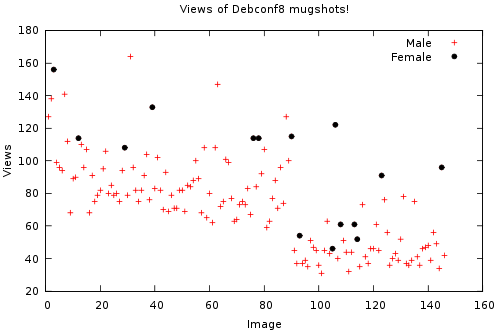
In a comment to my previous blog post, I linked to the DebConf photo gallery page with the DebConf8 mugshots. Felix Brandt, a friend of mine, noticed the per-picture view statistics there and plotted them, differentiating between male and female. He finds that the number of views on an image gives a fairly good indication of the sex (or gender?) of the person in question:
The most notable exception is the image of bubulle. He does not even look feminine. Maybe it s because he s like a mother to us Debianers, always kind and always helpful? :-) This observation fits my experience when I created a top-100-statistic of individual picture page views of my personal gallery: I got a collection of pretty much all pictures of girls in bikinis, lying at some beach, across the various pages and years, and hardly any other picture. I won t post these top-100 here, as I don t want to additionally increase the effect...

7 January 2010

Joachim Breitner: screen-message ported to Windows

Over the holidays I investigated how to cross-compile GTK applications for Windows, and managed to port screen-message. I also created an Inno Setup based installer for it that includes the necessary GTK DLLs. You can grab it from the screen-message homepage. The installer optionally binds screen-messages to the key combination Alt-Ctrl-S.
I would have published the binary much earlier if starting the application had not always given the error message
The application failed to initialize properly (0xc000007b). Click on OK to terminate the application.
on Windows, while it worked fine under WINE. It took me a while to find the cause, as there seems to be only one mention of it in the internet: One must not use MinGW s strip.exe utility on DLLs not created with MinGW, it seems. I added a make installer target to the Makefile to create the installer. If you are curious about how that works, have a look at the source.

25 December 2009

Joachim Breitner: Building arbtt for Windows

A friend of mine is interested in trying out the Automatic Rule Based Time-Tracker arbtt which I programmed. Unfortunately, he is using Windows and up to now, arbtt only worked on Linux. But as I wanted to check out Haskell s cross-platform abilities for a while, this was a good opportunity to do so. I don t have Windows installed myself (and did not plan to do so), so I did all this under WINE, the Windows compatibility layer, which works very well: It takes only a few minutes to install the Haskell Platform for Windows and then I was able to run wine ghc --make and cabal install. I played around with some simple programs and was surprised by these timings:
$ rm *.o *.hi; ghc --make fourfours.hs ; time ./fourfours > /dev/null
[1 of 1] Compiling Main             ( fourfours.hs, fourfours.o )
Linking fourfours ...
real	0m1.909s
user	0m1.692s
sys	0m0.208s
$ rm *.o *.hi; wine ghc --make fourfours.hs ; time wine ./fourfours.exe > /dev/null
[1 of 1] Compiling Main             ( fourfours.hs, fourfours.o )
Linking fourfours.exe ...
real	0m1.631s
user	0m1.376s
sys	0m0.092s
So it is faster to run a compiled Haskell program on top of a compatibility layer than directly on Linux! The world is in order again, though, if optimization is enabled:
$ rm *.o *.hi; ghc -O --make fourfours.hs ; time ./fourfours > /dev/null
[1 of 1] Compiling Main             ( fourfours.hs, fourfours.o )
Linking fourfours ...
real	0m0.981s
user	0m0.876s
sys	0m0.108s
$ rm *.o *.hi; wine ghc -O --make fourfours.hs ; time wine ./fourfours.exe > /dev/null
[1 of 1] Compiling Main             ( fourfours.hs, fourfours.o )
Linking fourfours.exe ...
real	0m1.270s
user	0m1.036s
sys	0m0.072s
Funny. Anyways, I wanted to port arbtt. The only platform-dependent part is the capture module that gathers the list of open Windows. The Win32 package that comes with the Haskell Platform did not cover all the functions needed to do so, but creating additional function bindings is really easy with Haskell, as can be seen in the Graphics.Win32.Window.Extra module. I also replaced the locking code that prevents two instances of arbtt-capture to run at the same time by equivalent code using Windows mutexes (module System.Win32.Mutex). With these small changes and some CPP conditionals to make the code compile for either platform, the porting was done! Even accessing the files in ~/.arbtt works correctly on Windows, where it will look in the Application Data folder, without changing the code, thanks to System.Directory.getAppUserDataDirectory. But Windows users won t like compiling software on their own. They won t even like installing software by copying various files to certain directories. Therefore, I also had to create a Windows Installer. I picked Inno Setup, because it s Free Software and seems to be simpler than NSIS. The installer puts the compiled .exe files, the example categorize.cfg and the HTML documentation in the right spot, adds icons to the Start Menu ( Edit categorize.cfg , which fires up wordpad, a link to the documentation and the uninstaller), puts arbtt-capture in the Autorun folder, puts the path to arbtt-stats in the PATH variable and starts arbtt-capture at the end (the last three points being optional). Of course it undoes all this when removing the program again. I integrated the call to the Inno Setup installer into the usual ./Setup build process of Haskell packages. Some more details of how to create the Windows installer are mentioned in the README file. Now all this does not magically add a graphical user interface to arbtt, so users will still have to work with arbtt-stats on the command line even on Windows. If this is not a problem for you then you can fetch the latest installer from the arbtt homepage. And if you happen to become a serious user of arbtt on Windows and want to help maintaining the Windows port, I ll gladly share some responsibilities. I m very satisfied with the process and the result and I m happy to know that I can offer some of my programs also to Windows users in the future.It is also a big plus for Haskell with Python, shipping a program for Windows users is likely more difficult. The next step will be providing gtk-based graphical Haskell applications for Windows, including a nice installer that ideally includes all dependencies (gtk etc.).

9 December 2009

Joachim Breitner: Packaged unicode-screensaver properly

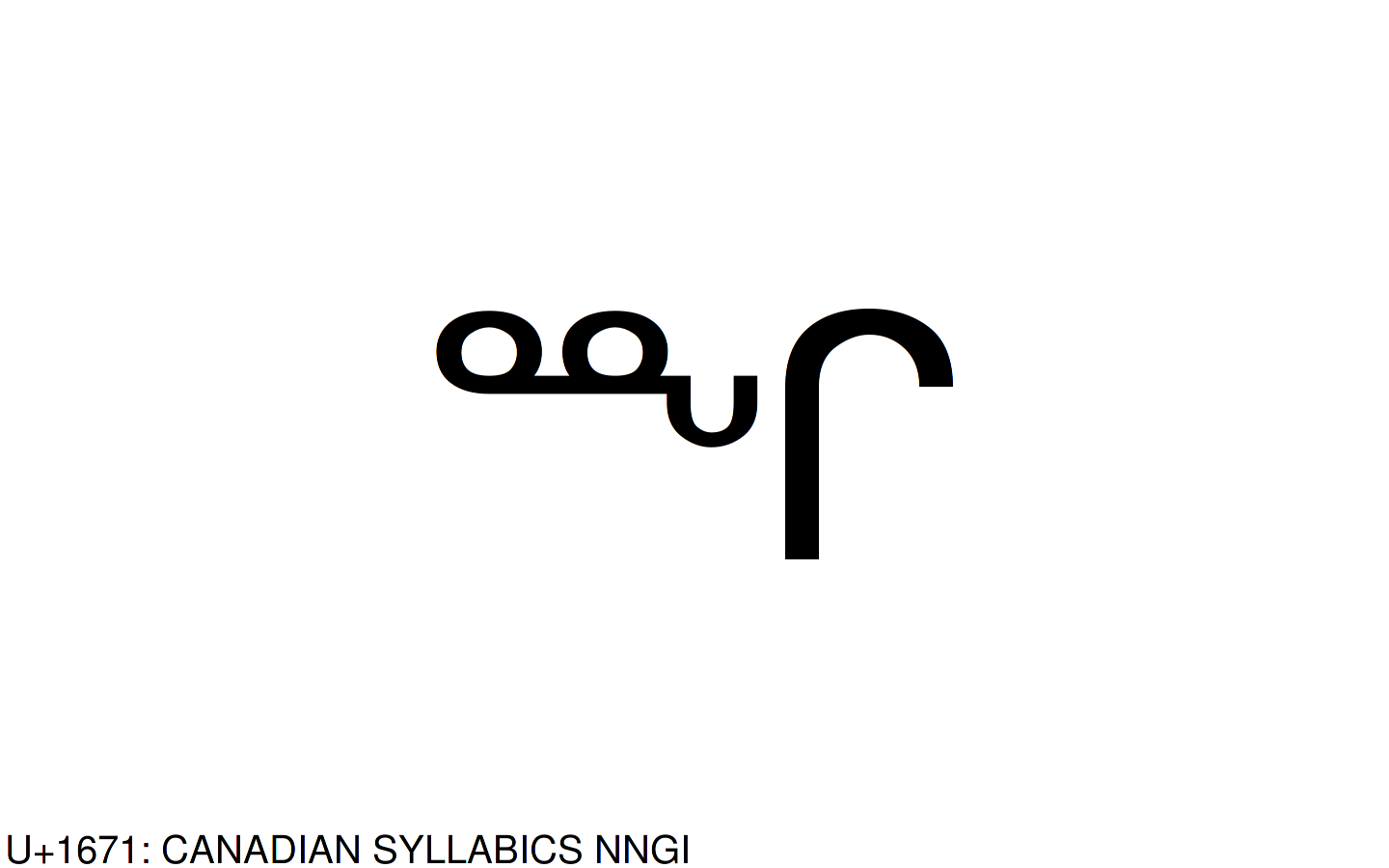
Three years ago, while I was in Ghana, I wrote a small screensaver that displays a randomly picked unicode character full-screen. I like it because there is a huge bunch of very weird characters and signs in the unicode standard. It also prints the unicode codepoint and character name.
Now I finally got around to properly package it: Created a small homepage, a source tarball with (hopefully) proper autotool files, all managed in a git repository (also on gitorious), complete with manpage, README and other additional files. I m also going to upload the package to Debian, so you can just do apt-get install unicode-screensaver as soon as it gets accepted.It can probably not enter the official xscreensaver distribution as it adds dependencies on the fontconfig and freetype libraries.

3 December 2009

Joachim Breitner: Second Post!

Yesterday, the German magazine freeX published its December issue. It includes an three-page article about vbox-sync, written by me, that is even mentioned on the cover page. After my article on the Cross-Site-Authentication attack that was published in the German Linux-Magazin and the international Linux Magazine in 2005, this is my second publication.Vbox-sync is a tool to distribute VirtualBox images via apt-get that Phil Kern and I wrote as part of our work for itomig.de, a German Free Software consulting company, and the LiMux project. I also held a talk about it at the Debian Conference in Extremadura, Spain, in 2009.

28 November 2009

Stefano Zacchiroli: Enforcing type-safe linking using package dependencies

Eclectic paper: dh-ocaml In my day job as a researcher, I mostly publish papers along the lines of my main research interests (theorem proving, web technologies, formal methods applied to software engineering, ...). Some time though, I just come up to some eclectic idea, not strictly related to my job, that I feel like cooking up as a paper to be reviewed by some scientific venue. It happened some weeks ago with dh-ocaml, the package implementing the new dependency scheme for OCaml-related packages in Debian. It took us (as in Debian OCaml maintainers) several years to get it right and satisfactory for maintainers, users, release team, etc. The problem which dh-ocaml addresses is that, differently than C and other system-level languages, OCaml breaks ABI compatibility very often, due to the need of ensuring type safety across different libraries at link time. Other similar strongly typed languages, such as Haskell, behave similarly. This is at odds with the implicit assumption of forward-compatibility (unless otherwise "stated", e.g. with soname changes) that is relied upon by versioned dependencies in distributions like Debian. This discussion, the analysis of possible solutions, and the description of the solution we have actually implemented in dh-ocaml (called ABI approximation) turned out to be interesting for the French functional programming academic community: the paper on dh-ocaml has been accepted at forthcoming JFLA 2010. It is no rocket science :-) , but people maintaining programs and libraries written in languages with concerns similar to OCaml's (e.g. Haskell, hello nomeata) might want to have a look.

27 November 2009

Joachim Breitner: screen-message now in an online version

Folllowing an idea by Kai Hendry, I re-implemented my Linux application screen-message, which does nothing but display a piece of text that you enter as large as possible, in HTML. So whenever you are in need of screen-message, but don t have it installed at the moment, put your browser into fullscreen mode, go to
http://sm.nomeata.de/
and type away.I only tested it with the web browser galeon, so I expect it to work with Firefox and related browsers. If it does not work with Internet Explorer, I can t help it but patches are welcome. The file is stored in the screen-message Darcs repository at http://darcs.nomeata.de/screen-message.upstream.PS: If anyone wants to donate a shorter domain for this, you are welcome. But I guess all good domains with sm in them are taken...

23 November 2009

Joachim Breitner: arbtt now in Debian

The Automatic Rule Based Time Tracker that I have created some weeks ago is now available in Debian unstable, so if if you were reluctant to use it because you did not want to figure out how to compile the Haskell code, you can just do apt-get install arbtt.Although it s such a young project, it already has a fork: Andreas Kl ckner was very impatient with a feature request (sensible merging of logs from different hosts), so we went ahead and re-implemented arbtt in python, named whatup. Although I prefer contributions to arbtt, it shows that the principle of arbtt is useful. And I won t be shy to copy nice ideas from him, as well :-)

20 November 2009

Joachim Breitner: Parody Song: College teacher

Although it does not reflect my experiences at the university, I wrote a song text about teachers that do not care about their students, to the melody of Private Dancer of Tina Turner. My list of parody songs now contains 22 entries!

15 November 2009

Joachim Breitner: Darcs Hacking Sprint: Mission Complete

The darcs hacking sprint is slowly nearing its end. As planned, I have worked on integrating DarcsWatch and bugs.darcs.net, and I am satisfied so far. From now on, if someone submits a Darcs patch to patches@darcs.net, the patch will also be tracked by DarcsWatch. DarcsWatch will display a link to the entry on bugs.darcs.net, and also add a comment to the bugtracker with a link to the patch on DarcsWatch. And eventually, if the patch is included in the darcs.net repository, DarcsWatch will change the state of the ticket to accepted, removing one step of work for the Darcs maintainers. Currently, it checks the state of the repository three times per hour, so expect a delay after you applied the patch to the repository before the state is updated.

14 November 2009

Joachim Breitner: Arrived at the Darcs hacking sprint

Today, my alarm clock was set to 4:30, as I was going to Vienna, to attend the Darcs hacking sprint. I ll be working on DarcsWatch, making it a bit more modular and hopefully integegrate it better into bug tracking systems (especially roundup, as that s used by the Darcs team). On Monday, I ll be a tourist until I leave in the evening. If any Debianers or Haskellers want to meet for keysigning or sightseeing, just drop me a mail!

12 November 2009

Joachim Breitner: Maxi-Max-Algorithm

Next.

Previous.