Search Results: "nion"

1 May 2023

Russ Allbery: Review: The Amazing Maurice and His Educated Rodents

Review: The Amazing Maurice and His Educated Rodents, by Terry Pratchett
Series: Discworld #28
Publisher: HarperCollins
Copyright: 2001
Printing: 2008
ISBN: 0-06-001235-8
Format: Mass market
Pages: 351
The Amazing Maurice and His Educated Rodents is the 28th Discworld novel and the first marketed for younger readers. Although it has enough references to establish it as taking place on Discworld, it has no obvious connections with the other books and doesn't rely on any knowledge of the series so far. This would not be a bad place to start with Terry Pratchett and see if his writing style and sense of humor is for you. Despite being marketed as young adult, and despite Pratchett's comments in an afterward in the edition I own that writing YA novels is much harder, I didn't think this was that different than a typical Discworld novel. The two main human characters read as about twelve and there were some minor changes in tone, but I'm not sure I would have immediately labeled it as YA if I hadn't already known it was supposed to be. There are considerably fewer obvious pop culture references than average, though; if that's related, I think I'll prefer Pratchett's YA novels, since I think his writing is stronger when he's not playing reference bingo. Maurice (note to US readers: Maurice is pronounced "Morris" in the UK) is a talking cat and the mastermind of a wandering con job. He, a stupid-looking kid with a flute (Maurice's description), and a tribe of talking rats travel the small towns of Discworld. The rats go in first, making a show of breaking into the food, swimming in the cream, and widdling on things that humans don't want widdled on. Once the townspeople are convinced they have a plague of rats, the kid with the flute enters the town and offers to pipe the rats away for a very reasonable fee. He plays his flute, the rats swarm out of town, and they take their money and move on to the next town. It's a successful life that suits Maurice and his growing hoard of gold very well. If only the rats would stop asking pointed questions about the ethics of this scheme. The town of Bad Blintz is the next on their itinerary, and if the rats have their way, will be the last. Their hope is they've gathered enough money by now to find an island, away from humans, where they can live their own lives. But, as is always the case for one last job in fiction, there's something uncannily wrong about Bad Blintz. There are traps everywhere, more brutal and dangerous ones than they've found in any other town, and yet there is no sign of native, unintelligent rats. Meanwhile, Maurice and the boy find a town that looks wealthy but has food shortages, a bounty on rats that is absurdly high, and a pair of sinister-looking rat-catchers who are bringing in collections of rat tails that look suspiciously like bootlaces. The mayor's daughter discovers Maurice can talk and immediately decides she has to take them in hand. Malicia is very certain of her own opinions, not accustomed to taking no for an answer, and is certain that the world follows the logic of stories, even if she has to help it along. This is truly great stuff. I think this might be my favorite Discworld novel to date, although I do have some criticisms that I'll get to in a moment. The best part are the rats, and particularly the blind philosopher rat Dangerous Beans and his assistant Peaches. In the middle of daring infiltration of the trapped sewers in scenes reminiscent of Mission: Impossible, the rats are also having philosophical arguments. They've become something different than the unaltered rats that they call the keekees, but what those differences mean is harder to understand. The older rats are not happy about too many changes and think the rats should keep acting like rats. The younger ones are discovering that they're afraid of shadows because now they understand what the shadows hint at. Dangerous Beans is trying to work out a writing system so that they can keep important thoughts. One of their few guides is a children's book of talking animals, although they quickly discover that the portrayed clothing is annoyingly impractical. But as good as the rats are, Maurice is nearly as much fun in an entirely different way. He is unapologetically out for himself, streetwise and canny in a way that feels apt for a cat, gets bored and mentally wanders off in the middle of conversations, and pretends to agree with people when that's how he can get what he wants. But he also has a weird sense of loyalty and ethics that only shows up when something is truly important. It's a variation on the con man with a heart of gold, but it's a very well-done variation that weaves in a cat's impatience with and inattention to anything that doesn't directly concern them. I was laughing throughout the book. Malicia is an absolute delight, the sort of character who takes over scenes through sheer force of will, and the dumb-looking kid (whose name turns out to be Keith) is a perfect counterbalance: a laid-back, quiet boy who just wants to play his music and is almost entirely unflappable. It's such a great cast. The best part of the plot is the end. I won't spoil it, so I'll only say that Pratchett has the characters do the work on the aftermath that a lot of books skip over. He doesn't have any magical solutions for the world's problems, but he's so very good at restoring one's faith that maybe sometimes those solutions can be constructed. My one complaint with this book is that Pratchett introduces a second villain, and while there are good in-story justifications for it and it's entangled with the primary plot, he added elements of (mild) supernatural horror and evil that I thought were extraneous and unnecessary. He already had enough of a conflict set up without adding that additional element, and I think it undermined the moral complexity of the story. I would have much rather he kept the social dynamics of the town at the core of the story and used that to trigger the moments of sacrifice and philosophy that made the climax work. The Discworld books by this point have gotten very good, but each book seems to have one element like that where it felt like Pratchett took the easy way out of a plot corner or added some story element that didn't really work. I feel like the series is on the verge of having a truly great book that rises above the entire series to date, but never quite gets there. That caveat aside, I thoroughly enjoyed this and had trouble putting it down. Mrs. Frisby and the Rats of Nimh was one of my favorite books as a kid, and this reminded me of it in some good ways (enough so that I think some of the references were intentional). Great stuff. If you were to read only one Discworld book and didn't want to be confused by all the entangled plot threads and established characters, I would seriously consider making it this one. Recommended. Followed by Night Watch in publication order. There doesn't appear to be a direct plot sequel, more's the pity. Rating: 8 out of 10

29 April 2023

Russell Coker: Write a blog post in the style of Russell Coker

Feeling a bit bored I asked ChatGPT Write a blog post in the style of Russell Coker and the result is in the section below. I don t know if ChatGPT knows that the person asking the question is the same as the person being asked about. If a human had created that I d be certain that great computer scientist and writer was an attempt at flattery, for a machine I m not sure. I have not written a single book, but I expect that in some alternate universe some version of me has written several. I don t know if humans would describe my writing as being known for clarity, precision, and depth . I would not be surprised if no-one else wrote about it so I guess I m forced to read what he wrote would be a more common response. The actual article part doesn t seem to be in my style at all. Firstly it s very short at only 312 words, while I have written some short posts most of them are much longer. To find this out I did some MySQL queries to get the lengths of posts (I used this blog post as inspiration [1]). Note that multiple sequential spaces counts as multiple words.
# get post ID and word count
SELECT id, LENGTH(post_content) - LENGTH(REPLACE(REPLACE(REPLACE(REPLACE(post_content, "\r", ""), "\n", ""), "\t", ""), " ", "")) + 1 AS wordcount FROM wp_posts where post_status = 'publish' and post_type='post';
# get average word count
SELECT avg(LENGTH(post_content) - LENGTH(REPLACE(REPLACE(REPLACE(REPLACE(post_content, "\r", ""), "\n", ""), "\t", ""), " ", "")) + 1) FROM wp_posts where post_status = 'publish' and post_type='post';
# get the first posts by length
SELECT id, LENGTH(post_content) - LENGTH(REPLACE(REPLACE(REPLACE(REPLACE(post_content, "\r", ""), "\n", ""), "\t", ""), " ", "")) + 1 AS wordcount, post_content FROM wp_posts where post_status = 'publish' and post_type='post' ORDER BY wordcount limit 10;
# get a count of the posts less than 312 words
SELECT count(*) from wp_posts where (LENGTH(post_content) - LENGTH(REPLACE(REPLACE(REPLACE(REPLACE(post_content, "\r", ""), "\n", ""), "\t", ""), " ", "")) + 1) < 312 and post_status = 'publish' and post_type='post';
# get a count of all posts
select count(*) from wp_posts where post_status = 'publish' and post_type='post';
It turns out that there are 333/1521 posts that are less than 312 words and the average length is 665 words. Of the shortest posts a large portion were written before Twitter became popular and had the sort of unimportant content that Twitter is good for. It seems ironic that ChatGPT says that I'm known for "depth" and then writes a short post allegedly in my style. As for the actual content of the "post", it's not something that I greatly disagree with but it's definitely not something I'd write. If some manager or marketing person wrote something like this and asked my opinion I'd probably suppress a sigh and say it's OK for it's target market. I think that free software is better in many ways and for many reasons and that separately from the issue of merit free software is important because of the ways that it is used. We could debate various issues related to the quality of free software vs proprietary software but even people who don't believe that free software is of high quality have to admit that software that runs most mobile phones and most web servers is important. As much as I dislike Windows most desktop PCs and laptops run it so I can't claim it to be unimportant. So my first disagreement with the content is the issue of importance vs quality. One thing that ChatGPT is known for is weak arguments that appear convincing. "This diversity often leads to better software, as bugs are found and fixed faster, and new features are added more quickly" could be opposed by "the payment for proprietary software often leads to better software, as bugs are found and fixed faster, and new features are added more quickly". I think that any case where "feature of option A gives this list of good results" can be rewritten as "feature of the opposite of option A gives the same list of good results" and be equally convincing is a poor argument. Also any argument that seems to rest on "free software is all written by hobbyists" is ignoring the demands of users who need things done on a non-hobby timeframe, the many profitable companies that develop and support free software, and the employment status of a large portion of my Facebook friends (many of whom are paid for ~2000 hours a year of free software development and many more of whom have paid free software development as part of their work supporting the use of free software). Really the entire blog post it wrote seems to me like something a human might write if their boss assigned them to write about the benefits of free software, and that they would then write a new article saying the exact opposite if their boss asked them to. Finally I prefer the term "free software" to "open source software". The difference doesn't seem important to some people, but any being that doesn't know the difference won't do well at impersonating me. ChatGPT Result Hello everyone, I'm ChatGPT, and today I'm going to try my best to write a blog post in the style of the great computer scientist and writer, Russell Coker. Russell Coker is a renowned software engineer and writer, who is best known for his contributions to the Linux community, especially the Debian project. He has authored several books and articles on topics ranging from security to software engineering, and his writing style is known for its clarity, precision, and depth. So, without further ado, let's dive into the topic of this blog post, which is the importance of open-source software. Open-source software is software whose source code is available for anyone to inspect, modify, and distribute. This means that anyone can use, study, and improve the software, without any restrictions or fees. Open-source software has been around for a long time, but it has become more prevalent and important in recent years, thanks to the rise of the internet and the digital economy. Open-source software has several benefits, both for individuals and for society as a whole. One of the most significant benefits is that it fosters innovation and collaboration. When software is open-source, it means that anyone can contribute to it, which leads to a diverse range of perspectives and ideas. This diversity often leads to better software, as bugs are found and fixed faster, and new features are added more quickly. Another benefit of open-source software is that it is often more secure than proprietary software. Because the source code is available for anyone to inspect, vulnerabilities and security flaws can be found and fixed faster. This means that open-source software is often more reliable and trustworthy than proprietary software, which may have hidden backdoors or vulnerabilities that can be exploited by attackers. Open-source software is also often more cost-effective than proprietary software. Because it is free to use and distribute, organizations can save money on licensing fees and other costs associated with proprietary software. This can be particularly important for non-profit organizations or small businesses that may not have the resources to invest in expensive software licenses. In conclusion, open-source software is an important part of the digital landscape, and its benefits are numerous. Whether you are a software developer, a business owner, or an individual user, open-source software has something to offer. So, the next time you are looking for software to use, consider open-source options, and help support the collaborative and innovative spirit of the open-source community.

28 April 2023

Shirish Agarwal: John Grisham s books, Evolution removed from textbooks

Gray Mountain John Grisham I have been perusing John Grisham s books, some read and some re-read again. Almost all of the books that Mr. Grisham wrote are relevant even today. The Gray Mountain talks about how mountain top removal was done in Applachia, the U.S. (South). In fact NASA made a summary which either was borrowed from this book or the author borrowed from NASA, either could be true although seems it might be the former. And this is when GOI just made a new Forest Conservation Bill 2023 which does the opposite. There are many examples of the same, the latest from my own city as an e.g. Vetal Tekdi is and was a haven for people animals, birds all kinds of ecosystem and is a vital lung of the city, one of the few remaining green spaces in the city but BJP wants to commercialize it as it has been doing for everything, I haven t been to the Himalayas since 4-5 years back as I hear the rape of the land daily. Even after Joshimath tragedy, if people are not opening the eyes what can I do  The more I say, the more depressed I will become so will leave it for now. In many ways the destruction seems similar to the destruction that happened in Brazil under Jair Bolsonaro. So as can be seen from what I have shared this book was mostly about environment and punitive damages and also how punitive damages have been ceiling in America (South). This was done via lobbying by the coal groups and apparently destroyed people s lives, communities, even whole villages. It also shared how most people called black lung and how those claims had been denied by Coal Companies all the time. And there are hardly any unions. While the book itself is a fiction piece, there is a large amount of truth in it. And that is one of the reasons people write a fiction book. You could write about reality using fictional names and nobody can sue you while you set the reality as it is. In many ways, it is a tell-all.

The Testament John Grisham One of the things I have loved about John Grisham is he understands human condition. In this book it starts with an eccentric billionaire who makes a will which leaves all his property to an illegitimate child who coincidentally also lives in Brazil, she is a missionary. The whole book is about human failings as well as about finding the heir. I am not going to give much detail as the book itself is fun.

The Appeal John Grisham In this, we are introduced to a company that does a chemical spill for decades and how that leads to lobbying and funding Judicial elections. It does go into quite a bit of length how private money coming from Big business does all kind of shady things to get their person elected to the Supreme Court. Sadly, this seems to happen all the time, for e.g. two weeks ago. This piece from the Atlantic also says the same. Again, won t tell as there is a bit of irony at the end of the book.

The Rainmaker John Grisham This in short is about how Insurance Companies stiff people. It s a wonderful story that has all people in grey including our hero. An engaging book that sorta tells how the Insurance Industry plays the game. In India, the companies are safe as they ask for continuance for years together and their object is to delay the hearings till the grandchildren are not alive unlike in the U.S. or UK. It also does tell how more lawyers are there then required. Both of which are the same in my country.

The Litigators John Grisham This one is about Product Liability, both medicines as well as toys for young kids. What I do find funny a bit is how the law in States allows people to file cases but doesn t protect people while in EU they try their best that if there is any controversy behind any medicine or product, they will simply ban it. Huge difference between the two cultures.

Evolution no longer part of Indian Education A few days ago, NCERT (one of the major bodies) that looks into Indian Education due to BJP influence has removed Darwin s Theory of Evolution. You can t even debate because the people do not understand adaptability. So the only conclusion is that Man suddenly appeared out of nowhere. If that is so, then we are the true aliens. They discard the notion that we and Chimpanzees are similar. Then they also have to discard this finding that genetically we are 96% similar.

27 April 2023

Arturo Borrero Gonz lez: Kubecon and CloudNativeCon 2023 Europe summary

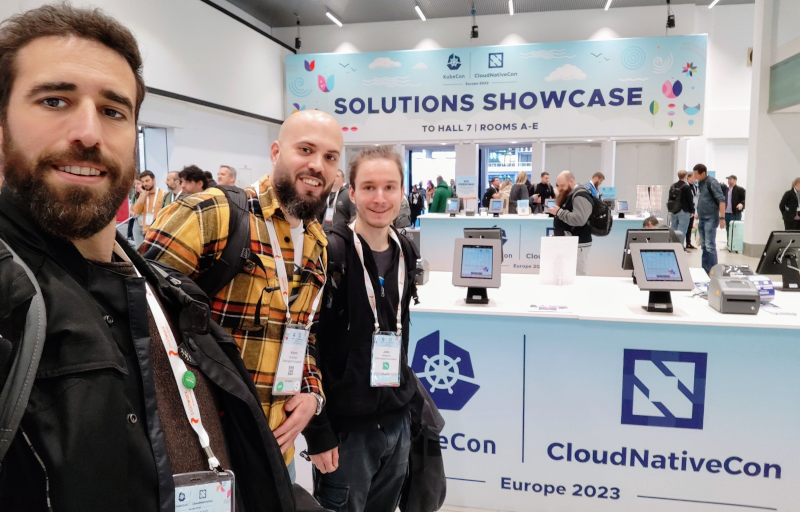
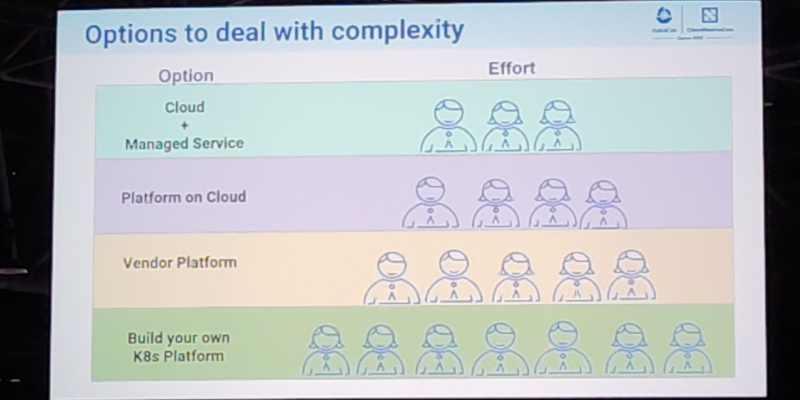
Post logo This post serves as a report from my attendance to Kubecon and CloudNativeCon 2023 Europe that took place in Amsterdam in April 2023. It was my second time physically attending this conference, the first one was in Austin, Texas (USA) in 2017. I also attended once in a virtual fashion. The content here is mostly generated for the sake of my own recollection and learnings, and is written from the notes I took during the event. The very first session was the opening keynote, which reunited the whole crowd to bootstrap the event and share the excitement about the days ahead. Some astonishing numbers were announced: there were more than 10.000 people attending, and apparently it could confidently be said that it was the largest open source technology conference taking place in Europe in recent times. It was also communicated that the next couple iteration of the event will be run in China in September 2023 and Paris in March 2024. More numbers, the CNCF was hosting about 159 projects, involving 1300 maintainers and about 200.000 contributors. The cloud-native community is ever-increasing, and there seems to be a strong trend in the industry for cloud-native technology adoption and all-things related to PaaS and IaaS. The event program had different tracks, and in each one there was an interesting mix of low-level and higher level talks for a variety of audience. On many occasions I found that reading the talk title alone was not enough to know in advance if a talk was a 101 kind of thing or for experienced engineers. But unlike in previous editions, I didn t have the feeling that the purpose of the conference was to try selling me anything. Obviously, speakers would make sure to mention, or highlight in a subtle way, the involvement of a given company in a given solution or piece of the ecosystem. But it was non-invasive and fair enough for me. On a different note, I found the breakout rooms to be often small. I think there were only a couple of rooms that could accommodate more than 500 people, which is a fairly small allowance for 10k attendees. I realized with frustration that the more interesting talks were immediately fully booked, with people waiting in line some 45 minutes before the session time. Because of this, I missed a few important sessions that I ll hopefully watch online later. Finally, on a more technical side, I ve learned many things, that instead of grouping by session I ll group by topic, given how some subjects were mentioned in several talks. On gitops and CI/CD pipelines Most of the mentions went to FluxCD and ArgoCD. At that point there were no doubts that gitops was a mature approach and both flux and argoCD could do an excellent job. ArgoCD seemed a bit more over-engineered to be a more general purpose CD pipeline, and flux felt a bit more tailored for simpler gitops setups. I discovered that both have nice web user interfaces that I wasn t previously familiar with. However, in two different talks I got the impression that the initial setup of them was simple, but migrating your current workflow to gitops could result in a bumpy ride. This is, the challenge is not deploying flux/argo itself, but moving everything into a state that both humans and flux/argo can understand. I also saw some curious mentions to the config drifts that can happen in some cases, even if the goal of gitops is precisely for that to never happen. Such mentions were usually accompanied by some hints on how to operate the situation by hand. Worth mentioning, I missed any practical information about one of the key pieces to this whole gitops story: building container images. Most of the showcased scenarios were using pre-built container images, so in that sense they were simple. Building and pushing to an image registry is one of the two key points we would need to solve in Toolforge Kubernetes if adopting gitops. In general, even if gitops were already in our radar for Toolforge Kubernetes, I think it climbed a few steps in my priority list after the conference. Another learning was this site: https://opengitops.dev/. Group On etcd, performance and resource management I attended a talk focused on etcd performance tuning that was very encouraging. They were basically talking about the exact same problems we have had in Toolforge Kubernetes, like api-server and etcd failure modes, and how sensitive etcd is to disk latency, IO pressure and network throughput. Even though Toolforge Kubernetes scale is small compared to other Kubernetes deployments out there, I found it very interesting to see other s approaches to the same set of challenges. I learned how most Kubernetes components and apps can overload the api-server. Because even the api-server talks to itself. Simple things like kubectl may have a completely different impact on the API depending on usage, for example when listing the whole list of objects (very expensive) vs a single object. The conclusion was to try avoiding hitting the api-server with LIST calls, and use ResourceVersion which avoids full-dumps from etcd (which, by the way, is the default when using bare kubectl get calls). I already knew some of this, and for example the jobs-framework-emailer was already making use of this ResourceVersion functionality. There have been a lot of improvements in the performance side of Kubernetes in recent times, or more specifically, in how resources are managed and used by the system. I saw a review of resource management from the perspective of the container runtime and kubelet, and plans to support fancy things like topology-aware scheduling decisions and dynamic resource claims (changing the pod resource claims without re-defining/re-starting the pods). On cluster management, bootstrapping and multi-tenancy I attended a couple of talks that mentioned kubeadm, and one in particular was from the maintainers themselves. This was of interest to me because as of today we use it for Toolforge. They shared all the latest developments and improvements, and the plans and roadmap for the future, with a special mention to something they called kubeadm operator , apparently capable of auto-upgrading the cluster, auto-renewing certificates and such. I also saw a comparison between the different cluster bootstrappers, which to me confirmed that kubeadm was the best, from the point of view of being a well established and well-known workflow, plus having a very active contributor base. The kubeadm developers invited the audience to submit feature requests, so I did. The different talks confirmed that the basic unit for multi-tenancy in kubernetes is the namespace. Any serious multi-tenant usage should leverage this. There were some ongoing conversations, in official sessions and in the hallway, about the right tool to implement K8s-whitin-K8s, and vcluster was mentioned enough times for me to be convinced it was the right candidate. This was despite of my impression that multiclusters / multicloud are regarded as hard topics in the general community. I definitely would like to play with it sometime down the road. On networking I attended a couple of basic sessions that served really well to understand how Kubernetes instrumented the network to achieve its goal. The conference program had sessions to cover topics ranging from network debugging recommendations, CNI implementations, to IPv6 support. Also, one of the keynote sessions had a reference to how kube-proxy is not able to perform NAT for SIP connections, which is interesting because I believe Netfilter Conntrack could do it if properly configured. One of the conclusions on the CNI front was that Calico has a massive community adoption (in Netfilter mode), which is reassuring, especially considering it is the one we use for Toolforge Kubernetes. Slide On jobs I attended a couple of talks that were related to HPC/grid-like usages of Kubernetes. I was truly impressed by some folks out there who were using Kubernetes Jobs on massive scales, such as to train machine learning models and other fancy AI projects. It is acknowledged in the community that the early implementation of things like Jobs and CronJobs had some limitations that are now gone, or at least greatly improved. Some new functionalities have been added as well. Indexed Jobs, for example, enables each Job to have a number (index) and process a chunk of a larger batch of data based on that index. It would allow for full grid-like features like sequential (or again, indexed) processing, coordination between Job and more graceful Job restarts. My first reaction was: Is that something we would like to enable in Toolforge Jobs Framework? On policy and security A surprisingly good amount of sessions covered interesting topics related to policy and security. It was nice to learn two realities:
  1. kubernetes is capable of doing pretty much anything security-wise and create greatly secured environments.
  2. it does not by default. The defaults are not security-strict on purpose.
It kind of made sense to me: Kubernetes was used for a wide range of use cases, and developers didn t know beforehand to which particular setup they should accommodate the default security levels. One session in particular covered the most basic security features that should be enabled for any Kubernetes system that would get exposed to random end users. In my opinion, the Toolforge Kubernetes setup was already doing a good job in that regard. To my joy, some sessions referred to the Pod Security Admission mechanism, which is one of the key security features we re about to adopt (when migrating away from Pod Security Policy). I also learned a bit more about Secret resources, their current implementation and how to leverage a combo of CSI and RBAC for a more secure usage of external secrets. Finally, one of the major takeaways from the conference was learning about kyverno and kubeaudit. I was previously aware of the OPA Gatekeeper. From the several demos I saw, it was to me that kyverno should help us make Toolforge Kubernetes more sustainable by replacing all of our custom admission controllers with it. I already opened a ticket to track this idea, which I ll be proposing to my team soon. Final notes In general, I believe I learned many things, and perhaps even more importantly I re-learned some stuff I had forgotten because of lack of daily exposure. I m really happy that the cloud native way of thinking was reinforced in me, which I still need because most of my muscle memory to approach systems architecture and engineering is from the old pre-cloud days. List of sessions I attended on the first day: List of sessions I attended on the second day: List of sessions I attended on third day: The videos have been published on Youtube.

14 April 2023

Russ Allbery: Review: Babel

Review: Babel, by R.F. Kuang
Publisher: Harper Voyage
Copyright: August 2022
ISBN: 0-06-302144-7
Format: Kindle
Pages: 544
Babel, or the Necessity of Violence: An Arcane History of the Oxford Translators' Revolution, to give it its full title, is a standalone dark academia fantasy set in the 1830s and 1840s, primarily in Oxford, England. The first book of R.F. Kuang's previous trilogy, The Poppy War, was nominated for multiple awards and won the Compton Crook Award for best first novel. Babel is her fourth book. Robin Swift, although that was not his name at the time, was born and raised in Canton and educated by an inexplicable English tutor his family could not have afforded. After his entire family dies of cholera, he is plucked from China by a British professor and offered a life in England as his ward. What follows is a paradise of books, a hell of relentless and demanding instruction, and an unpredictably abusive emotional environment, all aiming him towards admission to Oxford University. Robin will join University College and the Royal Institute of Translation. The politics of this imperial Britain are almost precisely the same as in our history, but one of the engines is profoundly different. This world has magic. If words from two different languages are engraved on a metal bar (silver is best), the meaning and nuance lost in translation becomes magical power. With a careful choice of translation pairs, and sometimes additional help from other related words and techniques, the silver bar becomes a persistent spell. Britain's industrial revolution is in overdrive thanks to the country's vast stores of silver and the applied translation prowess of Babel. This means Babel is also the only part of very racist Oxford that accepts non-white students and women. They need translators (barely) more than they care about maintaining social hierarchy; translation pairs only work when the translator is fluent in both languages. The magic is also stronger when meanings are more distinct, which is creating serious worries about classical and European languages. Those are still the bulk of Babel's work, but increased trade and communication within Europe is eroding the meaning distinctions and thus the amount of magical power. More remote languages, such as Chinese and Urdu, are full of untapped promise that Britain's colonial empire wants to capture. Professor Lowell, Robin's dubious benefactor, is a specialist in Chinese languages; Robin is a potential tool for his plans. As Robin discovers shortly after arriving in Oxford, he is not the first of Lowell's tools. His predecessor turned against Babel and is trying to break its chokehold on translation magic. He wants Robin to help. This is one of those books that is hard to review because it does some things exceptionally well and other things that did not work for me. It's not obvious if the latter are flaws in the book or a mismatch between book and reader (or, frankly, flaws in the reader). I'll try to explain as best I can so that you can draw your own conclusions. First, this is one of the all-time great magical system hooks. The way words are tapped for power is fully fleshed out and exceptionally well-done. Kuang is a professional translator, which shows in the attention to detail on translation pairs. I think this is the best-constructed and explained word-based magic system I've read in fantasy. Many word-based systems treat magic as its own separate language that is weirdly universal. Here, Kuang does the exact opposite, and the result is immensely satisfying. A fantasy reader may expect exploration of this magic system to be the primary point of the book, however, and this is not the case. It is an important part of the book, and its implications are essential to the plot resolution, but this is not the type of fantasy novel where the plot is driven by character exploration of the magic system. The magic system exists, the characters use it, and we do get some crunchy details, but the heart of the book is elsewhere. If you were expecting the typical relationship of a fantasy novel to its magic system, you may get a bit wrong-footed. Similarly, this is historical fantasy, but it is the type of historical fantasy where the existence of magic causes no significant differences. For some people, this is a pet peeve; personally, I don't mind that choice in the abstract, but some of the specifics bugged me. The villains of this book assert that any country could have done what Britain did in developing translation magic, and thus their hoarding of it is not immoral. They are obviously partly lying (this is a classic justification for imperialism), but it's not clear from the book how they are lying. Technologies (and magic here works like a technology) tend to concentrate power when they require significant capital investment, and tend to dilute power when they are portable and easy to teach. Translation magic feels like the latter, but its effect in the book is clearly the former, and I was never sure why. England is not an obvious choice to be a translation superpower. Yes, it's a colonial empire, but India, southeast Asia, and most certainly Africa (the continent largely not appearing in this book) are home to considerably more languages from more wildly disparate families than western Europe. Translation is not a peculiarly European idea, and this magic system does not seem hard to stumble across. It's not clear why England, and Oxford in particular, is so dramatically far ahead. There is some sign that Babel is keeping the mechanics of translation magic secret, but that secret has leaked, seems easy to develop independently, and is simple enough that a new student can perform basic magic with a few hours of instruction. This does not feel like the kind of power that would be easy to concentrate, let alone to the extreme extent required by the last quarter of this book. The demand for silver as a base material for translation magic provides a justification for mercantilism that avoids the confusing complexities of currency economics in our actual history, so fine, I guess, but it was a bit disappointing for this great of an idea for a magic system to have this small of an impact on politics. I'll come to the actual thrust of this book in a moment, but first something else Babel does exceptionally well: dark academia. The remainder of Robin's cohort at Oxford is Remy, a dark-skinned Muslim from Calcutta; Victoire, a Haitian woman raised in France; and Letty, the daughter of a British admiral. All of them are non-white except Letty, and Letty and Victoire additionally have to deal with the blatant sexism of the time. (For example, they have to live several miles from Oxford because women living near the college would be a "distraction.") The interpersonal dynamics between the four are exceptionally well done. Kuang captures the dislocation of going away to college, the unsettled life upheaval that makes it both easy and vital to form suddenly tight friendships, and the way that the immense pressure from classes and exams leaves one so devoid of spare emotional capacity that those friendships become both unbreakable and badly strained. Robin and Remy almost immediately become inseparable in that type of college friendship in which profound trust and constant companionship happen first and learning about the other person happens afterwards. It's tricky to talk about this without spoilers, but one of the things Kuang sets up with this friend group is a pointed look at intersectionality. Babel has gotten a lot of positive review buzz, and I think this is one of the reasons why. Kuang does not pass over or make excuses for characters in a place where many other books do. This mostly worked for me, but with a substantial caveat that I think you may want to be aware of before you dive into this book. Babel is set in the 1830s, but it is very much about the politics of 2022. That does not necessarily mean that the politics are off for the 1830s; I haven't done the research to know, and it's possible I'm seeing the Tiffany problem (Jo Walton's observation that Tiffany is a historical 12th century women's name, but an author can't use it as a medieval name because readers think it sounds too modern). But I found it hard to shake the feeling that the characters make sense of their world using modern analytical frameworks of imperialism, racism, sexism, and intersectional feminism, although without using modern terminology, and characters from the 1830s would react somewhat differently. This is a valid authorial choice; all books are written for the readers of the time when they're published. But as with magical systems that don't change history, it's a pet peeve for some readers. If that's you, be aware that's the feel I got from it. The true center of this book is not the magic system or the history. It's advertised directly in the title the necessity of violence although it's not until well into the book before the reader knows what that means. This is a book about revolution, what revolution means, what decisions you have to make along the way, how the personal affects the political, and the inadequacy of reform politics. It is hard, uncomfortable, and not gentle on its characters. The last quarter of this book was exceptional, and I understand why it's getting so much attention. Kuang directly confronts the desire for someone else to do the necessary work, the hope that surely the people with power will see reason, and the feeling of despair when there are no good plans and every reason to wait and do nothing when atrocities are about to happen. If you are familiar with radical politics, these aren't new questions, but this is not the sort of thing that normally shows up in fantasy. It does not surprise me that Babel struck a nerve with readers a generation or two younger than me. It captures that heady feeling on the cusp of adulthood when everything is in flux and one is assembling an independent politics for the first time. Once I neared the end of the book, I could not put it down. The ending is brutal, but I think it was the right ending for this book. There are two things, though, that I did not like about the political arc. The first is that Victoire is a much more interesting character than Robin, but is sidelined for most of the book. The difference of perspectives between her and Robin is the heart of what makes the end of this book so good, and I wish that had started 300 pages earlier. Or, even better, I wish Victoire has been the protagonist; I liked Robin, but he's a very predictable character for most of the book. Victoire is not; even the conflicts she had earlier in the book, when she didn't get much attention in the story, felt more dynamic and more thoughtful than Robin's mix of guilt and anxiety. The second is that I wish Kuang had shown more of Robin's intellectual evolution. All of the pieces of why he makes the decisions that he does are present in this book, and Kuang shows his emotional state (sometimes in agonizing detail) at each step, but the sense-making, the development of theory and ideology beneath the actions, is hinted at but not shown. This is a stylistic choice with no one right answer, but it felt odd because so much of the rest of the plot is obvious and telegraphed. If the reader shares Robin's perspective, I think it's easy to fill in the gaps, but it felt odd to read Robin giving clearly thought-out political analyses at the end of the book without seeing the hashing-out and argument with friends required to develop those analyses. I felt like I had to do a lot of heavy lifting as the reader, work that I wish had been done directly by the book. My final note about this book is that I found much of it extremely predictable. I think that's part of why reviewers describe it as accessible and easy to read; accessibility and predictability can be two sides of the same coin. Kuang did not intend for this book to be subtle, and I think that's part of the appeal. But very few of Robin's actions for the first three-quarters of the book surprised me, and that's not always the reading experience I want. The end of the book is different, and I therefore found it much more gripping, but it takes a while to get there. Babel is, for better or worse, the type of fantasy where the politics, economics, and magic system exist primarily to justify the plot the author wanted. I don't think the societal position of the Institute of Translation that makes the ending possible is that believable given the nature of the technology in question and the politics of the time, and if you are inclined to dig into the specifics of the world-building, I think you will find it frustrating. Where it succeeds brilliantly is in capturing the social dynamics of hothouse academic cohorts, and in making a sharp and unfortunately timely argument about the role of violence in political change, in a way that the traditionally conservative setting of fantasy rarely does. I can't say Babel blew me away, but I can see why others liked it so much. If I had to guess, I'd say that the closer one is in age to the characters in the book and to that moment of political identity construction, the more it's likely to appeal. Rating: 7 out of 10

11 April 2023

Russ Allbery: Review: Circe

Review: Circe, by Madeline Miller
Publisher: Little, Brown and Company
Copyright: April 2018
Printing: 2020
ISBN: 0-316-55633-5
Format: Kindle
Pages: 421
Circe is the story of the goddess Circe, best known as a minor character in Homer's Odyssey. Circe was Miller's third book if you count the short novella Galatea. She wrote it after Song of Achilles, a reworking of part of the Iliad, but as with Homer, you do not need to read Song of Achilles first. You will occasionally see Circe marketed or reviewed as a retelling of the Odyssey, but it isn't in any meaningful sense. Odysseus doesn't make an appearance until nearly halfway through the book, and the material directly inspired by the Odyssey is only about a quarter of the book. There is nearly as much here from the Telegony, a lost ancient Greek epic poem that we know about only from summaries by later writers and which picks up after the end of the Odyssey. What this is, instead, is Circe's story, starting with her childhood in the halls of Helios, the Titan sun god and her father. She does not have a happy childhood; her voice is considered weak by the gods (Homer describes her as having "human speech"), and her mother and elder siblings are vicious and cruel. Her father is high in the councils of the Titans, who have been overthrown by Zeus and the other Olympians. She is in awe of him and sits at his feet to observe his rule, but he's a petty tyrant who cares very little about her. Her only true companion is her brother Ae tes. The key event of the early book comes when Prometheus is temporarily chained in Helios's halls after stealing fire from the gods and before Zeus passes judgment on him. A young Circe brings him something to drink and has a brief conversation with him. That's the spark for one of the main themes of this book: Circe slowly developing a conscience and empathy, neither of which are common among Miller's gods. But it's still a long road from there to her first meeting with Odysseus. One of the best things about this book is the way that Miller unravels the individual stories of Greek myth and weaves them into a chronological narrative of Circe's life. Greek mythology is mostly individual stories, often contradictory and with only a loose chronology, but Miller pulls together all the ones that touch on Circe's family and turns them into a coherent history. This is not easy to do, and she makes it feel effortless. We get a bit of Jason and Medea (Jason is as dumb as a sack of rocks, and Circe can tell there's already something not right with Medea), the beginnings of the story of Theseus and Ariadne, and Daedalus (one of my favorite characters in the book) with his son Icarus, in addition to the stories more directly associated with Circe (a respinning of Glaucus and Scylla from Ovid's Metamorphoses that makes Circe more central). By the time Odysseus arrives on Circe's island, this world feels rich and full of history, and Circe has had a long and traumatic history that has left her suspicious and hardened. If you know some Greek mythology already, seeing it deftly woven into this new shape is a delight, but Circe may be even better if this is your first introduction to some of these stories. There are pieces missing, since Circe only knows the parts she's present for or that someone can tell her about later, but what's here is vivid, easy to follow, and recast in a narrative structure that's more familiar to modern readers. Miller captures the larger-than-life feel of myth while giving the characters an interiority and comprehensible emotional heft that often gets summarized out of myth retellings or lost in translation from ancient plays and epics, and she does it without ever calling the reader's attention to the mechanics. The prose, similarly, is straightforward and clear, getting out of the way of the story but still providing a sense of place and description where it's needed. This book feels honed, edited and streamlined until it maintains an irresistible pace. There was only one place where I felt like the story dragged (the raising of Telegonus), and then mostly because it's full of anger and anxiety and frustration and loss of control, which is precisely what Miller was trying to achieve. The rest of the book pulls the reader relentlessly forward while still delivering moments of beauty or sharp observation.
My house was crowded with some four dozen men, and for the first time in my life, I found myself steeped in mortal flesh. Those frail bodies of theirs took relentless attention, food and drink, sleep and rest, the cleaning of limbs and fluxes. Such patience mortals must have, I thought, to drag themselves through it hour after hour.
I did not enjoy reading about Telegonus's childhood (it was too stressful; I don't like reading about characters fighting in that way), but apart from that, the last half of this book is simply beautiful. By the time Odysseus arrives, we're thoroughly in Circe's head and agree with all of the reasons why he might receive a chilly reception. Odysseus talks the readers around at the same time that he talks Circe around. It's one of the better examples of writing intelligent, observant, and thoughtful characters that I have read recently. I also liked that Odysseus has real flaws, and those flaws do not go away even when the reader warms to him. I'll avoid saying too much about the very end of the book to avoid spoilers (insofar as one can spoil Greek myth, but the last quarter of the book is where I think Miller adds the most to the story). I'll just say that both Telemachus and Penelope are exceptional characters while being nothing like Circe or Odysseus, and watching the characters tensely circle each other is a wholly engrossing reading experience. It's a much more satisfying ending than the Telegony traditionally gets (although I have mixed feelings about the final page). I've mostly talked about the Greek mythology part of Circe, since that's what grabbed me the most, but it's quite rightly called a feminist retelling and it lives up to that label with the same subtlety and skill that Miller brings to the prose and characterization. The abusive gender dynamics of Greek myth are woven into the narrative so elegantly you'd think they were always noted in the stories. It is wholly satisfying to see Circe come into her own power in a defiantly different way than that chosen by her mother and her sister. She spends the entire book building an inner strength and sense of herself that allows her to defend her own space and her own identity, and the payoff is pure delight. But even better are the quiet moments between her and Penelope.
"I am embarrassed to ask this of you, but I did not bring a black cloak with me when we left. Do you have one I might wear? I would mourn for him." I looked at her, as vivid in my doorway as the moon in the autumn sky. Her eyes held mine, gray and steady. It is a common saying that women are delicate creatures, flowers, eggs, anything that may be crushed in a moment s carelessness. If I had ever believed it, I no longer did. "No," I said. "But I have yarn, and a loom. Come."
This is as good as everyone says it is. Highly recommended for the next time you're in the mood for a myth retelling. Rating: 8 out of 10

6 April 2023

Reproducible Builds: Reproducible Builds in March 2023

Welcome to the March 2023 report from the Reproducible Builds project. In these reports we outline the most important things that we have been up to over the past month. As a quick recap, the motivation behind the reproducible builds effort is to ensure no malicious flaws have been introduced during compilation and distributing processes. It does this by ensuring identical results are always generated from a given source, thus allowing multiple third-parties to come to a consensus on whether a build was compromised. If you are interested in contributing to the project, please do visit our Contribute page on our website.

News There was progress towards making the Go programming language reproducible this month, with the overall goal remaining making the Go binaries distributed from Google and by Arch Linux (and others) to be bit-for-bit identical. These changes could become part of the upcoming version 1.21 release of Go. An issue in the Go issue tracker (#57120) is being used to follow and record progress on this.
Arnout Engelen updated our website to add and update reproducibility-related links for NixOS to reproducible.nixos.org. [ ]. In addition, Chris Lamb made some cosmetic changes to our presentations and resources page. [ ][ ]
Intel published a guide on how to reproducibly build their Trust Domain Extensions (TDX) firmware. TDX here refers to an Intel technology that combines their existing virtual machine and memory encryption technology with a new kind of virtual machine guest called a Trust Domain. This runs the CPU in a mode that protects the confidentiality of its memory contents and its state from any other software.
A reproducibility-related bug from early 2020 in the GNU GCC compiler as been fixed. The issues was that if GCC was invoked via the as frontend, the -ffile-prefix-map was being ignored. We were tracking this in Debian via the build_path_captured_in_assembly_objects issue. It has now been fixed and will be reflected in GCC version 13.
Holger Levsen will present at foss-north 2023 in April of this year in Gothenburg, Sweden on the topic of Reproducible Builds, the first ten years.
Anthony Andreoli, Anis Lounis, Mourad Debbabi and Aiman Hanna of the Security Research Centre at Concordia University, Montreal published a paper this month entitled On the prevalence of software supply chain attacks: Empirical study and investigative framework:
Software Supply Chain Attacks (SSCAs) typically compromise hosts through trusted but infected software. The intent of this paper is twofold: First, we present an empirical study of the most prominent software supply chain attacks and their characteristics. Second, we propose an investigative framework for identifying, expressing, and evaluating characteristic behaviours of newfound attacks for mitigation and future defense purposes. We hypothesize that these behaviours are statistically malicious, existed in the past, and thus could have been thwarted in modernity through their cementation x-years ago. [ ]

On our mailing list this month:
  • Mattia Rizzolo is asking everyone in the community to save the date for the 2023 s Reproducible Builds summit which will take place between October 31st and November 2nd at Dock Europe in Hamburg, Germany. Separate announcement(s) to follow. [ ]
  • ahojlm posted an message announcing a new project which is the first project offering bootstrappable and verifiable builds without any binary seeds. That is to say, a way of providing a verifiable path towards trusted software development platform without relying on pre-provided binary code in order to prevent against various forms of compiler backdoors. The project s homepage is hosted on Tor (mirror).

The minutes and logs from our March 2023 IRC meeting have been published. In case you missed this one, our next IRC meeting will take place on Tuesday 25th April at 15:00 UTC on #reproducible-builds on the OFTC network.
and as a Valentines Day present, Holger Levsen wrote on his blog on 14th February to express his thanks to OSUOSL for their continuous support of reproducible-builds.org. [ ]

Debian Vagrant Cascadian developed an easier setup for testing debian packages which uses sbuild s unshare mode along and reprotest, our tool for building the same source code twice in different environments and then checking the binaries produced by each build for any differences. [ ]
Over 30 reviews of Debian packages were added, 14 were updated and 7 were removed this month, all adding to our knowledge about identified issues. A number of issues were updated, including the Holger Levsen updating build_path_captured_in_assembly_objects to note that it has been fixed for GCC 13 [ ] and Vagrant Cascadian added new issues to mark packages where the build path is being captured via the Rust toolchain [ ] as well as new categorisation for where virtual packages have nondeterministic versioned dependencies [ ].

Upstream patches The Reproducible Builds project detects, dissects and attempts to fix as many currently-unreproducible packages as possible. We endeavour to send all of our patches upstream where appropriate. This month, we wrote a large number of such patches, including: In addition, Vagrant Cascadian filed a bug with a patch to ensure GNU Modula-2 supports the SOURCE_DATE_EPOCH environment variable.

Testing framework The Reproducible Builds project operates a comprehensive testing framework (available at tests.reproducible-builds.org) in order to check packages and other artifacts for reproducibility. In March, the following changes were made by Holger Levsen:
  • Arch Linux-related changes:
    • Build Arch packages in /tmp/archlinux-ci/$SRCPACKAGE instead of /tmp/$SRCPACKAGE. [ ]
    • Start 2/3 of the builds on the o1 node, the rest on o2. [ ]
    • Add graphs for Arch Linux (and OpenWrt) builds. [ ]
    • Toggle Arch-related builders to debug why a specific node overloaded. [ ][ ][ ][ ]
  • Node health checks:
    • Detect SetuptoolsDeprecationWarning tracebacks in Python builds. [ ]
    • Detect failures do perform chdist calls. [ ][ ]
  • OSUOSL node migration.
    • Install megacli packages that are needed for hardware RAID. [ ][ ]
    • Add health check and maintenance jobs for new nodes. [ ]
    • Add mail config for new nodes. [ ][ ]
    • Handle a node running in the future correctly. [ ][ ]
    • Migrate some nodes to Debian bookworm. [ ]
    • Fix nodes health overview for osuosl3. [ ]
    • Make sure the /srv/workspace directory is owned by by the jenkins user. [ ]
    • Use .debian.net names everywhere, except when communicating with the outside world. [ ]
    • Grant fpierret access to a new node. [ ]
    • Update documentation. [ ]
    • Misc migration changes. [ ][ ][ ][ ][ ][ ][ ][ ]
  • Misc changes:
    • Enable fail2ban everywhere and monitor it with munin [ ].
    • Gracefully deal with non-existing Alpine schroots. [ ]
In addition, Roland Clobus is continuing his work on reproducible Debian ISO images:
  • Add/update openQA configuration [ ], and use the actual timestamp for openQA builds [ ].
  • Moved adding the user to the docker group from the janitor_setup_worker script to the (more general) update_jdn.sh script. [ ]
  • Use the (short-term) reproducible source when generating live-build images. [ ]

diffoscope development diffoscope is our in-depth and content-aware diff utility. Not only can it locate and diagnose reproducibility issues, it can provide human-readable diffs from many kinds of binary formats as well. This month, Mattia Rizzolo released versions 238, and Chris Lamb released versions 239 and 240. Chris Lamb also made the following changes:
  • Fix compatibility with PyPDF 3.x, and correctly restore test data. [ ]
  • Rework PDF annotation handling into a separate method. [ ]
In addition, Holger Levsen performed a long-overdue overhaul of the Lintian overrides in the Debian packaging [ ][ ][ ][ ], and Mattia Rizzolo updated the packaging to silence an include_package_data=True [ ], fixed the build under Debian bullseye [ ], fixed tool name in a list of tools permitted to be absent during package build tests [ ] and as well as documented sending out an email upon [ ]. In addition, Vagrant Cascadian updated the version of GNU Guix to 238 [ and 239 [ ]. Vagrant also updated reprotest to version 0.7.23. [ ]

Other development work Bernhard M. Wiedemann published another monthly report about reproducibility within openSUSE


If you are interested in contributing to the Reproducible Builds project, please visit our Contribute page on our website. However, you can get in touch with us via:

30 March 2023

Russell Coker: Links March 2023

Interesting paper about a plan for eugenics in dogs with an aim to get human equivalent IQ within 100 generations [1]. It gets a bit silly when the author predicts IQs of 8000+ as there will eventually be limits of what can fit in one head. But the basic concept is good. Interesting article about what happens inside a proton [2]. This makes some aspects of the Trisolar series and the Dragon s Egg series seem less implausible. Insightful article about how crypto-currencies really work [3]. Basically the vast majority of users trust some company that s outside the scope of most financial regulations to act as their bank. Surprisingly the author doesn t seem to identify such things as a Ponzi scheme. Bruce Schneier wrote an interesting blog post about AIs as hackers [4]. Cory Doctorow wrote an insightful article titled The Enshittification of TikTok which is about the enshittification of commercial Internet platforms in general [5]. We need more regulation of such things. Cat Valente wrote an insightful article titled Stop Talking to Each Other and Start Buying Things: Three Decades of Survival in the Desert of Social Media about the desire to profit from social media repeatedly destroying platforms [6]. This Onion video has a good point, I don t want to watch videos on news sites etc [7]. We need ad-blockers that can block video on all sites other than YouTube etc. Wired has an interesting article about the machines that still need floppy disks, including early versions of the 747 [8]. There are devices to convert the floppy drive interface to a USB storage device which are being used on some systems but which presumably aren t certified for a 747. The article says that 3.5 disks cost $1 each because they are rare that s still cheaper than when they were first released. Android Police has an interesting article about un-redacting information in PNG files [9]. It seems that some software on Pixel devices hasn t been truncating files when editing them, just writing the new data over top and some platforms (notably Discord) send the entire file wuthout parsing it (unlike Twitter for example which removes EXIF data to protect users). Then even though a PNG file is compressed from the later part of the data someone can deduce the earlier data. Teen Vogue has an insightful article about the harm that influencer parents do to their children [10]. Jonathan McDowell wrote a very informative blog post about his new RISC-V computer running Debian [11]. He says that it takes 10 hours to do a full Debian kernel build (compared to 14 minutes for my 18 core E5-2696) so it s about 2% the CPU speed of a high end 2015 server CPU which is pretty good for an embedded devivce. That is similar to some of the low end Thinkpads that were on sale in 2015. The Surviving Tomorrow site has an interesting article about a community where all property is community owned [12]. It s an extremist Christian group and the article is written by a slightly different Christian extremist, but the organisation is interesting. A technology positive atheist versions of this would be good. Bruce Schneier and Nathan E. Sanders co-wrote an insightful article about how AI could exploit the process of making laws [13]. We really need to crack down on political lobbying, any time a constitution is being amender prohibiting lobbying should be included. Anarcat wrote a very informative blog post about the Framework laptops that are designed to be upgraded by the user [14]. The motherboard can be replaced and there are cases designed so you can use the old laptop motherboard as an embedded PC. Before 2017 I would have been very interested in such a laptop. Now I ve moved to low power laptops and servers for serious compiles and a second-hand Thinkpad X1 Carbon costs less than a new Framework motherboard. But this will be a really good product for people with more demanding needs than mine. Pity they don t have a keyboard with the Thinkpad Trackpoint.

28 March 2023

Shirish Agarwal: Three Ancient Civilizations, Tesla, IMU and other things.

Three Ancient Civilizations I have been reading books for a long time but somehow I don t know how or when I realized that there are three medieval civilizations that time and again seem to fascinate the authors, either American or European. The three civilizations that do get mentioned every now and then are Egyptian, Greece and Roman and I have no clue as to why. Another two civilizations closely follow them, Mesopotian and Sumerian Civilizations. Why most of the authors irrespective of genre are mystified by these 5 civilizations is beyond me but they also conjure lot of imagination. Now if I was on the right side of 40, maybe 22-25 onwards and had the means or the opportunity or both, I would have gone and tried to learn as much as I can about these various civilizations. There is still a lot of enigma attached and it seems that the official explanations of how these various civilizations ended seems too good to be true or whatever. One of the more interesting points has been how Greece mythology were subverted and flipped to make Roman mythology. Apparently, many Greek gods have a Roman aspect and the qualities are opposite to the Greek aspect. I haven t learned the reason why it is so, yet. Apart from the Iziko Natural Museum in South Africa which did have its share of wonders (the whole South African experience was surreal) nowhere I have witnessed stuff from the above other than in Africa. The whole thing seemed just surreal. I could go on but as I don t know what is real and what is mythology when it comes to various cultures including whatever little I experienced in Africa.

Recent History Having said the above, I also find that many Indians somehow do not either know or are not interested in understanding recent history. I am talking of the time between 1800s and 1950 s. British apologist Mr. William Dalrymple in his book Anarchy has shared how the East Indian Company looted India and gave less than half back to the British. So where did the rest of the money go ? It basically went to the tax free havens around UK. That tale is very much similar as to how the Axis gold was used to have an entity called Switzerland from scratch. There have been books as well as couple of miniseries or two that document that fact. But for me this is not the real story, this is more of a side dish per-se. The real story perhaps is how the EU peace project was born. Because of Hitler s rise and the way World War 2 happened, the Allies knew that they couldn t subjugate Germany through another humiliation as they had after World War 1, who knows another Hitler might come. So while they did fine the Germans, they also helped them via the Marshall plan. Germany also realized that it had been warring with other European countries for over a thousand years as well as quite a few other countries. The first sort of treaty immediately in that regard was the Western Union Alliance . While on the face of it, it was a defense treaty between sovereign powers. Interestingly, as can be seen UK at that point in time wanted more countries to be part of the Treaty of Dunkirk. This was quickly followed 2 years later by the Treaty of London which made way for the Council of Europe to be formed. The reason I am sharing is because a lot of Indians whom I meet on SM do not know that UK was instrumental front and center for the formation of European Union (EU). Also they perhaps don t realize that after World War 2, UK was greatly diminished both financially and militarily. That is the reason it gave back its erstwhile colonies including India and other countries. If UK hadn t become a part of EU they would have been called the poor man of Europe as they had been called few hundred years ago. In fact, after Brexit, UK has been the only nation that has fallen on the dire times as much as it has. They have practically no food, supermarkets running out of veggies and whatnot. electricity sky-high as they don t want to curtail profits of the gas companies which in turn donate money to Tory coffers. Sadly, most of my brethen do not know that hence I have had to share it. The EU became a power in its own right due to Gravity model of trade. The U.S. is attempting the same thing and calls it near off-shoring.

Tesla, Investor Day Presentation, Toyota and Free Software The above brings it nicely about the Tesla Investor Day that happened couple of weeks back. The biggest news though was broken just 24 hours earlier when the governor of Monterrey] shared how Giga New Mexico would be happening and shared some site photographs. There have been bits of news on that off-and-on since then. Toyota meanwhile has been putting lot of anti-EV posters and whatnot. In fact, India seems to be mirroring Japan in a lot of ways, the only difference is Japan is still superior economically than India. I do sincerely hope that at least Japan can get out of its lost decades. I have asked privately if any of the Japanese translators would be willing to translate the anti-EV poster so we may all know.
Anti-EV poster by Toyota

Urinal outside UK Embassy About a week back few people chanting Khalistan entered the Indian Embassy and showed the flags. This was in the UK. Now in a retaliatory move against a friendly nation, we want to make a Urinal. after making a security downgrade for the Embassy. The pettiness being shown by Indian Govt. especially when it has very few friends. There are also plans to do the same for the U.S. and other embassies as well. I do not know when we will get common sense.

Holi Just a few weeks back, Holi happened. It used to be a sweet and innocent festival. But from the last few years, I have been hearing and seeing sexual harassment on the rise. In fact, saw quite a few lewd posts written to women on Holi or verge of Holi and also videos of the same. One of the most shameful incidents occurred with a Japanese tourist. She was not only sexually molested but also terrorized that if she were to report then she could be raped and murdered. She promptly left Delhi. Once it was reported in mass media, Delhi Police tried to show it was doing something. FWIW, Delhi s crime against women stats have been at record high and conviction at record low.

Ecommerce Rules being changed, logistics gonna be tough. Just today there have been changes in Ecommerce rules (again) and this is gonna be a pain for almost all companies big and small with the exception of Adani and Ambani. Almost all players including the Tatas have called them out. Of course, all such laws have been passed without debate. In such a scenario, small startups like these cannot hope to grow their business.

Inertial Measurement Unit or Full Body Tracking with cheap hardware. Apparently, a whole host of companies are looking at 3-D tracking using cheap hardware apparently known as IMU sensors. Sooner than later cheap 3-D glasses and IMU sensors should explode the 3-D market worldwide. There is a huge potential and upside to it and will probably overtake smartphones as well. But then the danger will be of our thoughts, ideas, nightmares etc. to be shared without our consent. The more we tap into a virtual world, what stops anybody from tapping into our brain and practically stealing our identity in more than one way. I dunno if there are any Debian people or FSF projects working on the above. Even Laws can only do so much, until and unless there are alternative places and ways it would be difficult to say the least

Jonathan Dowland: daily log

I was asked on the Fediverse1 to describe my $dayjob daily workflow. Blogging about it seemed like a good opportunity to take stock of my current setup. The core of my approach is to maintain a daily log, rather like an engineering Lab Book2. My number one tip for anyone starting a career in Software Engineering (or for that matter systems administration) is to keep a daily log of what you intended to do, what you actually did, what you changed, what changed as a consequence, etcetera. I've already written about the tools I use for that: vimwiki. They key drawback of that system is managing TODO lists. In Vimwiki, tasks look like this:
  * [ ] buy milk (still todo)
  * [X] clean the car (done)
These get dispersed or duplicated around different days/wiki pages. It's hard to get a current view of open (or otherwise relevant) tasks, and impractical to update many copies of the same task when its state changes (such as when it's done). The solution I've adopted for now is another Vim plugin, taskwiki, which synchronises tasks with Taskwarrior3, an external task-management tool. If I mark a task as "done", Taskwiki updates all references to that task to reflect the new state. I can also construct queries to list all tasks matching some criteria. I have a special Vimwiki page named "Backlog" which runs the query "all tasks tagged 'redhat' in state 'pending'" (Linked from the boilerplate at the top of every page I write, for quick access):
= Backlog   +redhat status:pending =
* [ ] buy milk (still todo)
...
Much like the base Vimwiki plugin, Taskwiki is very opinionated, and I've had to tame it by disabling several of its features. I've also hit a couple of mildly frustrating bugs (#368, #425). I might one day have a go at writing an alternative, simpler plugin in Lua (Neovim's native scripting language), but for now it works well enough and I don't have the time. There's very little in this current workflow for managing scheduling tasks, and that's probably where the focus should be for my next iterative improvement efforts. I think Taskwarrior, the underlying tool, has some good support for that. I'd particularly like some more visual approaches for managing the backlog, such as something Kanban-style.

  1. sorry I can't find who/the toot any more
  2. Analogous to an engineering lab book, but the analogy is not exact. I recently read a little bit about what Engineers are actually taught to do in a lab book, and it's quite a bit more narrowly-scoped than I realised. This slide-deck is interesting: https://www.training.nih.gov/assets/Lab_Notebook_508_(new).pdf
  3. I rarely use Taskwarrior directly yet, and so I haven't written about it independently of Taskwiki..

22 March 2023

Shirish Agarwal: Anti-national says the Indian Law Minister.

Anti-national and Anti-India judges Kiren Rijiju, Law Minister.
For those who can t see the above poster says the following A handful of retired Supreme Court judges who are part of Anti-India and are trying to make Indian judiciary play role of the Opposition party. Law Minister Kiren Rijiju. Now, just to give bit more of a context, the above has happened as the CJI (Chief Justice has not been listening or toeing their line)
The above is a statement given by CJI DY Chandrachud. He says and I quote Democracy needs truth to survive. Democracy and truth go hand in hand. Speaking truth to power is a right of every citizen in a democracy. It is equally a duty.
Another quote by him. I am personally averse to sealed covers. There has to be transparency in Court. This is about implementing the orders. What can be secrecy here. Now I need to again give context of the various statements given. The law minister who gave this statement, his name incidentally came first under the radar sometime in 2013-2014 in a list given/shared by Union Home Secretary R K Singh (then in UPA, now in BJP) as an anti-India China sympathizer. Of course today all sorts of thugs use the brand nationalism he is one of them. Now as far as the CJI is concerned, AFAIK I know he bent over backwards for them but they were not pleased with him. The latest sealed cover statement is because BJP wanted to put a sealed cover in the ongoing Udhav Thackeray vs Eknath Shinde case where BJP or the Eknath Shinde faction tried to give a sealed cover. The problem with sealed cover is for any defence there is nothing to fight against it. It could be a blank paper, it could be whole lot of gossip or innuendo, unless it s out in the open the prosecution in this case i.e. Udhav Thackeray team could not effectively fight as they do not know the contents of the said sealed cover. This goes against all judicial norms. The U.S. tried with sealed cover and ended the practise only after couple of cases. Even in the OROP case (One Rank One Pension) the Govt. tried the same trick. As I have shared before, this actually comes Senator Joseph Mccarthy who started this whole thing in 1950 s, a bit of background on him. I probably had shared about him before but it bears to know and remember again and again. The same is what Mr. Trump has done time and again. It s a similar script. Bully your opponents and use sealed cover as no questions can be asked about it. The good news though is that the views of CJI have been changing. So, yes they would like to change the CJI, they actually have been trying to have their own man have keys to the judiciary but without success so far, soon though this bastion would also fall, if not today then tomorrow. The EC (Election Commission) has been thoroughly compromised. Would not share more as that EC s bending acts would use a whole blog post or two to share the numerous instances where BJP has been given all rights. In fact, via RTI it came to be known that many of the BJP leaders had given false statements about their education in the EC affidavit. That alone should have been grounds for throwing out the legislators but in their wisdom they see fit to remain blind. The latest case is of Mr. Nishikant Dubey. Of course, even with the legal documents shared in public domain and EC having powers to verify such documents, they are choosing to remain silent. If one has lied about one thing in an affidavit, what or how many lies he has shared in that same document. And how are you supposed to trust anything that comes out of his mouth. This is the state of not just Mr. Dubey but a whole lot of people who are in BJP today. And EC as an institution seems to be let down. There was a time when it was lead by T.N. Seshan who was courageous, fearless and fair. He later went to become Speaker but even then he was harsh but fair. Perhaps people thought we will always have people like him. Hence instead of strong institutions having strong rules, we based our trust on people and hence we are where we are  There is much to share but some other day, Till later.

19 March 2023

Russ Allbery: Review: Allow Me to Retort

Review: Allow Me to Retort, by Elie Mystal
Publisher: The New Press
Copyright: 2022
ISBN: 1-62097-690-0
Format: Kindle
Pages: 257
If you're familiar with Elie Mystal's previous work (writer for The Nation, previously editor for Above the Law, Twitter gadfly, and occasional talking head on news commentary programs), you'll have a good idea what to expect from this book: pointed liberal commentary, frequently developing into rants once he works up a head of steam. The subtitle of A Black Guy's Guide to the Constitution tells you that the topic is US constitutional law, which is very on brand. You're going to get succinct and uncompromising opinions at the intersection of law and politics. If you agree with them, you'll probably find them funny; if you disagree with them, you'll probably find them infuriating. In other words, Elie Mystal is the sort of writer one reads less for "huh, I disagreed with you but that's a good argument" and more for "yeah, you tell 'em, Elie!" I will be very surprised if this book changes anyone's mind about a significant political debate. I'm not sure if people who disagree are even in the intended audience. I'm leery of this sort of book. Usually its function is to feed confirmation bias with some witty rejoinders and put-downs that only sound persuasive to people who already agree with them. If I want that, I can just read Twitter (and you will be unsurprised to know that Mystal has nearly 500,000 Twitter followers). This style can also be boring at book length if the author is repeating variations on a theme. There is indeed a lot of that here, particularly in the first part of this book. If you don't generally agree with Mystal already, save yourself the annoyance and avoid this like the plague. It's just going to make you mad, and I don't think you're going to get anything useful out of it. But as I got deeper into this book, I think Mystal has another, more interesting purpose that's aimed at people who do largely agree. He's trying to undermine a very common US attitude (even on the left) about the US constitution. I don't know if most people from the US (particularly if they're white and male) realize quite how insufferably smug we tend to be about the US constitution. When you grow up here, the paeans to the constitution and the Founding Fathers (always capitalized like deities) are so ubiquitous and unremarked that it's difficult not to absorb them at a subconscious level. There is a national mythology about the greatness of our charter of government that crosses most political divides. In its modern form, this comes with some acknowledgment that some of its original provisions (the notorious three-fifths of a person clause, for instance) were bad, but we subsequently fixed them and everything is good now. Nearly everyone gets taught this in school, and it's almost never challenged. Even the edifices of the US left, such as the ACLU and the NAACP, tend to wrap themselves in the constitution. It's an enlightening experience to watch someone from the US corner a European with a discussion of the US constitution and watch the European plan escape routes while their soul attempts to leave their body. And I think it's telling that having that experience, as rare as it might be given how oblivious we can be, is still more common than a white person having a frank conversation with a black person in the US about the merits of the constitution as written. For various reasons, mostly because this is not very safe for the black person, this rarely happens. This book is primarily Mystal giving his opinion on various current controversies in constitutional law, but the underlying refrain is that the constitution is a trash document written by awful people that sets up a bad political system. That system has been aggressively defended by reactionary Supreme Courts, which along with the designed difficulty of the amendment process has prevented fixing many obviously broken parts. This in turn has led to numerous informal workarounds and elaborate "interpretations" to attempt to make the system vaguely functional. In other words, Mystal is trying to tell the US reader to stop being so precious about this specific document, and is using its truly egregious treatment of black people as the main fulcrum for his argument. Along the way, he gives an abbreviated tour of the highlights of constitutional law, but if you're at all interested in politics you've probably heard most of that before. The main point, I think, is to dig up any reverence left over from a US education, haul it out into the light of day, and compare it to the obvious failures of the constitution as a body of law and the moral failings of its authors. Mystal then asks exactly why we should care about original intent or be so reluctant to change the resulting system of government. (Did I mention you should not bother with this book if you don't agree with Mystal politically? Seriously, don't do that to yourself.) Readers of my reviews will know that I'm fairly far to the left politically, particularly by US standards, and yet I found it fascinating how much lingering reverence Mystal managed to dig out of me while reading this book. I found myself getting defensive in places, which is absurd because I didn't write this document. But I grew up surrounded by nigh-universal social signaling that the US constitution was the greatest political document ever, and in a religious tradition that often argued that it was divinely inspired. If one is exposed to enough of this, it becomes part of your background understanding of the world. Sometimes it takes someone being deliberately provocative to haul it back up to the surface where it can be examined. This book is not solely a psychological intervention in national mythology. Mystal gets into detailed legal arguments as well. I thought the most interesting was the argument that the bizarre and unconvincing "penumbras" and "emanations" reasoning in Griswold v. Connecticut (which later served as the basis of Roe v. Wade) was in part because the Lochner era Supreme Court had, in the course of trying to strike down all worker protection laws, abused the concept of substantive due process so badly that Douglas was unwilling to use it in the majority opinion and instead made up entirely new law. Mystal argues that the Supreme Court should have instead tackled the true meaning of substantive due process head-on and decided Griswold on 14th Amendment equal protection and substantive due process grounds. This is probably a well-known argument in legal circles, but I'd not run into it before (and Mystal makes it far more interesting and entertaining than my summary). Mystal also joins the tradition of thinking of the Reconstruction Amendments (the 13th, 14th, and 15th amendments passed after the Civil War) as a second revolution and an attempt to write a substantially new constitution on different legal principles, an attempt that subsequently failed in the face of concerted and deadly reactionary backlash. I first encountered this perspective via Jamelle Bouie, and it added a lot to my understanding of Reconstruction to see it as a political fight about the foundational principles of US government in addition to a fight over continuing racism in the US south. Maybe I was unusually ignorant of it (I know I need to read W.E.B. DuBois), but I think this line of reasoning doesn't get enough attention in popular media. Mystal provides a good introduction. But, that being said, Allow Me to Retort is more of a vibes book than an argument. As in his other writing, Mystal focuses on what he sees as the core of a controversy and doesn't sweat the details too much. I felt like he was less trying to convince me and more trying to model a different way of thinking and talking about constitutional law that isn't deferential to ideas that are not worthy of deference. He presents his own legal analysis and possible solutions to current US political challenges, but I don't think the specific policy proposals are the strong part of this book. The point, instead, is to embrace a vigorous politics based on a modern understanding of equality, democracy, and human rights, without a lingering reverence for people who mostly didn't believe in any of those things. The role of the constitution in that politics is a flawed tool rather than a sacred text. I think this book is best thought of as an internal argument in the US left. That argument is entirely within the frame of the US legal tradition, so if you're not in the US, it will be of academic interest at best (and probably not even that). If you're on the US right, Mystal offers lots of provocative pull quotes to enjoy getting outraged over, but he provides that service on Twitter for free. But if you are on the US left, I think Allow Me to Retort is worth more consideration than I'd originally given it. There's something here about how we engage with our legal history, and while Mystal's approach is messy, maybe that's the only way you can get at something that's more emotion than logic. In some places it degenerates into a Twitter rant, but Mystal is usually entertaining even when he's ranting. I'm not sorry I read it. Rating: 7 out of 10

7 March 2023

Robert McQueen: Flathub in 2023

It s been quite a few months since the most recent updates about Flathub last year. We ve been busy behind the scenes, so I d like to share what we ve been up to at Flathub and why and what s coming up from us this year. I want to focus on: Today Flathub is going strong: we offer 2,000 apps from over 1,500 collaborators on GitHub. We re averaging 700,000 app downloads a day, with 898 million HTTP requests totalling 88.3 TB served by our CDN each day (thank you Fastly!). Flatpak has, in my opinion, solved the largest technical issue which has held back the mainstream growth and acceptance of Linux on the desktop (or other personal computing devices) for the past 25 years: namely, the difficulty for app developers to publish their work in a way that makes it easy for people to discover, download (or sideload, for people in challenging connectivity environments), install and use. Flathub builds on that to help users discover the work of app developers and helps that work reach users in a timely manner. Initial results of this disintermediation are promising: even with its modest size so far, Flathub has hundreds of apps that I have never, ever heard of before and that s even considering I ve been working in the Linux desktop space for nearly 20 years and spent many of those staring at the contents of dselect (showing my age a little) or GNOME Software, attending conferences, and reading blog posts, news articles, and forums. I am also heartened to see that many of our OS distributor partners have recognised that this model is hugely complementary and additive to the indispensable work they are doing to bring the Linux desktop to end users, and that having more apps available to your users is a value-add allowing you to focus on your core offering and not a zero-sum game that should motivate infighting. Ongoing Progress Getting Flathub into its current state has been a long ongoing process. Here s what we ve been up to behind the scenes: Development Last year, we concluded our first engagement with Codethink to build features into the Flathub web app to move from a build service to an app store. That includes accounts for users and developers, payment processing via Stripe, and the ability for developers to manage upload tokens for the apps they control. In parallel, James Westman has been working on app verification and the corresponding features in flat-manager to ensure app metadata accurately reflects verification and pricing, and to provide authentication for paying users for app downloads when the developer enables it. Only verified developers will be able to make direct uploads or access payment settings for their apps. Legal So far, the GNOME Foundation has acted as an incubator and legal host for Flathub even though it s not purely a GNOME product or initiative. Distributing software to end users along with processing and forwarding payments and donations also has a different legal profile in terms of risk exposure and nonprofit compliance than the current activities of the GNOME Foundation. Consequently, we plan to establish an independent legal entity to own and operate Flathub which reduces risk for the GNOME Foundation, better reflects the independent and cross-desktop interests of Flathub, and provides flexibility in the future should we need to change the structure. We re currently in the process of reviewing legal advice to ensure we have the right structure in place before moving forward. Governance As Flathub is something we want to set outside of the existing Linux desktop and distribution space and ensure we represent and serve the widest community of Linux users and developers we ve been working on a governance model that ensures that there is transparency and trust in who is making decisions, and why. We have set up a working group with myself and Mart n Abente Lahaye from GNOME, Aleix Pol Gonzalez, Neofytos Kolokotronis, and Timoth e Ravier from KDE, and Jorge Castro flying the flag for the Flathub community. Thanks also to Neil McGovern and Nick Richards who were also more involved in the process earlier on. We don t want to get held up here creating something complex with memberships and elections, so at first we re going to come up with a simple/balanced way to appoint people into a board that makes key decisions about Flathub and iterate from there. Funding We have received one grant for 2023 of $100K from Endless Network which will go towards the infrastructure, legal, and operations costs of running Flathub and setting up the structure described above. (Full disclosure: Endless Network is the umbrella organisation which also funds my employer, Endless OS Foundation.) I am hoping to grow the available funding to $250K for this year in order to cover the next round of development on the software, prepare for higher operations costs (e.g., accounting gets more complex), and bring in a second full-time staff member in addition to Bart omiej Piotrowski to handle enquiries, reviews, documentation, and partner outreach. We re currently in discussions with NLnet about funding further software development, but have been unfortunately turned down for a grant from the Plaintext Group for this year; this Schmidt Futures project around OSS sustainability is not currently issuing grants in 2023. However, we continue to work on other funding opportunities. Remaining Barriers My personal hypothesis is that our largest remaining barrier to Linux desktop scale and impact is economic. On competing platforms mobile or desktop a developer can offer their work for sale via an app store or direct download with payment or subscription within hours of making a release. While we have taken the time to first download time down from months to days with Flathub, as a community we continue to have a challenging relationship with money. Some creators are lucky enough to have a full-time job within the FLOSS space, while a few superstar developers are able to nurture some level of financial support by investing time in building a following through streaming, Patreon, Kickstarter, or similar. However, a large proportion of us have to make do with the main payback from our labours being a stream of bug reports on GitHub interspersed with occasional conciliatory beers at FOSDEM (other beverages and events are available). The first and most obvious consequence is that if there is no financial payback for participating in developing apps for the free and open source desktop, we will lose many people in the process despite the amazing achievements of those who have brought us to where we are today. As a result, we ll have far fewer developers and apps. If we can t offer access to a growing base of users or the opportunity to offer something of monetary value to them, the reward in terms of adoption and possible payment will be very small. Developers would be forgiven for taking their time and attention elsewhere. With fewer apps, our platform has less to entice and retain prospective users. The second consequence is that this also represents a significant hurdle for diverse and inclusive participation. We essentially require that somebody is in a position of privilege and comfort that they have internet, power, time, and income not to mention childcare, etc. to spare so that they can take part. If that s not the case for somebody, we are leaving them shut out from our community before they even have a chance to start. My belief is that free and open source software represents a better way for people to access computing, and there are billions of people in the world we should hope to reach with our work. But if the mechanism for participation ensures their voices and needs are never represented in our community of creators, we are significantly less likely to understand and meet those needs. While these are my thoughts, you ll notice a strong theme to this year will be leading a consultation process to ensure that we are including, understanding and reflecting the needs of our different communities app creators, OS distributors and Linux users as I don t believe that our initiative will be successful without ensuring mutual benefit and shared success. Ultimately, no matter how beautiful, performant, or featureful the latest versions of the Plasma or GNOME desktops are, or how slick the newly rewritten installer is from your favourite distribution, all of the projects making up the Linux desktop ecosystem are subdividing between ourselves an absolutely tiny market share of the global market of personal computers. To make a bigger mark on the world, as a community, we need to get out more. What s Next? After identifying our major barriers to overcome, we ve planned a number of focused initiatives and restructuring this year: Phased Deployment We re working on deploying the work we have been doing over the past year, starting first with launching the new Flathub web experience as well as the rebrand that Jakub has been talking about on his blog. This also will finally launch the verification features so we can distinguish those apps which are uploaded by their developers. In parallel, we ll also be able to turn on the Flatpak repo subsets that enable users to select only verified and/or FLOSS apps in the Flatpak CLI or their desktop s app center UI. Consultation We would like to make sure that the voices of app creators, OS distributors, and Linux users are reflected in our plans for 2023 and beyond. We will be launching this in the form of Flathub Focus Groups at the Linux App Summit in Brno in May 2023, followed up with surveys and other opportunities for online participation. We see our role as interconnecting communities and want to be sure that we remain transparent and accountable to those we are seeking to empower with our work. Whilst we are being bold and ambitious with what we are trying to create for the Linux desktop community, we also want to make sure we provide the right forums to listen to the FLOSS community and prioritise our work accordingly. Advisory Board As we build the Flathub organisation up in 2023, we re also planning to expand its governance by creating an Advisory Board. We will establish an ongoing forum with different stakeholders around Flathub: OS vendors, hardware integrators, app developers and user representatives to help us create the Flathub that supports and promotes our mutually shared interests in a strong and healthy Linux desktop community. Direct Uploads Direct app uploads are close to ready, and they enable exciting stuff like allowing Electron apps to be built outside of flatpak-builder, or driving automatic Flathub uploads from GitHub actions or GitLab CI flows; however, we need to think a little about how we encourage these to be used. Even with its frustrations, our current Buildbot ensures that the build logs and source versions of each app on Flathub are captured, and that the apps are built on all supported architectures. (Is 2023 when we add RISC-V? Reach out if you d like to help!). If we hand upload tokens out to any developer, even if the majority of apps are open source, we will go from this relatively structured situation to something a lot more unstructured and we fear many apps will be available on only 64-bit Intel/AMD machines. My sketch here is that we need to establish some best practices around how to integrate Flathub uploads into popular CI systems, encouraging best practices so that we promote the properties of transparency and reproducibility that we don t want to lose. If anyone is a CI wizard and would like to work with us as a thought partner about how we can achieve this make it more flexible where and how build tasks can be hosted, but not lose these cross-platform and inspectability properties we d love to hear from you. Donations and Payments Once the work around legal and governance reaches a decent point, we will be in the position to move ahead with our Stripe setup and switch on the third big new feature in the Flathub web app. At present, we have already implemented support for one-off payments either as donations or a required purchase. We would like to go further than that, in line with what we were describing earlier about helping developers sustainably work on apps for our ecosystem: we would also like to enable developers to offer subscriptions. This will allow us to create a relationship between users and creators that funds ongoing work rather than what we already have. Security For Flathub to succeed, we need to make sure that as we grow, we continue to be a platform that can give users confidence in the quality and security of the apps we offer. To that end, we are planning to set up infrastructure to help ensure developers are shipping the best products they possibly can to users. For example, we d like to set up automated linting and security scanning on the Flathub back-end to help developers avoid bad practices, unnecessary sandbox permissions, outdated dependencies, etc. and to keep users informed and as secure as possible. Sponsorship Fundraising is a forever task as is running such a big and growing service. We hope that one day, we can cover our costs through some modest fees built into our payments but until we reach that point, we re going to be seeking a combination of grant funding and sponsorship to keep our roadmap moving. Our hope is very much that we can encourage different organisations that buy into our vision and will benefit from Flathub to help us support it and ensure we can deliver on our goals. If you have any suggestions of who might like to support Flathub, we would be very appreciative if you could reach out and get us in touch. Finally, Thank You! Thanks to you all for reading this far and supporting the work of Flathub, and also to our major sponsors and donors without whom Flathub could not exist: GNOME Foundation, KDE e.V., Mythic Beasts, Endless Network, Fastly, and Equinix Metal via the CNCF Community Cluster. Thanks also to the tireless work of the Freedesktop SDK community to give us the runtime platform most Flatpaks depend on, particularly Seppo Yli-Olli, Codethink and others. I wanted to also give my personal thanks to a handful of dedicated people who keep Flathub working as a service and as a community: Bart omiej Piotrowski is keeping the infrastructure working essentially single-handedly (in his spare time from keeping everything running at GNOME); Kolja Lampe and Bart built the new web app and backend API for Flathub which all of the new functionality has been built on, and Filippe LeMarchand maintains the checker bot which helps keeps all of the Flatpaks up to date. And finally, all of the submissions to Flathub are reviewed to ensure quality, consistency and security by a small dedicated team of reviewers, with a huge amount of work from Hubert Figui re and Bart to keep the submissions flowing. Thanks to everyone named or unnamed for building this vision of the future of the Linux desktop together with us. (originally posted to Flathub Discourse, head there if you have any questions or comments)

26 February 2023

Russ Allbery: Review: An Informal History of the Hugos

Review: An Informal History of the Hugos, by Jo Walton
Publisher: Tor
Copyright: August 2018
ISBN: 1-4668-6573-3
Format: Kindle
Pages: 564
An Informal History of the Hugos is another collection of Jo Walton's Tor.com posts. As with What Makes This Book So Great, these are blog posts that are still available for free on-line. Unlike that collection, this series happened after Tor.com got better at tags, so it's much easier to find. Whether to buy it therefore depends on whether having it in convenient book form is worth it to you. Walton's previous collection was a somewhat random assortment of reviews of whatever book she felt like reviewing. As you may guess from the title, this one is more structured. She starts at the first year that the Hugo Awards were given out (1953) and discusses the winners for each year up through 2000. Nearly all of that discussion is about the best novel Hugo, a survey of other good books for that year, and, when other awards (Nebula, Locus, etc.) start up, comparing them to the winners and nominees of other awards. One of the goals of each discussion is to decide whether the Hugo nominees did a good job of capturing the best books of the year and the general feel of the genre at that time. There are a lot of pages in this book, but that's partly because there's a lot of filler. Each post includes all of the winners and (once a nomination system starts) nominees in every Hugo category. Walton offers an in-depth discussion of the novel in every year, and an in-depth discussion of the John W. Campbell Award for Best New Writer (technically not a Hugo but awarded with them and voted on in the same way) once those start. Everything else gets a few sentences at most, so it's mostly just lists, all of which you can readily find elsewhere if you cared. Personally, I would have omitted categories without commentary when this was edited into book form. Two other things are included in this book. Most helpfully, Walton's Tor.com reviews of novels in the shortlist are included after the discussion of that year. If you like Walton's reviews, this is great for all the reasons that What Makes This Book So Great was so much fun. Walton has a way of talking about books with infectious enthusiasm, brief but insightful technical analysis, and a great deal of genre context without belaboring any one point. They're concise and readable and never outlast my attention span, and I wish I could write reviews half as well. The other inclusion is a selection of the comments from the original blog posts. When these posts originally ran, they turned into a community discussion of the corresponding year of SF, and Tor included a selection of those comments in the book. Full disclosure: one of those comments is mine, about the way that cyberpunk latched on to some incorrect ideas of how computers work and made them genre conventions to such a degree that most cyberpunk takes place in a parallel universe with very different computer technology. (I suppose that technically makes me a published author to the tune of a couple of pages.) While I still largely agree with the comment, I blamed Neuromancer for this at the time, and embarrassingly discovered when re-reading it that I had been unfair. This is why one should never express opinions in public where someone might record them. Anyway, there is a general selection of comments from random people, but the vast majority of the comments are discussions of the year's short fiction by Rich Horton and Gardner Dozois. I understand why this was included; Walton doesn't talk about the short fiction, Dozois was a legendary SF short fiction editor and multiple Hugo winner, and both Horton and Dozois reviewed short fiction for Locus. But they don't attempt reviews. For nearly all stories under discussion, unless you recognized the title, you would have no idea even what sub-genre it was in. It's just a sequence of assertions about which title or author was better. Given that there are (in most years) three short fiction categories to the one novel category and both Horton and Dozois write about each category, I suspect there are more words in this book from Horton and Dozois than Walton. That's a problem when those comments turn into tedious catalogs. Reviewing short fiction, particularly short stories, is inherently difficult. I've tried to do a lot of that myself, and it's tricky to find something useful to say that doesn't spoil the story. And to be fair to Horton and Dozois, they weren't being paid to write reviews; they were just commenting on blog posts as part of a community conversation, and I doubt anyone thought this would turn into a book. But when read as a book, their inclusion in this form wasn't my favorite editorial decision. This is therefore a collection of Walton's commentary on the selections for best novel and best new writer alongside a whole lot of boring lists. In theory, the padding shouldn't matter; one can skip over it and just read Walton's parts, and that's still lots of material. But Walton's discussion of the best novels of the year also tends to turn into long lists of books with no commentary (particularly once the very-long Locus recommended list starts appearing), adding to the tedium. This collection requires a lot of skimming. I enjoyed this series of blog posts when they were first published, but even at the time I skimmed the short fiction comments. Gathered in book form with this light of editing, I think it was less successful. If you are curious about the history of science fiction awards and never read the original posts, you may enjoy this, but I would rather have read another collection of straight reviews. Rating: 6 out of 10

25 February 2023

Holger Levsen: 20230225-Debian-Reunion-Hamburg-2023

Debian Reunion Hamburg 2023 from May 23 to 30 As in the last years there will be a Debian Reunion Hamburg 2023 event taking place at the same location as previous years, from May 23rd until the 30th (with the 29th being a public holiday in Germany and elsewhere). This is just a short announcement to get the word out, that this event will happen, so you can ponder and prepare attending. The wiki page has more information and some fine folks have even already registered! Announcements on the appropriate mailinglists will follow soon. And once again, a few things still need to be sorted out, eg a call for papers and a call for sponsors. Also this year I'd like to distribute the work on more shoulders, especially dealing with accomodation (there are 34 beds available on-site), accomodation payments and finances in general. If you want to help with any of that or have questions about the event, please reach out via #debconf-hamburg on irc.oftc.net or via the debconf-hamburg mailinglist. I'm very much looking forward to meet some of you once again and getting to know some others for the first time! Yay.

13 February 2023

Vincent Bernat: Building a SQL-like language to filter flows

Akvorado collects network flows using IPFIX or sFlow. It stores them in a ClickHouse database. A web console allows a user to query the data and plot some graphs. A nice aspect of this console is how we can filter flows with a SQL-like language:
Filter editor in Akvorado console
Often, web interfaces expose a query builder to build such filters. I think combining a SQL-like language with an editor supporting completion, syntax highlighting, and linting is a better approach.1 The language parser is built with pigeon (Go) from a parsing expression grammar or PEG. The editor component is CodeMirror (TypeScript).

Language parser PEG grammars are relatively recent2 and are an alternative to context-free grammars. They are easier to write and they can generate better error messages. Python switched from an LL(1)-based parser to a PEG-based parser in Python 3.9. pigeon generates a parser for Go. A grammar is a set of rules. Each rule is an identifier, with an optional user-friendly label for error messages, an expression, and an action in Go to be executed on match. You can find the complete grammar in parser.peg. Here is a simplified rule:
ConditionIPExpr "condition on IP"  
  column:("ExporterAddress"i   return "ExporterAddress", nil  
        / "SrcAddr"i   return "SrcAddr", nil  
        / "DstAddr"i   return "DstAddr", nil  ) _ 
  operator:("=" / "!=") _ 
  ip:IP  
    return fmt.Sprintf("%s %s IPv6StringToNum(%s)",
      toString(column), toString(operator), quote(ip)), nil
   
The rule identifier is ConditionIPExpr. It case-insensitively matches ExporterAddress, SrcAddr, or DstAddr. The action for each case returns the proper case for the column name. That s what is stored in the column variable. Then, it matches one of the possible operators. As there is no code block, it stores the matched string directly in the operator variable. Then, it tries to match the IP rule, which is defined elsewhere in the grammar. If it succeeds, it stores the result of the match in the ip variable and executes the final action. The action turns the column, operator, and IP into a proper expression for ClickHouse. For example, if we have ExporterAddress = 203.0.113.15, we get ExporterAddress = IPv6StringToNum('203.0.113.15'). The IP rule uses a rudimentary regular expression but checks if the matched address is correct in the action block, thanks to netip.ParseAddr():
IP "IP address"   [0-9A-Fa-f:.]+  
  ip, err := netip.ParseAddr(string(c.text))
  if err != nil  
    return "", errors.New("expecting an IP address")
   
  return ip.String(), nil
 
Our parser safely turns the filter into a WHERE clause accepted by ClickHouse:3
WHERE InIfBoundary = 'external' 
AND ExporterRegion = 'france' 
AND InIfConnectivity = 'transit' 
AND SrcAS = 15169 
AND DstAddr BETWEEN toIPv6('2a01:e0f:ffff::') 
                AND toIPv6('2a01:e0f:ffff:ffff:ffff:ffff:ffff:ffff')

Integration in CodeMirror CodeMirror is a versatile code editor that can be easily integrated into JavaScript projects. In Akvorado, the Vue.js component, InputFilter, uses CodeMirror as its foundation and leverages features such as syntax highlighting, linting, and completion. The source code for these capabilities can be found in the codemirror/lang-filter/ directory.

Syntax highlighting The PEG grammar for Go cannot be utilized directly4 and the requirements for parsers for editors are distinct: they should be error-tolerant and operate incrementally, as code is typically updated character by character. CodeMirror offers a solution through its own parser generator, Lezer. We don t need this additional parser to fully understand the filter language. Only the basic structure is needed: column names, comparison and logic operators, quoted and unquoted values. The grammar is therefore quite short and does not need to be updated often:
@top Filter  
  expression
 
expression  
 Not expression  
 "(" expression ")"  
 "(" expression ")" And expression  
 "(" expression ")" Or expression  
 comparisonExpression And expression  
 comparisonExpression Or expression  
 comparisonExpression
 
comparisonExpression  
 Column Operator Value
 
Value  
  String   Literal   ValueLParen ListOfValues ValueRParen
 
ListOfValues  
  ListOfValues ValueComma (String   Literal)  
  String   Literal
 
// [ ]
@tokens  
  // [ ]
  Column   std.asciiLetter (std.asciiLetter std.digit)*  
  Operator   $[a-zA-Z!=><]+  
  String  
    '"' (![\\\n"]   "\\" _)* '"'?  
    "'" (![\\\n']   "\\" _)* "'"?
   
  Literal   (std.digit   std.asciiLetter   $[.:/])+  
  // [ ]
 
The expression SrcAS = 12322 AND (DstAS = 1299 OR SrcAS = 29447) is parsed to:
Filter(Column, Operator, Value(Literal),
  And, Column, Operator, Value(Literal),
  Or, Column, Operator, Value(Literal))
The last step is to teach CodeMirror how to map each token to a highlighting tag:
export const FilterLanguage = LRLanguage.define( 
  parser: parser.configure( 
    props: [
      styleTags( 
        Column: t.propertyName,
        String: t.string,
        Literal: t.literal,
        LineComment: t.lineComment,
        BlockComment: t.blockComment,
        Or: t.logicOperator,
        And: t.logicOperator,
        Not: t.logicOperator,
        Operator: t.compareOperator,
        "( )": t.paren,
       ),
    ],
   ),
 );

Linting We offload linting to the original parser in Go. The /api/v0/console/filter/validate endpoint accepts a filter and returns a JSON structure with the errors that were found:
 
  "message": "at line 1, position 12: string literal not terminated",
  "errors": [ 
    "line":    1,
    "column":  12,
    "offset":  11,
    "message": "string literal not terminated",
   ]
 
The linter source for CodeMirror queries the API and turns each error into a diagnostic.

Completion The completion system takes a hybrid approach. It splits the work between the frontend and the backend to offer useful suggestions for completing filters. The frontend uses the parser built with Lezer to determine the context of the completion: do we complete a column name, an operator, or a value? It also extracts the column name if we are completing something else. It forwards the result to the backend through the /api/v0/console/filter/complete endpoint. Walking the syntax tree was not as easy as I thought, but unit tests helped a lot. The backend uses the parser generated by pigeon to complete a column name or a comparison operator. For values, the completions are either static or extracted from the ClickHouse database. A user can complete an AS number from an organization name thanks to the following snippet:
results := []struct  
  Label  string  ch:"label" 
  Detail string  ch:"detail" 
 
columnName := "DstAS"
sqlQuery := fmt.Sprintf( 
 SELECT concat('AS', toString(%s)) AS label, dictGet('asns', 'name', %s) AS detail
 FROM flows
 WHERE TimeReceived > date_sub(minute, 1, now())
 AND detail != ''
 AND positionCaseInsensitive(detail, $1) >= 1
 GROUP BY label, detail
 ORDER BY COUNT(*) DESC
 LIMIT 20
 , columnName, columnName)
if err := conn.Select(ctx, &results, sqlQuery, input.Prefix); err != nil  
  c.r.Err(err).Msg("unable to query database")
  break
 
for _, result := range results  
  completions = append(completions, filterCompletion 
    Label:  result.Label,
    Detail: result.Detail,
    Quoted: false,
   )
 
In my opinion, the completion system is a major factor in making the field editor an efficient way to select flows. While a query builder may have been more beginner-friendly, the completion system s ease of use and functionality make it more enjoyable to use once you become familiar.

  1. Moreover, building a query builder did not seem like a fun task for me.
  2. They were introduced in 2004 in Parsing Expression Grammars: A Recognition-Based Syntactic Foundation. LR parsers were introduced in 1965, LALR parsers in 1969, and LL parsers in the 1970s. Yacc, a popular parser generator, was written in 1975.
  3. The parser returns a string. It does not generate an intermediate AST. This makes it simpler and it currently fits our needs.
  4. It could be manually translated to JavaScript with PEG.js.

8 February 2023

Chris Lamb: Most anticipated films of 2023

Very few highly-anticipated movies appear in January and February, as the bigger releases are timed so they can be considered for the Golden Globes in January and the Oscars in late February or early March, so film fans have the advantage of a few weeks after the New Year to collect their thoughts on the year ahead. In other words, I'm not actually late in outlining below the films I'm most looking forward to in 2023...

Barbie No, seriously! If anyone can make a good film about a doll franchise, it's probably Greta Gerwig. Not only was Little Women (2019) more than admirable, the same could be definitely said for Lady Bird (2017). More importantly, I can't help feel she was the real 'Driver' behind Frances Ha (2012), one of the better modern takes on Claudia Weill's revelatory Girlfriends (1978). Still, whenever I remember that Barbie will be a film about a billion-dollar toy and media franchise with a nettlesome history, I recall I rubbished the "Facebook film" that turned into The Social Network (2010). Anyway, the trailer for Barbie is worth watching, if only because it seems like a parody of itself.

Blitz It's difficult to overstate just how important the aerial bombing of London during World War II is crucial to understanding the British psyche, despite it being a constructed phenomenon from the outset. Without wishing to underplay the deaths of over 40,000 civilian deaths, Angus Calder pointed out in the 1990s that the modern mythology surrounding the event "did not evolve spontaneously; it was a propaganda construct directed as much at [then neutral] American opinion as at British." It will therefore be interesting to see how British Grenadian Trinidadian director Steve McQueen addresses a topic so essential to the British self-conception. (Remember the controversy in right-wing circles about the sole Indian soldier in Christopher Nolan's Dunkirk (2017)?) McQueen is perhaps best known for his 12 Years a Slave (2013), but he recently directed a six-part film anthology for the BBC which addressed the realities of post-Empire immigration to Britain, and this leads me to suspect he sees the Blitz and its surrounding mythology with a more critical perspective. But any attempt to complicate the story of World War II will be vigorously opposed in a way that will make the recent hullabaloo surrounding The Crown seem tame. All this is to say that the discourse surrounding this release may be as interesting as the film itself.

Dune, Part II Coming out of the cinema after the first part of Denis Vileneve's adaptation of Dune (2021), I was struck by the conception that it was less of a fresh adaptation of the 1965 novel by Frank Herbert than an attempt to rehabilitate David Lynch's 1984 version and in a broader sense, it was also an attempt to reestablish the primacy of cinema over streaming TV and the myriad of other distractions in our lives. I must admit I'm not a huge fan of the original novel, finding within it a certain prurience regarding hereditary military regimes and writing about them with a certain sense of glee that belies a secret admiration for them... not to mention an eyebrow-raising allegory for the Middle East. Still, Dune, Part II is going to be a fantastic spectacle.

Ferrari It'll be curious to see how this differs substantially from the recent Ford v Ferrari (2019), but given that Michael Mann's Heat (1995) so effectively re-energised the gangster/heist genre, I'm more than willing to kick the tires of this about the founder of the eponymous car manufacturer. I'm in the minority for preferring Mann's Thief (1981) over Heat, in part because the former deals in more abstract themes, so I'd have perhaps prefered to look forward to a more conceptual film from Mann over a story about one specific guy.

How Do You Live There are a few directors one can look forward to watching almost without qualification, and Hayao Miyazaki (My Neighbor Totoro, Kiki's Delivery Service, Princess Mononoke Howl's Moving Castle, etc.) is one of them. And this is especially so given that The Wind Rises (2013) was meant to be the last collaboration between Miyazaki and Studio Ghibli. Let's hope he is able to come out of retirement in another ten years.

Indiana Jones and the Dial of Destiny Given I had a strong dislike of Indiana Jones and the Kingdom of the Crystal Skull (2008), I seriously doubt I will enjoy anything this film has to show me, but with 1981's Raiders of the Lost Ark remaining one of my most treasured films (read my brief homage), I still feel a strong sense of obligation towards the Indiana Jones name, despite it feeling like the copper is being pulled out of the walls of this franchise today.

Kafka I only know Polish filmmaker Agnieszka Holland through her Spoor (2017), an adaptation of Olga Tokarczuk's 2009 eco-crime novel Drive Your Plow Over the Bones of the Dead. I wasn't an unqualified fan of Spoor (nor the book on which it is based), but I am interested in Holland's take on the life of Czech author Franz Kafka, an author enmeshed with twentieth-century art and philosophy, especially that of central Europe. Holland has mentioned she intends to tell the story "as a kind of collage," and I can hope that it is an adventurous take on the over-furrowed biopic genre. Or perhaps Gregor Samsa will awake from uneasy dreams to find himself transformed in his bed into a huge verminous biopic.

The Killer It'll be interesting to see what path David Fincher is taking today, especially after his puzzling and strangely cold Mank (2020) portraying the writing process behind Orson Welles' Citizen Kane (1941). The Killer is said to be a straight-to-Netflix thriller based on the graphic novel about a hired assassin, which makes me think of Fincher's Zodiac (2007), and, of course, Se7en (1995). I'm not as entranced by Fincher as I used to be, but any film with Michael Fassbender and Tilda Swinton (with a score by Trent Reznor) is always going to get my attention.

Killers of the Flower Moon In Killers of the Flower Moon, Martin Scorsese directs an adaptation of a book about the FBI's investigation into a conspiracy to murder Osage tribe members in the early years of the twentieth century in order to deprive them of their oil-rich land. (The only thing more quintessentially American than apple pie is a conspiracy combined with a genocide.) Separate from learning more about this disquieting chapter of American history, I'd love to discover what attracted Scorsese to this particular story: he's one of the few top-level directors who have the ability to lucidly articulate their intentions and motivations.

Napoleon It often strikes me that, despite all of his achievements and fame, it's somehow still possible to claim that Ridley Scott is relatively underrated compared to other directors working at the top level today. Besides that, though, I'm especially interested in this film, not least of all because I just read Tolstoy's War and Peace (read my recent review) and am working my way through the mind-boggling 431-minute Soviet TV adaptation, but also because several auteur filmmakers (including Stanley Kubrick) have tried to make a Napoleon epic and failed.

Oppenheimer In a way, a biopic about the scientist responsible for the atomic bomb and the Manhattan Project seems almost perfect material for Christopher Nolan. He can certainly rely on stars to queue up to be in his movies (Robert Downey Jr., Matt Damon, Kenneth Branagh, etc.), but whilst I'm certain it will be entertaining on many fronts, I fear it will fall into the well-established Nolan mould of yet another single man struggling with obsession, deception and guilt who is trying in vain to balance order and chaos in the world.

The Way of the Wind Marked by philosophical and spiritual overtones, all of Terrence Malick's films are perfumed with themes of transcendence, nature and the inevitable conflict between instinct and reason. My particular favourite is his stunning Days of Heaven (1978), but The Thin Red Line (1998) and A Hidden Life (2019) also touched me ways difficult to relate, and are one of the few films about the Second World War that don't touch off my sensitivity about them (see my remarks about Blitz above). It is therefore somewhat Malickian that his next film will be a biblical drama about the life of Jesus. Given Malick's filmography, I suspect this will be far more subdued than William Wyler's 1959 Ben-Hur and significantly more equivocal in its conviction compared to Paolo Pasolini's ardently progressive The Gospel According to St. Matthew (1964). However, little beyond that can be guessed, and the film may not even appear until 2024 or even 2025.

Zone of Interest I was mesmerised by Jonathan Glazer's Under the Skin (2013), and there is much to admire in his borderline 'revisionist gangster' film Sexy Beast (2000), so I will definitely be on the lookout for this one. The only thing making me hesitate is that Zone of Interest is based on a book by Martin Amis about a romance set inside the Auschwitz concentration camp. I haven't read the book, but Amis has something of a history in his grappling with the history of the twentieth century, and he seems to do it in a way that never sits right with me. But if Paul Verhoeven's Starship Troopers (1997) proves anything at all, it's all in the adaption.

2 February 2023

Matt Brown: 2023 Writing Plan

To achieve my goal of publishing one high-quality piece of writing per week this year, I ve put together a draft writing plan and a few organisational notes. Please let me know what you think - what s missing? what would you like to read more/less of from me? I aim for each piece of writing to generate discussion, inspire further writing, and raise my visibility and profile with potential customers and peers. Some of the writing will be opinion, but I expect a majority of it will take a learning by teaching approach - aiming to explain and present useful information to the reader while helping me learn more!

Topic Backlog The majority of my writing is going to fit into 4 series, allowing me to plan out a set of posts and narrative rather than having to come up with something novel to write about every week. To start with for Feb, my aim is to get an initial post in each series out the door. Long-term, it s likely that the order of posts will reflect my work focus (e.g. if I m spending a few weeks deep-diving into a particular product idea then expect more writing on that), but I will try and maintain some variety across the different series as well. This backlog will be maintained as a living page at https://www.mattb.nz/w/queue. Thoughts on SRE This series of posts will be pitched primarily at potential consulting customers who want to understand how I approach the development and operations of distributed software systems. Initial topics to cover include:
  • What is SRE? My philosophy on how it relates to DevOps, Platform Engineering and various other hot terms.
  • How SRE scales up and down in size.
  • My approach to managing oncall responsibilities, toil and operational work.
  • How to grow an SRE team, including the common futility of SRE transformations .
  • Learning from incidents, postmortems, incident response, etc.
Business plan drafts I have an ever-growing list of potential software opportunities and products which I think would be fun to build, but which generally don t ever leave my head due to lack of time to develop the idea, or being unable to convince myself that there s a viable business case or market for it. I d like to start sharing some very rudimentary business plan sketches for some of these ideas as a way of getting some feedback on my assessment of their potential. Whether that s confirmation that it s not worth pursuing, an expression of interest in the product, or potential partnership/collaboration opportunities - anything is better than the idea just sitting in my head. Initial ideas include:
  • Business oriented Mastodon hosting.
  • PDF E-signing - e.g. A Docusign competitor, but with a local twist through RealMe or drivers license validation.
  • A framework to enable simple, performant per-tenant at-rest encryption for SaaS products - stop the data leaks.
Product development updates For any product ideas that show merit and develop into a project, and particularly for the existing product ideas I ve already committed to exploring, I plan to document my product investigation and market research findings as a way of structuring and driving my learning in the space. To start with this will involve:
  • A series of explanatory posts diving into how NZ s electricity system works with a particular focus on how operational data that will be critical to managing a more dynamic grid flows (or doesn t flow!) today, and what opportunities or needs exist for generating, managing or distributing data that might be solvable with a software system I could build.
  • A series of product reviews and deep dives into existing farm management software and platforms in use by NZ farmers today, looking at the functionality they provide, how they integrate and generally testing the anecdotal feedback I have to date that they re clunky, hard to use and not well integrated.
  • For co2mon.nz the focus will be less on market research and more on exploring potential distribution channels (e.g. direct advertising vs partnership with air conditioning suppliers) and pricing models (e.g. buy vs rent).
Debugging walk-throughs Being able to debug and fix a system that you re not intimately familiar with is valuable skill and something that I ve always enjoyed, but it s also a skill that I observe many engineers are uncomfortable with. There s a set of techniques and processes that I ve honed and developed over the years for doing this which I think make the task of debugging an unfamiliar system more approachable. The idea, is that each post will take a problem or situation I ve encountered, from the initial symptom or problem report and walk through the process of how to narrow down and identify the trigger or root cause of the behaviour. Along the way, discussing techniques used, their pros and cons. In addition to learning about the process of debugging itself, the aim is to illustrate lessons that can be applied when designing and building software systems that facilitate and improve our experiences in the operational stage of a systems lifecycle where debugging takes place. Miscellaneous topics In addition the regular series above, stand-alone posts on the other topics may include:
  • The pros/cons I see of bootstrapping a business vs taking VC or other funding.
  • Thoughts on remote work and hiring staff.
  • AI - a confessional on how I didn t think it would progress in my lifetime, but maybe I was wrong.
  • Reflections on 15 years at Google and thoughts on subsequent events since my departure.
  • AWS vs GCP. Fight! Or with less click-bait, a level-headed comparison of the pros/cons I see in each platform.

Logistics

Discussion and comments A large part of my motivation for writing regularly is to seek feedback and generate discussion on these topics. Typically this is done by including comment functionality within the website itself. I ve decided not to do this - on-site commenting creates extra infrastructure to maintain, and limits the visibility and breadth of discussion to existing readers and followers. To provide opportunities for comment and feedback I plan to share and post notification and summarised snippets of selected posts to various social media platforms. Links to these social media posts will be added to each piece of writing to provide a path for readers to engage and discuss further while enabling the discussion and visibility of the post to grow and extend beyond my direct followers and subscribers. My current thinking is that I ll distribute via the following platforms:
  • Mastodon @matt@mastodon.nz - every post.
  • Twitter @xleem - selected posts. I m trying to reduce Twitter usage in favour of Mastodon, but there s no denying that it s still where a significant number of people and discussions are happening.
  • LinkedIn - probably primarily for posts in the business plan series, and notable milestones in the product development process.
In all cases, my aim will be to post a short teaser or summary paragraph that poses an question or relays an interesting fact to give some immediate value and signal to readers as to whether they want to click through rather than simply spamming links into the feed.

Feedback In addition to social media discussion I also plan to add a direct feedback path, particularly for readers who don t have time or inclination to participate in written discussion, by providing a simple thumbs up/thumbs down feedback widget to the bottom of each post, including those delivered via RSS and email.

Organisation To enable subscription to subsets of my writing (particularly for places like Planet Debian, etc where the more business focused content is likely to be off-topic), I plan to place each post into a set of categories:
  • Business
  • Technology
  • General
In addition to the categories, I ll also use more free-form tags to group writing with linked themes or that falls within one of the series described above.

30 January 2023

Russell Coker: Links January 2023

The Intercept has an amusing and interesting article about senior Facebook employees testifying that they don t know where Facebook stores all it s data on users [1]. One lesson all programmers can learn from this is to document all these things in an orderly manner. Cory Doctorow wrote a short informative article about inflation from a modern monetary theory perspective [2]. Russ Allbery wrote an insightful blog post about effecive altruism and respect for disadvantaged people [3]. GiveDirectly sounds good. The Conversation has an interesting article about the Google and Apple app stores providing different versions of apps for users in different regions [4]. Apparently there are specific versions to comply with GDPR and versions that differ in adverts. The hope that GDPR would affect enough people to become essentially a world-wide standard was apparently overly optimistic. We need political lobbying in all countries for laws like the GDPR to force the app stores to give us the better versions of apps. Arya Voronova wrote an informative article about USB-C and extension or data blocker cables [5]. USB just keeps getting more horrible in technology while getting more useful in functionality. Laptops and phones catching fire will probably become more common in future. John McBride wrote an insightful article about the problems in the security of the software supply chain [6]. His main suggestion for addressing problems is If you are on a team that relies on some piece of open source software, allocate real engineering time to contributing , the problem with this is that real engineering time means real money and companies don t want to do that. Maybe having companies contribute moderate amounts of money to a foundation that hires people would be a viable option. Toms Guide has an interesting article describing problems with the Tesla [7]. It doesn t cover things like autopilot driving over children and bikers but instead covers issues of the user interface that make it less pleasant to drive and also remove concentration from the road. The BBC has an interesting article about the way mathematical skill is correlated with the way language is used to express numbers [8]. Every country with a lesser way of expressing numbers should switch to some variation of the East-Asian way. Science 2.0 has an interesting blog post about the JP Aerospace plans to use airships to get most of the way through the atmosphere and then a plane to get to orbit [9]. It s a wild idea but seems plausible. The idea of going to space in balloons seems considerably scarier to me than the current space craft. Interesting list of red team and physical entry gear with links to YouTube videos showing how to use them [10]. The Verge has an informative summary of the way Elon mismanaged Twitter after taking it over [11].

28 January 2023

Emmanuel Kasper: Table of correspondence between AWS / Azure / Red Hat OpenShift Container Platform / upstream projects

If you know the Amazon Web Services or Azure portfolio, and you are interested in OpenShift or the OKD OpenShift community distribution, this is a table of corresponding technologies. OpenShift is Red Hat s Kubernetes distribution: it is basically the upstream Kubernetes delivered with monitoring, logging, CI/CD, underlying OS, tested upgrade paths not found with a manual kubernetes.io kubeadm install. After passing the two corresponding certifications, my opinion on cloud operators is that it is very much a step back in the direction of proprietary software. You can rebuild their cloud stack with opensource components, but it is also a lot of integration work, similar to using the Linux from scratch distribution instead of something like Debian. A good middle point are the OpenShift and OKD Kubernetes distributions, who integrate the most common cloud components, but allow an installation on your own hardware or cloud provider of your choice.
AWS Azure OpenShift *OpenShift upstream project&
Cloud Trail Kubernetes API Server audit log Kubernetes
Cloud Watch Azure Monitor, Azure Log Analytics OpenShift Monitoring Prometheus, Kubernetes Metrics
AWS Artifact Compliance Operator OpenSCAP
AWS Trusted Advisor Azure Advisor Insights
AWS Marketplace Red Hat Market place Operator Hub
AWS Identity and Access Management (IAM) Azure Active Directory, Azure AD DS Red Hat SSO Keycloack
AWS Elastisc Beanstalk Azure App Services OpenShift Source2Image (S2I) Source2Image (S2I)
AWS S3 Azure Blob Storage** ODF Rados Gateway Rook RGW
AWS Elastic Block Storage Azure Disk Storage ODF Rados Block Device Rook RBD
AWS Elastic File System Azure Files ODF Ceph FS Rook CephFS
AWS ELB Classic Azure Load Balancer MetalLB Operator MetalLB
AWS ELB Application Load Balancer Azure Application Gateway OpenShift Router HAProxy
Amazon Simple Notification Service OpenShift Streams for Apache Kafka Apache Kafka
Amazon Guard Duty Microsoft Defender for Cloud API Server audit log review, ACS Runtime detection Stackrox
Amazon Inspector Microsoft Defender for Cloud Quay.io container scanner, ACS Vulnerability Assessment Clair, Stackrox
AWS Lambda Azure Serverless Openshift Serverless* Knative
AWS Key Management System Azure Key Vault could be done with Hashicorp Vault Vault
AWS WAF NGINX Ingress Controller Operator with ModSecurity NGINX ModSecurity
Amazon Elasticache Redis Enterprise Operator Redis, memcached as alternative
AWS Relational Database Service Azure SQL Crunchy Data Operator PostgreSQL
Azure Arc OpenShift ACM Open Cluster Management
AWS Scaling Group Azure Scale Set OpenShift Autoscaler OKD Autoscaler
* OpenShift Serverless requires the application to be packaged as a container, something AWS Lambda does not require. ** Azure Blob Storage covers the object storage use case of S3, but is itself not S3 compatible

Next.

Previous.