Search Results: "mattia"

20 June 2015

Lunar: Reproducible builds: week 5 in Stretch cycle

What happened about the reproducible builds effort for this week: Toolchain fixes Uploads that should help other packages: Patch submitted for toolchain issues: Some discussions have been started in Debian and with upstream: Packages fixed The following 8 packages became reproducible due to changes in their build dependencies: access-modifier-checker, apache-log4j2, jenkins-xstream, libsdl-perl, maven-shared-incremental, ruby-pygments.rb, ruby-wikicloth, uimaj. The following packages became reproducible after getting fixed: Some uploads fixed some reproducibility issues but not all of them: Patches submitted which did not make their way to the archive yet: Discussions that have been started: reproducible.debian.net Holger Levsen added two new package sets: pkg-javascript-devel and pkg-php-pear. The list of packages with and without notes are now sorted by age of the latest build. Mattia Rizzolo added support for email notifications so that maintainers can be warned when a package becomes unreproducible. Please ask Mattia or Holger or in the #debian-reproducible IRC channel if you want to be notified for your packages! strip-nondeterminism development Andrew Ayer fixed the gzip handler so that it skip adding a predetermined timestamp when there was none. Documentation update Lunar added documentation about mtimes of file extracted using unzip being timezone dependent. He also wrote a short example on how to test reproducibility. Stephen Kitt updated the documentation about timestamps in PE binaries. Documentation and scripts to perform weekly reports were published by Lunar. Package reviews 50 obsolete reviews have been removed, 51 added and 29 updated this week. Thanks Chris West and Mathieu Bridon amongst others. New identified issues: Misc. Lunar will be talking (in French) about reproducible builds at Pas Sage en Seine on June 19th, at 15:00 in Paris. Meeting will happen this Wednesday, 19:00 UTC.

8 June 2015

Lunar: Reproducible builds: week 6 in Stretch cycle

What happened about the reproducible builds effort for this week: Presentations On May 26th,Holger Levsen presented reproducible builds in Debian at CCC Berlin for the Datengarten 52. The presentation was in German and the slides in English. Audio and video recordings are available. Toolchain fixes Niels Thykier fixed the experimental support for the automatic creation of debug packages in debhelper that being tested as part of the reproducible toolchain. Lunar added to the reproducible build version of dpkg the normalization of permissions for files in control.tar. The patch has also been submitted based on the main branch. Daniel Kahn Gillmor proposed a patch to add support for externally-supplying build date to help2man. This sparkled a discussion about agreeing on a common name for an environment variable to hold the date that should be used. It seems opinions are converging on using SOURCE_DATE_UTC which would hold a ISO-8601 formatted date in UTC) (e.g. 2015-06-05T01:08:20Z). Kudos to Daniel, Brendan O'Dea, Ximin Luo for pushing this forward. Lunar proposed a patch to Tar upstream adding a --clamp-mtime option as a generic solution for timestamp variations in tarballs which might also be useful for dpkg. The option changes the behavior of --mtime to only use the time specified if the file mtime is newer than the given time. So far, upstream is not convinced that it would make a worthwhile addition to Tar, though. Daniel Kahn Gillmor reached out to the libburnia project to ask for help on how to make ISO created with xorriso reproducible. We should reward Thomas Schmitt with a model upstream trophy as he went through a thorough analysis of possible sources of variations and ways to improve the situation. Most of what is missing with the current version in Debian is available in the latest upstream version, but libisoburn in Debian needs help. Daniel backported the missing option for version 1.3.2-1.1. akira submitted a new issue to Doxygen upstream regarding the timestamps added to the generated manpages. Packages fixed The following 49 packages became reproducible due to changes in their build dependencies: activemq-protobuf, bnfc, bridge-method-injector, commons-exec, console-data, djinn, github-backup, haskell-authenticate-oauth, haskell-authenticate, haskell-blaze-builder, haskell-blaze-textual, haskell-bloomfilter, haskell-brainfuck, haskell-hspec-discover, haskell-pretty-show, haskell-unlambda, haskell-x509-util, haskelldb-hdbc-odbc, haskelldb-hdbc-postgresql, haskelldb-hdbc-sqlite3, hasktags, hedgewars, hscolour, https-everywhere, java-comment-preprocessor, jffi, jgit, jnr-ffi, jnr-netdb, jsoup, lhs2tex, libcolor-calc-perl, libfile-changenotify-perl, libpdl-io-hdf5-perl, libsvn-notify-mirror-perl, localizer, maven-enforcer, pyotherside, python-xlrd, python-xstatic-angular-bootstrap, rt-extension-calendar, ruby-builder, ruby-em-hiredis, ruby-redcloth, shellcheck, sisu-plexus, tomcat-maven-plugin, v4l2loopback, vim-latexsuite. The following packages became reproducible after getting fixed: Some uploads fixed some reproducibility issues but not all of them: Patches submitted which did not make their way to the archive yet: Daniel Kahn Gilmor also started discussions for emacs24 and the unsorted lists in generated .el files, the recording of a PID number in lush, and the reproducibility of ISO images in grub2. reproducible.debian.net Notifications are now sent when the build environment for a package has changed between two builds. This is a first step before automatically building the package once more. (Holger Levsen) jenkins.debian.net was upgraded to Debian Jessie. (Holger Levsen) A new variation is now being tested: $PATH. The second build will be done with a /i/capture/the/path added. (Holger Levsen) Holger Levsen with the help of Alexander Couzens wrote extra job to test the reproducibility of coreboot. Thanks James McCoy for helping with certificate issues. Mattia Rizollo made some more internal improvements. strip-nondeterminism development Andrew Ayer released strip-nondeterminism/0.008-1. This new version fixes the gzip handler so that it now skip adding a predetermined timestamp when there was none. Holger Levsen sponsored the upload. Documentation update The pages about timestamps in manpages generated by Doxygen, GHC .hi files, and Jar files have been updated to reflect their status in upstream. Markus Koschany documented an easy way to prevent Doxygen to write timestamps in HTML output. Package reviews 83 obsolete reviews have been removed, 71 added and 48 updated this week. Meetings A meeting was held on 2015-06-03. Minutes and full logs are available. It was agreed to hold such a meeting every two weeks for the time being. The time of the next meeting should be announced soon.

17 May 2015

Lunar: Reproducible builds: week 3 in Stretch cycle

What happened about the reproducible builds effort for this week: Toolchain fixes Tomasz Buchert submitted a patch to fix the currently overzealous package-contains-timestamped-gzip warning. Daniel Kahn Gillmor identified #588746 as a source of unreproducibility for packages using python-support. Packages fixed The following 57 packages became reproducible due to changes in their build dependencies: antlr-maven-plugin, aspectj-maven-plugin, build-helper-maven-plugin, clirr-maven-plugin, clojure-maven-plugin, cobertura-maven-plugin, coinor-ipopt, disruptor, doxia-maven-plugin, exec-maven-plugin, gcc-arm-none-eabi, greekocr4gamera, haskell-swish, jarjar-maven-plugin, javacc-maven-plugin, jetty8, latexml, libcgi-application-perl, libnet-ssleay-perl, libtest-yaml-valid-perl, libwiki-toolkit-perl, libwww-csrf-perl, mate-menu, maven-antrun-extended-plugin, maven-antrun-plugin, maven-archiver, maven-bundle-plugin, maven-clean-plugin, maven-compiler-plugin, maven-ear-plugin, maven-install-plugin, maven-invoker-plugin, maven-jar-plugin, maven-javadoc-plugin, maven-processor-plugin, maven-project-info-reports-plugin, maven-replacer-plugin, maven-resources-plugin, maven-shade-plugin, maven-site-plugin, maven-source-plugin, maven-stapler-plugin, modello-maven-plugin1.4, modello-maven-plugin, munge-maven-plugin, ocaml-bitstring, ocr4gamera, plexus-maven-plugin, properties-maven-plugin, ruby-magic, ruby-mocha, sisu-maven-plugin, syncache, vdk2, wvstreams, xml-maven-plugin, xmlbeans-maven-plugin. The following packages became reproducible after getting fixed: Some uploads fixed some reproducibility issues but not all of them: Ben Hutchings also improved and merged several changes submitted by Lunar to linux. Currently untested because in contrib: reproducible.debian.net
Thanks to the reproducible-build team for running a buildd from hell. gregor herrmann
Mattia Rizzolo modified the script added last week to reschedule a package from Alioth, a reason can now be optionally specified. Holger Levsen splitted the package sets page so each set now has its own page. He also added new sets for Java packages, Haskell packages, Ruby packages, debian-installer packages, Go packages, and OCaml packages. Reiner Herrmann added locales-all to the set of packages installed in the build environment as its needed to properly identify variations due to the current locale. Holger Levsen improved the scheduling so new uploads get tested sooner. He also changed the .json output that is used by tracker.debian.org to lists FTBFS issues again but only for issues unrelated to the toolchain or our test setup. Amongst many other small fixes and additions, the graph colors should now be more friendly to red-colorblind people. The fix for pbuilder given in #677666 by Tim Landscheidt is now used. This fixed several FTBFS for OCaml packages. Work on rebuilding with different CPU has continued, a kvm-on-kvm build host has been set been set up for this purpose. debbindiff development Version 19 of debbindiff included a fix for a regression when handling info files. Version 20 fixes a bug when diffing files with many differences toward a last line with no newlines. It also now uses the proper encoding when writing the text output to a pipe, and detects info files better. Documentation update Thanks to Santiago Vila, the unneeded -depth option used with find when fixing mtimes has been removed from the examples. Package reviews 113 obsolete reviews have been removed this week while 77 has been added.

4 May 2015

Lunar: Reproducible builds: first week in Stretch cycle

Debian Jessie has been released on April 25th, 2015. This has opened the Stretch development cycle. Reactions to the idea of making Debian build reproducibly have been pretty enthusiastic. As the pace is now likely to be even faster, let's see if we can keep everyone up-to-date on the developments. Before the release of Jessie The story goes back a long way but a formal announcement to the project has only been sent in February 2015. Since then, too much work has happened to make a complete report, but to give some highlights: Lunar did a pretty improvised lightning talk during the Mini-DebConf in Lyon. This past week It seems changes were pilling behind the curtains given the amount of activity that happened in just one week. Toolchain fixes We also rebased the experimental version of debhelper twice to merge the latest set of changes. Lunar submitted a patch to add a -creation-date to genisoimage. Reiner Herrmann opened #783938 to request making -notimestamp the default behavior for javadoc. Juan Picca submitted a patch to add a --use-date flag to texi2html. Packages fixed The following packages became reproducible due to changes of their build dependencies: apport, batctl, cil, commons-math3, devscripts, disruptor, ehcache, ftphs, gtk2hs-buildtools, haskell-abstract-deque, haskell-abstract-par, haskell-acid-state, haskell-adjunctions, haskell-aeson, haskell-aeson-pretty, haskell-alut, haskell-ansi-terminal, haskell-async, haskell-attoparsec, haskell-augeas, haskell-auto-update, haskell-binary-conduit, haskell-hscurses, jsch, ledgersmb, libapache2-mod-auth-mellon, libarchive-tar-wrapper-perl, libbusiness-onlinepayment-payflowpro-perl, libcapture-tiny-perl, libchi-perl, libcommons-codec-java, libconfig-model-itself-perl, libconfig-model-tester-perl, libcpan-perl-releases-perl, libcrypt-unixcrypt-perl, libdatetime-timezone-perl, libdbd-firebird-perl, libdbix-class-resultset-recursiveupdate-perl, libdbix-profile-perl, libdevel-cover-perl, libdevel-ptkdb-perl, libfile-tail-perl, libfinance-quote-perl, libformat-human-bytes-perl, libgtk2-perl, libhibernate-validator-java, libimage-exiftool-perl, libjson-perl, liblinux-prctl-perl, liblog-any-perl, libmail-imapclient-perl, libmocked-perl, libmodule-build-xsutil-perl, libmodule-extractuse-perl, libmodule-signature-perl, libmoosex-simpleconfig-perl, libmoox-handlesvia-perl, libnet-frame-layer-ipv6-perl, libnet-openssh-perl, libnumber-format-perl, libobject-id-perl, libpackage-pkg-perl, libpdf-fdf-simple-perl, libpod-webserver-perl, libpoe-component-pubsub-perl, libregexp-grammars-perl, libreply-perl, libscalar-defer-perl, libsereal-encoder-perl, libspreadsheet-read-perl, libspring-java, libsql-abstract-more-perl, libsvn-class-perl, libtemplate-plugin-gravatar-perl, libterm-progressbar-perl, libterm-shellui-perl, libtest-dir-perl, libtest-log4perl-perl, libtext-context-eitherside-perl, libtime-warp-perl, libtree-simple-perl, libwww-shorten-simple-perl, libwx-perl-processstream-perl, libxml-filter-xslt-perl, libxml-writer-string-perl, libyaml-tiny-perl, mupen64plus-core, nmap, openssl, pkg-perl-tools, quodlibet, r-cran-rjags, r-cran-rjson, r-cran-sn, r-cran-statmod, ruby-nokogiri, sezpoz, skksearch, slurm-llnl, stellarium. The following packages became reproducible after getting fixed: Some uploads fixed some reproducibility issues but not all of them: Patches submitted which did not make their way to the archive yet: Improvements to reproducible.debian.net Mattia Rizzolo has been working on compressing logs using gzip to save disk space. The web server would uncompress them on-the-fly for clients which does not accept gzip content. Mattia Rizzolo worked on a new page listing various breakage: missing or bad debbindiff output, missing build logs, unavailable build dependencies. Holger Levsen added a new execution environment to run debbindiff using dependencies from testing. This is required for packages built with GHC as the compiler only understands interfaces built by the same version. debbindiff development Version 17 has been uploaded to unstable. It now supports comparing ISO9660 images, dictzip files and should compare identical files much faster. Documentation update Various small updates and fixes to the pages about PDF produced by LaTeX, DVI produced by LaTeX, static libraries, Javadoc, PE binaries, and Epydoc. Package reviews Known issues have been tagged when known to be deterministic as some might unfortunately not show up on every single build. For example, two new issues have been identified by building with one timezone in April and one in May. RD and help2man add current month and year to the documentation they are producing. 1162 packages have been removed and 774 have been added in the past week. Most of them are the work of proper automated investigation done by Chris West. Summer of code Finally, we learned that both akira and Dhole were accepted for this Google Summer of Code. Let's welcome them! They have until May 25th before coding officialy begins. Now is the good time to help them feel more comfortable by sharing all these little bits of knowledge on how Debian works.

14 March 2015

Tiago Bortoletto Vaz: MuseScore 2.0 is great, try it!

A bit of context: two years ago I joined an undergraduate program in electroacoustic music composition at the Universit de Montr al. Fortunately the faculty has decided to use mostly free software in the classes. They recently moved from Max/MSP to Pure Data to teach algorithmic composition. OpenMusic has been used for computer assisted composition classes. On acoustics classes, Sonic Visualiser is the recommended tool. For everything related to audio processing and sound synthesis we mainly use Python pyo library and Cecilia, both developed by the professor himself. Other many free softwares are used for building digital musical instruments in the courses: Arduino, SuperCollider, OpenCV, openFrameworks etc. So far I touched two proprietary softwares for my classes. First it was Reaper, a sequencer which has been recently adopted in replacement of Pro Tools in some grades. Reaper has a less unfair distribution model compared to Pro Tools and despite being a closed piece of software it somewhat looks like a community-oriented project, being developed by a small team of free software enthusiasts. Being an amazing, complete and still lightweight DAW I hope it goes free some day in the future (I've read about this possibility somewhere in a forum that I can't find now). Anyway, after some months playing with Reaper I went back to Ardour. Because it's free, not because it's better (Reapper still seems unbeatable here). The other was Finale, an alternative to MuseScore for music notation. I used it for three compositions mainly due to its playback capabilities. As a middle-aged music student I don't have the internal ear enough developed to listen orchestral textures, articulations and other details provided by expensive VST stuff. However, I found editing with Finale a pain in the ass. It's so bugged that I thought I were using a sort of alpha version. Basic editing is much more logical and elegant with MuseScore. After all, these first experiences with Finale didn't convince me that such realistic playbacks are adding any value to my music. I suspect that moving back to soundfonts or even composing with no playback at all will probably force me to exercice more critical/analytical listening whenever I need to understand the effects of a specific instrumental gesture and instrument combinations. So, I'm back to MuseScore. Not only because it's free, but also because it's better (at least for my current needs). MuseScore has allowed me to easily edit music scores in a free operating system, using a small and not so powerful laptop. Unable to donate money to this amazing project I've been happily giving some time to it, by testing new releases, reporting issues, translating to portuguese and making available unofficial Debian packages while the current maintainer prepares the official one, which seems to be coming very soon. If you're a Finale/Sibelius user and don't strictly need that universe of orchestral VSTs samples for your music work, please give MuseScore a try. Have a quick look at its online handbook and in a few minutes you will be able to experience the real pleasure of music scoring using a computer. You can try different soundfonts, including the so nice Sonatina Symphonic Orchestra. Below is a screenshot of MuseScore 2.0, which will be released very soon. You can download the RC version for your system in the MuseScore website.
/images/mscore2.png

MuseScore 2.0

7 March 2015

Holger Levsen: 20150307-reproducible-video

Video from the reproducible builds talk at FOSDEM 2015 and testing experimental The video from Lunar's and my talk Stretching out for trustworthy reproducible builds (follow this link if you're interested in the slides) given at the recent FOSDEM is finally available for download at both the FOSDEM video archive as well as the Debian video archive. (Update: the Debian video archive has a hires version now, I suspect the FOSDEM archive will follow soon.) To encourage maintainers uploading fixes to experimental and thanks to lots of work from Mattia Rizzolo we are now also testing packages in experimental for reproducibility! And even better: behind the scenes the site is prepared for stretch! Should you have wondered about the decrease in sid since we've been given the talk in early February: this is because we've added some more variations to the second build. Most notably building with a timezone difference of 25h lead to the decrease in the graphs showing the current prospects of reproducible builds... More work and joy to come!

15 January 2015

Lunar: 80%

Unfortunately I could not go on stage at the 31st Chaos Communication Congress to present reproducible builds in Debian alongside Mike Perry from the Tor Project and Seth Schoen from the Electronic Frontier Foundation. I've tried to make it up for it, though and we have made amazing progress. Wiki reorganization What was a massive and frightening wiki page now looks really more welcoming: Screenshot of ReproducibleBuilds on Debian wiki Depending on what one is looking for, it should be much easier to find. There's now a high-level status overview given on the landing page, maintainers can learn how to make their packages reproducible, enthusiasts can more easily find what can help the project, and we have even started writing some history. .buildinfo for all packages New year's eve saw me hacking Perl to write dpkg-genbuildinfo. Similar to dpkg-genchanges, it's run by dpkg-buildpackage to produce .buildinfo control files. This is where the build environment, and hash of source and binary packages are recorded. This script, integrated with dpkg, replace the previous debhelper interim solution written by Niko Tyni. We used to fix mtimes in control.tar and data.tar using a specific addition to debhelper named dh_fixmtimes. To better support the ALWAYS_EXCLUDE environment variable and for pragramtic reasons, we moved the process in dh_builddeb. Both changes were quickly pushed to our continuous integration platform. Before, only packages using dh would create a .buildinfo and thus eventually be considered reproducible. With these modifications, many more packages had their chance and this shows: Growing amount of packages considered reproducible Yes, with our experimental toolchain we are now at more than eighty percent! That's more than 17200 source packages! srebuild Another big item on the todo-list was crossed over by Johannes Schauer. srebuild is a wrapper around sbuild:
Given a .buildinfo file, it first finds a timestamp of Debian Sid from snapshot.debian.org which contains the requested packages in their exact versions. It then runs sbuild with the right architecture as given by the .buildinfo file and the right base system to upgrade from, as given by the version of the base-files package version in the .buildinfo file. Using two hooks it will install the right package versions and verify that the installed packages are in the right version before the build starts.
Understanding problems Over 1700 packages have now been reviewed to understand why build results could not be reproduced on our experimental platform. The variations between the two builds are currently limited to time and file ordering, but this still has uncovered many problems. There are still toolchain fixes to be made (more than 180 packages for the PHP registry) which can make many packages reproducible at once, but others like C pre-processor macros will require many individual changes. debbindiff, the main tool used to understand differences, has gained support for .udeb, TrueType and OpenType fonts, PNG and PDF files. It's less likely to crash on problems with encoding or external tool. But most importantly for large package, it has been made a lot faster, thanks to Reiner Herrmann and Helmut Grohne. Helmut has also been able to spot cross-compilation issues by using debbindiff! Targeting our efforts It gives warm fuzzy feelings to hit the 80% mark, but it would be a bit irrelevant if this would not concern packages that matter. Thankfully, Holger worked on producing statistics for more specific package sets. Mattia Rizzolo has also done great work to improve the scripts generating the various pages visible on reproducible.debian.net. All essential and build-esential packages, except gcc and bash, are considered reproducible or have patches ready. After some lengthy builds, I also managed to come up with a patch to make linux build reproducibly. Miscellaneous After my initial attempt to modify r-base to remove a timestamp in R packages, Dirk Eddelbuettel discussed the issue with upstream and came up with a better patch. The latter has already been merged upstream! Dirk's solution is to allow timestamps to be set using an external environment variable. This is also how I modified FontForge to make it possible to reproduce fonts. Identifiers generated by xsltproc have also been an issue. After reviewing my initial patch, Andrew Awyer came up with a much nicer solution. Its potential performance implications need to be evaluated before submission, though. Chris West has been working on packages built with Maven amongst other things. PDF generated by GhostScript, another painful source of troubles, is being worked on by Peter De Wachter. Holger got X.509 certificates signed by the CA cartel for jenkins.debian.net and reproducible.debian.net. No more scary security messages now. Let's hope next year we will be able to get certificates through Let's Encrypt! Let's make a difference together As you can imagine with all that happened in the past weeks, the #debian-reproducible IRC channel has been a cool place to hang out. It's very energizing to get together and share contributions, exchange tips and discuss hardest points. Mandatory quote:
* h01ger is very happy to see again and again how this is a nice
         learning circle...! i've learned a whole lot here too... in
         just 3 months... and its going on...!
Reproducible builds are not going to change anything for most of our users. They simply don't care how they get software on their computer. But they care to get the right software without having to worry about it. That's our responsibility, as developers. Enabling users to trust their software is important and a major contribution, we as Debian, can make to the wider free software movement. Once Jessie is released, we should make a collective effort to make reproducible builds an highlight of our next release.

8 July 2010

Michael Prokop: Report from FAI developer workshop 07/2010

Last weekend (2010-07-02 2010-07-04) nine people met at the FAI developer workshop at Linuxhotel in Essen/Germany. If you can t remember: FAI is a non-interactive system to install, customize and manage Linux systems and software configurations on computers as well as virtual machines and chroot environments, from small networks to large-scale infrastructures and clusters. The participants of the FAI meeting: picture of participants of the FAI developer workshop 2010 second row from left to right: Michael Goetze, Michael Prokop, Andreas Schuldei
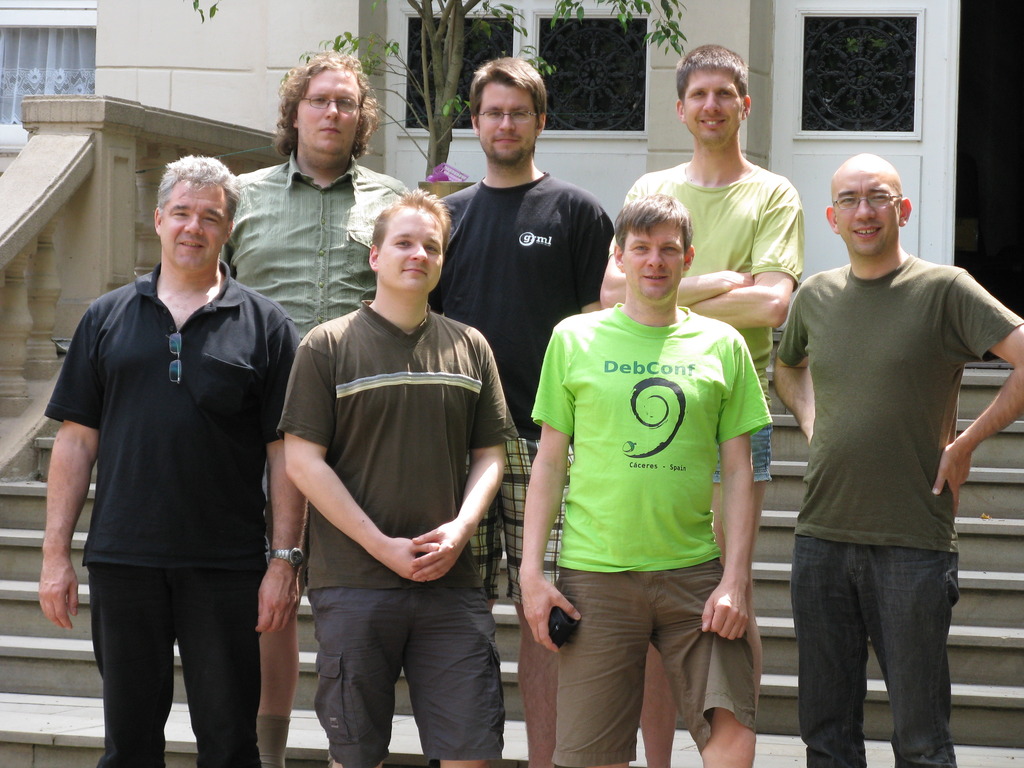
first row from left to right: Sebastian Hetze, Manuel Hachtkemper, Thomas Lange, Mattias Jansson
missing on the picture: Thomas Neumann (left on sunday midday) and Stephan Hermann (only part-time) Friday afternoon started with getting to know each other, continuing with discussions all around FAI. On saturday we started to hack on FAI. * Between the hack sessions and discussions the attending people presented their FAI usage and approaches. Some notes from the presentations:
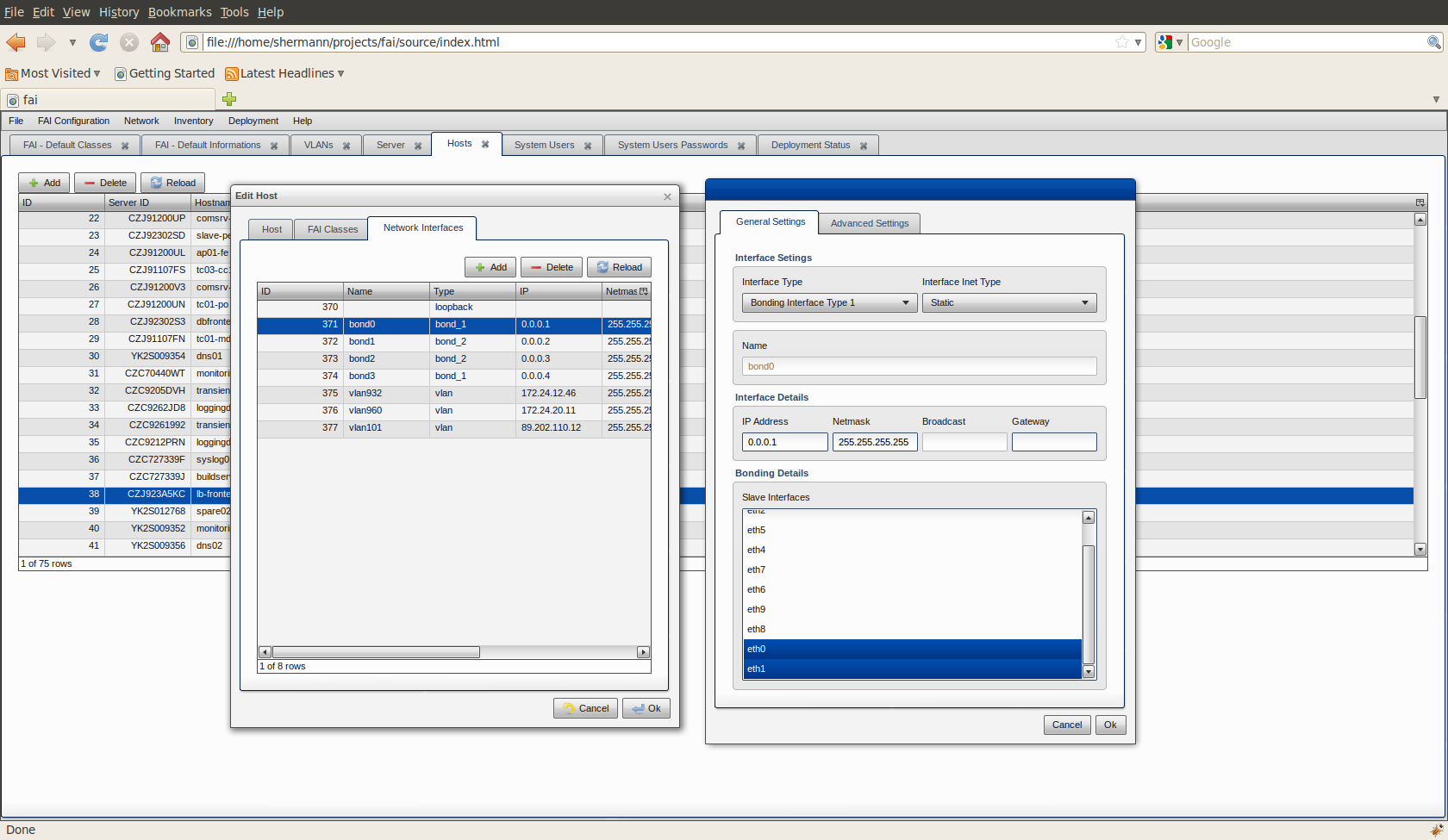
FAI Manager webfrontend / Stephan Hermann Stephan \sh Hermann presented his FAI web frontend which should be released under the GPL license in those days. The frontend uses qooxdoo whereas the backend is based on django, rpc4django and python-tftpy. Screenshot of FAI manager webfrontend A demo video is available at blip.tv. Currently Stephan is searching for a nice name for his FAI management tool please send suggestions either to him or to the linux-fai-devel mailinglist. Grml / Michael Prokop Grml is a Debian based Linux live system specially made for system administrators. Grml uses grml-live for building the ISOs, whereas grml-live itself uses FAI s dirinstall feature to build the live system. This provides the Grml team with a nice way to autobuild 18 ISOs per day, known as daily.grml.org. Mika also presented Grml s netscript bootoption and the ethdevice bootoption of live-initramfs which is useful for booting Grml/FAI via PXE. Host Europe / Michael Goetze Host Europe uses FAI for installing Debian and Ubuntu (32+64 bit) in the support center. They have ~20 FAI classes and use a Debian lenny NFSROOT as base for all deployed systems. Their main problems with FAI aren t related to FAI itself, but instead e.g. broadcom NICs with lack of support for it in Lenny s kernel. They are not using softupdate (yet) and currently use Kickstart for deploying CentOS but are working on deploying CentOS with FAI as well. LIS AG / Sebastian Hetze Linux Information Systems AG (LIS AG) are using FAI 3.2.17 and provide a luma and PyQt based GUI to their customers. They use DHCP, LDAP and DDNS for inventory, configuration and deployment. Mathematical Institute of the University of Bonn / Manuel Hachtkemper The Mathematical Institute of the University of Bonn uses FAI 3.1.8 and 3.3.5 for managing ~150 systems. They are automatically running softupdates every day, reporting how many hosts actually did run the softupdate and how many didn t run. The involved failogwatch tool supports two regex files, one for excluding specific hosts and the other one for grepping for known problems in the logs. Spotify / Andreas Schuldei + Mattias Jansson Spotify is a peer-to-peer music streaming service and the operating people at Spotify use FAI for deploying the systems. Currently they are using FAI 3.3.3 to deploy ~400 bare metal machines and ~150 virtualised machines. They have their class names in DNS using the txt/Text record entry. They are using a self written prepend_class script to manage dependencies between classes. University K ln / Thomas Lange Thomas uses FAI s trunk version (of course :) ), managing ~25 machines with less than 20 FAI classes. He s not using softupdates as Lenny s aptitude ignores the hold status of packages (this bug should be fixed for Squeeze). $COMPANY One of the big telecommunication providers in Germany uses FAI 3.3.3 for installing their bare-metal and virtual servers, providing Debian, Ubuntu and SLES. They are using Debian NFSROOT as a base for all systems as well and their main problems with FAI wasn t FAI itself but how to manage installation of virtual machines.
On Saturday evening we had a nice barbecue which included beer and K lsch *d&r*. ;) On Sunday we continued with discussions and development. Our work-log of the weekend: Important decisions made: We noticed that many FAI users implement their own way how to handle dependency management between classes, we will re-consider how we could provide such a mechanism through FAI s core. We also noted that it s important that any self-written scripts used within FAI are fully idempotent and users should be aware of this. Last but not least many thanks to the sponsors of the FAI developer workshop 07/2010! The workshop wouldn t have been possible without our generous sponsors, namely being:

19 September 2008

Lucas Nussbaum: Looking for cliques in the GPG signatures graph

The strongly connected set of the GPG keys graph contains a bit more than 40000 keys now (yes, that’s a lot of geeks!). I wondered what was the biggest clique (complete subgraph) in that graph, and also of course the biggest clique I was in. It’s easy to grab the whole web of trust there. Finding the maximum clique in a graph is NP-complete, but there are algorithms that work quite well for small instances (and you don’t need to consider all 40000 keys: to be in a clique of n keys, a key must have at least n-1 signatures, so it’s easy to simplify the graph — if you find a clique with 20 keys, you can remove all keys that have less than 19 signatures). My first googling result pointed to Ashay Dharwadker’s solver implementation (which also proves P=NP ;). Googling further allowed me to find the solver provided with the DIMACS benchmarks. It’s clearly not the state of the art, but it was enough in my case (allowed to find the result almost immediately). The biggest clique contains 47 keys. However, it looks like someone had fun, and injected a lot of bogus keys in the keyring. See the clique. So I ignored those keys, and re-ran the solver. And guess what’s the size of the biggest “real” clique? Yes. 42. Here are the winners:
CF3401A9 Elmar Hoffmann
AF260AB1 Florian Zumbiehl
454C864C Moritz Lapp
E6AB2957 Tilman Koschnick
A0ED982D Christian Brueffer
5A35FD42 Christoph Ulrich Scholler
514B3E7C Florian Ernst
AB0CB8C0 Frank Mohr
797EBFAB Enrico Zini
A521F8B5 Manuel Zeise
57E19B02 Thomas Glanzmann
3096372C Michael Fladerer
E63CD6D6 Daniel Hess
A244C858 Torsten Marek
82FB4EAD Timo Weing rtner
1EEF26F4 Christoph Ulrich Scholler
AAE6022E Karlheinz Geyer
EA2D2C41 Mattia Dongili
FCC5040F Stephan Beyer
6B79D401 Giunchedi Filippo
74B11360 Frank Mohr
94C09C7F Peter Palfrader
2274C4DA Andreas Priesz
3B443922 Mathias Rachor
C54BD798 Helmut Grohne
9DE1EEB1 Marc Brockschmidt
41CF0322 Christoph Reeg
218D18D7 Robert Schiele
0DCB0431 Daniel Hess
B84EF12A Mathias Rachor
FD6A8D9D Andreas Madsack
67007C30 Bernd Paysan
9978AF86 Christoph Probst
BD8B050D Roland Rosenfeld
E3DB4EA7 Christian Barth
E263FCD4 Kurt Gramlich
0E6D09CE Mathias Rachor
2A623F72 Christoph Probst
E05C21AF Sebastian Inacker
5D64F870 Martin Zobel-Helas
248AEB73 Rene Engelhard
9C67CD96 Torsten Veller
It’s likely that this happened thanks to a very successful key signing party somewhere in germany (looking at the email addresses). [Update: It was the LinuxTag 2005 KSP.] It might be a nice challenge to beat that clique during next Debconf ;) And the biggest clique I’m in contains 23 keys. Not too bad.

11 October 2006

Junichi Uekawa: Curry party in Ginza.

There were a few Debian Developers from the U. S., canada and Italy,and I did a meeting with them at a vegetarian curry restaurant in Ginza.11 people in total attended, with 6 people from Japan (Knok,Horms, Nori1, Iwamatsu, Daigo, dancerj).Mattia Dongli isthe Debian maintainer for user-mode-linux, and I did receivepatches for pbuilder user-mode-linux support; only that Ididn't remember until he mentioned.Matthew Wilcox and Iand few others discussed git/mercurial, and how it improvedour lives.Icommented that mercurial is not well-accepted because HG hasa subtly different connotation in Japan.I discussed a bit about ruby with Daigo, and it soon became midnight.Thanks to all who attended for attending.

NOKUBI Takatsugu: A party with malattia and matthew

Junichi Uekawa(dancerj) arrenged a welcome party for Mattia Dngili and Matthew Wilcox tonight. Unfortunately, I couldn't attend it because I need to stay to get my large baggage from a transporter. However, the place of the party is really near from my home, so if I can, I'll attend it. By the way, I already met with Matthew Wilbox in linux.conf.au 2004, but he wouldn't remember me.

7 November 2005

Simon Law: Jeff Bailey Love Day


Jeff Waugh escaped
Originally uploaded by magicfab.
Two Sundays ago, Jim and I walked down to Ubuntu Love Day. The Ubuntu Below Zero conference is being held at the Holiday Inn in Chinatown. That's the one with the fake Chinese tiles on the roof, which is sort of tacky. We found our way downstairs to the conference room and sat down. The previous night's revelries still had quite the effect, so I'm afraid I drifted in and out while listening to people speak. I thought I had rid myself of this habit, but apparently university has trained me to consider digital projectors as sleeping aids. I'll have to do something about this one day. I got to see some fairly interesting people: Mattias Klaus, whom I met earlier at Jeff Bailey's place; Fabio Di Nitto, who is incredibly jolly; Chris Peterman, who was with his classmates from Clarkson; Colin Watson, whom I thanked for working so hard on Debian; Jeff Waugh, who dressed up as an inmate; and plenty of others. Oh, I managed to meet Andrew Mitchell in person, but we failed to have a proper CHUG meeting while we were all in town. We broke for lunch, which was held in the hotel restaurant. A buffet, with some Chinese-style dishes, was being served. There, we had to negotiate with the unilingual (Cantonese) staff to find out what Jeff could eat. We had a special order of plain white rice brought for him and we were informed that it was safe for him to eat the stir-fried vegetables. I suggested to Jeff that he ought to keep a phrasebook on him whenever he travels. On each page, one per language, there should be a written description of what he can and cannot eat. Then, he just has to show this to waiters who don't speak English or French.

Stocking the buffet
Originally uploaded by magicfab.
For reference, the characters that mean "vegetarian" in Chinese are and . Most of the time, they mean "vegan", but there are some places where eggs and oysters are considered vegetarian. After lunch, Mark Shuttleworth gave Jeff a very nice birthday speech. He also gave Jeff a nice bottle of wine, which was very nice. And Matthias came up to give Jeff a bottle of fish-oil pills, which was very odd. Then, there were two Birds Of a Feather sessions, involving how to make an Ubuntu package and how to be an Ubuntu advocate. Being upstream to both these issues, I sat in the middle of the room and listened to both presentations at once. This was quite interesting, and slightly taxing. After this was done, we broke up once more. The plan for the evening was to meet for dinner in the hotel lobby. This transformed to meeting outside the front door. Jim, [info]wlach, and I showed up and were greeted by this mass of people. Since there were stragglers and I knew where dinner was to be held, Jeff took a group of nineteen people in the metro. I followed about ten minutes later with a group of eighteen. We met up on St-Denis, and by this time we had lost some of the more impatient, and more hungry, people. Eventually, a group of twenty-three were milling about outside Le Nil Bleu. Angie had made arrangements for us to be served a set meal, and they had agreed to seat twenty-five of us. I went inside to let the staff know that we had arrived. When 20:30 came around, we were let into the restaurant and seated. I think the kitchen was still preparing food, because we had to wait about an hour before being served. Unlike my previous experience there with Jeff, the food was quite good this time and the service was very attentive. We enjoyed ourselves very much, and Jeff seemed to be having a very excellent birthday dinner. Some of the guests were not so happy, because the food was a little spicy for their European palates. Since gratuities are not standardised around the world, we discovered that some people had not tipped. To cover the embarassment, Angie and I made sure that the wait-staff were adequately compensated for their efforts. I'll be sure to go back to this restaurant again, but with a more significant crowd to ensure good service. After eating, a group of us including Matthias and Tollef went up to B l K , which was just a little north on Mont-Royal. That's a really interesting bar with beautiful tiled floors and ostrich heads on the walls. We enjoyed the lovely music, had a very good conversation there, and laughed until we were all exhausted. Since the Canonical people had to be awake for the 09:00 keynote speech the next day, they left early. Jim and I bid goodnight to them before we staggered home.

Next.

Previous.