Search Results: "mako"

14 October 2010

Russell Coker: Links October 2010

Bruce Schneier wrote an insightful post about why designing products for wiretapping is a bad idea [1]. It seems that large parts of the Internet will be easy to tap (for both governments and criminals) in the near future unless something is done. The bad results of criminal use will outweigh any benefits of government use. Sam Watkins wrote an informative post about Android security [2]. Among other things any application can read all stored data including all photos, that s got to be a problem for anyone who photographs themself naked Rebecca Saxe gave an interesting TED talk about how brains make moral judgements [3]. Somehow she managed to speak about the Theory of Mind without mentioning Autism once. The Guardian has an amusing article by Cory Doctorow about security policies in banks [4]. He advocates promoting statistical literacy (or at least not promoting a lack of it) as a sound government policy. He also suggests allowing regulators to fine banks that get it wrong. Steven Johnson gave an interesting TED talk about Where Good Ideas Come From [5]. It s a bit slow at the start but gets good at the end. Adam Grosser gave an interesting TED talk about a fridge that was designed for use in Africa [6]. The core of the Absorption Refrigerator is designed to be heated in a pot of water in a cooking fire and it can then keep food cool for 12 hours. It s a pity that they couldn t design it to work on solar power to avoid the fuel use for the cooking fire. Josh Silver gave an interesting TED talk about liquid filled spectacles [7]. The glasses are shipped with a syringe filled with liquid at each side that is used to inflate the lenses to the desired refractive index. The wearer can just adjust the syringes until they get to the right magnification, as there are separate syringes the glasses work well with people who s eyes aren t identical (which is most people). Once the syringes are at the right spots the user can tighten some screws to prevent further transfer of liquid and cut the syringes off to give glasses that aren t overly heavy but which can t be adjusted any more, I guess that a natural extension to this would be to allow the syringes to be re-attached so that the user could adjust them every year to match declining vision. One thing that this wouldn t do is counter for Astigmatism (where the lens of the eye doesn t focus light to a point), but I guess they could make lenses to deal with a few common varieties of Astigmatism so that most people who have that problem can get a reasonable approximation. The current best effort is to make the glasses cost $19, which is 19 days salary for some of the poorest people in the world. Glasses in Australia cost up to $650 for a pair (or a more common cost of $200 or about $100 after Medicare) which would be about one day s salary. Eben Bayer gave an inspiring TED talk about one of the ways that mushrooms can save the planet [8]. He has designed molds that can be filled with Pasteurised organic waste (seed husks etc) and then seeded with fungal spores. The fungus then grows mycelium (thin fungal root fibers) through the organic waste making it into a solid structure which fits the shape of the mold. This is currently being used to replace poly-styrene foam for packaging and can apparently be used for making tiles that are fire retardant and sound proof for constructing buildings. The main benefits of the material are that it can be cheaply made without petrochemicals and that it is bio-degradable, I m not sure how the bio-degradable part would work with constructing buildings maybe they would just replace the panels every few years. Annie Lennox gave a TED talk about her Sing foundation to care for women and children who are affected by AIDS [9]. She describes the effect of AIDS in Africa as Genocide. Robert Ballard gave a very informative TED talk about exploring the oceans [10]. This was one of the most informative TED talks I ve seen and Robert is also one of the most enthusiastic speakers I ve seen, it s really worth watching! We really need more money spent on exploring the oceans. Jessa Gamble gave an interesting TED talk which suggests that the best thing to do is to go to bed at about sunset and then have a couple of hours of relaxing time during the middle of the night [11]. Apparently the subjects of body-block experiments who live for a month in a bunker without natural light or access to a clock get better sleep in this manner than they ever had in their life and feel fully awake for the first time. World Changing is a blog that has a lot of interesting articles about climate change and related issues [12]. It s worth a read. Cynthia Schneider gave an interesting TED talk about how reality competition TV is affecting reality [13]. Shows that are derived from the American Idol concept are driving a resurgence in some traditional forms of performance art while also promoting equality among other things it s apparent that winning is more important than misogyny. The Ritual of the Calling of an Engineer is an interesting concept [14]. I think it would be good to have something similar for Computer Science. Benjamin Mako Hill wrote an interesting and insightful essay about Piracy and Free Software [15].

11 October 2010

Benjamin Mako Hill: Piracy and Free Software

This essay is a summary of my presentation at the workshop Inlaws and Outlaws, held on August 19-20, 2010 in Split, Croatia. The workshop brought together advocates of piracy with participants in the free culture and free software movements.
In Why Software Should Not Have Owners, Richard Stallman explains that, if a friend asks you for a piece of software and the license of the software bars you from sharing, you will have to choose between being a bad friend or violating the license of the software. Stallman suggests that users will have to choose between the lesser of two evils and will choose to violate the license. He emphasizes that it's unfair to ask a user to make such a choice. Over the past few years, pirate parties have grown across much of the developed world. Of course, piracy remains the primary means of distributing media across most of the rest. Advocates of access to information have gathered and organized under the "pirate" banner, representing the choice of sharing with friends over compliance with license terms. The free/libre and open source software (FLOSS) and free culture movements seem to have a confused and conflicted reaction to all this. On one hand, major proponents of several pirate parties are FLOSS and free culture stalwarts and several pirate parties have made FLOSS advocacy a component of their political platforms. Pirate Parties' clear opposition to software patents and DRM resonates with both FLOSS and free culture communities. On the other hand, FLOSS leaders, including Stallman, have warned us about "pirate" anti-copyright policies. Free culture leaders, like Lawrence Lessig, have repeatedly and vociferously denounced piracy, treated even the intimation of an association with piracy as an affront, and systematically distanced themselves and their work from piracy. Should FLOSS and free culture advocates embrace pirates as comrades in arms or condemn them? Must we choose between being either with the pirates or against them? Our communities seem to have no clearly and consistently articulated consensus. I believe that, unintuitively, if you take a strong principled position in favor of information freedom and distinguish between principles and tactics, a more nuanced "middle ground" response to piracy is possible. In light of a principled belief that users should be able to share information, we can conclude there is nothing ethically wrong with piracy. Licenses have the power of the law but they are protected by unjust "intellectual property" laws. That said, principles are not the only reason activists choose to do things. Many political stunts are bad ideas not because they are wrong, but because they won't work and have negative side effects. Tactics matter too. Even though there might not be anything ethically wrong with piracy from the perspective of free software or free culture, it might still be a bad idea. There are at least three such tactical reasons that might motivate free software and culture to not support piracy or participate in pro-piracy movements and politics. First, a systematic disrespect for copyright undermines respect for all licenses which have been of a huge tactical benefit to free software and a increasingly important factor in the success of free culture. Copyleft licenses like the GPL or CC BY-SA have power only because copyright does. As Stallman has suggested, anti-copyright actions are anti-copyleft. That needn't be an argument against attempts to limit copyright. Indeed, I think we must limit and reduce copyright. But we must tread carefully. In the current copyright climate, I believe that copyleft offers a net advantage. Why should others respect our licenses if we don't respect theirs? Looking at the long term, we must weigh the benefits of promoting the systematic violation of proprietary licenses with the benefits of adherence to free software and free culture. Second, piracy is fundamentally reactionary. Part of its resonance as a political symbol comes from the fact that the piracy represents a way that consumers of media can fight back against a set of companies which have attacked them -- with lawsuits, DRM systems, and demonization in propaganda -- for sharing in ways that most consumers think are natural and socially positive. But piracy focuses on reaction rather the fundamental importance of sharing that drives it. As a result, most pirates do not support, or are even familiar with, a principled approach to access to information. As a result, many piracy advocates who speak out against DRM on DVDs will be as happy to use NetFlix to stream DRMed movies for $5 a month as they were to download for free. The best rallying cries do not always translate into be the most robust movements. Third, through its focus on a reaction, a dialog about piracy avoids engagement with the tough questions of what we will replace the current broken copyright system with. A principled position suggests that it is our ethical prerogative to create alternative models. The free software movement has succeeded because it created such a prerogative and then, slowly over time, provided examples of workable alternatives. A principled position on free software did not require that one provide working new systems immediately, but it makes the development of creative, sustainable approaches a priority. Attacking the system without even trying to speak about alternative modes of production is unsustainable. Free software and free culture call for a revolution. Piracy only calls for a riot. Piracy, in these three senses, can be seen as tactically unwise, without necessarily being unethical. By taking a principled position, one can go build on, and go beyond, RMS's comment. On free culture and free software's terms, we can suggest that piracy is not ethically wrong, but that it is an unwise way to try to promote sharing. Without being hypocritical, we can say: "I don't think piracy is unethical. But I also do not support it."

3 October 2010

Benjamin Mako Hill: AcaMako

As I mentioned recently, I've been writing summaries of academic articles I read over on AcaWiki. You should join me and write summaries of academic articles you read or help improve the summaries other folks have shared! Of course, you can also just read AcaWiki summaries. But while reading summaries takes less time that reading the full articles and books, a 500-1000 word summary is still too much for some very busy people. That's why I created a new microblog on Identica where I post summaries of the summaries I post to AcaWiki. You can subscribe to AcaMako to follow along.

1 October 2010

Benjamin Mako Hill: On Feminism and Microcontrollers

A month or so ago, I published a paper with Leah Buechley that is mostly an analysis of how the LilyPad Arduino has been used. I read an earlier draft last year and loved it so, when the opportunity arose, I was honored to help out as the paper evolved. LilyPad is a microcontroller platform that Leah created a few years back and that is specifically designed to be more useful than other microcontroller platforms (like normal Arduino) in the context of crafting practices like textiles or painting. Leah's design goal with LilyPad was to create a sewable microcontroller that could be useful for making things that were qualitatively different from what most people made with microcontrollers and that, she hoped, would be of interest to women and girls. Our paper tries to measure the breadth of LilyPad's appeal and the degree to which it accomplished her goals. We used sales data from SparkFun (the largest retail source for both Arduino and LilyPad in the US) and a crowd-sourced dataset of high-visibility microcontroller projects. Our goal was to get a better sense of who it is that is using the two platforms and how these groups and their projects differ. We found evidence to support the suggestion that LilyPad is disproportionally appealing to women, as compared to Arduino (we estimated that about 9% of Arduino purchasers were female while 35% of LilyPad purchasers were). We found evidence that suggests that a very large proportion of people making high-visibility projects using LilyPad are female as compared to Arduino (65% for LilyPad, versus 2% for Arduino). Digging deeper, qualitative evidence suggests a reason. LilyPad users aren't just different. The projects they are making are different too. Although LilyPad and Arduino are the same chips and the same code, we suggest that LilyPad's design, and the way the platform is framed, leads to different types of projects that appeal to different types of people. For example, Arduino seems likely to find its way into an interaction design project or a fighting robot. LilyPad seems more likely to find its way into a smart and responsive textile. Very often, different types of people want to make these projects. Leah and I believe that there's a more general lesson to be learned about designing technologies for communities underrepresented in science, technology, engineering, and mathematics (STEM) -- and for women in particular. The dominant metaphor in the discussion on women in computer science is Margolis and Fisher's idea of "unlocking the clubhouse." The phrase provides a good description of the path that most projects aimed at broadening participation of women in computing projects seem to take. The metaphor is based around the idea that computing culture is a boys' club that is unfriendly to women. The solution is finding ways to make this club more accessible to those locked outside. It should go without saying that we share Margolis and Fisher's goal of increasing participation of women in STEM. That's LilyPad's point, after all. It it hopefully also clear that we're supportive of, and involved in, projects working to remove systematic barriers to participation by women and other groups. That work must continue. But I also think that Leah's work with LilyPad suggests another way forward based on addressing issues of self-selection that will affect even the most welcoming technological communities. Here's what we say in our paper:
Our experience suggests a different approach, one we call Building New Clubhouses. Instead of trying to fit people into existing engineering cultures, it may be more constructive to try to spark and support new cultures, to build new clubhouses. Our experiences have led us to believe that the problem is not so much that communities are prejudiced or exclusive but that they're limited in breadth--both intellectually and culturally. Some of the most revealing research in diversity in STEM found that women and other minorities don't join STEM communities not because they are intimidated or unqualified but rather because they're simply uninterested in these disciplines. One of our current research goals is thus to question traditional disciplinary boundaries and to expand disciplines to make room for more diverse interests and passions. To show, for example, that it is possible to build complex, innovative, technological artifacts that are colorful, soft, and beautiful. We want to provide alternative pathways to the rich intellectual possibilities of computation and engineering. We hope that our research shows that disciplines can grow both technically and culturally when we re-envision and re-contextualize them. When we build new clubhouses, new, surprising, and valuable things happen. As our findings on shared LilyPad projects seem to support, a new female-dominated electrical engineering/computer science community may emerge.
I have a strong belief that computing can be an empowering tool and that expanding users' control over technology is a critically important issue. Our paper argues that we should attempt to expand participation in computing by broadening the possibilities of computing, rather than only by broadening participation in extant, computing organizations, projects, and genres. Even if computing and electrical engineering communities were perfectly welcoming (which they are not) most people (both male and female, but disproportionately female) will choose not to participate. Building new clubhouses requires creativity of its proponents and risks charges of reinforcing stereotypes and existing status hierarchies. But, executed carefully and well (as I believe LilyPad has been), it suggests ways to reach the majority of people that no "unlocking" project will ever seem relevant to.

19 September 2010

Benjamin Mako Hill: Contribute to AcaWiki

In the process of studying for my PhD general examinations this year, I ended up writing summaries about 200 academic books and articles. AcaWiki is a wiki designed to host summaries of academic articles so it seemed like a great place to host these things. Over the last few months, I've uploaded all these summaries. Since I've finished, I've continued to add summaries of other articles as I read them. My summaries tend to be rough. I write them, run them through a spellchecker, and then post them. I don't even reread them before publishing. I hope to improve them as I reread them over time. Of course, because I've uploaded them to wiki, I hope others will add to and improve the summaries as well. AcaWiki uses Semantic Mediawiki and provides nice platform for publishing, editing, and collaboration. Although there are still ways in which the platform can be better, what is needed now is, quite simply, more contributors. I am sad to see that my summaries make up a big chunk of all summaries on the site. So if you are a student, an academic, or anyone else who writes or has written summaries of articles or books or if you might want to do so, you should consider contributing your summaries, in whatever form, to AcaWiki. I've done a little work to help integrate AcaWiki and Zotero which might make things easier. Doctoral students reading for qualifying or general examinations in particular should should consider taking notes and studying with AcaWiki. From the student's perspective, writing summaries can be one of the best way to reflect on and learn a literature. In the process, one can create a great resource for the rest of the world. If a single doctoral student from each of twenty diverse fields of study published summaries of the 200 key articles in their area, AcaWiki would have the critical core of what is most relevant in academia. Help us build it!

10 September 2010

Lior Kaplan: Hebrew translation and Bidi issues in Openoffice 3.3 (beta)

In the last few years the Israeli government founded some work on openoffice.org by Tk Open Systems Ltd. During the years, the work has resulted with an Israeli version , released after the official release and includes a lot of patches to improve support for Bidi and Hebrew specifically. Although most patches were submitted to the hamburg , a lot of them weren t used and are still waiting for inclusion. The funding the that projects stopped a year ago (9/2009), and the last release of the Israeli version is 3.1.1. Since then we had a quiet period in which 3.2 and 3.2.1 were released. While still enjoying the fruits of the projects in these version, it seems that it s time for the community to take over, as we lost hopes for yet another funds from the government. In may Netanel and I started talking about taking over the Hebrew translation, and in June we got Hebrew added to the openoffice.org pootle server. We started with about 80%, and got to 86% in time to get to the list of languages getting a language pack built for. This was a first achievement as Hebrew didn t have a language pack since early on the 2.x versions. I believe that working as part of the openoffice.org l10n group and with openoffice.org release schedule will only benefit for the Hebrew translation process. We used the language pack to test the translation and improve it. We also were able to get to 89% with the help of more volunteers.I believe it s now much more consistent than before. In the process with manually checked Writer thoroughly, while Calc and Impress got less attention due to the time frame. But we fixed some major translation issues in all of the three components. While testing the translation we also started to report Bidi issues we saw in 3.3 beta, hoping they will be fixed for the final release. For example, the main openoffice.org screen on windows has is getting repainted wrongly when moving the mouse over the options (text, spreadsheet..). This looks very badly as this is the main screen! See issue #97556 for details
Openoffice.org main screen in RTL UI

In RTL UI the main screen doesn't get repaited properly.

In addition to report new issues, we also started to keep track of the already opened issues regarding Bidi and Hebrew. I m following the issue system for a few years now, but seeing the list of issues organized in the wiki gave me a better orientation in the problems we have. E.g. finding some related or similar issues and mention each other in the comments, when someone goes to first one, he could also fixed the other as the problem is similar and probably comes from the same code. Organizing also the already closed bugs in 3.x, gave me a some kind of a changelog for the Bidi and Hebrew related issues. In that manner, version 3.1 was a very good for Bidi, thanks for a lot of efforts and work with the Bidi meta issue #79434. The wiki page is in Hebrew, but looks quite OK with Google translate (see here). Hoping to have 3.4 a major release (Bidi wise), I ve opened issue #114236 as another meta issue for Bidi related issues. I ve kept Hebrew specific issues out, as to get it more general and also relevant for Bidi users in other languages. Any help of those issues will be more than welcome (starting with votes and ending with patches).
Filed under: i18n & l10n, Israeli Community, Openoffice.org

9 September 2010

Kartik Mistry: non-free (web) services

* I was thinking to move out of as many as non-free (FaiF) web services after reading mako s this post and now zack wrote about it with good explanations and reasons. What things I m using? And its replacement: - GMail [and related stuffs] (I don t own server/email setup, may be next year s plan?)
- Facebook (Big question here how will I keep touch with my wife?)
- LinkedIn (My profile there is crap, half baked. Can leave it without worry)
- Twitter (Identi.ca)
- Orkut (Already not using much)
- Github (Gitorious) Thank God. WordPress is amazing and free. I can keep in touch with this amazing blue pill virtual world with blog posts at least. Starting acting on the list from bottom-up. Lets see how far I can go.

Stefano Zacchiroli: yes we can

(... achieve Debian world domination without endorsing Facebook) Yes Raphael, we can.
Nobody said it would have been easy, to reach Total World Domination endorsing Free Software only, but that's not a reason to stop trying. I've recently stumbled upon a very nice article by Benjamin Mako Hill, titled Free Software Needs Free Tools, which I believe it's the best possible commentary to the proposal of having an official Debian Facebook page. Of course there is nothing wrong in having non-official, or let's call them "fan" pages, about Debian on Facebook. As a matter of fact we already have one, as you point out. And I also agree that it would be better to know who is behind that page. Individuals, including Debian Developers, are obviously free to use whatever media they please to spread the cause of Debian. After all, as individuals, each of us decide upon her own personal trade-offs (for instance, a trade-off of mine is to have both identi.ca and twitter accounts and to post only to the former with forwarding to the latter). There is no way to have an official Debian Facebook page and pretend that we are not, de facto, endorsing Facebook. That's why I believe having official Debian presence on Facebook, or on any other non Free Software platform, will just weaken our cause. It will send out the message that Free Software it's something which is good for others to use, but not necessarily for Debian as a project. That does not mean that we live under a rock and that we consider social networks useless to promote the Debian cause. It just mean that we should be picky in choosing social networks that respect our Free Software principles, as we are picky in choosing licenses that are DSFG-free. For instance, I'm glad to mention here that the Debian publicity team has recently obtained access to http://identi.ca/debian and will start using it soon. Subscribe! :-) PS This post also gives me a chance to comment on a so called "community page" of mine on Facebook. As I've briefly commented a few days ago I've nothing to do with that page. TTBOMK its content is just automatically injected from Wikipedia. The "Stefano Zacchiroli is on Facebook" claim on the upper left is true only in the sense that there are other people with my name on Facebook. IANAL, but such a claim (not the page in itself) will probably be considered an abusive advertisement in many countries around the world. update: re-word the identi.ca/debian paragraph, to better blend with surrounding text
update: mention "Debian" in heading

7 September 2010

Benjamin Mako Hill: Selectricity Source

After a semi-recent thread on debian-devel, I poked around and realized that I'd never actually gotten around to formally announcing the release of source code for Selectricity, a piece of web-based election software designed to allow for preferential decision-making and to provide "election machinery for the masses." Selectricity is useful for a range of decisions but it targets all those quick little decisions that we might want to decide preferentially but where running a vote would be overkill. Things were delayed through a drawn out set of negotiations with the MIT Technology Licensing Office over how to release the code under a free software license of my choosing. I was swamped when things finally came through. Over time, I managed to forget that I never did a formal announcement, never setup a mailing list, and never did all those things that I have tried to teach other people in the Free Software Project Management HOWTO. Code just sort of appeared on my website under the GNU Affero General Public License. It was until the debian-devel thread that I remembered I'd never made a formal announcement. Sorry about that! The git repository has been online and accessible through searches for more than a year now. Most folks who wanted the code seem to have been able to find it there. Indeed, a number of people have set up their own instances and a few have submitted patches to the code! But more visibility for the source means more empowered users, more visibility for free software, and more developers. So I've shipped all the code into a project in Gitorious (its like GitHub, except free), announced things on the Selectricity Blog, changed the Selectricity footer of to include a prominent link to the source. I've also created a mailing list. The Gitorious project page includes a wiki. I also want to mention this all here because the attention of the current development team seems mostly to have moved on to other projects. The current team seems able to keep the hosted version up and running, and even gets around to little improvements now and then, but there's definitely room for new life and new leadership. There are some nearly-complete and "complete minus further testing" features in the development tree that might provide low hanging fruit for folks interested in elections and decision-making who might want to get involved in Selectricity development. If you're interested and know (or want to learn) Rails, feel free to check out the code, introduce yourself on the list or contact team@selectricity.org to coordinate.

5 September 2010

Jurij Smakov: Kernel config files

Long ago I've set up a small but occasionally useful service on merkel: Debian Official Kernel Configuration files. It extracts and stores the configuration files from all kernel packages ever uploaded to the archive (does not seem to work particularly well with stuff uploaded to experimental though). Now that merkel is going away, this service is likely going to die. If you care about things like that, and would like to see it continue beyond merkel's demise, feel free to grab the script code and historical config files, and set it up elsewhere (it's not likely that I'm going to bother).

Benjamin Mako Hill: Free Software Needs Free Tools

I finally finished an article I've had in one form or another for years about on the use of proprietary tools in the creation of free software. From BitKeeper to SourceForge to Google Code to GitHub, non-free tools and services have played an important role in free software development over the past decade and, I argue, continue to create a number of important, if sometimes subtle, problems for our community. The article was published in the Spring 2010 FSF Bulletin which was mailed to all FSF associate members. I've also posted the article on my website and in PDF form as well.

27 August 2010

Colin Watson: Windows applications making GRUB 2 unbootable

If you find that running Windows makes a GRUB 2-based system unbootable (Debian bug, Ubuntu bug), then I'd like to hear from you. This is a bug in which some proprietary Windows-based software overwrites particular sectors in the gap between the master boot record and the first partition, sometimes called the "embedding area". GRUB Legacy and GRUB 2 both normally use this part of the disk to store one of their key components: GRUB Legacy calls this component Stage 1.5, while GRUB 2 calls it the core image (comparison). However, Stage 1.5 is less useful than the core image (for example, the latter provides a rescue shell which can be used to recover from some problems), and is therefore rather smaller: somewhere around 10KB vs. 24KB for the common case of ext[234] on plain block devices. It seems that the Windows-based software writes to a sector which is after the end of Stage 1.5, but before the end of the core image. This is why the problem appears to be new with GRUB 2. At least some occurrences of this are with software which writes a signature to the embedding area which hangs around even after uninstallation (even with one of those tools that tracks everything the installation process did and reverses it, I gather), so that you cannot uninstall and reinstall the application to defeat a trial period. This seems like a fine example of an antifeature, especially given its destructive consequences for free software, and is in general a poor piece of engineering; what happens if multiple such programs want to use the same sector, I wonder? They clearly aren't doing much checking that the sector is unused, not that that's really possible anyway. While I do not normally think that GRUB should go to any great lengths to accommodate proprietary software, this is a case where we need to defend ourselves against the predatory practices of some companies making us look bad: a relatively small number of people do enough detective work to realise that it's the fault of a particular Windows application, but many more simply blame our operating system because it won't start any more. I believe that it may be possible to assemble a collection of signatures of such software, and arrange to avoid the disk sectors they have stolen. Indeed, I have a first draft of the necessary code. This is not a particularly pleasant solution, but it seems to be the most practical way around the problem; I'm hoping that several of the programs at fault are using common "licence manager" code or something like that, so that we can address most of the problems with a relatively small number of signatures. In order to do this, I need to hear from as many people as possible who are affected by this problem. If you suffer from this problem, then please do the following: I hope that this will help me to assemble enough information to fix this bug at least for most people, and of course if you provide this information then I can make sure to fix your particular version of this problem. Thanks in advance!

26 August 2010

Benjamin Mako Hill: Italian Travel Update

Due to a variety of people and places we want to see, Mika and I have regrouped around a more ambitious travel schedule in Italy for the next week or so. Our new plan is: I know we'll have an organized LUG meeting in Siena. The rest of the period is a little more open. As always, if other free software, wikimedian, or like-minded folks are around and would like to meet up in any of those places, don't hesitate to get in contact. In related news, inspired by Florence and by Mika's domo-kun purse, I made a duomo-kun today. /copyrighteous/images/duomo-kun-small.png

5 August 2010

Benjamin Mako Hill: My August

I've got a pretty packed August. I just wrapped the Open and User Innovation Conference at MIT -- the academic conference on user and open innovation connected to my research. I organized the program and was MC for the 120+(!) talks and research updates on the program so it's a huge relief to see it come off successfully. On Thursday, August 5th (at 14:30 UTC) I'll be giving a talk on antifeatures at DebConf (the Annual Debian conference). It was accidentally listed as "Revealing Errors" until a few minutes ago -- sorry about that! It will be streamed live (details on the DC site) for those outside of New York City who might want to follow it. As soon as DebConf is done on August 8th, I'm going to head to Kor ula in Croatia to relax, read, and hopefully get a bit of research done, before I head off to Outlaws and Inlaws in Split on the 19th, a sort of piracy and (vs?) free software summit put on by mi2 connected to the recurring Nothing Will Happen where, from what I hear, quite a lot does. I'm going to have to leave Nothing Will Happen a little early to head to FrOSCon on the 21st where I'll be doing an antifeatures keynote again on the 22nd. I tend not to like to do the same talk too many times, or for more than a year, so this might be one of the last times I present on antifeatures in this form. After that, I'm going to head to Italy where I'll be between the 23rd and the 3rd of September. I'll fly and in and out of Rome and plan to spend some time in Rome, Tuscany, and Florence, but don't have a lot of set plans and might travel to Bologna or elsewhere. My schedule is pretty open. As always, I'm interested in meeting up for coffee or a drink with like-minded hackers, Wikipedians, researchers, activists, etc. If folks are interested in organizing talks or presentations, that sounds fun too. I'm keeping a brief description of my schedule updated alongside a bunch of ways to get in touch with me on my contact page. Don't hesitate to drop me a line!

2 August 2010

Christine Spang: lolbikeride to debconf

DebConf being in New York City this year, clearly the right way to get there was to bike, together with Molly and Daf. Being touring newbs, there were a few mishaps.
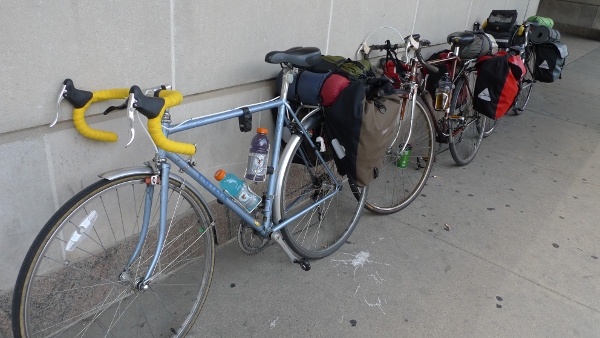
Day 1 We aimed to catch the 10:00 commuter rail train from Boston to Providence, Rhode Island, but we ran late (predictable) and had problems with the bicycle rack for my racing bike, which attaches without frame mounts (also predictable, since Mako and Mika test-rode it earlier in the week), so we didn't make it in to the station until around 10:20. We used the extra time to eat and fix up the bikes, though, so it's not clear how much of a setback that was. Here are our bikes ready to go at the Providence commuter rail station. bikes at Providence We then had some problems with Molly's brakes, and it took a long time to navigate out of the city, but eventually we found ourself on the "Washington Secondary Trail" a wonderful bike path along an old rail line. Every couple miles there'd be an old covered rail bridge over the river, and it was a well-paved straight shot for about ten miles, with no cars and no need to navigate. Molly on a train bridge Just as we were getting into things after the bike trail ended, something completely unexpected happened. This is Daf's derailleur after it sheared off in the middle as we attempted to start after a red light outside Tractor Supply Co. broken derailleur Luckily, John and his son Chris lent us a hand and hauled Daf and his bike to the nearest bicycle shop in the back of their pickup truck. They'd just come from there, where John had bought Chris a new helmet. Greenway Cycles, the only bike shop in a twenty mile radius, was three miles away. We got there an hour before it closed and Rick replaced the derailleur and straightened the hanger in a jiffy. Due to all these things, we didn't get as far as we'd planned in the first day and ended up camping in Seaport Campground in Mystic, Connecticut, rolling in at around 22:00. We did about 65 miles, including six due to the detour to the cycle shop. Carrying camping gear is heavy! Several delicious peanut butter and jelly bagels and some wheatberry and couscous salad later, we were passed out.



Day 2 Molly at the campground The second day included less bike trouble, but was no less eventful, and we were tired from the previous day's riding. The highlights included taking a tiny sidewalk path that I'm baffled how Google knows about up onto a sidewalk alongside the I-95 bridge across the Thames to New London, Connecticut. the Thames bridge The 13:00 ferry from New London to Orient Point, New York, where we got some remarkably good veggie burgers (whole edamame visible!) for lunch. Cross Sound Ferry And a vineyard on the north fork of Long Island, where we stopped for a quick tasting and ended up picking up a bottle of barrel-fermented chardonnay. The vineyard was small 23 acres, with 11 acres of grapes and the proprietors were friendly and extremely interested in our trip. They gave us a dollar off on the bottle due to our method of transport. The Old Field Vineyard It turns out there are only two trains a day on the Long Island rail, and we just barely caught the 18:52 return from Riverhead. We had mere seconds in the station and ended up without enough cash to pay for tickets onboard, but the conductor just took what we had and gave us tickets to Penn Station anyway. Outside Penn, a girl with a mohawk and a messenger bag overheard us talking about biking up Broadway and told us to bike up 8th Avenue instead. "Always bike up 8th and down Broadway because they have bike lanes in those directions." Thus, we didn't die dodging taxis in the dark. So basically, due to various people being extremely nice to us for no good reason, we made it to Columbia University around 22:30, on the correct day. Warm fuzzies for humanity all around. :)



31 July 2010

Benjamin Mako Hill: Grades

Over the last couple years, I have begun teaching. At first just a reading group or seminar with a handful of attendees. Last term I helped teach two large lecture classes. I know that, compared to some of my colleagues, I spend an enormous amount of time assessing and evaluating students' assignments. I try very hard to give detailed, substantive, feedback on each piece of student work. At the end of the day, however -- at my school at least -- there's always a grade. For someone who went well out of his way to go to a college with no grades, there's a tragic irony to the whole situation: I think grades mean little and are often worth much less. Today I am forced to to inflict them on people who, almost universally, do not.

15 July 2010

Jordi Mallach: Hiking through the Pyrenean GR 11

Tomorrow, at this time, I'll probably be unsuccessfully trying to find a comfortable position on a seat of the Bilmanbus to Irun. Very early on Saturday, as soon as we get off the bus, Maria and I will quickly head to Hondarribia's beach in Cape Higer to symbolically wet our feet in the waters of the Cantabrian Sea. We won't have much time to enjoy the cold waters of the ocean, though. Soon after that, we'll have to take a deep breath, look East, and start walking if we want to achieve our utmost objective: take a bath in the beautiful beaches of the Cap de Creus, in the Mediterranean sea. In between, 30 days and 840 kilometres of thick woods, deep valleys, high peaks and cold waters, all of which shape incredible landscapes.
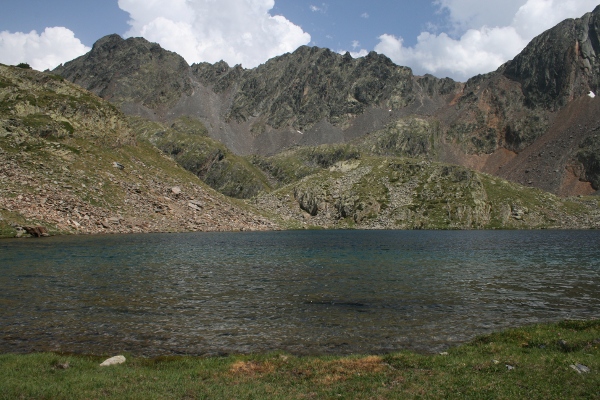

The Portella de Baiau, during our 2008 trip For a whole month, we'll be mostly disconnected from everything else that isn't our knee ache, our blisters, the Sun over our heads or where to get food. It's the first time I leave on a hiking trip as long and tough as this one, and I feel both uncertainty and eagerness. We've been so busy during the last few months that we've been unable to train at all for this, and I'm probably in the worst physical condition in a decade. It's too late to take care of that now, so we'll try to take good care of our legs and spine. In order to get back home in the Mediterranean, we'll have to be fast, some days joining two stages and skipping a few that we know are not that interesting (sections over asphalt, etc.). It's hard to make it in just one month, but we'll try our best. The plan is going to sleep not long after sunset, getting up at dawn, to be able to walk for a decent time before the heat starts being a handicap and just resting at midday, when the Sun is <strongest.> Of course, this means that I'm missing, yet again, this year's edition of DebConf in New York City, which is really sad because I was looking forward hanging around with Mako, Mika, Biella, micah, Clint and the rest of the NYC/ Boston gang, but when the idea of doing a long trip this summer popped up around January, it was clear DebConf seemed unlikely this year. I hope all of you have a lot of fun, and see you in a few weeks!

9 July 2010

Benjamin Mako Hill: Memory

Today I started to tell a friend about something from dinner the night before. Except that she was at the dinner. And sitting at the same table! Even when prompted, I couldn't really remember! This does not warrant a blog post. Anybody who knows me well knows that my memory for these kinds of more mundane details is pretty porous. This kind of thing happens all the time. I'm writing this so that when I'm much older, and still forgetting things all the time, folks can use this as a reference point before concluding that senility is setting in. I'm afraid that everyone else will forget my forgetfulness!

28 June 2010

Benjamin Mako Hill: Wikimedia Scholarship 2009-2010

Folks at last year's Wikimania may remember the presentation I gave there. It was essentially a literature review of Wikipedia and Wikimedia scholarship from the previous year. The idea was to give a bird's-eye-view as well a series of highlights -- all aimed at Wikimedians. Apparently somebody found it useful because I've been asked to do it again! I'm going to be paired up in a longer session with Felipe Ortega -- whose excellent dissertation I summarized as part of my talk last year -- and Mayo Fuster Morell has also agreed to help out. Felipe is program chair for WikiSym this year and will be focusing on providing folks with a summary of the papers published at that conference. It will be held immediately before Wikimania in Gdansk. For my part, I'm going to be focusing more broadly and talking about papers published, well, anywhere else. And this is where you come in! With search engines and all, I've got a pretty good idea of breadth of the work that's out there. I also "just know" stuff from my own areas of interest and study. That said, I don't have as strong of an idea of what's good and what's relevant beyond what I can grok from citation counts. And after one year (or less!), that's clearly not very much information. As a result, I'm looking for suggestions or recommendations from anybody on interesting, useful, important, or otherwise noteworthy scholarly papers on or about Wikipedia or other Wikimedia projects published in the last year. Feel free to leave a comment, email mako@atdot.cc, or edit this page.

25 June 2010

Benjamin Mako Hill: "Lance!"

On probably a dozen occasions, I've had people in cars taunt me by yelling some version of "Lance!", "Hey Lance!" or "Go Lance!" at me while I am riding my bike. It seems to be particularly likely if I'm wearing spandex. Indeed, the "verb" to Lance has an Urban Dictionary entry and there is a Facebook group for Yelling "Hey Lance!" when you see someone riding their bike. My friend Seth pointed out -- after we were (collectively?) called "Lance" in California -- that it's pretty strange to insult somebody by comparing them to a man who is nearly guaranteed to be on any list of greatest living athletes, in any sport.

Next.

Previous.
