Search Results: "lucas"

27 March 2013

Bits from Debian: Debian Project Leader elections 2013: interview with Gergely Nagy

We have asked Gergely Nagy, one of the three candidates for DPL elections 2013, to tell our readers about himself and his ideas for the Debian Project. You can also read the interviews to the other two candidates: Lucas Nussbaum and Moray Allan.
Please tell us a little about yourself. I was born in Hungary, a little bit over three decades ago, as a son of a biochemist and a pharmacist, who gave me the name Gergely Nagy (however, online - and offline too by now - I'm mostly known by my nickname, algernon). I went on to study human arts (hungarian grammar & literature, in particular), and to support this passion, I work as a software engineer, one who gets paid to work on free software. As such, I'm in a fortunate situation where my hobby supports my passion, and my hobby aligns well with my Debian work too. What do you do in Debian and how did you started contributing? At the moment, apart from maintaining a few packages, I'm doing a few other, mostly invisible things, like reassigning misfiled bugs so they don't end up being forgotten; or review newly uploaded packages before they enter the archive, making sure we are allowed to distribute them, and that their quality is up to our standards. I used to do quite a lot of other things, but I chose to spend the past year mostly invisible, learning. I started contributing by packaging an editor I was using at the time, but quickly ended up adopting another package - things escalated from there quickly. Why did you decide to run as DPL? There were two reasons that motivated me to run: one is that I believe I can bring something new to the table, that I can help Debian expand in new directions. The other reason is that I'm always on the lookout for new ways to contribute back to Debian, and being the project leader is a position where I believe I could contribute most at this point in time. Three keywords to summarise your platform. Non-technical contributors. What are the biggest challenges that you envision for Debian in the future? The biggest challenge is growing up, to become more than a group of computer geeks creating an amazing distribution. To become a community of a wide variety of people, where both computer geeks and art geeks feel equally at home. Yet, at the same time, where we as a project, keep our focus straight, and be the champions of Free Software. We just need to realize that there's much more to Free Software than the software itself. What are, in your opinion, the areas of the project more in need of technical and/or social improvements? I believe that while we do have many areas where we could use technical improvements, we are reasonably safe there, because we do have very skilled technical people to help us solve these problems. We can make our tools better, we can develop our infrastructure better to aid us even more - and so on and so forth. While we need work on many areas, we're on the right track there. However, when it comes to social issues, we're at a loss. We have serious trouble keeping certain topics civilised on mailing lists, we have trouble attracting women, and we have trouble reaching people who are not naturally exposed to Debian (or Free Software). We could really use a more diverse community, but that requires us to overcome quite a lot of social roadblocks, so to say. Outreach is one particular area where we need much more technical and social improvements. Why should people vote for you? People should vote me, because they found my platform, my answers on debian-vote@, and my ideas and goals convincing and worthy to pursue. People should vote me, because they trust I'll be able to serve the project well. Name three tools you couldn't stay without. Emacs, git and a pencil. Because with these three, I can pretty much do anything. What keep you motivated to work in Debian? The community. Over the years, I had the good fortune to meet with a lot of people I hold in high esteem, whose enthusiasm and motivation I found inspiring. For any other common goals Debian and I may share, in the end, it is the people within Debian that keep me motivated. Are there any other fields where you call yourself a geek, besides computers? I'm not quite there yet, but I'm working hard on becoming a human arts geek, or at least a geek of the hungarian language.

21 March 2013

Martin Pitt: python-dbusmock 0.6 released

I just pushed out a new python-dbusmock release 0.6. Calling a method on the mock now emits a MethodCalled signal on the org.freedesktop.DBus.Mock interface. In some cases this is easier to track than parsing the mock s log or using GetMethodCalls. Thanks to Lars Uebernickel for this. DBusMockObject.AddTemplate() and DBusTestCase.spawn_server_template() can now load local templates from your own project by specifying a path to a *.py file as template name. Thanks to Lucas De Marchi for this feature. I also wrote a quite comprehensive template for systemd s logind. It stubs out the power management functionality as well as user/seat/session objects, and is convincing enough for loginctl. Some bits like AttachDevice is missing, as this sounds unlikely to be required for D-BUS mock tests, but please let me know if you need anything else. The mock processes now terminate automatically if their connected D-BUS goes down, as advertised in the documentation. You can get the new tarball from Launchpad, and I uploaded it to Debian experimental now. Enjoy!

19 March 2013

Gergely Nagy: Rebuttals, or the lack of thereof

It is customary during Debian Project Leader elections to write a rebuttal of the other candidate's platform. However, this is very hard to do this year, as there are a lot of overlaps between platforms, goals and ideas this time around. It is hard to rebute another platform, without also rebuting one's own. So instead of trying to highlight where I disagree (there's very little of that, if at all), I'd like to point out where I found each platform lacking.Mind you, these notes are primarily based off of the platforms, because I'm sadly still behind on my debian-vote@ reading list. Furthermore, due to the high level of similarity between platforms, I will not always single out one or the other, but mention what I found lacking, or troublesome in general instead. So unless stated otherwise, my thoughts below apply to both Moray's and Lucas' platforms.The thing I miss most from both platforms is the curious lack of plans about non-packaging project members (something which I strongly emphasize in my own platform). Similarly, even though Moray does mention encouraging more local events, I find those few paragraphs a little bit lacking; and Lucas does not even mention local teams in his platform, even though they are a very, very important part of the wider Debian community, and a terrific tool in our asset. They can further our reach by long miles! Considering their importance, little's said about either local teams or local events, even when the candidate does explicitly recognise their importance.On the other hand, Lucas writes about innovation within Debian (which I found lacking in Moray's platform) - but while he does bring up the topic, I sadly found that section of his platform vague, a mistake I made last year myself, and which I tried to avoid this time, by explicitly listing a few of my ideas on how I'd imagine inspiring & motivating people (which, in turn, would foster innovation within the project).From what I see - and I may be wrong here, and I am obviously biased - both platforms are reasonably explicit when it comes to easier topics, things that we know to work, and which we'd all continue doing in the very same spirit as our predecessor. But when it comes to experimenting, to new ideas, I found both platforms too vague. There are exceptions, of course, Moray's intern idea for example is sufficiently well explained, as far as it is possible within the limits of a platform. I found no similar thing in Lucas' platform, however, most of the ideas he explained were technical things, and those are the areas where we're fairly good at, where we already have a reasonably chance of improving - and thus, an easier topic. I was suprised by Lucas' platform, because even though he lists the need for experimentation important, the lack of truly experimental ideas was lacking - I found more in Moray's platform.All in all, I found the discussions on debian-vote@ much more useful so far, than the platforms, a lot of things were asked and answered there that the platforms did not touch.

16 March 2013

Lucas Nussbaum: Ideas from the -vote@ DPL election discussions

After one week of campaign on -vote@, many subjects have been mentioned already. I m trying here to list the concrete, actionable ideas I found interesting (does not necessarily mean that I agree with all of them) and that may be worth further discussion at a less busy time. There s obviously some amount of subjectivity in such a list, and I m also slightly biased ;) . Feel free to point to missing ideas or references (when an idea appeared in several emails, I ve generally tried to use the first reference). On the campaign itself, and having general discussions inside Debian: On getting new users and contributors to Debian: Infrastructure, processes, releases: Relationships with upstreams/downstreams: This list could be moved to wiki.d.o if others find sufficiently useful to help maintaining it.

Stefano Zacchiroli: bits from the DPL for February 2013 and a half

Dear project members, here's another report of DPL activities, this time for a period longer than usual (February + 1st week of March), so that the next one will be at the very end of the current DPL term. Highlights Appointments DPL helpers Two more DPL helpers IRC meetings have happened, minutes and logs of both are available. Assets Events Past At the beginning of February, I've attended FOSDEM 2013, together with many other Debian people. I didn't have any specific talk this year, but it's been a chance to talk F2F about several ongoing issues (see logs), and help mediating in some conflicts. I've also accepted the invitation to participate in the GNOME Advisory Board meeting, together with Laurent Bigonville of our GNOME team. No report of that has been prepared as of yet (sorry about that), but we have both reported "live" to the rest of the team on IRC. Future Miscellaneous A couple of months ago I've mentioned that I had filed an application, as Debian representative, to participate in a working table to define software procurement rules for the Italian public administration. Good news: my application has been accepted, together with those of other well-known FOSS communities and organizations (e.g. KDE, FSFE). I'll keep you posted of how it goes. Let's go back to elect a new DPL and release Wheezy now,
Cheers.
PS the day-to-day activity logs for February and March 2013 are available at the usual place master:/srv/leader/news/bits-from-the-DPL.txt.20130 2,3

15 March 2013

MJ Ray: Debian Project Leader 2013 election campaign links: part 1

This is basically a link-post to the Debian Project Leader election email discussions on GMANE s blog-style interface to debian-vote. After only 3 days of the 21, there s already a pageful, so if I don t start collecting links now, I ll probably miss some. Right or wrong, I ve grouped these into three topics: The Job
  1. Why do you think you are a good candidate for DPL (10 Mar 2013)
  2. How do you plan to represent Debian externally? (10 Mar 2013)
  3. about a DPL board (12 Mar 2013)
  4. DPL term duration (12 Mar 2013)
  5. Work balance and traveling (12 Mar 2013)
  6. trying to do awesome and risking to fail (11 Mar 2013)
  7. To Lucas: how do you plan to push your ideas (12 Mar 2013)
  8. All candidates quotes for the press if you win (13 Mar 2013)
Money
  1. using debian funds for Debian s hardware infrastru (12 Mar 2013)
  2. Usage of Debian s Money (12 Mar 2013)
  3. Debian s relationship with money and the economy (12 Mar 2013)
Project Management
  1. getting new people to Debian (10 Mar 2013)
  2. Free Software challenges and Debian role (11 Mar 2013)
  3. Development and technical issues and challenges (10 Mar 2013)
  4. Are there problematic infrastructure or processes in Debian? (12 Mar 2013)
  5. to Moray: encourage teams to take interns (11 Mar 2013)
So, what do you think are the key points or differences? Leave me a comment, or get involved in the discussions. Campaigning ends and voting begins 30/31 March.

11 March 2013

Gunnar Wolf: So you want to be a leader

So we are at the beginning of this year's Debian Project Leader elections. And yes, after Stefano's long and (IMO) very successful DPL term, I feel as my voting machinery is somewhat stuck; it will not be so easy to get it back up to speed. Anyway, I have glanced over the three platforms, but only actually read 1.5 from the three DPL platforms. I know that whoever succeeds, I will be quite happy with the results. This year there are three runners for the post. I have worked in several teams with two of them, and would love to know better the third. In the same order as presented in the vote:
Gergely Nagy
I have not yet worked with Gergely, but enjoy reading him. The closest I have been to working with him was sketching a packaging tutorial during DebConf11, in Bosnia. Sadly, I was quite busy, and he picked up the complete workload And correspondingly, got the credits. I can say that Gergely has a very important quality, the ability to put in seductively easy words the most complex processes. So, yes, being the Debian Leader post a public-facing one, I am certain he has one of the important qualities.
Moray Allan
We have worked together organizing DebConf for many years, first loosely as orga-team members, and starting two years ago (and together with Holger Levsen) as formal delegates. I think our team is quite well balanced, and Moray plays an important role. Holger and I are sometimes anxious to take measures, measures that IMO would have proven disastrous more than once. Moray is often the voice of reason. Given that another one of the DPL's roles is to mediate in social conflicts and keep Debian working smoothly (or something close to it ;-) ), that is also a very important trait of a DPL, and I'm also sure Moray would shine as a good leader.
Lucas Nussbaum
I have long been part of the pkg-ruby-extras team (although I am way less active than what I used to, where Lucas often dazzles us with his intense streaks of activity. Among this group of three, I see Lucas firstly as the most technically oriented, the biggest implementer. Also, as the proactive bug-finder and team-herder. And yes, Lucas is maybe the most enthusiastic about the (always) important Making Debian Sexy point. So, if elected, I'm sure this facet will also make him shine
So, it's not that I'm trying to bribe our next DPL with sweet nice words about how interesting a person or how good a friend he is, but am trying to look at the election process as something different. It seems for me that we are going to choose which Debian do we want to pursue for this starting period. Now, for our soon-to-be-ex-DPL Stefano: As many will surely tell you (or already have): You rock. I truly enjoyed your DPL term, and there is much we should adopt and learn from your personality and leadership. And, although it has waned over the past few years, many people tend to publish their (stated?) vote during the campaigning period. I (think I) have never done so, and this time I will surely not do so. Choosing a DPL involves personal feelings, sympathies, and many non-objective things. And although I know nobody will feel hurt if I don't put them in the first place, I prefer not to expose such issues. I can only assure you that this year, "None of the above" will sink to the bottom of my ballot.

4 March 2013

Lucas Nussbaum: Debian is (still) changing

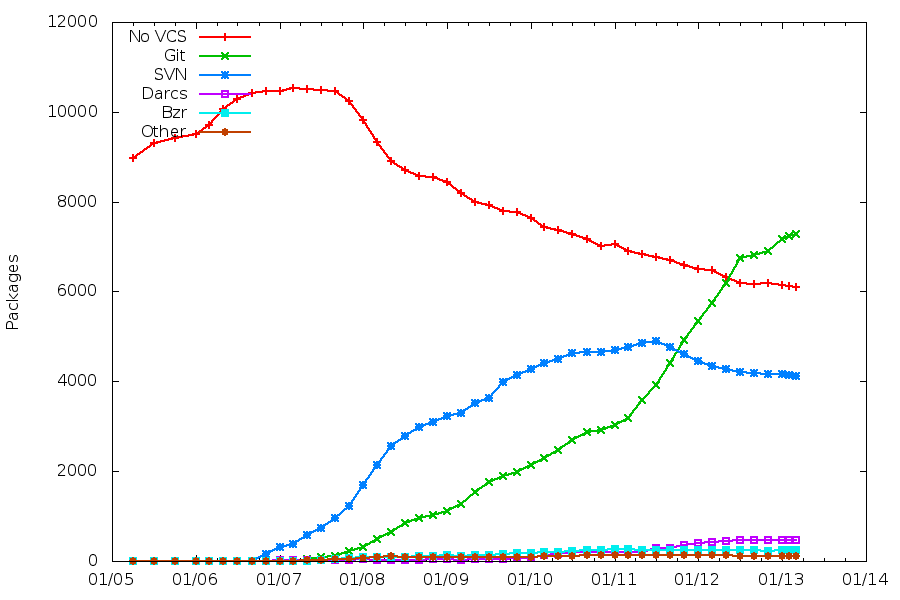
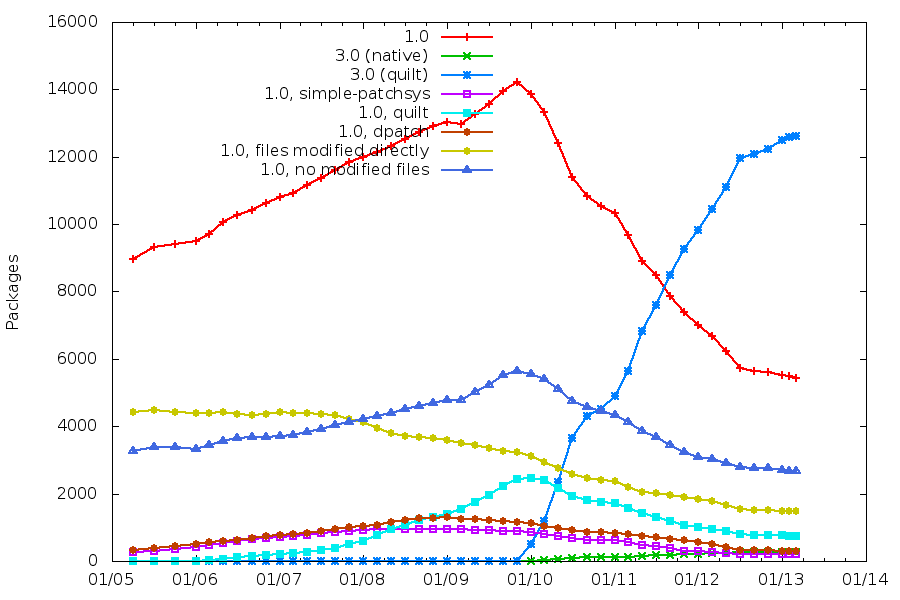
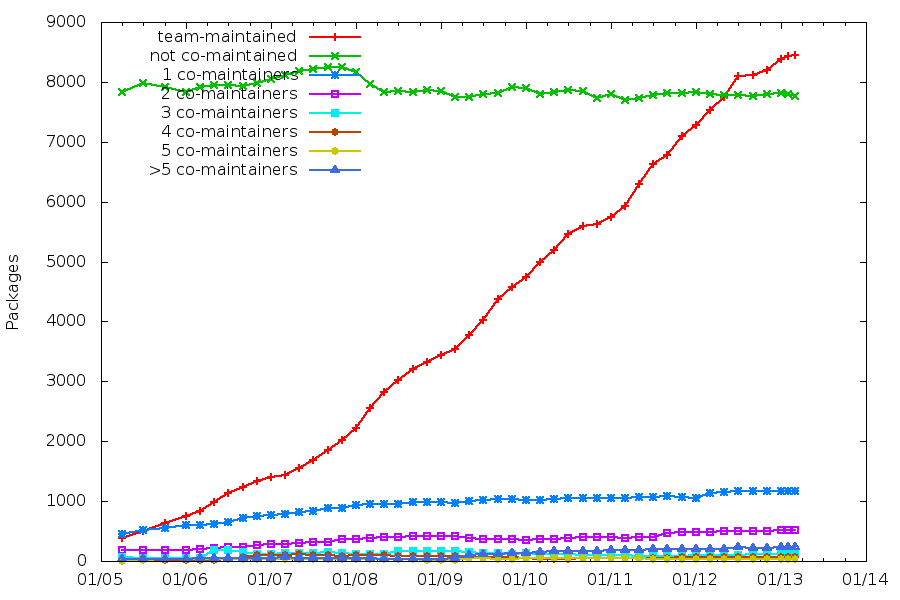
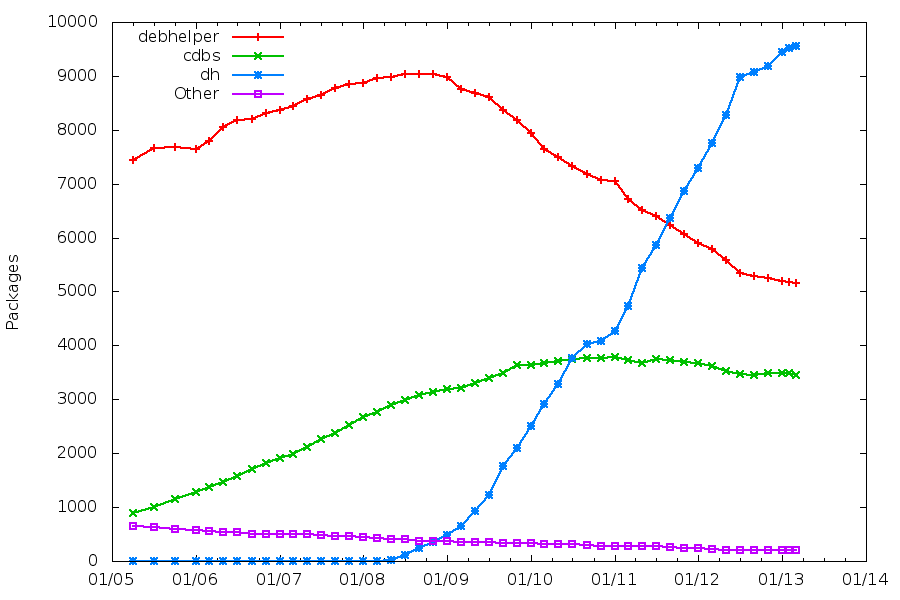
(Looking for those graphs online, I realized that I never properly published them, besides that old post) I ve been playing with snapshot.d.o, which is a fantastic resource if you want to look at Debian from an historical perspective (well, since 2005 at least). Team maintenance comaint
We now have more team-maintained packages than packages maintained by someone alone. Interestingly, the small, ad-hoc group of developers model does not really take off. Maintenance using a VCS vcs A large majority of our packages are maintained in a VCS repository, with Git being the clear winner now. Possible goal for Jessie: standardize on a Git workflow, since every team tends to design its own? Packaging helpers helpers Again, we have a clear winner here, with dh. It s interesting to note that, while dh was designed as a CDBS killer, it kind-of fails in that role. Possible goal for Jessie: deprecate at least pure-debhelper packaging? Patch systems and packaging formats formats-patches Again, clear winner with 3.0 (quilt). The (dirty) scripts that generate those graphs are available in Git (but you need to connect to stabile to execute them, and it s rather time consuming hours/days).
3 March 2013

Lucas Nussbaum: DPL game

When Francesca started her DPL game, I too started think about possible candidates. Here is my shortlist of dream candidates: Seriously, if you are a DD, you have the right to run. There s no need for someone to nominate you. If you think that you could possibly say something interesting during the discussion period, and can spare the time to participate in the -vote@ discussions, please run. DPL campaigns used to be a great time where Debian visions, goals, politics and random stuff were discussed. The more candidates, the more interesting campaigns (8 candidates in 2007!). Also, there are already two three other candidates, so even if you don t want the job, it s not that risky. (Initially, I thought about nominating everyone, but security-wise, it might not be such a great idea.)

20 February 2013

Mehdi Dogguy: DPL Game

For once, I think we are going to have a funny DPL campaign thanks to Francesca who brought to us a DPL Game :) So here is my little list of fantastic four:
(in random order)

Each one of them has super powers (lot of energy, wisdom, impartiality, ability to sort out complex situations) and can do a great DPL!

My fantastic four, please consider running for DPL!

4 January 2013

Stefano Zacchiroli: bits from the DPL for December 2012

Happy new year, Debian! To celebrate, here are some freshly posted, bits from the DPL for December 2012.
Dear Project Members, happy new year! Here goes another report of DPL activities, this time for December 2012. This issue of the DPL-monthly is skinnier than usual: during the past month I've been struck by the catastrophe also known as "family holiday season", enjoying a solid 10 day break from computer-related activities. Talks Assets DPL helpers Collaboration with the outer world That's all for last year, enjoy the new one, which will soon see a new Debian release out of the door. And to make it happen sooner, let's go back fix RC bugs! Cheers.
PS the day-to-day activity log for December 2012 is available at the usual place master:/srv/leader/news/bits-from-the-DPL.txt.201212

12 December 2012

Sylvestre Ledru: Mini Debconf 2012 - videos and feedbacks

A bit more than two weeks after the Mini Debconf in Paris, I am glad to say that the videos of the event are finally published (the sound is not very good for the 4 first presentations, sorry about that).
They will be also available on the new IRILL website with a video player when ready.
All slides are also available on the page of the event. I believe that there is a consensus about the quality of the event. We had around 150 people attending to the event, many interesting and various talks.
As usual, it was nice to meet some old and new friends from Debian. Mini debconf - group picture
Group picture by Frederic Lehobey
For those who wonder, I am confident there will be a 2013 Parisian Mini Debconf. Various feedbacks about the event:
Lucas Nussbaum
Stefano Zacchiroli
Vincent Untz
Raphael Hertzog
Pietro Abate
Logilab (Julien Cristau)
The 'official' Debian news And, once more, many thanks to the sponsors!
Logilab SmartJog
Bearstech Evolix
IRILL

26 November 2012

Stefano Zacchiroli: mini debconf paris 2012

rc bugs, cloud, and getting involved This past week-end has been rather intense. In addition to another, non free software related event I was volunteering for, I had the pleasure to participate in the 2nd Paris mini DebConf. Once again, the organization has been great and the average quality of the talks have been very high. I'd say talk quality is now totally up to par with the yearly full blown DebConf (and yes, talks have been in English :-P ). If I had to single the talk that intrigued me the most, I'd name Joss' talk on large GNOME deployments: it's full of insights on the GNOME architecture and of tips useful to all power users, no matter the size of your GNOME "deployment". For more info on the talks have a look at the program. To catch up with the talks you missed you can peruse the slides there and/or keep an eye on http://video.debian.net, where we usually post conference videos "when they are ready". At the conference I've also witnessed the usual healthy mix of country origins that I remember from the previous Paris mini DebConf. Once again I've been happy to meet (and host!) Debian friends from many countries including Germany, Switzerland, Italy, Greece, Finland, you name it. Kudos to the organizers (hi Sylvestre and Mehdi!) and to all the volunteers who made this possible. On my part, I didn't have any full blown talk scheduled (ETOOMANYTALKS struck me this month ) but I did book two lightning talks slots that I've used for: On the subject of lightning talks, I also recommend to promote Lucas' talk on how to get involved in Debian. It's dense and straight to the point, able to both convey useful tips and point wannabe contributors to the most useful contributions they can make to Debian.

25 November 2012

Lucas Nussbaum: Half of the package maintainers are not DDs or DMs

During the Paris Mini-Debconf, Nicolas Dandrimont talked about The state of mentors.debian.net: GSoC and beyond. He said that Half of Debian s packages are maintained by sponsored maintainers. That statement was actually wrong, as he confirmed later. However, using a few UDD queries, I could come up with: Full UDD notes:
all packages in sid:
select source, version from sources_uniq where release = 'sid'
packages in sid known to upload_history:
select source, version from upload_history where
(source, version) in (select source, version from sources_uniq where release = 'sid')
packages that were uploaded by the changed_by person:
create temporary table sources_not_sponsored as select distinct source, version
 from upload_history, carnivore_keys, carnivore_emails
 where (source, version) in (select source, version from sources_uniq where release = 'sid')
 and fingerprint = key
 and carnivore_keys.id = carnivore_emails.id
 and carnivore_emails.email = changed_by_email;
packages not uploaded by the changed_by person:
create temp table uh_sid as select source, version, fingerprint, changed_by_email
from upload_history
where (source, version) in (select source, version from sources_uniq where release = 'sid');
create temp table uh_sid_sponsored as select source, version, fingerprint, changed_by_email from uh_sid
where (source, version) not in (select source, version from sources_not_sponsored);
list with sponsor login:
select distinct source, version, fingerprint, changed_by_email, login
from uh_sid_sponsored
left join carnivore_keys on fingerprint = key
left join carnivore_login on carnivore_keys.id = carnivore_login.id;
=> 4188 sponsored packages. some of them are in a strange state (changed_by is a DD, but uploaded by another DD). excluding those:
create temp table sponsored_but_dds as select distinct source, version, fingerprint, changed_by_email, login
from uh_sid_sponsored, carnivore_emails, carnivore_login
where changed_by_email = carnivore_emails.email
and carnivore_emails.id = carnivore_login.id;
create temp table really_sponsored as select distinct source, version, fingerprint, changed_by_email, login
from uh_sid_sponsored
left join carnivore_keys on fingerprint = key
left join carnivore_login on carnivore_keys.id = carnivore_login.id
where (source, version) not in (select source, version from sponsored_but_dds);
=> 3147 sponsored packages
select distinct changed_by_email from really_sponsored ;
=> 963 different sponsorees
select distinct changed_by_email from upload_history where
(source, version) in (select source, version from sources_uniq where release = 'sid');
=> 2015 distinct emails.
no DD amongst maintainer or uploader:
create temp table dds_emails as select email from carnivore_emails, carnivore_login
where carnivore_emails.id = carnivore_login.id;
select source, version, maintainer, uploaders from sources_uniq
where release='sid'
and maintainer_email not in (select * from dds_emails)
and not exists (select * from uploaders where release = 'sid' and sources_uniq.source = uploaders.source and sources_uniq.version = uploaders.version and email in (select * from dds_emails))
and maintainer_email != 'packages@qa.debian.org'
and (source, version) in (select source, version from really_sponsored);

Lucas Nussbaum: Mini-debconf lightning talk: Get involved! It s not that hard!

This week-end I attended the Paris Mini-Debconf, which was really a great event, and a nice opportunity to meet everybody again.
I delivered a lightning talk on Get involved! It s not that hard! , which was also a good excuse to mention the Debian packaging tutorial and the Debian Maintainer Dashboard.

3 November 2012

Richard Hartmann: Release Critical Bug report for Week 42

Lucas Nussbaum pointed out that the weekly stats which Alexander Reichle-Schmehl used to provide are AWOL so I decided to take over. As I am patently lazy, I hacked together a little helper in perl which outputs the page I am just adding to by writing this. It's a tad hackish inasmuch I don't bother to transform the HTML into anything and simply embedd it in the Markdown, but it's working well enough for now. In the medium term, I am hoping to add some nice graphs as per azhag's suggestion, but they didn't get back to me, yet. A warning to anyone not subscribed to Planet Debian and reading this via a different aggregator: You will still see weekly stats from now on which may or may not be interesting to you. In case you object, please leave a comment or poke me directly. The UDD bugs interface currently knows about the following release critical bugs: How do we compare to the squeeze cycle ?
Week Squeeze Wheezy Diff
43 284 (213+71) 468 (332+136) +184 (+119 ; +65)
44 261 (201+60)
45 261 (205+56)
46 271 (200+71)
47 283 (209+74)
48 256 (177+79)
49 256 (180+76)
50 204 (148+56)
51 124 (124+54)
52 115 (78+37)
1 93 (60+33)
2 82 (46+36)
3 25 (15+10)
4 14 (8+6)
5 2 (0+2)
6 release!

25 October 2012

Lucas Nussbaum: Release Critical Bugs report for week 43

During the Squeeze release cycle, Alexander Reichle-Schmehl used to blog every week about this. Let s try to continue the tradition. The UDD bugs interface currently knows about the following release critical bugs: Note: I m looking for someone to send this posts on a regular basis. All you need is a blog syndicated on Planet Debian (there s a secret UDD page that generates the HTML code for you ;) ). Contact me if you are interested. taken!

9 August 2012

C.J. Adams-Collier: Linus on Instantiation and Armadaification

I feel a sense of pride when I think that I was involved in the development and maintenance of what was probably the first piece of software accepted into Debian which then had and still has direct up-stream support from Microsoft. The world is a better place for having Microsoft in it. The first operating system I ever ran on an 08086-based CPU was MS-DOS 2.x. I remember how thrilled I was when we got to see how my friend s 80286 system ran BBS software that would cause a modem to dial a local system and display the application as if it were running on a local machine. Totally sweet. When we were living at 6162 NE Middle in the nine-eight 292, we got an 80386 which ran Doom. Yeah, the original one, not the fancy new one with the double barrel shotgun, but it would probably run that one, too. It was also totally sweet and all thanks to our armadillo friends down south and partially thanks to their publishers, Apogee. I suckered my brothers into giving me their allowance from Dad one time so that we could all go in on a Sound Blaster Pro 16 sound card for the family s 386. I played a lot of Team Fortress and Q2CTF on that rig. I even attended the Quake 3 Arena launch party that happened at Zoid s place. I recall that he ported the original quake to Linux. I also recall there being naughty remarks included in the README.txt. When my older brother, Aaron turned 16, he was gifted a fancy car. When asked what type of car I would like when I turned 16, I said that I d prefer a computer instead. So I got a high-end 80486 with math co-processor. It could compile the kernel in 15 minutes flat. With all the bits turned on on in /usr/src/linux/.config. But this was later. I hadn t even heard of linux when I got my system. I wanted to be entertained by the thing. I made sure to get a CD-Rom and a sound card. I got on the beta for Ultima Online and spent a summer as a virtual collier. Digging stuff out of mines north of Britannia and hauling them to town to make weapons and armor out of them. And then setting out in said armor only to be PK d because I forgot healing potions and I was no good at fighting. While I was in the middle of all this gaming, my friend Lucas told me that I should try out this lynx thing that they run at the University of Washington. He heard that it was reported to run doom faster than it ran on MS-DOS. It turns out that it did, but that it was not, in fact, called lynx. Or pine. The Doom engine ran so fast that the video couldn t keep up. This was probably because they didn t use double buffering for frame display, since they didn t want to waste the time maintaining and switching context. I think I downloaded the boot/root 3.5 disk pair and was able to get the system to a shell with an on-phone assist from the Rev. I then promptly got lost in bash and the virtual terminals (OMG! I GET SIX CONSOLES!?) and bought a book on the subject. It shipped with slackware. Which I ran. Until Debian came along. Lucas also recommended that I try out this IRC thing, so I did. And I m still doing it on #linpeople just like I did back then. I learned to write Pascal on dos. Then I learned c while they were trying to teach me c++. I learned emacs and vi when I was attending North Kitsap High School. I learned sed and only a little awk when I took Running Start classes in Lynnwood at Edmonds Community College and perl & x.509 while attending Olympic Community College and simultaneously jr-administering Sinclair Communications. I studied TCP/IP, UNP, APUE, C and algorithms & data structures while preparing for an interview with a company whose CEO claimed to have invented SCSI. I learned PGP and PHP while writing web-based adware for this company. I didn t want to write ads and instead wanted to work in security, so took a job with Security Portal. While there, I wrote what one might call a blogging platform. It worked and made it possible for authors to write prose and poetry. Editors didn t have to manage a database in order to review and publish the posts that were ready. Everyone but me was able to avoid html and cgi. Then I sold pizza. Then I helped bring the bombay company onto the interwebs using the Amazon ECS (now AWS) platform. Then I helped support MaxDB. Then I helped develop and maintain the Amazon blogging platform. And then attempted to reduce the load on the Amazon pager system by doing and enforcing code reviews. It turns out that they prefer to run their support team at full bore and a load average of 16.
<iframe allowfullscreen="" frameborder="0" height="288" scrolling="no" src="http://www.youtube.com/embed/MShbP3OpASA" width="448"></iframe>
I am now, still, fully employed in an effort to make hard things possible. The hard thing we re working on now is the implementation and ongoing operations of distributed x.500 infrastructure. This includes request handling, processing and delivery of response ( la HTTP, SMTP, IMAP, SIP, RTP, RTSP, OCSP) including authentication, authorization and auditing (AAA) of all transactions. It s a hard thing to get right, but our product development team gets it right. Consistently and reliably. We make mistakes sometimes (sorry Bago), but we correct them and make the product better. I m the newest member of an R and d team (note: big R, little d) called NTR, which sits behind the firewall that is Product Development, out of production space. In a manner that reminds me of Debian Testing. We try new things. Our current project is to allow users to compare their current (cloud-based or iron-based) IT system with what their system would be like with a BIG-IP in front of it. I can probably come up with a demo if anyone s interested in checking it out. I ll go work on that now.

6 July 2012

Lucas Nussbaum: Debian Maintainer Dashboard update

I ve spent some more time on Debian Maintainer Dashboard (DMD), a maintainer/team-centric dashboard relying on Ultimate Debian Database. Done:
- added tabs (jquery really rocks) see example
- added a hacking.html file that describes how to setup a development environment
- created a pad (http://debian.titanpad.com/DMD) to store ideas. TODO:
- recruit contributors ;)

Next.

Previous.