Search Results: "joey"

7 May 2014

Mario Lang: Planet bug: empty alt tags for hackergotchis

There is a strange bug in Planet Debian I am seeing since I joined. It is rather minor, but since it is an accessibility bug, I'd like to mention it here. I have written to the Planet Debian maintainers, and was told to figure it out myself. This is a pattern, accessibility is considered wishlist, apparently. And the affected people are supposed to fix it on their own. It is better if I don't say anything more about that attitude.
The Bug On Planet Debian, only some people have an alt tag for their hackergotchi, while all the configured entries look similar. There is no obvious difference in the configuration, but still, only some users here have a proper alt tag for their hackergotchi. Here is a list:
  • Dirk Eddelbuettel
  • Steve Kemp
  • Wouter Verhelst
  • Mehdi (noreply@blogger.com)
  • Andrew Pollock
  • DebConf Organizers
  • Francois Marier
  • The MirOS Project (tg@mirbsd.org)
  • Paul Tagliamonte
  • Lisandro Dami n Nicanor P rez Meyer (noreply@blogger.com)
  • Joey Hess
  • Chris Lamb
  • Mirco Bauer
  • Christine Spang
  • Guido G nther
These people/organisations currently displayed on Planet Debian have a proper alt tag for their hackergotchi. All the other members have none. In Lynx, it looks like the following:
hackergotchi for
And for those where it works, it looks like:
hackergotchi for Dirk Eddelbuettel
Strange, isn't it? If you have any idea why this might be happening, let me know, or even better, tell Planet Debian maintainers how to fix it. P.S.: Package planet-venus says it is a rewrite of Planet, and Planet can be found in Debian as well. I don't see it in unstable, maybe I am blind? Or has it been removed recently? If so, the package description of planet-venus is wrong.

4 May 2014

Francois Marier: What's in a debian/ directory?

If you're looking to get started at packaging free software for Debian, you should start with the excellent New Maintainers' Guide or the Introduction to Debian Packaging on the Debian wiki. Once you know the basics, or if you prefer to learn by example, you may be interested in the full walkthrough which follows. We will look at the contents of three simple packages.

node-libravatar This package is a node.js library for the Libravatar service. Version 2.0.0-3 of that package contains the following files in its debian/ directory:
  • changelog
  • compat
  • control
  • copyright
  • docs
  • node-libravatar.install
  • rules
  • source/format
  • watch

debian/control
Source: node-libravatar
Priority: extra
Maintainer: Francois Marier <francois@debian.org>
Build-Depends: debhelper (>= 9)
Standards-Version: 3.9.4
Section: web
Homepage: https://github.com/fmarier/node-libravatar
Vcs-Git: git://git.debian.org/collab-maint/node-libravatar.git
Vcs-Browser: http://git.debian.org/?p=collab-maint/node-libravatar.git;a=summary
Package: node-libravatar
Architecture: all
Depends: $ shlibs:Depends , $ misc:Depends , nodejs
Description: libravatar library for NodeJS
 This library allows web application authors to make use of the free Libravatar
 service (https://www.libravatar.org). This service hosts avatar images for
 users and allows other sites to look them up using email addresses.
 .
 node-libravatar includes full support for federated avatar servers.
This is probably the most important file since it contains the bulk of the metadata about this package. Maintainer is a required field listing the maintainer of that package, which can be a person or a team. It only contains a single value though, any co-maintainers will be listed under the optional Uploaders field. Build-Depends lists the packages which are needed to build the package (e.g. a compiler), as opposed to those which are needed to install the binary package (e.g. a library it uses). Standards-Version refers to the version of the Debian Policy that this package complies with. The Homepage field refers to the upstream homepage, whereas the Vcs-* fields point to the repository where the packaging is stored. If you take a look at the node-libravatar packaging repository you will see that it contains three branches:
  • upstream is the source as it was in the tarball downloaded from upstream.
  • master is the upstream branch along with all of the Debian customizations.
  • pristine-tar is unrelated to the other two branches and is used by the pristine-tar tool to reconstitute the original upstream tarball as needed.
After these fields comes a new section which starts with a Package field. This is the definition of a binary package, not to be confused with the Source field at the top of this file, which refers to the name of the source package. In this particular example, they are both the same and there is only one of each, however this is not always the case, as we'll see later. Inside that binary package definition, lives the Architecture field which is normally one of these two:
  • all for a binary package that will work on all architectures but only needs to be built once
  • any for a binary package that will work everywhere but that will need to be built separately for each architecture
Finally, the last field worth pointing out is the Depends field which lists all of the runtime dependencies that the binary package has. This is what will be pulled in by apt-get when you apt-get install node-libravatar. The two variables will be substituted later by debhelper.

debian/changelog
node-libravatar (2.0.0-3) unstable; urgency=low
  * debian/watch: poll github directly
  * Bump Standards-Version up to 3.9.4
 -- Francois Marier <francois@debian.org>  Mon, 20 May 2013 12:07:49 +1200
node-libravatar (2.0.0-2) unstable; urgency=low
  * More precise license tag and upstream contact in debian/copyright
 -- Francois Marier <francois@debian.org>  Tue, 29 May 2012 22:51:03 +1200
node-libravatar (2.0.0-1) unstable; urgency=low
  * New upstream release
    - new non-backward-compatible API
 -- Francois Marier <francois@debian.org>  Mon, 07 May 2012 14:54:19 +1200
node-libravatar (1.1.1-1) unstable; urgency=low
  * Initial release (Closes: #661771)
 -- Francois Marier <francois@debian.org>  Fri, 02 Mar 2012 15:29:57 +1300
This may seem at first like a mundane file, but it is very important since it is the canonical source of the package version (2.0.0-3 in this case). This is the only place where you need to bump the package version when uploading a new package to the Debian archive. The first line also includes the distribution where the package will be uploaded. It is usually one of these values:
  • unstable for the vast majority of uploads
  • stable for uploads that have been approved by the release maintainers and fix serious bugs in the stable version of Debian
  • stable-security for security fixes to the stable version of Debian that cannot wait until the next stable point release and have been approved by the security team
Packages uploaded to unstable will migrate automatically to testing provided that a few conditions are met (e.g. no release-critical bugs were introduced). The length of time before that migration is influenced by the urgency field (low, medium or high) in the changelog entry. Another thing worth noting is that the first upload normally needs to close an ITP (Intent to Package) bug.

debian/rules
#!/usr/bin/make -f
# -*- makefile -*-
%:
    dh $@ 
override_dh_auto_test:
As can be gathered from the first two lines of this file, this is a Makefile. This is what controls how the package is built. There's not much to see and that's because most of its content is automatically added by debhelper. So let's look at it in action by building the package:
$ git buildpackage -us -uc
and then looking at parts of the build log (../node-libravatar_2.0.0-3_amd64.build):
 fakeroot debian/rules clean
dh clean 
   dh_testdir
   dh_auto_clean
   dh_clean
One of the first things we see is the debian/rules file being run with the clean target. To find out what that does, have a look at the dh_auto_clean which states that it will attempt to delete build residues and run something like make clean using the upstream Makefile.
 debian/rules build
dh build 
   dh_testdir
   dh_auto_configure
   dh_auto_build
Next we see the build target being invoked and looking at dh_auto_configure we see that this will essentially run ./configure and its equivalents. The dh_auto_build helper script then takes care of running make (or equivalent) on the upstream code. This should be familiar to anybody who has ever built a piece of free software from scratch and has encountered the usual method for building from source:
./configure
make
make install
Finally, we get to actually build the .deb:
 fakeroot debian/rules binary
dh binary 
   dh_testroot
   dh_prep
   dh_installdirs
   dh_auto_install
   dh_install
...
   dh_md5sums
   dh_builddeb
dpkg-deb: building package  node-libravatar' in  ../node-libravatar_2.0.0-3_all.deb'.
Here we see a number of helpers, including dh_auto_install which takes care of running make install. Going back to the debian/rules, we notice that there is manually defined target at the bottom of the file:
override_dh_auto_test:
which essentially disables dh_auto_test by replacing it with an empty set of commands. The reason for this becomes clear when we take a look at the test target of the upstream Makefile and the dependencies it has: tap, a node.js library that is not yet available in Debian. In other words, we can't run the test suite on the build machines so we need to disable it here.

debian/compat
9
This file simply specifies the version of debhelper that is required by the various helpers used in debian/rules. Version 9 is the latest at the moment.

debian/copyright
Format: http://www.debian.org/doc/packaging-manuals/copyright-format/1.0/
Upstream-Name: node-libravatar
Upstream-Contact: Francois Marier <francois@libravatar.org>
Source: https://github.com/fmarier/node-libravatar
Files: *
Copyright: 2011 Francois Marier <francois@libravatar.org>
License: Expat
Files: debian/*
Copyright: 2012 Francois Marier <francois@debian.org>
License: Expat
License: Expat
 Permission is hereby granted, free of charge, to any person obtaining a copy of this
 software and associated documentation files (the "Software"), to deal in the Software
 without restriction, including without limitation the rights to use, copy, modify,
 merge, publish, distribute, sublicense, and/or sell copies of the Software, and to
 permit persons to whom the Software is furnished to do so, subject to the following
 conditions:
 .
 The above copyright notice and this permission notice shall be included in all copies
 or substantial portions of the Software.
 .
 THE SOFTWARE IS PROVIDED "AS IS", WITHOUT WARRANTY OF ANY KIND, EXPRESS OR IMPLIED,
 INCLUDING BUT NOT LIMITED TO THE WARRANTIES OF MERCHANTABILITY, FITNESS FOR A
 PARTICULAR PURPOSE AND NONINFRINGEMENT. IN NO EVENT SHALL THE AUTHORS OR COPYRIGHT
 HOLDERS BE LIABLE FOR ANY CLAIM, DAMAGES OR OTHER LIABILITY, WHETHER IN AN ACTION OF
 CONTRACT, TORT OR OTHERWISE, ARISING FROM, OUT OF OR IN CONNECTION WITH THE SOFTWARE
 OR THE USE OR OTHER DEALINGS IN THE SOFTWARE.
This machine-readable file lists all of the different licenses encountered in this package. It requires that the maintainer audits the upstream code for any copyright statements that might be present in addition to the license of the package as a whole.

debian/docs
README.md
This file contains a list of upstream files that will be copied into the /usr/share/doc/node-libravatar/ directory by dh_installdocs.

debian/node-libravatar.install
lib/*    usr/lib/nodejs/
The install file is used by dh_install to supplement the work done by dh_auto_install which, as we have seen earlier, essentially just runs make install on the upstream Makefile. Looking at that upstream Makefile, it becomes clear that the files will need to be installed manually by the Debian package since that Makefile doesn't have an install target.

debian/watch
version=3
https://github.com/fmarier/node-libravatar/tags /fmarier/node-libravatar/archive/node-libravatar-([0-9.]+)\.tar\.gz
This is the file that allows Debian tools like the Package Tracking System to automatically detect that a new upstream version is available. What it does is simply visit the upstream page which contains all of the release tarballs and look for links which have an href matching the above regular expression. Running uscan --report --verbose will show us all of the tarballs that can be automatically discovered using this watch file:
-- Scanning for watchfiles in .
-- Found watchfile in ./debian
-- In debian/watch, processing watchfile line:
   https://github.com/fmarier/node-libravatar/tags /fmarier/node-libravatar/archive/node-libravatar-([0-9.]+)\.tar\.gz
-- Found the following matching hrefs:
     /fmarier/node-libravatar/archive/node-libravatar-2.0.0.tar.gz
     /fmarier/node-libravatar/archive/node-libravatar-1.1.1.tar.gz
     /fmarier/node-libravatar/archive/node-libravatar-1.1.0.tar.gz
     /fmarier/node-libravatar/archive/node-libravatar-1.0.1.tar.gz
     /fmarier/node-libravatar/archive/node-libravatar-1.0.0.tar.gz
Newest version on remote site is 2.0.0, local version is 2.0.0
 => Package is up to date
-- Scan finished

pylibravatar This second package is the equivalent Python library for the Libravatar service. Version 1.6-2 of that package contains similar files in its debian/ directory, but let's look at two in particular:
  • control
  • upstream/signing-key.asc

debian/control
Source: pylibravatar
Section: python
Priority: optional
Maintainer: Francois Marier <francois@debian.org>
Build-Depends: debhelper (>= 9), python-all, python3-all
Standards-Version: 3.9.5
Homepage: https://launchpad.net/pyLibravatar
...
Package: python-libravatar
Architecture: all
Depends: $ misc:Depends , $ python:Depends , python-dns, python
Description: Libravatar module for Python 2
 Module to make use of the federated Libravatar.org avatar hosting service
 from within Python applications.
...
Package: python3-libravatar
Architecture: all
Depends: $ misc:Depends , $ python3:Depends , python3-dns, python3
Description: Libravatar module for Python 3
 Module to make use of the federated Libravatar.org avatar hosting service
 from within Python applications.
...
Here is an example of a source package (pylibravatar) which builds two separate binary packages: python-libravatar and python3-libravatar. This highlights the fact that a given upstream source can be split into several binary packages in the archive when it makes sense. In this case, there is no point in Python 2 applications pulling in the Python 3 files, so the two separate packages make sense. Another common example is the use of a -doc package to separate the documentation from the rest of a package so that it doesn't need to be installed on production servers for example.

debian/upstream/signing-key.asc
-----BEGIN PGP PUBLIC KEY BLOCK-----
Version: GnuPG v1
mQINBEpQYz4BEAC7REQD1za69RUnkt6nRCFhSJmmoeJc+yEiWTKc9GOIMAwJDme1
+CMYgVn4Xzf1VQYwD/lE+mfWgyeMomLQjDM1mxx/LOM2a1WWPOk9+PvQwKfRJy92
...
UxDtZm/4yUmU6KvHvOGiDCMuIiB+MqhqJJ5wf80wXhzu8nmC+fyGt6nvu0ggMle8
sAMgXt/aQUTZE5zNCQ==
=RkTO
-----END PGP PUBLIC KEY BLOCK-----
This is simply the OpenPGP key that the upstream developer uses to sign release tarballs. Since PGP signatures are available on the upstream download page, it's possible to instruct uscan to check signatures before downloading tarballs. The way to do that is to use the pgpsigurlmange option in debian/watch:
version=3
opts=pgpsigurlmangle=s/$/.asc/ https://pypi.python.org/pypi/pyLibravatar https://pypi.python.org/packages/source/p/pyLibravatar/pyLibravatar-(.*)\.tar\.gz
which is simply a regular expression replacement string which takes the tarball URL and converts it to the URL of the matching PGP signature.

fcheck The last package we will look at is a file integrity checker. It essentially goes through all of the files in /usr/bin/ and /usr/lib/ and stores a hash of them in its database. When one of these files changes, you get an email. In particular, we will look at the following files in the debian/ directory of version 2.7.59-18:
  • dirs
  • fcheck.cron.d
  • fcheck.postrm
  • fcheck.postinst
  • patches/
  • README.Debian
  • rules
  • source/format

debian/patches This directory contains ten patches as well as a file called series which lists the patches that should be applied to the upstream source and in which order. Should you need to temporarily disable a patch, simply remove it from this file and it will no longer be applied at build time. Let's have a look at patches/04_cfg_sha256.patch:
Description: Switch to sha256 hash algorithm
Forwarded: not needed
Author: Francois Marier <francois@debian.org>
Last-Update: 2009-03-15
--- a/fcheck.cfg
+++ b/fcheck.cfg
@@ -149,8 +149,7 @@ TimeZone        = EST5EDT
 #$Signature      = /usr/bin/sum
 #$Signature      = /usr/bin/cksum
 #$Signature      = /usr/bin/md5sum
-$Signature      = /bin/cksum
-
+$Signature      = /usr/bin/sha256sum
 # Include an optional configuration file.
This is a very simple patch which changes the default configuration of fcheck to promote the use of a stronger hash function. At the top of the file is a bunch of metadata in the DEP-3 format. Why does this package contain so many customizations to the upstream code when Debian's policy is to push fixes upstream and work towards reduce the delta between upstream and Debian's code? The answer can be found in debian/control:
Homepage: http://web.archive.org/web/20050415074059/www.geocities.com/fcheck2000/
This package no longer has an upstream maintainer and its original source is gone. In other words, the Debian package is where all of the new bug fixes get done.

debian/source/format
3.0 (quilt)
This file contains what is called the source package format. What it basically says is that the patches found in debian/patches/ will be applied to the upstream source using the quilt tool at build time.

debian/fcheck.postrm
#!/bin/sh
# postrm script for fcheck
#
# see: dh_installdeb(1)
set -e
# summary of how this script can be called:
#        * <postrm>  remove'
#        * <postrm>  purge'
#        * <old-postrm>  upgrade' <new-version>
#        * <new-postrm>  failed-upgrade' <old-version>
#        * <new-postrm>  abort-install'
#        * <new-postrm>  abort-install' <old-version>
#        * <new-postrm>  abort-upgrade' <old-version>
#        * <disappearer's-postrm>  disappear' <overwriter>
#          <overwriter-version>
# for details, see http://www.debian.org/doc/debian-policy/ or
# the debian-policy package
case "$1" in
    remove upgrade failed-upgrade abort-install abort-upgrade disappear)
    ;;
    purge)
      if [ -e /var/lib/fcheck/fcheck.dbf ]; then
        echo "Purging old database file ..."
        rm -f /var/lib/fcheck/fcheck.dbf
      fi
      rm -rf /var/lib/fcheck
      rm -rf /var/log/fcheck
      rm -rf /etc/fcheck
    ;;
    *)
        echo "postrm called with unknown argument \ $1'" >&2
        exit 1
    ;;
esac
# dh_installdeb will replace this with shell code automatically
# generated by other debhelper scripts.
#DEBHELPER#
exit 0
This script is one of the many possible maintainer scripts that a package can provide if needed. This particular one, as the name suggests, will be run after the package is removed (apt-get remove fcheck) or purged (apt-get remove --purge fcheck). Looking at the case statement above, it doesn't do anything extra in the remove case, but it deletes a few files and directories when called with the purge argument.

debian/README.Debian This optional README file contains Debian-specific instructions that might be useful to users. It supplements the upstream README which is often more generic and cannot assume a particular system configuration.

debian/rules
#!/usr/bin/make -f
# -*- makefile -*-
# Sample debian/rules that uses debhelper.
# This file was originally written by Joey Hess and Craig Small.
# As a special exception, when this file is copied by dh-make into a
# dh-make output file, you may use that output file without restriction.
# This special exception was added by Craig Small in version 0.37 of dh-make.
# Uncomment this to turn on verbose mode.
#export DH_VERBOSE=1
build-arch:
build-indep:
build: build-stamp
build-stamp:
    dh_testdir
    pod2man --section=8 $(CURDIR)/debian/fcheck.pod > $(CURDIR)/fcheck.8
    touch build-stamp
clean:
    dh_testdir
    dh_testroot
    rm -f build-stamp 
    rm -f $(CURDIR)/fcheck.8
    dh_clean
install: build
    dh_testdir
    dh_testroot
    dh_prep
    dh_installdirs
    cp $(CURDIR)/fcheck $(CURDIR)/debian/fcheck/usr/sbin/fcheck
    cp $(CURDIR)/fcheck.cfg $(CURDIR)/debian/fcheck/etc/fcheck/fcheck.cfg
# Build architecture-independent files here.
binary-arch: build install
# Build architecture-independent files here.
binary-indep: build install
    dh_testdir
    dh_testroot
    dh_installdocs
    dh_installcron
    dh_installman fcheck.8
    dh_installchangelogs
    dh_installexamples
    dh_installlogcheck
    dh_link
    dh_strip
    dh_compress
    dh_fixperms
    dh_installdeb
    dh_shlibdeps
    dh_gencontrol
    dh_md5sums
    dh_builddeb
binary: binary-indep binary-arch
.PHONY: build clean binary-indep binary-arch binary install
This is an example of a old-style debian/rules file which you still encounter in packages which haven't yet upgraded to the latest version of debhelper 9, as can be shown by the contents of debian/compat:
8
It does essentially the same thing that what we've seen in the build log, but in a more verbose way.

debian/dirs
usr/sbin
etc/fcheck
This file contains a list of directories that dh_installdirs will create in the build directory. The reason why these directories need to be created is that files are copied into these directories in the install target of the debian/rules file. Note that this is different from directories which are created at the time of installation of the package. In that case, the directory (e.g. /var/log/fcheck/) must be created in the postinst script and removed in the postrm script.

debian/fcheck.cron.d
#
# Regular cron job for the fcheck package
#
30 */2  * * *   root    test -x /usr/sbin/fcheck && if ! nice ionice -c3 /usr/sbin/fcheck -asxrf /etc/fcheck/fcheck.cfg >/var/run/fcheck.out 2>&1; then mailx -s "ALERT: [fcheck]  hostname --fqdn " root </var/run/fcheck.out ; /usr/sbin/fcheck -cadsxlf /etc/fcheck/fcheck.cfg ; fi ; rm -f /var/run/fcheck.out
This file is the cronjob which drives the checks performed by this package. It will be copied to /etc/cron.d/fcheck by dh_installcron.

1 May 2014

Joey Hess: who needs whiteboards when you have strange seed pods from the jungle

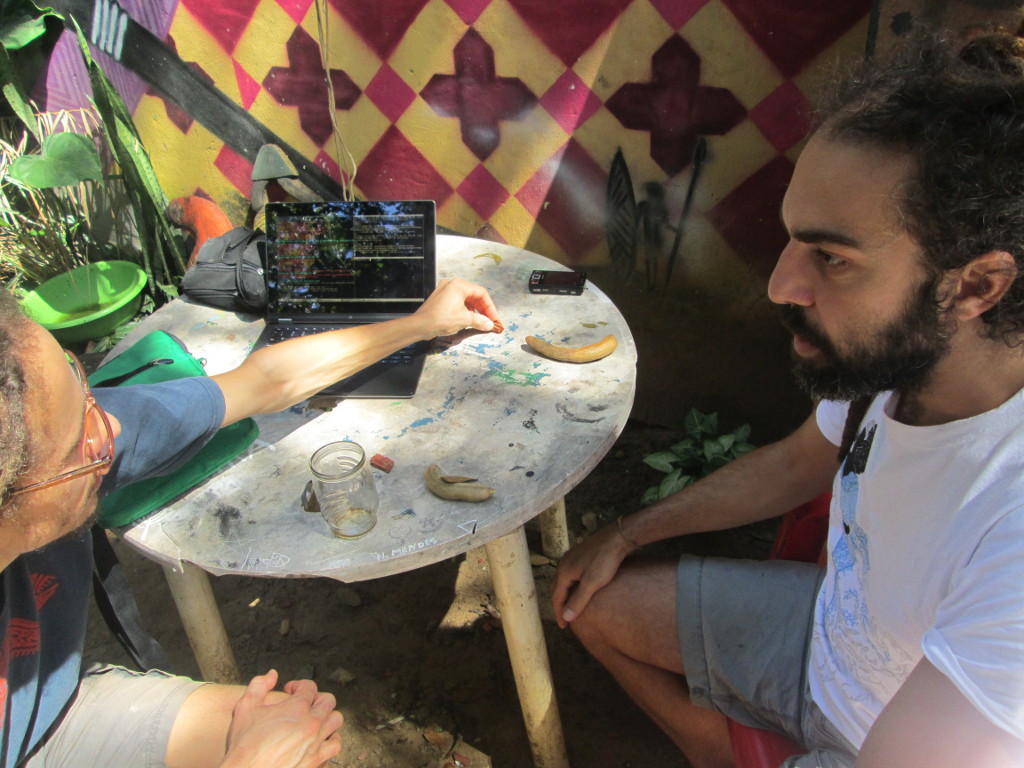
git-annex-routing.jpg Discussing git-annex routing with Vince and Fernao. Might not look like much, but we seem to be close to cracking the most interesting problem with git-annex routing. I need to translate and read Vince's thesis and build some simulations.. (Seed pod, cup, camera = fixed node; mini brick = usb drive; leaves = data.)

30 April 2014

Joey Hess: radio brazil

Live radio broadcast going on in the tent while I teach Mill to use ikiwiki.

29 April 2014

Joey Hess: the real Brazil

(click to enlarge)
"This is the real Brazil" -- Fernao After 3 days of travel, including 22 hours driving from Brasilia to the coast of Bahia, I can't say much more. A few things not pictured above.. The two hours of car-swallowing potholes in an arrow-straight highway in a flat plain, playing chicken against oncoming trucks. Night swim in the river in Correntina, followed by a whole grilled fish and ice cold guarana. Bliss. Push starting the car in a small cattle-farming village when it wouldn't start. The first sight of ocean waves and the drum circle last night.

19 April 2014

Joey Hess: propellor-driven DNS and backups

Took a while to get here, but Propellor 0.4.0 can deploy DNS servers and I just had it deploy mine. Including generating DNS zone files. Configuration is dead simple, as far as DNS goes:
     & alias "ns1.example.com"
        & Dns.secondary hosts "joeyh.name"
                & Dns.primary hosts "example.com"
                        (Dns.mkSOA "ns1.example.com" 100)
                        [ (RootDomain, NS $ AbsDomain "ns1.example.com")
            , (RootDomain, NS $ AbsDomain "ns2.example.com")
                        ]
The awesome thing is that propellor fills in all the other information in the zone file by looking at the properties of the hosts it knows about.
 , host "blue.example.com"
        & ipv4 "192.168.1.1"
        & ipv6 "fe80::26fd:52ff:feea:2294"
        & alias "example.com"
        & alias "www.example.com"
        & alias "example.museum"
        & Docker.docked hosts "webserver"
             requres  backedup "/var/www"
        
        & alias "ns2.example.com"
        & Dns.secondary hosts "example.com"
When it sees this host, Propellor adds its IP addresses to the example.com DNS zone file, for both its main hostname ("blue.example.com"), and also its relevant aliases. (The .museum alias would go into a different zone file.) Multiple hosts can define the same alias, and then you automaticlly get round-robin DNS. The web server part of of the blue.example.com config can be cut and pasted to another host in order to move its web server to the other host, including updating the DNS. That's really all there is to is, just cut, paste, and commit! I'm quite happy with how that worked out. And curious if Puppet etc have anything similar.
One tricky part of this was how to ensure that the serial number automtically updates when changes are made. The way this is handled is Propellor starts with a base serial number (100 in the example above), and then it adds to it the number of commits in its git repository. The zone file is only updated when something in it besides the serial number needs to change. The result is nice small serial numbers that don't risk overflowing the (so 90's) 32 bit limit, and will be consistent even if the configuration had Propellor setting up multiple independent master DNS servers for the same domain.
Another recent feature in Propellor is that it can use Obnam to back up a directory. With the awesome feature that if the backed up directory is empty/missing, Propellor will automcatically restore it from the backup. Here's how the backedup property used in the example above might be implemented:
backedup :: FilePath -> Property
backedup dir = Obnam.backup dir daily
    [ "--repository=sftp://rsync.example.com/~/webserver.obnam"
    ] Obnam.OnlyClient
     requires  Ssh.keyImported SshRsa "root"
     requires  Ssh.knownHost hosts "rsync.example.com" "root"
     requires  Gpg.keyImported "1B169BE1" "root"
Notice that the Ssh.knownHost makes root trust the ssh host key belonging to rsync.example.com. So Propellor needs to be told what that host key is, like so:
 , host "rsync.example.com"
        & ipv4 "192.168.1.4"
        & sshPubKey "ssh-rsa blahblahblah"
Which of course ties back into the DNS and gets this hostname set in it. But also, the ssh public key is available for this host and visible to the DNS zone file generator, and that could also be set in the DNS, in a SSHFP record. I haven't gotten around to implementing that, but hope at some point to make Propellor support DNSSEC, and then this will all combine even more nicely.
By the way, Propellor is now up to 3 thousand lines of code (not including Utility library). In 20 days, as a 10% time side project.

11 April 2014

Joey Hess: propellor introspection for DNS

In just released Propellor 0.3.0, I've improved improved Propellor's config file DSL significantly. Now properties can set attributes of a host, that can be looked up by its other properties, using a Reader monad. This saves needing to repeat yourself:
hosts = [ host "orca.kitenet.net"
        & stdSourcesList Unstable
        & Hostname.sane -- uses hostname from above
And it simplifies docker setup, with no longer a need to differentiate between properties that configure docker vs properties of the container:
 -- A generic webserver in a Docker container.
    , Docker.container "webserver" "joeyh/debian-unstable"
        & Docker.publish "80:80"
        & Docker.volume "/var/www:/var/www"
        & Apt.serviceInstalledRunning "apache2"
But the really useful thing is, it allows automating DNS zone file creation, using attributes of hosts that are set and used alongside their other properties:
hosts =
    [ host "clam.kitenet.net"
        & ipv4 "10.1.1.1"
        & cname "openid.kitenet.net"
        & Docker.docked hosts "openid-provider"
        & cname "ancient.kitenet.net"
        & Docker.docked hosts "ancient-kitenet"
    , host "diatom.kitenet.net"
        & Dns.primary "kitenet.net" hosts
    ]
Notice that hosts is passed into Dns.primary, inside the definition of hosts! Tying the knot like this is a fun haskell laziness trick. :) Now I just need to write a little function to look over the hosts and generate a zone file from their hostname, cname, and address attributes:
extractZoneFile :: Domain -> [Host] -> ZoneFile
extractZoneFile = gen . map hostAttr
  where gen = -- TODO
The eventual plan is that the cname property won't be defined as a property of the host, but of the container running inside it. Then I'll be able to cut-n-paste move docker containers between hosts, or duplicate the same container onto several hosts to deal with load, and propellor will provision them, and update the zone file appropriately.
Also, Chris Webber had suggested that Propellor be able to separate values from properties, so that eg, a web wizard could configure the values easily. I think this gets it much of the way there. All that's left to do is two easy functions:
overrideAttrsFromJSON :: Host -> JSON -> Host
exportJSONAttrs :: Host -> JSON
With these, propellor's configuration could be adjusted at run time using JSON from a file or other source. For example, here's a containerized webserver that publishes a directory from the external host, as configured by JSON that it exports:
demo :: Host
demo = Docker.container "webserver" "joeyh/debian-unstable"
    & Docker.publish "80:80"
    & dir_to_publish "/home/mywebsite" -- dummy default
    & Docker.volume (getAttr dir_to_publish ++":/var/www")
    & Apt.serviceInstalledRunning "apache2"
main = do
    json <- readJSON "my.json"
    let demo' = overrideAttrsFromJSON demo
    writeJSON "my.json" (exportJSONAttrs demo')
    defaultMain [demo']

10 April 2014

Joey Hess: Kite: a server's tale

My server, Kite, is finishing its 20th year online. It started as kite.resnet.cornell.edu, a 486 under the desk in my dorm room. Early on, it bounced around the DNS -- kite.ithaca.ny.us, kite.ml.org, kite.preferred.com -- before landing on kite.kitenet.net. The hardware has changed too, from a succession of desktop machines, it eventually turned into a 2u rack-mount server in the CCCP co-op. And then it went virtual, and international, spending a brief time in Amsterdam, before relocating to England and the kvm-hosting co-op. Through all this change, and no few reinstalls from scratch, it's had a single distinct personality. This is a multi-user unix system, of the old school, carefully (and not-so-carefully) configured and administered to perform a grab-bag of functions. Whatever the users need. I read the olduse.net hacknews newsgroup, and I see, in their descriptions of their server in 1984, the prototype of Kite and all its ilk. It's consistently had a small group of users, a small subset of my family and friends. Not quite big enough to really turn into a community, and we wall and talk less than we once did.
Exhibit: Kite as it appeared in the 90's [Intentionally partially broken, being able to read the cgi source code is half the fun.] Kite was an early server on the WWW, and garnered mention in books and print articles. Not because it did anything important, but because there were few enough interesting web sites that it slightly stood out.

Many times over these 20 years I've wondered what will be the end of Kite's story. It seemed like I would either keep running it indefinitely, or perhaps lose interest. (Or funding -- it's eaten a lot of cash over the years, especially before the current days of $5/month VPS hosting.) But I failed to anticipate what seems to really be happening to it. Just as I didn't fathom, when kite was perched under my desk, that it would one day be some virtual abstract machine in a unknown computer in anther country. Now it seems that what will happen to Kite is that most of the important parts of it will split off into a constellation of specialized servers. The website, including the user sites, has mostly moved to branchable.com. The DNS server, git server and other crucial stuff is moving to various VPS instances and containers. (The exhibit above is just one more automatically deployed, soulless container..) A large part of Kite has always been about me playing with bleeding-edge stuff and installing random new toys; that has moved to a throwaway personal server at cloudatcost.com which might be gone tomorrow (or might keep running for free for years). What it seems will be left is a shell box, with IMAP access to a mail server, and a web server for legacy /~user/ sites, and a few tools that my users need (including that pine program some of them are still stuck on.) Will it be worth calling that Kite?
[ Kite users: This transition needs to be done by December when the current host is scheduled to be retired. ]

2 April 2014

Joey Hess: propellor type-safe reversions

Propellor ensures that a list of properties about a system are satisfied. But requirements change, and so you might want to revert a property that had been set up before. For example, I had a system with a webserver container:
Docker.docked container hostname "webserver"
I don't want a web server there any more. Rather than having a separate property to stop it, wouldn't it be nice to be able to say:
revert (Docker.docked container hostname "webserver")
I've now gotten this working. The really fun part is, some properies support reversion, but other properties certianly do not. Maybe the code to revert them is not worth writing, or maybe the property does something that cannot be reverted. For example, Docker.garbageCollected is a property that makes sure there are no unused docker images wasting disk space. It can't be reverted. Nor can my personal standardSystem Unstable property, which amoung other things upgrades the system to unstable and sets up my home directory.. I found a way to make Propellor statically check if a property can be reverted at compile time. So revert Docker.garbageCollected will fail to type check! The tricky part about implementing this is that the user configures Propellor with a list of properties. But now there are two distinct types of properties, revertable ones and non-revertable ones. And Haskell does not support heterogeneous lists.. My solution to this is a typeclass and some syntactic sugar operators. To build a list of properties, with individual elements that might be revertable, and others not:
 props
        & standardSystem Unstable
        & revert (Docker.docked container hostname "webserver")
        & Docker.docked container hostname "amd64-git-annex-builder"
        & Docker.garbageCollected

1 April 2014

Joey Hess: adding docker support to propellor

Propellor development is churning away! (And leaving no few puns in its wake..) Now it supports secure handling of private data like passwords (only the host that owns it can see it), and fully end-to-end secured deployment via gpg signed and verified commits. And, I've just gotten support for Docker to build. Probably not quite work, but it should only be a few bugs away at this point. Here's how to deploy a dockerized webserver with propellor:
host hostname@"clam.kitenet.net" = Just
    [ Docker.configured
    , File.dirExists "/var/www"
    , Docker.hasContainer hostname "webserver" container
    ]
container _ "webserver" = Just $ Docker.containerFromImage "joeyh/debian-unstable"
        [ Docker.publish "80:80"
        , Docker.volume "/var/www:/var/www"
        , Docker.inside
            [ serviceRunning "apache2"
                 requires  Apt.installed ["apache2"]
            ]
        ]
Docker containers are set up using Properties too, just like regular hosts, but their Properties are run inside the container. That means that, if I change the web server port above, Propellor will notice the container config is out of date, and stop the container, commit an image based on it, and quickly use that to bring up a new container with the new configuration. If I change the web server to say, lighttpd, Propellor will run inside the container, and notice that it needs to install lighttpd to satisfy the new property, and so will update the container without needing to take it down. Adding all this behavior took only 253 lines of code, and none of it impacts the core of Propellor at all; it's all in Propellor.Property.Docker. (Well, I did need another hundred lines to write a daemon that runs inside the container and reads commands to run over a named pipe... Docker makes running ad-hoc commands inside a container a PITA.) So, I think that this vindicates the approach of making the configuration of Propellor be a list of Properties, which can be constructed by abitrarily interesting Haskell code. I didn't design Propellor to support containers, but it was easy to find a way to express them as shown above. Compare that with how Puppet supports Docker: http://docs.docker.io/en/latest/use/puppet/
docker::run   'helloworld':
  image        => 'ubuntu',
  command      => '/bin/sh -c "while true; do echo hello world; sleep 1; done"',
  ports        => ['4444', '4555'],
...
All puppet manages is running the image and a simple static command inside it. All the complexities that puppet provides for configuring servers cannot easily be brought to bear inside the container, and a large reason for that is, I think, that its configuration file is just not expressive enough.

30 March 2014

Joey Hess: propellor

Whups, I seem to have built a configuration management system this evening! Propellor has similar goals to chef or puppet or ansible, but with an approach much more like slaughter. Except it's configured by writing Haskell code. The name is because propellor ensures that a system is configured with the desired PROPerties, and also because it kind of pulls system configuration along after it. And you may not want to stand too close. Disclaimer: I'm not really a sysadmin, except for on the scale of "diffuse administration of every Debian machine on planet earth or nearby", and so I don't really understand configuration management. (Well, I did write debconf, which claims to be the "Debian Configuration Management system".. But I didn't understand configuration management back then either.) So, propellor makes some perhaps wacky choices. The least of these is that it's built from a git repository that any (theoretical) other users will fork and modify; a cron job can re-make it from time to time and pull down configuration changes, or something can be run to push changes. A really simple configuration for a Tor bridge server using propellor looks something like this:
main = ensureProperties
    [ Apt.stdSourcesList Apt.Stable  onChange  Apt.upgrade
    , Apt.removed ["exim4"]  onChange  Apt.autoRemove
    , Hostname.set "bridget"
    , Ssh.uniqueHostKeys
    , Tor.isBridge
    ]
Since it's just haskell code, it's "easy" to refactor out common configurations for classes of servers, etc. Or perhaps integrate reclass? I don't know. I'm happy with just pure functions and type-safe refactorings of my configs, I think. Properties are also written in Haskell of course. This one ensures that all the packages in a list are installed.
installed :: [Package] -> Property
installed ps = check (isInstallable ps) go
  where
        go = runApt $ [Param "-y", Param "install"] ++ map Param ps
Here's one that ensures the hostname is set to the desired value, which shows how to specify content for a file, and also how to run another action if a change needed to be made to satisfy a property.
set :: HostName -> Property
set hostname = "/etc/hostname"  File.hasContent  [hostname]
         onChange  cmdProperty "hostname" [Param hostname]
Here's part of a custom one that I use to check out a user's home directory from git. Shows how to make a property require that some other property is satisfied first, and how to test if a property has already been satisfied.
installedFor :: UserName -> Property
installedFor user = check (not <$> hasGitDir user) $
        Property ("githome " ++ user) (go =<< homedir user)
                     requires  Apt.installed ["git", "myrepos"]
  where
    go ... -- 12 lines elided
I'm about 37% happy with the overall approach to listing properties and combining properties into larger properties etc. I think that some unifying insight is missing -- perhaps there should be a Property monad? But as long as it yields a list of properties, any smarter thing should be able to be built on top of this. Propellor is 564 lines of code, including 25 or so built-in properties like the examples above. It took around 4 hours to build. I'm pretty sure it was easier to write it than it would have been to look into ansible and salt and slaughter (and also liw's human-readable configuration language whose name I've forgotten) in enough detail to pick one, and learn how its configuration worked, and warp it into something close to how I wanted this to work. I think that's interesting.. It's partly about NIH and I-want-everything-in-Haskell, but it's also about a complicated system that is a lot of things to a lot of people -- of the kind I see when I look at ansible -- vs the tools and experience to build just the thing you want without the cruft. Nice to have the latter!

1 March 2014

Wouter Verhelst: Transitioned to ikiwiki

If you can read this, that means my transition to ikiwiki has happened. I've been interested in ikiwiki ever since Joey first wrote about it back in 2006, but it took me until just recently to finally bite the bullet and migrate to ikiwiki. The plan was to retain everything, including comments, and I've mostly achieved that. Still, a few things were lost along the way: I should note that at this point I've only ported the blog itself, not the rest of my website. While ikiwiki can be used for that as well, the parts outside of my blog are fairly static and don't change all that often. In addition, those bits are set up in an even uglier way, and I didn't want to fix them up just yet. Things I've learned:

21 February 2014

Joey Hess: subverting hierarchy with git

Did you ever want to be able to tag your files, and use the tags to query and select the files you want? For many sorts of files we use, this is clearly better than being locked into a single hierarchial view of nested directories. Semantic file systems are a way to do things like this. But that's an entire separate filesystem, often implemented as a FUSE layer. I have never wanted tagging enough to take on that layer of complications. A week ago I realized that there was a way to do this without using an entirely separate filesystem. When we use git, we're used to having different views of our files, called branches, that we switch between. What then, if a git branch were generated from tags and other metadata that meet a query, providing a custom view that meet the user's current needs and could be incrementally refined. Here's a short screencast demoing these views.
And here's a walkthrough for setting it up. To build this, I needed a nice way to store metadata in git, and since git-annex happens to have a very nice way of using git as a database, I naturally built it on top of git-annex. This means that the tags and other metadata are automatically synchronized between different clones of the repository. Multiple users can be tagging and setting other metadata at the same time, and their changes will merge in a consistent way. I have a long list of things to do to fully integrate views into git-annex. However, they're already basically usable, and I'm very pleased with how these dymanic views of the contents of a repository are working out. Today's release of git-annex includes views support, so give them a try!

15 February 2014

Rog rio Brito: Miscellanea

Init system I am happy that Debian's Technical Committee was able to reach a very good decision with the choice of systemd as the default init system for the Linux ports. In particular, I was very pleasantly surprised by the lucidity of Russ Allbery's analyses and, above all, his patience even with people that, in my understanding, were just being trolls or trying to cause confusion and disrupt a process that was already chaotic. Russ, thank you for your exemplary role. (Also, you type fast or what? You fill whole e-mails seemingly faster than I can read!)

Unexpected union of forces It seems to me that Mark Shutterworth's decision of (perhaps?) embracing Debian's decision in the init system is a good thing. I think that one way where Ubuntu did a great thing with respect to Debian was their initial attitude towards cherry-picking the best of breed of Free Software from Debian's archive and polishing that to create a really "for human beings" operating system. I hope that this means that, at least in part, money (Mark's?) can be channeled in the best of the interests so that we all gain from it. (And, to be honest, I see no problem in making money with Free Software and I welcome a well done integration job).

More polarizing things I feel that, now, I may even have some hope of sending another potentially polarizing bug to the Tech Ctte (that is ffmpeg vs. libav) and have faith that some rational decision would be made. I was not even aware of it, but the ffmpeg folks even featured a news item in their page of me having filed the RFP bug mentioned above.

DebConf 14 If everything goes as expected, I hope to attend this year's DebConf. In fact, I am anticipating this, since I would love to, e.g., talk with Joey Hess and discuss a better way of having GNU parallel and the parallel program in moreutils have amicable co-installability among many, many other things with respect to my packages. And, quite probably, work on packaging ffmpeg with other interested people (which seem to be numerous).
Edit: Fix markdown link pointing twice to the ffmpeg site. Thanks Marius Gedminas for pointing this out.

18 December 2013

Joey Hess: what charlie's missing about bitcoin

(Posted as a comment to Charles Stross's blog post about bitcoin) Bitcoin is a piece of software which tries to implement a particular SFnal future. One in which the world currency is de-centralized, deflationary, all early bitcoin adopters own their own planetoids, and all visitors are automatically charged for the air they breath. Thing is, the real world is more complicated than that. Assuming Bitcoin did manage to become an important currency, countries would naturally try to regulate it. In 30 years, by the time bitcoin mining has slowed right down, the legal system will be fully caught up to the internet. Bitcoin tries to make its code the law (as Lessig used to say), but the law can certainly affect its code. The law could, for example, require that bitcoin be changed to stop increasing the difficulty of mining new blocks. Then bitcoin is suddenly an inflationary currency. This would be a hard fork in the block chain, but one enforced by financial regulators. Miners would be tracked down and forced to comply. Some would perhaps go underground and run the deflationary bitcoin network on TOR hidden services. Lots of possible ways it could play out. That's only one scenario, covering one of the many problems with Bitcoin that make Charlie hate it. So it seems to me that Bitcoin should be a gold mine for Science Fiction authors, if nothing else..

17 December 2013

Joey Hess: completely linux distribution-independent packaging

Sometimes it makes sense to ship a program to linux users in ready-to-run form that will work no matter what distribution they are using. This is hard. Often a commerical linux game will bundle up a few of the more problimatic libraries, and ship a dynamic executable that still depends on other system libaries. These days they're building and shipping entire Debian derivatives instead, to avoid needing to deal with that. There have been a few efforts to provide so-called one click install package systems that AFAIK, have not been widely used. I don't know if they generally solved the problem. More modern appoaches seem to be things like docker, which move the application bundle into a containerized environment. I have not looked at these, but so far it does not seem to have spread widely enough to be a practical choice if you're wanting to provide something that will work for a majority of linux users. So, I'm surprised that I seem to have managed to solve this problem using nothing more than some ugly shell scripts. My standalone tarballs of git-annex now seem fairly good at running on a very wide variety of systems. For example, I unpacked the tarball into the Debian-Installer initramfs and git-annex could run there. I can delete all of /usr and it keeps working! All it needs is a basic sh, which even busybox provides. Looks likely that the new armel standalone tarball of git-annex will soon be working on embedded systems as odd as the Synology NAS, and it's already been verified to work on Raspbian. (I'm curious if it would work on Android, but that might be a stretch.) Currently these tarballs are built for a specific architecture, but there's no particular reason a single one couldn't combine binaries built for each supported architecture. technical details The main trick is to ship a copy of ld-linux.so, as well as all the glibc libraries and associated files, and of course every other library and file the application needs. Shipping ld-linux.so lets a shell script wrapper be made around each binary, that runs ld-linux.so and passes it the library directories to search. This way the binary can be run, bypassing the system's own dynamic linker (which might not like it) and using the included glibc. For example a shell script that runs the git binary from the bundle:
exec "$GIT_ANNEX_LINKER" --library-path "$GIT_ANNEX_LD_LIBRARY_PATH" "$GIT_ANNEX_SHIMMED/git/git" "$@"
I have to set quite a lot of environment variables, to avoid using any files from the system and instead use ones from my tarball. One important one is GCONV_PATH. Note that LD_LIBRARY_PATH does not have to be set, and this is nice because it allows running a few programs from the host system, such as its web browser. worse is better Of course I'll take a proper distribution package anytime over this. Still, it seems to work quite well, in all the horrible cases that require it.

22 November 2013

Joey Hess: 2013 git-annex user survey

Similar to the yearly git user survey, I am doing a 2013 git-annex user survey. If you use git-annex, please take a few minutes to answer my questions!
Since this blog post is too short, let me also announce a minor spinoff project from git-annex that I have recently released. git-repair is a complement to git fsck that can fix up arbitrarily damaged git repositories. As well as avoiding the need to rm -rf a damaged repository and re-clone, using git-repair can help rescue commits you've made to the damaged repository and not yet pushed out. I've been testing git-repair with evil code that damages git repositories in random ways. It has now successfully repaired tens of thousands of damaged repositories. In the process, I have found some bugs in git itself.

18 November 2013

Joey Hess: new and old laptops

I've had a new laptop for a couple months. It's a lot larger and faster than my old Dell Mini 9 netbook, which I somewhat famously used exclusively for 5 years. The new laptop is a Lenovo Yoga 11, and its screen can bend all the way back and around to under the keyboard, converting it to a tablet. (Held together with some quite powerful magnets, it turns out.. when did those become ok to have around computer equiment?) This is a feature I've always felt laptops should have, especially after the Mini 9, which couldn't even open out to flat. Although since the accelerometer is not yet working under Linux, and Linux GUIs are not very well suited for tablets, I have so far mostly used the feature for a) reading and b) cleaning that usually hard to reach area around the hinge. Anyway, this is a laptop that wants to be a tablet, including all the bad parts, like a hard to remove battery. (20-some torx screws, according to the service manual.) Yesterday I made the mistake of running down the battery all day, and when I plugged it in, after a gloomy grey day, there was not enough oomph in the house's battery bank to recharge a hungry L-ion battery. So I was stuck using my old laptop for several hours, with its battery removed, and its lack of fan making it a nice warm lump. It felt kind of like driving around in an old VW bus, everything is awkward and slow, and yet somehow also charming, and at the end you wonder how you put up with it for so long. These machines and the ways they influence us..

30 October 2013

Joey Hess: license monads

This could have been a blog post about toothbrushes for monkeys, which I seem to have dreamed about this morning. But then I was vaguely listening to the FAIFCast in the car, and I came up with something even more esoteric to write about! License monads would allow separating parts of code that are under different licenses, in a rigorous fashion. For example, we might have two functions in different license monads:
foo :: String -> GPL String
bar :: Char -> BSD Char
Perhaps foo needs to use bar to calculate its value. It can only do so if there's a way to lift code in the BSD monad into the GPL monad. Which we can legally write, since the BSD license is upwards-compatable with the GPL:
liftGPL :: BSD a -> GPL a
On the other hand, there should be no way provided to lift the GPL monad into the BSD monad. So bar cannot be written using code from foo, which would violate foo's GPL license. Perhaps the reason I am thinking about this is that the other day I found myself refactoring some code out of the git-annex webapp (which is AGPL licensed) and into the git-annex assistant (which is GPL licensed). Which meant I had to relicense that code. Luckily that was easy to do legally speaking, since I am the only author of the git-annex webapp so far, and own the whole license of it. (Actually, it's only around 3 thousand lines of code, and another thousand of html.) It also turned out to be easy to do the refactoring, technically speaking because looking at the code, I realized I had accidentially written it in the wrong monad; all the functions were in the webapp's Handler monad, but all of them used liftAnnex to actually do their work in the Annex monad. If that had not been the case, I would not have been able to refactor the code, at least not without entirely rewriting it. It's as if I had accidentially written:
foo :: String -> GPL String
foo = mapM (liftGPL . bar)
Which can be generalized to:
foo :: String -> BSD String
foo = mapM bar
I don't think that license monads can be realistically used in the current world, because lawyers and math often don't mix well. Lawyers have, after all, in the past written laws re-defining pi to be 3. Still, license monads are an interesting way to think about things for myself. They capture how my code and licenses are structured and allow me to reason about it on a more granular level than the licences of individual files. (I have a vague feeling someone else may have written about this idea before? Perhaps I should have been blogging about monkey toothbrushes after all...)

2 October 2013

Joey Hess: insured

Here in the US, the Affordable Care Act is finally going into effect, with accompanying drama. I managed to get signed up today at healthcare.gov. After not having health insurance since 2000, I will finally be covered starting January 1 2014. Since my income is mosty publically known anyway, I thought it might be helpful to blog about some details. I was uninsured for 14 years due to a combination of three factors:
  1. Initially, youthful stupidity and/or a perfectly resonable cost/benefit analysis. (Take your pick.)
  2. Due to the US health insurance system being obviously broken, and my preference to avoid things that are broken. Especially when the breakage involved insurers refusing to cover me at any sane level due to a minor and easily controlled pre-existing condition.
  3. Since I'm not much motivated by income levels, and am very motivated to have time to work on things that are important to me, my income has been on average pretty low, and perhaps more importantly, I have intentionally avoided being a full-time employee of anyone at any point in the past 14 years (have rejected job offers), and so was not eligible for any employee plans which were the only reasonable way to be covered in the US. (See point #2.)
So, if you're stuck waiting in line on healthcare.gov (is this an entirely new online experience brought to us by the US government?), or have seen any of the dozen or so failure modes that I saw just trying to register for a login to the site, yeah, it's massively overloaded right now, and it's also quite broken on a number of technical levels. But you can eventually get though it. Based on some of the bugs I saw, it may help to have an large number of email addresses and use a different one for each application attempt. It also wouldn't hurt to write some programs to automate the attempts, because otherwise you may have to fill out the same form dozens of times. And no, you can't use "you+foo@bar.com" for your email; despite funding the development of RFC-822 in the 80's, the US government is clueless about what consititutes a valid email address. But my "favorite" misfeature of the site is that it refuses to let you enter any accented characters, or characters not in the latin alphabet when signing up. Even if they're, you know, part of your name. (Welcome back to Ellis Island..) I want to check the git repository to see if I can find the backstory for these and other interesting technical decisions, but they have forgotten to push anything to it for over 3 months. The good news is that once you get past the initial signup process, and assuming you get the confirmation mail before the really short expiration period of apparently less than 1 hour (another interesting technical choice, given things like greylisting), the actual exchange is not badly overloaded, and nor is it very buggy (comparatively). I was able to complete an application in about an hour. The irony is that after all that, I was only able to choose from one health insurer covering my area on the so-called "exchange". (Blue Cross/Blue Shield) I also signed up for dental insurance (it was a welcome surprise that the site offers this at all) and had a choice of two insurers for that. The application process was made more uncertian for me since I have no idea what I'll end up doing for money once my current crowdsourced year of work is done. The site wants you to know how much income you'll have in 2014, and my guess is anywhere between $6000 (from a rental property) and about what I made this year (approx $25000 before taxes). Or up, if I say, answered the Google pings. The best choice seemed to be to answer what I made this year, which is also close to what I made last year. So, I'll be paying around $200/month for a combination of not very good health insurance, and not very good dental insurance. There is around $750/year of financial aid to people at my guesstimated 2014 income level, which would drop that to $140/month, but I will let them refund me whatever that turns out to be in a lump sum later instead. For comparison, I am lucky to spend rather less renting a three bedroom house situated in 25 acres of woods.. It's strange to think that all of this is an improvement to the system here in the US, especially given all the better options that could have been passed instead, but it seems that it probably is. Especially when I consider the many people around me who are less fortunate than myself. If you'd like a broader perspective on this, see Tobias Buckell's "American healthcare was already socialized by Reagan, we re just fighting about how to pay for it".

Next.

Previous.