Jonathan Dowland: Lockdown music
 Last Christmas, to make room for a tree, I dis-assembled my hifi unit
and (temporarily, I thought) lugged my hi-fi and records up to the study.
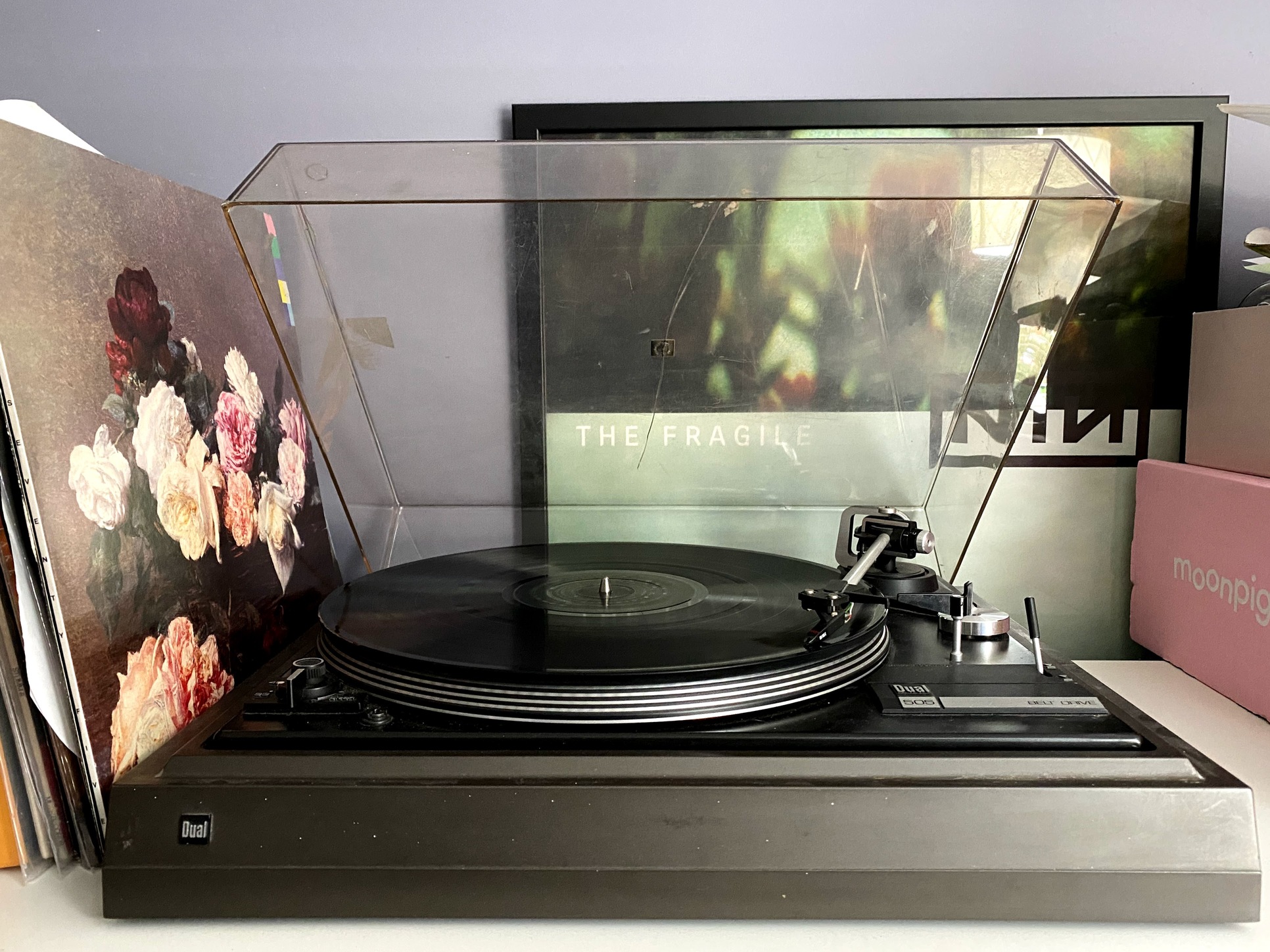 Last Christmas, to make room for a tree, I dis-assembled my hifi unit
and (temporarily, I thought) lugged my hi-fi and records up to the study.
I don't generally write consumer reviews, here or elsewhere; but I have been so
impressed by this one I wanted to mention it.
For Holly's birthday this year, taking place under Lockdown, we decided to buy
a year's subscription to "Disney+". Our current TV receiver (A Humax Freesat
box) doesn't support it so I needed to find some other way to get it onto the
TV.
After a short bit of research, I bought the "Roku Express" streaming media
player. This is the most basic streamer that Roku make, bottom of their range.
For a little bit more money you can get a model which supports 4K (although my
TV obviously doesn't: it, and the basic Roku, top out at 1080p) and a bit more
gets you a "stick" form-factor and a Bluetooth remote (rather than line-of-sight IR).
I paid 20 for the most basic model and it Just Works. The receiver is very
small but sits comfortably next to my satellite receiver-box. I don't have any
issues with line-of-sight for the IR remote (and I rely on a regular IR remote
for the TV itself of course). It supports Disney+, but also all the other big
name services, some of which we already use (Netflix, YouTube BBC iPlayer)
and some of which we didn't, since it was too awkward to access them
(Google Play, Amazon Prime Video). It has now largely displaced the
FreeSat box for accessing streaming content because it works so well and
everything is in one place.
There's a phone App that remote-controls the box and works even better than the
physical remote: it can offer a full phone-keyboard at times when you need to
input text, and can mute the TV audio and put it out through headphones
attached to the phone if you want.
My aging Plasma TV suffers from burn-in from static pictures. If left paused
for a duration the Roku goes to a screensaver that keeps the whole frame
moving. The FreeSat doesn't do this. My Blu Ray player does, but (I think) it
retains some static elements.
This is a fairly self-indulgent post, sorry!
Encouraged by Evgeni,
Michael and
others, given I'm spending a lot more time at my desk in my home office, here's
a picture of it:
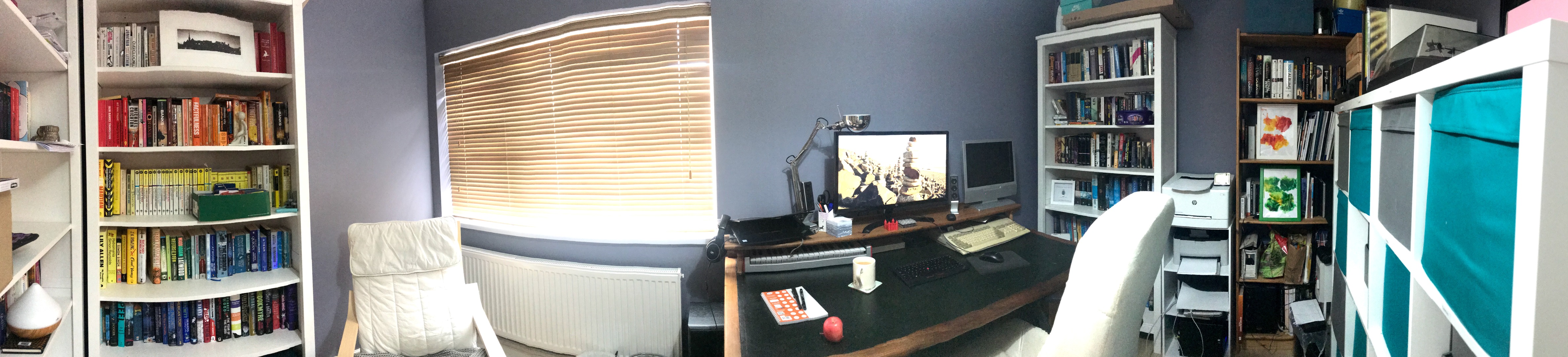 Fisheye shot of my home office
I've written about what Template Haskell is, and given an example of what
it can be used for, it's time to explain why I
was looking at it in the context of my PhD work.
Encoding stream-processing programs
StrIoT is an experimental distributed stream-processing
system that myself and others are building in order to explore our research
questions. A user of StrIoT writes a stream-processing program, using a set
of 8 functional operators provided for the purpose. A simple example is
streamFn :: Stream Int -> Stream Int
streamFn = streamFilter (<15)
         . streamFilter (>5)
         . streamMap (*2)
data StreamVertex = StreamVertex
      vertexId   :: Int
    , operator   :: StreamOperator
    , parameters :: [String]
    , intype     :: String
    , outtype    :: String
      deriving (Eq,Show)
path [ StreamVertex 0 Map    ["(*2)"]  "Int" "Int"
     , StreamVertex 1 Filter ["(>5)"]  "Int" "Int"
     , StreamVertex 2 Filter ["(<15)"] "Int" "Int"
     ]
[  streamFilter (<15) . streamFilter (>5) . streamMap (*2)  ]
  \s -> streamFilter (<15) (streamFilter (>5) (streamMap (*2) s))  ]
[  streamMap (*2) >>> streamFilter (>5) >>> streamFilter (<15)  ]
[  \s -> s & streamMap (*2) & streamFilter (>5) & streamFilter (<15)  ]
[  streamFn  ] -- a named expression, defined outside the quasi-quotes
reify can give you the definition of a function from its
name, but in practice it doesn't, because this was never implemented.
So at the very least we would need to insist that a user included the
entirety of a stream-processing program within quasi-quotes, and not
split it up into separate bits, with some bits defined outside the
quotes and references within (as in the last case above). We would
probably have to insist on a consistent approach for composing operators
together, such as always use (.) and never >>>, &, etc. which is
limiting.
Incremental approach
After a while ruminating on this, and before moving onto something else,
I thought I'd try approaching it from the other side. Could I introduce
some TH into the existing approach, and improve it? The first thing I've
tried is to change the parameters field to TH's ExpQ, meaning the
map instance example above would be
StreamVertex 0 Map [ [ (*2) ] ] "Int" "Int"
let f' = "(let f = ("++f++"); p = ("++p++"); g = ("++g++") in\
         \ \\ (a,b) v -> (f a v, if p v a then g b v else b))"
    a' = "("++a++","++b++")"
    q' = "(let p = ("++p++"); q = ("++q++") in \\v (y,z) -> p v y && q v z)"
let f' = [  \ (a,b) v -> ($(f) a v, if $(p) v a then $(g) b v else b)  ]
    a' = [  ($(a), $(b))  ]
    q' = [  \v (y,z) -> $(p) v y && $(q) v z  ]
intype and outtype could be TH Types instead of Strings.
This would catch some simple problems like typos, etc., but we could
possibly go further, andparameters is a list, because the different stream operators have
different arities. streamFilter has one parameter (the filter
predicate), so the list should have one element in that case, but
streamExpand has none, so it should be empty.
We could collapse this to a single ExpQ, which encoded however
many parameters are necessary, either in an internal list, or parameters
expression was actually a call to the relevant operator with its
parameters supplied.data StreamVertex = StreamVertex
vertexId :: Int
, opAndParams :: ExpQ
deriving (Eq,Show)
StreamVertex 0 [  streamMap (*2)  ]
StreamVertex 1 [  streamExpand  ]
StreamVertex 2 [  streamScan (\c _ -> c+1) 0  ]
vertexId field is a bit of wart, but we require that due to
the graph data structure that we are using. A change there could
eliminate it, too. By this point we are not that far away from where
we started, and certainly much closer to the "pure" function application
in the very first example.
I've been meaning to write more about my PhD work for absolutely ages, but I've
held myself back by wanting to try and keep a narrative running through the blog
posts. That's not realistic for a number of reasons so I'm going to just write
about different aspects of things without worrying about whether they make sense
in the context of recent blog posts or not.
Part of what I am doing at the moment is investigating
Template Haskell
to see
whether it would usefully improve our system implementation. Before I write more
about how it might apply to our system, I'll first write a bit about Template
Haskell itself.
Template Haskell (TH) is a meta-programming system: you write programs that are
executed at compile time and can output code to be spliced into the parent
program. The approach used by TH is really nice: you perform your meta-programming
in real first-class Haskell, and it integrates really well with the main program.
TH provides two pairs of special brackets. Oxford brackets surrounding any
Haskell expression cause the whole expression to be replaced by the result of
parsing the expression an expression tree which can be inspected and
manipulated by the main program:
[ \x -> x + 1 ]
Exp, for expression,
which has constructors for the different expression types. The above lambda
expression is represented as
LamE [VarP x_1]
    (InfixE (Just (VarE x_1))
            (VarE GHC.Num.+)
            (Just (LitE (IntegerL 1))))
 > 1 + $( litE (IntegerL 1) )
2
fst operators
on a 2-tuple and returns the first value. It cannot operate on a tuple of a
different valence. However, a meta-program can generate a version of fst
specialised for an n-tuple of any n:
genfst n = do
    xs <- replicateM n (newName "x")
    let ntup = tupP (map varP xs)
    [  \ $(ntup) ->  $(varE (head xs))  ]
 > $(genfst 2) (1,2)
1
 > $(genfst 3) ('a','b','c')
'a'
 > :t $(genfst 10)
$(genfst 10) :: (a, b, c, d, e, f, g, h, i, j) -> a
Exp within the Q Monad:
 > :t [  1  ]
[  1  ] :: ExpQ
ExpQ is a synonym for Q Exp. Eagle-eyed Haskellers will have noticed that
genfst above was written in terms of some Monad. And you might also have
noticed the case discrepancy between the constructor types VarE (Etc) and
varE, tupP, varP used in that function definition. These are convenience
functions that wrap the relevant constructor in Q. The point of the Q
Monad is (I think) to handle name scoping, and avoid unintended name clashes.
Look at the output of these simple expressions, passed through runQ:
 > runQ [  \x -> x  ]
LamE [VarP x_1] (VarE x_1)
 > runQ [  \x -> x  ]
LamE [VarP x_2] (VarE x_2)
x are not the same x in the context they are evaluated (a GHCi
session). And that's the crux of the problem I am exploring. More in a later
blog post!
Here's a practical example of applying Template Haskell to reduce
the amount of boilerplate code that is otherwise required. I wrote the below
after following this excellent blog post by Matt Parsons. This post will be much higher-level, read
Matt's blog for the gorier details.
Liquorice
Liquorice is a toy project of mine from a few years ago that lets you
draw 2D geometric structures similar to LOGO. Liquorice offers two interfaces:
pure functions that operate on an explicit Context (the pen location:
existing lines, etc.), and a second "stateful" interface where the input and
output are handled in the background.
I prefix the pure ones P. and the stateful ones S. in this blog post for
clarity.
The stateful interface can be much nicer to use for larger drawings.
Compare example8b.hs,
written in terms of the pure functions, and the stateful equivalent
example8.hs.
The majority of the stateful functions are "wrapped" versions of the pure
functions. For example, the pure function P.step takes two numbers
and moves the pen forward and sideways. Its type signature is
P.step :: Int -> Int -> Context -> Context
S.step :: Int -> Int -> State Context ()
S.step x y = modify (P.step x y)
Name of a function to wrap, we construct an instance of FunD, the
TH data-type representing a function definition. We use the base name of the
incoming function as the name for the new one.
mkWrap fn = do

    let name = mkName (nameBase fn)
    return $ FunD name [ Clause (map VarP args) (NormalB rhs) [] ]
reify
function to get type information about the function, and derive the arity from
that. Matt Parson's covers this exactly in his blog.
info    <- reify fn
let ty   = (\(VarI _ t _ ) -> t) info
let n    = arity ty - 1
args    <- replicateM n (newName "arg")
-- mkFnApp f [a,b,c] => ((f a) b) c => f a b c
mkFnApp = foldl (\e -> appE e . varE)
rhs     <- [  modify $(mkFnApp (varE fn) args) :: State Context ()  ]
rhs. This permits us
to write real Haskell inside the brackets, and get an expression data-type
outside them. Within we have a splice (the $( )), which does the opposite:
the code is evaluated at compile time and generates an Exp that is then
converted into the equivalent Haskell code and spliced into place.
Finally, we need to apply the above to a list of Names. Sadly, we can't get at
the list of exported names from a Module automatically. There is an open
request for a TH extension for
this. In the meantime,
we export a list of the functions to wrap from the Pure module and operate
on that
import Liquorice.Pure
wrapPureFunctions = mapM mkWrap pureFns
wrapPureFunctions at the top level in our state module
and Template Haskell splices all the function definitions into place.
The final code ended up only around 30 lines of code, and saved about the
same number of lines of boilerplate. But in doing this I noticed some missing
functions, and it will pay dividends if more pure functions are added.
Limitations
The current implementation has one significant limitation: it cannot handle
higher-order functions. An example of a pure higher-order function is
place, which moves the pen, performs an operation, and then moves it back:
P.place :: Int -> Int -> (Context -> Context) -> Context -> Context
Context -> Context. If we wrapped it, the
stateful version of the function would accept a pure function as the
parameter, but you would expect it to accept another stateful function.
To handle these, at a minimum we would need to detect the function arguments
that have type Context -> Context and replace them with State Context ().
The right-hand side of the wrapped function would also need to do more work to
handle wrapping and unwrapping the parameter. I haven't spent much time
thinking about it but I'm not sure that a general purpose wrapper would work
for all higher-order functions. For the time being I've just re-implemented the
half-dozen of them.
 tricky
At Red Hat we've just shipped Universal Base Image (UBI) build
images for OpenJDK. Download them with your favourite container manager,
e.g.:
podman pull registry.access.redhat.com/ubi8/openjdk-8
podman pull registry.access.redhat.com/ubi8/openjdk-11
This is the ninth part in a series of blog posts. The previous post was Amiga floppy recovery project scope. The whole series is available here: Amiga.It's been a while since I've reported on my Amiga floppy recovery project. With my bulky Philips CRT attached I slowly ground through the process of importing all my floppy disks, which is now done. The majority of disks were imported without errors. Commercial disks were the most likely to fail to import. Possibly I'd have more success with them if I used a different copying technique than X-COPY's default, but my focus was not on the commercial disks. I have not yet restored the use of my LCD TV with the Amiga. I was waiting to hear back from Amiga Kit about an agreed return, but despite their web store claiming they're still open for business, I haven't been able to get any response to my emails to them since mid-February. I've given up, written off that order and bought an RGB/SCART adaptor elsewhere instead. Meanwhile my bulky CRT has returned to the loft. The next step is pretty boring: time to check over my spreadsheet of disks, the imported copies of them, make sure everything is accounted for and decide whether to make further attempts for any that failed or write them off. For commercial disks it's almost certainly less effort to track down someone else's rip than to try mine again. After that I can return to moving the Gotek floppy adaptor inside the Amiga case, as described in the last entry, and start playing.
Continuing a series of blog posts about casual Nintendo Switch games, next
in the series is SUPERHOT.
Normally 19.99, I picked it up for 13.99 in a sale.
That's a little bit more than I would usually pay for a casual game.
SUPERHOT first came on my radar because someone I know from a baby group worked
on their VR port in some capacity.
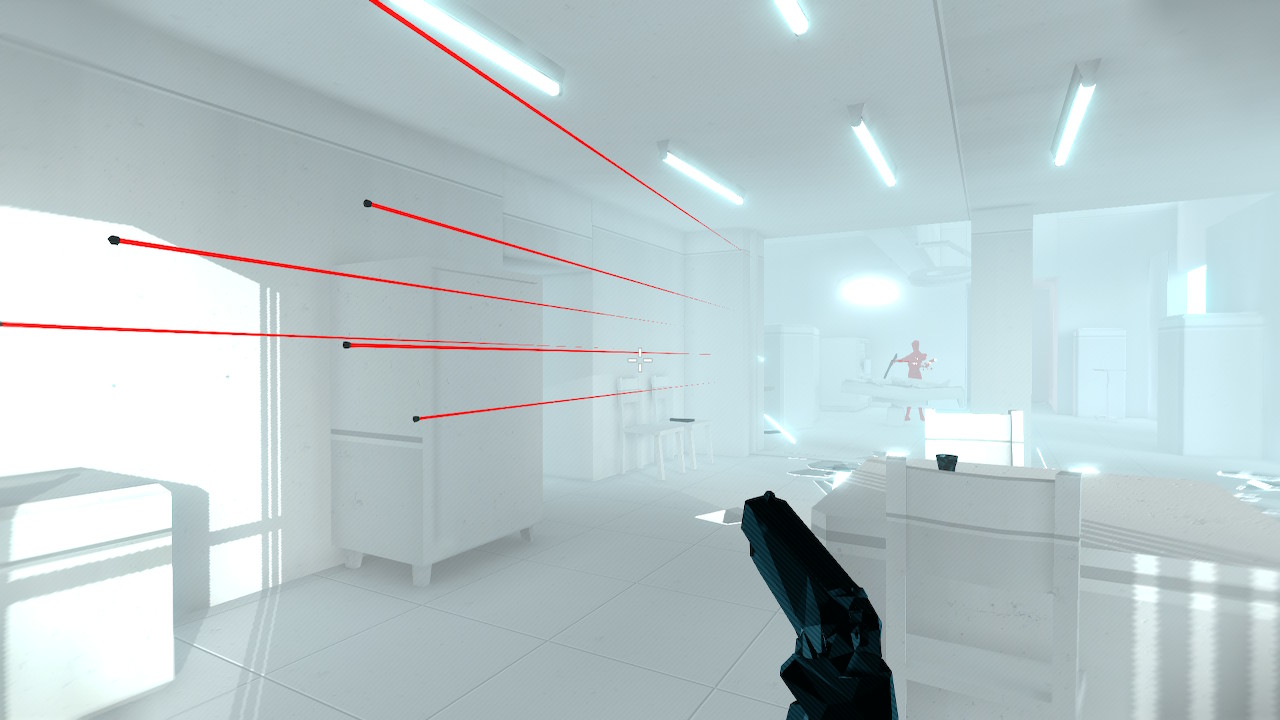 Slow-motion buckshot
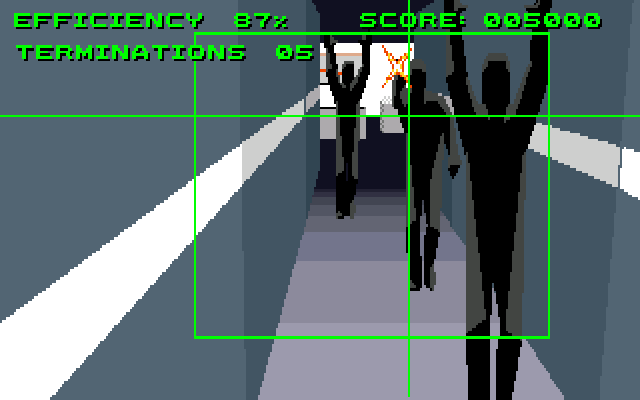 Robocop 3
 Amiga easter-egg
In Haskell (and many other functional languages) it's quite common
for the implementation of a function to reference one less argument
than the type signature declares:
g :: foo -> bar
g = length . reverse
f :: foo -> bar
f a b =
foo, but the definition is in terms of two
arguments. Huh?
What's going on is that bar is really a type synonym for another function.
In other words
type bar = baz -> qux
f to actually be
f :: foo -> baz -> qux
bar, in the definition of f above, the second
parameter b maps to the type baz.
When I've encountered this, I strongly suspect what has happened is the
function was originally written with the longer type signature, and later on
the type synonym was declared and function signatures updated to use it. I'm
not aware of anyone advocating for this style.
Further Switch game recommendations
Morphite is a first-person space exploration game, with a very distinctive
aesthetic, which reminds me a little bit of No Man's Sky. This is a fairly
child-friendly game of exploration and discovery. It also reminds me a little
bit of Frontier: First Encounters, the second sequel to Elite.


 Sonic Mania
For various personal projects and things, past and present (including my
personal site) I use IkiWiki, which (by modern standards) is a bit of a
pain to set up and maintain. For that reason I find it hard to recommend to
people. It would be nice to fire up a snapshot of an existing IkiWiki instance
to test what the outcome of some changes might be. That's cumbersome enough at
the moment that I haven't bothered to do it more than once. Separately, some
months ago I did a routine upgrade of Debian for the web server running
this site, and my IkiWiki installation broke for the first time in ten
years. I've never had issues like this before.
For all of these reasons I've just dusted off an old experiment of
mine now renamed Opinionated IkiWiki. It's IkiWiki in a
container, configured to be usable out-of-the-box, with some opinionated
configuration decisions made for you. The intention is you should be able to
fire up this container and immediately have a useful IkiWiki instance to work
from. It should hopefully be easier to clone an existing wiki
content, configuration and all for experimentation.
You can check out the source at GitHub,
and
grab container images from quay.io.
Or fire one up immediately at http://127.0.0.1:8080 with something like
podman run --rm -ti -p 8080:8080 \
quay.io/jdowland/opinionated-ikiwiki:latest
 Assume for a minute that that best way to take notes is on paper with
pens, pencils etc., and not in a digital device. (I might return to this
later).
I'm torn between two extremes for note-taking. One one hand, I find it
useful in the short-term to make scrappy, ephemeral notes: ad-hoc daily
TODO lists; mind maps and experiments, that I intend to throw away. There
are lots of styles of stationary to support this: ring-bound notebooks
that are easy to tear leaves from; or literally the back of envelopes.
The other extreme is the "preserve everything" mentality. For my PhD, I
have a single, hard-backed notebook that I try to do all my PhD note taking
in. I date each entry. There's a history I can refer to, no matter whether
what I'm writing is seemingly ephemeral or not.
So I do both. Sometimes I want to refer back to something I did which was
ephemeral and I've lost it or thrown it away. And having lots of mis-matched
stationary for ephemeral storage is a bit messy, and works against the other
extreme to a certain extent.
I've started to wonder whether strictly doing one or the other (and most
likely, the "preserve everything" approach) might be a good idea. In practise
that would mean settling on a particular notebook format, and disposing of
anything else; having separate notebooks by topics (PhD, work, ) with a
"catch-all" for the rest.
Does anyone have any advice or useful resources to read on this topic?
Last year I wrote about some tools for working with Docker
images. Since then, we've deprecated the dogen tool for our
own images and have built a successor called
Concreate.
Concreate takes a container image definition described in a YAML document and
generates an output image. To do so, it generates an intermediate
Dockerfile,
along with the scripts and artefacts you references in the YAML file,
and by default invokes docker build on the result.
However, it can use other builders, such as the OpenShift Build
Service, which is what we use for our production
images.
Concreate can also manage running
tests against the
image. As with the Container Testing Framework that I mentioned last time,
these tests are defined using the Behave system.
In related news is that we have published the sources for all of our
images. You can now go and read
the image.yaml file for EAP 7 on
OpenShift
to give you an example of what a real image using Concreate looks like.
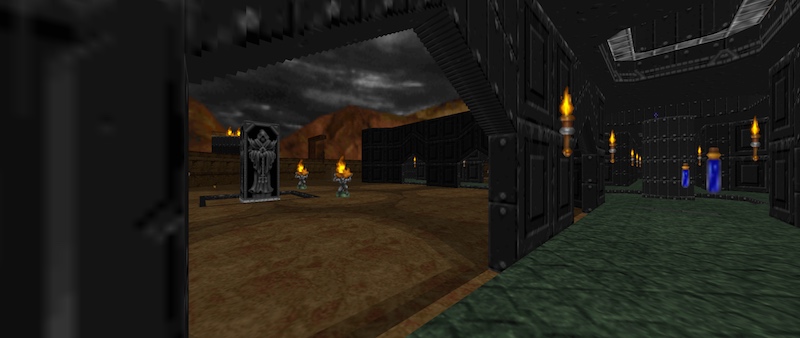 |
wadcli command-line interface respecting
preferences and a new preferences UI dialog (adapted from Quake
Injector).
There are two new example maps: A Labyrinth
demonstration contributed by
"Yoruk", and a Heretic map Bird
Cage by yours truly. These are
both now amongst the largest examples in the collection, although laby.wl was
generated by a higher-level program.
For more information see the release
notes and
the reference, or
check out the new gallery of examples
or skip straight to downloads.
I have no plans to work on WadC further (but never say never, I suppose.)
Every year, family members ask me to produce a list of gift suggestions for
them to buy for me for Christmas. An enviable position for many, I'm sure, but
combined with trying to come up with gift ideas for them, this can sometimes
be a stressful situation, with a risk of either giving or receiving gifts that
are really nothing more than tat, fluff or kipple. I've started to feel that
this is detracting from the spirit of the season.
I also don't really want much "stuff". When I am interested in something, it's
not something that is convenient for others to buy, either because it's hard
to describe, or has limited availability, or is only available at particular
times of the year, etc. I'd rather focus on spending time with friends and
family.
Starting this year, I'm asking that people who wish to do so donate to a
charity on my behalf instead. The charity I have chosen for this year is
St. Oswald's Hospice.
Next.