Search Results: "gio"

3 April 2023

Russ Allbery: Review: The Nordic Theory of Everything

Review: The Nordic Theory of Everything, by Anu Partanen
Publisher: Harper
Copyright: 2016
Printing: June 2017
ISBN: 0-06-231656-7
Format: Kindle
Pages: 338
Anu Partanen is a Finnish journalist who immigrated to the United States. The Nordic Theory of Everything, subtitled In Search of a Better Life, is an attempt to explain the merits of Finnish approaches to government and society to a US audience. It was her first book. If you follow US policy discussion at all, you have probably been exposed to many of the ideas in this book. There was a time when the US left was obsessed with comparisons between the US and Nordic countries, and while that obsession has faded somewhat, Nordic social systems are still discussed with envy and treated as a potential model. Many of the topics of this book are therefore predictable: parental leave, vacation, health care, education, happiness, life expectancy, all the things that are far superior in Nordic countries than in the United States by essentially every statistical measure available, and which have been much-discussed. Partanen brings two twists to this standard analysis. The first is that this book is part memoir: she fell in love with a US writer and made the decision to move to the US rather than asking him to move to Finland. She therefore experienced the transition between social and government systems first-hand and writes memorably on the resulting surprise, trade-offs, anxiety, and bafflement. The second, which I've not seen previously in this policy debate, is a fascinating argument that Finland is a far more individualistic country than the United States precisely because of its policy differences.
Most people, including myself, assumed that part of what made the United States a great country, and such an exceptional one, was that you could live your life relatively unencumbered by the downside of a traditional, old-fashioned society: dependency on the people you happened to be stuck with. In America you had the liberty to express your individuality and choose your own community. This would allow you to interact with family, neighbors, and fellow citizens on the basis of who you were, rather than on what you were obligated to do or expected to be according to old-fashioned thinking. The longer I lived in America, therefore, and the more places I visited and the more people I met and the more American I myself became the more puzzled I grew. For it was exactly those key benefits of modernity freedom, personal independence, and opportunity that seemed, from my outsider s perspective, in a thousand small ways to be surprisingly missing from American life today. Amid the anxiety and stress of people s daily lives, those grand ideals were looking more theoretical than actual.
The core of this argument is that the structure of life in the United States essentially coerces dependency on other people: employers, spouses, parents, children, and extended family. Because there is no universally available social support system, those relationships become essential for any hope of a good life, and often for survival. If parents do not heavily manage their children's education, there is a substantial risk of long-lasting damage to the stability and happiness of their life. If children do not care for their elderly parents, they may receive no care at all. Choosing not to get married often means choosing precarity and exhaustion because navigating society without pooling resources with someone else is incredibly difficult.
It was as if America, land of the Hollywood romance, was in practice mired in a premodern time when marriage was, first and foremost, not an expression of love, but rather a logistical and financial pact to help families survive by joining resources.
Partanen contrasts this with what she calls the Nordic theory of love:
What Lars Tr g rdh came to understand during his years in the United States was that the overarching ambition of Nordic societies during the course of the twentieth century, and into the twenty-first, has not been to socialize the economy at all, as is often mistakenly assumed. Rather the goal has been to free the individual from all forms of dependency within the family and in civil society: the poor from charity, wives from husbands, adult children from parents, and elderly parents from their children. The express purpose of this freedom is to allow all those human relationships to be unencumbered by ulterior motives and needs, and thus to be entirely free, completely authentic, and driven purely by love.
She sees this as the common theme through most of the policy differences discussed in this book. The Finnish approach is to provide neutral and universal logistical support for most of life's expected challenges: birth, child-rearing, education, health, unemployment, and aging. This relieves other social relations family, employer, church of the corrosive strain of dependency and obligation. It also ensures people's basic well-being isn't reliant on accidents of association.
If the United States is so worried about crushing entrepreneurship and innovation, a good place to start would be freeing start-ups and companies from the burdens of babysitting the nation s citizens.
I found this fascinating as a persuasive technique. Partanen embraces the US ideal of individualism and points out that, rather than being collectivist as the US right tends to assume, Finland is better at fostering individualism and independence because the government works to removes unnecessary premodern constraints on individual lives. The reason why so many Americans are anxious and frantic is not a personal failing or bad luck. It's because the US social system is deeply hostile to healthy relationships and individual independence. It demands a constant level of daily problem-solving and crisis management that is profoundly exhausting, nearly impossible to navigate alone, and damaging to the ideal of equal relationships. Whether this line of argument will work is another question, and I'm dubious for reasons that Partanen (probably wisely) avoids. She presents the Finnish approach as a discovery that the US would benefit from, and the US approach as a well-intentioned mistake. I think this is superficially appealing; almost all corners of US political belief at least give lip service to individualism and independence. However, advocates of political change will eventually need to address the fact that many US conservatives see this type of social coercion as an intended feature of society rather than a flaw. This is most obvious when one looks at family relationships. Partanen treats the idea that marriage should be a free choice between equals rather than an economic necessity as self-evident, but there is a significant strain of US political thought that embraces punishing people for not staying within the bounds of a conservative ideal of family. One will often find, primarily but not exclusively among the more religious, a contention that the basic unit of society is the (heterosexual, patriarchal) family, not the individual, and that the suffering of anyone outside that structure is their own fault. Not wanting to get married, be the primary caregiver for one's parents, or abandon a career in order to raise children is treated as malignant selfishness and immorality rather than a personal choice that can be enabled by a modern social system. Here, I think Partanen is accurate to identify the Finnish social system as more modern. It embraces the philosophical concept of modernity, namely that social systems can be improved and social structures are not timeless. This is going to be a hard argument to swallow for those who see the pressure towards forming dependency ties within families as natural, and societal efforts to relieve those pressures as government meddling. In that intellectual framework, rather than an attempt to improve the quality of life, government logistical support is perceived as hostility to traditional family obligations and an attempt to replace "natural" human ties with "artificial" dependence on government services. Partanen doesn't attempt to have that debate. Two other things struck me in this book. The first is that, in Partanen's presentation, Finns expect high-quality services from their government and work to improve it when it falls short. This sounds like an obvious statement, but I don't think it is in the context of US politics, and neither does Partanen. She devotes a chapter to the topic, subtitled "Go ahead: ask what your country can do for you." This is, to me, one of the most frustrating aspects of US political debate. Our attitude towards government is almost entirely hostile and negative even among the political corners that would like to see government do more. Failures of government programs are treated as malice, malfeasance, or inherent incompetence: in short, signs the program should never have been attempted, rather than opportunities to learn and improve. Finland had mediocre public schools, decided to make them better, and succeeded. The moment US public schools start deteriorating, we throw much of our effort into encouraging private competition and dismantling the public school system. Partanen doesn't draw this connection, but I see a link between the US desire for market solutions to societal problems and the level of exhaustion and anxiety that is so common in US life. Solving problems by throwing them open to competition is a way of giving up, of saying we have no idea how to improve something and are hoping someone else will figure it out for a profit. Analyzing the failures of an existing system and designing incremental improvements is hard and slow work. Throwing out the system and hoping some corporation will come up with something better is disruptive but easy. When everyone is already overwhelmed by life and devoid of energy to work on complex social problems, it's tempting to give up on compromise and coalition-building and let everyone go their separate ways on their own dime. We cede the essential work of designing a good society to start-ups. This creates a vicious cycle: the resulting market solutions are inevitably gated by wealth and thus precarious and artificially scarce, which in turn creates more anxiety and stress. The short-term energy savings from not having to wrestle with a hard problem is overwhelmed by the long-term cost of having to navigate a complex and adversarial economic relationship. That leads into the last point: schools. There's a lot of discussion here about school quality and design, which I won't review in detail but which is worth reading. What struck me about Partanen's discussion, though, is how easy the Finnish system is to use. Finnish parents just send their kids to the most convenient school and rarely give that a second thought. The critical property is that all the schools are basically fine, and therefore there is no need to place one's child in an exceptional school to ensure they have a good life. It's axiomatic in the US that more choice is better. This is a constant refrain in our political discussion around schools: parental choice, parental control, options, decisions, permission, matching children to schools tailored for their needs. Those choices are almost entirely absent in Finland, at least in Partanen's description, and the amount of mental and emotional energy this saves is astonishing. Parents simply don't think about this, and everything is fine. I think we dramatically underestimate the negative effects of constantly having to make difficult decisions with significant consequences, and drastically overstate the benefits of having every aspect of life be full of major decision points. To let go of that attempt at control, however illusory, people have to believe in a baseline of quality that makes the choice less fraught. That's precisely what Finland provides by expecting high-quality social services and working to fix them when they fall short, an effort that the United States has by and large abandoned. A lot of non-fiction books could be turned into long articles without losing much substance, and I think The Nordic Theory of Everything falls partly into that trap. Partanen repeats the same ideas from several different angles, and the book felt a bit padded towards the end. If you're already familiar with the policy comparisons between the US and Nordic countries, you will have seen a lot of this before, and the book bogs down when Partanen strays too far from memoir and personal reactions. But the focus on individualism and eliminating dependency is new, at least to me, and is such an illuminating way to look at the contrast that I think the book is worth reading just for that. Rating: 7 out of 10

25 March 2023

Russ Allbery: Review: Thief of Time

Review: Thief of Time, by Terry Pratchett
Series: Discworld #26
Publisher: Harper
Copyright: May 2001
Printing: August 2014
ISBN: 0-06-230739-8
Format: Mass market
Pages: 420
Thief of Time is the 26th Discworld novel and the last Death novel, although he still appears in subsequent books. It's the third book starring Susan Sto Helit, so I don't recommend starting here. Mort is the best starting point for the Death subseries, and Reaper Man provides a useful introduction to the villains. Jeremy Clockson was an orphan raised by the Guild of Clockmakers. He is very good at making clocks. He's not very good at anything else, particularly people, but his clocks are the most accurate in Ankh-Morpork. He is therefore the logical choice to receive a commission by a mysterious noblewoman who wants him to make the most accurate possible clock: a clock that can measure the tick of the universe, one that a fairy tale says had been nearly made before. The commission is followed by a surprise delivery of an Igor, to help with the clock-making. People who live in places with lots of fields become farmers. People who live where there is lots of iron and coal become blacksmiths. And people who live in the mountains near the Hub, near the gods and full of magic, become monks. In the highest valley are the History Monks, founded by Wen the Eternally Surprised. Like most monks, they take apprentices with certain talents and train them in their discipline. But Lobsang Ludd, an orphan discovered in the Thieves Guild in Ankh-Morpork, is proving a challenge. The monks decide to apprentice him to Lu-Tze the sweeper; perhaps that will solve multiple problems at once. Since Hogfather, Susan has moved from being a governess to a schoolteacher. She brings to that job the same firm patience, total disregard for rules that apply to other people, and impressive talent for managing children. She is by far the most popular teacher among the kids, and not only because she transports her class all over the Disc so that they can see things in person. It is a job that she likes and understands, and one that she's quite irate to have interrupted by a summons from her grandfather. But the Auditors are up to something, and Susan may be able to act in ways that Death cannot. This was great. Susan has quickly become one of my favorite Discworld characters, and this time around there is no (or, well, not much) unbelievable romance or permanently queasy god to distract. The clock-making portions of the book quickly start to focus on Igor, who is a delightful perspective through whom to watch events unfold. And the History Monks! The metaphysics of what they are actually doing (which I won't spoil, since discovering it slowly is a delight) is perhaps my favorite bit of Discworld world building to date. I am a sucker for stories that focus on some process that everyone thinks happens automatically and investigate the hidden work behind it. I do want to add a caveat here that the monks are in part a parody of Himalayan Buddhist monasteries, Lu-Tze is rather obviously a parody of Laozi and Daoism in general, and Pratchett's parodies of non-western cultures are rather ham-handed. This is not quite the insulting mess that the Chinese parody in Interesting Times was, but it's heavy on the stereotypes. It does not, thankfully, rely on the stereotypes; the characters are great fun on their own terms, with the perfect (for me) balance of irreverence and thoughtfulness. Lu-Tze refusing to be anything other than a sweeper and being irritatingly casual about all the rules of the order is a classic bit that Pratchett does very well. But I also have the luxury of ignoring stereotypes of a culture that isn't mine, and I think Pratchett is on somewhat thin ice. As one specific example, having Lu-Tze's treasured sayings be a collection of banal aphorisms from a random Ankh-Morpork woman is both hilarious and also arguably rather condescending, and I'm not sure where I landed. It's a spot-on bit of parody of how a lot of people who get very into "eastern religions" sound, but it's also equating the Dao De Jing with advice from the Discworld equivalent of a English housewife. I think the generous reading is that Lu-Tze made the homilies profound by looking at them in an entirely different way than the woman saying them, and that's not completely unlike Daoism and works surprisingly well. But that's reading somewhat against the grain; Pratchett is clearly making fun of philosophical koans, and while anything is fair game for some friendly poking, it still feels a bit weird. That isn't the part of the History Monks that I loved, though. Their actual role in the story doesn't come out of the parody. It's something entirely native to Discworld, and it's an absolute delight. The scene with Lobsang and the procrastinators is perhaps my favorite Discworld set piece to date. Everything about the technology of the History Monks, even the Bond parody, is so good. I grew up reading the Marvel Comics universe, and Thief of Time reminds me of a classic John Byrne or Jim Starlin story, where the heroes are dumped into the middle of vast interdimensional conflicts involving barely-anthropomorphized cosmic powers and the universe is revealed to work in ever more intricate ways at vastly expanding scales. The Auditors are villains in exactly that tradition, and just like the best of those stories, the fulcrum of the plot is questions about what it means to be human, what it means to be alive, and the surprising alliances these non-human powers make with humans or semi-humans. I devoured this kind of story as a kid, and it turns out I still love it. The one complaint I have about the plot is that the best part of this book is the middle, and the end didn't entirely work for me. Ronnie Soak is at his best as a supporting character about three quarters of the way through the book, and I found the ending of his subplot much less interesting. The cosmic confrontation was oddly disappointing, and there's a whole extended sequence involving chocolate that I think was funnier in Pratchett's head than it was in mine. The ending isn't bad, but the middle of this book is my favorite bit of Discworld writing yet, and I wish the story had carried that momentum through to the end. I had so much fun with this book. The Discworld novels are clearly getting better. None of them have yet vaulted into the ranks of my all-time favorite books there's always some lingering quibble or sagging bit but it feels like they've gone from reliably good books to more reliably great books. The acid test is coming, though: the next book is a Rincewind book, which are usually the weak spots. Followed by The Last Hero in publication order. There is no direct thematic sequel. Rating: 8 out of 10

20 March 2023

Russ Allbery: Review: The Star Fraction

Review: The Star Fraction, by Ken MacLeod
Series: Fall Revolution #1
Publisher: Orbit
Copyright: 1995
Printing: 2001
ISBN: 1-85723-833-8
Format: Trade paperback
Pages: 341
Ken MacLeod is a Scottish science fiction writer who has become amusingly famous for repeatedly winning the libertarian Prometheus Award despite being a (somewhat libertarian-leaning) socialist. The Star Fraction is the first of a loose series of four novels about future solar system politics and was nominated for the Clarke Award (as well as winning the Prometheus). It was MacLeod's first novel. Moh Kohn is a mercenary, part of the Felix Dzerzhinsky Workers' Defence collective. They're available for hire to protect research labs and universities against raids from people such as animal liberationists and anti-AI extremists (or, as Moh calls them, creeps and cranks). As The Star Fraction opens, he and his smart gun are protecting a lab against an attack. Janis Taine is a biologist who is currently testing a memory-enhancing drug on mice. It's her lab that is attacked, although it isn't vandalized the way she expected. Instead, the attackers ruined her experiment by releasing the test drug into the air, contaminating all of the controls. This sets off a sequence of events that results in Moh, Janis, and Jordon Brown, a stock trader for a religious theocracy, on the run from the US/UN and Space Defense. I had forgotten what it was like to read the uncompromising old-school style of science fiction novel that throws you into the world and explains nothing, leaving it to the reader to piece the world together as you go. It's weirdly fun, but I'm either out of practice or this was a particularly challenging example of the genre. MacLeod throws a lot of characters at you quickly, including some that have long and complicated personal histories, and it's not until well into the book that the pieces start to cohere into a narrative. Even once that happens, the relationship between the characters and the plot is unobvious until late in the book, and comes from a surprising direction. Science fiction as a genre is weirdly conservative about political systems. Despite the grand, futuristic ideas and the speculation about strange alien societies, the human governments rarely rise to the sophistication of a modern democracy. There are a lot of empires, oligarchies, and hand-waved libertarian semi-utopias, but not a lot of deep engagement with the speculative variety of government systems humans have proposed. The rare exceptions therefore get a lot of attention from those of us who find political systems fascinating. MacLeod has a reputation for writing political SF in that sense, and The Star Fraction certainly delivers. Moh (despite the name of his collective, which is explained briefly in the book) is a Trotskyist with a family history with the Fourth International that is central to the plot. The setting is a politically fractured Britain full of autonomous zones with wildly different forms of government, theoretically ruled by a restored monarchy. That monarchy is opposed by the Army of the New Republic, which claims to be the legitimate government of the United Kingdom and is considered by everyone else to be terrorists. Hovering in the background is a UN entirely subsumed by the US, playing global policeman over a chaotic world shattered by numerous small-scale wars. This satisfyingly different political world is a major plus for me. The main drawback is that I found the world-building and politics more interesting than the characters. It's not that I disliked them; I found them enjoyably quirky and odd. It's more that so much is happening and there are so many significant characters, all set in an unfamiliar and unexplained world and often divided into short scenes of a few pages, that I had a hard time keeping track of them all. Part of the point of The Star Fraction is digging into their tangled past and connecting it up with the present, but the flashbacks added a confused timeline on top of the other complexity and made it hard for me to get lost in the story. The characters felt a bit too much like puzzle pieces until the very end of the book. The technology is an odd mix with a very 1990s feel. MacLeod is one of the SF authors who can make computers and viruses believable, avoiding the cyberpunk traps, but AI becomes relevant to the plot and the conception of AI here feels oddly retro. (Not MacLeod's fault; it's been nearly 30 years and a lot has changed.) On-line discussion in the book is still based on newsgroups, which added to the nostalgic feel. I did like the eventual explanation for the computing part of the plot, though; I can't say much while avoiding spoilers, but it's one of the more believable explanations for how a technology could spread in a way required for the plot that I've read. I've been planning on reading this series for years but never got around to it. I enjoyed my last try at a MacLeod series well enough to want to keep reading, but not well enough to keep reading immediately, and then other books happened and now it's been 19 years. I feel similarly about The Star Fraction: it's good enough (and in a rare enough subgenre of SF) that I want to keep reading, but not enough to keep reading immediately. We'll see if I manage to get to the next book in a reasonable length of time. Followed by The Stone Canal. Rating: 6 out of 10

19 March 2023

Russ Allbery: Review: Allow Me to Retort

Review: Allow Me to Retort, by Elie Mystal
Publisher: The New Press
Copyright: 2022
ISBN: 1-62097-690-0
Format: Kindle
Pages: 257
If you're familiar with Elie Mystal's previous work (writer for The Nation, previously editor for Above the Law, Twitter gadfly, and occasional talking head on news commentary programs), you'll have a good idea what to expect from this book: pointed liberal commentary, frequently developing into rants once he works up a head of steam. The subtitle of A Black Guy's Guide to the Constitution tells you that the topic is US constitutional law, which is very on brand. You're going to get succinct and uncompromising opinions at the intersection of law and politics. If you agree with them, you'll probably find them funny; if you disagree with them, you'll probably find them infuriating. In other words, Elie Mystal is the sort of writer one reads less for "huh, I disagreed with you but that's a good argument" and more for "yeah, you tell 'em, Elie!" I will be very surprised if this book changes anyone's mind about a significant political debate. I'm not sure if people who disagree are even in the intended audience. I'm leery of this sort of book. Usually its function is to feed confirmation bias with some witty rejoinders and put-downs that only sound persuasive to people who already agree with them. If I want that, I can just read Twitter (and you will be unsurprised to know that Mystal has nearly 500,000 Twitter followers). This style can also be boring at book length if the author is repeating variations on a theme. There is indeed a lot of that here, particularly in the first part of this book. If you don't generally agree with Mystal already, save yourself the annoyance and avoid this like the plague. It's just going to make you mad, and I don't think you're going to get anything useful out of it. But as I got deeper into this book, I think Mystal has another, more interesting purpose that's aimed at people who do largely agree. He's trying to undermine a very common US attitude (even on the left) about the US constitution. I don't know if most people from the US (particularly if they're white and male) realize quite how insufferably smug we tend to be about the US constitution. When you grow up here, the paeans to the constitution and the Founding Fathers (always capitalized like deities) are so ubiquitous and unremarked that it's difficult not to absorb them at a subconscious level. There is a national mythology about the greatness of our charter of government that crosses most political divides. In its modern form, this comes with some acknowledgment that some of its original provisions (the notorious three-fifths of a person clause, for instance) were bad, but we subsequently fixed them and everything is good now. Nearly everyone gets taught this in school, and it's almost never challenged. Even the edifices of the US left, such as the ACLU and the NAACP, tend to wrap themselves in the constitution. It's an enlightening experience to watch someone from the US corner a European with a discussion of the US constitution and watch the European plan escape routes while their soul attempts to leave their body. And I think it's telling that having that experience, as rare as it might be given how oblivious we can be, is still more common than a white person having a frank conversation with a black person in the US about the merits of the constitution as written. For various reasons, mostly because this is not very safe for the black person, this rarely happens. This book is primarily Mystal giving his opinion on various current controversies in constitutional law, but the underlying refrain is that the constitution is a trash document written by awful people that sets up a bad political system. That system has been aggressively defended by reactionary Supreme Courts, which along with the designed difficulty of the amendment process has prevented fixing many obviously broken parts. This in turn has led to numerous informal workarounds and elaborate "interpretations" to attempt to make the system vaguely functional. In other words, Mystal is trying to tell the US reader to stop being so precious about this specific document, and is using its truly egregious treatment of black people as the main fulcrum for his argument. Along the way, he gives an abbreviated tour of the highlights of constitutional law, but if you're at all interested in politics you've probably heard most of that before. The main point, I think, is to dig up any reverence left over from a US education, haul it out into the light of day, and compare it to the obvious failures of the constitution as a body of law and the moral failings of its authors. Mystal then asks exactly why we should care about original intent or be so reluctant to change the resulting system of government. (Did I mention you should not bother with this book if you don't agree with Mystal politically? Seriously, don't do that to yourself.) Readers of my reviews will know that I'm fairly far to the left politically, particularly by US standards, and yet I found it fascinating how much lingering reverence Mystal managed to dig out of me while reading this book. I found myself getting defensive in places, which is absurd because I didn't write this document. But I grew up surrounded by nigh-universal social signaling that the US constitution was the greatest political document ever, and in a religious tradition that often argued that it was divinely inspired. If one is exposed to enough of this, it becomes part of your background understanding of the world. Sometimes it takes someone being deliberately provocative to haul it back up to the surface where it can be examined. This book is not solely a psychological intervention in national mythology. Mystal gets into detailed legal arguments as well. I thought the most interesting was the argument that the bizarre and unconvincing "penumbras" and "emanations" reasoning in Griswold v. Connecticut (which later served as the basis of Roe v. Wade) was in part because the Lochner era Supreme Court had, in the course of trying to strike down all worker protection laws, abused the concept of substantive due process so badly that Douglas was unwilling to use it in the majority opinion and instead made up entirely new law. Mystal argues that the Supreme Court should have instead tackled the true meaning of substantive due process head-on and decided Griswold on 14th Amendment equal protection and substantive due process grounds. This is probably a well-known argument in legal circles, but I'd not run into it before (and Mystal makes it far more interesting and entertaining than my summary). Mystal also joins the tradition of thinking of the Reconstruction Amendments (the 13th, 14th, and 15th amendments passed after the Civil War) as a second revolution and an attempt to write a substantially new constitution on different legal principles, an attempt that subsequently failed in the face of concerted and deadly reactionary backlash. I first encountered this perspective via Jamelle Bouie, and it added a lot to my understanding of Reconstruction to see it as a political fight about the foundational principles of US government in addition to a fight over continuing racism in the US south. Maybe I was unusually ignorant of it (I know I need to read W.E.B. DuBois), but I think this line of reasoning doesn't get enough attention in popular media. Mystal provides a good introduction. But, that being said, Allow Me to Retort is more of a vibes book than an argument. As in his other writing, Mystal focuses on what he sees as the core of a controversy and doesn't sweat the details too much. I felt like he was less trying to convince me and more trying to model a different way of thinking and talking about constitutional law that isn't deferential to ideas that are not worthy of deference. He presents his own legal analysis and possible solutions to current US political challenges, but I don't think the specific policy proposals are the strong part of this book. The point, instead, is to embrace a vigorous politics based on a modern understanding of equality, democracy, and human rights, without a lingering reverence for people who mostly didn't believe in any of those things. The role of the constitution in that politics is a flawed tool rather than a sacred text. I think this book is best thought of as an internal argument in the US left. That argument is entirely within the frame of the US legal tradition, so if you're not in the US, it will be of academic interest at best (and probably not even that). If you're on the US right, Mystal offers lots of provocative pull quotes to enjoy getting outraged over, but he provides that service on Twitter for free. But if you are on the US left, I think Allow Me to Retort is worth more consideration than I'd originally given it. There's something here about how we engage with our legal history, and while Mystal's approach is messy, maybe that's the only way you can get at something that's more emotion than logic. In some places it degenerates into a Twitter rant, but Mystal is usually entertaining even when he's ranting. I'm not sorry I read it. Rating: 7 out of 10

5 March 2023

Reproducible Builds: Reproducible Builds in February 2023

Welcome to the February 2023 report from the Reproducible Builds project. As ever, if you are interested in contributing to our project, please visit the Contribute page on our website.
FOSDEM 2023 was held in Brussels on the 4th & 5th of February and featured a number of talks related to reproducibility. In particular, Akihiro Suda gave a talk titled Bit-for-bit reproducible builds with Dockerfile discussing deterministic timestamps and deterministic apt-get (original announcement). There was also an entire track of talks on Software Bill of Materials (SBOMs). SBOMs are an inventory for software with the intention of increasing the transparency of software components (the US National Telecommunications and Information Administration (NTIA) published a useful Myths vs. Facts document in 2021).
On our mailing list this month, Larry Doolittle was puzzled why the Debian verilator package was not reproducible [ ], but Chris Lamb pointed out that this was due to the use of Python s datetime.fromtimestamp over datetime.utcfromtimestamp [ ].
James Addison also was having issues with a Debian package: in this case, the alembic package. Chris Lamb was also able to identify the Sphinx documentation generator as the cause of the problem, and provided a potential patch that might fix it. This was later filed upstream [ ].
Anthony Harrison wrote to our list twice, first by introducing himself and their background and later to mention the increasing relevance of Software Bill of Materials (SBOMs):
As I am sure everyone is aware, there is a growing interest in [SBOMs] as a way of improving software security and resilience. In the last two years, the US through the Exec Order, the EU through the proposed Cyber Resilience Act (CRA) and this month the UK has issued a consultation paper looking at software security and SBOMs appear very prominently in each publication. [ ]

Tim Retout wrote a blog post discussing AlmaLinux in the context of CentOS, RHEL and supply-chain security in general [ ]:
Alma are generating and publishing Software Bill of Material (SBOM) files for every package; these are becoming a requirement for all software sold to the US federal government. What s more, they are sending these SBOMs to a third party (CodeNotary) who store them in some sort of Merkle tree system to make it difficult for people to tamper with later. This should theoretically allow end users of the distribution to verify the supply chain of the packages they have installed?

Debian

F-Droid & Android

diffoscope diffoscope is our in-depth and content-aware diff utility. Not only can it locate and diagnose reproducibility issues, it can provide human-readable diffs from many kinds of binary formats. This month, Chris Lamb released versions 235 and 236; Mattia Rizzolo later released version 237. Contributions include:
  • Chris Lamb:
    • Fix compatibility with PyPDF2 (re. issue #331) [ ][ ][ ].
    • Fix compatibility with ImageMagick version 7.1 [ ].
    • Require at least version 23.1.0 to run the Black source code tests [ ].
    • Update debian/tests/control after merging changes from others [ ].
    • Don t write test data during a test [ ].
    • Update copyright years [ ].
    • Merged a large number of changes from others.
  • Akihiro Suda edited the .gitlab-ci.yml configuration file to ensure that versioned tags are pushed to the container registry [ ].
  • Daniel Kahn Gillmor provided a way to migrate from PyPDF2 to pypdf (#1029741).
  • Efraim Flashner updated the tool metadata for isoinfo on GNU Guix [ ].
  • FC Stegerman added support for Android resources.arsc files [ ], improved a number of file-matching regular expressions [ ][ ] and added support for Android dexdump [ ]; they also fixed a test failure (#1031433) caused by Debian s black package having been updated to a newer version.
  • Mattia Rizzolo:
    • updated the release documentation [ ],
    • fixed a number of Flake8 errors [ ][ ],
    • updated the autopkgtest configuration to only install aapt and dexdump on architectures where they are available [ ], making sure that the latest diffoscope release is in a good fit for the upcoming Debian bookworm freeze.

reprotest Reprotest version 0.7.23 was uploaded to both PyPI and Debian unstable, including the following changes:
  • Holger Levsen improved a lot of documentation [ ][ ][ ], tidied the documentation as well [ ][ ], and experimented with a new --random-locale flag [ ].
  • Vagrant Cascadian adjusted reprotest to no longer randomise the build locale and use a UTF-8 supported locale instead [ ] (re. #925879, #1004950), and to also support passing --vary=locales.locale=LOCALE to specify the locale to vary [ ].
Separate to this, Vagrant Cascadian started a thread on our mailing list questioning the future development and direction of reprotest.

Upstream patches The Reproducible Builds project detects, dissects and attempts to fix as many currently-unreproducible packages as possible. We endeavour to send all of our patches upstream where appropriate. This month, we wrote a large number of such patches, including:

Testing framework The Reproducible Builds project operates a comprehensive testing framework (available at tests.reproducible-builds.org) in order to check packages and other artifacts for reproducibility. In February, the following changes were made by Holger Levsen:
  • Add three new OSUOSL nodes [ ][ ][ ] and decommission the osuosl174 node [ ].
  • Change the order of listed Debian architectures to show the 64-bit ones first [ ].
  • Reduce the frequency that the Debian package sets and dd-list HTML pages update [ ].
  • Sort Tested suite consistently (and Debian unstable first) [ ].
  • Update the Jenkins shell monitor script to only query disk statistics every 230min [ ] and improve the documentation [ ][ ].

Other development work disorderfs version 0.5.11-3 was uploaded by Holger Levsen, fixing a number of issues with the manual page [ ][ ][ ].
Bernhard M. Wiedemann published another monthly report about reproducibility within openSUSE.
If you are interested in contributing to the Reproducible Builds project, please visit the Contribute page on our website. You can get in touch with us via:

4 March 2023

Matt Brown: Retrospective: Feb 2023

February ended up being a very short work month as I made a last minute decision to travel to Adelaide for the first 2 weeks of the month to help my brother with some house renovations he was undertaking. I thought I might be able to keep up with some work and my writing goals in the evenings while I was there, but days of hard manual labour are such an unfamiliar routine for me that I didn t have any energy left to make good on that intention. The majority of my time and focus for the remaining one and half weeks of the month was catching up on the consulting work that I had pushed back while in Adelaide. So while it doesn t make for a thrilling first month to look back and report on, overall I m not unhappy with what I achieved given the time available. Next month, I hope to be able to report some more exciting progress on the product development front as well.

Monthly Scoring Rubric I m evaluating each goal using a 10 point scale based on execution velocity and risk level, rather than absolute success (which is what I will look at in the annual/mid-year review). If velocity is good and risk is low or well managed the score is high, if either the velocity is low, or risk is high then the score is low. E.g:
  • 10 - perfect execution with low-risk, on track for significantly overachieving the goal.
  • 7 - good execution with low or well managed risk, highly likely to achieve the goal.
  • 5 - execution and risk are OK, should achieve the goal if all goes well.
  • 3 - execution or risk have problems, goal is at risk.
  • 0 - stalled, with no obvious path to recovery or success.

Goals

Consulting - 6/10 Goal: Execute a series of successful consulting engagements, building a reputation for myself and leaving happy customers willing to provide testimonials that support a pipeline of future opportunities.
  • I have one active local engagement assisting a software team with migrating their application from a single to multi-region architecture.
  • Two promising international engagements which were close to starting both cancelled based on newly issued company policies freezing their staffing/outsourcing budgets due to the current economic climate.
I m happy with where this is at - I hit 90% of my target hours in February (taking into account 2 weeks off) and the feedback I m receiving is positive. The main risk is the future pipeline of engagements, particularly if the cancellations indicate a new pattern. I m not overly concerned yet, as all the opportunities to date have been from direct or referred contacts in my personal network, so there s plenty of potential to more actively solicit work to create a healthier pipeline.

Product Development - 3/10 Goal: Grow my product development skill set by taking several ideas to MVP stage with customer feedback received, and launch at least one product which generates revenue and has growth potential.
  • Accelerating electrification - I continued to keep up with industry news and added some interesting reports to my reading queue, but made no significant progress towards identifying a specific product opportunity.
  • Farm management SaaS - no activity or progress at all.
  • co2mon.nz - I put significant thought and planning into how to approach a second iteration of this product. I started writing and completed 80% of a post to communicate the revised business plan, but it s not ready for publication yet, and even if it was, the real work towards it would need to actually happen to score more points here.
I had high hopes to make at least some progress in all three areas in February, but it just didn t happen due to lack of time. The good news is that since the low score here is purely execution driven, there s no new risks or blockers that will hinder much better progress here in March.

Professional Network Development - 8/10 Goal: To build a professional relationship with at least 30 new people this year. This is off to a strong start, I made 4 brand new connections and re-established contact with 9 other existing people I d not talked to for a while. I ve found the conversations energising and challenging and I m looking forward to continuing to keep this up.

Writing - 2/10 Goal: To publish a high-quality piece of writing on this site at least once a week. Well off track as already noted. I am enjoying the writing process and I continue to find it useful in developing my thoughts and forcing me to challenge my assumptions, but coupling the writing process with the thinking/planning that is a prerequisite to get those benefits definitely makes my output a lot slower than I was expecting. The slower speed, combined with the obvious time constraints of this month are not a great doubly whammy to be starting with, but I think with some planning and preparation it should have been avoidable by having a backlog of pre-written content for use in weeks where I m on holiday or otherwise busy. It s worth noting that among all the useful feedback I received, this writing target was often called out as overly ambitious, or likely to be counterproductive to producing quality writing. The feedback makes sense - for now I m not planning to change the goal (I might at my 6-month review point), but I am going to be diligent about adhering to my quality standard, which in turn means I m choosing to accept missing a weekly post here and there and taking a lower score on the goal overall. I apologise if you ve been eagerly waiting for writing that never arrived over February!

Community - 5/10 Goal: To support the growth of my local technical community by volunteering my experience and knowledge with others through activities such as mentoring, conference talks and similar.
  • I was an invited participant of the monthly KiwiSRE meet-up which was discussing SRE team models, and in particular I was able to speak to my experiences as described in an old CRE blog post on this topic.
  • I joined the program committee for SREcon23 APAC which is scheduled for mid-June in Singapore. I also submitted two talk proposals of my own (not sharing the details for now, since the review process is intended to be blind) which I m hopeful might make the grade with my fellow PC members!

Feedback As always, I d love to hear from you if you have thoughts or feedback triggered by anything I ve written above. In particular, it would be useful to know whether you find this type of report interesting to read and/or what you d like to see added/removed or changed.

28 February 2023

Paul Wise: FLOSS Activities Feb 2023

Focus This month I didn't have any particular focus. I just worked on issues in my info bubble.

Changes

Issues

Review

Administration
  • Debian BTS: unarchive/reopen/triage bugs for reintroduced package servefile
  • Debian IRC: turn an old channel into a redirect to the right one
  • Debian wiki: unblock IP addresses, approve accounts

Communication
  • Respond to queries from Debian users and contributors on the mailing lists and IRC

Sponsors The pyemd/sptag work was sponsored. All other work was done on a volunteer basis.

16 February 2023

Scarlett Gately Moore: KDE Snaps, Security updates, Debian Freeze

Icy morning Witch Wells AzIcy morning Witch Wells Az
Much like our trees, Debian is now in freeze stage for Bookworm. I am still working on packages locally until development opens up again. My main focus is getting mycroft packages updated to the new fork at https://github.com/orgs/OpenVoiceOS/repositories. On the KDE Snaps side of things: My PPA is not going well. There is a problem in Focal here qhelpgenerator-qt5 is a missing dependency, HOWEVER it is there as shown here: https://launchpad.net/ubuntu/focal/+package/qhelpgenerator-qt5 a fun circular dependency for qtbase. It also builds fine in a focal chroot. I have tried copying packages, source recipe builds, adding another PPA with successful builds, to no avail. My PPA does not seem to use its own packages, or universe for that matter. I have tried all of the dependency settings available and nothing changes. If any of you launchpad experts out there want to help me out, or point me in the right direction, it would be appreciated ! This PPA is mandatory for our core20 snaps moving forward, as they currently have no security updates, and I refuse to have my name on security riddled snaps. As for the kde-neon extension for core22, I have fixed most of the tests and Sergio is wrapping it up, thank you!!!! I am still looking for work!!! Please reach out if you, or anyone you know is looking for my skill set. Once again, I ask for you to please consider a donation. We managed to get the bills paid this month ( Big thank you! ) but, March is quickly approaching. The biggest thing is Phone/Internet so I can keep working on things and Job hunt. Thank you so much for your support! https://gofund.me/a9c36b87

13 February 2023

Jonathan Dowland: A visit to Prusa Labs

.
.

In September I was in Czechia for a Red Hat event. I ended up travelling via Prague, and had an unexpected extra day due to an airline strike causing my flight home to be cancelled. I took the opportunity to visit Prusa's offices/factory/Lab, and it was amazing! The Prusa team were all busy getting ready for the Prague Maker Faire that was happening the day afterwards.1 On arriving at the street which houses Prusa's Lab and Office buildings, the first thing that hit me was the smell. I find the melted-plastic smell of FDM printing (with PLA, at least) quite pleasant, and this was a super-condensed version of that, pumping out of their ground-floor windows. I started at the reception area on the ground floor. Outside reception there's a lovely sculpture representing the history of the development of the MK3S+.
The Reception The Reception
SLS Farm in the former Hack lab SLS Farm in the former Hack lab
History of the MK3S+ History of the MK3S+

At the reception you have a small waiting area with shelves of demonstration prints and some spools of Prusament. From here, our kind guide first took us to a region on the ground floor that used to be (prior to COVID times) the public maker/hack lab. The lab contained two modest farms of printers: one of their flagship FDM printer, the MK3S+, and another of their SLS resin printers. A close up of some example resin models is pictured above. The bicycle was tiny: about the size of a thumbnail.
A Historic display A Historic display
Bespoke QE equipment Bespoke QE equipment
The MK3S+ Farm The MK3S+ Farm

. Moi in the Farm
2KG orange PLA spools for the Farm 2KG orange PLA spools for the Farm
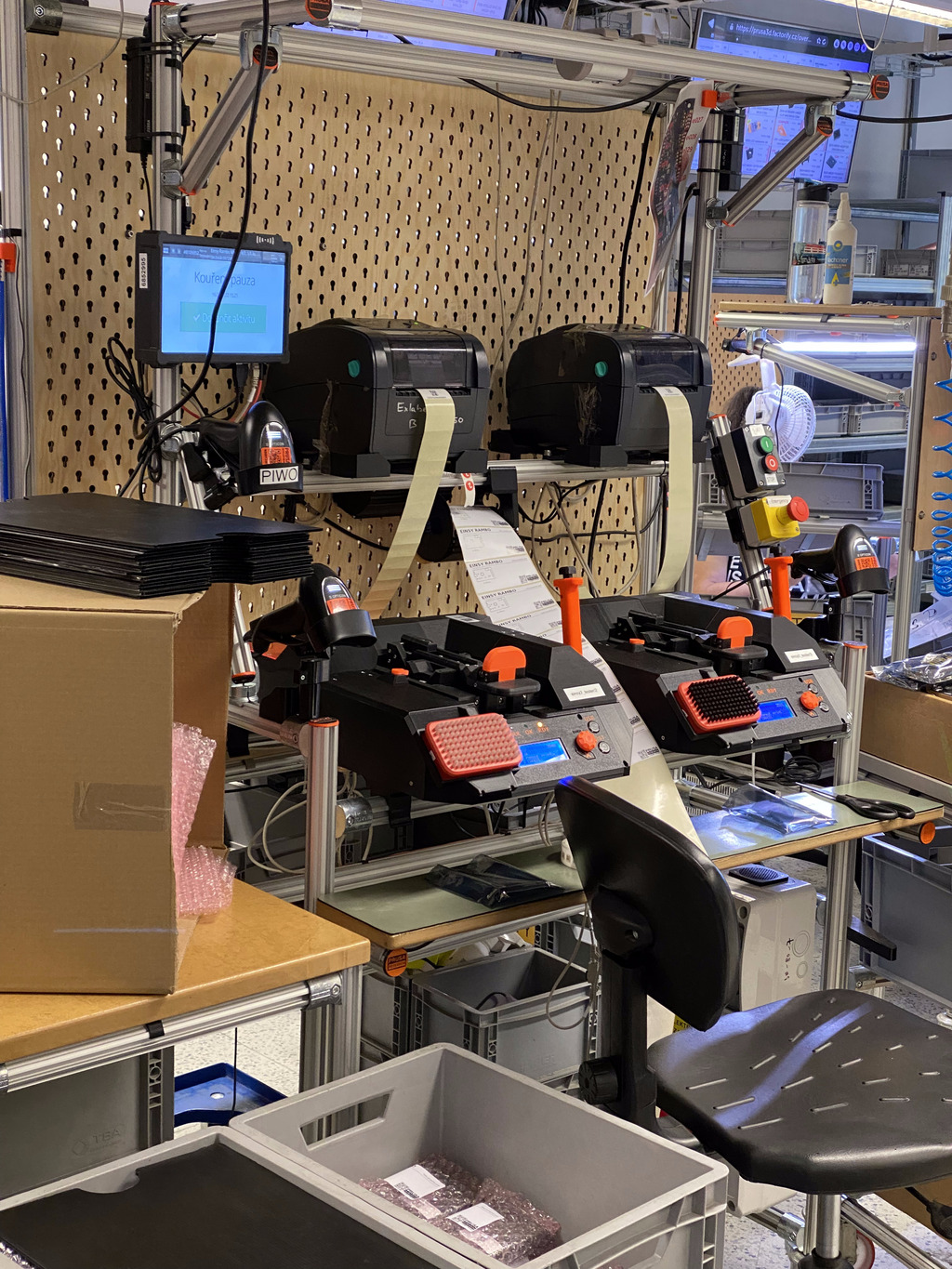
The rest of the ground floor area was full of heavy machinery and prototyping equipment. Onwards we went to the upstairs floors. Upstairs, past a nice graphic of Prusa's historic products, we visited the assembly and QE testing areas. They have a very organised system of parts buckets and some thorough QE processes, including some bespoke equipment that produces the "receipt" of tests and calibration that they provide for you in the box when you buy a 3D printer. After that, we visited the production Farm: a large room full of MK3S+ printers churning out parts for other printers. The noise was remarkable. The printers were running custom firmware to continually print the part they had been set for. Some of the printers were designated for printing with ASA: they were colour-coded (yellow controller surround) and within boxed regions to prevent the fumes causing problems. (picture at the top) Outside the room sat palettes of orange PETG plastic for the printer farm on 2KG spools (not a size they sell to the public just yet) The final part of the trip was outside, to the real farm: Prusa have a smallholding with Alpacas at the rear of their estate. Whilst we visited it, Josef Prusa himself turned up (in a snazzy looking custom colour Tesla) to feed the animals, say hello and pose for a picture. Overall, it was a fantastic visit. I'm very grateful to Air France for cancelling my flight home, and to Prusa Labs (in particular Luk ) for allowing me to come and say hello!

  1. I managed to squeeze that in too on my way to my rescheduled flight, although it was a rush visit and I don't have much to say or show from it. Suffice to say that it was lovely and bittersweet since the UK Maker Faire used to be hosted in my fair home city of Newcastle before they stopped.

Vincent Bernat: Building a SQL-like language to filter flows

Akvorado collects network flows using IPFIX or sFlow. It stores them in a ClickHouse database. A web console allows a user to query the data and plot some graphs. A nice aspect of this console is how we can filter flows with a SQL-like language:
Filter editor in Akvorado console
Often, web interfaces expose a query builder to build such filters. I think combining a SQL-like language with an editor supporting completion, syntax highlighting, and linting is a better approach.1 The language parser is built with pigeon (Go) from a parsing expression grammar or PEG. The editor component is CodeMirror (TypeScript).

Language parser PEG grammars are relatively recent2 and are an alternative to context-free grammars. They are easier to write and they can generate better error messages. Python switched from an LL(1)-based parser to a PEG-based parser in Python 3.9. pigeon generates a parser for Go. A grammar is a set of rules. Each rule is an identifier, with an optional user-friendly label for error messages, an expression, and an action in Go to be executed on match. You can find the complete grammar in parser.peg. Here is a simplified rule:
ConditionIPExpr "condition on IP"  
  column:("ExporterAddress"i   return "ExporterAddress", nil  
        / "SrcAddr"i   return "SrcAddr", nil  
        / "DstAddr"i   return "DstAddr", nil  ) _ 
  operator:("=" / "!=") _ 
  ip:IP  
    return fmt.Sprintf("%s %s IPv6StringToNum(%s)",
      toString(column), toString(operator), quote(ip)), nil
   
The rule identifier is ConditionIPExpr. It case-insensitively matches ExporterAddress, SrcAddr, or DstAddr. The action for each case returns the proper case for the column name. That s what is stored in the column variable. Then, it matches one of the possible operators. As there is no code block, it stores the matched string directly in the operator variable. Then, it tries to match the IP rule, which is defined elsewhere in the grammar. If it succeeds, it stores the result of the match in the ip variable and executes the final action. The action turns the column, operator, and IP into a proper expression for ClickHouse. For example, if we have ExporterAddress = 203.0.113.15, we get ExporterAddress = IPv6StringToNum('203.0.113.15'). The IP rule uses a rudimentary regular expression but checks if the matched address is correct in the action block, thanks to netip.ParseAddr():
IP "IP address"   [0-9A-Fa-f:.]+  
  ip, err := netip.ParseAddr(string(c.text))
  if err != nil  
    return "", errors.New("expecting an IP address")
   
  return ip.String(), nil
 
Our parser safely turns the filter into a WHERE clause accepted by ClickHouse:3
WHERE InIfBoundary = 'external' 
AND ExporterRegion = 'france' 
AND InIfConnectivity = 'transit' 
AND SrcAS = 15169 
AND DstAddr BETWEEN toIPv6('2a01:e0f:ffff::') 
                AND toIPv6('2a01:e0f:ffff:ffff:ffff:ffff:ffff:ffff')

Integration in CodeMirror CodeMirror is a versatile code editor that can be easily integrated into JavaScript projects. In Akvorado, the Vue.js component, InputFilter, uses CodeMirror as its foundation and leverages features such as syntax highlighting, linting, and completion. The source code for these capabilities can be found in the codemirror/lang-filter/ directory.

Syntax highlighting The PEG grammar for Go cannot be utilized directly4 and the requirements for parsers for editors are distinct: they should be error-tolerant and operate incrementally, as code is typically updated character by character. CodeMirror offers a solution through its own parser generator, Lezer. We don t need this additional parser to fully understand the filter language. Only the basic structure is needed: column names, comparison and logic operators, quoted and unquoted values. The grammar is therefore quite short and does not need to be updated often:
@top Filter  
  expression
 
expression  
 Not expression  
 "(" expression ")"  
 "(" expression ")" And expression  
 "(" expression ")" Or expression  
 comparisonExpression And expression  
 comparisonExpression Or expression  
 comparisonExpression
 
comparisonExpression  
 Column Operator Value
 
Value  
  String   Literal   ValueLParen ListOfValues ValueRParen
 
ListOfValues  
  ListOfValues ValueComma (String   Literal)  
  String   Literal
 
// [ ]
@tokens  
  // [ ]
  Column   std.asciiLetter (std.asciiLetter std.digit)*  
  Operator   $[a-zA-Z!=><]+  
  String  
    '"' (![\\\n"]   "\\" _)* '"'?  
    "'" (![\\\n']   "\\" _)* "'"?
   
  Literal   (std.digit   std.asciiLetter   $[.:/])+  
  // [ ]
 
The expression SrcAS = 12322 AND (DstAS = 1299 OR SrcAS = 29447) is parsed to:
Filter(Column, Operator, Value(Literal),
  And, Column, Operator, Value(Literal),
  Or, Column, Operator, Value(Literal))
The last step is to teach CodeMirror how to map each token to a highlighting tag:
export const FilterLanguage = LRLanguage.define( 
  parser: parser.configure( 
    props: [
      styleTags( 
        Column: t.propertyName,
        String: t.string,
        Literal: t.literal,
        LineComment: t.lineComment,
        BlockComment: t.blockComment,
        Or: t.logicOperator,
        And: t.logicOperator,
        Not: t.logicOperator,
        Operator: t.compareOperator,
        "( )": t.paren,
       ),
    ],
   ),
 );

Linting We offload linting to the original parser in Go. The /api/v0/console/filter/validate endpoint accepts a filter and returns a JSON structure with the errors that were found:
 
  "message": "at line 1, position 12: string literal not terminated",
  "errors": [ 
    "line":    1,
    "column":  12,
    "offset":  11,
    "message": "string literal not terminated",
   ]
 
The linter source for CodeMirror queries the API and turns each error into a diagnostic.

Completion The completion system takes a hybrid approach. It splits the work between the frontend and the backend to offer useful suggestions for completing filters. The frontend uses the parser built with Lezer to determine the context of the completion: do we complete a column name, an operator, or a value? It also extracts the column name if we are completing something else. It forwards the result to the backend through the /api/v0/console/filter/complete endpoint. Walking the syntax tree was not as easy as I thought, but unit tests helped a lot. The backend uses the parser generated by pigeon to complete a column name or a comparison operator. For values, the completions are either static or extracted from the ClickHouse database. A user can complete an AS number from an organization name thanks to the following snippet:
results := []struct  
  Label  string  ch:"label" 
  Detail string  ch:"detail" 
 
columnName := "DstAS"
sqlQuery := fmt.Sprintf( 
 SELECT concat('AS', toString(%s)) AS label, dictGet('asns', 'name', %s) AS detail
 FROM flows
 WHERE TimeReceived > date_sub(minute, 1, now())
 AND detail != ''
 AND positionCaseInsensitive(detail, $1) >= 1
 GROUP BY label, detail
 ORDER BY COUNT(*) DESC
 LIMIT 20
 , columnName, columnName)
if err := conn.Select(ctx, &results, sqlQuery, input.Prefix); err != nil  
  c.r.Err(err).Msg("unable to query database")
  break
 
for _, result := range results  
  completions = append(completions, filterCompletion 
    Label:  result.Label,
    Detail: result.Detail,
    Quoted: false,
   )
 
In my opinion, the completion system is a major factor in making the field editor an efficient way to select flows. While a query builder may have been more beginner-friendly, the completion system s ease of use and functionality make it more enjoyable to use once you become familiar.

  1. Moreover, building a query builder did not seem like a fun task for me.
  2. They were introduced in 2004 in Parsing Expression Grammars: A Recognition-Based Syntactic Foundation. LR parsers were introduced in 1965, LALR parsers in 1969, and LL parsers in the 1970s. Yacc, a popular parser generator, was written in 1975.
  3. The parser returns a string. It does not generate an intermediate AST. This makes it simpler and it currently fits our needs.
  4. It could be manually translated to JavaScript with PEG.js.

30 January 2023

Russell Coker: Links January 2023

The Intercept has an amusing and interesting article about senior Facebook employees testifying that they don t know where Facebook stores all it s data on users [1]. One lesson all programmers can learn from this is to document all these things in an orderly manner. Cory Doctorow wrote a short informative article about inflation from a modern monetary theory perspective [2]. Russ Allbery wrote an insightful blog post about effecive altruism and respect for disadvantaged people [3]. GiveDirectly sounds good. The Conversation has an interesting article about the Google and Apple app stores providing different versions of apps for users in different regions [4]. Apparently there are specific versions to comply with GDPR and versions that differ in adverts. The hope that GDPR would affect enough people to become essentially a world-wide standard was apparently overly optimistic. We need political lobbying in all countries for laws like the GDPR to force the app stores to give us the better versions of apps. Arya Voronova wrote an informative article about USB-C and extension or data blocker cables [5]. USB just keeps getting more horrible in technology while getting more useful in functionality. Laptops and phones catching fire will probably become more common in future. John McBride wrote an insightful article about the problems in the security of the software supply chain [6]. His main suggestion for addressing problems is If you are on a team that relies on some piece of open source software, allocate real engineering time to contributing , the problem with this is that real engineering time means real money and companies don t want to do that. Maybe having companies contribute moderate amounts of money to a foundation that hires people would be a viable option. Toms Guide has an interesting article describing problems with the Tesla [7]. It doesn t cover things like autopilot driving over children and bikers but instead covers issues of the user interface that make it less pleasant to drive and also remove concentration from the road. The BBC has an interesting article about the way mathematical skill is correlated with the way language is used to express numbers [8]. Every country with a lesser way of expressing numbers should switch to some variation of the East-Asian way. Science 2.0 has an interesting blog post about the JP Aerospace plans to use airships to get most of the way through the atmosphere and then a plane to get to orbit [9]. It s a wild idea but seems plausible. The idea of going to space in balloons seems considerably scarier to me than the current space craft. Interesting list of red team and physical entry gear with links to YouTube videos showing how to use them [10]. The Verge has an informative summary of the way Elon mismanaged Twitter after taking it over [11].

29 January 2023

Gunnar Wolf: miniDebConf Tamil Nadu 2023

Greetings from Viluppuram, Tamil Nadu, South India! As a preparation and warm-up for DebConf in September, the Debian people in India have organized a miniDebConf. Well, I don t want to be unfair to them They have been regularly organizing miniDebConfs for over a decade, and while most of the attendees are students local to this state in South India (the very tip of the country; Tamil Nadu is the Eastern side, and Kerala, where Kochi is and DebConf will be held, is the Western side), I have talked with attendees from very different regions of this country. This miniDebConf is somewhat similar to similarly-scoped events I have attended in Latin America: It is mostly an outreach conference, but it s also a great opportunity for DDs in India to meet in the famous hallway track. India is incredibly multicultural. Today at the hotel, I was somewhat surprised to see people from Kerala trying to read a text written in Tamil: Not only the languages are different, but the writing systems also are. From what I read, Tamil script is a bit simpler to Kerala s Mayalayam, although they come from similar roots. Of course, my school of thought is that, whenever you visit a city, culture or country that differs from the place you were born, a fundamental component to explore and to remember is Food! And one of the things I most looked forward for this trip was that precisely. I arrived to the Chennai Airport (MAA) 8:15 local time yesterday morning, so I am far from an expert but I have been given (and most happily received) three times biryani (pictured in the photo by this paragraph). It is delicious, although I cannot yet describe the borders of what should or should not be considered proper biryani): The base dish is rice, and you go mixing it with different sauces or foods. What managed to surprise us foreigners is, strangely, well known for us all: there is no spoon. No, the food is not pushed to your mouth using metal or wooden utensils. Not even using a tortilla as back home, or by breaking bits of the injera that serves also as a dish, as in Ethiopia. Sure, there is naan, but it is completely optional, and would be a bit too much for as big a big dish as what we have got. Biryani is eaten With the tools natural to us primates: the fingers. We have learnt some differnt techniques but so far, I am still using the base technique (thumb-finger-middle). I m closing the report with the photo of the closing of the conference as it happens. And I will, of course, share our adventures as they unfold in the next couple of days. Because Well, we finished with the conference-y part of the trip, but we have a full week of (pre-)DebConf work ahead of us!

24 January 2023

Bits from Debian: New Debian Developers and Maintainers (November and December 2022)

The following contributors got their Debian Developer accounts in the last two months: The following contributors were added as Debian Maintainers in the last two months: Congratulations!

Kentaro Hayashi: Porterboxes and alternatives

As you know, Debian projects and sponsor provides so-called "porterbox", but it does not cover all architectures. There are some alternatives to fix architecture-specific bugs. For the record, let's pick it up them. [1][2][3]
porterbox deb-o-matic qemu
amd64 adayevskaya.d.o debomatic-amd64.d.n DQIB ready
arm64 amdahl.d.o debomatic-arm64.d.n DQIB ready
armel amdahl.d.o abel.d.o debomatic-armel.d.n NG
armhf amdahl.d.o abel.d.o harris.d.o debomatic-armhf.d.n DQIB ready
i386 exodar.d.n debomatic-i386.d.n DQIB ready
mips64el eller.d.o debomatic-mips64el.d.n DQIB ready
mipsel eller.d.o debomatic-mipsel.d.n DQIB ready
ppc64el platti.d.o debomatic-ppc64el.d.n DQIB ready
s390x zelenka.d.o debomatic-s390x.d.n DQIB ready
alpha N/A N/A NG
arc N/A N/A N/A
hppa panama.d.n N/A N/A
ia64 yttrium.d.n N/A N/A
kfreebsd-amd64 lemon.d.n N/A N/A
kfreebsd-i386 lemon.d.n N/A N/A
m68k mitchy.d.n N/A NG
powerpc perotto.d.n debomatic-powerpc.d.n DQIB ready
ppc64 perotto.d.n N/A DQIB ready
riscv64 debian-riscv64-porterbox-01.d.n N/A DQIB ready
sh4 N/A N/A NG
sparc64 kyoto.d.n N/A N/A
x32 N/A N/A N/A
Thus, no alternatives for alpha, arc, sh4 and x32.

16 January 2023

Russ Allbery: Review: The Truth

Review: The Truth, by Terry Pratchett
Series: Discworld #25
Publisher: Harper
Copyright: November 2000
Printing: August 2014
ISBN: 0-06-230736-3
Format: Mass market
Pages: 435
The Truth is the 25th Discworld novel. Some reading order guides group it loosely into an "industrial revolution" sequence following Moving Pictures, but while there are thematic similarities I'll talk about in a moment, there's no real plot continuity. You could arguably start reading Discworld here, although you'd be spoiled for some character developments in the early Watch novels. William de Worde is paid to write a newsletter. That's not precisely what he calls it, and it's not clear whether his patrons know that he publishes it that way. He's paid to report on news of Ankh-Morpork that may be of interest of various rich or influential people who are not in Ankh-Morpork, and he discovered the best way to optimize this was to write a template of the newsletter, bring it to an engraver to make a plate of it, and run off copies for each of his customers, with some minor hand-written customization. It's a comfortable living for the estranged younger son of a wealthy noble. As the story opens, William is dutifully recording the rumor that dwarfs have discovered how to turn lead into gold. The rumor is true, although not in the way that one might initially assume.
The world is made up of four elements: Earth, Air, Fire, and Water. This is a fact well known even to Corporal Nobbs. It's also wrong. There's a fifth element, and generally it's called Surprise. For example, the dwarfs found out how to turn lead into gold by doing it the hard way. The difference between that and the easy way is that the hard way works.
The dwarfs used the lead to make a movable type printing press, which is about to turn William de Worde's small-scale, hand-crafted newsletter into a newspaper. The movable type printing press is not unknown technology. It's banned technology, because the powers that be in Ankh-Morpork know enough to be deeply suspicious of it. The religious establishment doesn't like it because words are too important and powerful to automate. The nobles and the Watch don't like it because cheap words cause problems. And the engraver's guild doesn't like it for obvious reasons. However, Lord Vetinari knows that one cannot apply brakes to a volcano, and commerce with the dwarfs is very important to the city. The dwarfs can continue. At least for now. As in Moving Pictures, most of The Truth is an idiosyncratic speedrun of the social effects of a new technology, this time newspapers. William has no grand plan; he's just an observant man who likes to write, cares a lot about the truth, and accidentally stumbles into editing a newspaper. (This, plus being an estranged son of a rich family, feels very on-point for journalism.) His naive belief is that people want to read true things, since that's what his original patrons wanted. Truth, however, may not be in the top five things people want from a newspaper. This setup requires some narrative force to push it along, which is provided by a plot to depose Vetinari by framing him for murder. The most interesting part of that story is Mr. Pin and Mr. Tulip, the people hired to do the framing and then dispose of the evidence. They're a classic villain type: the brains and the brawn, dangerous, terrifying, and willing to do horrible things to people. But one thing Pratchett excels at is taking a standard character type, turning it a bit sideways, and stuffing in things that one wouldn't think would belong. In this case, that's Mr. Tulip's deep appreciation for, and genius grasp of, fine art. It should not work to have the looming, awful person with anger issues be able to identify the exact heritage of every sculpture and fine piece of goldsmithing, and yet somehow it does. Also as in Moving Pictures (and, in a different way, Soul Music), Pratchett tends to anthropomorphize technology, giving it a life and motivations of its own. In this case, that's William's growing perception of the press as an insatiable maw into which one has to feed words. I'm usually dubious of shifting agency from humans to things when doing social analysis (and there's a lot of social analysis here), but I have to concede that Pratchett captures something deeply true about the experience of feedback loops with an audience. A lot of what Pratchett puts into this book about the problematic relationship between a popular press and the truth is obvious and familiar, but he also makes some subtle points about the way the medium shapes what people expect from it and how people produce content for it that are worthy of Marshall McLuhan. The interactions between William and the Watch were less satisfying. In our world, the US press is, with only rare exceptions, a thoughtless PR organ for police propaganda and the exonerative tense. Pratchett tackles that here... sort of. William vaguely grasps that his job as a reporter may be contrary to the job of the Watch to maintain order, and Vimes's ambivalent feelings towards "solving crimes" push the story in that direction. But this is also Vimes, who is clearly established as one of the good sort and therefore is a bad vehicle for talking about how the police corrupt the press. Pratchett has Vimes and Vetinari tacitly encourage William, which works within the story but takes the pressure off the conflict and leaves William well short of understanding the underlying politics. There's a lot more that could be said about the tension between the press and the authorities, but I think the Discworld setup isn't suitable for it. This is the sort of book that benefits from twenty-four volumes of backstory and practice. Pratchett's Ankh-Morpork cast ticks along like a well-oiled machine, which frees up space that would otherwise have to be spent on establishing secondary characters. The result is a lot of plot and social analysis shoved into a standard-length Discworld novel, and a story that's hard to put down. The balance between humor and plot is just about perfect, the references and allusions aren't overwhelming, and the supporting characters, both new and old, are excellent. We even get a good Death sequence. This is solid, consistent stuff: Discworld as a mature, well-developed setting with plenty of stories left to tell. Followed by Thief of Time in publication order, and later by Monstrous Regiment in the vaguely-connected industrial revolution sequence. Rating: 8 out of 10

9 January 2023

Gunnar Wolf: Back to Xochicalco

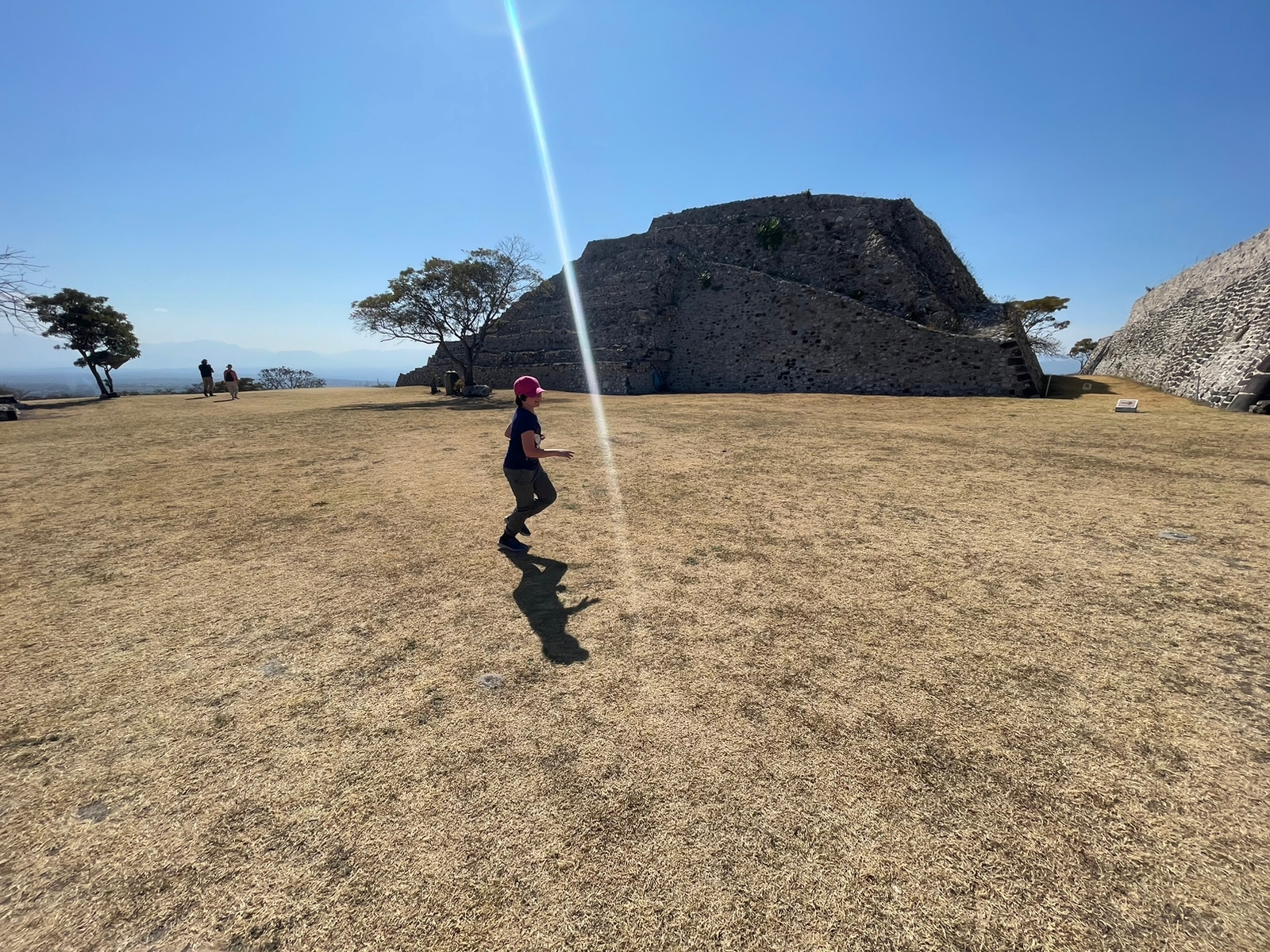
In Mexico, we have the great luck to live among vestiges of long-gone cultures, some that were conquered and in some way got adapted and survived into our modern, mostly-West-Europan-derived society, and some that thrived but disappeared many more centuries ago. And although not everybody feels the same way, in my family we have always enjoyed visiting archaeological sites when I was a child and today. Some of the regulars that follow this blog (or its syndicators) will remember Xochicalco, as it was the destination we chose for the daytrip back in the day, in DebConf6 (May 2006). This weekend, my mother suggested us to go there, as being Winter, the weather is quite pleasant we were at about 25 C, and by the hottest months of the year it can easily reach 10 more; the place lacks shadows, like most archaeological sites, and it does get quite tiring nevertheless! Xochicalco is quite unique among our archaeological sites, as it was built as a conference city: people came from cultures spanning all of Mesoamerica to debate and homogeneize the calendars used in the region. The first photo I shared here is by the Quetzalc atl temple, where each of the four sides shows people from different cultures (the styles in which they are depicted follow their local self-representations), encodes equivalent dates in the different calendaric systems, and are located along representationsof the God of knowledge, the feathered serpent, Quetzalc atl. It was a very nice day out. And, of course, it brought back memories of my favorite conference visiting the site of a very important conference

30 December 2022

Chris Lamb: Favourite books of 2022: Non-fiction

In my three most recent posts, I went over the memoirs and biographies, classics and fiction books that I enjoyed the most in 2022. But in the last of my book-related posts for 2022, I'll be going over my favourite works of non-fiction. Books that just missed the cut here include Adam Hochschild's King Leopold's Ghost (1998) on the role of Leopold II of Belgium in the Congo Free State, Johann Hari's Stolen Focus (2022) (a personal memoir on relating to how technology is increasingly fragmenting our attention), Amia Srinivasan's The Right to Sex (2021) (a misleadingly named set of philosophic essays on feminism), Dana Heller et al.'s The Selling of 9/11: How a National Tragedy Became a Commodity (2005), John Berger's mindbending Ways of Seeing (1972) and Louise Richardson's What Terrorists Want (2006).

The Great War and Modern Memory (1975)
Wartime: Understanding and Behavior in the Second World War (1989) Paul Fussell Rather than describe the battles, weapons, geopolitics or big personalities of the two World Wars, Paul Fussell's The Great War and Modern Memory & Wartime are focused instead on how the two wars have been remembered by their everyday participants. Drawing on the memoirs and memories of soldiers and civilians along with a brief comparison with the actual events that shaped them, Fussell's two books are a compassionate, insightful and moving piece of analysis. Fussell primarily sets himself against the admixture of nostalgia and trauma that obscures the origins and unimaginable experience of participating in these wars; two wars that were, in his view, a "perceptual and rhetorical scandal from which total recovery is unlikely." He takes particular aim at the dishonesty of hindsight:
For the past fifty years, the Allied war has been sanitised and romanticised almost beyond recognition by the sentimental, the loony patriotic, the ignorant and the bloodthirsty. I have tried to balance the scales. [And] in unbombed America especially, the meaning of the war [seems] inaccessible.
The author does not engage in any of the customary rose-tinted view of war, yet he remains understanding and compassionate towards those who try to locate a reason within what was quite often senseless barbarism. If anything, his despondency and pessimism about the Second World War (the war that Fussell himself fought in) shines through quite acutely, and this is especially the case in what he chooses to quote from others:
"It was common [ ] throughout the [Okinawa] campaign for replacements to get hit before we even knew their names. They came up confused, frightened, and hopeful, got wounded or killed, and went right back to the rear on the route by which they had come, shocked, bleeding, or stiff. They were forlorn figures coming up to the meat grinder and going right back out of it like homeless waifs, unknown and faceless to us, like unread books on a shelf."
It would take a rather heartless reader to fail to be sobered by this final simile, and an even colder one to view Fussell's citation of such an emotive anecdote to be manipulative. Still, stories and cruel ironies like this one infuse this often-angry book, but it is not without astute and shrewd analysis as well, especially on the many qualitative differences between the two conflicts that simply cannot be captured by facts and figures alone. For example:
A measure of the psychological distance of the Second [World] War from the First is the rarity, in 1914 1918, of drinking and drunkenness poems.
Indeed so. In fact, what makes Fussell's project so compelling and perhaps even unique is that he uses these non-quantitive measures to try and take stock of what happened. After all, this was a war conducted by humans, not the abstract school of statistics. And what is the value of a list of armaments destroyed by such-and-such a regiment when compared with truly consequential insights into both how the war affected, say, the psychology of postwar literature ("Prolonged trench warfare, whether enacted or remembered, fosters paranoid melodrama, which I take to be a primary mode in modern writing."), the specific words adopted by combatants ("It is a truism of military propaganda that monosyllabic enemies are easier to despise than others") as well as the very grammar of interaction:
The Field Service Post Card [in WW1] has the honour of being the first widespread exemplary of that kind of document which uniquely characterises the modern world: the "Form". [And] as the first widely known example of dehumanised, automated communication, the post card popularised a mode of rhetoric indispensable to the conduct of later wars fought by great faceless conscripted armies.
And this wouldn't be a book review without argument-ending observations that:
Indicative of the German wartime conception [of victory] would be Hitler and Speer's elaborate plans for the ultimate reconstruction of Berlin, which made no provision for a library.
Our myths about the two world wars possess an undisputed power, in part because they contain an essential truth the atrocities committed by Germany and its allies were not merely extreme or revolting, but their full dimensions (embodied in the Holocaust and the Holodomor) remain essentially inaccessible within our current ideological framework. Yet the two wars are better understood as an abyss in which we were all dragged into the depths of moral depravity, rather than a battle pitched by the forces of light against the forces of darkness. Fussell is one of the few observers that can truly accept and understand this truth and is still able to speak to us cogently on the topic from the vantage point of experience. The Second World War which looms so large in our contemporary understanding of the modern world (see below) may have been necessary and unavoidable, but Fussell convinces his reader that it was morally complicated "beyond the power of any literary or philosophic analysis to suggest," and that the only way to maintain a na ve belief in the myth that these wars were a Manichaean fight between good and evil is to overlook reality. There are many texts on the two World Wars that can either stir the intellect or move the emotions, but Fussell's two books do both. A uniquely perceptive and intelligent commentary; outstanding.

Longitude (1995) Dava Sobel Since Man first decided to sail the oceans, knowing one's location has always been critical. Yet doing so reliably used to be a serious problem if you didn't know where you were, you are far more likely to die and/or lose your valuable cargo. But whilst finding one's latitude (ie. your north south position) had effectively been solved by the beginning of the 17th century, finding one's (east west) longitude was far from trustworthy in comparison. This book first published in 1995 is therefore something of an anachronism. As in, we readily use the GPS facilities of our phones today without hesitation, so we find it difficult to imagine a reality in which knowing something fundamental like your own location is essentially unthinkable. It became clear in the 18th century, though, that in order to accurately determine one's longitude, what you actually needed was an accurate clock. In Longitude, therefore, we read of the remarkable story of John Harrison and his quest to create a timepiece that would not only keep time during a long sea voyage but would survive the rough ocean conditions as well. Self-educated and a carpenter by trade, Harrison made a number of important breakthroughs in keeping accurate time at sea, and Longitude describes his novel breakthroughs in a way that is both engaging and without talking down to the reader. Still, this book covers much more than that, including the development of accurate longitude going hand-in-hand with advancements in cartography as well as in scientific experiments to determine the speed of light: experiments that led to the formulation of quantum mechanics. It also outlines the work being done by Harrison's competitors. 'Competitors' is indeed the correct word here, as Parliament offered a huge prize to whoever could create such a device, and the ramifications of this tremendous financial incentive are an essential part of this story. For the most part, though, Longitude sticks to the story of Harrison and his evolving obsession with his creating the perfect timepiece. Indeed, one reason that Longitude is so resonant with readers is that many of the tropes of the archetypical 'English inventor' are embedded within Harrison himself. That is to say, here is a self-made man pushing against the establishment of the time, with his groundbreaking ideas being underappreciated in his life, or dishonestly purloined by his intellectual inferiors. At the level of allegory, then, I am minded to interpret this portrait of Harrison as a symbolic distillation of postwar Britain a nation acutely embarrassed by the loss of the Empire that is now repositioning itself as a resourceful but plucky underdog; a country that, with a combination of the brains of boffins and a healthy dose of charisma and PR, can still keep up with the big boys. (It is this same search for postimperial meaning I find in the fiction of John le Carr , and, far more famously, in the James Bond franchise.) All of this is left to the reader, of course, as what makes Longitute singularly compelling is its gentle manner and tone. Indeed, at times it was as if the doyenne of sci-fi Ursula K. LeGuin had a sideline in popular non-fiction. I realise it's a mark of critical distinction to downgrade the importance of popular science in favour of erudite academic texts, but Latitude is ample evidence that so-called 'pop' science need not be patronising or reductive at all.

Closed Chambers: The Rise, Fall, and Future of the Modern Supreme Court (1998) Edward Lazarus After the landmark decision by the U.S. Supreme Court in *Dobbs v. Jackson Women's Health Organization that ended the Constitutional right to abortion conferred by Roe v Wade, I prioritised a few books in the queue about the judicial branch of the United States. One of these books was Closed Chambers, which attempts to assay, according to its subtitle, "The Rise, Fall and Future of the Modern Supreme Court". This book is not merely simply a learned guide to the history and functioning of the Court (although it is completely creditable in this respect); it's actually an 'insider' view of the workings of the institution as Lazurus was a clerk for Justice Harry Blackmun during the October term of 1988. Lazarus has therefore combined his experience as a clerk and his personal reflections (along with a substantial body of subsequent research) in order to communicate the collapse in comity between the Justices. Part of this book is therefore a pure history of the Court, detailing its important nineteenth-century judgements (such as Dred Scott which ruled that the Constitution did not consider Blacks to be citizens; and Plessy v. Ferguson which failed to find protection in the Constitution against racial segregation laws), as well as many twentieth-century cases that touch on the rather technical principle of substantive due process. Other layers of Lazurus' book are explicitly opinionated, however, and they capture the author's assessment of the Court's actions in the past and present [1998] day. Given the role in which he served at the Court, particular attention is given by Lazarus to the function of its clerks. These are revealed as being far more than the mere amanuenses they were hitherto believed to be. Indeed, the book is potentially unique in its the claim that the clerks have played a pivotal role in the deliberations, machinations and eventual rulings of the Court. By implication, then, the clerks have plaedy a crucial role in the internal controversies that surround many of the high-profile Supreme Court decisions decisions that, to the outsider at least, are presented as disinterested interpretations of Constitution of the United States. This is of especial importance given that, to Lazarus, "for all the attention we now pay to it, the Court remains shrouded in confusion and misunderstanding." Throughout his book, Lazarus complicates the commonplace view that the Court is divided into two simple right vs. left political factions, and instead documents an ever-evolving series of loosely held but strongly felt series of cabals, quid pro quo exchanges, outright equivocation and pure personal prejudices. (The age and concomitant illnesses of the Justices also appears to have a not insignificant effect on the Court's rulings as well.) In other words, Closed Chambers is not a book that will be read in a typical civics class in America, and the only time the book resorts to the customary breathless rhetoric about the US federal government is in its opening chapter:
The Court itself, a Greek-style temple commanding the crest of Capitol Hill, loomed above them in the dim light of the storm. Set atop a broad marble plaza and thirty-six steps, the Court stands in splendid isolation appropriate to its place at the pinnacle of the national judiciary, one of the three independent and "coequal" branches of American government. Once dubbed the Ivory Tower by architecture critics, the Court has a Corinthian colonnade and massive twenty-foot-high bronze doors that guard the single most powerful judicial institution in the Western world. Lights still shone in several offices to the right of the Court's entrance, and [ ]
Et cetera, et cetera. But, of course, this encomium to the inherent 'nobility' of the Supreme Court is quickly revealed to be a narrative foil, as Lazarus soon razes this dangerously na ve conception to the ground:
[The] institution is [now] broken into unyielding factions that have largely given up on a meaningful exchange of their respective views or, for that matter, a meaningful explication or defense of their own views. It is of Justices who in many important cases resort to transparently deceitful and hypocritical arguments and factual distortions as they discard judicial philosophy and consistent interpretation in favor of bottom-line results. This is a Court so badly splintered, yet so intent on lawmaking, that shifting 5-4 majorities, or even mere pluralities, rewrite whole swaths of constitutional law on the authority of a single, often idiosyncratic vote. It is also a Court where Justices yield great and excessive power to immature, ideologically driven clerks, who in turn use that power to manipulate their bosses and the institution they ostensibly serve.
Lazurus does not put forward a single, overarching thesis, but in the final chapters, he does suggest a potential future for the Court:
In the short run, the cure for what ails the Court lies solely with the Justices. It is their duty, under the shield of life tenure, to recognize the pathologies affecting their work and to restore the vitality of American constitutionalism. Ultimately, though, the long-term health of the Court depends on our own resolve on whom [we] select to join that institution.
Back in 1998, Lazurus might have had room for this qualified optimism. But from the vantage point of 2022, it appears that the "resolve" of the United States citizenry was not muscular enough to meet his challenge. After all, Lazurus was writing before Bush v. Gore in 2000, which arrogated to the judicial branch the ability to decide a presidential election; the disillusionment of Barack Obama's failure to nominate a replacement for Scalia; and many other missteps in the Court as well. All of which have now been compounded by the Trump administration's appointment of three Republican-friendly justices to the Court, including hypocritically appointing Justice Barrett a mere 38 days before the 2020 election. And, of course, the leaking and ruling in Dobbs v. Jackson, the true extent of which has not been yet. Not of a bit of this is Lazarus' fault, of course, but the Court's recent decisions (as well as the liberal hagiographies of 'RBG') most perforce affect one's reading of the concluding chapters. The other slight defect of Closed Chambers is that, whilst it often implies the importance of the federal and state courts within the judiciary, it only briefly positions the Supreme Court's decisions in relation to what was happening in the House, Senate and White House at the time. This seems to be increasingly relevant as time goes on: after all, it seems fairly clear even to this Brit that relying on an activist Supreme Court to enact progressive laws must be interpreted as a failure of the legislative branch to overcome the perennial problems of the filibuster, culture wars and partisan bickering. Nevertheless, Lazarus' book is in equal parts ambitious, opinionated, scholarly and dare I admit it? wonderfully gossipy. By juxtaposing history, memoir, and analysis, Closed Chambers combines an exacting evaluation of the Court's decisions with a lively portrait of the intellectual and emotional intensity that has grown within the Supreme Court's pseudo-monastic environment all while it struggles with the most impactful legal issues of the day. This book is an excellent and well-written achievement that will likely never be repeated, and a must-read for anyone interested in this ever-increasingly important branch of the US government.

Crashed: How a Decade of Financial Crises Changed the World (2018)
Shutdown: How Covid Shook the World's Economy (2021) Adam Tooze The economic historian Adam Tooze has often been labelled as an unlikely celebrity, but in the fourteen years since the global financial crisis of 2008, a growing audience has been looking for answers about the various failures of the modern economy. Tooze, a professor of history at New York's Columbia University, has written much that is penetrative and thought-provoking on this topic, and as a result, he has generated something of a cult following amongst economists, historians and the online left. I actually read two Tooze books this year. The first, Crashed (2018), catalogues the scale of government intervention required to prop up global finance after the 2008 financial crisis, and it characterises the different ways that countries around the world failed to live up to the situation, such as doing far too little, or taking action far too late. The connections between the high-risk subprime loans, credit default swaps and the resulting liquidity crisis in the US in late 2008 is fairly well known today in part thanks to films such as Adam McKay's 2015 The Big Short and much improved economic literacy in media reportage. But Crashed makes the implicit claim that, whilst the specific and structural origins of the 2008 crisis are worth scrutinising in exacting detail, it is the reaction of states in the months and years after the crash that has been overlooked as a result. After all, this is a reaction that has not only shaped a new economic order, it has created one that does not fit any conventional idea about the way the world 'ought' to be run. Tooze connects the original American banking crisis to the (multiple) European debt crises with a larger crisis of liberalism. Indeed, Tooze somehow manages to cover all these topics and more, weaving in Trump, Brexit and Russia's 2014 annexation of Crimea, as well as the evolving role of China in the post-2008 economic order. Where Crashed focused on the constellation of consequences that followed the events of 2008, Shutdown is a clear and comprehensive account of the way the world responded to the economic impact of Covid-19. The figures are often jaw-dropping: soon after the disease spread around the world, 95% of the world's economies contracted simultaneously, and at one point, the global economy shrunk by approximately 20%. Tooze's keen and sobering analysis of what happened is made all the more remarkable by the fact that it came out whilst the pandemic was still unfolding. In fact, this leads quickly to one of the book's few flaws: by being published so quickly, Shutdown prematurely over-praises China's 'zero Covid' policy, and these remarks will make a reader today squirm in their chair. Still, despite the regularity of these references (after all, mentioning China is very useful when one is directly comparing economic figures in early 2021, for examples), these are actually minor blemishes on the book's overall thesis. That is to say, Crashed is not merely a retelling of what happened in such-and-such a country during the pandemic; it offers in effect a prediction about what might be coming next. Whilst the economic responses to Covid averted what could easily have been another Great Depression (and thus showed it had learned some lessons from 2008), it had only done so by truly discarding the economic rule book. The by-product of inverting this set of written and unwritten conventions that have governed the world for the past 50 years, this 'Washington consensus' if you well, has yet to be fully felt. Of course, there are many parallels between these two books by Tooze. Both the liquidity crisis outlined in Crashed and the economic response to Covid in Shutdown exposed the fact that one of the central tenets of the modern economy ie. that financial markets can be trusted to regulate themselves was entirely untrue, and likely was false from the very beginning. And whilst Adam Tooze does not offer a singular piercing insight (conveying a sense of rigorous mastery instead), he may as well be asking whether we're simply going to lurch along from one crisis to the next, relying on the technocrats in power to fix problems when everything blows up again. The answer may very well be yes.

Looking for the Good War: American Amnesia and the Violent Pursuit of Happiness (2021) Elizabeth D. Samet Elizabeth D. Samet's Looking for the Good War answers the following question what would be the result if you asked a professor of English to disentangle the complex mythology we have about WW2 in the context of the recent US exit of Afghanistan? Samet's book acts as a twenty-first-century update of a kind to Paul Fussell's two books (reviewed above), as well as a deeper meditation on the idea that each new war is seen through the lens of the previous one. Indeed, like The Great War and Modern Memory (1975) and Wartime (1989), Samet's book is a perceptive work of demystification, but whilst Fussell seems to have been inspired by his own traumatic war experience, Samet is not only informed by her teaching West Point military cadets but by the physical and ontological wars that have occurred during her own life as well. A more scholarly and dispassionate text is the result of Samet's relative distance from armed combat, but it doesn't mean Looking for the Good War lacks energy or inspiration. Samet shares John Adams' belief that no political project can entirely shed the innate corruptions of power and ambition and so it is crucial to analyse and re-analyse the role of WW2 in contemporary American life. She is surely correct that the Second World War has been universally elevated as a special, 'good' war. Even those with exceptionally giddy minds seem to treat WW2 as hallowed:
It is nevertheless telling that one of the few occasions to which Trump responded with any kind of restraint while he was in office was the 75th anniversary of D-Day in 2019.
What is the source of this restraint, and what has nurtured its growth in the eight decades since WW2 began? Samet posits several reasons for this, including the fact that almost all of the media about the Second World War is not only suffused with symbolism and nostalgia but, less obviously, it has been made by people who have no experience of the events that they depict. Take Stephen Ambrose, author of Steven Spielberg's Band of Brothers miniseries: "I was 10 years old when the war ended," Samet quotes of Ambrose. "I thought the returning veterans were giants who had saved the world from barbarism. I still think so. I remain a hero worshiper." If Looking for the Good War has a primary thesis, then, it is that childhood hero worship is no basis for a system of government, let alone a crusading foreign policy. There is a straight line (to quote this book's subtitle) from the "American Amnesia" that obscures the reality of war to the "Violent Pursuit of Happiness." Samet's book doesn't merely just provide a modern appendix to Fussell's two works, however, as it adds further layers and dimensions he overlooked. For example, Samet provides some excellent insight on the role of Western, gangster and superhero movies, and she is especially good when looking at noir films as a kind of kaleidoscopic response to the Second World War:
Noir is a world ruled by bad decisions but also by bad timing. Chance, which plays such a pivotal role in war, bleeds into this world, too.
Samet rightfully weaves the role of women into the narrative as well. Women in film noir are often celebrated as 'independent' and sassy, correctly reflecting their newly-found independence gained during WW2. But these 'liberated' roles are not exactly a ringing endorsement of this independence: the 'femme fatale' and the 'tart', etc., reflect a kind of conditional freedom permitted to women by a post-War culture which is still wedded to an outmoded honour culture. In effect, far from being novel and subversive, these roles for women actually underwrote the ambient cultural disapproval of women's presence in the workforce. Samet later connects this highly-conditional independence with the liberation of Afghan women, which:
is inarguably one of the more palatable outcomes of our invasion, and the protection of women's rights has been invoked on the right and the left as an argument for staying the course in Afghanistan. How easily consequence is becoming justification. How flattering it will be one day to reimagine it as original objective.
Samet has ensured her book has a predominantly US angle as well, for she ends her book with a chapter on the pseudohistorical Lost Cause of the Civil War. The legacy of the Civil War is still visible in the physical phenomena of Confederate statues, but it also exists in deep-rooted racial injustice that has been shrouded in euphemism and other psychological devices for over 150 years. Samet believes that a key part of what drives the American mythology about the Second World War is the way in which it subconsciously cleanses the horrors of brother-on-brother murder that were seen in the Civil War. This is a book that is not only of interest to historians of the Second World War; it is a work for anyone who wishes to understand almost any American historical event, social issue, politician or movie that has appeared since the end of WW2. That is for better or worse everyone on earth.


21 December 2022

Russ Allbery: Review: Shutdown

Review: Shutdown, by Adam Tooze
Publisher: Viking
Copyright: September 2021
ISBN: 0-593-29756-3
Format: Kindle
Pages: 305
Shutdown is a history of the world macroeconomic response to COVID-19, covering 2020 and the very beginning of 2021. But wait, you might be saying. It's only the end of 2022 right now, and this book was published in September of 2021. That's not history, that's journalism. And yes, I think that's a valid critique. Shutdown is doing something rather odd, and I'm not certain it was a good idea, but I do think it has a (somewhat narrow) audience. Descriptions first. After an awkward introduction (more on that later), Tooze launches into an essentially chronological history in four parts: the initial viral spread and early political and public health response, the economic hard stop and macroeconomic response, the summer fallout and political complications, and the more-organized aftershocks of the fall. The early chapters are closer to a history, with a clear timeline and the tracery of cause and effect. The closer the narrative comes to the time Tooze was writing it, the more that clarity drops away. The last few chapters feel like a collection of simultaneous events that may or may not be related or have long-term significance. Everyone reading this lived through those events, and if you're at all like me, consumed far more news coverage of them than was healthy. The obvious question, then, is why read a book that rehashes all of that? For me, there are two answers: Tooze pays attention to more of the world than makes it into the local headlines and tries to synthesize a larger picture, and the focus of this book is the macroeconomic facilities used in the response. I remember the fights over school closures in the US. I didn't know about the impact of unprecedented Federal Reserve action on the bond market for emerging market government debt. If you're the sort of person who reads The Economist religiously (which I am not), you may not learn anything new here. If you're not, and you have a general interest in international finance, there were probably some wrinkles you missed. Even if you stay up-to-date on the more technical news, Shutdown provides an intermediate consolidation and restructuring. It's not ready to be a history in the traditional sense, but it's a first pass at putting events in order and tracing the implications for the global financial system. Read in that sense, Shutdown felt like a continuation of Tooze's Crashed, following the same themes of a hegemonic but unstable dollar system and a Federal Reserve that has increasingly taken on the role of backstop to the entire world (and how the only tools it has available tend to increase wealth inequality). If you've not read Crashed, read it first. I think it's the stronger and more thorough book (not the least because it had more time and data to construct a coherent history), and it's the best introduction to the international macroeconomic risks that Tooze traces in Shutdown. This book was, for me, an update of the Tooze's thinking in Crashed for the COVID era. Tooze is very good at clearly describing macroeconomic shocks. I recently read Lev Menand's The Fed Unbound, which is in part about the same intervention during the COVID shock that Tooze describes here, and yet it wasn't until I read Shutdown that I grasped that the Treasury purchases by the Fed had arguably crossed the political red line of monetizing government debt, even though the Fed probably had no choice and few people noticed in the middle of the crisis. This is where Tooze's background as a historian is helpful. Most people writing on this topic are either economists, who seem to take inferences like that for granted and dive into the technical debate, or journalists, who rarely understand the nuance and often jump to facile conclusions. Tooze is a historian with an extensive economics background; he can explain the mechanics while still focusing on the limitations of politics, which is the sort of analysis that I want to read. The problem with this book as a history is that it necessarily raises more questions than it answers. In the conclusion, Tooze writes:
A severe tightening in U.S. monetary policy or even a full-fledged taper tantrum would put global resilience to a stern test. So too would a violent escalation of geopolitical tension in one of the major regions of the world economy.
Both of those events have subsequently happened, which throws any tentative conclusions Tooze can offer into question. For another example, when Tooze wrote Shutdown, China's zero COVID policy was widely celebrated inside China and had enabled a fast economic recovery while the rest of the world was still in serious difficulty. Before Omicron, it was conceivable (if extremely risky) that China could continue to avoid a major COVID surge. In December of 2022, it's obvious they only managed to delay, and while delay meant vaccination and the price in deaths may well be smaller than was paid for the route taken by most of the rest of the world, the trade-offs are now even harder to analyze. There are, of course, other examples, the most obvious of which is the rise of global inflation simultaneous with a strengthening dollar. A history written from a distance of several decades would have included that aftermath. A snap history with a distance of only a few months cannot. The other problem with this book is that it's not as polished. Viking did an amazing job turning publication around in roughly six months, dramatically faster than publishing normally works, but there are parts that could have used more editing. The introduction, in particular, reads more like a blog post than an edited book, and while I'm a happy reader of Tooze's Chartbook, the recap of COVID's impact was a bit trite and Tooze's abstract musings on polycrisis could have used tightening and clarity. The meat of the book is better, but there is a messy stream-of-consciousness feel that is inherent in a book written to this tight of a timeline. I think the audience of this book is, narrowly, people who have read Crashed and want to follow that line of reasoning into the COVID era. Crashed is one of the better books on macroeconomic history that I've read, and I did indeed want to follow that train of thought, so I am part of that audience. This is not the sort of book that I would widely recommend, however. If you want to read it, you probably know that already; if you are new to Tooze's analysis, Crashed is the place to start. Rating: 7 out of 10

20 December 2022

Russ Allbery: Review: Tess of the Road

Review: Tess of the Road, by Rachel Hartman
Series: Tess of the Road #1
Publisher: Random House
Copyright: 2018
Printing: 2022
ISBN: 1-101-93130-2
Format: Kindle
Pages: 536
Tess of the Road is the first book of a YA fantasy duology set in the same universe as Seraphina and Shadow Scale. It's hard to decide what to say about reading order (and I now appreciate the ambiguous answers I got). Tess of the Road is a sequel to Seraphina and Shadow Scale in the sense that there are numerous references to the previous duology, but it has a different protagonist and different concerns. You don't need to read the other duology first, but Tess of the Road will significantly spoil the resolution of the romance plot in Seraphina, and it will be obvious that you've skipped over background material. That said, Shadow Scale is not a very good book, and this is a much better book. I guess the summary is this: if you're going to read the first duology, read it first, but don't feel obligated to do so. Tess was always a curious, adventurous, and some would say unmanageable girl, nothing like her twin. Jeanne is modest, obedient, virtuous, and practically perfect in every way. Tess is not; after a teenage love affair resulting in an out-of-wedlock child and a boy who disappeared rather than marry her, their mother sees no alternative but to lie about which of the twins is older. If Jeanne can get a good match among the nobility, the family finances may be salvaged. Tess's only remaining use is to help her sister find a match, and then she can be shuffled off to a convent. Tess throws herself into court politics and does exactly what she's supposed to. She engineers not only a match, but someone Jeanne sincerely likes. Tess has never lacked competence. But this changes nothing about her mother's view of her, and Tess is depressed, worn, and desperately miserable in Jeanne's moment of triumph. Jeanne wants Tess to stay and become the governess of her eventual children, retaining their twin bond of the two of them against the world. Their older sister Seraphina, more perceptively, tries to help her join an explorer's expedition. Tess, in a drunken spiral of misery, insults everyone and runs away, with only a new pair of boots and a pack of food. This is going to be one of those reviews where the things I didn't like are exactly the things other readers liked. I see why people loved this book, and I wish I had loved it too. Instead, I liked parts of it a great deal and found other parts frustrating or a bit too off-putting. Mostly this is a preference problem rather than a book problem. My most objective complaint is the pacing, which was also my primary complaint about Shadow Scale. It was not hard to see where Hartman was going with the story, I like that story, I was on board with going there, but getting there took for-EV-er. This is a 536 page book that I would have edited to less than 300 pages. It takes nearly a hundred pages to get Tess on the road, and while some of that setup is necessary, I did not want to wallow in Tess's misery and appalling home life for quite that long. A closely related problem is that Hartman continues to love flashbacks. Even after Tess has made her escape, we get the entire history of her awful teenage years slowly dribbled out over most of the book. Sometimes this is revelatory; mostly it's depressing. I had guessed the outlines of what had happened early in the book (it's not hard), and that was more than enough motivation for me, but Hartman was determined to make the reader watch every crisis and awful moment in detail. This is exactly what some readers want, and sometimes it's even what I want, but not here. I found the middle of the book, where the story is mostly flashbacks and flailing, to be an emotional slog. Part of the problem is that Tess has an abusive mother and goes through the standard abuse victim process of being sure that she's the one who's wrong and that her mother is justified in her criticism. This is certainly realistic, and it eventually lead to some satisfying catharsis as Tess lets go of her negative self-image. But Tess's mother is a narcissistic religious fanatic with a persecution complex and not a single redeeming quality whatsoever, and I loathed reading about her, let alone reading Tess tiptoeing around making excuses for her. The point of this in the story is for Tess to rebuild her self-image, and I get it, and I'm sure this will work for some readers, but I wanted Tess's mother (and the rest of her family except her sisters) to be eaten by dragons. I do not like the emotional experience of hating a character in a book this much. Where Tess of the Road is on firmer ground is when Tess has an opportunity to show her best qualities, such as befriending a quigutl in childhood and, in the sort of impulsive decision that shows her at her best, learning their language. (For those who haven't read the previous books, quigutls are a dog-sized subspecies of dragon that everyone usually treats like intelligent animals, although they're clearly more than that.) Her childhood quigutl friend Pathka becomes her companion on the road, which both gives her wanderings some direction and adds some useful character interaction. Pathka comes with a plot that is another one of those elements that I think will work for some readers but didn't work for me. He's in search of a Great Serpent, a part of quigutl mythology that neither humans or dragons pay attention to. That becomes the major plot of the novel apart from Tess's emotional growth. Pathka also has a fraught relationship with his own family, which I think was supposed to parallel Tess's relationships but never clicked for me. I liked Tess's side of this relationship, but Pathka is weirdly incomprehensible and apparently fickle in ways that I found unsatisfying. I think Hartman was going for an alien tone that didn't quite work for me. This is a book that gets considerably better as it goes along, and the last third of the book was great. I didn't like being dragged through the setup, but I loved the character Tess became. Once she reaches the road crew, this was a book full of things that I love reading about. The contrast between her at the start of the book and the end is satisfying and rewarding. Tess's relationship with her twin Jeanne deserves special mention; their interaction late in the book is note-perfect and much better than I had expected. Unfortunately, Tess of the Road doesn't have a real resolution. It's only the first half of Tess's story, which comes back to that pacing problem. Ah well. I enjoyed this but I didn't love it. The destination was mostly worth the journey, but I thought the journey was much too long and I had to spend too much time in the company of people I hated far more intensely than was comfortable. I also thought the middle of the book sagged, a problem I have now had with two out of three of Hartman's books. But I can see why other readers with slightly different preferences loved it. I'm probably invested enough to read the sequel, although I'm a bit grumbly that the sequel is necessary. Followed by In the Serpent's Wake. Rating: 7 out of 10

11 December 2022

Vincent Bernat: Akvorado: a flow collector, enricher, and visualizer

Earlier this year, we released Akvorado, a flow collector, enricher, and visualizer. It receives network flows from your routers using either NetFlow v9, IPFIX, or sFlow. Several pieces of information are added, like GeoIP and interface names. The flows are exported to Apache Kafka, a distributed queue, then stored inside ClickHouse, a column-oriented database. A web frontend is provided to run queries. A live version is available for you to play.
Akvorado web interface displays the result of a simple query using stacked areas
Akvorado s web frontend
Several alternatives exist: Akvorado differentiates itself from these solutions because: The proposed deployment solution relies on Docker Compose to set up Akvorado, Zookeeper, Kafka, and ClickHouse. I hope it should be enough for anyone to get started quickly. Akvorado is performant enough to handle 100 000 flows per second with 64 GB of RAM and 24 vCPU. With 2 TB of disk, you should expect to keep data for a few years. I spent some time writing a fairly complete documentation. It seems redundant to repeat its content in this blog post. There is also a section about its internal design if you are interested in how it is built. I also did a FRnOG presentation earlier this year, and a ClickHouse meetup presentation, which focuses more on how ClickHouse is used. I plan to write more detailed articles on specific aspects of Akvorado. Stay tuned!

  1. While the collector could write directly to the database, the queue buffers flows if the database is unavailable. It also enables you to process flows with another piece of software (like an anti-DDoS system).

Next.

Previous.