Search Results: "fh"

18 April 2014

Richard Hartmann: higher security

Instant classic
Trusted:
NO, there were errors:
The certificate does not apply to the given host
The certificate authority's certificate is invalid
The root certificate authority's certificate is not trusted for this purpose
The certificate cannot be verified for internal reasons
Signature Algorithm: md5WithRSAEncryption
    Issuer: C=XY, ST=Snake Desert, L=Snake Town, O=Snake Oil, Ltd, OU=Certificate Authority, CN=Snake Oil CA/emailAddress=ca@snakeoil.dom
    Validity
        Not Before: Oct 21 18:21:51 1999 GMT
        Not After : Oct 20 18:21:51 2001 GMT
    Subject: C=XY, ST=Snake Desert, L=Snake Town, O=Snake Oil, Ltd, OU=Webserver Team, CN=www.snakeoil.dom/emailAddress=www@snakeoil.dom
...
            X509v3 Subject Alternative Name: 
            email:www@snakeoil.dom

For your own pleasure:
openssl s_client -connect www.walton.com.tw:443 -showcerts

or just run
echo '
-----BEGIN CERTIFICATE-----
MIIDNjCCAp+gAwIBAgIBATANBgkqhkiG9w0BAQQFADCBqTELMAkGA1UEBhMCWFkx
FTATBgNVBAgTDFNuYWtlIERlc2VydDETMBEGA1UEBxMKU25ha2UgVG93bjEXMBUG
A1UEChMOU25ha2UgT2lsLCBMdGQxHjAcBgNVBAsTFUNlcnRpZmljYXRlIEF1dGhv
cml0eTEVMBMGA1UEAxMMU25ha2UgT2lsIENBMR4wHAYJKoZIhvcNAQkBFg9jYUBz
bmFrZW9pbC5kb20wHhcNOTkxMDIxMTgyMTUxWhcNMDExMDIwMTgyMTUxWjCBpzEL
MAkGA1UEBhMCWFkxFTATBgNVBAgTDFNuYWtlIERlc2VydDETMBEGA1UEBxMKU25h
a2UgVG93bjEXMBUGA1UEChMOU25ha2UgT2lsLCBMdGQxFzAVBgNVBAsTDldlYnNl
cnZlciBUZWFtMRkwFwYDVQQDExB3d3cuc25ha2VvaWwuZG9tMR8wHQYJKoZIhvcN
AQkBFhB3d3dAc25ha2VvaWwuZG9tMIGfMA0GCSqGSIb3DQEBAQUAA4GNADCBiQKB
gQC554Ro+VH0dJONqljPBW+C72MDNGNy9eXnzejXrczsHs3Pc92Vaat6CpIEEGue
yG29xagb1o7Gj2KRgpVYcmdx6tHd2JkFW5BcFVfWXL42PV4rf9ziYon8jWsbK2aE
+L6hCtcbxdbHOGZdSIWZJwc/1Vs70S/7ImW+Zds8YEFiAwIDAQABo24wbDAbBgNV
HREEFDASgRB3d3dAc25ha2VvaWwuZG9tMDoGCWCGSAGG+EIBDQQtFittb2Rfc3Ns
IGdlbmVyYXRlZCBjdXN0b20gc2VydmVyIGNlcnRpZmljYXRlMBEGCWCGSAGG+EIB
AQQEAwIGQDANBgkqhkiG9w0BAQQFAAOBgQB6MRsYGTXUR53/nTkRDQlBdgCcnhy3
hErfmPNl/Or5jWOmuufeIXqCvM6dK7kW/KBboui4pffIKUVafLUMdARVV6BpIGMI
5LmVFK3sgwuJ01v/90hCt4kTWoT8YHbBLtQh7PzWgJoBAY7MJmjSguYCRt91sU4K
s0dfWsdItkw4uQ==
-----END CERTIFICATE-----
'   openssl x509 -noout -text

At least they're secure against heartbleed.

11 April 2014

Lars Wirzenius: Applying the Doctorow method to coding

When you have a big goal, do at least a little of it every day. Cory Doctorow writes books and stuff, and writes for at least twenty minutes every day. I write computer software, primarily Obnam, my backup program, and recently wrote the first rough draft of a manual for it, by writing at least a little every day. In about two months I got from nothng to something that is already useful to people. I am now applying this to coding as well. Software development is famously an occupation that happens mostly in one's brain and where being in hack mode is crucial. Getting into hack mode takes time and a suitable, distraction-free environment. I have found, however, that there are a lot of small, quick tasks that do not require a lot of concentration. Fixing wordings of error messages, making small, mechanical refactorings, confirming bugs by reproducing them and writing test cases to reproduce them, etc. I have foubd that if I've prepared for and planned such tasks properly, in the GTD planning phase, I can do such tasks even on trains and traun stations. This is important. I commute to work and if I can spend the time I wait for a train, or on the train, productively, I can significant, real progress. But to achieve this I really do have to do the preparation beforehand. Th 9:46 train to work is much too noisy to do any real thinking in.

1 April 2014

Marco d'Itri: Real out of band connectivity with network namespaces

This post explains how to configure on a Linux server a second and totally independent network interface with its own connectivity. It can be useful to access the server when the regular connectivity is broken. This can happen thanks to network namespaces, a virtualization feature available in recent kernels. We need to create a simple script to be run at boot time which will create and configure the namespace. First, move in the new namespace the network interface which will be dedicated to it:
ip netns add oob
ip link set eth2 netns oob
And then configure it as usual with iproute, by executing it in the new namespace with ip netns exec:
ip netns exec oob ip link set lo up
ip netns exec oob ip link set eth2 up
ip netns exec oob ip addr add 192.168.1.2/24 dev eth2
ip netns exec oob ip route add default via 192.168.1.1
The interface must be configured manually because ifupdown does not support namespaces yet, and it would use the same /run/network/ifstate file which tracks the interfaces of the main namespace (this is also a good argument in favour of something persistent like Network Manager...). Now we can start any daemon in the namespace, just make sure that they will not interfere with the on-disk state of other instances:
ip netns exec oob /usr/sbin/sshd -o PidFile=/run/sshd-oob.pid
Netfilter is virtualized as well, so we can load a firewall configuration which will be applied only to the new namespace:
ip netns exec oob iptables-restore < /etc/network/firewall-oob-v4
As documented in ip-netns(8), iproute netns add will also create a mount namespace and bind mount in it the files in /etc/netns/$NAMESPACE/: this is very useful since some details of the configuration, like the name server IP, will be different in the new namespace:
mkdir -p /etc/netns/oob/
echo 'nameserver 8.8.8.8' > /etc/netns/oob/resolv.conf
If we connect to the second SSH daemon, it will create a shell in the second namespace. To enter the main one, i.e. the one used by PID 1, we can use a simple script like:
#!/bin/sh -e
exec nsenter --net --mount --target 1 "$@"
To reach the out of band namespace from the main one we can use instead:
#!/bin/sh -e
exec nsenter --net --mount --target $(cat /var/run/sshd-oob.pid) "$@"
Scripts like these can also be used in fun ssh configurations like:
Host 10.2.1.*
 ProxyCommand ssh -q -a -x -N -T server-oob.example.net 'nsenter-main nc %h %p'

26 March 2014

Neil Williams: LAVA packages for Debian

Packaging LAVA for Debian unstable with notes on other distributions I ve been building packages for LAVA on Debian unstable for several months now and I ve been running LAVA jobs on the laptop and on devices in my home lab and on an ARMv7 arndale too. Current LAVA installations use lava-deployment-tool which has only supported Ubuntu 12.04 LTS Precise Pangolin. There has been a desire in LAVA to move away from a virtual environment, to put configuration files in FHS compliant paths, to use standard distribution packages for dependencies and so to make LAVA available on more platforms than just precise. Packaging opens the door to installing LAVA on Debian, Ubuntu, Fedora and any other recent distribution. Despite LAVA currently being reliant on 12.04 Precise, some of the python dependencies of LAVA have been able to move forward using the virtual environment provided by builtout and pypi. This means that LAVA, as packaged, requires a newer base OS suite than precise for Ubuntu, the minimal base is Saucy Salamander 13.10 and for Debian it would be Jessie (testing) although there is currently a transition ongoing in Debian which means that uwsgi is not in testing and Debian unstable would be needed instead. The work to migrate configuration snippets out of deployment-tool and to ensure that the tarball built using setuptools contains all of the necessary files for the package has already been done. The packaging itself is clean and most of the work is done upstream. There is, as ever, more to do but the packages work smoothly for single install LAVA servers where the dispatcher is on the same machine as the django web frontend. The packages have also migrated to Django1.6, something which is proving difficult with the deployment-tool as it has not kept pace with the changes outside the virtual environment, even if other parts of LAVA have. LAVA will be switching to packages for installation instead of deployment-tool and this will mean changes to how LAVA works outside the Cambridge lab. When the time comes to swich to packaging, the plan is to update deployment-tool so that it no longer updates /srv/lava/ but instead migrates the instance to packages. Main changes
  1. Configuration files move into /etc/
    • Device configuration files /etc/lava-dispatcher/devices/
    • Instance configuration files/etc/lava-server/
  2. Log files move into /var/log/
    • Adding logrotate support no more multi-Gb log files in /srv/lava/
  3. Commitment to keeping the upstream code up to date with dependencies
  4. Support for migrating existing instances, using South.
  5. Packaging helpers
    • add devices over SSH instead of via a combination of web frontend and SSH.
    • Developer builds with easily identifiable version strings, built as packages direct from your git tree.
  6. New frontend
    • Although django1.6 does not change the design of the web frontend at all, LAVA will take the opportunity to apply a bootstrap frontend which has greater support for browsers on a variety of devices, including mobile. This also helps identify a packaged LAVA from a deployment LAVA.
  7. Documentation and regular updates
The Plan LAVA has made regular releases based on a monthly cycle and these will be provided as source tarballs at http://www.linaro.org/downloads/ for distributions to download. The
official monthly release and any intervening updates will be made available for distributions to use for their own packaging. Additionally, Debian packages will be regularly built for use within LAVA and these will be available for those who choose to migrate from Ubuntu Precise to Debian Jessie. LAVA will assist maintainers who want to package LAVA for their distributions and we welcome patches from such maintainers. This can include changes to the developer build support script to automate the process of supporting development outside LAVA. Initially, LAVA will migrate to packaging internally, to prove the process and to smooth out the migration. Other LAVA instances are welcome to follow this migration or wait until the problems have been ironed out. The Issues Build Dependencies For Debian unstable, the list of packages which must be installed on your Debian system to be able to build packages from the lava-server and lava-dispatcher source code trees are:
debhelper (>= 8.0.0) python   python-all   python-dev   python-all-dev 
python-sphinx (>= 1.0.7+dfsg)   python3-sphinx python-mocker 
python-setuptools python-versiontools
(python-versiontools may disappear before the packages are finalised) In addition, to be able to install lava-server, these packages need to be built from tarballs released by Linaro (the list may shorten as changes upstream are applied)
linaro-django-pagination, 
python-django-restricted-resource (>= 0.2.7), 
lava-tool (>= 0.2), lava-utils-interface (>= 1.0), 
linaro-django-xmlrpc (>= 0.4),
python-versiontools (>= 1.8),
python-longerusername,
linaro-dashboard-bundle (>= 1.10.2), 
lava-dispatcher (>= 0.33.3)
lava-coordinator, lava-server-doc
The list for lava-dispatcher is currently:
python-json-schema-validator, lava-tool (>= 0.4), 
lava-utils-interface, linaro-dashboard-bundle (>= 1.10.2), 
The packages available from my experimental repository are using a new packaging branch of lava-server and lava-dispatcher where we are also migrating the CSS to Bootstrap CSS. Installing LAVA on Debian unstable
$ sudo apt-get install emdebian-archive-keyring
Add the link to my experimental repository (amd64, i386, armhf & arm64) to your apt sources, e.g. by creating a file /etc/apt/sources.list.d/lava.list containing:

deb http://people.linaro.org/~neil.williams/lava sid main
Update with the new key

$ sudo apt-get update
It is always best to install postgresql first:

$ sudo apt-get install postgresql
There are then three options for the packages to install (Please be careful with remote worker setup, it is not suitable for important installations at this time.):
  1. Single instance, server and dispatcher with recommended tools
    apt-get install lava
    Installs linaro-image-tools and guestfs tools.
  2. Single instance, server and dispatcher
    apt-get install lava-server
    Installs enough to run LAVA on a single machine, running jobs on boards on the same LAN.
  3. Experimental remote worker support
    apt-get install lava-worker
    Needs a normal lava-server installation to act as the master scheduler but is aimed at supporting a dispatcher and boards which are remote from that master.
The packages do not assume that your apache2.4 setup is identical to that used in other LAVA installations, so the LAVA apache config is installed to /etc/apache2/sites-available/ but is not enabled by default. If you choose to use the packaged apache config, you can simply run:

$ sudo a2ensite lava-server
$ sudo apache2ctl restart
(If this is a fresh apache install, use a2dissite to disable to default configuration before restarting.) Information on creating a superuser, adding devices and administering your LAVA install is provided in the README.Debian file in lava-server:

$ zless /usr/share/doc/lava-server/README.Debian.gz
Provisos and limitations Please be aware that packaged LAVA is still a work-in-progress but do let us know if there are problems. Now is the time to iron out install bugs and other issues as well as to prepare LAVA packages for other distributions. It will be a little while before the packages are ready for upload to Debian I ve got to arrange the download location and upload the dependencies first and some of that work will wait until more work has gone in upstream to consolidate some of the current dependencies.

25 March 2014

Francesca Ciceri: A crafty roundup: projects from the last months

A quick roundup of things I made during the last months, following tutorials here and there. finished projects for babies 1: a soft bunny more or less based on this one 2: skelly man! You can find pattern and instructions on Chez Beeper Bebe's blog 3: bibs: the embroidered one is based on this pattern by Charlotte Lyons on SouleMama's blog, the other re-uses the same pattern but add a bird applique instead. finished projects for women 1, 4: my first try with the beautiful Weekender Bag ended with something else entirely: apparently, where euclidean geometry principles apply, cutting a piece of fabric 10 cm smaller will result in a bag 10 cm smaller!
Go figure! Fhtang! I'm happy anyway with the final result, but it resembles more a tote bag than a weekender one. I then made also a successful Weekender, but haven't taken a pic yet. If you try that pattern, you may find this blogpost helpful. 2: This is my try at copycatting this model without a pattern and didn't end very well.
However, a couple lessons learned: 3: Blouse with knit-stretchy stuff! (You love me when I speak technical, don't you?)
I did that without pattern, mostly using a similar top I have as inspiration/guide

28 February 2014

Russell Coker: Links February 2014

The Economist has an interesting and informative article about the lack of reproducability of scientific papers and the implications for scientific research [1]. Regina Dugan gave an interesting TED talk about some of the amazing DARPA projects [2]. Chris Anderson interviewed Elon Musk about the Tesla cars, SpaceX, and his new venture Solar City [3]. Elon has a lot of great ideas for improving humanity while also making money. Smart Planet has an interesting article about Bhutan s switch to electric vehicles [4]. Paul Piff gave an insightful and well researched TED talk about the ways that money makes people mean [5]. Maryn McKenna wrote an interesting article for Wired about what happens when the current anti-biotics stop working [6]. Unfortunately she lists increasing food prices as a consequence, really the unreasonably low price of meat is due to the misuse of anti-biotics that is causing this problem. Linda Walther Tirado wrote an interesting article about being poor titled Why I Make Terrible Decisions, or, Poverty Thoughts [7]. It gives a real insight into the situation of people who are trapped in poverty. When someone who is as obviously intelligent as Linda feels that it s impossible to escape poverty there is a real problem in the system. While Australia doesn t suck nearly as badly as the US in this regard (higher minimum wage and better health care) we still need to improve things, I know people in Australia who s experience bears some similarity to Linda s. Maxwell Neely-Cohen wrote an interesting article about peer pressure [8]. Some of the conclusions are dubious, but the ideas on the way the Internet changes peer relationships in high school are interesting. An English pediatrician wrote an article for The Daily Beast about why he won t accept anti-vac clients [9]. There are some decent people in the Liberal Party, Liberal MP Warren Entsch attacks Cory Bernardi on gay obsession [10]. AFAIK we haven t yet had a gay sex scandal involving a homophobic Australian politician

23 February 2014

Vincent Cheng: Hello, Planet Debian! (also, RFH: sponsorship-requests)

Hi Debian! Just to briefly introduce myself, I'm Vincent (vcheng@d.o, vincent_c on OFTC/Freenode) and I'm a recent graduate of the NM process, having attained DD-ship (is that even a word?) about a month ago in January. Before that, I was a DM since mid-2012, and just another contributor for a few years prior to that. Most of my contributions to the Project are related to packaging, especially packages maintained within the Debian Games Team. Outside of Debian, well, I'm just another 20-year-old, 3rd-year undergrad student studying at the University of British Columbia, working towards a major in computer science. I anticipate that I'll be able to ditch academia for good in 2016; just 2 more years to go... More about my life story in my AM's report. It's fairly boring, if I say so myself. This blog post isn't just about me; I'd like to touch upon another topic that I consider important, i.e. attracting new contributors, and in many cases that involves package sponsorship. That's one of the many things I'd like to work on as a DD, and to that effect I've dedicated a large chunk of the time I currently spend on Debian sponsoring various packages, including packages that I'm not familiar with. I would love to see the sponsorship-requests queue empty one day, but I admit that I find that increasingly unlikely to happen, now that I've gotten a taste of the time commitment involved with sponsoring. Team maintenance and sponsorship seems to work relatively well in Debian; why does that success not translate over to sponsorship-requests / debian-mentors@l.d.o, where a considerable amount of RFS requests don't see any response at all, and merely get closed once those packages get removed from mentors.debian.net (AFAIK they automatically get removed after 20 weeks)? Well, I'm not here to offer an answer for that, but I will point out that there was a relevant thread that originated on debian-devel a month ago: <87ha8lzl7n.fsf@inf-8660.int-evry.fr> (and no, I'm not talking about the giant init-related threads that pop up on debian-devel every other week or so and drown out everything else on the list...). Are DDs in general reluctant to engage in "fly-by sponsoring"? Most packages coming through the sponsorship-requests queue are not team-maintained, and are sent from sponsorees who are not already in contact with a sponsor, and who have no other way of getting in touch with a potential sponsor (assuming that there isn't an existing team or a DD who happens to be interested in that package). Regardless of the merits of fly-by sponsoring (many arguments in favour of, and against, this type of sponsorship have already been discussed in that thread; no need to re-iterate them here), it's discouraging for potential contributors new to Debian, who may just give up and move on to something else. I've now had the opportunity to be a sponsor (rather than just a sponsoree), and I acknowledge that being a sponsor is more work than I imagined it to be a month ago, and it can be quite tedious and not-fun at times. I suppose I can draw a parallel between sponsoring packages and RC bug fixing; neither is what I'd consider to be a highly enjoyable way of spending my leisure time, and both can eat up a large chunk of time and effort; both often involve working on something that you aren't familiar with. But both are beneficial to Debian. No, beneficial isn't a strong enough word; how about "essential" instead? Yeah, that makes more sense. Without dedicated RC bug squashers, Debian would never be able to make a release; without dedicated sponsors, the size of Debian's archive would be smaller and of lesser quality, and its community also a lot smaller. With all that said...I hope this blog post inspires at least a few DDs, possibly more, to dedicate a little bit more of their time towards sponsoring packages. :)

20 February 2014

Marco d'Itri: Automatically unlocking xscreensaver in some locations

When I am at home I do not want to be bothered by the screensaver locking my laptop. To solve this, I use a custom PAM configuration which checks if I am authenticated to the local access point. Add this to the top of /etc/pam.d/xscreensaver:
auth sufficient pam_exec.so quiet /usr/local/sbin/pam_auth_xscreensaver
And then use a script like this one to decide when you want the display to be automatically unlocked:
#!/bin/sh -e
# return the ESSID of this interface
current_essid()  
  /sbin/iwconfig $1   sed -nre '/ESSID/s/.*ESSID:"([^"]+)".*/\1/p'
 
# automatically unlock only for these users
case "$PAM_USER" in
  "")   echo "This program must be run by pam_auth.so!"
        exit 1
        ;;
  md)   ;;
  *)    exit 1
        ;;
esac
CURRENT_ESSID=$(current_essid wlan0)
# automatically unlock when connected to these networks
case "$CURRENT_ESSID" in
  MYOWNESSID) exit 0 ;;
esac
exit 6

18 February 2014

Christoph Egger

Writing this because there seems to be no correct documentation on the relevant google websites and it turns out to be non-trivial. Our goal here is to unsubscribe from a ordinary google group. Mails from the google group contain the quoted footer:
-- 
You received this message because you are subscribed to the Google
Groups "FOO" group.
To unsubscribe from this group and stop receiving emails from it, send
an email to FOO+unsubscribe@googlegroups.com.
Visit this group at http://groups.google.com/group/FOO
For more options, visit https://groups.google.com/groups/opt_out.
Seems easy enough, so let's send a Mail to this FOO+unsubscribe address. Back comes a E-Mail:
From: FOO <FOO+unsubconfirm@googlegroups.com>
Subject: Unsubscribe request for FOO [ EJzZjpgFhDHd9seTdRA0 ]
To: Christoph Egger <christoph@example.com>
Date: Tue, 18 Feb 2014 18:55:24 +0000 (38 minutes, 53 seconds ago)
 [Leave This Group]
Visit Go 
[Start] your own group, [visit] the help center, or [report]
abuse.
So click on the [Leave This Group] link and be done? Unfortunately not. Looking at the link you notice it's called http://groups.google.com/group/FOO/subscribe -- no token and "subscribe"? I actually want to unsubscribe! And indeed, clicking gets an Interface that offers to "Enter the email address to subscribe:" + Captcha. And whatever it does, it -- of course -- doesn't unsubscribe. (My guess is, it would actually work if you had a real google account associated with that email address and were logged in to that account but there's no way of verifying this as already the first condition is false in this case) Now if you disable HTML completely for the email, a totally different content emerges:
Hello christoph@example.com,
We have received your request to unsubscribe from FOO. In order for us to complete the request, please reply to this email or visit the following confirmation URL:
http://groups.google.com/group/FOO/subscribe
If you have questions related to this or any other Google Group, visit the Help Center at http://groups.google.com/support/.
Thanks,
Google Groups
Still the non-functional link, however it also mentions a different solution: "please reply to this email" which was not present in the HTML mail at all. And it works.

30 January 2014

Marco d'Itri: On people totally opposed to systemd

Do you remember the very vocal people who, a decade ago, would endlessly argue that udev was broken and that they would never use it? Percentage over time of systems on which udev is installed Sometimes you can either embrace change or be dragged along by it. We are beyond the inflection point, and the systemd haters should choose their place.

1 January 2014

Debian Sysadmin Team: Martin Zobel-Helas: RFH: ferm integration into dsa-puppet.git

The Debian Project currently runs about 100 machines all over the world with different services. Those are mainly managed by the Debian System Administration team. For central configuration management we use Puppet. The Puppet config we use is publicly available here. Our next goal is to have a more or less central configuration of our iptables rules on all those machines. Some of the machines have home-brewed firewall scripts, some use ferm. Your mission, if you choose to accept it, is to provide us with a new dsa-puppet git branch with a module "ferm" that we can roll out to all our hosts. It might want to use information from the other puppet modules like "apache2_security_mirror" or "buildd" to decide which incoming traffic should be allowed. DSA will of course provide you with all necessary further information.

27 December 2013

John Goerzen: Richly Blessed

It s wedding week! Wedding week! Wedding week! Wedding week! Oh, also Christmas. Oh dad, it s wedding week! I can t believe it! It s finally here! Wedding week! Jacob, age 7, Sunday Oh dad, this is the best Christmas EVER! Jacob, Wednesday Dad, is the wedding TODAY? Oliver, age 4, every morning this week This has certainly been a Christmas like no other. I have never known something to upstage Christmas for Jacob, but apparently a wedding can! Laura and I got to celebrate our first Christmas together this year together, of course, with the boys. We enjoyed a wonderful day in the middle of a busy week, filled with play, family togetherness, warmth, and happiness. At one point, while I was helping the boys with their new model train components, Laura was enjoying playing Christmas tunes on the piano. Every time she d reach the end, Jacob paused, and said, That was awesome! , beating me to it. That s a few days before Christmas Jacob and Oliver demanding snow ice cream, and of course who am I to refuse? Cousins opening presents After his school Christmas program, Jacob has enjoyed singing. Here he is after the Christmas Eve program, where he excitedly ran up into the choir loft, picked up a hymnal, and pretended to sing. And, of course, opening of presents at home. Sometimes I think about how I didn t know life could get this good. Soon Laura and I will be married, and it will be even better. Truly we have been richly blessed.

15 December 2013

Hideki Yamane: my Desktop Environment broken - any help?


Recently, my GNOME environment was broken suddenly. Startup GNOME Shell cause segfault and die. I cannot use GDM3 at all.

henrich@hp:~ $ grep gnome-shell /var/log/syslog
Dec 15 10:51:12 hp kernel: [34944.969581] gnome-shell[10054]: segfault at 84 ip 00007f6c6186a7b9 sp 00007fff59f1dbc0 error 4 in libcogl.so.12.1.1[7f6c61821000+97000]
Dec 15 10:51:12 hp gnome-session[9565]: WARNING: Application 'gnome-shell.desktop' killed by signal 11
Dec 15 10:51:14 hp kernel: [34946.429046] gnome-shell[10202]: segfault at 84 ip 00007ffa2ae877b9 sp 00007fff2bc5c7d0 error 4 in libcogl.so.12.1.1[7ffa2ae3e000+97000]
Dec 15 10:51:14 hp gnome-session[9565]: WARNING: Application 'gnome-shell.desktop' killed by signal 11
Dec 15 10:51:14 hp gnome-session[9565]: WARNING: App 'gnome-shell.desktop' respawning too quickly
So, I've switched to KDM, and install xfce4. However, I faced to another problem - it cannot show any icons (desktop and panel).


Odd Chromium window (why red?).


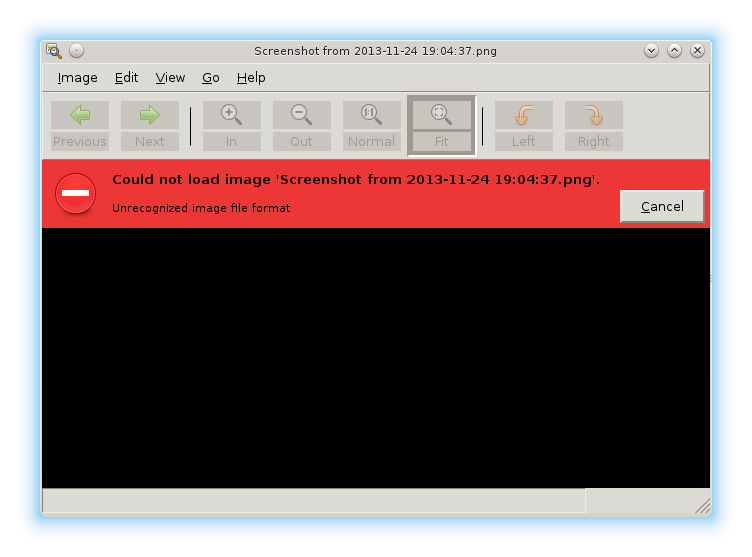
Also eog says "Could not load image" "Unrecognized image file format" - Well, why? It's just a .png file. (screenshot on KDE4)
Shotwell cause segfault, too :-( (and some other GTK applications)

I cannot point out broken component. Dear lazyweb, could you tell me how to fix this situation, please?


7 December 2013

Hideki Yamane: I was in Mini DebConf in Taiwan 2013

I've done GPG key sign for Mini DebConf in Taiwan 2013 participates, and written an article for Japanese magazine, Software Design 2014/Jan. This means, my short trip has been ended, at last.


In this event, I've talked about "local community" for Debian, a bit (PDF/ODF are in Debian Wiki).
Local Community for Debian (2013 Taiwan miniDebConf) from Hideki Yamane

Probably you know, most of Debian contributors are in Euro/America(North and South), not in Asia. But there are lots of talented people. It means: there is huge possibility for Debian :)


I hope we Asian Debian people unite and publish its community work more, and do "DebConf in Asia" - in the future.

1 December 2013

Marco d'Itri: Easily installing Debian on a Cubieboard

I recently bought a Cubieboard to replace my old Sheevaplug which has finally blown a power supply capacitor (this appears to be a common defect of Sheevaplugs), so I am publishing these instructions which show how to install Debian on sunxi systems (i.e. based on the Allwinner A10 SoC or one of its newer versions) with no need for cross compilers, emulators or ugly FAT partitions. This should work on any sunxi system as long as U-Boot is at least version 2012.10. The first step is to erase the beginning of SD card to remove anything in the unpartitioned space which may confuse U-Boot, partition and format it as desired. The first partition must begin at 1MB (1024*1024/512=2048 sectors) because the leading unpartitioned space is used by the boot loaders.
dd if=/dev/zero of=/dev/mmcblk0 bs=1M count=1
parted /dev/mmcblk0
  mklabel msdos
  mkpart primary ext4 2048s 15G
  unit s
  print
  mkpart primary linux-swap ... -1
mkfs.ext4 -L root /dev/mmcblk0p1
mkswap --label swap /dev/mmcblk0p2
Download the boot loaders and an initial kernel and install them:
tar xf cubieboard_hwpack.tar.xz
dd if=bootloader/sunxi-spl.bin of=/dev/mmcblk0 bs=1024 seek=8
dd if=bootloader/u-boot.bin of=/dev/mmcblk0 bs=1024 seek=32
mount /dev/mmcblk0p1 /mnt
mkdir /mnt/boot/
cp kernel/script.bin kernel/uImage /mnt/boot/
script.bin is Allwinner's proprietary equivalent of the device tree: it will be needed until sunxi support will be fully merged in mainline kernels. U-Boot needs to be configured to load the kernel from the ext4 file system (join the lines at \\, this is not a supported syntax!):
cat << END > /mnt/boot/uEnv.txt
# kernel=uImage
root=/dev/mmcblk0p1 rootwait
boot_mmc=ext4load mmc 0:1 0x43000000 boot/script.bin && ext4load mmc 0:1 0x48000000 boot/$ kernel  \\
  && watchdog 0 && bootm 0x48000000
END
Now the system is bootable: add your own root file system or build one with debootstrap. My old Sheevaplug tutorial shows how to do this without a working ARM system or emulator (beware: the other parts are quite obsolete and should not be trusted blindly). If you have an old armel install around it will work as well, and you can easily cross-grade it to armhf as long as it is up to date to at least wheezy (the newer, the better). You can also just use busybox for a quick test:
mkdir /mnt/bin/
dpkg-deb -x .../busybox-static_1.21.0-1_armhf.deb .
cp bin/busybox /mnt/bin/
ln -s busybox /mnt/bin/sh
After booting the busybox root file system you can run busybox --install /bin/ to install links for all the supported commands. Until Debian kernels will support sunxi (do not hold your breath: there are still many parts which are not yet in mainline) I recommend to install one of Roman's kernels:
dpkg -i linux-image-3.4.67-r0-s-rm2+_3.4.67-r0-s-rm2+-10.00.Custom_armhf.deb
mkimage -A arm -O linux -T kernel -C none -a 40008000 -e 40008000 \
  -n uImage -d /boot/vmlinuz-3.4.67-r0-s-rm2+ /boot/uImage-3.4.67-r0-s-rm2+
It is not needed with these kernels for most setups, but an initramfs can be created with:
update-initramfs -c -k 3.4.67-r0-s-rm2+
mkimage -A arm -T ramdisk -C none -n uInitrd \
  -d /boot/initrd.img-3.4.67-r0-s-rm2+ /boot/uInitrd-3.4.67-r0-s-rm2+
/boot/uEnv.txt will have to be updated to load the initramfs. Since the Cubieboard lacks a factory-burned MAC address you should either configure one in script.bin or (much easier) add it to /etc/network/interfaces:
iface eth0 inet dhcp
        hwaddress ether xx:xx:xx:xx:xx:xx
To learn more about the Allwinner SoCs boot process you can consult 1 and 2.

22 November 2013

Vincent Sanders: Error analysis is the sweet spot for improvement

Although Don Norman was discussing designers attitude to user errors I assert the same is true for programmers when we use static program analysis tools.

The errors, or rather defects in the jargon, that a static analysis tools produce can be considered low cost well formed bug reports available very early in the development process.

When I say low cost it is because they can be found by a machine without a user or fellow developer wasting their time finding them. Well formed comes because the machine can describe exactly how it came to the logical deduction leading to the defect.
IntroductionStatic analysis is in general terms using the computer to examine a program for logic errors beyond those of pure syntax before it is executed. Examining a running program for defects is known as dynamic program analysis and while a powerful tool in its own right is not the topic of discussion.

This analysis has historically been confined to compiled languages as their compilers already had the Abstract Syntax Tree (AST) of the code available for analysis. As an example the C language (released in 1972) had the lint tool (released in 1979) based on the PCC compiler.

Practical early compilers (I am generalising here as the 19070s were a time of white hot innovation in computing and examples of just about any innovation in the field could probably be found) were pretty primitive and produced executables which were less good than hand written assembler output. Due to practical constraints the progress of optimising compilers was not as rapid as might be desired so static analysis was largely used as an external process.

Before progressing I ought to explain why I just mixed the concept of an optimising compiler and static analysis. The act of optimisation within those compilers requires program analysis, from which they can generate defect reports which we all know and love as compiler warnings, also explaining why many warnings only appear at higher optimisation levels where deeper analysis is required.

The attentive reader may now enquire as to why we would need external analysis tools when our compilers already perform the task. The answer stems from the issue that a compiler is trying to reconcile many desirable traits including:
The slow progress in creating optimising compilers initially centred around the problem of getting the compiled output in a reasonable time to allow for a practical edit-compile-run-debug cycle although the issues more recently have moved more towards the compiler implementation costs.

Because the output generation time is still a significant factor compilers limit the level of static analysis performed to that strictly required to produce good output. In standard operation optimising compilers do not do the extended analysis necessary to find all the defects that might be detectable.

An example: compiling one 200,000 line C program with the clang (v3.3) compiler producing x86 instruction binaries at optimisation level 2 takes 70 seconds but using the clang based scan-build static analysis tool took 517 seconds or more than seven times as long.
Using static analysis
As already described warnings are a by-product of an optimising compilers analysis and most good programmers will endeavour to remove all warnings from a project. Thus almost all programmers are already using static analysis to some degree.

The external analysis tools available can produce many more defect reports than the compiler alone as long as the developer is prepared to wait for the output. Because of this delay static analysis is often done outside the usual developers cycle and often integrated into a projects Continuous Integration (CI) system.

The resulting defects are usually presented as annotated source code with a numbered list of logical steps which shows how the defect can present. For example the steps might highlight where a line of code allocates memory from the heap and then an exit path where no reference to the allocated memory is kept resulting in a resource leak.

Once the analysis has been performed and a list of defects generated the main problem with this technology rears its ugly head, that of so called "false positives". The analysis is fundamentally an undecidable problem (it is a variation of the halting problem) and relies on algorithms to generate approximate solutions. Because of this some of the identified defects are erroneous.

The level of erroneous defect reports varies depending on the codebase being analysed and how good the analysis tool being used is. It is not uncommon to see false positive rates, even with the best tools, in excess of 10%

Good tools allow for this and provide ways to supply additional context through model files or hints in the source code to suppress the incorrect defect reports. This is analogous to using asserts to explicitly constrain variable values or a type cast to suppress a type warning.

Even once the false positives have been dealt with there comes the problem of defects which while they may be theoretically possible take so many steps to achieve that their probability is remote at best. These defects are often better categorized as a missing constraint and the better analysis tools generate fewer than the more naive implementations.

An issue with some defect reports is that often defects will appear in a small number of modules within programs, generally where the developers already know the code is of poor quality, thus not adding useful knowledge about a project.

As with all code quality tools static analysis can be helpful but is not a panacea code may be completely defect free but still fail to function correctly.
Defect DensityA term that is often used as a metric for code quality is the defect density. This is nothing more than the ratio of defect to thousands of lines of code e.g. a defect density of 0.9 means that there is approximately one defect found in every 1100 lines of code.

The often quoted industry average defect density value is 1, as with all software metrics this can be a useful indicator but should not be used without understanding.

The value will be affected by improvements in the tool as well as how lines of code are counted so is exceptionally susceptible to gaming and long term trends must be treated with scepticism.
Practical examplesI have integrated two distinct static analysis tools into the development workflow for the NetSurf project which I shall present as case studies. These examples show a good open source solution and a commercial offering highlighting the issues with each.

Several other solutions, both open source and commercial, exist many of which have been examined and discarded as either impractical or proving less useful than those selected. However the investigation was not comprehensive and only considered what was practical for the project at the time.
clangThe clang project is a frontend to the LLVM project providing an optimising compiler for the C, C++ and objective C languages. As part of this project the compiler has been enhanced to run a collection of "checkers" which implement various methods of analysis on the code being compiled.

The "scan-build" tool is provided to make the using these features straightforward. This tool generates defect reports as a series of html files which show the analysis results.


NetSurf CI system scan-build overview
Because the scan-build takes in excess of eight minutes on powerful hardware the NetSurf developers are not going to run this tool themselves as a matter of course. To get the useful output without the downsides it was decided to integrate the scan into the CI system code quality checks.

NetSurf CI system scan-build result list
Whenever a git commit happens to the mainline branch and the standard check build completes successfully on all target architectures the scan is performed and the results are published as a list of defects.

The list is accessible directly through the CI interface and also incorporates a trend graph showing how many defects were detected in each build.

A scan-build report showing an extremely unlikely path to a defect
Each defect listed has a detail link which reveals the full analysis and logic necessary to cause the defect to occur.

Unfortunately even NetSurf which is a relatively small piece of software (around 200,000 lines of code at time of writing) causes 107 defects to be emitted by scan-build.

All but 25 of the defects are however "Dead Store" where the code has a value assigned but is never checked. These errors are simply not interesting to the developers and are occurring in code generated by a tool.

Of the remaining defects identified the majority are false positives and several (like the example in the image above) are simply improbable requiring a large number of steps to reach.

This shows up the main problem with the scan-build tool in that there is no way to suppress certain checks, mark defects as erroneous or avoid false positives using a model file. This reduces the usefulness of these builds because the developers all need to remember that this list of defects is not relevant.

Most of the NetSurf developers know that the project currently has 107 outstanding issues and if a code change or tool improvement were to change that value we have to manually work through the defect list one by one to check what had changed.
CoverityThe coverity SAVE tool is a commercial offering from a company founded in the Computer Systems Laboratory at Stanford University in Palo Alto, California. The results of the original novel research has produced a good solution which improved on analysis tools previously available.

Coverity Interface showing summary of NetSurf analysis. Layout issues are a NetSurf bug
The company hosts a gratis service for open source projects, they even provide scans for the Linux kernel so project size does not appear to be an issue.

The challenges faced integrating the coverity tool into the build process differed from clang however the issue of execution time remained and the CI service was used.

The coverity scanning tool is a binary executable which collects data on the build which is then submitted to the coverity service to be analysed. This tool obviously relies upon the developer running the executable to trust coverity to some degree.

A basic examination of the binary was performed and determined the executable was not establishing network connections or performing and observably undesirable behaviour. From this investigation the decision was made that running the tool inside a sandbox environment on a CI build slave was safe. The CI system also submits the collected results in a compressed form directly to the coverity scan service.

Care must be taken to only submit builds according to the services Acceptable Use Policy which limits the submission frequency of NetSurf scans to every other day. To ensure the project stays within the rules the build performed by the CI system is manually controlled and confined to a subset of NetSurf developers.
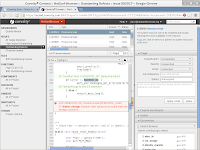
Coverity connect defect management console for NetSurfThe results are presented using the coverity connect web technology based defect management tool. Access to the coverity connect interface is controlled by a user management system which precludes publicly publishing the results within the CI system.

Unfortunately NetSurf itself does not currently have good enough JavaScript DOM bindings to support this interface so another browser must be used to view it.

Despite the drawbacks the quality of the analysis results is greatly superior to the clang solution. The false positive rate is very low while finding many real issues which had not been previously detected.

The analysis can be enhanced by use of collection configuration and modelling files which remove intended constructions from consideration reducing the false positive rate to very low levels. The ability to easily and persistently suppress false positives through the web interface is also available.

The false positive management capabilities coupled with a user interface that makes understanding the defect path simple make this solution very practical and indeed the NetSurf developers have removed over 50 actual issues within a relatively short period since the introduction of the tool.

Not all of those defects could be considered serious but they had the effect of encouraging deeper inspection of some very dubious smelling source.
ConclusionsThe principle conclusions of implementing and using static analysis have been:

When I started looking at this technology I was somewhat dubious about its usefulness but I have definitely changed my mind. It is a useful addition to any non-trivial project and the return on time and effort should be repaid handsomely in all but already perfect code (if you believe you have such code I have a bridge to sell you).

15 November 2013

Jo Shields: The directhex! In an Adventure with MIPS

We ve been trying to build Mono on MIPS in Debian for a long time. Just under a decade, in fact. Mono 0.29.99.20040114-3 was the first attempt, back when the Mono source was 10 meg, not today s ~80. It never worked though. Not once. At the end of 2004, 10 upstream versions later, we gave up, and turned off mipsel as a target architecture in the package. When I became a Debian Developer in 2009, one of the first things I did was try again with Mono on various previously unsupported architectures, by running a build on the Debian porterboxes. Supposedly MIPS support was there, as evidenced by all the MIPS-related files in the source tree. But I d try it, and it d fail, and upstream would say works for me . I repeat the process every major release or so, to see what s changed. The breakthrough Spurred by the removal of two bitrotted architectures (IA64 and SPARC), I decided to try again, this time investigating more deeply into the reason for the failures, with the help of upstream developer Alex R nne Petersen. A couple of hours of IRC-driven gdb and test program disassembly later, a seemingly innocent comment flagged something in my brain: 09-07-2013 15:10:11 < alexrp!~zor@baldr.rfw.name: TIL that mul and mult are not the same thing on mips Why is this notable? Well, MIPS processors lack a whole bunch of instructions which are commonly used in assembler. MUL is one of them it s valid MIPS assembler, which is expanded to MULT/MFLO when compiling. Call it a macro, or a mnemonic, or shorthand the preferred term is pseudoinstructions . So what s the issue? 09-07-2013 15:18:27 > directhex: mono isn't trying to use a mul instruction, right? i mean, that instruction doesn't exist as far as the cpu is concerned, it's a macro the compiler does things with See where this is headed? 09-07-2013 15:23:59 > directhex: mini/mini-mips.c:#define USE_MUL 1 /* use mul instead of mult/mflo for multiply */ Argh. See, the thing about MIPS pseudoinstructions is they may be real instructions on a given CPU implementation. Strictly speaking MUL isn t a standard instruction, but a given CPU might have it anyway, to make multiplication a little faster (by using only one instruction, not two, for multiplication). In this case, the Debian MIPS infrastructure is based around ICT Loongson-2E processors which don t have that extension but the upstream Mono developers were building and testing on an extended CPU, never seeing the issue themselves. Flipping that define to 0 (and amending the instruction length setting in another file) fixed the build. Mono was running on MIPS for me for the first time ever. Digging through the history in git showed just how annoying this implementation quirk was. USE_MUL was added in late 2008 replacing a previously used #if 1 . The mult/mflo version of the code existed in the Mono source since the first time the full MIPS port was committed in 2006, but we never saw it. The breakage So, with that patched to work, I added mipsel to the Experimental build of Mono which still failed. The runtime would build fine, but the class library build would fail at random times, with random meaningless stack traces. Unrepeatable. Some kind of race condition. The build would eventually succeed if I hammered make a few times, but that s no good for the Debian build daemons. Back to square one except I had an epiphany yesterday. I have heard more than once that Loongson processors are missing a few instructions. What if one of those was being hit, intermittently? I started doing a search in places that might need to work around that kind of issue, and found this. A patch to binutils in 2009, replacing one no-op instruction with another, when /usr/bin/as is fed the -mfix-loongson2f-nop flag. Turns out NOP is another pseudoinstruction on MIPS. Well, more of an alias. The opcode 0 000000 is Shift Left Logical with 0 registers and 0 data, which is a no-op. But on all but the latest generation of Loongson-2F chips, that opcode can, under heavy load, fail causing inconsistent state in the CPU registers. The flag to as replaces sll 0,0,0 with or $at,$at,0 , which is also a no-op instruction, but doesn t trigger the failure on Loongson-2F chips (and 2E chips, although that s not stated in the documentation). As long as ALL your programs get fed through as , you don t have a problem, since it uses the replacement opcode but what if you use a JITter to generate your own opcodes? Oh fuck, it couldn t be diff --git a/mono/arch/mips/mips-codegen.h b/mono/arch/mips/mips-codegen.h
index dc4df7d..1dbd1c6 100644
--- a/mono/arch/mips/mips-codegen.h
+++ b/mono/arch/mips/mips-codegen.h
@@ -334,7 +334,7 @@ enum
/* misc and coprocessor ops */
#define mips_move(c,dest,src) mips_addu(c,dest,src,mips_zero)
#define mips_dmove(c,dest,src) mips_daddu(c,dest,src,mips_zero)
-#define mips_nop(c) mips_sll(c,0,0,0)
+#define mips_nop(c) mips_or(c,mips_at,mips_at,0)
#define mips_break(c,code) mips_emit32(c, ((code)<<6) 13)
#define mips_mfhi(c,dest) mips_format_r(c,0,0,0,dest,0,16)
#define mips_mflo(c,dest) mips_format_r(c,0,0,0,dest,0,18)
Oh yes it could! Mono was using sll 0,0,0 (the recommended no-op instruction from the MIPS instruction reference manual), causing failures in my tests, because Debian s build and test infrastructure just happens to use defective silicon. And, again, upstream were unable to reproduce a problem because they use better silicon than we do. So what now? Well, last night I uploaded mono_3.2.3+dfsg-3, which includes the above patch to force the replacement no-op instruction. It test built fine on the porterbox, and it should (when the damn experimental buildd gets around to it), just work. Finally. After just under a decade, Mono packages will be available on MIPS in Debian. And after all this time, all we had to change was 4 lines to work around 7 year old Chinese knock-off processors. The edit So, things are finally built. It turns out that despite everything, the replacement NOP opcode is not enough. If you re-read the post to the binutils list, pay close attention to: In theory this is still not enough to fully eliminate possible hangs, but the possiblity is extremely low now and hard to be hit in real code. It s a filthy lie. It s easy to hit the issue in real code: just do a from-source build of the whole Mono class library. With the replacement instruction it builds .NET 2.0, 3.0, 3.5, 4.0, and most of 4.5, before dying in the same way as before an improvement on failing early in the 2.0 build, but not enough. Thankfully, 2 out of the 5 Debian mipsel build servers are not Loongson 2 they re 11 year old Broadcom SWARM developer boards. Not fast but also not broken. Luck smiled on me, and caused my build to go to one of these Broadcom machines. As a result (experimental_mipsel-dchroot)directhex@eder:~$ mono --version head -1
Mono JIT compiler version 3.2.3 (Debian 3.2.3+dfsg-3)
It s been a long time coming.

2 November 2013

Marco d'Itri: New PGP key

Since my current PGP key is a 1024 bits DSA key generated in 1998, I decided that it is time to replace it with a stronger one: there are legitimate concerns that breaking 1024 bits DSA is well within the reach of major governments. I have been holding out for the last year waiting for GnuPG 2.1, which will support elliptic curves cryptography, but I recently concluded that adopting ECC now would not be a good idea: Red Hat still does not fully support it due to unspecified patent concerns and there is no consensus in the cryptanalists community about the continued strength of (some?) ECC algorithms. So I created three fancy keys: a 4096 bits main key for offline storage, which hopefully will be strong enough for a long time, and two 3072 bits subkeys for everyday use. I have published a formal key transition statement and I will appreciate if people who have signed my old key will also sign the new one. What follows are the instructions that I used to generate these PGP keys. They follow the current best practices and only reference modern software. While the GnuPG defaults are usually appropriate, I think that it is a good idea to use a stronger hash for the key signatures of very long-lived keys. I could not find a simple way to "upgrade" the algorithm of key self signatures.
echo 'cert-digest-algo SHA256' >> ~/.gnupg/gpg.conf
First, generate a RSA/4096 sign only key, which will be your master key and may be stored offline. Then add to it two RSA/3072 subkeys (one sign only and one encrypt only):
# generate a RSA/4096 sign only key
gpg2 --gen-key
# add two RSA/3072 subkeys (sign only and encrypt only)
gpg2 --edit-key 8DC968B0
Since GnuPG lacks a command to remove the master secret key while keeping its secret subkeys, you need to delete the complete secret keys and then re-import only the subkeys:
gpg2 --export-secret-keys 8DC968B0 > backup.secret
gpg2 --export-secret-subkeys 8DC968B0 > backup.subkeys
gpg2 --delete-secret-key 8DC968B0
gpg2 --import backup.subkeys
Then you can import again the complete keys in a different secret keyring, which can be stored offline:
mkdir ~/.gnupg/master/
gpg2 --no-default-keyring \
  --keyring ~/.gnupg/pubring.gpg \
  --secret-keyring ~/.gnupg/master/secring.gpg \
  --import backup.secret
Now you can move ~/.gnupg/master/ to a USB stick. You are supposed to protect the master secret key with a strong passphrase, so there is no point in using block level encryption on the removable media. Since you are only using the master key to sign other keys, it only needs to be configured as the second keyring in ~/.caffrc:
$CONFIG 'secret-keyring'  = $ENV HOME  . '/.gnupg/master/secring.gpg';
It is also a good idea to have an hard copy backup of your keys, since the lifetime of USB sticks should not be trusted too much:
paperkey -v --output printable.txt --secret-key backup.secret
a2ps -2 --no-header -o printable.ps printable.txt
Some references that I used:

29 September 2013

Lars Wirzenius: My GTD booklet no longer on Amazon

I wrote a very short book on Getting Things Done for hackers, which I also put up for sale on Amazon as a Kindle book, in addition to allowing people to get it for free from my website. As expected, it didn't sell much, perhaps a few dozen copies in total, but I got a small kick out of having a book for sale. However, Amazon now wants me to set up some kind of US tax account, which is all fine and good and legal and appropriate, but it's not worth my time to do that. I've removed the book from Amazon, to keep my life simple. It continues to be available on its own website, including in a Kindle format. For free. Under a CC-BY-SA 3.0 license. Since I see the download statistics for it, I know how many people download it. The PDF form is most popular, as it happens. All good.

20 September 2013

Vincent Sanders: Man is fully responsible for his nature and his choices.

Well at least he should be according to Sartre though I am not entirely convinced the repercussions of my choice to manufacture another folding chair were entirely thought through.

After my most recent posting the urge to do "just one more iteration" became too great and I succumbed. I therefore present version 4 of my folding chair which corrects all the previously discovered issues.

The popliteal height (420mm) and buttock popliteal length (400mm) are both comfortable for a wide selection of people. The seat slopes a few degrees front to back and the back rest no longer comes further forward than the rear of the seat.

There is a small gap above where the seat folds in when flat but that is only an aesthetic issue when being stored.

Manufacture wise the design is simple to produce although I really will have to teach our CNC router how to use the round over bit to reduce the finishing steps as currently that takes longer than the CNC operation.

In future if I make more of these I will use this design and, once she is less annoyed at me for making another chair, I am going to consult with my wife on adding some cushioning material to the seat and backrest.

And of course that concludes my furniture making for a while...yeah, right!

there have been comments which have complained about my usage of space on sheets and suggested I waste too much material. That is probably true and in my own defence I have not been working with this machine for very long and am not quite used to what I can "get away with" yet.

Side X folding stool
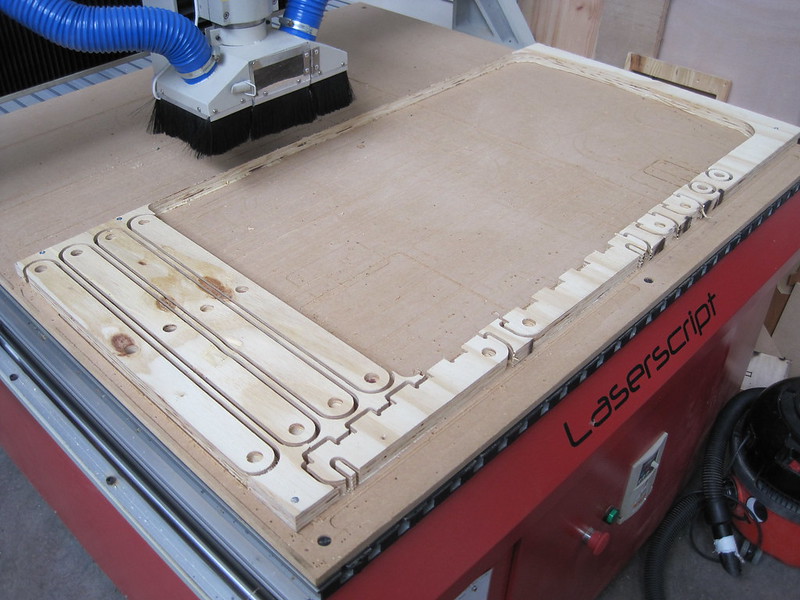
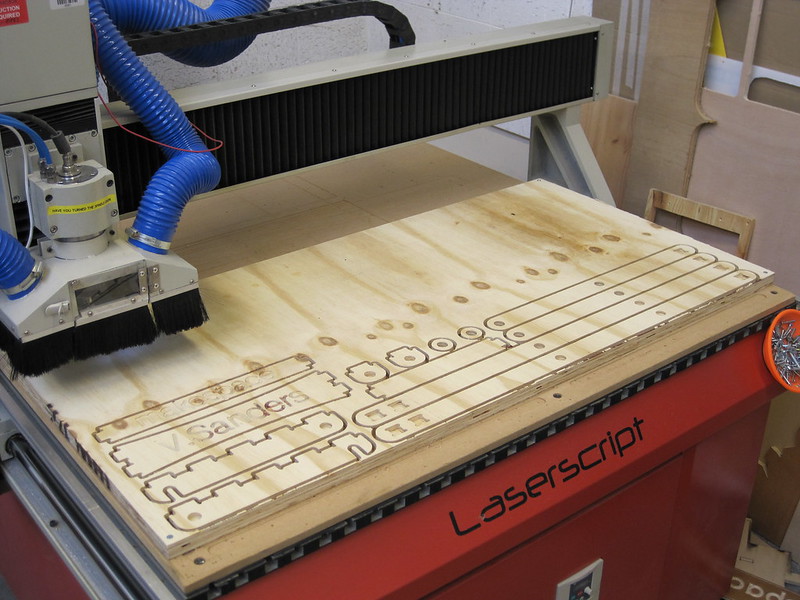
I was looking at the sheet after removing the last chair design and had a thought, I had not attempted a side X type folding design and perhaps I could squeeze one into the offcuts? I kinda got carried away, it roughly went:


Side X folding stool cut from sheet offcut
If all of that sounds like and utterly mad way to design a size X stool, you are of course correct, but it worked, and it was a very fast process taking less than four hours from idea to stool.

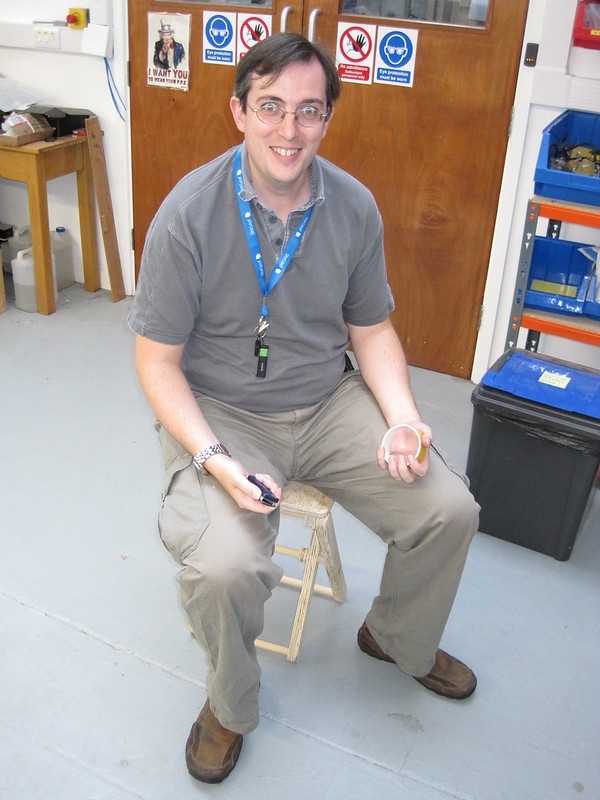
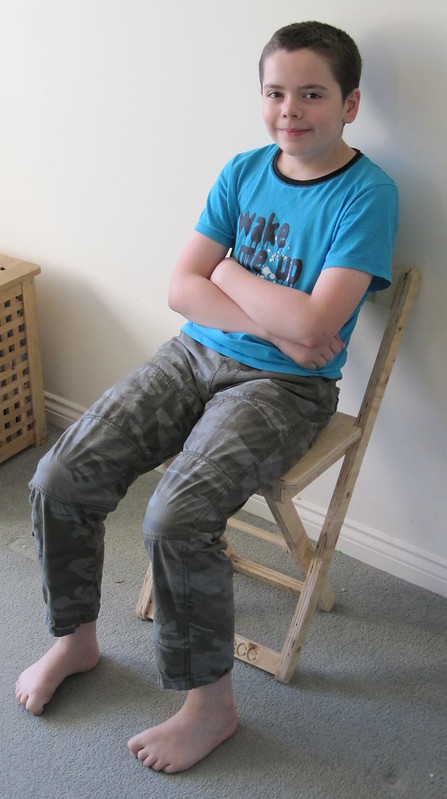
Paul testing the dry fit side X stool
There are a couple of issues:

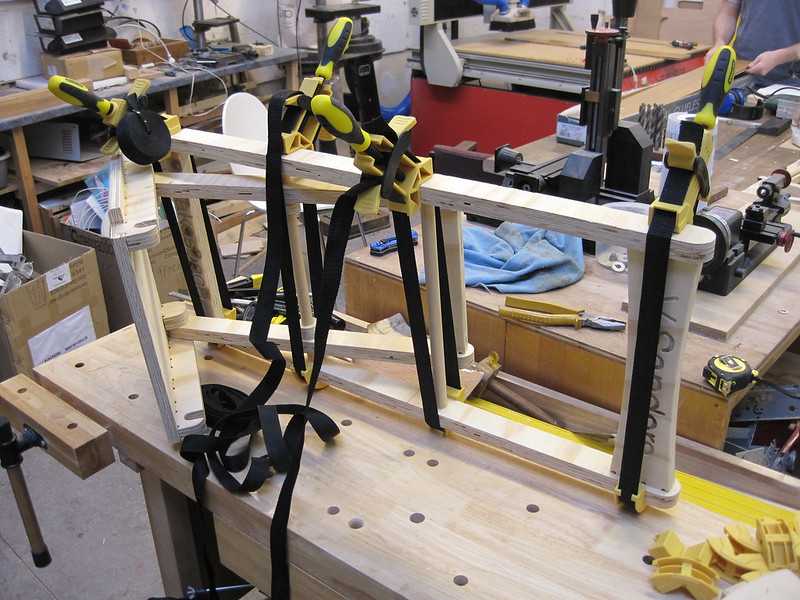
Clamping stool why the glue drys
The seat went together dry fit and Paul tested it for me, however that last issue soon made me realise that this time I was going to have to resort to glue. Yes, sorry, this design needs to be glued to remain stable (I know plywood contains glue...please stop telling me that).


It is pretty simple to put together and aside from needing half the clamps in makespace to hold it in place while the glue dried, I had no trouble.

Though this is definitely not a case of use glue "sparingly" I put generous amounts in all the dowel joints and all the seat slots and got very little ooze so I guess it could have used more.

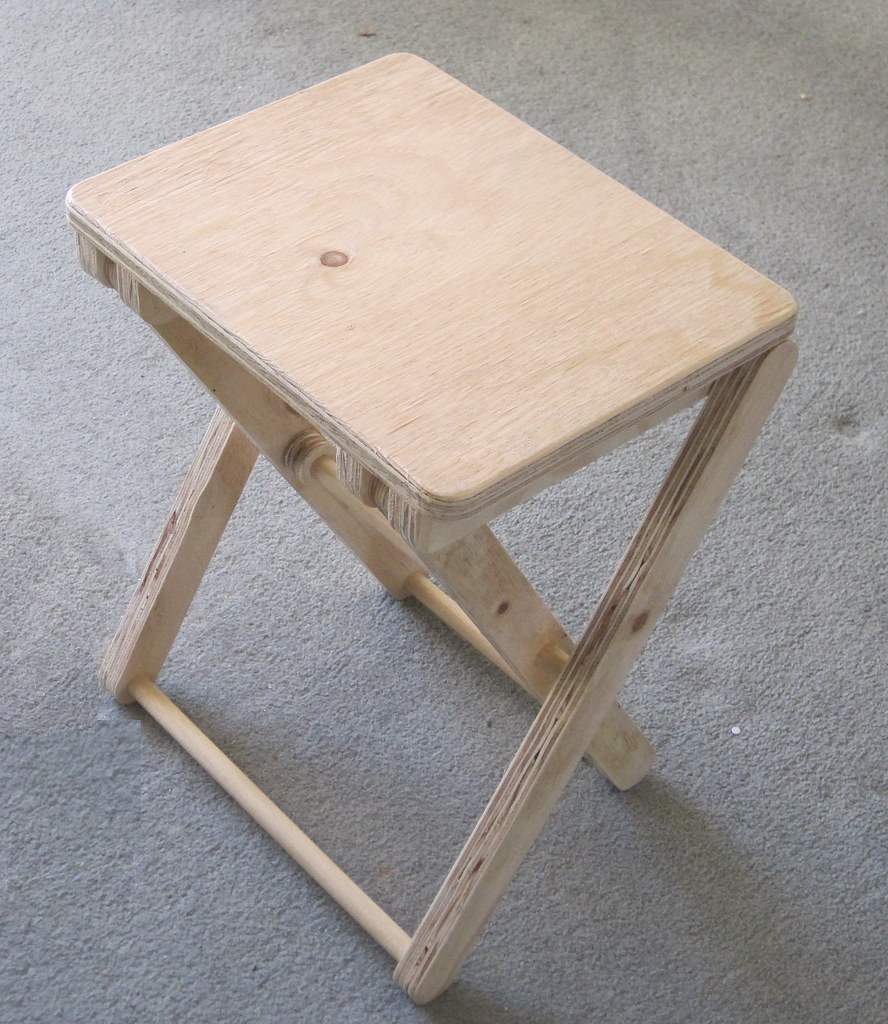
The final varnished stool is pretty robust but folds up nicely the concept of hooking to its own pivot dowel means it stays closed when flat which makes it very portable.

Total cost was an estimated 10.00 ( 4.25 dowel, 2.50 of 24mm ply, 1.75 for 18mm ply, 0.50 tool wear, 1.00 varnish) though the materials in my case could be argued to have cost nothing.

It has been suggested that I could make an entire picnic table and chairs set this way but if I did I would reduce the stool height by 50mm and examine ways to use less dowel.

This is usually the bit where I point you all at the freely usable design files on github and all the photos on flikr and wrap up.

But you know what the Monty Python boys say? "Nobody Expects the Spanish inquisition"

Or in this case my final (and yes I am going to do something else next) chair design. It is based on the stool, in fact it is the stool design with the outer legs extended and a back rest added.

The modified design reduces the dowel requirements to 775mm but requires a bit more sheet material (cannot get this one entirely from offcuts).

Total cost was an estimated 10.50 ( 2.50 dowel, 4.50 of 24mm ply, 1.75 for 18mm ply, 0.50 tool wear, 1.25 varnish).
Because it is based on the stool design it suffers from the height issue and in addition the back rest is a bit far back to be completely comfortable.

Neither of the side X designs have flaws that interest me enough to follow the iterative approach again to solve them. Both the designs work well enough and rounded out my adventures with folding chairs and indeed furniture for now.

As always the design files are on github and the images are on flikr.


Next.

Previous.