Russ Allbery: Review: The Box
| Publisher: | Princeton University Press |
| Copyright: | 2006, 2008 |
| Printing: | 2008 |
| ISBN: | 0-691-13640-8 |
| Format: | Trade paperback |
| Pages: | 278 |
| Publisher: | Princeton University Press |
| Copyright: | 2006, 2008 |
| Printing: | 2008 |
| ISBN: | 0-691-13640-8 |
| Format: | Trade paperback |
| Pages: | 278 |
Intro: Hi, I m Melissa from Igalia and welcome to the Rainbow Treasure Map, a
talk about advanced color management on Linux with AMD/SteamDeck.
Useful links: First of all, if you are not used to the topic, you may find
these links useful.
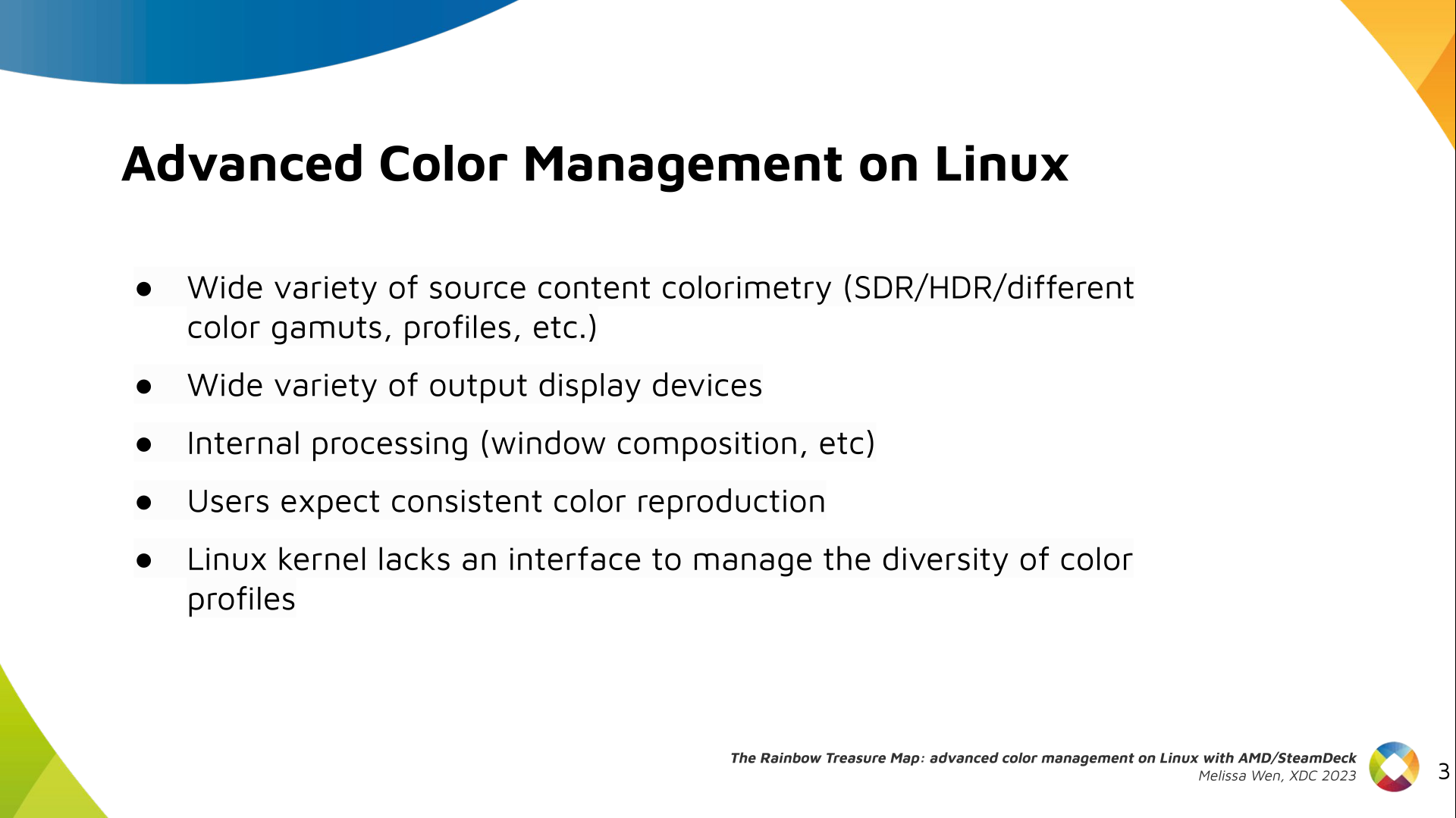
Context: When we talk about colors in the graphics chain, we should keep in
mind that we have a wide variety of source content colorimetry, a variety of
output display devices and also the internal processing. Users expect
consistent color reproduction across all these devices.
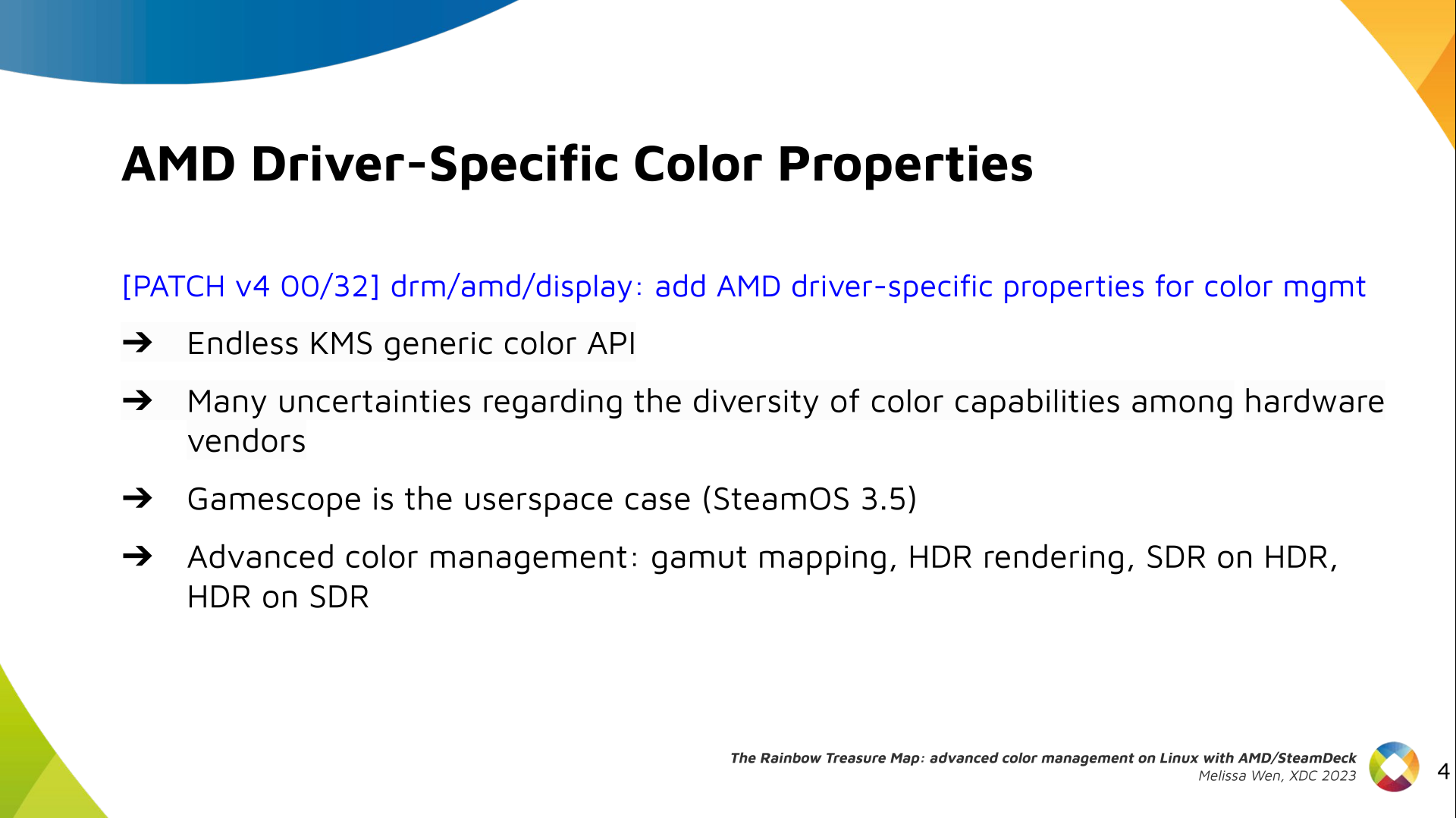
The userspace can use GPU-accelerated color management to get it. But this also
requires an interface with display kernel drivers that is currently missing
from the DRM/KMS framework.
Since April, I ve been bothering the DRM community by sending patchsets from
the work of me and Joshua to add driver-specific color properties to the AMD
display driver. In parallel, discussions on defining a generic color management
interface are still ongoing in the community. Moreover, we are still not clear
about the diversity of color capabilities among hardware vendors.
To bridge this gap, we defined a color pipeline for Gamescope that fits the
latest versions of AMD hardware. It delivers advanced color management features
for gamut mapping, HDR rendering, SDR on HDR, and HDR on SDR.
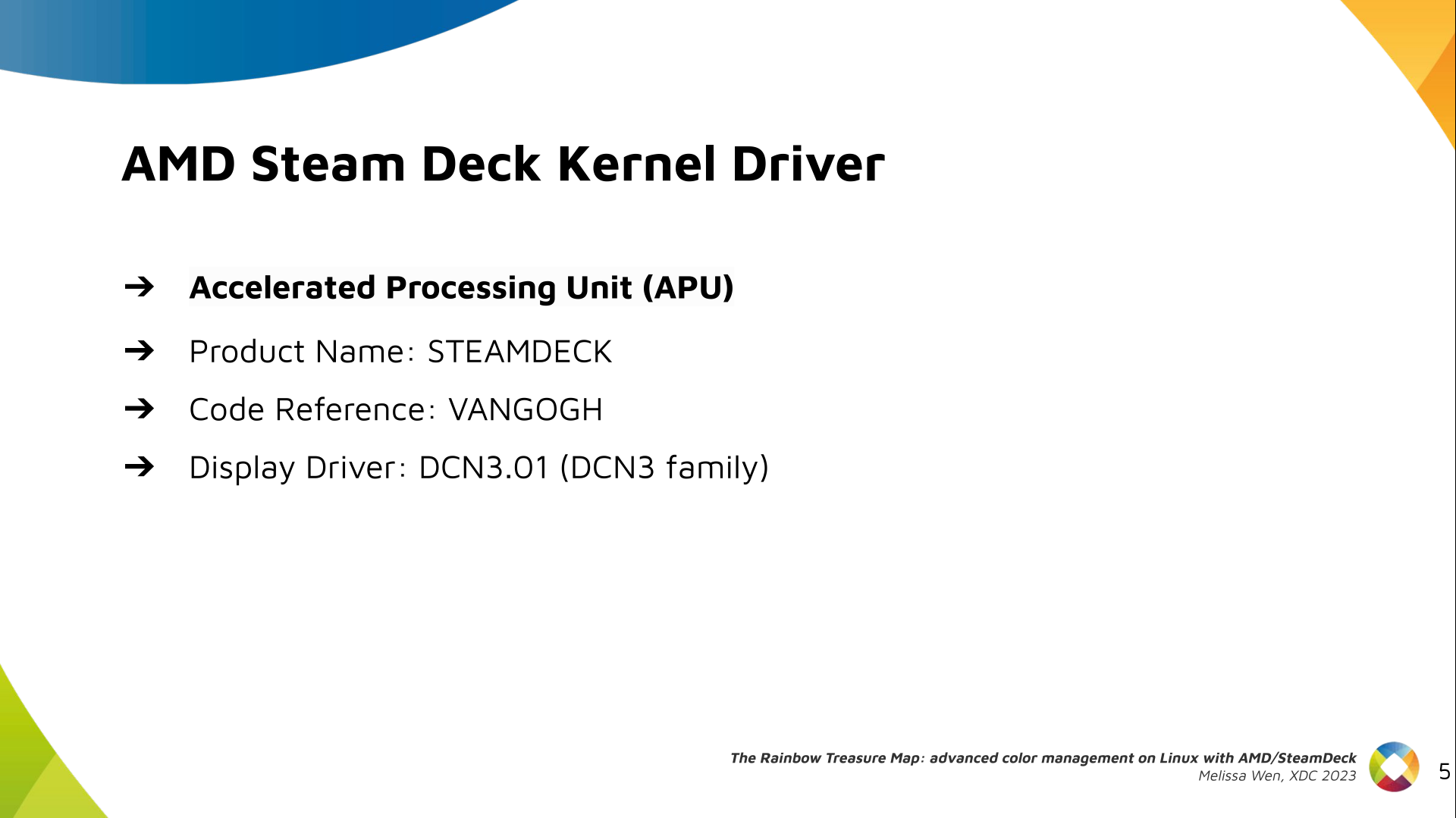
AMD/Steam Deck hardware: AMD frequently releases new GPU and APU generations.
Each generation comes with a DCN version with display hardware improvements.
Therefore, keep in mind that this work uses the AMD Steam Deck hardware and its
kernel driver. The Steam Deck is an APU with a DCN3.01 display driver, a DCN3
family.
It s important to have this information since newer AMD DCN drivers inherit
implementations from previous families but aldo each generation of AMD hardware
may introduce new color capabilities. Therefore I recommend you to familiarize
yourself with the hardware you are working on.
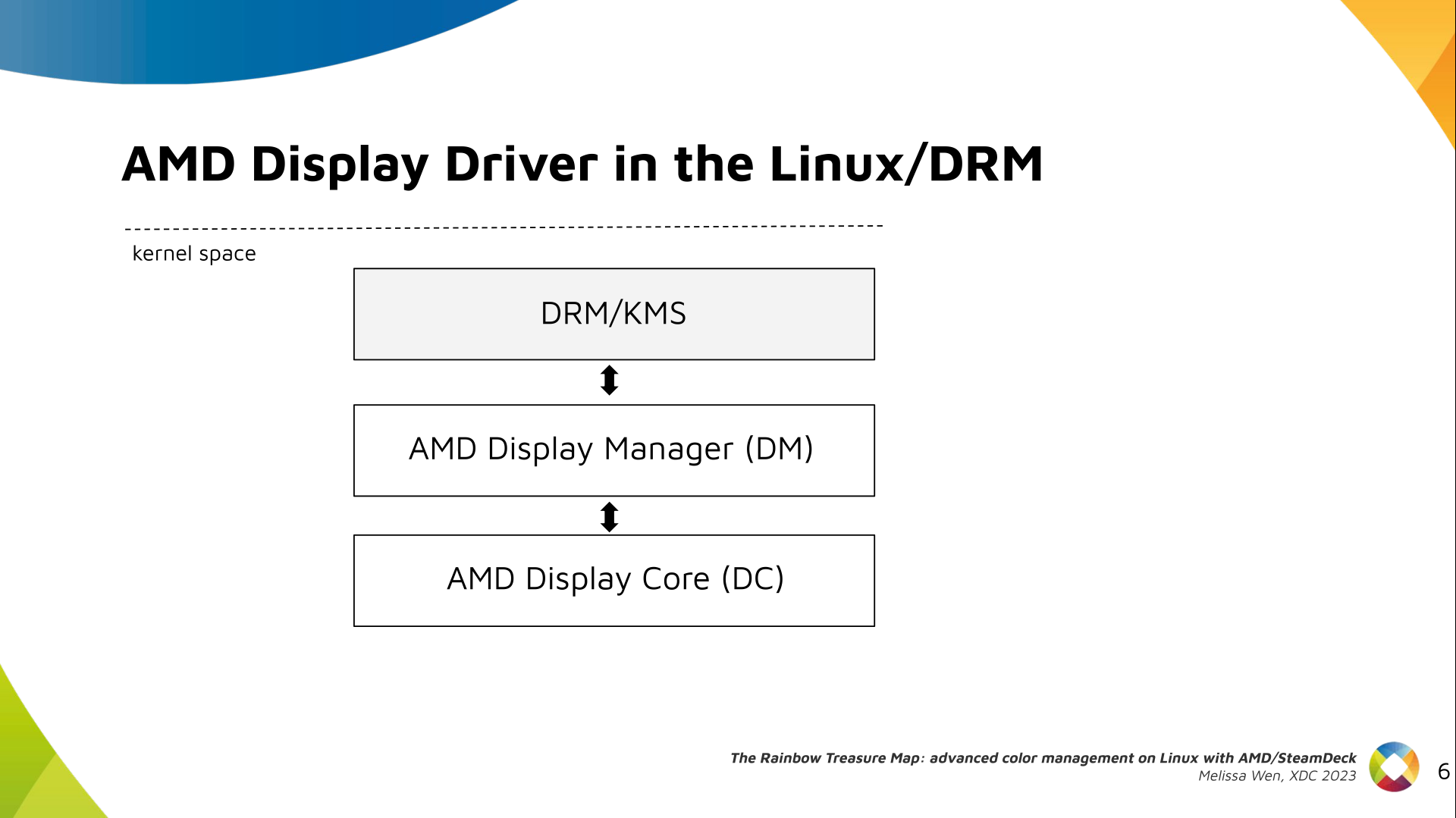
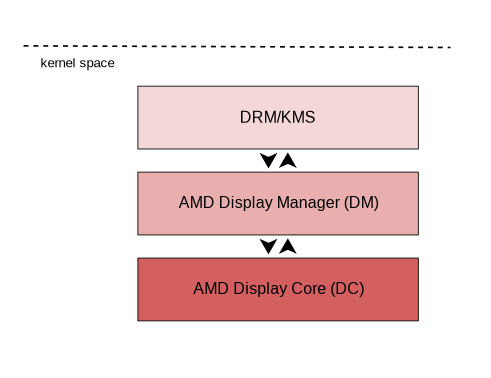
The AMD display driver in the kernel space: It consists of three layers, (1)
the DRM/KMS framework, (2) the AMD Display Manager, and (3) the AMD Display
Core. We extended the color interface exposed to userspace by leveraging
existing DRM resources and connecting them using driver-specific functions for
color property management.
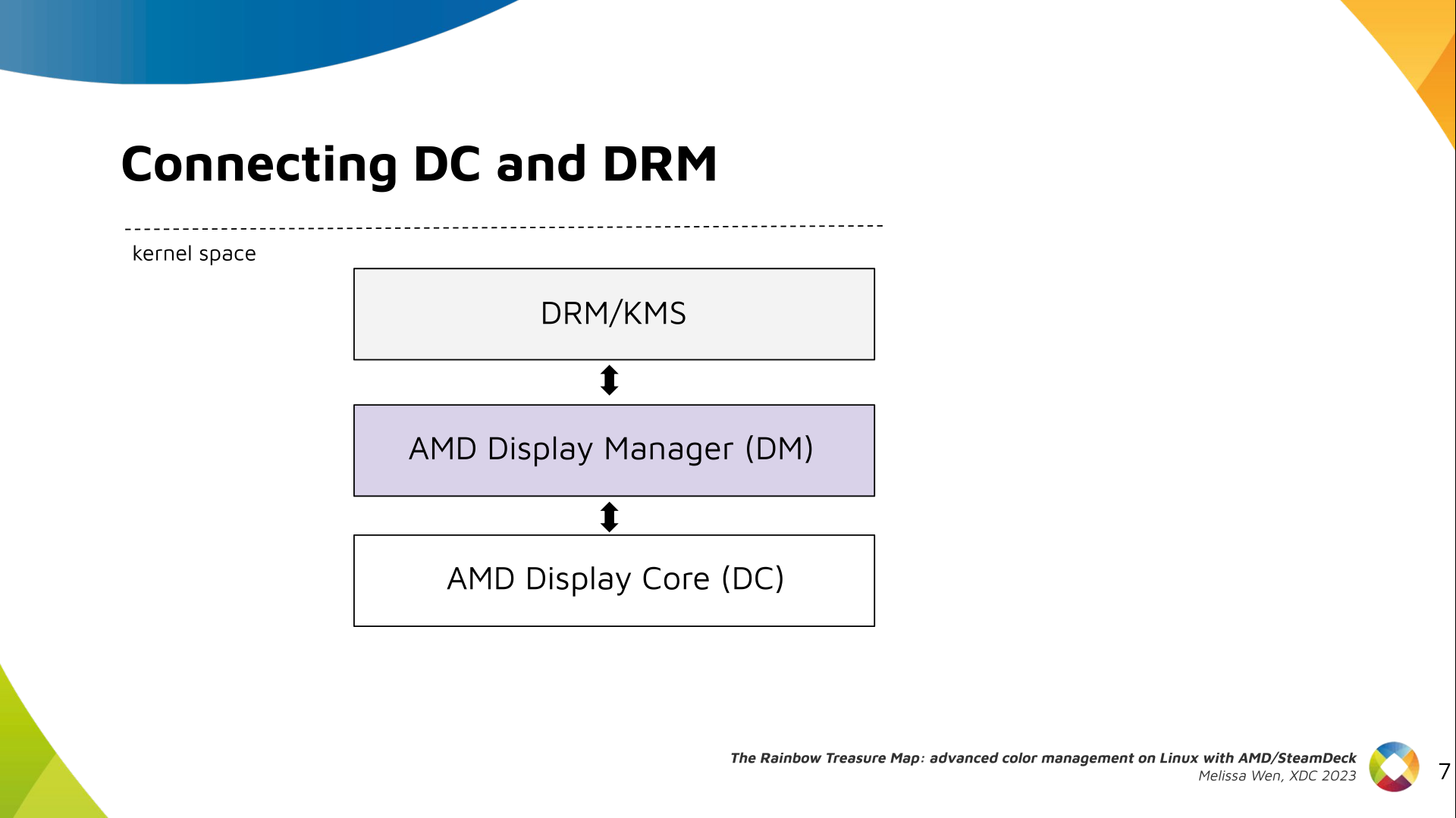
Bridging DC color capabilities and the DRM API required significant changes in
the color management of AMD Display Manager - the Linux-dependent part that
connects the AMD DC interface to the DRM/KMS framework.
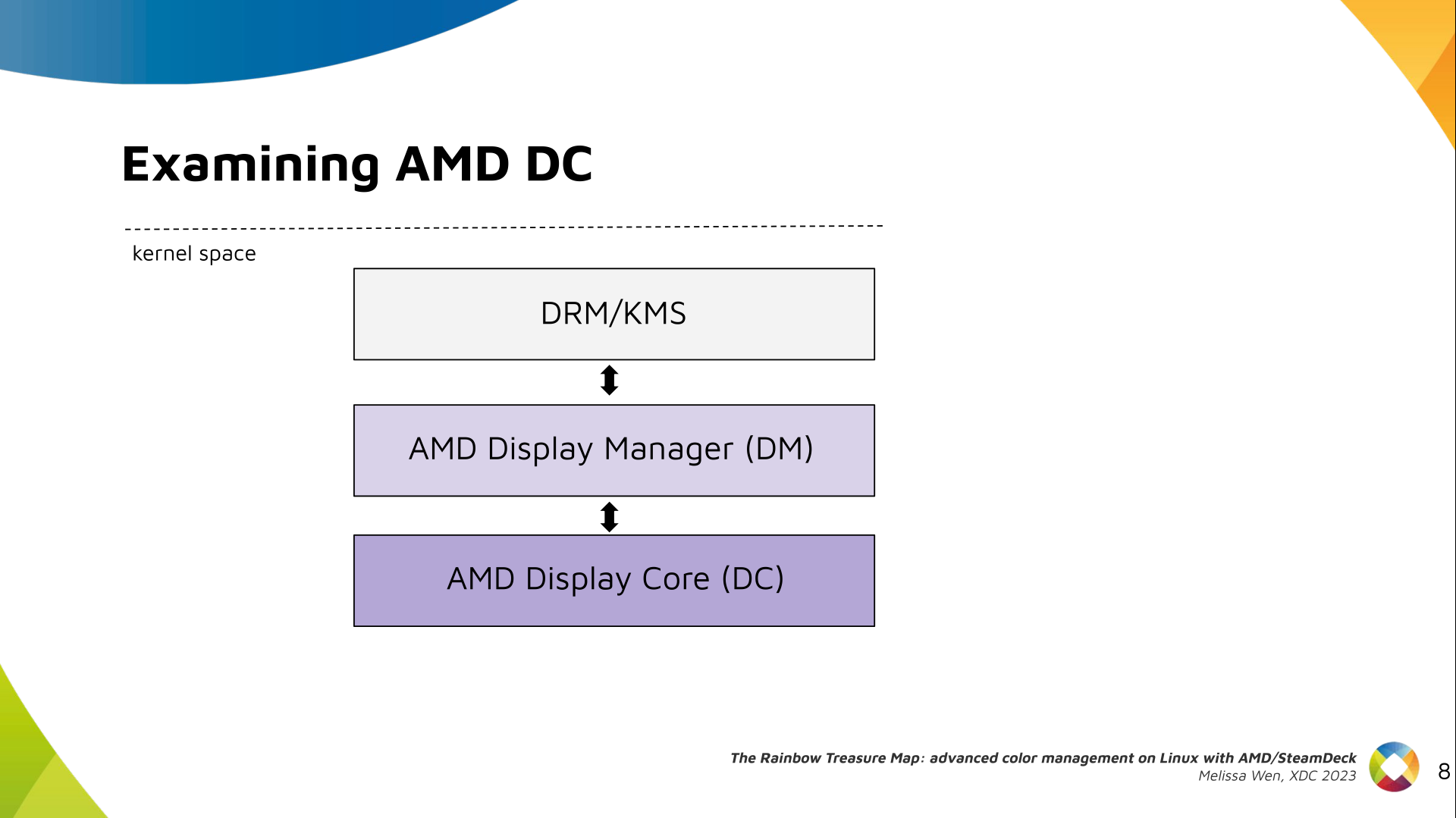
The AMD DC is the OS-agnostic layer. Its code is shared between platforms and
DCN versions. Examining this part helps us understand the AMD color pipeline
and hardware capabilities, since the machinery for hardware settings and
resource management are already there.
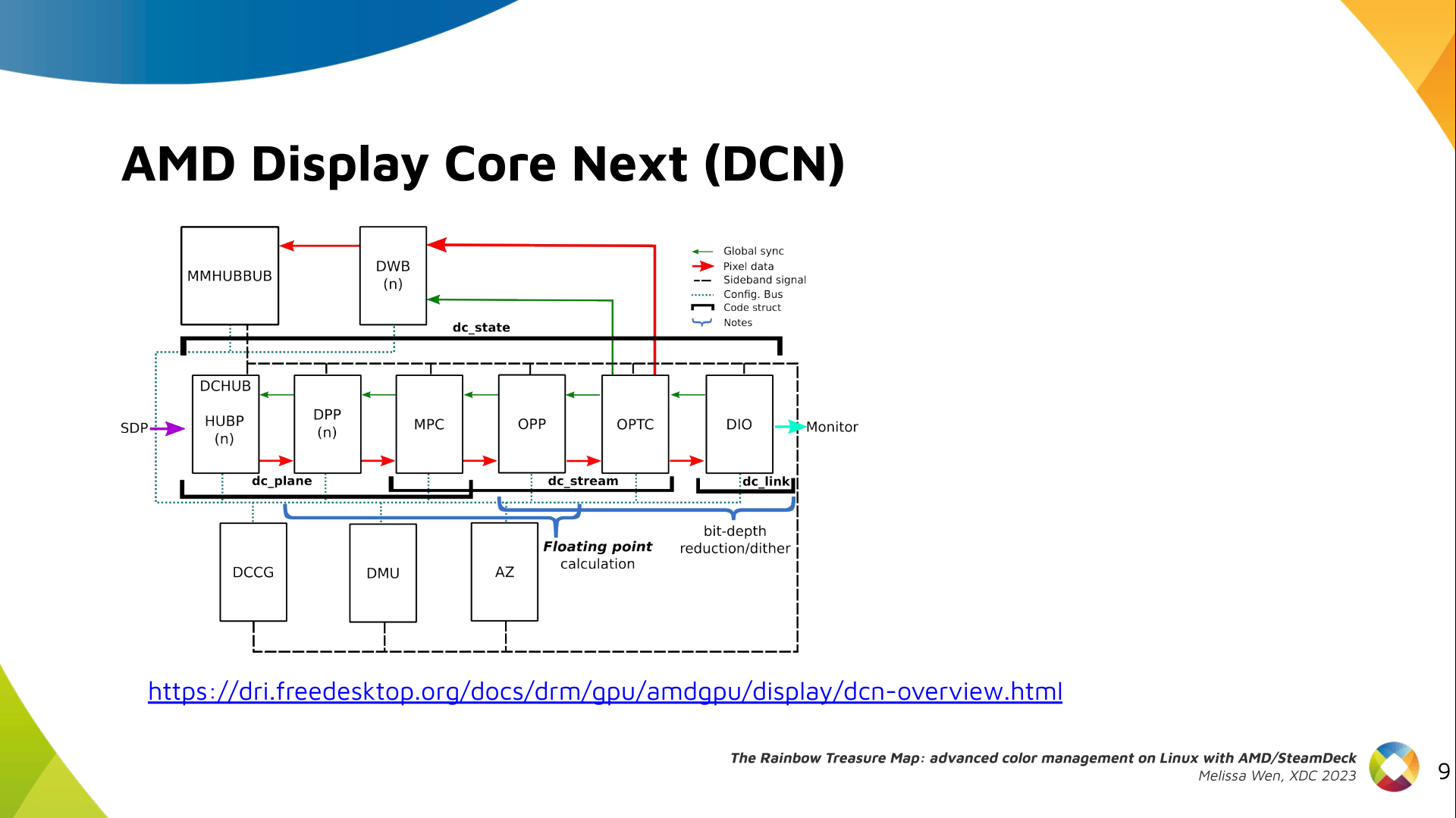
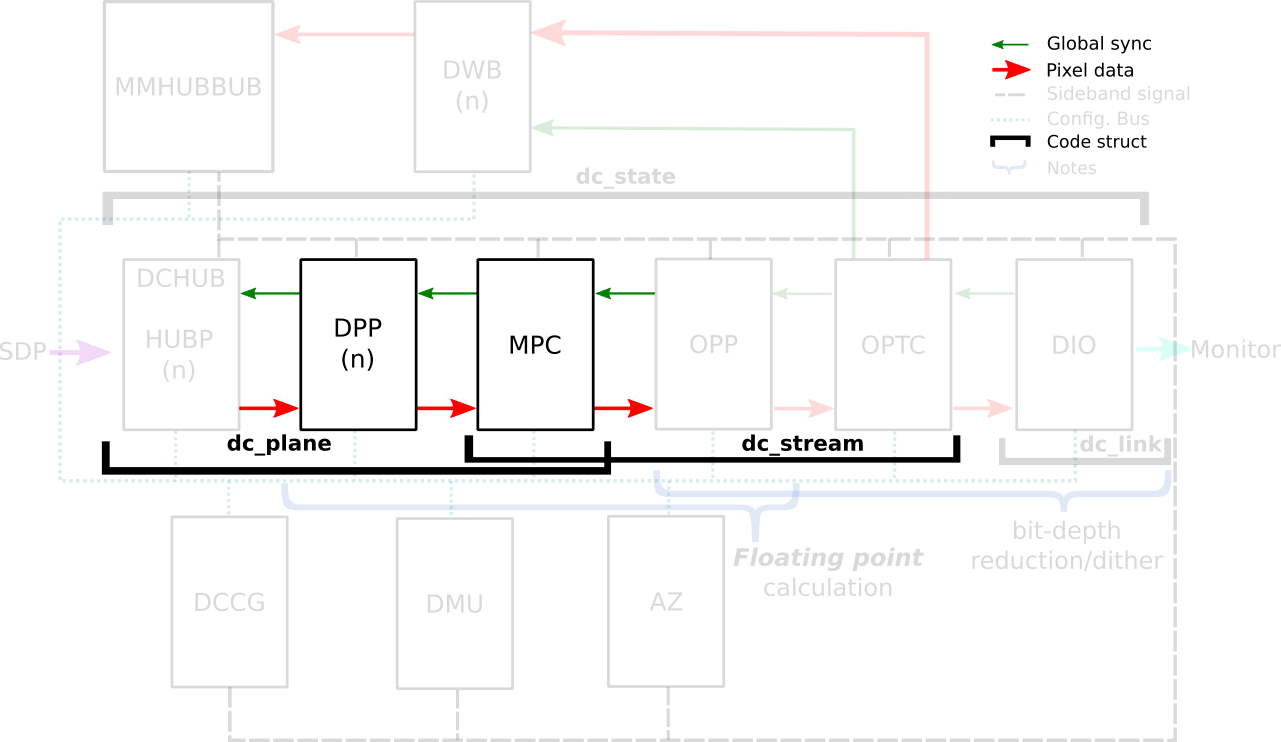
The newest architecture for AMD display hardware is the AMD Display Core Next.
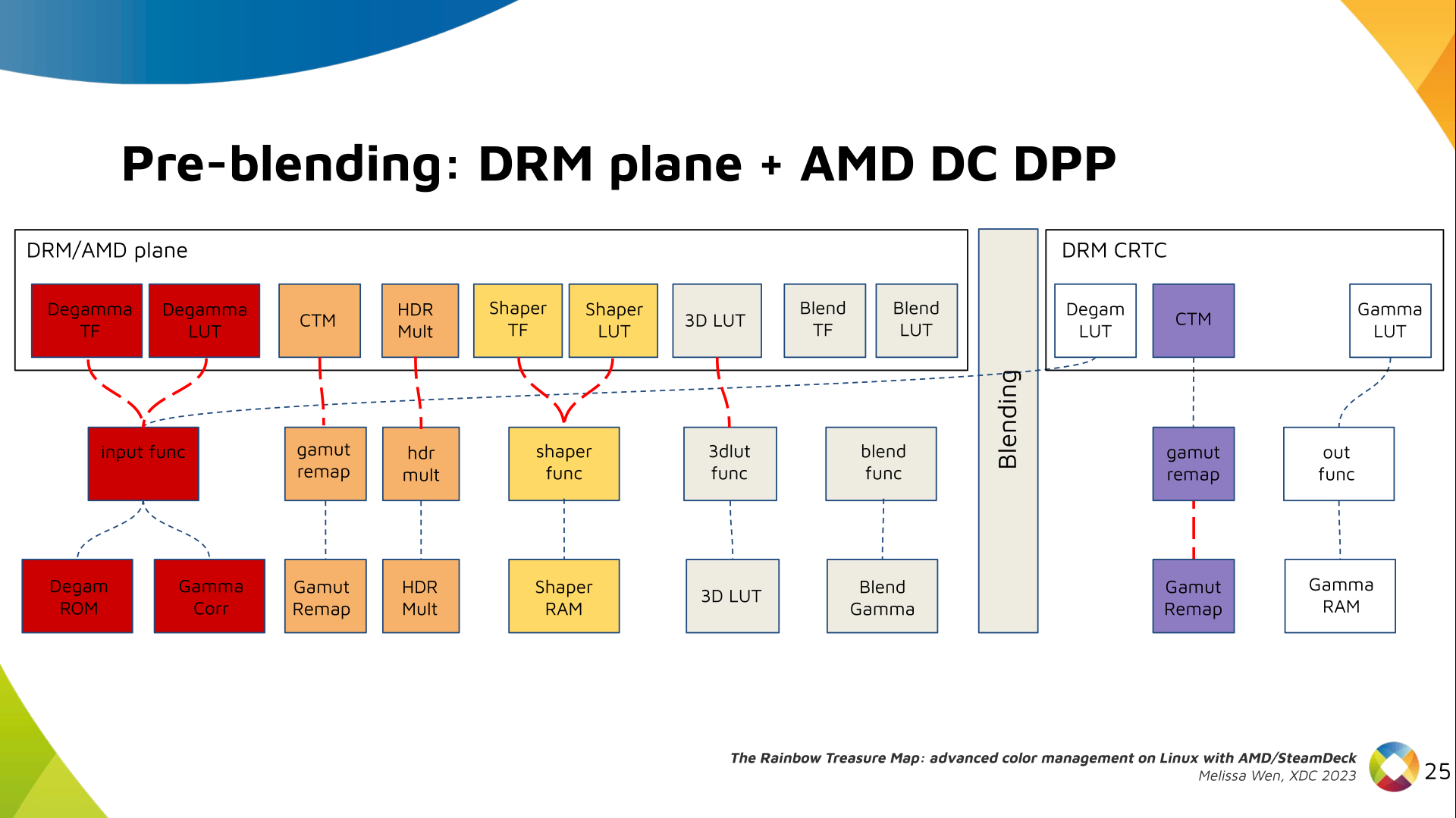
In this architecture, two blocks have the capability to manage colors:
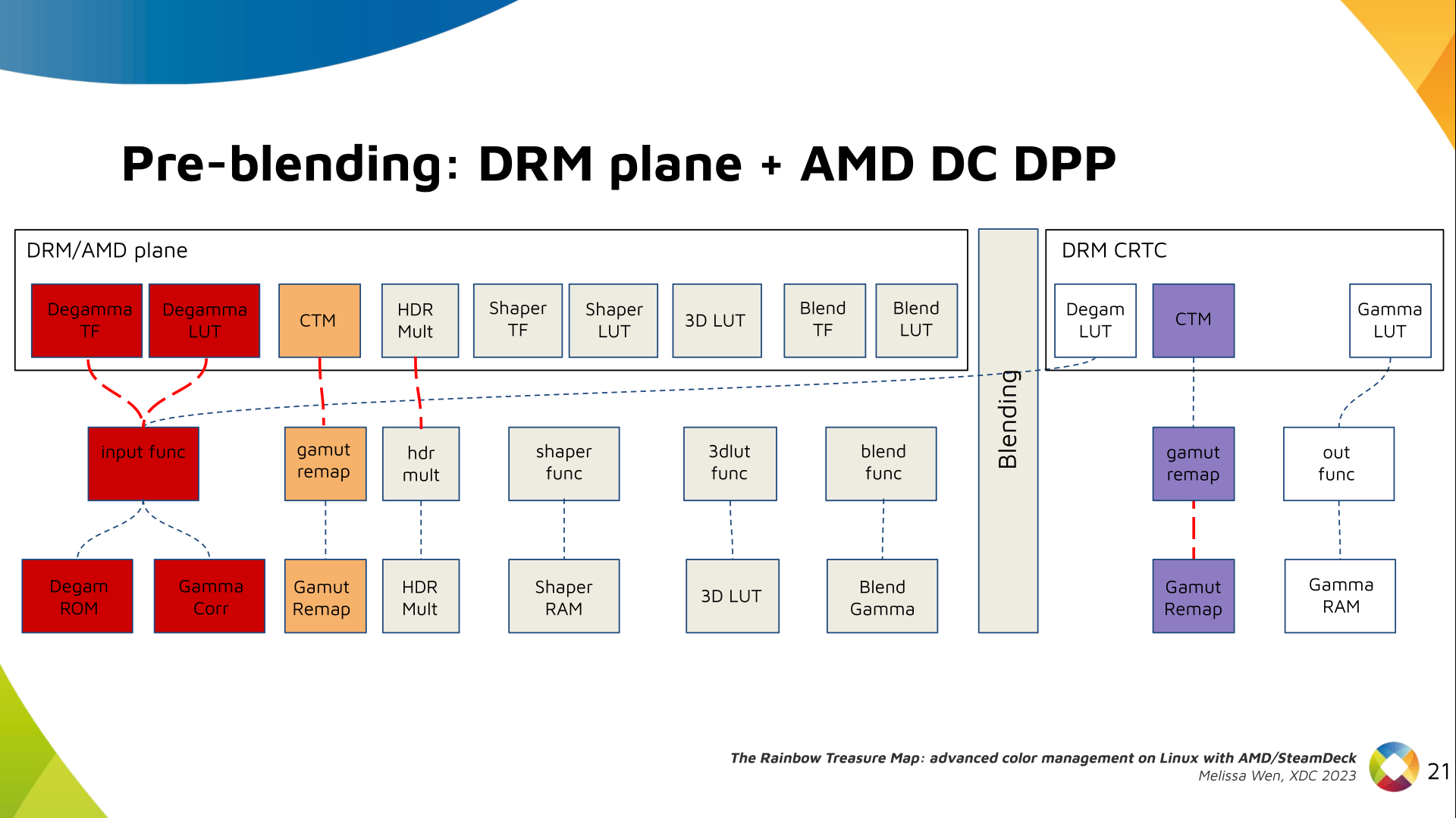
DRM plane color properties:
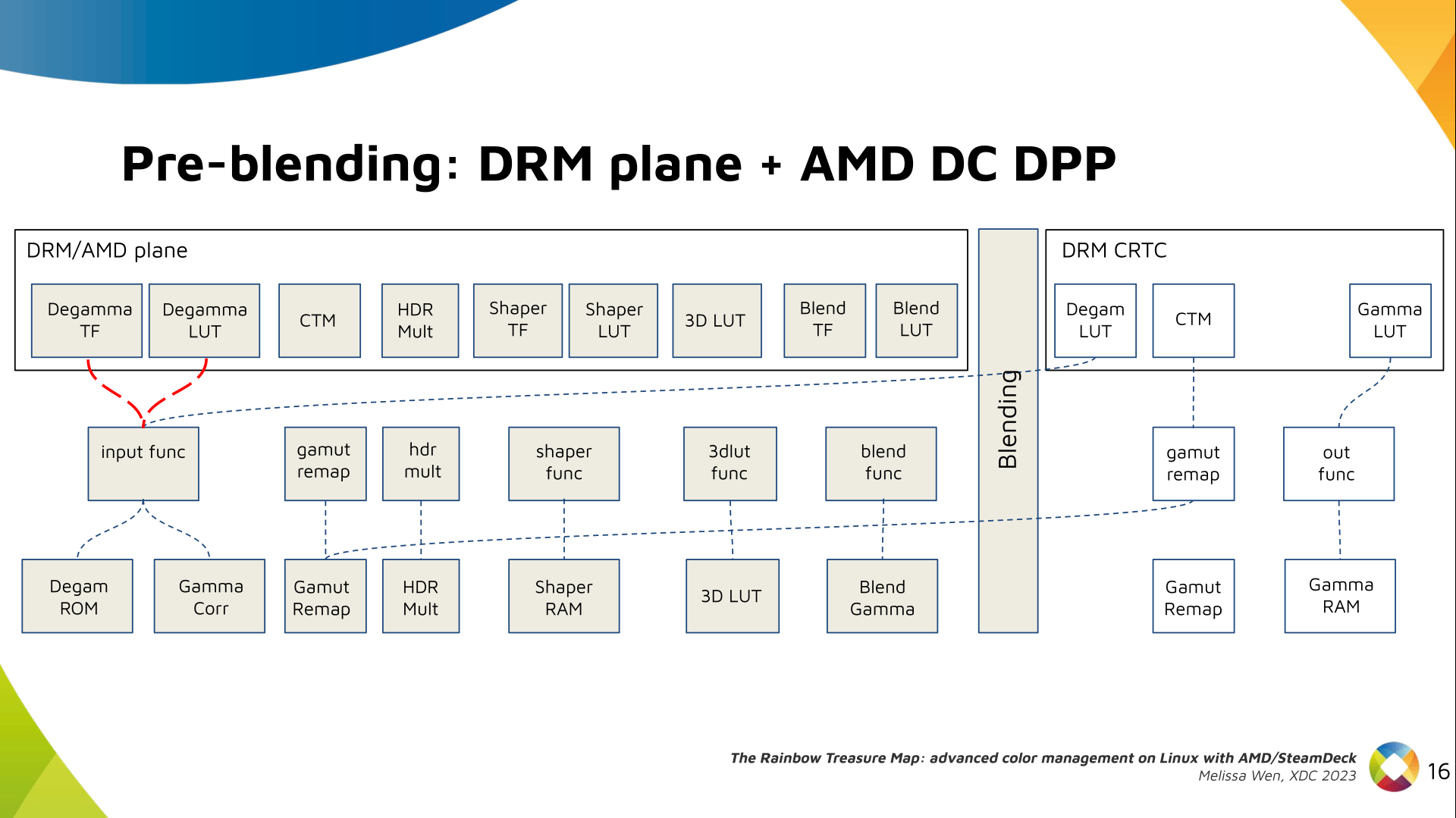
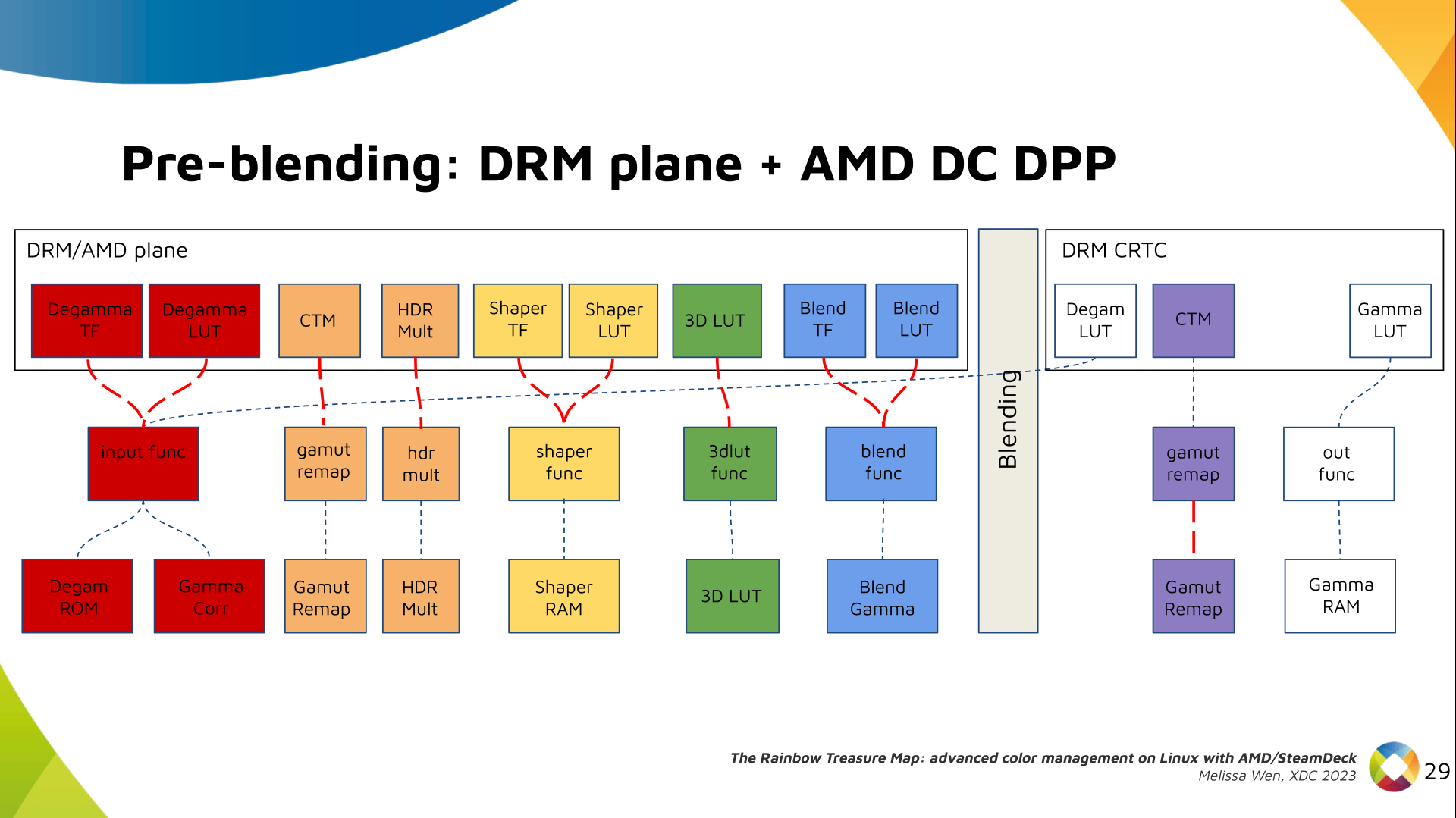
This is the DRM color management API before blending.
Nothing!
Except two basic DRM plane properties: color_encoding and color_range for
the input colorspace conversion, that is not covered by this work.
In case you re not familiar with AMD shared code, what we need to do is
basically draw a map and navigate there!
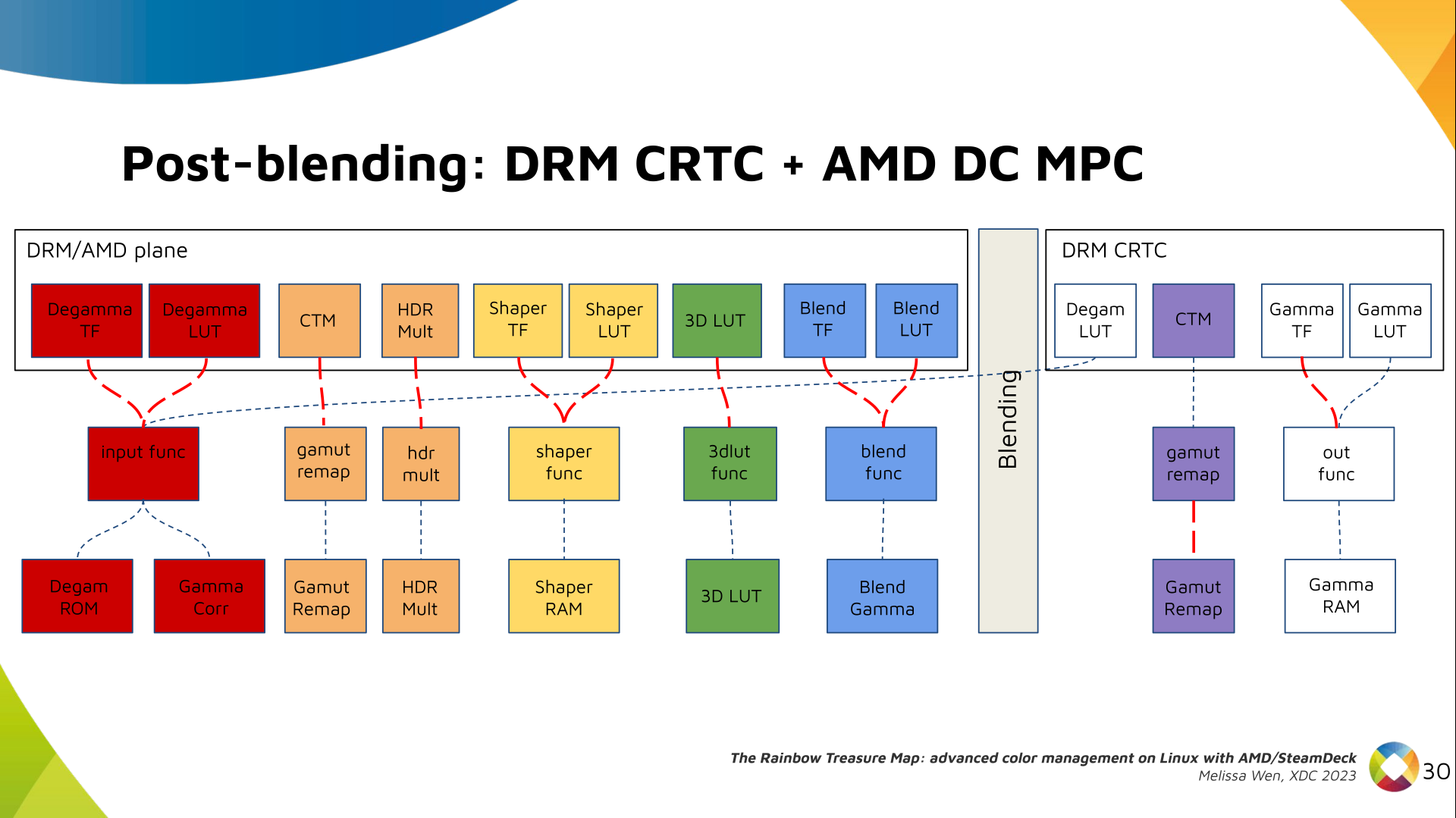
We have some DRM color properties after blending, but nothing before blending
yet. But much of the hardware programming was already implemented in the AMD DC
layer, thanks to the shared code.
Still both the DRM interface and its connection to the shared code were
missing. That s when the search begins!
AMD driver-specific color pipeline:
Looking at the color capabilities of the hardware, we arrive at this initial
set of properties. The path wasn t exactly like that. We had many iterations
and discoveries until reached to this pipeline.
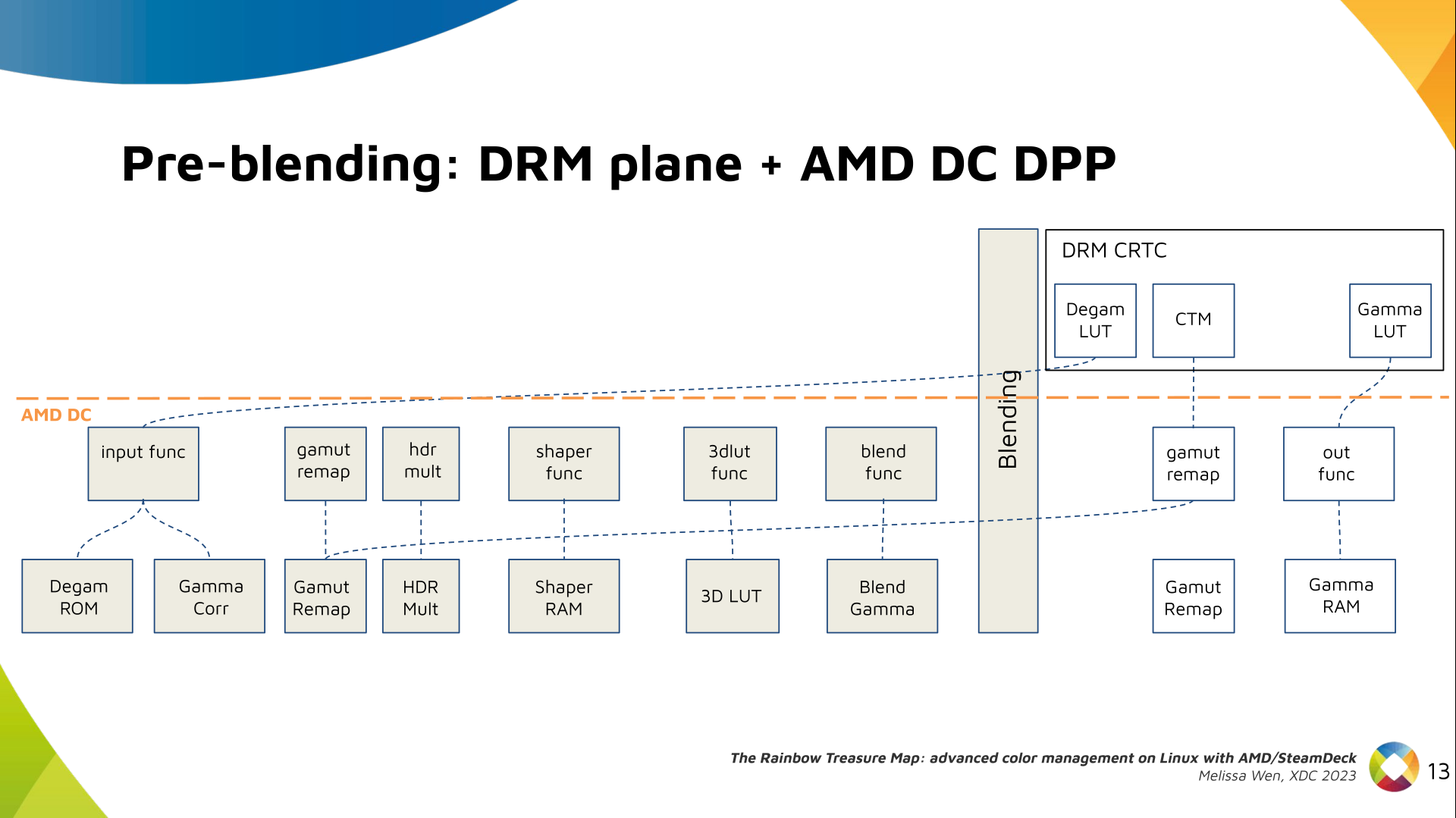
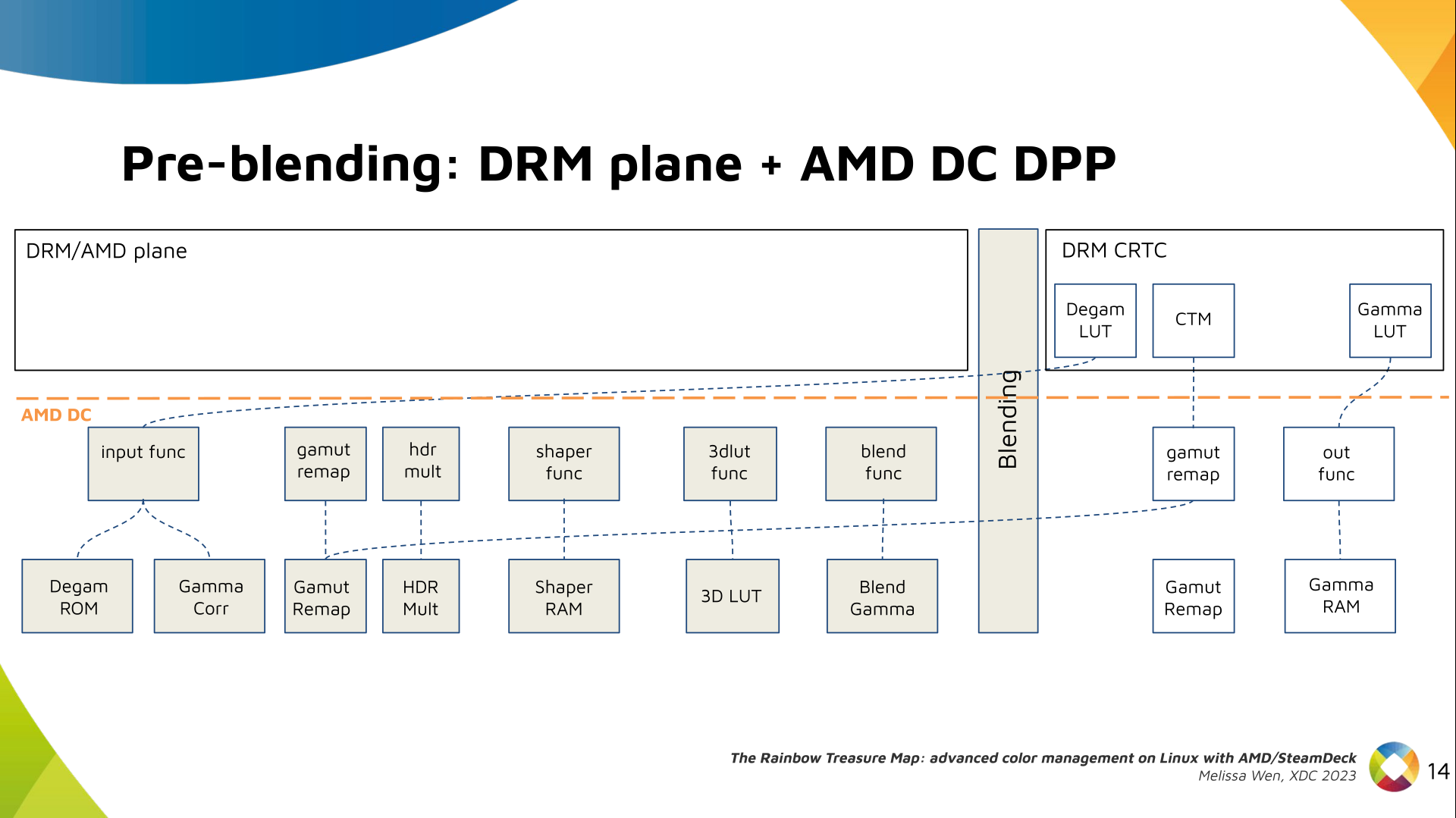
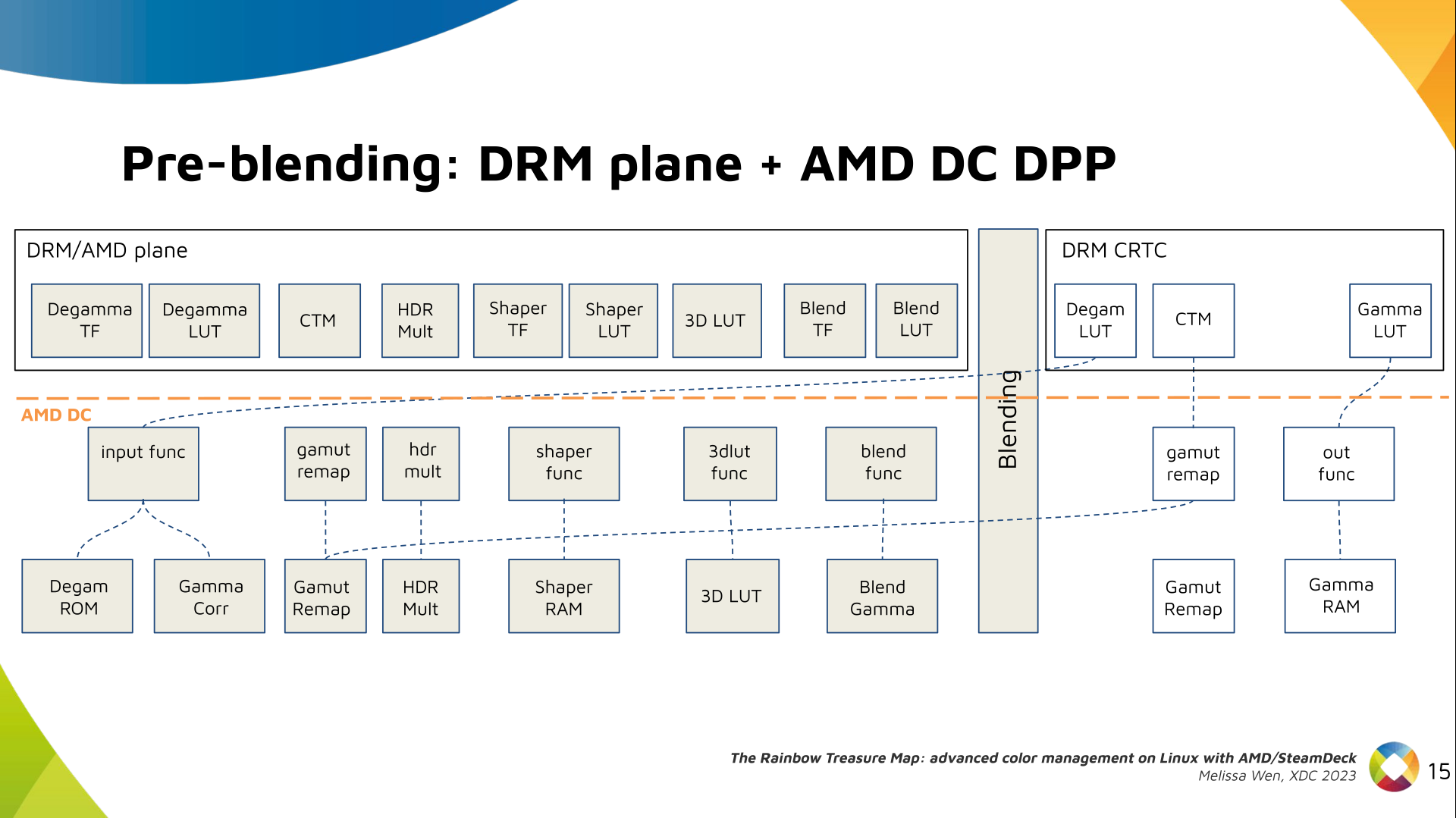
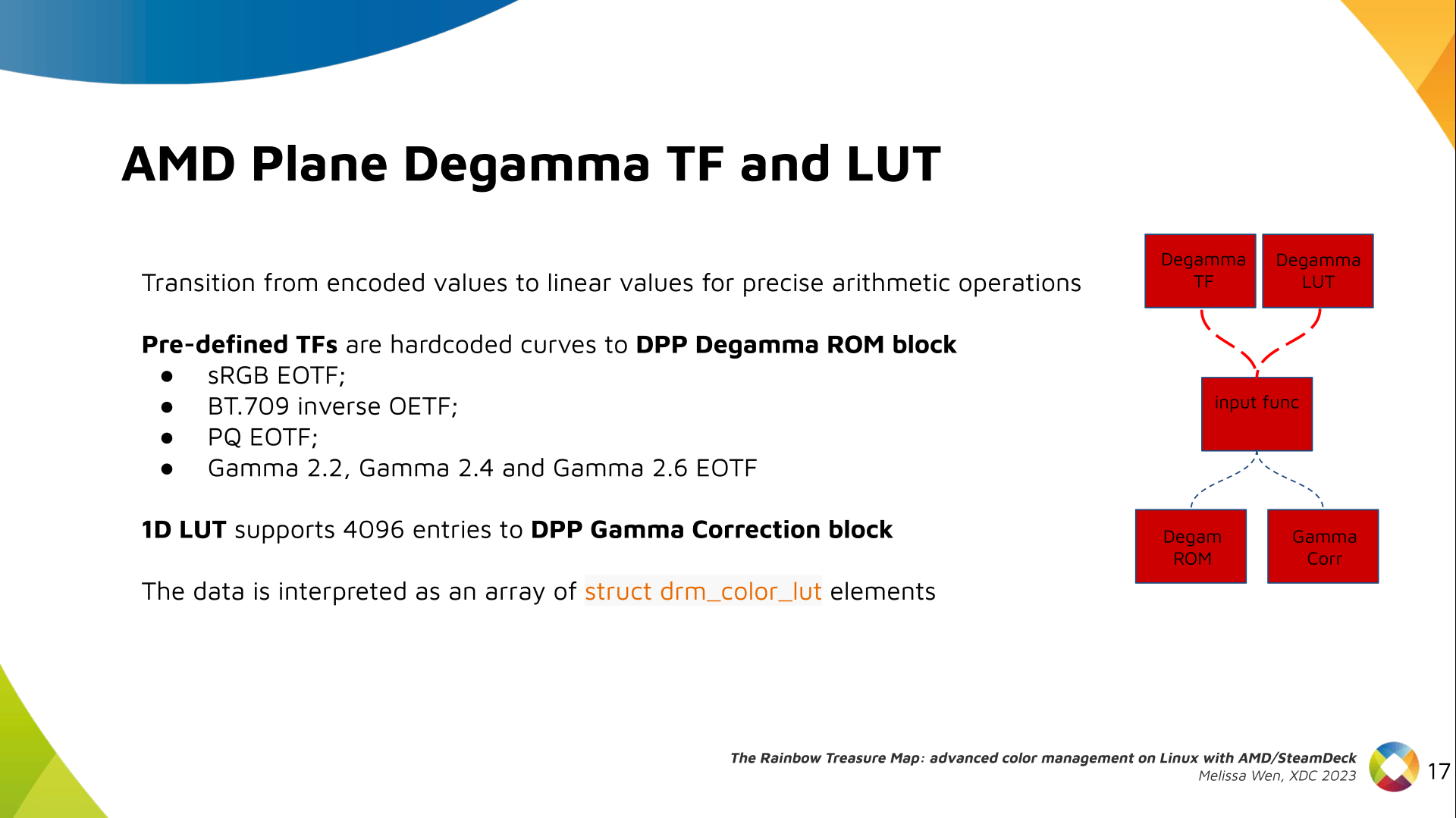
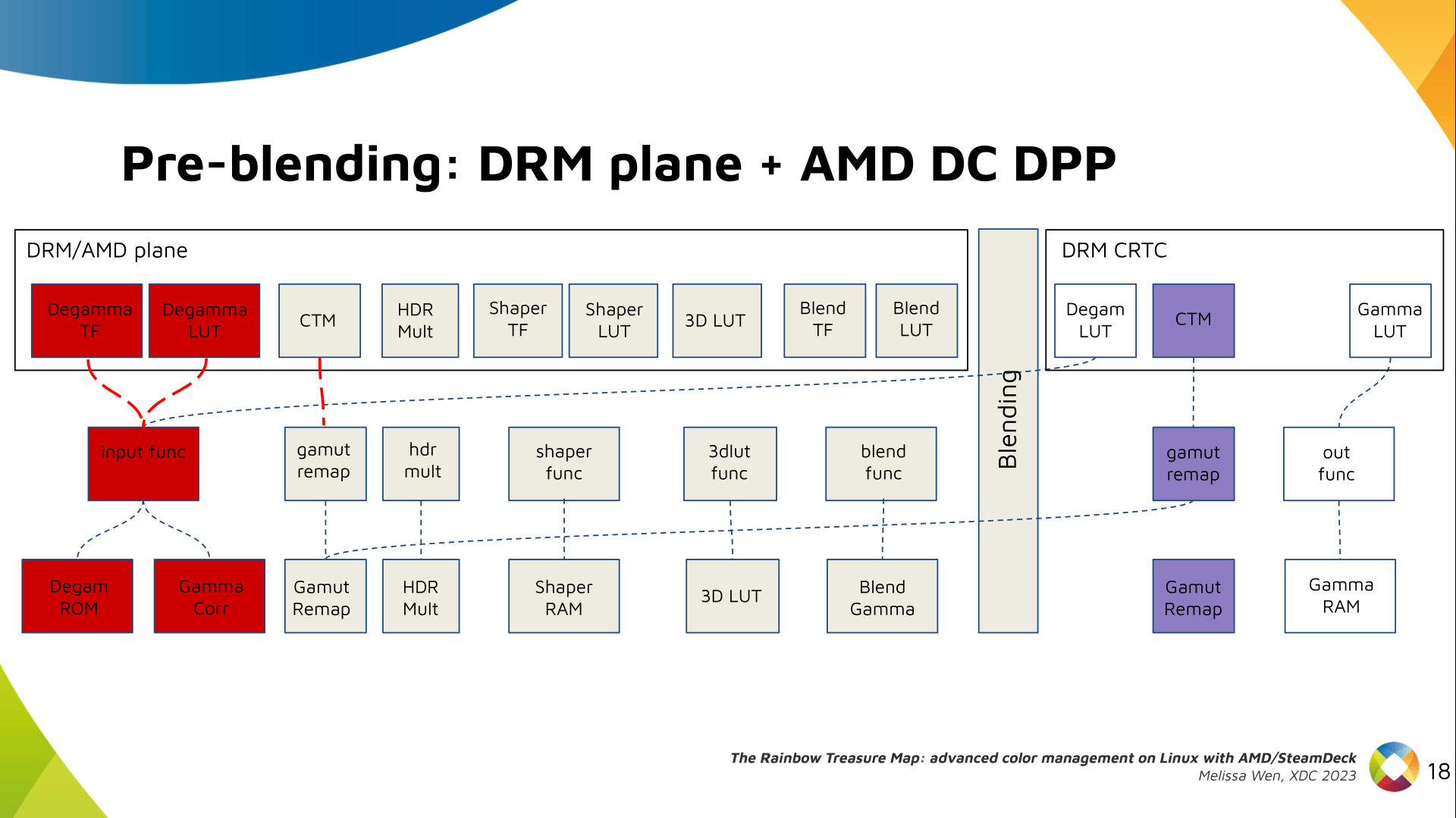
The Plane Degamma is our first driver-specific property before blending. It s
used to linearize the color space from encoded values to light linear values.
We can use a pre-defined transfer function or a user lookup table (in short,
LUT) to linearize the color space.
Pre-defined transfer functions for plane degamma are hardcoded curves that go
to a specific hardware block called DPP Degamma ROM. It supports the following
transfer functions: sRGB EOTF, BT.709 inverse OETF, PQ EOTF, and pure power
curves Gamma 2.2, Gamma 2.4 and Gamma 2.6.
We also have a one-dimensional LUT. This 1D LUT has four thousand ninety six
(4096) entries, the usual 1D LUT size in the DRM/KMS. It s an array of
drm_color_lut that goes to the DPP Gamma Correction block.
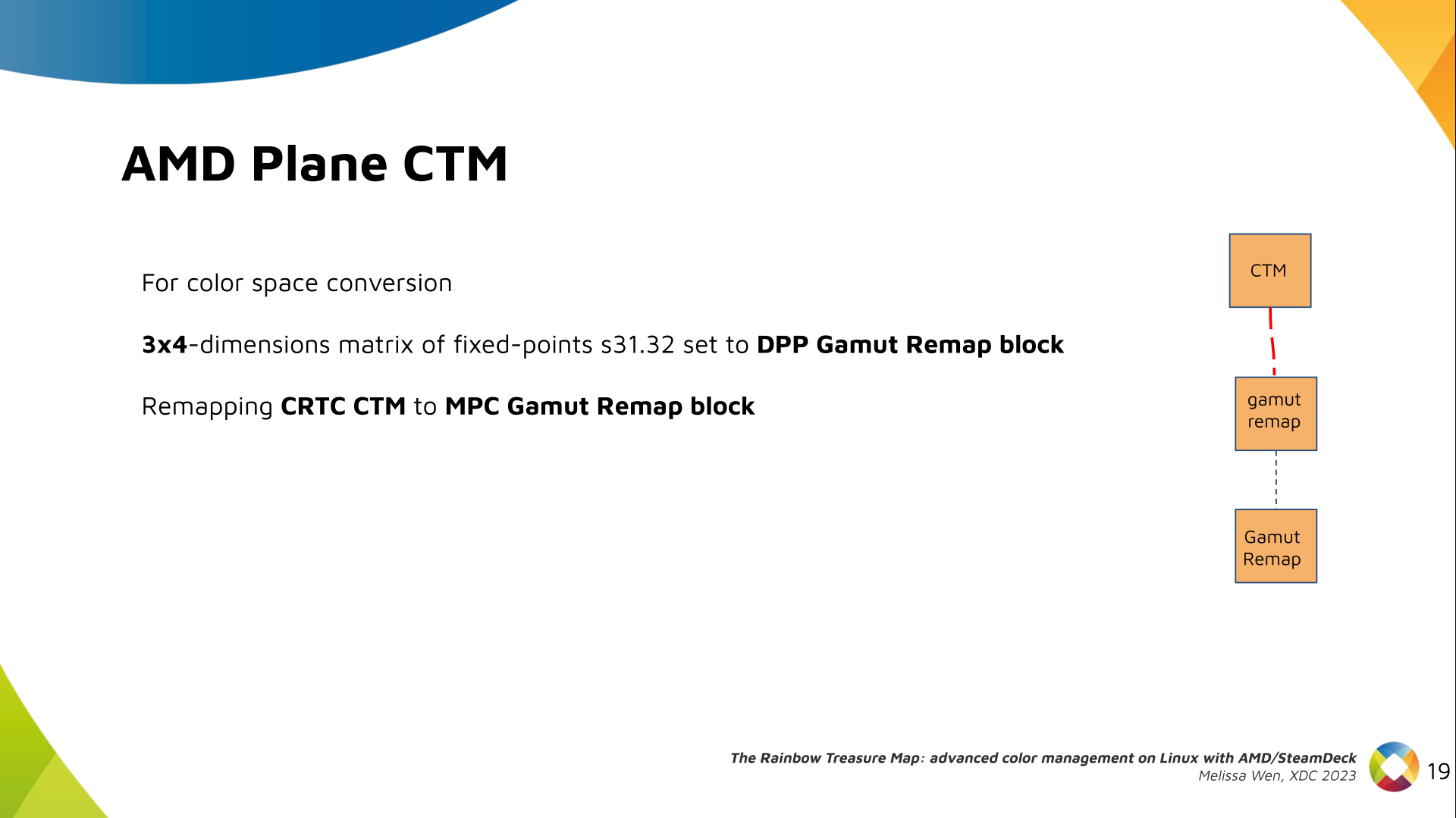
We also have now a color transformation matrix (CTM) for color space
conversion.
It s a 3x4 matrix of fixed points that goes to the DPP Gamut Remap Block.
Both pre- and post-blending matrices were previously gone to the same color
block. We worked on detaching them to clear both paths.
Now each CTM goes on its own way.
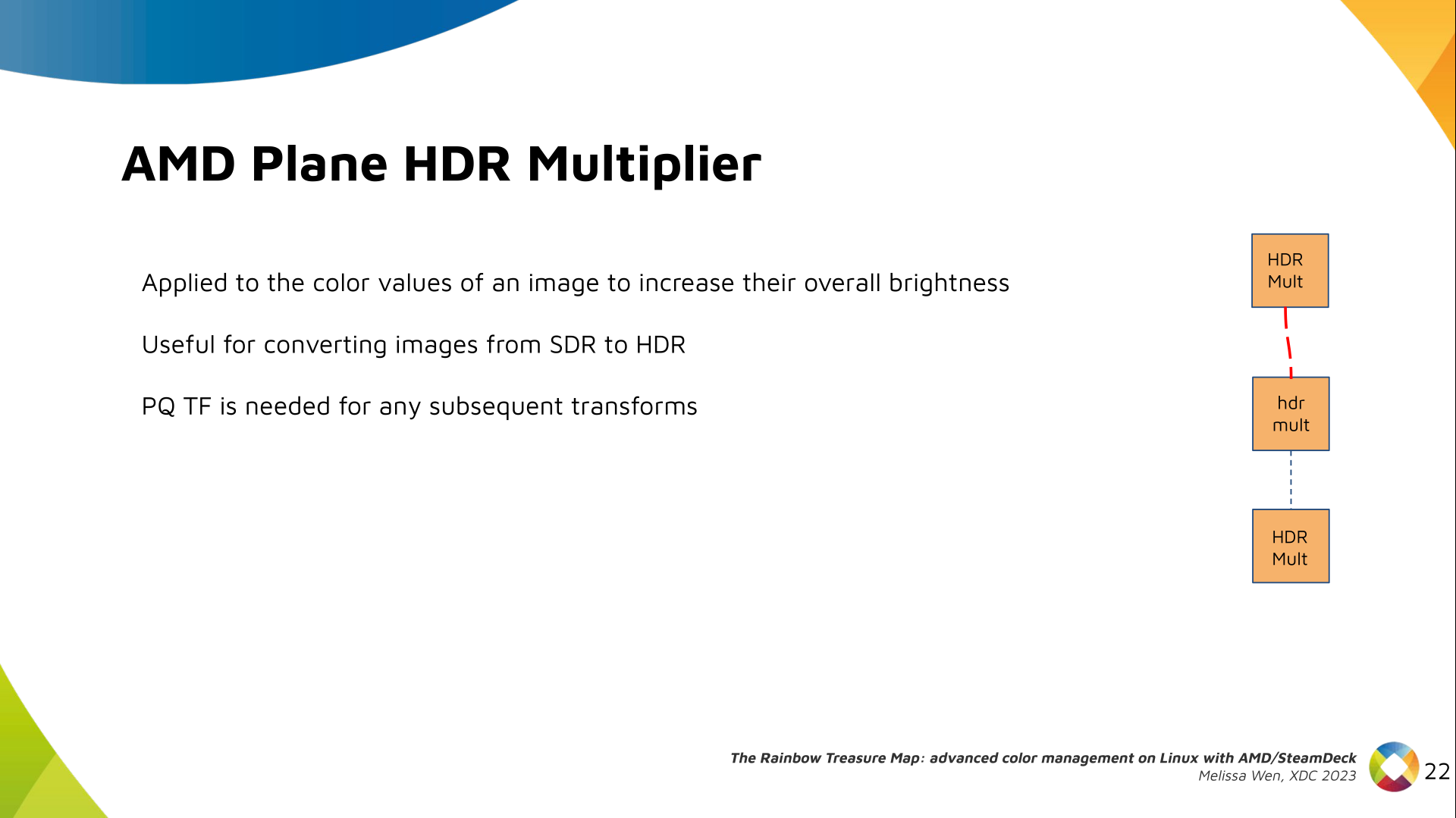
Next, the HDR Multiplier. HDR Multiplier is a factor applied to the color
values of an image to increase their overall brightness.
This is useful for converting images from a standard dynamic range (SDR) to a
high dynamic range (HDR). As it can range beyond [0.0, 1.0] subsequent
transforms need to use the PQ(HDR) transfer functions.
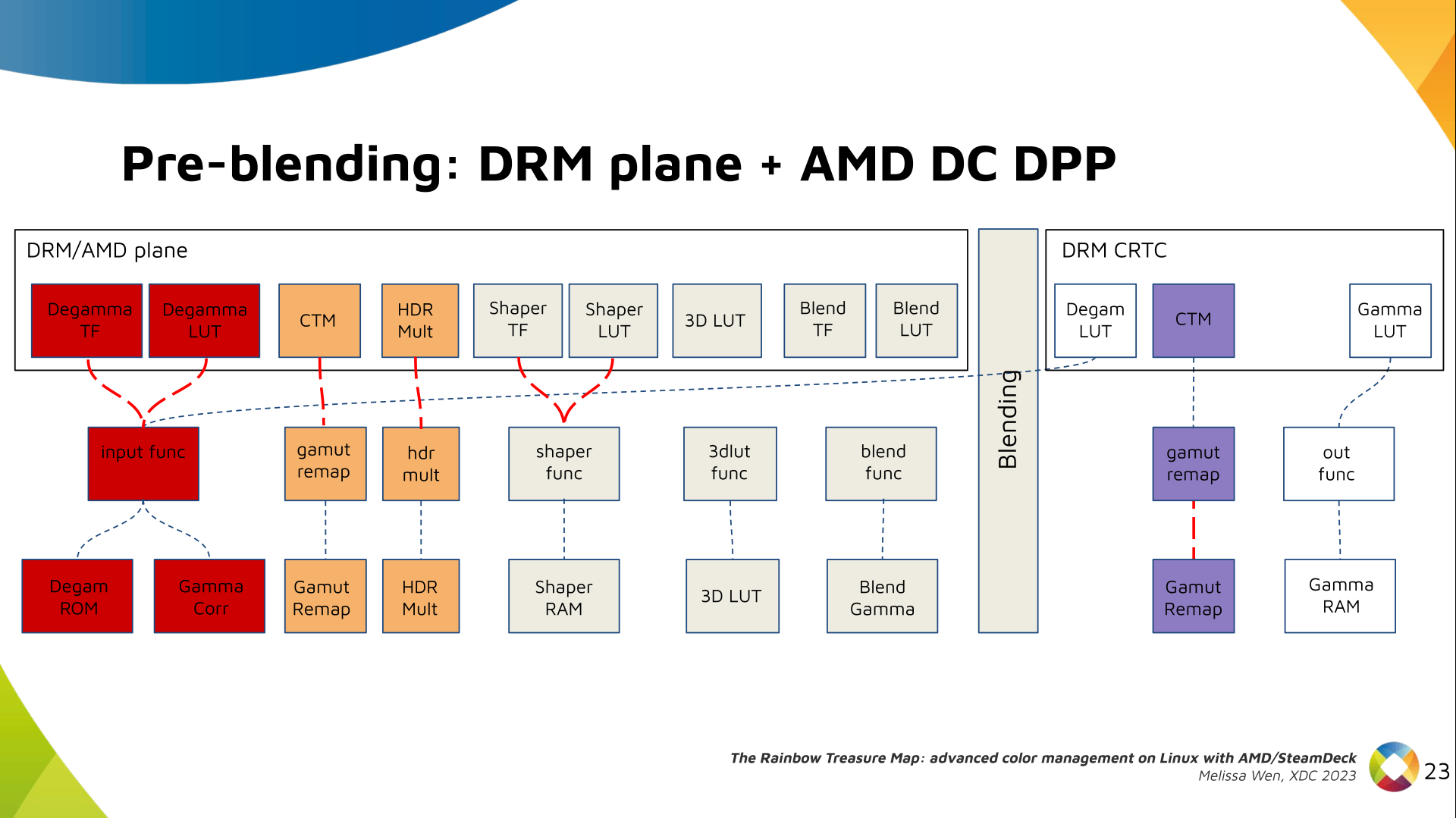
And we need a 3D LUT. But 3D LUT has a limited number of entries in each
dimension, so we want to use it in a colorspace that is optimized for human
vision. It means in a non-linear space. To deliver it, userspace may need one
1D LUT before 3D LUT to delinearize content and another one after to linearize
content again for blending.
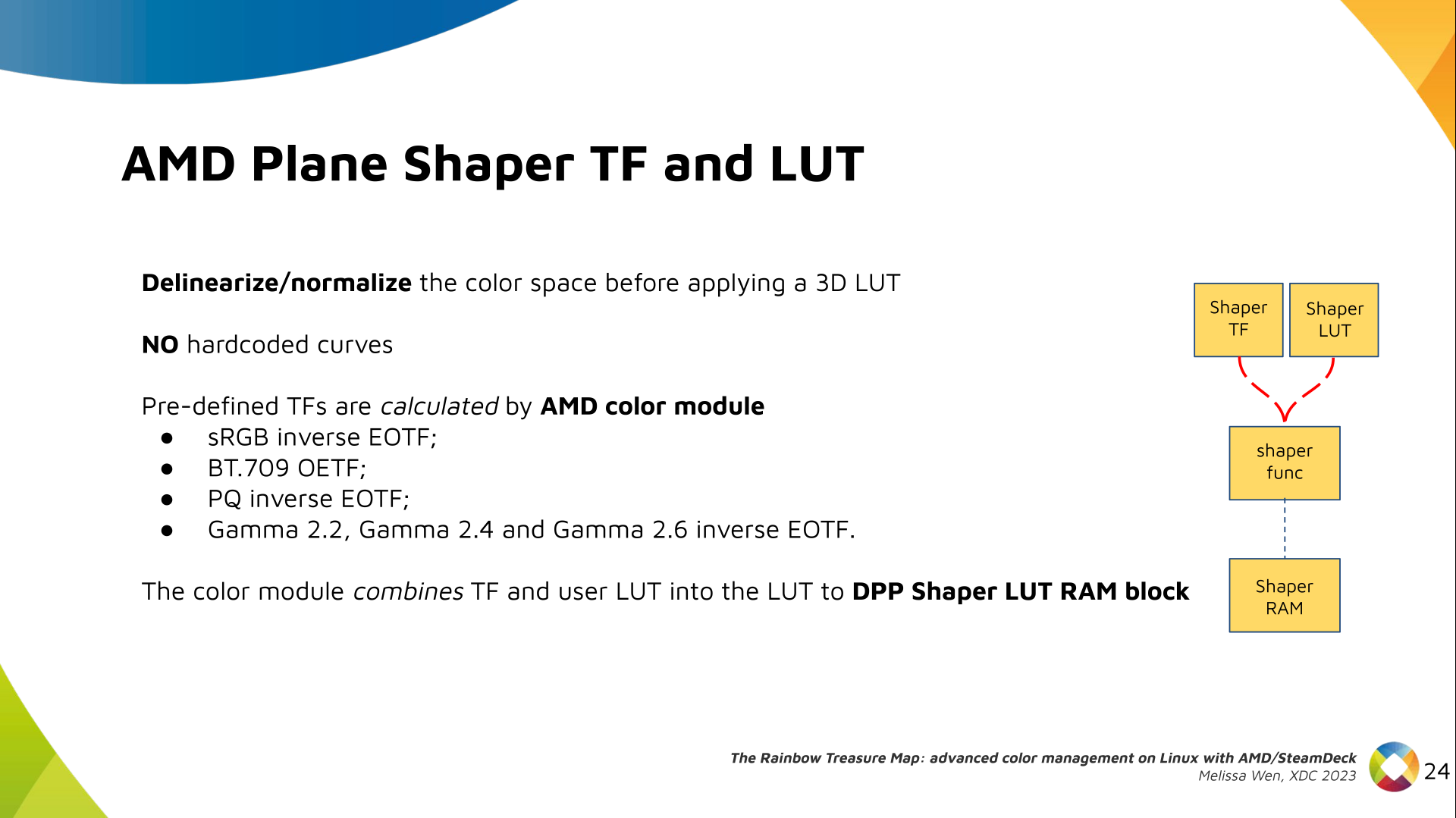
The pre-3D-LUT curve is called Shaper curve. Unlike Degamma TF, there are no
hardcoded curves for shaper TF, but we can use the AMD color module in the
driver to build the following shaper curves from pre-defined coefficients. The
color module combines the TF and the user LUT values into the LUT that goes to
the DPP Shaper RAM block.
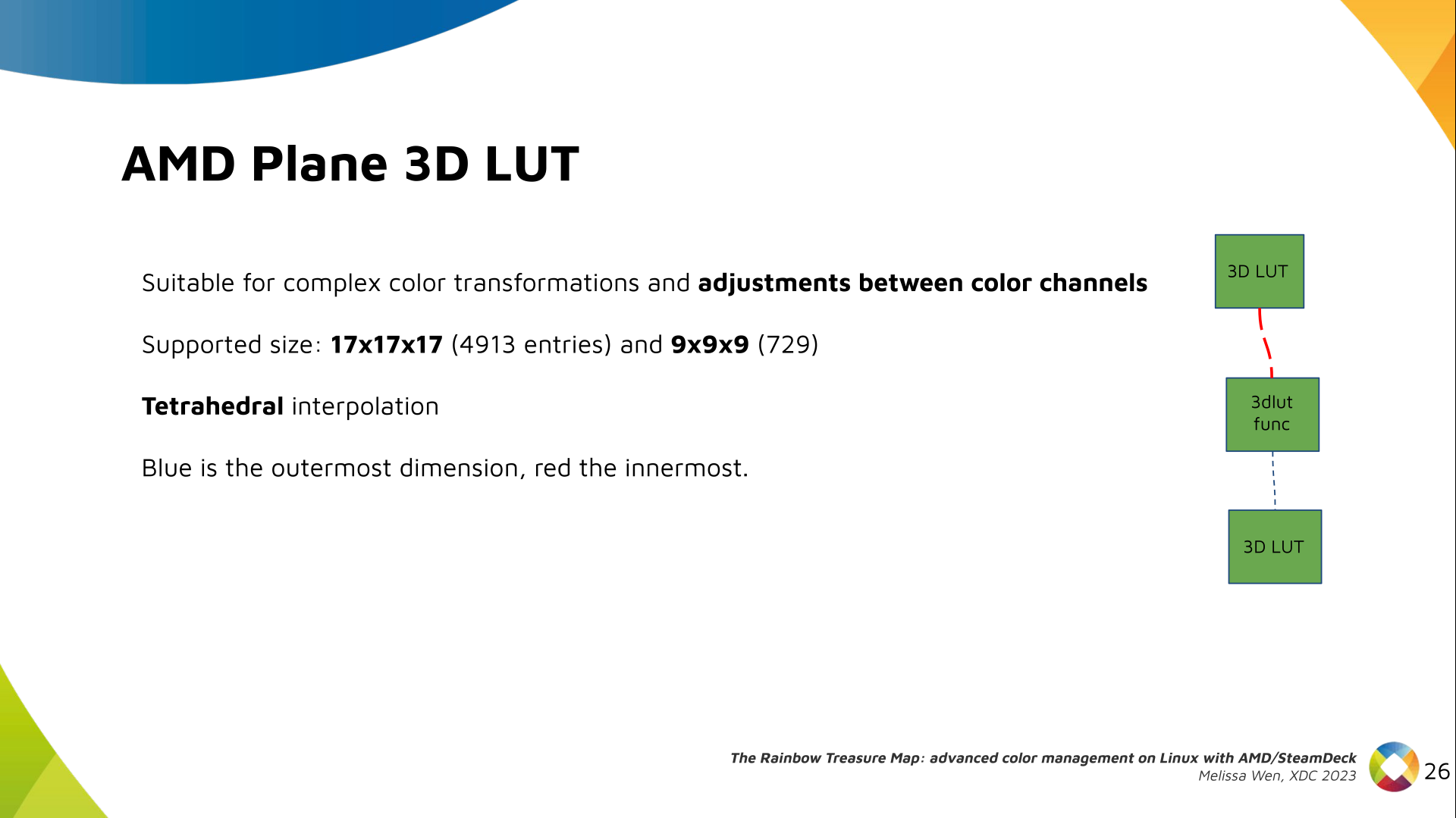
Finally, our rockstar, the 3D LUT. 3D LUT is perfect for complex color
transformations and adjustments between color channels.
3D LUT is also more complex to manage and requires more computational
resources, as a consequence, its number of entries is usually limited. To
overcome this restriction, the array contains samples from the approximated
function and values between samples are estimated by tetrahedral interpolation.
AMD supports 17 and 9 as the size of a single-dimension. Blue is the outermost
dimension, red the innermost.
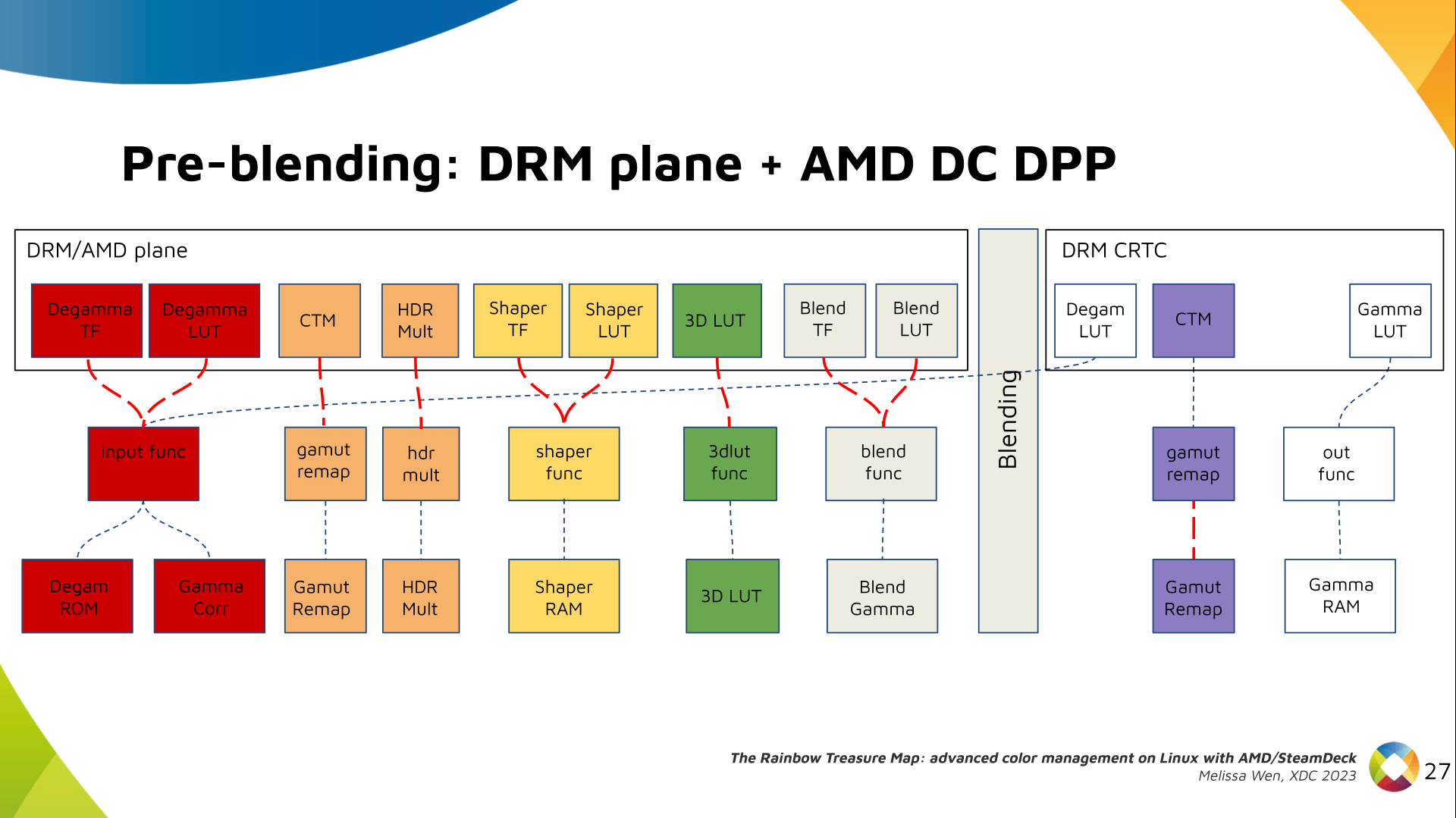
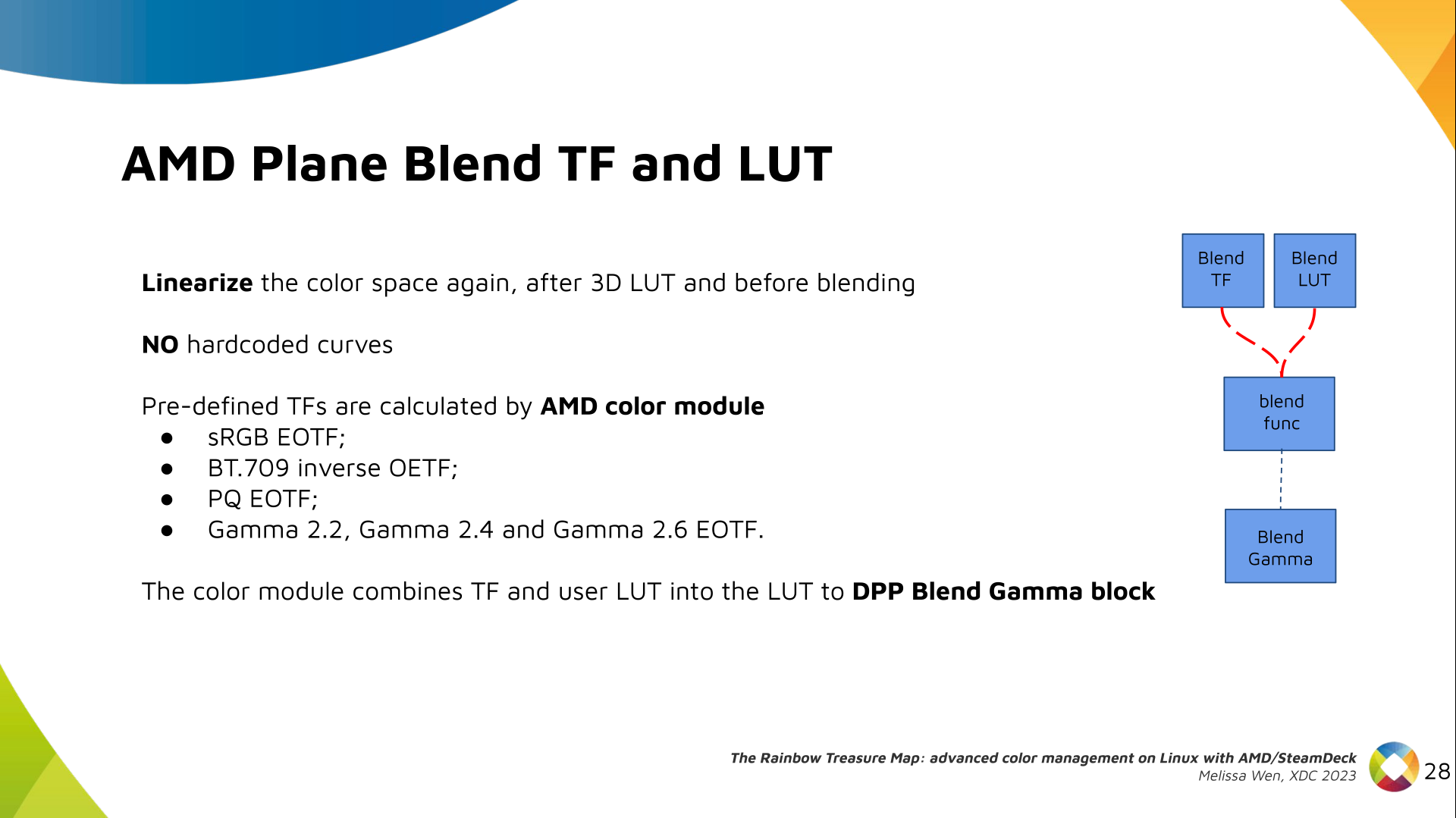
As mentioned, we need a post-3D-LUT curve to linearize the color space before
blending. This is done by Blend TF and LUT.
Similar to shaper TF, there are no hardcoded curves for Blend TF. The
pre-defined curves are the same as the Degamma block, but calculated by the
color module. The resulting LUT goes to the DPP Blend RAM block.
Now we have everything connected before blending. As a conflict between plane
and CRTC Degamma was inevitable, our approach doesn t accept that both are set
at the same time.
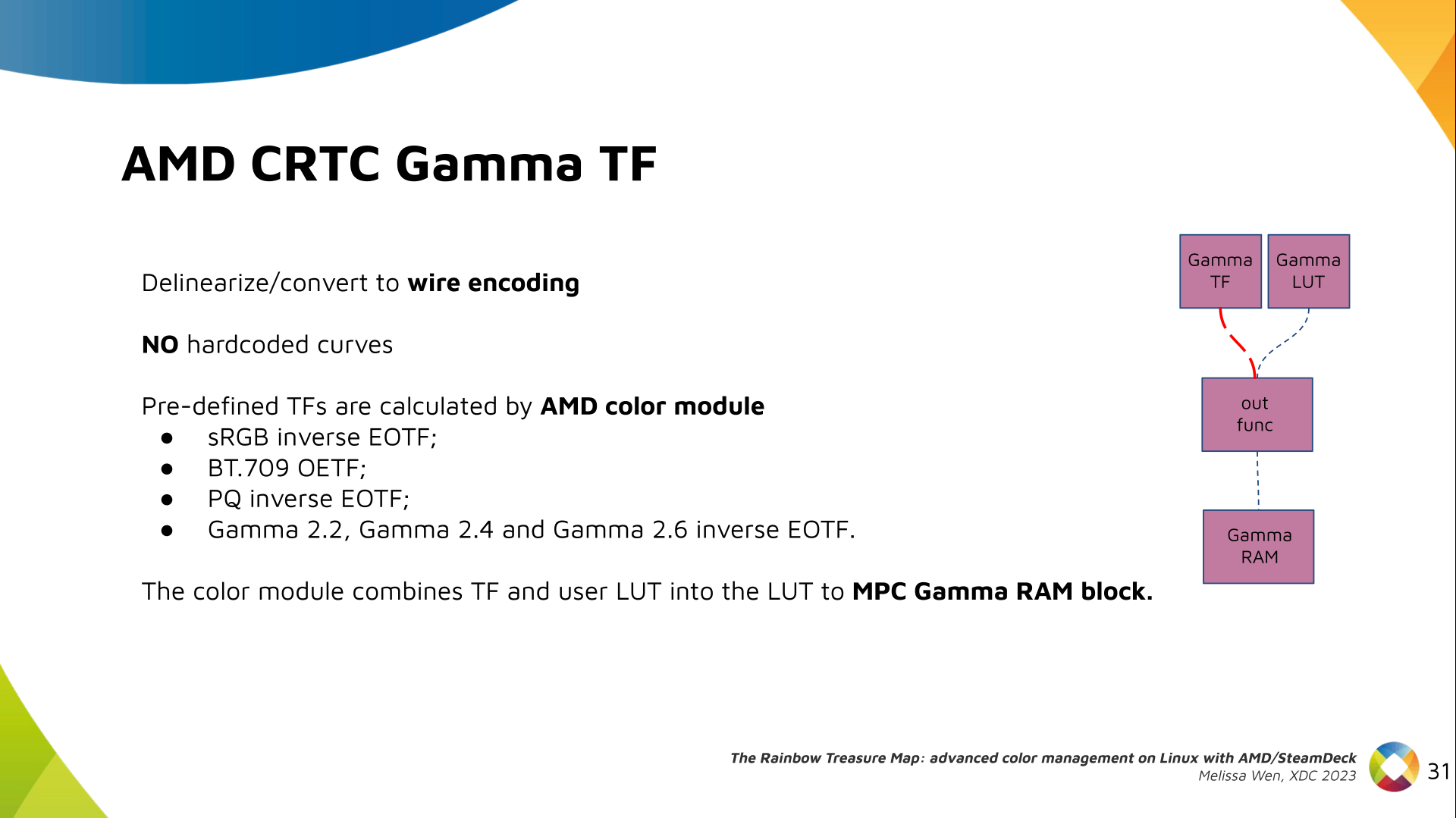
We also optimized the conversion of the framebuffer to wire encoding by adding
support to pre-defined CRTC Gamma TF.
Again, there are no hardcoded curves and TF and LUT are combined by the AMD
color module. The same types of shaper curves are supported. The resulting LUT
goes to the MPC Gamma RAM block.
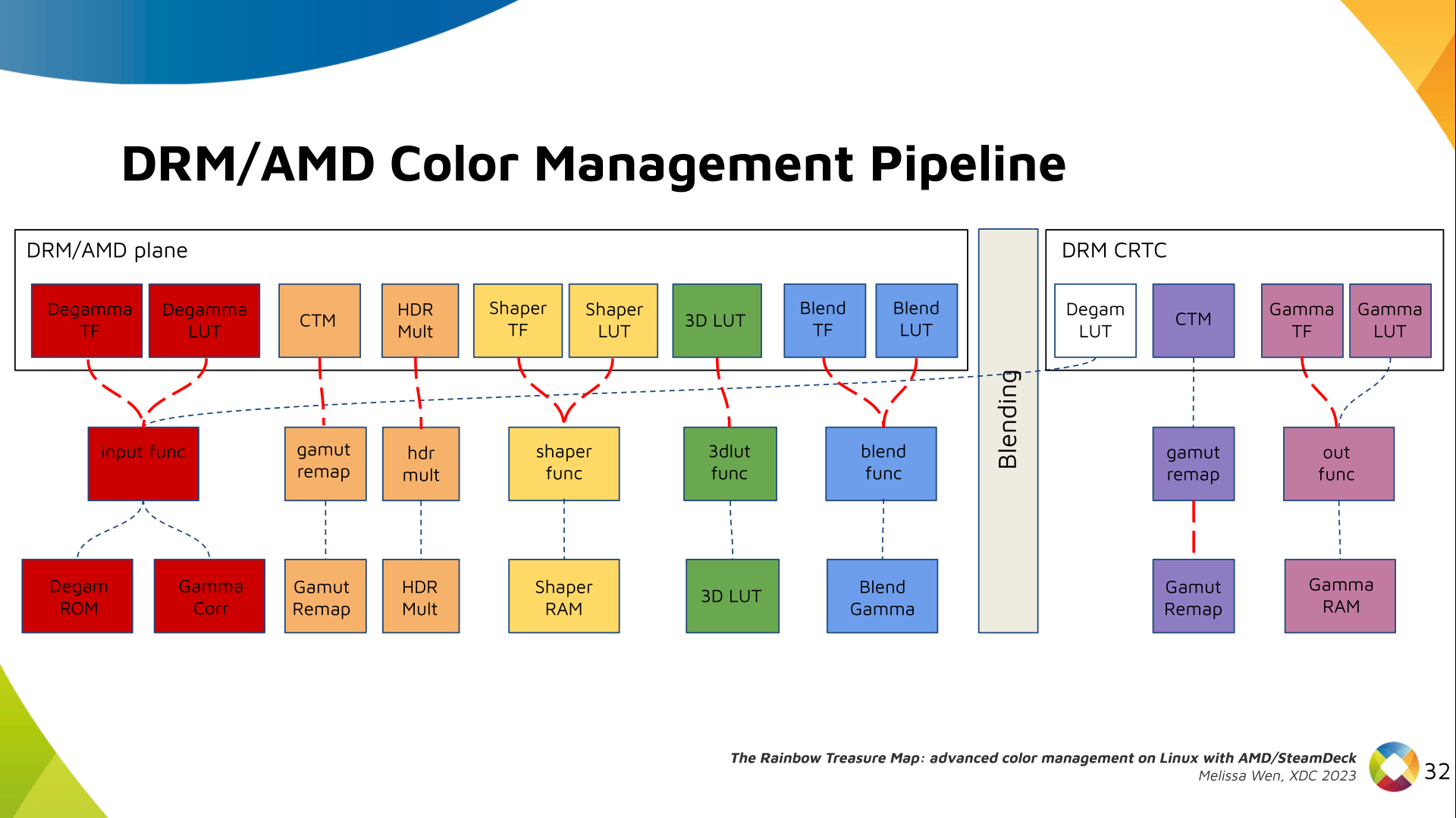
Finally, we arrived in the final version of DRM/AMD driver-specific color
management pipeline. With this knowledge, you re ready to better enjoy the
rainbow treasure of AMD display hardware and the world of graphics computing.
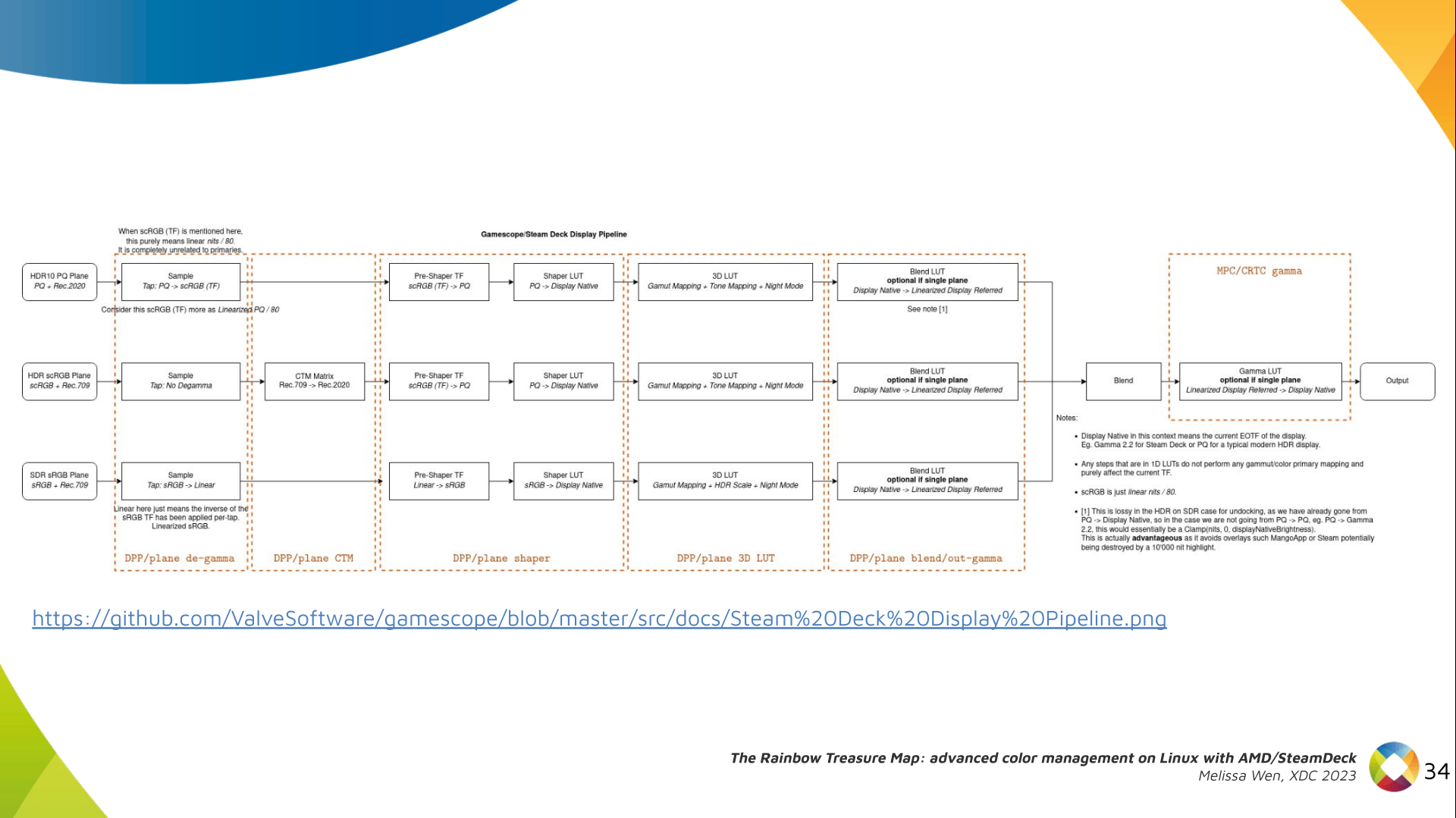
With this work, Gamescope/Steam Deck embraces the color capabilities of the AMD
GPU. We highlight here how we map the Gamescope color pipeline to each AMD
color block.
Future works:
The search for the rainbow treasure is not over! The Linux DRM subsystem
contains many hidden treasures from different vendors. We want more complex
color transformations and adjustments available on Linux. We also want to
expose all GPU color capabilities from all hardware vendors to the Linux
userspace.
Thanks Joshua and Harry for this joint work and the Linux DRI community for all feedback and reviews.
The amazing part of this work comes in the next talk with Joshua and The Rainbow Frogs!
Any questions?
The package is orphaned and its upstream is no longer developed. It depends on gtk2, has a low popcon and no reverse dependencies.So I had little hope to see this program back in Debian. The git repository shows little activity, the last being two years ago. Interestingly, I do not quite remember what it was testing, but I do remember it to find dead pixels, confirm native resolution, and various pixel-peeping. Here's a screenshot of one of the screentest screens:
Now, I think it's safe to assume this program is dead and buried, and
anyways I'm running wayland now, surely there's
something better?
Well, no. Of course not. Someone would know about it and tell me
before I go on a random coding spree in a fit of
procrastination... riiight? At least, the Debconf video team
didn't seem to know of any replacement. They actually suggested I just
"invoke gstreamer directly" and "embrace the joy of shell scripting".
--patterns. A list of patterns relevant to your installation is
available with the gst-inspect-1.0 videotestsrc command.
By default, screentest goes through all patterns. Each pattern runs
indefinitely until the you close the window, then the next pattern
starts.
You can restrict to a subset of patterns, for example this would be a
good test for dead pixels:
screentest --patterns black,white,red,green,blue
This would be a good sharpness test:
screentest --patterns pinwheel,spokes,checkers-1,checkers-2,checkers-4,checkers-8
A good generic test is the classic SMPTE color bars and is the
first in the list, but you can run only that test with:
screentest --patterns smpte
(I will mention, by the way, that as a system administrator with decades of experience, it is nearly impossible to type SMPTE without first typing SMTP and re-typing it again a few times before I get it right. I fully expect this post to have numerous typos.)Here's an example of the SMPTE pattern from Wikipedia:
screentest also supports specifying which
output to use as a native resolution, with --output. Failing that,
it will try to look at the outputs and use the first it will
find. If it fails to find anything, you can specify a resolution with
--resolution WIDTHxHEIGHT.
I have tried to make it go full screen by default, but stumbled a bug
in Sway that crashes gst-launch. If your Wayland compositor
supports it, you can possibly enable full screen with --sink
waylandsink fullscreen=true. Otherwise it will create a new window
that you will have to make fullscreen yourself.
For completeness, there's also an --audio flag that will emit the
classic "drone", a sine wave at 440Hz at 40% volume (the audiotestsrc
gstreamer plugin. And there's a --overlay-name option to show
the pattern name, in case you get lost and want to start with one of
them again.
gst-launch.
There might be some additional patterns that could be useful, but I
think those are better left to gstreamer. I, for example, am somewhat
nostalgic of the Philips circle pattern that used to play for TV
stations that were off-air in my area. But that, in my opinion, would
be better added to the gstreamer plugin than into a separate thing.
The script shows which command is being ran, so it's a good
introduction to gstreamer pipelines. Advanced users (and the video
team) will possibly not need screentest and will design their own
pipelines with their own tools.
I've previously worked with ffmpeg pipelines (in another such
procrastinated coding spree, video-proxy-magic), and I found
gstreamer more intuitive, even though it might be slightly less
powerful.
In retrospect, I should probably have picked a new name, to avoid
crashing the namespace already used by the project, which is now on
GitHub. Who knows, it might come back to life after this blog
post; it would not be the first time.
For now, the project lives along side the rest of my scripts
collection but if there's sufficient interest, I might move it to
its own git repositories. Comments, feedback, contributions are as
usual welcome. And naturally, if you know something better for this
kind of stuff, I'm happy to learn more about your favorite tool!
So now I have finally found something to test my projector, which will
likely confirm what I've already known all along: that it's kind
of a piece of crap and I need to get a proper one.
I've been tackling an equivalence problem with rewritten programs in
StrIoT, our proof-of-concept
stream-processing system.
The StrIoT Logical Optimiser applies a set of rewrite rules to a
stream-processing program, generating a set of variants that can be reasoned
about, ranked, and deployed. The problem I've been tackling is that a variant
may appear to be semantically equivalent to another, but compare (with ==)
as distinct.
The issue relates to the design of our data-type representing programs, in
particular, a consequence of our choice to outsource the structural aspect to a
3rd-party library (Algebra.Graph). The Graph library deems nodes that compare
as equivalent (again with ==) to be the same. Since a stream-processing
program may contain many operators which are equivalent, but distinct, we
needed to add a field to our payload type to differentiate them: so we opted
for an Integer field, vertexId (something I've described as a "wart"
elsewhere)
Here's a simplified example of our existing payload type, StreamVertex:
data StreamVertex = StreamVertex
vertexId :: Int
, operator :: StreamOperator
, parameters :: [ExpQ]
, intype :: String
, outtype :: String
A rewrite rule might introduce or eliminate operators from a stream-processing
program. For example, consider the rule which "hoists" a filter upstream from
a merge operator. In pseudo-Haskell,
streamFilter p . streamMerge [a , b, ...]
=>
streamMerge [ streamFilter p a
, streamFilter p b
, ...]
The original streamFilter is removed, and new streamFilters are introduced,
one per stream arriving at streamMerge. In general, rules may need to
synthesise new operators, and thus new vertexIds.
Another rewrite rule might perform the reverse operation. But the individual
rules operate in isolation: and so, the program variant that results after
applying a rule and then applying an inverse rule may not have the same
vertexIds, or the same order of vertexIds, as the original program.
I thought of the outline of two possible solutions to this.
"well-numbered" StreamGraphs
The first was to encode (and enforce) some rules about how vertexIds are used.
If they always began from (say) 1, and were strictly-ascending from the
source operator(s), and rewrite rules guaranteed that a "well numbered" input
would be "well numbered" after rewriting, this would be sufficient to rule out
a rewritten-but-semantically-equivalent program being considered distinct.
The trouble with this approach is using properties of a numerical system
built around vertexId as a stand-in for the real structural problem. I
was not sure I could prove both that the stand-in system was sound and
that it was a proper analogue for the underlying structural issue.
It feels to me more that the choice to use an external library to
encode the structure of a stream-processing program was the issue: the
structure itself is a fundamental part of the semantics of the program. What if
we had encoded the structure of programs within the same data-type?
alternative data-type
StrIoT programs are trees. The root is the sink node:
there is always exactly one. There can be multiple source (leaf nodes), but
they always converge. Operators can have multiple inputs (including zero).
The root node has no output, but all other operators have exactly one.
I explored transforming StreamVertex into a tree by adding a field
representing incoming streams, and dispensing with Graph and vertexId.
Something like this
data StreamProg = StreamProg StreamOperator [Exp] String String [StreamProg]
A uni-directional transformation from Graph StreamVertex to StreamProg
is all that's needed to implement something like ==, so we don't need
to keep track of vertexId mappings. Unfortunately, we can't fix the
actual Eq (Graph StreamVertex) implementation this way: it delegates
to Eq StreamVertex, and we just don't have enough information to fix
the problem at that level. But, we can write a separate graphEq and
use that instead where we need to.
could I go further?
Spoiler: I haven't. But I've been sorely tempted.
We still have a separate StreamOperator type, which it would be nice to fold
in; and we still have to use
a list around the incoming nodes, since different operators accept different
numbers of incoming streams. It would be better to encode the correct valences
in the type.
In 2020 I explored iteratively reducing the StreamVertex data-type to try and
get it as close as possible to the ideal end-user API: simple functions. I
wrote about one step along that path in Template Haskell and
Stream-processing programs, but concluded that,
since this was not my main PhD focus, I wouldn't go further. But it was
nagging at my subconcious ever since.
I allowed myself a couple of days exploring some advanced concepts including
typed Template Haskell (that has had some developments since 2020), generalised
abstract data types (GADTs) and more generic programming to see what could be
achieved.
I'll summarise all that in the next blog post.
drm-fixes-<date>.
2) Examine the issue tracker: Confirm that your issue isn t already
documented and addressed in the AMD display driver issue tracker. If you find a
similar issue, you can team up with others and speed up the debugging process.
[drm] Display Core v... , it s not likely a display driver issue. If this
message doesn t appear in your log, the display driver wasn t fully loaded and
you will see a notification that something went wrong here.[drm] Display Core v3.2.241 initialized on DCN 2.1[drm] Display Core v3.2.237 initialized on DCN 3.0.1drivers/gpu/drm/amd/display/dc/dcn301. We all know
that the AMD s shared code is huge and you can use these boundaries to rule out
codes unrelated to your issue.
7) Newer families may inherit code from older ones: you can find dcn301
using code from dcn30, dcn20, dcn10 files. It s crucial to verify which hooks
and helpers your driver utilizes to investigate the right portion. You can
leverage ftrace for supplemental validation. To give an example, it was
useful when I was updating DCN3 color mapping to correctly use their new
post-blending color capabilities, such as:
Additionally, you can use two different HW families to compare behaviours.
If you see the issue in one but not in the other, you can compare the code and
understand what has changed and if the implementation from a previous family
doesn t fit well the new HW resources or design. You can also count on the help
of the community on the
Linux AMD issue tracker
to validate your code on other hardware and/or systems.
This approach helped me debug
a 2-year-old issue
where the cursor gamma adjustment was incorrect in DCN3 hardware, but working
correctly for DCN2 family. I solved the issue in two steps, thanks for
community feedback and validation:
drivers/gpu/drm/amd/display/dc/dcn*/dcn*_resource.c file. More precisely in
the dcn*_resource_construct() function.
Using DCN301 for illustration, here is the list of its hardware caps:
/*************************************************
* Resource + asic cap harcoding *
*************************************************/
pool->base.underlay_pipe_index = NO_UNDERLAY_PIPE;
pool->base.pipe_count = pool->base.res_cap->num_timing_generator;
pool->base.mpcc_count = pool->base.res_cap->num_timing_generator;
dc->caps.max_downscale_ratio = 600;
dc->caps.i2c_speed_in_khz = 100;
dc->caps.i2c_speed_in_khz_hdcp = 5; /*1.4 w/a enabled by default*/
dc->caps.max_cursor_size = 256;
dc->caps.min_horizontal_blanking_period = 80;
dc->caps.dmdata_alloc_size = 2048;
dc->caps.max_slave_planes = 2;
dc->caps.max_slave_yuv_planes = 2;
dc->caps.max_slave_rgb_planes = 2;
dc->caps.is_apu = true;
dc->caps.post_blend_color_processing = true;
dc->caps.force_dp_tps4_for_cp2520 = true;
dc->caps.extended_aux_timeout_support = true;
dc->caps.dmcub_support = true;
/* Color pipeline capabilities */
dc->caps.color.dpp.dcn_arch = 1;
dc->caps.color.dpp.input_lut_shared = 0;
dc->caps.color.dpp.icsc = 1;
dc->caps.color.dpp.dgam_ram = 0; // must use gamma_corr
dc->caps.color.dpp.dgam_rom_caps.srgb = 1;
dc->caps.color.dpp.dgam_rom_caps.bt2020 = 1;
dc->caps.color.dpp.dgam_rom_caps.gamma2_2 = 1;
dc->caps.color.dpp.dgam_rom_caps.pq = 1;
dc->caps.color.dpp.dgam_rom_caps.hlg = 1;
dc->caps.color.dpp.post_csc = 1;
dc->caps.color.dpp.gamma_corr = 1;
dc->caps.color.dpp.dgam_rom_for_yuv = 0;
dc->caps.color.dpp.hw_3d_lut = 1;
dc->caps.color.dpp.ogam_ram = 1;
// no OGAM ROM on DCN301
dc->caps.color.dpp.ogam_rom_caps.srgb = 0;
dc->caps.color.dpp.ogam_rom_caps.bt2020 = 0;
dc->caps.color.dpp.ogam_rom_caps.gamma2_2 = 0;
dc->caps.color.dpp.ogam_rom_caps.pq = 0;
dc->caps.color.dpp.ogam_rom_caps.hlg = 0;
dc->caps.color.dpp.ocsc = 0;
dc->caps.color.mpc.gamut_remap = 1;
dc->caps.color.mpc.num_3dluts = pool->base.res_cap->num_mpc_3dlut; //2
dc->caps.color.mpc.ogam_ram = 1;
dc->caps.color.mpc.ogam_rom_caps.srgb = 0;
dc->caps.color.mpc.ogam_rom_caps.bt2020 = 0;
dc->caps.color.mpc.ogam_rom_caps.gamma2_2 = 0;
dc->caps.color.mpc.ogam_rom_caps.pq = 0;
dc->caps.color.mpc.ogam_rom_caps.hlg = 0;
dc->caps.color.mpc.ocsc = 1;
dc->caps.dp_hdmi21_pcon_support = true;
/* read VBIOS LTTPR caps */
if (ctx->dc_bios->funcs->get_lttpr_caps)
enum bp_result bp_query_result;
uint8_t is_vbios_lttpr_enable = 0;
bp_query_result = ctx->dc_bios->funcs->get_lttpr_caps(ctx->dc_bios, &is_vbios_lttpr_enable);
dc->caps.vbios_lttpr_enable = (bp_query_result == BP_RESULT_OK) && !!is_vbios_lttpr_enable;
if (ctx->dc_bios->funcs->get_lttpr_interop)
enum bp_result bp_query_result;
uint8_t is_vbios_interop_enabled = 0;
bp_query_result = ctx->dc_bios->funcs->get_lttpr_interop(ctx->dc_bios, &is_vbios_interop_enabled);
dc->caps.vbios_lttpr_aware = (bp_query_result == BP_RESULT_OK) && !!is_vbios_interop_enabled;
git log and git blame to identify commits
targeting the code section you re interested in.
10) Track regressions: If you re examining the amd-staging-drm-next
branch, check for regressions between DC release versions. These are defined by
DC_VER in the drivers/gpu/drm/amd/display/dc/dc.h file. Alternatively,
find a commit with this format drm/amd/display: 3.2.221 that determines a
display release. It s useful for bisecting. This information helps you
understand how outdated your branch is and identify potential regressions. You
can consider each DC_VER takes around one week to be bumped. Finally, check
testing log of each release in the report provided on the amd-gfx mailing
list, such as this one Tested-by: Daniel Wheeler:
sudo bash -c "echo high > /sys/class/drm/card0/device/power_dpm_force_performance_level"/* Surface update type is used by dc_update_surfaces_and_stream
* The update type is determined at the very beginning of the function based
* on parameters passed in and decides how much programming (or updating) is
* going to be done during the call.
*
* UPDATE_TYPE_FAST is used for really fast updates that do not require much
* logical calculations or hardware register programming. This update MUST be
* ISR safe on windows. Currently fast update will only be used to flip surface
* address.
*
* UPDATE_TYPE_MED is used for slower updates which require significant hw
* re-programming however do not affect bandwidth consumption or clock
* requirements. At present, this is the level at which front end updates
* that do not require us to run bw_calcs happen. These are in/out transfer func
* updates, viewport offset changes, recout size changes and pixel
depth changes.
* This update can be done at ISR, but we want to minimize how often
this happens.
*
* UPDATE_TYPE_FULL is slow. Really slow. This requires us to recalculate our
* bandwidth and clocks, possibly rearrange some pipes and reprogram
anything front
* end related. Any time viewport dimensions, recout dimensions,
scaling ratios or
* gamma need to be adjusted or pipe needs to be turned on (or
disconnected) we do
* a full update. This cannot be done at ISR level and should be a rare event.
* Unless someone is stress testing mpo enter/exit, playing with
colour or adjusting
* underscan we don't expect to see this call at all.
*/
enum surface_update_type
UPDATE_TYPE_FAST, /* super fast, safe to execute in isr */
UPDATE_TYPE_MED, /* ISR safe, most of programming needed, no bw/clk change*/
UPDATE_TYPE_FULL, /* may need to shuffle resources */
;
Source: UMR project documentation
A maintenance release of the tidyCpp
package arrived on CRAN this morning. The packages offers a clean C++
layer (as well as one small C++ helper class) on top of the C API for R
which aims to make use of this robust (if awkward) C API a little easier
and more consistent. See the vignette for motivating
examples.
This release follows a number of other releases this week in
accomodating the recently added -Wformat -Wformat-security
from the development branch of R. It also includes a new example snippet
illustrating creation of a numeric matrix.
The NEWS entry follows.
Thanks to my CRANberries, there is also a diffstat report for this release. For questions, suggestions, or issues please use the issue tracker at the GitHub repo. If you like this or other open-source work I do, you can now sponsor me at GitHub.Changes in tidyCpp version 0.0.7 (2023-11-30)
- Add an example for a numeric matrix creator
- Update the continuous integration setup
- Accomodate print format warnings from r-devel
This post by Dirk Eddelbuettel originated on his Thinking inside the box blog. Please report excessive re-aggregation in third-party for-profit settings.
$ debputy plugin list automatic-discard-rules
+-----------------------+-------------+
Name Provided By
+-----------------------+-------------+
python-cache-files debputy
la-files debputy
backup-files debputy
version-control-paths debputy
gnu-info-dir-file debputy
debian-dir debputy
doxygen-cruft-files debputy
+-----------------------+-------------+
$ debputy plugin show automatic-discard-rules la-files
Automatic Discard Rule: la-files
================================
Documentation: Discards any .la files beneath /usr/lib
Example
-------
/usr/lib/libfoo.la << Discarded (directly by the rule)
/usr/lib/libfoo.so.1.0.0
api.automatic_discard_rule(
"la-files",
_debputy_prune_la_files,
rule_reference_documentation="Discards any .la files beneath /usr/lib",
examples=automatic_discard_rule_example(
"usr/lib/libfoo.la",
("usr/lib/libfoo.so.1.0.0", False),
),
)
# Output if the code or example is broken
$ debputy plugin show automatic-discard-rules la-files
[...]
Automatic Discard Rule: la-files
================================
Documentation: Discards any .la files beneath /usr/lib
Example
-------
/usr/lib/libfoo.la !! INCONSISTENT (code: keep, example: discard)
/usr/lib/libfoo.so.1.0.0
debputy: warning: The example was inconsistent. Please file a bug against the plugin debputy
$ debputy plugin list plugable-manifest-rules
+-------------------------------+------------------------------+-------------+
Rule Name Rule Type Provided By
+-------------------------------+------------------------------+-------------+
install InstallRule debputy
install-docs InstallRule debputy
install-examples InstallRule debputy
install-doc InstallRule debputy
install-example InstallRule debputy
install-man InstallRule debputy
discard InstallRule debputy
move TransformationRule debputy
remove TransformationRule debputy
[...] [...] [...]
remove DpkgMaintscriptHelperCommand debputy
rename DpkgMaintscriptHelperCommand debputy
cross-compiling ManifestCondition debputy
can-execute-compiled-binaries ManifestCondition debputy
run-build-time-tests ManifestCondition debputy
[...] [...] [...]
+-------------------------------+------------------------------+-------------+
$ debputy plugin show plugable-manifest-rules install
Generic install ( install )
===========================
The generic install rule can be used to install arbitrary paths into packages
and is *similar* to how dh_install from debhelper works. It is a two "primary" uses.
1) The classic "install into directory" similar to the standard dh_install
2) The "install as" similar to dh-exec 's foo => bar feature.
Attributes:
- source (conditional): string
sources (conditional): List of string
A path match ( source ) or a list of path matches ( sources ) defining the
source path(s) to be installed. [...]
- dest-dir (optional): string
A path defining the destination *directory*. [...]
- into (optional): string or a list of string
A path defining the destination *directory*. [...]
- as (optional): string
A path defining the path to install the source as. [...]
- when (optional): manifest condition (string or mapping of string)
A condition as defined in [Conditional rules](https://salsa.debian.org/debian/debputy/-/blob/main/MANIFEST-FORMAT.md#Conditional rules).
This rule enforces the following restrictions:
- The rule must use exactly one of: source , sources
- The attribute as cannot be used with any of: dest-dir , sources
[...]
$ debputy plugin list manifest-variables
+----------------------------------+----------------------------------------+------+-------------+
Variable (use via: NAME ) Value Flag Provided by
+----------------------------------+----------------------------------------+------+-------------+
DEB_HOST_ARCH amd64 debputy
[... other DEB_HOST_* vars ...] [...] debputy
DEB_HOST_MULTIARCH x86_64-linux-gnu debputy
DEB_SOURCE debputy debputy
DEB_VERSION 0.1.8 debputy
DEB_VERSION_EPOCH_UPSTREAM 0.1.8 debputy
DEB_VERSION_UPSTREAM 0.1.8 debputy
DEB_VERSION_UPSTREAM_REVISION 0.1.8 debputy
PACKAGE <package-name> debputy
path:BASH_COMPLETION_DIR /usr/share/bash-completion/completions debputy
+----------------------------------+----------------------------------------+------+-------------+
+-----------------------+--------+-------------------------------------------------------+
Variable type Value Option
+-----------------------+--------+-------------------------------------------------------+
Token variables hidden --show-token-variables OR --show-all-variables
Special use variables hidden --show-special-case-variables OR --show-all-variables
+-----------------------+--------+-------------------------------------------------------+
$ debputy plugin show manifest-variables path:BASH_COMPLETION_DIR
Variable: path:BASH_COMPLETION_DIR
==================================
Documentation: Directory to install bash completions into
Resolved: /usr/share/bash-completion/completions
Plugin: debputy
| Series: | Divide #2 |
| Publisher: | Tor |
| Copyright: | 2021 |
| ISBN: | 1-250-23635-5 |
| Format: | Kindle |
| Pages: | 421 |
I've finally landed a patch/feature for HLedger I've been working on-and-off
(mostly off) since around March.
HLedger has a powerful CSV importer which you configure with a set of rules.
Rules consist of conditional matchers (does field X in this CSV row match
this regular expression?) and field assignments (set the resulting
transaction's account to Y).
motivating problem 1
Here's an example of one of my rules for handling credit card repayments. This
rule is applied when I import a CSV for my current account, which pays the
credit card:
if AMERICAN EXPRESS
account2 liabilities:amex
This results in a ledger entry like the following
2023-10-31 AMERICAN EXPRESS
assets:current - 6.66
liabilities:amex 6.66
My current account statements cover calendar months. My credit card period
spans mid-month to mid-month. I pay it off by direct debit, which comes out
after the credit card period, towards the very end of the calendar month.
That transaction falls roughly halfway through the next credit card period.
On my credit card statements, that repayment is "warped" to the start of the
list of transactions, clearing the outstanding balance from the previous
period.
When I import my credit card data to HLedger, I want to compare the result
against a PDF statement to make sure my ledger matches reality. The repayment
"warping" makes this awkward, because it means the balance for roughly half
the new transactions (those that fall before the real-date of the repayment)
don't match up.
motivating problem 2
I start new ledger files each year. I need to import the
closing balances from the previous year to the next, which I do by exporting
the final balance from the previous year in CSV and importing that into the
new ledgers in the usual way.
Between 2022 and 2023 I changed the scheme I use for account
names so I need to translate between the old and the new in
the opening balances. I couldn't think of a way of achieving this in the
import rules (besides writing a bespoke rule for every possible old account
name) so I abused another HLedger feature instead, HLedger
aliases. For example
I added this alias in my family ledger file for 2023
alias /^family:(.*)/ = \1
These are ugly and I'd prefer to get rid of them.
regex match groups
A common feature of regular expressions is defining match groups which can
be referenced elsewhere, such as on the far-side of a substitution. I added
match group support to HLedger's field assignments.
addressing date warping
Here's an updated version rule from the first motivating problem:
if AMERICAN EXPRESS
& %date (..)/(..)/(....)
account2 liabilities:amex
comment2 date:\3-\2-16
We now match on on extra date field, and surround the day/month/year components
with parentheses to define match groups. We add a second field assignment too,
setting the second posting's "comment" field to a string which, once the match
groups are interpolated, instructs HLedger to do date warping (I wrote about
this in date warping in HLedger)
The new transaction looks like this:
2023-10-31 AMERICAN EXPRESS
assets:current - 6.66
liabilities:amex 6.66 ; date:2023-10-16
getting rid of aliases
In the second problem, I can strip off the unwanted account name prefixes at
CSV import time, with rules like this
if %account2 ^family:(.*)$
account2 \1
When!
This stuff landed a week ago in early November, and is not yet in a Hledger release.
![]() |
| Photo by Pixabay |
Given a typical install of 3 generic kernel ABIs in the default configuration on a regular-sized VM (2 CPU cores 8GB of RAM) the following metrics are achieved in Ubuntu 23.10 versus Ubuntu 22.04 LTS:
2x less disk space used (1,417MB vs 2,940MB, including initrd)
3x less peak RAM usage for the initrd boot (68MB vs 204MB)
0.5x increase in download size (949MB vs 600MB)
2.5x faster initrd generation (4.5s vs 11.3s)
approximately the same total time (103s vs 98s, hardware dependent)
For minimal cloud images that do not install either linux-firmware or modules extra the numbers are:
1.3x less disk space used (548MB vs 742MB)
2.2x less peak RAM usage for initrd boot (27MB vs 62MB)
0.4x increase in download size (207MB vs 146MB)
Hopefully, the compromise of download size, relative to the disk space & initrd savings is a win for the majority of platforms and use cases. For users on extremely expensive and metered connections, the likely best saving is to receive air-gapped updates or skip updates.
This was achieved by precompressing kernel modules & firmware files with the maximum level of Zstd compression at package build time; making actual .deb files uncompressed; assembling the initrd using split cpio archives - uncompressed for the pre-compressed files, whilst compressing only the userspace portions of the initrd; enabling in-kernel module decompression support with matching kmod; fixing bugs in all of the above, and landing all of these things in time for the feature freeze. Whilst leveraging the experience and some of the design choices implementations we have already been shipping on Ubuntu Core. Some of these changes are backported to Jammy, but only enough to support smooth upgrades to Mantic and later. Complete gains are only possible to experience on Mantic and later.
The discovered bugs in kernel module loading code likely affect systems that use LoadPin LSM with kernel space module uncompression as used on ChromeOS systems. Hopefully, Kees Cook or other ChromeOS developers pick up the kernel fixes from the stable trees. Or you know, just use Ubuntu kernels as they do get fixes and features like these first.
The team that designed and delivered these changes is large: Benjamin Drung, Andrea Righi, Juerg Haefliger, Julian Andres Klode, Steve Langasek, Michael Hudson-Doyle, Robert Kratky, Adrien Nader, Tim Gardner, Roxana Nicolescu - and myself Dimitri John Ledkov ensuring the most optimal solution is implemented, everything lands on time, and even implementing portions of the final solution.
Hi, It's me, I am a Staff Engineer at Canonical and we are hiring https://canonical.com/careers.
Lots of additional technical details and benchmarks on a huge range of diverse hardware and architectures, and bikeshedding all the things below:
/usr/bin/jq -r '."key"' ~/.config/Signal/config.jsonAssuming the result from that command is 'secretkey', which is a hexadecimal number representing the key used to encrypt the database. Next, one can now connect to the database and inject the encryption key for access via SQL to fetch information from the database. Here is an example dumping the database structure:
% sqlcipher ~/.config/Signal/sql/db.sqlite
sqlite> PRAGMA key = "x'secretkey'";
sqlite> .schema
CREATE TABLE sqlite_stat1(tbl,idx,stat);
CREATE TABLE conversations(
id STRING PRIMARY KEY ASC,
json TEXT,
active_at INTEGER,
type STRING,
members TEXT,
name TEXT,
profileName TEXT
, profileFamilyName TEXT, profileFullName TEXT, e164 TEXT, serviceId TEXT, groupId TEXT, profileLastFetchedAt INTEGER);
CREATE TABLE identityKeys(
id STRING PRIMARY KEY ASC,
json TEXT
);
CREATE TABLE items(
id STRING PRIMARY KEY ASC,
json TEXT
);
CREATE TABLE sessions(
id TEXT PRIMARY KEY,
conversationId TEXT,
json TEXT
, ourServiceId STRING, serviceId STRING);
CREATE TABLE attachment_downloads(
id STRING primary key,
timestamp INTEGER,
pending INTEGER,
json TEXT
);
CREATE TABLE sticker_packs(
id TEXT PRIMARY KEY,
key TEXT NOT NULL,
author STRING,
coverStickerId INTEGER,
createdAt INTEGER,
downloadAttempts INTEGER,
installedAt INTEGER,
lastUsed INTEGER,
status STRING,
stickerCount INTEGER,
title STRING
, attemptedStatus STRING, position INTEGER DEFAULT 0 NOT NULL, storageID STRING, storageVersion INTEGER, storageUnknownFields BLOB, storageNeedsSync
INTEGER DEFAULT 0 NOT NULL);
CREATE TABLE stickers(
id INTEGER NOT NULL,
packId TEXT NOT NULL,
emoji STRING,
height INTEGER,
isCoverOnly INTEGER,
lastUsed INTEGER,
path STRING,
width INTEGER,
PRIMARY KEY (id, packId),
CONSTRAINT stickers_fk
FOREIGN KEY (packId)
REFERENCES sticker_packs(id)
ON DELETE CASCADE
);
CREATE TABLE sticker_references(
messageId STRING,
packId TEXT,
CONSTRAINT sticker_references_fk
FOREIGN KEY(packId)
REFERENCES sticker_packs(id)
ON DELETE CASCADE
);
CREATE TABLE emojis(
shortName TEXT PRIMARY KEY,
lastUsage INTEGER
);
CREATE TABLE messages(
rowid INTEGER PRIMARY KEY ASC,
id STRING UNIQUE,
json TEXT,
readStatus INTEGER,
expires_at INTEGER,
sent_at INTEGER,
schemaVersion INTEGER,
conversationId STRING,
received_at INTEGER,
source STRING,
hasAttachments INTEGER,
hasFileAttachments INTEGER,
hasVisualMediaAttachments INTEGER,
expireTimer INTEGER,
expirationStartTimestamp INTEGER,
type STRING,
body TEXT,
messageTimer INTEGER,
messageTimerStart INTEGER,
messageTimerExpiresAt INTEGER,
isErased INTEGER,
isViewOnce INTEGER,
sourceServiceId TEXT, serverGuid STRING NULL, sourceDevice INTEGER, storyId STRING, isStory INTEGER
GENERATED ALWAYS AS (type IS 'story'), isChangeCreatedByUs INTEGER NOT NULL DEFAULT 0, isTimerChangeFromSync INTEGER
GENERATED ALWAYS AS (
json_extract(json, '$.expirationTimerUpdate.fromSync') IS 1
), seenStatus NUMBER default 0, storyDistributionListId STRING, expiresAt INT
GENERATED ALWAYS
AS (ifnull(
expirationStartTimestamp + (expireTimer * 1000),
9007199254740991
)), shouldAffectActivity INTEGER
GENERATED ALWAYS AS (
type IS NULL
OR
type NOT IN (
'change-number-notification',
'contact-removed-notification',
'conversation-merge',
'group-v1-migration',
'keychange',
'message-history-unsynced',
'profile-change',
'story',
'universal-timer-notification',
'verified-change'
)
), shouldAffectPreview INTEGER
GENERATED ALWAYS AS (
type IS NULL
OR
type NOT IN (
'change-number-notification',
'contact-removed-notification',
'conversation-merge',
'group-v1-migration',
'keychange',
'message-history-unsynced',
'profile-change',
'story',
'universal-timer-notification',
'verified-change'
)
), isUserInitiatedMessage INTEGER
GENERATED ALWAYS AS (
type IS NULL
OR
type NOT IN (
'change-number-notification',
'contact-removed-notification',
'conversation-merge',
'group-v1-migration',
'group-v2-change',
'keychange',
'message-history-unsynced',
'profile-change',
'story',
'universal-timer-notification',
'verified-change'
)
), mentionsMe INTEGER NOT NULL DEFAULT 0, isGroupLeaveEvent INTEGER
GENERATED ALWAYS AS (
type IS 'group-v2-change' AND
json_array_length(json_extract(json, '$.groupV2Change.details')) IS 1 AND
json_extract(json, '$.groupV2Change.details[0].type') IS 'member-remove' AND
json_extract(json, '$.groupV2Change.from') IS NOT NULL AND
json_extract(json, '$.groupV2Change.from') IS json_extract(json, '$.groupV2Change.details[0].aci')
), isGroupLeaveEventFromOther INTEGER
GENERATED ALWAYS AS (
isGroupLeaveEvent IS 1
AND
isChangeCreatedByUs IS 0
), callId TEXT
GENERATED ALWAYS AS (
json_extract(json, '$.callId')
));
CREATE TABLE sqlite_stat4(tbl,idx,neq,nlt,ndlt,sample);
CREATE TABLE jobs(
id TEXT PRIMARY KEY,
queueType TEXT STRING NOT NULL,
timestamp INTEGER NOT NULL,
data STRING TEXT
);
CREATE TABLE reactions(
conversationId STRING,
emoji STRING,
fromId STRING,
messageReceivedAt INTEGER,
targetAuthorAci STRING,
targetTimestamp INTEGER,
unread INTEGER
, messageId STRING);
CREATE TABLE senderKeys(
id TEXT PRIMARY KEY NOT NULL,
senderId TEXT NOT NULL,
distributionId TEXT NOT NULL,
data BLOB NOT NULL,
lastUpdatedDate NUMBER NOT NULL
);
CREATE TABLE unprocessed(
id STRING PRIMARY KEY ASC,
timestamp INTEGER,
version INTEGER,
attempts INTEGER,
envelope TEXT,
decrypted TEXT,
source TEXT,
serverTimestamp INTEGER,
sourceServiceId STRING
, serverGuid STRING NULL, sourceDevice INTEGER, receivedAtCounter INTEGER, urgent INTEGER, story INTEGER);
CREATE TABLE sendLogPayloads(
id INTEGER PRIMARY KEY ASC,
timestamp INTEGER NOT NULL,
contentHint INTEGER NOT NULL,
proto BLOB NOT NULL
, urgent INTEGER, hasPniSignatureMessage INTEGER DEFAULT 0 NOT NULL);
CREATE TABLE sendLogRecipients(
payloadId INTEGER NOT NULL,
recipientServiceId STRING NOT NULL,
deviceId INTEGER NOT NULL,
PRIMARY KEY (payloadId, recipientServiceId, deviceId),
CONSTRAINT sendLogRecipientsForeignKey
FOREIGN KEY (payloadId)
REFERENCES sendLogPayloads(id)
ON DELETE CASCADE
);
CREATE TABLE sendLogMessageIds(
payloadId INTEGER NOT NULL,
messageId STRING NOT NULL,
PRIMARY KEY (payloadId, messageId),
CONSTRAINT sendLogMessageIdsForeignKey
FOREIGN KEY (payloadId)
REFERENCES sendLogPayloads(id)
ON DELETE CASCADE
);
CREATE TABLE preKeys(
id STRING PRIMARY KEY ASC,
json TEXT
, ourServiceId NUMBER
GENERATED ALWAYS AS (json_extract(json, '$.ourServiceId')));
CREATE TABLE signedPreKeys(
id STRING PRIMARY KEY ASC,
json TEXT
, ourServiceId NUMBER
GENERATED ALWAYS AS (json_extract(json, '$.ourServiceId')));
CREATE TABLE badges(
id TEXT PRIMARY KEY,
category TEXT NOT NULL,
name TEXT NOT NULL,
descriptionTemplate TEXT NOT NULL
);
CREATE TABLE badgeImageFiles(
badgeId TEXT REFERENCES badges(id)
ON DELETE CASCADE
ON UPDATE CASCADE,
'order' INTEGER NOT NULL,
url TEXT NOT NULL,
localPath TEXT,
theme TEXT NOT NULL
);
CREATE TABLE storyReads (
authorId STRING NOT NULL,
conversationId STRING NOT NULL,
storyId STRING NOT NULL,
storyReadDate NUMBER NOT NULL,
PRIMARY KEY (authorId, storyId)
);
CREATE TABLE storyDistributions(
id STRING PRIMARY KEY NOT NULL,
name TEXT,
senderKeyInfoJson STRING
, deletedAtTimestamp INTEGER, allowsReplies INTEGER, isBlockList INTEGER, storageID STRING, storageVersion INTEGER, storageUnknownFields BLOB, storageNeedsSync INTEGER);
CREATE TABLE storyDistributionMembers(
listId STRING NOT NULL REFERENCES storyDistributions(id)
ON DELETE CASCADE
ON UPDATE CASCADE,
serviceId STRING NOT NULL,
PRIMARY KEY (listId, serviceId)
);
CREATE TABLE uninstalled_sticker_packs (
id STRING NOT NULL PRIMARY KEY,
uninstalledAt NUMBER NOT NULL,
storageID STRING,
storageVersion NUMBER,
storageUnknownFields BLOB,
storageNeedsSync INTEGER NOT NULL
);
CREATE TABLE groupCallRingCancellations(
ringId INTEGER PRIMARY KEY,
createdAt INTEGER NOT NULL
);
CREATE TABLE IF NOT EXISTS 'messages_fts_data'(id INTEGER PRIMARY KEY, block BLOB);
CREATE TABLE IF NOT EXISTS 'messages_fts_idx'(segid, term, pgno, PRIMARY KEY(segid, term)) WITHOUT ROWID;
CREATE TABLE IF NOT EXISTS 'messages_fts_content'(id INTEGER PRIMARY KEY, c0);
CREATE TABLE IF NOT EXISTS 'messages_fts_docsize'(id INTEGER PRIMARY KEY, sz BLOB);
CREATE TABLE IF NOT EXISTS 'messages_fts_config'(k PRIMARY KEY, v) WITHOUT ROWID;
CREATE TABLE edited_messages(
messageId STRING REFERENCES messages(id)
ON DELETE CASCADE,
sentAt INTEGER,
readStatus INTEGER
, conversationId STRING);
CREATE TABLE mentions (
messageId REFERENCES messages(id) ON DELETE CASCADE,
mentionAci STRING,
start INTEGER,
length INTEGER
);
CREATE TABLE kyberPreKeys(
id STRING PRIMARY KEY NOT NULL,
json TEXT NOT NULL, ourServiceId NUMBER
GENERATED ALWAYS AS (json_extract(json, '$.ourServiceId')));
CREATE TABLE callsHistory (
callId TEXT PRIMARY KEY,
peerId TEXT NOT NULL, -- conversation id (legacy) uuid groupId roomId
ringerId TEXT DEFAULT NULL, -- ringer uuid
mode TEXT NOT NULL, -- enum "Direct" "Group"
type TEXT NOT NULL, -- enum "Audio" "Video" "Group"
direction TEXT NOT NULL, -- enum "Incoming" "Outgoing
-- Direct: enum "Pending" "Missed" "Accepted" "Deleted"
-- Group: enum "GenericGroupCall" "OutgoingRing" "Ringing" "Joined" "Missed" "Declined" "Accepted" "Deleted"
status TEXT NOT NULL,
timestamp INTEGER NOT NULL,
UNIQUE (callId, peerId) ON CONFLICT FAIL
);
[ dropped all indexes to save space in this blog post ]
CREATE TRIGGER messages_on_view_once_update AFTER UPDATE ON messages
WHEN
new.body IS NOT NULL AND new.isViewOnce = 1
BEGIN
DELETE FROM messages_fts WHERE rowid = old.rowid;
END;
CREATE TRIGGER messages_on_insert AFTER INSERT ON messages
WHEN new.isViewOnce IS NOT 1 AND new.storyId IS NULL
BEGIN
INSERT INTO messages_fts
(rowid, body)
VALUES
(new.rowid, new.body);
END;
CREATE TRIGGER messages_on_delete AFTER DELETE ON messages BEGIN
DELETE FROM messages_fts WHERE rowid = old.rowid;
DELETE FROM sendLogPayloads WHERE id IN (
SELECT payloadId FROM sendLogMessageIds
WHERE messageId = old.id
);
DELETE FROM reactions WHERE rowid IN (
SELECT rowid FROM reactions
WHERE messageId = old.id
);
DELETE FROM storyReads WHERE storyId = old.storyId;
END;
CREATE VIRTUAL TABLE messages_fts USING fts5(
body,
tokenize = 'signal_tokenizer'
);
CREATE TRIGGER messages_on_update AFTER UPDATE ON messages
WHEN
(new.body IS NULL OR old.body IS NOT new.body) AND
new.isViewOnce IS NOT 1 AND new.storyId IS NULL
BEGIN
DELETE FROM messages_fts WHERE rowid = old.rowid;
INSERT INTO messages_fts
(rowid, body)
VALUES
(new.rowid, new.body);
END;
CREATE TRIGGER messages_on_insert_insert_mentions AFTER INSERT ON messages
BEGIN
INSERT INTO mentions (messageId, mentionAci, start, length)
SELECT messages.id, bodyRanges.value ->> 'mentionAci' as mentionAci,
bodyRanges.value ->> 'start' as start,
bodyRanges.value ->> 'length' as length
FROM messages, json_each(messages.json ->> 'bodyRanges') as bodyRanges
WHERE bodyRanges.value ->> 'mentionAci' IS NOT NULL
AND messages.id = new.id;
END;
CREATE TRIGGER messages_on_update_update_mentions AFTER UPDATE ON messages
BEGIN
DELETE FROM mentions WHERE messageId = new.id;
INSERT INTO mentions (messageId, mentionAci, start, length)
SELECT messages.id, bodyRanges.value ->> 'mentionAci' as mentionAci,
bodyRanges.value ->> 'start' as start,
bodyRanges.value ->> 'length' as length
FROM messages, json_each(messages.json ->> 'bodyRanges') as bodyRanges
WHERE bodyRanges.value ->> 'mentionAci' IS NOT NULL
AND messages.id = new.id;
END;
sqlite>
Finally I have the tool needed to inspect and process Signal
messages that I need, without using the vendor provided client. Now
on to transforming it to a more useful format.
As usual, if you use Bitcoin and want to show your support of my
activities, please send Bitcoin donations to my address
15oWEoG9dUPovwmUL9KWAnYRtNJEkP1u1b.

struct drm_property. We extended the color
management interface exposed to userspace by leveraging existing resources and
connecting them with driver-specific functions for managing modeset properties.
On the AMD DC layer, the interface with hardware color blocks is established.
The AMD DC layer contains OS-agnostic components that are shared across
different platforms, making it an invaluable resource. This layer already
implements hardware programming and resource management, simplifying the external
developer s task. While examining the DC code, we gain insights into the color
pipeline and capabilities, even without direct access to specifications.
Additionally, AMD developers provide essential support by answering queries and
reviewing our work upstream.
The primary challenge involved identifying and understanding relevant AMD DC
code to configure each color block in the color pipeline. However, the ultimate
goal was to bridge the DC color capabilities with the DRM API. For this, we
changed the AMD DM, the OS-dependent layer connecting the
DC interface to the DRM/KMS framework. We defined and managed driver-specific
color properties, facilitated the transport of user space data to the DC, and
translated DRM features and settings to the DC interface. Considerations were
also made for differences in the color pipeline based on hardware capabilities.
AMD s display driver supports the following pre-defined transfer functions (aka named fixed curves):
- OETF: the opto-electronic transfer function, which converts linear scene light into the video signal, typically within a camera.
- EOTF: electro-optical transfer function, which converts the video signal into the linear light output of the display.
- OOTF: opto-optical transfer function, which has the role of applying the rendering intent .
These capabilities vary depending on the hardware block, with some utilizing hardcoded curves and others relying on AMD s color module to construct curves from standardized coefficients. It also supports user/custom curves built from a lookup table.
- Linear/Unity: linear/identity relationship between pixel value and luminance value;
- Gamma 2.2, Gamma 2.4, Gamma 2.6: pure power functions;
- sRGB: 2.4: The piece-wise transfer function from IEC 61966-2-1:1999;
- BT.709: has a linear segment in the bottom part and then a power function with a 0.45 (~1/2.22) gamma for the rest of the range; standardized by ITU-R BT.709-6;
- PQ (Perceptual Quantizer): used for HDR display, allows luminance range capability of 0 to 10,000 nits; standardized by SMPTE ST 2084.
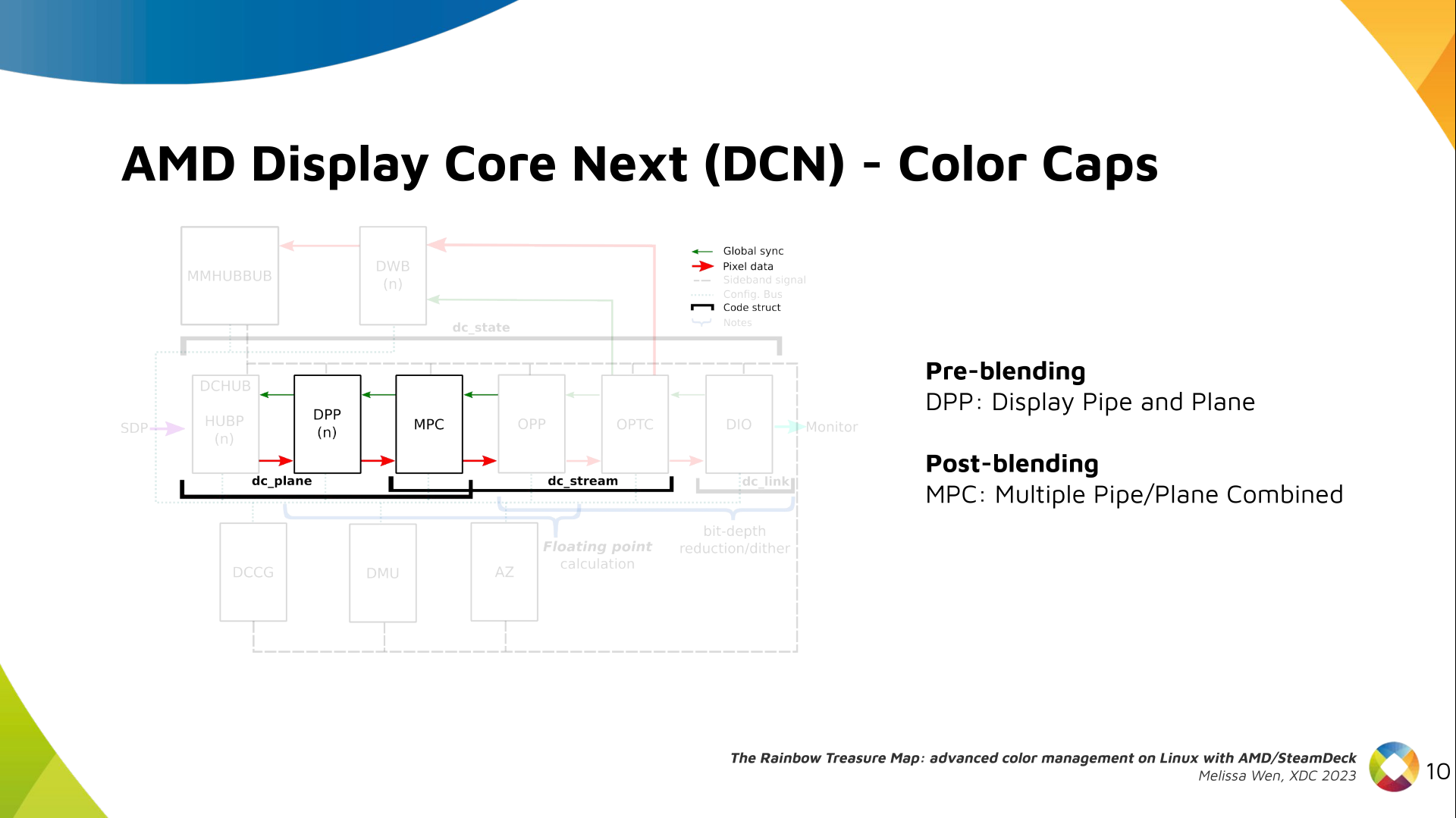
In the AMD Display Core Next hardware pipeline, we encounter two hardware
blocks with color capabilities: the Display Pipe and Plane (DPP) and the
Multiple Pipe/Plane Combined (MPC). The DPP handles color adjustments per plane
before blending, while the MPC engages in post-blending color adjustments.
In short, we expect DPP color capabilities to match up with DRM plane
properties, and MPC color capabilities to play nice with DRM CRTC properties.
Note: here s the catch there are some DRM CRTC color transformations that
don t have a corresponding AMD MPC color block, and vice versa. It s like a
puzzle, and we re here to solve it!
struct
dpp_color_caps
and struct
mpc_color_caps.
The AMD Steam Deck hardware provides a tangible example of these capabilities.
Therefore, we take SteamDeck/DCN301 driver as an example and look at the Color
pipeline capabilities described in the file:
driver/gpu/drm/amd/display/dcn301/dcn301_resources.c
/* Color pipeline capabilities */
dc->caps.color.dpp.dcn_arch = 1; // If it is a Display Core Next (DCN): yes. Zero means DCE.
dc->caps.color.dpp.input_lut_shared = 0;
dc->caps.color.dpp.icsc = 1; // Intput Color Space Conversion (CSC) matrix.
dc->caps.color.dpp.dgam_ram = 0; // The old degamma block for degamma curve (hardcoded and LUT). Gamma correction is the new one.
dc->caps.color.dpp.dgam_rom_caps.srgb = 1; // sRGB hardcoded curve support
dc->caps.color.dpp.dgam_rom_caps.bt2020 = 1; // BT2020 hardcoded curve support (seems not actually in use)
dc->caps.color.dpp.dgam_rom_caps.gamma2_2 = 1; // Gamma 2.2 hardcoded curve support
dc->caps.color.dpp.dgam_rom_caps.pq = 1; // PQ hardcoded curve support
dc->caps.color.dpp.dgam_rom_caps.hlg = 1; // HLG hardcoded curve support
dc->caps.color.dpp.post_csc = 1; // CSC matrix
dc->caps.color.dpp.gamma_corr = 1; // New Gamma Correction block for degamma user LUT;
dc->caps.color.dpp.dgam_rom_for_yuv = 0;
dc->caps.color.dpp.hw_3d_lut = 1; // 3D LUT support. If so, it's always preceded by a shaper curve.
dc->caps.color.dpp.ogam_ram = 1; // Blend Gamma block for custom curve just after blending
// no OGAM ROM on DCN301
dc->caps.color.dpp.ogam_rom_caps.srgb = 0;
dc->caps.color.dpp.ogam_rom_caps.bt2020 = 0;
dc->caps.color.dpp.ogam_rom_caps.gamma2_2 = 0;
dc->caps.color.dpp.ogam_rom_caps.pq = 0;
dc->caps.color.dpp.ogam_rom_caps.hlg = 0;
dc->caps.color.dpp.ocsc = 0;
dc->caps.color.mpc.gamut_remap = 1; // Post-blending CTM (pre-blending CTM is always supported)
dc->caps.color.mpc.num_3dluts = pool->base.res_cap->num_mpc_3dlut; // Post-blending 3D LUT (preceded by shaper curve)
dc->caps.color.mpc.ogam_ram = 1; // Post-blending regamma.
// No pre-defined TF supported for regamma.
dc->caps.color.mpc.ogam_rom_caps.srgb = 0;
dc->caps.color.mpc.ogam_rom_caps.bt2020 = 0;
dc->caps.color.mpc.ogam_rom_caps.gamma2_2 = 0;
dc->caps.color.mpc.ogam_rom_caps.pq = 0;
dc->caps.color.mpc.ogam_rom_caps.hlg = 0;
dc->caps.color.mpc.ocsc = 1; // Output CSC matrix.
struct dpp_color_caps,
struct mpc_color_caps
and struct rom_curve_caps.
Now, using this guideline, we go through color capabilities of DPP and MPC blocks and talk more
about mapping driver-specific properties to corresponding color blocks.
dc->caps.color.dpp.dcn_arch
dc->caps.color.dpp.dgam_ram, dc->caps.color.dpp.dgam_rom_caps,dc->caps.color.dpp.gamma_corr
AMD Plane Degamma data is mapped to the initial stage of the DPP pipeline. It
is utilized to transition from scanout/encoded values to linear values for
arithmetic operations. Plane Degamma supports both pre-defined transfer
functions and 1D LUTs, depending on the hardware generation. DCN2 and older
families handle both types of curve in the Degamma RAM block
(dc->caps.color.dpp.dgam_ram); DCN3+ separate hardcoded curves and 1D LUT
into two block: Degamma ROM (dc->caps.color.dpp.dgam_rom_caps) and Gamma
correction block (dc->caps.color.dpp.gamma_corr), respectively.
Pre-defined transfer functions:
struct drm_color_lut elements. Setting TF = Identity/Default and LUT as
NULL means bypass.
References:
struct drm_color_ctm_3x4. Setting NULL means bypass.
References:
dc->caps.color.dpp.hw_3d_lut
The Shaper block fine-tunes color adjustments before applying the 3D LUT,
optimizing the use of the limited entries in each dimension of the 3D LUT. On
AMD hardware, a 3D LUT always means a preceding shaper 1D LUT used for
delinearizing and/or normalizing the color space before applying a 3D LUT, so
this entry on DPP color caps dc->caps.color.dpp.hw_3d_lut means support for
both shaper 1D LUT and 3D LUT.
Pre-defined transfer function enables delinearizing content with or without
shaper LUT, where AMD color module calculates the resulted shaper curve. Shaper
curves go from linear values to encoded values. If we are already in a
non-linear space and/or don t need to normalize values, we can set a Identity TF
for shaper that works similar to bypass and is also the default TF value.
Pre-defined transfer functions:
calculate_curve() function in the file
amd/display/modules/color/color_gamma.c.struct drm_color_lut elements. When setting Plane Shaper TF (!= Identity)
and LUT at the same time, the color module will combine the pre-defined TF and
the custom LUT values into the LUT that s actually programmed. Setting TF =
Identity/Default and LUT as NULL works as bypass.
References:
dc->caps.color.dpp.hw_3d_lut
The 3D LUT in the DPP block facilitates complex color transformations and
adjustments. 3D LUT is a three-dimensional array where each element is an RGB
triplet. As mentioned before, the dc->caps.color.dpp.hw_3d_lut describe if
DPP 3D LUT is supported.
The AMD driver-specific property advertise the size of a single dimension via
LUT3D_SIZE property. Plane 3D LUT is a blog property where the data is interpreted
as an array of struct drm_color_lut elements and the number of entries is
LUT3D_SIZE cubic. The array contains samples from the approximated function.
Values between samples are estimated by tetrahedral interpolation
The array is accessed with three indices, one for each input dimension (color
channel), blue being the outermost dimension, red the innermost. This
distribution is better visualized when examining the code in
[RFC PATCH 5/5] drm/amd/display: Fill 3D LUT from userspace by Alex Hung:
+ for (nib = 0; nib < 17; nib++)
+ for (nig = 0; nig < 17; nig++)
+ for (nir = 0; nir < 17; nir++)
+ ind_lut = 3 * (nib + 17*nig + 289*nir);
+
+ rgb_area[ind].red = rgb_lib[ind_lut + 0];
+ rgb_area[ind].green = rgb_lib[ind_lut + 1];
+ rgb_area[ind].blue = rgb_lib[ind_lut + 2];
+ ind++;
+
+
+
+ /* Stride and bit depth are not programmable by API yet.
+ * Therefore, only supports 17x17x17 3D LUT (12-bit).
+ */
+ lut->lut_3d.use_tetrahedral_9 = false;
+ lut->lut_3d.use_12bits = true;
+ lut->state.bits.initialized = 1;
+ __drm_3dlut_to_dc_3dlut(drm_lut, drm_lut3d_size, &lut->lut_3d,
+ lut->lut_3d.use_tetrahedral_9,
+ MAX_COLOR_3DLUT_BITDEPTH);
dc->caps.color.dpp.ogam_ram
The Blend/Out Gamma block applies the final touch-up before blending, allowing
users to linearize content after 3D LUT and just before the blending. It supports both 1D LUT
and pre-defined TF. We can see Shaper and Blend LUTs as 1D LUTs that are
sandwich the 3D LUT. So, if we don t need 3D LUT transformations, we may want
to only use Degamma block to linearize and skip Shaper, 3D LUT and Blend.
Pre-defined transfer function:
struct drm_color_lut elements. If plane_blend_tf_property != Identity TF,
AMD color module will combine the user LUT values with pre-defined TF into the
LUT parameters to be programmed. Setting TF = Identity/Default and LUT to NULL
means bypass.
References:
struct drm_color_lut elements. Setting NULL means bypass.
Not really supported. The driver is currently reusing the DPP degamma LUT block
(dc->caps.color.dpp.dgam_ram and dc->caps.color.dpp.gamma_corr) for
supporting DRM CRTC Degamma LUT, as explaning by [PATCH v3 20/32]
drm/amd/display: reject atomic commit if setting both plane and CRTC
degamma.
dc->caps.color.mpc.gamut_remap
It sets the current transformation matrix (CTM) apply to pixel data after the
lookup through the degamma LUT and before the lookup through the gamma LUT. The
data is interpreted as a struct drm_color_ctm. Setting NULL means bypass.
dc->caps.color.mpc.ogam_ram
After all that, you might still want to convert the content to wire encoding.
No worries, in addition to DRM CRTC 1D LUT, we ve got a AMD CRTC gamma transfer
function (TF) to make it happen. Possible TF values are defined by enum
amdgpu_transfer_function.
Pre-defined transfer functions:
struct drm_color_lut elements. When setting CRTC Gamma TF (!= Identity)
and LUT at the same time, the color module will combine the pre-defined TF and
the custom LUT values into the LUT that s actually programmed. Setting TF =
Identity/Default and LUT to NULL means bypass.
References:
color_range and color_encoding properties. It is used for color space
conversion of the input content. On the other hand, we have de DC Output CSC
(OCSC) sets pre-defined coefficients from DRM connector colorspace
properties. It is uses for color space conversion of the composed image to the
one supported by the sink.
References:
A new release 0.3.3.9.4 of RcppEigen
arrived on CRAN yesterday, and
went to Debian today. Eigen is a C++ template library
for linear algebra: matrices, vectors, numerical solvers, and related
algorithms.
This update contains a small amount of the usual maintenance (see
below), along with a very nice pull request by Mikael Jagan which simplifies to
interface with the Matrix package and
inparticular the CHOLMOD library that is part of SuiteSparse.
This release is coordinated with lme4 and OpenMx which are
also being updated.
The complete NEWS file entry follows.
Courtesy of CRANberries, there is also a diffstat report for the most recent release. If you like this or other open-source work I do, you can sponsor me at GitHub.Changes in RcppEigen version 0.3.3.9.4 (2023-11-01)
- The CITATION file has been updated for the new
bibentrystyle.- The package skeleton generator has been updated and no longer sets an Imports:.
- Some README.md URLs and badged have been updated.
- The use of
-fopenmphas been documented inMakevars, and a simple thread-count reporting function has been added.- The old manual
src/init.chas been replaced by an autogenerated version, theRcppExportsfile have regenerated- The interface to package Matrix has been updated and simplified thanks to an excllent patch by Mikael Jagan.
- The new upload is coordinated with packages lme4 and OpenMx.
This post by Dirk Eddelbuettel originated on his Thinking inside the box blog. Please report excessive re-aggregation in third-party for-profit settings.
import requests from datetime import datetime import appdaemon.plugins.hass.hassapi as hass app_token = "<FIREFLY_PERSONAL_ACCESS_TOKEN>" firefly_url = "<FIREFLY_URL>" class HelloWorld(hass.Hass): def initialize(self): self.run_every(self.set_asset, "now", 60 * 60) def set_asset(self, kwargs): ent = self.get_entity("sensor.firefly3_asset_sparkasse_main") if not ent.exists(): ent.add( state=0.0, attributes= "native_value": 0.0, "native_unit_of_measurement": "EUR", "state_class": "measurement", "device_class": "monetary", "current_balance_date": datetime.now(), ) r = requests.get( firefly_url + "/api/v1/accounts?type=asset", headers= "Authorization": "Bearer " + app_token, "Accept": "application/vnd.api+json", "Content-Type": "application/json", ) data = r.json() for account in data["data"]: if not "attributes" in account or "name" not in account["attributes"]: continue if account["attributes"]["name"] != "Sparkasse giro": continue self.log("Account :" + str(account["attributes"])) ent.set_state( state=account["attributes"]["current_balance"], attributes= "native_value": account["attributes"]["current_balance"], "current_balance_date": datetime.fromisoformat(account["attributes"]["current_balance_date"]), ) self.log("Entity updated")It uses a URL and personal access token to access Firefly III API, gets the asset accounts information, then extracts info about current balance and balance date of my main account and then creates and/or updates a "sensor" value into Home Assistant. This sensor is with metadata marked as a monetary value and as a measurement. This makes Home Assistant track this value in the database as a graphable changing value. I modified the file using the File Editor addon to edit the
/config/appdaemon/apps/hello.py file. Each
time the file is saved it is reloaded and logs can be seen in the AppDaemon Logs section - main_log for
logging messages or error_log if there is a crash. Useful to know that
requests library is included, but it hard to see in the
docks what else is included or if there is an easy way to install extra Python packages.
This is already a very nice basis for custom value insertion into Home Assistant - whatever you can with
a Python script extract or calculate, you can also inject into Home Assistant.
With even this simple approach you can monitor balances, budgets, piggy-banks, bill payment status and
even sum of transactions in particular catories in a particular time window. Especially interesting data
can be found in the insight section of the Firefly III API.
The script above uses a trigger
like self.run_every(self.set_asset, "now", 60 * 60) to simply run once per hour. The data in Firefly will not
be updated too often anyway, at least not until we figure out how to make bank connection run automatically
without user interaction and not screw up already existing transactions along the way. In theory a
webhook API of the Firefly III
could be used to trigger the data update instantly when any transaction is created or updated. Possibly
even using Home Assistant
webhook integration. Hmmm. Maybe.
Who am I kiddind? I am going to make that work, for sure! :D But first - how about figuring out the future?
So what I want to do? In short, I want to predict what will be the balance on my main account just
before the next months salary comes in. To do this I would:
xzcat haos_generic-x86-64-11.0.img.xz dd of=/dev/mmcblk0 bs=1M
That just worked, prefectly and really fast. If you want to use a GUI in a live environment, then just using
the gnome-disk-utility ("Disks" in Gnome menu) and using the "Restore Disk Image ..." on a partition would
work just as well. It even supports decompressing the XZ images directly while writing.
But that image is small, will it not have a ton of unused disk space behind the fixed install partition? Yes,
it will ... until first boot. The HA OS takes over the empty space after its install partition on the first
boot-up and just grows its main partition to take up all the remaining space. Smart. After first boot is
completed, the first boot wizard can be accessed via your web browser and one of the prominent buttons there
is restoring from backup. So you just give it the backup file and wait. Sadly the restore does not actually give
any kind of progress, so your only way to figure out when it is done is opening the same web adress in another
browser tab and refresh periodically - after restoring from backup it just boots into the same config at it had
before - all the settings, all the devices, all the history is preserved. Even authentification tokens are
preserved so if yu had a Home Assitant Mobile installed on your phone (both for remote access and to send
location info and phone state, like charging, to HA to trigger automations) then it will just suddenly start
working again without further actions needed from your side. That is an almost perfect backup/restore experience.
The first thing you get for using the OS version of HA is easy automatic update that also automatically takes
a backup before upgrade, so if anything breaks you can roll back with one click. There is also a command-line
tool that allows to upgrade, but also downgrade ha-core and other modules. I had to use it today as HA version
23.10.4 actually broke support for the Sonoff bridge that I am using to control Zigbee devices, which are like
90% of all smart devices in my home. Really helpful stuff, but not a must have.
What is a must have and that you can (really) only get with Home Assistant Operating System are Addons. Some
addons are just normal servers you can run alongside HA on the same HA OS server, like MariaDB or Plex or a
file server. That is not the most important bit, but even there the software comes pre-configured to use in
a home server configuration and has a very simple config UI to pre-configure key settings, like users,
passwords and database accesses for MariaDB - you can litereally in a few clicks and few strings make serveral
users each with its own access to its own database. Couple more clicks and the DB is running and will be kept
restarted in case of failures.
But the real gems in the Home Assistant Addon Store are modules that extend Home Assitant core functionality
in way that would be really hard or near impossible to configure in Home Assitant Container manually,
especially because no documentation has ever existed for such manual config - everyone just tells you to
install the addon from HA Addon store or from HACS. Or you can read the addon metadata in various repos and
figure out what containers it actually runs with what settings and configs and what hooks it puts into the HA
Core to make them cooperate. And then do it all over again when a new version breaks everything 6 months later
when you have already forgotten everything. In the Addons that show up immediately after installation are
addons to install the new Matter
server, a MariaDB and MQTT server
(that other addons can use for data storage
and message exchange), Z-Wave support and ESPHome integration and very handy File manager that includes
editors to edit Home Assitant configs directly in brower and SSH/Terminal addon that boht allows SSH
connection and also a
web based terminal that gives access to the OS itself and also to a comand line interface, for example, to
do package downgrades if needed or see detailed logs. And also there is where you can get the features
that are the focus this year for HA developers - voice enablers.
However that is only a beginning. Like in Debian you can add additional repositories to expand your list of
available addons. Unlike Debian most of the amazing software that is available for Home Assistant is outside
the main, official addon store. For now I have added the most popular addon repository - HACS (Home Assistant
Community Store) and repository maintained by Alexbelgium. The first includes things like NodeRED (a workflow
based automation programming UI), Tailscale/Wirescale for VPN servers, motionEye for CCTV control, Plex for
home streaming. HACS also includes a lot of HA UI enhacement modules, like themes, custom UI control panels
like Mushroom or mini-graph-card and integrations that provide more advanced functions, but also require
more knowledge to use, like Local Tuya - that is harder to set up, but allows fully local control of (normally)
cloud-based devices. And it has AppDaemon - basically a Python based automation framework where you put in
Python scrips that get run in a special environment where they get fed events from Home Assistant and can
trigger back events that can control everything HA can and also do anything Python can do. This I will need
to explore later.
And the repository by Alex includes the thing that is actually the focus of this blog post (I know :D) -
Firefly III addon and Firefly Importer addon that you can then add to your Home Assistant OS with a few
clicks. It also has all kinds of addons for NAS management, photo/video server, book servers and
Portainer that
lets us setup and run any Docker container inside the HA OS structure. HA OS will detect this and warn you
about unsupported processes running on your HA OS instance (nice security feature!), but you can just dismiss
that. This will be very helpful very soon.
This whole environment of OS and containers and apps really made me think - what was missing in Debian that
made the talented developers behind all of that to spend the immense time and effor to setup a completely
new OS and app infrastructure and develop a completel paraller developer community for Home Assistant apps,
interfaces and configurations. Is there anything that can still be done to make HA community and the
general open source and Debian community closer together? HA devs are not doing anything wrong: they are
using the best open source can provide, they bring it to people whould could not install and use it otherwise,
they are contributing fixes and improvements as well. But there must be some way to do this better, together.
So I installed MariaDB, create a user and database for Firefly. I installed Firefly III and configured
it to use the MariaDB with the web config UI. When I went into the Firefly III web UI I was confronted with
the normal wizard to setup a new instance. And no reference to any backup restore. Hmm, ok. Maybe that goes
via the Importer? So I make an access token again, configured the Importer to use that, configured the
Nordlinger bank connection settings. Then I tried to import the export that I downloaded from Firefly III
before. The importer did not auto-recognose the format. Turns out it is just a list of transactions ...
It can only be barely useful if you first manually create all the asset accounts with the same names as
before and even then you'll again have to deal with resolving the problem of transfers showing up twice.
And all of your categories (that have not been used yet) are gone, your automation rules and bills are gone,
your budgets and piggy banks are gone. Boooo. It will be easier for me to recreate my account data from
bank exports again than to resolve data in that transaction export.
Turns out that Firefly III documenation explicitly
recommends making a mysqldump of your own and not rely
on anything in the app itself for backup purposes. Kind of sad this was not mentioned in the export page
that sure looked a lot like a backup :D
After doing all that work all over again I needed to make something new not to feel like I wasted days of
work for no real gain. So I started solving a problem I had for a while already - how do I add cash
transations to the system when I am out of the house with just my phone in the hand? So far my workaround has
been just sending myself messages in WhatsApp with the amount and description of any cash expenses. Two
solutions are possible: app and bot.
There are actually multiple Android-based phone apps that work with Firefly III API to do full
financial management from the phone. However, after trying it out, that is not what I will be using most
of the time. First of all this requires your Firefly III instance to be accessible from the Internet. Either
via direct API access using some port forwarding and secured with HTTPS and good access tokens, or via
a VPN server redirect that is installed on both HA and your phone. Tailscale was really easy to get working.
But the power has its drawbacks - adding a new cash transaction requires opening the app, choosing new
transaction view, entering descriptio, amount, choosing "Cash" as source account and optionally choosing
destination expense account, choosing category and budget and then submitting the form to the server.
Sadly none of that really works if you have no Internet or bad Internet at the place where you are using
cash. And it's just too many steps. Annoying.
An easier alternative is setting up a Telegram bot -
it is running in a custom Docker container right
next to your Firefly (via Portainer) and you talk to it via a custom Telegram chat channel that you create
very easily and quickly. And then you can just tell it "Coffee 5" and it will create a transaction
from the (default) cash account in 5 amount with description "Coffee". This part also works if you are
offline at the moment - the bot will receive the message once you get back online. You can use Telegram
bot menu system to edit the transaction to add categories or expense accounts, but this part only work
if you are online. And the Firefly instance does not have to be online at all. Really nifty.
So next week I will need to write up all the regular payments as bills in Firefly (again) and then I can start
writing a Python script to predict my (financial) future!251. This version includes the following changes:
* If the equivalent of file -i returns text/plain, fallback to comparing
this file as a text file. This especially helps when file(1) miscategorises
text files as some esoteric type. (Closes: Debian:#1053668)
* Update copyright years.
The following contributors got their Debian Developer accounts in the last two months:
Almost a month ago, I went to my always loved Rancho
Electr nico to celebrate the 30th anniversary of
the Debian project. Hats off to
Jathan for all the work
he put into this! I was there for close to 3hr, and be it following up an
install, doing a talk, or whatever he was doing it. But anyway, I only managed
to attend with one of my (great, beautiful and always loved) generic Debian or
DebConf T-shirts.
Today, when going through a box of old T-shirts, I found the shirt I was
looking for to bring to the occasion. A smallish print, ~12cm wide, over the
heart:
And as a larger print, ~25cm wide, across the back:
For the benefit of people who read this using a non-image-displaying browser or
RSS client, they are respectively:
10 years
100 countries
1000 maintainers
10000 packages
1 project
10 architectures
100 countries
1000 maintainers
10000 packages
100000 bugs fixed
1000000 installations
10000000 users
100000000 lines of code
Next.