Search Results: "enrico"

15 November 2016

Enrico Zini: Software quality in 2016

Ansible's default output, including the stderr of failed commands, is JSON encoded, which makes reading Jenkins' output hard. Ansible however has Callback plugins that could be used. In that page it says:
Ansible comes with a number of callback plugins that you can look at for examples. These can be found in lib/ansible/plugins/callback.
That is a link to a git repo with just a pile of Python sources and no, say README.md index to what they do. Hopefully they have some docstring with a short description of what they do? no. Actually, some do, but just because someone copypasted the default one and didn't even bother removing its docstring. frustration

9 November 2016

Enrico Zini: On SPF

I woke up this morning with some Django server error mails in my inbox:
UnicodeDecodeError: 'ascii' codec can't decode byte 0xc5 in position 9: ordinal not in range(128)
 
 'REMOTE_USER': u' -guest@users.alioth.debian.org',
I did what one does in cases like these, I tried to fix the bug and mailed -guest@users.alioth.debian.org asking them to try again and let me know if it works. I get a bounce:
  <Actual user's email>
    (generated from  -guest@users.alioth.debian.org)
    SMTP error from remote mail server after MAIL FROM:<enrico@enricozini.org> SIZE=3948:
    host   [ ]: 550 Please see http://www.openspf.org/Why?id=enrico%40enricozini.org&ip=2001%3a41c8%3a1000%3a21%3a%3a21%3a21&receiver=bq :
    Reason: mechanism
I resent the mail to the actual user's address, and it went through. Job done, at least until they get back to me telling me that my fix didn't work. Lessons learnt:

2 November 2016

Enrico Zini: schroot connector for ansible

I accidentally made an ansible connector plugin for schroot. I haven't even used ansible yet, so I have no idea what I am doing. You can choose the chroot type by setting something like schroot_type: jessie in your variables. You can install this locally as connection_plugins/schroot.py.
# Based on chroot.py (c) 2013, Maykel Moya <mmoya@speedyrails.com>
# Based on chroot.py (c) 2015, Toshio Kuratomi <tkuratomi@ansible.com>
# (c) 2016, Enrico Zini <enrico@debian.org>
#
# This is free software: you can redistribute it and/or modify
# it under the terms of the GNU General Public License as published by
# the Free Software Foundation, either version 3 of the License, or
# (at your option) any later version.
#
# Ansible is distributed in the hope that it will be useful,
# but WITHOUT ANY WARRANTY; without even the implied warranty of
# MERCHANTABILITY or FITNESS FOR A PARTICULAR PURPOSE.  See the
# GNU General Public License for more details.
#
# You should have received a copy of the GNU General Public License
# along with Ansible.  If not, see <http://www.gnu.org/licenses/>.
from __future__ import (absolute_import, division, print_function)
__metaclass__ = type
import distutils.spawn
import os
import os.path
import pipes
import subprocess
import traceback
from ansible import constants as C
from ansible.errors import AnsibleError
from ansible.plugins.connection import ConnectionBase, BUFSIZE
from ansible.module_utils.basic import is_executable
from ansible.utils.unicode import to_bytes
try:
    from __main__ import display
except ImportError:
    from ansible.utils.display import Display
    display = Display()
class Connection(ConnectionBase):
    ''' Local chroot based connections '''
    transport = 'schroot'
    has_pipelining = True
    # su currently has an undiagnosed issue with calculating the file
    # checksums (so copy, for instance, doesn't work right)
    # Have to look into that before re-enabling this
    become_methods = frozenset(C.BECOME_METHODS).difference(('su',))
    def __init__(self, play_context, new_stdin, *args, **kwargs):
        super(Connection, self).__init__(play_context, new_stdin, *args, **kwargs)
        self.chroot = self._play_context.remote_addr
        #if os.geteuid() != 0:
            #raise AnsibleError("chroot connection requires running as root")
        # we're running as root on the local system so do some
        # trivial checks for ensuring 'host' is actually a chroot'able dir
        #if not os.path.isdir(self.chroot):
        #    raise AnsibleError("%s is not a directory" % self.chroot)
        #chrootsh = os.path.join(self.chroot, 'bin/sh')
        ## Want to check for a usable bourne shell inside the chroot.
        ## is_executable() == True is sufficient.  For symlinks it
        ## gets really complicated really fast.  So we punt on finding that
        ## out.  As long as it's a symlink we assume that it will work
        #if not (is_executable(chrootsh) or (os.path.lexists(chrootsh) and os.path.islink(chrootsh))):
        #    raise AnsibleError("%s does not look like a chrootable dir (/bin/sh missing)" % self.chroot)
        self.chroot_cmd = distutils.spawn.find_executable('schroot')
        if not self.chroot_cmd:
            raise AnsibleError("chroot command not found in PATH")
        self.chroot_id = "session:" + self.chroot
        self.chroot_type = "stable"
        existing = subprocess.check_output([self.chroot_cmd, "--list", "--all"])
        self.chroot_exists = False
        for line in existing.splitlines():
            if line == self.chroot_id:
                self.chroot_exists = True
    def set_host_overrides(self, host, hostvars=None):
        super(Connection, self).set_host_overrides(host, hostvars)
        self.chroot_type = hostvars.get("schroot_type", self.chroot_type)
    def _connect(self):
        ''' connect to the chroot; nothing to do here '''
        super(Connection, self)._connect()
        if not self._connected:
            if not self.chroot_exists:
                self.chroot_id = subprocess.check_output([self.chroot_cmd, "-b", "-c", self.chroot_type, "-n", self.chroot]).strip()
                subprocess.check_call([self.chroot_cmd, "-r", "-c", self.chroot_id, "-u", "root", "--", "apt-get", "update"])
                subprocess.check_call([self.chroot_cmd, "-r", "-c", self.chroot_id, "-u", "root", "--", "apt-get", "-y", "install", "python"])
            display.vvv("THIS IS A LOCAL CHROOT DIR", host=self.chroot)
            self._connected = True
    def _buffered_exec_command(self, cmd, stdin=subprocess.PIPE):
        ''' run a command on the chroot.  This is only needed for implementing
        put_file() get_file() so that we don't have to read the whole file
        into memory.
        compared to exec_command() it looses some niceties like being able to
        return the process's exit code immediately.
        '''
        executable = C.DEFAULT_EXECUTABLE.split()[0] if C.DEFAULT_EXECUTABLE else '/bin/sh'
        local_cmd = [self.chroot_cmd, "-r", "-c", self.chroot_id, "-u", "root", "--", executable, '-c', cmd]
        display.vvv("EXEC %s" % (local_cmd), host=self.chroot)
        local_cmd = [to_bytes(i, errors='strict') for i in local_cmd]
        p = subprocess.Popen(local_cmd, shell=False, stdin=stdin,
                stdout=subprocess.PIPE, stderr=subprocess.PIPE)
        return p
    def exec_command(self, cmd, in_data=None, sudoable=False):
        ''' run a command on the chroot '''
        super(Connection, self).exec_command(cmd, in_data=in_data, sudoable=sudoable)
        p = self._buffered_exec_command(cmd)
        stdout, stderr = p.communicate(in_data)
        return (p.returncode, stdout, stderr)
    def _prefix_login_path(self, remote_path):
        ''' Make sure that we put files into a standard path
            If a path is relative, then we need to choose where to put it.
            ssh chooses $HOME but we aren't guaranteed that a home dir will
            exist in any given chroot.  So for now we're choosing "/" instead.
            This also happens to be the former default.
            Can revisit using $HOME instead if it's a problem
        '''
        if not remote_path.startswith(os.path.sep):
            remote_path = os.path.join(os.path.sep, remote_path)
        return os.path.normpath(remote_path)
    def put_file(self, in_path, out_path):
        ''' transfer a file from local to chroot '''
        super(Connection, self).put_file(in_path, out_path)
        display.vvv("PUT %s TO %s" % (in_path, out_path), host=self.chroot)
        out_path = pipes.quote(self._prefix_login_path(out_path))
        try:
            with open(to_bytes(in_path, errors='strict'), 'rb') as in_file:
                try:
                    p = self._buffered_exec_command('dd of=%s bs=%s' % (out_path, BUFSIZE), stdin=in_file)
                except OSError:
                    raise AnsibleError("chroot connection requires dd command in the chroot")
                try:
                    stdout, stderr = p.communicate()
                except:
                    traceback.print_exc()
                    raise AnsibleError("failed to transfer file %s to %s" % (in_path, out_path))
                if p.returncode != 0:
                    raise AnsibleError("failed to transfer file %s to %s:\n%s\n%s" % (in_path, out_path, stdout, stderr))
        except IOError:
            raise AnsibleError("file or module does not exist at: %s" % in_path)
    def fetch_file(self, in_path, out_path):
        ''' fetch a file from chroot to local '''
        super(Connection, self).fetch_file(in_path, out_path)
        display.vvv("FETCH %s TO %s" % (in_path, out_path), host=self.chroot)
        in_path = pipes.quote(self._prefix_login_path(in_path))
        try:
            p = self._buffered_exec_command('dd if=%s bs=%s' % (in_path, BUFSIZE))
        except OSError:
            raise AnsibleError("chroot connection requires dd command in the chroot")
        with open(to_bytes(out_path, errors='strict'), 'wb+') as out_file:
            try:
                chunk = p.stdout.read(BUFSIZE)
                while chunk:
                    out_file.write(chunk)
                    chunk = p.stdout.read(BUFSIZE)
            except:
                traceback.print_exc()
                raise AnsibleError("failed to transfer file %s to %s" % (in_path, out_path))
            stdout, stderr = p.communicate()
            if p.returncode != 0:
                raise AnsibleError("failed to transfer file %s to %s:\n%s\n%s" % (in_path, out_path, stdout, stderr))
    def close(self):
        ''' terminate the connection; nothing to do here '''
        super(Connection, self).close()
        #subprocess.check_command([self.chroot_cmd, "-e", "-c", self.chroot_id])
        self._connected = False

31 October 2016

Enrico Zini: Links for November 2016

So You Want To Learn Physics... [archive]
This post is a condensed version of what I've sent to people who have contacted me over the years, outlining what everyone needs to learn in order to really understand physics.
Operation Tamarisk [archive]
Operation Tamarisk was a Cold War-era operation run by the military intelligence services of the U.S., U.K., and France through their military liaison missions in East Germany, that gathered discarded paper, letters, and garbage from Soviet trash bins and military maneuvers, including used toilet paper.
Mortara case
Of how in Bologna, where I live, in the 1850s/1860s, when my grand-grand-granddad lived, the Papal State seized a child from a Jewish family on the basis of a former servant's testimony that she had administered emergency baptism to the boy when he fell sick as an infant.

30 October 2016

Enrico Zini: Bremen Freimarkt Parade

Look! They are having a parade with people dressed like Debian releases! Bremen Freimarkt Parade

18 October 2016

Enrico Zini: debtags and aptitude forget-new

I like to regularly go through the new packages section in aptitude to see what interesting new packages entered testing, but recently that joyful moment got less joyful for me because of a barrage of obscurely named packages. I have just realised that aptitude forget-new supports search patterns, and that brought back the joy. I put this in a script that I run before looking for new packages in aptitude:
aptitude forget-new '?tag(field::biology)
                     ?tag(devel::lang:ruby)
                     ?tag(devel::lang:perl)
                     ?tag(role::shared-lib)
                     ?tag(suite::openstack)
                     ?tag(implemented-in::php)
                     ~n^node-'
The actual content of the search pattern is purely a matter of taste. I'm happy to see how debtags becomes quite useful here, to keep my own user experience manageable as the size of Debian keeps growing. Update: pabs suggested to use apt post-invoke hooks. For example:
        $ cat /etc/apt/apt.conf.d/99forget-new
        APT::Update::Post-Invoke   "aptitude forget-new '~sdebug'";  ;

25 September 2016

Vincent Sanders: I'll huff, and I'll puff, and I'll blow your house in

Sometimes it really helps to have a different view on a problem and after my recent writings on my Public Suffix List (PSL) library I was fortunate to receive a suggestion from my friend Enrico Zini.

I had asked for suggestions on reducing the size of the library further and Enrico simply suggested Huffman coding. This was a technique I had learned about long ago in connection with data compression and the intervening years had made all the details fuzzy which explains why it had not immediately sprung to mind.

A small subset of the Public Suffix List as stored within libnspslHuffman coding named for David A. Huffman is an algorithm that enables a representation of data which is very efficient. In a normal array of characters every character takes the same eight bits to represent which is the best we can do when any of the 256 values possible is equally likely. If your data is not evenly distributed this is not the case for example if the data was english text then the value is fifteen times more likely to be that for e than k.

every step of huffman encoding tree build for the example string tableSo if we have some data with a non uniform distribution of probabilities we need a way the data be encoded with fewer bits for the common values and more bits for the rarer values. To be efficient we would need some way of having variable length representations without storing the length separately. The term for this data representation is a prefix code and there are several ways to generate them.

Such is the influence of Huffman on the area of prefix codes they are often called Huffman codes even if they were not created using his algorithm. One can dream of becoming immortalised like this, to join the ranks of those whose names are given to units or whole ideas in a field must be immensely rewarding, however given Huffman invented his algorithm and proved it to be optimal to answer a question on a term paper in his early twenties I fear I may already be a bit too late.

The algorithm itself is relatively straightforward. First a frequency analysis is performed, a fancy way of saying count how many of each character is in the input data. Next a binary tree is created by using a priority queue initialised with the nodes sorted by frequency.

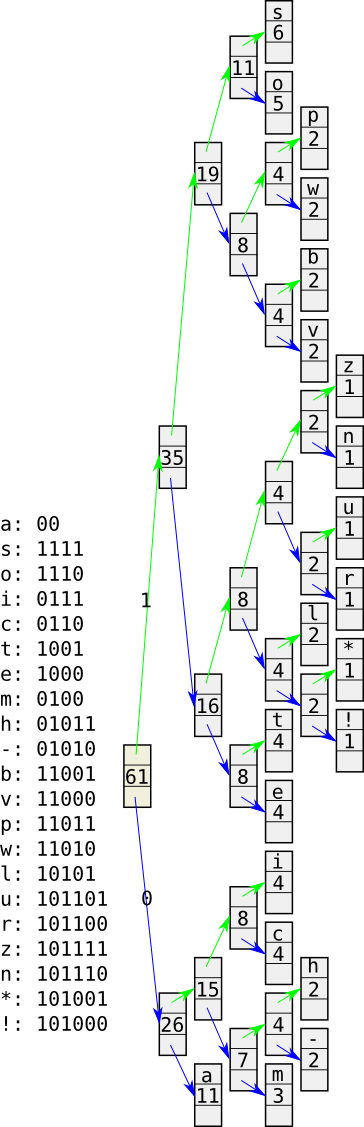
The resulting huffman tree and the binary representation of the input symbols
The two least frequent items count is summed together and a node placed in the tree with the two original entries as child nodes. This step is repeated until a single node exists with a count value equal to the length of the input.

To encode data once simply walks the tree outputting a 0 for a left node or 1 for right node until reaching the original value. This generates a mapping of values to bit output, the input is then simply converted value by value to the bit output. To decode the data the data is used bit by bit to walk the tree to arrive at values.

If we perform this algorithm on the example string table *!asiabvcomcoopitamazonawsarsaves-the-whalescomputebasilicata we can reduce the 488 bits (61 * 8 bit characters) to 282 bits or 40% reduction. Obviously in a real application the huffman tree would need to be stored which would probably exceed this saving but for larger data sets it is probable this technique would yield excellent results on this kind of data.

Once I proved this to myself I implemented the encoder within the existing conversion program. Although my perl encoder is not very efficient it can process the entire PSL string table (around six thousand labels using 40KB or so) in less than a second, so unless the table grows massively an inelegant approach will suffice.

The resulting bits were packed into 32bit values to improve decode performance (most systems prefer to deal with larger memory fetches less frequently) and resulted in 18KB of output or 47% of the original size. This is a great improvement in size and means the statically linked test program is now 59KB and is actually smaller than the gzipped source data.

$ ls -alh test_nspsl
-rwxr-xr-x 1 vince vince 59K Sep 25 23:58 test_nspsl
$ ls -al public_suffix_list.dat.gz
-rw-r--r-- 1 vince vince 62K Sep 1 08:52 public_suffix_list.dat.gz

To be clear the statically linked program can determine if a domain is in the PSL with no additional heap allocations and includes the entire PSL ordered tree, the domain label string table and the huffman decode table to read it.

An unexpected side effect is that because the decode loop is small it sits in the processor cache. This appears to cause the string comparison function huffcasecmp() (which is not locale dependant because we know the data will be limited ASCII) performance to be close to using strcasecmp() indeed on ARM32 systems there is a very modest improvement in performance.

I think this is as much work as I am willing to put into this library but I am pleased to have achieved a result which is on par with the best of breed (libpsl still has a data representation 20KB smaller than libnspsl but requires additional libraries for additional functionality) and I got to (re)learn an important algorithm too.

10 September 2016

Enrico Zini: Dreaming of being picked

From "Stop stealing dreams":
Settling for the not-particularly uplifting dream of a boring, steady job isn t helpful. Dreaming of being picked picked to be on TV or picked to play on a team or picked to be lucky isn t helpful either. We waste our time and the time of our students when we set them up with pipe dreams that don t empower them to adapt (or better yet, lead) when the world doesn t work out as they hope. The dreams we need are self-reliant dreams. We need dreams based not on what is but on what might be. We need students who can learn how to learn, who can discover how to push themselves and are generous enough and honest enough to engage with the outside world to make those dreams happen.
This made me think that I know many hero stories based on "the chosen", like Matrix, like most superheros getting powers either from some entity chosing them for it, or from chance. I have a hard time thinking of a superhero who becomes one just by working hard at acquiring and honing their skills: I can only think of Batman and Ironman, and they start off as super rich. If I think of people who start from scratch as commoners and work hard to become exceptional, in the standard superhero narrative, I can only think of supervillains. Scary. It makes me feel culturally biased into thinking that a common person cannot be trusted to act responsibly, and that only the rich, the chosen and the aristocrats can. As a bias it may serve the rich and the aristocrats, but I don't think it serves society as a whole.

31 August 2016

Enrico Zini: Links for September 2016

A Few Useful Mental Tools from Richard Feynman [archive]
These tricks show Feynman taking the method of thought he learned in pure science and applying it to the more mundane topics most of us have to deal with every day.
Pasta [archive]
A comprehensive introduction to pasta, to keep at hand in case I meet someone who has little familiarity with it.
MPTP: One Designer Drug and Serendipity [archive]
Abstract: Through an unlikely series of coincidences and fortunate accidents, the development of Parkinson s disease in several illicit drug users was traced to their use of a meperidine analog contaminated with 1-methyl-4-phenyl-1,2,3,6-tetrahydropyridine (MPTP). The discovery of a chemical capable of producing animal models of the disease has revitalized research efforts and resulted in important new information. The serendipitous finding also prompted consideration of what changes seem advisable if designer drugs are to be dealt with more efficaciously.
The Debunking Handbook: now freely available for download
The Debunking Handbook, a guide to debunking misinformation, is now freely available to download. Although there is a great deal of psychological research on misinformation, there's no summary of the literature that offers practical guidelines on the most effective ways of reducing the influence of myths.
Faulty neon light jams radio appliances [archive]
An apparent interference source began plaguing wireless vehicle key fobs, cell phones, and other wireless electronics. Key fob owners found they could not open or start their vehicles remotely until their vehicles were towed at least a block away, nor were they able to call for help on their cell phones when problems occurred
Calvin & Muad'Dib
Calvin & Hobbes with text taken from Frank Herbert's Dune. It's been around since 2013 and I consistently found it moving and deep.
When Birds Attack - Bike Helmet Hacks [archive]
Australian magpies attacking cyclists has propted several creative adaptations, including attaching an afro wig to the bike helmet.

31 July 2016

Enrico Zini: Links for August 2016

First post with the new link collection feature of staticsite!
Heavy Metal and Natural Language Processing [archived]
Natural language processing and Metal lyrics, including the formula for the "metalness" of a word and a list of the most and least metal words.
Confirming all use of an SSH agent [archived]
For a long time I ve wanted an ssh-agent setup that would ask me before every use, so I could slightly more comfortably forward authentication over SSH without worrying that my session might get hijacked somewhere at the remote end (I often find myself wanting to pull authenticated git repos on remote hosts). I m at DebConf this week, which is an ideal time to dig further into these things, so I did so today. As is often the case it turns out this is already possible, if you know how.
Why We Don t Report It [archived]
Why don t you report it? It s up there on every list I ve seen of things you shouldn t say to sexual assault survivors, yet I keep hearing it
Voltron, an extensible debugger UI toolkit written in Python
Multi-panel display built from various gdb outputs.
Notmuch, offlineimap and Sieve setup [archived]
Nice description of a notmuch+offlineimap+sieve setup, for when I feel like rethinking my email setup.
Wikipedia:Unusual articles
An endless source of weird and wonderful.
ZERO: no linked HIV transmissions [archived]
The results provide a dataset to question whether transmission with an undetectable viral load is actually possible. They should help normalise HIV and challenge stigma and discrimination.
TV pickup
Someone once in the UK told me that it was a big enough problem that so many people turn on their electric kettles during the endtitles of Eastenders, that there's an employee in a hydro plant that needs to watch it to ramp up the power at the right time. I've finally found a wikipedia page about it.
Amazon isn't saying if Echo has been wiretapped [archived]
"We may never know if the feds have hijacked Amazon Echo. In case you didn't know, Echo is an always-on device, which, when activated, can return search queries, as well as read audiobooks and report sports, traffic, and weather. It can even control smart home devices."

9 July 2016

Enrico Zini: Monthly link collections with staticsite

A year ago, I wrote:
Instead of keeping substantial tabs open until I have read all of them, or losing them in the jungle of browser bookmarks, I have written a script that collects them into a file per month, and turns them into markdown files for my blog.
That script turned out to be quirky and overengineered, so much so that I stopped using it myself. I've now rethought my approach, and downscaled it: instead of saving a copy of each page locally, I can blog a reference to https://archive.org or https://archive.is. I do not need to autogenerate a description from the site itself. The result has been a nicely minimal set of changes to staticsite that resulted in a new version where adding a link to a monthly collection is as easy as typing ssite new -a links. As long as I'll remember to rebuild the site 3 weeks from now, a new post should automagically appear in my blog.

26 June 2016

Clint Adams: A local script for local people

This isn't actually answering the question, but it's close. It's also horrible, so whoever adopts Enrico's script should also completely rewrite this or burn it along with the stack of pizza boxes and the grand piano. Input:
#!/bin/zsh
set -e
PATHS=$(tempfile)
NEWKEYS=$(tempfile)
NEWKEYRING=$(tempfile)
FARTHEST_TEN=$(tempfile)
trap "rm -f $ PATHS  $ NEWKEYS  $ NEWKEYRING  $ FARTHEST_TEN " EXIT
keyring=$ 1:-ksp-dc16.gpg 
myfpr=$ 2:-2100A32C46F895AF3A08783AF6D3495BB0AE9A02 
#keyserver=$ 3:-http://pool.sks-keyservers.net:11371/ 
# this doesn't handle hokey fetch failures
#(for fpr in $(hkt list --keyring $ keyring  --output-format JSON   jq '.[].publickey.fpr')
#do
#  hokey fetch --keyserver "$ keyserver " --validation-method MatchPrimaryKeyFingerprint "$ (Q)fpr "
#done) >$ NEWKEYS 
#
#gpg2 --no-default-keyring --keyring $ NEWKEYRING  --import $ NEWKEYS 
cp "$ keyring " "$ NEWKEYRING "
gpg2 --no-default-keyring --keyring $ NEWKEYRING  --refresh
hkt findpaths --keyring $ NEWKEYRING  '' '' '' > $ PATHS 
id=$(awk -F, "/$ myfpr )\$/  sub(/\(/,BLANKY,\$1);print \$1; " $ PATHS )
grep -e ",\[$ id ," -e ",$ id \]" $ PATHS    sort -n   tail -n 10 > $ FARTHEST_TEN 
targetids=($ (f)"$ $((sed 's/^.*\[//;s/,.*$//;' $ FARTHEST_TEN ; sed 's/\])$//;s/.*,//;' $ FARTHEST_TEN )   sort -n -u   grep -v "^$ id $") " )
targetfprs=($(for i in $ targetids ; do awk -F, "/\($ i ,[^[]/  sub(/\)/,BLANKY,\$2); print \$2 " $ PATHS ; done))
gpg2 --no-default-keyring --keyring $ NEWKEYRING  --list-keys $ targetfprs 
Output:
pub   rsa4096/0x664F1238AA8F138A 2015-07-14 [SC]
      Key fingerprint = 3575 0B8F B6EF 95FF 16B8  EBC0 664F 1238 AA8F 138A
uid                   [ unknown] Daniel Lange <dl.ml1@usrlocal.de>
sub   rsa4096/0x03BEE1C11DB1954B 2015-07-14 [E]
pub   rsa4096/0xDF23DA3396978EB3 2014-09-05 [SC]
      Key fingerprint = BBBC 58B4 5994 CF9C CC56  BCDA DF23 DA33 9697 8EB3
uid                   [  undef ] Michael Meskes <michael@fam-meskes.de>
uid                   [  undef ] Michael Meskes <meskes@postgresql.org>
uid                   [  undef ] Michael Meskes <michael.meskes@credativ.com>
uid                   [  undef ] Michael Meskes <meskes@debian.org>
sub   rsa4096/0x85C3AFFECF0BF9B5 2014-09-05 [E]
sub   rsa4096/0x35D857C0BBCB3B25 2014-11-04 [S]
pub   rsa4096/0x1E953E27D4311E58 2009-07-12 [SC]
      Key fingerprint = C2FE 4BD2 71C1 39B8 6C53  3E46 1E95 3E27 D431 1E58
uid                   [  undef ] Chris Lamb <chris@chris-lamb.co.uk>
uid                   [  undef ] Chris Lamb <lamby@gnu.org>
uid                   [  undef ] Chris Lamb <lamby@debian.org>
sub   rsa4096/0x72B3DBA98575B3F2 2009-07-12 [E]
pub   rsa4096/0xDF6D76C44D696F6B 2014-08-15 [SC] [expires: 2017-06-03]
      Key fingerprint = 1A6F 3E63 9A44 67E8 C347  6525 DF6D 76C4 4D69 6F6B
uid                   [ unknown] Sven Bartscher <sven.bartscher@weltraumschlangen.de>
uid                   [ unknown] Sven Bartscher <svenbartscher@yahoo.de>
uid                   [ unknown] Sven Bartscher <kritzefitz@debian.org>
sub   rsa4096/0x9E83B071ED764C3A 2014-08-15 [E]
sub   rsa4096/0xAEB25323217028C2 2016-06-14 [S]
pub   rsa4096/0x83E33BD7D4DD4CA1 2015-11-12 [SC] [expires: 2017-11-11]
      Key fingerprint = 0B5A 33B8 A26D 6010 9C50  9C6C 83E3 3BD7 D4DD 4CA1
uid                   [ unknown] Jerome Charaoui <jerome@riseup.net>
sub   rsa4096/0x6614611FBD6366E7 2015-11-12 [E]
sub   rsa4096/0xDB17405204ECB364 2015-11-12 [A] [expires: 2017-11-11]
pub   rsa4096/0xF823A2729883C97C 2014-08-26 [SC]
      Key fingerprint = 8ED6 C3F8 BAC9 DB7F C130  A870 F823 A272 9883 C97C
uid                   [ unknown] Lucas Kanashiro <kanashiro@debian.org>
uid                   [ unknown] Lucas Kanashiro <kanashiro.duarte@gmail.com>
sub   rsa4096/0xEE6E5D1A9C2F5EA6 2014-08-26 [E]
pub   rsa4096/0x2EC0FFB3B7301B1F 2014-08-29 [SC] [expires: 2017-04-06]
      Key fingerprint = 76A2 8E42 C981 1D91 E88F  BA5E 2EC0 FFB3 B730 1B1F
uid                   [ unknown] Niko Tyni <ntyni@debian.org>
uid                   [ unknown] Niko Tyni <ntyni@cc.helsinki.fi>
uid                   [ unknown] Niko Tyni <ntyni@iki.fi>
sub   rsa4096/0x129086C411868FD0 2014-08-29 [E] [expires: 2017-04-06]
pub   rsa4096/0xAA761F51CC10C92A 2016-06-20 [SC] [expires: 2018-06-20]
      Key fingerprint = C9DE 2EA8 93EE 4C86 BE73  973A AA76 1F51 CC10 C92A
uid                   [ unknown] Roger Shimizu <rogershimizu@gmail.com>
sub   rsa4096/0x2C2EE1D5DBE7B292 2016-06-20 [E] [expires: 2018-06-20]
sub   rsa4096/0x05C7FD79DD03C4BB 2016-06-20 [S] [expires: 2016-09-18]
Note that this completely neglects potential victims who are unconnected within the KSP set.

19 June 2016

Elena 'valhalla' Grandi: StickerConstructorSpec compliant swirl

StickerConstructorSpec compliant swirl

This evening I've played around a bit with the Sticker Constructor Specification https://github.com/terinjokes/StickerConstructorSpec and its https://github.com/terinjokes/StickerConstructorSpec/blob/master/assets/hexagonal-sticker_template.svg, and this is the result:

Immagine/fotohttp://social.gl-como.it/photos/valhalla/image/e8ee069635b2823e168c358d2a753f14


Now I just have to:

* find somebody in Europe who prints good stickers and doesn't require illustrator (or other proprietary software) to submit files for non-rectangular shapes
* find out which Debian team I should contact to submit the files so that they can be used by everybody interested.

But neither will happen today, nor probably tomorrow, because lazy O:-)

Edit: now that I'm awake I realized I forgot to thank @Enrico Zini Zini and MadameZou for their help in combining my two proposals in a better design.

Source svg http://social.gl-como.it/attach/3

15 June 2016

Enrico Zini: Verifying gpg keys

Suppose you have a gpg keyid like 9F6C6333 that corresponds to both key 1AE0322EB8F74717BDEABF1D44BB1BA79F6C6333 and 88BB08F633073D7129383EE71EA37A0C9F6C6333, and you don't know which of the two to use. You go to http://pgp.cs.uu.nl/ and find out that the site uses short key IDs, so the two keys are indistinguishable. Building on Clint's hopenpgp-tools, I made a script that screenscrapes http://pgp.cs.uu.nl/ for trust paths, downloads all the potentially connecting keys in a temporary keyring, and runs hkt findpaths on it:
$ ./verify-trust-paths 1793D6AB75663E6BF104953A634F4BD1E7AD5568 1AE0322EB8F74717BDEABF1D44BB1BA79F6C6333
hkt (hopenpgp-tools) 0.18
Copyright (C) 2012-2016  Clint Adams
hkt comes with ABSOLUTELY NO WARRANTY. This is free software, and you are welcome to redistribute it under certain conditions.
(4,[1,4,3,6])
(1,1793D6AB75663E6BF104953A634F4BD1E7AD5568)
(3,F8921D3A7404C86E11352215C7197699B29B232A)
(4,C331BA3F75FB723B5873785B06EAA066E397832F)
(6,1AE0322EB8F74717BDEABF1D44BB1BA79F6C6333)
$ ./verify-trust-paths 1793D6AB75663E6BF104953A634F4BD1E7AD5568 88BB08F633073D7129383EE71EA37A0C9F6C6333
hkt (hopenpgp-tools) 0.18
Copyright (C) 2012-2016  Clint Adams
hkt comes with ABSOLUTELY NO WARRANTY. This is free software, and you are welcome to redistribute it under certain conditions.
(0,[])
This is a start: it could look in the local keyring for all ultimately trusted key finegrprints and use those as starting points. It could just take as an argument a short keyid and automatically check all matching fingerprints. I'm currently quite busy with https://nm.debian.org and at the moment verify-trust-paths scratches enough of my itch that I can move on with my other things. Please send patches, or take it over: I'd like to see this grow.

Enrico Zini: On discomfort and new groups

I recenyly wrote:
When you get involved in a new community, such as Debian, find out early where, if that happens, you can find support, understanding, and help to make it stop.
Last night I asked a group of friends what do they do if they start feeling uncomfortable when they are alone in a group of people they don't know. Here are the replies: I think a lot of these point are good food for thought about barriers of entry, and about safety nets that a group has or might want to have.

7 June 2016

Enrico Zini: You'll thank me later

I agree with this post by Matthew Garrett. I am quite convinced that most of the communities that I have known are vulnerable to people who are good manipulators of people. Also, in my experience, manipulation by negating, pushing, or reframing the boundaries of people tends not to be recognised as manipulation, let alone abusive behaviour. It's not about physically forcing people to do things that they don't want to do. It's about pushing people, again and again, wearing them out, making them feel like, despite their actual needs and wants, saying "yes" to you is the only viable way out. It can happen for sex, and it can happen for getting a patch merged. It can happen out of habit. It can happen for pretty much anything. Consent culture was not part of my education, and it was something I've had to discover for myself. I assume that to be a common experience, and that pushing against boundaries does happen, even without malicious intentions, on a regular basis. However, it is not ok. Take insisting. It is not the same as persisting. Persisting is what I do when I advocate for change. Persisting is what I do when the first version of my code segfaults. Insisting is what I do when a person says "no" to me and I don't want to accept it. Is it ok to insist that a friend, whom you think is sick, goes and gets help? Is it ok to insist that a friend, whom you think is sexually repressed, pushes through their boundaries to explore their sexuality with you? In both cases, one may say, or think, trust me, you'll thank me afterwards. In both cases, what if afterwards I have nothing to thank you for? I see a common pattern in you'll thank me afterwards situations. It can be in good faith, it can be creepy, it can be abusive, and most of the time, what it is, is dangerously unclear to most of the people involved. I think that in a community like Debian, at the level of personal interaction, Insisting is not ok. I think that in a community like Debian, at the level of personal interaction, "You'll thank me afterwards" is not ok. When I say it's not ok I mean that it should not happen. If it happens, people must be free to say "stop". If it doesn't stop, people must expect to be able to easily find support, understanding, and help to make it stop. Just like when people upload untested packages. Pushing against personal boundaries of people is not ok, and pushing against personal boundaries does happen. When you get involved in a new community, such as Debian, find out early where, if that happens, you can find support, understanding, and help to make it stop. If you cannot find any, or if the only thing you can find is people who say "it never happens here", consider whether you really want to be in that community.

3 June 2016

Gunnar Wolf: Stop it with those short PGP key IDs!

Debian is quite probably the project that most uses a OpenPGP implementation (that is, GnuPG, or gpg) for many of its internal operations, and that places most trust in it. PGP is also very widely used, of course, in many other projects and between individuals. It is regarded as a secure way to do all sorts of crypto (mainly, encrypting/decrypting private stuff, signing public stuff, certifying other people's identities). PGP's lineage traces back to Phil Zimmerman's program, first published in 1991 By far, not a newcomer PGP is secure, as it was 25 years ago. However, some uses of it might not be so. We went through several migrations related to algorithmic weaknesses (i.e. v3 keys using MD5; SHA1 is strongly discouraged, although not yet completely broken, and it should be avoided as well) or to computational complexity (as the migration away from keys smaller than 2048 bits, strongly prefering 4096 bits). But some vulnerabilities are human usage (that is, configuration-) related. Today, Enrico Zini gave us a heads-up in the #debian-keyring IRC channel, and started a thread in the debian-private mailing list; I understand the mail to a private list was partly meant to get our collective attention, and to allow for potentially security-relevant information to be shared. I won't go into details about what is, is not, should be or should not be private, but I'll post here only what's public information already. What are short and long key IDs? I'll start by quoting Enrico's mail:
there are currently at least 3 ways to refer to a gpg key: short key ID (last 8 hex digits of fingerprint), long key ID (last 16 hex digits) and full fingerprint. The short key ID used to be popular, and since 5 years it is known that it is computationally easy to generate a gnupg key with an arbitrary short key id. A mitigation to this is using "keyid-format long" in gpg.conf, and a better thing to do, especially in scripts, is to use the full fingerprint to refer to a key, or just ship the public key for verification and skip the key servers. Note that in case of keyid collision, gpg will download and import all the matching keys, and will use all the matching keys for verifying signatures.
So... What is this about? We humans are quite bad at recognizing and remembering randomly-generated strings with no inherent patterns in them. Every GPG key can be uniquely identified by its fingerprint, a 128-bit string, usually encoded as ten blocks of four hexadecimal characters (this allows for 160 bits; I guess there's space for a checksum in it). That is, my (full) key's signature is:
AB41 C1C6 8AFD 668C A045  EBF8 673A 03E4 C1DB 921F
However, it's quite hard to recognize such a long string, let alone memorize it! So, we often do what humans do: Given that strong cryptography implies a homogenous probability distribution, people compromised on using just a portion of the key the last portion. The short key ID. Mine is then the last two blocks (shown in boldface): C1DB921F. We can also use what's known as the long key ID, that's twice as long: 64 bits. However, while I can speak my short key ID on a single breath (and maybe even expect you to remember and note it down), try doing so with the long one (shown in italics above): 673A03E4C1DB921F. Nah. Too much for our little, analog brains. This short and almost-rememberable number has then 32 bits of entropy I have less than one in 4,000,000,000 chance of generating a new key with this same short key ID. Besides, key generation is a CPU-intensive operation, so it's quite unlikely we will have a collision, right? Well, wrong. Previous successful attacks on short key IDs Already five years ago, Asheesh Laroia migrated his 1024D key to a 4096R. And, as he describes in his always-entertaining fashion, he made his computer sweat until he was able to create a new key for which the short key ID collided with the old one. It might not seem like a big deal, as he did this non-maliciously, but this easily should have spelt game over for the usage of short key IDs. After all, being able to generate a collision is usually the end for cryptographic systems. Asheesh specifically mentioned in his posting how this could be abused. But we didn't listen. Short key IDs are just too convenient! Besides, they allow us to have fun, can be a means of expression! I know of at least two keys that would qualify as vanity: Obey Arthur Liu's 0x29C0FFEE (created in 2009) and Keith Packard's 0x00000011 (created in 2012). Then we got the Evil 32 project. They developed Scallion, started (AFAICT) in 2012. Scallion automates the search for a 32-bit collision using GPUs; they claim that it takes only four seconds to find a collision. So, they went through the strong set of the public PGP Web of Trust, and created a (32-bit-)colliding key for each of the existing keys. And what happened now? What happened today? We still don't really know, but it seems we found a first potentially malicious collision that is, the first "nonacademic" case. Enrico found two keys sharing the 9F6C6333 short ID, apparently belonging to the same person (as would be the case of Asheesh, mentioned above). After contacting Gustavo, though, he does not know about the second That is, it can be clearly regarded as an impersonation attempt. Besides, what gave away this attempt are the signatures it has: Both keys are signed by what appears to be the same three keys: B29B232A, F2C850CA and 789038F2. Those three keys are not (yet?) uploaded to the keyservers, though... But we can expect them to appear at any point in the future. We don't know who is behind this, or what his purpose is. We just know this looks very evil. Now, don't panic: Gustavo's key is safe. Same for his certifiers, Marga, Agust n and Maxy. It's just a 32-bit collision. So, in principle, the only parties that could be cheated to trust the attacker are humans, right? Nope. Enrico tested on the PGP pathfinder & key statistics service, a keyserver that finds trust paths between any two arbitrary keys in the strong set. Surprise: The pathfinder works on the short key IDs, even when supplied full fingerprints. So, it turns out I have three faked trust paths into our impostor. What next? There are several things this should urge us to do. And there are surely many other important recommendations. But this is a good set of points to start with. [update] I was pointed at Daniel Kahn Gillmor's 2013 blog post, OpenPGP Key IDs are not useful. Daniel argues, in short, that cutting a fingerprint in order to get a (32- or 64-bit) short key ID is the worst of all worlds, and we should rather target either always showing full fingerprints, or not showing it at all (and leaving all the crypto-checking bits to be done by the software, as comparing 160-bit strings is not natural for us humans). [update] This post was picked up by LWN.net. A very interesting discussion continues in their comments.

31 May 2016

Enrico Zini: Python gotcha

This code:
#!/usr/bin/python3
class Test:
    def __init__(self, items=[]):
        self.items = items
    def add(self, item):
        self.items.append(item)
a = Test()
a.add("foo")
b = Test()
b.add("bar")
print(repr(a.items))
print(repr(b.items))
"obviously" prints:
['foo', 'bar']
['foo', 'bar']
Because the default value of the items argument is a mutable list constructed just once when the code is compiled when the function definition is evaluated, and then reused. So, in Python, mutable items in default arguments are a good way to get more fun time with debugging.

23 May 2016

Enrico Zini: I chipped in

I clicked on a random link and I found myself again in front of a wired.com popup that wanted to explain to me what I have to think about adblockers. This time I was convinced, and I took my wallet out. I finally donated $35 to AdBlock. (And then somebody pointed me to uBlock Origin and I switched to that.)

17 May 2016

Mehdi Dogguy: Newmaint Call for help

The process leading to acceptation of new Debian Maintainers is mainly administrative today and is handled by the Newmaint team. In order to simplify this process further, the team wants to integrate their workflow into nm.debian.org's interface so that prospective maintainers can send their application online and the Newmaint team review it from within the website.

We need your help to implement the missing pieces into nm.debian.org. It is written in Python and using Django. If you have some experience with that, you should definitely join the newmaint-site mailing list and ask for the details. Enrico or someone else in the list will do their best to share their vision and explain the needed work in order to get this properly implemented!

It doesn't matter if you're already a Debian Developer to be able to contribute to this project. Anyone can step up and help!

Next.

Previous.