Search Results: "edd"

2 July 2025

Dirk Eddelbuettel: RcppArmadillo 14.6.0-1 on CRAN: New Upstream Minor Release

armadillo image Armadillo is a powerful and expressive C++ template library for linear algebra and scientific computing. It aims towards a good balance between speed and ease of use, has a syntax deliberately close to Matlab, and is useful for algorithm development directly in C++, or quick conversion of research code into production environments. RcppArmadillo integrates this library with the R environment and language and is widely used by (currently) 1241 other packages on CRAN, downloaded 40.4 million times (per the partial logs from the cloud mirrors of CRAN), and the CSDA paper (preprint / vignette) by Conrad and myself has been cited 634 times according to Google Scholar. Conrad released a minor version 4.6.0 yesterday which offers new accessors for non-finite values. And despite being in Beautiful British Columbia on vacation, I had wrapped up two rounds of reverse dependency checks preparing his 4.6.0 release, and shipped this to CRAN this morning where it passed with flying colours and no human intervention even with over 1200 reverse dependencies. The changes since the last CRAN release are summarised below.

Changes in RcppArmadillo version 14.6.0-1 (2025-07-02)
  • Upgraded to Armadillo release 14.6.0 (Caffe Mocha)
    • Added balance() to transform matrices so that column and row norms are roughly the same
    • Added omit_nan() and omit_nonfinite() to extract elements while omitting NaN and non-finite values
    • Added find_nonnan() for finding indices of non-NaN elements
    • Added standalone replace() function
  • The fastLm() help page now mentions that options to solve() can control its behavior.

Courtesy of my CRANberries, there is a diffstat report relative to previous release. More detailed information is on the RcppArmadillo page. Questions, comments etc should go to the rcpp-devel mailing list off the Rcpp R-Forge page.

This post by Dirk Eddelbuettel originated on his Thinking inside the box blog. If you like this or other open-source work I do, you can sponsor me at GitHub.

Dirk Eddelbuettel: Rcpp 1.1.0 on CRAN: C++11 now Minimum, Regular Semi-Annual Update

rcpp logo With a friendly Canadian hand wave from vacation in Beautiful British Columbia, and speaking on behalf of the Rcpp Core Team, I am excited to shared that the (regularly scheduled bi-annual) update to Rcpp just brought version 1.1.0 to CRAN. Debian builds haven been prepared and uploaded, Windows and macOS builds should appear at CRAN in the next few days, as will builds in different Linux distribution and of course r2u should catch up tomorrow as well. The key highlight of this release is the switch to C++11 as minimum standard. R itself did so in release 4.0.0 more than half a decade ago; if someone is really tied to an older version of R and an equally old compiler then using an older Rcpp with it has to be acceptable. Our own tests (using continuous integration at GitHub) still go back all the way to R 3.5.* and work fine (with a new-enough compiler). In the previous release post, we commented that we had only reverse dependency (falsely) come up in the tests by CRAN, this time there was none among the well over 3000 packages using Rcpp at CRAN. Which really is quite amazing, and possibly also a testament to our rigorous continued testing of our development and snapshot releases on the key branch. This release continues with the six-months January-July cycle started with release 1.0.5 in July 2020. As just mentioned, we do of course make interim snapshot dev or rc releases available. While we not longer regularly update the Rcpp drat repo, the r-universe page and repo now really fill this role admirably (and with many more builds besides just source). We continue to strongly encourage their use and testing I run my systems with these versions which tend to work just as well, and are of course also fully tested against all reverse-dependencies. Rcpp has long established itself as the most popular way of enhancing R with C or C++ code. Right now, 3038 packages on CRAN depend on Rcpp for making analytical code go faster and further. On CRAN, 13.6% of all packages depend (directly) on Rcpp, and 61.3% of all compiled packages do. From the cloud mirror of CRAN (which is but a subset of all CRAN downloads), Rcpp has been downloaded 100.8 million times. The two published papers (also included in the package as preprint vignettes) have, respectively, 2023 (JSS, 2011) and 380 (TAS, 2018) citations, while the the book (Springer useR!, 2013) has another 695. As mentioned, this release switches to C++11 as the minimum standard. The diffstat display in the CRANberries comparison to the previous release shows how several (generated) sources files with C++98 boilerplate have now been removed; we also flattened a number of if/else sections we no longer need to cater to older compilers (see below for details). We also managed more accommodation for the demands of tighter use of the C API of R by removing DATAPTR and CLOENV use. A number of other changes are detailed below. The full list below details all changes, their respective PRs and, if applicable, issue tickets. Big thanks from all of us to all contributors!

Changes in Rcpp release version 1.1.0 (2025-07-01)
  • Changes in Rcpp API:
    • C++11 is now the required minimal C++ standard
    • The std::string_view type is now covered by wrap() (Lev Kandel in #1356 as discussed in #1357)
    • A last remaining DATAPTR use has been converted to DATAPTR_RO (Dirk in #1359)
    • Under R 4.5.0 or later, R_ClosureEnv is used instead of CLOENV (Dirk in #1361 fixing #1360)
    • Use of lsInternal switched to lsInternal3 (Dirk in #1362)
    • Removed compiler detection macro in a header cleanup setting C++11 as the minunum (Dirk in #1364 closing #1363)
    • Variadic templates are now used onconditionally given C++11 (Dirk in #1367 closing #1366)
    • Remove RCPP_USING_CXX11 as a #define as C++11 is now a given (Dirk in #1369)
    • Additional cleanup for __cplusplus checks (I aki in #1371 fixing #1370)
    • Unordered set construction no longer needs a macro for the pre-C++11 case (I aki in #1372)
    • Lambdas are supported in a Rcpp Sugar functions (I aki in #1373)
    • The Date(time)Vector classes now have default ctor (Dirk in #1385 closing #1384)
    • Fixed an issue where Rcpp::Language would duplicate its arguments (Kevin in #1388, fixing #1386)
  • Changes in Rcpp Attributes:
    • The C++26 standard now has plugin support (Dirk in #1381 closing #1380)
  • Changes in Rcpp Documentation:
    • Several typos were correct in the NEWS file (Ben Bolker in #1354)
    • The Rcpp Libraries vignette mentions PACKAGE_types.h to declare types used in RcppExports.cpp (Dirk in #1355)
    • The vignettes bibliography file was updated to current package versions, and now uses doi references (Dirk in #1389)
  • Changes in Rcpp Deployment:
    • Rcpp.package.skeleton() creates URL and BugReports if given a GitHub username (Dirk in #1358)
    • R 4.4.* has been added to the CI matrix (Dirk in #1376)
    • Tests involving NA propagation are skipped under linux-arm64 as they are under macos-arm (Dirk in #1379 closing #1378)

Thanks to my CRANberries, you can also look at a diff to the previous release Questions, comments etc should go to the rcpp-devel mailing list off the R-Forge page. Bugs reports are welcome at the GitHub issue tracker as well (where one can also search among open or closed issues).

This post by Dirk Eddelbuettel originated on his Thinking inside the box blog. If you like this or other open-source work I do, you can sponsor me at GitHub.

24 June 2025

Dirk Eddelbuettel: RcppRedis 0.2.6 on CRAN: Extensions

A new minor release 0.2.6 of our RcppRedis package arrived on CRAN today. RcppRedis is one of several packages connecting R to the fabulous Redis in-memory datastructure store (and much more). It works equally well with the newer fork Valkey. RcppRedis does not pretend to be feature complete, but it may do some things faster than the other interfaces, and also offers an optional coupling with MessagePack binary (de)serialization via RcppMsgPack. The package has been deployed in production as a risk / monitoring tool on a trading floor for several years. It also supports pub/sub dissemination of streaming market data as per this earlier example. This update brings new functions del, lrem, and lmove (for the matching Redis / Valkey commands) which may be helpful in using Redis (or Valkey) as a job queue. We also extended the publish accessor by supporting text (i.e. string) mode along with raw or rds (the prior default which always serialized R objects) just how listen already worked with these three cases. The change makes it possible to publish from R to subscribers not running R as they cannot rely on the R deserealizer. An example is provided by almm, a live market monitor, which we introduced in this blog post. Apart from that the continuous integration script received another mechanical update. The detailed changes list follows.

Changes in version 0.2.6 (2025-06-24)
  • The commands DEL, LREM and LMOVE have been added
  • The continuous integration setup was updated once more
  • The pub/sub publisher now supports a type argument similar to the listener, this allows string message publishing for non-R subscribers

Courtesy of my CRANberries, there is also a diffstat report for this this release. More information is on the RcppRedis page and at the repository and its issue tracker.

This post by Dirk Eddelbuettel originated on his Thinking inside the box blog. If you like this or other open-source work I do, you can sponsor me at GitHub.

Matthew Garrett: Why is there no consistent single signon API flow?

Single signon is a pretty vital part of modern enterprise security. You have users who need access to a bewildering array of services, and you want to be able to avoid the fallout of one of those services being compromised and your users having to change their passwords everywhere (because they're clearly going to be using the same password everywhere), or you want to be able to enforce some reasonable MFA policy without needing to configure it in 300 different places, or you want to be able to disable all user access in one place when someone leaves the company, or, well, all of the above. There's any number of providers for this, ranging from it being integrated with a more general app service platform (eg, Microsoft or Google) or a third party vendor (Okta, Ping, any number of bizarre companies). And, in general, they'll offer a straightforward mechanism to either issue OIDC tokens or manage SAML login flows, requiring users present whatever set of authentication mechanisms you've configured.

This is largely optimised for web authentication, which doesn't seem like a huge deal - if I'm logging into Workday then being bounced to another site for auth seems entirely reasonable. The problem is when you're trying to gate access to a non-web app, at which point consistency in login flow is usually achieved by spawning a browser and somehow managing submitting the result back to the remote server. And this makes some degree of sense - browsers are where webauthn token support tends to live, and it also ensures the user always has the same experience.

But it works poorly for CLI-based setups. There's basically two options - you can use the device code authorisation flow, where you perform authentication on what is nominally a separate machine to the one requesting it (but in this case is actually the same) and as a result end up with a straightforward mechanism to have your users socially engineered into giving Johnny Badman a valid auth token despite webauthn nominally being unphisable (as described years ago), or you reduce that risk somewhat by spawning a local server and POSTing the token back to it - which works locally but doesn't work well if you're dealing with trying to auth on a remote device. The user experience for both scenarios sucks, and it reduces a bunch of the worthwhile security properties that modern MFA supposedly gives us.

There's a third approach, which is in some ways the obviously good approach and in other ways is obviously a screaming nightmare. All the browser is doing is sending a bunch of requests to a remote service and handling the response locally. Why don't we just do the same? Okta, for instance, has an API for auth. We just need to submit the username and password to that and see what answer comes back. This is great until you enable any kind of MFA, at which point the additional authz step is something that's only supported via the browser. And basically everyone else is the same.

Of course, when we say "That's only supported via the browser", the browser is still just running some code of some form and we can figure out what it's doing and do the same. Which is how you end up scraping constants out of Javascript embedded in the API response in order to submit that data back in the appropriate way. This is all possible but it's incredibly annoying and fragile - the contract with the identity provider is that a browser is pointed at a URL, not that any of the internal implementation remains consistent.

I've done this. I've implemented code to scrape an identity provider's auth responses to extract the webauthn challenges and feed those to a local security token without using a browser. I've also written support for forwarding those challenges over the SSH agent protocol to make this work with remote systems that aren't running a GUI. This week I'm working on doing the same again, because every identity provider does all of this differently.

There's no fundamental reason all of this needs to be custom. It could be a straightforward "POST username and password, receive list of UUIDs describing MFA mechanisms, define how those MFA mechanisms work". That even gives space for custom auth factors (I'm looking at you, Okta Fastpass). But instead I'm left scraping JSON blobs out of Javascript and hoping nobody renames a field, even though I only care about extremely standard MFA mechanisms that shouldn't differ across different identity providers.

Someone, please, write a spec for this. Please don't make it be me.

comment count unavailable comments

22 June 2025

Iustin Pop: Coding, as we knew it, has forever changed

Back when I was terribly na ve When I was younger, and definitely na ve, I was so looking forward to AI, which will help us write lots of good, reliable code faster. Well, principally me, not thinking what impact it will have industry-wide. Other more general concerns, like societal issues, role of humans in the future and so on were totally not on my radar. At the same time, I didn t expect this will actually happen. Even years later, things didn t change dramatically. Even the first release of ChatGPT a few years back didn t click for me, as the limitations were still significant.

Hints of serious change The first hint of the change, for me, was when a few months ago (yes, behind the curve), I asked ChatGPT to re-explain a concept to me, and it just wrote a lot of words, but without a clear explanation. On a whim, I asked Grok then recently launched, I think to do the same. And for the first time, the explanation clicked and I felt I could have a conversation with it. Of course, now I forgot again that theoretical CS concept, but the first step was done: I can ask an LLM to explain something, and it will, and I can have a back and forth logical discussion, even if on some theoretical concept. Additionally, I learned that not all LLMs are the same, and that means there s real competition and that leap frogging is possible. Another topic on which I tried to adopt early and failed to get mileage out of it, was GitHub Copilot (in VSC). I tried, it helped, but didn t feel any speed-up at all. Then more recently, in May, I asked Grok what s the state of the art in AI-assisted coding. It said either Claude in a browser tab, or in VSC via continue.dev extension. The continue.dev extension/tooling is a bit of a strange/interesting thing. It seems to want to be a middle-man between the user and actual LLM services, i.e. you pay a subscription to continue.dev, not to Anthropic itself, and they manage the keys/APIs, for whatever backend LLMs you want to use. The integration with Visual Studio Code is very nice, but I don t know if long-term their business model will make sense. Well, not my problem.

Claude: reverse engineering my old code and teaching new concepts So I installed the latter and subscribed, thinking 20 CHF for a month is good for testing. I skipped the tutorial model/assistant, created a new one from scratch, just enabled Claude 3.7 Sonnet, and started using it. And then, my mind was blown-not just by the LLM, but by the ecosystem. As said, I ve used GitHub copilot before, but it didn t seem effective. I don t know if a threshold has been reached, or Claude (3.7 at that time) is just better than ChatGPT. I didn t use the AI to write (non-trivial) code for me, at most boilerplate snippets. But I used it both as partner for discussion - I want to do x, what do you think, A or B? , and as a teacher, especially for fronted topics, which I m not familiar with. Since May, in mostly fragmented sessions, I ve achieved more than in the last two years. Migration from old school JS to ECMA modules, a webpacker (reducing bundle size by 50%), replacing an old Javascript library with hand written code using modern APIs, implementing the zoom feature together with all of keyboard, mouse, touchpad and touchscreen support, simplifying layout from manually computed to automatic layout, and finding a bug in webkit for which it also wrote a cool minimal test (cool, as in, way better than I d have ever, ever written, because for me it didn t matter that much). And more. Could I have done all this? Yes, definitely, nothing was especially tricky here. But hours and hours of reading MDN, scouring Stack Overflow and Reddit, and lots of trial and error. So doable, but much more toily. This, to me, feels like cheating. 20 CHF per month to make me 3x more productive is free money well, except that I don t make money on my code which is written basically for myself. However, I don t get stuck anymore searching hours in the web for guidance, I ask my question, and I get at least direction if not answer, and I m finished way earlier. I can now actually juggle more hobbies, in the same amount of time, if my personal code takes less time or differently said, if I m more efficient at it. Not all is roses, of course. Once, it did write code with such an endearing error that it made me laugh. It was so blatantly obvious that you shouldn t keep other state in the array that holds pointer status because that confuses the calculation of how many pointers are down , probably to itself too if I d have asked. But I didn t, since it felt a bit embarassing to point out such a dumb mistake. Yes, I m anthropomorphising again, because this is the easiest way to deal with things. In general, it does an OK-to-good-to-sometimes-awesome job, and the best thing is that it summarises documentation and all of Reddit and Stack Overflow. And gives links to those. Now, I have no idea yet what this means for the job of a software engineer. If on open source code, my own code, it makes me 3x faster reverse engineering my code from 10 years ago is no small feat for working on large codebases, it should do at least the same, if not more. As an example of how open-ended the assistance can be, at one point, I started implementing a new feature threading a new attribute to a large number of call points. This is not complex at all, just add a new field to a Haskell record, and modifying everything to take it into account, populate it, merge it when merging the data structures, etc. The code is not complex, tending toward boilerplate a bit, and I was wondering on a few possible choices for implementation, so, with just a few lines of code written that were not even compiling, I asked I want to add a new feature, should I do A or B if I want it to behave like this , and the answer was something along the lines of I see you want to add the specific feature I was working on, but the implementation is incomplete, you still need to to X, Y and Z . My mind was blown at this point, as I thought, if the code doesn t compile, surely the computer won t be able to parse it, but this is not a program, this is an LLM, so of course it could read it kind of as a human would. Again, the code complexity is not great, but the fact that it was able to read a half-written patch, understand what I was working towards, and reason about, was mind-blowing, and scary. Like always.

Non-code writing Now, after all this, while writing a recent blog post, I thought this is going to be public anyway, so let me ask Claude what it thinks about it. And I was very surprised, again: gone was all the pain of rereading three times my post to catch typos (easy) or phrasing structure issues. It gave me very clearly points, and helped me cut 30-40% of the total time. So not only coding, but word smithing too is changed. If I were an author, I d be delighted (and scared). Here is the overall reply it gave me:
  • Spelling and grammar fixes, all of them on point except one mistake (I claimed I didn t capitalize one word, but I did). To the level of a good grammar checker.
  • Flow Suggestions, which was way beyond normal spelling and grammar. It felt like a teacher telling me to do better in my writing, i.e. nitpicking on things that actually were true even if they d still work. I.e. lousy phrase structure, still understandable, but lousy nevertheless.
  • Other notes: an overall summary. This was mostly just praising my post . I wish LLMs were not so focused on praise the user .
So yeah, this speeds me up to about 2x on writing blog posts, too. It definitely feels not fair.

Wither the future? After all this, I m a bit flabbergasted. Gone are the 2000 s with code without unittests, gone are the 2010 s without CI/CD, and now, mid-2020 s, gone is the lone programmer that scours the internet to learn new things, alone? What this all means for our skills in software development, I have no idea, except I know things have irreversibly changed (a butlerian jihad aside). Do I learn better with a dedicated tutor even if I don t fight with the problem for so long? Or is struggling in finding good docs the main method of learning? I don t know yet. I feel like I understand the topics I m discussing with the AI, but who knows in reality what it will mean long term in terms of stickiness of learning. For the better, or for worse, things have changed. After all the advances over the last five centuries in mechanical sciences, it has now come to some aspects of the intellectual work. Maybe this is the answer to the ever-growing complexity of tech stacks? I.e. a return of the lone programmer that builds things end-to-end, but with AI taming the complexity added in the last 25 years? I can dream, of course, but this also means that the industry overall will increase in complexity even more, because large companies tend to do that, so maybe a net effect of not much One thing I did learn so far is that my expectation that AI (at this level) will only help junior/beginner people, i.e. it would flatten the skills band, is not true. I think AI can speed up at least the middle band, likely the middle top band, I don t know about the 10x programmers (I m not one of them). So, my question about AI now is how to best use it, not to lament how all my learning (90% self learning, to be clear) is obsolete. No, it isn t. AI helps me start and finish one migration (that I delayed for ages), then start the second, in the same day. At the end of this a bit rambling reflection on the past month and a half, I still have many questions about AI and humanity. But one has been answered: yes, AI , quotes or no quotes, already has changed this field (producing software), and we ve not seen the end of it, for sure.

19 June 2025

Debian Outreach Team: GSoC 2025 Introduction: Make Debian for Raspberry Pi Build Again

Hello everyone! I am Kurva Prashanth, Interested in the lower level working of system software, CPUs/SoCs and Hardware design. I was introduced to Open Hardware and Embedded Linux while studying electronics and embedded systems as part of robotics coursework. Initially, I did not pay much attention to it and quickly moved on. However, a short talk on Liberating SBCs using Debian by Yuvraj at MiniDebConf India, 2021 caught my interest. The talk focused on Open Hardware platforms such as Olimex and BeagleBone Black, as well as the Debian distributions tailored for these ARM-based single-board computers has intrigued me to delve deeper into the realm of Open Hardware and Embedded Linux. These days I m trying to improve my abilities to contribute to Debian and Linux Kernel development. Before finding out about the Google Summer of Code project, I had already started my journey with Debian. I extensively used Debian system build tools(debootstrap, sbuild, deb-build-pkg, qemu-debootstrap) for Building Debian Image for Bela Cape a real-time OS for music making to achieve extremely fast audio and sensor processing times. In 2023, I had the opportunity to attend DebConf23 in Kochi, India - thanks to Nilesh Patra (@nilesh) and I met Hector Oron (@zumbi) over dinner at DebConf23 and It was nice talking about his contributions/work at Debian on armhf port and Debian System Administration that conversation got me interested in knowing more about Debian ARM, Installer and I found it fascinating that EmDebian was once a external project bringing Debian to embedded systems and now, Debian itself can be run on many embedded systems. And, also during DebCamp I got Introduced to PGP/GPG keys and the web of trust by Carlos Henrique Lima Melara (@charles) I learned how to use and generate GPG keys. After DebConf23 I tried debian packaging and I miserably failed to get sponsorship for a python library I packaged. I came across the Debian project for this year s Google Summer of Code and found the project titled Make Debian for Raspberry Pi Build Again quite interesting to me and applied. Gladly, on May 8th, I received an acceptance e-mail from GSoC. I got excited that I ll spend the summer working on something that I like doing. I am thrilled to be part of this project and I am super excited for the summer of 25. I m looking forward to work on what I most like, new connections and learning opportunities. So, let me talk a bit more about my project. I will be working on to Make Debian for Raspberry Pi SBC s under the guidance of Gunnar Wolf (@gwolf). In this post, I will describe the project I will be working on.

Why make Debian for Raspberry Pi build again? There is an available set of images for running Debian in Raspberry Pi computers (all models below the 5 series)! However, the maintainer severely lacking time to take care for them; called for help for somebody to adopt them, but have not been successful. The image generation scripts might have bitrotted a bit, but it is mostly all done. And there is a lot of interest and use still in having the images freshly generated and decently tested! This GSoC project is about getting the [https://raspi.debian.net/ Raspberry Pi Debian images] site working reliably, daily-built images become automatic again and ideally making it easily deployable to be run in project machines and migrating exsisting hosting infrastructure to Debian.

How much it differ from Debian build process? While the goal is to stay as close as possible to the Debian build process, Raspberry Pi boards require some necessary platform-specific changes primarily in the early boot sequence and firmware handling. Unlike typical Debian systems, Raspberry Pi boards depend on a non-standard bootloader and use non-free firmware (raspi-firmware), Introducing some hardware-specific differences in the initialization process. These differences are largely confined to the early boot and hardware initialization stages. Once the system boots, the userspace remains closely aligned with a typical Debian install, using Debian packages. The current modifications are required due to non-free firmware. However, several areas merit review: but there are a few parts that might be worth changing.
  1. Boot flow: Transitioning to a U-Boot based boot process (as used in Debian installer images for many other SBCs) would reduce divergence and better align with Debian Installer.
  2. Current scripts/workarounds: Some existing hacks may now be redundant with recent upstream support and could be removed.
  3. Board-specific images: Shift to architecture-specific base images with runtime detection could simplify builds and reduce duplication.
Debian already already building SD card images for a wide range of SBCs (e.g., BeagleBone, BananaPi, OLinuXino, Cubieboard, etc.) installer-arm64/images/u-boot and installer-armhf/images/u-boot, a similar approach for Raspberry Pi could improve maintainability and consistency with Debian s broader SBC support.

Quoted from Mail Discussion Thread with Mentor (Gunnar Wolf)
"One direction we wanted to explore was whether we should still be building one image per family, or whether we could instead switch to one image per architecture (armel, armhf, arm64). There were some details to iron out as RPi3 and RPi4 were quite different, but I think it will be similar to the differences between the RPi 0 and 1, which are handled at first-boot time. To understand what differs between families, take a look at Cyril Brulebois generate-recipe (in the repo), which is a great improvement over the ugly mess I had before he contributed it"
In this project, I intend to to build one image per architecture (armel, armhf, arm64) rather than continuing with the current model of building one image per board. This change simplifies image management, reduces redundancy, and leverages dynamic configuration at boot time to support all supported boards within each architecture. By using U-Boot and flash-kernel, we can detect the board type and configure kernel parameters, DTBs, and firmware during the first boot, reducing duplication across images and simplifying the maintenance burden and we can also generalize image creation while still supporting board-specific behavior at runtime. This method aligns with existing practices in the DebianInstaller team and aligns with Debian s long-term maintainability goals and better leverages upstream capabilities, ensuring a consistent and scalable boot experience. To streamline and standardize the process of building bootable Debian images for Raspberry Pi devices, I proposed a new workflow that leverages U-Boot and flash-kernel Debian packages. This provides a clean, maintainable, and reproducible way to generate images for armel, armhf and arm64 boards. The workflow is vmdb2, a lightweight, declarative tool designed to automate the creation of disk images. A typical vmdb2 recipe defines the disk layout, base system installation (via debootstrap), architecture-specific packages, and any custom post-install hooks and the image should includes U-Boot (the u-boot-rpi package), flash-kernel, and a suitable Debian kernel package like linux-image-arm64 or linux-image-armmp. U-Boot serves as the platform s bootloader and is responsible for loading the kernel and initramfs. Unlike Raspberry Pi s non-free firmware/proprietary bootloader, U-Boot provides an open and scriptable interface, allowing us to follow a more standard Debian boot process. It can be configured to boot using either an extlinux.conf or a boot.scr script generated automatically by flash-kernel. The role of flash-kernel is to bridge Debian s kernel installation system with the specifics of embedded bootloaders like U-Boot. When installed, it automatically copies the kernel image, initrd, and device tree blobs (DTBs) to the /boot partition. It also generates the necessary boot.scr script if the board configuration demands it. To work correctly, flash-kernel requires that the target machine be identified via /etc/flash-kernel/machine, which must correspond to an entry in its internal machine database.\ Once the vmdb2 build is complete, the resulting image will contain a fully configured bootable system with all necessary boot components correctly installed. The image can be flashed to an SD card and used to boot on the intended device without additional manual configuration. Because all key packages (U-Boot, kernel, flash-kernel) are managed through Debian s package system, kernel updates and boot script regeneration are handled automatically during system upgrades.

Current Workflow: Builds one Image per family The current vmdb2 recipe uses the Raspberry Pi GPU bootloader provided via the raspi-firmware package. This is the traditional boot process followed by Raspberry Pi OS, and it s tightly coupled with firmware files like bootcode.bin, start.elf, and fixup.dat. These files are installed to /boot/firmware, which is mounted from a FAT32 partition labeled RASPIFIRM. The device tree files (*.dtb) are manually copied from /usr/lib/linux-image-*-arm64/broadcom/ into this partition. The kernel is installed via the linux-image-arm64 package, and the boot arguments are injected by modifying /boot/firmware/cmdline.txt using sed commands. Booting depends on the root partition being labeled RASPIROOT, referenced through that file. There is no bootloader like UEFI-based or U-Boot involved the Raspberry Pi firmware directly loads the kernel, which is standard for Raspberry Pi boards.
- apt: install
  packages:
    ...
    - raspi-firmware  
The boot partition contents and kernel boot setup are tightly controlled via scripting in the recipe. Limitations of Current Workflow: While this setup works, it is
  1. Proprietary and Raspberry Pi specific It relies on the closed-source GPU bootloader the raspi-firmware package, which is tightly coupled to specific Raspberry Pi models.
  2. Manual DTB handling Device tree files are manually copied and hardcoded, making upgrades or board-specific changes error-prone.
  3. Not easily extendable to future Raspberry Pi boards Any change in bootloader behavior (as seen in the Raspberry Pi 5, which introduces a more flexible firmware boot process) would require significant rework.
  4. No UEFI-based/U-Boot The current method bypasses the standard bootloader layers, making it inconsistent with other Debian ARM platforms and harder to maintain long-term.
As Raspberry Pi firmware and boot processes evolve, especially with the introduction of Pi 5 and potentially Pi 6, maintaining compatibility will require more flexibility - something best delivered by adopting U-Boot and flash-kernel.

New Workflow: Building Architecture-Specific Images with vmdb2, U-Boot, flash-kernel, and Debian Kernel This workflow outlines an improved approach to generating bootable Debian images architecture specific, using vmdb2, U-Boot, flash-kernel, and Debian kernels and also to move away from Raspberry Pi s proprietary bootloader to a fully open-source boot process which improves maintainability, consistency, and cross-board support.

New Method: Shift to U-Boot + flash-kernel U-Boot (via Debian su-boot-rpi package) and flash-kernel bring the image building process closer to how Debian officially boots ARM devices. flash-kernel integrates with the system s initramfs and kernel packages to install bootloaders, prepare boot.scr or extlinux.conf, and copy kernel/initrd/DTBs to /boot in a format that U-Boot expects. U-Boot will be used as a second-stage bootloader, loaded by the Raspberry Pi s built-in firmware. Once U-Boot is in place, it will read standard boot scripts ( boot.scr) generated by flash-kernel, providing a Debian-compatible and board-flexible solution. Extending YAML spec for vmdb2 build with U-Boot and flash-kernel To improve an existing vmdb2 YAML spec(https://salsa.debian.org/raspi-team/image-specs/raspi_master.yaml), to integrate U-Boot, flash-kernel, and the architecture-specific Debian kernel into the image build process. By incorporating u-boot-rpi and flash-kernel from Debian packages, alongside the standard initramfs-tools, we align the image closer to Debian best practices while supporting both armhf and arm64 architectures. Below are key additions and adjustments needed in a vmdb2 YAML spec to support the workflow: Install U-Boot, flash-kernel, initramfs-tools and the architecture-specific Debian kernel.
- apt: install
  packages:
    - u-boot-rpi
    - flash-kernel
    - initramfs-tools
    - linux-image-arm64 # or linux-image-armmp for armhf 
  tag: tag-root
Replace linux-image-arm64 with the correct kernel package for specific target architecture. These packages should be added under the tag-root section in YAML spec for vmdb2 build recipe. This ensures that the necessary bootloader, kernel, and initramfs tools are included and properly configured in the image. Configure Raspberry Pi firmware to Load U-Boot Install the U-Boot binary as kernel.img in /boot/firmware we can also download and build U-Boot from source, but Debian provides tested binaries.
- shell:  
    cp /usr/lib/u-boot/rpi_4/u-boot.bin $ ROOT? /boot/firmware/kernel.img
    echo "enable_uart=1" >> $ ROOT? /boot/firmware/config.txt
  root-fs: tag-root
This makes the RPi firmware load u-boot.bin instead of the Linux kernel directly. Set Up flash-kernel for Debian-style Boot flash-kernel integrates with initramfs-tools and writes boot config suitable for U-Boot. We need to make sure /etc/flash-kernel/db contains an entry for board (most Raspberry Pi boards already supported in Bookworm). Set up /etc/flash-kernel.conf with:
- create-file: /etc/flash-kernel.conf
  contents:  
    MACHINE="Raspberry Pi 4"
    BOOTPART="/dev/disk/by-label/RASPIFIRM"
    ROOTPART="/dev/disk/by-label/RASPIROOT"
  unless: rootfs_unpacked
This allows flash-kernel to write an extlinux.conf or boot.scr into /boot/firmware. Clean up Proprietary/Non-Free Firmware Bootflow Remove the direct kernel loading flow:
- shell:  
    rm -f $ ROOT? /boot/firmware/vmlinuz*
    rm -f $ ROOT? /boot/firmware/initrd.img*
    rm -f $ ROOT? /boot/firmware/cmdline.txt
  root-fs: tag-root
Let U-Boot and flash-kernel manage kernel/initrd and boot parameters instead. Boot Flow After This Change
[SoC ROM] -> [start.elf] -> [U-Boot] -> [boot.scr] -> [Linux Kernel]
  1. This still depends on the Raspberry Pi firmware to start, but it only loads U-Boot, not Linux kernel.
  2. U-Boot gives you more flexibility (e.g., networking, boot menus, signed boot).
  3. Using flash-kernel ensures kernel updates are handled the Debian Installer way.
  4. Test with a serial console (enable_uart=1) in case HDMI doesn t show early boot logs.
Advantage of New Workflow
  1. Replaces the proprietary Raspberry Pi bootloader with upstream U-Boot.
  2. Debian-native tooling Uses flash-kernel and initramfs-tools to manage boot configuration.
  3. Consistent across boards Works for both armhf and arm64, unifying the image build process.
  4. Easier to support new boards Like the Raspberry Pi 5 and future models.
This transition will standardize a bit image-building process, making it aligned with upstream Debian Installer workflows.

vmdb2 configuration for arm64 using u-boot and flash-kernel NOTE: This is a baseline example and may require tuning.
# Raspberry Pi arm64 image using U-Boot and flash-kernel
steps:
  # ... (existing mkimg, partitions, mount, debootstrap, etc.) ...
  # Install U-Boot, flash-kernel, initramfs-tools and architecture specific kernel
  - apt: install
    packages:
      - u-boot-rpi
      - flash-kernel
      - initramfs-tools
      - linux - image - arm64 # or linux - image - armmp for armhf
    tag: tag-root
  # Install U-Boot binary as kernel.img in firmware partition
  - shell:  
      cp /usr/lib/u-boot/rpi_arm64 /u-boot.bin $ ROOT? /boot/firmware/kernel.img
      echo "enable_uart=1" >> $ ROOT? /boot/firmware/config.txt
    root-fs: tag-root
  # Configure flash-kernel for Raspberry Pi
  - create-file: /etc/flash-kernel.conf
    contents:  
      MACHINE="Generic Raspberry Pi ARM64"
      BOOTPART="/dev/disk/by-label/RASPIFIRM"
      ROOTPART="/dev/disk/by-label/RASPIROOT"
    unless: rootfs_unpacked
  # Remove direct kernel boot files from Raspberry Pi firmware
  - shell:  
      rm -f $ ROOT? /boot/firmware/vmlinuz*
      rm -f $ ROOT? /boot/firmware/initrd.img*
      rm -f $ ROOT? /boot/firmware/cmdline.txt
    root-fs: tag-root
  # flash-kernel will manage boot scripts and extlinux.conf
  # Rest of image build continues...

Required Changes to Support Raspberry Pi Boards in Debian (flash-kernel + U-Boot)

Overview of Required Changes
Component Required Task
Debian U-Boot Package Add build target for rpi_arm64 in u-boot-rpi. Optionally deprecate legacy 32-bit targets.
Debian flash-kernel Package Add or verify entries in db/all.db for Pi 4, Pi 5, Zero 2W, CM4. Ensure boot script generation works via bootscr.uboot-generic.
Debian Kernel Ensure DTBs are installed at /usr/lib/linux-image-<version>/ and available for flash-kernel to reference.

flash-kernel

Already Supported Boards in flash-kernel Debian Package https://sources.debian.org/src/flash-kernel/3.109/db/all.db/#L1700
Model Arch DTB-Id
Raspberry Pi 1 A/B/B+, Rev2 armel bcm2835-*
Raspberry Pi CM1 armel bcm2835-rpi-cm1-io1.dtb
Raspberry Pi Zero/Zero W armel bcm2835-rpi-zero*.dtb
Raspberry Pi 2B armhf bcm2836-rpi-2-b.dtb
Raspberry Pi 3B/3B+ arm64 bcm2837-*
Raspberry Pi CM3 arm64 bcm2837-rpi-cm3-io3.dtb
Raspberry Pi 400 arm64 bcm2711-rpi-400.dtb

uboot

Already Supported Boards in Debian U-Boot Package https://salsa.debian.org/installer-team/flash-kernel/-/blob/master/db/all.db

arm64 Model Arch Upstream Defconfig Debian Target - - - Raspberry Pi 3B arm64 rpi_3_defconfig rpi_3 Raspberry Pi 4B arm64 rpi_4_defconfig rpi_4 Raspberry Pi 3B/3B+/CM3/CM3+/4B/CM4/400/5B/Zero 2W arm64 rpi_arm64_defconfig rpi_arm64
armhf Model Arch Upstream Defconfig Debian Target - - - Raspberry Pi 2 armhf rpi_2_defconfig rpi_2 Raspberry Pi 3B (32-bit) armhf rpi_3_32b_defconfig rpi_3_32b Raspberry Pi 4B (32-bit) armhf rpi_4_32b_defconfig rpi_4_32b
armel Model Arch Upstream Defconfig Debian Target - - - Raspberry Pi armel rpi_defconfig rpi Raspberry Pi 1/Zero armel rpi_0_w rpi_0_w These boards are already defined in debian/rules under the u-boot-rpi source package and generates usable U-Boot binaries for corresponding Raspberry Pi models.

To-Do: Add Missing Board Support to U-Boot and flash-kernel in Debian Several Raspberry Pi models are missing from the Debian U-Boot and flash-kernel packages, even though upstream support and DTBs exist in the Debian kernel but are missing entries in the flash-kernel database to enable support for bootloader installation and initrd handling.

Boards Not Yet Supported in flash-kernel Debian Package
Model Arch DTB-Id
Raspberry Pi 3A+ (32 & 64 bit) armhf, arm64 bcm2837-rpi-3-a-plus.dtb
Raspberry Pi 4B (32 & 64 bit) armhf, arm64 bcm2711-rpi-4-b.dtb
Raspberry Pi CM4 arm64 bcm2711-rpi-cm4-io.dtb
Raspberry Pi CM 4S arm64 -
Raspberry Zero 2 W arm64 bcm2710-rpi-zero-2-w.dtb
Raspberry Pi 5 arm64 bcm2712-rpi-5-b.dtb
Raspberry Pi CM5 arm64 -
Raspberry Pi 500 arm64 -

Boards Not Yet Supported in Debian U-Boot Package
Model Arch Upstream defconfig(s)
Raspberry Pi 3A+/3B+ arm64 -, rpi_3_b_plus_defconfig
Raspberry Pi CM 4S arm64 -
Raspberry Pi 5 arm64 -
Raspberry Pi CM5 arm64 -
Raspberry Pi 500 arm64 -

So, what next? During the Community Bonding Period, I got hands-on with workflow improvements, set up test environments, and began reviewing Raspberry Pi support in Debian s U-Boot and flash-kernel and these are the logs of the project, where I provide weekly reports on the work done. You can check here: Community Bonding Period logs. My next steps include submitting patches to the u-boot and flash-kernel packages to ensure all missing Raspberry Pi entries are built and shipped. And, also to confirm the kernel DTB installation paths and make sure the necessary files are included for all Raspberry Pi variants. Finally, plan to validate changes with test builds on Raspberry Pi hardware. In parallel, I m organizing my tasks and setting up my environment to contribute more effectively. It s been exciting to explore how things work under the hood and to prepare for a summer of learning and contributing to this great community.

12 June 2025

Dirk Eddelbuettel: #50: Introducing almm: Activate-Linux (based) Market Monitor

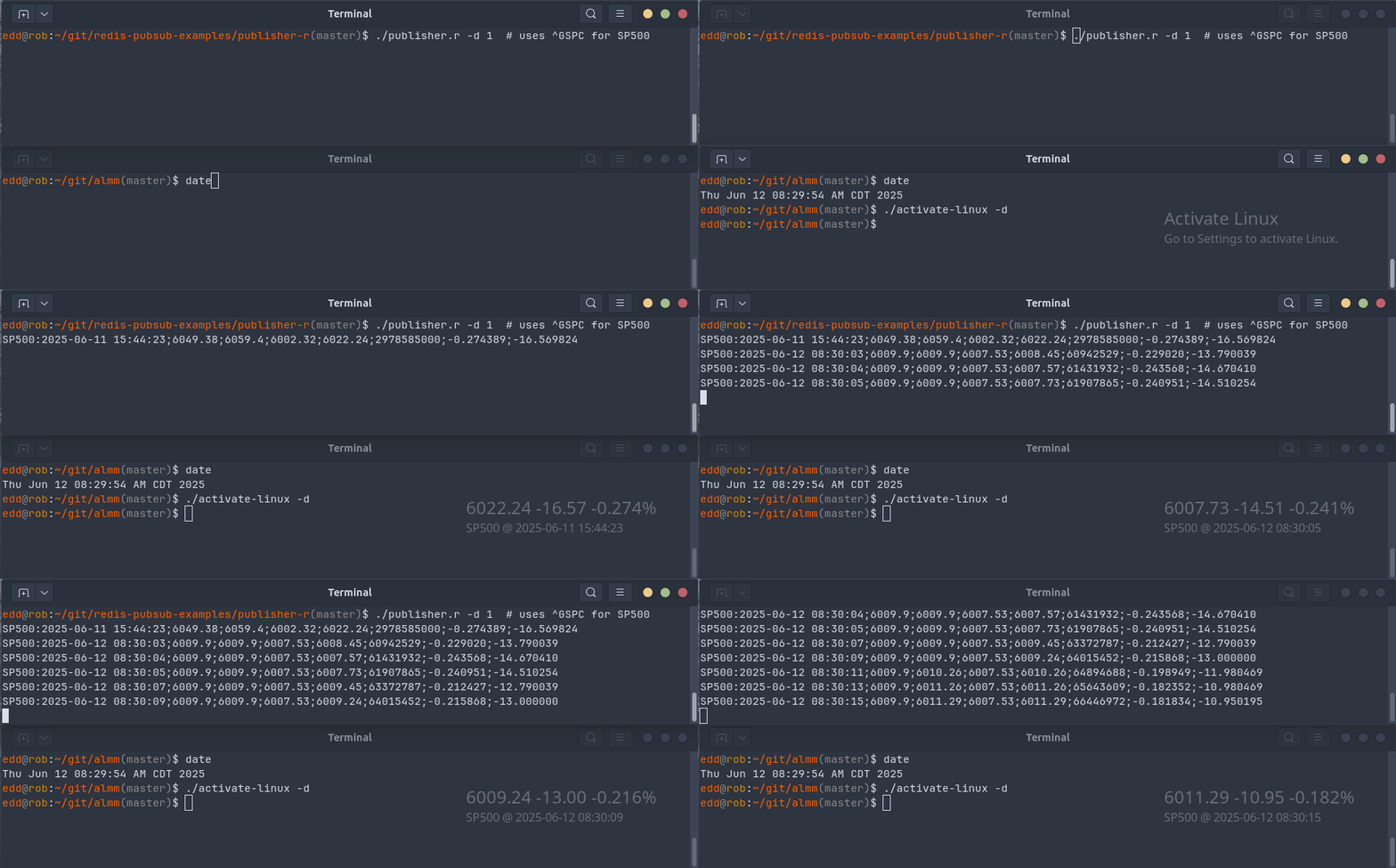
Welcome to post 50 in the R4 series. Today we reconnect to a previous post, namely #36 on pub/sub for live market monitoring with R and Redis. It introduced both Redis as well as the (then fairly recent) extensions to RcppRedis to support the publish-subscibe ( pub/sub ) model of Redis. In short, it manages both subscribing clients as well as producer for live, fast and lightweight data transmission. Using pub/sub is generally more efficient than the (conceptually simpler) poll-sleep loops as polling creates cpu and network load. Subscriptions are lighterweight as they get notified, they are also a little (but not much!) more involved as they require a callback function. We should mention that Redis has a recent fork in Valkey that arose when the former did one of these non-uncommon-among-db-companies licenuse suicides which, happy to say, they reversed more recently so that we now have both the original as well as this leading fork (among others). Both work, the latter is now included in several Linux distros, and the C library hiredis used to connect to either is still licensed permissibly as well. All this came about because Yahoo! Finance recently had another hickup in which they changed something leading to some data clients having hiccups. This includes GNOME applet Stocks Extension I had been running. There is a lively discussion on its issue #120 suggestions for example a curl wrapper (which then makes each access a new system call). Separating data acquisition and presentation becomes an attractive alternative, especially given how the standard Python and R accessors to the Yahoo! Finance service continued to work (and how per post #36 I already run data acquisition). Moreoever, and somewhat independently, it occurred to me that the cute (and both funny in its pun, and very pretty in its display) ActivateLinux program might offer an easy-enough way to display updates on the desktop. There were two aspects to address. First, the subscription side needed to be covered in either plain C or C++. That, it turns out, is very straightforward and there are existing documentation and prior examples (e.g. at StackOverflow) as well as the ability to have an LLM generate a quick stanza as I did with Claude. A modified variant is now in the example repo redis-pubsub-examples in file subscriber.c. It is deliberately minimal and the directory does not even have a Makefile: just compile and link against both libevent (for the event loop controlling this) and libhiredis (for the Redis or Valkey connection). This should work on any standard Linux (or macOS) machine with those two (very standard) libraries installed. The second aspect was trickier. While we can get Claude to modify the program to also display under x11, it still uses a single controlling event loop. It took a little bit of probing on my event to understand how to modify (the x11 use of) ActivateLinux, but as always it was reasonably straightforward in the end: instead of one single while loop awaiting events we now first check for pending events and deal with them if present but otherwise do not idle and wait but continue in another loop that also checks on the Redis or Valkey pub/sub events. So two thumbs up to vibe coding which clearly turned me into an x11-savvy programmer too The result is in a new (and currently fairly bare-bones) repo almm. It includes all files needed to build the application, borrowed with love from ActivateLinux (which is GPL-licensed, as is of course our minimal extension) and adds the minimal modifications we made, namely linking with libhiredis and some minimal changes to x11/x11.c. (Supporting wayland as well is on the TODO list, and I also need to release a new RcppRedis version to CRAN as one currently needs the GitHub version.) We also made a simple mp4 video with a sound overlay which describes the components briefly: Comments and questions welcome. I will probably add a little bit of command-line support to the almm. Selecting the symbol subscribed to is currently done in the most minimal way via environment variable SYMBOL (NB: not SYM as the video using the default value shows). I also worked out how to show the display only one of my multiple monitors so I may add an explicit screen id selector too. A little bit of discussion (including minimal Docker use around r2u) is also in issue #121 where I first floated the idea of having StocksExtension listen to Redis (or Valkey). Other suggestions are most welcome, please use issue tickets at the almm repository.

This post by Dirk Eddelbuettel originated on his Thinking inside the box blog. If you like this or other open-source work I do, you can now sponsor me at GitHub.

11 June 2025

Iustin Pop: This blog finally goes git-annex!

A long, long time ago I have a few pictures on this blog, mostly in earlier years, because even with small pictures, the git repository became 80MiB soon this is not much in absolute terms, but the actual Markdown/Haskell/CSS/HTML total size is tiny compared to the picture, PDFs and fonts. I realised I need a better solution, probably about ten years ago, and that I should investigate git-annex. Then time passed, and I heard about git-lfs, so I thought that s the way forward. Now, I recently got interested again into doing something about this repository, and started researching.

Detour: git-lfs I was sure that git-lfs, being supported by large providers, would be the modern solution. But to my surprise, git-lfs is very server centric, which in hindsight makes sense, but for a home setup, it s not very good. Maybe I misunderstood, but git-lfs is more a protocol/method for a forge to store files, rather than an end-user solution. But then you need to backup those files separately (together with the rest of the forge), or implement another way of safeguarding them. Further details such as the fact that it keeps two copies of the files (one in the actual checked-out tree, one in internal storage) means it s not a good solution. Well, for my blog yes, but not in general. Then posts on Reddit about horror stories people being locked out of github due to quota, as an example, or this Stack Overflow post about git-lfs constraining how one uses git, convinced me that s not what I want. To each their own, but not for me I might want to push this blog s repo to github, but I definitely wouldn t want in that case to pay for github storage for my blog images (which are copies, not originals). And yes, even in 2025, those quotas are real GitHub limits and I agree with GitHub, storage and large bandwidth can t be free.

Back to the future: git-annex So back to git-annex. I thought it s going to be a simple thing, but oh boy, was I wrong. It took me half a week of continuous (well, in free time) reading and discussions with LLMs to understand a bit how it works. I think, honestly, it s a bit too complex, which is why the workflows page lists seven (!) levels of workflow complexity, from fully-managed, to fully-manual. IMHO, respect to the author for the awesome tool, but if you need a web app to help you manage git, it hints that the tool is too complex. I made the mistake of running git annex sync once, to realise it actually starts pushing to my upstream repo and creating new branches and whatnot, so after enough reading, I settled on workflow 6/7, since I don t want another tool to manage my git history. Maybe I m an outlier here, but everything automatic is a bit too much for me. Once you do managed yourself how git-annex works (on the surface, at least), it is a pretty cool thing. It uses a git-annex git branch to store metainformation, and that is relatively clean. If you do run git annex sync, it creates some extra branches, which I don t like, but meh.

Trick question: what is a remote? One of the most confusing things about git-annex was understanding its remote concept. I thought a remote is a place where you replicate your data. But not, that s a special remote. A normal remote is a git remote, but which is expected to be git/ssh/with command line access. So if you have a git+ssh remote, git-annex will not only try to push it s above-mentioned branch, but also copy the files. If such a remote is on a forge that doesn t support git-annex, then it will complain and get confused. Of course, if you read the extensive docs, you just do git config remote.<name>.annex-ignore true, and it will understand that it should not sync to it. But, aside, from this case, git-annex expects that all checkouts and clones of the repository are both metadata and data. And if you do any annex commands in them, all other clones will know about them! This can be unexpected, and you find people complaining about it, but nowadays there s a solution:
git clone   dir && cd dir
git config annex.private true
git annex init "temp copy"
This is important. Any leaf git clone must be followed by that annex.private true config, especially on CI/CD machines. Honestly, I don t understand why by default clones should be official data stores, but it is what it is. I settled on not making any of my checkouts stable , but only the actual storage places. Except those are not git repositories, but just git-annex storage things. I.e., special remotes. Is it confusing enough yet ?

Special remotes The special remotes, as said, is what I expected to be the normal git annex remotes, i.e. places where the data is stored. But well, they exist, and while I m only using a couple simple ones, there is a large number of them. Among the interesting ones: git-lfs, a remote that allows also storing the git repository itself (git-remote-annex), although I m bit confused about this one, and most of the common storage providers via the rclone remote. Plus, all of the special remotes support encryption, so this is a really neat way to store your files across a large number of things, and handle replication, number of copies, from which copy to retrieve, etc. as you with.

And many of other features git-annex has tons of other features, so to some extent, the sky s the limit. Automatic selection of what to add git it vs plain git, encryption handling, number of copies, clusters, computed files, etc. etc. etc. I still think it s cool but too complex, though!

Uses Aside from my blog post, of course. I ve seen blog posts/comments about people using git-annex to track/store their photo collection, and I could see very well how the remote encrypted repos any of the services supported by rclone could be an N+2 copy or so. For me, tracking photos would be a bit too tedious, but it could maybe work after more research. A more practical thing would probably be replicating my local movie collection (all legal, to be clear) better than just run rsync from time to time and tracking the large files in it via git-annex. That s an exercise for another day, though, once I get more mileage with it - my blog pictures are copies, so I don t care much if they get lost, but movies are primary online copies, and I don t want to re-dump the discs. Anyway, for later.

Migrating to git-annex Migrating here means ending in a state where all large files are in git-annex, and the plain git repo is small. Just moving the files to git annex at the current head doesn t remove them from history, so your git repository is still large; it won t grow in the future, but remains with old size (and contains the large files in its history). In my mind, a nice migration would be: run a custom command, and all the history is migrated to git-annex, so I can go back in time and the still use git-annex. I na vely expected this would be easy and already available, only to find comments on the git-annex site with unsure git-filter-branch calls and some web discussions. This is the discussion on the git annex website, but it didn t make me confident it would do the right thing. But that discussion is now 8 years old. Surely in 2025, with git-filter-repo, it s easier? And, maybe I m missing something, but it is not. Not from the point of view of plain git, that s easy, but because interacting with git-annex, which stores its data in git itself, so doing this properly across successive steps of a repo (when replaying the commits) is, I think, not well defined behaviour. So I was stuck here for a few days, until I got an epiphany: As I m going to rewrite the repository, of course I m keeping a copy of it from before git-annex. If so, I don t need the history, back in time, to be correct in the sense of being able to retrieve the binary files too. It just needs to be correct from the point of view of the actual Markdown and Haskell files that represent the meat of the blog. This simplified the problem a lot. At first, I wanted to just skip these files, but this could also drop commits (git-filter-repo, by default, drops the commits if they re empty), and removing the files loses information - when they were added, what were the paths, etc. So instead I came up with a rather clever idea, if I might say so: since git-annex replaces files with symlinks already, just replace the files with symlinks in the whole history, except symlinks that are dangling (to represent the fact that files are missing). One could also use empty files, but empty files are more valid in a sense than dangling symlinks, hence why I settled on those. Doing this with git-filter-repo is easy, in newer versions, with the new --file-info-callback. Here is the simple code I used:
import os
import os.path
import pathlib

SKIP_EXTENSIONS= 'jpg', 'jpeg', 'png', 'pdf', 'woff', 'woff2' 
FILE_MODES =  b"100644", b"100755" 
SYMLINK_MODE = b"120000"

fas_string = filename.decode()
path = pathlib.PurePosixPath(fas_string)
ext = path.suffix.removeprefix('.')

if ext not in SKIP_EXTENSIONS:
  return (filename, mode, blob_id)

if mode not in FILE_MODES:
  return (filename, mode, blob_id)

print(f"Replacing ' filename ' (extension '. ext ') in  os.getcwd() ")

symlink_target = '/none/binary-file-removed-from-git-history'.encode()
new_blob_id = value.insert_file_with_contents(symlink_target)
return (filename, SYMLINK_MODE, new_blob_id)
This goes and replaces files with a symlink to nowhere, but the symlink should explain why it s dangling. Then later renames or moving the files around work naturally , as the rename/mv doesn t care about file contents. Then, when the filtering is done via:
git-filter-repo --file-info-callback <(cat ~/filter-big.py ) --force
It is easy to onboard to git annex:
  • remove all dangling symlinks
  • copy the (binary) files from the original repository
  • since they re named the same, and in the same places, git sees a type change
  • then simply run git annex add on those files
For me it was easy as all such files were in a few directories, so just copying those directories back, a few git-annex add commands, and done. Of course, then adding a few rsync remotes, git annex copy --to, and the repository was ready. Well, I also found a bug in my own Hakyll setup: on a fresh clone, when the large files are just dangling symlinks, the builder doesn t complain, just ignores the images. Will have to fix.

Other resources This is a blog that I read at the beginning, and I found it very useful as an intro: https://switowski.com/blog/git-annex/. It didn t help me understand how it works under the covers, but it is well written. The author does use the sync command though, which is too magic for me, but also agrees about its complexity

The proof is in the pudding And now, for the actual first image to be added that never lived in the old plain git repository. It s not full-res/full-size, it s cropped a bit on the bottom. Earlier in the year, I went to Paris for a very brief work trip, and I walked around a bit it was more beautiful than what I remembered from way way back. So a bit random selection of a picture, but here it is:
Un bateau sur la Seine Un bateau sur la Seine
Enjoy!

6 June 2025

Reproducible Builds: Reproducible Builds in May 2025

Welcome to our 5th report from the Reproducible Builds project in 2025! Our monthly reports outline what we ve been up to over the past month, and highlight items of news from elsewhere in the increasingly-important area of software supply-chain security. If you are interested in contributing to the Reproducible Builds project, please do visit the Contribute page on our website. In this report:
  1. Security audit of Reproducible Builds tools published
  2. When good pseudorandom numbers go bad
  3. Academic articles
  4. Distribution work
  5. diffoscope and disorderfs
  6. Website updates
  7. Reproducibility testing framework
  8. Upstream patches

Security audit of Reproducible Builds tools published The Open Technology Fund s (OTF) security partner Security Research Labs recently an conducted audit of some specific parts of tools developed by Reproducible Builds. This form of security audit, sometimes called a whitebox audit, is a form testing in which auditors have complete knowledge of the item being tested. They auditors assessed the various codebases for resilience against hacking, with key areas including differential report formats in diffoscope, common client web attacks, command injection, privilege management, hidden modifications in the build process and attack vectors that might enable denials of service. The audit focused on three core Reproducible Builds tools: diffoscope, a Python application that unpacks archives of files and directories and transforms their binary formats into human-readable form in order to compare them; strip-nondeterminism, a Perl program that improves reproducibility by stripping out non-deterministic information such as timestamps or other elements introduced during packaging; and reprotest, a Python application that builds source code multiple times in various environments in order to to test reproducibility. OTF s announcement contains more of an overview of the audit, and the full 24-page report is available in PDF form as well.

When good pseudorandom numbers go bad Danielle Navarro published an interesting and amusing article on their blog on When good pseudorandom numbers go bad. Danielle sets the stage as follows:
[Colleagues] approached me to talk about a reproducibility issue they d been having with some R code. They d been running simulations that rely on generating samples from a multivariate normal distribution, and despite doing the prudent thing and using set.seed() to control the state of the random number generator (RNG), the results were not computationally reproducible. The same code, executed on different machines, would produce different random numbers. The numbers weren t just a little bit different in the way that we ve all wearily learned to expect when you try to force computers to do mathematics. They were painfully, brutally, catastrophically, irreproducible different. Somewhere, somehow, something broke.
Thanks to David Wheeler for posting about this article on our mailing list

Academic articles There were two scholarly articles published this month that related to reproducibility: Daniel Hugenroth and Alastair R. Beresford of the University of Cambridge in the United Kingdom and Mario Lins and Ren Mayrhofer of Johannes Kepler University in Linz, Austria published an article titled Attestable builds: compiling verifiable binaries on untrusted systems using trusted execution environments. In their paper, they:
present attestable builds, a new paradigm to provide strong source-to-binary correspondence in software artifacts. We tackle the challenge of opaque build pipelines that disconnect the trust between source code, which can be understood and audited, and the final binary artifact, which is difficult to inspect. Our system uses modern trusted execution environments (TEEs) and sandboxed build containers to provide strong guarantees that a given artifact was correctly built from a specific source code snapshot. As such it complements existing approaches like reproducible builds which typically require time-intensive modifications to existing build configurations and dependencies, and require independent parties to continuously build and verify artifacts.
The authors compare attestable builds with reproducible builds by noting an attestable build requires only minimal changes to an existing project, and offers nearly instantaneous verification of the correspondence between a given binary and the source code and build pipeline used to construct it , and proceed by determining that t he overhead (42 seconds start-up latency and 14% increase in build duration) is small in comparison to the overall build time.
Timo Pohl, Pavel Nov k, Marc Ohm and Michael Meier have published a paper called Towards Reproducibility for Software Packages in Scripting Language Ecosystems. The authors note that past research into Reproducible Builds has focused primarily on compiled languages and their ecosystems, with a further emphasis on Linux distribution packages:
However, the popular scripting language ecosystems potentially face unique issues given the systematic difference in distributed artifacts. This Systemization of Knowledge (SoK) [paper] provides an overview of existing research, aiming to highlight future directions, as well as chances to transfer existing knowledge from compiled language ecosystems. To that end, we work out key aspects in current research, systematize identified challenges for software reproducibility, and map them between the ecosystems.
Ultimately, the three authors find that the literature is sparse , focusing on few individual problems and ecosystems, and therefore identify space for more critical research.

Distribution work In Debian this month:
Hans-Christoph Steiner of the F-Droid catalogue of open source applications for the Android platform published a blog post on Making reproducible builds visible. Noting that Reproducible builds are essential in order to have trustworthy software , Hans also mentions that F-Droid has been delivering reproducible builds since 2015 . However:
There is now a Reproducibility Status link for each app on f-droid.org, listed on every app s page. Our verification server shows or based on its build results, where means our rebuilder reproduced the same APK file and means it did not. The IzzyOnDroid repository has developed a more elaborate system of badges which displays a for each rebuilder. Additionally, there is a sketch of a five-level graph to represent some aspects about which processes were run.
Hans compares the approach with projects such as Arch Linux and Debian that provide developer-facing tools to give feedback about reproducible builds, but do not display information about reproducible builds in the user-facing interfaces like the package management GUIs.
Arnout Engelen of the NixOS project has been working on reproducing the minimal installation ISO image. This month, Arnout has successfully reproduced the build of the minimal image for the 25.05 release without relying on the binary cache. Work on also reproducing the graphical installer image is ongoing.
In openSUSE news, Bernhard M. Wiedemann posted another monthly update for their work there.
Lastly in Fedora news, Jelle van der Waa opened issues tracking reproducible issues in Haskell documentation, Qt6 recording the host kernel and R packages recording the current date. The R packages can be made reproducible with packaging changes in Fedora.

diffoscope & disorderfs diffoscope is our in-depth and content-aware diff utility that can locate and diagnose reproducibility issues. This month, Chris Lamb made the following changes, including preparing and uploading versions 295, 296 and 297 to Debian:
  • Don t rely on zipdetails --walk argument being available, and only add that argument on newer versions after we test for that. [ ]
  • Review and merge support for NuGet packages from Omair Majid. [ ]
  • Update copyright years. [ ]
  • Merge support for an lzma comparator from Will Hollywood. [ ][ ]
Chris also merged an impressive changeset from Siva Mahadevan to make disorderfs more portable, especially on FreeBSD. disorderfs is our FUSE-based filesystem that deliberately introduces non-determinism into directory system calls in order to flush out reproducibility issues [ ]. This was then uploaded to Debian as version 0.6.0-1. Lastly, Vagrant Cascadian updated diffoscope in GNU Guix to version 296 [ ][ ] and 297 [ ][ ], and disorderfs to version 0.6.0 [ ][ ].

Website updates Once again, there were a number of improvements made to our website this month including:

Reproducibility testing framework The Reproducible Builds project operates a comprehensive testing framework running primarily at tests.reproducible-builds.org in order to check packages and other artifacts for reproducibility. However, Holger Levsen posted to our mailing list this month in order to bring a wider awareness to funding issues faced by the Oregon State University (OSU) Open Source Lab (OSL). As mentioned on OSL s public post, recent changes in university funding makes our current funding model no longer sustainable [and that] unless we secure $250,000 in committed funds, the OSL will shut down later this year . As Holger notes in his post to our mailing list, the Reproducible Builds project relies on hardware nodes hosted there. Nevertheless, Lance Albertson of OSL posted an update to the funding situation later in the month with broadly positive news.
Separate to this, there were various changes to the Jenkins setup this month, which is used as the backend driver of for both tests.reproducible-builds.org and reproduce.debian.net, including:
  • Migrating the central jenkins.debian.net server AMD Opteron to Intel Haswell CPUs. Thanks to IONOS for hosting this server since 2012.
  • After testing it for almost ten years, the i386 architecture has been dropped from tests.reproducible-builds.org. This is because that, with the upcoming release of Debian trixie, i386 is no longer supported as a regular architecture there will be no official kernel and no Debian installer for i386 systems. As a result, a large number of nodes hosted by Infomaniak have been retooled from i386 to amd64.
  • Another node, ionos17-amd64.debian.net, which is used for verifying packages for all.reproduce.debian.net (hosted by IONOS) has had its memory increased from 40 to 64GB, and the number of cores doubled to 32 as well. In addition, two nodes generously hosted by OSUOSL have had their memory doubled to 16GB.
  • Lastly, we have been granted access to more riscv64 architecture boards, so now we have seven such nodes, all with 16GB memory and 4 cores that are verifying packages for riscv64.reproduce.debian.net. Many thanks to PLCT Lab, ISCAS for providing those.

Outside of this, a number of smaller changes were also made by Holger Levsen:
  • reproduce.debian.net-related:
    • Only use two workers for the ppc64el architecture due to RAM size. [ ]
    • Monitor nginx_request and nginx_status with the Munin monitoring system. [ ][ ]
    • Detect various variants of network and memory errors. [ ][ ][ ][ ]
    • Add a prominent link to reproducible-builds.org. [ ]
    • Add a rebuilderd-cache-cleanup.service and run it daily via timer. [ ][ ][ ][ ][ ]
    • Be more verbose what sources are being downloaded. [ ]
    • Correctly deal with packages with an epoch in their version [ ] and deal with binNMUs versions with an epoch as well [ ][ ].
    • Document how to reschedule all other errors on all archs. [ ]
    • Misc documentation improvements. [ ][ ][ ][ ]
    • Include the $HOSTNAME variable in the rebuilderd logfiles. [ ]
    • Install the equivs package on all worker nodes. [ ][ ]
  • Jenkins nodes:
    • Permit the sudo tool to fix up permission issues. [ ][ ]
    • Document how to manage diskspace with OpenStack. [ ]
    • Ignore a number of spurious monitoring errors on riscv64, FreeBSD, etc.. [ ][ ][ ][ ]
    • Install ntpsec-ntpdate (instead of ntpdate) as the former is available on Debian trixie and bookworm. [ ][ ]
    • Use the same SSH ControlPath for all nodes. [ ]
    • Make sure the munin user uses the same SSH config as the jenkins user. [ ]
  • tests.reproducible-builds.org-related:
    • Disable testing of the i386 architecture. [ ][ ][ ][ ][ ]
    • Document the current disk usage. [ ][ ]
    • Address some image placement now that we only test three architectures. [ ]
    • Keep track of build performance. [ ]
  • Misc:
    • Fix a (harmless) typo in the multiarch_versionskew script. [ ]
In addition, Jochen Sprickerhof made a series of changes related to reproduce.debian.net:
  • Add out of memory detection to the statistics page. [ ]
  • Reverse the sorting order on the statistics page. [ ][ ][ ][ ]
  • Improve the spacing between statistics groups. [ ]
  • Update a (hard-coded) line number in error message detection pertaining to a debrebuild line number. [ ]
  • Support Debian unstable in the rebuilder-debian.sh script. [ ] ]
  • Rely on rebuildctl to sync only arch-specific packages. [ ][ ]

Upstream patches The Reproducible Builds project detects, dissects and attempts to fix as many currently-unreproducible packages as possible. This month, we wrote a large number of such patches, including:

Finally, if you are interested in contributing to the Reproducible Builds project, please visit our Contribute page on our website. However, you can get in touch with us via:

Dirk Eddelbuettel: #49: The Two Cultures of Deploying Statistical Software

Welcome to post 49 in the R4 series. The Two Cultures is a term first used by C.P. Snow in a 1959 speech and monograph focused on the split between humanities and the sciences. Decades later, the term was (quite famously) re-used by Leo Breiman in a (somewhat prophetic) 2001 article about the split between data models and algorithmic models . In this note, we argue that statistical computing practice and deployment can also be described via this Two Cultures moniker. Referring to the term linking these foundational pieces is of course headline bait. Yet when preparing for the discussion of r2u in the invited talk in Mons (video, slides), it occurred to me that there is in fact a wide gulf between two alternative approaches of using R and, specifically, deploying packages. On the one hand we have the approach described by my friend Jeff as you go to the Apple store, buy the nicest machine you can afford, install what you need and then never ever touch it . A computer / workstation / laptop is seen as an immutable object where every attempt at change may lead to breakage, instability, and general chaos and is hence best avoided. If you know Jeff, you know he exaggerates. Maybe only slightly though. Similarly, an entire sub-culture of users striving for reproducibility (and sometimes also replicability ) does the same. This is for example evidenced by the popularity of package renv by Rcpp collaborator and pal Kevin. The expressed hope is that by nailing down a (sub)set of packages, outcomes are constrained to be unchanged. Hope springs eternal, clearly. (Personally, if need be, I do the same with Docker containers and their respective Dockerfile.) On the other hand, rolling is fundamentally different approach. One (well known) example is Google building everything at @HEAD . The entire (ginormous) code base is considered as a mono-repo which at any point in time is expected to be buildable as is. All changes made are pre-tested to be free of side effects to other parts. This sounds hard, and likely is more involved than an alternative of a whatever works approach of independent changes and just hoping for the best. Another example is a rolling (Linux) distribution as for example Debian. Changes are first committed to a staging place (Debian calls this the unstable distribution) and, if no side effects are seen, propagated after a fixed number of days to the rolling distribution (called testing ). With this mechanism, testing should always be installable too. And based on the rolling distribution, at certain times (for Debian roughly every two years) a release is made from testing into stable (following more elaborate testing). The released stable version is then immutable (apart from fixes for seriously grave bugs and of course security updates). So this provides the connection between frequent and rolling updates, and produces immutable fixed set: a release. This Debian approach has been influential for any other projects including CRAN as can be seen in aspects of its system providing a rolling set of curated packages. Instead of a staging area for all packages, extensive tests are made for candidate packages before adding an update. This aims to ensure quality and consistence and has worked remarkably well. We argue that it has clearly contributed to the success and renown of CRAN. Now, when accessing CRAN from R, we fundamentally have two accessor functions. But seemingly only one is widely known and used. In what we may call the Jeff model , everybody is happy to deploy install.packages() for initial installations. That sentiment is clearly expressed by this bsky post:
One of my #rstats coding rituals is that every time I load a @vincentab.bsky.social package I go check for a new version because invariably it s been updated with 18 new major features
And that is why we have two cultures. Because some of us, yours truly included, also use update.packages() at recurring (frequent !!) intervals: daily or near-daily for me. The goodness and, dare I say, gift of packages is not limited to those by my pal Vincent. CRAN updates all the time, and updates are (generally) full of (usually excellent) changes, fixes, or new features. So update frequently! Doing (many but small) updates (frequently) is less invasive than (large, infrequent) waterfall -style changes! But the fear of change, or disruption, is clearly pervasive. One can only speculate why. Is the experience of updating so painful on other operating systems? Is it maybe a lack of exposure / tutorials on best practices? These Two Cultures coexist. When I delivered the talk in Mons, I briefly asked for a show of hands among all the R users in the audience to see who in fact does use update.packages() regularly. And maybe a handful of hands went up: surprisingly few! Now back to the context of installing packages: Clearly only installing has its uses. For continuous integration checks we generally install into ephemeral temporary setups. Some debugging work may be with one-off container or virtual machine setups. But all other uses may well be under maintained setups. So consider calling update.packages() once in while. Or even weekly or daily. The rolling feature of CRAN is a real benefit, and it is there for the taking and enrichment of your statistical computing experience. So to sum up, the real power is to use For both tasks, relying on binary installations accelerates and eases the process. And where available, using binary installation with system-dependency support as r2u does makes it easier still, following the r2u slogan of Fast. Easy. Reliable. Pick All Three. Give it a try!

This post by Dirk Eddelbuettel originated on his Thinking inside the box blog. If you like this or other open-source work I do, you can now sponsor me at GitHub.

29 May 2025

Dirk Eddelbuettel: #48: r2u Talk Re-Recorded

Welcome to post 48 in the R4 series, and to video 8 in this series. Last week I had the honour of giving the opening talk at the 11eme Rencontres R at the Universit de Mons in Belgium as an invited plenary talk. Big thanks again to Philippe Grosjean and Kathy Huet for the invitation, and for organising a lovely conference. Being the opening talk, we were still sorting out projector issues when I started so I forgot to set a timer, and consequently ran out of time like a newbie. It occured to me that I could simply re-record the talk in front of my slides just as I do for my STAT 447 students. So I sat down this morning and did this, and the video is now online:

The slides are available as well. For questions or other feedback, please consider using the r2u GitHub repo issues section.

This post by Dirk Eddelbuettel originated on his Thinking inside the box blog. If you like this or other open-source work I do, you can now sponsor me at GitHub.

Dirk Eddelbuettel: RcppDate 0.0.6: New Upstream

RcppDate wraps the featureful date library written by Howard Hinnant for use with R. This header-only modern C++ library has been in pretty wide-spread use for a while now, and adds to C++11/C++14/C++17 what will is (with minor modifications) the date library in C++20. The RcppDate package adds no extra R or C++ code and can therefore be a zero-cost dependency for any other project; yet a number of other projects decided to re-vendor it resulting in less-efficient duplication. Oh well. C est la vie. This release syncs with upstream release 3.0.4 made yesterday which contains a few PRs (including one by us) for the clang++-20 changes some of which we already had in release 0.0.5. We also made a routine update to the continuous integration.

Changes in version 0.0.6 (2025-05-29)
  • Updated to upstream version 3.0.4

Courtesy of my CRANberries, there is also a diffstat report for the most recent release. More information is available at the repository or the package page.

This post by Dirk Eddelbuettel originated on his Thinking inside the box blog. If you like this or other open-source work I do, you can sponsor me at GitHub.

Arthur Diniz: Bringing Kubernetes Back to Debian

I ve been part of the Debian Project since 2019, when I attended DebConf held in Curitiba, Brazil. That event sparked my interest in the community, packaging, and how Debian works as a distribution. In the early years of my involvement, I contributed to various teams such as the Python, Golang and Cloud teams, packaging dependencies and maintaining various tools. However, I soon felt the need to focus on packaging software I truly enjoyed, tools I was passionate about using and maintaining. That s when I turned my attention to Kubernetes within Debian.

A Broken Ecosystem The Kubernetes packaging situation in Debian had been problematic for some time. Given its large codebase and complex dependency tree, the initial packaging approach involved vendorizing all dependencies. While this allowed a somewhat functional package to be published, it introduced several long-term issues, especially security concerns. Vendorized packages bundle third-party dependencies directly into the source tarball. When vulnerabilities arise in those dependencies, it becomes difficult for Debian s security team to patch and rebuild affected packages system-wide. This approach broke Debian s best practices, and it eventually led to the abandonment of the Kubernetes source package, which had stalled at version 1.20.5. Due to this abandonment, critical bugs emerged and the package was removed from Debian s testing channel, as we can see in the package tracker.

New Debian Kubernetes Team Around this time, I became a Debian Maintainer (DM), with permissions to upload certain packages. I saw an opportunity to both contribute more deeply to Debian and to fix Kubernetes packaging. In early 2024, just before DebConf Busan in South Korea, I founded the Debian Kubernetes Team. The mission of the team was to repackage Kubernetes in a maintainable, security-conscious, and Debian-compliant way. At DebConf, I shared our progress with the broader community and received great feedback and more visibility, along with people interested in contributing to the team. Our first tasks was to migrate existing Kubernetes-related tools such as kubectx, kubernetes-split-yaml and kubetail into a dedicated namespace on Salsa, Debian s GitLab instance. Many of these tools were stored across different teams (like the Go team), and consolidating them helped us organize development and focus our efforts.

De-vendorizing Kubernetes Our main goal was to un-vendorize Kubernetes and bring it up-to-date with upstream releases. This meant:
  • Removing the vendor directory and all embedded third-party code.
  • Trimming the build scope to focus solely on building kubectl, Kubernetes CLI.
  • Using Files-Excluded in debian/copyright to cleanly drop unneeded files during source imports.
  • Rebuilding the dependency tree, ensuring all Go modules were separately packaged in Debian.
We used uscan, a standard Debian packaging tool that fetches upstream tarballs and prepares them accordingly. The Files-Excluded directive in our debian/copyright file instructed uscan to automatically remove unnecessary files during the repackaging process:
$ uscan
Newest version of kubernetes on remote site is 1.32.3, specified download version is 1.32.3
Successfully repacked ../v1.32.3 as ../kubernetes_1.32.3+ds.orig.tar.gz, deleting 30616 files from it.
The results were dramatic. By comparing the original upstream tarball with our repackaged version, we can see that our approach reduced the tarball size by over 75%:
$ du -h upstream-v1.32.3.tar.gz kubernetes_1.32.3+ds.orig.tar.gz
14M	upstream-v1.32.3.tar.gz
3.2M	kubernetes_1.32.3+ds.orig.tar.gz
This significant reduction wasn t just about saving space. By removing over 30,000 files, we simplified the package, making it more maintainable. Each dependency could now be properly tracked, updated, and patched independently, resolving the security concerns that had plagued the previous packaging approach.

Dependency Graph To give you an idea of the complexity involved in packaging Kubernetes for Debian, the image below is a dependency graph generated with debtree, visualizing all the Go modules and other dependencies required to build the kubectl binary. kubectl-depgraph This web of nodes and edges represents every module and its relationship during the compilation process of kubectl. Each box is a Debian package, and the lines connecting them show how deeply intertwined the ecosystem is. What might look like a mess of blue spaghetti is actually a clear demonstration of the vast and interconnected upstream world that tools like kubectl rely on. But more importantly, this graph is a testament to the effort that went into making kubectl build entirely using Debian-packaged dependencies only, no vendoring, no downloading from the internet, no proprietary blobs.

Upstream Version 1.32.3 and Beyond After nearly two years of work, we successfully uploaded version 1.32.3+ds of kubectl to Debian unstable. kubernetes/-/merge_requests/1 The new package also includes:
  • Zsh, Fish, and Bash completions installed automatically
  • Man pages and metadata for improved discoverability
  • Full integration with kind and docker for testing purposes

Integration Testing with Autopkgtest To ensure the reliability of kubectl in real-world scenarios, we developed a new autopkgtest suite that runs integration tests using real Kubernetes clusters created via Kind. Autopkgtest is a Debian tool used to run automated tests on binary packages. These tests are executed after the package is built but before it s accepted into the Debian archive, helping catch regressions and integration issues early in the packaging pipeline. Our test workflow validates kubectl by performing the following steps:
  • Installing Kind and Docker as test dependencies.
  • Spinning up two local Kubernetes clusters.
  • Switching between cluster contexts to ensure multi-cluster support.
  • Deploying and scaling a sample nginx application using kubectl.
  • Cleaning up the entire test environment to avoid side effects.
  • debian/tests/kubectl.sh

Popcon: Measuring Adoption To measure real-world usage, we rely on data from Debian s popularity contest (popcon), which gives insight into how many users have each binary installed. popcon-graph popcon-table Here s what the data tells us:
  • kubectl (new binary): Already installed on 2,124 systems.
  • golang-k8s-kubectl-dev: This is the Go development package (a library), useful for other packages and developers who want to interact with Kubernetes programmatically.
  • kubernetes-client: The legacy package that kubectl is replacing. We expect this number to decrease in future releases as more systems transition to the new package.
Although the popcon data shows activity for kubectl before the official Debian upload date, it s important to note that those numbers represent users who had it installed from upstream source-lists, not from the Debian repositories. This distinction underscores a demand that existed even before the package was available in Debian proper, and it validates the importance of bringing it into the archive.
Also worth mentioning: this number is not the real total number of installations, since users can choose not to participate in the popularity contest. So the actual adoption is likely higher than what popcon reflects.

Community and Documentation The team also maintains a dedicated wiki page which documents:
  • Maintained tools and packages
  • Contribution guidelines
  • Our roadmap for the upcoming Debian releases
https://debian-kubernetes.org

Looking Ahead to Debian 13 (Trixie) The next stable release of Debian will ship with kubectl version 1.32.3, built from a clean, de-vendorized source. This version includes nearly all the latest upstream features, and will be the first time in years that Debian users can rely on an up-to-date, policy-compliant kubectl directly from the archive. By comparing with upstream, our Debian package even delivers more out of the box, including shell completions, which the upstream still requires users to generate manually. In 2025, the Debian Kubernetes team will continue expanding our packaging efforts for the Kubernetes ecosystem. Our roadmap includes:
  • kubelet: The primary node agent that runs on each node. This will enable Debian users to create fully functional Kubernetes nodes without relying on external packages.
  • kubeadm: A tool for creating Kubernetes clusters. With kubeadm in Debian, users will then be able to bootstrap minimum viable clusters directly from the official repositories.
  • helm: The package manager for Kubernetes that helps manage applications through Kubernetes YAML files defined as charts.
  • kompose: A conversion tool that helps users familiar with docker-compose move to Kubernetes by translating Docker Compose files into Kubernetes resources.

Final Thoughts This journey was only possible thanks to the amazing support of the debian-devel-br community and the collective effort of contributors who stepped up to package missing dependencies, fix bugs, and test new versions. Special thanks to:
  • Carlos Henrique Melara (@charles)
  • Guilherme Puida (@puida)
  • Jo o Pedro Nobrega (@jnpf)
  • Lucas Kanashiro (@kanashiro)
  • Matheus Polkorny (@polkorny)
  • Samuel Henrique (@samueloph)
  • Sergio Cipriano (@cipriano)
  • Sergio Durigan Junior (@sergiodj)
I look forward to continuing this work, bringing more Kubernetes tools into Debian and improving the developer experience for everyone.

Arthur Diniz: Bringing Kubernetes Back to Debian

I ve been part of the Debian Project since 2019, when I attended DebConf held in Curitiba, Brazil. That event sparked my interest in the community, packaging, and how Debian works as a distribution. In the early years of my involvement, I contributed to various teams such as the Python, Golang and Cloud teams, packaging dependencies and maintaining various tools. However, I soon felt the need to focus on packaging software I truly enjoyed, tools I was passionate about using and maintaining. That s when I turned my attention to Kubernetes within Debian.

A Broken Ecosystem The Kubernetes packaging situation in Debian had been problematic for some time. Given its large codebase and complex dependency tree, the initial packaging approach involved vendorizing all dependencies. While this allowed a somewhat functional package to be published, it introduced several long-term issues, especially security concerns. Vendorized packages bundle third-party dependencies directly into the source tarball. When vulnerabilities arise in those dependencies, it becomes difficult for Debian s security team to patch and rebuild affected packages system-wide. This approach broke Debian s best practices, and it eventually led to the abandonment of the Kubernetes source package, which had stalled at version 1.20.5. Due to this abandonment, critical bugs emerged and the package was removed from Debian s testing channel, as we can see in the package tracker.

New Debian Kubernetes Team Around this time, I became a Debian Maintainer (DM), with permissions to upload certain packages. I saw an opportunity to both contribute more deeply to Debian and to fix Kubernetes packaging. In early 2024, just before DebConf Busan in South Korea, I founded the Debian Kubernetes Team. The mission of the team was to repackage Kubernetes in a maintainable, security-conscious, and Debian-compliant way. At DebConf, I shared our progress with the broader community and received great feedback and more visibility, along with people interested in contributing to the team. Our first tasks was to migrate existing Kubernetes-related tools such as kubectx, kubernetes-split-yaml and kubetail into a dedicated namespace on Salsa, Debian s GitLab instance. Many of these tools were stored across different teams (like the Go team), and consolidating them helped us organize development and focus our efforts.

De-vendorizing Kubernetes Our main goal was to un-vendorize Kubernetes and bring it up-to-date with upstream releases. This meant:
  • Removing the vendor directory and all embedded third-party code.
  • Trimming the build scope to focus solely on building kubectl, Kubernetes CLI.
  • Using Files-Excluded in debian/copyright to cleanly drop unneeded files during source imports.
  • Rebuilding the dependency tree, ensuring all Go modules were separately packaged in Debian.
We used uscan, a standard Debian packaging tool that fetches upstream tarballs and prepares them accordingly. The Files-Excluded directive in our debian/copyright file instructed uscan to automatically remove unnecessary files during the repackaging process:
$ uscan
Newest version of kubernetes on remote site is 1.32.3, specified download version is 1.32.3
Successfully repacked ../v1.32.3 as ../kubernetes_1.32.3+ds.orig.tar.gz, deleting 30616 files from it.
The results were dramatic. By comparing the original upstream tarball with our repackaged version, we can see that our approach reduced the tarball size by over 75%:
$ du -h upstream-v1.32.3.tar.gz kubernetes_1.32.3+ds.orig.tar.gz
14M	upstream-v1.32.3.tar.gz
3.2M	kubernetes_1.32.3+ds.orig.tar.gz
This significant reduction wasn t just about saving space. By removing over 30,000 files, we simplified the package, making it more maintainable. Each dependency could now be properly tracked, updated, and patched independently, resolving the security concerns that had plagued the previous packaging approach.

Dependency Graph To give you an idea of the complexity involved in packaging Kubernetes for Debian, the image below is a dependency graph generated with debtree, visualizing all the Go modules and other dependencies required to build the kubectl binary. kubectl-depgraph This web of nodes and edges represents every module and its relationship during the compilation process of kubectl. Each box is a Debian package, and the lines connecting them show how deeply intertwined the ecosystem is. What might look like a mess of blue spaghetti is actually a clear demonstration of the vast and interconnected upstream world that tools like kubectl rely on. But more importantly, this graph is a testament to the effort that went into making kubectl build entirely using Debian-packaged dependencies only, no vendoring, no downloading from the internet, no proprietary blobs.

Upstream Version 1.32.3 and Beyond After nearly two years of work, we successfully uploaded version 1.32.3+ds of kubectl to Debian unstable. kubernetes/-/merge_requests/1 The new package also includes:
  • Zsh, Fish, and Bash completions installed automatically
  • Man pages and metadata for improved discoverability
  • Full integration with kind and docker for testing purposes

Integration Testing with Autopkgtest To ensure the reliability of kubectl in real-world scenarios, we developed a new autopkgtest suite that runs integration tests using real Kubernetes clusters created via Kind. Autopkgtest is a Debian tool used to run automated tests on binary packages. These tests are executed after the package is built but before it s accepted into the Debian archive, helping catch regressions and integration issues early in the packaging pipeline. Our test workflow validates kubectl by performing the following steps:
  • Installing Kind and Docker as test dependencies.
  • Spinning up two local Kubernetes clusters.
  • Switching between cluster contexts to ensure multi-cluster support.
  • Deploying and scaling a sample nginx application using kubectl.
  • Cleaning up the entire test environment to avoid side effects.
  • debian/tests/kubectl.sh

Popcon: Measuring Adoption To measure real-world usage, we rely on data from Debian s popularity contest (popcon), which gives insight into how many users have each binary installed. popcon-graph popcon-table Here s what the data tells us:
  • kubectl (new binary): Already installed on 2,124 systems.
  • golang-k8s-kubectl-dev: This is the Go development package (a library), useful for other packages and developers who want to interact with Kubernetes programmatically.
  • kubernetes-client: The legacy package that kubectl is replacing. We expect this number to decrease in future releases as more systems transition to the new package.
Although the popcon data shows activity for kubectl before the official Debian upload date, it s important to note that those numbers represent users who had it installed from upstream source-lists, not from the Debian repositories. This distinction underscores a demand that existed even before the package was available in Debian proper, and it validates the importance of bringing it into the archive.
Also worth mentioning: this number is not the real total number of installations, since users can choose not to participate in the popularity contest. So the actual adoption is likely higher than what popcon reflects.

Community and Documentation The team also maintains a dedicated wiki page which documents:
  • Maintained tools and packages
  • Contribution guidelines
  • Our roadmap for the upcoming Debian releases
https://debian-kubernetes.org

Looking Ahead to Debian 13 (Trixie) The next stable release of Debian will ship with kubectl version 1.32.3, built from a clean, de-vendorized source. This version includes nearly all the latest upstream features, and will be the first time in years that Debian users can rely on an up-to-date, policy-compliant kubectl directly from the archive. By comparing with upstream, our Debian package even delivers more out of the box, including shell completions, which the upstream still requires users to generate manually. In 2025, the Debian Kubernetes team will continue expanding our packaging efforts for the Kubernetes ecosystem. Our roadmap includes:
  • kubelet: The primary node agent that runs on each node. This will enable Debian users to create fully functional Kubernetes nodes without relying on external packages.
  • kubeadm: A tool for creating Kubernetes clusters. With kubeadm in Debian, users will then be able to bootstrap minimum viable clusters directly from the official repositories.
  • helm: The package manager for Kubernetes that helps manage applications through Kubernetes YAML files defined as charts.
  • kompose: A conversion tool that helps users familiar with docker-compose move to Kubernetes by translating Docker Compose files into Kubernetes resources.

Final Thoughts This journey was only possible thanks to the amazing support of the debian-devel-br community and the collective effort of contributors who stepped up to package missing dependencies, fix bugs, and test new versions. Special thanks to:
  • Carlos Henrique Melara (@charles)
  • Guilherme Puida (@puida)
  • Jo o Pedro Nobrega (@jnpf)
  • Lucas Kanashiro (@kanashiro)
  • Matheus Polkorny (@polkorny)
  • Samuel Henrique (@samueloph)
  • Sergio Cipriano (@cipriano)
  • Sergio Durigan Junior (@sergiodj)
I look forward to continuing this work, bringing more Kubernetes tools into Debian and improving the developer experience for everyone.

22 May 2025

Simon Quigley: Bootstrapping and Bikeshedding

When you learn to write, one of the major pieces is writing an introduction. You could say quite a bit about the formal process and the way formal writing is typically structured.That being said, I m not your typical writer. I didn t exactly plan to be in this spot, and honestly, it s just a hobby of mine. If you enjoy reading my posts, great. I appreciate it.My entire point, from the very beginning of this week, has been to bootstrap my own platform, on my own two feet. As you all know, rumors were going around, and I felt as if I wasn t in that great of a position to go out and say everything that I ve said, in one long post. I ve needed to break it apart, and work through some of my own notes again. Prove myself, rather than asking for it to be handed to me. Keep people guessing on some elements, to let the people who have been doing wrong firmly prove themselves. At least twelve people at this point have sent me undeniable proof. I don t want to do anything with it. I want to move on, and I want to write about technology, and other things I actually enjoy writing about.I really don t enjoy conflict, or writing about it, at all. I just know how to defend myself if I need to. If you think I actively want to make everyone mad for no good reason, you re honestly fooling yourself.I already know that I m not going to agree with everything I write in a few years, or maybe even weeks. But I ll hold myself to the same standard I hold everyone else. If you say something and a few years pass, I m not going to assume you still have the same opinion. I ll give you the opportunity to correct it. I d ask you lend me the same courtesy.I do this because I enjoy it, not out of anger, sadness, or anything like that. A number of people have approached me now simply asking why I m doing what I m doing. I planned to write this blog post at the very end all along. I just haven t revealed the plans before publishing. [I wrote the outline for this more than a day ago.]My entire point here is to give the common person a voice. I know exactly what it s like to start from nothing, and work your way up to a comfortable spot. I didn t only do it once, I did it twice. This is my third time. I genuinely don t appreciate it when people silence other people s voices just because they don t like them. I wasn t raised that way, and that s not how I run my own projects. In fact, I d say that if you silence opinions or values that don t exactly match yours, you re missing out on the variety of life.You can lead a horse to water, but you can t make them drink. If you still think there are issues on my end, you re being misinformed. Plain and simple. I m not going to spend any more time on it, I actually want to start what I ve always wanted to do for years, just never had the opportunity to.This is my last post for the week. I feel like I ve bootstrapped enough where next week I can focus on another topic, as originally planned.Thanks for reading. I appreciate your support. Talk to you on Monday. If you have topic suggestions, feel free to leave them in the comments. Feel free to leave your hate mail too, so I know where I m at.If you read Piaget, you know that silence is concerning with respect to socialization. I just took a look at the view count for the first time, and I m already up to more than 2k views. In the first week. Without actually digging into the content I want to write about, yet.I don t mean to say that to brag, I m just telling you for a fact that I m not ranting into thin air. I m not even ranting at all. In fact, every single one of my posts has been written either calmly or with happiness, including this one.My entire point is this: debate me on the merits of the subject, not on me as a person. If you don t like me, that s okay. Go play elsewhere.But, I m still going to keep writing. Next week, different metaphors.We re bootstrapped now.

Dirk Eddelbuettel: RcppArmadillo 14.4.3-1 on CRAN: Small Upstream Bug Fix

armadillo image Armadillo is a powerful and expressive C++ template library for linear algebra and scientific computing. It aims towards a good balance between speed and ease of use, has a syntax deliberately close to Matlab, and is useful for algorithm development directly in C++, or quick conversion of research code into production environments. RcppArmadillo integrates this library with the R environment and language and is widely used by (currently) 1251 other packages on CRAN, downloaded 39.8 million times (per the partial logs from the cloud mirrors of CRAN), and the CSDA paper (preprint / vignette) by Conrad and myself has been cited 628 times according to Google Scholar. Conrad released a minor bugfix version yesterday which addresses corner cases with non-finite values in sparse matrices. And despite conference traveling, I managed to wrap this up and ship it to CRAN where it appeared yesterday. The changes since the last CRAN release are summarised below.

Changes in RcppArmadillo version 14.4.3-1 (2025-05-21)
  • Upgraded to Armadillo release 14.4.3 (Filtered Espresso)
    • Fix for several corner cases involving handling of non-finite elements by sparse matrices

Courtesy of my CRANberries, there is a diffstat report relative to previous release. More detailed information is on the RcppArmadillo page. Questions, comments etc should go to the rcpp-devel mailing list off the Rcpp R-Forge page.

This post by Dirk Eddelbuettel originated on his Thinking inside the box blog. If you like this or other open-source work I do, you can sponsor me at GitHub.

19 May 2025

Melissa Wen: A Look at the Latest Linux KMS Color API Developments on AMD and Intel

This week, I reviewed the last available version of the Linux KMS Color API. Specifically, I explored the proposed API by Harry Wentland and Alex Hung (AMD), their implementation for the AMD display driver and tracked the parallel efforts of Uma Shankar and Chaitanya Kumar Borah (Intel) in bringing this plane color management to life. With this API in place, compositors will be able to provide better HDR support and advanced color management for Linux users. To get a hands-on feel for the API s potential, I developed a fork of drm_info compatible with the new color properties. This allowed me to visualize the display hardware color management capabilities being exposed. If you re curious and want to peek behind the curtain, you can find my exploratory work on the drm_info/kms_color branch. The README there will guide you through the simple compilation and installation process. Note: You will need to update libdrm to match the proposed API. You can find an updated version in my personal repository here. To avoid potential conflicts with your official libdrm installation, you can compile and install it in a local directory. Then, use the following command: export LD_LIBRARY_PATH="/usr/local/lib/" In this post, I invite you to familiarize yourself with the new API that is about to be released. You can start doing as I did below: just deploy a custom kernel with the necessary patches and visualize the interface with the help of drm_info. Or, better yet, if you are a userspace developer, you can start developing user cases by experimenting with it. The more eyes the better.

KMS Color API on AMD The great news is that AMD s driver implementation for plane color operations is being developed right alongside their Linux KMS Color API proposal, so it s easy to apply to your kernel branch and check it out. You can find details of their progress in the AMD s series. I just needed to compile a custom kernel with this series applied, intentionally leaving out the AMD_PRIVATE_COLOR flag. The AMD_PRIVATE_COLOR flag guards driver-specific color plane properties, which experimentally expose hardware capabilities while we don t have the generic KMS plane color management interface available. If you don t know or don t remember the details of AMD driver specific color properties, you can learn more about this work in my blog posts [1] [2] [3]. As driver-specific color properties and KMS colorops are redundant, the driver only advertises one of them, as you can see in AMD workaround patch 24. So, with the custom kernel image ready, I installed it on a system powered by AMD DCN3 hardware (i.e. my Steam Deck). Using my custom drm_info, I could clearly see the Plane Color Pipeline with eight color operations as below:
 "COLOR_PIPELINE" (atomic): enum  Bypass, Color Pipeline 258  = Bypass
     Bypass
     Color Pipeline 258
         Color Operation 258
             "TYPE" (immutable): enum  1D Curve, 1D LUT, 3x4 Matrix, Multiplier, 3D LUT  = 1D Curve
             "BYPASS" (atomic): range [0, 1] = 1
             "CURVE_1D_TYPE" (atomic): enum  sRGB EOTF, PQ 125 EOTF, BT.2020 Inverse OETF  = sRGB EOTF
         Color Operation 263
             "TYPE" (immutable): enum  1D Curve, 1D LUT, 3x4 Matrix, Multiplier, 3D LUT  = Multiplier
             "BYPASS" (atomic): range [0, 1] = 1
             "MULTIPLIER" (atomic): range [0, UINT64_MAX] = 0
         Color Operation 268
             "TYPE" (immutable): enum  1D Curve, 1D LUT, 3x4 Matrix, Multiplier, 3D LUT  = 3x4 Matrix
             "BYPASS" (atomic): range [0, 1] = 1
             "DATA" (atomic): blob = 0
         Color Operation 273
             "TYPE" (immutable): enum  1D Curve, 1D LUT, 3x4 Matrix, Multiplier, 3D LUT  = 1D Curve
             "BYPASS" (atomic): range [0, 1] = 1
             "CURVE_1D_TYPE" (atomic): enum  sRGB Inverse EOTF, PQ 125 Inverse EOTF, BT.2020 OETF  = sRGB Inverse EOTF
         Color Operation 278
             "TYPE" (immutable): enum  1D Curve, 1D LUT, 3x4 Matrix, Multiplier, 3D LUT  = 1D LUT
             "BYPASS" (atomic): range [0, 1] = 1
             "SIZE" (atomic, immutable): range [0, UINT32_MAX] = 4096
             "LUT1D_INTERPOLATION" (immutable): enum  Linear  = Linear
             "DATA" (atomic): blob = 0
         Color Operation 285
             "TYPE" (immutable): enum  1D Curve, 1D LUT, 3x4 Matrix, Multiplier, 3D LUT  = 3D LUT
             "BYPASS" (atomic): range [0, 1] = 1
             "SIZE" (atomic, immutable): range [0, UINT32_MAX] = 17
             "LUT3D_INTERPOLATION" (immutable): enum  Tetrahedral  = Tetrahedral
             "DATA" (atomic): blob = 0
         Color Operation 292
             "TYPE" (immutable): enum  1D Curve, 1D LUT, 3x4 Matrix, Multiplier, 3D LUT  = 1D Curve
             "BYPASS" (atomic): range [0, 1] = 1
             "CURVE_1D_TYPE" (atomic): enum  sRGB EOTF, PQ 125 EOTF, BT.2020 Inverse OETF  = sRGB EOTF
         Color Operation 297
             "TYPE" (immutable): enum  1D Curve, 1D LUT, 3x4 Matrix, Multiplier, 3D LUT  = 1D LUT
             "BYPASS" (atomic): range [0, 1] = 1
             "SIZE" (atomic, immutable): range [0, UINT32_MAX] = 4096
             "LUT1D_INTERPOLATION" (immutable): enum  Linear  = Linear
             "DATA" (atomic): blob = 0
Note that Gamescope is currently using AMD driver-specific color properties implemented by me, Autumn Ashton and Harry Wentland. It doesn t use this KMS Color API, and therefore COLOR_PIPELINE is set to Bypass. Once the API is accepted upstream, all users of the driver-specific API (including Gamescope) should switch to the KMS generic API, as this will be the official plane color management interface of the Linux kernel.

KMS Color API on Intel On the Intel side, the driver implementation available upstream was built upon an earlier iteration of the API. This meant I had to apply a few tweaks to bring it in line with the latest specifications. You can explore their latest work here. For a more simplified handling, combining the V9 of the Linux Color API, Intel s contributions, and my necessary adjustments, check out my dedicated branch. I then compiled a kernel from this integrated branch and deployed it on a system featuring Intel TigerLake GT2 graphics. Running my custom drm_info revealed a Plane Color Pipeline with three color operations as follows:
 "COLOR_PIPELINE" (atomic): enum  Bypass, Color Pipeline 480  = Bypass
     Bypass
     Color Pipeline 480
         Color Operation 480
             "TYPE" (immutable): enum  1D Curve, 1D LUT, 3x4 Matrix, 1D LUT Mult Seg, 3x3 Matrix, Multiplier, 3D LUT  = 1D LUT Mult Seg
             "BYPASS" (atomic): range [0, 1] = 1
             "HW_CAPS" (atomic, immutable): blob = 484
             "DATA" (atomic): blob = 0
         Color Operation 487
             "TYPE" (immutable): enum  1D Curve, 1D LUT, 3x4 Matrix, 1D LUT Mult Seg, 3x3 Matrix, Multiplier, 3D LUT  = 3x3 Matrix
             "BYPASS" (atomic): range [0, 1] = 1
             "DATA" (atomic): blob = 0
         Color Operation 492
             "TYPE" (immutable): enum  1D Curve, 1D LUT, 3x4 Matrix, 1D LUT Mult Seg, 3x3 Matrix, Multiplier, 3D LUT  = 1D LUT Mult Seg
             "BYPASS" (atomic): range [0, 1] = 1
             "HW_CAPS" (atomic, immutable): blob = 496
             "DATA" (atomic): blob = 0
Observe that Intel s approach introduces additional properties like HW_CAPS at the color operation level, along with two new color operation types: 1D LUT with Multiple Segments and 3x3 Matrix. It s important to remember that this implementation is based on an earlier stage of the KMS Color API and is awaiting review.

A Shout-Out to Those Who Made This Happen I m impressed by the solid implementation and clear direction of the V9 of the KMS Color API. It aligns with the many insightful discussions we ve had over the past years. A huge thank you to Harry Wentland and Alex Hung for their dedication in bringing this to fruition! Beyond their efforts, I deeply appreciate Uma and Chaitanya s commitment to updating Intel s driver implementation to align with the freshest version of the KMS Color API. The collaborative spirit of the AMD and Intel developers in sharing their color pipeline work upstream is invaluable. We re now gaining a much clearer picture of the color capabilities embedded in modern display hardware, all thanks to their hard work, comprehensive documentation, and engaging discussions. Finally, thanks all the userspace developers, color science experts, and kernel developers from various vendors who actively participate in the upstream discussions, meetings, workshops, each iteration of this API and the crucial code review process. I m happy to be part of the final stages of this long kernel journey, but I know that when it comes to colors, one step is completed for new challenges to be unlocked. Looking forward to meeting you in this year Linux Display Next hackfest, organized by AMD in Toronto, to further discuss HDR, advanced color management, and other display trends.

Simon Quigley: Toolboxes and Hammers Be You

Toolboxes and Hammers Be YouEveryone has a story. We all started from somewhere, and we re all going somewhere.Ten years ago this summer, I first heard of Ubuntu. It took me time to learn how to properly pronounce the word, although I m glad I learned that early on. I was less fortunate when it came to the pronunciation of the acronym for the Ubuntu Code of Conduct. I had spent time and time again breaking my computer, and I d wanted to start fresh.I ve actually talked about this in an interview before, which you can find here (skip to 5:02 6:12 for my short explanation, I m in orange):https://medium.com/media/ad59becdbd06d230b875fb1512df1921/hrefI ve also done a few interviews over the years, here are some of the more recent ones:https://medium.com/media/83bda448d5f2a979f848e17f04376aa6/hrefAsk Noah Show 377Lastly, I did a few talks at SCaLE 21x (which the Ubuntu community donation funds helped me attend, thank you for that!):https://medium.com/media/0fbde7ef0ed83c2272a8653a5ea38b67/hrefhttps://medium.com/media/4d18f1770dc7eed6c7a9d711ff6a6e89/hrefMy story is fairly simple to summarize, if you don t have the time to go through all the clips.I started in the Ubuntu project at 13 years old, as a middle school student living in Green Bay, WI. I m now 23 years old, still living in Green Bay, but I became an Ubuntu Core Developer, Lubuntu s Release Manager, and worked up to a very great and comfortable spot.So, Simon, what advice would you give to someone at 13 who wants to do the same thing? Here are a few tips * Don t be afraid to be yourself. If you put on a mask, it hinders your growth, and you ll end up paying for it later anyway.
* Find a mentor. Someone who is okay working with someone your age, and ideally someone who works well with people your age (quick shoutout to Aaron Prisk and Walter Lapchynski for always being awesome to me and other folks starting out at high school.) This is probably the most important part.
* Ask questions. Tons of them. Ask questions until you re blue in the face. Ask questions until you get a headache so bad that your weekend needs to come early. Okay, maybe don t go that far, but at the very least, always stay curious.
* Own up to your mistakes. Even the most experienced people you know have made tons of mistakes. It s not about the mistake itself, it s about how you handle it and grow as a person.Now, after ten years, I ve seen many people come and go in Ubuntu. I was around for the transition from upstart to systemd. I was around for the transition from Unity to GNOME. I watched Kubuntu as a flavor recover from the arguments only a few years before I first started, only to jump in and help years later when the project started to trend downwards again.I have deep love, respect, and admiration for Ubuntu and its community. I also have deep love, respect, and admiration for Canonical as a company. It s all valuable work. That being said, I need to recognize where my own limits are, and it s not what you d think. This isn t some big burnout rant.Some of you may have heard rumors about an argument between me and the Ubuntu Community Council. I refuse to go into the private details of that, but what I ll tell you is this in retrospect, it was in good faith. The entire thing, from both my end and theirs, was to try to either help me as a person, or the entire community. If you think any part of this was bad faith from either side, you re fooling yourself. Plus, tons of great work and stories actually came out of this.The Ubuntu Community Council really does care. And so does Mark Shuttleworth.Now, I won t go into many specifics. If you want specifics, I d direct you to the Ubuntu Community Council who would be more than happy to answer any questions (actually they d probably stay silent. Nevermind.) That being said, I can t really talk about any of this without mentioning how great Mark has become.Remember, I was around for a few different major changes within the project. I ve heard and seen stories about Mark that actually match what Reddit says about him. But in 2025, out of the bottom of my heart, I m here to tell you that you re all wrong now.See, Mark didn t just side with somebody and be done with it. He actually listened, and I could tell, he cares very very deeply. I really enjoyed reading ogra s recent blog post, you should seriously check it out. Of course, I m only 23 years old, but I have to say, my experiences with Mark match that too.Now, as for what happens from here. I m taking a year off from Ubuntu. I talked this over with a wide variety of people, and I think it s the right decision. People who know me personally know that I m not one to make a major decision like this without a very good reason to. Well, I d like to share my reasons with you, because I think they d help.People who contribute time to open source find it to be very rewarding. Sometimes so rewarding, in fact, that no matter how many economics and finance books they read, they still haven t figured out how to balance that with a job that pays money. I m sure everyone deeply involved in this space has had the urge to quit their job at least once or twice to pursue their passions.Here s the other element too I ve had a handful of romantic relationships before, and they ve never really panned out. I found the woman that I truly believe I m going to marry. Is it going to be a rough road ahead of us? Absolutely, and to be totally honest, there is still a (small, at this point) chance it doesn t work out.That being said I remain optimistic. I m not taking a year off because I m in some kind of trouble. I haven t burned any bridge here except for one.You know who you are. You need help. I d be happy to reconnect with you once you realize that it s not okay to do what you did. An apology letter is all I want. I don t want Mutually Assured Destruction, I don t want to sit and battle on this for years on end. Seriously dude, just back off. Please.I hate having to take out the large hammer. But sometimes, you just have to do it. I ve quite enjoyed Louis Rossmann s (very not-safe-for-work) videos on BwE.https://medium.com/media/ab64411c41e65317f271058f56bb2aba/hrefI genuinely enjoy being nice to people. I want to see everyone be successful and happy, in that order (but with both being very important). I m not perfect, I m a 23-year-old who just happened to stumble into this space at the right time.To this specific person only, I tell you, please, let me go take my year off in peace. I don t wish you harm, and I won t make anything public, including your name, if you just back off.Whew. Okay. Time to be happy again.Again, I want to see people succeed. That goes for anyone in Ubuntu, Lubuntu, Kubuntu, Canonical, you name it. I m going to remain detached from Ubuntu for at least a year. If circumstances change, or if I feel the timing just isn t right, I ll wait longer. My point is, I ll be back, the when of it will just never be public before it happens.In the meantime, you re welcome to reach out to me. It ll take me some time to bootstrap things, more than I originally thought, but I m hoping it ll be quick. After all, I ve had practice.I m also going to continue writing. About what? I don t know yet.But, I ll just keep writing. I want to share all of the useful tips I ve learned over the years. If you actually liked this post, or if you ve enjoyed my work in the Ubuntu project, please do subscribe to my personal blog, which will be here on Medium (unless someone can give me an open source alternative with a funding model). This being said, while I d absolutely take any donations people would like to provide, at the end of the day, I don t do this for the money. I do this for the people just like me, out of love.So you, just like me, can make your dreams happen.Don t give up, it ll come. Just be patient with yourself.As for me, I have business to attend to. What business is that, exactly? Read Walden, and you ll find out.I wish you all well, even the person I called out. I sincerely hope you find what you re looking for in life. It takes time. Sometimes you have to listen to some music to pass the time, so I created a conceptual mixtape if you want to listen to some of the same music as me.I ll do another blog post soon, don t worry.Be well. Much, much more to come.

11 May 2025

Dirk Eddelbuettel: RcppSMC 0.2.8 on CRAN: Maintenance

Release 0.2.8 of our RcppSMC package arrived at CRAN yesterday. RcppSMC provides Rcpp-based bindings to R for the Sequential Monte Carlo Template Classes (SMCTC) by Adam Johansen described in his JSS article. Sequential Monte Carlo is also referred to as Particle Filter in some contexts. The package now also features the Google Summer of Code work by Leah South in 2017, and by Ilya Zarubin in 2021. This release is somewhat procedural and contains solely maintenance, either for items now highlighted by the R and CRAN package checks, or to package internals. We had made those changes at the GitHub repo over time since the last release two years ago, and it seemed like a good time to get them to CRAN now. The release is summarized below.

Changes in RcppSMC version 0.2.8 (2025-05-10)
  • Updated continuous integration script
  • Updated package metadata now using Authors@R
  • Corrected use of itemized list in one manual page

Courtesy of my CRANberries, there is also a diffstat report detailing changes. More information is on the RcppSMC page and the repo. Issues and bugreports should go to the GitHub issue tracker.

This post by Dirk Eddelbuettel originated on his Thinking inside the box blog. If you like this or other open-source work I do, you can sponsor me at GitHub.

9 May 2025

Uwe Kleine-K nig: The Linux kernel's PGP Web of Trust

The Linux kernel's development process makes use of PGP. The most relevant part here is that subsystem maintainers are supposed to use signed tags in their pull requests to Linus Torvalds. As the concept of keyservers is considered broken, Konstantin Ryabitsev maintains a collection of relevant keys in a git repository. As of today (at commit a0bc65fb27f5033beddf9d1ad97d67c353849be2) there are 602 valid keys tracked in that repository. The requirement for a key to be added there is that there must be at least one trust path from Linus Torvalds' key to this key of length at most 5 within that keyring. Occasionally it happens that a key loses its trust paths because someone in these paths replaced their key, or keys expired. Currently this affects 2 keys. However there is a problem on the horizon: GnuPG 2.4.x started to reject third-party key signatures using the SHA-1 hash algorithm. In general that's good, SHA-1 isn't considered secure any more for more than 20 years. This doesn't directly affect the kernel-pgpkeys repo, because the trust path checking doesn't rely on GnuPG trusting the signatures; there is a dedicated tool that parses the keyring contents and currently accepts signatures using SHA-1. Also signatures are not thrown away usually, but there are exceptions: Recently Theodore Ts'o asked to update his certificate. When Konstantin imported the updated certificate GnuPG's "cleaning" was applied which dropped all SHA-1 signatures. So Theodore Ts'o's key lost 168 signatures, among them one by Linus Torvalds on his primary UID. That made me wonder what would be the effect on the web of trust if all SHA-1 signatures were dropped. Here are the facts: If you attend Embedded Recipes 2025 next week, there is an opportunity to improve the situation: Together with Ahmad Fatoum I'm organizing a keysigning session. If you want to participate, send your public key to er2025-keysigning@baylibre.com before 2025-05-12 08:00 UTC.

Next.

Previous.