Search Results: "dpk"

3 June 2020

Andy Simpkins: Getting Co-ap tools working on Debian

At work we have a wonderful pyhon tool that we are able to send CoAP messages to and from our products. Perfect for development work. However recently I needed to install a copy of the tools onto my personal laptop because the only work laptops I have access to have completely dead batteries and so are not suitable for taking out into a field to perform RF range tests .

As a company we have chosen not to package internal development tools I think that this is a mistake, but this is not my decision. So I simply copied across the coap tools directory and tried to run them. Obviously nothing worked! However, the error messages were enough to work out what dependencies I needed to resolve. Error #1 Missing libasan.so.2 shared library
By a process of deduction we found that gcc5 contains libasan2, quite old.
Debian s snapshots was our saviour here:
wget http://snapshot.debian.org/archive/debian/20180412T100152Z/pool/main/g/gcc-5/libasan2_5.5.0-12_amd64.deb

wget http://snapshot.debian.org/archive/debian/20180412T100152Z/pool/main/g/gcc-5/gcc-5-base_5.5.0-12_amd64.deb

dpkg -i ./gcc-5-base_5.5.0-12_amd64.deb ./libasan2_5.5.0-12_amd64.deb

great that was enough to get the port bindings to work
Error #2 google.protobuf When I tried to issue coap requests I ran into missing python3 imports google.protobuf fortunately this is found packaged in Debian buster as party of python3-protobuf
apt-get install python3-protobuf
Done! everything works :-)

2 June 2020

Sylvestre Ledru: Debian rebuild with clang 10 + some patches

Because of the lock-down in France and thanks to Lucas, I have been able to make some progress rebuilding Debian with clang instead of gcc.

TLDR Instead of patching clang itself, I used a different approach this time: patching Debian tools or implementing some workaround to mitigate an issue.
The percentage of packages failing drop from 4.5% to 3.6% (1400 packages to 1110 - on a total of 31014). I focused on two classes of issues:

Qmake As I have no intention to merge the patch upstream, I used a very dirty workaround. I overwrote the g++ qmake file by clang's:
https://salsa.debian.org/lucas/collab-qa-tools/-/blob/master/modes/clang10#L44-47 I dropped the number of this failure to 0, making some packages build flawlessly (example: qtcreator, chessx, fwbuilder, etc). However, some packages are still failing later and therefore increasing the number of failures in some other categories like link error. For example, qtads fails because of ordered comparison between pointer and zero or oscar fails on a -Werror,-Wdeprecated-copy error. Breaking the build later also highlighted some new classes of issues which didn't occur with clang < 10.
For example, warnings related to C++ range loop or implicit int float conversion (I fixed a bunch of them in Firefox) .

Symbol differences Historically, symbol management for C++ in Debian has been a pain. Russ Allbery wrote a blog post in 2012 explaining the situation. AFAIK, it hasn't changed much.
Once more, I took the dirty approach: if there new or missing symbols, don't fail the build.
The rational is the following: Packages in the Debian archive are supposed to build without any issue. If there is new or missing symbols, it is probably clang generating a different library but this library is very likely working as expected (and usable by a program compiled with g++ or clang). It is purely a different approach taken by the compiler developer. In order to mitigate this issue, before the build starts, I am modifying dpkg-gensymbols to transform the error into a warning.
So, the typical Debian error some new symbols appeared in the symbols file or some symbols or patterns disappeared in the symbols file will NOT fail the build. Unsurprisingly, all but one package (libktorrent) build. Even if I am pessimistic, I reported a bug on dpkg-dev to evaluate if we could improve dpkg-gensymbol not to fail on these cases.

Next steps The next offender is Imake.tmpl:2243:10: fatal error: ' X11 .rules' file not found with more than an hundred occurrences, reported upstream quite sometime ago. Then, the big issues are going to be much harder to fix as they are real issues/warnings (with -Werror) in the code of the packages. Example: -Wc++11-narrowing & Wreserved-user-defined-literal... The list is long.
I will probably work on that when llvm/clang 11 are in RC phase.

For maintainers & upstream Maintainer of Debian/Ubuntu packages? I am providing a list of failing packages per maintainer: https://clang.debian.net/maintainers.php
For upstream, it is also easy to test with clang. Usually, apt install clang && CC=clang CXX=clang++ <build step> is good enough.

Conclusion With these two changes, I have been able to fix about 290 packages. I think I will be able to get that down a bit more but we will soon reach a plateau as many warnings/issues will have to fix in the C/C++ code itself.

1 June 2020

Paul Wise: FLOSS Activities May 2020

Focus This month I didn't have any particular focus. I just worked on issues in my info bubble.

Changes

Issues

Review

Administration
  • nsntrace: talk to upstream about collaborative maintenance
  • Debian: deploy changes, debug issue with GPS markers file generation, migrate bls/DUCK from alioth-archive to salsa
  • Debian website: ran map cron job, synced mirrors
  • Debian wiki: approve accounts, ping folks with bouncing email

Communication

Sponsors The apt-offline work and the libfile-libmagic-perl backports were sponsored. All other work was done on a volunteer basis.

3 May 2020

Fran ois Marier: Backing up to a GnuBee PC 2

After installing Debian buster on my GnuBee, I set it up for receiving backups from my other computers.

Software setup I started by configuring it like a typical server but without a few packages that either take a lot of memory or CPU: I changed the default hostname:
  • /etc/hostname: foobar
  • /etc/mailname: foobar.example.com
  • /etc/hosts: 127.0.0.1 foobar.example.com vogar localhost
and then installed the avahi-daemon package to be able to reach this box using foobar.local. I noticed the presence of a world-writable directory and so I tightened the security of some of the default mount points by putting the following in /etc/rc.local:
mount -o remount,nodev,nosuid /etc/network
mount -o remount,nodev,nosuid /lib/modules
chmod 755 /etc/network
exit 0

Hardware setup My OS drive (/dev/sda) is a small SSD so that the GnuBee can run silently when the spinning disks aren't needed. To hold the backup data on the other hand, I got three 4-TB drives drives which I setup in a RAID-5 array. If the data were valuable, I'd use RAID-6 instead since it can survive two drives failing at the same time, but in this case since it's only holding backups, I'd have to lose the original machine at the same time as two of the 3 drives, a very unlikely scenario. I created new gpt partition tables on /dev/sdb, /dev/sdbc, /dev/sdd and used fdisk to create a single partition of type 29 (Linux RAID) on each of them. Then I created the RAID array:
mdadm /dev/md127 --create -n 3 --level=raid5 -a /dev/sdb1 /dev/sdc1 /dev/sdd1
and waited more than 24 hours for that operation to finish. Next, I formatted the array:
mkfs.ext4 -m 0 /dev/md127
and added the following to /etc/fstab:
/dev/md127 /mnt/data/ ext4 noatime,nodiratime 0 2
To reduce unnecessary noise and reduce power consumption, I also installed hdparm:
apt install hdparm
and configured all spinning drives to spin down after being idle for 10 minutes by putting the following in /etc/hdparm.conf:
/dev/sdb  
       spindown_time = 120
 
/dev/sdc  
       spindown_time = 120
 
/dev/sdd  
       spindown_time = 120
 
and then reloaded the configuration:
 /usr/lib/pm-utils/power.d/95hdparm-apm resume
Finally I setup smartmontools by putting the following in /etc/smartd.conf:
/dev/sda -a -o on -S on -s (S/../.././02 L/../../6/03)
/dev/sdb -a -o on -S on -s (S/../.././02 L/../../6/03)
/dev/sdc -a -o on -S on -s (S/../.././02 L/../../6/03)
/dev/sdd -a -o on -S on -s (S/../.././02 L/../../6/03)
and restarting the daemon:
systemctl restart smartd.service

Backup setup I started by using duplicity since I have been using that tool for many years, but a 190GB backup took around 15 hours on the GnuBee with gigabit ethernet. After a friend suggested it, I took a look at restic and I have to say that I am impressed. The same backup finished in about half the time.

User and ssh setup After hardening the ssh setup as I usually do, I created a user account for each machine needing to backup onto the GnuBee:
adduser machine1
adduser machine1 sshuser
adduser machine1 sftponly
chsh machine1 -s /bin/false
and then matching directories under /mnt/data/home/:
mkdir /mnt/data/home/machine1
chown machine1:machine1 /mnt/data/home/machine1
chmod 700 /mnt/data/home/machine1
Then I created a custom ssh key for each machine:
ssh-keygen -f /root/.ssh/foobar_backups -t ed25519
and placed it in /home/machine1/.ssh/authorized_keys on the GnuBee. On each machine, I added the following to /root/.ssh/config:
Host foobar.local
    User machine1
    Compression no
    Ciphers aes128-ctr
    IdentityFile /root/backup/foobar_backups
    IdentitiesOnly yes
    ServerAliveInterval 60
    ServerAliveCountMax 240
The reason for setting the ssh cipher and disabling compression is to speed up the ssh connection as much as possible given that the GnuBee has avery small RAM bandwidth. Another performance-related change I made on the GnuBee was switching to the internal sftp server by putting the following in /etc/ssh/sshd_config:
Subsystem      sftp    internal-sftp

Restic script After reading through the excellent restic documentation, I wrote the following backup script, based on my old duplicity script, to reuse on all of my computers:
# Configure for each host
PASSWORD="XXXX"  # use  pwgen -s 64  to generate a good random password
BACKUP_HOME="/root/backup"
REMOTE_URL="sftp:foobar.local:"
RETENTION_POLICY="--keep-daily 7 --keep-weekly 4 --keep-monthly 12 --keep-yearly 2"
# Internal variables
SSH_IDENTITY="IdentityFile=$BACKUP_HOME/foobar_backups"
EXCLUDE_FILE="$BACKUP_HOME/exclude"
PKG_FILE="$BACKUP_HOME/dpkg-selections"
PARTITION_FILE="$BACKUP_HOME/partitions"
# If the list of files has been requested, only do that
if [ "$1" = "--list-current-files" ]; then
    RESTIC_PASSWORD=$PASSWORD restic --quiet -r $REMOTE_URL ls latest
    exit 0
# Show list of available snapshots
elif [ "$1" = "--list-snapshots" ]; then
    RESTIC_PASSWORD=$GPG_PASSWORD restic --quiet -r $REMOTE_URL snapshots
    exit 0
# Restore the given file
elif [ "$1" = "--file-to-restore" ]; then
    if [ "$2" = "" ]; then
        echo "You must specify a file to restore"
        exit 2
    fi
    RESTORE_DIR="$(mktemp -d ./restored_XXXXXXXX)"
    RESTIC_PASSWORD=$PASSWORD restic --quiet -r $REMOTE_URL restore latest --target "$RESTORE_DIR" --include "$2"   exit 1
    echo "$2 was restored to $RESTORE_DIR"
    exit 0
# Delete old backups
elif [ "$1" = "--prune" ]; then
    # Expire old backups
    RESTIC_PASSWORD=$PASSWORD restic --quiet -r $REMOTE_URL forget $RETENTION_POLICY
    # Delete files which are no longer necessary (slow)
    RESTIC_PASSWORD=$PASSWORD restic --quiet -r $REMOTE_URL prune
    exit 0
# Catch invalid arguments
elif [ "$1" != "" ]; then
    echo "Invalid argument: $1"
    exit 1
fi
# Check the integrity of existing backups
RESTIC_PASSWORD=$PASSWORD restic --quiet -r $REMOTE_URL check   exit 1
# Dump list of Debian packages
dpkg --get-selections > $PKG_FILE
# Dump partition tables from harddrives
/sbin/fdisk -l /dev/sda > $PARTITION_FILE
/sbin/fdisk -l /dev/sdb > $PARTITION_FILE
# Do the actual backup
RESTIC_PASSWORD=$PASSWORD restic --quiet --cleanup-cache -r $REMOTE_URL backup / --exclude-file $EXCLUDE_FILE
I run it with the following cronjob in /etc/cron.d/backups:
30 8 * * *    root  ionice nice nocache /root/backup/backup-machine1-to-foobar
30 2 * * Sun  root  ionice nice nocache /root/backup/backup-machine1-to-foobar --prune
in a way that doesn't impact the rest of the system too much. Finally, I printed a copy of each of my backup script, using enscript, to stash in a safe place:
enscript --highlight=bash --style=emacs --output=- backup-machine1-to-foobar   ps2pdf - > foobar.pdf
This is actually a pretty important step since without the password, you won't be able to decrypt and restore what's on the GnuBee.

30 April 2020

Chris Lamb: Free software activities in April 2020

Here is my monthly update covering what I have been doing in the free software world during April 2020 (previous month's report). Looking it over prior to publishing, I am surprised how much I got done this month I felt that I was not only failing to do all the extra things I had planned, but I was doing far less than normal. But let us go easy on ourselves; nobody is nailing this. In addition, I did more hacking on the Lintian static analysis tool for Debian packages:
Reproducible builds One of the original promises of open source software is that distributed peer review and transparency of process results in enhanced end-user security. However, whilst anyone may inspect the source code of free and open source software for malicious flaws, almost all software today is distributed as pre-compiled binaries. This allows nefarious third-parties to compromise systems by injecting malicious code into ostensibly secure software during the various compilation and distribution processes. The motivation behind the Reproducible Builds effort is to ensure no flaws have been introduced during this compilation process by promising identical results are always generated from a given source, thus allowing multiple third-parties to come to a consensus on whether a build was compromised. The initiative is proud to be a member project of the Software Freedom Conservancy, a not-for-profit 501(c)(3) charity focused on ethical technology and user freedom. Conservancy acts as a corporate umbrella allowing projects to operate as non-profit initiatives without managing their own corporate structure. If you like the work of the Conservancy or the Reproducible Builds project, please consider becoming an official supporter. Elsewhere in our tooling, I made the following changes to diffoscope, our in-depth and content-aware diff utility that can locate and diagnose reproducibility issues, including preparing and uploading versions 139, 140, 141 and 142 to Debian: Lastly, I made a large number of changes to our website and documentation in the following categories:
Debian LTS This month I have contributed 18 hours to Debian Long Term Support (LTS) and 7 hours on its sister Extended LTS project. You can find out more about the project via the following video:
Debian I only filed three bugs in April, including one against snapshot.debian.org to report that a Content-Type HTTP header is missing when downloading .deb files (#956471) and to report build failures in the macs & ruby-enumerable-statistics packages:

25 April 2020

Julian Andres Klode: An - EPYC - Focal Upgrade

Ubuntu Focal Fossa 20.04 was released two days ago, so I took the opportunity yesterday and this morning to upgrade my VPS from Ubuntu 18.04 to 20.04. The VPS provides: I rebooted one more time than necessary, though, as my cloud provider Hetzner recently started offering 2nd generation EPYC instances which I upgraded to from my Skylake Xeon based instance. I switched from the CX21 for 5.83 /mo to the CPX11 for 4.15 /mo. This involved a RAM downgrade - from 4GB to 2GB, but that s fine, the maximum usage I saw was about 1.3 GB when running dose-distcheck (running hourly); and it s good for everyone that AMD is giving Intel some good competition, I think. Anyway, to get back to the distribution upgrade - it was fairly boring. I started yesterday by taking a copy of the server and launching it locally in a lxd container, and then tested the upgrade in there; to make sure I m prepared for the real thing :) I got a confusing prompt from postfix as to which site I m operating (which is a normal prompt, but I don t know why I see it on an upgrade); and a few config files I had changed locally. As the server is managed by ansible, I just installed the distribution config files and dropped my changes (setting DPkg::Options "--force-confnew"; ;" in apt.conf), and then after the upgrade, ran ansible to redeploy the changes (after checking what changes it would do and adjusting a few things). There are two remaining flaws:
  1. I run rspamd from the upstream repository, and that s not built for focal yet. So I m still using the bionic binary, and have to keep bionic s icu 60 and libhyperscan4 around for it. This is still preventing CI of the ansible config from passing for focal, because it won t have the needed bionic packages around.
  2. I run weechat from the upstream repository, and apt can t tell the versions apart. Well, it can for the repositories, because they have Size fields - but status does not. Hence, it merges the installed version with the first repository it sees. What happens is that it installs from weechat.org, but then it believes the installed version is from archive.ubuntu.com and replaces it each dist-upgrade. I worked around it by moving the weechat.org repo to the front of sources.list, so that the it gets merged with that instead of the archive.ubuntu.com one, as it should be, but that s a bit ugly.
I also should start the migration to EC certificates for TLS, and 0-RTT handshakes, so that the initial visit experience is faster. I guess I ll have to move away from certbot for that, but I have not investigated this recently.

Reinhard Tartler: Building Packages with Buildah in Debian

1 Building Debian Packages with buildah
Building packages in Debian seems to be a solved problem. But is it? At the bottom, installing the dpkg-dev package provides all the basic tools needed. Assuming that you already succeeded with creating the necessary packaging metadata (i.e., debian/changelog, debian/control, debian/copyright, etc., and there are great helper tools for this such ash dh-make, dh-make-golang, etc.,) it should be as simple as invoking the dpkg-buildpackage tool. So what's the big deal here?

The issue is that dpkg-buildpackage expects to be called with an appropriately setup build context, that is, it needs to be called in an environment that satisfies all build dependencies on the system. Let's say you are building a package for Debian unstable on your Debian stable system (this is the common scenario for the official Debian build machines), you would need your build to link against libraries in unstable, not stable. So how to tell the package build process where to find its dependencies?

The answer (in Debian and many other Linux distributions) is you do not at all. This is actually a somewhat surprising answer for software developers without a Linux distribution development background1. Instead, chroots "simulate" an environment that has all dependencies that we want to build against at the system locations, that is. /usr/lib, etc.

Chroots are basically full system installations in a subdirectory that includes system and application libraries. In order to use them, a package build needs to use the chroot(2) system call, which is a privileged operation. Also creating these system installations is a somewhat finicky process. In Debian, we have tools that make this process easier, the most popular ones are probably pbuilder(1)2 and sbuild(1)3. Still, they are somewhat clumsy to use, add significant levels of abstraction in the sense that they do quite a bit of magic behind the scenes to work hide the fact that privileged operations (need root to run chroot(2), etc.) are required. They are also somewhat brittle, for instance, if a build process is aborted (SIGKILL, or system crash), you may end up with temporary directories and files under userids other than your own that again may require root-privileges to cleanup.

What if there was an easy way to do all of the above without any process running as root? Enter rootless buildah.

Modern Linux container technologies allow unprivileged users to "untie" a process from the system (cf. the unshare(2) system call). This means that a regular user may run a process (and its child processes) in an "environment" where system calls behave differently and provide a configurable amount of isolation levels. This article demonstrates a novel build tool buildah, which is:
  • easy to setup build environment from the command line
  • secure, as no process needs to run as root
  • simple in architecture, requires no running daemon like for example docker
  • convenient to use: you can debug your debian/rules interactively
Architecturally, buildah is written in golang and compiled as a (mostly) statically linked executable. It builds on top a number of libraries written in golang, including github.com/containers/storage and github.com/containers/image. The overlay functionality is provided by the fuse-overlayfs(1) utility.

1.1 Preparation:
The Kernel in Debian bullseye (and in buster, and recent Ubuntu kernels to the best of my knowledge) do support usernamespaces, but leave them disabled by default. Here is how to enable them:
echo kernel.unprivileged_userns_clone = 1   sudo tee -a /etc/sysctl.d/containers.conf
systemctl -p /etc/sysctl.d/containers.conf
I have to admit that I'm not entirely sure why the Debian kernels don't enable usernamespaces by default. I've found a reference on stackexchange4 that claims this disables some "hardening" features in the Debian kernel. I also understand this step is not necessary if you chose to compile and run a vanilla upstream kernel. I'd appreciate a better reference and am happy to update this text.
$ c=$(buildah from docker.io/debian:sid)
Getting image source signatures
Copying blob 2bbc6b8c460d done
Copying config 9b90abe801 done
Writing manifest to image destination
Storing signatures
This command downloads the image from docker.io and stores it locally in your home directory. Let's install essential utilities for building Debian packages:
1: buildah run $c apt-get update -qq
2: buildah run $c apt-get install dpkg-dev -y
3: buildah config --workingdir /src $c
4: buildah commit $c dpkg-dev
The command on line 1 and 2 execute the installation of compilers and dpkg development tools such as dpkg-buildpackage, etc. The buildah config command in line 4 arranges that whenever you start a shell in the container, the current working directory in the container is in /src. Don't worry about this location not existing yet, we will make sources from your host system available there. The last command creates an OCI image with the name dpkg-dev. BTW, the name you use for the image in the commit command can be used in podman (but not the "containers"). See 5 and 6 for a comparison between podman and buildah.
buildah images -a
This output might look like this:
  REPOSITORY                 TAG      IMAGE          ID   CREATED   SIZE             
localhost/dpkg-dev latest b85c34f95d3e 16 seconds ago 406 MB
docker.io/library/debian sid 9b90abe801db 11 hours ago 124 MB

1.2 Running a package build
Now we have a working container with the reference in the variable $c. To use it conveniently with source packages that I have stored in /srv/scratch/packages/containers, let's introduce a shell alias r like this:
alias r='buildah run --tty -v /srv/scratch/packages/containers:/src $c '
This allows you to easily execute commands in that container:
r pwd
r bash
The last command will give you an interactive shell that we'll be using for building packages!
siretart@x1:~/scratch/packages/containers/libpod$ r bash

root@x1:/src# cd golang-github-openshift-imagebuilder

root@x1:/src/golang-github-openshift-imagebuilder# dpkg-checkbuilddeps
dpkg-checkbuilddeps: error: Unmet build dependencies: debhelper (>= 11) dh-golang golang-any golang-github-containers-storage-dev (>= 1.11) golang-github-docker-docker-dev (>= 18.09.3+dfsg1) golang-github-fsouza-go-dockerclient-dev golang-glog-dev

root@x1:/src/golang-github-openshift-imagebuilder# apt-get build-dep -y .
Note, using directory '.' to get the build dependencies
Reading package lists... Done
Building dependency tree
Reading state information... Done
The following NEW packages will be installed:
[...]

root@x1:/src/golang-github-openshift-imagebuilder# dpkg-checkbuilddeps

root@x1:/src/golang-github-openshift-imagebuilder#
Now we have a environment that has all build-dependencies available and we are ready to build the package:
root@x1:/src/golang-github-openshift-imagebuilder# dpkg-buildpackage -us -uc -b
Assuming the package builds, the package build results are placed in /src inside the container, and are visible at ~/scratch/packages/containers on the host. There you can inspect, extract or even install them. The latter part allows you to interactively rebuild packages against updated dependencies, without the need of setting up an apt archive or similar.

2 Availability
The buildah(1) tool is available in debian/bullseye since 2019-12-17. Since is a golang binary, it only links dynamically against system libraries such as libselinux and libseccomp, which are all available in buster-backports. I'd expect buildah to just work on a debian/buster system as well provided you install those system libraries and possibly the backported Linux kernel.

Keeping the package at the latest upstream version is challenging because of its fast development pace that picks up new dependencies on golang libraries and new versions of existing libraries with every new upstream release. In general, this requires updating several source packages, and in many cases also uploading new source packages to the Debian archive that need to be processed by the Debian ftp-masters.

As an exercise, I suggest to install the buildah package from bullseye, 'git clone' the packaging repository from https://salsa.debian.org/go-team/packages/golang-github-containers-buildah and build the latest version yourself. Note, I would expect the above to even work on a Fedora laptop.

The Debian packages have not swept into the Ubuntu distributions yet, but I expect them to be included in the Ubuntu 20.10 release. In the mean time, ubuntu users can install the package that are provided by the upstream maintainers in the "Project Atomic" PPA at https://launchpad.net/~projectatomic/+archive/ubuntu/ppa

3 Related Tools
The buildah tool is accompanied with two "sister" tools:

The Skopeo package provides tooling to work with remote images registries. This allows you download, upload images to remote registries, convert container images between different formats. It has been available in Debian since 2020-04-20.

The podman tool is a 'docker' replacement. It provides a command-line interface that mimics the original docker command to an extend that a user familiar with docker might want to place this in their ~/.bashrc file:
alias docker='podman'
Unfortunately, at the time of writing podman is still being processed by the ftp-masters since 01-03-2020. At this point, I recommend building the package from our salsa repository at https://salsa.debian.org/debian/libpod

4 Conclusion
Building packages in the right build context is a fairly technical issue for which many tools have been written for. They come with different trade-off when it comes to usability. Containers promise a secure alternative to the tried and proven chroot-based approaches, and the buildah makes using this technology very easy to use.

I'd love to get into a conversation with you on how these tools work for you, and would like to encourage participation and assistance with keeping the complicated software stack up-to-date in Debian (and by extension, in derived distribution such as Ubuntu, etc.).

Footnotes:
1
At my day-job, we build millions of lines of C++ code on Solaris10 and AIX6, where concepts such as "chroots" are restricted to the super user 'root' and is therefore not available to developers, not even through wrappers. Instead, libraries and headers are installed into "refroots", that is, subdirectories that mimic the structure of the "sysroot" directories that are used in the embedded Linux community for cross-compiling packages, and we use Makefiles that set include flags (-I rules and -L flags) to tell the compiler and linker where to look.

9 April 2020

Elana Hashman: Repack Zoom .debs to remove the ibus dependency

For whatever reason, Zoom distributes .debs that have a dependency on ibus. ibus is the "intelligent input bus" package and as far as I'm aware, might be used for emoji input in chat or something?? But is otherwise not actually a dependency of the Zoom package. I've tested this extensively... the client works fine without it. I noticed when I installed ibus along with the Zoom package that ibus would frequently eat an entire core of CPU. I'm sure this is a bug in the ibus package or service, but I have no energy to try to get that fixed. If it's not a hard dependency, Zoom shouldn't depend on it in the first place. Anyways, here's how you can repack a Zoom .deb to remove the ibus dependency:
scratch=$(mktemp -d)
# Extract package contents
dpkg -x zoom_amd64.deb $scratch
# Extract package control information
dpkg -e zoom_amd64.deb $scratch/DEBIAN
# Remove the ibus dependency
sed -i -E 's/(ibus,  , ibus)//' $scratch/DEBIAN/control
# Rebuild the .deb
dpkg -b $scratch patched_zoom_amd64.deb
Now you can install the patched .deb with
dpkg -i patched_zoom_amd64.deb
The upstream fix would be for Zoom to move the ibus "Dependency" to a "Recommends", but they have been unwilling to do this for over a year. But wait, what version even is my package? By the way, you may have also noticed that the Zoom client downloads do not conform to the standard Debian package naming scheme (i.e. including the version in the filename). If you're not sure what version a zoom_amd64.deb package you've downloaded is, you can quickly extract that information with dpkg-deb:
dpkg-deb -I zoom_amd64.deb   grep Version
# Version: 3.5.383291.0407

3 April 2020

Sean Whitton: Manifest to run Debian pre-upload tests on builds.sr.ht

Before uploading stuff to Debian, I build in a clean chroot, and then run piuparts, autopkgtest and lintian. For some of my packages this can take around an hour on my laptop, which is fairly old. Normally I don t mind waiting, but sometimes I want to put my laptop away, and then it would be good for things to be faster. It occurred to me that I could make use of my builds.sr.ht account to run these tests on more powerful hardware. This build manifest seems to work:
# BEGIN CONFIGURABLE
sources:
  - https://salsa.debian.org/perl-team/modules/packages/libgit-annex-perl.git
environment:
  source: libgit-annex-perl
  quilt:  auto
# END CONFIGURABLE
image: debian/unstable
packages:
  - autopkgtest
  - devscripts
  - dgit
  - lintian
  - piuparts
  - sbuild
tasks:
  - setup:  
      cd $source
      source_version=$(dpkg-parsechangelog -SVersion)
      echo "source_version=$source_version" >>~/.buildenv
      git deborig   origtargz
      sudo sbuild-createchroot --command-prefix=eatmydata --include=eatmydata unstable /srv/chroot/unstable-amd64-sbuild
      sudo sbuild-adduser $USER
  - build:  
      cd $source
      dgit --quilt=$quilt sbuild -d unstable --no-run-lintian
  - lintian:  
      lintian $ source _$ source_version _multi.changes
  - piuparts:  
      sudo piuparts --no-eatmydata --schroot unstable-amd64-sbuild $ source _$ source_version _multi.changes
  - autopkgtest:  
      autopkgtest $ source _$ source_version _multi.changes -- schroot unstable-amd64-sbuild
And here s my script.

29 March 2020

Sven Hoexter: Looking into Envertech Enverbridge EVB 202 SetID tool

Disclaimer: I'm neither an experienced programmer nor proficient in reverse engineering, but I like at least to try to figure out how things work. Sometimes the solution is so easy, that even I manage to find it, still take this with a grain of salt. I lately witnessed the setup of an Envertech EnverBridge ENB-202 which is kind of a classic Chinese IoT device. Buy it, plug it in, use some strange setup software, and it will report your PV statistics to a web portal. The setup involved downloading a PE32 Windows executable, with an UI that basically has two input boxes and a sent button. You've to input the serial number(s) of your inverter boxes and the ID of your EnverBridge. That made me interested in what this setup process really looks like. The EnverBridge device itself has on one end a power plug, which is also used to communicate with the inverter via some Powerline protocol, and a network plug with a classic RJ45 end you plug into your network. If you power it up it will request an IPv4 address via DHCP. That brings us to the first oddity, the MAC address is in the BC:20:90 prefix which I could not find in the IEEE lists. Setting Up the SetID Software You can download the Windows software in a Zipfile, once you unpack it you end up with a Nullsoft installer .exe. Since this is a PE32 executable we've to add i386 as foreign architecture to install the wine32 package.
dpkg --add-architecture i386
apt update
apt install wine32:i386
wget http://www.envertec.com/uploads/bigfiles/Set%20ID.zip
unzip Set\ ID.zip
wine Set\ ID.exe
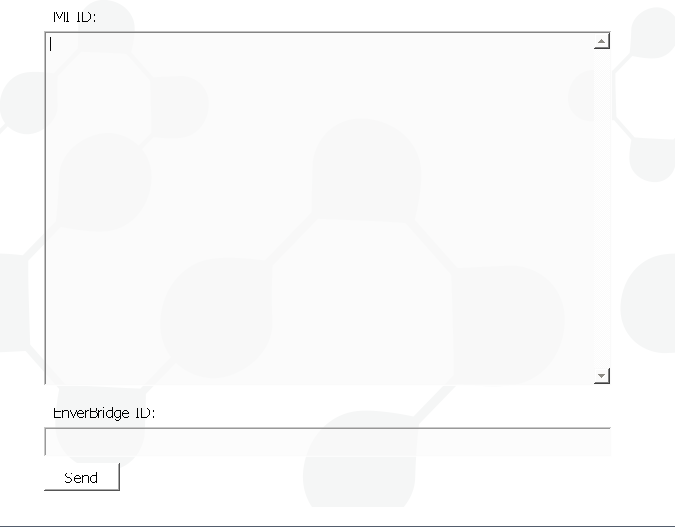
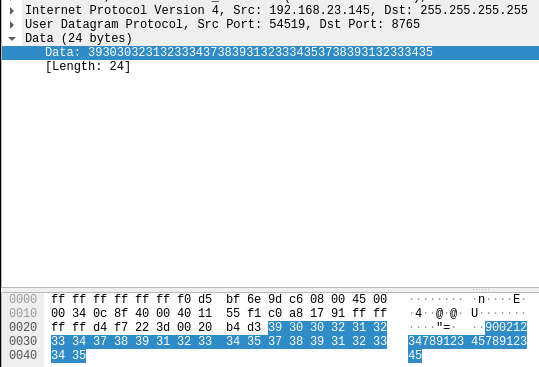
The end result is an installation in ~/.wine/drive_c/Program Files/SetID which reveals that this software is build with Qt5 according to the shipped dll's. The tool itself is in udpCilentNow.exe, and looks like this: Envertech SetID software The Network Communication To my own surprise, the communication is straight forward. A single UDP paket is sent to the broadcast address (255.255.255.255) on port 8765. Envertech SetID udp paket in wireshark I expected some strange binary protocol, but the payload is just simple numbers. They're a combination of the serial numbers of the inverter and the ID of the Enverbridge device. One thing I'm not 100% sure about are the inverter serial numbers, there are two of them, but on the inverter I've seen the serial numbers are always the same. So the payload is assembled like this: If you've more inverter the serials are just appended in the same way. Another strange thing is that the software does close to no input validation, they only check that the inverter serials start with CN and then just extract char 9 to 16. The response from the EnverBridge is also a single UDP paket to the broadcast address on port 8764, with exactly the same content we've sent. Writing a Replacement My result is probably an insult for all proficient Python coders, but based on a bit of research and some cut&paste programming I could assemble a small script to replicate the function of the Windows binary. I guess the usefulness of this exercise was mostly my personal entertainment, though it might help some none Windows users to setup this device. Usage is also very simple:
./enverbridge.py -h
Usage: enverbridge.py [options] MIIDs
Options:
  -h, --help         show this help message and exit
  -b BID, --bid=BID  Serial Number of your EnverBridge
./enverbridge.py -b 90087654 CN19100912345678 CN19100912345679
This is basically 1:1 the behaviour of the Windows binary, though I tried to add a bit more validation then the original binary and some more error messages. I also assume the serial numbers are also always the same so I take only one as the input, and duplicate it for the paket data.

24 March 2020

Christoph Berg: Announcing apt-archive.postgresql.org

Users had often asked where they could find older versions of packages from apt.postgresql.org. I had been collecting these since about April 2013, and in July 2016, I made the packages available via an ad-hoc URL on the repository master host, called "the morgue". There was little repository structure, all files belonging to a source package were stuffed into a single directory, no matter what distribution they belonged to. Besides this not being particularly accessible for users, the main problem was the ever-increasing need for more disk space on the repository host. We are now at 175 GB for the archive, of which 152 GB is for the morgue. Our friends from yum.postgresql.org have had a proper archive host (yum-archive.postgresql.org) for some time already, so it was about time to follow suit and implement a proper archive for apt.postgresql.org as well, usable from apt. So here it is: apt-archive.postgresql.org The archive covers all past and current Debian and Ubuntu distributions. The apt sources.lists entries are similar to the main repository, just with "-archive" appended to the host name and the distribution:

deb https://apt-archive.postgresql.org/pub/repos/apt DIST-pgdg-archive main
deb-src https://apt-archive.postgresql.org/pub/repos/apt DIST-pgdg-archive main
The oldest PostgreSQL server versions covered there are 8.2.23, 8.3.23, 8.4.17, 9.0.13, 9.1.9, 9.2.4, 9.3beta1, and everything newer. Some example:
$ apt-cache policy postgresql-12
postgresql-12:
  Installed: 12.2-2.pgdg+1+b1
  Candidate: 12.2-2.pgdg+1+b1
  Version table:
 *** 12.2-2.pgdg+1+b1 900
        500 http://apt.postgresql.org/pub/repos/apt sid-pgdg/main amd64 Packages
        500 https://apt-archive.postgresql.org/pub/repos/apt sid-pgdg-archive/main amd64 Packages
        100 /var/lib/dpkg/status
     12.2-2.pgdg+1 500
        500 https://apt-archive.postgresql.org/pub/repos/apt sid-pgdg-archive/main amd64 Packages
     12.2-1.pgdg+1 500
        500 https://apt-archive.postgresql.org/pub/repos/apt sid-pgdg-archive/main amd64 Packages
     12.1-2.pgdg+1 500
        500 https://apt-archive.postgresql.org/pub/repos/apt sid-pgdg-archive/main amd64 Packages
     12.1-1.pgdg+1 500
        500 https://apt-archive.postgresql.org/pub/repos/apt sid-pgdg-archive/main amd64 Packages
     12.0-2.pgdg+1 500
        500 https://apt-archive.postgresql.org/pub/repos/apt sid-pgdg-archive/main amd64 Packages
     12.0-1.pgdg+1 500
        500 https://apt-archive.postgresql.org/pub/repos/apt sid-pgdg-archive/main amd64 Packages
     12~rc1-1.pgdg+1 500
        500 https://apt-archive.postgresql.org/pub/repos/apt sid-pgdg-archive/main amd64 Packages
     12~beta4-1.pgdg+1 500
        500 https://apt-archive.postgresql.org/pub/repos/apt sid-pgdg-archive/main amd64 Packages
     12~beta3-1.pgdg+1 500
        500 https://apt-archive.postgresql.org/pub/repos/apt sid-pgdg-archive/main amd64 Packages
     12~beta2-1.pgdg+1 500
        500 https://apt-archive.postgresql.org/pub/repos/apt sid-pgdg-archive/main amd64 Packages
     12~beta1-1.pgdg+1 500
        500 https://apt-archive.postgresql.org/pub/repos/apt sid-pgdg-archive/main amd64 Packages
Because this is hosted on S3, browsing directories is only supported indirectly by static index.html files, so if you want to look at some specific URL, append "/index.html" to see it. The archive is powered by a PostgreSQL database and a bunch of python/shell scripts, from which the apt index files are built. Archiving old distributions I'm also using the opportunity to remove some long-retired distributions from the main repository host. The following distributions have been moved over: They are available as "DIST-pgdg" from the archive, e.g. squeeze:
deb https://apt-archive.postgresql.org/pub/repos/apt squeeze-pgdg main
deb-src https://apt-archive.postgresql.org/pub/repos/apt squeeze-pgdg main

7 March 2020

Julian Andres Klode: APT 2.0 released

After brewing in experimental for a while, and getting a first outing in the Ubuntu 19.10 release; both as 1.9, APT 2.0 is now landing in unstable. 1.10 would be a boring, weird number, eh? Compared to the 1.8 series, the APT 2.0 series features several new features, as well as improvements in performance, hardening. A lot of code has been removed as well, reducing the size of the library.

Highlighted Changes Since 1.8

New Features
  • Commands accepting package names now accept aptitude-style patterns. The syntax of patterns is mostly a subset of aptitude, see apt-patterns(7) for more details.
  • apt(8) now waits for the dpkg locks - indefinitely, when connected to a tty, or for 120s otherwise.
  • When apt cannot acquire the lock, it prints the name and pid of the process that currently holds the lock.
  • A new satisfy command has been added to apt(8) and apt-get(8)
  • Pins can now be specified by source package, by prepending src: to the name of the package, e.g.:
    Package: src:apt
    Pin: version 2.0.0
    Pin-Priority: 990
    
    Will pin all binaries of the native architecture produced by the source package apt to version 2.0.0. To pin packages across all architectures, append :any.

Performance
  • APT now uses libgcrypt for hashing instead of embedded reference implementations of MD5, SHA1, and SHA2 hash families.
  • Distribution of rred and decompression work during update has been improved to take into account the backlog instead of randomly assigning a worker, which should yield higher parallelization.

Incompatibilities
  • The apt(8) command no longer accepts regular expressions or wildcards as package arguments, use patterns (see New Features).

Hardening
  • Credentials specified in auth.conf now only apply to HTTPS sources, preventing malicious actors from reading credentials after they redirected users from a HTTP source to an http url matching the credentials in auth.conf. Another protocol can be specified, see apt_auth.conf(5) for the syntax.

Developer changes
  • A more extensible cache format, allowing us to add new fields without breaking the ABI
  • All code marked as deprecated in 1.8 has been removed
  • Implementations of CRC16, MD5, SHA1, SHA2 have been removed
  • The apt-inst library has been merged into the apt-pkg library.
  • apt-pkg can now be found by pkg-config
  • The apt-pkg library now compiles with hidden visibility by default.
  • Pointers inside the cache are now statically typed. They cannot be compared against integers (except 0 via nullptr) anymore.

python-apt 2.0 python-apt 2.0 is not yet ready, I m hoping to add a new cleaner API for cache access before making the jump from 1.9 to 2.0 versioning.

libept 1.2 I ve moved the maintenance of libept to the APT team. We need to investigate how to EOL this properly and provide facilities inside APT itself to replace it. There are no plans to provide new features, only bugfixes / rebuilds for new apt versions.

6 March 2020

Reproducible Builds: Reproducible Builds in February 2020

Welcome to the February 2020 report from the Reproducible Builds project. One of the original promises of open source software is that distributed peer review and transparency of process results in enhanced end-user security. However, whilst anyone may inspect the source code of free and open source software for malicious flaws, almost all software today is distributed as pre-compiled binaries. This allows nefarious third-parties to compromise systems by injecting malicious code into ostensibly secure software during the various compilation and distribution processes. The motivation behind the reproducible builds effort is to provide the ability to demonstrate these binaries originated from a particular, trusted, source release: if identical results are generated from a given source in all circumstances, reproducible builds provides the means for multiple third-parties to reach a consensus on whether a build was compromised via distributed checksum validation or some other scheme. In this month s report, we cover:

If you are interested in contributing to the project, please visit our Contribute page on our website.

Media coverage & upstream news Omar Navarro Leija, a PhD student at the University Of Pennsylvania, published a paper entitled Reproducible Containers that describes in detail the workings of a new user-space container tool called DetTrace:
All computation that occurs inside a DetTrace container is a pure function of the initial filesystem state of the container. Reproducible containers can be used for a variety of purposes, including replication for fault-tolerance, reproducible software builds and reproducible data analytics. We use DetTrace to achieve, in an automatic fashion, reproducibility for 12,130 Debian package builds, containing over 800 million lines of code, as well as bioinformatics and machine learning workflows.
There was also considerable discussion on our mailing list regarding this research and a presentation based on the paper will occur at the ASPLOS 2020 conference between March 16th 20th in Lausanne, Switzerland. The many virtues of Reproducible Builds were touted as benefits for software compliance in a talk at FOSDEM 2020, debating whether the Careful Inventory of Licensing Bill of Materials Have Impact of FOSS License Compliance which pitted Jeff McAffer and Carol Smith against Bradley Kuhn and Max Sills. (~47 minutes in). Nobuyoshi Nakada updated the canonical implementation of the Ruby programming language a change such that filesystem globs (ie. calls to list the contents of filesystem directories) will henceforth be sorted in ascending order. Without this change, the underlying nondeterministic ordering of the filesystem is exposed to the language which often results in an unreproducible build. Vagrant Cascadian reported on our mailing list regarding a quick reproducible test for the GNU Guix distribution, which resulted in 81.9% of packages registering as reproducible in his installation:
$ guix challenge --verbose --diff=diffoscope ...
2,463 store items were analyzed:
  - 2,016 (81.9%) were identical
  - 37 (1.5%) differed
  - 410 (16.6%) were inconclusive
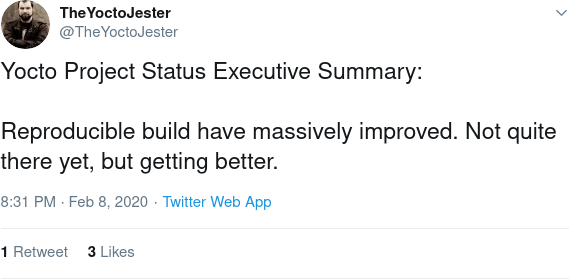
Jeremiah Orians announced on our mailing list the release of a number of tools related to cross-compilation such as M2-Planet and mescc-tools-seed. This project attemps a full bootstrap of a cross-platform compiler for the C programming language (written in C itself) from hex, the ultimate goal being able to demonstrate fully-bootstrapped compiler from hex to the GCC GNU Compiler Collection. This has many implications in and around Ken Thompson s Trusting Trust attack outlined in Thompson s 1983 Turing Award Lecture. Twitter user @TheYoctoJester posted an executive summary of reproducible builds in the Yocto Project: Finally, Reddit user tofflos posted to the /r/Java subreddit asking about how to achieve reproducible builds with Maven and Chris Lamb noticed that the Linux kernel documentation about reproducible builds of it is available on the kernel.org homepages in an attractive HTML format.

Distribution work

Debian Chris Lamb created a merge request for the core debian-installer package to allow all arguments and options from sources.list files (such as [check-valid-until=no] , etc.) in order that we can test the reproducibility of the installer images on the Reproducible Builds own testing infrastructure. (#13) Thorsten Glaser followed-up to a bug filed against the dpkg-source component that was originally filed in late 2015 that claims that the build tool does not respect permissions when unpacking tarballs if the umask is set to 0002. Matthew Garrett posted to the debian-devel mailing list on the topic of Producing verifiable initramfs images as part of a wider conversation on being able to trust the entire software stack on our computers. 59 reviews of Debian packages were added, 30 were updated and 42 were removed this month adding to our knowledge about identified issues. Many issue types were noticed and categorised by Chris Lamb, including:

openSUSE In openSUSE, Bernhard M. Wiedemann published his monthly Reproducible Builds status update as well as provided the following patches:

Software development

diffoscope diffoscope is our in-depth and content-aware diff-like utility that can locate and diagnose reproducibility issues. It is run countless times a day on our testing infrastructure and is essential for identifying fixes and causes of nondeterministic behaviour. Chris Lamb made the following changes this month, including uploading version 137 to Debian:
  • The sng image utility appears to return with an exit code of 1 if there are even minor errors in the file. (#950806)
  • Also extract classes2.dex, classes3.dex from .apk files extracted by apktool. (#88)
  • No need to use str.format if we are just returning the string. [ ]
  • Add generalised support for ignoring returncodes [ ] and move special-casing of returncodes in zip to use Command.VALID_RETURNCODES. [ ]

Other tools disorderfs is our FUSE-based filesystem that deliberately introduces non-determinism into directory system calls in order to flush out reproducibility issues. This month, Vagrant Cascadian updated the Vcs-Git to specify the debian packaging branch. [ ] reprotest is our end-user tool to build same source code twice in widely differing environments and then checks the binaries produced by each build for any differences. This month, versions 0.7.13 and 0.7.14 were uploaded to Debian unstable by Holger Levsen after Vagrant Cascadian added support for GNU Guix [ ].

Project documentation & website There was more work performed on our documentation and website this month. Bernhard M. Wiedemann added a Java Gradle Build Tool snippet to the SOURCE_DATE_EPOCH documentation [ ] and normalised various terms to unreproducible [ ]. Chris Lamb added a Meson.build example [ ] and improved the documentation for the CMake [ ] to the SOURCE_DATE_EPOCH documentation, replaced anyone can with anyone may as, well, not everyone has the resources, skills, time or funding to actually do what it refers to [ ] and improved the pre-processing for our report generation [ ][ ][ ][ ] etc. In addition, Holger Levsen updated our news page to improve the list of reports [ ], added an explicit mention of the weekly news time span [ ] and reverted sorting of news entries to have latest on top [ ] and Mattia Rizzolo added Codethink as a non-fiscal sponsor [ ] and lastly Tianon Gravi added a Docker Images link underneath the Debian project on our Projects page [ ].

Upstream patches The Reproducible Builds project detects, dissects and attempts to fix as many currently-unreproducible packages as possible. We endeavour to send all of our patches upstream where appropriate. This month, we wrote a large number of such patches, including: Vagrant Cascadian submitted patches via the Debian bug tracking system targeting the packages the Civil Infrastructure Platform has identified via the CIP and CIP build depends package sets:

Testing framework We operate a fully-featured and comprehensive Jenkins-based testing framework that powers tests.reproducible-builds.org. This month, the following changes were made by Holger Levsen: In addition, Mattia Rizzolo added an Apache web server redirect for buildinfos.debian.net [ ] and reverted the reshuffling of arm64 architecture builders [ ]. The usual build node maintenance was performed by Holger Levsen, Mattia Rizzolo [ ][ ] and Vagrant Cascadian.

Getting in touch If you are interested in contributing to the Reproducible Builds project, please visit our Contribute page on our website. However, you can get in touch with us via:

This month s report was written by Bernhard M. Wiedemann, Chris Lamb and Holger Levsen. It was subsequently reviewed by a bunch of Reproducible Builds folks on IRC and the mailing list.

29 February 2020

Chris Lamb: Free software activities in February 2020

Here is my monthly update covering what I have been doing in the free software world during February 2020 (previous month): For the Tails privacy-oriented operating system, I uploaded the following packages to Debian:
Reproducible builds One of the original promises of open source software is that distributed peer review and transparency of process results in enhanced end-user security. However, whilst anyone may inspect the source code of free and open source software for malicious flaws, almost all software today is distributed as pre-compiled binaries. This allows nefarious third-parties to compromise systems by injecting malicious code into ostensibly secure software during the various compilation and distribution processes. The motivation behind the Reproducible Builds effort is to provide the ability to demonstrate these binaries originated from a particular trusted source release: if identical results are generated from a given source in all circumstances, reproducible builds provides the means for multiple third-parties to reach a consensus on whether a build was compromised via distributed checksum validation or some other scheme. The initiative is proud to be a member project of the Software Freedom Conservancy, a not-for-profit 501(c)(3) charity focused on ethical technology and user freedom. Conservancy acts as a corporate umbrella allowing projects to operate as non-profit initiatives without managing their own corporate structure. If you like the work of the Conservancy or the Reproducible Builds project, please consider becoming an official supporter. This month, I: In our tooling, I also made the following changes to diffoscope, our in-depth and content-aware diff utility that can locate and diagnose reproducibility issues, including uploading version 137 to Debian:
Debian I submitted a Request for Package (RFP) bug for hsd, a blockchain-based top-level domain DNS protocol implementation that underpins Handshake and worked on some initial packaging. (#952472)
Debian LTS This month I have worked 18 hours on Debian Long Term Support (LTS) and 12 hours on its sister Extended LTS project. You can find out more about the project via the following video:
Uploads Finally, I made a non-maintainer upload of adminer (4.7.6-1) on behalf of Alexandre Rossi.

1 November 2017

James McCoy: Monthly FLOSS activity - 2017/10 edition

Debian subversion vim
libvterm
pangoterm
vim-gnupg
neovim
vim

31 October 2017

Chris Lamb: Free software activities in October 2017

Here is my monthly update covering what I have been doing in the free software world in October 2017 (previous month):
Reproducible builds

Whilst anyone can inspect the source code of free software for malicious flaws, most software is distributed pre-compiled to end users. The motivation behind the Reproducible Builds effort is to allow verification that no flaws have been introduced either maliciously or accidentally during this compilation process by promising identical results are always generated from a given source, thus allowing multiple third-parties to come to a consensus on whether a build was compromised. I have generously been awarded a grant from the Core Infrastructure Initiative to fund my work in this area. This month I:


I also made the following changes to our tooling:
diffoscope

diffoscope is our in-depth and content-aware diff utility that can locate and diagnose reproducibility issues.

  • Improve names in output of "internal" binwalk members. (#877525).
  • Don't crash on malformed md5sums files. (#877473).
  • Omit misleading "any of" prefix when only complaining about a single module on import. [...]
  • Adjust tests as ps2ascii now varies its output on timezone. [...]

strip-nondeterminism

strip-nondeterminism is our tool to remove specific non-deterministic results from a completed build.

  • Clojure considers .class file to be stale if it shares the same timestamp of the .clj. We thus adjust the timestamps of the .clj to always be younger. (#877418).
  • Print a message in --verbose mode if no canonical time was specified. [...]

buildinfo.debian.net

buildinfo.debian.net is my experiment into how to process, store and distribute .buildinfo files after the Debian archive software has processed them.

  • Always show SHA-256 checksums, regardless of the browser viewport size. [...]
  • Add an API endpoint to fetch specific .buildinfo files for a certain package/version/architecture. [...]


Debian My activities as the current Debian Project Leader are covered in my "Bits from the DPL" email to the debian-devel-announce mailing list.
Patches contributed
  • devscripts: Please print the actual arguments debuild makes to Lintian. (#880124)
  • hw-detect: Drop reference to floppy disks; it's almost 2018. (#880122)
  • debci:
    • Use deb.debian.org over http.debian.net. (#879654)
    • Document how to use an alternative mirror. (#879655)

Debian LTS

This month I have been paid to work 18 hours on Debian Long Term Support (LTS). In that time I did the following:
  • "Frontdesk" duties, triaging CVEs, etc.
  • Followed up on a large number of upstream "pings" that have been left dormant.
  • Issued DLA 1121-1 to fix an out-of-bounds read vulnerability in curl where a malicious FTP server could abuse this to prevent clients from interacting with it.
  • Issued DLA 1123-1 for the "Go" programming language where an attacker could generate a MIME request such that the server ran out of file descriptors.
  • Issued DLA 1126-1 for the libxfont font selection and rasterisation library, correcting two vulnerabilities, both involving the library being tricked into reading invalid/random memory.
  • Issued DLA 1134-1 for sdl-image1.2, an image loading library. A maliciously-crafted .xcf file could cause a stack-based buffer overflow resulting in potential code execution.

Uploads
  • python-django:
    • 2.0~beta1-1 New upstream 2.x release.
    • 1.11.6-1 New upstream bugfix release.
  • gunicorn (19.6.0-10+deb9u1) Prepared a release for stable to avoid a runtime dependency on a compiler. (#877722)
  • redis:
    • 4:4.0.2-3:
      • Drop the Debian-specific /etc/redis/redis-server.pre-up.d (etc.) hooks and remove them if unchanged.
      • Include systemd redis-server@.service and redis-sentinel@.service template files to easily run multiple Redis instances. (#877702)
      • Patch redis.conf and sentinel.conf with quilt instead of maintaining our own versions under debian/.
    • 4:4.0.2-4:
      • Add input validity checking to cluster config slot numbers to fix CVE-2017-15047. (#878076)
      • Drop debian/bin/generate-parts now we aren't calling it.
      • Correct Bash-ism in NEWS file.
    • 4:4.0.2-5: Replace the existing patch for CVE-2017-15047 with an upstream-blessed version that covers another case.
  • redisearch (0.21.3-5) Initial release.
  • docbook2man (2.0.0-40) Correct spelling mistakes in binaries and other misc packaging tidying.
  • python-redis (2.10.6-1) New upstream release.
  • bfs (1.1.3-1) New upstream release.

FTP Team

As a Debian FTP assistant I ACCEPTed 103 packages: amcheck, argagg, binutils, blockui, bro-pkg, chkservice, citus, django-axes, docker-containerd, doctest, dtkwidget, duktape, feed2exec, fontforge, fonttools, gcc-8, gcc-8-cross, generator-scripting-language, gitgraph.js, haskell-uri-encode, hoel, iniparser, its, jquery-areyousure, kodi, libcatmandu-mods-perl, libcatmandu-template-perl, libcatmandu-xml-perl, libcatmandu-xsd-perl, libcode-tidyall-plugin-sortlines-naturally-perl, libgdamm5.0, libinfinity, libmods-record-perl, libreoffice-dictionaries, libset-intervaltree-perl, libsodium, linux, linux-grsec, ltsp-manager, lxqt-themes, mailman3-core, measurement-kit, mini-buildd, musescore, node-babel, node-babel-eslint, node-babel-loader, node-babel-plugin-add-module-exports, node-babel-plugin-transform-define, node-gulp-newer, node-regenerate-unicode-properties, node-regexpu-core, node-regjsparser, node-unicode-data, node-unicode-loose-match, openjdk-9, orafce, pgaudit, pgsql-ogr-fdw, pk4, postgresql-mysql-fdw, powa-archivist, python-azure-devtools, python-colormap, python-darkslide, python-dotenv, python-karborclient, python-logfury, python-lupa, python-marshmallow, python-murano-pkg-check, python-octaviaclient, python-pathspec, python-pgpy, python-pydub, python-randomize, python-sabyenc, python-searchlightclient, python-stestr, python-subunit2sql, python-twitter, python-utils, python-wsgilog, r-cran-bindr, r-cran-desc, r-cran-hms, r-cran-readstata13, r-cran-rprojroot, r-cran-wikidatar, r-cran-wikipedir, r-cran-wikitaxa, repmgr, requests-file, resteasy3.0, sdl-kitchensink, stardicter, systemd-el, thunderbird, tomcat8.0, uwsgi-plugin-luajit, uwsgi-plugin-mongo, uwsgi-plugin-php & uwsgi-plugin-v8. I additionally filed 3 RC bugs against packages that had incomplete debian/copyright files against: fonttools, generator-scripting-language & libsodium.

29 October 2017

Niels Thykier: Building packages without (fake)root

Turns out that it is surprisingly easy to build most packages without (fake)root. You just need to basic changes:
  1. A way to set ownership to root:root of paths when dpkg-deb build constructs the binary.
  2. A way to have debhelper not do a bunch of (now) pointless chowns to root:root .
The above is sufficient for dpkg, debhelper, lintian, apt-file, mscgen, pbuilder and a long list of other packages that only provide paths owned by root:root . Obviously, packages differ and yours might need more tweaks than this (e.g. dh_usrlocal had to change behaviour to support this). But for me, the best part is that the above is not just some random prototype stuck in two git repos on alioth: Unfortunately, if you are working with games or core packages like shadow with need for static ownership different from root:root (usually with a setuid or setgid bit), then our first implementation does not support your needs at the moment[1]. We are working on a separate way to solve static ownership in a declarative way. [1] Note regarding /usr/local : If your package needs to provide directories there owned by root:staff with mode 02775, then dh_usrlocal can handle that. The non- root:root ownership here works because the directories are created in a maintainer script run as root during installation. Unfortunately, it cannot provide different ownership or modes with R != binary-targets at the moment.
Filed under: Debhelper, Debian

24 October 2017

Reproducible builds folks: Reproducible Builds: Weekly report #130

Here's what happened in the Reproducible Builds effort between Sunday October 15 and Saturday October 21 2017: Past events Upcoming events New York University sessions A three week session will be held at New York University to work on reproducibilty issues in conjunction with the reproducible builds community. Students from the Application Security course will be working for two weeks to work on the reproducible builds effort. Packages reviewed and fixed, and bugs filed The following reproducible builds-related NMUs were accepted: Patches sent upstream: Reviews of unreproducible packages 41 package reviews have been added, 119 have been updated and 54 have been removed in this week, adding to our knowledge about identified issues. 2 issue types were removed as they were fixed: Weekly QA work During our reproducibility testing, FTBFS bugs have been detected and reported by: diffoscope development strip-nondeterminism development Version 0.039-1 was uploaded to unstable by Chris Lamb. It included contributions already covered by posts of the previous weeks, including: reprotest development tests.reproducible-builds.org Website updates Misc. This week's edition was written by Bernhard M. Wiedemann, Chris Lamb, Holger Levsen, Santiago Torres & reviewed by a bunch of Reproducible Builds folks on IRC & the mailing lists.

22 October 2017

Sean Whitton: Debian Policy call for participation -- October 2017

Here s are some of the bugs against the Debian Policy Manual. In particular, there really are quite a few patches needing seconds from DDs. Consensus has been reached and help is needed to write a patch: #759316 Document the use of /etc/default for cron jobs #761219 document versioned Provides #767839 Linking documentation of arch:any package to arch:all #770440 policy should mention systemd timers #773557 Avoid unsafe RPATH/RUNPATH #780725 PATH used for building is not specified #793499 The Installed-Size algorithm is out-of-date #810381 Update wording of 5.6.26 VCS-* fields to recommend encryption #823256 Update maintscript arguments with dpkg >= 1.18.5 #833401 virtual packages: dbus-session-bus, dbus-default-session-bus #835451 Building as root should be discouraged #838777 Policy 11.8.4 for x-window-manager needs update for freedesktop menus #845715 Please document that packages are not allowed to write outside thei #853779 Clarify requirements about update-rc.d and invoke-rc.d usage in mai #874019 Note that the -e argument to x-terminal-emulator works like #874206 allow a trailing comma in package relationship fields Wording proposed, awaiting review from anyone and/or seconds by DDs: #688251 Built-Using description too aggressive #737796 copyright-format: support Files: paragraph with both abbreviated na #756835 Extension of the syntax of the Packages-List field. #786470 [copyright-format] Add an optional License-Grant field #810381 Update wording of 5.6.26 VCS-* fields to recommend encryption #835451 Building as root should be discouraged #845255 Include best practices for packaging database applications #846970 Proposal for a Build-Indep-Architecture: control file field #850729 Documenting special version number suffixes #864615 please update version of posix standard for scripts (section 10.4) #874090 Clarify wording of some passages #874095 copyright-format: Use the synopsis term established in the de Merged for the next release: #683495 perl scripts: #!/usr/bin/perl MUST or SHOULD? #877674 [debian-policy] update links to the pdf and other formats of the do #878523 [PATCH] Spelling fixes

16 October 2017

Russ Allbery: Free software log (September 2017)

I said that I was going to start writing these regularly, so I'm going to stick to it, even when the results are rather underwhelming. One of the goals is to make the time for more free software work, and I do better at doing things that I record. The only piece of free software work for September was that I made rra-c-util compile cleanly with the Clang static analyzer. This was fairly tedious work that mostly involved unconfusing the compiler or converting (semi-intentional) crashes into explicit asserts, but it unblocks using the Clang static analyzer as part of the automated test suite of my other projects that are downstream of rra-c-util. One of the semantic changes I made was that the vector utilities in rra-c-util (which maintain a resizable array of strings) now always allocate room for at least one string pointer. This wastes a small amount of memory for empty vectors that are never used, but ensures that the strings struct member is always valid. This isn't, strictly speaking, a correctness fix, since all the checks were correct, but after some thought, I decided that humans might have the same problem that the static analyzer had. It's a lot easier to reason about a field that's never NULL. Similarly, the replacement function for a missing reallocarray now does an allocation of size 1 if given a size of 0, just to avoid edge case behavior. (I'm sure the behavior of a realloc with size 0 is defined somewhere in the C standard, but if I have to look it up, I'd rather not make a human reason about it.) I started on, but didn't finish, making rra-c-util compile without Clang warnings (at least for a chosen set of warnings). By far the hardest problem here are the Clang warnings for comparisons between unsigned and signed integers. In theory, I like this warning, since it's the cause of a lot of very obscure bugs. In practice, gah does C ever do this all over the place, and it's incredibly painful to avoid. (One of the biggest offenders is write, which returns a ssize_t that you almost always want to compare against a size_t.) I did a bunch of mechanical work, but I now have a lot of bits of code like:
     if (status < 0)
         return;
    written = (size_t) status;
    if (written < avail)
        buffer->left += written;
which is ugly and unsatisfying. And I also have a ton of casts, such as with:
    buffer_resize(buffer, (size_t) st.st_size + used);
since st.st_size is an off_t, which may be signed. This is all deeply unsatisfying and ugly, and I think it makes the code moderately harder to read, but I do think the warning will potentially catch bugs and even security issues. I'm still torn. Maybe I can find some nice macros or programming styles to avoid the worst of this problem. It definitely requires more thought, rather than just committing this huge mechanical change with lots of ugly code. Mostly, this kind of nonsense makes me want to stop working on C code and go finish learning Rust.... Anyway, apart from work, the biggest thing I managed to do last month that was vaguely related to free software was upgrading my personal servers to stretch (finally). That mostly went okay; only a few things made it unnecessarily exciting. The first was that one of my systems had a very tiny / partition that was too small to hold the downloaded debs for the upgrade, so I had to resize it (VM disk, partition, and file system), and that was a bit exciting because it has an old-style DOS partition table that isn't aligned (hmmm, which is probably why disk I/O is so slow on those VMs), so I had to use the obsolete fdisk -c=dos mode because I wasn't up for replacing the partition right then. The second was that my first try at an upgrade died with a segfault during the libc6 postinst and then every executable segfaulted. A mild panic and a rescue disk later (and thirty minutes and a lot of swearing), I tracked the problem down to libc6-xen. Nothing in the dependency structure between jessie and stretch forces libc6-xen to be upgraded in lockstep or removed, but it's earlier in the search path. So ld.so gets upgraded, and then finds the old libc6 from the libc6-xen package, and the mismatch causes immediate segfaults. A chroot dpkg --purge from the rescue disk solved the problem as soon as I knew what was going on, but that was a stressful half-hour. The third problem was something I should have known was going to be an issue: an old Perl program that does some internal stuff for one of the services I ran had a defined @array test that has been warning for eons and that I never fixed. That became a full syntax error with the most recent Perl, and then I fixed it incorrectly the first time and had a bunch of trouble tracking down what I'd broken. All sorted out now, and everything is happily running stretch. (ejabberd, which other folks had mentioned was a problem, went completely smoothly, although I suspect I now have too many of the plugin packages installed and should do a purging.)

Next.

Previous.