Search Results: "daniel"

23 October 2020

Birger Schacht: An Analysis of 5 Million OpenPGP Keys

In July I finished my Bachelor s Degree in IT Security at the University of Applied Sciences in St. Poelten. During the studies I did some elective courses, one of which was about Data Analysis using Python, Pandas and Jupyter Notebooks. I found it very interesting to do calculations on different data sets and to visualize them. Towards the end of the Bachelor I had to find a topic for my Bachelor Thesis and as a long time user of OpenPGP I thought it would be interesting to do an analysis of the collection of OpenPGP keys that are available on the keyservers of the SKS keyserver network. So in June 2019 I fetched a copy of one of the key dumps of the one of the keyservers (some keyserver publish these copies of their key database so people who want to join the SKS keyserver network can do an initial import). At that time the copy of the key database contained 5,499,675 keys and was around 12GB. Using the hockeypuck keyserver software I imported the keys into an PostgreSQL database. Hockeypuck uses a table called keys to store the keys and in there the column doc stores the OpenPGP keys in JSON format (always with a data field containing the original unparsed data). For the thesis I split the analysis in three parts, first looking at the Public Key packets, then analysing the User ID packets and finally studying the Signature Packets. To analyse the respective packets I used SQL to export the data to CSV files and then used the pandas read_csv method to create a dataframe of the values. In a couple of cases I did some parsing before converting to a DataFrame to make the analysis step faster. The parsing was done using the pgpdump python library. Together with my advisor I decided to submit the thesis for a journal, so we revised and compressed the whole paper and the outcome was now

PUBLISHED in the Journal of Wireless Mobile Networks, Ubiquitous Computing, and Dependable Applications (JoWUA). I think the work gives some valuable insight in the development of the use of OpenPGP in the last 30 years. Looking at the public key packets we were able to compare the different public key algorithms and for example visualize how DSA was the most used algorithm until around 2010 when it was replaced by RSA. When looking at the less used algorithms a trend towards ECC based crytography is visible. What we also noticed was an increase of RSA keys with algorithm ID 3 (RSA Sign-Only), which are deprecated. When we took a deeper look at those keys we realized that most of those keys used a specific User ID string in the User ID packets which allowed us to attribute those keys to two software projects both using the Bouncy Castle Java Cryptographic API (resp. the Spongy Castle version for Android). We also stumbled over a tutorial on how to create RSA keys with Bouncycastle which also describes how to create RSA keys with code that produces RSA Sign-Only keys. In one of those projects, this was then fixed. By looking at the User ID packets we did some statistics about the most used email providers used by OpenPGP users. One domain stood out, because it is not the domain of an email provider: tellfinder.com is a domain used in around 45,000 keys. Tellfinder is a Big Data analysis software and the UID of all but two of those keys is TellFinder Page Archiver- Signing Key <support@tellfinder.com>. We also looked at the comments used in OpenPGP User ID fields. In 2013 Daniel Kahn Gillmor published a blog post titled OpenPGP User ID Comments considered harmful in which he pointed out that most of the comments in the User ID field of OpenPGP keys are duplicating information that is already present somewhere in the User ID or the key itself. In our dataset 3,133 comments were exactly the same as the name, 3,346 were the same as the domain and 18,246 comments were similar to the local part of the email address Last but not least we looked at the signature subpackets and the development of some of the preferences (Preferred Symmetric Algorithm, Preferred Hash Algorithm) that are being published using signature packets. Analysing this huge dataset of cryptographic keys of the last 20 to 30 years was very interesting and I learned a lot about the history of PGP resp. OpenPGP and the evolution of cryptography overall. I think it would be interesting to look at even more properties of OpenPGP keys and I also think it would be valuable for the OpenPGP ecosystem if these kinds analysis could be done regularly. An approach like Tor Metrics could lead to interesting findings and could also help to back decisions regarding future developments of the OpenPGP standard.

11 October 2020

Mark Brown: Book club: JSON Web Tokens

This month for our book club Daniel, Lars, Vince and I read Hardcoded secrets, unverified tokens, and other common JWT mistakes which wasn t quite what we d thought when it was picked. We had been expecting an analysis of JSON web tokens themselves as several us had been working in the area and had noticed various talk about problems with the standard but instead the article is more a discussion of the use of semgrep to find and fix common issues, using issues with JWT as examples. We therefore started off with a bit of a discussion of JWT, concluding that the underlying specification was basically fine given the problem to be solved but that as with any security related technology there were plenty of potential pitfalls in implementation and that sadly many of the libraries implementing the specification make it far too easy to make mistakes such as those covered by the article through their interface design and defaults. For example interfaces that allow interchangable use of public keys and shared keys are error prone, as is is making it easy to access unauthenticated data from tokens without clearly flagging that it is unauthenticated. We agreed that the wide range of JWT implementations available and successfully interoperating with each other is a sign that JWT is getting something right in providing a specification that is clear and implementable. Moving on to semgrep we were all very enthusiastic about the technology, language independent semantic matching with a good set of rules for a range of languages available. Those of us who work on the Linux kernel were familiar with semantic matching and patching as implemented by Coccinelle which has been used quite successfully for years to both avoiding bad patterns in code and making tree wide changes, as demonstrated by the article it is a powerful technique. We were impressed by the multi-language support and approachability of semgrep, with tools like their web editor seeming particularly helpful for people getting started with the tool, especially in conjunction with the wide range of examples available. This was a good discussion (including the tangential discussions of quality problems we had all faced dealing with software over the years, depressing though those can be) and semgrep was a great tool to learn about, I know I m going to be using it for some of my projects.

8 October 2020

Dirk Eddelbuettel: RcppSimdJson 0.1.2: Upstream update

A new RcppSimdJson release arrived on CRAN yesterday bringing along the simdjson 0.5.0 release that happened a few weeks. RcppSimdJson wraps the fantastic and genuinely impressive simdjson library by Daniel Lemire and collaborators. Via very clever algorithmic engineering to obtain largely branch-free code, coupled with modern C++ and newer compiler instructions, it results in parsing gigabytes of JSON parsed per second which is quite mindboggling. The best-case performance is faster than CPU speed as use of parallel SIMD instructions and careful branch avoidance can lead to less than one cpu cycle per byte parsed; see the video of the talk by Daniel Lemire at QCon (also voted best talk). Beside the upstream update, not too much happened to our package itself since 0.1.1 though Brandon did help one user to seriously speed up his JSON processing. The (this time very short) NEWS entry follows.

Changes in version 0.1.2 (2020-10-07)
  • Upgraded to simdjson 0.5.0 (Dirk #49)

Courtesy of my CRANberries, there is also a diffstat report for this release. For questions, suggestions, or issues please use the issue tracker at the GitHub repo. If you like this or other open-source work I do, you can now sponsor me at GitHub. For the first year, GitHub will match your contributions.

This post by Dirk Eddelbuettel originated on his Thinking inside the box blog. Please report excessive re-aggregation in third-party for-profit settings.

21 September 2020

Kees Cook: security things in Linux v5.7

Previously: v5.6 Linux v5.7 was released at the end of May. Here s my summary of various security things that caught my attention: arm64 kernel pointer authentication
While the ARMv8.3 CPU Pointer Authentication (PAC) feature landed for userspace already, Kristina Martsenko has now landed PAC support in kernel mode. The current implementation uses PACIASP which protects the saved stack pointer, similar to the existing CONFIG_STACKPROTECTOR feature, only faster. This also paves the way to sign and check pointers stored in the heap, as a way to defeat function pointer overwrites in those memory regions too. Since the behavior is different from the traditional stack protector, Amit Daniel Kachhap added an LKDTM test for PAC as well. BPF LSM
The kernel s Linux Security Module (LSM) API provide a way to write security modules that have traditionally implemented various Mandatory Access Control (MAC) systems like SELinux, AppArmor, etc. The LSM hooks are numerous and no one LSM uses them all, as some hooks are much more specialized (like those used by IMA, Yama, LoadPin, etc). There was not, however, any way to externally attach to these hooks (not even through a regular loadable kernel module) nor build fully dynamic security policy, until KP Singh landed the API for building LSM policy using BPF. With this, it is possible (for a privileged process) to write kernel LSM hooks in BPF, allowing for totally custom security policy (and reporting). execve() deadlock refactoring
There have been a number of long-standing races in the kernel s process launching code where ptrace could deadlock. Fixing these has been attempted several times over the last many years, but Eric W. Biederman and Ernd Edlinger decided to dive in, and successfully landed the a series of refactorings, splitting up the problematic locking and refactoring their uses to remove the deadlocks. While he was at it, Eric also extended the exec_id counter to 64 bits to avoid the possibility of the counter wrapping and allowing an attacker to send arbitrary signals to processes they normally shouldn t be able to. slub freelist obfuscation improvements
After Silvio Cesare observed some weaknesses in the implementation of CONFIG_SLAB_FREELIST_HARDENED s freelist pointer content obfuscation, I improved their bit diffusion, which makes attacks require significantly more memory content exposures to defeat the obfuscation. As part of the conversation, Vitaly Nikolenko pointed out that the freelist pointer s location made it relatively easy to target too (for either disclosures or overwrites), so I moved it away from the edge of the slab, making it harder to reach through small-sized overflows (which usually target the freelist pointer). As it turns out, there were a few assumptions in the kernel about the location of the freelist pointer, which had to also get cleaned up. RISCV page table dumping
Following v5.6 s generic page table dumping work, Zong Li landed the RISCV page dumping code. This means it s much easier to examine the kernel s page table layout when running a debug kernel (built with PTDUMP_DEBUGFS), visible in /sys/kernel/debug/kernel_page_tables. array index bounds checking
This is a pretty large area of work that touches a lot of overlapping elements (and history) in the Linux kernel. The short version is: C is bad at noticing when it uses an array index beyond the bounds of the declared array, and we need to fix that. For example, don t do this:
int foo[5];
...
foo[8] = bar;
The long version gets complicated by the evolution of flexible array structure members, so we ll pause for a moment and skim the surface of this topic. While things like CONFIG_FORTIFY_SOURCE try to catch these kinds of cases in the memcpy() and strcpy() family of functions, it doesn t catch it in open-coded array indexing, as seen in the code above. GCC has a warning (-Warray-bounds) for these cases, but it was disabled by Linus because of all the false positives seen due to fake flexible array members. Before flexible arrays were standardized, GNU C supported zero sized array members. And before that, C code would use a 1-element array. These were all designed so that some structure could be the header in front of some data blob that could be addressable through the last structure member:
/* 1-element array */
struct foo  
    ...
    char contents[1];
 ;
/* GNU C extension: 0-element array */
struct foo  
    ...
    char contents[0];
 ;
/* C standard: flexible array */
struct foo  
    ...
    char contents[];
 ;
instance = kmalloc(sizeof(struct foo) + content_size);
Converting all the zero- and one-element array members to flexible arrays is one of Gustavo A. R. Silva s goals, and hundreds of these changes started landing. Once fixed, -Warray-bounds can be re-enabled. Much more detail can be found in the kernel s deprecation docs. However, that will only catch the visible at compile time cases. For runtime checking, the Undefined Behavior Sanitizer has an option for adding runtime array bounds checking for catching things like this where the compiler cannot perform a static analysis of the index values:
int foo[5];
...
for (i = 0; i < some_argument; i++)  
    ...
    foo[i] = bar;
    ...
 
It was, however, not separate (via kernel Kconfig) until Elena Petrova and I split it out into CONFIG_UBSAN_BOUNDS, which is fast enough for production kernel use. With this enabled, it's now possible to instrument the kernel to catch these conditions, which seem to come up with some regularity in Wi-Fi and Bluetooth drivers for some reason. Since UBSAN (and the other Sanitizers) only WARN() by default, system owners need to set panic_on_warn=1 too if they want to defend against attacks targeting these kinds of flaws. Because of this, and to avoid bloating the kernel image with all the warning messages, I introduced CONFIG_UBSAN_TRAP which effectively turns these conditions into a BUG() without needing additional sysctl settings. Fixing "additive" snprintf() usage
A common idiom in C for building up strings is to use sprintf()'s return value to increment a pointer into a string, and build a string with more sprintf() calls:
/* safe if strlen(foo) + 1 < sizeof(string) */
wrote  = sprintf(string, "Foo: %s\n", foo);
/* overflows if strlen(foo) + strlen(bar) > sizeof(string) */
wrote += sprintf(string + wrote, "Bar: %s\n", bar);
/* writing way beyond the end of "string" now ... */
wrote += sprintf(string + wrote, "Baz: %s\n", baz);
The risk is that if these calls eventually walk off the end of the string buffer, it will start writing into other memory and create some bad situations. Switching these to snprintf() does not, however, make anything safer, since snprintf() returns how much it would have written:
/* safe, assuming available <= sizeof(string), and for this example
 * assume strlen(foo) < sizeof(string) */
wrote  = snprintf(string, available, "Foo: %s\n", foo);
/* if (strlen(bar) > available - wrote), this is still safe since the
 * write into "string" will be truncated, but now "wrote" has been
 * incremented by how much snprintf() *would* have written, so "wrote"
 * is now larger than "available". */
wrote += snprintf(string + wrote, available - wrote, "Bar: %s\n", bar);
/* string + wrote is beyond the end of string, and availabe - wrote wraps
 * around to a giant positive value, making the write effectively 
 * unbounded. */
wrote += snprintf(string + wrote, available - wrote, "Baz: %s\n", baz);
So while the first overflowing call would be safe, the next one would be targeting beyond the end of the array and the size calculation will have wrapped around to a giant limit. Replacing this idiom with scnprintf() solves the issue because it only reports what was actually written. To this end, Takashi Iwai has been landing a bunch scnprintf() fixes. That's it for now! Let me know if there is anything else you think I should mention here. Next up: Linux v5.8.

2020, Kees Cook. This work is licensed under a Creative Commons Attribution-ShareAlike 4.0 License.
CC BY-SA 4.0

18 September 2020

Daniel Lange: Fixing the Nextcloud menu to show more than eight application icons

I have been late to adopt an on-premise cloud solution as the security of Owncloud a few years ago wasn't so stellar (cf. my comment from 2013 in Encryption files ... for synchronization across the Internet). But the follow-up product Nextcloud has matured quite nicely and we use it for collaboration both in the company and in FLOSS related work at multiple nonprofit organizations. There is a very annoying "feature" in Nextcloud though that the designers think menu items for apps at the top need to be limited to eight or less to prevent information overload in the header. The whole item discussion is worth reading as it it an archetypical example of design prevalence vs. user choice. And of course designers think they are right. That's a feature of the trade.

And because they know better there is no user configurable option to extend that 8 items to may be 12 or so which would prevent the annoying overflow menu we are seeing with 10 applications in use: Screenshot of stock Nextcloud menu Luckily code can be changed and there are many comments floating around the Internet to change const minAppsDesktop = 8. In this case it is slightly complicated by the fact that the javascript code is distributed in compressed form (aka "minified") as core/js/dist/main.js and you probably don't want to build the whole beast locally to change one constant. Basically
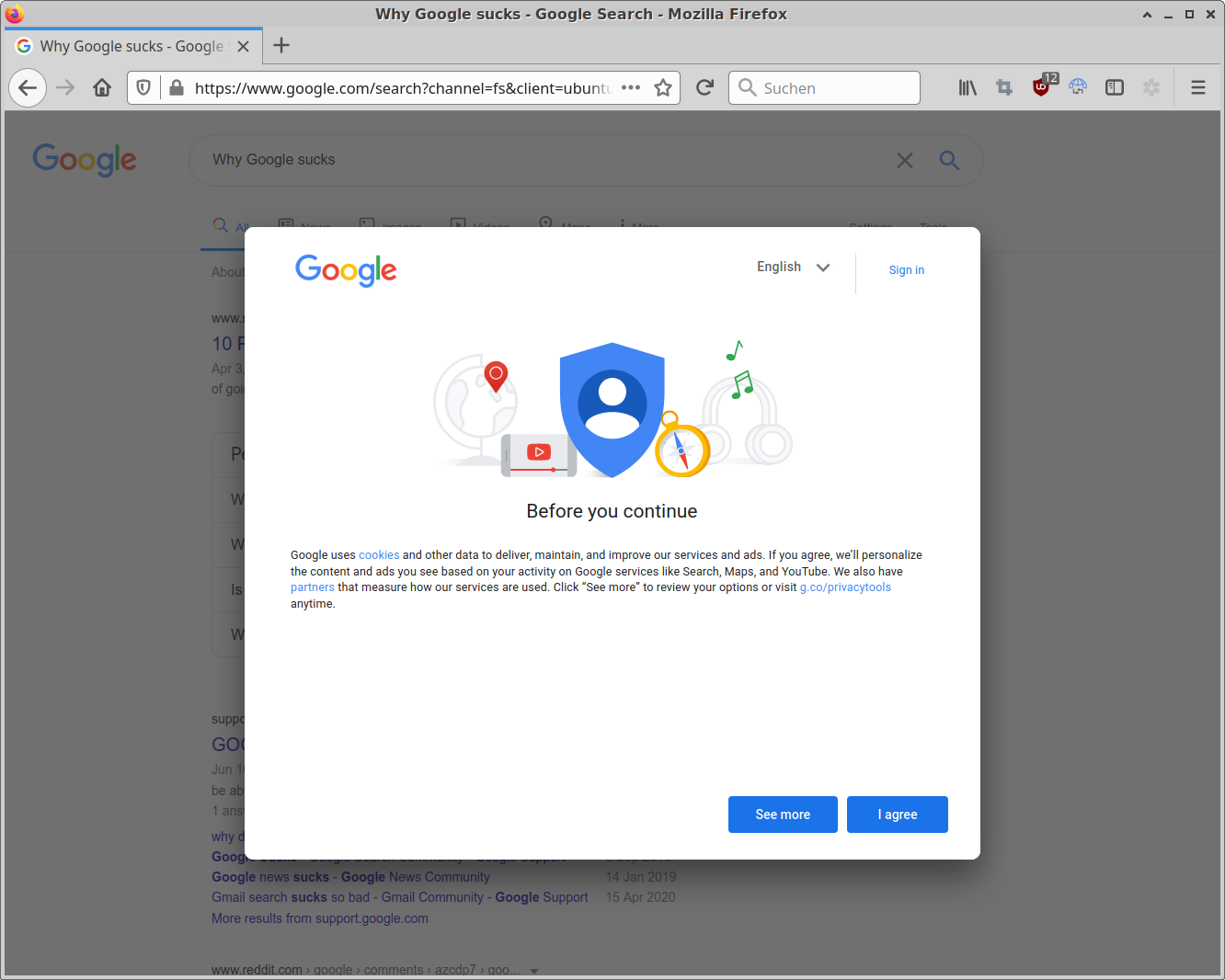
const breakpoint_mobile_width = 1024;

const resizeMenu = () =>
const appList = $('#appmenu li')
const rightHeaderWidth = $('.header-right').outerWidth()
const headerWidth = $('header').outerWidth()
const usePercentualAppMenuLimit = 0.33
const minAppsDesktop = 8
let availableWidth = headerWidth - $('#nextcloud').outerWidth() - (rightHeaderWidth > 210 ? rightHeaderWidth : 210)
const isMobile = $(window).width() < breakpoint_mobile_width
if (!isMobile)
availableWidth = availableWidth * usePercentualAppMenuLimit

let appCount = Math.floor((availableWidth / $(appList).width()))
if (isMobile && appCount > minAppsDesktop)
appCount = minAppsDesktop

if (!isMobile && appCount < minAppsDesktop)
appCount = minAppsDesktop


// show at least 2 apps in the popover
if (appList.length - 1 - appCount >= 1)
appCount--


$('#more-apps a').removeClass('active')
let lastShownApp
for (let k = 0; k < appList.length - 1; k++)
const name = $(appList[k]).data('id')
if (k < appCount)
$(appList[k]).removeClass('hidden')
$('#apps li[data-id=' + name + ']').addClass('in-header')
lastShownApp = appList[k]
else
$(appList[k]).addClass('hidden')
$('#apps li[data-id=' + name + ']').removeClass('in-header')
// move active app to last position if it is active
if (appCount > 0 && $(appList[k]).children('a').hasClass('active'))
$(lastShownApp).addClass('hidden')
$('#apps li[data-id=' + $(lastShownApp).data('id') + ']').removeClass('in-header')
$(appList[k]).removeClass('hidden')
$('#apps li[data-id=' + name + ']').addClass('in-header')


// show/hide more apps icon
if ($('#apps li:not(.in-header)').length === 0)
$('#more-apps').hide()
$('#navigation').hide()
else
$('#more-apps').show()

gets compressed during build time to become part of one 15,000+ character line. The relevant portion reads:
var f=function() var e=s()("#appmenu li"),t=s()(".header-right").outerWidth(),n=s()("header").outerWidth()-s()("#nextcloud").outerWidth()-(t>210?t:210),i=s()(window).width()<1024;i (n*=.33);var r,o=Math.floor(n/s()(e).width());i&&o>8&&(o=8),!i&&o<8&&(o=8),e.length-1-o>=1&&o--,s()("#more-apps a").removeClass("active");for(var a=0;a<e.length-1;a++) var l=s()(e[a]).data("id");a<o?(s()(e[a]).removeClass("hidden"),s()("#apps li[data-id="+l+"]").addClass("in-header"),r=e[a]):(s()(e[a]).addClass("hidden"),s()("#apps li[data-id="+l+"]").removeClass("in-header"),o>0&&s()(e[a]).children("a").hasClass("active")&&(s()(r).addClass("hidden"),s()("#apps li[data-id="+s()(r).data("id")+"]").removeClass("in-header"),s()(e[a]).removeClass("hidden"),s()("#apps li[data-id="+l+"]").addClass("in-header"))) 0===s()("#apps li:not(.in-header)").length?(s()("#more-apps").hide(),s()("#navigation").hide()):s()("#more-apps").show()
Well, we can still patch that, can we? Continue reading "Fixing the Nextcloud menu to show more than eight application icons"

Daniel Lange: Getting rid of the Google cookie consent popup

If you clear your browser cookies regularly (as you should do), Google will annoy you with a full screen cookie consent overlay these days. And - of course - there is no "no tracking consent, technically required cookies only" button. You may log in to Google to set your preference. Yeah, I'm sure this is totally following the intent of the EU Directive 2009/136/EC (the "cookie law"). Google cookie consent pop-up Unfortunately none of the big "anti-annoyances" filter lists seem to have picked that one up yet but the friendly folks from the Computerbase Forum [German] to the rescue. User "Sepp Depp" has created the following filter set that WFM: Add this to your uBlock Origin "My filters" tab:
! Google - remove cookie-consent-popup and restore scroll functionality
google.*##.wwYr3.aID8W.bErdLd
google.*##.aID8W.m114nf.t7xA6
google.*##div[jsname][jsaction^="dg_close"]
google.*##html:style(overflow: visible !important;)
google.*##.widget-consent-fullscreen.widget-consent

10 September 2020

Daniel Silverstone: Broccoli Sync Conversation

Broccoli Sync Conversation A number of days ago (I know, I'm an awful human who failed to post this for over a week), myself, Lars, Mark, and Vince discussed Dropbox's article about Broccoli Sync. It wasn't quite what we'd expected but it was an interesting discussion of compression and streamed data. Vince observed that it was interesting in that it was a way to move storage compression cost to the client edge. This makes sense because decompression (to verify the uploaded content) is cheaper than compression; and also since CPU and bandwidth are expensive, spending the client CPU to reduce bandwidth is worthwhile. Lars talked about how even in situations where everyone has gigabit data connectivity with no limit on total transit, bandwidth/time is a concern, so it makes sense. We liked how they determined the right compresison level to use available bandwidth (i.e. not be CPU throttled) but also gain the most compression possible. Their diagram showing relative compression sizes for level 1 vs. 3 vs. 5 suggests that the gain for putting the effort in for 5 rather than 1. It's interesting in that diagram that 'documents' don't compress well but then again it is notable that such documents are likely DEFLATE'd zip files. Basically if the data is already compressed then there's little hope Brotli will gain much. I raised that it was interesting that they chose Brotli, in part, due to the availability of a pure Rust implementation of Brotli. Lars mentioned that Microsoft and others talk about how huge quantities of C code has unexpected memory safety issues and so perhaps that is related. Daniel mentioned that the document talked about Dropbox having a policy of not running unconstrained C code which was interesting. Vince noted that in their deployment challenges it seemed like a very poor general strategy to cope with crasher errors; but Daniel pointed out that it might be an over-simplified description, and Mark suggested that it might be sufficient until a fix can be pushed out. Vince agreed that it's plausible this is a tiered/sharded deployment process and thus a good way to smoke out problems. Daniel found it interesting that their block storage sounds remarkably like every other content-addressible storage and that while they make it clear in the article that encryption, client identification etc are elided, it looks like they might be able to deduplicate between theoretically hostile clients. We think that the compressed-data plus type plus hash (which we assume also contains length) is an interesting and nice approach to durability and integrity validation in the protocol. And the compressed blocks can then be passed to the storage backend quickly and effectively which is nice for latency. Daniel raised that he thought it was fun that their rust-brotli library is still workable on Rust 1.12 which is really quite old. We ended up on a number of tangential discussions, about Rust, about deployment strategies, and so on. While the article itself was a little thin, we certainly had a lot of good chatting around topics it raised. We'll meet again in a month (on the 28th Sept) so perhaps we'll have a chunkier article next time. (Possibly this and/or related articles)

11 August 2020

Dirk Eddelbuettel: RcppSimdJson 0.1.1: More Features

A first update following for the exciting RcppSimdJson 0.1.0 release last month is now on CRAN. Version 0.1.1 brings further enhancements such direct parsing of raw chars, working with compressed files as well as much expanded querying ability all thanks to Brendan, some improvements to our demos thanks to Daniel as well as a small fix via a one-liner borrowed from upstream for a reported UBSAN issue. RcppSimdJson wraps the fantastic and genuinely impressive simdjson library by Daniel Lemire and collaborators. Via very clever algorithmic engineering to obtain largely branch-free code, coupled with modern C++ and newer compiler instructions, it results in parsing gigabytes of JSON parsed per second which is quite mindboggling. The best-case performance is faster than CPU speed as use of parallel SIMD instructions and careful branch avoidance can lead to less than one cpu cycle use per byte parsed; see the video of the talk by Daniel Lemire at QCon (also voted best talk). The detailed list of changes follows.

Changes in version 0.1.1 (2020-08-10)
  • Corrected incorrect file deletion when mixing local and remote files (Brendan in #34) closing #33.
  • Added support for raw vectors, compressed files, and compressed downloads (Dirk and Brendan in #36, #39, and #45 closing #35 and addressing issues raised in #40 and #44).
  • Examples in two demos are now more self-sufficient (Daniel Lemire and Dirk in #42).
  • Expanded query functionality to include single, flat, and nested queries (Brendan in #45 closing #43).
  • Split error handling parameters from error_ok/on_error into parse_error_ok/on_parse_error and query_error_ok/on_query_error (Brendan in #45).
  • One-line upstream change to address sanitizer error on cast.

Courtesy of CRANberries, there is also a diffstat report for this release. For questions, suggestions, or issues please use the issue tracker at the GitHub repo. If you like this or other open-source work I do, you can now sponsor me at GitHub. For the first year, GitHub will match your contributions.

This post by Dirk Eddelbuettel originated on his Thinking inside the box blog. Please report excessive re-aggregation in third-party for-profit settings.

24 July 2020

Rapha&#235;l Hertzog: The Debian Handbook has been updated for Debian 10

Better late than never as we say thanks to the work of Daniel Leidert and Jorge Maldonado Ventura, we managed to complete the update of my book for Debian 10 Buster. You can get the electronic version on debian-handbook.info or the paperback version on lulu.com. Or you can just read it online. Translators are busy updating their translations, with German and Norvegian Bokmal leading the way

One comment Liked this article? Click here. My blog is Flattr-enabled.

7 July 2020

Dirk Eddelbuettel: RcppSimdJson 0.1.0: Now on Windows, With Parsers and Faster Still!

A smashing new RcppSimdJson release 0.1.0 containing several small updates to upstream simdjson (now at 0.4.6) in part triggered by very excisting work by Brendan who added actual parser from file and string and together with Daniel upstream worked really hard to make Windows builds as well as complete upstream tests on our beloved (ahem) MinGW platform possible. So this version will, once the builders have caught up, give everybody on Windows a binary with a JSON parser running circles around the (arguably more feature-rich and possibly easier-to-use) alternatives. Dave just tweeted a benchmark snippet by Brendan, the full set is at the bottom our issue ticket for this release. RcppSimdJson wraps the fantastic and genuinely impressive simdjson library by Daniel Lemire and collaborators, which in its upstream release 0.4.0 improved once more (also see the following point releases). Via very clever algorithmic engineering to obtain largely branch-free code, coupled with modern C++ and newer compiler instructions, it results in parsing gigabytes of JSON parsed per second which is quite mindboggling. The best-case performance is faster than CPU speed as use of parallel SIMD instructions and careful branch avoidance can lead to less than one cpu cycle use per byte parsed; see the video of the recent talk by Daniel Lemire at QCon (which was also voted best talk). As mentioned, this release expands the reach of the package to Windows, and adds new user-facing functions. A big thanks for most of this is owed to Brendan, so buy him a drink if you run across him. The full NEWS entry follows.

Changes in version 0.1.0 (2020-07-07)
  • Upgraded to simdjson 0.4.1 which adds upstream Windows support (Dirk in #27 closing #26 and #14, plus extensive work by Brendan helping upstream with mingw tests).
  • Upgraded to simdjson 0.4.6 with further upstream improvements (Dirk in #30).
  • Change Travis CI to build matrix over g++ 7, 8, 9, and 10 (Dirk in #31; and also Brendan in #32).
  • New JSON functions fparse and fload (Brendan in #32) closing #18 and #10).

Courtesy of CRANberries, there is also a diffstat report for this release. For questions, suggestions, or issues please use the issue tracker at the GitHub repo. If you like this or other open-source work I do, you can now sponsor me at GitHub. For the first year, GitHub will match your contributions.

This post by Dirk Eddelbuettel originated on his Thinking inside the box blog. Please report excessive re-aggregation in third-party for-profit settings.

6 July 2020

Reproducible Builds: Reproducible Builds in June 2020

Welcome to the June 2020 report from the Reproducible Builds project. In these reports we outline the most important things that we and the rest of the community have been up to over the past month.

What are reproducible builds? One of the original promises of open source software is that distributed peer review and transparency of process results in enhanced end-user security. But whilst anyone may inspect the source code of free and open source software for malicious flaws, almost all software today is distributed as pre-compiled binaries. This allows nefarious third-parties to compromise systems by injecting malicious code into seemingly secure software during the various compilation and distribution processes.

News The GitHub Security Lab published a long article on the discovery of a piece of malware designed to backdoor open source projects that used the build process and its resulting artifacts to spread itself. In the course of their analysis and investigation, the GitHub team uncovered 26 open source projects that were backdoored by this malware and were actively serving malicious code. (Full article) Carl Dong from Chaincode Labs uploaded a presentation on Bitcoin Build System Security and reproducible builds to YouTube: The app intended to trace infection chains of Covid-19 in Switzerland published information on how to perform a reproducible build. The Reproducible Builds project has received funding in the past from the Open Technology Fund (OTF) to reach specific technical goals, as well as to enable the project to meet in-person at our summits. The OTF has actually also assisted countless other organisations that promote transparent, civil society as well as those that provide tools to circumvent censorship and repressive surveillance. However, the OTF has now been threatened with closure. (More info) It was noticed that Reproducible Builds was mentioned in the book End-user Computer Security by Mark Fernandes (published by WikiBooks) in the section titled Detection of malware in software. Lastly, reproducible builds and other ideas around software supply chain were mentioned in a recent episode of the Ubuntu Podcast in a wider discussion about the Snap and application stores (at approx 16:00).

Distribution work In the ArchLinux distribution, a goal to remove .doctrees from installed files was created via Arch s TODO list mechanism. These .doctree files are caches generated by the Sphinx documentation generator when developing documentation so that Sphinx does not have to reparse all input files across runs. They should not be packaged, especially as they lead to the package being unreproducible as their pickled format contains unreproducible data. Jelle van der Waa and Eli Schwartz submitted various upstream patches to fix projects that install these by default. Dimitry Andric was able to determine why the reproducibility status of FreeBSD s base.txz depended on the number of CPU cores, attributing it to an optimisation made to the Clang C compiler [ ]. After further detailed discussion on the FreeBSD bug it was possible to get the binaries reproducible again [ ]. For the GNU Guix operating system, Vagrant Cascadian started a thread about collecting reproducibility metrics and Jan janneke Nieuwenhuizen posted that they had further reduced their bootstrap seed to 25% which is intended to reduce the amount of code to be audited to avoid potential compiler backdoors. In openSUSE, Bernhard M. Wiedemann published his monthly Reproducible Builds status update as well as made the following changes within the distribution itself:

Debian Holger Levsen filed three bugs (#961857, #961858 & #961859) against the reproducible-check tool that reports on the reproducible status of installed packages on a running Debian system. They were subsequently all fixed by Chris Lamb [ ][ ][ ]. Timo R hling filed a wishlist bug against the debhelper build tool impacting the reproducibility status of 100s of packages that use the CMake build system which led to a number of tests and next steps. [ ] Chris Lamb contributed to a conversation regarding the nondeterministic execution of order of Debian maintainer scripts that results in the arbitrary allocation of UNIX group IDs, referencing the Tails operating system s approach this [ ]. Vagrant Cascadian also added to a discussion regarding verification formats for reproducible builds. 47 reviews of Debian packages were added, 37 were updated and 69 were removed this month adding to our knowledge about identified issues. Chris Lamb identified and classified a new uids_gids_in_tarballs_generated_by_cmake_kde_package_app_templates issue [ ] and updated the paths_vary_due_to_usrmerge as deterministic issue, and Vagrant Cascadian updated the cmake_rpath_contains_build_path and gcc_captures_build_path issues. [ ][ ][ ]. Lastly, Debian Developer Bill Allombert started a mailing list thread regarding setting the -fdebug-prefix-map command-line argument via an environment variable and Holger Levsen also filed three bugs against the debrebuild Debian package rebuilder tool (#961861, #961862 & #961864).

Development On our website this month, Arnout Engelen added a link to our Mastodon account [ ] and moved the SOURCE_DATE_EPOCH git log example to another section [ ]. Chris Lamb also limited the number of news posts to avoid showing items from (for example) 2017 [ ]. strip-nondeterminism is our tool to remove specific non-deterministic results from a completed build. It is used automatically in most Debian package builds. This month, Mattia Rizzolo bumped the debhelper compatibility level to 13 [ ] and adjusted a related dependency to avoid potential circular dependency [ ].

Upstream work The Reproducible Builds project attempts to fix unreproducible packages and we try to to send all of our patches upstream. This month, we wrote a large number of such patches including: Bernhard M. Wiedemann also filed reports for frr (build fails on single-processor machines), ghc-yesod-static/git-annex (a filesystem ordering issue) and ooRexx (ASLR-related issue).

diffoscope diffoscope is our in-depth diff-on-steroids utility which helps us diagnose reproducibility issues in packages. It does not define reproducibility, but rather provides a helpful and human-readable guidance for packages that are not reproducible, rather than relying essentially-useless binary diffs. This month, Chris Lamb uploaded versions 147, 148 and 149 to Debian and made the following changes:
  • New features:
    • Add output from strings(1) to ELF binaries. (#148)
    • Dump PE32+ executables (such as EFI applications) using objdump(1). (#181)
    • Add support for Zsh shell completion. (#158)
  • Bug fixes:
    • Prevent a traceback when comparing PDF documents that did not contain metadata (ie. a PDF /Info stanza). (#150)
    • Fix compatibility with jsondiff version 1.2.0. (#159)
    • Fix an issue in GnuPG keybox file handling that left filenames in the diff. [ ]
    • Correct detection of JSON files due to missing call to File.recognizes that checks candidates against file(1). [ ]
  • Output improvements:
    • Use the CSS word-break property over manually adding U+200B zero-width spaces as these were making copy-pasting cumbersome. (!53)
    • Downgrade the tlsh warning message to an info level warning. (#29)
  • Logging improvements:
  • Testsuite improvements:
    • Update tests for file(1) version 5.39. (#179)
    • Drop accidentally-duplicated copy of the --diff-mask tests. [ ]
    • Don t mask an existing test. [ ]
  • Codebase improvements:
    • Replace obscure references to WF with Wagner-Fischer for clarity. [ ]
    • Use a semantic AbstractMissingType type instead of remembering to check for both types of missing files. [ ]
    • Add a comment regarding potential security issue in the .changes, .dsc and .buildinfo comparators. [ ]
    • Drop a large number of unused imports. [ ][ ][ ][ ][ ]
    • Make many code sections more Pythonic. [ ][ ][ ][ ]
    • Prevent some variable aliasing issues. [ ][ ][ ]
    • Use some tactical f-strings to tidy up code [ ][ ] and remove explicit u"unicode" strings [ ].
    • Refactor a large number of routines for clarity. [ ][ ][ ][ ]
trydiffoscope is the web-based version of diffoscope. This month, Chris Lamb also corrected the location for the celerybeat scheduler to ensure that the clean/tidy tasks are actually called which had caused an accidental resource exhaustion. (#12) In addition Jean-Romain Garnier made the following changes:
  • Fix the --new-file option when comparing directories by merging DirectoryContainer.compare and Container.compare. (#180)
  • Allow user to mask/filter diff output via --diff-mask=REGEX. (!51)
  • Make child pages open in new window in the --html-dir presenter format. [ ]
  • Improve the diffs in the --html-dir format. [ ][ ]
Lastly, Daniel Fullmer fixed the Coreboot filesystem comparator [ ] and Mattia Rizzolo prevented warnings from the tlsh fuzzy-matching library during tests [ ] and tweaked the build system to remove an unwanted .build directory [ ]. For the GNU Guix distribution Vagrant Cascadian updated the version of diffoscope to version 147 [ ] and later 148 [ ].

Testing framework We operate a large and many-featured Jenkins-based testing framework that powers tests.reproducible-builds.org. Amongst many other tasks, this tracks the status of our reproducibility efforts across many distributions as well as identifies any regressions that have been introduced. This month, Holger Levsen made the following changes:
  • Debian-related changes:
    • Prevent bogus failure emails from rsync2buildinfos.debian.net every night. [ ]
    • Merge a fix from David Bremner s database of .buildinfo files to include a fix regarding comparing source vs. binary package versions. [ ]
    • Only run the Debian package rebuilder job twice per day. [ ]
    • Increase bullseye scheduling. [ ]
  • System health status page:
    • Add a note displaying whether a node needs to be rebooted for a kernel upgrade. [ ]
    • Fix sorting order of failed jobs. [ ]
    • Expand footer to link to the related Jenkins job. [ ]
    • Add archlinux_html_pages, openwrt_rebuilder_today and openwrt_rebuilder_future to known broken jobs. [ ]
    • Add HTML <meta> header to refresh the page every 5 minutes. [ ]
    • Count the number of ignored jobs [ ], ignore permanently known broken jobs [ ] and jobs on known offline nodes [ ].
    • Only consider the known offline status from Git. [ ]
    • Various output improvements. [ ][ ]
  • Tools:
    • Switch URLs for the Grml Live Linux and PureOS package sets. [ ][ ]
    • Don t try to build a disorderfs Debian source package. [ ][ ][ ]
    • Stop building diffoscope as we are moving this to Salsa. [ ][ ]
    • Merge several is diffoscope up-to-date on every platform? test jobs into one [ ] and fail less noisily if the version in Debian cannot be determined [ ].
In addition: Marcus Hoffmann was added as a maintainer of the F-Droid reproducible checking components [ ], Jelle van der Waa updated the is diffoscope up-to-date in every platform check for Arch Linux and diffoscope [ ], Mattia Rizzolo backed up a copy of a remove script run on the Codethink-hosted jump server [ ] and Vagrant Cascadian temporarily disabled the fixfilepath on bullseye, to get better data about the ftbfs_due_to_f-file-prefix-map categorised issue. Lastly, the usual build node maintenance was performed by Holger Levsen [ ][ ], Mattia Rizzolo [ ] and Vagrant Cascadian [ ][ ][ ][ ][ ].

If you are interested in contributing to the Reproducible Builds project, please visit our Contribute page on our website. However, you can get in touch with us via:

This month s report was written by Bernhard M. Wiedemann, Chris Lamb, Eli Schwartz, Holger Levsen, Jelle van der Waa and Vagrant Cascadian. It was subsequently reviewed by a bunch of Reproducible Builds folks on IRC and the mailing list.

26 June 2020

Chris Lamb: On the pleasure of hating

People love to tell you that they "don't watch sports" but the story of Lance Armstrong provides a fascinating lens through which to observe our culture at large. For example, even granting all that he did and all the context in which he did it, why do sports cheats act like a lightning rod for such an instinctive hatred? After all, the sheer level of distaste directed at people such as Lance eludes countless other criminals in our society, many of whom have taken a lot more with far fewer scruples. The question is not one of logic or rationality, but of proportionality. In some ways it should be unsurprising. In all areas of life, we instinctively prefer binary judgements to moral ambiguities and the sports cheat is a clich of moral bankruptcy cheating at something so seemingly trivial as a sport actually makes it more, not less, offensive to us. But we then find ourselves strangely enthralled by them, drawn together in admiration of their outlaw-like tenacity, placing them strangely close to criminal folk heroes. Clearly, sport is not as unimportant as we like to claim it is. In Lance's case in particular though, there is undeniably a Shakespearean quality to the story and we are forced to let go of our strict ideas of right and wrong and appreciate all the nuance.

There is a lot of this nuance in Marina Zenovich's new documentary. In fact, there's a lot of everything. At just under four hours, ESPN's Lance combines the duration of a Tour de France stage with the depth of the peloton an endurance event compared to the bite-sized hagiography of Michael Jordan's The Last Dance. Even for those who follow Armstrong's story like a mini-sport in itself, Lance reveals new sides to this man for all seasons. For me, not only was this captured in his clumsy approximations at being a father figure but also in him being asked something I had not read in countless tell-all books: did his earlier experiments in drug-taking contribute to his cancer? But even in 2020 there are questions that remain unanswered. By needlessly returning to the sport in 2009, did Lance subconsciously want to get caught? Why does he not admit he confessed to Betsy Andreu back in 1999 but will happily apologise to her today for slurring her publicly on this very point? And why does he remain so vindictive towards former-teammate Floyd Landis? In all of Armstrong's evasions and masterful control of the narrative, there is the gnawing feeling that we don't even know what questions we should be even asking. As ever, the questions are more interesting than the answers.

Lance also reminded me of how professional cycling's obsession with national identity. Although I was intuitively aware of it to some degree, I had not fully grasped how much this kind of stereotyping runs through the veins of the sport itself, just like the drugs themselves. Journalist Daniel Friebe first offers us the portrait of:
Spaniards tend to be modest, very humble. Very unpretentious. And the Italians are loud, vain and outrageous showmen.
Former directeur sportif Johan Bruyneel then asserts that "Belgians are hard workers... they are ambitious to a certain point, but not overly ambitious", and cyclist J rg Jaksche concludes with:
The Germans are very organised and very structured. And then the French, now I have to be very careful because I am German, but the French are slightly superior.
This kind of lazy caricature is nothing new, especially for those brought up on a solid diet of Tintin and Asterix, but although all these examples are seemingly harmless, why does the underlying idea of ascribing moral, social or political significance to genetic lineage remain so durable in today's age of anti-racism? To be sure, culture is not quite the same thing as race, but being judged by the character of one's ancestors rather than the actions of an individual is, at its core, one of the many conflations at the heart of racism. There is certainly a large amount of cognitive dissonance at work, especially when Friebe elaborates:
East German athletes were like incredible robotic figures, fallen off a production line somewhere behind the Iron Curtain...
... but then bermensch Jan Ullrich is immediately described as "emotional" and "struggled to live the life of a professional cyclist 365 days a year". We see the habit to stereotype is so ingrained that even in the face of this obvious contradiction, Friebe unironically excuses Ullrich's failure to live up his German roots due to him actually being "Mediterranean".

I mention all this as I am known within my circles for remarking on these national characters, even collecting stereotypical examples of Italians 'being Italian' and the French 'being French' at times. Contrary to evidence, I don't believe in this kind of innate quality but what I do suspect is that people generally behave how they think they ought to behave, perhaps out of sheer imitation or the simple pleasure of conformity. As the novelist Will Self put it:
It's quite a complicated collective imposture, people pretending to be British and people pretending to be French, and then they get really angry with each other over what they're pretending to be.
The really remarkable thing about this tendency is that even if we consciously notice it there is no seemingly no escape even I could not smirk when I considered that a brash Texan winning the Tour de France actually combines two of America's cherished obsessions: winning... and annoying the French.

25 June 2020

Dirk Eddelbuettel: RcppSimdJson 0.0.6: New Upstream, New Features!

A very exciting RcppSimdJson release with the updated upstream simdjson release 0.4.0 as well as a first set of new JSON parsing functions just hit CRAN. RcppSimdJson wraps the fantastic and genuinely impressive simdjson library by Daniel Lemire and collaborators. Via very clever algorithmic engineering to obtain largely branch-free code, coupled with modern C++ and newer compiler instructions, it results in parsing gigabytes of JSON parsed per second which is quite mindboggling. The best-case performance is faster than CPU speed as use of parallel SIMD instructions and careful branch avoidance can lead to less than one cpu cycle use per byte parsed; see the video of the recent talk by Daniel Lemire at QCon (which was also voted best talk). The very recent 0.4.0 release further improves the already impressive speed. And this release brings a first set of actually user-facing functions thanks to Brendan which put in a series of PRs! The full NEWS entry follows.

Changes in version 0.0.6 (2020-06-25)
  • Created C++ integer-handling utilities for safe downcasting and integer return (Brendan in #16 closing #13).
  • New JSON functions .deserialize_json and .load_json (Brendan in #16, #17, #20, #21).
  • Upgrade Travis CI to 'bionic', extract package and version from DESCRIPTION (Dirk in #23).
  • Upgraded to simdjson 0.4.0 (Dirk in #25 closing #24).

Courtesy of CRANberries, there is also a diffstat report for this release. For questions, suggestions, or issues please use the issue tracker at the GitHub repo. If you like this or other open-source work I do, you can now sponsor me at GitHub. For the first year, GitHub will match your contributions.

This post by Dirk Eddelbuettel originated on his Thinking inside the box blog. Please report excessive re-aggregation in third-party for-profit settings.

21 June 2020

Daniel Lange: Upgrading Limesurvey with (near) zero downtime

Limesurvey is an online survey tool. It is very powerful and commonly used in academic environments because it is Free Software (GPLv2+), allows for local installations protecting the data of participants and allowing to comply with data protection regulations. This also means there are typically no load-balanced multi-server szenarios with HA databases. But simple VMs where Limesurvey runs and needs upgrading in place. There's an LTS branch (currently 3.x) and a stable branch (currently 4.x). There's also a 2.06 LTS branch that is restricted to paying customers. The main developers behind Limesurvey offer many services from template design to custom development to support to hosting ("Cloud", "Limesurvey Pro"). Unfortunately they also charge for easy updates called "ComfortUpdate" (currently 39 for three months) and the manual process is made a bit cumbersome to make the "ComfortUpdate" offer more attractive. Due to Limesurvey being an old code base and UI elements not being clearly separated, most serious use cases will end up patching files and symlinking logos around template directories. That conflicts a bit with the opaque "ComfortUpdate" process where you push a button and then magic happens. Or you have downtime and a recovery case while surveys are running. If you do not intend to use the "ComfortUpdate" offering, you can prevent Limesurvey from connecting to http://comfortupdate.limesurvey.org daily by adding the updatable stanza as in line 14 to limesurvey/application/config/config.php:
  1. return array(
  2. [...]
  3. // Use the following config variable to set modified optional settings copied from config-defaults.php
  4. 'config'=>array(
  5. // debug: Set this to 1 if you are looking for errors. If you still get no errors after enabling this
  6. // then please check your error-logs - either in your hosting provider admin panel or in some /logs directory
  7. // on your webspace.
  8. // LimeSurvey developers: Set this to 2 to additionally display STRICT PHP error messages and get full access to standard templates
  9. 'debug'=>0,
  10. 'debugsql'=>0, // Set this to 1 to enanble sql logging, only active when debug = 2
  11. // Mysql database engine (INNODB MYISAM):
  12. 'mysqlEngine' => 'MYISAM'
  13. , // Update default LimeSurvey config here
  14. 'updatable' => false,
  15. )
  16. );
The comma on line 13 is placed like that in the current default limesurvey config.php, don't let yourself get confused. Every item in a php array must end with a comma. It can be on the next line. The basic principle of low risk, near-zero downtime, in-place upgrades is:
  1. Create a diff between the current release and the target release
  2. Inspect the diff
  3. Make backups of the application webroot
  4. Patch a copy of the application in-place
  5. (optional) stop the web server
  6. Make a backup of the production database
  7. Move the patched application to the production webroot
  8. (if 5) Start the webserver
  9. Upgrade the database (if needed)
  10. Check the application
So, in detail: Continue reading "Upgrading Limesurvey with (near) zero downtime"

19 June 2020

Reproducible Builds (diffoscope): diffoscope 148 released

The diffoscope maintainers are pleased to announce the release of diffoscope version 148. This version includes the following changes:
[ Daniel Fullmer ]
* Fix a regression in the CBFS comparator due to changes in our_check_output.
[ Chris Lamb ]
* Add a remark in the deb822 handling re. potential security issue in the
  .changes, .dsc, .buildinfo comparator.
You find out more by visiting the project homepage.

15 June 2020

Mark Brown: Book Club: Zettlekasten

Recently I was part of a call with Daniel and Lars to discuss Zettelkasten, a system for building up a cross-referenced archive of notes to help with research and study that has been getting a lot of discussion recently, the key thing being the building of links between ideas. Tomas Vik provided an overview of the process that we all found very helpful, and the information vs knowledge picture in Eugene Yan s blog on the topic (by @gapingvoid) really helped us crystalize the goals. It s not at all new and as Lars noted has a lot of similarities with a wikis in terms of what it produces but it couples this with an emphasis on the process and constant generation of new entries which Daniel found similar to some of the Getting Things Done recommendations. We all liked the emphasis on constant practice and how that can help build skills around effective note taking, clear writing and building links between ideas. Both Daniel and Lars already have note taking practicies that they find useful, combinations of journalling and building up collections of notes of learnings over time, and felt that there could be value in integrating aspects of Zettelkasten into these practices so we talked quite a bit about how that could be done. There was a consensus that journalling is useful so the main idea we had was to keep maintaining the journal, using that as an inbox and setting aside time to write entries into a Zettelkasten. This is also a useful way to approach recording things when away from a computer, taking notes and then writing them up later. Daniel suggested that one way to migrate existing notes might be to simply start anew, moving things over from old notes as required and then after a suitably long period (for example a year) review anything that was left and migrate anything that was left. We were all concerned about the idea of using any of the non-free solutions for something that is intended to be used long term, especially where the database isn t in an easily understood format. Fortunately there are free software tools like Zettlr which seem to address these concerns well. This was a really useful discussion, it really helps to bounce ideas off each other and this was certainly an interesting topic to learn about with some good ideas which will hopefully be helpful to us.

4 June 2020

Reproducible Builds: Reproducible Builds in May 2020

Welcome to the May 2020 report from the Reproducible Builds project. One of the original promises of open source software is that distributed peer review and transparency of process results in enhanced end-user security. Nonetheless, whilst anyone may inspect the source code of free and open source software for malicious flaws, almost all software today is distributed as pre-compiled binaries. This allows nefarious third-parties to compromise systems by injecting malicious code into seemingly secure software during the various compilation and distribution processes. In these reports we outline the most important things that we and the rest of the community have been up to over the past month.

News The Corona-Warn app that helps trace infection chains of SARS-CoV-2/COVID-19 in Germany had a feature request filed against it that it build reproducibly. A number of academics from Cornell University have published a paper titled Backstabber s Knife Collection which reviews various open source software supply chain attacks:
Recent years saw a number of supply chain attacks that leverage the increasing use of open source during software development, which is facilitated by dependency managers that automatically resolve, download and install hundreds of open source packages throughout the software life cycle.
In related news, the LineageOS Android distribution announced that a hacker had access to the infrastructure of their servers after exploiting an unpatched vulnerability. Marcin Jachymiak of the Sia decentralised cloud storage platform posted on their blog that their siac and siad utilities can now be built reproducibly:
This means that anyone can recreate the same binaries produced from our official release process. Now anyone can verify that the release binaries were created using the source code we say they were created from. No single person or computer needs to be trusted when producing the binaries now, which greatly reduces the attack surface for Sia users.
Synchronicity is a distributed build system for Rust build artifacts which have been published to crates.io. The goal of Synchronicity is to provide a distributed binary transparency system which is independent of any central operator. The Comparison of Linux distributions article on Wikipedia now features a Reproducible Builds column indicating whether distributions approach and progress towards achieving reproducible builds.

Distribution work In Debian this month: In Alpine Linux, an issue was filed and closed regarding the reproducibility of .apk packages. Allan McRae of the ArchLinux project posted their third Reproducible builds progress report to the arch-dev-public mailing list which includes the following call for help:
We also need help to investigate and fix the packages that fail to reproduce that we have not investigated as of yet.
In openSUSE, Bernhard M. Wiedemann published his monthly Reproducible Builds status update.

Software development

diffoscope Chris Lamb made the changes listed below to diffoscope, our in-depth and content-aware diff utility that can locate and diagnose reproducibility issues. He also prepared and uploaded versions 142, 143, 144, 145 and 146 to Debian, PyPI, etc.
  • Comparison improvements:
    • Improve fuzzy matching of JSON files as file now supports recognising JSON data. (#106)
    • Refactor .changes and .buildinfo handling to show all details (including the GnuPG header and footer components) even when referenced files are not present. (#122)
    • Use our BuildinfoFile comparator (etc.) regardless of whether the associated files (such as the orig.tar.gz and the .deb) are present. [ ]
    • Include GnuPG signature data when comparing .buildinfo, .changes, etc. [ ]
    • Add support for printing Android APK signatures via apksigner(1). (#121)
    • Identify iOS App Zip archive data as .zip files. (#116)
    • Add support for Apple Xcode .mobilepovision files. (#113)
  • Bug fixes:
    • Don t print a traceback if we pass a single, missing argument to diffoscope (eg. a JSON diff to re-load). [ ]
    • Correct differences typo in the ApkFile handler. (#127)
  • Output improvements:
    • Never emit the same id="foo" anchor reference twice in the HTML output, otherwise identically-named parts will not be able to linked to via a #foo anchor. (#120)
    • Never emit an empty id anchor either; it is not possible to link to #. [ ]
    • Don t pretty-print the output when using the --json presenter; it will usually be too complicated to be readable by the human anyway. [ ]
    • Use the SHA256 over MD5 hash when generating page names for the HTML directory-style presenter. (#124)
  • Reporting improvements:
    • Clarify the message when we truncate the number of lines to standard error [ ] and reduce the number of maximum lines printed to 25 as usually the error is obvious by then [ ].
    • Print the amount of free space that we have available in our temporary directory as a debugging message. [ ]
    • Clarify Command [ ] failed with exit code messages to remove duplicate exited with exit but also to note that diffoscope is interpreting this as an error. [ ]
    • Don t leak the full path of the temporary directory in Command [ ] exited with 1 messages. (#126)
    • Clarify the warning message when we cannot import the debian Python module. [ ]
    • Don t repeat stderr from if both commands emit the same output. [ ]
    • Clarify that an external command emits for both files, otherwise it can look like we are repeating itself when, in reality, it is being run twice. [ ]
  • Testsuite improvements:
    • Prevent apksigner test failures due to lack of binfmt_misc, eg. on Salsa CI and elsewhere. [ ]
    • Drop .travis.yml as we use Salsa instead. [ ]
  • Dockerfile improvements:
    • Add a .dockerignore file to whitelist files we actually need in our container. (#105)
    • Use ARG instead of ENV when setting up the DEBIAN_FRONTEND environment variable at runtime. (#103)
    • Run as a non-root user in container. (#102)
    • Install/remove the build-essential during build so we can install the recommended packages from Git. [ ]
  • Codebase improvements:
    • Bump the officially required version of Python from 3.5 to 3.6. (#117)
    • Drop the (default) shell=False keyword argument to subprocess.Popen so that the potentially-unsafe shell=True is more obvious. [ ]
    • Perform string normalisation in Black [ ] and include the Black output in the assertion failure too [ ].
    • Inline MissingFile s special handling of deb822 to prevent leaking through abstract layers. [ ][ ]
    • Allow a bare try/except block when cleaning up temporary files with respect to the flake8 quality assurance tool. [ ]
    • Rename in_dsc_path to dsc_in_same_dir to clarify the use of this variable. [ ]
    • Abstract out the duplicated parts of the debian_fallback class [ ] and add descriptions for the file types. [ ]
    • Various commenting and internal documentation improvements. [ ][ ]
    • Rename the Openssl command class to OpenSSLPKCS7 to accommodate other command names with this prefix. [ ]
  • Misc:
    • Rename the --debugger command-line argument to --pdb. [ ]
    • Normalise filesystem stat(2) birth times (ie. st_birthtime) in the same way we do with the stat(1) command s Access: and Change: times to fix a nondeterministic build failure in GNU Guix. (#74)
    • Ignore case when ordering our file format descriptions. [ ]
    • Drop, add and tidy various module imports. [ ][ ][ ][ ]
In addition:
  • Jean-Romain Garnier fixed a general issue where, for example, LibarchiveMember s has_same_content method was called regardless of the underlying type of file. [ ]
  • Daniel Fullmer fixed an issue where some filesystems could only be mounted read-only. (!49)
  • Emanuel Bronshtein provided a patch to prevent a build of the Docker image containing parts of the build s. (#123)
  • Mattia Rizzolo added an entry to debian/py3dist-overrides to ensure the rpm-python module is used in package dependencies (#89) and moved to using the new execute_after_* and execute_before_* Debhelper rules [ ].

Chris Lamb also performed a huge overhaul of diffoscope s website:
  • Add a completely new design. [ ][ ]
  • Dynamically generate our contributor list [ ] and supported file formats [ ] from the main Git repository.
  • Add a separate, canonical page for every new release. [ ][ ][ ]
  • Generate a latest release section and display that with the corresponding date on the homepage. [ ]
  • Add an RSS feed of our releases [ ][ ][ ][ ][ ] and add to Planet Debian [ ].
  • Use Jekyll s absolute_url and relative_url where possible [ ][ ] and move a number of configuration variables to _config.yml [ ][ ].

Upstream patches The Reproducible Builds project detects, dissects and attempts to fix as many currently-unreproducible packages as possible. We endeavour to send all of our patches upstream where appropriate. This month, we wrote a large number of such patches, including:

Other tools Elsewhere in our tooling: strip-nondeterminism is our tool to remove specific non-deterministic results from a completed build. In May, Chris Lamb uploaded version 1.8.1-1 to Debian unstable and Bernhard M. Wiedemann fixed an off-by-one error when parsing PNG image modification times. (#16) In disorderfs, our FUSE-based filesystem that deliberately introduces non-determinism into directory system calls in order to flush out reproducibility issues, Chris Lamb replaced the term dirents in place of directory entries in human-readable output/log messages [ ] and used the astyle source code formatter with the default settings to the main disorderfs.cpp source file [ ]. Holger Levsen bumped the debhelper-compat level to 13 in disorderfs [ ] and reprotest [ ], and for the GNU Guix distribution Vagrant Cascadian updated the versions of disorderfs to version 0.5.10 [ ] and diffoscope to version 145 [ ].

Project documentation & website
  • Carl Dong:
  • Chris Lamb:
    • Rename the Who page to Projects . [ ]
    • Ensure that Jekyll enters the _docs subdirectory to find the _docs/index.md file after an internal move. (#27)
    • Wrap ltmain.sh etc. in preformatted quotes. [ ]
    • Wrap the SOURCE_DATE_EPOCH Python examples onto more lines to prevent visual overflow on the page. [ ]
    • Correct a preferred spelling error. [ ]
  • Holger Levsen:
    • Sort our Academic publications page by publication year [ ] and add Trusting Trust and Fully Countering Trusting Trust through Diverse Double-Compiling [ ].
  • Juri Dispan:

Testing framework We operate a large and many-featured Jenkins-based testing framework that powers tests.reproducible-builds.org that, amongst many other tasks, tracks the status of our reproducibility efforts as well as identifies any regressions that have been introduced. Holger Levsen made the following changes:
  • System health status:
    • Improve page description. [ ]
    • Add more weight to proxy failures. [ ]
    • More verbose debug/failure messages. [ ][ ][ ]
    • Work around strangeness in the Bash shell let VARIABLE=0 exits with an error. [ ]
  • Debian:
    • Fail loudly if there are more than three .buildinfo files with the same name. [ ]
    • Fix a typo which prevented /usr merge variation on Debian unstable. [ ]
    • Temporarily ignore PHP s horde](https://www.horde.org/) packages in Debian bullseye. [ ]
    • Document how to reboot all nodes in parallel, working around molly-guard. [ ]
  • Further work on a Debian package rebuilder:
    • Workaround and document various issues in the debrebuild script. [ ][ ][ ][ ]
    • Improve output in the case of errors. [ ][ ][ ][ ]
    • Improve documentation and future goals [ ][ ][ ][ ], in particular documentiing two real world tests case for an impossible to recreate build environment [ ].
    • Find the right source package to rebuild. [ ]
    • Increase the frequency we run the script. [ ][ ][ ][ ]
    • Improve downloading and selection of the sources to build. [ ][ ][ ]
    • Improve version string handling.. [ ]
    • Handle build failures better. [ ]. [ ]. [ ]
    • Also consider architecture all .buildinfo files. [ ][ ]
In addition:
  • kpcyrd, for Alpine Linux, updated the alpine_schroot.sh script now that a patch for abuild had been released upstream. [ ]
  • Alexander Couzens of the OpenWrt project renamed the brcm47xx target to bcm47xx. [ ]
  • Mattia Rizzolo fixed the printing of the build environment during the second build [ ][ ][ ] and made a number of improvements to the script that deploys Jenkins across our infrastructure [ ][ ][ ].
Lastly, Vagrant Cascadian clarified in the documentation that you need to be user jenkins to run the blacklist command [ ] and the usual build node maintenance was performed was performed by Holger Levsen [ ][ ][ ], Mattia Rizzolo [ ][ ] and Vagrant Cascadian [ ][ ][ ].

Mailing list: There were a number of discussions on our mailing list this month: Paul Spooren started a thread titled Reproducible Builds Verification Format which reopens the discussion around a schema for sharing the results from distributed rebuilders:
To make the results accessible, storable and create tools around them, they should all follow the same schema, a reproducible builds verification format. The format tries to be as generic as possible to cover all open source projects offering precompiled source code. It stores the rebuilder results of what is reproducible and what not.
Hans-Christoph Steiner of the Guardian Project also continued his previous discussion regarding making our website translatable. Lastly, Leo Wandersleb posted a detailed request for feedback on a question of supply chain security and other issues of software review; Leo is the founder of the Wallet Scrutiny project which aims to prove the security of Android Bitcoin Wallets:
Do you own your Bitcoins or do you trust that your app allows you to use your coins while they are actually controlled by them ? Do you have a backup? Do they have a copy they didn t tell you about? Did anybody check the wallet for deliberate backdoors or vulnerabilities? Could anybody check the wallet for those?
Elsewhere, Leo had posted instructions on his attempts to reproduce the binaries for the BlueWallet Bitcoin wallet for iOS and Android platforms.


If you are interested in contributing to the Reproducible Builds project, please visit our Contribute page on our website. However, you can get in touch with us via:

This month s report was written by Bernhard M. Wiedemann, Chris Lamb, Holger Levsen, Jelle van der Waa and Vagrant Cascadian. It was subsequently reviewed by a bunch of Reproducible Builds folks on IRC and the mailing list.

30 May 2020

Reproducible Builds (diffoscope): diffoscope 146 released

The diffoscope maintainers are pleased to announce the release of diffoscope version 146. This version includes the following changes:
[ Chris Lamb ]
* Refactor .changes and .buildinfo handling to show all details (including
  the GPG header and footer components), even when referenced files are not
  present. (Closes: reproducible-builds/diffoscope#122)
* Normalise filesystem stat(2) "birth times" (ie. st_birthtime) in the same
  way we do with stat(1)'s "Access:" and "Change:" times to fix a
  nondetermistic build failure on GNU Guix.
  (Closes: reproducible-builds/diffoscope#74)
* Drop the (default) subprocess.Popen(shell=False) keyword argument so that
  the more unsafe shell=True is more obvious.
* Ignore lower vs. upper-case when ordering our file format descriptions.
* Don't skip string normalisation in Black.
[ Mattia Rizzolo ]
* Add a "py3dist" override for the rpm-python module (Closes: #949598)
* Bump the debhelper compat level to 13 and use the new
  execute_after_*/execture_before_* style rules.
* Fix a spelling error in changelog.
[ Daniel Fullmer ]
* Mount GuestFS filesystem images readonly.
[ Jean-Romain Garnier ]
* Prevent an issue where (for example) LibarchiveMember's has_same_content
  method is called regardless of the actual type of file.
You find out more by visiting the project homepage.

23 May 2020

Dirk Eddelbuettel: RcppSimdJson 0.0.5: Updated Upstream

A new RcppSimdJson release with updated upstream simdjson code just arrived on CRAN. RcppSimdJson wraps the fantastic and genuinely impressive simdjson library by Daniel Lemire and collaborators. Via some very clever algorithmic engineering to obtain largely branch-free code, coupled with modern C++ and newer compiler instructions, it results in parsing gigabytes of JSON parsed per second which is quite mindboggling. The best-case performance is faster than CPU speed as use of parallel SIMD instructions and careful branch avoidance can lead to less than one cpu cycle use per byte parsed; see the video of the recent talk by Daniel Lemire at QCon (which was also voted best talk). This release brings updated upstream code (thanks to Brendan Knapp) plus a new example and minimal tweaks. The full NEWS entry follows.

Changes in version 0.0.5 (2020-05-23)
  • Add parseExample from earlier upstream announcement (Dirk).
  • Synced with upstream (Brendan in #12) closing #11).
  • Updated example parseExample to API changes (Brendan).

Courtesy of CRANberries, there is also a diffstat report for this release. For questions, suggestions, or issues please use the issue tracker at the GitHub repo. If you like this or other open-source work I do, you can now sponsor me at GitHub. For the first year, GitHub will match your contributions.

This post by Dirk Eddelbuettel originated on his Thinking inside the box blog. Please report excessive re-aggregation in third-party for-profit settings.

12 May 2020

Daniel Silverstone: The Lars, Mark, and Daniel Club

Last night, Lars, Mark, and I discussed Jeremy Kun's The communicative value of using Git well post. While a lot of our discussion was spawned by the article, we did go off-piste a little, and I hope that my notes below will enlighten you all as to a bit of how we see revision control these days. It was remarkably pleasant to read an article where the comments section wasn't a cesspool of horror, so if this posting encourages you to go and read the article, don't stop when you reach the bottom -- the comments are good and useful too.
This was a fairly non-contentious article for us though each of us had points we wished to bring up and chat about it turned into a very convivial chat. We saw the main thrust of the article as being about using the metadata of revision control to communicate intent, process, and decision making. We agreed that it must be possible to do so effectively with Mercurial (thus deciding that the mention of it was simply a bit of clickbait / red herring) and indeed Mark figured that he was doing at least some of this kind of thing way back with CVS. We all discussed how knowing the fundamentals of Git's data model improved our ability to work wih the tool. Lars and I mentioned how jarring it has originally been to come to Git from revision control systems such as Bazaar (bzr) but how over time we came to appreciate Git for what it is. For Mark this was less painful because he came to Git early enough that there was little more than the fundamental data model, without much of the porcelain which now exists. One point which we all, though Mark in particular, felt was worth considering was that of distinguishing between published and unpublished changes. The article touches on it a little, but one of the benefits of the workflow which Jeremy espouses is that of using the revision control system as an integral part of the review pipeline. This is perhaps done very well with Git based workflows, but can be done with other VCSs. With respect to the points Jeremy makes regarding making commits which are good for reviewing, we had a general agreement that things were good and sensible, to a point, but that some things were missed out on. For example, I raised that commit messages often need to be more thorough than one-liners, but Jeremy's examples (perhaps through expedience for the article?) were all pretty trite one-liners which perhaps would have been entirely obvious from the commit content. Jeremy makes the point that large changes are hard to review, and Lars poined out that Greg Wilson did research in this area, and at least one article mentions 200 lines as a maximum size of a reviewable segment. I had a brief warble at this point about how reviewing needs to be able to consider the whole of the intended change (i.e. a diff from base to tip) not just individual commits, which is also missing from Jeremy's article, but that such a review does not need to necessarily be thorough and detailed since the commit-by-commit review remains necessary. I use that high level diff as a way to get a feel for the full shape of the intended change, a look at the end-game if you will, before I read the story of how someone got to it. As an aside at this point, I talked about how Jeremy included a 'style fixes' commit in his example, but I loathe seeing such things and would much rather it was either not in the series because it's unrelated to it; or else the style fixes were folded into the commits they were related to. We discussed how style rules, as well as commit-bisectability, and other rules which may exist for a codebase, the adherence to which would form part of the checks that a code reviewer may perform, are there to be held to when they help the project, and to be broken when they are in the way of good communication between humans. In this, Lars talked about how revision control histories provide high level valuable communication between developers. Communication between humans is fraught with error and the rules are not always clear on what will work and what won't, since this depends on the communicators, the context, etc. However whatever communication rules are in place should be followed. We often say that it takes two people to communicate information, but when you're writing commit messages or arranging your commit history, the second party is often nebulous "other" and so the code reviewer fulfils that role to concretise it for the purpose of communication. At this point, I wondered a little about what value there might be (if any) in maintaining the metachanges (pull request info, mailing list discussions, etc) for historical context of decision making. Mark suggested that this is useful for design decisions etc but not for the style/correctness discussions which often form a large section of review feedback. Maybe some of the metachange tracking is done automatically by the review causing the augmentation of the changes (e.g. by comments, or inclusion of design documentation changes) to explain why changes are made. We discussed how the "rebase always vs. rebase never" feeling flip-flopped in us for many years until, as an example, what finally won Lars over was that he wants the history of the project to tell the story, in the git commits, of how the software has changed and evolved in an intentional manner. Lars said that he doesn't care about the meanderings, but rather about a clear story which can be followed and understood. I described this as the switch from "the revision history is about what I did to achieve the goal" to being more "the revision history is how I would hope someone else would have done this". Mark further refined that to "The revision history of a project tells the story of how the project, as a whole, chose to perform its sequence of evolution." We discussed how project history must necessarily then contain issue tracking, mailing list discussions, wikis, etc. There are exist free software projects where part of their history is forever lost because, for example, the project moved from Sourceforge to Github, but made no effort (or was unable) to migrate issues or somesuch. Linkages between changes and the issues they relate to can easily be broken, though at least with mailing lists you can often rewrite URLs if you have something consistent like a Message-Id. We talked about how cover notes, pull request messages, etc. can thus also be lost to some extent. Is this an argument to always use merges whose message bodies contain those details, rather than always fast-forwarding? Or is it a reason to encapsulate all those discussions into git objects which can be forever associated with the changes in the DAG? We then diverted into discussion of CI, testing every commit, and the benefits and limitations of automated testing vs. manual testing; though I think that's a little too off-piste for even this summary. We also talked about how commit message audiences include software perhaps, with the recent movement toward conventional commits and how, with respect to commit messages for machine readability, it can become very complex/tricky to craft good commit messages once there are multiple disparate audiences. For projects the size of the Linux kernel this kind of thing would be nearly impossible, but for smaller projects, perhaps there's value. Finally, we all agreed that we liked the quote at the end of the article, and so I'd like to close out by repeating it for you all... Hal Abelson famously said:
Programs must be written for people to read, and only incidentally for machines to execute.
Jeremy agrees, as do we, and extends that to the metacommit information as well.

Next.

Previous.