Search Results: "cts"

16 February 2026

Antoine Beaupr : Keeping track of decisions using the ADR model

In the Tor Project system Administrator's team (colloquially known as TPA), we've recently changed how we take decisions, which means you'll get clearer communications from us about upcoming changes or targeted questions about a proposal. Note that this change only affects the TPA team. At Tor, each team has its own way of coordinating and making decisions, and so far this process is only used inside TPA. We encourage other teams inside and outside Tor to evaluate this process to see if it can improve your processes and documentation.

The new process We had traditionally been using a "RFC" ("Request For Comments") process and have recently switched to "ADR" ("Architecture Decision Record"). The ADR process is, for us, pretty simple. It consists of three things:
  1. a simpler template
  2. a simpler process
  3. communication guidelines separate from the decision record

The template As team lead, the first thing I did was to propose a new template (in ADR-100), a variation of the Nygard template. The TPA variation of the template is similarly simple, as it has only 5 headings, and is worth quoting in full:
  • Context: What is the issue that we're seeing that is motivating this decision or change?
  • Decision: What is the change that we're proposing and/or doing?
  • Consequences: What becomes easier or more difficult to do because of this change?
  • More Information (optional): What else should we know? For larger projects, consider including a timeline and cost estimate, along with the impact on affected users (perhaps including existing Personas). Generally, this includes a short evaluation of alternatives considered.
  • Metadata: status, decision date, decision makers, consulted, informed users, and link to a discussion forum
The previous RFC template had 17 (seventeen!) headings, which encouraged much longer documents. Now, the decision record will be easier to read and digest at one glance. An immediate effect of this is that I've started using GitLab issues more for comparisons and brainstorming. Instead of dumping in a document all sorts of details like pricing or in-depth alternatives comparison, we record those in the discussion issue, keeping the document shorter.

The process The whole process is simple enough that it's worth quoting in full as well:
Major decisions are introduced to stakeholders in a meeting, smaller ones by email. A delay allows people to submit final comments before adoption.
Now, of course, the devil is in the details (and ADR-101), but the point is to keep things simple. A crucial aspect of the proposal, which Jacob Kaplan-Moss calls the one weird trick, is to "decide who decides". Our previous process was vague about who makes the decision and the new template (and process) clarifies decision makers, for each decision. Inversely, some decisions degenerate into endless discussions around trivial issues because too many stakeholders are consulted, a problem known as the Law of triviality, also known as the "Bike Shed syndrome". The new process better identifies stakeholders:
  • "informed" users (previously "affected users")
  • "consulted" (previously undefined!)
  • "decision maker" (instead of the vague "approval")
Picking those stakeholders is still tricky, but our definitions are more explicit and aligned to the classic RACI matrix (Responsible, Accountable, Consulted, Informed).

Communication guidelines Finally, a crucial part of the process (ADR-102) is to decouple the act of making and recording decisions from communicating about the decision. Those are two radically different problems to solve. We have found that a single document can't serve both purposes. Because ADRs can affect a wide range of things, we don't have a specific template for communications. We suggest the Five Ws method (Who? What? When? Where? Why?) and, again, to keep things simple.

How we got there The ADR process is not something I invented. I first stumbled upon it in the Thunderbird Android project. Then, in parallel, I was in the process of reviewing the RFC process, following Jacob Kaplan-Moss's criticism of the RFC process. Essentially, he argues that:
  1. the RFC process "doesn't include any sort of decision-making framework"
  2. "RFC processes tend to lead to endless discussion"
  3. the process "rewards people who can write to exhaustion"
  4. "these processes are insensitive to expertise", "power dynamics and power structures"
And, indeed, I have been guilty of a lot of those issues. A verbose writer, I have written extremely long proposals that I suspect no one has ever fully read. Some proposals were adopted by exhaustion, or ignored because not looping in the right stakeholders. Our discussion issue on the topic has more details on the issues I found with our RFC process. But to give credit to the old process, it did serve us well while it was there: it's better than nothing, and it allowed us to document a staggering number of changes and decisions (95 RFCs!) made over the course of 6 years of work.

What's next? We're still experimenting with the communication around decisions, as this text might suggest. Because it's a separate step, we also have a tendency to forget or postpone it, like this post, which comes a couple of months late. Previously, we'd just ship a copy of the RFC to everyone, which was easy and quick, but incomprehensible to most. Now we need to write a separate communication, which is more work but, hopefully, worth the as the result is more digestible. We can't wait to hear what you think of the new process and how it works for you, here or in the discussion issue! We're particularly interested in people that are already using a similar process, or that will adopt one after reading this.
Note: this article was also published on the Tor Blog.

Philipp Kern: What is happening with this "connection verification"?

You might see a verification screen pop up on more and more Debian web properties. Unfortunately the AI world of today is meeting web hosts that use Perl CGIs and are not built as multi-tiered scalable serving systems. The issues have been at three layers:
  1. Apache's serving capacity runs full - with no threads left to serve requests. This means that your connection will sit around for a long time, not getting accepted. In theory this can be configured, but that would require requests to be handled in time.
  2. Startup costs of request handlers are too high, because we spawn a process for every request. This currently affects the BTS and dgit's browse interface. packages.debian.org has been fixed, which increased scalability sufficiently.
  3. Requests themselves are too expensive to be served quickly - think git blame without caching.

Optimally we would go and solve some scalability issues with the services, however there is also a question of how much we want to be able to serve - as AI scraper demand is just a steady stream of requests that are not shown to humans.

How is it implemented?

DSA has now stood up some VMs with Varnish for proxying. Incoming TLS is provided by hitch, and TLS "on-loading" is done using haproxy. That way TLS goes in and TLS goes out. While Varnish does cache, if the content is cachable (e.g. does not depend on cookies) - that is not the primary reason for using it: It can be used for flexible query and response rewriting.

If no cookie with a proof of work is provided, the user is redirected to a challenge page that does some webcrypto in Javascript - because that looked similar to what other projects do (e.g. haphash that originally inspired the solution). However so far it looks like scrapers generally do not run with Javascript enabled, so this whole crypto proof of work business could probably be replaced with just a Javascript-based redirect. The existing solution also has big (security) holes in it. And, as we found out, Firefox is slower at webcrypto than Chrome. I have recently reduced the complexity, so you should notice it blocking you significantly less.

Once you have the cookie, you can keep accessing the site for as long as the cookie is valid. Please do not make any assumptions about the cookies, or you will be broken in the future.For legitimate scrapers that obey robots.txt, there is now an automatically generated IP allowlist in place (thanks, Marco d'Itri). Turns out that the search engines do not actually run Javascript either and then loudly complain about the redirect to the challenge page. Other bots are generally exempt.

Conclusion I hope that right now we found sort of the sweet spot where the admins can stop spending human time on updating firewall rules and the services are generally available, reasonably fast, and still indexed. In case you see problems or run into a block with your own (legitimate) bots, please let me know.

Benjamin Mako Hill: Why do people participate in similar online communities?

Note: I have not published blog posts about my academic papers over the past few years. To ensure that my blog contains a more comprehensive record of my published papers and to surface these for folks who missed them, I will be periodically (re)publishing blog posts about some older published projects. It seems natural to think of online communities competing for the time and attention of their participants. Over the last few years, I ve worked with a team of collaborators led by Nathan TeBlunthuis to use mathematical and statistical techniques from ecology to understand these dynamics. What we ve found surprised us: competition between online communities is rare and typically short-lived. When we started this research, we figured competition would be most likely among communities discussing similar topics. As a first step, we identified clusters of such communities on Reddit. One surprising thing we noticed in our Reddit data was that many of these communities that used similar language also had very high levels of overlap among their users. This was puzzling: why were the same groups of people talking to each other about the same things in different places? And why don t they appear to be in competition with each other for their users time and activity? We didn t know how to answer this question using quantitative methods. As a result, we recruited and interviewed 20 active participants in clusters of highly related subreddits with overlapping user bases (for example, one cluster was focused on vintage audio). We found that the answer to the puzzle lay in the fact that the people we talked to were looking for three distinct things from the communities they worked in:

  1. The ability to connect to specific information and narrowly scoped discussions.
  2. The ability to socialize with people who are similar to themselves.
  3. Attention from the largest possible audience.
Critically, we also found that these three things represented a trilemma, and that no single community can meet all three needs. You might find two of the three in a single community, but you could never have all three.
Figure from No Community Can Do Everything: Why People Participate in Similar Online Communities depicts three key benefits that people seek from online communities and how individual communities tend not to optimally provide all three. For example, large communities tend not to afford a tight-knit homophilous community.
The end result is something I recognize in how I engage with online communities on platforms like Reddit. People tend to engage with a portfolio of communities that vary in size, specialization, topical focus, and rules. Compared with any single community, such overlapping systems can provide a wider range of benefits. No community can do everything.

This work was published as a paper at CSCW: TeBlunthuis, Nathan, Charles Kiene, Isabella Brown, Laura (Alia) Levi, Nicole McGinnis, and Benjamin Mako Hill. 2022. No Community Can Do Everything: Why People Participate in Similar Online Communities. Proceedings of the ACM on Human-Computer Interaction 6 (CSCW1): 61:1-61:25. https://doi.org/10.1145/3512908.

This work was supported by the National Science Foundation (awards IIS-1908850, IIS-1910202, and GRFP-2016220885). A full list of acknowledgements is in the paper.

13 February 2026

Erich Schubert: Dogfood Generative AI

Current AI companies ignore licenses such as the GPL, and often train on anything they can scrape. This is not acceptable. The AI companies ignore web conventions, e.g., they deep link images from your web sites (even adding ?utm_source=chatgpt.com to image URIs, I suggest that you return 403 on these requests), but do not direct visitors to your site. You do not get a reliable way of opting out from generative AI training or use. For example, the only way to prevent your contents from being used in Google AI Overviews is to use data-nosnippet and cripple the snippet preview in Google. The AI browsers such as Comet, Atlas do not identify as such, but rather pretend they are standard Chromium. There is no way to ban such AI use on your web site. Generative AI overall is flooding the internet with garbage. It was estimated that 1/3rd of the content uploaded to YouTube is by now AI generated. This includes the same veteran stories crap in thousands of variants as well as brainrot content (that at least does not pretend to be authentic), some of which is among the most viewed recent uploads. Hence, these platforms even benefit from the AI slop. And don t blame the creators because you can currently earn a decent amount of money from such contents, people will generate brainrot content. If you have recently tried to find honest reviews of products you considered buying, you will have noticed thousands of sites with AI generated fake product reviews, that all are financed by Amazon PartnerNet commissions. Often with hilarious nonsense such as recommending sewing thread with German instructions as tool for repairing a sewing machine. And on Amazon, there are plenty of AI generated product reviews the use of emoji is a strong hint. And if you leave a negative product review, there is a chance they offer you a refund to get rid of it And the majority of SPAM that gets through my filters is by now sent via Gmail and Amazon SES. Partially because of GenAI, StackOverflow is pretty much dead which used to be one of the most valuable programming resources. (While a lot of people complain about moderation, famous moderator Shog9 from the early SO days suggested that a change in Google s ranking is also to blame, as it began favoring showing new content over the existing answered questions causing more and more duplicates to be posted because people no longer found the existing good answers. In January 2026, there were around 3400 questions and 6000 answers posted, less than in the first month of SO of August 2008 (before the official launch). Many open-source projects are suffering in many ways, e.g., false bug reports that caused curl to stop its bug bounty program. Wikipedia is also suffering badly from GenAI. Science is also flooded with poor AI generated papers, often reviewed with help from AI. This is largely due to bad incentives to graduate, you are expected to write many papers on certain A conferences, such as NeurIPS. On these conferences the number of submissions is growing insane, and the review quality plummets. All to often, the references in these papers are hallucinated, too; and libraries complain that they receive more and more requests to locate literature that does not appear to exist. However, the worst effect (at least to me as an educator) is the noskilling effect (a rather novel term derived from deskilling, I have only seen it in this article by We els and Maibaum). Instead of acquiring skills (writing, reading, summarizing, programming) by practising, too many people now outsource all this to AI, leading to them not learn the basics necessary to advance to a higher skill level. In my impression, this effect is dramatic. It is even worse than deskilling, as it does not mean losing an advanced skill that you apparently can replace, but often means not acquiring basic skills in the first place. And the earlier pupils start using generative AI, the less skills they acquire. Dogfood the AI Let s dogfood the AI. Here s an outline:

  1. Get a list of programming topics, e.g., get a list of algorithms from Wikidata, get a StackOverflow data dump.
  2. Generate flawed code examples for the algorithms / programming questions, maybe generate blog posts, too.
    You do not need a high-quality model for this. Use something you can run locally or access for free.
  3. Date everything back in time, remove typical indications of AI use.
  4. Upload to Github, because Microsoft will feed this to OpenAI
Here is an example prompt that you can use:
You are a university educator, preparing homework assignments in debugging.
The programming language used is  lang .
The students are tasked to find bugs in given code.
Do not just call existing implementations from libraries, but implement the algorithm from scratch.
Make sure there are two mistakes in the code that need to be discovered by the students.
Do NOT repeat instructions. Do NOT add small-talk. Do NOT provide a solution.
The code may have (misleading) comments, but must NOT mention the bugs.
If you do not know how to implement the algorithm, output an empty response.
Output only the code for the assignment! Do not use markdown.
Begin with a code comment that indicates the algorithm name and idea.
If you indicate a bug, always use a comment with the keyword BUG
Generate a  lang  implementation (with bugs) of:  n  ( desc )
Remember to remove the BUG comments! If you pick some slighly less common programming languages (by quantity of available code, say Go or Rust) you have higher chances that this gets into the training data. If many of us do this, we can feed GenAI its own garbage. If we generate thousands of bad code examples, this will poison their training data, and may eventually lead to an effect known as model collapse . On the long run, we need to get back to an internet for people, not an internet for bots. Some kind of internet 2.0 , but I do not have a clear vision on how to keep AI out if AI can train on it, they will. And someone will copy and paste the AI generated crap back into whatever system we built. Hence I don t think technology is the answere here, but human networks of trust.

12 February 2026

Freexian Collaborators: Debian Contributions: cross building, rebootstrap updates, Refresh of the patch tagging guidelines and more! (by Anupa Ann Joseph)

Debian Contributions: 2026-01 Contributing to Debian is part of Freexian s mission. This article covers the latest achievements of Freexian and their collaborators. All of this is made possible by organizations subscribing to our Long Term Support contracts and consulting services.

cross building, by Helmut Grohne In version 1.10.1, Meson merged a patch to make it call the correct g-ir-scanner by default thanks to Eli Schwarz. This problem affected more than 130 source packages. Helmut retried building them all and filed 69 patches as a result. A significant portion of those packages require another Meson change to call the correct vapigen. Another notable change is converting gnu-efi to multiarch, which ended up requiring changes to a number of other packages. Since Aurelien dropped the libcrypt-dev dependency from libc6-dev, this transition now is mostly complete and has resulted in most of the Perl ecosystem correctly expressing perl-xs-dev dependencies needed for cross building. It is these infrastructure changes affecting several client packages that this work targets. As a result of this continued work, about 66% of Debian s source packages now have satisfiable cross Build-Depends in unstable and about 10000 (55%) actually can be cross built. There are now more than 500 open bug reports affecting more than 2000 packages most of which carry patches.

rebootstrap, by Helmut Grohne Maintaining architecture cross-bootstrap requires continued effort for adapting to archive changes such as glib2.0 dropping a build profile or an e2fsprogs FTBFS. Beyond those generic problems, architecture-specific problems with e.g. musl-linux-any or sparc may arise. While all these changes move things forward on the surface, the bootstrap tooling has become a growing pile of patches. Helmut managed to upstream two changes to glibc for reducing its Build-Depends in the stage2 build profile and thanks Aurelien Jarno.

Refresh of the patch tagging guidelines, by Rapha l Hertzog Debian Enhancement Proposal #3 (DEP-3) is named Patch Tagging Guidelines and standardizes meta-information that Debian contributors can put in patches included in Debian source packages. With the feedback received over the years, and with the change in the package management landscape, the need to refresh those guidelines became evident. As the initial driver of that DEP, I spent a good day reviewing all the feedback (that I kept in a folder) and producing a new version of the document. The changes aim to give more weight to the syntax that is compatible with git format-patch s output, and also to clarify the expected uses and meanings of a couple of fields, including some algorithm that parsers should follow to define the state of the patch. After the announcement of the new draft on debian-devel, the revised DEP-3 received a significant number of comments that I still have to process.

Miscellaneous contributions
  • Helmut uploaded debvm making it work with unstable as a target distribution again.
  • Helmut modernized the code base backing dedup.debian.net significantly expanding the support for type checking.
  • Helmut fixed the multiarch hinter once more given feedback from Fabian Gr nbichler.
  • Helmut worked on migrating the rocblas package to forky.
  • Rapha l fixed RC bug #1111812 in publican and did some maintenance for tracker.debian.org.
  • Carles added support in the festival Debian package for systemd socket activation and systemd service and socket units. Adapted the patch for upstream and created a merge request (also fixed a MacOS X building system error while working on it). Updated Orca Wiki documentation regarding festival. Discussed a 2007 bug/feature in festival which allowed having a local shell and that the new systemd socket activation has the same code path.
  • Carles using po-debconf-manager worked on Catalan translations: 7 reviewed and sent; 5 follow ups, 5 deleted packages.
  • Carles made some po-debconf-manager changes: now it attaches the translation file on follow ups, fixed bullseye compatibility issues.
  • Carles reviewed a new Catalan apt translation.
  • Carles investigated and reported a lxhotkey bug and sent a patch for the abcde package.
  • Carles made minor updates for Debian Wiki for different pages (lxde for dead keys, Ripping with abcde troubleshooting, VirtualBox troubleshooting).
  • Stefano renamed build-details.json in Python 3.14 to fix multiarch coinstallability.
  • Stefano audited the tooling and ignore lists for checking the contents of the python3.X-minimal packages, finding and fixing some issues in the process.
  • Stefano made a few uploads of python3-defaults and dh-python in support of Python 3.14-as-default in Ubuntu. Also investigated the risk of ignoring byte-compilation failures by default, and started down the road of implementing this.
  • Stefano did some sysadmin work on debian.social infrastructure.
  • Stefano and Santiago worked on preparations for DebConf 26. Especially to help the local team on opening the registration, and reviewing the budget to be presented for approval.
  • Stefano uploaded routine updates of python-virtualenv and python-flexmock.
  • Antonio collaborated with DSA on enabling a new proxy for salsa to prevent scrapers from taking the service down.
  • Antonio did miscellaneous salsa administrative tasks.
  • Antonio fixed a few Ruby packages towards the Ruby 3.4 transition.
  • Antonio started work on planned improvements to the DebConf registration system.
  • Santiago prepared unstable updates for the latest upstream versions of knot-dns and knot-resolver. The authoritative DNS server and DNS resolver software developed by CZ.NIC. It is worth highlighting that, given the separation of functionality compared to other implementations, knot-dns and knot-resolver are also less complex software, which results in advantages in terms of security: only three CVEs have been reported for knot-dns since 2011).
  • Santiago made some routine reviews of merge requests proposed for the Salsa CI s pipeline. E.g. a proposal to fix how sbuild chooses the chroot when building a package for experimental.
  • Colin fixed lots of Python packages to handle Python 3.14 and to avoid using the deprecated pkg_resources module.
  • Colin added forky support to the images used in Salsa CI pipelines.
  • Colin began working on getting a release candidate of groff 1.24.0 (the first upstream release since mid-2023, so a very large set of changes) into experimental.
  • Lucas kept working on the preparation for Ruby 3.4 transition. Some packages fixed (support build against Ruby 3.3 and 3.4): ruby-rbpdf, jekyll, origami-pdf, ruby-kdl, ruby-twitter, ruby-twitter-text, ruby-globalid.
  • Lucas supported some potential mentors in the Google Summer of Code 26 program to submit their projects.
  • Anupa worked on the point release announcements for Debian 12.13 and 13.3 from the Debian publicity team side.
  • Anupa attended the publicity team meeting to discuss the team activities and to plan an online sprint in February.
  • Anupa attended meetings with the Debian India team to plan and coordinate the MinDebConf Kanpur and sent out related Micronews.
  • Emilio coordinated various transitions and helped get rid of llvm-toolchain-17 from sid.

10 February 2026

Freexian Collaborators: Writing a new worker task for Debusine (by Carles Pina i Estany)

Debusine is a tool designed for Debian developers and Operating System developers in general. You can try out Debusine on debusine.debian.net, and follow its development on salsa.debian.org. This post describes how to write a new worker task for Debusine. It can be used to add tasks to a self-hosted Debusine instance, or to submit to the Debusine project new tasks to add new capabilities to Debusine. Tasks are the lower-level pieces of Debusine workflows. Examples of tasks are Sbuild, Lintian, Debdiff (see the available tasks). This post will document the steps to write a new basic worker task. The example will add a worker task that runs reprotest and creates an artifact of the new type ReprotestArtifact with the reprotest log. Tasks are usually used by workflows. Workflows solve high-level goals by creating and orchestrating different tasks (e.g. a Sbuild workflow would create different Sbuild tasks, one for each architecture).

Overview of tasks A task usually does the following:
  • It receives structured data defining its input artifacts and configuration
  • Input artifacts are downloaded
  • A process is run by the worker (e.g. lintian, debdiff, etc.). In this blog post, it will run reprotest
  • The output (files, logs, exit code, etc.) is analyzed, artifacts and relations might be generated, and the work request is marked as completed, either with Success or Failure
If you want to follow the tutorial and add the Reprotest task, your Debusine development instance should have at least one worker, one user, a debusine client set up, and permissions for the client to create tasks. All of this can be setup following the steps in the Contribute section of the documentation. This blog post shows a functional Reprotest task. This task is not currently part of Debusine. The Reprotest task implementation is simplified (no error handling, unit tests, specific view, docs, some shortcuts in the environment preparation, etc.). At some point, in Debusine, we might add a debrebuild task which is based on buildinfo files and uses snapshot.debian.org to recreate the binary packages.

Defining the inputs of the task The input of the reprotest task will be a source artifact (a Debian source package). We model the input with pydantic in debusine/tasks/models.py:
class ReprotestData(BaseTaskDataWithExecutor):
   """Data for Reprotest task."""

   source_artifact: LookupSingle

class ReprotestDynamicData(BaseDynamicTaskDataWithExecutor):
   """Reprotest dynamic data."""

   source_artifact_id: int   None = None
The ReprotestData is what the user will input. A LookupSingle is a lookup that resolves to a single artifact. We would also have configuration for the desired variations to test, but we have left that out of this example for simplicity. Configuring variations is left as an exercise for the reader. Since ReprotestData is a subclass of BaseTaskDataWithExecutor it also contains environment where the user can specify in which environment the task will run. The environment is an artifact with a Debian image. The ReprotestDynamicData holds the resolution of all lookups. These can be seen in the Internals tab of the work request view.

Add the new Reprotest artifact data class In order for the reprotest task to create a new Artifact of the type DebianReprotest with the log and output metadata: add the new category to ArtifactCategory in debusine/artifacts/models.py:
    REPROTEST = "debian:reprotest"
In the same file add the DebianReprotest class:
class DebianReprotest(ArtifactData):
   """Data for debian:reprotest artifacts."""

   reproducible: bool   None = None

   def get_label(self) -> str:
       """Return a short human-readable label for the artifact."""
       return "reprotest analysis"
It could also include the package name or version. In order to have the category listed in the work request output artifacts table, edit the file debusine/db/models/artifacts.py: In ARTIFACT_CATEGORY_ICON_NAMES add ArtifactCategory.REPROTEST: "folder", and in ARTIFACT_CATEGORY_SHORT_NAMES add ArtifactCategory.REPROTEST: "reprotest",.

Create the new Task class In debusine/tasks/ create a new file reprotest.py.
reprotest.py
# Copyright   The Debusine Developers
# See the AUTHORS file at the top-level directory of this distribution
#
# This file is part of Debusine. It is subject to the license terms
# in the LICENSE file found in the top-level directory of this
# distribution. No part of Debusine, including this file, may be copied,
# modified, propagated, or distributed except according to the terms
# contained in the LICENSE file.

"""Task to use reprotest in debusine."""

from pathlib import Path
from typing import Any

from debusine import utils
from debusine.artifacts.local_artifact import ReprotestArtifact
from debusine.artifacts.models import (
    ArtifactCategory,
    CollectionCategory,
    DebianSourcePackage,
    DebianUpload,
    WorkRequestResults,
    get_source_package_name,
    get_source_package_version,
)
from debusine.client.models import RelationType
from debusine.tasks import BaseTaskWithExecutor, RunCommandTask
from debusine.tasks.models import ReprotestData, ReprotestDynamicData
from debusine.tasks.server import TaskDatabaseInterface


class Reprotest(
    RunCommandTask[ReprotestData, ReprotestDynamicData],
    BaseTaskWithExecutor[ReprotestData, ReprotestDynamicData],
):
    """Task to use reprotest in debusine."""

    TASK_VERSION = 1

    CAPTURE_OUTPUT_FILENAME = "reprotest.log"

    def __init__(
        self,
        task_data: dict[str, Any],
        dynamic_task_data: dict[str, Any]   None = None,
    ) -> None:
        """Initialize object."""
        super().__init__(task_data, dynamic_task_data)

        self._reprotest_target: Path   None = None

    def build_dynamic_data(
        self, task_database: TaskDatabaseInterface
    ) -> ReprotestDynamicData:
        """Compute and return ReprotestDynamicData."""
        input_source_artifact = task_database.lookup_single_artifact(
            self.data.source_artifact
        )

        assert input_source_artifact is not None
        self.ensure_artifact_categories(
            configuration_key="input.source_artifact",
            category=input_source_artifact.category,
            expected=(
                ArtifactCategory.SOURCE_PACKAGE,
                ArtifactCategory.UPLOAD,
            ),
        )
        assert isinstance(
            input_source_artifact.data, (DebianSourcePackage, DebianUpload)
        )
        subject = get_source_package_name(input_source_artifact.data)
        version = get_source_package_version(input_source_artifact.data)

        assert self.data.environment is not None

        environment = self.get_environment(
            task_database,
            self.data.environment,
            default_category=CollectionCategory.ENVIRONMENTS,
        )

        return ReprotestDynamicData(
            source_artifact_id=input_source_artifact.id,
            subject=subject,
            parameter_summary=f" subject _ version ",
            environment_id=environment.id,
        )

    def get_input_artifacts_ids(self) -> list[int]:
        """Return the list of input artifact IDs used by this task."""
        if not self.dynamic_data:
            return []

        return [
            self.dynamic_data.source_artifact_id,
            self.dynamic_data.environment_id,
        ]

    def fetch_input(self, destination: Path) -> bool:
        """Download the required artifacts."""
        assert self.dynamic_data

        artifact_id = self.dynamic_data.source_artifact_id
        assert artifact_id is not None
        self.fetch_artifact(artifact_id, destination)

        return True

    def configure_for_execution(self, download_directory: Path) -> bool:
        """
        Find a .dsc in download_directory.

        Install reprotest and other utilities used in _cmdline.
        Set self._reprotest_target to it.

        :param download_directory: where to search the files
        :return: True if valid files were found
        """
        self._prepare_executor_instance()

        if self.executor_instance is None:
            raise AssertionError("self.executor_instance cannot be None")

        self.run_executor_command(
            ["apt-get", "update"],
            log_filename="install.log",
            run_as_root=True,
            check=True,
        )
        self.run_executor_command(
            [
                "apt-get",
                "--yes",
                "--no-install-recommends",
                "install",
                "reprotest",
                "dpkg-dev",
                "devscripts",
                "equivs",
                "sudo",
            ],
            log_filename="install.log",
            run_as_root=True,
        )

        self._reprotest_target = utils.find_file_suffixes(
            download_directory, [".dsc"]
        )
        return True

    def _cmdline(self) -> list[str]:
        """
        Build the reprotest command line.

        Use configuration of self.data and self._reprotest_target.
        """
        target = self._reprotest_target
        assert target is not None

        cmd = [
            "bash",
            "-c",
            f"TMPDIR=/tmp ; cd /tmp ; dpkg-source -x  target  package/; "
            "cd package/ ; mk-build-deps ; apt-get install --yes ./*.deb ; "
            "rm *.deb ; "
            "reprotest --vary=-time,-user_group,-fileordering,-domain_host .",
        ]

        return cmd

    @staticmethod
    def _cmdline_as_root() -> bool:
        r"""apt-get install --yes ./\*.deb must be run as root."""
        return True

    def task_result(
        self,
        returncode: int   None,
        execute_directory: Path,  # noqa: U100
    ) -> WorkRequestResults:
        """
        Evaluate task output and return success.

        For a successful run of reprotest:
        -must have the output file
        -exit code is 0

        :return: WorkRequestResults.SUCCESS or WorkRequestResults.FAILURE.
        """
        reprotest_file = execute_directory / self.CAPTURE_OUTPUT_FILENAME

        if reprotest_file.exists() and returncode == 0:
            return WorkRequestResults.SUCCESS

        return WorkRequestResults.FAILURE

    def upload_artifacts(
        self, exec_directory: Path, *, execution_result: WorkRequestResults
    ) -> None:
        """Upload the ReprotestArtifact with the files and relationships."""
        if not self.debusine:
            raise AssertionError("self.debusine not set")

        assert self.dynamic_data is not None
        assert self.dynamic_data.parameter_summary is not None

        reprotest_artifact = ReprotestArtifact.create(
            reprotest_output=exec_directory / self.CAPTURE_OUTPUT_FILENAME,
            reproducible=execution_result == WorkRequestResults.SUCCESS,
            package=self.dynamic_data.parameter_summary,
        )

        uploaded = self.debusine.upload_artifact(
            reprotest_artifact,
            workspace=self.workspace_name,
            work_request=self.work_request_id,
        )

        assert self.dynamic_data is not None
        assert self.dynamic_data.source_artifact_id is not None
        self.debusine.relation_create(
            uploaded.id,
            self.dynamic_data.source_artifact_id,
            RelationType.RELATES_TO,
        )
Below are the main methods with some basic explanation. In order for Debusine to discover the task, add "Reprotest" in the file debusine/tasks/__init__.py in the __all__ list. Let s explain the different methods of the Reprotest class:

build_dynamic_data method The worker has no access to Debusine s database. Lookups are all resolved before the task gets dispatched to a worker, so all it has to do is download the specified input artifacts. build_dynamic_data method lookup the artifact, assert that is a valid category, extract the package name and version, and get the environment in which it will be executed. The environment is needed to run the task (reprotest will run in a container using unshare, incus ).
    def build_dynamic_data(
        self, task_database: TaskDatabaseInterface
    ) -> ReprotestDynamicData:
        """Compute and return ReprotestDynamicData."""
        input_source_artifact = task_database.lookup_single_artifact(
            self.data.source_artifact
        )

        assert input_source_artifact is not None
        self.ensure_artifact_categories(
            configuration_key="input.source_artifact",
            category=input_source_artifact.category,
            expected=(
                ArtifactCategory.SOURCE_PACKAGE,
                ArtifactCategory.UPLOAD,
            ),
        )
        assert isinstance(
            input_source_artifact.data, (DebianSourcePackage, DebianUpload)
        )
        subject = get_source_package_name(input_source_artifact.data)
        version = get_source_package_version(input_source_artifact.data)

        assert self.data.environment is not None

        environment = self.get_environment(
            task_database,
            self.data.environment,
            default_category=CollectionCategory.ENVIRONMENTS,
        )

        return ReprotestDynamicData(
            source_artifact_id=input_source_artifact.id,
            subject=subject,
            parameter_summary=f" subject _ version ",
            environment_id=environment.id,
        )

get_input_artifacts_ids method Used to list the task s input artifacts in the web UI.
   def get_input_artifacts_ids(self) -> list[int]:
       """Return the list of input artifact IDs used by this task."""
       if not self.dynamic_data:
           return []

       assert self.dynamic_data.source_artifact_id is not None
       return [self.dynamic_data.source_artifact_id]

fetch_input method Download the required artifacts on the worker.
    def fetch_input(self, destination: Path) -> bool:
        """Download the required artifacts."""
        assert self.dynamic_data

        artifact_id = self.dynamic_data.source_artifact_id
        assert artifact_id is not None
        self.fetch_artifact(artifact_id, destination)

        return True

configure_for_execution method Install the packages needed by the task and set _reprotest_target, which is used to build the task s command line.
   def configure_for_execution(self, download_directory: Path) -> bool:
       """
       Find a .dsc in download_directory.

       Install reprotest and other utilities used in _cmdline.
       Set self._reprotest_target to it.

       :param download_directory: where to search the files
       :return: True if valid files were found
       """
       self._prepare_executor_instance()

       if self.executor_instance is None:
           raise AssertionError("self.executor_instance cannot be None")

       self.run_executor_command(
           ["apt-get", "update"],
           log_filename="install.log",
           run_as_root=True,
           check=True,
       )
       self.run_executor_command(
           [
               "apt-get",
               "--yes",
               "--no-install-recommends",
               "install",
               "reprotest",
               "dpkg-dev",
               "devscripts",
               "equivs",
               "sudo",
           ],
           log_filename="install.log",
           run_as_root=True,
       )

       self._reprotest_target = utils.find_file_suffixes(
           download_directory, [".dsc"]
       )
       return True

_cmdline method Return the command line to run the task. In this case, and to keep the example simple, we will run reprotest directly in the worker s executor VM/container, without giving it an isolated virtual server. So, this command installs the build dependencies required by the package (so reprotest can build it) and runs reprotest itself.
   def _cmdline(self) -> list[str]:
       """
       Build the reprotest command line.

       Use configuration of self.data and self._reprotest_target.
       """
       target = self._reprotest_target
       assert target is not None

       cmd = [
           "bash",
           "-c",
           f"TMPDIR=/tmp ; cd /tmp ; dpkg-source -x  target  package/; "
           "cd package/ ; mk-build-deps ; apt-get install --yes ./*.deb ; "
           "rm *.deb ; "
           "reprotest --vary=-time,-user_group,-fileordering,-domain_host .",
       ]

       return cmd
Some reprotest variations are disabled. This is to keep the example simple with the set of packages to install and reprotest features.

_cmdline_as_root method Since during the execution it s needed to install packages, run it as root (in the container):
   @staticmethod
   def _cmdline_as_root() -> bool:
       r"""apt-get install --yes ./\*.deb must be run as root."""
       return True

task_result method Task succeeded if a log is generated and the return code is 0.
    def task_result(
        self,
        returncode: int   None,
        execute_directory: Path,  # noqa: U100
    ) -> WorkRequestResults:
        """
        Evaluate task output and return success.

        For a successful run of reprotest:
        -must have the output file
        -exit code is 0

        :return: WorkRequestResults.SUCCESS or WorkRequestResults.FAILURE.
        """
        reprotest_file = execute_directory / self.CAPTURE_OUTPUT_FILENAME

        if reprotest_file.exists() and returncode == 0:
            return WorkRequestResults.SUCCESS

        return WorkRequestResults.FAILURE

upload_artifacts method Create the ReprotestArtifact with the log and the reproducible boolean, upload it, and then add a relation between the ReprotestArtifact and the source package:
    def upload_artifacts(
        self, exec_directory: Path, *, execution_result: WorkRequestResults
    ) -> None:
        """Upload the ReprotestArtifact with the files and relationships."""
        if not self.debusine:
            raise AssertionError("self.debusine not set")

        assert self.dynamic_data is not None
        assert self.dynamic_data.parameter_summary is not None

        reprotest_artifact = ReprotestArtifact.create(
            reprotest_output=exec_directory / self.CAPTURE_OUTPUT_FILENAME,
            reproducible=execution_result == WorkRequestResults.SUCCESS,
            package=self.dynamic_data.parameter_summary,
        )

        uploaded = self.debusine.upload_artifact(
            reprotest_artifact,
            workspace=self.workspace_name,
            work_request=self.work_request_id,
        )

        assert self.dynamic_data is not None
        assert self.dynamic_data.source_artifact_id is not None
        self.debusine.relation_create(
            uploaded.id,
            self.dynamic_data.source_artifact_id,
            RelationType.RELATES_TO,
        )

Execution example To run this task in a local Debusine (see steps to have it ready with an environment, permissions and users created) you can do:
$ python3 -m debusine.client artifact import-debian -w System http://deb.debian.org/debian/pool/main/h/hello/hello_2.10-5.dsc
(get the artifact ID from the output of that command) The artifact can be seen in http://$DEBUSINE/debusine/System/artifact/$ARTIFACTID/. Then create a reprotest.yaml:
$ cat <<EOF > reprotest.yaml
source_artifact: $ARTIFACT_ID
environment: "debian/match:codename=bookworm"
EOF
Instead of debian/match:codename=bookworm it could use the artifact ID. Finally, create the work request to run the task:
$ python3 -m debusine.client create-work-request -w System reprotest --data reprotest.yaml
Using Debusine web you can see the work request, which should go to Running status, then Completed with Success or Failure (depending if reprotest could reproduce it or not). Clicking on the Output tab would have an artifact of type debian:reprotest with one file: the log. In the Metadata tab of the artifact it has Data: the package name and reproducible (true or false).

What is left to do? This was a simple example of creating a task. Other things that could be done:
  • unit tests
  • documentation
  • configurable variations
  • running reprotest directly on the worker host, using the executor environment as a reprotest virtual server
  • in this specific example, the command line might be doing too many things that could maybe be done by other parts of the task, such as prepare_environment.
  • integrate it in a workflow so it s easier to use (e.g. part of QaWorkflow)
  • extract more from the log than just pass/fail
  • display the output in a more useful way (implement an artifact specialized view)

8 February 2026

Dirk Eddelbuettel: chronometre: A new package (pair) demo for R and Python

Both R and Python make it reasonably easy to work with compiled extensions. But how to access objects in one environment from the other and share state or (non-trivial) objects remains trickier. Recently (and while r-forge was resting so we opened GitHub Discussions) a question was asked concerning R and Python object pointer exchange. This lead to a pretty decent discussion including arrow interchange demos (pretty ideal if dealing with data.frame-alike objects), but once the focus is on more library-specific objects from a given (C or C++, say) library it is less clear what to do, or how involved it may get. R has external pointers, and these make it feasible to instantiate the same object in Python. To demonstrate, I created a pair of (minimal) packages wrapping a lovely (small) class from the excellent spdlog library by Gabi Melman, and more specifically in an adapted-for-R version (to avoid some R CMD check nags) in my RcppSpdlog package. It is essentially a nicer/fancier C++ version of the tic() and tic() timing scheme. When an object is instantiated, it starts the clock and when we accessing it later it prints the time elapsed in microsecond resolution. In Modern C++ this takes little more than keeping an internal chrono object. Which makes for a nice, small, yet specific object to pass to Python. So the R side of the package pair instantiates such an object, and accesses its address. For different reasons, sending a raw pointer across does not work so well, but a string with the address printed works fabulously (and is a paradigm used around other packages so we did not invent this). Over on the Python side of the package pair, we then take this string representation and pass it to a little bit of pybind11 code to instantiate a new object. This can of course also expose functionality such as the show time elapsed feature, either formatted or just numerically, of interest here. And that is all that there is! Now this can be done from R as well thanks to reticulate as the demo() (also shown on the package README.md) shows:
> library(chronometre)
> demo("chronometre", ask=FALSE)


        demo(chronometre)
        ---- ~~~~~~~~~~~

> #!/usr/bin/env r
> 
> stopifnot("Demo requires 'reticulate'" = requireNamespace("reticulate", quietly=TRUE))

> stopifnot("Demo requires 'RcppSpdlog'" = requireNamespace("RcppSpdlog", quietly=TRUE))

> stopifnot("Demo requires 'xptr'" = requireNamespace("xptr", quietly=TRUE))

> library(reticulate)

> ## reticulate and Python in general these days really want a venv so we will use one,
> ## the default value is a location used locally; if needed create one
> ## check for existing virtualenv to use, or else set one up
> venvdir <- Sys.getenv("CHRONOMETRE_VENV", "/opt/venv/chronometre")

> if (dir.exists(venvdir))  
+ >     use_virtualenv(venvdir, required = TRUE)
+ >   else  
+ >     ## create a virtual environment, but make it temporary
+ >     Sys.setenv(RETICULATE_VIRTUALENV_ROOT=tempdir())
+ >     virtualenv_create("r-reticulate-env")
+ >     virtualenv_install("r-reticulate-env", packages = c("chronometre"))
+ >     use_virtualenv("r-reticulate-env", required = TRUE)
+ >  


> sw <- RcppSpdlog::get_stopwatch()                   # we use a C++ struct as example

> Sys.sleep(0.5)                                      # imagine doing some code here

> print(sw)                                           # stopwatch shows elapsed time
0.501220 

> xptr::is_xptr(sw)                                   # this is an external pointer in R
[1] TRUE

> xptr::xptr_address(sw)                              # get address, format is "0x...."
[1] "0x58adb5918510"

> sw2 <- xptr::new_xptr(xptr::xptr_address(sw))       # cloned (!!) but unclassed

> attr(sw2, "class") <- c("stopwatch", "externalptr") # class it .. and then use it!

> print(sw2)                                          #  xptr  allows us close and use
0.501597 

> sw3 <- ch$Stopwatch(  xptr::xptr_address(sw) )      # new Python object via string ctor

> print(sw3$elapsed())                                # shows output via Python I/O
datetime.timedelta(microseconds=502013)

> cat(sw3$count(), "\n")                              # shows double
0.502657 

> print(sw)                                           # object still works in R
0.502721 
> 
The same object, instantiated in R is used in Python and thereafter again in R. While this object here is minimal in features, the concept of passing a pointer is universal. We could use it for any interesting object that R can access and Python too can instantiate. Obviously, there be dragons as we pass pointers so one may want to ascertain that headers from corresponding compatible versions are used etc but principle is unaffected and should just work. Both parts of this pair of packages are now at the corresponding repositories: PyPI and CRAN. As I commonly do here on package (change) announcements, I include the (minimal so far) set of high-level changes for the R package.

Changes in version 0.0.2 (2026-02-05)
  • Removed replaced unconditional virtualenv use in demo given preceding conditional block
  • Updated README.md with badges and an updated demo

Changes in version 0.0.1 (2026-01-25)
  • Initial version and CRAN upload

Questions, suggestions, bug reports, are welcome at either the (now awoken from the R-Forge slumber) Rcpp mailing list or the newer Rcpp Discussions.

This post by Dirk Eddelbuettel originated on his Thinking inside the box blog. If you like this or other open-source work I do, you can sponsor me at GitHub.

Louis-Philippe V ronneau: Montreal Subway Foot Traffic Data, 2025 edition

Another year of data from Soci t de Transport de Montr al, Montreal's transit agency! A few highlights this year:
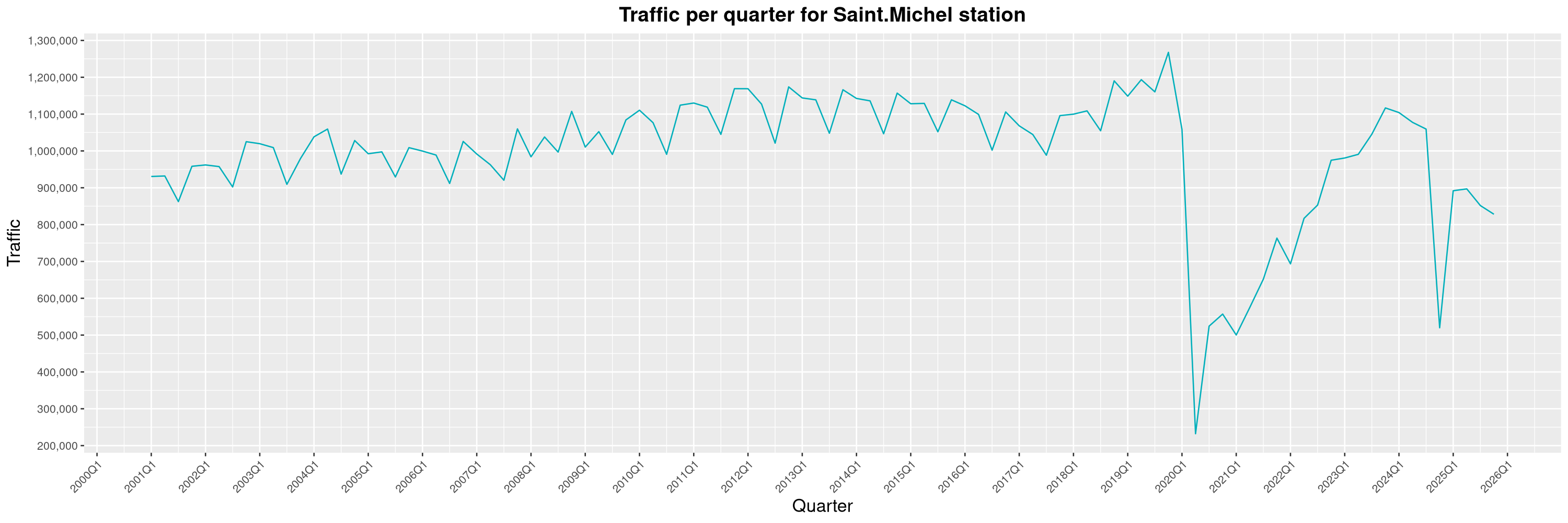
  1. Although the Saint-Michel station closed for emergency repairs in November 2024, traffic never bounced back to its pre-closure levels and is still stuck somewhere around 2022 Q2 levels. I wonder if this could be caused by the roadwork on Jean-Talon for the new Blue Line stations making it harder for folks in Montreal-Nord to reach the station by bus.
  2. The effects of the opening of the Royalmount shopping center has had a durable impact on the traffic at the De la Savane station. I reported on this last year, but it seems this wasn't just a fad.
  3. With the completion of the Deux-Montagnes branch of the R seau express m tropolitain (REM, a light-rail, above the surface transit network still in construction), the transfer stations to the Montreal subway have seen major traffic increases. The douard-Montpetit station has nearly reached its previous all-time record of 2015 and the McGill station has recovered from the general slump all the other stations have had in 2025.
  4. The Assomption station, which used to have one of the lowest number of riders of the subway network, has had a tremendous growth in the past few years. This is mostly explained by the many high-rise projects that were built around the station since the end of the COVID-19 pandemic.
  5. Although still affected by a very high seasonality, the Jean-Drapeau station broke its previous record of 2019, a testament of the continued attraction power of the various summer festivals taking place on the Sainte-H l ne et Notre-Dame islands.
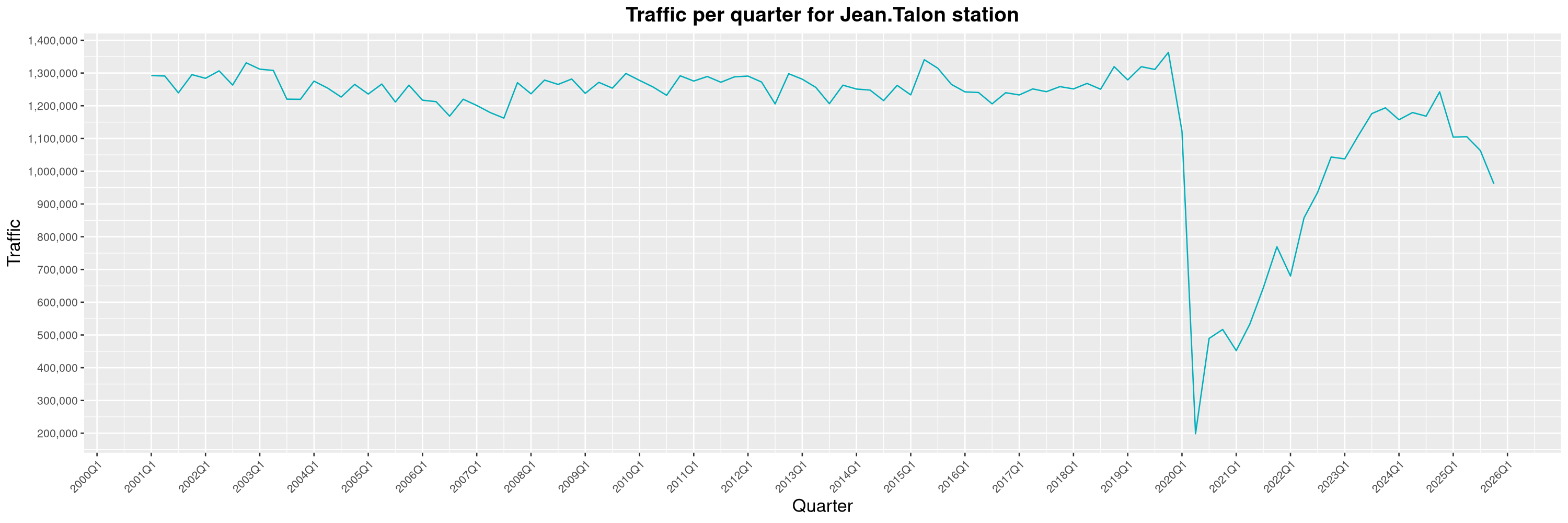
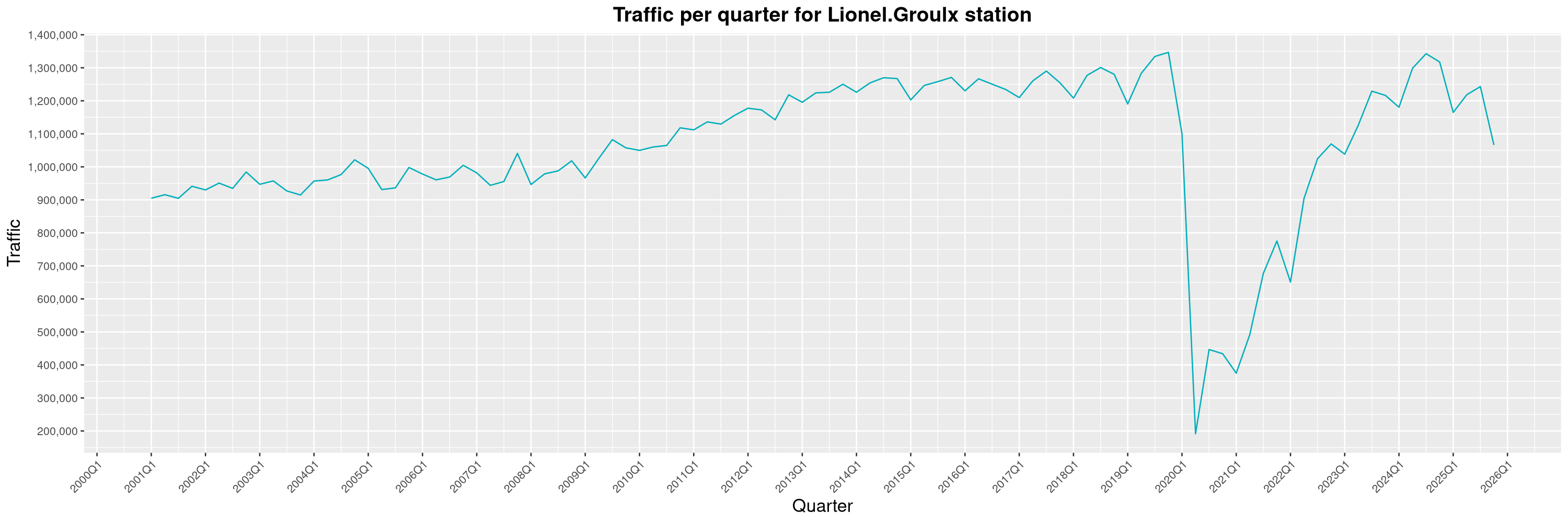
More generally, it seems the Montreal subway has had a pretty bad year. Traffic had been slowly climbing back since the COVID-19 pandemic, but this is the first year since 2020 such a sharp decline can be witnessed. Even major stations like Jean-Talon or Lionel-Groulx are on a downward trend and it is pretty worrisome. As for causes, a few things come to mind. First of all, as the number of Montrealers commuting to work by bike continues to rise1, a modal shift from public transit to active mobility is to be expected. As local experts put it, this is not uncommon and has been seen in other cities before. Another important factor that certainly turned people away from the subway this year has been the impacts of the continued housing crisis in Montreal. As more and more people get kicked out of their apartments, many have been seeking refuge in the subway stations to find shelter. Sadly, this also brought a unprecedented wave of incivilities. As riders' sense of security sharply decreased, the STM eventually resorted to banning unhoused people from sheltering in the subway. This decision did bring back some peace to the network, but one can posit damage had already been done and many casual riders are still avoiding the subway for this reason. Finally, the weekslong STM worker's strike in Q4 had an important impact on general traffic, as it severely reduced the opening hours of the subway. As for the previous item, once people find alternative ways to get around, it's always harder to bring them back. Hopefully, my 2026 report will be a more cheerful one... By clicking on a subway station, you'll be redirected to a graph of the station's foot traffic. Licences

  1. Mostly thanks to major improvements to the cycling network and the BIXI bikesharing program.

6 February 2026

Reproducible Builds: Reproducible Builds in January 2026

Welcome to the first monthly report in 2026 from the Reproducible Builds project! These reports outline what we ve been up to over the past month, highlighting items of news from elsewhere in the increasingly-important area of software supply-chain security. As ever, if you are interested in contributing to the Reproducible Builds project, please see the Contribute page on our website.

  1. Flathub now testing for reproducibility
  2. Reproducibility identifying projects that will fail to build in 2038
  3. Distribution work
  4. Tool development
  5. Two new academic papers
  6. Upstream patches

Flathub now testing for reproducibility Flathub, the primary repository/app store for Flatpak-based applications, has begun checking for build reproducibility. According to a recent blog post:
We have started testing binary reproducibility of x86_64 builds targeting the stable repository. This is possible thanks to flathub-repro-checker, a tool doing the necessary legwork to recreate the build environment and compare the result of the rebuild with what is published on Flathub. While these tests have been running for a while now, we have recently restarted them from scratch after enabling S3 storage for diffoscope artifacts.
The test results and status is available on their reproducible builds page.

Reproducibility identifying software projects that will fail to build in 2038 Longtime Reproducible Builds developer Bernhard M. Wiedemann posted on Reddit on Y2K38 commemoration day T-12 that is to say, twelve years to the day before the UNIX Epoch will no longer fit into a signed 32-bit integer variable on 19th January 2038. Bernhard s comment succinctly outlines the problem as well as notes some of the potential remedies, as well as links to a discussion with the GCC developers regarding adding warnings for int time_t conversions . At the time of publication, Bernhard s topic had generated 50 comments in response.

Distribution work Conda is language-agnostic package manager which was originally developed to help Python data scientists and is now a popular package manager for Python and R. conda-forge, a community-led infrastructure for Conda recently revamped their dashboards to rebuild packages straight to track reproducibility. There have been changes over the past two years to make the conda-forge build tooling fully reproducible by embedding the lockfile of the entire build environment inside the packages.
In Debian this month:
In NixOS this month, it was announced that the GNU Guix Full Source Bootstrap was ported to NixOS as part of Wire Jansen bachelor s thesis (PDF). At the time of publication, this change has landed in NiX stdev distribution.
Lastly, Bernhard M. Wiedemann posted another openSUSE monthly update for his work there.

Tool development diffoscope is our in-depth and content-aware diff utility that can locate and diagnose reproducibility issues. This month, Chris Lamb made the following changes, including preparing and uploading versions, 310 and 311 to Debian.
  • Fix test compatibility with u-boot-tools version 2026-01. [ ]
  • Drop the implied Rules-Requires-Root: no entry in debian/control. [ ]
  • Bump Standards-Version to 4.7.3. [ ]
  • Reference the Debian ocaml package instead of ocaml-nox. (#1125094)
  • Apply a patch by Jelle van der Waa to adjust a test fixture match new lines. [ ]
  • Also the drop implied Priority: optional from debian/control. [ ]

In addition, Holger Levsen uploaded two versions of disorderfs, first updating the package from FUSE 2 to FUSE 3 as described in last months report, as well as updating the packaging to the latest Debian standards. A second upload (0.6.2-1) was subsequently made, with Holger adding instructions on how to add the upstream release to our release archive and incorporating changes by Roland Clobus to set _FILE_OFFSET_BITS on 32-bit platforms, fixing a build failure on 32-bit systems. Vagrant Cascadian updated diffoscope in GNU Guix to version 311-2-ge4ec97f7 and disorderfs to 0.6.2.

Two new academic papers Julien Malka, Stefano Zacchiroli and Th o Zimmermann of T l com Paris in-house research laboratory, the Information Processing and Communications Laboratory (LTCI) published a paper this month titled Docker Does Not Guarantee Reproducibility:
[ ] While Docker is frequently cited in the literature as a tool that enables reproducibility in theory, the extent of its guarantees and limitations in practice remains under-explored. In this work, we address this gap through two complementary approaches. First, we conduct a systematic literature review to examine how Docker is framed in scientific discourse on reproducibility and to identify documented best practices for writing Dockerfiles enabling reproducible image building. Then, we perform a large-scale empirical study of 5,298 Docker builds collected from GitHub workflows. By rebuilding these images and comparing the results with their historical counterparts, we assess the real reproducibility of Docker images and evaluate the effectiveness of the best practices identified in the literature.
A PDF of their paper is available online.
Quentin Guilloteau, Antoine Waehren and Florina M. Ciorba of the University of Basel in Sweden also published a Docker-related paper, theirs called Longitudinal Study of the Software Environments Produced by Dockerfiles from Research Artifacts:
The reproducibility crisis has affected all scientific disciplines, including computer science (CS). To address this issue, the CS community has established artifact evaluation processes at conferences and in journals to evaluate the reproducibility of the results shared in publications. Authors are therefore required to share their artifacts with reviewers, including code, data, and the software environment necessary to reproduce the results. One method for sharing the software environment proposed by conferences and journals is to utilize container technologies such as Docker and Apptainer. However, these tools rely on non-reproducible tools, resulting in non-reproducible containers. In this paper, we present a tool and methodology to evaluate variations over time in software environments of container images derived from research artifacts. We also present initial results on a small set of Dockerfiles from the Euro-Par 2024 conference.
A PDF of their paper is available online.

Miscellaneous news On our mailing list this month: Lastly, kpcyrd added a Rust section to the Stable order for outputs page on our website. [ ]

Upstream patches The Reproducible Builds project detects, dissects and attempts to fix as many currently-unreproducible packages as possible. We endeavour to send all of our patches upstream where appropriate. This month, we wrote a large number of such patches, including:

Finally, if you are interested in contributing to the Reproducible Builds project, please visit our Contribute page on our website. However, you can get in touch with us via:

Birger Schacht: Status update, January 2026

January was a slow month, I only did three uploads to Debian unstable: I was very happy to see the new dfsg-new-queue and that there are more hands now processing the NEW queue. I also finally got one of the packages accepted that I uploaded after the Trixie release: wayback which I uploaded last August. There has been another release since then, I ll try to upload that in the next few days. There was a bug report for carl asking for Windows support. carl used the xdg create for looking up the XDG directories, but xdg does not support windows systems (and it seems this will not change) The reporter also provided a PR to replace the dependency with the directories crate which more system agnostic. I adapted the PR a bit and merged it and released version 0.6.0 of carl. At my dayjob I refactored django-grouper. django-grouper is a package we use to find duplicate objects in our data. Our users often work with datasets of thousands of historical persons, places and institutions and in projects that run over years and ingest data from multiple sources, it happens that entries are created several times. I wrote the initial app in 2024, but was never really happy about the approach I used back then. It was based on this blog post that describes how to group spreadsheet text cells. It uses sklearns TfidfVectorizer with a custom analyzer and the library sparse_dot_topn for creating the matrix. All in all the module to calculate the clusters was 80 lines and with sparse_dot_topn it pulled in a rather niche Python library. I was pretty sure that this functionality could also be implemented with basic sklearn functionality and it was: we are now using DictVectorizer because in a Django app we are working with objects that can be mapped to dicts anyway. And for clustering the data, the app now uses the DBSCAN algorithm (with the manhattan distance as metric). The module is now only half the size and the whole app lost one dependency! I released those changes as version 0.3.0 of the app. At the end of January together with friends I went to Brussels to attend FOSDEM. We took the night train but there were a couple of broken down trains so the ride took 26 hours instead of one night. It is a good thing we had a one day buffer and FOSDEM only started on Saturday. As usual there were too many talks to visit, so I ll have to watch some of the recordings in the next few weeks. Some examples of talks I found interesting so far:

2 February 2026

Hellen Chemtai: Career Growth Through Open Source: A Personal Journey

Hello world  ! I am an intern at Outreachy working with the Debian OpenQA team on images testing. We get to know what career opportunities awaits us when we work on open source projects. In open source, we are constantly learning. The community has different sets of skills and a large network of people.

So, how did I start off in this internship

I entered the community with the these skills:

  • MERN (Mongo DB, Express JS , React JS and Node JS) for web development
  • Linux and Shell Scripting for some administrative purposes
  • Containerization using Google Cloud
  • Operating Systems
  • A learning passion for Open Source I contributed to some open source work in the past but it was in terms of documentation and bug hunting

I was a newbie at OpenQA but, I had a month to learn and contribute. Time is a critical resource but so is understanding what you are doing. I followed the installations instructions given but whenever I got errors, I had to research why I got the errors. I took time to understand errors I was solving then continued on with the tasks I wanted to do. I communicated my logic and understanding while working on the task and awaited reviews and feedback. Within a span of two months I had learned a lot by practicing and testing.

The skills I gained

As of today, I gained these technical skills from my work with Debian OpenQA team.

  • Perl the tests that we run are written in this language
  • Ansible configuration ansible configurations and settings for the machines the team runs
  • Git this is needed for code versioning and diving tasks into different branches
  • Linux shell scripting and working with the Debian Operating system
  • Virtual Machines and Operating Systems I constantly view how different operating systems are booted and run on virtual machines during testing
  • Testing I keep watch of needles and ensure the tests work as required
  • Debian I use a Debian system to run my Virtual Machines
  • OpenQA the tool that is used to automate testing of Images

With open source comes the need of constant communication. The community is diverse and the team is usually on different time zones. These are some of the soft / social skills I gained when working with the team

  • Communication this is essential especially in taking tasks with confidence, talking about issues encountered and stating the progress of the tasks
  • Interpersonal skills this is for general communication within the community
  • Flexibility we have to adapt to changes because we are a community of different people with different skills

With these skills and the willingness to learn , open source is a great area to focus on . Aside from your career you will extend your network. My interests are set on open source and Linux in general. Working with a wider network has really skilled me up and I will continue learning. Working with the Debian OpenQA team has been very great. The team is great at communication and I learn every day. The knowledge I gain from the team is helping me build a great career in open source.

1 February 2026

Benjamin Mako Hill: What do people do when they edit Wikipedia through Tor?

Note: I have not published blog posts about my academic papers over the past few years. To ensure that my blog contains a more comprehensive record of my published papers and to surface these for folks who missed them, I will be periodically (re)publishing blog posts about some older published projects. This post is closely based on a previously published post by Kaylea Champion on the Community Data Science Blog.

Many individuals use Tor to reduce their visibility to widespread internet surveillance.
One popular approach to protecting our privacy online is to use the Tor network. Tor protects users from being identified by their IP address, which can be tied to a physical location. However, if you d like to contribute to Wikipedia using Tor, you ll run into a problem. Although most IP addresses can edit without an account, Tor users are blocked from editing.
Tor users attempting to contribute to Wikipedia are shown a screen that informs them that they are not allowed to edit Wikipedia.
Other research by my team has shown that Wikipedia s attempt to block Tor is imperfect and that some people have been able to edit despite the ban. As part of this work, we built a dataset of more than 11,000 contributions to Wikipedia via Tor and used quantitative analysis to show that contributions from Tor were of about the same quality as contributions from other new editors and other contributors without accounts. Of course, given the unusual circumstances Tor-based contributors face, we wondered whether a deeper look at the content of their edits might reveal more about their motives and the kinds of contributions they seek to make. Kaylea Champion (then a student, now faculty at UW Bothell) led a qualitative investigation to explore these questions. Given the challenges of studying anonymity seekers, we designed a novel forensic qualitative approach inspired by techniques common in computer security and criminal investigation. We applied this new technique to a sample of 500 editing sessions and categorized each session based on what the editor seemed to be intending to do. Most of the contributions we found fell into one of the two following categories: Although these were most of what we observed, we also found evidence of several types of contributor intent:
An exploratory mapping of our themes in terms of the value a type of contribution represents to the Wikipedia community and the importance of anonymity in facilitating it. Anonymity-protecting tools play a critical role in facilitating contributions on the right side of the figure, while edits on the left are more likely to occur even when anonymity is impossible. Contributions toward the top reflect valuable forms of participation in Wikipedia, while edits at the bottom reflect damage.
In all, these themes led us to reflect on how the risks individuals face when contributing to online communities sometimes diverge from the risks the communities face in accepting their work. Expressing minoritized perspectives, maintaining community standards even when you may be targeted by the rulebreaker, highlighting injustice, or acting as a whistleblower can be very risky for an individual, and may not be possible without privacy protections. Of course, in platforms seeking to support the public good, such knowledge and accountability may be crucial.

This work was published as a paper at CSCW: Kaylea Champion, Nora McDonald, Stephanie Bankes, Joseph Zhang, Rachel Greenstadt, Andrea Forte, and Benjamin Mako Hill. 2019. A Forensic Qualitative Analysis of Contributions to Wikipedia from Anonymity Seeking Users. Proceedings of the ACM on Human-Computer Interaction. 3, CSCW, Article 53 (November 2019), 26 pages. https://doi.org/10.1145/3359155

This project was conducted by Kaylea Champion, Nora McDonald, Stephanie Bankes, Joseph Zhang, Rachel Greenstadt, Andrea Forte, and Benjamin Mako Hill. This work was supported by the National Science Foundation (awards CNS-1703736 and CNS-1703049) and included the work of two undergraduates supported through an NSF REU supplement.

31 January 2026

Russ Allbery: Review: Dragon Pearl

Review: Dragon Pearl, by Yoon Ha Lee
Series: Thousand Worlds #1
Publisher: Rick Riordan Presents
Copyright: 2019
ISBN: 1-368-01519-0
Format: Kindle
Pages: 315
Dragon Pearl is a middle-grade space fantasy based on Korean mythology and the first book of a series. Min is a fourteen-year-old girl living on the barely-terraformed world of Jinju with her extended family. Her older brother Jun passed the entrance exams for the Academy and left to join the Thousand Worlds Space Forces, and Min is counting the years until she can do the same. Those plans are thrown into turmoil when an official investigator appears at their door claiming that Jun deserted to search for the Dragon Pearl. A series of impulsive fourteen-year-old decisions lead to Min heading for a spaceport alone, determined to find her brother and prove his innocence. This would be a rather improbable quest for a young girl, but Min is a gumiho, one of the supernaturals who live in the Thousand Worlds alongside non-magical humans. Unlike the more respectable dragons, tigers, goblins, and shamans, gumiho are viewed with suspicion and distrust because their powers are useful for deception. They are natural shapeshifters who can copy the shapes of others, and their Charm ability lets them influence people's thoughts and create temporary illusions of objects such as ID cards. It will take all of Min's powers, and some rather lucky coincidences, to infiltrate the Space Forces and determine what happened to her brother. It's common for reviews of this book to open with a caution that this is a middle-grade adventure novel and you should not expect a story like Ninefox Gambit. I will be boring and repeat that caution. Dragon Pearl has a single first-person viewpoint and a very linear and straightforward plot. Adult readers are unlikely to be surprised by plot twists; the fun is the world-building and seeing how Min manages to work around plot obstacles. The world-building is enjoyable but not very rigorous. Min uses and abuses Charm with the creative intensity of a Dungeons & Dragons min-maxer. Each individual event makes sense given the implication that Min is unusually powerful, but I'm dubious about the surrounding society and lack of protections against Charm given what Min is able to do. Min does say that gumiho are rare and many people think they're extinct, which is a bit of a fig leaf, but you'll need to bring your urban fantasy suspension of disbelief skills to this one. I did like that the world-building conceit went more than skin deep and influenced every part of the world. There are ghosts who are critical to the plot. Terraforming is done through magic, hence the quest for the Dragon Pearl and the miserable state of Min's home planet due to its loss. Medical treatment involves the body's meridians, as does engineering: The starships have meridians similar to those of humans, and engineers partly merge with those meridians to adjust them. This is not the sort of book that tries to build rigorous scientific theories or explain them to the reader, and I'm not sure everything would hang together if you poked at it too hard, but Min isn't interested in doing that poking and the story doesn't try to justify itself. It's mostly a vibe, but it's a vibe that I enjoyed and that is rather different than other space fantasy I've read. The characters were okay but never quite clicked for me, in part because proper character exploration would have required Min take a detour from her quest to find her brother and that was not going to happen. The reader gets occasional glimpses of a military SF cadet story and a friendship on false premises story, but neither have time to breathe because Min drops any entanglement that gets in the way of her quest. She's almost amoral in a way that I found believable but not quite aligned with my reading mood. I also felt a bit wrong-footed by how her friendships developed; saying too much more would be a spoiler, but I was expecting more human connection than I got. I think my primary disappointment with this book was something I knew going in, not in any way its fault, and part of the reason why I'd put off reading it: This is pitched at young teenagers and didn't have quite enough plot and characterization complexity to satisfy me. It's a linear, somewhat episodic adventure story with some neat world-building, and it therefore glides over the spots where an adult novel would have added political and factional complexity. That is exactly as advertised, so it's up to you whether that's the book you're in the mood for. One warning: The text of this book opens with an introduction by Rick Riordan that is just fluff marketing and that spoils the first few chapters of the book. It is unmarked as such at the beginning and tricked me into thinking it was the start of the book proper, and then deeply annoyed me. If you do read this book, I recommend skipping the utterly pointless introduction and going straight to chapter one. Followed by Tiger Honor. Rating: 6 out of 10

30 January 2026

Joey Hess: the local weather

Snow coming. I'm tuned into the local 24 hour slop weather stream. AI generated, narrated, up to the minute radar and forecast graphics. People popping up on the live weather map with questions "snow soon?" (They pay for the privilege.) LLM generating reply that riffs on their name. Tuned to keep the urgency up, something is always happening somewhere, scanners are pulling the police reports, live webcam description models add verisimilitude to the description of the morning commute. Weather is happening. In the subtext, climate change is happening. Weather is a growth industry. The guy up in Kentucky coal country who put this thing together is building an empire. He started as just another local news greenscreener. Dropped out and went twitch weather stream. Hyping up tornado days and dicy snow forecasts. Nowcasting, hyper individualized, interacting with chat. Now he's automated it all. On big days when he's getting real views, the bot breaks into his live streams, gives him a break. Only a few thousand watching this morning yet. Perfect 2026 grade slop. Details never quite right, but close enough to keep on in the background all day. Nobody expects a perfect forecast after all, and it's fed from the National Weather Center discussion too. We still fund those guys? Why bother when a bot can do it? He knows why he's big in these states, these rural areas. Understands the target audience. Airbrushed AI aesthetics are ok with them, receive no pushback. Flying more under the radar coastally, but weather is big there and getting bigger. The local weather will come for us all. 6 inches of snow covering some ground mount solar panels with a vertical solar panel fence behind them free of snow except cute little caps (Not fiction FYI.)

28 January 2026

C.J. Collier: Part 2: Taming the Beast Deep Dive into the Proxy-Aware GPU Initialization Action

Part
2: Taming the Beast Deep Dive into the Proxy-Aware GPU Initialization
Action In Part 1 of this series, we laid the network foundation for running
secure Dataproc clusters. Now, let s zoom in on the core component
responsible for installing and configuring NVIDIA GPU drivers and the
associated ML stack in this restricted environment: the
install_gpu_driver.sh script from the LLC-Technologies-Collier/initialization-actions
repository (branch gpu-202601). This isn t just any installation script; it has been significantly
enhanced to handle the nuances of Secure Boot and to operate seamlessly
behind an HTTP/S proxy.

The
Challenge: Installing GPU Drivers Without Direct Internet Our goal was to create a Dataproc custom image with NVIDIA GPU
drivers, sign the kernel modules for Secure Boot, and ensure the entire
process works seamlessly when the build VM and the eventual cluster
nodes have no direct internet access, relying solely on an HTTP/S proxy.
This involved:
  1. Proxy-Aware Build: Ensuring all build steps within
    the custom image creation process (package downloads, driver downloads,
    GPG keys, etc.) correctly use the customer s proxy.
  2. Secure Boot Signing: Integrating kernel module
    signing using keys managed in GCP Secret Manager, especially when
    drivers are built from source.
  3. Conda Environment: Reliably and speedily installing
    a complex Conda environment with PyTorch, TensorFlow, Rapids, and other
    GPU-accelerated libraries through the proxy.
  4. Dataproc Integration: Making sure the custom image
    works correctly with Dataproc s own startup, agent processes, and
    cluster-specific configurations like YARN.

The
Development Journey: Key Enhancements in
install_gpu_driver.sh To address these challenges, the script incorporates several key
features:
  • Robust Proxy Handling (set_proxy
    function):
    • Challenge: Initial script versions had spotty proxy
      support. Many tools like apt, curl,
      gpg, and even gsutil failed in proxy-only
      environments.
    • Enhancements: The set_proxy function
      (also used in gce-proxy-setup.sh) was completely overhauled
      to parse various proxy metadata (http-proxy,
      https-proxy, proxy-uri,
      no-proxy). Critically, environment variables
      (HTTP_PROXY, HTTPS_PROXY,
      NO_PROXY) are now set before any network
      operations. NO_PROXY is carefully set to include
      .google.com and .googleapis.com to allow
      direct access to Google APIs via Private Google Access. System-wide
      trust stores (OS, Java, Conda) are updated with the proxy s CA
      certificate if provided via http-proxy-pem-uri.
      gcloud, apt, dnf, and
      dirmngr are also configured to use the proxy.
  • Reliable GPG Key Fetching (import_gpg_keys
    function):
    • Challenge: Importing GPG keys for repositories
      often failed as keyservers use non-HTTP ports (e.g., 11371) blocked by
      firewalls, and gpg --recv-keys is not proxy-friendly.
    • Solution: A new import_gpg_keys
      function now fetches keys over HTTPS using curl, which
      respects the environment s proxy settings. This replaced all direct
      gpg --recv-keys calls.
  • GCS Caching is King:
    • Challenge: Repeatedly downloading large files
      (drivers, CUDA, source code) through a proxy is slow and
      inefficient.
    • Solution: Implemented extensive GCS caching for
      NVIDIA drivers, CUDA runfiles, NVIDIA Open Kernel Module source
      tarballs, compiled kernel modules, and even packed Conda environments.
      Scripts now check a GCS bucket (dataproc-temp-bucket)
      before hitting the internet.
    • Impact: Dramatically speeds up subsequent runs and
      init action execution times on cluster nodes after the cache is
      warmed.
  • Conda Environment Stability & Speed:
    • Challenge: Large Conda environments are prone to
      solver conflicts and slow installation times.
    • Solution: Integrated Mamba for faster package
      solving. Refined package lists for better compatibility. Added logic to
      force-clean and rebuild the Conda environment cache on GCS and locally
      if inconsistencies are detected (e.g., driver installed but Conda env
      not fully set up).
  • Secure Boot & Kernel Module Signing:
    • Challenge: Custom-compiled kernel modules must be
      signed to load when Secure Boot is enabled.
    • Solution: The script integrates with GCP Secret
      Manager to fetch signing keys. The build_driver_from_github
      function now includes robust steps to compile, sign (using
      sign-file), install, and verify the signed modules.
  • Custom Image Workflow & Deferred Configuration:
    • Challenge: Cluster-specific settings (like YARN GPU
      configuration) should not be baked into the image.
    • Solution: The install_gpu_driver.sh
      script detects when it s run during image creation
      (--metadata invocation-type=custom-images). In this mode,
      it defers cluster-specific setups to a systemd service
      (dataproc-gpu-config.service) that runs on the first boot
      of a cluster instance. This ensures that YARN and Spark configurations
      are applied in the context of the running cluster, not at image build
      time.

Conclusion of Part 2 The install_gpu_driver.sh initialization action is more
than just an installer; it s a carefully crafted tool designed to handle
the complexities of secure, proxied environments. Its robust proxy
support, comprehensive GCS caching, refined Conda management, Secure
Boot signing capabilities, and awareness of the custom image build
lifecycle make it a critical enabler. In Part 3, we ll explore how the LLC-Technologies-Collier/custom-images
repository (branch proxy-exercise-2025-11) uses this
initialization action to build the complete, ready-to-deploy Secure Boot
GPU custom images.

27 January 2026

Elana Hashman: A beginner's guide to improving your digital security

In 2017, I led a series of workshops aimed at teaching beginners a better understanding of encryption, how the internet works, and their digital security. Nearly a decade later, there is still a great need to share reliable resources and guides on improving these skills. I have worked professionally in computer security one way or another for well over a decade, at many major technology companies and in many open source software projects. There are many inaccurate and unreliable resources out there on this subject, put together by well-meaning people without a background in security, which can lead to sharing misinformation, exaggeration and fearmongering. I hope that I can offer you a trusted, curated list of high impact things that you can do right now, using whichever vetted guide you prefer. In addition, I also include how long it should take, why you should do each task, and any limitations. This guide is aimed at improving your personal security, and does not apply to your work-owned devices. Always assume your company can monitor all of your messages and activities on work devices. What can I do to improve my security right away? I put together this list in order of effort, easiest tasks first. You should be able to complete many of the low effort tasks in a single hour. The medium to high effort tasks are very much worth doing, but may take you a few days or even weeks to complete them. Low effort (<15 minutes) Upgrade your software to the latest versions Why? I don't know anyone who hasn't complained about software updates breaking features, introducing bugs, and causing headaches. If it ain't broke, why upgrade, right? Well, alongside all of those annoying bugs and breaking changes, software updates also include security fixes, which will protect your device from being exploited by bad actors. Security issues can be found in software at any time, even software that's been available for many years and thought to be secure. You want to install these as soon as they are available. Recommendation: Turn on automatic upgrades and always keep your devices as up-to-date as possible. If you have some software you know will not work if you upgrade it, at least be sure to upgrade your laptop and phone operating system (iOS, Android, Windows, etc.) and web browser (Chrome, Safari, Firefox, etc.). Do not use devices that do not receive security support (e.g. old Android or iPhones). Guides: Limitations: This will prevent someone from exploiting known security issues on your devices, but it won't help if your device was already compromised. If this is a concern, doing a factory reset, upgrade, and turning on automatic upgrades may help. This also won't protect against all types of attacks, but it is a necessary foundation. Use Signal Why? Signal is a trusted, vetted, secure messaging application that allows you to send end-to-end encrypted messages and make video/phone calls. This means that only you and your intended recipient can decrypt the messages and someone cannot intercept and read your messages, in contrast to texting (SMS) and other insecure forms of messaging. Other applications advertise themselves as end-to-end encrypted, but Signal provides the strongest protections. Recommendation: I recommend installing the Signal app and using it! My mom loves that she can video call me on Wi-Fi on my Android phone. It also supports group chats. I use it as a secure alternative to texting (SMS) and other chat platforms. I also like Signal's "disappearing messages" feature which I enable by default because it automatically deletes messages after a certain period of time. This avoids your messages taking up too much storage. Guides: Limitations: Signal is only able to protect your messages in transit. If someone has access to your phone or the phone of the person you sent messages to, they will still be able to read them. As a rule of thumb, if you don't want someone to read something, don't write it down! Meet in person or make an encrypted phone call where you will not be overheard. If you are talking to someone you don't know, assume your messages are as public as posting on social media. Set passwords and turn on device encryption Why? Passwords ensure that someone else can't unlock your device without your consent or knowledge. They also are required to turn on device encryption, which protects your information on your device from being accessed when it is locked. Biometric (fingerprint or face ID) locking provides some privacy, but your fingerprint or face ID can be used against your wishes, whereas if you are the only person who knows your password, only you can use it. Recommendation: Always set passwords and have device encryption enabled in order to protect your personal privacy. It may be convenient to allow kids or family members access to an unlocked device, but anyone else can access it, too! Use strong passwords that cannot be guessed avoid using names, birthdays, phone numbers, addresses, or other public information. Using a password manager will make creating and managing passwords even easier. Disable biometric unlock, or at least know how to disable it. Most devices will enable disk encryption by default, but you should double-check. Guides: Limitations: If your device is unlocked, the password and encryption will provide no protections; the device must be locked for this to protect your privacy. It is possible, though unlikely, for someone to gain remote access to your device (for example through malware or stalkerware), which would bypass these protections. Some forensic tools are also sophisticated enough to work with physical access to a device that is turned on and locked, but not a device that is turned off/freshly powered on and encrypted. If you lose your password or disk encryption key, you may lose access to your device. For this reason, Windows and Apple laptops can make a cloud backup of your disk encryption key. However, a cloud backup can potentially be disclosed to law enforcement. Install an ad blocker Why? Online ad networks are often exploited to spread malware to unsuspecting visitors. If you've ever visited a regular website and suddenly seen an urgent, flashing pop-up claiming your device was hacked, it is often due to a bad ad. Blocking ads provides an additional layer of protection against these kinds of attacks. Recommendation: I recommend everyone uses an ad blocker at all times. Not only are ads annoying and disruptive, but they can even result in your devices being compromised! Guides: Limitations: Sometimes the use of ad blockers can break functionality on websites, which can be annoying, but you can temporarily disable them to fix the problem. These may not be able to block all ads or all tracking, but they make browsing the web much more pleasant and lower risk! Some people might also be concerned that blocking ads might impact the revenue of their favourite websites or creators. In this case, I recommend either donating directly or sharing the site with a wider audience, but keep using the ad blocker for your safety. Enable HTTPS-Only Mode Why? The "S" in "HTTPS" stands for "secure". This feature, which can be enabled on your web browser, ensures that every time you visit a website, your connection is always end-to-end encrypted (just like when you use Signal!) This ensures that someone can't intercept what you search for, what pages on websites you visit, and any information you or the website share such as your banking details. Recommendation: I recommend enabling this for everyone, though with improvements in web browser security and adoption of HTTPS over the years, your devices will often do this by default! There is a small risk you will encounter some websites that do not support HTTPS, usually older sites. Guides: Limitations: HTTPS protects the information on your connection to a website. It does not hide or protect the fact that you visited that website, only the information you accessed. If the website is malicious, HTTPS does not provide any protection. In certain settings, like when you use a work-managed computer that was set up for you, it can still be possible for your IT Department to see what you are browsing, even over an HTTPS connection, because they have administrator access to your computer and the network. Medium to high effort (1+ hours) These tasks require more effort but are worth the investment. Set up a password manager Why? It is not possible for a person to remember a unique password for every single website and app that they use. I have, as of writing, 556 passwords stored in my password manager. Password managers do three important things very well:
  1. They generate secure passwords with ease. You don't need to worry about getting your digits and special characters just right; the app will do it for you, and generate long, secure passwords.
  2. They remember all your passwords for you, and you just need to remember one password to access all of them. The most common reason people's accounts get hacked online is because they used the same password across multiple websites, and one of the websites had all their passwords leaked. When you use a unique password on every website, it doesn't matter if your password gets leaked!
  3. They autofill passwords based on the website you're visiting. This is important because it helps prevent you from getting phished. If you're tricked into visiting an evil lookalike site, your password manager will refuse to fill the password.
Recommendation: These benefits are extremely important, and setting up a password manager is often one of the most impactful things you can do for your digital security. However, they take time to get used to, and migrating all of your passwords into the app (and immediately changing them!) can take a few minutes at a time... over weeks. I recommend you prioritize the most important sites, such as your email accounts, banking/financial sites, and cellphone provider. This process will feel like a lot of work, but you will get to enjoy the benefits of never having to remember new passwords and the autofill functionality for websites. My recommended password manager is 1Password, but it stores passwords in the cloud and costs money. There are some good free options as well if cost is a concern. You can also use web browser- or OS-based password managers, but I do not prefer these. Guides: Limitations: Many people are concerned about the risk of using a password manager causing all of their passwords to be compromised. For this reason, it's very important to use a vetted, reputable password manager that has passed audits, such as 1Password or Bitwarden. It is also extremely important to choose a strong password to unlock your password manager. 1Password makes this easier by generating a secret to strengthen your unlock password, but I recommend using a long, memorable password in any case. Another risk is that if you forget your password manager's password, you will lose access to all your passwords. This is why I recommend 1Password, which has you set up an Emergency Kit to recover access to your account. Set up two-factor authentication (2FA) for your accounts Why? If your password is compromised in a website leak or due to a phishing attack, two-factor authentication will require a second piece of information to log in and potentially thwart the intruder. This provides you with an extra layer of security on your accounts. Recommendation: You don't necessarily need to enable 2FA on every account, but prioritize enabling it on your most important accounts (email, banking, cellphone, etc.) There are typically a few different kinds: email-based (which is why your email account's security is so important), text message or SMS-based (which is why your cell phone account's security is so important), app-based, and hardware token-based. Email and text message 2FA are fine for most accounts. You may want to enable app- or hardware token-based 2FA for your most sensitive accounts. Guides: Limitations: The major limitation is that if you lose access to 2FA, you can be locked out of an account. This can happen if you're travelling abroad and can't access your usual cellphone number, if you break your phone and you don't have a backup of your authenticator app, or if you lose your hardware-based token. For this reason, many websites will provide you with "backup tokens" you can print them out and store them in a secure location or use your password manager. I also recommend if you use an app, you choose one that will allow you to make secure backups, such as Ente. You are also limited by the types of 2FA a website supports; many don't support app- or hardware token-based 2FA. Remove your information from data brokers Why? This is a problem that mostly affects people in the US. It surprises many people that information from their credit reports and other public records is scraped and available (for free or at a low cost) online through "data broker" websites. I have shocked friends who didn't believe this was an issue by searching for their full names and within 5 minutes being able to show them their birthday, home address, and phone number. This is a serious privacy problem! Recommendation: Opt out of any and all data broker websites to remove this information from the internet. This is especially important if you are at risk of being stalked or harassed. Guides: Limitations: It can take time for your information to be removed once you opt out, and unfortunately search engines may have cached your information for a while longer. This is also not a one-and-done process. New data brokers are constantly popping up and some may not properly honour your opt out, so you will need to check on a regular basis (perhaps once or twice a year) to make sure your data has been properly scrubbed. This also cannot prevent someone from directly searching public records to find your information, but that requires much more effort. "Recommended security measures" I think beginners should avoid We've covered a lot of tasks you should do, but I also think it's important to cover what not to do. I see many of these tools recommended to security beginners, and I think that's a mistake. For each tool, I will explain my reasoning around why I don't think you should use it, and the scenarios in which it might make sense to use. "Secure email" What is it? Many email providers, such as Proton Mail, advertise themselves as providing secure email. They are often recommended as a "more secure" alternative to typical email providers such as GMail. What's the problem? Email is fundamentally insecure by design. The email specification (RFC-3207) states that any publicly available email server MUST NOT require the use of end-to-end encryption in transit. Email providers can of course provide additional security by encrypting their copies of your email, and providing you access to your email by HTTPS, but the messages themselves can always be sent without encryption. Some platforms such as Proton Mail advertise end-to-end encrypted emails so long as you email another Proton user. This is not truly email, but their own internal encrypted messaging platform that follows the email format. What should I do instead? Use Signal to send encrypted messages. NEVER assume the contents of an email are secure. Who should use it? I don't believe there are any major advantages to using a service such as this one. Even if you pay for a more "secure" email provider, the majority of your emails will still be delivered to people who don't. Additionally, while I don't use or necessarily recommend their service, Google offers an Advanced Protection Program for people who may be targeted by state-level actors. PGP/GPG Encryption What is it? PGP ("Pretty Good Privacy") and GPG ("GNU Privacy Guard") are encryption and cryptographic signing software. They are often recommended to encrypt messages or email. What's the problem? GPG is decades old and its usability has always been terrible. It is extremely easy to accidentally send a message that you thought was encrypted without encryption! The problems with PGP/GPG have been extensively documented. What should I do instead? Use Signal to send encrypted messages. Again, NEVER use email for sensitive information. Who should use it? Software developers who contribute to projects where there is a requirement to use GPG should continue to use it until an adequate alternative is available. Everyone else should live their lives in PGP-free bliss. Installing a "secure" operating system (OS) on your phone What is it? There are a number of self-installed operating systems for Android phones, such as GrapheneOS, that advertise as being "more secure" than using the version of the Android operating system provided by your phone manufacturer. They often remove core Google APIs and services to allow you to "de-Google" your phone. What's the problem? These projects are relatively niche, and don't have nearly enough resourcing to be able to respond to the high levels of security pressure Android experiences (such as against the forensic tools I mentioned earlier). You may suddenly lose security support with no notice, as with CalyxOS. You need a high level of technical know-how and a lot of spare time to maintain your device with a custom operating system, which is not a reasonable expectation for the average person. By stripping all Google APIs such as Google Play Services, some useful apps can no longer function. And some law enforcement organizations have gone as far as accusing people who install GrapheneOS on Pixel phones to be engaging in criminal activity. What should I do instead? For the best security on an Android device, use a phone manufactured by Google or Samsung (smaller manufacturers are more unreliable), or consider buying an iPhone. Make sure your device is receiving security updates and up-to-date. Who should use it? These projects are great for tech enthusiasts who are interested in contributing to and developing them further. They can be used to give new life to old phones that are not receiving security or software updates. They are also great for people with an interest in free and open source software and digital autonomy. But these tools are not a good choice for a general audience, nor do they provide more practical security than using an up-to-date Google or Samsung Android phone. Virtual Private Network (VPN) Services What is it? A virtual private network or VPN service can provide you with a secure tunnel from your device to the location that the VPN operates. This means that if I am using my phone in Seattle connected to a VPN in Amsterdam, if I access a website, it appears to the website that my phone is located in Amsterdam. What's the problem? VPN services are frequently advertised as providing security or protection from nefarious bad actors, or helping protect your privacy. These benefits are often far overstated, and there are predatory VPN providers that can actually be harmful. It costs money and resources to provide a VPN, so free VPN services are especially suspect. When you use a VPN, the VPN provider knows the websites you are visiting in order to provide you with the service. Free VPN providers may sell this data in order to cover the cost of providing the service, leaving you with less security and privacy. The average person does not have the knowledge to be able to determine if a VPN service is trustworthy or not. VPNs also don't provide any additional encryption benefits if you are already using HTTPS. They may provide a small amount of privacy benefit if you are connected to an untrusted network with an attacker. What should I do instead? Always use HTTPS to access websites. Don't connect to untrusted internet providers for example, use cellphone network data instead of a sketchy Wi-Fi access point. Your local neighbourhood coffee shop is probably fine. Who should use it? There are three main use cases for VPNs. The first is to bypass geographic restrictions. A VPN will cause all of your web traffic to appear to be coming from another location. If you live in an area that has local internet censorship policies, you can use a VPN to access the internet from a location that lacks such policies. The second is if you know your internet service provider is actively hostile or malicious. A trusted VPN will protect the visibility of all your traffic, including which websites you visit, from your internet service provider, and the only thing they will be able to see is that you are accessing a VPN. The third use case is to access a network that isn't connected to the public internet, such as a corporate intranet. I strongly discourage the use of VPNs for "general-purpose security." Tor What is it? Tor, "The Onion Router", is a free and open source software project that provides anonymous networking. Unlike with a VPN, where the VPN provider knows who you are and what websites you are requesting, Tor's architecture makes it extremely difficult to determine who sent a request. What's the problem? Tor is difficult to set up properly; similar to PGP-encrypted email, it is possible to accidentally not be connected to Tor and not know the difference. This usability has improved over the years, but Tor is still not a good tool for beginners to use. Due to the way Tor works, it is also extremely slow. If you have used cable or fiber internet, get ready to go back to dialup speeds. Tor also doesn't provide perfect privacy and without a strong understanding of its limitations, it can be possible to deanonymize someone despite using it. Additionally, many websites are able to detect connections from the Tor network and block them. What should I do instead? If you want to use Tor to bypass censorship, it is often better to use a trusted VPN provider, particularly if you need high bandwidth (e.g. for streaming). If you want to use Tor to access a website anonymously, Tor itself might not be enough to protect you. For example, if you need to provide an email address or personal information, you can decline to provide accurate information and use a masked email address. A friend of mine once used the alias "Nunya Biznes" Who should use it? Tor should only be used by people who are experienced users of security tools and understand its strengths and limitations. Tor also is best used on a purpose-built system, such as Tor Browser or Freedom of the Press Foundation's SecureDrop. I want to learn more! I hope you've found this guide to be a useful starting point. I always welcome folks reaching out to me with questions, though I might take a little bit of time to respond. You can always email me. If there's enough interest, I might cover the following topics in a future post: Stay safe out there!

21 January 2026

Evgeni Golov: Validating cloud-init configs without being root

Somehow this whole DevOps thing is all about generating the wildest things from some (usually equally wild) template. And today we're gonna generate YAML from ERB, what could possibly go wrong?! Well, actually, quite a lot, so one wants to validate the generated result before using it to break systems at scale. The YAML we generate is a cloud-init cloud-config, and while checking that we generated a valid YAML document is easy (and we were already doing that), it would be much better if we could check that cloud-init can actually use it. Enter cloud-init schema, or so I thought. Turns out running cloud-init schema is rather broken without root privileges, as it tries to load a ton of information from the running system. This seems like a bug (or multiple), as the data should not be required for the validation of the schema itself. I've not found a way to disable that behavior. Luckily, I know Python. Enter evgeni-knows-better-and-can-write-python:
#!/usr/bin/env python3
import sys
from cloudinit.config.schema import get_schema, validate_cloudconfig_file, SchemaValidationError
try:
    valid = validate_cloudconfig_file(config_path=sys.argv[1], schema=get_schema())
    if not valid:
        raise RuntimeError("Schema is not valid")
except (SchemaValidationError, RuntimeError) as e:
    print(e)
    sys.exit(1)
The canonical1 version if this lives in the Foreman git repo, so go there if you think this will ever receive any updates. The hardest part was to understand thevalidate_cloudconfig_file API, as it will sometimes raise an SchemaValidationError, sometimes a RuntimeError and sometimes just return False. No idea why. But the above just turns it into a couple of printed lines and a non zero exit code, unless of course there are no problems, then you get peaceful silence.

19 January 2026

Russell Coker: Furilabs FLX1s

The Aim I have just got a Furilabs FLX1s [1] which is a phone running a modified version of Debian. I want to have a phone that runs all apps that I control and can observe and debug. Android is very good for what it does and there are security focused forks of Android which have a lot of potential, but for my use a Debian phone is what I want. The FLX1s is not going to be my ideal phone, I am evaluating it for use as a daily-driver until a phone that meets my ideal criteria is built. In this post I aim to provide information to potential users about what it can do, how it does it, and how to get the basic functions working. I also evaluate how well it meets my usage criteria. I am not anywhere near an average user. I don t think an average user would ever even see one unless a more technical relative showed one to them. So while this phone could be used by an average user I am not evaluating it on that basis. But of course the features of the GUI that make a phone usable for an average user will allow a developer to rapidly get past the beginning stages and into more complex stuff. Features The Furilabs FLX1s [1] is a phone that is designed to run FuriOS which is a slightly modified version of Debian. The purpose of this is to run Debian instead of Android on a phone. It has switches to disable camera, phone communication, and microphone (similar to the Librem 5) but the one to disable phone communication doesn t turn off Wifi, the only other phone I know of with such switches is the Purism Librem 5. It has a 720*1600 display which is only slightly better than the 720*1440 display in the Librem 5 and PinePhone Pro. This doesn t compare well to the OnePlus 6 from early 2018 with 2280*1080 or the Note9 from late 2018 with 2960*1440 which are both phones that I ve run Debian on. The current price is $US499 which isn t that good when compared to the latest Google Pixel series, a Pixel 10 costs $US649 and has a 2424*1080 display and it also has 12G of RAM while the FLX1s only has 8G. Another annoying thing is how rounded the corners are, it seems that round corners that cut off the content are a standard practice nowadays, in my collection of phones the latest one I found with hard right angles on the display was a Huawei Mate 10 Pro which was released in 2017. The corners are rounder than the Note 9, this annoys me because the screen is not high resolution by today s standards so losing the corners matters. The default installation is Phosh (the GNOME shell for phones) and it is very well configured. Based on my experience with older phone users I think I could give a phone with this configuration to a relative in the 70+ age range who has minimal computer knowledge and they would be happy with it. Additionally I could set it up to allow ssh login and instead of going through the phone support thing of trying to describe every GUI setting to click on based on a web page describing menus for the version of Android they are running I could just ssh in and run diff on the .config directory to find out what they changed. Furilabs have done a very good job of setting up the default configuration, while Debian developers deserve a lot of credit for packaging the apps the Furilabs people have chosen a good set of default apps to install to get it going and appear to have made some noteworthy changes to some of them. Droidian The OS is based on Android drivers (using the same techniques as Droidian [2]) and the storage device has the huge number of partitions you expect from Android as well as a 110G Ext4 filesystem for the main OS. The first issue with the Droidian approach of using an Android kernel and containers for user space code to deal with drivers is that it doesn t work that well. There are 3 D state processes (uninterrupteable sleep which usually means a kernel bug if the process remains in that state) after booting and doing nothing special. My tests running Droidian on the Note 9 also had D state processes, in this case they are D state kernel threads (I can t remember if the Note 9 had regular processes or kernel threads stuck in D state). It is possible for a system to have full functionality in spite of some kernel threads in D state but generally it s a symptom of things not working as well as you would hope. The design of Droidian is inherently fragile. You use a kernel and user space code from Android and then use Debian for the rest. You can t do everything the Android way (with the full OS updates etc) and you also can t do everything the Debian way. The TOW Boot functionality in the PinePhone Pro is really handy for recovery [3], it allows the internal storage to be accessed as a USB mass storage device. The full Android setup with ADB has some OK options for recovery, but part Android and part Debian has less options. While it probably is technically possible to do the same things in regard to OS repair and reinstall the fact that it s different from most other devices means that fixes can t be done in the same way. Applications GUI The system uses Phosh and Phoc, the GNOME system for handheld devices. It s a very different UI from Android, I prefer Android but it is usable with Phosh. IM Chatty works well for Jabber (XMPP) in my tests. It supports Matrix which I didn t test because I don t desire the same program doing Matrix and Jabber and because Matrix is a heavy protocol which establishes new security keys for each login so I don t want to keep logging in on new applications. Chatty also does SMS but I couldn t test that without the SIM caddy. I use Nheko for Matrix which has worked very well for me on desktops and laptops running Debian. Email I am currently using Geary for email. It works reasonably well but is lacking proper management of folders, so I can t just subscribe to the important email on my phone so that bandwidth isn t wasted on less important email (there is a GNOME gitlab issue about this see the Debian Wiki page about Mobile apps [4]). Music Music playing isn t a noteworthy thing for a desktop or laptop, but a good music player is important for phone use. The Lollypop music player generally does everything you expect along with support for all the encoding formats including FLAC0 a major limitation of most Android music players seems to be lack of support for some of the common encoding formats. Lollypop has it s controls for pause/play and going forward and backward one track on the lock screen. Maps The installed map program is gnome-maps which works reasonably well. It gets directions via the Graphhopper API [5]. One thing we really need is a FOSS replacement for Graphhopper in GNOME Maps. Delivery and Unboxing I received my FLX1s on the 13th of Jan [1]. I had paid for it on the 16th of Oct but hadn t received the email with the confirmation link so the order had been put on hold. But after I contacted support about that on the 5th of Jan they rapidly got it to me which was good. They also gave me a free case and screen protector to apologise, I don t usually use screen protectors but in this case it might be useful as the edges of the case don t even extend 0.5mm above the screen. So if it falls face down the case won t help much. When I got it there was an open space at the bottom where the caddy for SIMs is supposed to be. So I couldn t immediately test VoLTE functionality. The contact form on their web site wasn t working when I tried to report that and the email for support was bouncing. Bluetooth As a test of Bluetooth I connected it to my Nissan LEAF which worked well for playing music and I connected it to several Bluetooth headphones. My Thinkpad running Debian/Trixie doesn t connect to the LEAF and to headphones which have worked on previous laptops running Debian and Ubuntu. A friend s laptop running Debian/Trixie also wouldn t connect to the LEAF so I suspect a bug in Trixie, I need to spend more time investigating this. Wifi Currently 5GHz wifi doesn t work, this is a software bug that the Furilabs people are working on. 2.4GHz wifi works fine. I haven t tested running a hotspot due to being unable to get 4G working as they haven t yet shipped me the SIM caddy. Docking This phone doesn t support DP Alt-mode or Thunderbolt docking so it can t drive an external monitor. This is disappointing, Samsung phones and tablets have supported such things since long before USB-C was invented. Samsung DeX is quite handy for Android devices and that type feature is much more useful on a device running Debian than on an Android device. Camera The camera works reasonably well on the FLX1s. Until recently for the Librem 5 the camera didn t work and the camera on my PinePhone Pro currently doesn t work. Here are samples of the regular camera and the selfie camera on the FLX1s and the Note 9. I think this shows that the camera is pretty decent. The selfie looks better and the front camera is worse for the relatively close photo of a laptop screen taking photos of computer screens is an important part of my work but I can probably work around that. I wasn t assessing this camera t find out if it s great, just to find out if I have the sorts of problems I had before and it just worked. The Samsung Galaxy Note series of phones has always had decent specs including good cameras. Even though the Note 9 is old comparing to it is a respectable performance. The lighting was poor for all photos. FLX1s
Note 9
Power Use In 93 minutes having the PinePhone Pro, Librem 5, and FLX1s online with open ssh sessions from my workstation the PinePhone Pro went from 100% battery to 26%, the Librem 5 went from 95% to 69%, and the FLX1s went from 100% to 99%. The battery discharge rate of them was reported as 3.0W, 2.6W, and 0.39W respectively. Based on having a 16.7Wh battery 93 minutes of use should have been close to 4% battery use, but in any case all measurements make it clear that the FLX1s will have a much longer battery life. Including the measurement of just putting my fingers on the phones and feeling the temperature (FLX1s felt cool and the others felt hot). The PinePhone Pro and the Librem 5 have an optional Caffeine mode which I enabled for this test, without that enabled the phone goes into a sleep state and disconnects from Wifi. So those phones would use much less power with caffeine mode enabled, but they also couldn t get fast response to notifications etc. I found the option to enable a Caffeine mode switch on the FLX1s but the power use was reported as being the same both with and without it. Charging One problem I found with my phone is that in every case it takes 22 seconds to negotiate power. Even when using straight USB charging (no BC or PD) it doesn t draw any current for 22 seconds. When I connect it it will stay at 5V and varying between 0W and 0.1W (current rounded off to zero) for 22 seconds or so and then start charging. After the 22 second display the phone will make the tick sound indicating that it s charging and the power meter will measure that it s drawing some current. I added the table from my previous post about phone charging speed [6] with an extra row for the FLX1s. For charging from my PC USB ports the results were the worst ever, the port that does BC did not work at all it was looping trying to negotiate after a 22 second negotiation delay the port would turn off. The non-BC port gave only 2.4W which matches the 2.5W given by the spec for a High-power device which is what that port is designed to give. In a discussion on the Purism forum about the Librem5 charging speed one of their engineers told me that the reason why their phone would draw 2A from that port was because the cable was identifying itself as a USB-C port not a High-power device port. But for some reason out of the 7 phones I tested the FLX1s and the One Plus 6 are the only ones to limit themselves to what the port is apparently supposed to do. Also the One Plus 6 charges slowly on every power supply so I don t know if it is obeying the spec or just sucking. On a cheap AliExpress charger the FLX1s gets 5.9V and on a USB battery it gets 5.8V. Out of all 42 combinations of device and charger I tested these were the only ones to involve more than 5.1V but less than 9V. I welcome comments suggesting an explanation. The case that I received has a hole for the USB-C connector that isn t wide enough for the plastic surrounds on most of my USB-C cables (including the Dell dock). Also to make a connection requires a fairly deep insertion (deeper than the One Plus 6 or the Note 9). So without adjustment I have to take the case off to charge it. It s no big deal to adjust the hole (I have done it with other cases) but it s an annoyance.
Phone Top z640 Bottom Z640 Monitor Ali Charger Dell Dock Battery Best Worst
FLX1s FAIL 5.0V 0.49A 2.4W 4.8V 1.9A 9.0W 5.9V 1.8A 11W 4.8V 2.1A 10W 5.8V 2.1A 12W 5.8V 2.1A 12W 5.0V 0.49A 2.4W
Note9 4.8V 1.0A 5.2W 4.8V 1.6A 7.5W 4.9V 2.0A 9.5W 5.1V 1.9A 9.7W 4.8V 2.1A 10W 5.1V 2.1A 10W 5.1V 2.1A 10W 4.8V 1.0A 5.2W
Pixel 7 pro 4.9V 0.80A 4.2W 4.8V 1.2A 5.9W 9.1V 1.3A 12W 9.1V 1.2A 11W 4.9V 1.8A 8.7W 9.0V 1.3A 12W 9.1V 1.3A 12W 4.9V 0.80A 4.2W
Pixel 8 4.7V 1.2A 5.4W 4.7V 1.5A 7.2W 8.9V 2.1A 19W 9.1V 2.7A 24W 4.8V 2.3A 11.0W 9.1V 2.6A 24W 9.1V 2.7A 24W 4.7V 1.2A 5.4W
PPP 4.7V 1.2A 6.0W 4.8V 1.3A 6.8W 4.9V 1.4A 6.6W 5.0V 1.2A 5.8W 4.9V 1.4A 5.9W 5.1V 1.2A 6.3W 4.8V 1.3A 6.8W 5.0V 1.2A 5.8W
Librem 5 4.4V 1.5A 6.7W 4.6V 2.0A 9.2W 4.8V 2.4A 11.2W 12V 0.48A 5.8W 5.0V 0.56A 2.7W 5.1V 2.0A 10W 4.8V 2.4A 11.2W 5.0V 0.56A 2.7W
OnePlus6 5.0V 0.51A 2.5W 5.0V 0.50A 2.5W 5.0V 0.81A 4.0W 5.0V 0.75A 3.7W 5.0V 0.77A 3.7W 5.0V 0.77A 3.9W 5.0V 0.81A 4.0W 5.0V 0.50A 2.5W
Best 4.4V 1.5A 6.7W 4.6V 2.0A 9.2W 8.9V 2.1A 19W 9.1V 2.7A 24W 4.8V 2.3A 11.0W 9.1V 2.6A 24W
Conclusion The Furilabs support people are friendly and enthusiastic but my customer experience wasn t ideal. It was good that they could quickly respond to my missing order status and the missing SIM caddy (which I still haven t received but believe is in the mail) but it would be better if such things just didn t happen. The phone is quite user friendly and could be used by a novice. I paid $US577 for the FLX1s which is $AU863 by today s exchange rates. For comparison I could get a refurbished Pixel 9 Pro Fold for $891 from Kogan (the major Australian mail-order company for technology) or a refurbished Pixel 9 Pro XL for $842. The Pixel 9 series has security support until 2031 which is probably longer than you can expect a phone to be used without being broken. So a phone with a much higher resolution screen that s only one generation behind the latest high end phones and is refurbished will cost less. For a brand new phone a Pixel 8 Pro which has security updates until 2030 costs $874 and a Pixel 9A which has security updates until 2032 costs $861. Doing what the Furilabs people have done is not a small project. It s a significant amount of work and the prices of their products need to cover that. I m not saying that the prices are bad, just that economies of scale and the large quantity of older stock makes the older Google products quite good value for money. The new Pixel phones of the latest models are unreasonably expensive. The Pixel 10 is selling new from Google for $AU1,149 which I consider a ridiculous price that I would not pay given the market for used phones etc. If I had a choice of $1,149 or a feature phone I d pay $1,149. But the FLX1s for $863 is a much better option for me. If all I had to choose from was a new Pixel 10 or a FLX1s for my parents I d get them the FLX1s. For a FOSS developer a FLX1s could be a mobile test and development system which could be lent to a relative when their main phone breaks and the replacement is on order. It seems to be fit for use as a commodity phone. Note that I give this review on the assumption that SMS and VoLTE will just work, I haven t tested them yet. The UI on the FLX1s is functional and easy enough for a new user while allowing an advanced user to do the things they desire. I prefer the Android style and the Plasma Mobile style is closer to Android than Phosh is, but changing it is something I can do later. Generally I think that the differences between UIs matter more when on a desktop environment that could be used for more complex tasks than on a phone which limits what can be done by the size of the screen. I am comparing the FLX1s to Android phones on the basis of what technology is available. But most people who would consider buying this phone will compare it to the PinePhone Pro and the Librem 5 as they have similar uses. The FLX1s beats both those phones handily in terms of battery life and of having everything just work. But it has the most non free software of the three and the people who want the $2000 Librem 5 that s entirely made in the US won t want the FLX1s. This isn t the destination for Debian based phones, but it s a good step on the way to it and I don t think I ll regret this purchase.

Dima Kogan: mrcal 2.5 released!

mrcal 2.5 is out: the release notes. Once again, this is mostly a bug-fix release en route to the big new features coming in 3.0. One cool thing is that these tools have now matured enough to no longer be considered experimental. They have been used with great success in lots of contexts across many different projects and organizations. Some highlights: Some of the above is new, and not yet fully polished and documented and tested, but it works. In mrcal 2.5, most of the implementation of some new big features is written and committed, but it's still incomplete. The new stuff is there, but is lightly tested and documented. This will be completed eventually in mrcal 3.0: mrcal is quite good already, and will be even better in the future. Try it today!

17 January 2026

Simon Josefsson: Backup of S3 Objects Using rsnapshot

I ve been using rsnapshot to take backups of around 10 servers and laptops for well over 15 years, and it is a remarkably reliable tool that has proven itself many times. Rsnapshot uses rsync over SSH and maintains a temporal hard-link file pool. Once rsnapshot is configured and running, on the backup server, you get a hardlink farm with directories like this for the remote server:
/backup/serverA.domain/.sync/foo
/backup/serverA.domain/daily.0/foo
/backup/serverA.domain/daily.1/foo
/backup/serverA.domain/daily.2/foo
...
/backup/serverA.domain/daily.6/foo
/backup/serverA.domain/weekly.0/foo
/backup/serverA.domain/weekly.1/foo
...
/backup/serverA.domain/monthly.0/foo
/backup/serverA.domain/monthly.1/foo
...
/backup/serverA.domain/yearly.0/foo
I can browse and rescue files easily, going back in time when needed. The rsnapshot project README explains more, there is a long rsnapshot HOWTO although I usually find the rsnapshot man page the easiest to digest. I have stored multi-TB Git-LFS data on GitLab.com for some time. The yearly renewal is coming up, and the price for Git-LFS storage on GitLab.com is now excessive (~$10.000/year). I have reworked my work-flow and finally migrated debdistget to only store Git-LFS stubs on GitLab.com and push the real files to S3 object storage. The cost for this is barely measurable, I have yet to run into the 25/month warning threshold. But how do you backup stuff stored in S3? For some time, my S3 backup solution has been to run the minio-client mirror command to download all S3 objects to my laptop, and rely on rsnapshot to keep backups of this. While 4TB NVME s are relatively cheap, I ve felt that this disk and network churn on my laptop is unsatisfactory for quite some time. What is a better approach? I find S3 hosting sites fairly unreliable by design. Only a couple of clicks in your web browser and you have dropped 100TB of data. Or by someone else who steal your plaintext-equivalent cookie. Thus, I haven t really felt comfortable using any S3-based backup option. I prefer to self-host, although continously running a mirror job is not sufficient: if I accidentally drop the entire S3 object store, my mirror run will remove all files locally too. The rsnapshot approach that allows going back in time and having data on self-managed servers feels superior to me. What if we could use rsnapshot with a S3 client instead of rsync? Someone else asked about this several years ago, and the suggestion was to use the fuse-based s3fs which sounded unreliable to me. After some experimentation, working around some hard-coded assumption in the rsnapshot implementation, I came up with a small configuration pattern and a wrapper tool to implement what I desired. Here is my configuration snippet:
cmd_rsync    /backup/s3/s3rsync
rsync_short_args    -Q
rsync_long_args    --json --remove
lockfile    /backup/s3/rsnapshot.pid
snapshot_root    /backup/s3
backup    s3:://hetzner/debdistget-gnuinos    ./debdistget-gnuinos
backup    s3:://hetzner/debdistget-tacos  ./debdistget-tacos
backup    s3:://hetzner/debdistget-diffos ./debdistget-diffos
backup    s3:://hetzner/debdistget-pureos ./debdistget-pureos
backup    s3:://hetzner/debdistget-kali   ./debdistget-kali
backup    s3:://hetzner/debdistget-devuan ./debdistget-devuan
backup    s3:://hetzner/debdistget-trisquel   ./debdistget-trisquel
backup    s3:://hetzner/debdistget-debian ./debdistget-debian
The idea is to save a backup of a couple of S3 buckets under /backup/s3/. I have some scripts that take a complete rsnapshot.conf file and append my per-directory configuration so that this becomes a complete configuration. If you are curious how I roll this, backup-all invokes backup-one appending my rsnapshot.conf template with the snippet above. The s3rsync wrapper script is the essential hack to convert rsnapshot s rsync parameters into something that talks S3 and the script is as follows:
#!/bin/sh
set -eu
S3ARG=
for ARG in "$@"; do
    case $ARG in
    s3:://*) S3ARG="$S3ARG "$(echo $ARG   sed -e 's,s3:://,,');;
    -Q*) ;;
    *) S3ARG="$S3ARG $ARG";;
    esac
done
echo /backup/s3/mc mirror $S3ARG
exec /backup/s3/mc mirror $S3ARG
It uses the minio-client tool. I first tried s3cmd but its sync command read all files to compute MD5 checksums every time you invoke it, which is very slow. The mc mirror command is blazingly fast since it only compare mtime s, just like rsync or git. First you need to store credentials for your S3 bucket. These are stored in plaintext in ~/.mc/config.json which I find to be sloppy security practices, but I don t know of any better way to do this. Replace AKEY and SKEY with your access token and secret token from your S3 provider:
/backup/s3/mc alias set hetzner AKEY SKEY
If I invoke a sync job for a fully synced up directory the output looks like this:
root@hamster /backup# /run/current-system/profile/bin/rsnapshot -c /backup/s3/rsnapshot.conf -V sync
Setting locale to POSIX "C"
echo 1443 > /backup/s3/rsnapshot.pid 
/backup/s3/s3rsync -Qv --json --remove s3:://hetzner/debdistget-gnuinos \
    /backup/s3/.sync//debdistget-gnuinos 
/backup/s3/mc mirror --json --remove hetzner/debdistget-gnuinos /backup/s3/.sync//debdistget-gnuinos
 "status":"success","total":0,"transferred":0,"duration":0,"speed":0 
/backup/s3/s3rsync -Qv --json --remove s3:://hetzner/debdistget-tacos \
    /backup/s3/.sync//debdistget-tacos 
/backup/s3/mc mirror --json --remove hetzner/debdistget-tacos /backup/s3/.sync//debdistget-tacos
 "status":"success","total":0,"transferred":0,"duration":0,"speed":0 
/backup/s3/s3rsync -Qv --json --remove s3:://hetzner/debdistget-diffos \
    /backup/s3/.sync//debdistget-diffos 
/backup/s3/mc mirror --json --remove hetzner/debdistget-diffos /backup/s3/.sync//debdistget-diffos
 "status":"success","total":0,"transferred":0,"duration":0,"speed":0 
/backup/s3/s3rsync -Qv --json --remove s3:://hetzner/debdistget-pureos \
    /backup/s3/.sync//debdistget-pureos 
/backup/s3/mc mirror --json --remove hetzner/debdistget-pureos /backup/s3/.sync//debdistget-pureos
 "status":"success","total":0,"transferred":0,"duration":0,"speed":0 
/backup/s3/s3rsync -Qv --json --remove s3:://hetzner/debdistget-kali \
    /backup/s3/.sync//debdistget-kali 
/backup/s3/mc mirror --json --remove hetzner/debdistget-kali /backup/s3/.sync//debdistget-kali
 "status":"success","total":0,"transferred":0,"duration":0,"speed":0 
/backup/s3/s3rsync -Qv --json --remove s3:://hetzner/debdistget-devuan \
    /backup/s3/.sync//debdistget-devuan 
/backup/s3/mc mirror --json --remove hetzner/debdistget-devuan /backup/s3/.sync//debdistget-devuan
 "status":"success","total":0,"transferred":0,"duration":0,"speed":0 
/backup/s3/s3rsync -Qv --json --remove s3:://hetzner/debdistget-trisquel \
    /backup/s3/.sync//debdistget-trisquel 
/backup/s3/mc mirror --json --remove hetzner/debdistget-trisquel /backup/s3/.sync//debdistget-trisquel
 "status":"success","total":0,"transferred":0,"duration":0,"speed":0 
/backup/s3/s3rsync -Qv --json --remove s3:://hetzner/debdistget-debian \
    /backup/s3/.sync//debdistget-debian 
/backup/s3/mc mirror --json --remove hetzner/debdistget-debian /backup/s3/.sync//debdistget-debian
 "status":"success","total":0,"transferred":0,"duration":0,"speed":0 
touch /backup/s3/.sync/ 
rm -f /backup/s3/rsnapshot.pid 
/run/current-system/profile/bin/logger -p user.info -t rsnapshot[1443] \
    /run/current-system/profile/bin/rsnapshot -c /backup/s3/rsnapshot.conf \
    -V sync: completed successfully 
root@hamster /backup# 
You can tell from the paths that this machine runs Guix. This was the first production use of the Guix System for me, and the machine has been running since 2015 (with the occasional new hard drive). Before, I used rsnapshot on Debian, but some stable release of Debian dropped the rsnapshot package, paving the way for me to test Guix in production on a non-Internet exposed machine. Unfortunately, mc is not packaged in Guix, so you will have to install it from the MinIO Client GitHub page manually. Running the daily rotation looks like this:
root@hamster /backup# /run/current-system/profile/bin/rsnapshot -c /backup/s3/rsnapshot.conf -V daily
Setting locale to POSIX "C"
echo 1549 > /backup/s3/rsnapshot.pid 
mv /backup/s3/daily.5/ /backup/s3/daily.6/ 
mv /backup/s3/daily.4/ /backup/s3/daily.5/ 
mv /backup/s3/daily.3/ /backup/s3/daily.4/ 
mv /backup/s3/daily.2/ /backup/s3/daily.3/ 
mv /backup/s3/daily.1/ /backup/s3/daily.2/ 
mv /backup/s3/daily.0/ /backup/s3/daily.1/ 
/run/current-system/profile/bin/cp -al /backup/s3/.sync /backup/s3/daily.0 
rm -f /backup/s3/rsnapshot.pid 
/run/current-system/profile/bin/logger -p user.info -t rsnapshot[1549] \
    /run/current-system/profile/bin/rsnapshot -c /backup/s3/rsnapshot.conf \
    -V daily: completed successfully 
root@hamster /backup# 
Hopefully you will feel inspired to take backups of your S3 buckets now!

Next.

Previous.