Here s my 70th monthly but brief update about the activities I ve done in the F/L/OSS world.
Debian
This was my 79th month of actively contributing to Debian.
I became a DM in late March 2019 and a DD on Christmas 19! \o/
Debian was in freeze throughout so whilst I didn t do many uploads, there s a bunch of other things I did:
Attended DebConf25 in Brest, France.
Lead the bursary BOF and discussions.
Participated in other sessions, especially around the FTP masters.
I ve started to look at things with my trainee hat on.
Participated in the Debian Security Tracker sprints during DebCamp. More on that below.
Mentoring for newcomers.
Moderation of -project mailing list.
Ubuntu
This was my 54th month of actively contributing to Ubuntu.
I joined Canonical to work on Ubuntu full-time back in February 2021.
Whilst I can t give a full, detailed list of things I did (there s so much and some of it might not be public yet!), here s a quick TL;DR of what I did:
Got a recognition award for leading 24.04.2 LTS release and leading the Release Management team.
Preparing for the 24.04.3 LTS release early next month.
Debian (E)LTS
Debian Long Term Support (LTS) is a project to extend the lifetime of all Debian stable releases to (at least) 5 years. Debian LTS is not handled by the Debian security team, but by a separate group of volunteers and companies interested in making it a success.
And Debian Extended LTS (ELTS) is its sister project, extending support to the stretch and jessie release (+2 years after LTS support).
This was my 70th month as a Debian LTS and 57th month as a Debian ELTS paid contributor.
I only worked for 15.00 hours for LTS and 5.00 hours for ELTS and did the following things:
Coordinated with upstream due to lack of clarity on 1.11.4 being affected & not having a clear reproducer.
As 1.11.4 was still partially vulnerable and the backport was non-trivial, it was probably conveinent to bump the upstream version to 1.11.12 instead, fixing:
Helped Bastien with ca-certificates bit & coordinating with fellow Debian contributors.
Also triaged some newly supported packages for ELTS.
[LTS] Attended the monthly LTS meeting on IRC. Summary here.
Debian Security Tracker sprint 2025
Thanks to the LTS team for also organizing a security tracker sprint during DebCamp25. I attended the sprint and spent 10 hours working on the following tasks:
This includes some coordination with the web team and some back and forth with them to ensure both the Web team and the Security team would be happy with the fix. It also fixes more issues as mentioned in the description of the MR.
Show packages from next-point-release.txt in source package overview
It's Sunday and I'm now sitting in the train from Brest to Paris where I will be changing to Germany, on the way back from the annual Debian conference. A full week of presentations, discussions, talks and socializing is laying behind me and my head is still spinning from the intensity.
Pollito and the gang of DebConf mascots wearing their conference badges (photo: Christoph Berg)
Table of Contents
Sunday, July 13th
It started last Sunday with traveling to the conference. I got on the Eurostar in Duisburg and we left on time, but even before reaching Cologne, the train was already one hour delayed for external reasons, collecting yet another hour between Aachen and Liege for its own technical problems. "The train driver is working on trying to fix the problem." My original schedule had well over two hours for changing train stations in Paris, but being that late, I missed the connection to Brest in Montparnasse. At least in the end, the total delay was only one hour when finally arriving at the destination. Due to the French julliet quatorze fireworks approaching, buses in Brest were rerouted, but I managed to catch the right bus to the conference venue, already meeting a few Debian people on the way.
The conference was hosted at the IMT Atlantique Brest campus, giving the event a nice university touch. I arrived shortly after 10 in the evening and after settling down a bit, got on one of the "magic" buses for transportation to the camping site where half of the attendees where stationed. I shared a mobile home with three other Debianites, where I got a small room for myself.
Monday, July 14th
Next morning, we took the bus back to the venue with a small breakfast and the opening session where Enrico Zini invited me to come to his and Nicolas Dandrimont's session about Debian community governance and curation, which I gladly did. Many ideas about conflict moderation and community steering were floated around. I hope some of that can be put into effect to make flamewars on the mailing lists less heated and more directed. After that, I attended Olly Betts' "Stemming with Snowball" session, which is the stemmer used also in PostgreSQL. Text search is one of the areas in PostgreSQL that I never really looked closely at, including the integration into the postgresql-common package, so it was nice to get more information about that.
In preparation for the conference, a few of us Ham radio operators in Debian had decided to bring some radio gear to DebConf this year in order to perhaps spark more interest for our hobby among the fellow geeks. In the afternoon after the talks, I found a quieter spot just outside of the main hall and set up a shortwave antenna by attaching a 10m mast to one of the park benches there. The 40m band was still pretty much closed, but I could work a few stations from England, just across the channel from Bretagne, answering questions from interested passing-by Debian people between the contacts. Over time, the band opened and more European stations got into the log.
F/DF7CB in Brest (photo: Evangelos Ribeiro Tzaras)
Tuesday, July 15th
Tuesday started with Helmut Grohne's session about "Reviving (un)schroot". The schroot program has been Debian's standard way of managing build chroots for a long time, but it is more and more being regarded as obsolete with all kinds of newer containerization and virtualization technologies taking over. Since many bits of Debian infrastructure depend on schroot, and its user interface is still very useful, Helmut reimplemented it using Linux namespaces and the "unshare" systemcall. I had already worked with him at the Hamburg Minidebconf to replace the apt.postgresql.org buildd machinery with the new system, but we were not quite there yet (network isolation is nice, but we still sometimes need proper networking), so it was nice to see the effort is still progressing and I will give his new scripts a try when I'm back home.
Next, Stefano Rivera and Colin Watson presented Debusine, a new package repository and workflow management system. It looks very promising for anyone running their own repository, so perhaps yet another bit of apt.postgresql.org infrastructure to replace in the future. After that, I went to the Debian LTS BoF session by Santiago Ruano Rinc n and Bastien Roucari s - Debian releases plus LTS is what we are covering with apt.postgresql.org. Then there were bits from the DPL (Debian Project Leader), and a session moderated by Stefano Rivera interesting to me as a member of the Debian Technical Committee on the future structure of the packages required for cross-building in Debian, a topic which had been brought to TC a while ago. I am happy that we could resolve the issue without having to issue a formal TC ruling as the involved parties (kernel, glibc, gcc and the cross-build people) found a promising way forward themselves. DebConf is really a good way to get such issues unstuck.
Ten years ago at the 2015 Heidelberg DebConf, Enrico had given a seminal "Semi-serious stand-up comedy" talk, drawing parallels between the Debian Open Source community and the BDSM community - "People doing things consensually together". (Back then, the talk was announced as "probably unsuitable for people of all ages".) With his unique presentation style and witty insights, the session made a lasting impression on everyone attending. Now, ten years later (and he and many in the audience being ten years older), he gave an updated version of it. We are now looking forward to the sequel in 2035. The evening closed with the famous DebConf tradition of the Cheese & Wine party in a old fort next to the coast, just below the conference venue. Even when he's a fellow Debian Developer, Ham and also TC member, I had never met Paul Tagliamonte in person before, but we spent most of the evening together geeking out on all things Debian and Ham radio.
The northern coast of Ushant (photo: Christoph Berg)
Wednesday, July 16th
Wednesday already marked the end of the first half of the week, the day of the day trips. I had chosen to go to Ouessant island (Ushant in English) which marks the Western end of French mainland and hosts one of the lighthouses yielding the way into the English channel. The ferry trip included surprisingly big waves which left some participants seasick, but everyone recovered fast. After around one and a half hours we arrived, picked up the bicycles, and spent the rest of the day roaming the island. The weather forecast was originally very cloudy and 18 C, but over noon this turned into sunny and warm, so many got an unplanned sunburn. I enjoyed the trip very much - it made up for not having time visiting the city during the week. After returning, we spent the rest of the evening playing DebConf's standard game, Mao (spoiler alert: don't follow the link if you ever intend to play).
Having a nice day (photo: Christoph Berg)
Thursday, July 17th
The next day started with the traditional "Meet the Technical Committee" session. This year, we trimmed the usual slide deck down to remove the boring boilerplate parts, so after a very short introduction to the work of the committee by our chairman Matthew Vernon, we opened up the discussion with the audience, with seven (out of 8) TC members on stage. I think the format worked very well, with good input from attendees. Next up was "Don't fear the TPM" by Jonathan McDowell. A common misconception in the Free Software community is that the TPM is evil DRM hardware working against the user, but while it could be used in theory that way, the necessary TPM attestations seem to impossible to attain in practice, so that wouldn't happen anyway. Instead, it is a crypto coprocessor present in almost all modern computers that can be used to hold keys, for example to be used for SSH. It will also be interesting to research if we can make use of it for holding the Transparent Data Encryption keys for CYBERTEC's PostgreSQL Enterprise Edition.
Aigars Mahinovs then directed everyone in place for the DebConf group picture, and Lucas Nussbaum started a discussion about archive-wide QA tasks in Debian, an area where I did a lot of work in the past and that still interests me. Antonio Terceiro and Paul Gevers followed up with techniques to track archive-wide rebuilding and testing of packages and in turn filing a lot of bugs to track the problems. The evening ended with the conference dinner, again in the fort close by the coast. DebConf is good for meeting new people, and I incidentally ran into another Chris, who happened to be one of the original maintainers of pgaccess, the pre-predecessor of today's pgadmin. I admit still missing this PostgreSQL frontend for its simplicity and ability to easily edit table data, but it disappeared around 2004.
Friday, July 18th
On Friday, I participated in discussion sessions around contributors.debian.org (PostgreSQL is planning to set up something similar) and the New Member process which I had helped to run and reform a decade or two ago. Agathe Porte (also a Ham radio operator, like so many others at the conference I had no idea of) then shared her work on rust-rewriting the slower parts of Lintian, the Debian package linter. Craig Small talked about "Free as in Bytes", the evolution of the Linux procps free command. Over the time and many kernel versions, the summary numbers printed became better and better, but there will probably never be a version that suits all use cases alike. Later over dinner, Craig (who is also a TC member) and I shared our experiences with these numbers and customers (not) understanding them. He pointed out that for PostgreSQL and looking at used memory in the presence of large shared memory buffers, USS (unique set size) and PSS (proportional set size) should be more realistic numbers than the standard RSS (resident set size) that the top utility is showing by default.
Antonio Terceiro and Paul Gevers again joined to lead a session, now on ci.debian.net and autopkgtest, the test driver used for running tests on packages after then have been installed on a system. The PostgreSQL packages are heavily using this to make sure no regressions creep in even after builds have successfully completed and test re-runs are rescheduled periodically. The day ended with Bdale Garbee's electronics team BoF and Paul Tagliamonte and me setting up the radio station in the courtyard, again answering countless questions about ionospheric conditions and operating practice.
Saturday, July 19th
Saturday was the last conference day. In the first session, Nikos Tsipinakis and Federico Vaga from CERN announced that the LHC will be moving to Debian for the accelerator's frontend computers in their next "long shutdown" maintenance period in the next year. CentOS broke compatibility too often, and Debian trixie together with the extended LTS support will cover the time until the next long shutdown window in 2035, until when the computers should have all been replaced with newer processors covering higher x86_64 baseline versions. The audience was very delighted to hear that Debian is now also being used in this prestige project.
Ben Hutchings then presented new Linux kernel features. Particularly interesting for me was the support for atomic writes spanning more than one filesystem block. When configured correctly, this would mean PostgreSQL didn't have to record full-page images in the WAL anymore, increasing throughput and performance. After that, the Debian ftp team discussed ways to improve review of new packages in the archive, and which of their processes could be relaxed with new US laws around Open Source and cryptography algorithms export. Emmanuel Arias led a session on Salsa CI, Debian's Gitlab instance and standard CI pipeline. (I think it's too slow, but the runners are not under their control.) Julian Klode then presented new features in APT, Debian's package manager. I like the new display format (and a tiny bit of that is also from me sending in wishlist bugs).
In the last round of sessions this week, I then led the Ham radio BoF with an introduction into the hobby and how Debian can be used. Bdale mentioned that the sBitx family of SDR radios is natively running Debian, so stock packages can be used from the radio's touch display. We also briefly discussed his involvement in ARDC and the possibility to get grants from them for Ham radio projects. Finally, DebConf wrapped up with everyone gathering in the main auditorium and cheering the organizers for making the conference possible and passing Pollito, the DebConf mascot, to the next organizer team.
Pollito on stage (photo: Christoph Berg)
Sunday, July 20th
Zoom back to the train: I made it through the Paris metro and I'm now on the Eurostar back to Germany. It has been an intense week with all the conference sessions and meeting all the people I had not seen so long. There are a lot of new ideas to follow up on both for my Debian and PostgreSQL work. Next year's DebConf will take place in Santa Fe, Argentina. I haven't yet decided if I will be going, but I can recommend the experience to everyone!
The post The Debian Conference 2025 in Brest appeared first on CYBERTEC PostgreSQL Services & Support.
The main text below is an edited version of my original review of
Cyteen written on 2012-01-03. Additional comments
from my re-read are after the original review.
I've reviewed several other C.J. Cherryh books somewhat negatively, which
might give the impression I'm not a fan. That is an artifact of when I
started reviewing. I first discovered Cherryh with Cyteen some 20
years ago, and it remains one of my favorite SF novels of all time. After
finishing my reading for 2011, I was casting about for what to start next,
saw Cyteen on my parents' shelves, and decided it was past time for
my third reading, particularly given the recent release of a sequel,
Regenesis.
Cyteen is set in Cherryh's Alliance-Union universe following the
Company Wars. It references several other books in that universe, most
notably Forty Thousand in Gehenna but also
Downbelow Station and others. It also
has mentions of the Compact Space series (The Pride of Chanur and
sequels). More generally, almost all of Cherryh's writing is loosely tied
together by an overarching future history. One does not need to read any
of those other books before reading Cyteen; this book will fill you
in on all of the politics and history you need to know. I read
Cyteen first and have never felt the lack.
Cyteen was at one time split into three books for publishing
reasons: The Betrayal, The Rebirth, and The
Vindication. This is an awful way to think of the book. There are no
internal pauses or reasonable volume breaks; Cyteen is a single
coherent novel, and Cherryh has requested that it never be broken up that
way again. If you happen to find all three portions as your reading copy,
they contain all the same words and are serviceable if you remember it's a
single novel under three covers, but I recommend against reading the
portions in isolation.
Human colonization of the galaxy started with slower-than-light travel
sponsored by the private Sol Corporation. The inhabitants of the far-flung
stations and the crews of the merchant ships that supplied them have
formed their own separate cultures, but initially remained attached to
Earth. That changed with the discovery of FTL travel and a botched attempt
by Earth to reassert its authority. At the time of Cyteen, there
are three human powers: distant Earth (which plays little role in this
book), the merchanter Alliance, and Union.
The planet Cyteen is one of only a few Earth-like worlds discovered by
human expansion, and is the seat of government and the most powerful force
in Union. This is primarily because of Reseune: the Cyteen lab that
produces the azi.
If Cyteen is about any one thing, it's about azi: genetically
engineered human clones who are programmed via intensive psychological
conditioning starting before birth. The conditioning uses a combination of
drugs to make them receptive and "tape," specific patterns of instruction
and sensory stimulation. They are designed for specific jobs or roles,
they're conditioned to be obedient to regular humans, and they're not
citizens. They are, in short, slaves.
In a lot of books, that's as deep as the analysis would go. Azi are
slaves, and slavery is certainly bad, so there would probably be a plot
around azi overthrowing their conditioning, or around the protagonists
trying to free them from servitude. But Cyteen is not any SF novel,
and azi are considerably more complex and difficult than that analysis. We
learn over the course of the book that the immensely powerful head of
Reseune Labs, Ariane Emory, has a specific broader purpose in mind for the
azi. One of the reasons why Reseune fought for and gained the role of
legal protector of all azi in Union, regardless of where they were
birthed, is so that Reseune could act to break any permanent dependence on
azi as labor. And yet, they are slaves; one of the protagonists of
Cyteen is an experimental azi, which makes him the permanent
property of Reseune and puts him in constant jeopardy of being used as a
political prisoner and lever of manipulation against those who care about
him.
Cyteen is a book about manipulation, about programming people,
about what it means to have power over someone else's thoughts, and what
one can do with that power. But it's also a book about connection and
identity, about what makes up a personality, about what constitutes
identity and how people construct the moral codes and values that they
hold at their core. It's also a book about certainty. Azi are absolutely
certain, and are capable of absolute trust, because that's part of their
conditioning. Naturally-raised humans are not. This means humans can do
things that azi can't, but the reverse is also true. The azi are not
mindless slaves, nor are they mindlessly programmed, and several of the
characters, both human and azi, find a lot of appeal in the core of
certainty and deep self-knowledge of their own psychological rules that
azis can have. Cyteen is a book about emotions, and logic, and
where they come from and how to balance them. About whether emotional pain
and uncertainty is beneficial or damaging, and about how one's experiences
make up and alter one's identity.
This is also a book about politics, both institutional and personal. It
opens with Ariane Emory, Councilor for Science for five decades and the
head of the ruling Union Expansionist party. She's powerful, brilliant,
dangerously good at reading people, and dangerously willing to manipulate
and control people for her own ends. What she wants, at the start of the
book, is to completely clone a Special (the legal status given to the most
brilliant minds of Union). This was attempted before and failed, but
Ariane believes it's now possible, with a combination of tape, genetic
engineering, and environmental control, to reproduce the brilliance of the
original mind. To give Union another lifespan of work by their most
brilliant thinkers.
Jordan Warrick, another scientist at Reseune, has had a long-standing
professional and personal feud with Ariane Emory. As the book opens, he is
fighting to be transferred out from under her to the new research station
that would be part of the Special cloning project, and he wants to bring
his son Justin and Justin's companion azi Grant with them. Justin is a PR,
a parental replicate, meaning he shares Jordan's genetic makeup but was
not an attempt to reproduce the conditions of Jordan's rearing. Grant was
raised as his brother. And both have, for reasons that are initially
unclear, attracted the attention of Ariane, who may be using them as
pawns.
This is just the initial setup, and along with this should come a warning:
the first 150 pages set up a very complex and dangerous political
situation and build the tension that will carry the rest of the book, and
they do this by, largely, torturing Justin and Grant. The viewpoint jumps
around, but Justin and Grant are the primary protagonists for this first
section of the book. While one feels sympathy for both of them, I have
never, in my multiple readings of the book, particularly liked them.
They're hard to like, as opposed to pity, during this setup; they have
very little agency, are in way over their heads, are constantly making
mistakes, and are essentially having their lives destroyed.
Don't let this turn you off on the rest of the book. Cyteen takes a
dramatic shift about 150 pages in. A new set of protagonists are
introduced who are some of the most interesting, complex, and delightful
protagonists in any SF novel I have read, and who are very much worth
waiting for. While Justin has his moments later on (his life is so hard
that his courage can be profoundly moving), it's not necessary to like him
to love this book. That's one of the reasons why I so strongly dislike
breaking it into three sections; that first section, which is mostly
Justin and Grant, is not representative of the book.
I can't talk too much more about the plot without risking spoiling it, but
it's a beautiful, taut, and complex story that is full of my favorite
things in both settings and protagonists. Cyteen is a book about
brilliant people who think on their feet. Cherryh succeeds at showing this
through what they do, which is rarely done as well as it is here. It's a
book about remembering one's friends and remembering one's enemies, and
waiting for the most effective moment to act, but it also achieves some
remarkable transformations. About 150 pages in, you are likely to loathe
almost everyone in Reseune; by the end of the book, you find yourself
liking, or at least understanding, nearly everyone. This is extremely
hard, and Cherryh pulls it off in most cases without even giving the
people she's redeeming their own viewpoint sections. Other than perhaps
George R.R. Martin I've not seen another author do this as well.
And, more than anything else, Cyteen is a book with the most
wonderful feeling of catharsis. I think this is one of the reasons why I
adore this book and have difficulties with some of Cherryh's other works.
She's always good at ramping up the tension and putting her characters in
awful, untenable positions. Less frequently does she provide the emotional
payoff of turning the tables, where you get to watch a protagonist do
everything you've been wanting them to do for hundreds of pages, except
even better and more delightfully than you would have come up with.
Cyteen is one of the most emotionally satisfying books I've ever
read.
I could go on and on; there is just so much here that I love. Deep
questions of ethics and self-control, presented in a way that one can see
the consequences of both bad decisions and good ones and contrast them.
Some of the best political negotiations in fiction. A wonderful look at
friendship and loyalty from several directions. Two of the best semi-human
protagonists I've seen, who one can see simultaneously as both wonderful
friends and utterly non-human and who put nearly all of the androids in
fiction to shame by being something trickier and more complex. A wonderful
unfolding sense of power. A computer that can somewhat anticipate problems
and somewhat can't, and that encapsulates much of what I love about
semi-intelligent bases in science fiction. Cyteen has that rarest
of properties of SF novels: Both the characters and the technology meld in
a wonderful combination where neither could exist without the other, where
the character issues are illuminated by the technology and the technology
supports the characters.
I have, for this book, two warnings. The first, as previously mentioned,
is that the first 150 pages of setup is necessary but painful to read, and
I never fully warmed to Justin and Grant throughout. I would not be
surprised to hear that someone started this book but gave up on it after
50 or 100 pages. I do think it's worth sticking out the rocky beginning,
though. Justin and Grant continue to be a little annoying, but there's so
much other good stuff going on that it doesn't matter.
The other warning is that part of the setup of the story involves the rape
of an underage character. This is mostly off-camera, but the emotional
consequences are significant (as they should be) and are frequently
discussed throughout the book. There is also rather frank discussion of
adolescent sexuality later in the book. I think both of these are relevant
to the story and handled in a way that isn't gratuitous, but they made me
uncomfortable and I don't have any past history with those topics.
Those warnings notwithstanding, this is simply one of the best SF novels
ever written. It uses technology to pose deep questions about human
emotions, identity, and interactions, and it uses complex and interesting
characters to take a close look at the impact of technology on lives. And
it does this with a wonderfully taut, complicated plot that sustains its
tension through all 680 pages, and with characters whom I absolutely love.
I have no doubt that I'll be reading it for a fourth and fifth time some
years down the road.
Followed by Regenesis, although
Cyteen stands well entirely on its own and there's no pressing need
to read the sequel.
Rating: 10 out of 10
Some additional thoughts after re-reading Cyteen in
2025:
I touched on this briefly in my original review, but I was really struck
during this re-read how much the azi are a commentary on and a
complication of the role of androids in earlier science fiction. Asimov's
Three Laws of Robotics were an attempt to control the risks of robots, but
can also be read as turning robots into slaves. Azis make the slavery more
explicit and disturbing by running the programming on a human biological
platform, but they're more explicitly programmed and artificial than a lot
of science fiction androids.
Artificial beings and their relationship to humans have been a recurring
theme of SF since Frankenstein, but I can't remember a novel that
makes the comparison to humans this ambiguous and conflicted. The azi not
only like being azi, they can describe why they prefer it. It's clear that
Union made azi for many of the same reasons that humans enslave other
humans, and that Ariane Emory is using them as machinery in a larger (and
highly ethically questionable) plan, but Cherryh gets deeper into the
emergent social complications and societal impact than most SF novels
manage. Azi are apparently closer to humans than the famous SF examples
such as Commander Data, but the deep differences are both more subtle and
more profound.
I've seen some reviewers who are disturbed by the lack of a clear moral
stance by the protagonists against the creation of azi. I'm not sure what
to think about that. It's clear the characters mostly like the society
they've created, and the groups attempting to "free" azi from their
"captivity" are portrayed as idiots who have no understanding of azi
psychology. Emory says she doesn't want azi to be a permanent aspect of
society but clearly has no intention of ending production any time soon.
The book does seem oddly unaware that the production of azi is unethical
per se and, unlike androids, has an obvious exit ramp: Continue cloning
gene lines as needed to maintain a sufficient population for a growing
industrial civilization, but raise the children as children rather than
using azi programming. If Cherryh included some reason why that was
infeasible, I didn't see it, and I don't think the characters directly
confronted it.
I don't think societies in books need to be ethical, or that Cherryh
intended to defend this one. There are a lot of nasty moral traps that
civilizations can fall into that make for interesting stories. But the
lack of acknowledgment of the problem within the novel did seem odd this
time around.
The other part of this novel that was harder to read past in this re-read
is the sexual ethics. There's a lot of adolescent sexuality in this book,
and even apart from the rape scene which was more on-the-page than I had
remembered and which is quite (intentionally) disturbing there is a
whole lot of somewhat dubious consent. Maybe I've gotten older or just
more discriminating, but it felt weirdly voyeuristic to know this much
about the sex lives of characters who are, at several critical points in
the story, just a bunch of kids.
All that being said, and with the repeated warning that the first 150
pages of this novel are just not very good, there is still something magic
about the last two-thirds of this book. It has competence porn featuring a
precociously brilliant teenager who I really like, it has one of
the more interesting non-AI programmed computer systems that I've read in
SF, it has satisfying politics that feel like modern politics
(media strategy and relationships and negotiated alliances, rather than
brute force and ideology), and it has a truly excellent feeling of
catharsis. The plot resolution is a bit too abrupt and a bit
insufficiently explained (there's more in Regenesis), but even
though this was my fourth time through this book, the pacing grabbed me
again and I could barely put down the last part of the story.
Ethics aside (and I realize that's quite the way to start a sentence), I
find the azi stuff fascinating. I know the psychology in this book is not
real and is hopelessly simplified compared to real psychology, but there's
something in the discussions of value sets and flux and self-knowledge
that grabs my interest and makes me want to ponder. I think it's the
illusion of simplicity and control, the what-if premise of thought where
core motivations and moral rules could be knowable instead of endlessly
fluid the way they are in us humans. Cherryh's azi are some of the most
intriguing androids in science fiction to me precisely because they don't
start with computers and add the humanity in, but instead start with
humanity and overlay a computer-like certainty of purpose that's fully
self-aware. The result is more subtle and interesting than anything
Star Trek managed.
I was not quite as enamored with this book this time around, but it's
still excellent once the story gets properly started. I still would
recommend it, but I might add more warnings about the disturbing parts.
The Dragon's Banker is a self-published stand-alone fantasy novel,
set in a secondary world with roughly Renaissance levels of technology and
primarily alchemical magic. The version I read includes an unrelated
novelette, "Forego Quest." I have the vague impression that this novel
shares a world with other fantasy novels by the same author, but I have
not read them and never felt like I was missing something important.
Sailor Kelstern is a merchant banker. He earns his livelihood by financing
caravans and sea voyages and taking a cut of the profits. He is not part
of the primary banking houses of the city; instead, he has a small,
personal business with a loyal staff that looks for opportunities the
larger houses may have overlooked. As the story opens, he has fallen on
hard times due in part to a spectacular falling-out with a previous client
and is in desperate need of new opportunities. The jewel-bedecked Lady
Arkelai and her quest for private banking services for her father, Lord
Alkazarian, may be exactly what he needs. Or it may be a dangerous trap;
Sailor has had disastrous past experience with nobles attempting to
strong-arm him into their service.
Unbeknownst to Sailor, Lord Alkazarian is even more dangerous than he
first appears. He is sitting on a vast hoard of traditional riches whose
value is endangered by the rise of new-fangled paper money. He is not at
all happy about this development. He is also a dragon.
I, and probably many other people who read this book, picked it up because
it was recommended by Matt Levine as a fantasy about finance instead of
the normal magical adventuring. I knew it was self-published going in, so
I wasn't expecting polished writing. My hope was for interesting finance
problems in a fantasy context, similar to the kind of things Matt Levine's
newsletter is about: schemes for financing risky voyages, complications
around competing ideas of money, macroeconomic risks from dragon hoards,
complex derivatives, principal-agent problems, or something similar that
goes beyond the (annoyingly superficial) treatment of finance in most
fantasy novels.
Unfortunately, what I got was a rather standard fantasy setting and a plot
that revolves mostly around creative uses for magical devices, some
conventional political skulduggery, and a lot of energetic but rather
superficial business hustling. The protagonist is indeed a merchant banker
who is in no way a conventional fantasy hero (one of the most taxing parts
of Sailor's occasional visits to the dragon is the long hike down to the
hoard, or rather the long climb back out), but the most complex financial
instrument that appears in this book is straightforward short-selling.
Alas. I was looking forward to the book that I hoped this was.
Given my expectations, this was a disappointment. I kept waiting for the
finances to get more complicated and interesting, and that kept not
happening. Without that expectation, this is... okay, I guess. The writing
is adequate but kind of stilted, presumably in an effort to make it sound
slightly archaic, and has a strong self-published feel. Sailor is not a
bad protagonist, but neither is he all that memorable. I did like some of
the world-building, which has an attention to creative uses of bits of
magic that readers who like gadget fantasy may appreciate. There are a lot
of plot conveniences and coincidences, though, and very little of this is
going to feel original to a long-time fantasy reader.
Putting some of the complexity of real Renaissance banking and finance
systems into a fantasy world is a great idea, but I've yet to read one
that lived up to the potential of the premise. (Neal Stephenson's
Baroque Cycle comes the closest; unfortunately,
the non-economic parts of that over-long series are full of Stephenson's
worst writing habits.) Part of the problem is doubtless that I am
reasonably well-read in economics, so my standards are high. Maybe the
average reader would be content with a few bits on the perils of
investment, a simple treatment of trust in currency, and a mention or two
of short-selling, which is what you get in this book.
I am not altogether sorry that I read this, but I wouldn't recommend it. I
encourage Matt Levine to read more genre fiction and find some novels with
more interesting financial problems!
"Forego Quest": This included novelette, on the other hand, was
surprisingly good and raised my overall rating for the book by a full
point.
Arturus Kingson is the Chosen One. He is not the Chosen One of a single
prophecy or set of prophecies; no, he's the Chosen One of, apparently, all
of them, no matter how contradictory, and he wants absolutely nothing to
do with any of them. Magical swords litter his path. He has so many scars
and birthmarks that they look like a skin condition. Beautiful women
approach him in bars. Mysterious cloaked strangers die dramatically in
front of him. Owls try to get into his bedroom window. It's all very
exhausting, since the universe absolutely refuses to take no for an
answer.
There isn't much more to the story than this, but Warren writes it in the
first person with just the right tone of exasperated annoyance and gives
Arturus a real problem to solve and enough of a plot to provide some
structure. I'm usually not a fan of parody stories because too many of
them feel like juvenile slapstick. This one is sarcastic instead, which is
much more to my taste.
"Forego Quest" goes on perhaps a bit too long, and the ending was not as
successful as the rest of the book, but this was a lot of fun and made me
laugh. (7)
Rating: 6 out of 10
DebConf 25 happened between 14th July and
19th July and I was there. It was my first DebConf (the big one, I was at a
Mini DebConf in Hamburg a
couple of years ago) and it was interesting. DebConf 25 happened at a Campus
University at the outskirts of Brest and I was rather reluctant to go at first
(EuroPython 25 was happening at the same time
in Prague), but I decided to use the chance of DebConf happening in Europe,
reachable by train from Vienna. We took the nighttrain to Paris, then found our
way through the maze that is the Paris underground system and then got to Brest
with the TGV. On our way to the Conference site we made a detour to a
supermarket, which wasn t that easy because is was a national holiday in France
and most of the shops were closed. But we weren t sure about the food situation
at DebConf and we also wanted to get some beer.
At the conference we were greeted by very friendly people at the badge station
and the front desk and got our badges, swag and most important the keys to
pretty nice rooms on the campus. Our rooms had a small private bathroom with a
toilet and a shower and between the two rooms was a shared kitchen with a
refrigerator and a microwave. All in all, the accommodation was simple but
provided everything we needed and especially a space to have some privacy.
During the next days I watched a lot of talks, met new people, caught up with
old friends and also had a nice time with my travel buddies. There was a beach
near the campus which I used nearly every day. It was mostly sunny except for
the last day of the conference, which apparently was not common for the Brest
area, so we got lucky regarding the weather.
Given that we only arrived in the evening of the first day of DebConf, I missed
the talk When Free Software Communities Unite: Tails, Tor, and the Fight for
Privacy
(recording),
but I watched it on the way home and it was also covered by
LWN.
On Tuesday I started the day by visiting a talk about
tag2upload
(recording).
The same day there was also an academic track and I watched the talk titled
Integrating Knowledge Graphs into the Debian
Ecosystem
(recording) which presented
a property graph showing relationships between various entities like packages,
maintainers or bugs (there is a
repository with parts of a paper,
but not much other information). The speaker also mentioned the graphcast
framework and the ontocast
framework which sound interesting - we
might have use for something liked this at $dayjob.
In the afternoon there was a talk about the
ArchWiki
(recording)
which gave a comprehensive insight in how the
ArchWiki and the community behind it works. Right
after that was a Debian Wiki BoF. There are various technical limitations with
the current wiki software and there are not enough helping hands to maintain
the service and do content curation. But the BoF had some nice results: there
is now a new debian-wiki mailinglist,
an IRC channel, a MediaWiki installation has been set up during DebConf, there
are efforts to migrate the data and most importantly: and handful of people who
want to maintain the service and organize the content of the wiki. I think the
input from the ArchWiki folks gave some ideas how that team could operate.
Wednesday was the day of the daytrip. I did not sign up for any of the trips
and used the time to try out
tag2upload, uploaded
the latest labwc release to
experimental
and spent the rest of the day at the beach.
Other noteworthy session I ve attended were the Don t fear the
TPM talk
(recording),
which showed me a lot of stuff to try out, the session about
lintian-ng (no
recording), which is an experimental approach to make lintian faster, the
review of the first year of wcurls
existence (no
recording yet) and the summary of Rust packaging in
Debian (no
recording yet). In between the sessions I started working on packaging
wlr-sunclock
(#1109230).
What did not work
Vegan food.
I might be spoiled by other conferences. Both at EuroPycon last year (definitely
bigger, a lot more commercial) and at PyCon CZ
23 (similar
in size, a lot more DIY) there was catering with explicitly vegan options.
As I ve mentioned in the beginning, we went to a supermarket before we went to
the conference and we had to go there one more time during the conference. I
think there was a mixture between a total lack of awareness and a LOT of
miscommunication. The breakfasts at the conference consisted of pastries and
baguettes - I asked at the first day what the vegan options were and the answer
was I don t know, maybe the baguette? and we were asked to only take as
much baguette as the people who also got pastries.
The lunch was prepared by the Restaurant associatif de Kern vent which is
a canteen at the university campus. When we asked if there is vegan food, the
people there said that there was only a vegetarian option so we only ate salad.
Only later we heard via word of mouth that one has to explicitly ask for a
vegan meal which was apparently prepared separatly and you had to find the
right person that knows about it (I think thats very Debian-like ). But even
then a person once got a vegetarian option offered as vegan food.
One problem was also the missing / confusing labeling of the food. At the
conference dinner there was apparently vegan food, but it was mixed with all
the other food. There were some labels but with hundreds of hungry people around
and caterers removing empty plates and dropping off plates with other stuff,
everything gets mixed up. In the end we ate bread soaked in olive oil, until the
olive oil got taken away by the catering people literally while we were dipping
the bread in it.
And when these issues were raised, some of the reactions can be summarized as
You re holding it wrong which was really frustrating.
The dinners at the conference hall were similar. At some point I had the
impression that vegan and vegetarian was simply seen as the same thing.
If the menus would be written like a debian/copyright file it would probably
have looked like this:
Food: *
Diet: Vegan or Vegetarian
But the thing is that Vegan and Vegetarian cannot be mixed. Its similar to non
compatible licenses. Once you mix vegan food with vegan food with vegetarian
food it s not vegan anymore.
Don t get me wrong, I know its hard to organize food for hundreds of people.
But if you don t know what it means to provide a vegan option, just communicate
the fact so people can look alternatives in advance. During the week some of
the vegan people shared food, which was really nice and there were also a lot
of non-vegan people who tried to help, organized extra food or simply listened
to the hangry rants. Thanks for that!
Paris
Saturday was the last day of DebConf and it was a rainy day. On Sunday morning
we took the TGV back to Paris and then stayed there for one night because the
next night train back to Vienna was on Monday. Luckily the weather was
better in Paris. The first thing we did was to look up a vegan burger place. In
the evening we strolled along the Seine and had a couple of beers at the
Jardins du Trocad ro. Monday the rain also arrived in Paris and we mostly went
from one cafe to the next, but also managed to visit Notre Dame.
Conclusio
The next DebConf will be in Argentina and I think its likely that DebConf 27
will also not happen anywhere in trainvelling distance. But even if, I think
the Mini DebConfs are more my style of happening (there is one planned in
Hamburg next spring, and a couple of days ago I learned that there will be a
Back to the Future musical show in Hamburg during that time). Nonetheless I had
a nice time and I stumbled over some projects I might get more involved in.
Thanks also to my travel buddies who put up with me
One thing that annoys me on TV shows and movies is getting the details wrong. Yes it s fiction and yes some things can t be done correctly and in some situations correctly portraying things goes against the plot. But otherwise I think they should try to make it accurate.
I was just watching The Americans (a generally good show that I recommend watching) and in Season 4 Episode 9 there s a close up of a glass of wine which clearly shows that the Tears of Wine effect is missing, the liquid in the glass obviously has the surface tension of water not of wine. When they run a show about spies then have to expect that the core audience will be the type of detail oriented people who notice these things. Having actors not actually drink alcohol on set is a standard practice, if they have to do 10 takes of someone drinking a glass of wine then that would be a problem if they actually drank real wine. But they could substitute real wine for the close up shots and of course just getting it right the first time is a good option.
Some ridiculous inaccuracy we just need to deal with, like knives making a schwing sound when pulled out of scabbards and silenced guns usually still being quite loud (so many people are used to it being wrong). Organisations like the KGB had guns that were actually silent, but they generally looked obviously different to regular guns and had a much lower effective range.
The gold coins shown on TV are another ridiculous thing. The sound of metal hitting something depends on how hard it is and how dense it is. Surely most people have heard the sounds of dropping steel nuts and ball bearings and the sound of dropping lead sinkers and knows that the sounds of items of similar size and shape differ greatly based on density and hardness. A modern coin made of copper, cupro-nickel (the current silver coins), or copper-aluminium (the current gold coins) sounds very different to a gold coin when dropped on a bench. For a show like The Witcher it wouldn t be difficult to make actual gold coins of a similar quality to iron age coin production, any jeweller could make the blanks and making stamps hard enough to press gold isn t an engineering challenge (stamping copper coins would be much more difficult). The coins used for the show could be sold to fans afterwards.
Once coins are made they can t be just heaped up. Even if you are a sorcerer you probably couldn t fill a barrel a meter high with gold coins and not have it break from the weight and/or have the coins at the bottom cold welded. Gold coins are supposed to have a precise amount of gold and if you pile them up too high then the cold welding process will transfer gold between coins changing the value. If someone was going to have a significant quantity of gold stored then it would be in gold ingots with separators between layers to prevent cold welding.
Movies tend not to show coins close up, I presume that s because they considered it too difficult to make coins and they just use some random coins from their own country.
Another annoying thing is shows that don t match up the build dates of objects used. It s nice when they get it right like the movie Titanic featuring a M1911 pistol which is something that a rich person in 1912 would likely have. The series Carnival Row (which I recommend) has weapons that mostly match our WW1 era, everything that doesn t involve magic seems legit. One of the worst examples of this is the movie Anna (by Luc Besson which is mostly a recreation of his film Nikita but in the early 90s and with the KGB). That film features laptops with color screens and USB ports before USB was invented and when color screens weren t common on laptops, as an aside military spec laptops tend to have older designs than consumer spec ones.
I ve mostly given up on hoping that movies will get hacking scenes that are any more accurate than knives making a schwing sound. But it shouldn t be that hard for them to find computer gear that was manufactured in the right year to use for the film.
Why can t they hire experts on technology to check everything?
Related posts:
ReWine I have just discovered an innovative Melbourne company that has...
Ever since I put up http://demo.corydalis.io, and setup logcheck, I m
inadvertently keeping up with recent exploits in common CMS frameworks, or maybe
even normal web frameworks issues, by seeing what 404s I get from the logs.
Now, I didn t indent to do this per se, I just wanted to make sure I don t have
any 500s, and at one point, I did actually catch a bug by seeing seemingly valid
URLs, with referrer my own pages, leading to 404s. But besides that, it s mainly
a couple times per week, a bot finds the site, and then it tries in fast
succession something like this (real log entries, with the source IP address
removed):
Now, this example is actually trying to catch a bit more things, but many times
it s focused on some specific thing, or two things. Here we have docker, MacOS
.DS_Store (I m not sure how that s useful - to find more filenames?), VSCode
settings, various secrets, GitHub workflows, log output, database dumps, AWS
credentials, and still I guess from the wp filename WordPress settings. The
first few years were full of WordPress scanners, now it seems it has quieted
down, I haven t seen a bot scanning 200 WP potential filenames in ages. And this
bot even bothers to put in Mozilla/5.0 as browser identification .
Side-note: I don t think the filename path in the first log entry, i.e.
../../../../../../~/, ever properly resolves to the home directory of any
user. So I m not that particular scanner ever works, but who knows? Maybe some
framework does bad tilde expansion, but at least bash will not expand ~ inside
a path, it seems that path is passed as-is to an invoked command (strace
confirms it).
What s surprising here is that these are usually plain dumb scanners, from the
same IP address, no concern on throttling, no attempt to hide, just 2 minutes of
brute-forcing a random list of known treasures , then moving on. For this to be
worth, it means there are still victims found using this method, sadly. Well,
sometimes I get a single, one-off "GET /wp-login.php HTTP/1.1, which is
strange enough it might not be a bot even, who knows. But in general, periods of
activity of this type are coming and going, probably aligned with new CVEs.
And another surprising thing is that for this type of scanning to work (and I ve
seen many over the years), the website framework/configuration must allow random
file download. Corydalis itself is written in Haskell, using
Yesod, and it has a hardcoded (built at compile
time) list of static resources it will serve. I haven t made the switch to fully
embedding in the binary, but at that point, it won t need to read from the
filesystem at all. Right now it will serve a few CSS and JS files, plus fonts,
but that s it, no arbitrary filesystem traversal. Strange that some frameworks
allow it.
This is not productively spent time, but it is fun, especially seeing how this
changes over time. And probably the most use anyone gets out of
http://demo.corydalis.io .
One thing not documented there is that you need the pocket-reform dtb as well.
Copy that file from reform-debian-packages, and update the relevant Makefile.
With these changes I can boot in to 6.16~rc6, and log in the serial console, but
the LCD display seems blank (but with some backlight power). That is probably related to the following warnings from device tree compilation
The current source is on
https://salsa.debian.org/bremner/collabora-rockchip-3588
The branch "reform-patches" is subject to rebase (and may make your
computer explode).
For now I'm blocked on the panel, I suspect the dts file needs an
update.
even I managed to migrate my last setup to sway a few weeks ago. I was the last one you've been
waiting for dear X Strike Force, right?
Multi display support just works, no more
modeline hackery.
Oh and we can also remove those old
clipboard manager.
One oddity with sway I could not yet solve is that I had to delete the default
wallpaper /usr/share/backgrounds/sway/Sway_Wallpaper_Blue_1920x1080.png to allow it to load
the Debian wallpaper via
output * bg /usr/share/desktop-base/active-theme/wallpaper/contents/images/1920x1080.svg fill
Update: Thanks to Birger and Sebastian who easily could explain that. The sway-backgrounds package
ships a config snippet in /etc/sway/config.d and if that's included e.g. via include /etc/sway/config.d/*after setting the background in your ~/.config/sway/config it does the obvious and overrides
your own background configuration again. Didn't expect that but makes sense. So the right fix
is to just remove the sway-backgrounds package.
I also had a bit of fist fight with sway to make sure I've as much screen space available
as possible. So I tried to shrink fonts and remove borders.
Rest I guess is otherwise well documented. I settled on wofi as menu tool, cliphist for
clipboard access, of course waybar to be able to use the nm-applet, swayidle and swaylock
are probably also more or less standard for screen locking.
Having
Posted on July 18, 2025
Tags: madeof:bits, topic:debian, FreeSoftWear
There may have been a lightning talk.
Things similar to the rest of this article may have been said.
I think that most people in this room care about running Freely licensed
software on their computers.
Some probably would also like, when possible, to use Freely licensed
hardware, or to enjoy Freely licensed art.
And then there are very few people who decided that they d prefer to
wear DFSG-Free clothing.
If you make your own, it s not that different from software: you get a
pattern, the source code, and compilation instructions. The compilation
process is a bit manual, but there are a lot of people who enjoy that.
It doesn t have to be sewing, it can be knitting, crochet, any craft
that can be used to build something that you wear and has patterns or
other kinds of source code. I d say that a certain tartan also
qualifies.
If you re interested in the idea, these are the places I know of that do
FreeSoftWear: two are personal websites, included mine, freesewing is a
community and an online platform to design patterns.
Welcome to the 6th report from the Reproducible Builds project in 2025. Our monthly reports outline what we ve been up to over the past month, and highlight items of news from elsewhere in the increasingly-important area of software supply-chain security. If you are interested in contributing to the Reproducible Builds project, please see the Contribute page on our website.
In this report:
There are numerous policy compliance and regulatory processes being developed that target software development but do they solve actual problems? Does it improve the quality of software? Do Software Bill of Materials (SBOMs) actually give you the information necessary to verify how a given software artifact was built? What is the goal of all these compliance checklists anyways or more importantly, what should the goals be? If a software object is signed, who should be trusted to sign it, and can they be trusted forever?
The talk will introduce the audience to Reproducible Builds as a set of best practices which allow users and developers to verify that software artifacts were built from the source code, but also allows auditing for license compliance, providing security benefits, and removes the need to trust arbitrary software vendors.
Hosted by the Software Freedom Conservancy and taking place in Portland, Oregon, USA, FOSSY aims to be a community-focused event: Whether you are a long time contributing member of a free software project, a recent graduate of a coding bootcamp or university, or just have an interest in the possibilities that free and open source software bring, FOSSY will have something for you . More information on the event is available on the FOSSY 2025 website, including the full programme schedule.
Vagrant and Chris will also be staffing a table this year, where they will be available to answer any questions about Reproducible Builds and discuss collaborations with other projects.
Holger Levsen has discovered that it is now possible to bootstrap a minimal Debian trixie using 100% reproducible packages. This result can itself be reproduced, using the debian-repro-status tool and mmdebstrap s support for hooks:
  $ mmdebstrap --variant=apt --include=debian-repro-status \
       --chrooted-customize-hook=debian-repro-status \
       trixie /dev/null 2>&1   grep "Your system has"
   INFO  debian-repro-status > Your system has 100.00% been reproduced.
Having several .buildinfo files for the same architecture is something
that we plausibly want to have eventually. Imagine running two sets of
buildds and assembling a single upload containing buildinfo files from
both buildds in the same upload. In a similar vein, as a developer I may
want to supply several .buildinfo files with my source upload (e.g. for
multiple architectures). Doing any of this is incompatible with current
incoming processing and with reprepro.
In GNU Guix, Timothee Mathieu reported that a long-standing issue with reproducibility of shell containers across different host operating systems has been solved. In their message, Timothee mentions:
I discovered that pytorch (and maybe other dependencies) has a reproducibility problem of order 1e-5 when on AVX512 compared to AVX2. I first tried to solve the problem by disabling AVX512 at the level of pytorch, but it did not work. The dev of pytorch said that it may be because some components dispatch computation to MKL-DNN, I tried to disable AVX512 on MKL, and still the results were not reproducible, I also tried to deactivate in openmpi without success. I finally concluded that there was a problem with AVX512 somewhere in the dependencies graph but I gave up identifying where, as this seems very complicated.
The IzzyOnDroid Android APK repository made more progress in June. Not only have they just passed 48% reproducibility coverage, Ben started making their reproducible builds more visible, by offering rbtlog shields, a kind of badge that has been quickly picked up by many developers who are proud to present their applications reproducibility status.
Lastly, in openSUSE news, Bernhard M. Wiedemann posted another monthly update for their work there.
diffoscopediffoscope is our in-depth and content-aware diff utility that can locate and diagnose reproducibility issues. This month, Chris Lamb made the following changes, including preparing and uploading versions 298, 299 and 300 to Debian:
Add python3-defusedxml to the Build-Depends in order to include it in the Docker image. []
Handle the RPM format s HEADERSIGNATURES and HEADERIMMUTABLE as a special-case to avoid unnecessarily large diffs. Thanks to Daniel Duan for the report and suggestion. [][]
Update copyright years. []
In addition, @puer-robustus fixed a regression introduced in an earlier commit which resulted in some differences being lost. [][]
Lastly, Vagrant Cascadian updated diffoscope in GNU Guix to version 299 [][] and 300 [][].
OSS Rebuild updates
OSS Rebuild has added a new network analyzer that provides transparent HTTP(S) interception during builds, capturing all network traffic to monitor external dependencies and identify suspicious behavior, even in unmodified maintainer-controlled build processes.
The text-based user interface now features automated failure clustering that can group similar rebuild failures and provides natural language failure summaries, making it easier to identify and understand patterns across large numbers of build failures.
OSS Rebuild has also improved the local development experience with a unified interface for build execution strategies, allowing for more extensible environment setup for build execution. The team also designed a new website and logo.
Website updates
Once again, there were a number of improvements made to our website this month including:
Arnaud Brousseau added Stage , a new Linux distribution, to our Tools page.
Chris Lamb improved the docker instructions on the diffoscope website. []
Upstream patches
The Reproducible Builds project detects, dissects and attempts to fix as many currently-unreproducible packages as possible. We endeavour to send all of our patches upstream where appropriate. This month, we wrote a large number of such patches, including:
Reproducibility testing framework
The Reproducible Builds project operates a comprehensive testing framework running primarily at tests.reproducible-builds.org in order to check packages and other artifacts for reproducibility. In June, however, a number of changes were made by Holger Levsen, including:
Installed and deployed rebuilderd version 0.24 from Debian unstable in order to make use of the new compression feature added by Jarl Gullberg for the database. This resulted in massive decrease of the SQLite databases:
79G 2.8G (all)
84G 3.2G (amd64)
75G 2.9G (arm64)
45G 2.1G (armel)
48G 2.2G (armhf)
73G 2.8G (i386)
72G 2.7G (ppc64el)
45G 2.1G (riscv64)
for a combined saving from 521G 20.8G. This naturally reduces the requirements to run an independent rebuilderd instance and will permit us to add more Debian suites as well.
During migration to the latest version of rebuilderd, make sure several services are not started. []
Actually run rebuilderd from /usr/bin. []
Raise temperatures for NVME devices on some riscv64 nodes that should be ignored. [][]
Use a 64KB kernel page size on the ppc64el architecture (see #1106757). []
Improve ordering of some failed to reproduce statistics. []
Detect a number of potential causes of build failures within the statistics. [][]
Add support for manually scheduling for the any architecture. []
Misc:
Update the Codethink nodes as there are now many kernels installed. [][]
Install linux-sysctl-defaults on Debian trixie systems as we need ping functionality. []
Limit the fs.nr_open kernel turnable. []
Stop submitting results to deprecated buildinfo.debian.net service. [][]
In addition, Jochen Sprickerhof greatly improved the statistics and the logging functionality, including adopting to the new database format of rebuilderd version 0.24.0 [] and temporarily increasing maximum log size in order to debug a nettlesome build []. Jochen also dropped the CPUSchedulingPolicy=idlesystemd flag on the workers. []
Finally, if you are interested in contributing to the Reproducible Builds project, please visit our Contribute page on our website. However, you can get in touch with us via:
Tobias Frost
did 2.5h (out of 12.0h assigned), thus carrying over 9.5h to the next month.
Evolution of the situation
In June, we released 35 DLAs.
Notable security updates:
mariadb-10.5, prepared by Otto Kek l inen, fixes vulnerabilities which could result in denial of service, information disclosure, or unauthorized data modification
python-django, prepared by Chris Lamb, fixes vulnerabilities which would result in log injection or denial of service
webkit2gtk, prepared by Emilio Pozuelo Monfort, fixes many vulnerabilities which could results in a wide range of issues
xorg-server, prepared by Emilio Pozuelo Monfort, fixes multiple vulnerabilities which may result in privilege escalation
sudo, prepared by Thorsten Alteholz, fixes a vulnerability which could result in privilege escalation
Notable non-security updates:
debian-security-support, prepared by Santiago Ruano Rinc n, updates status of packages which receive limited security support or which have reached the end of security support
dns-root-data, prepared by Sylvain Beucler, updates the DNSSEC trust anchors
This month s contributions from outside the regular team include the mariadb-10.5 update mentioned above, prepared by Otto Kek l inen (the package maintainer); an update to libfile-find-rule-perl, prepared by Salvatore Bonaccorso (a member of the Debian Security Team); an update to activemq, prepared by Emmanuel Arias (a maintainer of the package).
Additionally, LTS Team members contributed stable updates of the following packages:
curl, prepared by Carlos Henrique Lima Melara
python-tornado, prepared by Daniel Leidert
python-flask-cors, prepared by Daniel Leidert
common-vfs, prepared by Daniel Leidert
cjson, prepared by Adrian Bunk
icu, prepared by Adrian Bunk
node-tar-fs, prepared by Adrian Bunk
rar, prepared by Adrian Bunk
Something of particular noteworthiness is that LTS contributor Carlos Henrique Lima Melara discovered a regression in the upstream fix for CVE-2023-2753 in curl. The corrective action which he took included providing a patch to upstream, uploading a stable update of curl, and further updating the version of curl in LTS.
DebConf, the annual Debian Conference, is coming up in July and, as is customary each year, the week preceding the conference will feature an event called DebCamp. The DebCamp week provides an opportunity for teams and other interested groups/individuals to meet together in person in the same venue as the conference itself, with the purpose of doing focused work, often called sprints . LTS coordinator Roberto C. S nchez has announced that the LTS Team is planning to hold a sprint primarily focused on the Debian security tracker and the associated tooling used by the LTS Team and the Debian Security Team.
Thanks to our sponsors
Sponsors that joined recently are in bold.
When companies design products a major concern seems to be what the reviewers will have to say about it. For any product of significant value the users are unable to perform any reasonable test before buying, for a casual user some problems may only be apparent after weeks of use so professional reviews are important to many people. The market apparently doesn t want reviews of the form here s a list of products that are quite similar and all do the job well, you can buy any of them, it s no big deal which would be the most technically accurate way of doing it.
So the reviewers compare the products on the criteria that are easiest to measure, this lead to phones being compared by how light and thin they are. I think it s often the case that users would be better served by thicker heavier phones that have larger batteries but instead they are being sold phones that have good battery life in a fresh installation but which don t last a day with a full load of apps installed.
The latest issue with bad reviews driving poor product design is electric cars. For a while the advocates of old fashioned cars have touted the range of petrol cars which has become an issue for comparing EVs. I have been driving cars for 35 years and so far I have never driven anywhere that s out of range of the current electric charging network, even with the range of the LEAF (which is smaller than many other EVs). If I ever felt the need to drive across the Nullarbor Plain then I could rent a car to do that and the costs of such car rental would be small compared to the money I m saving by driving an EV and also small when compared to the premium I would have to pay for an EV with a larger range.
Some of the recent articles I ve seen about EVs have covered vehicles with a battery range over 700Km which is greater than the legal distance a commercial driver can drive without a break. I ve also seen articles about plans to have a small petrol or Diesel motor in an EV to recharge the battery without directly driving the wheels. A 9KW Diesel motor could provide enough electricity on average to keep the charge maintained in a LEAF battery and according to the specs of Diesel generators would take about 55Kg of fuel to provide the charge a LEAF needs to drive 1000Km. The idea of a mostly electric hybrid car that can do 1000Km on one tank of fuel is interesting as a thought experiment but doesn t seem to have much actual use. Apparently a Chinese company is planning to release a car that can do 1400Km one one tank of fuel using such technology which is impressive but not particularly useful.
The next issue of unreasonable competition is in charge speed. Charging a car at 2KW from a regular power socket is a real limit to what you can do with a car. It s a limit that hasn t bothered me so far because the most driving I typically do in a week is less than one full charge, so at most I have to charge overnight twice in a week. But if I was going to drive to another city without hiring a car that has better range I d need a fast charger. Most current models of the Nissan LEAF support charging speeds up to 50KW which means fully charging the battery in under an hour (or slightly over an hour for the long range version). If I was to drive from Melbourne to Canberra in my LEAF I d have to charge twice which would be an annoyance at those speeds. There are a variety of EVs that can charge at 100KW and some as high as 350KW. 350KW is enough to fully charge the largest EV batteries in half an hour which seems to be as much as anyone would need. But there are apparently plans for 1MW car chargers which would theoretically be able to charge a Hummer (the EV with the largest battery) in 12 minutes. One obvious part of the solution to EV charging times is to not drive a Hummer! Another thing to note is that batteries can t be charged at a high rate for all charge levels, this is why advertising for fast chargers makes claims like 80% charge in half an hour which definitely doesn t mean 100% charge in 37.5 minutes !
There are significant engineering issues with high power applications. A 1MW cable is not just a bigger version of a regular power cable, there are additional safety issues, user training is required and cooling of the connector is probably required. That s a lot to just get a better number in the table at the end of a review. There is research in progress on the Megawatt Charging System which is designed to charge heavy vehicles (presumably trucks and buses) at up to 3.75MW. Charging a truck at that rate is reasonable as the process of obtaining and maintaining a heavy vehicle license requires a significant amount of effort and some extra training in 3.75MW charging probably doesn t make much difference.
A final issue with fast charging is the capacity of the grid. A few years ago I attended a lecture by an electrical engineer who works for the Victorian railway system which was very interesting. The Vic rail power setup involved about 100MW of grid connectivity with special contracts with the grid operators due to the fact that 1MW trains suddenly starting and stopping causes engineering problems that aren t trivial to solve. They were also working on battery packs and super capacitors to deal with regenerative braking and to avoid brownouts in long sections of track. For a medium size petrol station 14 bays for fuelling cars is common. If 6 such petrol stations were replaced with fast charging stations that can charge cars at 1MW each that would draw the same power as the train network for the entire state! There is a need for significant engineering work to allow most cars to be electric no matter how it s done, but we don t need to make that worse just for benchmarks.
For some time now I was looking for a device to replace my Thinkpad. Its a 14"
device, but thats to big for my taste. I am a big fan of small notebooks, so
when frame.work announced their 12" laptop, I took the chance and ordered one
right away.
I was in one of the very early batches and got my package a couple of days ago.
When ordering, I chose the DIY edition, but in the end there was not that much
of DIY to do: I had to plug in the storage and the memory, put the keyboard in
and tighten some screws. There are very detailed
instructions with a lot of
photos that tell you which part to put where, which is nice.
My first impressions of the device are good - it is heavier than I anticipated,
but very vell made. It is very easy to assemble and disassemble and it feels
like it can take a hit.
When I started it the first time it took some minutes to boot because of the
new memory module, but then it told me right away that it could not detect an
operating system. As usual when I want to install a new system, I created
a GRML live usb system and tried to boot from this
USB device. But the Framwork BIOS did not want to let me boot GRML, telling
me it is blocked by the current security policy. So I started to look in the
BIOS where I could find the SecureBoot configuration, but there was no such
setting anywhere. I then resorted to a Debian Live image, which was allowed
to boot.
I only learned later, that the SecureBoot setting is in a separate section
that is not part of the main BIOS configuration dialog. There is an Administer
Secure Boot icon which you can choose when starting the device, but
apparently only before you try to load an image that is not
allowed.
I always use my personal minimal install
script to
install my Debian systems, so it did not make that much of a difference to use
Debian Live instead of GRML. I only had to apt install debootstrap before
running the script.
I updated the install script to default to trixie and to also install
shim-signed and after successful installation booted into Debian 13 on the
Framwork 12. Everthing seems to work fine so far. WIFI works. For sway to
start I had to install firmware-intel-graphics. The touchscreen works without
me having to configure anything (though I don t have frame.work stylus, as they
are not yet available), also changing the brightness of the screen worked right
away. The keyboard feels very nice, likewise the touchpad, which I configured
to allow tap-to-click using the tap enabled option of
sway-input.
One small downside of the keyboard is that it does not have a backlight, which
was a surprise. But given that this is a frame.work laptop, there are chances
that a future generation of the keyboard will have backlight support.
The screen of the laptop can be turned all the way around to the back of the
laptops body, so it can be used as a tablet. In this mode the keyboard gets
disabled to prevent accidently pushing keys when using the device in tablet
mode.
For online meetings I still prefer using headphones with cables over bluetooth
once, so I m glad that the laptop has a headphone jack on the side.
Above the screen there are a camera and a microphone, which both have separate
physical switches to disable them.
I ordered a couple of expansion cards, in the current setup I use two USB-C,
one HDMI and one USB-A. I also ordered a 1TB expansion card and only used this
to transfer my /home, but I soon realized that the card got rather hot, so I
probably won t use it as a permanent expansion.
I can not yet say a lot about how long the battery lasts, but I will bring
the laptop to DebConf 25, I guess there I ll find out. There I might also
have a chance to test if the screen is bright enough to be usable outdoors ;)
For at least 12 years laptops have been defaulting to not having the traditional PC 101 key keyboard function key functionality and instead have had other functions like controlling the volume and have had a key labelled Fn to toggle the functions. It s been a BIOS option to control whether traditional function keys or controls for volume etc are the default and for at least 12 years I ve configured all my laptops to have the traditional function keys as the default.
Recently I ve been working in corporate IT and having exposure to many laptops with the default BIOS settings for those keys to change volume etc and no reasonable option for addressing it. This has made me reconsider the options for configuring these things.
Here s a page listing the standard uses of function keys [1]. Here is a summary of the relevant part of that page:
F1 key launches help doesn t seem to get much use. The main help option in practice is Google (I anticipate controversy about this and welcome comments) and all the software vendors are investigating LLM options for help which probably won t involve F1.
F2 is for renaming files but doesn t get much use. Probably most people who use graphical file managers use the right mouse button for it. I use it when sorting a selection of photos.
F3 is for launching a search (which is CTRL-F in most programs).
ALT-F4 is for closing a window which gets some use, although for me the windows I close are web browsers (via CTRL-W) and terminals (via CTRL-D).
F5 is for reloading a page which is used a lot in web browsers.
F6 moves the input focus to the URL field of a web browser.
F8 is for moving a file which in the degenerate case covers the rename functionality of F2.
F11 is for full-screen mode in browsers which is sometimes handy.
The keys F1, F3, F4, F7, F9, F10, and F12 don t get much use for me and for the people I observe. The F2 and F8 keys aren t useful in most programs, F6 is only really used in web browsers but the web browser counts as most programs nowadays.
Here s the description of Thinkpad Fn keys [2]. I use Thinkpads for fun and Dell laptops for work, so it would be nice if they both worked in similar ways but of course they don t. Dell doesn t document how their Fn keys are laid out, but the relevant bit is that F1 to F4 are the same as on Thinkpads which is convenient as they are the ones that are likely to be commonly used and needed in a hurry.
I have used the KDE settings on my Thinkpad to map the function F1 to F3 keys to the Fn equivalents which are F1 to mute-audio, F2 for vol-down, and F3 for vol-up to allow using them without holding down the Fn key while having other function keys such as F5 and F6 have their usual GUI functionality. Now I have to could train myself to use F8 in situations where I usually use F2, at least when using a laptop.
The only other Fn combinations I use are F5 and F6 for controlling screen brightness, but that s not something I use much.
It s annoying that the laptop manufacturers forced me to this. Having a Fn key to get extra functions and not need 101+ keys on a laptop size device is a reasonable design choice. But they could have done away with the PrintScreen key to make space for something else. Also for Thinkpads a touch pad is something that could obviously be removed to gain some extra space as the Trackpoint does all that s needed in that regard.
Posted on July 4, 2025
Tags: madeof:atoms, craft:sewing, FreeSoftWear
And this is the time when one realizes that she only has one white
camisole left. And it s summer, so I m wearing a lot of white shirts,
and I always wear a white camisole under a white shirt (unless I m
wearing a full chemise).
Not a problem, I have a good pattern for a well fitting camisole
that I ve done multiple times, I don t even need to take my measurements
and draft things, I can get some white jersey from the stash and quickly
make a few.
From the stash. Where I have a roll of white jersey and one of off-white
jersey. It s in the inventory. With the position field set to a place
that no longer exists. uooops.
But I have some leftover lightweight (woven) linen fabric. Surely if I
cut the pattern as is with 2 cm of allowance and then sew it with just 1
cm of allowance it will work even in a woven fabric, right?
Wrong.
I mean, it would have probably fit, but it was too tight to squeeze
into, and would require adding maybe a button closure to the front.
feasible, but not something I wanted.
But that s nothing that can t be solved with the Power of Insertion
Lace, right?
One dig through the Lace Stash1 and some frantic zig-zag sewing
later, I had a tube wide enough for me to squiggle in, with lace on the
sides not because it was the easiest place for me to put it, but because
it was the right place for it to preserve my modesty, of course.
Encouraged by this, I added a bit of lace to the front, for the look of
it, and used some more insertion lace for the straps, instead of making
them out of fabric.
And, it looks like it can work. I plan to wear it tonight, so that I can
find out whether there is something that chafes or anything, but from a
quick test it feels reasonable.
At bust level it s now a bit too wide, and it gapes a bit under the
arms, but I don t think that it s going to cause significant problems,
and (other than everybody on the internet) nobody is going to see it, so
it s not a big deal.
I still have some linen, but I don t think I m going to make another one
with the same pattern: maybe I ll try to do something with a front
opening, but I ll see later on, also after I ve been looking for the
missing jersey in a few more potential places.
As for now, the number of white camisoles I have has doubled, and this
is progress enough for today.
with many thanks to my mother s friend who gave me quite a
bit of vintage cotton lace.
Debian uses LDAP for storing information about users, hosts and other
objects. The wrapping around this is called userdir-ldap, or ud-ldap
for short. It provides a mail gateway, web UI and a couple of schemas
for different object types.
Back in late 2018 and early 2019, we (DSA) removed support for ISO5218
in userdir-ldap, and removed the corresponding data. This made some
people upset, since they were using that information, as imprecise as
it was, to infer people s pronouns. ISO5218 has four values for sex,
unknown, male, female and N/A. This might have been acceptable when
the standard was new (in 1976), but it wasn t acceptable any longer in
2018.
A couple of days ago, I finally got around to adding support to
userdir-ldap to let people specify their pronouns. As it should be,
it s a free-form text field. (We don t have localised fields in LDAP,
so it probably makes sense for people to put the English version of
their pronouns there, but the software does not try to control that.)
So far, it s only exposed through the LDAP gateway, not in the web UI.
If you re a Debian developer, you can set your pronouns using
echo "pronouns: he/him" gpg --clearsign mail changes@db.debian.org
I see that four people have already done so in the time I ve taken to
write this post.
Back when I was terribly na ve
When I was younger, and definitely na ve, I was so looking forward to AI, which
will help us write lots of good, reliable code faster. Well, principally me, not
thinking what impact it will have industry-wide. Other more general concerns,
like societal issues, role of humans in the future and so on were totally not on
my radar.
At the same time, I didn t expect this will actually happen. Even years later,
things didn t change dramatically. Even the first release of ChatGPT a few years
back didn t click for me, as the limitations were still significant.
Hints of serious change
The first hint of the change, for me, was when a few months ago (yes, behind the
curve), I asked ChatGPT to re-explain a concept to me, and it just wrote a lot
of words, but without a clear explanation. On a whim, I asked Grok then recently
launched, I think to do the same. And for the first time, the explanation
clicked and I felt I could have a conversation with it. Of course, now I forgot
again that theoretical CS concept, but the first step was done: I can ask an LLM
to explain something, and it will, and I can have a back and forth logical
discussion, even if on some theoretical concept. Additionally, I learned that
not all LLMs are the same, and that means there s real competition and that leap
frogging is possible.
Another topic on which I tried to adopt early and failed to get mileage out of
it, was GitHub Copilot (in VSC). I tried, it helped, but didn t feel any
speed-up at all. Then more recently, in May, I asked Grok what s the state of
the art in AI-assisted coding. It said either Claude in a browser tab, or in VSC
via continue.dev extension.
The continue.dev extension/tooling is a bit of a strange/interesting thing. It
seems to want to be a middle-man between the user and actual LLM services, i.e.
you pay a subscription to continue.dev, not to Anthropic itself, and they manage
the keys/APIs, for whatever backend LLMs you want to use. The integration with
Visual Studio Code is very nice, but I don t know if long-term their business
model will make sense. Well, not my problem.
Claude: reverse engineering my old code and teaching new concepts
So I installed the latter and subscribed, thinking 20 CHF for a month is good
for testing. I skipped the tutorial model/assistant, created a new one from
scratch, just enabled Claude 3.7 Sonnet, and started using it. And then, my mind
was blown-not just by the LLM, but by the ecosystem. As said, I ve used GitHub
copilot before, but it didn t seem effective. I don t know if a threshold has
been reached, or Claude (3.7 at that time) is just better than ChatGPT.
I didn t use the AI to write (non-trivial) code for me, at most boilerplate
snippets. But I used it both as partner for discussion - I want to do x, what
do you think, A or B? , and as a teacher, especially for fronted topics, which
I m not familiar with.
Since May, in mostly fragmented sessions, I ve achieved more than in the last
two years. Migration from old school JS to ECMA modules, a webpacker (reducing
bundle size by 50%), replacing an old Javascript library with hand written code
using modern APIs, implementing the zoom feature together with all of keyboard,
mouse, touchpad and touchscreen support, simplifying layout from manually
computed to automatic layout, and finding a bug in webkit for which it also
wrote a cool minimal test (cool, as in, way better than I d have ever, ever
written, because for me it didn t matter that much). And more. Could I have done
all this? Yes, definitely, nothing was especially tricky here. But hours and
hours of reading MDN, scouring Stack Overflow and Reddit, and lots of trial and
error. So doable, but much more toily.
This, to me, feels like cheating. 20 CHF per month to make me 3x more productive
is free money well, except that I don t make money on my code which is written
basically for myself. However, I don t get stuck anymore searching hours in the
web for guidance, I ask my question, and I get at least direction if not answer,
and I m finished way earlier. I can now actually juggle more hobbies, in the
same amount of time, if my personal code takes less time or differently said, if
I m more efficient at it.
Not all is roses, of course. Once, it did write code with such an endearing
error that it made me laugh. It was so blatantly obvious that you shouldn t keep
other state in the array that holds pointer status because that confuses the
calculation of how many pointers are down , probably to itself too if I d have
asked. But I didn t, since it felt a bit embarassing to point out such a dumb
mistake. Yes, I m anthropomorphising again, because this is the easiest way to
deal with things.
In general, it does an OK-to-good-to-sometimes-awesome job, and the best thing
is that it summarises documentation and all of Reddit and Stack Overflow. And
gives links to those.
Now, I have no idea yet what this means for the job of a software engineer. If
on open source code, my own code, it makes me 3x faster reverse engineering my
code from 10 years ago is no small feat for working on large codebases, it
should do at least the same, if not more.
As an example of how open-ended the assistance can be, at one point, I started
implementing a new feature threading a new attribute to a large number of call
points. This is not complex at all, just add a new field to a Haskell record,
and modifying everything to take it into account, populate it, merge it when
merging the data structures, etc. The code is not complex, tending toward
boilerplate a bit, and I was wondering on a few possible choices for
implementation, so, with just a few lines of code written that were not even
compiling, I asked I want to add a new feature, should I do A or B if I want it
to behave like this , and the answer was something along the lines of I see
you want to add the specific feature I was working on, but the implementation
is incomplete, you still need to to X, Y and Z . My mind was blown at this
point, as I thought, if the code doesn t compile, surely the computer won t be
able to parse it, but this is not a program, this is an LLM, so of course it
could read it kind of as a human would. Again, the code complexity is not
great, but the fact that it was able to read a half-written patch, understand
what I was working towards, and reason about, was mind-blowing, and scary. Like
always.
Non-code writing
Now, after all this, while writing a recent blog post, I thought this is going
to be public anyway, so let me ask Claude what it thinks about it. And I was
very surprised, again: gone was all the pain of rereading three times my post to
catch typos (easy) or phrasing structure issues. It gave me very clearly points,
and helped me cut 30-40% of the total time. So not only coding, but word
smithing too is changed. If I were an author, I d be delighted (and scared).
Here is the overall reply it gave me:
Spelling and grammar fixes, all of them on point except one mistake (I claimed
I didn t capitalize one word, but I did). To the level of a good grammar
checker.
Flow Suggestions, which was way beyond normal spelling and grammar. It felt
like a teacher telling me to do better in my writing, i.e. nitpicking on
things that actually were true even if they d still work. I.e. lousy phrase
structure, still understandable, but lousy nevertheless.
Other notes: an overall summary. This was mostly just praising my post . I
wish LLMs were not so focused on praise the user .
So yeah, this speeds me up to about 2x on writing blog posts, too. It definitely
feels not fair.
Wither the future?
After all this, I m a bit flabbergasted. Gone are the 2000 s with code without
unittests, gone are the 2010 s without CI/CD, and now, mid-2020 s, gone is the
lone programmer that scours the internet to learn new things, alone?
What this all means for our skills in software development, I have no idea,
except I know things have irreversibly changed (a butlerian jihad aside). Do I
learn better with a dedicated tutor even if I don t fight with the problem for
so long? Or is struggling in finding good docs the main method of learning? I
don t know yet. I feel like I understand the topics I m discussing with the AI,
but who knows in reality what it will mean long term in terms of stickiness of
learning. For the better, or for worse, things have changed. After all the
advances over the last five centuries in mechanical sciences, it has now come to
some aspects of the intellectual work.
Maybe this is the answer to the ever-growing complexity of tech stacks? I.e. a
return of the lone programmer that builds things end-to-end, but with AI taming
the complexity added in the last 25 years? I can dream, of course, but this also
means that the industry overall will increase in complexity even more, because
large companies tend to do that, so maybe a net effect of not much
One thing I did learn so far is that my expectation that AI (at this level) will
only help junior/beginner people, i.e. it would flatten the skills band, is not
true. I think AI can speed up at least the middle band, likely the middle top
band, I don t know about the 10x programmers (I m not one of them). So, my
question about AI now is how to best use it, not to lament how all my learning
(90% self learning, to be clear) is obsolete. No, it isn t. AI helps me start
and finish one migration (that I delayed for ages), then start the second, in
the same day.
At the end of this a bit rambling reflection on the past month and a half, I
still have many questions about AI and humanity. But one has been answered: yes,
AI , quotes or no quotes, already has changed this field (producing software),
and we ve not seen the end of it, for sure.
Tag2upload?
The tag2upload service has finally gone live for Debian Developers in an open beta.
If you ve never heard of tag2upload before, here is a great primer presented by Ian Jackson and prepared by Ian Jackson and Sean Whitton.
In short, the world has moved on to hosting and working with source code in Git repositories. In Debian, we work with source packages that are used to generated the binary artifacts that users know as .deb files. In Debian, there is so much tooling and culture built around this. For example, our workflow passes what we call the island test you could take every source package in Debian along with you to an island with no Internet, and you ll still be able to rebuild or modify every package. When changing the workflows, you risk losing benefits like this, and over the years there has been a number of different ideas on how to move to a purely or partially git flow for Debian, none that really managed to gain enough momentum or project-wide support.
Tag2upload makes a lot of sense. It doesn t take away any of the benefits of the current way of working (whether technical or social), but it does make some aspects of Debian packages significantly simpler and faster. Even so, if you re a Debian Developer and more familiar with how the sausage have made, you ll have noticed that this has been a very long road for the tag2upload maintainers, they ve hit multiple speed bumps since 2019, but with a lot of patience and communication and persistence from all involved (and almost even a GR), it is finally materializing.
Performing my first tag2upload
So, first, I needed to choose which package I want to upload. We re currently in hard freeze for the trixie release, so I ll look for something simple that I can upload to experimental.
I chose bundlewrap, it s quote a straightforward python package, and updates are usually just as straightforward, so it s probably a good package to work on without having to deal with extra complexities in learning how to use tag2upload.
So, I do the usual uscan and dch -i to update my package
And then I realise that I still want to build a source package to test it in cowbuilder. Hmm, I remember that Helmut showed me that building a source package isn t necessary in sbuild, but I have a habit of breaking my sbuild configs somehow, but I guess I should revisit that.
So, I do a dpkg-buildpackage -S -sa and test it out with cowbuilder, because that s just how I roll (at least for now, fixing my local sbuild setup is yak shaving for another day, let s focus!).
I end up with a binary that looks good, so I m satisfied that I can upload this package to the Debian archives. So, time to configure tag2upload.
The first step is to set up the webhook in Salsa. I was surprised two find two webhooks already configured:
I know of KGB that posts to IRC, didn t know that this was the mechanism it does that by before. Nice! Also don t know what the tagpending one does, I ll go look into that some other time.
Configuring a tag2upload webhook is quite simple, add a URL, call the name tag2upload, and select only tag push events:
I run the test webhook, and it returned a code 400 message about a missing message header, which the documentation says is normal.
Next, I install git-debpush from experimental.
The wiki page simply states that you can use the git-debpush command to upload, but doesn t give any examples on how to use it, and its manpage doesn t either. And when I run just git-debpush I get:
jonathan@lapcloud:~/devel/debian/python-team/bundlewrap/bundlewrap-4.23.1$ git-debpush
git-debpush: check failed: upstream tag upstream/4.22.0 is not an ancestor of refs/heads/debian/master; probably a mistake ('upstream-nonancestor' check)
pristine-tar is /usr/bin/pristine-tar
git-debpush: some check(s) failed; you can pass --force to ignore them
I have no idea what that s supposed to mean. I was also not sure whether I should tag anything to begin with, or if some part of the tag2upload machinery automatically does it. I think I might have tagged debian/4.23-1 before tagging upstream/4.23 and perhaps it didn t like it, I reverted and did it the other way around and got a new error message. Progress!
jonathan@lapcloud:~/devel/debian/python-team/bundlewrap/bundlewrap-4.23.1$ git-debpush
git-debpush: could not determine the git branch layout
git-debpush: please supply a --quilt= argument
Looking at the manpage, it looks like quilt=baredebian matches my package the best, so I try that:
Ooh! That looked like it did something! And a minute later I received the notification of the upload in my inbox:
So, I m not 100% sure that this makes things much easier for me than doing a dput, but, it s not any more difficult or more work either (once you know how it works), so I ll be using git-debpush from now on, and I m sure as I get more used to the git workflow of doing things I ll understand more of the benefits. And at last, my one last use case for using FTP is now properly dead. RIP FTP :)
To run a SMP system with multiple CPUs you need to have CPUs that are identical , the question is what does identical mean. In this case I m interested in Intel CPUs because SMP motherboards and server systems for Intel CPUs are readily available and affordable. There are people selling matched pairs of CPUs on ebay which tend to be more expensive than randomly buying 2 of the same CPU model, so if you can identify 2 CPUs that are identical which are sold separately then you can save some money. Also if you own a two CPU system with only one CPU installed then buying a second CPU to match the first is cheaper and easier than buying two more CPUs and removing a perfectly working CPU.
Above is a pic of 2 E5-2640v4 CPUs that were in a SMP system I purchased along with a plain ASCII representation of the text on one of them. The bottom code (starting with 77 ) is apparently the serial number, one of the two codes above it is what determines how identical those CPUs are.
The code on the same line as the nominal clock speed (in this case SR2NZ) is the spec number which is sometimes referred to as sspec [1].
The line below the sspec and above the serial number has J717B324 which doesn t have a google hit. I looked at more than 20 pics of E5-2640v4 CPUs on ebay, they all had the code SR2NZ but had different numbers on the line below. I conclude that the number on the line below probably indicates the model AND stepping while SR2NZ just means E5-2640v4 regardless of stepping. As I wasn t able to find another CPU on ebay with the same number on the line below the sspec I believe that it will be unreasonably difficult to get a match for an existing CPU.
For the purpose of matching CPUs I believe that if the line above the serial number matches then the CPUs can be used together. I am not certain that CPUs with this number slightly mismatching won t work but I definitely wouldn t want to spend money on CPUs with this number being different.
When you boot Linux the kernel identifies the CPU in a manner like the above, the combination of family and model seem to map to one spec number. The combination of family, model, and stepping should be all that s required to have them work together.
I think that Intel did the wrong thing in not making this clearer. It would have been very easy to print the stepping on the CPU case next to the sspec or the CPU model name. It also wouldn t have been too hard to make the CPU provide the magic number that is apparently the required match for SMP to the OS. Having the Intel web site provide a mapping of those numbers to steppings of CPUs also shouldn t be difficult for them.
If anyone knows more about these issues please let me know.



 It's Sunday and I'm now sitting in the train from Brest to Paris where I will be changing to Germany, on the way back from the
 Pollito and the gang of DebConf mascots wearing their conference badges (photo: Christoph Berg)
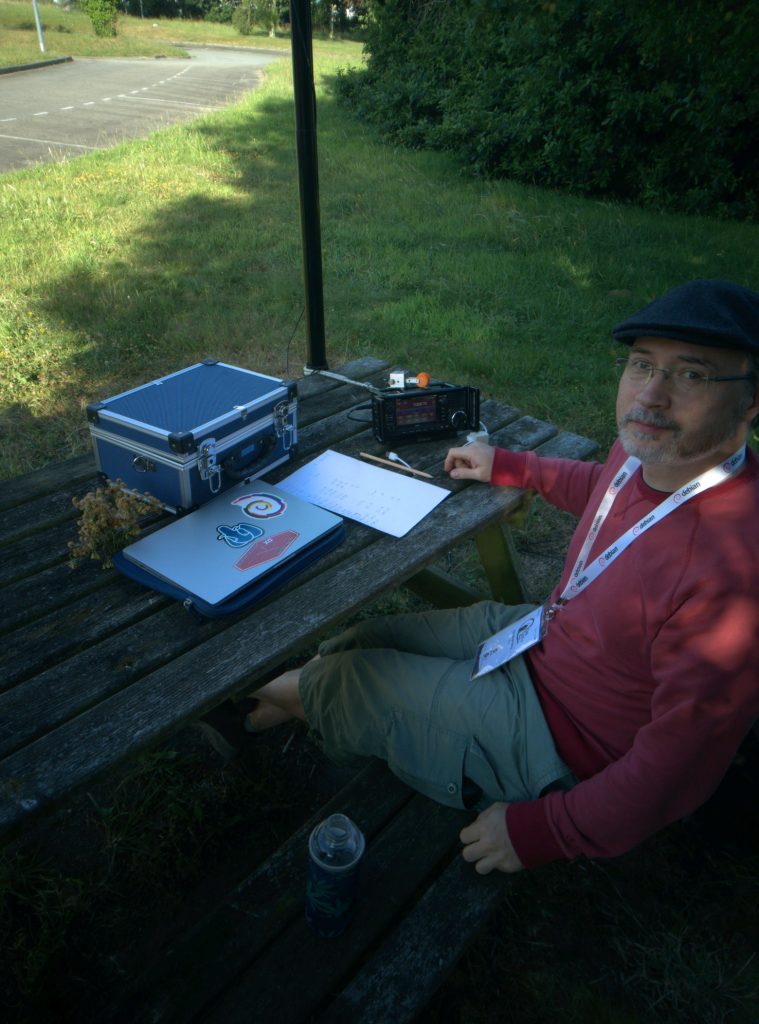 F/DF7CB in Brest (photo: Evangelos Ribeiro Tzaras)
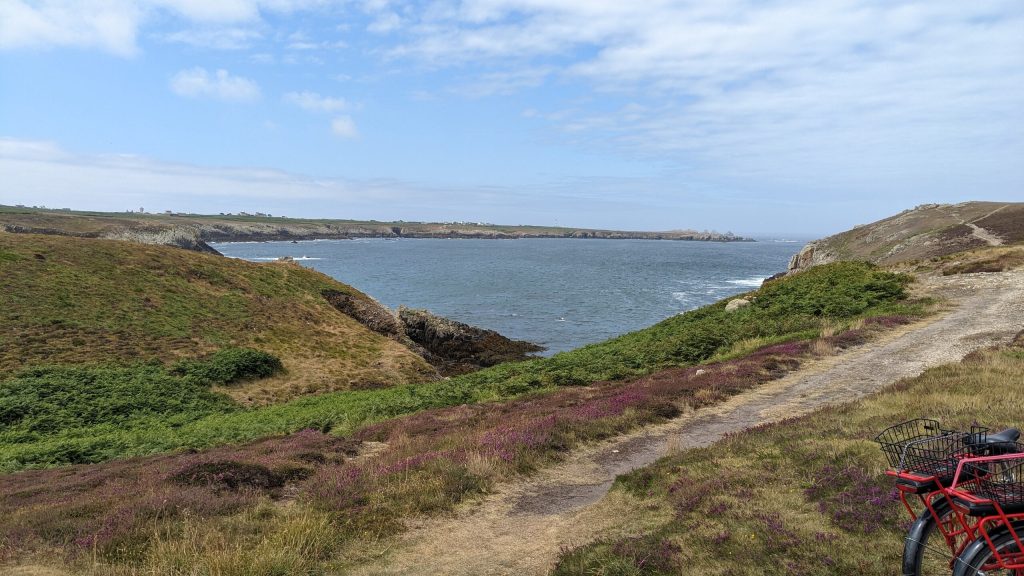 The northern coast of Ushant (photo: Christoph Berg)
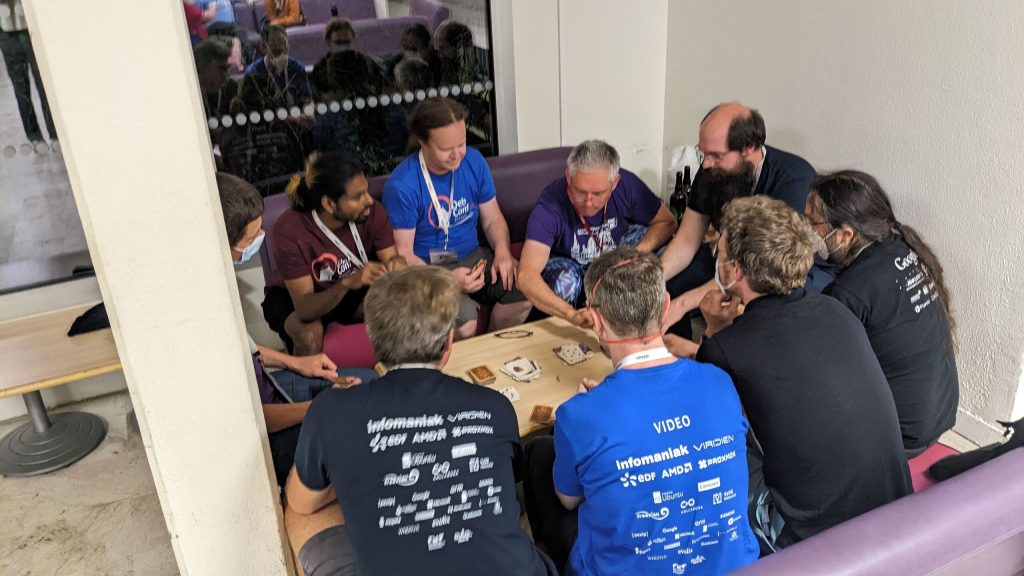 Having a nice day (photo: Christoph Berg)
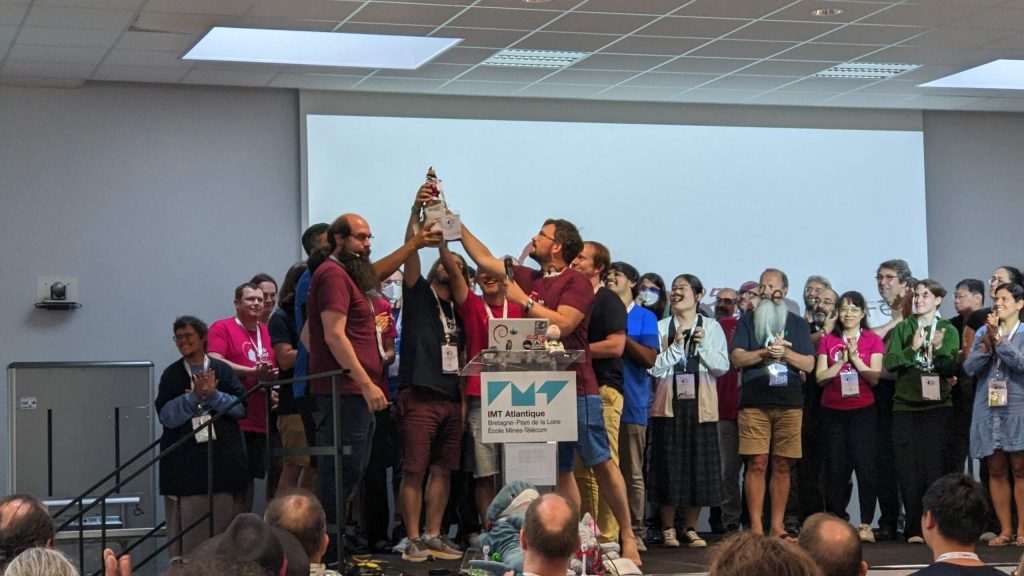 Pollito on stage (photo: Christoph Berg)
 Given that we only arrived in the evening of the first day of DebConf, I missed
the talk
 Wednesday was the day of the daytrip. I did not sign up for any of the trips
and used the time to
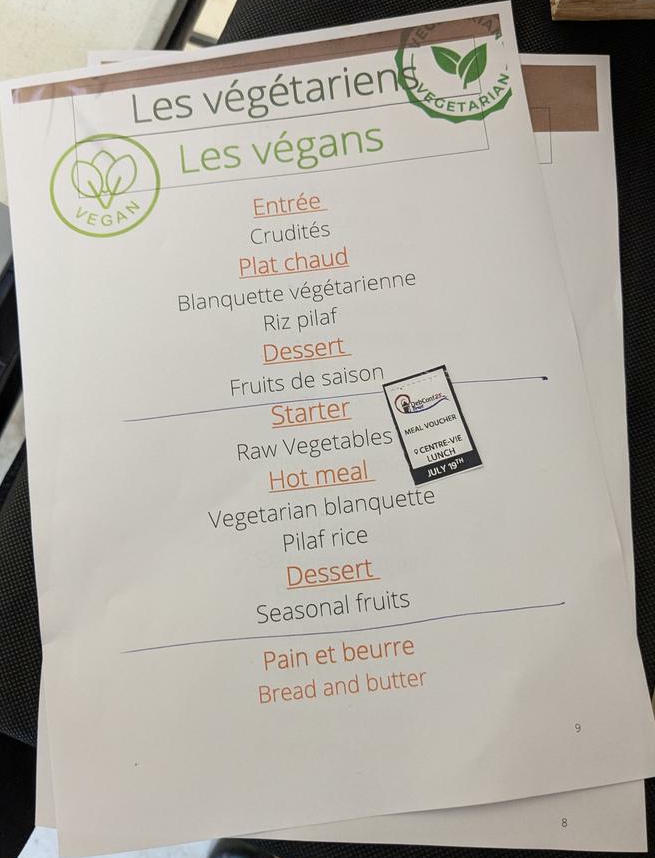 If the menus would be written like a









 Like each month, have a look at the work funded by
 My first impressions of the device are good - it is heavier than I anticipated,
but very vell made. It is very easy to assemble and disassemble and it feels
like it can take a hit.
When I started it the first time it took some minutes to boot because of the
new memory module, but then it told me right away that it could not detect an
operating system. As usual when I want to install a new system, I created
a
 I only learned later, that the SecureBoot setting is in a separate section
that is not part of the main BIOS configuration dialog. There is an Administer
Secure Boot icon which you can choose when starting the device, but
 One small downside of the keyboard is that it does not have a backlight, which
was a surprise. But given that this is a frame.work laptop, there are chances
that a future generation of the keyboard will have backlight support.
The screen of the laptop can be turned all the way around to the back of the
laptops body, so it can be used as a tablet. In this mode the keyboard gets
disabled to prevent accidently pushing keys when using the device in tablet
mode.
For online meetings I still prefer using headphones with cables over bluetooth
once, so I m glad that the laptop has a headphone jack on the side.
Above the screen there are a camera and a microphone, which both have separate
physical switches to disable them.
I ordered a couple of expansion cards, in the current setup I use two USB-C,
one HDMI and one USB-A. I also ordered a 1TB expansion card and only used this
to transfer my
 And this is the time when one realizes that she only has one white
camisole left. And it s summer, so I m wearing a lot of white shirts,
and I always wear a white camisole under a white shirt (unless I m
wearing a full chemise).
Not a problem, I have
 At bust level it s now a bit too wide, and it gapes a bit under the
arms, but I don t think that it s going to cause significant problems,
and (other than everybody on the internet) nobody is going to see it, so
it s not a big deal.
I still have some linen, but I don t think I m going to make another one
with the same pattern: maybe I ll try to do something with a front
opening, but I ll see later on, also after I ve been looking for the
missing jersey in a few more potential places.
As for now, the number of white camisoles I have has doubled, and this
is progress enough for today.
 Debian uses LDAP for storing information about users, hosts and other
objects. The wrapping around this is called userdir-ldap, or ud-ldap
for short. It provides a mail gateway, web UI and a couple of schemas
for different object types.
Back in late 2018 and early 2019, we (DSA) removed support for ISO5218
in userdir-ldap, and removed the corresponding data. This made some
people upset, since they were using that information, as imprecise as
it was, to infer people s pronouns. ISO5218 has four values for sex,
unknown, male, female and N/A. This might have been acceptable when
the standard was new (in 1976), but it wasn t acceptable any longer in
2018.
A couple of days ago, I finally got around to adding support to
userdir-ldap to let people specify their pronouns. As it should be,
it s a free-form text field. (We don t have localised fields in LDAP,
so it probably makes sense for people to put the English version of
their pronouns there, but the software does not try to control that.)
So far, it s only exposed through the LDAP gateway, not in the web UI.
If you re a Debian developer, you can set your pronouns using