Search Results: "az"

16 April 2025

Otto Kek l inen: Going Full-Time as an Open Source Developer

Featured image of post Going Full-Time as an Open Source DeveloperAfter careful consideration, I ve decided to embark on a new chapter in my professional journey. I ve left my position at AWS to dedicate at least the next six months to developing open source software and strengthening digital ecosystems. My focus will be on contributing to Linux distributions (primarily Debian) and other critical infrastructure components that our modern society depends on, but which may not receive adequate attention or resources.

The Evolution of Open Source Open source won. Over the 25+ years I ve been involved in the open source movement, I ve witnessed its remarkable evolution. Today, Linux powers billions of devices from tiny embedded systems and Android smartphones to massive cloud datacenters and even space stations. Examine any modern large-scale digital system, and you ll discover it s built upon thousands of open source projects. I feel the priority for the open source movement should no longer be increasing adoption, but rather solving how to best maintain the vast ecosystem of software. This requires building robust institutions and processes to secure proper resourcing and ensure the collaborative development process remains efficient and leads to ever-increasing quality of software.

What is Special About Debian? Debian, established in 1993 by Ian Murdock, stands as one of these institutions that has demonstrated exceptional resilience. There is no single authority, but instead a complex web of various stakeholders, each with their own goals and sources of funding. Every idea needs to be championed at length to a wide audience and implemented through a process of organic evolution. Thanks to this approach, Debian has been consistently delivering production-quality, universally useful software for over three decades. Having been a Debian Developer for more than ten years, I m well-positioned to contribute meaningfully to this community. If your organization relies on Debian or its derivatives such as Ubuntu, and you re interested in funding cyber infrastructure maintenance by sponsoring Debian work, please don t hesitate to reach out. This could include package maintenance and version currency, improving automated upgrade testing, general quality assurance and supply chain security enhancements.
Best way to reach me is by e-mail otto at debian.org. You can also book a 15-minute chat with me for a quick introduction.

Grow or Die My four-year tenure as a Software Development Manager at Amazon Web Services was very interesting. I m grateful for my time at AWS and proud of my team s accomplishments, particularly for creating an open source contribution process that got Amazon from zero to the largest external contributor to the MariaDB open source database. During this time, I got to experience and witness a plethora of interesting things. I will surely share some of my key learnings in future blog posts. Unfortunately, the rate of progress in this mammoth 1.5 million employee organization was slowing down, and I didn t feel I learned much new in the last years. This realization, combined with the opportunity cost of not spending enough time on new cutting-edge technology, motivated me to take this leap. Being a full-time open source developer may not be financially the most lucrative idea, but I think it is an excellent way to force myself to truly assess what is important on a global scale and what areas I want to contribute to. Working fully on open source presents a fascinating duality: you re not bound by any external resource or schedule limitations, and can the progress you make is directly proportional to how much energy you decide to invest. Yet, you also depend on collaboration with people you might never meet and who are not financially incentivized to collaborate. This will undoubtedly expose me to all kinds of challenges. But what would be better in fostering holistic personal growth? I know that deep down in my DNA, I am not made to stay cozy or to do easy things. I need momentum. OK, let s get going

15 April 2025

Russell Coker: Storage Trends 2025

It s been almost 15 months since I blogged about Storage Trends 2024 [1]. There hasn t been much change in this time (in Australia at least I m not tracking prices in other countries). The change was so small I had to check how the Australian dollar has performed against other currencies to see if changes to currencies had countered changes to storage prices, but there has been little overall change when compared to the Chinese Yuan and the Australian dollar is only about 11% worse against the US dollar when compared to a year ago. Generally there s a trend of computer parts decreasing in price by significantly more than 11% per annum. Small Storage The cheapest storage device from MSY now is a Patriot P210 128G SATA SSD for $19, cheaper than the $24 last year and the same price as the year before. So over the last 2 years there has been no change to the cheapest storage device on sale. It would almost never make sense to buy that as a 256G SATA SSD (also Patriot P210) is $25 and has twice the lifetime (120TBW vs 60TBW). There are also 256G NVMe devices for $29 and $30 which would be better options if the system has a NVMe socket built in. The cheapest 500G devices are $42.50 for a 512G SATA SSD and $45 for a 500G NVMe. Last year the prices were $33 for SATA and $36 for NVMe in that size so there s been a significant increase in price there. The difference is enough that if someone was on a tight budget they might reasonably decide to use smaller storage than they might have used last year! 2TB hard drives are still $89 the same price as last year! Last year a 2TB SATA SSD was $118 and a 2TB NVMe was $145, now a 2TB SATA SSD is $157 and a 2TB NVMe is $127. So NVMe has become cheaper than SATA in that segment but overall prices are higher than last year. Again for business use 2TB seems a sensible minimum for most systems if you are paying MSY rates (or similar rates from Amazon etc). Medium Storage Last year 4TB HDDs were $135, now they are $148. Last year the cheapest 4TB SSD was $299, now the cheapest is a $309 NVMe. While the prices have all gone up the price difference between hard drives and SSD has decreased in that size range. So for a small server (a lot of home servers and small business servers) 4TB of RAID-1 storage is all that s needed and for that SSDs are the best option. The price difference between $296 for 4TB of RAID-1 HDDs and $618 for RAID-1 NVMe is small enough to be justified by the benefits of speed and being quiet for most small server uses. In 2023 a 8TB hard drive cost $179 and a 8TB SSD cost $739. Last year a 8TB hard drive cost $239 and a 8TB SATA SSD cost, $899. Now a 8TB HDD costs $229 and MSY doesn t sell 8TB SSDs but for comparison Amazon has a Samsung 8TB SATA SSD for $919. So for storing 8TB+ there are benefits of hard drives as SSDs are difficult to get in that size range and more expensive than they were before. It seems that 8TB SSDs aren t used by enough people to have a large market in the home and small office space, so those of us who want the larger storage sizes will have to get second hand enterprise gear. It will probably be another few years before 8TB enterprise SSDs start appearing on the second hand market. Serious Storage Last year I wrote about the affordability of U.2 devices. I regret not buying some then as there are fewer on sale now and prices are higher. For hard drives they still aren t a good choice for most users because most users don t have more than 4TB of data. For large quantities of data hard drives are still a good option, a 22TB disk costs $899. For companies this is a good option for many situations. For home users there is the additional problem that determining whether a drive is Shingled Magnetic Recording which has some serious performance issues for some use and it s very difficult to determine which drives use it. Conclusion For corporate purchases the options for serious storage are probably decent. But for small companies and home users things definitely don t seem to have improved as much as we expect from the computer industry, I had expected 8TB SSDs to go for $450 by now and SSDs less than 500G to not even be sold new any more. The prices on 8TB SSDs have gone up more in the last 2 yeas than the ASX 200 (index of 200 biggest companies in the Australian stock market). I would never recommend using SSDs as an investment, but in retrospect 8TB SSDs could have been a good one. $20 seems to be about the minimum cost that SSDs approach while hard drives have a higher minimum price of a bit under $100 because they are larger, heavier, and more fragile. It seems that the market is likely to move to most SSDs being close to $20, if they can make 2TB SSDs cheaply enough to sell for about that price then that would cover the majority of the market. I ve created a table of the prices, I should have done this before but I initially didn t plan an ongoing series of posts on this topic.
Jun 2020 Apr 2021 Apr 2023 Jan 2024 Apr 2025
128G SSD $49 $19 $24 $19
500G SSD $97 $73 $32 $33 $42.50
2TB HDD $95 $72 $75 $89 $89
2TB SSD $335 $245 $149
4TB HDD $115 $135 $148
4TB SSD $895 $349 $299 $309
8TB HDD $179 $239 $229
8TB SSD $949 $739 $899 $919
10TB HDD $549 $395

9 April 2025

Taavi V n nen: Writing a custom rsync server to automatically update a static site

Inspired by some friends,1 I too wanted to make a tiny website telling which event I am at this exact moment. Thankfully I already had an another toy project with that information easily available, so generating the web page was a matter of just querying that project's API and feeding that data to a HTML template. Now the obvious way to host that would be to hook up the HTML-generating code to a web server, maybe add some caching for the API calls, and then route external HTTPS traffic to it. However, that'd a) require that server to be constantly available to serve traffic, and b) be boring. For context: I have an existing setup called staticweb, which is effectively a fancy name for a couple of Puppet-managed servers that run Apache httpd to serve static web pages and have a bunch of systemd timers running rsync to ensure they're serving the same content. It works really well and I use it for things ranging from my website or whyisbetabroken.com to things like my internal apt repository. Now, there are two ways to get new content into that mechanism: it can be manually pushed in from e.g. a CI job, or the system can be configured to periodically pull it from a separate server. The latter mechanism was initially created so that I could pull the Debian packages from my separate reprepro server into the staticweb setup. It turns out that the latter makes a really neat method for handling other dynamically-generated static sites as well. So, for my "where is Taavi at" site, I ended up writing the server part in Go, and included an rsync server using the gokrazy/rsync package. Initially I just implemented a static temporary directory with a timer to regularly update the HTML file in it, but then I got an even more cursed idea: what if the HTML was dynamically generated when an rsync client connected to the server? So I did just that. For deployment, I slapped the entire server part in a container and deployed it to my Kubernetes cluster. The rsync server is exposed directly as a service to my internal network with no authentication or encryption - I think that's fine since that's a read-only service in a private LAN and the resulting HTML is going to be publicly exposed anyway. (Thanks to some DNS magic, just creating a LoadBalancer Service object with a special annotation is enough to have a DNS name provisioned for the assigned IP address, which is neat.) Overall the setup works nice, at least for now. I need to add some sort of a cache to not fetch unchanged information from the API since for every update. And I guess I could write some cursed rsyncd reverse proxy with per-module rules if I end up creating more sites like this to avoid creating new LoadBalancer services for each of them.

  1. Mostly from Sammy's where.fops.at.

7 April 2025

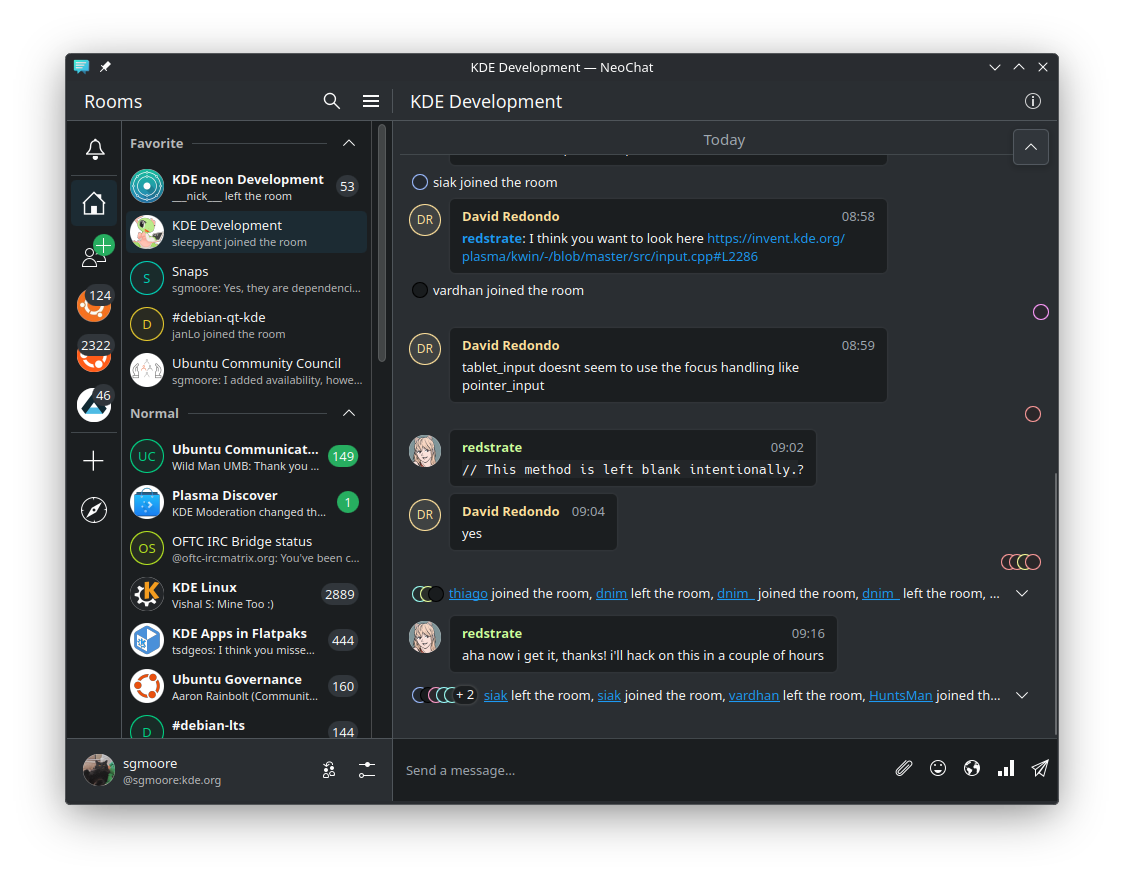
Scarlett Gately Moore: KDE Snap Updates, Kubuntu Updates, More life updates!

Icy morning Witch Wells AzIcy morning Witch Wells Az
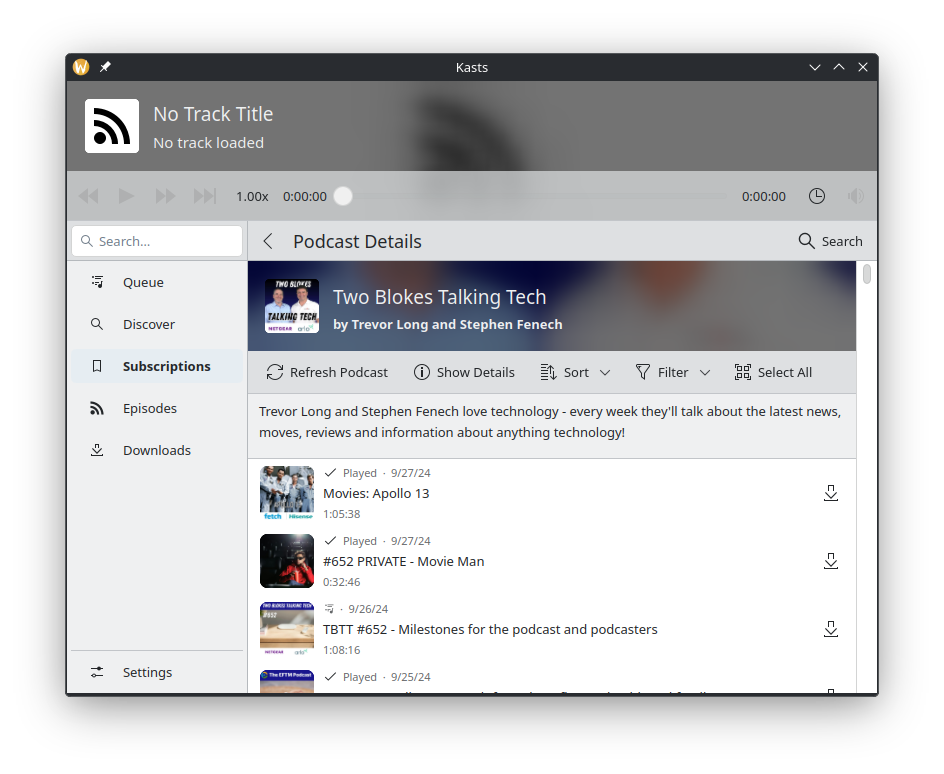
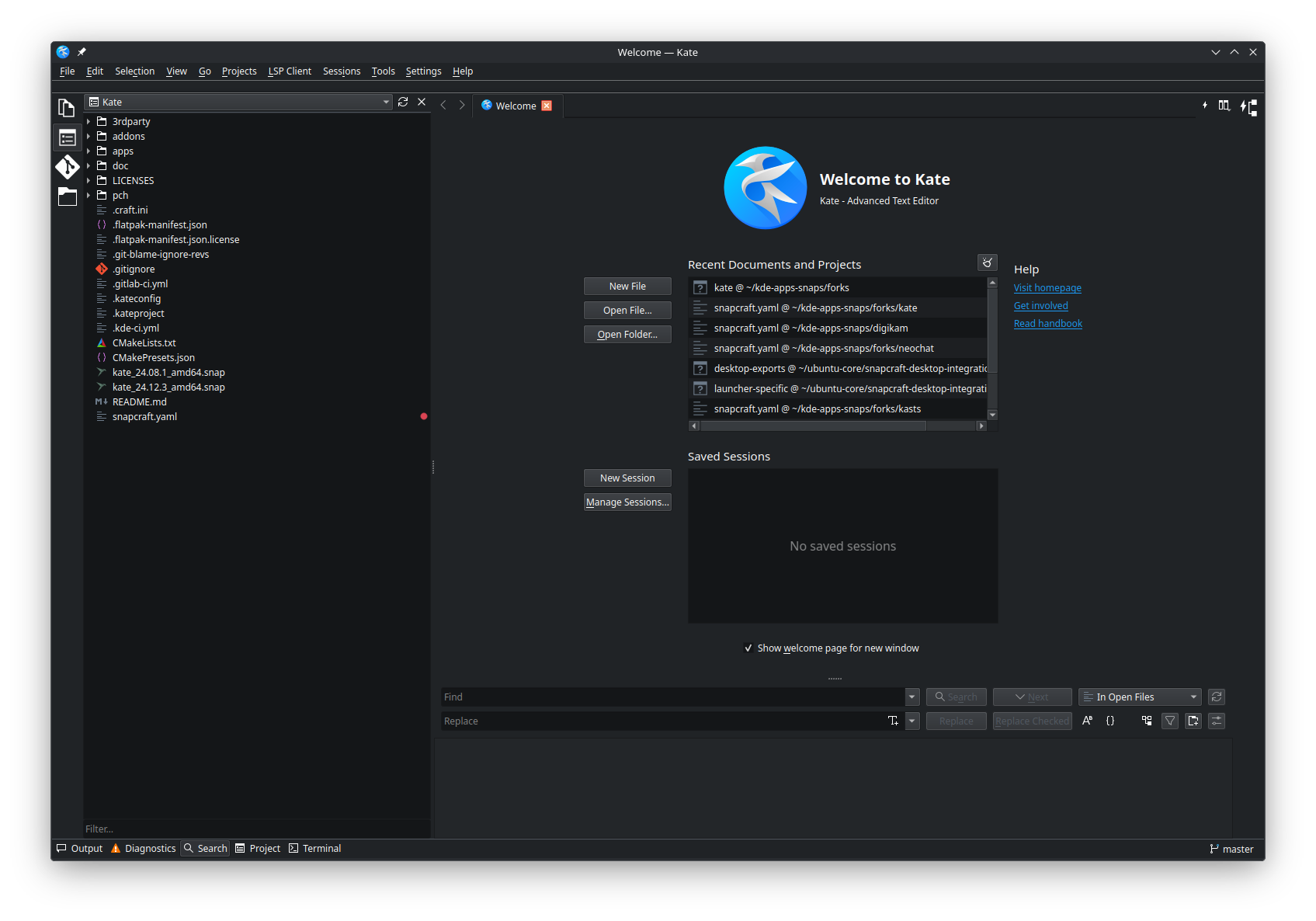
Life: Last week we were enjoying springtime, this week winter has made a comeback! Good news on the broken arm front, the infection is gone, so they can finally deal with the broken issue again. I will have a less invasive surgery April 25th to pull the bones back together so they can properly knit back together! If you can spare any change please consider a donation to my continued healing and recovery, or just support my work  Kubuntu: While testing Beta I came across some crashy apps ( Namely PIM ) due to apparmor. I have uploaded fixed profiles for kmail, akregator, akonadiconsole, konqueror, tellico KDE Snaps: Added sctp support in Qt https://invent.kde.org/neon/snap-packaging/kde-qt6-core-sdk/-/commit/bbcb1dc39044b930ab718c8ffabfa20ccd2b0f75 This will allow me to finish a pyside6 snap and fix FreeCAD build. Changed build type to Release in the kf6-core24-sdk which will reduce the size of kf6-core24 significantly. Fixed a few startup errors in kf5-core24 and kf6-core24 snapcraft-desktop-integration. Soumyadeep fixed wayland icons in https://invent.kde.org/neon/snap-packaging/kf6-core-sdk/-/merge_requests/3 KDE Applications 25.03.90 RC released to candidate ( I know it says 24.12.3, version won t be updated until 25.04.0 release ) Kasts core24 fixed in candidate Kate now core24 with Breeze theme! candidate Neochat: Fixed missing QML and 25.04 dependencies in candidate Kdenlive now with Galxnimate animations! candidate Digikam 8.6.0 now with scanner support in stable Kstars 3.7.6 released to stable for realz, removed store rejected plugs. Thanks for stopping by!

4 April 2025

Johannes Schauer Marin Rodrigues: To boldly build what no one has built before

Last week, we (Helmut, Jochen, Holger, Gioele and josch) met in W rzburg for a Debian crossbuilding & bootstrap sprint. We would like to thank Angest pselt e. V. for generously providing us with their hacker space which we were able to use exclusively during the four-day-sprint. We d further like to thank Debian for their sponsorship of accommodation of Helmut and Jochen. The most important topics that we worked on together were: Our TODO items for after the sprint are: In addition to what was already listed above, people worked on the following tasks specifically: Thank you all for attending this sprint, for making it so productive and for the amazing atmosphere and enlightening discussions!

3 April 2025

Gregor Herrmann: Debian MountainCamp, Innsbruck, 16 18 May 2025

the days are getting warmer (in the northern hemisphere), debian is getting colder, & quite a few debian events are taking place. in innsbruck, we are organizing MountainCamp, an event in the tradition of SunCamp & SnowCamp: no schedule, no talks, meet other debian people, fix bugs, come up with crazy ideas, have fun, develop things. interested? head over to the information & signup page on the debian wiki.

1 April 2025

Colin Watson: Free software activity in March 2025

Most of my Debian contributions this month were sponsored by Freexian. You can also support my work directly via Liberapay. OpenSSH Changes in dropbear 2025.87 broke OpenSSH s regression tests. I cherry-picked the fix. I reviewed and merged patches from Luca Boccassi to send and accept the COLORTERM and NO_COLOR environment variables. Python team Following up on last month, I fixed some more uscan errors: I upgraded these packages to new upstream versions: In bookworm-backports, I updated python-django to 3:4.2.19-1. Although Debian s upgrade to python-click 8.2.0 was reverted for the time being, I fixed a number of related problems anyway since we re going to have to deal with it eventually: dh-python dropped its dependency on python3-setuptools in 6.20250306, which was long overdue, but it had quite a bit of fallout; in most cases this was simply a question of adding build-dependencies on python3-setuptools, but in a few cases there was a missing build-dependency on python3-typing-extensions which had previously been pulled in as a dependency of python3-setuptools. I fixed these bugs resulting from this: We agreed to remove python-pytest-flake8. In support of this, I removed unnecessary build-dependencies from pytest-pylint, python-proton-core, python-pyzipper, python-tatsu, python-tatsu-lts, and python-tinycss, and filed #1101178 on eccodes-python and #1101179 on rpmlint. There was a dnspython autopkgtest regression on s390x. I independently tracked that down to a pylsqpack bug and came up with a reduced test case before realizing that Pranav P had already been working on it; we then worked together on it and I uploaded their patch to Debian. I fixed various other build/test failures: I enabled more tests in python-moto and contributed a supporting fix upstream. I sponsored Maximilian Engelhardt to reintroduce zope.sqlalchemy. I fixed various odds and ends of bugs: I contributed a small documentation improvement to pybuild-autopkgtest(1). Rust team I upgraded rust-asn1 to 0.20.0. Science team I finally gave in and joined the Debian Science Team this month, since it often has a lot of overlap with the Python team, and Freexian maintains several packages under it. I fixed a uscan error in hdf5-blosc (maintained by Freexian), and upgraded it to a new upstream version. I fixed python-vispy: missing dependency on numpy abi. Other bits and pieces I fixed debconf should automatically be noninteractive if input is /dev/null. I fixed a build failure with GCC 15 in yubihsm-shell (maintained by Freexian). Prompted by a CI failure in debusine, I submitted a large batch of spelling fixes and some improved static analysis to incus (#1777, #1778) and distrobuilder. After regaining access to the repository, I fixed telegnome: missing app icon in About dialogue and made a new 0.3.7 release.

30 March 2025

Utkarsh Gupta: FOSS Activites in March 2025

Here s my 66th monthly but brief update about the activities I ve done in the F/L/OSS world.

Debian
This was my 75th month of actively contributing to Debian. I became a DM in late March 2019 and a DD on Christmas 19! \o/ There s a bunch of things I do, both, technical and non-technical. Here s what I did:
  • Updating Rails to v7.2.2.1 for Trixie.
  • Updating Redmine to v6.0.4 for Trixie.
  • Kickstarting the bursary team for DC25.
  • Mentoring for newcomers.
  • Moderation of -project mailing list.

Ubuntu
This was my 50th month of actively contributing to Ubuntu. Now that I joined Canonical to work on Ubuntu full-time, there s a bunch of things I do! \o/ I mostly worked on different things, I guess. I was too lazy to maintain a list of things I worked on so there s no concrete list atm. Maybe I ll get back to this section later or will start to list stuff from the fall, as I was doing before. :D

Debian (E)LTS
Debian Long Term Support (LTS) is a project to extend the lifetime of all Debian stable releases to (at least) 5 years. Debian LTS is not handled by the Debian security team, but by a separate group of volunteers and companies interested in making it a success. And Debian Extended LTS (ELTS) is its sister project, extending support to the stretch and jessie release (+2 years after LTS support). This was my 66th month as a Debian LTS and 53rd month as a Debian ELTS paid contributor.
I worked for 15.00 hours for LTS and 7.50 hours for ELTS. I did the following things:
  • [ELTS] Worked on backporting patches for adminer.
  • [E/LTS] Working on the musl fixes for bullseye. Taking it forward from where it was left off by Chris.
    • Co-ordiating with Santiago to see how to best get the reproducer to test the update.
    • Plan is to reproduce it myself but then reach out to Adrian if that doesn t work out.
    • Also makes sense to upload to LTS first, let it settle there, and then look at ELTS.
  • [LTS] Attended the LTS meeting on IRC. Summary here.
  • [stable] Co-ordinated with the Security team to fix rails in bookworm via 2:6.1.7.10+dfsg-1~deb12u1.
    • Fixes: CVE-2023-28362, CVE-2023-38037, CVE-2024-26144, CVE-2024-28103, CVE-2024-41128, CVE-2024-47887, CVE-2024-47888, CVE-2024-47889, and CVE-2024-54133.
    • Released as DSA 5881-1.
  • [stable] Co-ordinated with the Security team to fix ruby-rack in bookworm via 2.2.13-1~deb12u1.
    • Fixes: CVE-2025-27610, CVE-2025-27111, and CVE-2025-25184.
    • Released as DSA 5886-1.
  • [stable] Partly co-ordinated with the Security team to fix ruby-saml in bookworm.

Until next time.
:wq for today.

22 March 2025

Antoine Beaupr : Minor outage at Teksavvy business

This morning, internet was down at home. The last time I had such an issue was in February 2023, when my provider was Oricom. Now I'm with a business service at Teksavvy Internet (TSI), in which I pay 100$ per month for a 250/50 mbps business package, with a static IP address, on which I run, well, everything: email services, this website, etc.

Mitigation

Email The main problem when the service goes down like this for prolonged outages is email. Mail is pretty resilient to failures like this but after some delay (which varies according to the other end), mail starts to drop. I am actually not sure what the various settings are among different providers, but I would assume mail is typically kept for about 24h, so that's our mark. Last time, I setup VMs at Linode and Digital Ocean to deal better with this. I have actually kept those VMs running as DNS servers until now, so that part is already done. I had fantasized about Puppetizing the mail server configuration so that I could quickly spin up mail exchangers on those machines. But now I am realizing that my Puppet server is one of the service that's down, so this would not work, at least not unless the manifests can be applied without a Puppet server (say with puppet apply). Thankfully, my colleague groente did amazing work to refactor our Postfix configuration in Puppet at Tor, and that gave me the motivation to reproduce the setup in the lab. So I have finally Puppetized part of my mail setup at home. That used to be hand-crafted experimental stuff documented in a couple of pages in this wiki, but is now being deployed by Puppet. It's not complete yet: spam filtering (including DKIM checks and graylisting) are not implemented yet, but that's the next step, presumably to do during the next outage. The setup should be deployable with puppet apply, however, and I have refined that mechanism a little bit, with the run script. Heck, it's not even deployed yet. But the hard part / grunt work is done.

Other The outage was "short" enough (5 hours) that I didn't take time to deploy the other mitigations I had deployed in the previous incident. But I'm starting to seriously consider deploying a web (and caching) reverse proxy so that I endure such problems more gracefully.

Side note on proper servics Typically, I tend to think of a properly functioning service as having four things:
  1. backups
  2. documentation
  3. monitoring
  4. automation
  5. high availability
Yes, I miscounted. This is why you have high availability.

Backups Duh. If data is maliciously or accidentally destroyed, you need a copy somewhere. Preferably in a way that malicious joe can't get to. This is harder than you think.

Documentation I have an entire template for this. Essentially, it boils down to using https://diataxis.fr/ and this "audit" guide. For me, the most important parts are:
  • disaster recovery (includes backups, probably)
  • playbook
  • install/upgrade procedures (see automation)
You probably know this is hard, and this is why you're not doing it. Do it anyways, you'll think it sucks, but you'll be really grateful for whatever scraps you wrote when you're in trouble.

Monitoring If you don't have monitoring, you'll know it fails too late, and you won't know it recovers. Consider high availability, work hard to reduce noise, and don't have machine wake people up, that's literally torture and is against the Geneva convention. Consider predictive algorithm to prevent failures, like "add storage within 2 weeks before this disk fills up". This is harder than you think.

Automation Make it easy to redeploy the service elsewhere. Yes, I know you have backups. That is not enough: that typically restores data and while it can also include configuration, you're going to need to change things when you restore, which is what automation (or call it "configuration management" if you will) will do for you anyways. This also means you can do unit tests on your configuration, otherwise you're building legacy. This is probably as hard as you think.

High availability Make it not fail when one part goes down. Eliminate single points of failures. This is easier than you think, except for storage and DNS (which, I guess, means it's harder than you think too).

Assessment In the above 5 items, I check two:
  1. backups
  2. documentation
And barely: I'm not happy about the offsite backups, and my documentation is much better at work than at home (and even there, I have a 15 year backlog to catchup on). I barely have monitoring: Prometheus is scraping parts of the infra, but I don't have any sort of alerting -- by which I don't mean "electrocute myself when something goes wrong", I mean "there's a set of thresholds and conditions that define an outage and I can look at it". Automation is wildly incomplete. My home server is a random collection of old experiments and technologies, ranging from Apache with Perl and CGI scripts to Docker containers running Golang applications. Most of it is not Puppetized (but the ratio is growing). Puppet itself introduces a huge attack vector with kind of catastrophic lateral movement if the Puppet server gets compromised. And, fundamentally, I am not sure I can provide high availability in the lab. I'm just this one guy running my home network, and I'm growing older. I'm thinking more about winding things down than building things now, and that's just really sad, because I feel we're losing (well that escalated quickly).

Resolution In the end, I didn't need any mitigation and the problem fixed itself. I did do quite a bit of cleanup so that feels somewhat good, although I despaired quite a bit at the amount of technical debt I've accumulated in the lab.

Timeline Times are in UTC-4.
  • 6:52: IRC bouncer goes offline
  • 9:20: called TSI support, waited on the line 15 minutes then was told I'd get a call back
  • 9:54: outage apparently detected by TSI
  • 11:00: no response, tried calling back support again
  • 11:10: confirmed bonding router outage, no official ETA but "today", source of the 9:54 timestamp above
  • 12:08: TPA monitoring notices service restored
  • 12:34: call back from TSI; service restored, problem was with the "bonder" configuration on their end, which was "fighting between Montr al and Toronto"

Antoine Beaupr : Losing the war for the free internet

Warning: this is a long ramble I wrote after an outage of my home internet. You'll get your regular scheduled programming shortly. I didn't realize this until relatively recently, but we're at war. Fascists and capitalists are trying to take over the world, and it's bringing utter chaos. We're more numerous than them, of course: this is only a handful of people screwing everyone else over, but they've accumulated so much wealth and media control that it's getting really, really hard to move around. Everything is surveilled: people are carrying tracking and recording devices in their pockets at all time, or they drive around in surveillance machines. Payments are all turning digital. There's cameras everywhere, including in cars. Personal data leaks are so common people kind of assume their personal address, email address, and other personal information has already been leaked. The internet itself is collapsing: most people are using the network only as a channel to reach a "small" set of "hyperscalers": mind-boggingly large datacenters that don't really operate like the old internet. Once you reach the local endpoint, you're not on the internet anymore. Netflix, Google, Facebook (Instagram, Whatsapp, Messenger), Apple, Amazon, Microsoft (Outlook, Hotmail, etc), all those things are not really the internet anymore. Those companies operate over the "internet" (as in the TCP/IP network), but they are not an "interconnected network" as much as their own, gigantic silos so much bigger than everything else that they essentially dictate how the network operates, regardless of standards. You access it over "the web" (as in "HTTP") but the fabric is not made of interconnected links that cross sites: all those sites are trying really hard to keep you captive on their platforms. Besides, you think you're writing an email to the state department, for example, but you're really writing to Microsoft Outlook. That app your university or border agency tells you to install, the backend is not hosted by those institutions, it's on Amazon. Heck, even Netflix is on Amazon. Meanwhile I've been operating my own mail server first under my bed (yes, really) and then in a cupboard or the basement for almost three decades now. And what for? So I can tell people I can? Maybe! I guess the reason I'm doing this is the same reason people are suddenly asking me about the (dead) mesh again. People are worried and scared that the world has been taken over, and they're right: we have gotten seriously screwed. It's the same reason I keep doing radio, minimally know how to grow food, ride a bike, build a shed, paddle a canoe, archive and document things, talk with people, host an assembly. Because, when push comes to shove, there's no one else who's going to do it for you, at least not the way that benefits the people. The Internet is one of humanity's greatest accomplishments. Obviously, oligarchs and fascists are trying to destroy it. I just didn't expect the tech bros to be flipping to that side so easily. I thought we were friends, but I guess we are, after all, enemies. That said, that old internet is still around. It's getting harder to host your own stuff at home, but it's not impossible. Mail is tricky because of reputation, but it's also tricky in the cloud (don't get fooled!), so it's not that much easier (or cheaper) there. So there's things you can do, if you're into tech. Share your wifi with your neighbours. Build a LAN. Throw a wire over to your neighbour too, it works better than wireless. Use Tor. Run a relay, a snowflake, a webtunnel. Host a web server. Build a site with a static site generator and throw it in the wind. Download and share torrents, and why not a tracker. Run an IRC server (or Matrix, if you want to federate and lose high availability). At least use Signal, not Whatsapp or Messenger. And yes, why not, run a mail server, join a mesh. Don't write new software, there's plenty of that around already. (Just kidding, you can write code, cypherpunk.) You can do many of those things just by setting up a FreedomBox. That is, after all, the internet: people doing their own thing for their own people. Otherwise, it's just like sitting in front of the television and watching the ads. Opium of the people, like the good old time. Let a billion droplets build the biggest multitude of clouds that will storm over this world and rip apart this fascist conspiracy. Disobey. Revolt. Build. We are more than them.

21 March 2025

Jamie McClelland: AI's Actual Impact

Two years after OpenAI launched ChatGPT 3.5, humanity is not on the cusp of extinction and Elon Musk seems more responsible for job loss than any AI agent. However, ask any web administrator and you will learn that large language models are having a significant impact on the world wide web (or, for a less technical account, see Forbes articles on bots). At May First, a membership organization that has been supporting thousands of web site for over 20 years, we have never seen anything like this before.

Now what? So, no, unfortunately, your web site is not suddenly getting really popular. And, you are blessed with a whole new set of strategic decisions. Fortunately, May First has undergone a major infrastructure transition, resulting in centralized logging of all web sites and a fleet of web proxy servers that intercept all web traffic. Centralized logging means we can analyze traffic and identify bots more easily, and a web proxy fleet allows us to more easily implement rules across all web sites. However, even with all of our latest changes and hours upon hours of work to keep out the bots, our members are facing some hard decisions about maintaining an open web. One member of May First provides Google translations of their web site to every language available. But wow, that is now a disaster because instead of having every bot under the sun scrapping all 843 (a made up number) pieces of unique content on their site, the same bots are scraping 843 * (number of available languages) pieces of content on their site. Should they stop providing this translation service in order to ensure people can access their site in the site s primary language? Should web sites turn off their search features that include drop down options of categories to prevent bots from systematically refreshing the search page with every possible combination of search terms? Do we need to alter our calendar software to avoid providing endless links into the future (ok, that is an easy one)?

What s next? Something has to change.
  • Lock down web 2.0. Web 2.0 brought us wonderful dynamic web sites, which Drupal and WordPress and many other pieces of amazing software have supported for over a decade. This is the software that is getting bogged down by bots. Maybe we need to figure out a way to lock down the dynamic aspects of this software to logged in users and provide static content for everyone else?
  • Paywalls and accounts everywhere. There s always been an amazing non-financial reward to providing a web site with high quality movement oriented content for free. It populates the search engines, provides links to inspiring and useful content in moments of crises, and can galvanize movements. But these moments of triumph happen between long periods of hard labor that now seems to mostly feed capitalist AI scumbags. If we add a new set of expenses and labor to keep the sites running for this purpose, how sustainable is that? Will our treasure of free movement content have to move behind paywalls or logins? If we provide logins, will that keep the bots out or just create a small hurdle for them to automate the account creation process? What happens when we can t search for this kind of content via search engines?
  • Cutting deals. What if our movement content providers are forced to cut deals with the AI entrepreneurs to allow the paying scumbags to fund the content creation. Eww. Enough said.
  • Bot detection. Maybe we just need to get better at bot detection? This will surely be an arms race, but would have some good benefits. Bots have also been filling out our forms and populating our databases with spam, testing credit cards against our donation pages, conducting denial of service attacks and all kinds of other irritating acts of vandalism. If we were better at stopping bots automatically it would have a lot of benefits. But what impact would it have on our web sites and the experience of using them? What about good bots (RSS feed readers, payment processors, web hooks, uptime detectors)? Will we cut the legs off any developer trying to automate something?
I m not really sure where this is going, but it seems that the world wide web is about to head in a new direction.

17 March 2025

Vincent Bernat: Offline PKI using 3 YubiKeys and an ARM single board computer

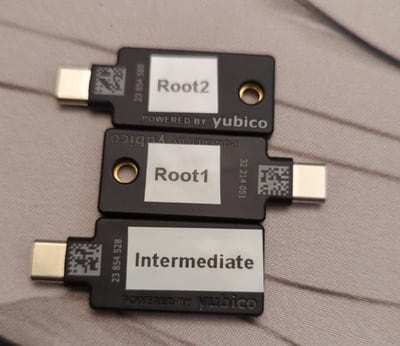
An offline PKI enhances security by physically isolating the certificate authority from network threats. A YubiKey is a low-cost solution to store a root certificate. You also need an air-gapped environment to operate the root CA.
PKI relying on a set of 3 YubiKeys: 2 for the root CA and 1 for the intermediate CA.
Offline PKI backed up by 3 YubiKeys
This post describes an offline PKI system using the following components: It is possible to add more YubiKeys as a backup of the root CA if needed. This is not needed for the intermediate CA as you can generate a new one if the current one gets destroyed.

The software part offline-pki is a small Python application to manage an offline PKI. It relies on yubikey-manager to manage YubiKeys and cryptography for cryptographic operations not executed on the YubiKeys. The application has some opinionated design choices. Notably, the cryptography is hard-coded to use NIST P-384 elliptic curve. The first step is to reset all your YubiKeys:
$ offline-pki yubikey reset
This will reset the connected YubiKey. Are you sure? [y/N]: y
New PIN code:
Repeat for confirmation:
New PUK code:
Repeat for confirmation:
New management key ('.' to generate a random one):
WARNING[pki-yubikey] Using random management key: e8ffdce07a4e3bd5c0d803aa3948a9c36cfb86ed5a2d5cf533e97b088ae9e629
INFO[pki-yubikey]  0: Yubico YubiKey OTP+FIDO+CCID 00 00
INFO[pki-yubikey] SN: 23854514
INFO[yubikit.management] Device config written
INFO[yubikit.piv] PIV application data reset performed
INFO[yubikit.piv] Management key set
INFO[yubikit.piv] New PUK set
INFO[yubikit.piv] New PIN set
INFO[pki-yubikey] YubiKey reset successful!
Then, generate the root CA and create as many copies as you want:
$ offline-pki certificate root --permitted example.com
Management key for Root X:
Plug YubiKey "Root X"...
INFO[pki-yubikey]  0: Yubico YubiKey CCID 00 00
INFO[pki-yubikey] SN: 23854514
INFO[yubikit.piv] Data written to object slot 0x5fc10a
INFO[yubikit.piv] Certificate written to slot 9C (SIGNATURE), compression=True
INFO[yubikit.piv] Private key imported in slot 9C (SIGNATURE) of type ECCP384
Copy root certificate to another YubiKey? [y/N]: y
Plug YubiKey "Root X"...
INFO[pki-yubikey]  0: Yubico YubiKey CCID 00 00
INFO[pki-yubikey] SN: 23854514
INFO[yubikit.piv] Data written to object slot 0x5fc10a
INFO[yubikit.piv] Certificate written to slot 9C (SIGNATURE), compression=True
INFO[yubikit.piv] Private key imported in slot 9C (SIGNATURE) of type ECCP384
Copy root certificate to another YubiKey? [y/N]: n
You can inspect the result:
$ offline-pki yubikey info
INFO[pki-yubikey]  0: Yubico YubiKey CCID 00 00
INFO[pki-yubikey] SN: 23854514
INFO[pki-yubikey] Slot 9C (SIGNATURE):
INFO[pki-yubikey]   Private key type: ECCP384
INFO[pki-yubikey]   Public key:
INFO[pki-yubikey]     Algorithm:  secp384r1
INFO[pki-yubikey]     Issuer:     CN=Root CA
INFO[pki-yubikey]     Subject:    CN=Root CA
INFO[pki-yubikey]     Serial:     1
INFO[pki-yubikey]     Not before: 2024-07-05T18:17:19+00:00
INFO[pki-yubikey]     Not after:  2044-06-30T18:17:19+00:00
INFO[pki-yubikey]     PEM:
-----BEGIN CERTIFICATE-----
MIIBcjCB+aADAgECAgEBMAoGCCqGSM49BAMDMBIxEDAOBgNVBAMMB1Jvb3QgQ0Ew
HhcNMjQwNzA1MTgxNzE5WhcNNDQwNjMwMTgxNzE5WjASMRAwDgYDVQQDDAdSb290
IENBMHYwEAYHKoZIzj0CAQYFK4EEACIDYgAERg3Vir6cpEtB8Vgo5cAyBTkku/4w
kXvhWlYZysz7+YzTcxIInZV6mpw61o8W+XbxZV6H6+3YHsr/IeigkK04/HJPi6+i
zU5WJHeBJMqjj2No54Nsx6ep4OtNBMa/7T9foyMwITAPBgNVHRMBAf8EBTADAQH/
MA4GA1UdDwEB/wQEAwIBhjAKBggqhkjOPQQDAwNoADBlAjEAwYKy/L8leJyiZSnn
xrY8xv8wkB9HL2TEAI6fC7gNc2bsISKFwMkyAwg+mKFKN2w7AjBRCtZKg4DZ2iUo
6c0BTXC9a3/28V5aydZj6rvx0JqbF/Ln5+RQL6wFMLoPIvCIiCU=
-----END CERTIFICATE-----
Then, you can create an intermediate certificate with offline-pki yubikey intermediate and use it to sign certificates by providing a CSR to offline-pki certificate sign. Be careful and inspect the CSR before signing it, as only the subject name can be overridden. Check the documentation for more details. Get the available options using the --help flag.

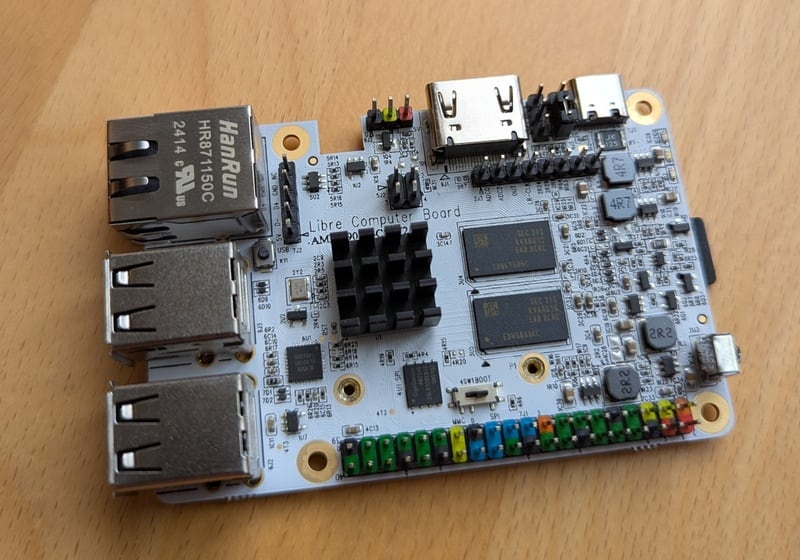
The hardware part To ensure the operations on the root and intermediate CAs are air-gapped, a cost-efficient solution is to use an ARM64 single board computer. The Libre Computer Sweet Potato SBC is a more open alternative to the well-known Raspberry Pi.1
Libre Computer Sweet Potato single board computer relying on the Amlogic S905X SOC
Libre Computer Sweet Potato SBC, powered by the AML-S905X SOC
I interact with it through an USB to TTL UART converter:
$ tio /dev/ttyUSB0
[16:40:44.546] tio v3.7
[16:40:44.546] Press ctrl-t q to quit
[16:40:44.555] Connected to /dev/ttyUSB0
GXL:BL1:9ac50e:bb16dc;FEAT:ADFC318C:0;POC:1;RCY:0;SPI:0;0.0;CHK:0;
TE: 36574
BL2 Built : 15:21:18, Aug 28 2019. gxl g1bf2b53 - luan.yuan@droid15-sz
set vcck to 1120 mv
set vddee to 1000 mv
Board ID = 4
CPU clk: 1200MHz
[ ]

The Nix glue To bring everything together, I am using Nix with a Flake providing:
  • a package for the offline-pki application, with shell completion,
  • a development shell, including an editable version of the offline-pki application,
  • a NixOS module to setup the offline PKI, resetting the system at each boot,
  • a QEMU image for testing, and
  • an SD card image to be used on the Sweet Potato or another ARM64 SBC.
# Execute the application locally
nix run github:vincentbernat/offline-pki -- --help
# Run the application inside a QEMU VM
nix run github:vincentbernat/offline-pki\#qemu
# Build a SD card for the Sweet Potato or for the Raspberry Pi
nix build --system aarch64-linux github:vincentbernat/offline-pki\#sdcard.potato
nix build --system aarch64-linux github:vincentbernat/offline-pki\#sdcard.generic
# Get a development shell with the application
nix develop github:vincentbernat/offline-pki

  1. The key for the root CA is not generated by the YubiKey. Using an air-gapped computer is all the more important. Put it in a safe with the YubiKeys when done!

9 March 2025

Lisandro Dami n Nicanor P rez Meyer: Bah a Blanca floods - Mother nature says: no Nuremberg for you today

Update 20250309 13:20-03:00 - How to help A friend of mine living in the USA sent me this link to help the flood victims: Support Bah a Blanca (Argentina) Flood Victims Original blog post These are not good news. In fact, much the contrary. Compared to the real issue, the fact that I'm not able to attend Embedded World at Nuremberg is, well, a detail. Or at least that's what I'm forcing myself to believe, as I REALLY wanted to be there. But mother nature said otherwise. Plaza Dr. Alberto Martinelli - Barrio Parque Las Ca itas Park "D. Alberto Martinelli", Las Ca itas, Bah a Blanca (Google Maps) Bah a Blanca , the city I live, has received a lot on rainfall. Really, a lot. Let me introduce the number like this: the previous highest recorded measurement was 170mm (6.69 inch)... in a month. Yesterday Friday 07 we had more than 400mm (15.75 inch) in 9 hours. But those are just numbers. Some things are better seen in images. I'll start with some soft ones. Streetk sink 1 Streetk sink 2 Sink in Fournier street near Cambaceres (Google Maps) I also happen to do figure skating in the same school of the 4 times world champions (where "world" means the whole world) Roller Dreams precision skating team - Instagram, from Club El Nacional. Our skating rink got severely damaged with the hail we had like 3 weeks ago (yes, we had hail too!!!). Now it's just impossible: Roller Dreams CEN skating rink The "real" thing Let's get to the heavy, heartbreaker part. I did go to downtown Bah a Blanca, but during night, so let me share some links, most of them in Spanish, but images are images: My alma matter, Universidad Nacional del Sur, lost its main library, great part of the Physics department and a lot of labs :-( A nearby town, General Cerri, had even worst luck. In Bah a Blanca, a city of 300k+ people, has around 400 evacuated people. General Cerri, a town of 3000? people, had at least 800. Bah a Blanca, devil's land Every place has its legends. We do too. This land was called "Huecuv Map ", something like "Devil's land" by the original inhabitants of the zone, due to its harsh climate: string winters and hot summers, couple with fierce wind. But back in 1855 the Cacique (chief) Jos Mar a Bulnes Yanquetruz had a peace agreement with commander Nicanor Otamendi. But a battle ensued, which Yanquetruz won. At this point history defers depending upon who tells it. Some say Yanquetruz was assigned a military grade as Captain of the indigenous auxiliary forces and provided a military suit, some say he stole it, some say this was a setup of another chief wanting to disrupt peace. But what is known is that Yanquetruz was killed, and his wife, the "machi" (sorceress), issued a curse over the land that would last 1000 years, and the curse was on the climate. Aftermath No, we are not there yet. This has just happened. The third violent climate occurrence in 15 months. The city needs to mourn and start healing itself. Time will say.

8 March 2025

Debian Brasil: MiniDebConf Belo Horizonte 2024 - a brief report

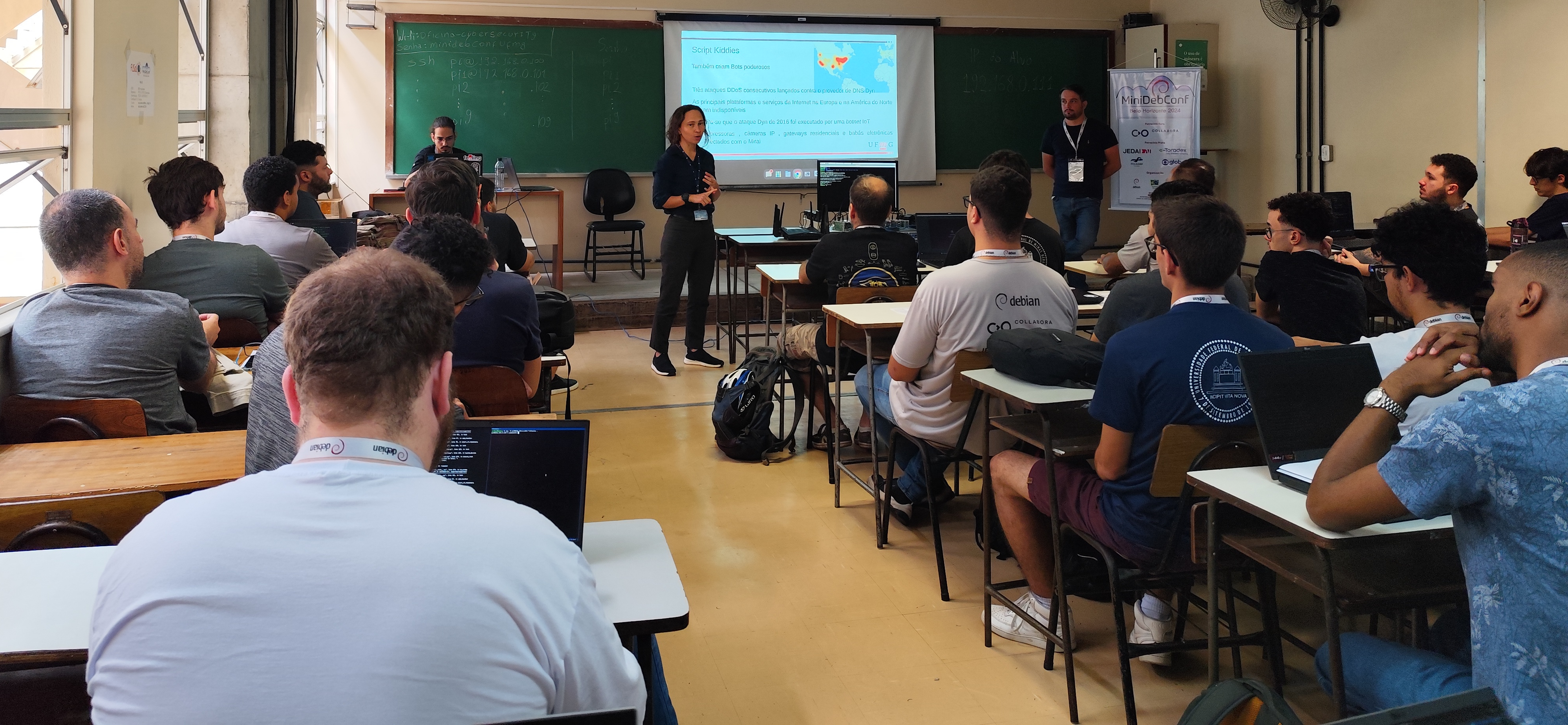
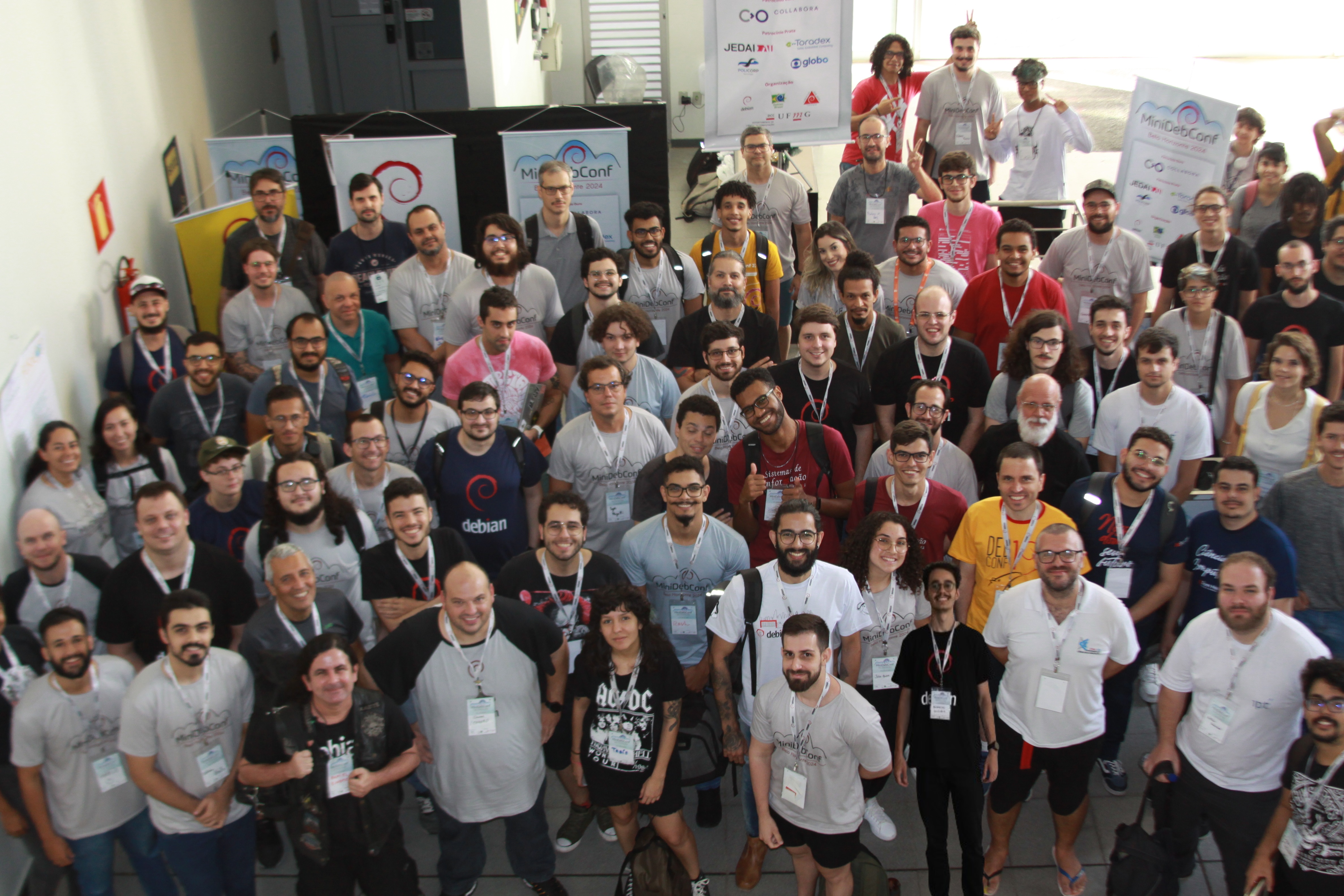
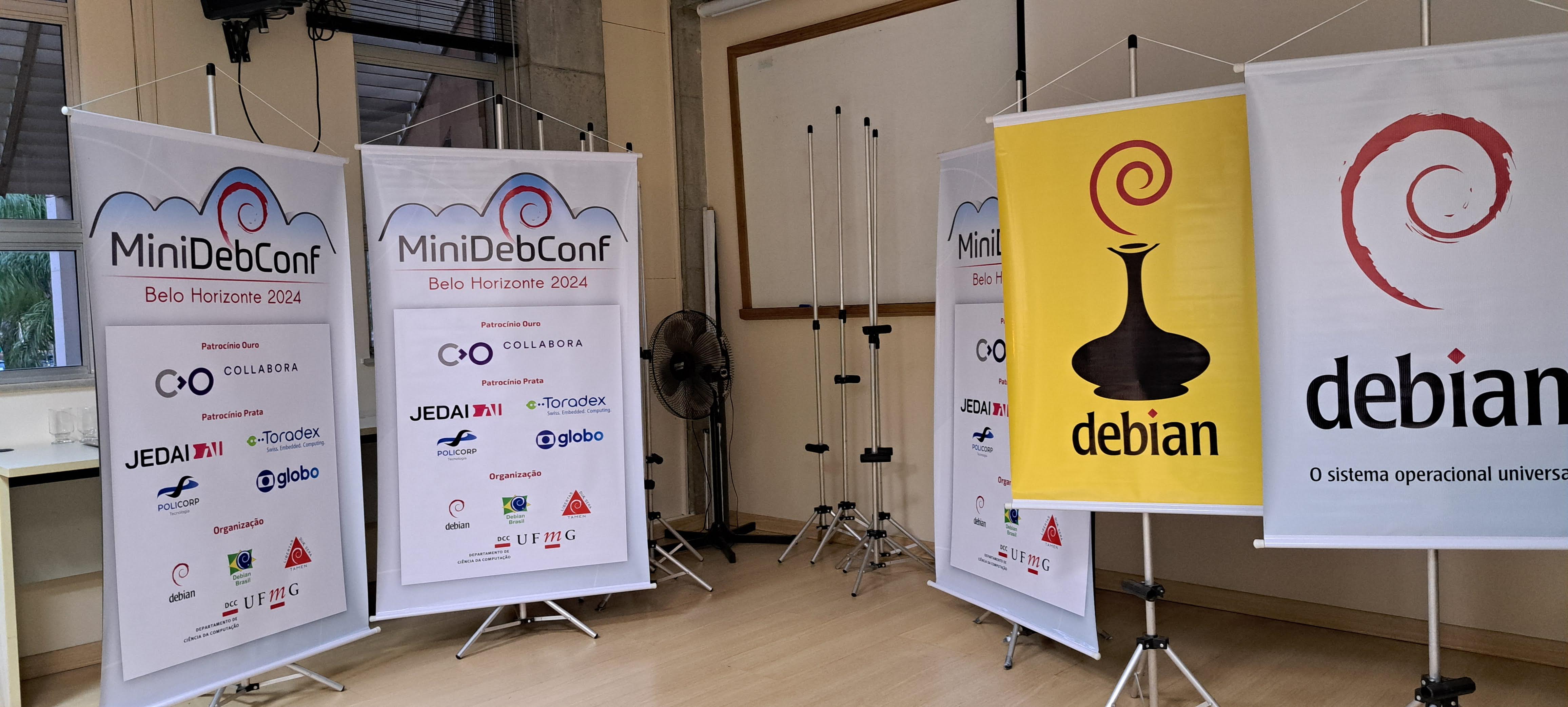
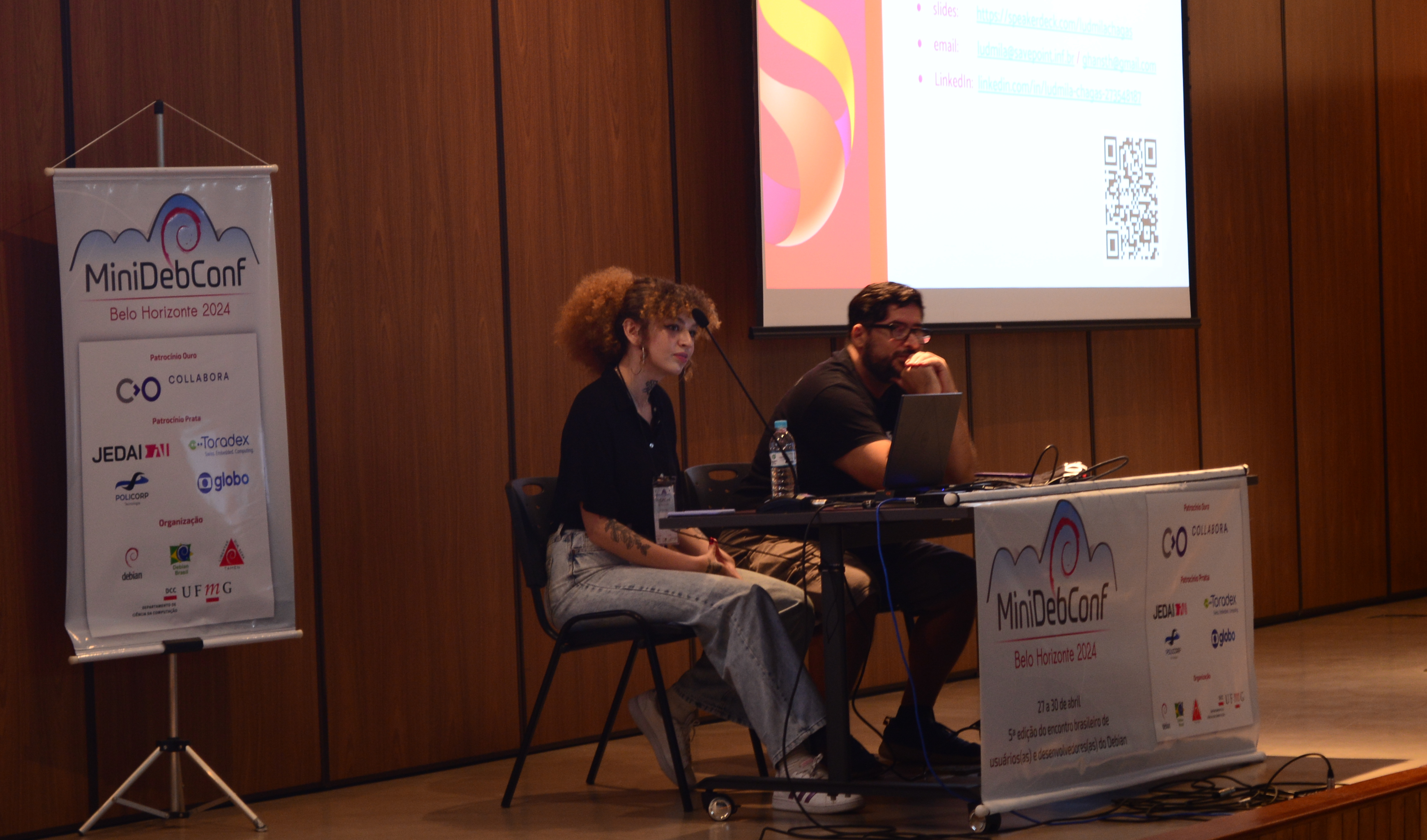
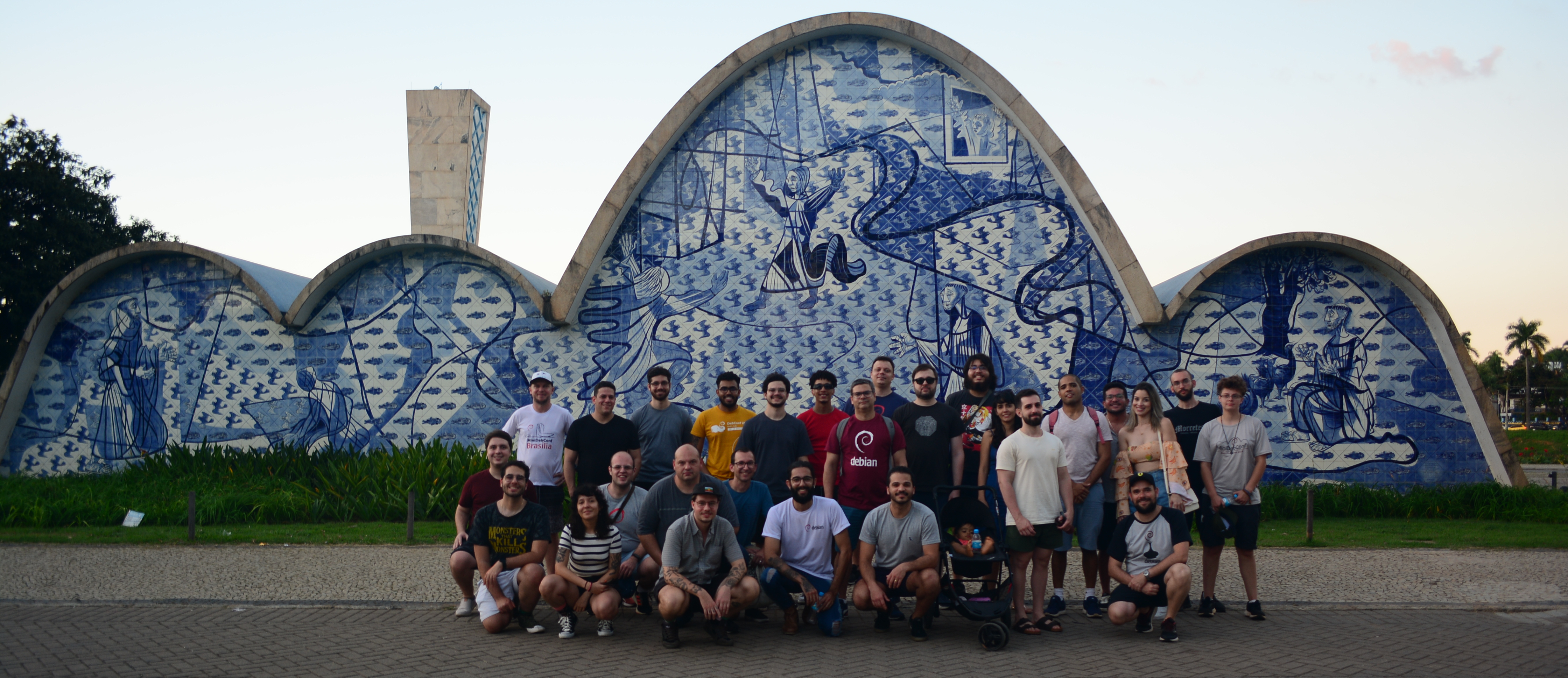
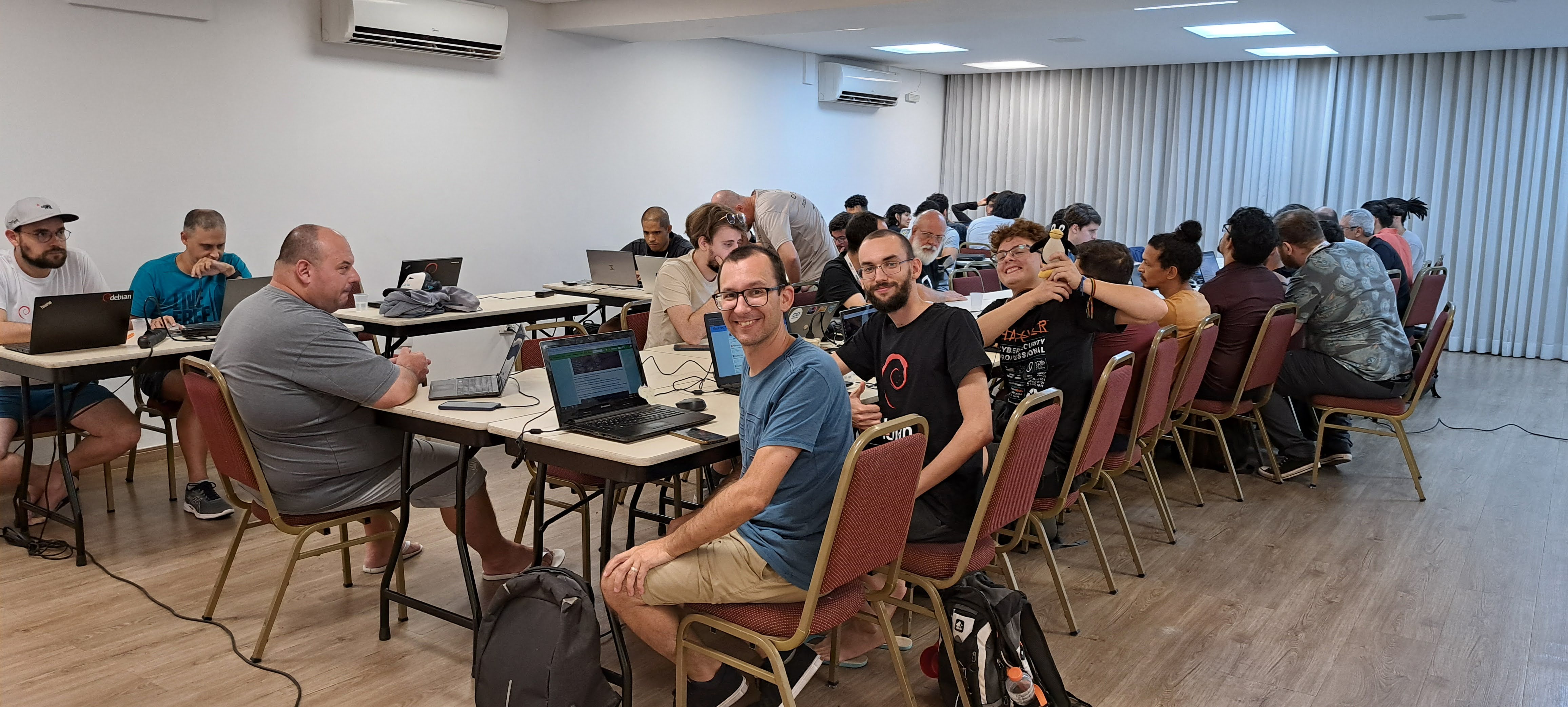
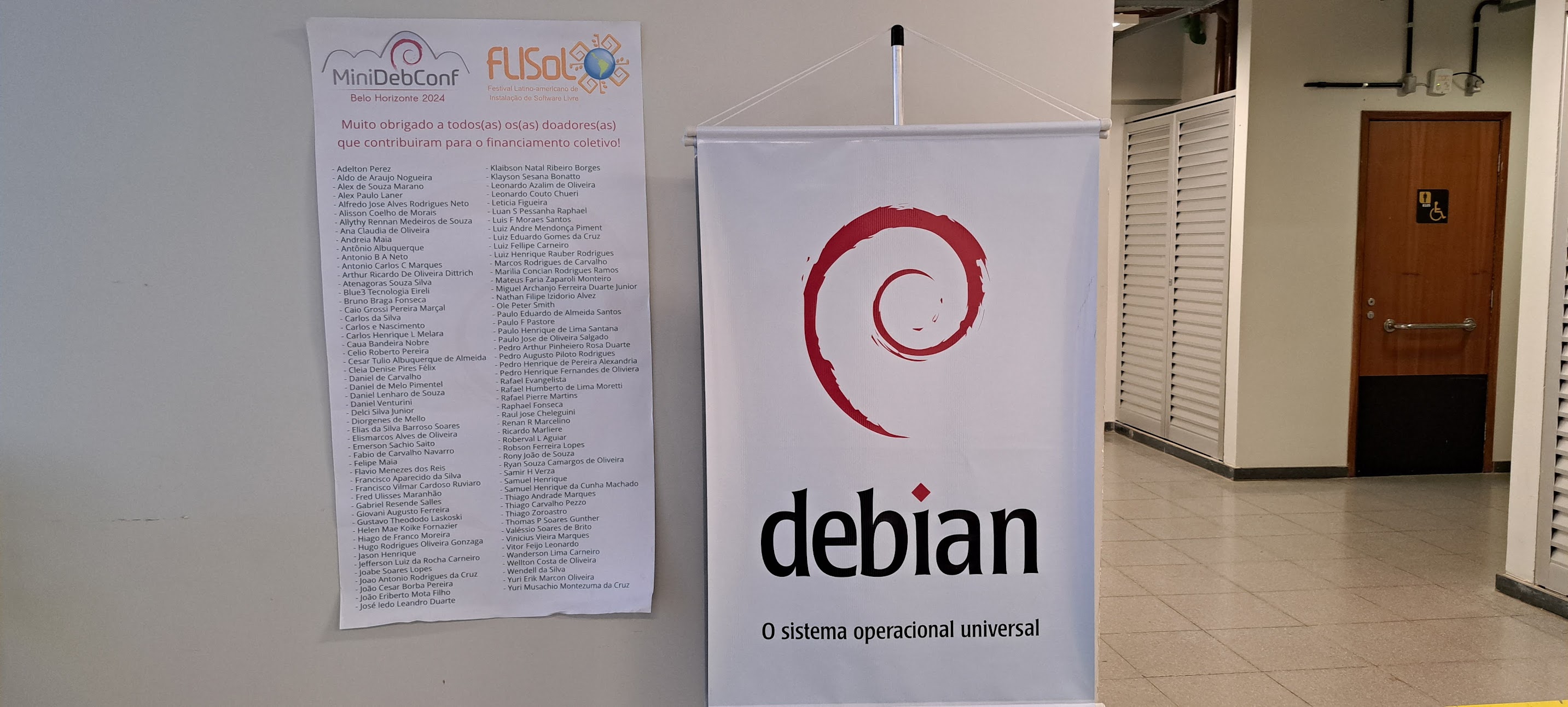
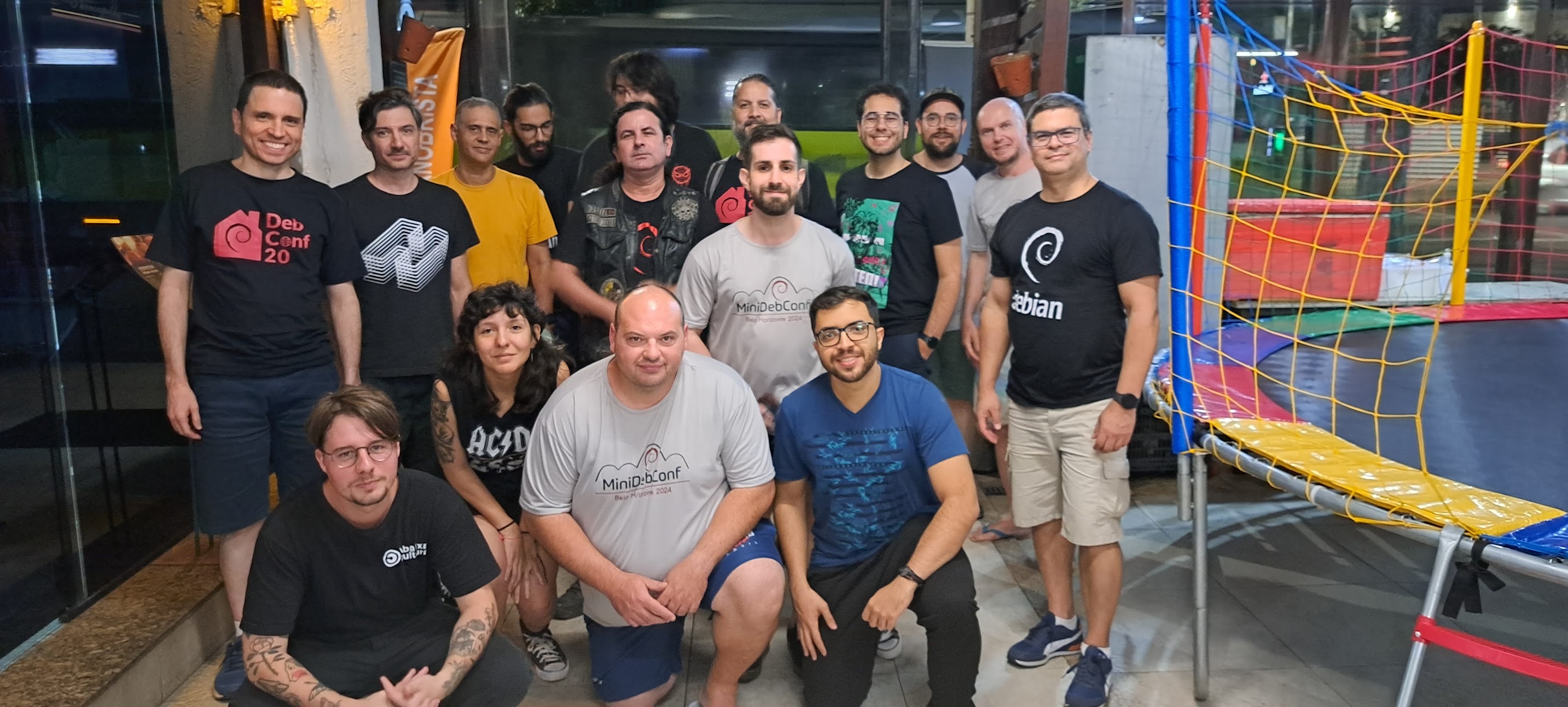
From April 27th to 30th, 2024, MiniDebConf Belo Horizonte 2024 was held at the Pampulha Campus of UFMG - Federal University of Minas Gerais, in Belo Horizonte city. MiniDebConf BH 2024 banners This was the fifth time that a MiniDebConf (as an exclusive in-person event about Debian) took place in Brazil. Previous editions were in Curitiba (2016, 2017, and 2018), and in Bras lia 2023. We had other MiniDebConfs editions held within Free Software events such as FISL and Latinoware, and other online events. See our event history. Parallel to MiniDebConf, on 27th (Saturday) FLISOL - Latin American Free Software Installation Festival took place. It's the largest event in Latin America to promote Free Software, and It has been held since 2005 simultaneously in several cities. MiniDebConf Belo Horizonte 2024 was a success (as were previous editions) thanks to the participation of everyone, regardless of their level of knowledge about Debian. We value the presence of both beginner users who are familiarizing themselves with the system and the official project developers. The spirit of welcome and collaboration was present during all the event. MiniDebConf BH 2024 flisol 2024 edition numbers During the four days of the event, several activities took place for all levels of users and collaborators of the Debian project. The official schedule was composed of: MiniDebConf BH 2024 palestra The final numbers for MiniDebConf Belo Horizonte 2024 show that we had a record number of participants. Of the 224 participants, 15 were official Brazilian contributors, 10 being DDs (Debian Developers) and 05 (Debian Maintainers), in addition to several unofficial contributors. The organization was carried out by 14 people who started working at the end of 2023, including Prof. Lo c Cerf from the Computing Department who made the event possible at UFMG, and 37 volunteers who helped during the event. As MiniDebConf was held at UFMG facilities, we had the help of more than 10 University employees. See the list with the names of people who helped in some way in organizing MiniDebConf Belo Horizonte 2024. The difference between the number of people registered and the number of attendees in the event is probably explained by the fact that there is no registration fee, so if the person decides not to go to the event, they will not suffer financial losses. The 2024 edition of MiniDebconf Belo Horizonte was truly grand and shows the result of the constant efforts made over the last few years to attract more contributors to the Debian community in Brazil. With each edition the numbers only increase, with more attendees, more activities, more rooms, and more sponsors/supporters. MiniDebConf BH 2024 grupo

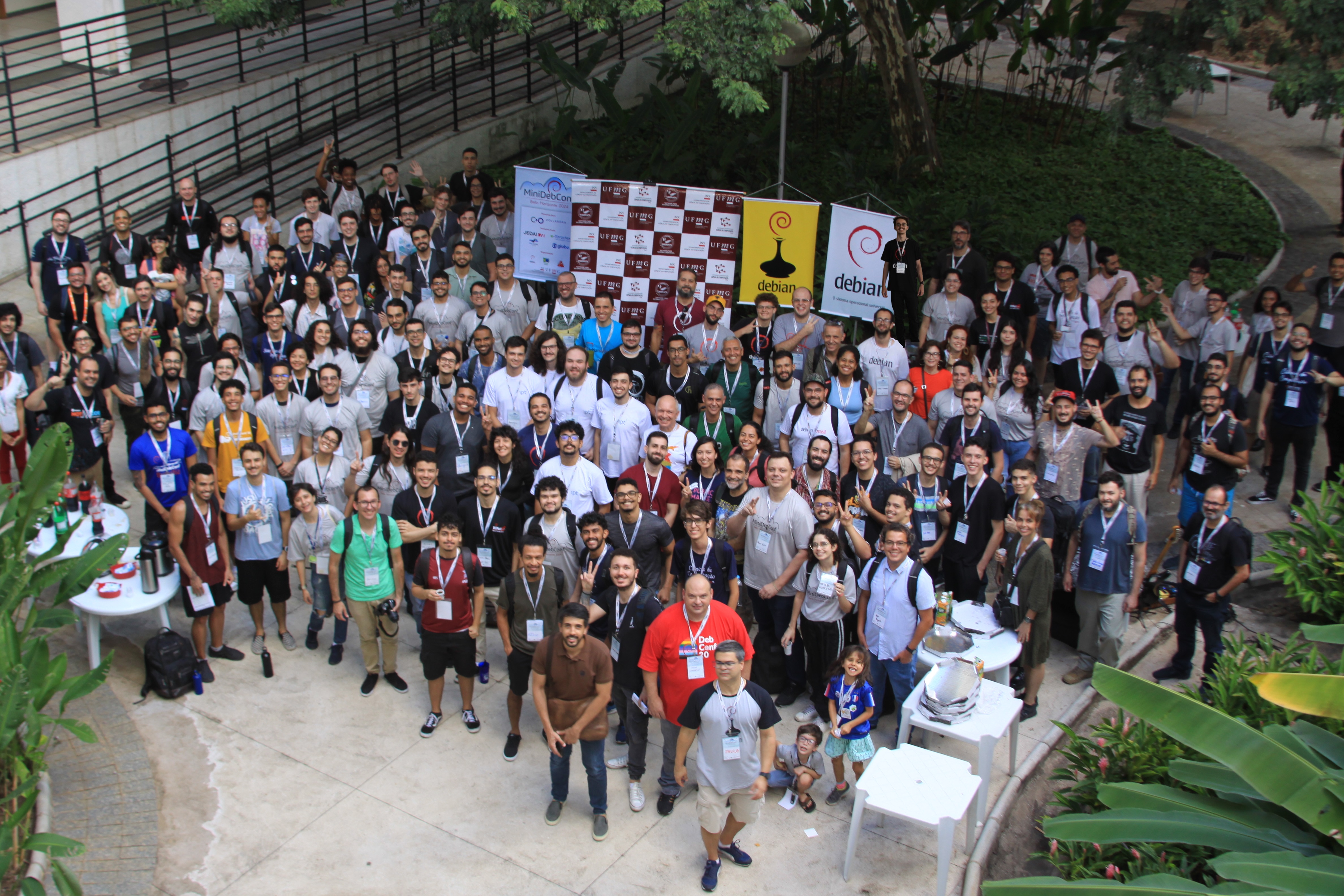
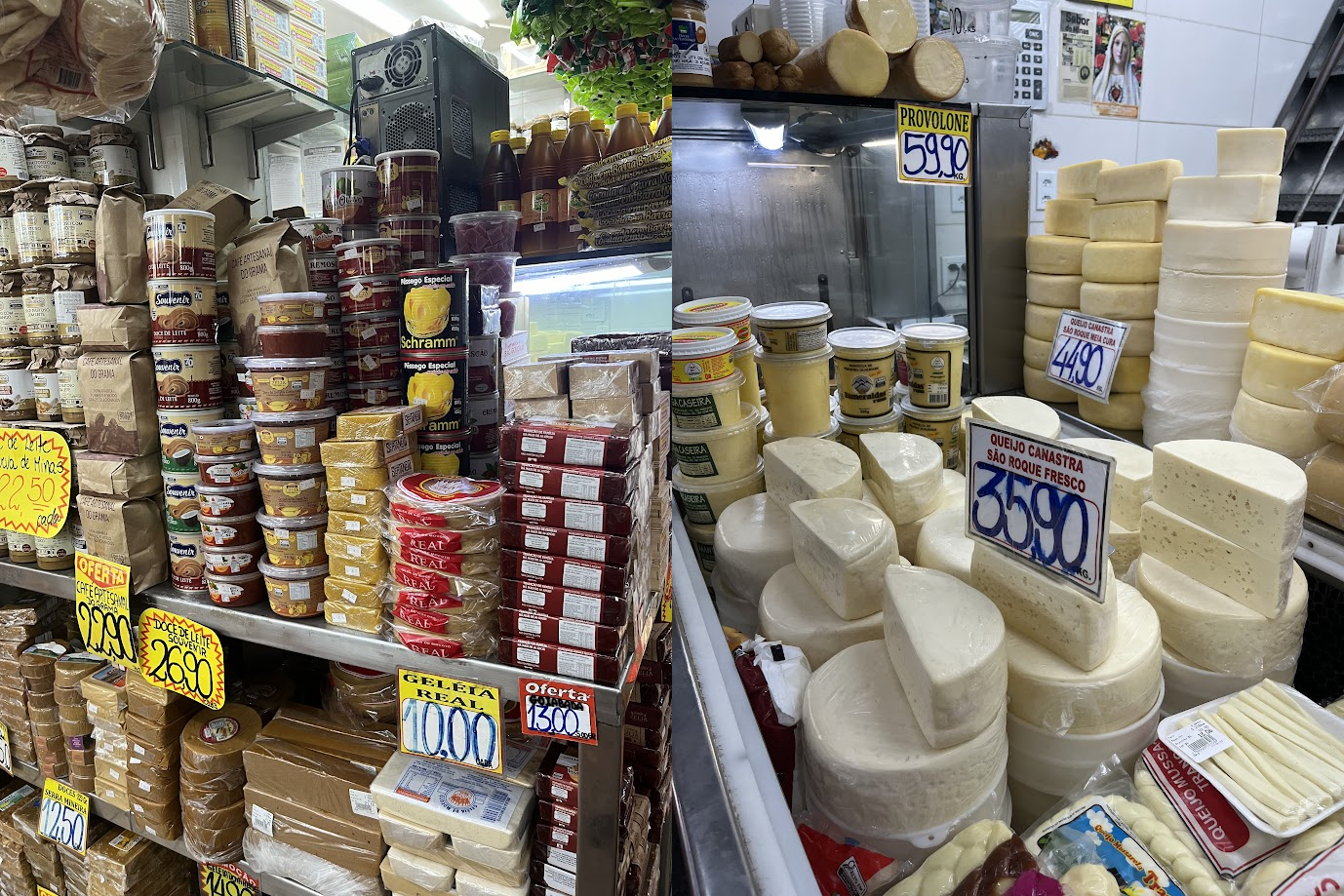
MiniDebConf BH 2024 grupo Activities The MiniDebConf schedule was intense and diverse. On the 27th, 29th and 30th (Saturday, Monday and Tuesday) we had talks, discussions, workshops and many practical activities. MiniDebConf BH 2024 palestra On the 28th (Sunday), the Day Trip took place, a day dedicated to sightseeing around the city. In the morning we left the hotel and went, on a chartered bus, to the Belo Horizonte Central Market. People took the opportunity to buy various things such as cheeses, sweets, cacha as and souvenirs, as well as tasting some local foods. MiniDebConf BH 2024 mercado After a 2-hour tour of the Market, we got back on the bus and hit the road for lunch at a typical Minas Gerais food restaurant. MiniDebConf BH 2024 palestra With everyone well fed, we returned to Belo Horizonte to visit the city's main tourist attraction: Lagoa da Pampulha and Capela S o Francisco de Assis, better known as Igrejinha da Pampulha. MiniDebConf BH 2024 palestra We went back to the hotel and the day ended in the hacker space that we set up in the events room for people to chat, packaging, and eat pizzas. MiniDebConf BH 2024 palestra Crowdfunding For the third time we ran a crowdfunding campaign and it was incredible how people contributed! The initial goal was to raise the amount equivalent to a gold tier of R$ 3,000.00. When we reached this goal, we defined a new one, equivalent to one gold tier + one silver tier (R$ 5,000.00). And again we achieved this goal. So we proposed as a final goal the value of a gold + silver + bronze tiers, which would be equivalent to R$ 6,000.00. The result was that we raised R$7,239.65 (~ USD 1,400) with the help of more than 100 people! Thank you very much to the people who contributed any amount. As a thank you, we list the names of the people who donated. MiniDebConf BH 2024 doadores Food, accommodation and/or travel grants for participants Each edition of MiniDebConf brought some innovation, or some different benefit for the attendees. In this year's edition in Belo Horizonte, as with DebConfs, we offered bursaries for food, accommodation and/or travel to help those people who would like to come to the event but who would need some kind of help. In the registration form, we included the option for the person to request a food, accommodation and/or travel bursary, but to do so, they would have to identify themselves as a contributor (official or unofficial) to Debian and write a justification for the request. Number of people benefited: The food bursary provided lunch and dinner every day. The lunches included attendees who live in Belo Horizonte and the region. Dinners were paid for attendees who also received accommodation and/or travel. The accommodation was held at the BH Jaragu Hotel. And the travels included airplane or bus tickets, or fuel (for those who came by car or motorbike). Much of the money to fund the bursaries came from the Debian Project, mainly for travels. We sent a budget request to the former Debian leader Jonathan Carter, and He promptly approved our request. In addition to this event budget, the leader also approved individual requests sent by some DDs who preferred to request directly from him. The experience of offering the bursaries was really good because it allowed several people to come from other cities. MiniDebConf BH 2024 grupo Photos and videos You can watch recordings of the talks at the links below: Thanks We would like to thank all the attendees, organizers, volunteers, sponsors and supporters who contributed to the success of MiniDebConf Belo Horizonte 2024. MiniDebConf BH 2024 grupo Sponsors Gold: Silver: Bronze: Organizers

6 March 2025

Antoine Beaupr : Nix Notes

Meta In case you haven't noticed, I'm trying to post and one of the things that entails is to just dump over the fence a bunch of draft notes. In this specific case, I had a set of rough notes about NixOS and particularly Nix, the package manager. In this case, you can see the very birth of an article, what it looks like before it becomes the questionable prose it is now, by looking at the Git history of this file, particularly its birth. I have a couple of those left, and it would be pretty easy to publish them as is, but I feel I'd be doing others (and myself! I write for my own documentation too after all) a disservice by not going the extra mile on those. So here's the long version of my experiment with Nix.

Nix A couple friends are real fans of Nix. Just like I work with Puppet a lot, they deploy and maintain servers (if not fleets of servers) with NixOS and its declarative package management system. Essentially, they use it as a configuration management system, which is pretty awesome. That, however, is a bit too high of a bar for me. I rarely try new operating systems these days: I'm a Debian developer and it takes most of my time to keep that functional. I'm not going to go around messing with other systems as I know that would inevitably get me dragged down into contributing into yet another free software project. I'm mature now and know where to draw the line. Right? So I'm just testing Nix, the package manager, on Debian, because I learned from my friend that nixpkgs is the largest package repository out there, a mind-boggling 100,000 at the time of writing (with 88% of packages up to date), compared to around 40,000 in Debian (or 72,000 if you count binary packages, with 72% up to date). I naively thought Debian was the largest, perhaps competing with Arch, and I was wrong: Arch is larger than Debian too. What brought me there is I wanted to run Harper, a fast spell-checker written in Rust. The logic behind using Nix instead of just downloading the source and running it myself is that I delegate the work of supply-chain integrity checking to a distributor, a bit like you trust Debian developers like myself to package things in a sane way. I know this widens the attack surface to a third party of course, but the rationale is that I shift cryptographic verification to another stack than just "TLS + GitHub" (although that is somewhat still involved) that's linked with my current chain (Debian packages). I have since then stopped using Harper for various reasons and also wrapped up my Nix experiment, but felt it worthwhile to jot down some observations on the project.

Hot take Overall, Nix is hard to get into, with a complicated learning curve. I have found the documentation to be a bit confusing, since there are many ways to do certain things. I particularly tripped on "flakes" and, frankly, incomprehensible error reporting. It didn't help that I tried to run nixpkgs on Debian which is technically possible, but you can tell that I'm not supposed to be doing this. My friend who reviewed this article expressed surprised at how easy this was, but then he only saw the finished result, not me tearing my hair out to make this actually work.

Nix on Debian primer So here's how I got started. First I installed the nix binary package:
apt install nix-bin
Then I had to add myself to the right group and logout/log back in to get the rights to deploy Nix packages:
adduser anarcat nix-users
That wasn't easy to find, but is mentioned in the README.Debian file shipped with the Debian package. Then, I didn't write this down, but the README.Debian file above mentions it, so I think I added a "channel" like this:
nix-channel --add https://nixos.org/channels/nixpkgs-unstable nixpkgs
nix-channel --update
And I likely installed the Harper package with:
nix-env --install harper
At this point, harper was installed in a ... profile? Not sure. I had to add ~/.nix-profile/bin (a symlink to /nix/store/sympqw0zyybxqzz6fzhv03lyivqqrq92-harper-0.10.0/bin) to my $PATH environment for this to actually work.

Side notes on documentation Those last two commands (nix-channel and nix-env) were hard to figure out, which is kind of amazing because you'd think a tutorial on Nix would feature something like this prominently. But three different tutorials failed to bring me up to that basic setup, even the README.Debian didn't spell that out clearly. The tutorials all show me how to develop packages for Nix, not plainly how to install Nix software. This is presumably because "I'm doing it wrong": you shouldn't just "install a package", you should setup an environment declaratively and tell it what you want to do. But here's the thing: I didn't want to "do the right thing". I just wanted to install Harper, and documentation failed to bring me to that basic "hello world" stage. Here's what one of the tutorials suggests as a first step, for example:
curl -L https://nixos.org/nix/install   sh
nix-shell --packages cowsay lolcat
nix-collect-garbage
... which, when you follow through, leaves you with almost precisely nothing left installed (apart from Nix itself, setup with a nasty "curl pipe bash". So while that works in testing Nix, you're not much better off than when you started.

Rolling back everything Now that I have stopped using Harper, I don't need Nix anymore, which I'm sure my Nix friends will be sad to read about. Don't worry, I have notes now, and can try again! But still, I wanted to clear things out, so I did this, as root:
deluser anarcat nix-users
apt purge nix-bin
rm -rf /nix ~/.nix*
I think this cleared things out, but I'm not actually sure.

Side note on Nix drama This blurb wouldn't be complete without a mention that the Nix community has been somewhat tainted by the behavior of its founder. I won't bother you too much with this; LWN covered it well in 2024, and made a followup article about spinoffs and forks that's worth reading as well. I did want to say that everyone I have been in contact with in the Nix community was absolutely fantastic. So I am really sad that the behavior of a single individual can pollute a community in such a way. As a leader, if you have all but one responsability, it's to behave properly for people around you. It's actually really, really hard to do that, because yes, it means you need to act differently than others and no, you just don't get to be upset at others like you would normally do with friends, because you're in a position of authority. It's a lesson I'm still learning myself, to be fair. But at least I don't work with arms manufacturers or, if I would, I would be sure as hell to accept the nick (or nix?) on the chin when people would get upset, and try to make amends. So long live the Nix people! I hope the community recovers from that dark moment, so far it seems like it will. And thanks for helping me test Harper!

5 March 2025

Reproducible Builds: Reproducible Builds in February 2025

Welcome to the second report in 2025 from the Reproducible Builds project. Our monthly reports outline what we ve been up to over the past month, and highlight items of news from elsewhere in the increasingly-important area of software supply-chain security. As usual, however, if you are interested in contributing to the Reproducible Builds project, please visit our Contribute page on our website. Table of contents:
  1. Reproducible Builds at FOSDEM 2025
  2. Reproducible Builds at PyCascades 2025
  3. Does Functional Package Management Enable Reproducible Builds at Scale?
  4. reproduce.debian.net updates
  5. Upstream patches
  6. Distribution work
  7. diffoscope & strip-nondeterminism
  8. Website updates
  9. Reproducibility testing framework

Reproducible Builds at FOSDEM 2025 Similar to last year s event, there was considerable activity regarding Reproducible Builds at FOSDEM 2025, held on on 1st and 2nd February this year in Brussels, Belgium. We count at least four talks related to reproducible builds. (You can also read our news report from last year s event in which Holger Levsen presented in the main track.)
Jelle van der Waa, Holger Levsen and kpcyrd presented in the Distributions track on A Tale of several distros joining forces for a common goal. In this talk, three developers from two different Linux distributions (Arch Linux and Debian), discuss this goal which is, of course, reproducible builds. The presenters discuss both what is shared and different between the two efforts, touching on the history and future challenges alike. The slides of this talk are available to view, as is the full video (30m02s). The talk was also discussed on Hacker News.
Zbigniew J drzejewski-Szmek presented in the ever-popular Python track a on Rewriting .pyc files for fun and reproducibility, i.e. the bytecode files generated by Python in order to speed up module imports: It s been known for a while that those are not reproducible: on different architectures, the bytecode for exactly the same sources ends up slightly different. The slides of this talk are available, as is the full video (28m32s).
In the Nix and NixOS track, Julien Malka presented on the Saturday asking How reproducible is NixOS: We know that the NixOS ISO image is very close to be perfectly reproducible thanks to reproducible.nixos.org, but there doesn t exist any monitoring of Nixpkgs as a whole. In this talk I ll present the findings of a project that evaluated the reproducibility of Nixpkgs as a whole by mass rebuilding packages from revisions between 2017 and 2023 and comparing the results with the NixOS cache. Unfortunately, no video of the talk is available, but there is a blog and article on the results.
Lastly, Simon Tournier presented in the Open Research track on the confluence of GNU Guix and Software Heritage: Source Code Archiving to the Rescue of Reproducible Deployment. Simon s talk describes design and implementation we came up and reports on the archival coverage for package source code with data collected over five years. It opens to some remaining challenges toward a better open and reproducible research. The slides for the talk are available, as is the full video (23m17s).

Reproducible Builds at PyCascades 2025 Vagrant Cascadian presented at this year s PyCascades conference which was held on February 8th and 9th February in Portland, OR, USA. PyCascades is a regional instance of PyCon held in the Pacific Northwest. Vagrant s talk, entitled Re-Py-Ducible Builds caught the audience s attention with the following abstract:
Crank your Python best practices up to 11 with Reproducible Builds! This talk will explore Reproducible Builds by highlighting issues identified in Python projects, from the simple to the seemingly inscrutable. Reproducible Builds is basically the crazy idea that when you build something, and you build it again, you get the exact same thing or even more important, if someone else builds it, they get the exact same thing too.
More info is available on the talk s page.

Does Functional Package Management Enable Reproducible Builds at Scale? On our mailing list last month, Julien Malka, Stefano Zacchiroli and Th o Zimmermann of T l com Paris in-house research laboratory, the Information Processing and Communications Laboratory (LTCI) announced that they had published an article asking the question: Does Functional Package Management Enable Reproducible Builds at Scale? (PDF). This month, however, Ludovic Court s followed up to the original announcement on our mailing list mentioning, amongst other things, the Guix Data Service and how that it shows the reproducibility of GNU Guix over time, as described in a GNU Guix blog back in March 2024.

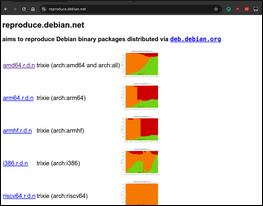
reproduce.debian.net updates The last few months have seen the introduction of reproduce.debian.net. Announced first at the recent Debian MiniDebConf in Toulouse, reproduce.debian.net is an instance of rebuilderd operated by the Reproducible Builds project. Powering this work is rebuilderd, our server which monitors the official package repositories of Linux distributions and attempt to reproduce the observed results there. This month, however, Holger Levsen:
  • Split packages that are not specific to any architecture away from amd64.reproducible.debian.net service into a new all.reproducible.debian.net page.
  • Increased the number of riscv64 nodes to a total of 4, and added a new amd64 node added thanks to our (now 10-year sponsor), IONOS.
  • Discovered an issue in the Debian build service where some new incoming build-dependencies do not end up historically archived.
  • Uploaded the devscripts package, incorporating changes from Jochen Sprickerhof to the debrebuild script specifically to fix the handling the Rules-Requires-Root header in Debian source packages.
  • Uploaded a number of Rust dependencies of rebuilderd (rust-libbz2-rs-sys, rust-actix-web, rust-actix-server, rust-actix-http, rust-actix-server, rust-actix-http, rust-actix-web-codegen and rust-time-tz) after they were prepared by kpcyrd :
Jochen Sprickerhof also updated the sbuild package to:
  • Obey requests from the user/developer for a different temporary directory.
  • Use the root/superuser for some values of Rules-Requires-Root.
  • Don t pass --root-owner-group to old versions of dpkg.
and additionally requested that many Debian packages are rebuilt by the build servers in order to work around bugs found on reproduce.debian.net. [ ][[ ][ ]
Lastly, kpcyrd has also worked towards getting rebuilderd packaged in NixOS, and Jelle van der Waa picked up the existing pull request for Fedora support within in rebuilderd and made it work with the existing Koji rebuilderd script. The server is being packaged for Fedora in an unofficial copr repository and in the official repositories after all the dependencies are packaged.

Upstream patches The Reproducible Builds project detects, dissects and attempts to fix as many currently-unreproducible packages as possible. We endeavour to send all of our patches upstream where appropriate. This month, we wrote a large number of such patches, including:

Distribution work There as been the usual work in various distributions this month, such as: In Debian, 17 reviews of Debian packages were added, 6 were updated and 8 were removed this month adding to our knowledge about identified issues.
Fedora developers Davide Cavalca and Zbigniew J drzejewski-Szmek gave a talk on Reproducible Builds in Fedora (PDF), touching on SRPM-specific issues as well as the current status and future plans.
Thanks to an investment from the Sovereign Tech Agency, the FreeBSD project s work on unprivileged and reproducible builds continued this month. Notable fixes include:
The Yocto Project has been struggling to upgrade to the latest Go and Rust releases due to reproducibility problems in the newer versions. Hongxu Jia tracked down the issue with Go which meant that the project could upgrade from the 1.22 series to 1.24, with the fix being submitted upstream for review (see above). For Rust, however, the project was significantly behind, but has made recent progress after finally identifying the blocking reproducibility issues. At time of writing, the project is at Rust version 1.82, with patches under review for 1.83 and 1.84 and fixes being discussed with the Rust developers. The project hopes to improve the tests for reproducibility in the Rust project itself in order to try and avoid future regressions. Yocto continues to maintain its ability to binary reproduce all of the recipes in OpenEmbedded-Core, regardless of the build host distribution or the current build path.
Finally, Douglas DeMaio published an article on the openSUSE blog on announcing that the Reproducible-openSUSE (RBOS) Project Hits [Significant] Milestone. In particular:
The Reproducible-openSUSE (RBOS) project, which is a proof-of-concept fork of openSUSE, has reached a significant milestone after demonstrating a usable Linux distribution can be built with 100% bit-identical packages.
This news was also announced on our mailing list by Bernhard M. Wiedemann, who also published another report for openSUSE as well.

diffoscope & strip-nondeterminism diffoscope is our in-depth and content-aware diff utility that can locate and diagnose reproducibility issues. This month, Chris Lamb made the following changes, including preparing and uploading versions 288 and 289 to Debian:
  • Add asar to DIFFOSCOPE_FAIL_TESTS_ON_MISSING_TOOLS in order to address Debian bug #1095057) [ ]
  • Catch a CalledProcessError when calling html2text. [ ]
  • Update the minimal Black version. [ ]
Additionally, Vagrant Cascadian updated diffoscope in GNU Guix to version 287 [ ][ ] and 288 [ ][ ] as well as submitted a patch to update to 289 [ ]. Vagrant also fixed an issue that was breaking reprotest on Guix [ ][ ]. strip-nondeterminism is our sister tool to remove specific non-deterministic results from a completed build. This month version 1.14.1-2 was uploaded to Debian unstable by Holger Levsen.

Website updates There were a large number of improvements made to our website this month, including:

Reproducibility testing framework The Reproducible Builds project operates a comprehensive testing framework running primarily at tests.reproducible-builds.org in order to check packages and other artifacts for reproducibility. In January, a number of changes were made by Holger Levsen, including:
  • reproduce.debian.net-related:
    • Add a helper script to manually schedule packages. [ ][ ][ ][ ][ ]
    • Fix a link in the website footer. [ ]
    • Strip the emojis from package names on the manual rebuilder in order to ease copy-and-paste. [ ]
    • On the various statistics pages, provide the number of affected source packages [ ][ ] as well as provide various totals [ ][ ].
    • Fix graph labels for the various architectures [ ][ ] and make them clickable too [ ][ ][ ].
    • Break the displayed HTML in blocks of 256 packages in order to address rendering issues. [ ][ ]
    • Add monitoring jobs for riscv64 archicture nodes and integrate them elsewhere in our infrastructure. [ ][ ]
    • Add riscv64 architecture nodes. [ ][ ][ ][ ][ ]
    • Update much of the documentation. [ ][ ][ ]
    • Make a number of improvements to the layout and style. [ ][ ][ ][ ][ ][ ][ ]
    • Remove direct links to JSON and database backups. [ ]
    • Drop a Blues Brothers reference from frontpage. [ ]
  • Debian-related:
    • Deal with /boot/vmlinuz* being called vmlinux* on the riscv64 architecture. [ ]
    • Add a new ionos17 node. [ ][ ][ ][ ][ ]
    • Install debian-repro-status on all Debian trixie and unstable jobs. [ ]
  • FreeBSD-related:
    • Switch to run latest branch of FreeBSD. [ ]
  • Misc:
    • Fix /etc/cron.d and /etc/logrotate.d permissions for Jenkins nodes. [ ]
    • Add support for riscv64 architecture nodes. [ ][ ]
    • Grant Jochen Sprickerhof access to the o4 node. [ ]
    • Disable the janitor-setup-worker. [ ][ ]
In addition:
  • kpcyrd fixed the /all/api/ API endpoints on reproduce.debian.net by altering the nginx configuration. [ ]
  • James Addison updated reproduce.debian.net to display the so-called bad reasons hyperlink inline [ ] and merged the Categorized issues links into the Reproduced builds column [ ].
  • Jochen Sprickerhof also made some reproduce.debian.net-related changes, adding support for detecting a bug in the mmdebstrap package [ ] as well as updating some documentation [ ].
  • Roland Clobus continued their work on reproducible live images for Debian, making changes related to new clustering of jobs in openQA. [ ]
And finally, both Holger Levsen [ ][ ][ ] and Vagrant Cascadian performed significant node maintenance. [ ][ ][ ][ ][ ]
If you are interested in contributing to the Reproducible Builds project, please visit our Contribute page on our website. However, you can get in touch with us via:

Otto Kek l inen: Will decentralized social media soon go mainstream?

Featured image of post Will decentralized social media soon go mainstream?In today s digital landscape, social media is more than just a communication tool it is the primary medium for global discourse. Heads of state, corporate leaders and cultural influencers now broadcast their statements directly to the world, shaping public opinion in real time. However, the dominance of a few centralized platforms X/Twitter, Facebook and YouTube raises critical concerns about control, censorship and the monopolization of information. Those who control these networks effectively wield significant power over public discourse. In response, a new wave of distributed social media platforms has emerged, each built on different decentralized protocols designed to provide greater autonomy, censorship resistance and user control. While Wikipedia maintains a comprehensive list of distributed social networking software and protocols, it does not cover recent blockchain-based systems, nor does it highlight which have the most potential for mainstream adoption. This post explores the leading decentralized social media platforms and the protocols they are based on: Mastodon (ActivityPub), Bluesky (AT Protocol), Warpcast (Farcaster), Hey (Lens) and Primal (Nostr).

Comparison of architecture and mainstream adoption potential
Protocol Identity System Example Storage model Cost for end users Potential
Mastodon Tied to server domain @ottok@mastodon.social Federated instances Free (some instances charge) High
Bluesky Portable (DID) ottoke.bsky.social Federated instances Free Moderate
Farcaster ENS (Ethereum) @ottok Blockchain + off-chain Small gas fees Moderate
Lens NFT-based (Polygon) @ottok Blockchain + off-chain Small gas fees Niche
Nostr Cryptographic Keys npub16lc6uhqpg6dnqajylkhwuh3j7ynhcnje508tt4v6703w9kjlv9vqzz4z7f Federated instances Free (some instances charge) Niche

1. Mastodon (ActivityPub) Screenshot of Mastodon Mastodon was created in 2016 by Eugen Rochko, a German software developer who sought to provide a decentralized and user-controlled alternative to Twitter. It was built on the ActivityPub protocol, now standardized by W3C Social Web Working Group, to allow users to join independent servers while still communicating across the broader Mastodon network. Mastodon operates on a federated model, where multiple independently run servers communicate via ActivityPub. Each server sets its own moderation policies, leading to a decentralized but fragmented experience. The servers can alternatively be called instances, relays or nodes, depending on what vocabulary a protocol has standardized on.
  • Identity: User identity is tied to the instance where they registered, represented as @username@instance.tld.
  • Storage: Data is stored on individual instances, which federate messages to other instances based on their configurations.
  • Cost: Free to use, but relies on instance operators willing to run the servers.
The protocol defines multiple activities such as:
  • Creating a post
  • Liking
  • Sharing
  • Following
  • Commenting

Example Message in ActivityPub (JSON-LD Format)
json
 
 "@context": "https://www.w3.org/ns/activitystreams",
 "type": "Create",
 "actor": "https://mastodon.social/users/ottok",
 "object":  
 "type": "Note",
 "content": "Hello from #Mastodon!",
 "published": "2025-03-03T12:00:00Z",
 "to": ["https://www.w3.org/ns/activitystreams#Public"]
  
 
Servers communicate across different platforms by publishing activities to their followers or forwarding activities between servers. Standard HTTPS is used between servers for communication, and the messages use JSON-LD for data representation. The WebFinger protocol is used for user discovery. There is however no neat way for home server discovery yet. This means that if you are browsing e.g. Fosstodon and want to follow a user and press Follow, a dialog will pop up asking you to enter your own home server (e.g. mastodon.social) to redirect you there for actually executing the Follow action on with your account. Mastodon is open source under the AGPL at github.com/mastodon/mastodon. Anyone can operate their own instance. It just requires to run your own server and some skills to maintain a Ruby on Rails app with a PostgreSQL database backend, and basic understanding of the protocol to configure federation with other ActivityPub instances.

Popularity: Already established, but will it grow more? Mastodon has seen steady growth, especially after Twitter s acquisition in 2022, with some estimates stating it peaked at 10 million users across thousands of instances. However, its fragmented user experience and the complexity of choosing instances have hindered mainstream adoption. Still, it remains the most established decentralized alternative to Twitter. Note that Donald Trump s Truth Social is based on the Mastodon software but does not federate with the ActivityPub network. The ActivityPub protocol is the most widely used of its kind. One of the other most popular services is the Lemmy link sharing service, similar to Reddit. The larger ecosystem of ActivityPub is called Fediverse, and estimates put the total active user count around 6 million.

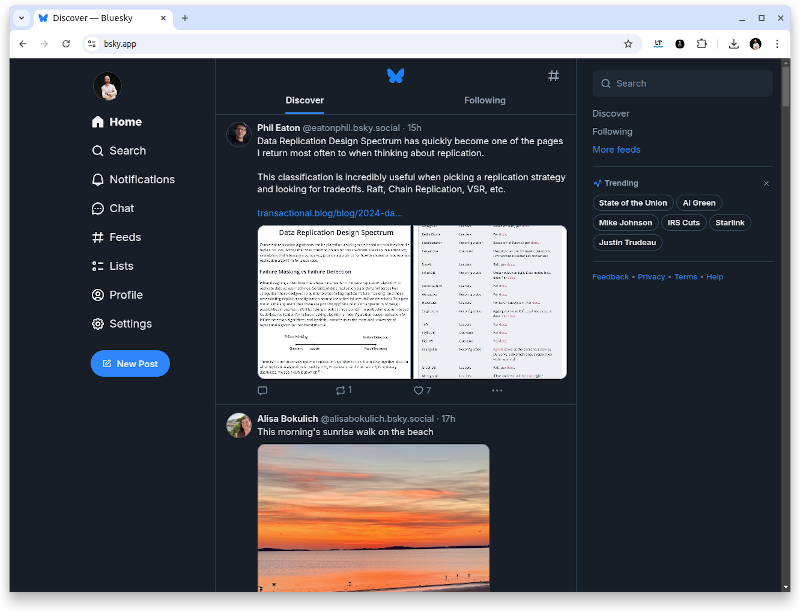
2. Bluesky (AT Protocol) Screenshot of Bluesky Interestingly, Bluesky was conceived within Twitter in 2019 by Twitter founder Jack Dorsey. After being incubated as a Twitter-funded project, it spun off as an independent Public Benefit LLC in February 2022 and launched its public beta in February 2023. Bluesky runs on top of the Authenticated Transfer (AT) Protocol published at https://github.com/bluesky-social/atproto. The protocol enables portable identities and data ownership, meaning users can migrate between platforms while keeping their identity and content intact. In practice, however, there is only one popular server at the moment, which is Bluesky itself.
  • Identity: Usernames are domain-based (e.g., @user.bsky.social).
  • Storage: Content is theoretically federated among various servers.
  • Cost: Free to use, but relies on instance operators willing to run the servers.

Example Message in AT Protocol (JSON Format)
json
 
 "repo": "did:plc:ottoke.bsky.social",
 "collection": "app.bsky.feed.post",
 "record":  
 "$type": "app.bsky.feed.post",
 "text": "Hello from Bluesky!",
 "createdAt": "2025-03-03T12:00:00Z",
 "langs": ["en"]


Popularity: Hybrid approach may have business benefits? Bluesky reported over 3 million users by 2024, probably getting traction due to its Twitter-like interface and Jack Dorsey s involvement. Its hybrid approach decentralized identity with centralized components could make it a strong candidate for mainstream adoption, assuming it can scale effectively.

3. Warpcast (Farcaster Network) Farcaster was launched in 2021 by Dan Romero and Varun Srinivasan, both former crypto exchange Coinbase executives, to create a decentralized but user-friendly social network. Built on the Ethereum blockchain, it could potentially offer a very attack-resistant communication medium. However, in my own testing, Farcaster does not seem to fully leverage what Ethereum could offer. First of all, there is no diversity in programs implementing the protocol as at the moment there is only Warpcast. In Warpcast the signup requires an initial 5 USD fee that is not payable in ETH, and users need to create a new wallet address on the Ethereum layer 2 network Base instead of simply reusing their existing Ethereum wallet address or ENS name. Despite this, I can understand why Farcaster may have decided to start out like this. Having a single client program may be the best strategy initially. One of the decentralized chat protocol Matrix founders, Matthew Hodgson, shared in his FOSDEM 2025 talk that he slightly regrets focusing too much on developing the protocol instead of making sure the app to use it is attractive to end users. So it may be sensible to ensure Warpcast gets popular first, before attempting to make the Farcaster protocol widely used. As a protocol Farcaster s hybrid approach makes it more scalable than fully on-chain networks, giving it a higher chance of mainstream adoption if it integrates seamlessly with broader Web3 ecosystems.
  • Identity: ENS (Ethereum Name Service) domains are used as usernames.
  • Storage: Messages are stored in off-chain hubs, while identity is on-chain.
  • Cost: Users must pay gas fees for some operations but reading and posting messages is mostly free.

Example Message in Farcaster (JSON Format)
json
 
 "fid": 766579,
 "username": "ottok",
 "custodyAddress": "0x127853e48be3870172baa4215d63b6d815d18f21",
 "connectedWallet": "0x3ebe43aa3ae5b891ca1577d9c49563c0cee8da88",
 "text": "Hello from Farcaster!",
 "publishedAt": 1709424000,
 "replyTo": null,
 "embeds": []
 

Popularity: Decentralized social media + decentralized payments a winning combo? Ethereum founder Vitalik Buterin (warpcast.com/vbuterin) and many core developers are active on the platform. Warpcast, the main client for Farcaster, has seen increasing adoption, especially among Ethereum developers and Web3 enthusiasts. I too have an profile at warpcast.com/ottok. However, the numbers are still very low and far from reaching network effects to really take off. Blockchain-based social media networks, particularly those built on Ethereum, are compelling because they leverage existing user wallets and persistent identities while enabling native payment functionality. When combined with decentralized content funding through micropayments, these blockchain-backed social networks could offer unique advantages that centralized platforms may find difficult to replicate, being decentralized both as a technical network and in a funding mechanism.

4. Hey.xyz (Lens Network) The Lens Protocol was developed by decentralized finance (DeFi) team Aave and launched in May 2022 to provide a user-owned social media network. While initially built on Polygon, it has since launched its own Layer 2 network called the Lens Network in February 2024. Lens is currently the main competitor to Farcaster. Lens stores profile ownership and references on-chain, while content is stored on IPFS/Arweave, enabling composability with DeFi and NFTs.
  • Identity: Profile ownership is tied to NFTs on the Polygon blockchain.
  • Storage: Content is on-chain and integrates with IPFS/Arweave (like NFTs).
  • Cost: Users must pay gas fees for some operations but reading and posting messages is mostly free.

Example Message in Lens (JSON Format)
json
 
 "profileId": "@ottok",
 "contentURI": "ar://QmExampleHash",
 "collectModule": "0x23b9467334bEb345aAa6fd1545538F3d54436e96",
 "referenceModule": "0x0000000000000000000000000000000000000000",
 "timestamp": 1709558400
 

Popularity: Probably not as social media site, but maybe as protocol? The social media side of Lens is mainly the Hey.xyz website, which seems to have fewer users than Warpcast, and is even further away from reaching critical mass for network effects. The Lens protocol however has a lot of advanced features and it may gain adoption as the building block for many Web3 apps.

5. Primal.net (Nostr Network) Nostr (Notes and Other Stuff Transmitted by Relays) was conceptualized in 2020 by an anonymous developer known as fiatjaf. One of the primary design tenets was to be a censorship-resistant protocol and it is popular among Bitcoin enthusiasts, with Jack Dorsey being one of the public supporters. Unlike the Farcaster and Lens protocols, Nostr is not blockchain-based but just a network of relay servers for message distribution. If does however use public key cryptography for identities, similar to how wallets work in crypto.
  • Identity: Public-private key pairs define identity (with prefix npub...).
  • Storage: Content is federated among multiple servers, which in Nostr vocabulary are called relays.
  • Cost: No gas fees, but relies on relay operators willing to run the servers.

Example Message in Nostr (JSON Format)
json
 
 "id": "note1xyz...",
 "pubkey": "npub1...",
 "kind": 1,
 "content": "Hello from Nostr!",
 "created_at": 1709558400,
 "tags": [],
 "sig": "sig1..."
 

Popularity: If Jack Dorsey and Bitcoiners promote it enough? Primal.net as a web app is pretty solid, but it does not stand out much. While Jack Dorsey has shown support by donating $1.5 million to the protocol development in December 2021, its success likely depends on broader adoption by the Bitcoin community.

Will any of these replace X/Twitter? As usage patterns vary, the statistics are not fully comparable, but this overview of the situation in March 2025 gives a decent overview.
Platform Total Accounts Active Users Growth Trend
Mastodon ~10 million ~1 million Steady
Bluesky ~33 million ~1 million Steady
Nostr ~41 million ~20 thousand Steady
Farcaster ~850 thousand ~50 thousand Flat
Lens ~140 thousand ~20 thousand Flat
Mastodon and Bluesky have already reached millions of users, while Lens and Farcaster are growing within crypto communities. It is however clear that none of these are anywhere close to how popular X/Twitter is. In particular, Mastodon had a huge influx of users in the fall of 2022 when Twitter was acquired, but to challenge the incumbents the growth would need to significantly accelerate. We can all accelerate this development by embracing decentralized social media now alongside existing dominant platforms. Who knows, given the right circumstances maybe X.com leadership decides to change the operating model and start federating contents to break out from a walled garden model. The likelyhood of such development would increase if decentralized networks get popular, and the encumbents feel they need to participate to not lose out.

Past and future The idea of decentralized social media is not new. One early pioneer identi.ca launched in 2008, only two years after Twitter, using the OStatus protocol to promote decentralization. A few years later it evolved into pump.io with the ActivityPump protocol, and also forked into GNU Social that continued with OStatus. I remember when these happened, and that in 2010 also Diaspora launched with fairly large publicity. Surprisingly both of these still operate (I can still post both on identi.ca and diasp.org), but the activity fizzled out years ago. The protocol however survived partially and evolved into ActivityPub, which is now the backbone of the Fediverse. The evolution of decentralized social media over the next decade will likely parallel developments in democracy, freedom of speech and public discourse. While the early 2010s emphasized maximum independence and freedom, the late 2010s saw growing support for content moderation to combat misinformation. The AI era introduces new challenges, potentially requiring proof-of-humanity verification for content authenticity. Key factors that will determine success:
  • User experience and ease of onboarding
  • Network effects and critical mass of users
  • Integration with existing web3 infrastructure
  • Balance between decentralization and usability
  • Sustainable economic models for infrastructure
This is clearly an area of development worth monitoring closely, as the next few years may determine which protocol becomes the de facto standard for decentralized social communication.

4 March 2025

Paul Tagliamonte: Reverse Engineering (another) Restaurant Pager system

Some of you may remember that I recently felt a bit underwhelmed by the last pager I reverse engineered the Retekess TD-158, mostly due to how intuitive their design decions were. It was pretty easy to jump to conclusions because they had made some pretty good decisions on how to do things. I figured I d spin the wheel again and try a new pager system this time I went for a SU-68G-10 pager, since I recognized the form factor as another fairly common unit I ve seen around town. Off to Amazon I went, bought a set, and got to work trying to track down the FCC filings on this model. I eventually found what seemed to be the right make/model, and it, once again, indicated that this system should be operating in the 433 MHz ISM band likely using OOK modulation. So, figured I d start with the center of the band (again) at 433.92 MHz, take a capture, test my luck, and was greeted with a now very familiar sight. Same as the last goarounds, except the premable here is a 0 symbol followed by 6-ish symbol durations of no data, followed by 25 bits of a packet. Careful readers will observe 26 symbols above after the preamble I did too! The last 0 in the screenshot above is not actually a part of the packet rather, it s part of the next packet s preamble. Each packet is packed in pretty tight.


By Hand Demodulation Going off the same premise as last time, I figured i d give it a manual demod and see what shakes out (again). This is now the third time i ve run this play, so check out either of my prior two posts for a better written description of what s going on here I ll skip all the details since i d just be copy-pasting from those posts into here. Long story short, I demodulated a call for pager 1, call for pager 10, and a power off command.
What Bits
Call 1 1101111111100100100000000
Call 101101111111100100010100000
Off 1101111111100111101101110
A few things jump out at me here the first 14 bits are fixed (in my case, 11011111111001), which means some mix of preamble, system id, or other system-wide constant. Additionally, The last 9 bits also look like they are our pager the 1 and 10 pager numbers (LSB bit order) jump right out (100000000 and 010100000, respectively). That just leaves the two remaining bits which look to be the action 00 for a Call , and 11 for a Power off . I don t super love this since command has two bits rather than one, the base station ID seems really long, and a 9-bit Pager ID is just weird. Also, what is up with that power-off pager id? Weird. So, let s go and see what we can do to narrow down and confirm things by hand.

Testing bit flips Rather than call it a day at that, I figure it s worth a bit of diligence to make sure it s all correct so I figured we should try sending packets to my pagers and see how they react to different messages after flipping bits in parts of the packet. I implemented a simple base station for the pagers using my Ettus B210mini, and threw together a simple OOK modulator and transmitter program which allows me to send specifically crafted test packets on frequency. Implementing the base station is pretty straightforward, because of the modulation of the signal (OOK), it s mostly a matter of setting a buffer to 1 and 0 for where the carrier signal is on or off timed to the sample rate, and sending that off to the radio. If you re interested in a more detailed writeup on the steps involved, there s a bit more in my christmas tree post. First off, I d like to check the base id. I want to know if all the bits in what I m calling the base id are truly part of the base station ID, or perhaps they have some other purpose (version, preamble?). I wound up following a three-step process for every base station id:
  • Starting with an unmodified call packet for the pager under test:
    • Flip the Nth bit, and transmit the call. See if the pager reacts.
    • Hold SET , and pair the pager with the new packet.
    • Transmit the call. See if the pager reacts.
    • After re-setting the ID, transmit the call with the physical base station, see if the pager reacts.
  • Starting with an unmodified off packet for the pager system
  • Flip the Nth bit, transmit the off, see if the pager reacts.
What wound up happening is that changing any bit in the first 14 bits meant that the packet no longer worked with any pager until it was re-paired, at which point it begun to work again. This likely means the first 14 bits are part of the base station ID and not static between base stations, or some constant like a version or something. All bits appear to be used. I repeated the same process with the command bits, and found that only 11 and 00 caused the pagers to react for the pager ids i ve tried. I repeated this process one last time with the pager id bits this time, and found the last bit in the packet isn t part of the pager ID, and can be either a 1 or a 0 and still cause the pager to react as if it were a 0. This means that the last bit is unknown but it has no impact on either a power off or call, and all messages sent by my base station always have a 0 set. It s not clear if this is used by anything likely not since setting a bit there doesn t result in any change of behavior I can see yet.

Final Packet Structure After playing around with flipping bits and testing, the final structure I was able to come up with based on behavior I was able to observe from transmitting hand-crafted packets and watching pagers buzz:
base id
command
pager id
???

Commands The command section bit comes in two flavors either a call or an off command.
Type Id (2 bits) Description
Call00Call the pager identified by the id in pager id
Off11Request pagers power off, pager id is always 10110111
As for the actual RF PHY characteristics, here s my best guesses at what s going on with them:
What Description
Center Frequency 433.92 MHz
Modulation OOK
Symbol Duration 1300us
Bits 25
Preamble 325us of carrier, followed by 8800us of no carrier
I m not 100% on the timings, but they appear to be close enough to work reliabily. Same with the center frequency, it s roughly right but there may be a slight difference i m missing.

Lingering Questions This was all generally pretty understandable another system that had some good decisions, and wasn t too bad to reverse engineer. This was a bit more fun to do, since there was a bit more ambiguity here, but still not crazy. At least this one was a bit more ambiguous that needed a bit of followup to confirm things, which made it a bit more fun. I am left with a few questions, though which I m kinda interested in understanding, but I ll likely need a lot more data and/or original source: Why is the command two bits here? This was a bit tough to understand because of the number of bits they have at their disposal given the one last bit at the end of the packet that doesn t seem to do anything, there s no reason this couldn t have been a 16 bit base station id, and an 8 bit pager id along with a single bit command (call or off). When sending an off why is power off that bit pattern? Other pager IDs don t seem to work with off , so it has some meaning, but I m not sure what that is. You press and hold 9 on the physical base station, but the code winds up coming out to 0xED, 237 or maybe -19 if it s signed. I can t quite figure out why it s this value. Are there other codes? Finally what s up with the last bit? Why is it 25 bits and not 24? It must take more work to process something that isn t 8 bit aligned and all for something that s not being used!

2 March 2025

Lisandro Dami n Nicanor P rez Meyer: PGP/GPG transition from 0x6286A7D0 to 0xB48C1072

I am currently transitioning my GPG/GPG key from D/4096 0x12DDFA84AC23B2BBF04B313CAB645F406286A7D0 to D/4096 0xA94C9FBFA49AA7CD4F40BB9F5E9030CCB48C1072. Let's put this in plain text, signed with both keys:
-----BEGIN PGP SIGNED MESSAGE-----
Hash: SHA512
- -----BEGIN PGP SIGNED MESSAGE-----
Hash: SHA512
I am currently transitioning my GPG/GPG key from D/4096 0x12DDFA84AC23B2BBF04B313CAB645F406286A7D0 to D/4096 0xA94C9FBFA49AA7CD4F40BB9F5E9030CCB48C1072.
This file is first signed with the new key and then with the old one.
- -----BEGIN PGP SIGNATURE-----
iQIzBAEBCgAdFiEEqUyfv6Sap81PQLufXpAwzLSMEHIFAmfE6RwACgkQXpAwzLSM
EHJpUBAAwMAbOwGcRiuX/aBjqDMA9HerRgimNWE9xA35Asg3F+A5/AFrBo+BDng3
jviCGxR6YdicSLZptaScLuRnqG1i/OcochGDxvHYVQ9I/G9SuHB7ylqD7zDnO5pw
Lldwx9jovkszgXMC+vs1E9tQ4vpuWNQ1I7q90rdikywhvNdNs8XUSCUNCLol5fzm
u64hcKex3pwt7wYs6TxtgO5DLpp//5Z6NoZ5f/esC0837zqy5Py6+7scN3tgRmXj
SyALlhfOCsy4+v22K5xk0VNelEWUg+VKqgMjPYbEfGQ3e4LXId6gGlKF+OuXCJX5
Eqi2leO/O3c+1MZ8LMh3YQft1/TmYktASMTdwV7Y87qMgVkXsJqIvw8d9VNlZvET
B3MMsuPK9VNKCokbSiHwB2ZQR235Hq6LPrBfMPnoVb5QzUgIk8Kz92wM3NWVAjzE
oj/660SZ7SfbBi6qmQyMjYKSKN+kSZazQfoUZo0fK1Y1mywN/XkeeV+gq/ZiYPhI
QLbjEfoeHEVcufgQCU0PvUuKr/+ud8BAwdH/9YWxYnObAzXFxgOJ9AvDqKxbD+rw
MVXCU4xMtNHHDqgZ+pSdB0br/bYtIqh1YsFfHw16lUgj9lcmfnujhl+h700pob6d
oArO0Bjb0bM9PTRRAn3CMiz2UeerBzY6gvaSnO3oBQc/UAx3RgA=
=r9Sr
- -----END PGP SIGNATURE-----
-----BEGIN PGP SIGNATURE-----
iQIzBAEBCgAdFiEEEt36hKwjsrvwSzE8q2RfQGKGp9AFAmfE6U8ACgkQq2RfQGKG
p9DEWA/+N1AtaPwVGRi3OTcC+mzjjVd3oB4H4E80559FCbWQLvbnlazCTgdVHxp5
Pjlm4I/hKYSaWNirUvE7Dq7LNWYYhZRBunXc/VrrX2fkxj99D+F9co5fXYO3fsQn
vlz1UZzq8OrvWJo5Cv65CkblQReB31SNY//gBk5SjaeL4bnH3qOLCn6gGrqIgkyj
qb8vQzk9ssb0b2P2hNJlkYQA20LUshyShyfnaAJuEtmDYp3F3fWfuyTPEznJZ0AJ
efxfkYqQIznY36Om8dW0ec5LI3Xb+Obj4ccfNhWBfVG4RKruKHEhQCDtZbMSGPDn
ns4yOl5cqbN/2Gqa/Ww+LafWPsa73NYQNDOIM2XhVFLf2wikGMnb2bew3iZrEBo5
BORucyd1sBFsdD2tXAZEaXBpuCU+7mI9bJz9Co2+NWf1+IDaKyvJSgl7cQxuUtd4
tp7mDB7Czf4yDK+QHqeWY46DtU0dlDpyOt2IijkJzhH6nL9cfo+W4JUFJrhd42Tr
fRqjt7WeGrauX+d8wfvVV/KFrCkuw51ojLAtztvH7iwDP85wAOu95AlT1kT4ZwlE
uEmdgtYE3GGwQKP2osndJZwic/tZuKrm7p5xFYJr8N95nsRNlk1ia4EkyvQbe49m
2+JHO8Q0EjUGfV2+bSw4Eupi6qEgWp2s4sIGpHEGzWYfNqmozWE=
=A5kI
-----END PGP SIGNATURE-----
The above can be found as a file here.

Jonathan McDowell: RIP: Steve Langasek

[I d like to stop writing posts like this. I ve been trying to work out what to say now for nearly 2 months (writing the mail to -private to tell the Debian project about his death is one of the hardest things I ve had to write, and I bottled out and wrote something that was mostly just factual, because it wasn t the place), and I ve decided I just have to accept this won t be the post I want it to be, but posted is better than languishing in drafts.] Last weekend I was in Portland, for the Celebration of Life of my friend Steve, who sadly passed away at the start of the year. It wasn t entirely unexpected, but that doesn t make it any easier. I ve struggled to work out what to say about Steve. I ve seen many touching comments from others in Debian about their work with him, but what that s mostly brought home to me is that while I met Steve through Debian, he was first and foremost my friend rather than someone I worked with in Debian. And so everything I have to say is more about that friendship (and thus feels a bit self-centred). My first memory of Steve is getting lost with him in Porto Alegre, Brazil, during DebConf4. We d decided to walk to a local mall to meet up with some other folk (I can t recall how they were getting there, but it wasn t walking), ended up deep in conversation (ISTR it was about shared library transititions), and then it took a bit longer than we expected. I don t know how that managed to cement a friendship (neither of us saw it as the near death experience others feared we d had), but it did. Unlike others I never texted Steve much; we d occasionally chat on IRC, but nothing major. That didn t seem to matter when we actually saw each other in person though, we just picked up like we d seen each other the previous week. DebConf became a recurring theme of when we d see each other. Even outside DebConf we went places together. The first time I went somewhere in the US that wasn t the Bay Area, it was to Portland to see Steve. He, and his family, came to visit me in Belfast a couple of times, and I did road trip from Dublin to Cork with him. He took me to a volcano. Steve saw injustice in the world and actually tried to do something about it. I still have a copy of the US constitution sitting on my desk that he gave me. He made me want to be a better person. The world is a worse place without him in it, and while I am better for having known him, I am sadder for the fact he s gone.

Next.

Previous.