Search Results: "aron"

18 April 2007

Jos Parrella: Sobre moderaci n en Planeta Linux

Desde su concepci n, Planeta Linux ha exhortado a sus participantes a sindicar contenido exclusivamente relacionado con tecnolog a, computaci n, software libre y Linux, en orden incremental de preferencia. Pronto se determin que la exhortaci n no era suficiente y se pas al requerimiento. H ctor Colina y Milton Mazzarri, por nombrar dos venezolanos, estuvieron involucrados en los Lineamientos y las Preguntas Frecuentes de Planeta Linux Venezuela. Como para ese momento ya hab amos hecho un grupo inicial de “venezolanos con blog que hablan de Linux” (b sicamente gente de VELUG, SOLVE, Debian Venezuela y de unplug.org.ve), no tuvimos la oportunidad de requerirles que tuvieran una categor a dedicada a Planeta Linux. A las nuevas personas que se inscrib an por la lista, en ocasiones se les requer a la categor a si su blog conten a, a primera vista, contenido no relacionado con Linux. En todos los casos, se requer a estar de acuerdo con los Lineamientos. En el caso de las personas que me solicitaban a mi directamente (que desde hace no mucho tengo acceso al SVN de Planeta Linux) yo les requer a una categor a particular, a menos de que su software no lo permitiera. En este ltimo caso, muy a pesar de los quejones de oficio, elimin bamos a la persona de PL. Es el caso de Luigino Bracci, quien en alguna ocasi n lleg a llenar todo Planeta Linux con contenido pol tico parcializado, y quien manifest que su sistema de blogs no le permit a agregar categor as. Hay casos en los que una persona que escribe poco o que suele escribir de Linux llega y hace algun desastre al estilo Alberto Capella con su foto a tama o gigante. En esos casos alguien se da cuenta y me avisa (aunque es un error, al final de la p gina hay direcciones de contacto y en Venezuela somos varios que administramos!) pero estoy involucrado en muchas cosas como para dar respuesta inmediata a ese tipo de casos. Y ah viene otro problema. En Planeta Linux NO PODEMOS moderar un post o a una persona. Solo podemos suspenderlo o eliminarlo. No podemos borrar una imagen ni un post ni nada, porque en 15 minutos perdemos los cambios. Espero que eso de algunas luces cuando haya algo de que quejarse en Planeta Linux. El ltimo caso es particular. Jes s Lara hizo varios posts no relacionados con Linux en su blog. Particularmente hubo gente que reclam que hab an recien escrito algo relacionado con Linux y los posts de Jes s “empujaron” los posts relacionados con Linux hacia el final del Planeta. Por lo tanto suspendi la suscripci n de Jes s y lo contact el 9 de Abril. Cre una categor a y me lo comunic . Eso es suficiente para volver a reactivar su suscripci n (en este caso me tard unos d as porque el commit fall y nunca me enter de ello, ni Jes s me lo inform , realmente) Ya hay mucha gente que sindica categor as en PL, y pronto ser n muchos m s. Cont ctenme si quieren hacer el proceso pronto. Por favor, la pr xima vez que encuentren un problema en Planeta Linux:

12 March 2007

Evan Prodromou: 20 Vent se CCXV

Another good day at South by Southwest. I had the night out last night, so I stopped at the Frogdesign Party for a while to see people and have some beers. I left to try to see Douglas Coupland's new movie, Everything's Gone Green. As a speaker I got a "gold" pass, which means I get to go see some of the films in the festival, but by the time I got to the theatre, it was at capacity. Too bad! Over to Club de Ville to see old friend Ben Cerveny, then trying to catch up with Niko, then an early night getting home. This morning I went to see Identity Woman (Kaliya Hamlin) talk about OpenID at the identity panel. It was a good discussion about identity and privacy, and I also got to meet Scott Kveton in person, too. Mike Linksvayer was there too, which was nice; it's great catching up with such a sympatico person. This afternoon I watched the incredibly valuable Everything You Always Wanted to Know About the Mobile Web...but Were Afraid to Ask. Great practical information for people willing to give mobile a try. I came away enthused and ready to make wikitravel.mobi a reality. Best of all was seeing Ben on his panel about virtual identity and avatars. Ben's got a talent for identifying the most intellectually stimulating thread in a conversation and following it with gusto, so it was really cool to see him talk on stage. tags:

La Traviata We stopped in for dinner at La Traviata, an Italian restaurant on Congress that Maj had heard good things about. The menu was nice but not too friendly to us pescevegetarians; we were excited when we heard that there was a seafood special that night. But the waiter came back to tell us that they weren't available. After we ordered, I heard the waitress behind me saying to her very big table, "...and we have two plates of the mahi-mahi available..." I stopped our waiter when he came by, and he was sheepish. "The chef was keeping those two plates for this big party." Oh. Our food was great -- I had a mushroom fettuccine, Maj had a grilled salmon with greens -- and we forgot about it. But the waiter came out later and said, "I talked about it with the chef and we want to extend our apologies. We should offer the specials to every customer equally. The chef wants to offer you dessert on the house." OK, sounds good. It doesn't take much to make up for a mistake, especially in the restaurant industry. La Traviata had good food, a really nice building, and great service up until then, but going that extra mile to make up for a mistake -- a debatable mistake I probably would have never thought about again -- gained my trust. More restaurants -- no, more businesses -- should have service like that. tags:

Blog review roundup I wanted to quickly shout-out to people who mentioned my talk at SXSW (Talks/SXSW07) in their blogs: I'm really glad to see so much positive response to the talk. I worked really hard on it, and the subject is obviously very dear to my heart. It's great when your work pays off and people appreciate it. tags:

Wiki BOF We're having a Wiki BOF lunch tomorrow at the 4th-floor coffee lounge. It should be fun. Thanks for announcing it, Liz! tags:

27 February 2007

Edd Dumbill: OpenID and microformats support on XTech site

Thanks in no small part to the advocacy of Simon Willison, I've just OpenID-enabled the XTech web site. OpenID log in box on Expectnation Users can now create their accounts using an OpenID, or associate an OpenID with an existing account. A single-sign on solution like OpenID solves an important problem for us, as most people tend to interact with our conference web sites in only one or two time periods each year. While we've gone to the trouble of making retrieving a password easy, there's still the mental burden on the user of setting up the account and noting it down somewhere. As a measure of the impact of this on me personally: I habitually save registration confirmation emails in a certain mail folder. Since 1997 I have collected no fewer than 572 of these, and I'm sure some have been missed! One other cool thing about OpenID is that finally I can get the identity I wish to have. No longer do I have to be a compulsive early adopter of every service just to get the name edd. (Well, as long as said service integrates OpenID of course!) Personal branding is an important attractive aspect of OpenID.ImplementationImplementing OpenID using the Ruby ruby-openid gem was quite straightforward, as was the logical integration into our user models. I've not been the only one following this path recently, as illustrated by this post on Rails OpenID integration from Dan Webb.The harder problem of deploying OpenID lies in making the user interface work well: ultimately that will have a huge influence over its uptake. We've made a decent first go of it in Expectnation, but I'm sure we'll evolve and improve it over time. The main puzzling thing is how obvious to make the OpenID facility, given its relatively small take-up right now. We don't want to confuse normal users too much by using it. Microformats When I did my behind-the-scenes piece on the building of the XTech schedule last week, one feature I didn't discuss was the support for microformats we have in the schedule and on the session pages. If you use a tool such as Operator, you can easily save talk times to your calendar while reading the schedule.
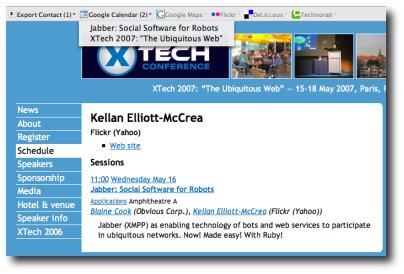
XTech schedule microformats I'm personally a little late to the microformats party. Being a fan of pragmatic RDF, I didn't see much need for microformats right away. However, with tools like Operator I can honestly say that the use of microformats does enhance the XTech schedule.My impressions of microformats (in particular hCalendar and hCard) from using them are mixed. One the plus side, it was very easy to do. On the negative side, I found them restrictive in the sense that for the metadata to be present in the hCalendar object, it needs to be part of the HTML presentation.So, while microformats are meant to be about making human readable data useful for computers, they can have a tail-wagging effect on the human markup. Let me elaborate. In the conference schedule there is a grid overview. For readability here we want to keep the details down to a minimum in each box. There is definitely no need to repeat the date of each presentation when you can see there's a grid per day.But also we want to have microformats available in the page so users can use the grid to pick off talks to add to their calendar. The only details you currently get from the microformat are those you physically include inside the div marked as vevent. This means we can't embed the full details, such as the talk description. It also means I indulge in some dubious markup practices (an empty abbr element) in order to get the date and time into each hCalendar object.It seems to me that this could be ameliorated by more intelligent user agent behaviour. Each of my hCalendar events is given a URL. At the end of that URL is a full description of the event, using microformats. So, as long as I reference the URL in a summary page, the user agent can beetle off and pull down the full information, in much the same sort of way that FOAF uses the rdfs:seeAlso property.So, remove the expectation that microformats provide complete data, and I'm sold.Other schedule features: iCal, Upcoming.org
Of course, we have iCalendar support in the XTech schedule, so you can subscribe conventionally using iCal, Evolution or a similar program. Aaron Straup Cope took the iCalendar, and uploaded each event into Upcoming.org. If you look at the upcoming events tagged xtech07, you see the results of his work.This foreshadows some of the social elements we plan to add to Expectnation itself: indicating your intent to attend a talk, and adding comments to it. As a program chair I'm finding this quite fascinating to watch.

25 February 2007

Adam Rosi-Kessel: Grimmelmann and Kozinski on Law

I recently came across two old and unrelated writings about law, both of which are worth reading, especially for people with strong opinions but no formal training. The first is this piece, entitled Seven Ways in Which Code Equals Law (And One in Which It Does Not), by recently-appointed New York Law School professor James Grimmelmann and EFF Legal Director Cindy Cohn. Several observations are particularly appropriate for the slashdot crowd (and, to a lesser extent, certain members of the Debian community and others who grew up on a diet of BASIC, Pascal, and then C and later perl). I especially like this bit about “hacking the law”:
Some people, seeing this connection, and remembering the values of good code, try to improve the legal system by treating it as a computer. People come to me with ideas for hacking the law. The government says that cryptography is a weapon, they say, but the Bill of Rights says we have the right to bear arms. So that means we have a Constitutional right to use cryptography. But the legal system isn t a computer. If you can t convince a judge that what you re proposing is consistent with the values underlying a law, your argument will go nowhere. People go to jail every year because they think they ve found a way to hack the Sixteenth Amendment. The income tax is illegal, they say, or, The income tax is voluntary, see, it says so right here, and then they get convicted of tax evasion and sent to jail. We did convince several judges about the Constitutional dimension of cryptography, but the claim started from the values of the First Amendment, not a mechanical reading of its words. It s a category mistake to treat the legal system as just another architecture with its own specialized language. Code and law are different ways of regulating; they have different textures. All of those people who are required to make the legal system work leave their mark on its outcomes: they make a certain amount of drift and discretion almost inevitable. Code doesn t have such a limit: it can make perfectly hard-nosed bright-line rules and hold everyone in the world to them. Code is capable of a kind of regulatory clarity and intensity that law can only state, never really achieve.
I don’t entirely agree with the other article, entitled What I Ate For Breakfast and Other Mysteries of Judicial Decision Making by outspoken Ninth Circuit Judge Alex Kozinski (unofficial site maintained by Aaron Swartz, wikipedia entry). For example, I think critical legal studies has resulted in some interesting insights, some of which actually have practical applciation. Still, Judge Kozinski makes an important point about the numerous factors that act as a check on discretion in judicial decisionmaking:
It is popular in some circles to suppose that judicial decision making can be explained largely by frivolous factors, perhaps for example the relationship between what judges eat and what they decide. Answering questions about such relationships is quite simple - it is like being asked to write a scholarly essay on the snakes of Ireland: There are none. But as far back as I can remember in law school, the notion was advanced with some vigor that judicial decision making is a farce. Under this theory, what judges do is glance at a case and decide who should win - and they do this on the basis of their digestion (or how they slept the night before or some other variety of personal factors). If the judge has a good breakfast and a good night’s sleep, he might feel lenient and jolly, and sympathize with the downtrodden. If he had indigestion or a bad night’s sleep, he might be a grouch and take it out on the litigants. Of course, even judges can’t make both sides lose; I know, I’ve tried. So a grouchy mood, the theory went, is likely to cause the judge to take it out on the litigant he least identifies with, usually the guy who got run over by the railroad or is being foreclosed on by the bank. This theory immodestly called itself Legal Realism. Just to prove that even the silliest idea can be pursued to its illogical conclusion, Legal Realism spawned Critical Legal Studies. As I understand this so-called theory, the notion is that because legal rules don’t mean much anyway, and judges can reach any result they wish by invoking the right incantation, they should engraft their own political philosophy onto the decision-making process and use their power to change the way our society works. So, if you accept that what a judge has for breakfast affects his decisions that day, judges should be encouraged to have a consistent diet so their decisions will consistently favor one set of litigants over the other. I am here to tell you that this is all horse manure. And, like all horse manure, it contains little seeds of truth from which tiny birds can take intellectual nourishment. The little truths are these: Under our law judges do in fact have considerable discretion in certain of their decisions: making findings of fact, interpreting language in the Constitution, statutes and regulations; determining whether officials of the executive branch have abused their discretion; and, fashioning remedies for violations of the law, including fairly sweeping powers to grant injunctive relief. The larger reality, however, is that judges exercise their powers subject to very significant constraints. They simply can’t do anything they well please.
Finally, I will link, but not embed, this video of the Anna Nicole Smith court order, for an entirely different perspective on the legal process. You almost don’t really want to have to see this stuff.

9 February 2007

Alastair McKinstry: [astronomy] Galway Astronomy Festival, 2007.

I went to the Astronomy Festival on Jan 27 organised by Galway Astronomy Club. Worth seeing; it attracted about 100 people (the Hotel conference room was full); successful for a town like Galway, so frequently covered in Cloud. Dr. Lucie Green save a good talk on Solar Physics, describing the different methods we now have of exploring the Suns behaviour, Flares, Sunspots, etc. and the different missions such as SOHO and the new STEREO mission to observe the Sun. Prof. Chris Dainty gave a clear presentation describing the state of the Art in Adaptive Optics, and work his group has been doing, both in Astronomy and pushing AO into other fields, such as opthalmology (treating the eye as the obstacle and observing the retina behind) and productising A.O. for 'non-professional' use. He hopes in the near future to be able to provide Adaptive Optics to Amateurs (price range around Eur 5000, status: not ready yet, the first units would be for 'University Dept' observatories, costing 20-30k, in the next year or two). Of particular interest were one by Prof. Dick Butler, head of the Chemistry dept. here in NUIG; it was on Organic Chemistry and meteorites. He is a long-time amateur astronomer but professional chemist; he was particularly interested in the organic chemistry of the Murchison meteorite. After pointing out the out the false alarm of ALH 84001, he gave a convincing presentation of the extra-terrestrial origin of complex organic compounds, including amino acids, etc. in the Murchison meteorite. In particular he disputed claims that the meteorite was contaminated, pointing to the Deuterium enrichment of the compounds within; as the C-D bond is stronger that C-H, Carbon-Hydrogen compounds are more likely to be broken up by extraterrestrial radiation that their deuterium variants, leading to deuterium enrichment over terrestrial equivalents. Later he gave a nice summary of conditions on Saturn's moon Titan, pointing to its rich supply of organic compounds, showing that when hit by meteorites, lakes of water would be possible for several hundred years at a time, as the impact craters cooled, and called Titan a utopia for organic chemistry exploration. This seems to make the idea of panspermia: life originating off-Earth more plausible. For a while now I've had a book (found in the Bargain bin somewhere) by Fred Hoyle and Chandra Wickramasinghe, From Grains to Bacteria, a collection of papers documenting their belief that they've discovered bacteria in free space via spectroscopy. I must admit my spectroscopy is not up to challenging them; time to dig deeper and fish it out. Dr. Aaron Golden gave a very interesting talk on Brown Dwarfs: Planets or Pulsars that he and his students have been doing. Basically it turns out that while Brown Dwarfs have long been seen as the 'runt' of the Stellar world, stars that didn't make it, some of them it seems are Pulsars. (He's invented the acronym SPUDs: Sporadically Pulsating Ultracool Dwarfs, for them; maybe it'll help people remember that Pulars were originally discovered by an Irishwoman, too). This was first seen by Andys Postgrads Greg Hallinan and Steve Bourke - (see the papers). Kinda interesting as Aaron studied under Dr. Andy Shearer in NUIG working on Pulsars, so knew a bit about them, and had seen behaviour like this before, with a bit of a clue what might be causing it. It was wierd going to this talk; Andy hired me to work in ICHEC, and we have an office in NUIG; Greg and Steve work down the hall, and indeed, I see them occasionally working on our computers; but didn't know what they'd been working on until now. So, it appears that these Brown Dwarfs (they've seen Pulsar behaviour in several) have Starspots (details here and here; some hot-off-the-press stuff: rumour has it he was checking the results of observations from the night before to ensure they didn't disprove what he was about to say). Aaron was pointing out the coherent maser behaviour was similar to that seen at Jupiter, leading to its strong radio emissions. I didn't get to talk to him about it in detail, but the idea of an Object with both sunspots and clouds sounds fairly exotic and interesting. Beyond that, the Festival was a good opportunity to see what Irish Amateur Astronomers have been doing, and meet some interesting people. Kudos to all those who organised it.

18 January 2007

Christine Spang: SIPB IAP Debian Class Slides

One of the student groups I’m involved in at MIT is the SIPB, the Student Information Processing Board. It’s a volunteer computer group so old that they called it “information processing” back then. They run a bunch of different servers and provide lots of cool services for the MIT community. One of the things that they do is teach classes about various things related to computing during IAP, MIT’s Independent Activities Period. So back when I had just gotten started with the group, one of the members was like, “Hey! You want to teach an IAP class!” and, being a frosh, I was like, “Er, I didn’t know that… but, um, okay.” So I taught one about Debian, of course. This year’s topic was Giving Back: Contributing to Debian and the New Maintainer Process. It was a three-day series, as described here. The lengths of the talks varied, with the first day being ~45 minutes, the second being ~1.5 hours, and the last being ~30 minutes. All of the lecture materials can be found here. The audience was on the high side of technical, and a lot of the slides were more to nudge me into what I was talking about rather than to be really awesome slides. Which probably should have involved less text. The packaging crash course definitely drew a much larger audience than the first or third parts, which mostly consisted of people I know who work on Debian-Athena, the unexpected appearance of my friend Aaron Swartz who’s in town for a couple weeks, and a few faces that I didn’t know. Maybe next year I’ll try to plan something that just involves a more intensive packaging course. Because, although I procrastinated, pushed the original lecture dates back a week from original plan, and made my lecture slides on the day they were presented, I actually did have fun. And it’s good practice.

6 January 2007

Evan Prodromou: 15 Niv se CCXV

We got back to Montreal yesterday morning just after midnight. Maj got us upgrades on United to business class, which was really a life-saver. There's a direct flight from San Francisco to Montreal, but it's 5 hours one way and 6 hours on another. This time traveling to California, we decided to split up the flight, stopping in Chicago about halfway between. Returning was a good flight. We were comfortable, there was room, Amita had enough space to play on the ground and sleep comfortably on our laps. Maj: "Business class isn't anything fancy; it's just enough space, good service and quality food that you feel like a human rather than like livestock." The only downside was that Chicago O'Hare is a half-ass airport. For one of the most (the most?) visited and transited airports in the world, it's really skimpy on services inside the security area. There aren't any big restaurants or nice bars or stores inside the B and C concourse; just stand-up kiosks. We walked halfway across the airport to find a pub to eat at. Probably the best thing about the airport is the giant brachiosaurus skeleton in B concourse. Amita June couldn't stop looking at it; she ran from foot to foot banging it with her hand. Good for her; it's a pretty neat thing to see in a boring airport. tags:

Ebjo Another Maj quote: "It's just a coincidence that we use the term blog as a cutesy contraction for 'Web log'. It could have easily have been a 'Web journal' people were contracting, and then we'd call it an ebjo." tags:

Goethe One of the things that I've found as a participant in Open Source software and Open Content is that there are a lot of different people involved. And today, in 2007, Germany and France have become important loci of new developments in Free Culture. I've been working on my French for a while, and I think I'm getting pretty good, but I've never learned any German. At all. But German Wikitravel is one of the largest and most popular versions of the project. And I want to be more of a participant -- or, at least, have some better relationships with our German users. So, today I signed up for German lessons at the Montreal Goethe Institute. The Goethe Institute promotes German language and culture world-wide, including high-quality lessons in German. Montreal's is in a beautiful old building right at the corner of Sherbrooke and St. Denis. It's got a nice office and a friendly warm bookstore, "Das Buch". I'm going to take the intensive beginner's course -- mornings Tuesday and Thursday for 6 weeks. I hope at the end of that time I'll be better able to meet German-speaking Free Software advocates, Open Content participants, and most of all Wikitravellers a little more towards halfway. tags:

La ka I went to La ka this afternoon again to meet a couple of people. It was my first two-meeting day at La ka, which I think is a bad sign I'm turning into a serious maven. But like they say, it's really where the hipsters are doing business on this le lately. The nice thing was that I got to introduce two Montrealers that I like a lot. Hugh Macguire of, among other things, the Librivox public-domain audiobook project, is really interesting and passionate about communities and free content. Nicolas Ritoux is one of the most clued-in tech journalists I've met. It was nice to introduce them, and it was good that they seemed to get along. Depressing, on the other hand, was walking around the Plateau in January with 12C weather. This has gotten beyond funny into scary -- we just haven't had any serious snow in Montreal this winter. I'm worried that it's going to get worse, too, and I don't know what that will mean for Quebec's culture. Mon pays, c'est l'hiver, goes the song, and I'm not sure I get what a city without winter would mean here. tags:

House Maj and I have been watching House on DVD. It's really good, although a little formulaic. Everybody's always running around and bleeding and vomiting, and people get an average of 3.8 different rare diseases per episode. There's also a lot of cheating and sneakiness. It's great. tags:

Mantini One nice thing about New Year's Eve this year was that Baron Earl served a refreshing -- nay, energizing -- spocktail called a mantini. I was especially pleased to find out that the first ingredient was not, in fact, a praying mantis. With the Baron, you never know. tags:

4 January 2007

Benjamin Mako Hill: Reflecting on the Definition of Definition

In his latest talk Lawrence Lessig spends time defending the use of non-commericial use clauses and goes into detail about how the free culture movement does not need and should not have definitions of freedom. In doing so, he was referring to a public discussion the two of us had most recently in September. While my name was not mentioned until the questions, he implicitly criticized both my freedom definition and my call for any definition at all. As usual, his criticism has made me think a lot about what it is that I'm trying to do. I've been thinking about a conversation I had with Aaron Swartz recently where he was also criticizing me for focusing too much on definitions. He was skeptical about my assertion that social movements and freedom movements needed "definitions." I thought about it and told him then that I thought I'd been making a mistake by saying I want free culture movements to have definitions. More accurately, what I want are goals, standards, or ideals. I want to be able to say, "music when will be free when every producer can do A, B, and C and every listener can do X, Y, and Z." I want the possibility of a shared utopianism. I want these kinds of goals because I believe that these images of what what things might be like if we win is what motivates us to win in the first place. I believe that the idea that, "things might be better" is simply never as powerful as a strong, perhaps even unattainable, ideal that challenges people and gives them something to strive for. The leaders of other successful social movements I know can tell you exactly what they are trying to achieve -- although few of them ever will realize it completely. No free culture movement leader can do this with any authority. For reasons I've talked about in the past, I think that fact may ultimately make us less successful. In the free software movement, our most important goal (free software itself) is documented in the Free Software Definition. Even the most ethically motivated among us aren't perfect -- most of us use some proprietary software -- but we have an ideal to hold our behavior up to and a method by which we can always improve. Inspired by free software, I unimaginatively said that I thought free culture needed a "definition." I probably could have found a better way to describe what I wanted and I'll do so in the future. I suppose I should have thought a little more about the definition of definition.

28 December 2006

David Welton: OFBiz officially joins the ASF

As of this writing, the DNS/infrastructure hasn't quite caught up, but ofbiz.apache.org ought to be live soon. "Apache Open For Business", aka OFBiz, has been promoted out of the incubator (the term the ASF uses for projects hoping to become full-fledged ASF projects) to its own top level project. As J Aaron Farr mentions, they managed most everything on their own, and were a project that wouldn't have looked out of place as part of the ASF even from the beginning of the incubation period, which made my job as a "mentor" pretty easy. What will be interesting is to track the project going forward. It has tremendous potential, because it focuses very much on providing not only the low level tools (which is still where most open source is), but also on creating good business models and processes, which is relatively newer terrain in the open source world. I think they face a couple of important challenges. First and foremost, a way to lower the barrier to entry. OFBiz is a big collection of code that in some ways tends to stand alone compared to the "mainstream" in that it uses its own tools in terms of the framework. Also, since it encompasses so much, it's a lot to come to terms with when you get started. This means that the initial step of the "learning curve" is pretty high, and I imagine that a lot of people stumble. Clearly, it's not a simple application, but I think efforts to make it more approachable will pay off in terms of attracting more users (and eventually, developers). The broader challenge is simply the fact that in some ways, this is uncharted territory for free software, so it remains to be seen what sort of "ecosystem" (if you'll pardon the buzzword) grows up around it. For instance, at this point in time, no one, least of all the core developers, sees it as a program that you simply download and run, but rather as a place to start from for integrators and developers who mould the code to fit the needs of the particular firm adopting it. That's working right now, but perhaps at some point it will be more of an out of the box system. Or maybe not - attempting to make it work well for a vague 'everyone' might just be chasing taillights and prove ultimately fruitless. Unfortunately, I still haven't had the opportunity to use it "in anger", as they say, so I don't have much to say about it technically, but from a business point of view, I really like their data model, and the system of processes they've put together, which allows you to capture a great deal of use cases in a very flexible way, which is no mean feat. In any case, a big round of congratulations to the core developers, and best wishes for the future!

24 December 2006

Evan Prodromou: 3 Niv se CCXV

We had a tough time getting out of Encinitas yesterday. It seems like everything was going wrong. I'd forgotten to order food for a sick aunt and her family in New Jersey the night before, so I was scrambling with apologies and new orders all morning. Then, when we finally got out of town, we hit traffic for about an hour near Santa Ana. Blech! Fortunately, it's a nice stretch of California highway, and we could see Catalina Island off on the horizon to the west. Our Christmas-eve-eve (or Festivus, if you will) was spent at Maj's parents' house in Long Beach, with about 30+ Jenkinses plus various offshoots and friendly relations. They have a huge house near Long Beach/Belmont Shore, with a giant tiled patio area that goes right into the house. It was a good place for a party. Amita June got some nice gifts from family, including a screaming monkey doll dressed as Superman. Yeah, we already have one screaming monkey doll with an "I LA" t-shirt, so this new one will join our growing collection of screaming monkeys with poor sartorial taste. tags:

Typewriters are broken Yesterday Amita June and I were playing with pyKeys, from the awesome pyToddler suite of tools, and I realized that typewriter keyboards are broken. I was showing her that when she pushed on the key marked "Q", a "Q" would appear on the screen. But that's not what happened: instead, a "q" appeared on the screen. That's not a bug in pyToddler, of course: that's just the way typewriters work. If you click on the button marked with a capital letter, it prints the lowercase letter on the paper or screen. To get the capital letter itself, you have to put the keyboard in another mode, or use a modifying chord key. I'm not sure why this is the case. It's clear why we use modifier keys to make capitals, since we type lowercase keys much more often. But why do keyboards show the capitals printed on the keys, then? tags:

Free Culture Christmas If there's anything that gives a bracing jolt of Christmas cheer, it's 235 Creative Commons Christmas songs. Thanks to Uwe Hermann for compiling this fine list. tags:

16 December 2006

Ian Murdock: More on iAccessible2 and cross platform accessibility interfaces

Aaron Leventhal of IBM has more details on the relationship between iAccessible2 and the UNIX/Linux accessibility API (ATK/AT-SPI) as well as the motivations behind iAccessible2’s evolutionary approach:
[A]n evolutionary path was needed for applications which already had MSAA (IAccessible) support… [and] an API was needed that did not require separate accessibility implementations for each platform. […] The IAccessible2 interface itself collects important ATK features from other areas, as well some completely new methods and features… For the most part, features were added either to bring Windows capabilities up to the level of ATK/AT-SPI, or in order to support the features of ARIA (previously known of DHTML accessibility). […] [W]hat we’re doing is expanding MSAA while matching ATK/AT-SPI to a very helpful degree. […] [B]ecause IAccessible2 is backwards-compatible with MSAA, the current support of Windows screen readers and other assistive technologies can continue to work on applications that add IAccessible2 support. However, the newer IAccessible2 capabilities will also be exposed, and thus newer assistive technologies will be able to take advantage of them.
Peter Korn of Sun weighs in as well. (Via Andy Updegrove.)

24 November 2006

Evan Prodromou: 3 Frimaire CCXV

I think there's a certain special sloth that Americans get to experience on the day after Thanksgiving that we don't get on other parts of the year. Something about the combination of gluttony and wholesomeness makes Black Friday a very mellow, enjoyable time. Maybe it's the fact that it's officially now The Holiday Season, but the stressful tasklist of December hasn't started yet. Or maybe just that it's a day off of work for no good reason except it just is. Maybe it's the fridge full of leftovers that still taste kind of good. I dunno. We had a good Thanksgiving dinner yesterday evening. Maj, Amita June and I had planned to go visit family in New Brunswick (New Jersey) for the holiday, which was really nice to do last year. But our visas are running out in December, and although we're (probably) not going to have a problem renewing them, our lawyer said it was a bad time to leave the country. So, we stayed in Montreal for Thanksgiving. Canadians have their own Thanksgiving, of course, on the 2nd Monday of October, but not having grown up with that day as Thanksgiving, and with most of our family celebrating in November, it's hard to get motivated around Canadian Thanksgiving. And it's just not that big a deal in Quebec, anyways. So we had a good dinner here; John Usher, Niko, Jeff Waye, Meg and Patti all came over and had a good time of it. I cooked my first Thanksgiving dinner -- a big salmon, potatoes and sweet potatoes, roasted broccoli and wax beans, a great big salad. Every family has a Thanksgiving dish tradition -- one of the Prodromous' is a big pot of macaroni and cheese. So I made that, too. We all ate pretty well, drank some wine, talked about the future of music and how fun it is to play hockey. Unfortunately, I managed to miss my Blinky Hockey practice last night -- I tried to put the (overtired) baby to bed at 10PM and ended up falling asleep myself. All in all a good TG, even though far from family. tags:

Speaking of home All of Canada is abuzz right now about a recently-proposed bill by the ruling Conservative Party in Parliament to declare the Quebecois to be a nation within Canada. Sovereignty of Quebec has been an extremely contentious issue in Canada over the last 50 years (two sovereignist parties are major players at the federal and provincial level), and this form of recognition is an interesting step. The whole thing began with Michael Ignatieff, a candidate for the leadership of the opposition Liberal Party. He has stated publicly that Quebec is indeed a nation, and his followers are pushing to have that be part of the Liberal Party platform. The sovereignist Bloc Quebecois tried to steal their thunder by introducing a bill in parliament to the same effect. Their thunder was in turn stolen by the Government with the latest bill, which now has the support of all the parties and will almost definitely pass. The wording of the bill is interesting. First, it calls the Quebecois a nation -- the people themselves, not Quebec qua territory or government. Although the government has stated that this includes all people in Quebec, it's still pretty obviously targeted towards recognition of an ethnic group, French-speaking Quebecois, more than everybody who's living inside the borders. Second, it recognizes this group as a nation within Canada -- deflating the suggestion that it may become an independent state. I have to admit that the ambiguous nature of Quebec's status is one of the things I find fascinating about living in Montreal. As far as I can tell, few sovereignists hope for anything like a total split with Canada, but instead are looking for some sort of autonomous status. On the other side, even the staunchest federalists have seemed comfortable with granting Quebec more of an international profile, such as giving Quebec a formal role in UNESCO. My guess is that the nature of Quebec's relationship with Canada will change gradually until it reaches some stable point where everyone's comfortable. I don't know where that stable point is, but I think it'll be interesting to find out. At the turn of the 20th century, if you had told people that the British, Austrian, Turkish and Russian Empires would be dissolved and almost forgotten within 100 years, they would have scoffed. But in that short span of time, the idea of empire, spheres of influence, and Great Powers has passed from the world stage. We simply don't think in terms of Empire any more, but in terms of nation-states. My guess is that the 21st century will see a similar change in the idea of nation-state. With pressure from supranational organizations like the UN, EU, GATT and the International Criminal Court, as well as pressure from unrecognized nations like Quebec and Catalunya and Wales, I think the firm borders of the nation-state are going to loosen up a lot. What it will mean is anyone's guess, but I think if we're lucky we'll have a richer tapestry of nations and people participating in global politics and culture. And I think Quebec will be an important part of those changes. tags:

Thanks, Biella! I'm glad to see that Biella is going to give us the goods on PR. Our Wikitravel 2007 Get-together is going to be on the island of Puerto Rico, and Biella's from there, so she's going to make up a list of good places to check out. Great news! tags:

21 November 2006

Biella Coleman: A spirited debate on the liberal frame of mind

This morning I came across Michael Berube’s response to Jodi Dean’s critique of Berube’s book What’s Liberal about the Liberal Arts?: Classroom Politics and Bias in Higher Education… It is a fascinating interchange worthy of a close read or two but without first-hand knowledge of the book, I hesitate to pledge my allegiance on either side. But I will hopefully to do so. The only thing that surprised me was that there was no mention of the grand master of the critique of liberalism, Stanely Fish… Not sure why but he seems like an obvious place to start. These ppst happened to really captured my attention this morening given I found them after reading the Chronicle of Higher Education piece Input or Intrusion? which examines the recent attacks against scholars deemed as “anti-Israel/pro-Palestine,” including against Nadia Abu El-Haj who happened to be on my dissertation committee… It will be very interesting to see how this all pans out and I am sure many of us are watching closely. And as an added bonus, here is a student’s thoughtful perspective on the Berube book.

25 October 2006

Dirk Eddelbuettel: Boston bound

This just in this morning:
111th Boston MarathonDear Dirk Eddelbuettel,

This is to notify you that your entry into the 111th Boston Marathon on Monday, April 16, 2007 has been accepted, provided that the information you submitted is accurate.

[...]
Yay! This was using the time from Sunburst in June but given Sunday's time I even get to run in 2008 too.

8 October 2006

Biella Coleman: My Reading

So people may be wondering, How does Biella pass her time in the vast, desolate Canadian north? Thankfully there are many things to do in Edmonton proper, but I have delved quite a bit into reading so I thought I would take a break and give small reviews of the books I have read or am reading as they are all quite good. I am trying to be more systematic about my reading habits so I am back to using citeulike. I am adding anything new I read and then as I go back to I have already read (for articles), I am adding them to the list also. I hope this pays off in the future! I started the reading bash with a book that was recommended to me over a year ago while I was still in Chicago: The Fugitive’s Property: Law and the Poetics of Personhood as it deals with the bread and butter of my own work, intellectual property, liberalism, market capitalism, and American history. I found the introduction enlivening and was sufficiently interested to continue on. I think there is not a lot of innovative work in the field of intellectual property (only because it has been covered very well) and to bring together slavery/the fugitive person and intellectual property under the same analytical lens, seems productive. Best looks at how the legal treatment of the slave and that of IP, hold striking parallels for their highly fugitive (formal) nature, driven and intensified by the legal/market framework that makes personhood into property. There is a lot of good stuff in there (including a fantastic discussion on legal positivism) but in the end, the labor it took to sift through some really obtuse prose was too much for me. I can’t remember the last time I languished under the heavy weight of language that was far too ornate and under sentences that just lacked clarity. This was compounded by the fact that he assumed you knew a fair bit about slave history, which I did not. My drive also escaped me and while I hope to return to it later, I took a break and turned to more readbale material. After such heavy linguistic ornateness, I needed an antidote, QUICK, and I knew exactly where to go: William Sewell and his book I had on my shelf also nearly for a year: The Logics of History. Along with being a first rate historian he is like that black instrument popularized in the 1980s by the likes of Herbie Hancock, and Brian Eno, he is a synthesizer with an amazing ability to write clearly. Being the synthesizer that he is, he is skilled at connecting the dots between various theoretical topics like event, structure, and agency, making the theoretical implications so crystal clear you feel happy to have entered into a field (the social sciences that is) that feels awfully arcane and pointless at times. I left Stehpen Best, which was like leaving a cluttered medieval castle and into a simply decorated room filled nothing with good theoretical feng shui (I think about writing in spatial terms more than ever). He just makes reading fun, even when the topics can be less than enthralling. Many of the essays were published previously and I had read a number of them, such as his famous essay on structure and agency. What I appreciated along with the great writing, was that he takes serious the question of plurality of social life within the net of various social, economic, political determinants. So while he assumes the existence of structure (and turns Marshall Sahlins to establish), he also is quick to show that structure, like a cultural system, can only act as partial (and unexpected determinants of social life) because of the existence and presence of events (which is really Sahlins great masterful point) but more importantly because of the plurality of structures… This was perhaps on the the central motifs in my dissertation; while I placed hacking within the cultural lineage of liberalism, in no way is this the only cultural system that hackers operate through and with; they move through a cultural domain more intrinsic to their own praxis, not to mention other systems of value that reverberate more widely among the digerati… And it is this movement between social positions that allows for forms of reflexivity and social change. I primarily used Bakhtin to make this point but now I got Sewell to add to this mix. Here is a nice passage from the book that makes this point:
I would argue that a multiple conception of structures would make subjects cultural creativity easier to explain. If the cultural structures by which subjectivities are formed are multiple, then so are the subjectivities… Because persons, symbols, and objects of cultural reference overlap between structural realms, structurally generated rules, emotions, categories, and senses of self can potentially be transposed from one situation to another. Indeed, if actors commonly have the experience of negotiating and renegotiating the relationships between noncongruent cultural structures, it follows they should have some intellectual distance on the structural categories themselves, that they should be able to view one set of cultural categories from the point of view of others that are differently organized, to compare and critizise categories and categorical logics, to work out ways of harmonization or odering the seemingly contradictory demands of different cultural schemes. A multiple conception of structure, consequently makes human creativity and reflection an integral element in the theory of history, not a philosophically prior metaphysical assumption. p. 213
And here is a more engaged review that is a little more critical than my very short comments. As part of a reading group organized by my tireless supervisor, I am also reading The Cultural Locations of Disability written by two of the most prolific scholars in the field, Sharon Snyder and David Mitchell. Since I am a novice in field it is hard for me to judge the two chapters we have so far read but it is a total total total treat reading a book slowly with a group of other folks from a vast range of departments. So far I appreciate the larger arguments presented in the introduction. For example, they point to two broad categories—capitalism and modernity/enlightenment– as driving forces in a new wave of obsession with the disabled. So while capitalism’s insistence on measuring the worth of humans through an abstract and actual ability to labor, marginalizes those who cannot offer their constant labor power (and makes them an “odd” cultural object), modernity–in its desire to march forward to the mysterious plane of progress, offers a technological promise to eradicate what it designates as deviant or primitive. As they nicely sum up: In a culture that endlessly assures itself that it is on the verge of conquering Nature once and for all, along with its own primitive instincts and the persistent domains of have-nots, disability is referenced with respect to these idealized visions. As a vector of human variability, disabled bodies both represent a throwback to human prehistory and serve as the barometer of a future without deviancy. p. 31 I, think, however, they should have also included some discussion of liberalism, which in many ways, was the legal and philosophical engine that helped to naturalize capitalism not to mention it also offered a vision of person, in which self-development, expression, and discrete autonomy was deeply cherished. Seen in this liberal light, disability becomes also a type of tragedy that can be resolved though new technological interventions they discuss under the guise of modernity. I have just started Michelle Murphy’s Sick Building Syndrome and the Problem of Uncertainty: Environmental Politics, Technoscience, and Women Workers, which promises to be quite a tour de force into the contentious politics of uncertainty and the play of perceptibility and imperceptibility that surround one of many many syndromes sick building syndrome that now are part and parcel of the medical and patient advocacy field. Along with this I read and finished Andrew Lakoff’s Pharmaceutical Reason: Knowledge and Value in Global Psychiatry, which will make for great teaching, and has one of the nicest discussions on the way in which psychiatry’s insecure status among the other medical science was one of the driving forces toward embracing the new scientism of the 1980s that coincided with new more general neoliberal trends. Another nice move about the ethnography is that he was able to clarify some of the trends and rationalities of American and European psychiatry by examining how it was received and resisted among more psychoanalytical Argentinian therapists. Very classicial anthropological lens in that sesne. Finally I am in the middle of Play Money: Or, How I Quit My Day Job and Made Millions Trading Virtual Loop and I will say more about it when I am done, which should be soon as I am tearing through it evern night. I have been waiting for this book for a long while now because Dibbell is part of that trinity (Steven Levy, Bruce Sterling, Julian Dibbell) that offers some of the best writing on hackers, the internet, and virtual worlds. And this book continues in that tradition of providing a fantastic read, a vivid ethnographic picture of the topic at hand, along with key insights into the nature of economies, money, and plau within (and outside of) virtual landscapes. What I respect about Julian Dibbell is that he took a long time to get this book out. He started the research in 2003 and then spent a few years writing up. I think there is a lot of pressure to get any material or book on “virtual whatever” out there as quick as possible but for the most part I think that is a mistake. You need to let these things brew a long while or else they won’t acquire that taste of a finished product.

20 September 2006

Russell Coker: War On Terror - the game

TerrorBullGames has just released the board game War On Terror. The first I heard of this was a short article in a local news paper about how much the game has offended some people (quoting someone who was injured in the London bombings). A co-creator of the game Andy Thompkins said "We accept that some people think this is in poor taste and may see it as puerile. But we would say that launching an illegal war on Iraq is in poor taste".

It's not as if profiting from terrorism is anything new. Governments in Australia, the UK, and the US have profited from it at the ballot box and also used it to stifle opposition parties to get unpopular legislation approved. An example of this is the attempts of the Bush regeime to legalise torture, see the Washington Post and The Age (Australia).

Shortly after 9-11 almost every computer company that had anything to do with backups or disaster-recovery was advertising heavily. Oil companies have done particularly well with high prices, they would have done even better if the plans for Iraq had succeeded.

TerrorBullGames appears to have an aim to draw attention to the lies of politicians, which makes them better than everyone else who has profited from 9-11. Maybe if they draw enough attention to the bad things that our governments are doing they can influence the results of elections, and we can get governments that don't promote terrorism.

Here's a review of the game.

13 September 2006

Clint Adams: Broke out of the old apartment, always wanted a monkey

So K. called me a brat, and rightly so. Now I could go on about the bizarre dysfunctional ways A. and M. keep trying to drag me into their extramarital insanity, but that would be overuse of initials. I could tell you about Fatslaps and his plans to splatter Harry with onions, but Harry is whimpering just about the right amount. I'm talking about Harry, not Harry. I could do a Marxist literary criticism of The Garbage Pail Kids Movie, but something disturbing happened to me, indirectly leading me to have a flashback. It was another century, though not more than a couple miles away. As with all progress , some things are better now, and some things are worse. Maybe that's just how I see it. It's stereotypically geriatric to reminisce about the past, accentuating the positive, but it's stereotypically me to only comment on the negative. So in the interest of stalling, here comes a m lange of the two. Value judgments are left as an exercise for the reader, assuming the prostitute/lover question isn't still getting top billing. Warren Zevon was still alive. Nouvelle Vague hadn't released any albums yet. I only knew one person who spoke Brazilian Portuguese. I hadn't seen Rent yet. I used to eat a lot more Colombian food. I refused to eat tomatoes. Actually, I ate quite a few things then that I don't now, and quite a few things now that I didn't then. I don't remember what I ate that night, but it wasn't Kraft dinner ; I'm sure of that. I know because I went to see a free concert as performed by the Barenaked Ladies. The concert was free because they were almost completely unknown. I was introduced to them a while before, by a dirty, dirty slut who squealed with delight because the lyrics featured words such as erection . It took me years of recovery to be able to appreciate that song. Years. If she hadn't, I would have found out about them through Minna Bromberg because she does a cover. One of the people I was with shouted out to Steven Page, calling him by the wrong name. If being a starstruck poseur weren't enough cause, I think the error would have made me implode from embarrassment. He took it on the chin. I know this Canadian who keeps telling the same tired old story that the Barenaked Ladies is the only Canadian band to ever become famous outside of Canada. He uses this dubious claim to segue into his bit about how The Tragically Hip is really popular in Canada, but unknown everywhere else. I tell him that I've heard of The Tragically Hip. He doesn't believe me. I try telling him that I've never heard of Moxy Fr vous or Rush, at which point he breaks down and admits that everyone has heard of Rush. Then we repeat the conversation a month later. So BNL did get all famous and mainstream and STUFF. That night, they urged everyone in the audience to promote them so they could GET PAID and sell out to The Man. I must confess not comprehending their earnestness and the gravity of the situation. I also never expected them to be played on Z100. Boycott ClearChannel. They're sellouts now, but they weren't then, and a good time was had by all. At the time, If I Had $1000000 might've been their most popular song. AS SUCH, the more rabid fans in the audience had brought boxes and boxes of macaroni & cheese, as well as a stuffed monkey or two. These items were flung at the stage, at appropriate times, frightening the band. I don't believe that anyone threw a green dress. Now, Canadians are funny people. They like to flap their heads and do medleys and covers and rap gratuitously in the middle of concerts. Well, Rush doesn't, but Moxy Fr vous and BNL do, and that's enough for me to make a sweeping generalization, because Rush can be disqualified purely on the mullet factor. You probably don't know this, but If I Had $1000000 is a song which gets a lot of variation and perhaps improv. For example, the owner of the remains will vary, and they'll vamp the introduction with the lyrics of some other song. You can hear it on the Rock Spectacle album, where they lead in with Grade 9. That night they did Prince's Raspberry Beret. We swooned. We swooned.

2 September 2006

Michael Janssen: Late at night when the wires in the walls

After my iBook problems last week, I tried to install Debian on the thing. I have narrowed down the problem to something with the hard drive inside, because the machine seems to run fine and go through most of the installation without any trouble, but once I start using the hard drive, it completely freezes. I successfully ran the hardware test disc which came with it a couple times in extended mode, but I'm not sure that it uses the hard drive in it's tests long enough for it to exhibit the problem. The failure seems to be somewhat random in nature, occuring at different times in the install process. Now I have the unhappy decision of trying to save this laptop which is more than 3 years old, or to attempt to buy a new one. Right now I am leaning toward buying a new one.

Honeywell seems 1.5 times as long this week, mostly because I'm making up for a day which I missed a couple weeks ago. Things have settled down there in terms of software failure, so I'm back at the normal coding which I am doing. The code uses Ogre, which is a handy 3d engine, making it much easier than learning something like OpenGL, and as a bonus adding portability. I am considering building some play applicaitons with the toolkit at home just because it would be fun.

Tonight I need to build a couple presentations covering some papers which were in CVPR this year to present at a reading group at Honeywell. It would be fine except that I am completely unaware of any of the recent history of vision research, so it makes it much harder to build the presentations. I hope I can finish them in a reasonable amount of time so I can watch Eureka tonight.

The TiVo Diet is still working out as expected. I discovered that I don't really have anything to watch on Sunday or Monday of the week. I'm getting much more productive work done than I used to. One downside of the diet is that I tend to not want to just sit and veg at the end of the work day - I think it frustrates [info]ceilingsarecool a bit because I'm always going off to the office to do something on the computer.

I recieved and watched the Studio 60 on the Sunset Strip yesterday. Being an Aaron Sorkin fan, I am excited for another of his shows to broadcast. Judging by the pilot, it should be a decent show.

Sidenote: Planet Debian seems to like one of my weekend weeviews a little too much, and is regrabbing it for the front page every so often. I can't figure out why this is happening, so any help would be greatly appreciated. Otherwise, in a couple more posts it should be off the RSS feed.

1 August 2006

Gunnar Wolf: Israeli mistakes

Reading Jordi's blog, I cannot but agree with him (in most points): I plainly cannot understand Israel's actions in the last weeks. I can sadly understand how some people defend them, specially people not living in Israel - I was talking with a friend today, a friend who does not share a single political viewpoint with me, but still... The world seems to be completely polarized. Some have the impression that Israelis live under constant shelling, that life is unsustainable in that poor country, the last corner of civilization in that mess called the Middle East, and that the Arab countries (which are huge and petroleum-rich) just want to throw Jews to the sea or worse. The rest of the world think that Israelis are mass-murderers who decided to take a heavily populated bit of land and martyrize its originary population by any possible means, establishing an Apartheid.
Both views are false. But of course, both views hold their bits of truth.
I cannot claim to be neutral on this: Although I lived there in total for ~18 months, I am an Israeli by choice (I adopted the Israeli nationality in 1996 and wanted to live my life there - I came back to Mexico for personal reasons, and I later decided to stay here). I have not been to Israel since then - But I try to keep myself informed. And, living in a Jewish family, it's hard not to be somewhat informed - and of course, shocked at your relatives' opinions. Jews outside Israel tend to be right-wingers. I lived in a kibbutz, and I still sympathyze with Meretz, the most leftwing Zionist party.
I won't restate what Jordi eloquently said. I know not everybody who reads my blog reads Jordi's as well - Please do. If you missed it some lines above, here is the link. I insist: I agree with most of what he wrote. What could Israel do to protect itself from its enemies? The answer is simple: Don't give them a reason to hate you.
One year ago, I was optimistic because Israel was heading the right way. Of all people, Ariel Sharon (one of Israel's most hawkish, right-wing strongmen of all times) decided to withdraw from Gaza, and hinted that areas in the West Bank would follow. No, not the best way possible, not as his predecessor Menahem Begin did with Egypt leading to a strong and long lasting peace, and certainly not in the very notable way Itzhak Rabin did with Jordan, getting peace and even friendship. But at least, Sharon accepted the reality, and seemed he meant to let Palestinians build their state. When he organized a new party which reduced Likud to a shadow of its past, one of Israel's most prominent figures for the peace camp, Shimon Peres, joined. Amazing.
But still, there is too much hatred. Of course, life in Gaza is plainly not sustainable. You can walk the Gaza strip side to side in less than one hour, and North to South it's less than 50 Km long. Still, over 400,000 people live in there. The area is simply unsustainable.
Gaza depends for everything from Israel. Of course, according to the never-stable security status, the border between Gaza and Israel opens or closes every day. When I lived in Zikim, mostly every day there were five or six Arabs working with us... Except for the days when they weren't there. And, of course, Israel also depends on the Arabs for much of its hard labor jobs (as it's always the case when two economically disparate populations live together).
Anyway, back on track: Besides giving the Arabs their slice of land (which in a squeezed area as Israel is always hard; people have fought for such small spaces it's hard to believe), the only thing Israel can do is help them. It has worked before: Israeli Arabs (the Arabs living inside the internationally recognized borders of Israel) are full citizens. Yes, there is racism in the country towards them, and yes, they are not really equal with Jewish Israelis - But they have voting rights, they have the right to be elected, they can optionally join the army (it's not compulsory as it is with the Jewish population), and they get government aid. Arab towns are poorer than Jewish towns, yes, but they have their dignity.
The problem in Gaza and South Lebanon (somewhat less so in the West Bank, but also) is that it's plainly all made up of refugee camps. Refugees that were born there, and whose parents were born there as well. And, let me emphasize this, they are not Israel's fault. The refugees fled the newborn Israel because the Arab states said (in May 1948) they would enter Palestine and butcher everybody, inviting Arab civilians to flee and then get back home - of course, 700,000 (out of 1,300,000 who lived in Palestine by then) Arabs did so. And when the Arabs lost the war, the Palestinians were denied citizenship by all the Arab countries except for Jordan (not surprisingly, the most stable of them all, and with which Israel has the closest relation). They were given refugee camps to live, one over the other. When Egypt signed the peace with Israel, it demanded back every inch of the Sinai - But not an inch of Gaza. And not a single Palestinian refugee.
I agree here with Jordi as well: There is a huge military operation in Gaza, but it's more spectacular in Lebanon today. The media talks about Lebanon, but not about Gaza. And the crisis in Gaza is not easier. But how can it be solved in a permanent way? Israel does neither have land to spare to give to the Palestinians - and even if it did, most of Gaza is surrounded by the Negev, a desert where it would not be easy for them to get anything better than what they have inside Gaza. As desirable as it would be to have a completely independent Palestinian state, Gaza would just remain a concentration camp. There is too much hatred, and neither Arabs nor Israelis want to keep working together, not trusting each other. The only solution I can find to this is to have an agreement with Egypt, where Egypt opens its border with Gaza, gives either nationality or work permits to Gazan Palestinians, and Israel injects capital to develop Northern Sinai, to give some hope of survival to the almost half million people.
The same in Lebanon: Israel was widely applauded to withdraw from South Lebanon in 2000. The area is mostly peaceful - For $ DEITY 's sake, what is the kidnapping of two soldiers in a six year period compared to soldiers being killed in the occupation army every week or two? Israel did well to leave Lebanon. Lebanon was starting an incredible national rebuilding process, as Robert Fisk tells us (Spanish only. I could find only the first paragraphs of the original English version, which appears to require subscription) of the wonders of the rebuilding process, reduced to rubble again. Of course, Israeli and Syrian armies left Lebanon. The Lebanese government and army are plainly too weak to care for the country. Hezbollah (which, indoubtely, is a terrorist entity, no matter how many benefical aspects it does have) have poured tremendous amounts of money to rebuild its area of influence, South Lebanon. Of course, they rebuilt, healed and educated with a strong ideological inclination, and that's not good for Israel. What can Israel do to leasen the Islamist influence? Simple: Send aid. Don't just leave. Don't leave a void, don't invite bad people to loot, don't invite extremist people to recruite future bombers. Turn occupation into aid. Build hospitals. Build houses. Give money, give infrastructure. Do it behind your back, as you gave money to the South Lebanon Army for almost 20 years. But make the people see you don't want to kill and rob them - Make the Lebanese Arabs feel their neighbour as a friend, although different. Bring back the good border. What's that? That's the nickname for the Lebanese border between +- 1950 and 1970 - The only border that was stable, that was not filled with hatred, where Israeli doctors treated Lebanese patients across the fence. And still today, the border is just a simple fence.
How can you convince a people of not killing themselves to kill the invasor? Don't act as an invasor. Act in all your best self-interest - Save them from poverty and from indignity.

9 July 2006

Evan Prodromou: 20 Messidor CCXIV

No honking today; I guess there just isn't a big German population in Montreal. But, y'know, fourth place is pretty damn good, Portugal! Nothing to sneeze at. Still ahead of Brazil, for what it's worth. Tomorrow's the big finale, of course. The Paramount Famous Players on Ste. Catherine downtown is going to have a live showing, free for the first 300 people. I dunno... I guess it could be fun, but it seems a little impersonal. I think I'll be watching from Niko's again. It's easy to walk to Little Italy, or Barouf, from there. tags:

Grillr I spent the day putting together household furniture. We stopped by Canadian Tire on Tuesday to buy lawn furniture, and we got a shipment from Ikea on Wednesday. This afternoon cleared out a lot of cardboard boxes from our house. First up was Amita June's big girl bed, which she got as a present for her month birthday. Yeah, Amita turned the big one-oh yesterday (10 months!), and although we've been doing wp:co-sleeping, we want her to start learning to sleep in her own bed. (Most co-sleeping babies want to move out after about 1 year.) She got a toddler bed, which is actually pretty cute, and fits perfectly in her room. Building Ikea furniture isn't really all that fun. First, they optimize for shipping size and storage, not for ease of building (or stability), so you get some really shaky stuff. Second, the instructions have no words -- assumably to avoid translation costs -- so you have to interpret their graphical V lapuk into some kind of reasonable instructions. Fortunately, just about the time I finished building it, Maj and Amita came home from a walk. Amita had just fallen asleep, so we put her in to see how it fit. Looks pretty good to me! [image] After that, I watered my new lawn. The grass seeds I spread on Tuesday are coming up in teensity-tinesity leaves. Huzzah! Then I turned my attention to the wt:Muskoka chairs we got from Canadian Tire. These turned out to be a lot easier, and they were made from cedar wood, so they were pleasant to work with. Maj had invited over some friends for grilling, so she went to the store to buy food while I worked on the Muskokas. The baby hung out with me outside in her playpen. The chairs turned out great, and we had a nice grill. Brenda, Parise and Tony all came over. Brenda and Tony are librarians, and Brenda and Parise grew up together in wt:Moncton. The Muskokas were a hit; here are Brenda and Amita enjoying one. [image] tags:

Fireworks I can hear right now the dull thump thump tha-thump-thump of fireworks going off down at La Ronde, the amusement park in the middle of the St. Laurent River. They're the hosts of the International Fireworks Festival, which happens every summer. It's one of the great things about living in Montreal -- fireworks every Wednesday and Saturday from early June until the end of July. The festival is a competition -- national pyrotechnics teams each provide a half-hour long show on one of the nights, and then at some point after the festival they decide on a winner (I think... I've never actually checked who "won"). The fireworks are first-class, and it's just fun to have explosions over the city all the time. Tonight's team is wt:South Africa -- it's the first time there's been an African national team. Go SA! tags:

Best show ever One of the best music shows I ever went to was a "surprise" event by Camper Van Beethoven at the now-defunct Mint Platter record store on Telegraph Avenue in wt:Berkeley, California around 1990. Probably one of the next best music shows I ever went to was a surprise (for me) when Maj took me to see CVB at the Just pour Rire Theatre in Montreal in 2004, one week after we were married. (The band had recently reformed, and that night their equipment was stolen out of their tour bus in Mtl. Such a shame.) I'm just thinking about it because so many of the shows I love are on the etree section of the Internet Archive. Secret message to every taper I crabbed out because their big boom mike was blocking my view of the stage: sorry. You were right. Thanks. And what reminded me of that? The NPR Live Concert Series, aka All Songs Considered. Man, there's a lot of good music in there. tags:

One So, has anyone offered Kyle Macdonald of One Red Paperclip a marketing job yet? Guy knows his marketing. tags:

Bignose strikes again I'll be honest -- most of the time, I totally don't understand fellow piglogger Michael Bakunin's blog. Here's an excerpt from Gasoline: FD: small short position in one US refiner, and thinking about crack spreads. Does that mean something to some species of animal? I dunno. tags:

Next.

Previous.