Search Results: "agi"

4 January 2026

Matthew Garrett: What is a PC compatible?

Wikipedia says An IBM PC compatible is any personal computer that is hardware- and software-compatible with the IBM Personal Computer (IBM PC) and its subsequent models . But what does this actually mean? The obvious literal interpretation is for a device to be PC compatible, all software originally written for the IBM 5150 must run on it. Is this a reasonable definition? Is it one that any modern hardware can meet? Before we dig into that, let s go back to the early days of the x86 industry. IBM had launched the PC built almost entirely around off-the-shelf Intel components, and shipped full schematics in the IBM PC Technical Reference Manual. Anyone could buy the same parts from Intel and build a compatible board. They d still need an operating system, but Microsoft was happy to sell MS-DOS to anyone who d turn up with money. The only thing stopping people from cloning the entire board was the BIOS, the component that sat between the raw hardware and much of the software running on it. The concept of a BIOS originated in CP/M, an operating system originally written in the 70s for systems based on the Intel 8080. At that point in time there was no meaningful standardisation - systems might use the same CPU but otherwise have entirely different hardware, and any software that made assumptions about the underlying hardware wouldn t run elsewhere. CP/M s BIOS was effectively an abstraction layer, a set of code that could be modified to suit the specific underlying hardware without needing to modify the rest of the OS. As long as applications only called BIOS functions, they didn t need to care about the underlying hardware and would run on all systems that had a working CP/M port. By 1979, boards based on the 8086, Intel s successor to the 8080, were hitting the market. The 8086 wasn t machine code compatible with the 8080, but 8080 assembly code could be assembled to 8086 instructions to simplify porting old code. Despite this, the 8086 version of CP/M was taking some time to appear, and a company called Seattle Computer Products started producing a new OS closely modelled on CP/M and using the same BIOS abstraction layer concept. When IBM started looking for an OS for their upcoming 8088 (an 8086 with an 8-bit data bus rather than a 16-bit one) based PC, a complicated chain of events resulted in Microsoft paying a one-off fee to Seattle Computer Products, porting their OS to IBM s hardware, and the rest is history. But one key part of this was that despite what was now MS-DOS existing only to support IBM s hardware, the BIOS abstraction remained, and the BIOS was owned by the hardware vendor - in this case, IBM. One key difference, though, was that while CP/M systems typically included the BIOS on boot media, IBM integrated it into ROM. This meant that MS-DOS floppies didn t include all the code needed to run on a PC - you needed IBM s BIOS. To begin with this wasn t obviously a problem in the US market since, in a way that seems extremely odd from where we are now in history, it wasn t clear that machine code was actually copyrightable. In 1982 Williams v. Artic determined that it could be even if fixed in ROM - this ended up having broader industry impact in Apple v. Franklin and it became clear that clone machines making use of the original vendor s ROM code wasn t going to fly. Anyone wanting to make hardware compatible with the PC was going to have to find another way. And here s where things diverge somewhat. Compaq famously performed clean-room reverse engineering of the IBM BIOS to produce a functionally equivalent implementation without violating copyright. Other vendors, well, were less fastidious - they came up with BIOS implementations that either implemented a subset of IBM s functionality, or didn t implement all the same behavioural quirks, and compatibility was restricted. In this era several vendors shipped customised versions of MS-DOS that supported different hardware (which you d think wouldn t be necessary given that s what the BIOS was for, but still), and the set of PC software that would run on their hardware varied wildly. This was the era where vendors even shipped systems based on the Intel 80186, an improved 8086 that was both faster than the 8086 at the same clock speed and was also available at higher clock speeds. Clone vendors saw an opportunity to ship hardware that outperformed the PC, and some of them went for it. You d think that IBM would have immediately jumped on this as well, but no - the 80186 integrated many components that were separate chips on 8086 (and 8088) based platforms, but crucially didn t maintain compatibility. As long as everything went via the BIOS this shouldn t have mattered, but there were many cases where going via the BIOS introduced performance overhead or simply didn t offer the functionality that people wanted, and since this was the era of single-user operating systems with no memory protection, there was nothing stopping developers from just hitting the hardware directly to get what they wanted. Changing the underlying hardware would break them. And that s what happened. IBM was the biggest player, so people targeted IBM s platform. When BIOS interfaces weren t sufficient they hit the hardware directly - and even if they weren t doing that, they d end up depending on behavioural quirks of IBM s BIOS implementation. The market for DOS-compatible but not PC-compatible mostly vanished, although there were notable exceptions - in Japan the PC-98 platform achieved significant success, largely as a result of the Japanese market being pretty distinct from the rest of the world at that point in time, but also because it actually handled Japanese at a point where the PC platform was basically restricted to ASCII or minor variants thereof. So, things remained fairly stable for some time. Underlying hardware changed - the 80286 introduced the ability to access more than a megabyte of address space and would promptly have broken a bunch of things except IBM came up with an utterly terrifying hack that bit me back in 2009, and which ended up sufficiently codified into Intel design that it was one mechanism for breaking the original XBox security. The first 286 PC even introduced a new keyboard controller that supported better keyboards but which remained backwards compatible with the original PC to avoid breaking software. Even when IBM launched the PS/2, the first significant rearchitecture of the PC platform with a brand new expansion bus and associated patents to prevent people cloning it without paying off IBM, they made sure that all the hardware was backwards compatible. For decades, PC compatibility meant not only supporting the officially supported interfaces, it meant supporting the underlying hardware. This is what made it possible to ship install media that was expected to work on any PC, even if you d need some additional media for hardware-specific drivers. It s something that still distinguishes the PC market from the ARM desktop market. But it s not as true as it used to be, and it s interesting to think about whether it ever was as true as people thought. Let s take an extreme case. If I buy a modern laptop, can I run 1981-era DOS on it? The answer is clearly no. First, modern systems largely don t implement the legacy BIOS. The entire abstraction layer that DOS relies on isn t there, having been replaced with UEFI. When UEFI first appeared it generally shipped with a Compatibility Services Module, a layer that would translate BIOS interrupts into UEFI calls, allowing vendors to ship hardware with more modern firmware and drivers without having to duplicate them to support older operating systems1. Is this system PC compatible? By the strictest of definitions, no. Ok. But the hardware is broadly the same, right? There s projects like CSMWrap that allow a CSM to be implemented on top of stock UEFI, so everything that hits BIOS should work just fine. And well yes, assuming they implement the BIOS interfaces fully, anything using the BIOS interfaces will be happy. But what about stuff that doesn t? Old software is going to expect that my Sound Blaster is going to be on a limited set of IRQs and is going to assume that it s going to be able to install its own interrupt handler and ACK those on the interrupt controller itself and that s really not going to work when you have a PCI card that s been mapped onto some APIC vector, and also if your keyboard is attached via USB or SPI then reading it via the CSM will work (because it s calling into UEFI to get the actual data) but trying to read the keyboard controller directly won t2, so you re still actually relying on the firmware to do the right thing but it s not, because the average person who wants to run DOS on a modern computer owns three fursuits and some knee length socks and while you are important and vital and I love you all you re not enough to actually convince a transglobal megacorp to flip the bit in the chipset that makes all this old stuff work. But imagine you are, or imagine you re the sort of person who (like me) thinks writing their own firmware for their weird Chinese Thinkpad knockoff motherboard is a good and sensible use of their time - can you make this work fully? Haha no of course not. Yes, you can probably make sure that the PCI Sound Blaster that s plugged into a Thunderbolt dock has interrupt routing to something that is absolutely no longer an 8259 but is pretending to be so you can just handle IRQ 5 yourself, and you can probably still even write some SMM code that will make your keyboard work, but what about the corner cases? What if you re trying to run something built with IBM Pascal 1.0? There s a risk that it ll assume that trying to access an address just over 1MB will give it the data stored just above 0, and now it ll break. It d work fine on an actual PC, and it won t work here, so are we PC compatible? That s a very interesting abstract question and I m going to entirely ignore it. Let s talk about PC graphics3. The original PC shipped with two different optional graphics cards - the Monochrome Display Adapter and the Color Graphics Adapter. If you wanted to run games you were doing it on CGA, because MDA had no mechanism to address individual pixels so you could only render full characters. So, even on the original PC, there was software that would run on some hardware but not on other hardware. Things got worse from there. CGA was, to put it mildly, shit. Even IBM knew this - in 1984 they launched the PCjr, intended to make the PC platform more attractive to home users. As well as maybe the worst keyboard ever to be associated with the IBM brand, IBM added some new video modes that allowed displaying more than 4 colours on screen at once4, and software that depended on that wouldn t display correctly on an original PC. Of course, because the PCjr was a complete commercial failure, it wouldn t display correctly on any future PCs either. This is going to become a theme. There s never been a properly specified PC graphics platform. BIOS support for advanced graphics modes5 ended up specified by VESA rather than IBM, and even then getting good performance involved hitting hardware directly. It wasn t until Microsoft specced DirectX that anything was broadly usable even if you limited yourself to Microsoft platforms, and this was an OS-level API rather than a hardware one. If you stick to BIOS interfaces then CGA-era code will work fine on graphics hardware produced up until the 20-teens, but if you were trying to hit CGA hardware registers directly then you re going to have a bad time. This isn t even a new thing - even if we restrict ourselves to the authentic IBM PC range (and ignore the PCjr), by the time we get to the Enhanced Graphics Adapter we re not entirely CGA compatible. Is an IBM PC/AT with EGA PC compatible? You d likely say yes , but there s software written for the original PC that won t work there. And, well, let s go even more basic. The original PC had a well defined CPU frequency and a well defined CPU that would take a well defined number of cycles to execute any given instruction. People could write software that depended on that. When CPUs got faster, some software broke. This resulted in systems with a Turbo Button - a button that would drop the clock rate to something approximating the original PC so stuff would stop breaking. It s fine, we d later end up with Windows crashing on fast machines because hardware details will absolutely bleed through. So, what s a PC compatible? No modern PC will run the DOS that the original PC ran. If you try hard enough you can get it into a state where it ll run most old software, as long as it doesn t have assumptions about memory segmentation or your CPU or want to talk to your GPU directly. And even then it ll potentially be unusable or crash because time is hard. The truth is that there s no way we can technically describe a PC Compatible now - or, honestly, ever. If you sent a modern PC back to 1981 the media would be amazed and also point out that it didn t run Flight Simulator. PC Compatible is a socially defined construct, just like Woman . We can get hung up on the details or we can just chill.

  1. Windows 7 is entirely happy to boot on UEFI systems except that it relies on being able to use a BIOS call to set the video mode during boot, which has resulted in things like UEFISeven to make that work on modern systems that don t provide BIOS compatibility
  2. Back in the 90s and early 2000s operating systems didn t necessarily have native drivers for USB input devices, so there was hardware support for trapping OS accesses to the keyboard controller and redirecting that into System Management Mode where some software that was invisible to the OS would speak to the USB controller and then fake a response anyway that s how I made a laptop that could boot unmodified MacOS X
  3. (my name will not be Wolfwings Shadowflight)
  4. Yes yes ok 8088 MPH demonstrates that if you really want to you can do better than that on CGA
  5. and by advanced we re still talking about the 90s, don t get excited

3 January 2026

Benjamin Mako Hill: Effects of Algorithmic Flagging on Fairness: Quasi-experimental Evidence from Wikipedia

Note: I have not published blog posts about my academic papers over the past few years. To ensure that my blog contains a more comprehensive record of my published papers and to surface these for folks who missed them, I will be periodically (re)publishing blog posts about some older published projects. This particular post is closely based on a previously published post by Nate TeBlunthuis from the Community Data Science Blog. Many online platforms are adopting AI and machine learning as a tool to maintain order and high-quality information in the face of massive influxes of user-generated content. Of course, AI algorithms can be inaccurate, biased, or unfair. How do signals from AI predictions shape the fairness of online content moderation? How can we measure an algorithmic flagging system s effects? In our paper published at CSCW, Nate TeBlunthuis, together with myself and Aaron Halfaker, analyzed the RCFilters system: an add-on to Wikipedia that highlights and filters edits that a machine learning algorithm called ORES identifies as likely to be damaging to Wikipedia. This system has been deployed on large Wikipedia language editions and is similar to other algorithmic flagging systems that are becoming increasingly widespread. Our work measures the causal effect of being flagged in the RCFilters user interface.

Screenshot of Wikipedia edit metadata on Special:RecentChanges with RCFilters enabled. Highlighted edits with a colored circle to the left side of other metadata are flagged by ORES. Different circle and highlight colors (white, yellow, orange, and red in the figure) correspond to different levels of confidence that the edit is damaging. RCFilters does not specifically flag edits by new accounts or unregistered editors, but does support filtering changes by editor types.
Our work takes advantage of the fact that RCFilters, like many algorithmic flagging systems, create discontinuities in the relationship between the probability that a moderator should take action and whether a moderator actually does. This happens because the output of machine learning systems like ORES is typically a continuous score (in RCFilters, an estimated probability that a Wikipedia edit is damaging), while the flags (in RCFilters, the yellow, orange, or red highlights) are either on or off and are triggered when the score crosses some arbitrary threshold. As a result, edits slightly above the threshold are both more visible to moderators and appear more likely to be damaging than edits slightly below. Even though edits on either side of the threshold have virtually the same likelihood of truly being damaging, the flagged edits are substantially more likely to be reverted. This fact lets us use a method called regression discontinuity to make causal estimates of the effect of being flagged in RCFilters.
Charts showing the probability that an edit will be reverted as a function of ORES scores in the neighborhood of the discontinuous threshold that triggers the RCfilters flag. The jump in the increase in reversion chances is larger for registered editors compared to unregistered editors at both thresholds.
To understand how this system may affect the fairness of Wikipedia moderation, we estimate the effects of flagging on edits on different groups of editors. Comparing the magnitude of these estimates lets us measure how flagging is associated with several different definitions of fairness. Surprisingly, we found evidence that these flags improved fairness for categories of editors that have been widely perceived as troublesome particularly unregistered (anonymous) editors. This occurred because flagging has a much stronger effect on edits by the registered than on edits by the unregistered. We believe that our results are driven by the fact that algorithmic flags are especially helpful for finding damage that can t be easily detected otherwise. Wikipedia moderators can see the editor s registration status in the recent changes, watchlists, and edit history. Because unregistered editors are often troublesome, Wikipedia moderators attention is often focused on their contributions, with or without algorithmic flags. Algorithmic flags make damage by registered editors (in addition to unregistered editors) much more detectable to moderators and so help moderators focus on damage overall, not just damage by suspicious editors. As a result, the algorithmic flagging system decreases the bias that moderators have against unregistered editors. This finding is particularly surprising because the ORES algorithm we analyzed was itself demonstrably biased against unregistered editors (i.e., the algorithm tended to greatly overestimate the probability that edits by these editors were damaging). Despite the fact that the algorithms were biased, their introduction could still lead to less biased outcomes overall. Our work shows that although it is important to design predictive algorithms to avoid such biases, it is equally important to study fairness at the level of the broader sociotechnical system. Since we first published a preprint of our paper, a follow-up piece by Leijie Wang and Haiyi Zhu replicated much of our work and showed that differences between different Wikipedia communities may be another important factor driving the effect of the system. Overall, this work suggests that social signals and social context can interact with algorithmic signals, and together these can influence behavior in important and unexpected ways.

The full citation for the paper is: TeBlunthuis, Nathan, Benjamin Mako Hill, and Aaron Halfaker. 2021. Effects of Algorithmic Flagging on Fairness: Quasi-Experimental Evidence from Wikipedia. Proceedings of the ACM on Human-Computer Interaction 5 (CSCW): 56:1-56:27. https://doi.org/10.1145/3449130.

We have also released replication materials for the paper, including all the data and code used to conduct the analysis and compile the paper itself.

2 January 2026

Joachim Breitner: Seemingly impossible programs in Lean

In 2007, Martin Escardo wrote a often-read blog post about Seemingly impossible functional programs . One such seemingly impossible function is find, which takes a predicate on infinite sequences of bits, and returns an infinite sequence for which that predicate hold (unless the predicate is just always false, in which case it returns some arbitrary sequence). Inspired by conversations with and experiments by Massin Guerdi at the dinner of LeaningIn 2025 in Berlin (yes, this blog post has been in my pipeline for far too long), I wanted to play around these concepts in Lean. Let s represent infinite sequences of bits as functions from Nat to Bit, and give them a nice name, and some basic functionality, including a binary operator for consing an element to the front:
import Mathlib.Data.Nat.Find
abbrev Bit := Bool
def Cantor : Type := Nat   Bit
def Cantor.head (a : Cantor) : Bit := a 0
def Cantor.tail (a : Cantor) : Cantor := fun i => a (i + 1)
@[simp, grind] def Cantor.cons (x : Bit) (a : Cantor) : Cantor
    0 => x
    i+1 => a i
infix:60 " # " => Cantor.cons
With this in place, we can write Escardo s function in Lean. His blog post discusses a few variants; I ll focus on just one of them:
mutual
  partial def forsome (p : Cantor   Bool) : Bool :=
    p (find p)
  partial def find (p : Cantor   Bool) : Cantor :=
    have b := forsome (fun a => p (true # a))
    (b # find (fun a => p (b # a)))
end
We define find together with forsome, which checks if the predicate p holds for any sequence. Using that find sets the first element of the result to true if there exists a squence starting with true, else to false, and then tries to find the rest of the sequence. It is a bit of a brian twiter that this code works, but it does:
def fifth_false : Cantor   Bool := fun a => not (a 5)
/-- info: [true, true, true, true, true, false, true, true, true, true] -/
#guard_msgs in
#eval List.ofFn (fun (i : Fin 10) => find fifth_false i)
Of course, in Lean we don t just want to define these functions, but we want to prove that they do what we expect them to do. Above we defined them as partial functions, even though we hope that they are not actually partial: The partial keyword means that we don t have to do a termination proof, but also that we cannot prove anything about these functions. So can we convince Lean that these functions are total after all? We can, but it s a bit of a puzzle, and we have to adjust the definitions. First of all, these seemingly impossible functions are only possible because we assume that the predicate we pass to it, p, is computable and total. This is where the whole magic comes from, and I recommend to read Escardo s blog posts and papers for more on this fascinating topic. In particular, you will learn that a predicate on Cantor that is computable and total necessarily only looks at some initial fragment of the sequence. The length of that prefix is called the modulus . So if we hope to prove termination of find and forsome, we have to restrict their argument p to only such computable predicates. To that end I introduce HasModulus and the subtype of predicates on Cantor that have such a modulus:
-- Extensional (!) modulus of uniform continuity
def HasModulus (p : Cantor    ) :=   n,   a b : Cantor, (  i < n, a i = b i)   p a = p b
@[ext] structure CantorPred where
  pred : Cantor   Bool
  hasModulus : HasModulus pred
The modulus of such a predicate is now the least prefix lenght that determines the predicate. In particular, if the modulus is zero, the predicate is constant:
namespace CantorPred
variable (p : CantorPred)
noncomputable def modulus : Nat :=
  open Classical in Nat.find p.hasModulus
theorem eq_of_modulus :  a b : Cantor, (  i < p.modulus, a i = b i)   p a = p b := by
  open Classical in
  unfold modulus
  exact Nat.find_spec p.hasModulus
theorem eq_of_modulus_eq_0 (hm : p.modulus = 0) :   a b, p a = p b := by
  intro a b
  apply p.eq_of_modulus
  simp [hm]
Because we want to work with CantorPred and not Cantor Bool I have to define some operations on that new type; in particular the cons element before predicate operation that we saw above in find:
def comp_cons (b : Bit) : CantorPred where
  pred := fun a => p (b # a)
  hasModulus := by
    obtain  n, h_n  := p.hasModulus
    cases n with
      zero => exists 0; grind
      succ m =>
      exists m
      intro a b heq
      simp
      apply h_n
      intro i hi
      cases i
        rfl
        grind
@[simp, grind =] theorem comp_cons_pred (x : Bit) (a : Cantor) :
  (p.comp_cons x) a = p (x # a) := rfl
For this operation we know that the modulus decreases (if it wasn t already zero):
theorem comp_cons_modulus (x : Bit) :
    (p.comp_cons x).modulus   p.modulus - 1 := by
  open Classical in
  apply Nat.find_le
  intro a b hab
  apply p.eq_of_modulus
  cases hh : p.modulus
    simp
    intro i hi
    cases i
      grind
      grind
grind_pattern comp_cons_modulus => (p.comp_cons x).modulus
We can rewrite the find function above to use these operations:
mutual
  partial def forsome (p : CantorPred) : Bool := p (find p)
  partial def find (p : CantorPred) : Cantor := fun i =>
    have b := forsome (p.comp_cons true)
    (b # find (p.comp_cons b)) i
end
I have also eta-expanded the Cantor function returned by find; there is now a fun i => i around the body. We ll shortly see why that is needed. Now have everything in place to attempt a termination proof. Before we do that proof, we could step back and try to come up with an informal termination argument. We can express all this reasoning as a termination measure in the form of a lexicographic triple. The 0 and 1 in the middle component mean that for zero modulus, we can call forsome from find for free .
mutual
  def forsome (p : CantorPred) : Bool := p (find p)
  termination_by (p.modulus, if p.modulus = 0 then 0 else 1, 0)
  decreasing_by grind
  def find (p : CantorPred) : Cantor := fun i =>
    have b := forsome (p.comp_cons true)
    (b # find (p.comp_cons b)) i
  termination_by i => (p.modulus, if p.modulus = 0 then 1 else 0, i)
  decreasing_by all_goals grind
end
The termination proof doesn t go through just yet: Lean is not able to see that (_ # p) i will call p with i - 1, and it does not see that p (find p) only uses find p if the modulus of p is non-zero. We can use the wf_preprocess feature to tell it about that: The following theorem replaces a call to p f, where p is a function parameter, with the slightly more complex but provably equivalent expression on the right, where the call to f is no in the else branch of an if-then-else and thus has p.modulus = 0 in scope:
@[wf_preprocess]
theorem coe_wf (p : CantorPred) :
    (wfParam p) f = p (if _ : p.modulus = 0 then fun _ => false else f) := by
  split
  next h => apply p.eq_of_modulus_eq_0 h
  next => rfl
And similarly we replace (_ # p) i with a variant that extend the context with information on how p is called:
def cantor_cons' (x : Bit) (i : Nat) (a :   j, j + 1 = i   Bit) : Bit :=
  match i with
    0 => x
    j + 1 => a j (by grind)
@[wf_preprocess] theorem cantor_cons_congr (b : Bit) (a : Cantor) (i : Nat) :
  (b # a) i = cantor_cons' b i (fun j _ => a j) := by cases i <;> rfl
After these declarations, the above definition of forsome and find goes through! It remains to now prove that they do what they should, by a simple induction on the modulus of p:
@[simp, grind =] theorem tail_cons_eq (a : Cantor) : (x # a).tail = a := by
  funext i; simp [Cantor.tail, Cantor.cons]
@[simp, grind =] theorem head_cons_tail_eq (a : Cantor) : a.head # a.tail = a := by
  funext i; cases i <;> rfl
theorem find_correct (p : CantorPred) (h_exists :   a, p a) : p (find p) := by
  by_cases h0 : p.modulus = 0
    obtain  a, h_a  := h_exists
    rw [  h_a]
    apply p.eq_of_modulus_eq_0 h0
    rw [find.eq_unfold, forsome.eq_unfold]
    dsimp -zeta
    extract_lets b
    change p (_ # _)
    by_cases htrue :   a, p (true # a)
    next =>
      have := find_correct (p.comp_cons true) htrue
      grind
    next =>
      have : b = false := by grind
      clear_value b; subst b
      have hfalse :   a, p (false # a) := by
        obtain  a, h_a  := h_exists
        cases h : a.head
          exists Cantor.tail a
          grind
          exfalso
          apply htrue
          exists Cantor.tail a
          grind
      clear h_exists
      exact find_correct (p.comp_cons false) hfalse
termination_by p.modulus
decreasing_by all_goals grind
theorem forsome_correct (p : CantorPred) :
    forsome p   (  a, p a) where
  mp hfind := by unfold forsome at hfind; exists find p
  mpr hex := by unfold forsome; exact find_correct p hex
This is pretty nice! However there is more to do. For example, Escardo has a massively faster variant of find that we can implement as a partial function in Lean:
def findBit (p : Bit   Bool) : Bit :=
  if p false then false else true
def branch (x : Bit) (l r : Cantor) : Cantor :=
  fun n =>
    if n = 0      then x
    else if 2   n then r ((n - 2) / 2)
                  else l ((n - 1) / 2)
mutual
  partial def forsome (p : Cantor -> Bool) : Bool :=
    p (find p)
  partial def find (p : Cantor -> Bool) : Cantor :=
    let x := findBit (fun x => forsome (fun l => forsome (fun r => p (branch x l r))))
    let l := find (fun l => forsome (fun r => p (branch x l r)))
    let r := find (fun r => p (branch x l r))
    branch x l r
end
But can we get this past Lean s termination checker? In order to prove that the modulus of p is decreasing, we d have to know that, for example, find (fun r => p (branch x l r)) is behaving nicely. Unforunately, it is rather hard to do termination proof for a function that relies on the behaviour of the function itself. So I ll leave this open as a future exercise. I have dumped the code for this post at https://github.com/nomeata/lean-cantor.

Ben Hutchings: FOSS activity in December 2025

1 January 2026

Daniel Baumann: P r ch storage (in Western Europe)

The majority of P r ch ( ) is stored in Asia (predominantly China, some in Malaysia and Taiwan) because of its climatic conditions:
  • warm (~30 C)
  • humid (~75% RH)
  • stable (comparatively small day to day, day to night, and seasonal differences)
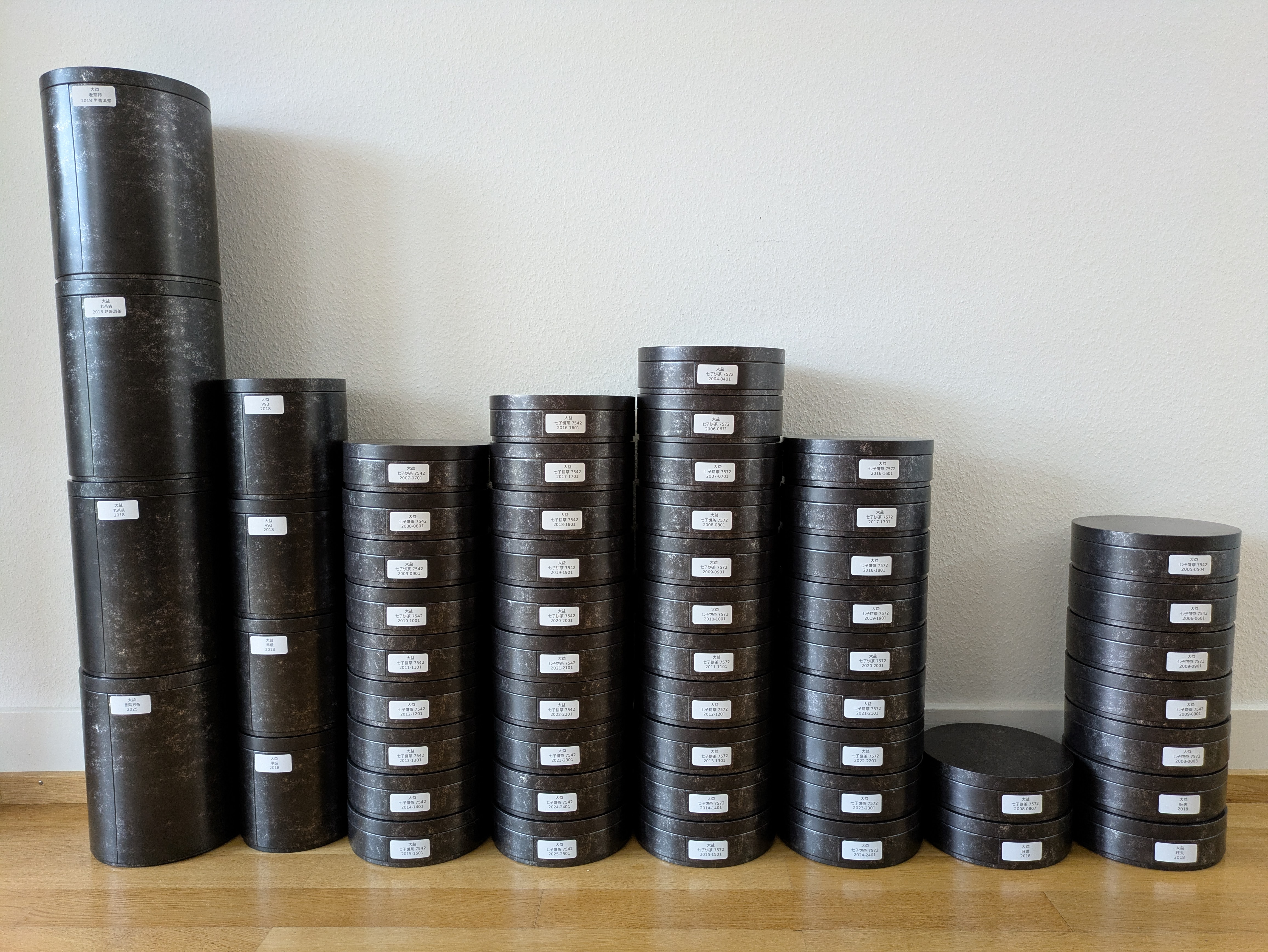
These are ideal for ageing and allow efficient storage in simple storehouses, usually without the need for any air conditioning. The climate in Western European countries is significantly colder, drier, and more variable. However, residential houses offers throughout the year a warm (~20 C), humid (~50% RH), and stable baseline to start with. High quality, long term storage and ageing is possible too with some of the Asian procedures slightly adjusted for the local conditions. Nevertheless, fast accelerated ageing still doesn t work here (even with massive climate control). Personally I prefer the balanced, natural storage over the classical wet or dry , or the mixed traditional storage (of course all storage types are not that meaningful as they are all relative terms anyway). Also I don t like strong fermentation either (P r is not my favourite tea, I only drink it in the 3 months of winter). Therefore, my intention is primarily to preserve the tea while it continues to age normally, keep it in optimal drinking condition and don t rush its fermentation. The value of correct storage is of great importance and has a big effect on P r, and is often overlooked and underrated. Here s a short summary on how to store P r ch (in Western Europe).
P ' r ch  storage (in Western Europe) Image: some D y P r ch stored at home
1. Location
1.1 No light Choose a location with neither direct nor indirect sunlight (= ultraviolet radiation) exposure:
  • direct sunlight damages organic material ( bleeching )
  • indirect sunlight by heating up the containers inbalances the microclimate ( suppression )
1.2 No odors Choose a location with neither direct nor indirect odor exposure:
  • direct odor immissions (like incense, food, air polution, etc.) makes the tea undrinkable
  • indirect odor immissions (especially other teas stored next to it) taint the taste and dilute the flavours
Always use individual containers for each tea, store only identical tea of the same year and batch in the same container. Idealy never store one cake, brick or tuo on its own, buy multiples and store them together for better ageing.
2. Climate
2.1 Consistent temperature Use a location with no interference from any devices or structures next to it:
  • use an regular indoor location for mild temperature curves (i.e. no attics with large day/night temperature differences)
  • aim for >= 20 C average temperature for natural storage (i.e. no cold basements)
  • don t use a place next to any heat dissipating devices (like radiators, computers, etc.)
  • don t use a place next to an outside facing wall
  • always leave 5 to 10cm distance to a wall for air to circulate (generally prevents mold on the wall but also isolates the containers further from possible immissions)
As consistent temperature as possible allows even and steady fermentation. However, neither air conditioning or filtering is needed. Regular day to day, day to night, and season to season fluctuations are balanced out fine with otherwise correct indoor storage. Also humidity control is much more important for storage and ageing, and much less forgiving than temperature control.
2.2 Consistent humidity Use humidity control packs to ensure a stable humidity level:
  • aim for ~65% RH
Lower than 60% RH will (completely) dry out the tea, higher than 70% RH increases chances for mold.
3. Equipment
3.1 Proper containers Use containers that are long term available and that are easily stackable, both in form and dimensions as well as load-bearing capacity. They should be inexpensive, otherwise it s most likely scam (there are people selling snake-oil containers specifically for tea storage). For long term storage and ageing:
  • never use plastic: they leak chemicals over time (no tupperdors , mylar and zip lock bags, etc.)
  • never use cardboard or bamboo: they let to much air in, absorb too much humity and dry to slow
  • never use wood: they emit odors (no humidors)
  • never use clay: they absorb all humidity and dry out the tea (glazed or porcelain urns are acceptable for short term storage)
Always use sealed but not air tight, cleaned steal cans (i.e. with no oil residues from manufacturing; such as these).
3.2 Proper humidity control Use two-way humidity control packs to either absorb or add moisture depending on the needs:
  • use humidity control pack(s) in every container
  • use one 60g pack (such as these) per 500g of tea
3.3 Proper labels Put labels on the outside of the containers to not need to open them to know what is inside and disturbe the ageing:
  • write at least manufacturer and name, pressing year, and batch number on the label (such as these)
  • if desired and not otherwise kept track already elsewhere, add additional information such as the amount of items, weights, previous storage location/type, date of purchase, vendor, or price, etc.
3.4 Proper monitoring Measuring and checking temperature and humidity regularly prevents storage parameters turning bad going unnoticed:
  • put temperature and humidity measurement sensors (such as these) inside some of the containers (e.g. at least one in every different size/type of container)
  • keep at least one temperature and humidity measurement sensor next to the containers on the outside to monitor the storage location
4. Storage
4.1 Continued maintenance Before beginning to initially store a new tea, let it acclimatize for 2h after unpacking from transport (or longer if temperature differences between indoors and outdoors are high, i.e. in winter). Then continuesly:
  • once a month briefly air all containers for a minute or two
  • once a month check for mold, just to be safe
  • every 3 to 6 months check all humidity control packs for need of replacement
  • monitor battery life of temperature and humidity measurement sensors
Humidity control packs can be recharged (usually voiding any warranty) by submerging them for 2 days in distilled water and 4 hours drying on paper towl afterwards. Check with a weight scale after recharging, they should regain their original weight (e.g. 60g plus ~2 to 5g for the packaging).
Finally With a correct P r ch storage:
  • beginn to drink Sh ng P r ( ) roughly after about 10-15 years, or later
  • beginn to drink Sh u P r ( ) roughly after about 3-5 years, or later
Prepare the tea by breaking it into, or breaking off from it, ~5 to 10g pieces about 1 to 3 months ahead of drinking and consider increase humidity to 70% RH during that time. 2026

31 December 2025

Chris Lamb: Favourites of 2025

Here are my favourite books and movies that I read and watched throughout 2025.

Books

Eliza Clark: Boy Parts (2020)Rachel Cusk: The Outline Trilogy (2014 2018)Edith Wharton: The House of Mirth (1905)Michael Finkel: The Art Thief (2023)Tony Judt: When the Facts Change: Essays 1995-2010 (2010)Jennette McCurdy: I'm Glad My Mom Died (2022)Joan Didion: The Year of Magical Thinking (2005)Jill Lepore: These Truths: A History of the United States (2018)

Films Recent releases

Disappointments this year included 28 Years Later (Danny Boyle, 2025), Cover-Up (Laura Poitras & Mark Obenhaus, 2025), Bugonia (Yorgos Lanthimos, 2025) and Caught Stealing (Darren Aronofsky, 2025).
Older releases ie. Films released before 2024, and not including rewatches from previous years. Distinctly unenjoyable watches included War of the Worlds (Rich Lee, 2025), Highest 2 Lowest (Spike Lee, 2025), Elizabethtown (Cameron Crowe, 2005), Crazy Rich Asians (Jon M. Chu, 2018) and Spinal Tap II: The End Continues (Rob Reiner, 2025). On the other hand, unforgettable cinema experiences this year included big-screen rewatches of Chinatown (Roman Polanski, 1974), Koyaanisqatsi (Godfrey Reggio, 1982), Heat (Michael Mann, 1995) and Night of the Hunter (Charles Laughton, 1955).

30 December 2025

Russ Allbery: Review: Dark Ambitions

Review: Dark Ambitions, by Michelle Diener
Series: Class 5 #4.5
Publisher: Eclipse
Copyright: 2020
ISBN: 1-7637844-2-8
Format: Kindle
Pages: 81
Dark Ambitions is a science fiction romance novella set in Michelle Diener's Class 5 series, following the events of Dark Matters. It returns to Rose as the protagonist and in that sense is a sequel to Dark Horse, but you don't have to remember that book in detail to read this novella. Rose and Dav (and the Class 5 ship Sazo) are escorting an exploration team to a planet that is being evaluated for settlement. Rose has her heart set on going down to the planet, feeling the breeze, and enjoying the plant life. Dav and his ship are called away to deal with a hostage situation. He tries to talk her out of going down without him, but Rose is having none of it. Predictably, hijinks ensue. This is a very slight novella dropped into the middle of the series but not (at least so far as I can tell) important in any way to the overall plot. It provides a bit of a coda to Rose's story from Dark Horse, but given that Rose has made cameos in all of the other books, readers aren't going to learn much new here. According to the Amazon blurb, it was originally published in the Pets in Space 5 anthology. The pet in question is a tiny creature a bit like a flying squirrel that Rose rescues and that then helps Rose in exactly the way that you would predict in this sort of story. This is so slight and predictable that it's hard to find enough to say about it to write a review. Dav is protective in a way that I found annoying and kind of sexist. Rose doesn't let that restrict her decisions, but seems to find this behavior more charming than I did. There is a tiny bit of Rose being awesome but a bit more damsel in distress than the series usually goes for. The cute animal is cute. There's the obligatory armory scene with another round of technomagical weapons that I think has appeared in every book in this series. It all runs on rather obvious rails. There is a subplot involving Rose feeling some mysterious illness while on the planet that annoyed me entirely out of proportion to how annoying it is objectively, mostly because mysterious illnesses tend to ramp up my anxiety, which is not a pleasant reading emotion. This objection is probably specific to me. This is completely skippable. I was told that in advance and thus only have myself to blame, but despite my completionist streak, I wish I'd skipped it. We learn one piece of series information that will probably come up in the future, but it's not the sort of information that would lead me to seek out a story about it. Otherwise, there's nothing wrong with it, really, but it would be a minor and entirely forgettable chapter in a longer novel, padded out with a cute animal and Dav trying to be smothering. Not recommended just because you probably have something better to do with that reading time (reading the next full book of the series, for example), but there's nothing wrong with this if you want to read it anyway. Followed by Dark Class. Rating: 5 out of 10

28 December 2025

Balasankar 'Balu' C: Granting Namespace-Specific Access in GKE Clusters

Heyo, In production Kubernetes environments, access control becomes critical when multiple services share the same cluster. I recently faced this exact scenario: a GKE cluster hosting multiple services across different namespaces, where a new team needed access to maintain and debug their service-but only their service. The requirement was straightforward yet specific: grant external users the ability to exec into pods, view logs, and forward ports, but restrict this access to a single namespace within a single GKE cluster. No access to other clusters in the Google Cloud project, and no access to other namespaces.

The Solution Achieving this granular access control requires combining Google Cloud IAM with Kubernetes RBAC (Role-Based Access Control). Here s how to implement it:

Step 1: Tag Your GKE Cluster First, apply a unique tag to your GKE cluster. This tag will serve as the identifier for IAM policies.

Step 2: Grant IAM Access via Tags Add an IAM policy binding that grants users access to resources with your specific tag. The Kubernetes Engine Viewer role (roles/container.viewer) provides sufficient base permissions without granting excessive access.

Step 3: Create a Kubernetes ClusterRole Define a ClusterRole that specifies the exact permissions needed:
apiVersion: rbac.authorization.k8s.io/v1
kind: ClusterRole
metadata:
  name: custom-access-role
rules:
  - apiGroups: [""]
    resources: ["pods", "pods/exec", "pods/attach", "pods/portforward", "pods/log"]
    verbs: ["get", "list", "watch", "create"]
Note: While you could use a namespace-scoped Role, a ClusterRole offers better reusability if you need similar permissions for other namespaces later.

Step 4: Bind the Role to Users Create a RoleBinding to connect the role to specific users and namespaces:
apiVersion: rbac.authorization.k8s.io/v1
kind: RoleBinding
metadata:
  name: custom-rolebinding
  namespace: my-namespace
subjects:
  - kind: User
    name: myuser@gmail.com
    apiGroup: rbac.authorization.k8s.io
roleRef:
  kind: ClusterRole
  name: custom-access-role
  apiGroup: rbac.authorization.k8s.io
Apply both configurations using kubectl apply -f <filename>.

How It Works This approach creates a two-layer security model:
  • GCP IAM controls which clusters users can access using resource tags
  • Kubernetes RBAC controls what users can do within the cluster and limits their scope to specific namespaces
The result is a secure, maintainable solution that grants teams the access they need without compromising the security of other services in your cluster.

25 December 2025

Russ Allbery: Review: Machine

Review: Machine, by Elizabeth Bear
Series: White Space #2
Publisher: Saga Press
Copyright: October 2020
ISBN: 1-5344-0303-5
Format: Kindle
Pages: 485
Machine is a far-future space opera. It is a loose sequel to Ancestral Night, but you do not have to remember the first book to enjoy this book and they have only a couple of secondary characters in common. There are passing spoilers for Ancestral Night in the story, though, if you care. Dr. Brookllyn Jens is a rescue paramedic on Synarche Medical Vessel I Race To Seek the Living. That means she goes into dangerous situations to get you out of them, patches you up enough to not die, and brings you to doctors who can do the slower and more time-consuming work. She was previously a cop (well, Judiciary, which in this universe is mostly the same thing) and then found that medicine, and specifically the flagship Synarche hospital Core General, was the institution in all the universe that she believed in the most. As Machine opens, Jens is boarding the Big Rock Candy Mountain, a generation ship launched from Earth during the bad era before right-minding and joining the Synarche, back when it looked like humanity on Earth wouldn't survive. Big Rock Candy Mountain was discovered by accident in the wrong place, going faster than it was supposed to be going and not responding to hails. The Synarche ship that first discovered and docked with it is also mysteriously silent. It's the job of Jens and her colleagues to get on board, see if anyone is still alive, and rescue them if possible. What they find is a corpse and a disturbingly servile early AI guarding a whole lot of people frozen in primitive cryobeds, along with odd artificial machinery that seems to be controlled by the AI. Or possibly controlling the AI. Jens assumes her job will be complete once she gets the cryobeds and the AI back to Core General where both the humans and the AI can be treated by appropriate doctors. Jens is very wrong. Machine is Elizabeth Bear's version of a James White Sector General novel. If one reads this book without any prior knowledge, the way that I did, you may not realize this until the characters make it to Core General, but then it becomes obvious to anyone who has read White's series. Most of the standard Sector General elements are here: A vast space station with rings at different gravity levels and atmospheres, a baffling array of species, and the ability to load other people's personalities into your head to treat other species at the cost of discomfort and body dysmorphia. There's a gruff supervisor, a fragile alien doctor, and a whole lot of idealistic and well-meaning people working around complex interspecies differences. Sadly, Bear does drop White's entertainingly oversimplified species classification codes; this is the correct call for suspension of disbelief, but I kind of missed them. I thoroughly enjoy the idea of the Sector General series, so I was delighted by an updated version that drops the sexism and the doctor/nurse hierarchy and adds AIs, doctors for AIs, and a more complicated political structure. The hospital is even run by a sentient tree, which is an inspired choice. Bear, of course, doesn't settle for a relatively simple James White problem-solving plot. There are interlocking, layered problems here, medical and political, immediate and structural, that unwind in ways that I found satisfyingly twisty. As with Ancestral Night, Bear has some complex points to make about morality. I think that aspect of the story was a bit less convincing than Ancestral Night, in part because some of the characters use rather bizarre tactics (although I will grant they are the sort of bizarre tactics that I could imagine would be used by well-meaning people using who didn't think through all of the possible consequences). I enjoyed the ethical dilemmas here, but they didn't grab me the way that Ancestral Night did. The setting, though, is even better: An interspecies hospital was a brilliant setting when James White used it, and it continues to be a brilliant setting in Bear's hands. It's also worth mentioning that Jens has a chronic inflammatory disease and uses an exoskeleton for mobility, and (as much as I can judge while not being disabled myself) everything about this aspect of the character was excellent. It's rare to see characters with meaningful disabilities in far-future science fiction. When present at all, they're usually treated like Geordi's sight: something little different than the differential abilities of the various aliens, or even a backdoor advantage. Jens has a true, meaningful disability that she has to manage and that causes a constant cognitive drain, and the treatment of her assistive device is complex and nuanced in a way that I found thoughtful and satisfying. The one structural complaint that I will make is that Jens is an astonishingly talkative first-person protagonist, particularly for an Elizabeth Bear novel. This is still better than being inscrutable, but she is prone to such extended philosophical digressions or infodumps in the middle of a scene that I found myself wishing she'd get on with it already in a few places. This provides good characterization, in the sense that the reader certainly gets inside Jens's head, but I think Bear didn't get the balance quite right. That complaint aside, this was very fun, and I am certainly going to keep reading this series. Recommended, particularly if you like James White, or want to see why other people do.
The most important thing in the universe is not, it turns out, a single, objective truth. It's not a hospital whose ideals you love, that treats all comers. It's not a lover; it's not a job. It's not friends and teammates. It's not even a child that rarely writes me back, and to be honest I probably earned that. I could have been there for her. I didn't know how to be there for anybody, though. Not even for me. The most important thing in the universe, it turns out, is a complex of subjective and individual approximations. Of tries and fails. Of ideals, and things we do to try to get close to those ideals. It's who we are when nobody is looking.
Followed by The Folded Sky. Rating: 8 out of 10

23 December 2025

Daniel Kahn Gillmor: AI and Secure Messaging Don't Mix

AI and Secure Messaging Don't Mix Over on the ACLU's Free Future blog, I just published an article titled AI and Secure Messaging Don't Mix. The blogpost assumes for the sake of the argument that people might actually want to have an AI involved in their personal conversations, and explores why Meta's Private Processing doesn't offer the level of assurance that they want it to offer. In short, the promises of "confidential cloud computing" are built on shaky foundations, especially against adversaries as powerful as Meta themselves. If you really want AI in your chat, the baseline step for privacy preservation is to include it in your local compute base, not to use a network service! But these operators clearly don't value private communication as much as they value binding you to their services. But let's imagine some secure messenger that actually does put message confidentiality first -- and imagine they had integrated some sort of AI capability into the messenger. That at least bypasses the privacy questions around AI use. Would you really want to talk with your friends, as augmented by their local AI, though? Would you want an AI, even one running locally with perfect privacy, intervening in your social connections? What if it summarized your friend's messages to you in a way that led you to misunderstand (or ignore) an important point your friend had made? What if it encouraged you to make an edgy joke that comes across wrong? Or to say something that seriously upsets a friend? How would you respond? How would you even know that it had happened? My handle is dkg. More times than i can count, i've had someone address me in a chat as "dog" and then cringe and apologize and blame their spellchecker/autocorrect. I can laugh these off because the failure mode is so obvious and transparent -- and repeatable. (also, dogs are awesome, so i don't really mind!) But when our attention (and our responses!) are being shaped and molded by these plausibility engines, how will we even know that mistakes are being made? What if the plausibility engine you've hooked into your messenger embeds subtle (or unsubtle!) bias? Don't we owe it to each other to engage with actual human attention?

21 December 2025

Ian Jackson: Debian s git transition

tl;dr: There is a Debian git transition plan. It s going OK so far but we need help, especially with outreach and updating Debian s documentation. Goals of the Debian git transition project
  1. Everyone who interacts with Debian source code should be able to do so entirely in git.
That means, more specifically:
  1. All examination and edits to the source should be performed via normal git operations.
  2. Source code should be transferred and exchanged as git data, not tarballs. git should be the canonical form everywhere.
  3. Upstream git histories should be re-published, traceably, as part of formal git releases published by Debian.
  4. No-one should have to learn about Debian Source Packages, which are bizarre, and have been obsoleted by modern version control.
This is very ambitious, but we have come a long way! Achievements so far, and current status We have come a very long way. But, there is still much to do - especially, the git transition team needs your help with adoption, developer outreach, and developer documentation overhaul. We ve made big strides towards goals 1 and 4. Goal 2 is partially achieved: we currently have dual running. Goal 3 is within our reach but depends on widespread adoption of tag2upload (and/or dgit push). Downstreams and users can obtain the source code of any Debian package in git form. (dgit clone, 2013). They can then work with this source code completely in git, including building binaries, merging new versions, even automatically (eg Raspbian, 2016), and all without having to deal with source packages at all (eg Wikimedia 2025). A Debian maintainer can maintain their own package entirely in git. They can obtain upstream source code from git, and do their packaging work in git (git-buildpackage, 2006). Every Debian maintainer can (and should!) release their package from git reliably and in a standard form (dgit push, 2013; tag2upload, 2025). This is not only more principled, but also more convenient, and with better UX, than pre-dgit tooling like dput. Indeed a Debian maintainer can now often release their changes to Debian, from git, using only git branches (so no tarballs). Releasing to Debian can be simply pushing a signed tag (tag2upload, 2025). A Debian maintainer can maintain a stack of changes to upstream source code in git (gbp pq 2009). They can even maintain such a delta series as a rebasing git branch, directly buildable, and use normal git rebase style operations to edit their changes, (git-dpm, 2010; git-debrebase, 2018) An authorised Debian developer can do a modest update to any package in Debian, even one maintained by someone else, working entirely in git in a standard and convenient way (dgit, 2013). Debian contributors can share their work-in-progress on git forges and collaborate using merge requests, git based code review, and so on. (Alioth, 2003; Salsa, 2018.) Core engineering principle The Debian git transition project is based on one core engineering principle: Every Debian Source Package can be losslessly converted to and from git. In order to transition away from Debian Source Packages, we need to gateway between the old dsc approach, and the new git approach. This gateway obviously needs to be bidirectional: source packages uploaded with legacy tooling like dput need to be imported into a canonical git representation; and of course git branches prepared by developers need to be converted to source packages for the benefit of legacy downstream systems (such as the Debian Archive and apt source). This bidirectional gateway is implemented in src:dgit, and is allowing us to gradually replace dsc-based parts of the Debian system with git-based ones. Correspondence between dsc and git A faithful bidirectional gateway must define an invariant: The canonical git tree, corresponding to a .dsc, is the tree resulting from dpkg-source -x. This canonical form is sometimes called the dgit view . It s sometimes not the same as the maintainer s git branch, because many maintainers are still working with patches-unapplied git branches. More on this below. (For 3.0 (quilt) .dscs, the canonical git tree doesn t include the quilt .pc directory.) Patches-applied vs patches-unapplied The canonical git format is patches applied . That is: If Debian has modified the upstream source code, a normal git clone of the canonical branch gives the modified source tree, ready for reading and building. Many Debian maintainers keep their packages in a different git branch format, where the changes made by Debian, to the upstream source code, are in actual patch files in a debian/patches/ subdirectory. Patches-applied has a number of important advantages over patches-unapplied: The downside is that, with the (bizarre) 3.0 (quilt) source format, the patch files files in debian/patches/ must somehow be kept up to date. Nowadays though, tools like git-debrebase and git-dpm (and dgit for NMUs) make it very easy to work with patches-applied git branches. git-debrebase can deal very ergonomically even with big patch stacks. (For smaller packages which usually have no patches, plain git merge with an upstream git branch, and a much simpler dsc format, sidesteps the problem entirely.) Prioritising Debian s users (and other outsiders) We want everyone to be able to share and modify the software that they interact with. That means we should make source code truly accessible, on the user s terms. Many of Debian s processes assume everyone is an insider. It s okay that there are Debian insiders and that people feel part of something that they worked hard to become involved with. But lack of perspective can lead to software which fails to uphold our values. Our source code practices in particular, our determination to share properly (and systematically) are a key part of what makes Debian worthwhile at all. Like Debian s installer, we want our source code to be useable by Debian outsiders. This is why we have chosen to privilege a git branch format which is more familiar to the world at large, even if it s less popular in Debian. Consequences, some of which are annoying The requirement that the conversion be bidirectional, lossless, and context-free can be inconvenient. For example, we cannot support .gitattributes which modify files during git checkin and checkout. .gitattributes cause the meaning of a git tree to depend on the context, in possibly arbitrary ways, so the conversion from git to source package wouldn t be stable. And, worse, some source packages might not to be representable in git at all. Another example: Maintainers often have existing git branches for their packages, generated with pre-dgit tooling which is less careful and less principled than ours. That can result in discrepancies between git and dsc, which need to be resolved before a proper git-based upload can succeed. That some maintainers use patches-unapplied, and some patches-unapplied, means that there has to be some kind of conversion to a standard git representation. Choosing the less-popular patches-applied format as the canonical form, means that many packages need their git representation converted. It also means that user- and outsider-facing branches from browse,git .dgit.d.o and dgit clone are not always compatible with maintainer branches on Salsa. User-contributed changes need cherry-picking rather than merging, or conversion back to the maintainer format. The good news is that dgit can automate much of this, and the manual parts are usually easy git operations. Distributing the source code as git Our source code management should be normal, modern, and based on git. That means the Debian Archive is obsolete and needs to be replaced with a set of git repositories. The replacement repository for source code formally released to Debian is *.dgit.debian.org. This contains all the git objects for every git-based upload since 2013, including the signed tag for each released package version. The plan is that it will contain a git view of every uploaded Debian package, by centrally importing all legacy uploads into git. Tracking the relevant git data, when changes are made in the legacy Archive Currently, many critical source code management tasks are done by changes to the legacy Debian Archive, which works entirely with dsc files (and the associated tarballs etc). The contents of the Archive are therefore still an important source of truth. But, the Archive s architecture means it cannot sensibly directly contain git data. To track changes made in the Archive, we added the Dgit: field to the .dsc of a git-based upload (2013). This declares which git commit this package was converted from. and where those git objects can be obtained. Thus, given a Debian Source Package from a git-based upload, it is possible for the new git tooling to obtain the equivalent git objects. If the user is going to work in git, there is no need for any tarballs to be downloaded: the git data could be obtained from the depository using the git protocol. The signed tags, available from the git depository, have standardised metdata which gives traceability back to the uploading Debian contributor. Why *.dgit.debian.org is not Salsa We need a git depository - a formal, reliable and permanent git repository of source code actually released to Debian. Git forges like Gitlab can be very convenient. But Gitlab is not sufficiently secure, and too full of bugs, to be the principal and only archive of all our source code. (The open core business model of the Gitlab corporation, and the constant-churn development approach, are critical underlying problems.) Our git depository lacks forge features like Merge Requests. But: The dgit git depository outlasted Alioth and it may well outlast Salsa. We need both a good forge, and the *.dgit.debian.org formal git depository. Roadmap In progress Right now we are quite focused on tag2upload. We are working hard on eliminating the remaining issues that we feel need to be addressed before declaring the service out of beta. Future Technology Whole-archive dsc importer Currently, the git depository only has git data for git-based package updates (tag2upload and dgit push). Legacy dput-based uploads are not currently present there. This means that the git-based and legacy uploads must be resolved client-side, by dgit clone. We will want to start importing legacy uploads to git. Then downstreams and users will be able to get the source code for any package simply with git clone, even if the maintainer is using legacy upload tools like dput. Support for git-based uploads to security.debian.org Security patching is a task which would particularly benefit from better and more formal use of git. git-based approaches to applying and backporting security patches are much more convenient than messing about with actual patch files. Currently, one can use git to help prepare a security upload, but it often involves starting with a dsc import (which lacks the proper git history) or figuring out a package maintainer s unstandardised git usage conventions on Salsa. And it is not possible to properly perform the security release as git. Internal Debian consumers switch to getting source from git Buildds, QA work such as lintian checks, and so on, could be simpler if they don t need to deal with source packages. And since git is actually the canonical form, we want them to use it directly. Problems for the distant future For decades, Debian has been built around source packages. Replacing them is a long and complex process. Certainly source packages are going to continue to be supported for the foreseeable future. There are no doubt going to be unanticipated problems. There are also foreseeable issues: for example, perhaps there are packages that work very badly when represented in git. We think we can rise to these challenges as they come up. Mindshare and adoption - please help! We and our users are very pleased with our technology. It is convenient and highly dependable. dgit in particular is superb, even if we say so ourselves. As technologists, we have been very focused on building good software, but it seems we have fallen short in the marketing department. A rant about publishing the source code git is the preferred form for modification. Our upstreams are overwhelmingly using git. We are overwhelmingly using git. It is a scandal that for many packages, Debian does not properly, formally and officially publish the git history. Properly publishing the source code as git means publishing it in a way that means that anyone can automatically and reliably obtain and build the exact source code corresponding to the binaries. The test is: could you use that to build a derivative? Putting a package in git on Salsa is often a good idea, but it is not sufficient. No standard branch structure git on Salsa is enforced, nor should it be (so it can t be automatically and reliably obtained), the tree is not in a standard form (so it can t be automatically built), and is not necessarily identical to the source package. So Vcs-Git fields, and git from Salsa, will never be sufficient to make a derivative. Debian is not publishing the source code! The time has come for proper publication of source code by Debian to no longer be a minority sport. Every maintainer of a package whose upstream is using git (which is nearly all packages nowadays) should be basing their work on upstream git, and properly publishing that via tag2upload or dgit. And it s not even difficult! The modern git-based tooling provides a far superior upload experience. A common misunderstanding dgit push is not an alternative to gbp pq or quilt. Nor is tag2upload. These upload tools complement your existing git workflow. They replace and improve source package building/signing and the subsequent dput. If you are using one of the usual git layouts on salsa, and your package is in good shape, you can adopt tag2upload and/or dgit push right away. git-debrebase is distinct and does provides an alternative way to manage your git packaging, do your upstream rebases, etc. Documentation Debian s documentation all needs to be updated, including particularly instructions for packaging, to recommend use of git-first workflows. Debian should not be importing git-using upstreams release tarballs into git. (Debian outsiders who discover this practice are typically horrified.) We should use only upstream git, work only in git, and properly release (and publish) in git form. We, the git transition team, are experts in the technology, and can provide good suggestions. But we do not have the bandwidth to also engage in the massive campaigns of education and documentation updates that are necessary especially given that (as with any programme for change) many people will be sceptical or even hostile. So we would greatly appreciate help with writing and outreach. Personnel We consider ourselves the Debian git transition team. Currently we are: We wear the following hats related to the git transition: You can contact us: We do most of our heavy-duty development on Salsa. Thanks Particular thanks are due to Joey Hess, who, in the now-famous design session in Vaumarcus in 2013, helped invent dgit. Since then we have had a lot of support: most recently political support to help get tag2upload deployed, but also, over the years, helpful bug reports and kind words from our users, as well as translations and code contributions. Many other people have contributed more generally to support for working with Debian source code in git. We particularly want to mention Guido G nther (git-buildpackage); and of course Alexander Wirt, Joerg Jaspert, Thomas Goirand and Antonio Terceiro (Salsa administrators); and before them the Alioth administrators.

comment count unavailable comments

17 December 2025

Matthew Garrett: How did IRC ping timeouts end up in a lawsuit?

I recently won a lawsuit against Roy and Rianne Schestowitz, the authors and publishers of the Techrights and Tuxmachines websites. The short version of events is that they were subject to an online harassment campaign, which they incorrectly blamed me for. They responded with a large number of defamatory online posts about me, which the judge described as unsubstantiated character assassination and consequently awarded me significant damages. That's not what this post is about, as such. It's about the sole meaningful claim made that tied me to the abuse.

In the defendants' defence and counterclaim[1], 15.27 asserts in part The facts linking the Claimant to the sock puppet accounts include, on the IRC network: simultaneous dropped connections to the mjg59_ and elusive_woman accounts. This is so unlikely to be coincidental that the natural inference is that the same person posted under both names. "elusive_woman" here is an account linked to the harassment, and "mjg59_" is me. This is actually a surprisingly interesting claim to make, and it's worth going into in some more detail.

The event in question occurred on the 28th of April, 2023. You can see a line reading *elusive_woman has quit (Ping timeout: 2m30s), followed by one reading *mjg59_ has quit (Ping timeout: 2m30s). The timestamp listed for the first is 09:52, and for the second 09:53. Is that actually simultaneous? We can actually gain some more information - if you hover over the timestamp links on the right hand side you can see that the link is actually accurate to the second even if that's not displayed. The first event took place at 09:52:52, and the second at 09:53:03. That's 11 seconds apart, which is clearly not simultaneous, but maybe it's close enough. Figuring out more requires knowing what a "ping timeout" actually means here.

The IRC server in question is running Ergo (link to source code), and the relevant function is handleIdleTimeout(). The logic here is fairly simple - track the time since activity was last seen from the client. If that time is longer than DefaultIdleTimeout (which defaults to 90 seconds) and a ping hasn't been sent yet, send a ping to the client. If a ping has been sent and the timeout is greater than DefaultTotalTimeout (which defaults to 150 seconds), disconnect the client with a "Ping timeout" message. There's no special logic for handling the ping reply - a pong simply counts as any other client activity and resets the "last activity" value and timeout.

What does this mean? Well, for a start, two clients running on the same system will only have simultaneous ping timeouts if their last activity was simultaneous. Let's imagine a machine with two clients, A and B. A sends a message at 02:22:59. B sends a message 2 seconds later, at 02:23:01. The idle timeout for A will fire at 02:24:29, and for B at 02:24:31. A ping is sent for A at 02:24:29 and is responded to immediately - the idle timeout for A is now reset to 02:25:59, 90 seconds later. The machine hosting A and B has its network cable pulled out at 02:24:30. The ping to B is sent at 02:24:31, but receives no reply. A minute later, at 02:25:31, B quits with a "Ping timeout" message. A ping is sent to A at 02:25:59, but receives no reply. A minute later, at 02:26:59, A quits with a "Ping timeout" message. Despite both clients having their network interrupted simultaneously, the ping timeouts occur 88 seconds apart.

So, two clients disconnecting with ping timeouts 11 seconds apart is not incompatible with the network connection being interrupted simultaneously - depending on activity, simultaneous network interruption may result in disconnections up to 90 seconds apart. But another way of looking at this is that network interruptions may occur up to 90 seconds apart and generate simultaneous disconnections[2]. Without additional information it's impossible to determine which is the case.

This already casts doubt over the assertion that the disconnection was simultaneous, but if this is unusual enough it's still potentially significant. Unfortunately for the Schestowitzes, even looking just at the elusive_woman account, there were several cases where elusive_woman and another user had a ping timeout within 90 seconds of each other - including one case where elusive_woman and schestowitz[TR] disconnect 40 seconds apart. By the Schestowitzes argument, it's also a natural inference that elusive_woman and schestowitz[TR] (one of Roy Schestowitz's accounts) are the same person.

We didn't actually need to make this argument, though. In England it's necessary to file a witness statement describing the evidence that you're going to present in advance of the actual court hearing. Despite being warned of the consequences on multiple occasions the Schestowitzes never provided any witness statements, and as a result weren't allowed to provide any evidence in court, which made for a fairly foregone conclusion.

[1] As well as defending themselves against my claim, the Schestowitzes made a counterclaim on the basis that I had engaged in a campaign of harassment against them. This counterclaim failed.

[2] Client A and client B both send messages at 02:22:59. A falls off the network at 02:23:00, has a ping sent at 02:24:29, and has a ping timeout at 02:25:29. B falls off the network at 02:24:28, has a ping sent at 02:24:29, and has a ping timeout at 02:25:29. Simultaneous disconnects despite over a minute of difference in the network interruption.

comment count unavailable comments

15 December 2025

Russ Allbery: Review: Brigands & Breadknives

Review: Brigands & Breadknives, by Travis Baldree
Series: Legends & Lattes #3
Publisher: Tor
Copyright: 2025
ISBN: 1-250-33489-6
Format: Kindle
Pages: 325
Brigands & Breadknives is a secondary-world sword-and-sorcery fantasy and a sequel to both Legends & Lattes and Bookshops & Bonedust. It takes place shortly after Legends & Lattes chronologically, but Fern, the protagonist, was introduced in the Bookshops & Bonedust prequel. You may have noticed I didn't describe this as cozy fantasy. That is intentional. When we left Fern at the end of Bookshops & Bonedust, the rattkin was running a bookshop in the town of Murk. As Brigands & Breadknives opens, Fern is moving, for complicated and hard-to-describe personal reasons, to Thune where Viv has her coffee shop. Her plan is to open a new bookstore next door to Legends and Lattes. This is exactly the sort of plot one might expect from this series, and the first few chapters feel like yet another version of the first two novels. Then Fern makes an impulsive and rather inexplicable (even to herself) decision and the plot goes delightfully sideways. Brigands & Breadknives is not, as Baldree puts it in the afterword, a book about fantasy small-business ownership as the answer to all of life's woes. It is, instead, a sword and sorcery story about a possibly immortal elven bounty hunter, her utterly baffling goblin prisoner, and a rattkin bookseller who becomes their unexpected travel companion for reasons she can't explain. It's a story about a mid-life crisis in a world and with supporting characters that I can only describe as inspired by a T. Kingfisher novel. Baldree is not Ursula Vernon, of course. This book does not contain paladins or a romance, possibly to the relief of some readers. It's slower, a bit more introspective, and doesn't have as sharp of edges or the casual eerie unsettlingness. But there is a religious order that worships a tentacled space horror for entirely unexpected reasons, pompous and oleaginous talking swords with verbose opinions about everything, a mischievously chaotic orange-haired goblin who quickly became one of my favorite fantasy characters and then kept getting better, and a whole lot of heart. You may see why Kingfisher was my first thought for a comparison point. Unlike Baldree's previous novels, there is a lot of combat and injury. I think some people will still describe this book as cozy, and I'm not going to argue too strongly because the conflicts are a bit lighter than the sort of rape and murder one would see in a Mercedes Lackey novel. But to me this felt like sword and sorcery in a Dungeons and Dragons universe made more interesting by letting the world-building go feral and a little bit sarcastic. Most of the book is spent traveling, there are a lot of random encounters that build into a connected plot, and some scenes (particularly the defense of the forest village) felt like they could have sold to the Swords and Sorceress anthology series. Also, this was really good! I liked both Legends & Lattes and Bookshops & Bonedust, maybe a bit more than the prevailing opinion among reviewers since the anachronisms never bothered me, but I wasn't sure whether to dive directly into this book because I was expecting more of the same. This is not more of the same. I think it's clearly better writing and world-building than either of the previous books. It helps that Fern is the protagonist; as much as I like Viv, I think Fern is a more interesting character, and I am glad she got a book of her own. Baldree takes a big risk on the emotional arc of this book. Fern starts the story in a bad state and makes some decisions to kick off the plot that are difficult to defend. She beats herself up for those decisions for most of the book, deservedly, and parts of that emotional turmoil are difficult to read. Baldree resists the urge to smooth everything over and instead provides a rather raw sense of depression, avoidance, and social anxiety that some readers are going to have to brace themselves for. I respect the decision to not write the easy series book people probably expected, but I'm not sure Fern's emotional arc quite worked. Baldree is hinting at something that's hard to describe logically, and I'm not sure he was able to draw a clear enough map of Fern's thought process for the reader to understand her catharsis. The "follow your passion" self-help mindset has formed a gravitational singularity in the vicinity of this book's theme, it takes some skillful piloting to avoid being sucked into its event horizon, and I don't think Baldree quite managed to escape it. He made a valiant attempt, though, and it created a far more interesting book than one about safer emotions. I wanted more of an emotional payoff than I got, but the journey, even with the moments of guilt and anxiety, was so worth it. The world-building is funnier and more interesting than the previous books of the series, and the supporting cast is fantastic. If you bailed on the series but you like sword and sorcery and T. Kingfisher novels, consider returning. You do probably need to read Bookshops & Bonedust first, if you haven't already, since it helps to know the start of Fern's story. Recommended, and shortcomings aside, much better than I had expected. Content notes: Bloody sword fights, major injury, some very raw emotions about letting down friends and destroying friendships. Rating: 8 out of 10

12 December 2025

Freexian Collaborators: Debian Contributions: Updates about DebConf Video Team Sprint, rebootstrap, SBOM tooling in Debian and more! (by Anupa Ann Joseph)

Debian Contributions: 2025-11 Contributing to Debian is part of Freexian s mission. This article covers the latest achievements of Freexian and their collaborators. All of this is made possible by organizations subscribing to our Long Term Support contracts and consulting services.

DebConf Video Team Sprint The DebConf Video Team records, streams, and publishes talks from DebConf and many miniDebConfs. A lot of the infrastructure development happens during setup for these events, but we also try to organize a sprint once a year to work on infrastructure, when there isn t a DebConf about to happen. Stefano attended the sprint in Herefordshire this year and wrote up a report.

rebootstrap, by Helmut Grohne A number of jobs were stuck in architecture-specific failures. gcc-15 and dpkg still disagree about whether PIE is enabled occasionally and big endian mipsen needed fixes in systemd. Beyond this regular uploads of libxml2 and gcc-15 required fixes and rebasing of pending patches. Earlier, Loongson used rebootstrap to create the initial package set for loong64 and Miao Wang now submitted their changes. Therefore, there is now initial support for suites other than unstable and use with derivatives.

Building the support for Software Bill Of Materials tooling in Debian, by Santiago Ruano Rinc n Vendors of Debian-based products may/should be paying attention to the evolution of different jurisdictions (such as the CRA or updates on CISA s Minimum Elements for a Software Bill of Materials) that require to make available Software Bill of Materials (SBOM) of their products. It is important then to have tools in Debian to make it easier to produce such SBOMs. In this context, Santiago continued the work on packaging libraries related to SBOMs. This includes the packaging of the SPDX python library (python-spdx-tools), and its dependencies rdflib and mkdocs-include-markdown-plugin. System Package Data Exchange (SPDX), defined by ISO/IEC 5962:2021, is an open standard capable of representing systems with software components as SBOMs and other data and security references. SPDX and CycloneDX (whose python library python3-cyclonedx-lib was packaged by prior efforts this year), encompass the two main SBOM standards available today.

Miscellaneous contributions
  • Carles improved po-debconf-manager: added checking status of bug reports automatically via python-debianbts; changed some command line options naming or output based on user feedback; finished refactoring user interaction to rich; codebase is now flake8-compliant; added type safety with mypy.
  • Carles, using po-debconf-manager, created 19 bug reports for translations where the merge requests were pending; reviewed and created merge requests for 4 packages.
  • Carles planned a second version of the tool that detects packages that Recommends or Suggests packages which are not in Debian. He is taking ideas from dumat.
  • Carles submitted a pull request to python-unidiff2 (adapted from the original pull request to python-unidiff). He also started preparing a qnetload update.
  • Stefano did miscellaneous python package updates: mkdocs-macros-plugin, python-confuse, python-pip, python-mitogen.
  • Stefano reviewed a beets upload for a new maintainer who is taking it over.
  • Stefano handled some debian.net infrastructure requests.
  • Stefano updated debian.social infrastructure for the trixie point release.
  • The update broke jitsi.debian.social, Stefano put some time into debugging it and eventually enlisted upstream assistance, who solved the problem!
  • Stefano worked on some patches for Python that help Debian:
    • GH-139914: The main HP PA-RISC support patch for 3.14.
    • GH-141930: We observed an unhelpful error when failing to write a .pyc file during package installation. We may have fixed the problem, and at least made the error better.
    • GH-141011: Ignore missing ifunc support on HP PA-RISC.
  • Stefano spun up a website for hamburg2026.mini.debconf.org.
  • Rapha l reviewed a merge request updating tracker.debian.org to rely on bootstrap
    version 5.
  • Emilio coordinated various transitions.
  • Helmut sent patches for 26 cross build failures.
  • Helmut officially handed over the cleanup of the /usr-move transition.
  • Helmut monitored the transition moving libcrypt-dev out of build-essential and bumped the remaining bugs to rc-severity in coordination with the release team.
  • Helmut updated the Build-Profiles patch for debian-policy incorporating feedback from Sean Whitton with a lot of help from Nattie Mayer-Hutchings and Freexian colleagues.
  • Helmut discovered that the way mmdebstrap deals with start-stop-daemon may result in broken output and sent a patch.
  • As a result of armel being removed from sid , but not from forky , the multiarch hinter broke. Helmut fixed it.
  • Helmut uploaded debvm accepting a patch from Luca Boccassi to fix it for newer
    systemd.
  • Colin began preparing for the second stage of the OpenSSH GSS-API key exchange package split.
  • Colin caught and fixed a devscripts regression due to it breaking part of Debusine.
  • Colin packaged django-pgtransaction and backported it to trixie , since it looks useful for Debusine.
  • Thorsten uploaded the packages lprng, cpdb-backend-cups, cpdb-libs and ippsample to fix some RC bugs as well as other bugs that accumulated over time. He also uploaded cups-filters to all Debian releases to fix three CVEs.

4 December 2025

Colin Watson: Free software activity in November 2025

My Debian contributions this month were all sponsored by Freexian. I had a bit less time than usual, because Freexian collaborators gathered in Marseille this month for our yearly sprint, doing some planning for next year. You can also support my work directly via Liberapay or GitHub Sponsors. OpenSSH I began preparing for the second stage of the GSS-API key exchange package split (some details have changed since that message). It seems that we ll need to wait until Ubuntu 26.04 LTS has been released, but that s close enough that it s worth making sure we re ready. This month I just did some packaging cleanups that would otherwise have been annoying to copy, such as removing support for direct upgrades from pre-bookworm. I m considering some other package rearrangements to make the split easier to manage, but haven t made any decisions here yet. This also led me to start on a long-overdue bug triage pass, mainly consisting of applying usertags to lots of our open bugs to sort them by which program they apply to, and also closing a few that have been fixed, since some bugs will eventually need to be reassigned to GSS-API packages and it would be helpful to make them easier to find. At the time of writing, about 30% of the bug list remains to be categorized this way. Python packaging I upgraded these packages to new upstream versions: I packaged django-pgtransaction and backported it to trixie, since we plan to use it in Debusine; and I adopted python-certifi for the Python team. I fixed or helped to fix several other build/test failures: I fixed a couple of other bugs: Other bits and pieces Code reviews

30 November 2025

Utkarsh Gupta: FOSS Activites in November 2025

Here s my monthly but brief update about the activities I ve done in the FOSS world.

Debian
Whilst I didn t get a chance to do much, here are still a few things that I worked on:
  • Did a few sessions with the new DFSG team to help kickstart things, et al.
  • Assited a few folks in getting their patches submitted via Salsa.
  • Mentoring for newcomers.
  • Moderation of -project mailing list.

Ubuntu
I joined Canonical to work on Ubuntu full-time back in February 2021. Whilst I can t give a full, detailed list of things I did, here s a quick TL;DR of what I did:
  • Successfully released Resolute Snapshot 1!
    • This one was particularly interesting as it was done without the ISO tracker and cdimage access.
    • There are some wrinkles that need ironing out for the next snapshot.
  • Resolute Raccoon is now fully and formally open.
  • Assisted a bunch of folks with my Archive Admin and Release team hats to:
    • review NEW packages for Ubuntu Studio.
    • remove old binaries that are stalling transition and/or migration.
    • LTS requalification of Ubuntu flavours.
    • bootstrapping dotnet-10 packages.
    • removal of openjdk-19 from Jammy, which sparked some interesting discussions.

Debian (E)LTS
This month I have worked 22 hours on Debian Long Term Support (LTS) and on its sister Extended LTS project and did the following things:
  • wordpress: There were multiple vulnerabilities reported in Wordpress, leading to Sent Data & Cross-site Scripting.
    • [bookworm]: Roberto rightly pointed out that the upload to bookworm hadn t gone through last month, so I re-uploaded wordpress/6.1.9+dfsg1-0+deb12u1 to bookworm-security.
    • This is now released as DSA 6075-1.
  • ruby-rack: There were multiple vulnerabilities reported in Rack, leading to DoS (memory exhaustion) and proxy bypass.
    • [ELTS]: Last month I had backported fixes for CVE-2025-46727 & CVE-2025-32441 to buster and stretch but the other backports were being a bit tricky due to really old versions.
    • I spent a bit more time but there s a lot to demystify. Gonna take a bit of break from this one and come back to this after doing other updates. Might even consider sending a RFH to the list.
  • libwebsockets: Multiple issues were reported in LWS causing denial of service and stack-based buffer overflow.
  • mako: It was found that Mako, a Python template library, was vulnerable to a denial of service attack via crafted regular expressions.
    • [LTS]: For bullseye, these were fixed via 1.1.3+ds1-2+deb11u1. And released as DLA 4393-1.
    • Backporting tests was an interesting exercise as I had to make them compatible with the bullseye version. :)
  • ceph: Affected by CVE-2024-47866, using the argument x-amz-copy-source to put an object and specifying an empty string as its content leads to the RGW daemon crashing, resulting in a DoS attack.
    • [LTS]: Whilst the patch is straightforward, backports are a bit tricky. I ve prepared the update but would like to reach out to zigo, the maintainer, to make sure nothing regresses.
    • [ELTS]: Same as LTS, I d like to get a quick review and upload to LTS first before I start staging uploads for ELTS.
  • [LTS] Attended the monthly LTS meeting on IRC. Summary here.
    • It was also followed by a 50-minute post-meeting technical discussion/question session.
  • [E/LTS] Monitored discussions on mailing lists, IRC, and all the documentation updates. Thanks, Sylvain, for a great documentation summary.

Until next time.
:wq for today.

Otto Kek l inen: DEP-18: A proposal for Git-based collaboration in Debian

Featured image of post DEP-18: A proposal for Git-based collaboration in DebianI am a huge fan of Git, as I have witnessed how it has made software development so much more productive compared to the pre-2010s era. I wish all Debian source code were in Git to reap the full benefits. Git is not perfect, as it requires significant effort to learn properly, and the ecosystem is complex with even more things to learn ranging from cryptographic signatures and commit hooks to Git-assisted code review best practices, forge websites, and CI systems. Sure, there is still room to optimize its use, but Git certainly has proven itself and is now the industry standard. Thus, some readers might be surprised to learn that Debian development in 2025 is not actually based on Git. In Debian, the version control is done by the Debian archive itself. Each commit is a new upload to the archive, and the commit message is the debian/changelog entry. The commit log is available at snapshots.debian.org. In practice, most Debian Developers (people who have the credentials to upload to the Debian archive) do use Git and host their packaging source code on salsa.debian.org the GitLab instance of Debian. This is, however, based on each DD s personal preferences. The Debian project does not have any policy requiring that packages be hosted on salsa.debian.org or be in version control at all.

Is collaborative software development possible without git and version control software? Debian, however, has some peculiarities that may be surprising to people who have grown accustomed to GitHub, GitLab or various company-internal code review systems. In Debian:
  • The source code of the next upload is not public but resides only on the developer s laptop.
  • Code contributions are plain patch files, based on the latest revision released in the Debian archive (where the unstable area is equivalent to the main development branch).
  • These patches are submitted by email to a bug tracker that does no validation or testing whatsoever.
  • Developers applying these patches typically have elaborate Mutt or Emacs setups to facilitate fetching patches from email.
  • There is no public staging area, no concept of rebasing patches or withdrawing a patch and replacing it with a better version.
  • The submitter won t see any progress information until a notification email arrives after a new version has been uploaded to the Debian archive.
This system has served Debian for three decades. It is not broken, but using the package archive just feels well, archaic. There is a more efficient way, and indeed the majority of Debian packages have a metadata field Vcs-Git that advertises which version control repository the maintainer uses. However, newcomers to Debian are surprised to notice that not all packages are hosted on salsa.debian.org but at various random places with their own account and code submission systems, and there is nothing enforcing or even warning if the code there is out of sync with what was uploaded to Debian. Any Debian Developer can at any time upload a new package with whatever changes, bypassing the Git repository, even when the package advertised a Git repository. All PGP signed commits, Git tags and other information in the Git repository are just extras currently, as the Debian archive does not enforce or validate anything about them. This also makes contributing to multiple packages in parallel hard. One can t just go on salsa.debian.org and fork a bunch of repositories and submit Merge Requests. Currently, the only reliable way is to download source packages from Debian unstable, develop patches on top of them, and send the final version as a plain patch file by email to the Debian bug tracker. To my knowledge, no system exists to facilitate working with the patches in the bug tracker, such as rebasing patches 6 months later to detect if they or equivalent changes were applied or if sending refreshed versions is needed. To newcomers in Debian, it is even more surprising that there are packages that are on salsa.debian.org but have the Merge Requests feature disabled. This is often because the maintainer does not want to receive notification emails about new Merge Requests, but rather just emails from bugs.debian.org. This may sound arrogant, but keep in mind that these developers put in the effort to set up their Mutt/Emacs workflow for the existing Debian process, and extending it to work with GitLab notifications is not trivial. There are also purists who want to do everything via the command-line (without having to open a browser, run JavaScript and maintain a live Internet connection), and tools like glab are not convenient enough for the full workflow.

Inefficient ways of working prevent Debian from flourishing I would claim, based on my personal experiences from the past 10+ years as a Debian Developer, that the lack of high-quality and productive tooling is seriously harming Debian. The current methods of collaboration are cumbersome for aspiring contributors to learn and suboptimal to use for both new and seasoned contributors. There are no exit interviews for contributors who left Debian, no comprehensive data on reasons to contribute or stop contributing, nor are there any metrics tracking how many people tried but failed to contribute to Debian. Some data points to support my concerns do exist:
  • The contributor database shows that the number of contributors is growing slower than Debian s popularity.
  • Most packages are maintained by one person working alone (just pick any package at random and look at the upload history).

Debian should embrace git, but decision-making is slow Debian is all about community and collaboration. One would assume that Debian prioritized above all making collaboration tools and processes simpler, faster and less error-prone, as it would help both current and future package maintainers. Yet, it isn t so, due to some reasons unique to Debian. There is no single company or entity running Debian, and it has managed to operate as a pure meritocracy and do-cracy for over 30 years. This is impressive and admirable. Unfortunately, some of the infrastructure and technical processes are also nearly 30 years old and very difficult to change for the same reason: the nature of Debian s distributed decision-making process. As a software developer and manager with 25+ years of experience, I strongly feel that developing software collaboratively using Git is a major step forward that Debian needs to take, in one form or another, and I hope to see other DDs voice their support if they agree.

Debian Enhancement Proposal 18 Following how consensus is achieved in Debian, I started drafting DEP-18 in 2024, and it is currently awaiting enough thumbs up at https://salsa.debian.org/dep-team/deps/-/merge_requests/21 to get into CANDIDATE status next. In summary, the DEP-18 proposes that everyone keen on collaborating should:
  1. Maintain Debian packaging sources in Git on Salsa.
  2. Use Merge Requests to show your work and to get reviews.
  3. Run Salsa CI before upload.
The principles above are not novel. According to stats at e.g. trends.debian.net, and UDD, ~93% of all Debian source packages are already hosted on salsa.debian.org. As of June 1st, 2025, only 1640 source packages remain that are not hosted on Salsa. The purpose of DEP-18 is to state in writing what Debian is currently doing for most packages, and thus express what among others new contributors should be learning and doing, so basic collaboration is smooth and free from structural obstacles. Most packages are also already allowing Merge Requests and using Salsa CI, but there hasn t been any written recommendation anywhere in Debian to do so. The Debian Policy (v.4.7.2) does not even mention the word Salsa a single time. The current process documentation on how to do non-maintainer uploads or salvaging packages are all based on uploading packages to the archive, without any consideration of using git-based collaboration such as posting a Merge Request first. Personally I feel posting a Merge Request would be a better approach, as it would invite collaborators to discuss and provide code reviews. If there are no responses, the submitter can proceed to merge, but compared to direct uploads to the Debian archive, the Merge Request practice at least tries to offer a time and place for discussions and reviews to happen. It could very well be that in the future somebody comes up with a new packaging format that makes upstream source package management easier, or a monorepo with all packages, or some other future structures or processes. Having a DEP to state how to do things now does not prevent people from experimenting and innovating if they intentionally want to do that. The DEP is merely an expression of the minimal common denominators in the packaging workflow that maintainers and contributors should follow, unless they know better.

Transparency and collaboration Among the DEP-18 recommendations is:
The recommended first step in contributing to a package is to use the built-in Fork feature on Salsa. This serves two purposes. Primarily, it allows any contributor to publish their Git branches and submit them as Merge Requests. Additionally, the mere existence of a list of Forks enables contributors to discover each other, and in rare cases when the original package is not accepting improvements, collaboration could arise among the contributors and potentially lead to permanent forks in the general meaning. Forking is a fundamental part of the dynamics in open source that helps drive quality and agreement. The ability to fork ultimately serves as the last line of defense of users rights. Git supports this by making both temporary and permanent forks easy to create and maintain.
Further, it states:
Debian packaging work should be reasonably transparent and public to allow contributors to participate. A maintainer should push their pending changes to Salsa at regular intervals, so that a potential contributor can discover if a particular change has already been made or a bug has been fixed in version control, and thus avoid duplicate work. Debian maintainers should make reasonable efforts to publish planned changes as Merge Requests on Salsa and solicit feedback and reviews. While pushing changes directly on the main Git branch is the fastest workflow, second only to uploading all changes directly to Debian repositories, it is not an inclusive way to develop software. Even packages that are maintained by a single maintainer should at least occasionally publish Merge Requests to allow new contributors to step up and participate.
I think these are key aspects leading to transparency and true open source collaboration. Even though this talks about Salsa which is based on GitLab the concepts are universal and will work also on other forges, like Forgejo or GitHub. The point is that sharing work-in-progress on a real-time platform, with CI and other supporting features, empowers and motivates people to iterate on code collaboratively. As an example of an anti-pattern, Oracle MySQL publishes the source code for all their releases and is license-compliant, but as they don t publish their Git commits in real-time, it does not feel like a real open source project. Non-Oracle employees are not motivated to participate as second-class developers who are kept in the dark. Debian should embrace git and sharing work in real-time, embodying a true open source spirit.

Recommend, not force Note that the Debian Enhancement Proposals are not binding. Only the Debian Policy and Technical Committee decisions carry that weight. The nature of collaboration is voluntary anyway, so the DEP does not need to force anything on people who don t want to use salsa.debian.org. The DEP-18 is also not a guide for package maintainers. I have my own views and have written detailed guides in blog articles if you want to read more on, for example, how to do code reviews efficiently. Within DEP-18, there is plenty of room to work in many different ways, and it does not try to force one single workflow. The goal here is to simply have agreed-upon minimal common denominators among those who are keen to collaborate using salsa.debian.org, not to dictate a complete code submission workflow. Once we reach this, there will hopefully be less friction in the most basic and recurring collaboration tasks, giving DDs more energy to improve other processes or just invest in having more and newer packages for Debian users to enjoy.

Next steps In addition to lengthy online discussions on mailing lists and DEP reviews, I also presented on this topic at DebConf 2025 in Brest, France. Unfortunately the recording is not yet up on Peertube. The feedback has been overwhelmingly positive. However, there are a few loud and very negative voices that cannot be ignored. Maintaining a Linux distribution at the scale and complexity of Debian requires extraordinary talent and dedication, and people doing this kind of work often have strong views, most of the time for good reasons. We do not want to alienate existing key contributors with new processes, so maximum consensus is desirable. We also need more data on what the 1000+ current Debian Developers view as a good process to avoid being skewed by a loud minority. If you are a current or aspiring Debian Developer, please add a thumbs up if you think I should continue with this effort (or a thumbs down if not) on the Merge Request that would make DEP-18 have candidate status. There is also technical work to do. Increased Git use will obviously lead to growing adoption of the new tag2upload feature, which will need to get full git-buildpackage support so it can integrate into salsa.debian.org without turning off Debian packaging security features. The git-buildpackage tool itself also needs various improvements, such as making contributing to multiple different packages with various levels of diligence in debian/gbp.conf maintenance less error-prone. Eventually, if it starts looking like all Debian packages might get hosted on salsa.debian.org, I would also start building a review.debian.org website to facilitate code review aspects that are unique to Debian, such as tracking Merge Requests across GitLab projects in ways GitLab can t do, highlighting which submissions need review most urgently, feeding code reviews and approvals into the contributors.debian.org database for better attribution, and so forth. Details on this vision will be in a later blog post, so subscribe to updates!

29 November 2025

Freexian Collaborators: Monthly report about Debian Long Term Support, October 2025 (by Roberto C. S nchez)

The Debian LTS Team, funded by Freexian s Debian LTS offering, is pleased to report its activities for October.

Activity summary During the month of October, 21 contributors have been paid to work on Debian LTS (links to individual contributor reports are located below). The team released 37 DLAs fixing 893 CVEs. The team has continued in its usual rhythm, preparing and uploading security updates targeting LTS and ELTS, as well as helping with updates to oldstable, stable, testing, and unstable. Additionally, the team received several contributions of LTS uploads from Debian Developers outside the standing LTS Team. Notable security updates:
  • https-everywhere, prepared by Markus Koschany, deals with a problem created by ownership of the https-rulesets.org domain passing to a malware operator
  • openjdk-17 and openjdk-11, prepared by Emilio Pozuelo Monfort, fixes XML external entity and certificate validation vulnerabilities
  • intel-microcode, prepared by Tobias Frost, fixes a variety of privilege escalation and denial of service vulnerabilities
Notable non-security updates:
  • distro-info-data, prepared by Stefano Rivera, updates information concerning current and upcoming Debian and Ubuntu releases
Contributions from outside the LTS Team:
  • Lukas M rdian, a Debian Developer, provided an update of log4cxx
  • Andrew Ruthven, one of the request-tracker4 maintainers, provided an update of request-tracker4
  • Christoph Goehre, co-maintainer of thunderbird, provided an update of thunderbird
Beyond the typical LTS updates, the team also helped the Debian community more broadly:
  • Guilhem Moulin prepared oldstable/stable updates of libxml2, and an unstable update of libxml2.9
  • Bastien Roucari s prepared oldstable/stable updates of imagemagick
  • Daniel Leidert prepared an oldstable update of python-authlib, oldstable update of libcommons-lang-java and stable update of libcommons-lang3-java
  • Utkarsh Gupta prepared oldstable/stable/testing/unstable updates of ruby-rack
The LTS Team is grateful for the opportunity to contribute to making LTS a high quality for sponsors and users. We are also particularly grateful for the collaboration from others outside the time; their contributions are important to the success of the LTS effort.

Individual Debian LTS contributor reports

Thanks to our sponsors Sponsors that joined recently are in bold.

27 November 2025

Russ Allbery: Review: A Matter of Execution

Review: A Matter of Execution, by Nicholas & Olivia Atwater
Series: Tales of the Iron Rose #0
Publisher: Starwatch Press
Copyright: 2024
ISBN: 1-998257-08-8
Format: Kindle
Pages: 131
A Matter of Execution is the introductory novella that kicked off the Tales of the Iron Rose series. It is steampunk fantasy with airships. I previously read and reviewed the subsequent novel, Echoes of the Imperium. As noted in that review, I read the novel first. That was a mistake; this is a much better place to start. A Matter of Execution was clearly intended as the introduction of all of these characters. More importantly, I think reading the novella first would have given me enough affinity with the characters to not mind the worst part of Echoes of the Imperium: the extremely slow first half that seemed filled with the protagonist's impostor syndrome. A Matter of Execution opens, fittingly, with Captain William Blair, a goblin, former Imperial soldier, Oathbreaker, and series first-person protagonist being carted to his execution. He is not alone; in the same prison wagon is an arrogant (and racist) man named Strahl, the killer of one of the rulers of Lyonesse. Strahl is rather contemptuous of Blair's claim to be a captain, given that he's both a goblin and an Oathbreaker. Strahl quickly revises that opinion when Blair's crew, somewhat predictably given that he is the series protagonist, creates a daring escape for both of them. The heat of action gives both a chance to gain some respect for the other, which explains why Blair is not only willing to invite Strahl to join his crew, but to go back for Strahl's companion. Breaking out Strahl's companion will be a more difficult, and surprising, problem. Nicholas Atwater is a role-playing game GM, something that you will learn in the "about the author" section at the end of this novella but probably will have guessed by then. Even more than Echoes of the Imperium, this novella feels like a (good) write-up of an RPG adventure. A wildly varied cast of characters come together and form a party with a well-defined objective that has some surrounding mysteries and surprises. Each of those characters get their individual moments to show off their specific skills. Readers with a certain gaming background will know exactly where to insert the Borderlands-style title card with a slightly demented description of each character. This is not a complaint. You may be able to see the bones of the setup adventure for a long-running campaign, but I like this style of character introduction and the story moves right along. There are a ton of varied characters, some interesting villains and maybe-villains, a rather satisfying heist setup, and some good chemistry and a bit of banter. This is not a deep story it's clearly an introductory episode for both the characters and the world background but it's a fun way to spend a few hours. I think the best part of this series is the world-building. If you have read my review of Echoes of the Imperium, you have unfortunately been mildly spoiled for the revelation in this novella. I don't think it hurt the story that much; you will be able to predict what obvious gaps in the novel backstory the novella is going to fill in, but it's just as enjoyable to see how that happens. But the Atwaters aren't going to drop any of the big world-building bombs in the introductory novella, of course. Instead, you get a gradual introduction to the nature of magic in this world, some of the political setup of the recent war, and a quick introduction to the capabilities of Strahl's mysterious companion. If you've not yet read this series, I recommend starting here. It's a quick investment to see if you'll be interested. The novel is heavier and slower, and the pacing of the first half isn't great, but the world-building is even better. If you've already read the novel, this is still worth reading as long as you enjoyed it. You'll have a few moments of "oh, that's how that happened," and it's a fun and fast-moving way to spend a bit more time with the characters. Followed by Echoes of the Imperium. The back matter of the novella says that The Winds of Fortune is supposedly forthcoming. Rating: 7 out of 10

20 November 2025

B lint R czey: Think you can t interpose static binaries with LD_PRELOAD? Think again!

Well, you are right, you can t. At least not directly. This is well documented in many projects relying on interposing binaries, like faketime.
But what if we could write something that would take a static binary, replace at least the direct syscalls with ones going through libc and load it with the dynamic linker? We are in luck, because the excellent QEMU project has a user space emulator! It can be compiled as a dynamically linked executable, honors LD_PRELOAD and uses the host libc s syscall well, at least sometimes. Sometimes syscalls just bypass libc. The missing piece was a way to make QEMU always take the interposable path and call the host libc instead of using an arch-specifix assembly routine ( safe_syscall_base ) to construct the syscall and going directly to the kernel. Luckily, this turned out to be doable. A small patch later, QEMU gained a switch that forces all syscalls through libc. Suddenly, our static binaries started looking a lot more dynamic!
$ faketime '2008-12-24 08:15:42'  qemu-x86_64 ./test_static_clock_gettime
2008-12-24 08:15:42.725404654
$ file test_static_clock_gettime 
test_clock_gettime: ELF 64-bit LSB executable, x86-64, version 1 (GNU/Linux), statically linked, ...
With this in place, Firebuild can finally wrap even those secretive statically linked tools. QEMU runs them, libc catches their syscalls, LD_PRELOAD injects libfirebuild.so, and from there the usual interposition magic happens. The result: previously uncachable build steps can now be traced, cached, and shortcut just like their dynamic friends. There is one more problem though. Why would the static binaries deep in the build be run by QEMU? Firebuild also intercepts the exec() calls and now it rewrites them on the fly whenever the executed binary would be statically linked!
$ firebuild -d comm bash -c ./test_static
...
FIREBUILD: fd 9.1: ( ExecedProcess 161077.1, running, "bash -c ./test_static", fds=[0:  FileFD ofd= FileO
FD #0 type=FD_PIPE_IN r  cloexec=false , 1:  FileFD ofd= FileOFD #3 type=FD_PIPE_OUT w   Pipe #0  close_o
n_popen=false cloexec=false , 2:  FileFD ofd= FileOFD #4 type=FD_PIPE_OUT w   Pipe #1  close_on_popen=fal
se cloexec=false , 3:  FileFD NULL  /* times 2 */] )
 
    "[FBBCOMM_TAG]": "exec",
    "file": "test_static",
    "// fd": null,
    "// dirfd": null,
    "arg": [
        "./test_static"
    ],
    "env": [
        "SHELL=/bin/bash",
 ...
        "FB_SOCKET=/tmp/firebuild.cpMn75/socket",
        "_=./test_static"
    ],
    "with_p": false,
    "// path": null,
    "utime_u": 0,
    "stime_u": 1017
 
FIREBUILD: -> proc_ic_msg()  (message_processor.cc:782)  proc= ExecedProcess 161077.1, running, "bash -c 
./test_static", fds=[0:  FileFD ofd= FileOFD #0 type=FD_PIPE_IN r  cloexec=false , 1:  FileFD ofd= FileOF
D #3 type=FD_PIPE_OUT w   Pipe #0  close_on_popen=false cloexec=false , 2:  FileFD ofd= FileOFD #4 type=F
D_PIPE_OUT w   Pipe #1  close_on_popen=false cloexec=false , 3:  FileFD NULL  /* times 2 */] , fd_conn=9.
1, tag=exec, ack_num=0
FIREBUILD:   -> send_fbb()  (utils.cc:292)  conn=9.1, ack_num=0 fd_count=0
Sending message with ancillary fds []:
 
    "[FBBCOMM_TAG]": "rewritten_args",
    "arg": [
        "/usr/bin/qemu-user-interposable",
        "-libc-syscalls",
        "./test_static"
    ],
    "path": "/usr/bin/qemu-user-interposable"
 
...
FIREBUILD: -> accept_ic_conn()  (firebuild.cc:139)  listener=6
...
FIREBUILD: fd 9.2: ( Process NULL )
 
    "[FBBCOMM_TAG]": "scproc_query",
    "pid": 161077,
    "ppid": 161073,
    "cwd": "/home/rbalint/projects/firebuild/test",
    "arg": [
        "/usr/bin/qemu-user-interposable",
        "-libc-syscalls",
        "./test_static"
    ],
    "env_var": [
        "CCACHE_DISABLE=1",
...
        "SHELL=/bin/bash",
        "SHLVL=0",
        "_=./test_static"
    ],
    "umask": "0002",
    "jobserver_fds": [],
    "// jobserver_fifo": null,
    "executable": "/usr/bin/qemu-user-interposable",
    "// executed_path": null,
    "// original_executed_path": null,
    "libs": [
        "/lib/x86_64-linux-gnu/libatomic.so.1",
        "/lib/x86_64-linux-gnu/libc.so.6",
        "/lib/x86_64-linux-gnu/libglib-2.0.so.0",
        "/lib/x86_64-linux-gnu/libm.so.6",
        "/lib/x86_64-linux-gnu/libpcre2-8.so.0",
        "/lib64/ld-linux-x86-64.so.2"
    ],
    "version": "0.8.5.1"
 
The QEMU patch is forwarded to qemu-devel. If it lands, anyone using QEMU user-mode emulation could benefit not just Firebuild. For Firebuild users, though, the impact is immediate. Toolchains that mix dynamic and static helpers? Cross-builds that pull in odd little statically linked utilities? Previously invisible steps in your builds? All now fair game for caching. Firebuild 0.8.5 ships this new capability out of the box. Just update, make sure you re using a patched QEMU, and enjoy the feeling of watching even static binaries fall neatly into place in your cached build graph. Ubuntu users can get the prebuilt patched QEMU packages from the Firebuild PPA already. Static binaries, welcome to the party!

Next.

Previous.